October 4, 2013
MEDICAL UNIVERSITY of SOUTH CAROLINA
Vol. 32, No. 8
Inside Phlebotomist not afraid of hard work CEO rEflECts On last 6 mOnths
2
Dr. Patrick Cawley talks about improved communications and employee satisfaction.
mUsC rakEs in $75.1m
8
Despite a rocky economy the institution received gifts and pledges from organizations, individuals and other sources. 5 Meet Steve 6 Applause 11 Classifieds thE C ata ly s t OnlinE http://www. musc.edu/ catalyst
By Ashley BArker Public Relations
G
rowing up in a small community within West Ashley, Shandela Gethers spent time as a child carrying chopped wood to her grandmother’s wooden stove. She remembers tinkering with nails and learning to hammer and paint, skills that became useful when she helped build her Habitat for Humanity home more than two years ago. “My grandmother was the laboring type. She did the porch building and little things that she could do herself around the house,” Gethers said. “I’m not scared of work because I learned how to do it from her.” Gethers, a MUSC phlebotomist at Carolina Family Care in West Ashley, had to contribute “sweat equity” in order to earn her Sea Island Habitat for Humanity home, which she closed on July 1, 2011. The homeowners, along with family members Gethers and friends, have to contribute 300 hours of labor at the home’s construction site, 50 hours at the Habitat for Humanity ReStore, 20 hours in homeowner classes and 130 other hours of work in the office, helping with community events and providing lunch for volunteers. “They have people out there who build homes for a living, and they would tell you what they wanted you to do,” Gethers said. “You do one thing, someone else does another and then we put it all together. It’s like an assembly line. There was nothing that was really difficult.” Gethers said that moving into the new home with her children – Jaquelle, 20, Kierra, 18, and Gregg Jr., 12 – was a dream come true. “It was exciting, scary, all of the emotions you can think, all in one. The responsibility
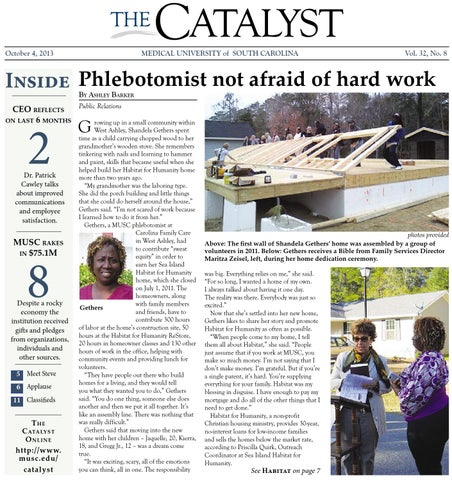
photos provided Above: The first wall of Shandela Gethers’ home was assembled by a group of volunteers in 2011. Below: Gethers receives a Bible from Family Services Director Maritza Zeisel, left, during her home dedication ceremony. was big. Everything relies on me,” she said. “For so long, I wanted a home of my own. I always talked about having it one day. The reality was there. Everybody was just so excited.” Now that she’s settled into her new home, Gethers likes to share her story and promote Habitat for Humanity as often as possible. “When people come to my home, I tell them all about Habitat,” she said. “People just assume that if you work at MUSC, you make so much money. I’m not saying that I don’t make money. I’m grateful. But if you’re a single parent, it’s hard. You’re supplying everything for your family. Habitat was my blessing in disguise. I have enough to pay my mortgage and do all of the other things that I need to get done.” Habitat for Humanity, a non-profit Christian housing ministry, provides 30-year, no-interest loans for low-income families and sells the homes below the market rate, according to Priscilla Quirk, Outreach Coordinator at Sea Island Habitat for Humanity.
See Habitat on page 7
2 The CATAlysT, October 4, 2013
CEO reflects on 183 days in medical center leadership By Cindy ABole Public Relations
M
USC’s Patrick J. Cawley, M.D., assumed MUSC hospital’s top role as of April 1. Cawley, who is the medical center’s executive director and chief executive officer and vice president of clinical operations, has spent the last six months meeting with leaders and staff across the hospital, practice plan and university about charting the medical center’s course for the future. In a recent interview with The Catalyst, Cawley paused to reflect on the last 183 days in his hospital leadership role.
Q
&
A
What were the top priorities in the medical center as of April 1? I came at a time of multiple challenges for the medical center. We had a mission that was threatened by cuts in educational funding, decreased federal funding for medical research and reductions in clinical income as a result of the Affordable Health Care Act. Cawley But prior to my start, I was able to work closely with interim director Kester Freeman to put together a financial improvement plan, which we call MUSC Performance Excellence and begin implementation of that plan. In addition, I was able to work with hospital leaders to set goals to improve the relationship between our 6,800 nurses, 950 physicians, our clinical care staff, employees and staff from six colleges. I also was able to work with MUSC Health’s Clinical Leadership Council to align goals and efforts. MUSC’s Performance Excellence Plan is clearly working as we’ve already seen progress. I show the Performance Excellence plan predominantly with a wheel graphic which represents a $100 million improvement in the medical center’s cost structure. The $100 Million Wheel represents goals (Procedure Center Standardization, Focus on Unit Cost, Palliative Care, Access Enhancement, Graduate Medical Education Funding, Patient Co-pays/Waivers and Huron Recommendations) within the wheel that must must be implemented within an 18-24 month period.
I see our medical center making progress on all parts of this wheel and I feel good about our plan in place for financial improvement. We’re making progress at a slow but steady pace each month. But we’re not done. We need to be better prepared as the country’s on the cusp of initiating the Affordable Care Act. Our changes will be essential. What were some other priorities that you set? I wanted to first focus on financial performance tightening in the medical center as that allows us to work on other priorities. Our other key priorities are health care reform, population health, and employee and physician engagement. But a constant key priority is maintaining our high quality, which is the key to MUSC’s success. We cannot rest on the quality improvement front. What areas do you want to see improvements? The medical center’s new electronic medical record system, Epic Go Live is scheduled to golive on the inpatient and revenue cycle areas on July 1. It is essential that we are well prepared for that go-live date. There’s also MUHA’s Access Initiative, which is all about making it easier to get patients into MUSC. Historically, we have not been the easiest place to access our physicians and services. We are making that much easier and have a goal for significant improvement in the next year. MUHA’s Clinical Leadership Council, which represents the hospital, the practice plan and the College of Medicine, continues to mature and work together. Since February, we’ve accomplished a lot by setting goals, making financial decisions, reviewing strategic investment and marketing decisions as a group and not separately. This approach is vital as the integrated approach helps us to use resources most appropriately in order to reach our strategic intent as one of the nation’s top academic medical centers. What’s the latest news about the MUSC Health Plan option? MUSC has been working with South Carolina’s Public Employee Benefits Authority since April to create a new insurance product called the MUSC Health Plan for 2014. The plan is one example how MUSC is actively exploring new strategies that manage health care costs within populations. The new plan will support benefits-eligible MUSC employees and their dependents and will utilize collaborations within the MUSC Health Plan Network, which is a Patient-Centered Medical Home model to help lower out-of-pocket costs. Employee premiums for the MUSC Health Plan will remain the same as the Standard State Health Plan and will not increase
in 2014. In addition, the MUSC Health Plan will have great preventive medicine benefits. Employees still have a choice as it relates to receiving care outside the MUSC Health Plan Network as they will be covered by the Standards SHP. Employees enrolled in Blue Choice HMO or SHP Savings Plan can be “grandfathered in” and retain their coverage. Also employees have the right to refuse health insurance coverage during the institution’s open enrollment period throughout October. I’d like to thank Betts Ellis, Dr. Mark Lyles and others for their dedication in coordinating this effort and finalizing the plan’s details under what’s been a tight timeline in order to start this plan in January. We will be heavily communicating the specifics of the plan in the coming months. What efforts have you done to improve employee communications? This is an area that I’ve spent a lot of time on in the past five months. My goal is to initially focus on teamwork using the sailboat metaphor as described in my first hospital town hall meetings. However, we can’t do good teamwork without very high communication abilities. So this has been a focus for me. I meet with our communications team every week and personally help work on messages we need to get out to employees and medical staff. I now send out three messages a week, which while coming from me, actually take a team to put together. These messages are geared to all employees, all leaders, or all medical staff. I do think we are doing much better with overall communications. The goal is to get information out faster and with
See Cawley on page 9
The Catalyst Editorial of fice MUSC Office of Public Relations 135 Cannon Street, Suite 403C, Charleston, SC 29425. 843-792-4107 Fax: 843-792-6723 Editor: Kim Draughn catalyst@musc.edu Catalyst staff: Cindy Abole, aboleca@musc.edu Ashley Barker barkera@musc.edu The Catalyst is published once a week. Paid adver tisements, which do not represent an endorsement by MUSC or the State of South Carolina, are handled by Island Publications Inc., Moultrie News, 134 Columbus St., Charleston, S.C., 843-849-1778 or 843-958-7490. sales@moultrienews.com.
The CATAlysT, October 4, 2013 3
4 The CATAlysT, October 4, 2013
New SmartState Center approved by review board By WAndA huTTo Office of Research and Devlopment The review board that oversees the state’s Centers of Economic Excellence SmartState Program has approved state funding for a new Center of Economic Excellence collaboration among the University of South Carolina, Clemson University and Health Sciences South Carolina. The newly approved Translational Biomedical Informatics SmartState Center plans to provide the critical mass of informatics experts to establish a stateof-the art biomedical informatics research hub in South Carolina with an academic center at MUSC. The center’s research will integrate with other IT organizations statewide to achieve a progressive vision of 21st century medicine that is personalized, preventative, predictable and participatory. In total, the Translational Biomedical Informatics SmartState Center received a $2 million award, which must be matched by private, federal or municipal funds. Kathleen T. Brady, M.D., Ph.D., an associate provost for clinical and translational science and professor in the College of Medicine at the MUSC, will lead the project and will work with Jihad Obeid, M.D.,
“Through methodological contributions to data sharing and analysis, the center will help to decrease cost and increase efficiency of our health care delivery and promote the development of cutting-edge technologies.” Dr. Kathleen Brady endowed chair for biomedical informatics in the Patient Safety and Clinical Effectiveness SmartState Center at MUSC; Jay Moskowitz, Ph.D., president of HSSC and endowed chair of the Healthcare Quality SmartState Center at USC; and Jim Bottum, vice provost and chief information officer for computing and information technology at Clemson University.
“Through methodological contributions to data sharing and analysis, the center will help to decrease cost and increase efficiency of our health care delivery and promote the development of cutting-edge technologies,” Brady said. “This center will enhance the state’s knowledge base in biomedical informatics by providing targeted instruction in master’s and doctoral-level degree programs, effectively establishing a continuum of formal informatics training programs.” “In addition to the statewide collaborations, the new center will act as the catalyst for extramural and interprofessional biomedical informatics research activities across the MUSC campus,” said Stephen Lanier, Ph.D., associate vice provost for research. “Another goal of the center is to strengthen the potential for research funding, industry partnerships and entrepreneurial opportunities in the biomedical informatics area in South Carolina.” The S.C. Centers of Economic Excellence Program was established by the South Carolina General Assembly in 2002. The legislation authorizes the state's three public research institutions (Clemson, MUSC and USC) to use state funds to create Centers of Economic Excellence in research areas that will advance the economy.
mEdiCal UnivErsity WOmEn’s ClUb hOnOrs stUdEnts With sChOlarships The Medical University Women’s Club scholarship chair, Tiffany Takacs, back row left, presents $20,000 worth of scholarship awards to 13 MUSC students: Laura Hoffman (Health Professions), back row from left, Pamela Vesely (Health Professions), Destine Hoover (Pharmacy), Katie Bliven (Pharmacy), and Callie Osborne (Medicine). Front row from left are Dayvia Lewis (Graduate Studies), Whitney Weigold (Health Professions), Anna Blair Price (Health Professions) and Sylvia Lee (Medicine). To support the scholarship fund, the club sells roses during commencement, sells of its cookbook and collects membership dues. Not pictured are Robert Whiteen (Graduate Studies), Kristen Baum (Health Professions), April Spitz (Dental Medicine) and Brandi White (Health Professions). For information, visit academicdepartments.musc.edu/ womensclub. photo by Sharlene Atkins, Public Relations
The CATAlysT, October 4, 2013 5
Meet Steve
Steve Paterniti Department Business Development & Marketing Services How you are changing what’s possible at MUSC By identifying the most profitable business from MUSC’s most loyal referring physicians. Family Bonnie, my wife of 15 years; sons, Thomas, Dave and Tim. How long at MUSC About 15 years Music in your player right now Contemporary Christian. Meal you love to cook Steve’s Famous Pasta. That’s what my wife and I call it. It’s a combination of pasta, sauteed vegetables, basil, olive oil and a secret blend of spices. Dream vacation To visit the land of my ancestors in Sicily Favorite quote “I am only one, but still I am one. I cannot do everything, but still I can do something.”—Helen Keller
6 The CATAlysT, October 4, 2013
UltrasOUnd maChinE dEdiCatEd tO Ed
ApplAuSe progrAM The following employees received recognition through the Applause Program for going the extra mile:
Members of MUSC’s Pediatric Emergency Department gather around for the dedication of a new ultrasound machine Sept. 5. More than $50,000 was raised by WEZL and Y102.5 radio stations from their Care for Kids Radiothon in February. Bottom left photo: Pediatric emergency physician Dr. Geoffrey Hayden uses the ultrasound on patient Demaria McNair, 23 months, while mom, Takia Sheppard, looks on. The ultrasound uses the most updated technology and allows ED physicians to make bedside assessments that lead to a faster diagnosis and response.
photos by Cindy Abole, Public Relations
The S.C. Lowcountry Society of Gastroenterology Nurses and Associates presents its Annual Fall Conference 2013 Oct. 18 - 20 at Marriott Grand Dunes Resort 8400 Costa Verde Drive Myrtle Beach, SC, 29572 Event registration for SGNA Members – $145, non-member – $165, GI Tech and Nursing Students – $75 Contact R’celle Boyd at boydrd@musc.edu or visit www.sclcsgna.org.
Medical Center Janice Quinn, Pulmonary Function Testing Lab; Gwen Parker, Star Ladson; Annie Williams, Amb Preop Clinic; Keri Walker, PACU; Debbie Cepeda, Women's Health Registration; Brenda Brown, Women's Health Registration; Aimee Tiller, Pediatrics; April Cooper, Financial Counseling Services; Lori McCall, Health Information Services; Jenna Delany, Surgery; Alison Carter, 8E; Dr. Gweneth Lazenby, OB/GYN; Sarah Palmatier, 6E Renal Transplant Nephrology; Sylvia Shrock, Transplant Administration; Pam Mayes, Children's Registration Georgia McCune, Children's Registration; Kelly Burns, ART 3W; Jonathan Hartman, ART 3W; Janice Pennelli, Pediatric Emergency Department; Kelly Laffey, Pediatric Emergency Department; Karen White, Labor & Delivery; Sibyl Lawrence, Postpartum; Elika Jordan, Postpartum; Monica Wigfall, Postpartum; Roberta Lockwood, Antepartum; Debra Heath, 7W; Jessica Hardy, Ultrasound Genetics; Deborah Jones, ART Patient Admissions; LinQuista White, ART Patient Admissions; Jennifer Wilson, MedSurg Registration; Sophia Orr, Meduflex Team; Paul Hasenfuss, Meduflex Team; Joshua Dakin, 10W Orthopaedics; Kimberly Wilky Owens, 10W Orthopedics; Fred Scruggs, 10W Orthopaedics; Elaine Cromwell, Venipuncture; Devonna Brown-Williams, ART Venipuncture; Ricky Greene, CH After Hours Care; Diane Dufour, Pediatrics Hematology/Oncology; Tamequa Durant, RT MedSurg Registration; Deb Cassidy, 6E Renal Transplant Nephrology; Shon
Gladden, General Surgery; Jennifer Griffin, Women’s Health Resident Practice; Sally Shields, Ultrasound Genetics; Barry Williams, Patient Transport Services; Shashidar Pai, Genetics; Kimberly Brown, Ultrasound Genetics; Kim Kirk, Ped Sub-Speciality; Stacy Messersmith, Ped Sub-Speciality; Martha Krauss, Lactation Center; Michelle Sharp, Women’s Services; Susan Gordon, Dialysis; Teavia Carter, 1W; Latoshia Greene, Meduflex Team; Corey Cox, Patient Safety; Linda Waite, HIS/Coding; Lucretia Wilson, Endoscopy; Vera Brown, RT Lab; Edrica Chaplin, RT Lab; Thomas Michael Smith, GI; Vickey Allen, GI; Eric Rice, Transport; John Oliver, Cast Tech; and Joy Simmons, GI Surgery Clinic. University Sushma Acharya, College of Dental Medicine; Kelli Adams, Radiology; Richard Anderson, Pediatrics; LaDeidra Berry, Human Resources Benefits Office; Carol Boyer, College of Medicine; Stacy Bramlett, College of Dental Medicine; Alfred Bryant, University Press; Michael Haschker, OCIO-Information Services; Katherine Helfrich, College of Dental Medicine; Karen Holmes, Mail Services; Toni Jackson, University Transportation; K. Taylor Joseph, Emergency Department; Jeri Lawing, Surgery; Cherylene Wood Lopez, College of Dental Medicine; Jaime Miller, Emergency Department; Gordon Mutter, Emergency Department; Angela Stevens, College of Dental Medicine; Sarah Thigpen, College of Dental Medicine; Michelle Vareltzis, Radiology; Tracy Washington, Urology Services; Debra Wood, College of Dental Medicine; L’Tanya Wright, Pharmacy; and Barbara Wallace, St. Luke’s Chapel.
Nomination currently being accepted for honorary degrees The Office of the President is accepting nominations for people to receive honorary degrees from MUSC, to be awarded at Commencement in May. In general, honorary degrees go to individuals in the following broad categories: Contribution(s) to the nation; Contribution(s) to science; and Contribution(s) to the state or MUSC. Consider submitting nominations
of candidates along with supporting materials such as letters, articles, curriculum vitae, etc., in the above mentioned categories. The nominations should be forwarded to Marcia Higaki, Office of the President, Colcock Hall, 179 Ashley Ave., MSC 001, higakimc@ musc.edu, no later than Oct. 25. Nominations of MUSC alumni are generally discouraged.
The CATAlysT, October 4, 2013 7
photo provided
Shandela Gethers’ home, pictured above, and all of the homes in West Ashley Joeva Cover are Earth Craft Certified for energy efficiency and handicapped accessible.
hABiTAT
Continued from Page One
Homeowners must meet income guidelines established by Housing and Urban Development. They also must have job stability, have a credit score of 610 or above, be a United States citizen or permanent resident, pass a background check and be able to provide tax records from the past two years. “The monthly mortgage on a brand new three-bedroom home – including escrow, taxes, homeowners insurance and termite bond – is between $500 and $525, depending on insurance,” Quirk said. “Some people believe we ‘give houses away,’ which is not the case. Our homeowners sign mortgages and are responsible for their bills just as other
homeowners are. Our partner families all work hard for their homes. Shandela Gethers is a great example of a Habitat homeowner.” There are five Habitat for Humanity International affiliates in the Charleston area: Berkeley Habitat, Charleston Habitat, Dorchester Habitat, East Cooper Habitat and Sea Island Habitat. Sea Island Habitat, the largest affiliate in Charleston, has built 300 homes on Johns, James and Wadmalaw islands, averaging 10 homes each year. For more information, visit seaislandhabitat.org. Those interested in receiving a Sea Island Habitat homeowner screening should email familyservices@seaislandhabitat.org or call 768-0998 ext. 111.
Share events on new calendar The Catalyst staff launched a new online seminars and events calendar in August with the help of the MUSC Office of Instructional Technology and Faculty Resources. The calendar – which can be found by going to academicdepartments.musc. edu/catalyst/calendar or by visiting The Catalyst website and clicking “Seminars & Events” in the left column menu – allows readers to submit their own events or search for events already listed. To add an event, click the “Submit Event” icon located above the calendar. The form will then ask for the submitter’s name and email, the event
name, type of event, location, start and end times and details. Submitters also have the option of adding keywords, contact information, sponsor name, Twitter account, a related link and registration information. Once the form is submitted, a member of The Catalyst staff will review the event and approve or deny it. Messages must be related to the mission of MUSC. Once approved, the event will be made available online within a few hours. Readers may also search for events based on location, type of event or keywords. The search features are available above the calendar.
8 The CATAlysT, October 4, 2013
Lift Team helps critically ill patients become mobile By Cindy ABole Public Relations
T
he staff of the Medical Intensive Care Unit held a luncheon Aug. 30 honoring members of the university hospital’s Lift Team. MICU nurses are involved in a pilot program that evaluates the benefits of early mobility of intensive care patients that has formed a collaborative relationship with the Lift Team and other physical therapists. The team, which is one of three teams based at the university hospital and at Ashley River Tower, has supported MICU and other inpatient units since its inception in 2002. The Lift Team assists the nursing and therapy staffs with patients who are physically limited in moving to change their positions or move from a bed to chair. MICU is a 17-bed adult critical care unit that cares for the hospital’s sickest and severely compromised patients. The nursing staff relies on the Lift Team for its quick response and skill with proper transfer techniques, which sometimes involves various lift equipment to help mobilize patients. The following are statements regarding the Lift Team:
Occupational and physical therapy manager Anne Benton, center, congratulates Joseph Collier, from left, PT technician; physical therapists Monica Zeigler; Jennifer Keevern; and PT technician Brad Lepper. a consistent basis. There have been numerous times when I could not have gotten a patient to the side of the bed or out of bed without their help. They have also been a huge help in transporting patients off the floor to and from procedures, and the patients absolutely love them! Their humorous and easygoing approach is the best medicine for these patients. We wish we could have them full-time.” —Jennifer Keevern, PT
due to the medical complexity and low level when a tech just isn’t enough help. They are quick to respond to a call, knowing that when I call I truly need the help. There are many patients that I would not have been able to get to the EOB or OOB without their assistance. This isn’t only true in the MICU, but once these patients transfer to the floor. It is great to have that sense of rapport built prior to transfer to the floor.” —Monica Zeigler, PT
“I cannot say enough about how helpful the Lift Team has been on
“I love our Lift Team. They are absolutely necessary for several patients
“A couple of weeks ago I cared for a patient who was in a very weakened
photo by Cindy Abole, Public Relations
condition. We called the Lift Team to assist us in getting this patient out of bed and into a wheelchair. The Lift Team arrived and helped us move this patient into the wheelchair safely. This was not a small effort as he was a tall, heavy-set man and very edematous. In addition to helping us safely transfer him, they accompanied us, along with respiratory therapy, off the unit. For the first time in weeks, he left his room, and we took him to the eighth floor to look out the window with his wife. It was a special moment for this couple. We could not have accomplished this without the help of our Lift Team. They consistently arrive with positive attitudes and help us to do amazing work with critically ill patients. I am so grateful for their presence and work ethic. Many thanks.” —Jess Burlington, R.N., MICU “The MUSC Lift Team is an invaluable component to the early mobility initiative in MICU. When the Lift Team arrives, everyone’s anxiety goes down. The Lift Team members are friendly, strong, and they communicate with patients and families in a gentle manner. They respond quickly to requests for help and don’t leave until the patient is settled and the OK is given from the rest of the team in the patient’s room. If I could have one wish, it would be to have Lift Team support 24/7! —Janet Byrne, R.N., MICU nurse manager
MUSC ends fiscal year with $75.1 million in donations By John nAsh Office of Development MUSC received $75.1 million in philanthropic gifts and pledges during fiscal 2013. Most of the year’s contributions ($39.2 million) came from individuals, followed by organizations ($15.6 million), foundations ($11 million) and corporations ($9.3 million). Of the amount that was donated by individuals, more than half ($21.9 million) was given by people who did not graduate from one of the university’s six colleges. The university realized sharp increases in many giving categories during the year. For example, corporate giving nearly doubled, as did giving by alumni ($14.8 million). Meanwhile, students enrolled at MUSC
donated eight times more (nearly $68,000) than in 2012. Also during the year, the MUSC Foundation’s investment portfolio achieved an 11.1 percent return, bringing the foundation’s total assets to more than $458 million. These philanthropically provided funds are used to pay for scholarships, endowed chairs, facility enhancements and a broad range of research, academic and patient-care programs. MUSC’s Interim President Mark Sothmann, Ph.D., said the year’s philanthropic support will help the university sustain and build upon the progress and momentum established by former President Ray Greenberg, M.D., Ph.D.,who left MUSC in August to serve as executive vice chancellor for health affairs at the
“We are tremendously grateful for this level of support.” Dr. Mark Sothmann University of Texas System. “We are tremendously grateful for this level of support. In many ways, we see it as an endorsement of Ray’s leadership and the institution that he helped build over the past 14 years,” said Sothmann. “With the team we have in place and the community’s continued generosity, I’m confident that MUSC’s best days are yet to come.”
The CATAlysT, October 4, 2013 9
CAWley
Continued from Page Two
more transparency. Our next focus is to evaluate and implement new methods of communication including more two-way conversations where we receive feedback from employees. The most successful medical centers do this very well. Since April we’ve enhanced medical center communication methods by introducing new formats such as my weekly messages and monthly Communication Cascades with key messages that leaders are expected to share with employees and medical staff. In July, we introduced mandatory town hall meetings using webinars to allow employees to watch the meeting from alternative locations. We were surprised by its popularity among employees and leaders. By our next town hall series (November), we hope to utilize better technology and software that allows us to comfortably handle hundreds of remote viewers at different locations. I’m also organizing a new Communications Advisory Group that will consist of 20 hospital employees from various work levels in the hospital to discuss hot topics, current issues and make recommendations about communication improvement. I’d also like to continue with the CEO’s one-onone lunch meetings with medical center employees to address concerns and answer questions. My plan is to expand those in the coming months. What have you done to improve employee satisfaction? We’ve not done a good job in the past focusing on employee satisfaction and engagement. If we have happy, satisfied and engaged employees, this leads to them providing better services and a higher quality of care for our patients. We need to first improve on employee satisfaction and engage employees through better communications and transparency. Secondly, we need to improve our leaders to deal with certain situations involving employees. So in August, we introduced Professionalism and the Just Culture programs to medical center leadership. Just Culture is a method in how leaders and employees approach
patient safety situations by investigating events and providing a response. Professionalism is a best practice that teaches employees to speak out or stop unprofessional behavior using key words. What qualities do you see are important in a new president? I’d like to see us choose a leader who is a great communicator and advocate for MUSC and South Carolina. This individual will have to interface with many people across the state in the areas of business, policy and South Carolina’s medical communities. We would benefit from someone who can further integrate and foster staff working at MUSC. This is an exciting time to be in health care and the person in this role has an opportunity to lead this institution through Health Care Reform, promote cutting edge science in the fields of genetics, biotechnology, nanotechnology, computers, etc. All this will change the way we deliver health care and it will be very exciting. What’s ahead for 2014? There are no changes to our current plan. As I see it, we’re in full-steam-ahead mode with our many initiatives already laid out. We’re dedicated to creating new ways for our employees to work better together. Through the University Health Consortium, we hope to collaborate more with other academic medical centers. On a statewide level, we’ll continue to work closely with the S.C. Hospital Association, and continue to improve health care for all South Carolina residents by providing guidance, support and leadership on projects. As for Health Care Reform (which officially begins Jan. 1), we won’t really know the full effects of this for another year or so. However, we will focus on controlling health care costs by exploring ways to deliver high quality care at low costs and evaluate new technologies that lead to improving overall care. fOr mOrE infOrmatiOn Read about Medical University Hospital Authority employee communications, visit mcintranet. musc.edu/muscexcellence/ communications/index.htm.
Temporary changes begin for parking, bus stops W
eather permitting, repair and repaving of the visitor parking lot on the south side (Spring Street side) of Harborview Office Tower began Sept. 30. There can be no through traffic until the work is finished in late October. The following provisions are being made for users of the MUSC transit system and for visitors who need to park at Harborview Tower while on business there. The bus stop for Harborview Tower and student AA lot will be temporarily relocated to Hagood Avenue just south of the entrance to the HT parking garage. The bus stop for the Lockwood lot and student BB lot will be temporarily relocated to Lockwood Drive outside of and just north of the Lockwood lot entrance/exit. Visitors who drive to Harborview Tower may park in the visitor spaces
that are located on the west end of the building. The garage entrance and exit gates will be in the open and upright position so that visitors may pass from Hagood Avenue through the garage to the visitor spaces. The rear driveway repaving is complete and open for exits from visitor parking and from the garage. While the garage gates are open, parking enforcement of the garage will be increased to prevent unauthorized use of the facility. This project is sponsored and funded by the MUSC Office of Parking Management. For information, call Mike Bouissey, parking maintenance and repair supervisor at 303-8640 or Jim Roche, manager, Parking Enforcement and Field Activities, at 478-7022.
10 The CATAlysT, October 4, 2013
EmplOyEEs CElEbratE 10 yEars Of sErviCE at mUsC
Employees and staff at the Medical University of South Carolina, top photo, and Medical University Hospital Authority employees, left photo, celebrate their years of service Sept. 10 (MUSC employees) and Sept. 11 (MUHA employees). Each year the Department of Human resources invite employees who have 10, 20, 30, 40 and 50 years of working at MUSC and MUHA. This year Interim President Dr. Mark Sothmann, center in both pictures, presented the employees with 10-year gold pins; 20, 30 and 40 years all received certificates of appreciation. photos provided by Anne Thompson, Digital Imaging
Dunkin’ Donuts, Children’s Hospital launch campaign Staff Report
D
unkin’ Donuts has partnered with MUSC Children’s Hospital to collect donations in all of its Charleston area restaurants from Sept. 30 through Oct. 13. A portion of the donation will also benefit the Southeast chapter of the Dunkin’ Donuts & BaskinRobbins Community Foundation. The mission is to serve the neighborhoods by supporting initiatives that address hunger, safety and children’s health. According to Barbara Rivers, director of development, MUSC Children’s Hospital, something special happens every time MUSC Children’s Hospital partners with the community in this way. “That’s when we’re all at our best. And so we’re tremendously
excited and grateful to the Dunkin’ Donuts and Baskin Robbins Community Foundation for this opportunity.” The MUSC Children’s Hospital donation will be used for books, toys, games and other materials designed to help young patients feel more comfortable during their hospital visit. “A big part of what makes the MUSC Children’s Hospital experience so special is the fact that we devote so much time and energy into making our patients feel as safe, comfortable, happy and stress-free as possible during their stay with us,” Rivers added. “This partnership will help us do that, in a very tangible way.” During the campaign, $1 donations will be collected to support MUSC Children’s Hospital and the Dunkin’ Donuts & Baskin-Robbins Community Foundation at all participating locations in the Charleston region.
For each donation, guests will receive a “Community Cup” to sign and display in the restaurant. Fifty percent of the donation will be donated to MUSC Children’s Hospital. The remaining 50 percent will be donated to the foundation and will be designated for grants to local charities in the Southeast that focus on hunger relief, safety and children’s health. Dunkin’ Donuts field marketing manager, Meaghan Duff said it’s amazing to realize that Dunkin’ Donuts can make a difference in the local communities. “Through The Dunkin’ Donuts & Baskin-Robbins Community Foundation, we are committed to giving back to the communities where we live and work, and look forward to further supporting local charities in the Southeast that focus on hunger relief, safety and children’s health,” she said.
The CATAlysT, October 4, 2013 11
Furniture
Misc. Services
King Size Plush Set New, will sacrifice for $200 843-501-3485
FALL CLEAN UP? Call Greg 843-303-2615 Great rates.
Bed-Queen Pillowtop that is Brand New in Plastic. Will take $150. Please call 843-270-4283
12 The CATAlysT, October 4, 2013
Clinical, Translational Research Ethics fellows honored Graduates of MUSC’s Fellowship in Clinical and Translational Research Ethics certificate program gathered Aug. 22 at Colcock Hall with MUSC leaders and faculty to celebrate the conclusion of their training with a certificate presentation and reception. Interim President Mark Sothmann, Ph.D., joined program faculty Robert Sade, M.D., and Dan Lackland, Ph.D., to congratulate the fellows. The program, created as a part of the clinical research ethics core of the S.C. Clinical and Translational Research Institute, used a variety of instructional methods and required courses to give participants a broad understanding of research ethics. According to Sade, professor in the Department of Surgery, the certificate program has been highly successful “In its two years of operation, we have had 33 fellows, and this year so far we have 15 fellows. It’s not too late to sign up for the program and the early sessions are available online,” Sade said. For information, call 876-4843.
photo by Cindy Abole, Public Relations
The fellows are Dr. Mohammed Al Gadban, Dr. Hibah B Al Nasiri, V Naga Mahesh Baratam, Avudaiappan Chokkalingam, Kalyan Chundru, Michelle Edwards, Priyadharshni Gnanasekar, Deepak Hire, Saurabh D. Jachak, Naveen Kannam, Shalini Kanukala, Daljit Kaur, Suchit Kumbhare, Mohan "Moby" Madisetti, Howard Powell Mandel, Beneta Parthiban, Janani Sridhar, John Theisen, Hitesh Verma, Riddhi Kaushik Zaveri and Stephanie Zeigler. Also joining the group are faculty and support staff including Dr. Andrea Boan, Dr. Perry Halushka and Megan Fier.