October 25, 2013
MEDICAL UNIVERSITY of SOUTH CAROLINA
Vol. 32, No. 11
Future of health care arrives with pilot plan
This month thousands of MUSC employees may opt into a new state health plan that is part of a state pilot program. The state Budget and Control Board approved MUSC’s collaboration with the S.C. Public Employee Benefit Authority to offer this type of plan to employees. The pilot will begin Jan. 1 and is expected to run two to three years, providing critical data for the development of plans that can be adopted across the state. It is based on a patient-centered medical home model. Patrick J. Cawley, M.D., MUSC vice president for clinical operations and executive director of the Medical University Hospital Authority, said MUSC has been laying the groundwork for this for awhile. A patient-centered medical home strategy team has been meeting for several years to prepare this model, and there’s watch been a separate group with a large a ViDeo number of enthusiastic supporters working to get the PEBA pilot plan on course, including core team www.musc.edu/ members: Mark Lyles, M.D., chief pr/newscenter/ strategic officer for the MUSC 2013/pcmh.html clinical enterprise; Karyn Rae, managed care; Betts Ellis, MUHA; Mark Stimpson and Dee Crawford of University Human Resources; David McLean, MUHA Legal Counsel; and Mark Sweatman, MUSC special assistant to the president, Columbia office. The next decade will bring radical changes to health care delivery, he said. Beyond this pilot project, hospitals are going to have massive capabilities when it comes to analytics, data and patient information. “Combine this model,” Cawley said of the electronic medical records that have been put in place, “with the future of genomics and knowledge about our own genes — combine all three of those things — and we’re looking at a very different type of care during the next 10 years and here at MUSC. We feel as a traditional academic medical center, we need to be on the cutting edge of that testing of what works and what doesn’t work. That is what we do best.”
6
Sickle Cell Researcher
Dr. Julie Kanter-Washko focuses on treating sickle cell disease.
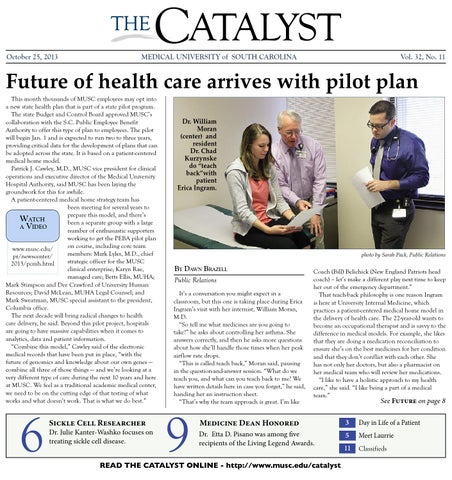
Dr. William Moran (center) and resident Dr. Chad Kurzynske do “teach back”with patient Erica Ingram.
photo by Sarah Pack, Public Relations
By Dawn Brazell Public Relations It’s a conversation you might expect in a classroom, but this one is taking place during Erica Ingram’s visit with her internist, William Moran, M.D. “So tell me what medicines are you going to take?” he asks about controlling her asthma. She answers correctly, and then he asks more questions about how she’ll handle those times when her peak airflow rate drops. “This is called teach back,” Moran said, pausing in the question-and-answer session. “What do we teach you, and what can you teach back to me? We have written details here in case you forget,” he said, handing her an instruction sheet. “That’s why the team approach is great. I’m like
9
Coach (Bill) Belichick (New England Patriots head coach) – let’s make a different play next time to keep her out of the emergency department.” That teach-back philosophy is one reason Ingram is here at University Internal Medicine, which practices a patient-centered medical home model in the delivery of health care. The 22-year-old wants to become an occupational therapist and is savvy to the difference in medical models. For example, she likes that they are doing a medication reconciliation to ensure she’s on the best medicines for her condition and that they don’t conflict with each other. She has not only her doctors, but also a pharmacist on her medical team who will review her medications. “I like to have a holistic approach to my health care,” she said. “I like being a part of a medical team.”
See Future on page 8
Medicine Dean Honored
3
Day in Life of a Patient
Dr. Etta D. Pisano was among five recipients of the Living Legend Awards.
5
Meet Laurrie
11
Classifieds
READ THE CATALYST ONLINE - http://www.musc.edu/catalyst
2 the catalyst, October 25, 2013
PeoPle Dr. Anne Osborne Kilpatrick Anne Osborne Kilpatrick, DPA, professor emeritus from the Department of Healthcare Leadership and Management, was awarded the Joan Fiss Bishop Award at the Section for Women in Public Administration meeting in New Orleans. The award is presented to a woman, who, by example and action, has promoted increased participation of women in the public service profession. Dr. Joseph Schoepf Joseph Schoepf, M.D., director of CT research and development, Department of Radiology and Radiological Science, was named the Most Influential Radiology Researcher for the 2013 Minnies awards by Aunt Minnie.com. The web site is a portal designed to support radiology professionals. For information, visit auntminnie.com.
Around Campus
photo by Cindy Abole, Public Relations
Repaving and upgrades to Harborview Office Tower’s visitor parking lot (Spring Street side) continue until the end of October. Visitors may continue to park in spaces located at the west end of the building. The project is sponsored and funded by the Office of Parking Management.
Dr. Craig Velozo Craig Velozo, Ph.D., was named a professor and director of the Division of Occupational Therapy of the Department of Health Professions in the College of Health Professions on July 1. Velozo is a nationally recognized occupational therapy educator and researcher.
Matt Wain Matt Wain is the new chief operating officer for the medical center. He will manage the service lines, help develop cost-effective programs and services and align organizational strategies. Wain, who started Oct. 1, came from Penn State Hershey Medical Center in Hershey, Pa.
eVents Biomedical Career Fair College of Graduate Studies will host a Professional Development and Career Fair for Biomedical Scientists Nov. 7. The fair introduces students to other types of non-academic careers in science. Participants will talk to presenters via a panel, see exhibits, review networking opportunities and participate in a workshop. It coincides with the Perry V. Halushka Student Research Day Nov. 8. Register at http://tinyurl. com/mnqdzeg.
Make a Difference Holiday Assistance The Salvation Army is taking applications through Nov. 1 for holiday assistance at 2135 Ashley River Rd. Call 763-9881. Epilepsy Awareness Night Join MUSC, the S.C. Advocates for Epilepsy and the Stingrays Nov. 16 for hockey and a silent auction. Proceeds support the Research and Education in Epilepsy Fund. The Stingrays will be wearing signature jerseys and there will be a jersey auction during the game. To purchase tickets, visit groupaide. com (Group code HH4E).
Campus security, crime statistics report available Editorial of fice MUSC Office of Public Relations 135 Cannon Street, Suite 403C, Charleston, SC 29425. 843-792-4107 Fax: 843-792-6723 Editor: Kim Draughn catalyst@musc.edu Catalyst staff: Cindy Abole, aboleca@musc.edu
The Catalyst is published once a week. Paid adver tisements, which do not represent an endorsement by MUSC or the State of South Carolina, are handled by Island Publications Inc., Moultrie News, 134 Columbus St., Charleston, S.C., 843-849-1778 or 843-958-7490. E-mail: sales@moultrienews.com.
The MUSC Department of Public Safety is committed to providing the safest environment possible for work and study. Part of that commitment involves providing information about campus security to current as well as prospective students and employees. This report, prepared in compliance with the Jeanne Clery Act Disclosure of Campus Security Policy and Campus Crime Statistics Act, outlines the university’s policies and discloses campus
crime statistics. This report contains the past three years’ statistics for certain types of crimes that were reported on campus. It may be accessed online at website http://academicdepartments.musc.edu/ vpfa/publicsafety/reports/clery_report. htm. A hard copy of this document may be obtained upon request by contacting or visiting the MUSC Department of Public Safety at 101 Doughty St., Charleston, S.C. 29425, or by calling 792-2261.
the catalyst, October 25, 2013 3
Employees invited to see integrated medical record By Megan fink MUSC Epic Program Moving toward an integrated electronic health record system not only satisfies government mandates, but it improves patient outcomes. A new report by the Agency for Healthcare Research and Quality has even linked IT products that offer clinical workflow support and coordination to better results in care. MUSC’s integrated EHR system, Epic, is our link to improved health care outcomes by creating a single patient platform on which everyone on the care team can document. During the week of Nov. 4, employees will have the chance to see what our integrated record will look like – scheduling, clinical care including the Clinical Practice Model content and billing. On Nov. 4 – 6, the MUSC Epic project team will demo the system by highlighting “a day in the life of a patient.” Attendees will understand how one
photo provided
The Epic team performed the first round of integrated testing the week of Oct. 7 to ensure all pieces of the electronic health record work properly together. patient moves through the EHR system when transported around the hospital. The focus is on the continuum of care throughout the patient’s record — one flowsheet, one care plan, and one problem list for all disciplines. Staff will see the patient safety features of Epic,
such as medications and allergy warnings originating from various areas and patient banner information. “The ‘Day in the Life’ walkthrough is an opportunity for end users to get a birds-eye view of what an integrated medical record really means,” said Kay
Burke, MUSC Epic Inpatient Clinical Systems manager. “The concept of ‘one record—one patient’ can be vague, particularly since clinicians have been accustomed to fragmented systems for so long. The inpatient clinical applications and revenue cycle applications have been working alongside staff to build this integrated end product, and we’re excited to showcase our combined efforts.” Clinicians will walk away with a clearer idea of how our integrated EHR looks and functions, how Epic touches their respective areas, as well as get a glimpse of some of the numerous patient-safety features built into the product. The same demo will be offered at: q Nov. 4: 7 to 8 a.m., Room 402, Basic Science Building; 1 to 2 p.m. and 5 to 6 p.m., Room 1119, Ashley River Tower q Nov. 5: 7 to 8 a.m., Room 402, BSB; 1 to 2 p.m., Room 100, BSB; 5 to 6 p.m., Room 402, BSB q Nov. 6: 7 to 8 a.m., Room 402, BSB; 1 to 2 p.m. and 5 to 6 p.m., Room 1119, ART.
4 the catalyst, October 25, 2013
the catalyst, October 25, 2013 5
Meet Laurrie
Laurrie Rumpp, R.N. Department Surgery - Division of Surgical Oncology How you are changing what’s possible at MUSC I come to MUSC and give 110 percent to my cancer patients and their family members in hopes of making a difference and a positive impact in their lives. How long at MUSC 15 years A unique talent you have I love to party plan, from planning an annual HOA Christmas party to hosting a Pink Party for a Purpose breast cancer fundraiser. I’m always up for brainstorming and executing a fun event. Meal you love to cook Dessert. I would love to serve dessert for breakfast, lunch and dinner. Favorite restaurants There are so many Charleston restaurants to choose from. The Boathouse on Breach Inlet is a special place for my husband and me. We enjoyed our post-engagement party and many anniversary dinners there. Best thing about living in Charleston Being close to my sweet family, wonderful friends and so many fun things to do
6 the catalyst, October 25, 2013
Researcher wants to transform treatment of sickle cell disease By lauren sausser Of the Post and Courier Staff It’s hard to say how many adults suffer from sickle cell disease in South Carolina because the government only starting tracking new cases of the inherited blood disorder in 2000. But the new director of sickle cell disease research at MUSC wants to get to the bottom of it. Julie Kanter-Washko, M.D., recently moved to the Lowcountry from Louisiana and intends to make MUSC a leader in treating sickle cell disease. “We are incredibly fortunate to recruit her,” said Pat Votava, an advocate for the MUSC Children’s Hospital. Kanter-Washko, a trained pediatric hematologistoncologist and the former director of the Sickle Cell Center of Southern Louisiana at Tulane University, recently discussed her professional goals with The Post and Courier. Her responses have been edited for length.
Q
&A
Are there similarities between Louisiana and South Carolina, with sickle cell disease specifically? The real problem is resources, so when (patients) age out of childhood, they have no resources — this is whether you’re in Atlanta, New Orleans, South Carolina. There’s very few places that continue to maintain their insurance. The biggest problem is it becomes a Catch-22. So patients, to maintain insurance, will obtain Social Security disability status, which is highly unfortunate because most of them aren’t disabled and a good portion of them want to work and are very capable of it, but they can’t go to work because they’ll lose their insurance and if they lose their insurance, then they’ll be too sick to work. So it’s a really bad Catch-22. What are the statistics? Do you have any South Carolina specific numbers? So there is no national registry, which is interesting. It’s very different than a lot of the other genetic diseases where we have really good numbers. We estimate in the United States about 70,000 to 100,000 are affected by sickle cell disease. In South Carolina ... there’s a very large population of patients with sickle cell disease per population number. So compared to Louisiana, which is a bigger state, there are far more affected individuals here. Why can’t we pinpoint an exact number? By 2000, all 50 states had to diagnose sickle cell disease by newborn screening. It’s a heel stick. Literally
photo by Brad Nettles, Post and Courier
Dr. Julie Kanter-Washko checks in on 7-year-old Diamond Rhodes at MUSC Children’s Hospital. Kanter-Washko is the director of MUSC’s Sickle Cell Disease Research Center. you take blood from the heel. It’s done everywhere. There’s an array of disorders you can diagnose with less than 2 milliliters of blood from that heel stick, one of which is sickle cell disease. Each state has its own different panel of diseases that they diagnose by newborn screening, but some of them are mandatory federal law, and sickle cell is one of those. So we can track how many babies are born in South Carolina now, but that wasn’t required before 2000, so it’s hard to pinpoint the total number? Prevalence data is minimal. Sickle cell disease, it’s really incredibly underfunded. It’s sad and pathetic, actually, how underfunded it is. It’s a disease that we’ve known about since 1910 ... and yet despite the fact that it’s been around for 103 years, we only have one FDA-approved drug that actually helps the disease and no registry, no really strong national support system and it’s underfunded compared to cystic fibrosis, which is a good comparison because cystic fibrosis is also a genetic disease with mortality that tends to be in that third and fourth decade of life, with limited treatment options as patients get older. And if you compare their funding ... it’s something like 5 to 1. It’s something like for every $500 a cystic fibrosis patient gets, a sickle cell patient gets $10 — 50 to one. I was off by a factor. It is incredibly — it’s a horrible
health disparity. What made the move to MUSC seem like the right fit? New Orleans is a difficult place to work. It’s just not a progressive atmosphere to improving the care of children, to improving the care of anyone, but specifically children. Is that Louisiana as a whole, or is that just New Orleans? I think it’s Louisiana as a whole. I think there’s some areas that are improving. They have a fabulous new director of Medicaid — I can’t say enough good things about. I really think she’s going to make improvements. Is there reason to believe attention paid toward sickle cell disease by the medical community is improving? Sickle cell is a hot topic nationally. Unfortunately the reason it’s a hot topic — I’m glad it’s a hot topic because it’s getting attention finally — but the reason for that is readmission rates. Now, no one wants to pay for 30-day hospital readmissions. Sickle cell in Louisiana was the second-highest cause of readmission rates. In South Carolina, it’s at the top three. I don’t know what position it holds. From a
See sickle on page 7
the catalyst, October 25, 2013 7
sickle
Continued from Page Six
financial standpoint, which is where a lot of medicine is headed, sickle cell has become a hot topic. How would you like to change the treatment of this disease? I want to design a bundled care plan ... where patients with sickle cell disease are insured throughout their lives. It crosses both sides of the party lines. It’s the right thing to do. We should have access to health care. It’s also, on the more conservative side of things, it’s a good economic model. Patients should work. Especially on the very conservative side, everybody wants you to pull up your bootstraps and work, well, nobody is giving these people an opportunity to work. What is sickle cell disease? Sickle cell disease is a range of hereditary blood disorders, the most common of which is called sickle cell anemia. The disease affects the body’s red blood cells, distorting the cell’s shape into an “S” or a sickle shape, according to the National Institutes of Health. The distorted shape blocks blood flow, causing pain and internal organ damage. The federal government estimates one in 500 AfricanAmericans suffer from sickle cell disease. According to
“It’s a disease characterized by chronic pain, and the older patients get, the more pain they have. The pain is very real and very terrible.” Dr. Julie Kanter-Washko 2012 data compiled by the S.C. Department of Health and Environmental Control, 63 infants were born with confirmed cases of sickle cell disease in the state last year. “It’s a disease characterized by chronic pain, and the older patients get, the more pain they have. The pain is very real and very terrible,” said Kanter-Washko, MUSC’s new director of sickle cell disease research. “On top of that, it’s stigmatized. There’s a lot of people out there who still inappropriately think it’s a disease of drug seekers ... which is the most inaccurate representation of sickle cell.” The average life expectancy for a patient with sickle cell disease is mid-40s, according to the Sickle Cell Disease Association of America. Editor’s note: The article ran Oct. 14 in The Post and Courier and is reprinted with permission.
Registration is free but required. Visit sctr.musc.edu
8 the catalyst, October 25, 2013
future
Continued from Page One
It shows, as Ingram pops back answers to Moran. She’s as motivated as her team to manage her asthma as well as she can. This health care model depends on patient participation and empowerment. Patrick J. Cawley, M.D., MUSC vice president for clinical operations and executive director of the Medical University Hospital Authority, said it’s the perfect timing for MUSC’s collaboration with the S.C. Public Employee Benefit Authority to offer this type of plan to MUSC employees. “We were ecstatic about this,” Cawley said. “We’ve had a group here at MUSC working with a group at PEBA since April. They’ve been working very hard, meeting almost every week working out the details of the plan. At the beginning, I thought there was a slim chance we’d have it done for January 2014, but the group worked hard, and they got it done. We want to try this at MUSC, so that’s why we got moving quickly.” cost containMent The reason MUSC is the perfect collaborator with PEBA is that most employees already receive their care at MUSC, Cawley said. The plan offers a way for employees and MUSC to avoid the 10 to 15 percent rise in insurance premium costs in exchange for using the plan. “These are our own employees, and they are likelier to work with us and perfect our plan. We’re seeing our cost of care go up very fast. We think we have an opportunity to intervene and do something about that. The way this works is we are going to provide financial incentives for the patient to get their care through the patient-centered medical home. It’s less expensive care and better care.” The primary care physician serves as the hub of a team of care providers in this model. All the primary care parts of MUSC will be involved: Carolina Family Care, General Internal Medicine, General Pediatrics and Family Medicine – and all are or will be certified as patient-centered medical homes before January. Controlling rising medical costs is the number one driver of this plan, but
healthier population. Cawley said the primary care providers will be looking at the high utilizers, a task made easier by the use of electronic medical records, and doing strategic outreach so that patients with such conditions as diabetes or high blood pressure, for example, get the preventive care they need. “Medical care is incredibly complicated – it’s one of the most complicated things we do across any business in the United States. We simply have not had the tools.” Now that’s changing, especially with electronic medical records. “If you don’t have the data, you can’t do the reaching out. It’s data that needs to be monitored to see what’s working and not working and who is not showing up.” photo by Sarah Pack, Public Relations
LPN Melissa Nolan checks on Erica Ingram’s vital signs.
not the only one. “The second reason is that as a health care provider, we’re in a very unique circumstance to provide health care in a way that’s innovative and different. A car builder can’t provide health care to their employees but we can,” Cawley said. “The third reason to do it is that we’re the state’s leading educator in terms of medical education. We have to teach the next generation of nurses, and medical students and physical therapists et cetera how to practice medicine that’s better quality at a less expensive cost.” One way is patient empowerment. “I’m a physician and have dedicated my entire career to quality improvement and continuous improvement,” Cawley said. “We need a feedback loop here and the feedback loop is the patient. We can put this plan together, but we really need to seek input to see if it’s working the way it should be. If it’s not we need to modify and tweak it. It’s called the continuous learning wheel.” Another driving force is better data. Eighty percent of the health care dollars are spent by 20 percent of the population. In the patient-centered medical care model, the team does triage on its patients by figuring how to better deal with sicker patients so they get the preventive care they need and reduce costs, while still offering easy access to its
Data rules Mention data, and Moran’s face lights up. With extensive experience in a patient-centered medical home model and is trained as an epidemiologist, he knows what a difference data can make as a division director and a UIM physician. “We need to build experience in this,” he said. “Most people here have never been exposed to a managed-care model. There’s also not a lot of experience within MUSC with managed care, and there’s not a lot of experience with ‘tell me my numbers.’” Moran said he has gone to family care doctors and asked what their control rate with blood pressure is for their patients and gotten the response that they think it is “pretty good.” “I can tell them mine is 69 percent, and I can tell you the patients who are out of control and that we’re working with. Working with data is working with populations. That’s one of the huge things we’ve developed with UIM. We have incredible data management. It’s tough to look good when you don’t know your numbers. You don’t know how well you’re doing.” On his staff is health economist Patrick Mauldin, Ph.D., who has more than 20 years experience and can be called anytime for data reports. If Moran wants to see what hospital readmissions are for nursing home patients, for example, he gives Mauldin a call and two minutes later he has the data he needs,
he said. If he wants to know which patients aren’t showing up for their appointments, he can find that out, too. Moran said he worries most about the patients not showing up.“If you’re not coming into clinic, you’re much likelier to end up in the ED or the hospital. If you cancel or are a no show for an appointment, it dramatically increases your chances of ending up in the hospital, particularly for certain diseases. If it’s ‘I’m too sick to go to the doctor,’ that’s not a good sign.” thinking outsiDe the Box Moran said he and the many others serving on MUSC’s Patient-Centered Medical Home strategy team love the challenge of setting up better health care delivery models.“There are a lot of reasons why people access services the way they do. We have to build a system that patients like to use — and prefer to use — rather than alternatives like the ER that are more expensive.” His nurses have 1,400 patients each to manage, which may sound like a large load, except only 20 percent have health conditions that require frequent care. Seventy percent of the patients are young and relatively healthy. The question for those patients is how to facilitate their access and care since they generally have jobs and busy schedules. One solution is electronic visits for straight-forward cases, which saves time for the patient and physician. “How many electronic visits can I do in an hour? A lot. Then my time is reserved for those really sick patients who need to talk for awhile,” Moran said. Health care providers on a patientcentered model focus on better patient education. “So when you do a foot exam for a diabetic and do education about how to not get an ulcer on your foot, it’s a worthwhile investment,” he said, citing statistics about the costs of amputations on the health care system.“Eyesight is the same way. What’s the cost of blindness? If you can laser a diabetic’s eyes and prevent blindness, that’s a good thing,” Moran said. Editor’s note: To see the full multimedia package, visit MUSC News Center, www. musc.edu/pr/newscenter.
the catalyst, October 25, 2013 9
Pink Glove 2013
Voting begins at noon, Oct. 25 through Nov. 8 MUSC entered the Medline Pink Glove Dance Competition for a chance to win a $25,000 donation to a local breast cancer charity and international social media attention — and needs your vote. This year, MUSC chose a storyline that follows a “pink glove guardian angel” set to the allowed 90 seconds of Fun’s “Carry On.” With group dance scenes and the portrayal of a
photo provided
College of Medicine Dean Dr. Etta Pisano, second from left, joins 2013 honorees of the Third Annual de Pizan Honors Living Legends Award. With Pisano is, from left, Denyce Graves (opera singer), Phylicia Rashad (entertainer), and Joan Bradley Wages (National Women’s History Museum president and CEO). Not pictured are honorees Sally Jewell (Secretary of the Interior) and Ken Burns (documentary filmmaker).
Medicine dean receives Living Legend honor Staff Report Breast cancer screening radiologist Etta D. Pisano, M.D., was recognized among five honorees for their historic achievements with the Third Annual de Pizan Honors held Oct. 9 at the Mead Center for American Theater in Washington, D.C. The awards are sponsored by the National Women’s History Museum. Pisano, who is dean of the College of Medicine and vice president for Medical Affairs, joined Denyce Graves, a mezzo-soprano opera singer; Sally Jewell, U.S. Secretary of the Interior; Phylicia Rashad, entertainer; and Ken Burns, documentary filmmaker; as a 2013 Living Legend honoree. “To be recognized for your life’s work with the Dr. Helen Taussig Living Legacy Award by an organization like the National Women’s History Museum is, to say the least, humbling. It serves as an inspiration as we continue to advance breast imaging research and it provides a moment to pause and recognize women
pioneers in medicine like Dr. Taussig, who forever changed our place in this field,” Pisano said. Pisano joined MUSC in July 2010 and was former vice dean for academic affairs at the University of North Carolina School of Medicine, director of UNC’s Biomedical Research Imaging Center and the Kenan Professor of Radiology and Biomedical Engineering. Her life’s work has focused on the development and testing of imaging technology for the early detection and diagnosis of breast cancer. She is widely known for serving as principal investigator of the largest clinical trial ever run by a radiologist. The Digital Mammographic Imaging Screening Trial enrolled nearly 50,000 women in a study comparing digital to film mammography, the results of which were published in 2005 in the New England Journal of Medicine. A champion of diversity, mentoring and work-life balance, Pisano is a mother of four and one of only about a dozen women medical school deans in the country. She is the first at MUSC.
cancer patient by MUSC’s Children’s Hospital’s Melissa Martin, R.N., and her family, MUSC uses pink-colored exam gloves to raise awareness about the importance of early detection through mammograms. To vote for MUSC’s video, visit http://www.pinkglovedance.com/ videos/2013-video-contest/medicaluniversity-of-south-carolina/. Winners will be announced Nov. 15.
10 the catalyst, October 25, 2013
the catalyst, October 25, 2013 11
Items for Sale
Misc. Services
King Size Plush Set New, will sacrifice for $200 843-501-3485
FALL CLEAN UP? Call Greg 843-303-2615 Great rates.
Bed-Queen Pillowtop that is Brand New in Plastic. Will take $150. Please call 843-270-4283
12 the catalyst, October 25, 2013