January 31, 2014
MEDICAL UNIVERSITY of SOUTH CAROLINA
Vol. 32, No. 23
Novel migraine surgery brings hope Inside BY DAWN BRAZELL Public Relations
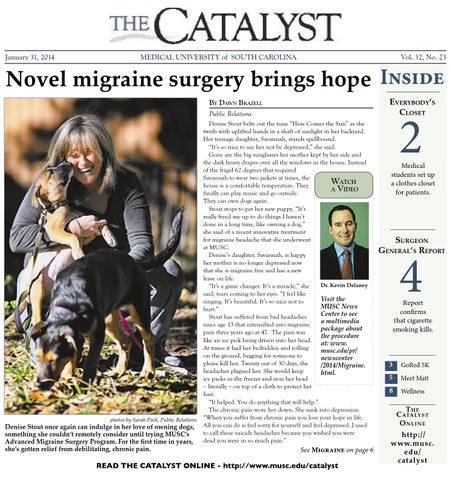
Denise Stout belts out the tune “Here Comes the Sun” as she twirls with uplifted hands in a shaft of sunlight in her backyard. Her teenage daughter, Savannah, stands spellbound. “It’s so nice to see her not be depressed,” she said. Gone are the big sunglasses her mother kept by her side and the dark heavy drapes over all the windows in the house. Instead of the frigid 62 degrees that required Savannah to wear two jackets at times, the WATCH house is a comfortable temperature. They A VIDEO finally can play music and go outside. They can own dogs again. Stout stops to pet her new puppy. “It’s really freed me up to do things I haven’t done in a long time, like owning a dog,” she said of a recent innovative treatment for migraine headache that she underwent at MUSC. Denise’s daughter, Savannah, is happy her mother is no longer depressed now that she is migraine free and has a new lease on life. Dr. Kevin Delaney “It’s a game changer. It’s a miracle,” she said, tears coming to her eyes. “I feel like Visit the singing. It’s beautiful. It’s so nice not to MUSC News hurt.” Center to see Stout has suffered from bad headaches a multimedia since age 13 that intensified into migraine package about pain three years ago at 47. The pain was the procedure like an ice pick being driven into her head. at: www. At times it had her bedridden and rolling musc.edu/pr/ on the ground, begging for someone to newscenter please kill her. Twenty out of 30 days, the /2014/Migraine. headaches plagued her. She would keep html. ice packs in the freezer and iron her head – literally – on top of a cloth to protect her hair. “It helped. You do anything that will help.” The chronic pain wore her down. She sank into depression. “When you suffer from chronic pain you lose your hope in life. photos by Sarah Pack, Public Relations Denise Stout once again can indulge in her love of owning dogs, All you can do is feel sorry for yourself and feel depressed. I used to call these suicide headaches because you wished you were something she couldn’t remotely consider until trying MUSC’s dead you were in so much pain.” Advanced Migraine Surgery Program. For the first time in years, she’s gotten relief from debilitating, chronic pain. See Migraine on page 6
READ THE CATALYST ONLINE - http://www.musc.edu/catalyst
EVERYBODY’S CLOSET
2
Medical students set up a clothes closet for patients.
SURGEON GENERAL’S REPORT
4
Report confirms that cigarette smoking kills.
3
GoRed 5K
5
Meet Matt
8
Wellness
THE C ATA LY S T ONLINE
http:// www.musc. edu/ catalyst
2 THE CATALYST, January 31, 2014
Medical students establish Everybody’s Closet BY MIKIE HAYES Public Relations
N
ot every patient arrives at the hospital adequately dressed or even in clothes they will be able to leave in for that matter. Emergencies create situations that people aren’t able to anticipate and under typical circumstances, clothes are one of the last things on a patient’s mind. What happens when a trauma patient arrives by ambulance in clothes that are torn, covered in blood or destroyed from having been cut off? Or a homeless man is admitted to the hospital in clothes so threadbare or soiled he couldn’t possibly leave in them? Or an indigent woman walks in to the Emergency Department wearing clothing that in no way protects her from the outside elements? Such are the realities health care providers see every day. When a patient has no appropriate clothes to leave in at the end of a hospital stay, it is common for them to be sent home wearing a set of disposable "paper scrubs" that the hospital provides. This situation concerned a group of College of Medicine students who couldn’t bear sending people out of the hospital, possibly even back onto the streets, wearing nothing more than thin paper scrubs. While this has been the accepted practice across the country, the students wondered if there were a better solution. When the members of the Paul B. Underwood Jr. Chapter of the Gold Humanism Honor Society (GHHS) met to discuss this challenge, they came up with the idea to create Everybody’s Closet, a storehouse designed to house certain wardrobe items and provide patients with clean, gently-used clothing to wear when they leave. Evie Smith, a fourth–year medicine student and co–president of the GHHS at MUSC, respectively, has seen many cases that have left an indelible impression on her heart, fueling her desire to see Everybody’s Closet become a reality. Perhaps the most disturbing case was a patient who had been discharged from the
Editorial of fice MUSC Office of Public Relations 135 Cannon Street, Suite 403C, Charleston, SC 29425. 843-792-4107 Fax: 843-792-6723 Interim editor: Cindy Abole catalyst@musc.edu Catalyst staff: Mikie Hayes, hayesmi@musc.edu
photo by Mikie Hayes, Public Relations Co–presidents Evie Smith and Dave McCabe, fourth–and third–year College of Medicine students, respectively, serve with the Paul B. Underwood Jr. Chapter of the Gold Humanism Honor Society. They are spearheading the Everybody’s Closet project.
hospital and readmitted three weeks later wearing the same paper scrubs she had left in — likely having worn them during the duration, she said. “Patients have been through such frightening ordeals and situations that can be demeaning. They should not have to leave in paper scrubs or bloody clothes. They deserve to leave in comfortable and appropriate clothing. It’s something so simple that we can do for people,” Smith said. The GHHS received permission to move forward with this project and they have fashioned a designated
The Catalyst is published once a week. Paid adver tisements, which do not represent an endorsement by MUSC or the State of South Carolina, are handled by Island Publications Inc., Moultrie News, 134 Columbus St., Charleston, S.C., 843-849-1778 or 843-958-7490. E-mail: sales@moultrienews.com.
area in the triage area of the Emergency Department where MUSC staff can pick out size and weather appropriate attire for a patient who has no clothing to wear home. By providing this resource, they feel a patient has been treated most respectfully. To properly stock the closet, GHHS students announced an on–going clothing drive and are asking for donations of all types of gently used, comfortable clothing, with a particular need for T-shirts, sweat pants and warm outerwear of all types. Clothes are needed for men and women and larger sizes are extremely helpful. In addition they desperately need new undergarments and socks for men and woman, again larger sizes are most helpful. No children’s items are needed at this time. Currently, the area where the clothes are stored is little more than four cabinets labeled with sizes for men and women. They are trying to secure a grant to enable them to build shelves and buy hangers, so it’s more user–friendly, and ultimately, a larger space with which to work. When fully stocked and operational, Everybody’s Closet will provide a valuable resource for patients at MUSC. While it will initially help patients in the Emergency Department, the GHHS students plan for it to quickly grow to serve many areas of MUSC and to be a permanent source of help. Their labor of love will officially begin on Valentine’s Day, Feb. 14, coinciding with the Gold Society’s National Solidarity Day for Compassionate Patient Care 2014. Solidarity Day recognizes the importance of compassion between health care professionals and their patients and encourages health care professionals to put more thought and reflection into what they observe and what they can do to incorporate humanism into the medicine they practice. It also serves as a positive reminder of how small acts of kindness can make a very big difference in a patient’s care.
See Closet on page 10
Nominations being accepted for awards A call for nominations is underway to all faculty and students. The purpose of these awards is to recognize members of the MUSC faculty who have made outstanding contributions to the university through teaching. Awards may be given from the Clinical/Professional (Educator-Mentor); Scholarship/Academic (EducatorMentor); Educator-Lecturer; and Developing Teacher. Any regular, full-time faculty member who holds an academic rank
of instructor or higher in a college or department of MUSC, who has not been the recipient of this award within the previous three years is eligible for nomination. The deadline for nominations is Jan. 27. Nominees will be invited to submit supporting materials, and a committee of faculty and students will select the recipients for this year’s awards. Forms may be found at http://www. carc.musc.edu/nomination/. For information, call 792-2228.
THE CATALYST, January 31, 2014 3
Physician helps launch Go Red race for women BY ALLYSON BIRD
Office of Development & Alumni Affairs
M
arian H. Taylor, M.D., remembers the day a young cytogenetics technician named Stephanie Carter contacted her, asking if Taylor would help start a race in memory of Carter’s mother, who died from a heart attack at age 47. “She sent me letter explaining what she wanted to do and how important her mom had been to her,” said Taylor, a cardiologist with a passion for women’s heart health. “I couldn’t imagine not helping her try to do this.” The two women shared an interest in running and a calling to educate people about heart disease, the No. 1 killer of women. The rest, they decided, they would figure out as they went along, including U.S. Track & Field certifications, town permits, sponsorships and volunteers. That one letter exchanged between strangers launched the Go Red Heart 5K Run and Walk in memory of Robin Seay which, on Feb. 1, will mark its fourth year. “I can't overstate my appreciation for Dr. Taylor,” Carter said. “She put in a lot of time, time that I know she doesn’t have, to make my dream for this event a reality.” Taylor handles everything from hiring emergency staff to filling race bags to handling packet pick-up. “We hear so much about breast cancer, but so many more women
photos provided
Stephanie Carter, left, and Dr. Marian Taylor organize the annual Go Red Heart 5K Run and Walk in memory of Robin Seay.
die from heart disease than breast cancer,” Taylor said. “I thought, if we could have a successful run and walk, we could show women that they can have fun when they exercise.” Taylor grew up in Puerto Rico, but her mother was born in Lake City, and her uncle, an MUSC alumnus, practiced gynecology in Greenville. Taylor aspired to
become a social worker at an orphanage, but her father told her he would only pay for medical school or law school. “My brother is a lawyer,” she said. “But because I’m horrible at confrontation, I went to medical school.” She graduated from the MUSC College of Medicine in 1994. Taylor discovered her dedication to heart health while completing a fellowship in rheumatology and researching the connection between scleroderma, a chronic autoimmune disease, and heart disease. Over the years, Taylor also realized how women often put themselves last, making time for cooking, cleaning and caring for their families at the expense of their own health. “I tell them, if they don’t have time for exercise, they’re going to have to find time for disease, because it’s going to catch up with them,” she said. Taylor hopes this year’s race will draw the most runners and volunteers yet, with proceeds benefitting the American Heart Association’s Go Red for Women Campaign and the MUSC’s Women’s Heart Care Program. Editor’s Note: The 2014 Go Red Heart 5K Run and Walk in memory of Robin Seay takes place Feb. 1 at the Charleston Harbor Resort in Mount Pleasant. For information, visit http://www.muschealth.com/ goredrun.
4 THE CATALYST, January 31, 2014
Half-century later, smoking still poses threat Staff Report Approximately 5.6 million American children alive today — or one out of every 13 children under age 18 — will die prematurely from smoking-related diseases unless current smoking rates drop, according to a new surgeon general’s report. In the last 50 years, more than 20 million Americans have died from smoking. The new report concludes that cigarette smoking kills nearly half a million Americans a year, with an additional 16 million suffering from smoking – related conditions. It puts the price tag of smoking in this country at more than $289 billion a year in direct medical care and other economic costs. The report, The Health Consequences of Smoking – 50 Years of Progress: A Report of the Surgeon General, comes a half–century after the historic 1964 surgeon general’s report, which concluded that cigarette smoking causes lung cancer. Since that time, smoking has been identified as a cause of serious diseases of nearly all the body’s organs. Today, scientists add diabetes, colorectal and liver cancer, rheumatoid arthritis, erectile dysfunction, age–related macular degeneration, and other conditions to the list of diseases that cigarette smoking causes. In addition, the report concludes that secondhand smoke exposure is now known to cause strokes in nonsmokers. “Smokers today have a greater risk of developing lung cancer than they did when the first surgeon general’s report was released in 1964, even though they smoke fewer cigarettes,” said Acting Surgeon General Boris Lushniak, M.D., MPH. “How cigarettes are made and the chemicals they contain have changed over the years and some of those changes may be a factor in higher lung cancer risks. Of all forms of tobacco, cigarettes are the most deadly — and cause medical and financial burdens for millions of Americans.” Twenty years ago, male smokers were about twice as likely as female smokers to die early from smoking–related disease. The new report finds that women are now dying at rates as high as men from many of these diseases, including lung cancer, chronic obstructive pulmonary disease and heart disease. In fact, death
photos provided
Drs. Anthony Alberg and Graham Warren were among three MUSC researchers who contributed to the 2014 Surgeon General’s Report on smoking and health. Not pictured is Dr. K. Michael Cummings. from COPD is now greater in women than in men. “Today, we’re asking Americans to join a sustained effort to make the next generation a tobacco–free generation,” said Health and Human Services Secretary Kathleen Sebelius. “This is not something the federal government can do alone. We need to partner with the business community, local elected officials, schools and universities, the medical community, the faith community, and committed citizens in communities across the country to make the next generation tobacco free.” Although youth smoking rates declined by half between 1997 and 2011, each day another 3,200 children under age 18 smoke their first cigarette and another 2,100 youth and young adults become daily smokers. Every adult who dies prematurely from smoking is replaced by two youth and young adult smokers. The report concludes that the tobacco industry started and sustained this epidemic using aggressive marketing strategies to deliberately mislead the public about the harms of smoking. The evidence in the report emphasizes the need to accelerate and sustain successful tobacco control efforts that have been underway for decades. “Over the last 50 years tobacco control efforts have saved 8 million lives but the
job is far from over,” said HHS Assistant Secretary for Health Howard K. Koh, M.D., M.P.H. “This report provides the impetus to accelerate public health and clinical strategies to drop overall smoking rates to less than 10 percent in the next decade. Our nation is now at a
crossroads, and we must choose to end the tobacco epidemic once and for all.” The Obama Administration’s ongoing efforts to end the tobacco epidemic include enactment of the landmark Family Smoking Prevention and Tobacco Control Act, which gives FDA regulatory authority over tobacco products; significant expansion of tobacco cessation coverage through the Affordable Care Act to help encourage and support quitting; new Affordable Care Act investments in tobacco prevention campaigns like the “Tips from Former Smokers” campaign to raise awareness of the long-term health effects of smoking and encourage quitting; and increases in the cost of cigarettes resulting from the federal excise tax increase in the Children’s Health Insurance Program Reauthorization Act. MUSC researchers respond MUSC researchers K. Michael Cummings, Ph.D., Dr. Anthony Alberg, Ph.D., and Graham Warren, M.D., Ph.D., are contributors to the 2014 Surgeon General’s Report on
See Smoking on page 10
THE CATALYST, January 31, 2014 5
MEET MATT
Matt Jenny Department Business Development & Marketing Services How you are changing what’s possible at MUSC I joined the referral relations team last September as the MUSC Health Link liaison. In this job, I coordinate sponsorship and create and implement training for referring providers and their staffs. Pets and their names Two dogs (rescues), Hunley, a hound mix and Kaiser, a shepherd mix Favorite exercise Road biking. I started riding last March and have logged over 2,000 miles. My goal for 2014 is to ride 3,000 miles and to sign up for a century ride. Meal you love to cook Lately, it’s breakfast burritos Best thing about living in Charleston The waterways, history and amount of really good restaurants Favorite quote “If I had asked people what they wanted, they would have said faster horses.” — Henry Ford
6 THE CATALYST, January 31, 2014
MIGRAINE
Continued from Page One
Stout got referrals to all kinds of specialists, finally ending up in the office of Kevin Delaney, M.D., a plastic and reconstructive surgeon. It might seem an odd place to go for headaches, except Delaney heads up the new MUSC Advanced Migraine Surgery Program. His wife suffers from migraine headaches, so he has seen firsthand the toll it takes and researched the latest treatments available. His quest led him a few years ago to Cleveland plastic surgeon Bahman Guyuron, M.D., who is a pioneer of a surgical treatment for migraine headaches. Guyuron noticed that some of his patients who had undergone cosmetic brow-lift surgery were more excited about the relief they experienced from their migraine headaches following cosmetic surgery. Research later showed that release of the supraorbital nerve, which is commonly done during brow-lift surgery, was the reason for this improvement. Since then researchers have discovered many other nerve “trigger” points that surgeons target to decompress in order to relieve migraine headache pain, similar to what’s done to treat carpal tunnel syndrome. One way surgeons know if surgery will work for a chronic migraine headache sufferer is to try Botox treatments, something Stout underwent before her surgery. It was a procedure that made her nervous, not so much about enduring the injections at her suspected trigger sites, more so worrying about whether it would work. Stout, who had lost jobs and become very inactive, said she had watched her life dwindle down to very little. “It’s sad what you get used to.” This was a last shot for her. Fortunately, the Botox treatment worked. Stout knew the effects would wear off after a few months, but knew it offered hope that the surgical treatment would work for her. Delaney said studies have found the surgical procedure to be effective in more than 90 percent of cases. They have also shown that the procedure can result in the complete relief of migraine headaches in up to 50 percent of patients. “It can be life changing. That’s why we’re so excited to be offering this at
“My brain works now. I feel fantastic. I’m like a kid in a candy store.” Denise Stout
Left, to right, Dr. Brian Kubiak, Dr. Kevin Delaney and Dr. Jason Ulm perform migraine surgery on Denise Stout at Ashley River Tower. MUSC. Our goal here is to change lives for the better and there’s no better way to do that than to alleviate the migraine in patients who’ve been suffering for many years.” Delaney said surgery offers another option for treatment since medications have side effects and fail to completely treat migraine headache pain for some patients. Migraine headaches are a significant problem in the nation, affecting about 35 million in the U.S. alone, which is about 13 percent of the population. The majority of people are females. It’s estimated that up to 30 percent of females will suffer from migraine headaches at some point in their life. “It can affect their daily life. Many times the pain is debilitating, affecting the ability to keep a job and just function in daily life,” he said, adding that the World Health Organization considers migraine headaches to be one of the top 20 debilitating conditions in the world.” The migraine surgery treatment is an outpatient procedure done by plastic surgeons who are trained in a variety of specialties, including nerve surgery, microsurgery and cosmetic surgery. “It’s that unique skill set that makes plastic surgeons the physicians who are able to treat migraine headaches with surgery.” The premise behind the surgery is that there are various nerves that are just
Dr. Kevin Delaney releases the pressure on one of Denise Stout’s nerves. under the skin in regions of the face, as well as the scalp and back of the head, and that these nerves are being pinched by overlying muscles, he said. As these nerves are being pinched, they trigger migraine headaches. The MUSC Advanced Migraine Surgery Program takes a holistic approach. “We’re in a unique situation as a large academic medical center. We have the resources available to bring all different disciplines to a person with migraine headaches,” he said, referring to a long list of professionals, including neurologists, pain specialists, massage therapists, nutritionists and mental health specialists. Surgery may not be the best option. Physicians will recommend less invasive treatments to relieve pain as a first line of defense. However, if
patients’ previous treatments and medications aren’t working and their migraine severity and duration aren’t being well controlled, then they should be evaluated to see if they are suitable for surgery, he said. Stout was one of the first patients at MUSC to have the procedure in August of last year. They have since treated six more people and have 30 candidates considering the treatment. “Denise was having 15 to 20 headaches a month. She was at her wit’s end. She didn’t think there was any way she’d ever be without migraine headaches. She was referred to us out of desperation.” Delaney was glad to see her respond well to the preliminary Botox treatment. “She went from desperate and defeated prior to the Botox treatments to very excited and ecstatic about the possibility that she could go for the rest of her life without headaches.” Delaney made well-concealed incisions to get access to the nerves that were being pinched by the muscles on the front of her head and back of her neck. Initially Stout had post-operative discomfort, but the nerves settled down as expected in about three months. Stout said she can make plans and set goals now. She and her daughter want to start a vintage dress shop. “My brain works now,” she said, adding that it’s been more than a month since she’s had a headache. “I feel fantastic. I’m like a kid in a candy store.” For Delaney, it’s gratifying. “She has a new lease on life and is able to go on and live her life in a much better way than she was with her migraine headaches. She has a new job and a new outlook. That’s what we want to do for all our patients that come see us. We want to provide them with a new lease on life.”
THE CATALYST, January 31, 2014 7
MUSC joins elite group of national depression centers Artists and medical professionals prone to depression have reason to celebrate. The issue will be an area of focus and research for MUSC’s Department of Psychiatry and Behavioral Sciences. It recently joined the National Network of Depression Centers (NNDC), which links together more than 20 leading medical centers across the country working to improve the lives of those struggling with depression. The department received this designation given its national reputation as a leader in depression research and a commitment to advancing knowledge and care of patients with depression. The network brings together leading depression centers and academic medical centers to transform the field of mood disorders, thus making diagnosis and treatment more affordable, accessible and acceptable. Creating similar networks in other disease specialties, such as the National Cancer Institute, has been tremendously successful in advancing understanding of disease as well as improving treatments and reducing stigma. By creating a similar national network of leading depression centers, systematic data can be shared with experts at those centers, while each multidisciplinary center will offer a unique area of
depression expertise and future research. MUSC’s unique contributions to the national network includes the university’s Comprehensive Depression Center (CDC), providing expertise in the areas of brain stimulation methods in the treatment of mood disorders and pain, depression in medical disease, women’s reproductive bio-behavioral health and brain and creativity, a novel concept in terms of better understanding the artistic community and their mental well-being. “When you look across people with great creativity, there seems to be an increased prevalence of addiction and depression problems,” said Thomas Uhde, M.D., chairman of the Department of Psychiatry and Behavioral Services, executive director of the Institute of Psychiatry, and interim CDC director. “It could be that great creativity lives within a part of the brain that overlaps the brain regions responsible for mood and anxiety. Anecdotally, clinicians struggle to treat these people because the trade-off for successful treatment is sometimes what the patients complain about as a loss of their creative edge.” He said that these creative patients seem to have higher rates of relapse and suicide as a result. The idea behind this approach is to bring together clinicians
with an interest in finding ways to treat artistic people who suffer from depression or substance abuse without damaging their creative inclinations. One initiative of the brain and creativity area will be to introduce the university’s dedication to understanding these disorders in the arts community. The purpose in forming a task force on the brain and creativity is to demonstrate a partnership between the providers and those who struggle. “The first step will be to establish baseline measures, but ultimately we want to see if we can find ways to treat talented and creative people in a way that enhances that part of them, not take away from it.” Uhde thinks the work could also translate into depression research related to medical professionals, a group that is well known to have high rates of depression and suicide, but is often reluctant to seek mental health treatment for a myriad of reasons. “Who’s helping the helpers? I think MUSC in particular is well poised to further this research because we have several colleges that we could work with right here on campus to implement community outreach education about depression amongst care providers,” he said. For information, visit http://www.nndc.org.
8 THE CATALYST, January 31, 2014
Employee Wellness The statistics are staggering: q Heart disease is still the No. 1 killer of women, claiming more lives than all forms of cancer combined. q Heart disease kills more women than men, at an average rate of one death per minute. Many of these deaths Susan Johnson can be prevented, but most women don’t notice the symptoms until it’s too late. So, MUSC along with the American Heart Association’s “Go Red For Women,” will focus the focus throughout February on what’s called the “silent killer,” including detection, prevention and treatment in an effort to improve those numbers. Did you know that only about 50 percent of women are aware of the signs and symptoms of a heart attack? One in three American women suffer from heart disease, but only one in five believe she is personally at risk, thinking heart disease doesn’t happen to “someone like me.” Eighty percent of cardiac events in women may be prevented if they make the right choices for their hearts, involving diet, exercise and abstinence from smoking. Employees, students as well as members of the community are encouraged to attend two great Go Red events in February to learn more about heart related illness. First, sign up to run or walk in the 4th annual Go Red Heart 5K Run and Walk on Saturday, Feb. 1 at Charleston Harbor Resort & Marina in Mt. Pleasant. This certified 5k is a fast, flat course, that’s family and pet friendly too. Visit MUSChealth.com/ goredrun. Save $5 with promo code GORED for details. Then on Friday, Feb. 7, wear red to help raise awareness of heart disease, and stop by Ashley River Tower lobby from noon to 2p.m. for MUSC’s Go Red Day. This is a free event, featuring free blood pressure readings, info on seven simple ways to improve your heart health, fitness
Health at work
demonstrations, lots of freebies, chair massages and more. At 12:30 p.m. participants will form a human heart on the stairs of the Atrium for a group photo. Sodexo will be sponsoring a contest throughout February to highlight the right food choices for a healthier heart. Purchase any one of the daily Mindful by Sodexo specials in either the ART or UH cafeterias. Write your name on the back of the receipt and drop it in the contest box. (On Feb. 7 there will multiple Mindful entrees offered in support of Go Red Day.) Prizes include two first place prizes: $50 meal card and two second place prizes: $25 meal card (one first place and one second place winner will be chosen from each cafeterias). Multiple entries are allowed. The Employee Wellness Fitness Series class this month will be Cardio Power - a higher end fitness level class that uses intense cardio intervals with strength training to maximize results, and be sure to look for daily Heart Health tips via broadcast messages. Sessions at the MUSC Urban Farm will highlight ideas for “Planning a heart-healthy Spring garden.” And look for the Go Red symbol, a red dress painted on windows around town to help raise awareness of women’s risks for heart disease beyond the MUSC campus.
Wellness Events
q 4th annual Go Red Heart 5k Run and Walk on Saturday, Feb. 1 at Charleston Harbor Resort & Marina in Mt. Pleasant. This certified 5K is a fast, flat course, that’s family and pet friendly too. Visit MUSChealth.com/goredrun. Save $5 with promo code GORED for details. q Go Red Day at MUSC Help MUSC Go Red from 12 to 2 p.m., Feb. 7, Ashley River Tower for this free event featuring free blood pressure screenings, freebies, heart health info, hands–free CPR demonstrations, chair massages and more. Help form a “human heart” at 12:30 p.m. on the stairs. q Worksite screening: The next worksite screening will be held Feb. 14, Gazes Building Auditorium, room 125, valued at about $350, is available to employees
of the State Health Plan (including the MUSC Health Plan) for only $15 (covered spouses also can participate for $15). Employees and spouses without this insurance can participate for $42. To register, go to www.musc.edu/ employeewellness. q Employee XPRESS membership to MUSC Wellness Center: Employees will be offered a one–year membership (no spouses or dependents) for $25 per month ($15 enrollment fee). Workouts during limited hours, 11 a.m. to 2 p.m., weekdays; 8 to 10 p.m., Monday to Thursday and 6 to 8 p.m., Friday. Register at the Wellness Center membership desk. q MUSC Employee Wellness Fitness Series — Join Katie Blaylock for a free Cardio Power class from 4:15 to 4:45 p.m., Feb. 19 at the Wellness Center. Register via email to musc-empwell@ musc.edu q Mindful by Sodexo — Offered at Main and ART cafeterias. Throughout February, diners may enter a chance to win two first place prizes ($50 meal card) or two second place prizes ($25 meal card). Winners will be selected from the entrees (a winner from each cafeteria).
Purchase any of the daily Mindful entrees in the cafeteria, write your name on the back of the receipt and drop it into the contest box. Multiple entries are allowed. q Chair massages: Free massages are offered to employees on Tuesday nights and midday Wednesdays. Look for broadcast messages for locations and times. q Farmers Markets: Enjoy fresh fruits and vegetables from local farmers on Tuesdays, 8 a.m. to 4 p.m. (Harborview); Wednesday sand Thursdays, 8 a.m. to 6 p.m. (ART); and Fridays, 7 a.m. to 3:30 p.m. (Horseshoe)
MUSC Urban Farm
q Lunch and Learn — 12 to 1 p.m., Jan. 30. Like us on Facebook and email urbanfarm@musc.edu to get the Farm Newsletter q Sunset Work & Learn, 4 to 5 p.m., Jan. 22 q Early bird maintenance — Wednesdays 7:30 to 8:30 a.m. For information, contact johnsusa@ musc.edu or shela@musc.edu about Employee Wellness events and activities.
THE CATALYST, January 31, 2014 9
Resolution Revolution... let’s get started BY MIKIE HAYES Public Relations
I
t’s the end of January. Sadly, the festivities of the holidays have been over for a month now. People no longer greet others with a cheery, hopeful, Happy New Year! — now it’s, “where’s that report I asked for?” So, life is pretty much back to normal… But, what about New Year’s resolutions? I wondered how many people are still working them come Jan. 31. Thankfully, the University of Scranton knew the answer: 64 percent of those who make them. Every single Jan. 1 is an invitation to wipe the slate clean and strive to be a better person: shed some pounds, quit smoking, spend less and save more, help our fellow man, put Christmas decorations away before March (OK, that may just be me.) According to the University of Scranton study published in the Journal of Clinical Psychology, 38 percent of Americans make New Year’s resolutions and 8 percent achieve what they set out to do. But 8 percent doesn’t reflect the entire picture. By the end of June, 46 percent of those who made resolutions are still keeping them… not bad. The number one resolution in the U.S.? Losing weight. Being that 66.7 percent of adults in the U.S. are considered overweight or obese, that may not be a huge surprise. While Barbie and Ken haven't gained an ounce since March of 1959, clearly most of the rest of us have, and nearly 40 percent of us need a good reason to change things in our lives and a date on which to start. January 31 we know that 36 percent of “resolutioners” have already bailed. Did life get in the way? Did the monthly office birthday cookie derail them? Did they go into the endeavor fully resolved, with written goals? If not, that could be a recipe for failure. People who explicitly make resolutions are 10 times more likely to attain their goals than people who
don’t, according to the same study. But how many people have just given up on making New Year’s resolutions all together? Apparently a lot. Thirty– eight percent “absolutely” never make resolutions and 17 percent make them infrequently. My small study bears out similarly. A query of 30 people on the MUSC horseshoe, during my “man on the street” interview, yielded only three New Year’s resolutions: q Keais Pope, a College of Medicine student, wants to lose 15 pounds and kick the crap out of his boards. q John Green, a public safety officer, plans to tithe more this year at his church. q Krutika Patel, a College of Dental Medicine student, longs to be more organized and has started carrying around a pocket organizer and writing down projects and crossing them off her list. The others responded with some version of “I don’t make them.” “I hate resolutions.” “No.” “Resolutions should be outlawed.” The disappointing results initiated a “woman on the phone” campaign with my begging colleagues to share the changes they hoped to make in 2014. After several calls produced answers ranging from: “Oh come on, please don’t ask me that!” to “My resolution is not to make resolutions.” (“Wait, isn’t that a resolution?” I asked...click.) Finally I found one willing survey participant. Erin Charpia with Business Development & Marketing Services wants to stop smoking after a recent stent procedure and spend more time with her grandkids. Thank you, Erin, and good luck! Defeated, I decided to scrap the article. Then, I thought to myself: Wait a minute… I didn’t make any real resolutions this year – more like a passing note to self: Get sleep. Lose weight. Did I say get sleep? Most people state a lack of willpower as the reason they failed in their quest for self–improvement. Research shows the
Janis Newton, interim director of the Harper Student Wellness Center, demonstrates proper crunch technique. more support you have the better your outcomes will likely be. Look at Oprah. Perhaps we should just admit we need the help of experts, hand-holders, motivators. I mean, we wouldn’t try to pull our own tooth – well, not a second time - or remove our own appendix. We spend at least 40 hours on campus a week and we’re surrounded by countless types of experts. Out of the Top 10 resolutions, there are resources within blocks that can help with a good six of them: q Lose weight — Run right now to the Wellness Center or Weigh Management Center. Literally. Run. q Staying fit and healthy — Ditto from above and add every health professional on campus q Learn something exciting — Read Public Relations’ Broadcast messages to find great classes, studies, lectures, events q Quit smoking — Call the Office of Health Promotion q Help others in their dreams — Call the Office of Development Bottom–line, a resolution doesn’t have to start on Jan. 1. It can start on March 15 or Sept. 20 or Nov. 4. It doesn’t even have to be a resolution. It
can be your own personal revolution or an evolution. The name doesn’t matter. I started my personal revolution on Jan. 10, in Susan Johnson’s office, when I committed to a Year of Mindfulness, which starts with Janis Newton’s Healthy Charleston Challenge. HCC. The very letters inspire fear. I’d heard about it, but never had the guts to attempt it when other friends stepped up. So, will I be planking until I faint? Will it be a blessing just knowing the Ashley River Tower is directly next door to the Wellness Center? Will someone on my team pull a hammy or tear a delt? Will anyone fall off the Stairmaster crying, “I just can’t do anymore.” These questions – and many others – will be answered in future issues.
Read Part I of A Year if Mindfulness blog, visit http:// academicdepartments.musc. edu/catalyst/archives/2014/131HCC.htm.
10 THE CATALYST, January 31, 2014
EXPANDED 10WEST ORTHO AND JOINT REPLACEMENT UNIT RE–OPENS Department of Orthopaedic Surgery Chair and 10 West unit Medical Director Dr. Vincent Pellegrini Jr., fourth from right, and MUSC medical center CEO Dr. Patrick Cawley, far right, join Drs. Harry Demos, from left, Langdon Hartsock, Richard Friedman and nurse manager Maureen Ducharme in cutting the ribbon, opening the renovated Orthopaedic Joint Replacement Unit on Jan. 6. The unit had expanded from eight to 14 hospital beds with plans to expand to 20 beds in the near future. The unit supports patients from the medical center’s trauma areas, neurology spinal cord injury, joint replacement, geriatric hip fractures and patients from other areas. For information, visit http://www.muschealth.com/ mski/about/orthopaedics.html photo by Cindy Abole, Public Relations
SMOKING
Continued from Page Four
Smoking and Health. According to the National Center for Disease Control and Prevention they are the only contributors from South Carolina. q Anthony Alberg, Ph.D., Medical University of South Carolina, professor, Associate Director for Cancer Control at Hollings Cancer Center — “This accomplishment could be celebrated more fully as a public health triumph were it not for the fact that similar estimates indicate that double this number--20 million deaths--were caused by smoking during this same period. This latter figure underscores the preeminence of cigarette smoking as a public health threat. According to the report, in the U.S., today over 440,000 deaths per year are attributable to active and passive smoking. The magnitude of this threat is a function of the fact that 1) many of cigarette smoking’s numerous deleterious health effects are often fatal and 2) the high prevalence of smoking. Sadly, the cigarette companies seem to be unfazed by the evidence that their products are unnecessarily defective and deadly. As described in the report,
tobacco use remains the world’s leading cause of preventable premature death with an estimated 1 billion deaths projected worldwide in this century. Thus, despite all that is known about its health consequences, cigarette smoking persists as one of the major global health crises of our time. This remains an evolving story, with the final chapter on the scourge of tobacco upon society yet to be written, but let’s hope we don’t have to wait for another 50 years to get to the last chapter.” q K. Michael Cummings, Ph.D., Medical University of South Carolina, Professor, Psychiatry & Behavioral Sciences, Co-lead Tobacco Research, Hollings Cancer Center — “The really frustrating part of this story is that deaths from tobacco are entirely preventable. The report describes the problem resulting from today’s modern cigarette which has been engineered to allow easy inhalation of nicotine into the lungs making cigarettes highly addictive, but also exposing smokers to thousands of toxins, which are the by product of burning tobacco. Amazingly, the data show that the risks from smoking have actually doubled over
the past 50 years, because the addition of filters and additives which has made the smoke in today’s modern cigarette easier to inhale and thus more deadly.” q Graham Warren M.D., Ph.D., Medical University of South Carolina; Associate Professor, Vice Chairman for Research in Radiation Oncology; Department of Cell and Molecular Pharmacology and Experimental Therapeutics, Hollings Cancer Center — "Tremendous progress has been made over the past 50 years understanding the complex addictive nature of tobacco and spectrum of adverse health effects attributed to tobacco use. However, we are just beginning to understand the effects of continued tobacco use in chronic disease populations such as cancer patients. Smoking by cancer patients significantly increases cancer recurrence, treatment toxicity, and mortality. The report highlights the benefits of smoking cessation to reduce the adverse health effects caused by tobacco. Given the dismay associated with a cancer recurrence and the ever escalating costs of medical care, it's important to understand that it's never too late to quit smoking."
CLOSET
Continued from Page Two
Last year, the GHHS medical students delivered "Care Baskets" filled with food to families in hospital waiting areas. Every year their project’s goal is to thoughtfully touch the lives of patients and their families. GHHS exists to demonstrate excellence in clinical care, leadership, compassion and dedication to service and was organized to elevate the values of humanism and professionalism within the field of medicine. Smith said, “Compassion in medicine is integral to being a good doctor. The humanistic values of integrity, honestly, respect, excellence and empathy are the ideals I’m basing my career on. There are many different ways to be a good doctor, but compassion is a very important part. The most important.” To donate clothes, please drop them in the boxes located inside the doors of the Colbert Education Center and Library, the entrance of the main hospital off the Horseshoe, the Basic Science Building lobby, the Clinical Science Building lobby or the Children’s Hospital lobby.
THE CATALYST, January 31, 2014 11
New north area Weight Management clinic opens
Furniture Full Mattress Set with Euro Pillow Top New $115. Please Call: 843-270-4283 King Size Plush Set New, will sacrifice for $275 843-270-4283 Bed-Queen Pillowtop that is Brand New in Plastic. Will take $125. Please call 843-270-4283
MUSC Weight Management Center is very excited to announce that we’ve now opened a satellite clinic in North Charleston. If you or your family have been reluctant to join one of our programs because you don’t want to stay/come downtown, join us in North Charleston. Our new satellite clinic is located near the intersection of Dorchester and Appian Way. If you’d like more information, email me and I will get you scheduled for a free in-person consultation to learn more about our full range of program options. For information, call 792-2273 or visit http://www.MUSChealth.com/ weight.
12 THE CATALYST, January 31, 2014