GYLON Style 3545
Configuration
®
WINNER
Benefits
Chemical Processing’s VAALER AWARD
Microcellular PTFE
Tighter seal
Highly compressible PTFE outer layers seal under low bolt load—suitable for many flat face and glass-lined flanges* ■ Compressible layers conform to surface irregularities, especially on warped, pitted or scratched flanges ■ Rigid PTFE core reduces cold flow and creep normally associated with conventional PTFE gaskets ■
Rigid PTFE
Microcellular PTFE
Excellent chemical compatibility ■
Pure PTFE withstands a wide range of chemicals
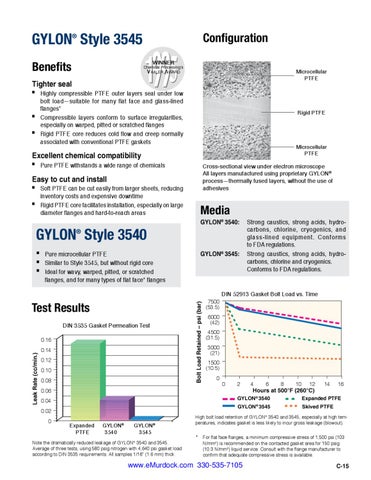
Cross-sectional view under electron microscope All layers manufactured using proprietary GYLON® process—thermally fused layers, without the use of adhesives
Easy to cut and install
Soft PTFE can be cut easily from larger sheets, reducing inventory costs and expensive downtime ■ Rigid PTFE core facilitates installation, especially on large diameter flanges and hard-to-reach areas ■
GYLON Style 3540 ®
Pure microcellular PTFE Similar to Style 3545, but without rigid core ■ Ideal for wavy, warped, pitted, or scratched flanges, and for many types of flat face* flanges ■ ■
DIN 3535 Gasket Permeation Test
Leak Rate (cc/min.)
0.16 0.14 0.12 0.10 0.08 0.06 0.04 0.02 0
Expanded PTFE
GYLON 3540 ®
GYLON® 3540: GYLON® 3545:
Bolt Load Retained – psi (bar)
Test Results
Media
GYLON 3545
®
Note the dramatically reduced leakage of GYLON® 3540 and 3545. Average of three tests, using 580 psig nitrogen with 4,640 psi gasket load according to DIN 3535 requirements. All samples 1/16" (1.6 mm) thick.
7500 (53.5)
Strong caustics, strong acids, hydrocarbons, chlorine, cryogenics, and glass-lined equipment. Conforms to FDA regulations. Strong caustics, strong acids, hydrocarbons, chlorine and cryogenics. Conforms to FDA regulations.
DIN 52913 Gasket Bolt Load vs. Time
6000 (42) 4500 (31.5) 3000 (21) 1500 (10.5) 0
0
2
4
6
8
10
12
Hours at 500°F (260°C)
14
16
GYLON® 3540
Expanded PTFE
GYLON® 3545
Skived PTFE
High bolt load retention of GYLON® 3540 and 3545, especially at high temperatures, indicates gasket is less likely to incur gross leakage (blowout). * For flat face flanges, a minimum compressive stress of 1,500 psi (103 N/mm2) is recommended on the contacted gasket area for 150 psig (10.3 N/mm2) liquid service. Consult with the flange manufacturer to confirm that adequate compressive stress is available.
www.eMurdock.com 330-535-7105
C-15