Dance ThornsAmong
Kari J. Brandtzæg
by Kari J. Brandtzæg
Higgie
Foreword
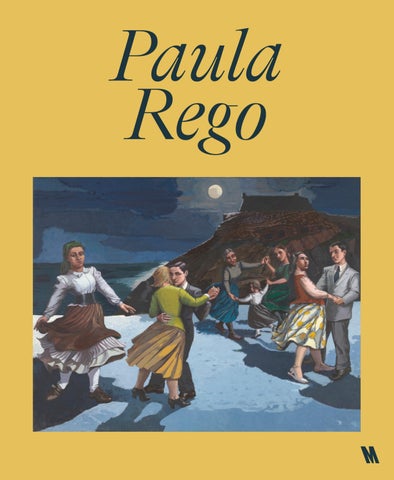
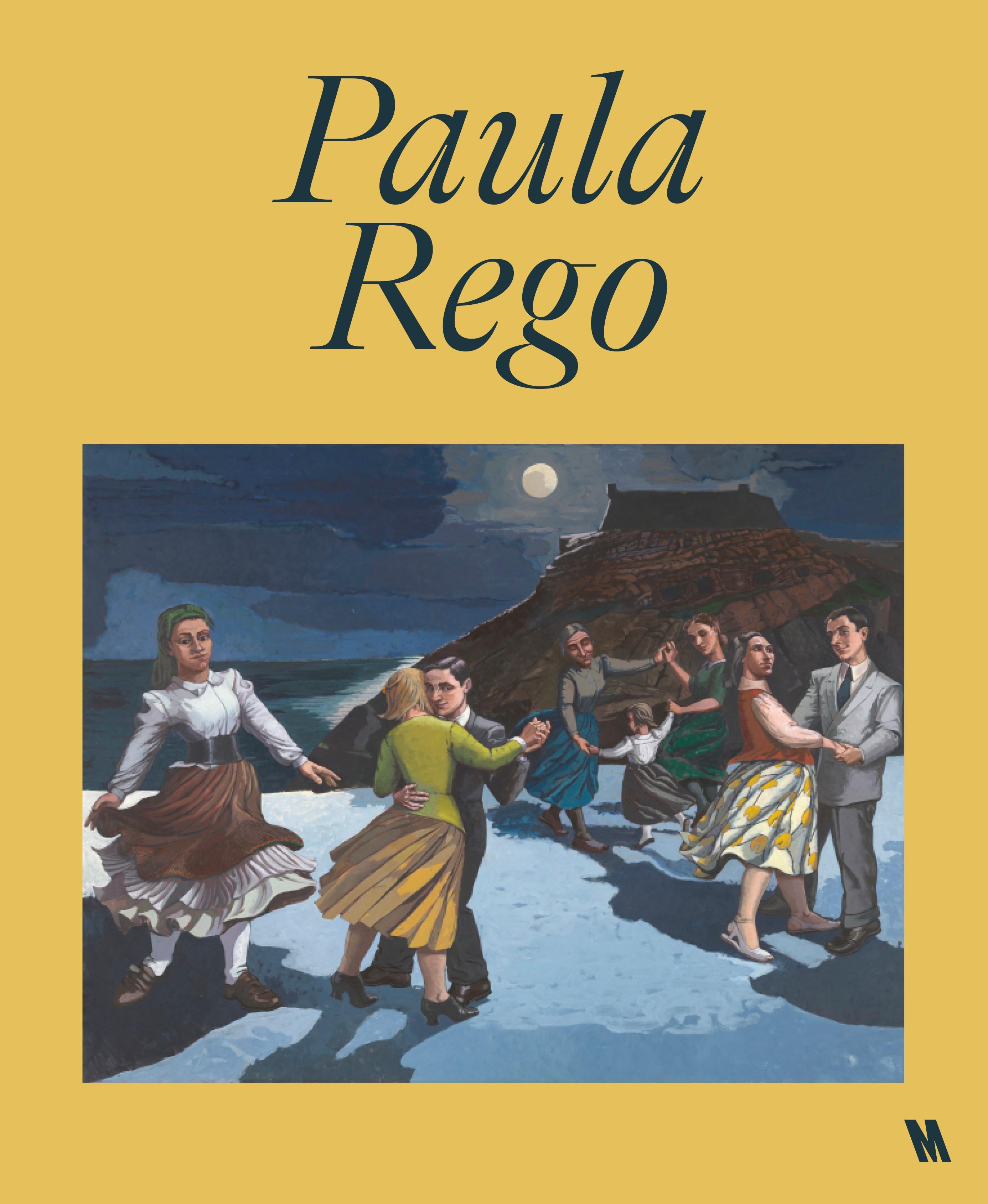
Paula Rego – Dance Among Thorns is the first comprehensive museum presentation in the Nordic countries of the Portuguese-British artist Paula Rego (1935–2022). The exhibition title refers to her principle work The Dance (1988), in which a group of people moves in circles through life and the landscape on a moon-lit beach. At first glance the scene appears to be harmonious, but as we often find with Rego a sense of unease seems to be trembling beneath the surface – a hint that this fellowship also contains power imbalances, loneliness, tensions and demanding constraints.
Rego’s sensitivity to the grey area between pleasure and pain is reminiscent of that found in Edvard Munch, and his Dance of Life motif (first version 1898) is an obvious reference point for Rego’s dancing figures on the beach. In the exhibition and this book, the two works function as a double portal to Rego’s painful and powerful range of motifs, as they developed in relation to other art – from Renaissance painting to Surrealism, and from Francisco de Goya to Käthe Kollwitz – over more than seven decades.
Like Munch, Rego is also an uncompromising explorer of the human experience, with a characteristically figurative style. Unlike the Norwegian painter, however, she adopts an explicitly political and feminist view, shaped in Portugal by her childhood under António de Oliveira Salazar’s authoritarian regime, and later in England as an artist. This perspective took different forms throughout her career – from her early abstract political collages, via a range of narrative series and image groups in various media, to the grotesque tableaus of her later years – but the focus was nearly always on women.
Rego’s female figures are normally enveloped in textiles, rendered with an exquisite sense of colour and a materiality somewhat reminiscent of the refined surfaces of the 17th-century painter Velázquez. The figurative expression and feminine universe that emerges in Rego’s pictures,
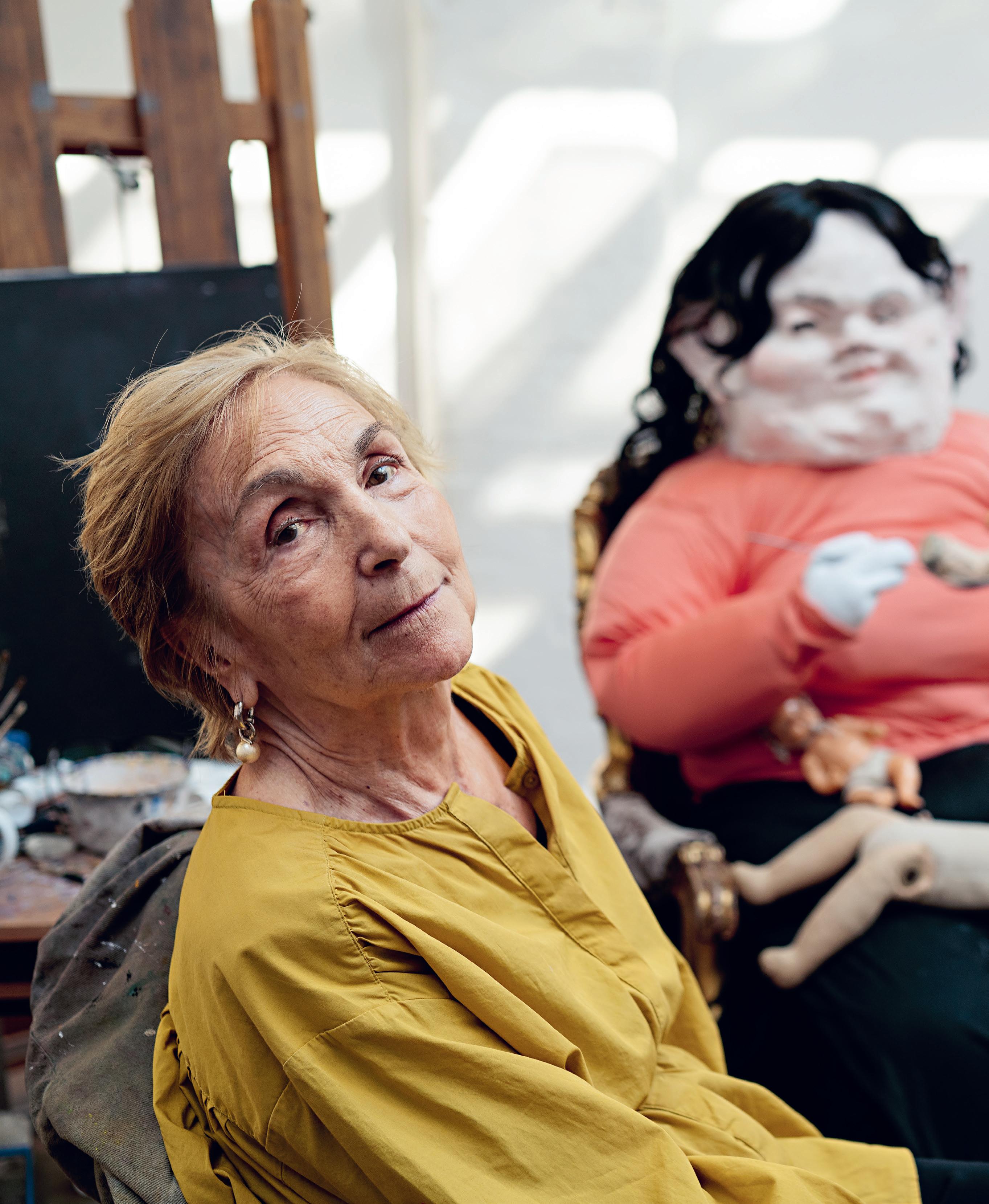
Paula Rego in her studio 14 May 2019
combined with her unique sense of colour and texture, meant that she was dismissed as a ‘figurative and decorative female artist’ until the beginning of the 1990s. But what Paula Rego – Dance Among Thorns shows is that her use of colour, pattern and technical brilliance is never pure decoration, but a hard-hitting and convincing political tool.
With her pictures Rego claims ownership of the closed femosphere she grew up with under Salazar’s regime, where women were bound to the home through strict gender roles and expectations of conservative decency, which included the way they dressed. For Rego these domestic spaces were places for resistance, liberation and radical narratives about intimacy, gender roles and power games, and it is these narratives that this book intends to explore.
In her personal essay ‘Dance Among Thorns’ Kari J. Brandtzæg explores the central themes of the exhibition, and in ‘Paula Rego’s Discovery of Edvard Munch’ the project’s hitherto overlooked connection between Rego’s and Edvard Munch’s oeuvres. Brandtzæg, the exhibition’s curator, has also written ‘Faces of War’, which concerns Rego’s artistic treatment of her childhood memories from Portugal during the Second World War. In addition, Brandtzæg has written ‘An Oratorio for Rejected Children’ about Rego’s shift towards grotesque themes using pastel and fabric-sculptures during the later phase of her career, when she was already recognised as one of the most significant artists of our time.
In the text ‘Fairy Tales Should Be Respected’, Jennifer Higgie sheds light on Rego’s relationship with the British art scene, which Rego had been a part of since her teenage years, while Catarina Alfaro’s ‘Theatres of Memory’ explores the traces of childhood Portugal and fairy tales in the adult painter’s work. Rego’s experiences in Britain and Portugal are also woven into Isabel Freire’s ‘From the Waist Down’, which explores the artist’s long-standing commitment to women’s issues, particularly a woman’s right to abortion which was heavily restricted in Portugal until 2007. Many thanks to all the writers for their insightful and engaging contributions to this book.
Many others deserve a similar thank you. An exhibition requires a whole team, and I am deeply grateful to all those – both external and internal – who have contributed to making Paula Rego – Dance Among Thorns a reality. One person, however, deserves a particular mention: Nick Willing, the artist’s son, filmmaker and director of the Estate of Paula Rego, who has been in close dialogue with the museum throughout the entire process. A special thank you goes to him for his infectious engagement and support, from the drawing board to finally implementing the project on the museum’s walls and in this book.
Finally, I would like to offer a warm thank you to the museum’s sponsors: INPEX Idemitsu Norge AS, Canica, Viking, Deloitte, the Bergesen Foundation, the Savings Bank Foundation DNB and Talent Norge, who make it possible for MUNCH to realise a broad and ambitious programme of exhibitions, publications and live events every single year.
Tone Hansen Director, MUNCH
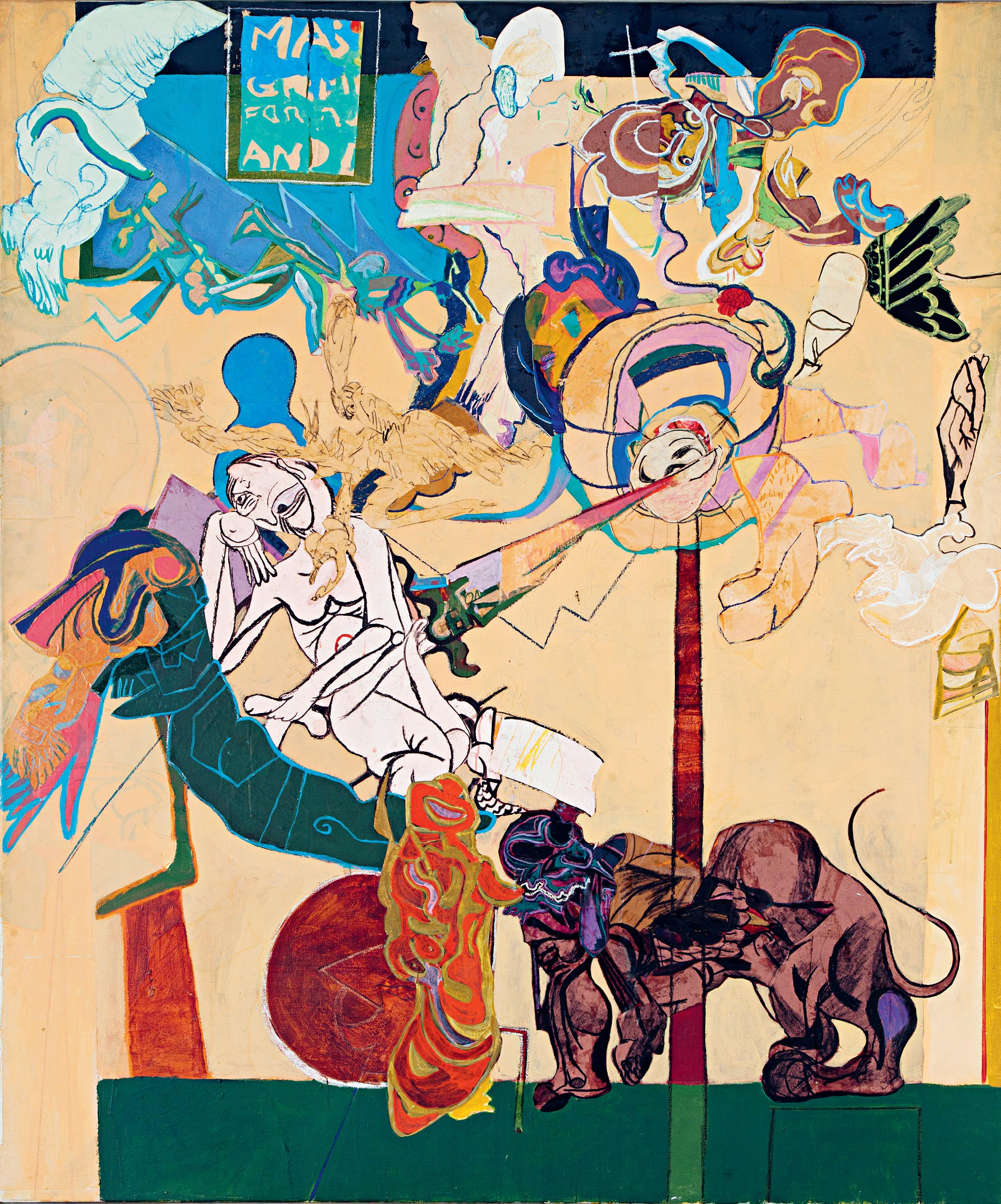
Manifesto (for a Lost Cause), 1965. Acrylic paint and collage on canvas, 183 × 152 cm
Dance Among Thorns An Essay on Paula Rego
by Kari J. Brandtzæg
In the spring of 2018, I was exhausted after a painful breakup and badly needed to get away. So, I travelled to Lisbon, Portugal, a country that had long held a special place in my memory. As a teenager in the 1980s, I spent several Easter holidays in the Algarve, attending a training camp near Albufeira. At the time, I knew almost nothing of the country’s recent past, not even that its fascist dictatorship had been swept away by the Carnation Revolution barely a decade earlier.
Until 1968, António de Oliveira Salazar (1889–1970), who became prime minister in 1932, had ruled the country with an iron fist. In 1933, and in close collaboration with the Catholic Church, Salazar established the Estado Novo (‘New State’) which placed God, the fatherland, and the family at the centre of what was a conservative and authoritarian regime. Although Salazar was more invisible in public than other dictators of the time, such as Hitler, Mussolini, Franco and Stalin, he was ruthless and patriarchal, and this had a particularly severe impact on women’s options in life. Among other things, women were subject to strict travel and work restrictions and were neither allowed to divorce nor have an abortion.
As a young girl in Portugal, it wasn’t the country’s history that interested me, but the running track, the food, the sun, the glistening sea and the precipitous, sand-coloured cliffs along the Algarve coast. The beautiful surroundings had an intoxicating effect on this Protestant teenager from the icy north, who took social democratic ideals of equality and freedom for granted. En route to Lisbon almost four decades later, with Russian, art history and curating a central part of my professional work, the situation was different. I had learned that equality could not be taken for granted – not even within a social democracy like Norway.
Through my own experiences of studying in Russia, university, family and work, it gradually became clear to me how representatives of the ‘strong’ sex continue to maintain and exploit their privileges and positions of authority in many places around the world. While the limits
I experienced personally were incomparable to the systematic oppression that women face under totalitarian regimes, they helped awaken my professional curiosity about the Portuguese-born artist Paula Rego (1935–2022). She was born three years after Salazar took power, and it was clear to me early on that growing up under a fascist dictatorship, which suppressed freedom of expression, persecuted its political opponents and discriminated against women, had influenced her career as an artist.
The connection between England and Portugal Arriving in Lisbon in the spring of 2018, I was hoping to become better acquainted with Rego’s artistry. Over the previous decade, her name had come up repeatedly in connection with exhibitions I had curated with artists such as Lena Cronqvist, Marianne Bratteli, Tracey Emin and Vanessa Baird.1 This spring, however, my understanding of both Rego and Portugal’s unique history would be significantly expanded.
In Lisbon, I booked a hotel very close to the renowned Gulbenkian museum, which opened in 1969 to house the extensive art collection of the eccentric Armenian-British oil magnate Calouste Gulbenkian (1869–1955).2 The museum, built in a concrete, brutalist style, is surrounded by a lush sculpture park which makes the monumental facility appear both inclusive and accessible.3 I had decided to visit the exhibition Post-Pop: Beyond the Commonplace, which examined the development of pop art between 1965 and 1975 among Portuguese and British artists, including Paula Rego.
The exhibition drew a close connection between Britain and Portugal, which came as a surprise to me. I began to understand how the two former European powers – both old seafaring nations with colonial and territorial muscle – once had a mutual need to develop a strategic political alliance – an alliance that still exists in the form of a significant linguistic, cultural and economic exchange between the two countries.4 The Calouste Gulbenkian Foundation can be understood as one result of this connection, which also had a positive and vital impact on the art scenes in both countries, and – as I gradually discovered – on Rego’s life and art.
Paula Rego’s parents were strongly oriented towards British culture, history and the English language. In the 1930s, her father, José Rego, had trained in England as an electrical engineer under Guglielmo Marconi, and both José and Rego’s mother Maria often stayed there. When Paula was just over a year old, she was left with her grandparents in Ericeira, so that her father could complete his internship in Essex. During these formative childhood years, her grandmother and aunt introduced her to Portuguese legends and fairy tales. These stories would form an important basis for her fairy tale studies in the 1970s, which later defined much of her artistic work.
Although Paula Rego grew up in liberal and privileged surroundings, her childhood was unavoidably marked by the authoritarian and deeply conservative Estado Novo dictatorship. Because in Portugal fascism aimed its sharp thorns primarily at women, who were considered the mothers of the future and the ideological backbone of the nation. If they became too wild, unrestrained or promiscuous, they could threaten the social order.5 Women were therefore encouraged to do ‘as little as
1
In respectively 2017, 2020, 2022 and 2024. Their work is similar to Rego’s in various ways, particularly with regard to the thematisation of gender, power structures and family relationships, and the use of personal experiences.
2
In 1956, Calouste Gulbenkian’s fortune was placed in the Fundação Calouste Gulbenkian in Lisbon. The foundation is one of the largest in Europe, it runs several libraries in Portugal, and awards scholarships and prizes to artists internationally. In 1961–62, the foundation awarded Paula Rego a study grant which enabled her to travel to London, and later a free research grant for the years 1977–79.
3
The Gulbenkian was designed by the architects Rui Jervis d’Athouguia, Pedro Cid and Alberto Pessoa.
4
The Anglo-Portuguese Alliance is widely regarded as the world’s oldest continuous diplomatic alliance. It was formally established through the Treaty of 1373 between England and Portugal, and has never been officially broken since.
5
Maria Manuel Lisboa, Paula Rego’s Map of Memory: National and Sexual Politics (Surrey: Ashgate Publishing, 2003), 14. In this book Lisboa explains that Salazar considered young women the mothers of the future, and believed that they had to submit to the regime to avoid the collapse of the social order.
6
See Jennifer Higgie’s essay ‘Fairy Tales Should Be Respected’ in this book.
possible’, and preferably stay in the kitchen, obey their husbands and fulfil their primary function as mothers. As an only child and only daughter, Rego soon experienced frustration with the limitations of a society where female agency and independence were considered a threat.
Rego’s mother was Catholic, marked by Portuguese society’s view of women and preoccupied with etiquette. Although she was artistically inclined and had studied art herself, she rarely encouraged her daughter to pursue her obvious talent for drawing. This role was instead left to her father José, with whom Paula had a particularly close relationship. José was anti-fascist and opposed to the Catholic priesthood, and made sure that his daughter was admitted to the British school in Lisbon, Saint Julian’s in Carcavelos, where she was a pupil from 1945 to 1951. Later, he encouraged her to move to England and study art.
Her encounter with London and the Slade School of Fine Art, where she studied from 1952 to 1955, would be fateful. It was there that Rego met Victor Willing, an artist seven years her senior, who became her great love, husband and father of their three children. At the same time, she came in touch with an active and dynamic art scene that was undergoing significant change, involving newly established galleries and private art collectors. They defined new trends and set the terms for who got the opportunity to establish themselves as professional artists – still only a minority of them women.
In the community around Willing, Rego met several artists who would later gain international recognition, such as Francis Bacon, David Hockney and Lucian Freud. Like them, Rego worked within a painterly figurative tradition, although unlike them, her work was rooted in overtly political and feminist themes, frequently informed by her formative years in Portugal.
Rego’s oil painting The Meal (p. 110), which she completed in 1951 at the age of 16, is an early example of this, and of the way her art constantly drew on her own experiences. Even then, she was already demonstrating a willingness to challenge the restrictions the Portuguese dictatorship imposed on women: The motif is built around a bare breasted woman in frontal view, seated at a table. The woman stares at us resignedly, while a naked baby greedily clutches her breast. A sturdily built man sits beside them, eating with similar greediness, while a young daughter just picks at her food with her eyes turned away from her parents, as if actively rejecting their fixed gender roles.
London’s student scene offered Rego a freedom she hadn’t been used to in Portugal, but the climate in 1950s England was also patriarchal and sexually charged. In the film Secrets & Stories (2017), made by her son Nick Willing, she talks about how she and her female art-school friends had illegal abortions while they were students, and that it was considered almost normal at the time. It was also difficult for a female artist to gain recognition, and Rego found that several of her teachers at Slade underestimated her potential.6
In the British art world, her work was long considered too personal and overstated. It was not until her series of paintings Girl and Dog (1986–88, pp. 80 and 82) and first major solo exhibition, which took place at the Serpentine Gallery in 1988, that critics received her with genuine interest and enthusiasm. Earlier that year, she had her first major retro-
spective exhibition at the Gulbenkian, Lisbon, where Manuel de Brito and Galeria 111 had been representing her since the mid-1970s. In London, she was represented by Marlborough Fine Arts from 1987 and for nearly three decades, before joining the Victoria Miro Gallery in 2020.
Girl and Dog
On my trip to Lisbon in the spring of 2018, I was already familiar with Rego’s breakthrough works from the 1980s, in which sexual and violent themes often merge in a troubling and disturbing way, as they do in the etching Four Girls Playing with a Dog (1987, p. 87). One year earlier, I had curated an exhibition with the Swedish artist Lena Cronqvist (1938–2025), who had a marked appreciation of Rego’s work, especially these pictures. Like Rego, Cronqvist’s paintings show how a reckless and rebellious inner life can hide within nice little girls with bows in their hair.7
At the time, however, I didn’t know that Rego’s Girl and Dog series sprang from her experience of husband Victor Willing’s growing need for care after being diagnosed with MS in 1967. The works in this series reflect the changing power relationship between the couple during the final two years of her husband’s life. While Willing had previously been the strong one, the relationship was turned upside down when the illness began to weaken him. In the pictures, the husband takes on various roles, as a dog or a helpless fantasy creature, looked after by strong and determined young girls and women. These animals will often be crying, in works such as Girl with Pig and Weeping Dog (1984, p. 67).
During this period, Rego’s mother Maria often travelled to London to give her daughter some respite. In an untitled painting from 1986, she paints her mother as a purple, long-eared rabbit with a Catholic rosary between its fingers. The painting is made in a rough painterly style, and the figures are highlighted with black outlines. Some of the paintings also feature a woman with a firm grip on her dog; characters which represent Rego and her sick husband. Death also lurks in the background as an eerie pink column. In another, smaller motif, the mother stands in the background wearing a hat and a translucent white dress, while Rego depicts herself in a red dress – again with a firm grip on her dog. During the dictatorship, it was mandatory for women and girls to cover their heads in public, as we also see in the earlier collage Self-Portrait in Red (1966, p. 13), where Rego portrays herself as a little girl in a white bonnet.
The political images of the 1960s
It was at the Gulbenkian in the spring of 2018 that I first experienced Rego’s seminal political art of the 1960s, when she alternated between living in London and Lisbon with her husband and three children. In the semi-abstract motifs from this period, she opposes Salazar’s dictatorship, both through subtle Dadaist effects and a fascinating collage and cutting technique that she herself describes as an oppositional act: ‘I began to cut [the works] up. And the cutting up was a part of the thing. I’d cut across – big bits, small bits. The pleasure of cutting was part of the process, the pleasure you get from destroying.’8 One of the pieces exhibited at the Gulbenkian was the major work Manifesto (for a Lost Cause) (1965, p. 16)
7 Like Rego, Cronqvist draws on her own family history, including postpartum depression and the strained relationship she had with her mother as a child. See Kari J. Brandtzæg, ed., Head by Head – Cronqvist | Bjørlo | Munch, exh. cat. (Oslo: Munch Museum, 2017).
8 Fiona Bradley, ed., Paula Rego, exh. cat. (London: Tate Liverpool, 1997), unpaginated. The exhibition was supported by the Gulbenkian.
9
The exhibition Paula Rego: Manifesto, was curated by Catarina Alfaro in 2024 to celebrate 50 years since the end of the dictatorship in Portugal. See Manifesto, exh. cat. (Cascais: Casa das Histórias, 2024). The exhibition Manifesto (1965), which was shown at the Socieda Nacional de Belas-Artes in Lisbon, confirmed Rego’s importance for the Portuguese art scene. As did the Gulbenkian’s purchase of the work Manifesto (for a Lost Cause)
10
Salazar held on to Portugal’s colonies on the African continent, which had enriched the country’s resources since Henry the Navigator’s expeditions across the Atlantic in the 15th century, see Erika Fatland, Sjøfareren: En reise gjennom Portugals tapte imperium (Oslo: Kagge forlag, 2024).
11
The tapestry is currently in the collection of the Casa das Histórias Paula Rego, where I saw it in connection with the exhibition Paula Rego: Manifesto in spring 2024.
which was among the central motifs at Rego’s first solo exhibition in Lisbon that year.
The title Manifesto (for a Lost Cause) expresses intense political frustration at how in 1965 the battle against Salazar’s misogynistic dictatorship was seemingly lost. For Rego and other dissidents it was an especially bad year in which the regime’s opponent General Humberto Delgado was assassinated by government agents. This tragedy is reflected in the work’s complex form, which creates a political and aesthetic rebus from newspaper fragments and paper, cut and pasted onto canvas. The work provides an outlet for silent fury at the dictatorship’s persistent, absurd and brutal presence.9 It also touches on Salazar’s colonial policies: his strong reluctance to give up Portugal’s colonies in Angola and Mozambique,10 and the gruesome and senseless colonial wars that followed throughout the 1960s.
The bloody colonial wars are also thematised in the tapestry The Battle of Alcácer Quibir (1966, pp. 22–23), which Rego completed the following year as a protest against Portugal’s colonial presence. Although the work was not included in the Gulbenkian exhibition, a few years later I was struck by its monumental format, textile technique and powerful expression.11 It immediately evoked associations with Pablo Picasso’s anti-war work Guernica (1937), which he created during the Spanish Civil War. The varied embroidery techniques and overlapping fabric echoes Rego’s other political collages. The title refers to King Sebastian I’s failed military campaign against Morocco in 1578, in which thousands of young men lost their lives. The tapestry was commissioned by a hotel owner in the Algarve, but due to the work’s overtly critical nature, he didn’t dare accept it. It was not until 1975, the year after the dictatorship’s fall, that the colonies achieved independence.
Casa das Histórias and the fairy tale motifs
In Lisbon, the Gulbenkian exhibition Post-Pop: Beyond the Commonplace inspired me to explore more aspects of Paula Rego’s work, which had proven to be more complex than I had first imagined. So instead of staying in Lisbon, I caught the train to the fashionable little seaside town of Cascais, where the Casa das Histórias (House of Stories) museum was established in 2009 to honour and preserve Rego’s art. Cascais, just 30 km west of the capital, was the train’s last stop. From there, I wandered through narrow, sun-filled alleyways full of tourists, before heading up the hills from the town’s historic centre towards the Rego museum.
12
The opening took place on 7 May 2018. See Paula Rego: Folktales and Fairy Tales, exh. cat. (Cascais: Casa das Histórias, 2018), particularly Catarina Alfaro’s essay ‘Take a Walk on the Wild Side’, 55–71.
In a verdant park area, a stylish, red-hued museum building designed by Eduardo Souto de Moura came into view – glowing in the sun like a mythical castle against a clear blue sky. The fairy tale association was fitting, since my visit coincided with the opening of the Folktales and Fairy Tales exhibition,12 which explored how fairy tales and myths – partly inspired by her grandmother’s stories from her childhood– had influenced Rego’s creative processes since the early 1970s. Here I saw for the first time her delightful textile sculpture The Princess and the Pea (1978, p. 203), her prints of the manipulative and power-hungry Prince Pig (2006, p. 209) and her papier-mâché sculpture of the same figure. I also saw her large, dramatic pastels from 1995 featuring fairy tale characters
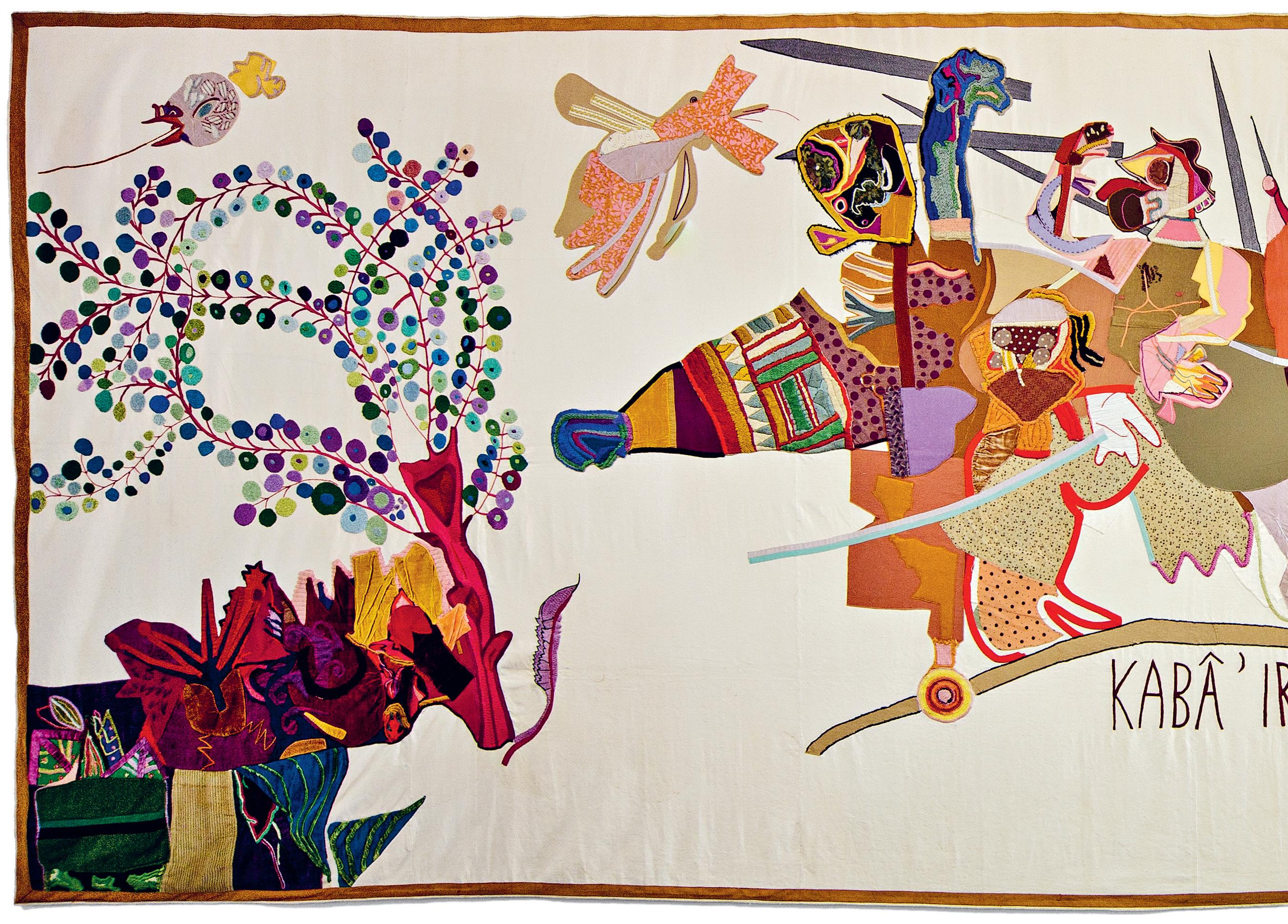
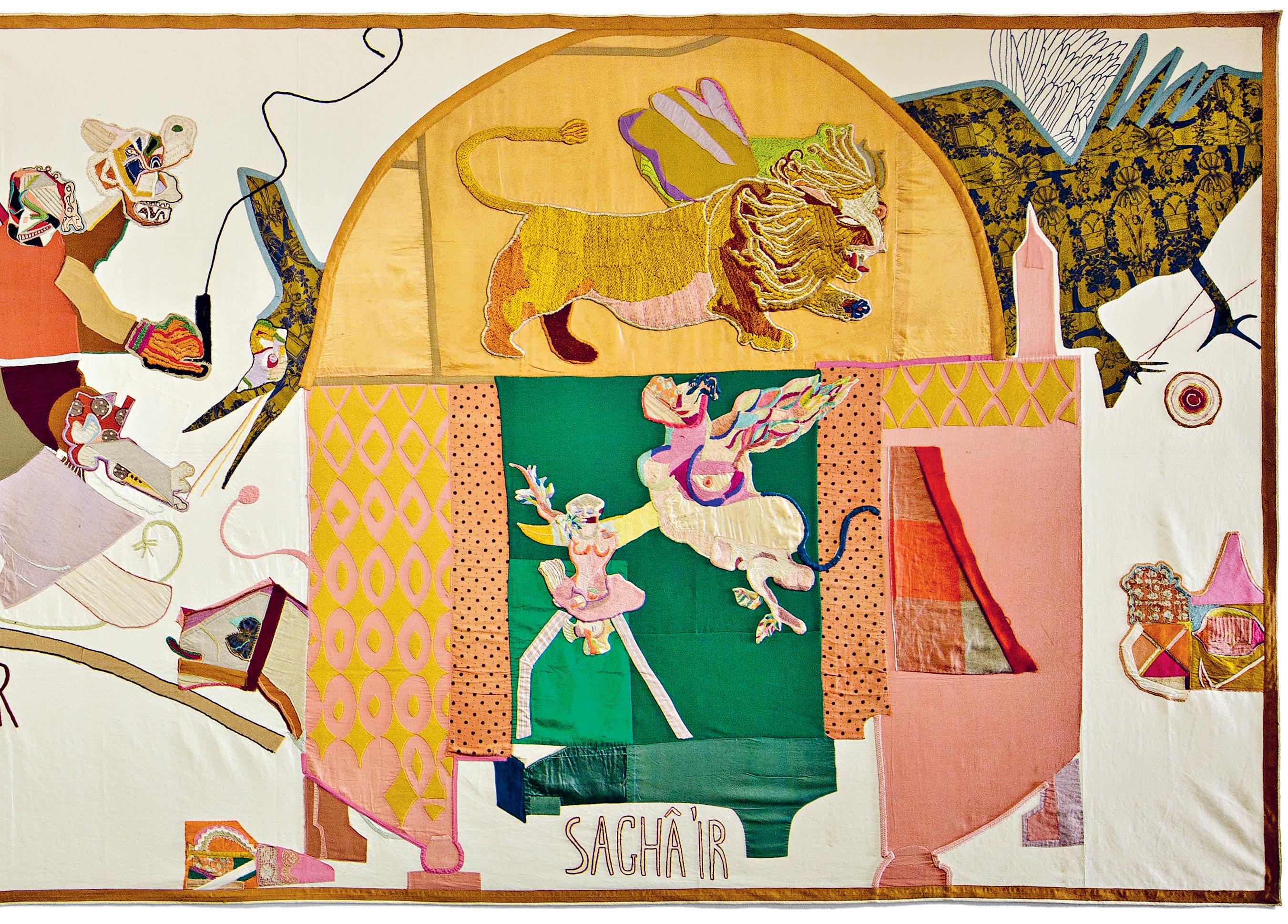
Battle of Alcácer Quibir, 1966. Wool, silk, cotton and various fabrics on linen, 250 × 650 cm
from Disney classics such as Pinocchio and Snow White – films she watched as a child with her father.
That May evening, Rego’s beautiful and disturbing twists on known fairy tale themes made a deep impression on me. In the exhibition catalogue, I read about how her interest in the collective unconscious – a part of the human psyche that we all share, across cultures – coincided with the crumbling and eventual collapse of the dictatorship in 1974. For Rego, exploring fairy tales became a welcome retreat from the chaotic political and social situation Portugal found itself in, but it was also a space for imagination, where she could process her grief over the death of her father José in 1966 and her husband’s diagnosis of MS the following year.
The 1970s were marked by relief, writes Leonor de Oliveira, but also by chaos, economic collapse and political confusion. Because where could Portugal go from here, after more than 40 years of dictatorship? After the death of his father-in-law, Victor Willing took over the running of the family’s electrotechnology business. Illness and the unstable times, however, made it increasingly difficult to ensure a profit. During this turbulent period, the family lived alternately in London and Ericeira.
In a letter to her friend the poet Alberto de Lacerda, Paula Rego writes that the individual freedom she values above all else is still being suppressed in Portugal, despite the fall of the dictatorship: ‘I don’t understand, nor am I yet comfortable with the “new environment” that exists in Portugal. Since I’m not someone who holds any particular “faith” I can’t sympathise with Communist, Maoist, Conformist etc. I passionately believe in the “individual”.’ In another letter to the same friend, written after the failed military coup on 11 March 1975, she elaborates: ‘The prisons are full, phones are tapped, letters are opened […]. People speak in hushed voices, looking around them.’13
When the business went bankrupt in 1976, it became hard to maintain the family’s financial security.14 Paula Rego then turned to the Gulbenkian Foundation for support, applying for funds to immerse herself in Portuguese and European fairy tales. The following year she received a three-year scholarship that made it possible to study at the Gulbenkian in Lisbon, and the British Library and Victoria & Albert Museum in London.15 In 1979, after the loss of the family home in Ericeira, the family moved to London permanently. Rego’s tireless research resulted in a series of textile dolls and illustrations. The influence of well-known fairy tale illustrators from the turn of the last century, such as Ivan Bilibin, Walter Crane and Aubrey Beardsley, is also evident in these works.
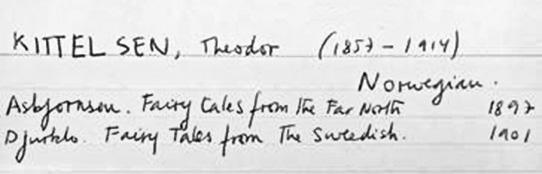
Rego’s interest was also captured by Scandinavian folk tales. Especially the fairy tales of the Danish author Hans Christian Andersen, which became the basis for an exhibition at Charlottenborg in 2004, which included The Little Mermaid (2003, p. 237).16 In a little black book, she also noted various editions of the Norwegian folk tales collected by Asbjørnsen and Moe,17 and on archive cards listed the names of Scandinavian fairy tale illustrators such as Kay Nielsen and Otto Sinding, as well as Theodor Kittelsen, known for dark and disturbing images with a certain parallel to Rego’s.
In 1966, Rego began receiving psychotherapy, something that would be pivotal to her artistic development. Drawing on Carl Gustav Jung’s theories on archetypes, dreams and the collective unconscious, it opened
13
Ibid. See also Leonor de Oliveira, ‘Giving Fear a Face: Paula Rego and Traditional Tales in the 1970’s’, in Catarina Alfaro, ed., Paula Rego: Folktales and Fairy Tales (Cascais: Casa das Histórias, 2018), 43.
14
The Carnation Revolution was followed by two years of political chaos, as various political forces – from military reformists to communists and social democrats –fought for influence over Portugal’s future form of government. Parliamentary democracy was eventually introduced, and a new constitution came into force in 1976.
15
The report Rego submitted to the Gulbenkian after completing her studies consists of two texts: ‘Several illustrators of Fairy Tales, 1861–1939’ and the essay ‘Some Origins of Fairy Tales’. This material belongs to the Gulbenkian’s collection, while the small notebooks and archive cards in which she recorded her findings are in the Estate of Paula Rego’s archives.
16
Paula Rego: The Portuguese Duck and Other Stories, Charlottenborg, Copenhagen, 27 December 2003–18 January 2004 (Corner Group Exhibition, Marlborough Fine Arts, London).
17
Rego once received the book Best-Loved Folktales of the World, Joanna Cole, ed. (New York: Anchor Books / Doubleday, 1982) as a Christmas present from Alberto de Lacerda. It includes several well-known Norwegian folk tales. Thanks to Eloisa Rodrigues at the Estate of Paula Rego for information from the Rego archive.
18
For more about the relationship between Rego’s and Munch’s art, see the essay ‘Paula Rego’s Discovery of Edvard Munch’ in this book.
19
Nick Willing is a film maker, and director of the Estate of Paula Rego.
the door to a more systematic exploration of internal images, mythological figures and psychological conflicts. Psychotherapy also directed Rego’s practice into a distinctly psychological landscape, where personal and collective histories intersect with political and mythical structures. This enabled her to articulate states that elude straightforward representation, such as grief, loss, fear, aggression and repressed memories.
For Rego, stories and fairy tales offered a way of coping with life. Similarly, I found that her politically engaged and daring art helped me confront my own despair, providing space to reflect on questions that mattered to me as well, about issues such as gender, power and responsibility. By the time I returned home to Oslo, I was thus in a lighter mood, and a few years later – by a happy coincidence – I was asked to develop an exhibition of Paula Rego’s art at MUNCH.
Models and stories
When working on this exhibition, which has been given the title Dance Among Thorns, I decided to pursue the same themes that I had been so forcefully struck by in Lisbon in spring 2018: Rego’s political sting –directed especially at Salazar’s fascist and misogynistic dictatorship – along with the importance of fairy tales, her commitment to the abortion issue, and influences from the Portuguese and English art scenes, which all coalesce in her artistic work. Over time, the striking similarity between some of Rego’s paintings and certain motifs by Edvard Munch, such as Dance of Life (p. 48) and History (p. 52), also became a common thread in the curatorial work.18
Preparations for the exhibition began in earnest with a visit to Paula Rego’s studio in London, where MUNCH’s director Tone Hansen and I met her son Nick Willing for the first time, in December 2023.19 The studio was nearly untouched, almost as the artist had left it when she died in June 2022. It still appeared to be a focused and active workspace: stacks of paper, large canvases, clothing, dolls and props lay all over the floor and along the walls. There were also easels with tins full of pastels beside them. I looked at the colours, which were often in dark shades, and thought about how enormously gifted she had been to have created these magnificent, enigmatic and richly detailed tableaus using nothing but chalk pastels from a metal box.
Around the studio there were also dolls such as Pillowman, Prince Pig and the disturbing Gluttony (p. 139). In conversations with Nick, it emerged that the clothed papier-mâché dolls should be understood in relation to her pictures, and the stories one finds in them, and that the large pastel compositions of the 2000s are based on tableaus that she created in her studio. Only the early fairy tale figures of the 1970s, and the later works Oratorio (p. 134), Gluttony, Pride and a few others, are considered independent sculptures.
As I worked on the exhibition Nick constantly reminded me that his mother was primarily a storyteller. In the late 1980s – and concurrent with her series Girl and Dog – this was something she demonstrated in works such as The Little Murderess (1987, p. 91) and Prey (1986, p. 93), which display a renewed sense of confidence, strength and rawness. The works convey visual narratives in which active, confrontational human
figures are given a more prominent place than in earlier pieces.
After her husband Victor Willing’s death in 1988, Rego’s preferred medium became chalk-pastel drawings mounted on large aluminium sheets. She then began working more systematically with live models, particularly her husband’s former carer, Lila Nunes, who became a key collaborator. Although Nunes’s physical appearance differed from Rego’s, her Portuguese background allowed her to serve as a projection surface for the artist’s emotions, restlessness and experiences.
The many pictures of solitary women from the late 1980s and early 1990s, related to the Dog Woman series, can be seen as existential reflections on Rego’s altered circumstances following widowhood. In pastel works such as Girdle (1995, p. 102), Moth (1994, p. 101) and Obedient (1995, p. 103), she allows hands, postures and clothing to convey physical unease, loneliness and silent but determined resistance. These images come across as quiet and charged moments, where strong psychological expressions are condensed in tiny movements possessing both sorrow and strength – all reinforced by the images’ empty, monochrome backgrounds.
However, in Watcher and 1953 (both from 1994, pp. 95 and 94) there is a sense of new-found optimism and independence. The striking contrasts in colour, between blue and red, create a Southern-European mood, far from the grey skies of London. In the first pastel we see a woman gazing towards the horizon with a red tricycle at her feet; in the other a smiling woman drives away in a little red sports car. The subjects possibly originate from Rego’s longing for Portugal and the toys and props of her childhood, but could also suggest freedom, assertiveness and the possibility of a new beginning.
Through Lila Nunes’s physical presence, Rego was able to stage the figures in a way that was both theatrical and intimate: The poses that Nunes adopted convey both strength and vulnerability, imbuing the figures with human and existential weight – and often with a humorous twist, as exemplified in the central work Dancing Ostriches from Walt Disney’s Fantasia (1995, pp. 228–229), a triptych she created for the exhibition Spellbound: Art and Film at the Hayward Gallery in 1996. The motif is inspired by the Disney film Fantasia (1940), which she saw as a child with her father. Whereas the film depicts graceful, dancing ostriches, Rego stages heavily built older women stood waiting, full of longing for something to happen.
The triptych highlights Rego’s characteristic wit and persistent willingness to challenge established notions of the body, gender and age. Throughout art history, ballerinas have traditionally been young, slender and disciplined, as shown in Edgar Degas’s pastels from the late 19th century. This tradition, however, is one which Rego deliberately breaks with, instead making room for bodies that bear traces of time, experience and desire. She has stated that her ballerinas, in their undersized costumes, reflect her own aging and acknowledge the inevitably changing body.20 Using subtle contrasts of light and dark in chalk pastel, Rego heightens the women’s looks of anticipation, and challenges the male gaze in a similar way to the feminist writers that interested her so much.
Rego had long drawn inspiration from Simone de Beauvoir’s analyses of gender and power,21 and became close friends with feminist
20
See Sarah Kent, Paula Rego: The Dancing Ostriches from Disney’s Fantasia (London: Saatchi Collection, 1996). See also John McEwen, ‘The Ostriches: A Tribe of Bird Women – on the Edge of the Sea’, in Sarah Kent, ed., The Ostriches (London: Saatchi Gallery, 1996), unpaginated.
21
It is not inconceivable that Paula Rego was familiar with Susan Sontag’s famous essay ‘The Double Standard of Aging’ (1972), about the suffocating pressure to look good that follows women throughout their lives, and how ageism affects women more often and earlier than men. Sontag’s essay provides an interesting backdrop to Rego’s Fantasia triptych.
22
Philip Dodd, ‘Drawn to the dark side’, Tate, 11 (1997): 28–33. In Dodd’s essay, he discusses Rego’s art in relation to Hans Bellmer and André Breton, especially the latter’s belief that societal structures can be changed by setting the unconscious free.
23
Miriam Stoppard, ‘Anima Magic’, Tate, 11 (1997): 33–35. This essay is interesting because Stoppard interprets Rego’s image as an appeal to the female psyche.
writers such as Germaine Greer and Marina Warner. The latter has written thoroughly in several of Rego’s exhibition publications about the artist’s use of myths and fairy tales, especially how these stories function for her as instruments for exploring oppression, desire and resistance. During the late 1990s, several writers also point out that her art increasingly gravitates towards the darkness of surrealism, and that her interest in the unconscious becomes a means of liberating repressed memories and emotions.22 In an interview, Rego describes the development of her motifs as nearly impossible to explain. She compares it to receiving secret messages and admits that she is often surprised by the way they unfold on the canvas.23
Sources from literature and art history
While studying Paula Rego’s art, I became increasingly fascinated by the many references to literature and art history that appear in her paintings. After the turn of the millennium, she began a dialogue largely with the visual art of the Renaissance, through complex and monumental compositions reminiscent of paintings by 16th and 17th century masters like Diego Velázquez and José de Ribera. The latter was known for his dark, realistic and often brutal style, which fascinated Rego. Over the last two decades of her life, details, texture and tactility also took on a more prominent role in her depictions of clothing and poses, as they do in Renaissance paintings.
24
Paula Rego gifted several artworks to the Gulbenkian early on, in gratitude for the support they had been showing her since the 1970s. The gift consisted of several of Rego’s most central works, and a large collection of the fairy tale pictures from the 1970s.
During this time, use of the triptych – the classic three-part picture format – also became prominent in Rego’s artistry, as in Human Cargo (2007–08, pp. 140–141). Another example is the Vanitas triptych (2006, pp. 28–29), commissioned for the Gulbenkian Foundation’s 50th anniversary in 2006.24 ‘Vanitas’ is a motif from art history that traditionally refers to human vanity and the transience of life. Rego’s version depicts a combat-ready woman seated at a table which is covered with objects and symbols related to death. The woman is wearing a luxurious yellow dress and is staring ahead intensely, as if warning death to keep its distance. The triptych can be considered both a self-portrait and a tribute to Calouste Gulbenkian, who was immortalised through all the artworks he collected and the foundation’s lasting importance to artists like Rego.
At the same time, she increasingly refers to literary sources of inspiration, including Jean Genet, Martin McDonagh, Henry Darger, Charlotte Brontë – especially her novel Jane Eyre – and the Portuguese writer Eça de Queiroz, who wrote the 19th-century novel The Crime of Father Amaro. The latter depicts a love affair between a man, the priest Father Amaro, and a young woman; a subject that haunts several of Rego’s works from the late 1990s. In works from this period, including the fantastical images Mother and The Cell (both 1997, pp. 150 and 151), desire, involuntary pregnancies and the fateful consequences of abortion for women once again emerge as central themes.
The vulnerable female body
Throughout her career, Rego was concerned with sexuality and unwanted pregnancy, subjects that are highlighted in the exhibition Dance Among Thorns. There was almost no access to contraception when she was grow-
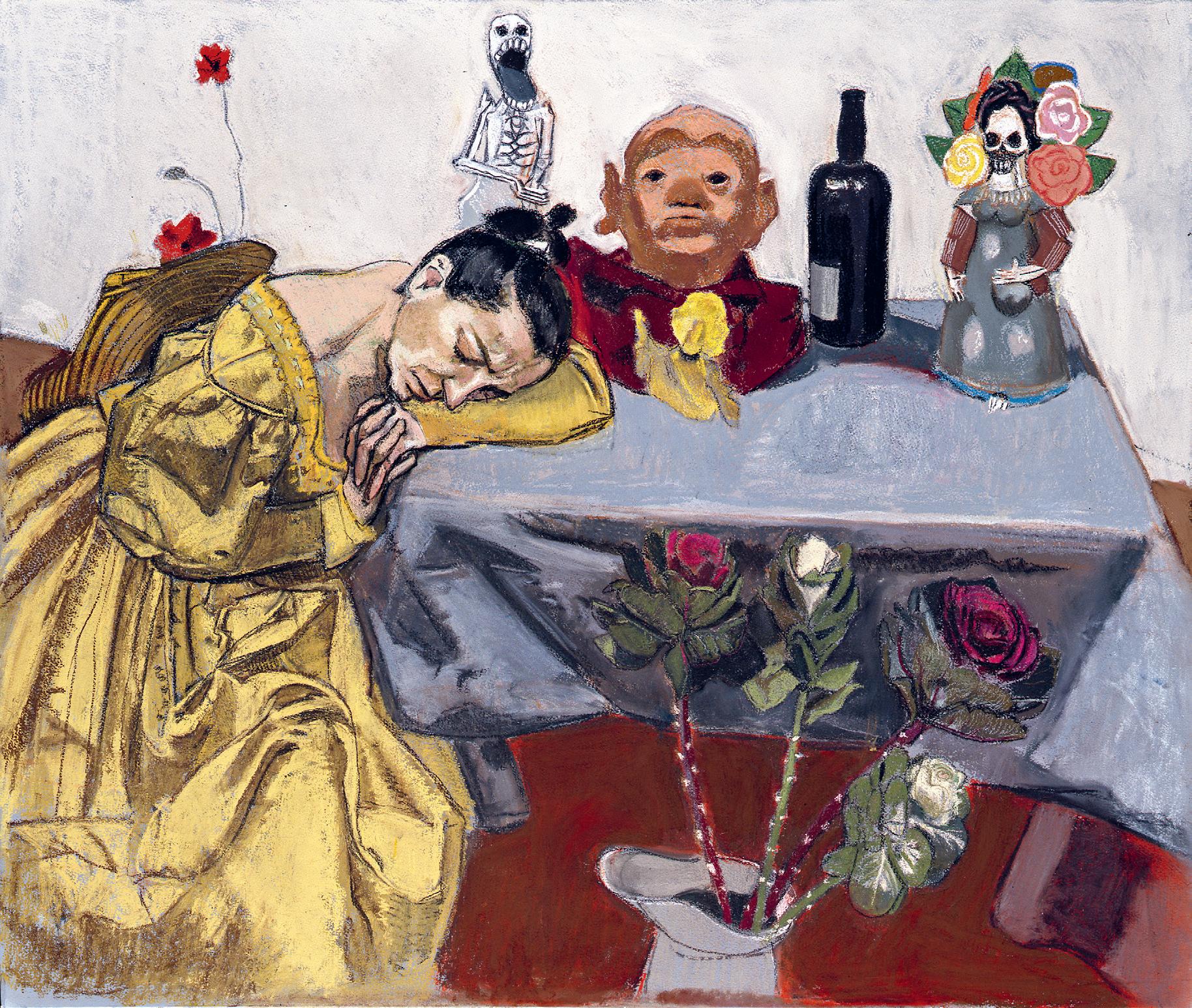
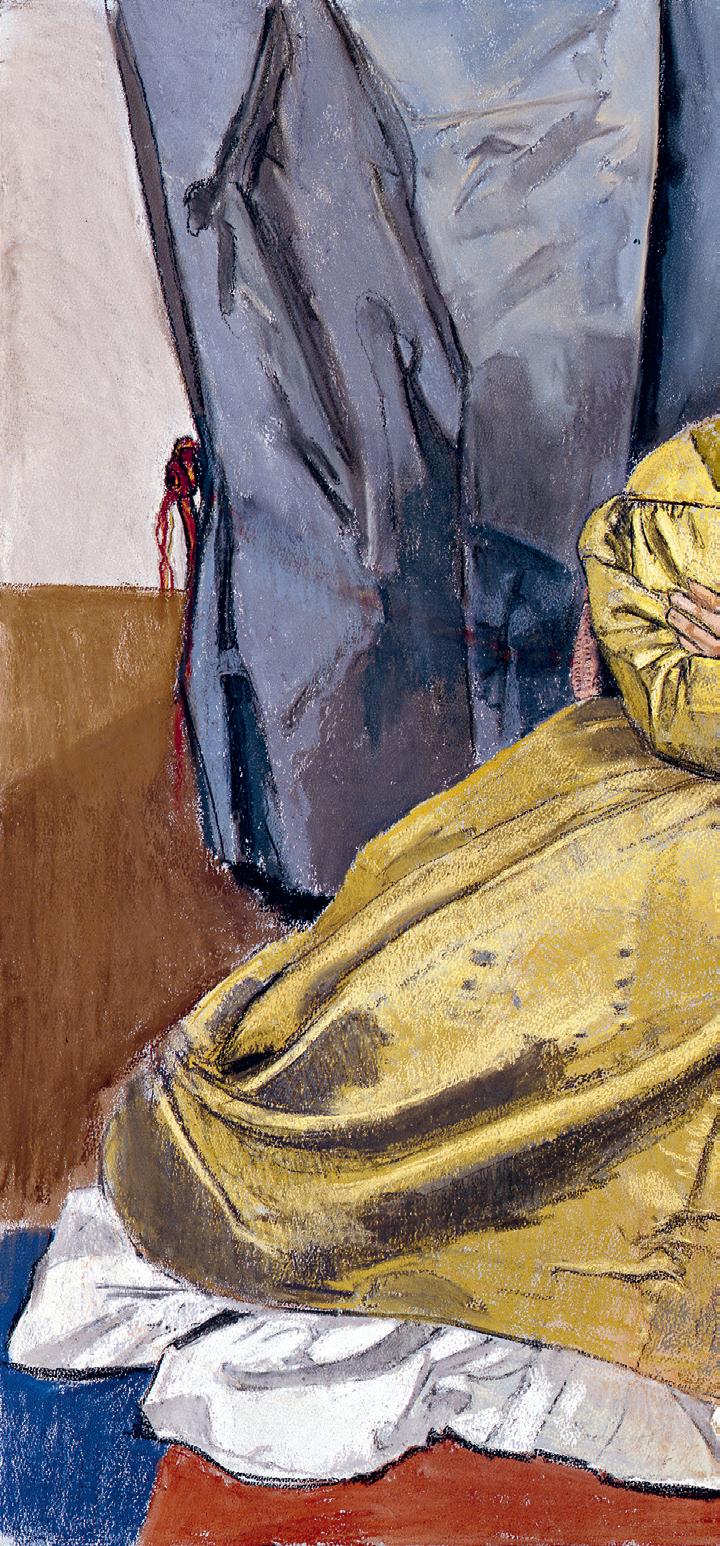
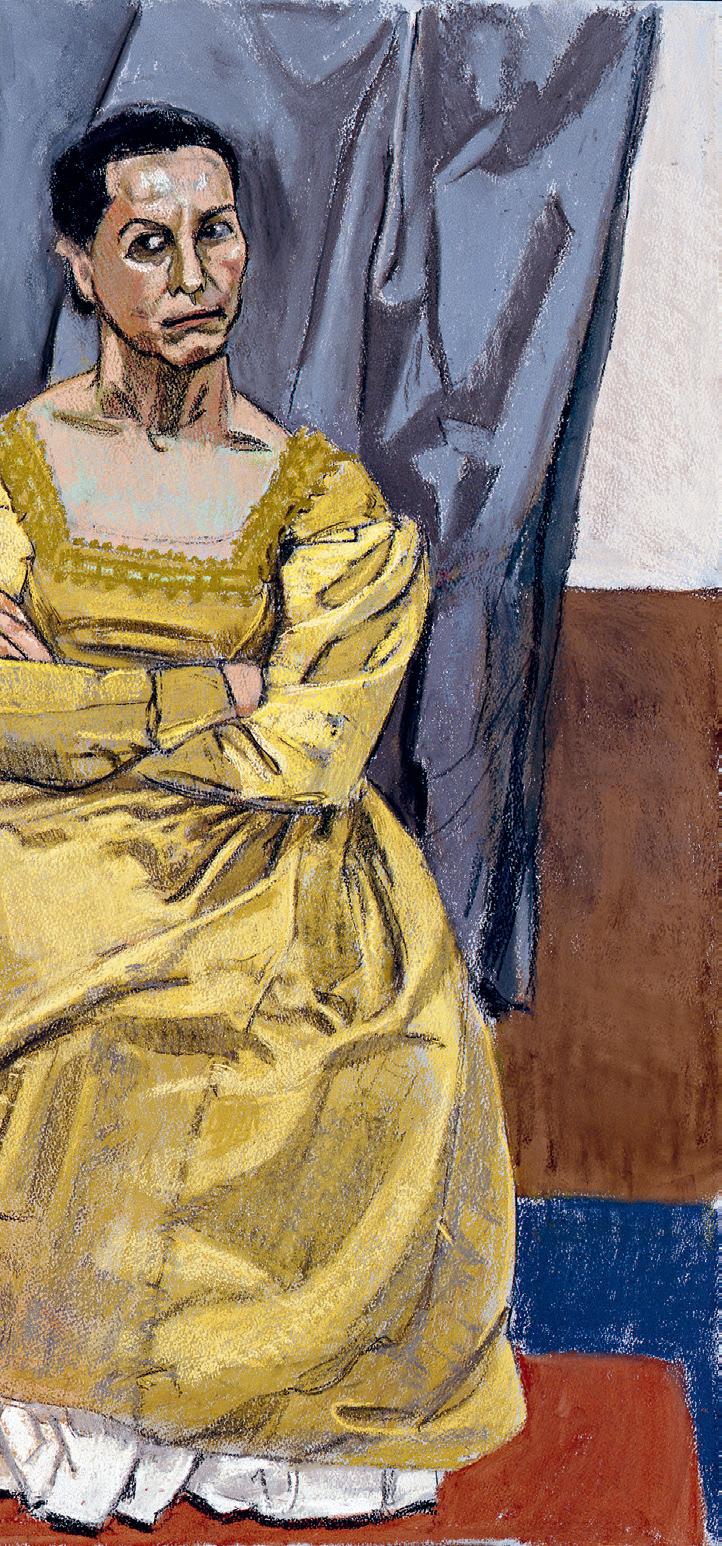
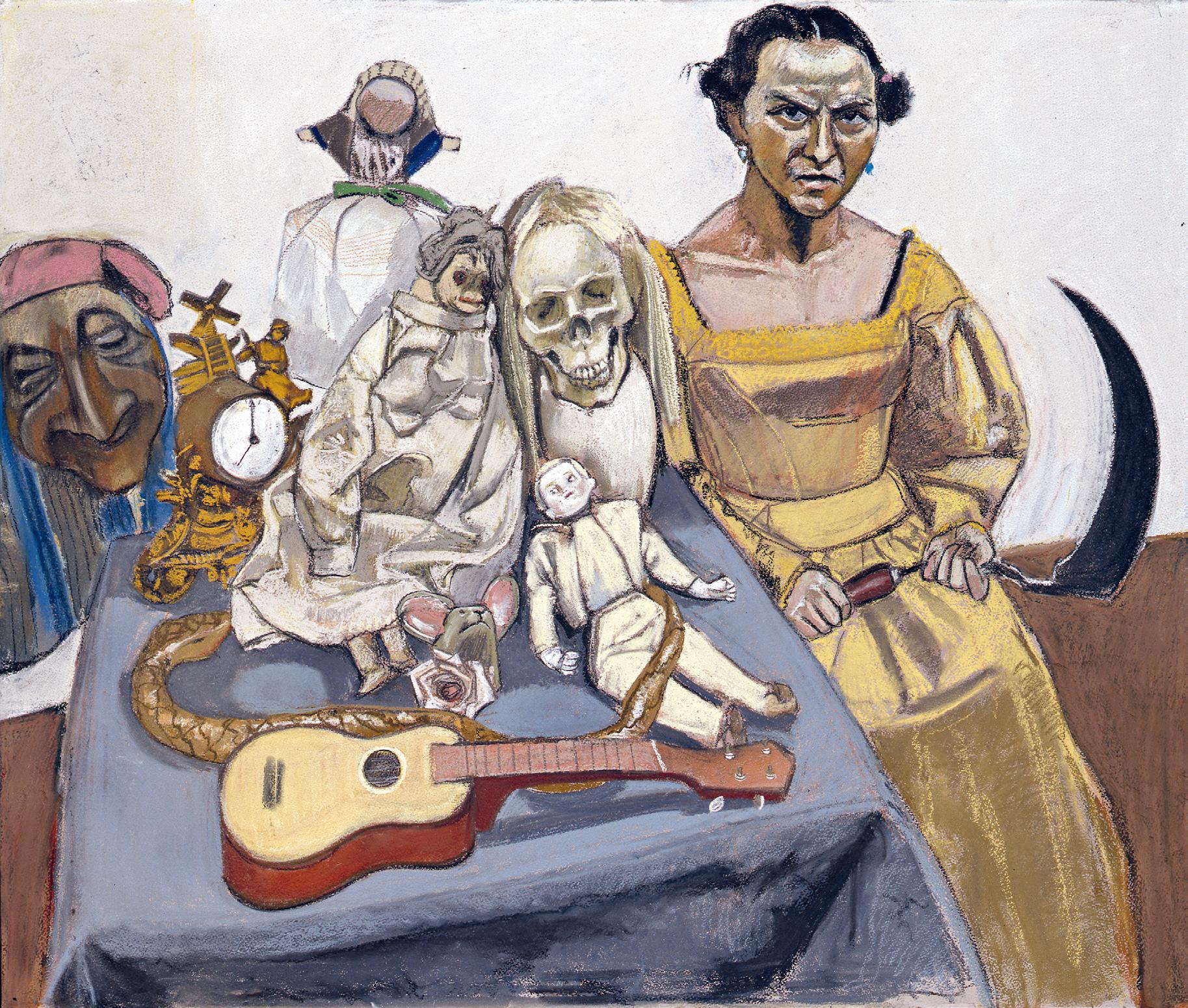
Vanitas, 2006. Pastel on paper, 110 × 130 cm; 130 × 120 cm; 110 × 130 cm
ing up, and many women had to resort to secret and potentially-lethal abortions. Rego had several abortions herself, before leaving art school in London to give birth to her first child. Both her personal experiences with abortion and her roles as wife and mother exposed her to the issues that would become central to her artistic practice.
Rego had already expressed her commitment to the abortion issue in the early and hitherto unknown work Drought (1953, p. 56), painted when she was 18 years old.25 This small and narrow oil painting shows a woman facing a blazing sun, with a bulging belly and an emaciated child in her arms. Drought, as with The Meal, is also an early example of how she experimented with modern and rough visual language, while simultaneously addressing political and social themes that were close to her heart. The image bears a striking resemblance to Käthe Kollwitz’s poster Down with the Abortion Paragraph! from 1923,26 which shows a pregnant and exhausted woman in a similar pose, holding a child in her arms while another hangs from her skirt. Kollwitz was a pioneer in her artistic commitment to abortion rights for poor working-class women, and Rego can be understood as her modern successor, because of her artistic continuation of the abortion struggle.
In Norway, the law on self-determined abortion was introduced in 1978, and today around 11,000 abortions are performed every year. In Portugal, however, the struggle for women’s liberation was significantly hindered by the Catholic Church, even after the dictatorship’s fall in 1974. A referendum on liberalising abortion laws was not held until 1998, but low voter turnout ensured that abortion remained a criminal act.
For Rego – who since 1979 had been living in London, where abortion had been legalised as early as 1968 – the referendum’s outcome was both a shock and a deep political provocation. As a direct response to the disappointing electoral defeat in Portugal, she created the series Untitled (Abortion series, 1998–2000, pp. 109 and 118–127), which is today considered one of her most important political art projects. The images, depicting women undergoing the trauma of illegal abortions, had a profound public impact and contributed to the political mobilisation that in 2007 led to abortion being legalised in Portugal. Following a second referendum, abortion was finally permitted in authorised health clinics up to the tenth week of pregnancy.
The Abortion series consists of one pastel triptych, ten individual pastel motifs and ten etchings.27 After making the first three pastels, collected in Triptych (1998), Rego wrote:
The central panel was the first of a series I made on the subject of abortion, before I knew that it was going to be part of a triptych […]. They were done for propaganda […]. We all knew what it was like. There are abortion clinics on the Spanish border, where people go. It’s totally hypocritical, it’s bad for the poor, who can’t afford to visit those clinics and go through the most awful processes at home […]. I left the pictures untitled. I didn’t think I should call them Abortion, because it’s pretty obvious, isn’t it?28
A total of thirteen pastel motifs were made for this series – ten of which are presented in Dance Among Thorns, along with two of the etchings
25 Thanks to Nick Willing and the archive who found this small painting, which has a clear reference to Edvard Munch’s motifs and use of colour. The archive dated the work to 1953. For more on this, see the text ’Paula Rego’s Discovery of Edvard Munch’ in this book.
26
Kollwitz collaborated with and illustrated Dr. Créde’s book A People in Need! The Catastrophe of the Abortion Law / Volk in Not! Das Unheil des Abtreibungsparagraphen, 1927. Throughout the 1920s, Kollwitz often worked with motifs related to the war, hunger and injustice that characterised the faltering Weimar Republic in Germany after the First World War.
27
T.G. Rosenthal, Paula Rego: The Complete Graphic Work (London: Thames & Hudson, 2003), 146–155. The prints were made for a Portuguese travelling exhibition that opened in 1999, and have been described as ‘the strongest feminist statements ever made in our time’. Rosenthal (2003), 149.
28
See Marco Livingstone, ed., Paula Rego, exh. cat. (Madrid: Museo Nacional Centro de Arte Reina Sofia, 2007), 263.
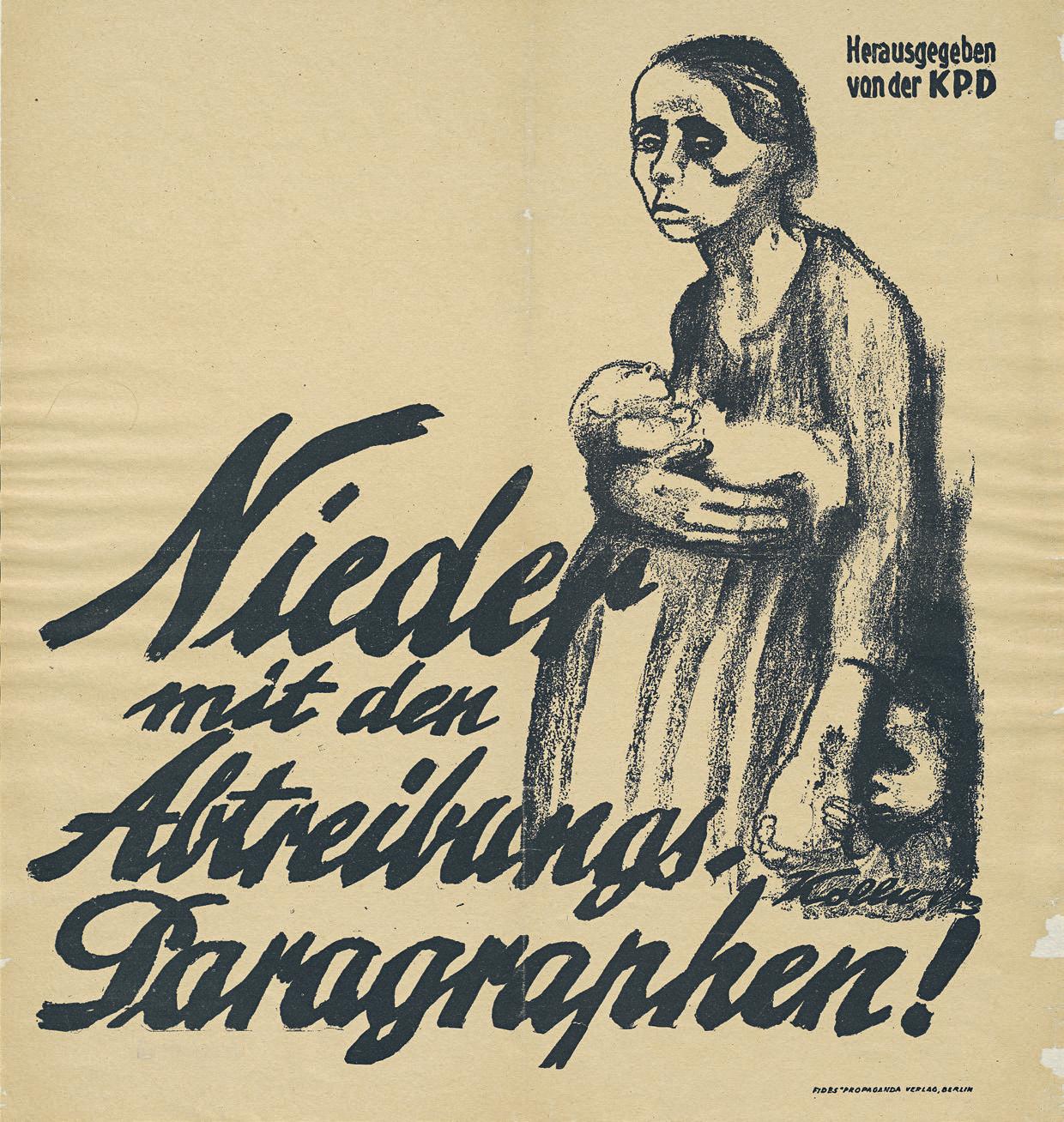
Down with the Abortion Paragraph! Poster for Germany’s Communist Party (KPD)
1923
Lithograph
52.5 x 48.4 cm
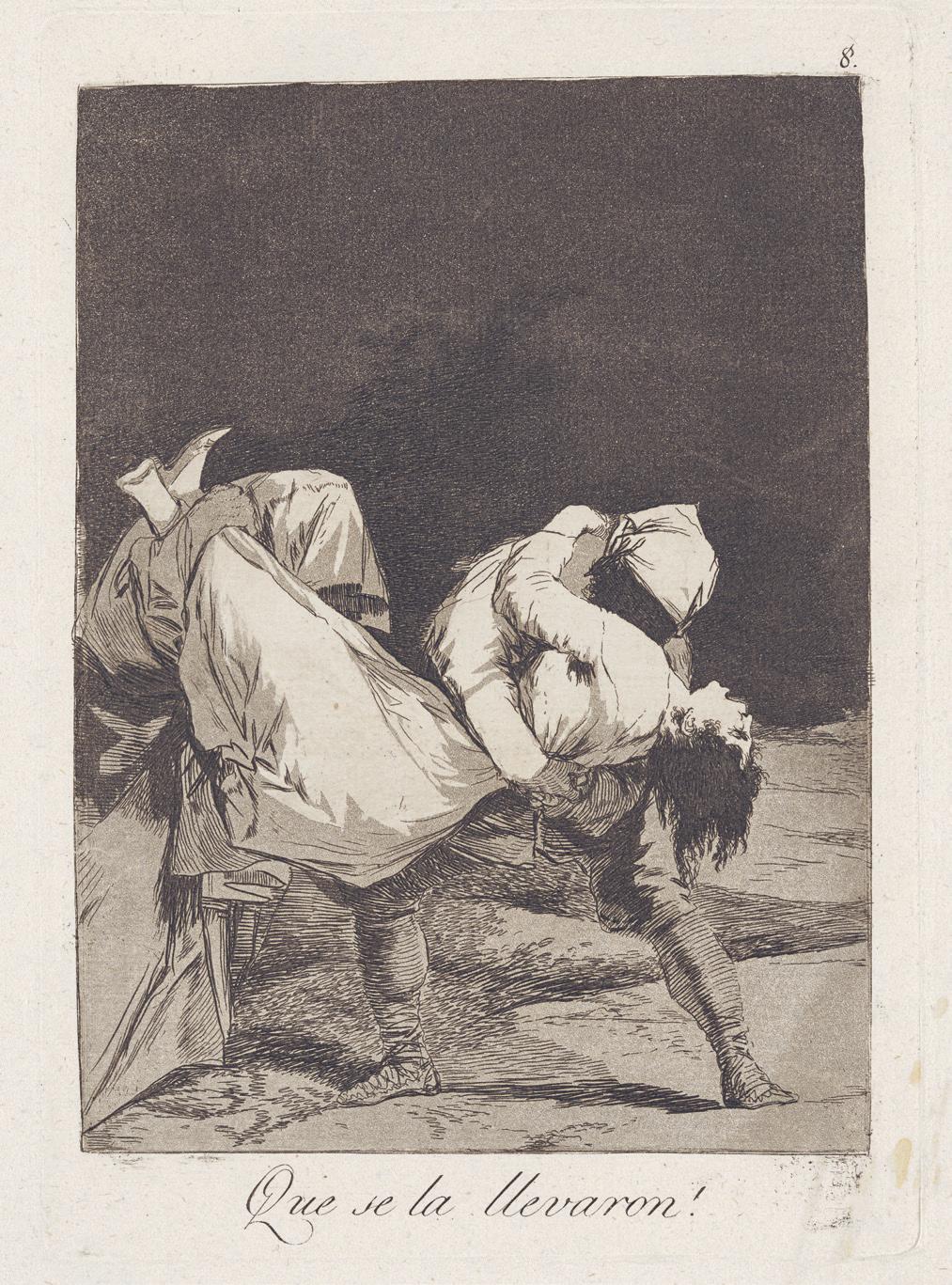
They Carried Her Off! from the series The Caprices
1797–98
Etching and aquatint
21.5 × 15 cm
Käthe Kollwitz
Francisco de Goya
– conveying the intimate, bodily and painful realities faced by women undergoing illegal abortions. The figures represent different ages and social classes, but they are all depicted alone in closed rooms. We see neither blood nor any other direct traces of the interventions. Instead, Rego focuses on the women’s bodies: how they are sitting, lying or doubled up in pain, their faces marked by pent-up despair, exhaustion or by quiet but defiant endurance.
One motif stands out: Untitled No 9, which shows an older, tough looking woman with cropped hair. She is seated and wiping a dish that she is holding in her lap. Beside her is a bed with white sheets and a crumpled blanket, and on the floor a bucket – discreet but telling details. The woman represents the so-called ‘angel makers’, that being the many unskilled women who, in the absence of legal and medically sound alternatives, helped desperate women terminate pregnancies.
The Abortion series received a huge amount of international attention and have since remained an example of how figurative art can directly intervene in social debates and help change cultural perceptions. Like Kollwitz – and Francisco de Goya, whom she deeply admired – Rego also used graphic techniques to reach a wider audience. By using etchings, her pictures were able to circulate beyond the art institution and serve as visual arguments in an ongoing political struggle. The artist herself was quite open about her objective: ‘I did them, too, for propaganda. I did them so that when you can’t show the paintings, you can show the etchings.’29 In this way, the Untitled pictures became a strategic tool in an ongoing public and political struggle in her native Portugal.
We live in a time when radical right-wing forces are on the rise, and the abortion issue is once again being politicised and contested. When I first became aware of Rego’s Abortion series, I was confronted with my own physical experiences as a woman. It is hard to go through a woman’s life without experiencing voluntary or involuntary pregnancies, miscarriages, or the pervasive fear and stress that can arise when a period doesn’t come. Rego’s images serve as a polemical and uncomfortably necessary reminder of the historical and constant vulnerability of the female body.
No bed of roses
Since my trip to Lisbon in spring 2018, I have returned several times in connection with the exhibition Dance Among Thorns. Notably, Nick Willing invited me to Cascais in spring 2024, for the opening of the Manifesto exhibition at Casa das Histórias.30 It had then been 50 years since the Carnation Revolution, and the anniversary was to be marked with an exhibition in which one of the main works was Manifesto (for a Lost Cause) – the work I had been so deeply fascinated by at the Gulbenkian six years earlier. The exhibition was also a celebration of Rego’s first solo exhibition in 1965. Its reconstruction made it possible to see the images in context, as a targeted and uncompromising showdown with Salazar’s dictatorship.
Paula Rego’s social and political art can be understood as a continuation of a European tradition. One that also incorporates Francisco de Goya, Käthe Kollwitz and Edvard Munch, in which art serves as a critical corrective to society’s power structures. The central issue for these artists
29 Ibid.
30
See Catarina Alfaro and Leonor de Oliveira, eds., Paula Rego: Manifesto, exh. cat. (Cascais: Casa das Histórias, 2024).
31
Kari J. Brandtzæg, ‘The Loneliness of the Soul: Tracey Emin meets Edvard Munch: An essay on loneliness, sexuality and ageing’, in Heidi Bale Amundsen, ed., Tracey Emin | Edvard Munch: The Loneliness of the Soul, exh. cat. (Oslo: Munch Museum, 2021), 8–24.
32 See Brandtzæg, ‘An Oratorio for Rejected Children’, in this book.
is the vulnerability of humanity, and for Rego all these artists are important references. However, unlike Goya and Munch – but like Kollwitz – Rego is focused on the experiences of women, fighting patriarchal and political limitations.
The contemporary artist Tracey Emin, who I collaborated with a few years ago on the exhibition The Loneliness of the Soul at MUNCH, does similarly.31 Emin, who was taught by Rego at the Royal College of Art, has commented on how important she was for the recognition of female artists and the legitimisation of themes related to being a woman. In 2007, the two exhibited together at the Foundling Museum in London, united by the theme of abortion and teenage pregnancy.32 In an email, Emin writes to me:
33 E-mail dialogue between Tracey Emin and the undersigned, 15 November 2025.
I was very lucky to have Paula Rego as my external tutor at the Royal college of art in 1988–1989. But, at the time I didn’t relate to Paula’s work. Because her work was so much more controlled, and my work has always been very wild and expressive. But as the years have gone by, I’ve learnt to have a deep respect for Paula. The fact that for most of her career she was wholly unfashionable, and how she pushed the boundaries of acceptance for what it is to be a female artist. She was fearless.33
Tracey Emin calls attention to Rego’s fearlessness, which I too am struck by. She not only fought the thorns of fascism using art as her weapon, she also paved the way for other female artists.
Paula Rego’s art also resonates deeply with my own understanding of what it means to be a woman. When I was a young teenager running carefree around the Algarve coast, I was largely unaware of all the struggles fought since Norway granted women the right to vote in 1913 – struggles that made it possible for me to pursue higher education, have children, work full-time and support myself financially. Yet, even today, a woman’s sexuality, body and ageing are surrounded by moral expectations, shame and silence, which is why Rego’s images are so important. Her art reminds us that legal rights do not always mean genuine freedom, and that experiences related to the body and sexuality are always shaped by ideological and cultural norms.
Through literary references, dialogues with art history and an uncompromising exploration of the subconscious, Rego gives us enigmatic and complex images that confront and touch us and embody the female experiences that are all too often silenced and repressed.
Paula Rego’s Discovery of Edvard Munch
by Kari J. Brandtzæg
When I began to study the art of Paula Rego in connection with the exhibition Dance Among Thorns, I became aware of an unexpected link to Edvard Munch (1863–1944). It was almost as though Rego’s work was in a silent conversation with the Norwegian artist’s visual world. What I found especially striking was the thematic and compositional similarity between two of Rego’s best known paintings – The Dance (1988, p. 49) and Time – Past and Present (1990) – and Munch’s central motifs Dance of Life (1899–1900, p. 48) and History (first version 1909–10, p. 52). This subtle association was something I felt compelled to investigate, as it raised numerous questions: Was the similarity intentional? Did Rego hold a particular interest in Munch? Did she view him as a role model? And when might she have encountered his work?
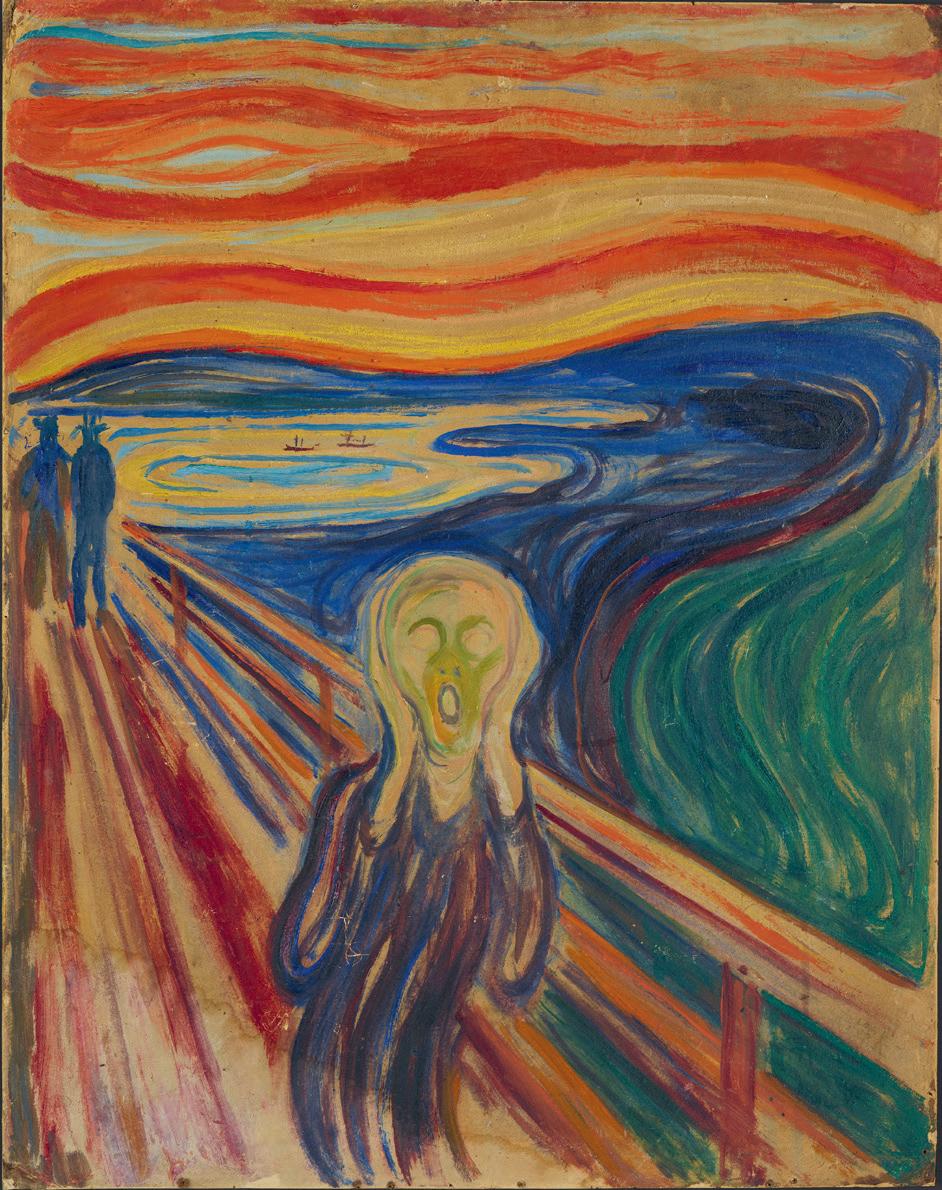
Nick Willing, Rego’s son and director of the Estate of Paula Rego, confirmed that his mother had indeed admired Munch’s work. There was, however, no concrete evidence indicating where or how Munch’s artistry had come to Rego’s attention. We wanted to explore this further, but months passed without any progress, until Nick in autumn 2025 rediscovered a small painting among the works he brought with him to London from the family house in Portugal in 2015. The picture was undated, but probably painted in 1953, while Rego was attending the Slade School of Fine Art, and its rough, curved strokes in red and yellow were reminiscent of Munch’s art – especially his expressive use of warm hues in Angst and The Scream (p. 57), both of which were painted in the early 1890s.
The hitherto unknown painting was called Drought (1953, p. 56), and shows a pregnant woman with her face turned towards a blazing sun. Over her belly she carries a foetus-like baby, whose large head and slender body are reminiscent of the baby in Käthe Kollwitz’s 1923 poster for the legalisation of abortion in Germany. The child also bears a strik-
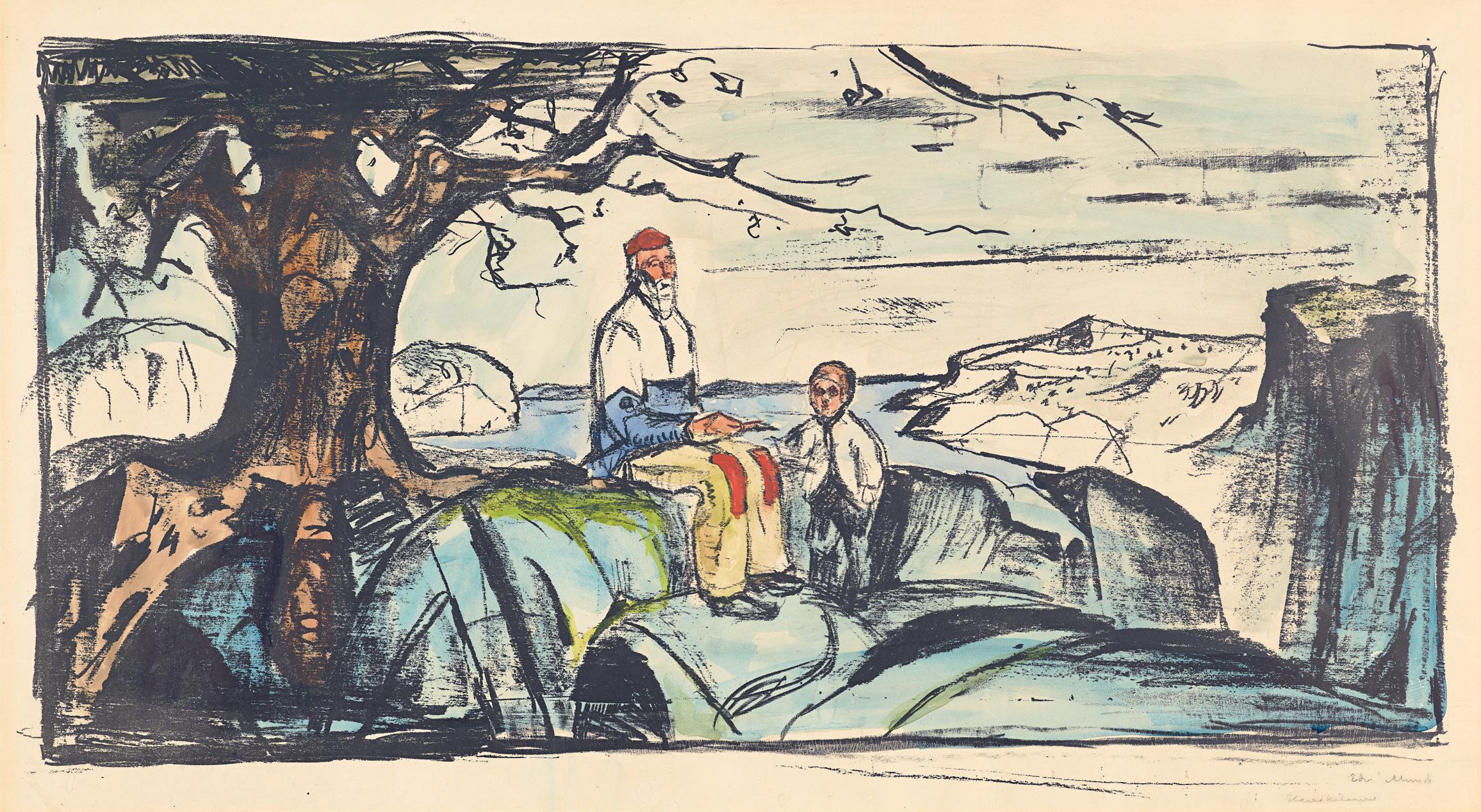
Edvard Munch, History, 1914. Hand-coloured lithograph, 42 × 78.4 cm
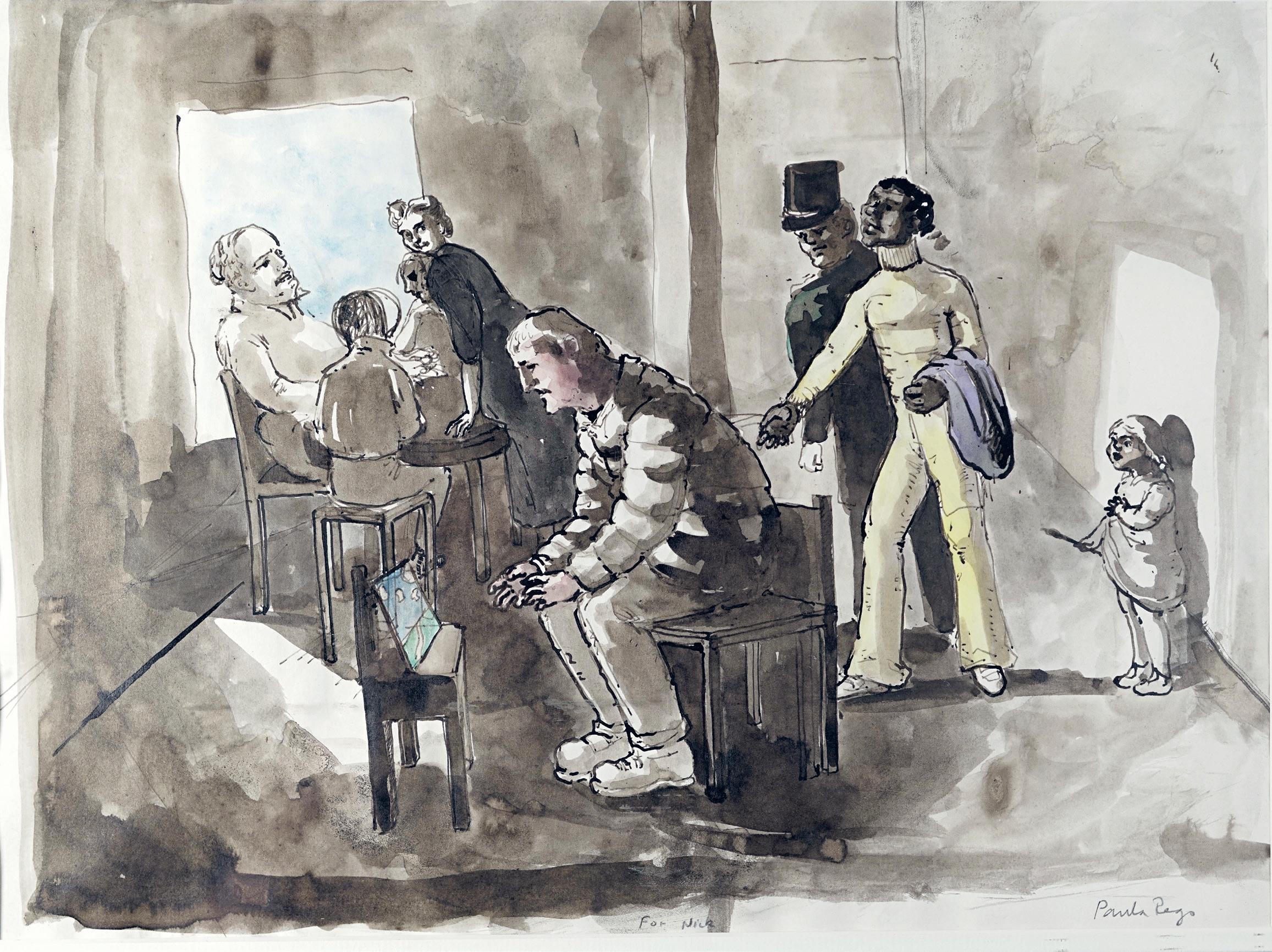
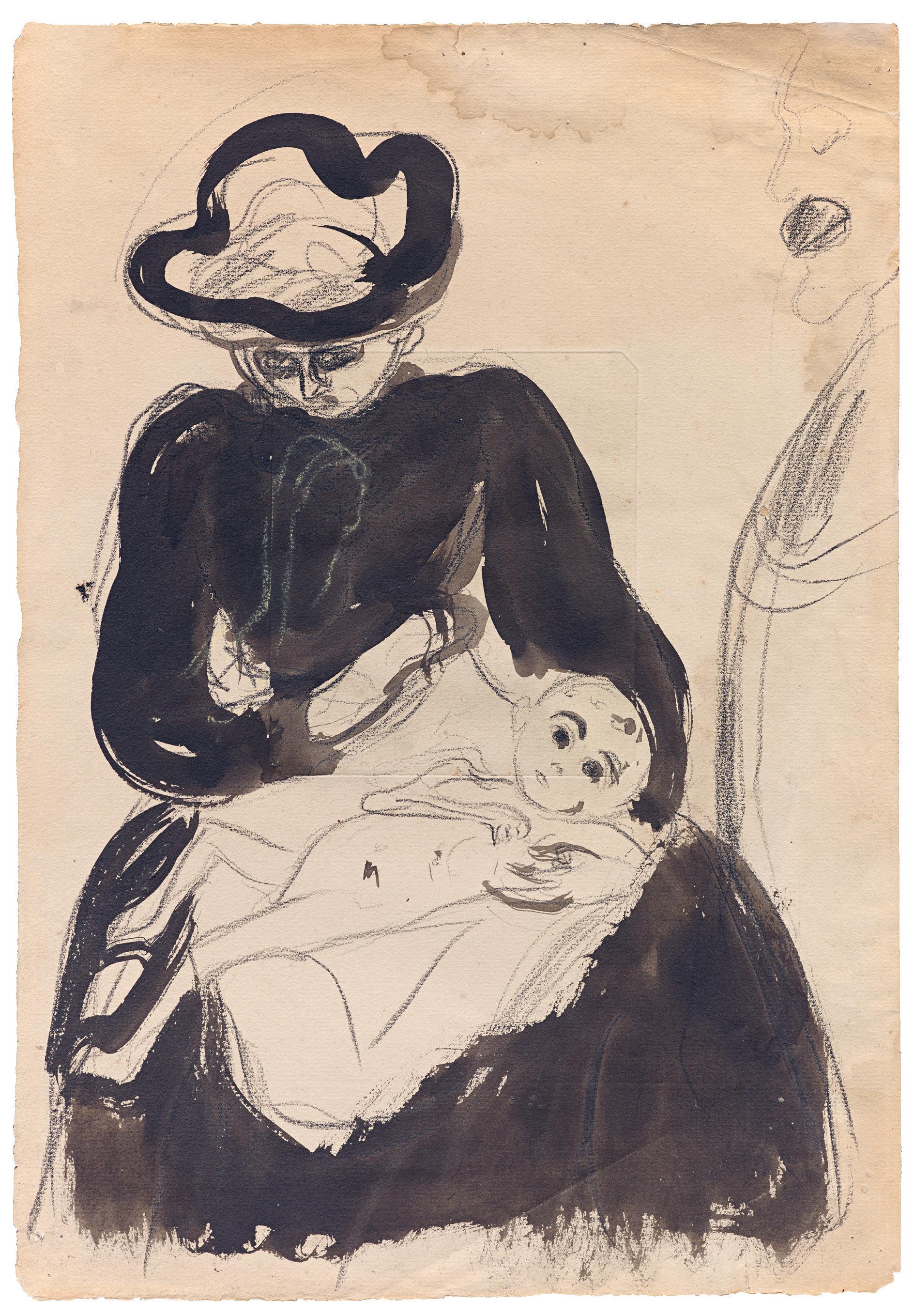
Sketch for Time – Past and Present, 1990. Ink and watercolour on paper, 29 × 39 cm
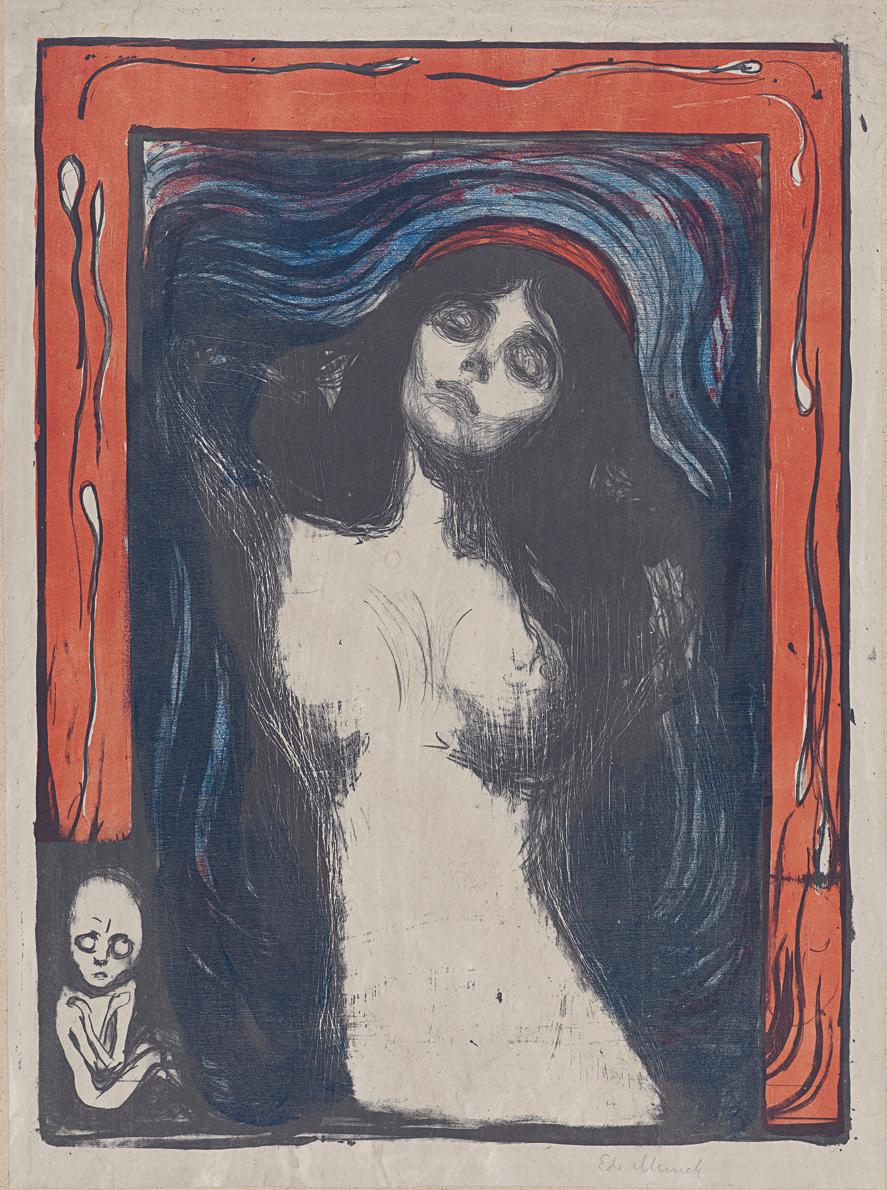
ing resemblance to the corpse-like foetus that appears in the margins of some versions of Munch’s Madonna (first version 1894, p. 57).
Munch’s life coincided with the first wave of Norwegian women’s liberation, and liberated and headstrong women such as Oda Krohg, Tulla Larsen and Dagny Juel were among those he associated with. The latter of these women likely posed as the Madonna in an erotic posture with her eyes half-closed, for an image that hints at the moment of conception and sexual pleasure. Munch’s radical depiction echoes the period’s heightened focus on female sexuality, but also seems to be a commentary on the lack of contraception and the many involuntary pregnancies of the time. This issue seems to have preoccupied Munch, although naturally it is even more clearly expressed in Rego’s art, where she depicts illegal abortions from a female and self-experienced perspective.
The discovery of Drought confirmed my feeling that Rego and Munch had a shared formal and thematic interest, and it simultaneously prompted new searches, this time for letters or other written material in which Rego could have mentioned Munch. I cannot read Portuguese myself, but the whole archive was gone through with the help of the Estate of Paula Rego. After a long and fruitless search, a breakthrough finally came in November 2025: a letter documenting that Rego – aged only 16 and on a school trip to London in autumn 1951 – had seen a comprehensive exhibition of Munch’s work at the Tate Gallery. In the letter, written to her art-loving mother Maria, she writes that her class saw pictures from Picasso’s Blue Period as well as works by Modigliani, Gauguin, Matisse, Chagall and Blake. What had struck her the most, however, was a temporary exhibition of Edvard Munch’s works.
In the letter, Paula wondered if her mother knew about Munch’s famous painting The Scream, but told her that it was the painting Inheritance – depicting a tearful woman with a sick and emaciated baby in her lap – that made the greatest impression:
[...] what impressed me most was an exhibition there by a modern Norwegian painter, Edvard Munch. I don’t know if you are familiar with that quite famous painting The Scream – that’s his – and he paints almost everything in that genre; he also has many engravings and drawings. But it’s so impressive, so impressive that you can’t imagine. Above all, a painting called Inheritance, which shows a seated woman crying with a skeleton child, all painted green, in her lap.1
Admission to the Munch exhibition cost one shilling, and in her letter, Paula writes that only she and one friend could afford a ticket. This encounter with Munch and other artists at the Tate was decisive for Rego, because it directed her interest towards modern art. She elaborates on this in her letter: ‘More and more, Mum, I understand modern painters better and feel them more deeply, and I become less and less interested in the old ones, finding them increasingly devoid of feeling (I can’t quite explain it).’2 Rego felt that the modern artistic expressions, particularly Munch’s works, had an emotional content which older art lacked, and that it was something she wanted to develop in her own work.
1 Letter from Paula Rego to her mother Maria, November–December 1951, Estate of Paula Rego’s archive, reference A111. Thanks to Nick Willing and Eloisa Rodrigues for translation from Portuguese and help in finding the letter.
2 Ibid.
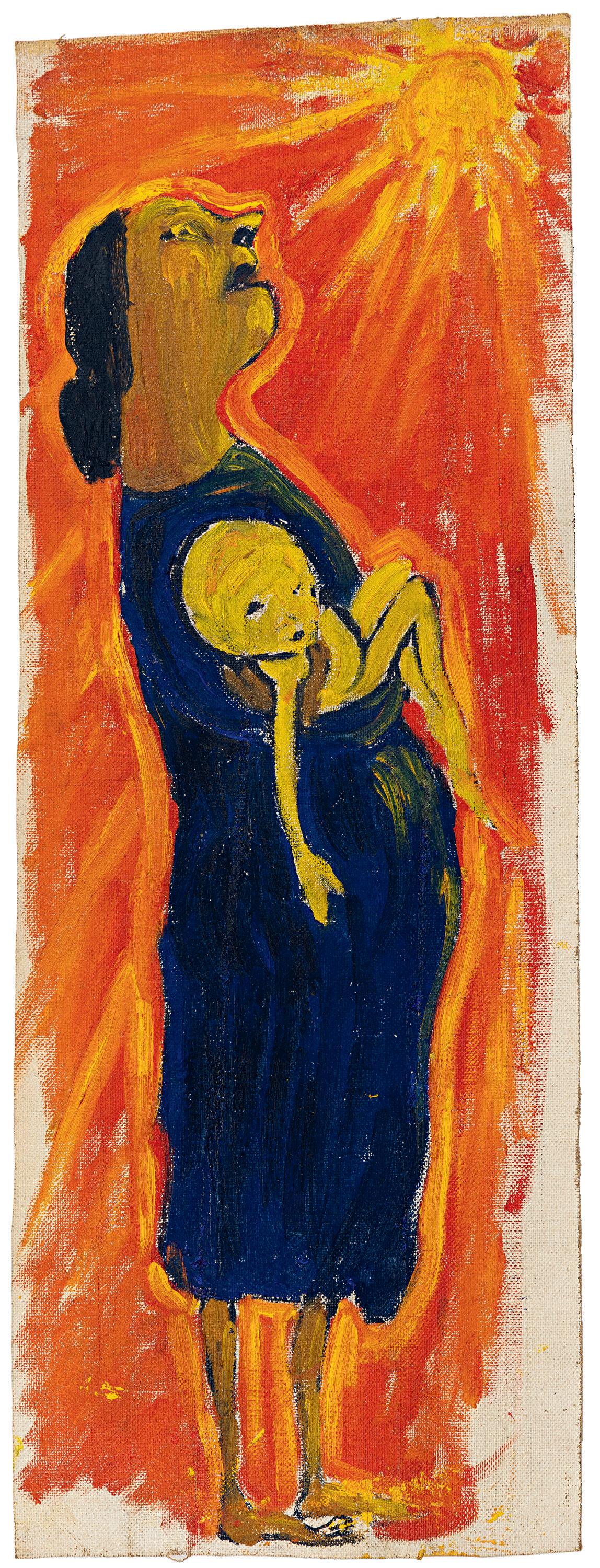
Drought, 1953. Oil on canvas, 65 × 22 cm
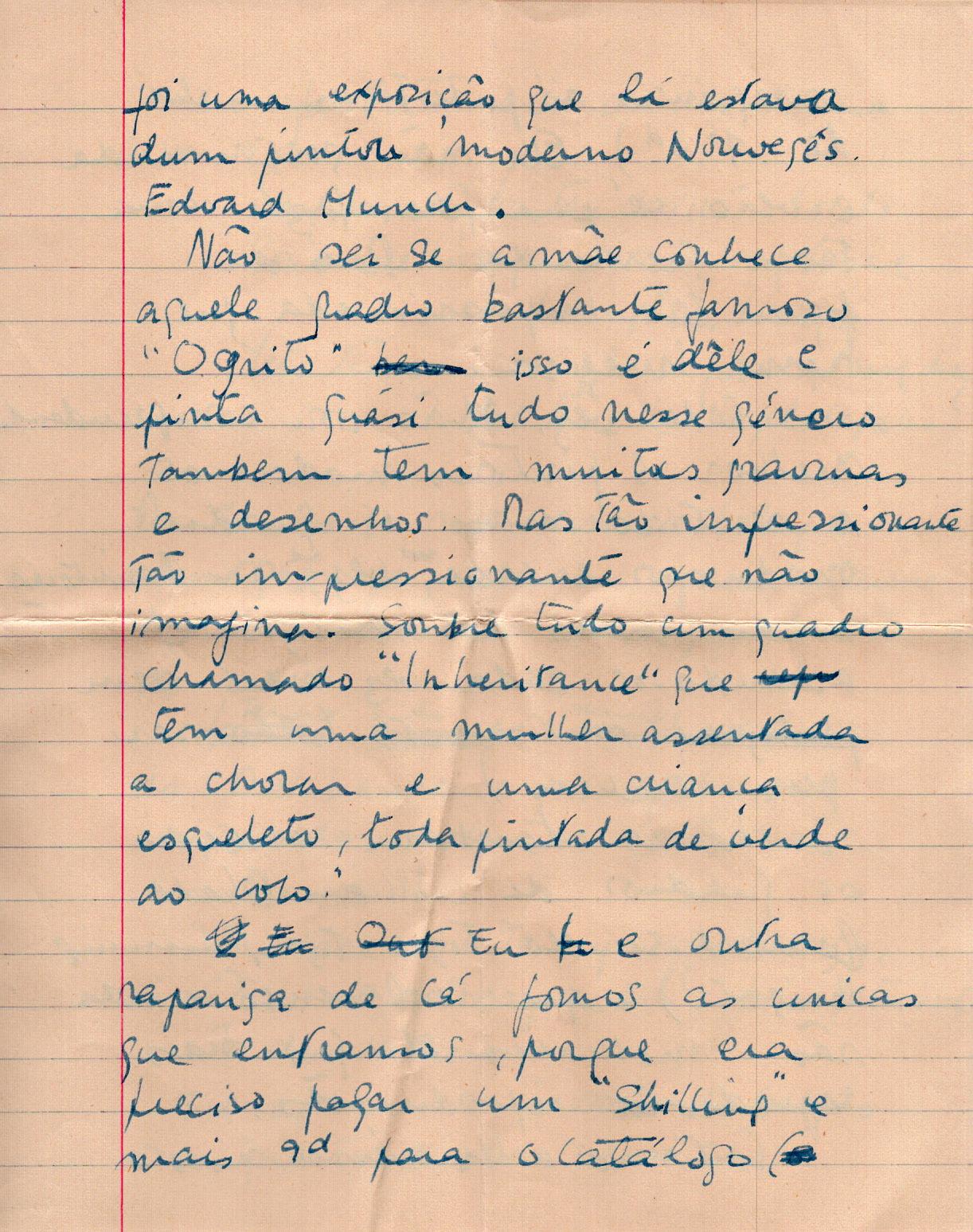
from Paula Rego to her mother Maria, November–December 1951
Edvard Munch
Madonna 1895/1902
Colour lithograph
60.5 × 44.5 cm
Edvard Munch
The Scream
1910?
Tempera and crayon on cardboard
83.5 × 66 cm
Letter
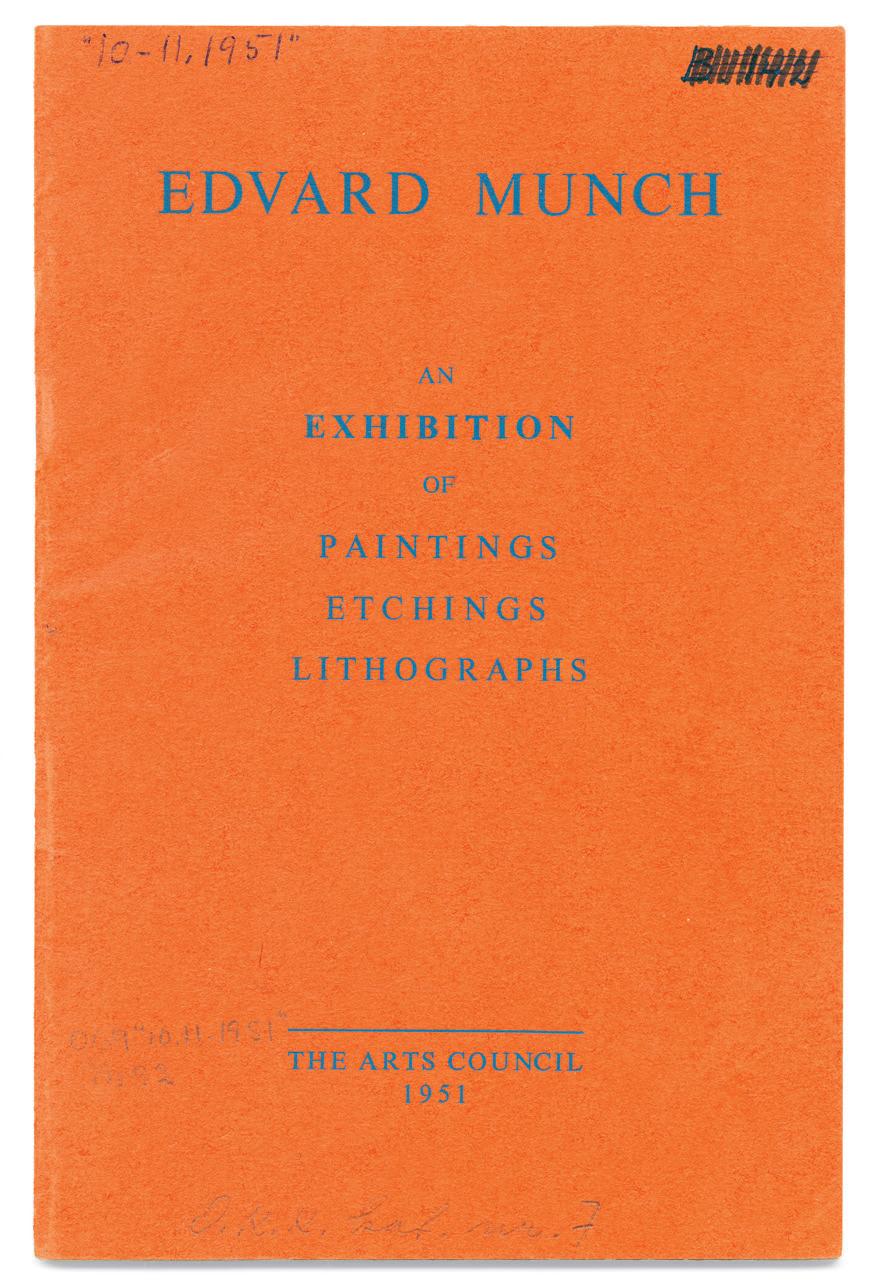
Catalogue for Edvard Munch exhibition at Tate Gallery, 1951
Edvard Munch, Inheritance, 1897. Brush and crayon on paper, 44.6 × 30.8 cm
3 With the exception of six works, the Tate Gallery exhibition was the same as the major Munch exhibition shown at MoMA in New York in 1950, and subsequently in several other US cities.
In the 1950s, there were several touring exhibitions of Munch’s paintings and graphic works in both Europe and the US, as part of the new, post-war focus on transatlantic dialogue and cultural exchange. These exhibitions also supported an ambition of those from the Norwegian side to promote and position Munch as a pioneer in modern art.3 At the Munch Museum’s library, I was assisted in finding the little, red publication that accompanied the works assembled at the Tate Gallery. The exhibition had been arranged by the British Council, with good help from the Munch Museum’s first director, Johan H. Langaard, who writes this in the catalogue text:
[...] as early as 1885, Edvard Munch felt the need to develop a bolder and more simplified style of painting, which we have now come to know as ‘expressionism’. He was one of those artists who reacted against naturalism, and led a movement which has since dominated modern art.4
4 Edvard Munch: An Exhibition of Paintings, Etchings, Lithographs (The Arts Council, 1951) was conceived at a high political level. In the catalogue’s preface, Philip James of the British Council expressed his immense gratitude to the Norwegian government and Fred. Olsen Line who had transported the exhibition from Norway to London completely free of charge.
5 Langaard writes: ‘[Munch] did not create an art for art’s sake, but for the sake of humanity.’ Introduction by Johan H. Langaard, Edvard Munch: An Exhibition of Paintings, Etchings, Lithographs (The Arts Council, London, 1951). After the artist’s death in 1944, Langaard, as director of the City of Oslo Art Collections, administered Munch’s bequest to the city.
Langaard also writes that Munch created groups of pictures that were somehow linked by a shared underlying idea. In doing so, he turned his art into an instrument for exploring both life and the universe itself. It was not created for decoration, Langaard argues, but for the sake of humanity.5
Like Munch, Rego was not concerned with ‘art for art’s sake’. As a teenager, she was already making pictures with a clear political message, images that revealed the constraints that both fascism and Catholicism placed on women’s rights to sexual freedom and expression in her native Portugal. This can be seen in works like her painting The Meal (1951, p. 110), the aforementioned Drought and her later and now highly renowned Abortion series (1998–2000, pp. 109 and 118–127).
For Munch, the collecting of images into series and friezes allowed for a more nuanced exploration of human existence and the conditions of life. Starting in the 1960s, Rego also dedicated herself to groups of works and thematic friezes – first in the ‘60s with her political collages, then with her 1970s fairy tale motifs and later the freer and more painterly images of the 1980s and 1990s, such as Vivian Girls at the End of the World (1984, p. 65) and the Girl and Dog (pp. 80 and 82) and Dog Woman series. With these, she repeats and examines the same motifs from multiple perspectives, as if searching for answers to existential questions, particularly those concerning care, gender dynamic and oppression of women’s self-worth.
6 She confirms this in Nick Willings’ documentary Paula Rego: Secrets & Stories (2017).
As it turned out, 16-year old Rego’s encounter with Munch in London was not her only early experience of his art. In 1952, on her journey home to Portugal from London after completing her time at Sevenoaks Finishing School, Rego and her parents drove to Paris to see an exhibition at the Petit Palais. There she saw a number of the pictures she had seen at the Tate the previous year.6 In an interview from 2004, Rego recounts how great it was to see Munch again, this time highlighting the motifs At the Deathbed (1893) and Puberty (1894–95), the latter depicting a tense young girl sat naked with her hands between her knees:
Yes. I saw a big show of him in Paris. I think it was 1953 [sic], something like that. 1953.7 The deathbed scene was there and there was a girl called Innocence [sic] of the naked girl with her hands between her knees. That one. I thought they were amazing when I saw them. It just seemed that it was very emotional. I’m saying that now because I know what it was, but I loved the life in them and all these things that were going on seem to me what I was trying to do, really.8
The quote reveals how Rego, like Munch, was concerned with the complexities of human emotions, which she explores in images that oscillate between the personal and the universal.
This oscillation is especially visible in the monumental composition The Dance (1988), which clearly relates to Munch’s Dance of Life (first version 1899–1900); one of the images we now know that Rego saw at the Tate in 1951. In these motifs, dancing figures along a coastline appear as a symbol of the cycle of life – from youthful hopefulness via mature love to the loneliness and resignation of old age. The psychological and existential content of Munch’s image along with the formal structure of the motif are also clearly recognisable in Rego’s version.
While Rego’s ‘dance’ speaks to all of us on an existential level, it is deeply rooted in her personal grief over the loss of her husband, the artist Victor Willing, who died while she was working on the picture. This grief is expressed through the enlarged female character, dressed in white on the left of the composition – a bewildered, lonely figure who must learn to master a new existence on her own. Her son Nick has written this about the creation of The Dance:
Her idea of The Dance started with sketches of women holding hands in a circle, as is done in traditional Portuguese folk dances […]. And then dad died. We all took his death very badly. He had such intellectual power over us, colouring our lives with so many profound insights and humour, that the world suddenly felt empty. Mum coped like she always did, by throwing herself into her work, and as The Dance was what she was painting, that’s what occupied her night and day.9
To help Rego complete the motif, Nick says, he had to pose as his father in his mother’s studio while wearing his father’s clothes. In the picture, the father dances with his mistress; the blonde woman in green with her back turned. To their left, Paula, depicted slightly bigger than the other figures, dances alone while looking towards us. In the background, we see a fort under a bright moon, and the beach in Ericeira, Portugal, where Rego spent many summers as a child and later lived for extended periods. At the back of the group we see the artist again, this time as a little girl, dancing with her mother and grandmother. By doing so, Rego explores family relationships, grief and experiences of loss, as Munch did in his motifs from the 1890s, including those concerning the early deaths of his mother and sister. Paula Rego’s visual narratives deal with time and history, and – like Edvard Munch’s works – are rooted in personal memories and
7
Here Rego remembers incorrectly. The exhibition she saw in Paris was shown in the Petit Palais (Musée des Beaux-Arts de la Ville de Paris) between 28 March and 30 April 1952. It was organised by the Arts Council of Great Britain.
8
Cathy Courtney, interview with Paula Rego, Artists’ Lives (National Life Stories, British Library Sound Archive, recording from 2002–2004), collection ref. C466/157.
9
Nick Willing, ‘The Dance’, in Eva Reifert, ed., Paula Rego: Power Games, exh.cat. (Basel: Kunstmuseum Basel, 2024), 73.
10 Elena Crippa, ‘Fantasy & Rebellion’, in Elena Crippa, ed., Paula Rego, exh. cat. (London: Tate Britain, 2021), 12. Crippa writes about Rego’s Interrogation, suggesting that the artist is ‘possibly taking inspiration from the palette and lowered head of the woman in Edvard Munch’s The Sick Child’
experiences. We see this, for example, in Rego’s Time – Past and Present (p. 50), which has a link to Munch’s History. His painting depicts an old man, more specifically a fisherman, telling stories to a child who is listening attentively. The motif was designed for the University of Oslo’s ceremonial hall, and the blue-clad narrator was meant to represent both Norway’s recent independence and the weight of the history of its people.
Rego’s Time – Past and Present also shows an older man in a blue suit, only this time in a domestic interior and with children around him on all sides. The painting can be read as a reflection on time’s passing. The children point towards the future, while simultaneously being in close contact with the past which is represented by the aging man – a situation that can be reminiscent of the motif in History. The young girl sitting at the table drawing is usually read as a self-portrait of Paula Rego in the process of receiving and interpreting stories and life experiences. Like Munch’s work, the painting’s subject is the power of storytelling and the transmission of memories and knowledge between generations. But while the active figure in History is the older man, in Rego’s painting it is the child, who takes control of presenting its own story.
Apart from Elena Crippa – who, in an essay written for Rego’s retrospective show at the Tate in 2021,10 pointed out that she may have been inspired by Munch’s palette – few have yet noticed the connection between the two artists. This text is an attempt to open the space between them and launch some initial thoughts about Edvard Munch’s influence on the development of Rego’s visual universe.
Without doubt, the two artists were equally sensitive to humankind’s emotional relationship to life, the world and its surroundings. But while working on the exhibition Paula Rego – Dance Among Thorns, it became clear to me that Rego approached reality from an entirely unique perspective, shaped by her upbringing in Portugal during Salazar’s fascist regime and by her roles as a mother and artist in England. Rego never adopted Munch’s forms of expression, but processed – consciously or unconsciously – elements from his images in a visual language that is exclusively hers, and a body of work that lives with power and conviction in everyone who encounters it.
Published by MUNCH in connection with the exhibition
Paula Rego – Dance Among Thorns 24 April – 2 August 2026
Head of MUNCH Publishing: Josephine Langebrekke
Editors: Heidi Bale Amundsen and Kari J. Brandtzæg
Editorial Consultant: Karen Elizabeth Lerheim
Design: Modest [Rune Døli]
Repro: JK Morris
Print and binding: Livonia Print, Latvia
Translation of the director’s foreword, Kari J. Brandtzæg’s texts, the timeline and the extended captions from Norwegian: Matt Bagguley
Translation of Catarina Alfaro’s and Isabel Freire’s texts from Portuguese: Rosa Churcher Clarke
Cover: Paula Rego, The Dance, 1988 © Estate of Paula Rego
© Ron Mueck / BONO, Oslo 2026
All rights reserved. This book’s contents may not be reproduced in any form, in whole or in part, without written permission from the publisher.
© 2026 Munchmuseet, Oslo www.munch.no
ISBN: 978-82-8462-059-6
MUNCH thanks its sponsors and partners:
Dance ThornsAmong
British-Portuguese Paula Rego (1935–2022) carved out her place in international art history with a self-possessed, uncompromising expression and a burning commitment to fighting oppression and lack of freedom. Rego grew up in Portugal under António de Oliveira Salazar’s dictatorship, which imposed strong constraints, especially on women’s freedom. This experience came to shape Rego’s long career, during which she dissected the relationship between gender, the body and power in a dark, fantastical visual language inspired by fairy tales and myths. At a time when authoritarian forces are on the rise across the world and women’s right to control their own bodies is under pressure, Rego’s images feel more relevant than ever.
The exhibition Paula Rego – Dance Among Thorns presents Rego’s powerful and unsettling oeuvre in its full breadth, including her early interest in Edvard Munch’s art. The catalogue presents all the exhibited works and a collection of new texts by the exhibition’s curator Kari J. Brandtzæg as well as by Catarina Alfaro, Isabel Freire and Jennifer Higgie. Together, they sketch an intense and nuanced portrait of an artist who never ceased to challenge – whether aesthetically or politically.