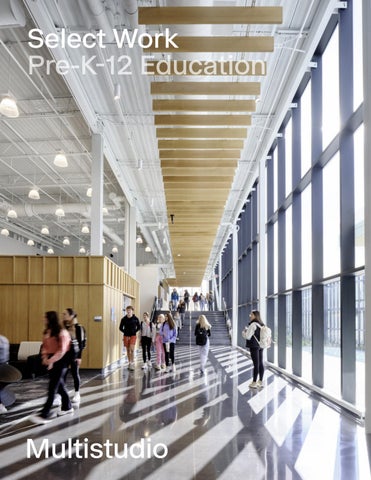
Select Work Pre-K-12 Education
2
Multistudio
PreK-12 Education
Table of Contents
Introduction
05
Approach
06
Multi-Process
12
Select Work
22
Contact
82
3
4
Multistudio
PreK-12 Education
Multistudio is a multidisciplinary architecture and design practice with five studios nationwide, each with the mission to enrich communities and the human experience through the built environment. Diversity of thought, people, and practice areas enables us to explore place and spark economic, social, and environmental change. And although we take on a variety of projects, neither size nor type dictates their importance—their impact does. Founded 1974 Employee Owned Our Studio Kansas City Lawrence New Orleans Phoenix San Francisco
5
Approach
6
Multistudio
PreK-12 Education
7
We are multiple disciplines, and everevolving in the field of design to meet future needs. We believe design is inherent in everything we do and carries multiple responsibilities to positively impact people, organizations, communities, and the environment.
8
Multistudio
PreK-12 Education
Elevating Diverse Voices Great design begins with people. At Multistudio, we cultivate a culture that encourages curiosity, mentorship, and accountability across disciplines. By embracing a wide range of perspectives, we ensure that our ideas are richer and our solutions more enduring. This inclusivity strengthens both our practice and our projects, allowing every team member to bring their full identity and expertise to the work. The result is design that not only reflects creativity and skill but also honors the lived experiences of those who shape it. Building Trust Through Partnership We view our partners—clients, consultants, and collaborators—as integral to the design process. Transparent dialogue and shared accountability enable us to align on goals and elevate each other’s expertise. By working closely with cost estimators, construction managers, and community stakeholders, we build trust and momentum at every stage. This collaborative framework results in designs that are both resilient and precise, shaped by the collective intelligence of many. Our partnerships are not transactional—they are the foundation for delivering environments that endure and inspire.
Designing with Community Insight Communities are central to our work, shaping spaces that foster identity, pride, and belonging. We engage directly with diverse voices to uncover needs and aspirations, weaving their insights into every stage of design. From rural school districts to urban neighborhoods, our projects are catalysts for connection, well-being, and shared prosperity. We recognize that authentic community engagement requires more than listening sessions—it means building trust, elevating local knowledge, and designing with transparency. By amplifying these perspectives, we create environments that feel rooted in place and culture while preparing for future change. Each project is an opportunity to strengthen bonds, expand access, and spark lasting impact that extends beyond the building itself.
Advancing Climate Responsibility We design with the understanding that environmental stewardship is inseparable from social responsibility. Climate change poses profound challenges, particularly for vulnerable communities, and our work addresses these realities head-on. By prioritizing healthy materials, low-carbon strategies, and adaptable systems, we create environments that safeguard human health while restoring ecological balance. Our designs not only minimize harm but actively advance resilience, wellness, and equity. At Multistudio, sustainability is more than a checklist—it is a commitment to shaping places that inspire future generations to thrive.
9
We bring more than 50 years of design leadership to educational environments that inspire learning and community.
10
Multistudio
PreK-12 Education
With over 800 education projects completed for public, private, and parochial clients nationwide, our team has shaped schools, campuses, and community facilities that elevate both performance and experience. Our work has been recognized more than 300 times by leading professional organizations and publications, underscoring our commitment to excellence in planning and design. Our services include: →
Education architecture across PreK–12, higher education, and community facilities
→
District master planning and educational specifications
→
Facilities assessments and bond support
→
FF&E services and post-occupancy evaluations
→
Brand experience integration within learning environments
→
Workforce housing solutions for educators and staff
→
Kitchen electrification and sustainable systems planning
Highlighted below are select PreK–12 projects completed within the past five years that demonstrate our depth of experience and design excellence across diverse educational settings. Albany Unified School District - Ocean View Elementary School Rebuild
Manhattan-Ogden Unified School District 383 Warehouse
Ascension Parish - West Ascension Early Learning Center
Nativity Parish School - Master Plan and Renovation
Auburn-Washburn Unified School District 437 - Washburn Rural Middle School Renovation
Nativity Parish School - Modular Classrooms
Auburn-Washburn Unified School District 437 - Washburn Rural North Middle School Barstow School - Athletics Facility Improvements Barstow School - Interior Improvements Bayou Community Academy Pre-K-8 New School Brentwood Union School District - Isaac R. Montañez Elementary & Middle School Citizens of the World Charter School - Kansas City Renovation and Addition Delano School Redevelopment Hayward Unified School District - Treeview Elementary School Kansas City Girls Preparatory Academy - Addition KIPP Legacy High School Design-Build Lawrence Unified School District 497 - Lawrence High School Renovation and Addition Lawrence Unified School District 497 - Free State High School Renovation and Addition Lee’s Summit R-7 School District - Lee’s Summit High School Renovation and Addition Lee’s Summit R-7 School District - District High School Robotics Additions Lee’s Summit R-7 School District - District Athletic Turf & Track Replacements
Notre Dame de Sion - Phase 1 Science/Learning Commons Renovation Oakland Unified School District - Highlands Preschool Orleans Parish School Board - Ninth Ward Stadium Confidential Client - Multipurpose Performance Building Rockhurst High School - Baseball Field Design San Rafael City Schools - Sun Valley Elementary School Modernization San Francisco Unified School District - Abraham Lincoln High School Athletic Field San Francisco Unified School District - Mission Bay Elementary School Bridging Documents San Francisco Unified School District - Production Kitchens San Francisco Unified School District - West Portal Elementary School Modernization South San Francisco Unified School District - El Camino High School St. James Academy - St. James Academy - Cultural Arts Center St. James Academy - Phase 1: Media Arts & Rhetoric Renovation St. James Academy - Renovation of the SPARK Center for Academics & Mega Lab Update St. James Academy - Site Infrastructure and Stadium
Lee’s Summit R-7 School District - Lee’s Summit High School Parking Lot Expansion
St. Paul’s Episcopal Day School - Multipurpose Space Renovation
Lee’s Summit R-7 School District - Missouri Innovation Campus Phase 2 Addition
St. Tammany Parish School Board - Mandeville JH Gymnasium Locker Room Renovations
Manhattan-Ogden Unified School District 383 - High School Renovation and Addition Phase 2
St. Teresa’s Academy - Donnelly Hall 1st Floor
Manhattan-Ogden Unified School District 383 - 901 Poyntz Manhattan-Ogden Unified School District 383 - Robinson Education Center
Osage City Unified School District 420 - Early Childhood Center West Contra Costa Unified School District - Michelle Obama School
Manhattan-Ogden Unified School District 383 - Central Kitchen / Transportation
11
Multi-Process Inclusive Engagement, Research, Workforce Housing Think Tanks, and Brand Experience
12
Multistudio
PreK-12 Education
13
Inclusive Engagement
Deck of Spaces™ is a shared language for thinking outside the box. The Deck of Spaces™: is a hands-on tool to facilitate expanded considerations of space design for equity and inclusion. Designed in partnership between Multistudio, UDL-IRN, and CAST, the Deck of Spaces™ is the beginning of your future classroom.
How can we explore the many ways contemporary school design marginalizes users based on race, ethnicity, socioeconomic status, trauma, and mental health? How do we break down these barriers to learning? The Deck of Spaces™ is a brainstorming tool for schools, districts, state departments of education, and even national education ministries to implement the UDL’s highly effective learning framework. The K-12 deck of 67 idea cards was co-designed by a national collaboration of experts in learning science and school design. Each idea is firmly rooted in the researchbased framework of Universal Design for Learning (UDL) and serves as an entry point to discuss sometimes challenging topics affecting students of all variabilities. https://deckofspaces.com/
Recognition → Metropolis Magazine Planet Positive Award → A4LE Kelly Tanner Innovation Award → Fast Company Innovation By Design Award → Core77 Notable Interaction Award → San Francisco Design Week Wild Card Award
14
Multistudio
PreK-12 Education
15
Research
The Multistudio Research Center studies the future of learning to unlock opportunities for creating school environments that inspire students and educators. A thriving school community needs supportive, flexible facilities to empower the students and professionals who work there each day. Multistudio’s researchers explore the interplay of people and place to create new insights for learning environments that are efficient, welcoming, and adaptable to meet the needs of the community over the lifespan of the facility. Our Research Center brings together designers, architects, and scholars to embed evidence-driven design into every one of our projects.
16
Multistudio
PreK-12 Education
→
Accessibility: inclusive design for each and every student through Universal Design for Learning
→
Authenticity: connections to business and community through Real World Learning
→
Flexibility: innovating teaching models like team teaching and learning neighborhoods
→
Welcoming: emphasis on student and teacher connections to place through design for sense of belonging
→
Longevity: supportive professional environments with a focus on staff recruitment and retention
→
Engagement: designing to support hands-on, project-based learning across the curriculum
→
Accountability: project evaluation through quantitative post occupancy evaluation (POE) methods
STEAM Studio helps us to gain new insights and empathy.
Multistudio operates a STEAM Learning Studio within our offices in Kansas City. Students come to Multistudio to participate in innovative learning programs. Partners include area private and charter schools, public schools, as well as non-profit agencies supporting youth from historically marginalized groups and those experiencing homelessness. Multistudio staff frequently participate in the education and mentoring process which brings great empathy to our work in designing education environments. The relationships established with area educators also leverage our ability to better understand the emergent trends and pressures affecting today’s schools. The insights gained from these hands-on experiences have led to unique opportunities to partner with other signature schools to reimagine their campus with a STEAM-focused overlay. Aside from the STEAM focus, both campuses are extending the cross-disciplinary nature of STEAM to courses well beyond Science, Technology, Engineering, Art, and Math to create collaborative, cross-disciplinary cultures that permeate their entire school cultures. https://steam-studio.org/ 17
Workforce Housing Think Tanks
Our PreK-12 Workforce Housing Think Tanks turn district interest into a clear first-year action plan, align the right partners at the right time, and build momentum from idea to implementation.
Building Momentum for Educator Housing School districts nationwide are confronting a growing challenge: retaining teachers who can no longer afford to live in the communities they serve. Multistudio’s Workforce Housing Think Tanks and early feasibility services help districts move from interest to implementation—aligning partners, clarifying options, and building momentum from concept to construction. Through collaborative sessions, we connect district leaders, developers, and policy advisors to unpack barriers and identify near-term opportunities. Our process distills complex issues into clear next steps, outlining priority sites, sequencing partnerships, and defining board touchpoints over the first 90–180 days. We combine market analysis, AMI targeting, and early pro forma studies with design and planning expertise to translate data into feasible, fundable options. Each engagement concludes with a succinct roadmap that reveals physical potential, highlights financial pathways, and positions districts to act with confidence. Our services span planning, feasibility studies, community engagement, funding strategy, RFQ/P development, and the design of shared and flexible spaces. Whether adaptive reuse, new construction, or a public-private partnership, Multistudio’s integrated approach turns workforce housing strategy into built outcomes that strengthen schools and communities alike.
Visit www.multi.studio/perspective/perspective/workforce-housing for: → PK-12 Workforce Housing Think Tank #1 Key Takeaways → PK-12 Workforce Housing Think Tank #2 Key Takeaways → PK-12 Workforce Housing Think Tank #3 Key Takeaways 18
Multistudio
PreK-12 Education
We help school districts transform workforce housing vision into action by connecting partners, clarifying priorities, and defining a clear path from feasibility to funding. Through an integrated approach that blends planning, design, and financial strategy, we deliver practical, communitycentered housing solutions that strengthen schools and the people who make them thrive.
19
Brand Experience
Our Brand Experience team uses storytelling, identity, and experiential design to create cohesive pK–12 environments that reinforce your mission and strengthen connections among students, families, and communities.
20
Multistudio
PreK-12 Education
Multistudio’s Brand Experience team explores the connections between storytelling and education, brand and communication, graphics and interiors—reinforcing your mission through a cohesive experience that integrates every aspect of your identity. Through brand, we shape holistic environments that invite people of all ages to engage and form meaningful connections to place. Recognizing that no two schools are alike, we tailor our process to your unique goals, mission, and vision. Grounded in a deep understanding of your community— from students and families to staff and neighbors—we combine demographic insights and cultural context to inform our design. Together, we craft solutions that enhance both brand and experience. From strategy and identity to school spirit graphics, digital integration, and wayfinding, we create environments where every interaction amplifies your story and strengthens connection across the educational journey.
21
Select Work Schools That Serve Each and Every
22
Multistudio
PreK-12 Education
23
Lee's Summit High School Lee's Summit School District
24
Multistudio
PreK-12 Education
25
Lee’s Summit High School is transformed into a connected, collaborative campus aligned with the district’s Real World Learning vision. To ensure equitable access to future-ready learning environments, we engaged stakeholders in the development of the district’s Comprehensive Facility Master Plan, aligning fiscal resources and adjusting school boundaries to meet the instructional programming and facility needs of all pre-K through K-12 students. The result was a $100M+ bond to modernize and create innovative learning spaces with a focus on Real World Learning. At the heart of the comprehensive plan is Lee’s Summit High School. Lee’s Summit School District R-7 directive was to “think big and lead the charge.” Multistudio stepped up to the challenge. Step one was to create a clearly defined spine that defines a hierarchy of circulation through this existing disjointed campus. Because students expressed appreciation for exterior circulation, this spine is an entwined symmetry of interior and exterior circulation, including an Innovation Way and Greenway. Innovation Hubs offer support to the school’s Real World Learning initiatives, providing gathering and break-out spaces for client-connected project work and business partner visits. Innovation Way ties together the sprawling campus through a new circulation route lined with educational space to support real-world learning. A Greenway weaves through the campus, providing access to—and circulation through—outdoor learning spaces, while creating a secure campus. To emphasize the hierarchy and promote collaboration, the future-ready learning program is stretched along this spine. Innovation Hubs, a series of collaborative, flexible hubs are stretched through the large campus to provide worklike settings in which teachers and students can better engage in real-world learning projects and engage with business partners. As part of the Kauffman Foundation’s first cohorts for Real World Learning, students can leverage these hubs and the flexible classrooms to do a wider range of learning activities as they attain market value assets, improving readiness for life after graduation.
26
Multistudio
PreK-12 Education
Project Data → Lee's Summit, MO → 390,000 SF Renovation; 70,000 SF Addition → Renovation & Addition Recognition → AIA Kansas Chapter, Architectural Project Honor Award - Urban Category
27
"There are few architects, in my opinion, that have invested as much time and effort as Multistudio into educational research. They have helped the Lee’s Summit School District transform the functionality of our learning space." — Kyle Gorrell, Director of Facilities, Lee's Summit School District
28
Multistudio
PreK-12 Education
29
Washburn Rural North Middle School Auburn-Washburn Unified School District
30
Multistudio
PreK-12 Education
31
A biophilic design centered on the Forest Walk transforms shared spaces into a continuous landscape for learning and belonging.
32
Multistudio
PreK-12 Education
With over 6,000 students across the district and only a single school to accommodate all middle-level learners, Auburn-Washburn USD 437 required a second middle school to help alleviate overcrowding. The new middle school was designed for a projected enrollment of 750 students and allows the district to move the sixth-grade curriculum from their elementary schools to their middle schools. The new school supports students’ socio-emotional needs while also embodying a “learning happens everywhere” ethos to ensure highefficiency space allocation. Engagement with students through surveys and workshops revealed the need for students’ socio-emotional support. The design approach embraces this need by providing a school with purposebuilt space supporting student autonomy, encouraging social engagement between classes, and celebrating personal identity and expression.
Project Data → Topeka, KS → 138,000 SF → New Construction Recognition → AIA Kansas Chapter, Honor Award - Architectural Project Award: Urban Category
A primary circulation spine, known as the “Forest Walk” for its connection to the adjacent forest’s edge, consolidates public commons, dining, and library into a single “learning first” environment. Its unique blend of programs brings together typically underutilized program space to create a highly efficient and vibrant learning community that can be used continuously throughout the school day. This strategy saved the school district nearly 10,000 SF without sacrificing any programming, creating new opportunities for facility and curriculum investment. Biophilic design principles are integrated throughout the school to further support students’ wellbeing.
33
34
Multistudio
PreK-12 Education
35
Aspen Grove Elementary School Blue Valley USD
36
Multistudio
PreK-12 Education
37
A future-ready elementary model designed to grow with student needs. Aspen Grove Elementary is a new 67,000-square-foot prototype school in Overland Park, Kansas, designed to serve 650 students while advancing the district’s vision for high-performing, future-ready learning environments. The design is centered on flexible learning communities that can adapt to both traditional homerooms and more progressive models of personalized learning. Teachers can co-teach as grade-level teams, grouping students by readiness levels, and the layout allows learning to flow naturally between spaces. Flexibility is embedded throughout the building. Mobile walls between learning studios and commons make it possible to shift between independent study, collaborative projects, and interdisciplinary teaching. A diverse mix of spaces supports a wide range of activities—from maker-based exploration and team projects to quiet reading and small group instruction. Learning studios are equipped with adaptable furniture and integrated technology, ensuring they can morph to meet changing needs throughout the day. The heart of the school is defined by central gathering spaces, including a café and commons that serve as hubs for dining, assemblies, and community events. These spaces extend outdoors, reinforcing the connection between learning and environment while providing additional areas for eating and socializing. Flex Studios add another layer of adaptability, enabling the school to absorb enrollment shifts without sacrificing essential support functions. Together, these design strategies ensure Aspen Grove Elementary will remain responsive, resilient, and supportive of innovative teaching and learning for years to come. Multistudio (Architect of Record) and Fielding International (Education Planner)
38
Multistudio
PreK-12 Education
Project Data → Overland Park, KS → 67,000 SF → New Construction
39
40
Multistudio
PreK-12 Education
41
Pembroke Hill School Athletics and Dining
42
Multistudio
PreK-12 Education
43
Design rooted in Pembroke Hill’s mission fosters engagement, wellness, and connection across campus life. Multistudio worked with Pembroke Hill School in Kansas City, Missouri, to expand and renovate the dining and athletic facilities in line with the school’s mission and values. The renovated and expanded dining facility elements included raising the ceiling height, expanding the lobby, and enhancing the overall character of the facility. The replacement of the school’s gymnasium included a game court, retractable bleachers to provide two cross-courts, a second practice court, miscellaneous support spaces, a dance room, a weight room, and a trainer room. We also enhanced the campus landscape architecture. The mission of Pembroke Hill School is to enable all students to build character and to develop their intellectual, physical, and creative abilities to the highest level. →
Children learn best by doing
→
Educate the whole child
→
Healthy relationships are essential
To that end, the planning and design team worked closely with school staff and administrators to gain a thorough understanding of the way the existing facilities were being used to inform the final design. Through this process, the following guiding principles were identified and are driving the design: →
Increase opportunities for engagement and interaction to strengthen relationships across the entire PHS community
→
Design for flexibility and multiple usages to support stewardship of resources through the highest and best utilization of all spaces
→
Build to last, but build sensibly while allowing shortterm adaptability
→
Seek aesthetic unity and completeness among the buildings and grounds
44
Multistudio
PreK-12 Education
Project Data → Kansas City, MO → 60,000 SF → Renovation & Addition Recognition → AIA Kansas Chapter, Excellence in Design Merit Award in Architectural Research and Innovation Category
45
Lawrence High School Lawrence Unified School District
46
Multistudio
PreK-12 Education
47
A comprehensive renovation reimagines Lawrence High School to support interdisciplinary learning and student well-being. The upgrades to Lawrence High School were part of an $87 million bond initiative that funded renovations and additions across the district’s two high schools and four middle schools. Encompassing 288,000 square feet of renovation and 27,000 square feet of new construction, the project was guided by extensive teacher and student surveys that identified the types of spaces needed to support evolving instructional models. The modernization focused on bringing Career and Technical Education (CTE) and Real World Learning programs into the heart of the school, creating a more connected and accessible environment. New shared collaboration areas extend learning beyond the classroom, integrating digital media zones, gallery spaces, and flexible areas for groups of all sizes. These spaces encourage interaction, creativity, and interdisciplinary learning that the previous layout could not easily accommodate. The phased renovation also placed a strong emphasis on wellness, nutrition, and physical health. A new wellness commons was introduced as a central gathering place that supports both student well-being and a stronger sense of community within the school.
48
Multistudio
PreK-12 Education
Project Data → Lawrence, KS → 288,000 SF Renovation; 27,000 SF Addition → Renovation & Addition
49
Free State High School Lawrence Unified School District
50
Multistudio
PreK-12 Education
51
Relocating the library to the school’s core turns underused space into a dynamic, integrated learning environment. The upgrades for Free State High School were part of an $87M bond issue that was passed in 2017 to fund improvements to the district’s two high schools and four middle schools. The Free State improvements included moving the school’s library/media center to a central corridor on the second floor, while connecting it to a first-floor dining commons with a “media stair.” The monumental stair includes seven levels of ascending platforms between two traditional staircases—creating a venue for social gathering, classes, and special presentations for groups of up to 100 students. The decision to relocate the library/media center was made when a survey found that many of Free State’s students didn’t use the library. Thus, the new design has multiple features that make the library more appealing for students and provides greater flexibility, with the goal of creating a fully integrated learning environment used eight hours a day. The media center is laid out with active areas near the main stair and quiet areas in the back. Among its features are a space with a large audio-visual display with seating for 12, a group project center with printers and a sink, a group study area, a private study area, and breakout areas for smaller group meetings.
52
Multistudio
PreK-12 Education
Project Data → Lawrence, KS → 47,000 SF Renovation; 13,000 SF Addition → Renovation & Addition
53
Manhattan High School Manhattan-Ogden Unified School District
54
Multistudio
PreK-12 Education
55
Design clarity and transparency create a cohesive campus that strengthens connection and belonging.
56
Multistudio
PreK-12 Education
Human inquiry was the primary driver in the reorganization of this high school campus, which had undergone multiple additions to accommodate a growing student population. The design team’s research pointed to two primary issues plaguing this growth: a lack of organization, and consequently, a lack of community.
Project Data → Manhattan, KS → 244,196 SF Renovation; 79,263 SF Addition → Renovation & Addition
We addressed the issues of organizational clarity and transparency of program by consolidating commons, cafeteria, library and media center into a highly visible academic core, nestled between two light-filled and rejuvenated courtyards. The core serves as a social and connective “living room,” with blurred boundaries between interior/exterior and social/academic programs. Within this core, spaces accessible to the community are distinguished from student spaces with rich material texture. To further support clear wayfinding and circulation, a new building “language” was overlaid upon the campus at a multitude of scales. In some cases this language is literal, as in the braille signage; in some cases material, as in the graphic patterns embedded in the long runs of lockers or exterior building panels that transition tonally across the facade; and in some cases conceptual, as in the dappled light that filters through the exterior scrim.
Recognition → AIA Kansas Chapter, Citation for Unbuilt Commissioned Architecture → AIA Kansas City Chapter, Citation Award for Design Excellence - Unbuilt → International Interior Design Association (IIDA) Mid America Chapter, MADA Silver Award → Riley County Preservation Alliance, Historic Preservation Award - Public: Community Enhancement → AIA Central States Region, Merit Award - Commercial Architecture
Student Pathways: Multistudio tracked student pathways through the campus to understand current use and opportunities for re-organization.
57
Missouri Innovation Campus
58
Multistudio
PreK-12 Education
59
“I want the entire country to notice the innovation happening here [at Missouri Innovation Campus], and I want other colleges to take a look at what’s being done here as well." —President Barack Obama The Missouri Innovation Campus is a one-of-a-kind program offering the most accelerated degree program in the country. It’s the result of a unique partnership between Lee’s Summit R-7 School District and the University of Central Missouri, Metropolitan Community Colleges, and more than two dozen industry partners throughout the Silicon Prairie region. Multistudio led the programming and design of this innovative new campus from start to finish, and led all the engagement sessions with the various industry partners. The design outcomes specifically meet the emerging needs of today’s students seeking to enter the workforce quicker, at less cost, and with better assurance of job placement as opposed to traditional secondary-to-undergraduate tracks. Maintaining close alignment with workforce needs means programs are constantly evolving; thereby the facility has an unusually high degree of flexibility. The programming and design process for MIC was driven by the DNA of Multistudio - gathering and synthesizing input from diverse partners including community based organizations, regional business partners, students, district leaders, and university leaders. These meaningful dialogues guided our explorations to find the essence of the project. This immersive, collaborative process was responsible for the realization of a unique facility and program against which no other institution in our region has been as transformational. MIC truly reevaluates how education is delivered. Creating a learning environment that emulates the workplace required the design team to study contemporary workplace settings and translate these into practical learning environments that help students develop the essential skills needed to be successful after graduation. Multistudio, Design Architect; DLR Group, Architect of Record 60
Multistudio
PreK-12 Education
Project Data → Lee's Summit, MO → 147,115 SF → New Construction Recognition → Kansas City Business Journal, Capstone Award for Community Impact → Association for Learning Environments (A4LE) Exhibition of School Planning and Architectural Award - Design Concept → Society for College and University Planning (SCUP/AIA-CAE) Excellence in Architecture Award - Special Citation → AIA Central States Region, Design Excellence Award → Associated General Contractors Kansas City Chapter, Building Excellence Award Project of the Year ($25-50 million) → The Chicago Athenaeum: Museum of Architecture and Design, The American Architecture Award → Learning By Design Magazine Architectural Portfolio, Grand Prize Award → American School & University Magazine (AS&U) Educational Interiors Showcase, Special Citation → AIA Kansas Chapter Design Awards, Merit Award → American School & University Architectural Portfolio, William W. Caudill Citation as Top K-12 Project of the Year → Engineering News Record Midwest Chapter, Best Projects Award - K-12 Education → International Interior Design Association (IIDA) Mid-America Chapter Design Awards, Gold Award
61
Laurel Child Development Center Oakland Unified School District
62
Multistudio
PreK-12 Education
63
An all-electric preschool brings equitable early learning and ecological stewardship to an underserved California community. The preschool is envisioned as an all-electric, decarbonized early childhood development center that serves an underserved public school community. Developed in close partnership with the school district, administrators, and local stakeholders, the project reflects a shared vision of an equitable preschool that sparks imagination and curiosity while fostering a culture of early ecological stewardship. To bring this vision to life, the design emphasizes learning environments deeply connected to nature and extends support services to the entire family. Four classrooms— designed to accommodate up to 108 children—open directly to a sequence of outdoor learning zones, from areas for nature play and gardening to spaces designed for more active, noisy play. Complementing the learning spaces, the building also houses a family resource center and dedicated work areas for teachers and staff, reinforcing its role as a hub for both education and community support. The facility’s sustainable design features are woven into the educational experience, offering opportunities for children to learn directly from the environment around them. A solar roof offsets energy and carbon, while edible gardens and rainwater collection barrels teach lessons in growth and resourcefulness. A dedicated teaching garden highlights the water and nutrient cycle, creating tangible, hands-on experiences that encourage curiosity and nurture a lifelong awareness of ecological responsibility.
64
Multistudio
PreK-12 Education
Project Data → Oakland, CA → 10,200 SF → Renovation → All-Electric
65
Ocean View Elementary School Albany Unified School District
66
Multistudio
PreK-12 Education
67
Welcoming design and hands-on learning spaces create a sense of community for a globally diverse student body.
68
Multistudio
PreK-12 Education
This new facility construction and modernization was funded by bond measures to replace an outdated and seismically-deficient set of buildings. The design was guided by the goal of providing a strong sense of belonging for its families, many of whom hail from international backgrounds and reside in the adjacent UC Village. The school population is highly transitional with many students entering mid-year, making it important to signal welcoming throughout the campus. Multistudio facilitated a planning process using the UDL Deck of Spaces to create a shared understanding of priorities that would achieve these objectives.
Project Data → Albany, CA → 25,000 SF New Construction 17,000 SF Modernization → New Construction & Renovation → Net Zero Ready
The centerpiece of the new design is the vibrant new International Courtyard that provides a welcoming and nurturing entry experience. It features plants from each continent to represent its diverse student population. A new library and maker space with shaded outdoor porch is situated within the courtyard, supporting hands-on learning and providing space for after-hours community meetings. The library creates an inviting shared resources hub that the classroom, administration and kindergarten wings are organized around, forming the campus “heart” and inspiring a maker ethos throughout the school. The project was designed with sustainability in mind, with a range of passive, active and landscape strategies that work together. It is Net Zero Ready.
69
West Ascension Early Learning Center Ascension Parish
70
Multistudio
PreK-12 Education
71
Reimagining a 150-year-old general store into a model for equitable, community-rooted early education. As a result of a productive working relationship, Ascension Parish approached Multistudio to reimagine the ground floor of the Lemann Building (an existing 150 year old historic General Store) into an early childhood learning space that could be modeled throughout the region. The Center will foster growth for infants through 2-year-olds and is designed to give children the start they need to succeed. The curriculum will follow the Perry Preschool Project, which takes an active learning approach to early education and was developed outside Detroit in the early 1960s. The Perry Preschool Project came as a response to the disinvestment that Black people were seeing and continue to see in their communities throughout the country. Financed by money rerouted from the St. Bernard Juvenile Detention Center, the Early Childhood Education Center illustrates how funds redirected from penal architecture to spaces intended to foster the growth of the individual can weaken systemic structures of inequality and racism. To put it simply, build educational spaces—open people’s minds and hearts, and good things will come. The Early Childhood Education Center will come equipped with learning spaces to serve infants through 2-year-old children: a gracious lobby welcomes families while maintaining security, classrooms include ample daylighting and healthy material finishes that emulate nature, and the cafeteria serves as a multipurpose space for dining and indoor gross motor activities. Though outside our scope of work, the building’s second and third floors were renovated to accommodate mixed-income housing—promoting artist-preferred accommodations.
72
Multistudio
PreK-12 Education
Project Data → Donaldsonville, LA → 7,500 SF → Renovation / Adaptive Reuse
73
Ozark Innovation Center Ozark School District Our team is dedicated to researching how education spaces should better reflect the workplace, not only in today’s society but also anticipating future workforce readiness. Our Real World Learning Initiative focuses on the enterprise skills which the country’s leading employers are looking for, such as collaboration, communication, drive, grit, cognitive flexibility, and complex problem-solving. The Ozark Innovation Center is a renovation of an abandoned manufacturing facility. It is emblematic of where the world of secondary education needs to evolve. Rather than siloed classrooms and compartmentalized programs, the school was designed for 21st-century skill development by creating team space for all, organized in learning neighborhoods. The campus is set up with learning hubs, pavilions, and a storefront that allows for the school to expand and contract. Multistudio worked with the Ozark School District’s educators in order to make sure that every space—from classrooms to hallways to outdoor spaces—acts as a learning space. The school is a gallery that celebrates a “maker ethos” since its programs will focus on more robust disciplines such as automotive, engineering, construction, marketing, technology, and communication but will also house math and science courses for the high school. The design has glass walls lit by overhead skylights cut into the existing roof to highlight the learning that is going on in each department. Since the school will move toward project-based learning, this will allow for students to easily traverse different spaces throughout the different phases of their learning. OIC’s facility is extremely flexible, so it will allow for the learning spaces to be altered for new programs in the future. Multistudio, Design Architect; Esterly-Schneider & Associates, Architect of Record
74
Multistudio
PreK-12 Education
Project Data → Ozark, MO → 170,000 SF → Renovation / Adaptive Reuse
75
Michelle Obama School West Contra Costa Unified School District The Michelle Obama School is a full-service community school designed to facilitate active learning and support families through spaces for parent education and skills development. Built on the site of the previous school, it was shaped by the Richmond community’s input to address a lack of open space, amenities, and resources. Within budget and site constraints, the design team created the district’s first flexible-learning school with multifunctional learning suites, integrated community spaces, indoor-outdoor connections, and generous daylighting that place students at the center of their education. In a neighborhood where most families are low-income and many students are English learners, the school became a catalyst for equity and empowerment. Bilingual workshops with parents, staff, and students informed the design of welcoming, community-oriented spaces, including an entry plaza connected to the library, multipurpose room, and community room. The projectbased learning suites support collaboration, independent study, and small group instruction, while outdoor learning areas and gardens extend the classroom into nature. Sustainable design principles reinforce the school’s educational mission. North-south building orientation and high-efficiency systems optimize comfort and reduce energy use, while green plazas, bioswales, and garden spaces offer hands-on lessons in ecology and stewardship. The Michelle Obama School is a place where students and families feel valued, connected, and empowered to learn and grow together.
76
Multistudio
PreK-12 Education
Project Data → Richmond, CA → 47,500 SF → New Construction
77
Young Mind Center
The Young Mind Center purchased a former government building located on a prominent site adjacent to the Phoenix Mountain Preserve, with the goal of creating a new type of community asset within the city. Multistudio provided architectural and interior design services, as well as branding, logo and website design. The new Young Mind Center facility enables the organization to expand its offerings in the areas of autism diagnosis, behavioral intervention, educational support, staff training / professional development and family support. The Center’s flexible array of spaces further support its long-term goal to serve as an integral part of the Phoenix community. We transformed the drab concrete building by punching larger openings in the East and South facades of the building, allowing natural light to spill into the interior and provide spectacular views outward to the mountainous landscape. By selectively exposing elements of the existing building – such as the original wood ceiling trusses – we were able to stretch the budget. A welcoming lobby featuring the Center’s new logo serves as a point of orientation and access to the Center’s meeting rooms, one-on-one assessment rooms, preschool classrooms, an indoor gymnasium / recreation area and upper-floor staff training areas. We collaborated with Dig Studio on a vibrant new outdoor play and picnic area that is both shaded and secure. Throughout the interior and exterior, we employed design elements that are kid-friendly and sensory-aware. The outdoor spaces provide for an enhanced sensory experience with a “sensory walk”, textured wall panels, fragrant plants, swings, and a metallophone. The interior walls feature Baltic birch plywood – a common material in children’s furniture – built-in interactive elements, and child-sized nooks. Each classroom features a wall niche with a unique feature to invite exploration, whether it be a reading nook, busy board or chalkboard surface. 78
Multistudio
PreK-12 Education
Project Data → Phoenix, AZ → 10,413 SF → Renovation / Adaptive Reuse → Architectural Design, Interior Design, Branding, Wayfinding, FF&E, Website Design
79
Mission Bay School San Francisco Unified School District Mission Bay School will be located in the Mission Bay neighborhood, which is a relatively new area of development within San Francisco to include housing, the hospital campus, biotech businesses, public park areas, and Chase Arena. SFUSD’s demographic projections show enrollment of young students to grow significantly both in this region as well as other South-of-Market areas. The 95,000 SF building includes three primary programmatic components: →
An Elementary School consisting of preschool, transitional kindergarten, and kindergarten through 5th grade.
→
A Linked Learning Hub in which high school students coming from other SFUSD schools participate in job training, internships and business partnerships.
→
A Professional Learning facility in which educators and administrators participate in training, adult learning and continuing professional development.
The design is flexible to provide resources that can be shared between these three main components and help bridge between current and future educational approaches.
80
Multistudio
PreK-12 Education
Project Data → San Francisco, CA → 95,000 SF → Bridging Documents Recognition → Association for Learning Environments (A4LE), Planning & Design Award in Exceptional Planning Category
81
Kansas City 4200 Pennsylvania Avenue Kansas City, MO 64111 816.931.6655 Lawrence 706 Massachusetts Street Lawrence, KS 66044 785.842.3800 New Orleans 1501 Religious Street, Suite A New Orleans, LA 70130 504.681.6303 Phoenix 521 South 3rd Street, Suite 100 Phoenix, AZ 85004 602.234.1140 San Francisco 156 South Park Street San Francisco, CA 94107 415.844.2110 Contact possibilities@multi.studio www.multi.studio