Competitions Guide


Hi Everyone! My name is Josiah and this year I am serving as your Vice-President of Advocacy Competitions In this role, I am responsible for overseeing MULS’s internal and external advocacy competitions, ensuring they run smoothly and that students benefit from these experiences to the fullest extent Our portfolio hopes to coordinate these competitions to allow competitors to develop their practical legal skills in preparation for their future endeavours These include their legal writing skills through written submissions or their advocacy in oral submissions
MULS hosts a variety of subject-based moot competitions to cover different areas of law These include private, public and international law, providing competitors with insight into future opportunities Additionally, MULS immerses competitors in the courtroom experience through the Witness Examination competition From opening statements to cross-examination, this competition is an excellent platform for those prospecting to become a barrister
For 2026, MULS is specifically aiming to increase first-time engagement with firstyear students and novice competitors. We realise how beneficial these competitions are and hope that a greater proportion of the law school participates after showcasing the growth that competitions lead to and the interstate opportunities that materialise Recently, MULS has seen great success in intervaristy advocacy competitions. In 2025, our team came first in the national ALSA International Humanitarian Law Moot in Canberra We have also seen success in the Michael Kirby Contract Law Moot in hosted by Victoria University, finishing as runner-ups in 2024 and winners in 2022 MULS hopes to continue these successes in 2026 by providing high quality coaching and support for our intervarsity teams.
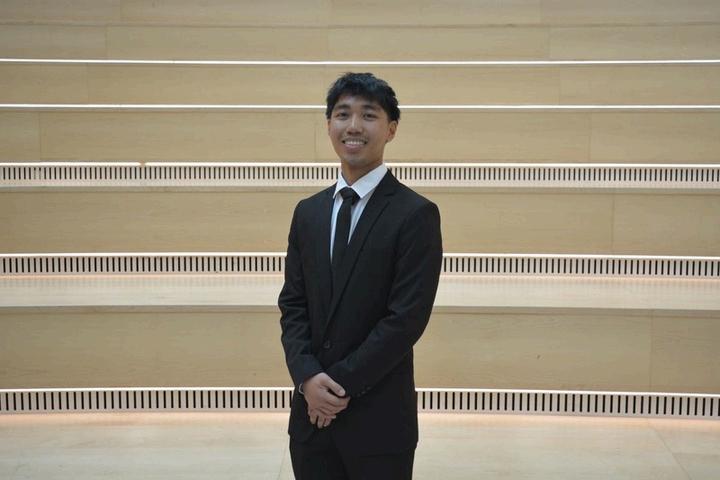

Hi everyone, and welcome to Competitions for 2026! My name is Rachel Justic, your Vice President of Competitions, Professional Skills at MULS
This year, we will be offering many competitions catered to you whether you are new to competing or a seasoned competitor, including Junior Client Interview, Senior Client Interview, Negotiations, internal and intervarsity Alternative Dispute Resolution Championships, and our first-ever Family Law Mediation competition We are also excited to collaborate with other universities and organisations, allowing you to represent MULS in competitions such as the ADC-ICC Asia-Pacific Commercial Mediation Competition (APCMC)
My role focuses on coordinating internal and external professional skills competitions, which are some of the most practical opportunities available to you These competitions allow you to develop industry skills that you will use throughout your career, including client interviewing, dispute resolution, negotiation, and letter writing, which are all skills that you use outside of the Courtroom. These competitions are a good gateway into competing or building on practical skills before entering the industry in a variety of areas of law, such as commercial, policy and family law No matter what you want to pursue, there is a competition for you!
Our goal as a portfolio this year is to increase engagement in our competitions and encourage as many of you to sign up With high-calibre judging panels excited to provide feedback, competitions are the perfect opportunity to receive industry feedback.
Our biggest piece of advice is to give anything you are interested in a go! Everyone is learning as they go, and each competition comes with resources, coaching and feedback to help you grow. Please feel free to reach out or find me on campus if you have any questions or would like some advice if you are interested in competing
Hello students! My name is Aditi Pal, and I am pleased to serve as the President of the Macquarie University Law Society (MULS) Whether you are new to competitions or a seasoned competitor, this guide is designed to outline the opportunities available to you in 2026 and help you understand what your competitions journey with MULS can look like.
My introduction to MULS began with attending the Competitions Expo in my first year, which led me to compete throughout every year of my degree. Through these experiences, I have seen, first-hand, the value of competitions in fostering both personal and professional growth Competitions allow you to strengthen your legal research and writing, refine your oral advocacy, work effectively both individually and in teams, all while familiarising yourself with real-world settings. These competitions have been designed to help you develop the skills and confidence needed to become a well-rounded, job-ready graduate, equipped to thrive in diverse legal environments
By participating, you will have the opportunity to gain insight into your strengths, explore new areas of interest, and develop the skills that will support your future career Competitions are one of the most rewarding extracurricular opportunities at law school, offering experiences, connections and skills beyond the classroom I encourage you to explore our competitions, find the ones that interest you, and get involved!
My name is Kaylen La Brooy, and it is my pleasure to serve this year as your Vice President (Publications) Competitions are a staple of the Macquarie law school experience They provide students with a unique opportunity to apply practical legal knowledge and skills to strengthen confidence, and engage critically with the law beyond your units. Whether you are participating in your first competition or returning with experience, each event offers valuable lessons in advocacy, teamwork, problem-solving, and professionalism I encourage all competitors to approach every competition with curiosity, intrigue and commitment Competitions aren’t merely about ‘winning’, they are testament to your growth, resilience, and ability to think and communicate like a lawyer They provide a supportive environment to test your skills, receive constructive feedback, and connect with like-minded peers who share your interest in the law
La Brooy
On behalf of MULS, I would like to thank our competitions teams, sponsors, adjudicators, and volunteers for their continued support and hard work Their contributions make these opportunities possible and ensure the standard of our competitions remain high I wish all you the best of luck, and hope you find this experience both challenging and rewarding Be sure to give everything a go!
I am Oliver Bunting, the Executive Officer (Editor) of MULS and am in my fourth year studying a Bachelor of Laws (Hons). My role involves editing, creating and assisting in writing many of the publications that are produced by our society The Competitions Guide is catered to students at all stages of their undergraduate LLB or postgraduate JD studies, and aims to provide comprehensive insights into the various law competitions offered at Macquarie University. Macquarie University Law School has a strong reputation for not only providing excellent academic education, but also preparing its students practically for professional practice through the various competitions it offers Whether you are looking to build confidence, gain practical experience or simply try something new, there is a competition suited to your interests and experience level.
Competitions provide a unique chance to apply your legal knowledge in practical settings, build confidence and develop skills that will serve you throughout your degree and into your professional career. I advise you to keep an open mind and utilise this guide to determine which competitions you may be interested in and those that match your level of experience Make the most of your law degree by seizing opportunities, challenging yourself, and enjoying the rewarding journey ahead at Macquarie
E A N ’ S W E L C O M E
Welcome to the MULS Mooting Guide for 2026
One of the most transformative aspects of legal education is discovering how to think about law as it actually operates in the world – not as discrete topics in isolation, but as a living system that shapes and responds to real human problems Mooting and competitions offer you precisely this opportunity. When you prepare for a moot, you’re not just applying contract law or tort principles in the abstract You’re grappling with scenarios where legal doctrine intersects with human experiences, ethical dilemmas, policy considerations, and practical constraints This holistic perspective – seeing how different areas of law interact and connect to genuine human concerns – is essential to becoming an effective legal practitioner and a thoughtful contributor to justice.
Beyond the intellectual challenge, mooting creates something equally valuable: community. When you join a moot team, you’re entering a space where you’ll spend late nights researching together, debate strategy over coffee, support each other through moments of doubt, and celebrate victories as a team. The bonds formed through this intensive collaborative work often become some of the strongest friendships of your university years You’ll also connect with coaches, alumni judges, and fellow competitors who share your commitment to advocacy, building a professional network grounded in mutual respect and shared experience
PROFESSOR LISE BARRY DEAN OF MACQUARIE LAW SCHOOL
Trying something new – especially something that feels intimidating – is where genuine growth happens Many students tell me they were terrified before their first moot. They worried about public speaking, questioned whether they belonged, doubted their ability to perform under pressure Yet these same students later describe mooting as the defining experience of their legal education. The skills you develop extend far beyond oral advocacy You’ll learn to synthesize complex material quickly, construct persuasive arguments, think strategically, respond to challenging questions with poise, and work effectively in high-pressure team environments These capabilities serve you whether you end up in a courtroom, a boardroom, a negotiation, or any professional setting where clear communication and analytical thinking matter

Our Michael Kirby Building houses what is widely recognized as Australia’s finest moot court facility This world-class venue provides an authentic environment that mirrors the gravitas and ceremony of actual court proceedings, giving you a genuine taste of legal advocacy in action
The calibre of advocacy at Macquarie speaks for itself. Our Jessup Moot team has represented Australia at the International Rounds for three consecutive years – an extraordinary achievement that reflects both the dedication of our students and the strength of our mooting program. In 2023, our team also secured second place globally in the Nuremberg Moot Competition. These successes demonstrate what’s possible when talented students commit to excellence and support one another in pursuit of a shared goal
While our mooting program is renowned, our competitions extend well beyond traditional court advocacy Our Negotiations and Client Interview competitions develop crucial interpersonal and problem-solving skills that every legal professional needs These competitions simulate real-world scenarios where you’ll learn to manage client relationships, navigate complex negotiations, and find practical solutions – all while building the same collaborative relationships and holistic understanding that make mooting so valuable.
One of the most valuable aspects of our competitions program is connecting with distinguished alumni who return as judges and mentors. These practitioners, many of whom started their journey in the same competitions you’ll participate in, provide invaluable feedback drawn from their professional experience. Many students have secured internships and career opportunities through these connections, demonstrating how competitions can open doors to your future.
If you’re hesitant about competing, there are many ways to be involved You can volunteer as a witness in mock trials or a client in the Interview competition, gaining valuable exposure to the competition environment without the pressure of advocacy All our internal competitions are organized by the amazing MULS Competition Team, offering opportunities for students at every level of experience and confidence
I encourage you to take the leap. Try something that challenges you Join a team, build those relationships, and discover what you’re capable of achieving Become part of Macquarie’s proud tradition of excellence in legal advocacy and professional skills development
Kind regards
Professor Lise Barry Dean, Macquarie Law School
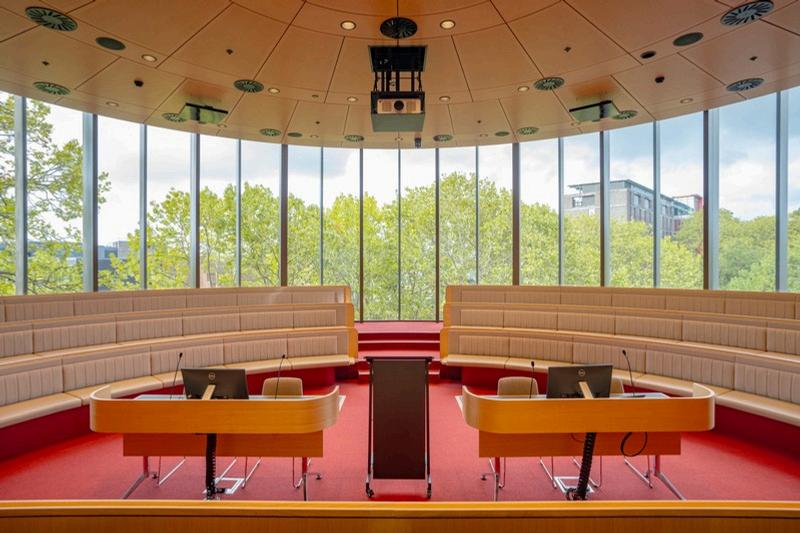
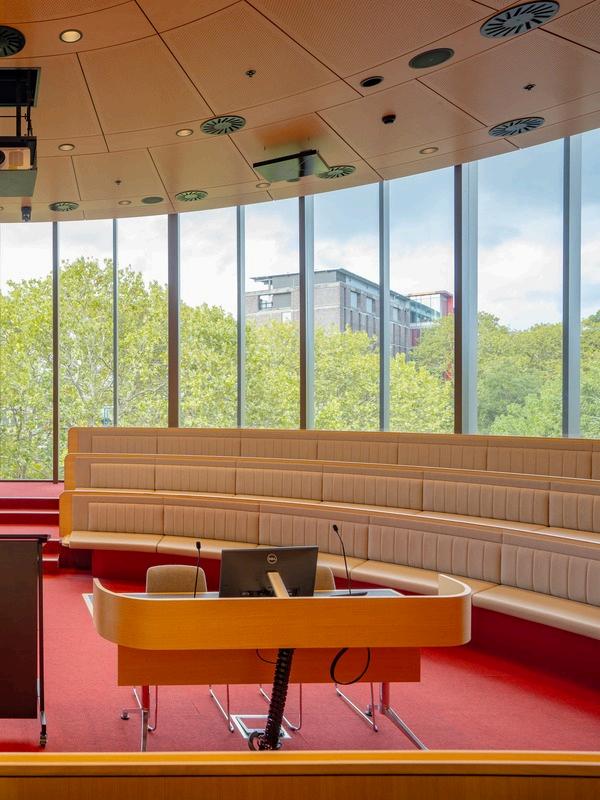
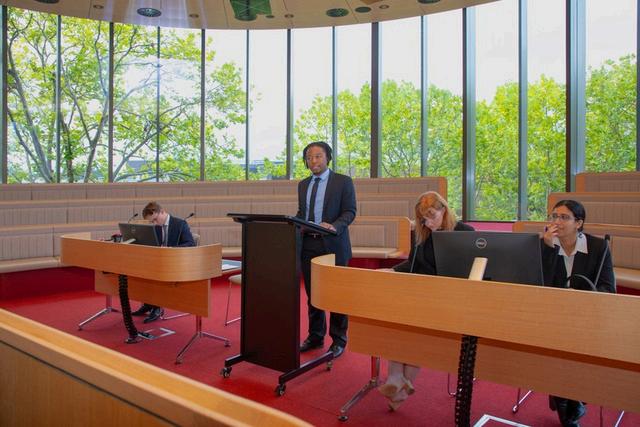
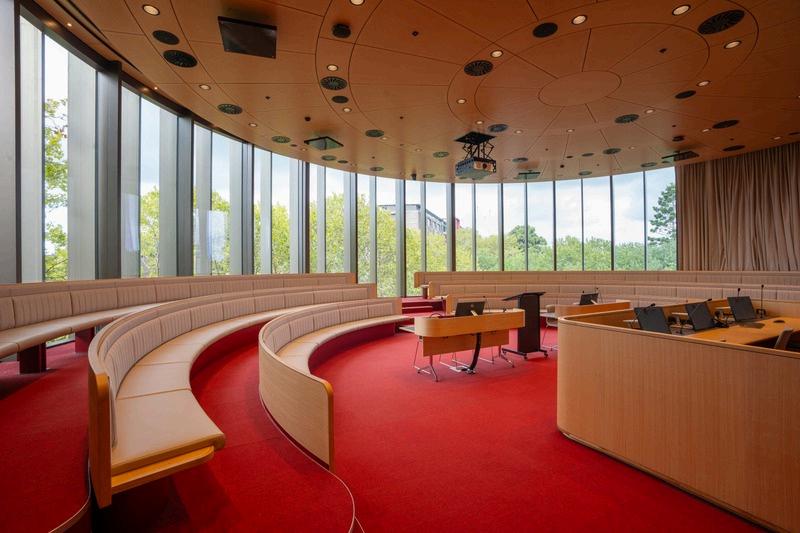
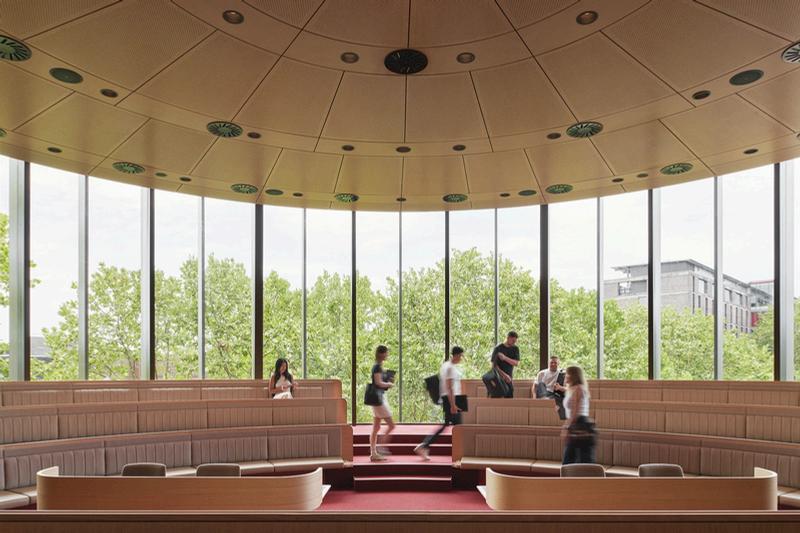
The Michael Kirby Mooting Court, is a world class mooting facility dedicated to fostering advocacy skills Named after the esteemed Justice Michael Kirby, this state-of-the-art space provides students with an immersive environment to practice legal arguments, refine courtroom techniques, simulate courtroom scenarios, and prepare for real-world challenges. The Moot Court is equipped with monitors on all tables, and has three rows of circular seating in order to provide an extended view of proceedings
Macquarie Law School’s quiet and meeting rooms provide students with spaces for focused research, as well as collaborative work Designed for productivity, these rooms foster an environment ideal for research, group discussions and teamwork Equipped with modern amenities, they support academic success and professional growth in a supportive, well-resourced setting.
Visit bookaspace.mq.edu.au to book a room
Macquarie Law School also offers other cutting-edge rooms designed to further enhance students’ advocacy and legal reasoning skills These versatile spaces replicate real-world courtroom settings, providing a practical environment for Competitions. Equipped with advanced technology such as X, they prepare students for the dynamic challenges of legal advocacy.
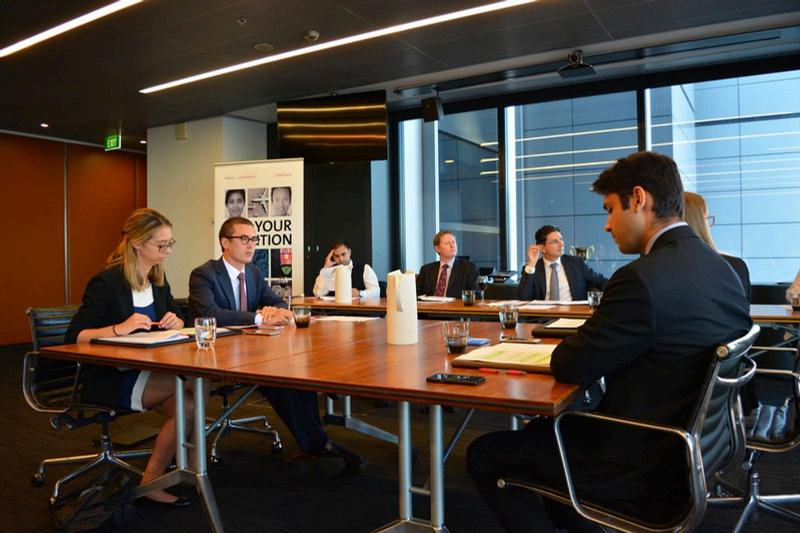
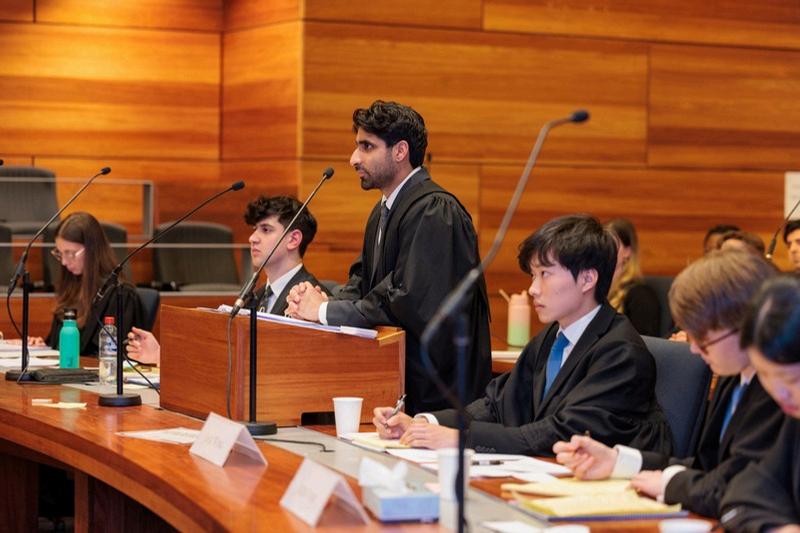
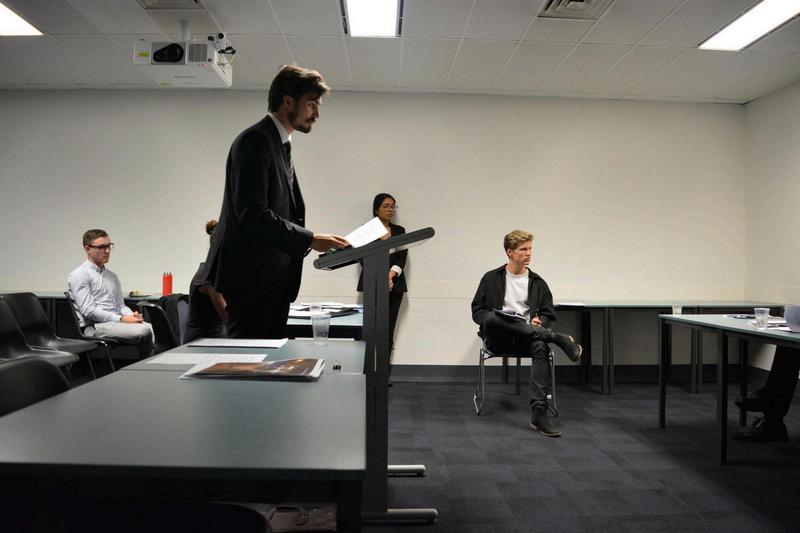
Advocacy Competitions are simulated legal exercises designed to help students develop and showcase their skills in legal research and courtroom prescence. These competitions typically replicate real-world courtroom scenarios, allowing participants to take on the roles of advocates arguing cases before judges.
MOOTING is the most common advocacy competition, but the Portfolio also encompasses other competitions such as WITNESS EXAMINATION (WITEX).
Hello everybody! My name is Scott and I am one of the Executive Officers for Competition (Advocacy) for the coming year I am a third year completing a Bachelor of Laws and Bachelor of Environment majoring in Environmental Management As an Executive Officer for Competitions (Advocacy), it is my role at MULS in organising and coordinating certain internal moots throughout the year You may see me involved in managing the Criminal Law Moot and Contract Law Moot this year and I am eager to support you all in your research application and advocacy of criminal and contract law
Executive Officer
(Advocacy)
This year, as one of the Executive Officers for Competition (Advocacy), I hope to ensure all participants have a positive experience competing in the Criminal Law Moot and/or the Contract Law Moot I hope to use my position to ensure all questions are answered through efficient and supportive communication, allowing competitors to have a valuable and enjoyable competitive experience
I find that these two moots are great opportunities to explore very prominent areas of the law and is a great opportunity to expose yourself to either a criminal facts scenario or a contractual dispute and apply your knowledge to create compelling arguments for both the appellant and respondent These two moots challenge you to explore all perspectives of a set of facts, ensuring that you consider all points of law from both perspectives and allows you to practice your written skills in constructing a detailed and concise written submission and advocate your submissions confidently I hope you all find satisfaction exploring the facts, applying the law and advocating for your clients in a professional and proficient manner
Hello! My name is Francesca, and I am excited to be one of the Executive Officers for Competitions (Advocacy) Through this position, I aim to organise engaging and well-prepared advocacy competitions that can give you the chance to develop important skills relevant to future legal practice, such as professional communication and critical thinking, beyond tutorials This year, I will be responsible for organising the Private Law Moot, Championship Moot, and Witness Examination
Participating in these competitions gives students the opportunity to further develop their legal skills, gain insights into real world legal practice, and build connections with legal professionals I highly encourage you to take part in these rewarding experiences and witness how much you can grow both on a personal and professional level!
Executive Officer
Scott Elliott (Advocacy)
Francesca Martinez
Executive Officer (Foundations)
Chau Nguyen
Executive Officer (Foundations)
Japneet Gill
Hello! I’m Chau an international student studying a Bachelor of Laws/Bachelor of Commerce at Macquarie University I currently serve as one of the two Foundations Competitions Executive Officers, and my goal for this year is to support students as they take their first steps into mooting and legal competitions My first experience with mooting was the Foundations of Law Competition, which quickly became the highlight of my first year and inspired me to work towards making mooting more accessible for students of all experience levels In Semester 1, I will co-organise the International Humanitarian Law (IHL) Moot, where students who have completed or are currently undertaking LAWS2000/LAWS8015 can engage with international humanitarian law in a practical and critical way, reinforcing concepts learned in class In Semester 2, I will organise the Foundations of Law Moot, which serves as an entry point into mooting for first-year students studying LAWS1000/LAWS8001 My aim for 2026 is to strengthen Macquarie’s foundations-based competitions pathway by ensuring students are supported from their first exposure to advocacy through to more advanced competitions Macquarie has a strong culture of introductory mooting, and I hope to continue building an environment where students feel confident engaging with competitions early in their degree
My name is Japneet Gill, and I’m currently studying a Bachelor of Laws and Bachelor of Commerce
I’m proud to be serving as Executive Officer – Competitions (Foundations) alongside Chau this year In my role, I work closely with the executive team to deliver our Foundations competitions, including the International Humanitarian Law Moot, Foundations of Law Moot and the Novice Moot These competitions are designed to give you the opportunity to develop essential advocacy, research, and teamwork skills in a supportive and encouraging environment My focus is on ensuring that these experiences are accessible, well-structured, and rewarding, so that every participant feels confident I’m also passionate about creating a welcoming space where students feel comfortable asking questions, making mistakes, and growing through the process
Foundations competitions are the best place for exposure to practical legal skills beyond the classroom I highly recommend you take part in these competitions as they have truly enriched my entire university and life experience My biggest piece of advice for first-year students is to say yes to opportunities, even if they feel intimidating because that’s often where you’ll find the most supportive communities and the strongest friendships Apply for the role you ’ re unsure about Introduce yourself to new people University can feel overwhelming at first, but the experiences you build outside of lectures will shape your journey the most I can’t wait to meet you all and see what you achieve this year!
Executive Officer (External Advocacy)
Jasmine Sutton
Hi, I’m Jasmine! I’m a third-year student studying a Bachelor of Laws and a Bachelor of Arts, majoring in Ancient History This year, I am the Executive Officer for External Advocacy, within the Competitions portfolio of MULS It is super exciting to be involved in helping organise and run the competitions, which I’ve enjoyed participating in already, in competitions such as the Criminal Law Moot, the Contract Law Moot, the IHL Moot and the inter-varsity Pride and Diversity Moot The role I have encompasses the advocacy competitions MULS participates in with other universities We are involved in a variety of bilateral and multilateral competitions, some of which even occur inter-state Primarily, we seek to strengthen relations between the law societies of different universities, and give students as much opportunity as possible to compete in a variety of environments and subject areas of law
Mooting is a great way to learn new skills and meet new people, and provides key insights into what practicing law is really like To be able to moot against other universities helps build competitions with increased variety of talking styles and approaches to mooting, and is a great way to network with other students My goal is to make these competitions as accessible as possible, and to encourage as many students as possible to compete I aim to consistently improve the organization of the competitions to do so MULS has historically done well in the various inter-varsity competitions, so to continue to support teams to further this legacy would be great!
Mooting is a simulated mock appeal where law students argue a legal question before a panel of judges. Unlike mock trials, no new evidence or witness testimony is presented—only legal arguments based on agreed facts. Participants develop advocacy skills, mastering legal research, persuasive reasoning, and courtroom etiquette in a simulated appellate setting.
Understand the Facts: When you first receive the facts, focus on understanding the hypothetical scenario that the moot presents without immediately applying relevant case law. Identify the key aspects: Who are the parties? What is the context? What is their relationship? What are the main issues and arguments on each side?
Annotate or highlight important details to aid comprehension
Once you have a clear grasp, analyze the hypothetical in detail by considering gaps or missing information that could benefit either side, facts directly supporting your argument: How can case law be used to strengthen your position or counter the opposing argument? What does the absence of certain facts imply for your case?
What conclusions or inferences can be reasonably drawn?
Thorough analysis ensures a strong and well-prepared argument.
Understand the Law: In applying the relevant law to the facts provided, you must make sure that you are providing the correct, specific section of the legislation you are using You may also want to consider, if the terms in the specific section of the legislation you are using, have been defined in the statute or have particular sections been interpreted by cases. When using cases you may want to consider: What is the current point of law?
The facts, ratio, orbiter and judgement of the case. Make sure you have a holistic understanding of the case
How was the law applied in the case?
Did this case follow a precedence, or if this case served a precedence in another case Did it confirm/overturn a precedent? Did this case challenge authority?
Develop a case table to make this step easier!
Avoid written speeches: While it may be tempting- using dot points instead allows for a more natural and engaging conversation with the bench. It also demonstrates confidence in your arguments and enables you to respond to questions more effectively, thinking on your feet
NOTE: It is recomended you peruse the Mooting Handbook and the General Rules of the specific moot you are interested in. Familiarise yourself with what to expect in the competitions, the rules and regulations concerning written submissions, oral arguments, structure, teams and other important information.
RECEIVING THE HYPOTHETICAL
Written Submissio
Legal Resea
Legal Analy
Time Managem
Courtroom Etique
Answering Questions Persuasiv
Right of Re
“I withdraw that”

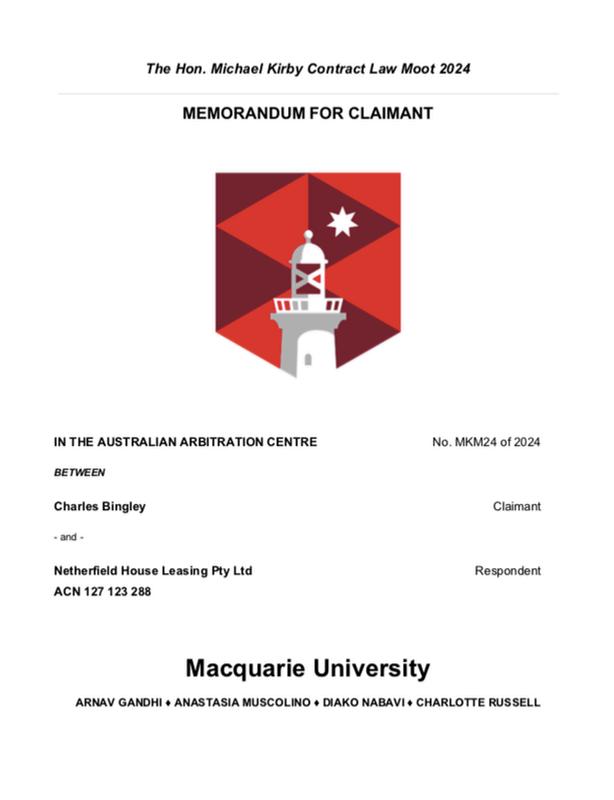
Consistent Paragraphing
Clear signposting
Pinpoint and judge(s) name.
Law stated first, then applied to facts

The Foundations of Law Moot is an introductory competition designed for first-year law students, with a particular focus on concepts taught in LAWS1000/LAWS8001. The competition provides students with their first exposure to mooting by guiding them through the structure of legal problem-solving and advocacy in a clean and supported environment Participants are required to analyse problem questions and apply statutory interpretation and foundational legal principles to develop structured legal arguments Through both written submissions and oral presentations, students learn how to identify relevant legal issues, engage with legislation, and present their reasoning in a clear and persuasive manner
2025 WINNERS:
Liz Frodsham
Japneet Gill
Kunal Patel
Chau Nguyen
Casssidy Lauguico
How did you prepare for the competition?
Chau: We always draft the written submissions together (in a meeting) to ensure that our submissions are coherent and that all team members’ perspectives are incorporated. We also tried to come up with as many questions from the bench as possible (even on the wordings of the submission) to prepare for any scenarios I personally recommend re-visiting our Foundations of Laws notes as well and have a look at foundational legal concepts and Latin maxims!
How did you manage to balance your other commitments with this competition?
Cassidy: Incorporating the competition through my to-do lists and my calendar, treating it as another law unit, helped me balance the demands of the competition. Using my academic habits of goal-setting, daily to-do lists, and time blocking helped me adjust my schedule to develop the arguments of our team Including small tasks on a list for your whole team, then delegating, such as checking if citations and grammar are correct with assisting in strengthening your written submission for judges within competitions.
What was the most challenging aspect of the competition? How did you overcome this?
Liz: Answering questions from the judge(s) on the fly. Practising with hypotheticals certainly helped, but ultimately you just have to commit to an answer (any answer!) and trust your preparation. I don’t know if I ever truly overcame this challenge, but I certainly improved The ongoing support of my team mates was invaluable, especially when I felt that I had butchered a response.
How has this competition supported your personal and professional development?
Kunal: Experiencing the competition helped assist in improving my legal reasoning due to all the critical thinking required. The competition not only improved my confidence but also allowed me to think of points through a different perspective. Additionally as a professional development I know have a greater understanding of what is expected in the real world and how I should present and act towards others
What is one piece of advice you could give to new competitors this year?
Liz: If you’re unsure how to answer a prickly question from a judge: have a sip of water, take a deep breath, and start with, “Your Honour, it depends”!
Kunal: It may be a bit cliche, but have confidence in what you're saying Mooting is about having conversations with the judge(s) so be present and actively engage. Preparing for the moot involves understanding your cases and formalities but during the moot it is about eating all the nervousness and presenting your case.
Chau: Speak slowly. If you think you’re speaking slowly, slow down even more. Watching High Court cases on the High Court website can also help you observe how real-life barristers pace their speech and present their arguments clearly
Cassidy: Read the cases! Take detailed notes of the actual matter of law, and what the law or issue is that is being contended over Consider how it is different or similar to the competition question provided Often, the cases given are provided to you for a reason and give you guidance on how you could structure your arguments Good luck, everyone!

The Novice Moot is an exciting opportunity for second-year and above students who are new to mooting This competition is specifically designed for those who have never participated in a moot before, offering a supportive environment to develop and refine your advocacy skills Participants will engage in either a contract or criminal law hypothetical, drawing on the legal principles you’ve learned in your courses to build compelling arguments and apply them to practical scenarios.
How did you prepare for the competition?
2025 WINNERS:
Sharan: At first I found it quite daunting as I’d never done anything like it before, so I watched videos of moots and mooting etiquette to familiarise myself with the process. MULS has several resources about mooting which I found quite helpful, and they also ran a mooting workshop which was great to hear from people experienced with a range of competitions Beyond that, preparing for the actual rounds was a lot of learning on the job, which is something that gets easier as you progress
How did you manage to balance your other commitments with this competition?
Sharan: Just like any other extracurricular activity anyone might do, it’s super important to just be aware of everything you have up, as it’s very likely you’d have other commitments occurring simultaneously with the competition. I found it was really helpful to write down everything I had going on and keep it on a sticky note on my laptop, so it was at the forefront of my mind and I didn’t neglect anything. It got easier as the competition progressed, as I slowly got used to the regularity at which submissions were due
What was the most challenging aspect of the competition? How did you overcome this?
Ben: The first round In the Novice moot, you have never mooted before so you don’t quite know what to expect, which made the first round difficult (remembering to sign post, use court room etiquette, etc) I overcame this by accepting that my first round would be my worst beforehand, and by writing reminders / phrases at the top of my notes to do basic things like say ‘may it please the court’
How has this competition supported your personal and professional development?
Ben: I could not speak highly enough of this competition and the skills it helped me develop. This competition is the perfect opportunity to practice your legal writing and speaking skills where the pressure is low Participating in this competition gives you credibility beyond exam marks
What is one piece of advice you could give to new competitors this year?
Ben: Ask the Judges for feedback and WRITE it down. The judges are all experienced mooters: they have certain phrases, habits, and ideas which they have picked up from others during their years of mooting I have pages of notes of specific phrases, habits, and advice that these judges would give us at the end of each round and I intentionally applied them in the next round.
Sharan: I’d really encourage everyone to give it a go, and not self select out You don’t have to have amazing grades or loads of speaking experience, only a willingness to learn and to put your best foot forward!! It’s a great learning experience for everyone. Once you do start the competition, a great piece of advice I got from a judge was to really convince yourself of the side you’re arguing, and that the person/organisation you’re representing is absolutely right I found this to be challenging at times depending on the area of law, my personal views and just the fact that you switch between appellant and defendant each round, but being convinced of your case (or pretending to be) helps you to present and answer questions confidently, and with conviction

The International Humanitarian Law (IHL) Moot is an advanced competition recommended for students who have completed the International Law unit. This moot emphasises the application of international law in real-world scenarios, testing both your legal reasoning and advocacy skills
How did you prepare for the competition?
2025 WINNERS:
Elliot Madden Khan
Lara El Chaar
Japleen Sandhu
Ameya Deshpande
Ameya: My mooting journey started with this moot, the 2025 International Humanitarian Law Moot To prepare for this moot I executed the following steps: (1) Read the scenario carefully, before proceeding to any of the next steps it is imperative that you understand the facts of the case in order to determine the general direction of your argument (2)
Start creating the key arguments of the case that will be presented to the bench, ensure that these arguments align with your given position, e.g. prosecution or defence. These will form the basis for your next step. (3) Commence research based on the key arguments created Conduct thorough research to ensure that your arguments are well substantiated with relevant legislation, treaties, case law, etc This research will be important to ensure that there is enough supporting evidence to satisfy the bench to the best of your ability, apply your research to the facts of the case.
How did you manage to balance your other commitments with this competition?
Ameya: It was certainly challenging to balance my other commitments with this competition I personally decided to take the approach of prioritisation Here I essentially ranked my subjects based on when certain assignments and readings had to be completed Based on these rankings I decided to split my time evenly between academic and moot work. It always helps if there are more people in your team, this way the amount of work that needs to be done per person reduces significantly, thereby reducing the pressure on academic commitments.
What was the most challenging aspect of the competition? How did you overcome this?
Ameya: The most challenging aspect of this competition was filtering out the copious volumes of international case law. Given the serious nature of the war crimes you may across during your research, there are often multiple volumes of case reports about the same war crime. Here it is imperative that you use keyboard shortcuts to search for the key terms that are related to the facts of the case. However, there will be some reports where that shortcut is not available, in that case, you will need to properly skim through the pages and search for the key information that is relevant
How has this competition supported your personal and professional development?
Ameya: Given the nature of international law, this competition has improved my ability to remain resilient in times of struggle. This competition has helped me to improve my research skills and my analysis. This improvement has translated to my academic work where I improved noticeably in my law assessments, thus providing me with the confidence to succeed in my law degree One critical aspect to note is that presenting a moot is in a way similar to writing a legal essay where you have to support your argument I believe that by doing more moots, one can improve their legal analysis.
What is one piece of advice you could give to new competitors this year?
Ameya: This is the first thing I would say, international law is significantly different to Australian domestic laws, so if you feel like you might be getting frustrated when trying to understand the facts or doing research, stop, take a break to clear your mind, rest for a couple minutes and let your mind wander of and then return to your work. Doing this will reduce your chances of making any silly mistakes and thus will lead to positive outcomes Moreover, another piece of advice that I would give is to work well with your team, an effective team can lead to more productive analysis and skills while also reducing the work required per member. I personally believe that positive camaraderie with your team will lead to improved advocacy, which in turn can lead to increased chances of progressing to the following round. Finally, another piece of advice is to make sure you have fun. Mooting is intense and requires a lot of work, however it is also a time where there are moments of laughter and joy, so cherish them, you won't regret it

The Criminal Law Moot is another subject-based competition where you will have the opportunity to apply the principles of criminal law covered in your LAWS1300 unit. This moot is designed to challenge your understanding of key concepts such as criminal liability, mens rea, actus reus, and defences. Similarly to the Contracts Moot, more weighting is given to legal arguments to advocacy skills.
How did you prepare for the competition?
Justin: Being my first moot, I started by finding as many resources I could about mooting and what the competition would actually look like – the language used, the format of submissions, rebuttals, etc At the same time we were both researching the relevant issues of law, and you quickly learn that legal research itself is a very particular skill The textbook is a good place to get a 10,000-foot view, then it’s a deep dive into as much case law as you can find after that
How did you manage to balance your other commitments with this competition?
Justin: Mooting takes a fair bit of time, and alongside the Negotiations competition, I wasn’t always on top of things week-to-week. At the end of semester it ended up being a matter of setting very firm deadlines in terms of which days I had to do what, and it’s here that you have to understand your work capacity and set realistically achievable goals for every single day. With a little bit of discipline (which I had to learn), the internal moots are very manageable.
What was the most challenging aspect of the competition? How did you overcome this?
Justin: For me, it was the research process. There’s a lot of stuff out there and it’s hard to know when you’ve found everything that’s needed, and there’s always something else. It’s harder still to keep track of all you’ve read in a coherent, organised manner. I had the benefit of having an amazing teammate who I was able to learn from throughout the entire moot, but like most mooting skills I think it’ll always be a “work in progress” rather than something that’s necessarily overcome
How has this competition supported your personal and professional development?
Justin: It’s hard to overstate the impact The competition completely changed my mindset about the law and where I see myself in twenty years It’s opened a lot of doors for me in terms of opportunities for further professional development, and it can largely all be traced back to that singular decision to sign up Sitting here now in the midst of yet another competition, I can confidently say that I am a far more capable law student (and advocate) than I could ever have imagined prior to the moot – and I’m having a lot more fun with everything too!
What is one piece of advice you could give to new competitors this year?
Justin: Back yourself and give it a real, proper go On one hand it’s definitely less scary just to try it out in a noncommittal fashion, but I don’t feel like the benefits of mooting can be properly realised unless you give it your all There’s a lot to learn with mooting and everyone starts from somewhere, so take it seriously, listen to feedback, and everything else will follow
The Contract Law Moot is a dynamic competition where you will have the opportunity to apply the principles of contract law covered in your LAWS1200 unit This moot is designed to challenge your understanding of key concepts such as offer and acceptance, consideration, breach of contract, remedies, and can also include elements from Property and/or Business Organisations Since this is a subject-based moot, more weighting is given to legal arguments to advocacy skills
2025 WINNERS:
Isabella Roperti
How did you prepare for the competition?
Alannah: Isabella and I have done a few moots together now and we have found a method that works really well for us We both have full schedules so finding time to dedicate to these extracurricular activities is often difficult We usually meet in the library before morning classes around a week before our written submissions are due Thoroughly reading the problem question line by line is the most crucial step to a solidly built argument Annotating the question, discussing our first impressions, drawing on our knowledge of the subject, and reading through the given cases allow us to gain a deeper understanding of how we can present a compelling argument for either side. We then typically break down our ideas into the given appeal points and split them, half for senior speaker and half for junior speaker. We then work mostly independently during the week, checking in to provide feedback and align our arguments into a cohesive written submission. Our oral submissions are then drafted after receiving our competitors’ brief, as we like to work methodically through their arguments to write our rebuttals.
Isabella: I always begin by reading the problem question a few times through Considering that the moot is essentially based on a few pages of information, understanding the key issues is absolutely paramount to ensuring that both your written and oral submissions are focused Both Alannah and I will then go through and begin annotating the question with our key initial thoughts and ideas for arguments, both for the appellant and the respondent, regardless of which side we may be doing that week I find this step is helpful as you progress in the competition, because it can become very easy to track the development of your arguments throughout the weeks Then the research begins - we go through all possible cases that may be relevant, and prepare case briefs for each, identifying the strengths and weaknesses for each side
How did you manage to balance your other commitments with this competition?
Alannah: Effective time management is the key to success when balancing numerous commitments. It often feels like mooting competitions or any other extracurricular activity gets in the way of the ‘real’ work that we face in law school. It's easy to forget about alternate commitments when the mountains of reading and influx of assignments hit, seemingly all at once I try to push past this by reminding myself of the passion I feel for advocacy, that it is an exciting challenge to present a case in front of a panel of judges When you are doing something you enjoy, it doesn't feel like a hassle to put in the extra hours mooting competitions require
Isabella: Mooting is a very time-consuming extracurricular activity, and as someone who works most days, balancing it amongst other commitments can be difficult, but it is definitely manageable Time management and clear communication
with your team are essential in ensuring that there isn’t a last-minute dash to reach a deadline For myself, I always try to start the research side of things as soon as possible so that I can at the very least have an understanding of the problem, the current case law and the direction I would like our written submissions to head. Alannah and I will then work together to develop a rough outline of our written submissions, allocating argument points to each person and identifying exactly when we would like them to be finished by. This self-induced deadline will always be a couple of days before our written submissions are due, so that we can work through refining them together before handing them in
What was the most challenging aspect of the competition? How did you overcome this?
Alannah: For this particular competition, the given cases were quite dense and lengthy Reading through them over and over again to find small sections of the judgement that help a particular point, whilst ensuring you don't accidentally hand your competitors ammunition, was at times, quite draining However, it's all worth it when you find a point that perfectly supports your arguments and is crucial to the success of your case
Isabella: I definitely think the most challenging aspect of this competition was the cases. Sometimes, the cases we found would take us down a rabbit hole that led nowhere. Other times, you’d read the whole judgment and happen to find the one thing you were looking for to support your argument. However, the difficulty with contracts is often that judgments can be very convoluted and long. Case briefs helped us to focus our arguments and ensure that whatever we included in our written and oral submissions could be explained back to case law and ultimately be linked back to our specific case scenario.
How has this competition supported your personal and professional development?
Alannah: I originally started mooting to improve my public speaking skills I started with the Foundations of Law moot in my first semester of university, and was incredibly shaky My confidence and oral abilities have since improved tenfold I even had the honour of being named Best Oralist in the grand final round of what is now my 4th competition This skill has supported both my personal and professional development in small and large ways I find speaking with peers more comfortable and answering tutorial questions less daunting I am able to articulate my thoughts clearly and succinctly under pressure, something that was challenging even six months ago I highly recommend mooting for these reasons, it is incredible how much you improve when placed outside your comfort zone.
Isabella: Participating in the Contract Law Moot has had a significant impact on both my personal and professional development. Most notably, it has strengthened my ability to think critically under pressure and, with that, communicate complex ideas clearly and persuasively - a skill that is fundamental to any future legal practitioner. Standing up and responding to questions in real time forced me to trust my preparation and back my reasoning, even when it is being scrutinised It also pushed me to become more adaptable Questions from the bench can often take submissions in unexpected directions, and learning to navigate that calmly has been invaluable
What is one piece of advice you could give to new competitors this year?
Alannah: The best piece of advice I received from a judge was this: ‘You are not there to argue your case in front of a panel of judges, you are there to have a conversation with those judges - your job is to assist the court ’ It completely changed my approach to oral advocacy When the goal wasn't to argue, it made it less confronting to speak to multiple judges, all asking different questions. Answering a question from a judge that pushes back against your argument can be stressful, but when you frame it as an opportunity to better explain your side of the case, it becomes less daunting. Another invaluable trick is to bring a piece of paper and pen up to the lectern with you in anticipation for judges' questions. If there are multiple judges or you get a few questions in short succession, being able to write down what they ask you so you can answer each point in turn, will make you look professional and prepared.
Isabella: Don’t prepare a speech for your orals Although this can be tempting and can understandably offer you a sense of comfort, especially when you are being grilled by a judge, it can become very obvious that you have prepared a speech, and unfortunately, in mooting, this can give the impression that you don’t understand what you are saying I would recommend instead, having a dot point outline of each of your arguments that clearly references your writing and allows you to develop those ideas more fully This will force you to actually take the time to understand the full depth of the argument you are making, which ultimately helps in communicating with the bench Your oral submissions should be a formal conversation with the bench, not a prepared speech that you recite to them
The Private Law Moot is a competition designed to challenge your understanding of key concepts in Equity and Trusts, Torts, Business Organisations, and other areas of private law, with a strong focus on commercial law principles. This moot is strongly recommended to students who have done at least 2/3 of the above subjects. This moot provides an excellent opportunity to apply your theoretical knowledge to real-world legal problems that commonly arise in the business and commercial sectors.

2025 WINNERS:
Reese Harvey
Tara Phimsipasom
Stella Field
Megan Huntley
Diako Nabavi
Sophie Nixey
How did you prepare for the competition?
Diako: Initial preparation for the Championship Moot (the Moot) is a bit more difficult as the subject for the Moot is not revealed until the question is received (unlike other moots which are subject based) To start, we researched the area and did wide readings on seminal cases We also reviewed journal articles relating to the area which may provide different perspectives We then wrote our written submissions and prepared oral submissions This includes case briefs for all our referenced cases Finally, practice moots were key to develop our oral advocacy skills and familiarity with the question
Sophie: As with all moot competitions, our problem question provided a highly specific set of agreed facts that demanded in-depth exploration of niche legal issues Before diving into legislative minutiae, it was helpful to go back to the foundational principles of Australian property law (the focus of our question) These principles provided a strong basis that lent credibility to our submissions Furthermore, they assisted in responding to questions from the bench regarding the practical application of our arguments by demonstrating an understanding of the relevant issues beyond the confines of our given fact scenario
How did you manage to balance your other commitments with this competition?
Diako: An effective time management system is key to balancing commitments My teammate and I made plans and set times to work on the moot Communication was important to ensure we could identify spots that were lacking in research and understanding, and work together to get them fixed Nevertheless, we prioritised our units and made sure that our commitments did not conflict with each other
Sophie: Mooting can sometimes feel like an additional law unit The best way for me to stay on top of the work required was to behave as if it was. Treating submission deadlines like assignment due dates ensured that I prioritised competition preparation, which helped to minimise (if not eliminate) late nights. Clear communication and delegation of responsibilities within our team was also essential to keep each other on track and manage our time efficiently
What was the most challenging aspect of the competition? How did you overcome this?
Diako: In my view, the most challenging aspect was preparing and ensuring we covered all necessary parts of the question This involved immense research and synthesis. Further, moot judges tend to ask general questions on the area that the moot is on. A wide knowledge is required which necessitates revision of the topic. A good strategy to identify and overcome gaps in knowledge is to run practice moots with your teammates In this process, it is important for your teammates to throw any and all questions at you (no matter how ridiculous) to challenge your perspective and your original logic This helps identify different viewpoints and research things that are missing
Sophie: Reconciling my desire for the ‘ultimate argument’ with the reality of a time-limited competition was a persistent challenge It felt as though the perfect precedent was lingering just out of reach, waiting to be discovered. One more case, one more journal article, one more trawl through CaseBase armed with an excessive amount of Boolean operators It was easy to fixate on small details whilst losing sight of the broader legal issues Such misgivings were best managed by maintaining a disciplined approach to research I imposed strict personal deadlines, allowing sufficient time to consolidate my findings and construct submissions Finally, it was necessary to accept that there was no judicial panacea to answer all legal questions in our favour Grappling with complex issues for which there are no straightforward solutions is what mooting is all about!
How has this competition supported your personal and professional development?
Diako: The Moot has greatly developed my personal and professional growth It sharpened my legal research, writing, and advocacy skills while also building my confidence in high pressure environments The depth of preparation strengthened my ability to analyse complex issues quickly, respond strategically to questioning, and collaborate effectively with a teammate Beyond the technical skills, the experience connected me with a supportive community of mooters and shaped the kind of advocate I’m becoming
Sophie: This Championship Moot enhanced my understanding of how law school translates into the professional world. Knowing the law is one thing. Being able to express it clearly, in a manner beneficial to your case, is another. The latter skill was honed throughout the competition as we refined our written submissions and fielded unexpected questions from judges Further, this moot reinforced the importance of effective collaboration Trust between team members allowed us to work efficiently and to perform at a high standard
What is one piece of advice you could give to new competitors this year?
Diako: Get involved and don’t stop mooting. Mooting is a great opportunity to learn and develop your skills. MQ has very good judges for the moots and their feedback is invaluable to growth and learning. The legal research, writing, and advocacy skills you gain go beyond what you learn in a classroom which is beneficial
Most importantly, you meet fantastic people that you can grow close to while competing Some of my closest friends are people I was randomly put on a team with The absolute best reward from mooting is the friends you get out of it
Sophie: Understand the difference between the strength and importance of your arguments Some points may seem unfavourable on the facts or sparse on authority. Nevertheless, if it is essential to your case, it will need to be argued. Aim to anticipate challenges put by judges and opposing counsel, and consider how the facts of your scenario can be distinguished from contrary precedents. Moots are ultimately decided by advocacy, not academia Even a case that appears doubtful at first glance can be a winning one if you trust yourself and argue it to the best of your abilities

2
The scenario will be given either 3 hours (for preliminary rounds) or 90 minutes before. Spend this time to formulate a case theory and to brief the witness
1
As the scenario is given on the day, conduct prior preparation by familiarising yourself with the Evidence Act and case law PREPARATION
3
For around 2 minutes, the Prosecution will provide a brief overview to the Bench that will outline your case theory.
CROSS EXAMINATION FROM THE DEFENCE (15-25 MINS)
The Defence will then try and find inconsistencies in the witness’ testimony in order to disprove their case theory This will be 15 minutes in the preliminaries, and 25 minutes in the grand field
Similarly to the Prosecution, the Defence will now be able to call their own witness to provide evidence in support of their case This will often take around 10 minutes in the preliminaries, and 15 minutes in the Grand Final
Competitors should thoroughly understand evidence rules and the Evidence Act before the round starts Knowing which questions are permissible and what evidence is objectionable will significantly benefit participants. First-time competitors are also encouraged to watch past grand final rounds to familiarise themselves with competition etiquette and operations
Competitors are given 3 hours to prepare during the preliminary rounds and 90 minutes before the final rounds Therefore, they should make the most of this limited time to review the witness statements, brief the witness, develop their case for trial, and identify key lines of questioning. Competitors should:
1. Develop your case theory
This process requires carefully analysing the statements of both witnesses and developing a case theory—a narrative built around your version of the events The case theory should be introduced in the opening arguments and should identify key facts, assess witness credibility and examine the evidence strength
2. Revise the relevant features of evidence law.
Competitors must prepare for outlining the law in relation with the relevant offence. After the introduction of case theory during the trial, the prosecution is responsible for introducing the charge, the relevant legislation and to outline the elements that need to be satisfied for the conviction to be met. The opening should make express reference to the burden that must be discharged and why it is or is not met. The Defence as the counterpart should focus on the agreed elements and reference the differing standard of proof required
3. Prepare the Witness.
This includes reviewing the scenario's facts, practicing examination-in-chief questions, preparing the witness for cross-examination, and addressing any issues in witness statements. However, it is essential to avoid "coaching" by giving scripted answers or encouraging the witness to alter or fabricate facts.
The goal of the Witness Examination is to establish a convincing enough case theory to pursuade the judges. A case theory in witness examination is the central narrative that a Competitior will develop to guide how evidence is presented, how witnesses are questioned, and how arguments are structured.
Legal Research
Legal Analysis
Time Management
1.) How can you best prepare for this competition?
Be disciplined with your time and dedicate slots out of your week to practice questioning and strategy. It is important to recognise that the nature of the competition is that preparation is limited since material is released soon before the round takes place.
2.) How does this competition support your personal and professional development?
Witness examination rewards composure, adaptability, and the ability to respond on the fly. Thus, this competition is crucial in developing flexiblity in a professional and personal sense, given it shifts between structured evidence-in-chief and flexible cross-examination to develop both logical and creative thinking. Witness examinations are great opportunites to explore the notion that law is built on contentious narratives.



Leading Questions are questions that suggest or imply a particular answer. While leading questions are commonly used in cross-examination, they are generally not permissible during examination-in-chief or reexamination under the Evidence Act s37 (except in limited circumstances).
Howdoyoufeelaboutyourjob?= Not-leadingasitisaneutral proposition VS
“Youenjoyyourjob,don’tyou?”= Leadingasitsuggestsapositive response

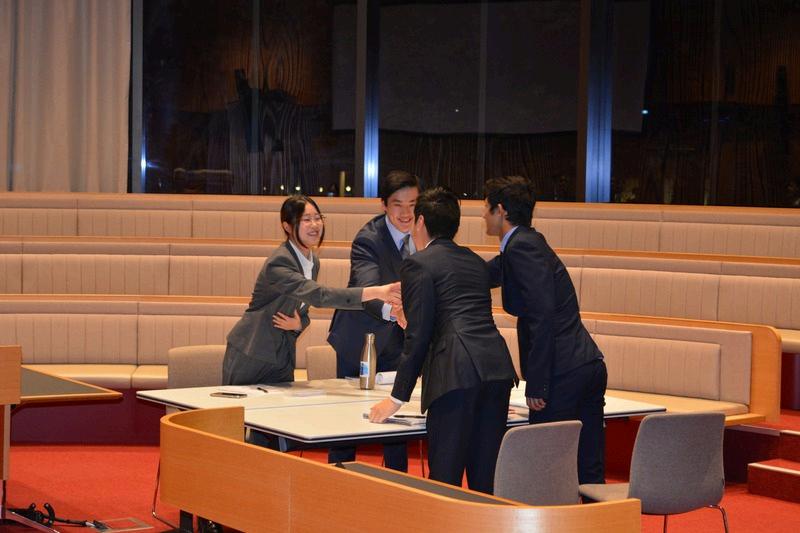
Professional Skills Competitions focus on developing practical, clientfacing skills that extend beyond the traditional advocacy roles of lawyers. Instead, these competitions encompass areas like negotiations, client interviews and alternative dispute resolution (ADR) Competitions.
Hi Everyone! My name is Chelsea and I am in my final year of a Bachelor of Laws and Commerce (Economics) I am the Executive Officer for External Professional Skills Competitions for 2026, and I will be overseeing all external and intervarsity professional skills competitions MULS continues to foster strong relationships with law societies at Australia’s leading universities allowing us to provide Macquarie University law students valuable opportunities to compete with peers from other universities This year, you can look forward to the MULS x SULS Client Interview Competition in Semester 1 and Intervarsity ADR Championship in Semester 2 Competitions are one of the most rewarding experiences you can have in law school as they offer invaluable exposure to core legal skills required of you as a lawyer My advice to first years is to step outside your comfort zone as it will set you up for growth and success throughout your degree
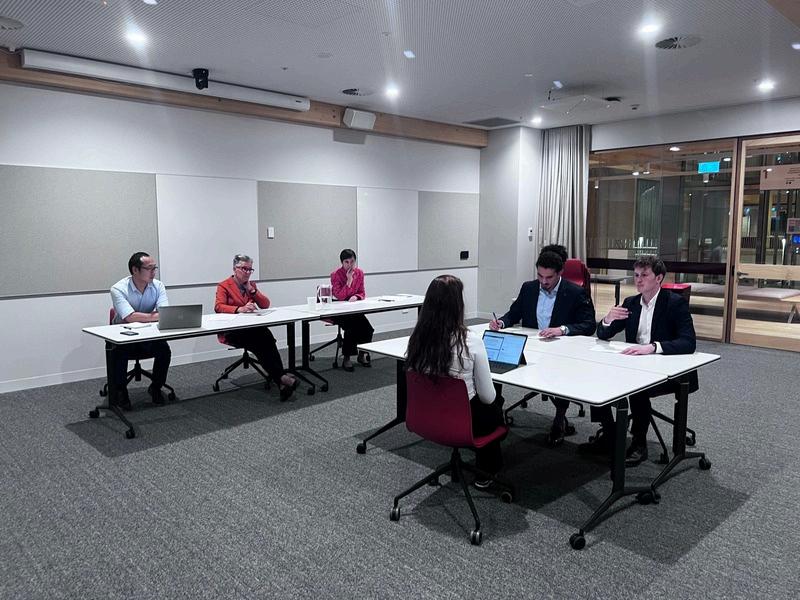
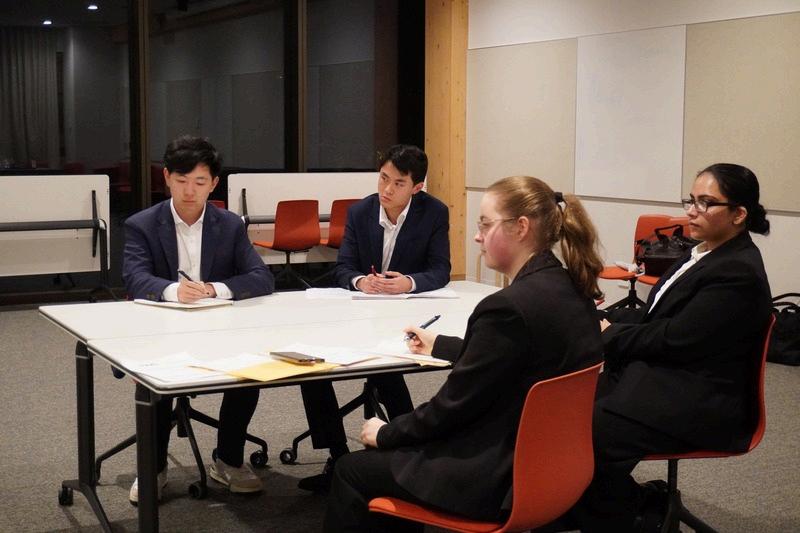
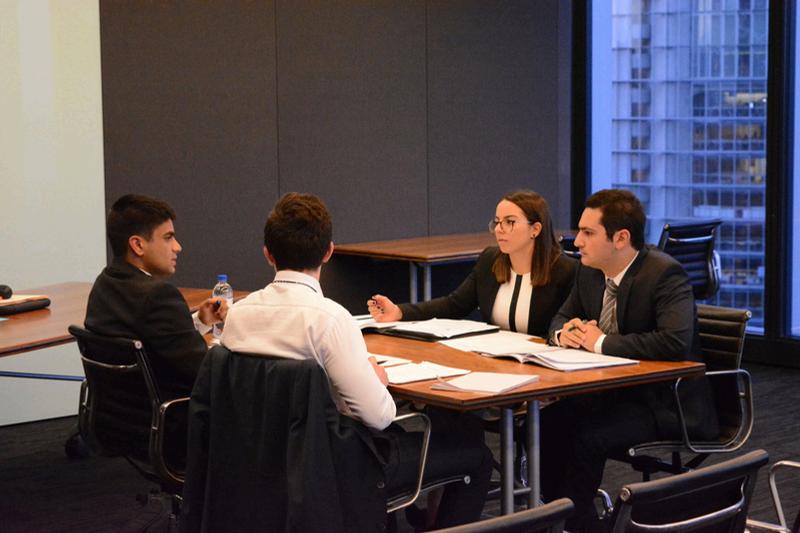
Client interview competitions are a simulation of a real-world consultation between a lawyer and a client. Participants are assessed on their ability to build rapport, elicit information, analyse legal issues, and provide clear preliminary advice. MULS runs a JUNIOR and SENIOR client interview.
INTRODUCTION AND FORMALITIES (5 MINS)
Firstly, state you and your teammate’s name and role Utilise small talk to break the ice and build rapport Talk about your aims for the session, and reassure them that everything they tell you is private and confidential
3 5 4
Use open ended questions, active listening, structural guides to encourage a client to continue describing the problem Conclude this section by idenitifying and summarising the client’s problem
Howdidyouprepareforthecompetition?
WINNERS:
Rebecca Edmonds
Radhika Dutta
Rebecca: To prepare for the competition, the most helpful thing I did was sit down and watch a real round to get an understanding of what it looks like This is the best way to understand exactly what is expected, and it also allows you to pick up useful phrasing or observe how successful teams approach questioning I also carefully read the competition manual and instructions and broke down the marking criteria. For example, while housekeeping is important in client interviews and for building rapport, no marks are allocated to it If you spend too long, you end up taking away valuable time that should be allocated for questioning, issue identification, proposing possible solutions, and effectively wrapping up the interview; where more of the marks lie
Howdidyoumanagetobalanceyourothercommitmentswiththiscompetition?
Rebecca: Junior client interview competitions generally require less preparation than other types of mooting or mock competitions However, it is still essential to be on the same page as your teammate to ensure a smooth and cohesive interview My teammate and I balanced our preparation alongside part-time jobs, full-time university study, and family commitments by finding times when our schedules aligned and blocking out time specifically for preparation, research, and practice We also made it a priority to meet at least half an hour before each round to run through practice interviews, review notes and feedback from previous rounds, and confirm our goals for the upcoming interview
Radhika: As Rebecca said, client interview competitions require less preparation, especially because we received the memos for each round a day or two prior My teammate and I did not always meet up to prepare; sometimes we managed over a phone call. Once you are through the first couple of rounds, you sort of get into the flow and it is easier to just meet right before the competition to go over last round's feedback and do some research to get a basic understanding of the particular issue in the memo and get a few pieces of advice ready
Whatwasthemostchallengingaspectofthecompetition?Howdidyouovercomethis?
Radhika: The most challenging aspect of the competition was asking the right questions to draw out the important and 'secret' facts from the client, especially since every client has a different personality. To overcome this, we decided to have an issue-based (issues in chronological order) style of questioning where we moved from issue to issue, dissecting with who, where, what, when, and why This style worked for me and my teammate; it is important to try and set a questioning routine and try out what works for you and your partner in the initial rounds
Howhasthiscompetitionsupportedyourpersonalandprofessionaldevelopment?
Rebecca: Competitions like this have greatly supported my personal and professional development They allowed me to practise the practical skills required for a future career as a lawyer while interacting with experienced practitioners and receiving valuable feedback and insight from them.
Whatisonepieceofadviceyoucouldgivetonewcompetitorsthisyear?
Rebecca: My main piece of advice is not to get too caught up in the law This is a client interview, and the focus is on the client rather than legal technicalities, particularly since clients often do not have a legal background The key aspect being assessed is how well you engage with the client, so keeping the client at the centre of the interview is essential. It is also important to remember that the time after the interview, when speaking with the judge, is your opportunity to demonstrate your legal understanding and address or clarify any errors you think you may have made This shows awareness and reflection
Radhika: One piece of advice for new competitors is to make sure that you have a timed structure that you will be following during the competition Distribute the time you have to phases of the interview For example, you will have 2–3 minutes for introduction and greeting, then move to housekeeping for the next 5 minutes Structure in questioning is also very important: open-ended questions, then close-ended. And know it is okay if you get muddled up a little, just make sure you summarise the facts in chronological order at the end of questioning
Howdidyouprepareforthecompetition?
WINNERS:
Alexander Healy
Laura Melville
Alex: The client interview, being a very practical application of legal knowledge and skills, meant that it was quite different from how you would normally prepare for a legal essay for example. We would have a loose interview structure which we would employ each week, with Laura and I being responsible for a section each However, each time, we would scope out the week's specific legal area, looking at key laws, potential problems the client was having, potential lines of questioning and brainstormed solutions
Laura: My partner, Alex, and I had previously competed in an ADR, but we were not too comfortable with the competition structure To prepare, we began by reading the MULS guide and reviewing the competition guidelines. We also watched client interview videos on YouTube to better understand and familiarise ourselves with the general structure of the competition We used these exemplar videos to develop a loose mental script This script guided how we approached and structured the interview Once the problem scenario for the week was released, we briefly met up to prepare together We developed targeted questions and identified key discussion points that were specific to the scenario
Howdidyoumanagetobalanceyourothercommitmentswiththiscompetition?
Alex: This competition was pleasantly manageable, and becomes easier as you go through the rounds and become more practiced Each round is unique and some time has to be put into researching a new area of law (although this exposure to different areas of law was one of the highlights of the competition), but when you establish a structure, the general workload is very predictable and easy to manage
Laura: Generally the workload was pretty manageable We also found that once the initial preparation for the first round was done, significantly less time was required for later rounds, which made it much easier to manage alongside other responsibilities. Additionally, when one of us had a heavier schedule, the other would take on more of the preparation
Whatwasthemostchallengingaspectofthecompetition?Howdidyouovercomethis?
Alex: The first stages of the competition were the most challenging, especially with difficult clients that would throw off our structure or flow. As we gained more experience, we adjusted our approach recognising every client is unique and it is your goal to work out how to best communicate with your client, how to manage their expectations and keep them on track Figuring out what really drives your client and being flexible with your approach, always keeping this in mind is how we overcame this challenge
Laura: The most challenging aspect was staying composed when the interview took an unexpected turn or when a question momentarily stumped us Relying too heavily on a script sometimes caused us to lose our train of thought, so we shifted our focus to the flow of the interview by listening and responding naturally This is definitely easier said than done and required quite a lot of practice
Howhasthiscompetitionsupportedyourpersonalandprofessionaldevelopment?
Alex: Law is inherently a people-focused profession and this competition aided my skills in seeing how to apply the law, not in isolation but in context, addressing real issues and delivering it to real people It also developed my confidence in stepping back to identify the key issues and the broader strategy, rather than becoming overly focused on narrower, peripheral points
Laura: The competition was invaluable in developing our skills. It significantly strengthened my ability to perform under pressure, remain level-headed in high-stakes situations, and approach challenges with greater confidence and composure Also personally, I made some great friends from the competitions and am excited to enter more competitions in the future!
Whatisonepieceofadviceyoucouldgivetonewcompetitorsthisyear?
Alex: My biggest takeaway from the competition and piece of advice is to really lean into your strengths and utilise your teammates own unique strengths Laura and I were stronger in different areas and phases of the interview and over the competition we learnt to bounce off each other’s strengths, with me being more comfortable in the rapport building and funnel questions to establish our key issues, with Laura being more adept at the more focused questions pinning down key roadblocks and hidden facts
Laura: Don’t over-rely on a script While preparation is important, the key is being able to think on your feet and respond to the client Focus on understanding your clients 'real’, immediate issues rather than ticking off a checklist Active listening and adaptability go a long way

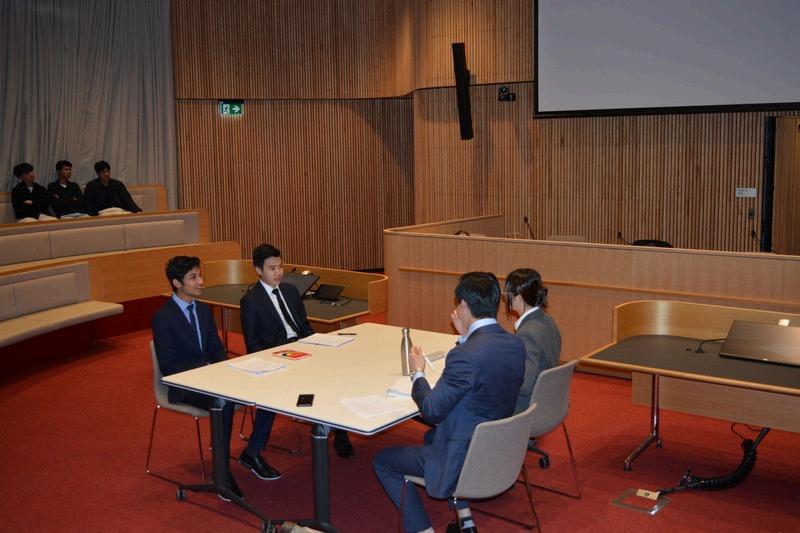
When you think of a lawyer, you might automatically think of advocating in a big case in front of a jury However, in reality the majority of matters settle through negotiations outside of court A Negotiations competition is a legal skills competition where teams of law students represent opposing counsel in a simulated negotiation This negotiation process replicates the process that is usually undertaken outside of the Courtroom before the litigation Teams consisting of two students are assigned to a client with the aim of reaching an agreement, either tentative or binding, that best aligns with their respective client’s interest
Know your Client and the facts
Carefully reading the facts and taking notes help identify client interests, instructions, and potential issues A detail-oriented approach ensures teams recall key information quickly and accurately, leading to successful negotiations amid complex scenarios with multiple interests. Negotiation teams ultimately represent their clients, and therefore must clearly understand their needs, interests, and expectations While advocating for their client’s interests, flexibility is key Balancing assertiveness and compromise, teams can use traditional or creative approaches to achieve favourable outcomes while considering opposing counsel’s suggestions.
Develop a Negotiation Strategy
Going into the rounds with a clear strategy that prioritises key issues will ensure efficient time use and meaningful discussions. To further increase efficiency, teams should anticipate opposing arguments, allowing for proactive responses and stronger positions However, flexibility should not be neglected in being able to navigate unexpected challenges and achieving the best possible outcome.
Interest-based Solution
Strategies that focus on understanding and satisfying the underlying interests of all parties rather than fighting to get the best position. The judges tend to favour this approach as it emphasises collaboration over aggressiveness In negotiation, a position is what someone states they want, while an interest is the underlying reason or motivation behind that position Interest-based negotiation shifts the focus from rigid demands to focusing on the deeper needs both parties, leading to more creative and mutually beneficial solutions. There may also be more interests in common than you might think. Seperate
RECEIVING THE HYPOTHETICAL
INTRODUCTION(2 MINS)
EXPLORATION OF INTEREST(15 MINS)
PRELIMINARIES(6 MINS)
FINALISING SOLUTIONS (5 MINS)
GENERATING OPTIONS (15 MINS)
SIGNING AND HANDSHAKE (5 MINS)
CONFIRMING AGREEMENT/MOVING FORWARD (5 MINS)
What is a BATNA and a WATNA?
A BATNA is the Best Alternative to a Negotiated Agreement It refers to the best alternative course of action a party can take if the current negotiation fails In contrast, a WATNA is the Worst Alternative to a Negotiated Agreement. It refers to the worst alternative outcome a party might face if the negotiation fails.
Why is it important to know your BATNA and WATNA?
Try to identify the opposition’s BATNA and WATNA to help increase your options as well. For example, if you are fairly sure that their BATNA is weak, this allows you to negotiate your position with more leverage knowing they have limited alternatives. However, if their BATNA is strong, it isn’t a complete catastrophe. It allows you to switch your negotiating to alternative benefits that might not be in their BATNA.
Identifying the opposition’s BATNA and WATNA:
Before entering negotiations, evaluate your alternatives and have a clear idea of what your BATNA and WATNA will be Knowing your BATNA will help you negotiate with leverage, while knowing your WATNA will encourage you to make concessions to avoid a worst-case scenario.
WINNERS:
How did you prepare for the competition?
Justin: We started off by looking at every negotiations-focused resource that we could find. The MULS negotiations manual is a decent place to start, along with the rules, but there’s a big advantage to be gained from looking elsewhere The Harvard Negotiation Project in particular has a lot of resources on interest-based negotiation, along with the book “Getting to Yes” by the founders of the Project Both were enormously helpful throughout the entire process and honestly worth a read for anyone in general
How did you manage to balance your other commitments with this competition?
Justin: Negotiations has a relatively low time requirement, at least compared to other competitions I was competing in a moot at the same time and whilst things did start to get dicey towards the tail end of both competitions, it was manageable with just a bit of stress and planning ahead The most important thing is that the team communicates properly as to when and how the work is going to get done – although commitments have to be juggled, it should never be at the cost of your teammate.
What was the most challenging aspect of the competition? How did you overcome this?
Justin: Doing well in negotiations requires you not to treat it as a competition, which can feel very counterintuitive at times. Trying to screw the opposition at the table results in a lot of pointless back-and-forth between the teams until either a compromise is reached, or the timer runs out Audrey and I were lucky enough to learn this in the early rounds, but at the very start there was definitely the temptation to try and make sure we won more than the opponent (which isn’t the point of a negotiation!)
How has this competition supported your personal and professional development?
Justin: I really think that negotiations is something everyone should try at some point It’s a very different skillset to mooting, but also gives you a much better understanding of how people tend to think and what makes them tick even when you are (theoretically) at odds On a personal level, I feel that the experience has given me a more well-rounded and flexible skillset than I otherwise might have had, as someone who has since spent a lot more time immersed in the advocacy side of things.
What is one piece of advice you could give to new competitors this year?
Justin: Negotiations requires research! The low time commitment of negotiations may be a little exaggerated at times. A lot of what eventually resulted in our success was the research we conducted into every single scenario – not just law, but things like the seasonal fruiting characteristics of a lemon tree, or the cost of equipment to clean up an offshore oil spill
Background knowledge can often be drawn upon as an objective standard, which is an incredibly useful tool in any form of negotiation
The Alternative Dispute Resolution (ADR) competition is the ultimate competition for elite professional skills competitors. In one big event, competitors will complete in four separate ADR disciplines (client interview, negotiation, draft a letter of advice, and a Partner Presentation). An Alternative Dispute Resolution (ADR) competition consists of multiple stages, each requiring different skills. Below is a structured approach to preparing for Client Interview, Negotiation, Letter of Advice, and Final Presentation.
Since you have less time than in an actual client interview competition, make sure to establish rapport early on by beginning with with open-ended questions and body language Also, come into the competition with a pretty good understanding of what legal and non-legal courses of actions will likely be applicable to your client’s needs and situation.
Come into the competition having a clear strategy that factors in your BATNA and WATNA in order to make strategic concessions while maximising your client’s interests In order to further build on this and establish mutual rapport, maintain a cooperative (as opposed to aggressive) tone with the opposing counsel.
In your letter of advice, clearly begin with a legal analysis of their situation, their available options, and what you recommend their next steps to be in line with their interests For example, you may begin with an introduction such as:
"Dear (Client’s Name),
I hope you are doing well. I am writing in response to our recent consultation regarding your concerns about (succintly state the issue). Based on the facts provided, I have outlined the key legal considerations and future courses of action available to you." Keep in mind to avoid using complex legal jargon to ensure that your client fully understands the advice provided.”
In your final presentation, make sure to summarise the key facts of your client’s case and their legal issues, evaluate how the client interview and negotiation went, and state your recommendations for future courses of action Make sure these facts are presented in a well-structured way And make sure your oral delivery is persuasive and calm in front of the Judges.
3
2
CLIENT INTERVIEW (25 MINS)
Teams will engage in 20-minute client interviews where competitors will simulate a lawyer-client consultation They will be expected to build rapport, provide preliminary options, and comply with legal and ethical obligations. . This is followed by a 5minute post-consultation in which teams are expected to provide selfanalysis on the interview and answer any questions posed by the judge
4
Teams will then begin drafting a Letter of Advice where they will offer a summary and preliminary legal advice on the Client Interview that happened earlier in the day. 5
How did you prepare for the competition?
WINNERS:
Rachel Justic
Maddison McCarry
Rachel: To prepare for the competition, my teammate and I began by understanding the key pieces of legislation and case law in the area of the memo we received before the competition. By understanding the area of law, we would be able to ask questions we knew were relevant We then moved to planning out as many lines of questioning as we could, and divided questions between us so that we knew who would ask what We took a tree diagram approach, in that each answer our client gave would open up new lines of questioning. While this helped, we also practised together so that if an answer didn't fit into our plan, we would still be able to respond in a professional manner and react calmly
How did you manage to balance your other commitments with this competition?
Rachel: Being aware of where your assessments and competitions are in your calendar, and how much planning time is required for each, is integral As long as you plan accordingly and start work as early as necessary, balancing this competition is incredibly doable, especially since it is a one-day intensive.
What was the most challenging aspect of the competition? How did you overcome this?
Rachel: The most challenging aspect of this competition is its intensive nature, in that you move through each of the different rounds without extensive breaks or preparation time. The day can be exhausting, but it can be overcome by pacing yourself and working as a team, with a balanced and shared workload between you both Communicating your bandwidth and capacity with your partner is arguably the most important aspect of the competition, and taking breaks as needed.
How has this competition supported your personal and professional development?
Rachel: As the competition exposed me to various different competition styles, such as letter writing, negotitaing and interviewing, my client-focused skills in the workplace have been supported By receiving client-interaction feedback prior to entering practice, I am more confident in my ability to communicate with clients
What is one piece of advice you could give to new competitors this year?
Rachel: My biggest piece of advice is to try every competition you are interested in! Do not be afraid your skill level is too low; each year, every competition has a large number of competitors who have never competed before The only way to know if you like it and to improve is to try! The first round may be nerve-racking, but after that, you settle in very easily
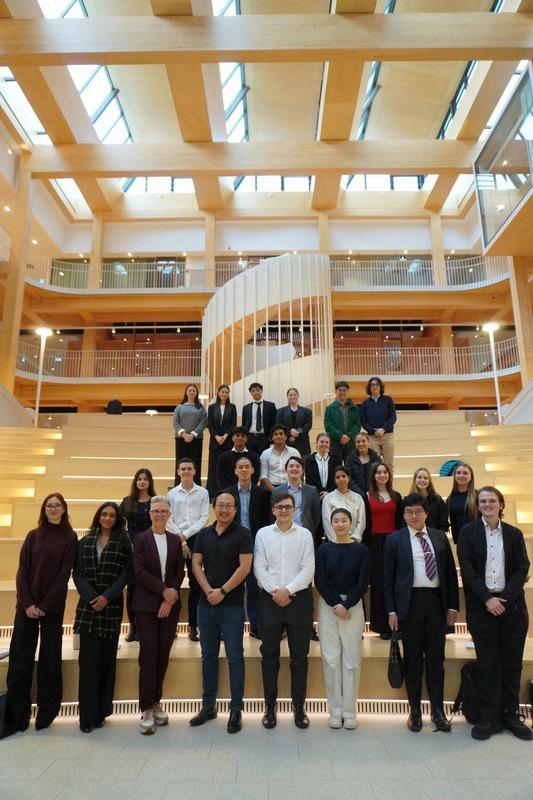
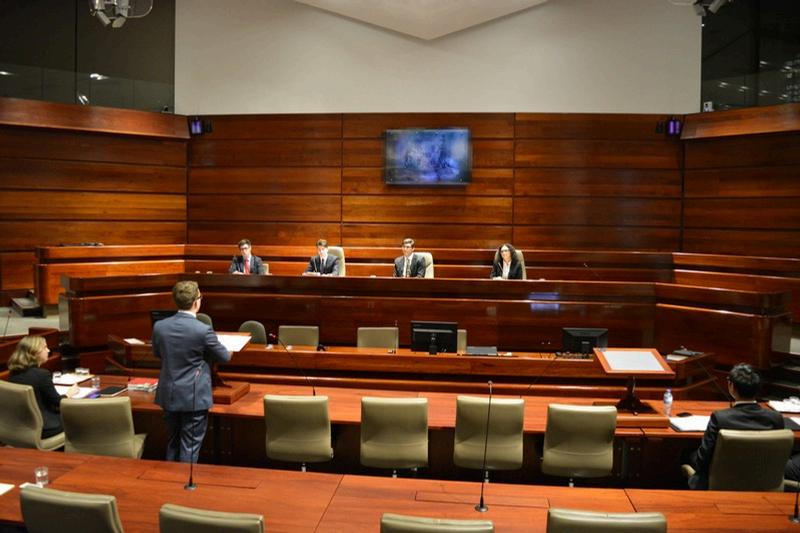
Intervarsity competitions are are offered across both the Advocacy and Professional Skills portfolios, providing opportunities to develop practical legal skills, from mooting and witness examination to negotiation and client interviewing, while competing against other universities at a regional and interstate level
2025 Team: Rachel Edmonds
Mackenzie Haladus
Diako Nabavi
Justin Lin
Justices and Solicitors-General in the past. Additionally, the Grand Final of the moot has been presided over by numerous High Court Justices, highlighting the honour to be selected as a competitor and representative of Macquarie University.
What will the judges be looking for?
Josiah: Judges will expect competitors to present their arguments logically The arguments should be based on the legal issues within the problem question and a continued application of the facts of the case. To excel as an oral advocate, judges also expect speakers to present at an appropriate volume and tone, and at a speed that ensures clarity. As such, judges also expect the formalities of court to be met by all competitors. Competitors should also be capable of accurately and concisely responding to questions posed by the bench
What preparation should competitors undertake prior to the commencement of the competition?
Josiah: Competitors should start their preparation by identifying the legal issues of the problem question which involves thoroughly examining the facts of the case Each competitor should have a great understanding of the particulars of what their side is advocating for and hoping to achieve. This is followed by extensive research into relevant authorities that will support your arguments Prior to the commencement of the competition, competitors must also prepare to anticipate opposing points and questions from the bench. This process could be completed by practice rounds with teammates
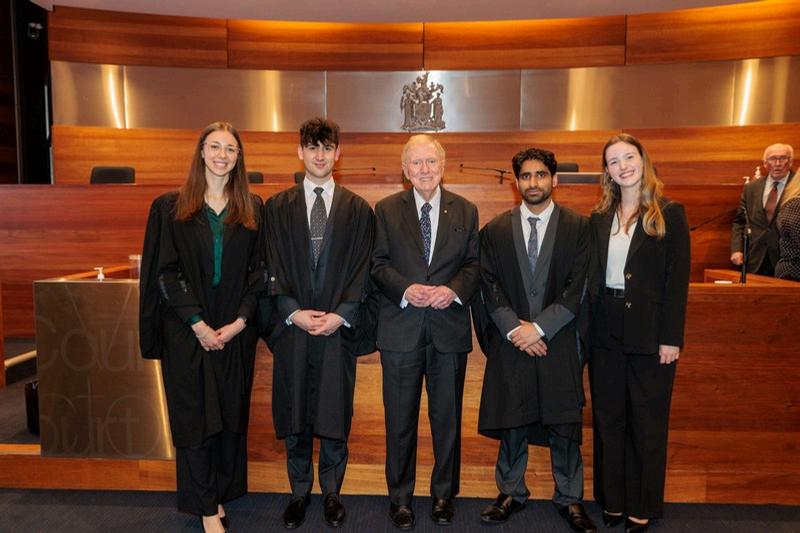
5 years
2025 Team: Reese Harvey
Elliot Madden Khan
Madeline Mingay
Amirali Shojaei
What will the judges be looking for?
Josiah: Judges will be looking for well-structured submissions that address the key issues that arise in the problem question Additionally, judges will expect competitors to have a thorough understanding of relevant legal authorities and the facts of the case. Strong oral advocates will present at a steady pace so that the bench may easily follow submissions
What preparation should competitors undertake prior to the commencement of the competition?
Josiah: Prior to the commencement of the competition, competitors should begin by identifying the central legal issues in the problem question The facts of the case must be read through consistently throughout the preparation process to understand which issues are contentious and require further research and time commitments Submission must be supplemented by researched authorities It is effective to know how the facts of different cases can similarly apply or differentiate to the facts of the problem question. Furthermore, competitors are best prepared when they have prior experience of the high-intensity setting of the competition. Presenting submissions in front of a practice bench will prepare competitors for similar questions during their rounds.
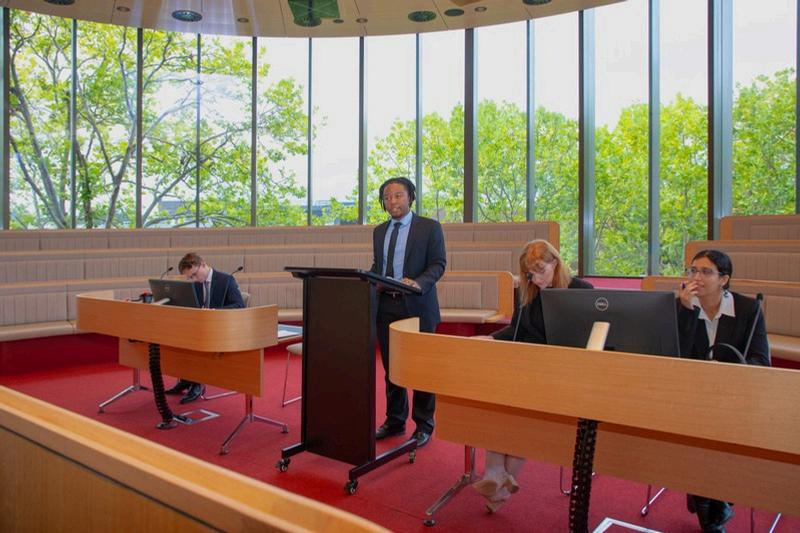
hand from online sources such as Westlaw
How did you manage to balance your other commitments with this competition?
Natasha: I dedicated designated time periods to either meet up in person with my team mates, or over phone to complete our submissions
What was the most challenging aspect of the competition? How did you overcome this?
Natasha: The online aspect of the moot was challenging, as it took away from the physical aspect of moots, and oral presentation in front of a live bench. Technology can also lead to disruptions, and it removes the professional environment and setting that moots have. My team overcame this challenge by meeting up in person to join a zoom call together, allowing us to still feel connected and work together in person throughout the day of mooting We kept our setting formal by standing up for speakers, passing notes to each other as instructing solicitors, etc.
How has this competition supported your personal and professional development?
Natasha: This competition allowed me to gain hands-on experience competing against other universities and challenged me in the intervarsity environment. We were tasked with multiple submissions for both sides under limited time Environmental law was an elective neither of my team mates had covered yet, so it was a challenge in itself to not only draft and prep the submissions on time, but to educate ourselves on the laws behind our moot as well
What is one piece of advice you could give to new competitors this year?
Natasha: Push yourself, take up new opportunities and sign up to moots that you have no experience in Make sure you learn to balance your time working on moots with your law studies, and recreational time
2025 Team:
Diako Nabavi
Sophie Nixey
Anastasia Muscolino
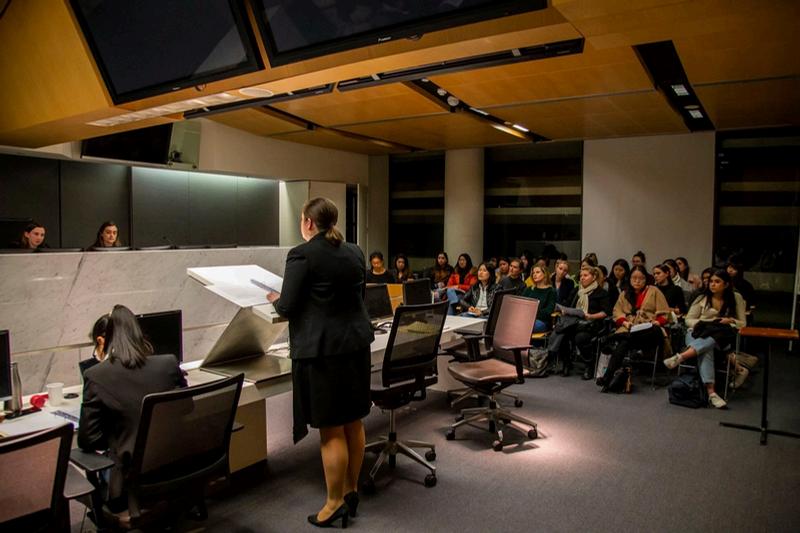
relevant case law that would support our submissions. We then rotated through the points of law so we could build on each other's notes. The team then met in person to put together our draft written submissions based on our research, which we continued to refine and edit until they were ready for submission. In addition to editing each other's work, it was also useful to read exemplar written submissions from previous teams to ensure our written submissions were in a clear and concise state The final stage of preparation is participating in practice moots to give team members a chance to develop and master oral submissions. My team was very grateful to have experienced academics and mooters act as practice judges which allowed us to sharpen our oral skills and anticipate questions the bench may ask on the day of the competition. Finally (and most importantly), read the question every day! It seems simple, but reading the question daily allows the team to memorise and account for all aspects of the facts. You'll be surprised at how many submissions are only realised after multiple read-throughs of the question.
How did you manage to balance your other commitments with this competition?
Anastasia: Mooting is notoriously time consuming, so it is important to be realistic about the time you have available when considering applying for a moot competition For the Sir John Peden Contract Law Moot, my team started by creating a shared schedule where we filled in the times during the week that we were available to meet and work on the moot Where possible, it is useful to keep these times free throughout the competition so that you can form a routine around times in the week that you will dedicate to mooting, and times that you will spend working, studying or socialising. One way that I balanced my other commitments with this competition was by taking my laptop to work so that I could make some progress on the moot during my morning and evening commute. I also recorded myself
reading the question so that I could listen to it whilst driving or walking. I also found it beneficial to plan exactly what parts of the moot I would work on each day (for example, instead of writing 'work on the written submissions' on your to-do list, you would instead say something like 'finish submission 3 of Claim 1') By being specific in my daily goals, I procrastinated less as I had a defined outcome to meet and was able to chip away at the moot incrementally.
What was the most challenging aspect of the competition? How did you overcome this?
Anastasia: The most challenging aspect of the competition was being able to create satisfactory responses to questions from the bench. Particularly with the Sir John Peden Contract Law Moot, the bench on the day of the competition comprises of highly esteemed members of the judiciary and academics who have been looking at contract law for many more years than you have! It is important to remember that this aspect of mooting is always nerve wracking, no matter how experienced you become and that the judges know the teams are made up of students and just want to help you develop your skills as an advocate. In order to overcome this challenge, I wrote down any questions the team got from the bench during our practice moots and came up with answers to them, in case we got them on the day of the competition. I would also try and take a moment before answering a question so that I could formulate a clear and coherent response, rather than rushing into an answer which I hadn't thought through Finally, remember that as an oralist you are in control of the pace of the moot (if you stop talking, the whole case stops!).
How has this competition supported your personal and professional development?
Anastasia: Mooting is an incredible way to develop not only your legal skills, but also yourself. Participating in a moot requires resilience, co-operation and hard work Stepping out of your comfort zone in this way allows you to grow as a person by pushing your legal knowledge and skills beyond what you can learn in a classroom, and achieving results you can truly be proud of (and that doesn't simply mean winning, but the whole process of putting together articulate and strong submissions). Mooting is also extremely beneficial for developing your legal skills as it puts the knowledge you have learnt throughout your degree into practice, with the opportunity to receive feedback and guidance from highly experienced legal professionals, academics and students alike. Mooting allows individuals to participate in legal research across various areas of law, and often in areas with debated legal opinions, practice legal writing through the construction of written submissions and also improve speaking abilities such as breaking down technical concepts into clear and direct answers as well as controlling pace and tone whilst under pressure
What is one piece of advice you could give to new competitors this year?
Anastasia: One piece of advice for new competitors, particularly for mooting, is to avoid creating and reading off a script during oral submissions. It is completely normal and even useful to do this at first whilst you get a grasp of the language and processes used in mooting, but the end goal is to be able to make oral submissions using notes which just include key points and supporting case law This allows you to be flexible when leaving your notes to answer questions from the bench, without completely losing your place on a page full of text! You will also be able to recall the important parts more effectively by memorising the structure and cases in your submissions rather than a speech that consists of multiple pages. 59
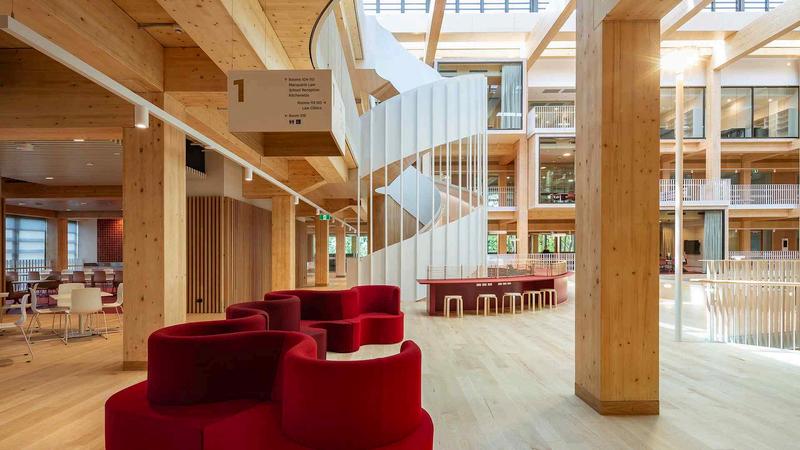
How did you prepare for the competition?
2025 Team: Natasha Zimin
Luciana Romanokvski
Amirali Shojaei
Luciana: The first step to preparing for a competition is having a strong team that is dedicated to the moot. I was lucky enough to be selected with Amirali Shojaei and Natasha Zimin, as we all worked well together and shared the same goals in the competition As a team, we thoroughly read the facts and identify the relevant laws, cases and creative arguments for our case. Secondly, we develop and edit our submission thousands of times over, in order to ensure our arguments are best suited to our side. Thirdly, we coach each other by completing numerous practice moots It took us many team meetings and practices to help us prepare for the competition. We were fortunate to be coached by Sami Shamsi, who is an inspiration for our mooting endeavours. Sami provided an expert perspective, and we are very grateful that he continues to be an amazing support for both studying law and mooting
How did you manage to balance your other commitments with this competition?
Luciana: To study and moot at the same time is truly a unique, rewarding, but difficult experience. It takes time to balance study and mooting preparation. Your team should all support one another by creating schedules and meetings for discussion, which effectively help you work on your submissions or practice It is ideal to set a certain time of the day to solely work on the moot. As students, you share the same experiences of balancing between studying and mooting It is important to ask members of your team if you are unsure or if you are feeling overwhelmed, and to support those who also ask for your help. I prefer to view mooting as an opportunity that supports and expands my knowledge to study law.
What was the most challenging aspect of the competition? How did you overcome this?
Luciana: The most challenging aspect of the competition is awaiting the results of the moot. No matter how well the moot went or how much preparation that was put into the competition, nothing can prepare a team for the end result. In this moment, it is often hard to breathe, and you are flowing with adrenaline. The winning result is the end goal that you have wanted to achieve from the beginning when we were
accepted into the competition. Like this moot, sometimes the results do not go in your favour. We learnt to accept and be proud of our achievements We congratulate and speak to the opposing team The most important tip that we do to reflect on our results, whether it is a win or a loss, is to write down the judge’s feedback, being the good and bad. This helps us move forward, develop our skills and look forward to future moots as a team.
How has this competition supported your personal and professional development?
Luciana: The experience of mooting has led me to the pathway of my future career goals. Mooting has shown me that advocacy and submitting to the Court is where I will be most happy and rewarded in my career. In addition, my team has shown me a different perspective to developing arguments, which will support my professional development when collaborating in the workplace or with other peers in my degree. I am very fortunate to have met many mentors and peers who have coached and inspired me to continue mooting and challenging my legal reasonings
What is one piece of advice you could give to new competitors this year?
Luciana: The best way to view mooting is a conversation with the Judges. It is an opportunity to put forth your point of view, rather than intensely arguing with the Judge The questions that the Judge imposes on you provides you with a pathway to explain your case, develop your argument, and speak profoundly on the law. It is most important to have confidence in yourself and in your team. MULS and Macquarie Law School provide endless opportunities, and it is important that you accept these

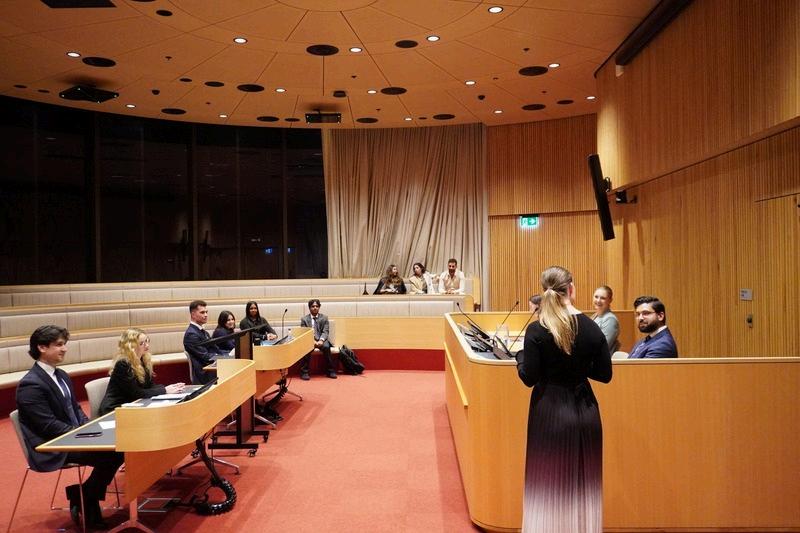
How did you prepare for the competition?
Dino: We spent months immersing ourselves in the problem question, drafting and refining our written submissions, and participating in multiple practice moots where we received detailed and constructive feedback We were fortunate to be guided throughout the process by our mooting coach, Simeon Levine, whose expertise was invaluable to our preparation.
How did you manage to balance your other commitments with this competition?
Dino: We devoted a significant amount of our free time to this moot, including weekends and any spare time we could squeeze between work, tutorials, and assignments. The preparation process was intense, but ultimately very rewarding at the end
What was the most challenging aspect of the competition? How did you overcome this?
Dino: The most challenging aspect of the competition was definitely the practice moots. It was an extremely challenging and uncomfortable process, with our oral advocacy skills placed under a microscope by a bench of experienced mooters, tutors, and alumni. However, I am very grateful for this challenge, as it ensured that I was able to deliver my oral submissions confidently and clearly, and by the time the competition arrived we were very well prepared.
How has this competition supported your personal and professional development?
Dino: Professionally this competition allowed me to significantly improve my legal research, writing and oral advocacy skills. The moot really forces you to hone these skills under pressure and in a realistic setting. I found that what I learnt translated directly into my work as a paralegal and studies, making me more confident and precise in how I approach legal problems. Personally, it was an incredible experience and one of my favourite memories that I will look back on after I graduate. Competing against some of the best mooters from across Australia, as well as a few from overseas, was an amazing and rare opportunity.
What is one piece of advice you could give to new competitors this year?
Dino: My advice to new competitors would be to lean into the discomfort that comes with mooting. Feeling challenged, nervous, or out of your depth is completely normal, particularly during practice moots. However, the more you expose yourself to that feeling and learn to work through it, the more confident and effective you will become by the time the competition begins

What is the UNSW Contract Law Moot?
Josiah: The UNSW Novice Contract Law Moot is a new intervaristy competition designed by UNSW for participants with prior experience in mooting, however, who have not competed outside of their respective universities. Competitors are granted an opportunity to develop their practical legal skills of advocacy and critical thinking against other like-minded competitors whilst simultaneously benefiting from an intervaristy experience representing Macquaire. This competition could be seen as a great opportunity for those looking to represent the university in Jessup or the Nuremberg Court Moot in the future.
What will the judges be looking for?
Josiah: The judges will be looking for clear and confident advocacy, strong critical thinking, and a solid understanding of contract law. They’ll want to see competitors who can structure their arguments logically, think on their feet when asked questions, and communicate their points persuasively and professionally.
What preparation should competitors undertake prior to the commencement of the competition?
Josiah: Competitors should seek to thoroughly break down the question to gain a knowledgeable understanding of the key legal issues. Subsequently, they should revise the contract law principles that are present within the issues and engage in deep research to formulate strong and logical arguments. Additionally, competitors should constantly review their arguments, enhancing their understanding, which would benefit their advocacy in front of judges. Anticipating questions from the bench will also better prepare competitors for their round.
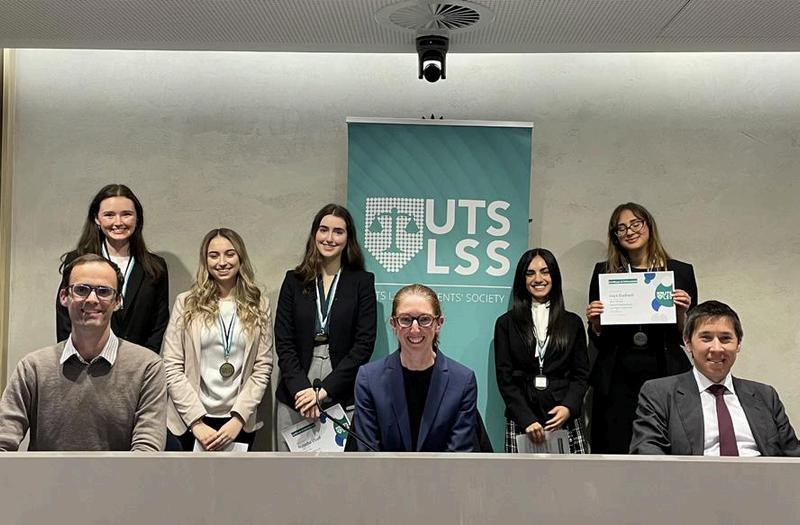
Josiah: The UNSW Novice Contract Law Moot is an intervarsity competition designed by UNSW for participants with prior experience in mooting, however, who have not competed outside of their respective universities. Competitors are granted an opportunity to develop their practical legal skills of advocacy and critical thinking against other like-minded competitors whilst simultaneously benefiting from an intervaristy experience representing Macquarie This competition could be seen as a great opportunity for those looking to represent the university in Jessup or the Nuremberg Court Moot in the future.
will the judges be looking for?
Josiah: The judges will be looking for clear and confident advocacy, strong critical thinking, and a solid understanding of contract law. They’ll want to see competitors who can structure their arguments logically, think on their feet when asked questions, and communicate their points persuasively and professionally
What preparation should competitors undertake prior to the commencement of the competition?
Josiah: Competitors should seek to thoroughly break down the question to gain a knowledgeable understanding of the key legal issues. Subsequently, they should revise the contract law principles that are present within the issues and engage in deep research to formulate strong and logical arguments Additionally, competitors should constantly review their arguments, enhancing their understanding, which would benefit their advocacy in front of judges. Anticipating questions from the bench will also better prepare competitors for their round.
How did you prepare for the competition?
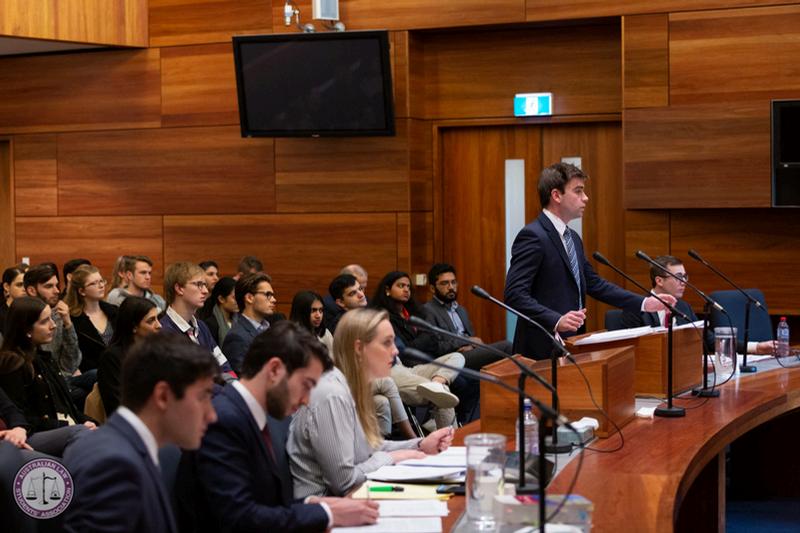
Team: Charlie Mackenzie
Rhiannon Marshall
Rachael Edmonds
Rachael: Our team spent a lot of time on campus during the mid year break knuckling down and researching for this competition I think being in the same room as much as possible was really helpful for collaborating on ideas and enhancing communication so that we could plan deadlines and organise draft memorials. When we weren’t in the same room, we were often on calls, or texting. IHL definitely involves a lot of research, not just into the Rome Statute and Elements of Crimes, but also into the case law of various ad hoc criminal tribunals, traveaux preparatoire
Charlie: IHL has two very distinct skills that you have to learn. First is how to research effectively in an area that has less than twenty cases Of that twenty-odd, maybe three are relevant to the question you are being asked So when writing our written submissions it's a matter of just reading huge amounts of material and siphoning out the parts that are both persuasive and useful to either the prosecution or the defence side. Once the written submissions are done, as Rachel said, it is all about being in the room together practising, getting your submissions down so that when you actually compete you do not have to think
How did you manage to balance your other commitments with this competition?
Charlie: There is no getting around the fact that the IHL moot is a very time consuming and challenging moot to do Being able to balance this type of competition with your general studies is an invaluable skill to learn not just as a student but for going ahead in your career too. I have done a number of moots at Macquarie and IHL whilst being definitely the most challenging has also been very much the most rewarding and satisfying As far as balancing other commitments with this competition, if you want to do well, ensure the only thing you are balancing is study and the moot for the short period in which the IHL moot occurs is probably your best bet and be prepared to work hard.
What was the most challenging aspect of the competition? How did you overcome this?
Charlie: Being confident to know that you have done the research, you know what you're talking about, and that you can stand up in front of people who know so much about IHL, including people that actually negotiated the Rome statute, and people who directly worked on the cases that you are using to make an argument Being confident enough to stand up in front of them to make your case and have a dialogue with them during your oral submissions was by far the most challenging and daunting aspect of the competition. But it all comes back to trusting that you've done the research. If you have put the time and effort in, you know the cases and you know the answers to the questions they ask before they even ask them
How has this competition supported your personal and professional development?
Charlie: Learning to be confident in my knowledge and research of an area, and to be able to effectively deliver my point of view to someone who is an expert in that area is something that you get from mooting that you just can't get anywhere else at university. Any barrister or lawyer will tell you that those skills are invaluable in a legal career and one of the core skills of not just IHL moot, but any moot that you might do
What is one piece of advice you could give to new competitors this year?
Charlie: Just give it a crack. You never know where these competitions can take you. I have been lucky enough to compete in Tasmania and Canberra, and I'm about to go to Hong Kong to compete against universities from all over the Asia Pacific region. I never thought I would be good at mooting, I never thought that I had the demeanour or confidence to deliver effective submissions and persuade a world leading expert in IHL that my argument was the better argument, but I have. Because I just gave it a crack. You won't regret it
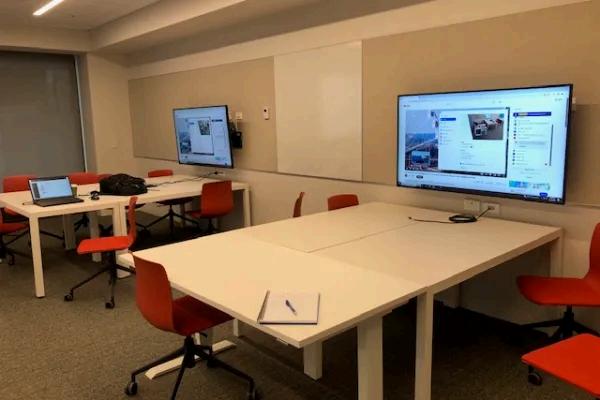
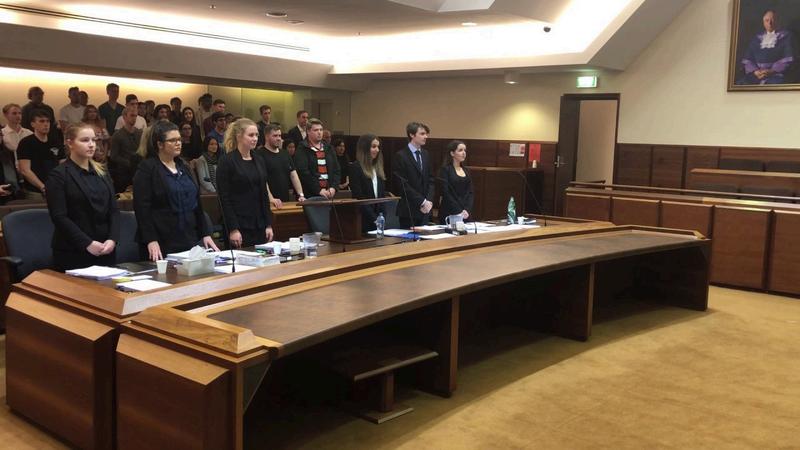
What is the ALSA Championship Moot?
Josiah: The ALSA Championship Moot represents one of the highest pinnacles of intervarsity mooting. It is a competition that is designed to include the strongest competitors from each university around Australia. These competitors are expected to have undertaken a wide range of prior competitions, both internally and externally, to develop their advocacy skills and formulation of arguments. Additionally, there is no prescribed area of law for this competition, thus requiring competitors to have a broad knowledge of the law.
What will the judges be looking for?
Josiah: Judges will be looking for well-structured and logical arguments that comprehensively analyse the issues at hand. Arguments should be composed and thorough whilst avoiding ambiguities and repetitiveness. Specifically, judges will also expect competitors to have a quality understanding of the facts of the case, in addition to the law. The presentation of arguments should be well communicated to ensure clarity before the bench
What preparation should competitors undertake prior to the commencement of the competition?
Josiah: Competitors should devote a significant amount of time to comprehending the facts of the case and conducting thorough research into the relevant legal principles and case law to develop compelling argumen rguments from the eir team.

Josiah: The ALSA Witness Examination is a simulated mock trial competition where competitors take on the role of barristers to examine and cross-examine witnesses. The competition is open to all universities across Australia, as each can register a representative team constructed of their best advocates. The competition first demands an opening statement, which is followed by the examination of witnesses. Competitors must be capable of thinking on their feet to question their opponent’s witnesses in cross-examination.
What will the judges be looking for?
Josiah: Judges look for clear and purposeful questioning that is coupled with a coherent case theory. They value advocates who use proper question forms, respond calmly to unexpected answers, and handle basic evidentiary issues and objections with confidence and respect.
What preparation is involved during this competition?/What’s the preparation process during this competition
Josiah: In the ALSA Witness Examination, competitors are provided the question 90 minutes before the commencement of the round. Upon receiving the question, competitors should carefully read through the material consisting of witness statements and relevant legislation. Competitors should have an idea of what they are persuading the bench to believe after examinations. They should also draft questions and determine the areas that the opposing witness should be cross-examined on.

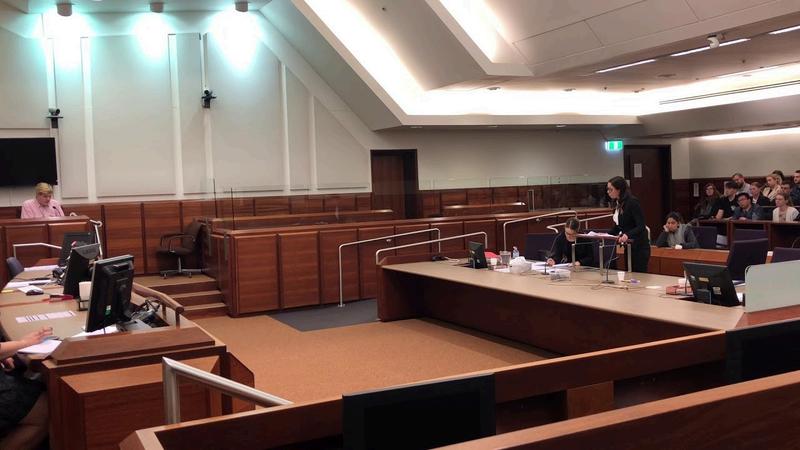
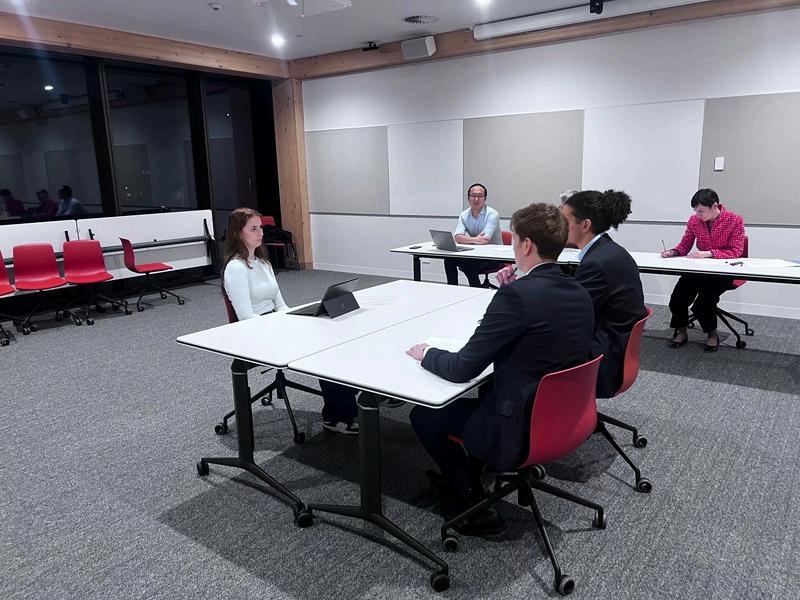

How did you prepare for the competition?
Team: n La Brooy en Lee
Lin y Lin
Hayden: Before beginning any formal preparation or practice rounds, I made sure to get to know my team first on more of just a surface level relationship This competition involves a great deal of communication, which may not always be spoken to each other but rather an understanding and team work. In terms of formal preparation before the competition, it is crucial you are familiar with your fact scenario. The fact scenario is the foundation of the competition, it is where the opposing side will challenge you and where your overall strategy is developed Knowing it inside allows you to respond confidently, anticipate issues, and adapt our approach as the mediation unfolded.
How did you manage to balance your other commitments with this competition?
Hayden: Balancing this competition with other commitments came back to preparation and time management I made use of any spare moments I had, such as reading the fact scenario while commuting, to stay familiar with the material This meant that when it came time for team meetings, we could focus on developing and refining our strategy rather than revisiting basic details The better I understood the scenario, the more efficiently I could contribute during preparation, which made it easier to manage my time and balance other academic and personal commitments alongside the competition.
What was the most challenging aspect of the competition? How did you overcome this?
Hayden: The most challenging aspect of the competition for me was that it was conducted entirely online via Zoom. I found it difficult at times to interject at strategically appropriate moments, as the natural flow of conversation is harder to manage in this setting To overcome this, I learned to make effective use of the mediator The mediator is a strategic play most competitors will overlook. Engaging the mediator allowed me to raise concerns, clarify issues, and communicate my client’s position more clearly.
How has this competition supported your personal and professional development?
Hayden: In mediations, it is common for one side or even one individual to take on a dominant role. This presented a valuable opportunity for personal development, as it required me to confidently interject and advocate for my client’s position without allowing the narrative to be controlled by the other side From a professional development perspective, the competition reinforced the importance of how you lead a mediation. Effective leadership requires striking a balance between being assertive and being respectful How you conduct yourself can directly impact your team’s outcome, and learning to lead without overpowering others is a skill that will be highly valuable in professional legal practice.
What is one piece of advice you could give to new competitors this year?
Hayden: Structure is key It is important to remember that you are not only communicating your client’s position to the other party, but also to the mediator and the judges. Without a clear and logical structure, it becomes difficult for all parties to understand what your client truly wants A well-structured mediation ensures your arguments are clear, cohesive, and persuasive, and prevents key ideas from becoming lost or blurred as discussions move between issues.
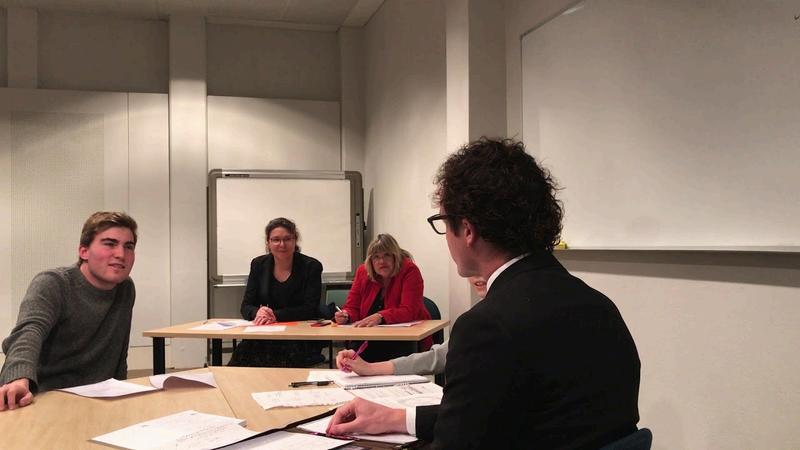
Rachel: The ALSA Client Interview Competition is a high level competition designed to test students across Australia in their interview skills by drawing on a simulated initial consultation Teams of two elicit relevant facts, build rapport, address ethical issues and provide preliminary legal options within a set time, followed by a post-interview reflection with the judge. It emphasises practical communication and legal problem-solving.
What will the judges be looking for?
Rachel: Judges will assess how well competitors establish rapport, identify the client’s problem, manage ethical issues, explore options, facilitate informed decisions, conclude the interview and reflect on performance. Teamwork, effective communication, understanding of issues and balanced participation between team members will be key aspects of the judging criteria.
What preparation should competitors undertake prior to the commencement of the competition?
Rachel: Competitors are best prepared for this competition by developing their skills through internal MULS interview competitions. Competitions are also encourages to understand the ALSA rules and judging criteria, plan structured questions, practice active listening, research relevant legal principles, and build post-interview self-reflection skills. Reviewing past problems and mock interviewing with peers will also improve your confidence and performance in these interviews.
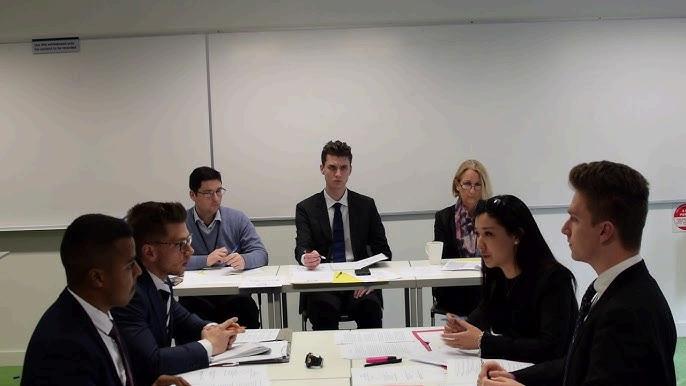
Rachel: The ALSA Negotiation Competition is a national negotiation competition for law students across Australia. Similar to Macquarie Universitys’ internal negotiations competitions, teams negotiate simulated disputes with shared and confidential facts to achieve the best outcome for their client. This high level competition tests communication, strategy, collaboration and real-world negotiation skills
What will the judges be looking for?
Rachel: Judges will be looking for how effectively teams represent their client’s interests, apply creative solutions, manage time, communicate with eachother, and build rapport Scoring will consider aspects like negotiation outcomes, teamwork, professionalism, ethical conduct along with quality of self reflection.
What preparation should competitors undertake prior to the commencement of the competition?
Rachel: Competitors are best to participate in internal negotiations competitions,, build teamwork along with a strong understanding of BATNAs/WATNA,s client instructions and ethical duties to parties involved. Competitiors should also practice self reflection skills. Familiarity with ALSA rules and reflective self-review after practice rounds will prepare you well for this competition.
The below competitions are some of the most prestigious mooting contests held worldwide. They offer invaluable experience, global exposure, and professional development. Students should aspire to participate, as these competitions enhance their advocacy skills and legal knowledge. Whilst these competitions are not organised by MULS, students are encouraged to apply directly with Macquarie Law School.

The Judges’ Corner showcases distinguished adjudicators with experience in Macquarie Law competitions, ranging from experienced barristers, academics, and alumni. Their expertise span mooting competitions, client interviews, negotiations, witness examinations and more. Committed to excellence, these judges provide invaluable feedback, uphold high standards, and inspire competitors to excel at Macquarie University.





Simeon graduated from Macquarie in 2024 following an extensive and highly accomplished mooting career. He competed across a broad range of competitions, most notably as a member of the 2024 Jessup International Law Moot Court Competition team, which were crowned Australian Champions, and as a quarterfinalist in the Michael Kirby Contract Law Moot. Now a Tipstaff at the Supreme Court of New South Wales, Simeon brings to the bench not only his proven success as a competitor, but also his experience directly from the Court. His combined insight into high-level advocacy and judicial process places him in an exceptional position to provide thoughtful, practical feedback and to guide competitors toward their own mooting success.

Keep mooting. If you haven't done a moot before, now is the time to sign up for one. You may lose a few hours of sleep, but what you gain from mooting will exceed anything else in your University degree or experience Listen to judges feedback carefully and try to improve one moot at a time

Dr. Esther Erlings is a Senior Lecturer at Macquarie Law School. She is also a member of Lifespan Health and Wellbeing, and Smart Green Cities, where she is the MCR Lead for sustainable cities. Esthers’ research areas focus on family and health law, human rights, tort law and occasionally trade law. She has been involved in judging a range of MULS competitoins spanning from international mooting competitions to negotiations, supporting students in their personal and professional development.
Which competitions did you judge? And did you have any competition experience prior to judging?
Which ones didn’t I judge?! I’ve been involved in a lot of competitions, including client interviewing, negotiations, Michael Kirby contract moot, Jessup, English as a Second Language moot etc. etc. As you can tell, I love some diversity in my life!
When I attended law school many moons ago, mooting competitions were not really a big thing. We did simulation trials in our units, but competitions were few and far between I do recall taking part in the ‘European Parliament for Students’ moot, where my team had to negotiate a good outcome for a tiny Baltic State (Latvia).
How does competing help students in their legal career?
Mooting allows students to be one step ahead of the pack. Imagine two legal interns: one has never written a court submission, and one has written multiple ones on which they have received semi-individual feedback Who do you think will do better? Mooting forces you to develop practical skills and to appreciate feedback. And just as important, mooting requires you to put yourself into someone else’s shoes, which is probably one of the most important things a lawyer should be able to do If it’s a litigation or negotiation moot, you have to consider what the other side might think or argue, and if you participate in client interviewing, you really have to get your head around handling sometimes difficult clients. (I also cannot recommend signing up to play the client enough; it is incredibly useful to “be on the other side”, so that you can take these insights and improve your own client interviewing )
To a large extent, the value is in “having seen it before”, so that you’re not charting completely unfamiliar territory once you enter practice.
What common mistakes do you see competitors make in your capacity as a judge?
My person pet peeve is reflection A lot of competitors do not understand how to use their opportunity for reflection and harp on about how fantastic they were, or blame the other side (or, worse, the judges) for anything that did not go so well. Reflection is the opportunity to redeem yourself by showing insight into your performance where things went wrong, and to take responsibility for your own performance. Use this opportunity to show that you understand some things could have gone better, and how you will tackle them next time. Of course, you should also highlight the things that went well, and you should do that strategically. Many competitors start with things they did well and end with things requiring improvement – turn that around, so the last thing the judge hears is what you did well
Three other things that are important are, first, to really read the facts very, very carefully, and, secondly, to know the facts of cases that you cite Cases get distinguished on the facts, so you should know those and not just the legal rule coming out of a case Thirdly, make sure that your submissions are coherent, especially if there is a senior and junior counsel (this is also a key task for the instructing solicitors, if there are any). Sometimes counsel have just prepared their own documents without regard to those of the other counsel and they end up essentially arguing against each other! Collaboration really is the keyword here
What attributes do you look out for in stand-out competitors?
This depends a bit on the competition.
If it is litigation, I look for the three things listed above (awareness of facts, understanding of cases and coherence) and how students respond to judges’ questions. The really good students will be able to stay calm and not show any signs of irritation no matter the question They are also able to gauge when they should just accede a point.
If the competition is negotiation, the key is control – stand-out competitors are in control of the negotiation. Importantly, control of the negotiation does not equal dominating the discussion; very often, those who monopolise the floor are not actually in control. Collaboration is another sign of a good negotiator. Being hawkish and playing hardball gets you nowhere. The best negotiations are those where people show a willingness to find a solution, ask respectful questions and think outside the box
Finally, client interviewing Good competitors are those with people-skills They ask questions rather than interrogate the client (there’s a big difference). They never let a difficult client get to them, explain things in a way a client can understand (how many people who meet a lawyer for the first time will instantly know what a ‘retainer’ is?!) and they do not blindly trust the client
Especially for negotiation and client interviewing, good competitors are those who work as a team. They do not just divide tasks, they are in it together.
What particular aspects of judging did you find most enjoyable?
I really love the feedback part at the end. How often do you get the chance to really sit down with students and take the time to go over how they are doing and answer all the questions they may have? It is a safe space to
honestly discuss what went well and what could have gone better in an individualised manner. Also (and somewhat relatedly), seeing competitors grow. I sometimes judge competitions from the preliminary rounds up to the grand final and it is such a pleasure to see teams who struggled a little at first do an excellent job later on!
You’re there to learn, not to beat the other team. The gains are in developing your skills and getting all the feedback you may need to improve next time. Even if you get a terrible score the first and second time around, take the feedback on board and try again

1. Which competitions did you judge? And did you have any competition experience prior to judging? I have been fortunate to judge moot trials, witness examinations, and client interviews for MULS and other university law schools. I have also been a tutor for the NSW Bar Association in the Readers’ Course preparing candidates for Court appearances.
2. How does competing help students in their legal career? It teaches discipline and gives students guidance on how the skills they acquire as students and participants will be put into practice when they graduate Students learn basic skills that are essential and also how to avoid pitfalls whether they eventually practice as solicitors or barristers. That said, the skills are acquired by ‘flight hours’ and nobody expects a student to be performing at the level of a senior practitioner but competing in the competitions most certainly assists and is a beneficial CV/resume addition.
3. What common mistakes do you see competitors make in your capacity as a judge?
Often students in moot trials spend too much time on reciting facts that the judges are already familiar with. As a result, they lose time that should be spent on developing their arguments in a clear and cogent manner Time is limited so it’s best not to expend it unnecessarily rehearsing what everyone already knows from the decision of the Court below. Also, be aware of what jurisdiction you’re arguing in as it makes a significant difference and be well-versed with the relevant legislation and authorities
4. What attributes do you look out for in stand-out competitors?
Excellent preparation, well-structured submissions, and clarity of expression. Try not to get flustered if you are interrupted by a question from the Bench and, if necessary, don’t be afraid to ask to return to it rather than 78
giving a poor answer that doesn’t really address what has been asked. Judges will usually permit that, and it shows that you will seriously and properly consider. Also demonstrate confidence but not arrogant overconfidence Judges spot it easily and are more likely to really test your abilities!
5. What particular aspects of judging did you find most enjoyable?
Imparting industry knowledge and tips that law schools are often unable to cover due to time and resource constraints. Assisting students further their potential and giving them constructive criticism. It’s very rewarding seeing students who participate return in following years and who have improved greatly.
6. What advice would you give to future competitors?
Three things: Preparation, preparation, and more preparation! It is crucial to spend quality time and research on perfecting written submissions and getting them right. The judge will have read these before the trial starts. They are effectively a ‘free kick’ and when rehearsed will make the time on your feet a lot easier Also, within reason, allow yourself to develop your own style whilst simultaneously retaining formality and courtesy. Not every advocate has to sound and deliver the same.

Andrew is a Senior Lecturer and Director of Education at Macquarie Law School, and the convenor of Criminal Justice and Criminal Procedure. A graduate of Macquarie University with both an LLB and a PhD, Andrew also spent six years in private practice as a criminal defence lawyer. Drawing on both his academic expertise and his substantial experience in criminal litigation, Andrew brings a well-rounded and practical perspective to his role as a judge. His combined experience in the classroom and the courtroom enables him to assess advocacy with both doctrinal precision and a deep understanding of real-world criminal practice.
Which competitions did you judge? And did you have any competition experience prior to judging?
I mainly judge the Criminal Law Moot, criminal law being my thing, but also the Foundations Moot as well. I was a criminal defence practitioner so my experience is in court, and to be honest I didn’t do any mooting myself. I wish that I had, but when I was a student here mooting was very limited. Today’s students have it better!
How does competing help students in their legal career?
In so many ways. It builds a lot of confidence to be able to discuss the law out loud and in a formal context, which isn’t easy It demystifies court process a little I think it makes you a better law student because you have to engage with the law really closely, and in a way builds skills for assessments. It looks great on a CV. It’s also a good way to make friends and feel like you’re really part of our Law School community. Honestly I cannot recommend it enough.
What common mistakes do you see competitors make in your capacity as a judge?
Mooting, like real court work, is not about making a presentation It’s not a speech It’s about communicating your argument to a human being who has their own ideas and opinions. Absolutely thoroughly prepare what you want to say, and then understand that persuasion requires assessing where the person you’re seeking to persuade is at and meeting them there Expect questions, listen to them carefully, and answer thoughtfully Grasp that the questions being asked are likely telling you which points the judge is not persuaded on and adjust your submissions accordingly.
What attributes do you look out for in stand-out competitors?
The key attribute is an ability to go directly to the key legal issue/s. Most competitions, like most real court cases, ultimately are really about one or two points Everything else is just colour The best competitors will say: this crux of this case is X, and on X our position is … That simplifies things and leaves you in no doubt what a team’s argument is.
It might be helpful to consider the perspective of a real judge Imagine that you have the heavy responsibility of adjudicating matters, and you’ve got multiple to get through each day. What do you want from the lawyers who appear in your court? You want submissions that help you. It’s a hard job. You want to be told exactly what the issue is – not that there are 10 issues and you have to decide which one is real – and you want a clear, succinct and precise explanation of the positions on that issue and the evidence behind each position. It’s a vital skill for any advocate.
What particular aspects of judging did you find most enjoyable?
The opportunity to support students who really want to learn particular skills. I love the law and I loved court work, so seeing students invest in the nerdiness of it all really warms my heart
What advice would you give to future competitors?
Simple: give it a go and don’t give up. The best silk in the land was probably awful in their first court appearance so never be discouraged by a bad day. The rewards for developing these skills will be enormous for you.