The Navigational Instruments Market
Size, Industry Trends, Growth and Major Players
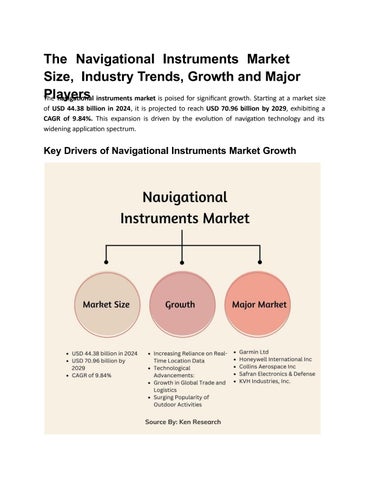
The navigational instruments market is poised for significant growth. Starting at a market size of USD 44.38 billion in 2024, it is projected to reach USD 70.96 billion by 2029, exhibiting a CAGR of 9.84%. This expansion is driven by the evolution of navigation technology and its widening application spectrum.
Key Drivers of Navigational Instruments Market Growth
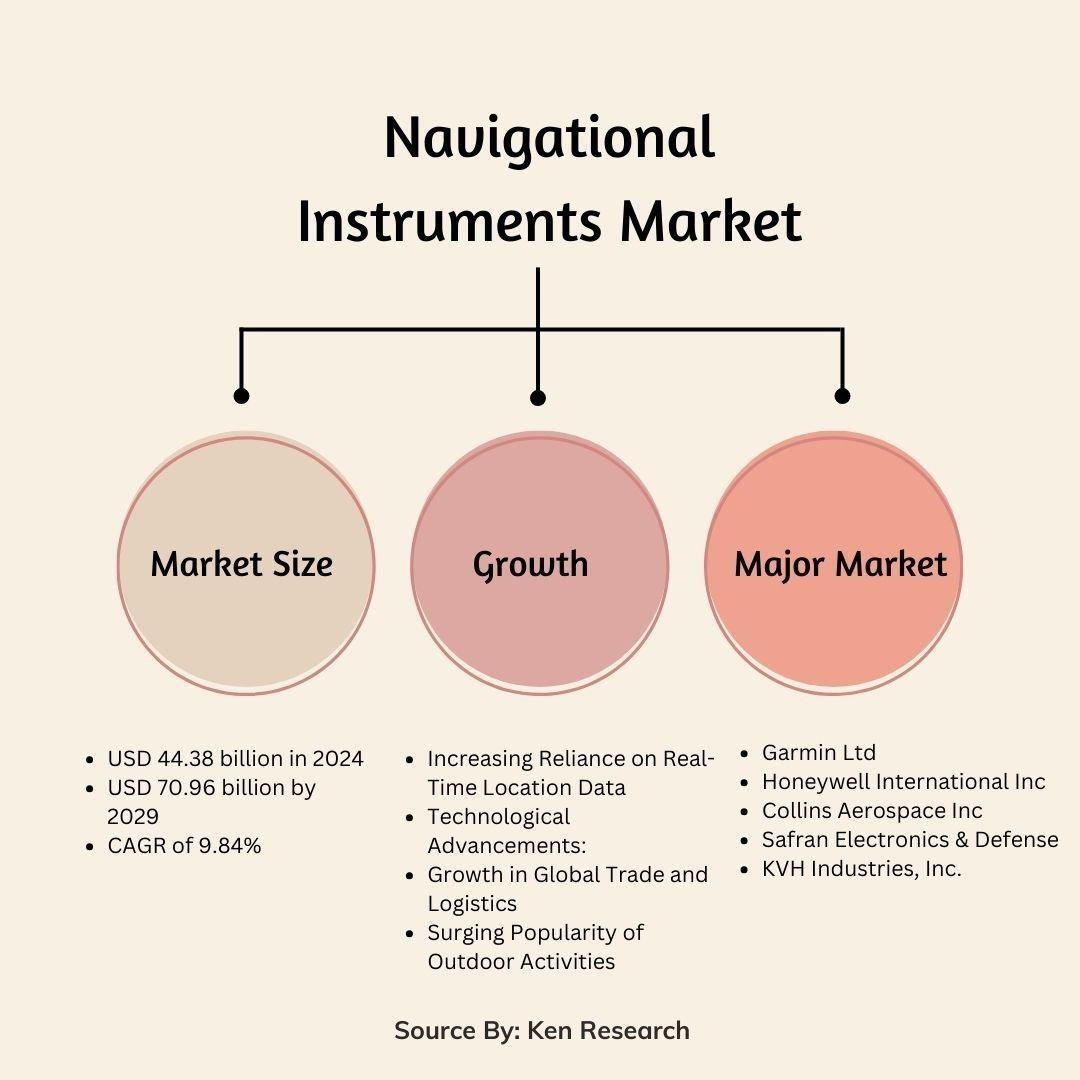
The navigational instruments market growth is experiencing significant growth, driven by a confluence of factors.
● Increasing Reliance on Real-Time Location Data: Across sectors like automotive, aviation, marine, and defense, there's a growing dependence on real-time location data for navigation and tracking purposes. This demand is fueling the need for more precise and sophisticated navigational instruments.
● Technological Advancements: The integration of cutting-edge technologies like Artificial Intelligence (AI), Machine Learning (ML), and advanced sensors is leading to more accurate, efficient, and user-friendly instruments with real-time data processing capabilities.
● Rise of Autonomous Vehicles, Drones, and the Internet of Things (IoT): The development and deployment of autonomous vehicles, drones, and IoT devices are creating a significant demand for sophisticated navigation solutions. These technologies rely heavily on accurate and reliable positioning data to function effectively.
● Growth in Global Trade and Logistics: The expansion of global trade necessitates efficient transportation systems. Navigational instruments play a crucial role in optimizing logistics operations by ensuring the safe, timely, and cost-effective movement of goods across vast distances.
● Surging Popularity of Outdoor Activities and Adventure Travel: The increasing popularity of outdoor activities like hiking, camping, and adventure travel is creating a space for user-friendly navigation tools for recreational purposes. These instruments cater to the growing demand for reliable navigation solutions in remote or unfamiliar environments.
Navigational Instruments Industry Segmentation Insights
The navigational instruments market is segmented across various categories to understand market trends and growth potential.
By Application
● Defense: Military applications for navigational instruments include guidance systems for missiles and bombs, navigation systems for aircraft, ships, and submarines,
● Aviation: Navigation instruments are critical for various aspects of aviation, including aircraft positioning during takeoff, landing, and en route, as well as collision avoidance systems.
● Maritime: Ships and other marine vessels rely on navigational instruments for precise positioning, route planning, and collision avoidance at sea.
● Automotive: In-vehicle navigation systems are a common feature in modern cars, providing drivers with turn-by-turn directions and real-time traffic updates.
● Other Applications: Navigation instruments also find application in agriculture, construction, surveying, and various recreational activities.
By Type
● Satellite Navigation Systems (SNS): Also known as Global Navigation Satellite Systems (GNSS), these systems use signals from satellites to determine a user's location. GPS (Global Positioning System) is the most widely used SNS.
● Inertial Navigation Systems (INS): These systems use gyroscopes and accelerometers to track a user's movement and position, independent of external signals. They are often used in conjunction with SNS for improved accuracy and reliability.
● Radio Navigation Systems: These systems use radio signals from beacons or ground stations to determine a user's location.
● Other Types: Other types of navigational instruments include radar, LiDAR, and electronic compasses.
Read Also:- The Navigational Instruments Market Size, Key Players and Challenges
By Geography
● North America: This region is a dominant player in the navigational instruments market due to the presence of major industry players, significant investments in research and development, and high adoption rates of these technologies.
● Europe: Europe has a well-established navigational instruments sector with a strong focus on innovation and technological advancements.
● Asia Pacific: The Asia Pacific region is experiencing rapid growth in the navigational instruments market, driven by factors such as increasing urbanization, rising disposable incomes, and growing investments in infrastructure development.
● Latin America and Middle East & Africa: These regions are expected to witness significant growth in the navigational instruments market in the coming years, fueled by factors such as increasing government spending on defense and infrastructure, and rising adoption of consumer electronics with navigation capabilities.
Major Market Players in Navigational Instruments Market
Here are some of the major players in the navigational instruments industry

● Garmin Ltd. (US): A leading manufacturer of a wide range of navigational instruments, including GPS devices, wearables, marine electronics, and aviation equipment.
● Honeywell International Inc. (US): A major player in the aerospace industry, Honeywell also offers a wide range of navigational instruments for aviation and defense applications.
● Collins Aerospace Inc. (US): A subsidiary of Raytheon Technologies, Collins Aerospace provides navigational instruments for commercial and military aircraft, as well as for other applications.
● Safran Electronics & Defense (France): A leading provider of avionics and navigation systems for civil and military aircraft, helicopters, missiles, and unmanned aerial vehicles (UAVs).
● KVH Industries, Inc. (US): A leading manufacturer of satellite communication and navigation systems for maritime, military, and commercial applications.