Spring 2026 CLA Magazine

Page 1


The

mtsu.edu/liberalarts

Spring 2026 - vol. 13, no. 1

DeanLeah Tolbert Lyons

Development DirectorMeredith Kerr

EditorMichael Davis

Director of Creative and Visual ServicesKristy D. O’Neal

Lead DesignerDarrell Callis Burks

Student DesignersDeseré Carlson, Lila Gordon, Katelyn LaFon, Ryan Parkin

University PhotographersAndy Heidt, J. Intintoli, Cat Curtis Murphy, James Cessna

Senior EditorDrew Ruble

Associate EditorCarol Stuart

Contributing EditorNancy Broden

University PresidentSidney A. McPhee

University ProvostMark Byrnes

Vice President for Marketing and CommunicationsAndrew Oppmann

Intintoli

CLA Magazine is published once per year. Address changes should be sent to Advancement Services, 1301 E. Main St., MTSU Box 109, Murfreesboro, TN 37132; alumni@mtsu.edu.

Design and photography by Creative and Visual Services at MTSU.

1,870 copies printed at Pollock Printing, Nashville, Tennessee.

1125-8286 / Middle Tennessee State University does not discriminate against students, employees, or applicants for admission or employment on the basis of race, color, religion, creed, national origin, sex, sexual orientation, disability, age, status as a protected veteran, genetic information, or any other legally protected class with respect to all employment, programs, and activities sponsored by MTSU. The Assistant to the President for Civil Rights Compliance has been designated to handle inquiries regarding the non-discrimination policies and can be reached at Cope Administration Building 116, 1301 East Main Street, Murfreesboro, TN 37132; Christy.Sigler@mtsu.edu; or 615-898-2185. The MTSU policy on non-discrimination can be found at crc.mtsu.edu.

College of Liberal Arts - Spring 2026

Cover photo by J.

INTEGRATIVE AND INTERCONNECTED | | | |

In my 25th year at MTSU, I am reminded of the tremendous value that liberal arts education has brought to my life: an appreciation for artistry and creativity; empowerment to ask the right questions and question the wrong answers; insight into the interplay of society, systems, and structures; and a deeper understanding of the human condition that engenders empathy and compassion. This value will never fade; it only grows over time. This is why lifelong learning is such an integral part of what we do and who we are in CLA.

Recently, someone asked me what was on the horizon for the College of Liberal Arts. In response, I spoke briefly about our ongoing work to promote excellence in education that emphasizes essential skills such as critical thinking, information literacy, creativity, and collaboration. Then I shared something that may be surprising. I talked about the growing need for interdisciplinary education. The beauty of the liberal arts is that a common skill set is developed through the lenses of multiple disciplines. Together, multiple disciplines help sharpen essential skills.

I have long noted—even from my own undergraduate majors in French and English— that the liberal arts-focused student has multiple interests across disciplines that span the arts, humanities, and social sciences. Whatever their various interests, students need a way to capitalize on them all while prioritizing a timely progression to graduation. This is how we ensure that students are positioned for a rich and deeply satisfying future and prepared to be career-ready for a lifetime.

For this reason, we are launching several initiatives in interdisciplinary studies to support students’ interests across disciplines, to champion professors’ innovative interdisciplinary teaching and research, and to identify grant funding that supports interdisciplinary work. CLA has a new associate dean, Rehab Ghazal (see introduction on page 39), who will give leadership to these e orts.

Twenty-five years into my career in higher education, I a rm a strong commitment to the value of liberal arts education and its enduring value for our society. In this edition of CLA Magazine, you will find stories that demonstrate this ethos and celebrate the impactful work we are doing on campus and in the broader community. As our world changes, we may need to adopt novel approaches to meet the challenges we face. So I am glad the liberal arts prepare us to be adaptable, lifelong learners who are positioned to meet whatever challenges come. -

When guests step into the vibrant, pixel-perfect world of Super Nintendo World at Universal Orlando’s new Epic Universe theme park, they are not just entering a fantasy—they are walking through the creative legacy of MTSU alumna Susan Cummings. Her journey from Tucker Theatre to theme park executive is as compelling as the attractions she helps bring to life.

Cummings (’90), who majored in Theatre and minored in History, has spent her career producing large-scale entertainment experiences. As executive producer for Super Nintendo World, she led the team responsible for translating decades of beloved video game history into a fully immersive, multigenerational theme park experience.

But her journey did not start in Hollywood or Orlando, where Universal’s five U.S. parks are. It began in MTSU’s Theatre program, where she first discovered the professional possibilities of a life in entertainment.

MTSU Theatre graduate Susan Cummings (’90) in front of Universal Epic Universe’s Super Nintendo World, a part of the new theme park that she helped create as executive producer Submitted photo

Before transferring to MTSU, Cummings spent a year at Tennessee Tech, where she quickly realized something was missing: a theatrical program. She recalls touring MTSU’s campus and a moment that would shape her future.

“I remember standing outside Tucker Theatre, and I was like, ‘Well, this is where I want to be.’ ”

That instinct proved right. Once at MTSU, she immersed herself in the Theatre department, where she found not only a creative home but also a foundation for a career that would span comedy, live events, and eventually, theme park production.

Mentorship Moments

Cummings originally planned to become a stand-up comedian, but her time at MTSU opened her eyes to the broader world of entertainment production, especially in directing. She credits the department’s holistic approach—requiring students to work in all areas of the Theatre program—for preparing her to lead complex, interdisciplinary teams.

“One of the things about being a producer is you look at things holistically,” she explained. “That comes from theater—where you’re thinking big picture, managing di erent personalities, and communicating across disciplines.”

Faculty members like Deborah Anderson, Virginia Donnell, and Michael “Doc” Sniderman played pivotal roles in shaping Cummings’ confidence and career direction.

Anderson had a critical impact in molding her perspective on directing and leadership. “She was my academic advisor, and I was in a lot of her classes,” Cummings said. “She’s like the first person that I could talk to about theater and making that a career.”

Anderson’s belief in her students’ potential was unwavering, Cummings said.

“It wasn’t a weird conversation. It wasn’t like, ‘How could you?’ It was like, ‘Absolutely. You’re a professional. You could be a professional.’ ” That matter-of-fact encouragement helped Cummings see herself not just as a performer, but as someone capable of leading creative teams—a skill she would carry into her work directing live shows and producing large-scale immersive experiences and attractions.

Anderson also helped Cummings take her first steps into stand-up comedy by signing her up for an open mic night—without asking.

Cummings vividly remembers Anderson’s interaction with the event’s organizer.

“She just said, ‘This is one of my students. She’s a comedian,’ and signed me up,” Cummings recalled. “That was one of Deborah’s gifts—she could see who you were and helped you step into it.”

As for the other two professors who left lasting impressions, one of her first classes at MTSU was stagecraft with Sniderman, who, she recalled, “was super straightforward, and I was not prepared for that.” After blunt feedback on her first paper, Cummings said, they went on to have a great relationship, and she appreciated his honesty and high standards.

In the costume shop, Donnell taught her something less technical but equally important: authenticity.

“She really taught me just to be yourself,” Cummings said, describing Donnell as “one-of-a-kind,” with a personality as bold as the Siouxsie and the Banshees and Cyndi Lauper posters that decorated her o ce.

During her final semester, Cummings directed the Buchanan Players’ production of The Nerd in MTSU’s arena theater—a space that today bears the name of her mentor, Anderson. MTSU’s Sidelines published a review of the play in which news editor Chris Bell wrote, “Student director Susan Cummings has proven her ability here with her first solo e ort. Her clean staging lets the actors do their work, and that’s enough to make The Nerd worth seeing.”

These three images Courtesy of Universal Orlando Resort

From Comedy Clubs to Creative Command

After graduation, Cummings moved to Orlando to pursue comedy and took a job at Universal Orlando while she worked the comedy scene. What started as a temporary gig in the merchandise warehouse evolved into a decades-long career. She worked her way through live shows, special events, and eventually into creative leadership roles.

“Universal had all these outlets—live shows, events, production— and I was able to jump jobs while staying within the same company,” Cummings said.

Her MTSU Theatre training gave her the flexibility and confidence to adapt. Whether managing engineers, designers, or architects, she drew on her liberal arts background to communicate e ectively and keep teams aligned.

“You may say the same thing di erently to an actor than you would to an engineer,” she said. “That’s a skill that not everyone has.”

Building Super Nintendo World

Cummings’ latest “production”—Super Nintendo World—opened in 2025 as part of Universal Epic Universe. The world includes attractions like Mario Kart: Bowser’s Challenge, Yoshi’s Adventure, and Donkey Kong’s Mine-Cart Madness. It is a nostalgic playground for fans of all ages, and Cummings was instrumental in shaping its emotional resonance.

“We wanted to strike a chord that people would instantly recognize,” she said. “People played these games as kids, and now they’re playing them with their kids—or even grandkids. It’s deeply personal.”

When working with something as beloved as Super Nintendo World, Cummings and her team had to balance innovation with reverence for their source material. Her favorite attraction in this themed land? Yoshi’s Adventure. “It’s a family ride, it’s interactive, and it gives you views of the land you won’t see anywhere else,” she said. “Plus, Yoshi is just super cute.”

Cummings also emphasized the importance of listening—to guests, to collaborators, and to the legacy of the intellectual property.

“You have to honor the audience,” she said. “You do not want to talk down to them. You have to meet them where they’re at with the material.”

Advice for the Next Generation

Whether she is bragging on her team’s work bringing Super Nintendo World to life or planning her next project at Universal’s planned Kids Resort in Frisco, Texas, Cummings’ creativity and leadership shines through in conversation. But she hasn’t forgotten her roots—or the value of a liberal arts education.

“There were two things that I’ve done in my education that have really helped me,” Cummings said. “One is I learned to type, and the other is I got a liberal arts degree.”

Her advice to students? Be curious. Be well-rounded. And don’t be afraid to explore. “Study architecture, art history, literature, music— travel if you can,” she said. “Be an interesting person. That’s what will make you a great storyteller, no matter what industry you’re in.”

She also encourages students to find creative outlets outside of work, especially if they’re part of a large organization where the vision is shared.

“Find those things that scratch your own creative itch,” she said. “Because if you’re going to work for a larger company, a lot of times it’s someone else’s vision. You want to be in a good headspace yourself.” Reflecting on her time at MTSU, Cummings said the further she gets from it, the more she realizes how formative it was.

“College is such an interesting time in people’s lives,” she said. “You don’t realize it at the time, but those experiences shape how you think, how you work, and how you lead.”

From the call board in Tucker Theatre to the immersive worlds of Universal Epic Universe, Cummings’ story is a testament to the power of a liberal arts education—and the enduring influence of a place that felt like home from the very beginning -

1990 Sidelines article when Cummings directed The Nerd
These two images Courtesy of Universal Orlando Resort

High school event exhibits a tradition of learning, leadership, and legacy
Each spring, the MTSU campus becomes a hub of historical inquiry and creativity as it hosts the Middle Tennessee Regional History Day competition.

Part of the larger National History Day program, this event is more than a contest—it’s a transformative educational experience that has shaped the lives of thousands of students across the state and the nation over the years. The statewide leader of this program is MTSU alumna Nikki Ward, whose leadership and passion for history education have helped elevate the program’s impact and accessibility.

History of History Education at MTSU

MTSU’s involvement with history competitions dates to the early 1970s, even before the founding of National History Day (NHD) in 1974. In 1971, the University’s Department of History launched a regional history competition featuring a rigorous multiple-choice and essay exam.

Spearheaded by faculty members James Huhta, Fred Colvin, and Robert “Bob” Jones, this early contest aimed to recognize outstanding high school history students and engage teachers in professional development. By 1989, the competition had grown to include 276 students from 21 high schools.

Although it ended in the mid-1990s, this original competition laid the groundwork for MTSU’s later involvement with National History Day. The University’s formal engagement with NHD began in earnest in 2002, when Rebecca Conard, with support from Williamson County Schools and a public service grant, organized the first regional contest on campus. That year nearly 300 students participated, and the event has continued to grow.

From Student to Statewide Leader

Ward’s journey with History Day is deeply rooted in her time at MTSU. A self-described “redshirt senior,” Ward explored various academic paths before earning her degree in History. An undergraduate public history course and an internship at a small local museum sparked her interest in museum education, eventually leading her to the Tennessee Historical Society (THS), where she now serves as the state coordinator for Tennessee History Day.

Ward’s experience as both a classroom teacher and museum educator gives her a unique perspective on the value of History Day.

“It is an authentic assessment of students’ ability to do history, to actually be a historian in some capacity,” she said. “It also serves as a framework for teachers to engage students in historical thinking, analysis of sources, synthesizing data, and forming their own opinions.”

Her role involves coordinating the statewide contest, supporting regional a liates like MTSU, and providing professional development for educators. Ward emphasizes the importance of institutional support and community involvement, noting that Tennessee uses a hybrid model where regional contests are coordinated by various institutions with support from the THS.

Scholarship on Display

Often described as a “science fair for history,” National History Day challenges students to conduct original research and present their findings through papers, exhibits, performances, documentaries, or websites. Each year’s theme—such as “Revolution, Reaction, Reform in History” for 2026 during the Declaration of Independence’s 250th anniversary—provides a lens through which students develop arguments and analyze historical events.

Ward sees the theme as a critical tool for deep learning.

“It’s easy to write a book report or a bio on Diane Nash,” she said. “But when you have to develop an argument around the topic or person, it can be much harder.” This process encourages students to think critically, engage with primary sources, and articulate their own interpretations of the past.

The program’s interdisciplinary nature also fosters collaboration among educators.

TENNESSEE HISTORY DAY

“I love seeing English Language Arts teachers and history teachers working together,” Ward said. “The ability to share the workload amongst educators makes it more manageable.”

Often described as a “science fair for history,”
National History Day challenges students to conduct original research and present their findings through papers, exhibits, performances, documentaries, or websites.

Building Skills for Every Future

While History Day is rooted in historical research, its benefits extend far beyond the classroom. Students gain valuable skills in writing, public speaking, digital literacy, and project management.

“It’s about more than doing historical research,” Ward noted. “There’s been a larger conversation about how this is reinforcing literacy skills in the classroom and civic engagement.”

Ward shared the story of a student who pursued astrophysics at the University of Southern California after years of History Day projects on the subject. “Her writing skills, her ability to analyze sources, her ability to understand science helped her in her future endeavors as a physicist,” Ward said. “All types of people come out of doing history programs—teachers, media professionals, doctors, technicians. All of us need those thinking skills.”

The competition also introduces students to potential career paths through interactions with judges, many of whom are historians, educators, or museum professionals.

“It gives students glimpses into what their future careers could be,” Ward said. “Getting to interact with people that work professionally in the field can make it seem more tangible.”

TENNESSEE HISTORICAL SOCIETY
Nikki Ward

A Platform for Growth and Recognition

Students who place first or second at the regional level advance to the state contest in Nashville, and top state winners go on to the national competition at the University of Maryland, just outside of Washington, D.C. There, they have opportunities to showcase their work in prestigious venues such as the National Museum of American History and the National Museum of African American History and Culture.

In recent years, Tennessee students have presented projects on Eleanor Roosevelt and on the Memphis sanitation strike at national showcases, engaging with curators and receiving behind-thescenes tours. Multiple Tennessee participants have placed among the nation’s best, bringing home medals and special awards, highlighting the state’s strong commitment to historical research and scholarship.

Possibilities Through Partnerships

Regional contests, including the one at MTSU, are free for students to enter. And they give students the opportunity to visit a fouryear college campus and see the variety of resources they would have open to them as college students. Strategic partners, like the Tennessee secretary of state’s o ce and Humanities Tennessee, help o set costs for the statewide event in Nashville, ensuring that financial barriers do not prevent students from participating.

Ward also works to support educators through professional development and curriculum resources. The Tennessee Historical Society o ers virtual and in-person training sessions, often in partnership with organizations such as the Center for Historic Preservation and Discover Tennessee History.

“The hardest thing for new teachers is getting started,” Ward acknowledged.

“So we try to o er a variety of types of not just professional development, but resources for implementing the program.”

MTSU’s Role in Regional Success

MTSU’s commitment to History Day is evident in its continued hosting of the regional contest and its support for the humanities. The University provides facilities, funding, and faculty involvement, helping to create a welcoming environment for students. “It seems accessible to students,” Ward said. “They see the campus as a space where they’re going to learn and also showcase their learning.”

The contest also serves as a recruitment tool, exposing highachieving students to MTSU’s academic o erings. Panels, campus tours, and interactions with faculty help students envision themselves as future Blue Raiders.

Looking Ahead

As History Day continues to grow in Tennessee, Ward hopes to expand awareness and participation.

“I hope that whether that is in their schools, in their classrooms, in their communities, we’re able to find a way to make it manageable for them to participate,” she said. “Because the value in it is helping develop our future citizenry.”

She also emphasizes the importance of soft skills—organization, collaboration, and perseverance—that students gain through the program.

“Keeping up with your binder, keeping up with sources, working with your neighbor in a way that is productive but kind—all of those things are important,” Ward said.

Ultimately, History Day is about more than learning how to study history. It is about empowering students to think critically, communicate e ectively, and engage with the world around them—all tenets of the liberal arts experience. Thanks to the dedication of educators, investment by MTSU’s campus, and leaders like Ward, the program continues to inspire the next generation of thinkers, leaders, and citizens. -

Tennessee Arts Academy for educators moves to Murfreesboro

MTSU is well-respected for its stellar academic programs in the visual and performing arts. And CLA has demonstrated a longstanding commitment to excellence in arts education programs through the School of Music, the Department of Art and Design, and the Department of Theatre and Dance. Each program produces great teachers who in turn develop great students across the state and beyond.

Recently, the College of Liberal Arts has taken another step that solidifies MTSU’s position as the preeminent arts destination in the region, through a partnership with the Tennessee Arts Academy (TAA).

TAA is the longest-running and premier summer program for arts-based professional development for teachers, with training in arts leadership, music, theater and dance, and visual art in America—and now it takes place right on the campus of MTSU.

Funded by a grant from the Tennessee Department of Education, TAA was hosted by Belmont University from its earliest iteration, in 1986. After this long history with the Nashville institution, TAA sought out MTSU starting in 2025 because of its reputation for training and producing artists.

Photo by Scott Schrecker Photography

TAA Executive Director Frank Bluestein called the new partnership “a natural fit.” MTSU has a strong track record of cultivating arts and arts educators.

Bluestein highlighted CLA’s contributions to the K–12 arts space in particular.

“With so many major high school student arts programs hosted on the MTSU campus, including the Governor’s School for the Arts, band programs, and the state thespian conference, we felt it made perfect sense for our organization to be able to connect and partner with a university that was so deeply invested in student learning and progress,” he said. “This helps bring TAA full circle by connecting with both students and teachers to create a highly synergistic environment that benefits everyone involved.”

Bluestein is uniquely positioned to see the bigger picture of the arts across the state of Tennessee. He is an award-winning educator and theatrical director with many accolades, including the Tennessee Governor’s Arts Award in 2021—the highest honor in the state for the arts.

While grant-funded, TAA is buttressed by a nonprofit, fundraising arm of the organization, the Tennessee Arts Academy Foundation. Foundation President William H. Watkins Jr. echoed Bluestein’s sentiment about the new partnership with MTSU.

“Bringing the Tennessee Arts Academy to MTSU opens up new opportunities for growth, collaboration, and accessibility,” Watkins said. “This move reflects our ongoing mission to support arts educators by evolving with the needs of our state.

“We’re thrilled to begin this next chapter on such a dynamic and welcoming campus.”

A New Beginning

Last year’s TAA summer institute took place July 13–18 and served K–12 arts specialists, elementary teachers, librarians, and pre-service Education majors, as well as school administrators. This comprehensive audience had the benefit of receiving specialized training in their individual artistic disciplines, hearing from featured speakers from across the country, and experiencing performances from gifted guest artists.

The institute focuses on education and celebration so that attendees feel energized and excited about the upcoming school year.

“You are the ones who remind them—and yourselves—that creativity and the arts are not just decoration,” Bluestein told attendees during the institute’s opening session. “The teaching of the arts is as important and as vital as any subject matter taught in your school building all day and every day. . . . Together, let’s make this week a beautiful and magical new beginning!”

TAA o ers a rich and rewarding experience that focuses on excellence and brings out the best in the participants. Every aspect of the summer institute, from performances to faculty and speakers, is carefully selected to meet the most stringent standards of personal and professional excellence. Included in the program is TAA Musings, an opportunity for participants to reflect on the value and significance of their work in the arts.

These conversations are guided by industry experts such as Ricky Ian Gordon, internationally renowned composer and writer based in New York; Chaz Guest, a painter and sculptor whose work has been collected by notable celebrities and political figures; Victoria Clark, Tony Award-winning lead actress who is beloved on both stage and screen; and Norm Lewis, a multitalented Emmy, Grammy, Tony, and SAG award nominee. The lineup of performances is no less impressive, including o erings in musical theater, dance, and vocal and instrumental music performances.

Frank Bluestein (l) and Ricky Ian Gordon
An educator workshop

“There is no substitute for authenticity,” Clark said during her Musings session. “Authenticity includes the ability to pivot and be open to change. Your next adventure might be right in front of you. . . . Authenticity is the ability to trust. We don’t walk this path alone. Listen to the answers of your future, wiser self. Walk through doors that other people might open for you.”

Recognizing the excellence enjoyed in Murfreesboro, last year’s program also included the Middle Tennessee Choral Society, conducted by CLA’s own School of Music faculty member Angela Tipps. TAA also seeks and promotes community involvement by o ering a vendors fair during the institute and hosting Bravo!, a banquet where educators are honored and live entertainment creates a triumphant, celebratory atmosphere.

Statewide Impact

TAA trains more than 300 arts teachers each summer with an impact that reaches about 200,000 students in the state each year. This is critically important because of the varying needs in di erent communities across Tennessee’s diverse landscape.

“Many of the arts educators we support are working in rural communities where resources can be limited,” said Kami Lunsford, TAA’s director of educational programs and events. “Partnering with MTSU opens new doors to reach those teachers in meaningful, innovative ways.” This emphasis on meeting community needs is a key component of TAA and has always been at the heart of what CLA does.

Bluestein commented that in MTSU’s College of Liberal Arts, TAA finds “not only a welcoming atmosphere, but also a shared vision— one committed to building the strongest arts education programs for all students in every school across the state.”

CLA endeavors to make this partnership with TAA strong and enduring. In addition to their space in Nashville, Bluestein and the entire TAA sta have on-campus o ces in Jones Hall to administer the institute and have displayed the highest quality professionalism.

“TAA trains more than 300 arts teachers each summer with an impact that reaches about 200,000 students in the state.”

After the success of the first summer institute at MTSU, TAA agrees that the partnership is exceeding expectations.

“I’m especially thankful to the MTSU College of Liberal Arts—one of the most collaborative and supportive academic communities I’ve encountered—for embracing our mission and helping us take it to the next level,” Lunsford said.

CLA could not be prouder of this partnership and is thrilled to see how TAA and CLA will grow together and complement each other in serving and producing excellent arts educators. This partnership represents the shared tradition of two institutions with a long and rich history of excellence in the arts. The arts are indeed thriving at MTSU. -

Musings of Norm Lewis
Musings of Victoria Clark

The

first thing most people notice on game day is the sound. It rises from the field in waves, steady and confident, long before the first snap. For generations of MTSU football fans, that sound has carried out a simple promise. The Band of Blue is here.

And something memorable is

That promise began in 1957, when a young music educator named Joseph T. Smith arrived at what was then Middle Tennessee State College. Smith founded the Band of Blue that same year, building it from the ground up. He believed a band could be a point of pride for the campus, a home for students from every major, and a living symbol of the institution’s ambition.

The Blue Raider spirit is alive.
about to happen.

Smith set that tone for decades. He built up the band, raised its reputation, and created experiences students still talk about. Smith, who retired in 1993 and died in 2014, also launched the Contest of Champions in 1962, a high school

marching band competition that became one of the most respected in the region. His influence was so profound that the rehearsal hall in the Wright Music Building bears his name. Every director who followed stepped into a program shaped by his vision.

One of the leaders who carried that legacy forward was Craig Cornish, whose 23-year tenure defined the modern era of the Band of Blue. Cornish guided the group through years of remarkable growth, including a season when membership reached 380 students, the largest in school history.

Cornish strengthened the modern identity of the ensemble and nurtured a culture that valued camaraderie as much as musical precision. His retirement in early 2025 marked the end of a meaningful chapter, but not the end of the values he reinforced daily.

“Hopefully [the students] took away my love of music, maybe a little bit of my work ethic, my desire for excellence,” Cornish said. “And hopefully they’ll take away that I want them to do it having fun. There’s no reason to be miserable while you’re trying to do something good.”

Smith in 2006 at the dedication of the Joseph T. Smith Rehearsal Hall in the Wright Music Building

When he walked away from the field for the last time as director, nearly 200 alumni returned to march beside him. “That was one of the most emotional days I’ve had in a long time,” Cornish said. “They came, they hugged me, they said congratulations. It touched my heart in so many ways.”

Now, the lineage continues with Bryan Braue, who stepped onto the podium in Fall 2025 to lead the Band of Blue through his first season as director. By the time the band took the field for the season’s home opener, the transition felt complete. Braue had already put his stamp on the ensemble and leaned into the family-centered culture that has defined the band for nearly seven decades.

From Every Field to One Family

When he moved to middle Tennessee, Braue says, the spirit of the region struck him immediately.

“The family atmosphere and the friendliness of the Nashville metro stood out. My wife and I moved here and noticed how kind everyone was. People are very genuine,” he said. He calls MTSU “a great community” and says he loves working with “incredible students.”

Braue’s path to the podium included 15 years of collegiate marching experience. After earning his bachelor’s degree at Stetson University, he completed a master’s degree at the University of South Florida, earned his doctorate at the University of Florida, and then led the band program at the University of Texas–Permian Basin.

“I fell in love with working at the collegiate level and shaping the next generation of teachers,” he said. “My wife, Michelle, and I are very happy to be here in Murfreesboro. Working with the Band of Blue is one of the most special parts of my job responsibilities.”

Last fall’s first season gave him a front-row view of the program’s foundation.

“Students come from so many di erent fields and areas across campus,” he said. “But they are united as one band program, supporting our athletes and our University.”

Braue’s goals reflect both tradition and growth. He would love to increase band numbers to 285–300 students in the next five years; the COVID-19 pandemic “took a toll.” Just as important, he wants to maintain the culture.

“The program is based on family. That’s important to me,” the new Band of Blue director said. “It’s a wonderful opportunity to work with students and help shape their lives.”

Sound and Lightning for the Fans

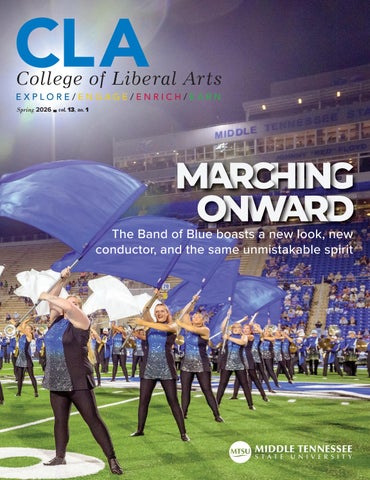
The season also brought something fans could see the moment the band took the field: new uniforms, bringing a fresh look that blends tradition with modern design. The updated uniforms carry the classic MT paired with MTSU’s mascot Lightning on the chest. A bold MT emblem spans the back, and the uniform is accented with a sash that goes down the side. While the main band uniforms are primarily blue, the drum majors stand apart in solid black.

The uniforms reflect not just a design shift, but a program stepping confidently into its next era.

From the stands, Jennifer Snodgrass, the new director of MTSU’s School of Music, sees the energy these changes bring.

Those musicians know they’re making magic happen on game day.

Craig Cornish during the Raider Walk prior to Cornish’s last football game in 2024 as Band of Blue director
Current Band of Blue director Bryan Braue

“There is nothing quite like game day and watching the band take the field. You can feel the energy from the fans, from the students, and from the band members themselves,” she said. Snodgrass believes the connection between the band and fans is reciprocal.

“Those musicians know they’re making magic happen on game day,” she said. “But do we realize we, as the fans, have an opportunity to participate in this moment by singing along to the fight song or spelling out MTSU?”

She describes the potential for a stadium to be “a massive, breathing instrument” where everyone becomes part of the sound. “Our strongest results always come from working together. And there may be no better way to work together than to pick up an instrument or sing and clap along to the fight song under the MTSU blue sky.”

Steps to Support Future Generations

That sense of belonging is why alumni continue investing in the program. Jeremy Baxter-Jenkins, a 2006 graduate, marched under Cornish and recently helped establish the Band of Blue Excellence Scholarship with fellow alumni. This scholarship honors Cornish’s legacy, as well as the contributions of past and future directors of the Band of Blue, by providing private scholarship support for current band members.

“I was one of the first freshmen to meet Professor Cornish in 2002, and my four years in the Band of Blue truly shaped who I am today,” Baxter-Jenkins said.

He was not a Music major, but the program changed his life. An Advertising-Public Relations student with a Political Science minor, Baxter-Jenkins now works as senior executive producer, AWS Marketing, Amazon Web Services Inc.

“When I think about where I am now in my career and my personal life, I can trace so much of it back to what I learned in this program,” he said. Now, he gives so other students can find the same footing. “This scholarship removes barriers so students can focus on growth rather than worrying about costs.”

Baxter-Jenkins believes the program builds qualities that last. “Students in the Band of Blue develop skills like teamwork, discipline, leadership, and resilience. When we remove obstacles, we’re giving more students the opportunity to reach their full potential.”

Although the new uniforms came through institutional support, Baxter-Jenkins stresses that alumni and donor contributions remain vital for instruments, travel, recruitment, enrichment, and scholarships.

“Anyone who was part of the Band of Blue understands the lasting impact of this program,” he said. “These students represent the future, and they’re working hard. When we invest in them, we’re continuing a tradition of support that helped shape us. It creates a ripple e ect.”

The Band of Blue stands at an important moment. It carries a legacy nearly 70 years old. It remembers Smith, who built the foundation. It honors Cornish, who strengthened the culture. And it moves forward with Braue, whose first season has already shown his clarity and purpose.

With a season under wraps in the new era, fans can long remember the sound, the energy, the new look, and the unmistakable identity of a band that has defined MTSU spirit for generations.

Because the Band of Blue has always been more than music. It is a home, a space to be mentored, and a proving ground. And with continued support, it will remain a place where students learn who they are and who they can become. -

Photo by Cat Curtis Murphy

Viewers and Readers Like You

MTSU and Nashville PBS partner on programming and opportunities

The Nashville PBS station and MTSU have served the region for decades, each with a longstanding commitment to education, storytelling, and community engagement. Their partnership—rooted in shared values and strengthened by years of collaboration—continues to expand in meaningful ways.

“MTSU has been a valued and trusted partner with Nashville PBS for many years and on so many levels,” said Becky Magura, president and CEO of Nashville PBS, “including providing financial support for our signature series, Tennessee Crossroads; as a content partner each December with Joys of the Season, an annual musical special that celebrates the talent of MTSU students and faculty; and most importantly as a key sta ng partner since so many of our Nashville PBS team members are MTSU graduates.” MTSU alumnus Jerome Moore (’12) joined the Nashville PBS team in 2022. As host and public a airs producer, he brings his passion for community-centered storytelling to Nashville PBS programming.

In fall 2023, Moore joined Magura onstage before MTSU’s Strickland Lecture for a special announcement. Together, they introduced attendees to an exclusive preview of Ken Burns’ acclaimed documentary The American Bu alo, ahead of the film’s national PBS premiere. The screening o ered students, faculty, sta , donors, and community members a firsthand look at public media’s commitment to educational storytelling—and showcased the MTSU-Nashville PBS partnership.

MTSU alumnus Jerome Moore
MTSU History graduate student Matthew Barnes

&

A Signature Collaboration

For decades, Tennessee Crossroads has been one of Nashville PBS’ most beloved programs, taking viewers across the state to discover hidden gems, regional traditions, and stories of innovation.

As a presenting sponsor for the past few years, MTSU proudly supports this iconic series—reinforcing its own mission to highlight Tennessee’s creativity, history, and sense of community. The partnership also features a familiar MTSU voice from the preshow announcements at MTSU Arts performances. The narration during the program’s sponsorship message is voiced by H. Stephen Smith of MTSU’s School of Music. Together, MTSU and Nashville PBS ensure that Tennessee Crossroads continues its mission of connecting Tennesseans with the best the state has to o er.

Hands-on Learning with Lasting Impact

In addition to cross-promotional opportunities, the MTSU-PBS partnership has developed tangible learning opportunities. Last summer, MTSU History graduate student Matthew Barnes completed an internship with Nashville PBS that left a significant and lasting mark on the station’s archival practices.

“Another area that many people may not be aware of is the amazing work MTSU does on behalf of preservation of our Tennessee artifacts,” Magura said. “We were thrilled recently to have a talented MTSU graduate student work closely with Nashville PBS on our broadcast archives, creating a detailed recommendation on the preservation and storage of our locally

“Matthew made significant contributions to the preservation and understanding of local public television history.”

created content spanning over 60 years. This is an area we plan to continue exploring and expanding with MTSU. It is truly a gift beyond measure.”

Tasked with assessing the condition and organization of Nashville PBS’ extensive archival holdings, Barnes approached the project with academic rigor and creative initiative.

“I discovered that enthusiastic employees had worked on the Nashville PBS collection for years,” Barnes said. “These employees had cared about the historic contributions of the station, but nobody was ever able to devote the time and resources to adequately preserving the materials.”

Barnes uncovered materials that had gone undocumented for decades—items that o ered rare insight into the development of local public broadcasting. He extended his research beyond the station, consulting the Tennessee Archive of Moving Image and Sound (TAMIS) to contextualize Nashville PBS’ history within broader regional and national trends.

“During his six-week internship with Nashville PBS, Matthew made significant contributions to the preservation and understanding of local public television history,” said Samantha Andrews, the station’s director of education and engagement.

“Charged with implementing archival best practices and enhancing the visibility of Nashville PBS’ media legacy, Matthew demonstrated a thoughtful, research-driven approach that went beyond the immediate scope of his assignment.”

Barnes’ final report combined archival theory with real-world challenges, providing a roadmap for long-term preservation, potential digitization projects, and new opportunities for public engagement. Through his work, Barnes helped Nashville PBS see its archives not simply as stored tapes and documents, but as a living cultural resource worthy of renewed attention and investment.

MTSU Arts on the Air

In addition to Barnes’ behind-the-scenes experience, the MTSUPBS partnership provides opportunities to highlight students, faculty, and sta on the airwaves. Joys of the Season, the College of Liberal Arts’ annual gift to the community, is a vibrant holiday showcase of theater, dance, music, and visual arts. Originally staged at Tucker Theatre from 2015 to 2019, the program shifted to a televised format during the COVID-19 pandemic—a move that opened new doors.

Since 2021, the special has aired as a full-length edition of Out of the Blue, MTSU’s monthly television program. In 2024, Nashville PBS expanded its reach even further by broadcasting the program statewide and making it available on the PBS app—bringing MTSU arts to audiences across the country.

The 2025 edition—hosted by Andrew Oppmann, MTSU’s vice president for marketing and communications, and CLA Dean Leah Tolbert Lyons—showcased the creativity and artistic excellence of MTSU students and faculty.

Highlights included:

•Theatre—Professor Kristi Shamburger’s Musical Theatre students performing the energetic Broadway classic “Turkey Lurkey Time” from Promises, Promises

•Dance—Two delightful selections from The Nutcracker, “Candy Cane” and “Hot Chocolate,” choreographed by Dance faculty Kim Holt

•Art—A family craft segment led by Art professor Debrah Sickler-Voigt with children from Rutherford County Schools

•Music—Performances by the Schola Cantorum (“O, Come All Ye Faithful”), directed by Will Chandler, and the MTSU Bassoon Ensemble (“Have Yourself a Merry Little Christmas”), led by Staci Spring

What began as a campus tradition now serves as a statewide—and increasingly national—celebration of MTSU’s artistic excellence.

Support That Truly Matters

Nashville PBS, MTSU’s College of Liberal Arts, and the University as a whole share a deep commitment to serving the region. Together, they help students explore their world, enrich their lives, and engage their minds.

The partnership thrives because of dedicated viewers, students, alumni, and community supporters.

And it is made possible by viewers and readers like you. -

Dancers (l–r) Rylee Mallicoat, Maya Siciliano, Lily Agee, and Kristin Buttrey
To see the video of Joys of the Season, scan QR code

Employee alumni voices sing praises for the MALA program

When the Master of Arts in Liberal Arts program launched in Fall 2015 at MTSU, it created something rare in graduate education—a flexible, interdisciplinary degree that invited students to explore big questions, bridge academic fields within the liberal arts, and pursue intellectual passions at any stage of life. Ten years later, that vision has exceeded all expectations.

More than 100 graduates have now completed the master’s degree program, representing a vibrant community of lifelong learners, creative thinkers, and professionals seeking meaningful growth.

“MALA is unique because it allows students to design a program that reflects their interests,” said Janet McCormick, director of the program often referred to by its in-house nickname.

“We’ve seen students combine history and religious studies, dive into cultural studies, or even prepare for doctoral work. It’s about flexibility, intellectual growth, and personal transformation.”

Unlike master’s degree programs anchored in a single discipline, the M.A. in Liberal Arts draws on the full academic breadth of the College of Liberal Arts. Students can choose thesis or non-thesis paths, take evening or online courses, and join study abroad programs that bring learning to life. The result is a graduate experience that cultivates critical thinking, creativity, communication skills, and cultural awareness—tools that empower graduates across countless professional paths.

“The liberal arts teach us to think critically, communicate e ectively, and understand the human experience,” said McCormick, who has headed the program since 2019.

“Those skills are timeless—and they’re needed now more than ever.”

As the program celebrates its first decade, its mission remains unchanged: fostering intellectual curiosity, interdisciplinary inquiry, and personal growth. Graduates consistently describe the program as life-changing—both professionally and personally—and their stories reflect the heart of what the liberal arts can accomplish.

The following alumni vignettes feature MTSU employees past and present who completed the M.A. in Liberal Arts and embody the program’s mission of curiosity, growth, and lifelong learning. Their journeys reveal how the interdisciplinary nature of the degree empowered them to expand their worldviews, elevate their careers, and bring renewed purpose to their roles across campus.

Together, their stories highlight the breadth of the program’s impact, illustrating how the program strengthens not only individual lives but the heart of the MTSU community itself. -

Graduates consistently describe the program as life-changing—both professionally and personally.

Chelsea Able

Ph.D. candidate, University of Missouri

I graduated with an M.A. in the Liberal Arts program in May 2024. I had previously started a few di erent master's programs, at another institution and at MTSU, but none seemed to maintain my interest. I later realized that I was interested in learning more about anthropology and possibly getting a Ph.D., but first, I wanted to determine if the field was a good fit for me. Once I learned about the MALA program and how it could be tailored to fit my goals, I realized it could be the perfect opportunity to learn more about anthropology before going into a Ph.D. program.

Although the MALA program more broadly explores the liberal arts as a whole, it o ers flexibility regarding the content of your capstone or thesis as well as your electives to explore specific topics within the liberal arts.

As such, I took a biological anthropology class for graduate credit as one of my electives, where I confirmed that anthropology was the right fit for me and my interests.

With the support of Dr. Shannon Hodge, I conducted a literature search for my capstone project to explore current knowledge of cranial evolution and its potential impact on the ability for symbolic thought in Neanderthals as evidenced by current archaeological findings.

Following graduation, the connections I made with Dr. Hodge and other faculty members in the program led to references for my applications. As a result, I was accepted into the Ph.D. program in Anthropology at the University of Missouri, fully funded, which I began in the Fall 2025 semester. Without completing the MALA program, I would not have had the opportunity to explore my interests in anthropology, nor would I have made my goal of being accepted into a Ph.D. program a reality.

Megan Richard Analyst, Education Abroad

Being part of the MALA program was an incredible experience. Getting a master’s degree was something that I had always wanted to do but never had the opportunity. When I heard about the program, I immediately jumped in and applied because it seemed to fit everything I was interested in. Dr. McCormick was so supportive and helpful from beginning to end, and that care really helped give me the confidence in pursuing this dream.

When I began taking courses for the program, I found them to be interesting and engaging. What was apparent is that a lot of thoughtful work had been put into making this program accessible for anyone, no matter what stage of life they were in. While I loved all the courses I took, my favorite were the foundation courses that o ered a small piece of many subjects in the College of Liberal Arts. I loved how these courses stretched me into areas that I hadn’t considered before.

As part of my program, I participated in a study abroad program to Israel. This experience changed me in so many ways. Israel was a fascinating opportunity to learn about the ancient history up to the present day and to see how the people there work with the political, religious, and cultural complexities of the region. I will always feel grateful for the time I spent in Israel and the perspective it gave me.

I graduated from the MALA program in 2023, filled with pride and joy at having accomplished this dream that I had always wanted to pursue. I loved getting to share that with my family who had supported me through the years as step by step I went through the program. The MALA program really is something unique and special and is a gift to all those who are a part of it.

The interlocking aspects of each liberal arts discipline, as presented in class by great professors, amazed me and trained my mind to be more observational and curious about the world around me. Studies on the formation of my own identity and belief system made me more empathetic and humanistic in my view and approach to a diverse world, including persons and cultures di erent from my own. I graduated from the program with my critical thinking skills enhanced and my view of humankind broadened to a global, if not universal, perspective regarding my existence here on Earth.

I have always been intellectually drawn to the disciplines represented under the heading of liberal arts. These included music, film, art, history, English literature, philosophy, and religious studies. Before coming to MTSU, I had worked for organizations from both ideological spectrums, including Norman Lear and Pat Robertson. I have seen much and engaged in creative collaboration with varied types of people. These experiences made the MALA program a natural fit for me and solidified my goal of a meaningful career at MTSU that contributed to the betterment of society.

“The MALA program really is something unique and special and is a gift to all those who are a part of it.”

While working full time after my MTSU bachelor’s degree, I pursued a master’s degree in history for a while but ended up not making a career change and then life happened—including three kids at a later age. I was only a few steps short of my degree. During the COVID-19 pandemic, my college sophomore twin daughters returned home that spring and summer, taking courses online. I had planned on completing my master’s at some point; learned the M.A. in Liberal Arts would be my best option for finishing; and discovered there would be a History of Epidemics graduate class that summer of 2020. Despite years (decades!) out of the classroom, I managed to keep up with the rigorous demands among those scholars, including doctoral students—and eventually had my historiography final paper on the 1918 Great Influenza published in MTSU’s academic journal, Scientia et Humanitas. After taking MALA Foundations courses with students ranging in age from recent graduates and a current MTSU tennis player to a Navy veteran and people older than me, I then enrolled in an extra elective before writing a historically based creative paper for my capstone.

The research bug bit me, and I’m now considering pursuing a doctorate in English after completing a separate graduate certificate program. As an MTSU sta member, the MALA program and other courses have kept me involved in the academic mission of the University, honed my critical thinking and writing skills to enhance my current professional production, and continued my lifelong learning.

I’ve also seen firsthand how this Liberal Arts master’s degree has helped fellow graduates land promotions or new jobs to boost their family income and has created a way for students to combine subject areas such as history and religious studies or concentrate on an area where MTSU currently does not o er a master’s program.

Rachel Helms

Assistant director, Alumni Relations

The MALA program o ers great flexibility for someone who works full time and has a family. Courses are in the evening or online, and the classroom topics are varied and plentiful. The faculty have taken great care in planning the introduction courses, which rotate liberal arts concentrations every couple of weeks, so you become familiar with how many options you do have to study. Faculty also give you opportunities to present at educational conferences and connect you with experts in your field of study.

The most important aspect for me personally was that I thoroughly enjoyed every course and learned skills that complement my current job as an assistant director in Alumni Relations. That’s the great part about a degree in arts and humanities—it’s about communication, problem-solving, and understanding the big picture. In class, you are constantly absorbing information and then debating it. The discussions made me feel empowered, like I finally had the knowledge and tools to help solve problems we all face.

I am currently pursuing my doctorate in education. The foundation MALA provided me has made it easy to adapt to my new program, since I already have a conference presentation and multiple research papers under my belt. One of my goals is to have my research published in a peer-reviewed journal. I also would like to teach in higher education as an adjunct professor.

The study of liberal arts is incredibly important to our society and culture, so don’t let anyone tell you it’s not worth your time and money. MALA has opened many doors for me professionally, but most importantly, it has inspired me to be involved in the conversation surrounding our local community and society at large. In my humble opinion, a liberal arts education is more important than ever, and MALA surely delivers.

Jennifer Rice

Coordinator, Liberal Arts

When I began working at MTSU, I was encouraged to take advantage of the employee educational opportunity and pursue a master's degree. While I have always enjoyed learning, I was not sure if a master’s program was the right choice. However, I decided to embrace the journey without focusing on the destination. I would simply start taking classes and see where it led. The MALA program immediately appealed to me due to its inherent flexibility. I have always struggled to focus on a single area of study, and MALA o ered the perfect avenue to explore a variety of subjects that piqued my interest.

A unique aspect of my MALA journey was being a student alongside my children. My daughter was an MTSU sophomore when I started, and my son soon followed. This shared experience gave me a profound understanding of their daily challenges. As I juggled work, motherhood, and coursework, I found myself more sympathetic to their feelings of being overwhelmed during highstress times, like finals or major paper deadlines.

Beyond the shared academic experience with my children, being a student at MTSU opened doors to resources I had long encouraged them to explore. I no longer had to be envious of others; as a student I could take advantage of those opportunities myself. One of those was being able to study abroad. I wish I had taken a study abroad course as an undergrad, so I will always be grateful that I was able to incorporate study abroad into my master’s program. Because of this, study abroad became the focus of my MALA capstone project and broadened my worldview. Through the MALA program, I learned so much, not only about the liberal arts and the world, but also about myself and the lives my children were experiencing. It was a truly enriching and transformative journey, and it has been a joy to celebrate all of our success together.

Jason Lukawitz

Lecturer, Communication Studies

It was early on a Sunday morning, after spending the past few weeks researching various master’s-level degree programs, when I stumbled upon the MALA program at MTSU. Intrigued by the description, I emailed the program director, Dr. Janet McCormick, to express interest. Minutes later, Dr. McCormick responded— beginning a series of emails that answered my questions. That had me applying a few days later and subsequently being accepted into the program.

Beginning in Summer 2021, my time in MALA had me exploring learning relevant and important to me, that learning occurring within the confines of coursework necessary for the program. At the beginning of my third semester, I was o ered a graduate teaching assistant position in the Department of Communication Studies. That engagement allowed me to step into an adjunct role upon graduation in December 2022. My time spent as an adjunct morphed into a full-time faculty role I interviewed for and was o ered. I started teaching full time in August 2023, working alongside colleagues with whom I previously worked as a GTA in MALA.

Through carefully curated course o erings, Dr. McCormick created learning opportunities which present relevant content that creates true learning, engages the mind, and challenges the individual to incorporate it into real-world application. I unapologetically state that MALA changed my life, and I know I am not alone in making such a bold claim. The integration of concepts presented incorporated into one’s life means MALA graduates are equipped to truly make an impact on their sphere of influence—that e ect on one’s sphere the evidence of true learning through practical application. I am proud to state that I am a graduate of the Master of Arts in Liberal Arts program at MTSU.

Rice with her children

Academic advisor, Media and Entertainment

In April 2017, I made a midlife career shift. I left my music business job after almost 24 years and revisited my childhood dream of working in education. I had always wanted to teach or be a guidance counselor. I am very passionate about the value of education and lifelong learning, so I started working at MTSU in 2017 with the goal of rebuilding my career trajectory in the direction I knew I wanted to go since I was 10. At the suggestion of my supervisor, Dr. Greg Pitts, then the director of the MTSU School of Journalism and Strategic Media, I started the MALA program in Fall 2018. Getting my master’s degree had been on my bucket list for over two decades.

After the death of my younger brother in January 2018, I decided it was time to act. The MALA program was the perfect fit! I was able to take classes that greatly expanded my cultural understanding and academic aptitude in areas like human geography with Dr. James Chaney, e ective listening and communication with Dr. Janet McCormick, and detective fiction with Dr. Joan McRae. The liberal arts foundation of the program was the perfect pathway for crafting my career in higher education as an academic advisor. I gained a deeper understanding of the human experience, socioeconomic inequities, and cultural biases that provided the perfect foundation for my thriving career at MTSU. The MALA program allowed me to finally, in my early 50s, work with students from various backgrounds who want to learn and persist in the face of everyday obstacles, challenges, and accomplishments of both higher education and life in general. I am happier in my current career than I have ever been as a working professional. I would absolutely not be in this highly satisfying position had it not been for the invaluable opportunity to earn this degree.

Julie Baker

Enrollment coordinator, MT One Stop

After considering whether to pursue a master’s degree, I ran into Dr. McCormick at an event on MTSU’s campus. I had taken a class with her as an undergraduate student and developed a great respect for her. We talked at length and I mentioned possibly applying for a graduate degree program. She discussed the MALA program with me and what an excellent opportunity it would be. During my lunch break the next day, I read about the program online and decided that it sounded very interesting and would be a great fit with my schedule. With such an exciting program and the opportunity to take classes as an MTSU employee benefit, I made the decision that same day that I was going to do it. I applied to the MALA program and was quickly admitted.

I started in January 2020 with two in-person, evening classes. While we were o for spring break, campus was shut down due to the COVID-19 pandemic, and we never returned to class in person. Our classes were switched to online, but this was an easy transition for me because I had taken some online courses as an undergraduate.

This program is such a wonderful opportunity for most everyone because you can take classes in so many di erent areas. Whether you are most interested in art, history, music, linguistics, or numerous other content areas, there is something for everyone. My classmates came from various backgrounds and ranged in age from 22 to 80. I loved the diversity of the people in my classes as this added to the learning experience. The professors were excellent and created a wonderful opportunity for exploring more about things we were already interested in or expanding our knowledge about new subject material. As a May 2021 graduate of the MALA program, I would highly recommend this program because I thoroughly enjoyed my experience and believe that others will as well.

McBride with Provost Mark Byrnes

C onvers�tion Corner

Q&A with alumnus Aaron Shew on liberal arts, leadership, and technology

When Aaron Shew arrived at MTSU back in 2008, he set out to study international relations, drawn to questions about people, systems, and how competing interests shape decisions. Study abroad experiences and research opportunities sharpened his ability to navigate uncertainty and complexity— skills that would later shape his work across academia, agriculture, and technology, including time as a university professor. He graduated from MTSU with two bachelor’s degrees—one in International Relations, the other in Global Studies with a minor in Agriculture. Shew worked with a nonprofit in Afghanistan and Iraq to establish soybean-milling operations, improving regional food security and creating agribusiness opportunities. He then completed master’s degrees in Geography and in Agricultural Economics before earning his Ph.D. in Environmental Dynamics at the University of Arkansas.

In this conversation, Shew traces the untraditional path that led to his recent promotion to chief technology o cer (CTO) at Acres, a land intelligence platform, and explains how a liberal arts education not only set the foundation, but continues to guide the way he leads, communicates, and makes decisions in a rapidly evolving field.

Aaron Shew received MTSU’s 2019–20 Young Alumni Achievement Award.

When you look back at your time at MTSU, what skills or experiences show up most in your work today?

My background in international relations taught me how to digest complex institutional problems, frame theories, and gather data to understand trade-o s and stakeholder viewpoints. Most people assume a CTO solves technical puzzles. In reality, the hardest problems I face are human ones that require deep collaboration across diverse perspectives and teams. My role is about framing those problems, gathering intelligence from stakeholders, and communicating a clear path forward. Ultimately, the ability to make decisive moves with limited information is the core of my job, and it’s a skill set deeply rooted in the foundational thinking I developed at MTSU.

Was there a moment when you realized your career would not follow a traditional international relations track?

I am not sure my trajectory ever felt traditional. I have always gravitated toward the edges of things and hard problems. Moving from international development into graduate school allowed me to focus on agricultural development in a more scientific way. That work translated into both domestic and international agriculture. While my career now sits in U.S.-focused technology, I still stay connected to international work through occasional projects. We are not great at predicting the future, so I stay open to what comes next.

What pulled you from research and academia into product and technology leadership?

Serendipity, mostly. I loved being a professor—the research, teaching, and extension work were incredibly fulfilling. However, a friend introduced me to Acres, and I started as a data consultant just to dip my toe in the water. I found a team of ambitious dreamers I could learn from in a rapidly growing business, and I decided to make the jump. I’m an opportunist and an optimist. The path to an industry leadership role found me at exactly the right time.

What surprised you most about moving from academia to building commercial products?

The level of collaboration. In academia, you often own every piece of the work. In industry, I work with experts who move faster than I do in their domains. That allows me to focus on connecting ideas across teams. I also expected rigid structure. Instead, I found autonomy paired with shared accountability. Good leadership here centers on trust and ownership, not micromanagement.

What does being a CTO mean beyond managing technology? For me, it’s about bridging the gap between business goals and technical execution. I identify the strategies, feasibility, and roadmaps needed to hit our targets while collaborating closely with product, design, and engineering. I also spend a lot of time with our marketing and sales teams to support go-to-market strategies, and I’m frequently on calls with clients to ensure our technical solutions are actually solving their real-world pain points.

What leadership habits matter most to you now?

Building trust through regular one-on-one conversations. Removing blind spots through structured feedback. Staying tactical when needed and jumping in on hard work. Setting priorities through clear objectives. If everything is a priority, nothing is.

What role did mentors play in your journey and how do you try to pay that forward?

Mentors played a larger role than I can put into words. At MTSU, Dr. Karen Petersen, Dr. Allen Hibbard, and Dr. Nathan Phillips took time with me that I’ll cherish forever. I actually failed out of my first attempt at college, so when I arrived at MTSU a few years later, I was unsure of myself. They helped me navigate not just school, but life. They presented me with opportunities I would have never known about and helped me understand how to get my foot in the door. Today, I try to be that person for others. I mentor people within Acres and serve on the Graduate Student and International Education advisory board at the University of Arkansas. You always need people who will inspire, challenge, and question you. It’s the only way to keep growing.

What would you tell a liberal arts student who does not see a clear career path yet?

Don’t worry about having a clear path. I’m still not sure I have one! My advice is to be proactive and, as I heard in an MTSU public speaking class, ‘Be the yellow car in the red car parade.’ It’s not just okay to be di erent; it is often better for your career, even if it feels uncomfortable at first. If you don’t know what you want to do for the rest of your life, just do something until the next opportunity arrives. While you’re at it, don’t neglect building new connections and friendships that are directionally where you want to go. The best place to start is simply to immerse yourself in what you enjoy. Whatever you choose to embark on, make it a deliberate part of your narrative; you are there to learn, to contribute, and to grow. Liberal arts students possess the critical thinking skills and EQ to make decisions without having 100% of the data. Lean into that. In the professional world, the people who grow the fastest are those who can execute and lead in the face of uncertainty.

How should students think about combining liberal arts strengths with technical skills?

Combining liberal arts strengths with technical skills is an incredibly powerful formula for leadership. You don’t have to be the most technical person in the room, but you need to be conversant. As AI continues to democratize technical knowledge, “hard” skills are becoming easier to acquire. I encourage students to use AI as a bridge to learn the tech, but rely on their liberal arts foundation to frame the problems and move the needle on strategy and execution. At the end of the day, doing is almost always more powerful than knowing. While math and code are essential context for much of the modern workforce, the truly scarce resources over the next decade will be creativity, innovation, communication, and entrepreneurial spirit. The tech is just a tool. Your ability to think critically is what determines how, and how well, you use it.

Shew studying abroad in Turkey in 2010 while an MTSU International Relations student

MTSU SEASON HIGHLIGHTS

THEATRE

The season opened with The Wolves, a contemporary play centered on a high school girls indoor soccer team. Performed entirely during pregame warmups, the production captured overlapping conversations about identity, politics, relationships, and loss.

In November, Pirates of Penzance brought fast pacing, sharp humor, and iconic music to the stage. The production leaned into Gilbert and Sullivan’s wit, featuring strong vocal performances and comedic timing.

Clue: On Stage followed in late winter, delivering a high-energy murder mystery inspired by the cult-classic film and board game. Audiences were pulled into a rapid-fire whodunit filled with physical comedy, sharp character work, and nonstop surprises.

The season closed with Natasha, Pierre, and the Great Comet of 1812, an ambitious electropop opera based on War and Peace. The production blended contemporary music with classical storytelling, offering an immersive experience.

DANCE

The Fall Dance Concert highlighted original choreography by faculty and guest artists, with strong collaboration across design, technical, and stage management students. The concert reflected the program’s emphasis on interdisciplinary work and professional-level production.

The Student Dance Gala placed the spotlight on student choreographers and performers. Each piece reflected personal voice, experimentation, and growth, giving audiences a clear view of the next generation of dance artists.

The Spring Dance Concert continued that momentum, featuring new faculty and guest choreography and reinforcing the program’s collaborative approach across the department.

Proudly Presented By

ART

“Daylighting” explored environmental and emotional themes through sculpture and painting, drawing attention to hidden systems beneath everyday spaces. The exhibition invited viewers to consider what lies below the surface, both physically and personally.

“Echoes of the Archive” reimagined historic advertisements from local archives through contemporary artistic practices. Artists transformed familiar imagery into new narratives, prompting reflection on identity, culture, and the evolution of visual language.

“Yokai Parade” introduced audiences to supernatural figures from Japanese folklore and popular culture. Curated by a leading scholar, the exhibition traced the shift of yokai from feared spirits to lasting cultural icons, offering historical context alongside striking visual storytelling.

MUSIC

Throughout the year, music ensembles and student recitals filled concert halls on campus and across the region. These performances highlighted technical skill, discipline, and artistic range, while giving students consistent opportunities to perform for live audiences.

LOOKING AHEAD

This season reflected the energy and creativity of MTSU Arts across every discipline. New performances, exhibitions, and concerts are already in development.

Keep an eye out for the upcoming MTSU Arts calendar for the next academic year and plan your next visit to support our talented students and faculty.

Find events at mtsu.edu/mtsuarts/calendar

MTSU Arts Patrons Society

MTSU Arts would not be able to present outstanding seasons without the generous support of our MTSU Arts Patrons. Learn how the MTSU Arts Patrons Society supports students and how you can join at mtsu.edu/mtsuarts.

CLA Highlights

CLA Dean Leah Tolbert Lyons completed the Fulbright International Education Administrators program last fall as one of only 14 higher education leaders chosen for the 2025 France delegation. Fulbright is a prestigious academic exchange program run by the U.S. State Department. Participation is competitive, with fewer than 200 U.S. administrators taking part each year.

The seminar in France spanned Reims, Troyes, and Paris. During the two-week program last October, participants met with university leaders, faculty, students, and government o cials to study higher education systems and expand global cooperation.

In Reims, Lyons met with university leaders focused on student access and innovation. In Troyes, she toured renovated learning spaces designed to preserve historical context while supporting modern instruction. The program concluded in Paris with meetings at leading institutions, including the Franco-American Commission, Institut Polytechnique de Paris, and the National Center for Scientific Research. Discussions centered on women in STEM, international student mobility, and research partnerships.

Lyons returned with new contacts, new insight, and a clear focus: to expand international experience for MTSU students and faculty. She sees opportunities in student exchange, research cooperation, and collaborative programming. She also continues to encourage students to study abroad.

Leadership Updates

Rehab “Rubie” Ghazal is the CLA associate dean responsible for interdisciplinary studies and initiatives. She has over 20 years of expertise in using international education, experiential learning, and interdisciplinary studies to enhance institutional and student success. Previously, she served as associate vice provost for international a airs at MTSU, focusing on international student recruitment, retention, and capacity building.

A seasoned global educator, Ghazal is dedicated to fostering intercultural understanding and advancing professional development for educators and students. Her research emphasizes authentic engagement and cultural awareness, which led to impactful partnerships with organizations like the education departments in Panama and the Dominican Republic, the Abu Dhabi Department of Education and Knowledge, and the American University in Cairo. She has secured funding from the U.S. Department of State, Ford Foundation, Fulbright, CitiGroup, and Dubai Police, among others. Ghazal holds a Ph.D. from the University at Bu alo, an M.A. from the American University in Cairo, and a B.A. from Alexandria University.

Jennifer Snodgrass serves as the new director of MTSU’s School of Music. Snodgrass previously was the director of the School of Music at Lipscomb University (2022–25) and the director of Graduate Studies and a professor of Music Theory at Appalachian State (2005–22). She holds a Ph.D. from the University of Maryland, an M.M. from the University of Tennessee, and a B.M. in vocal performance from Meredith College.

Snodgrass is committed to excellence in teaching and has received numerous awards and grants. She was named a quarterfinalist for the Grammy Foundation Music Educator Award and recently was presented with the Bledsoe Faculty Excellence Award in Humanities and the Arts at Lipscomb. Her research has been published in multiple book chapters, and she maintains an active presentation schedule at meetings of the Society for Music Theory, College Music Society, and the National Association of Schools of Music.

Mike Davis joined the CLA dean’s o ce last fall as strategic communications manager. A U.S. Air Force veteran, Davis served 20 years in public a airs and multimedia roles, gaining experience in video production, broadcasting, media relations, and crisis communications. His assignments took him across the globe, including Germany, Japan, Hawaii, and several other U.S. locations. Following military service, he worked as a video marketing manager for a private agency in Idaho before returning to government work as a public a airs specialist for the U.S. Army Corps of Engineers, where he managed media relations and emergency response communications.

Davis holds an A.S. in Audio-Visual Production from the Community College of the Air Force and a B.S. in Business Administration from Colorado Technical University. He is currently pursuing an M.S. in Integrated Marketing Communications from West Virginia University.

Jennifer Dix is an executive assistant in the dean’s o ce, having joined the College of Liberal Arts last summer. Dix has extensive experience supporting leadership across health care and nonprofit sectors at national organizations, including the Association of Clinicians for the Underserved and the National Health Care for the Homeless Council. Prior to these roles, she worked for more than a decade at Vanderbilt University Medical Center in research support, grant administration, and community engagement.

Originally from west Tennessee, Dix considers herself a lifelong learner with a deep appreciation for the arts, creativity, and education. Dix earned a B.B.A. in Marketing from Austin Peay State University and is currently pursuing an M.A. in Liberal Arts at MTSU.

2026 INDUCTEES

HALL OF FAME

Established during the 2022–23 academic year, the MTSU Arts Hall of Fame recognizes persons, living or deceased, and organizations who have made major contributions to the development and/or recognition of the arts on our campus. The Hall of Fame commemorates their achievements and celebrates the sustained impact of their support and/or artistic, educational, administrative, and/or financial contributions to the arts at MTSU.

John Robert Duke had a dual career in his musical life. In Nashville, as Johnny Duke, he was well-known as a studio musician who recorded with numerous artists, including Louis Armstrong, Eddy Arnold, Johnny Cash, Perry Como, Floyd Cramer, Al Hirt, Roy Orbison, Elvis Presley, Tony Joe White, Johnny and Edgar Winter, and many other artists. He served as the music director of Opryland theme park at its inception and wrote the orchestration and conducted its hit show, “I Hear America Singing.”

Duke was hired at MTSU in 1970 as the only teacher of woodwind instruments and theory. As the number of woodwind students increased, the school was able to hire teachers of flute, oboe, bassoon, and saxophone, allowing him to specialize on the clarinet. Duke was active in establishing new classes such as Aesthetics, History of Popular Music, Improvisation, Recording Industry, and his special love, Jazz Ensemble. In 1973, Neil Wright asked him to begin a Jazz Ensemble class, and Duke readily agreed. Students in the ensemble voted to call themselves the Blues Crusade and soon gathered a national reputation and began to tour each semester, financed through the University’s public relations department. The tours included all of Tennessee, as well as parts of Alabama and Kentucky, to recruit for MTSU. Many of the members of this ensemble have become top musicians in Nashville.

Duke was selected to become a member of the MTSU Foundation in 1990, and through that membership was chosen to be part of a three-man committee to form the curriculum for a new department called Recording Industry Management. Soon after that, the music department established its own Music Industry program.

James Gibson , a native of West Virginia, received his B.S. and B.A. from the University of Charleston in 1958 and then earned his M.F.A. in sculpture from Ohio University in 1961. He taught at MTSU for 29 years, from 1970 until 1999, and influenced countless students, inspiring many to attend graduate school.

Gibson’s reputation during those years was best captured by Clara Hieronymus, the art and drama critic for The Tennessean: “He seems to me to be the prototype of the ideal teacher-artist. Which is to say that his own creative talents speak for what he is teaching his students; that he is both teacher and respected artist.” Gibson often said, “If my teaching goes well, my sculpture goes well.”

His retirement in 1999 marked the beginning of another vibrant period of creativity, in which over 200 more sculptures would emerge from his studio at home in Murfreesboro. Gibson died in 2018 at age 81, leaving a legacy that includes more than 600 sculptures, 20 commissions, and 128 exhibitions in galleries across the country.

His work is in many national and international collections and has been included in numerous invitational and juried exhibitions. Gibson’s sculpture is held in many Nashvillearea collections, including Vanderbilt University, Nissan, Bridgestone, and MTSU. His work is part of public and private collections throughout the United States

2026 INDUCTEES

MAKE OUR STORIES POSSIBLE

The College of Liberal Arts hopes you have enjoyed this edition of CLA Magazine and are as excited as we are about the accomplishments of our students, alumni, and faculty.

Please consider a tax-deductible gift to support one of the programs highlighted in this issue—your generosity makes innovative learning in and out of the classroom possible. You can easily help make our stories possible by giving a gift online or via text. Visit mtsu.edu/supportliberalarts

For more information on giving, contact: Meredith Kerr

Director of Development, College of Liberal Arts Office of Development, Wood-Stegall Center MTSU Box 109, Murfreesboro, TN 37132 o: 615-898-5223 • meredith.kerr@mtsu.edu

MTSUNEWS.COM

Flipped Classroom Experience

Kaity Newman has come full circle—from MTSU Philosophy student to teaching in the program. It’s proof that a liberal arts education can take you far, and sometimes even bring you back home. mtsunews.com/philosophy-professor-mtsu-alumna

PKP Nationwide Award Winners

December 2025 CLA graduates Victoria Grigsby and Jorge Avila were among only 50 students nationwide to receive the 2025 Phi Kappa Phi Pioneer Award. The $1,000 award recognizes research, engagement, and leadership skills necessary for scholarly success. mtsunews.com/grigsby-avila-phi-kappa-phi-pioneer-award-recipients

Keep up with what’s

Ease on Down the Road

MTSU Theatre alum Cal Mitchell made a “hometown stop” at Nashville’s Tennessee Performing Arts Center. Mitchell is playing Lion in the Tony Award-winning musical The Wiz mtsunews.com/mtsu-theatre-alum-cal-mitchell-roars-onto-nationalstage-tpac-as-lion-in-the-wiz

Political Analyst in Tucker Theatre

Author and political commentator David Brooks (PBS NewsHour and The New York Times) headlined the 2025 Constitution Day event, ”We the People: The Place of the U.S. Constitution in Students’ Everyday Spaces.” mtsunews.com/constitution-day-2025-david-brooks

Turn static files into dynamic content formats.

Create a flipbook