
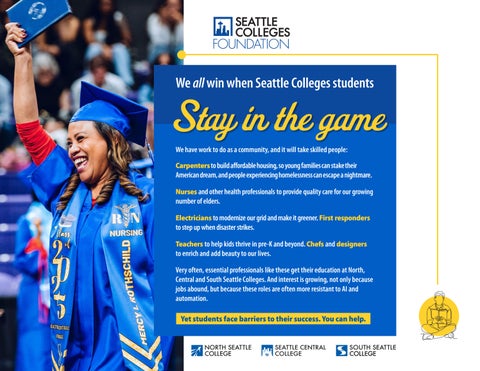

Carpenters to build affordable housing, so young families can stake their American dream, and people experiencing homelessness can escape a nightmare.
Nurses and other health professionals to provide quality care for our growing number of elders.
Electricians to modernize our grid and make it greener. First responders to step up when disaster strikes.
Teachers to help kids thrive in pre -K and beyond. Chefs and designers to enrich and add beauty to our lives.
Very often, essential professionals like these get their education at North, Central and South Seattle Colleges. And interest is growing, not only because jobs abound, but because these roles are often more resistant to AI and automation.
Yet students face barriers to their success. You can help.





Many Seattle Colleges grads successfully transfer to schools like the UW. Others step quickly into the frontline roles that keep our community livable, lovable and prosperous each day.
Given the stakes, we all benefit if Seattle Colleges students round the bases and complete their education. Yet too many don’t, typically because they struggle financially or need added services and supports — like college students everywhere. Three proven, interlocking strategies can make the difference. Big thanks to our Seattle Mariners for being an early and ongoing supporter. Join them!

34,835 students in 2024-25 second in undergrads statewide only



Bridging students closer to the true cost of attendance

Full-time tuition at the Seattle Colleges is typically $5,058, and students sometimes benefit from government grants. Often it’s the other expenses — not of school but of life — that pose the affordability challenge. Rent, utilities, groceries, transportation, childcare (our average student is 28) are all costlier in Seattle than almost anywhere in the country. Even when students work as 70% do it’s hard to make ends meet.

When students don’t graduate, it’s seldom because of academics, but rather the financial strain. Research indicates an average shortfall of $4,920 between what students can piece together and the true cost of attendance. Your investment in Stay in the Game creates targeted $5K scholarships to bridge this gap.
With eight broad Seattle Colleges can for someone returning a family, who faces past academic setbacks College & Career Game work one-on goals. They also make supports like tools The impact is profound. Georgetown campus a 58% increase in
572 scholarships










Helping students quickly identify and effectively pursue their preferred educational/career pathway
areas of study and more than 130 programs, the can overwhelm anyone. That can be particularly true returning to school after a long absence, who’s supporting faces language or cultural barriers, or who’s overcoming setbacks — the circumstances of many of our students.
Career Navigators you support through Stay in the on-one with students to identify courses that fit their make connections to tutoring, financial resources, material and uniforms, and ultimately internships and jobs. profound. With focused navigator support, the Colleges’ campus saw a 68% growth in pre-apprenticeship enrollment, completions, and a 37% jump in job placements.


Getting students fast help when they face a major financial setback



Scholarships can help students avoid a financial crisis while in school, however there’s money for only a fraction of the students who qualify. And according to a recent survey, more than half of Seattle Colleges students regularly struggle with food or housing insecurity. Your investment in Stay in the Game supports:
Campus food pantries with groceries, toiletries, even diapers so no one chooses between basic needs and learning.
Benefits Hubs where trained coaches help students unlock the housing aid, childcare, and public benefits they may qualify for.
One -time assistance grants that help with repairing a car, replacing a stolen laptop, or covering a late utility bill whatever will keep a student educationally on-track. >46%



1,590 recent high-school grads


















Tuition is less than a fifth of the overall




of attendance