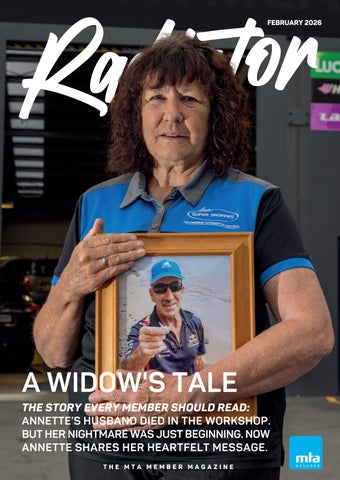
MTA Radiator February

Page 1


Member

What

Advocacy: WoF reform — What we told Govt

Dealer: Ongoing MVR compliance challenges

Mediation: Before you keep the deposit

HR Advice: HR in 2026

Training & Development: Fuel sector builds career pathways

Repairer: MTA surveys — why they matter

Collision Repair: More trends in automotive collision repair

Fuel & Heavy Vehicle: ReFuel Forum APAC & ANZ 2026

Market Stats: January 2026

Annette McGrath's husband Paul went to work one morning - and never came home. He died as sole director of the business and without a will, creating a nightmare for Annette to deal with. She shares her story with members.

Editor

Gerald Rillstone

027 252 3229

gerald.rillstone@mta.org.nz

Postal address

PO Box 9244, Marion Square, Wellington 6141

Physical address

Level 5, AIA House

34 Manners Street, Wellington 6011

E: mta@mta.org.nz

W: www.mta.org.nz

Printing & Production

Vertia, Wellington

Mailhouse

Orange Box, Wellington Radiator Magazine ISSN 1179-7800

The Motor Trade Association (Inc) (MTA) is not responsible for statements, opinions or factual matters published in Radiator magazine, nor do they necessarily reflect the views of MTA, its Board of Directors or its advisory/specialty committees, unless expressly so stated, and does not endorse advertisers.

Radiator magazine is available free to all members of MTA. Information on products and services contained in the editorial and advertising pages of this magazine is published as a service and no responsibility will be taken for inaccurate information.

Radiator magazine does not imply the endorsement of any product or service.

The publisher reserves the right to refuse advertising and editorial at any stage.

Copyright: No part of Radiator magazine may be reproduced in part or in whole without the written permission of the publisher.

Saddle up –it’s going to be quite a ride

Fun fact: According to the Chinese zodiac, 2026 is the Year of The Horse.

To be precise, it’s a Fire Horse year –a year traditionally of high energy and fast-paced change.

It’s also especially good news for me, as I was born in a Fire Horse year, and the zodiac says that means I’m in for a bonza of a year.

According to centuries-old belief, born Fire Horses like my good self have the power to achieve great things, and be powerful and inspiring leaders. Which just goes to show those ancient astrologers can be wrong occasionally.

But the Year of the Horse also feels like a good metaphor for the year ahead – as our political parties jockey for position to be first to the winning post. High energy and fast-paced change are guaranteed – whoever the winners are.

Keeping with the equine theme, as a paid-up member of the Wellington Racing Club for many years, I have been known to have a flutter from time to time. I’ve had my share of wins (and, ahem, small losses), so the stars have aligned for me to offer some thoughts on the race ahead.

Naturally, the election dominates a substantial part of MTA’s thinking and strategy this year.

Three years ago, we launched our political manifesto Driving New

simon.bradwell@mta.org.nz

Zealand Forward, which outlined our calls to the incoming Government –whatever that ended up looking like.

Very soon after the National-led coalition subsequently took office, many of our calls were pleasingly adopted by the new Government. So much so in fact, that in some places they lifted directly from the manifesto when policy was written!

This has inspired us to make the 2026 manifesto even bigger and better.

We take this responsibility to advocate for the benefit of members, industry and the public so seriously that we started work on this year’s manifesto towards the end of last year – a full 12 months before election day.

A lot of in-house expertise, member

sector – to make an extremely wellreasoned and informed submission (also available to read on the MTA website).

We backed that with our ‘open letter’ in newspapers around the country to make sure our point of view landed firmly under the eyes of all politicians. Writing an insightful, data-based, forward-thinking manifesto is no sprint. And neither is the election. As I write this, the election date of 7 November has just been announced, and in racing terms we’re in Melbourne Cup territory for distance.

Some contenders may have an advantage at this stage but that counts for naught when the gates open.

Let’s not try to pick the result now. That would be like trying to pick the trifecta in next year’s New Zealand Derby. Easier to predict the hurdles the parties face and will have to overcome to enter the winners’ circle.

Cost of living is the obvious one. Many New Zealanders – including those

who have departed these fair shores –have felt the pinch the last few years.

The supermarket shop is the clearest evidence of that.

Convincing voters they have the solution will be top of the list for all parties. Linked closely of course is the economy – whether you believe we’re on the right track or off the rails, there’s a volatile, fragile feel to how the economy is performing. Who can convince and reassure the electorate?

Law and order is always a good election year issue, and one where the current Government enjoys an edge.

But who will sway the voters on health and education? Again, the latter favours the coalition, but health concerns traditionally benefit Labour.

Many young voters are concerned with the environment, taxation and Treaty issues – who stands to benefit?

Lastly, do not underestimate the influence of personality politics.

Leaders of both big parties have received less than stellar reviews

in workforce surveys in the last six months, while leaders of the other parties are best described as polarising.

Who handles the media coverage, debates and the inevitable ‘bombshells’ best will also be crucial.

It’s going to be a fascinating ride before and on election day. You’d be mad to wager on a winner right now. But MTA is going to be leaving no stone unturned to reach and work with all parties to get the best results for members. Not just for next year, or for three years, but beyond.

That’s something you can bet on. Best wishes for 2026.

•MTA Chief Executive Lee Marshall was enjoying a well-earned break during the production of Radiator this month. Simon Bradwell is MTA’s Head of Communications, who as a journalist covered several elections for TVNZ and Sunday News.

consultation and collaboration with industry goes in to the manifesto.

If you want to learn more, a copy of the 2023 iteration is on the MTA website (search “manifesto”), and we will be keeping members posted on progress.

The work we do with politicians – and one step removed, the media – is one of the most important things we do.

That’s why last year we created Expert Advisory Groups in all the sectors of MTA membership, so members can have direct input on our advocacy work.

Last year’s approach to the Government’s proposed Warrant of Fitness changes is a good example. We worked with members – and the

MTA is working on its election year manifesto for politicians across the House.
Out of the gate…but who will finish first in the Year of the Horse stakes?

The cost of not planning: a widow’s warning

It began as a typical August weekday morning.

Paul McGrath arrived at his Ferrymead workshop in Christchurch at 7.30am, unlocked the doors and got straight to work on a customer’s car, just as he had done almost every working day for the past 27 years. He expected his team to arrive around eight.

They never got the chance to greet him.

Sometime in that quiet half hour, Paul suffered a massive heart attack and died. He left behind a thriving business, a grieving family and no will.

As the sole director of the company, his sudden death triggered a legal and administrative nightmare for his widow Annette that would stretch on for months.

When Paul died, his passing last year devastated his family, friends and staff.

But for Annette, the grief was compounded by a harsh reality few business owners want to confront.

“It is so hard when you are grieving for someone you have lived with, worked with and loved, and then everything just comes to a grinding halt,” says.

Now Annette has welcomed the chance to share her story with Radiator, in the hope that members learn from her experience.

Paul had no will, and he was the sole director of the business.

What followed was months of legal, financial and emotional turmoil that Annette describes as a nightmare.

“It is pretty devastating when you own a business as a sole director and you die,” she says. “For your family, it is horrific.”

Paul’s death immediately triggered a legal freeze on the business. Without a will, and without Annette appointed as a director, she had no authority to operate the company.

“That was a mess,” Annette says.

“Because he was the sole company director and hadn’t appointed me or anyone else, legally it rocked the boat big-time. It opened a can of worms.”

The consequences were immediate and severe.

“While this is happening, you have to shut the business down. You can’t legally trade,” she says.

Despite there being money in the business accounts, Annette was legally barred from accessing it. Yet the business still staff who needed to be paid — and Annette felt a

responsibility to them.

“I couldn’t pay myself, but I had to pay four employees out of my own personal funds because all the assets were frozen.”

At the same time, the bills kept coming.

“I still had to pay the lease on the building and the bills due on the 20th of the month, but I had no way of producing any income.”

Untangling the legal mess came at a cost. Annette estimates it cost around $8000 in legal fees to get the directorship and administration paperwork sorted. Even then, the process was fraught.

“I had to get the bank to make me the business owner, and that was an absolute nightmare,” she says. “They have strict protocols, they don’t bend

Annette and Paul were looking forward to their retirement after 27 years at the business.
Right: Annette at Paul's workshop in Christchurch, which she's kept running after his death.

them, and they have no empathy whatsoever.”

She recalls being told bluntly that the situation was simply “tough luck.

“They basically said Paul should have had a will.”

Every step required lawyers, accountants and bank approvals — all while the business sat idle and Annette continued paying staff wages from her personal account.

Although Annette had worked alongside Paul for 20 years, she had never been involved in the administrative side of the business.

Being forced to pick up the pieces while grieving for her husband of 27 years was overwhelming.

Getting the business legally operational again took six weeks, a process Annette says was fast-tracked. Even then, cashflow didn’t bounce back overnight.

“Once the business was up and trading again, it took another six weeks to get the cashflow back to a reasonable level,” she says.

“He died in August last year and we are still running at a deficit. We are cash poor and still catching up and probably will be for another year.”

To keep staff employed during the shutdown, Annette found non-incomegenerating work where she could.

“We were lucky I had work for them to do, a big clean-out, sorting shelves, tidying the yard but none of it generated money.”

Despite everything, Annette was determined not to let the business fail.

and above to help out.”

Now 65, Annette is trying to sell the business, a task she never expected to face.

“This was meant to be our retirement year. Instead, I was thrown into the deep end. Paul was the heart of the business, and I am not a businessperson. It has been a huge emotional and mental load.”

Looking back, Annette is clear about

the lesson for other business owners.

“Anyone owning a business should have a secondary director appointed. It can be a lawyer or anyone — it doesn’t have to be a family member,” she says.

“If Paul had had a will and appointed me as a director, or someone else who was living, I wouldn’t have gone through this financial and emotional distress. I could have continued

running the business.”

The experience has taken a heavy toll, but Annette says she found the strength because she had no choice.

“I wanted to honour my husband, and I wanted to look after the people he cared about.”

Her message to MTA members is simple — and urgent.

“Don’t leave it until it’s too late.”

Plan before it’s too late

Automotive industry expert Peter Morton has firsthand experience dealing with member businesses and offers some advice.

I have dealt with MTA member businesses over many decades, and when a business owner dies without a will it is absolutely dramatic for those left to deal with the problem.

“I didn’t want to close it down. I wanted to honour Paul’s memory. Christmas was coming, the economy was tight, and I had four staff who needed looking after. That’s what Paul would have wanted.”

She credits her staff, suppliers and support network for helping her survive the ordeal.

“I am grateful and humbled by my staff they have been so supportive, loving and kind. Auto Super Shoppe Group have been incredibly supportive too.”

Some weeks, she couldn’t afford to pay full wages.

“They had bills to pay and they accepted that. They were so understanding, and I am so grateful.”

Suppliers also stepped up.

“Thankfully Paul had never been in debt to suppliers, and they went over

“I don’t need a will — I’ll sell the business before I die.”

That mindset is just asking for trouble.

A major problem is under the banking rules for Anti Money Laundering, it is a nightmare to keep the business going. Imagine an MTA member who is the only signatory for the business and who has no other person on the list to sign and passes away suddenly. And no will in place. The banks freeze the account and the business stops overnight. No one to pay the employees and they will more than likely leave and there is no business to carry on. Any children of the person who passed will have to apply to the court to get an administrator appointed. That is not an easy pathway.

Every person should have at a minimum a will to deal with where their assets should be distributed to on their passing. This gives the right to the executor of the will to take over and pay the bills, keep the business going until it can be sold.

A memorandum of wishes should be made as well as part of the will process so the executor knows what the deceased person was wishing to happen. What to do with the business, for example, maybe offer it to the employees first.

Equally important is a power of attorney for business matters. This covers situations where the owner is still alive but unable to act for themselves — for example, after a serious illness or stroke. A business power of attorney allows someone trusted to step in, keep things running, and, if necessary, sell the business until the owner can return or a longer-term decision is made.

None of this is pleasant to think about.

But planning ahead isn’t about being pessimistic — it’s about protecting your family, your staff, and the business you’ve worked hard to build.

How to get a will?

It is better to use a lawyer as they are experts in this field, but you can download a will online and do yourself, but you will need two witnesses who are not beneficiaries of the will. Keep the will in a safe place and let someone know where it is. If you use a lawyer, then they will keep the original.

How to get a power of attorney?

The same as a will applies. Helpful links: www.publictrust.co.nz, www.lawdepot.com/nz.

Annette credits the team of supportive staff with helping her cope with the loss of Paul (inset).
Peter Morton.

Flooded, fixed and future-proofed

Two years on from the Auckland Anniversary floods that engulfed MTA member Brett Piddington’s Browns Bay workshop, the weather forecast still has the power to unsettle him.

Brett owns Dale Nixon Automotive and vividly remembers the evening of 27 January 2023, when relentless rain overwhelmed Auckland and sent floodwaters surging through his business.

“It was a pretty dark day,” Brett says. “You can’t put a price on the PTSD I still have.”

But that experience has taught him valuable lessons that he’s eager to share with MTA members.

In the aftermath of the floods, Brett was faced with the daunting task of cleaning up the damage and lodging a claim with Gallagher Insurance.

“It was pretty stressful, and then it got to the point where I was resigned to the fact I’d have to put a lot of time into making a claim,” he says. “Gallagher Insurance were excellent, and their advice was excellent.”

covered.

“What they pointed out was there was scope in my policy to pay someone to compile my claim,” he says.

“They also wanted a list of who helped with the clean-up and how long they spent cleaning, and that could be claimed back from the landlord’s insurance.”

Despite the stress and disruption, Brett can now see a small silver lining.

“In the wash-up it was an amazing spring clean for us.”

Future proofi ng

While his insurance costs might otherwise have reduced this year, Brett has instead chosen to add business interruption insurance for the same overall cost.

“I know better than most that you need a good policy,” he says.

“The better insurance you have, the better experience you’ll have when something happens.”

The floods also prompted Brett to take practical steps to flood-proof the business.

“We’ve moved the compressor that went underwater upstairs,” he says.

“We wheel everything else onto the hoist and put it up in the air.

“If we flood again, it’ll take a few days to wash the mud out and I doubt I’ll have to make a claim.”

Computers are now treated as priority items whenever heavy rain is forecast.

“If it looks like it’s going to get wet, the computers are the first thing to go upstairs.”

But while the physical changes help, the emotional toll remains.

“The biggest thing for me is knowing it’s going to happen again,” Brett says. “That wears on me, and it’s really hard to quantify how much that affects you.”

With Auckland’s weather patterns seemingly shifting, Brett has a wry suggestion.

“We need to change January and February to monsoon months, not summer months.”

The flood was more than a one-off event, it was a stark reminder that preparation and relevant insurance can make all the difference.

Now Brett encourages all members to check their insurance – and be ready for when disaster strikes.

One of the most overwhelming tasks was researching and pricing around 300 individual items for replacement.

“We had pictures of everything covered in oily water,” he recalls.

“Once I compiled my list of stuff and came up with all the prices, it was a really quick process and they accepted [the claim] straight away.”

A significant part of the claim involved labour costs to clean up the workshop, something Brett hadn’t initially realised could be

Flood waters inundated Brett Piddington’s workshop during the Auckland Anniversary Day floods of 2023.
With Auckland’s weather patterns seemingly shifting, Brett suggests a change for January and February to monsoon months, not summer months.

Having the right insurance cover can save you a lot of heartache and hassle if disaster strikes. Here’s some tips.

• Regularly review insurance policies – speak to your insurer or broker and schedule a review. Review what is covered, how much per claim and per event. Check what the small prints says! Is the cover sufficient to replace items? If you are renewing your insurance, consider the MTA Member benefit package by Gallagher.

•Also review the cover versus excess, some members are reporting large increases in excess levels.

• Have processes in place to mitigate any possible loss, shift valuable tooling away from low lying areas, ensure downpipes and guttering are in good

condition, move vehicles to a safer area or ensure they are on a hoist to minimise water ingress.

•Have an up-to-date inventory. At a minimum you should have a simple inventory list and carry out regular stocktakes – having stock management solution integrated to your workshop software is an even better solution.

One of the issues that arose in previous floods was that of uninsured customer vehicles on site that were damaged.

Business insurance will not (generally) cover vehicles damaged by an “Act of God” event, as this is covered by the owner’s vehicle insurance. However, if the owner does not have insurance, this will result in a situation where the owner believes you are responsible under a “duty of care”.

• Have some method of confirming if a vehicle entering your business or in your care is insured.

•Ensure clear signage that conveys that a vehicle in your care is covered by the business’ insurance for an at fault incident. At fault incidents are where you, your employees/engaged contractors or other person working for the business are at fault. Incidents outside of the business’ control, such as weather events are the responsibility of the owner and their insurance policy.

Remember, MTA has a member benefit with Gallagher Insurance and a policy specifically developed for MTA members. Information can be found on the MTA Toolbox.

A new year, new equipment

Setting up a new automotive workshop is exciting — but it’s also one of the easiest times to overspend, under-spec, or miss a key piece of equipment that later creates bottlenecks.

This checklist is designed for Kiwi workshops planning a fit-out (or a major upgrade). It focuses on the practical stuff that impacts day-today workflow: vehicle mix, bay layout, throughput, and the equipment categories that keep jobs moving.

Step 1: confirm your workshop basics

Mastersofworkwear rental&cleaning.

Mastersofworkwear rental&cleaning.

If you want your staff to look clean and professional and save your company money with the least amount of hassle, talk to Apparelmaster. We buy any kind of workwear and rent it back to you, professionally launder and repair it and make sure you get the right gear where and when you need it.

If you want your staff to look clean and professional and save your company money with the least amount of hassle, talk to Apparelmaster. We buy any kind of workwear and rent it back to you, professionally launder and repair it and make sure you get the right gear where and when you need it.

NEW ZEALAND, COVERED AT WORK

To find out more, call 0800 808 820 or visit online at apparelmaster.co.nz

NEW ZEALAND, COVERED AT WORK

To find out more, call 0800 808 820 or visit online at apparelmaster.co.nz

Before you buy anything, lock in these inputs. They determine what “right equipment” actually means.

•Vehicle mix: passenger, SUV, light commercial, heavy vehicle, CV/fleet

•Jobs you’ll do most: tyres/alignment, servicing, diagnostics, brakes, A/C, fleet work, performance work

•Bay count + workflow: how vehicles move through the workshop (avoid backtracking)

•Ceiling height + power/air requirements: influences what equipment is feasible

•Throughput target: how many vehicles per day/week you need to service profitably

Step 2: plan your bays before your shopping list

A simple starting point:

•Bay 1–2: core servicing + diagnostics (highest daily use)

•Bay 3: wheel service / alignment

(high throughput + strong revenue)

•Bay 4: specialist work (A/C, brake

testing, ADAS calibration, fleet)

Step 3: Workshop Equipment checklist

Wheel service and wheel alignment:

These are often the highest-throughput services in many workshops.

Tyre changer(s) suited to your vehicle mix

Wheel balancer(s) suitable for speed and repeatability

Wheel alignment capability (your target market may expect this as standard)

Diagnostic equipment (don’t underspec this)

Diagnostics influences almost every job

— from check engine lights to modern drivability issues.

Scan tools aligned to your vehicle mix (light vehicle vs heavy vs CV)

Hybrid/EV capability if you service modern vehicles

Oscilloscope capability for deeper electrical troubleshooting

Update/support pathway (so your tools stay current)

ADAS calibration readiness

ADAS is moving from “nice to have” to “customers expect it”, especially on newer vehicles.

Space requirements (clean, controlled area)

Process workflow (calibration time + staff training)

Equipment aligned to the vehicles you service most

Automotive air conditioning servicing

A/C work is common and can be a strong add-on revenue stream when

equipped correctly.

Recovery and re-gassing capability suited to your expected volume

Safe handling procedures and training

Consumables + servicing considerations

Performance testing (optional, specialist)

Not every workshop needs this — but if performance work is part of your offering, plan for it properly.

Space requirements and ventilation considerations

Repeatable testing and reporting capability

Safety and workflow planning

Step 4: don’t forget the support side (it affects profitability) Two workshops can buy similar equipment and get very different outcomes depending on setup, onboarding, and after-sales support.

When comparing options, ask: Who helps with setup and onboarding?

What does after-sales support look like in NZ?

How do updates and troubleshooting work?

What’s the learning curve for staff?

Not sure where to start?

If you tell us your vehicle mix, bay space, and the services you want to offer — especially the jobs you’ll do most — we can recommend a practical setup that fits your workflow and budget.

MTA’s call to members: give blood and save lives

We’re calling on all members to show their support for their community and sign up to give blood.

Blood banks play a crucial role in a range of treatments – donated blood is literally a life-saver.

“We are all part of the community, and the community keeps us all in business,” says MTA’s Membership Services Manager Sean Stevens.

“Let’s all give back to that community and show our support for Kiwis by giving blood.”

MTA’s call was inspired by the recent experience of MTA Coast to Coast membership advisor Shelley Carter and her grand-daughter Harlow.

“I was sitting at the Scope Classic car racing, watching cars go around the track, when my daughter rang and said Harlow had been diagnosed with leukaemia,” Shelley recalls.

“It was a massive shock.”

Just days before her diagnosis, Harlow, aged just three, had started preschool. She was unusually tired, pale and unwell — symptoms the family initially thought might be ironrelated.

“She was quite drowsy, lying on the couch,” Shelley says. “My daughter took her to A&E, and within a couple of hours they had diagnosed leukaemia. Within a week, she had started chemotherapy.”

As Harlow’s treatment progressed, blood transfusions became a critical part of her care.

“People undergoing chemotherapy often get very sick because their immunity is so low,” Shelley says.

“They can develop colds, pneumonia and lung infections, and they can go downhill dramatically and very fast.”

Blood products, red blood cells, platelets and plasma, play a vital role

in preventing or reducing the severity of these infections.

“In the last year alone, Harlow has received 20 blood products,” Shelley says. “That includes plasma, red blood cells, platelets and immune globulin, which helps prevent or reduce severe infections.”

Many of these transfusions were required during a serious liver infection caused by a strong reaction to chemotherapy.

Each year in New Zealand, around 150 children are diagnosed with cancer. Of those, between 40 and 50

are battling leukaemia.

MTA is getting behind Shelley’s call to action and would like members to follow as well.

“MTA staff across the country are being encouraged to give blood too,” Sean says.

Shelley hopes MTA members will donate half a million litres of blood in just three months — one litre at a time.

“It’s something so many of us can do,” Shelley says. “And for families like ours, it can mean everything.”

DONATE BLOOD FROM FEB APRIL YOUCOULD SAVE ALIFE

JOIN OUR MTA NZ TEAM RED AND BOOK IN YOUR DONATION AT A BLOOD DRIVE NEAR YOU

Shelley Carter's grand-daughter Harlow, who's received more than 20 blood transfusions.

Melissa’s mission: empowering women in automotive

Melissa Hannan joins Radiator as a new columnist with a mission to change the way women see their place in the automotive industry. With 17 years’ experience as a motor mechanic, she knows her way around an engine bay, but more importantly she understands the confidence gap that stops many women from picking up the tools in the first place. Melissa also runs the highly successful Girls N Gasoline programme that helps women learn more about vehicle maintenance.

As we start a new year, I’ve taken some time to reflect on the journey that has brought me to where I am today.

I’ve started 2026 in a completely new chapter of life - with a newborn, navigating the balance of working, running a business, and being a mum, all while finding my feet in my new home of Timaru.

Twenty years ago, fresh out of school, I began a mechanical apprenticeship in Auckland. Fast forward two decades and I am now a fully qualified mechanic, hold my WOF authority, and run my own business teaching women across New Zealand how to look after their vehicles.

I’m on a mission to empower women around the country to feel confident looking after their cars — and to see the automotive industry as a place where they truly belong. Drawing on nearly two decades working as a motor mechanic, I created Girls N’ Gasoline women-only classes to break down the basics in a practical, supportive way. Every month I’m on the road or jumping on a plane, encouraging women to pick up the tools, ask questions, and have a crack — because getting involved in this trade isn’t about proving anything to anyone else, it’s about backing yourself and realising you’re more than capable.

Working in a male-dominated trade

has certainly come with its fair share of challenges. There were times people didn’t believe I was a mechanic, assumed my car belonged to my partner, or would call the workshop and ask to speak to “the mechanic” - as if I wasn’t one. Those moments weren’t easy, but every obstacle helped shape the person I am today, and I’m incredibly proud that I pushed through them.

When I was just 15 years old, I bought the personalised number plate NTH1S (Not His), originally with the goal of putting it on a mini truck - partly as

proof that the vehicle was mine. That number plate has followed me through many vehicles over the years and now proudly sits on my 1959 Chevrolet Parkwood, a car I’ve owned for the past 10 years and one of my absolute dream vehicles.

When I first started my apprenticeship, I worked full-time while studying, alongside weekend and night jobsoften with the goal of buying my next car or to afford modifications to the current. If I wasn’t working, I was in the garage, out cruising, or heading to car shows. My family wasn’t really into

Melissa's classes are hands-on instruction for female attendees.
If you’d told that 16-year-old girl where she’d end up today, she wouldn’t have believed you! “

the car scene, so where my petrolhead stamina came from, I’m not entirely sure. As a teenager, my walls were covered in posters and photos of cars. Back in the days before camera phones, my schoolbooks were filled with magazine cut-outs and car photos - and to this day, I still have some of them. Looking back now, I’m friends with many of the people who owned the cars that once covered my walls. If you’d told that 16-year-old girl where she’d end up today, she wouldn’t have believed you!

These days, I’m hearing more and more about women entering the automotive trade, or wanting to give it a go - and I fully back them! There were definitely times during my apprenticeship when I wanted to give up, but I was lucky to have supportive people around me, including a boss who continued to push and believe in me. To any women out there considering a trade: keep going. My inbox is always open if you want advice, encouragement, or someone to talk to. I absolutely love being a mechanic and encouraging more women into the industry.

For most of my life, I worked two jobs and pushed hard for the things

Smoko Stumpers

Test your knowledge with our five-minute monthly motoring quiz.

Ratings:

1/5: Put your L plates back on.

2/5: Hit the books, rookie.

3/5: Middle of the road.

4/5: Close but no cigar.

5/5: Congratulations, you’ve outrun The Chaser.

.

I wanted. Today, I own one of my dream vehicles - and I say “one” because, like most car people, I’ve got a few more on that list. To anyone wanting to pursue something that isn’t considered the norm: go for it. Stand tall, stay true to yourself, and prove to those who doubted you that you absolutely can do it.

I’ve met some incredible people through the automotive industry and the classic car scene all throughout New Zealand. I’m deeply grateful to everyone who has supported me throughout my career. Without those people, I wouldn’t be where I am today.

• Do you have experience, questions or ideas you’d like to share with Melissa? Drop her a line at girlsngasoline@gmail.com or go to www.fiveninegarage.com

1. When will this year’s election be held? 7 November, 14 November, 21 November?

2. Which famous American car marque will make its F1 debut in 2026?

3. Who wrote the song, Pink Cadillac? (Clue: ask The Boss)

4. What was the best-selling vehicle in 2025?

5. What does Vespa (as in the scooter) translate to in English? Wind, Whiny, or Wasp?

Answers on page 60

Automotive events 2026

Autorama fundraising event on the 21st February in Rotorua.

Car show, swap meet, car boot sale, kids entertainment, food trucks and more. Arawa Racecourse, Fenton Street Rotorua. Gates open 9am.

Masterton

Wairarapa’s original hot rod and custom car clubs' inaugural annual automotive event on Sunday 1 March 2026 — celebrating everything automotive and the people who love them!

Automotive Swap Meet — find those hard-toget parts, tools, memorabilia and more.

Vehicle Sales Yard — from vintage classics to modern performance, come buy, browse or bring your own vehicle to sell.

Market Stalls & Food Vendors — crafts, collectables and tasty treats for all ages.

Vehicle Display Area — showcasing the best cars, bikes and unique builds from around the region.

Location: Tauherenikau Racecourse (between Featherston & Greytown)

Public Gates: 8:00am

Vendor Entry: from 6:30am

General Admission: $10 per person (Under 14’s free)

Swap Sites: $20 per site

Vehicle Sale Yard: $20 per vehicle No pre-registration required — just roll in on the day!

Whangarei Rod and Custom Club

Bring along your pre 59 cars and pre 69 bikes Racing starts at 9:30 am at the Meremere Dragway Meremere March 1st

Cruz’n The Bayz

Cruz'n the Bayz has grown over three years, and many have enjoyed this fantastic event is open for ticketing now so everyone can plan for Cruz'n the Bayz 2026.Over 4 days cruise Northland with like-minded classic/hot rod/ muscle car and bike enthusiasts from all over Aotearoa NZ. The cruise will travel through our local communities who are supporting the event with music/entertainment, local cuisine and welcoming celebrations.

Cruising from Paihia daily to surrounding townships.

Thu 5 Mar 2026–Sun 8 Mar 2026, 8:00am–10:00pm Ala Moana Motel in Paihia have come on board with an Earlybird 3 nights' free accommodation during the 2026 event. Register for Cruz'n the Bayz at Eventfinda between 1st May to 1st October and you're in the draw.

Call 0800 BUY TIX (289 849)

Waitangi

Cruz'n the Bayz Waitangi Sports Grounds, 1 Tau Henare Drive, Paihia Thursday 5 March 2026 - Sunday 8 March 2026

Timaru

Caroline Bay Rock and Hop Timaru plays host the 7th Caroline Bay Rock and Hop, featuring Classic, Custom and Vintage.

4 Day Car Show and Rock and Hop. Cruises, Dances, Quiz Night, Gala Day, Stalls, Food Stalls, Laps at Levels, Best Dressed competition, music, entertainment, BBQ’s, raffles, kids’ scavenger hunt, and so much more.

General public are welcome at Laps at Levels and the Gala Day, entry by way of donation into one of our donation buckets.

For tickets the visit our Caroline Bay Rock and Hop website.

Thursday 13th / Friday 14th / Saturday 15th / Sunday 16th March 2026.

Gisborne

Gas Guzzlers Breakfast

This event is on the first Sunday of every month rain, hail or shine. Reads Quay Gisborne 8:30 am to 11:00 am. American, Aussie, Kiwi, European, open to anything of interest.

Autorama fundraising event on the 21st February in Rotorua. Car show, swap meet, car boot sale, kids entertainment, food trucks and more. Arawa Racecourse, Fenton Street Rotorua. Gates open 9am.

Masterton Motorplex International Drag Strip 2025/26 SEASON DATES ARE HERE! The new Masterton Motorplex season is locked and loaded! Get those cars prepped, trailers packed, and calendars marked; it's going to be an epic run from September through March. NZDRA National Series –All Classes: Jan 3-4, 2026 – Bob Wilton Memorial Drags Featuring Dragstalgia, Gasser Showdown & Wild Bunch Wars Bobs’s Burnouts – Jan 3 (Saturday Night) Jan 24-25, 2026 – Modified Mania MMP Comp Meeting + Group 1, Comp Bike, Top Sportsman, Boosted Outlaws, Comp Eliminator Rounds for NZDRA National Series Feb 1415, 2026 – Wild Bunch vs The World plus Group 1 round – NZDRA National Series Mar 21-22, 2026 – 58th NZ Nationals Grand Finals – All Classes – NZDRA National Series

Mel's garage where she holds her popular Girls N Gasoline workshops.
I came to New Zealand in 2003. My kids were eight and 11, and I thought it would be a better lifestyle. “

Tea times brew up success for Mercedes guru

Auckland workshop North Shore Car Clinic specialises in Japanese and European vehicles, and owner Harindra Pilaptiya is rated a Mercedes Benz expert.

But Harindra’s roots are in an exotic location far away from Germany, Japan or New Zealand. Harindra grew up on a tea plantation in Sri Lanka, and that’s where his love affair with working on vehicles began.

“I got interested in four-wheel drives when I was very young, my whole family—even my uncles were into them,” he says.

When Harindra’s not in the workshop, he’s likely to be tinkering with a classic military machinery [see sidebar] – another passion that began in the Teardrop Isle.

Rugged vehicles were essential and ex-army WW2 Jeeps were the backbone of daily life. Aged

just 15, Harindra and his brother bought the local village Jeep, a vehicle that had seen better days.

The boys opened the gearbox and found rice husks mixed in with the gear oil. It needed extensive work, including a complete rewire, they got it up and running and the experience cemented his fascination with the rugged machines.

In 1988 he began working as a

mechanic with Mercedes-Benz in Sri Lanka. Three years after becoming fully qualified the workshop foreman left for Australia.

Better lifestyle

“I was asked to take over, and then in 2003 I came to New Zealand,” he says. “My kids were eight and 11, and I thought it would be a better lifestyle.”

He started work at Mercedes-Benz in Newmarket in January that year.

Within three months, history repeated itself—the workshop foreman departed for Australia, and once again Harindra was encouraged to apply for the position. His biggest worry in taking the job, he says, was being seen as an interloper - but his ability to diagnose and solve complex Mercedes issues had set him apart.

He took the job, and his reputation grew rapidly, to the point where one of the Giltrap family’s sons rang him personally, wanting to

know more about the man behind the problem-solving.

Harindra credits intensive training for his expertise.

“We used to go to Germany every year, sometimes twice a year, for training—often for six weeks at a time.

“We have built a global network. Every country had different problems, and there is always someone you could call to help solve one.”

Building a team

When Harindra took over as foreman, one of the first things he introduced was a Friday afternoon tradition—staff gathering after work to share food cooked by his wife.

“I built a good team,” he says. “When I started, we were doing about 35 cars a day. When I left, we were doing 75.”

Running his own business wasn’t originally part of the plan. But after being asked to look at a

When time allows, Harindra uses his hard-earned mechanical skills to breath life into rugged WW2 military vehicles.
Since opening his own Mercedes specialist workshop, Harindra has built a solid customer base of like-minded customers.

workshop opportunity for a friend, who ultimately declined, Harindra realised it was something he wanted to pursue himself.

“So I did a deal and got the workshop in 2008,” he says. “We specialise in Mercedes. I already had a few private customers, joined the Mercedes Club, and it grew by word of mouth.”

Among his most cherished vehicles is a 1951 Mercedes fitted with a 1.7-litre diesel engine—once an Auckland taxi.

“All cars have a history,” Harindra says.

He also owns a classic 220 Mercedes, another of the brand’s distinctive rounded-body models.

“I do love Mercedes.”

Mixing military with Mercedes, there is also a 1951 diesel 220 Mercedes in his collection.

Clubs are the key

Clubs are key to Harinda’s customer base. He’s a member of the Mercedes Club, the Vintage Car Club, and the Military Vehicles Club—and those connections bring customers through the workshop door.

But he’s also a big fan of historic military vehicles.

Among his current completed and projects is a restored 1976 V8 Land Rover 101, forward control, meaning the driver sits in front of the engine, imported from the UK and formerly used by the British Army.

Then there’s the ex–French Army Dodge from WW2, powered by a 4.2-litre flathead engine. After the war, it was sent to the Netherlands and later used as a farm truck. By the time Harindra acquired it, the vehicle was battered and barely running.

During the war, it served as a radio command vehicle under General George Patton’s command.

General Patton is said to have driven all the vehicles in his command. So it’s possible he drove this one. “

“General Patton is said to have driven all the vehicles in his command,” Harindra says. “So it’s possible he drove this one.”

Harindra rebuilt the Dodge in just eight months. “I worked on it every day from five to eight in the evenings, and on weekends. I like the challenge.”

And there are the Jeeps, a rare 1941 Slat grilled model and a 1942 model, lovingly restored

and used at every opportunity fully registered, warranted, and ready to go.

“It’s what I enjoy,” he says. “And it’s because I need a hobby.”

• Do you have a passion or hobby that would interest other members? Drop us a line at: gerald.rillstone@mta.org.nz

One of his favourite vehicles, the ex-army WW2 Dodge Command vehicle.
All historic military vehicles grab his attention including this forward control ex-British Army Land Rover.

Website and digital marketing solutions

OurAuto Digital are automotive experts with a team of web designers, content specialists, SEO experts, graphic designers, videographers and social media marketers that focus on connecting customers with your business. Our digital marketing services are both comprehensive and responsive to your needs.

The OurAuto Diagnostic tool is easy to use and has class-leading automotive fault-technology software enabled, including seamless integration with VACC MotorTech, providing auto-detection, top range health reports and monthly updates. The Diagnostic Tool is available on a convenient monthly subscription plan.

Automotive information at your fingertips

VACC MotorTech brings together the extensive online and physical repair, service and diagnostic information resources available from VACC with the global might of Haynes Publishing group, resulting in over 150 years, experience assisting the industry to repair motor vehicles.

An affordable scan tool for your business

What you're telling us

Every month we reply to members’ questions and comments drawn from conversations with the MTA team. Do you need advice or an answer on something? Radiator would love to hear from you. Please email simon.bradwell@mta.org.nz.

This is what I do when I have to deal with customers when it comes to surprise repairs. Emphasise fairness and necessity; nothing annoys someone faster than sparkle language around an unavoidable spend.

This is a great way to deal with the situation; it also builds a level of trust from your customers and when times are tough, keeping customers happy is the key to staying ahead.

Looking to improve business turnover? I do bundle or combo deals offering things like new brake pads, brake fluid, oil change as a package deal.

Tips like this are just what’s needed in a tough economic environment. Another one, a member has suggested, is making sure brake parts on EVs and hybrids are well lubed due to the time frame between replacements. It saves the customer money in the long run and gives members a chance to offer something extra when doing a full service.

With all the filters on modern cars, I advise customers of the need to spend a little extra to check and replace them, explaining the problems that can be caused for hybrid and electric vehicles if they are left too long. This is a great idea; all sorts of things can block vents in modern vehicles, especially with systems for cooling batteries, simple checks can be charged for or offered as an incentive for customers to return to your business.

I take on an apprentice religiously every year and once the last person is on the last part of their apprenticeship cycle, the next person is produced.

Doing this helps your business and the industry; you will always have the right level of staff, all the while making sure the labour supply is topped up.

If the receptionist/admin is away, one of the apprentices (more than two years’ experience) can answer the phones and order parts online.

We have recently closed our post office box. MTA has our physical address, is there anything else we need to do?

A lot of businesses are getting rid of their post office boxes and even though MTA has your street address on record we still need to be notified.

This is so the direct mail address can be changed, otherwise your mail will be returned and there will be a delay in getting orders to members.

Is there somewhere members who are retiring or are retired who are still interested in working for others for a few hours a week can advertise?

There is advertising space in Radiator in the Situations Vacant section, and the good news is that it is free to members.

Another alternative is Kerrie Thomson-Booth’s recently launched Crew Connections, office@crewconnections.co.nz.

MTA member benefits and offers

Make the most of your membership and take advantage of the value on offer from our business partners. For more information visit the MTA Toolbox or give us a call on 0800 00 11 44.

Afterpay

Offer Afterpay at a special MTA rate and attract more customers with Buy Now Pay Later convenience.

ASURE Accommodation

10 percent off 40 ASURE Accommodation Group properties throughout New Zealand.

AUXO Software

Increase profits with leading comprehensive solutions for automotive dealers and workshops.

Boost

Ready-made employee benefits package in a simple phone app.

Cardlink

Save thousands with transaction fee discounts for Service Stations.

DebtorInfo

Makes getting paid easy, effective and affordable. Members get a highly preferential rate.

Eftpos NZ

25 percent off terminal rental and free credit card surcharging.

Employment Advice

Our HR team are on hand to help you with staff and employment issues. Access a host of free HR resources and templates on our Toolbox.

Gallagher Insurance

A business insurance solution designed specifically for MTA members.

Gift Products

These MTA products have been designed to keep the MTA brand in front of consumers and encourage spend back to MTA members.

mta.org.nz/toolbox

Health, Safety and Wellbeing

We offer tools that help your business stay compliant and safe. Support is available for members and their staff dealing with life’s challenges.

Interislander Ferries

10 percent off the best available fare when you cruise between islands.

Just Water

Keep staff hydrated with 15 percent off water coolers and supplies.

Mediation Advice

Our free mediation service can help you handle issues with customers before they escalate.

MTF Finance

MTA have partnered with MTF Finance to provide a finance solution aimed to help your customers pay for repairs, maintenance, parts and accessories that exceed $1500.

n3 Business Buying Power

Free access for members. Last year members saved an average of $7,566 using n3 suppliers.

Our Auto

Service repair data and diagnostics at great rates.

Regional Opportunities

MTA hosts over 500 training and social events per year for members and staff.

Scenic Trains

Enjoy great journeys of New Zealand with 10 percent off the best available fares.

Triton Hearing

Free hearing checks and an extra 10 percent off hearing devices and protection.

*All business partner offers are subject to their own individual terms and conditions.

Charging ahead –or falling behind?

The Government’s ambition to build 10,000 public EV charge points by 2030 is bold on paper. On the ground, the automotive industry is still waiting to see how, or if it will happen.

Before and after the 2023 election, National committed to a headlinegrabbing target: 10,000 public EV charge points by 2030.

The figure is included in the Government’s second Emissions Reduction Plan covering 2026–30, although it is subject to a cost-benefit analysis.

As of the start of 2026, the reality looks very different. Transport Minister Chris Bishop says New Zealand currently has 1425 public charge points, equating to roughly one charger for every 92 electric vehicles when battery electric and plug-in hybrids are combined.

The 1425 is an increase of around 100 new charge points over the past year, and Bishop admits “the 10,000 chargers are an ambitious stretch goal.”

The Government’s preferred model relies heavily on private investment.

Funding will be available for both DC fast chargers and AC chargers, but the final mix will be driven by what the private sector chooses to invest in, rather than a centrally planned rollout.

Concessionary loan agreements are expected to be announced soon, with officials pointing to the Ultra-Fast Broadband rollout as proof that this model can work. The theory is simple: leverage private capital, minimise taxpayer exposure, and still deliver national infrastructure.

In practice, EV advocates say the pace so far has been glacial.

Drive Electric Chair Kirsten Corson says the run rate towards 10,000 chargers by 2030 is “moving spectacularly slowly.”

“The impact of this Government’s

policies has not yet been seen,” she says. “But at the current rate, it’s very hard to see how that target is achieved.”

Little visibility

Beyond charger numbers, Corson points to a deeper, less visible problem, the electricity distribution network itself.

New Zealand has 29 Electricity Distribution Businesses (EDBs), and according to Drive Electric, many provide little to no visibility around network capacity, connection costs, or timeframes. There is no consistent pricing model and no standardised

process.

“One EDB might charge $2000 for a connection, another $20,000,” Corson says.

“One will respond in three days, another in three months.”

For charge point operators trying to build viable businesses, that uncertainty is crippling. Capital costs blow out, projects stall, and investment decisions are delayed or abandoned altogether.

For an industry already grappling with tight margins and long payback periods, it is a significant handbrake on progress.

Sales slump

Compounding the infrastructure challenge is a sharp slowdown in EV sales at home. In 2023, new EV sales accounted for 27 per cent of vehicle sales in New Zealand. Since then, policy changes have taken their toll. Over the past two years, the combined average has dropped to less than 10 per cent. That decline stands in stark contrast to global trends. Worldwide, one in five cars sold in 2024 was electric. In 2025, that figure rose to one in four.

The direction of travel internationally is clear. New Zealand’s is not.

For MTA members, the disconnect between ambition and execution matters.

Workshop owners, dealers, and service centres are being asked to prepare for an electrified future, invest in training, tooling, while the supporting infrastructure and market signals remain uncertain.

And weak EV sales are making it harder to justify private investment in chargers. It’s a classic chicken-and-egg problem, and right now, neither side is moving fast enough. The Government insists its approach will deliver better value for money over time, but with just four years left to hit their target, charging infrastructure needs to expand at several times its current pace.

A 2025 promotion announcing 10,000 EV chargers by 2030
There has been an increase of around 100 EV chargers since the announcement.

Geely Starray EM-i Inspire vs MG HS Essence Super Hybrid

Newly arrived Chinese Super Hybrids promise a ‘best of both worlds’ scenario with their impressive ranges in both EV and HEV modes. But which to choose between the MG HS and the new Geely Starray?

It seems a bit like groundhog day around here, we find ourselves again driving a brace of new hybrid SUVs originating from China. Such is the blitz from these new brands. This month we have the Geely Starray, the PHEV cousin of the electric EX5, while we have yet another MG HS variant, and it’s another plug-in ‘super hybrid’.

Both offer good engine-off driving-ranges when their batteries are charged, while efficient management of the petrol side of things means they are economical when driven further afield. By now, you should know that a PHEV’s fuel consumption is tied to how often you charge it, and how far you drive in a day. You should really

only contemplate buying a PHEV if you intend to charge it every night to maximise the engine-off miles, for the sake of both local air quality, and cheaper running costs. How do these two stack up?

While MG would normally be the ‘value’ offering in a comparison, the likes of Geely

are re-defining the concept with even more affordable models.

The Starray lands here starting at $45,990, although this Inspire grade is $49,490. Its set-up has a 160kW/262Nm motor working with a 73kW/125Nm petrol engine. The electric motor does most of the grunt work; it’s not until you really force the issue that the engine will add its extras to help proceedings, with a combined figure of 193kW. You get an 18.4kWh battery, said to be good for 83km of EV range. You can DC charge the Starray, but only at 30kW, while the AC maximum if 6.6kW. It also offers a 3.3kW vehicle to load function. Fuel consumption they peg at 2.4L/100km, though the Rightcar website says 1.5.

The MG HS Super Hybrid starts

at $52,990, this better-specified Essence being $56,990. That’s $14k more than the petrol Essence and $8k more than the ‘self charging’ hybrid. It’s actually more expensive than the new MG S5 pure electric.

It’s got a similar setup to the Starray, but has more of everything.

The 154kW/340Nm motor combines with a 105kW/230Nm engine for a total of 220kW and 350Nm. They work via a twospeed transmission, the two ratios apparently optimised for different scenarios ensuring both electric and combined propulsion operate in their efficiency sweet spots. It’s got a bigger 24.7kWh battery, giving it a longer WLTP rated EV range of 120km. The consumption figure is listed at 0.7L/100km, though Rightcar reckons

1L/100km. This lacks the DC charge ability if that matters, and there’s no Vehicle to Load function either. You can switch between EV and hybrid drive modes to suit, and each has a Sport/Power mode for max performance.

Comparing spec sheets they offer similar amenities; powered tailgates, glass roofs and other things you really don’t need. And lots of ADAS systems to turn off. Convenience features abound; charge pad, wireless connectivity (plugged Android on the Geely until it gets an update), smart key operation, powered and heated seats. The Starray has a few extras like its connected services with intelligent voice control (works pretty well too), a bigger screen, head-up display, ambient lighting (gimmicky, and turned off) and seat

ventilation too. It’s well loaded for the price, though Geely charges for colours other than white.

What are the numbers?

So how far did they go on a charge? We got 75km from the Starray, while the MG gave us 112km, both over a mix of urban streets and motorway running. The MG feels more sprightly in its EV mode, and you’re less likely to fire the petrol engine into action when accelerating more enthusiastically. Both offer the usual, smooth, torque rich delivery, uninterrupted too without gear changes. The MG is the more responsive to throttle inputs, Geely with a slight delay before it gets back into it.

The smooth operation continues in hybrid mode, just with the added vibration and noise of the engine helping charge the battery.

Both operate primarily as series hybrids (engine running the generator, electric motor drive) though both can run in parallel mode (engine adding power to the drive) when max thrust is required. Both can run in charge mode (engine offering more power

to recharge the battery, rather than merely topping it up to keep hybrid mode working) but expect consumption to rise. It’s better to charge via the mains when you get home; it’s cheaper especially considering these both need 95 and it’s best to maximise those cheap EV miles with PHEV RUCs. In hybrid mode, expect the MG to consume between 5.0-5.5L/100km, the Geely around the 6.0L mark.

Boring to drive but?

Behind the wheel, we favoured the more composed set up of the MG overall. The Starray is typically Chinese spongy soft on the go. Some might like it, we find it just a tad aloof. The HS is a little firmer but more controlled without the wallowing and diving. The Geely’s steering is super light, which is good in town, and it has an easy turn around too. The MG’s wheel is a touch heftier, with a slightly annoying self centring vibe too. Its brake regen is more effective in high mode, the Geely’s requiring more brake pedal use, itself a little too soft under foot, where the MG’s isn’t.

The Starray’s ride is pleasant

enough on the highway, smoothing over the smaller irregularities, although it struggles to gel over the more difficult lumps. It’s quiet in a road- and wind-noise sense, though you’ll hear the engine wind up under load. The MG is just that touch more settled, but without degrading the ride.

The Geely doesn’t feel as hasty as its power output suggests, but the performance is adequate. The MG struggles to effectively put its power down, the ESP needed to sort it all out when you give it the jandal. But it does feel the stronger of the two in a performance sense. While it’s not a corner master, as the MG is less inclined to roll, it turns better, holding a line okay but does tend toward understeer sooner than desired.

The Geely’s lane keeping system corrupts the otherwise okay steering, constantly nudging you around. The wheel at least relays an idea of connection, and loads up a little to provide some resistance in bends, along with some mild kick back in bumpy corners. The roll, while not unruly, still manages to undo the balance, the electronic aids subtly keeping

this on line. We’d give the Annoying Bong award to the MG; its warnings are more intense. Both however dong and buzz at you all the time via the driver monitor, the over speed warning and lane keeping. You can mess about turning them off every time you go out, but why can’t they just program them to work better?

Geely quality a plus

The Starray has one of the better interiors you’ll come across for this sort of money. It’s certainly China centric, especially in this optional white hue. It’s uplifting if you’ve got the lifestyle for it (i.e. no grubby kids to ferry about).

The one big central touchscreen controls the show, with a couple of extra buttons on the console that aren’t really much help, including a huge volume knob (which also doubles as a fan speed controller). But otherwise you’re delving into the touchscreen for everything. It’s at least quick to switch between its myriad menus. No lack of driver info here with a little screen in front of you and a head-up display. There’s a good smattering of quality synthetic materials layering just about everything and good storage

too. The seats are pretty squishy and have just enough adjustment to help you get comfortable. Same too for the steering wheel, although it’s a bit too square.

The stalk-mounted gear selector adds convenience, flicking between drive and reverse seamlessly. And the Starray is on as soon as you get in, no need to wait around for start up, like in the MG. The HS isn’t quite as appealing when you step into the cabin; it has more of a value feel to it with more hard plastics, the vinyls are not as good and a few trim bits were misaligned (like the glove box). The

infotainment system is slower, the screen smaller (so more scrolling) and the imaging not as clear for the surround view camera. It does the basics well though with good seats and enough storage (though less than the Geely).

There’s oodles of room in the back of the Starray with a completely flat floor, high roof and comfortable seats complete with the usual Isofix for the kids. The MG’s not bad either, though entry and head room aren’t as favorable.

Both have a good boot, the Geely’s not as well shaped as the MG, but deeper thanks to a

variable floor. And both have the usual 60/40 split folding rear seat for the extras. No spare wheels but. The MG can haul up to 1500kg while Geely doesn’t tow. So which is it?

Given the Geely looks okay, has a great interior and is priced well, we can see people leaning toward it over the more pricey MG. The Geely’s quality is better too, with a few extras for less asked. We do however prefer the way the MG drives, its powertrain performs better and gives more EV miles, if that stuff matters.

0-100 km/h 6.9s

Ambient cabin noise

71.9dB@100km/h

Model MG HS Essence Super Hybrid

Blast from the Past

Every month we revisit pages from Radiator's history.

Weighty issues

Up until recently, a GVM upgrade kit was something you fitted to your ute, if you wanted to carry more stuff. However, there are more and more kits available for the passenger car (or 4WD wagon) variants of these utes, and while they offer more options for carrying around camping equipment, dogs, roof tents, and the kitchen sink, they can cause unintended issues with vehicle weight limits. The weight of a vehicle, especially in relation to the number of passengers it can carry, can change the vehicle class – which can change the frequency and type of inspection needed, and in some cases whether or not the vehicle needs to pay Road User Charges. This isn’t normally something that the owner thinks about when buying a GVM upgrade for their 4WD wagon

To get an idea of where things get murky, let’s first look at which light vehicle classes are which:

• MA class – these are light passenger vehicles that have nine seating positions or less. Most light vehicles fit into this class.

• MB class – these are light passenger vehicles with nine seating positions or less, and the centre of the steering wheel is in the forward quarter of the vehicle’s total length. Cabover vans, like Hiaces and L300s are MB class.

• MC class – these are four-wheel-drive light passenger vehicles with nine seating positions or less, which are adapted for off-road use, and have specified breakover, ground clearance, and entry/exit angles.

• NA class – these are goods vehicles with a GVM up to 3500kgs.

There are also various light and heavy omnibus classes, but those aren’t relevant to this column. Goods vehicles are vehicles constructed for both the carriage of goods and passengers, but are considered primarily for the carriage of goods, if the number of seating positions multiplied by 68kg is less than 50% of the difference between the gross vehicle mass and the unladen mass. In simple terms, if the car can take more goods than passengers, it’s a goods vehicle.

There is a misconception that MA, MB, and MC class vehicles all share the upper weight limit of 3500kgs, but this isn’t true – they have no upper weight limit. However, the proportion of weight versus passengers carried can tip them out of being a passenger vehicle into being a goods vehicle, which do have upper weight limits.

Where this becomes an issue is when a 4WD vehicle has a GVM upgrade – let’s take something like a Ford Everest as an example. The factory GVM is 3100kgs, but there are kits available out of Australia to raise the GVM to over 3700kgs. Because there is no upper weight limit for an MC class vehicle, this should be fine, in theory. However, if the vehicle is allowed to carry more cargo than passengers, this could change the vehicle class that the vehicle falls into.

passenger vehicle.

If that Everest is then fitted with a GVM upgrade kit to increase its GVM to 3750kgs, the difference between its kerb weight and GVM is now 1350kgs. The 476kgs of passengers hasn’t changed, though – the rest of the increased weight allowed for is taken up by cargo capacity, which has ballooned out to 874kgs. Now, the amount of cargo it can carry is greater than the passenger weight, so suddenly it’s become a goods

Even if the GVM upgrade was only to 3500kgs, it would still have more cargo capacity than passengers. While this would mean it’s still a light vehicle, it would become an NA class.

Sometimes it’s easier just to find a smaller roof tent, to keep under the factory weight limit!

Let’s do some maths:

A 2017-’22 Everest is an MC class vehicle with a kerb weight of 2400kgs and a factory GVM of 3100kgs. It has seven seats, and a payload of 700kgs. Remember that the difference between a goods vehicle and passenger vehicle is the proportion of goods carried versus seating positions (at a nominal 68kgs each). So, 68kgs multiplied by 7 seating positions gives you 476kgs of passengers, leaving 224kg of cargo space. All is well at this point – the total weight of passengers is greater than the cargo capacity, so it’s a light

MANAGED, ONLINE LEARNING ADVANCED SUBJECTS

WoF reformWhat we told Govt

In December, MTA submitted on the Government’s proposed changes to the Warrant of Fitness (WoF) regime. Officials are now wrapping up analysis of more than 5000 submissions to provide advice to Cabinet, with final decisions expected closer to the middle of the year.

The proposal would extend the first WoF for new vehicles from three years to four years, introduce two- yearly WoFs for vehicles aged four to ten years, retain annual WoFs for vehicles over ten years, and remove six-monthly WoFs for vehicles first registered before 1 January 2000. It would also introduce basic checks of Advanced Driver Assistance Systems (ADAS), alongside enforcement and education measures.

MTA acknowledged the cost-of-living and supported easing costs where this can be achieved without creating undue safety risk. However, the proposal shifts too much risk on to the public by delaying the detection of common safety -related defects, while relying heavily on enforcement

and behaviour-change measures that are not yet proven, resourced, budgeted, or operationally defined.

We also cautioned against treating “fewer inspections” as a guaranteed household saving. In the real world, faults found later are often more expensive to fix, and a reduction in inspection volumes can put upward pressure on inspection pricing as providers recover fixed costs. Our submission highlighted likely second-order effects including higher average repair bills (faults discovered later with compounding damage), inspection price pressure, and potential insurance premium pressure if risk materialises.

For the age band proposed to shift to two- yearly WoFs (four to ten years), our submission noted that around 20%–31% of vehicles already present at inspection with safety -related issues. For vehicles aged eight to ten years, it is around one in three. We also highlighted that at the first post-on-road check under the current regime, around 14% of vehicles present with safety -related issues. Extending the

first WoF to four years means some vehicles, including high-mileage vehicles, could go longer before an independent check of tyres, brakes, steering and suspension.

We raised concerns that higher repair costs could worsen non-compliance over time as defects become more expensive to repair.

MTA put forward a safer compromise that still reduces compliance burden:

• Keep the first WoF at three years.

• Narrow the two- yearly bracket to three to seven years, then revert to annual WoFs from seven years onward, and/or cap the number of two- year WoFs to prevent timing gaming.

• Support basic ADAS checks if fitted, while being clear ADAS is complementary and not a substitute for core roadworthiness checks.

We supported the proposed change to CoF A frequency for light rental vehicles under five years old (six-monthly to annual).

We also did not oppose removing six-monthly WoFs for pre -2000

vehicles, provided the wider settings remain safety -focused and compliance measures are credible. Looking ahead

It's shaping up as a busy year for the industry. The year has started with the successful transition of MITO to industry ownership, and we will keep members updated as the new arrangements bed in.

Key dates to keep on the radar

• Budget 2026: 28 May

• Parliament rises for election: Late September

• General election: 7 November

We are also developing the 2026 MTA Manifesto and will be running events through the year to test priorities with members and partners. We’re looking at bold, practical reforms to:

• Strengthen the skills pipeline and reduce barriers to training and employing the technicians and tradespeople New Zealand needs

• Support a safer and more sustainable fleet, using pragmatic levers to lift safety and encourage gradual fleet renewal

• Improve the commercial environment for small and medium businesses, with fairer rules of the game and clearer dispute pathways

• Respond to retail crime and fuel theft through practical prevention measures, better coordination and clearer expectations

If you would like to help shape our work programme, let us know the single biggest pressure on your business right now by emailing james.mcdowall@mta.org.nz

Ongoing MVR compliance challenges for dealers

The NZTA Motor Vehicle Register (MVR) S421 Gazette Notice 2022-AU4073 introduced strengthened requirements for how motor vehicle dealers handle, secure and govern personal information accessed through the MVR. While the intent is to lift privacy and data-protection standards across the sector, many dealers are encountering challenges as they work through the expectations outlined in the 2025 declaration form. Important compliance dates are approaching, as follows:

• Dealers who have not completed the 2025 declaration form must do so by 1 March 2026, or their MVR access will be revoked.

• Category 1 (highest-risk) actions must be completed by 27 February 2026.

• Category 2 actions are due by 30 April 2026. Staff access

A common area of difficulty relates to internal training under section S241. Dealers must show that any staff accessing MVR data are properly trained and understand their legal obligations, For many, particularly smaller dealerships, developing structured training

Before you keep the deposit: what dealers need to know

david.wilce@mta.org.nz

programmes and maintaining evidence of completion is proving challenging. To support members, MTA has developed a draft training module available on the MVR page of the Toolbox. Closely linked is the requirement for Privacy Commissioner training. Although many dealerships follow sound privacy practices, it remains essential that staff understand not only how to access personal information but also when such access is lawful and appropriate.

MTA recommends that all employees accessing MVR data complete the Privacy ABC training module as a best-practice minimum. Completing both Privacy ABC and Privacy 101 provides a more comprehensive, gold-standard level of training aligned with the Privacy Act 2020. Documented procedures

Another significant gap identified through the 2025 declaration process is the absence of formal Privacy Breach, Onboarding, and Offboarding processes. Dealers must have clear, documented procedures for identifying, managing and reporting privacy breaches, as well as robust controls for granting and removing system access for new or departing staff. Many dealerships’ current

processes are informal or undocumented; to help address this, MTA has provided draft templates and processes also on the Toolbox.

The reporting process for third-party providers is also creating confusion. Dealer access to the MVR is granted through MTA membership, allowing approved third-party platforms to provide lookup access. While third-party systems can generate the required reporting, not all platforms produce reports with the level of detail NZTA requires. Dealers must ensure they know how to access these reports and understand what information they contain so they can demonstrate full compliance during audits.

Dealers must also ensure they have a clear data-retention and disposal policy, including secure destruction methods especially for any printed or physical records containing personal information. In addition, a Statement on Access to Information must be available, advising clients that you have the right to view their personal information.

If you have any compliance concerns or need support, please contact me directly via email larry.fallowfield@mta.org.nz

Occasionally we get customers complaining that their purchase was not completed and the dealer refuses to return the deposit. While there can be a variety of reasons for the noncompletion of a sale, there are limited reasons for withholding a deposit. The Motor Vehicle Disputes Tribunal (MVDT) has questioned whether a deposit forfeiture clause in the VOSA provides complete justification for retaining the entire deposit. Their view is the forfeiture clause has the potential to be a penalty, ie it allows one party to penalise another for failing to perform their obligations under the agreement.

Section 46M(c) of the Fair Trading Act (FTA) recognises that a term that penalises, or has the effect of penalising, one party (but not the other party) for a breach or termination of the contract may be an unfair contract term. The MVDT does not have powers to make orders on unfair contract terms under the FTA. However, the FTA’s unfair contract term provisions provide useful guidance in determining whether a purchaser is entitled to relief under s 43(1) of the Contract and Commercial Law Act (CCLA), which the MVDT can rule on. Generally, a trader can only claim for legitimate loss or damage resulting from the failure to complete the contract. Trade sales and opting out of the CGA: When selling a vehicle to a business for ‘in trade’ use there is provision for opting out of the CGA (in accordance with section 43. of the CGA). Most dealers are aware of clause I3. and 8.2.1 of the Terms and Conditions in the VOSA, however, simply obtaining signatures beside these

clauses on the VOSA is not enough to successfully opt out of the CGA. There is a perceived imbalance in the bargaining power between the dealer and the customer, because the dealer knows of the existence and effect of the exclusion clause. It is contained in the fine print of the VOSA, which is the dealer’s own standard form agreement. The customer does not have this familiarity with the VOSA and could argue that the exclusion clause in the fine print was never pointed out to them, or that they didn’t understand the effect of signing these clauses.

If you chose to use section 43. of the CGA to opt out of the CGA, these clauses should be signed on the VOSA, but you also need to be able to show that the effect of doing so has been explained and understood by the customer. You could do this with a separate form that explains the exclusion clause and the significance of signing it and opting out of the GGA. By signing this separate form the customer shows they have had the situation explained, and they understand it.

Covering your case

You also need to take into account “the extent to which a party was able to negotiate the terms of the agreement” and “whether a party was required to either accept or reject the agreement on the terms and conditions presented by another party”. There needs to be an ability for the customer to negotiate the terms around opting out of the CGA. E.g. the customer could negotiate a free MBI to cover the fact that they have given up the protections under the CGA. That should be noted in writing to cover you in case of dispute.

As always, the Mediation team is here to help you with any questions or issues relating to a customer complaint. It is advisable to contact us as early as can, rather than wait until we get a formal complaint from your customer. We are unable to provide legal advice, but will give you the benefit of our experience, information and common sense. Any legal input should be provided by your own lawyers, who would be properly briefed with all the relevant evidence and information.

prabha.raman@mta.org.nz

HR in 2026

2026 is a year of change and opportunity. Whether you run a workshop, dealership or service centre, your people remain your biggest asset. The labour market is shifting, technology is moving fast, and employee expectations continue to rise. This means employers need to be more proactive, practical, and peoplefocused than ever.

Here are the HR priorities that matter most:

1. A changing labour market

There is an increase in people actively looking for better employment opportunities due to cost-of-living pressures, and job advertising is also slowly increasing after a quiet period. However, this doesn’t mean hiring has suddenly become easy. Skilled occupations within the automotive sector continue to experience strong demand, and shortages remain across many technical roles.

2. Growing your own talent

Technical roles within our sector continue to rely heavily on migrant labour. However, uncertainty around changing immigration settings and migrant pathways

makes this complicated and time-consuming. It is imperative to reduce reliance on overseas recruitment to manage skills shortages. This is particularly relevant for the motor trade, where qualified technicians are already in short supply.

What you can do:

• Strengthen your apprenticeship pathways and invest in upskilling.

• Retain skilled staff by offering clear career development and consistent recognition.

• Focus on building internal talent rather than relying on overseas candidates to fill vacancies.

• Support migrant workers you already employ – good recordkeeping, fair pay and clear communication help them meet visa requirements and stay with you.

• Invest in leadership training so managers are equipped to support a diverse workforce.

yulene.knight@mta.org.nz

3. Technology is changing how work gets done – but people still come first

AI and automation are becoming more common across industries, including automotive. While advanced AI adoption varies, basic digital skills are now essential across most roles.

For some businesses, this is not about replacing people but is about giving them better tools. AIsupported diagnostics, digital job cards, automated parts systems, and online booking platforms can all streamline operations. Automation should lighten workloads, not reduce roles.

By taking over repetitive administrative tasks, technology allows employees to focus more on communication, problem solving, and customer service.

Your actions:

• Trial digital tools and introduce them gradually, with proper training.

• Set clear expectations; technology is there to support your people, not replace them.

• Prioritise ongoing digital upskilling.

4. Taking care of employees’ wellbeing

Tight deadlines, customer pressure, and personal responsibilities all take their toll. With tough economic years, employees are increasingly aware of their wellbeing needs, and employers who genuinely care stand out.

Offer support and counselling, flexible arrangements where possible, and improve workload management for your staff. This can be done by:

• smarter scheduling and rostering to reduce fatigue

• proper breaks and safe workload distribution

• encouraging a respectful, zerotolerance approach to bullying

• recognising achievements and long-term loyalty.

Free and confidential counselling via OCP services is available to all

MTA members and their staff.

5. HR compliance matters more than ever

With the changing employment relations landscape, HR compliance – particularly around employment records – pay accuracy, and worker eligibility is more critical than ever.

With higher applicant volumes, changing visa settings, and increased scrutiny on employer practices, businesses should focus on:

• accurate timesheets and payroll systems

• clear job descriptions

• strong health and safety processes

• up-to-date employment agreements and policies

• transparent, fair practices. Strong HR processes don’t just reduce legal risk, they help to create a safer, more trusted workplace.

There is a real opportunity in 2026 to strengthen teams and build more resilient workplaces. By focusing on development, fair employment practices, smart use of technology, and genuine care for your people, you can set your business up for success, no matter what the year brings.

We at MTA HR are here to support you on your journey to build a fair and resilient work culture.

Andrea Andrew WoF Consultant

National Service available

• QMS and VIRM Training

• Face-to-face group training

Stress-free annual performance assessments

• On-site VI competency assessments (specific areas)

www.wofconsultant.co.nz 021 2777 228 andrea@wofconsultant.co.nz

Fuel sector builds career pathways

For too long, the fuel sector has faced a familiar challenge, attracting good people, developing them on the job, and then watching them leave for larger retail or supermarket environments that appear to offer clearer career structures and progression.

The reality is that the fuel sector has always built strong, capable workers through hands-on experience. But without nationally recognised qualifications or visible career pathways, those skills haven’t always translated into long-term retention. That’s now changing.

Through MTA’s partnership with ServiceIQ, fuel sector businesses finally have access to clear, structured, NZQA-recognised qualification pathways that support people from entry-level roles through to leadership and management. This isn’t just training, it’s a journey designed to help businesses bring people in, grow them, and keep them.

This is a career, not just a job and the new pathways are designed to show people exactly what a future in the fuel sector can look like. From a student’s first taste of work through to senior leadership, there is now a visible progression that makes the sector competitive with other retail servicebased employers.

A range of pathways

The pathways on offer span retail foundations and barista or foodhandling skills, through to supervision, management, and leadership. This breadth allows individuals to build

loretta.thompson@mta.org.nz

portable, nationally recognised skills that are valuable within the fuel sector and across the wider service economy.

It starts early. Gateway programmes allow secondary school students to gain real-world experience while earning NCEA credits. For many, this is their first introduction to the fuel sector and often the beginning of long-term employment.

From there, entry-level staff can complete practical, on-the-job programmes such as the Retail Savvy Award or the New Zealand Certificate in Retail (Level 3). These build confidence in customer service, stock management, compliance, and safety skills that immediately lift performance on the forecourt and in-store.

For sites offering food and beverage, specialist programmes ensure food safety, hygiene, and customer experience meet industry standards.

As people grow, more advanced qualifications support, leadership and business qualifications help identify and develop future managers, supporting succession planning and long-term stability. And the best thing? All programmes are less than $250 for the entire qualification.

This matters now, because fuel businesses don’t just compete on price or location, they compete for people. Larger retail and supermarket environments often attract staff by offering structured development and clear advancement. Until now, the fuel sector hasn’t always been able to tell that same story across the entire sector.

Nationally recognised

These pathways change the conversation. Staff can earn nationally recognised NZQA qualifications while working on the job, businesses benefit from better-trained teams, and the sector becomes more attractive to new entrants looking for a career, not a stopgap role.

Importantly, should an individual decide to leave the fuel sector, their skills don’t disappear. Instead, the industry helps retain capability within the wider retail and sales workforce, rather than losing people and their experience altogether. Retention improves when people feel invested in, valued, and able to see where their roles can take them.

Even more exciting opportunities are ahead. Thanks to the support of the Inspiring Futures Foundation, MTA and ServiceIQ will be offering scholarships to help employers allocate and support training across their teams, further strengthening attraction, training and retention across the fuel sector. Members are encouraged to keep an eye on their email inboxes; announcements are coming soon on how you can apply for a Fuel Sector Scholarship

This marks a significant step forward in professionalising the fuel sector workforce. With clear pathways, recognised qualifications, and futurefocused support, the industry is well positioned to attract talent, build capability, and keep great people where they belong, in the fuel sector.

MTA surveys — why they matter

As you read this, our 2026 MTA Repairer Charge out and Wage and Salary Surveys will be running. We strongly encourage our members to complete these surveys to assist both MTA and your businesses alike.

MTA is the voice for our industry; we rely on our members to provide us with insights into their businesses in order to assist us in our discussions with government and its agencies, along with advocating on behalf of our members and the industry. All information obtained within the surveys are for MTA use only, and we do not share or sell any of your data to outside organisations or parties. But this is not just for us. This is a tool you can use to help your business in its day-to-day running, benchmarking against both national and regional costs. The ever-changing complexities of business, staff wages and charge outs, along with WoF inspection

costs, need to be reviewed, and this wealth of information will help you make decisions.

If you have not received an email with the link for the surveys, please email me at glen.mcgarry@mta. org.nz to obtain an invitation to complete.

As we have done in previous years, once the surveys have been completed, the results will only be sent to those who have fully participated in each survey. Check out the MTA Toolbox for previous results.

WoF inspections for rust

The year has started with yet more adverse weather events in many parts of the country. As vehicles are often caught in the deluges, they fall victim to the weather and rising water levels, and many of the vehicles flooded and submerged in these events are compete writeoffs. We only need to think back to the weeks following the 2023 Auckland Anniversary floods,

Glen.mcgarry@mta.org.nz

when there were hundreds, if not thousands, of privately owned vehicles that may have been uninsured being dried and aired out on people’s front lawns. For whatever reasons the motoring public did this, we as trained professional inspectors need to be vigilant for signs of corrosion; we need to check that safety components such as seat belt buckles and all safety critical modules (SRS and ABS etc) are, in fact, working correctly.

We have seen many weather events across the country, and vehicles are sold and moved across the nation, so this is a concern for everyone. While it not might have been the best start to 2026 for much of our country, the industry saw a good upward trend towards the end of 2025. According to some members I talked to earlier this year, it is shaping to be better than last year. Let’s hope for a good 2026!

More trends in automotive and collision repair

In starting off 2026, I thought I would canvass specialists and ask the question in the headline above.

In 2026, the auto collision repair industry continues its shift from traditional mechanical bodywork to high-tech, software-driven restoration. Safety technology like ADAS reduces the frequency of minor accidents, but this technology significantly increases the complexity and cost of repairs when a collision occurs.

Current technical trends:

• ADAS calibration: US data shows about 70 per cent to 85 per cent of all collision repairs this year will involve at least one Advanced Driver Assistance Systems (ADAS) step, such as scanning, programming, or calibration. In New Zealand, my estimate is this figure will be similar. Even minor ‘fender-benders’ now require multi-sensor checks for cameras and radar.

• AI and virtual diagnostics: Expect introduction of AI agents to conduct digital damage assessments from photos and videos. These systems can identify hidden structural damage and generate instant parts orders before a technician even touches the car.

• Hybrid and EV dominance: While pure EV sales saw a

stewart@collisionrepair.co.nz

correction in 2025, hybrids grew, becoming a larger share of collision shop workloads, and are expected to continue to increase as a proportion of collision shop repairs. These repairs typically cost 2050 per cent more than ICE vehicles due to high-voltage safety protocols and specialised sensor arrays.

• 3D printing parts: Options to combat supply chain problems include using on-site 3D printing to create non-structural replacement parts, such as clips and trim, on demand.

Other challenges:

• Skill gap: New Zealand has a shortage of technicians qualified for ADAS and electrical work. This has implications for New Zealand, as Australia also states it is short of automotive technicians (mechanical and collision repair), potentially adding to the concern for New Zealand businesses, as skilled workers cross the Tasman.

• Total loss changes: US data suggests up to 30 per cent of repairable work could disappear as insurance companies lower their ‘total loss’ thresholds. The cost of repair to modern electronics is so high the risk is that vehicles with even moderate

damage are more likely to be written off rather than fixed. Already, CRA members are reporting this behaviour.

• Consolidation: The cost of expensive diagnostic and calibration equipment can push businesses into consolidating or joining with buyer groups. This can drive market consolidation, where larger multi-site operators (MSOs) acquire businesses to gain the scale needed to cover high costs.

• Liability: Yet to be tested in New Zealand, incorrect ADAS calibration is a potential litigation concern. Validation of repairs in100 percent compliance with the manufacturer’s specification is critical. The risk is that a repairer could be held responsible for work that impacted the vehicle’s ADAS and contributed to an accident.

Changes to building motor vehicles

The future of automotive manufacturing has moved in many areas from hardware-focused production to a ‘mobility-as-a-service’ and softwaredriven operation.

• Software-defined vehicles (SDVs): ‘Smartphones on wheels’ where functions like

braking, steering and infotainment are managed by software. Manufacturers sell ongoing services and updates via over-theair (OTA) technology.

• Subscription ownership: Buying a car is replaced by subscribing to the use of a vehicle; this may be many different vehicles, removing the pride of ownership aspect in favour of a consumer item.

• Advanced manufacturing new plant are Giga casting (casting large vehicle parts in one piece) with assembly lines where autonomous robots build diverse models—from ICE to electric—on a single, trackless production line.

• Hyper-connectivity: 5G and satellite standards enable vehicle-to-everything (V2X) communication, allowing

cars to ‘talk’ to traffic lights and other vehicles to optimise flow and safety.

Ten years ago, these would have been dreams of the distant future; in 2026 the dreams are here and coming to a shop near you.

The 2025 CRA insurance company survey

The CRA conducts this survey yearly to assess the performance of vehicle insurance companies. These companies often make up a significant part of repairers’ income, and how they deal with repairers, ease of process, communication, and financial reward are all assessed by repairers across the country to provide a picture of their dealings with that company.

This survey was conducted in October and November 2025; any changes insurers have made since then will not be reflected in the results. Where companies have made changes or introduced new systems, the impact on repairers is reflected in the survey results.

ReFuel Forum APAC & ANZ 2026

Happy New Year, MTA service station members!

As the fuel and convenience retail industry navigates ongoing transformation, staying ahead requires more than just adapting or reacting. The industry demands connection, innovation and insight.

Enter the ReFuel Forum APAC & ANZ 2026, the industry’s premier event for service station retailers and suppliers, returning on 15-16 April 2026 at the stunning PARKROYAL COLLECTION in Kuala Lumpur.

With a legacy spanning more than 20 years, ReFuel Forum is unique in the APAC and ANZ region – a focused, ‘speednetworking’ event crafted exclusively for busy business owners and decision-makers. This isn’t your typical conference filled with endless presentations. Instead, it offers a streamlined, efficient platform to benchmark your business and supply chain, discover cutting-edge innovations, and gain expert insights into the rapidly evolving forecourt landscape.

Mathew.alderdice@mta.org.nz

Why should NZ retailers attend?

• Efficient, targeted networking: Connect directly with industry leaders, including Chevron, TotalEnergies, 7-Eleven, Petronas, ACAMPA, ExxonMobil, Shell, Gilbarco VeederRoot, TNS, Triquestra, and more, through pre-scheduled one-on-one meetings tailored to your business needs.

• Insightful, future-focused sessions: Last year’s agenda featured thought leaders such as Mark McKenzie (ACAPMA), Rizalino 'Yen' Roxas (RXS Meta Group) on leveraging AI for growth and sustainability; Vishnu Govender (Gilbarco Veeder-Root) on adapting to market changes; and a dynamic panel discussing the next five years in APAC fuel and convenience markets with experts from Shell, BP, Bharat Petroleum and SymphonyAI.

• Peer connection in a premium setting: Beyond

meetings, enjoy exclusive social events and luxury hospitality designed to build meaningful relationships with likeminded leaders across ANZ and APAC.

What to expect at ReFuel Forum APAC & ANZ 2026

This event brings together the entire fuel and convenience ecosystem under one roof. From the latest EV infrastructure solutions and retail technology to food and beverage trends and car wash innovations, you’ll gain exposure to world-class products and services tailored specifically for the dynamic ANZ market.

Key sessions include Circle K and RXS Meta Group exploring practical AI uses, MTA NZ discussing the market realities in ANZ fuel retail, and further sessions from Shell and Hindustan Petroleum.

With a ‘speed-meeting’ format, you can maximise your time, ensuring each conversation is valuable and aligned with your strategic goals. And with one complimentary place offered to every retail company (including two nights’ luxury accommodation and all dining/ drinks) you can focus on what truly matters: advancing your business and getting exposure to new technology and trends in the fuel retail industry. There will be a site visit to a flagship Petronas service station to

Attendees will arrive from across the globe for the forum.

experience the innovations developed by Petronas to enhance customer service and retention for their business.

Looking ahead

As the industry faces the challenges of digital transformation, sustainability and evolving consumer expectations, ReFuel Forum APAC & ANZ 2026 is an essential platform to future-proof your service station business. Whether you’re seeking to refine your supply

chain, expand your network or explore innovative technology, this forum equips you with the insights and connections to thrive.

For New Zealand retailers committed to leading the charge, this event is your gateway to the future of fuel and convenience retail.

For further information, please contact Mat Alderdice or check the MTA Toolbox.

No ordinary day job

Dylan Bennett, a diesel fuel technician at Diesel Specialists Limited, has been named the Association of Australasian Diesel Specialists (AADS) Apprentice of the Year 2025.

Dylan, who completed his apprenticeship with MITO in August 2024, has a passion for diagnosing problems that few others can tackle.

“Our industry is shrinking,” he says. “There aren’t many of us specialist diesel workshops compared to general workshops and it’s a great industry to be in; we’re always busy and there’s no shortage of work. I’d definitely recommend taking the next step— become specialised.”

Dylan’s role is anything but ordinary. His day-to-day tasks range from repairing fuel injection systems and turbochargers to working on vehicles, fuel pumps, and injectors in the fuel room. He also handles invoicing and quotes—a true mix of handson technical work and business responsibilities.

Dylan Bennett with Business Owners Jared and Alana Watkins, and dog, Millie. Dylan Bennett with Business Owners Jared and Alana Watkins, and dog, Millie.

Banner image L-R: MITO Manager Corporate Brian Scott, Dylan Bennett, MITO Training Advisor Eugene Bensemann, and Business Owners Jared and Alana Watkins.

What keeps Dylan motivated? The variety.

“Every day brings something new— no two days are the same. It’s such a blessing not to be stuck doing oil changes and tyre replacements day in and day out. The diversity keeps things exciting and mentally stimulating. This role challenges you to think, adapt, and grow. It’s definitely not boring—and that’s what makes it so rewarding.”

Behind Dylan’s success is strong support. Jared, the owner of Diesel Specialist Limited, signed him up for an apprenticeship and encouraged him to get qualified. That guidance was pivotal, Dylan says.

“My confidence has grown immensely since starting the apprenticeship. It gave me the essential foundation—the basic knowledge I needed before diving deeper into the trade. The structured learning, combined with Jared’s mentoring, was invaluable.”

New vehicles

What a start to 2026! The total new passenger and commercial vehicle market saw 11,807 unit registrations; this was up 8.7 percent or 949 units on January 2025 and up nearly 27 percent or 2,501 units on December 2025.

New passenger vehicle registrations for January totalled 9,038, an increase of 12.1 percent or a 979-unit increase on January 2025 and up 40.7 percent on December 2025 or 2,616 units.

New commercial registrations were down by only 1.1 percent or 30 units on January 2025. The sector also dropped on December 2025 by 115 units or 4 percent. 2026 started well for Mitsubishi, which was second on

the new passenger and commercial vehicle manufacturers table with 1,304 units and 11 percent market share. This was a 386-unit increase on January 2025.

Dylan’s now fully qualified, having completed MITO’s New Zealand Certificate in Automotive Diesel Fuel Technology (Level 4). He credits MITO for making the journey smoother:

“MITO’s support was only a phone call away. There were challenges— like sourcing specific pumps and completing tasks still required in the curriculum—but the support made all the difference. From guidance on repairs to feedback on assessments, even the assessors were there every step of the way. People will be surprised by the amount of feedback, advice, and opportunities they can get through MITO.”

For Dylan, the apprenticeship wasn’t just about earning a qualification—it was a confidence booster and a career-defining experience.

So winning the AADS Apprentice of the Year has been an unexpected highlight:

“It’s great—I didn’t think it was on the cards at all. It wasn’t really a thing that, even when starting the apprenticeship, I thought was an opportunity. To be recognised like that is a huge surprise and an honour.”

Toyota was still dominant at the top of the table with a nearly 20 percent market share and a 1,049-unit increase on Mitsubishi to begin 2026, albeit with a 103-unit decrease on January 2025’s 2,456 units.

Ford rounded out the top three, up 199 units on the same month last year. GWM had a 45-unit increase over January 2025 to round out the Top 10 list.

The top four dominated with 49.9 percent (5,893 units) of the registrations, while the remaining 82 manufacturers captured the remaining 5,914 units. Since January 2025, 14 more brands have entered the New Zealand market.

Since January 2025, 29 new models have hit the road, and more refinements are due this year. Last year the Toyota Rav4 dominated the month with 1,023 units; this year it crashed down by 382 units to sit second on the table, while the Ford Ranger with a 135-unit increase over last January took the top spot in both overall sales and the best-selling ute category.

New Vehicle Motive Power

The used import passenger and commercial vehicle sector started the 2026 year with a little 249-unit or 3.2 percent boost over January 2025, albeit down 20.1 percent on January 2024. The month was up 13.4 percent or 946 units on December 2025.

Passenger vehicle registrations totalling 7,604 in January 2026 were up 3 percent and 223 units on January 2025, and also up by 896 units and 13.4 percent on December 2025. In the commercial vehicle sector, a 26-unit increase over January 2025 was 7.2 percent up, while also increasing over December 2025 by 14.7 percent and 50 units – a small win to start the year with 389 unit registrations. The top three brands in January 2026 all made four-digit sales to register 5,120 units or 64.1 percent of the total January 2026 registrations.

Whilst the top three haven’t changed, the numbers have moved up on January 2025 with a 2.3 percent and 334-unit increase over the same month last year. Since January 2025 four additional brands have entered the used import dealer space. The Nissan Note with a 133-unit increase over January 2025 made the top three, while the Toyota Aqua topped January with 781 units, an 86-unit increase on January 2025. Toyota Prius with 468 was also up, albeit by six units. Reflective of the overall increase, the top 15 models increased by 224 units over January 2025, and an additional 21 models have been sold since January last year.

Used Vehicle Market Passenger and Commercial - January 2026

Top 10 Used Import Brands - January 2026

Motorcycles and scooters

January 2013 – that’s how far back you need to go to find a worse start to the year. January 2025 was the highest trading month for what was also the lowest trading year since 2013. This is not the start the sector needed or wants. The combined new road motorcycle and scooter market sales are down on January 2025 by 11.2 percent, from 801 to 711 unit registrations, albeit up 5 percent or 34 units on December 2025. Suzuki was the only brand to make triple figures with 111 unit registrations or 15.6 percent of the total volume – up 12 units on the same month last year. Second- and third-placed CF Moto and Honda dropped a combined 68 units from January 2025, with CF Moto down 50 units and Honda down 18, from 115 units and 100 units respectively, to finish with 75 and 72 units.

The over-60cc class saw 644 units registered, down from last year’s 702 units, and the under-60cc category dropped 32 units from last year’s 99 to finish with 67 registrations.

Top 15 Used Import Models - January 2026

The used space saw a combined 79 unit registrations, down 53 units on January 2025 and down 19 units on December 2025. The 68 registrations in the over-60cc class was down 33

units, and 11 registered units in the under-60cc class was down 20 units.

Four new brands and 12 new models have entered the market since January 2025.

The top three models in January 2026 were the CF Moto MT450 with 37 units, down 40 units on last January’s 77 units; KTM 390 – up 26 units on last year’s five units; and the Suzuki DR-Z400, also up 15 units on last year’s seven unit registrations.

The CF MOTO MT450 series was the top-selling model in 2025 with a total of 284 unitsregistrations.

Automotive technician

AUCKLAND

We are seeking a service technician to join our well-established workshop shop at West Euro Auto. Applicants must be certified to issue Warrant of Fitness, able in both manual and scanned diagnostics, have knowledge and a high standard of work on a variety of makes and models. Email nick@westeuroauto.co.nz Text or phone 021591113. Applicants for this position should have NZ residency or a valid NZ work visa.

WoF Inspector

AUCKLAND

Torbay Service Station

We are looking for a part-time WOF Inspector to join our small team. We run a 4 Day Work Week, Monday - Thursday 7am - 6pm. The hours can be flexible and we would be happy to discuss this further.

Phone: 02102645644

Email: tammyh.tss@gmail.com

Tow-bar Fabricator & Accessory Installer

CHRISTCHURCH

Blackwell Loadmaster

Day-to-day work will include fabricating custom tow bars, fitting and wiring tow bars and accessories, installing vehicle accessories including winch and bull bars, nudge bars, roof racks.Would suit auto mechanics with welding or fabrication experience, custom fabricators with automotive experience If you have hands-on skills and love working on vehicles.

Phone: 021 201 9090

Email: tony@loadmaster.co.nz

Towsafe Towbars

CHRISTCHURCH

Auto Electrician - Team Leader

We're seeking an experienced Auto Electrician you be responsible for leading a small team of wirers within our busy tow bar business, this hands-on leadership role involves both technical work and team management. You will be qualified Auto Electrician with proven hands-on experience.This is an opportunity to shape and grow the electrical division. Phone: 021 201 9090

Email: tony@towsafe.co.nz

Heavy Diesel Automotive Tech

GREYMOUTH

At Doug Thomson Mechanical Ltd, we are looking for someone with the following qualities: -Have a broad range of knowledge with servicing and repairs to most heavy vehicles - Be able to complete tasks to a high standard in a timely manner - Be confident with a scan tool or be open to learning - A solid work ethic, reliable and punctual -Self motivated and the ability to work unsupervised - A full drivers license including Classes 2-5 or the ability to gain them. - Looking for a qualified or nearly qualified heavy diesel automotive technician. Contact Phone: 027 361 7570 Email applicants should go to: office@dtmechanical.co.nz

Automotive technician

HAMILTON

Looking for a change? Want to work in a great team environment? Applicants must have at least level 3 qualification. Wof inspector not necessary but preferred. *General repairs on all makes and models, petrol and diesel. *Servicing. *Tyres, fitting and balancing/wheel alignments. *Electrical diagnosing and repairs.Contact Mark Walters 07 856 3571 for more information. Email info@motavation.co.nz

Senior Automotive Technician

HAWKES BAY

We are on the hunt for a Senior Automotive Technician.We can accommodate this role at either our Napier or Hastings branch. We offer lifestylefriendly hours – no weekend work, competitive remuneration & overtime opportunities also full

factory training towards Toyota Diagnostic Master Technician status and career development across our wider Hawkes Bay Toyota Group. Phone: 0223609792

Email: snash@hbtoyota.co.nz

Automotive technician

INVERCARGILL

New car dealership, Southland Vehicle Sales has a long term opportunity available for a qualified mechanic to join the team working on Kia and Hyundai vehicles. Please contact Mark Lee on 021 0832 3373 or mark@leerecruitment.co.nz.

Mechanic

KUMEU, RODNEY

Small busy workshop seeking a mechanic with recognised qualification. WoF authority a bonus. Great communication skills and ability to work under pressure. Email Mike: admin@manukaautomotive.co.nz.

WoF Technician

KIRWEE

Looking for Person/Mechanic with WOF Authority This position could be full time or part time This position could be solely doing WOF's or could be a mixture of WOF's & Repairs/Servicing Busy Workshop with a variety of vehicles coming through for WOF, Repairs & Servicing. Phone: 0273263083

Email: vanessa@kirweechallenge.co.nz

Mechanic/WoF inspector

KAIKOHE

Looking for a qualified automotive technician with WoF authority servicing and mechanical repairs. Clean New Zealand driver licence. Phone Richard 09 401 0155 or email CV to office@kaikohepanelbeaters.co.nz.

Qualified Technician

KAIKOHE

At Petersen Motors we are seeking a qualified technician to join our team. This will be a full-time position. WoF ticket certification is a bonus but not necessary, so long as the applicant is capable and willing to get it. Email applicants should send their CV to: p.motors2024@gmail.com

Automotive Technician

LOWER HUTT

Capital City Motors is looking for a technician for their flagship Ford Lower Hutt workshop site and also out in their Kapiti Coast site. The ideal candidate will be a qualified and knowledgeable mechanic with good communication and teamwork skills. You will have a proven background in servicing, maintenance repairs, diagnostics, fault finding and repairing and either have or be working towards becoming an Authorised Warrant of Fitness Inspector. Email applicants should go to: HR@capitalcitymotors.co.nz

Auto Electrician

MATAMATA

Onsite Auto Electrical Matamata are looking for a qualified auto electrician to join our team. We work on a variety of vehicles both in our workshop and onsite.Email office@onsiteae.co.nz or 078887579

Auto Electrician MOTUEKA

Burnett Auto Electrical, Motueka’s longest established Auto Electrical workshop, is seeking a fully qualified auto electrician or 3rd year apprentice to join our busy team. Between $35 and upwards 40hour work weeks with overtime opportunities (overtime rates apply). A company vehicle will be offered to suitable applicant. Responsibilities will be diagnosing and repairing electrical faults and computer-controlled systems used in automotive technology such as private, commercial, and industrial vehicles. Contact Phone: 035289218. Email applicants should go to: admin@burnett.nz

Product Support Engineer MASTERTON

AECS Equipment and Technical Support supplies equipment and support to the Automotive Industry across NZ. We are looking for someone to grow into our technical support team. The role could be based anywhere and includes travel and flexible hours. If you want to have passion for what you do, get in touch! For more information on the role please email jodie@aecs.co.nz

Workshop Manager

NGAIO

Motor Doctors Ngaio

We are seeking an experienced and motivated Workshop Manager to lead the day-to-day operations of our workshop in Ngaio.In this role, you will oversee a team of skilled mechanics, ensuring the efficient repair and servicing of a variety of vehicles. We Offer competitive remuneration, working Monday-Friday an opportunity to be part of a growing and forward-thinking company. Email: accounts@motordoctors.co.nz

Qualified

Automotive Technician/2IC NAPIER

We are looking for a qualified Automotive Technician/2IC to join our busy service & repair workshop in Pandora, Napier. We’re an AA and MTA approved centre, Hawke’s Bay AA road service contractor, Ironman 4x4 & Yakima premium dealer. You'll need to have an Automotive trade qualification WoF certification (or eligible to gain authority) and a clean full NZ driver's licence. Contact Logan: 027 644 2210 or send your CV to: logan@onsiteservices.co.nz

Qualified Automotive Technician NAPIER

We are looking for a qualified Automotive Technician Join our busy service & repair workshop in Pandora, Napier. We’re an AA and MTA approved centre, Hawke’s Bay AA road service contractor, Ironman 4x4 & Yakima premium dealer. We pride ourselves on top service for a wide customer,commercial & fleet client base. You'll need to have an Automotive trade qualification, WoF certification (or eligible to gain authority) and a clean full NZ driver's licence. Contact Logan: 027 644 2210 or send your CV to: logan@onsiteservices.co.nz

Panel Beater

OAMARU

Riteway Paint and Panel are seeking an experienced Panel Beater. Proven experience as a Panel Beater (qualified preferred but not essential). Ability to work independently and as part of a team. Full NZ Drivers Licence preferred.We offer a competitive pay based on experience, a steady workload and job security in a modern workshop and quality equipment. Contact Phone: 0272759391 Email riteway@xtra.co.nz

Auto technician/WoF Inspector

PAIHIA

Want a job by the sea? We’re looking for a qualified auto technician. Great remuneration and relocation support. E: brian@boiam.co.nz or call 029 238 4088

Service advisor

PAPAMOA

To ensure customers have an excellent experience, you’ll be a person who is passionate about providing outstanding customer service. Email your CV to jobs@coastalautos.nz. Senior technician/ Foreman

PAPAMOA

Work, play and enjoy life on the beach. Relocation costs may be subsidised. For a qualified, 10yrs+ experienced mechanic, we offer competitive pay.

Please send CV to jobs@coastalautos.nz. Qualified mechanic PORIRUA

Join our busy, friendly team at Porirua Motors. Contact Murray Phone: 04 237 4975 or directly to our workshop. Phone: 04 237 7979

Senior Automotive Technician RANGIORA

Driven Automotive. Bring your skills in diagnostics, repairs, and vehicle maintenance to a supportive, growing team. Trade Certified with WoF authority, and automotive electrical skills preferred. Enjoy career progression, modern tools, and a strong, inclusive culture. Excellent work–life balance with beaches, ski fields, and outdoor activities nearby. Make an impact, grow your career, and be part of a company that values your contribution. Email: hamish@drivenautomotive.co.nz

Automotive technician SOUTH CANTERBURY

South Canterbury Honda service centre, after hours AA roadside contractor and carry out salvaging throughout the district. Must hold a full driver’s licence, have excellent diagnostic skills, time management and be a team player. Call Alan on 027 228 9584 or email alan@vaughanmotors.co.nz

Auto Electrician TAURANGA

P&R Automotive & Electrical. Looking for a qualified automotive electrician with strong diagnostic and repair capability. High-level auto electrical knowledge and proven hands-on experience. Mechanical knowledge is highly advantageous.This is a rare opportunity to join a growing company with a strong reputation for quality, trust, and innovation.A fully equipped mobile workshop vehicle, stocked with the equipment you need. Phone: 0221003202 Email: info@pandrauto.co.nz

Windscreen Glazier TAIHAPE

Bell’s Diesel Truck & Tractor Limited - Central North Island. We are looking for an experienced auto glass technician to carry out repairs and replacements of automotive windscreens along with recalibration. You will have at least a 3-year experience in a similar role. Full time – Part-time hours can be considered for the right person. Phone: 06 388 0449 or 027 279 199 or 027 256 4027.

Email applicants should go to: bellsdieseltruckandtractor@gmail.com

Experienced Mechanic TAIHAPE

Please email us for further information bellsdieseltruckandtractor@gmail.com or call 027 332 2471

2x Qualified Auto-Electricians TASMAN / NELSON

Our work is interesting and varied, servicing –retail, commercial and industrial clients. Work can be in our workshop or out in the field. Join our fun dynamic team! Contact Dawn on 027 432 3171

Email: sales@auto-electrical.co.nz

Automotive technician TAURANGA

Welcome to Automotivated - we are a busy Automotive workshop in sunny B.O.P Tauranga. Looking for a motivated full time technician to join our team, We specialize in fleet servicing all vehicle make/model repairs/wof s MTA approved all the latest workshop/equipment and diagnostic scan tools, preferable WOF authorized or able to achieve

authority, possibility to grow within role. Job type: Full Time - Contact Phone: 0275710548.Email applicants should go to: admin@automotivated.co.nz

Automotive tech/WoF Inspector

TE AROHA

Immediate start. Qualified or equivalent experience and WoF authority are required. We offer excellent working conditions. Please email CV to: service@summitmotors.co.nz or call Garth on 021511911.

Qualified Mechanic

TE AROHA

We are seeking an automotive mechanic with their WOF ticket. Job includes, WOF tests, diagnostics, assessments, repairs and servicing on a variety of vehicles. Maintaining accurate records. Ability to work independently. Must be currently living in, and legally allowed to work in New Zealand. Must have a current and full NZ driver licence. Option to be on call out roster. Contact AgPlus Ltd 28-32 Lawrence Avenue, Te Aroha, 3320. admin@agplus.co.nz 07 8849901.

Qualified Mechanic

TE AWAMUTU, WAIKATO

We are seeking a Qualified Mechanic with their current WOF certificate or be willing to complete a course to obtain WOF Certificate for our busy workshop in Te Awamutu.Hours of work 8am - 5pm Monday to Friday. The successful candidate will need to be reliable with a good work ethic and a can-do attitude, pay attention to detail and be fluent in English both written and oral. A full NZ driving licence is essential along with a keen interest in the automotive trade. Please apply to: admin@totalautomotiveltd.co.nz

Automotive Technician

TE PUNA, TAURANGA

Seeking qualified mechanic for full time or job share role in busy, well established workshop. Email Adrian: service@tepunamotors.co.nz

Yamaha Motorcycle Technician WAIKATO

Join our team at Blackwood Yamaha in the mighty Waikato! Excellent customer service and communication skills both written and verbal. A full NZ Driver’s Licence and Motorcycle class 6 Licence (or willing to get one) A competitive pay will be based depending on your skills and experience. We also offer other staff benefits. Phone: 07 827 7066 Email applicants should go to: sales@blackwoodyamaha.co.nz

Senior mechanic/ diagnostician WAIPU

We are on the hunt for an Experienced/ Intermediate mechanic to carry out vehicle and Trailer WOF inspections. Service, repair work and diagnostics on all makes and models of vehicles. No two days are the same. The ideal candidate must have a WOF inspection certificate ,4 or more years experience and a level 4 Certificate in Automotive Engineering. Adapting to paperless job cards through MechanicDesk and basic computer skills is essential; An excellent knowledge of vehicles of all makes and models, In particular, European vehicle knowledge would be beneficial. Please note: this is not a trainee or apprenticeship position. Good hours Monday to Friday 8:00 to 4:30. Car-pooling available from Whangarei. Contact Phone: 09 4320301 Email applicants should go to: accounts@ waipumotors.com

Mechanic & WOF Inspector WHANGANUI

Experienced mechanic wanted Full Time, MondayFriday. Fun, friendly team working in busy Rural Garage on all automotive/ farm machinery & equipment. Contact Ross 06 342 7827 or email fordellgarage@inspire.net.nz

Automotive Technician WHANGAREI

This is a wonderful opportunity if you are looking for a positive change in a rural environment surrounded by a wonderful community. Full-time or part-time considered. Please email: chevaun@gasmgk.co.nz Auto electrician

WHANGAREI

Bindon Auto is a specialist Auto Electrical workshop located in central. We work on a large variety of vehicles and equipment including Passenger, transport, forestry, recreational and Marine. We are a fun team of 8 with a high level of expertise. Must be Trade certified automotive electrical engineer with experience in the commercial sector. Current New Zealand Drivers license Experience with Air Conditioning an advantage. Excellent remuneration with tool allowance and overtime paid.

Diesel mechanic WYNDHAM

Enthusiastic diesel injection technician with common rail experience to join a thriving rural garage with a fully equipped diesel fuel injection facility. Generous package to reflect experience, with possibility for future investment into the business. Email: redbarron222@gmail.com or phone 0272 417 614

Businesses for sale

Automatic Transmission Specialist NEW PLYMOUTH

Current owner for 40 years. A very successful family business now for sale so owners can retire. Automatic transmission repairs, Power steering and general servicing and repairs. Currently working out of two workshops with the capability of reducing to one. SAM computer system and Excel run through the accountant. All hoists, specialist tools. Grant: 0275 320 611 Email: automatics@xtra.co.nz

Automotive Workshop NORTHSHORE (OREWA

Retirement Looms. Prime location/Long established business. 3 Bays 2x2 post Hoist, 1x4 post Hoist Wofs,Tyres,Batteries. P: 09 4265783 M:021 022 45219. E: orewa.auto2016@gmail.com

Automotive Workshop/Station TASMAN

Situated in Mapua in the middle of the Tasman Bay. Lots of opportunity to grow an already very busy business. All equipment has been replaced over recent years. 20k invested this year alone. AA roadside contractor. Owner prepared to assist with transition. For information call Chris 021 540 286 or email chris.perrysauto@gmail.com.

Services

VIRM In-Service Certification Questionnaire pack

Training resource for prospective and current VIs. 14 questionnaires, marking and certificate of completion. Contact Fliss, Business Systems Sorted. Phone: 022 151 1243. Email: fliss@businesssystemssorted.co.nz. www.businesssystemssorted.co.nz.

Need some help?

Simple, personalised H&S system, documented policies and procedures, hazsub inventories and office optimisation service - clearing the clutter! Contact Fliss, Business Systems Sorted022 151 1243.

Email: fliss@businesssystemssorted.co.nz. www.businesssystemssorted.co.nz.

We encourage all members to attend the training courses, professional development opportunities or networking events taking place in their areas. Our region coordinators will let you know what’s on and when. They are also keen to hear your ideas for other training or get-togethers that you’d like to take part in.

UPPER NORTH ISLAND

MIKE BURD Team Leader 027 539 4010 mike.burd@mta.org.nz

SOUTH AUCKLAND

MARK MOWBRAY 027 270 2665 mark.mowbray@mta.org.nz

LOWER NORTH ISLAND & UPPER SOUTH ISLAND

DANNY GARRICK 027 478 0593 danny.garrick@mta.org.nz

CENTRAL NORTH ISLAND

NICK MILLS 027 2099 494 nick.mills@mta.org.nz

LOWER SOUTH ISLAND

SHELLEY CARTER 027 497 1568 shelley.carter@mta.org.nz

MEMBERSHIP SUPPORT

Member support team: 0800 00 11 44 mta@mta.org.nz

CENTRAL WEST

The more you get involved, the more you can benefit from membership. Just contact your coordinator to check the dates of the meetings in your region. natalie.campbell@mta.org.nz

NORTHERN REGION

KAIMAI EASTLAND

SOUTHERN MAINLAND

Katrina Garrett Region Coordinator 021 225 5528 katrina.garrett@mta.org.nz

Amy Lai Region Coordinator 021 292 7652 amy.lai@mta.org.nz

natalie.campbell@mta.org.nz

Shannon Morbey Region Coordinator 021 031 0075 shannon.morbey@mta.org.nz

COAST TO COAST

Shelley Carter (Temporary)

AORAKI EAST COAST

2026 MTA Board: Isaac Heron, Dave Boot, Grant Woolford (vice president), Sturrock Saunders (President), Jason Land, Rob Braun, Ross Verry.
Nick Mills (Temporary)
Shelley Carter (Temporary)
“Let us help fix

those raised eyebrows.”

Get your customers back on the road faster and get paid for your hard work. With over 50 MTF Finance offices nationwide, simply jump on mtf.co.nz , choose your nearest office and ask them to help your customer, pronto.

Your local MTF Finance office can offer same-day approval without phone queues or middlemen.

mtf.co.nz

Turn static files into dynamic content formats.

Create a flipbook