MSVU is located in Kjipuktuk (Halifax), part of Mi’kma’ki, the unceded ancestral territory which remains the homeland of the Mi’kmaq Nation. This territory is covered by the Covenant Chain of Treaties of Peace and Friendship signed between 1725 and 1779. These treaties are affirmed by the Supreme Court of Canada and recognize Aboriginal Title (which is embedded in both the 1763 Royal Proclamation and in section 35(1) of the 1982 Constitution Act). The treaties are living agreements that establish the rules for an ongoing Treaty relationship between nations. We pay respect to the knowledge embedded in the Mi’kmaw custodians of the lands and waters and to the Elders, past, present, and future.
A message from the Vice-President Academic and Provost
I’m pleased to champion Mount Saint Vincent University’s first Strategic Enrolment Management (SEM) Plan – a comprehensive, university-wide road-map toward optimal student enrolment, retention, and graduation.
MSVU has long been engaged in work related to strategic enrolment management. The new plan brings significant value with its purposeful and cohesive approach that unites these efforts across campus and identifies pathways for new ones.
Students and their experiences are the heart of this SEM plan. The plan centres on supports for MSVU student success using data-driven, co-operative, and sustainable approaches. The plan considers the whole of the student journey, emphasizing recruitment, retention/persistence/completion, and fostering a SEM culture at MSVU.
The new SEM plan thoughtfully reflects what makes MSVU unique: a deep commitment to removing barriers to education; to fostering meaningful Truth and Reconciliation; to advancing the principles of equity, diversity, inclusion, and accessibility in education; and to the advancement of women and girls. The plan considers the challenges that we face as an institution and across the entire post-secondary education sector.
SEM is most successful when the entire university is engaged. The degree of engagement in this plan’s development was exceptionally high and the data review process that informed the plan was extensive. The end result is a plan that is specific to MSVU.
I extend sincere thanks to everyone from all areas of campus who participated in the numerous plan development consultations and recognize the commitment of the members of the SEM Steering and Planning Committees who helped to shape this plan. I acknowledge the many contributions made by Dr. Marisha Caswell, Senior Advisor, Strategic Enrolment Management, who expertly guided the plan’s development.
At MSVU, we hold a strong passion for fostering an environment that supports students to have positive and formative university experiences and to achieve their academic and personal goals. This new plan stands to set us all up for even greater success in the long-term.
Dr. Lori Francis Vice-President Academic and Provost Mount Saint Vincent University
MSVU’s Mission
MSVU is dedicated to:
The advancement of women and girls, inspired by our strong tradition of social responsibility.
The delivery of academic excellence through a rich and rewarding university experience.
The pursuit of knowledge: scholarship, teaching, and intellectual endeavours of the highest quality.
The promotion of accessibility through flexible learning opportunities and services.
MSVU’s Vision
Mount Saint Vincent University is a model of creative teaching and research that nurtures socially responsible global citizens.
MSVU’s Values
Academic Freedom
Accountability
Creativity
Engagement
Professionalism
Respect
Strategic Enrolment Management
Strategic Enrolment Management (SEM) is a deliberate and targeted approach to enrolment that considers the whole of the institution and the overall student experience (inside and outside the classroom). SEM takes a student-centred approach that considers student progression from recruitment to completion and even engagement as alumni. A SEM plan identifies priorities and areas of focus to help direct resources in a way that has the most effective impact, while remaining focused on what matters to MSVU and its mission. The development of MSVU’s SEM plan was a collaborative and consultative process that provided all members of the MSVU community with opportunities to engage in the planning process. All components of MSVU’s SEM plan were driven and informed by a commitment to equity, diversity, inclusion, and accessibility (EDIA), a student-centred focus, and the principles of collaboration, transparency, and mutual respect.
The postsecondary sector faces challenges and uncertainty. This SEM plan provides a roadmap to guide MSVU through the next five years, supporting us in offering a strong academic and university experience to all its students. MSVU aims to achieve a sustainable increase in overall enrolment through the recruitment and retention initiatives outlined in this plan. In keeping with MSVU’s history and commitment to social justice and access to education for equity-denied groups, the SEM plan reaffirms MSVU’s commitment to equity, diversity, inclusion, and accessibility (EDIA); Truth and Reconciliation; and increasing access by removing barriers to education.
Enrolment at MSVU
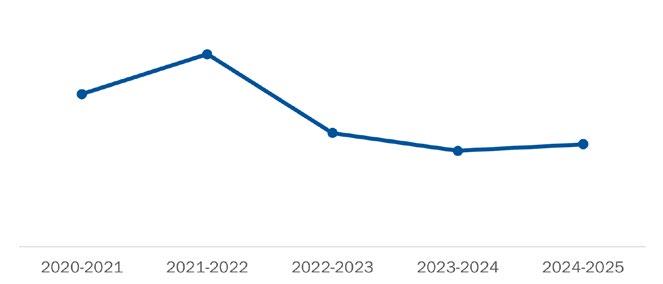
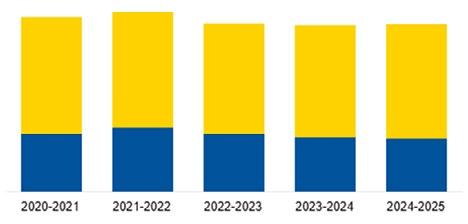
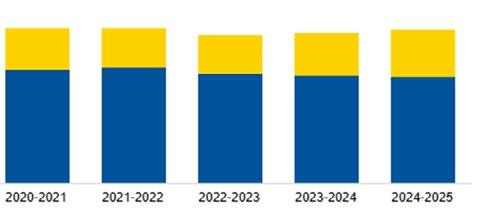
MSVU’s enrolment has fluctuated over the past five years. The peak enrolment years of 2020-2021 and 2021-2022 were followed by a general decline in overall enrolment numbers. The decline in enrolment is less significant when measured by full-time equivalencies (FTEs) than when measured by headcount. This situation is primarily due to the large number of part-time students at MSVU, who take fewer classes than full-time students each term. Enrolment varies by program and academic level, with undergraduate education (B.Ed.) and graduate education cohorts experiencing growth over the past five years. International student enrolment in undergraduate certificate and diploma programs increased significantly between 2020 and 2024, but these numbers are expected to decline with changes to Post Graduate Work Permit (PGWP) eligibility. Undergraduate enrolment has been declining since 2020, particularly amongst domestic students. Between 2020 and 2023, MSVU’s decline in domestic student enrolment was offset by an increase in international student enrolment. However, the recent Immigration, Refugees, and Citizenship Canada (IRCC) changes to study permit and immigration regulations have led to a decline in international student enrolment at MSVU, particularly in undergraduate and graduate professional studies programs.
The below data comes from the Association of Atlantic Universities’ (AAU) Surveys of Preliminary Enrolments.
Overall Enrolment at MSVU
Enrolment Targets
MSVU is committed to balanced and sustainable enrolment that recognizes current infrastructure and resources (human and financial) and the need for consistent and predictable enrolment. MSVU has many part-time students who choose MSVU because of its flexibility and commitment to an accessible education for students. This SEM plan considers the balance between part-time and full-time students, particularly when considering the number of students and the number of courses they take in terms of the resources required to provide these students with excellent academic and university experiences. Within this context, the SEM plan uses enrolment targets to guide initiatives and provide focus for the overall goals and tactics. Using the baseline enrolment of the 2024-2025 reporting year, the SEM plan establishes the following goals to be achieved between 2025 and 2030.
Strengthen domestic student enrolment
• Increase domestic student enrolment in undergraduate programs by 10%.
• Increase domestic student enrolment in graduate Professional Studies, Arts, and Science programs by 10%.
• Increase domestic student enrolment in the B.Ed. program by 5%.
Stabilize international student enrolment
• Aim for international student enrolment that comprises 20-25% of MSVU’s overall enrolment.
• Strive for diversity of geographic regions and international student programs of study.
• Recognize and manage risk if international student enrolment goes beyond 25% from one geographic region and/or if international students comprise more than 50% of any program’s enrolment.
Remove barriers to access, persistence, and retention
• Affirm MSVU’s core values of equity, diversity, inclusion, and accessibility (EDIA) and Truth and Reconciliation, including the commitment in the Strategic Plan to “be a national leader in the removal of systemic barriers to full participation in the university experience,” especially for students “from equity-denied groups, including persons with a physical, intellectual and/or learning disability, African-Nova Scotians, other racial minorities, Indigenous peoples, and 2SLGBTQIA+” students.
• Identify and remove barriers to access, persistence, and retention for equity-denied student groups, including groups identified in the Strategic Plan.
• Continue to support MSVU’s long-standing tradition of providing increased educational opportunities for women, first generation, mature, and transfer students.
Achieving Enrolment Targets through Recruitment & Retention
The SEM plan uses levers of enrolment such as retention and applicant-to-student conversion to achieve these enrolment targets. A key component of these levers is a commitment to removing barriers to access, persistence, and retention.
Conversion & Melt
• Increase the number of domestic undergraduate applicants converting to students to 75% (from 67%).
• Decrease the domestic undergraduate melt rate to 15% (from 27%).
• Increase the number of domestic graduate applicants converting to students to 85% (from 74%).
• Decrease the domestic graduate melt rate to 10% (from 19%).
Retention & Transition
• Increase undergraduate retention rate to 85% (from 79%).
• Increase first-year undergraduate retention rate to 80% (from 78%).
• Increase graduate retention rate to 90% (from 89%).
• Maintain B.Ed. retention rate of 95%.
Program Excellence and Development
• Support Deans, academic departments, and faculty in program development.
• Leverage program review process to support faculty-led program innovation and excellence.
Goal 1: Strengthen domestic student enrolment, stabilize international enrolment, and increase the diversity of the overall MSVU student body.
Strategy 1.1 Develop systems and processes to support balanced and sustainable enrolment across all academic levels (undergraduate, graduate, education).
i. Implement a new application portal to make the application process more efficient, data-informed, effective, and user-friendly.
ii. Develop and implement standardized and targeted outreach to accepted students.
iii. Integrate SEM-informed principles into academic planning, quality assurance processes, and the development of academic programs.
Strategy 1.2 Increase access and improve pathways to MSVU.
i. Review entrance requirements to identify barriers to access. Develop EDIA-informed strategies and alternate pathways for consideration by Senate.
ii. Increase investments to support pathway programming. Develop culturally responsive relationships with community groups to identify and implement potential pathways for students who have traditionally faced barriers to access.
iii. Strengthen relationships with existing articulation agreement partners. Increase the number of articulation agreements and diversity of partners across all undergraduate programs.
Strategy 1.3 Increase the diversity of MSVU’s student population.
i. Identify distribution of equity-denied student groups within and across academic departments. Examine what program features drive enrolment.
ii. Integrate focus on diversification for groups who have traditionally faced barriers to access, persistence, and retention into annual recruitment, conversion, and retention planning and efforts.
iii. Develop a long-term internationalization strategy in alignment with the priorities of the SEM plan.
Strategy 1.4 Align financial aid, financial practices, and scholarships with the financial realities of current and future MSVU students.
i. Evaluate alternate payment options for tuition such as payment plans and tuition predictability models. Identify and implement reasonable opportunities for change.
ii. Conduct an analysis of scholarship and bursary programs to evaluate their impact on recruitment, conversion, and retention at all academic levels (graduate, undergraduate, education).
iii. Evaluate how to expand entrance scholarship opportunities, including off-cycle entrance scholarships and increased entrance scholarship opportunities for transfer or mature undergraduate students, and funding opportunities for graduate students. Identify and implement reasonable opportunities for change.
iv. Increase student awareness of available financial resources by cataloguing available financial resources and developing associated education and outreach programs.
Strategy 1.5 Assess level of demand and identify approaches to increase awareness of MSVU’s academic programs.
i. Develop resources for graduate student recruitment, including an annual graduate recruitment plan.
ii. Develop standardized department home pages through the MSVU website that clearly communicate program offerings, career pathways, and key student benefits.
iii. Provide regular recruitment updates about potential student interests and program demand to Chairs, Directors, Coordinators, Deans, University Librarian, and Vice-Presidents.
iv. Develop and implement surveys to better understand applicants and their decisions to enrol at MSVU or decline admission.
v. Continue to support strategic recruitment efforts to anticipate and respond to priorities identified in the SEM plan.
Goal 2: Create a supportive environment that removes barriers and helps facilitate a smooth pathway for students from the beginning of their program through to completion.
Strategy 2.1 Develop student-centred and data-informed course scheduling practices.
i. Develop practices to encourage a shift away from iterative scheduling, such as providing information about student requirements and progression to Chairs, Directors, Coordinators, Deans, and University Librarian in time for them to be considered in departmental course scheduling decisions.
ii. Implement course scheduling software and/or a student planning module to assist in developing student-centred and data-informed scheduling.
iii. Establish a consistent, student-centred, equitable, and responsive waitlist management process and procedure.
Strategy 2.2 Develop a data-informed and student-centred approach to program progression and completion.
i. Implement a system that tracks students by start term and monitors their program progression. Provide this information to all Chairs, Directors, Coordinators, Deans, University Librarian, Vice-Presidents, and other relevant parties at the beginning of each term.
ii. Improve access to courses and program progression by making better use of flexible learning opportunities. Collaborate with academic departments and Academic Advisors to review and identify program areas where additional summer, and/or online course offerings would support students’ program progression.
iii. Increase access to course availability by making wider use of all timeslots on the timetable.
Strategy 2.3 Improve the educational outcomes and experiences of students who have traditionally faced barriers to access, persistence, and retention.
i. Collaborate with student groups, faculty, and student service providers to identify and address barriers to access, persistence, and retention, particularly for equity-denied groups.
ii. Develop a professional development series for faculty and staff focusing on EDIA and Truth and Reconciliation.
iii. Provide training for faculty in inclusive learning, including (but not limited to) the creation of an optional teaching certificate in inclusive learning.
iv. Increase the proportion of equity-denied students engaging in paid research, experiential learning, and work-integrated learning opportunities.
Strategy 2.4 Increase transition support for all students.
i. Develop and implement a university entrance survey for incoming students. Use the results of the survey to target and triage support and outreach.
ii. Improve collaboration between faculty and student service providers to identify areas where students require additional support. Identify and develop programming, services, and resources such as modules and workshops to address areas of concern and skills training.
iii. Develop engagement strategies with high school staff, guidance counsellors, and articulation agreement partner institutions to support student transition to MSVU.
Strategy 2.5 Increase flexible learning opportunities available to students at all academic levels.
i. Develop a system and consistent language to identify and track course delivery modes, online students, and part-time/full-time students.
ii. Conduct regular program completion audit exercises for all online programs and articulation agreements.
iii. Recognize and design the summer terms as an integrated part of the academic year. Adjust the add date to the first week of summer terms. Provide students access to the Summer I, Summer II, Fall, Winter (SSFW) timetable at the same time.
iv. Increase the number of online pathways to complete programs (e.g., majors, minors, certificates).
Strategy 2.6 Support students in their development of career readiness.
i. Systematically track alumni and gather information on how they are using their MSVU experiences. Provide annual updates on alumni outcomes to all relevant parties.
ii. Establish an alumni support network to encourage graduating students to take on active and engaged roles within their communities.
iii. Develop a process to identify career outcomes and career pathways stemming from all programs. Support academic departments in communicating this information through departmental websites.
iv. Consistently track experiential learning and work integrated learning opportunities across the university. Increase the number of programs providing experiential learning and work integrated learning opportunities for students.
Goal 3: Provide MSVU students with an engaging, consistent, and cohesive experience that meets their university-related needs in an accessible and culturally responsive environment.
Strategy 3.1 Create a student and campus engagement culture that is unique to MSVU.
i. Develop a student engagement strategy that outlines university-wide accountability and responsibility required to support student engagement.
ii. Engage with the Mount Saint Vincent University Students’ Union (MSVUSU) as a partner in the creation of a vibrant campus.
iii. Develop guidelines and best practices for student engagement that are shared regularly with all relevant parties.
Strategy 3.2 Improve internal communication with students.
i. Increase opportunities for meaningful consultation with students, including a standardized and coordinated bidirectional student feedback schedule and cycle.
ii. Develop a student communication strategy that coordinates communication for all non-academic departments and expands the form of communication beyond email.
iii. Provide regular updates to staff and faculty regarding student feedback and concerns.
Strategy 3.3 Improve the user experience of the MSVU website and utilize it more effectively as a communication tool.
i. Conduct a comprehensive website review. Identify resources and develop a schedule to implement recommended changes.
ii. Incorporate SEM perspectives into web development. Develop a website best practices checklist and review guidelines/template.
iii. Implement the practice of an annual website review at the departmental level.
iv. Research the option of improving the search function and/or incorporating chat options into the website. Identify and implement reasonable opportunities for change.
Strategy 3.4 Identify and address procedural barriers and systemic issues in student-facing processes.
i. Establish and implement a schedule and system for student-focused and EDIA-informed reviews of non-Senate policies and procedures affecting students.
ii. Develop feedback channels for students, staff, and faculty to identify recurring issues and/or areas of concern for students.
Strategy 3.5 Enhance student services to meet the university-related needs of MSVU’s students.
i. Explore the benefits and requirements of centralizing student services online and in person, with a view to providing students with a central hub or one-stop-shop.
ii. Collaborate with student groups to evaluate current services and identify changes and practices to better support students who have traditionally faced barriers to access, persistence, and retention.
iii. Increase the number of academic support and student services offering services outside of standard operating hours (e.g., open late at least one day per week).
Goal 4: Integrate SEM practices into MSVU’s culture and structure.
Strategy 4.1 Foster a SEM culture across MSVU that establishes awareness of and accountability for enrolment across the university.
i. Clarify responsibilities and assign university-wide accountability for enrolment and SEM plan implementation.
ii. Develop an organizational and committee structure that supports SEM initiatives, practices, and communication updates about SEM across MSVU.
iii. Develop a SEM training and professional development series to promote awareness of SEM at MSVU.
Strategy 4.2 Establish consistent data and reporting structures that enable effective and data-informed decision making.
i. Establish and implement clear, consistent, and shared enrolment data definitions.
ii. Develop a process and system to collect, evaluate, and efficiently analyse the data required to inform internal decisions and comply with government and external data-reporting requirements.
iii. Develop user-friendly, self-serve enrolment dashboards and an analytics site to assist relevant members of the MSVU community in interpreting enrolment trends and requirements for action.
iv. Establish a data governance system that identifies ownership of data, subject matter experts, and reporting structures.
v. Develop practices to identify data outcomes and metrics for all SEM-related projects and initiatives.
Strategy 4.3 Facilitate connections between departments and units to foster a cohesive and consistent student experience.
i. Establish and implement universal service guidelines and communication standards in all staff units.
ii. Develop an annual training program so faculty and staff can properly connect students with the revelant department, resources, and/or student services.
iii. Collaborate across departments and units to clearly identify roles, responsibilities, overlaps, and intersecting areas in terms of student processes and supports.
iv. Create a standardized onboarding program and orientation for all new faculty and staff. Include a formal onboarding process to introduce new employees to the rest of the university.
SEM Steering Committee
Dr. Emily Ballantyne, Acting Director, Teaching & Learning Centre
Dr. Antony Card, Dean of Education
Dr. Marisha Caswell, Senior Advisor, Strategic Enrolment Management
Dr. Carrie Dawson, Dean of Arts & Science
Dr. Lori Francis, Vice-President, Academic and Provost
Kelly Gallant, Associate Vice-President, University Relations (past member)
Stephanie Hale Wills, University Registrar
Dr. Keltie Jones, Associate Vice-President, Student Experience
Isabelle Nault, Vice-President, Administration
Dr. Karen Smyth, Director, Information Technology & Services
Dr. Susan Trenholm, Dean of Professional Studies and Graduate Studies
SEM Planning Committee
Dr. Emily Ballantyne, Acting Director, Teaching & Learning Centre
Amy Braye, Manager, International Education Centre
Dr. Marisha Caswell, Senior Advisor, Strategic Enrolment Management
Sharon Davis, Director of Finance & Administration
Randy Headley, Advisor, Black Student Support Office
Gloria Johnston, Manager, Accessibility Services
Jeremy Neilson, Manager, Student Recruitment
Erin Patrick, Manager, Advancement Services
Heather Standing, Associate Registrar, Systems
Erin Tomlinson, Manager, Centre for Academic Advising & Student Success
SEM Planning Process
MSVU’s Strategic Plan, Strength Through Community, identified the need to “Develop a strategic enrolment management plan and refine student processes to better meet the needs of students throughout their lifecycle from prospect to alumni” (Transformative Teaching and Learning, Strategy 2c). The Strategic Plan also identified developing and implementing a SEM plan as a strategy to achieve its theme of operational excellence and sustainability (Theme 7, Strategy 1a).
MSVU hired Academica to conduct an internal and external review to begin developing a SEM plan. Using the results of their findings, Academica wrote an Environmental Scan, an Assessment Report, and an Enrolment Funnel Analysis (all available on the intranet).
September 2023
December 2023 to April 2024
April 2024
May 2024
June to September 2024
Senior Advisor, Strategic Enrolment Management (MSVU staff contract position) hired to lead and oversee the development of MSVU’s SEM plan.
Senior Advisor, SEM conducted a series of community consultations to discuss SEM, areas of concern, and potential areas for focus for SEM plan development. Fourteen student focus groups and consultation sessions with 15 staff groups and 13 academic departments and committees were held. Results of these consultations are available in the Campus Feedback Report (available on the intranet).
Terms of Reference and membership finalized for SEM Steering Committee and SEM Planning Committee.
The planning phase of the SEM project started with a two-day planning workshop hosted by Academica. Members of the SEM Steering & Planning Committees, Department Chairs, Education Coordinators, Graduate Coordinators, Librarians, and members of CAPP, UCC, and GSPP* were invited to attend and contribute to the workshop sessions.
SEM Planning Committee used results of the planning workshop and additional documents to develop themes, guiding principles, and areas of focus for the SEM plan. SEM Planning Committee developed a series of challenge statements to structure further MSVU community participation in the SEM planning process.
August to December 2024
October to November 2024
SEM Steering Committee engaged in optimum enrolment planning exercises. Identified areas of priority and enrolment targets to structure the SEM plan.
SEM Planning Committee hosted three workshops where participants were invited to develop strategies, tactics, and solutions for the SEM challenge statements. Workshops were open to all MSVU staff and faculty. Those who could not attend workshops were invited to submit feedback separately. Ninety individuals (beyond the Steering and Planning Committee members) participated in the sessions, resulting in over 250 suggested strategies, tactics, and potential focus areas. A full list of suggested tactics and strategies is available on the intranet.
November 2024 to February 2025
February 2025
March to April 2025
April 2025 May 2025
June 2025
October 2025
SEM Planning Committee used material developed during strategy workshops and previous planning activities to develop a draft SEM plan and SEM plan framework. SEM Steering Committee reviewed and provided feedback on the draft plan and framework.
Nova Scotia provincial government identified the development of a Strategic Enrolment Management plan and SEM initiatives as key priorities in the bilateral funding agreement: MSVU’s provincial funding agreement from April 2025-March 2027.
SEM plan draft framework circulated for input from MSVU faculty and staff. In addition to the participants in the March Campus Exchange, 18 departments, units, groups, and committees and seven individuals provided feedback on the framework and its direction. Feedback was collected and used to inform revisions to SEM plan draft. A summary of the framework feedback and discussion of how it was addressed is available on the intranet.
SEM plan draft circulated as an information item, with request for feedback, to MSVU Senate Committees (CAPP, UCC, GSPP)*. Feedback was addressed during discussions and suggested changes incorporated into the SEM plan.
SEM plan draft submitted to Senate as an information item with request for feedback. Draft plan discussed at May 2025 Senate meeting. Senate feedback was incorporated into SEM plan.
SEM plan and planning process were discussed at the June 2025 Board of Governors meeting.
SEM Steering Committee endorsed the draft SEM plan and submitted to Executive Leadership Team for review and approval.
Executive Leadership Team approved SEM plan.
*Committee on Academic Policy & Planning (CAPP), Undergraduate Curriculum Committee (UCC), Graduate Studies Program & Policy Committee (GSPP).
Flexible learning opportunities
Full-time equivalencies (FTEs)
Melt rate Strategic Enrolment Management (SEM)
Strategic Enrolment Management (SEM) culture
Strategic Enrolment Management (SEM) plan
The rate of accepted applicants who confirm acceptance by paying their confirmation deposit. Confirmed students have a status of SR (Student Records), DA (Deposit Accepted), and DC (Deposit Conditional) in Colleague. Measured by using the following formula: deposits paid/offers of admissions.
Flexible learning means providing students with more choice in how and when they learn. This includes offering more online deliveries, including asynchronous learning, and more opportunities for blended and other non-traditional learning. Flexibility can also mean changes in the timing of deliveries, including more evening and weekend courses, and more summer offerings. It could also include the duration of learning, including more compressed offerings outside of the summer terms and longer offerings in the summer terms.
The overall headcount in relation to the number of courses taken by students. This number is reached by dividing billing units by 5.
The percentage of new students who pay their confirmation deposit and/or enrol in courses but do not attend MSVU. Measured using the following formula: (deposit paid-registered)/(deposit paid).
Strategic Enrolment Management (SEM) is a deliberate and targeted approach to enrolment that considers the whole of the institution and the overall student experience (inside and outside the classroom). SEM takes a student-centred approach that considers student progression from recruitment to completion and even engagement as alumni.
A SEM culture is one in which our decisions and daily practices reflect and align with the values embedded within the SEM plan. A SEM culture is student-centred, data-informed, EDIA-driven, and recognizes the interconnected nature of everything that is done at MSVU. SEM culture is about actions that embed these values into daily practices at MSVU. It is a way to guide our decisions, helping determine what we think about when we make decisions and evaluate their success.
A SEM plan identifies priorities and areas of focus to help direct resources in a way that has the most effective impact, while also helping us remain focused on what matters to MSVU and its mission.