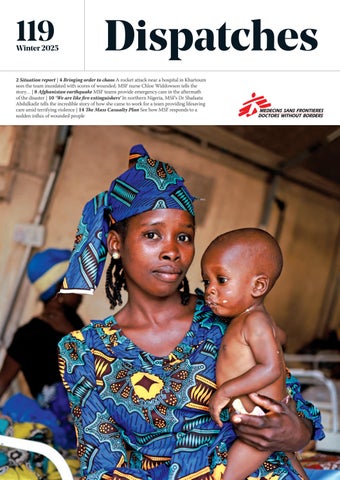
2 Situation report | 4 Bringing order to chaos A rocket attack near a hospital in Khartoum sees the team inundated with scores of wounded. MSF nurse Chloe Widdowson tells the story… | 8 Afghanistan earthquake MSF teams provide emergency care in the aftermath of the disaster | 10 ‘We are like fire extinguishers’ In northern Nigeria, MSF’s Dr Shafaatu Abdulkadir tells the incredible story of how she came to work for a team providing lifesaving care amid terrifying violence | 14 The Mass Casualty Plan See how MSF responds to a sudden influx of wounded people
SITUATION REPORT
1. BANGLADESH
MSF Nurse Zannatul Arafat prepares four-year-old Shofi for an operation to remove abscesses at the hospital in Kutupalong Refugee Camp in Bangladesh. With more than one million inhabitants, Kutupalong, located close to the border with Myanmar, is the world’s largest refugee camp, and is populated by Rohingya refugees who have fled violence and persecution in Myanmar. MSF is the leading provider of healthcare in the camp and offers emergency care for trauma patients, mental healthcare, sexual and reproductive healthcare, treatment for chronic diseases, and water and sanitation support.
8,500
Number of measles vaccinations for children provided by MSF in Musenyi camp, Burundi, between April and August 2025.
2. BURUNDI
Espérance is helped out of an MSF vehicle after giving birth in the Gihofi hospital. Since the beginning of 2025, tens of thousands of people have fled insecurity in the Democratic Republic of Congo’s east and sought refuge in neighbouring Burundi. Of these, over 17,000 have settled in the Musenyi refugee camp, where MSF runs vaccination campaigns, provides malaria treatment, and organises transport to and from the local hospital.
3. AFGHANISTAN
At MSF’s Kunduz Trauma Centre, Matiullah undergoes physiotherapy to regain mobility in his left leg following surgery for a motorcycle accident.
Three members of the Walid family play amid the ruins of a camp in Idlib province. Walid and his family left their small village in southern Aleppo in 2011 after the regime began bombing the area. Over the following 14 years, they moved at least seven times as deadly airstrikes followed them from village to village. When Walid and his family went back to their village after the fall of the Assad regime, they found empty ruins filled with the remains of mines left behind by the regime. In 2024, MSF conducted more than 1,134,400 outpatient consultations in Syria.
5. DEMOCRATIC REPUBLIC OF CONGO
MSF doctors perform surgery on a man with a gunshot wound in the Salama Clinic in Bunia, Ituri Province, where escalating violence is having a devastating impact on the population. Since mid-2023, MSF teams have performed more than 4,200 surgical procedures in the project.
16.7 MILLION
Number of Syrians requiring lifesaving aid, according to the UN.
GAZA UPDATE
MSF was forced to leave Gaza City on 24 September 2025 amid the intensified Israeli offensive in the city. Following the commencement of the ceasefire on 10 October, we have partially resumed our activities in the city.
On 15 October, we reopened our wound care clinic in Gaza City, and between then and 23 October, our teams treated more than 640 patients – the majority of them with traumarelated injuries. Many had been without access to proper wound care and dressings for weeks. MSF also continues to remotely support Al-Helou Maternity hospital and Al-Shifa hospital with medicines, supplies, and fuel.
At the beginning of September, we were forced to suspend activities at a healthcare centre in Sheikh Radwan. When our teams returned to the area in mid-October, they found the facility partially destroyed, leaving the community there without a crucial source of medical care.
As of 14 October, MSF has also resumed water trucking in Gaza City. For nine consecutive days, we provided between 90,000 and 180,000 litres of drinking water per day, across 14 distribution sites. We are currently assessing the possibility of further expanding these distributions, as more people return from the south and face limited access to safe water in Gaza City.
A rocket attack near a hospital in Khartoum sees the team inundated with scores of wounded people.
MSF nurse Chloe Widdowson tells the story…
Chloe Widdowson, MSF nurse
Let’s go! Let’s go!’
The explosion outside reverberates in my ears. You learn fast in Sudan – there’s never just one rocket. Another one is coming.
The walls of this room are not reinforced. I know because a stray bullet from outside hit a colleague in here last week. He survived – the bullet hit his arm. But the people I am with now are the hospital’s most senior staff. If the room gets hit by the next rocket, the hospital will not be able to function.
‘Let’s GO!’
In the corridor, we face a decision. The safe room is in one direction. The A&E is in the other. I hesitate. And then I think, ‘If I’m going to die, it’s going to bloody well be doing something I love.’
My Sudanese colleagues are clearly thinking the same. We run towards the A&E.
The hospital is in Omdurman, on the outskirts of Khartoum, the capital of Sudan. The people of Sudan have been living through a civil war for over two years. This is the biggest humanitarian crisis in the world: 13 million people have been displaced – roughly equivalent to the total population of Ireland, Scotland and Wales. There is famine in multiple areas of the country.
There is not enough humanitarian aid. Too few people know about the crisis, and too little is being done to alleviate people’s suffering and help them survive. MSF is one of the only organisations working in some areas – many others have left because of the violence or a lack of funding. The needs are huge. But there are Sudanese doctors and nurses who are trying to keep at least some of the hospitals open, despite the challenges.
MSF has been supporting this hospital with supplies and logistics, as well as training staff in emergency care, including mass casualty response and pain management for trauma injuries. Since I arrived in Omdurman, the sound of shelling has been so frequent that it feels like normal background noise – but it doesn’t usually get this close.
Just as we get to the A&E, the next rocket hits. I guess it was about 75 metres outside the hospital gates.
The A&E is in chaos. Everyone knows it’s a ‘safe zone’ because of the double-concrete thickness of the walls, and so people have rushed in from the street for cover. It’s so crowded it’s hard to move. Patients on the floor. And more and more people running in with the injured and the fatalities.
A ‘mass casualty incident’ is any situation where the capacity of emergency workers to respond is outstripped by the sheer number of people needing care. This is definitely the case now.
Emotions are running high among the crowd. Among everyone. Are hospitals a target now? Is MSF? We can’t ask people to leave because there’s a very real risk that there will be another explosion. But there are critically injured patients in the room, and the medical teams need space.
Remembering their training, the hospital volunteers start to help with crowd control. They move people into the corridors and stairwells. But people who have come in with an injured loved one don’t want to leave them. Levels of distress are really high.
Eventually people do shift. It’s not ideal but it’s better. Meanwhile the senior staff I was in the meeting with are around me, treating
MSF anaesthetist
Nora Zergi prepares a patient for surgery to extract a bullet at Bashair Hospital, Khartoum.
patients. I take a breath to think about how I can be most useful – I don’t want to disrupt the established way of working in an emergency. This is one of only two A&E departments still functioning in Omdurman: the staff have seen many more incidents like this than I have. The best thing I can do is to support the care they’re providing.
One of the first principles of emergency trauma care is protecting the airway. As patients are being rushed in by bystanders they are being laid on their backs wherever there is space. So I help with that, checking first to see if they have a spinal injury that prevents them being moved to a position that will reduce the risk of choking on blood or vomit.
I assist with infection prevention and control. I run for medications and other supplies.
There are multiple patients in every bed. At one, people are crowded around as the team performs CPR on a child. The man next to the child is haemorrhaging. There is blood bubbling from his mouth, but he is alive and breathing, and the child is not.
Gently I let them know that it’s time to stop trying to resuscitate this child, whose injuries are not compatible with life. All of them know
it already, but for reasons of culture and simply because it is a child, it is difficult for them to make the call. So, this becomes another way I can help, by being the outside voice that can say, ’This is not going to work. We need to stop now because the patient next to him still has a chance, and we have to take it or they’ll both die.’ It’s hard. But later that week, when I look for the man’s name on the list of the dead, it isn’t there. He survived.
Hours after the explosion, the team is still working. In the early days of the conflict, many people who had the means to leave Sudan did so, trying to get their families to safety. But this means that many of the medical team who remain are new graduates, rushed through the last parts of their training so they can offer desperately needed care.
Everyone who works at the hospital is so tired, not just after this incident, but generally. They have lived through two years of war. Everyone knows someone who has been displaced or injured or killed. But they are still turning up to do this very hard job, and they’re still making every effort to give good-quality care in really difficult circumstances.
In the days after this incident, we review everything, looking for the learnings, for ways to make things easier, quicker, for changes that could help to save more lives in future. Back in the meeting room, I go back to the presentation I was giving when the first rocket hit. The slide I didn’t get to show: ’What if there’s a mass casualty event at the hospital itself?’
Things still feel raw, but together we go through the process. The team revise the plan, suggest improvements, and ensure that if another hit comes, they will be ready.”
FIND OUT MORE AT MSF.ORG.UK/SUDAN
As the crisis in Sudan worsens, your support enables our teams to continue providing lifesaving medical care in desperate circumstances.
£65
can pay for three manual resuscitators used by medical teams to deliver oxygen to patients in respiratory distress.
£570
can pay for a surgeon to spend one week working in an MSF project.
Thank you. We couldn’t do it without you.
AFGHANISTAN
PHOTOGRAPHY
TASAL KHOGYANI
ALEXANDRE MARCOU
MSF
n 31 August 2025 an earthquake struck eastern Afghanistan, close to the border with Pakistan. More than 2,200 people were killed and approximately 3,600 injured. Entire villages were reduced to rubble, with many people trapped in collapsed structures.
MSF rapidly deployed an emergency team to Nangahar and Kunar provinces.
“Because of the terrain, many of the villages were not easy to access,” says MSF water and sanitation specialist Ihsanullah Noori. “Most of the people are trying to come out of the valleys and their villages to get access to basics. The people here are still traumatised. They have lost their homes and their farms.”
Zerai Baba and Patang displacement camps are located in Nurgal district, Kunar province. In Patang camp, around 1,000 displaced families were relocated after they lost their homes during the earthquake.
Within days, MSF had opened a clinic in a camp in Patang to provide outpatient care, including wound dressing and vaccination.
“The needs are very high,” says MSF emergency medical coordinator Marta Maziek. “Each day, we are seeing between 200 and 300 people. The main conditions we’re treating are infected wounds, respiratory tract infections and diarrhoea due to the living conditions.”
MSF water and sanitation teams have installed ten latrines and distributed ten small water tanks with around 3,000 litres capacity each to the displaced population in Zerai Baba camp. As more people arrived, it was vital that proper water and sanitation systems were installed to avoid the spread of diseases such as malaria, acute watery diarrhoea and respiratory infections.
Mohammad travelled to the clinic with his family following the earthquake. “We have been running around, overwhelmed by the heat. We have not been able to sleep, we are exhausted.”
EARTHQUAKE
Thank you. It’s your support that enables us to rapidly provide lifesaving medical and humanitarian care in the aftermath of natural disasters.
Thank you. We couldn’t do it without you.
can pay for two waterproof familysized tents to provide shelter to families in the aftermath of disasters and other crises.
In northern Nigeria, MSF’s Emergency Response Team works to provide lifesaving care amid rising levels of malnutrition and terrifying violence. The team’s medical activity manager, Dr Shafaatu Abdulkadir, tells the incredible story of how she came to join this frontline team.
Dr Shafaatu Abdulkadir, Medical activity manager
When people ask me what the Nigeria Emergency Response Team (NIMERT) does, I tell them we’re like fire extinguishers.
Wherever emergencies flare up, whether it’s an outbreak of measles or cholera, people displaced by floods or children weakened by malnutrition, we try to get there quickly and put the flames out.
How quickly you respond to an outbreak can make all the difference. It’s like you have an hourglass and the sand is moving, but it’s moving very fast. A lot of things are happening within that time, and if you don’t intervene early enough, the damage becomes so large that it gets beyond your scope to deal with.
For example, when there is flooding, you need to respond quickly and provide clean water and latrines. If you don’t do that, there is a risk that cholera will break out as all the water sources become contaminated. These things sound like little things, but within a couple of days of people taking water from a contaminated source, you can have a disease that spreads very quickly. It just takes one person to go down with it, and it will spread across the board.
The job is intense. On the same day we arrive, we assess the situation, develop a plan and begin implementing it immediately. That could mean shipping medicines, deploying vaccines or bringing water and sanitation support – whatever’s needed most.
The security situation here in northern Nigeria is heartbreaking and it’s not getting any better. Some days seem calm, but it’s never really calm. It’s more of a pause before the next terrible thing. In the northeast and northwest, malnutrition is on the rise. Farmers can’t plant crops because stepping into their fields means risking being shot, robbed or kidnapped. Women risk being raped simply by leaving their homes. Families live in constant fear, and the
A group of men wait to donate blood at Jahun General Hospital. Most of the blood donors are relatives of the women and babies being treated for maternal and neonatal complications. Photograph
psychological toll is crushing. How many children have been orphaned? How many women widowed? How many lives cut short for no reason at all?
There is one experience that really broke me for a long time. There was a father who ran a small shop, selling cold water and cigarettes, and he was working with his young son when two armed men arrived. They asked for a brand of cigarette he didn’t have. Because he didn’t have that brand, they shot him and his son multiple times. His son died instantly. The father was brought to our clinic, bleeding and broken, his only words to ask for his boy. But how do you tell a father his child is gone?
This violence makes no sense, and there is such disregard for life. It’s multiplying like a hydra, with every head cut down replaced by two more. I’ve treated children starving from hunger, women traumatised by rape and patients riddled with bullets. The weight of it never leaves you. I stopped watching the news because what I see at first hand is more than enough.
And yet there is still hope. When violence happens, when Pandora’s box is opened, the last thing left at the bottom is a sense of hope. For people who have suffered, to see that someone is there for them, to know that someone else cares,
that little bit of hope that makes them want to see the next day is so important. Imagine if MSF wasn’t in any of these locations. The level of hope would be zero. The will to live, to carry on, would be so very low.
I was in medical school in the north when the violence really started. I had near-death experiences. I had bombs exploding and making me deaf for a long time. I managed patients on hospital floors.
In those situations, you had to learn fast. If you’re assigned to the emergency room, you’re no longer a student. When a mass casualty incident occurs, anybody with medical knowledge is on the frontline. People need you, and your doubts and fears are no longer a priority.
None of us who went to medical school in that place at that time were ever the same again. Those of us who survived, anyway.
Living through that changes your perception. It makes you either want to help humanity or to give up on it. I’m lucky, because it pushed me to help and want to make a difference, no matter how small that difference may be.
Before those experiences in medical school, I had other plans. I was going to be a surgeon. I even passed the exams after medical school and got into the programme. But after what I’d been through, it didn’t feel right in my soul. I had a conversation with my parents, who are not very emotional, and my father calmly said to me, ‘You are not in the right place.’
That was how I came to apply for MSF. I got the job, and within a month, I felt so good, so happy, like I was where I was supposed to be. For me, it’s not just a job or a way to earn a living. It’s who I am. Yes, I am breaking expectations. I am a woman, unmarried, childless, from the north, but I’m where I am supposed to be.
‘People need you, and your doubts and fears are no longer a priority...’
In this work, we deal a lot with numbers. However, I don’t always want to discuss numbers, because people are more than just numbers. Being a doctor here means I can’t look at data without feeling it.
Not long ago, a little girl was brought into the emergency room when I was on the night shift. She was malnourished, severely anaemic and her body was in shock. Her mother had already lost three children, and you could tell she had given up hope.
But we weren’t ready to give up. We fought. We searched desperately for a vein in the girl’s head, arms, or anywhere else. Nothing. Finally, blood came from the hospital bank, and we transfused. She held on.
Day after day, I checked in. Even at home, I would call the night shift, begging for updates: ‘How is she? Is she still with us?’ We kept treating her.
The days blurred into weeks as we treated her for malnutrition, trying everything for diarrhoea that refused to respond, adjusting and adapting. Slowly, she began to change. Her skin healed, her eyes opened, and she began to sit up and feed herself. And then the wonderful day comes
when you can write in the notes: Everything normal. Discharge home. Follow up in one week.
The day she was discharged, her mother waited for me. The way she hugged me! She wouldn’t let go, and we both couldn’t stop crying.
I felt like a rock star when that happened, like there was a party going on inside me. No money can buy that.
What would I say to someone to encourage them to donate to MSF? I would ask them to imagine how they would feel if it were their child going hungry, or their family dying for lack of medicine or clean water. Imagine living like that every day, when even the basics of survival are luxuries. And then imagine someone showing up with food, with medicine, with hope. You would never forget them. You would feel love, because being cared for, not being abandoned, is everything. Giving what you can means that someone has a hot meal, someone has medication, somebody’s child is saved. I was brought up to believe that if you save one life, you’ve done something to save every life on the planet. It’s what I believe and it’s why I work for MSF.”
THE MASS CASUALTY PLAN
When an attack, an explosion or an earthquake occurs, how do MSF teams cope with a sudden influx of wounded people?
As large numbers of injuries and fatalities can easily overwhelm hospital teams, MSF has developed emergency protocols and plans that can be rapidly implemented in the event of a mass casualty incident, enabling the management and treatment of the largest number of patients. Together these form the Mass Casualty Plan.
1.INCIDENT OCCURS
A series of explosions occur in a market a few miles from the hospital. Scores of wounded are carried and transported on trucks and in vehicles to the hospital. For the MSF team, the sudden arrival of patients at the hospital may be the only indication that a mass casualty incident has occurred.
2. HOSPITAL ALERTED
The hospital director initiates the Mass Casualty Plan and a siren sounds to alert hospital staff, who have rehearsed the procedures during regular training sessions.
3. HOSPITAL IS CLEARED
The hospital is cleared of patients who are well enough to leave, and as many beds as possible are made available.
4. ZONES SET UP
Staff interrupt their routine work and proceed to their assigned posts. Casualties will be dispatched to one of four zones – green, yellow, red or black, depending on their condition. In each zone, beds and medical supplies are prepared and sufficient staff mobilised.
5. ENTRANCES CLOSED
All entrances to the hospital are closed, except one, which will serve as a first filter. To prevent chaotic overcrowding, no more than one person is allowed to accompany a patient into the hospital.
6. TRIAGE
Doctors rapidly assess each patient and assign them a colour using several criteria.
7. ALLOCATION
Hospital porters take the patients to their designated zones. In the red zone, emergency room doctors stabilise patients, and surgeons decide who requires surgery and in what order.
Green: If the patient can walk and has no worrying injuries or symptoms, they are assigned to the green zone. This is the least urgent category, and their treatment can wait.
Red: If the patient has worrying injuries or symptoms, including signs of neurological, respiratory or cardiovascular distress, they are assigned to the red zone for patients requiring priority treatment.
Black: If the patient is not breathing, or if the doctor judges that the hospital does not have the necessary resources to save their life, they are assigned to the black zone – by far the most challenging decision for a doctor to make. These patients will receive palliative care.
Yellow: All other patients are assigned to the yellow zone, where they are monitored and may wait up to an hour for treatment.
Cleaners are assigned to different zones to disinfect beds that have been cleared.
Medical staff not involved in triage or surgery are allocated to one of the four zones.
Administrative staff assist with crowd control and communication.
Afghanistan: Elizabeth Wait, Activity manager; Prudence Jarrett, Medical activity manager; Melody CubaBabasassa, Nursing activity manager
Bangladesh: Orla Murphy, Head of mission; Georgia Hales, Water & sanitation manager
Central African Republic: Kamal Berechid, Anaesthetist
Chad: Alice Maclennan, Logistics manager
Democratic Republic of Congo: Joseph Mannion, Medical activity manager
Ethiopia: John Canty, Deputy head of mission
France: Luca Alvarez Marron, Head nurse
Haiti: Laura Holland, Water & sanitation coordinator; Elizabeth Lewis, Humanitarian affairs manager; Oliver Steighardt, Nursing activity manager
India: Jenna Darler, Humanitarian affairs officer; Declan Crilly, Doctor; Rowena Neville, Medical team leader
Iraq: Zahra Legris, Psychiatrist
Jordan: Laurence Boobier, Logistician
Kenya: Paul Banks, Procurement manager; Orla Sheridan, GIS coordinator
Lebanon: Fiona Mitchell, Doctor
Malawi: Caoimhe O’Regan, Epidemiologist
Nigeria: Jean Marie Majoro, Deputy head of mission; Abdirashid Bulhan, Water & sanitation coordinator; Charlie Kerr, Logistician
Palestine: Helen OttensPatterson, Head of mission; Andrew StevensCox, Logistician; Milena Beauvallet, HR and finance coordinator; Zoe Bennell, Communications manager
Papua New Guinea: Clare Atterton, Medical team leader; Melissa Buxton, Nurse
Serbia: Joan Hargan, Medical team leader
Sierra Leone: Pauline Lynch, Gynaecologist
South Sudan: Benjamin Greenacre, Humanitarian affairs manager; Caroline Jones, Medical activity manager; Aliisha Mariam Karimi, Anaesthetist
Sudan: Nicodeme Zirora, Deputy finance coordinator; Heidi Sawares; Pharmacist; Thomas Mitchell, Gynaecologist; Dimitrinka Tomova, Nursing activity manager; Sara Cronin, HR and finance manager
Médecins Sans Frontières/Doctors Without Borders (MSF) is a leading independent humanitarian organisation for emergency medical aid. In more than 70 countries worldwide, MSF provides relief to the victims of war, natural disasters and epidemics, irrespective of race, religion, gender or political affiliation. MSF was awarded the 1999 Nobel Peace Prize.
TEL 020 7404 6600
ADDRESS Médecins Sans Frontières/ Doctors Without Borders (MSF UK) Level 5, Unit 12–13, 9 Prescot Street, London E1 8PR, United Kingdom
Charity Registration Number 1026588
ABOUT
Dispatches is written by MSF staff and sent out quarterly to our supporters to keep you informed about our medical work around the world, all of which is funded by you. Dispatches gives our patients and staff a platform to speak out about the conflicts, emergencies and epidemics in which MSF works. It costs £0.72 to produce, package and send using the cheapest form of post. It is an important source of income for MSF and raises three times what it costs to produce. We always welcome your feedback. Please contact us using the methods listed, or email: dispatches.uk@london.msf.org
SIGN UP TO EMAIL
Get the latest MSF news delivered to your inbox. Sign up at msf.org.uk/signup
MAKE A DONATION
You can donate by phone, online or by post. If possible please quote your supporter number (located on the top left-hand side of the letter) and name and address.
LEAVING A GIFT IN YOUR WILL
Have you thought of remembering MSF in your will? Any gift is welcome, however large or small. For more information, email legacies@london.msf.org or call us on 020 7404 6600
CHANGING YOUR ADDRESS
Please call 020 7404 6600 or email: uk.fundraising@london.msf.org
CHANGING A REGULAR GIFT
To increase or decrease your regular gift, please call us on 020 7404 6600 or email: uk.fundraising@london.msf.org with your request. Please also get in touch if your bank details have changed.
If you would like to stop receiving communications from us, please contact our Supporter Care team on 020 7404 6600 or email uk.fundraising@london.msf.org and we’ll be happy to help. Thank you for your support.