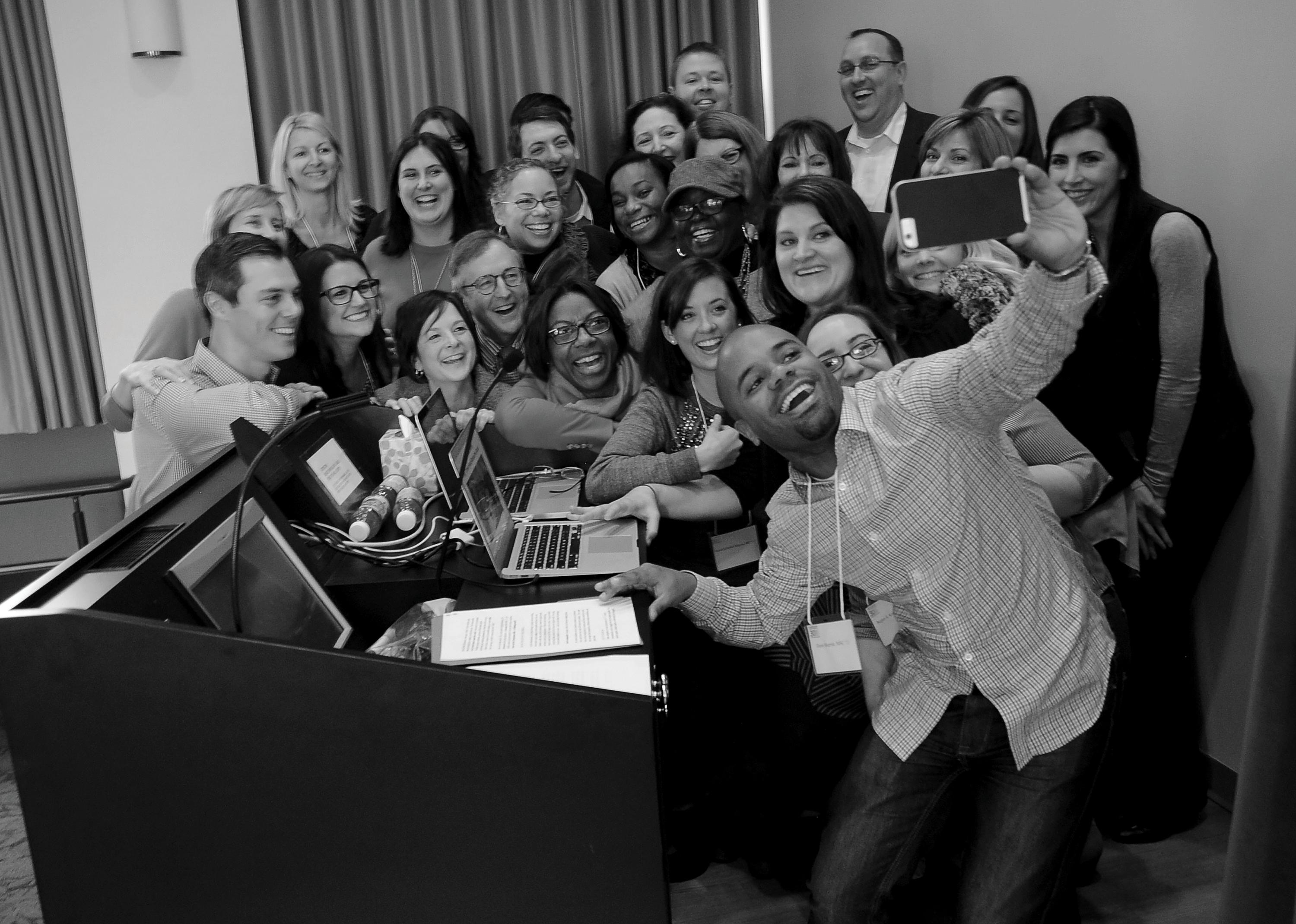
Welcome to Northwestern University’s Master of Science in Communication program. With focus and effort, this new chapter of your personal and professional development will prove to be a rewarding time of your life.
One of the best parts of MSC is that it is comprised of an accomplished student body. Your cohort is an informed, value-conscious group of individuals representing a range of world views, sectors, industries, and interests—who also share the goal to make our communities better. As an MSC student, you are joining these scholars—soon to become partners, colleagues and friends—committed to tackling communication management challenges in the United States and globally. Upon graduation, you’ll leave with your graduate degree and access to a vast Northwestern family with networks all over the world.
This curriculum guide serves as a holistic view of the MSC program. Here, you’ll find a description of what you’ll learn (and how you’ll learn it), the courses taught by world-renowned faculty and industry experts, and our robust suite of co-curricular offerings. Keep this guide close as you select classes, enroll in enrichment workshops, and (often) check important dates and timelines.
Finally, as you begin this accelerated adventure, I encourage you to regularly slow down. This is your time. Say no to external offers for one year so that you can enjoy the opportunities here. And remember: my door is always open should you need academic guidance or even just want to chat. We can’t wait to start learning with you—and from you.
Sincerely,
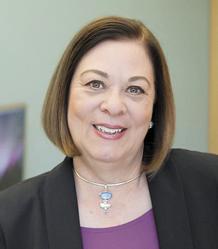
Anne Marie Adams, PhD Director of MSC Administration & Academic Affairs
CORE CURRICULAR THEMES
MSC CORE CURRICULAR THEMES
The MSC program is based on three core curricular themes, reflected in every course we offer, every program we host, and in the skills and principles our students master throughout the program.
Managing
Complexity
Today’s business landscape rewards individuals who respond to and embrace complexity. Our program offers instruction in auditing and assessing complex organizational environments to achieve communication goals. Students are trained to analyze and leverage networks and utilize new open technologies and systems to innovate, engage stakeholders, and respond to organizational crises.
Collaboration is at the core of great leadership. We believe that collaboratively leading teams across disciplines, distances, and sectors is critical in addressing today’s complex challenges. Our experiential curriculum teaches students about building professional relationships, decision-making through appraising team needs, managing collective technologies, and facilitating group interaction.
Elegant
Communication
Elegant communication is the most sought after competency in the workplace today. Our program cultivates leaders who are masters of communication: able to critically analyze, create, and deliver sophisticated messaging geared to one’s audience, purpose, and context. Students leave with a deeper understanding of strategic communication planning.
The MSC program believes that to master the art of communication, one must produce elegant communication.
Elegant Communication
How do we ensure our students gain a solid understanding of these core curricular themes? In the way our students engage with knowledge:
CONCEPTUAL KNOWLEDGE is synthesizing, alongside our expert faculty, decades of concepts and theories within the interdisciplinary field of communication. These ideas are transmitted through lectures, readings, and activities, giving students the confidence to make decisions and lead others.
APPLIED KNOWLEDGE is the comprehensive study of how concepts and theories are applied in the real world. Students read case studies and share professional experience with classmates, while faculty share their consulting stories and experiences.
PRODUCED KNOWLEDGE is the heart of our program. In each course and in the Capstone Project, students demonstrate advanced understanding of both conceptual and applied knowledge by showcasing their own knowledge and skills in their work and interactions with each other.
DEGREE CONCENTRATIONS
DEGREE CONCENTRATIONS
All MSC students who successfully complete the required coursework earn a MS in Communication diploma from the Northwestern University School of Communication.
In the MSC program, you also have an opportunity to choose a concentration – or area of expertise or a specialty - that will appear on your transcript.
A graduate concentration constitutes a coherent program of study requiring additional breadth or considerable depth of knowledge. With a specialized concentration,
you'll gain graduate level training related to your professional interests and develop competency in a particular area of communication studies to sharpen your focus and apply the knowledge to your daily work.
develop competency in a particular area of communication studies to sharpen your focus and apply the knowledge to your daily work.
Details on MSC Concentrations:
The Organizational Leadership Concentration focuses on the core curriculum themes of collaborative leadership and managing complexity. Students who complete this specialization develop more in-depth knowledge and skills necessary to be highly e ective leaders and managers within an organization.
The Strategic Communication Concentration focuses on the core curriculum themes of managing complexity and elegant communication. Students who complete this specialization develop more in-depth knowledge and skills necessary to be highly interactive communicators to diverse audiences within and without an organization.
The Strategic Communication and Organizational Leadership Double Concentration focuses on core curricular themes of managing complexity, collaborative leadership and elegant communication. Students who complete this option specialize in both Organizational Leadership and Strategic Communication (see notes above).
How to choose a pathway to an MSC Concentration:
Like declaring a minor, MSC o ers several pathways for declaring a degree concentration.
Complete three or more electives in the Organizational Leadership pathway and your nal transcript will state that you have earned an MS in Communication with a concentration in Organizational Leadership.
Complete three or more electives in the Strategic Communication pathway and your nal transcript will state that you have earned an MS in Communication with a concentration in Strategic Communication.
Complete three electives in the Strategic Communication pathway and three electives in the Organizational Leadership pathway and your nal transcript will state that you have earned an MS in Communication with a double concentration in Strategic Communication and Organizational Leadership.
MSC CUSTOM LEADERSHIP PROGRAMMING
(CLP) Concentration Offerings
Digital Storytelling
Brand Management
Persuasive Message Design
Power in Organizations
Design Thinking and Innovation
Digital Media Planning
Persuasive Video Storytelling
Visual Communication
Using Data to Make Informed Decisions
Leadership, Media & Strategy
Leading with AI
Crisis Communication
Socially Responsible
Communication
Content and In uencer Marketing
Generative AI & the Media
Social Media Listening
Communication & Decision-Making
Social Media & Organizations
Executive Presence & Performance: Adaptive Delivery for Business, Media & Strategy
Public Persuasion
LEARNING OUTCOMES
WHAT YOU’LL LEARN & HOW YOU’LL LEARN IT.
Studies show that students learn more effectively when they understand the purpose of their classes and the connection between the degree and course objectives.
MSC created a framework to assess student learning and enhance their educational experience. These Learning Outcomes and Dispositions were developed by the program Faculty Director, the Director of Curriculum, and the MSC Faculty and Industry Leaders Advisory Board.
MSC Learning Outcomes and Dispositions identify how our interdisciplinary study of communication is relevant to the school, students, and employers. In addition, they offer a tangible description of what a Northwestern University MSC graduate knows, believes, values, and has the ability to do.
LEARNING OUTCOMES
L1 L2
Articulate connections between the interdisciplinary field of communication and the central curriculum themes of the MSC program.
CRITIQUE AND IDENTIFY the major theories and trends in Strategic and Organizational Communication, Group and Team Communication, Persuasion Theory, and Media and Technology Studies from the program’s central thematic perspectives.
ELUCIDATE SIGNIFICANT CHALLENGES involved in practicing the core curricular themes, and analyze and explore the leading edges of current limits of theory, knowledge, & practice.
Demonstrate the ability to assess complex organizational environments and achieve communication goals.
CONDUCT STAKEHOLDER ANALYSIS to determine the urgency, legitimacy, and power of stakeholder groups.
EVALUATE what expertise, across disciplines, is necessary to address complex problems & identify strategies to engage experts in diverse disciplines.
IDENTIFY STRATEGIES to capitalize on open organization trends, including two-way communication with external stakeholders and the use of crowd-based and open technology systems.
UTILIZE authentic crisis communication strategies, addressing both internal and external stakeholder concerns.
L3 L4 LEARNING OUTCOMES
Critically analyze messages.
ARTICULATE characteristics of mediated and non-mediated messages.
MEASURE the complexity and influence of messages before they are delivered to the intended audience.
FORMULATE an evaluation plan to assess the processes and outcomes of communication.
DRAW evidence-based conclusions and make a call for action.
L5 L6
Create and deliver elegant messages appropriate to audience, purpose, and context.
ENGAGE in active listening.
EFFECTIVELY give and receive feedback.
SELECT creative, appropriate modalities & technologies to accomplish communicative goals.
ADAPT messages to the diverse needs of individuals, groups, and contexts, and adjust messages while in the process of communicating.
PERFORM written, verbal, and nonverbal behaviors that illustrate elegant communication.
UNDERSTAND and engage organizational and social networks to deliver the right message to the right audience in the right context.
DISPOSITIONS
MSC Dispositions are designed to produce socially conscious, culturally aware, ethical leaders who will:
ESTABLISH AND REFINE intrapersonal dispositions* such as: self-awareness, self-regulation, self-confidence, commitment, motivation, enthusiasm, empathy, humility, cultural intelligence, emotional intelligence, decisiveness, courage, poise, and integrity.
ESTABLISH A MINDSET that leaders can—and should—engage in complex issues as a framework for building interdisciplinary networks and employ collaborative leadership skills to move knowledge to action.
Utilize communication to embrace complexity and difference.
RESPECT diversity in all its forms and the ways it influences communication.
ARTICULATE one’s own cultural standpoint and commit to the continual study of how it affects communication.
UNDERSTAND and value human diversity and inclusive practices as a central element in communication.
RECOGNIZE the complexity of diversity and difference, and the ways they influence communication.
ADAPT one’s communication in diverse cultural contexts.
D3 D4
Choose to communicate with ethical intention and evaluate the virtuous elements of any communication situation.
EXPLAIN the relevance of various ethical perspectives.
IDENTIFY one’s own ethical perspectives.
PROPOSE solutions for unethical communication.
Be equipped to influence change.
RECOGNIZE the collaborative nature of creating lasting change.
INFLUENCE the larger political, social, economic, legal, and cultural contexts by building relationships and mobilizing others.
WELCOME AND CREATE opportunities to act as a change agent by planning and evaluating, exercising power and influence, mobilizing community resources, resolving ambiguity, and taking responsibility.
NOTABLE leadership scholars
TH EO RI ST
Burns (1978)
Bass (1985)
House (1992)
Avolio & Yammarino (2002)
Popper (2005)
Northouse (2008)
Groves & LaRocca (2011)
Collison (1999)
D ottin (2010)
Koeppen & Jenkins (2007)
Karges-Bone & Griffin (2009)
Johnson, Almericho, Henriot, & Shapiro (2011)
Leith & Jantazi (1990)
Phillips (1992)
Matusak (1997)
Collins (2001)
Batstone (2003)
Hagan (2004)
Marzano, Waters, & McNulty (2005)
Wasicsko (2007)
Godzyk (2008)
Helm (2007), (2010)
Ruggieri (2009)
Hacket & Hartman (2011)
Hargis, Watt, & Piotrowski (2011)
DI SP OSITIO N
Morals and values
Values
Self-confidence and charisma
Morals and ethics
Empathy
Values and ideals
Ethics, values, and principled leadership
Compassion and creativity
Reflective, caring, passionate, open-minded
Thoughtfulness and reflective
Compassion, fairness, integrity
Values and attitudes
Moral leadership
Humility and morals
Spirituality
Humility
Spirituality
Trustworthy
Idealized influence
Honesty and people-focused
Humility and critical thinking
Caring , work ethic, humility, honesty, and fair
Team-centered
Emotional intelligence and competency
Team-centered and building capacity
COURSES
OUR COURSES, YOUR CHOICES.
Our courses, taught by WORLD RENOWNED FACULTY & LEADING INDUSTRY EXPERTS, represent a range of subjects and specialties—so that each student finds classes appropriate for their own interests, talents, and learning experience.
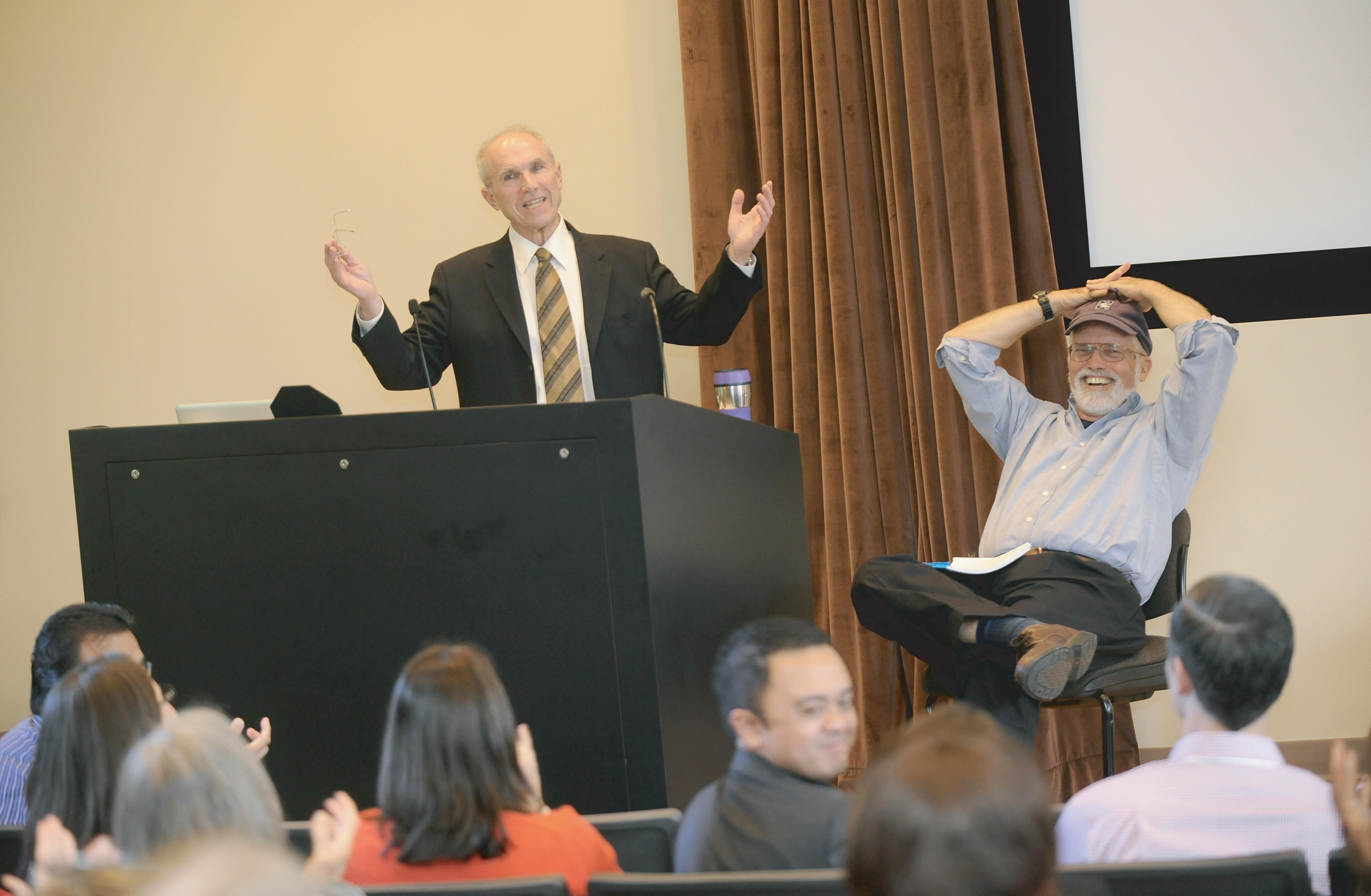
MSC Co-Founders Irving J. Rein, PhD (left) and Paul Arntson, PhD (right)
MSC CUSTOM LEADERSHIP PROGRAM (CLP) FALL COURSE
CORE
LEADING COLLABORATION - MSC 540 (1 CREDIT)
INSTRUCTOR: LESLIE DECHURCH, PHD
This action-oriented course builds participants’ collaborative leadership skills. Through a series of case studies, activities, and projects, students learn how to e ectively lead diverse and often distributed teams. The course explores the speci c challenges associated with leading teams, some of which include building and designing teams, managing information exchange within and across teams, structuring e ective group decision processes, igniting creative thinking, enabling complex problem solving, and managing team con ict.
PROFESSIONAL DEVELOPMENT PRACTICUM - MSC 549A (CONTINUING CREDIT)
The Professional Development Practicum provides the opportunity for students to gain familiarity and expertise with a wide range of communication topics, practices, technologies, and trends that inform the practice of communication. Students will participate in quarterly workshops taught by subject matter experts and complete assignments that integrate gained knowledge and skills with their professional goals and career pathways.
ELECTIVES
SPECIAL TOPICS: DIGITAL STORYTELLING - MSC 529 (1 CREDIT)
INSTRUCTOR: ANAS GHAZI, MSC
CONCENTRATION: STRATEGIC COMMUNICATION
This course takes an integrated approach to digital storytelling connecting the disciplines of data-driven insights and strategy, omni channel media buying, in uencer marketing, and e-commerce to create and amplify behavior changing stories across mediums. Taught from a theory-connected-to-practicum perspective, students will learn how to develop and deploy compelling global stories supported by a permutation of readings, in-class activities, trainings, and perspectives shared by a roster of industry leaders. Coming out of the course, students will have practical knowledge and tools they can apply for a career in the digital marketing and communication industry.
SPECIAL TOPICS: POWER IN ORGANIZATIONS - MSC 529 (1 CREDIT)
INSTRUCTOR: RICHARD GEORGE MARTIN JOLLY, MBA
CONCENTRATION: ORGANIZATIONAL LEADERSHP
Power, status, and in uence are topics that make many people a little uncomfortable. However, their existence permeates all aspects of organizational and social life. Power and in uence are the key mechanisms by which things get done. We have a good understanding of the rules that determine who gets to positions of power and of the tactics necessary to exercise power with integrity. This course is designed to familiarize students with concepts useful for understanding power and in uence, and to provide them with tools to analyze power dynamics in organizations. More importantly, this course will encourage students to think about your own personal path to power (which can include, of course, a path away from power), and to develop their ability to exercise in uence. Don’t be naïve about how the world works – understand the ‘rules of the game’ and come up with a strategy to achieve ones career goals.
SPECIAL TOPICS: BRAND MANAGEMENT - MSC 529 (1 CREDIT)
INSTRUCTOR: THOMAS J. BILLARD, PHD
CONCENTRATION: STRATEGIC COMMUNICATION
Brands are ubiquitous to modern society. The logics of branding shape how we view nearly every aspect of social life and, oftentimes, how we view ourselves. But the practices of brand management—of creating, shaping, maintaining, and contesting brand meaning—have transformed dramatically in recent decades. Technological changes have “opened up” the processes of branding and shifted the distribution of communicative power within consumer culture. At the same time, brands have become more “personal,” taking on public personalities and more explicit stances on issues of identity and justice. This course provides an overview of how these changes have altered the practices of brand management, bringing together both critical and administrative perspectives on contemporary branding. The ultimate aim is to provide students with a practical understanding of how brand management works, while also providing them with the conceptual tools to critique those practices.
SPECIAL TOPICS: DESIGN THINKING AND INNOVATION - MSC 529 (1 CREDIT)
INSTRUCTOR: ELIZABETH GERBER, PHD
CONCENTRATION: ORGANIZATIONAL LEADERSHIP
This graduate studio course on design thinking aims to equip students with essential skills for creative problem-solving. The studio course will introduce students to the principles and mindsets of design thinking. Students will learn how to approach complex problems by emphasizing empathy, creativity, and iterative processes. Students will explore various problem spaces, identifying opportunities for improvement, understanding diverse stakeholders’ needs, motivations, and pain points. Students will reframe problems to uncover new perspectives, develop guiding hypotheses, lead brainstorming sessions, rapidly build and test prototypes, and present concepts visually and verbally. The class will include a mix of reading materials, lectures, in-class workshops, and collaborative group work.
PERSUASIVE MESSAGE DESIGN - MSC 541 (1 CREDIT)
INSTRUCTOR: NATHAN WALTER, PHD
CONCENTRATION: STRATEGIC COMMUNICATION
The course provides a general introduction to the social scienti c study of persuasive message design, emphasizing message, source, receiver, and contextual factors that either enhance or attenuate the e ectiveness of strategic messaging. The course covers key factors that underlie human behavior change and discusses the ways in which behavioral change can be measured, analyzed, and validated. The larger purpose of the course is to provide a toolkit for thinking about how to in uence behaviors through e ective messaging. Additionally, students will put knowledge into practice, by completing an original research project that tests the e ectiveness of a particular persuasive message.
FOUNDATIONS OF PROFESSIONAL COMMUNICATION - MSC 481 (1 CREDIT)
INSTRUCTORS: ANNE MARIE ADAMS, PHD; RANDY IDEN, PHD
Designed speci cally with early career professionals in mind, this course provides an opportunity to develop and re ne communication and analytical skills in business-oriented research, writing and oral presentation that will be useful in the professional world. The focus of the course will be on learning communication and professional practices that are relevant to understanding and thriving in a variety of organizational contexts. Students will learn and practice the skills necessary to e ectively and persuasively communicate knowledge and insights using both written and oral modalities. Students will also gain skills in working collaboratively on business-oriented projects and tasks.
STRATEGY IN THE GLOBAL ECONOMY - MSC 490 (1 CREDIT)
INSTRUCTOR: DILIP GAONKAR,
PHD
This course will discuss the issues (problems, challenges, and opportunities) arising from the con uence of commerce, culture, and politics under the current regime of globalization. While there is more to globalization than economics (integration of markets and nuances) and technology (mobility and connectivity within the knowledge based and information driven wired/wireless world), one must begin by attending to the technoeconomic forces transforming the world today. On the other hand, even though our world driven by technological innovations and economic imperatives it is rapidly globalizing, the cross-border di erences—cultural, political, and geographical—still matter a great deal. Paying attention to and leveraging those di erences is critical for the success of any individual manager and any corporation or nation now compelled to compete on the global stage. This is where strategy or global strategy becomes relevant. This course will explore, by way of case studies and theoretical re ection, how to identify, negotiate, and overcome/or utilize di erences strategically. Please note that this is not a “business model” course, even though there will be ample use of corporate case studies.
MANAGING GLOBAL TEAMS - MSC 528 (1 CREDIT)
INSTRUCTOR:
DAVID BERNAL, MBA
Globalization, information, and technology access have transformed the face of the business world in the last decade. Although multinational organizations continue to increase their in uence worldwide, these trends have also transformed and impacted businesses of all sizes, locations, and industries. The speed of change and the instant interactions between cultures have created immense business opportunities. Whole industries have been re-de ned, (i.e., impact on cost structure by foreign manufacturing, speed of product development, and ability to leverage global resources for almost any business need). These opportunities also create new challenges for today's managers. As Managers, it is critical to become more e ective leaders in a multicultural and global economy. This course uses an action-oriented approach to develop a good understanding of international management and their practical implications when leading and managing teams.
INTERNATIONAL STRATEGIC COMMUNICATION - MSC 545 (1 CREDIT)
INSTRUCTOR:
OLGA KAMENCHUK, PHD
This course introduces students to the eld of international strategic communication. The aim of the course is to provide students with knowledge and the skills to create and run e ective strategic communication programs for foreign markets. We will address the context, the process, and the outcomes of international strategic communication: from theory and research, through international consumer psychology and global market analysis, to creative execution and media planning.
MSC CUSTOM LEADERSHIP PROGRAM
CORE
FOUNDATIONS OF STRATEGIC COMMUNICATION - MSC 491 (1 CREDIT)
INSTRUCTOR: ERIK NISBET, PHD
Strategic communication and marketing are critical components of organizational leadership and success. Without the engagement of external stakeholders and audiences – whether in a business, nonpro t, advocacy, or community contextsan organization cannot achieve its core goals. Marketing is a broad business practice that encompasses four sets of considerations typically described as product, price, place, and promotion. Foundations of Strategic Communication will focus speci cally on this last component of marketing and introduces students to contemporary principles and practices associated with consumer-centered strategic communication, often known as Integrated Marketing Communications (IMC).
We will focus on providing the necessary knowledge, skills, planning in branding, audience segmentation, consumer psychology and behavior, strategic message design, and leveraging paid, owned, and earned media to meet promotional goals and objectives. These fundamentals of promotion and branding will be supplemented with speci c scholarship, case studies, and speakers. By the end of the course, students will have a broad understanding of strategic communication and experience in developing the major components of an integrated marketing communications plan.
PROFESSIONAL DEVELOPMENT PRACTICUM - MSC 549B (CONTINUING CREDIT)
The Professional Development Practicum provides the opportunity for students to gain familiarity and expertise with a wide range of communication topics, practices, technologies, and trends that inform the practice of communication. Students will participate in quarterly workshops taught by subject matter experts and complete assignments that integrate gained knowledge and skills with their professional goals and career pathways.
ELECTIVES
USING DATA TO MAKE INFORMED DECISIONS - MSC 483 (1 CREDIT)
INSTRUCTOR: OLGA KAMENCHUK, PHD
CONCENTRATIONS: ORGANIZATIONAL LEADERSHIP
In this course, students study the use, collection, analysis, and application of information in organizational planning and decision-making. Particular attention is given to sampling methods, survey methodology, social media/website analytics, and focus groups. The goal is to produce students who make informed decisions when presented with organizational and market research.
DIGITAL MEDIA PLANNING - MSC 547 (1 CREDIT)
INSTRUCTOR: YU XU, PHD
CONCENTRATION: STRATEGIC COMMUNICATION
This course focuses on the evolving media landscape and the adaptation of strategic communications to media technology and usage. The lectures will cover topics such as emerging media technologies, paid/owned/earned media, data-driven and data-informed media planning, programmatic and computational advertising, digital marketing and analytics, electronic word-of-mouth and customer reviews, and the business of audience and media measurement. The goal of the course is to provide students with fundamental knowledge and skills to design and evaluate evidence-based media strategies for di erent purposes.
SPECIAL TOPICS: PERSUASIVE VIDEO STORYTELLING - MSC 529 (1 CREDIT)
INSTRUCTOR: STEVE GRAND, PHD
CONCENTRATION: STRATEGIC COMMUNICATION
You no longer need to be a Hollywood producer/director or Madison Avenue ad executive to produce compelling video narratives. Today, most people have the means of production (a video camera on their phone and a computer) and the means of distribution (the Internet) to communicate their story to audiences around the world. This hands-on course combines messaging theory, storytelling, and production skills development in conceiving, scripting, shooting & editing, and campaign implementation. Students will conceive, write, shoot, and produce their own videos on topics and/or campaigns of their choosing. The course explores how to use research techniques to re ne a message and present that message in narrative form that gets noticed; and is most accessible to their chosen target audiences. In our video storytelling age, students will hopefully leave the course with skills and an approach that will serve them long into the future, both professionally and personally.
VISUAL COMMUNICATION - MSC 533 (1 CREDIT)
INSTRUCTOR: ERIC PATRICK, MFA
CONCENTRATIONS: STRATEGIC COMMUNICATION
Contemporary society is inundated with visual messages. Aside from the pervasive images and icons used in advertising, visual information permeates every aspect of our lives (from politics, fashion and architecture to data, computers and the domestic objects that require our daily use). While visual information in society has become more prominent in the digital age, many of the methods for communicating visually remain the same. Visual Communication uses a set of universal principles to e ectively communicate through the design and layout of images and data. Through the study of Design, Cognitive Science, Cartography, Human Machine Interface, Typography and semiotics, this class will study the ways that we perceive visual messages, how we interpret them, how to create them for a variety of purposes, and how to problem solve visually.
LEADERSHIP, MEDIA & STRATEGY - MSC 546 (1 CREDIT)
INSTRUCTOR: RICK MORRIS, MBA, JD, LLM
CONCENTRATIONS: ORGANIZATIONAL LEADERSHIP
This course covers business and regulated industries and uses the communications/media industry as a model to discuss several important general business concepts: strategies for operation in regulated environments, crisis response for business operations, and the intersection of technology and regulation. The general concepts are then extended and applied to several example industries and current issues, from climate/energy, global technology, healthcare, etc. and are usable equally for people in established business or for start-ups and entrepreneurs. This course covers “how to get things done” in the business world through examining the meta-record of what has worked and not worked in the past and what is rapidly developing daily. We will cover both business-based strategies as well as social issue and social justice strategies.
FOUNDATIONS OF PROFESSIONAL COMMUNICATION - MSC 481 (1 CREDIT)
INSTRUCTORS: ANNE MARIE ADAMS, PHD; RANDY IDEN,
PHD
Designed speci cally with early career professionals in mind, this course provides an opportunity to develop and re ne communication and analytical skills in business-oriented research, writing and oral presentation that will be useful in the professional world. The focus of the course will be on learning communication and professional practices that are relevant to understanding and thriving in a variety of organizational contexts. Students will learn and practice the skills necessary to e ectively and persuasively communicate knowledge and insights using both written and oral modalities. Students will also gain skills in working collaboratively on business-oriented projects and tasks.
STRATEGY IN THE GLOBAL ECONOMY - MSC 490 (1 CREDIT)
INSTRUCTOR: DILIP GAONKAR,
PHD
This course will discuss the issues (problems, challenges, and opportunities) arising from the con uence of commerce, culture, and politics under the current regime of globalization. While there is more to globalization than economics (integration of markets and nuances) and technology (mobility and connectivity within the knowledge based and information driven wired/wireless world), one must begin by attending to the technoeconomic forces transforming the world today. On the other hand, even though our world driven by technological innovations and economic imperatives it is rapidly globalizing, the cross-border di erences—cultural, political, and geographical—still matter a great deal. Paying attention to and leveraging those di erences is critical for the success of any individual manager and any corporation or nation now compelled to compete on the global stage. This is where strategy or global strategy becomes relevant. This course will explore, by way of case studies and theoretical re ection, how to identify, negotiate, and overcome/or utilize di erences strategically. Please note that this is not a “business model” course, even though there will be ample use of corporate case studies.
MANAGING GLOBAL TEAMS - MSC 528 (1 CREDIT)
INSTRUCTOR:
DAVID BERNAL, MBA
Globalization, information, and technology access have transformed the face of the business world in the last decade. Although multinational organizations continue to increase their in uence worldwide, these trends have also transformed and impacted businesses of all sizes, locations, and industries. The speed of change and the instant interactions between cultures have created immense business opportunities. Whole industries have been re-de ned, (i.e., impact on cost structure by foreign manufacturing, speed of product development, and ability to leverage global resources for almost any business need). These opportunities also create new challenges for today's managers. As Managers, it is critical to become more e ective leaders in a multicultural and global economy. This course uses an action-oriented approach to develop a good understanding of international management and their practical implications when leading and managing teams.
INTERNATIONAL STRATEGIC COMMUNICATION - MSC 545 (1 CREDIT)
INSTRUCTOR:
OLGA KAMENCHUK, PHD
This course introduces students to the eld of international strategic communication. The aim of the course is to provide students with knowledge and the skills to create and run e ective strategic communication programs for foreign markets. We will address the context, the process, and the outcomes of international strategic communication: from theory and research, through international consumer psychology and global market analysis, to creative execution and media planning.
CORE
LEADING & LEVERAGING NETWORKS - MSC 492 (1 CREDIT)
INSTRUCTOR: NOSHIR CONTRACTOR, PHD
This course provides students with the concepts, insights, and techniques that will give them a competitive edge as they discover, diagnose and design networks. The course o ers a set of strategic principles for students to create, maintain and dissolve network ties. These principles vary depending on a student’s desire to explore innovations, engage in entrepreneurship, exploit existing resources, implement change, or mobilize strategic partnerships. The course will identify the optimal principles in these diverse contexts using a set of case studies, review articles and computer-based visual-analytic demonstrations. By the end of the course, students will have the conceptual tools and techniques to assess an existing network and rewire them to achieve any desired individual or organizational goal.
PROFESSIONAL DEVELOPMENT PRACTICUM - MSC 549C (1 CREDIT)
The Professional Development Practicum provides the opportunity for students to gain familiarity and expertise with a wide range of communication topics, practices, technologies, and trends that inform the practice of communication. Students will participate in quarterly workshops taught by subject matter experts and complete assignments that integrate gained knowledge and skills with their professional goals and career pathways.
ELECTIVES
SPECIAL TOPICS: CRISIS COMMUNICATION MANAGEMENT - MSC 529 (1 CREDIT)
INSTRUCTOR: AMY O’CONNOR, PHD
CONCENTRATION: STRATEGIC COMMUNICATION
This course introduces students to the eld and practice of crisis communication. The aim of the course is to provide students with knowledge and the skills to be competent crisis communicators in a variety of settings – from organizational and corporate to individual. Students will learn how professionals prepare for and respond to crises, as well as how they develop and implement crisis communication plans. The course has three progressive modules: understanding theory and practice of crisis prevention and preparation; application and practice of crisis communication skills and simulation; and evaluation and learning from crises and post-crisis lessons.
SPECIAL TOPICS: COMMUNICATION & DECISION-MAKING - MSC 529 (1 CREDIT)
INSTRUCTOR: COURTNEY LYNAM SCHERR, PHD
CONCENTRATION: ORGANIZATIONAL LEADERSHIP
This course investigates how cognitive, a ective, and motivational factors shape our preferences and impact our decision-making processes. Students will gain insight into e ective communication strategies for informed decision-making by analyzing real-world scenarios. Whether navigating personal choices or professional contexts, this course equips learners with the skills to critically evaluate their decisions and enhance their decision-making processes.
This team-taught course will have students learn from three leading experts about using and managing arti cial intelligence (AI) in professional and organizational settings. The course will be composed of three topical modules. In the rst module, students will build their AI literacy and ability to critically evaluate AI technologies; learn to communicate and collaborate e ectively with and about AI; use AI as a tool online, at home, and in the workplace, and how AI can support their own creative ideation. The second module will instruct students on an emerging challenge facing most professional organizations: how can we successfully lead and incorporate the collaboration of an “AI teammate” in an otherwise all human team? Students will explore three essentials of high performing human-AI teams, a ective states, cognitive properties, and behavioral processes, and the unique challenges and opportunities posed by AI. In the third module, students will learn to adopt a digital mindset, which is crucial for managers partnering with these emerging technologies. Students will explore how AI can improve decision-making, determine processes that could bene t from automation, and assess its impact across related industries. The focus is on providing practical skills that enable students to apply AI responsibly in their organizations, with an emphasis on the importance of ethics and trust in AI use. Coursework and learning will be comprised of interactive and leadership activities, case study analysis, engagement with current AI technologies, and re ection assignments about how they may use creative AI in their own work ows.
SPECIAL TOPICS: SOCIALLY RESPONSIBLE COMMUNICATION - MSC 529 (1 CREDIT)
INSTRUCTOR: RANDY IDEN, PHD CONCENTRATIONS: STRATEGIC COMMUNICATION
Corporations, whether for pro t or not for pro t, are social actors. There is now general agreement among scholars and business executives that corporations must consider the impact of their activities beyond simply calculating returns to shareholders or customer satisfaction. The general acceptance of stakeholder theory demands that corporations be responsible to a wide range of stakeholders. It is, therefore, necessary for corporate communicators to assess and disseminate information about any organization’s socially responsible theories and practices. In fact, it is increasingly uncommon to encounter a corporate website or report that does not contain a statement of corporate social responsibility. This course examines the role of strategic communication in coordinating information about social responsibility and ensuring that it is represented in marketing, public relations, internal and legal forms of corporate communication. Students will learn how to develop strategies for authentic development of responsible practices and how these practices can be e ectively communicated for both the bene t of the corporation and its stakeholders.
SPECIAL TOPICS: SOCIAL MEDIA & ORGANIZATIONS - MSC 529 (1 CREDIT)
INSTRUCTOR: JEFFREY TREEM, PHD
CONCENTRATIONS:
ORGANIZATIONAL LEADERSHIP
In this course students will explore various facets of the relationship between social media use and organizational communication. Speci cally, the course will explore three themes: 1) Ways organizations use social media for communication with external stakeholders, 2) Ways individuals engage with organizations’ use of social media, and 3) Ways that social media may shift traditional conceptions of organizations and organizing. Discussions, case studies, and readings will address the social, technical, and psychological factors related to the use and adoption of social media technologies among various organizational stakeholders. Emphasis will be placed on analyzing contemporary practices regarding how organizations can e ectively build communities, develop relationships, and manage reputations. Students will explore opportunities and threats companies may face while adjusting to the challenges posed by social media technologies and the demands of managing social media communications.
FOUNDATIONS OF PROFESSIONAL COMMUNICATION - MSC 481 (1 CREDIT)
INSTRUCTORS:
ANNE MARIE ADAMS, PHD; RANDY IDEN, PHD
Designed speci cally with early career professionals in mind, this course provides an opportunity to develop and re ne communication and analytical skills in business-oriented research, writing and oral presentation that will be useful in the professional world. The focus of the course will be on learning communication and professional practices that are relevant to understanding and thriving in a variety of organizational contexts. Students will learn and practice the skills necessary to e ectively and persuasively communicate knowledge and insights using both written and oral modalities. Students will also gain skills in working collaboratively on business-oriented projects and tasks.
STRATEGY IN THE GLOBAL ECONOMY - MSC 490 (1 CREDIT)
INSTRUCTOR:
DILIP GAONKAR, PHD
This course will discuss the issues (problems, challenges, and opportunities) arising from the con uence of commerce, culture, and politics under the current regime of globalization. While there is more to globalization than economics (integration of markets and nuances) and technology (mobility and connectivity within the knowledge based and information driven wired/wireless world), one must begin by attending to the technoeconomic forces transforming the world today. On the other hand, even though our world driven by technological innovations and economic imperatives it is rapidly globalizing, the cross-border di erences—cultural, political, and geographical—still matter a great deal. Paying attention to and leveraging those di erences is critical for the success of any individual manager and any corporation or nation now compelled to compete on the global stage. This is where strategy or global strategy becomes relevant. This course will explore, by way of case studies and theoretical re ection, how to identify, negotiate, and overcome/or utilize di erences strategically. Please note that this is not a “business model” course, even though there will be ample use of corporate case studies.
MANAGING GLOBAL TEAMS - MSC 528 (1 CREDIT)
INSTRUCTOR: DAVID
BERNAL, MBA
Globalization, information, and technology access have transformed the face of the business world in the last decade. Although multinational organizations continue to increase their in uence worldwide, these trends have also transformed and impacted businesses of all sizes, locations, and industries. The speed of change and the instant interactions between cultures have created immense business opportunities. Whole industries have been re-de ned, (i.e., impact on cost structure by foreign manufacturing, speed of product development, and ability to leverage global resources for almost any business need). These opportunities also create new challenges for today's managers. As Managers, it is critical to become more e ective leaders in a multicultural and global economy. This course uses an action-oriented approach to develop a good understanding of international management and their practical implications when leading and managing teams.
INTERNATIONAL STRATEGIC COMMUNICATION - MSC 545 (1 CREDIT)
INSTRUCTOR:
OLGA KAMENCHUK, PHD
This course introduces students to the eld of international strategic communication. The aim of the course is to provide students with knowledge and the skills to create and run e ective strategic communication programs for foreign markets. We will address the context, the process, and the outcomes of international strategic communication: from theory and research, through international consumer psychology and global market analysis, to creative execution and media planning.
CORE
CHANGE MANAGEMENT - MSC 513 (1 CREDIT)
INSTRUCTOR: MICHAEL ROLOFF, PHD
In this course, a variety of theories and research projects that focus on how organizational change can be managed will be presented. At its core, organizational change management is about implementation of new ideas and practices. Because organizational change might be focused on a micro and macro level, we will examine perspective that focus on how an individual’s attitudes and behavior might be altered as well as how an organizations policies and practices might be changed. Consequently, we will focus on material related to persuasion, bargaining and negotiation, and organizational campaigns. These theories will be drawn from a variety of disciplines including organizational behavior, industrial relations, political science, social psychology, and communication. Although the primary method of teaching will be lecture, students are encouraged to ask questions and o er examples.
ELECTIVES
PUBLIC PERSUASION - MSC
482 (1 CREDIT)
INSTRUCTOR: : JASON DESANTO, JD
CONCENTRATION: ORGANIZATIONAL LEADERSHP
This course is an exploration of the ways in which communication can be more e ectively used to exert in uence and to exercise power — bringing together a variety of disciplines including rhetorical analysis, leadership theory, composition, speechwriting, and public speaking. The goal is to help students understand how the beliefs and behaviors of decision-makers and publics can be in uenced by e ective communication.
CAREER & INTERNSHIP DEVELOPMENT IN COMMUNICATION - MSC 580 (1 CREDIT)
INSTRUCTOR: SARAH CLEVELAND, PHR
The Internship Course is designed to support MSC students as they engage in an internship that aligns with their interests, coursework, and goals. Through readings, re ections, projects, and other assignments, students will assess their own skills, experiences, and interests to develop a personal plan on how to further their career development and individualized goals. Topics and concepts explored include career management and planning, performance management and principles of learning & development, personal branding, professional engagement, development of career assets, and professional engagement. Students are supervised at their internship throughout the quarter to receive support and ensure successful completion. This course occurs simultaneously while students are interning to provide a structured approach to those activities and to career development during summer quarter. This course will be delivered through Zoom with two live sessions + asynchronous support and coursework through Canvas. *NOTE: students MUST secure proof of internship by June 1. See Sarah Cleveland with questions (sarah.cleveland@northwestern.edu).
SPECIAL TOPICS: GENERATIVE AI & THE MEDIA
INSTRUCTOR: NICHOLAS DIAKOPOULOS, PHD
CONCENTRATION: STRATEGIC COMMUNICATION
Since the launch of ChatGPT in late 2022 generative AI has proliferated throughout society, capturing the imagination of the public with its potential to upend much of how people create and consume media and information. In this course we’ll demystify this new technology, understand how it works, how to control it through prompting, and how to implement it in various use cases found in media production and communication. We’ll also step back with a critical eye to ask questions of how generative AI changes the larger media system and raises ethical and governance issues around data, copyright, privacy, bias, and more.
SPECIAL TOPICS: EXECUTIVE PRESENCE & PERFORMANCE: Adaptive Delivery for Business, Media & Strategy - MSC 529 (1 CREDIT)
INSTRUCTOR: JEANNE SPARROW, MSC
CONCENTRATION: ORGANIZATIONAL LEADERSHIP
This course introduces students to communication techniques for de ning, developing, and delivering professional and personal value through spoken and non-verbal communication. Through readings and practical application, students will learn how to e ectively engage others to reach desired goals in 1:1 conversation, interviews, when addressing groups virtually and in-person, and through recorded and live messaging via social, traditional (broadcast) & other media. This course will explore methods for pitching ideas, elding Q&A, extemporaneous speaking, and in uencer communication to execute communication strategies through executive presence, message design, and audience analysis beyond data and demographics. This course will explore concepts of internal and external communication, persuasion, storytelling, branding, media/performance training and the nature of media itself.
SPECIAL TOPICS: SOCIAL MEDIA LISTENING - MSC 529 (1 CREDIT)
INSTRUCTOR:
AYSE LOKMANOGLU, PHD
CONCENTRATION:
STRATEGIC COMMUNICATION
Social media is an integral part of organizations, providing copious data on the public as well as their relationship with the public. With the growth of electronic sources such as cell phones, online messaging platforms, and applications, every second new data is being added globally, whether it's a Google Review on a laundromat in Sri Lanka or Tik Tok comments on a new foundation release, or Facebook comments on an advertisement in New York Times. This course provides a hands-on tutorial on introductory methods in mining social media data, to analyze a company, listen to its publics, and engage with the data analytics. At the end of the course students will leverage their analysis using real-world cases to provide evidence driven solutions to social media strategies of organizations.
FOUNDATIONS OF PROFESSIONAL COMMUNICATION - MSC 481 (1 CREDIT)
INSTRUCTORS:
ANNE MARIE ADAMS, PHD; RANDY IDEN, PHD
Designed speci cally with early career professionals in mind, this course provides an opportunity to develop and re ne communication and analytical skills in business-oriented research, writing and oral presentation that will be useful in the professional world. The focus of the course will be on learning communication and professional practices that are relevant to understanding and thriving in a variety of organizational contexts. Students will learn and practice the skills necessary to e ectively and persuasively communicate knowledge and insights using both written and oral modalities. Students will also gain skills in working collaboratively on business-oriented projects and tasks.
STRATEGY IN THE GLOBAL ECONOMY - MSC 490 (1 CREDIT)
INSTRUCTOR:
DILIP GAONKAR, PHD
This course will discuss the issues (problems, challenges, and opportunities) arising from the con uence of commerce, culture, and politics under the current regime of globalization. While there is more to globalization than economics (integration of markets and nuances) and technology (mobility and connectivity within the knowledge based and information driven wired/wireless world), one must begin by attending to the technoeconomic forces transforming the world today. On the other hand, even though our world driven by technological innovations and economic imperatives it is rapidly globalizing, the cross-border di erences—cultural, political, and geographical—still matter a great deal. Paying attention to and leveraging those di erences is critical for the success of any individual manager and any corporation or nation now compelled to compete on the global stage. This is where strategy or global strategy becomes relevant. This course will explore, by way of case studies and theoretical re ection, how to identify, negotiate, and overcome/or utilize di erences strategically. Please note that this is not a “business model” course, even though there will be ample use of corporate case studies.
MANAGING GLOBAL TEAMS - MSC 528 (1 CREDIT)
INSTRUCTOR: DAVID
BERNAL, MBA
Globalization, information, and technology access have transformed the face of the business world in the last decade. Although multinational organizations continue to increase their in uence worldwide, these trends have also transformed and impacted businesses of all sizes, locations, and industries. The speed of change and the instant interactions between cultures have created immense business opportunities. Whole industries have been re-de ned, (i.e., impact on cost structure by foreign manufacturing, speed of product development, and ability to leverage global resources for almost any business need). These opportunities also create new challenges for today's managers. As Managers, it is critical to become more e ective leaders in a multicultural and global economy. This course uses an action-oriented approach to develop a good understanding of international management and their practical implications when leading and managing teams.
INTERNATIONAL STRATEGIC COMMUNICATION - MSC 545 (1 CREDIT)
INSTRUCTOR:
OLGA KAMENCHUK, PHD
This course introduces students to the eld of international strategic communication. The aim of the course is to provide students with knowledge and the skills to create and run e ective strategic communication programs for foreign markets. We will address the context, the process, and the outcomes of international strategic communication: from theory and research, through international consumer psychology and global market analysis, to creative execution and media planning.
CO-CURRICULAR PROGRAMS
CO-CURRICULAR PROGRAMMING
to personal development. Advisors assist with devising the best routes and electives to pursue while in this program, as well as connections between MSC courses and goals for personal and academic growth. These sessions also highlight how each course within MSC connects to the program’s three core curricular themes.
AN EVENING WITH…GUEST SPEAKER SERIES
An Evening With…brings the world to MSC and MSC to the world! MSC hosts an interactive evening program to offer real-world insight into critical communication management issues. Speakers address topics including negotiations, storytelling, personal branding, communication campaigns, and more.
CAREER COMMUNITIES
MSC Career Communities will serve to provide industry guidance and elevated mentorship to current MSC students. MSC Career Communities will provide students with industry insights through interaction with MSC Alumni who are working in the field.
CREATIVE BRANDING & DESIGN
Up your graphic design game and learn the basics of branding yourself or your business for a successful future. This fun introduction to professional design software and the basics of typography, color, and graphic design for print and web. Content and tutorials are delivered both online and in person.
EPICS (EXTERNAL PARTNERSHIPS, INTERNSHIPS, AND CAREER SERVICES)
MSC hosts speaker panels throughout the year, exposing students to different industry experts in entrepreneurship, networking vs mentorship vs sponsorship, leveraging an MSC degree, and more. These speaker panels are interactive and allow students to learn about new industries and ask questions.
Professional Development Menu of Services
The topics below are suggestions for coaching appointments and can be added to your Personalized Career Dashboard. We will also be o ering Career Management Sessions throughout the year focused on these topics.
Know Yourself & Self-Assessment
Ambitions & Goals
Skills Assessment & Articulation
Career Values
Formal Assessments to further self-insight
Strengths Finder 2.0: Identify Your Top Strengths
Meyers-Briggs Type
Indicator® I Step II
1:1 Coaching that meets you where you are
Career Visioning
Personalized Career Strategy Development
Job Search Strategies
Internship Strategies & Support
Professional Association Lists
Career Audit, Pivot, or Change
Advancement Strategy
Leadership Development
Accountability Check-ins
Getting "Unstuck"
Resume Refresh
Application & Cover Letter Review & Feedback
Personal Value Propositions
Building Your Brand Linkedln Profile
Strategy & Audit
Portfolio Development
Interviewing
Entrepreneurial Strategies
Knowledge & Opportunities
Broadening Your Network
Connecting to the MSC Alumni Network
Target Companies + Strategy to Engage Industry Research
Implementing Networking Plan
Informational Interviews
MSC Speaker Series
Breakfast with EPICS
EPICS Industry Events
EPICS Career Treks
MSC AT A GLANCE
JANUARY
2024 - 2025 CLP CALENDAR
September 18th - 19th, 2024
September 19th, 2024
September 20th, 2024
September 24th, 2024
September 28th, 2024
November 11th, 2024
November 27th - Dec. 1st, 2024
December 7th, 2024
December 15th - Jan 5th, 2025
December 24th - Jan 1st, 2025
January 6th, 2025
January 11th, 2025
January 20th, 2025
February 24th, 2025
March 15th, 2025
March 16th - April 1st, 2025
April 1st, 2025
April 5th, 2025
April TBD, 2025
May 24th - 26th, 2025
June 7th, 2025
June 19th, 2025
June 21st, 2025
June TBD, 2025
July 4th, 2025
July 26th, 2025
International Student Orientation (req)
Fall Registration
New Student Orientation (required)
Weekday Classes Begin
Saturday Classes Begin
Winter Registration
Thanksgiving Holiday Break
Professional Development Practicum (mandatory for ALL students; for credit)
Winter Break
University Closed
Weekday Classes Begin
Saturday Classes Begin
Martin Luther King Jr. Day (NU Closed)
Spring Registration
Professional Development Practicum (mandatory for ALL students; for credit)
Spring Break
Weekday Classes Begin
Saturday Classes Begin
Summer Registration - DATE TBD
Memorial Holiday Weekend (NU Closed)
Professional Development Practicum
(mandatory for ALL students; for credit)
Juneteenth (NU Closed)
Saturday Classes Begin & Summer BBQ
NU Commencement (optional) TBD
USA Independence Day (NU Closed)
End of 6-week Summer Quarter
July 28th, 2025 MSC Convocation
Where does the MSC program fit within Nor thwestern?
NORTHWESTERN UNIVERSITY’S 12 SCHOOLS AND COLLEGES:
Weinberg College of Ar ts and Sciences
School of Communication
School of Education & Social Policy
McCormick School of Engineering & Applied Science
The Graduate School
Medill School of Journalism, Media , & Integrated Marketing Communications
Pritzker School of Law
Kellogg School of Management
Feinberg School of Medicine
Bienen School of Music
School of Professional Studies
Nor thwestern in Qatar
DEPARTMENTS WITHIN THE SCHOOL OF COMMUNICATION
Communication Science + Disorders
Communication Studies
Radio, Television & Film
Performance Studies
Theater
PROFESSIONAL PROGRAMS WITHIN THE DEPARTMENT OF COMMUNICATION STUDIES
MS in Communication
MS in Health Communication
MS in Leadership for Creative Enterprises
MA in Sound Ar ts and Industries
Graduate Programs
PhD in Communication Studies
MA/PhD in Media , Technology and Society
MA/PhD in Technology and Social Behavior
SCHOOL OF COMMUNICATION LEADERSHIP ROLES
E. Patrick Johnson, PhD Dean, School of Communication
ASSOCIATE DEAN
DEPT CHAIR MSC FACULTY DIRECTOR
CHAIR
Rick Morris, MBA, JD, LLM Associate Dean of Finance and Administration School of Communication
Leslie DeChurch, PhD Communication Studies Department Chair
Jeremy Birnholtz , PhD Communication Studies Department Associate Chair
Robert Hariman, PhD Director of Graduate Studies, MSC
MSC STAFF DIRECTORY
Anne Marie Adams, MSC'11, PhD
Director of MSC Administration & Academic Affairs
ances Searle Building Room 1-252
adams@northwestern.edu 847.491.3848
Meghan Gaseor
Program Manager
Frances Searle Building Room 1-254
gaseor@northwestern.edu 847.467.6037
Sarah Cleveland
Associate Director of External Programs, Internships and Career Services (EPICS)
Frances Searle Building Room 1-182
sarah.cleveland@northwestern.edu 847.467.2933
MSC STAFF DIRECTORY
Michelle Villagomez, MPPA
Associate Director of Marketing & Enrollment Management
Frances Searle Building Room 1-156
michelle.villagomez@northwestern.edu
Monica Kosak, MA
MSC Marketing & Enrollment Manager
Frances Searle Building Room 1-156 monica.kosak@northwestern.edu
Zhenya Tsanev
Program Coordinator
Frances Searle Building Room 1-156 zhenya.tsanev@northwestern.edu
Jeffrey Hunter
Program Assistant
Frances Searle Building Room 1-156 jeffery.hunter@northwestern.edu
847.467.2933
FACULT Y DIRECTORY
ANNE MARIE ADAMS, PHD adams@northwestern.edu
Foundations of Professional Communication
DIEGO BARROILHET, MSC
diego.barroilhet@northwestern.edu
Communication Skills Practicum C
DAVID BERNAL, MBA david.bernal@northwestern.edu
Managing Global Teams
THOMAS J. (TJ) BILLARD, PHD billard@northwestern.edu
Brand Management
SUSAN D. CARVER, PHD
susan.carver@northwestern.edu
Communication Skills Practicum A
SARAH CLEVELAND, PHR sarah.cleveland@northwestern.edu
MSC alumni are forward thinking, global communicators with a common vision to suppor t alumni and current students. The MSC Alumni Association (MSC AA) wasestablished to cultivate a sense of community through networking, social engagement , continuing education, professional oppor tunities, and mentoring.
The association is currently comprised of over 1,600 alumni worldwide, with an active executive board, and eight key committees: Analytics, Bylaws, Communications, Events, International , Membership, Mentoring, and Nominating. MSC alumni are encouraged to join a committee to enhance the experience for all .
View the MSC AA webpage with meeting minutes, events, and alumni news at: https://msc.northwestern.edu/alumni/
Access the MSC Program Digital Archive for the history of this storied program: https://msc.northwestern.edu/msc-digital-archive/
All of the MSC AA are listed on this website page: https://msc.northwestern.edu/alumni-officers-and-chairs/
CAMPUS STUDENT SUPPORT SERVICES & PROGRAMS
SUPPORT SERVICE
AccessibleNU
Nor thwestern Uni challenging e school , and p accommodation coordinated by AccessibleNU.
https://www.northwestern.edu/accessiblenu/
Center for Awareness, Response, & Education (CARE)
CARE is a confidential space for students impacted by sexual violence, relationship violence or stalking, including friends or par tners of survivors. The center’s mission is to create a culture of healthy sexuality at Nor thwestern University, where sexual violence, relationship violence, and stalking are not tolerated.
https://www.northwestern.edu/care/
Counseling and Psychological Services (CAPS)
CAPS serves as the primary mental health service at Nor thwestern University, with offices on both the Evanston and Chicago campuses. CAPS provides clinical services, educational workshops, and consultations with faculty, staff, and parents. There is no charge for CAPS services. CAPS is based on a shor t-term model .
Nor thwestern University has six libraries and endless online por tals. Students may use their NetID to access them all . There are also valuable library guides to suppor t students in research effor ts, as well as more specific assistance. Guides can be accessed through the library website. Your Communication Studies exper t librarian is Lauren McKeen; students may contact her directly for suppor t .
The Wildcard Advantage is a free discount program in which over 300 independent businesses (unaffiliated with Nor thwestern) can promote deals and discounts to Nor thwestern students, faculty, and staff. These offers are subject to change without notice. Questions regarding a specific discount should be directed to the business or organization for more information.
The Norris University Center provides spaces, services, and guidance to promote student learning, community engagement , and cultural inclusion. The bookstore is also located within Norris.
https://www.northwestern.edu/norris/
The Writing Place
The Writing Place is a free tutorial service for students currently enrolled in a Nor thwestern University School of Professional Studies class. The Writing Place offers one-on-one advice and assistance from an experienced writer who can provide extra help with writing assignments, text analysis and constructive criticism.
The MSC Alumni Association is involved with many program events throughout the year. Be sure to engage with this powerful network early and often!
https://msc.northwestern.edu/alumni/
Multicultural Student Affairs (MSA)
MSA aims to enrich Nor thwestern’s cultural experience through leadership and education programming, community engagement and identity expression oppor tunities, and student assistance with navigating the University.
https://www.northwestern.edu/msa/
Nor thwestern University Alumni Association (NAA)
NAA invites all members of the Nor thwestern family—alumni, current students, parents, and friends—to connect with the University’s alumni community. Sign up to receive communication about events, programs, and benefits.
NU IT offers access to software for academic and/or personal use to Nor thwestern faculty, staff and students. If a needed application is not listed on the website, first contact your local IT depar tment to see if they have an active license for it . If an application required for University purposes is not offered, please complete a Software Suggestion Form and Nor thwestern IT will begin the software evaluation process.
Plan-It Purple is a consolidated events calendar. Filter by category or audience.
https://planitpurple.northwestern.edu/
Religious & Spiritual Life
The office of Religious & Spiritual Life aims to promote religious, spiritual , and philosophical pathways seeking to establish meaning and purpose in life. It is inclusive to all .