SMarT News Summer 10 4-6-10:SMarT News Autumn 2006 mike
4/6/10
16:05
Page 1
Issue 28 Summer 2010
SMarT The newsletter of the Sarah Matheson Trust
News
Contents
A new name for the Trust
A new name for the Trust
T
The Trust introduces the charity’s new name
1
The importance of monitoring and coping with this common symptom of MSA
Low blood pressure
2
A success story showing how the scheme can provide valuable support
Contact scheme
6
Meet the new MSA Specialist Nurse
8
Katie Rigg joins the team
Reports from around the country
Regional support
10
Marathons, balls, mountain climbing... our supporters will do almost anything to raise funds!
Fundraising
13
Useful contacts for planning a holiday
15
Holiday Directory
How to get involved 16 The Trust’s new name and logo will appear in the next issue of SMarT News. We’re also looking for a new title for the magazine which will fit with our new name, Multiple System Atrophy Trust. We’d welcome your ideas. If you have any suggestions for a new title, please email Executive Director, Nickie Roberts: nickie@msaweb.co.uk. Look forward to hearing from you!
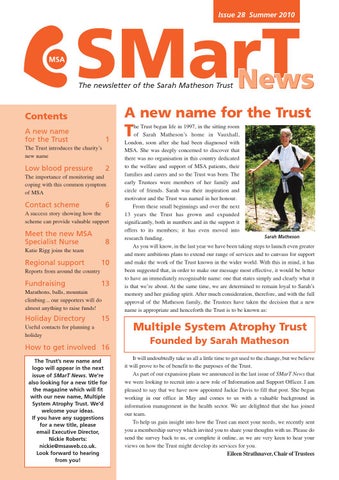
he Trust began life in 1997, in the sitting room of Sarah Matheson’s home in Vauxhall, London, soon after she had been diagnosed with MSA. She was deeply concerned to discover that there was no organisation in this country dedicated to the welfare and support of MSA patients, their families and carers and so the Trust was born. The early Trustees were members of her family and circle of friends. Sarah was their inspiration and motivator and the Trust was named in her honour. From these small beginnings and over the next 13 years the Trust has grown and expanded significantly, both in numbers and in the support it offers to its members; it has even moved into Sarah Matheson research funding. As you will know, in the last year we have been taking steps to launch even greater and more ambitious plans to extend our range of services and to canvass for support and make the work of the Trust known in the wider world. With this in mind, it has been suggested that, in order to make our message most effective, it would be better to have an immediately recognisable name: one that states simply and clearly what it is that we’re about. At the same time, we are determined to remain loyal to Sarah’s memory and her guiding spirit. After much consideration, therefore, and with the full approval of the Matheson family, the Trustees have taken the decision that a new name is appropriate and henceforth the Trust is to be known as:
Multiple System Atrophy Trust Founded by Sarah Matheson
It will undoubtedly take us all a little time to get used to the change, but we believe it will prove to be of benefit to the purposes of the Trust. As part of our expansion plans we announced in the last issue of SMarT News that we were looking to recruit into a new role of Information and Support Officer. I am pleased to say that we have now appointed Jackie Davis to fill that post. She began working in our office in May and comes to us with a valuable background in information management in the health sector. We are delighted that she has joined our team. To help us gain insight into how the Trust can meet your needs, we recently sent you a membership survey which invited you to share your thoughts with us. Please do send the survey back to us, or complete it online, as we are very keen to hear your views on how the Trust might develop its services for you. Eileen Strathnaver, Chair of Trustees
SMarT News Summer 10 4-6-10:SMarT News Autumn 2006 mike
4/6/10
16:05
Page 2
Low blood pressure
Monitoring and living with postural hypotension One of the common symptoms of MSA is a low blood pressure – postural hypotension – when changing position. We take a look at the importance of monitoring your blood pressure and offer suggestions on how to adapt to life with postural hypotension. lood pressure is regulated by nerves and hormones which direct the flow and amount of blood circulating in the body. A supply of blood to organs like the brain and heart is vital at all times. Blood pressure is a complex system that works automatically under the control of the autonomic nerves. Your blood pressure will alter throughout the day and depending on your activities, so it is helpful to see what factors affect it. For example, if you have been sitting or lying down for some time you might find that your blood pressure drops suddenly instead of correcting itself when you stand. This could cause unsteadiness and a loss of balance. Apart from possibly making you feel unwell, it can also put you at risk of falls. Some medications (such as Parkinson’s disease medications) may also lower blood pressure and you may find that your blood pressure may be at a different level when at home than when you visit your neurologist or GP.
B
2
For a lot of people making some adaptations to daily life can help improve postural hypotension. Sometimes the neurologist may recommend medication. If this is the case for you, being more aware of your blood pressure levels can help with on-going treatment, and you can self-monitor by taking regular readings at home if your district nurse is not able to do this for you. Home monitoring can give your neurologist an accurate picture of what your blood pressure is like over a period of time and can assist him or her in altering medication as necessary. Normally you will only need to check it once a week unless requested to record it any more frequently by the neurologist or GP. What are the symptoms of low blood pressure? A fall in blood pressure leads to a reduced blood supply to organs and muscles and this can cause a variety of symptoms: • Feeling dizzy and light-headed • Changes in vision such as blurring, greying or blacking vision • Feeling vague or muddled • Losing consciousness with or without warning – this is a ‘blackout’ or ‘faint’ • Pain across the back of shoulders and neck –
‘coathanger’ pain • Pain in lower back and buttocks • Angina-type pain in the chest • Weakness • Fatigue These symptoms can vary from person to person. What to do when you get symptoms Think of the symptoms as a warning that your blood pressure is too low. The only way to improve your blood pressure is to: • Stop what you’re doing • Sit down – use bus stops, walls, benches: lie down if possible • Drink some water • Think about what has triggered your symptoms If you do faint (blackout) your family or those around you need to: • Lay you down flat • Ensure you are safe – remove any dangers (eg, hot drinks) and check for breathing and circulation (simple first aid checks) • Raise your legs above your hips for 3-5 minutes • If there is no change to your symptoms call 999 promptly When are the symptoms likely to happen? At any time when there is an increased demand on the circulating blood, for example: • Moving – standing or sitting up suddenly
SMarT News – The newsletter of the Sarah Matheson Trust – Summer 2010
SMarT News Summer 10 4-6-10:SMarT News Autumn 2006 mike
4/6/10
16:05
Page 3
Low blood pressure
• In the morning – when blood
pressure is naturally lower • After meals – as blood is needed by the digestive system. In particular, big meals or sugary foods increase this demand. Alcohol also has this affect • During exercise – exercise (eg, walking) and activity (eg, dusting), especially when on your feet, increases the demand for blood in the muscles • ‘Straining’ on the toilet when you are constipated or have difficulty passing urine In addition the following things will make symptoms worse: • Being dehydrated • Getting overheated, eg, in a warm room, after a hot bath or on a sunny day • Illnesses such as colds or infections, especially if you need to rest in bed • Anxiety and panic, especially if it changes your breathing pattern • Medication – some medication can worsen postural hypotension Can exercise help? There are some exercises that help circulation and some manoeuvres which reduce symptoms. • Circulation exercises These simple exercises stimulate your circulation. You can do them in bed or whilst sitting or standing and should do them before you change position or if you have been sitting or lying down for a while. – Move your feet up and down at the ankle – Do gentle ‘marching’ on the spot If you get symptoms when you stop moving (eg, after climbing up a flight of stairs), use these exercises after you have stopped. • Manoeuvres These can be used discreetly at the first sign of symptoms. – Avoid standing still, cross and uncross your legs
Medication to raise blood pressure Medication can be used to raise blood pressure. These include:. Fludrocortisone (Florinef) – a steroid, taken in very small doses; may cause ankle swelling Ephedrine – works quickly (within 60 minutes). Usually taken three times a day but not after 6pm Midodrine (Gutron) – works quickly (within 30-60 minutes). Only available on a special prescription. Usually taken three times a day but not after 6pm DDAVP (Desmopressin) – used to reduce the production of urine overnight, which will help boost morning blood pressure Octreotide (Sandostatin) – an injection given before meals which reduces hypotension after food Erythropoetin – used when anaemia occurs with postural hypotension All these medications can raise blood pressure even when lying down. This may cause problems so it is advisable to avoid lying flat (head-up tilt) and have monthly blood pressure readings.
– Crouch or squat down (as if to tie your shoe laces or look in your bag) – Bend forward and press your stomach, this is the position most people use when feeling faint
Improving control of postural hypotension There are many lifestyle choices you can make to help improve control of postural hypotension. Planning your day so that you have enough time to do things safely and incorporating rest times is important. You may find that arranging appointments and visits for your best times of day, usually afternoon and evening, and spacing out activities that cause postural hypotension will give your blood pressure time to recover. Other lifestyle changes that may help improve control include: • Avoid dehydration Drink 3½ pints (2 litres) of fluid every day. This can be water, tea, low sugar drinks, ice lollies and sorbets, and drink a large glass of water before you get out of bed in the morning. • Keep your head up in bed Sleeping with your head up at night helps to boost your blood pressure when you get out of bed. You can use a foam wedge under
SMarT News – The newsletter of the Sarah Matheson Trust – Summer 2010
•
•
•
the mattress or blocks under the legs at the head of the bed to do this. Take it easy in the morning Prepare your morning medication and a drink the night before and leave it by your bed. Take any blood pressure medication before you get out of bed. Sit up slowly, an electric backrest that lifts the head of your bed up is useful, and sit on the side of the bed before standing up. Move safely Do circulation exercises before moving and take your time when changing position (eg, rising from a chair). Talk to an occupational therapist about equipment that can help you change position slowly (eg, a bed raiser and a reclining chair). Sit down to do everyday tasks like getting dressed or preparing vegetables. Talk to a physiotherapist about using stairs safely. Avoid bending down or stretching up (eg, hanging out washing). Mealtimes Eat small meals and snacks at regular intervals during the day, avoiding sugary foods (eg, chocolate, biscuits) and drinks (eg, lucozade). Eat salty snacks (eg, crisps, nuts and soup) and use 3
SMarT News Summer 10 4-6-10:SMarT News Autumn 2006 mike
4/6/10
16:05
Page 4
Low blood pressure
• • • • •
drinks containing caffeine (eg, coffee and diet cola). Exercise Be active every day but have frequent rests to avoid exhaustion. Preventing constipation Eat foods with fibre (eg, cereals and fruit) every day and drink 3½ pints (2 litres) of fluid every day. Use laxatives to prevent constipation. Keeping cool Keep the heating turned down and use fans; have a warm shower or bath instead of a hot one; don’t sit in the sun. New tablets Ask if your blood pressure will be affected by any new tablets and always read the information leaflets that come with your medication. See your GP Ask for the Flu jab to help avoid winter epidemics. If your postural hypotension symptoms suddenly get worse it may be a sign that you have an infection, most commonly bladder or lungs.
Other things to think about • Take your own seat Carry a lightweight folding chair (or shooting stick): this will give you a seat whenever you need one, for example in a queue or out shopping. • Driving You are responsible for informing the Driving and Vehicle Licencing Authority (DVLA) of your condition. You can discuss your ability to drive with your doctor. If your mobility is restricted you may be entitled to a Blue Badge (disabled parking permit), contact your local Social Services Department for advice. • Finances You may be entitled to benefits such as Disability Living 4
Key points to remember • Get to know your symptoms and what triggers them • Have a plan of action for when you feel faint • Establish a routine, get organised and give yourself plenty of time • Understand your medication • Have your lying and standing blood pressure monitored and recorded • Contact the specialist nurses at the Trust for further information or advice
•
•
Allowance (DLA) or Incapacity Benefit (IB). Contact the Benefit Enquiry Line (0800 88 22 00). Medical Alert bracelet This is a recognised system that tells people about your problem and what to do to help you. Contact Medic Alert (0800 581420, www.medicalert.org.uk ), or SOS Talisman (0208 554 5579), for further information. Holidays If you are planning a holiday think about how you will stay cool if you are going somewhere hot. Take enough medication, including some extra for your
•
whole stay. Carry it in your hand luggage. Make sure you have medical cover. If travel companies are aware of your condition they can help with additional arrangements such as use of a wheelchair at the airport. (See our article on page 15 for more information about going on holiday.) Going into hospital The change of routine, investigations or operations can all affect blood pressure control. Further information on preparing to go into hospital is available from the Trust.
Blood pressure monitor offer to Trust members The Blood Pressure Association is offering a 20% discount on its home blood pressure monitor to UK-based Trust members. The BPA/Microlife BP-3AF1 comes with a three year guarantee and is included in the British Hypertension Society’s list of clinically validated blood pressure monitors for home use. The monitor usually sells for £34.99, but for Trust members is available for £27.99 which includes VAT and delivery. Please visit www.bpassoc.org.uk to order, quoting MSAT.
SMarT News – The newsletter of the Sarah Matheson Trust – Summer 2010
SMarT News Summer 10 4-6-10:SMarT News Autumn 2006 mike
4/6/10
16:05
Page 5
Low blood pressure
Monitoring your own blood pressure Monitoring your own blood pressure can help you to identify what is contributing to your postural hypotension, check that medication is helping and reassure you that changes to your daily routines are making a difference.
lood pressure monitors can be bought from most high street chemists. Look for one that is clinically validated for accuracy by The British Hypertension Society. This means it has been properly tested and you can be confident it will give accurate results. Avoid buying from unknown suppliers. Machines will vary in price and most people will not need the extra gadgetry that expensive ones have, but you may find a memory facility helpful which can store the readings for you. You should write the results in a diary or notebook and record the date and time you took the recordings to show your neurologist or GP. Most high street chemists sell validated machines which vary greatly in price and can start from £20 for basic models. You can also buy them from the Blood Pressure Association’s online shop (see special offer to Trust members). A machine that records your blood pressure on your upper arm is more accurate than one that measures at your wrist or finger. An upper arm machine comes with a cuff that you wrap around your upper arm. This should be measured to ensure it gives an accurate result. To find out your cuff size, measure around your upper arm at the midpoint between your shoulder and elbow. The cuffs
B
will have sizes printed on them. Most home blood pressure monitors will come with a medium-sized cuff. You may have to order a different-sized cuff separately. How to record your blood pressure Before you record your blood pressure ensure that you: • Avoid recording your blood pressure if you need to use the toilet • Avoid recording your blood pressure if you have just eaten a large meal • Avoid recording your blood pressure if you have drunk caffeine or been smoking within the past 30 minutes • Use the same arm for each recording. Use whichever arm is easiest and most comfortable for you, and note which arm it is when you record the reading (it may be slightly higher on the left arm) • Wear short-sleeved or loosefitting clothes to ensure easier access to your arm • Rest for five minutes before taking a recording • Ideally you should sit with your arm resting on a desk or table • Make sure your arm is supported and your arm is at the same level as your heart. You may need to
Upper Arm Blood Pressure Monitor cuff sizes Cuff size
Measurement (cm)
Measurement (inches)
Small
18-22 cm
7.1-8.7”
Medium
22-32 cm
8.8-12.8”
Large
32-45 cm
12.8-18
SMarT News – The newsletter of the Sarah Matheson Trust – Summer 2010
rest your arm on a cushion or pillow to achieve this Your arm should be relaxed, not • tense • Put the cuff around your upper arm following the instructions with the machine • Remain still whilst taking the recording • Take three readings sitting and work out the average. Write this down and mark it “sitting” • Stand (aided if necessary) and take three more readings. Write down the average and mark it “standing” • You can record the readings, either in a notebook or in the memory of your machine if you prefer • Ideally take the reading at the same time of day and make a note of the time Taking the readings at the same time of day allows a meaningful comparison of what your blood pressure is doing over a period of time. Don’t round your readings up or down, you need to keep accurate details to give to your doctor. Don’t worry if you get a one-off reading that is very low, do a further reading on another day. Record what medicines you take and at what time of day you take them as this will help your doctor understand if medication is affecting your blood pressure. Try not to take readings too often as this can cause you unnecessary anxiety which may also affect your readings. Once a week is usually enough. 5
SMarT News Summer 10 4-6-10:SMarT News Autumn 2006 mike
4/6/10
16:05
Page 6
Contact scheme
Contact scheme success! My husband was diagnosed in 2000 with multiple system atrophy and after searching the internet I found the Sarah Matheson Trust (as it was then called), of which we became members. A year later I read in SMarT News about a telephone contact scheme that Catherine Best, the then MSA specialist nurse, was hoping to start up. I contacted Catherine and she put me in touch with a lady in Croydon, Surrey. We live in Nottinghamshire but, of course, distance was no object to a telephone scheme so that was ideal for me. The lady telephoned me in August 2001 and introduced herself as Brenda. We talked for a while and found that we had a lot in common. Brenda is a carer for her husband Michael and I am a carer for Peter and also at that time for my mother. We both have daughters, both work part-time and are of a similar age. At that initial call we seemed to jell and arranged to telephone each other in turn every Sunday, which I am pleased to say we still do. We have supported each other through happy times such as our daughters’ weddings and the births of our grandchildren, and the not so happy times of loss of close family and hospital stays, etc. As each Sunday draws closer I find myself looking forward to speaking to Brenda as we chat for about an hour, and some weeks it can be that we talk about everyday things and nothing to do with our caring role at all. Other times we can ask each other about a certain problem we might have come across and discuss how to make things easier. Another time we might just have a good old moan. There is no set pattern and I feel that we are just friends who can talk about anything and never be judged by each other. Three years ago Peter and I went on holiday to Kent and Brenda and Michael met up with us for the day at Leeds Castle. We had a lovely day, we all got on well and it really was good to put a face to a name. As a carer I feel that support is very important and especially from someone who knows what you are going through and I really do value Brenda’s support and friendship and hope that it will continue for many years to come. I would advise anyone who has the opportunity to join such a scheme to do so as I have found it invaluable and have also made a very close friend. Lynda Sansom
Peter and Lynda Sansom
6
SMarT News – The newsletter of the Sarah Matheson Trust – Summer 2010
SMarT News Summer 10 4-6-10:SMarT News Autumn 2006 mike
4/6/10
16:05
Page 7
Contact scheme I was given Lynda’s na me through the Trust’s contact scheme nearly a little nervous when I nine years ago. I was first telephoned her. Ho we ve r, I needn’t have worri was very easy to talk to ed because Lynda and before long we we re chatting about our hu life in general. I guess sbands, families and we are probably quite similar in our outlook in our lives, having da an d are at the same stage ughters and grandchild ren of the same age. We have an arranged tim e to phone every Sund ay and talk about what week. Having a regula has happened in the r slot for calls means I can get things off my chest as they happen. I don’t and discuss worries have to make a special call to discuss a proble if feeling upset, as I ha m, wh ich I may not do ve a time already arran ged. We usually chat for ab out an hour, which migh t not suit others but wo conversation is ideal be rks for us. A phone cause it can be at a conv en ient time, in your own contact can be anywhe home and your re in the country. Lynda is a good listener. Someone to tell “I lost it”, who understands the stresses of caring and how it can wear you down. Ly nda gives me time to talk thr ough difficult situations witho ut pressing for information which I might not be rea dy to discuss at that moment. Maybe not everyone would be able to support another person without getting depressed thems elves. Obviously we are in the same position as carers, so can empathise with each oth er’s problems. A couple of years ago I finally met Lynda, som eone I knew really well but ha d only Michael and Brenda Stammers seen in a photo. We sha red a lovely day togeth er at Leeds Castle. It wa continue our conversati s so natural to ons as on the phone bu t in person, and really am at last and meet each oth azing to get together er’s husbands as well. I would recommend the contact scheme. Clearly Lynda and I are lucky well, but when it works that we get on so it is a very convenient me an s of mutual support. I’m was put in touch with so pleased I Lynda. She is a specia l person. I can’t imagine our weekly chats. We ha no t having her there for ve, I hope, become lifeti me friends. Brenda Stammers
Why have a contact scheme? The Trust established the contact scheme as a response to views expressed by callers to our Helpline. People with MSA talked about never meeting anyone else with MSA and having to repeat explanations about MSA to friends, colleagues and even health professionals. This led to a sense of isolation and frustration and to help with this the scheme was established. It enables people to communicate by telephone, letter or e-mail. If you are interested in registering please contact Jackie Davis at the Trust’s office on 0207 940 4666 or email her at Jackie@msaweb.co.uk. Once you have completed a contact registration form the nurses will match you with someone who suits your preferences. For example, someone newly diagnosed, someone living alone or someone really interested in research. We will also send you a leaflet explaining how to get the most from the scheme.
SMarT News – The newsletter of the Sarah Matheson Trust – Summer 2010
7
SMarT News Summer 10 4-6-10:SMarT News Autumn 2006 mike
4/6/10
16:05
Page 8
Specialist nurses
Meet the northern region’s MSA specialist nurse Katie Rigg, MSA specialist nurse for the UK’s northern region explains her role in helping the Trust to support people whose lives are affected by MSA. would like to introduce myself to all readers of SMarT News. I am one of two nurse specialists working with the Trust to support patients with multiple system atrophy (MSA), their families, carers and the professionals involved with them. I undertook training to qualify as both a specialist children’s nurse and a registered general adult nurse. Subsequently I have gained specialist qualifications for both community nursing and palliative care. Over a number of years I have gained experience working in hospitals, community services, hospices and voluntary organisations which I hope will prove beneficial in assisting people with MSA and their families to access the range of services they require from these organisations. Increasingly over time I have developed a particular interest in neurodisability and neuro-degenerative conditions. I feel strongly that people coping with these conditions deserve at least as good access to palliative care as someone living, say, with cancer. Much of my palliative care work has focussed on trying to achieve this goal for people enduring these conditions and their families. Many of you will know my colleague Samantha Pavey well who, until my appointment, has been offering support across the UK. Samantha and I will be available to all of you, but we will be taking particular responsibility for geographical areas. Samantha will be the first point of
I
8
contact for people living in Wales and those of you who live South of the Lincolnshire, Nottinghamshire, Derbyshire and Cheshire borders. I will be focussing on support for those of you living in the counties mentioned and all areas North, plus Scotland and Ireland. As you will be aware, there are a number of support groups running across this geographical area. I have already had the pleasure of meeting some of you, or at least speaking with you on the telephone. However I hope to meet more of you when I attend the groups in the East Midlands, Manchester, Lancashire and Merseyside and Yorkshire and Humber. I will also be attending the specialist movement disorders clinics that are held in Manchester, Edinburgh and Newcastle, so for those of you who attend these clinics I may have an opportunity to met you face-to-face there. Samantha and I hope to work together to review and update some of the information sheets that are available to you through free registration with the Trust, as well as developing some new ones. If you have any thoughts or ideas about information that would be useful to develop – either about something you have struggled to find out about or things you now know about but wished that information had been available when you were first aware you had MSA – please let us know. You can, of course, also share your thoughts through the Trust’s survey sent to you at the
Katie Rigg
beginning of June, if you haven’t already done so. We also plan to continue to develop links and increase awareness amongst, professionals about the challenges MSA presents for patients and families to quickly access the right type of support. This is achieved by attending the specialist clinics, teaching at professional study days, giving training to care home staff, and any group of professionals who request this. A key goal as nurse specialists is to keep abreast of new information, research and improved practice that may be beneficial to people with MSA and share this with the professionals working alongside patients and their families. This information is also made available through SMarT News. Samantha regularly writes articles covering a wide range of topics, and I will be contributing to these as we come across information we believe you may find helpful. However, our primary focus is to
SMarT News – The newsletter of the Sarah Matheson Trust – Summer 2010
SMarT News Summer 10 4-6-10:SMarT News Autumn 2006 mike
1/7/10
15:07
Page 9
Specialist nurses give individual patients and their families the information, advice and support they need as they need it whilst guiding, advising and advocating for them to access the best care possible. Between Samantha and I we try to ensure one of us is available as much as possible through the working day to take telephone queries. If one of us is attending a clinic, providing teaching or at a support group the other can take calls. However, on occasions when this isn’t achievable there is always an answerphone on our helpline numbers and at the Trust’s head office at Southbank House, so please leave a message and we will call back at our earliest opportunity. Many people find the email service most helpful, as whatever time of day they have a query that isn’t urgent they can email either Samantha or I and we will email a response when we next access the service. This also gives people something in writing to refer back to if they need to remind themselves about information given. The Trust is beginning to look at how it can contribute to care on a national level, and Samantha and I will provide input to the Trust’s work on relevant government consultations on care for neurology patients, palliative care and long-term conditions to try and give MSA a voice and encourage needs specific to MSA to be given due consideration. The specialist nurse service is there for you as patients and carers. The Trust welcomes comments and thoughts about other ways you think it can improve things to meet the needs you have so, again, please take advantage of the survey you should have received, and at any other time to either Samantha and I or direct to the Trust. The Trust strives to support people with MSA and their families and to enable them to access the best care possible. I hope I can contribute to achieving this for all of you.
What is palliative care? Palliative care is the medical specialty focused on relief of the pain, stress and other debilitating symptoms of serious illness. The goal of palliative care is to relieve suffering and provide the best possible quality of life for patients and their families. Ensures quality of life People’s needs vary and a key benefit of palliative care is that it tailors treatment to meet the individual needs of patients and their families. Palliative care aims to relieve symptoms of illness and help people to gain the strength to carry on with daily life. It improves their ability to tolerate medical treatments and helps them to better understand their choices for care. Palliative care, in essence, offers patients the best possible quality of life during their illness. Palliative care benefits patients, their families and carers as, along with symptom management, communication and support for all are the main goals. Palliative care is not the same as hospice care as it may be provided at any time during a person’s illness from the time of diagnosis onwards As Katie says, “Everybody has the right to have their wishes and choices respected, be cared for with dignity, have their pain and symptoms addressed and their anxieties and fears acknowledged, shared and resolved as far as possible.”
Areas covered by the MSA Specialist Nurses
Ireland
South Samantha Pavey 0203 371 0003 samantha.msa@googlemail.com Wales Avon Herefordshire Gloucester Oxfordshire Hampshire Wiltshire Shropshire Norfolk / Suffolk Buckinghamshire London / Surrey / Kent / Sussex Dorset Cambridgshire / Essex Somerset Devon / Cornwall
SMarT News – The newsletter of the Sarah Matheson Trust – Summer 2010
North Katie Rigg 01434 381932 katie.msa@cybermoor.org.uk Scotland Ireland Cumbria Northumberland Scotland Durham Yorkshire Lancashire Cheshire Staffordshire Derbyshire Nottinghamshire Yorkshire Lincolnshire Lancashire and Tyne & Wear Merseyside Leicestershire and Rutland Gtr Manchester Cleveland Derbyshire
East Midlands
Wales Gloucestershire Essex Surrey Devon Cornwall
Counties with a support group operating are shown in yellow
9
SMarT News Summer 10 4-6-10:SMarT News Autumn 2006 mike
4/6/10
16:05
Page 10
Regional support
Regional support groups If you would like to attend any support group, please contact either the Support Group Leader or the Trust on 020 7940 4666 or office@msaweb.co.uk Region
Group leader/ Coordinators
Phone
Next meeting
Cornwall
Jane Handy Jan Pearce
moonbeams @ymail.com
01726 74792 01726 861361
No meetings currently scheduled for 2010
Derbyshire
Kulwant Sehmbi Karen White
karen@karenwhite7. wanadoo.co.uk
01332 164354 01283 735847
To be confirmed
Devon
Dennis Westrip
denniswestrip @btinternet.com
01271 378273
Friday, 2 July 2010
East Midlands
Elizabeth Brackenbury Ian Jones
i.jones5 @ntlworld.com
0115 9333083 0115 9199294
Wednesday, 6 October 2010
Essex
Lady Laurelie Laurie Sir Bay Laurie
baylaurie331 @btinternet.com
01206 210410
Monday, 25 October 2010
Gloucester
Janice Davies
janicedavies147 @hotmail.com
01242 224617
September/October (tbc)
Greater Manchester
Katie Rigg
katie.msa @cybermoor.org.uk
01434 382931
Friday, 1 October 2010
MSA Specialist Nurse Katie Rigg to attend
Lancashire & Merseyside
Jo Hans Fraser Gordon
hansjj@talktalk.net
01704 568353 01253 821693 01704 894129
September 2010
MSA Specialist Nurse Northern Region Katie Rigg to attend (tbc)
Surrey
Peter Turvey
peterturvey @waitrose.com
01483 827395
Thursday, 12 August 2010
New group: MSA Specialist Nurse Southern Region Samantha Pavey to attend
Yorkshire & Humber
Karen Walker
karenwalker @BH-CC.co.uk
01274 861947
September/October (tbc)
Comments
MSA Northern Region Specialist Nurse Katie Rigg to attend (tbc)
These support groups are run entirely by members of the Trust for the benefit of those whose lives have been affected by a diagnosis of MSA. If you are interested in the possibility of running your own local support group, we would warmly welcome your enquiries and will assist in providing relevant information and guidance on how to start one up. Please contact the office on 020 7940 4666.
10
SMarT News – The newsletter of the Sarah Matheson Trust – Summer 2010
SMarT News Summer 10 4-6-10:SMarT News Autumn 2006 mike
4/6/10
16:05
Page 11
Regional support
Reports from the MSA support groups The Trust believes that support groups provide an invaluable forum for people with MSA, carers and families to talk to one another, to receive specialist advice, to share concerns and provide mutual support. We’d really like to hear your thoughts on how we might develop the group network further so please, if you haven’t already done so, fill in your membership survey and share your views with us. There’s a specific section on support groups. The Spring meeting of the Lancashire and Merseyside Group was very successful. Over 25 people came to enjoy coffee and cakes and to talk to MSA Specialist Nurse Southern Region, Samantha Pavey. It was a good opportunity for everyone to exchange
ideas, get information and to receive specialist advice. Everyone who came to the meeting went home smiling, the raffle was as popular as ever and new friendships were made. This was my last meeting and I would like to take this opportunity to thank all my helpers who have
contributed greatly to the success of the Group and also all the people who come to the meetings. I have met many amazingly brave people and I thank you all for your friendship which I value greatly and I know the Group will go from strength to strength. Ann McLennan
The second Greater Manchester Support Group took place on 19 March at BASIC (Brain and Spinal Injury Centre) in Salford and was well attended. This is a joint group run with the PSP nurse specialist. Many of the issues are similar in both illnesses and all those who
attended felt it was very supportive. We had a general discussion about people’s concerns. The nurse specialists then went around the tables talking to people individually. It was a particularly good event as the new MSA Specialist Nurse Northern Region, Katie Rigg, also attended, as well as
Patsy Cotton, the advanced nurse practitioner who kindly set up the group and who many of you see in clinic. Katie will now be taking over this group allowing me to attend MSA support groups in the south. Samantha Pavey, MSA Specialist Nurse Southern Region
We usually have around 20 people at our meetings. This is the right number for the size of the room and means we can all move around freely and gives everyone a chance to talk to everyone else. It was very nice to have three new people. We were sorry that Margaret Palpeyman Biddulph was unable to come; she has been our treasurer since we started and organizes the raffle. We
hope she makes a good recovery from her recent operation. In her absence the raffle was done by Margaret Jones and we made £42. It was marvelous to have Katie Rigg who started as a MSA nurse specialist in March. She drove down from Cumbria where she lives. We sat round and had a general discussion about MSA and the different problems people encounter. She then talked separately to individuals
about their particular problems. MSA is an isolating illness that I think our support group meetings provide an opportunity for people with MSA and their carers to meet and compare notes in the knowledge that everyone in the room understands what they are talking about. Our next meeting is on Wednesday, 6 October and I look forward to seeing everyone then. Elizabeth Brackenbury
Our meeting was held for a second time in the Lady Chapel of St Leonard’s Church in Scawsby, near Doncaster. The meeting was the first in Yorks and Humber for Katie Rigg, the MSA Nurse Specialist for the north of the country.
We were all delighted to meet Katie and to have the opportunity to chat to her, asking both general medical questions and some more specific questions about particular diagnosis and current treatment. There was a lot of general discus-
sion between members and their carers/partners and we were delighted by the homemade buns and muffins that were supplied. We sold off any extras to raise funds for the Trust and did a quick raffle for a bottle of wine kindly supplied by one of the members. Those
Lancashire and Merseyside
Manchester
East Midlands
Yorkshire and Humber
SMarT News – The newsletter of the Sarah Matheson Trust – Summer 2010
11
SMarT News Summer 10 4-6-10:SMarT News Autumn 2006 mike
4/6/10
16:05
Page 12
Regional support who came along will be pleased to hear we raised £15 for the Trust during the afternoon by spending our loose change. Many thanks to all. Our next meeting is to be located a bit further north, closer to Harrogate. I will confirm the date and venue once
they have been decided. My thanks once again to Father Pay for allowing us the use of the Lady Chapel in Scawsby free of charge and to all the members who managed to make it to the meeting, look forward to seeing you
New groups Surrey People in the Surrey and surrounding area are invited to attend a new support group. The group aims to link people with MSA and carers by providing a forum for discussion, support and information about MSA and the problems associated with the condition. The meeting is scheduled for Thursday, 12 August 2010 at Shalford Village Hall, Kings Rd, Shalford, Guildford,
again in the near future. In the meantime if anyone needs to contact me, I do work full-time so evenings are usually better and the number is 07710 312552, or email at karenwalker@bh-cc.co.uk. Karen Walker
GU4 8JU. We are fortunate to have Samantha Pavey, nurse specialist for MSA, join us for this our first meeting. We will meet at 1pm for tea and coffee (feel free to bring a sandwich lunch), with the talk starting at 2pm.
Derbyshire There is a new support group starting up for Derbyshire. The first meeting was held on Thursday, 20 May. The Group leaders are Kulwant Sehmbi and Karen White. Katie Rigg, the MSA nurse specialist attended this meeting.
For information on future support group meetings, please see our regularly updated Events Diary on the website. Please go to www.msaweb.co.uk/events
The Trust’s information and support service
ackie Davis has recently joined the Trust to help develop its information and support services which includes the specialist nurse service, our range of information materials, the support groups and our equipment. As part of its next phase of growth and development the Trust is keen to
J
look at these services in more detail to get a clearer idea of how they help you, how they can be improved and generally to get a sense of how the Trust might support members in the future. Throughout this issue of SMarT News you’ll see many references to the recent membership survey we sent to you a few weeks ago. This survey
really is important as your answers will help us develop our information and support services for you, along with other areas of Trust activities. Please contact Jackie on 020 7940 4666 or email her at Jackie@msaweb.co.uk if you would like further details on the survey or advice on how to complete it.
In Memory
If you have informed the Trust of a loved one’s death and their name does not appear below, please accept our apologies. Let us know and we will rectify this in the next edition. Some members passed away earlier than 2010 and the corresponding year is shown in brackets next to their name. G G G G G G G G G G G G G G G G
12
Robert Breach Trevor Britton Chris Brownhall Phyllis Bunnelle (2009) Keith Bussey John Clarke Steven Cook Graham Cooper Patricia Corina James Corrigan Raymond Coulton (2009) Sally Devlin John Dukes (2009) Dennis Evans Gwen Hannigan Alan Hepworth
G G G G G G G G G G G G G G G G
Alison Jeffery Norman Johnstone Mary Jones Colin Lake Maureen Mason Peter McCluskey Penelope Milner-Smith Bill Morton Arline Oakley Steve Parsons Alan Seamore Terry Stafford David Turner Pamela Turner Sue Whitcombe Peter Umpleby
G G G G G G G G
J C Renney Myrtle (Tigs) Seabrook Alan Turnbull Kevin Howkins (2009) Irene Tracy Sonia Osman Malcolm Noble Dave Denial
G G G G G
Paul Hayward Michael Arbuthnot Freda Dearie Bob Gladman Eric Tarrant
This edition of SMarT News covers the first half of 2010.
muchloved.com muchloved.com is a website dedicated to offering personalised website tributes in memory of a loved one. MuchLoved is a UK registered charity set up to help with grieving and healing. The website can be used without charge or obligation. To visit the website go to www.muchloved.com
SMarT News – The newsletter of the Sarah Matheson Trust – Summer 2010
SMarT News Summer 10 4-6-10:SMarT News Autumn 2006 mike
4/6/10
16:05
Page 13
Fundraising
Yet again, Trust members have proved themselves to be fantastic fundraisers! We are always amazed and genuinely appreciative of the wide-ranging efforts that Trust members and their families make in fundraising. Here are some recent achievements... She ran, she swam and she rode her bike... In just 4hrs and 4 minutes, Sarah McIntyre swam 1,500 m, rode her bike for 40 km and ran for 10 km in the London Triathlon to raise funds for the Trust and to support her boyfriend’s mum, Arline Oakley. The words on Sarah’s wetsuit seem very appropriate! Well done Sarah.
Sarah smiling at the start and the end of the triathlon
London’s medical students support MSA patients and families Medical students at St George’s Hospital in Tooting, South London chose the Trust as one of this year’s RAG Week charity recipients. RAG Week organiser, Daniel Greenwood, said “It was a pleasure to raise money for the Trust, who provided us with some excellent prizes that really encouraged students to fundraise. The racing bike donated by the Trust was won by a student who raised over £1,200 in one day – quite an effort!” (Editor’s note: thank you to Cycle to Cannes who donated the racing bike as a prize for Rag Week)
Climbing Kilimanjaro Climbing eight hours a day for eight days for a view never to be forgotten: Brad and Charlotte share their inspiring African trip with us My husband and I have watched my mother Janet go from being an able-bodied lady, to a women who struggles with her mobility even doing the most menial of Brad and Charlotte tasks in just over four years, all due to the disorder MSA. Because of this we decided to challenge ourselves and at the same time raise money and people’s awareness of this relentless illness. Kilimanjaro was top of the list. My husband, Brad, and I enjoy walking but the thought of walking eight hours a day for eight days at heights of up to 5000 meters left us both questioning our fitness. We trained for many months prior to the trip to prepare ourselves, however altitude sickness was an unknown factor. Luckily we only felt very mild symptoms, which subsided after a short time. That said, we certainly noticed the lack of oxygen at 5895 meters above sea level. All our hard work paid off. Although each day was slow progress, the thought of helping people who suffer from the same degenerative disorder as my mother helped us through each day. We both made it to the summit in just over 10 hours from base camp. The views were amazing, the skies clear and the sun shone. It is a day I will never forget! We would like to thank all those who supported us though their generous donations both in money and equipment – we could not have wished for more. But most of all thank you to my mother for being an inspiration in her determination to fight this awful illness, yet still a smile every day.
New York Marathon Ludovic Floch ran the New York Marathon recently in memory of his father-in-law. Ludovic says, “I started running seriously in Spring 2005 in preparation for the Great North Run that year. In the meantime, Cathy’s father was finally diagnosed with MSA and sadly passed away in July. That led to us getting in touch with the Trust and subsequently raising some funds during the Run. I also ran for the Trust in the 2006 London Marathon. After a twoyear break from running due to a back
SMarT News – The newsletter of the Sarah Matheson Trust – Summer 2010
Ludovic with his well-deserved medal
13
SMarT News Summer 10 4-6-10:SMarT News Autumn 2006 mike
4/6/10
16:05
Page 14
Fundraising
Six Trust runners brave London’s streets in the 2010 Marathon
Tracey Nutt (medal and blue vest), her family, Sadie Geoghegan (medal and pink vest), Gavin Brett (medal and red tshirt) and their supporters celebrate their marvellous achievement. Inset picture: Gavin Brett and Andrew Ladd.
This year’s London Marathon was graced by the presence of six runners from across the UK all taking part to raise funds for the Trust, cheered on by an amazing group of family and friends. Gavin Brett, Andrew Ladd, Tracey Nutt, Sadie Geoghegan, Liz Stammers and Ian Kovacs trained hard in preparation for the marathon. They ran through London’s streets with thousands of other participants and secured finishing times ranging from three hours to just over six. An incredible achievement by everyone, and thank you all!
injury, I started running again to achieve my goal of running the New York Marathon. I ran it last November in support of the Trust and achieved my personal best of 3:17:01.” Congratulations and thank you Ludovic. Maureen’s Ball Cardington Village Hall in Bedfordshire was treated to another evening of
live entertainment, casino tables, disco and other glitzy fun during a fundraising evening in memory of Maureen Hammond. Maureen’s grandson, Haydn, has masterminded and organised these events in memory of his gran, and to raise awareness and funds for the Trust. The photos on the website, www.maureensball.co.uk show the event to have been a great success!
A challenge to our female readers! The Adidas Women’s 5k challenge is being held on Sunday, 5 September 2010 in Hyde Park, London and entry forms are being accepted now. As in previous years, entries are on a first-come, first-served basis, so don’t put off your application! In the words of the organisers, “The only requirement is that you have to be female – age and ability are not important!” You can enter online at www.womenschallenge.co.uk There is a £15 entry fee but £5 of that will be donated to the charity of the runner’s choice. The closing date is 6 August 2010 or earlier should the entry limit be reached.
14
Guests enjoying Maureen’s Ball
We are very grateful for all your fundraising activities. We would be grateful if any future cheques be made payable to ‘Multiple System Atrophy Trust’
SMarT News – The newsletter of the Sarah Matheson Trust – Summer 2010
SMarT News Summer 10 4-6-10:SMarT News Autumn 2006 mike
4/6/10
16:05
Page 15
Directory
Holiday directory It’s that time of year when you might be thinking about trips and holidays and to help you with your preparations we’ve updated our holiday directory. Please note that we have not tried or tested these and are unable to give recommendations, comment on their suitability or guarantee the accuracy of the information. However, most have websites where you can find out more information. Happy planning!
Holidays and Trips Accessible Travel & Leisure Package and tailor-made holidays for the disabled: US & Europe. Tel: 01452 729739 Fax: 01452 729853 www.accessibletravel.co.uk Bond Accessible Holidays Range of holidays for people with disabilities and special needs. Tel: 01253 341218 Fax: 01253 349452 www.bondhotel.co.uk Can be Done Limited Holidays in the UK, Europe and worldwide. Also cruises. Tel: 020 8907 2400 Fax: 020 8909 1854 www.canbedone.co.uk Enable Holidays Package holidays for the disabled in the United States and Europe. Tel: 0871 222 4939 Fax: 0871 222 5753 www.enableholidays.com
Gowrings Mobility Smooth Ride Guide – UK Guide available for purchase covering days out and accommodation throughout the UK. Tel: 0845 608 8050 Also available at www.Amazon.co.uk Open Britain Guide Guide available for purchase with information on holidays and short stay/respite. Tel: 01473 212115 www.openbritain.net The Cruise People Limited Agency representing all cruise lines. Wide range of holidays in adapted cabins. Tel: 020 7723 2450 Fax: 020 7723 2486 www.cruisepeople.co.uk
Travel Insurance Age UK Travel Insurance 0845 6012234 Able2Travel 08458 399345 www.able2travel.com Free Spirit 0845 2305000 www.free-spirit.com
Freedom Travel Insurance 01223 454 290 www.freedominsure.co.uk
Lloyds TSB Travel Insurance 0800 072 3321 (may offer online discounts via www.insurance.co.uk) 24drtravel 01825 712945 www.24drtravel.com
Saga Holiday Insurance 0800 0565464 (Applicant must be over 50) Travelbility 020 7446 7626 www.travelbility.co.uk
Members’ Survey 2010 Please remember to return your completed survey by 28th June 2010 SMarT News – The newsletter of the Sarah Matheson Trust – Summer 2010
15
SMarT News Summer 10 4-6-10:SMarT News Autumn 2006 mike
4/6/10
16:05
Page 16
Ways to support the Trust and help it grow Donations can be made to the Trust by setting up a monthly or annual direct debit. Regardless of size, all donations help us maintain and improve upon our services. Don’t forget to Gift Aid any donations to increase the value of the donation generously given.
Become a regular donor Information, Support, Education and Research in Multiple System Atrophy. Providing services to people with MSA, families, carers and professionals. G G G G G G G
Information leaflets and newsletters Specialist nurses Telephone help line Regional support meetings Training and education sessions MSA research Communication aid loans Welfare gift scheme
Patrons: Sir Roger Bannister CBE FRCP Professor CJ Mathias DPhil DSc FRCP Trustees: Nicholas Bunt Mrs Robin Brackenbury Michael Evans Valentine Fleming Ms Darcy Hare Alexander Loehnis Geoffrey Murray Hon Mrs Clare Powell Eileen Lady Strathnaver OBE Lady Harriot Tennant Karen Walker
Link with the Trust office and independently run a group to provide local group support.
Form a local support group
Share our information with family, friends and the health professionals you meet.
Did you know that if you are a UK tax payer, we can increase the value of any donations made to the Trust. This Gift Aid could raise the Trust’s income by as much as £20,000 extra per year. We have Gift Aid forms available at the office.
Gift Aid It!
If you would like to make a donation to the Multiple System Atropy Trust (formerly the Sarah Matheson Trust) please complete the form below and send to the office. If you are a UK taxpayer we can increase the value of your donation by 28% by reclaiming the tax as Gift Aid.
Donate now!
All correspondence and enquiries to: Multiple System Atrophy Trust Southbank House Black Prince Road London SE1 7SJ Tel: 020 7940 4666 Fax: 020 7940 4664 www.msaweb.co.uk The Trust is financed entirely by voluntary donations. Registered Charity Number 1062308
Membership Numbers as of May 2010
16
Sharing your experiences and tips with other members helps keep it your newsletter.
Contribute to SMarT News
Raise awareness about MSA
Executive Director and SMarT News Editor: Nickie Roberts
Current MSA members Other patient members Relatives and carers Professionals Others Total
We have the facility for you to use an online fundraising package on: www.justgiving.com. This facility can be used for anything from a personal occasion to an in memorium for a person’s life.
Use our online fundraising/donation facility
839 32 499 1432 182 2984
Name Address Post code Signature
J J J
Date
I would like to make a regular donation by standing order. Please send me the appropriate form. I would like to make a donation of £ and enclose a cheque made payable to ‘Multiple System Atrophy Trust’. I am a UK taxpayer and wish all gifts of money that I have made in the past six years and all future gifts of money that I make from the date of this declaration, until I notify you otherwise, to be treated as Gift Aid donations.
PLEASE MAKE ALL CHEQUES PAYABLE TO ‘MULTIPLE SYSTEM ATROPHY TRUST’
Next issue All articles to be received by the office by 3rd September 2010 The Trust endeavours to ensure the accuracy of articles in SMarT News. Please note, however, that personal views and opinions expressed are not necessarily endorsed by the Trust.
Designed, laid out and printed by INQ Design. Call Martin on 020 7737 5775
G
Events such as coffee mornings, car boot sales and a wide variety of sponsorship opportunities bring the Trust valuable income every year. New ideas are always welcome.
Become a fundraiser