Goldie Globe - Throwback Edition

Page 1


Othe BE GL

GOLDIE

A Publication of the Goldie Margolin School for Girls

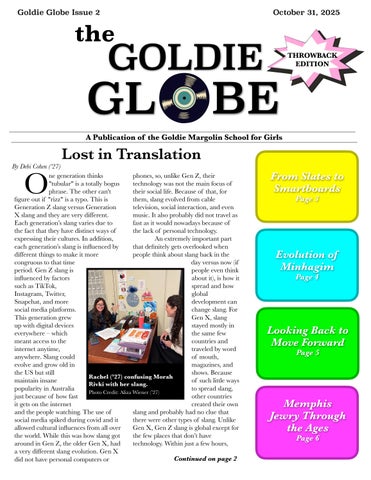
Lost in Translation

ne generation thinks "tubular" is a totally bogus phrase. The other can't figure out if "rizz" is a typo. This is Generation Z slang versus Generation X slang and they are very different. Each generation’s slang varies due to the fact that they have distinct ways of expressing their cultures. In addition, each generation’s slang is influenced by different things to make it more congruous to that time period. Gen Z slang is influenced by factors such as TikTok, Instagram, Twitter, Snapchat, and more social media platforms. This generation grew up with digital devices everywhere – which meant access to the internet anytime, anywhere. Slang could evolve and grow old in the US but still maintain insane popularity in Australia just because of how fast it gets on the internet and the people watching. The use of social media spiked during covid and it allowed cultural influences from all over the world. While this was how slang got around in Gen Z, the older Gen X, had a very different slang evolution. Gen X did not have personal computers or

phones, so, unlike Gen Z, their technology was not the main focus of their social life. Because of that, for them, slang evolved from cable television, social interaction, and even music. It also probably did not travel as fast as it would nowadays because of the lack of personal technology.

An extremely important part that definitely gets overlooked when people think about slang back in the day versus now (if people even think about it), is how it spread and how global development can change slang. For Gen X, slang stayed mostly in the same few countries and traveled by word of mouth, magazines, and shows. Because of such little ways to spread slang, other countries created their own slang and probably had no clue that there were other types of slang. Unlike Gen X, Gen Z slang is global except for the few places that don’t have technology. Within just a few hours,

Continued on page 2

Rachel (’27) confusing Morah Rivki with her slang.
Photo Credit: Aliza Wiener (’27)

people can learn a new phrase or word and then incorporate it into their culture. That really shows the impact that slang makes by using technology to be able to connect people all over the world. As of right now, people create slang, but, with up-andcoming technology, slang will probably change again to adapt to new technology and this new technology might just create more slang for people to use. Now, circling back to the different ways of expressing their cultures. Both generations had multiple similarities, such as using entertainment as a way to spread slang and using slang to express sarcasm and humor. At the same time, there are a lot more differences. For example, Gen X had to count on their tone and attitude to get the point across while Gen Z uses emojis and abbreviations to make their point. It has become very humorous so that even off the screen, slang is still able to get the point across and

get a laugh in too. Another difference is that while Gen Z slang is getting updated or added to basically every other day, Gen X slang would go weeks or months without changing. The last big difference is how they are used. Gen Xers often used slang to be independent or rebellious, like saying “as if” to your parents was basically telling them to buzz off. But Gen Zers use slang to be more expressive, especially with online interactions.

In case you were wondering, much of slang itself is not just random words people made up and gave a definition to. Slang is words made out of other words to make them shorter or slightly change the meaning but keep the same root word. It helps express feelings that older words just don't do justice for. Slang has become such an intricate detail in so many people's lives that sometimes people do not even realize they are using slang. Alright, we've had a lot of discussion on how slang is different and how it's similar so let's see if we can actually match them up. Don’t worry, we’re using definitions so everyone understands what's being said. To start with the basics, rad (Gen X) and fire (Gen Z) both mean cool or really good. Here's one where I definitely prefer the Gen Z version more: rizz

(Gen Z) and bodacious (Gen X), which both mean attractive or charming. The next one I actually dislike the Gen Z version, which is ick, compared to the Gen X version, grody, which means gross or disgusting. Ick actually means offputting or something that suddenly makes someone unattractive. While that isn’t the best match, they are used in the same context usually. The last one is to take a chill pill (Gen X) and it's not that deep (Gen Z) which both mean to calm down. As we see from the matches, slang doesn't really change that much but rather adjusts to the different time periods. The question that everyone seems to be asking is which is better? Honestly, I'm not sure which one is better. Each slang word is different and don't all have counterparts in different generations. They can't really be compared in the case of which one's better because of how different they are. I might be a little biased if I give my opinion but I'm going to anyway. Gen Z slang makes way more sense than Gen X slang. That's my opinion because, to me, Gen X slang really makes no sense. I'm sure they made sense back then, which is what really mattered. Just like how many parents (who I'm sure will read this) have no clue what their kids say when they use slang but know that somehow the kids know what they are saying. At least we all speak English!

Ms. Gray looking confused at the slang written on the board.
Photo Credit: Rachel Sanderson (’27)

HFrom Slates to Smartboards

ave you ever wondered how the school has changed since its establishment? What was it like 70 years ago? Well, let's find out!

Today, we have three different perspectives spanning multiple generations. We have Mr. Louis Safier, who attended in 1952, Tova Safier Frenkel, who attended from 1993-2008, and Avigayil Safier, a current ninth grader graduating in 2029. Let's see the differences and similarities in their answers after interviewing them!

1. What was the school building like when you attended? Which buildings were there and which weren’t?

Mr. SafierThe first building started in a one-room schoolhouse downtown. Then the school moved to the Baron Hirsch on 4th and Washington. It moved again to the Anshei Shul on North Parkway and Belview. Now, the current location is on White Station. At that time, it was K-8th grade. There was no gym or the Beit Midrash. And the field was a lake!

classroom and the gym was the cafeteria!

Avigayil Safier- Now, we have a STEAM lab, field, and newly renovated Beit Midrash.

2. Were there any special traditions or events at the school?

MS- The MHA had an annual Memphis Cotton Carnival. People in the community would make food and sell it! And the school invited Rav Moshe Feinstein z’tl to speak at the boys’ High School dedication.

TSF- There was school on Sukkos, which was a blast! And the Alumni game, where I sat with Bubbie selling tickets and food. Also, during Purim when the high school boys visited each classroom hyping everyone with songs. I loved the Senior-Freshman

“Kidnap” at midnight! We went to Walmart, drove to Shelby Farms, the radio station, and finished with breakfast. I also loved ‘Senior Ditch Day,’ the canoe trip, and the Gatlinburg Shabbaton.

AS- We have the annual science fair and school-wide poetry contest. We also have siddur and chumash plays.

3. How did students get to school? Were there any buses?

4. What kind of extracurricular activities were popular?

MS- MHA had baseball and basketball teams. It was very popular and many people joined and watched the games on Saturday night.

TSF- They offered basketball, which we all made the varsity team, and an annual play.

AS- MHA offers many extracurricular sports! Flag football, basketball, tennis, golf, and soccer shots.

5. How did technology in the classroom change over the years?

MS- Everything was on paper and we did a lot of cursive writing.

TSF- We also learned cursive! Only essays were typed. My parents made me write the essay first and then copy it to the computer! SATs were taken by hand.

AS- Now, a lot of assignments are on the computer. We write essays, answer questions and read passages on them.

6. How did your friendships shape your life?

MS- I was friends with many guys, but we all went our separate ways afterwards.

TSF- There's nothing like a childhood friend who knows you and your family. You don't need to explain anything because they lived it with you.

AS- Friends help shape your personality and are always there! It’s always nice to have a friend who knows you well.

Tova Safier Frenkel- The current buildings are for students K-12th. The Beit Midrash, and the boys’ dorm were there. The playground and the field were both there also. The lunchroom was the Kindergarten

MS- A big yellow school bus went around the community. The school was always in the neighborhood. When the school moved around, the people moved with the school.

TSF- Everyone drove to school. No one walked, and when we got to high school everyone drove each other.

AS- Many people drive but there are walkers and bikers too.

And there you have it: a journey across generations showing how much has changed, yet the school’s values of community, and learning remain. From slates to Smartboards, the spirit continues!

Avigayil Safier (’29) and family, all alumni of MHA.
Photo Credit: Avigayil Safier (’29)

Evolution of Minhagim

Minhagim, or customs, are different for each family in the Jewish world. Each of them have many aspects that aren’t known to everyone, even those who follow them. People find that they just follow minhagim because they always have and it’s what their parents did. Although these minhagim aren’t required by Halacha, they still hold a great significance for Jews all over the world. Each of these different minhagim evolve over time, with some changing and some even getting lost. But what causes an important and respected minhag to change?

Changes in our modern values and new discoveries often require the minhagim to be adjusted. Most of our customs have changed since the time the Beit Hamikdash stood, even the things that are normal in our day to day lives now. For example, breaking a glass at a wedding was really only ritualized after the destruction of the Beit Hamikdash because our past should always be on our minds. The groom breaks the glass at the wedding to remind us that even in the happiest times, we have to remember the sorrow of the destruction of the Beit Hamikdash. A lot of our minhagim are related to the Beit Hamikdash’s destruction. One of those is the minhag to put salt on our challah on Shabbat and on other holidays. The reason we do this is because during the times of the Beit Hamikdash, we would put salt on our korbanot (sacrifices), thus commemorating the traditions of such an important time in our history. Another minhag that relates to the Beit Hamikdash is how some people have the custom to face Yerushalayim (usually to the East) when they pray. This minhag goes back to Shlomo Hamelech, back in the time of the first Beit Hamikdash. He said that if anyone prayed toward the Beit

Hamikdash, Hashem would hear their prayers. Since the Beit Hamikdash was destroyed, we now just pray towards Yerushalayim, hoping for the same effect. If you live in Yerushalayim, you would pray towards where the Beit Hamikdash stood before it was destroyed. This custom is seen in the book of Daniel, where he prays facing Yerushalayim with the windows open. Because of this custom, many shuls have been built to face that direction. It’s remarkable to see how a custom that started thousands of years ago now influences something as central as how we build our shuls.

Some minhagim don’t have to do with the Beit Hamikdash though, like whether you can eat kitniyot on Pesach or not. And many minhagim differ based on the family, which is clearly seen on Pesach where Ashkenazi families have a minhag to not eat kitniyot (ex: rice, beans), and Sephardi families do so freely. The reason Ashkenazi Jews stopped eating kitniyot is because the Rabbis didn’t want there to be confusion between that and chametz, which look similar and are very easily confused. Even if now we are less worried about confusion, we still obey the minhag set forth by the rabbis centuries ago. Sephardim still eat kitniyot because when the Ashkenazi people first said they weren’t eating it, the Sephardic communities didn’t agree. They thought that there was a big enough difference between the two that it was okay to eat them. For cases like this, people say “Minhag Yisrael K’hilchata.” This means that a minhag can be turned into a halacha, something

we are required to do.

Some people do things without even realizing it’s a minhag. An example of that is when most religious Jews cover their eyes with their dominant hand during the Shema. This minhag originated from the time of Yaakov Avinu. Over time, it spread and became a very common minhag. The reason we do this is to prevent distractions while reciting the prayer. Placing your dominant hand over your eyes is intended to help you focus on the meaning of the Shema, which is saying that Hashem is the only G-d. Some people have the custom to put three fingers over their eyes, the pointer and the ring finger on their eyes and the middle finger between. It represents the Hebrew letter, shin. It serves as a reminder of the meaning of the Shema.

Minhagim can also build on things that someone is required to do, like Mishloach Manot(giving gifts of food on Purim). The minimum amount to give is two different food items and you have to give to at least one person. This amount is required, but some have the custom to do more. There is no limit on how much you can give; some people even like to give them to entire communities.

Our minhagim have ancient roots, even though some of them have grown and developed as our communities grow and develop. Minhagim play a big role in our lives and they mean a lot to different people. This all shows how things can change but we still have to work in unity to continue serving Hashem the best we can.

Ariella Caplan (’29) covering her eyes while saying Shema.
Photo credit: Margalit Goldkin (’26)

Looking Back to Move Forward

This week’s parsha is Lech Lecha, a parsha known to many to lay the foundation for Judaism. Hashem begins right away with His Commandment to Avraham: “

,” “Go for yourself, from your land, from your birthplace, and from your father’s house, to the land that I will show you.” Avraham, with a vague sense of direction and yet a strong drive for truth, packs his bags and gathers his family to embark on their journey to this unknown land. This pivotal moment in Jewish history marks Avraham’s beginning steps into destiny – not only his own, but that of his entire posterity. The very beginnings of the Jewish people and their ties to the land of Israel all come back to this instant and this very commandment. Lech Lecha - go for yourself, and by extension, your future as well.

yet it chooses to provide us with a “throwback,” bringing up where Avraham comes from without even saying where he is going.

Upon first glance, it seems obvious that this is the start of something new. However, the Torah surprisingly characterizes this incredibly significant juncture as an act of leaving behind. The text describes in deep detail everything that Avraham, and we as a nation, are intentionally moving away from. So why does Hashem emphasize what Avraham is leaving; his land, his birthplace, his father’s house, especially when it should be about him moving forward? The Torah could have easily left out these words,

Rashi and Midrash Rabbah bring a beautiful answer to this question. Rashi suggests that by explaining these many steps in painstaking detail, we can see that each one became progressively harder for Avraham to leave behind and let go of. The Midrash Beresheit Rabbah elaborates that they each were a representation for a different influence on Avraham, each description holding a distinct significance for him. “ךצראַמ – your land” represents his culture, “ךתּדלוֹמּמוּ – your birthplace” refers to his ingrained behaviors, and, lastly, “ךיבאָ תיבּמוּ – your father’s house” refers to family influence. Not only is Avraham commanded to go somewhere that is completely new to him, but also to leave every piece of familiarity from his past in which he found comfort. This is an incredibly difficult task. Avraham is being forced to erase every trace of his life and follow blindly after Hashem. Avraham truly has to look back at his past and abandon all its influence.

The discussion of Avraham’s past and his desire to follow after Hashem despite it reminds us that in order to truly understand who we are, we have to remember our past. What kind of people are we? What kind of things can we look back on and strive to improve? The Torah often uses the past to highlight the growth of someone or something. We see this with our constant remembrance of “

,” “remembering the Exodus of Egypt,” which we recall constantly. We remember our slavery

in Egypt – the very epitome of our past selves – on Pesach, Kiddush on Shabbat, and everyday in our Shema prayers. But looking back on the past doesn’t mean that we need to fixate on it or berate ourselves for it either. We don’t only focus on everything that came before, but we appreciate how far we’ve come since. This commandment of “Lech Lecha” given to Avraham demonstrates to us that in order to move forward, it’s necessary to look back and reflect. Until he can overcome his experience and take away the lessons learned from his land, birthplace, and father’s house, Avraham is unable to proceed to the new land he is being promised. To help us connect to this idea on a personal level, it is important for us as Jews to recognize that we are constantly being forced to move on and leave behind pivotal pieces of our past. It can be difficult in the modern age to look ahead with hope when being faced with harsh realities, whether it be our devastating slavery in Egypt or heartbreaking events like October 7th. Similar to Avraham, we are required to look back at these moments in our history in order to truly move forward and become the nation that we are today. Not only is Avraham moving forward a physical journey, but a spiritual one as well, as he’s moving forward by looking back at the past.

Another significant lesson we can learn from Lech Lecha is Avraham’s bitachon, faith, in Hashem. Avraham was commanded by Hashem to leave his home and he did so without a single question to ask. His trust in Hashem is something we can all strive towards in our lives. Avraham’s faith in God, willingness to start anew, and ability to through it all, reflect on his past, sets an example for the Jewish people as we continue in Avraham’s footsteps.

Hodaya (’27) looking back at the Avot to know how to move forward.
Photo Credit: Sara Shimanovich (’26)

Memphis Jewry Through the Ages

“Memphis? Where is Memphis?” “I think I’ve heard of that place; is that in Mexico?” These are just a few of the many responses I have received upon sharing my hometown with other Jews from bigger communities. Anyone who has ever left Memphis has likely run into Jews from all over the world, from communities big and small. Among these places, however, Memphis always seemed to stick out. Whenever I would tell people where I’m from, I was often met with a look of confusion or a furrowed brow – and honestly, who could blame them? Memphis surely isn’t home to the biggest Jewish population, and I wasn’t shocked that our community didn’t seem as present on the map. What people don’t know, however, is that Memphis has a rich Jewish history that stretches back centuries and has served the community in both rain and shine. Dating back to the early 19th century, Memphis began to attract more Jews with its growing riverside economy – David Hart being the first. Hart was a Jewish pioneer of sorts, promptly establishing an inn and saloon in the flourishing commercial town. Although Hart moved away, his influence had succeeded in drawing other Jews to the area. Later on, Joseph Andrews, an affluent cotton salesman, settled in Memphis with his

family. Eventually, Andrews started working as city alderman, a government position that allowed him to put his bright ideas for the Jewish community into motion. Andrews helped create a Jewish cemetery for his brother, and in the process, founded the Hebrew Benevolent Society, a project that is still ongoing to this day.

After the launch of the Hebrew Benevolent Society, the Memphis Jewish community gained momentum like never before. In 1853, the organization decided to create the first Memphis congregation – B'nai Israel, which met in the back of an obsolete bank. At that point, the Jewish community was on a roll, opening up charity organizations, breakoff congregations, and even a social club. However, the outbreak of the Civil War changed the Jewish scene in Memphis entirely. Memphis, buried deep in the Confederate South during the Civil War, became a new and precarious environment for its Jewish community. Throughout the war, Jews continued to partake in trade and other commercial dealings with gentiles frequently. This serene period for the Jews in Memphis screeched to a halt with General Ulysses S. Grant’s General Orders No. 11. This order targeted Jews from all over Tennessee, Mississippi, and Kentucky, with the hopes of expelling Jews from bigger southern hubs. Grant’s directive was incredibly accusatory, stating that, “The Jews, as a class violating every regulation of trade established by the Treasury Department and also department

orders, are hereby expelled from the department within twenty-four hours from the receipt of this order.” Not only did the General fail to provide relevant evidence for the banishment of Southern Jews from their homes, he even limited them to a 24-hour window in hopes of expediting the process! Jews in these areas, including Memphis, were rightfully outraged. After a stream of harsh backlash and protests, President Lincoln quickly revoked the order, to which the Jewish community was incredibly grateful.

Following the yellow fever epidemic, which devastated the Jewish community along with the rest of Memphis, the city rebuilt with the help of new Eastern European Jewish immigrants.These immigrants, along with other Jews, began to settle downtown in an area known as “the Pinch.” The Pinch, which consisted of twelve blocks, grew tremendously, expanding into an array of shops, restaurants, and housing units – a Jewish haven of sorts. It even led to the original formation of Baron Hirsch Synagogue, which could be found way downtown among the Pinch’s many other establishments. The founding of this Orthodox synagogue attracted even more Jews to come down to Memphis, and thus, the small southern commercial town evolved into an impressive Jewish community of all different denominations. The Margolin Hebrew Academy was also created later on, in 1949, spearheaded by the efforts of Rav Nota Greenblatt, and has continued to grow, along with the community as a whole, over the course of nearly eighty years.

Although the details of the incredible Memphis Jewish community remain unsung to other larger Jewish populations, the deep and cultured history of Jews in this city and its evolution over time remains inspiring as our community continues to grow and make its mark.

Margalit Goldkin (’26) standing in front of the historical Baron Hirsch Synagogue.
Photo Credit: Hodaya Harary (’27)

Which Generation are You?

Take this quiz and find out which generation you are, answers can be found at the bottom.

1. What is your favorite social media platform?

A. Facebook

B. YouTube

C. Twitter

D. TikTok

2. What do you enjoy doing in your free time?

A. Relax and listen to music

B. Scroll through YouTube/TikTok

C. Go shopping in the outdoor mall

D. Play Roblox

3. You’re feeling hungry, what do you grab as a snack?

A. Crunchy popcorn

B. Spicy Takis

C. Cheesy pizza

D. On-the-go protein bar

4. What is your dream job?

A. Software engineer; I’m more creative and like to problem solve

B. Nurse/doctor; it has lots of opportunities, and I would be financially stable

C. Entrepreneur; I can be my own boss and have a stable work-life balance

D. Social media influencer; it’s flexible, and I could be famous

5. Who is your favorite singer?

A. Adele

B. Taylor Swift

C. Whitney Houston

D. Billie Eilish

6. You’re throwing a party, you have a…

A. Karaoke night

B. Sleepover

C. Throwback theme

D. Dance party

7. What is your favorite animal?

A. Horse

B. Cat

C. Tiger

8. What is your favorite season of the year?

A. Spring; everything is blooming and it starts to get warmer

B. Winter; it’s cozy and you can sip hot chocolate by a warm fire

C. Fall; it’s nostalgic and the nature outdoors is colorful

D. Summer; it’s sunny weather and no schoolwork

9. How do you concentrate when doing homework?

A. I will stay up late if I have to. I am very dedicated and focused when it comes to work/school.

B. I will try to focus, but if I don’t understand something, I’ll ask ChatGPT, and maybe then I’ll understand it.

C. I’m naturally skilled at doing anything school-related, and I don’t really need to concentrate. I just do it.

D. I don’t have a long attention span, so doing work is harder for me. I’ll study a little bit each day.

Answers:

You are Gen Alpha! Born from 2010 until 2024, you are humorous and kind, but may be a little too immersed in your digital world.

If you chose mostly D’s…

You are Gen X! Born from 1965-1980, you enjoy the great outdoors and care a lot for the people around you.

If you chose mostly C’s…

You are Gen Z! Born from 1997 to 2012 into the world of internet and social media, you are socially aware and passionate for what you believe in.

If you chose mostly B’s…

You are a Millennial! Born from 1981- 1996, you are an ambitious hardworking person.

If you chose mostly A’s…

Remember When…

we didn’t have tocarryafob with us?

we lost power and had class in the schoollower library?

weusedto havea couchinthe lounge?

ourbusbroke downgoingto our nature trip?

we drove 14 hours to the Israel parade in DC?

we did insteadyoga of PE?

elective period was right before lunch?

Guess the Teacher

we were able to keep our phones the whole day?

Answers:

Top row (Left to Right) : Morah Rivki, Mrs. Grunwald, Mrs. Brown
Bottom row (Left to Right) : Mrs. Nissan, Mrs. Crews, Dr. Kennon

Spot the Difference

Etta’s Hot Take

This week I come to you from the horrifically humid state of Florida with an urgent message: drive-in movies need to make a comeback. While the 1950s had some truly tragic (and I mean tragic) fashion choices (yes, I’m talking about poodle skirts), this era had some redeeming qualities, mainly, dun dun dun, the drive-in movies. So, you may ask, “Oh, wondrous writer full of wisdom, why do drive-in movies need to make a comeback?” And I will answer you, “I’m so glad you asked, random reader - I will tell you why.” Have you ever been relaxing, enjoying your night out at the movies? The temperature is a perfect fifty eight degrees, the seats go all the way back, and, best of all, the movie is splendiferous (yes, that is a real word). You think to yourself, “Wow, this must be what cinematic bliss feels like.” You have not a care in the world UNTIL… the person behind you starts chewing obnoxiously loud – so loud, in fact, that you wonder if they broke the sound barrier, ruining your perfect movie experience. Now this whole disturbing experience could have been easily avoided. At a drive-in, you bring your own snacks and you have complete control over your car's air conditioning. You won’t have to worry about some random guy with slides and disgusting socks (that for some reason he has pulled over his sweatpants) spreading his nasty feet out on your chair. No random reader, you will have you and your car and the glory of sweet uninterrupted cinema.

GMSG SNAPS

Is it the 70’s or 2019? I guess we’ll never know…

contain their

for learning.

Photo Credit: Daphna Kam (’28)
Zionism takes over the Agricenter.
Photo Credit: Margalit Goldkin (’26)
Freshman gather to plan their GMSG takeover.
Photo Credit: Aliza Wiener (’27)
The future of Torah Tours.
Photo Credit: Rachel Sanderson (’27)
Sara and Adina show off their best penguin impressions.
Photo Credit: Rivki Wiener
Neima and Margalit can barely
excitement
Photo Credit: Neima Rovner (’26)
Only eight, but the energy is midlife crisis with sprinkles.
Photo Credit: Rivki Wiener
Hodi and Aliza model the best way to look at a camera.
Photo Credit: Yaheli Zalman (’28)
Sara heads toward dictatorship, with Rachel close behind.
Photo Credit: Sara Klein (’28)

Goldie's Guidance

Dear Goldie,

It’s my first time going to a real school, and I'm really nervous. I can’t remember another time when I’ve had such unbearable sleep. My mom has homeschooled me for as long as I can remember. Only now am I even allowed to go to a real school, #Strictparentsalert. I’m 14 years old and going into tenth grade; I'll be the youngest and apparently the shortest one in my entire class (and grade). This year has to be good, mainly because I am not going back to recess in our backyard sandpit. The problem is that I have absolutely no idea what in the entire universe to do or not to do. Do you have any tips from when you were a kid? If so, please send ALL of them.

Sincerely, Homesch00l_Hannah1234

Hold your horses, Homesch00l_Hannah1234,

This question brings back so many (almost all good) memories of my childhood. I was what you would call a dweeb to a queen. I was snazzy, sassy, and oh so classy. All throughout growing up, I went to the same school, and I rocked, or in my day, I was the cat's meow. This one time, we had a school sleepover in the gym. The music was a banger, and wow, you should’ve seen my dance moves; I would’ve swept you off your sleeping bag. Now, in high school, EVERYTHING changes, so you'd better start getting ready. Things will most likely either change over the holidays or the summer beforehand, so get prepared. In my case, our class clown was a complete buffoon; she would have lunch detention with Principal Frank almost every day. We watched her scrape mint or fruity flavored gum off from under the school’s long lunch tables, ewww. But when the next school year started, no one could believe that she was the same person. Just like that, in the blink of an eye, her entire school life was altered. Now, it’s only your first year, so don’t get your hopes up, especially since you’re only starting now - unlike me, who was swell from the moment I walked onto campus. Be prepared to get laughed at and joked upon or maybe even shoved into a locker, just FYI. If you want to avoid that humiliation, your first tip is to rock the stage with all you’ve got. And modesty is a NECESSITY. I was the queen of my school while my knees, elbows, and somewhat collarbone were covered. If that’s not skill, I don't know what is. This is to show your inner respect towards yourself. The biggest tip I can possibly give (because let’s be real) is to honor yourself, where you come from, and what you want to do moving forward for your inner self. Now, get your bottoms off the couch, stop being a lazy potato, and show that school what you are made of. Hopefully, it’ll be better than a teen playing by herself in her backyard kiddie sandpit.

To accomplish this and be as fetch as I am myself, follow these rules:

1. Wear neon (up to twice a week).

2. Shower EVERY night (NO exceptions).

3. Know your favorite movies - always a good conversation starter.

4. Go to all the hip events, woo hoo.

5. Don’t be the first person to hand in a test, but never be the last.

6. Always have extra snacks in your locker, especially hard candies and Takis.

7. Join school sports and clubs; you’ll have tons of fun.

For each year of high school, I was in a different club and somehow became president of all of them. Whether it was golf, YUNMUN, basketball, or mock trial, I dominated in every area. In ninth grade, when I was on the golf team, all I ever wanted to do was score a hole in one. Long story short, never just swing your club as hard as you can – someone will end up in the hospital. Sadly, my golf ball didn't even make it close to the hole; it landed in the sandpit, oh, diggity darn it. Overall, school will only be as good as you make it, but never take for granted some advantages of being homeschooled. Like ending around two in the afternoon. You will now be leaving the same time the sun leaves the sky. If you're still having difficulties after following my tips, look again because you're doing something wrong.

Dear Readers,

Letter From the Editor

Sefer Bereishit, which we just began, tells the story of the start of the world and Am Yisrael. In this issue, we use the reflective time period to have our GMSG “throwback.” We looked back on the history of the words we use, the school we go to, and the community we live in. Please enjoy this entertaining and enlightening issue that brings the past to the present!

To sponsor an issue for just $30, email Rachel Sanderson at rachel.sanderson@mhafyos.org

GOLDIE GLOBE STAFF

Hodaya Harary

Editor-in-Chief

neima.rovner@mhafyos.org

Margalit Goldkin

Managing Editor

margalit.goldkin@mhafyos.org

Sara Shimanovich

Senior Editor sara.shimanovich@mhafyos.org

Sara Klein

Assistant Layout Editor sara.klein@mhafyos.org

Assistant Editor-in-Chief

hodaya.harary@mhafyos.org

Aliza Wiener

Layout Editor / General Editor

aliza.wiener@mhafyos.org

Rachel Sanderson

Features Editor

rachel.sanderson@mhafyos.org

Faculty Advisors

Mrs. Ashley Brown &

Mrs. Rivki Wiener

Etta Kurinsky

Debi Cohen

Adina Schwartzberg

Yaheli Zalman

Daphna Kam

Abby Lewis

Rena Siegel

Yonina Lichter

Ariella Caplan

Chaya Devorah Besser

Maytal Davidovics

Miriam Kaplowitz

Rivka Ruderman

Avigayil Safier

Sophie Chaifetz

Turn static files into dynamic content formats.

Create a flipbook
Issuu converts static files into: digital portfolios, online yearbooks, online catalogs, digital photo albums and more. Sign up and create your flipbook.
Goldie Globe - Throwback Edition by Margolin Hebrew Academy - Issuu