The Official Newspaper of the Cooper Yeshiva High School for Boys
CYHSBers feel about how wel the school prepares them for life
Zacharia Levine(’29)
We’ve all sat in class wondering, “How will this really help me when I’m an adult?” When most people talk about high school, they think of classes, grades, sports, tests, and the usual daily routine. But underneath all of that, there’s a bigger question that every student eventually asks themselves: Is any of this actually preparing me for real life? Not the “study for the next quiz” kind of life, but the
day you have to file taxes, sign a lease, manage a bank account, or understand how interest works on a car payment. As Daniel Kahane ('27) puts it, "High School teaches us how to pass tests, but not how to file taxes or manage money.
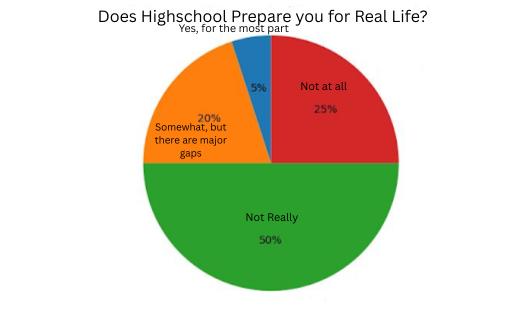
To get a better sense of what students in our school actually think, a poll was sent out to a student group chat asking the question, “Do you Continued on next page
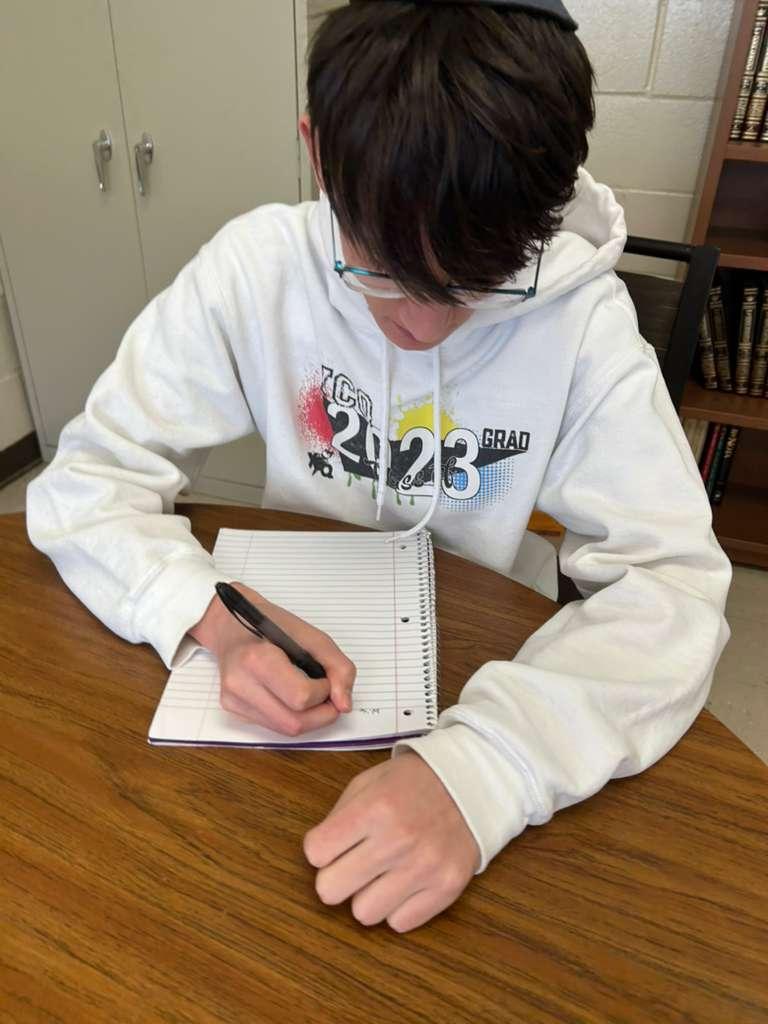
Image: Zacharia Levine ('29)
Continued fom previous page feel high school is actually preparing you for real life?” The results were surprising. Although most students feel they’re learning a lot academically, many are unsure whether they’re gaining the practical skills they’ll need once school ends. Out of the votes cast, one student voted “yes, for the most part,” five students responded “Somewhat, but there are major gaps,” another five said “Not at all,” and the largest amount, which was ten students, said “Not really.” That means the overwhelming majority of respondents feel unprepared for basic adult responsibilities. What stands out the most is that students want to feel prepared. They want to understand how taxes work, how to budget, how to avoid falling into debt, and how to navigate the choices that adulthood brings. "I think that schools should have classes t tach us even a little bit about the basics of adulthood," Benny Freiden ('26). It’s not that anyone expects high school to teach every possible adult skill; life itself will always be the real teacher. But many teens today feel like learning the basics
earlier would make the transition smoother.
Another topic students bring up a lot is decisionmaking. Not the small decisions like what lunch table to sit at or which electives to take but the bigger ones. Choosing a career path, evaluating college options, comparing financial commitments, or even simply learning how to manage time independently. These are parts
to sign a form, make a financial decision, or handle something important, they won’t freeze or panic.
of adulthood that don’t come with a textbook. They require confidence, experience, and the kind of practice most teens don’t get until they’re suddenly on their own. That’s why the responses from students are so valuable. They don’t point to a failure or a flaw. They point to a desire for readiness and confidence. They want to feel like when the moment comes
Ultimately, the goal of school is not just to teach facts, but to prepare students for life. And students clearly also want knowledge that goes beyond equations and essays. They want to walk across the graduation stage not just proud of what they’ve learned academically, but secure in the idea that they can handle the responsibilities waiting on the other side. If there’s one thing this conversation shows, it’s that today’s students care about their futures more than people might realize. We don’t just want to pass our classes we want to be prepared. And the fact that students are openly thinking about these questions is a sign, not of fear, but of maturity. We’re ready to learn, grow, and take the next steps. It’s a reminder that students aren’t afraid of the future they’re simply preparing for it. And with the right tools, we’re ready to step into it with confidence.
High School may not equip you wil the right life skils.
AI image: Zacharia Levine
The Story Behind Elite Interviews
Benny Freiden (’26)
What started as a fun idea between two friends has turned into one of the most exciting student run sports media projects in our community. Last year, Jack Kampf (‘25) and I decided to go to an EYBL basketball tournament just for fun. We did not bring a camera or any equipment. We simply hoped to enjoy the games. Instead, we ended up interviewing NBA point guard Anthony Black of the Orlando Magic and NBA legend Jamal Crawford.
From there, Elite Interview was born.
Jack and I both wear kippot and we take pride in representing who we are everywhere we go, whether that is in a high school basketball gym or standing next to professional athletes. We kept pushing forward and soon began interviewing local Memphis football players such as Sutton Smith, Everett Roussaw, and Nahmier Robinson, the son of NBA legend Nate Robinson. After one game, we even ended up on the field interviewing college standouts Cortez Braham, Brendon Lewis, and Greg Deroussises.
Cardinals pitcher Gordon Graceffo. From there, we began making game day vlogs of the sporting events, giving fans a behind the scenes look at the action.
Another highlight was Labor Day. We drove to Arkansas State University and filmed a
Across YouTube, Instagram, and TikTok, Elite Interview now has thousands of folowers. Image:
Across YouTube, Instagram, and TikTok, Elite Interview now has thousands of followers. And last month, we launched our second page, Elite in Memphis, which showcases high school basketball teams, players, and games in the city. In less than one month, it already reached over 2.4 Million views and more than 2,000 followers. Just a few days ago, we went to an FACS game vs Lausanne. We then posted a video after the game about FACS’s 5 foot point guard EJ Blount who dropped 17 and is in 8th grade playing varsity. The video went viral and has over 650 thousand views and 50 thousand likes. It even made it onto The Chris Vernon show on Grind City Media the next day. Chris Vernon said, “Elite in Memphis is a great idea”. ESPN reached out and posted it Maybe this turns into something big in the future, and maybe it doesn’t. But the lessons we’re learning, the relationships we’re building, and the memories we’re creating will stay with us forever.
One of the biggest moments came when I reached out to the Memphis Redbirds and secured an interview with St. Louis
“Day in the Life of a D1 Player” video with several of their basketball players. We toured their dorms, campus, and facilities, watched them work out, and even played against them ourselves. It was an unforgettable experience.
Make sure to follow us @eliteinterview and @eliteinmemphis on Instagram, @Eliteinterview1 on YouTube, and @elite.interview on TikTok.
Changes in the CYHSB: For The Better?
Avigdor Zweihorn (’27)
The CYHSB is changing. About a month ago, an email was sent out to the faculty and parents at the CYHSB informing them of an upcoming “cultural recalibration.” The administration explained that it was time to place a stronger emphasis on consistent rule enforcement.
In the email, Rabbi Dr. Brown, Rabbi Rossman, and Dr. Kennon explained that in order for the school to best do its job of teaching and supporting students, it must have clear expectations and follow- through. The administration described the school as an engine, explaining that at times it needs adjustment in order to run smoothly. Three main values were emphasized: attention, respect, and responsibility. According to the email, the administration feels that the school culture has, at times, fallen short of these principles,
and they committed to working
will have a lasting effect on overall student behavior.
nitely
been more full recently,” one CYHSB student commented anonymously. Detention is not the only area where change has been observed. Lateness is being addressed more closely, dress code expectations are being checked, and skipping classes has become more difficult. However, it is still unclear whether these changes
When asked to comment on the cultural changes, Rabbi Rossman, the Judaics Principal at the CYHSB, explained that the administration regularly reviews school culture and works together to improve it. “We are always looking and collaborating to see how we can best support our students and strengthen the environment at school,” he said. Rabbi Rossman explained that the administration took time to observe and better understand the situation, which allowed for planning, discussion, and consideration of feedback from parents before moving forward.
While the administration has followed through on its plan to increase consistency in rule enforcement, the question remains whether this approach will ultimately lead to improved behavior. The answer to that question remains to be seen.
Avigdor Zweihorn('27) writes this article while in detention.
Photo by Dotan Weiss ('27)
Crispy Potato Latkes
Ingredients
• 1 1/2 pounds russet potatoes (3 to 4 potatoes), scrubbed well
• 1/2 an onion, peeled and halved
• 1 large egg
• 2 tablespoons matzo meal or breadcrumbs
• 1 teaspoon kosher salt
• 1/8 teaspoon freshly ground black pepper
• 1 cup canola oil
Direction
1. Arrange a rack in the middle of the oven and heat the oven to 200°F. Line a baking sheet with a double layer of paper towels.
2. Cut 1 1/2 pounds of potatoes in half, crosswise. Grate the potatoes and the onion using the shredding disk of a food processor.
3. Transfer the grated potato and onion onto a large triple layer of cheesecloth. Gather the corners up and tie around the handle of a wooden spoon. Hang the bundle over a large bowl, then twist and squeeze the potatoes and onion as hard as you can until no more liquid comes out. Let the liquid sit for a few minutes to allow the potato starch to settle. Pour off and discard the liquid but leave the potato starch.
Latkes sizzling over stove. Source: https://www.thekitchn.com/
4. Add the potatoes, onion, egg, matzo meal or breadcrumbs, kosher salt, and black pepper to the bowl of starch. Mix with your fingers, making sure that the potato starch breaks up and is evenly distributed with the rest of the ingredients. Let sit for 10 minutes.
5. Place the canola oil in a large skillet. Heat over medium-high heat until a piece of the latke mixture dropped in sizzles immediately.
6. Scoop 1/4 cup of the latke mixture onto a fish or flat spatula. Flatten with your fingers to a 4-inch patty. Slide the latke into the hot oil, using a fork to nudge the latke into the pan. Repeat until the pan is full but the latkes aren't crowded. Cook until deeply golden-brown, 4 to 5 minutes per side, adjusting the heat as needed.
7. Transfer the latkes to a paper towel-lined baking sheet to drain for 2 minutes. And Enjoy!
Chef Gavi Lichter ('27) shares this recipe fom his achive . Photo: Rafi Davidovics and ChatGPT
Just When Was Pharaoh’s Birthday Anyway?
Chaggai Yorav (’28)
If I asked you what the only birthday that is mentioned in the Torah is, you will most likely answer Pharaoh’s birthday. But here is the real riddle - what was its date? Let’s try to find the answer, and maybe even come to understand our parshah a bit better.
In last week’s parshah, we learned about Yosef’s time in jail. He met the Chief Cupbearer and Chief Baker to Pharaoh, they both dreamt dreams, and Yosef interpreted them. He said that Pharaoh was going to decide in three days what would happen to each one, and the Torah tells us that the decision was actually made on Pharaoh's birthday. Back in our parshah, the Torah says right at the beginning “ץקמ היהיו םימי םייתנש" - "At the end of two years.” The Torah could have said “after” but from the fact it says “at the end of two years" From this we can understand that it happened exactly two years after the last event, Pharaoh's birthday. The story then follows: Pharaoh has a dream, and everyone fails to interpret it. Suddenly, the Chief Cupbearer remembers that there is a person in jail that can interpret dreams, Yosef. Pharaoh sends people to bring him and tells him the dreams. But there are some changes in Pharaoh’s retelling, from the
original dreams. The biggest difference between them, is that the Torah says "הערפו לע דמוע הנהו ,םלוח רואיה” - "Pharaoh was dreaming, and he stood on the Nile" And Pharaoh says “דמוע יננהו רואיה תפש לע” - "And I stood on the Nile’s bank" The difference is that standing on the bank is more admirable than standing on the Nile itself, so Pharaoh changed it, out of arrogance. After that, Yosef is interpreting the dream, and Pharaoh tells his servants "Could we find another like him? A man with divine spirit?” This part is pretty weird. Pharaoh couldn't know at the time that Yosef was right - so why did he assume that Yosef has a divine spirit?
Before we deal with that, I want to jump a couple centuries ahead.
In Tehilim, Chapter 81, David says “Blow the Shofar on the new moon, on the full moon for our festival.” This pasuk is definitely talking about Rosh Hashana. It continues, "Testimony [on/for Rosh Hashana] in Yosef he placed, when he went forth [from the prison to rule] over the land of Egypt.” We learned from this that the whole story happened on Rosh Hashanah. But this is not the
it should be punctuated this way: !עמשא -יתעדי אל "תפש" "Yosef told Pharaoh "I know your dream, and the word "תפש" (bank) I didn’t know." In other words "I know that you are lying, you didn’t stand on the Nile’s bank in your dream." That’s why he told his servants that Yosef has a divine spirit; he knew the dream before Pharaoh told him! And now we also know when Pharaoh’s birthday (most likely) was . If the story that happened exactly two years after his birthday happened on Rosh Hashana, it means that his birthday must be on Rosh Hashana!
Pharoah dreaming. AI image by Chagai Yorav
Cooper Clicks
Top Right: Jack Kampf ('26) and Jonah Siegel (’27) dancing at the Mesiba.
Top Lef: KTM Chunukah party.
Bottom Right: Odd one out.
Bottom Lef: Matty Ardestani(’29) and Chaggai Yorav(’28) make Dreidels.
Photos: Daniel Kahane (’27)
To sponsor an issue and lend support to the next installment of your favorite Jewish newspaper for only $20, please reach out to Akiva.Levine@mhafyos.org
This issue highlights a shared theme across our school: growth and preparation. Students are thinking critically about whether high school truly prepares them for life beyond graduation, while others are already taking that preparation into their own hands through creative projects like Elite Interview. At the same time, the CYHSB administration is working to strengthen school culture through increased consistency and accountability. Together, these stories show a community that is reflecting, evolving, and pushing forward. Whether through student initiative or institutional change, one thing is clear—our school is focused on preparing students