The Ecosystem Approach and the Endangered Species Act: An Unlikely Alliance
Provided by Catherine Murphy,
Program Support Team (PST)
The Endangered Species Act (ESA) turns 50 this year and I’d like to take this opportunity to reflect on how best to use the ESA to serve the threatened and endangered species within the Middle Rio Grande (MRG). As a multi-species collaborative, our complex mission demands that we help each other to seek out the most efficient and effective pathways to conservation and recovery. This challenge is compounded by increasing types and intensities of threats to our species and their habitats. While the ESA safeguards individual species and subspecies, it can also provide landscape-level protections for an entire suite of species inextricably linked by the ecosystem they share. Since we are also tasked with protecting existing and future water uses, we are acknowledging our own role as a member of that ecosystem. Considering how the ecosystem supports its inhabitants by providing structure and function is, in my opinion, the most efficient approach to species management and recovery. But you certainly don’t have to take my word for it.
As early as July 1994, the U.S. Fish and Wildlife Service and the National Marine Fisheries Service (the Services) adopted an Interagency Cooperative Policy for the Ecosystem Approach to the Endangered Species Act. The purpose of this policy was, “to promote healthy ecosystems through activities undertaken by the Services under authority of the Endangered Species Act.” The Services asserted that, “species will be conserved best not by a species-by-species approach but by an ecosystem conservation strategy that transcends individual species.” The policy laid out specific guidelines designed to incorporate ecosystem considerations in ESA actions with respect to listing, interagency cooperation, recovery and cooperative activities. This policy was well-intentioned, but its implementation over the last 29 years has received mixed reviews.
MRGESCP June 2023 Newsletter Page 1 of 15
2023 Newsletter FEATURED THIS ISSUE: Ecosystem Approach & ESA BEMP Crawford Symposium MRG Announcements
Recent Publications
Funding & Job Announcements
Program Updates
MIDDLE RIO GRANDE ENDANGERED SPECIES COLLABORATIVE PROGRAM June
New Member
Upcoming Dates
Continued on pg 2
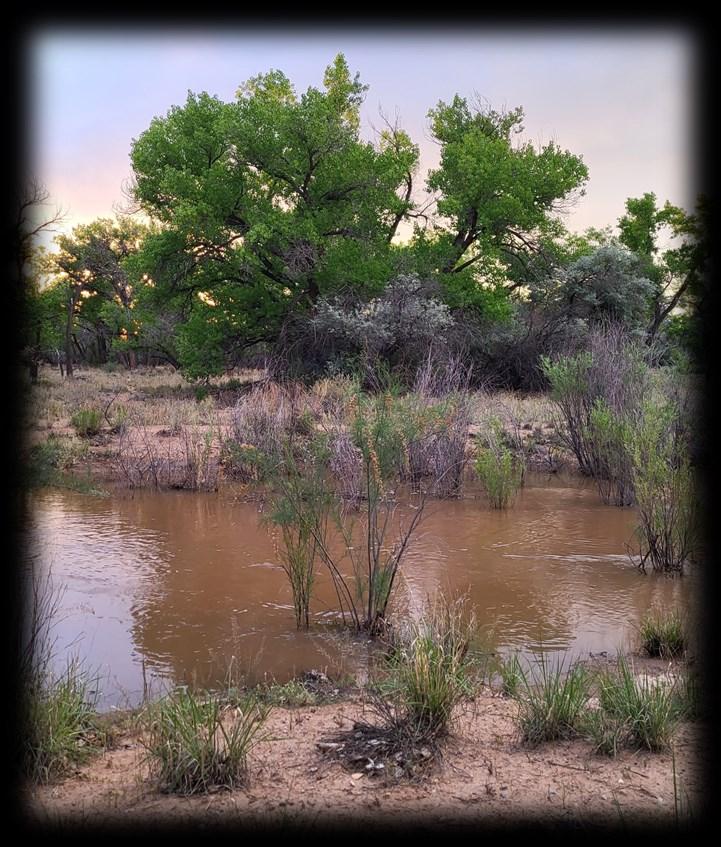
Photo: 2023 Bosque floodplain
Credit: Debbie Lee
THE ECOSYSTEM APPROACH & THE ESA CONT.
More recently, ecosystem planning has been proposed to address funding limitations, workload backlog, and other problems plaguing implementation of the ESA (Noss et al. 2021). In an effort to streamline ESA process and decisions, the U.S. Fish and Wildlife Service (USFWS) has promoted multi-species recovery plans and habitat conservation plans (HCPs). HCPs are designed to accommodate economic development by landowners and communities by authorizing the limited and unintentional take of listed species, while also providing long-term benefits to species and their habitats. Multi-species recovery plans claim to streamline the public comment process, save time and agency resources, and promote thinking on a broader scale. However, combining species on the basis of threat similarity or ecosystem under multi-species recovery plans has demonstrated less status improvement than with single-species plans (Clark and Harvey 2002). Critics of multi-species recovery plans also often discourage the use of ecosystem approaches, but this is most likely because some USFWS documents conflate these two concepts.
To avoid these pitfalls, I recommend that the Collaborative Program continue to support singlespecies recovery, while also exploring use of the ecosystemapproach as defined by the Convention on Biological Diversity (CBD). The CBD ecosystem approach is described as “a strategy for the integrated management of land, water and living resources that promotes conservation and sustainable use in an equitable way.” This approach is perhaps best understood as the application of its twelve principles (CBD 2007; Box 1). The approach “recognizes that humans, with their cultural diversity, are an integral component of many ecosystems.” Nowhere is this more pertinent than in our highly-managed hydrological system and expanding urban center. Most
importantly, the CBD approach focuses on “levels of biological organization, which encompass the essential structure, processes, functions and interactions among organisms and their environment.” This focus on ecosystem structure and function is key to successful ecosystem management and enables us to bridge the conservation gap between “the ecosystem” and “species habitat.” Ecosystem function can also serve as a “common denominator” for management discussions and collaborations among signatories with different interests, requirements, and authorities.
Indeed, an ecosystem approach was identified as one of the program-wide adaptive management needs during our 2022 Collaboratory event. Reasons cited included benefits to species through maintenance of ecosystem function, a need to plan for projected changes to the ecosystem, and a need for guidance regarding restoration assessment and monitoring. The Collaborative Program has already begun to incorporate the ecosystem approach in the following efforts:
Development of the Society for Ecological Restoration’s Recovery Wheel at the ecosystem level for the MRG;
Targeting ecosystem functions relating to listed species habitats for the Climate Futures Planning Workshop;
Development of an ecosystem-level conceptual ecological model for the MRG;
Studying the ecosystem functions and processes associated with vegetated islands and bars (and how they relate to listed species habitats); and
Refinement of metrics used to demonstrate restoration success, to include indicators of ecosystem function and process.
Continued on pg 3
https://webapps.usgs.gov/MRGESCP/ Page 2 of 15
THE ECOSYSTEM APPROACH & THE ESA CONT.
Moving forward, we will continue to explore the extensive operational guidance for applying the ecosystem approach provided by the CBD. My prediction is that this approach will eventually become the tapestry into which the Collaborative Program can weave its species management, restoration assessment, long-term planning, climate resilience, and other priorities, as they arise. Organizing and contextualizing our adaptive
management under the ecosystem approach also opens a door to new and greater funding opportunities. As a diverse collaborative that is adaptively managing endangered species for climate resilience using an ecosystem approach, we are addressing many of the key criteria for some of the new cooperative, watershed-scale grant programs. Along this new path, I believe we have little to lose and much to gain.
Box 1: The twelve principles of the Convention on Biological Diversity ecosystem approach.
Principle 1: The objectives of management of land, water and living resources are a matter of societal choices.
Principle 2: Management should be decentralized to the lowest appropriate level.
Principle 3: Ecosystem managers should consider the effects (actual or potential) of their activities on adjacent and other ecosystems.
Principle 4: Recognizing potential gains from management, there is usually a need to understand and manage the ecosystem in an economic context.
Principle 5: Conservation of ecosystem structure and functioning, in order to maintain ecosystem services, should be a priority target of the ecosystem approach.
Principle 6: Ecosystems must be managed within the limits of their functioning.
Principle 7: The ecosystem approach should be undertaken at the appropriate spatial and temporal scales.
Principle 8: Recognizing the varying temporal scales and lag-effects that characterize ecosystem processes, objectives for ecosystem management should be set for the long term.
Principle 9: Management must recognize the change is inevitable.
Principle 10: The ecosystem approach should seek the appropriate balance between, and integration of, conservation and use of biological diversity.
Principle 11: The ecosystem approach should consider all forms of relevant information, including scientific and indigenous and local knowledge, innovations and practices.
Principle 12: The ecosystem approach should involve all relevant sectors of society and scientific disciplines.
References
Clark, J. and E. Harvey. 2002. Assessing Multi-Species Recovery Plans under the Endangered Species Act. Ecological Applications, Vol. 12, No. 3, pp. 655-662.
Convention on Biological Diversity. February 7, 2007. Implementation: Principles. Ecosystem Approach. https:// www.cbd.int/ecosystem/principles.shtml
Noss, R. F., et al. 2021. Improving species status assessments under the U.S. Endangered Species Act and implications for multispecies conservation challenges worldwide. Conservation Biology. 35: 1715 1724. https://doi.org/10.1002/ cobi.13777
U.S. Fish and Wildlife Service and National Marine Fisheries Service. 1994. Federal Register Notice. Endangered and Threatened Wildlife and Plants: Notice of Interagency Cooperative Policy for the Ecosystem Approach to the Endangered Species Act. Federal Register Volume 59, Number 126 (July 1, 1994). FR Doc No: 94-16025. https:// www.govinfo.gov/content/pkg/FR-1994-07-01/html/94-16025.htm
MRGESCP June 2023 Newsletter Page 3 of 15
WHAT’S HAPPENING IN THE MRG
• BEMP Crawford Symposium
• MRG Announcements
• Recent Publications
• Funding Announcements

• Job Announcements
2023 BEMP CRAWFORD SYMPOSIUM
The Bosque Ecosystem Monitoring Program (BEMP) held its annual Crawford Symposium on April 28, 2023 at the Mountain View Community Center. The Symposium was a hybrid event, with both prerecorded and live presentations. The event was also streamed live via the BEMP YouTube channel.
Shelby Bazan, BEMP educator, opened the evening, providing a history of the Crawford Symposium, which is held in honor of BEMP’s co-founder Dr. Cliff Crawford. Rafael Martinez de Leon, an educator at the Bosque School, provided opening remarks in Spanish, and Dr. Tina Vesbac, the chair of the University of New Mexico Department of Biology, provided opening remarks in English.
Attendees then watched pre-recorded youth presentations from BEMP students from Horizon Academy West, Bosque School, A. Montoya Elementary, College and Career High School, and Inez Elementary. Students shared their experiences with BEMP monitoring, litter surveys, and bosquebased education.
A series of in-person speakers closed out the evening. Graduate student Cassandra Miller presented on her journey to find research interests after traveling and studying around the world and ending up back in New Mexico. Graduate student Hannah Miller presented the results of a survey of bosque managers, showing how BEMP data is used to inform bosque ecosystem management.
https://webapps.usgs.gov/MRGESCP/
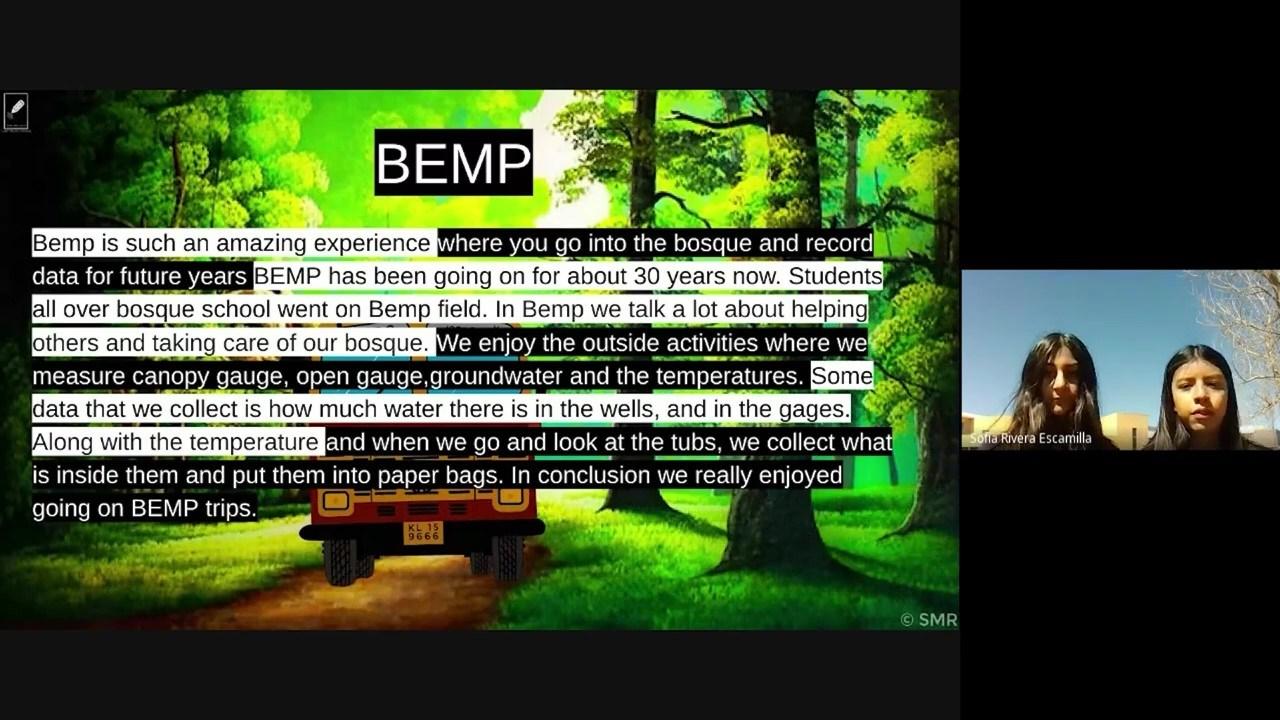
Photo: Slide from a student presentation at the 2023 BEMP Crawford Symposium
WHAT’S HAPPENING IN THE MRG
2023 BEMP CRAWFORD SYMPOSIUM CONT.
The 2023 Crawford Symposium had two keynote speakers. First, Richard Moore of the Los Jardines Institute discussed the importance of grassroot communities and activism in ensuring local voices are heard. He tied the livelihood of local agricultural communities and the health of the surrounding bosque to greater environmental justice implications. Mr. Moore shared that in 1991, environmentalism and conservationism was redefined to be “where we live, work, play, pray, and go to school.” He noted that BEMP’s data was important to track environmental impacts to the local community in the South Valley. And BEMP’s work with students is fostering the next generation of local activists working to better their local community and the world.
Second, Dr. Gregory Cajete, a Tewa educator and author, spoke on the importance of including local people, community, and knowledge into environmental discourse. He relayed some examples of local and indigenous knowledge of plants in New Mexico, and the need to link local impacts to conversations about environmental and climate solutions.
Due to a fire alarm, attendees were not able to watch the presentations from BEMP UNM students, but they are available as part of the full recording. Grant Forbrig presented on “How much do we really know about the bosque flora right in our backyard?” and Erick Fernandez presented on “Fires are ‘lit’! – burn site assessments.”
To watch the full recording of the 2023 BEMP Crawford Symposium, visit https://bemp.org/crawfordsymposium/.
MRG ANNOUNCEMENTS
2023 Animas and San Juan Watersheds Conference
The 2023 Animas and San Juan Watersheds Conference will be held at the San Juan College Henderson Fine Arts Center in Farmington, New Mexico, and online via Zoom on June 21 & 22, 2023. Click here for more information!
SER Southwest 2023 Annual Conference
The Society for Ecological Restoration (SER) 2023 Annual Conference will be held on November 16-19, 2023 in Santa Fe, New Mexico. Check out the link for event information.
Southwest Monsoon Fantasy Forecasts
Join the Southwest Monsoon Fantasy Forecast, an initiative of the Arizona Institute for Resilience at the University of Arizona, in which players take guesses at total monthly precipitation in the five major cities in the U.S Southwest Monsoon region. Points are assigned each month July through September based on the riskiness and accuracy of the players' forecasts, and cash prizes totaling $900 in Amazon gift cards will be awarded to the top three players at the end of the season. Forecasts for July must be cast by June 30 at 11:59 PM. Sign up now to watch the weather, compete with other players, and learn about the Southwest region’s iconic summer storm season! Join in here.
MRGESCP June 2023 Newsletter Page 5 of 15
WHAT’S HAPPENING IN THE MRG CONT.
RECENT PUBLICATIONS
Abundance and occupancy of the western yellow-billed cuckoo (Coccyzus americanus) in Sonora, Mexico
Macías-Duarte, A., Juárez, E., Sánchez-Murrieta, E., Perales-Hoeffer, E.L., Ortega-Rosas C.I. Canadian Journal of Zoology (2023). https://doi.org/10.1139/cjz-2022-0096
ABSTRACT

Unveiling factors that determine abundance and distribution of endangered wildlife species has important implicationsfortheirconservationacrossinternationalboundaries.Forinstance,theWestern Distinct Population (as defined by the U.S. Fish and Wildlife Service) of the yellow-billed cuckoo Coccyzus americanus (Linnaeus, 1758) has disappeared in most of the species’ range across western United States and southwestern Canada but little is known about the conservation status at the southern edge of its breeding distribution in Mexico. To fill this information gap, we estimated abundance and occupancy rates of yellow-billed cuckoos using a standard broadcast call survey protocol. We used Bayesian spatial count models to estimate cuckoo population density at survey sites. We used Bayesian hierarchical models to estimate the effects of geography, climate, and vegetation on occupancy rates while accounting for imperfect detection. Mean cuckoo count per transect for all sites was C = 9.00 ± 0.45 cuckoos. Overall cuckoo density was D = 13.18 cuckoos/km2 (SD(D) = 5.61 cuckoos/km2). Overall cuckoo occupancy in Sonora was ψ = 0.538 (95%CrI(ψ) = 0.488–0.600), but showed strong geographic variation. Relatively high occupancy levels suggest yellow-billed cuckoo populations in Sonora may be robust, but they are largely reliant on declining high-tree cover.
Isleta Diversion Dam Modification Project Environmental Assessment
BRIC, LLC. (2023). Prepared by BRIC, LLC, a subsidiary of Diné Development Corporation. Prepared for U.S. Bureau of Reclamation, Albuquerque Area Office. Link
Prioritizing Locations for Irrigation Infrastructure to Create Drought Refuge Habitats
Archdeacon, T.P., Bedwell Boro, M.E. (2023). Prepared by U.S. Fish and Wildlife Service, New Mexico Fish and Wildlife Conservation Office. Prepared for U.S. Bureau of Reclamation, Albuquerque Area Office. Link
Continued on pg 7
https://webapps.usgs.gov/MRGESCP/ Page 6 of 15
Photos: Rainbow in Albuquerque
Credit: Catherine Murphy
WHAT’S HAPPENING IN THE MRG CONT.
RECENT PUBLICATIONS CONT.
Rio Grande Silvery Minnow Population Monitoring During 2022
Dudley, R.K., Platania, S.P., White, G.C. (2023). Prepared for U.S. Bureau of Reclamation, Albuquerque Area Office. Link
Rio Grande Silvery Minnow Population Monitoring During April 2023
Dudley, R.K., Platania, S.P., White, G.C. (2023) Prepared for U.S. Bureau of Reclamation, Albuquerque Area Office. Link
Rio Grande Silvery Minnow Population Monitoring During May 2023
Dudley, R.K., Platania, S.P., White, G.C. (2023) Prepared for U.S. Bureau of Reclamation, Albuquerque Area Office. Link
Retrospective: Transitioning River Geomorphology and its Impact on Habitat Management
Harris, A., AuBuchon, J., Porter, M., McKay, S.K. (2023). Prepared by U.S. Army Corps of Engineers. Link
ABSTRACT
Since the early 1900s, the US government and state-level agencies throughout the southwest have invested ambitiously and prolifically on large-scale engineering projects to mitigate risks due to alternating conditions of drought and flood. These approaches included construction-intensive methods, particularlybuildingdams,levees,andriverchannelization.Thecombinationofthesestructuresmet design goals to reduce flood risk by reducing inundated areas and improving river conveyance. However, the impacts to sediment supply and homogenization of water discharge have generated a geomorphic response that has impacted riparian ecosystems. Channel narrowing, floodplain disconnection, and streambed erosion have been common in these heavily engineered semi-arid river systems.
Due to increased prioritization of ecological function and cost of recurring maintenance challenges, government activities have shifted from hardened river infrastructure solutions to engineering with nature, habitat restoration, and channel maintenance. However, in contrast to hard-engineering projects, habitat management faces challenges in demonstrating longevity, engineering effectiveness, and quantifying habitat quality improvement.
The purpose of this paper is to characterize the geomorphic change that has occurred in one of these highlyengineeredriversystems,theRioGrande,andhowobservedtrendsimpactassumptionsabout restoration effectiveness and project scales. Based on geomorphic trends on the Rio Grande near Albuquerque, NM, we discuss an alternative framework to assess long-term restoration efficacy within the context of geomorphic change. The intention is to increase project resilience and effectiveness. We discuss challenges to innovation in over-allocated and highly engineered river systems, while also demonstrating how such alternatives have economic potential and reduce liabilities by reducing recurring maintenance and improving ecological function.
MRGESCP June 2023 Newsletter Page 7 of 15
WHAT’S HAPPENING IN THE MRG CONT.
FUNDING ANNOUNCEMENTS
Invasive Plant Program Grant – Year-round applications
The State of New Mexico, Energy, Minerals and Natural Resources Department (EMNRD), Forestry Division (Forestry Division) accepts grant applications for invasive plant management projects yearround. The U.S. Department of Agriculture, Forest Service (Forest Service) regularly provides funds specifically to address areas where invasive plants threaten forested acres. Projects must emphasize prevention and treatment of invasive plants and address any or all of the following:
• awareness and education;
• prevention and early detection;
• inventory and mapping;
• planning and coordination;
• integrated weed management; or
• monitoring and evaluation.
The Forestry Division shall give the highest priority to projects that apply integrated management practices and demonstrate partnerships and monitoring results and for projects that address priority species on the New Mexico Noxious Weed List. See the application here.
USDA Technical Assistance and Construction for Innovative Regional Wastewater Treatment Solutions – Applications due July 21,
2023
The Technical Assistance and Construction for Innovative Regional Wastewater Treatment Solutions (TAC-RWTS) Grant Pilot Program has been established for the study, design or construction of innovative treatment solutions of regional wastewater systems for historically impoverished communities that have had difficulty installing traditional wastewater treatment systems due to soil conditions. Funds must benefit communities that are located within historically impoverished communities, as defined within the notice of funding opportunity. To learn more about eligibility and the application process, click here.
JOB ANNOUNCEMENTS
Seed Collectors for the Institute for Applied Ecology – Applications due June 29, 2023
The Institute for Applied Ecology is hiring five seed collection positions in New Mexico and Arizona. Announcements with further details and application instructions can be found here.
Wildlife Biologist at Sevilleta NWR – Applications due July 10, 2023
The Sevilleta National Wildlife Refuge is hiring a Wildlife Biologist. Check out the links below for more information. The job vacancy announcements are intended to fill one vacancy.
Fish and Wildlife Service (Land Management Workforce Flexibility Act): Link
Public Land Corps: Link
Recent Graduates: Link
https://webapps.usgs.gov/MRGESCP/ Page 8 of 15
PROGRAM UPDATES
COLLABORATIVE SEMINARS
CLIMATE PROJECTIONS, MODELING, AND THE IMPACT BEYOND CLIMATE SCIENCE
Adrienne Wootten, South Central Climate Adaptation Science Center – May 10, 2023
Recording Link
PDF Link
Dr. Adrienne Wootten, Research Scientist with the South Central Climate Adaptation Science Center (University of Oklahoma), presented a seminar to the Collaborative Program on the development of climate projections, interpreting uncertainty, and the application of climate projections to research and management. Adrienne gave an overview of potential climate trends based on global carbon emissions scenarios, and showed the associated uncertainty in projected temperature changes. There are dozens of different climate models from around the world, and while all climate models are based on the same physical processes, different models use different equations to describe those processes, such as cloud formation and solar radiation. Another difference between models is the choice of downscaling method, which increases the resolution of global climate models by incorporating effects of topography across a region, improving the utility at the local scale. These differences contribute to the overall uncertainty surrounding climate projections.
Adrienne also discussed the application of climate projections beyond climate science, in areas such as adaptation planning, impact assessments, and decision making. She provided examples of how climate projections can be used to project changes to variables relevant to management decisions, such as streamflow and vegetation. Adrienne also provided an overview of datasets, tools, and other resources available for the southwestern United States. Key takeaways from the seminar included: 1) ensuring that selected climate projections are appropriate for a geographic region, 2) consulting climate scientists regarding use of models, and 3) understanding that climate projections can’t reveal everything about future conditions. The incorporation of climate futures into planning efforts can provide critical insights about changes in relevant variables, can provide plausible upper and lower bounds on uncertainty, and can help to generate a forum for collaborative adaptive management.
ECOLOGICAL RECOVERY WHEEL
Zoë Rossman, Collaborative Program – May 17, 2023
Recording Link
PDF Link
Zoë Rossman, Assistant Science Coordinator for the Collaborative Program, presented a seminar on Applying the Society for Ecological Restoration’s (SER) Ecological Recovery Wheel as a tool for monitoring ecosystem restoration in the Middle Rio Grande (MRG). Zoë began by identifying some common problems shared by restoration practitioners, such as difficulty securing funding for longterm monitoring at restoration sites, a lack of guidance regarding site maintenance, and the need to visually demonstrate restoration progress. To address these problems, the SER Recovery Wheel was researched and deemed appropriate for the assessment of restoration success at the ecosystem level
Continued on pg 10
MRGESCP June 2023 Newsletter Page 9 of 15
PROGRAM UPDATES
COLLABORATIVE SEMINARS CONT.
ECOLOGICAL RECOVERY WHEEL CONT.
in the MRG. According to the SER, the Recovery Wheel is part of a set of international ecological restoration standards, which provide a guide to restoring degraded ecosystems around the world, with a focus on increasing effectiveness of restoration through design, planning, and implementation of restoration efforts.
The wheel comprises six key attributes, which are based in the SER’s restoration standards and apply to any ecosystem at a broad scale. Sub-attribute components of the six broad attributes are specified for a particular ecosystem and can be quantified using measurable indicators. Metrics measured on the sub-attributes are assigned levels, or “stars,” from 1 to 5, where 1 star represents the most degraded condition and 5 stars represents full recovery. By documenting the levels attained for each sub-attribute over the life of a restoration site, progress towards recovery is visually demonstrated on the wheel.
Zoë then walked through a case study from Virginia to demonstrate how the wheel is applied to an actual stream restoration project. The Recovery Wheel is applied throughout a project to inform planning and monitoring and help evaluate success. Using the wheel for long-term monitoring can illustrate the trajectory of recovery at the site, but also provides information to help managers decide when to intervene with maintenance. Zoë concluded her presentation by relating the SER Recovery Wheel to current Collaborative Program activities and explaining how development of a wheel for the MRG will be used to inform restoration monitoring guidance in the future.
Continued on pg 11
https://webapps.usgs.gov/MRGESCP/ Page 10 of 15
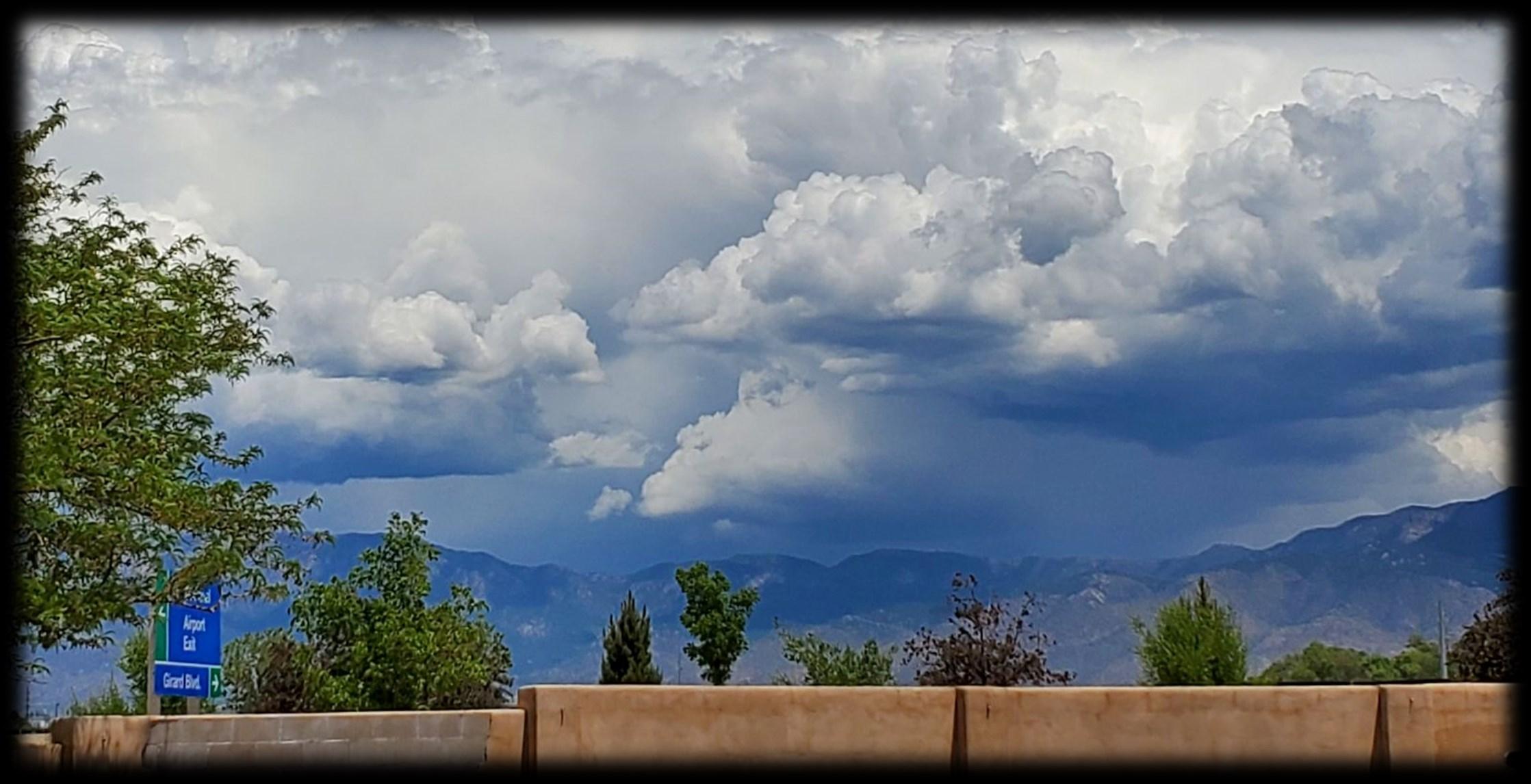
Photo: Albuquerque sky Credit: Catherine Murphy
PROGRAM UPDATES
COLLABORATIVE SEMINARS CONT.
WATER QUALITY AND ECOSYSTEM PROCESSING IN THE MRG
Dave Van Horn, University of New Mexico Biology – June 8, 2023
Recording Link
PDF Link
Dr. Dave Van Horn, Research Assistant Professor at UNM Biology, presented a seminar to the Collaborative Program on water quality monitoring in the MRG, research on the impacts of water quality on ecosystem processes, and implications of water quality for management of the Rio Grande silvery minnow (RGSM).
Dave first highlighted the relevance of water quality research and monitoring to Collaborative Program objectives. For RGSM, water quality influences life history traits and habitat suitability. Water quality data also support efforts to characterize river conditions by reach, as well as the environmental assessment process to establish the conservation storage pool for endangered species in the MRG.
Dave provided an overview of the distribution of water quality studies conducted in the MRG within three categories: 1) disturbances that impact survival and recruitment of RGSM, 2) algal resources important for RGSM diet, and 3) environmental controls on life history traits and habitat suitability for RGSM. The Water Quality Monitoring Network for the Middle Rio Grande has conducted continuous water quality collection in the Angostura Reach since 2006. Four additional southern water quality collection sites were added between 2021 and 2023. Results from this water quality monitoring program are available upon request (vanhorn@unm.edu).
Dave presented published findings on disturbances that impact survival and recruitment of RGSM. These findings show that urban and non-urban storm events have distinct and potentially large impacts on MRG water quality. These results also show that both the northern and southern reaches have varying disturbance regimes specific to stormwater; however, dissolved oxygen at both reaches are differentially impacted.
Unpublished findings from Dave’s research group, with regards to algal resources important for RGSM diet, suggest that overall gross primary productivity (GPP) declines in the downstream direction in the MRG. Preliminary work on environmental controls of life history traits and habitat suitability reveals that a site in the northern MRG consistently has the highest water quality in terms of dissolved oxygen and temperature. Maximum daily temperature at southern sites often exceeds the acute lethal limit for RGSM.
Although collection of water quality data in the southern reach of the MRG is challenging due to sediment movement and river drying, Dave highlighted that our current understanding of water quality in the MRG is significantly limited due to the lack of water quality data south of Albuquerque. Therefore, data collection and analysis from the Isleta Diversion Dam to Elephant Butte Reservoir should be prioritized in support of the largest remaining RGSM population.
MRGESCP June 2023 Newsletter Page 11 of 15
PROGRAM UPDATES

ANNOUNCEMENTS
2022 ANNUAL REPORT
The final 2022 Annual Report is available on the Program Portal here. Printed copies will be provided to all signatories. The report features letters from the Executive Committee Co-chairs, write-ups on the Program's biggest accomplishments in 2022, a Year in Review graphic, photos and quotes from the signatories, and the Program’s messages for 2023. The Collaborative Program had many wins as it moved from "planning to practice" in 2022, and they were celebrated in the 2022 annual report!
2021-2022 BIBLIOGRAPHY
The Collaborative Program maintains a bibliography of peer-reviewed literature pertaining to listed species in the MRG in order to increase awareness of recently published relevant science. The 20212022 Bibliography is now available on the Program Portal here
The limited scope of the bibliography is described in the preface of the document. If you have any feedback to improve the utility of the bibliography moving forward, please contact the Program Support Team at cmurphy@west-inc.com.
CLIMATE FUTURES PLANNING WORKSHOP
The Collaborative Program will host a Climate Futures Planning Workshop in October 2023 to help participants prepare and plan for changing climate conditions in the MRG. The Collaborative Program is continuing to plan the event with the Climate Futures Planning Small Group. A save the date will be announced after the June Executive Committee meeting.
https://webapps.usgs.gov/MRGESCP/ Page 12 of 15
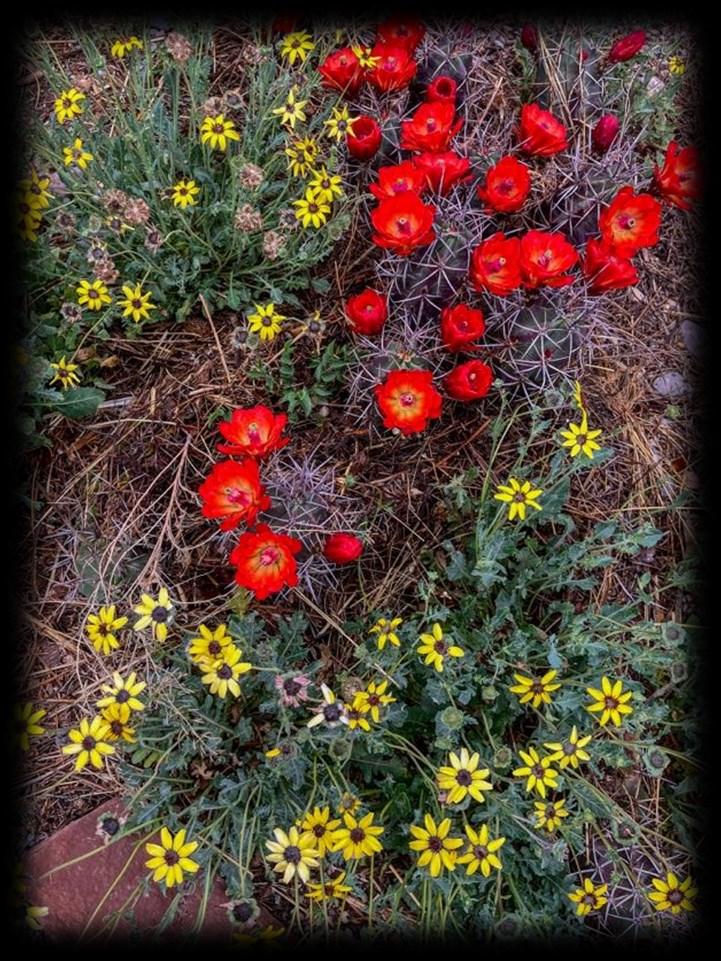
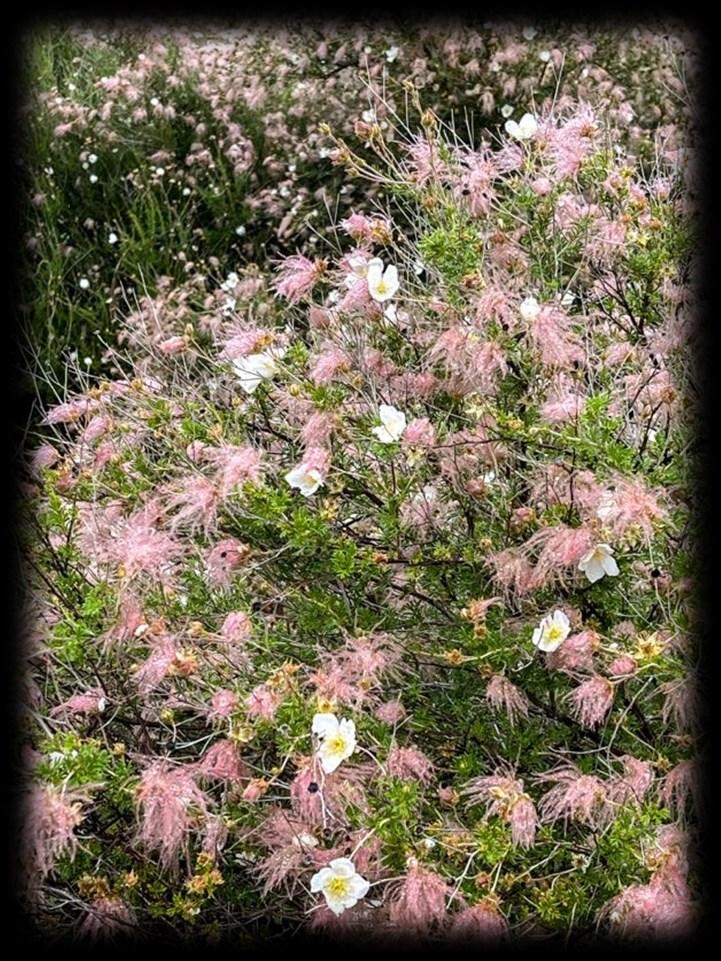
Photos: Vegetation at Whitfield
Credit: Zoë Rossman
PROGRAM UPDATES
CALLS FOR ACTION
SUBMIT 2022 SIGNATORY ACTIVITIES!
Collaborative Program signatories are asked to provide their 2022 activities via the Science and Adaptive Management Information System (SAMIS) or Survey Planet form as soon as possible. These activities are vital for Collaborative Program efforts, including the cost share report, signatory contributions report, and Long-Term Plan. Please contact Michelle Tuineau (mtuineau@west-inc.com) with any questions.
TAKE THE CLIMATE FUTURES POLL!
Please complete the Climate Planning Poll regarding your understanding and use of climate projections in endangered species habitat management in the MRG by August 23, 2023. Your answers will inform the Climate Futures Planning Workshop in October 2023. Take the poll here.
The poll includes the following questions:
1. Rank the factors in the order of importance your organization considers them when implementing endangered species habitat management in the MRG.
2. How would you rate your level of understanding regarding the application of climate projections to your work?
3. How have climate projections influenced your current management of water and/or natural resources in the MRG?
4. How do you think climate projections will affect your future (next 30 years) planning for management of water and natural resources in the MRG?
JOIN THE SYMPOSIUM PLANNING SMALL GROUP!
The 2023 Science Symposium will take place in early December. The Collaborative Program is calling for interested parties to join a small group tasked with planning the event. Please contact Debbie Lee (dlee@west-inc.com) if you are interested in joining the group.
ENTER THE PHOTO CONTEST!
The Collaborative Program is holding a photo contest for the August 2023 newsletter! The theme is “Water, Water, Everywhere.” 2023 is shaping up to have plenty of high flows, and we want to see your best water photos. While you are working or playing outdoors, be on the lookout for photo opportunities! To enter the contest, please send your best water photo to mtuineau@west-inc.com with the name of the photographer, location of the photo, and a brief caption by August 25, 2023.
MRGESCP June 2023 Newsletter Page 13 of 15
PROGRAM UPDATES
FIND THE HIDDEN MINNOW
Search through the newsletter for the hidden minnow. Click the image for a surprise!
SOLVE THE WORD SEARCH
Find the following words in the puzzle.

https://webapps.usgs.gov/MRGESCP/ Page 14 of 15
COLLABORATION ENDANGERED JUMPING MOUSE RIO GRANDE COTTONWOOD FLOODPLAIN MANAGEMENT SOUTHWEST CUCKOO FLYCATCHER MINNOW SUNFLOWER ECOSYSTEM HABITAT RESTORATION
GAMES
S J R G F L Y C A T C H E H R L P E U U M E C O L L A B O R A I T O N N N M N A S O E D R S H J J F L O L D B P V O N T T C H I U C U K C O O A A I W X Q A O T O A O N B Y A K R N D N Y I C H G R O S B G F U S S Q G X G U R X E R E A N Y I R Z L C I E B M X G L J I R M T W S T O A P T R S O U T H W E S T E I O T A N W R E N U R M I N N O W B N O O E T D E D Y S V P O E L I J H E T N D M E E R H E W M K W D F L O O D P L A I N E
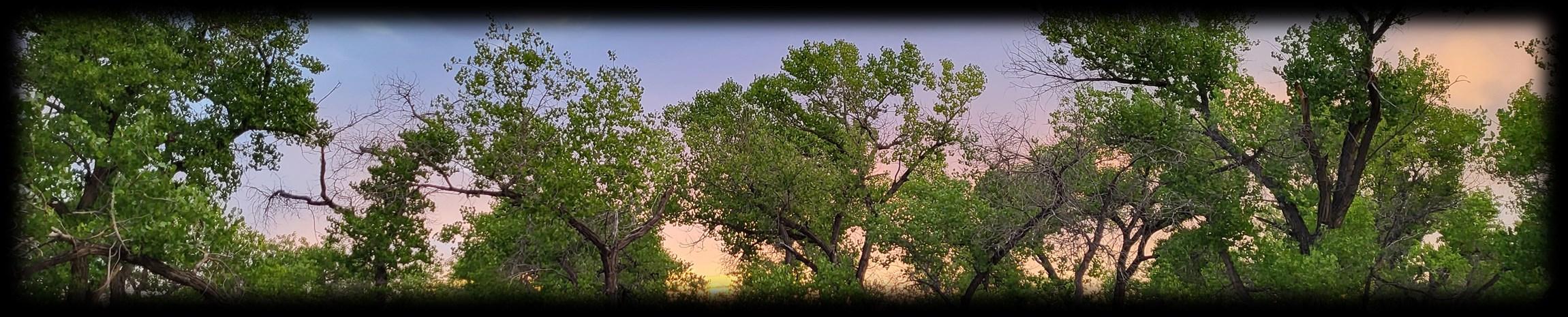
Photos: Bosque tree line
Credit: Debbie Lee
NEW MEMBER & UPCOMING DATES
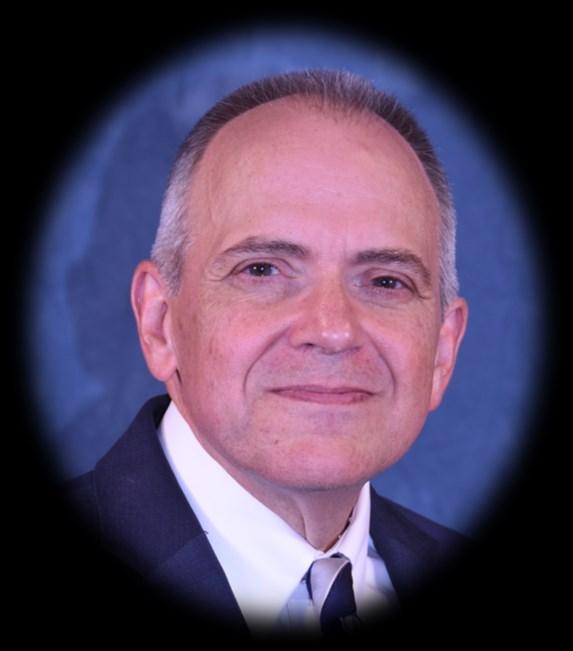
FAREWELL KATRINA GRANTZ, WELCOME BACK WAYNE PULLAN
After two years as the Federal Co-chair for the Executive Committee (EC), Katrina Grantz’s tenure ended in April 2023. During her time, Katrina was an influential and creative voice, and helped the Collaborative Program take its first steps after its transition to a new science and adaptive management framework.
As we say goodbye to Katrina, we are joined again by a familiar face; Wayne Pullan has once again joined the Collaborative Program as the Federal Co-Chair. Wayne is the Regional Director of Reclamation’s Upper Colorado Basin. He oversees a variety of water and hydropower projects in Arizona, Colorado, New Mexico, Texas, Utah, and Wyoming. During his 26 years of experience at Reclamation, he has worked on
PROGRAM DATES
Executive Committee Meeting
June 29, 2023
1:00 PM—4:00 PM MT Water Photo Contest Closes (pg 13)
August 25, 2023
The information in this newsletter should not be attributed to the Collaborative Program or its Executive Committee, but to the organization from which it was submitted.
For comments and inquiries, contact: Program Support Team | (505) 414-3507 | mtuineau@west-inc.com
infrastructure rehabilitation, endangered species recovery, Indian water rights settlements, water quality improvement, and municipal and irrigation water supply planning, among other areas.
Wayne was also the winner of the 2021 Rick Billings Memorial Award for his decisive leadership during a major period of transition for the Collaborative Program.
It is truly a pleasure to have Wayne’s clarity and guidance at this point in the Collaborative Program’s journey. Please join us in welcoming back Wayne!
MRG DATES
2023 Animas and San Juan Watersheds Conference (pg 5)
June 21-22, 2023
Southwest Monsoon Fantasy Forecasts (pg 5)
June 30, 2023
Proposals for USDA Innovative Regional Wastewater Treatment Solutions Grant (pg 8)
July 21, 2023
SER Southwest 2023 Annual Conference (pg 5)
November 16-19, 2023
MRGESCP June 2023 Newsletter Page 15 of 15
