
Our Samui Magazine Mar-Jun 2026

Page 1


Publisher’s Note

A Season of Radiant Energy

As we welcome the second issue of OurSamui, the island enters its most radiant season — a time of celebration, renewal, and vibrant energy.

The Thai summer casts Samui and its sister islands in brilliant light; the sea shimmering beneath expansive blue skies, palm trees waving in the warm coastal breeze, and days feel both relaxed and alive. It is a season that naturally invites us outdoors — from early-morning walks along quiet beaches to afternoons on the sandy shores, from lively markets to hillside sanctuaries overlooking the horizon.

April brings Songkran, the traditional Thai New Year — a joyful celebration of fresh beginnings. Water becomes both blessing and renewal, washing away the past and welcoming what lies ahead. In many ways, this spirit mirrors our own journey. We are deeply grateful for the warm reception of our inaugural issue and encouraged by the continued support of our hospitality partners, readers, and community. With this second edition, we move forward with renewed commitment and purpose.

Beyond the shoreline lies a world of discovery. Snorkel colourful reefs, sail among dramatic limestone islands, hike forest trails to hidden waterfalls, or simply pause to savour the changing colours of the sky at dusk. From Koh Phangan to Koh Tao and the surrounding isles, each

Glory panel

HOTLINES

ADVERTISING

Guitar

+66 (0) 87 929 6611  guitar@mpmith.com  valentino@mpmith.com

EDITORIAL  editorial@oursamui.com

Read Online

OurSamui.com

PUBLISHED BY

MPMI Group Co., Ltd. 1 Soi Lasalle 23 Yaek 2, Bangna Tai, Bangna, Bangkok 10260, Thailand Tel. +66 (0) 2744 4975 Fax. +66 (0) 2744 5271

PUBLISHER/CEO Steven Fong Chookiat Pangviphas

destination offers its own charm — yet all share the same unmistakable island soul.

As June approaches, you’ll notice the first hint of the Green Season softening the landscape. Hills deepen in colour, the air grows gentler, and a quieter beauty emerges. Samui reminds us that it is never defined by a single mood, but by a seamless blend of serenity and calm.

Wherever this season leads you — along the beaches, across neighbouring islands, or within the quiet comfort of your island retreat — may it leave you with memories that endure long after your journey ends.

Warm regards, Steven Fong Chookiat Pangviphas Publisher, OurSamui

EDITOR-IN-CHIEF Mimi Grachangnetara

CREATIVE DIRECTOR JyeShen Koo

ART DIRECTOR Pongtorn Khaoplag

PHOTOGRAPHER & VIDEOGRAPHER Pangchanak Pangviphas

PRINTER

Cyberprint Group Co., Ltd.

GENERAL MANAGER Daruni Klaprapchon

ACCOUNTS & ADMINISTRATION MANAGER Supavadee Salyajivin

DIGITAL MARKETING MANAGER Nichapat Noraphaiphipaksa

MEDIA SPECIALIST Pangchalong Pangviphas

OurSamui is edited and published by MPMI Group Co., Ltd. All articles and photographs published herein are produced at the discretion of their respective authors and photographers and do not necessarily reflect the views of the publisher. MPMI Group Co., Ltd. assumes no responsibility or liability arising from the publication of such content. All information is correct at the time of press. All rights reserved. No part of this magazine may be reproduced, stored in a retrieval system, or transmitted in any form or by any means without prior written permission from MPMI Group Co., Ltd. MULTI

OUR SOCIAL MEDIA HANDLES

oursamuii

our.samui @our.samui

@oursamui

Contents

SamuiWays 8

8 THAILAND AT A GLANCE

A tidy primer on the Kingdom: cultural cues, climatic quirks and the quiet codes of conduct that separate the merely passing through from the well-versed. Consider this your compass before stepping onto Samui’s sands.

10 SAMUI AT A GLANCE

A breezy briefing on Koh Samui— where to linger, what to expect and how to shape each day with intention. A compact companion to a standout stay.

12 EVENTS

A curated calendar of Thailand’s most spirited festivals and Samui’s liveliest gatherings. From walking streets to shoreline soirées, this is your shortcut to staying in the loop.

24 SHORE THINGS

Beyond Samui lie sister isles with gentler rhythms. A considered selection of excursions that reveal the archipelago at its most unhurried.

28 TRENDING

Arcade evenings, flyboard thrills and jungle treks: playful adrenaline meets a growing pull toward nature and off-grid adventure.

36 THE FULL MOON PARTY: HOW IT ALL BEGAN

An origin story of moonlit revelry tracing the rise of the legendary beach gathering on Koh Phangan —from backpacker rite to global fixture.

40 MADE IN SAMUI

Island-made and locally led. A showcase of products crafted by Samui hands, each with a story stitched, carved or bottled into it.

16 BEACH BLISS

The island’s shoreline, reimagined. Fresh hideouts, polished beach clubs and quiet coves worth plotting on your map—proof that Samui’s sands never stand still.

42 FLAVOURS

A considered tour through southern Thailand’s palate, spotlighting Samui’s beloved dishes—fragrant herbs, bright broths and recipes that favour clarity over clutter.

48 COCONUT TREE CLIMBING, REVEALED

An inherited skill passed from parent to child. We look at the agility, nerve and quiet pride behind one of the island’s enduring traditions.

COVER: A PERFECT FAMILY GETAWAY ON CHAWENG BEACH, SAMUI. PHOTO: RANG JIRAPHOL RIKSHASUTA

Contents Features 52

52 MUAY THAI

Born not in polished gyms but in lived experience, Muay Thai grew from battlefield pragmatism into a discipline admired worldwide— elbows, knees and resolve included.

60 KHAO PA NA LAY ECO-TOURISM

A community-led venture balancing conservation with curiosity—proof that development and stewardship need not be at odds.

64 LOY KROH

An ancient coastal ritual woven into southern life. On Samui, it offers rare insight into how communities once understood illness, hardship and harmony with the unseen.

68 ARTISANS OF SAMUI

A batik painter reimagines local textiles with a dusting of glitter—heritage technique meets contemporary flourish.

72 WORLD WATER FEATURE

With World Water Day and Songkran  approaching, we consider water as both celebration and responsibility—joyous, essential and deserving of care.

78 CAROUSEL — SAMUI UNPLUGGED

A visual interlude encouraging you to disconnect, look up and let the island set the tempo.

86 CURRENT MOOD

A gentle reminder to look skyward: the wide-eyed charm of the dusky leaf monkey, often spotted in the island’s greener corners, perfectly captures Samui’s quieter spirit.

THE LAND OF SMILES

Few destinations balance beauty and ease quite like Thailand — a country defined by warmth, colour, and quiet confidence. With Buddhism as its steady pulse, life unfolds at a measured pace: monks move through the morning light and temples glint beneath tropical skies. From Bangkok’s creative bustle to Chiang Mai’s misty hills and Samui’s softedged horizons, Thailand offers both energy and stillness. Its cuisine, a deft harmony of sweet, sour, spicy, and salty, reflects a culture attuned to balance. Whether it’s adventure in Khao Sok or a Samui sunset melting into the sea, Thailand’s quiet grace and effortless hospitality make every traveller feel at home.

Essential Facts

Capital: Bangkok

Population: Approx. 70 million

Language: Thai (English widely understood in major destinations)

Dialects: Central Thai, Northern (Lanna), Northeastern (Isaan), and Southern Thai (Pak Tai)

Religion: About 94% Buddhism, 5% Islam, 1 % Christianity, Hinduism and others — Thailand warmly embraces all faiths in a spirit of harmony and respect.

Currency: Thai Baht (THB)

Time Zone: GMT +7

Electricity: 220 V, 50 Hz, two-pin plugs

International Dial Code: +66

Climate & Seasons

Thailand’s tropical climate makes it a wonderful destination year-round, with each season offering its own charm.

From November to February, cooler breezes and clear skies prevail, with average daytime temperatures around 25 – 30 °C and humidity near 70–75% — ideal for sightseeing and outdoor adventures.

Between March and May, bright sunshine and blue skies dominate; temperatures often reach 30 – 36 °C, with humidity around 80 %, giving this season its vibrant, lively energy.

From June to October, light tropical rains refresh the air and drape the countryside in lush green; temperatures average 26–33°C, and humidity ranges 80–90%, creating a serene, rejuvenating atmosphere.

No matter the month, Thailand’s warmth — in both climate and hospitality — ensures every visit is memorable.

Thailand by Numbers

513,120 sq km – total land area

77 provinces, including Bangkok, grouped into five main regions — with approximate population figures:

• Bangkok Metropolitan Region: ≈ 11 million

• Central Region (excluding Bangkok): ≈ 9 million

• Northern Region: ≈ 11 million

• Northeastern (Isaan) Region: ≈ 22 million

• Southern Region: ≈ 9 million

• Eastern & Western Regions: ≈ 8 million

2,600 km + – coastline along the Gulf of Thailand and the Andaman Sea

40,000 + – Buddhist temples nationwide

1,400 + – tropical islands

1,300 + – species of native orchids

Koh Tao
Koh Phangan
Koh Samui
Mu Koh Ang Thong National Marine Park

Paul’s Fashion

Ladies

& Gents Custom Tailor

Paul’s Fashion Samui is Koh Samui’s trusted name in premium custom tailoring, known for timeless craftsmanship, precision, and personal service refined over many years. Specialising in bespoke suits for ladies and gents, along with shirts, dresses, blazers and coats, each garment is cut from carefully selected premium fabrics and tailored to last. Clients enjoy a seamless experience with free hotel pickup, fittings and delivery, fast turnaround with suits ready in as little as 48 hours, and measurements securely stored for future orders. Trusted by clients worldwide and highly rated on Google and TripAdvisor, Paul's Fashion Samui also offers effortless re-ordering from anywhere via WhatsApp or

Website: www.paulfashionsamui.com

Suits Shirts Dresses Blazers Coats

WhatsApp: Paul’s Fashion Samui
Google Map: Paul’s Fashion Samui
Tripadvisor: Paul’s Fashion Samui

Samui Ways

SAMUI AT A GLANCE

THE ISLAND OF DREAMS

Samui, a municipality in Surat Thani and Thailand’s second-largest island, sits gracefully in the Gulf of Thailand. Once a quiet fishing community, it has grown into one of the country’s most sought-after island escapes, loved for its coconut groves, jade peaks, and powder-soft beaches fading into turquoise seas. Home to about 67,000 residents, the island is ringed with coral reefs and dotted with waterfalls and sacred temples. Compact enough to explore in a day, Samui still offers endless experiences, from sunrise yoga to lively night markets. Despite its global fame, Samui has kept its soul. Fishermen cast nets at dawn, coconut farmers climb towering palms, and locals welcome visitors with genuine warmth. Beyond the beaches lie jungle trails, healing spas, and a rich food culture shaped by southern flavours and coconut sweetness.

Essential Facts

Location: Gulf of Thailand, Surat Thani Province

Population: Approx. 67,000 permanent residents (not including temporary workers and visitors)

Language: Thai (Southern dialect widely spoken; English commonly understood)

Religion: Predominantly Buddhism, with Muslim and Christian minorities living in harmony.

Climate & Seasons

Samui’s weather pattern differs from much of Thailand, making it an appealing destination at any time of year.

From December to April, bright skies and calm seas prevail — temperatures range from

Samui by Numbers

228 sq km – total land area

Over 2 million visitors each year, drawn by Samui’s natural beauty and refined hospitality

50 km – length of the main ring road encircling the island

26 – 33 °C, with humidity around 70 – 75 %, perfect for beach days, sailing and island-hopping.

Between May and September, light showers cool the air and nourish the island’s greenery; average temperatures are 27 – 32 °C, and humidity rises to 80 – 85 %, keeping the landscape lush.

From October to mid-December, gentle tropical rains bring a slower pace and tranquil beauty — temperatures average 26 – 31 °C, humidity around 85 – 90 %, ideal for wellness retreats and rejuvenation.

With its unique microclimate, Samui promises sunshine, serenity and natural beauty across all seasons.

1847 – year of Samui’s first recorded settlement

80 + – nearby islands including Koh Phangan, Koh Tao and the Ang Thong archipelago

88 – Buddhist temples and shrines on the island

1 – international airport (Samui Airport)

Samui Ways

WHAT'S

ON

March - June

From candlelit temple rituals and centuriesold royal ceremonies to contemporary sustainability movements and moments of national spectacle, the months from March to June offer a revealing snapshot of Thailand at its most reflective and expressive. Whether you’re drawn to spiritual observances, cultural heritage or the quiet work of conservation, this is a season that rewards curiosity and a slower pace.

3rd March

MAKHA BUCHA DAY

One of Buddhism’s most sacred days, Makha Bucha commemorates a key moment in the Buddha’s teachings. As evening falls, temples across the island host candlelit processions marked by silence and ceremony. Visitors are welcome to observe—modest dress and a respectful demeanour are essential.

3rd / March

WORLD WILDLIFE DAY

Thailand ranks among the world’s most biologically diverse countries, and this global observance shines a light on the ecosystems that sustain it. Expect conservation talks, nature walks and low-key initiatives hosted by resorts and local groups on Samui, with a focus on marine life and coastal preservation.

8th / March

INTERNATIONAL WOMEN’S DAY

Marked globally, this day recognises women’s contributions across society. In Thailand, it is increasingly observed through talks, exhibitions and community events highlighting leadership in business, culture and social enterprise.

13th / March

NATIONAL THAI ELEPHANT DAY

This is a day dedicated to Thailand’s most revered animal. Ethical elephant sanctuaries open their doors for educational programmes focused on welfare, conservation and coexistence—an opportunity to engage responsibly with an enduring national symbol.

17th / March

NATIONAL MUAY THAI DAY

Celebrating Thailand’s national sport, this day honours Muay Thai’s deep cultural roots. Demonstrations, exhibitions and bouts across the country, including on Koh Samui, highlight the discipline, ritual and athleticism behind the art.

30th / March

INTERNATIONAL DAY OF ZERO WASTE

Highlighting the global shift towards circular living, this observance focuses on reducing waste and rethinking consumption—issues increasingly front of mind for island destinations.

28th / March

MISS GRAND THAILAND 2026

One of Thailand’s most high-profile beauty pageants, combining performance, fashion and national spectacle. Widely televised, it reflects the country’s flair for pageantry on a grand scale.

22nd / March

WORLD WATER DAY

An especially relevant observance for island communities. Resorts and environmental groups often mark the day with watersaving initiatives, talks on marine health and beach clean-ups.

28th / March

EARTH HOUR

For one hour after sunset, lights are dimmed worldwide to promote energy conservation. Many hotels and restaurants on Samui might participate, creating a subdued, candlelit atmosphere.

21st / March

INTERNATIONAL DAY OF FORESTS

Forests cover nearly a third of Thailand’s landmass and play a crucial role in climate resilience. On the island of Koh Samui, the lush, mountainous interior acts as a natural watershed that sustains the local ecosystem amidst its turquoise waters.

6th / April

CHAKRI MEMORIAL DAY

This day marks a public holiday commemorating the founding of the Chakri Dynasty in 1782. Ceremonies are formal and national in tone, reflecting Thailand’s enduring reverence for monarchy and continuity.

Samui Ways

WHAT'S ON

2nd / May

WORLD TUNA DAY

In Thailand, a major seafood producer, the day draws attention to responsible sourcing and ocean health, a day aimed at highlighting the importance of sustainable fisheries.

13-15th / April

SONGKRAN FESTIVAL

Songkran is Thailand’s most famous celebration that marks the traditional New Year. While best known for exuberant water fights, Songkran also includes temple visits, merit-making and family rituals. On Samui, festivities tend to be spirited but more relaxed, with beachside gatherings and daytime rituals.

3-9th / May

WORLD COMPOSTING AWARENESS WEEK

An increasingly relevant observance as resorts, farms and communities look to reduce food waste and improve soil health through composting.

31st May

VISAKHA BUCHA DAY

One of the most important dates in the Buddhist calendar, commemorating the Buddha’s birth, enlightenment and passing. Candlelit ceremonies once again bring temples to life, closing the season on a contemplative note.

Day, Thailand’s beloved green papaya salad gets its own moment in the spotlight. It’s a delicious excuse to plan your next food-focused getaway — and in Samui, you’re in the perfect place to pay tribute to the seafood version of this signature Thai dish.

5th / June

WORLD ENVIRONMENT DAY

World Environment Day is marked across Thailand with beach clean-ups, ecoworkshops, and sustainability campaigns in cities and seaside towns alike. For travellers, it’s an opportunity to explore Thailand more consciously — whether that means visiting a communityled eco-tourism project or simply spending the day outdoors in one of the country’s lush, protected landscapes.

8th / June

WORLD OCEANS DAY

With turquoise waters on both coasts, Thailand embraces World Oceans Day with shoreline clean-ups, marine conservation talks, and diving events. Snorkelling trips and reef-awareness programmes offer visitors a deeper look at the fragile ecosystems beneath the surface.

HALAPUA BY KAPUHALA

Italian Restaurant

Recognized worldwide:

Best Hotels in Samui — Condé Nast Traveller

Best Vegan Restaurant & Resort — PETA Asia

Top Farm-to-Table Spot — HappyCow

whatsapp us to book now

Samui Ways

Koh Samui doesn’t give up all its secrets at once. With some 40 beaches strung like pearls around its 50-kilometre coastline, the island rewards curiosity. Each stretch of sand carries its own mood— glamorous, bohemian, or blissfully bare. The joy lies in drifting between them, discovering one quiet cove after another until you find the spot that feels entirely yours.

Chaweng Beach

Samui’s most famous strand—and its longest—is also its most energetic. Chaweng’s six kilometres of powdersoft sand form the island’s beating heart. Mornings bring paddleboarders and parasails; by night, the tempo rises with beach bars and DJs. Yet it’s not all hedonism—wander to the Heart-Shaped Mountain Viewpoint to see the bay’s luscious curves from above, and you’ll agree that Samui’s wild beauty still wins out over its buzz

Lamai Beach

Just south of Chaweng, Lamai has the same good looks with a gentler pace. The water deepens faster here, making it a draw for swimmers and surfers, while yoga studios and coconut-oil spas hide behind the palms. At the beach’s southern end, Hin

Ta and Hin Yai—the cheekily named “Grandfather and Grandmother Rocks”—draw visitors for both the views and the folklore. Stop at Lad Koh Viewpoint en route, a quiet perch where sunrise feels like a secret.

Bo Phut Beach

If you prefer your beaches with a side of good taste, Bo Phut delivers. Once a sleepy fishing village, it’s now a haven for breezy bistros and barefoot dining. Fisherman’s Village still retains its wooden charm, now reimagined as a stylish promenade of concept stores and cafés.

BEACH BLISS

Laem Set & Taling Ngam

On Samui’s southern and western fringes, the crowds melt away. Laem Set is cinematic—boulders, leaning palms, and glass-clear shallows that catch the morning light. Further west, Taling Ngam feels like a secret whispered between travellers: an endless, often empty sweep with views of the Five Islands. It’s the side of Samui that reminds you isolation can be a luxury.

SCAN ME

For a bird's-eye drone flight over Taling Ngam beach with OurSamui.

 The sun-washed shores of Lamai beach.

 Fisherman’s Village turns golden — a seaside promenade of charm, craft, and candlelit indulgence.

 An aerial view of Laem Set beach.

 Green meets blue at Taling Ngam beach.

Photo: Pangchanak Pangviphas
Photo: Rang Jiraphol Rikshasuta

Maenam & Bangrak Beaches

Two northern favourites for those who like their escapes unhurried. Maenam, framed by palms and longtail boats, has an old-island grace—perfect for quiet swims and hammock afternoons. A short drive east, Bangrak, or Big Buddha Beach, faces the island’s most iconic statue—a golden 12-metretall figure glowing at dusk. Both offer understated charm, where time slows with each turning tide.

 Pastel skies melt into the horizon at Bangrak beach.

 The quiet shores and gentle tides of Maenam beach.

 Wooden boats rest on turquoise waters, a timeless portrait of coastal life in motion.

BEACH BLISS

Samui Ways

Lipa Noi & Nathon

Lipa Noi is where families and romantics exhale. Its shallow, ripple-free waters invite lazy swims, and the sunsets, while luxury resorts and simple beach cafés coexist in perfect calm. A few kilometres north, Nathon marks a shift from postcard to real life. The island’s working port and commercial centre offers an authentic Thai vibe: market chatter, pier views, and a frontrow seat for the evening ferry framed against the sinking sun.

 Lipa Noi & Nathon beaches from above
 Sunset at Nathon beach
BEACH BLISS

Samui Ways

SHORE THINGS

Whether you’re here solo, with a partner, or among family and friends, Samui and its sister Islands of paradise or within an easy reach.

Koh Samui — Festivals and Island Life

Spring on Samui is marked by a gentle rhythm of tradition and celebration. Makha Bucha Day (3 March) brings quiet temple observances, while the island livens up later in the month with the Samui Open Beach Volleyball Tournament (27–29 March), drawing players and spectators to the sand. facebook.com/SamuiOpen April sees a shift in tempo. Chakri Memorial Day (6 April) is reflective and formal, followed by the exuberance of Songkran (13–15 April), when the island

Koh Phangan — Full Moon Party

Once a month, Haad Rin Beach slips into nocturnal mode as the Full Moon Party takes over the shoreline. Timed with the lunar calendar, the gatherings fall on 3 March, 2 April, 1 May and 31 May 2026. Expect electronic music pulsing through the night, subtle chaos under fluorescent body paint and barefoot dancing on sand until sunrise. Love it or loathe it, this is one of Asia’s most talked-about beach rituals—and a cultural phenomenon that shows no sign of fading. fullmoonpartythailand.com/dates

embraces Thailand’s New Year with water fights, music and street-side revelry. Labour Day (1 May) adds a public-holiday pause before sails fill the horizon at the Samui Regatta (23–30 May)—a week-long highlight for sailing enthusiasts and spectators alike. Between headline dates, daily pleasures persist: evening strolls through Fisherman’s Village Night Market, sunset cruises along the coast and snorkelling trips that define Samui’s unhurried summer mood.

Koh Tao & Koh Nang Yuan — Beneath the Surface

A day trip from Samui opens the door to Koh Tao and Koh Nang Yuan, long regarded as Thailand’s most accessible dive destinations. Clear waters, healthy coral and gentle currents make this an easy introduction to snorkelling and scuba alike. Expect half a day at sea, unpolished beach stops and time spent drifting above reefs rather than rushing through them.

Definition of Anodas Spa

Experience a refined level of relaxation where spa, wellness, and healthcare come together seamlessly. Our expert therapies nurture beauty, health, and inner balance—bringing harmony to body and mind.

Experience at Anodas Spa

Enjoy a private sea-view treatment suite designed for ultimate tranquility. With a modern jacuzzi perfect for couples and honeymooners, relax and rejuvenate as you take in the soothing ocean scenery.

Nora Buri Resort & Spa

www.noraburiresort.com

111 Moo 5, Chaweng Beach Bophut, Koh Samui, Suratthani 84320, Thailand

Email: reservation@noraburiresort.com

Experience the Charm of Thailand at Rice Barge

Rice Barge at Nora Buri Resort & Spa brings together the timeless charm of Thai culture and the distinctive spirit of Koh Samui in an elegant and memorable way. Discover the essence of Nora Buri through a warm and inviting

atmosphere, authentic flavors reimagined with a contemporary touch, and unique décor unlike anywhere else on the island — all complemented by breathtaking ocean views that elevate every dining experience into something truly special.

Samui Ways

Koh Madsūm (Pig Island) — Playful Escapes

Part of Samui’s southern island-hopping circuit, Koh Madsūm offers a lighter, more whimsical diversion. Shallow waters, coral-fringed shores and its famously free-roaming pigs make this a popular half-day excursion from March to May. Come for the snorkelling, stay for the absurd charm—and leave before it gets crowded.

Eco-Nature Trails

Curated by TAT

Seasonal, peaking March–May

Thailand’s Tourism Authority continues to spotlight eco-tourism with curated nature journeys that blend wildlife encounters and rare flora. From Bryde’s whale watching to guided orchid walks, these packages are designed for travellers seeking a slower, more considered way to explore Thailand’s natural landscapes — with conservation firmly in focus.

Ang Thong National Marine Park

Rising dramatically from the Gulf of Thailand, Ang Thong National Marine Park is a study in scale and stillness. Day trips combine boat cruising, sea kayaking and panoramic viewpoints overlooking the park’s signature Emerald Lagoon. It’s a rewarding morning-to-afternoon escape for travellers seeking something calming.

Orchid Season at Ang Thong Marine Park

November–April, peak bloom March–May

Dusky Langur Spotting

April–May

Late summer marks a gentle, intimate season for Thailand’s dusky langurs. During April and May, mothers are often seen caring for their young, making it one of the best times to observe family groups in the wild.

Hidden among the limestone outcrops of Ang Thong National Marine Park, the rare Ang Thong Lady's Slipper orchid (Paphiopedilum angthongense) comes into bloom during Thailand’s dry season. March to May is the most rewarding window, when the delicate flowers emerge in greater numbers in their natural habitat.

Samui Ways

TRENDING

From slow-sailing nostalgia to high-octane jungle thrills, Koh Samui has it all in spades to provide visitors with a much-needed sense of escapism.

Koh Samui > Koh Phangan JUNK CHANTARA CRUISES

Time behaves differently aboard Junk Chantara. With its burnished teak deck and billowing red sails, this restored junk turns an island hop into a gentle ritual. Days drift between snorkelling at Koh Ma’s reefs, leisurely lunches of Thai classics served on deck and quiet beach time on Phangan’s calmer shores. Come sunset, appetisers appear, glasses clink and the sea takes on a molten sheen. It’s travel at human speed that’s equal parts nostalgic and luxurious. junk-chantara.com

Land & Sea, Samui Archipelago CREATIVE ADVENTURE

For travellers allergic to mass tourism, Creative Adventure offers a softer, more personal way in. Led by French or Englishspeaking guides (with Thai spoken too), these tailored excursions favour back roads, lesser-known coves and stories you won’t find on placards. Whether by sea or on land, the emphasis is on context, conversation and curiosity. facebook.com/creativeaventure

Samui Rainforest Adventure CANOPY TO WATERFALL

This is a greatest-hits nature immersion: ziplining through rainforest canopy, swimming at Na Muang waterfalls and rumbling through backcountry trails in a 4x4. Many tours fold in Thai lunches, cultural stops and scenic viewpoints, creating a full-day snapshot of Samui beyond the coast. Thrilling but accessible, it’s a crowd-pleaser done well.

Odyssey, Koh Samui

A POLISHED NEWCOMER TO KOH SAMUI’S BOATING SET

Odyssey is a 44ft Shuttleworth Advantage catamaran reworked for languid days in tropical waters. Stable under sail and generous on deck, she carries up to 18 guests for day cruises – with room for six to stay overnight in three tidy cabins. A broad foredeck with twin trampolines invites sun-soaked indolence, while the open salon and aft deck are made for long lunches and low-key entertaining. Based at Buri Rasa Pier in Bangrak Bay, Odyssey slips easily towards neighbouring Koh Phangan, anchoring in quiet coves for swimming, snorkelling or an unhurried paddle. Crewed, well-provisioned and available for private charter, it’s a civilised way to see the Gulf. myodysseyadventures.com

Ang Thong National Marine Park

BLUE STARS KAYAKING & SNORKELLING

Operating since 1997, Blue Stars knows Ang Thong National Marine Park intimately — and it shows. This full-day tour pairs kayaking with snorkelling, taking guests deep into caves, tunnels and jade-green lagoons that larger boats can’t reach. Two kayak sessions, a stop at Koh Mae Koh and snorkelling near Koh Tai Plao culminate in a northern route exclusive to Blue Stars. It’s a natureforward and refreshingly unflashy experience that leaves you salt-tired and truly satisfied. facebook.com/BluestarsKayakingSamui

Samui Grand Safari Tour OFF-ROAD WITH HEART

Based in Maenam, Samui Grand Safari Tour blends adventure with local insight. From jungle tracks and viewpoints to cultural stops and beaches, each outing is guided by people who know the island well — and care about how it’s experienced. It’s a balanced take on the safari format: energetic, informative and grounded in community. samui-map.info/contact/

Samui Paintball Party ADRENALINE, ISLAND-STYLE

Paintball, Samui-style, is messy, loud and deeply satisfying. Ideal for groups, birthdays or competitive friends, this outdoor arena swaps spreadsheets for strategy and delivers an afternoon of high-energy release. Expect laughter, teamwork and a few colourful bruises. facebook.com/samuipaintball

Koh Samui

ARCADE EVENINGS

This large-format arcade trades sticky carpets for polish. A full-length bowling alley anchors the space, flanked by a smart edit of classic and next-gen games that keep the tempo high without tipping into chaos. Neon washes the room in colour, a tight playlist hums in the background and the bar turns out confident cocktails rather than sugary novelties. Indoor–outdoor seating encourages lingering; friendly rivalries unfold over a second round. It’s less teenage hangout, more after-hours clubhouse. pixelthailand.com

Island Classics with Energy

MR. UNG’S MAGICAL SAFARI TOUR

Lively, action-packed and refreshingly oldschool, Mr. Ung’s tours cover Samui’s greatest hits — safaris, fishing trips and three-island cruises — with a sense of fun that never takes itself too seriously. Expect full days, big smiles and a pace that suits families and first-time visitors keen to see a lot, quickly. mrungtourskohsamui.com

Chaweng Beach

FLYBOARD KOH SAMUI

For those who prefer their sea time with a shot of adrenaline, Flyboard Koh Samui delivers exactly that. Strapped in and powered by water jets, riders lift above the waves, hovering and diving like comicbook heroes. Run by an experienced team and designed with safety front of mind, it’s playful, splashy fun — best enjoyed between swims and sunset drinks. facebook.com/Flyboard-KohSamui-100083205728895

AMAZING SPORT HUB

(Calm, Refresh Tired Muscles)

Koh Samui Experiences BESPOKE TRAVEL, ELEVATED

This is Samui travel without friction. Koh Samui

Experiences handles everything from private airport transfers and villas to speedboat escapes and curated itineraries, all through a single, dedicated contact. The service is built on availability, attention and trust and ideal for travellers who want their holiday to feel seamless.

kohsamuiexperiences.com

Samui Electric Motorbike Tours QUIETLY RADICAL

Exploring Samui’s hills on electric motorbikes is both exhilarating and environmentally sound. These private tours wind through jungle paths and mountain roads, introducing riders (aged 16 and up) to the island’s wilder side without noise or fumes. Safety gear is provided, routes are tailored, and the emphasis is firmly on nature.

Elephant Jungle Sanctuary Samui ETHICAL ENCOUNTERS

Beyond Samui’s beaches lies a quieter, more meaningful experience. Elephant Jungle Sanctuary Samui offers visitors the chance to meet rescued elephants in a setting built around welfare. Guided by trained English-speaking staff, guests learn about each elephant’s history, feed them by hand and help bathe them — always on the animals’ terms. It’s calm, respectful and genuinely moving, setting a benchmark for ethical wildlife tourism on the island.

elephantjunglesanctuary.com

Samui Electric Motorbike

Chaweng, Central Samui

ANOTHER

WORLD VR CLUB

Samui goes digital at this slick virtual-reality arena in the heart of Chaweng. Another World VR Club offers wire-free, multiplayer games in a 100-sq-metre space where movement is the point. Think laser tag energy, minus the bruises. Families, teens and curious adults can dive into fantastical worlds or educational simulations, while a lounge area doubles as an events hub. It’s air-conditioned escapism for rainy afternoons or post-beach downtime — and proof that Samui’s fun isn’t confined to sand and sea. samui.another-world.com

The Wild Side

X QUAD SAMUI ATV & BUGGY TOURS

X Quad Samui takes riders deep into the island’s interior — to hidden waterfalls, high viewpoints and the summit near Teepangkorn Temple. The journey mixes easy tracks with more challenging jungle sections, balanced by temple stops and a Thai buffet at Jungle Route 360. It’s dusty, scenic and unapologetically adventurous — Samui, turned up a notch xquad-samui.com

Koh Samui JUNGLE TREK

Koh Samui hides a surprising number of waterfalls, many at their most dramatic during the island’s rainy months. One of the more rewarding rambles leads to Hin Lat Waterfall, where a jungle trail threads past multiple tiers of cascading water. The trek can be demanding—expect slippery boulders, narrow paths and the occasional stream crossing—but the dense forest and rushing water make it worthwhile. For a refreshing pause, head to Na Muang Waterfall, whose deep pools invite a cooling dip beneath a 30-metre cascade. Easily reached from the road yet still adventurous for those who climb higher, it offers both a quick swim and a satisfying uphill wander.

Samui

Ways

HIGH TIDES

Under the Same Moon

What began as a low-key farewell gathering on a quiet Thai island has evolved into one of the world’s most recognisable beach parties. Still guided by moonlight rather than marketing, Koh Phangan’s Full Moon Party remains a rare example of a celebration shaped by community, chance and place.

Words: Bella Luna

There are places that host a party, and then there are places where a party becomes a place. Koh Phangan’s Full Moon Party belongs firmly in the latter category. Once a whispered tip passed between backpackers and now a monthly migration marked on global travel calendars, this beachside gathering has outgrown the word “event” and settled into something closer to ritual.

On the night of the full moon, Haad Rin Beach undergoes its familiar metamorphosis. By day, it is a gentle arc of white sand, fringed with palms and the sort of turquoise water that features heavily in airline magazines. By night— specifically that night—it becomes a luminous corridor of sound, colour and movement. The moon rises over

the Gulf of Thailand, indifferent yet indispensable, as if it knows it has been cast in a supporting role it never auditioned for.

The origins of the Full Moon Party are refreshingly unpolished.

In the late 1980s, Koh Phangan was still a backwater even by Thai island standards. Electricity was patchy, roads were few and Haad Rin was a quiet beach dotted with simple bungalows catering to long-staying travellers. According to local lore, the first party was thrown by a bungalow business as a farewell gathering for a group of friends. Without stages or sponsors to set the rules, the night belonged entirely to those who showed up—dancing barefoot in the sand, aware that they were part of something gently, unexpectedly special.

 By day, Koh Phangan is all sun, sand and turquoise calm— before the night transforms it completely.

 Partygoers dance from dusk until dawn.

 There’s never a dull moment at the Full Moon Party, where energy pulses long after midnight.

 An aerial view of Haad Rin reveals the crescent beach that becomes the epicentre of Koh Phangan’s most famous night.

4

With little artificial lighting available, the bright lunar glow provided a natural spotlight, illuminating the beach well enough for people to dance, talk and linger long into the night. The atmosphere it created— half-primitive, half-dreamlike— became inseparable from the experience. The party repeated the following month, and then the next. Each time, more people came. Back in those days where there was no social media, word travelled via dog-eared notebooks, hostel noticeboards and conversations that began with, “Have you heard about this beach in Thailand…?”

By the 1990s, the Full Moon Party had found its groove. It grew slowly but surely. A bar opened here, while a sound system was set up there. Someone painted a sign. Someone else brought speakers. Music diversified as different corners of the beach developed their own personalities. What had started as a farewell became a fixture, and then a phenomenon.

2

3

Today, the numbers can be startling. During peak periods, up to 20,000 people can descend on Haad Rin for a single night. The beach bristles with modern lighting rigs and powerful sound systems, projecting electronic beats across the water. And yet, despite the scale, the moon still hangs above it all, quietly reminding everyone that this is not a stadium or a fenced-off field, but a natural shoreline temporarily repurposed.

What sets the Full Moon Party apart from many global music festivals is its lack of a single author. Instead of a central organising committee with glossy launch campaigns,

it remains a community-driven endeavour shaped by the people who live and work on Haad Rin. Local businesses build temporary bars and stages while DJs and sound system owners bring their own styles and loyal followings. Artists hand-paint signs and fluorescent decorations that glow under ultraviolet light. Food vendors work through the night, keeping the energy levels up as the hours stretch on.

This decentralised structure gives the party its patchwork character. Walk a few metres and the soundtrack changes. One stretch pulses with trance, another leans into house, stroll further along and you’ll find hip-hop or

During peak periods, up to 20,000 people can descend on Haad Rin for a single night.

pop anthems engineered for mass singalongs. The beach literally becomes a living mixtape.

Of course, success has brought complications. The Full Moon Party has long been the subject of debate—about sustainability, safety and the pressures of overtourism on a small island. Local authorities and community groups have worked to address these issues, introducing measures to manage waste, improve transport and reduce harm. The conversation continues, as it must, in any place where popularity collides with fragility.

And yet, for all the scrutiny, the party endures. Perhaps because, at its core, it still offers something elemental. Strip away the neon paint and the amplified sound and you are left with people gathering under a bright moon by the sea—a practice as old as civilisation itself. There is a reason the Full Moon Party has resisted being neatly packaged or fully corporatised. Its appeal lies in its looseness, its refusal to be overly defined.

For first-timers, the experience can feel overwhelming, even surreal. For veterans, it is a familiar cadence, a monthly punctuation

mark in island life. For Koh Phangan itself, it is both a calling card and a challenge.

In an age of meticulously curated experiences, the Full Moon Party remains gloriously untidy. It is not perfect, and it does not pretend to be. Instead, it offers a fleeting sense of collective release, framed by moonlight and sea air, that keeps people coming back. The moon rises, the beach fills, and for one night, Haad Rin becomes what it has been for nearly four decades: a gathering point where chance, community and a bit of lunar luck continue to dance together.

 Revellers line up for their first round of the night—fuel for the long hours ahead.

 When your drink comes in a bucket, you know you’ve officially arrived at the Full Moon Party.

 Fire dancing remains one of the island’s signature spectacles, lighting up the beach with sparks, skill and spectacle.

Samui Ways

Samui’s handcrafted gifts for all seasons

If you’re in search of the ideal gift for loved ones, why not swap the standard souvenirs for island-born treasures made by Samui’s local artisans? These thoughtful finds capture the island’s miscellany of craft, care and sustainability.

 MATCHA CUP

Embrace the island’s calm with a handcrafted matcha cup. Sleek, tactile and designed to elevate your daily ritual, it’s a reminder that the simplest pleasures often travel best.

 KALAMAIR

Kalamair is Koh Samui’s signature sweet — a toffee-like treat crafted from sticky rice and palm sugar simmered and infused with pandan or coconut. It’s a confection that goes well with afternoon tea or as a gift from Thailand’s southern shores.

NATURAL INDIGO JACKET

Cut from soft, breathable cotton and dyed in natural indigo, this jacket strikes a balance between craftsmanship and quiet utility. The hand-finished hue lends depth and character that only improves with wear. Understated, durable, and distinctly tactile — it’s everyday workwear with soul.

EVERYDAY ACCESSORIES

Designed for modern multitaskers, these contemporary pouches, bags, and the playful Thai alphabet hat bring order and charm to everyday life— combining smart design, subtle style, and island-ready practicality in one understated collection.

COCONUT BOWLS WITH ENAMEL

Part island keepsake, part everyday essential, these coconut-shell bowls lined with enamel add a tropical touch to your table. Perfect for serving or simply admiring, they capture Samui’s spirit in every curve.

Made in Samui

 THAI FLORAL SHAMPOO

Infused with coconut, jasmine, frangipani, lemongrass, and Thai herbs, this gentle shampoo features 99.5% aloe vera to soothe sun-stressed skin. It is enriched with vitamins B5 and E and wheat protein for lasting moisture and protection, and free from SLS, parabens and benzophenones.

 HOME-MADE SPA PRODUCTS

Bring the island’s serenity home with this line of organic balms, massage oils and skincare crafted in small batches.

Naturally scented and soothing, they make thoughtful gifts – or welldeserved indulgences.

 WOODEN ELEPHANTS

Handcrafted from recycled scrap wood by local artisans, this wooden elephant from Samui Elephant Home celebrates Thailand’s national symbol. Each piece supports community livelihoods, reduces waste, and contributes to elephant care—transforming local creativity into meaningful conservation. 

 BANANA ROPE BAG

Woven from durable banana fibre, this bag is a nod to conscious craftsmanship. Lightweight yet sturdy, it’s ideal for keeping your phone, glasses or travel essentials close at hand.

 COCONUT BENTO BOX

Handcrafted from local wood, this traditional Thai bento box offers a sustainable spin on lunchtime. Lightweight, practical and plastic-free, it’s as at home in a park picnic as it is on an office desk.

STOCKISTS

Samui’s Big 10 Samui Ways FL AVOURS

On Koh Samui, Thai food is at its most confident: seafood pulled from nearby waters, seasoning that prizes balance over bravado and recipes that reward curiosity. These ten dishes offer a primer in southern Thai flavours— salty, sharp, herbal and as fresh as it gets.

Words: Sky Fitzgerald

Hoy Nang Rom Song Kreuang (Oysters with Condiments)

Served plump and cool, fresh oysters arrive with roasted chilli paste, crisp shallots, herbs and a bracing seafood sauce. Assemble each bite yourself—it’s a lesson in contrast and control. Thai oysters are less about brine and more about theatre!

Goong Chae Nam Pla (Raw Prawns in Fish Sauce)

This dish is a tribute to Thailand’s fondness for fearless freshness. Translucent prawns are dressed in a lime-led fish-sauce marinade, sharpened with chilli and softened by a pinch of sugar. Slivers of garlic add bite. Order this as locals do: as a shared appetiser, eaten sparingly and appreciatively.

Goong Kua Prik Kleua (Wok-Fried Prawns with Chilli and Salt)

Minimal seasoning, maximum flavour. Prawns are flash-fried with garlic, chilli and salt, letting the seafood speak for itself. A staple of beachside kitchens. Delicious comfort food with a kick.

Pla Meuk Pad Kai Kem (Squid with Salted Egg Yolk)

Who cares about the waistline when a dish tastes this good? Rich, sandy and faintly sweet, the salted egg yolk clings to springy squid in this modern Thai classic. It’s indulgent without being heavy and works best with plain rice to temper the richness.

Poo Kai Dong (Marinated Blue Crab with Roe)

Poo Kai Dong is a cult favourite that rewards the curious. Blue crab is gently cured, its roe luxuriously molten. Some eat it neat with seafood sauce, others spoon it over hot rice. Either way, it’s a masterclass in umami and texture.

Goong Ob Woon Sen (Baked Prawns with Glass Noodles)

A one-pot favourite scented with ginger, pepper and soy sauce. As the prawns bake, their sweetness seeps into the noodles below. Comfort food, Thai-style.

Yum Woon Sen Talay (Seafood Glass-Noodle Salad)

Light but assertive, this salad combines slippery glass (vermicelli) noodles with prawns and squid, tossed in lime juice and fish sauce. It’s refreshing, aromatic and quietly filling.

Kai Pla Meuk Tod (Fried Squid Eggs)

Crisp outside, softly rich within. Squid eggs are lightly battered and fried, often overlooked by visitors but beloved by locals. Proof that Thai cooking wastes nothing, and celebrates everything, even squid eggs!

Pla Meuk Dad Deaw (Sun-Dried Squid)

Part preservation, part pleasure. Squid is lightly dried under the sun, then grilled until chewy and aromatic. Often served with a punchy and spicy dipping sauce, it’s Thailand’s answer to slow snacking.

crisp harmony. Deep-fried sea bass is topped with a glossy sauce of palm sugar, tamarind and chilli—proof that Thai cuisine thrives on balance rather than excess.

Samui Ways

Crab lover alert. If you want to enjoy flower crabs to the fullest, these tips were made for you.

When you visit Koh Samui, you'll discover a world of vibrant markets and incredible seafood, and one of the true stars of this culinary scene is the flower crab (known locally as poo mah). These beautiful creatures are found all along Thailand’s coast, from the calm waters of the Gulf of Thailand to the buzzing shores of the Andaman Sea. They are an essential part of the local fishing industry, especially loved for their naturally sweet meat.

Why are they so special? Flower crabs are full of protein, calcium, and omega-3 fatty acids which makes them a popular choice with healthy eaters and can be found at any local seafood restaurant.

However, with their

popularity comes a responsibility to protect them. Overfishing has become a concern, with a rising number of small crabs and egg-bearing females being caught. That's why you'll see local initiatives like the flower crab bank on Samui island run by local fishermen who collect female crabs with eggs and help them reproduce in a protected environment before releasing the young crabs back into the sea. This effort ensures that future generations can continue to enjoy this valuable resource.

How to choose the best crab  For a truly authentic experience, head to a local market and choose your own crab. Look for one that is strong and active, with clear eyes and all its legs and claws intact. A fresh crab

will have a clean, oceanic smell, not a pungent or foul odour. For a meaty crab, choose a male with large claws. If you prefer roe, a female crab is the way to go. You can easily tell them apart by their blue-green shells (males) or brownish colour (females).

Peak Season: Adult crabs are at their best from March to May.

The Gulf’s crystalline waters and a rich marine diet have ushered in a prime season for the flower crab. Yet, for the truest expression of the delicacy, the discerning eye should seek out the male. Loved for heftier claws and significantly sweeter meat, it is easily identified by the sharp, pointed shape of its abdomen—distinct from the rounded curve of the female. It is a subtle inspection, but one that guarantees a superior lunch.

Holy Crab!

The Sauce That Steals the Show

In Thailand, seafood is rarely served alone. This limebright, chilli-laced sauce — pounded by hand and layered with sugar and fish sauce — proves that the right accompaniment can be the main event.

This is the sort of sauce that doesn’t just accompany seafood but animates it. Sharp with lime, aromatic with coriander root and garlic, and balanced by layers of sugar and fish sauce, this seafood sauce or namjim seafood is a condiment that truly understands contrast the Thai way. It's a little hot, a little sweet, and insistently fragrant. The best part about this recipe is that the mortar does most of the work! All you have to do is trust it.

Ingredients

To pound first

• Coriander roots –4–5, washed and scraped clean

• Red chilies – 5

• Green chilies – 5

• Garlic cloves – 10

• White pepper –to taste

• Salt – ½ teaspoon

To add for balance and fragrance

• Fresh lime juice –about 3 ladles (or generous tablespoons)

• Cooking vinegar – 1 ladle (optional, to extend shelf life)

• Palm sugar –2 tablespoons

• White sugar – 1 tablespoon

• Brown sugar – 1 tablespoon

• Fish sauce – 1–3 tablespoons, to taste

Instructions Begin, as all good things do, with a mortar and pestle — because this sauce needs bruising, not blending. Drop in the coriander roots, chillies, garlic, pepper and salt, and pound patiently. The aim is not speed but surrender, so that you can smell the ingredients softening, yielding, releasing their oils until the aroma rises up and meets you halfway.

Now comes the moment that transforms everything. Pour in the fresh lime juice — not timidly, but generously. This is what wakes the paste, what lifts the heat and coaxes out that unmistakable citrus fragrance. If you’re planning to keep the sauce for more than a day or two, add a ladle of cooking vinegar here — practical, yes, but it also deepens the acidity in a pleasing way.

Sprinkle in the palm sugar, followed by the white and brown sugars. This combination is a Thai favourite: palm sugar for its round, almost smoky warmth; white sugar for clarity; brown sugar for depth. Stir and mash until everything dissolves into a glossy, amber-flecked paste.

Finally, add the fish sauce — start with one tablespoon and taste. Add more if you crave saltiness or depth. Adjust with extra lime, sugar, or even another pinch of chilli.

Spoon generously over grilled prawns, steamed crab if you prefer, but the Thai way of enjoying this is simply use it as a dipping sauce — and watch how something so simple makes everything else taste more itself.

The Curry that Needs Nothing

Silky without spice oil, balanced without heat, gaeng khua is a coconut curry that speaks softly but lingers long—an island original where sun-dried fish, subtle sourness, and restraint create a flavour that only improves with time.

Words: Mimi Grachangnetara

Like many local dishes found on Koh Samui and its sister islands, gaeng khua kati pla khem is one that needs no theatrical presentation or flourish, and that’s why locals love it.

Indigenous to the island and deeply woven into its everyday rituals, this curry arrives unadorned, with the brick-hued coconut curry and sundried salted fish, its aroma does all the talking.

At first glance, it can be mistaken for any number of Thai coconut-milk curries such as gaeng pet since it shares a similar palette with red curry and green curry, and its base—coconut cream and chilli paste—feels familiar. But taste it, and the differences are immediate.

Where gaeng pet is characterised by its sharp heat and floating chilli oil, gaeng khua is quieter, deeper, and more composed. Its surface is smooth

Photo: Pangchanak Pangviphas

and creamy, without the telltale layer of red oil that comes from dry spices like coriander seed and cumin. Those spices, standard in red curry paste, are deliberately absent here. For this reason, this curry feels more rounded rather than fiery, its richness designed to stay longer on the palate.

Traditionally, cooks turned to rakam—the tart, tannic fruit of the salak tree. Today, pineapple is more commonly used, offering a gentler acidity and a hint of sweetness. Bird’s eye chillies may be added at the end, but sparingly.

Proteins vary by region and circumstance, but on Samui, the version that holds particular affection is gaeng khua kati made with pla khem—sun-dried salted fish. This is a dish closely associated with temple offerings and merit-making ceremonies, where it appears reliably,

year after year, at nearly every village temple. Ask locals, and many will joke that it’s a favourite of ta and yai—grandfathers and grandmothers— precisely because it keeps so well. Reheated once, twice, even three times, the flavours only deepen, the curry growing more harmonious with each warming.

This Samui-style preparation is austere in the best sense, the curry so rich and intense that no vegetables or garnish are needed. The curry’s robust flavour come from the fish itself— firm, savoury, and concentrated by sun and salt, gently melting into the coconut base. It is a style often described as ton tumrap (original or ancestral recipe), passed down through home kitchens rather than written cookbooks. “Just the curry, just the fish—that’s enough,” as one island mother’s recipe puts it.

Samui Ways

Samui Ways ISLANDER

 & 

simple

 Practice is conducted within arm’s reach of the ground, with a companion standing by.

A
piece of loin cloth can be used to harvest coconuts.

Up the trunk

The ascent of a coconut palm has long been a skill honed in groves lined with swaying palms. For generations, this knowledge has been passed down from parent to child, neighbour to neighbour. The techniques are taught low to the ground at first, learned by watching and by doing, with elders keeping a careful eye on posture, rhythm and restraint. It is a practical craft, certainly, but also a cultural one – part of the everyday choreography of rural life, bound up with food, work and seasonal routines.

The Coconut Museum on Koh Samui has carefully documented this lineage with photographs, illustrations and oral histories that chart the evolution of the practice. The exhibits show how climbers traditionally relied on simple,

Words: Sua Pon Nam

Photos: Nattapol Suvapat

Passed down through generations and rooted in everyday rural life, coconut tree climbing is less a daring feat than a patient craft –one that reveals how tradition, skill and respect for nature still shape the way coconuts are brought down to earth.

locally-made aids and an intimate familiarity with the palm itself. The emphasis, as the museum makes clear, was never on conquering height but on working with the tree, returning safely to the ground and leaving the palm unharmed.

These days, as visitors grow more curious about where coconuts actually come from (hint: not supermarket shelves), tree-climbing is increasingly framed as heritage rather than spectacle. It is admired as a reminder that many essential skills predate modern equipment and formal instruction, surviving instead through continuity and care. In a world hooked on shortcuts and speed, the coconut climber offers a refreshingly different message – that some knowledge is best learned 2

3

slowly, practised carefully and respected for the generations who inched their way up the palms with confidence, caution and quiet skill.

Traditionally, climbers relied on little more than a loop – often made from jute, cloth, leather or rubber – fashioned to brace the feet against the trunk. The device is simple but effective: a band wide enough to encircle the palm, snug enough to create friction. With feet placed inside the loop and pressed firmly to the bark, the climber grips the trunk with both arms, advances the band incrementally upward and follows with a coordinated lift of the body. It is a rhythm learned through repetition: secure, step, lift; secure, step, lift.

Those new to the craft are advised to begin low and stay low. Practice is conducted within arm’s reach of the ground, where errors are instructive rather than catastrophic. A companion stands by – not as audience but as insurance. Coconut palms can rise to daunting heights and the margin for error narrows with every metre gained. The rule, passed down as firmly as any technique, is simple: do not climb beyond your ability. Descent demands as much focus as ascent, with the foot loop again bearing weight as the climber lowers themselves carefully, one measured movement at a time.

“The rule, passed down as firmly as any technique, is simple: do not climb beyond your ability.”

There is, of course, a reward at the summit. The fronds part to reveal a view across tiled roofs and fishing boats; the crown of the palm offers a surprisingly sturdy perch. A freshly cut coconut –cool, heavy and improbably full of sweet water – is both trophy and refreshment. Yet even here restraint applies. The tree must not be scarred in the process. Spiked shoes and metal grips, while expedient, pierce the trunk and leave it vulnerable to insects, fungus and rot. Rangers and orchard owners alike discourage such methods, favouring rubberised surfaces that increase friction without inflicting damage. Improvised solutions – strips cut from discarded tyres and fastened securely to gloves or foot loops – are common, provided they are fixed firmly enough not to slip.

5 6

Safety, in this discipline, is neither optional nor dramatic. Gloves guard against splinters; fatigue is answered by locking the feet around the trunk and pausing. Beginners are counselled to attempt shorter palms first, ideally those whose lower fronds can be grasped while standing on solid ground. And always, someone remains below, ready to call for help should a grip falter. The higher the climb, the harder the fall – a fact stated plainly and respected absolutely.

As travellers become more interested in provenance – in understanding how food makes its way from palm to plate – coconut climbing is being recast as cultural heritage

rather than everyday labour. It serves as a reminder that many vital skills existed long before harnesses and hydraulic lifts, preserved instead through patience, observation and lived experience.

While skilled climbers are now less common on Koh Samui, the practice has not disappeared. Instead, it is gaining renewed attention among younger islanders, who regard it as a form of local wisdom worth sustaining. What was once routine agricultural work is increasingly recognised as a choreography shaped by climate, landscape and continuity –carried out with assurance, restraint and quiet expertise.

 At the crown of the palm, the climber steadies himself and reaches for the day’s yield.

 A companion remains below — part lookout, part reassurance — ready to respond should something go awry.

 On Koh Samui, coconuts have long shaped daily life — and continue to do so.

 Coconut groves remain a defining feature of the Koh Samui landscape.

 The fruit offers both sweet refreshment and firm flesh — a staple of the tropical table.

 Once dried, coconut husks return to the soil, valued in local agriculture.

 A tool used by farmers to handle the coconuts.

Get to know Muay Thai, the art of combat that fought its way around the world

Thai Fighting Spirit

Words:

Mimi Grachangnetara

When you step into a Muay Thai gym, it isn’t the clipped bark of trainers—hands wrapped in decades of scar tissue—nor the smack of shin against pad that first catches your attention.

It’s the music.

The reedy whine of the pi chawa, the insistent heartbeat of the drums—it sounds ceremonial, ancient, the way old things do. This music announces that what you’re watching isn’t just sport. It comes from a lineage that is unmistakably Thai.

Muay Thai never began with tidy historical chapters or earnest martialarts manuals. The Thais didn’t refine it in a dojo, and they certainly didn’t codify it with coloured belts. It grew the way real things grow: out of war and necessity, in a landscape where people fought with whatever they

had—even if all they had were their elbows and knees.

One of the earliest legends speaks of Phra Chao Suea, a ruler of the Ayutthaya Kingdom so enamoured with fighting that he would sneak out of the palace disguised as a commoner to compete in distant kingdoms—testing himself while learning how ordinary people lived. The man defeated three of the finest fighters of his era. Imagine Charles III slipping out at night to bare-knuckle box in Hackney. Stories like that only come from Thailand, where history is always a little wilder than you expect.

No one knew the identity of this mysterious fighter until word spread that he was, in fact, the King of Ayutthaya. That legend is why February 6 became known as National Muay Thai Day—the date of Phra Chao Suea’s coronation.

 Muay Thai is an important part of Thai culture and Thailand’s national sport.

 A boxer binds his hands before a fight.

 Boxers from all over the world have been drawn to Muay Thai

Muay Thai never began with tidy historical chapters or earnest martial arts manuals.

 Boxers prepare for training.

 Vintage posters of legendary Muay Thai fighters.

As the kingdom evolved, Muay Thai seeped into temples. Retired warriors entered the monkhood, and monks— often unwittingly—became fight coaches. Villages and markets doubled as training grounds. Picture a small rural temple: chickens scratching outside, incense curling in the air, and inside, a boy learning to kick under the watchful eye of a monk who once commanded troops, counting strikes by candlelight. From that world came a simple truth.

In an environment shaped by conflict, it became necessary to develop an effective form of combat. When soldiers lost their weapons on the battlefield, they were forced to use their bodies as weapons. This was the origin of pahuyuth—bare-handed fighting—the foundation of Muay Thai.

Early Thailand was not peaceful. It did not breed philosophers in ivory towers. It bred survivors. Historical records from the Sukhothai period— particularly the famous Ramkhamhaeng Inscription—mention “those skilled in the arts of combat.” They never say “Muay Thai” outright, but the implications are unmistakable. Old legal codes such as the Three Seals Law refer to fighters using bare hands and

to rewards for martial skill. Ayutthaya-era chronicles introduce one of the first international Muay Thai legends: Nai Khanom Tom, the warrior who defeated multiple Burmese fighters and became a folk hero.

Muay Thai Day is celebrated every year on March 17 to honour Nai Khanom Tom, commemorating his bravery in defeating ten Burmese fighters in 1774 to win his freedom.

Yet Muay Thai was always as spiritual as it was physical. Fighters learned through a strict teacher–student lineage rooted in respect, humility, ritual, and moral code. Before gloves and television broadcasts, it was closer to religion than sport.

The traditions include the wai kru ceremony, which honoured teachers and was conducted to seek protection.

The mongkhon headband and pra jiad armbands, symbols of fortune and protection, often blessed by monks, or cut from a mother’s sarong were also part of the ritual, as well as mantras and charms which were believed to guard fighters from harm. To outsiders, these practices may seem superstitious, but to Thais, they are simply threads woven into daily life.

 Fighters pay respect to each other and to their masters before a fight.

 A boxer binds his hands before entering the ring.

 Boxers of all ages and genders have taken an interest in the sport.

RATTANAKOSIN:

MUAY THAI ENTERS THE COURT

With the founding of the Rattanakosin era in 1782, Muay Thai underwent its first major transformation. King Rama I sought to revive Thai culture after the fall of Ayutthaya, and Muay Thai became part of that cultural reconstruction. Fighting became a ceremony, spectacle, and national pride. Major royal events—coronations, Katin ceremonies, Songkran—featured formal Muay Thai bouts. The monarchy created ranks and titles for elite fighters; some were appointed royal guards.

This era produced legends including Khun Phaen Din Thin of Supanburi, famed

2 3

for razor-sharp elbows and knees; Nen Thep of Lopburi, a master of evasive footwork; Pai Sing of Chainat, whose punches and kicks shaped a generation. Cities developed camps with distinct identities. Some emphasised refined technique, others sheer power. At Wat Sutat, training was punishing. At palace camps, etiquette mattered almost as much as victory.

Music became inseparable from the fight. The pi chawa, ching, and klong khaek didn’t merely accompany the action but guided it. As the pace quickened, so did the rhythm. When fighters paused, the music softened, coaxing them toward the next exchange.

MODERNISATION UNDER RAMA V–VI

As King Chulalongkorn (Rama V) modernised Siam to survive the colonial era, Muay Thai adapted alongside it.

Rules were introduced as were weight classes, timed rounds, neutral referees, standardised rope ring, and early fighter records.

The kingdom opened to foreign influence. Thai fighters faced Burmese, Khmer, and Chinese opponents. Western boxing techniques filtered into training. Promoters borrowed marketing ideas from abroad. Muay Thai was evolving— still Thai, but increasingly global.

Under King Vajiravudh (Rama VI), Muay Thai became a symbol of national pride. The construction of Ratchadamnoen Stadium in 1921 set a new standard. Designed by an Italian architect and built of reinforced concrete, with electric lighting and ventilation, it was the first modern Muay Thai arena.

Its 8,000 seats were arranged by social class, from aristocrats to labourers. Muay Thai was, for once, everyone’s sport.

WAR, AMERICANS, AND THE GLOBAL BREAKOUT

World War II and the Vietnam War unexpectedly propelled Muay Thai onto the world stage. American soldiers stationed in Thailand learned the sport and carried it home. Thai trainers travelled overseas.

Camps opened in Silom and Bang Kapi specifically for foreigners.

By the 1980s and ’90s, Europe had embraced Muay Thai. The Dutch, in particular, merged it with their kickboxing traditions, producing fighters capable of standing toe-to-toe with Thais. Japan, Korea, and China followed. Australia committed fully—its fighters now rank among the world’s best.

In 1993, the creation of the International Federation of Muaythai Associations (IFMA) finally gave the sport a unified global governing body. Standardised rules, international tournaments, and world championships followed.

Muay Thai was no longer only Thailand’s treasure, but it was also becoming the world’s.

 Professional fighters often start at a very young age to reach the top.

 The wai kru ceremony is an important part of Muay Thai

 Visitors can witness Muay Thai fights in many key cities, especially major tourist destinations.

Features | Muay Thai

&

Boxers of many nationalities have become professional Muay Thai fighters.

MUAY THAI TODAY

In the 21st century, Muay Thai is both cultural emblem and economic engine. Tourist camps flourish from Chiang Mai to Phuket, generating billions of baht. Cultural performances appear in theatres and festivals. Curated Muay Thai travel itineraries take visitors to historic gyms, ringside seats at Lumpinee, and villages steeped in the sport’s mythology.

As Thailand embraces soft power as national strategy, Muay Thai sits

at its centre—its clearest, most recognisable cultural export. Like kung fu to China or judo to Japan, Muay Thai is both identity and diplomacy.

Tracing its journey—from battlefield survival technique to glittering global sport—reveals something deeper than footwork and clinches. Muay Thai mirrors more than 700 years of Thai society: its wars, monarchs, rituals, modernisation, anxieties, and ambitions.

This history isn’t nostalgic. It’s functional. Muay Thai has always

Top Muay Thai Camps & Gyms on Samui

PUNCH IT GYM – PREMIUM TRAINING DESTINATION

One of Samui’s most popular Muay Thai camps, with a strong reputation for authentic Thai-style pad work, sparring, and conditioning. Good for:  All levels, fight preparation, foreigners who want structured training. punchitgym.com

FAS MUAY THAI BOXING GYM –HIGHLY RATED LOCAL GYM

Excellent reviews and a solid choice if you want intense Muay Thai training with experienced coaches. Known for high-energy sessions and friendly atmosphere.

Good for: Fitness + Muay Thai blend. fasmuaythaigym.com

JUN MUAY THAI – Authentic Muay Thai Experience

Smaller, highly rated gym in Lamai with solid local training vibes; reviewers praise the pad work, sparring, and close attention from trainers.

Good for: Authentic feel and focused training. junmuaythai.com

YODYUT MUAYTHAI –

Traditional Training Spot

Strong local reputation for Muay Thai fundamentals, pad work, and sparring. Often recommended for those who want a more traditional, less touristy training vibe.

Good for: Technique + consistent sparring. yodyutmuaythai.com

adapted when Thailand adapted— without losing its heart.

That is the lesson. Muay Thai shows how a fiercely local tradition can survive the shockwaves of globalisation without diluting itself. How a small nation can wield culture, not weaponry, as soft power. How identity can be preserved, exported, and celebrated.

Like the music that opens each bout, the story of Muay Thai

2

SUPERPROSAMUI –

Gym + Muay Thai + Fitness

A large resort-style Muay Thai, MMA, and fitness camp. Offers classes for all levels and flexible package options.

Good for: Variety of combat sports and training options. superprosamui.com

has a quiet pull. It traces a line from battlefield to stadium, from monk to fighter, and from Thailand to the world. Today, the art continues its fight—not to survive, but also to stay true in today’s modern world. As it pushes back against becoming spectacle alone, Thailand’s national sport remains anchored in ritual, respect, and memory, and you’ll find that in every wai kru and every strike, history remains present.

CHOR.RATCHAWAT

MUAY THAI BOPHUT –

Local Community Gym

Friendly gym with great reviews and personal attention. Good option if you want a community vibe with strong traditional training. ratchawatmuaythai.com

P.M PAYU MUAYTHAI

GYM – Boutique Muay Thai Gym

Smaller, highly rated gym focusing on basics, technique, and personalised training. Works well for beginners and intermediate students. pmpayumuaythai.com

LIVE FIGHT NIGHT TIPS

in the thick

3

oldest and best-known

Thai arena. For decades, the venue has been the beating heart of Samui’s fight scene, drawing seasoned fans alongside firsttime visitors. The atmosphere is loud and raw and if you want to see the sport up close, this is the place to take a seat.

FB: Phetbuncha Samui Stadium

GENERAL CONTACT NOTES

For many gyms mentioned, the best way to get exact schedules, pricing, and training package details is to visit their website or call/ WhatsApp ahead (most provide contact info on Google Business or their official sites). Most coaches also speak English and can tailor training plans to your level.

DOCK & KITTI MUAY

THAI – Intensely Focused Training

Smaller gym with excellent reviews, intimate atmosphere, and strong trainer attention—great for pad work, clinch, and sparring. dock-and-kitti-muaythai-gym.com

CHATPICHIT MUAY

THAI GYM – Lamai Training Option

Highly rated local gym known for quality sessions and friendly coaches—good for technique-focused training without large crowds.

FB: Chatpichit Muaythai Gym

Right
of Chaweng sits Phet Buncha Boxing Stadium, the island’s
Muay

Designed by nature

How a Samui local is turning a once-troubled landscape into a quiet blueprint for sustainable living Words: Sky Fitzgerald Photos: Bella Luna

By the time the sun begins its languid descent over Khao Pa Na Lay (Hills Forest Field Sea)— a laid-back stretch of Samui framed by water and trees, lined with handcrafted sculptures along a wooden walkway, and softened by a gentle sea breeze — the scene feels almost intentionally composed. As though a careful hand has arranged each element. In many ways, one has.

That hand belongs to Chatchawat Wongto, the quietly driven architect-turned-custodian behind one of Samui’s most compelling experiments in sustainable tourism. Khao Pa Na Lay — a pocket of land that folds mountains into forest, forest into paddyfield, and paddyfield into sea — is both a retreat and a reflection of its maker’s philosophy: that people heal best when nature is allowed to embrace them fully, not partially or performatively.

 A perfect place for peaceful moments of

“It started after COVID,” Chatchawat tells us. “Back then, everything paused. I wanted to do something that could stay meaningful after the world re-opened. And I thought, visitors don’t come to Samui for buildings. They come for nature.”

Before the cocktail shakers or the shoreline bar, before the art installations of driftwood and sea-worn rope, there were paddyfields. “Every rainy season, the floods came,” he says. “Almost every year the rice died. Everything washed over this basin. And in the dry season, the total opposite happened — the pond dried out and the fish died too.”

It was a cycle that made no economic or ecological sense. So he reversed course. Instead of fighting the water, he designed for it. The paddyfields became a vast lotus pond,

engineered to store water in the low season and withstand the deluge when the rains return. Mountains feed it, the forest shades it, and the sea completes the equation.

“I wanted this place to be a model for sustainable tourism,” Chatchawat says. “But it takes money, time, patience. People think sustainability is just a label, but it’s really a lifestyle — it’s constant work.”

His accommodations nearby are intentionally understated: wood, soft concrete, shade, airflow. Everything nudges visitors toward a slower pace — snacks under the trees, long walks along the lotus pond edge, an unhurried lunch of local favourites: wok-fried kraprao, fragrant fried rice, southern Thai seafood dishes that taste like the coastline they came from.

For visitors wanting to fully take

 Chatchawat Wongto, the quiet force behind Khao Pa Na Lay
Chatchawat’s art made from discarded marine waste.
serenity.

in the ambience, the beach bar is the perfect place to slip into. It’s a structure that seems to float above the sand, where afternoons blur into early evenings. Here, guests, local artists, digital nomads and long-weekenders gather with mocktails or low-sugar juices to feel the wind press gently against their open palms and watch the sky turn apricot.

Chatchawat keeps the music light. “Just enough to make you breathe a little slower,” he says.

If Samui has long been a destination for sunseekers, Khao Pa Na Lay is something subtler: a refuge for the overconnected, the gently burned-out, and those who need isolation that doesn’t feel lonely.

Visitors are encouraged — though never instructed — to sink their feet into warm sand, feel the subtle sting of sea salt against their skin, and let the wind cool their wrists after hours of reading or sketching. The lotus pond draws some into quiet contemplation; others come for the sunset ritual, when hands instinctively reach for their drinks, not their phones.

“People should have a place where

they can de-stress without trying too hard,” Chatchawat reflects. “Nature already knows what to do. You just have to let it.”

Walk the shoreline and you’ll find pieces of sea-borne debris — washed-up fishing fragments, sculptural driftwood, ropes and oddities shaped by tide and time — assembled into artworks that look both accidental and deliberate.

Chatchawat laughs when asked about them. “I’m not an artist. I’m just an architect who sometimes thinks he’s an artist.”

Yet his sculptures form an honest vocabulary of this place and the materials he collects from the beach are given new meaning to become objects reborn without polish. It’s sustainability that doesn’t need branding or gloss.

Khao Pa Na Lay is a retreat anchored in the small luxuries of being present. Feeling the wind tug at your sleeves, digging bare toes into sun-warmed sand, and watching the sun disappear slowly enough that you remember what slowness feels like. It’s a hidden gem that invites you to isolate just long enough to reconnect with yourself, the landscape, and silence.

 Grab a beanbag and skulk away.

 Order snacks or simple but satisfying Thai meals from the restaurant.

 Natural healing.

Khao Pa Na Lay is a retreat anchored in the small luxuries of being present.

Hope Floats

If you’re visiting Samui during April or May, ask a local about Loy kroh. You may be led not to a beach club or spa, but to the shoreline itself—where one of Thailand’s most quietly moving rituals unfolds, and where misfortune is set gently adrift.

Words: Mimi Grachangnetara

Photos: Tourism Authority of Thailand & Bella Luna

Loy kroh is an ancient ritual that has long been woven into the cultural fabric of southern Thailand. To witness this ritual on Koh Samui is to step back in time, for it’s a rare, surviving piece of the island’s cultural soul that shows us how early coastal communities made sense of their world, treating illness and bad luck as a delicate dance between nature and the divine.

Translated as “floating away misfortune,” Loy kroh is a ritual that reflects centuries of cultural exchange, drawing heavily from Brahmanic (Hindu) beliefs from ancient India, and later blending seamlessly with Buddhist practices as Buddhism spread into the region.

Historical records suggest that Buddhism entered what is now Thailand through the south, particularly through Nakhon Si Thammarat, once known as Tambralinga. This powerful port city became one of the earliest centres of Buddhist learning in the region. Along with religious teachings came Indian customs, cosmology, and ritual practices—many of which still linger in Thai life today.

As Buddhism and Brahmanism intertwined, it became difficult to separate where one belief system ended and the other began. Everyday Thai rituals— weddings, funerals, house blessings, spirit worship— absorbed elements of both traditions. Loy kroh is one such ritual, and it’s Brahmanic in origin, Buddhist in expression, and deeply local in character.

In Brahmanic belief, kroh refers to misfortune or harmful influences that obstruct life. Buddhism uses a similar concept called upatthava, meaning obstacles, suffering, or defilement that cloud the mind and disrupt harmony.

Rather than viewing misfortune as something abstract or psychological, traditional belief treats it as a real force—something that can attach itself to a person, a household, or even an entire village. Illness, accidents, failed crops, conflict, and emotional distress were all signs that  kroh had settled in. The solution? Definitely not confrontation, but more about release.

BUILDING A BOAT FOR BAD LUCK

The kroh boat lies at the heart of this tradition—a small ceremonial vessel carefully constructed from natural

materials such as bamboo and coconut leaves. A coconut often forms the base, symbolising stability and life. A small rudder guides the boat’s symbolic journey away from shore.

Inside the boat are items representing misfortune: strands of hair and fingernail clippings, uncooked rice, chilies and garlic, and offerings of sweet and savoury food. These objects are not random. Hair and nails represent the body; rice represents sustenance; chilies and garlic are believed to repel harmful forces. Together, they act as stand-ins for everything the participant wishes to release—illness, grief, fear, bad luck, and lingering sorrow.

Before the boat touches the water, Buddhist monks chant prayers, blessing the ritual and reinforcing

“By floating away misfortune together, villages reinforced social bonds and shared responsibility for one another’s well-being.”

the intention to cleanse and protect. While the ritual’s roots are Brahmanic, Buddhism provides its spiritual framework today, emphasising compassion, mindfulness, and renewal.

Loy kroh is traditionally performed during the dry season, usually in April or May, when seas are calm and travel is safe. On Koh Samui, ceremonies were held near the shore, close enough for the village to gather as one. The sea plays a central role as a living force capable of carrying away human burdens on this occasion. Water, in many cultures, symbolises purification and transition. In Loy kroh, the sea becomes a boundary between suffering and release.

Once the kroh boat is set afloat, participants are instructed not to look back. To turn around is to risk calling misfortune back into one’s life. Likewise, picking up another person’s boat is strictly forbidden—it would mean taking on their burden instead. As the boat drifts farther away, it carries with it a quiet promise: that life can begin again, lighter than before.

Every village that practiced Loy kroh maintained a small pavilion near the ceremony site known as the Sala Por Ta. This structure was believed to house the guardian spirit of the community—a protective presence ensuring peace, safety, and balance. By floating away misfortune together, villagers reinforced social bonds and shared responsibility for one another’s well-being.

A TRADITION AT RISK OF DISAPPEARING

Today, modern life, urban development, and changing belief systems have pushed the ritual to the margins. While merit-making ceremonies at homes or guardian shrines still continue, the full Loy kroh

In an age defined by speed, certainty, and constant connection, Loy kroh offers a strikingly different worldview, reminding us that misfortune is not always something to fight—but something to acknowledge, honour, and when the time is right, let float gently away. 3 4 5

 On Koh Samui, locals prepare for the ancient Loy kroh ceremony — a ritual that continues to be practised today, connecting generations through tradition.

 Loy kroh is observed in only a handful of provinces, with Chiang Khan district in Loei standing out as one of its most devoted keepers.

 Handcrafted from natural materials, a small ceremonial boat on Koh Samui is released into the sea, symbolising the letting go of misfortune and the welcoming of new beginnings.

 Traditional food offerings arranged for the Loy kroh ceremony in Loei — each item carrying symbolic meaning and heartfelt intention.

 In Loei province, residents carry a large ceremonial float toward the Mekong River, where it will drift downstream, taking troubles away with it.

ceremony survives only in Mae Nam Sub-district, and even there, on a small scale.

Its decline is not unusual. Across the world, rituals tied closely to nature and oral tradition are often the first to fade as societies modernise. Yet with their disappearance goes something irreplaceable: a way of understanding life that values balance over control, release over resistance.

A Glittering Future Woven by Hand

On Koh Samui, where craft is often overshadowed by tourism gloss, one woman stands out as the island’s only glitter-batik artist. Her work — measured and rooted in tradition yet unmistakably her own — mirrors the pateh sarong’s enduring place in southern Thai life.

Words: Mimi Grachangnetara

Photos: Nattapol Suvapat

In Thailand’s deep south, the  pateh, or batek sarong, is an emblem of belonging. Worn as a wrap, gifted at ceremonies, or packed into the luggage of those travelling north for work, the textile is a soft ambassador of the region’s identity. The patterns of the batik sarong rendered in wax and pigment represent a unique cultural geometry, serving as a lived vocabulary of elegance. To wear one is to embrace a tradition that is as utilitarian as it is beautiful.

In recent years, as global tastes shift toward craft with provenance, the pateh has been quietly reasserting itself. You’ll find it in boutique hotels in Nakhon Si Thammarat, slung across chairs in Trang cafés or fashioned into cushions in Samui’s design-forward villas. But its resilience depends not on trend cycles, but rather, on the patience and passion of the artisans who keep the colours alive. One of them is Sureerat Jitmoong, who, at 63, found her second life after returning home.

 Creations that require time and temperament.

Her story begins in Nakhon Si Thammarat, pauses in Samui, detours through early retirement in Khanom district, and circles back home again. “I came back to care for my mother,” she says simply. Her father had passed away when she was 56, and with COVID-19 arriving years later, she became her mother’s lone caretaker — cooking rice, keeping the household steady, and trying to fend off the quiet boredom brought by the island’s long lockdowns.

Like many southern women, she first turned to food: kanom kai pla (fish roe snacks) made from an ancient family recipe, and pui fai (chiffon with Thai custard). Her snacks earned an OTOP (One Tambon One Product) label, but the work was demanding. Then a relative

suggested a government vocational programme in Ang Tong province, which offered free workshops. One category caught her eye immediately: batik

“I’m a southerner — so I have an innate love for pateh,” she says. But Sureerat was particular. The workshop used low-cost Chinese pigments that faded too quickly. She wanted colours with longevity — pigments with conviction, so she travelled to Phuket and Trang provinces, searching out see kaak pet, a glitter-based textile paint with a lacquer-like sheen, closer to what one might find in nail varnish. That journey led her to a master of the arts, known by the term Kru Changsin Hang Pandin, who had pioneered this shimmering technique for more than fifteen years.

“The acrylic forms the under-painting; the kaak pet is the light-catching final act.”
 &  Sureerat with her glitter-based work.

Training with him wasn’t cheap. “But I really wanted to learn,” Sureerat smiles. She paid for two full days — intensive lessons on acrylic bases, colour gradation from light to dark, and the discipline of allowing each layer to dry before adding the next. Flowers must appear lifelike, she explains. Shadows must sit exactly where they belong. The acrylic forms the underpainting; the kaak pet is the lightcatching final act.

Each textile takes three to five days to complete. More, if the rains set in and the colours thicken stubbornly in the humidity. She paints only when she has the right samati — the clarity of mind essential to her craft. “If my mood is wrong, I can’t work. If I make a mistake, I cannot fix it.”

Her tools are simple but chosen with care. While most batik artists rely on brushes fully, Sureerat adjusts techniques depending on how the glitter paint behaves. Good fabric is essential — cotton without polyester,

cut for sarongs or larger wrap cloths. She treats finished works like silk.

No two pieces are alike. Some, she says, require dern sen, a technique that creates a subtle three-dimensional outline, giving her flowers and leaves a sculptural lift. Her most intricate floral patterns can fetch 8,000 baht, though standard pieces usually start around 1,500 baht. These creations are only affordable luxuries for those who understand the time and temperament required to make them.

She sells quietly through a mobile phone application and to locals who know what they’re looking at. Tourists, she says, often don’t recognise the cultural value — though one of her pieces once graced a small island fashion show.

Alongside her batik practice, Sureerat still tends her durian and rubber plantations and makes occasional southern snacks. But painting remains her solitude. “I need to be alone,” she says. “It’s my peace.”

 Sureerat is only able to paint with the right samati (focus).

& Each textile takes 3-5 days to complete.

Words:

Photography: Shutterstock

With World Water Day observed globally and Thailand readying itself for Songkran, the water-soaked Thai New Year, water emerges as both a source of joy and a measure of how we care for the world ahead.

Mimi Grachangnetara

 A market vendor navigates a narrow canal at a floating market.

On Koh Samui, the presence of water is everywhere, but it often makes its presence felt before it is fully seen. Arriving as a hush along the shore, beading on frangipani leaves, gathering in the hollows of coconut husks, and slipping quietly into the sand, it has been a constant companion for people and wildlife for generations.

Before the pipes and pumps came, it was water that shaped where we settled, grew and how we learned to live together. Rivers were our first roads while monsoons were our first calendars. Even now, in an age of abundance that feels permanent but is not, water remains the measure of civilisation. How we treat it says everything about who we are.

World Water Day on March 22 invites us to pause and remember this truth, asking us to think not only about access and infrastructure—essential as they are— but about intimacy, too: our daily, largely unconscious relationship with water. The small, overlooked moments matter, whether it’s a long shower after the beach, a towel used just once, or a glass topped up while still half full. These habits are so familiar they barely register, yet they deserve intention and in places of beauty like Samui, where water appears abundant and ever-present, it is especially easy to forget just how fragile that relationship has become. Islands understand limits better than continents. While Samui’s aquifers are finite, rainfall is generous, but irregular,

tourism brings livelihoods, ideas and exchange, but also thirst. Five-star hotels, infinity pools, lush gardens and fresh linens are modern miracles of comfort, yet each relies on careful stewardship. Luxury, today, is not excess, but restraint done beautifully.

In Thailand, water is sacred, flowing through stories and ceremonies, through the graceful geometry of rice fields and the patient engineering of canals. In April, this is especially true when Songkran arrives, bright and joyful, marking the Thai New Year. Water is poured gently over elders’ hands, a blessing of renewal and respect. Only later did the festival swell into exuberant street celebrations filled with laughter, splashing and water guns that briefly turn cities into rivers.

There is no need to lose that joy, but there is wisdom in remembering the original intention. Celebrating Songkran the Thai way is honouring water as a gift rather than a toy. This year, as the heat deepens and the rains hesitate, restraint becomes an act of reverence and a moment where celebration and conservation can become partners.

As travellers, we tend to forget that fresh water makes up only a tiny fraction of what exists on Earth; that aquifers take decades to recharge, and that coral reefs depend on clean runoff. We forget that climate change does not announce itself with drama, but with subtle shifts: a dry season a little longer, a storm that much heavier.

“Before the pipes and pumps came, it was water that shaped where we settled, grew and how we learned to live together.”

 A farmer guides his water buffalo as it ploughs through the rice paddies.

 Riverside lodges remain a popular retreat for travellers.

 A farmer’s home overlooks a landscape of terraced rice fields.

And yet, remembering is surprisingly easy. It begins with attention. Next time you turn on the tap, just notice how water disappears quickly when left running, and how satisfying it is when turned off with purpose. Notice how much you truly need. Notice how often less is enough.

Hotels across Samui are uniquely placed to lead this quiet revolution. A card by the sink that explains reuse as contribution rather than sacrifice.

Landscapes designed with native plants that thrive on rain rather than demand irrigation, pools maintained with care and chemistry rather than constant replacement and guests who understand that mindful use is not a downgrade in comfort, but an upgrade in conscience.

For travellers, too, water awareness can be woven gently into the stay. Shorter showers or towels reused without a second thought. Choosing experiences that honour water rather than consume it is a good start. Enjoy a paddle at sunrise instead of an island excursion on a longtail boat; a

mangrove walk that reveals how roots filter and protect; a simple swim in the sea, where salt reminds us why fresh water matters. If we take the time to think about how water connects everything, we might be able to make wiser decisions. That glass on your bedside table is linked to clouds over the Gulf of Thailand. The shower after Songkran is linked to farmers inland watching the sky. The ice in your drink carries the memory of a reservoir, a pipe, a pump, a decision made somewhere to prioritise supply over waste. We often speak of saving water, as though it were something fragile we carry in our pockets, but in truth, water saves us daily. Our task is not heroism, but humility. To take only what we need and to give thanks in small, consistent ways.

As the March–June season unfolds, as World Water Day reminds us and Songkran invites renewal, there is an opportunity here on Samui to model a future that is both elegant and responsible. Water has carried us this far. The least we can do is carry it, carefully, into what comes next.

 Songkran celebrations have evolved into joyful watersplashing festivities.

 Children use water to cool off from the intense heat.

 A deep-purple rock face gives Na Muang Waterfall 1 its name and drama.

 Hin Lad Waterfall before the end of the rainy season.

 Visitors cool off with a refreshing swim.

Unplugged in Samui

Turn off your phone and slip off your shoes. Between sunrise swims, jungle waterfalls and long, salt-tinged afternoons, Thailand’s perennial “paradise island” offers something rarer than escape — the space to slow down, breathe deeply and truly switch off.

There are islands that promise escape and there places like Koh Samui, which delivers it with quiet confidence. The ritual begins the moment shoes are slipped off and phones are turned face down. The sand is fine and obliging, the sea a patient blue. Days on this island stretch generously: morning swims before the heat settles in, long, Thai lunches shaded by coconut trees, and evenings arrive in different shades of orange, blue and pink. The pace is unhurried but never dull and the island understands that true luxury is time.

Visitors come to unwind but stay to recalibrate. Activities such as skulking by the pool at dawn, a blissful massage in the afternoon, or a book finished before dusk is proof that time spent here is restorative rather than relentless.

Let nature do the heavy lifting. The salt in the air, the green density of coconut groves, the hush between waves — all conspire to lower the volume of modern life. Allow yourself to rediscover small, tactile pleasures such as the weight of warm sand under your feet. Time here allows one to the steady rhythm of one’s breath and to engage in conversation uninterrupted by notifications.

Last Word Thai Quick Language Guide

Don’t speak Thai? Here’s your personal phrasebook featuring essential Thai words and expressions to help you explore Thailand with ease.

Getting Around

Thailand offers many ways to travel — from tuk-tuks and trains to ferries and long-tail boats. Knowing a few key Thai phrases helps when drivers don’t speak English or rely on maps. Use these words to ask for directions, confirm fares, or tell drivers where to stop. They’re especially handy in smaller towns, where English signs are limited.

Where is...?

Go to...

Stop here

How much?

Turn left / right

Go straight

Airport

Bus station

Train station

Boat pier

Near / Far

Left / Right side

Food & Ordering

Thai dining is lively, social, and full of flavour. Learning a few local expressions helps you order with confidence, adjust spice levels, and thank cooks for their food. Try these phrases at street stalls, cafés, or restaurants to order politely, ask what’s in a dish, and share your compliments — a simple way to make every meal more enjoyable.

ENGLISH

I’m hungry

Water

Rice / Noodles

Spicy / Not spicy

A little spicy

Delicious

Bill please

No sugar

No peanuts

Takeaway

Eat here

Tastes good!

Accommodation

Whether you’re staying in a hostel or a boutique hotel, a few Thai words can make check-ins smoother. These phrases help you book rooms, ask for amenities, or sort out minor issues politely. While larger hotels often use English, smaller guesthouses may not — so knowing how to say “room,” “key,” or “hot water” keeps things easy and respectful.

อยู่ทีไหน (... yuu tee nai?)

(pai...)

(jod tee nee)

(tao rai?)

/ ขวา (liao sai / kwaa)

(trong pai) สนามบิน (sanaam bin)

(sataani rot mae)

(sataani rot fai) ท่าเรือ (taa rua)

/ ไกล (glai / klai)

/ ฝั งขวา (fang sai / fang kwaa)

THAI (SCRIPT + TRANSLITERATION)

หิวข้าว (hiu khao)

นา (naam)

ข้าว / ก๋วยเตียว (khao / guay tiew)

(pet / mai pet)

เผ็ดนิดหน่อย (pet nit noi)

อร่อย (aroy)

เชคบิล (check bin)

ไม่ใส่นาตาล (mai sai namtaan)

ไม่ใส่ถัว (mai sai tua)

เอากลับบ้าน (ao glub baan)

กินทีนี (gin tee nee)

อร่อยมาก! (aroy mak!)

ENGLISH THAI (SCRIPT + TRANSLITERATION)

Do you have a room?

I have a reservation

One night / Two nights

How much per night?

Air conditioning

Wi-Fi password

Bathroom

Hot water

Clean / Dirty

Change room

(mee hong wang mai?)

(jorng hong wai laew)

MEANING

/ NOTES

Used when asking for directions. Tell the driver your destination. Ask the driver to stop. Ask for fare or price.

Directional instruction. Go forward.

Useful for taxis. Bus terminal.

Train terminal. For ferries or river transport.

Distance words.

Helpful for directions.

MEANING / NOTES

Say when you’re hungry.

Basic drink word.

Common meal bases.

Spice control.

Mildly spicy.

Compliment for good food.

Ask for the bill.

Useful for drinks.

Allergy note. For takeout.

Dine-in option.

Very tasty!

/ สองคืน (neung kuen / song kuen)

(kuen la tao rai?)

(kruang prup akaat)

(rahat wi-fi)

(hong naam)

(naam ron)

/ สกปรก (sa-aat / sokaprok)

(kor plian hong)

MEANING / NOTES

Ask for vacancy.

At check-in.

Length of stay.

Room rate inquiry.

Ask if available.

Wi-Fi access.

Common facility.

Ask for hot shower.

Describe cleanliness. Request room change.

Shopping & Bargaining

Markets are a big part of Thai life, and bargaining is part of the fun — always done with a smile. Use these phrases to ask for prices, negotiate politely, and praise vendors. Showing a little effort in Thai often leads to warmer exchanges and sometimes even better deals.

ENGLISH

How much is this?

Too expensive

Can you give a discount?

I’ll take it

I’m just looking

Small / medium / large

Other colours?

Can I try it on?

Bag please

Beautiful

Cheap

Emergencies & Health

Serious situations are uncommon, but it’s wise to know a few Thai words for emergencies. These phrases help you ask for a doctor, describe symptoms, or contact the police. A little language knowledge can save time and bring calm when you need help quickly.

ENGLISH

Help!

Call the police

I’m sick

I have a fever

Stomachache

Need a doctor

Hospital

Pharmacy

I’m lost

I’ve been robbed

Everyday ExpressionsPolite

Courtesy matters deeply in Thailand. Simple greetings, thank-you’s, and gentle tones go a long way. End your sentences with krub (for men) or ka (for women) to sound respectful and kind. These small gestures create goodwill and make every encounter a bit warmer.

ENGLISH

Hello / Goodbye

Thank you

You’re welcome

Yes / No

Excuse me / Sorry

How are you?

I’m fine.

No problem.

I don’t understand.

Can you speak English?

THAI (SCRIPT + TRANSLITERATION)

อันนีเท่าไหร่ (an nee tao rai?)

แพงไป (paeng pai)

ลดได้ไหม (lode dai mai?)

เอา (ao)

ดูเฉยๆ (duu choey choey)

เล็ก / กลาง / ใหญ่ (lek / klaang / yai)

มีสีอืนไหม (mee see eun mai?)

ลองได้ไหม (long dai mai?)

ขอถุงด้วย (kor toong duay)

สวย (suay)

ถูก (tuke)

MEANING / NOTES

Ask price. Politely say too costly. Ask for lower price. Confirm purchase. Browsing only. Clothing sizes. Ask colour options. Request fitting. Ask for bag.

Compliment item. Say when affordable.

THAI (SCRIPT + TRANSLITERATION)

ชวยด้วย (chuay duay!)

เรียกตำารวจ (riak tamruat)

(mai sabai)

มีไข้ (mee kai)

ปวดท้อง (puat tong)

ต้องการหมอ (tong gaan maw)

โรงพยาบาล (rong payabaan)

ร้านขายยา (raan kai yaa)

หลงทาง (long taang)

ถูกปล้น (tuke plon)

THAI

(SCRIPT + TRANSLITERATION)

สวัสดี (sawadee)

ขอบคุณครับ (kop khun)

ยินดีครับ/ค่ะ (yin dee)

ใช / ไม่ใช (chai / mai chai)

ขอโทษ (kor tode)

สบายดีไหม (sabai dee mai?)

สบายดี (sabai dee)

ไม่เป็นไร (mai pen rai)

ไม่เข้าใจ (mai kao jai)

พูดภาษาอังกฤษได้ไหม (pood pasa ungkrit dai mai?)

MEANING / NOTES

Call for help. In emergencies. Feeling unwell. Health issue. Common complaint. Medical help. For emergencies. Medicine shop. When disoriented. Report theft.

MEANING / NOTES

Common greeting. To express thanks. Reply to thanks. Affirmation. Polite apology. Casual greeting. Common reply. Reassuring phrase. When confused. Ask language ability.

Ghosts of the Canopy Current mood

Shy, endangered and fleetingly visible, the dusky leaf monkey offers a rare glimpse into the fragile wild heart of southern Thailand.

At the edge of Ang Thong National Marine Park, where limestone islands rise from a glass-calm sea, dusky leaf monkeys (Trachypithecus obscurus) — also known as the spectacled langur, or kaang wan in Thai — sometimes emerge from the forest canopy. Their movements are quiet and deliberate, set against a backdrop of sand, sea and mangroves.

Shy by nature, these monkeys are easily recognised by the pale rings encircling their eyes and usually retreat at the first sign of human presence. Under ideal conditions, however — gentle weather, minimal disturbance and abundant food — they may briefly reveal themselves. Around May in Ang Thong National Marine Park, mothers can sometimes be seen carrying vivid orange infants, a striking contrast to the adults’ muted grey-brown fur.

The species is listed as Endangered (EN) by the International Union for Conservation of Nature (IUCN), following significant population declines driven by habitat loss, including forest clearing, agricultural expansion, and hunting for the pet trade. Although found in parts of Thailand, Malaysia and Myanmar, the dusky leaf monkey remains under increasing pressure. As leaf-eating, tree-dwelling primates, they play an important role in forest ecology through seed dispersal, making their decline particularly concerning.

Visitors lucky enough to encounter these animals are urged to observe from a distance of at least 10 to 15 metres, keep noise to a minimum and secure all food and drink. Feeding wildlife or approaching too closely can disrupt natural behaviour and threaten the delicate balance that allows these rare primates to survive.

Koh Samui, Thailand

Turn static files into dynamic content formats.
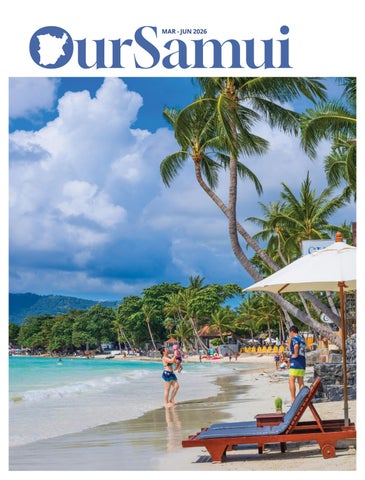
Create a flipbook
Our Samui Magazine Mar-Jun 2026 by mpmigroup - Issuu