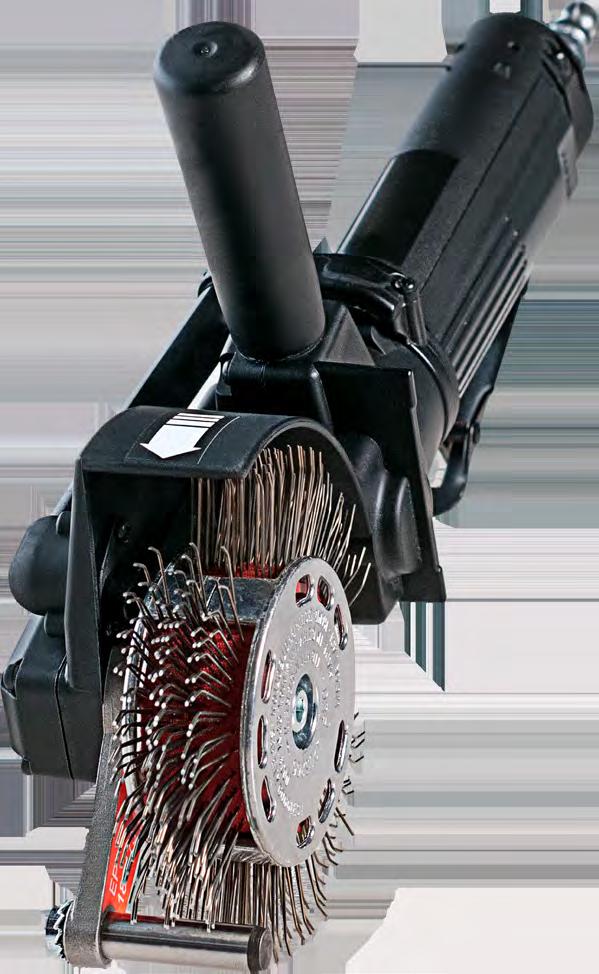
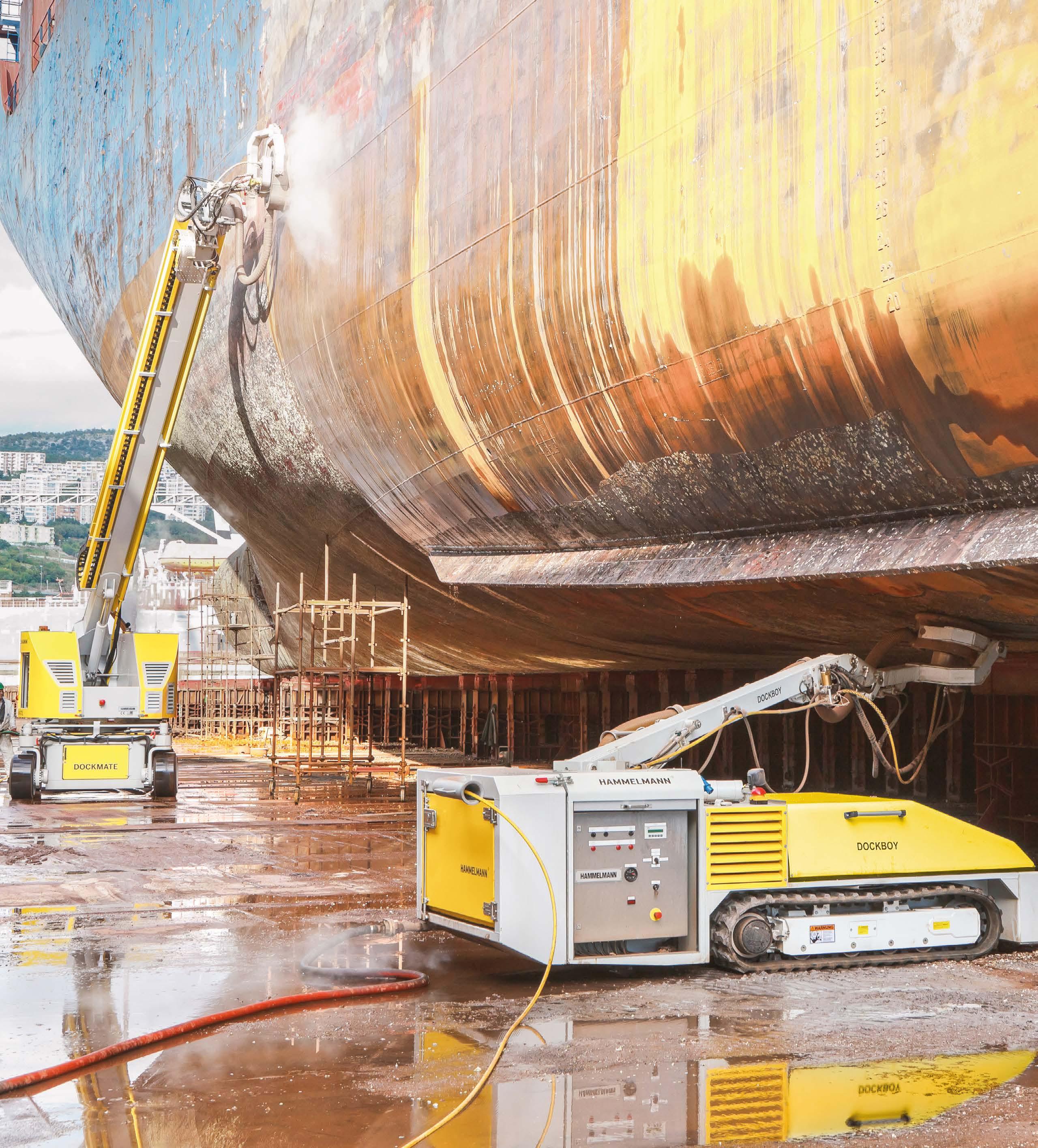
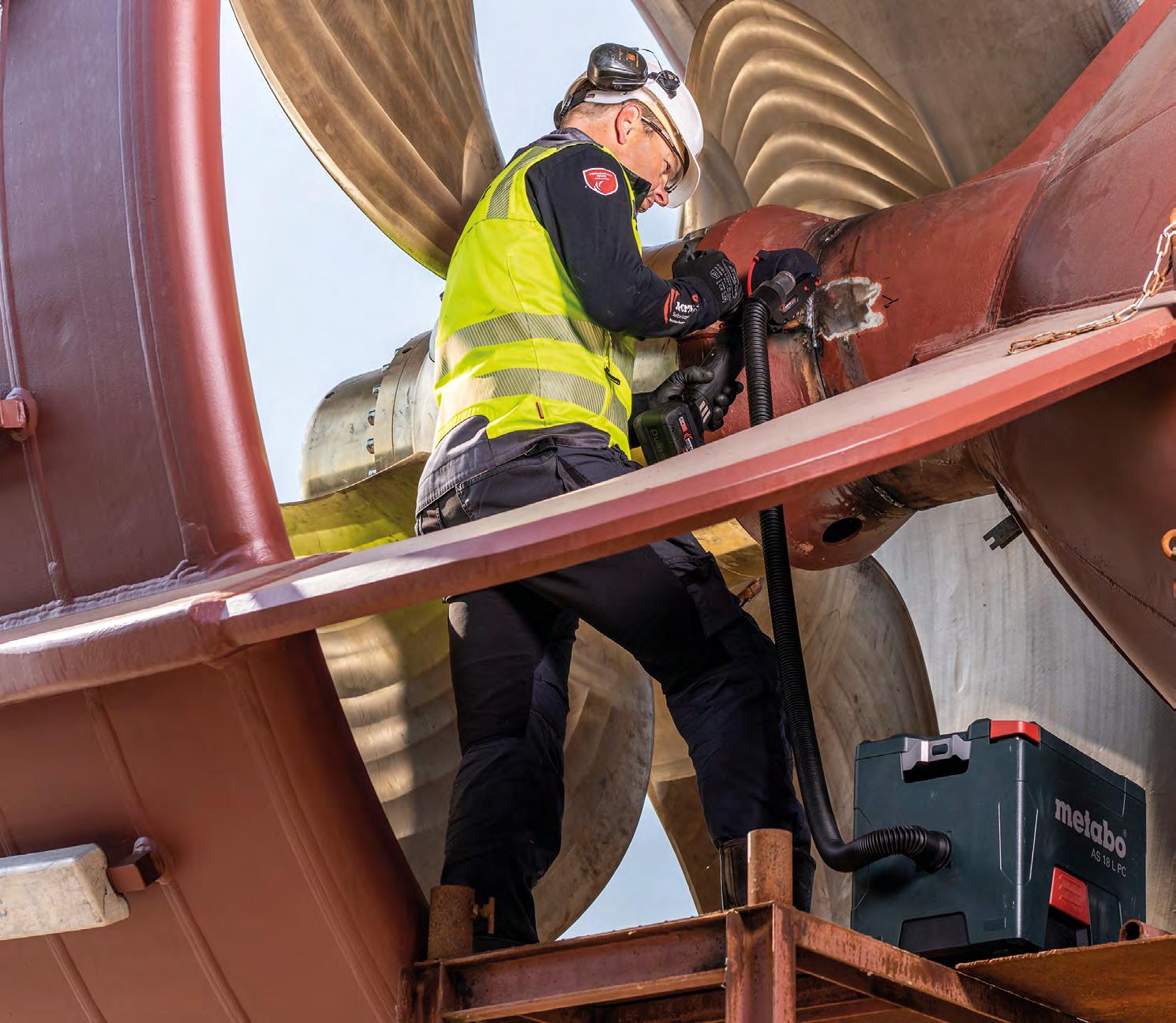
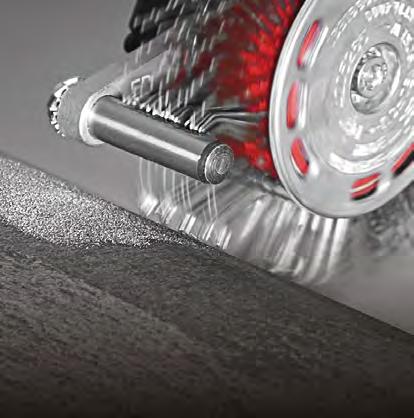
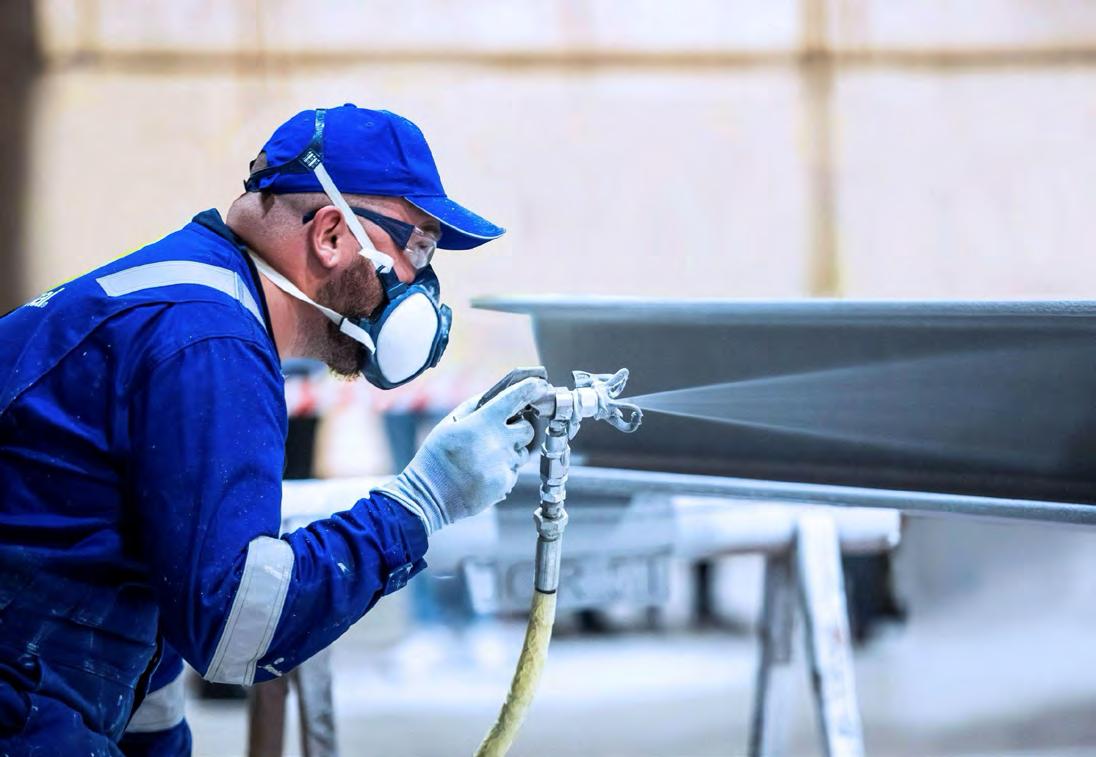
MontiPower’s Bristle Blaster bridges the performance of grit blasting with the practicality of hand tools
MONTI
Werkzeuge GmbH, Reisertstr. 21, 53773
Hennef, Germany
+49 (0) 2242 9090 630 www.montipower.com
AkzoNobel helps protect aviation history with its Dulux brand
6 Spotlight
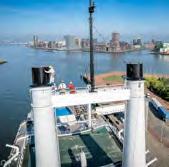
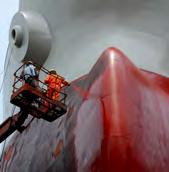
Arend Dorsman of PPG describes how a modern makeover of the SS Rotterdam became a case study in coatings innovation
12 Lifting the Lid
A new section covering the more technical aspects of paints and coatings, corrosion investigation and prevention, with Carboline discussing intumescent fire-resistant materials
20 In Focus
Jotun looks at why biocides are a necessary tool for managing biofouling and Safinah explains the need to consider speed, activity and seawater temperature when designing an antifouling coating scheme
34 Update
Nor-Maali investigates what should be considered when planning a machinery and equipment line painting process
40 Review
A new polyurea protection solution for aquaculture tanks from Corroless Eastern
46 Corrodere Academy
The latest articles, news and directory listing from Corrodere Academy
56 News
The latest products, appointments and industry news
MPI Group
Peel House, Upper South View
Farnham, Surrey GU9 7JN, England
Tel: +44 (0) 1252 732220
Email: info@mpigroup.co.uk www.mpigroup.co.uk
MPI Group, as a body, is not responsible for any opinions expressed in PCE by contributors. All rights reserved. No part of this publication may be reproduced, stored in a retrieval system, or transmitted, in any form or by any means, electronic, mechanical, photocopying, recording or otherwise, without prior permission of MPI Group.
Publisher: Andrew Deere andrew.deere@mpigroup.co.uk
UP FRONT
PROTECTING AVIATION HISTORY
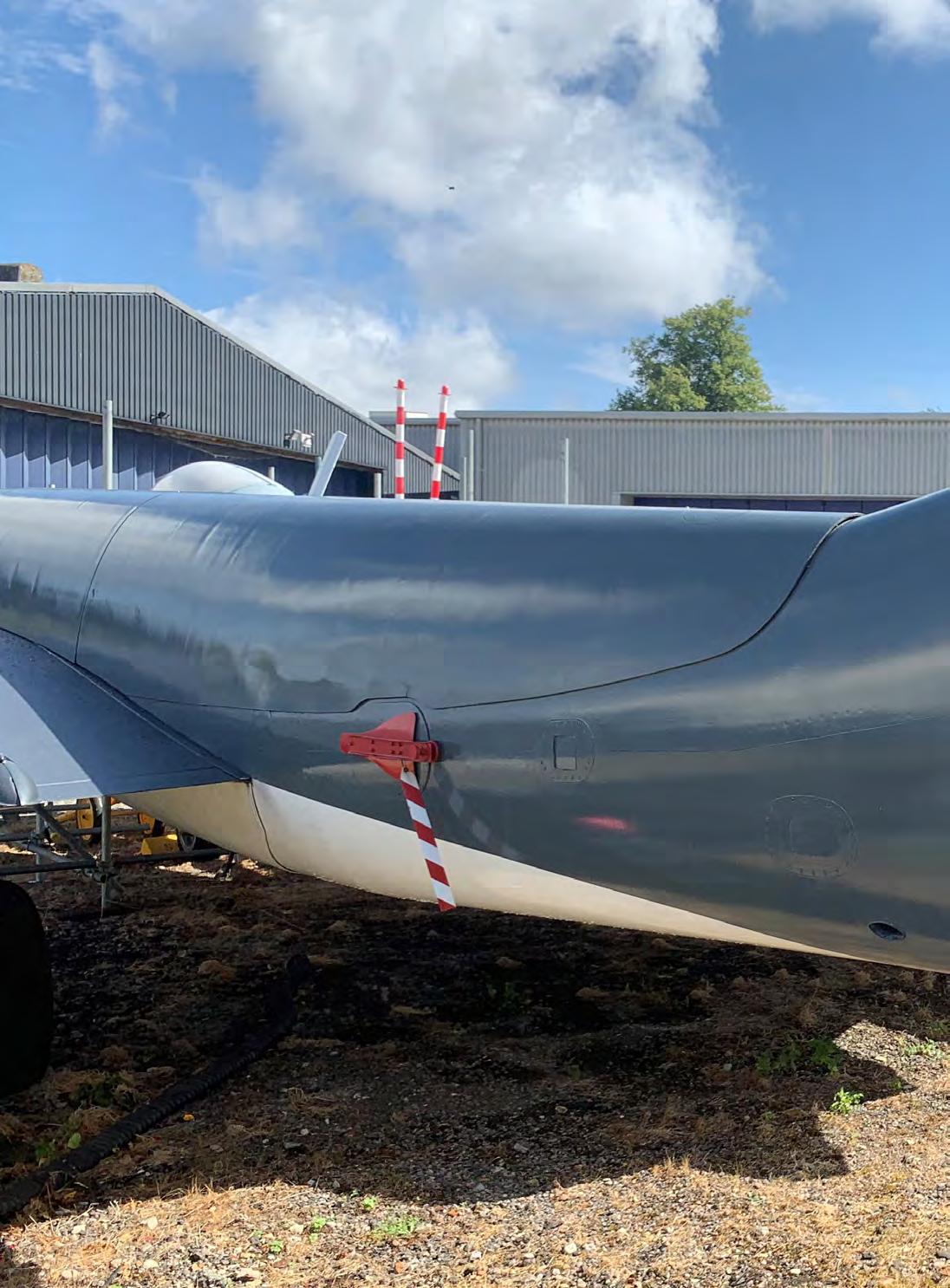
When a UK aviation museum asked AkzoNobel to help protect one of its remarkable exhibits, the last thing on anyone’s mind was recommending an exterior gloss paint supplied by the company’s Dulux brand – but that’s exactly what happened.
It all began in April 2024 with a call from the volunteer-run de Havilland Aircraft Museum, where a prized outdoor exhibit was in desperate need of preservation work.
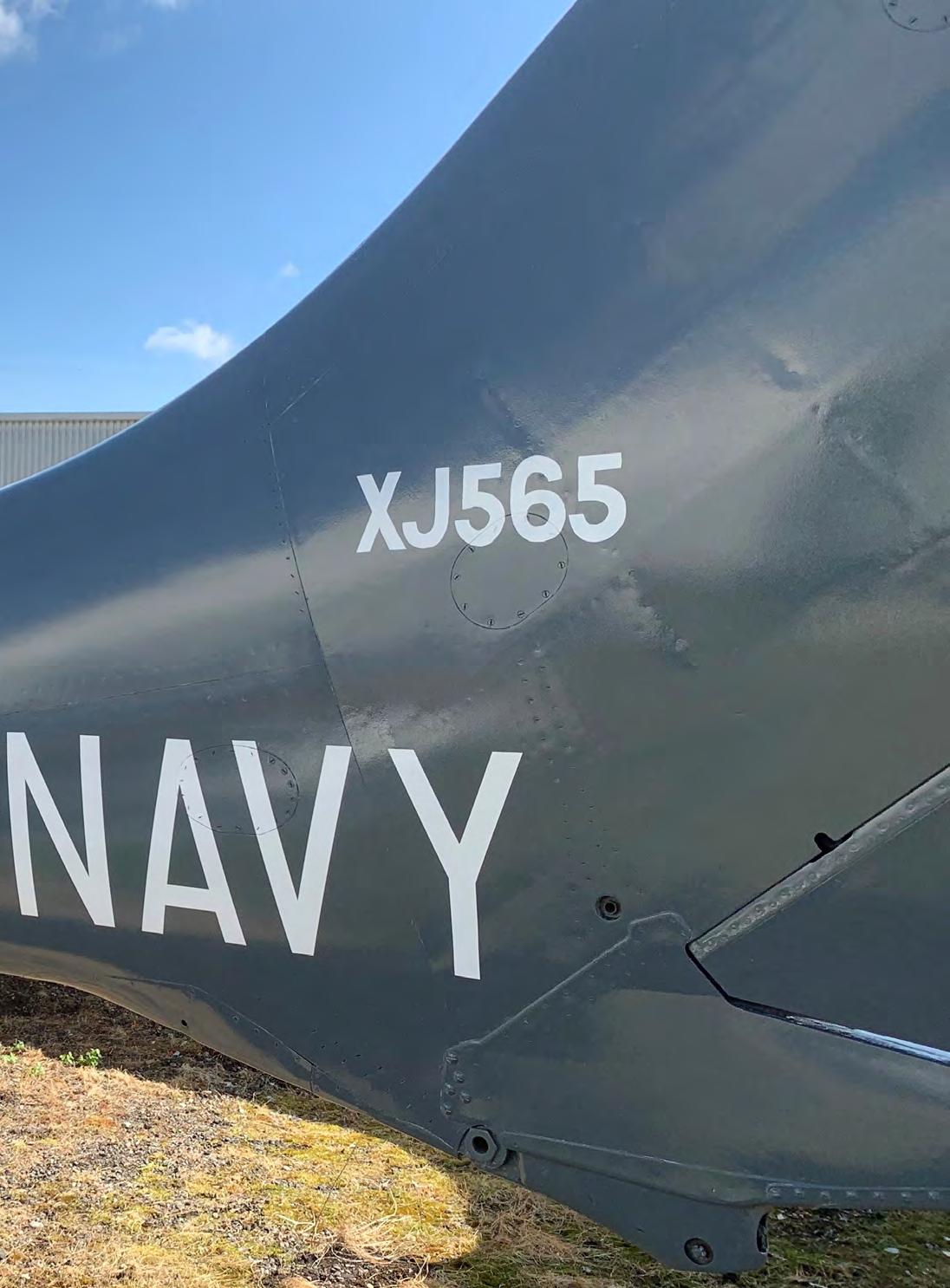
The aircraft in question was a de Havilland DH.110 Sea Vixen – the first British two-seater combat aircraft to achieve supersonic speed. Easily identified by its twin boom-tailed design, it was flown by the Royal Navy’s Fleet Air Arm from the 1950s to the early 1970s.
“After many years as an outside exhibit, the aircraft wasn’t looking its best,” explains William Gutch, a Specification Development Manager for the Dulux brand. “The Sea Vixen team had explored spraying the aircraft, but with no hangar space large enough to accommodate the airframe, a decision was made to explore completing the task in-situ.”
Aircraft conservation
Spraying in the open air was out of the question (ruling out a dedicated aerospace coating), so another solution was needed. “I was made aware that the plane would never be made airworthy, so rather than a restoration project, the task would be one of conservation/ protection,” continues Gutch. “I felt that if we looked at the project in the same way as we would any exterior metal surface, a solution could be found within our range of Dulux Trade durable exterior coatings.”
The trustees of the museum were also keen to preserve a level of colour authenticity, so Gutch secured the help of colleagues Steven Plowman (Technical Support Manager) and Abbie Churchill (Senior Technical Support
Manager), to assist with product selection and colour advice.
The brief was to replicate the colour of an original ‘aged’ panel to preserve its ‘in-service’ brightness and hue and not recreate a factoryperfect finish. After exhaustive trials, Dulux Trade Weathershield undercoat and exterior gloss were finally chosen because of their durability and excellent coverage rates. And, remarkably, the team was able to use vintage Ministry of Defence-specific colours, as they were still available on AkzoNobel’s in-store tinting software via the archive.
Superb results
A team of volunteers has been lovingly completing the work, which isn’t quite over yet. “I’m delighted that the Vixen team was able to achieve superb results,” continues Gutch. “In fact, many visitors have even commented they thought the aircraft had been sprayed.”
Dulux products have also been used to repaint several of the museum’s outbuildings, while the company has also been approached for assistance in refurbishing one of its three iconic Mosquito aircraft.
“The technical advances made by de Havilland from the very beginning of aeronautics to the first passenger jet airliner should be celebrated and enjoyed by generations to come,” says Gutch. “Preserving these aircraft will enable visitors to marvel at the ingenuity of the human race and help maintain the heritage of a pioneering company who were at the very forefront of world aviation.” ■
PRESERVING AN ICON
Arend Dorsman, PPG Key Account Manager, Protective and Marine Coatings looks at how a modern makeover of the SS Rotterdam became a case study in coatings innovation.
When people talk about a maritime legacy, they often focus on the past. Consider romantic stories of ocean crossings and bygone eras. But today, preserving historic vessels like the SS Rotterdam proves to be less about nostalgia and more about innovation, collaboration and sustainability.
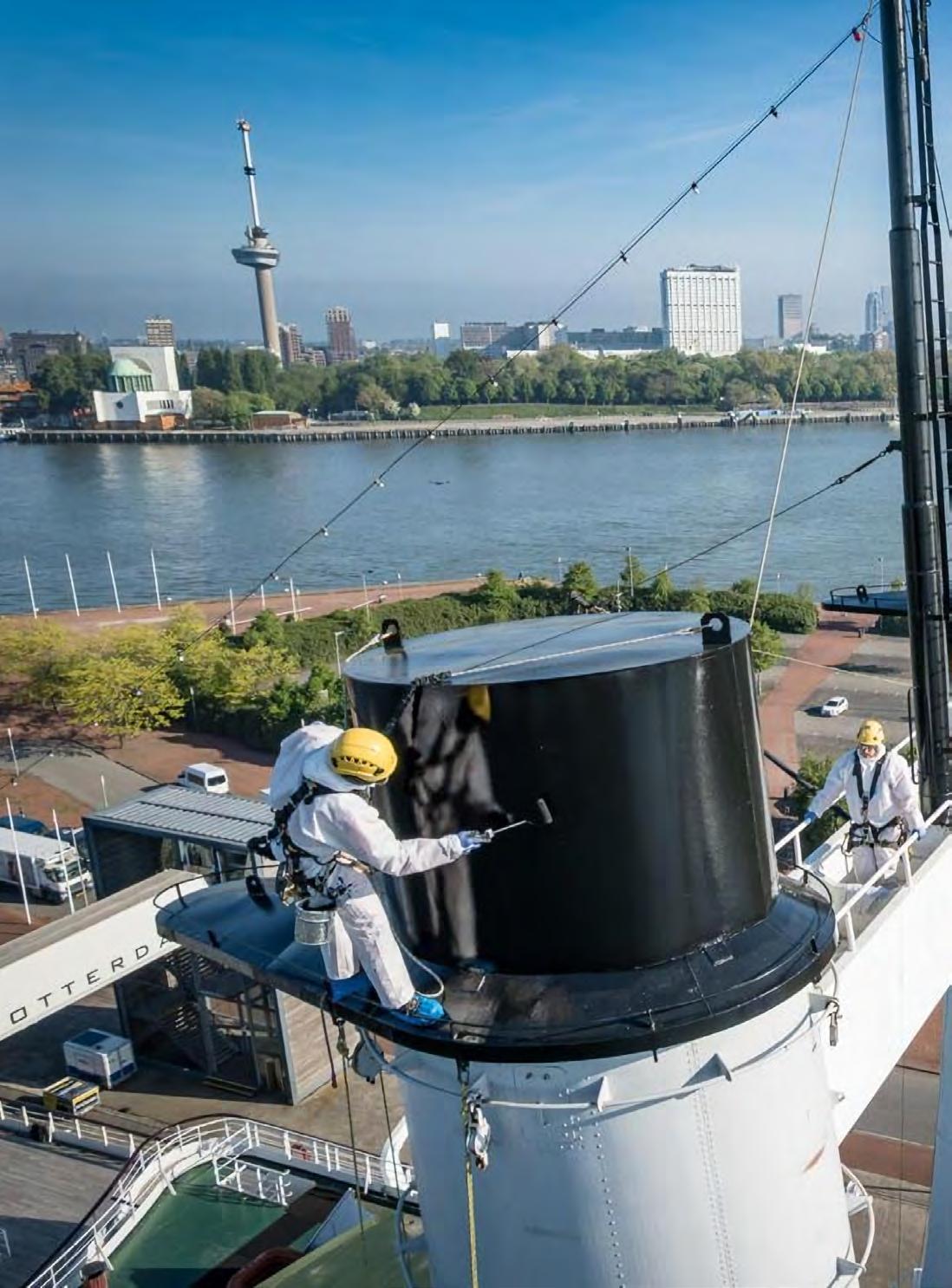
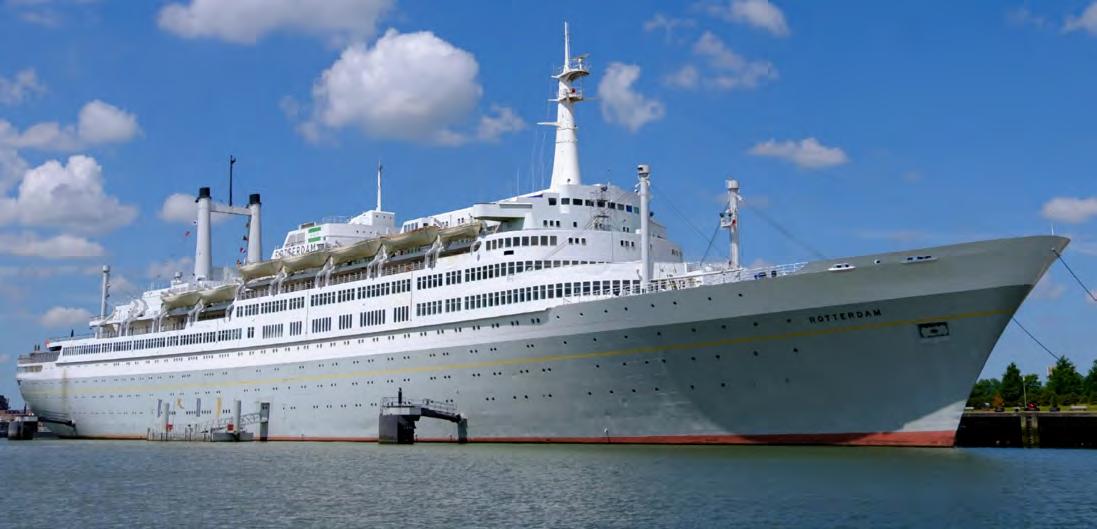
What once served as the pride of the Holland America Line (christened in 1958 by Queen Juliana of the Netherlands) now functions as a floating hotel, restaurant and event venue moored in Rotterdam’s harbour. This iconic ocean liner needed more than cosmetic upkeep. It required a strategic, technically advanced preservation effort. That effort now stands as a model for how advanced coatings innovation can extend the legacy of maritime heritage into the future.
Static heritage challenges
The SS Rotterdam hasn’t sailed in years, but its battle against the elements hasn’t stopped. As a permanently moored structure, it faces saltladen air, ultraviolet radiation and corrosion risks whilst simultaneously serving thousands of guests each year. This dual identity (part ship, part building) demands a certain maintenance approach.
Interestingly, its legal classification as a building meant the owners could skip traditional dry docking. That convenience didn’t eliminate the need for high-performance coating solutions. Over time, exposure to sun and sea had faded the vessel’s exterior, and corrosion threatened the ship’s surface integrity.
Enter Smits Vastgoedzorg, the Dutch contractor renowned for restoring architecturally and culturally significant buildings. The firm took on the ambitious challenge of recoating the vessel within six months without disrupting daily operations.
Strategic collaboration, powerful systems
PPG Protective and Marine Coatings partnered with Smits Vastgoedzorg to deliver a solution that worked under real-world conditions. Together, the teams specified a coatings system built for durability and aesthetics. They selected:
. PPG SigmaPrime 200: a corrosion-resistant primer formulated for strong adhesion across multiple substrates
. PPG SigmaDur 550: a durable topcoat offering superior UV resistance and longterm colour retention.
Unlike traditional ship maintenance, this project’s operations continued steadily.
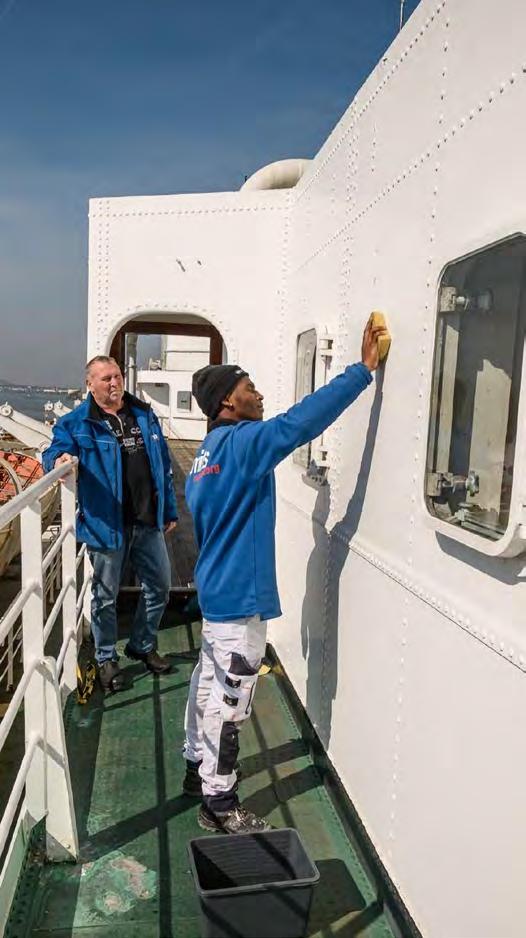
Hotel guests continued to check in and out, staff remained on duty and the ship’s role as a cultural landmark never paused. This reality demanded a coatings system that could perform under high traffic and logistical constraints. The PPG seastock coatings selected for the project met those expectations, offering ease of application and maintenance flexibility critical for in-service projects.
Scaling new heights
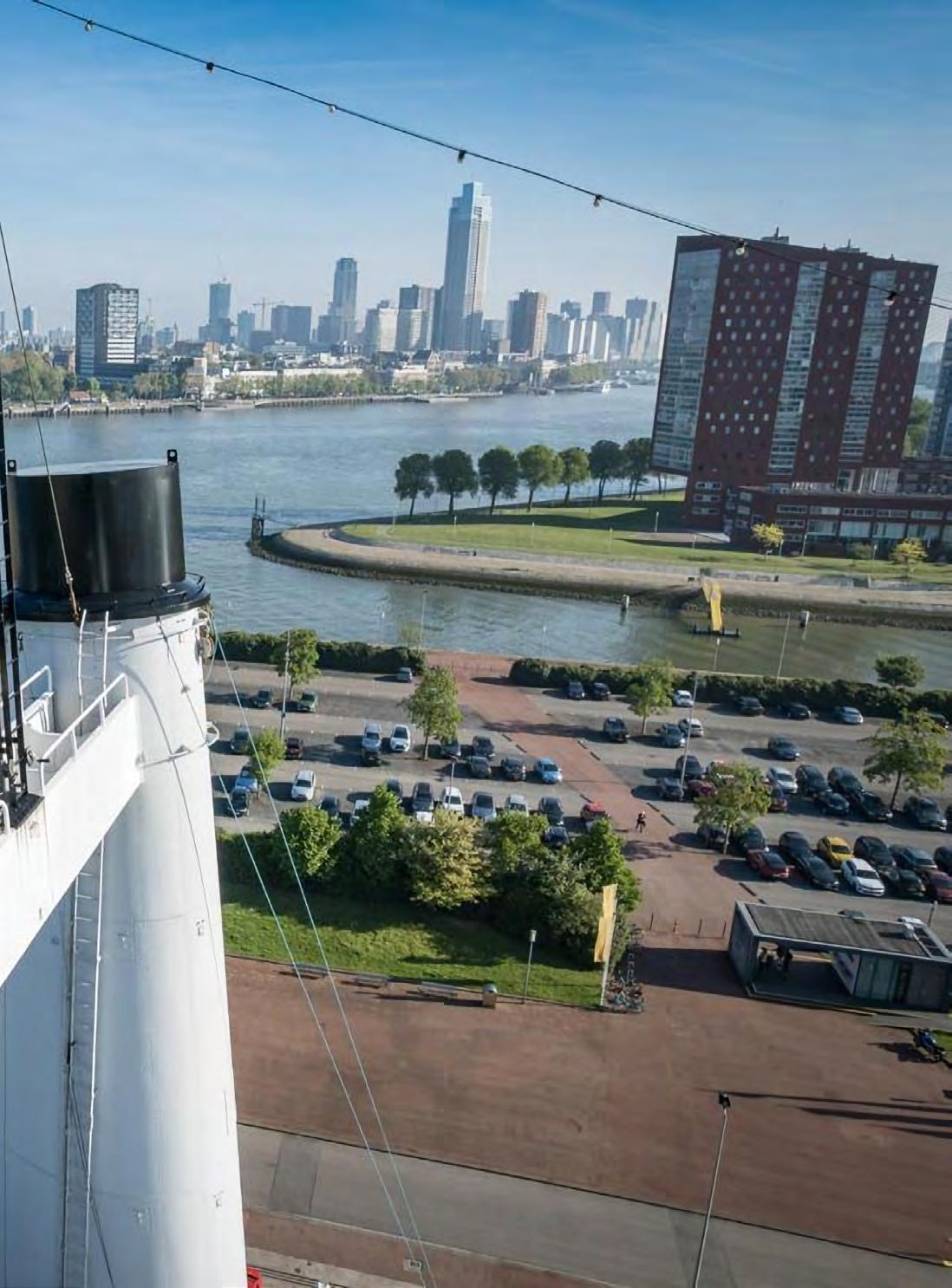
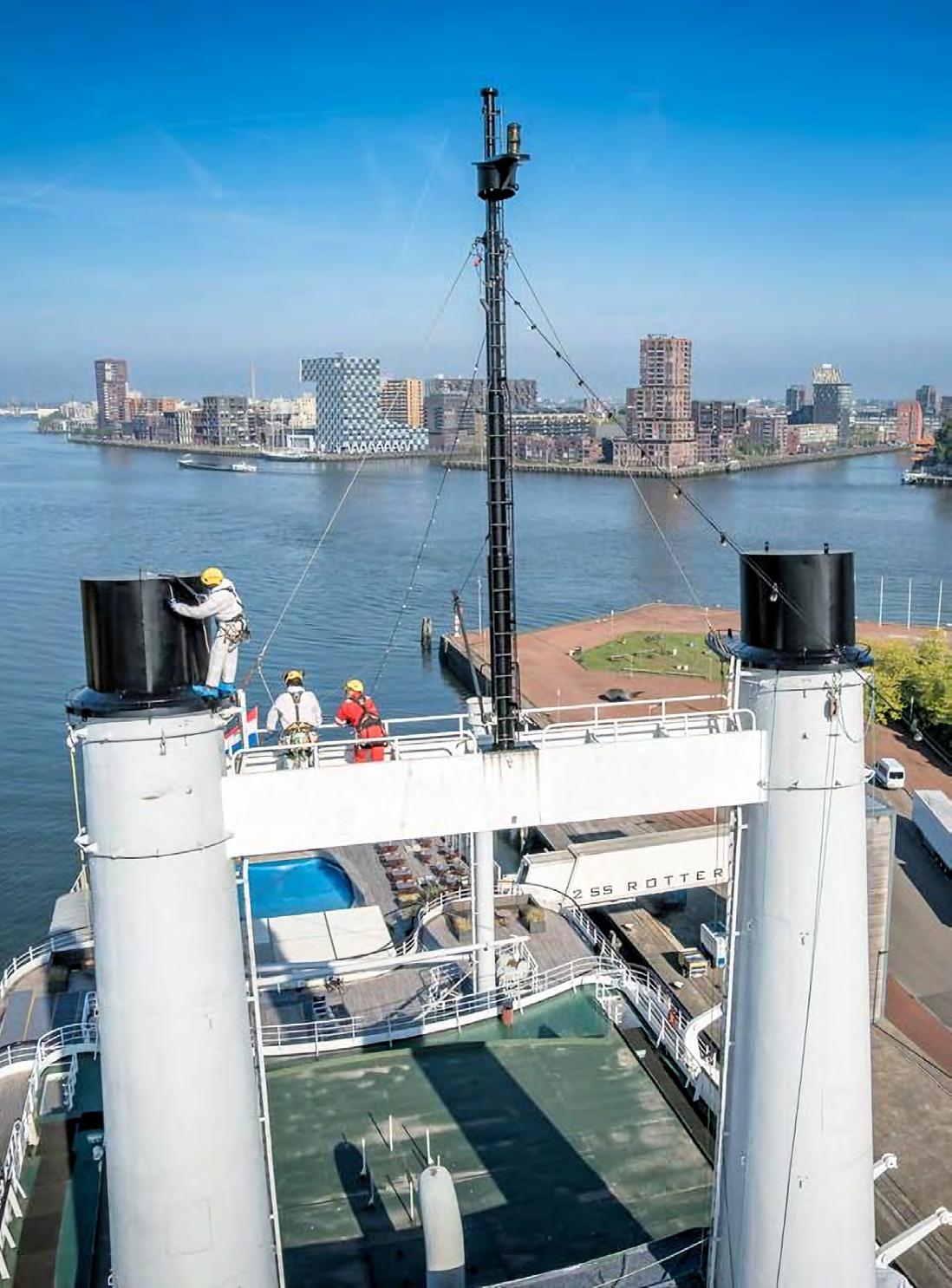
Coating the upper decks and massive funnel of the SS Rotterdam posed access issues. Instead of relying on intrusive scaffolding or mechanical lifts, the team brought in rope-access specialists, a technique often reserved for skyscrapers and industrial towers. This approach enabled work to continue without affecting hotel operations or the guest experience.
The original colour scheme had faded inconsistently after 10-15 years of exposure. Recreating the look wasn’t a simple case of using old colour codes. Instead, PPG’s architectural and marine coatings teams collaborated to match the hues as closely as possible to the vessel’s vintage identity to bridge the gap between old and new without jarring visual contrast.
The results exceeded expectations. The team completed the work ahead of schedule and also delivered the restored ship in time for Smits Vastgoedzorg’s 100th anniversary celebration, hosted aboard the freshly-coated SS Rotterdam.
Making sustainability tangible
While the visual transformation is clear to see, the sustainability advantage runs deeper. The longer-lasting coatings reduce the frequency of maintenance cycles, minimising labour and materials.
One example stands out: a steel deck on the ship previously coated in dark paint absorbed solar heat, increasing indoor temperatures and energy usage. Repainting it with a light, reflective white topcoat immediately reduced internal heat buildup, cutting cooling demands and improving comfort for hotel guests. That’s how coatings – often invisible in daily life – can directly support energy efficiency.
Coatings used in this project feature low volatile organic compounds (VOC) formulations and comply with modern regulations. These advancements support both regulatory compliance and corporate sustainability goals, which are critical considerations in hospitality, infrastructure and public-sector projects today.
A blueprint for adaptive reuse
Around the world, architects and developers look for ways to breathe new life into decommissioned ships. Some convert them into student housing. Others into floating offices, museums or hospitality centres. As one 2025 report puts it, “the adaptive reuse of cultural heritage sites represents a strategic approach to sustainable development, aligning architectural conservation with economic and environmental resilience.”
In each case, long-term durability, guest safety and regulatory compliance take centre stage, and advanced marine coatings can play a significant role.
The SS Rotterdam project delivers a clear playbook:
. Use durable coatings that protect and enhance visual appeal
. Collaborate across disciplines early to streamline logistics and avoid surprises
. Embrace modern access techniques to minimise disruption during application
. Align restoration with sustainability goals from material selection to operational energy use.
It’s a message that resonates well beyond the Port of Rotterdam. As more cities face the challenge of conserving maritime heritage, they’ll need trusted coatings partners that offer technical rigour and cultural sensitivity in equal measure.
In conclusion, the SS Rotterdam stands as a physical reminder that the maritime past still holds value. With the right coatings and the right partners, these giants of another era can thrive. PPG and Smits Vastgoedzorg have preserved a city’s icon, demonstrating that technical innovation, thoughtful collaboration and environmental awareness can coexist in a single project.
Arend Dorsman is a PPG Key Account Manager, Protective and Marine Coatings, with 20 years of experience in advanced coatings. ■
Epoxy, solvent-based and water-based intumescents all were specified for different elements of the Google Bayview 1, Bayview 2 Googleplex Campus in Mountain View, California Credit: Austin McKinley
The reason it’s ‘ideal’ and not ‘best’ is because ‘best’ is subjective, explains Carboline.
Relationships among each project’s circumstances mean that no material type or application method is universally superior. And unfortunately, these circumstances do not march one after another neatly in time. They are simultaneous and often at odds. So, what material or combination of materials makes the most sense – the lazy answer is, it depends.
The real answer reframes the question: What information do I need so that I know my specification will result in a satisfactory and timely delivery?
This guide doesn’t tell you what to choose, but it will help you think through how.
Required fire ratings
Matching intumescent materials to applicable required fire ratings has a way of being straightforward and prescriptive without being easy or fun.
Building codes state the fire rating or ratings a structure must meet, and then the normal push and pull of architecture and engineering results in a design for load-bearing members that satisfies the aesthetic vision and is feasible to build.
Intumescent fireproofing selection falls within that push and pull, where a crucial detail risks being overlooked: testing.
Laboratory testing verifies the thermal performance of structural members in a huge range of shapes and sizes. Yet it does sometimes happen that a design includes a shape or size never used before.
Architects do not go out of their way to include novel components in enclosed spaces where simpler, cheaper options will suffice. But it’s a different story if the component is prominent and essential in an exposed location, or somehow vital to structural integrity regardless of its visibility. What then?
Adjacent circumstances like cost and schedule will dictate what happens next. Maybe making that architectural statement is not so crucial after all, and the design is changed. Or maybe it isn’t, or maybe the part plays a vital structural role. If either is the case, that is the beginning of the long, expensive process to validate intumescent material performance over the novel design for the very first time.
Architectural design
The reason intumescent products exist in the first place is to achieve fire ratings with lowerprofile and nicer-looking materials vs. cementitious products.
But differences in intumescent chemistries and applied protection thicknesses lead to different finish characteristics. Whether these characteristics are regarded as appealing is a matter of shifting opinion.
The general rule is that solvent-based and two-component epoxy intumescents cure to form an orange-peel texture. Some waterborne intumescents can achieve qualities almost indistinguishable from conventional high-gloss urethanes.
Sometimes that orange-peel texture is desirable. Other times it’s not, and so you either choose something else or adjust the budget, schedule, and specification accordingly to abrade away unwanted texture before applying a compatible decorative topcoat. If the latter path is chosen, it is essential that enough intumescent is initially applied so that the ensuring reduction in thickness does not bring it below the minimum. Project teams must weigh the aesthetic benefit of having their chosen colour or other finish qualities against the cost and schedule impact of applying a topcoat that has no functional purpose.
Google’s Bayview 1, Bayview 2, and Charleston East headquarters buildings include some structural steel protected by Firefilm III
The team leading construction of Apple’s new headquarters utilised a temporary “shop on the job site” setup to apply Thermo-Lag E100 to structural steel as field application would have been extremely hard
A popular way architects get the best of both worlds is to specify water-based intumescents in inoffensive neutral colours. If the colour is acceptable, then no additional surface prep, material or labour is required to achieve the great-looking finish water-based materials provide.
A case in point
In Mountain View, California, Google’s Bayview 1, Bayview 2 and Charleston East headquarters buildings include some structural steel protected by Firefilm III. It was applied to exposed, highly visible beams in the ceiling of work and common spaces. Firefilm III is bright white and contrasts pleasantly with the clean, warm tone of the blonde-coloured wooden ceiling the beams support.
Project architects needed a material with exceptional finish qualities because these components would be within just a few feet of people.
Note, however, that visual appeal never exists in a vacuum. The factors and material characteristics described below conflict with, and sometimes overrule, a choice made purely based on aesthetics.
Construction timeline
Project teams take great care to develop and stick to schedules. The dominance of the designbuild or integrated project delivery construction method is proof that builders today see speed as the definitive pathway to the greatest profit.
The coatings industry has responded to builders’ pervasive search for time savings by developing materials and application methods designed to accelerate construction schedules.
The problem is, which material or which method ends up saving time depends on far more than just what the coating is made of or how you put it on. The debate over applying intumescents in the shop verses in the field is the perfect example.
The coatings industry has responded to builders’ pervasive search for time savings by developing materials and application methods designed to accelerate construction schedules.
Some celebrate shop application of two-component epoxy intumescents (for example, ThermoLag E100) prior to steel erection as the ideal time saver. The premise is that the shop is always a safer, more controlled and less crowded environment. The more systematic nature of shop production is faster per square foot of steel coated, and therefore cheaper. Epoxy materials are also generally hard but ductile upon curing, an important combination that is resistant to strain on steel members or damage that can occur during transit.
But what about all those blockouts at connection points? Those cannot be fireproofed until after erection. Shop application always results in needing to do some field application anyway. And what about other components that need to be attached to the steel after it’s installed? This often results in intentional destruction of some fireproofing that needs to be fixed later, adding to the time spent on site.
On the other hand, proponents of field application note that the real savings come when solvent-based intumescents (such as Thermo-Sorb VOC) are applied after steel is erected and before curtain walls go up. When the material goes on after erection, there is no blocking out. And solvent-based products require far simpler equipment compared to the complicated and very expensive equipment required for two-component application. Some are also weatherresistant and can cure perfectly even during open-frame construction in cold weather.
But that’s still a lot of equipment and material hauled to the site. What about the difficulty in coating irregular shapes or in areas difficult to access? What about bumping into all the other trades at work? And you cannot argue that applying material from the height of a man-lift will ever be safer than doing it on solid ground.
Matching demand
The truth is that materials and methods themselves do not save anyone anything. Savings come from understanding them both well enough to know when each one works best and matching that knowledge with the owner’s or general contractor’s schedule demands.
All the better when that knowledge is shared early. On one hand, it can help bring an unrealistic schedule back down to earth. On another, it could accelerate a schedule and put more profit in everyone’s pocket.
Differing examples
In Cupertino, California, the team leading construction of Apple’s new headquarters utilised a temporary ‘shop on the job site’ setup to apply Thermo-Lag E100 to structural steel supporting a clerestory that rings the top of the famed circular building. Field application would have been extremely hard, slow work owing to the difficulty in reaching the clerestory’s structural steel after erection. Applying the material on the ground to pre-assembled clerestory modules reduced the number of blockouts requiring touching up.
Down the road in Santa Clara, the project team building the new Nvidia headquarters settled on field application of Thermo-Sorb VOC for primary columns and other structural supports because of the material’s ability to withstand general construction conditions – including rather cold
Efforts by industry and government to curtail the ecological and human health impacts of construction projects have resulted in myriad ‘green’ or sustainability criteria and a growing list of materials certified to meet them.
temperatures – when applied prior to curtain wall application. This feature empowers construction teams to establish work sequences untroubled by weather.
Environmental/sustainability concerns
The manufacture of construction materials and the construction process itself are both significant sources of harmful pollution.
Efforts by industry and government to curtail the ecological and human health impacts of construction projects have resulted in myriad ‘green’ or sustainability criteria and a growing list of materials certified to meet them.
A sticky problem is that ‘sustainable’ or ‘green’ have many meanings. Some criteria approach these from the lens of composition of raw materials. Others from the lens of emissions during and after installation. Some overlap, and some do not. Some are mandatory and some are not, and even that depends on the location of the project. It gets confusing very quickly.
Generally, you have more flexibility in terms of material availability and cost when sustainability is not prioritised. You have less flexibility – and should expect to pay a bit more – if sustainability is an overriding priority.
Leaving cost aside, it’s also critical to compare performance, application and aesthetic attributes of candidate materials when making a sustainability-driven specification. Not every intumescent material can score an A+ on sustainability, achieve a four-hour fire rating and look as good as a decorative urethane all in one package.
It’s a world of trade-offs. Carboline has tried to simplify it with a product transparency page that lists products, including intumescent fireproofing, meeting various sustainability criteria.
Sometimes the answer is
‘all
of the above’
Some projects are large or complex enough that the most ideal intumescent specification features a combination of material types each suited for different locations or stages in the timeline.
Case in point: Epoxy, solvent-based and water-based intumescents all were specified for different elements of the Google Bayview 1, Bayview 2 and Charleston East headquarters mentioned above.
Thermo-Lag E100 two-component epoxy was chosen for exterior columns holding up the roof around the perimeter of the buildings. Shop application of the material made sense because the large columns have only two connection points each. Touch-up of blockouts was rather quick and easy.
Thermo-Sorb VOC was specified for all interior columns and supports holding up the towering canopy roof. Its application properties allowed for field application when the building was only partially enclosed. And while the components are in an exposed interior environment, they are distant enough that no-one can perceive a difference in the finish compared to Firefilm III.
As first described in the earlier section, Firefilm III was used for all interior exposed steel floor beams. These beams are in plain view of workers and visitors so a requirement for superior visual appeal led to its specification.
Importantly for Google, each of these materials was tested and verified to meet strict VOCs and emissions requirements under LEED v4.0 – the latest version of that rating system at the time. This came at a significant effort and investment, but it was worthwhile to Google, which has pledged to build the most sustainable buildings possible.
A clear path forward
Construction project circumstances inform intumescent material specifications. Intumescent specifications can inform project circumstances.
It is difficult to navigate an environment where both a statement and its inverse are true but a clear path is opened when stakeholders work to get on the same page early on. It’s never too soon to consult with a Carboline technical expert to discuss an upcoming fireproofing project. ■
Epoxy, solventbased, and waterbased intumescents all were specified for different elements of the Google Bayview 1, Bayview 2, and Charleston East headquarters
IN FOCUS
BIOCIDES — A NECESSARY TOOL FOR MANAGING BIOFOULING
The prevention of biofouling is a hot topic in shipping generally and for regulators in particular. Biocidal antifouling coatings containing active substances that control the growth of unwanted organisms can and do make a huge contribution to combatting the global issue, but the biocides themselves are under scrutiny even though the industry still considers biocides as a key contributor to sustainable shipping, explains Jotun.
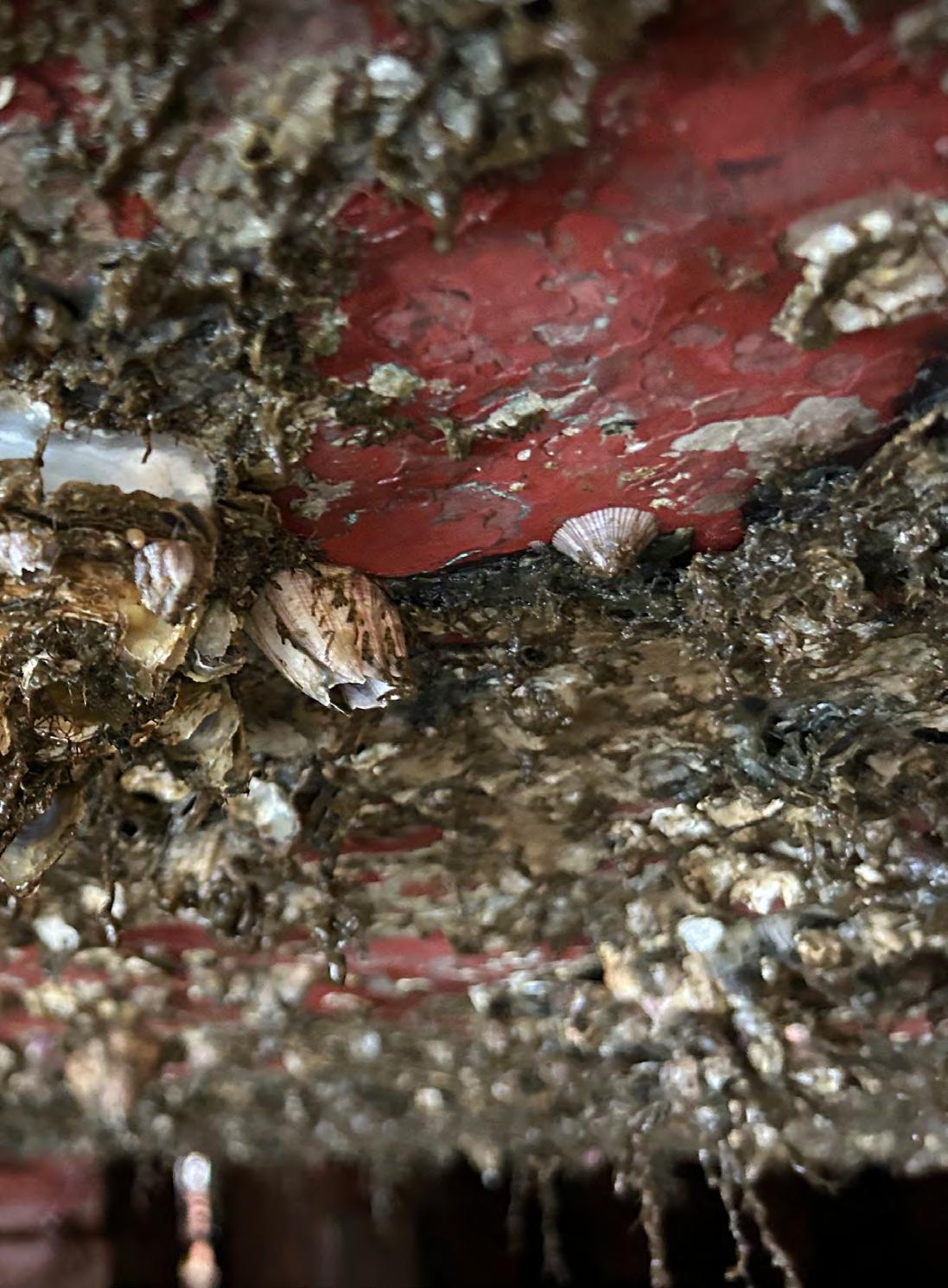
Biofouling – the accumulation of marine organisms on the hull of a ship – reduces the efficiency of the vessel, causing it to slow down or to use more fuel to maintain operational speed.
Throughout maritime history ship operators have been engaged in a struggle with nature that has seen them attempting to reduce or eliminate the impact of biofouling on the operation of their vessels. Today there are multiple options available, with antifouling coatings containing biocides the most popular and effective across the shipping industry.
But questions are being asked about their sustainability in a world where ESG standards and regulation are forcing operators to think harder about the choices they need to make.
“Biofouling – the accumulation of marine organisms on the hull of a ship – reduces the efficiency of the vessel, causing it to slow down or to use more fuel to maintain operational speed,” says Morten Sten Johansen, Global Category Director, Jotun. “That is a problem regardless of the owner’s operating strategy. Whether operating directly on the owner’s account, or through charterers, it reduces profitability.”
Controlling biofouling has become even more important with the IMO EEDI regulations in 2013 for new vessels and the EEXI regulations for existing vessels in 2023, along with the CII
operational limits on CO2 emissions. With these in place, owners are no longer combatting biofouling purely for their own operation and economic reasons but also to meet mandatory requirements aimed at reducing greenhouse gas emissions across the shipping industry.
To add to the complexity of the problem, protecting biodiversity by way of reducing or eliminating the transfer of invasive species has come onto the radar of many national governments and the IMO. Populations of invasive species in non-native waters can be facilitated in many ways, but the most obvious is by way of the biofouling on ships’ hulls.
So far only a small number of national governments have enacted laws that require ship operators to keep their ships free of biofouling or risk expulsion from territorial waters, but the IMO appears to be moving away from its current voluntary recommendations towards a mandatory regime that would encompass shipping on a global scale. At MEPC 83 in April 2025 the IMO agreed to a new output on the “Development of a legally binding framework for the control and management
of ships’ biofouling to minimise the transfer of invasive aquatic species - a biofouling Convention”. The work will start in 2026, but how long the process will take is debatable. Work on the AFS convention began in 1990 but it did not come into force until 2008. The Ballast Water Convention took even longer to be developed and come into full effect.
Increasing pressure from customers
Alongside their own benefits and regulatory compliance from combatting biofouling, some ship operators also face increasing pressure from their direct customers and others further along the value chain to both improve efficiency and protect biodiversity. Often this pressure is the result of public opinion and is more evident for carriers of consumer goods –liner operators and car carrier operators – than in the bulk and tanker segments.
Attitudes of ship operators towards green issues naturally cover the whole spectrum from actively embracing them to doing the minimum necessary to meet legal requirements to keep their ships operational. Furthermore, across
that spectrum budgetary issues mean that ambitions may need to be tempered to which products to combat biofouling are affordable and available.
A survey by Jotun on shipowners’ considerations when choosing antifouling coatings revealed that over 66% agreed that coatings containing biocides are more effective than biocide-free coatings. Almost 20% had no strong opinion and just 14% preferred biocidefree coatings.
Clearly, biocides are important to achieving the owners’ objective. But if it did happen that some, or in the worst case all, biocides are restricted or regulated out, the effect would be an increase in greenhouse gas (GHG) emissions and the environment would lose. It is important for stakeholders/regulators to take a holistic approach.
“We firmly believe in taking a holistic view,” says Petter Andreassen, R&D Chief Chemist at Jotun. “The best performance is the best for the environment providing that the ingredients comply with relevant local regulations and an environmental risk assessment has been done.”
For its part, Jotun manufactures a range of products to cover all operators’ antifouling needs, and although it is difficult to determine what the impact on biodiversity may be, for emissions reductions a good estimate can be made. In 2024 DNV Maritime Advisory carried out a technical evaluation for the company which verified that 11.1 million tons of CO2 was avoided in 2024 for Jotun-coated vessels.
Evolving technology offers multiple solutions
Preventing organisms from attaching to ships is extremely difficult with current technologies, so the best way to do it effectively and economically is to use a coating on the underwater part of the hull that contains a biocide – a biocidal active substance that controls the growth of unwanted organisms. Such coatings also protect steel ships from corrosion in the same way as the conventional coatings used above the waterline. The effect of the biocidal coating can be reinforced by appropriate hull cleaning technologies.
Biocide use is not confined to protecting ships from biofouling. Indeed most of the antifouling biocides commonly used today have applications in many other fields including agriculture, cosmetics, cleaning products and more.
Over time, preventing biofouling has involved the use of many different materials and chemicals, from sheets of copper on wooden vessels to poisonous compounds. Some of these were very successful but their undesirable side effects attracted the attention of science and the environmental movement which want to see them controlled, or in some cases prohibited from use.
Unlike so much IMO regulation which details what ships must do or carry, the International Convention on the Control of Harmful Antifouling Systems (AFS) on Ships, which was adopted in October 2001 but only came into force on 17 September 2008, is totally geared to preventing the use of certain products. The convention covers all vessels including FSUs and FPSOs.
Initially the product at which the convention was aimed was tributyltin (TBT), a substance developed through the 1960s and first used in the 1970s and which the IMO itself conceded is probably the most effective biocide so far devised for the maritime industry. Since 2023, the IMO has also banned the use of cybutryne,
which was used in some antifouling coatings to control algae.
Problems with TBT first surfaced in the 1980s and within a decade several governments became concerned about its impact on a wide range of marine creatures. In 1990 Japan banned its use on Japanese vessels, and the IMO took up the challenge. During the development of the AFS Convention, most coatings manufacturers began winding down TBT production and searched for alternatives, introducing them long before the AFS Convention reached the ratification stage. Copper compounds used extensively well before TBT was developed appeared to be the best choice, and most antifouling coatings today make use of copper in some form.
Biocides best against biofouling – but under scrutiny
Combatting the impact of biofouling is no longer something shipowners can ignore even if they wanted to. Coatings manufacturers have developed an array of options, most of which make use of biocides although a few are biocide free. The product ranges have been developed and tailored to suit operational profiles of different vessel types, intended regions of operation and operators’ budgetary restraints.
“Coatings containing biocides are designed to remain effective for periods of up to five years or more for premium priced products and otherwise to give protection at least between dry dockings,” says Jotun’s Andreassen.
“Although biocides are the most effective weapon against biofouling, it has to be acknowledged that they are hazardous chemicals. Therefore, the level in antifouling coatings should be minimised. However, a product with 5 w% of biocide A is not necessarily better for the environment than a product with 50 w% of biocide B. This is because toxicity and the risks involved in their use also needs to be considered. In the above example, biocide A could be 100 times more toxic than biocide B, meaning even though the level in the paint is only one tenth, the toxicity is higher.”
Comparing the toxicity data of different biocides is a pure hazard assessment. For the exposure assessment in marine environments
Pressure is the result of public opinion and is more evident for carriers of consumer goods such as liner operators
there is a need for reliable chemical fate models. Such models must handle the complex transport and exchange processes in coastal environments.
There are computer models in existence that are intended to measure risks according to various factors such as estimation of hydrodynamical exchange, compound properties/processes, emission estimation based on leaching rates and environmental/ hydrodynamical parameters, among others. These models are of use when considering regulations and helpful to coatings manufacturers in developing sustainable and safer products, but likely have little of interest for ship operators who only wish to consider effectiveness and legality of their coating choices.
Biocides and their benefits
Copper oxide is by far the most commonly used antifouling biocide giving protection against most of the 4,000-5,000 species associated with biofouling, including both hard and soft fouling organisms. Hard fouling is understood as the shell-forming organisms, such as barnacles, mussels, oysters and tubeworms. Soft fouling is understood as plants (algae), soft animals (tunicates, soft corals etc) and slime (microorganisms forming a biofilm on the surface). Some algae are quite tolerant towards copper; hence a co-biocide is often used in combination with copper.
Copper oxide is used by all major coatings manufacturers and is found in >90% of all
coatings applied for fouling protection of ships at levels ranging from 20-50 w%. Copper is a naturally occurring substance and is also a micronutrient. It is essential for life and necessary for all living cells. However, at elevated concentrations, notably on the coating surface during idling periods, the copper ions (Cu2+) are considered toxic. Copper from antifoulings will eventually end up in the sea, but for the most part will be confined to the sediment and typically convert to copper sulphide (CuS), which is insoluble and not bioavailable.
There are two alternatives to copper oxide that are effective towards hard fouling organisms: tralopyril and medetomidine. Both are far more potent than copper, hence the volume consumption is lower.
Tralopyril (Econea) was the first alternative to copper with an effect towards hard fouling organisms. It has been on the market since 2007. Due to reactions with copper oxide, it is primarily used in copper-free products. It requires a co-biocide, typically zinc pyrithione, to give full protection including against soft foulings. Tralopyril is 6-8 times more potent than copper oxide, hence the use level is 3-6 w% in paints. It breaks down very quickly in seawater by hydrolysis.
Medetomidine (Selektope) Antifouling paints with medetomidine were launched around 2014. Medetomidine works selectively towards barnacles and tubeworms. It may be used in copper-free paints, together with co-biocides,
but is primarily used in combination with copper oxide as a barnacle fighter. It does not kill the fouling organisms but induces a physiological response that repels them from the surface.
Zinc and Copper pyrithione (CleanBio, Omadine, Pyrion) The pyrithiones are primarily used against soft fouling. Both were launched during the 1990s, but currently copper pyrithione is dominating in volumes, primarily due to the reaction between zinc pyrithione and copper oxide. Both pyrithiones degrade quickly in seawater, primarily via photolysis.
Dichloro octyl isothiazolinone (Sea-Nine) has a high acute activity towards soft fouling organisms. It was introduced in the early 1990s to replace TBT. DCOIT works well with copper oxide and is typically used at 2-4 w% level in antifouling paints. It also works well in combination with other biocides, in copper-free products. It breaks down rapidly in seawater and sediment, primarily via biodegradation.
Zineb (Zineb Nautec, Perozin Marine) has high activity towards soft fouling organisms. It works well in combination with copper oxide. It degrades quickly in seawater.
In addition to the relatively small number of biocides mentioned above there are some biocides being used on a smaller scale and in local antifouling coatings only. However, the list is getting shorter every year due to lack of supporting documentation and suppliers.
Looking ahead
Even though two very effective biocides have now been banned, restrictions on biocides are expected to progressively tighten, and the expectation is that the current assortment of biocides available for use will reduce in the years to come. The environmental aspect of the six key biocides currently in use is now considered acceptable, as they are all approved by the EU.
The situation is generally complicated by a multitude of national and regional regulations which are not aligned, with demands for different approaches to assure compliance. The EU has the strictest regulatory system globally, and it is expected that other markets will follow and implement restrictions should there be any.
There have been suggestions that biocidefree options represent the future, but this view is somewhat speculative given the availability of viable alternatives to biocidal coatings. In 2024, Washington State Department of Ecology conducted a thorough evaluation of all the available technologies for fouling protection of pleasure craft, including copper-free and biocide-free products.
On biocide-free products, the report said that these mostly use silicone polymers and sometimes fluorinated chemicals which may pose their own hazards and for which scientific information on environmental impact is not yet available. Their conclusion was: “Ecology is not able to determine that safer and effective alternatives to copper based antifouling paints are feasible, reasonable and readily available.”
Other reports have raised questions about the potential for foul release coatings to releases PFAS – sometimes referred to as forever chemicals – and to leach persistent silicone oils into the oceans.
“The issue of biofouling and means to combat its impact is high on the agenda of the IMO and regional and national authorities. Given the IMO’s ambitions around emissions, efficiency and biodiversity, based on current knowledge it is fair to say that the antifouling coating with the best performance is probably the best for the environment providing that the ingredients comply with relevant local laws and regulations, and an environmental risk assessment has been done. Over time, there will no doubt be improvements with coatings manufacturers at the forefront in this regard,” concludes Andreassen. ■
FOCUS
ANTIFOULING COATING SCHEME DESIGN IN
Carl Barnes, Head of Marine Consultancy – Safinah explains the need to consider speed, activity and seawater temperature when designing an antifouling coating scheme.
the hydrodynamic performance of a
Hull fouling can have a huge impact on
vessel
Antifouling coatings comprise a soluble or partly soluble resin system that contains a mixture of biocides effective against a broad range of fouling organisms. These coatings primarily differ by the resin system used, often referred to as the ‘delivery mechanism’, and the type and level of biocide(s) used. The solubility of the resin system and the efficacy of the biocides used are the key parameters in determining the overall efficiency
of the coating. Simply put, the resin system ‘polishes away’ in service, delivering the biocides to prevent fouling settlement.
Antifouling coatings currently make up around 80-90% of the fouling control market for marine shipping, with the remainder of the market comprising non-polishing foul release (both biocide-containing and biocide-free), along with hard ‘scrubbable’ coatings and a biocide-free polishing system.
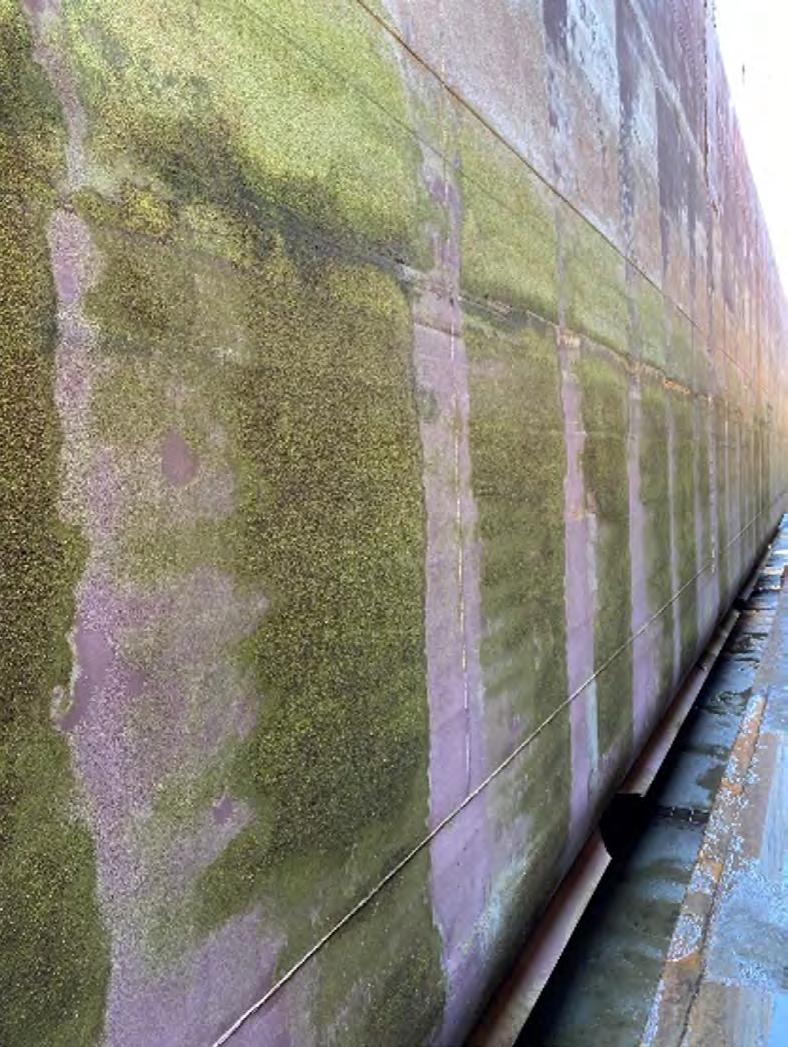
Figure 1: Striped pattern of nonfouled coating/ fouled coating
Antifouling selection
The selection of an antifouling coating is clearly a complex task with over 140 products to choose from, which is further complicated as a scheme then needs to be designed that is specifically tailored to the expected shipspecific operational and environmental factors. When designing an antifouling scheme, the dry film thickness (DFT) required is directly related to the expected vessel speed, activity and seawater temperature, along with the intended in-service period, i.e. 36 months, 60 months etc. In simplistic terms, the required DFT of an antifouling coating increases with increasing speed, activity, seawater temperature and longer in-service periods. If the vessel eventually trades at speeds and/or activities and/or seawater temperatures significantly lower than the antifouling scheme design, the following are the likely consequences:
. Antifouling will have been applied in excess of what is required for the scheme life, which is a waste of upfront paint costs
. At the following dry dock there will be a significant DFT of antifouling remaining on the hull, which may cause problems with excess thickness build-up and subsequently cracking and delamination/ detachment of the hull coatings. This can manifest itself as the coating dries out on entering the dry dock.
Antifouling issue
However, if the vessel trades at speeds and/ or activity and/or seawater temperatures
significantly higher than the scheme design, the antifouling coating is likely to ‘polish through’ prematurely before the end of the designed in-service period. Polish-through of the antifouling coating will expose the tie coat which will not provide any fouling protection, hence the tie coat will quickly foul even if the vessel is static for only a few days under normal port operations.
Figure 1 shows a striped pattern of nonfouled coating/fouled coating. The non-fouled areas are in way of spray overlap areas where additional antifouling paint has been applied. However, the areas between the overlaps have polished back to the tie coat and, as a result, have fouled.
To understand how much of a problem premature polish-through of the antifouling coatings is on marine vessels, you need to look at data. Safinah, an independent coating consultancy, has a unique in-house database of coating condition assessments documented from dry dock supervision activities dating back to 2010.
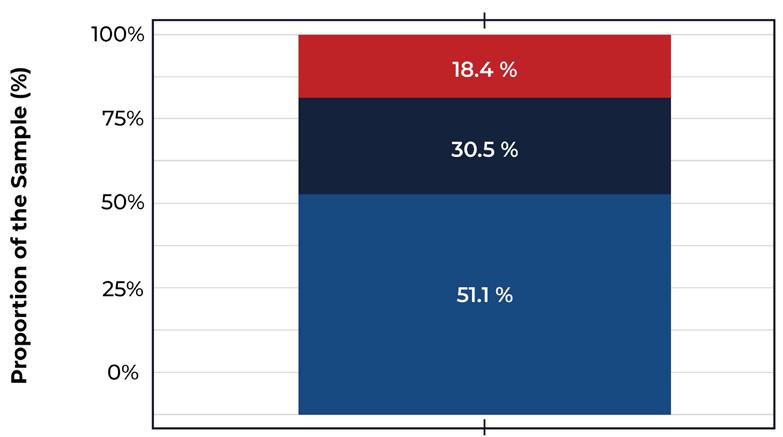
Safinah’s data from dry dock hull projects conducted between 2015-2024 showed that around 50% of the ships had a level of polishthrough of the antifouling on arrival at dry dock, including around 30% of the ships with up to 20% polish-through and about 18% of ships with more than 20% polish-through (see Figure 2).
The data shows that premature polishthrough of the antifouling coating is clearly a significant problem, and the accumulation of biofouling on areas of polish-through will lead to the following key industry issues:
Figure 2: Observed polishthrough levels
■ More than 20% polish-through
■ Up to 20% polish-through
■ No polishthrough
. An increase in underwater hull roughness (from fouling species), which has a direct impact on fuel consumption and consequently the emission of air pollutants (greenhouse gases) which the IMO has adopted regulations to address . An increased risk of translocating nonnative, potentially invasive aquatic species.
Increased fuel consumption
However, the most significant financial penalty for the shipping industry is the increase in fuel consumption (whilst maintaining a constant speed) due to the adverse effects of hull fouling on the hydrodynamic performance of the vessel.
As such, the expected parameters for speed, activity and seawater temperature need to be carefully considered when designing the antifouling scheme. Typically, this is done using the vessel’s historical Automatic Identification System (AIS) data for the in-service period since the last dry dock, which is then analysed to obtain the required parameters. However, this historical data is only useful if the vessel is going to continue the same trade after the upcoming dry dock, and any predicted changes need to be carefully considered and taken into account.
Whilst the vessel speed can be relatively easy to predict (for example, charter party agreements typically state expected speeds and a ship’s activity will generally remain within an expected range), predicting the expected seawater temperature over a three- or fiveyear scheme life is a significant challenge.
The polishing rate of all antifouling technologies is affected by seawater temperature and whilst a faster polishing rate, and hence an increased rate of biocide delivery in high fouling challenge warmer waters, can be a positive, it makes calculating the correct scheme DFT more critical.
Safinah’s findings
Based on Safinah’s knowledge of antifouling schemes, a significant change in scheme thickness (DFT applied) can be seen for what appear as relatively minor changes to the seawater temperature. For example, moving from 25°C to 28°C, a relatively small increase of 3°C, the scheme DFT required significantly increasing by around 70µm (an approximate 30% increase in the total DFT required).
Therefore, assuming a linear polishing rate for simplicity, a vessel applied with a five-year scheme (for a seawater temperature of 25°C)
which spends a high proportion of actual in-service operations at a temperature of 28°C, could expect to see significant areas of polish-through of the antifouling a year before the next scheduled dry dock. These areas of polish-through would quickly foul, with a subsequent increase in fuel consumption (when maintaining speed) and greenhouse gas emissions as well as significantly higher future
dry dock costs. These could include increased cleaning and blasting costs and/or increased paint costs, as exposed tie coats cannot be directly overcoated with new antifouling.
To further add to the complexity, from analysis of antifouling schemes and in-service performance results from the dry dock database, Safinah has found that simply using average seawater temperatures is not accurate
enough and a more in-depth analysis of the raw temperature data is required. By analysing the condition of the hulls at dry dock and the scheme applied, Safinah has developed a method to incorporate other factors into the seawater temperature calculation which provides a ‘functional seawater temperature’ more fitting to the conditions expected to be encountered by the vessel. ■
The polishing rate of an antifouling technology makes calculating the correct scheme DFT critical
Optimising painting in line manufacturing
The painting of industrially line-manufactured metal products –such as machines and equipment – is an important part of the production process. It is an essential element of the product’s brand and recognisability, but above all, a protection against corrosion, mechanical wear and chemicals. A well-executed surface treatment extends the product’s service life, facilitates cleaning and improves its resale value, but what should be considered when planning a line painting process, asks Nor-Maali?
Accurate surface preparation is the basis for a successful painting process. As in all industrial painting, metal surfaces must be carefully cleaned and pre-treated before painting. Cleaning removes all impurities that weaken adhesion – solid particles, salts, greases and oils. A typical solution today is an alkaline, water-based detergent that effectively removes most impurities.
Steel surfaces are blast-cleaned to at least grade Sa2½. Certain special products may require even level Sa3. The blasting process can be automated. If the shape or material of the component does not withstand blasting, chemical pre-treatment is used instead. The most typical methods are iron and zinc phosphating. There are different types of phosphating agents and the storage passivation often used with them. Therefore, paint adhesion to the passivated surface must always be verified. Other types of chemical pre-treatment are also available, but they are less common.
The higher the corrosion category (e.g. ISO 12944) defined for the object to be painted, the more significant the role of pre-treatment. The quality of surface preparation is emphasised especially in the case of waterborne systems, as waterborne coatings tolerate impurities less effectively than solvent-based alternatives.
Selecting the right coating system
The choice of coating system typically depends on environmental conditions: whether the equipment is exposed to corrosion, chemicals, mechanical wear or UV radiation.
The coating system can be selected in accordance with ISO 12944-5, but in product painting it is common that customers have their own experience-based painting specifications, which define the requirements and tests for surface treatment.
The following details the properties of the most common industrial coating types used on metal surfaces.
. Epoxies provide excellent chemical and corrosion protection. They are well suited particularly as primers and also as topcoats for indoor use. In outdoor applications, epoxies tend to chalk under UV radiation from sunlight, so they require a weatherresistant topcoat. If the painted product is exposed to corrosion categories C4–C5, epoxy coating is a recommended choice for the primer in a multi-coat system.
Zinc-rich epoxies are particularly suitable for applications requiring very high corrosion protection (typically C5). Zinc acts as a sacrificial metal in the system and effectively prevents rust progression even in the case of surface damage.
. Polyurethanes offer excellent gloss and colour retention even under UV exposure. They are suitable both as topcoats and direct-to-metal coatings. As single coats, polyurethane coatings typically provide good protection up to corrosion category C3.
. Acrylics and alkyds are single-component options for lower corrosion categories (C1–C2). Their use has decreased in recent years due to environmental legislation (e.g. VOC content) and stricter customer quality requirements.
Single-coat or multi-coat system?
Painting can be done as a single-coat or multicoat system, each having its own advantages. Single-coat painting (DTM) saves time and costs, as it requires only one application. Modern direct-to-metal coatings can already achieve demanding corrosion categories, but high quality requires precise workmanship: film thickness control must be at a high level to ensure coverage and the desired corrosion protection.
A multi-coat system takes more time in the process than single-coat painting but is less sensitive to possible film thickness deviations and often allows for higher corrosion protection. If the primer and topcoat are based on the same chemistry (e.g. epoxy), the topcoat
can often be applied after a short interval (wet-on-wet application), which speeds up the process.
Environment and user safety
Companies may have defined policies regarding the environmental friendliness and user safety of paint products used. It should also be noted that EU Directive 1999/13 limits solvent emissions (VOC) from production facilities. VOC emissions can be reduced by choosing a waterborne or high-solids coating system, in which case emissions can be reduced to as little as one fifth compared to an equivalent solvent-based system.
Some companies may also require paint products to be isocyanate-free. EU Commission The choice of coating system typically depends on the environmental conditions in which the equipment will operate
Regulation 2020/1149 sets restrictions on products containing more than 0.1% isocyanate monomers. In addition, companies may have their own chemical lists that prohibit or restrict the use of certain substances. Typical restricted substances include those on the REACH Candidate List (SVHC, Substances of Very High Concern), Category 1 CMR substances (carcinogenic, mutagenic or reproductive toxins), and respiratory sensitisers.
Appearance and cleanability
The degree of gloss has a major impact on the final appearance of the product. A glossy surface looks stylish and is easier to clean, but it also reveals possible surface defects in the coating more easily. A high gloss level therefore also requires a higher standard of painting quality.
Other considerations
In product painting, it is typical that the line speed is high and there is limited time for drying of the painted parts.
The most common painting technique in product painting is still high-pressure airless spray. Painting can be performed automatically (traverse or robot), manually or with a combination of both. The choice of the correct nozzle tip size and spray angle is extremely important and is made according to the shape of the painted object and the product used. A smaller nozzle allows more precise film thickness control but slows down the work.
The use of electrostatic or air-assisted spray guns is common. The former reduces material waste, while the latter improves the surface quality. If the quantities are very large
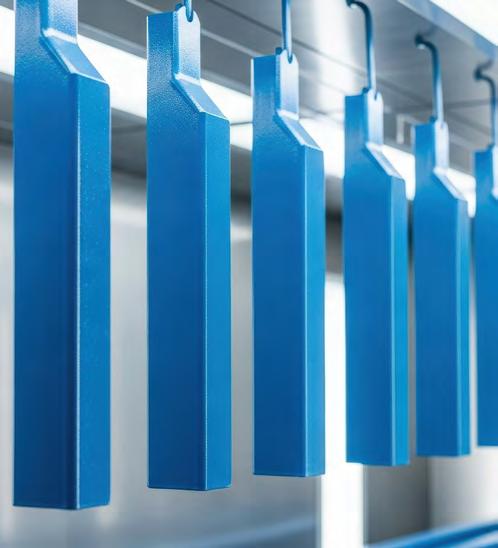
and the shapes complex, dip coating can also be used. In this case, it is important to monitor the stability of the product (viscosity, pH, solids content), often together with the paint supplier.
Drying can be accelerated by increasing the temperature of the drying line. Typical solutions include electric and gas-fired ovens. The use of infrared (IR) elements has also become more common due to rising energy costs. IR radiation is a more efficient way to transfer thermal energy to the object being dried.
Especially with waterborne products, the drying process must be carefully designed, as water evaporates relatively slowly compared to solvents and requires a great deal of energy for evaporation. The evaporation of water can alternatively be accelerated by reducing the humidity of the surrounding air. After the heating
process, it is also important to consider the time required for the part to cool down and whether this should be accelerated, for example, with fans.
Final product quality control, both in terms of appearance and technical durability, is an essential part of product painting. The maximum number of surface defects is often defined, and adhesion is typically monitored through random testing, for example, using the cross-cut test (ISO 2409).
Durable and high-quality results
The optimal selection of surface preparation, coating system and drying conditions enhances the efficiency of the product painting process, reduces the need for maintenance painting and lowers the overall lifecycle costs of the product – even if the paint used is more expensive per unit. ■
POLYUREA PROTECTION FOR AQUACULTURE TANKS
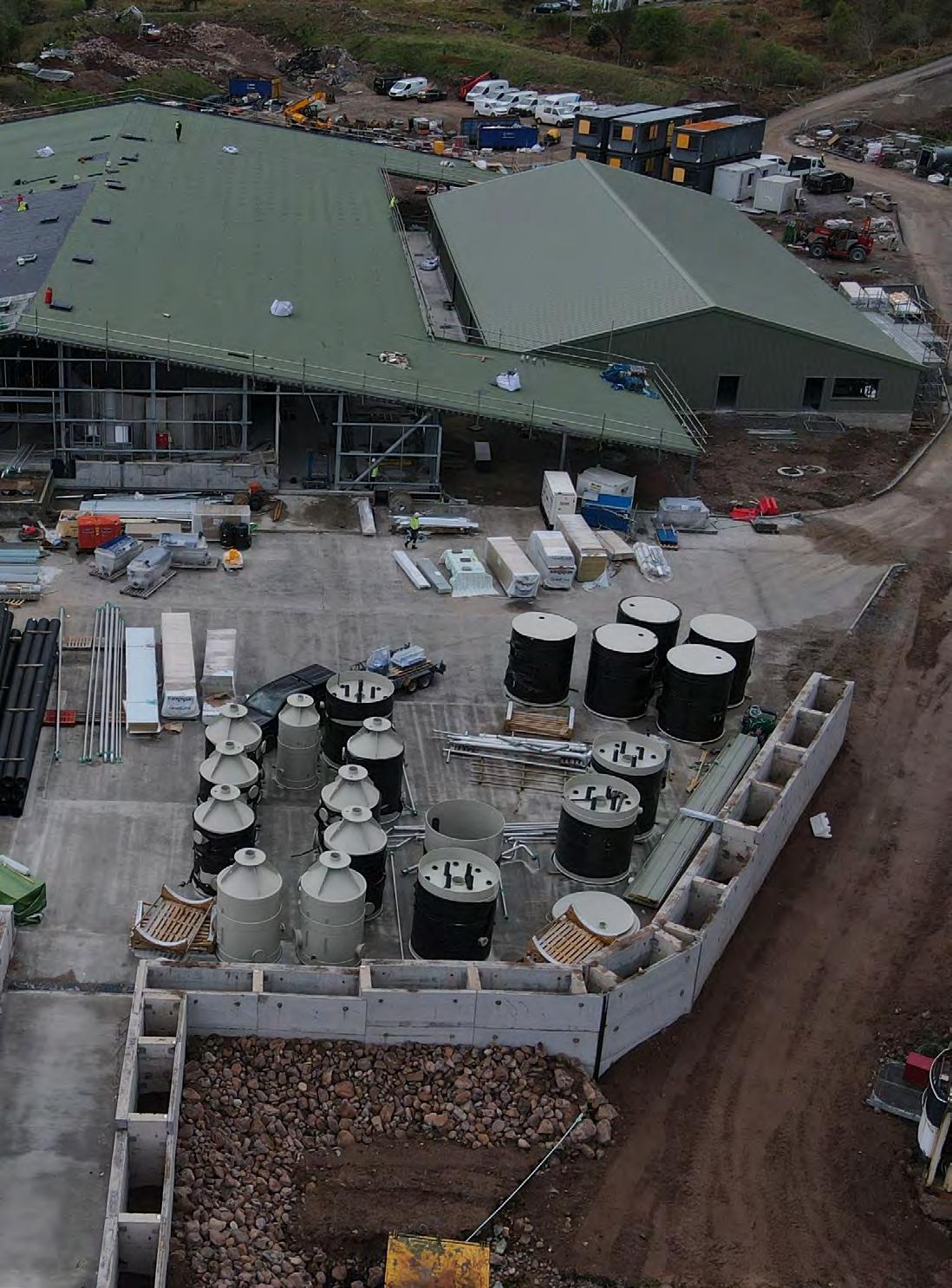
A new aquaculture farm had 10 precast concrete tanks that required a polyurea tank lining to provide protection to the fish that would be contained within them, but earlier experience led the farm to seek a new solution from Corroless Eastern.
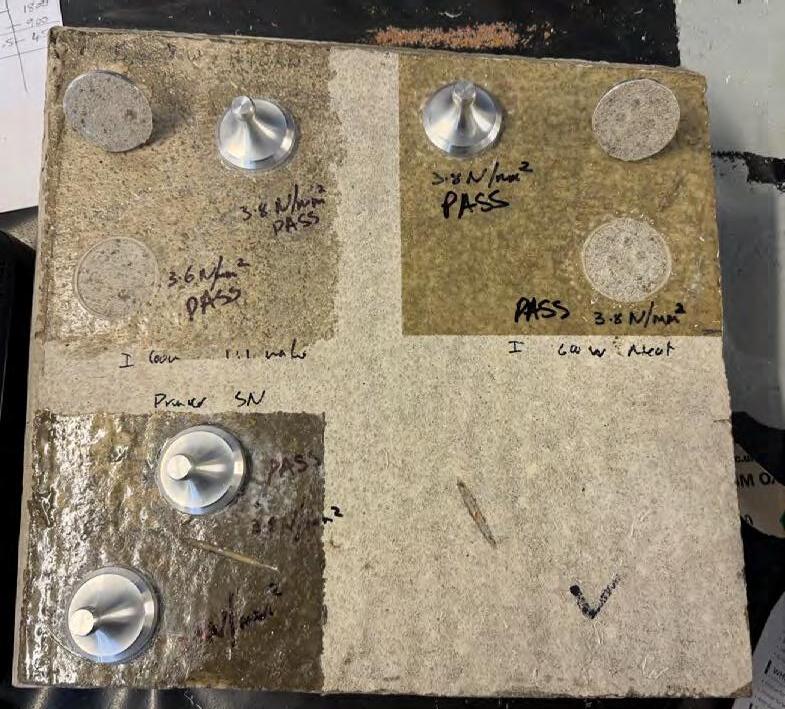
Part of our tender involved preparation and adhesion tests on the precast concrete panels that the tanks were constructed from
The client had previously suffered from poor polyurea application at other facilities that had caused ongoing issues, with remedial works being required once in operation.
Corroless Eastern proposed the application of a Water Regulations Advisory Scheme (WRAS)-approved polyurea from VIP Coatings.
As part of the tender, Corroless Eastern conducted preparation and adhesion tests on the pre-cast concrete panels that the tanks were constructed from.
This confirmed that due to the quality of the concrete, preparation of the walls using
high-pressure washing would be sufficient, thus avoiding risking the opening up of the concrete matrix and subsequent making good that might be required.
The tank walls were prepared using 3,000 psi pressure washing and utilising a spinning jet attachment to remove loose laitance and contaminants to provide a clean and stable surface for the tank lining primer to adhere to. The tank bases, being site-cast and having more surface laitance, were prepared using vacuum-controlled diamond grinding.
Concrete moisture content and climatic conditions were tested and recorded as part of Corroless Eastern’s tank lining quality assurance
The central outlet required a very flat surface to ensure an effective seal. Corroless Eastern was therefore asked to level this area using an epoxy self-smoother.
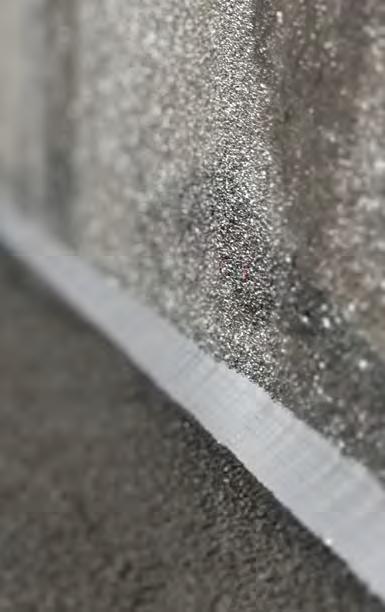
The fixings and perimeter of this area were first masked, and a foam tape installed around the outlet pipe to form a termination point for the subsequent polyurea tank lining to ‘toe’ into.
Prior to any coating materials being applied and throughout the project, the concrete moisture content and climatic conditions were tested and recorded as part of the company’s tank lining quality assurance.
The interface between the floor and the walls was isolated with a polyurethane jointing compound
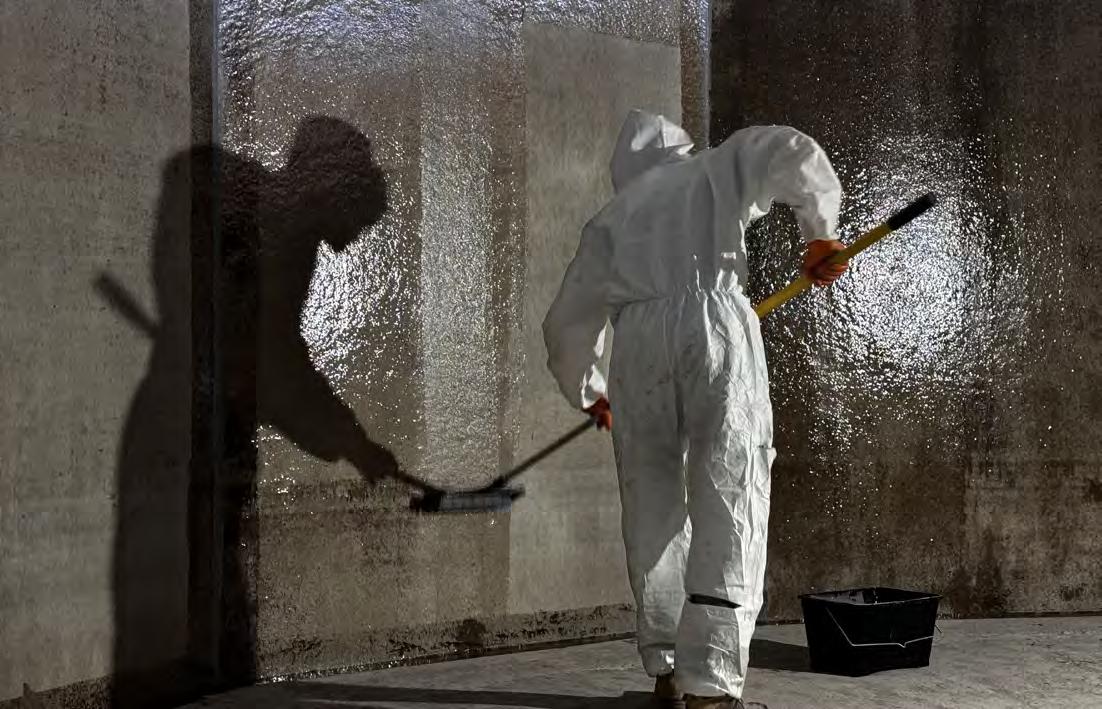
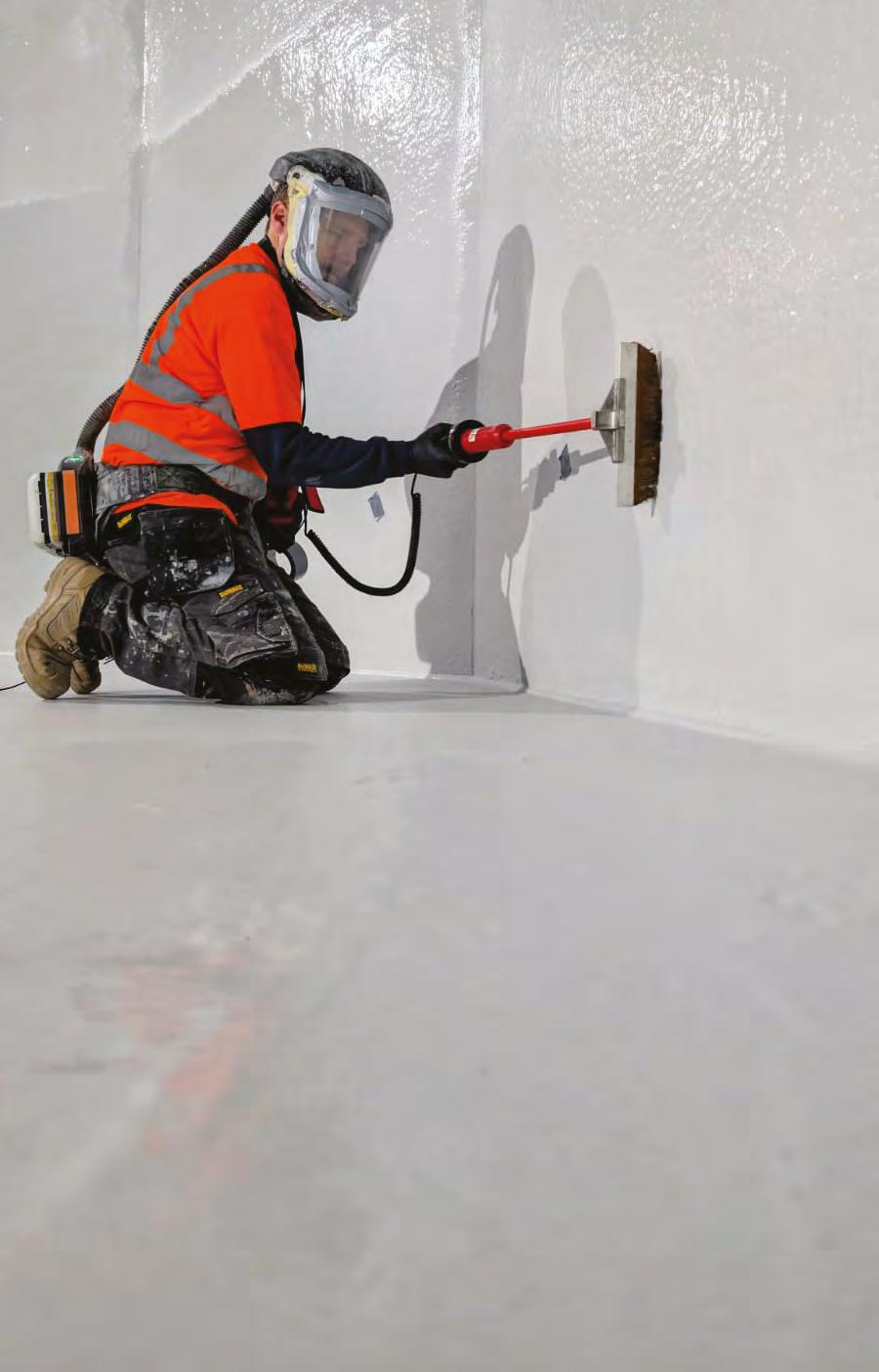
The first coat of damp tolerant epoxy primer was then applied by brush and roller throughout the tanks
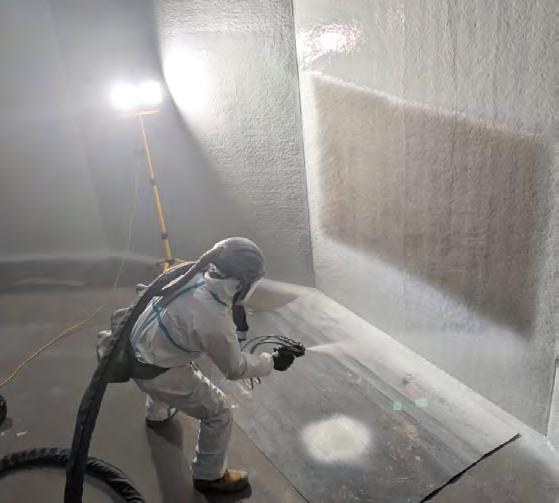
VIP Quickspray Industrial was then spray applied to a nominal thickness of 2mm
Within the overcoat window of the polyurea lining (the same shift) the applied polyurea was tested for pinholing using a DC Holiday spark tester.
Coating application
The epoxy self-smoother was then applied by trowel to smooth this area.
Once cured, this epoxy was diamond-ground to create the smoothest possible transition to the surrounding concrete, and also to provide a mechanical key for subsequent coats to adhere to as the overcoat window would be exceeded. The vertical panel joints were then primed using a damp-tolerant epoxy primer applied by brush.
These were then filled using a polyurethane jointing compound to provide a smoother finished surface and create a simpler profile to which to apply the polyurea tank lining. Because of the fast gel time and application equipment, small recesses such as these are more challenging to apply polyurea coatings to.
The first coat of damp-tolerant epoxy primer was then applied throughout the tanks by brush and roller.
To minimise pinholing during the polyurea application, a second coat of the epoxy primer was applied as part of Corroless Eastern’s standard polyurea application process. Whilst wet, this second coat of primer was fully blinded using a quartz aggregate to provide an excellent mechanical profile for the polyurea tank lining to adhere to. This also meant that if the overcoat window of the primer was exceeded, adhesion would still be obtained.
Loose and unbound quartz aggregate was removed using soft brooms and vacuums so as not to disrupt the adhesion of the polyurea lining. The interface between the floor and the walls was isolated as per best lining practice using a polyurethane jointing compound applied using
mastic guns. Items not to be coated with polyurea were masked to prevent overspray damage.
VIP Quickspray Industrial was then sprayapplied to a nominal thickness of 2mm. Within the overcoat window of the polyurea lining (the same shift), the applied polyurea was tested for pinholing using a DC Holiday spark tester. Any pinholes identified were marked prior to filling using a polyurethane mastic.
A final continuous application of the same polyurea was applied throughout the tanks to achieve as smooth a finish as possible as desired by the client.
Following completion of polyurea spraying, all masking was removed and previously-cut termination points sealed using a polyurethane sealant to protect the edges of the polyurea tank lining from creeping. The top edge to the polyurea on the tank walls was protected by the installation of a plastic trim around the tanks’ circumference, bonded in place using a polyurethane sealant.
Excellent solution
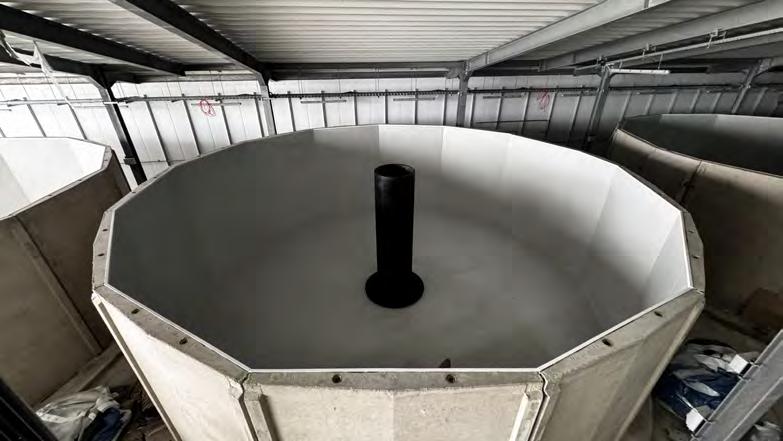
Once complete, the tanks were returned to the client and the fitment of the outlet pipes checked to ensure that a sufficient seal had been obtained between the pipe and the finished polyurea tank lining.
By adhering to polyurea application best practice and implementing a stringent quality assurance regime, Corroless Eastern is confident that the issues with polyurea that the client had previously experienced will be avoided, providing an excellent solution for the prevention of damage to the fish farm. ■
Once complete the tanks were returned to the client and the fitment of the outlet pipes checked to ensure that a sufficient seal had been obtained between the pipe and the finished polyurea tank lining
News
from the Corrodere Academy
Corrodere Academy provides globally recognised accredited training and qualifications to the protective coatings and corrosion control industry. Their aim is to raise standards worldwide and help students learn, discover and succeed.
Meet our ICorr Assessors: David Eyre
At Corrodere Academy, we’re proud to introduce the expert trainers and assessors who deliver our ICorr Coating Inspection courses. Today, we’re pleased to feature David Eyre, our Training Director and a long-standing ICorr trainer and assessor. With nearly five decades of experience in the protective coatings industry, David has trained and mentored professionals around the world—and continues to play a key role in shaping the next generation of Inspectors.
Can you tell us a bit about your background and how you got into the protective coatings industry?
I started in the coatings industry 48 years ago as an apprentice. After several years on the tools, I joined a coating distributor in the London area and moved into a technical sales role. From those early days, my career has taken me all over the world in both technical and commercial positions.
How long have you been delivering ICorr training and assessments? Since 2013, so 12 years!
What does a typical training or assessment day look like for you?
I’m usually in the office around 7:30 a.m. to clear as much of my inbox as possible before I begin training. I then prepare all the equipment and ensure the electronics and media are set up and working correctly. At 9:00 a.m., the students arrive, and we spend some time getting to know one another. I always encourage interaction throughout the day—it makes the session more enjoyable and engaging for everyone. I try to end each day on a positive note, with every student leaving confident in the knowledge they’ve gained.
What do you enjoy most about delivering ICorr training?
Hopefully the satisfaction of inspiring the younger students-seeing their enthusiasm for the industry and how it opens up a whole new world of opportunity. I was that person once!
What do you think sets the ICorr certification apart in the industry?
It has 100% global recognition. Wherever I’ve worked in the world, my ICorr Level 3 qualification has been respected as the benchmark standard in the industry.
How do you support students who may be struggling with certain concepts or assessments?
I’m a strong believer in the building-block approach. When introducing new concepts, I always link them back to something the student already understands. I also ask questions to confirm they’ve grasped the material. Before a practical ICorr assessment, I take a little time to get to know the student and explain that it’s just the two of us discussing inspection equipment and standards. I also reassure them that there’s no need to rush-we have plenty of time. Usually, they’re smiling before the assessment even begins.
What advice would you give to someone starting out in the protective coatings industry?
It’s not just a job-it can be a lifelong career that can take you all over the world in many different directions. The harder you work and the more sacrifices you’re prepared to make, the greater the rewards will be.
Candidate Feedback:
“I had the privilege of being taught by David for both the practical and theory sessions. He is a great trainer who takes time with his delegates and goes above and beyond to ensure everyone understands the material and feels confident before their exams.”
Johnny Morton – Project Engineer/Technical Authority at Bilfinger UK and ICorr STGB Chair
David’s dedication to his students and the protective coatings industry is evident in every workshop he delivers. At Corrodere Academy, we’re incredibly fortunate to have him leading our training efforts and helping maintain the high standards of ICorr certification worldwide. ■
Meet our ICorr Assessors: David Martin
Next up in our ICorr Assessor series is David Martin, who brings over 50 years of coatings industry experience to Corrodere’s ICorr training and assessments.
Here, we speak with David to learn more about his background, his approach to training, and what he enjoys most about supporting the next generation of coating inspectors.
How did you begin your career in the coatings industry?
“I commenced working in the coatings industry 53 years ago for a local industrial painting contractor, starting as a labourer, pot man and then learning to blast and spray. I worked on various factories along the Humber bank for many years and then I qualified as a Coatings Inspector in my early 20’s which opened opportunities for me to work all over the UK and then worldwide.”
How long have you been delivering ICorr training and assessments?
“I have been delivering ICorr training and assessments for the past year, but prior to this I was delivering the Industrial Coating Applicators apprenticeship throughout the UK plus other coating inspection, surface preparation and painting training programs for various training providers.”
What does your preparation for a training or assessment day look like?
“The evening before the scheduled assessment or training day I set up the worktable in my office and layout all the inspection instruments and ensure my computer and software is working correctly so I’m ready for the next day. I usually get online at least half an hour early, so I am ready for starting promptly at 9am. I find it
is important to be informal, introduce the students to each other and get some banter & teamwork going to relax and encourage them to ask any questions no matter how trivial throughout the day.”
What do you enjoy most about training and assessing?
“I get so much satisfaction imparting knowledge to the next generation of Coating Inspectors. I vividly remember being in the same position as them so many years ago and how this industry has provided me with a comfortable lifestyle. It’s so satisfying, possibly being able to help students with their careers, and achieve similar opportunities.”
What value do you feel ICorr certification offers students?
“ICorr certification has come a long way since it was first introduced and is respected and specified by many companies worldwide. The online courses are very flexible, allowing the student to study at their own pace with full support available to them whenever and wherever they may need it.”
How do you approach helping students who may be struggling?
“If the student is struggling to understand some part of the curriculum, I try and refer to a real-life inspection related scenario which I have experienced during my career. This often explains things in an easier way for the student to understand. When assessment time comes along some of the students are quite nervous and it’s important to try and calm and relax them by talking about various subjects or hobbies they may be interested in both before and during the assessment. This tends to settle them down and their confidence improves.”
What advice would you give to someone starting out in the coatings industry?
“If they are diligent, prepared to work hard, and accept there will be some sacrifices to make along the way, there are so many different career opportunities available. It can be very rewarding, you meet some great colleagues and characters from all over the world, and many remain lifelong friends.”
A huge thank you to David Martin for sharing his insight into life as an ICorr Trainer and Assessor. We are so pleased to have him as part of the team. ■
Celebrating 10 years with CAKE Commerical Services
This year, we’re proud to celebrate a decade-long partnership with Cake Commercial Services, our Affiliate Training Provider for Train the painter in New Zealand. Over the past ten years, CAKE has delivered high-quality protective coatings training, helping to strengthen standards across New Zealand and beyond.
A big thank you to Dean, Daniel AstonCAKE’s Train the painter Trainer, and the entire CAKE Commercial Services team for their dedication to developing skills, supporting their workforce, and contributing to the coatings community.
Here’s to the next ten years of partnership and progress!
Madacan join the Train the painter network
We’re delighted to welcome MADACAN SARLU as our Train the painter Affiliate Training Provider in Madagascar. Madacan is committed to raising standards, developing local talent, and supporting the growth of the coatings industry.
Their goal is to empower local workers with internationally recognised qualifications, reduce reliance on expatriate labour, and help build a stronger, more professional coatings industry in Madagascar.
ADCAM Fabrications join Train the painter
We’re delighted to welcome ADCAM FABRICATIONS LIMITED as a registered Train the painter company. Their decision to join the programme was driven by client requirements – including specifications from BAE Systems, who have made Train the painter training a standard for all subcontractors.
“We were motivated to join the Train the painter programme from requirements made to us by some of our customers - for their customers. Going forward, we believe that the Train the painter programme and access to their network will enhance our company profile within the industry, displaying to existing and potential customers our commitment to standards and the painting processes.” – Dave New, ADCAM
We’re proud to support ADCAM as they continue to strengthen their expertise and uphold the highest industry standards through Train the painter.
Corrodere Academy achieve recognised training provider status with ASFP
Corrodere Academy is proud to have achieved Recognised Training Provider status with the Association for Specialist Fire Protection (ASFP).
This accreditation highlights the quality and relevance of our fireproofing training courses, ensuring they align with industry expectations and support the development of competent professionals in the passive fire protection sector. Our achievement was also acknowledged during the ASFP’s recent End of Year Awards, where Corrodere Academy’s contribution to enhancing skills and standards within fire protection was celebrated. We look forward to continuing to deliver trusted, up-to-date and accessible training for learners and industry partners.
Corrodere Academy at the PFPNet Annual Conference
Corrodere Academy recently took part in the PFPNet Annual Conference, an event that brought together professionals from across the passive fire protection sector to share insight, updates, and best practice. The Academy was pleased to see its PFPNet Passive Fire Protection Inspection Level 2 course highlighted during discussions, reinforcing its relevance to today’s industry needs. It was also a valuable opportunity to reconnect with learners, including Vijay Kumar, who has completed several of our inspection and specialist courses. A standout moment was seeing student Jonny Alder present an insightful session on on-site considerations for repair schemescontributing meaningfully to a productive and collaborative day.
Innovation and Industry Insight at the Marine Paint Forum
Corrodere Academy recently attended the Marine Paint Forum in London, joining industry professionals for a day of insightful presentations and discussion on the latest developments in marine coatings. Sessions covered topics such as SAM product advances and non-destructive surface replication techniques, offering valuable technical updates for attendees. Representing the Academy, Technical Director Brendan Fitzsimons delivered a talk on the Coating Surveys course and the innovative Coating Radar App, which provides practical digital support for coating inspection and survey work. Students enrolling on the course receive 12 months’ free access to the app, strengthening the link between training and real-world application.
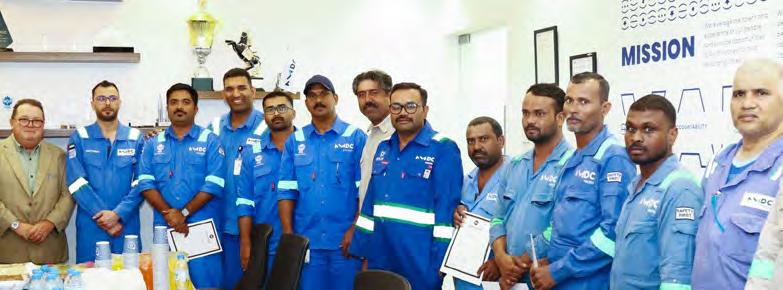
QCA Certification success for NMCD employees
Recently, 106 NMDC Energy employees successfully completed their QCA certifications –covering A1 Abrasive Blast Cleaning, S1 Spray Painting, and P1 Protective Coating Application. NMDC recently held a certificate presentation ceremony to celebrate the achievements of all participants, with our global support partners in Saudi Arabia, Bob McMurdy and Jonathan Ombler at Corrodere Inc, pleased to attend and show their support.
The QCA certification demonstrates competency and alignment with recognised industry standards, helping to ensure quality and professionalism across the coatings sector.
Congratulations to everyone involved!
Corrodere Academy Registered Companies & Affiliate Providers
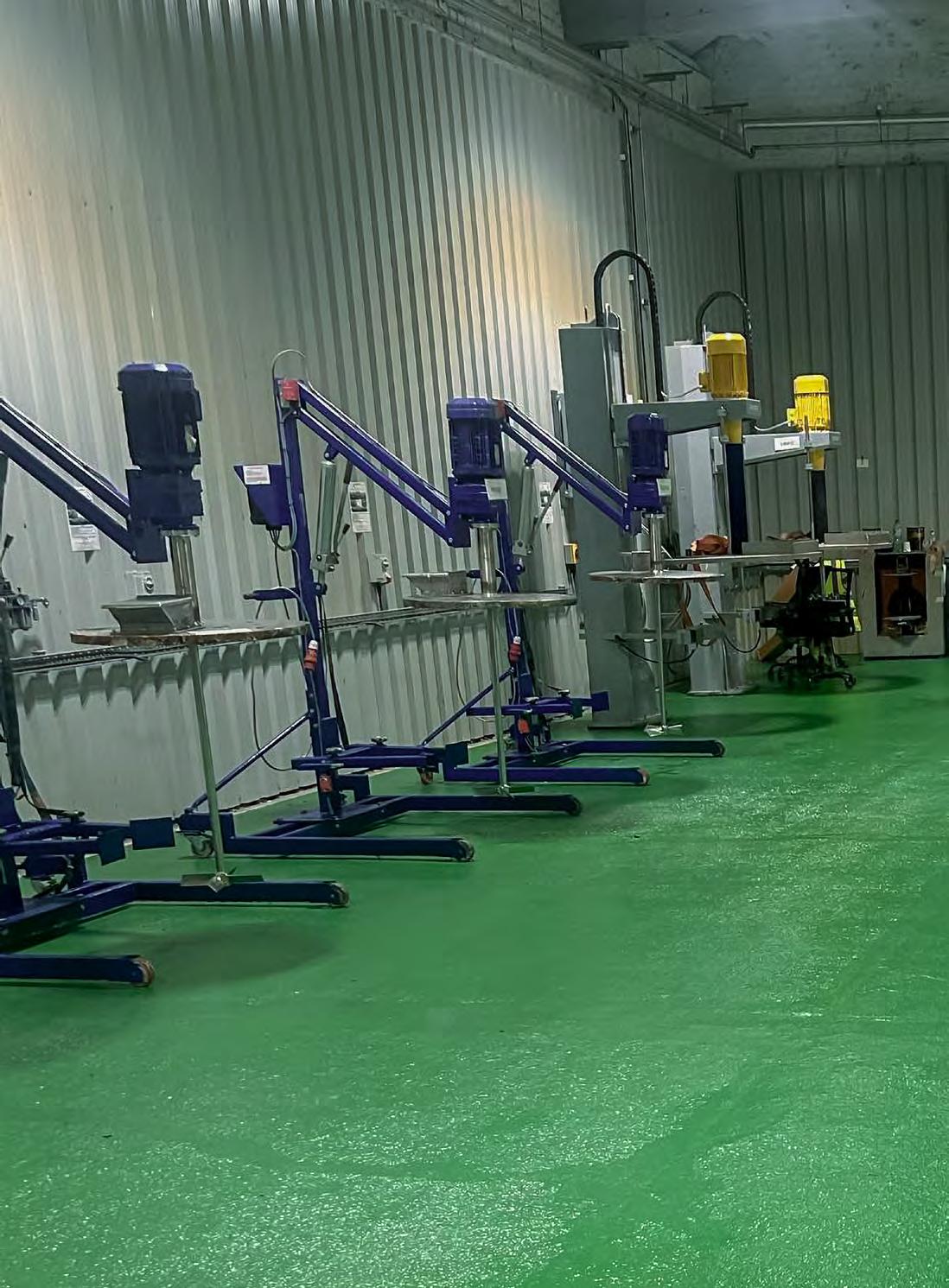
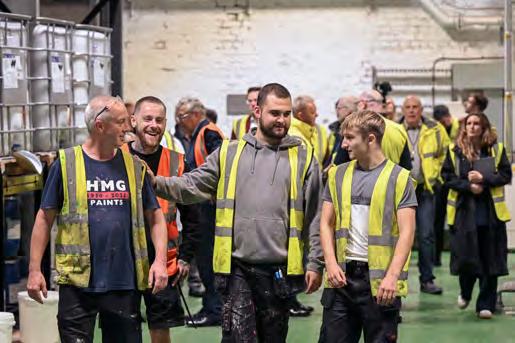
HMG Paints has officially opened its new department known as the ‘Len Hutton Centre’, a modern facility dedicated to water-based production, named after former Production Director Len Hutton. The opening will increase water-based production capabilities at the company.
This substantial capital investment, which coincides with the business celebrating its 95th anniversary, is projected to increase capacity by an estimated 50,000 litres per month and allows the business to meet growing
demand for its range of water-based products, as customers and the industry shift towards low-VOC, environmentally-friendly and sustainable coatings.
The new department, operated by six highly-trained staff members, is equipped with 12 high-efficiency mixers and a dedicated washout facility. It showcases HMG Paints’ commitment to investment and innovation, whilst also celebrating the core family-first approach at the company. The Len Hutton Centre will serve as a hub for developing and manufacturing
innovative, water-based coatings for a range of markets.
“This is a huge honour, having a department named after myself makes me feel my name will truly live forever at HMG,” said Hutton, whose legacy the new department honours. “I consider it a great privilege to know that my department will be the future of waterborne production for the company, and it is great to have myself named amongst other greats at the business who have similarly had departments named after them throughout the years.”
NEW AEROSPACE TRAINING PROGRAMME
AkzoNobel Aerospace Coatings used the National Business Aviation Association (NBAA) event in Las Vegas to launch its AS7489-certified training programme, created to advance the adoption of the globally-recognised standard in aerospace coatings application and raise professional standards.
Developed as part of AkzoNobel Aerospace Coatings’ Aerofleet Training+ offering, the programme is fully compliant with SAE International’s AS7489 standard, a universallyrecognised framework for the training and qualification of aerospace organic coatings applicators.
Whilst certifications have
long existed for mechanical, structural and safety disciplines, there was no universal benchmark for coatings until the introduction of AS7489. AkzoNobel’s programme directly addresses this gap by improving access to professional training for the global aerospace industry.
AkzoNobel’s AS7489 training is structured across five progressive levels, in accordance with the AS7489 technical standard and approved for delivery by SAE International. The courses go from theoretical fundamentals (Level 1) to advanced, practical assessments (Levels 2, 3 and 4) that test hands-on skills and understanding, to Level 5 which provides in-depth specialisation for expert applicators.
AkzoNobel’s training centre in Troy, Michigan has been approved and AkzoNobel’s first cohort of technical service representatives have been certified to deliver AS7489certified training to customers. AkzoNobel plans to establish and certify additional training centres and technical service teams to support the future rollout of AS7489 training across Europe.
The launch of AS7489certified training builds on AkzoNobel’s long-standing commitment to innovation in learning and development.
Supporting the rollout of the new programme is AkzoNobel’s bespoke online training and certification platform, which gives applicators, assessors and employers full visibility
AkzoNobel’s programme improves access to professional training for the global aerospace industry
Wacker and SICO Performance Material have opened a new application development centre in Jining, China
of training progress and qualification status.
Through the online training platform, participants can submit their work, track their learning journey and store digital records of their certifications. Independent assessors will use the system to review and grade submissions, ensuring objective evaluation against the AS7489 standard. Employers will be able to monitor employee progress, identify development needs and, when recruiting, verify the credentials of candidates.
CHINESE SILICONE BUSINESS STRENGTHENED
To strengthen its specialties business, German chemical company Wacker and Chinese specialty silane producer and joint-venture partner SICO Performance Material have opened a new application development centre for organofunctional silanes in Jining, China. The approx. 2,300-square-metre facility features several laboratories where highperformance additives for the plastics, coatings and adhesives industries will be developed going forward. In addition, the technology centre acts as an interface between research, technical support and production. For example, SICO’s production and scale-up resources, which are also located in Jining, can be fully leveraged for development work. The technology centre thus enables the rapid market launch of new products.
Investments in the Wacker SICO Application Development Centre (ADC) facility total a mid-six-figure euro sum.
FORECASTING TOOL UPDATED
International, AkzoNobel’s marine coatings brand, has announced a series of new updates to its Intertrac Vision digital forecasting tool.
Building upon its 10-year track record, the new features enhance user experience and deliver deeper insights to further support more informed decision-making in marine coatings selection.
Following the expansion of EU Emissions Trading Systems (EU ETS) in January 2024 and
the implementation of FuelEU from January 2025, there is growing demand from ship owners and operators for more in-depth and accessible fouling control data to help them better understand the performance of fouling control technologies.
The latest updates include the ability for users to share forecasts directly with colleagues, along with improved visibility and accessibility for quick analysis of the commercial impact of coatings selection.
PCE January-March 2026 issue
The Leading Protective Coatings Magazine
SPECIAL EDITORIAL FEATURES:
• Waterborne Coatings
• Tank & Pipeline Coatings
• Heritage Coatings
• Raw Materials
FOCUS: Nano Technology
EVENTS:
• Eurocoat: Paris
• Middle East Coatings Show: Dubai
• Paint Expo: Karlsruhe
PCE will continue to showcase its regular features; Lifting the Lid, Upfront and Spotlight, as well as featuring the latest news and developments in marine and offshore coatings
PCE International is published quarterly by MPI Group Peel house, Upper South View, Farnham, Surrey. GU9 7JN. UK
To advertise in the magazine, on the website and /or newsletter contact Nick Carugati: nick@pce-international.com
Additionally, Total Cost of Ownership (TCO) and dry dock costs are now aligned with the specific coating scheme and number of coats applied, resulting in more accurate and reliable insights.
International has also made visual changes to the Performance and TCO Reports to improve the clarity, in addition to several functionality updates. These include making ROI and payback time visible in months and enabling users to input
additional costs to cover high-pressure fresh water washing and application. The updates allow users to align maintenance, dry dock or investment decisions with budget cycles and financial targets.
ANTIFOULING CLASS-VERIFIED
Jotun has announced that its SeaQuantum X200 antifouling has received official verification from DNV confirming an average speed loss of just 1.0%
over a dock-to-dock period. The company claims this represents the lowest verified speed loss in the industry, setting a new benchmark for hull performance.
“SeaQuantum X200 is Jotun’s flagship SeaQuantum antifouling, and part of HPS 2.0. It has 15 years track record of maximising hull performance with around 2,500 deepseagoing vessel applications, and delivers high performance for predictable trades, which is now also quantified and confirmed by DNV,” says Habibe Escobar, Category Manager and responsible for Jotun’s SeaQuantum brand.
“An average speed loss of 1.0% really pushes the boundaries of what an antifouling can deliver.”
Habibe Escobar, Category
Manager
and responsible for Jotun’s SeaQuantum brand
The verification is based on the in-service performance methodology outlined in ISO 19030, which evaluates speed loss over the last four years of a five-year dry-docking cycle,
with the first year out of dock establishing a benchmark.
“We are pleased to receive this verification from DNV, which confirms what our data has consistently shown,” says Morten Sten Johansen, Global Category Director, Hull Performance at Jotun. “As the home of hull performance, we are happy to bring in another evidence of our efforts.”
The data used in the verification includes 41 vessels coated with SeaQuantum X200, representing a fleet of medium- to high-activity vessels operating under normal conditions. The verified speed loss of 1.0% showcases a big contrast to the industry benchmark with a baseline of
5.9% average speed loss as per ISO 19030.
“The verification of SeaQuantum X200’s performance was carried out with rigour and precision, enabled by access to highquality performance data,” said Olav Rognebakke, Head of Section Hydrodynamics & Stability at DNV Maritime Advisory.
“Based on our evaluation, the coating demonstrated the lowest average speed loss verified under ISO 19030 standards. This level of performance is consistent with reduced hull resistance over time, which can contribute to lower fuel consumption under typical operating conditions.”
EUROPEAN FIRE PROTECTION LAUNCH
International, part of AkzoNobel, has officially launched its leading epoxy passive fire protection (PFP), Chartek ONE, to the European market following a successful launch in the Middle East last year.
Chartek ONE is a single coat, mesh-free solution that simplifies PFP application for assets in the energy sector, offering one solution for total protection.
Streamlining the installation process, the product maximises efficiency as well as enhancing health and safety. It provides three hours of jet and pool fire protection
Chartek ONE has now been launched in Europe following a successful launch in the Middle East last year
across a wide operating temperature range, shielding assets against different types of fires, including cryogenic and hydrocarbon fires, whilst providing robust corrosion resistance.
Chartek ONE’s 100% solids formula is boron-free and contains no chlorinated plasticizers, reducing occupational risks while minimising environmental impact – reinforcing AkzoNobel’s commitment to sustainability.
Its mesh-free design eliminates the need for reinforcement in hydrocarbon pool and jet fire protection, including high heat flux jet fires. This simplifies and speeds up PFP system installation both in the workshop and on site, whilst lowering installed weight and reducing labour and material costs – without compromising fire protection performance. These benefits are especially critical in industries with strict weight constraints, such as offshore oil and gas.
Developed to simplify even the most demanding projects, these features can reduce workshop hours by up to 59%, saving users both time and money throughout projects and over the lifetime of the asset.
Chartek ONE is certified to meet the industry’s highest standards, including NORSOK M-501 Revision 7, ISO 21843, ISO 22899 and UL1709 Edition 5.
INTUMESCENT INNOVATION
Jotun, a global leader in protective coatings, announces the launch of Jotachar 1709 XT, the latest innovation to its industryleading Jotachar range of trusted intumescent fire protection coatings for the oil and gas industry. Engineered for fire performance in the most demanding environments, delivering competitive loadings and installation cost, Jotachar 1709 XT is optimised for UL1709 projects and strengthens the recognised Jotachar range with new products suited for all types of project scenarios.
Ensuring the safety and integrity of steel assets is critical, especially as the industry faces increasing challenges – from reducing the carbon footprint to limiting the risks of fires and cryogenic spills. In the face of hazards or the pressure of tight schedules, time is essential and trusted performance is everything. Jotun’s range
of passive fire protection coatings through its Jotachar brand is engineered, tested, and certified to withstand extreme conditions, protecting people and assets, and its latest addition, Jotachar 1709 XT, is presented to the industry for the first time at ADIPEC.
“Jotun revolutionised the intumescent fire protection industry when it launched Jotachar JF750 in 2013, as the industry’s first mesh-free application solution for all hydrocarbon fire scenarios.
Now Jotun enhances the Jotachar range with its latest edition, Jotachar 1709 XT –developed and optimised for onshore new construction projects requiring UL1709 certification,” said James Irving, Global R&D Manager for Fire Protection at Jotun.
“As a patent-pending allclimate-capable fire protection coating, developed for the most extreme environments, Jotachar 1709 XT enables efficient installation for projects with all levels of complexity.”
GLOBAL MERGER
AkzoNobel and Axalta Coating Systems have announced that they have entered into a definitive agreement to combine in an all-stock merger of equals, creating a premier global coatings company with an enterprise value of approximately $25Bn.
The combination brings together two coatings industry leaders with complementary portfolios of highly-regarded brands to better serve customers across key end markets and enhance value for shareholders, employees and other stakeholders. The combined
Chartek ONE is a single coat, meshfree solution
business will have a highly attractive financial profile, industry-leading innovation capabilities and a balanced global footprint spanning over 160 countries to bring global capabilities to local customers.
AEROSPACE AND DEFENCE COMPLIANCE ACHIEVED
Advanced surface coating specialist Anotec has strengthened its growing reputation within the aerospace and defence industries by achieving JOSCAR accreditation.
The UK-based company, part of the Anochrome Group, supplies advanced surface treatments to industries where reliability is non-negotiable.
The JOSCAR accreditation helps to clearly demonstrate Anotec’s compliance in aerospace and defence, while connecting the business with prime registered buyers.
“I am delighted that Anotec has received the JOSCAR accreditation as we continue to grow our influence in this key area,” says Steve Norman, Group Commercial & Divisional Director at the Anochrome Group. “In both aerospace and defence, equipment must withstand extremes such as huge temperature ranges, altitude, saltwater, sand and constant vibration.
“We are already a trusted partner to the defence sector, supporting OEMs, tier suppliers and engineering teams with coating and
fastening solutions that deliver long-term durability, reduced maintenance and guaranteed performance even in the harshest conditions.
“We would be delighted to speak to engineers to see how we can help them with their requirements.”
Anotec offers a comprehensive range of advanced surface treatments tailored for aerospace and defence, including zinc flake coatings, anodising conversion, passivating, powder coatings and thermal diffusion.
JOSCAR is run by Hellios Information, a company that specialises in managing supplier data for assurance. The collaborative platform centralises
Steve Norman, Group Commercial & Divisional Director at the Anochrome Group
Cruise and Ferr y
Sur face Protection
Temprotech is a leading global supplier of flame retardant and IMO approved temporar y protection materials to cruise and ferr y newbuild and refurbishment programs. Our range of affordable products provide cruise lines, yards, outfitters and contractors with security and peace of mind enabling them to complete projects with minimal disruption, damage or delay
An extensive stock of products in strategic locations are ready for immediate despatch worldwide. You can rely on our experience and exper tise to supply the right protection for your next projects.
supplier pre-qualification and compliance data so that buying organisations have more information immediately available to them. JOSCAR reduces the burden of answering multiple questionnaires for different buyers.
NEW POWDER COATING GUIDE
AkzoNobel has launched the Interpon D powder coatings Range and Specification Guide, a comprehensive, convenient resource for architects, designers and coating applicators in North America. It offers detailed insights into the technology, specifications and sustainability of Interpon D powder coatings and supports built environment professionals in making informed decisions that help them realise their project ambitions.
The guide provides a complete overview of powder coating technology, from manufacturing and application to specification and maintenance. It covers a wide range of topics, including Interpon’s Approved Applicator scheme, sustainability considerations, colour and finishes options, as well as digital tools and more. The guide also serves as a practical guide to Interpon D products, providing information on different levels of durability, the highest of which are designed to meet the most demanding architectural requirements. Used for facades, window frames, doors or metal panels, Interpon D powder coatings deliver exceptional colour retention and resistance to weathering and corrosion. ■
Elevate your coatings expertise with
SPECIAL OFFER SAVE£78
When you purchase both Fitz’s Atlas of coating surveys and Fitz’s Atlas of coating defects. Only £300 for both (usually £189 each)
Streamline your coating surveys with Fitz’s Atlas of coating surveys - a handy guide containing comprehensive detail and visual assessment for coatings evaluation.
Understand coating defects with Fitz’s Atlas 2, providing a detailed visual guide with a a description of the defect, probable causes, how to prevent it and how to repair it.