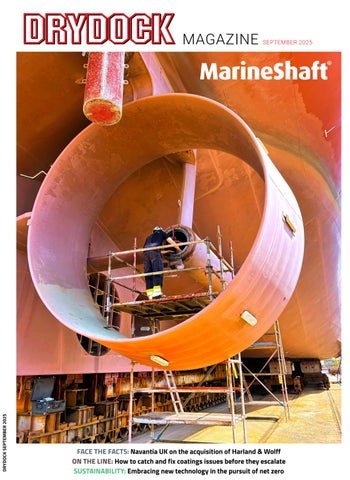
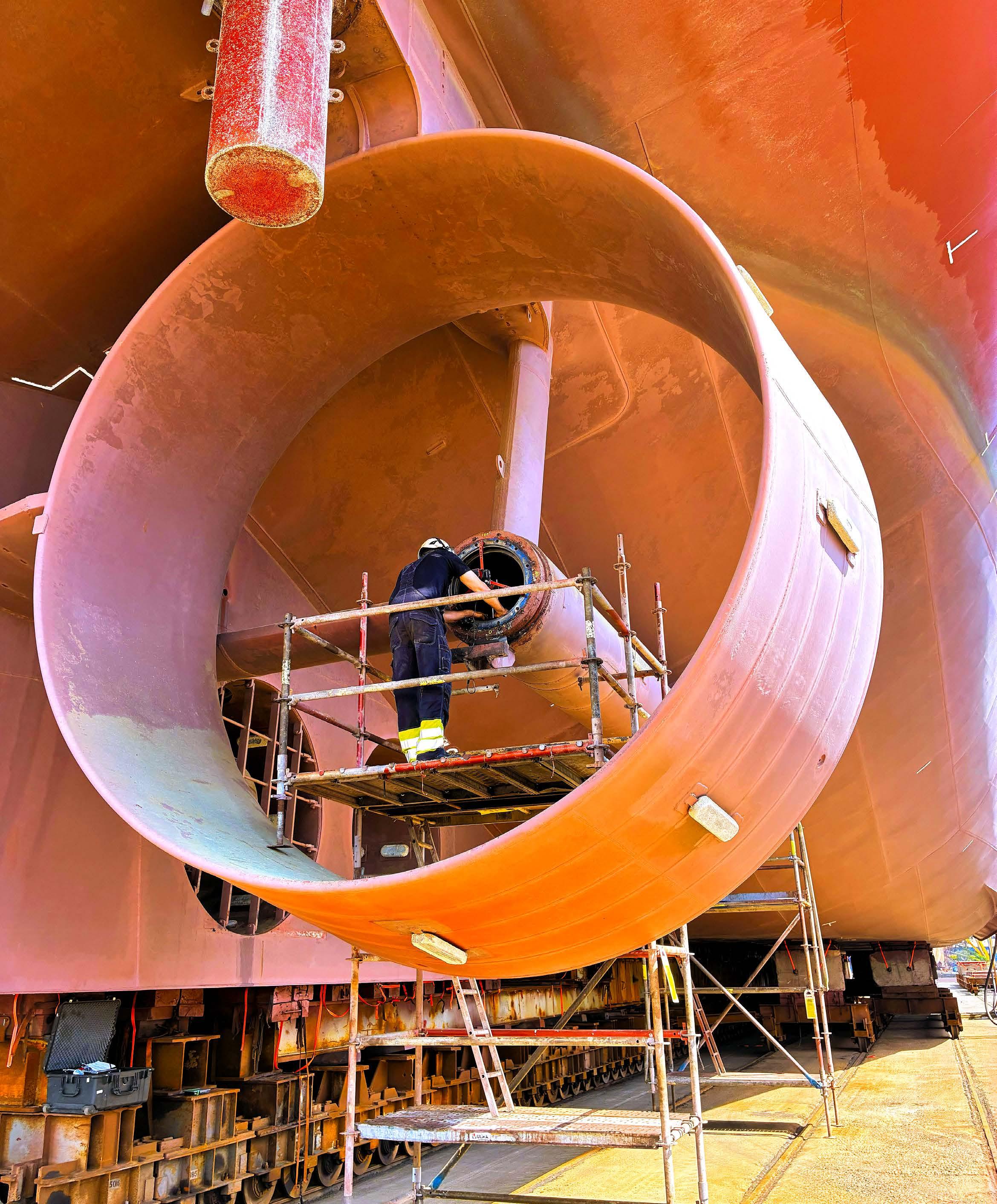
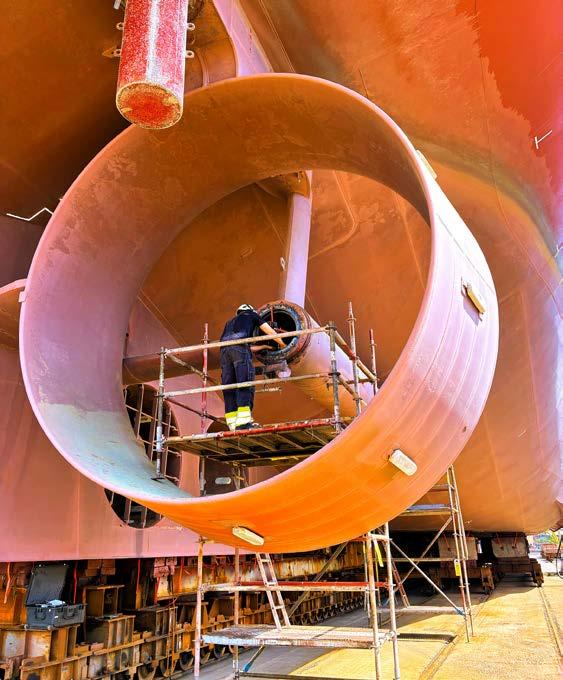
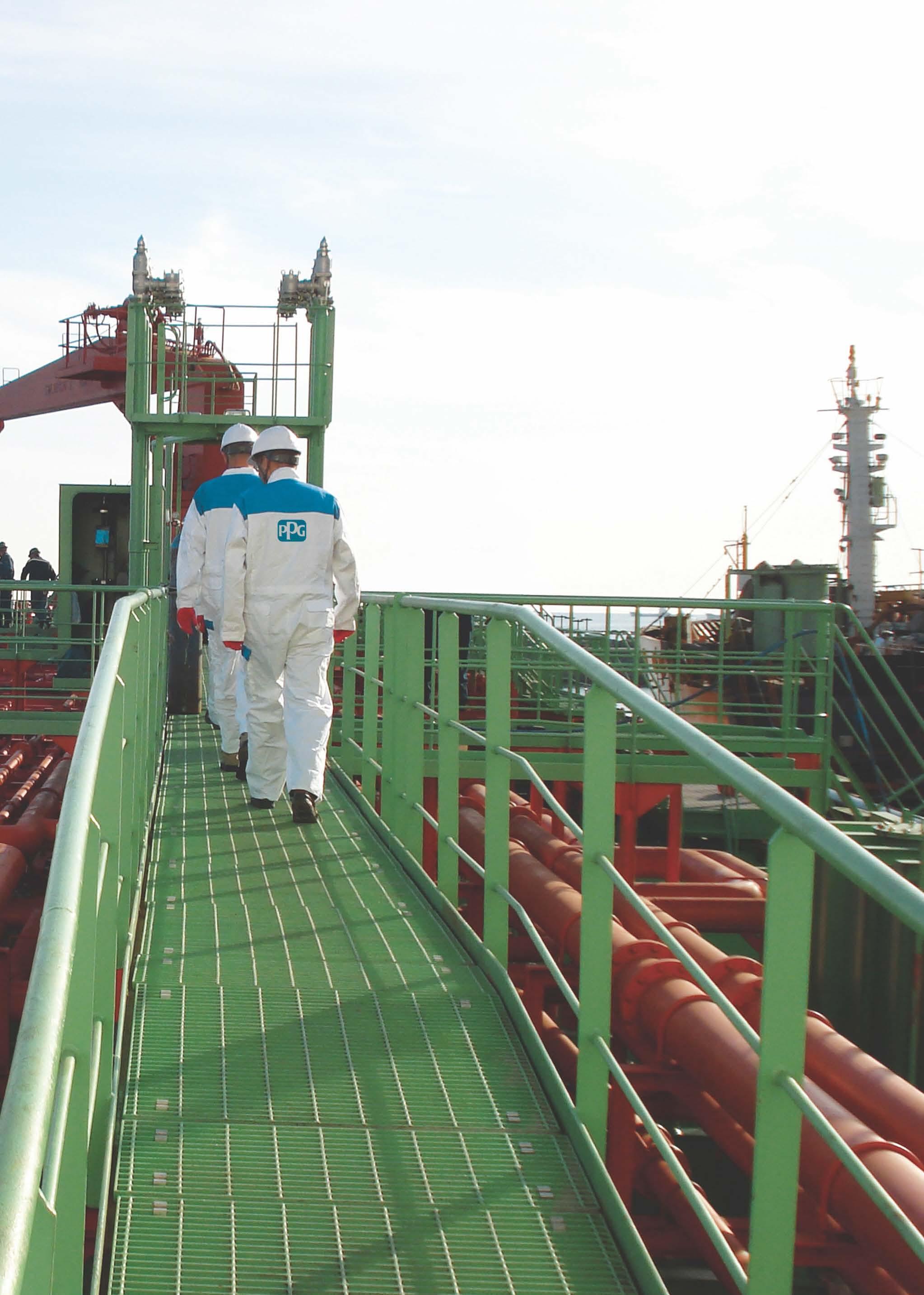
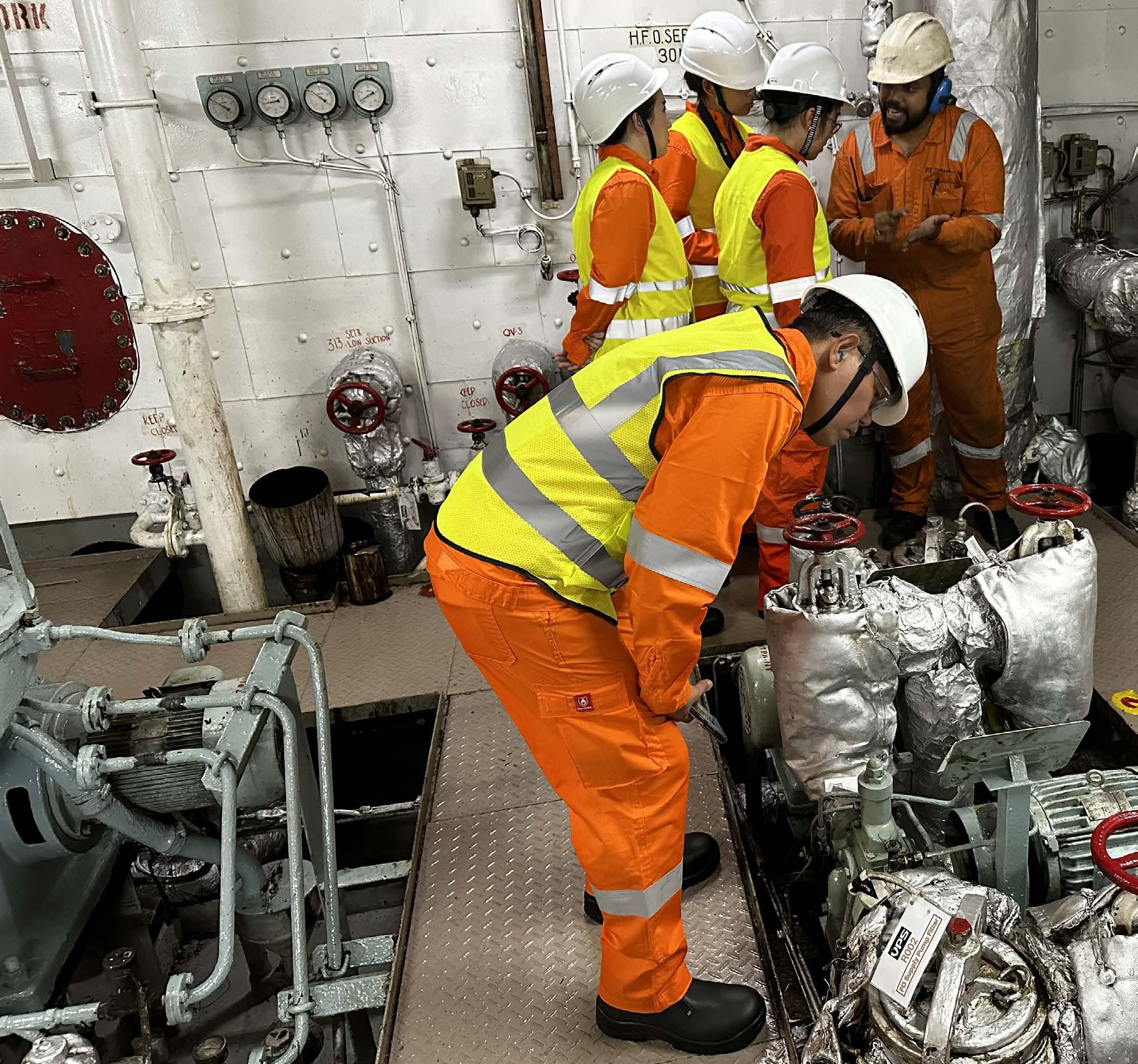
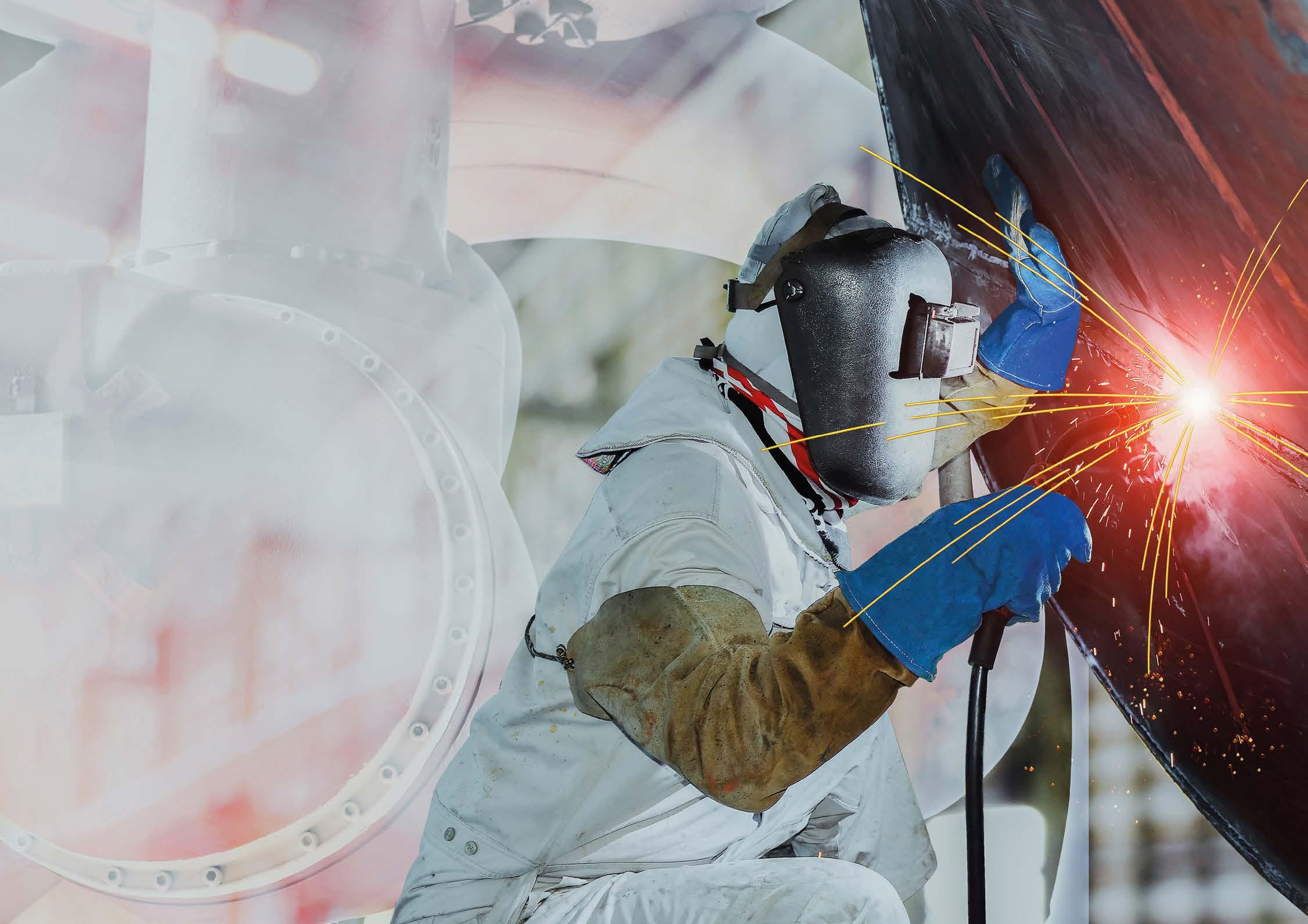
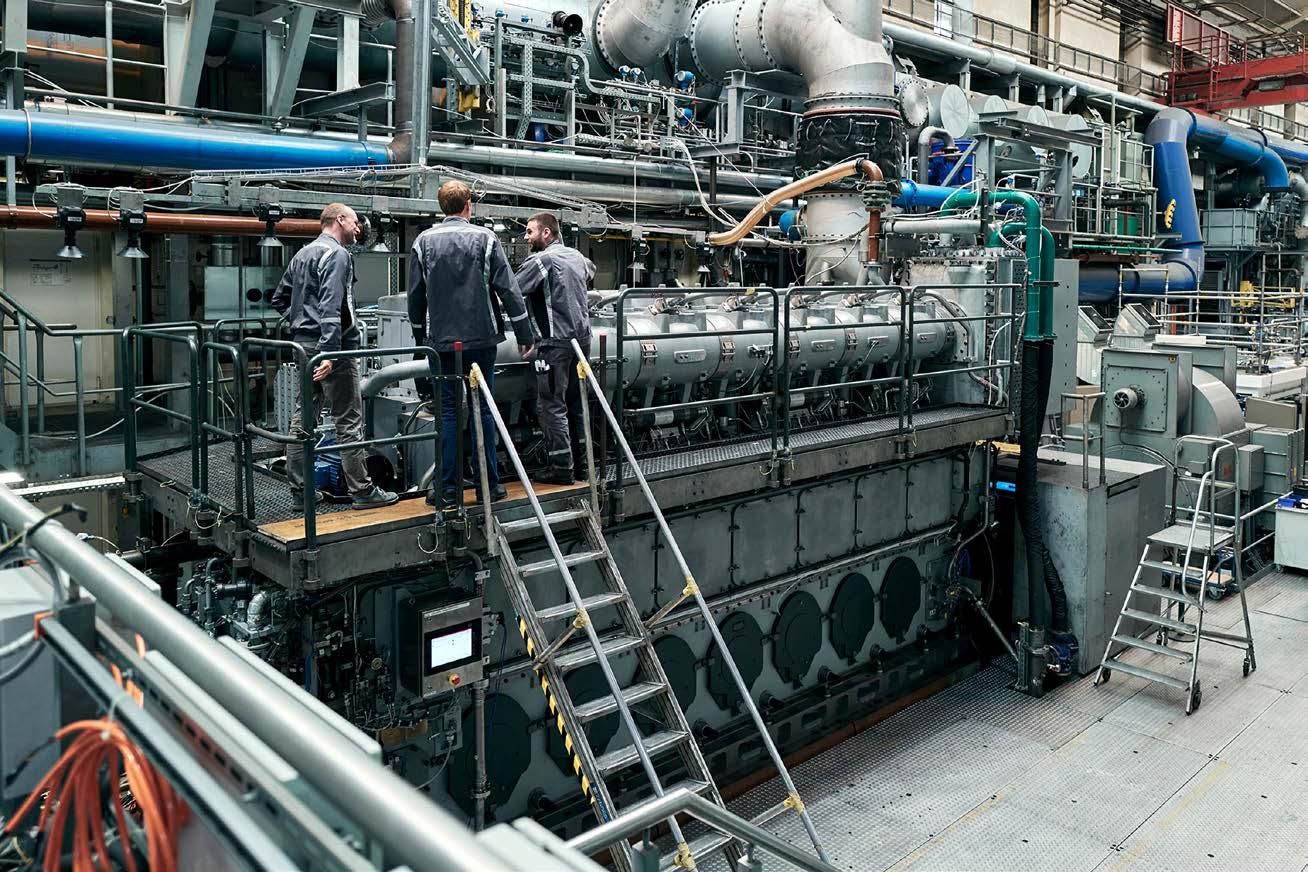
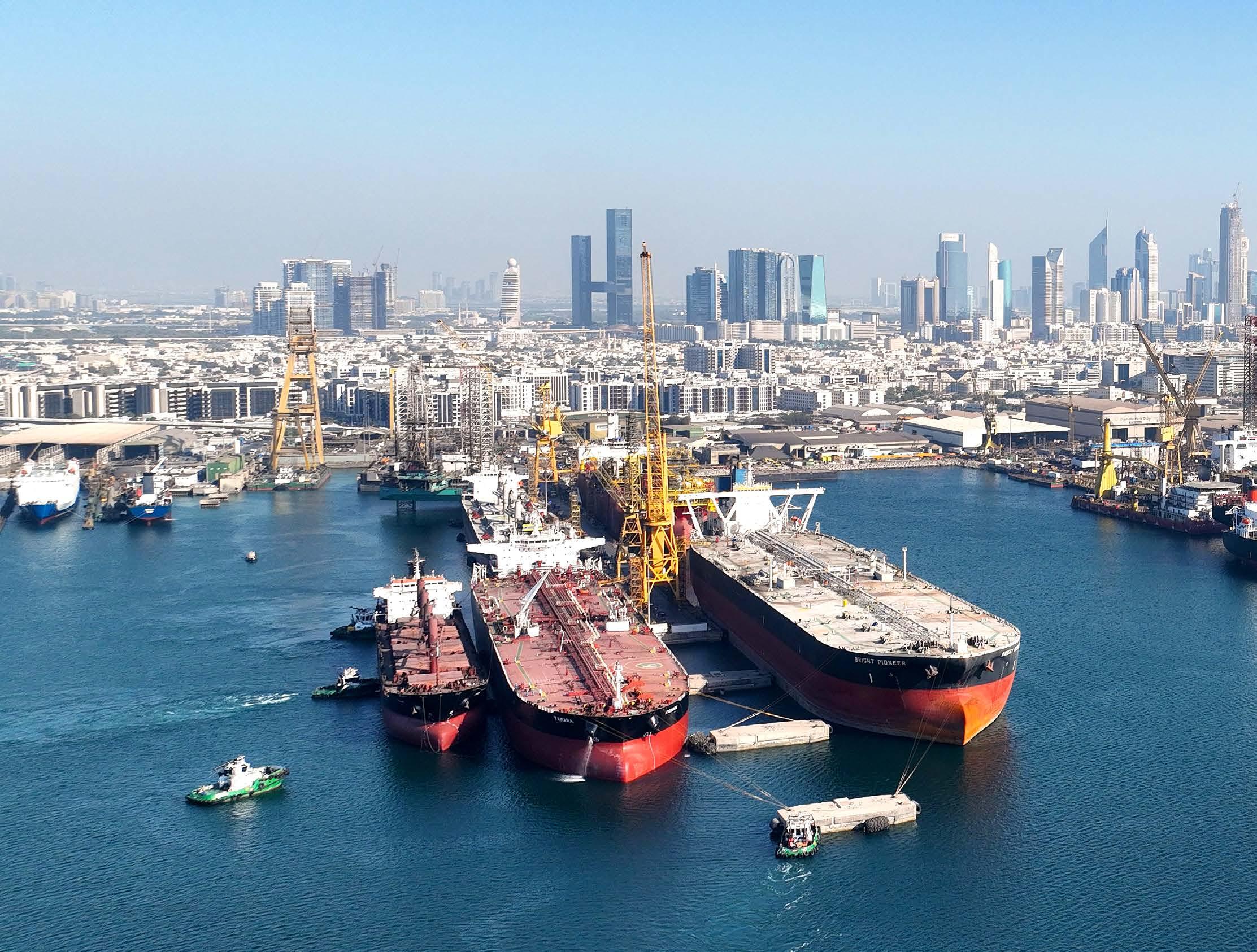
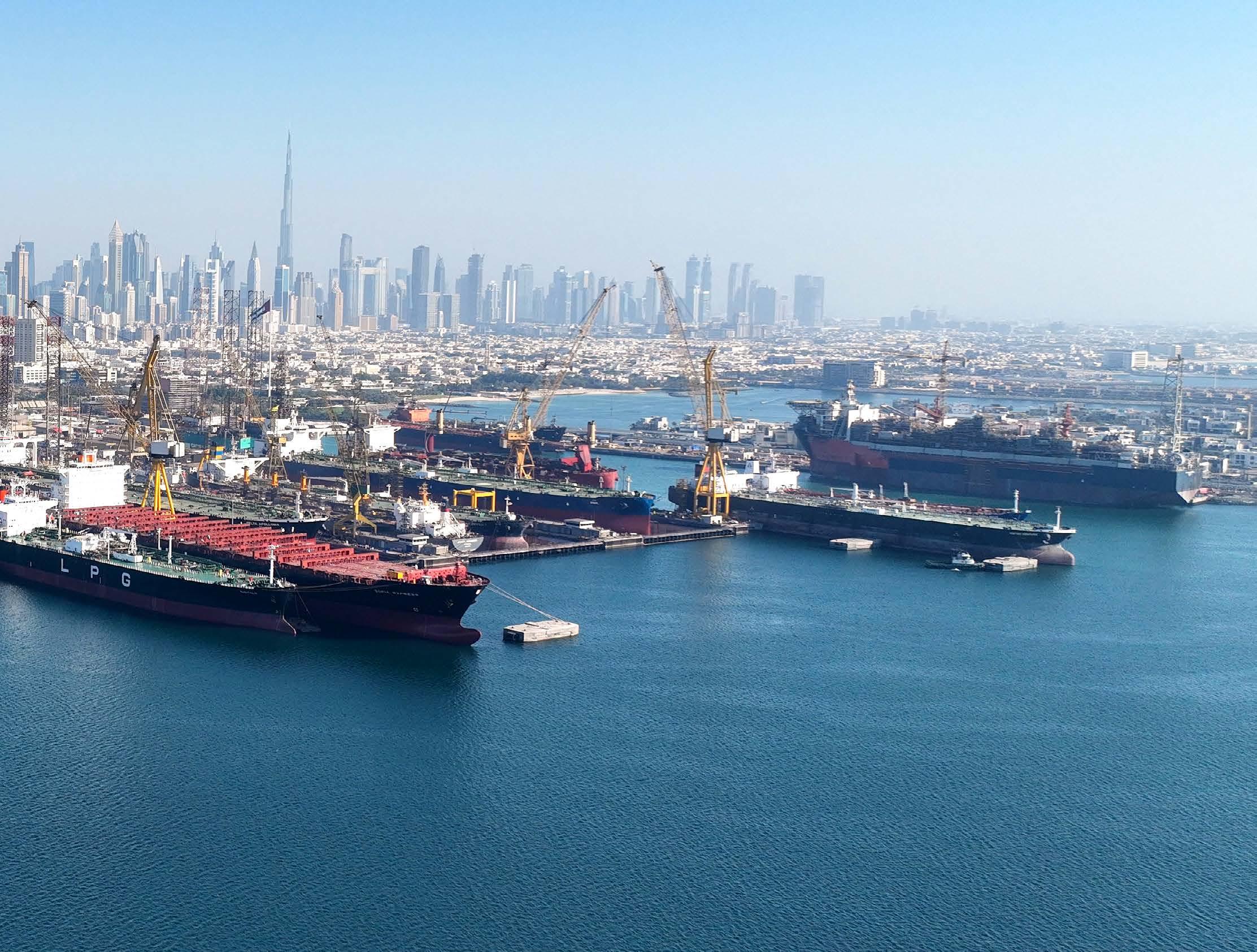
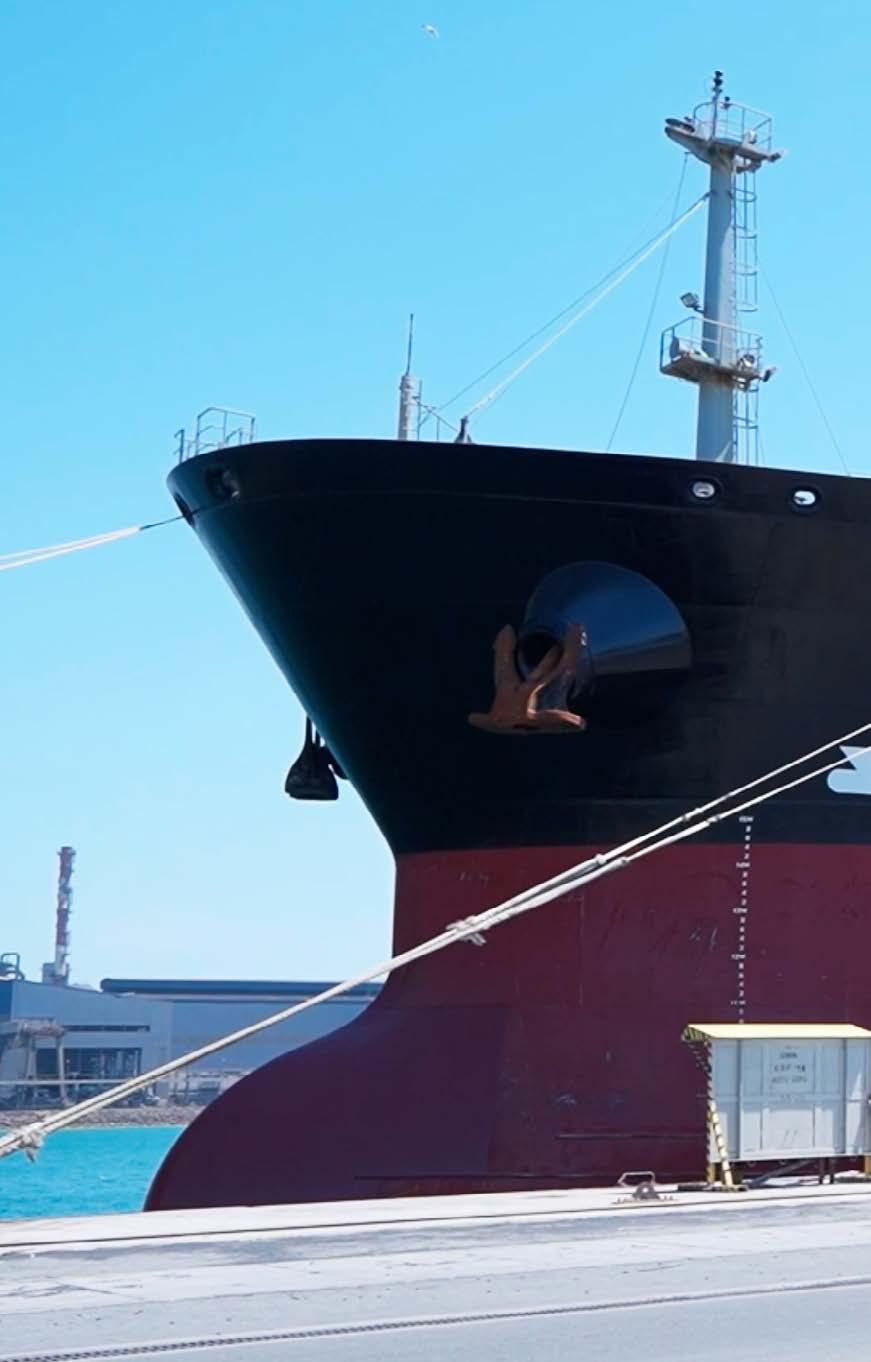
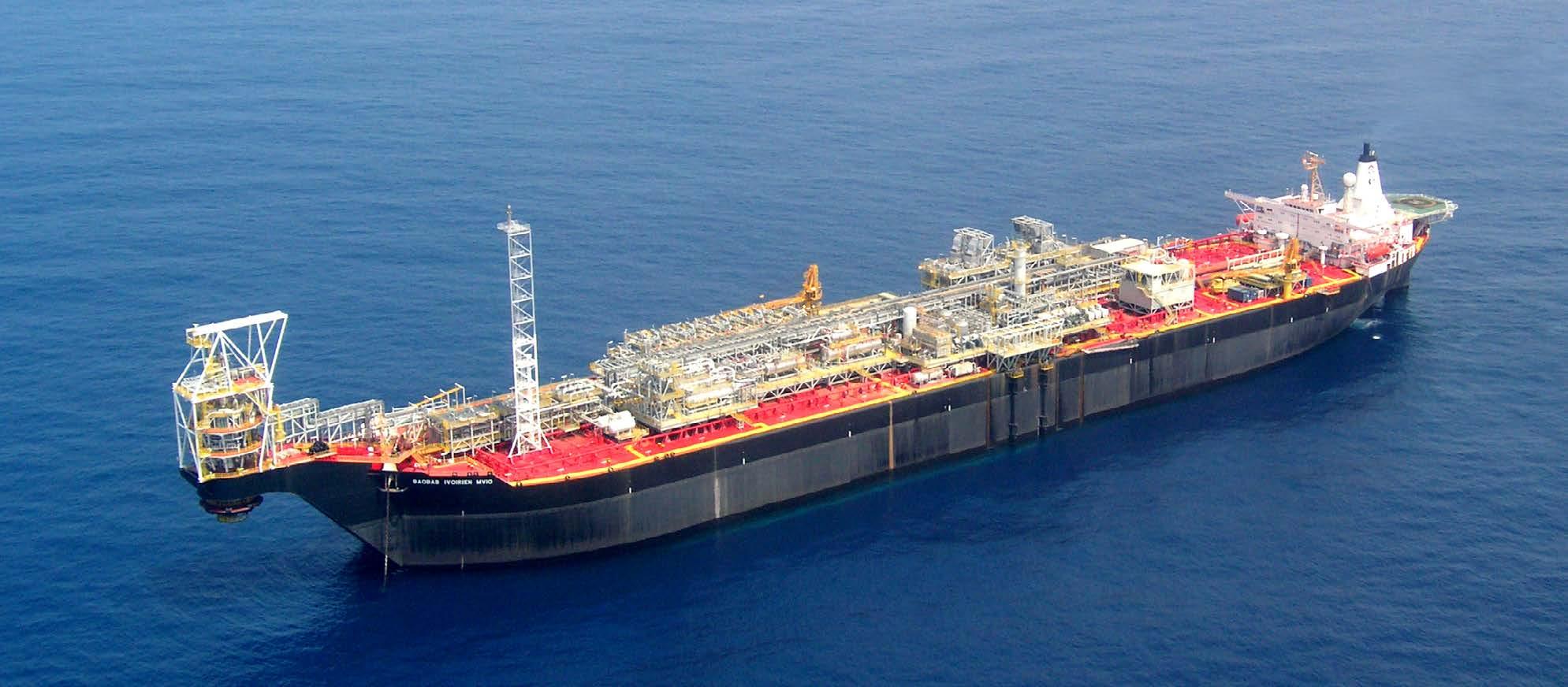
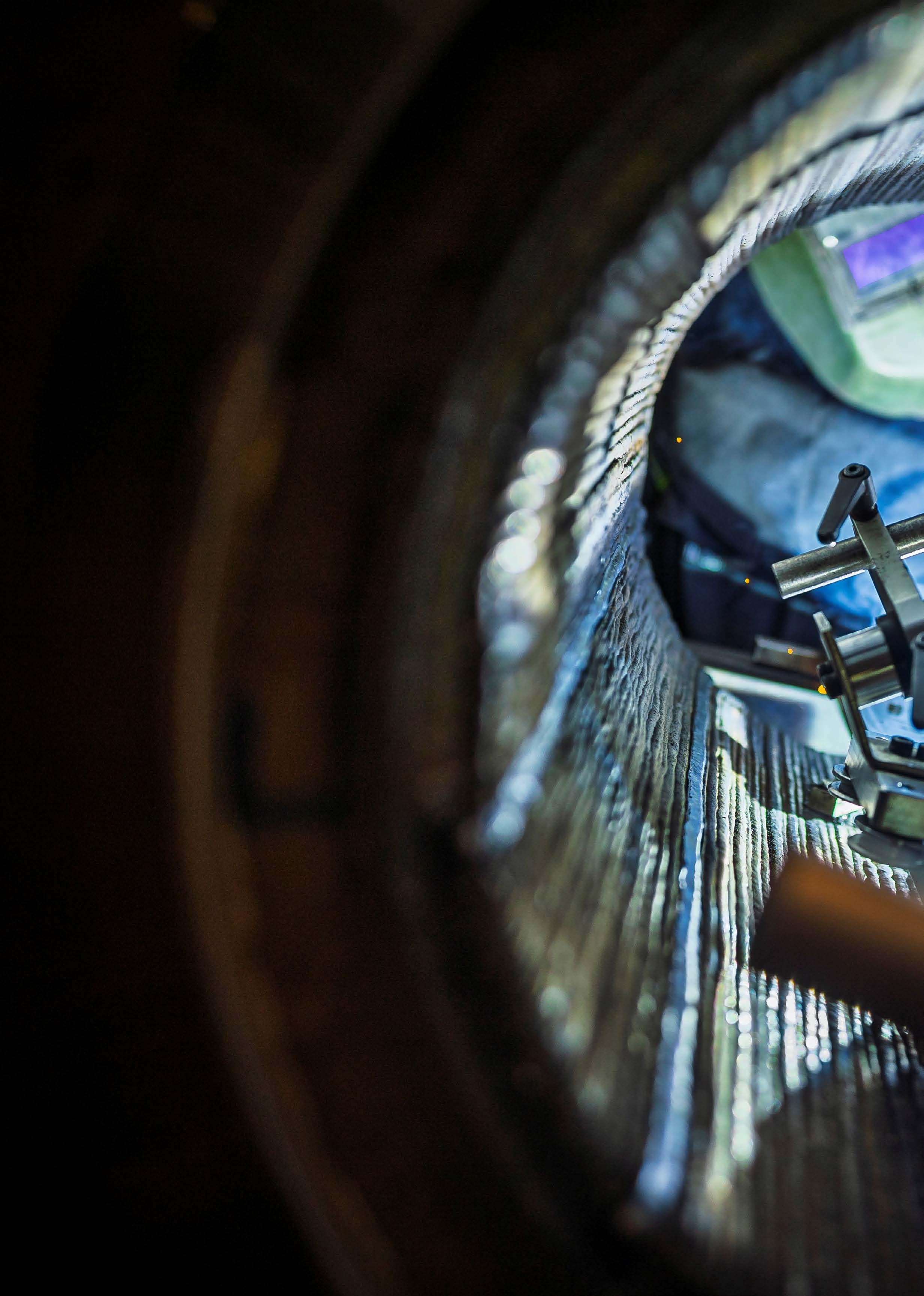
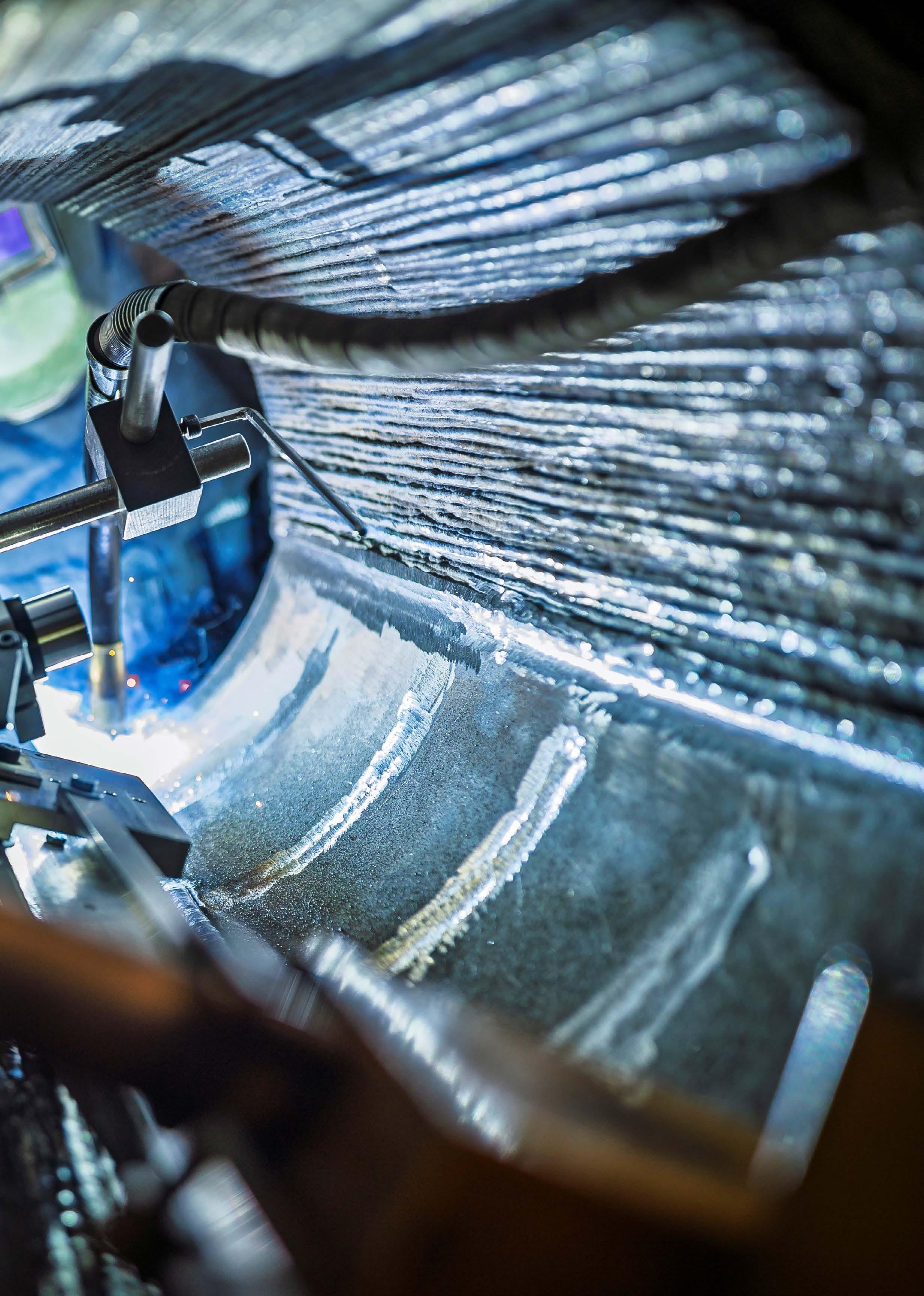
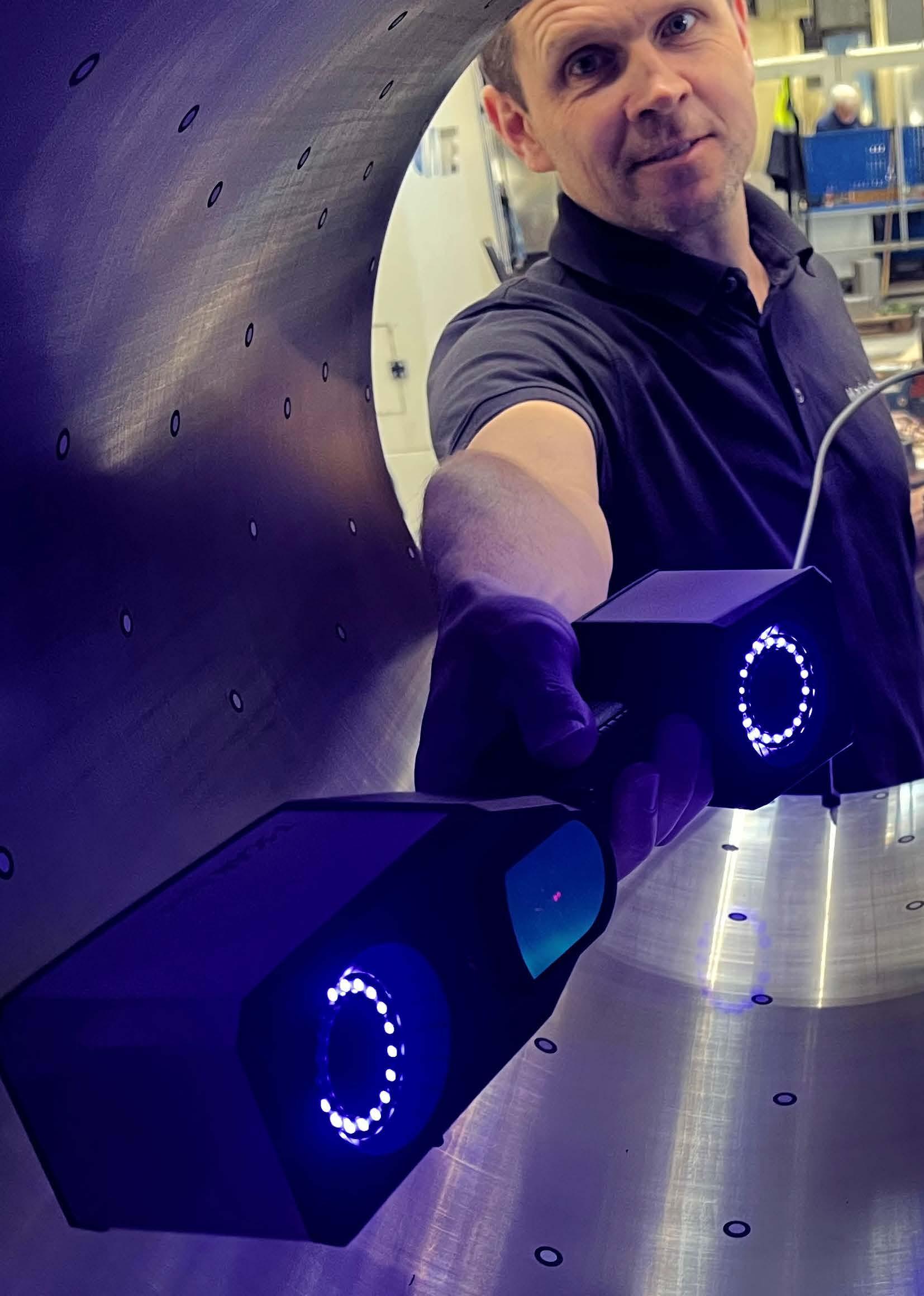
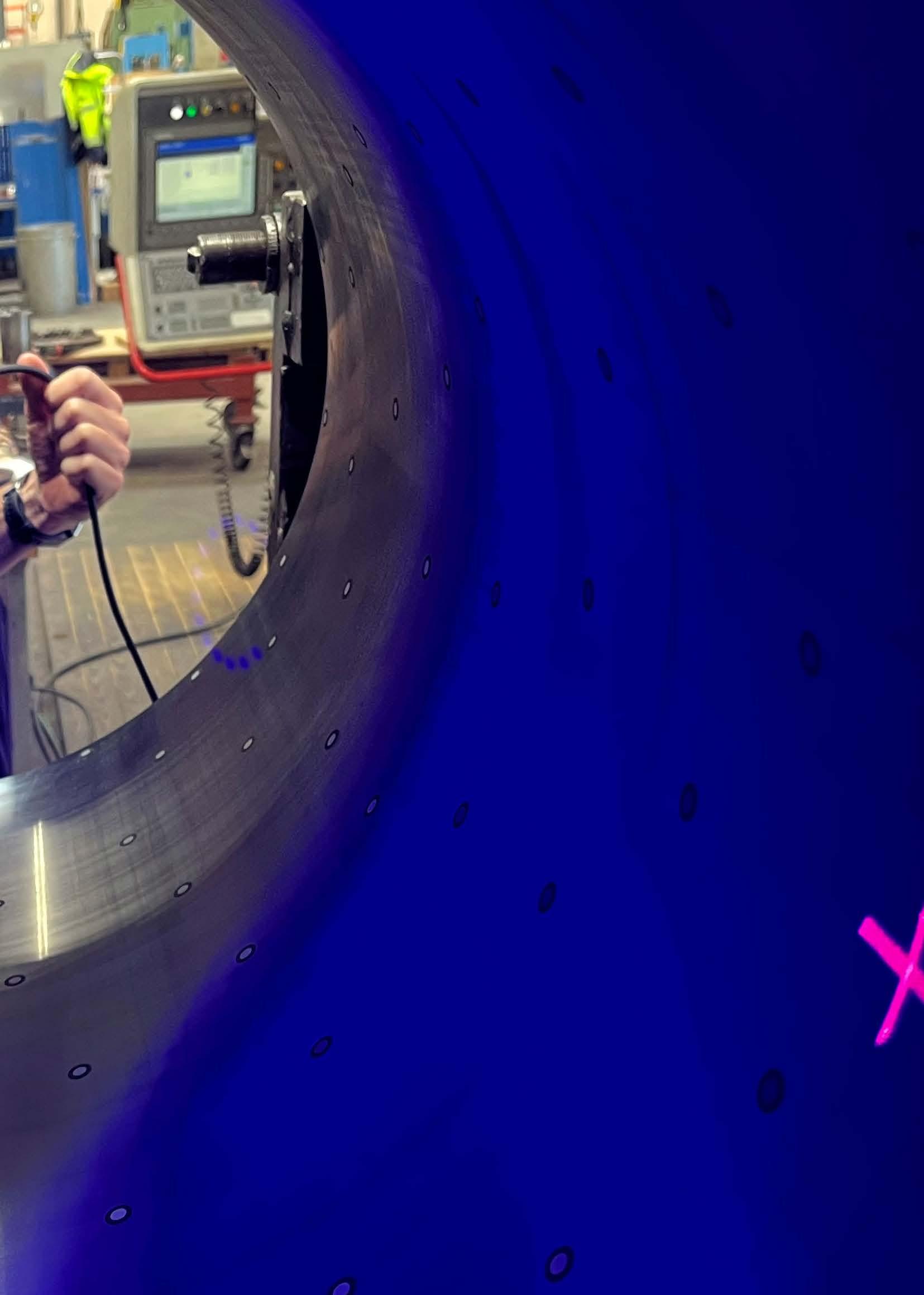
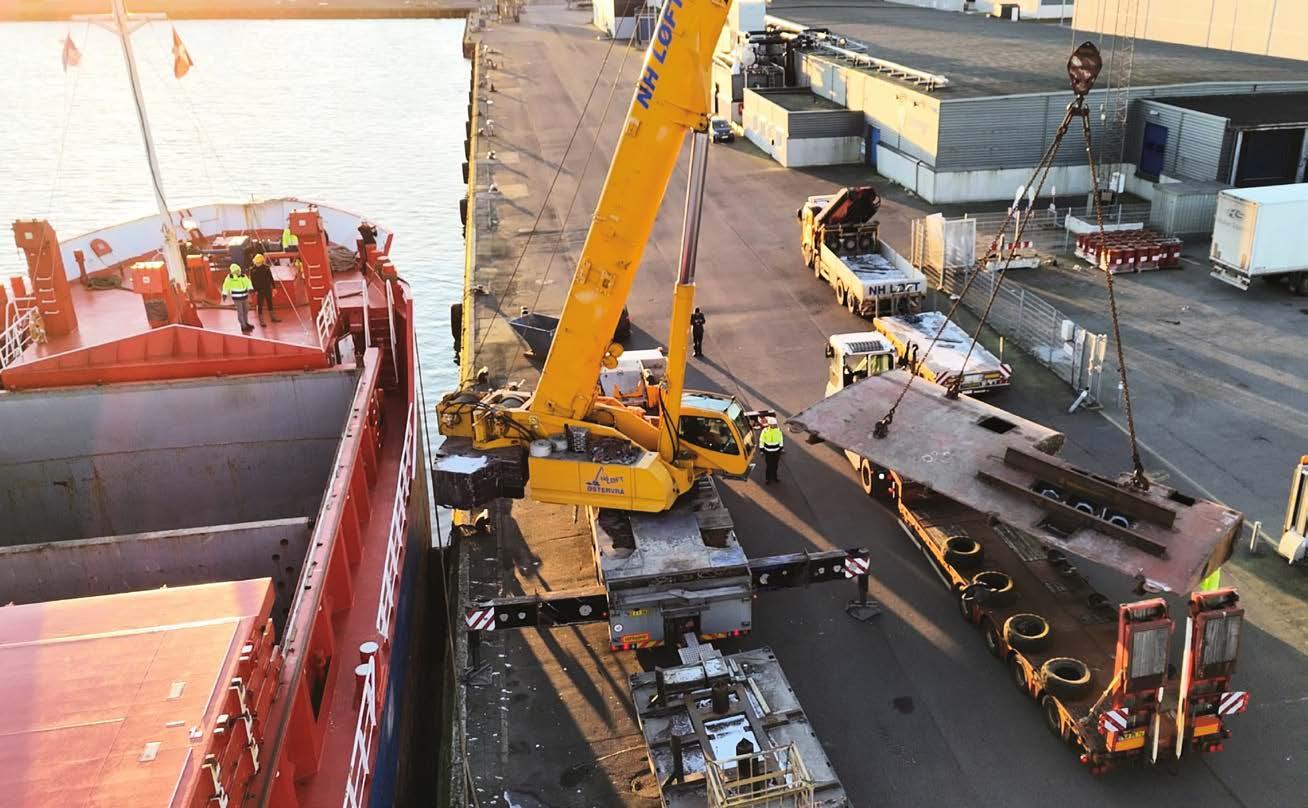
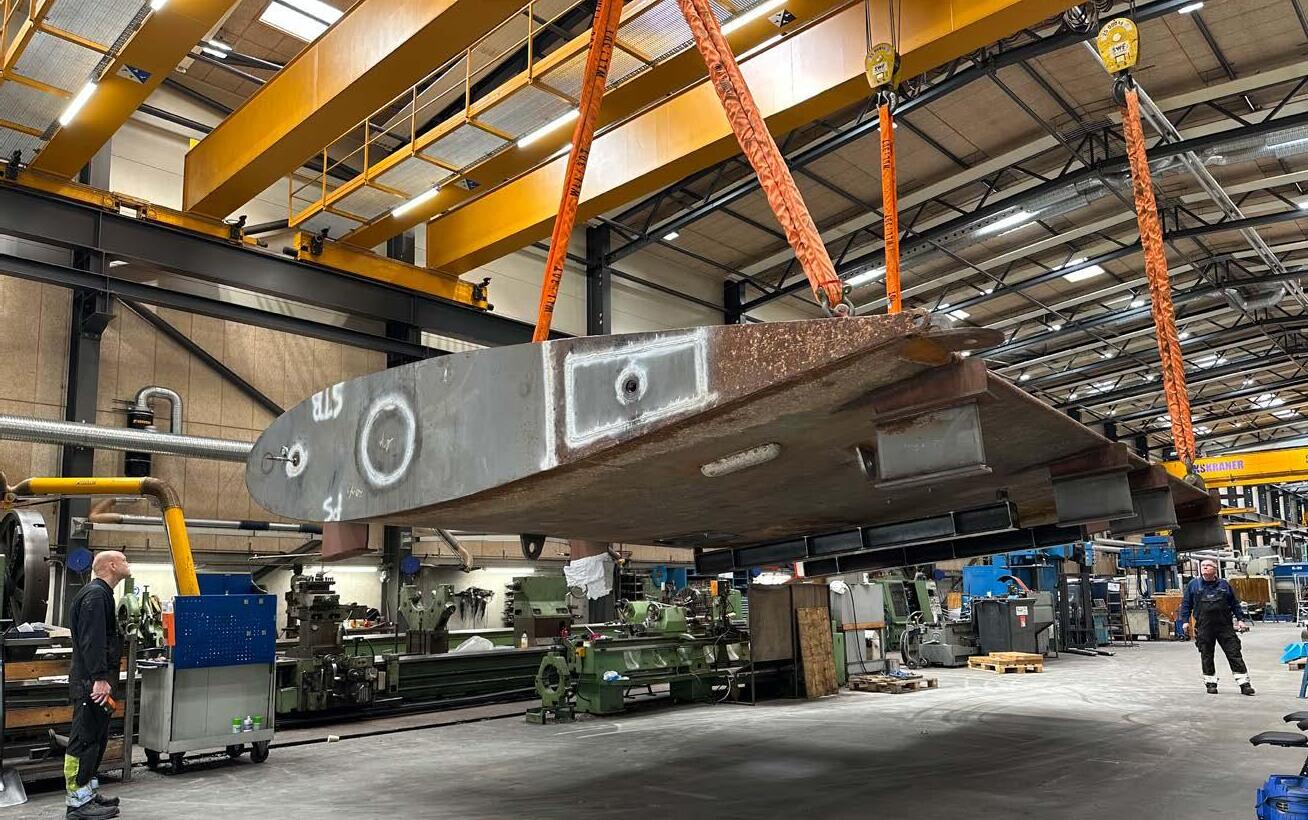
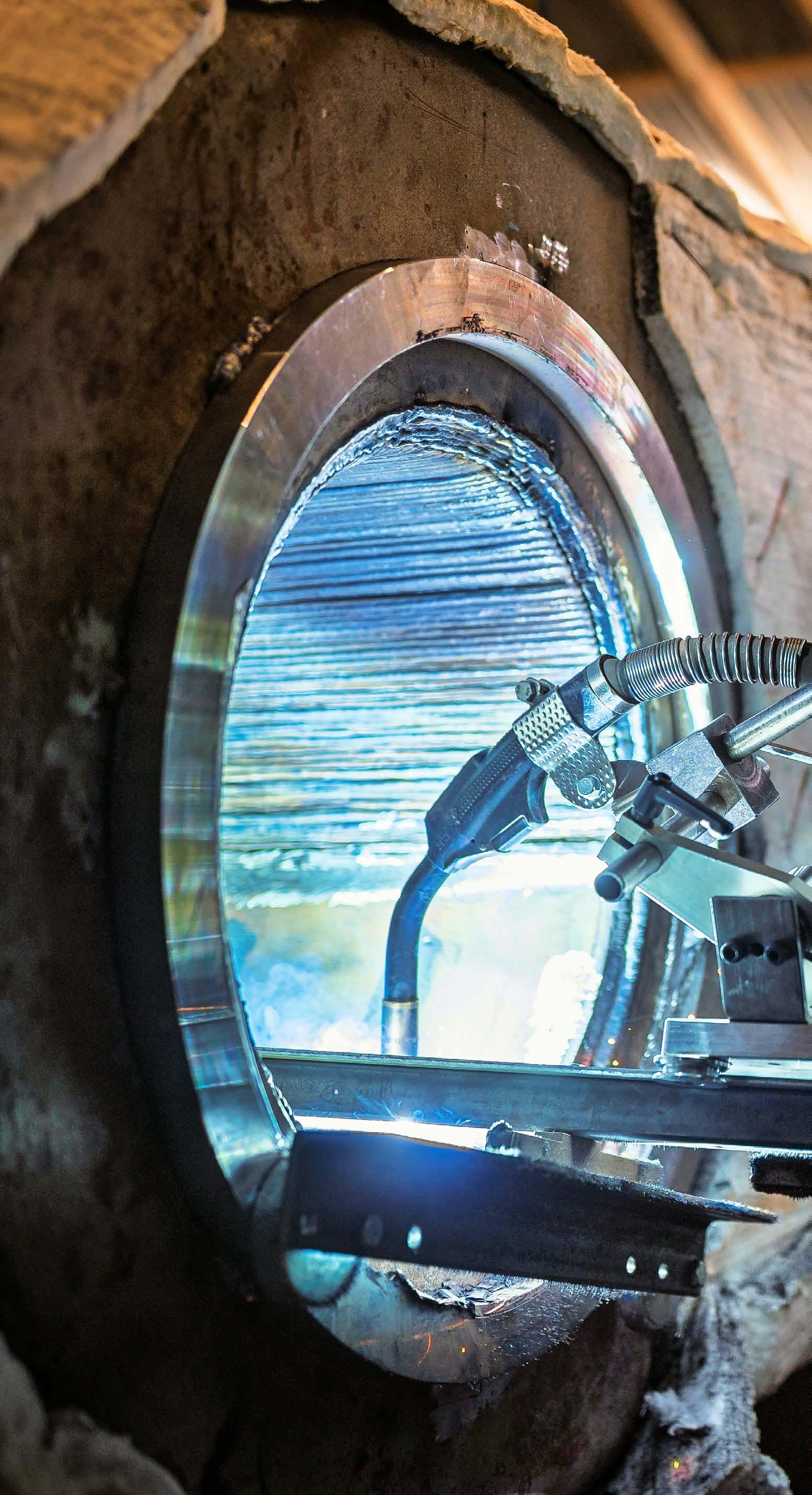
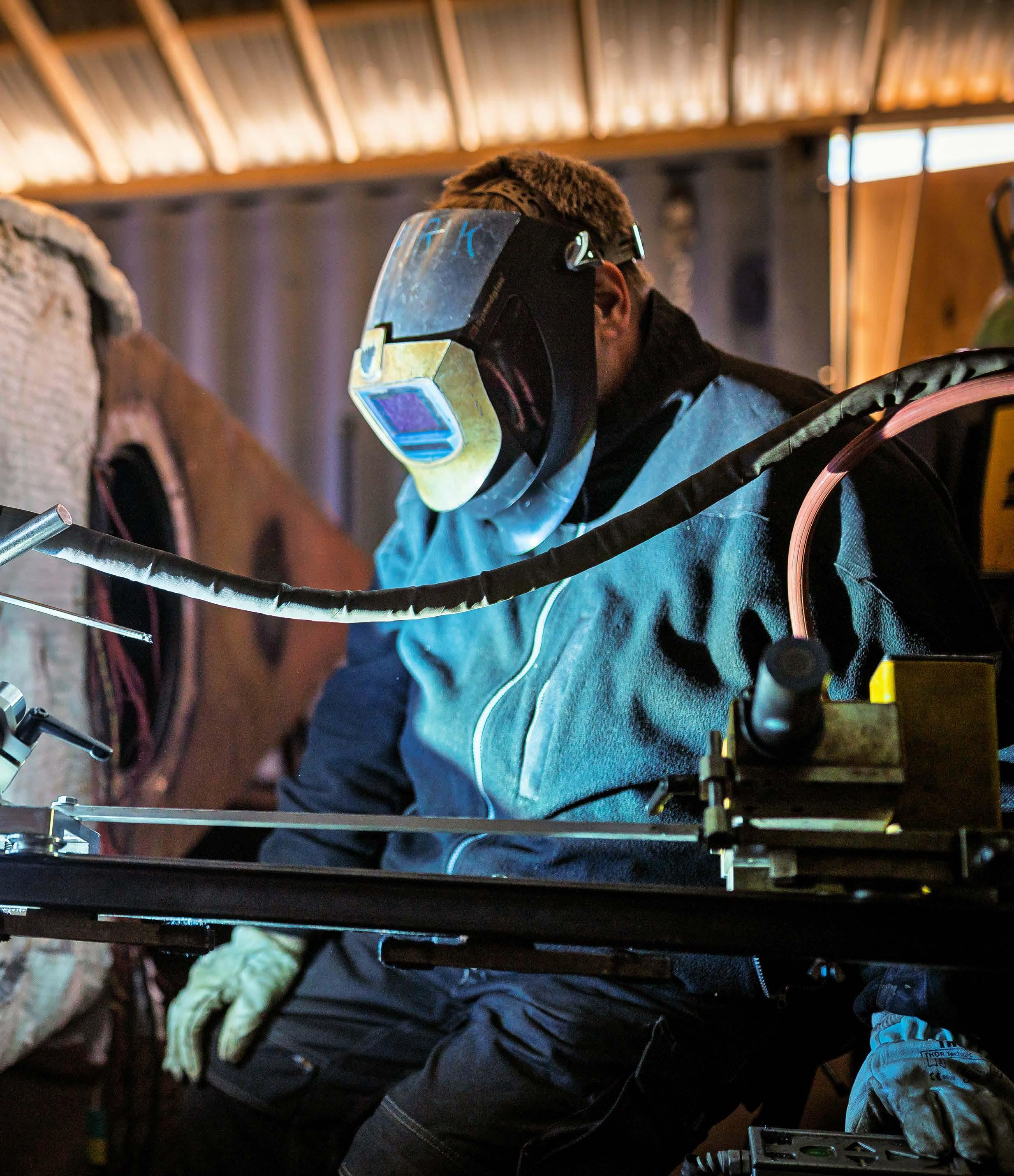
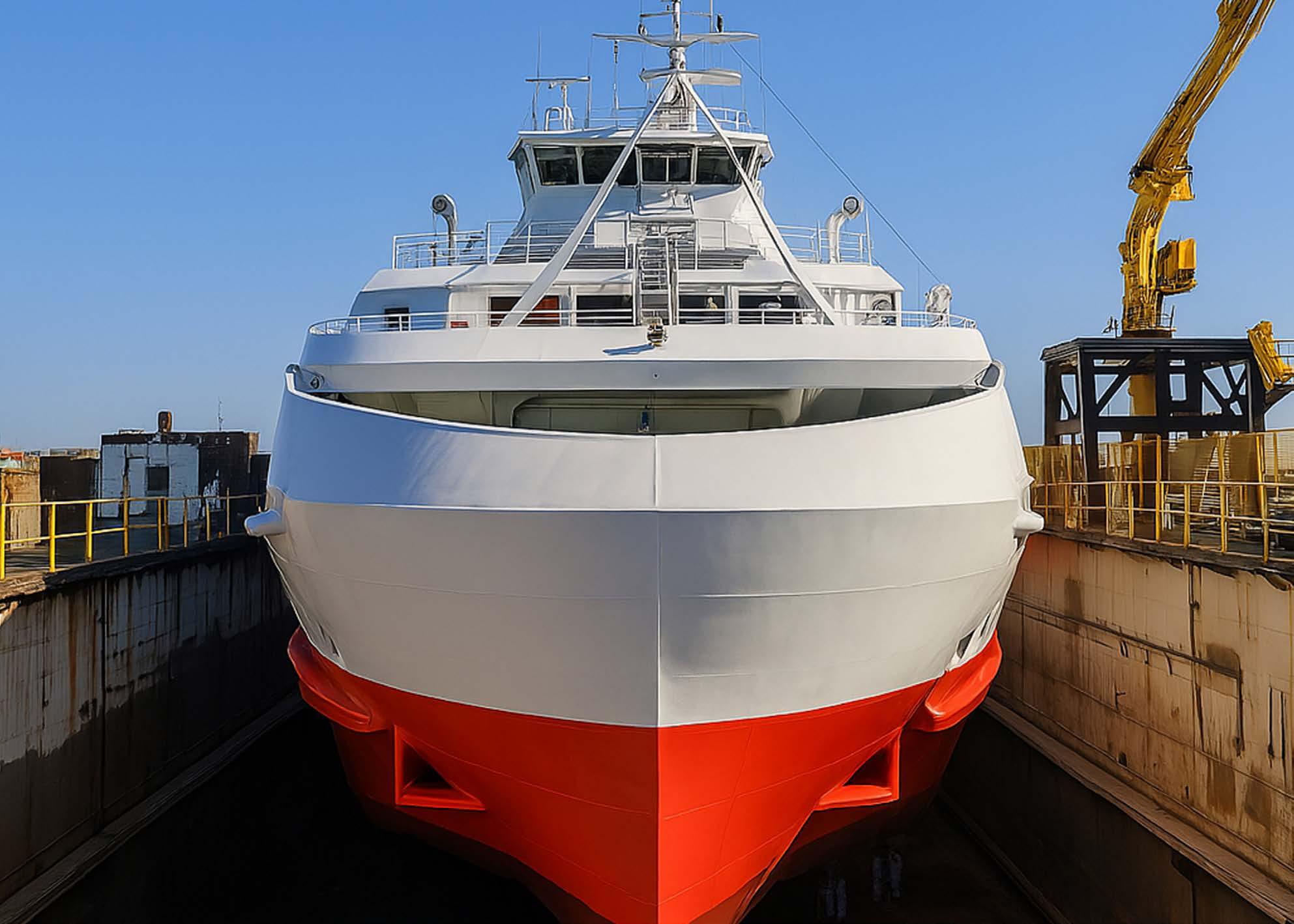
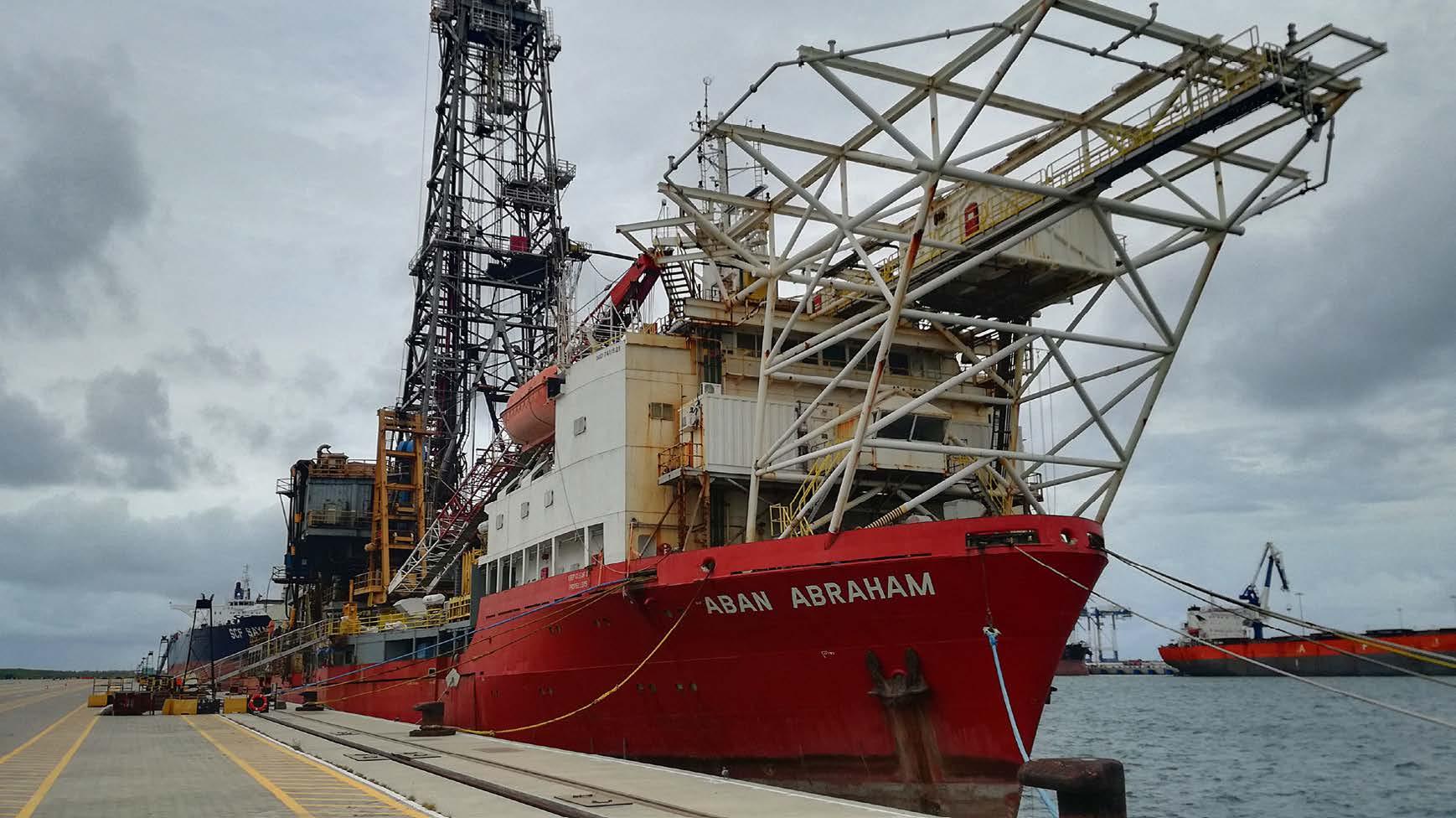
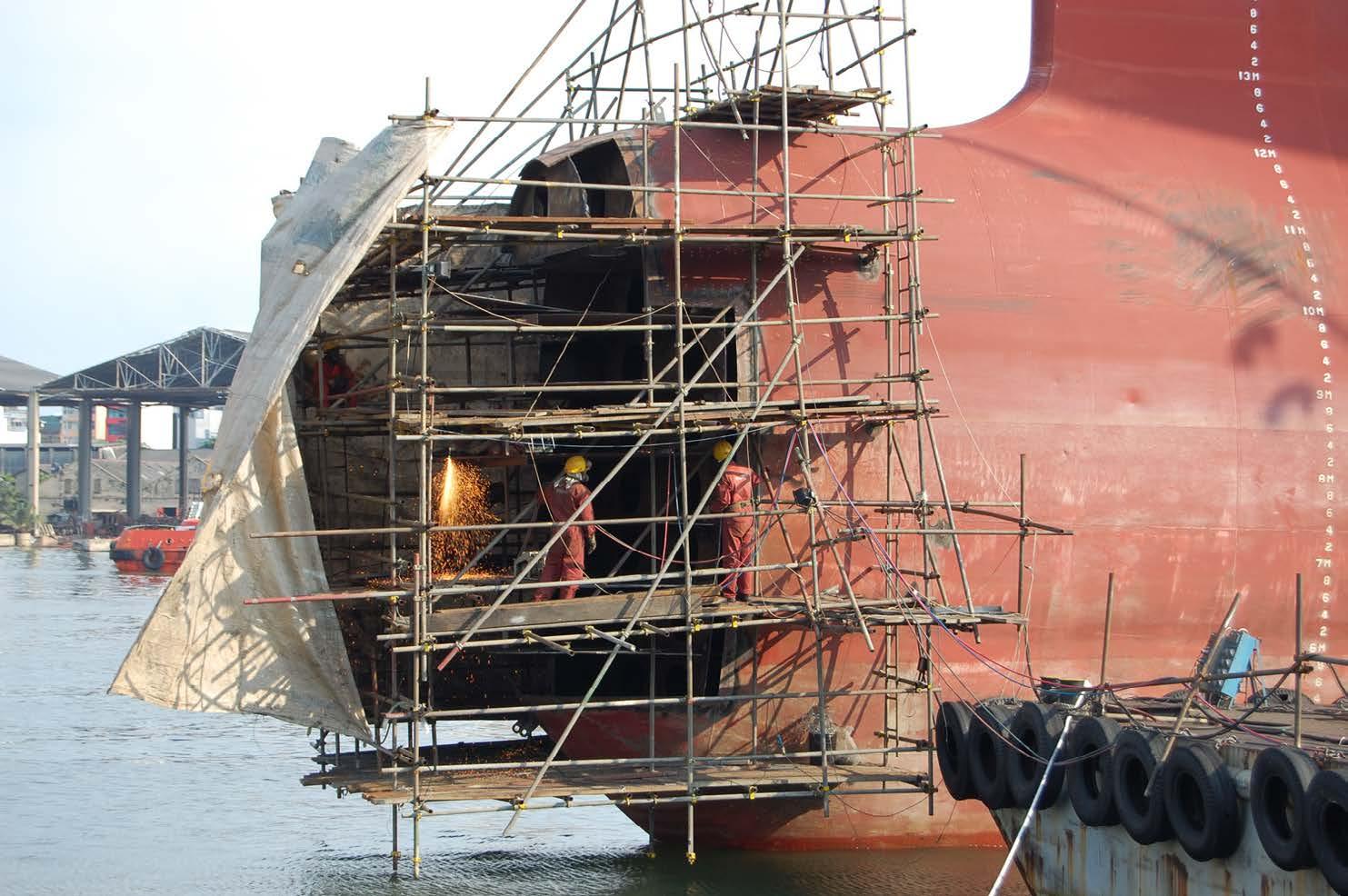
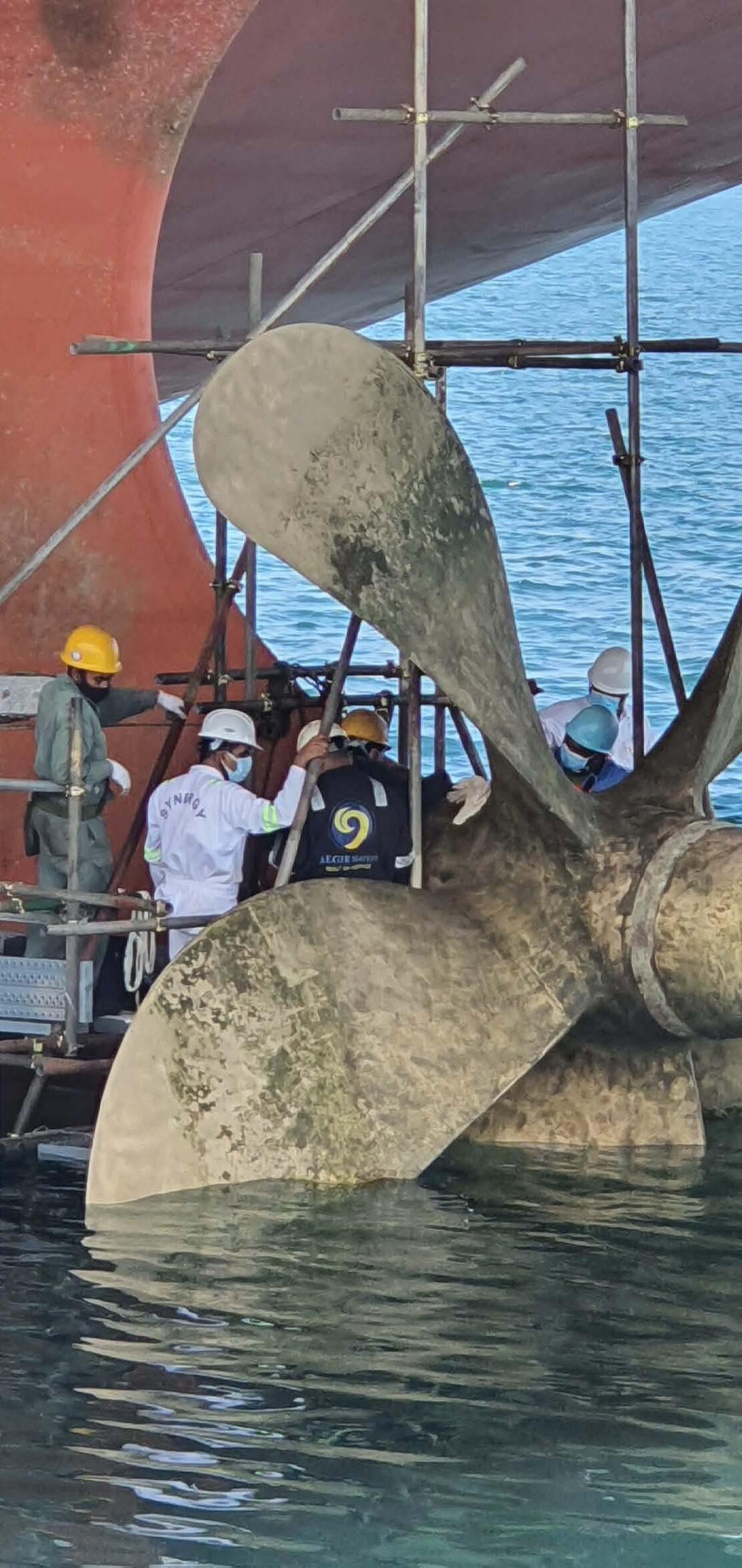
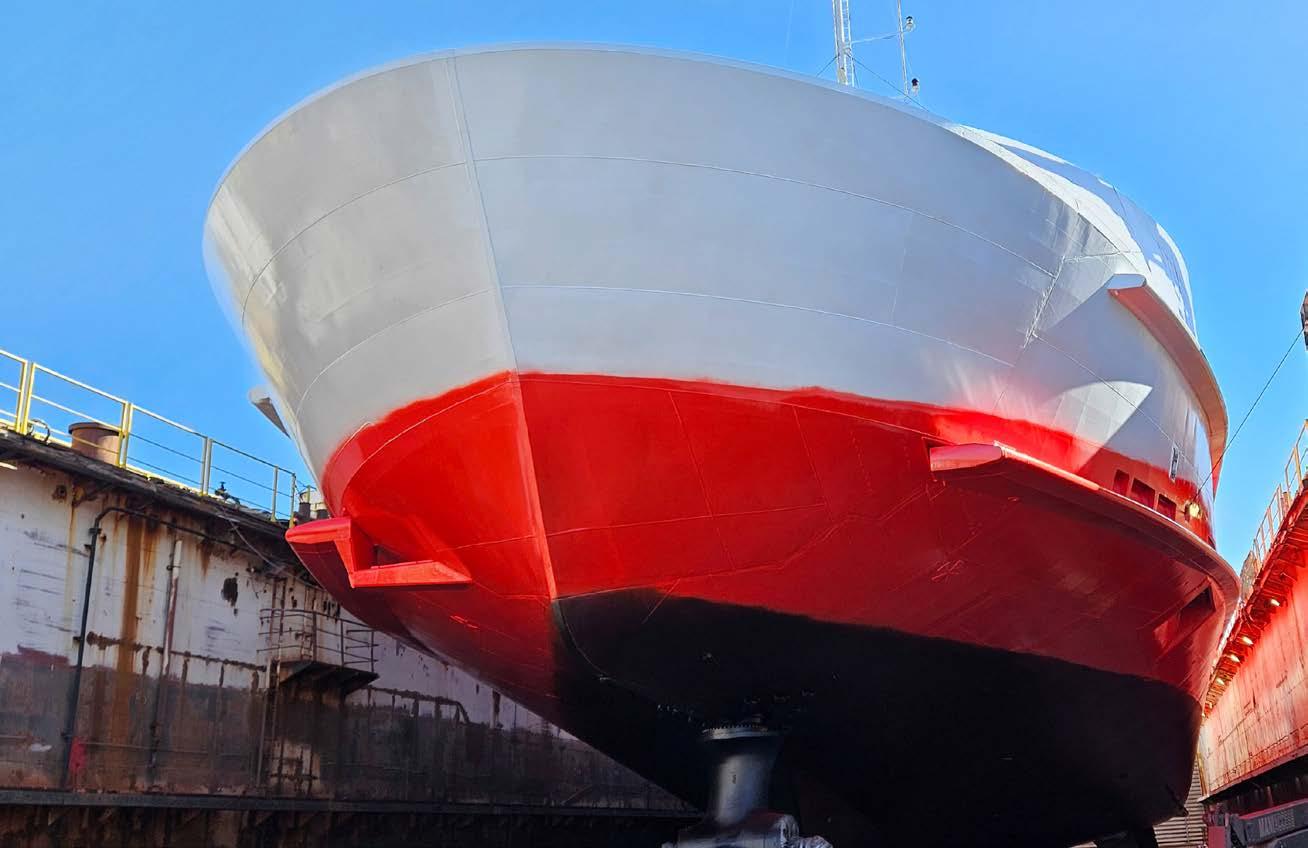
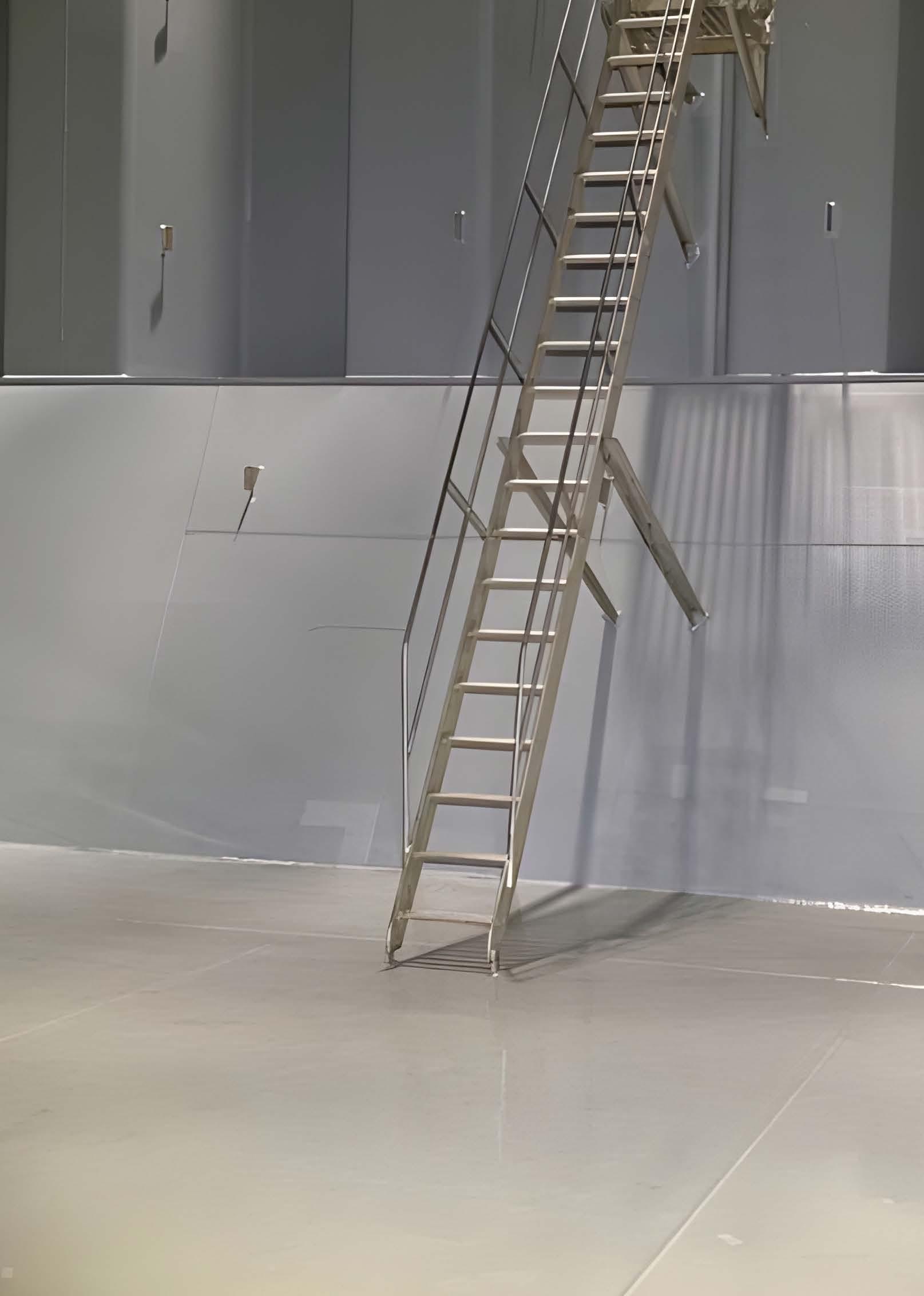
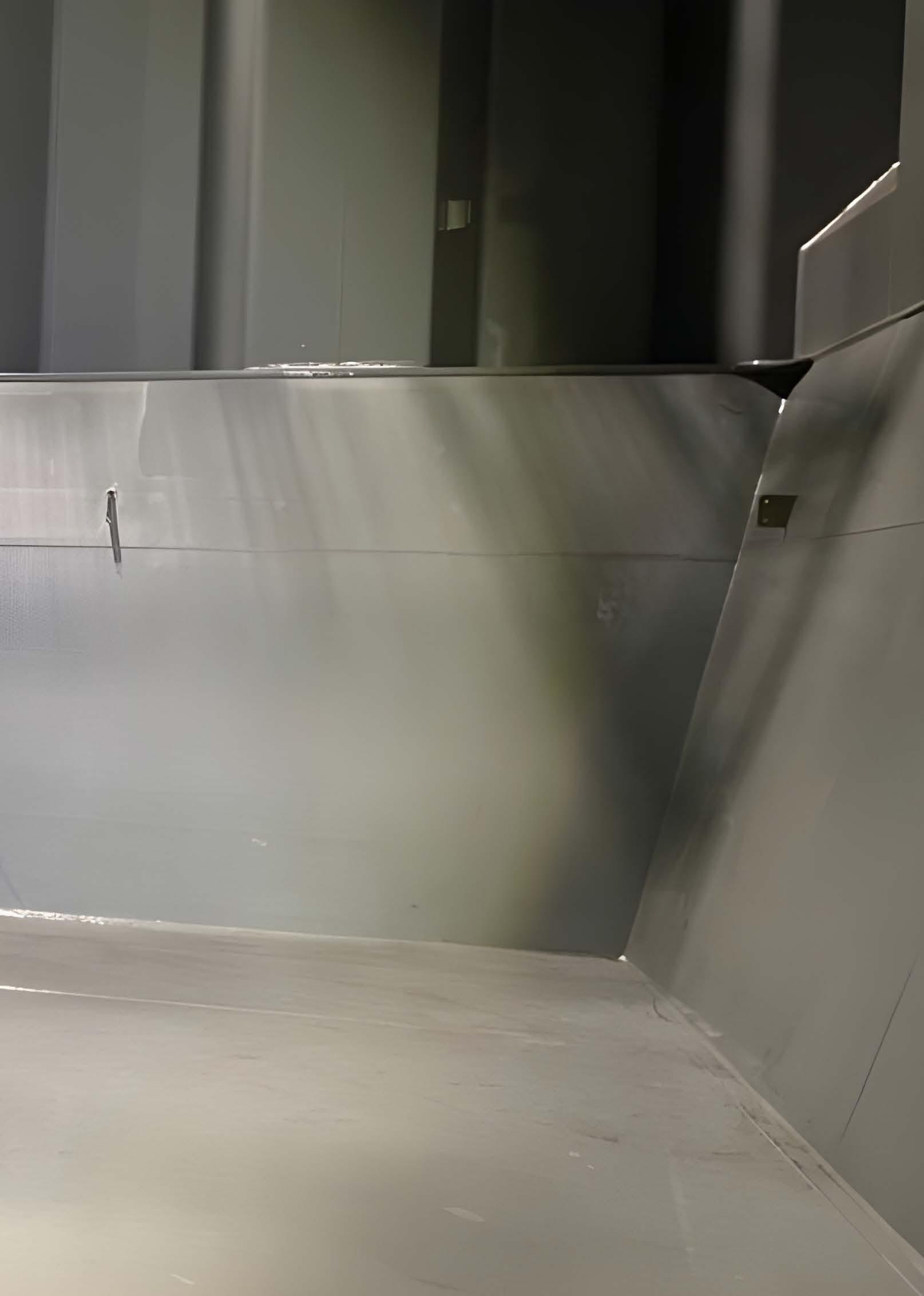
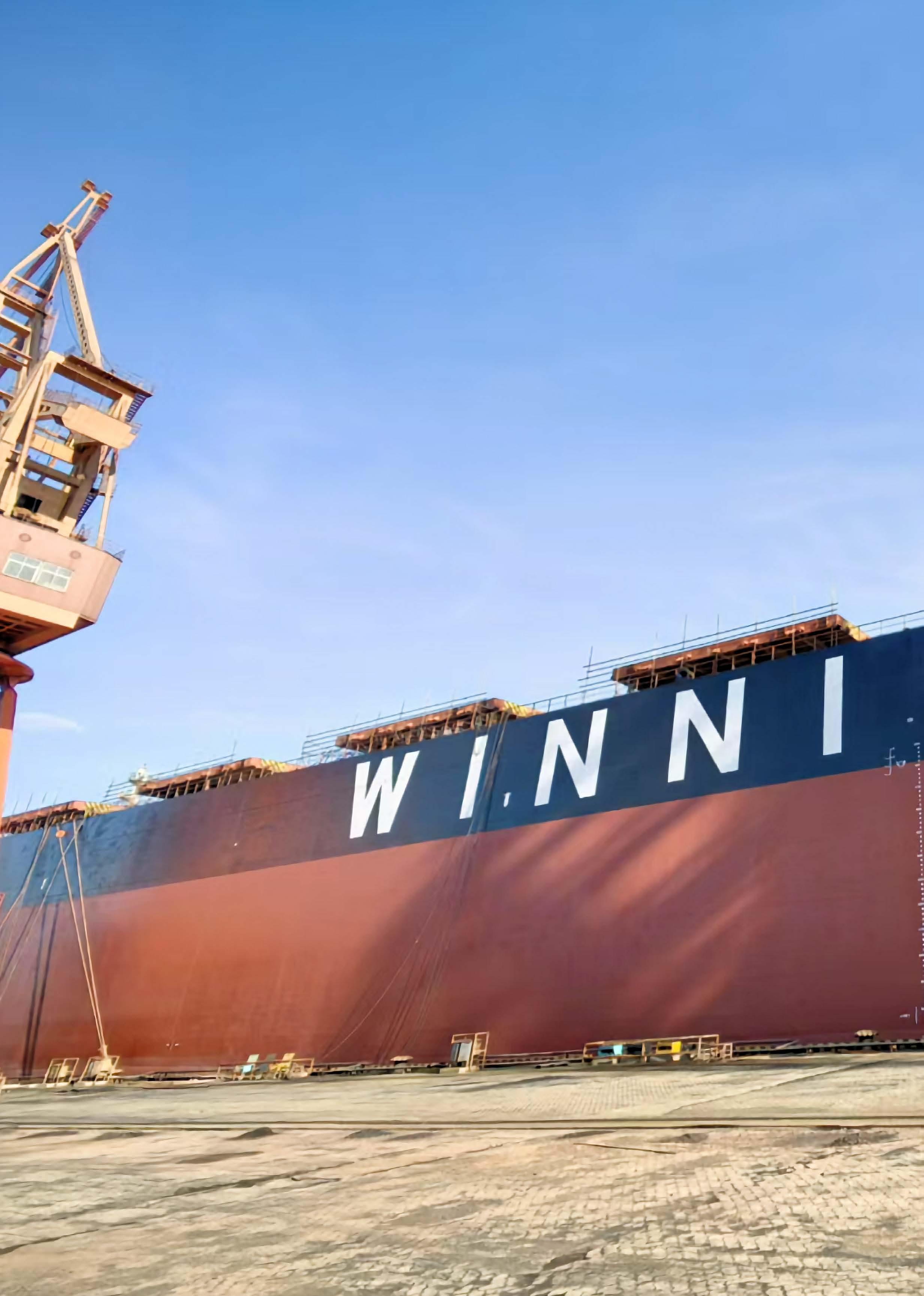
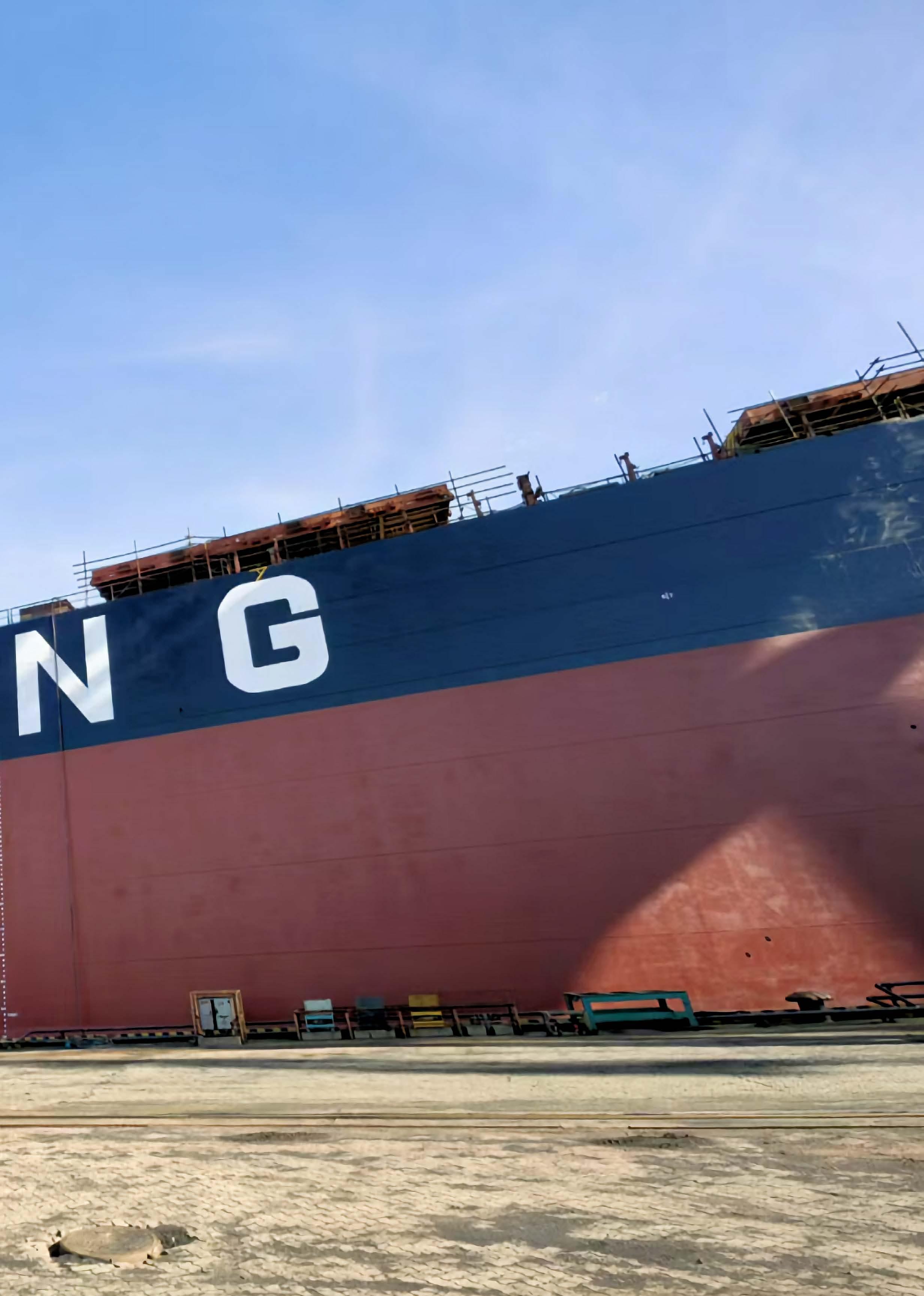
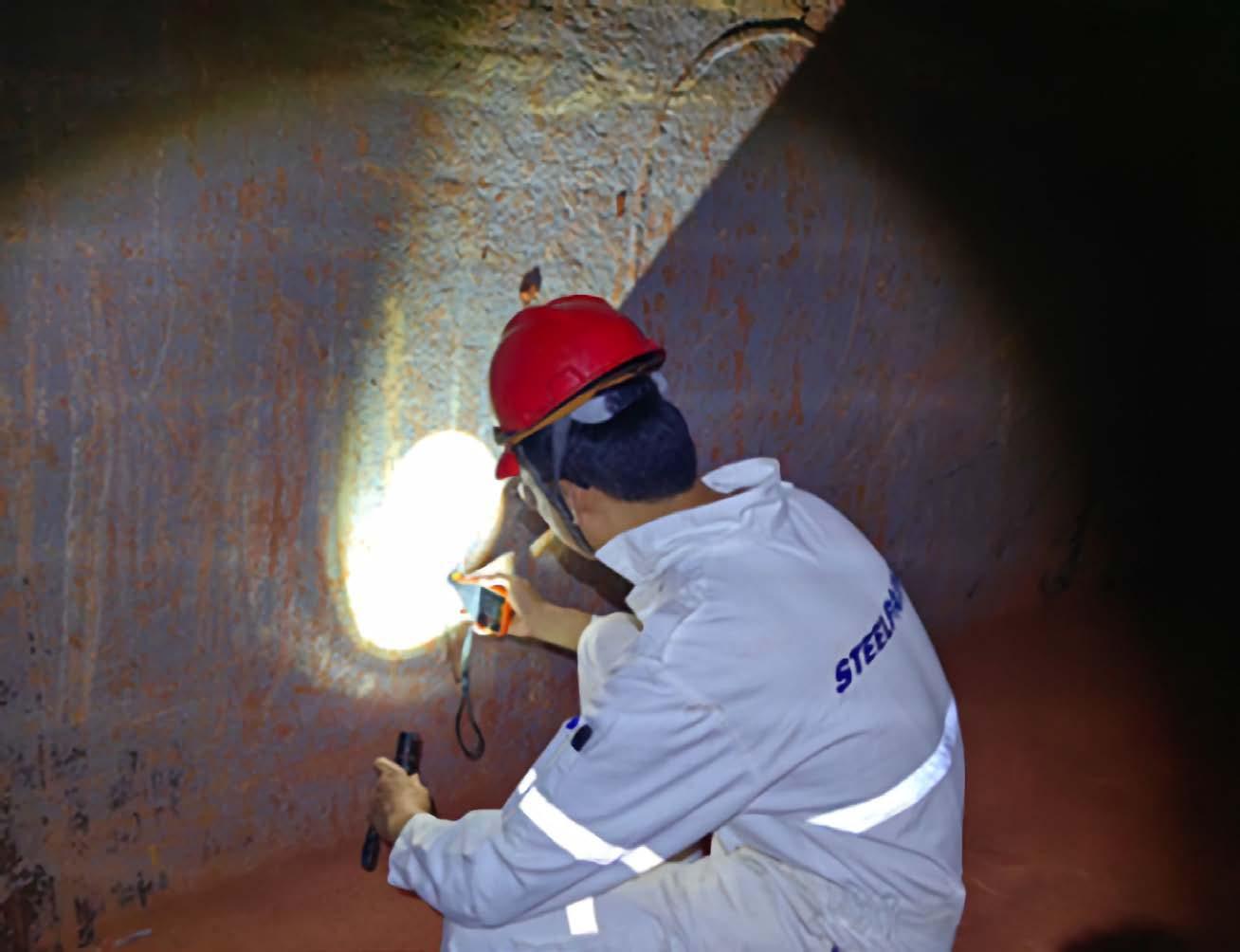
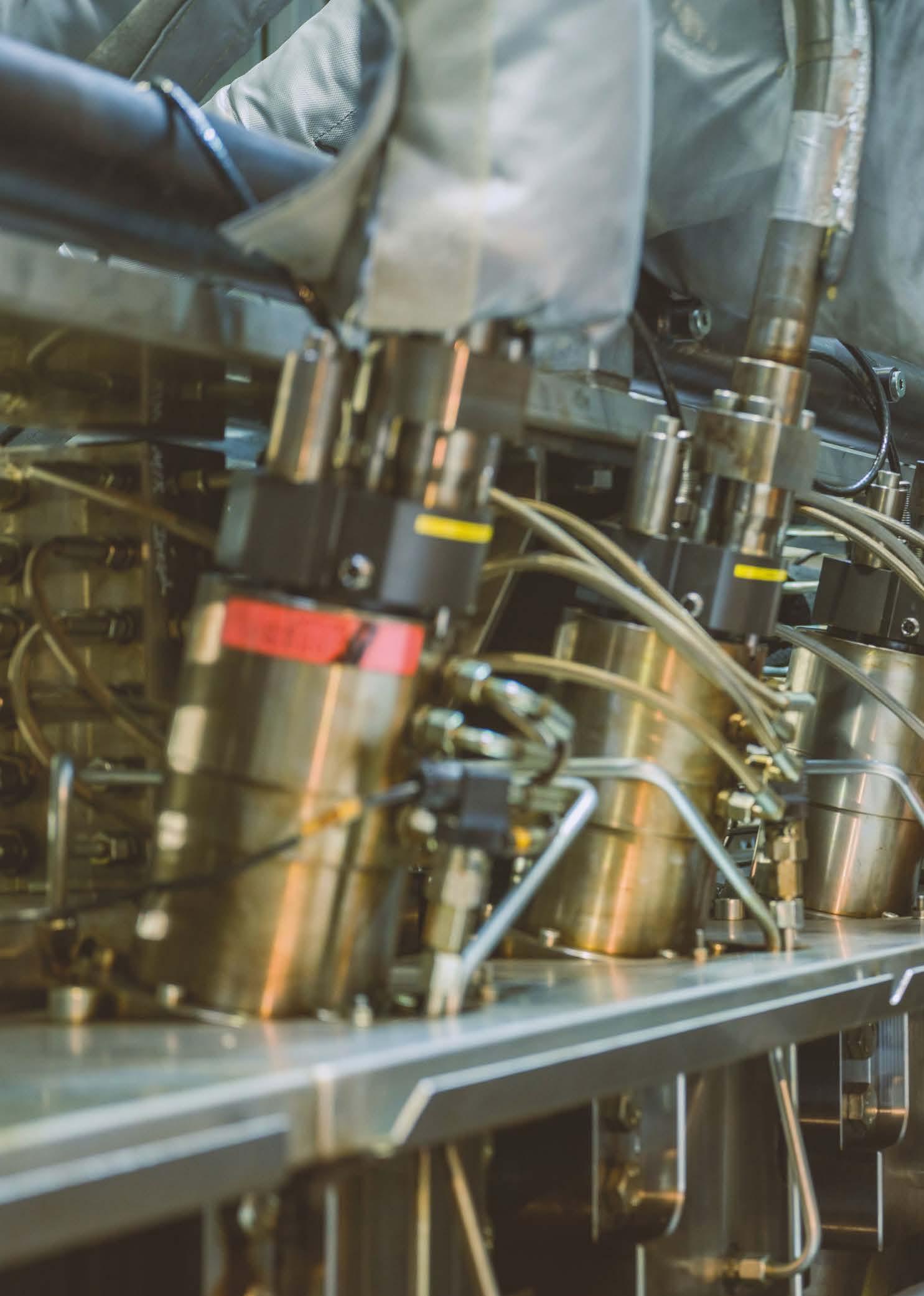
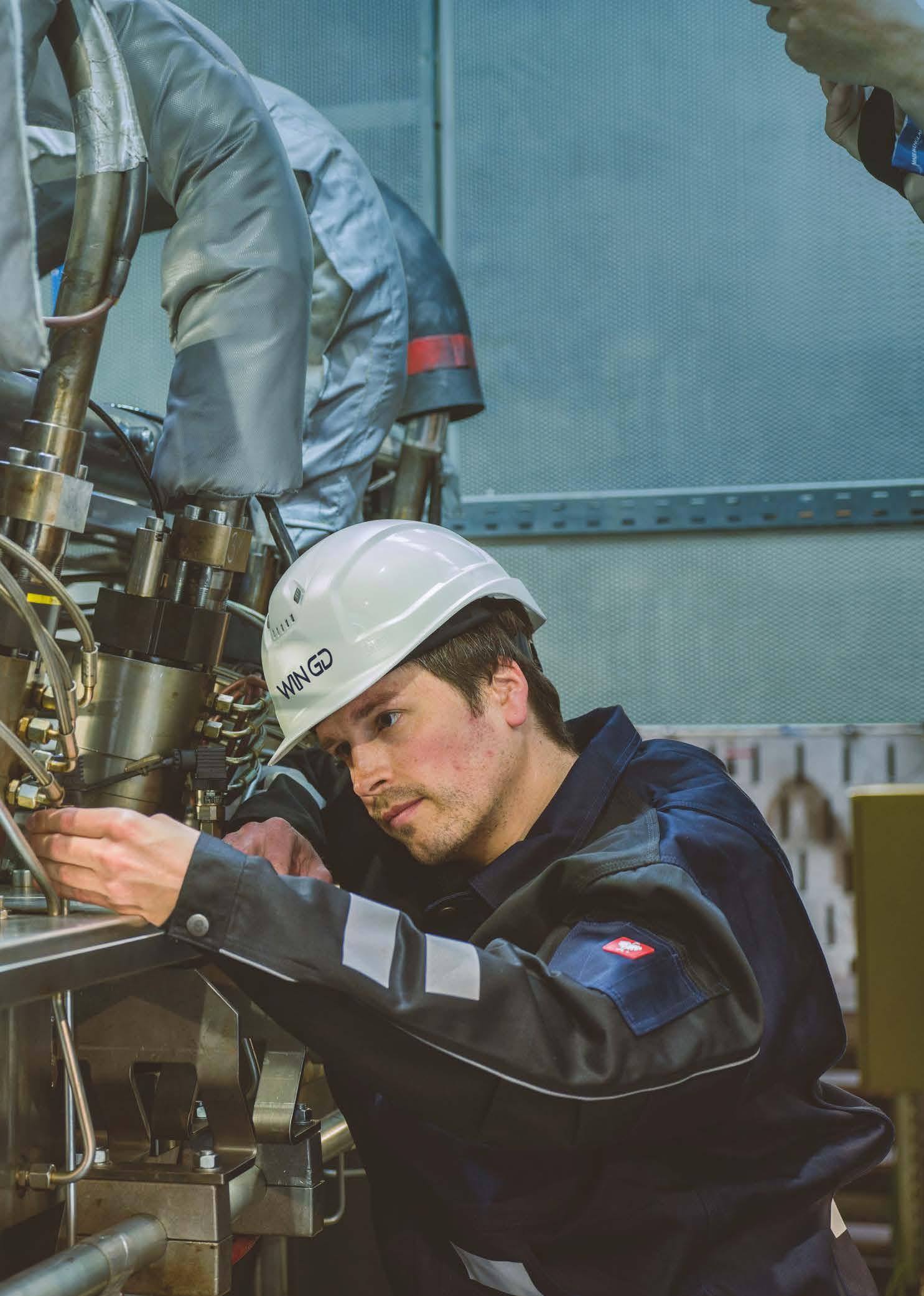
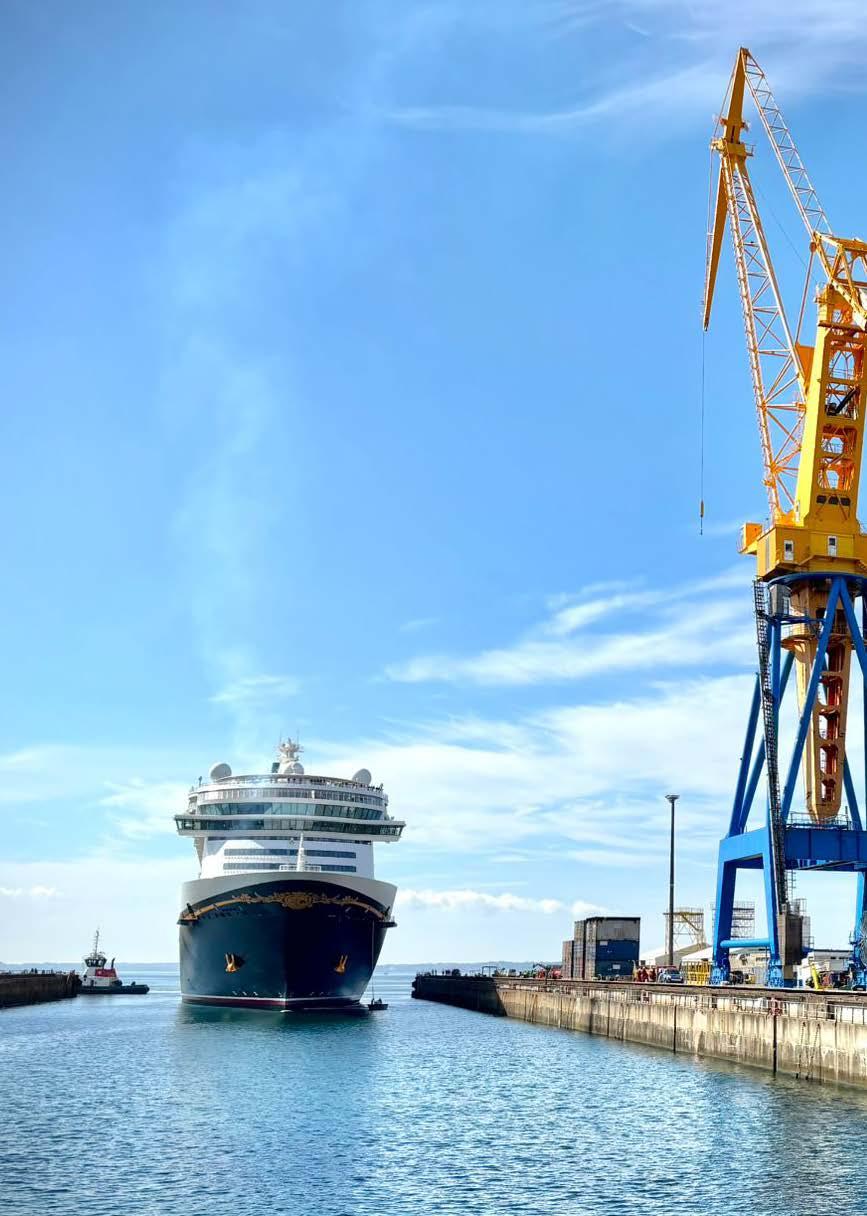
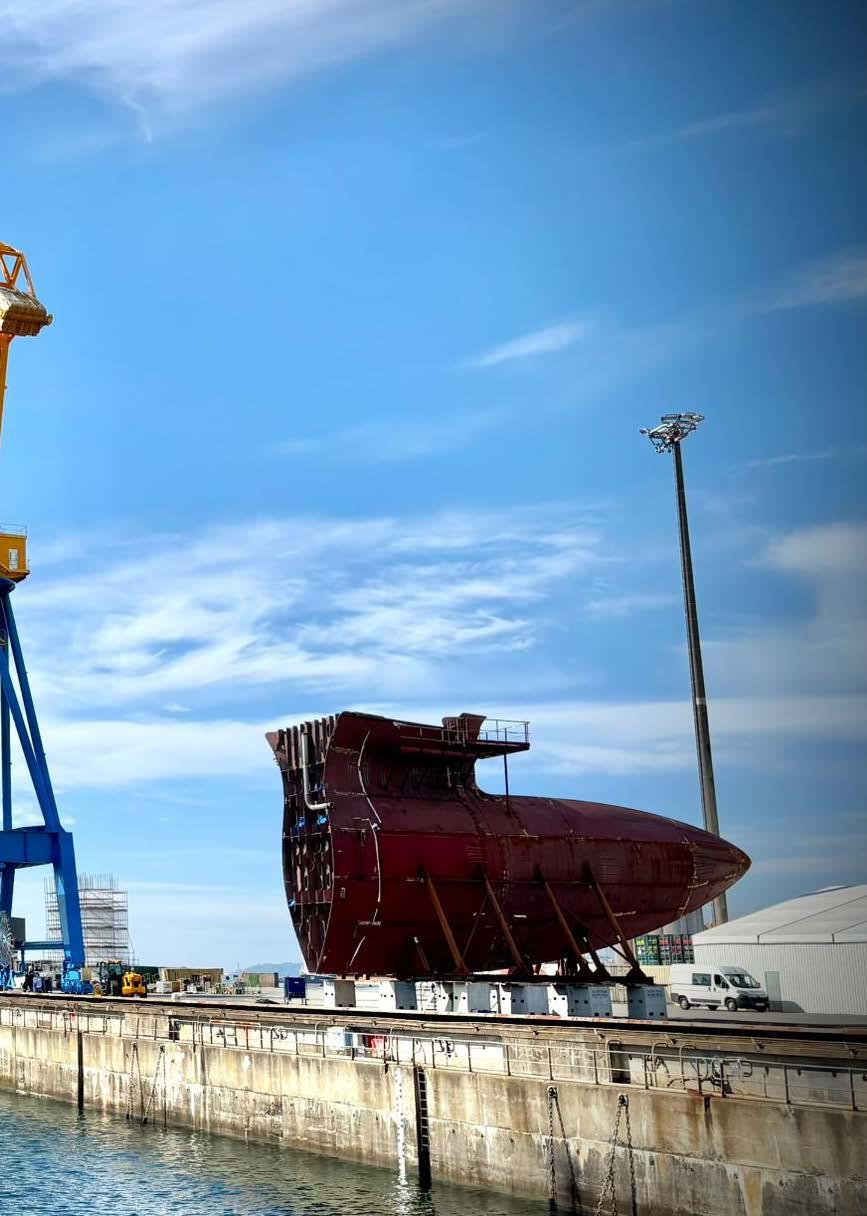
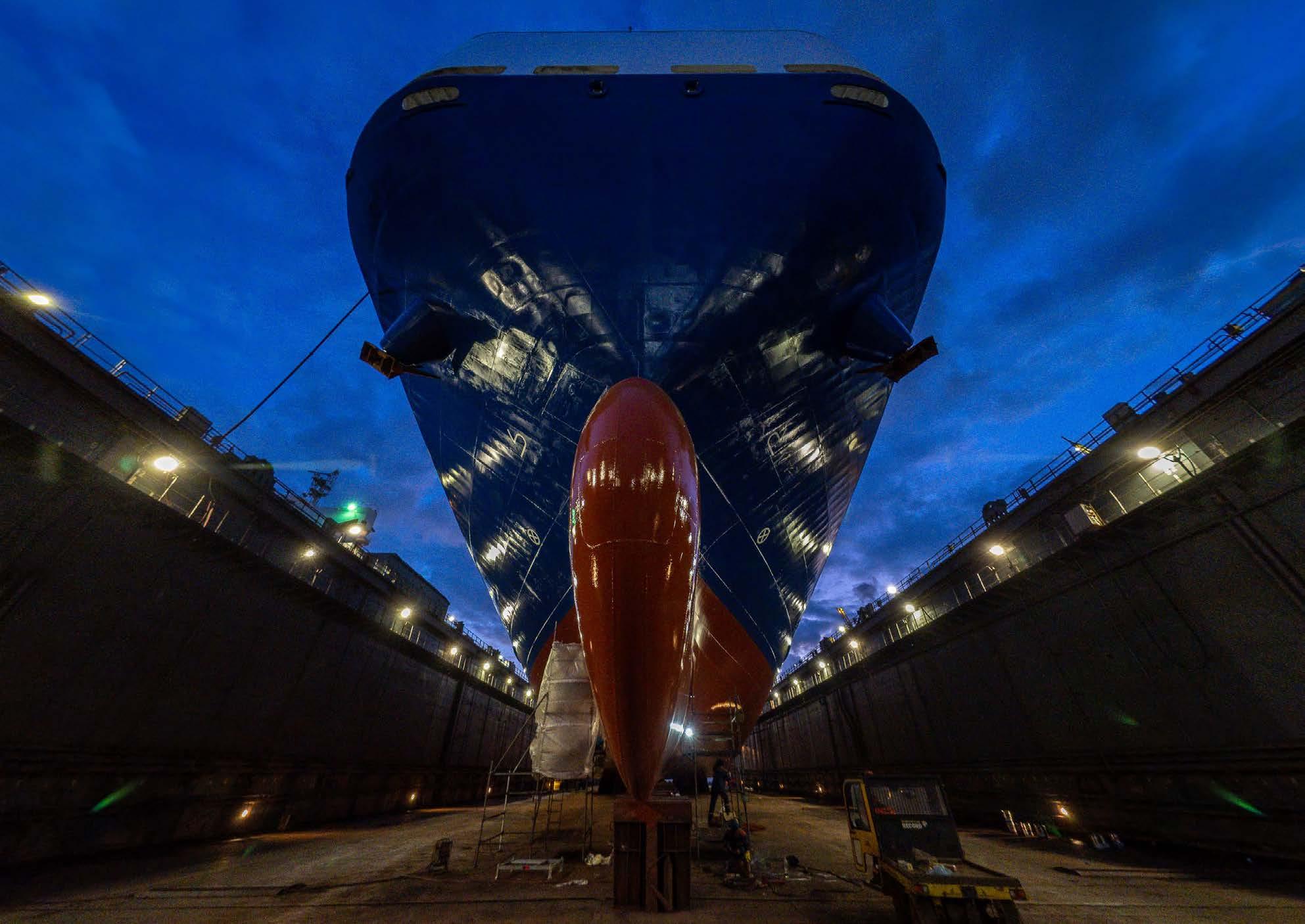
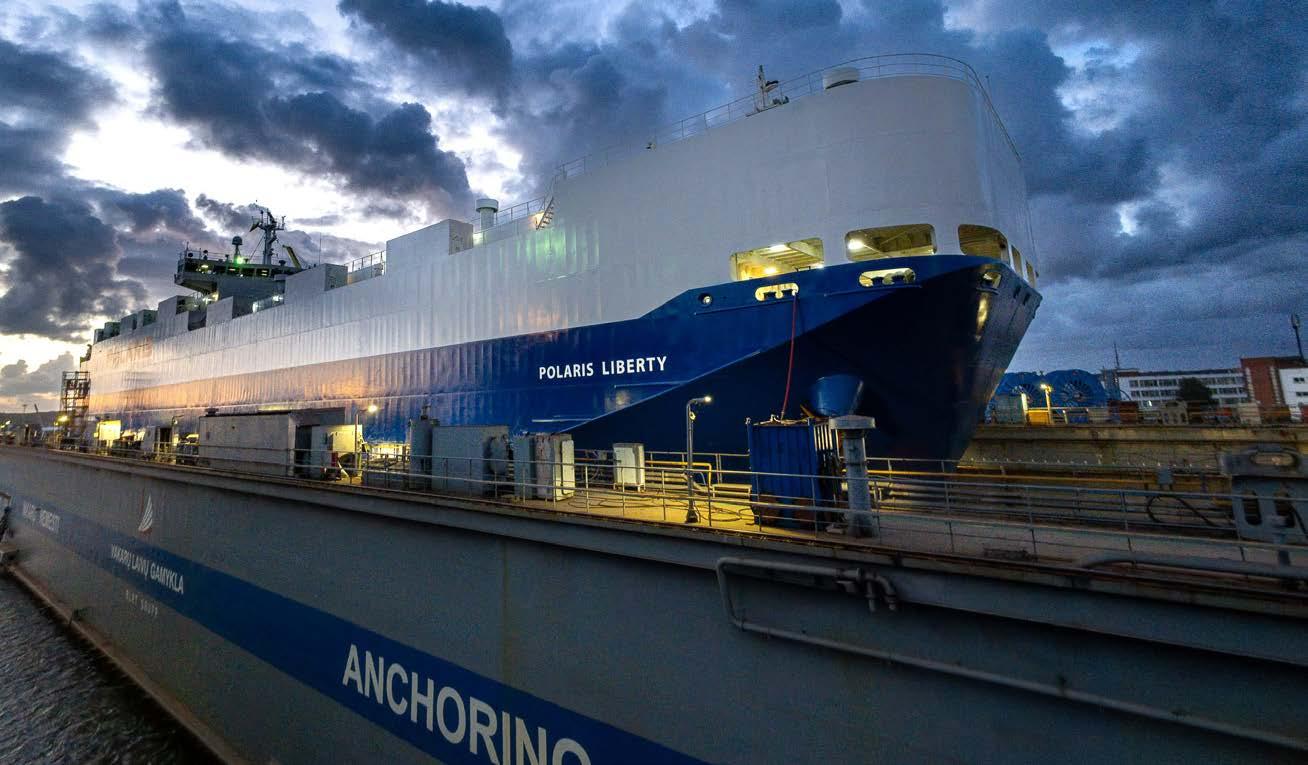
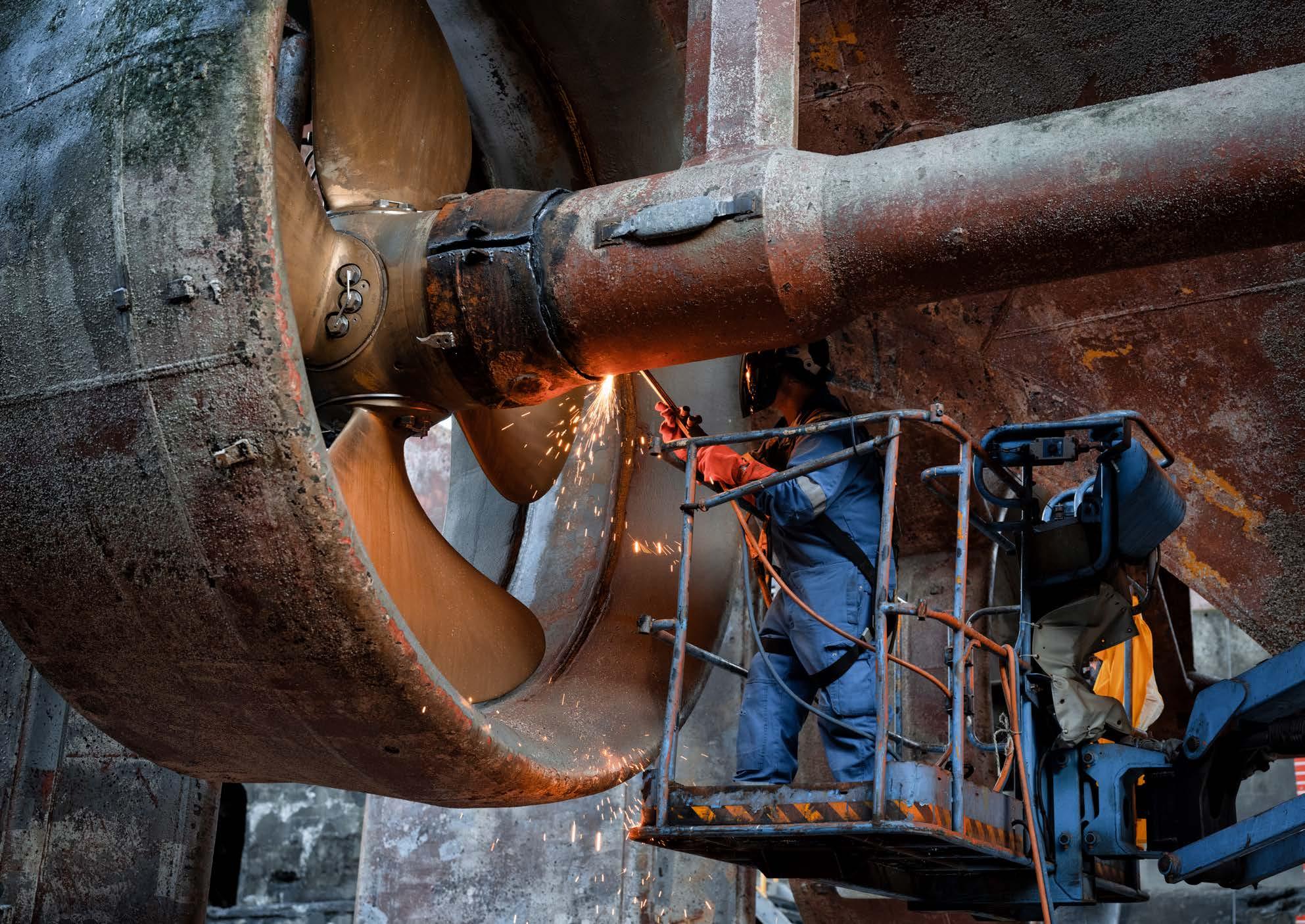
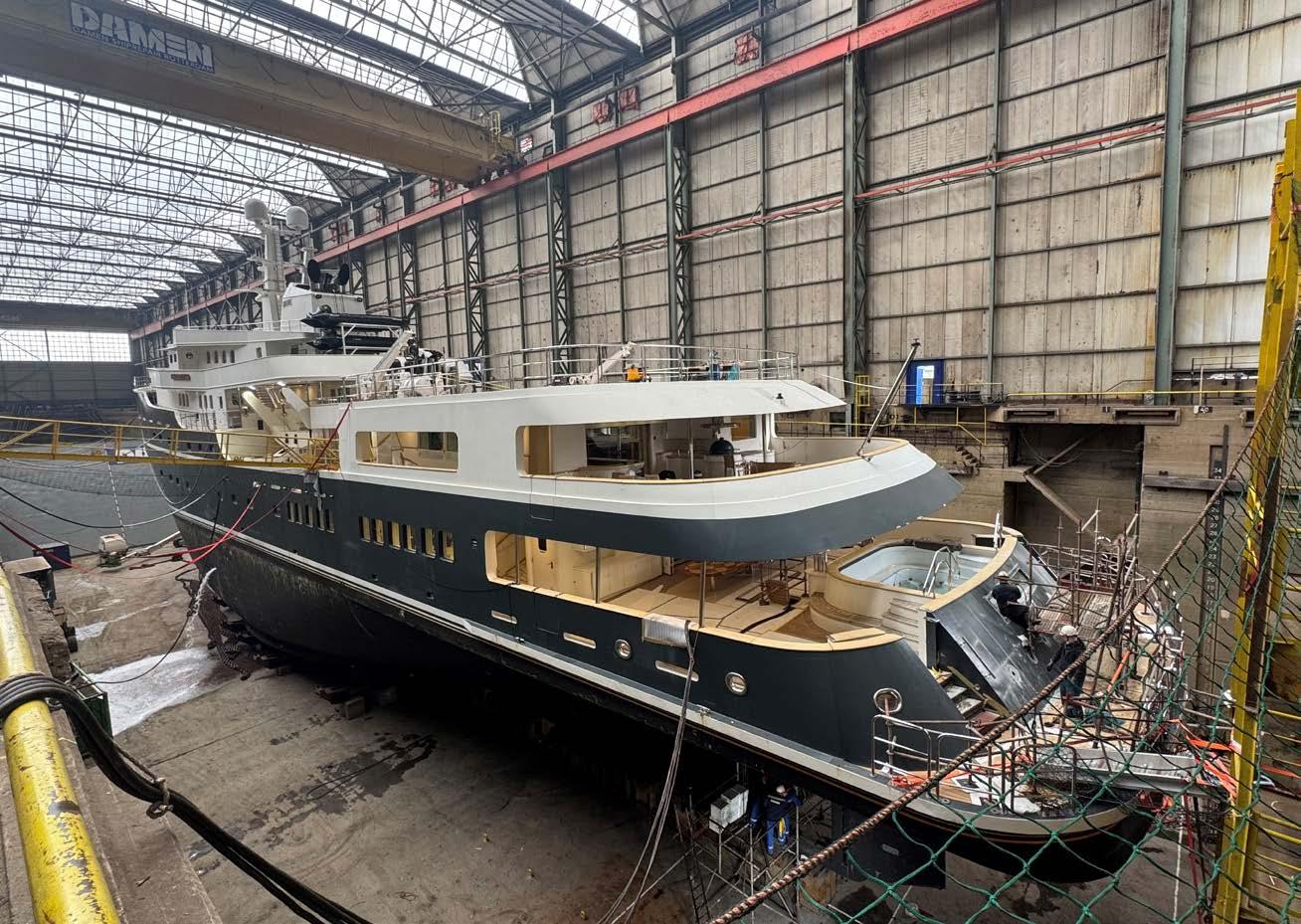
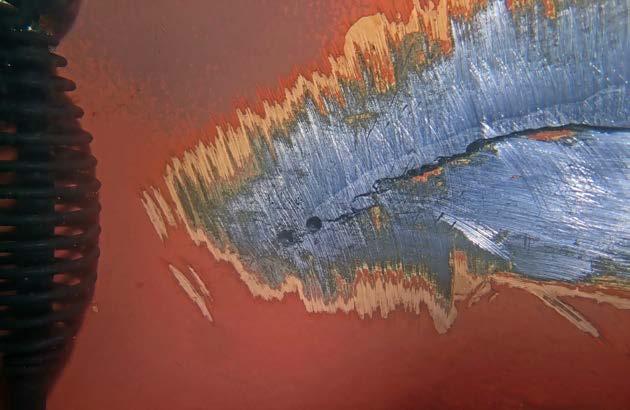
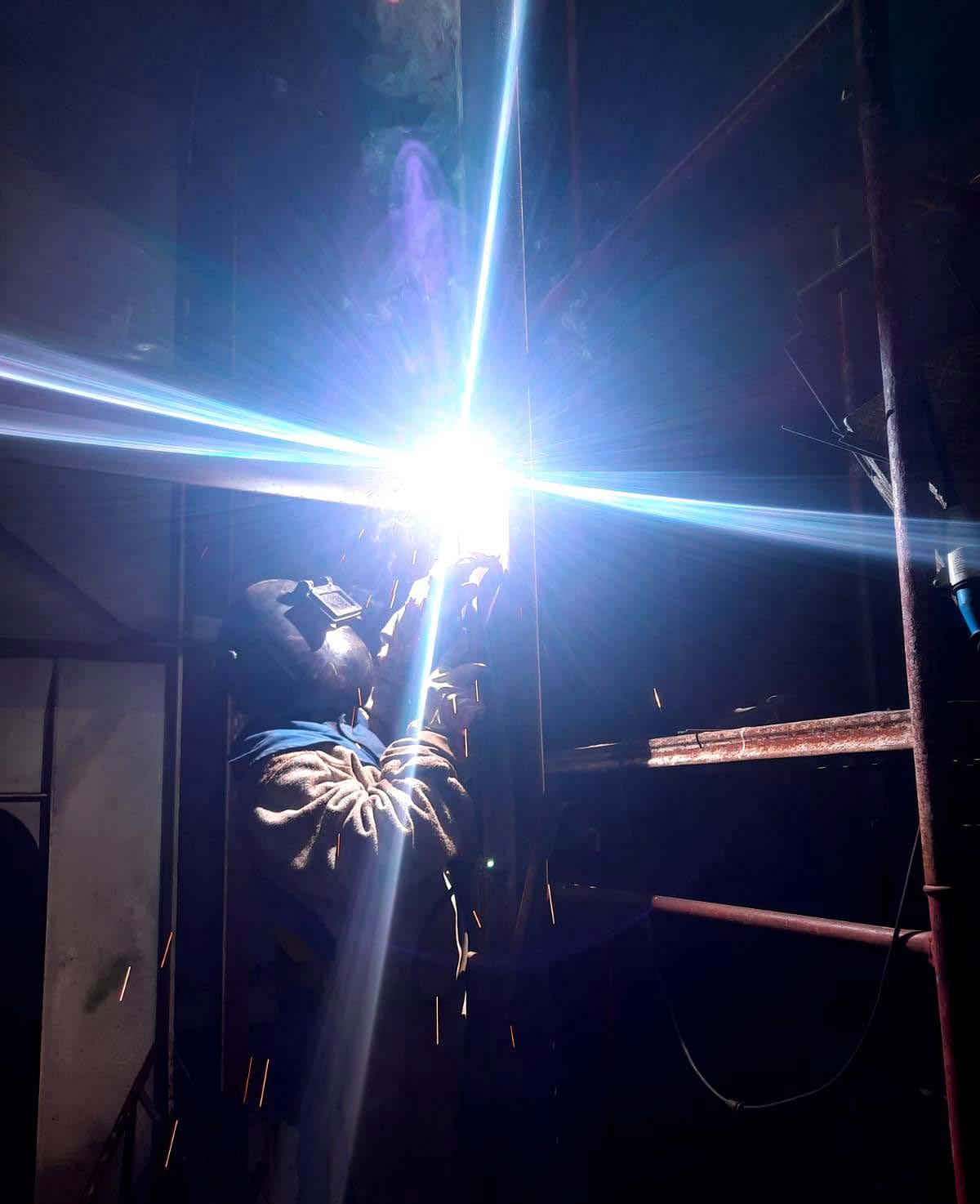
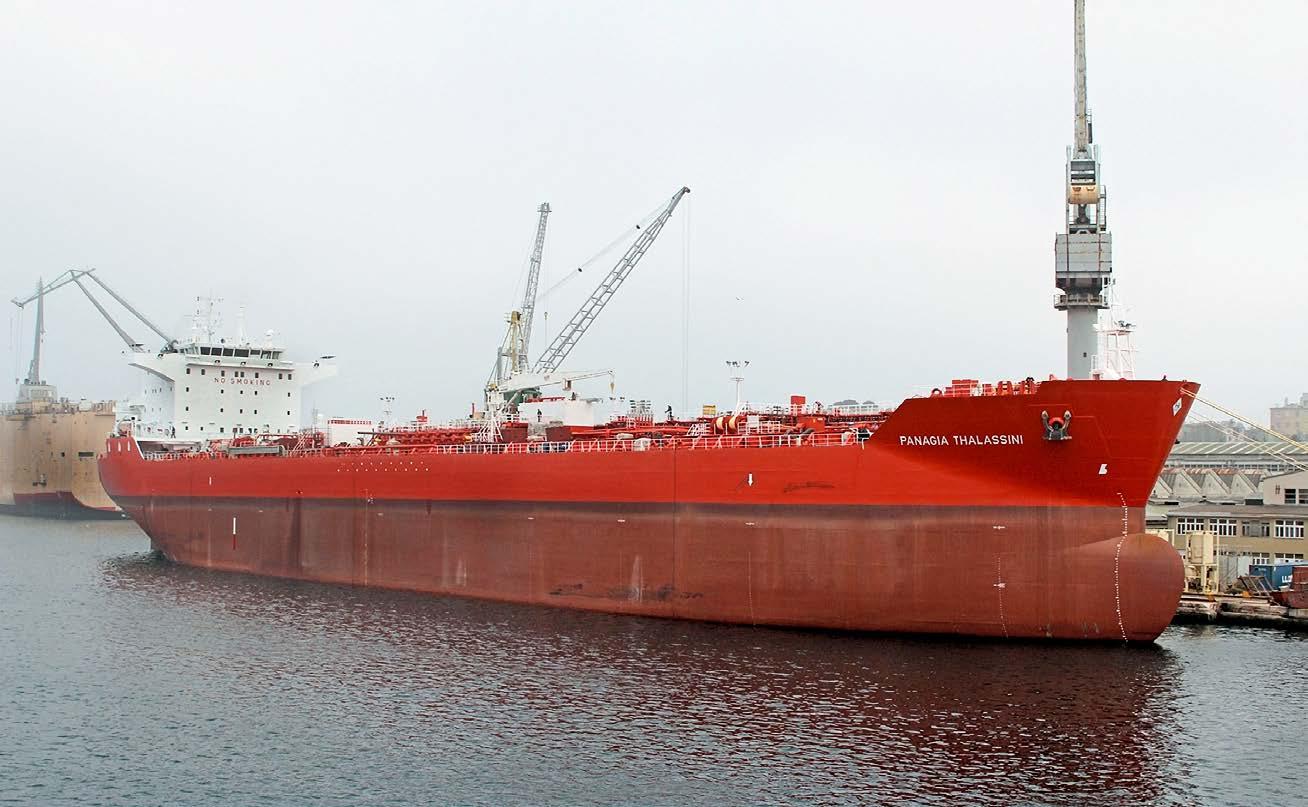
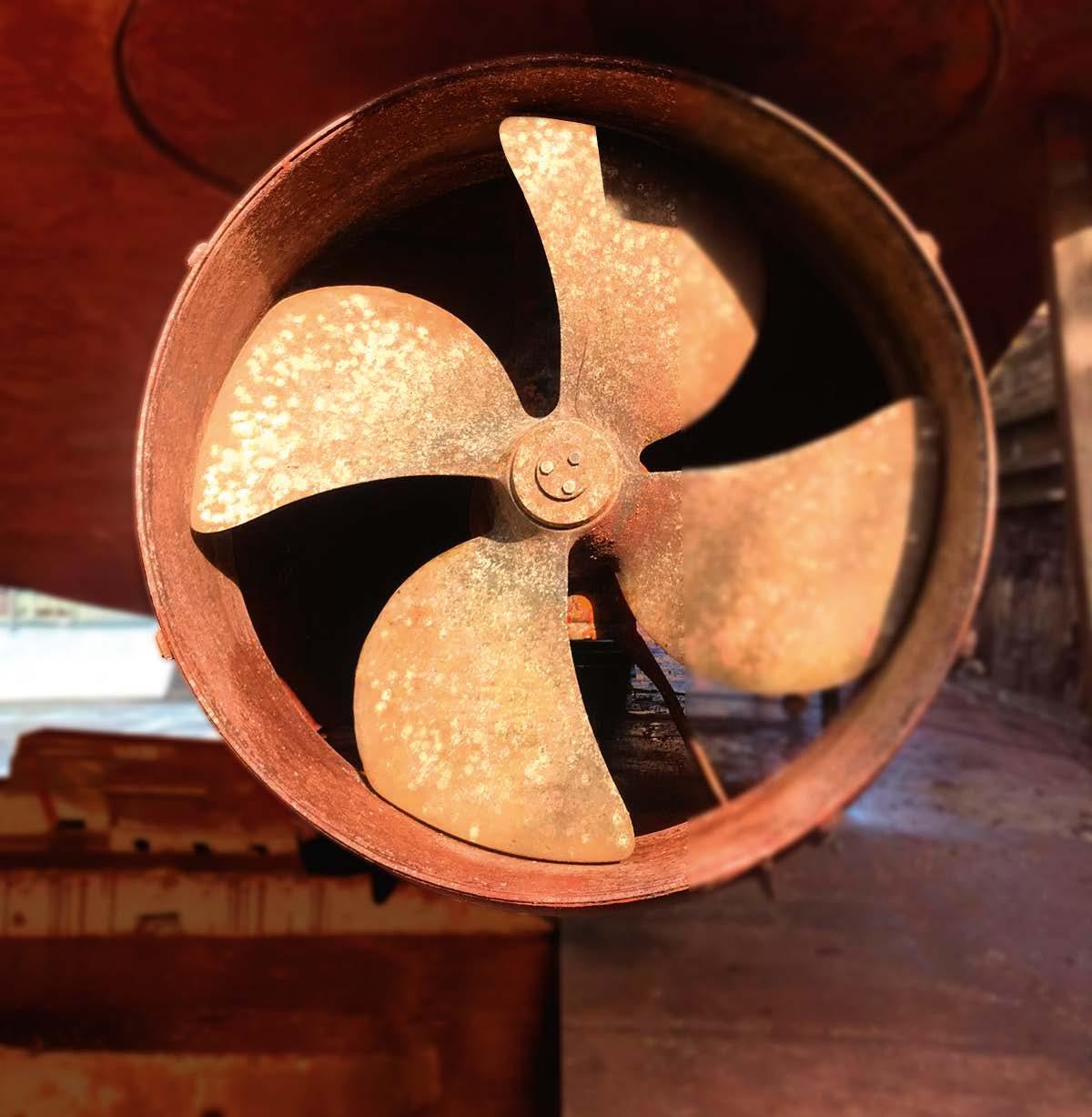
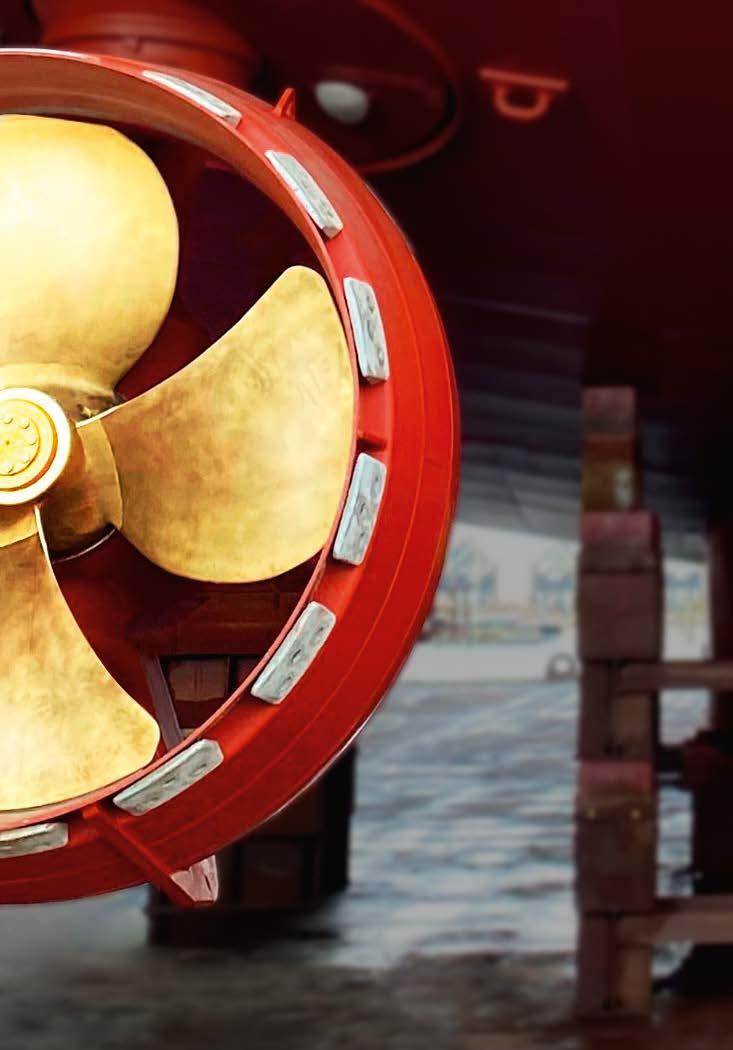
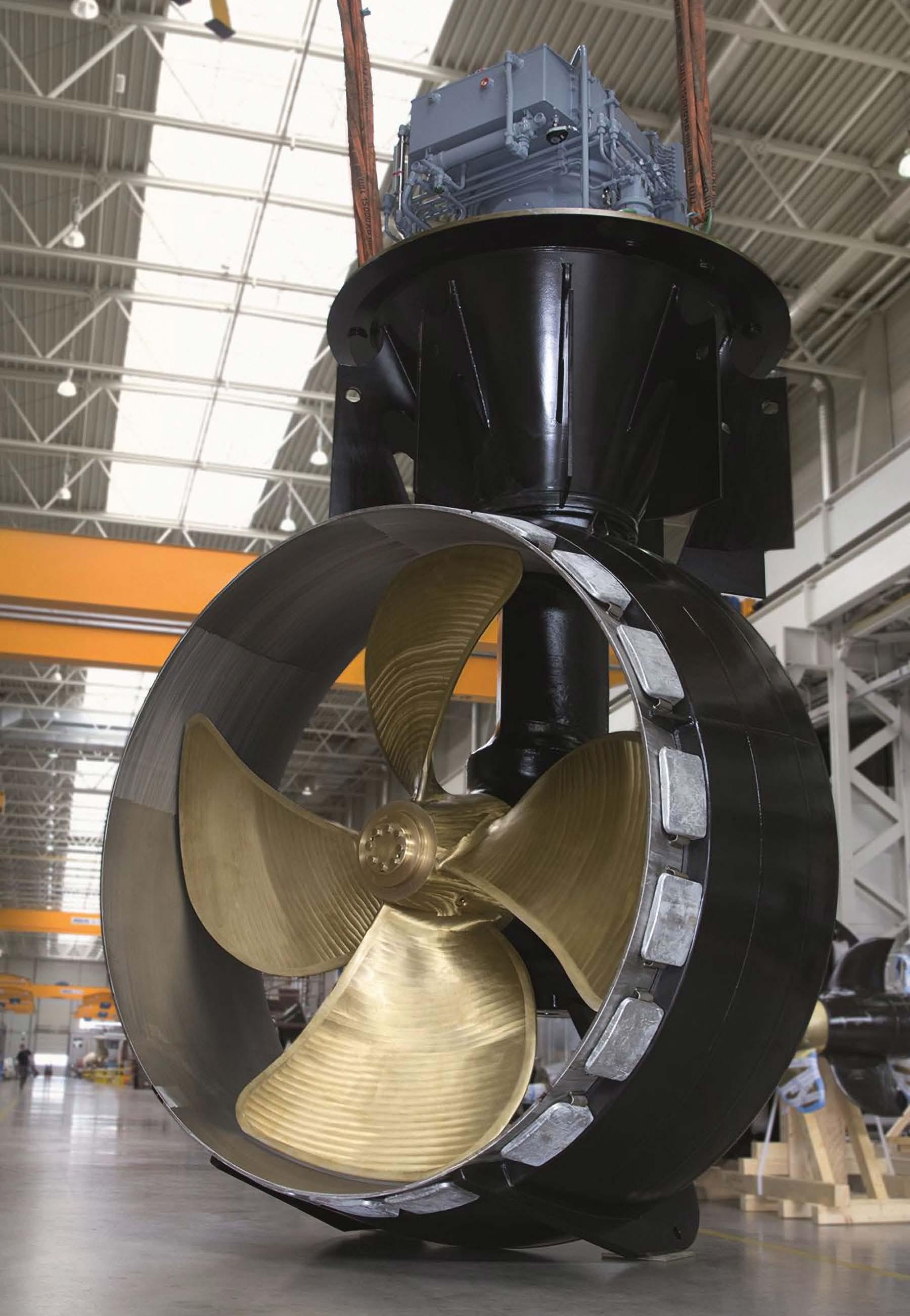
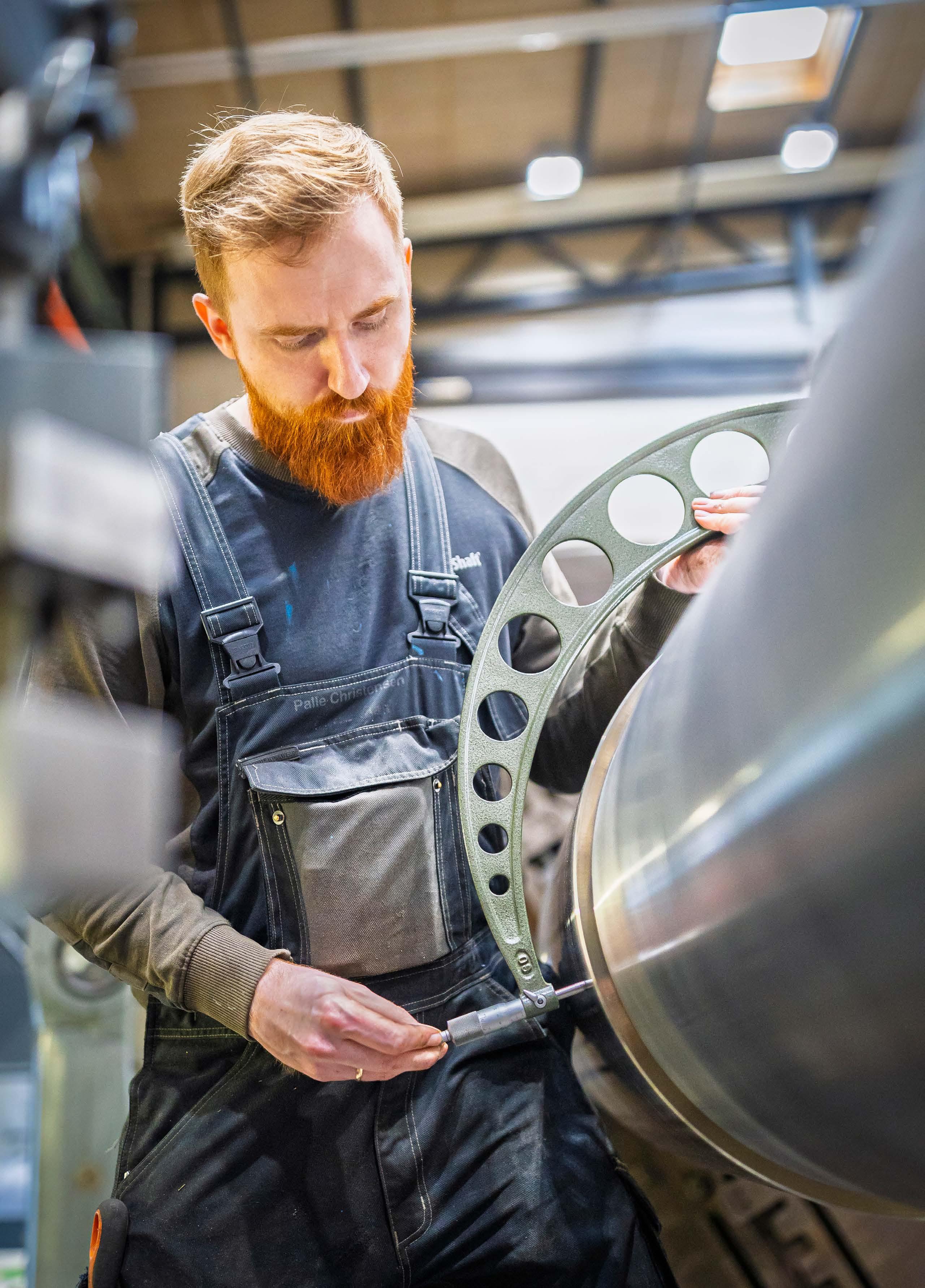
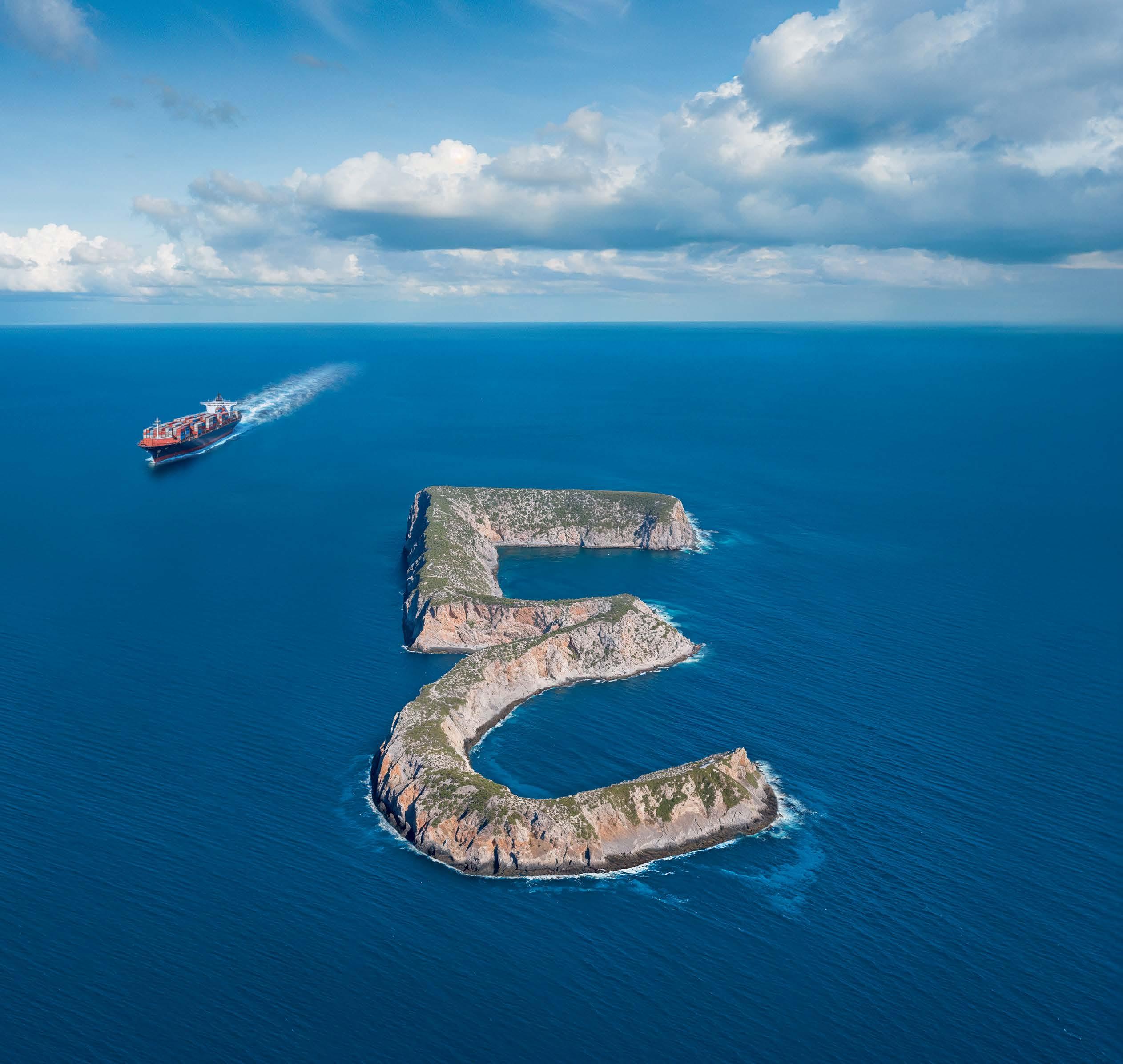
When an offshore supply vessel suffered a stern tube bearing failure, MarineShaft was contracted to carry out an alignment test of the shaftline during a planned drydocking in Spain.
MarineShaft A/S
E-mail: info@marineshaft.com
Invoice e-mail: reception@ marineshaft.dk
Phone: +45 9656 0202
Issue: June 2025
Volume No.49 No.3
ISSN No. 0143-5000
Editor: Mark Langdon
Advertisement Manager: Nick Carugati
Design & Production Manager: Fiona Andreanelli
Accounts: Claire Long
Subscriptions: Molly Andrews
Publisher: Andrew Deere
Subscribe Today!
Visit www.drydockmagazine.com
MPI Group Peel House, Upper South View Farnham, Surrey GU9 7JN, UK
Tel: +44 (0)1252 732220
info@mpigroup.co.uk www.mpigroup.co.uk
MPI Group, as a body, are not responsible for any opinions expressed in DryDock by contributors. All rights reserved. No part of this publication may be reproduced, stored in a retrieval system, or transmitted, in any form or by any means, electronic, mechanical, photocopying, recording or otherwise, without prior permission of MPI Group.
2 Face the Facts
Donata Martinez, CEO of Navantia UK, talks about the acquisition of Harland & Wolff’s facilities in Belfast, Appledore, Methil and Arnish earlier this year
6 On the Line
Ewout Bosman, PPG Global Marine Seastock Segment Director, Protective and Marine Coatings, explains how PPG’s hands-on Seastock Training aims to help crews catch and fix marine coatings issues before they escalate
14 Sustainability
Maritime sustainability gains pace with vessel owners continuing to embrace new technology in their pursuit of net zero
28 Spotlight
The spotlight is turned on the Mediterranean and Black Sea, where we feature Besiktas Shipyard, Hat-San, Constanta Shipyard, Gibdock and Multimarine Shipyards
40 Area Review
Drydocks World and ASRY are powering performance in the Middle East
48 Market Intelligence
Steve Gordon, Global Head of Clarksons Research, provides an update of ship repair data points from Clarksons World Fleet Register
54 Mechanical Matters
We feature a comprehensive rudder repair by MarineShaft and a new twinscrew controllable-pitch propeller installation carried out by Wärtsilä
62 In Focus
The advantages of a cleanable hull coating explained by Ecospeed, a copperfree antifouling solution from PPG, and new orders for Advanced Polymer Coatings and Steelpaint
76 Analysis
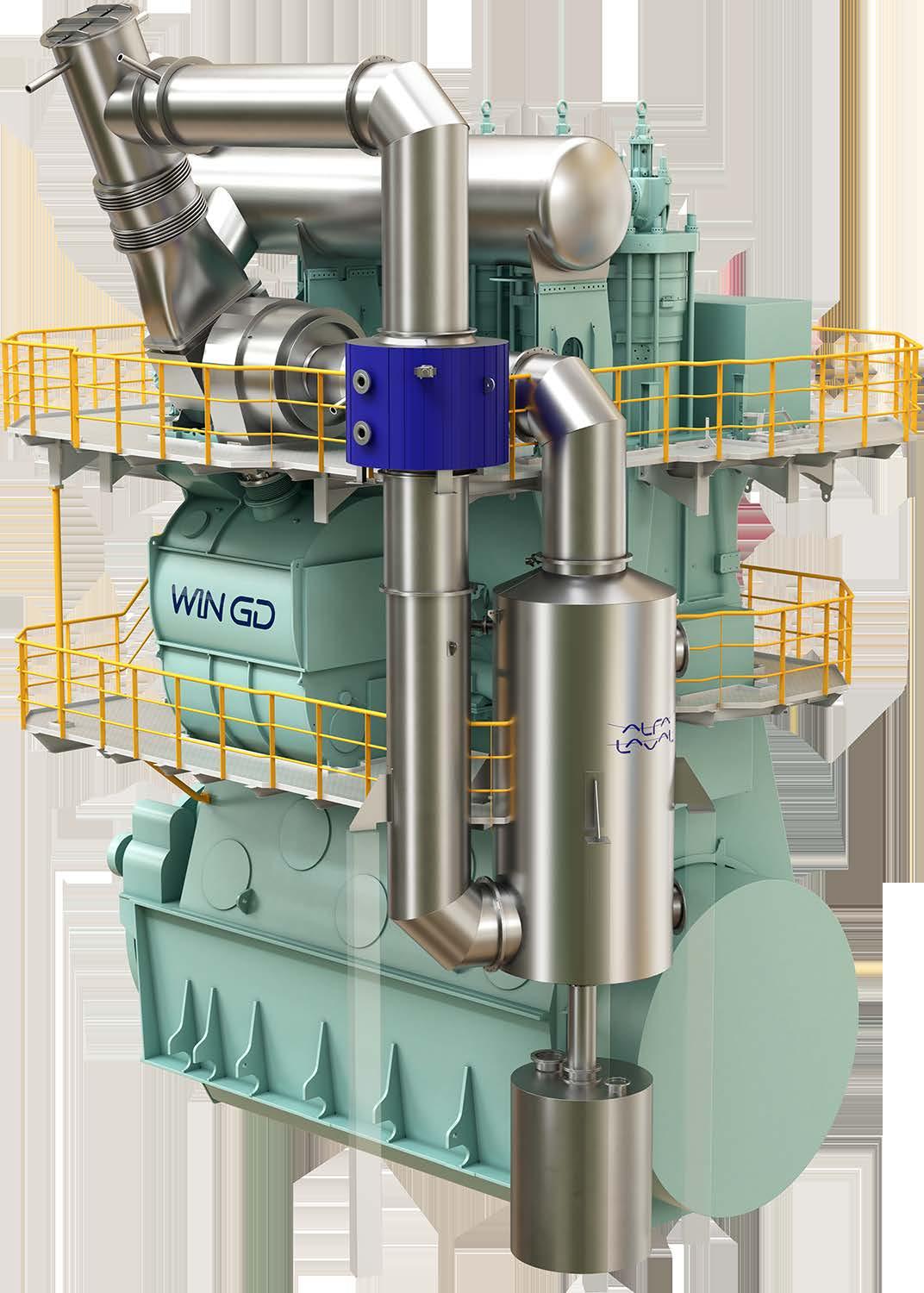
A well-planned and supported retrofit can add many profitable years of compliant operation to the existing fleet – without the newbuild price tag, WinGD suggests
82 Worldwide
A roundup of ship repair news from BLRT, Damen, Hydrex and Metalock Brasil
90 News
The latest products, appointments and news
Navantia Shiprepairs offers more locations & increased flexibility
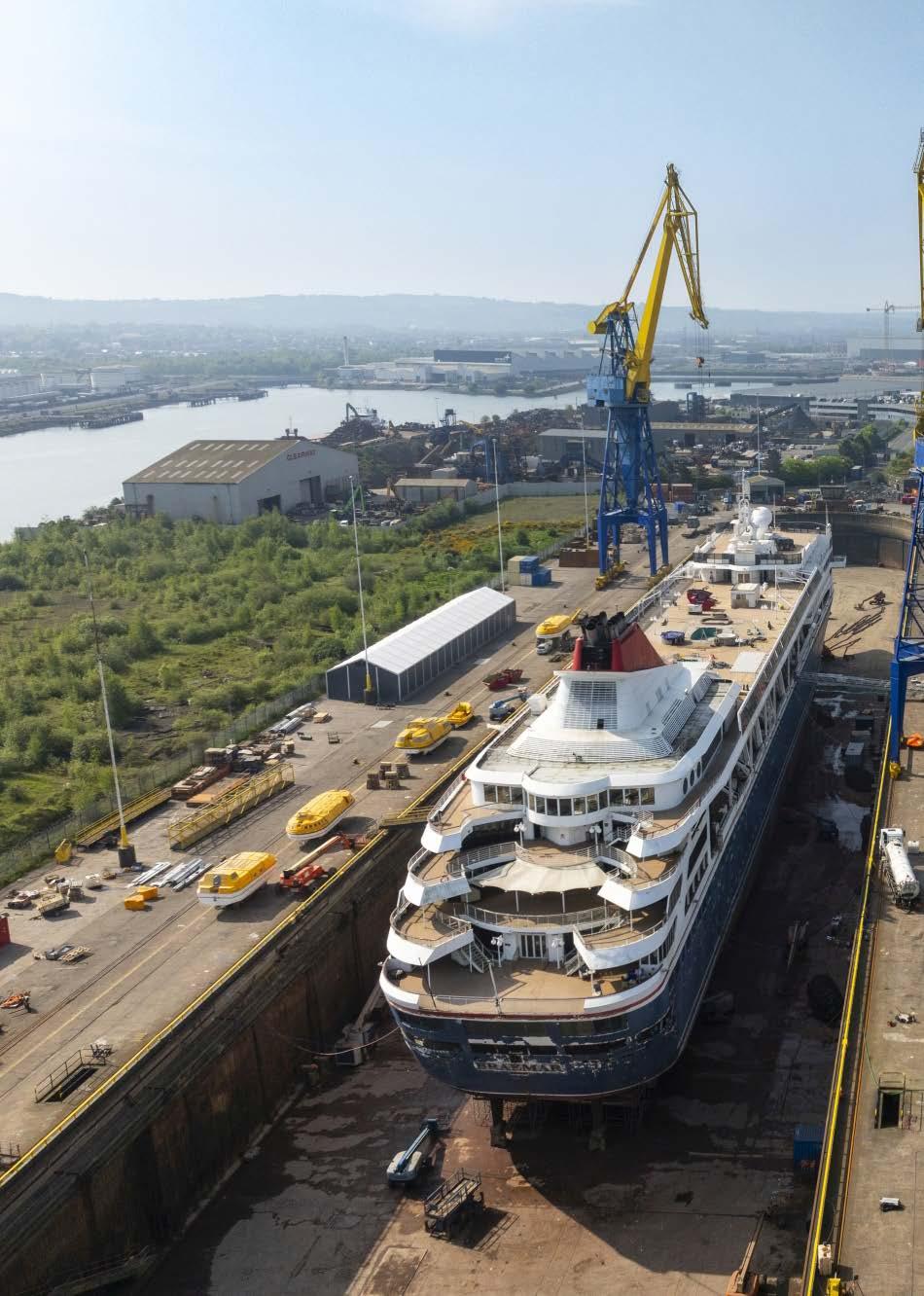
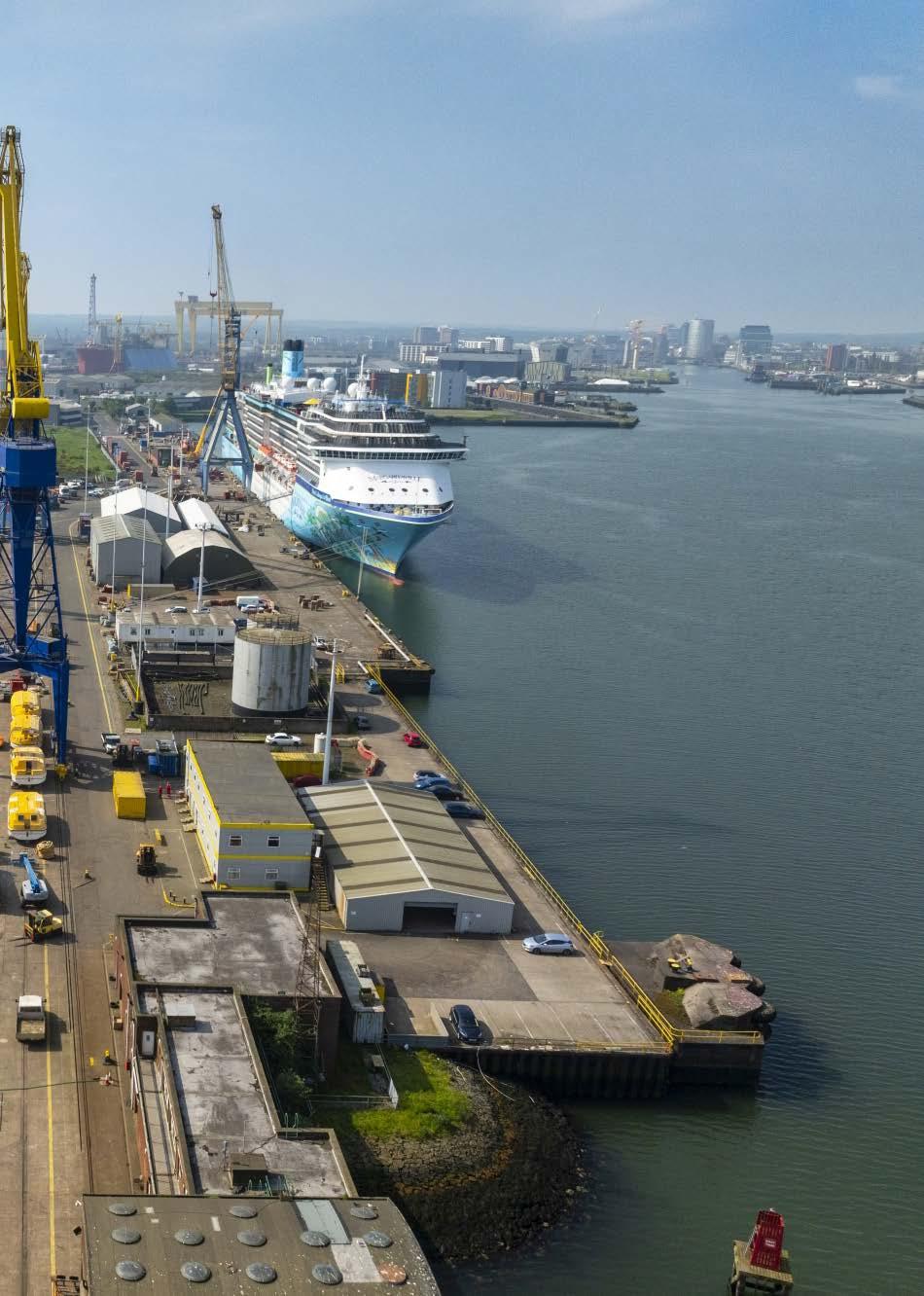
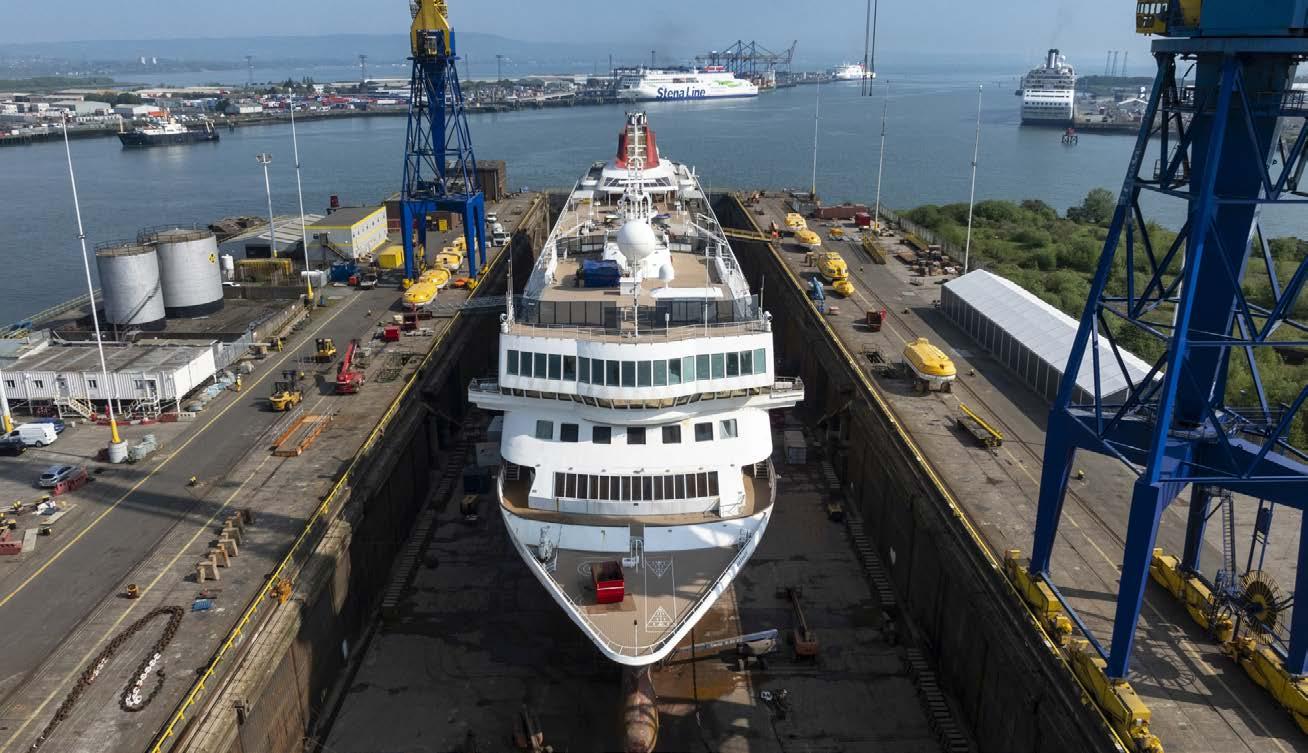
Navantia UK completed its acquisition of Harland & Wolff’s facilities in Belfast, Appledore, Methil and Arnish in January 2025.
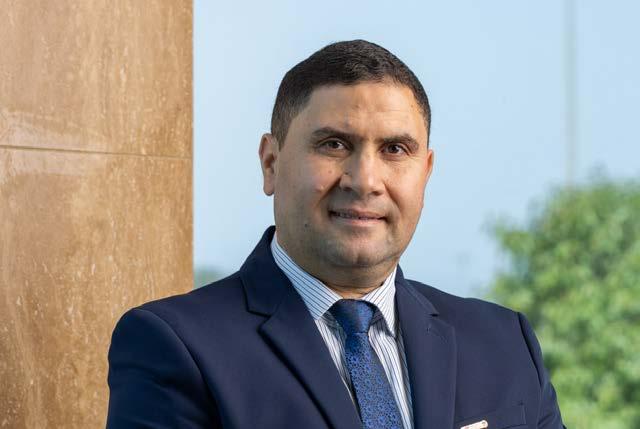
Donata Martinez has been CEO of Navantia UK since May this year. He was previously Chief Technology and Strategy Officer at Navantia, SA for a year. Before that he served as Systems, Services, Technology and Digital VP and Chief Technology Officer. He also previously worked at Navantia Australia and Navantia in Spain, where he had various roles after joining the company in December 2005.
Martinez holds an MBA from the University of Navarra, a PDD Management from Escuela Organización Industrial and an MSc in Naval Architecture from Universidad Politécnica de Madrid.
Q. What was the key rationale behind the acquisition of Harland & Wolff?
A. The acquisition ensures the continuation of the Fleet Solid Support (FSS) programme, comprising three ships for the Royal Fleet Auxiliary to support the UK Carrier Strike Group, and aligns with Navantia’s group growth strategy.
These FSS vessels will be built at the Belfast and Appledore facilities alongside Navantia’s facilities in Spain, and integrated and delivered at Harland & Wolff (Belfast). Using Navantia’s expertise, we are aiming to create one of UK’s most advanced shipyards, grow productivity and develop sustainable manufacturing processes.
Q. Do you plan to still run the yards in Northern Ireland (Belfast), England (Appledore) and Scotland (Methil and Arnish) as individual entities, or do you plan to integrate them fully within Navantia?
A. Navantia UK will operate all four yards as a single legal entity. Each yard plays a vital role in Britain’s industrial renewal and will benefit from the investment and modernisation plan that Navantia UK has already initiated.
Q. Is your main interest in the FSS shipbuilding programme for the UK’s Ministry of Defence, or is Navantia interested in the ship repair and upgrades parts of the business?
A. Navantia already has a ship repair division in Spain which, apart from providing all maintenance, repair, docking and upgrade services required by the Spanish Navy and other navies with whom Navantia has agreements, is also focussed on the repair, docking, upgrade, conversion and revitalisation works of commercial vessels of all types, although with specialised lines of business where it is already a key global reference in markets such as LNGs and O&G, luxury cruiseships and megayachts.
On the other hand, Navantia UK also has shipyards with a long tradition in repair, upgrade, and conversion works of both military and commercial vessels, which will continue and expand their traditional ship repair work in coordination with and with full support from Navantia’s ship repair division. Therefore, Navantia Shiprepairs will now offer a wider option of geographical locations and increased flexibility to some of its existing clients, especially those operating in the UK, Ireland and North Sea area.
Q. What about the green energy part of the business?
A. Navantia UK is vital to Britain’s energy security. The UK aims to generate 50 gigawatts of electricity from offshore wind by 2030 (about a third of overall energy needs). Navantia UK’s Scottish facilities (Methil and Arnish) can be crucial in achieving this goal.
Navantia Seanergies is an international global partner in the green energy sector with extensive experience in offshore wind industry and hydrogen technologies.
We are investing in our Scottish facilities at Methil and Arnish to transform them into hubs of excellence for renewable
energy manufacturing. Both facilities are ideally located for offshore energy –including deep-sea access and quayside fabrication halls.
Q. Do you have any plans to expand the ship repair and conversion part of the business?
A. As commented earlier, to complement Navantia UK’s other areas of activity in shipbuilding and green energies, the ship repair and conversion activity will be expanded through the upgrade of existing facilities, the enhancement of current technical and human resources, and the commercial support of the group’s ship repair division. This has a prominent position in the international military and commercial ship repair markets and is renowned as a world reference in its core segments of specialisation.
Q. Do you have any plans for major changes to the yards?
A. We are introducing new technologies to enhance all four yards – including lifting cranes, robotic plasma cutting systems and automated quality control processes. We are fostering industry innovation and workforce development. New state-of-the-art facilities and equipment are being installed in Belfast and a new state-ofthe-art plasma cutter at Appledore is replacing legacy equipment, increasing accuracy, speed and complexity in steel cutting – critical for delivering
high-quality naval components on time and at scale. On top of the physical investments, Navantia UK is deploying Navantia’s digital systems to run all business processes. These systems are the fruit of Navantia’s digital transformation strategy.
Q. How do you see the future for ship repair in the region?
A. The strategic geographical location of the Navantia UK shipyards in Belfast and Appledore, with such a long naval tradition and experience, and the current high demand for docking and repairs from international shipowners and operators, should contribute to boosting the ship repair activity in the region.
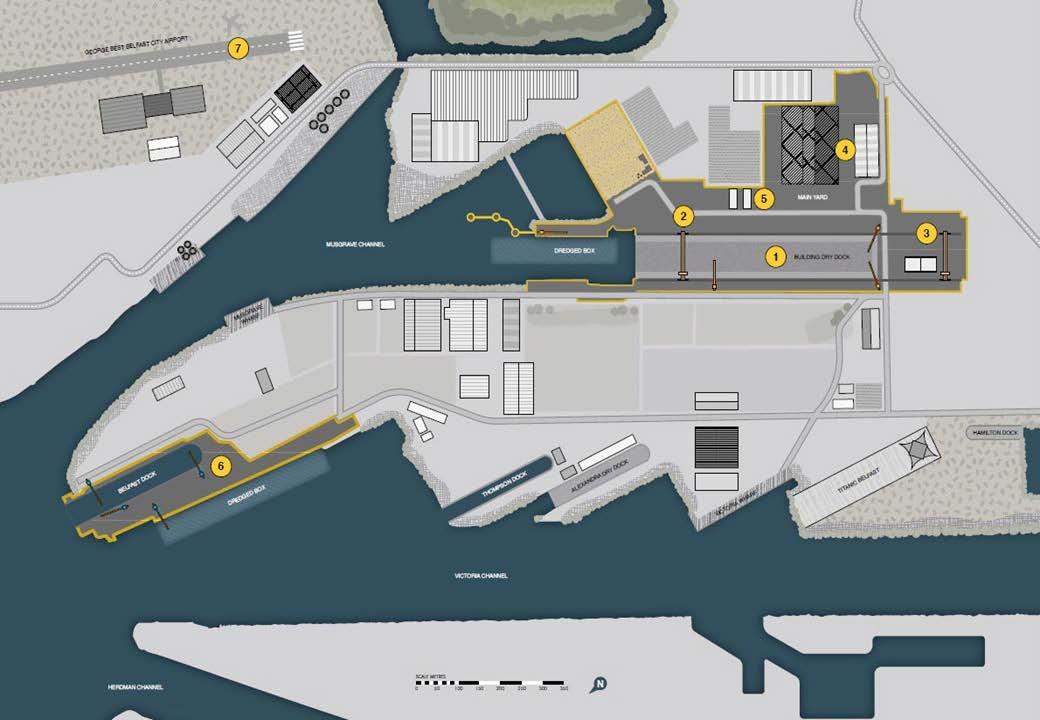
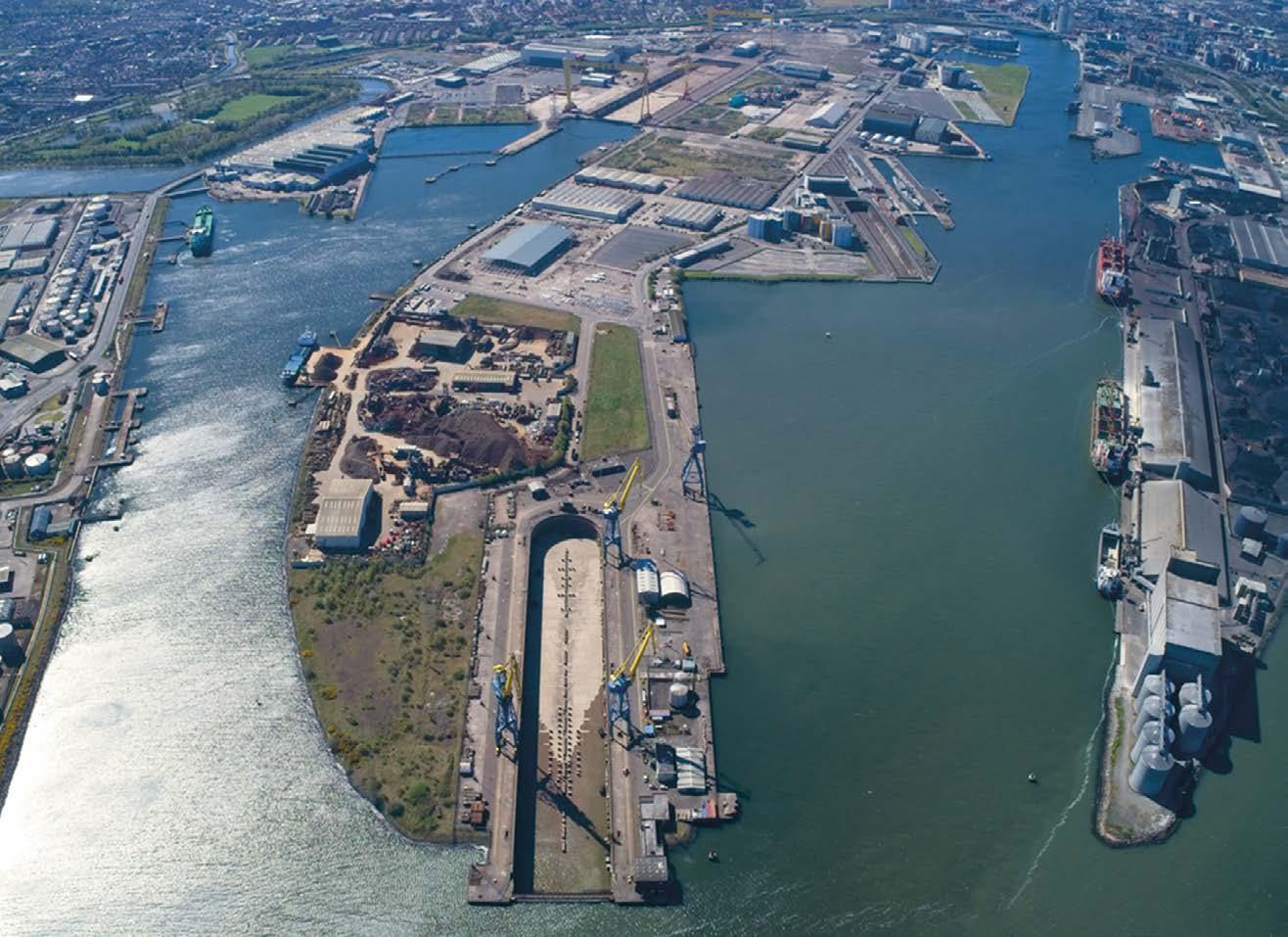
The layout (top) and aerial view (bottom) of Harland & Wolff in Belfast
The front line of VESSEL PROTECTION
Most, if not all, premature coatings failures are due to improper surface preparation and incorrect application procedures, explains Ewout Bosman, PPG Global Marine Seastock Segment Director, Protective and Marine Coatings.
Corrosion tends to increase during the third and fourth renewal surveys, especially in areas exposed to tough environmental conditions. These patterns point to a clear need for better application, maintenance and inspection habits. Once coatings start to degrade, corrosion spreads fast, driving up maintenance costs, creating unsafe conditions and reducing vessel performance.
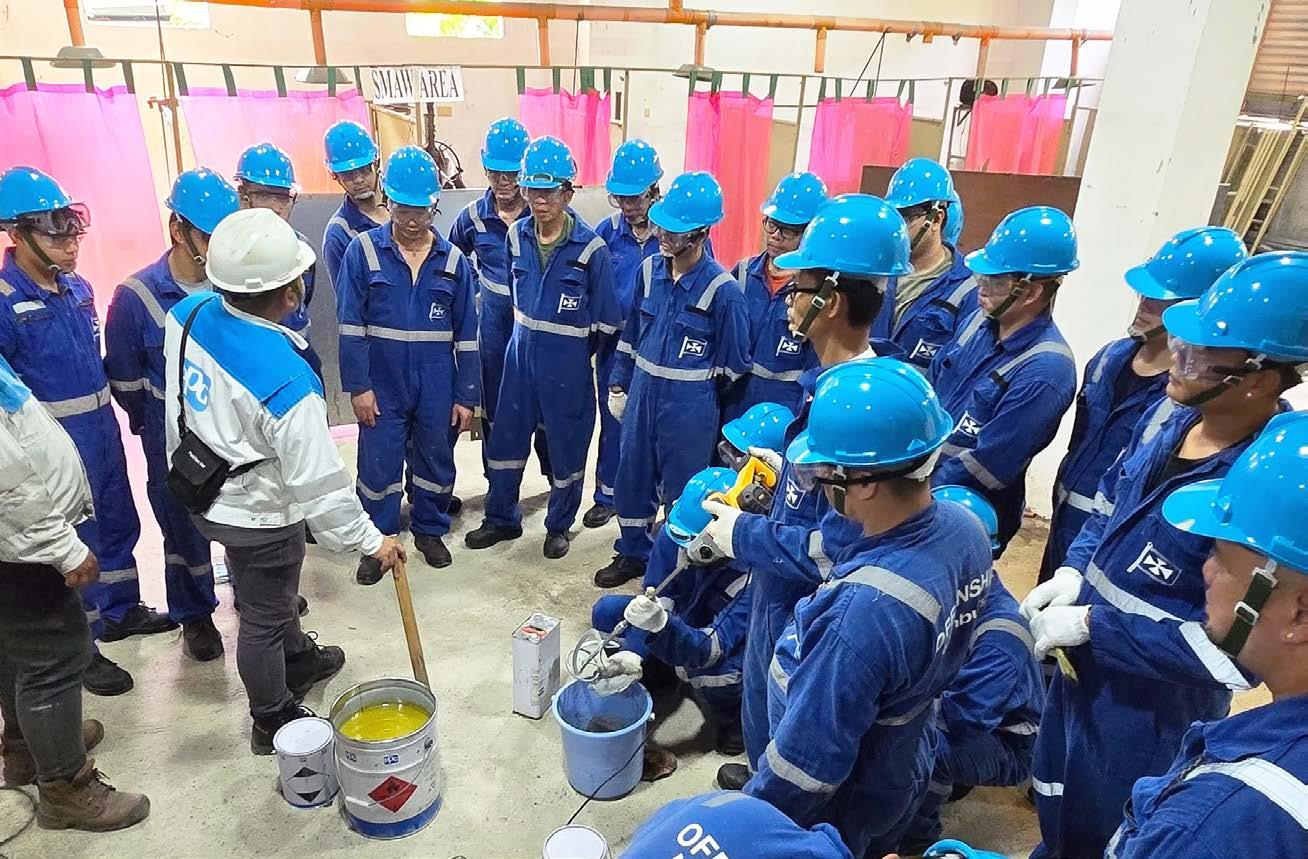
Hands-on Seastock Training helps crews catch and fix marine coatings issues before they escalate. It reinforces proper techniques, improves coating consistency and helps maintain vessel protection between drydock cycles.
In fact, well-trained crews approach daily maintenance with sharper awareness and stronger judgment. They recognise when surfaces need more attention, ask for guidance when unsure and document their work. These habits reduce mistakes, limit material waste and build stronger communication with their teams.
This approach delivers real financial value. Crews who know how to maintain coatings effectively reduce rework, stretch maintenance intervals and help marine coatings last longer. That leads to lower costs. Data shows that proactive maintenance can cut emergency repairs by 20-30%. Ship Universe also reports that companies investing in technical training see fewer operational errors and longer component life. Across a full fleet, even small gains add up to major savings.
The role of skills training
In the past, coating maintenance often fell into a reactive pattern, where crews addressed issues as they arose with limited focus on prevention. Today, forward-thinking ship operators understand the value of proactive care, especially in marine coating management. A coating system’s longevity hinges on the quality of application, surface preparation, environmental controls and timely inspections. Even minor application
errors, such as incorrect mixing ratios, can shorten a marine coating’s lifecycle, resulting in unplanned repairs. These risks underscore the critical need for skilled, well-trained maintenance crews who understand both the science and the practical application behind anticorrosive coatings.
Training crews in proper coating practices also directly supports sustainability by reducing material waste and environmental impact. Well-trained personnel understand how to manage correct mixing ratios, prepare surfaces effectively and avoid overcoating to minimise unnecessary paint use and maximise product performance. When crews know how to paint correctly the first time, they spend less time on rework and have more capacity to focus on other essential maintenance tasks.
What makes a programme successful
The best training programmes share common traits:
• Relevance: They match what crews do
• Flexibility: They adapt to time, space and crew rotation
• Practicality: They include hands-on learning
• Frequency: They happen regularly
• Feedback: They evolve based on crew response
• Sustainability: They reduce waste through better material use and application practices
• Cost efficiency: They improve paint usage and reduce rework, lowering long-term expenses
• Reliability: They build consistent habits that will enhance fleet-wide maintenance standards and vessel performance.
Training should enhance operations, not interrupt them. This requires delivering sessions at maritime training centres, led by instructors who understand vessel workflows. Effective programmes prioritise live demonstrations over slideshows and
Ewout Bosman is PPG Global Segment Director for Marine Seastock, Protective and Marine Coatings
BESIKTAS SHIPYARD:
With our experienced team and continuous improvement approach, we have consistently raised the bar in ship repair and maintenance by emphasizing safety and quality management.
As Besiktas Shipyard, we are proud to be one of Europe’s leading ship repair yards and to work with the world’s most reputable shipowners and operators. www.besiktasshipyard.com
THE PPG SEASTOCK TRAINING
MODEL IS BASED ON CUSTOMER INPUT, TAKING INTO ACCOUNT VESSEL
include practical case studies, real-world examples and corrective strategies.
Whilst most training targets the crew applying coatings, supervisors play a pivotal role. When chief mates and superintendents join these sessions, they become better equipped to support maintenance teams, guide repairs and communicate with shore-based technical staff. This alignment between deck leadership and crew ensures coating practices remain consistent across trips and vessels.
PPG Seastock Training model
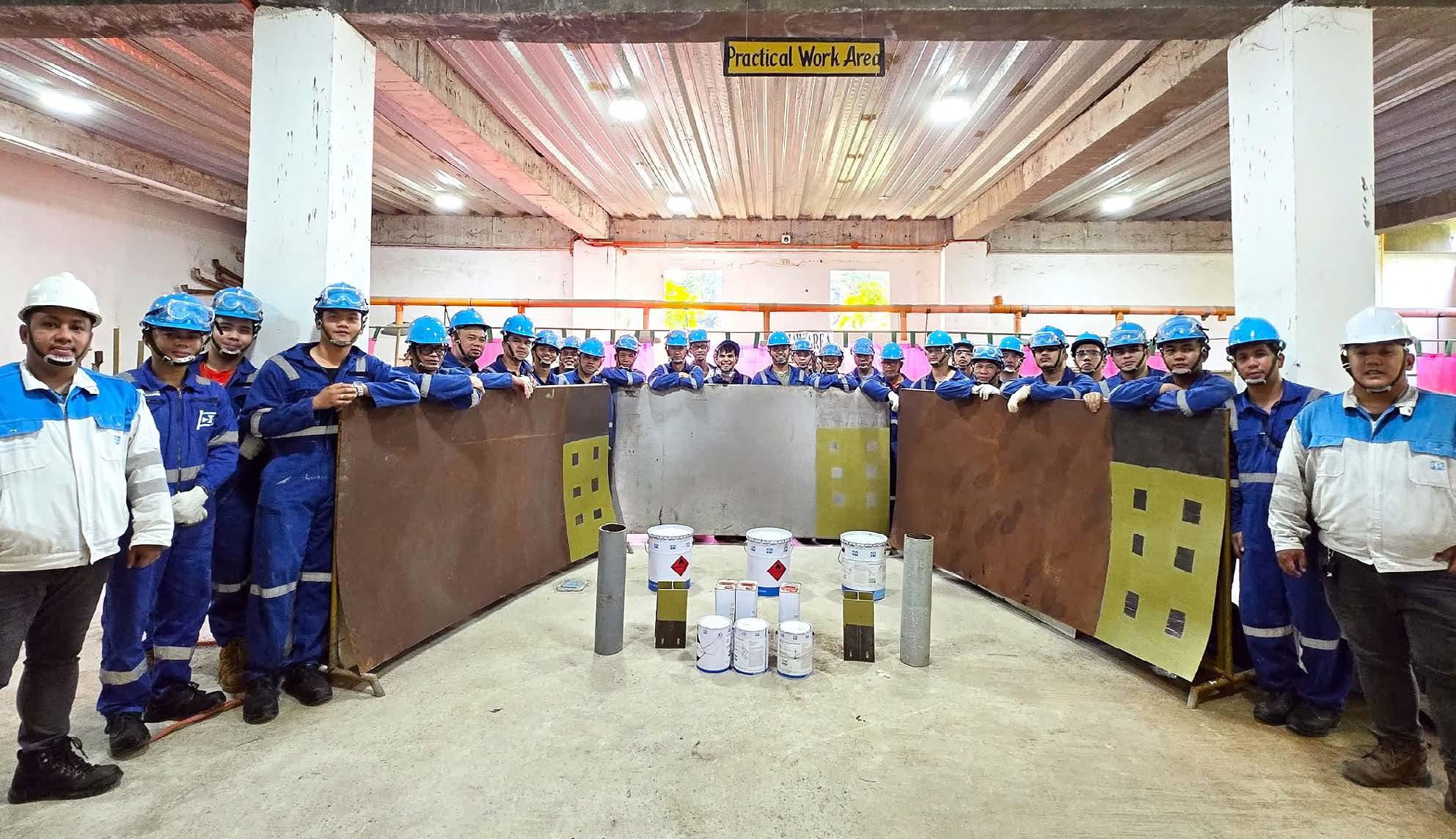
Looking specifically at PPG’s Seastock Training programme, which is conducted globally, these tailored on-site sessions address the real-world needs of marine crews to offer both theoretical instruction and hands-on practice using the actual products and tools employed onboard.
The training modules cover essential topics such as:
• Fundamentals of corrosion and protection
• Correct surface preparation techniques
• Correct mixing and application of coatings (single and two-component systems)
• Correct paint application techniques
• Identification and rectification of coating defects
• Maintenance strategies for prolonged lifecycle performance.
This curriculum, based on customer input, takes into account vessel types, crew experience, operational conditions and regional logistics. Training formats range from one-hour seminars to three-day workshops, depending on the customer crew’s availability and needs.
Hands-on learning in local contexts
Crew demographics shape where training programmes take root. Sessions often take place in countries with a strong maritime labour presence, such as the Philippines, Indonesia, Turkey, China and Romania. For example, the trainings hosted in Manila, Philippines, stand out for their consistency, with monthly programmes aligned with officer conferences and pre-deployment rotations. Training in Manila includes both senior officers and junior crew, from seamen and bosuns to chief mates and superintendents. This broad inclusion fosters shared standards and clearer communication across ranks.
Shipowners may request in-country sessions for crews based elsewhere, such as in Europe or the Middle East. In these cases, the customer provides the facility and equipment, while trainers supply the coatings and conduct the sessions using materials that crews will handle onboard. This practical, locationbased approach ensures relevance and real-world alignment.
Overall, hands-on components deliver the greatest value. Crews use the same coatings, tools and equipment they’ll handle onboard. They learn to prepare surfaces, mix materials and apply coatings correctly, all under expert guidance. This hands-on practice bridges the gap between instruction and execution.
How crews apply what they learn
Well-trained crews bring sharper awareness and better decision-making to day-to-day maintenance. They know when surfaces need more preparation, ask questions instead of guessing and provide accurate reports. These habits reduce errors, minimise waste and improve collaboration with their technical teams.
Crews spend less time on preventable fixes and more on proactive strategies that support long-term coating performance. Shipowners report smoother inspections, clearer documentation and more efficient maintenance cycles as a result.
It also supports the future of the workforce. As Gen Z enters the maritime industry, they bring different expectations, prioritising value-driven
roles, mental wellbeing and career growth over short-term perks. Handson Seastock Training builds real-world competence while sending a strong signal: the value of skilled maintenance roles to support vessel performance. This clarity helps bridge generational expectations and reinforces long-term fleet readiness.
The business case for Seastock Training
The business case for Seastock Training proves strong. When well-trained crews maintain coatings while at sea, they reduce rework, extend maintenance intervals and preserve coating integrity, translating directly into cost savings. Proactive onboard maintenance lowers the risk of failures and avoids costly emergency repairs or premature drydockings. Industry data shows that such programmes can cut emergency repair costs by 20-30%. Across a fleet, even modest gains can deliver substantial annual savings. Ship Universe data also shows that companies that invest in technical training see 20-30% fewer operational errors and 10-15% longer component lifespans.
Consider the experience of CPO Crewing GmbH & Co. KG, a German
crew management company based in Hamburg. It’s part of the Offen Group, a well-established shipowner and manager operating a container fleet of more than 50 vessels and specialising in providing qualified seafarers for its ships and third-party vessels. Since partnering with PPG in 2018, the company’s crews have undergone regular Seastock Training. According to feedback, the programme has led to improved technical proficiency, smoother onboard maintenance, extended coating durability, and ultimately, more reliable fleet performance.
“This training has enhanced our crew’s confidence and technical proficiency, allowing them to take ownership of vessel maintenance with greater efficiency and accuracy,” reported CPO Crewing GmbH & Co KG. “As a direct result, we have witnessed smoother maintenance operations, improved vessel appearance, and extended coating durability, all of which contribute to operational reliability and cost savings for our company.”
Another example includes a Germanbased shipping company and ship management provider, which hosts monthly training. These sessions, lasting up to three days, provide indepth education on surface preparation and coating application, as well as exploring the identification and correction of defects. The result – the company reports improved coating integrity, fewer in-service failures and a higher standard of onboard maintenance.
Creating a culture of continuous improvement
Seastock Training programmes must stay current, with modules regularly updated to reflect new products, application methods, technologies and industry regulations. Regular refreshers, delivered quarterly or biannually, help crews maintain sharp skills and stay aligned with best practices.
Hybrid models that blend in-person instruction with digital tools have become increasingly effective. While hands-on sessions remain critical for
practical application, online modules, video walkthroughs and virtual demonstrations enable fleets to train dispersed crews without logistical strain. Digital learning can also complement the use of digital maintenance tools. For example, PPG’s Sigmacare Plus tool simplifies coatings management onboard by helping crews track inventory, choose the right products, place orders, and follow step-by-step maintenance guidance. In real-world use, this platform has helped fleets streamline operations, reduce mistakes and maintain higher standards of onboard performance.
Charting what’s ahead
Seastock Training ultimately delivers far more than technical know-how. Hands-on learning opportunities provide practical education for crews, adapting to the realities of time, space and rotation schedules. By adapting to crew feedback, these programmes enable continuous improvement that strengthens fleet reliability and vessel performance. The result is less waste, more efficient use of coatings and significant cost savings through reduced rework and extended maintenance cycles. Together, these advantages ensure that training is not simply an operational necessity but a strategic tool for long-term sustainability and fleet readiness.
Strong Seastock programmes empower crews to protect vessels from the inside out, ensuring that every layer applied at sea performs to its full potential. In today’s environment, the quality of the marine coatings depends as much on the product as on the people applying it, and training closes that gap.
Ewout Bosman is PPG Global Segment Director for Marine Seastock, Protective and Marine Coatings, where he leads international initiatives focused on sustainable maintenance strategies for the maritime industry. With almost two decades of experience in the coatings industry, Bosman brings deep expertise in segment strategy, product and portfolio management, and innovation across global markets.
THIS TRAINING HAS ENHANCED OUR CREW’S CONFIDENCE AND TECHNICAL PROFICIENCY, ALLOWING THEM TO TAKE OWNERSHIP OF VESSEL MAINTENANCE WITH GREATER EFFICIENCY AND ACCURACY.
Maritime sustainability gains pace
Vessel owners continue to embrace new technology in their pursuit of net zero.
GCMD’s Project LOTUS was Launched in partnership with NYK Line in May 2024
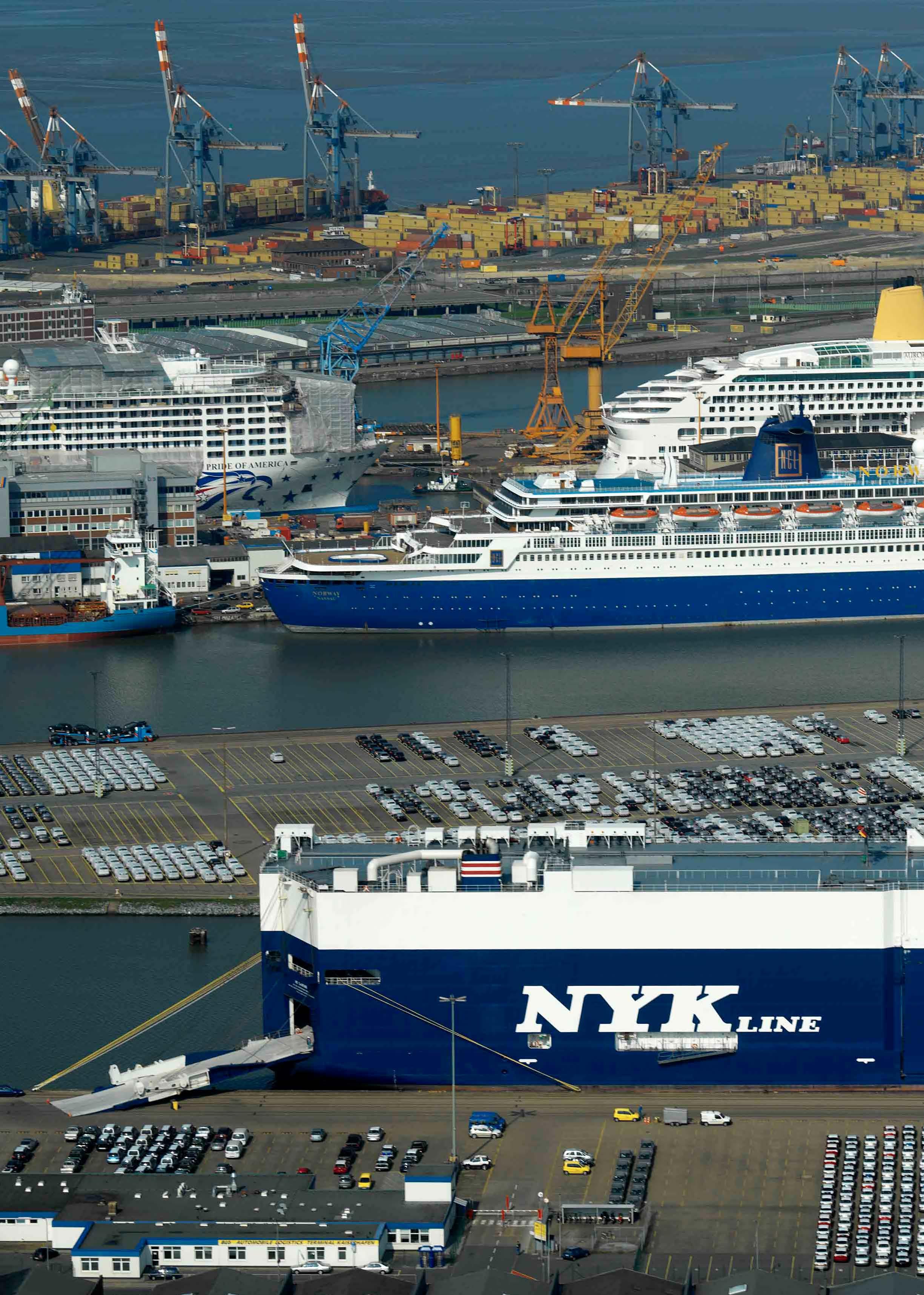
The Global Centre for Maritime Decarbonisation (GCMD) has released its Project LOTUS (Long-term impact of continuous use of biofuels on vessel operations) report. Launched in partnership with NYK Line on 9 May 2024, the six-month trial on board a pure car and truck carrier (PCTC) assessed the impact of continuous use of a B24 blend, comprising 24% fatty acid methyl ester (FAME; also known as biodiesel) with very low sulfur fuel oil (VLSFO), on engine performance and operations of the fuel oil delivery systems.
Closing the gap
Until now, the impacts of long-term use of biodiesel on main and generator engines, fuel storage and supply systems and other shipboard components have not been comprehensively evaluated. Additionally, operational protocols for fuel conditioning, onboard storage and comprehensive inspection checklists remain limited.
Project LOTUS addresses this gap directly by implementing a structured monitoring approach to track fuel and lubricant quality at key sampling points across these
systems, and inspect engine and fuel system components throughout the trial.
This work is especially pertinent following the International Maritime Organization (IMO)’s approval of its netzero framework, positioning biofuels as an increasingly valuable near-term decarbonisation measure. Shipowners can increase the biofuel content of their blends to reduce penalties under escalating Greenhouse Gas Fuel Intensity (GFI) targets, meet compliance requirements, or generate ‘surplus units’ for trading or future use.
Extensive testing under actual operating conditions
Project LOTUS involved extensive laboratory testing of 94 fuel and 91 lubricating oil samples, alongside detailed engine inspections and measurements during the vessel’s scheduled post-trial drydock.
The main and generator engines, which ran on B24 for 2,888 and 1,813 hours respectively, performed comparably to when they operated on VLSFO. Key observations confirmed no excessive sludge in fuel injection valves, no scratches in fuel injection pump plungers, and no liner or piston wear beyond original equipment manufacturer (OEM) specifications. Scavenge drain and engine oil analyses also showed no excessive wear elements.
While the acid value of B24 blends increased 2.5-fold after six months of storage, the fuel quality remained within ISO 8217 specifications. No microbial growth was observed in fuel samples.
With these findings, OEMs confirmed engine and hardware compatibility with long-term B24 use, with no significant impact on operational costs, provided appropriate maintenance and handling practices are followed.
Actual operational practices with biodiesel
To complement the pilot, GCMD surveyed other vessel operators using biodiesel to compare their onboard practices with guidelines issued by marine classification societies and OEMs.
The interviews indicate that while OEMs and classification societies take an abundance-of-caution stance, the vessel operators surveyed have adopted a more pragmatic, risk-based strategy to adopting biodiesel blends by adapting existing standard operating procedures for VLSFO with recommended technical guidance where practicable. This suggests that when operators carry out appropriate operations in line with such guidance, biodiesel use does not present major issues.
PROJECT LOTUS INVOLVED EXTENSIVE LABORATORY TESTING OF 94 FUEL AND 91 LUBRICATING OIL SAMPLES, ALONGSIDE DETAILED ENGINE INSPECTIONS AND MEASUREMENTS DURING THE VESSEL’S SCHEDULED POST-TRIAL DRYDOCK.
As biofuels adoption becomes increasingly pervasive, ship operators, OEMs and classification societies will need to align on how and to what extent technical guidance should be applied to balance robust safety standards with operational realities.
A framework to support shipboard biodiesel monitoring
A key outcome of Project LOTUS is the development of a structured monitoring framework designed around operational considerations for biodiesel use to systematically track equipment performance and identify anomalies arising from biodiesel operations.
A data log template was created based on an existing engine log and tailored to address the project’s specific needs. Now that this template has been successfully piloted, it is publicly available and can be further customised to accommodate different vessel setups.
“Project LOTUS grounds the conversation around the extended use of biofuels in evidence,” explains Professor Lynn Loo, CEO of GCMD. “Our findings show that they can be deployed safely and reliably, providing a concrete pathway for shipping’s decarbonisation.
“The use of biofuels is one of the key options for advancing the sustainable development of the maritime industry,” says Nobuhiro Kashima, Senior Managing Executive Officer of NYK Line. “We hope that the outcomes of this project will offer new possibilities to those considering the adoption of biofuels and help accelerate their broader use in various fields. By sharing the value of decarbonisation and logistics across society, we aim to help shape the next generation of shipping together.”
WIND-ASSISTED UPDATE
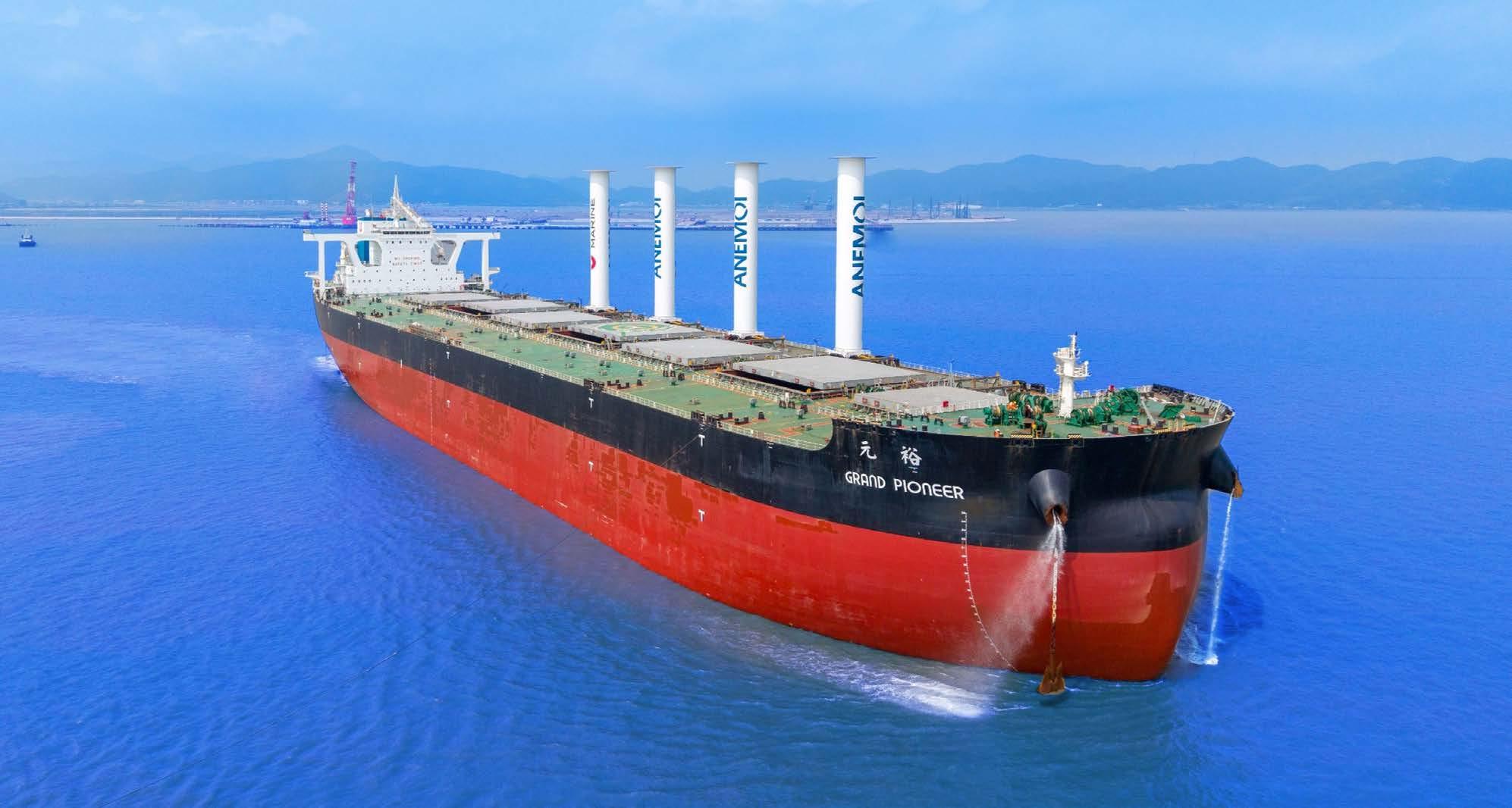
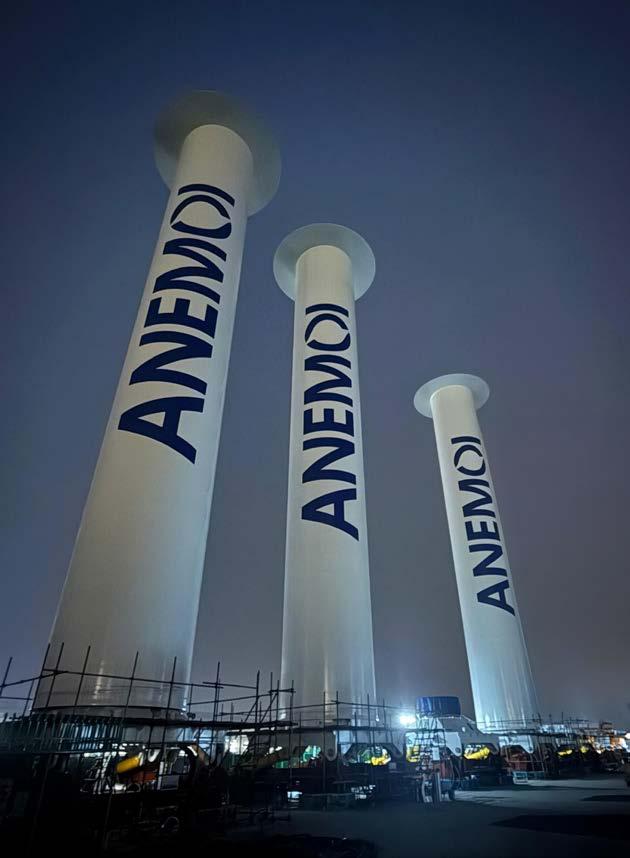
U-Ming Marine Transport Corporation (U-Ming) and leading wind propulsion technology provider Anemoi Marine Technologies (Anemoi) have successfully completed the installation of the Rotor Sails on U-Ming’s Grand Pioneer, a 325,000dwt Very Large Ore Carrier (VLOC).
U-Ming is the first Taiwanese shipowner to adopt Rotor Sails, marking a major milestone in the company’s decarbonisation strategy and underlining its role as a first mover in deploying innovative clean technologies.
The four 35m-tall, 5m-diameter folding (tilting) Rotor Sails were delivered fully assembled and dynamically balanced from Anemoi’s production base on
Anemoi has successfully completed the installation of Rotor Sails on U-Ming’s Grand Pioneer
TAKE A TOUR
SHIP REPAIR & DECARBONISATION SOLUTIONS
Tallinn
Klaipeda
Naantali
the Yangtze River and transported by barge to COSCO Zhoushan shipyard. In a streamlined plug-and-play process unique to Anemoi, the sails were lifted directly onto the deck and secured in place. This method significantly reduces the shipyard’s scope of work and keeps installation time short. For this installation, it took only 1.5 days to lift and fix the Rotor Sails in position on board, with a further five days for commissioning and testing all four Rotor Sails and folding systems once the shipyard had completed their works during the vessel’s scheduled drydock in September.
Anemoi’s specialist team was present throughout the process, overseeing the installation, and will sail on the vessel’s maiden voyage from Zhoushan to Singapore, with the Rotor Sails deployed and operational. This is to ensure crew training and operational handover will be completed smoothly, equipping U-Ming’s seafarers with the skills and confidence to operate the technology from day one.
wind propulsion as a critical pathway to lower emission shipping, and we look forward to analysing the performance data from upcoming voyages.”
Following completion of the installation, Grand Pioneer will resume deep-sea service between Brazil and China under a long-term charter with Brazilian mining company Vale. The vessel is projected to achieve annual fuel and emissions reductions of approximately 10-12% on average.
This milestone underscores the importance of industry collaboration in driving meaningful change. By taking decisive action as a first mover, U-Ming is reinforcing its decarbonisation strategy while setting an important example for the global shipping community, demonstrating how innovative partnerships and proven technologies like Rotor Sails can accelerate the sector’s transition towards a net-zero future.
PROJECT FUNDING WIN
U-MING’S COLLABORATION WITH FORWARDTHINKING PARTNER ANEMOI IS TURNING STRATEGY INTO ACTION BY REDUCING EMISSIONS, ENHANCING EFFICIENCY, AND DELIVERING LONG-TERM VALUE.
“The installation of Rotor Sails on Grand Pioneer marks an important step in U-Ming’s decarbonisation journey and reflects our belief that the future of global shipping must be both sustainable and competitive,” explains Jeff Hsu, Vice Chairman of U-Ming. “Through the collaboration with our forward-thinking partner Anemoi, we are turning strategy into action by reducing emissions, enhancing efficiency, and delivering long-term value. This initiative also demonstrates our commitment to innovation and our contribution to the industry’s shared ambition of achieving net zero by 2050.”
“We are proud to have delivered another successful Rotor Sail installation, providing fully assembled technology that minimises time in the yard and maximises value for our customers,” says Clare Urmston, CEO of Anemoi. “U-Ming’s decision to adopt Rotor Sails, particularly as the first in the Taiwanese market to do so, demonstrates their strength, ambition and clear focus on decarbonisation. Our collaboration reflects the growing momentum behind
Anemoi Marine Technologies has also recently won funding under the sixth round of the UK Clean Maritime Demonstration Competition (CMDC). The £1.2 million project will include the development of a nextgeneration folding sail system tailored to Kamsarmax and Panamax bulk carriers, as well as aerodynamic design enhancements that will significantly increase fuel savings.
The competition has so far directed £136 million in government funding to engineering innovators developing cutting-edge maritime decarbonisation solutions, with the aim of driving growth for coastal communities and cementing the UK’s position as a clean energy leader. The CMDC funding gives Anemoi the opportunity to further strengthen its technology leadership in the rapidlygrowing wind-assisted propulsion sector.
“This funding will support Anemoi in advancing the next generation of Rotor Sail technology,” says Anemoi CEO Clare Urmston. “While our Rotor Sails are already efficient and high-performing, ongoing innovation is essential to
Anemoi has recently won funding for the development of a next-generation folding sail system
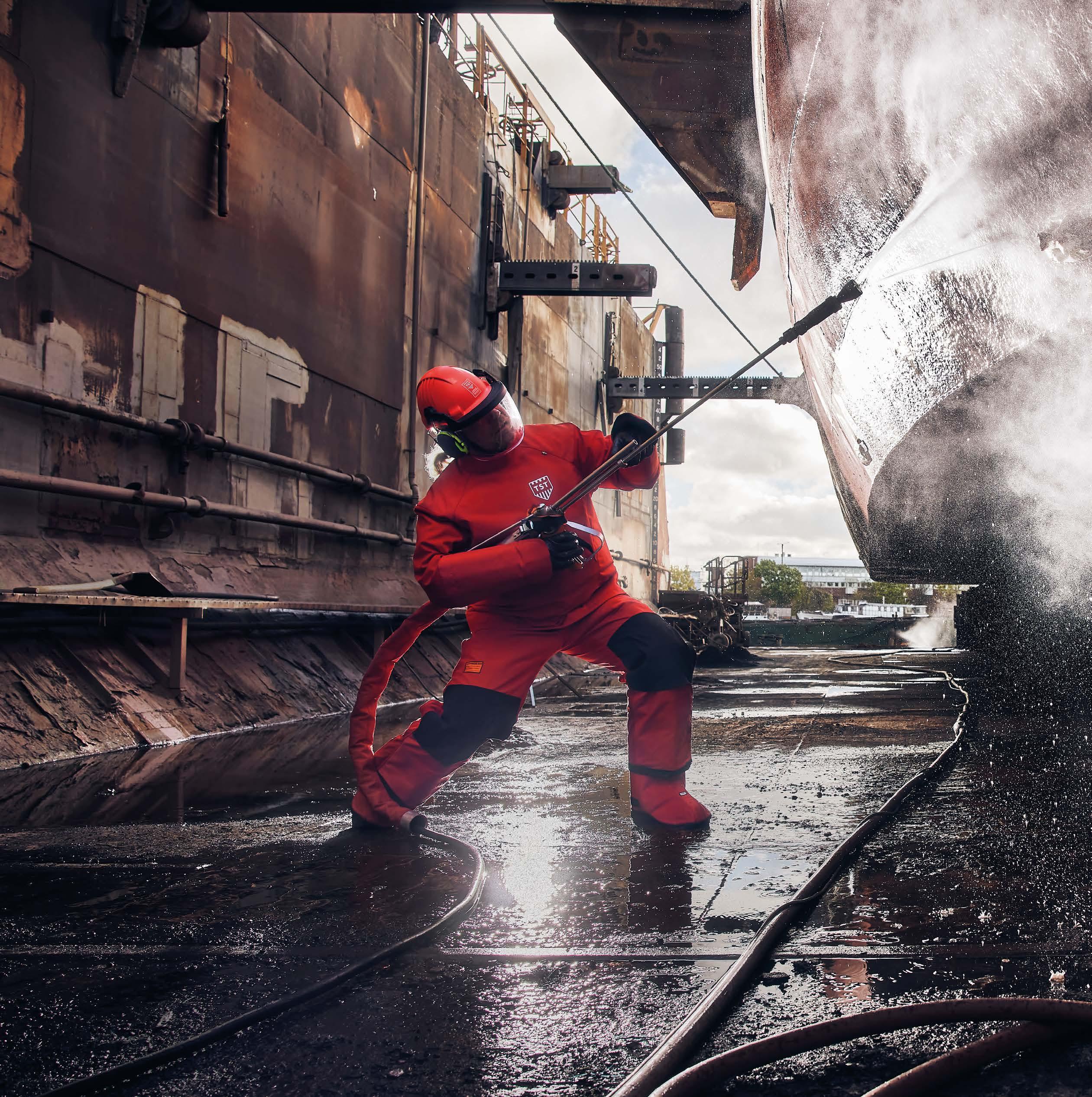
Protect your head, face, and hearing.
Maintain a good grip while keeping your hands protected.
Gloves 500 bar
Move,
Stay mobile and comfortable thanks to flexible protection and advanced design.
Jacket, 3 000 bar
Trousers,
Remember to protect your feet – accidents often strike there.
3 000 bar
SAFE FROM HEAD TO TOE
Gaiters,
unlock further efficiency gains, adapt to evolving vessel designs, and meet increasingly ambitious environmental targets. This investment underscores Anemoi’s potential to support the UK in sustainable shipping as the maritime industry works to cut emissions.”
Under the seven-month project, Anemoi will design, build and test a prototype of a new folding system for its 3.5m Rotor Sail. The result will be an industry first for Rotor Sails of this size, as folding systems have previously only been used on larger 5m sails. By allowing sails to be lowered during port operations, the design will significantly reduce operational obstacles to the uptake of wind-assisted propulsion. Operational seamlessness is a core element of Anemoi’s offering, as the company also offers a unique rail deployment system, which allows the Rotor Sails to move along the deck of the ship.
In addition to the folding system development, the project will cover extra
design optimisations that are expected to improve the aerodynamic performance of wind-assisted vessels, delivering increased fuel savings and emissions reductions compared to Anemoi’s current state-of-the-art Rotor Sails.
The test rig will be manufactured by UK company Pressure Design Hydraulics Engineers, with aerodynamic enhancements developed in partnership with Cape Horn Engineering, supported by Stehr Consulting. Victoria Steamship, a UK-based shipbroker, will contribute insights based on its fleet of nine vessels operating globally in the bulk carrier segment, a primary market for folding Rotor Sails. The UK innovation accelerator Connected Places Catapult will conduct market research and a port and vessel integration study.
REPEAT WIND ORDER
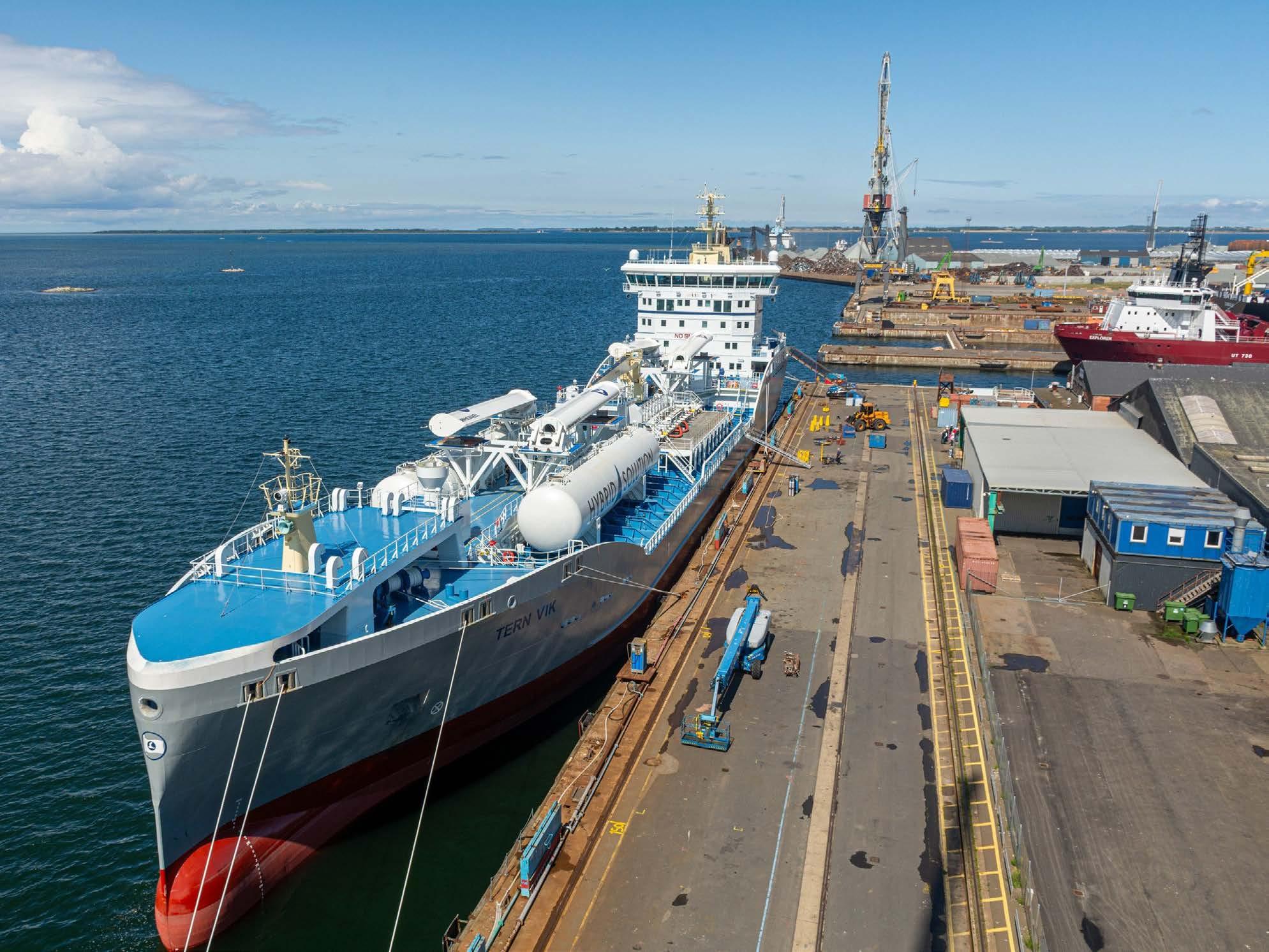
Econowind has received a repeat order from Terntank for the installation of eight VentoFoil units on two additional
Econowind has received a repeat order from Terntank for the installation of eight VentoFoil units on two additional methanol-ready hybrid tankers
methanol-ready hybrid tankers. Following the initial order in May 2023 for three newbuilds, this brings the total to five vessels and 20 VentoFoils, with each ship fitted with four 16m wind wings.
The first vessel, Tern Vik, was delivered in April 2025 by China Merchants Jinling Shipyard (Yangzhou). The entire series is equipped with Kongsberg’s advanced energy and propulsion management system. Under the K-Sail concept, wind can take the lead when conditions are favourable. Combined with battery packs and dual-fuel engines capable of running on methanol or diesel, the vessels are designed for zero-emission operations and fully aligned with the IMO 2050 targets.
Terntank operates in the Nordic region and focuses on the transport of sustainable fuels. Its newbuilds are among the most environmentally advanced in the market. Wind-assisted ship propulsion is a key element of the design. The VentoFoils are lightweight,
foldable for safe and efficient port operations, and fully ATEX-certified to meet tanker safety requirements.
“At Terntank, we are always looking for ways to reduce fuel consumption. It’s part of our DNA,” said Claes Möller, CEO of Terntank. “The installation of the VentoFoils and their integration with the Kongsberg system went seamlessly. It’s great to see that the actual fuel savings match what was predicted. We’re very pleased with the results.”
This repeat order follows strong performance results from the first installations, demonstrating the contribution of wind-assisted ship propulsion to fuel savings and emission reductions. Terntank’s confidence in VentoFoil technology is also a signal to the broader market that wind propulsion is no longer a future concept, but a working solution available today.
Econowind’s engineering team has worked closely with Terntank and Kongsberg to ensure seamless
FUEL CELLS POWERED BY HYDROGEN OR AMMONIA ARE VIEWED AS OPTIONS FOR
integration of the VentoFoils into the vessel’s overall energy system. The collaborative approach allows real-time optimisation of power sources, where wind, batteries and fuel-based engines work together to minimise emissions and maximise efficiency.
“We are proud to continue our collaboration with Terntank and support their leadership in sustainable shipping,” said Chiel de Leeuw, CCO of Econowind. “This repeat order confirms the performance of our VentoFoils and the shared ambition to decarbonize maritime transport.” With this latest order, Econowind has now sold over 130 VentoFoil units. These are being deployed across a wide range of vessel types, including dry bulk carriers, tankers, RoRo and containerships, reflecting growing momentum for wind-assisted ship propulsion across the industry.
NEW FUEL CELL INTEGRATION GUIDANCE
Lloyd’s Register (LR) has released updated guidance for the installation of fuel cells on ships, offering shipowners and shipbuilders a comprehensive framework to support the safe deployment of alternative power systems.
The July 2025 edition of Guidance Notes on the Installation of Fuel Cells on Ships incorporates recent regulatory updates and technical developments related to fuel cell technology in the maritime sector.
Fuel cells powered by hydrogen or ammonia are viewed as options for achieving zero or near net-zero tank-towake emissions. LR’s updated guidance corresponds to the 2024 Rule changes for fuel cell installations and presents revised safety concepts for onboard integration.
The guidance introduces two safety concepts for fuel cell spaces: emergency shutdown-protected fuel cell spaces and gas-safe fuel cell spaces. The gas-safe fuel cell space concept enables installation of fuel cell power
systems within conventional machinery spaces and simplifies retrofitting, while ensuring compliance with fire protection, explosion prevention and hazardous zone requirements.
The document also addresses lifecycle considerations such as degradation, maintenance and end-of-life performance, as well as operational topics such as power conditioning, thermal management and inert gas purging. Specific recommendations are provided for installation locations, access and environmental resilience.
The updated guidance highlights the importance of risk assessments tailored to each installation, considering hazards including fire, explosion, toxicity and electric shock.
“This new guidance is intended to provide detailed information for supporting the safe integration and reliable operation of fuel cell technologies on board ships,” says Thomas Bayer, Lead Specialist Fuel Cell Technology, Lloyd’s Register.
“By meticulously detailing the framework for safe integration and operation of fuel cell technologies, we are not just providing guidance for understanding and implementing of LR rules; we are fostering innovation and building confidence in the next generation of propulsion systems.”
A COMPREHENSIVE BATTERY RETROFIT
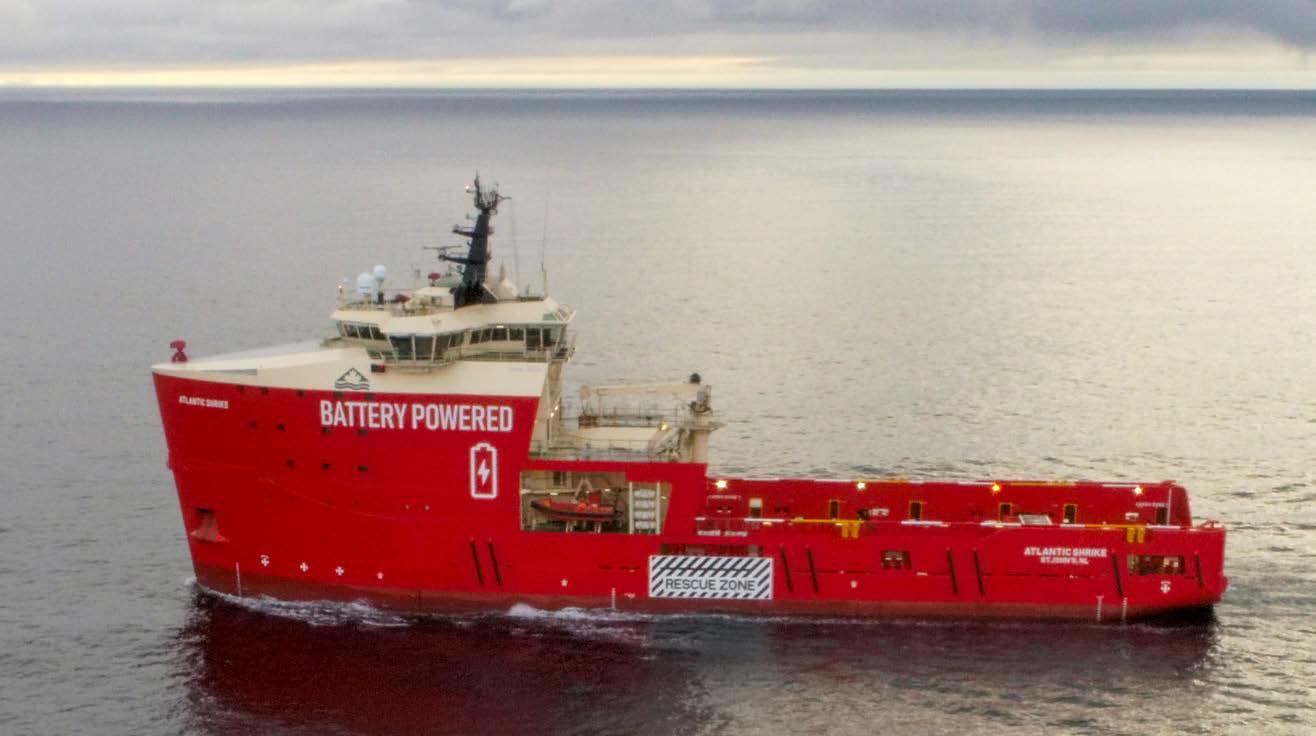
Atlantic Towing Ltd has achieved a major milestone in its decarbonisation journey with the successful retrofit of its diesel-electric platform supply vessel (PSV) Atlantic Shrike. Equipped with Vard Electro’s SeaQ Energy Storage System, the vessel has recorded an 11% fuel saving across all operations and substantial CO2 savings.
Atlantic Shrike is a 4,200dwt PSV built in 2017, measuring 85.6m in length with a beam of 22m. It operates primarily on the Grand Banks, off the coast of Newfoundland and Labrador.
As the maritime industry faces mounting pressure to reduce greenhouse gas emissions and
enhance fuel efficiency, vessel owners are seeking innovative solutions to modernise their fleets. In 2021, Atlantic Towing, a subsidiary of J.D. Irving Ltd, embarked on a mission to upgrade the Atlantic Shrike, aiming to meet the environmental requirements without compromising operational reliability.
In close collaboration with Vard Electro, a subsidiary of the Fincantieriowned Vard Group, Atlantic Towing implemented a comprehensive battery retrofit that has not only ensured compliance with evolving emissions regulations but also delivered significant measurable improvements in fuel savings and operational efficiency.
Enhancing efficiency whilst staying operational
Operating in demanding offshore conditions, the Atlantic Shrike required a retrofit solution capable of enduring extreme conditions while enhancing energy efficiency. The goal was to reduce greenhouse gas emissions, cut fuel consumption and improve onboard conditions, all without disrupting vessel availability.
Additionally, during low-load operations such as harbour manoeuvres, transit and docking, battery systems offer significant advantages. They can supply transient loads, reduce the need for multiple generators running at inefficient low loads, and provide immediate power response, leading to improved fuel efficiency, reduced emissions and enhanced crew comfort due to lower noise and vibration levels.
SeaQ retrofit package
Vard Electro delivered a complete retrofit package of the SeaQ Energy Storage System (ESS), purpose-built for seamless integration with the vessel’s existing power and automation systems. As both equipment supplier and system integrator, Vard Electro ensured the battery system was fully aligned with the vessel’s propulsion and control architecture.
The entire installation was carried out in close collaboration with the customer and aligned with Atlantic Shrike’s planned docking periods, minimising operational impact. Vard Electro’s local service team in Canada led the project execution, ensuring a smooth process from planning to commissioning.
To secure long-term results, SeaQ training was provided to the crew, ensuring they understood how to operate the system for maximum battery efficiency and system longevity.
“This project demonstrates how we, as a system integrator, bring together technical insight and operational understanding to create tailored retrofit solutions,” says Francisco Lima, VP Retrofit and Service at Vard Electro.
“By designing a SeaQ ESS setup that matched Atlantic Shrike’s operational profile, we ensured real-world impact. Open and continuous communication with the customer was a key success factor from start to finish.”
Strong performance results
Following the installation of the SeaQ Energy Storage System, Atlantic Shrike
Atlantic Shrike has had a comprehensive battery retrofit
Dan Vyselaar, Director of Engineering & Asset Management in Atlantic Towing
Francisco Lima, VP Retrofit and Service in Vard Electro
has delivered strong and measurable results.
• 11% fuel savings across all operations
• 362 tonnes of CO₂ reductions in 2024, verified by operational data
• Reduced engine noise, improving crew comfort
• Lower engine running hours, extending maintenance intervals and enhancing working conditions in the engine room.
These outcomes highlight how a well-executed battery retrofit can deliver both operational efficiency and improved onboard conditions.
This successful collaboration has strengthened the partnership with Atlantic Towing, which now relies on Vard Electro for a larger share of its aftermarket services – a direct result of the value it experienced on this project.
“The competence and collaboration shown by the Vard Electro team was impressive. They understood our operational needs and delivered a solution that works – both technically and commercially,” says Dan Vyselaar, Director of Engineering & Asset Management at Atlantic Towing.
More than a supplier
This case illustrates how Vard Electro acts as a total service supplier, offering much more than components. From
early dialogue and engineering, to integration, training and lifecycle support, Vard Electro delivers complete solutions tailored to the vessel’s operational profile in close collaboration with the customer. “Our cross-functional competence, built through decades of experience, ensures that shipowners get the support they need – when and where they need it,” says Lima.
METHANOL RETROFIT SOLUTION
Meyer RE has established a strategic partnership with Everllence to advance methanol retrofit solutions in the maritime industry. This partnership marks a significant step towards reducing the sector’s carbon footprint while ensuring operational efficiency and compliance with stringent environmental regulations.
The collaboration focuses on the retrofitting of existing Everllence fourstroke engines and vessels, providing a practical and scalable solution for shipping companies transitioning towards greener fuel alternatives. By leveraging the combined expertise of both companies, this initiative aims to set new industry standards for sustainable maritime operations.
“By concluding this Partnership Frame Agreement, we are laying the foundations for strong, trusting, and sustainable cooperation – a joint path to and for a greener future,” says Bernd Siebert, Head of Retrofit & Upgrade at Everllence.
“With our methanol retrofit packages, we offer our customers an economically attractive opportunity to convert their older engines to a future-proof engine type. Together with Meyer RE, we will now develop a holistic concept for retrofitting the entire ship system.”
“The challenges for cruiseships are substantial,” explains Henning Jongebloed, Head of Sales at Meyer RE. “Retrofitting cruise vessels is a relatively new concept, as these ships function like small cities with complex subsystems. A holistic approach is necessary – changing an engine or fuel
alone is not enough. That’s why teaming up with experienced partners is crucial to ensuring that the entire system functions seamlessly, including energy production.”
The partnership aims to develop a comprehensive roadmap outlining the technical and operational steps required for the transition to methanol as a primary fuel source. This includes vessel retrofitting, infrastructure development for methanol fuelling, and the establishment of industry-wide safety standards and best practices.
By working together, Meyer RE and Everllence are providing the shipping industry with a clear strategy for sustainable transformation, reinforcing their commitment to innovation and environmental responsibility.
BATTERY POWER EXTENSION
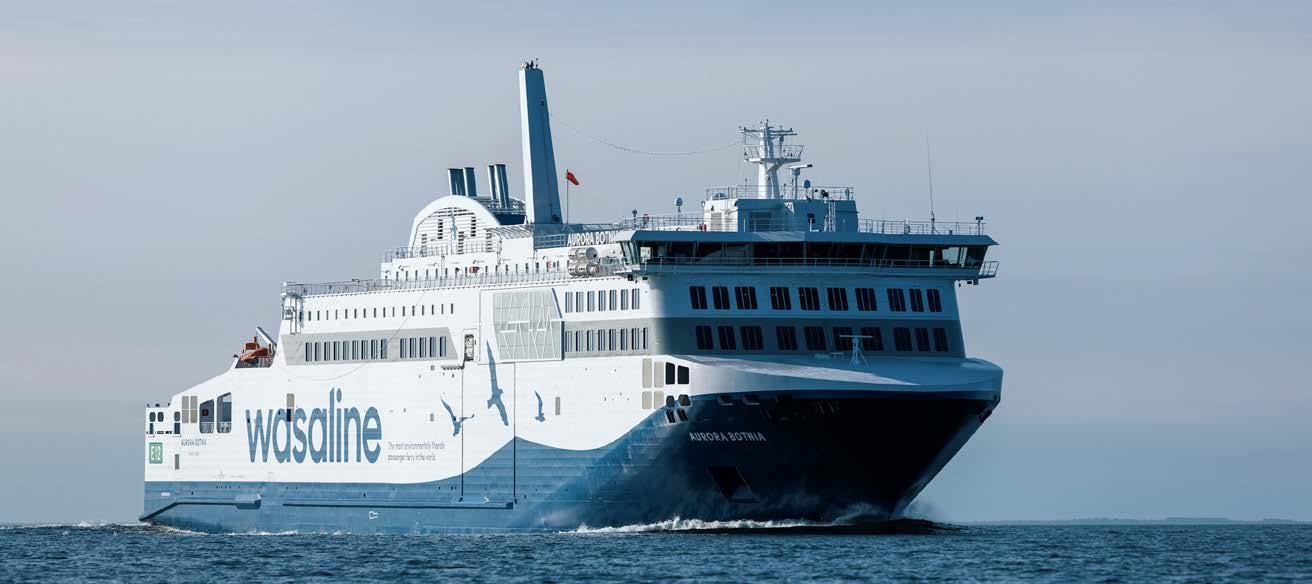
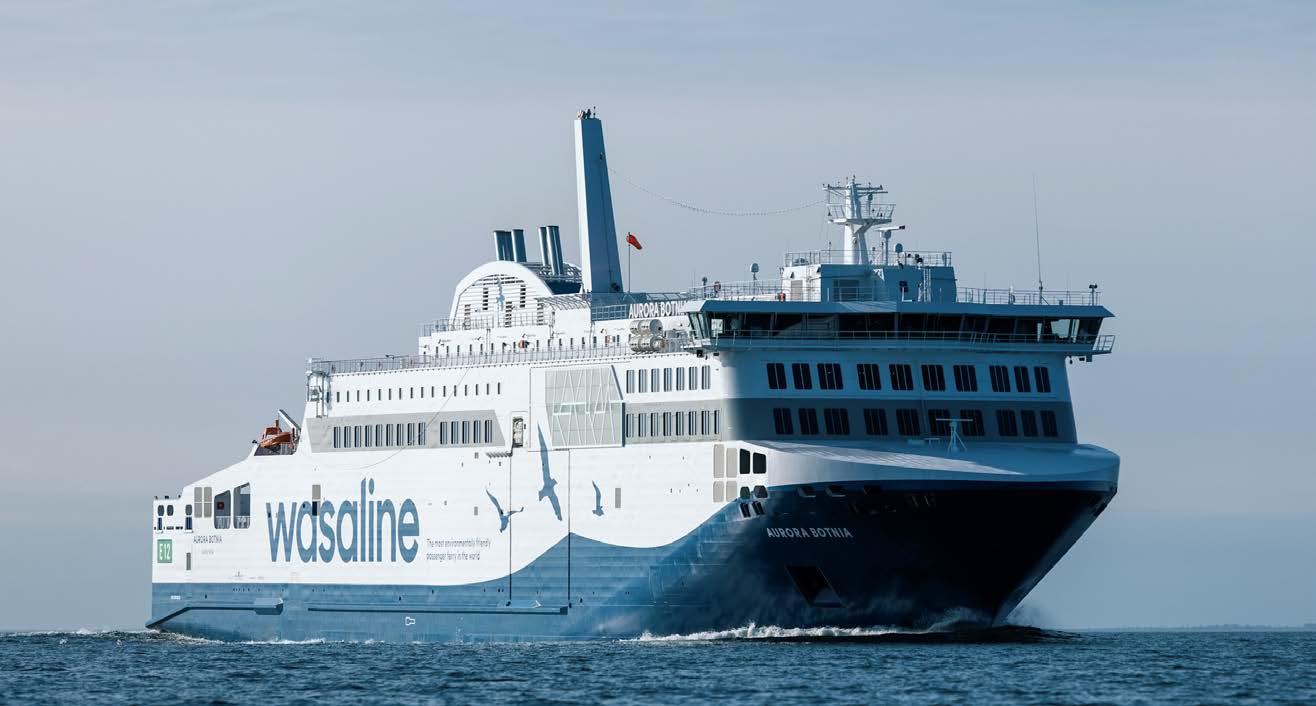
Wärtsilä has been selected as the electrical integrator for a major battery extension project for the Wasaline RoPax ferry Aurora Botnia. The project will increase the ship’s battery capacity by 10.4 MWh, from 2.2 MWh to 12.6 MWh, making it the world’s largest marine battery hybrid system in operation. The order with Wärtsilä was booked in Q3 2025.
In the transition to more sustainable ferry transportation, hybrid propulsion systems have emerged as a compelling solution, offering a multitude of pathways to reduce greenhouse gas (GHG) emissions. These systems, which combine energy storage capabilities with conventional engines, can significantly cut fuel consumption and, consequently, emissions.
The Aurora Botnia is equipped with dualfuel engines and batteries and uses biogas and batteries for propulsion. Expanding its battery capacity is a major step in making the ship even more sustainable. Wärtsilä will lead the integration project and as a result, the battery capacity of the ferry will be extended by 10.4MWh. Wärtsilä will also deliver the Energy Management System, as well as upgrading the
power drives and the control system integration. The system is scheduled to be commissioned in early 2026.
“Wasaline’s commitment to decarbonised shipping operations is central to everything we do,” says Peter Ståhlberg, Managing Director –Wasaline. “In this, our close cooperation with Wärtsilä is an essential element that benefits not only both our companies, and we can see that our cooperation sets standards for the whole marine sector. Through our continued collaboration, the ‘Aurora Botnia’ has become a working example of what is possible when it comes to delivering environmentally friendly transportation within shipping.”
This latest project will strengthen the existing collaboration agreement between Wärtsilä and Wasaline, with the Aurora Botnia acting as a floating test lab linked to Wärtsilä’s Sustainable Technology Hub. It allows further development of hybrid technologies to optimise fuel efficiency and minimise exhaust emissions. As a result, the vessel is one of the most environmentally sustainable ferries in the world, already operating carbonneutrally today.
“Wasaline once again demonstrates its strong commitment to decarbonisation by extending the electrification capacity of this ferry,” comments Roger Holm, President of Wärtsilä Marine & Executive Vice President at Wärtsilä Corporation. “Our latest contribution will optimise the ship’s operations even further, creating fuel savings and a significant reduction in emissions.”
WASALINE’S COMMITMENT TO DECARBONISED SHIPPING OPERATIONS IS CENTRAL TO EVERYTHING WE DO.
Wärtsilä
has been selected as the electrical integrator on the Aurora Botnia
Spotlight on the
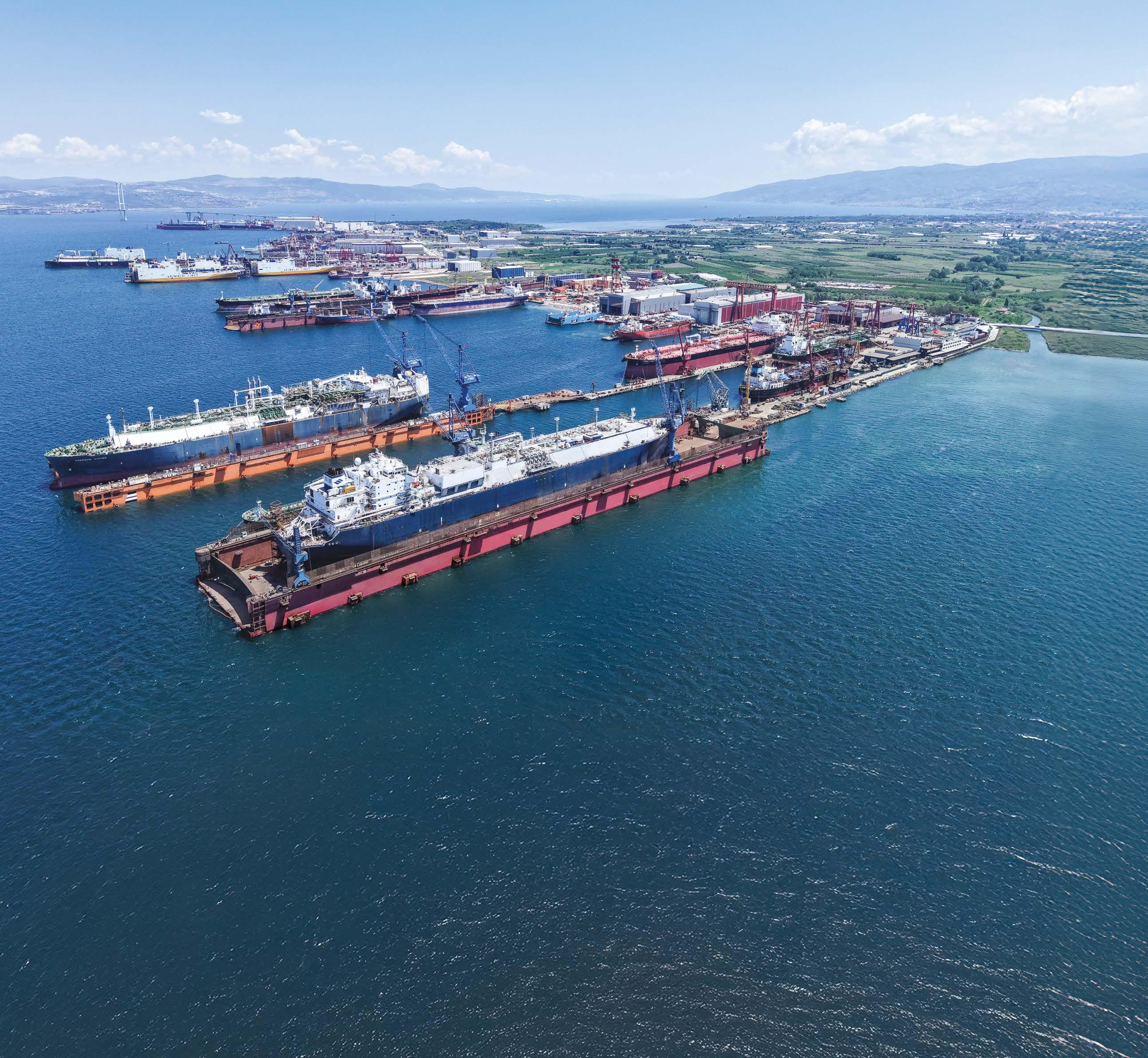
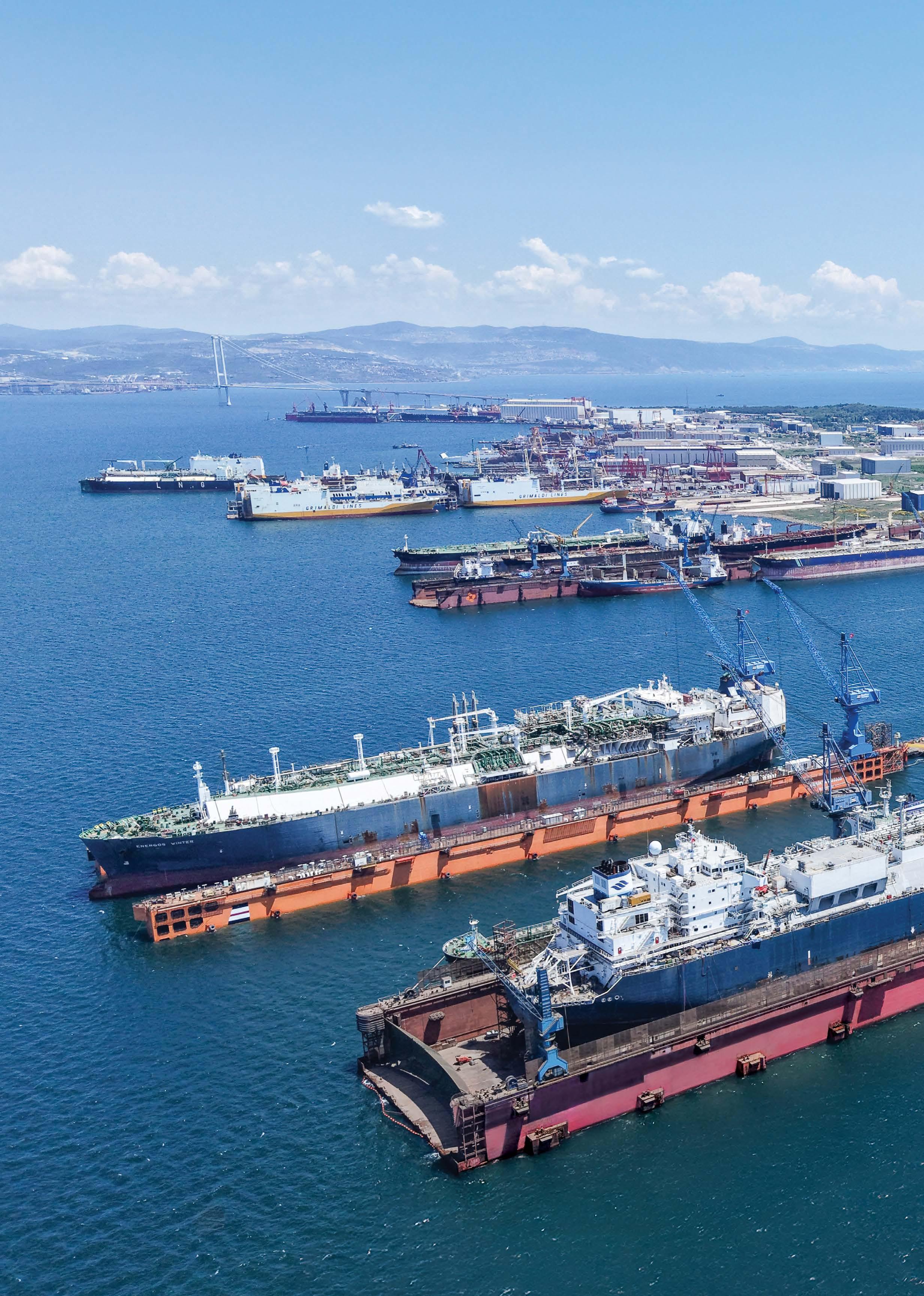
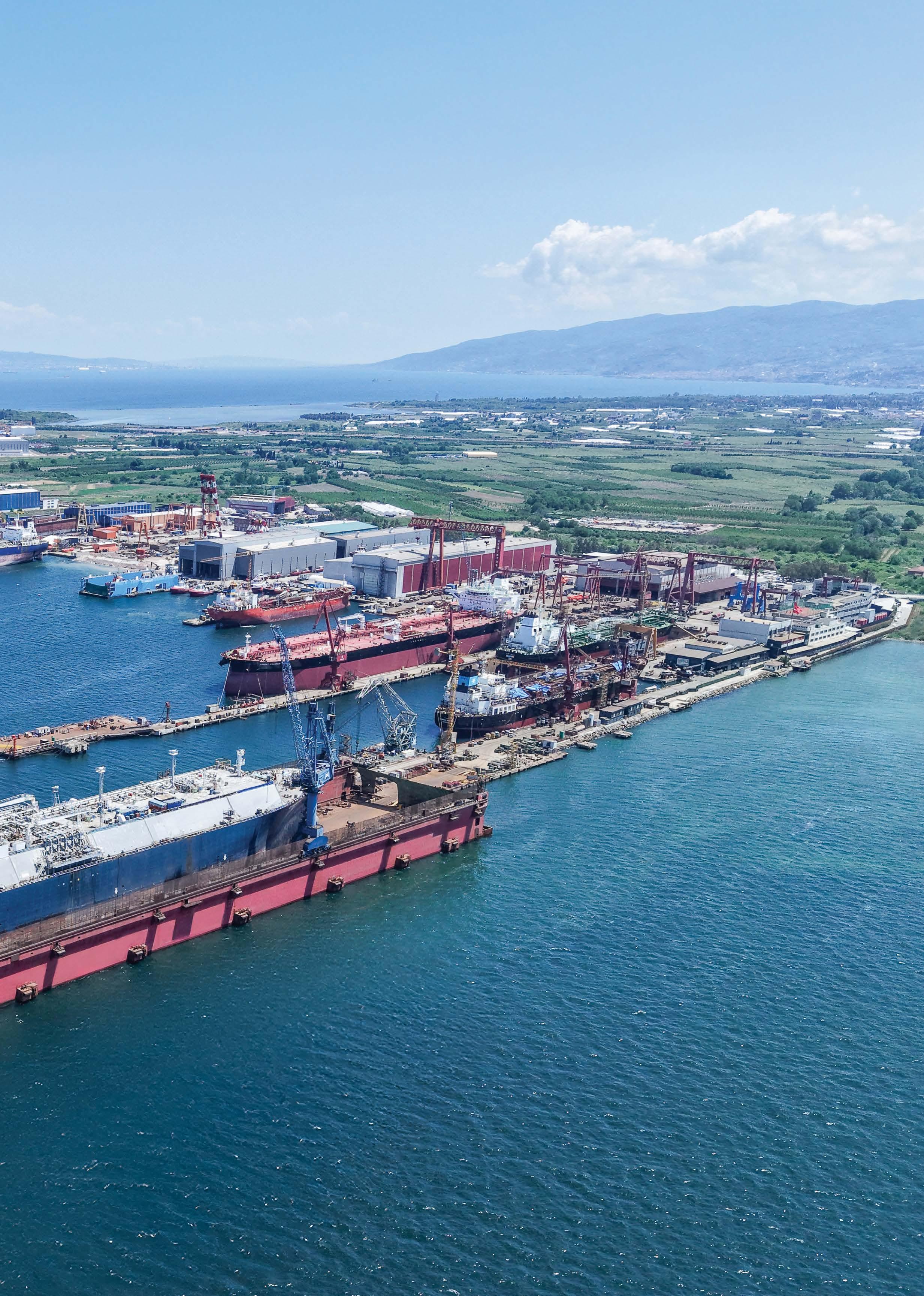
Besiktas Shipyard in Turkey has two floating docks over 300m in length
Mediterranean & Black Sea
Besiktas Shipyard reinforces its LNG focus, substantial investment at Hat-San, Constanta Shipyard goes green, Gibdock raises its OSV profile and a mixed bag at Multimarine Shipyards.
BESIKTAS SHIPYARD HAS ONE OF THE LARGEST TLC FLOATING DOCKS IN EUROPE AT 345M LONG AND 70M WIDE.
Besiktas Shipyard has taken a bold step towards becoming a regional hub for LNG and FSRU vessels
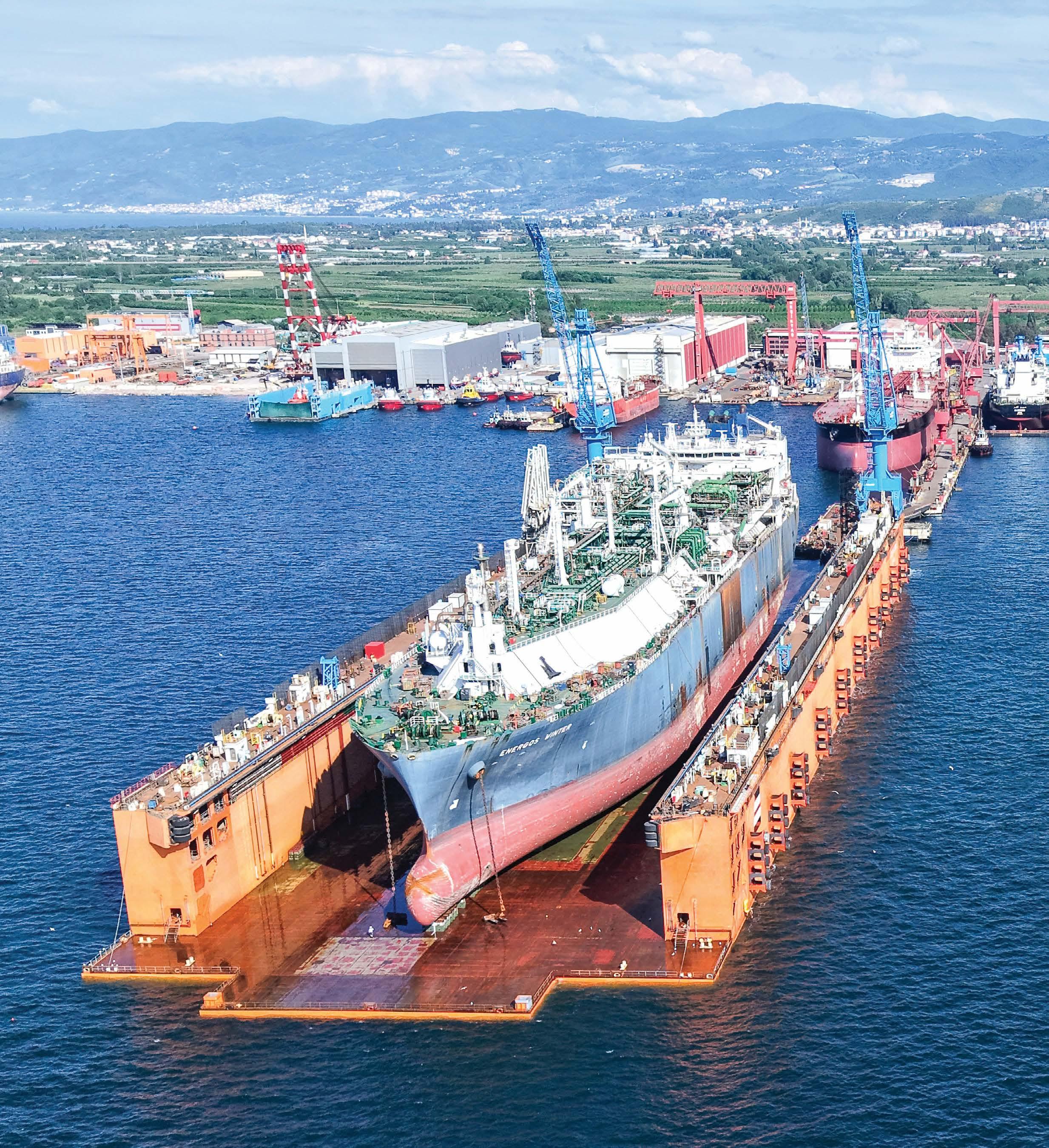
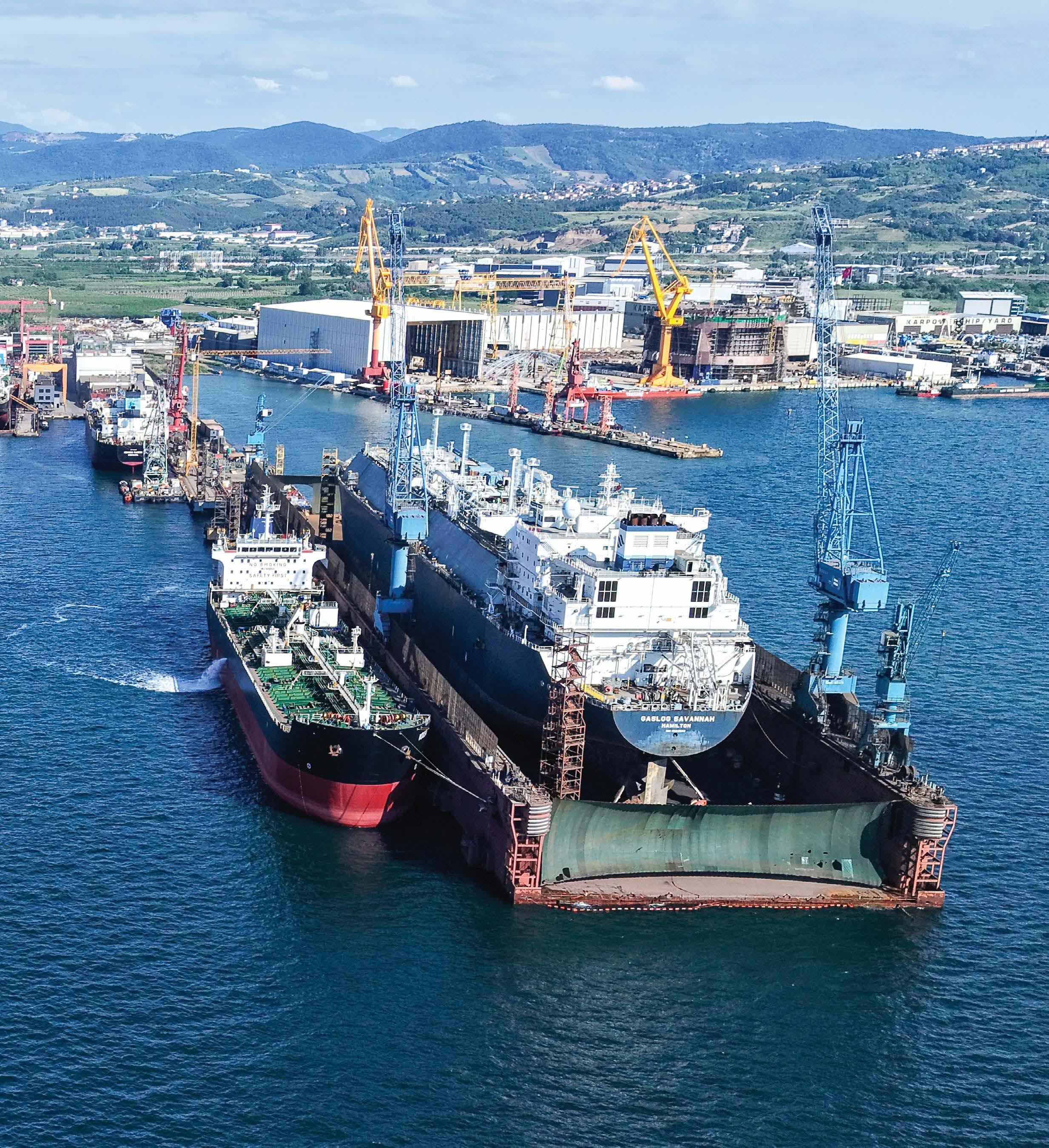
Besiktas Shipyard in Turkey, one of Europe’s most active ship repair yards, continues to expand its capacity and capabilities, especially in the LNG and FSRU segments. With two floating docks over 300m in length operating simultaneously and a total of six docks across the Besiktas Group shipyards – including Besiktas, Art, and Park Shipyards – the group handles over 300 complex ship repair and conversion projects annually.
Following the commissioning of its new 85,000 TLC floating dock in May – one of the largest in Europe at 345m long and 70m wide – Besiktas Shipyard has taken a bold step towards becoming a regional hub for LNG and FSRU vessels. This dock allows the yard to accommodate very heavy ships and platforms, including oil rigs, FPSOs and cruiseships.
Today, Besiktas Shipyard boasts the capacity to simultaneously accommodate up to three LNG/FSRU vessels, offering advanced expertise in conversion, upgrade, and mid-life extension projects – a segment that has grown significantly in 2025.
Flagship projects in 2025
Several standout projects have marked the shipyard’s progress this year, including:
• Energos Winter – The first-ever FSRU repair project in Turkey, including a full upgrade package.
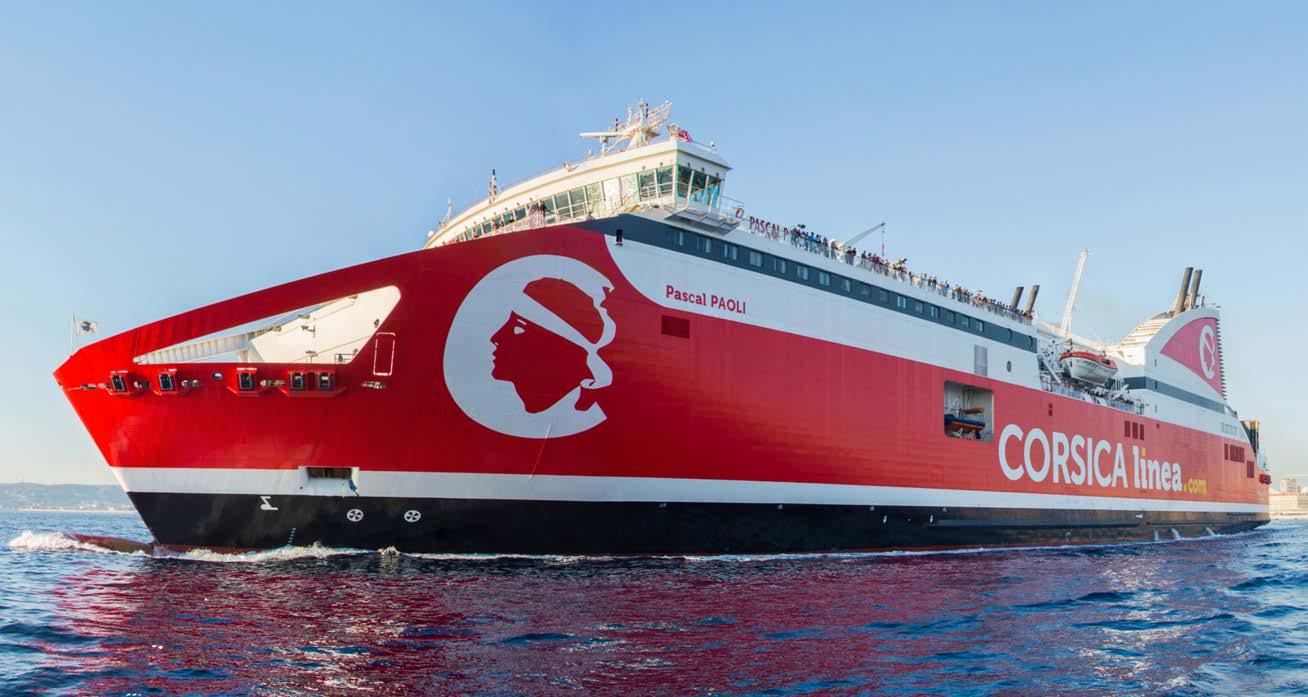
• Pascal Paoli – A comprehensive modernisation of a RoRo.
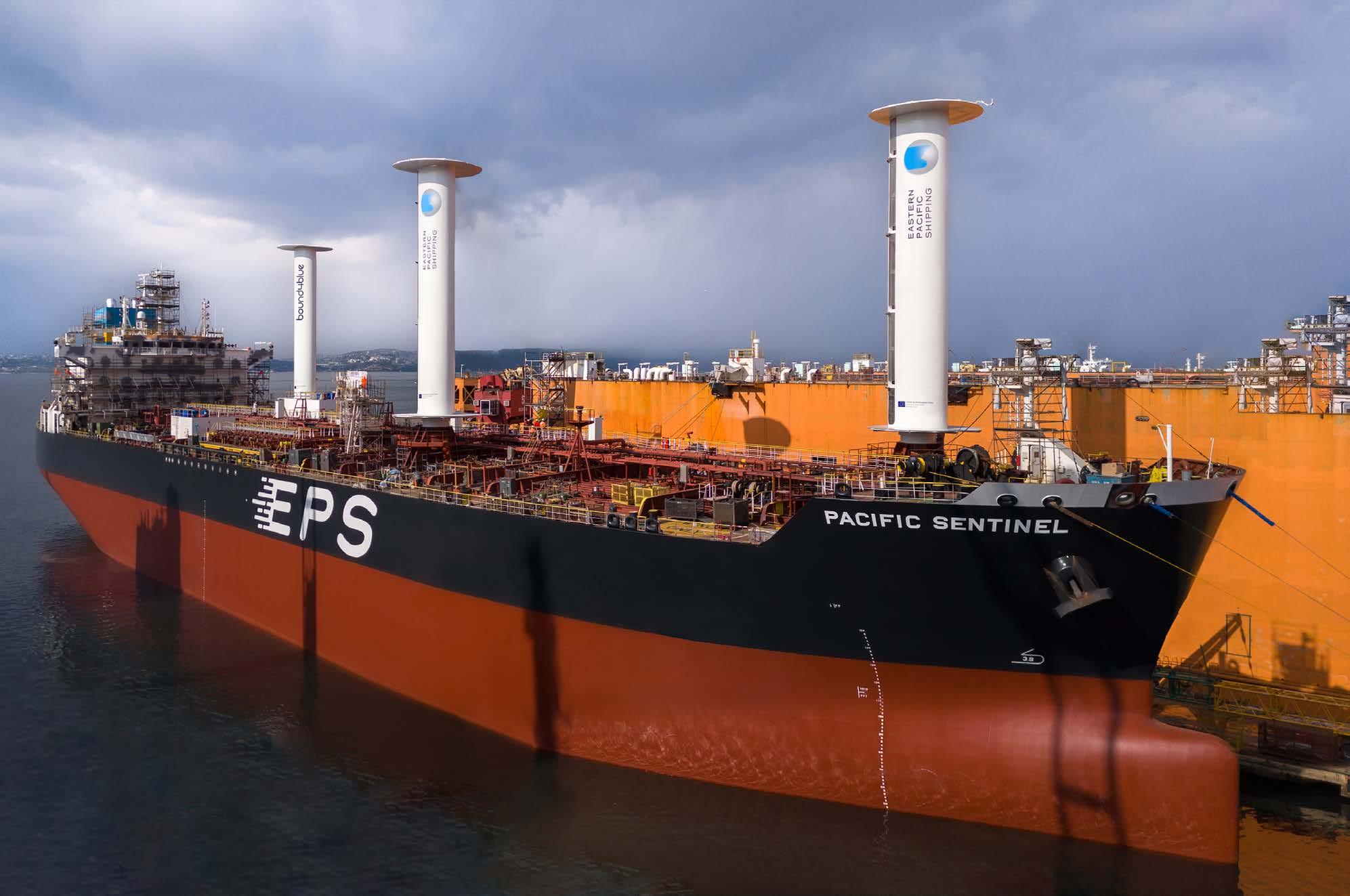
• Pacific Sentinel – Rotor sail installation as part of a green propulsion initiative.
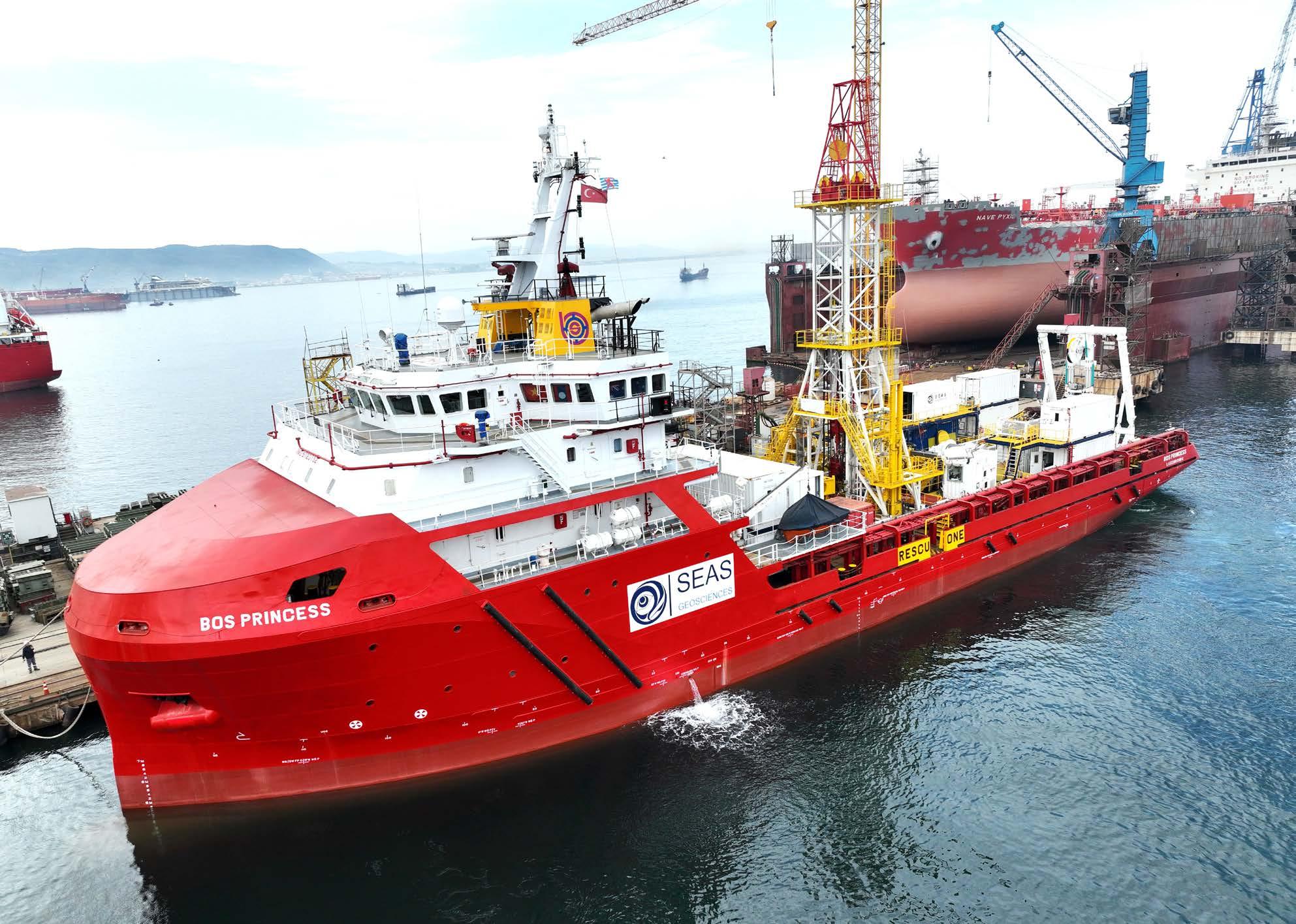
• Bos Princess – Conversion into a state-of-the-art geotechnical drilling vessel.
The yard has long been among the most preferred facilities in the region for
complex repair and conversion projects – a trend that is set to continue in the coming period.
Shared strength
With Besiktas Shipyard, Art Shipyard, and Park Shipyard operating under the Besiktas Group Shipyards umbrella, the organisation continues to lead the Turkish maritime sector. The group not only offers geographical flexibility and capacity but also shared engineering know-how and operational synergy, allowing it to serve a wide range of global clients with unmatched efficiency.
Looking ahead: LNG & sustainability
Having been the first accredited shipyard in the region for LNG ship repairs in 2021, Besiktas Shipyard is committed to growing its LNG service portfolio. In parallel, the shipyard is expanding its mechanical and cryogenic workshops, enhancing its ability to handle LNG repairs and upgrades more effectively and safely.
Aiming to become a regional LNG service centre, the shipyard is positioning itself at the forefront of the industry’s energy transition. Alongside LNG, the yard is preparing to attract more cruise vessels, especially with the introduction of eco-friendly hull surface preparation technologies. Starting in December, two floating docks will be equipped for water-based blasting, significantly reducing environmental impact compared to traditional methods.
Green transition
Besiktas Shipyard’s commitment to sustainability is also reflected in its investments in solar energy. Through two major projects – a 220-acre (89 ha) solar farm and an upcoming rooftop installation, together providing a total capacity of 25MW – the shipyard will generate more than twice the energy it consumes annually, significantly reducing carbon emissions and energy costs.
Above: Pacific Sentinel
Right: Besiktas Shipyard commitment to sustainability is also reflected in its investments in solar energy
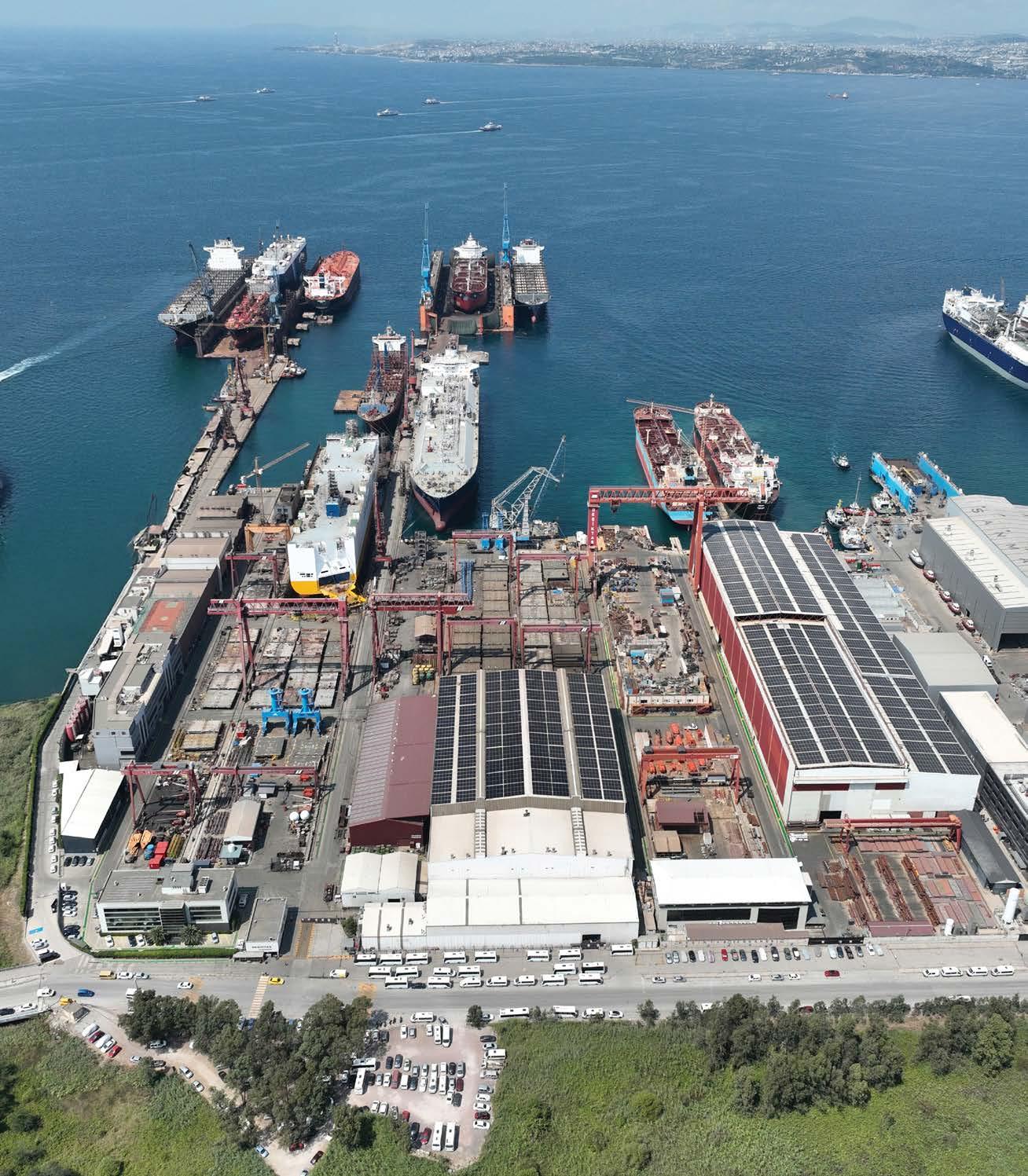
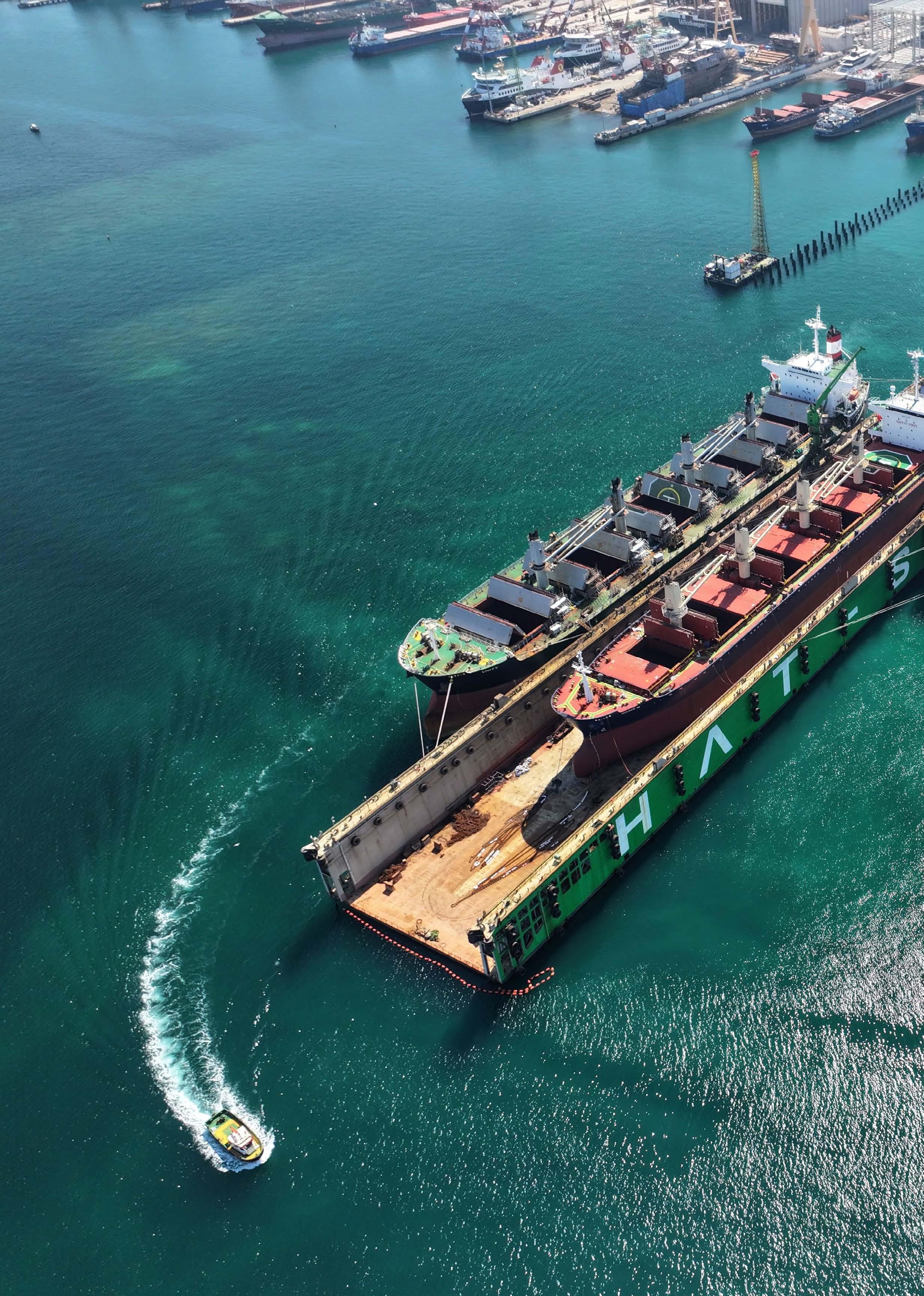
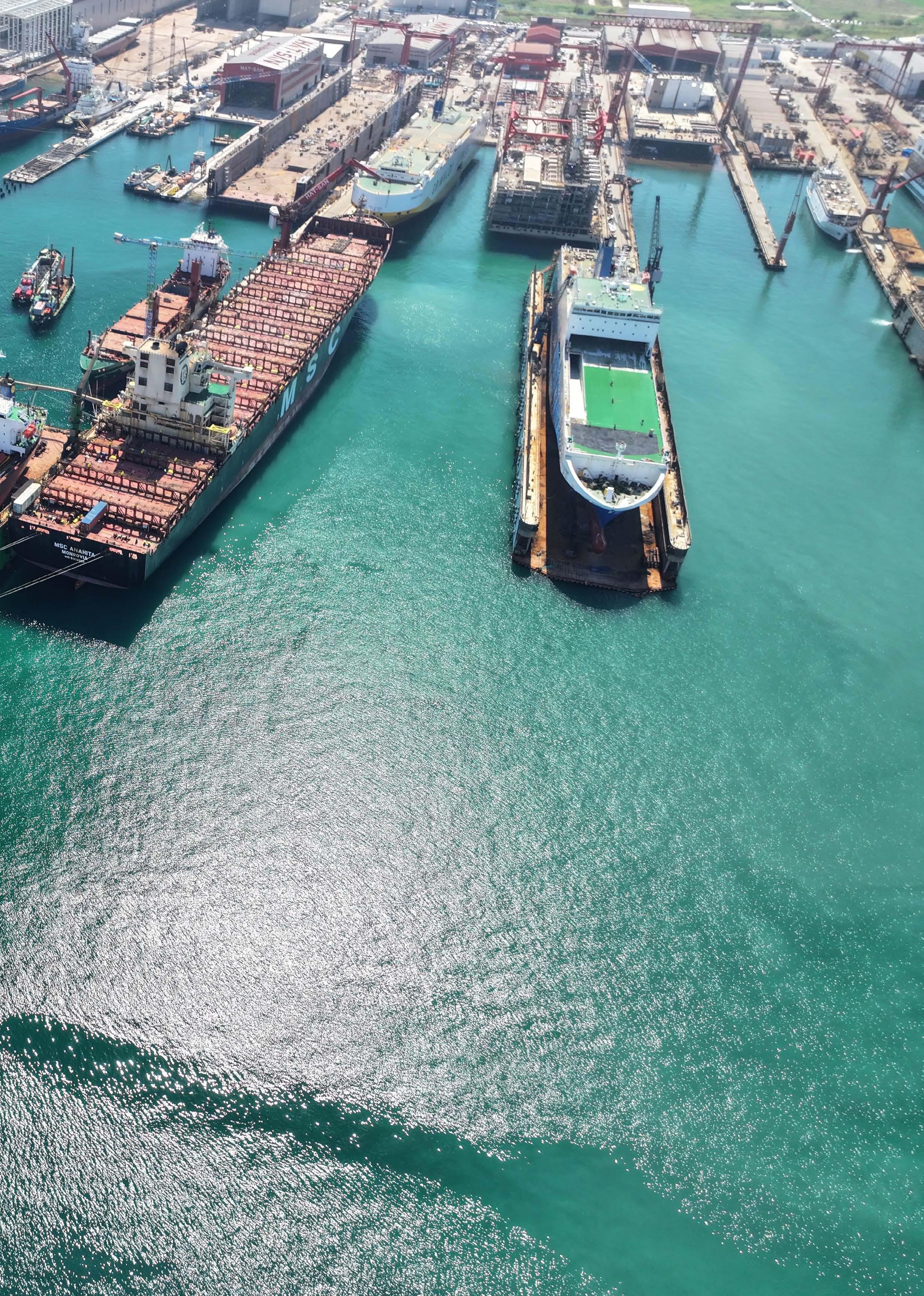
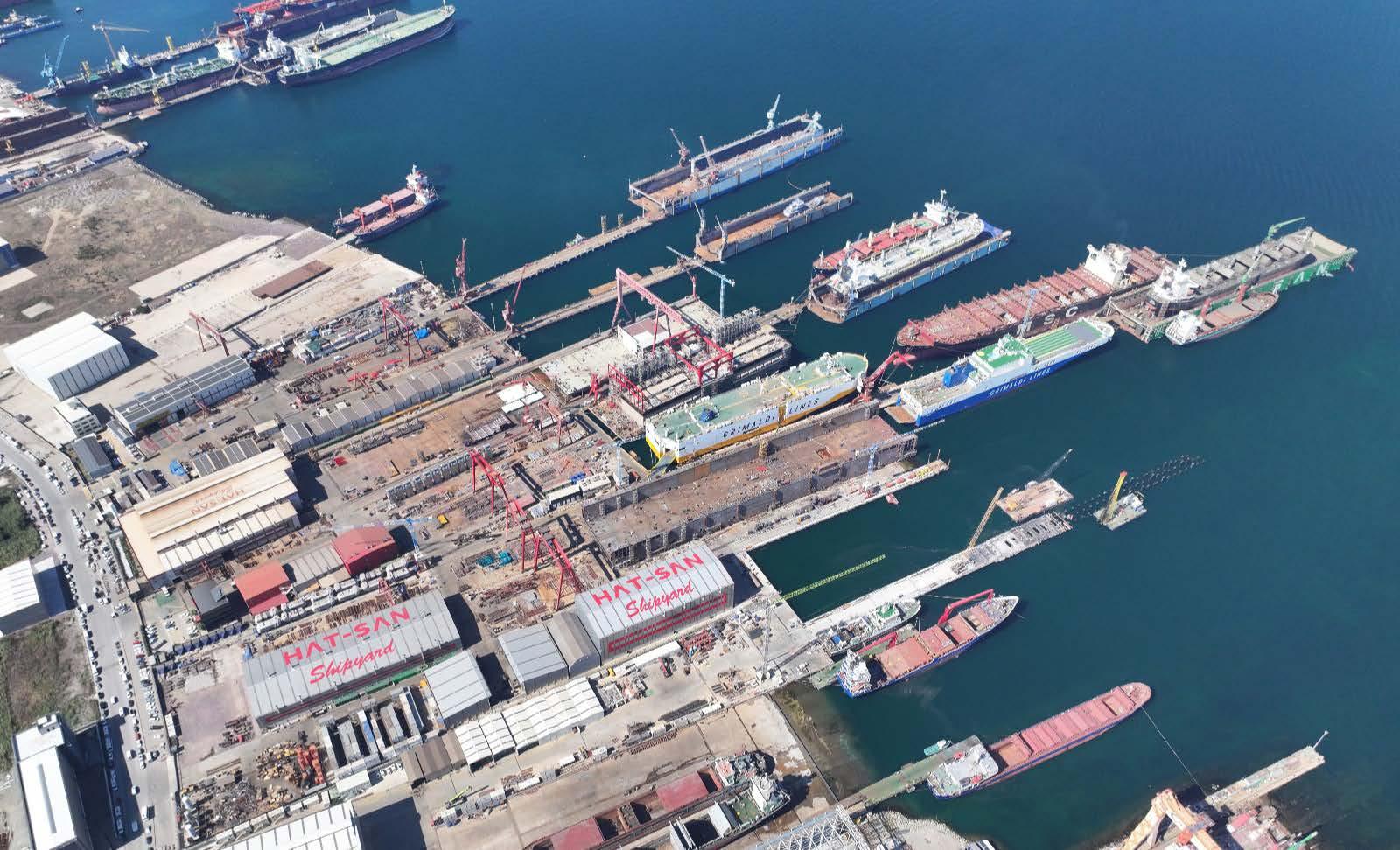
SUBSTANTIAL INVESTMENT AT TURKEY’S HAT-SAN
“Driven by our commitment for continuous growth and serving our partners, we’ve made substantial investments in our shipyard this year,” explains Özgün Oruc Manager of HatSan’s Repair Marketing Department. “As of Q4 2025, we have successfully completed a wide range of repair projects, demonstrating both the quality and flexibility of our services. Our facilities have been consistently utilised across a diverse fleet, with over 40 repair projects successfully delivered this year.”
This portfolio includes major works on RoRos (including PCCs), bulk carriers, chemical/oil product tankers and containerships. “We have also completed repair projects for specialised vessels, such as dredgers and a large power station vessel, showcasing our technical adaptability,” says Oruc.
To further enhance its service offering and accommodate larger projects, HatSan is announcing two major additions to the shipyard:
• New floating dock: Hat-San Shipyard’s new floating dock, featuring a length of 230m and 38m inner beam, is scheduled to be fully operational within Q4 2025. This addition significantly boosts the yard’s drydocking capacity and reduces waiting times for clients.
• New workshop: Hat-San has completed construction of a new, 3,000m² workshop. This new facility increases the yard’s in-house steel and outfitting fabrication capacity and gives faster turnaround times for complex repairs.
Hat-San has made substantial investments in its shipyard this year
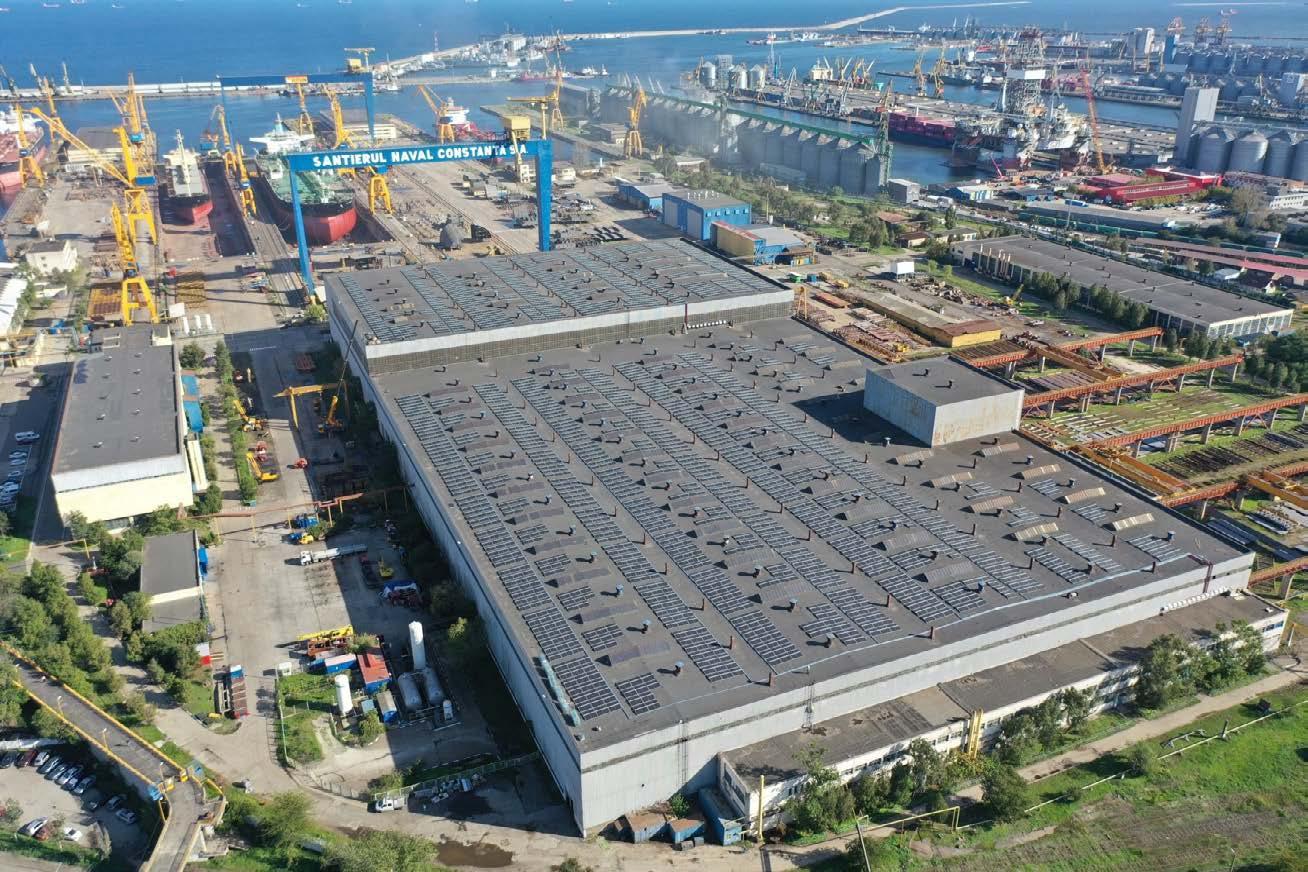
Top: Constanta Shipyard has invested over €1.8 million in a 3.2 MWp photovoltaic power plant
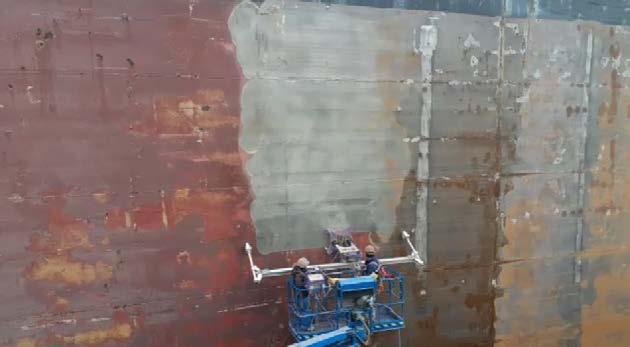
Above Constanta has also invested in advanced surface treatment technology, including lift worker beams
CONSTANTA SHIPYARD GOES GREEN
In response to the pressing challenges of climate change and the rising costs of energy and raw materials, Constanta Shipyard in Romania has made a strategic decision to reduce operational expenses and align its activities with EU and national environmental regulations and sustainability goals.
The first major step toward a greener future was taken some years ago with the acquisition of state-of-the-art ultrahigh-pressure (UHP) and high-pressure (HP) hydro-jetting equipment, investing over €3.5 million. This includes:
• 15 UHP pumps with pressures up to 3,000 bar
• 4 HP pumps up to 2,000 bar
• Approximately 15 specialised units, including lift worker beams, multi workers, line workers, lift jets and surface robots.
These systems provide high-quality water-jetted surfaces for ship hulls, main decks, cargo holds and more – without the use of abrasive grit –thus eliminating waste and reducing environmental impact.
The equipment has proved its effectiveness over the years, with increasing customer satisfaction and growing demand for this environmentally-friendly alternative to traditional surface preparation. The
ability to work continuously, combined with reduced waste and a favourable cost-performance ratio, confirms that Constanta Shipyard has taken the right first step on its sustainability journey.
Investing in renewable energy
Building on this progress, the next major milestone in the shipyard’s green transformation is the development of renewable energy generation capabilities.
Located on the sunny coast of Constanta, the shipyard has invested over €1.8 million in a 3.2 MWp photovoltaic power plant. The project is co-financed through Romania’s National Recovery and Resilience Plan, managed by the Ministry of Energy, with 70% of the investment covered by the shipyard’s own funds.
Key project details include:
• Installation site: 45,000 sqm rooftop of the Hull Workshop
• Solar modules: 5,472 photovoltaic panels, each with a nominal power of 585 Wp
• Inverters: Units with capacities of 125 kW and 100 kW
• Transformer station: Newly built, 2 x 1,600 kVA, 0.4/6kV
• Connection: Integrated into the existing 6 kV grid via new transformer infrastructure
• Operation mode: Self-consumption.
The photovoltaic plant became operational at the end of spring 2025 and is projected to cover approximately 35% of the shipyard’s annual energy consumption, significantly reducing dependency on conventional power sources.
Constanta Shipyard remains committed to reducing its environmental footprint and embracing sustainable innovation in both operations and infrastructure. These initiatives mark only the beginning of a long-term transformation aligned with global and national efforts toward a greener maritime industry.
GIBDOCK RAISES ITS OSV PROFILE
Gibdock has completed a series of highprofile offshore support vessel (OSV) projects in recent months to consolidate its reputation for delivering exceptional and timely service to the offshore industry.
In a significant and growing market for Gibdock, the Gibraltar-based ship repair yard has established itself as a trusted strategic partner to several major offshore players by consistently executing projects on time, within budget and to the highest safety and quality standards.
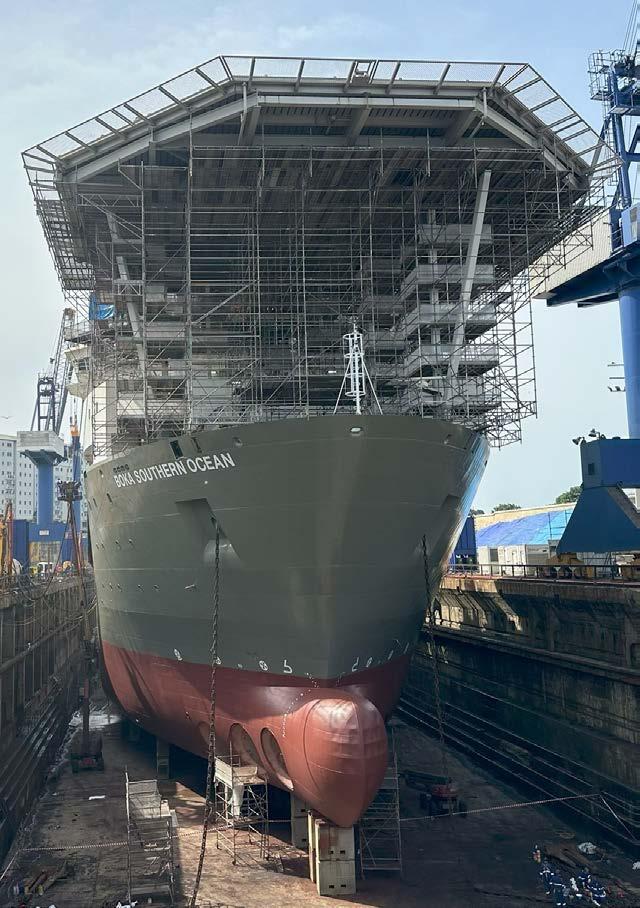
As part of an ongoing relationship with Boskalis, Gibdock has completed works on the trailing hopper suction dredger Gateway, the construction support vessel BOKA Southern Ocean and the multipurpose construction vessel BOKA Fulmar in recent months. Other significant OSV projects this year include the repair of Subsea 7’s construction/flex-lay vessel Seven Pacific and the repair and renewal of Technip’s specialised rigid pipe-lay vessel Deep Blue
With Solstad’s anchor-handling tug supply vessel Normand Pacific currently in the yard for renewal, and many more projects in the pipeline for the year ahead, Gibdock’s outlook in the offshore support segment is strong.
“Offshore majors trust Gibdock because of our track record in delivering safe, high-quality, and on-time services at good value,” commented John Barnard, Commercial Director, Gibdock. “We work closely with these companies to provide bespoke projects and conversions within a timeline that suits them. Due to the strong and growing demand for our OSV services, we encourage proactive engagement: interested parties should approach us early, even when projects are planned for two or three years out, so we can ensure availability and provide tailored input.”
VARIETY AT MULTIMARINE
Multimarine Shipyards is based inside Limassol Port, Cyprus and operates modern, state-of-the-art drydocking facilities and a dedicated repairs quay for afloat works.
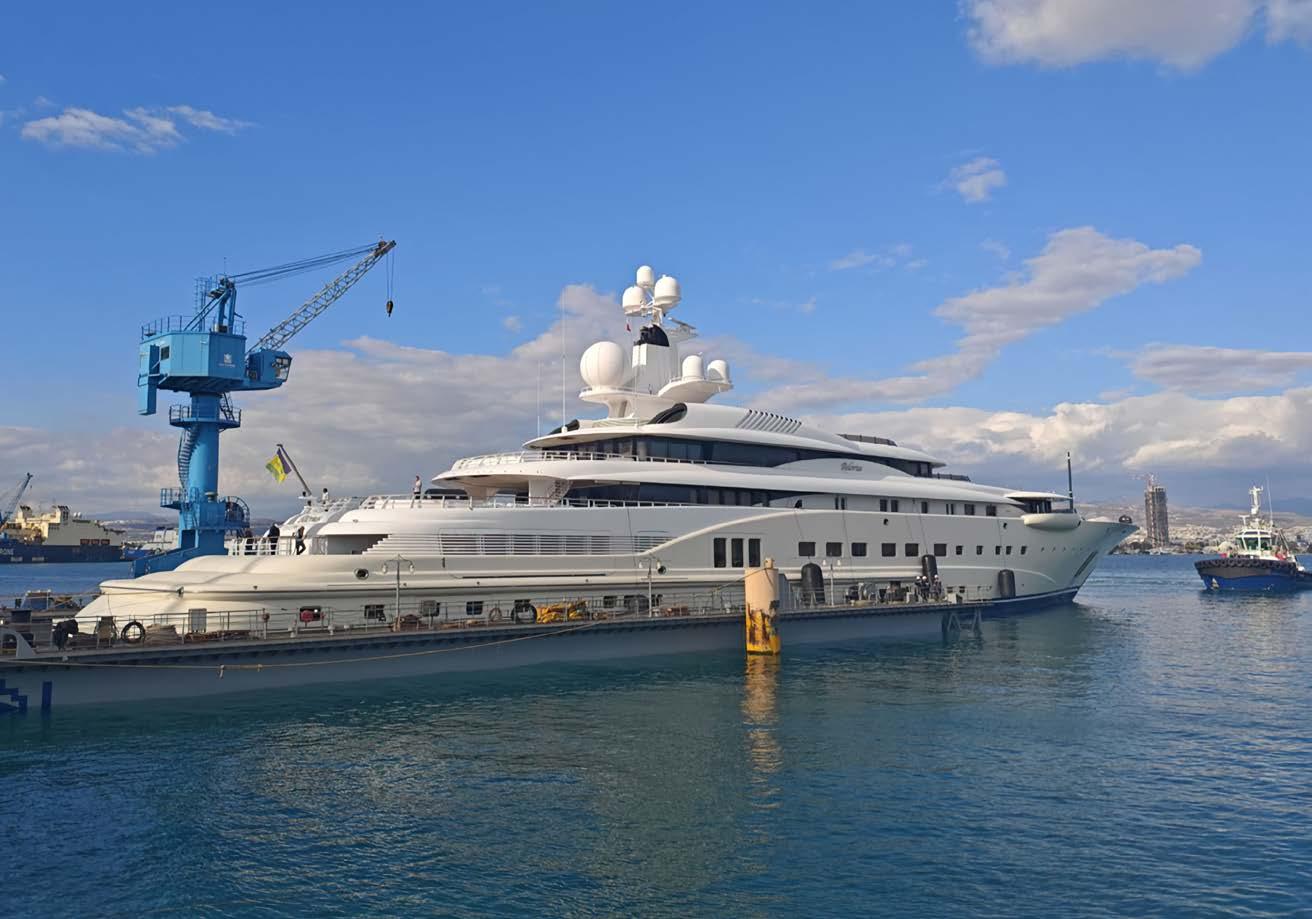
“In the past weeks our shipyard was engaged in the following projects,” says Pavlos Phokas, Commercial Director, Multimarine Services Ltd: “The refit and drydocking of mega-yacht Pelorus, a Special Survey of the tanker Iris and the lift out of the water of the shipyardowned 400t barge Atlas in preparation for the retrofit of the Horizon Blue Barge Project.
“The yard also recently drydocked Tidewater’s platform supply vessel Lundstrom Tide.”
The construction support vessel BOKA Southern Ocean in drydock at Gibdock
Powering performance in the Middle East
With over 22,500 completed projects Dubai-headquartered Drydocks World continues to support the maritime and energy sectors
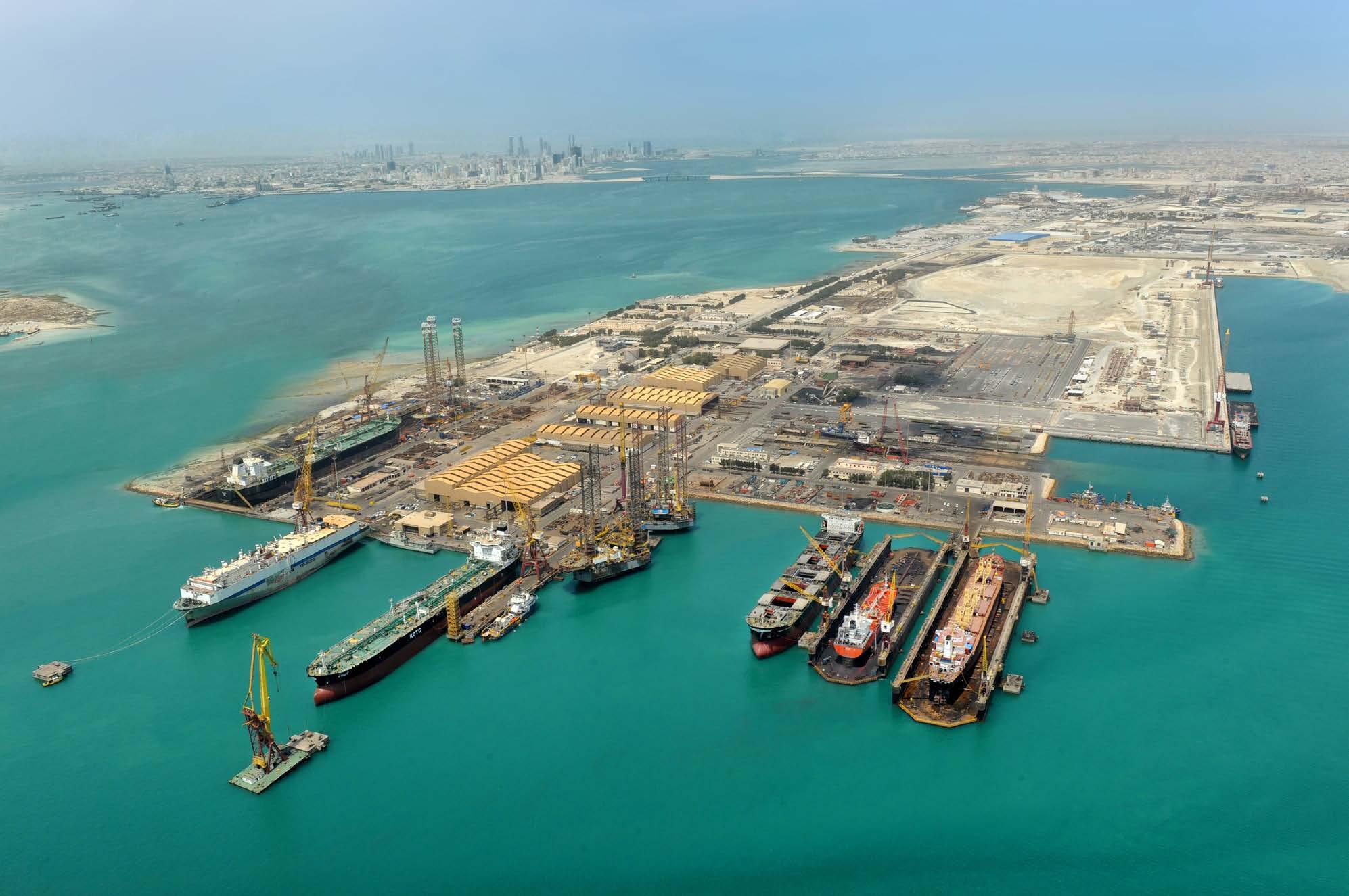
Drydocks World’s current programme showcases its engineering expertise, operational scale and consistent delivery of complex maritime projects, demonstrating a commitment to raising industry standards, and ASRY delivers when it comes to ship repair, environmental innovation, integrated maritime solutions and newbuilds.
With over 22,500 completed projects – including more than 11,000 ship repairs, 270 rig repairs and over 11,200 global offshore & onshore services (GOS) projects, Dubai-headquartered Drydocks World continues to support the maritime and energy sectors. In the first half of 2025, the company delivered close to 140 projects across ship and rig repair, maintenance and upgrade, underscoring its reputation for innovation and operational excellence.
Broad portfolio
The yard’s recent project portfolio showcases its capacity to manage complex projects across multiple vessel classes. Six rigs underwent major structural and equipment maintenance, including leg and spudcan repairs and upgrades to drilling systems. Each
project was completed safely and efficiently, enabling the rigs to return to commercial service with extended operational lifespans and improved performance.
Alongside these, two heavy-lift and pipe-lay vessels completed wide-ranging machinery overhauls and crane upgrades. One included installing a new pedestal crane and hydraulic systems, enhancing the vessel’s lifting range and operational flexibility and directly supporting upcoming project commitments.
A replenishment dry cargo naval vessel completed an intensive docking and refurbishment programme. The project resulted in a fully preserved hull, renewed helideck coatings, new tie-downs, pressure-tested high-pressure lines and modernised cargo elevator systems, allowing the vessel to re-enter service on schedule for its next deployment.
The yard also completed repair projects for cruiseships, bulk carriers, tankers and gas carriers. On one tanker, a main engine and crankshaft rebuild improved reliability and extended service intervals, while the LPG carrier’s full system repairs ensured compliance and readiness for new contracts. Completing these projects alongside offshore scopes demonstrates the yard’s ability to meet diverse customer requirements while maintaining high reliability.
In one notable operation, an unplanned crane vessel repair was completed at Sharjah port. Drydocks World’s response team restored the vessel’s structural and mechanical integrity within a compressed timeframe, minimising downtime and enabling the vessel to resume commercial operations with minimal schedule impact.
Offshore energy
The yard’s offshore energy programme continues to gain scale. Five floating production units are currently under execution, encompassing an EPC FPSO redeployment, a full FPSO conversion with topside module integration, two FPSO refurbishment and life extension projects and an FLNG or FSU conversion. The successful delivery of these assignments will allow clients to extend asset life, increase production capabilities and ensure continued operational efficiency, demonstrating Drydocks World’s multidisciplinary project competencies.
In parallel, four HVDC offshore wind platforms are under fabrication and integration. These projects, including EPCI and EPCIC scopes, are advancing through partnerships and will directly contribute to expanding renewable energy infrastructure. The extensive
The yard’s recent project portfolio showcases its capacity to manage complex projects across multiple vessel classes
HVAC and architectural works package further showcases the execution strength behind complex turnkey solutions supporting the future needs of the industry.
Engineering scale and performance
Drydocks World’s extensive in-house resources and multidisciplinary expertise are evident in its consistent record of delivering safe, high-quality outcomes across multiple projects running at the same time. This capability is particularly notable given the scale and complexity of the operations the company manages daily.
Each project is supported by detailed planning and resource alignment to maintain schedule reliability. Drydocks World’s approach to integrated work management enables seamless transitions between vessel docking, refit and commissioning phases, maintaining consistency across all major campaigns.
Looking ahead
As activity continues through the second half of the year, the yard remains focused on strengthening its operational capacity and extending its project range. Several large-scale offshore and floating production projects are progressing toward completion, while upgrades to lifting, fabrication and quayside infrastructure continue to advance.
The construction of a new 5,000-ton floating crane, due for completion in 2026, will further enhance heavy-lift handling capacity and reinforce the yard’s position as a global hub for complex energy and vessel repair and upgrade operations.
Through its disciplined execution and technical precision, Drydocks World consistently sets new benchmarks for performance and coordination in ship repair and offshore construction.
Drydocks World’s offshore energy programme continues to gain scale
ASRY TAKES PRIDE IN ITS ACHIEVEMENTS
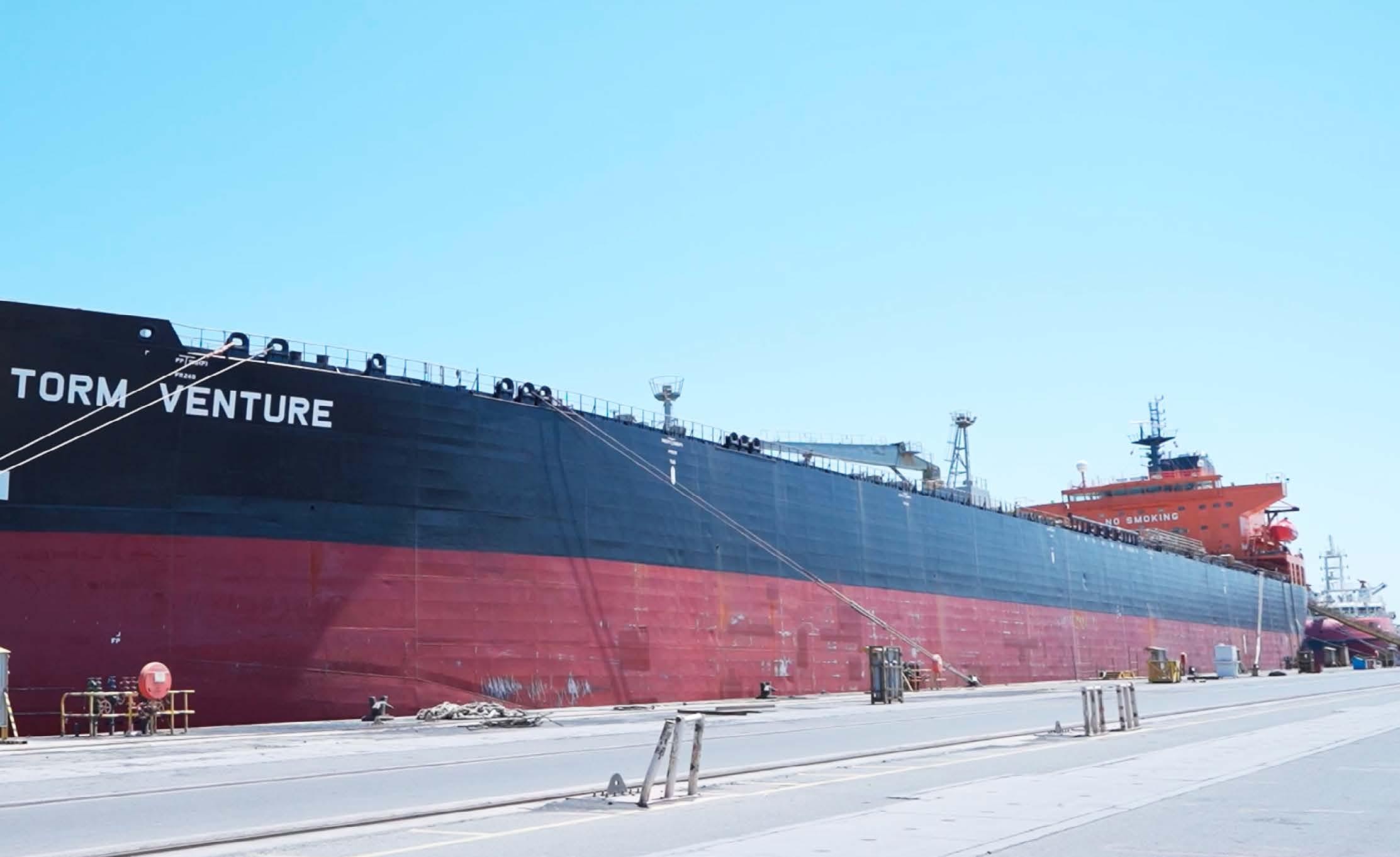
The Arab Shipbuilding and Repair Yard Company (ASRY), Bahrain, has completed the repair, maintenance and handover of the products tanker Torm Venture, owned by Danish shipping company Torm, one of the world’s largest owners and operators of products tankers. The project involved major repair and maintenance work to renew the vessel and improve its operational efficiency, ensuring continued performance at the highest levels of safety and reliability.
“During this project, we faced a challenge to complete the repairs and deliver the vessel successfully within just 14 days from the start of work, while the expected timeframe was 18 days,” explains Mahmood Hassan, Project Manager at ASRY. “We managed to achieve this thanks to the efforts of both teams.”
He added: “The growth of our partnership with one of the most important names in global shipping,
Torm, is a point of pride. At ASRY, we keep our clients at the heart of everything we do, and we work as one team to provide them with tailored experiences that meet their expectations and raise their satisfaction, helping to build lasting relationships with all our partners.”
‘We brought in one of our oldest tankers, now over 18 years in service, for this maintenance project,” says Shadhivardhan Khoat, Dry Dock Manager at Torm. “Today we must say that ASRY’s services have exceeded all our expectations in terms of quality, performance, and timing precision.”
He added: “We are looking forward to more collaboration in future, and this project is just the beginning of a fruitful partnership that brings mutual benefit to both companies.”
World’s largest dry-dock solar energy project
His Highness Shaikh Nasser bin Hamad Al Khalifa, the representative of His Majesty the King for Humanitarian Work and Youth Affairs and Chairman
Above: ASRY has recently completed the repair, maintenance and handover of the cargo tanker Torm Venture
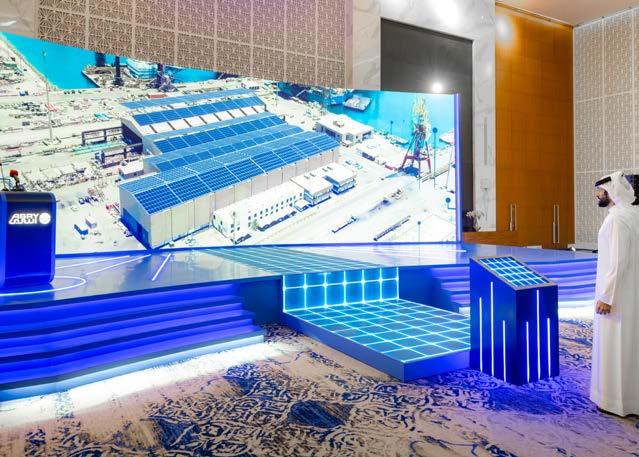
Below: The launch of the world’s largest drydock solar energy project
of Bapco Energies, affirmed that ASRY’s solar energy project embodies the vision of His Majesty King Hamad bin Isa Al Khalifa in the march of progress and prosperity, and translates His Majesty’s directives to build a future based on sustainability and innovation. His Highness noted that the project receives the continuous support of His Royal Highness Prince Salman bin Hamad Al Khalifa, the Crown Prince and Prime Minister, of pioneering initiatives in environmental innovation and the transition to clean energy.
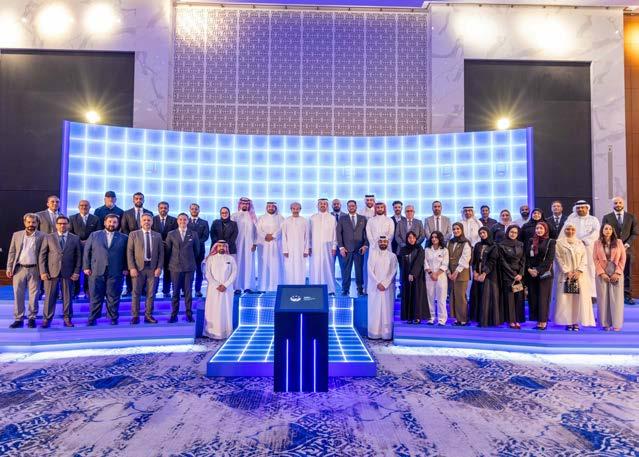
This came as His Highness attended the launch of the ASRY’s solar energy project, the largest of its kind in the world in the ship repair and shipbuilding sector, in partnership with Kanoo CleanMax Renewables, in the presence of ministers and senior officials.
His Highness said the project affirms Bahrain’s status among the leading countries in applying advanced renewable-energy technologies, and showcases the Kingdom’s efforts in creating a sustainable working environment that encourages innovation and strengthens the green economy.
“At ASRY we believe environmental responsibility is an integral part of our corporate strategy, and based on this, we are keen to launch practical initiatives that support the green transition adopted by the Kingdom of Bahrain,” said Dr Ahmed Al Abri, ASRY’s CEO.
The total capacity of the solar power plant is 22.5MW in the first phase, plus 22MW in the second. The output will exceed 36 million kilowatt-hours per year in phase one and 71 million kilowatt-hours per year after phase two is completed. This will deliver yearly savings of more than $2m after both phases, as well as improving energy use and cutting operating costs.
The project reinforces ASRY’s position as a leading maritime hub in the region and a national institution that helps build a more sustainable future for the next generations, in line with the Kingdom’s aspirations for a sustainable green economy.
Integrated maritime solution
ASRY has also launched its Underway Replenishment Service, introduced in collaboration with Fairwaters, a leading provider of integrated maritime solutions. This initiative marks a significant step as part of ASRY’s broader efforts to advance the maritime industry through the adoption of cutting-edge technologies.
“Underway Replenishment (UnRep) represents a transformative shift in maritime logistics support operations,” says Abdel Maksoud Basyouni, Projects Management Director. “It enables fuel and cargo transfers without the need to stop or slow down, thereby maintaining operational schedules without disruption and enhancing both operational continuity and performance efficiency.”
With this move, ASRY marks a major milestone by adopting and deploying this technology, which represents a strategic evolution in maritime logistics, due to the high level of precision, coordination and technical readiness it requires. It also demands advanced infrastructure and specially-equipped vessels capable of carrying out such operations. ASRY’s involvement in these projects underscores its continued commitment to practical innovation and development. It also reflects the company’s broader vision of delivering advanced marine solutions that cater to the evolving demands of the shipping industry, across the region and beyond.
“We constantly strive to expand our partnerships and bring in global experience and specialised technology,” explains CEO Al Abri. “This project marks a step forward that strengthens ASRY’s position as a trusted provider of integrated maritime services and reflects our ongoing efforts to deliver practical tools that improve the performance of both naval and commercial fleets.”
“While originally developed for naval operations, UnRep is now proving highly effective in commercial shipping,” director Basyouni continues. “This shift improves the flexibility and reliability of supply routes and reflects a wider move
Dr Ahmed Al Abri, ASRY’s CEO
Abdel Maksoud Basyouni, Projects Management Director, ASRY’s CEO
in the industry towards smarter, more sustainable solutions.” He added: “By reducing delays, cutting operating costs and keeping supply moving, Underway Replenishment offers a reliable solution for today’s fleets working in fast-paced, competitive conditions.”
Bunker vessels launched
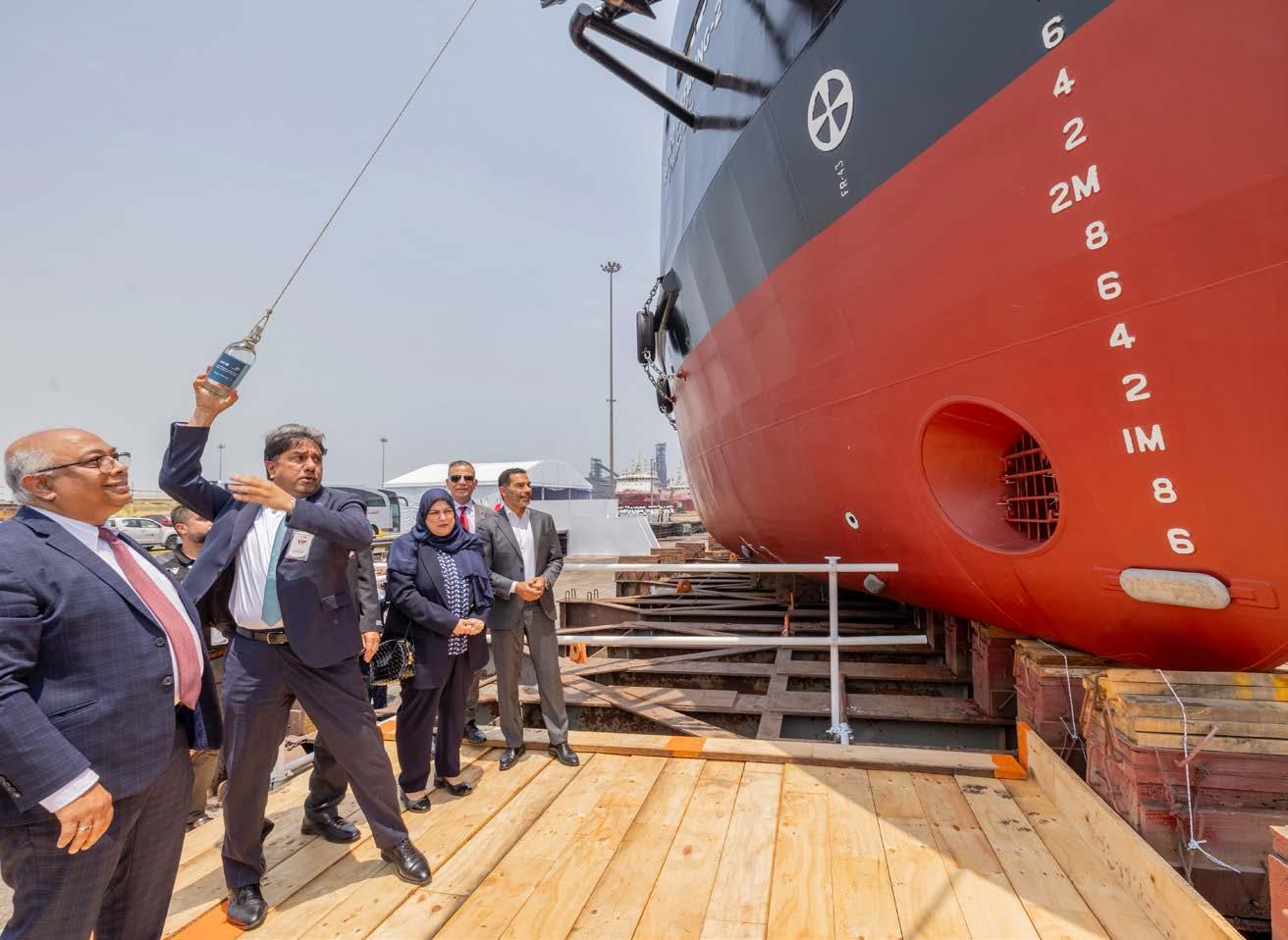
ASRY has launched two bunker vessels for Bapco Refining, a subsidiary of Bapco Energies, at a ceremony attended by ASRY’s CEO, Bapco Refining Deputy Chief Executive Officer Afaf Zainalabedin and senior representatives from both companies.
The event featured the formal launch, with both vessels lowered into the water for the first time, marking completion of a main stage of the project and showing ASRY’s ability to deliver major marine projects to the highest engineering, technical and safety standards.
“This project is the result of a strong strategic collaboration between ASRY and Bapco Refining,” said Dr Al Abri. “It also shows both sides’ backing for building
national skills and for delivering innovative marine solutions that serve the Kingdom’s energy and sea-transport sectors.”
The launch is part of a wider project to build and hand over two self-propelled fuel vessels for Bapco Refining. ASRY was selected to execute the project because of its specialist expertise in engineering, ship construction and repair.
Top: ASRY has launched an Underway Replenishment Service
Above: The launch of two bunker vessels for Bapco Refining
POSITIVE SHIP REPAIR OUTLOOK
Global ship repair demand has continued to see steady growth amid an expanding, ageing fleet, with a rising number of 3rd-5th surveys. Work linked to sulfur emission and ballast water regulations has slowed, while programmes linked to emission reduction efforts have increased but remain at early stages, explains Steve Gordon, Global Head of Clarksons Research.
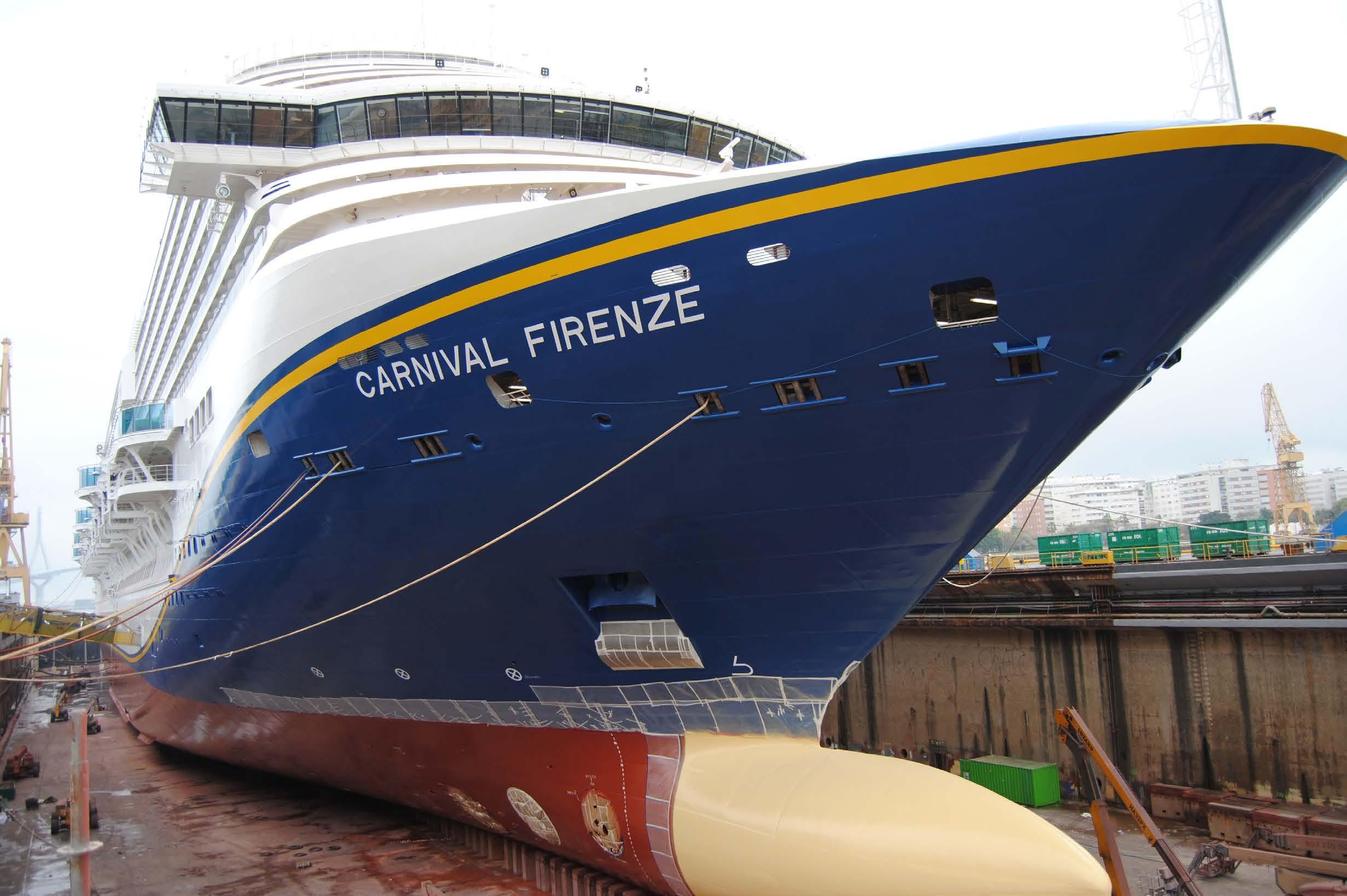
Cruise refurbishment is a specialism for European repair yards, which account for c.75% of cruise refurbishment work Credit: Navantia
In January-August 2025, there were >13,300 recorded instances of vessels (2,000+ dwt/gt) undergoing work at a specific ship repair yard location, up 7% on the 2024 run rate (full year: >18,700), continuing a trend of steady growth in repair demand over recent years (2019-24 CAGR: +3%). Rising demand for repair work comes on the back of an expanding fleet (2019-24 CAGR: +2%), with a current upswing in special surveys also supporting activity.
Special surveys account for a significant proportion of the demand for ship repair yards, with the timing of other repair and retrofit work often carried out to coincide with drydocking. An estimated c.11,800 ships (2,000+ dwt/gt) of c.310m gt are scheduled to undergo a special survey in 2025 given the age profile of the fleet, up 3% y-o-y in terms of number of ships and 9% in gt. This comes amid a building ‘wave’ of special survey work, which is expected to peak in 2026-27, with a potential for >12,000 ships of >320m gt to be surveyed each year, before easing in 2028. Notably, the ageing fleet is extending the duration of special surveys, creating more demand for repair yards. In 2025, c.70% of vessels undergoing special surveys are expected to be >15 years old (2016: c.45%), with older tonnage typically spending more time in drydock (15yr survey avg. duration: c.+20% vs 10yr survey).
Retrofit work
By contrast, retrofit work linked to the IMO’s sulfur emission and ballast water regulations has slowed in recent years. The BWMS retrofit programme is coming to an end following the IMO Ballast Water Convention’s full entry into force in September 2024 (January-August: c.150 BWMS retrofits; 2024: c.1,700; 2022-peak: c.6,000). Meanwhile, SOx scrubber retrofitting continues at a slower pace (January-August: 215; 2024: 345) after the ‘wave’ of work before the entry into force of the IMO’s 2020 sulfur fuel limit (2019-20: >1,000 p.a.), with narrower VLSFO-HSFO price differentials (Rotterdam: $62/t in Aug-25 vs $215/t in 2022) and positive shipping market conditions discouraging work.
CHINESE REPAIR YARDS ACCOUNTED
Work streams limited to shipping’s broader emission reduction efforts remain at an early stage but are building. More than 360 ships received an EST retrofit in January-August, in line with 2024’s record run rate (full year: >540), but still somewhat below the scale of work once created by the scrubber and BWMS retrofit programmes. Other prospective work streams, such as Carbon Capture Scrubbers (CCS) retrofits and alternative fuel conversions, are at early stages (c.50 of each so far in the 2020s).
Repair destinations
Turning to repair destinations, Chinese yards have a leading market share, accounting for c.45% of visits to repair yards in January-August, though notably their share of work is lower than in shipbuilding (China: 63% of ships on order), and ship repair work overall is more geographically dispersed than shipbuilding. The top three builder countries account for >90% of CGT delivered in 2024, but the top five repair countries only account for 66% of work. Other major destinations for repair work include Turkey (January-August: c.10% of callings), Japan and Indonesia (c.5% each).
Moreover, at the regional level, Asia accounts for c.65% of repair work (excluding China: c.20%) while Europe accounts for c.25%. Additionally, there is a degree of specialisation in regional repair yard work depending on vessel trading patterns and yard expertise: Chinese repair yards accounted for c.75% of bulker and c.60% of containership repair work in 2024, while European yards accounted for c.70% of
repairs (Spain,
PosiTector ® Inspection
Coating Thickness Probes
n Ferrous n Non-Ferrous n Combination n
Surface Profile Probes
n Depth Micrometer n Replica Tape Reader
Environmental Conditions Probes
n Integral n Cabled Magnetic Probe n Anemometer
n 1/2” NPT n Infrared
Hardness Probes
n Shore n Barcol
Salt Contamination Probe
n Bresle Method
Gloss
n
Ultrasonic Wall Thickness Probes
n Corrosion n Multiple Echo Thru-Paint n Precision
n Low Frequency n Xtreme
Customized
CRUISE REFURBISHMENT IS A SPECIALISM FOR EUROPEAN REPAIR YARDS, WHICH ACCOUNT FOR c.75% OF CRUISE REFURBISHMENT WORK. OTHER MAJOR CRUISE REFURBISHMENT DESTINATIONS INCLUDE SINGAPORE AND THE BAHAMAS WITH
France and the Netherlands: c.10% cruise repair work each).
In line with its market leading position, 16 of the 20 most active repair yards in the world were located in China in 2024, though outside China, large repair yards are geographically dispersed: of the 20 most active non-Chinese yards in 2024, 11 are in Europe (four in Turkey), six are in Asia and three are in the Middle East.
European focus
Focusing on Europe, the leading ship repair destinations in the region are Turkey (c.30% of repair work carried out in Europe), followed by Greece (c.10%), the Netherlands and Poland (c.5% each). Notably, European yards are generally less reliant on the major ‘volume’ cargo sectors for generating repair yard work compared to the rest of the world. Tankers, bulk carriers, containerships and gas carriers account for c.40% of repair work at European yards, compared to c.70% in the rest of the world. Meanwhile, MPPs, general cargo ships and RoRos, which are generally more active in regional trades, account for c.35% of work at European repair yards (c.15%), while cruise and ferry ships account for c.10% of work (c.5%). Indeed, cruise refurbishment is a specialism for European repair yards, which account for c.75% of cruise refurbishment work. Other major cruise refurbishment destinations include Singapore and the Bahamas with c.10% and c.5% respectively.
Ship repair outlook
The outlook for the ship repair sector is positive, supported by expectations for continued steady fleet growth (2025/26f: c.+2.5% yoy in terms of number of ships in both years) and the shape of the fleet’s age profile (now: c.20% of fleet gt >20yrs; 2030: c.40% of current fleet gt will be >20yrs). Furthermore, new ‘green’ regulations (e.g. IMO ‘Mid-Term Measures’, FuelEU Maritime) could drive further increases in repair yard demand through increased demand for EST retrofitting and the potential for CCS retrofit and fuel conversion programmes to expand in the future.
Our passion is not new!
We work with the same passion since the day we started, despite the high demand on quality, and always with the same commitment.
Mechanical repair & upgrade
A comprehensive rudder repair and a new twin-screw controllable-pitch propeller installation.
Following severe rudder damage on a bulk carrier, MarineShaft handled the full repair of a 40-ton rudder blade, manufacturing a new rudder stock, pintle and related components, including on-site supervision in Portugal.
After the incident, MarineShaft conducted an on-site inspection to evaluate the damage. The rudder blade had been significantly bent and the rudder stock required complete renewal, as did several other key components. Based on the findings, a comprehensive repair plan was defined, covering both workshop and on-site services.
Due to the rudder blade’s weight of nearly 40 tonnes, it was not suitable for road transport. Instead, it was shipped by sea from a European shipyard to MarineShaft’s fully-equipped workshop in Denmark, where the repair process commenced.
3D scanning
MarineShaft applied 3D scanning technology to accurately measure the deformation of the rudder blade. This enabled targeted plate replacements and structural reinforcement through welding. In parallel, a new rudder stock was manufactured, along with a new pintle fitted with a shrunk-on sleeve. Additional components included a rudder stock bearing and housing and a pintle bearing and housing.
On-site measurements were used to guide precision machining, ensuring that the new rudder stock’s upper cone would align exactly with the original steering gear. The steering rotor, delivered together with the rudder blade, was also blue-fitted. All fitting procedures were supervised and approved by the classification society, Class NK.
Right: The 40-ton rudder blade being loaded onto transport (top inset) and arriving at MarineShaft’s workshop
Final alignment
MarineShaft technicians travelled to Portugal to oversee the final installation. The scope included casting the rudder horn bushing and performing an alignment check of the full rudder system. The repair was carried out in compliance with the maker’s specifications and the requirements of the classification society.
With the complete refurbishment and installation successfully finalised, the vessel was returned to full operational status. The new and repaired rudder components met all technical and classification standards, restoring the vessel’s steering performance with minimal downtime.
TWIN SCREW UPGRADE
Wärtsilä’s retrofit package for the Corsica Linea ferry Pascal Paoli has resulted in fuel savings of up to 22%. This significant gain in energy efficiency on each trip has been made possible by the installation of a new twin-screw, controllable-pitch propeller (CPP) system with blades optimised for the ship’s operating profile; the Wärtsilä EnergoProFin energy-saving propeller cap, a controls retrofit and combinator curves for the ship’s various operating modes.
These upgrades, which were completed at the end of 2024, were validated through CFD (computational fluid dynamics) open water simulations, and confirmed during sea trials with the chief engineer. In monetary terms, the fuel savings equate to an estimated $7,700 per trip. The related reduction in emissions represents a massive step in Corsica Linea’s decarbonisation journey, allowing the company to remain compliant with the stricter requirements on carbon emissions.
“We are extremely happy with the efficiency improvements resulting from this Wärtsilä retrofit package,” says Xavier Esnault, Energy Transition Project Manager at Corsica Linea. “The fuel savings are important, both from a cost perspective, as well as supporting our decarbonisation strategy to reach a reduction of 40% of our CO2 emissions by 2030.”
Targeted plate replacements and structural reinforcement were carried out through welding
The Pascal Paoli is a 174m-long RoPax ferry operating between Marseille and Bastia. Ferries are on the front line of the energy transition and are among the first sectors to target net-zero-carbon operations. At the same time, operators are expected to provide a reliable, efficient on-time service, while keeping operating costs under strict control.
Propulsion system
The Pascal Paoli operates with two Wärtsilä 46 engines per shaftline. It has a number of operating modes, including sailing and manoeuvring with one or two engines per shaftline. The changes resulting from the retrofit project did not impact the vessel’s manoeuvrability.
This upgrade comes at a time when ferry operators are under increasing pressure to decarbonise. The IMO’s new Net-Zero Framework through GHG fuel intensity (GFI) provides a clear incentive for operators to invest in energy-efficiency solutions, such as the technologies leveraged for this retrofit project. By placing an explicit price on GHG emissions, the IMO has sent a strong market signal that energy efficiency technologies and alternative fuel solutions must be part of every shipowner’s toolkit. This framework encourages industry stakeholders to invest in immediate operational improvements, explore onboard abatement solutions and accelerate the roll-out of sustainable fuels.
Wärtsilä’s retrofit package for Pascal Paoli has resulted in fuel savings of up to 22%
Wärtsilä had previously carried out its Decarbonisation Modelling on two vessels in the Corsica Ferries fleet
Advantages of a cleanable hull coating
Cleaning the hull of a cruiseship coated with Ecospeed to ensure maximum fuel efficiency
Properly implemented, efficient hull cleaning on the right type of underwater ship hull coating is the answer to optimum fuel efficiency, long-term hull protection and the elimination of the hull-borne invasive aquatic species problem, says Ecospeed.
Because of the types of hull coating in general use on the world fleet, the subject of hull cleaning has become somewhat controversial. Most of these coatings are not suitable for in-water cleaning. In this article, Ecospeed examines how its hull coating and cleaning system cuts through this controversy and delivers excellent ship hull performance with the advantages of significant fuel savings and benefit to the marine environment.
Historical perspective
Ship hull cleaning for performance is not a new subject – the Greek author Plutarch (45-125 AD) discusses the benefits of clean ship hulls in his Symposiacs, written around 100 AD.
“…for the ship continuing dry, not yet made heavy by the moisture soaking into the wood, it is probable that it lightly glides, and as long as it is clean, easily cuts the waves; but when it is thoroughly soaked, when weeds, ooze, and filth stick upon its sides, the stroke of the ship is more obtuse and weak; and the water, coming upon this clammy matter, doth not so easily part from it; and this is the reason why they usually calk their ships.”
More recently, in 1770, Captain James Cook on his trip around the world notes in his journal that he was looking for
a suitable location to careen (beach and lay on its side) the Endeavour with the sole purpose of cleaning the ship’s bottom.
Later, ship hulls were cleaned by divers using hand and mechanical tools with the ship still in the water. This avoided beaching and careening or the more modern equivalent, drydocking.
Highly toxic TBT in hull paints gave the illusion that ship hull cleaning was an unnecessary thing of the past. It was soon discovered that TBT’s damage to the marine environment was extensive, severe and unsustainable. Nevertheless, during the ‘TBT era’ the subject and practice of underwater ship hull cleaning went into decline in terms of repute, technology, skill and general availability.
Vicious circle
However, the antifouling technology that replaced TBT-laden hull paint was relatively ineffective. All ship hulls develop a biofilm or slime layer at the very least, regardless of the bottom paint used, and this, combined with rough hull coatings which degrade over time, carries with it a fuel penalty of as much as 20% or more. These coatings could not be cleaned without damage to the paint and to the marine environment.
Wooden sailing ship careened (laid on its side) for hull cleaning
A SUITABLE HULL COATING, IS THE ANSWER TO REDUCING FUEL COSTS, CUTTING GHG EMISSIONS AND PREVENTING THE SPREAD OF NONINDIGENOUS SPECIES WHILE AVOIDING MARINE
CHEMICAL POLLUTION.
The hull coating industry has created a ‘damned if you do, damned if you don’t’ situation for shipowners/operators which includes frequent drydocking and paint replacement, a built-in fuel penalty, and coatings which are ineffective in preventing fouling yet are not suitable for underwater cleaning (the only practical means of avoiding the fuel penalty incurred).
Today, underwater ship hull cleaning, thoroughly and efficiently done, on an industrial basis and on a suitable hull coating, is the answer to reducing fuel costs, cutting GHG emissions and preventing the spread of nonindigenous species while avoiding marine chemical pollution.
Ecospeed was invented to overcome these problems
There are two main liabilities of cleaning conventional AF and FR coatings:
1. Damage to the coating from the cleaning
2. Harm to the local environment.
The coatings in general use are not very tough, and they are porous enough for barnacle glue to penetrate the coating scheme, all the way down to the steel. Because they are relatively soft, when one attempts to clean them the coating is damaged by brushing, even if only weed and slime are removed. This reduces the effective life of the coating, and more fouling accumulates which then needs to be cleaned off – a dwindling spiral. Underwater highpressure jets are not effective since they have to overcome the resistance of the water and have a strong repelling force against the hull.
At the same time, cleaning coatings that are laden with heavy metals, biocides, silicone oils, PFAS and microplastics results in a pulse discharge of these toxic substances into the water column and the sediment. There they remain until stirred up and resuspended.
Ecospeed, on the other hand, is a hard coating which can be cleaned regularly without losing any thickness and without any toxic substances being
released into the water. It can also be high-pressure washed in drydock, but when cleaned underwater with the right tools, the result is a slight buffing effect which improves the hydrodynamic properties of the coating over time. This coating does not need to be replaced. Any mechanical damage can easily be repaired, leaving the surface as good as when the paint was first applied, just slightly smoother. So 10 years down the line, you still have a well-protected hull with the original coating intact and the bonus of better fuel efficiency than when new.
Case in point
One cruise line took the plunge and opted for the Ecospeed coating and cleaning system for four of its ships. They blasted off the traditional antifouling scheme on two ships, applied Ecospeed, cleaned regularly when the hull accumulated slime and light weed and measured the results.
The president of the cruise line was interviewed and quoted as saying of the coating: “About five years ago, in an industry first, one ship had the same [Ecospeed] product applied to its hull and its fuel consumption was reduced by 10%. The environmentally friendly coating achieves its fuel savings by reducing hull resistance in the water.”
The company went on to use the same system on two newbuild cruiseships with even better results.
There were other advantages of Ecospeed for the cruise line. The officers and crew nicknamed it the ‘wash and go coating’ because when they drydocked, all they had to do was high-pressure wash the hull, perhaps carry out minor paint touch-ups and the ship would be ready to sail. No more lengthy stays in drydock for repainting.
Conclusion
Ship hull cleaning has a long history with very mixed results. When the right type of coating is used, it is the answer to high fuel efficiency without any harm to the marine environment.
A COPPER-FREE ANTIFOULING SOLUTION
Sylt Express is a RoRo passenger ship operated by FRS Syltferry and sails between Havneby on the Danish island of Rømø and the German island resort List on Sylt. The parent company FRS (formerly Förde Reederei Seetouristik) is an international ferry operator based
in the north of Germany with around 75 vessels. The company carried 5.7 million passengers and 1.5 million vehicles on its numerous national and international shipping lines in 2023. The Sylt Express is not only responsible for transporting tourists to and from List on Sylt but also for the island’s access to food, infrastructure and more.
“Drill Ship Aban Abraham” Heli pad removed at afloat at Hambantota Port
The vessel was drydocked at Esbjerg Shipyard, Denmark, in collaboration with the applicator MMT Group and industrial equipment supplier Mouritsen A/S. Mouritsen supported the shipyard and PPG with the equipment needed to ensure that the antifouling application went smoothly.
The challenge
One of FRS’s guiding principles is corporate social responsibility. It is always looking for innovative, sustainable solutions that are geared towards long-term business goals and sustainable strategies with the intent of reducing its ecological footprint.
Esbjerg Shipyard is always looking for innovations that can help it reach its sustainability goals and minimise its environmental footprint. “Operating a shipyard in the middle of a national park also brings obligations to think of more environmental and sustainable products to be used for maintenance and repair of ships,” explains Brian Mose, the yard’s Sales Supervisor.
The solution
For many years, PPG has invested in developing sustainably advantaged products, helping shipowners reach their sustainability targets. Investing in advanced hull coatings helps owners cut fuel use, lower GHG emissions and comply with IMO regulations. By reducing drag, these coatings boost efficiency and support sustainable, costeffective operations.
One example is PPG Sigmaglide 2390, a fouling release silicone-based coating that is 100% biocide free, along with PPG Nexeon 810, which is a copper-free antifouling with reduced photodegradable biocides. These two products are unique not only due to being sustainably advantaged, but they are also suitable for electrostatic application. This spraying technique significantly reduces coating overspray and waste, minimising the loss factor, resulting in less paint needed.
To support the customer’s needs, PPG proposed PPG Nexeon 810 as an ultralow-friction hull coating for the ferry. As it is 100% copper-free, PPG could ensure that no copper would be released into the marine environment in relation to the coating. This ultra-low friction product also delivers immediate power and emissions savings, compared with traditional antifouling coatings, thereby reducing environmental impact.
As stated above, PPG Nexeon 810 is suitable for electrostatic coating application, a technology that has an increased paint transfer efficiency compared to airless spraying. Using an electrostatic spray gun, the charged paint droplets are drawn to the grounded hull surface like a magnet. This technique not only creates a uniform, ultra-smooth, long-lasting film layer but also significantly reduces overspray and waste. It also minimises the need for masking the vessel and cleaning the dock post-application, saving time, materials and costs.
The result
Relying on PPG as a trusted partner, FRS Syltferry and Esbjerg Shipyard took significant steps towards achieving their sustainability ambitions, whilst not compromising on aesthetics and performance. PPG Nexeon 810 helps to improve vessel performance by delivering up to 25% emissions savings due to reduced drag, maintaining higher speeds while staying CII compliant, and improving speed by 0.5 knots, compared with traditional antifouling coatings.
The electrostatic spraying technique also greatly reduced overspray around the shipyard and contamination in the surrounding waters.
MARINTEC CHINA 2025
TWO-TANKER RECOATING DEAL
Advanced Polymer Coatings (APC) has deepened its close relationship with shipping group United Overseas Management through a new double tanker recoating deal.
APC is applying its industry-leading MarineLINE protective tank coating to the 45,553dwt NCC Yanbu and 45,612dwt UACC Manama
The recoating work for the Greecebased shipping group is taking place at the Chengxi Shipyard in China. The NCC Yanbu underwent the process in June, with the UACC Manama scheduled to undergo its recoating in September.
MarineLINE was chosen as the tank coating during the construction of the product and chemical (PCT) cargocarrying tankers in South Korea in 2010 and the recoating will maintain the high performance it has delivered for the shipping company.
APC has built a strong relationship with United Overseas Management, which operates 18 vessels. Since 2021 APC has carried out the full recoating of six members of its fleet.
“We work really hard to build relationships with our clients and this latest deal with United Overseas Management highlights that,” says Georgios Mitropoulos, APC Southeast Europe Sales Manager. “We work very closely with them so we can support all the requirements that they have. It is an ongoing process to deliver the very best.”
MarineLINE’s superior chemical resistance properties, ease and speed of cleaning and the reduced risk of contamination from previous cargoes were all considerations in United Overseas Management’s original coating choice and when it came to the recoating deals sealed with APC since 2021.
MarineLINE has been developed to give protection against thousands of highly aggressive chemicals, and as a result protects cargo tanks from more IMO-approved chemicals than any other coating in the world.
“United Overseas Management continue to find the case for MarineLINE compelling,” adds Mitropoulos. “It protects cargo tanks from more IMOapproved chemicals than any other coating. And due to its high resistance, high gloss finish and low absorption, it is much faster to clean. Faster cleaning times enable quicker ship turnaround, which in turn can free up additional sailing days, all improving the performance, earning ability and profitability of the vessel. And added to that, it helps to lower emissions.”
The two-tanker agreement is the latest in a raft of contracts for APC in the first half of 2025. These include sealing a major new contract with Hafnia, the world’s largest operator of product and chemical tankers.
That deal will see APC’s highperformance MarineLINE coating system applied to 10 chemical tankers in Singapore-headquartered Hafnia’s fleet.
APC now has around 12% of the global chemical tanker coating market, with some 700 ships worldwide coated with MarineLINE. Exports underpin APC’s growth with key markets, including China, the Gulf, Croatia and Turkey.
FIRST FORMAL COLLABORATION
Steelpaint GmbH has received its first order from Singapore-based Winning International Group to supply its advanced two-coat polyurethane-zinc coating system for the cargo holds of Winning Kindness, a 184,000dwt Capesize bulk carrier.
The contract marks the first formal collaboration between Steelpaint and Winning and extends the German manufacturer’s reach among major Asian shipowners.
The order saw the protective coating applied at a yard in Zhoushan, China, with drydocking carried out during September 2025. The coating was to be applied to the tank top and the lower hopper/stool structure across a 2m area prone to aggressive corrosion.
“This latest contract signals strong momentum for our corrosion-resistant coatings across Asia,” says Steelpaint Director Frank Müller. “Owners are seeing the long-term value of switching to a system that not only reduces lifecycle costs but extends vessel service life. We’re proud to be part of that shift.”
In addition to the Stelpant product, Steelpaint will supply onboard maintenance coats, allowing the Winning Kindness crew to carry out touch-up work as needed to maintain long-term corrosion protection performance throughout the vessel’s service.
The order follows a successful test patch trial on Winning Rich, proposed after the shipowner’s superintendent observed the coating’s performance on a competitor vessel during a drydocking at the Shanhaiguan shipyard.
“Vessels between 10 and 15 years old typically suffer thinning of tank top plating and if not addressed, can result in expensive steel renewal work,” said Dmitry Gromilin, Chief Technical
Supervisor at Steelpaint. “Our PUzinc system offers reliable protection, especially in high-stress areas.”
Shipboard testing and operator assessments showed that Stelpant retained its protective layer even after 17 months of exposure to high-impact loading in cargo holds, helping to extend maintenance intervals to 2.5 years and reduce steel renewal costs by an estimated $4.5 million per vessel over its operational life.
A senior superintendent at Winning International said: “Our decision to move forward with Steelpaint was based on both technical performance and long-term cost benefits of its Stelpant product. What stood out was the track record Steelpaint has with other major operators and the results from our own trials. Compared to traditional coatings, the Stelpant system showed significantly better resistance to wear and corrosion.”
With several older Capesize bulkers in its fleet, Winning is expected to closely monitor the performance with a view to possible wider adoption across the fleet.
This is the second contract Steelpaint has signed with Singapore-based ship operators in recent months. In April, the company was awarded a contract from one of the world’s largest bulk carrier operators to supply Stelpant to an initial 20 dry bulk vessels.
“With demand for dry bulk tonnage holding strong and shipyard slots at a premium, owners are increasingly turning to coatings that deliver reliable protection and reduce time out of service,” Müller continued.
“Over the past few years, Asian shipowners have become more active in the sale and purchase market, especially for second-hand capes. This opens the door for us to support operators looking to extend vessel life while keeping maintenance costs under control.”
Developed in the early 1980s, Stelpant has its origins in civil engineering and has gained growing traction in the shipping industry over the past decade, particularly among owners looking to safeguard ageing vessels operating on mineral-intensive Asia-Pacific trades.
Retrofits & upgrades: The pragmatic choice for today’s fleet
As waves of regulation make onboard energy more expensive, shipowners face significant decisions about how to stay competitive and compliant. A well-planned and supported retrofit can add many profitable years of compliant operation to the existing fleet – without the newbuild price tag, WinGD suggests.
As the shipping industry accelerates towards ambitious decarbonisation targets, shipowners face a difficult reality: most of the vessels that will be trading in 2030, and indeed in 2040, are already at sea today. For those managing existing fleets, the challenge is clear: how to reduce costs, meet tighter environmental regulations and maintain competitiveness before making significant investments in newbuilds?
For many, the answer lies in retrofits. Upgrading the performance, reliability and fuel capabilities of vessels already in service promises a pragmatic and more immediately cost-effective way to make progress towards decarbonisation.
“While newbuilds will always attract the headlines, the reality is that the path to net zero runs through the ships already in service,” says René Baart, Head of Retrofit Solutions at marine propulsion specialist WinGD. “Retrofits give shipowners the flexibility to reduce emissions, improve efficiency and extend the value of their assets today, not years from now.”
The decision to retrofit or upgrade is more than regulatory box-ticking. It is a strategic decision that can deliver fuel savings, optimise lifecycle costs and retain asset value.
“Given the still-emerging regulatory landscape, a retrofit programme can bring some much-needed operational certainty, delivering predictable savings, compliant operations and minimise time off-hire,” says Baart. “With compliance costs increasingly challenging the profitability of older vessels, a well-timed retrofit can also keep a vessel in viable service for longer.”
What retrofit and upgrade options are available?
While new ships can be designed from scratch to meet new emissions rules, existing vessels have legacy design and technology issues that may complicate the conversion to new fuels or efficiency measures. The right investments – or whether to invest at all – will be a shipby-ship decision that will depend on a number of factors, including the vessel’s existing machinery and equipment, its age and operating profile, the availability and cost of new technologies and drydocking schedule.
When it comes to compliant propulsion, shipowners have a wide range of options:
• Engine conversions for LNG, methanol or ammonia fuel
• Engine and engine control upgrades
• Emissions abatement installations and upgrades
• Engine derating and advanced tunings
• Hybrid power and energy management systems installations
• Digital optimisation solution installations and upgrades
• Reliability upgrade to ensure troublefree operation.
René Baart, Head of Retrofit Solutions at marine propulsion specialist WinGD
The most visible retrofit pathway is the conversion of existing diesel engines to operate on cleaner fuels such as LNG, methanol or ammonia. All WinGD X and X-DF engines are designed with this adaptability in mind, making the conversion – including the replacement of cylinder heads, installation of fuel injectors and modification of control systems – relatively straightforward.
“Infrastructure and fuel availability are evolving at different speeds around the world,” notes Baart. “By converting vessels today, shipowners can secure compliance and cost advantages immediately while positioning themselves for future fuel adoption.”
Converting
from diesel-only to dual-fuel with LNG: three months to
greener shipping
WinGD’s dual-fuel-ready diesel X-engines can be converted to dual fuel when the shipowner makes the decision to opt for a greener fuel, be it LNG, methanol or ammonia. In the case of LNG, the work scope for the engine includes cylinder cover and liner replacement, additional gas admission valves and gas supply piping, and engine control system modifications. The ship itself requires LNG storage tanks and a fuel gas supply system, an inert gas system and additional control, safety and alarm systems. Additional updates to the X-DF engine, such as intelligent control by exhaust recycling (iCER) and variable compression ratio (VCR) technology, will further enhance the emissions savings. An additional filler gasket alone, placed between cylinder cover and cylinder liner, can reduce methane slip by 0.2g/kWh for just two to four days of installation work.
Smart upgrades for efficiency and reliability
Not every vessel is a candidate for fuel conversion, but there are still numerous retrofit pathways to reducing energy intensity and improving competitiveness.
Automated Sequential Turbocharging (aSTC) allows operators to cut fuel consumption at partial loads, saving up to 5g/kWh. Engine derating and advanced diesel tuning can deliver measurable efficiency gains while improving EEXI and CII ratings. Intelligent Combustion Control automatically adapts injection and valve timing to compensate for changing ambient conditions, reducing fuel burn and wear on engine parts.
Digitalisation also plays a vital role. WinGD’s WiDE platform provides real-time diagnostics, troubleshooting, predictive maintenance and performance optimisation, helping crews and operators make informed decisions that extend engine life and cut operating costs.
Additional updates to the X-DF engine, such as variable compression ratio technology will further enhance emissions savings
A lifecycle partnership
A successful retrofit requires the right partner. WinGD, for example, has a global service network that ensures expert guidance, rapid support and genuine parts availability wherever ships operate, reducing project risk and minimising downtime.
For shipowners, this means every upgrade – from a simple software update to a full dual-fuel conversion –comes with the reliability of the OEM and the support of a long-term partner. There is not infinite capacity, however, and there’s bound to be a scramble for capacity as compliance deadlines loom.
“Shipowners who act early not only gain the compliance and emissions benefits, but they also reduce operating costs and secure long-term value from their assets,” says WinGD’s Head of Retrofit Solutions. “Retrofits are not just a stop-gap – they are the commercially sensible and proven bridge to a compliant and sustainable future.”
Worldwide ship rounduprepair
The Disney Fantasy recently entered drydock in France at Damen following the completion of its first summer season in Europe
A variety of regular work, conversions and upgrades at BLRT and Damen, Hydrex underwater repairs in South Africa and onboard cell guide repairs by Metalock Brasil.
BLRT
Repair Yards is a group of ship repair yards located in Estonia, Lithuania and Finland boasting seven docks, including the largest floating dock in the Baltics and one of the largest drydocks in Northern Europe.
Recent visitors include the Polaris Liberty, a 140m vehicle carrier that completed its scheduled maintenance at BLRT Repair Yards Klaipeda.
With a capacity of 2,000 CEU (car equivalent units), Polaris Liberty, owned by Polaris Autoliners and managed by OSM Thome, is designed for high-volume, efficient global vehicle transportation.
To ensure the vessel continues operating at peak performance, BLRT’s team, in close collaboration with the vessel crew, carried out a comprehensive scope of work including steel renewal, rudder repairs to ensure safe and responsive manoeuvring, a major overhaul of the stern ramp system, supporting critical RoRo operations, and application of a silicone-based fouling-release coating from Hempel Marine, enhancing fuel efficiency and reducing friction.
Hybrid conversion
The Deutschland was also a recent visitor to Klaipeda after months of planning, coordination and engineering. It is the first of two Scandlines ferries undergoing conversion into plug-in hybrid vessels.
The Polaris Liberty recently completed its scheduled maintenance at BLRT Repair Yards Klaipeda
The Deutschland is being equipped with a fast-charging 5 MWh energy storage system, with this milestone retrofit bringing Scandlines closer to its goal of emission-free ferry operations on its Puttgarden-Rødby route by 2030. The second Scandlines ferry arrives in December.
A cleaner tomorrow
When reefer Silver Star, owned by Silver Sea and managed by Fjord Shipping AS, called at BLRT Repair Yards in Tallinn, its maintenance list was large and required a full-scale SCR (Selective Catalytic Reduction) system integration.
The scope of work included:
• Installation of SCR equipment from Ecoexhaust from the urea tanks, dosing unit, and SCR reactor to the control panel and air compressor
• Rebuilding existing exhaust pipes to create the space for the new reactor
• Manufacturing and installing a new exhaust bypass line
• Thermal insulation for exhaust lines
• Fabricating and fitting urea pipelines into one seamless injection system
• Electrical works – pulling new cables for power and control.
This emission control retrofit is aimed at upgrading a vessel to meet modern environmental regulations (IMO Tier III NOx limits). These regulations require up to 80% lower nitrogen oxide emissions compared with older standards and are mandatory in NECAs (Nitrogen Oxide Emission Control Areas), designated sea zones like the Baltic Sea, North Sea and North American coasts, where the cleanest exhaust standards apply.
VARIETY AT DAMEN
Damen Shiprepair Amsterdam (DSAm) prides itself on ‘going the extra mile’ for its clients. This philosophy was put into practice during a recent project for Hanson Aggregates Marine, where the yard, in close collaboration with Damen Marine Components (DMC), achieved a record-fast nozzle refit for the trailing suction hopper dredger Arco Dijk
For operators in the sand and gravel extraction sector, every day of downtime counts double. Hanson Aggregates Marine, a long-standing partner, entrusted DSAm with the 10-year class renewal survey of the Arco Dijk. During this process, it became clear that the vessel’s existing nozzles required replacement – a task where speed and precision were paramount.
Above: The Deutschland is the first of two Scandlines ferries undergoing conversion into a plug-in hybrid vessel in
Below:
Klaipeda
Damen Shiprepair Amsterdam with Damen Marine Components achieved a record-fast nozzle refit for the trailing suction hopper dredger Arco Dijk
Thanks to seamless cooperation between DSAm and DMC, from initial request to signed order, the job was completed in just six days. DSAm’s teams leveraged decades of experience and in-house expertise to design, produce and install two custom Optima nozzles, returning the Arco Dijk to service in record time.
A sustainable upgrade
The decision to fit DMC’s renewed Optima nozzle marked a significant upgrade in both design and efficiency. Specifically engineered for the Arco Dijk, the new nozzles feature a stainlesssteel interior, ensuring extended service life and reduced maintenance. This life-extension docking enables Hanson Aggregates Marine to operate the vessel sustainably for at least another five years, until their newbuild enters service.
Precision engineering and teamwork
What sets DSAm apart is its commitment to teamwork and
craftsmanship. During engineering, DMC incorporated DSAm’s installation requirements, resulting in a perfect fit – no adjustments needed to the vessel’s headbox or struts. Installation was executed with millimetre precision, even in challenging conditions, thanks to advanced 3D measurement and positioning techniques.
Over the course of three weeks, dock teams completed 30 jobs on the Arco Dijk, with the nozzle refit as a critical element. Every step was guided by the accumulated knowledge and dedication of Damen’s workforce, ensuring on-time completion and exceptional quality.
This project exemplifies the strength of the Damen Group. By working as ‘One Damen’, it provided Hanson Aggregates Marine with a fully integrated solution, drawing on expertise from multiple divisions. The result: a client who was fully taken care of during a busy maintenance period, and a project that showcased the value of information exchange and collaboration within Damen.
Fantasy upgrade
The 130,000gt cruiseship Disney Fantasy recently entered drydock at Damen in France following the completion of its first summer season in Europe.
After a final sailing from its UK homeport in late September, the ship arrived in Brest for its scheduled drydock. The Disney Fantasy is now undergoing technical maintenance, routine work and technical inspections before resuming service.
In line with the project carried out on its sister ship Disney Dream, the vessel is also expected to undergo updates to its public areas and features.
Having had four sailings cancelled earlier this year to allow for more time in drydock, the ship is set to welcome guests back on November 3, 2025.
Superyacht survey
Damen Shiprepair is pleased to welcome back the former Legend, being renamed Aqua Lares, to its yard in Rotterdam. After successfully being docked in one of the yard’s largest covered drydocks (215m), it is undergoing a comprehensive scope of work, including:
These upgrades will ensure the vessel remains in top condition for its next adventures. The company is proud to see more Explorer & Expedition Yachts choosing Damen Shiprepair for their maintenance, surveys, and conversions – including OceanX and REV Ocean, currently under construction at Damen Shiprepair Vlissingen.
UNDERWATER REPAIRS IN SOUTH AFRICA
Hydrex was contacted by the representative of a 200m vehicle carrier to perform a crack repair during the ship’s stop in Durban, South Africa. The
operation was carried out swiftly during the Easter weekend in April.
Hydrex performs repairs on any type of rudder at anchorage or while the vessel is berthed, without interrupting cargo operations. In most cases these repairs are permanent and do not require follow up. In some cases, the repairs are temporary and subject to further action when the ship is next in drydock. This was the case with the operation in Durban.
A team of Hydrex diver/welders travelled from the company’s headquarters in Antwerp to Durban where they met up with the company’s local support base. Hydrex has a large global network with state-of-the-art
Above: Damen Shiprepair recently welcomed back the former Legend, being renamed Aqua Lares to its yard in Rotterdam
Below: Crack arrests were drilled on both extremities of the crack to prevent it from spreading
equipment at the ready which allows it to mobilise for smaller operations like this almost immediately.
Scope of work
After arriving on site, the team set up its equipment whilst the team leader discussed the scope of work with the ship’s superintendent. The divers then started the underwater operation by cleaning the area around the crack. This allowed them to make a detailed inspection of the affected area.
With the measurements taken during this inspection, a complete assessment of the damage could be made. This allowed the best possible repair plan to be created to solve the problem.
The crack was found to be 650mm long, covering the weld seam of the starboard side rudder cover plate. The crack was curved over the left top corner of the inspection plate.
To prevent the crack from spreading, crack arrests were drilled at its extremities. Hydrex diver/technicians then ground out the crack in a V-shape over its entire length. They also ground the surrounding area. Then a root pass was made in the crack, which was filled with full penetration welding.
As a result of this repair the vessel’s owner did not have to go off schedule for an emergency visit to drydock but could make arrangements for a followup repair at a more convenient time and location.
ONBOARD CELL GUIDE REPAIR
Metalock Brasil has been expanding its operations in the international maritime sector through the deployment of riding teams to carry out complex repairs on containership cell guides. These operations were performed while the vessels were in transit, covering strategic routes across South America, at the request of one of the leading European shipowners.
Cell guides play a critical role in keeping containers properly aligned and secure during transport. Damage or wear to these structures can significantly limit a vessel’s cargo capacity, posing both operational and logistical risks.
Given that containerships make very brief stops at ports – making traditional alongside maintenance unfeasible –Metalock Brasil has been executing these repairs during navigation. The riding teams consist of welding and platework specialists who operate simultaneously in multiple holds, using scaffolding systems that often exceed the height of seven-storey buildings.
In the first half of 2025 alone, Metalock teams carried out onboard interventions along routes such as Santos–Rio Grande, Rio de Janeiro–Santos, and Santos–Santo Antonio (Chile). These operations demonstrate the company’s capability to deliver critical structural maintenance services with precision, safety, and agility – even under challenging conditions and while vessels remain at sea.
Metalock Brasil has been deploying riding teams to carry out complex repairs on containership cell guides while the vessels were in transit
NEW EVP MARINE FOR HEMPEL
Hempel A/S has appointed Gosha Kolton Executive Vice President & Head of Marine, effective from the beginning of January 2026.
“I am delighted to welcome Gosha to Hempel,” said Michael Hansen, Group President & CEO at Hempel, commenting on the appointment. “Her international perspective, leadership experience and passion for innovation will be invaluable as we continue to strengthen our position in the marine coatings industry. Her commitment to building strong teams and customerfocused strategies will also help us deliver value for our stakeholders.”
Kolton brings extensive international experience in strategic and operational leadership across both developed and emerging markets. Her experience in leading complex transformations and delivering customer value aligns perfectly with Hempel’s strategic priorities and ambitions for the marine segment
“I am excited to join Hempel and the Marine team, and I look forward to
working together to deliver outstanding value for Hempel’s customers and drive sustainable growth,” she says.
A Polish national, Kolton joins Hempel from her role as EU Vice President of Packaging Adhesives, Coatings and Sealants at German multinational Henkel. In that position, she successfully steered one of the company’s largest regional businesses through volatile market conditions and transformations over the last five years, consistently delivering strong results across Europe.
FLNG UPGRADE
Seatrium has secured a contract from Golar Hilli Corporation (Golar), a subsidiary of Golar LNG Ltd, to perform the upgrading of FLNG Hilli Episeyo
“We are honoured to be entrusted once again by Golar with this FLNG upgrading contract,” says Marlin Khiew, Executive Vice President, Energy (Americas),
Seatrium. “FLNG Hilli Episeyo is a testament to the strong track record of the projects we have delivered to Golar over the years and reflects their confidence in Seatrium as a partner in the development, conversion and upgrading of high-quality, sustainable, and robust production units.”
Scheduled to enter the yard in the third quarter of 2026, the project involves technical modifications for FLNG Hilli Episeyo’s redeployment. The scope of work includes engineering and procurement of long-lead items, repair and life extension and winterisation of the vessel, as well as the installation of a new soft-yoke mooring system.
When completed, the FLNG will be redeployed in the Gulf of San Matias in the Rio Negro province offshore Argentina, liquifying gas from the Vaca Muerta Shale formation onshore in Neuquen province for 20 years. Hilli Episeyo is set to recommence operations in 2027.
TANKER RECOATING PROJECT
Advanced Polymer Coatings (APC) has completed a tanker recoating contract for Spanish-headquartered shipping line Marflet Marine.
Gosha Kolton Executive Vice President & Head of Marine
Coatings
APC applied its industry-leading MarineLINE protective tank coating to the Panagia Thalassini after the previous successful coating of Marflet Marine’s Santiago 1
The recoating work for the Madridbased shipping group took place at the IMC Shipyard (Zhoushan) in China where APC operates a team of specialist heat-curing engineers and inspectors to support customers.
The deal is the latest in a raft of contracts secured by APC throughout 2025 as it continues its global growth journey.
The MRII Chemical and oil product tankers Panagia Thalassini and Santiago 1 were both built in Croatia. Santiago 1 was completed in 2022 and Panagia Thalassini is five years older.
Operating since 1957, Marflet Marine is one of the oldest and highly regarded privately-owned Spanish shipping companies.
The MarineLINE coating system was chosen by Marflet because of its superior chemical resistance properties, ease and speed of cleaning, and the reduced risk of contamination from previous cargoes. MarineLINE is designed to carry specialist heated and challenging free fatty acid cargoes. Both vessels are modern designs fitted with the latest technology to ensure efficient cargo operations, including the coating.
“We have built a good working relationship with Marflet and it found
the case for MarineLINE compelling when it came to this recoating work,” says Peter Stoyles, APC European Sales Manager. “Switching easily between cargoes was very important here, together with faster cleaning times which can free up sailing days, improving the earning ability of the vessel. Plus, faster cleaning time means fewer emissions.
“This is because unlike other epoxy coatings, our unique technology means significantly less fuel is required to heat vast quantities of hot water for cargo tank cleaning, for ships using MarineLINE.”
MarineLINE is rigorously tested at APC’s R&D facility in Avon, Ohio to ensure it can provide protection against thousands of highly aggressive chemicals.
NEW CEO FOR SGS
Harun Duzgoren has been appointed Chief Executive Officer of Subsea Global Solutions (SGS). He previously served as Regional CEO, Americas, for Inchcape Shipping Services, bringing with him more than 25 years of international leadership experience in marine and subsea services.
This leadership transition strengthens SGS’s global operations and positions the company for continued growth. As part of this change, Paul Peters has been appointed Chief Operating Officer for the Americas, while Captain Satnam Kumar remains COO for Asia-Pacific & Europe.
STRATEGIC COLLABORATION
Goltens Worldwide and IPCO Power have signed a strategic collaboration agreement to jointly support shipowners in achieving more efficient and sustainable fuel operations.
The partnership combines IPCO Power’s proven fuel homogenisation technology with Goltens’ extensive global engineering and service capabilities, offering shipowners a fully integrated solution – from 3D scanning and technical design to installation, commissioning and long-term lifecycle support.
“More and more often, clients are asking for complete packages, not just equipment,” says IPCO Power Managing Director Bart Sluimer. “Thanks to our partnership with Goltens, we can now deliver full-scope projects worldwide –from technical design to commissioning – that can fully unburden the customer.”
At the heart of IPCO Power’s offering is a robust and field-proven rotor-stator homogeniser, which can reduce fuel droplet sizes to below 3µ for enhanced fuel performance. This core technology supports a wide range of applications, enabling shipowners to achieve tangible benefits including:
• Up to 80% sludge reduction before the separator
• Up to 2.5% fuel savings
• Improved fuel stability during storage
Harun Duzgoren, Chief Executive Officer of Subsea Global Solutions (SGS).
COMING UP
Drydock December 2025
The world’s leading ship repair and maintenance magazine
SPECIAL EDITORIAL FEATURES & ANALYSIS
• Area Review: Americas
• Spotlight: Middle East and Africa
• Green Tech
• Emmissions
Bonus event distribution
Marintec: Shanghai
Subscribe to receive Drydock Magazine
Drydock Magazine will continue to showcase its regular features: On the Line, Face the Facts, In Focus, Mechanical Matters, Worldwide repairs & International News.
Editorial content is welcomed and will be published at the Editor’s discretion.
DryDock Magazine is published quarterly by MPI Group. Peel house, Upper South View, Farnham, Surrey. GU9 7JN. UK
To advertise in the magazine, on the website and/or newsletter, contact Nick Carugati: nick@drydockmagazine.com
itself has been trusted since 1978 to safeguard steel structures worldwide in all of these industries.
• Onboard blending of different fuel types, including biofuels
• Water-in-fuel emulsification for emission reduction.
By combining these capabilities with Goltens’ expertise in retrofits and turnkey project execution, the collaboration addresses increasing demand for practical, scalable solutions that deliver efficiency and compliance – especially for existing vessels seeking efficiency gains without major engine modifications.
AIRLESS SPRAYING TECHNOLOGY BREAKTHROUGH
Elcometer, a global leader in coating inspection, surface preparation and spray equipment, has launched Elcometer Tornado Airless Pumps, a breakthrough in high-performance airless spraying technology.
Developed by spray painters for spray painters, the Elcometer Tornado redefines industry standards with superior quality, reduced maintenance and extended operational lifespan, ensuring unmatched durability and precision for the industrial and marine protective coatings industries.
The Elcometer Tornado Airless Pumps are the result of an exhaustive
three-year development process, which included more than 13 million pump cycles and over 3,600 hours of extensive laboratory and field trials.
Tested across a wide range of marine and protective coatings, in temperatures from -3°C to 52°C (27°F-126°F), the pump proved its ability to deliver consistent, high-performance spraying which withstands harsh environments and resists wear and tear.
Engineered to tackle heavy-duty coating applications, the Tornado is available in two models:
• Tornado 71 (71:1) – Max outlet pressure of 425 bar (6,164 psi)
• Tornado 43 (43:1) – Max outlet pressure of 260 bar (3,771 psi)
NEXT-GENERATION COATING
Jotun has launched Hardtop XP II, the next generation of its most sold product. Building on the legacy of Hardtop XP, which has sold over 300 million litres since its launch in 2006, Hardtop XP II takes durability, efficiency and aesthetics to the next level.
With a legacy dating back to 1926, Jotun has consistently delivered innovative solutions to protect assets across industries including energy, shipping and infrastructure. The Hardtop brand
“The Hardtop brand is recognised and well-known in the industry, and Hardtop XP has been our bestselling product – not only in this category but for all Jotun products. Now, with Hardtop XP II we aim to push the commercial and innovative boundaries yet again,” said Dmitry Arzhanov, Global Category Manager for Topcoats at Jotun.
With Hardtop XP II Jotun is ready to deliver an even stronger product to meet the evolving demands in the industries:
• Increased application efficiency with faster curing times reducing downtime and doubled initial hardness to limit surface damage during handling from day one, ensuring consistent results.
• Enhanced steel protection against UV radiation, chemicals, water exposure and physical damage over time, reducing maintenance cost and preventing corrosion.
• Lasting aesthetics with excellent colour and gloss retention with enhanced dirt pick-up, ensuring that the project’s design withstands the time.
“We have rigorously tested Hardtop XP II across various climates and scenarios,” explains Arzhanov. “Feedback from customers and applicators
IPCO Power's FID Improver
Elcometer’s Tornado Airless Pump
have confirmed the product’s consistent performance regardless of environmental conditions or application methods. The result is a topcoat that truly performs everywhere.”
MAJOR MILESTONE
This year marks the 75th anniversary of the Schottel RudderPropeller (SRP). Schottel founder Josef Becker revolutionised marine propulsion technology with his invention of the fully steerable rudder propeller, a groundbreaking innovation that continues to shape the maritime industry today. Since its introduction, more than 17,000 SRPs have been sold, powering a wide variety of vessels on nearly every major body of water around the globe.
“Throughout its 75-year history, the SRP has played a pivotal role in pioneering new maritime markets,” explains Schottel CEO Stefan Kaul. “From early harbour tugboats to offshore energy exploration, to today’s leading solution for fully electric tugs
YOUR PROPULSION EXPERTS
– this versatile propulsion system has consistently been the preferred choice in response to emerging demands.”
Customers value Schottel’s extensive technical expertise and tailored aftersales service. “Behind the more than 17,000 SRPs sold are partnerships built on trust and reliability – that is deeply moving and a source of pride,” says Kaul. Today, the SRP is available in numerous variants, covering a wide range of power sources, installation options and operational requirements. Its exceptional versatility is evident from the fact that it is used in more than 120 different vessel types for a variety of applications.
Specialists in class-approved repairs of propeller and rudder equipment
We move big things to zero with future-proof retrofit solutions.
Retrofit solutions are among the most e ective ways to achieve net-zero targets. Our experts convert your conventional fuel engines into dual fuel systems that can also run on green e-fuels. By upgrading existing engines and turbomachinery, we balance ecology and economy, and give your business a long, clean future.