83 rue Saint-Dominique, 75007, France mouna.bahej@paris-valdeseine.archi.fr +33 (0)7 67 20 85 05 +33 (0)7 86 23 15 45 bahejmouna@yahoo.com
00 33 7 86 23 15 45
(0)7 86 23 15 45
bahejmouna@yahoo.com
bahejmouna@yahoo.com
83 rue Saint-Dominique, 75007, France mouna.bahej@paris-valdeseine.archi.fr
83 rue Saint-Dominique, 75007, France mouna.bahej@paris-valdeseine.archi.fr +33 (0)7 67 20 85 05 +33 (0)7 86 23 15 45
(0)7 67 20 85 05
(0)7 86 23 15 45
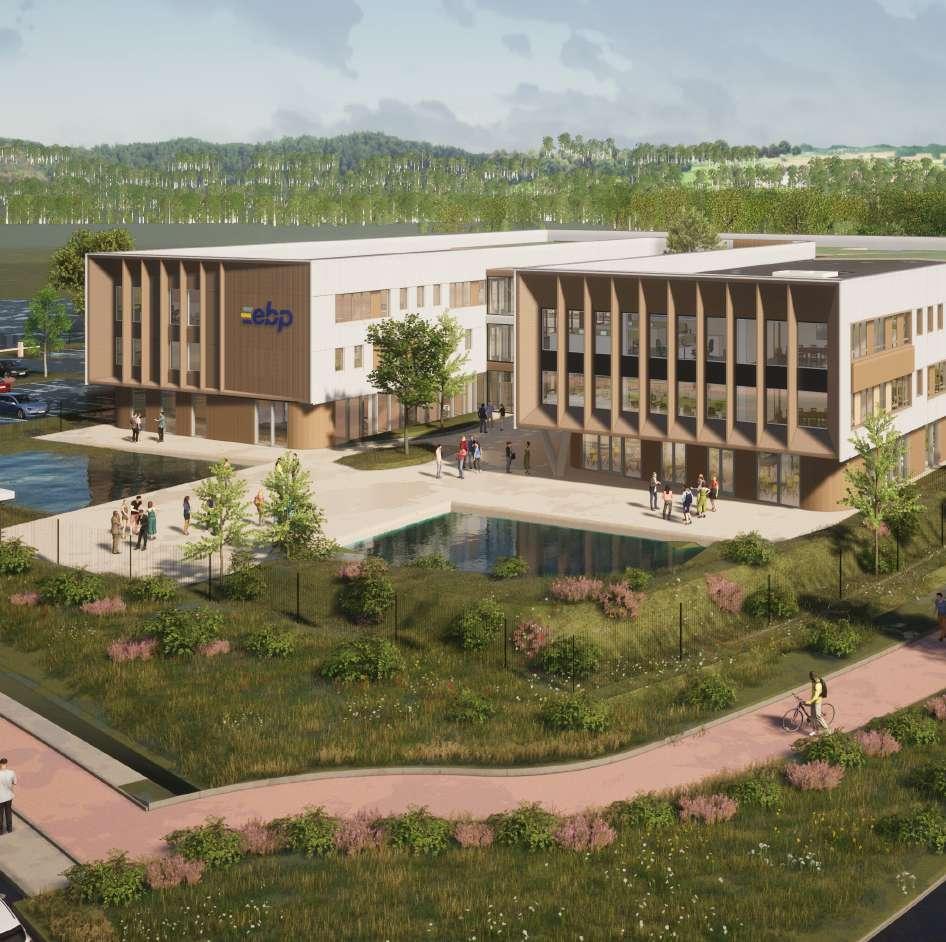
Headquarters of EBP 1
PROFESSIONAL PROJECTS
2
Hotel Hampton by Hilton, Roissy France
Residential building in Evry
Construction of the social center of Deauville
ACADEMIC WORKS
Water as an architectural material
Water through Bab Makina
Towards the casbah of Algiers
PROFESSIONAL
PROFESSIONAL PROJECTS
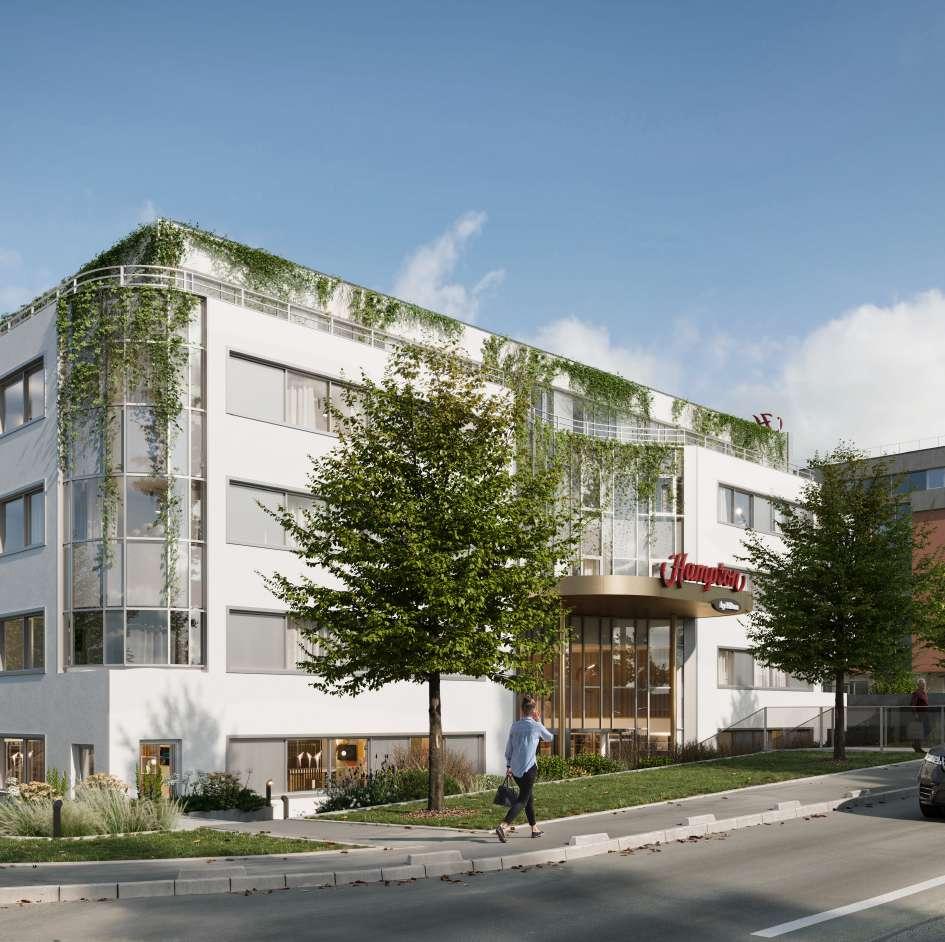
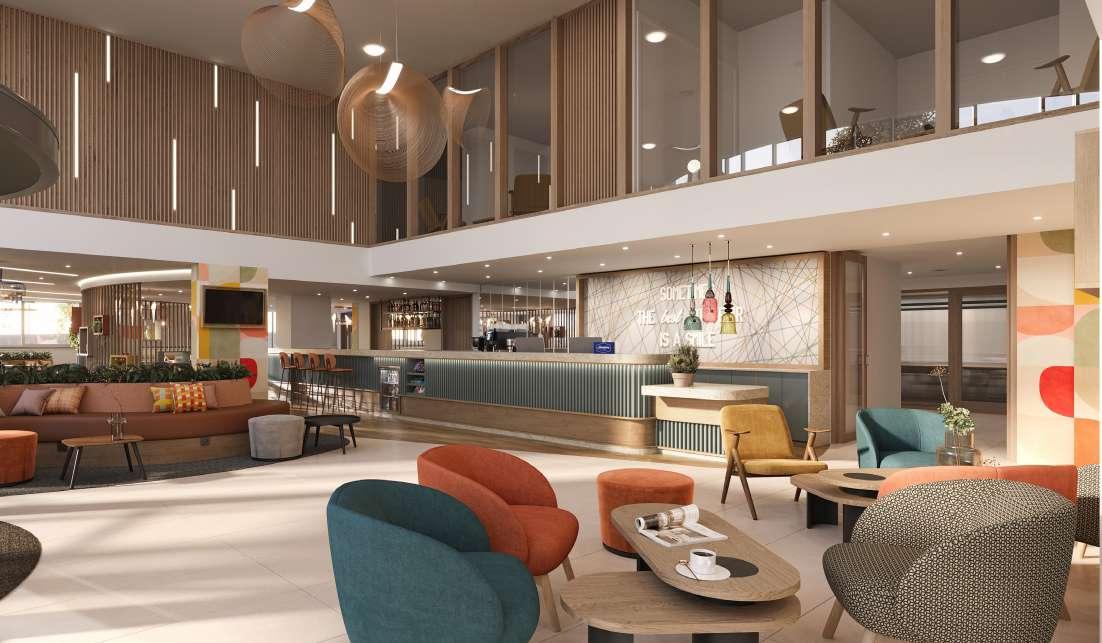
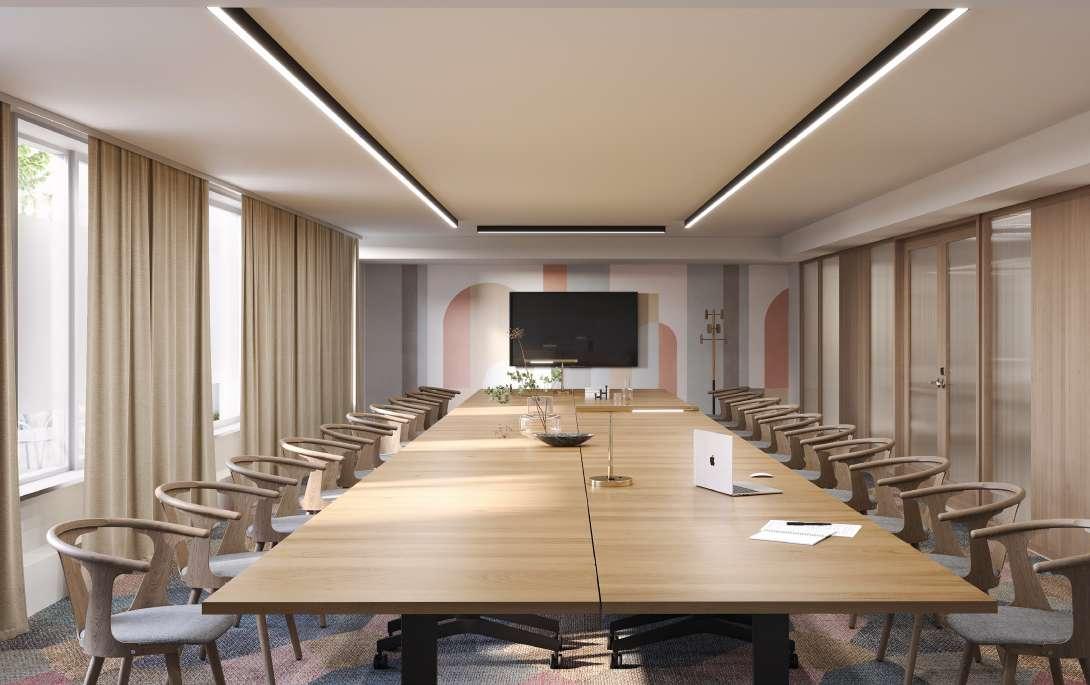
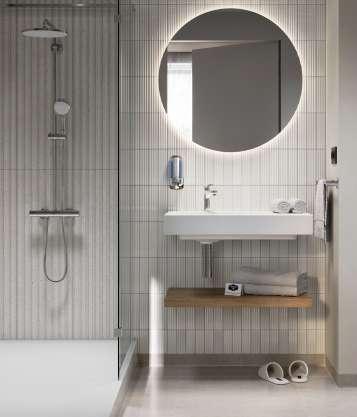
HAMPTON BY HILTON, ROISSY FRANCE
Program: Conversion of an office building into a 157-room Hampton by Hilton hotel, including a bar and restaurant.
Missions carried out: Participation in the design, furniture design, creation of part of the graphic documents, coordination of meetings with the perspective artist, 3D modeling of the building and furniture, site visit. I participated in the inception of this project as an architect and interior designer.
Area : 6300 m2
Axonometric view of the project
Site of the hotel Hampton by Hilton
Perspective of the lobby
Perspective of a meeting room
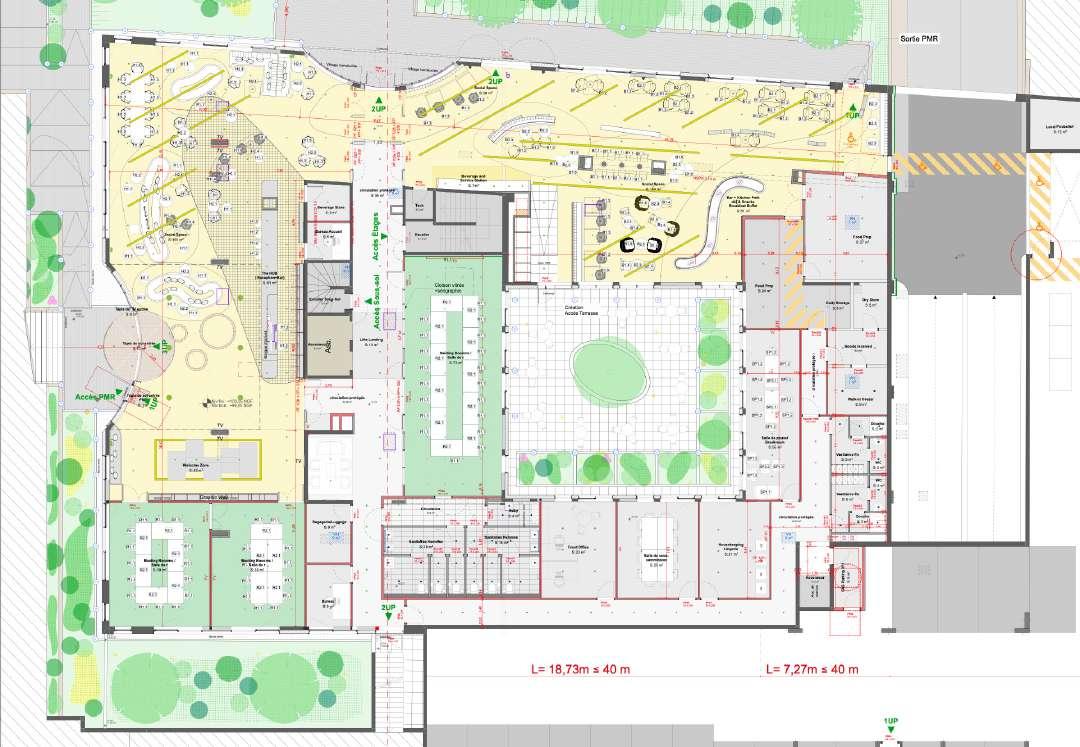
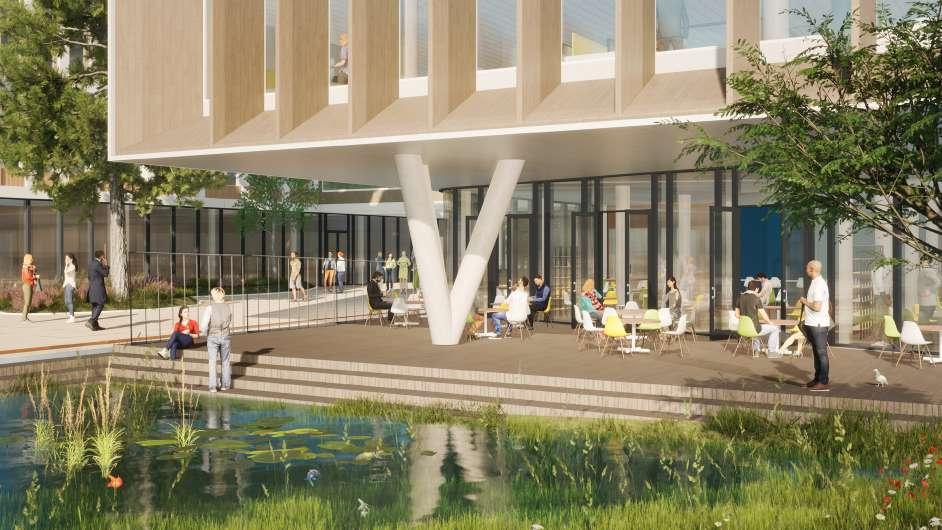
HEADQUARTERS OF EBP
Program : Construction of EBP’s headquarters and interior design
Missions carried out: Participation in the design, furniture design, creation of part of the graphic documents. I participated in the inception of this project as an architect and interior designer.
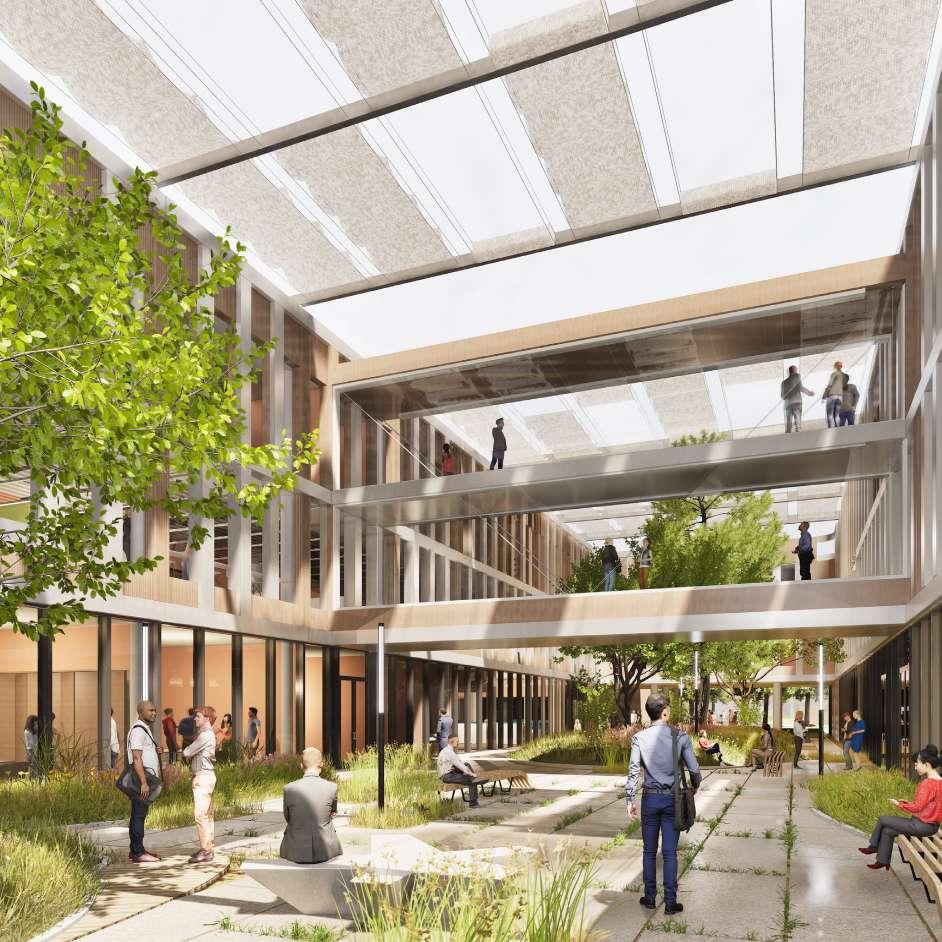
PATIO
The central courtyard will feature a patio in the heart of the building to optimize natural light.
1 2 3 TO CREATE A BUILT FRONT TO EXTEND THE EXISTING NATURAL AREA TO CONNECT THE URBAN AREA
WITHDRAWAL
The ground floor will be set back to offer a different perception of the building at the pedestrian scale.
POROSITY
The ground floor program is subdivided to create gaps and establish a link between the surrounding spaces of the building (natural space, etc.).
SIGNAL
The reception area is marked by the cutting of the west gable to create a visual signal and invite towards the building.
Perspective of the cafeteria and its water basins from the square
Perspective of the patio
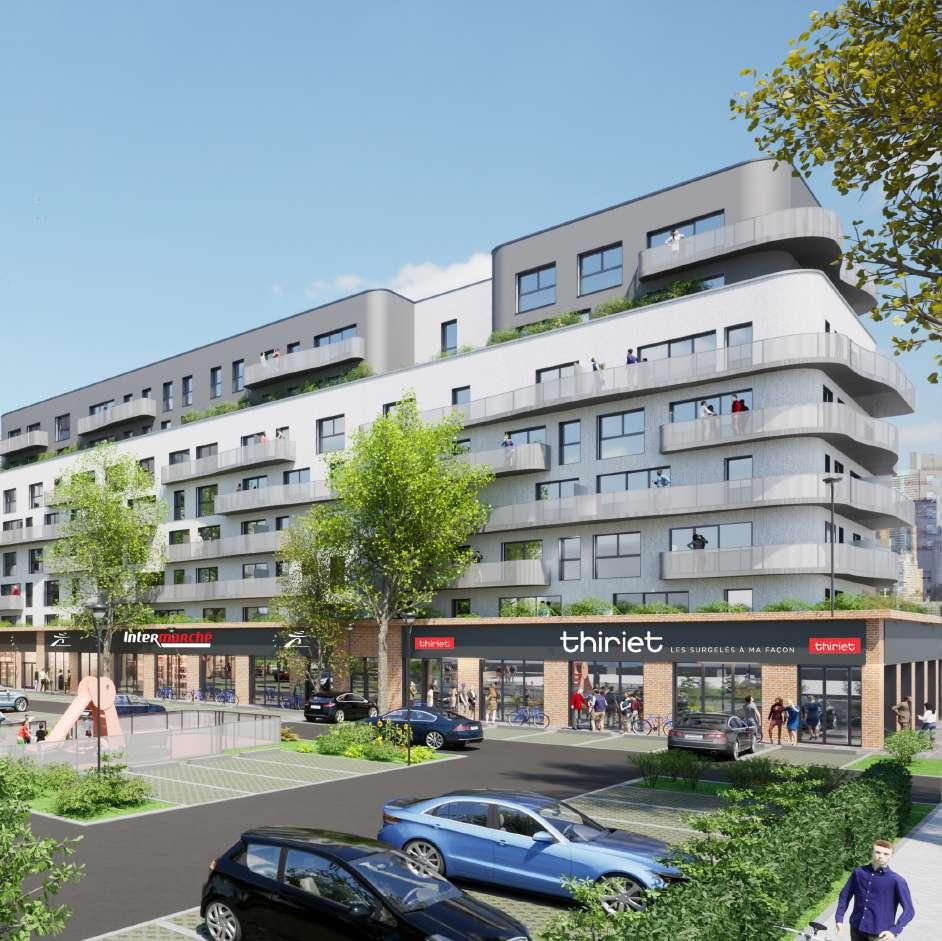
RESIDENTIAL BUILDING IN EVRY
Program : Urban commercial area comprising 158 housing units, activities and shops.
Missions carried out: Design and submission of the building permit
Area : 11 401 m2
Axedecirculationsecondaire
Axedecirculationsecondaire
CONSTRUCTION OF THE SOCIAL CENTER OF DEAUVILLE
AWARD-WINNING PROJECT
Execution of all graphic documents
In the context of my mandatory master’s internship, I was tasked with participating in several competitions. For the creation of the social center in Deauville, I was entrusted with producing all graphic documents.
To best meet the expectations outlined in the program, we developed the following themes:
Creating a building capable of seamlessly integrating into its context: The project is located on Rue de Verdun, a residential street in Deauville characterized by:
Townhouses with 1 or 2 floors, sometimes with attic space, Alignment with the street or setback for small gardens, Gardens at the rear,
Traditional and high-quality materials: brick, wood, cut stone, plaster...
To harmoniously integrate into this context, we had the following objectives:
Working on a domestic scale despite the size of the project, creating continuity with the street landscape of Rue de Verdun, which mainly consists of single-family or semi-detached houses. Using facade materials inspired by the tradition and history of the city.
Harmoniously integrating different entities within the same building. Creating shared spaces that can be differentiated according to different schedules.
Plan masse
Site plan
Northeast façade
Façade nord-est
Northwest façade
Façade nord-ouest
WORKS
WATER AS AN ARCHITECTURAL MATERIAL
Master thesis - Distinction - October 2020 to March 2021
Supervisor: Cyrille Faivre-Aublin
Problem statement : To what extent does the architectural staging of water as a telluric and atmospheric phenomenon enable the unification of places and people?
Method : Comparison of two projects through drawings, decomposition of sections...
• Thermal Baths of Sidi Harazem by Jean-François Zevaco
• Lalla Yeddouna Square by Michel Mossessian
Vitruvius dedicates the eighth book of his work De Architectura to water, presenting it as one of the four elements: WATER, EARTH, FIRE, AIR. He explains how to find and analyze water.
Water is a chemical element that, like air or light, affects tectonics, stereometry, the envelope, and the hearth.
This thesis focuses on two complementary projects: the new Lalla Yeddouna Square in Fez by Michel Mossessian and the thermal baths of Sidi Harazem by Jean-François Zevaco.
Through these two examples, I seek to understand how architecture interacts with water, showcasing it in a way that ultimately transforms it from an economic object to an aesthetic one.
We discover in Lalla Yeddouna Square how water, through architecture—whether allegorical or concrete—brings people together. Finally, through the case of the Sidi Harazem thermal baths, we understand that water, in a more concrete manner, seems to give birth to architecture but also unites places and people.
Water, as a material, can be assimilated to an element of composition in the architecture of Lalla Yeddouna Square and the unifying thread of the Sidi Harazem thermal baths, where every drop is recovered, where everything is measured, and nothing is left to chance.
RUNOFF
Plan de toiture du projet Lalla Yeddouna
Roof plan of the Lalla Yeddouna project
Plan de toiture du projet Lalla Yeddouna
Document personnel
Document personnel
Plan masse du projet des thermes initialement voulues par Zevaco
Document personnel
plan
the
Site
of
Sidi Harazem thermal baths
BAB MAKINA POUR ET PAR L’EAU, FÈS
WATER THROUGH BAB MAKINA
PFE recherche - mention très bien semestre 8 - Sept 2020 à Sept 2021
Supervisors : Cyrille Faivre-Aublin and Laurent Beaudouin
Encadrants : Cyrille Faivre-Aublin et Laurent Beaudouin.
Invités : Jean-Louis Faloci, Paolo Amaldi, Jean-Paul Midant, Emmanuelle Sarrazin
Axonométrie du projet dans son ensemble
Axonometric view of the project
A BERBER MUSEUM ALONG THE WATER
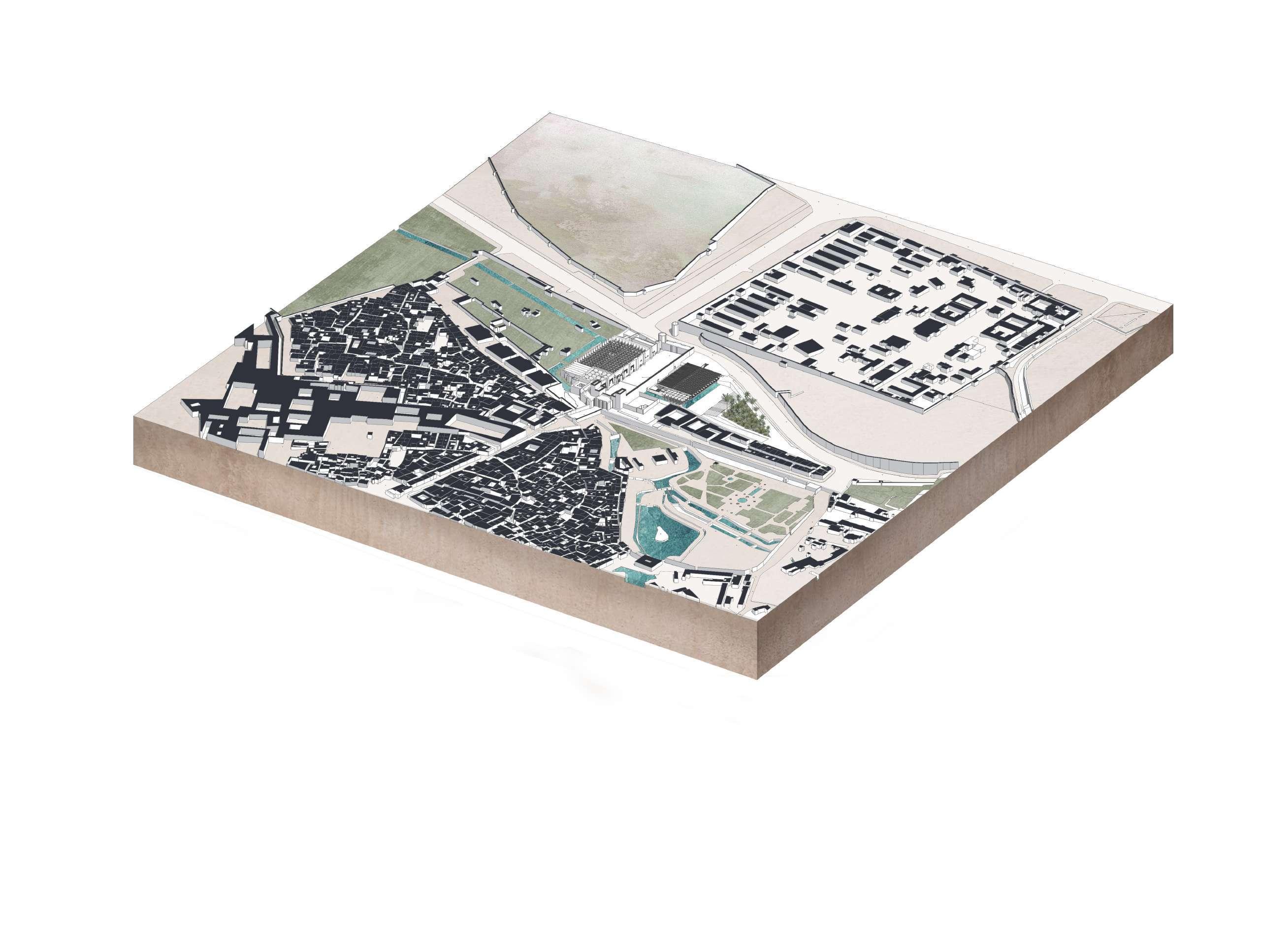
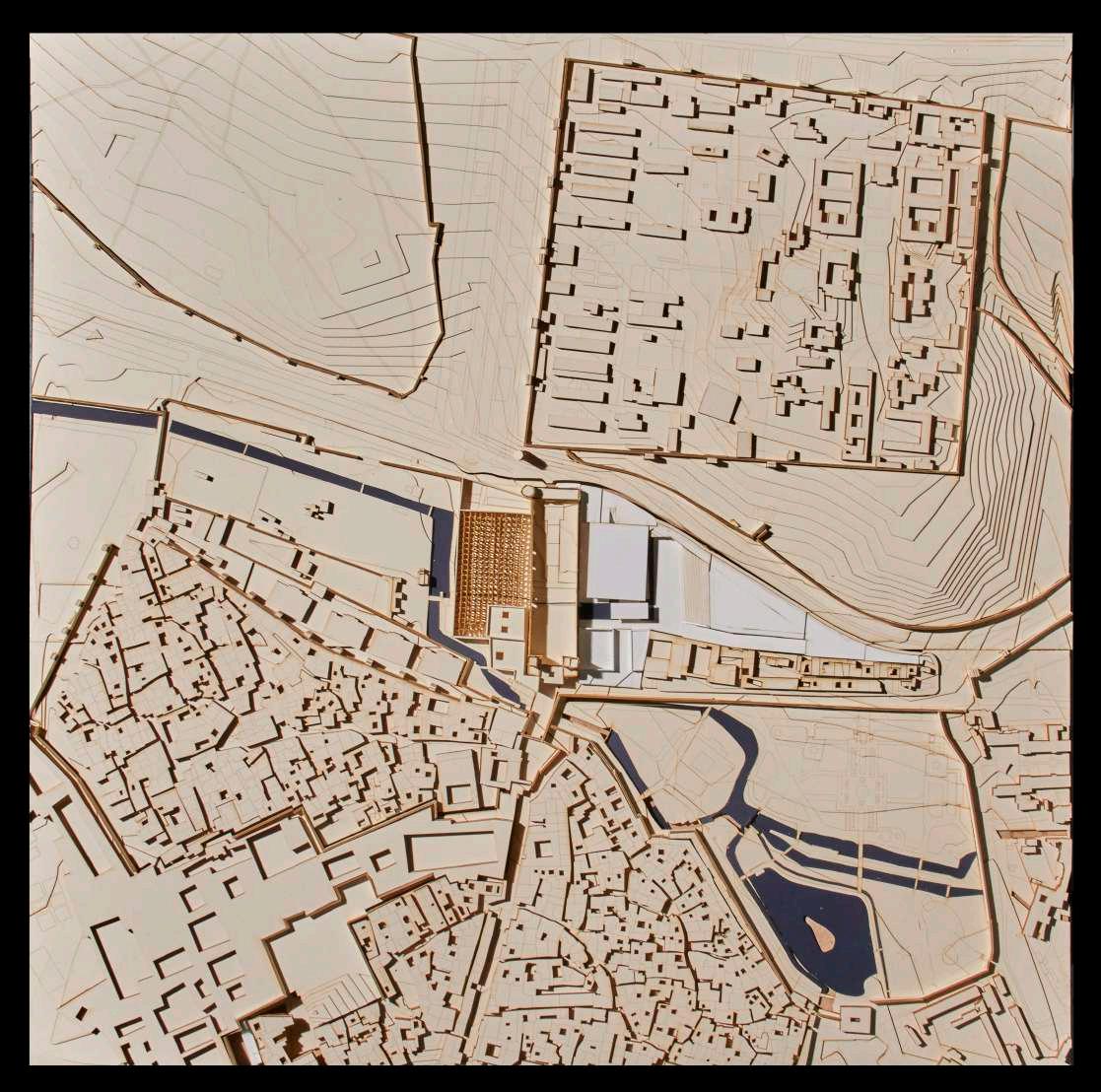
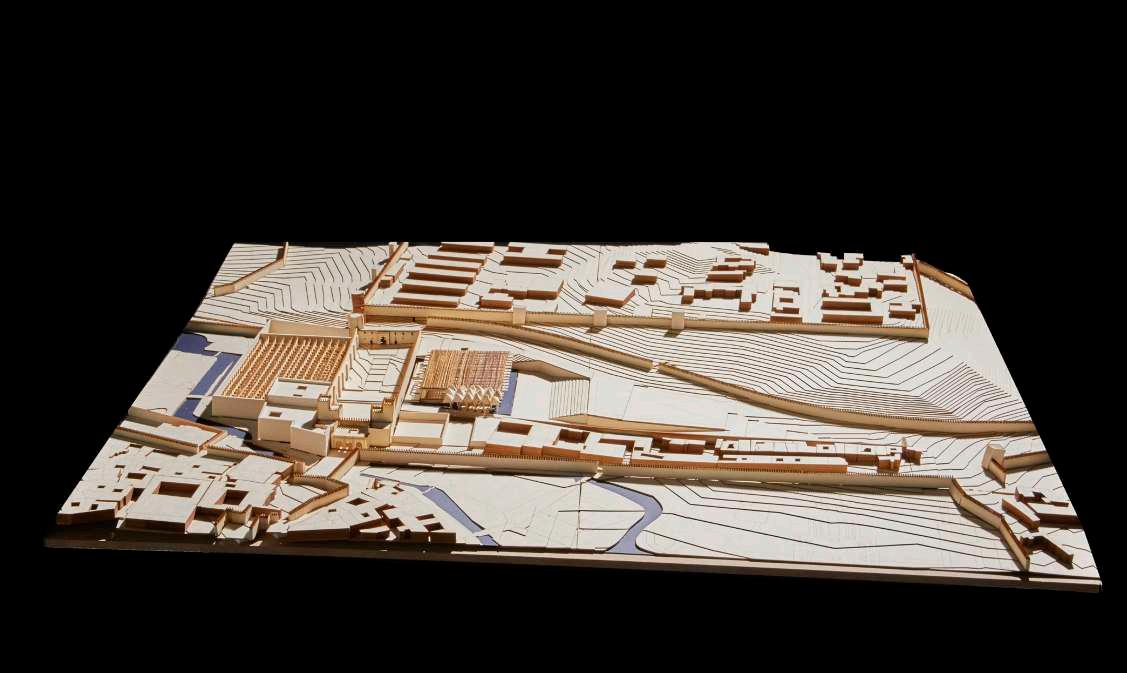
In continuation with my thesis, which focused on the theme of water as an architectural material, my choice for my final year project was the city of Fes, specifically a site named Bab Makina. This site is traversed by a river that gives it a distinct identity.
The question addressed by this project is: «To what extent does the architectural staging of water unify dissociated structures?»
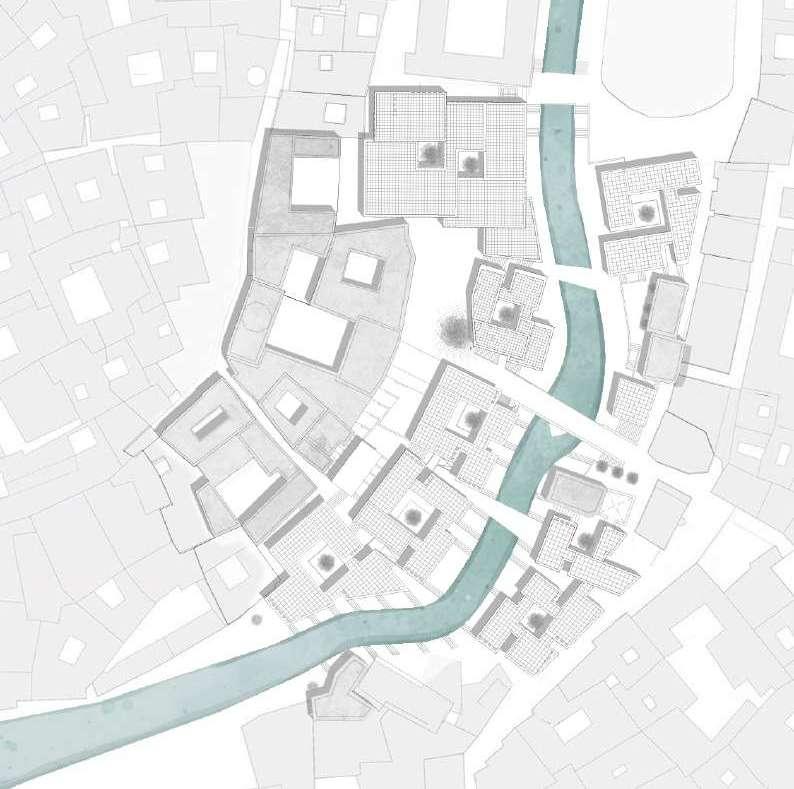
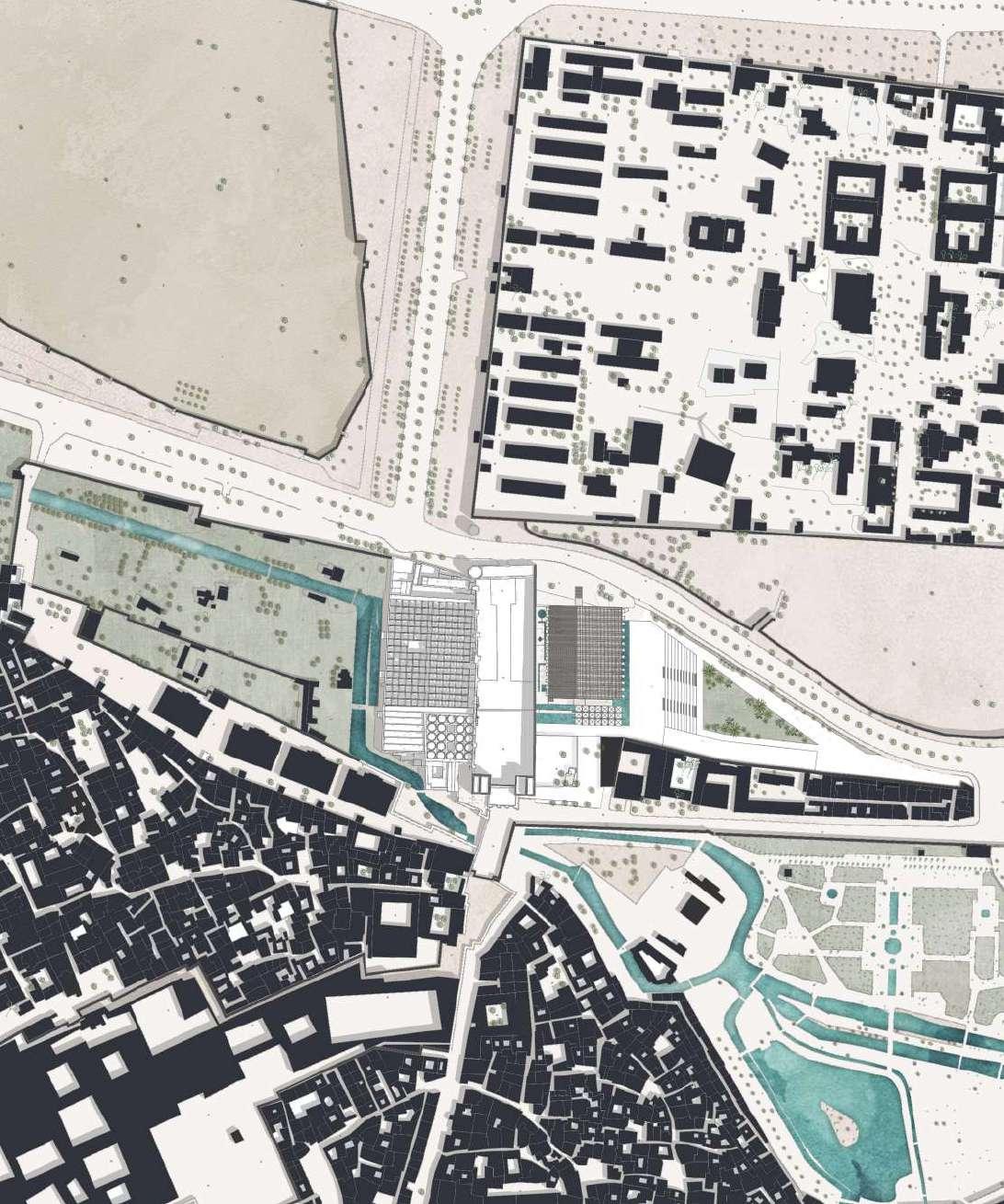
The current state of the site reveals an area surrounded by ramparts, secluded and traversed by neglected waterways. Three structures adjoin:
The Makina, a former arsenal left abandoned and to be transformed into a library within the project scope.
Bab Makina Square, a historic square where one of the ramparts, made of rammed earth, forms an abandoned aqueduct.
A vacant lot, the museum site proposed by this architectural intervention project.
At the urban scale, the project involves creating a riverside promenade through the redevelopment of riverbanks. This includes establishing a water reservoir to supply the promenade during dry periods and prevent centennial floods. A water channel (seguia) is designed to flow successively through the Makina, the square, and the museum, continuing on to merge with the water from Jnane Sbil Garden nearby.
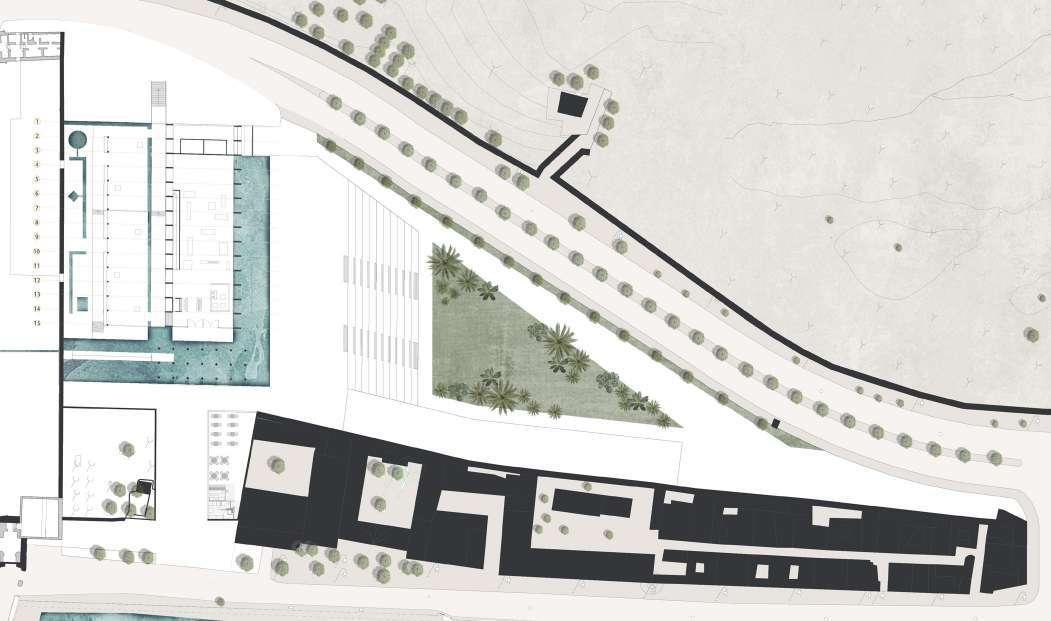
At the architectural scale, the museum highlights Berber culture through a design where the promenade is rhythmically guided by water. The museum comprises three main parts: the primary exhibition space, where light is filtered through inverted shells forming gutters.
BAB MAKINA POUR ET PAR L’EAU
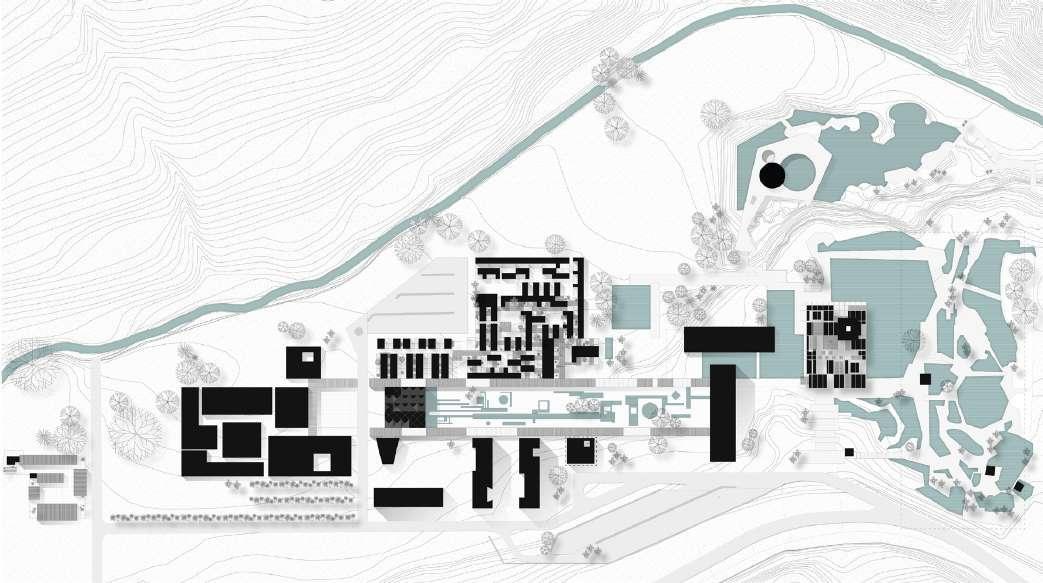
Site plan of the project
masse du projet - Échelle 1/1000e Plan masse du projet
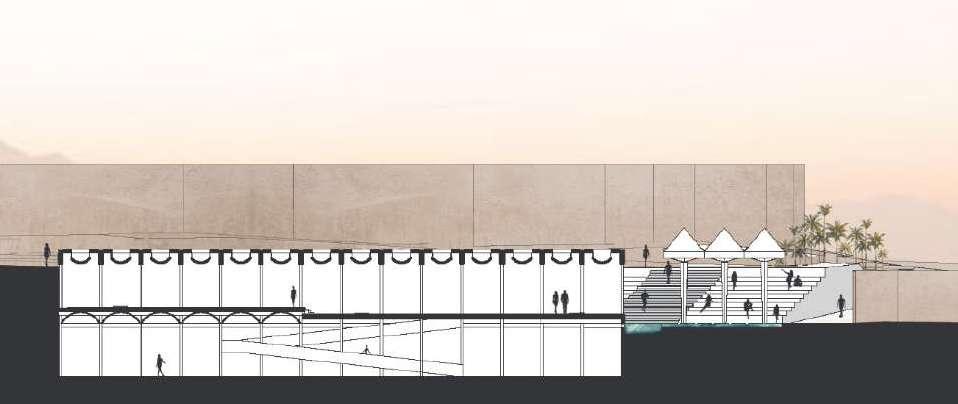
Coupe longitudinale de la salle d’exposition exterieure du musée - Échelle 1/200e
Coupe longitudinale du musée
Coupe longitudinale de la salle d’exposition intérieure du musée- Échelle 1/200e
Coupe AA
Perspective longitudinale schématique du musée
Coupe AA
Schematic longitudinal perspective of the museum.
Schematic cross-sectional view of the existing state of the intervention site.
BB
Coupe transversale schématique de l’état existant du site d’intervention
Coupe BB
THE MEDINA AS INSPIRATION
LA MÉDINA COMME INSPIRATION
The climatic conditions of the city of Fes necessitate protection from the sun. Thus, following the logic of the shaded alleyways of the medina, one of the museum’s experiments involved designing a roof that echoes the general appearance of the sunshades in Fes Jdid. The goal was to propose a filtering roof whose shade pattern would punctuate the ground.
This inspiration came to me through analyzing the arcades of the kissaria at the Sidi Harazem baths, which seemed to be inspired by the sunshades of the medina.
Les conditions climatiques de la ville de Fès impliquent de se protéger du soleil. Ainsi, dans la logique des ruelles ombragées de la médina, l’une des expérimentations du musée a consisté en l’élaboration d’un toit repren- nant l’allure générale des ombrières de Fès Jdid ; L’objectif étant de proposer un toit filtrant dont l’ombre de sa trame viendrait ponctuer le sol. Cette inspiration m’est venue grâce à l’analyse des portiques de la kissaria des thermes de Sidi Harazem qui m’ont semblé être inspirés des ombrières de la médina.
THE GRID OF THE MAKINA AS A PROJECT PREMISE
LA TRAME DE LA MAKINA COMME PRÉMISSE DU PROJET
It seemed logical to choose a grid for the museum equivalent to that of the Makina, which is 5m by 5m. Thus, on the roof of the museum, we can see a grid similar to that of the old arsenal, although the footprint on the ground differs.
Il m’a semblé cohérent de choisir pour le musée une trame équivalente à celle de la Makina qui est de 5m par 5m.
Ainsi, pouvons-nous lire en toiture du musée une trame équivalente à celle de l’ancien arsenal tandis que l’emprise au sol diffère.
JARDIN DE LA MAKINA
TERRAIN DU FUTUR MUSÉE
LA MAKINA LA PLACE TERRAIN VAGUE
CITADELLE / KASBAH CHERRARDA
Coupe
JARDIN DE LA MAKINA
TERRAIN DU FUTUR MUSÉE LA MAKINA LA PLACE TERRAIN VAGUE ROUTE
LA CITADELLE / KASBAH CHERRARDA
THE MEDINA CEMETERY THE SITE
THE ROAD CEMETERY
CITADEL
GARDEN OF THE MAKINA
LA MAKINA THE SQUARE SITE OF THE FUTURE MUSEUM THE ROAD WASTELAND
THE CITADEL/KASBAH CHERRARDA
L’EAU GÉNÉRATRICE DE TOITURE
Perspective de la galerie d’exposition extérieure
Perspective de la galerie d’exposition extérieure
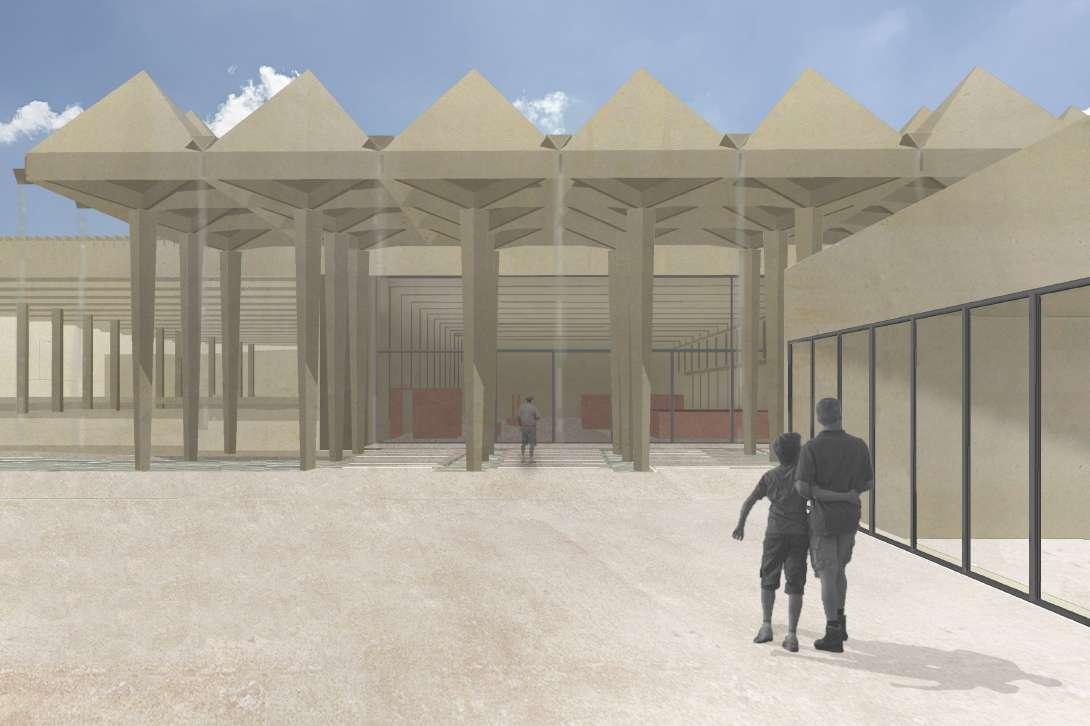
Exterior perspective of the museum entrance.
Perspective extérieure de l’entrée du musée
Perspective extérieure de l’entrée du musée
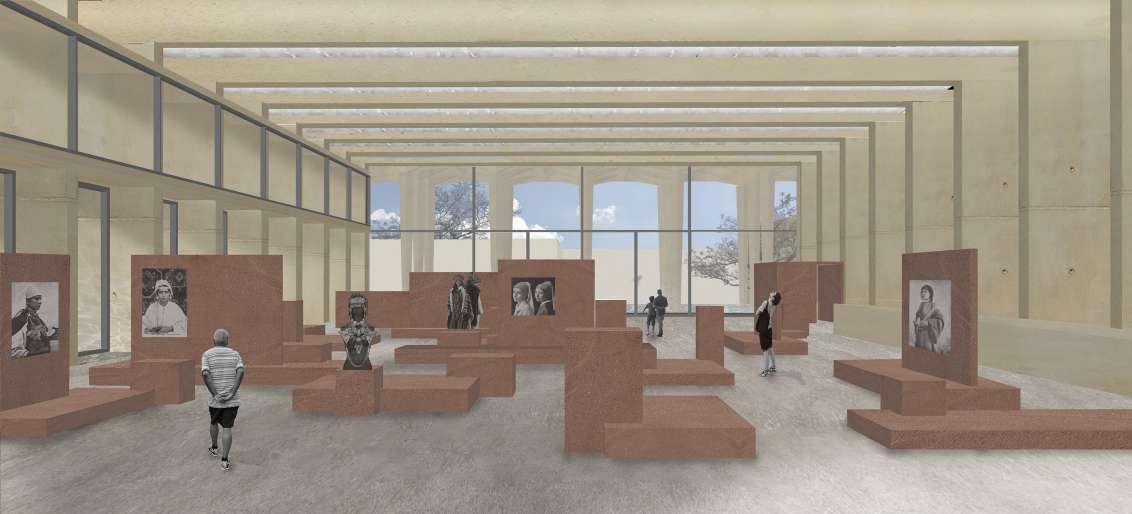
Perspective de la salle d’exposition
Perspective de la salle d’exposition
Perspective de la salle d’exposition permanente / hall
Ground floor plan of the museum.
Perspective de la salle d’exposition permanente / hall
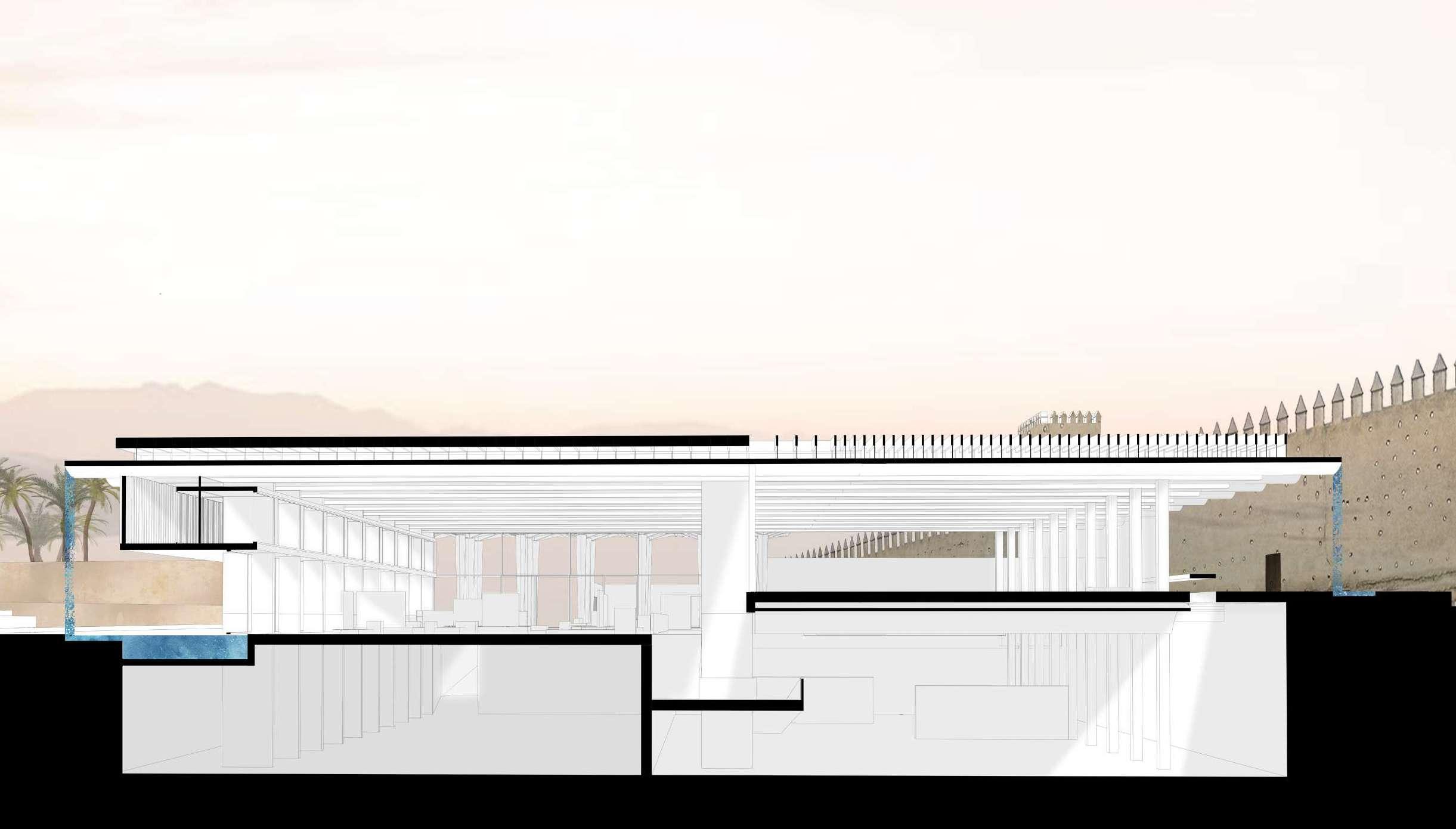
Coupe perspective transversale - Échelle 1/200e
Perspective de la salle d’exposition
Coupe perspective transversale - Échelle 1/200e
Coupe perspective transversale - Échelle 1/200e
Perspective de la salle d’exposition
Coupe perspective transversale - Échelle 1/200e
Site model at 1:1000 scale Maquette de site au 1/1000e
du projet et ses alentours au 1/500e
Model of the project and its surroundings at 1:500 scale
Encadrants : Sébastien Memet, Paolo Tarabusi, Chérazade Nafa.
Supervisors : Sherazade Nafa, Paolo Tarbusi, Sebastien Memet
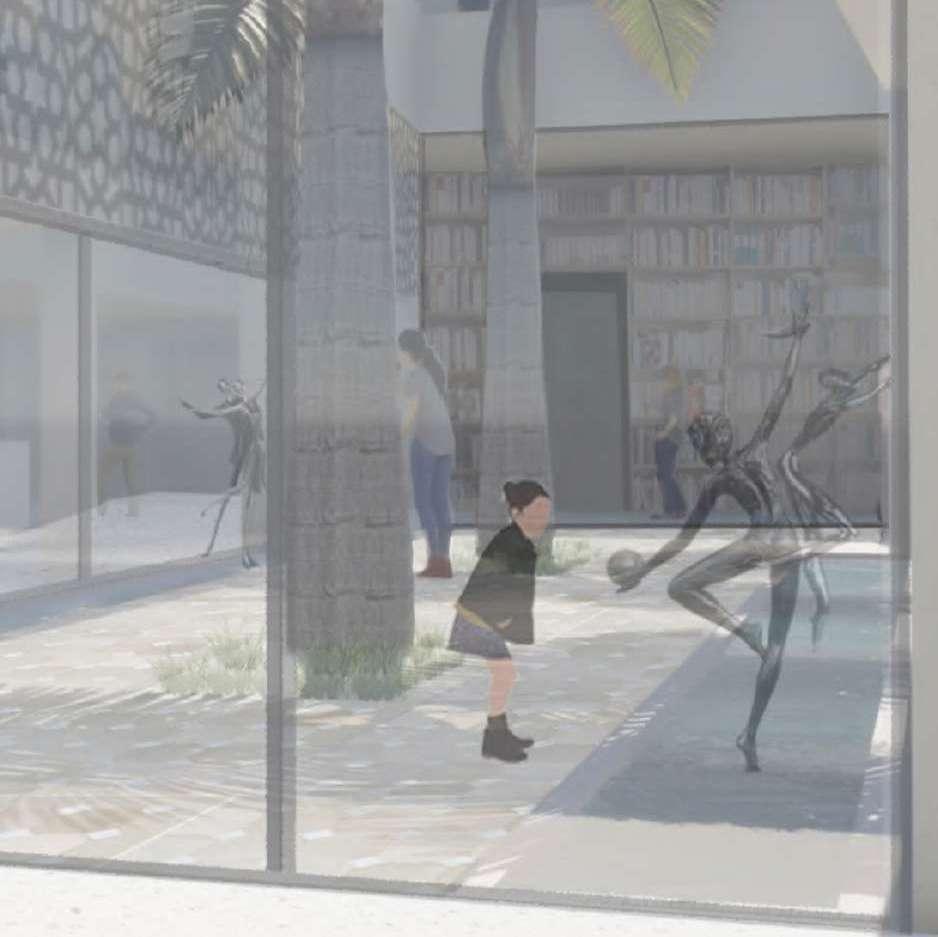
d’un des patios du centre culturel
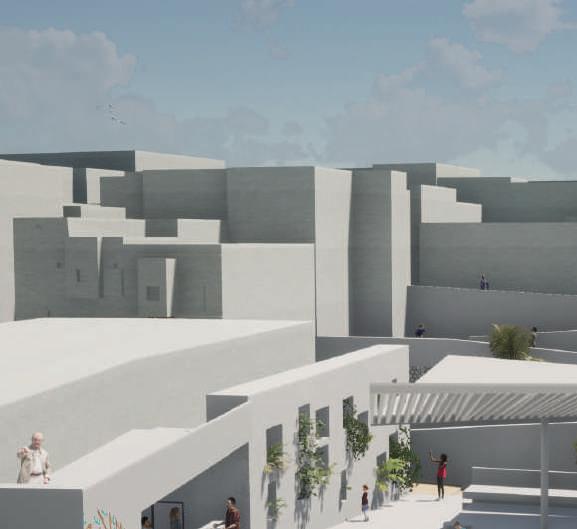
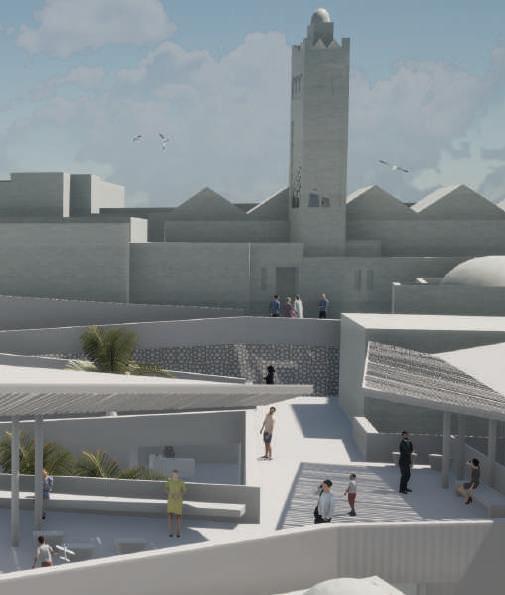
ALONG THE PATIOS, ALGIER
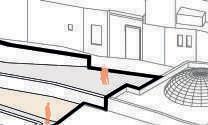
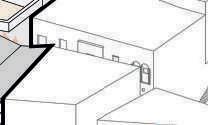
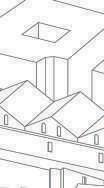
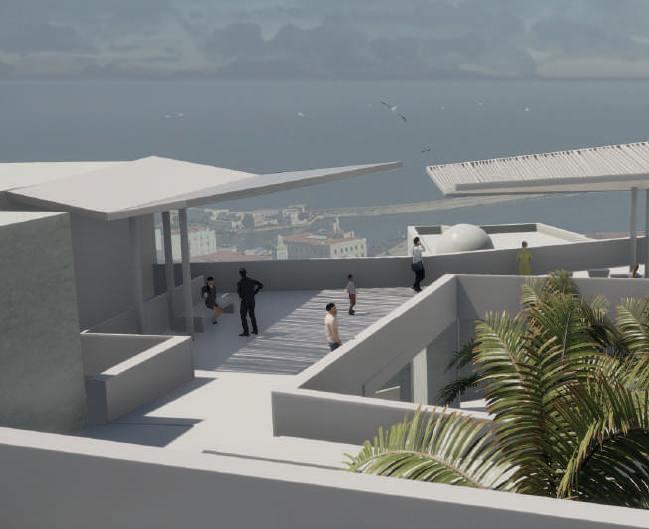
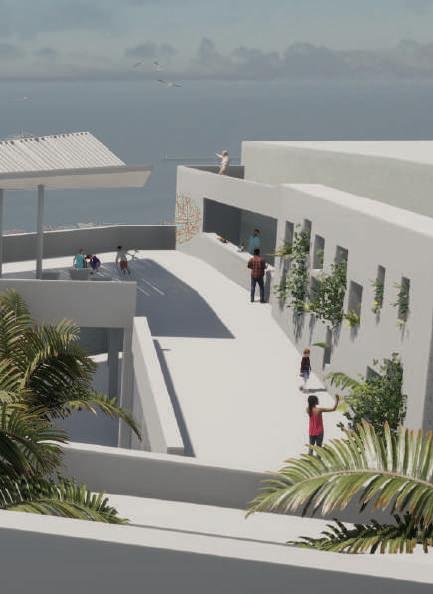
The site of this cultural center is the result of the assembly of different urban voids in the Casbah of Algiers, overlooking it and thus enjoying a panoramic view of the sea.
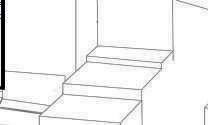
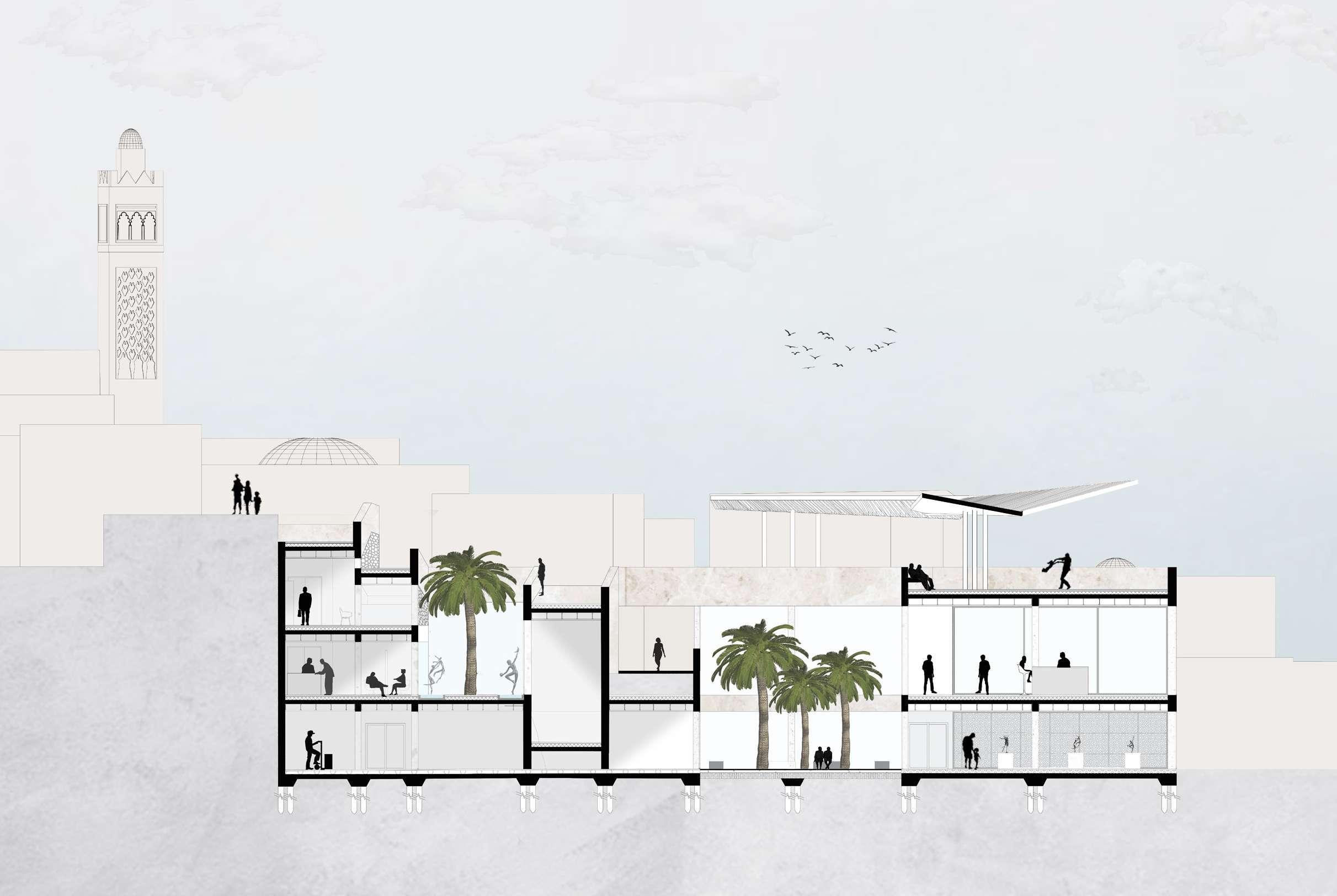
This project consists of two buildings located on two different plots with varying levels, exploiting the elevation to allow rooftop promenades, turning the museum into an infrastructure. The building on the first plot houses the museum, featuring a sloped roof that leads to the roof of the second building. The latter serves as an underground extension of the museum and on its ground floor, a restaurant inspired by market halls found in Spain or Portugal.
The restaurant, composed of kiosks, offers a culinary discovery of Algiers while providing a view of the sea. The basement (-1) includes discovery workshops where visitors can cook their own dishes.
Regarding the views, the project highlights the sea. Thanks to the sloped terrain, different viewpoints of the sea are possible during the promenade. As one descends, the sea becomes less visible, but two courtyards are integrated into the route to compensate for this. These courtyards subtly evoke the courtyards of the Casbah houses without attempting to replicate them. They allow light to enter the buildings and create a play of perspectives. When strolling on the museum’s roof, the first courtyard reveals itself, while walking on Rue Hamidouche unveils the second courtyard, although it is not accessible. Similar to the Casbah house courtyards, its privacy lies in being visible yet inaccessible to the public eye.
ROOF
FIRST FLOOR
GROUND FLOOR
BASEMENT LEVEL
Le projet dans son contexte
VUE PIÉTONNE - ARRIVÉE DEPUIS LA RUE SIDI RAMDANE
VUE AÉRIENNE DE L’ESPACE PUBLIC
Vue piétonne - arrivée depuis la rue Sidi Ramdane
Vue aérienne de l’espace public
Pedestrian view - arrival from Sidi Ramdane Street
Aerial view of the public space
Coupe transversale du musée
Cross-section of the project
MOUNA BAHEJ
UAE residence visa sponsorship from father Architect HMONP
Born on 25/12/1997 in Strasbourg (France)
83 rue Saint-Dominique, 75007 bahejmouna@yahoo.com