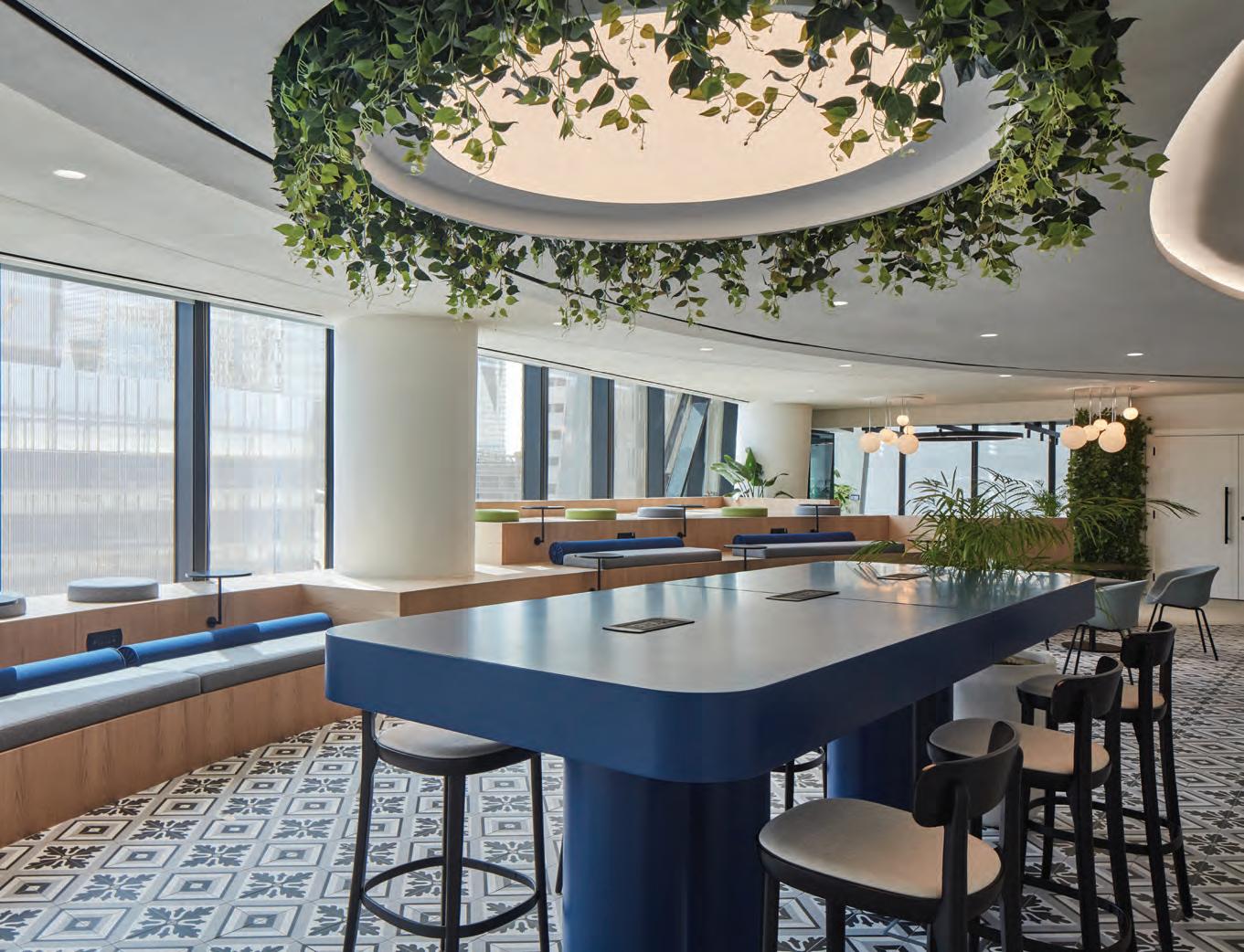
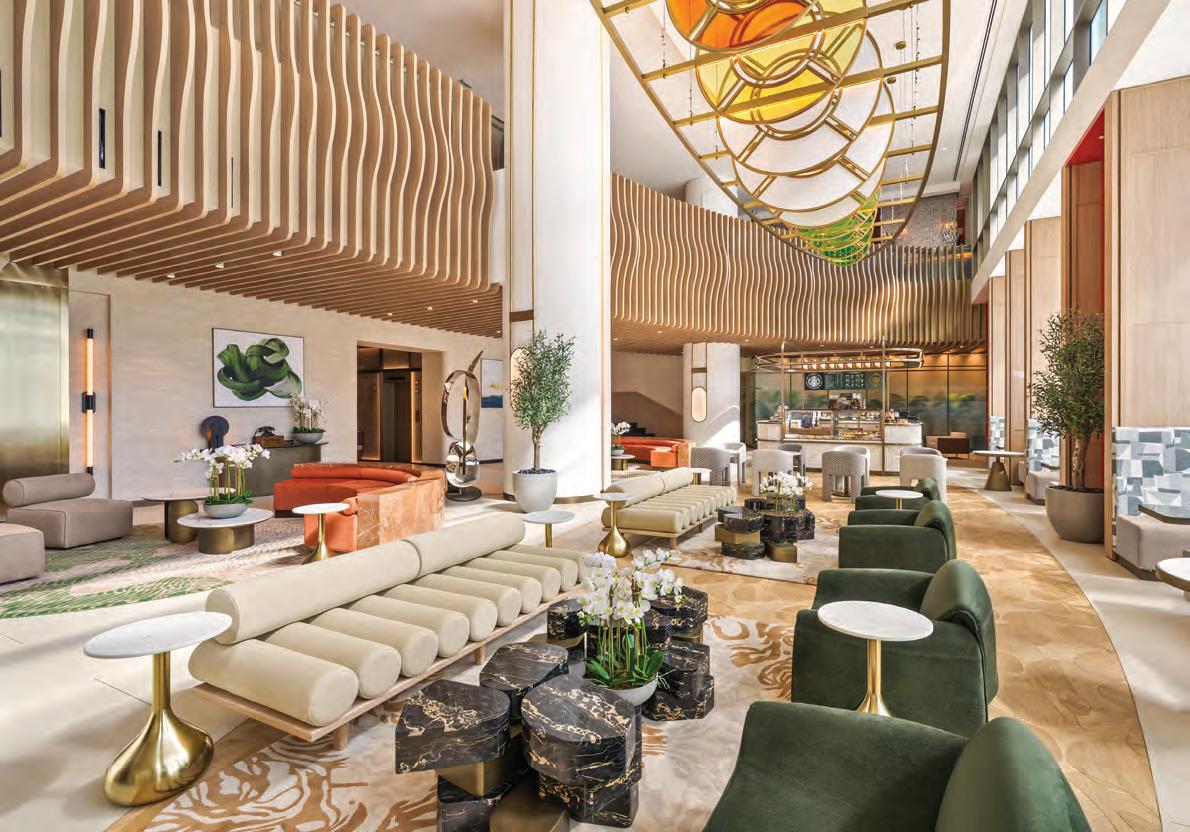
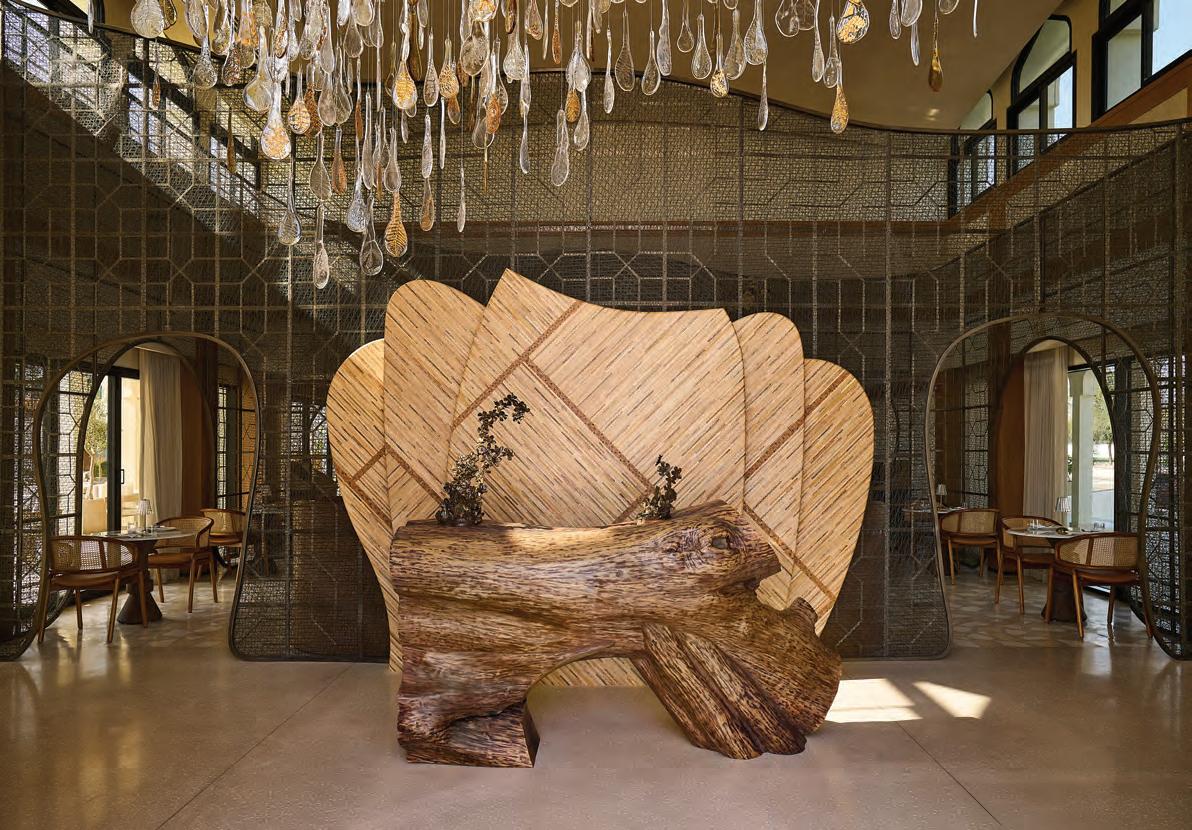
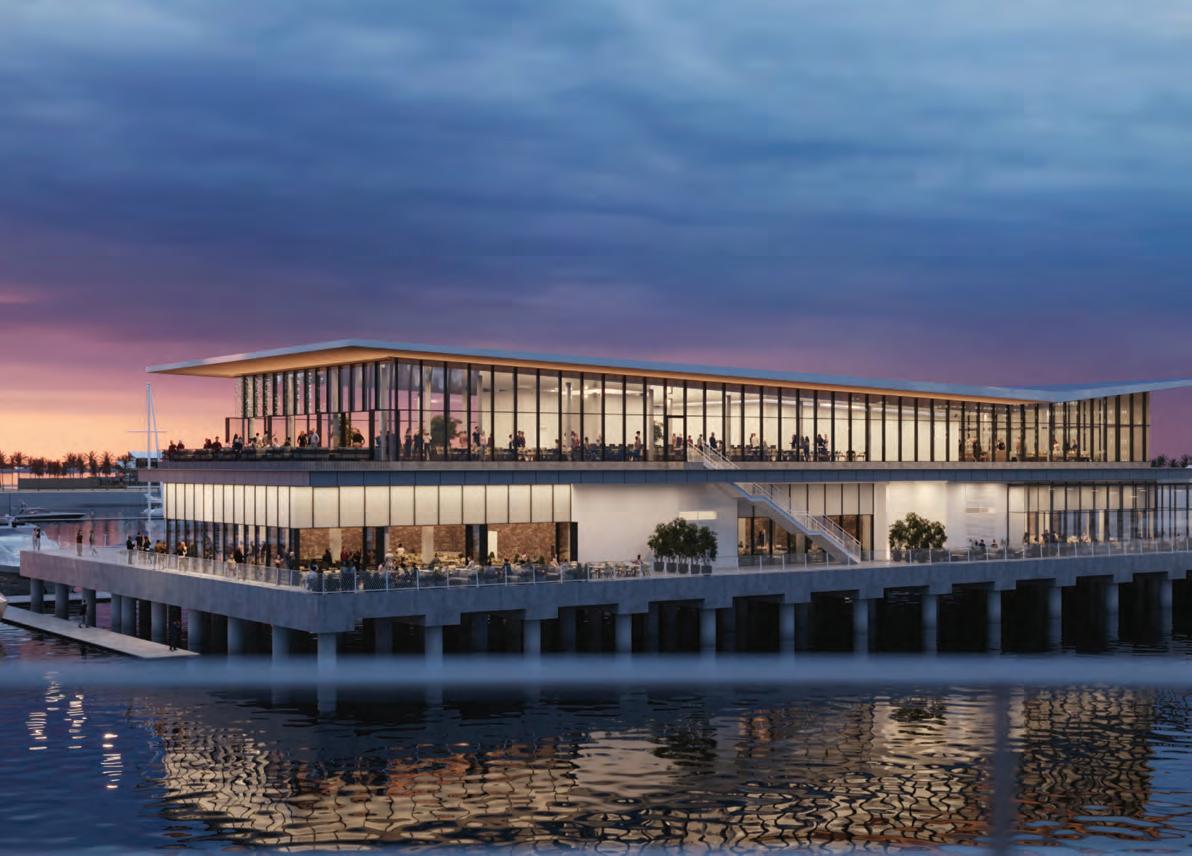
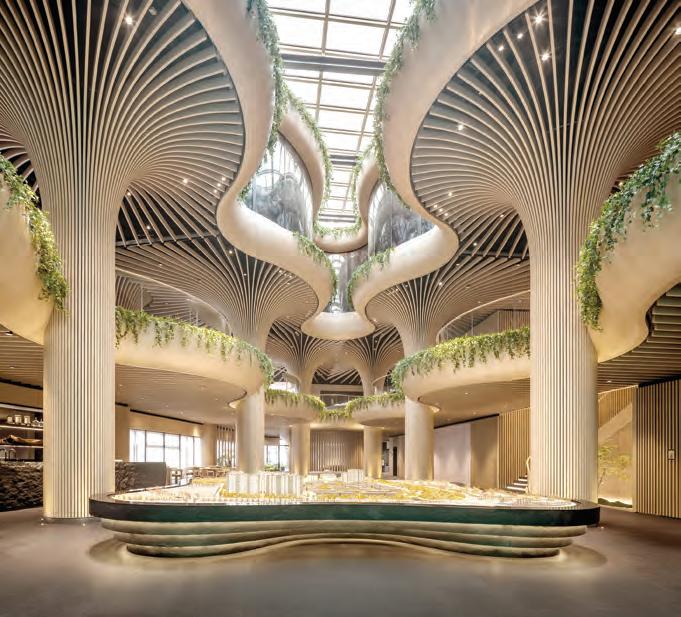
Living Spaces and Home Makeovers / Al Ain Oasis Hub by Aedas / Art Basel Qatar
by Al Shamsi
18 Meaning, Myths and Motivation
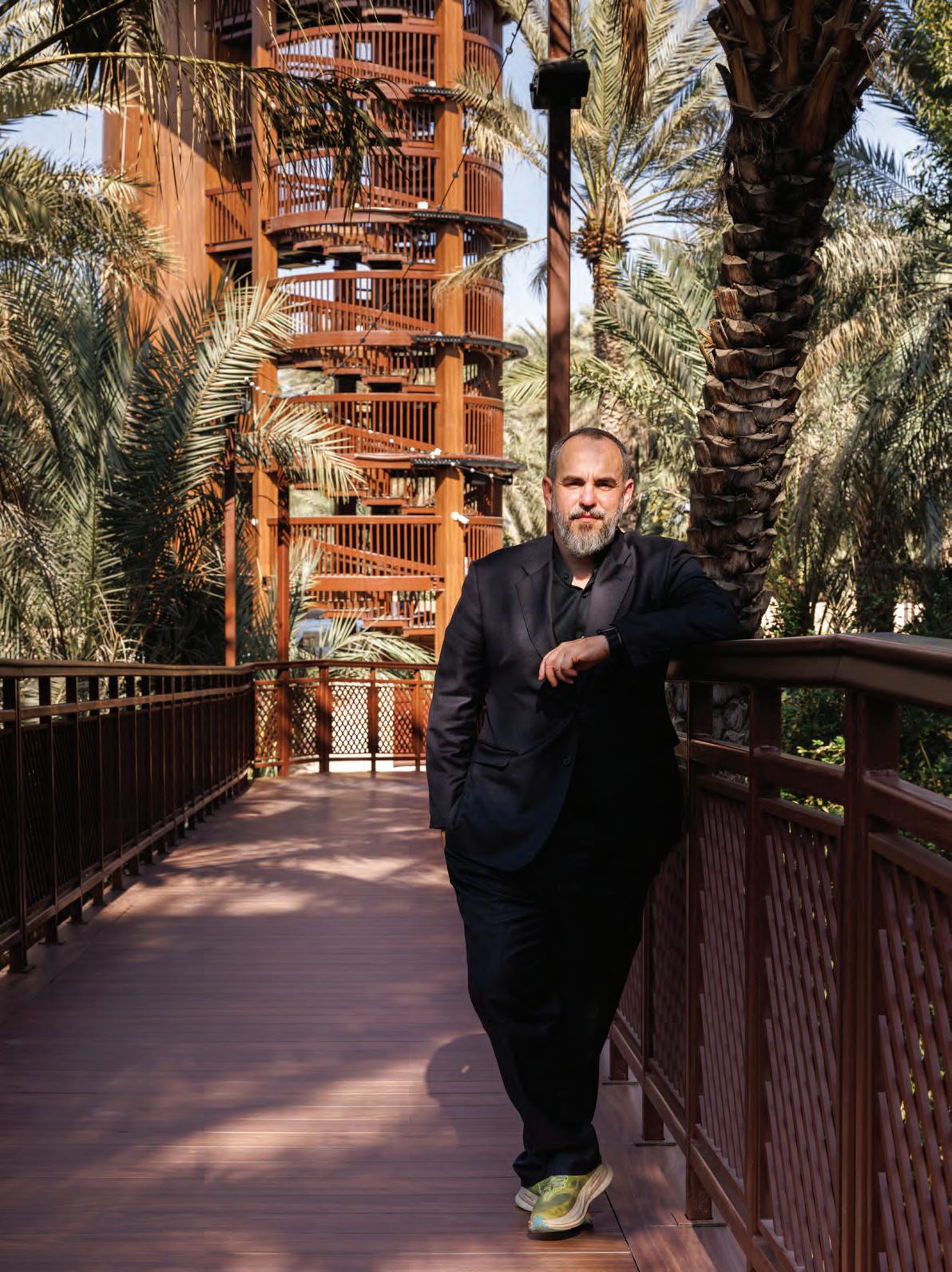
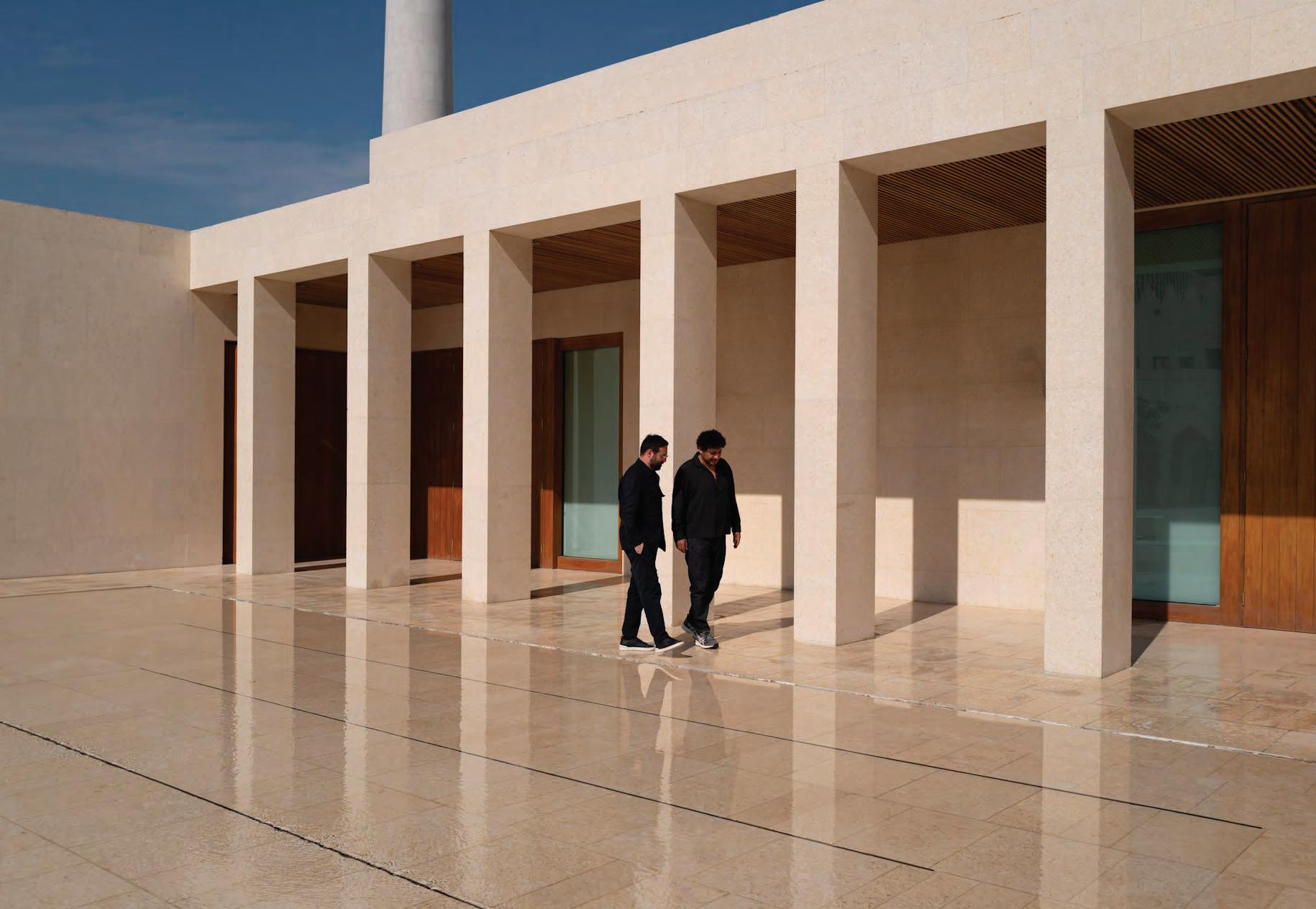
Based in the Middle East for two decades, Ignacio Gomez is an award-winning architect, renowned for creating landmark projects in the region, with his work spanning master planning, hospitality, residential, cultural, leisure and transport. We sat down with the Global Design Principal of multinational architecture design studio Aedas to talk about his work, changes in the region and the next generation of architects
34 Women in Design
As the Gulf ’s design industry continues its upswing, these 13 female designers offer bold, innovate and practical takes to the region’s rapidly evolving creative landscape
48 Spatial Rhythms of Fluid Design
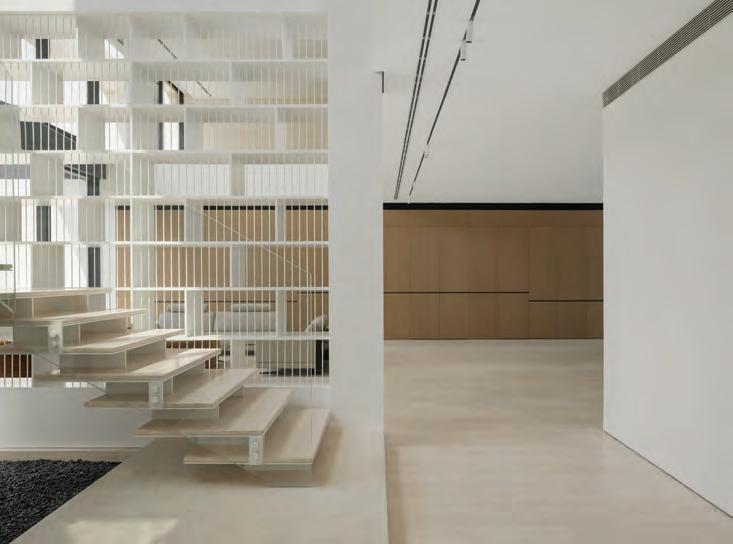
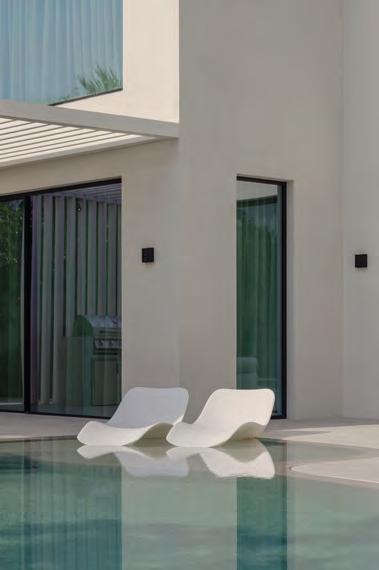
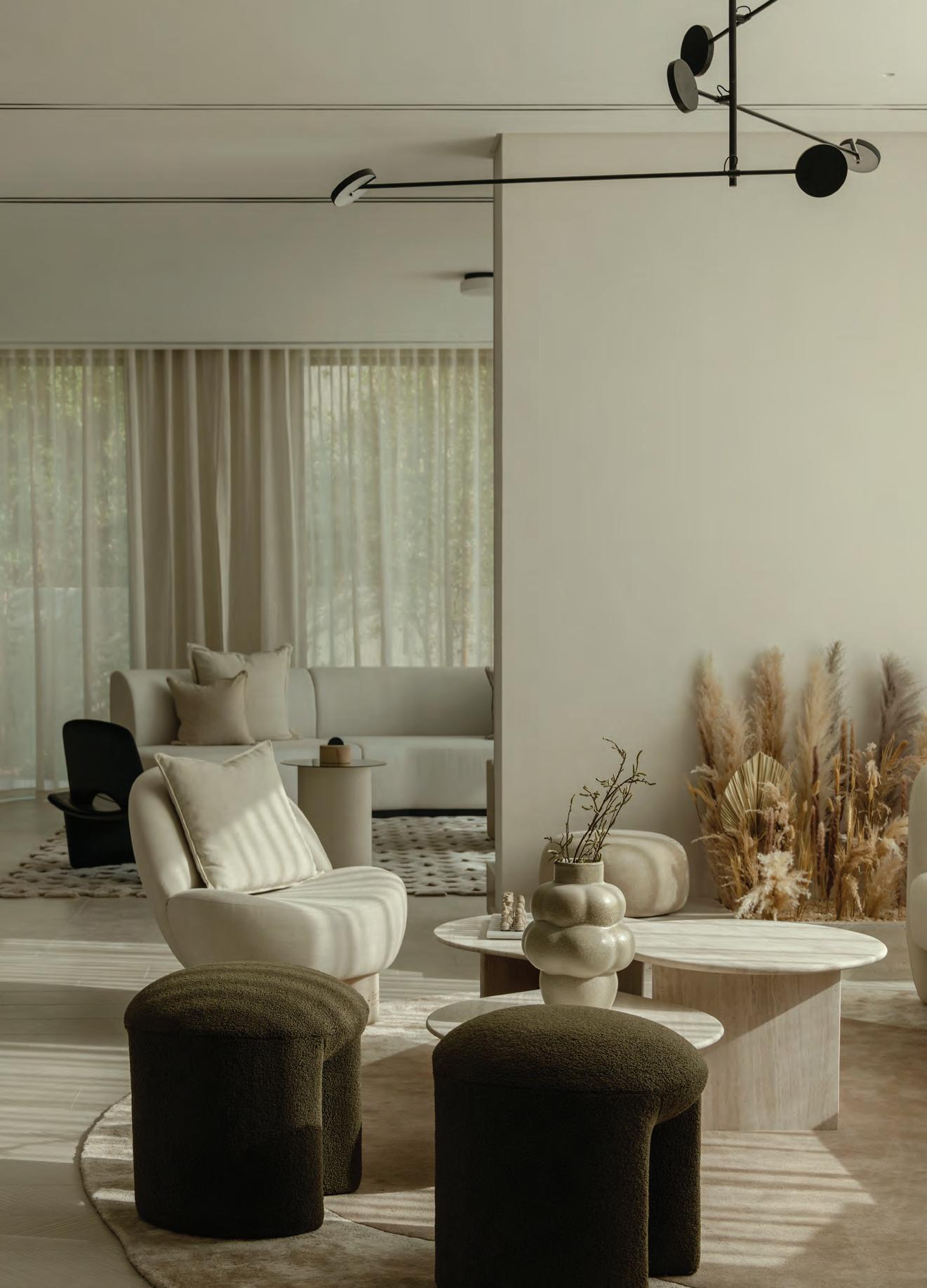
Located in Jumeirah Golf Estates, Villa Limni offers an adaptive, fluid minimalist design that evolves with its surroundings and the lives of its inhabitants
58 A Grand Florentine Retreat
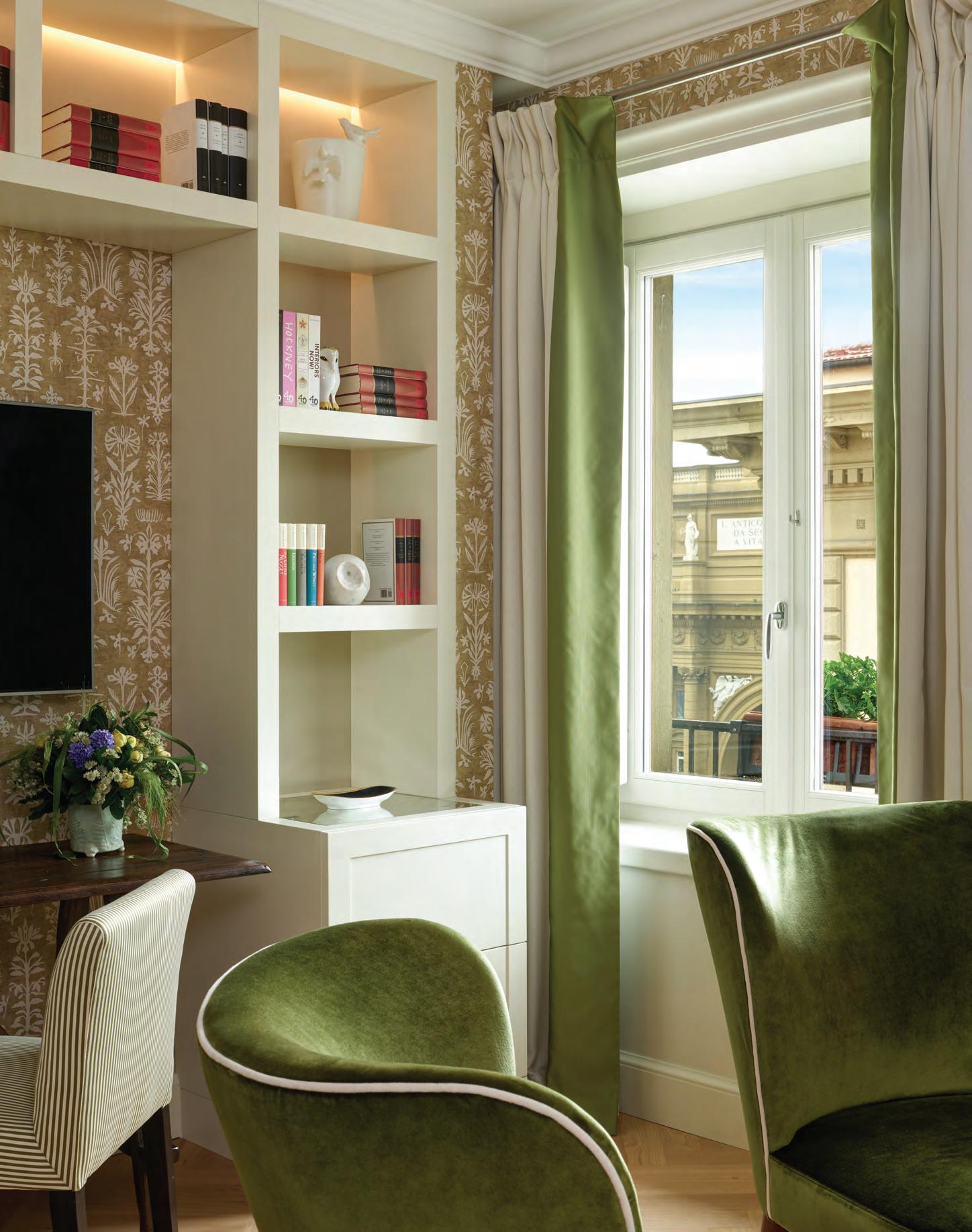
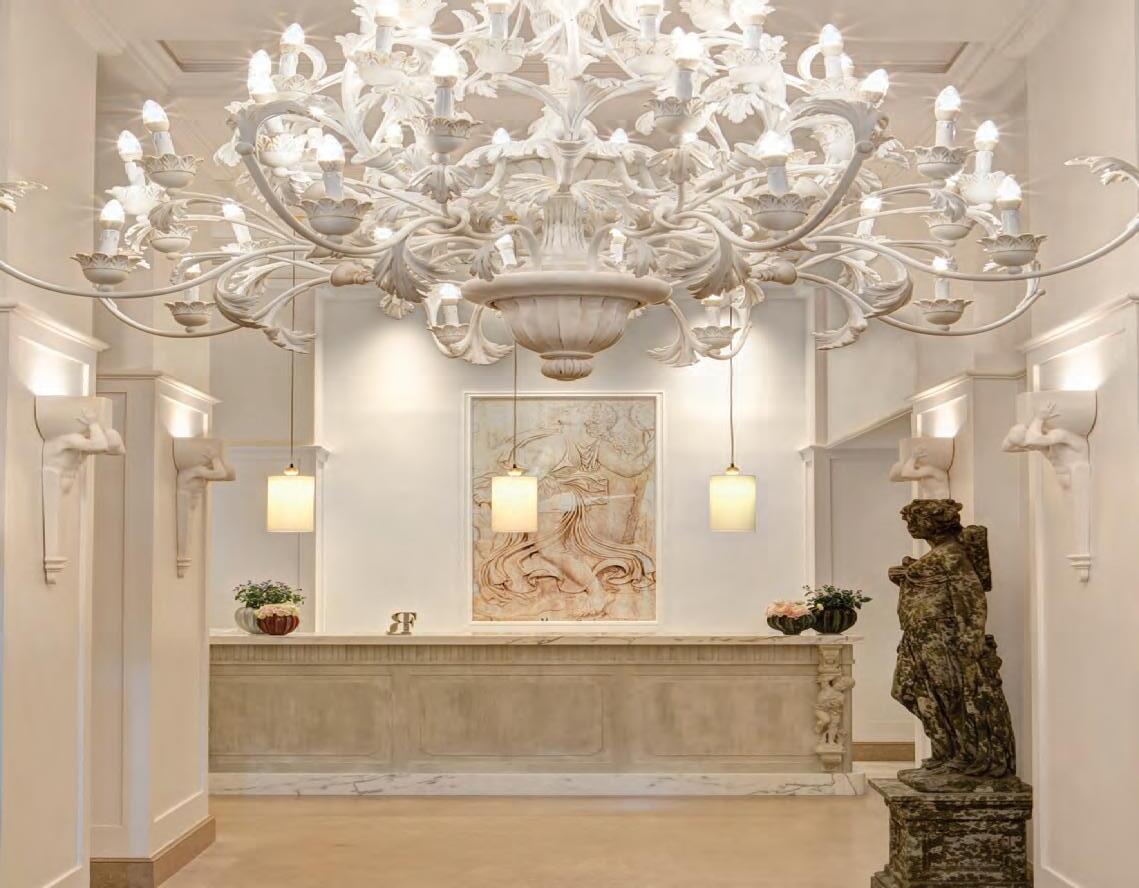
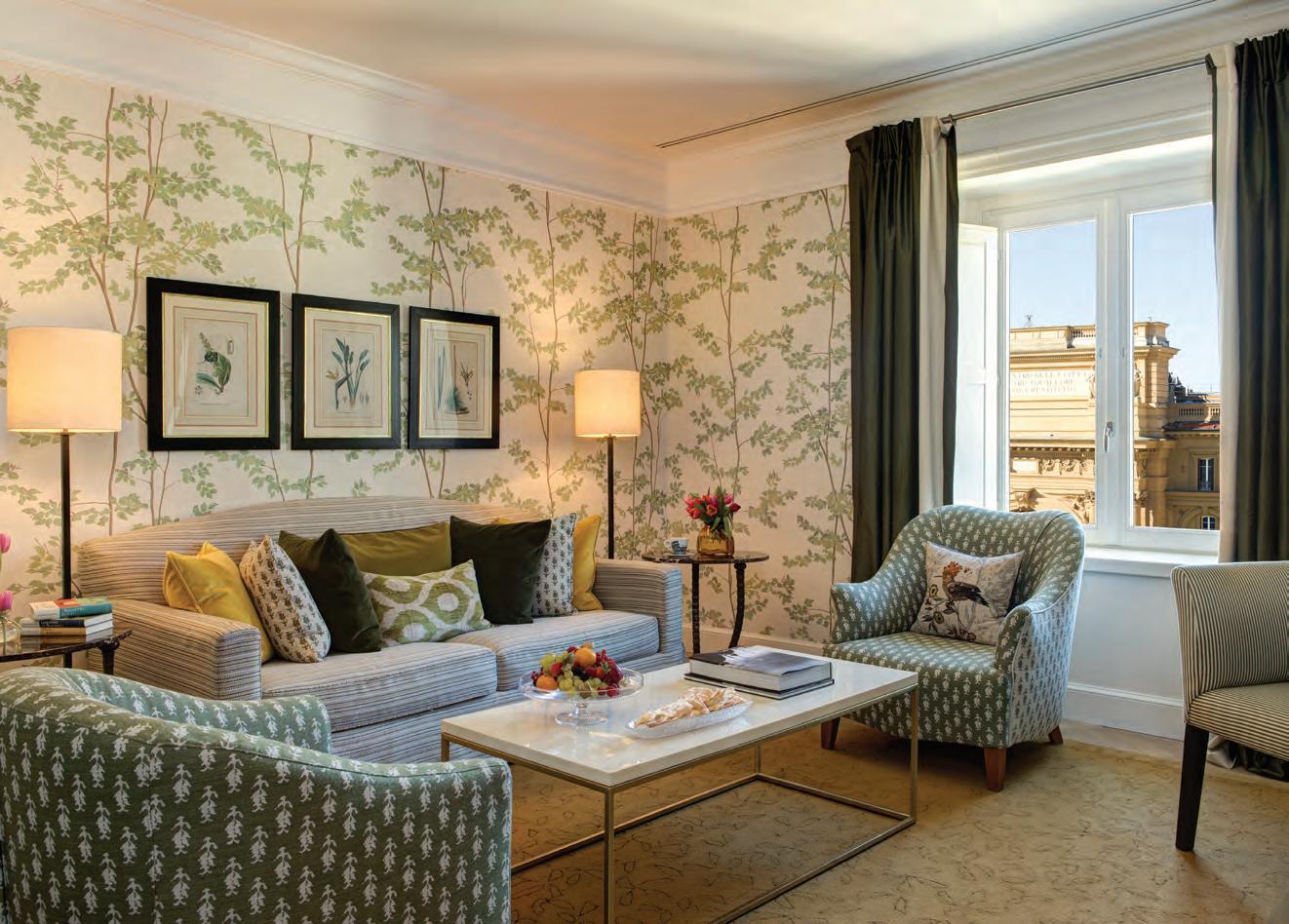
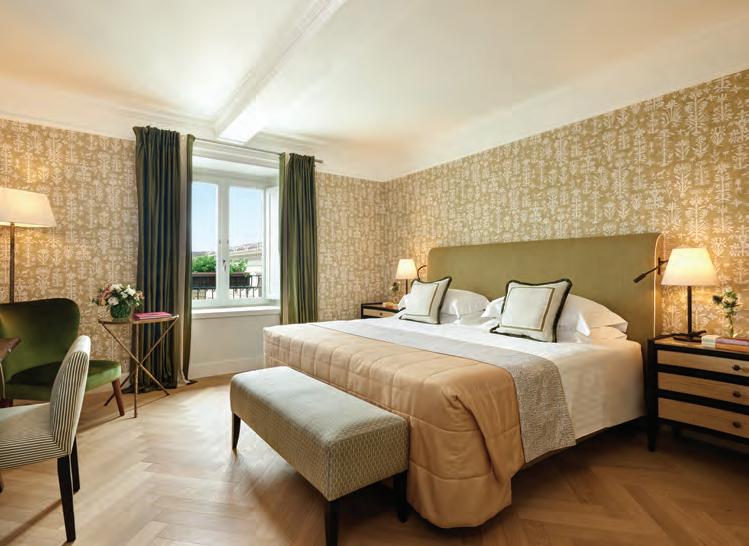
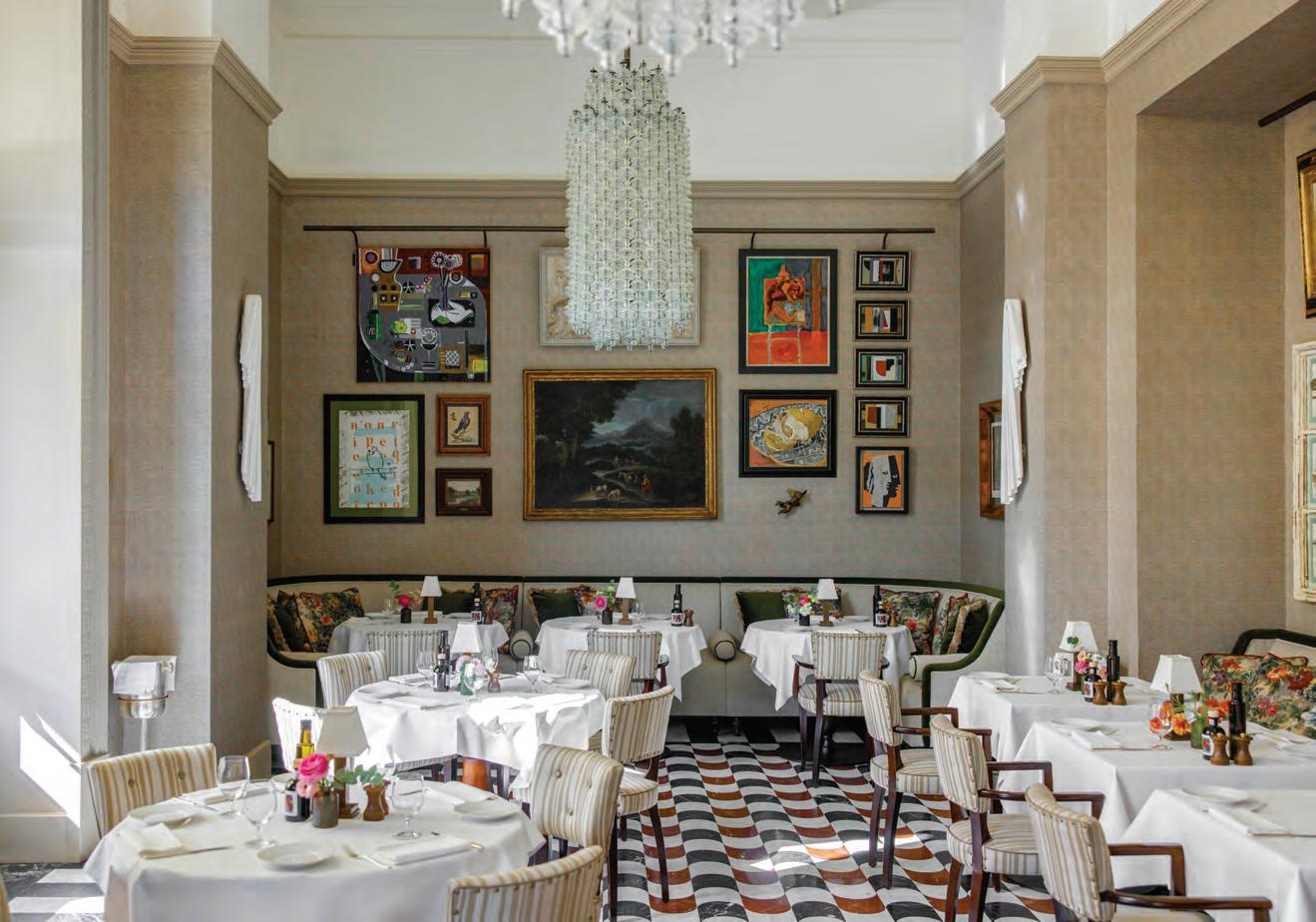
The storied Hotel Savoy in the heart of Florence features interiors designed by Olga Polizzi and Laudomia Pucci, blending lively and fresh features into its Florentine heritage
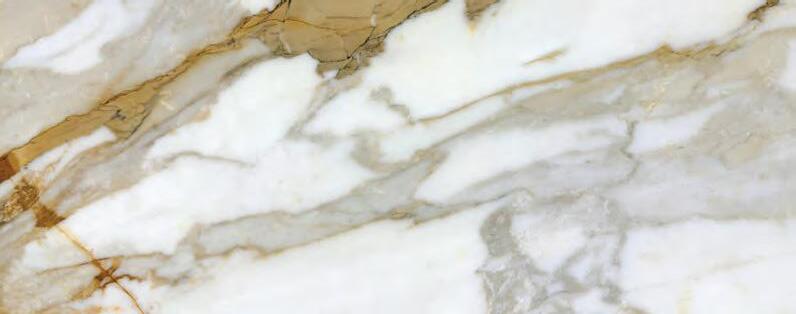
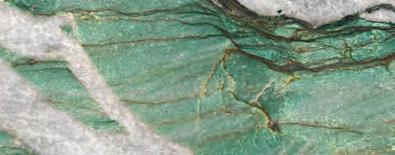
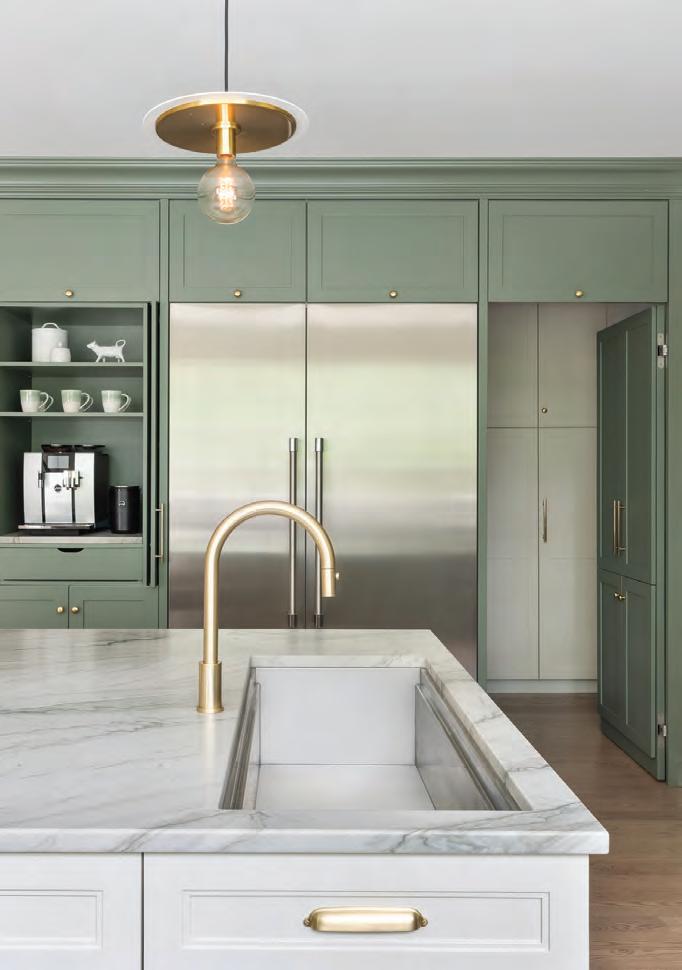
Surface Solutions, Designed By Nature
Editor-in-Chief
Obaid Humaid Al Tayer
Managing Partner and Group Editor
Ian Fairservice
Chief Commercial Officer
Anthony Milne
Group Content Director
Thomas Woodgate
Editor
Aneesha Rai
Contributing Editor
Rebecca Anne Proctor
Senior Art Director
Olga Petroff
Designer
Vibha Monteiro
Sub-editor
Max Tuttle
Senior Partnerships Manager
Sharmine Khan
General Manager - Production
Sunil Kumar
Production Manager
Binu Purandaran
Assistant Production Manager
Venita Pinto
Head Office: Media One Tower, PO Box 2331, Dubai, UAE; Tel: +971 4 427 3000, Fax: +971 4 428 2260; E-mail: motivate@motivate.ae
Abu Dhabi: PO Box 43072, UAE, Tel: +971 2 677 2005, Fax: +971 2 677 0124; E-mail: motivate-adh@motivate.ae
Saudi Arabia: Regus Offices No. 455 - 456, 4th Floor, Hamad Tower, King Fahad Road, Al Olaya, Riyadh, Kingdom of Saudi Arabia; Tel: +966 11 834 3595 / +966 11 834 3596; E-mail: motivate@motivate.ae
London: Acre House, 11/15 William Road, London NW1 3ER, UK; E-mail: motivateuk@motivate.ae
[MARCH 2026]
Editor’s Note
We’ve been feeling introspective this month, as the urgency that often defines the early weeks of the year begins to ebb. January’s momentum and February’s recalibration give way to something more measured in March. That shift has, no doubt, been deepened by the arrival of Ramadan – a period that encourages reflection, generosity and a heightened awareness of how we gather and connect.
It feels fitting, then, that our cover story this month centres on meaning rather than spectacle. This issue, we sit down with Ignacio Gomez, Global Design Principal at Aedas, to discuss what architecture must become if it is to remain relevant. Based in the Middle East for two decades, Gomez speaks candidly about dismantling the myth of the heroic architect and reframing the discipline as one of collective intelligence, process and accountability. His perspective is clear: architecture cannot afford to be visually loud but strategically irrelevant. The conversation is a timely reminder that the future of the built environment will be shaped less by ego and more by the ability to align complex systems toward a shared ambition.
That emphasis on leadership and long-term impact flows naturally into our Women in Design feature, which feels particularly resonant during Ramadan. As the Gulf’s architecture and interiors landscape continues its upward trajectory, the voices shaping it are increasingly diverse and confident. The designers featured do not approach their work as statements of visibility alone, but as disciplined, research-led practices rooted in context. Across multiple disciplines, they demonstrate that empowerment is not performative – it is embedded in built form and the ability to translate cultural memory into contemporary space. Together, they reflect a generation of practitioners redefining influence through measurable impact.
This feels like the right moment, too, to recognise the incredible women behind identity who bring each issue to life. From editorial and design to partnerships, production and operations, their creative intelligence shape these pages every month. Much like the architects and designers we feature, they balance instinct with execution. The magazine is, and has always been, a collective effort that ensures these pages remain reflective of the industry we serve.
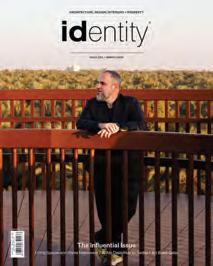
Welcome to the March issue of identity.
Aneesha Rai Editor identity
On the cover
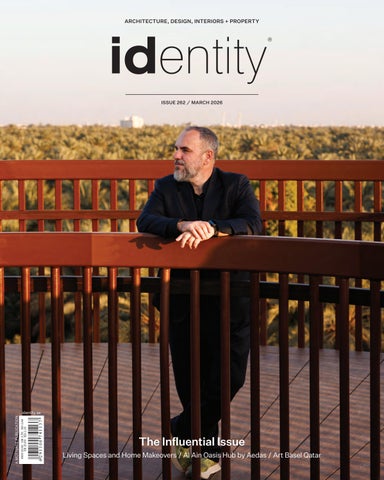
Global Design Principal of Aedas, Ignacio Gomez, photographed by Mark Mathew
New Logica
back panel with magical doors integrated into the architecture
Managing Director of LSI- La Sorogeeka Interiors Ujjwal Goel explains how and why achieving sensorial richness is so vital to the immersive environments the company crafts
WORDS – REBECCA ANNE PROCTOR
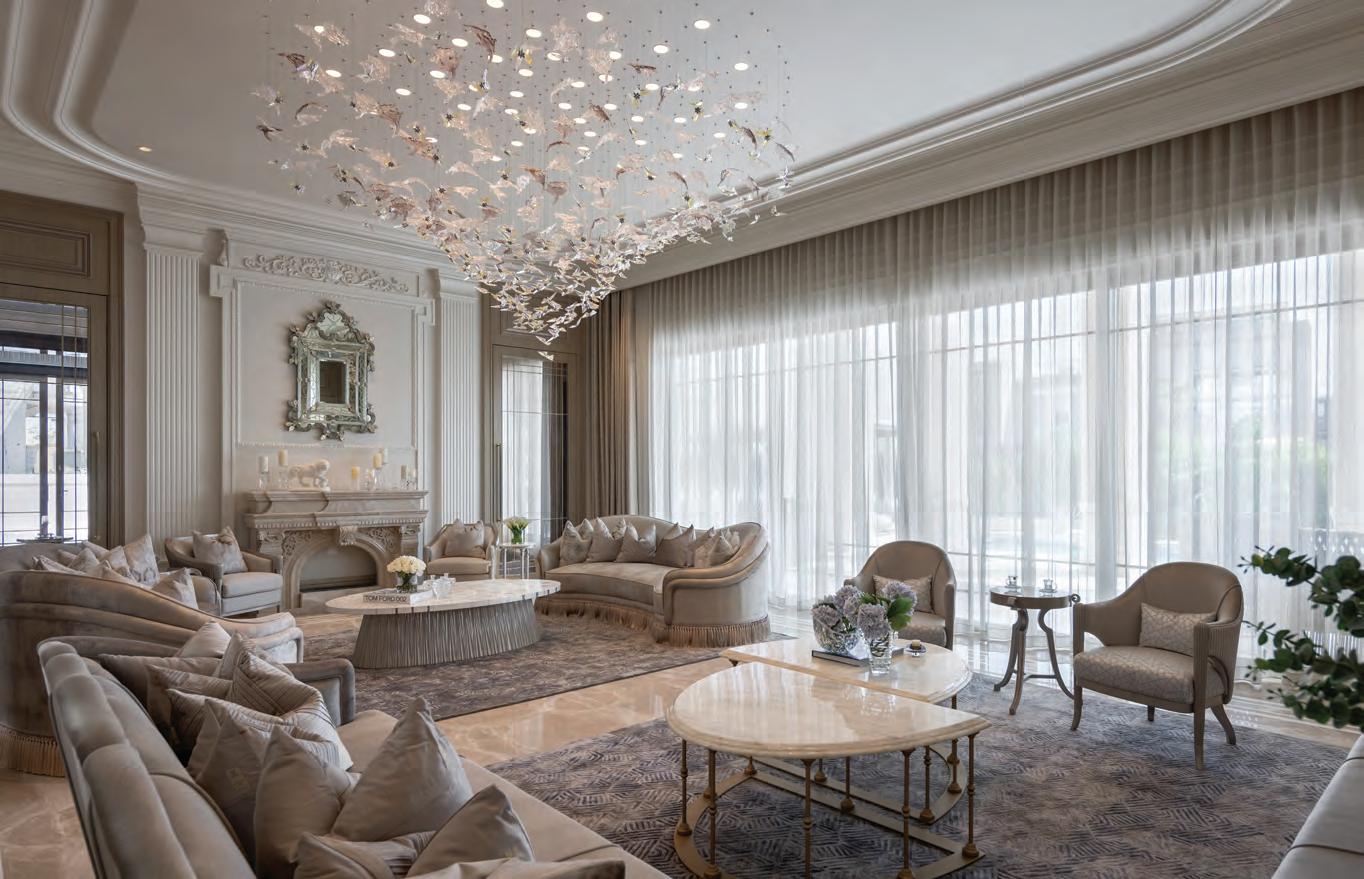
There is nothing quite like stepping into a beautifully designed home that provides a sense of wellbeing, uplifting the spirit and the senses. The mission of LSI, a Dubai-based company is exactly this: to create among the most luxurious, bespoke homes in the world. The company focuses strongly on what it calls “living legacies,” meaning incorporating a combination of meticulous craftsmanship, design, build, fit-out, and turnkey solutions. From the first concept to the finishing touches, LSI brings to life every project with care, creativity, and precision.
As Ujjwal Goel, Managing Director of LSI- La Sorogeeka Interiors explains: “Rather than offering fragmented solutions, we provide a fully aligned design-to-delivery model across four core verticals: Design, Build, Fit-Out, and FF&E Styling.”
Recognised as one of the top names for luxury residential interior design, a large part of LSI’s commitment to luxury is through the creation of spaces that deeply engage the senses. “At LSI, our philosophy is centered on creating immersive environments that engage all the senses,” explains managing director of LSI, Ujjwal Goel. “We believe
luxury is not something applied – it is conceived from the outset. A residence should feel cohesive, intentional, and deeply personal. The way natural light moves across textured stone, the tactile warmth of handcrafted finishes, the subtle acoustics within a double-height space, the balance of proportion and scale – each element is orchestrated to create a layered sensory experience.”
Quality, emphasises Goel, is paramount to everything LSI crafts. “Materiality is fundamental,” he says to an approach that prioritises the senses. “We curate materials from around the world – rare marbles, distinctive woods, bespoke metals, artisanal finishes – selecting each for its authenticity and character. This global sourcing allows us to craft residences that feel refined and singular rather than repetitive. Every material is chosen not just for appearance, but for how it contributes to atmosphere, depth, and identity.”
While quality is of utmost importance to every aspect of LSI’s work, its significance also lends itself to the bespoke, exacting approach with which the company caters to its clients. “Our approach connects design intent, technical planning, procurement, and on-site execution within one cohesive framework,” he adds. “This eliminates fragmentation and ensures that every decision made at the conceptual stage is carried through to completion
without dilution. In the ultra-luxury segment, where expectations are exacting and margins for error are minimal, this continuity becomes a significant advantage.” Goel believes such an approach – the balance of prioritising a rich sensorial experience, the best quality possible and a turnkey approach – is increasingly important and useful in a city like Dubai. “In a global hub like Dubai, the perception of luxury has evolved significantly,” says Goel. “Bespoke living now means complete personalisation: tailored layouts, custom-crafted finishes, globally sourced materials, and spatial narratives shaped around lifestyle rather than trend.”
LSI has a growing portfolio of luxurious villas and mansions throughout the United Arab Emirates in locations such as the Palm Jumeirah, Al Barari, Emirates Hills and Dubai Hills, with many nearing completion.
One of the company’s projects is The Highland Estate, a 26,000-square-foot ultra-luxury residence under construction in the Dubai Hill area. “It reflects this shift,” adds Goel. “The home has been designed around experiential living, incorporating a private wellness spa, a cinema room, and dedicated lifestyle spaces tailored to the client’s daily rituals.” The mansion also reflects LSI’s premiere products and services which are defined by “integration, precision, and the ability to control every stage of a project under one unified vision,” explains Goel. Such services are premiere because they work together under one unified ecosystem whereby all the parts cater to the whole and a luxury residence becomes, as Goel states: “conceptual, structural and experiential.”
Ujjwal Goel, Managing Director of LSI- La Sorogeeka Interiors
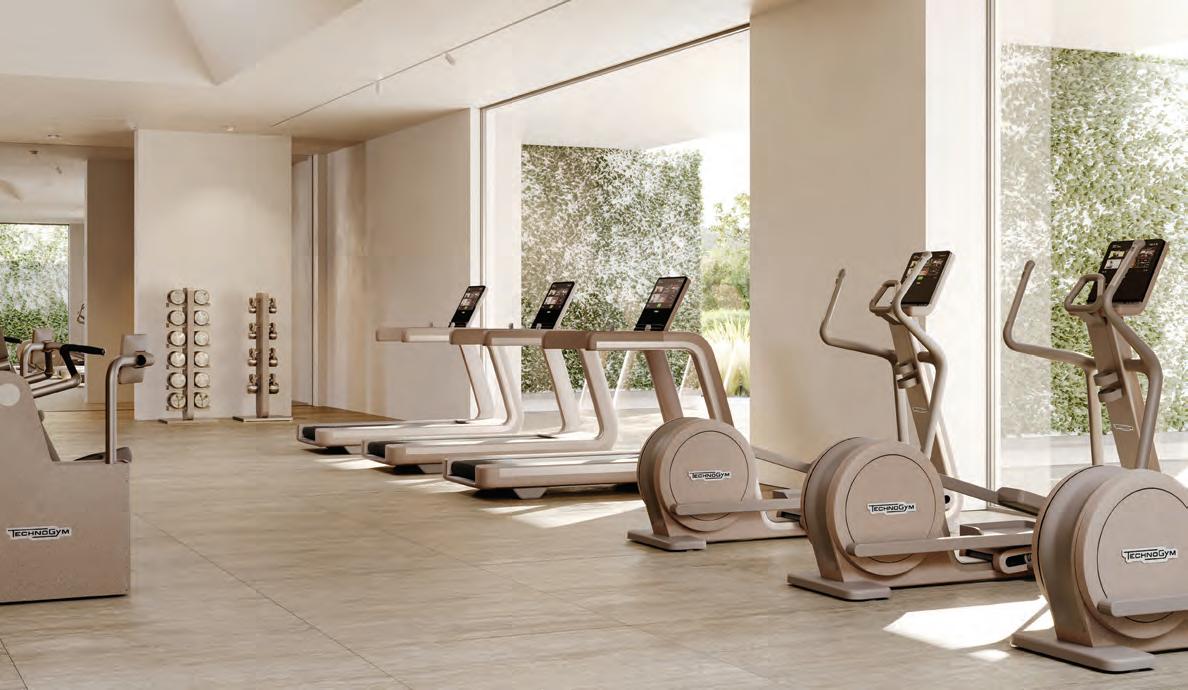
Sand Stone collection by Technogym Redefining interiors
with wellness and style
WORDS – NILUFER NAJEEB
Technogym introduces Sand Stone, a groundbreaking collection that ushers in a new era of wellness luxury living. This collection redefines the standards of wellness interior design by blending the warm, textured authenticity of Mediterranean sandstone with advanced materials and sophisticated craftsmanship. The result is an aesthetic that feels both natural and innovative, crafted to elevate the design of the most exclusive wellness spaces.
Sand Stone offers a refined palette inspired by nature, where neutral tones and meticulous finishes allow the equipment to seamlessly integrate with wood, stone, and other premium materials. This versatile design language creates immersive environments that balance performance, sustainability, and timeless elegance. The collection’s cohesive look crosses product categories, encompassing cardio, strength, and functional training equipment. It unites diverse product lines such as Technogym
Checkup, Artis cardio, Artis strength, Biostrength, Personal Tools, and Technogym Reform into a unified family, fostering a seamless wellness experience. Designed to suit a variety of settings, Sand Stone finds its place in private homes as well as high-end wellness spaces in hotels, residential complexes, and fitness clubs. For architects and designers, it offers a distinctive aesthetic that elevates brand identity, enhances customer experience, and increases perceived value. Every space transformed by Sand Stone becomes a statement of quality, refinement, and a wellness-conscious approach that resonates with discerning users.
Central to the collection’s innovation is its carefully chosen materials and finishes, which cultivate a renewed connection with nature through textures, colours, and tactile sensations. Speckled Stone casings are made from an innovative plastic infused with 2-3 per cent natural mica, creating a textured effect reminiscent of real stone. Importantly, 30 per cent
of these components come from recycled materials, underscoring Technogym’s commitment to sustainability.
Warm Titanium metalised frames and inlays add a layer of luxury and technological sophistication to the products, drawing inspiration from the iconic designs of contemporary high-tech objects. Clay surfaces found on handles and vegan leather seats feature an opaque, warm finish that feels pleasing to the touch, designed to encourage natural and comfortable interaction. Complementing these elements is the use of beech and ash wood, with its organic grain patterns bringing a living, authentic quality to handles and frames, particularly in Personal Tools and Technogym Reform.
Together, these components form a holistic design language that radiates warmth and sophistication, inviting users to engage with wellness spaces without intimidation. This approach transforms the exercise experience into one of comfort and authenticity, making wellness accessible and inviting. Sand Stone’s innovative fusion of nature-inspired aesthetics, advanced materials, and thoughtful craftsmanship positions it at the forefront of wellness luxury living. It enables operators to create distinctive, immersive environments where design and performance merge effortlessly.
Technogym’s new collection is not only a celebration of refined interior design but also a reflection of a wellness-conscious lifestyle that values sustainability, quality, and user experience.
Snaidero UAE Redefining Homes
Italian heritage, Dubai vision: a 10-year celebration
WORDS – THOMAS WOODGATE
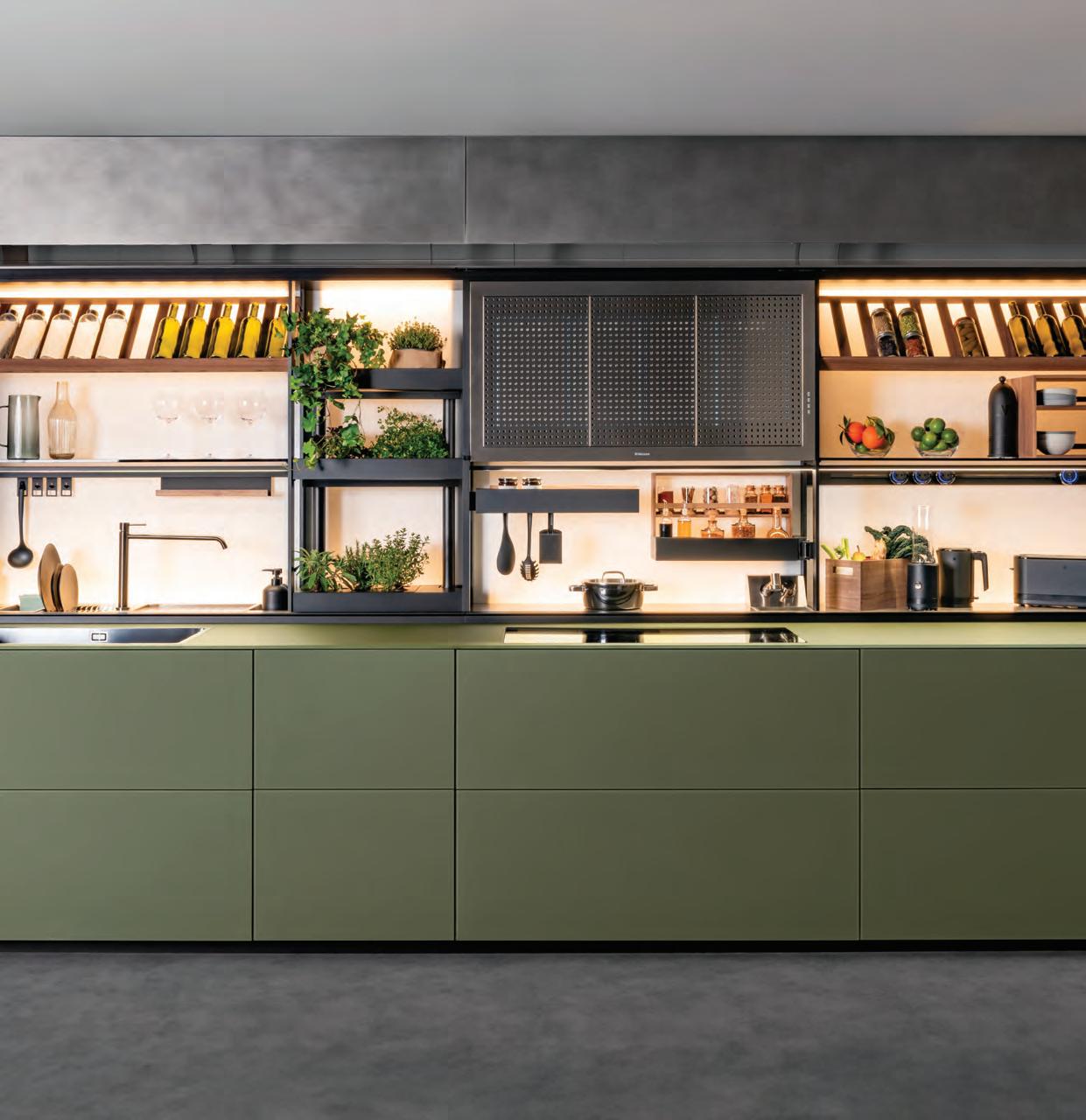
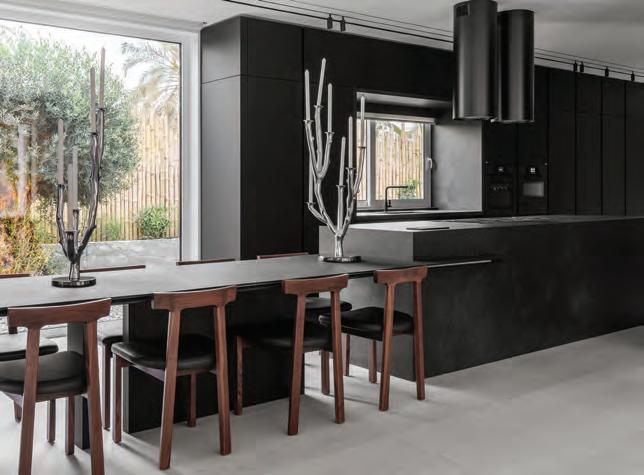
In a city known for its evolving skyline, the kitchen has quietly become one of the most considered spaces in the home. In Dubai, it is no longer treated as a purely functional room, but as an integral part of the architectural narrative.
Since its relaunch in 2016, Snaidero UAE has focused on bringing Italian design principles into dialogue with the way people live in the Emirates. Craftsmanship, proportion and material sensitivity sit at the core of this approach, supported by a deep understanding of local spatial scale and lifestyle. From its first showroom in Dubai Design District to its expanded flagship space on Sheikh Zayed Road, the brand’s growth mirrors the broader maturation of the UAE’s luxury interiors market.
Over the past decade, residential design in Dubai has shifted noticeably. Earlier preferences for darker timbers and more traditional compositions have gradually given way to lighter palettes and more fluid layouts. Pale wood veneers, muted lacquers
and generous applications of natural and engineered stone now dominate. Cabinetry is streamlined, detailing is integrated and surfaces are uninterrupted, allowing materials to be appreciated for their texture and depth rather than ornamentation.
This evolution has resulted in over 600 kitchens installed across the UAE, each responding to the generous proportions of typical of homes in the region. Expansive floorplans allow for elongated configurations and substantial islands that act as both preparation zones and gathering points. The island, in particular, has taken on a central role, anchoring open-plan living spaces and encouraging interaction.
A distinct regional feature further shapes kitchen design in the UAE: the dual-kitchen concept. With a dedicated show kitchen for daily living and entertaining, and a separate working kitchen designed for heavier cooking, the primary space can prioritise material continuity and visual calm. This separation allows for greater refinement in the main kitchen without sacrificing practicality.
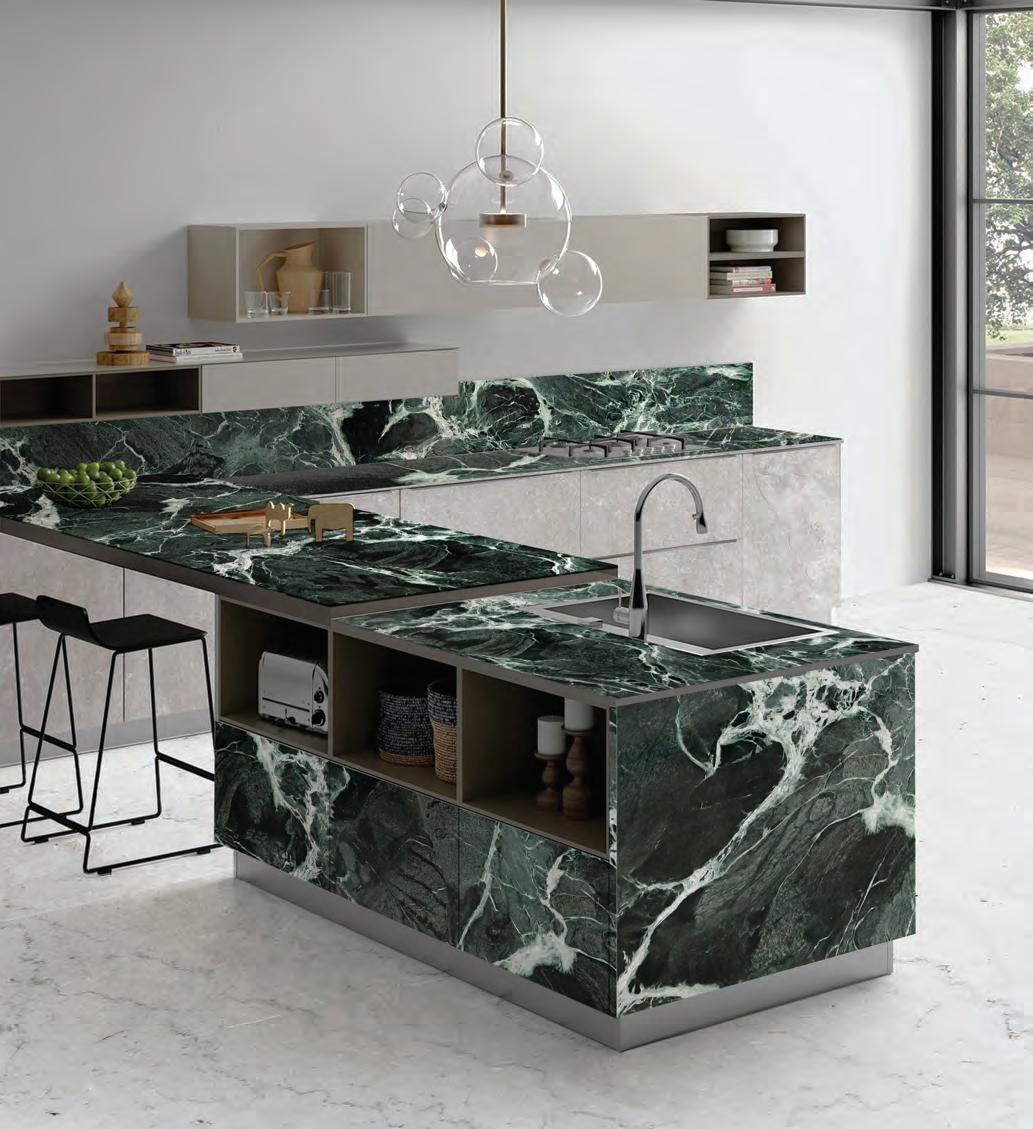
Within this context, modern and contemporary collections have resonated most strongly, particularly those that emphasise stone surfaces, clean-lined cabinetry and restrained detailing. There is a growing preference for kitchens that feel architectural rather than decorative – spaces that integrate technology discreetly and favour materials chosen for longevity.
Ten years on, Snaidero UAE’s trajectory reflects a broader shift in how kitchens are perceived across Dubai: as social spaces, as architectural anchors, and as environments where craft and contemporary living meet in a more thoughtful way.
Maison&Objet 2026: The Defining Moments
We reflect on the ideas, moments and shifts that defined Maison&Objet January 2026
WORDS – NILUFER NAJEEB
With the stands dismantled and the city returning to its rhythm, we’ve been reflecting on our time on the ground at Maison&Objet January 2026 and seeing it for what it was: an edition defined by clarity rather than excess, and by moments that revealed a broader shift within design.
Stepping into Maison&Objet this January was like entering a world where emotion fuels meaning, and meaning fuels business opportunities. Bringing together 2,294 brands from 148 countries, including 543 new exhibitors, the fair unfolded as a 360° panorama of creativity that honoured both past traditions and future possibilities. With nearly 67,286 visitors, the event once again confirmed the remarkable global appeal and quality of its international audience. Notably, markets such as Italy, Belgium and Spain showed continued growth.
At the heart of Maison&Objet’s DNA lies a commitment to exceptional craftsmanship and contemporary design, a story woven alongside its long-standing shareholder, Ateliers d’Art de France. This edition marked a deliberate return to these fundamentals, with Fine Craft –métiers d’art – taking centre stage. The theme Past Reveals Future echoed throughout, inspired exhibitors and visitors alike to reflect on the dialogue between heritage and innovation.
Philippe Delhomme, Chairman of the Executive Board of SAFI, the fair’s organiser, summed it up perfectly: “What struck me most during this January session was the resurgence of a powerful sense of emotion from the moment you entered the fair, driven by ambitious and unapologetic scenography, faithful to Maison&Objet’s DNA. This energy is owed as much to the commitment of our teams as to that of the exhibitors, who chose to fully invest in their stands to create genuine experiences. Many visitors spoke to me about this rediscovered ‘wow’ effect, which encourages visitors to slow down, observe, and let themselves be surprised. This January 2026 edition confirms that Maison&Objet remains a place where emotion gives meaning, and where meaning fuels business opportunities.”
A Journey Through Craft and Innovation
Maison&Objet was carefully organised into six sectors, from Signature & Projects to Fine Craft, Fragrance & Wellness, Gift & Play, Decor & Design, and Fashion & Accessories. Spanning seven halls, the fair offered a rich mosaic of ideas, all framed by the theme Past Reveals Future – a timeless concept at the crossroads of trends and imagination.
Visitors were invited on a sensory journey with installations by emerging and established talents. Interior architect Rudy Guénaire curated What’s New? In Hospitality, Elizabeth Leriche guided visitors through What’s New? In Decor, while François Delclaux unveiled insights in What’s New? In Retail.
Spotlight on Designer of the Year: Harry Nuriev
One of the highlights was the installation by 2026 Designer of the Year, Harry Nuriev. His space embodied the spirit of Transformism, the manifesto that guides his work. With a futuristic silver patina, the design was both bold and reflective.
Spaces That Inspire Reflection
The Curatio Village returned for a second edition, curated by Thomas Haarmann, presenting 60 pieces of sensitive design in harmonious dialogue. Atelier highlights such as In Materia by Elizabeth Leriche reimagined the relationship with objects through touch and materiality, while master coppersmith Elie Hirsch showcased his craftsmanship at the entrance to Hall 5A.
Maison&Objet also debuted the Manufactures d’Excellence village, spotlighting 20 exceptional French heritage companies. In the Gift & Play sector, Pet Square made its entrance, while outdoor living was elevated through a curated selection of 50 international brands.
More Than a Fair: A Global Creative Ecosystem
Maison&Objet extends well beyond the exhibition halls. Maison&Objet In The City featured nearly 150 curated Parisian venues, while The Talks programme brought together leading figures including Cédric Klapisch, Yves Béhar, Maxime d’Angeac and Luca Pronzato across 27 expert-led sessions. Women&Design by Maison&Objet gathered the creative commu-
nity for an exclusive dinner at Hôtel de Crillon, celebrating bold female visions in design alongside supportive male allies.
The Business of Meaningful Design
This edition of Maison&Objet was not only a creative showcase but also a vital business platform. Vincent Lhoste, CEO of SAFI, highlighted the event’s impact: “This edition of Maison&Objet confirms more than ever its status as a leading international business platform… Maison&Objet is a fair where meetings turn into opportunities and orders: this is where business gets done.”
The Next Chapter
Maison&Objet is preparing for its next chapter. The September 2026 edition will take place from 10-14 September, with key announcements set to be unveiled at a press conference in Paris this month. With Vincent Lhoste as CEO of SAFI, the fair stands poised to evolve while remaining anchored in the values that have defined it for over three decades.
As the design world looks ahead, Maison&Objet remains a place where past and future converge, where emotion and business align, and where creativity continues to inspire and transform.
Photography: Anne Emmanuelle
Left page – (from left) PH COLLECTION; Klimchi This page – (from left) Coozus; Curatio by Thomas Haarmann
Leaving a Lasting Legacy
Deloitte’s headquarters in Saudi Arabia have been designed by SAY Studio to inspire, nurture and endure
In the heart of the King Abdullah Financial District, SAY Studio has created a new kind of headquarters for accounting and consulting giant Deloitte. The eight-floor project is, says the studio, “Rooted in the firm’s deep awareness around time – how it passes and shapes decisions, and how the right ideas can outlast it.” The workplace does not feel ‘corporate’; rather, the floor plan unfolds in continuous, concentric layers, like the ripples left behind when a stone meets water. The designers say this is a metaphor for Deloitte’s work: “Solutions designed not just for the present, but for what comes next. Circulation is fluid; there are no dead ends or rigid corridors, rather a natural rhythm that draws people forward.”
WORDS – MAX TUTTLE
SAY Studio states that four forces guided the design – organic, directed, experiential and centred – resulting in spaces shaped not only to function, but to be felt, with an emphasis on wellbeing. The building feels alive and responsive to people, making use of greenery in unexpected places, tactile and calming materials, light to energise shared tables and quiet corners, and glass walls to offer transparency without sacrificing focus.
Focused workstations sit alongside collaborative hubs, enabling a variety of working arrangements, while quiet zones support deep concentration and common spaces invite collective ideation. Conference rooms, anchored around organic focal points, encourage dis-
cussion and connection. The informal work settings of the fourth floor, known as ‘Your Work, Your Way’, encourage spontaneous dialogue. The eighth floor – the ‘Greenhouse’ – is a catalyst equipped with advanced technology, designed to adapt effortlessly from hands-on workshops to large-scale gatherings.
Laila Al-Yousuf, Design Director at SAY Studio, says, “This building is a manifestation of Deloitte’s values, reflecting sustainability, forward-thinking design and a deep understanding that work environments should inspire, nurture and endure.” This space acknowledges time while creating an environment where people can pause, connect and build lasting work.
Images: SAY Studio
Left page – The Greenhouse, situated on the 8th floor of the SAY Studiodesigned Deloitte headquarters in Saudi Arabia, adapts effortlessly from handson workshops to large-scale gatherings Below – The Townhall, a space designed for sharing perspective and sparking inspiration
MEANING, MYTHS AND MOTIVATION
Based in the Middle East for two decades, Ignacio Gomez is an award-winning architect, renowned for creating landmark projects in the region, with his work spanning master planning, hospitality, residential, cultural, leisure and transport. We sat down with the Global Design Principal of multinational architecture design studio Aedas to talk about his work, changes in the region and the next generation of architects.
WORDS – MAX TUTTLE
PHOTOGRAPHY – MARK MATHEW
“I want a return to longevity, adaptability and restraint. Sustainability should become instinctive again rather than performative.”
What has your experience taught you about the world of architecture, and how do you utilise that knowledge in your role?
IG: Running a big practice in the Middle East has taught me that the profession needs to reset some of its assumptions about what architects are. Architecture still behaves, and architecture is still taught, as if the architect is the heroic author of society’s next chapter. That idea was earned in very specific moments. After the Industrial Revolution, architects and planners had to respond to industrial cities, public health and mass housing. After the great wars, large parts of Europe needed new cities, new infrastructure and new models of modern life. But today, many of the forces shaping the city are written elsewhere. Technology, finance, logistics, energy policy and regulation often have more impact on daily life than architectural form. When architects retreat into internal jargon or pure formal obsession, the profession becomes visually loud but strategically irrelevant.
The second lesson is humility. Architecture is collective intelligence. It is coordination under pressure. It is teams, consultants, contractors, authorities, procurement and supply
chains. The myth of the lone genius is seductive, but it does not match reality. What matters is the culture of practice, the clarity of intent and the ability to align many people around decisions.
And the Middle East adds a unique truth. Time is a design material here. The region is reinventing itself while the energy transition compresses the horizon and the window to diversify economies narrows. That urgency can produce extraordinary results if you build a practice that learns fast. I use all of this in my role by focusing on process over ego, learning continuously and measuring success through relevance and impact rather than image alone.
How do you get to know your clients, and to understand their ambitions and objectives for their projects?
IG: Clients communicate on more than one layer. There is the brief, where requirements are stated clearly through the programme, efficiency, cost per square foot and return on investment. We take that layer seriously.
Then there is what is not written. Identity, legacy, reputation, internal alignment and risk are often the real drivers behind major
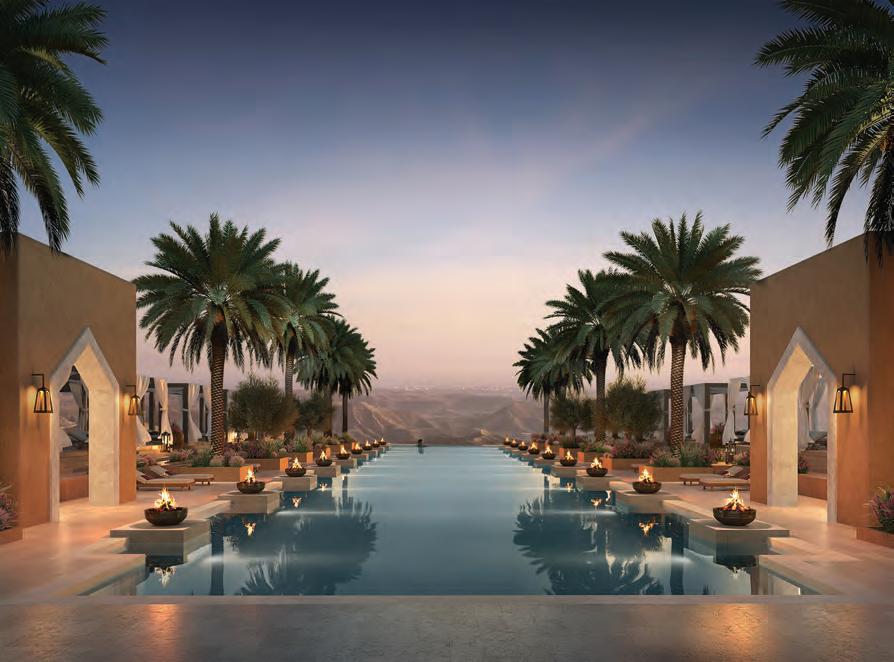
Left – Oberoi Wadi Safar is an ultraluxurious sanctuary embedded within the agricultural heritage of Wadi Safar in Diriyah, the historic ‘City of Earth’ and home to the UNESCO World Heritage Site of At-Turaif. Palm groves, water systems, private courtyards and lowlying villas have been carefully woven into the terrain to create seclusion and a continuous dialogue with the land
decisions. Those things rarely appear in an RFP [request for proposal], but they shape the project more than any spreadsheet. Our job is to listen for them, name them and translate them into design principles that the whole team can protect. We also understand clients well because we are not visitors. This region is home. That changes the conversation because it brings cultural fluency and a shared understanding of pace, nuance and context.
At Aedas we start each project with a beginner’s mind. Each project is a chance to learn. If the design process does not produce knowledge, then it is not design, it is repetition. Why do a project if you already know the outcome on day one? Discovery is better.
You are a believer in storytelling; how do you decide on the narratives for each project and how they will be embedded? IG: I believe meaning is essential, but I am cautious with the word storytelling because it is often misused. Many people assume that if a project has a narrative, it automatically has value. But narratives can be shallow, nostalgic or dishonest. The important question is whether the meaning is true, whether it is shared beyond the architect, and whether it is strong enough to survive reality.
Buildings are physical records of their time; they store the energy of a moment. In that sense, every project tells a story – whether we write one or not. Our role is to make that meaning legible to a wider audience, starting with the client and then extending to the public.
We build narrative from place, people and time, then embed it through sequence and experience rather than slogans. If the story only exists in a presentation, it is not embedded. If it is embedded, the building explains itself without words.
I also think the future will reward a renewed respect for the intelligence of previous generations. Many vernacular environments solved comfort and sustainability without performance. The next kind of progress may be rediscovering that wisdom and translating it for contemporary life.
What are the key challenges and opportunities for architecture? Do these differ by region – if so, how?
IG: The key challenge is relevance. If architects do not engage the systems shaping cities, then architecture becomes a visual layer rather than a strategic contribution. Another challenge is credibility. Sustainability and humancentric claims must be measurable or they will be dismissed as branding. Speed is also a challenge, because the world moves faster than the traditional design process, and the profession risks being outpaced.
Architecture can become a systems discipline again. Climate response, comfort, mobility, water, energy and public life can be integrated through design thinking. There is also an opportunity to use technology wisely.
AI can reduce production time and free more time for thinking, but only if practices choose to invest that time in judgement rather than in more output. The Middle East is an opportunity because it is still inventing. The scale of transformation allows architects to contribute to new typologies and new models of urban life. That is rare today.
How would you like to see architecture change in the coming years?
IG: In the next five years, I hope architects will challenge their own relevance. The profession needs to regain a stronger voice in shaping the forces that define daily life. Too many decisions affecting cities are made by technology companies and financial systems with very little architectural input. We need to engage the public
again and explain clearly why design matters, without hiding behind specialist language.
We must also be honest about artificial intelligence. It will compress design time dramatically and mimic creativity faster than we expect. Architects cannot rely on creativity as protection. Our value will shift toward judgement, ethics, responsibility, coordination and accountability. If we do not adapt, we risk becoming the liability holder while software does the work. In twenty years, the construction industry should move away from treating every building as a one-off prototype. We need intelligent standardisation and systems that perform, that can be measured, upgraded, repaired and reconfigured. Architecture should become more like a kit of parts in many cases, optimised for energy and long life, while still
Above – Aedas created the Red Palace Boutique Hotel by transforming the historic palace that had served as the residence of King Saud during his reign. It now offers opulent accommodation that immerses guests in its rich heritage while making use of innovative stone cladding and modern interpretations of classic elements such as the mashrabiya
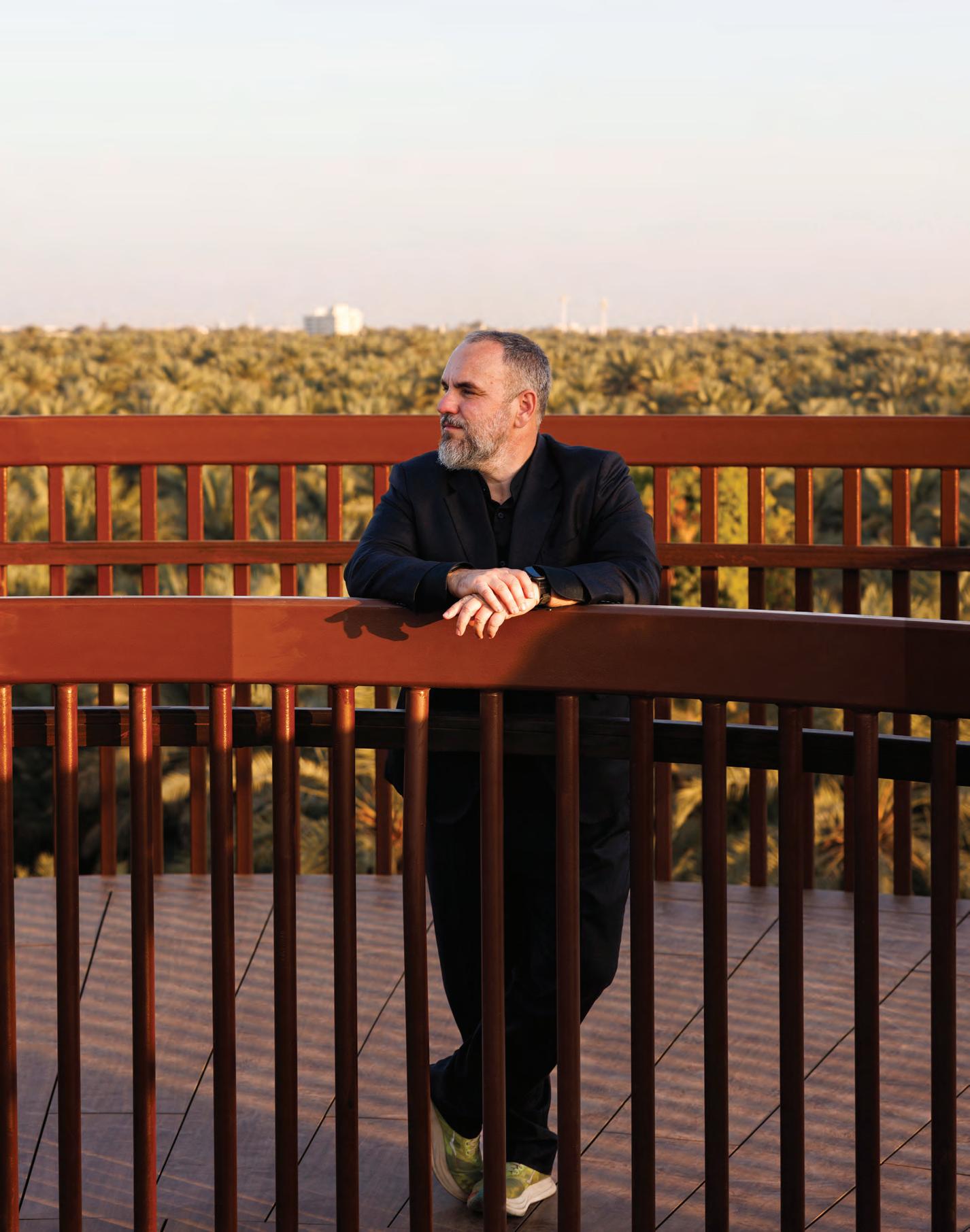
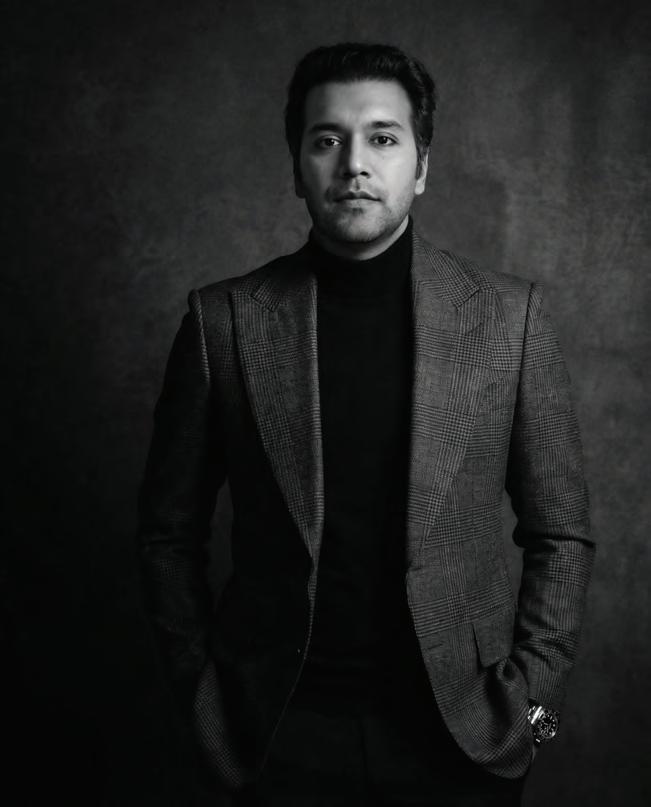
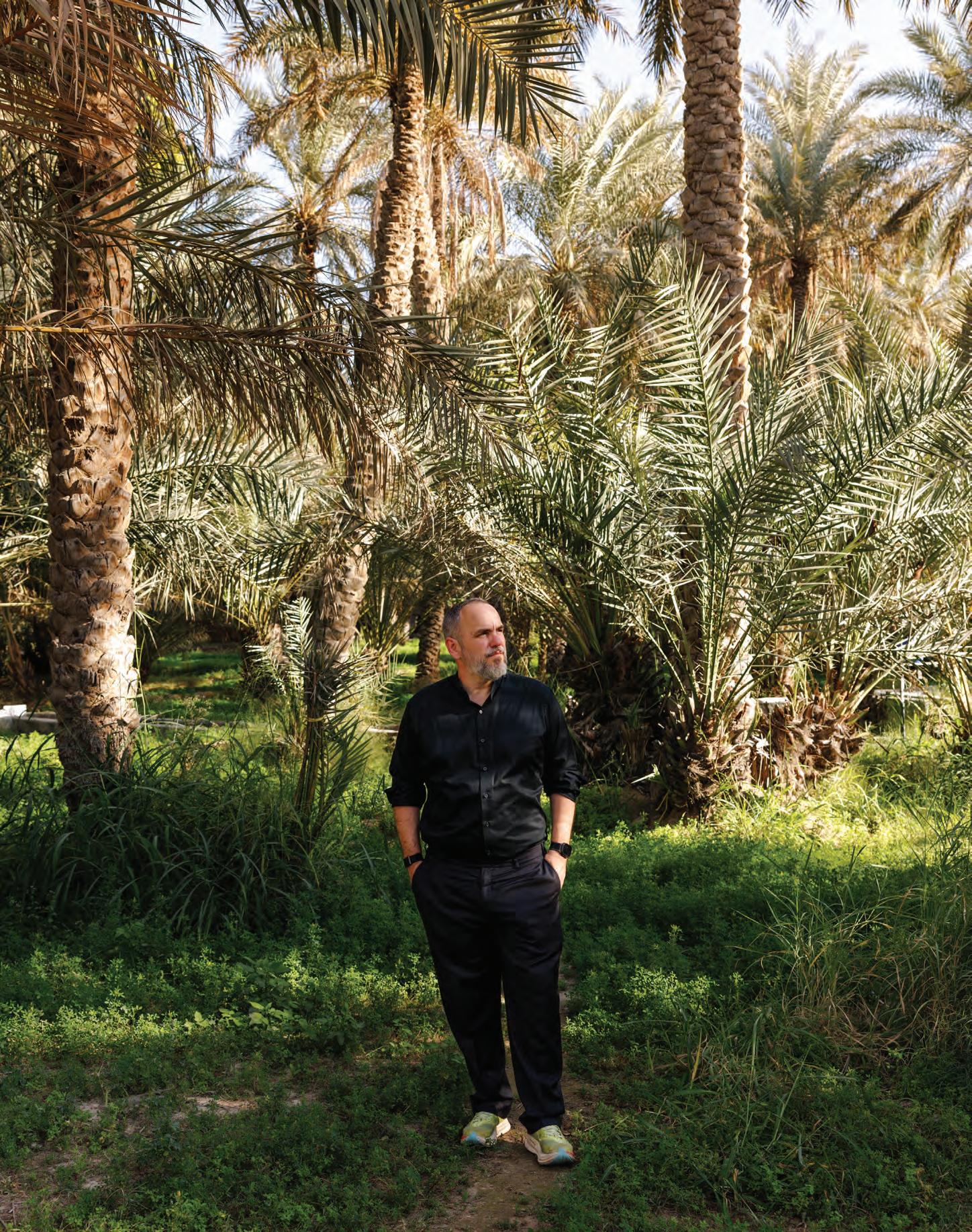
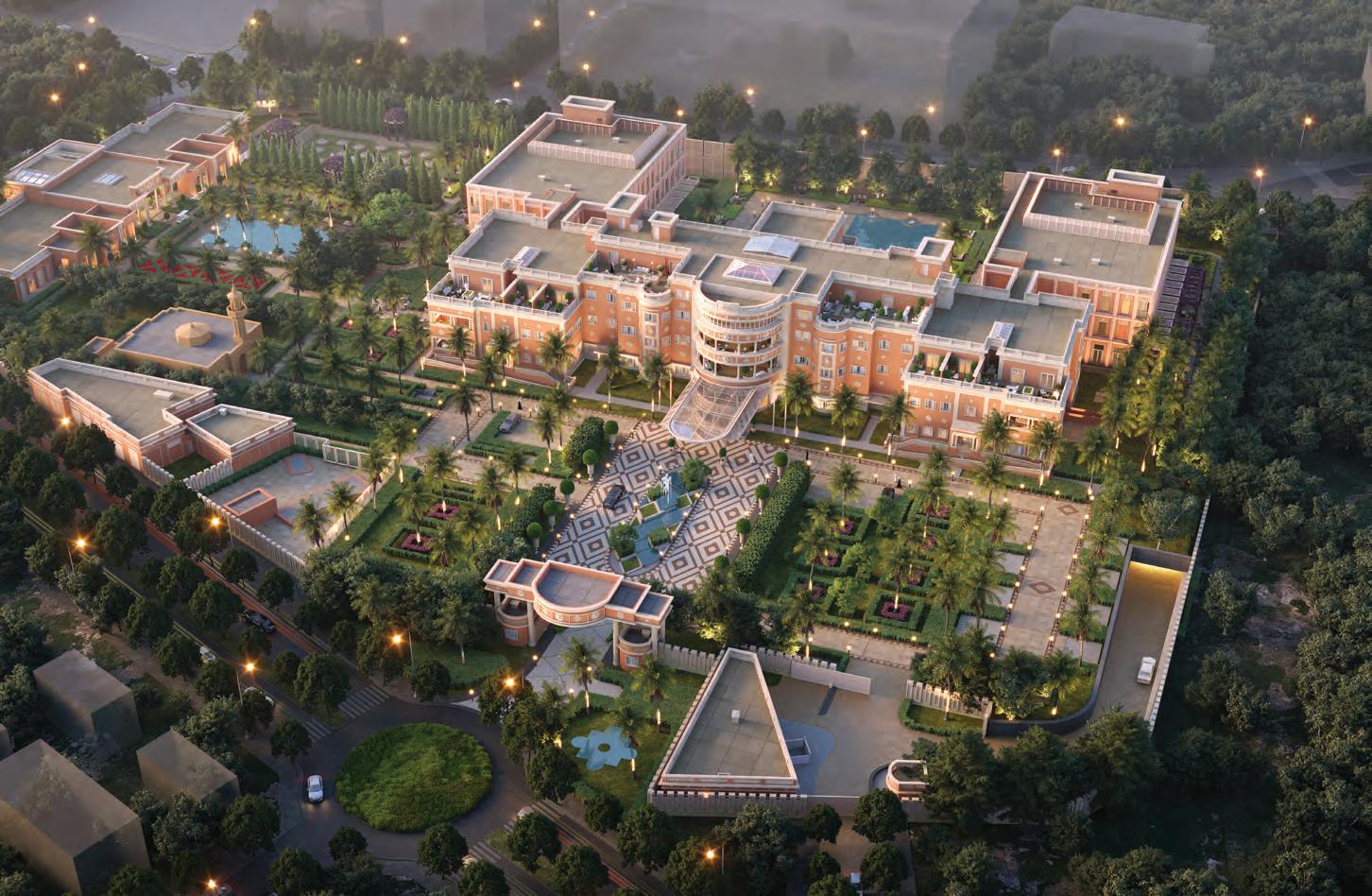
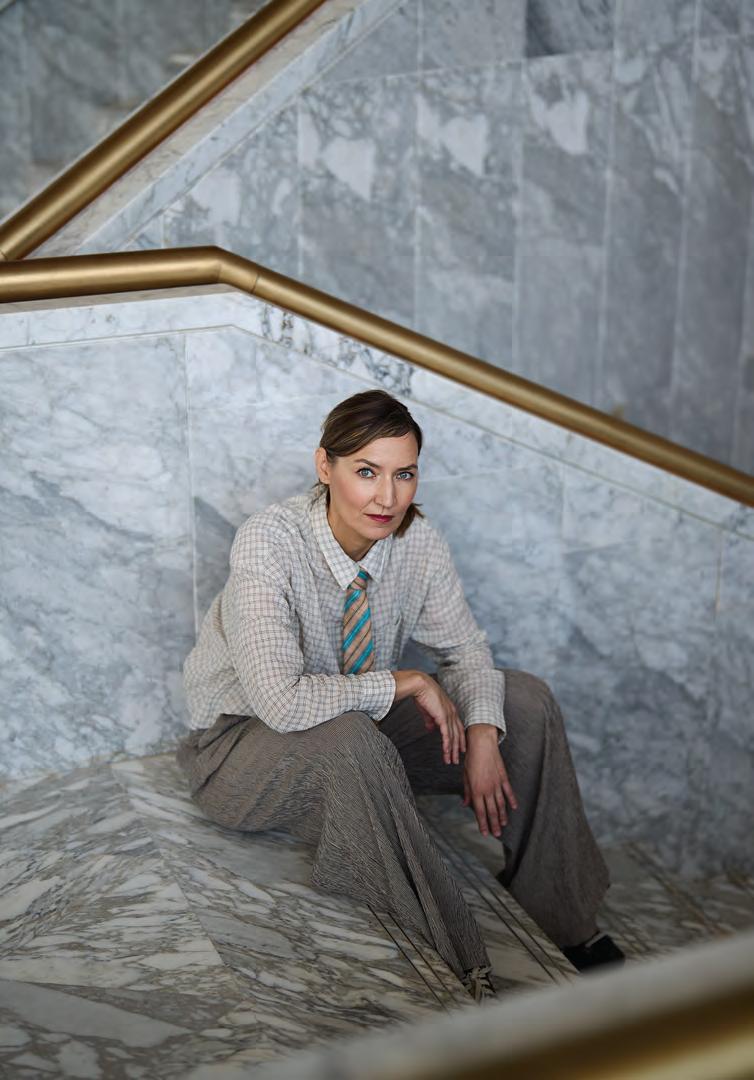
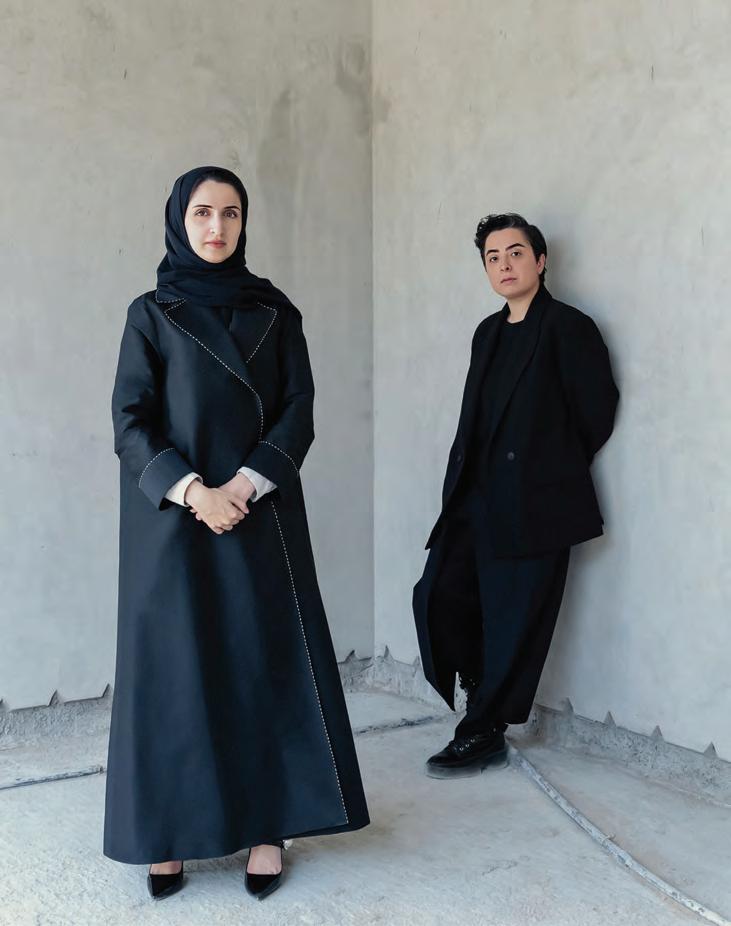
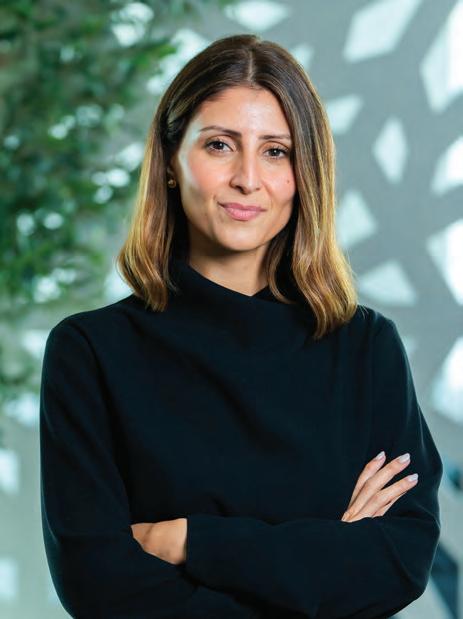
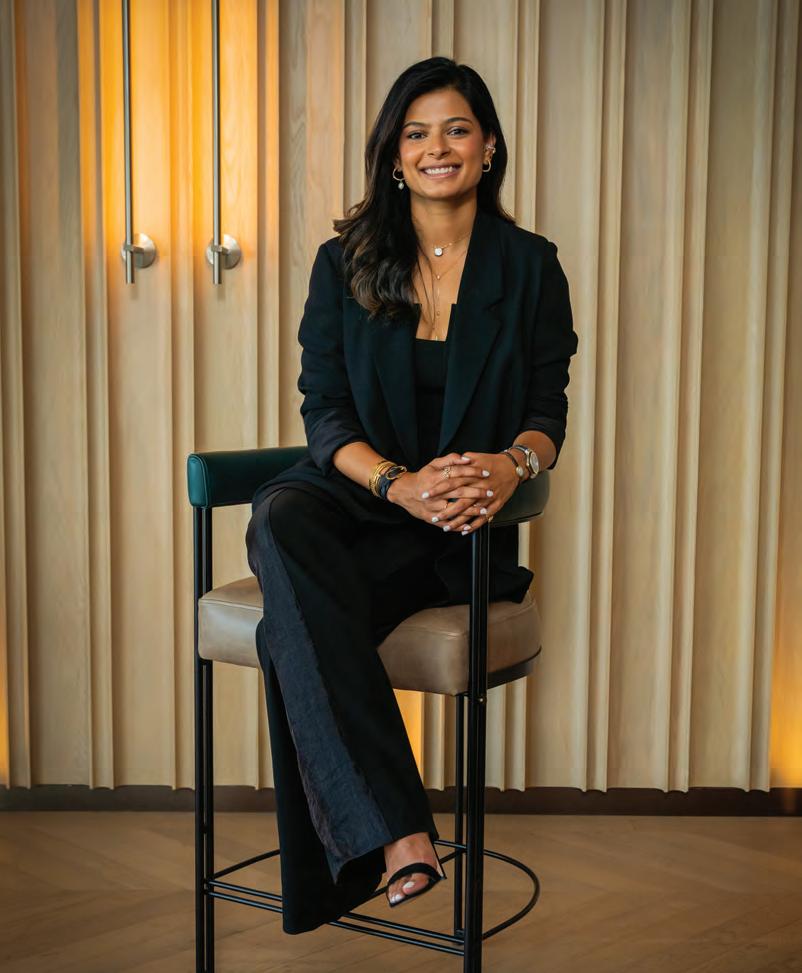
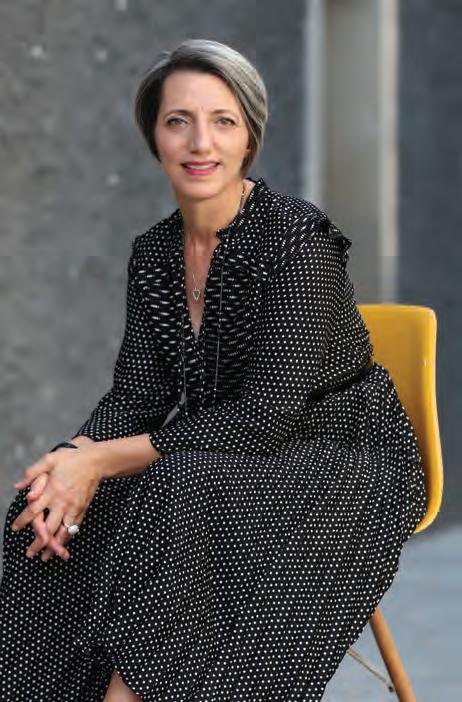
Global Design Principal of multinational architecture design studio Aedas, awardwinning architect Ignacio Gomez is known for creating landmark projects in the Middle East. Here, he is photographed at the Al Ain Oasis Hub, a project designed by Aedas for Eagle Hills, within the UAE’s first UNESCO World Heritage Site
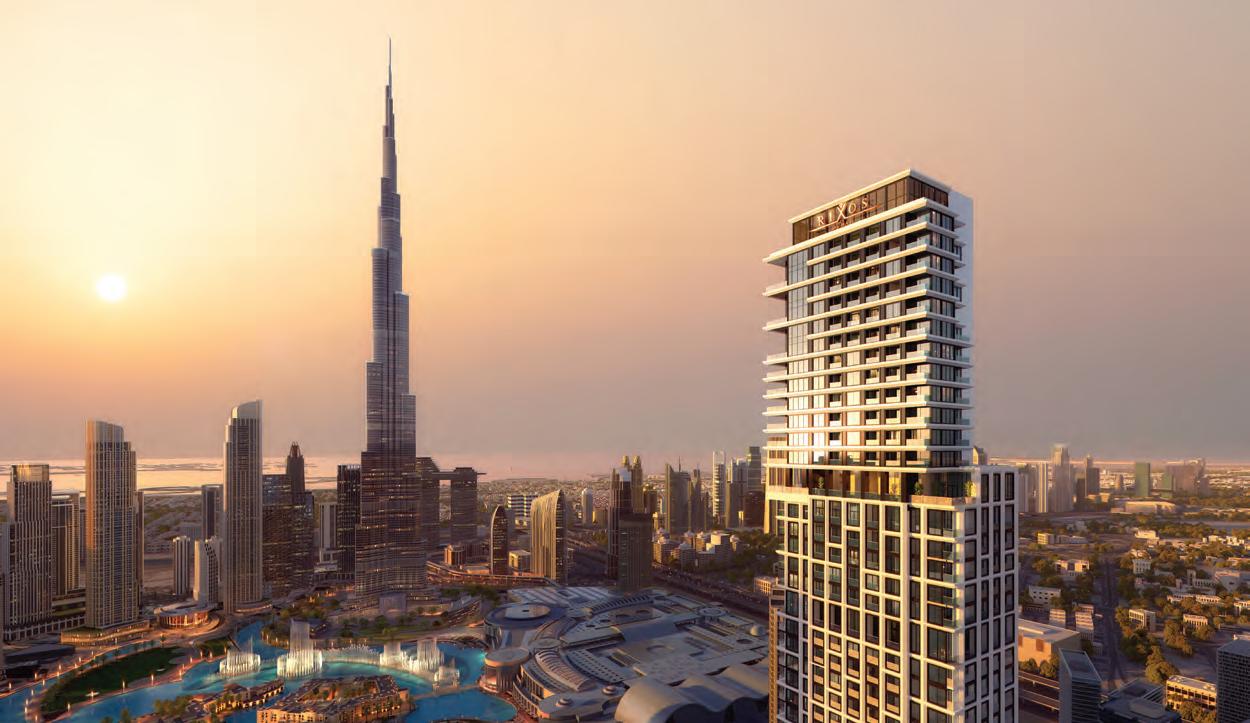
Above – Inspired by simple yet elegant design principles, the Rixos Financial Center Road Dubai Residences is divided into three distinct volumes – the 32-floor Low Zone, 27-floor Mid Zone and the High Zone with 12 floors of penthouses – and provides outstanding views of the Burj Khalifa and Downtown Dubai on one side, and picturesque vistas of the canal on the other
allowing spaces for exceptional projects where uniqueness is necessary.
In 100 years, I hope we rediscover resourcefulness. Our disposable culture is not sustainable. I want a return to longevity, adaptability and restraint. Sustainability should become instinctive again rather than performative. Comfort should be redefined, and energy use should be questioned as seriously as aesthetics.
Have you been influenced particularly by other architects, designers or projects – and if so, in which ways?
IG: I try to learn from everyone I meet along the way. It is healthy to be challenged because it pulls you away from your own echo chamber.
I have had strong mentors who shaped my thinking and my way of practising, including Brian Johnson, Ricus van Zyl, Boran Agoston and Keith Griffith. Each of them influenced my understanding of leadership, rigour and culture. The attitude of Rem Koolhaas and OMA have always been a major influence –particularly a refusal to be lazy in thought, a willingness to research and provoke, and a kind of seriousness without self-importance. Delirious New York [written by Koolhaas] remains fundamental for understanding how the
city evolves through forces larger than architecture. Al Manakh is equally important for understanding the Middle East as a subject of research rather than spectacle. That intellectual posture, the ability to read reality and turn it into insight, is what I admire.
What changes have you seen in the Middle East since you began working here?
IG: The change has been phenomenal, both regarding what the region is building and how the world perceives it.
Once, architecture in the Middle East was not taken seriously by parts of the global canon, as if working here was somehow less meaningful than working in the established Western centres. That perception has shifted because the region engages architecture in a direct way. The public discusses it, visits it and debates it. The built environment is part of a broader cultural conversation rather than an internal professional one.
Internally, the ambition has matured. The discussion is no longer only about individual landmarks – it is about cities, mobility, public realm, tourism ecosystems, new ways of producing energy and new models of living in extreme climates. In some Western cities, ur-
ban growth feels consolidated and almost finished. Here, the questions are still open, and that makes the conversation more relevant and more urgent. We are not just shaping buildings anymore. We are participating in a regional experiment about what the future can look like.
When you are nurturing young architects, what are the most valuable pieces of advice you can give them?
IG: We try to deconstruct a few myths early. Architecture is not a solo performance; it is collaboration under constraints. Many young designers arrive wanting to be a star, but the real profession is about judgement, communication, responsibility and teamwork. We expose young architects to clients early so they understand that design exists within a society, a market and a time. You need to be humble when necessary and strong when it matters.
We also push them toward first principles: What is the value of an architect? What is good architecture? Why does it matter? Often the limiting factor is not skill, it is preconception. If you can remove mental inertia, you can grow faster. Finally, build process, not style. A style can become a cage. A process can take you anywhere.
Everyday Elevated
Curated design that balances function, material, and meaning
WORDS – NILUFER NAJEEB
by Andrea Ferrari
PETAL
[LEFT]
ORTEGA DIAGO
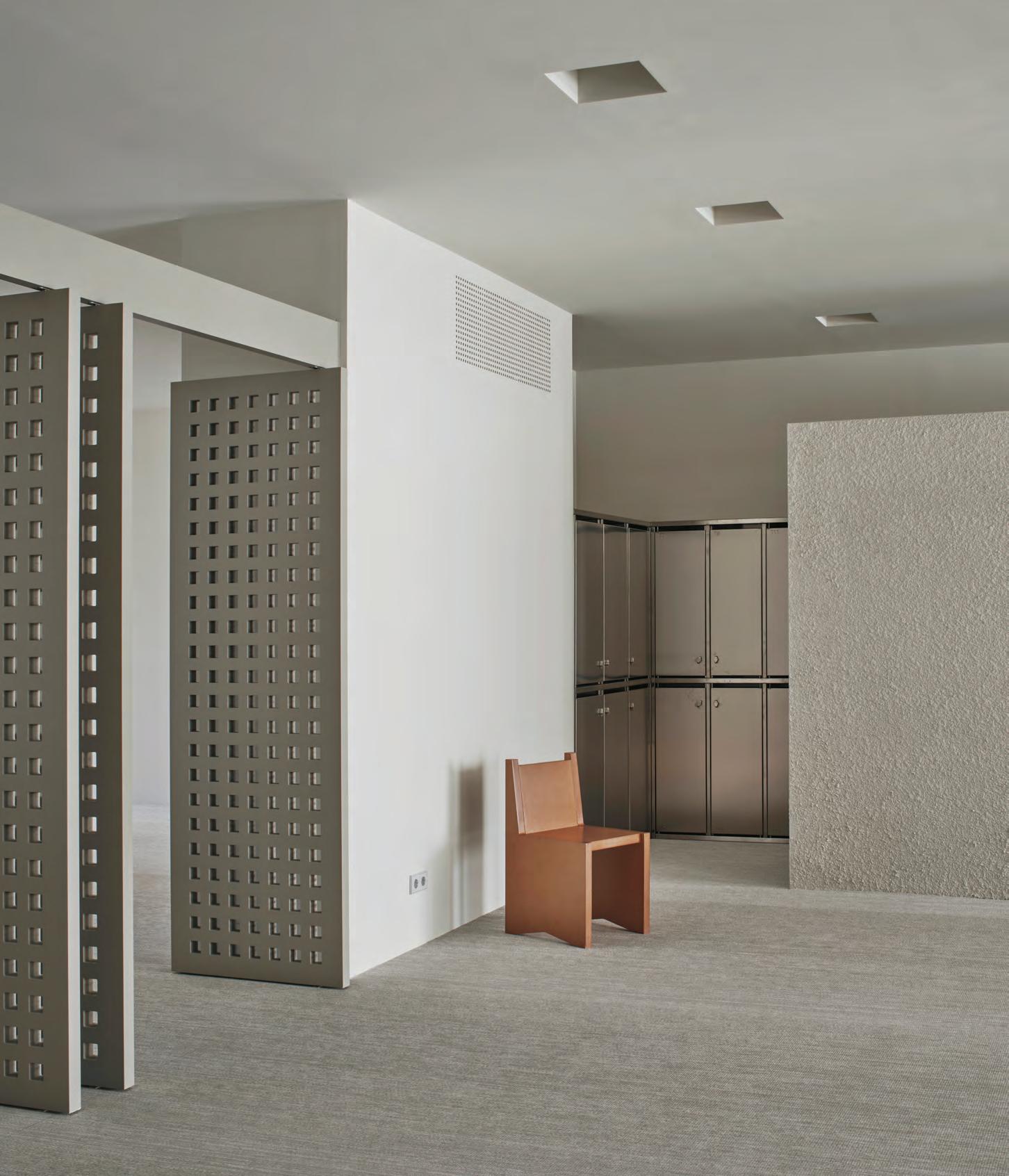
Ortega Diago reshapes the ground floor of the Memory Center in San Sebastián into an environment where architecture itself fosters care and serenity. The dense structural grid is embraced rather than hidden, providing a rhythmic framework for new volumes and partitions. Rough, coarse-grained stone walls give tactile presence, while stainless steel surfaces catch and diffuse light, introducing subtle reflections that animate the space. Large perforated pivoting doors act as both dividers and dynamic filters, casting geometric shadows that shift with the movement of sunlight. The design prioritises domesticity and comfort. Sand-toned textileappearance flooring softens circulation,
and perimeter curtains offer acoustic and visual separation from the urban surroundings. Wood and leather furniture adds warmth, scale, and material richness. Circulation is conceived as a gentle, meandering journey, where light, texture, and structure guide visitors through a carefully orchestrated experience. The Memory Center becomes a space where architecture nurtures, supports, and accompanies its users.
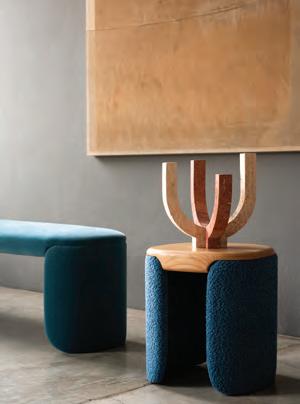
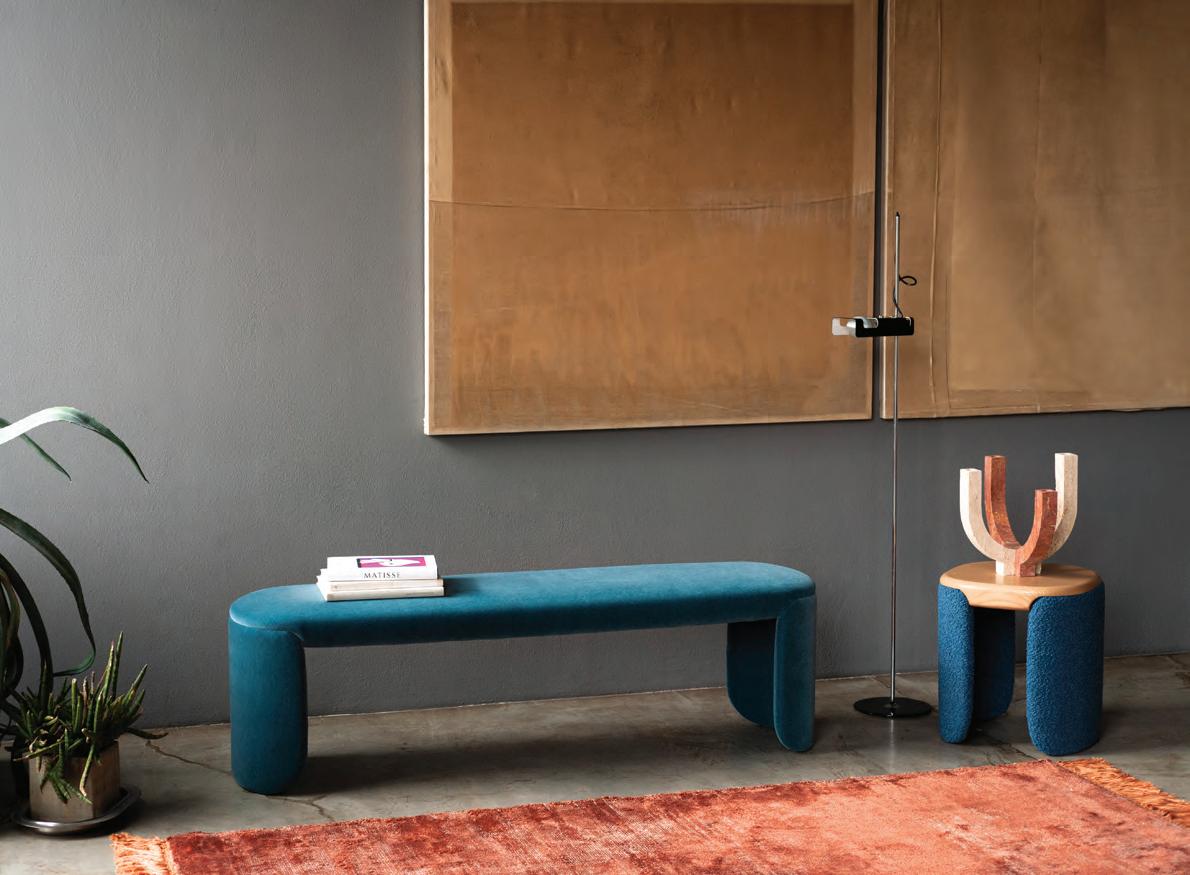
Petal by Marco Zito for Bross transforms everyday seating and surfaces into a refined design statement. Conceived by Venetian architect and designer Marco Zito, Petal is a versatile collection of benches, coffee tables, and stools, seamlessly bridging functionality and sculptural elegance. Its defining feature lies in the fully upholstered structure, available in leather or fabric, with inward-curved sides and softly rounded corners. The seat or ashwood top fits seamlessly within the frame, creating a continuous, uninterrupted surface that emphasises proportion, materiality, and subtle detailing. Petal’s modularity and adaptability make it ideal for conversation areas, living spaces, bedrooms, and waiting zones, offering both comfort and visual harmony. Each piece reflects Bross’s dedication to craftsmanship while exploring contemporary materials and finishes, resulting in a tactile and architectural presence. Through Petal, Zito transforms everyday furniture into objects of quiet sophistication, where soft details and structural clarity define the identity of the entire product family.
[ABOVE]
Photography
ANDROID
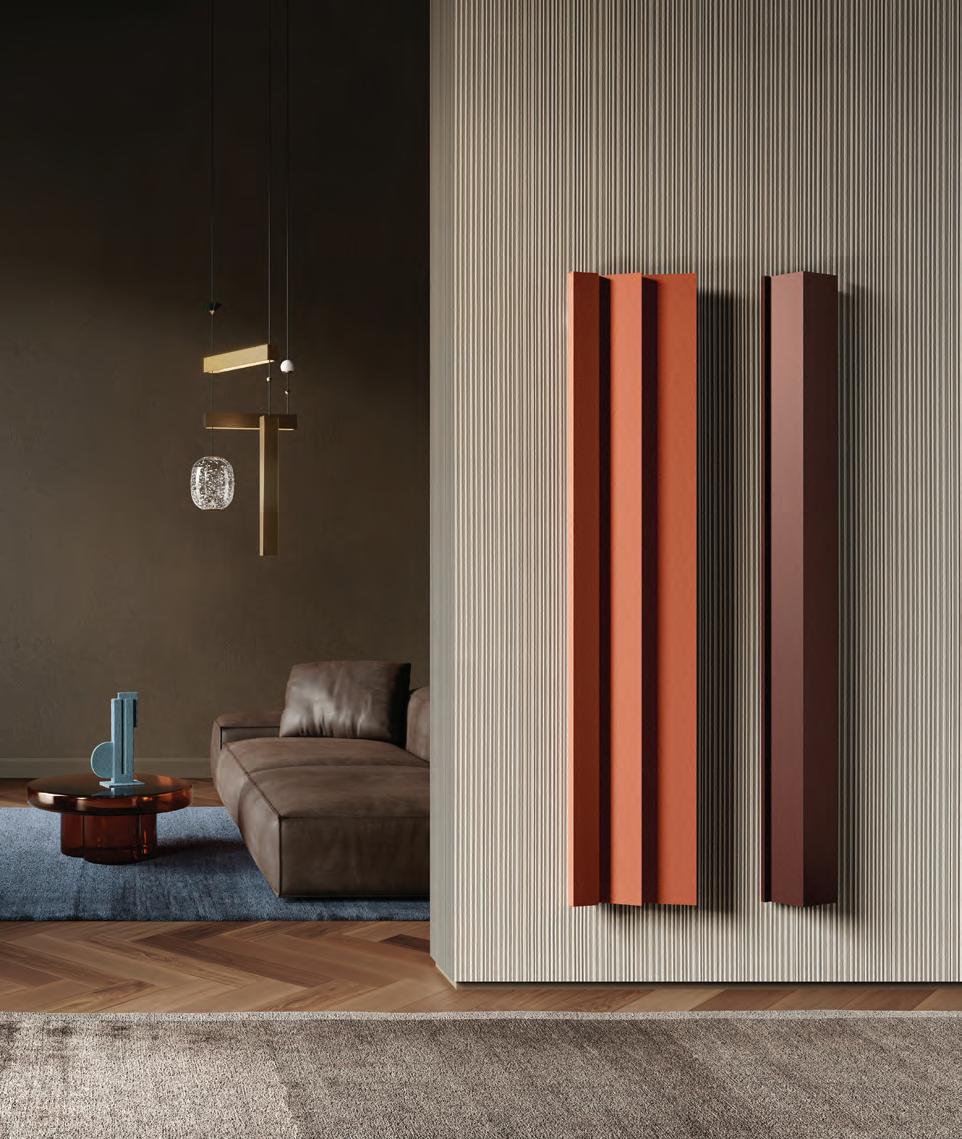
Emerging from the wall as a faceted volume, Android by Daniel Libeskind for Antrax IT transforms the radiator into a sculptural object that transcends function. Its design evolves the traditional flat plate into a dynamic three-dimensional relief defined by crisp folds and sharp angles. This faceted surface captures and manipulates light, creating a play of shadows and depth that changes with perspective whether mounted horizontally or vertically. As Antrax IT celebrates its 10th anniversary, Android stands as
a defining example of the brand’s commitment to design innovation. The rhythmic sequence of folds and edges forms a striking visual cadence, giving the radiator an architectural presence that engages its environment. The Android IQ variant intensifies this language through bold diagonal cuts, amplifying movement and geometric tension. Every detail, from proportion to material finish, reflects a meticulous balance between artistry and purpose. Complementary accessories, including towel rails shaped to echo the radiator’s contours, extend the design vocabulary.
POD
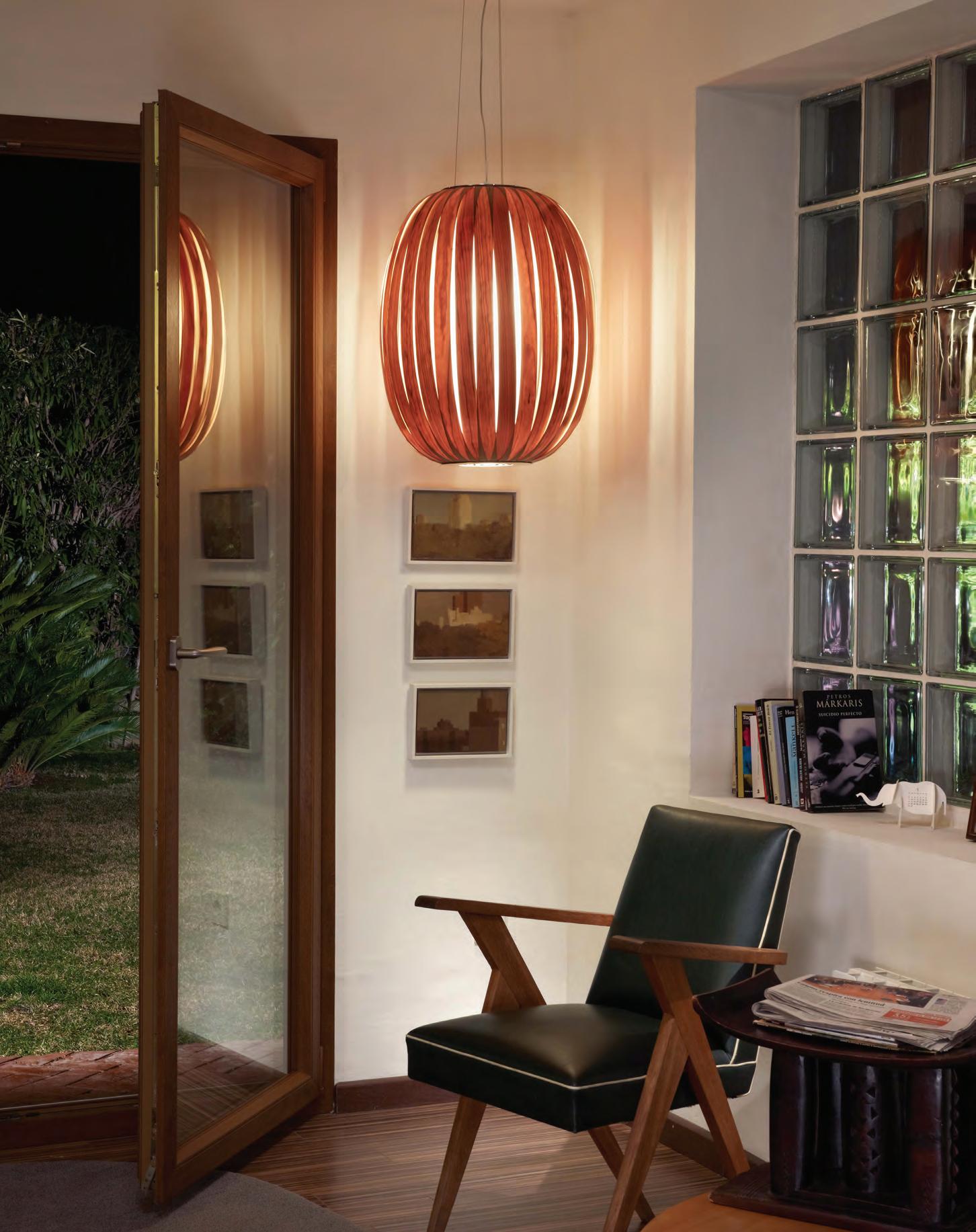
Pod, The Fresh Light by Burkhard Dämmer is a study in restrained geometry and subtle illumination. Each strip of the Pod is separated by a narrow gap, allowing only glimpses of light to escape, transforming the pendant into a layered sculptural object rather than a simple light source. Its medium size and refined proportions create a balanced presence, whether installed alone or grouped with other Pod lights. The interplay of solid and void, light and shadow, defines its visual rhythm, producing a luminous sculpture that engages with the surrounding space.
Pod’s design is intentionally unassuming, yet highly considered: the spacing of each strip, the curvature, and the alignment of the elements all contribute to a composition that is both precise and expressive. It elevates everyday lighting into an architectural gesture, where form, detail, and light converge into a coherent, contemporary statement.
[ABOVE]
[RIGHT]
Words by Rebecca Anne Proctor
SOLACE
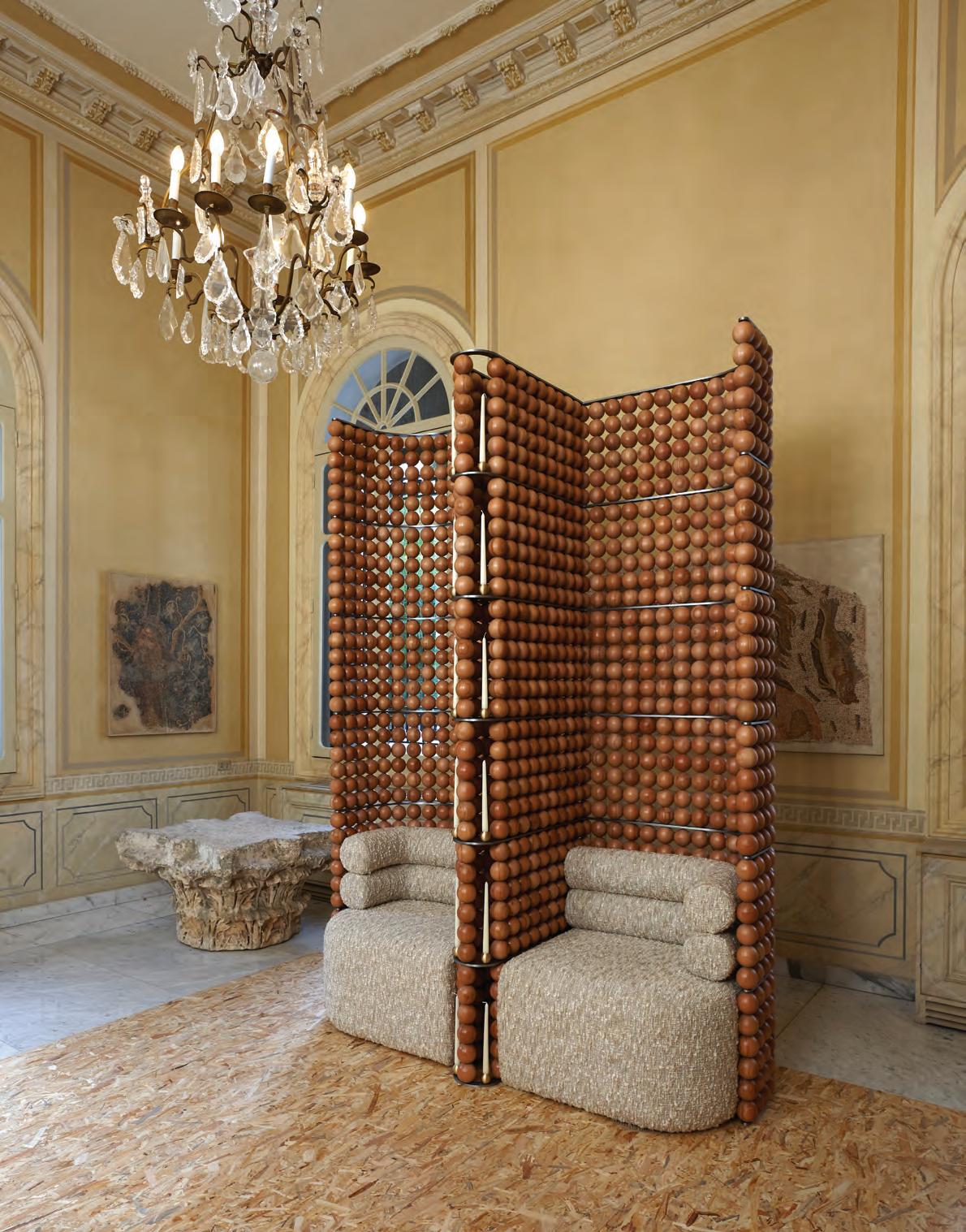
Beirut-based Studio Bazazo founded by Lebanese architect Ahmed Bazazo has launched Solace, a chair that takes the form of a sculptural installation offering a space of reclusion and privacy. Conceived as an abstract confessional booth, Solace is a sculptural installation presenting two adjoined seats separated by 2.5-meter-high curved screens of wooden spheres. With its high and imposing structure and gentle curves, the chairs encourage an intimate retreat from the outside world. “Solace stands as an object hand crafted by Lebanese artisans out of solid beech wood and brushed steel,” says Bazazo. “It is inspired by a confessional booth, one which invites the user to sit, reflect, and confess their deepest inner thoughts, in a place of comfort and introspection.” He notes that the chairs, clad in warm, textured surfaces, also explores the complex and often conflicting relationship individuals have with the city of Beirut. The object, which was launched during We Design Beirut 2025, stages a dialogue between attraction, nostalgia and escape – sentiments that are commonly used to describe the city of Beirut and its myriad complexities. Solace, explains Bazazo, invites reflection on the personal and collective ideas or “confessions” as he calls them, that are carried about Beirut. The object stands still, tall, proud and determined yet also enclosed as if to cherish, reflect and protect.
[BELOW]
ILQUADRO
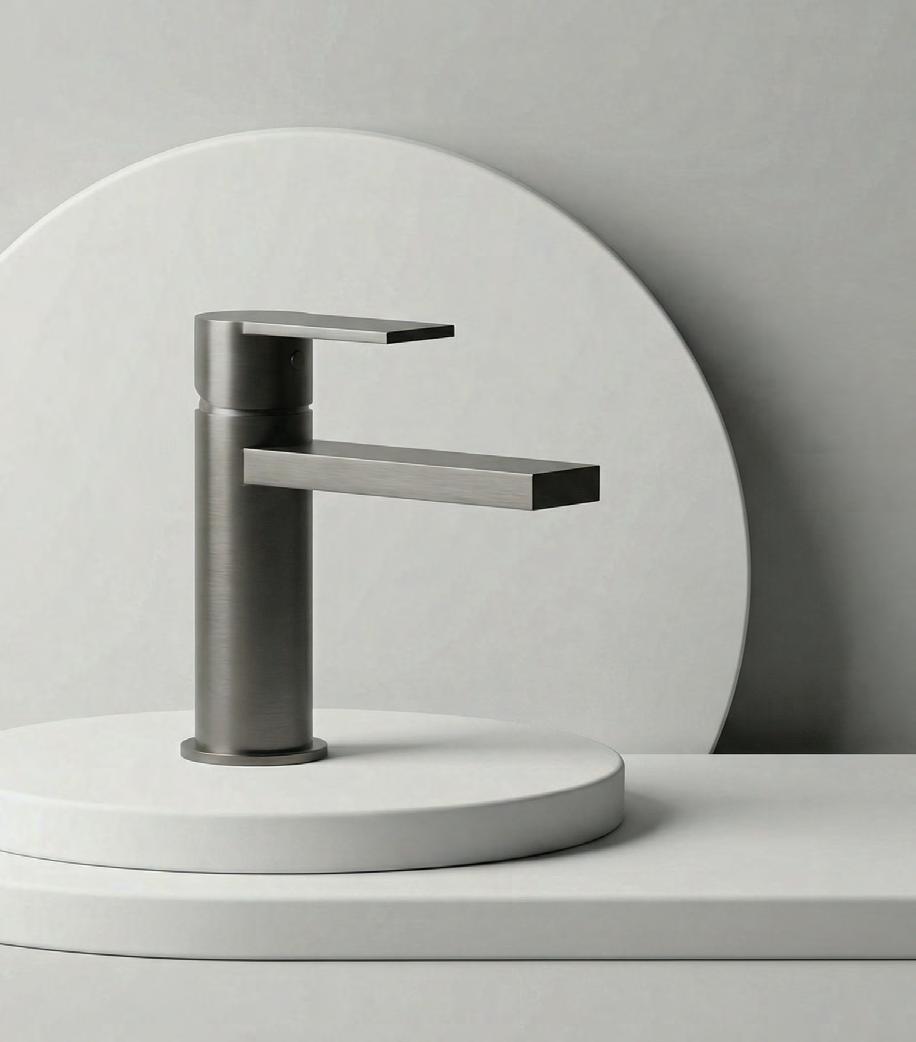
Carimali introduces a new single control plate version, The wall-mounted washbasin mixer from the IlQuadro series distills tapware to its purest geometric expression. Rooted in the dialogue between square and circle, its design balances structural rigor with fluid continuity. The square backplate establishes a precise architectural frame, while the circular control introduces a softer, dynamic counterpoint. This measured contrast defines a composition that is both restrained and expressive. In the single control plate configuration, the
separation of spout and mixer through independent escutcheons enhances the clarity of each element. Every component is treated as an autonomous volume, aligned with exacting proportion and spacing. The result is a modular system that emphasises order, rhythm, and visual lightness on the wall plane. Surfaces and finishes further articulate the form, capturing light along edges and curves to reveal depth and definition. Reduced to its essential lines, the washbasin mixer becomes a discreet architectural gesture, where geometry and function resolve into a refined, timeless presence.
Refined and Lasting
Dedalo – crafted for subtle, timeless living by Studio 971
WORDS – NILUFER NAJEEB
At Studio 971, design is defined by discipline and the belief that the smallest detail shapes the entire experience of a space. Within this philosophy, Dedalo emerges as a refined interior solution created to enhance living systems and wardrobes with architectural clarity and
structural precision. Conceived specifically for modular compositions, Dedalo integrates seamlessly into open living units and bespoke storage environments. Its role is subtle yet transformative. By refining internal frameworks and sharpening proportions, it ensures that every junction, panel and finish feels intentional. Lines appear cleaner, transitions more fluid, and compositions more resolved. Rather than competing with surrounding elements, Dedalo supports them, allowing the overall design to feel cohesive and complete.
Positioned alongside distinguished brands such as Arrital, Lema and Novamobili, Dedalo reflects Studio 971’s commitment to solutions that balance innovation with timeless elegance. It is tailored for architects and interior designers seeking technical excellence, as well as for homeowners who appreciate refined simplicity in everyday living.
What distinguishes Dedalo is its disciplined restraint. It enhances modular living systems and wardrobe designs without overpowering them, strengthening detailing while preserving visual harmony. Continuity across materials and finishes is maintained, enabling both minimalist interiors and more expressive spaces to achieve sharper execution and elevated finishing standards.
Beyond aesthetics, Dedalo improves performance. Its precision engineering supports durability and functionality, ensuring that beauty is matched by reliability. For design professionals, it offers greater flexibility in execution; for end users, it delivers enduring quality woven seamlessly into daily life.
As part of the Studio 971 collection, Dedalo embodies a considered approach to contemporary interiors one where true luxury lies not in excess, but in precision.
Design, Beneath the Surface
APE Grupo brings a design-led Spanish sensibility to the Middle East, redefining ceramics as architectural tools
WORDS – NILUFER NAJEEB
Spain has long been a meeting point of cultures, materials and ways of living, and for APE Grupo, this layered heritage has shaped a distinct approach to design. Tradition is not treated as a style to be repeated, but as a starting point for rethinking how surfaces can actively shape contemporary spaces. This philosophy now extends to the Middle East, a region where architectural ambition and contextual sensitivity go hand-in-hand.
With more than 30 years of experience, APE Grupo remains a family-owned company with a presence in over 120 countries. Its international growth has been driven by consistency, evolution and long-term thinking rather than fleeting trends. The group is not defined by a single collection or recognisable aesthetic. Instead, it operates through a diverse portfolio of brands, each with its own identity, united by a shared belief that “surfaces are not
decorative elements, but architectural tools.” This belief underpins how APE Grupo designs for real life. Its collections are developed to engage with architecture across different scales and typologies, from hospitality and residential environments to commercial and public spaces. Surfaces are conceived as integral components of an architectural narrative, supporting how spaces are lived in, moved through and experienced over time. Design integrity, innovation and performance are approached as inseparable qualities.
The Middle East represents a natural progression in APE Grupo’s global evolution. The region’s ability to merge tradition with bold contemporary expression, combined with its demand for durable, high-performance materials, closely aligns with the group’s expertise. Rather than introducing a pre-existing offer, APE Grupo approaches the region as a long-term partner,
bringing decades of accumulated knowledge and a genuine respect for local contexts.
Behind every surface lies a careful balance between aesthetics and functionality. APE Grupo’s solutions respond to the realities of architecture, including high-traffic areas, wet zones and challenging climatic conditions, without compromising on visual character. This integrated approach positions the group as a trusted ally for architects and designers seeking materials that perform reliably while retaining strong design intent.
The opening of APE Grupo’s regional showroom marks more than a physical presence. Conceived as a meeting point for professionals, it offers space for dialogue, exploration and collaboration. With a clear design-led vision, APE Grupo enters the Middle East ready to contribute thoughtfully to a built environment where surfaces play an active architectural role.
Things to Covet
Products with elegant and thoughtful design to elevate every hosting moment this season
WORDS – NILUFER NAJEEB
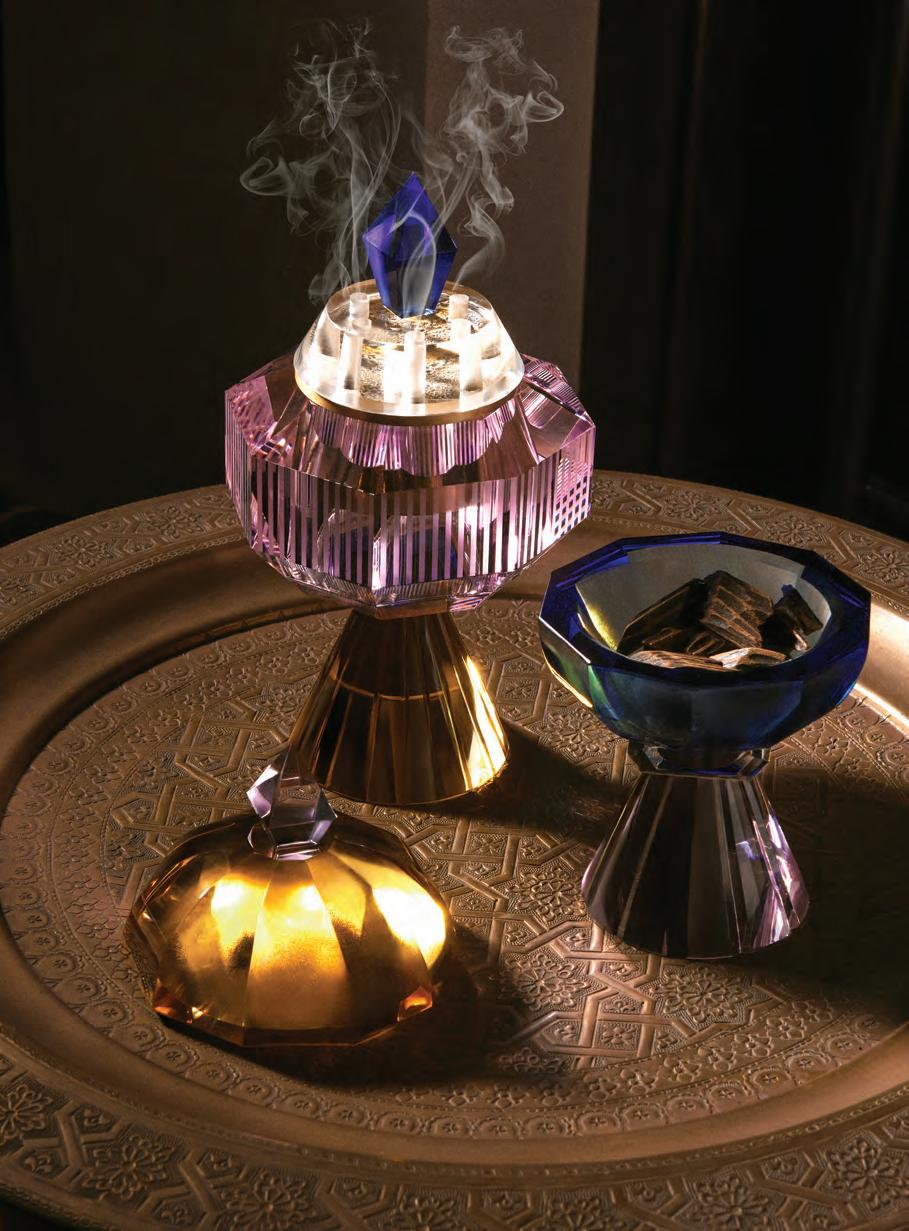
1. The Harmony Incense Burner by Reflections
Copenhagen
Featured in the exclusive Ramadan Collection at Tanagra, this is a masterful creation in fine crystal. Its dome-shaped lid tapers to a flame-like finial, decorated with delicate leaf-patterned cuts in shimmering icy blue and violet tones. The smooth, transparent bowl balances the design, making it a luxurious vessel for bakhoor or incense.
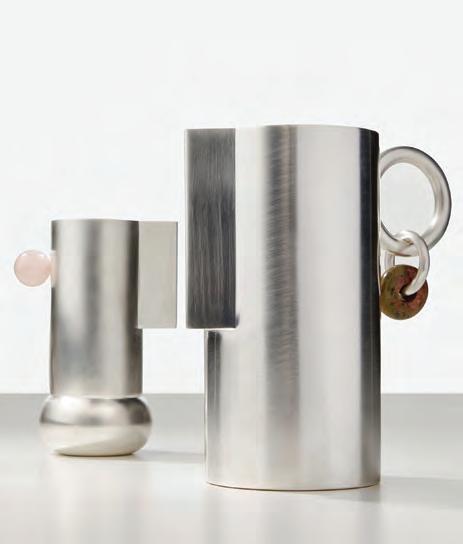
2. Silver-plated brass pitcher by Natalia Criado
Natalia Criado’s silver-plated brass pitcher balances artistry and utility. Crafted in Italy, it features clean, sculptural lines and a unique stone detail that elevates its presence. Elegant, functional, and refined, this piece turns occasional hostings into a moment of curated sophistication.
3. Arcadia Dinner Plate Set by Baccarat
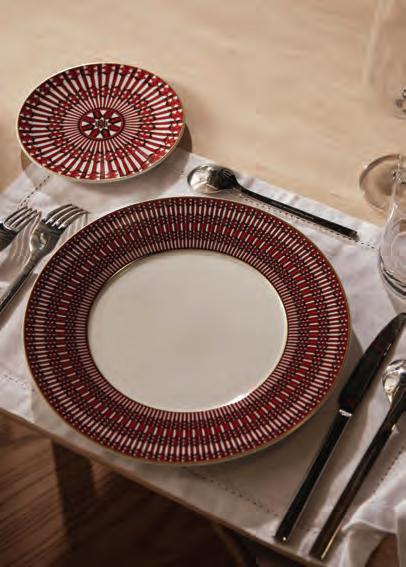
Baccarat presents the Arcadia Dinner Plate Set, a refined duo crafted from high-quality porcelain in a striking red and gold finish. Adorned with the signature Arcadia pattern, the round plates with smooth edges bring vibrant elegance to the table, combining durability with style for serving mains, pasta, or salads.
4. The Ocean by Alexa Lixfeld
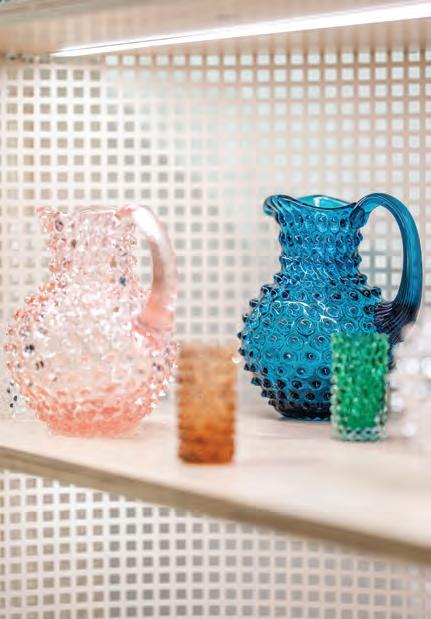
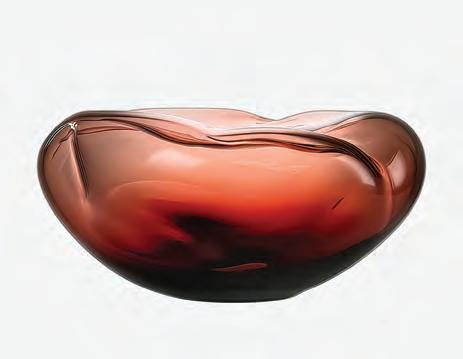
Alexa Lixfeld focuses on creating non-industrial, non-standard, and ethically approved goods. The Ocean decorative object is carefully mouth-blown in the Czech Republic, crafted from redhued glass with a delicate gradient. Rendered in the designer colour brownish red, it is a striking piece that combines individuality, artistry, and timeless elegance for any interior.
5. The Center of Universe Mirrors by SHEWEKAR
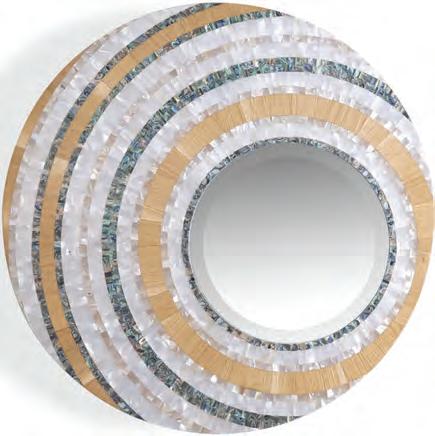
Transforming any wall into a radiant focal point and crafted from genuine mother-of-pearl and oak veneer in three colours, the trio is perfectly aligned around an off-centered mirror, creating a magnetic, sun-inspired effect. Warmth, elegance, and artistry come together in this stunning set.
6. The Hopi Ottoman by La Chance
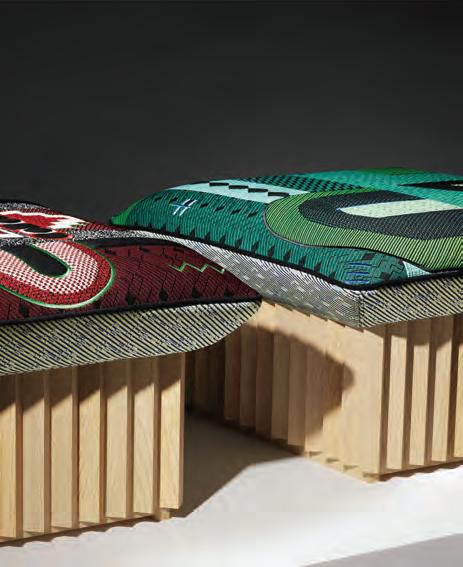
The Hopi Ottoman explores contrast through material and proportion. A solid base in black Marquina marble or ash anchors the design, while an oversized cushion adds softness and comfort. Sculptural yet practical, it brings architectural presence and tactile warmth to contemporary interiors.
7. Deco Leaves 3-Tier Large Server by L’Objet
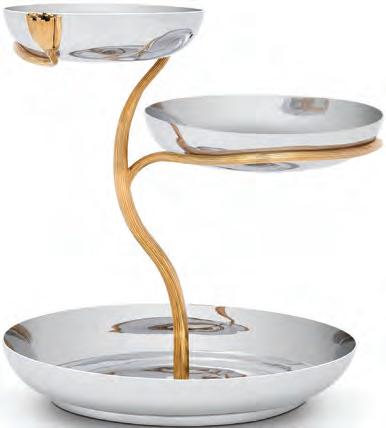
An elegant addition to any dining collection. Ateliercrafted from hand-forged stainless steel with 24k gold plating, it features three serving bowls on a central post, making a luxurious centerpiece for entertaining and stylishly presenting your favourite snacks with opulence and refined design.
Compiled
Vibha Monteiro
WOMEN IN DESIGN
As the Gulf’s design industry continues its upswing, these 13 female designers offer bold, innovative and practical takes to the region’s rapidly evolving creative landscape
WORDS – REBECCA ANNE PROCTOR
Agata Kurzela
With over two decades of work in master planning, architecture and interior design, Polishborn Agata Kurzela has been delivering innovative and poetic responses to challenging and complex projects across the Middle East.
Launching her eponymous design studio in 2020, Kurzela’s designs feature a blend of contemporary creativity, technological insight, and contextual awareness distinguishing her studio as one that sensitively aims to look at the social and historical context of each project.
“Each project is sparked by a trigger – a person, an institution, a community, or a specific need,” explains Kurzela. “Our role is to understand that impulse and to learn everything we can about the fundamentals of the task and its context. We anchor the work in its cultural and spatial surroundings, uncovering the stories, material realities, and aspirations that give it meaning.” She transforms client briefs into functional, poetically engaging spaces across various disciplines, including product design, installations, interior design, and architecture.
Her recent projects in Abu Dhabi signal a new direction for her practice. At the Zayed National Museum, Kurzela was entrusted with the creative direction, curatorship, and interior design across a wide constellation of public, VIP, and research environments. Treated as a spatial interpretation rather than an exhibition, the interiors she designed, including a series of interior spaces and bespoke furniture, express cultural identity and authorship and are rooted in ideas of time, ritual, and material memory.
Collaborations with Emirati designers form a central layer of the work, ensuring that cultural expression emerges from within the project rather than being applied to it. She also designed a 780-square-meter F1 lounge located in the Shams Tower at Yas Marina Circuit in Abu Dhabi.
A similar use of poetic sensitivity defines the adaptive reuse of Erth Hotel & Club, the former Armed Forces Officers’ Club originally designed by Roger Taillibert. Recognised as modern heritage, Kurzela’s interventions included restoring spatial coherence and reinforcing the building’s original geometric logic, while introducing new architectural and interior elements that resonate with its sculptural clarity and contemporary Emirati identity. kurzela.com
The Research Library at Zayed National Museum
Agata Kurzela at Erth, Abu Dhabi
Dina Murali
Co-founder and design director of DZ Design, a Dubai-based architecture and interior design studio, Dina Murali is recognised for redefining luxury living across hospitality and multi-residential developments in the Middle East and Africa. Known for delivering environments that are both emotionally resonant and technically rigorous, under her creative leadership, DZ Design has completed numerous projects in the region, including the newly refurbished Pullman JLT, Gobi restaurant in The Ritz-Carlton RAK, a five-star ski resort in Azerbaijan, the Mövenpick Hotel in Dubai Healthcare City, and multiple residential towers in Business Bay and Mohammed
Bin Rashid City. The studio’s awardwinning work spans the hospitality and wellness sectors, including Amaseena at The Ritz-Carlton JBR, Sunny Wellness Spa in Sharjah Healthcare City, VEO gyms by Emaar, Semi-Sweet in Sharjah, and a series of high-end private villas, alongside large-scale commercial developments. “My primary focus is on designing spaces that genuinely reflect a brand’s values and tell a strong story,” says Murali. “With our recent expansion in Dubai and India, and growing opportunities in Saudi Arabia, we are ready to take on more ambitious projects.” Pushing the boundaries in hospitality design, Murali stresses that sustainability and innovation play an increasingly important role in today’s architecture and design landscape. dzdae.com
Pullman Dubai Jumeirah Lakes Towers
Hajar Altenaiji
Abu Dhabi-based designer Hajar Altenaiji centers her creative practice on her Emirati heritage, aiming to bridge the gap between authentic heritage and contemporary design. With a vision to create products that tell the story of the UAE, Altenaiji established her eponymous firm Hajar Design Studio in 2018 to address a question: What if traditional techniques could speak to today's world? Her design objects and interior projects stem from a desire to preserve the rich heritage of her country’s past while embracing the forward-thinking aesthetics of modern and contemporary design. “I dedicate myself to uncovering the cultural stories that live within objects,” explains Altenaiji, emphasising how she and her team “are cultural curators as much as designers, spending months in heritage sites, workshops, and community spaces.”
In 2024, Altenaiji was the recipient of the Van Cleef & Arpels Emergent Designer Prize for a functional kite inspired by dhows, the traditional Emirati sailing boats. Most recently, she designed a sensorial installation for Ramadan in collaboration with French silverware brand Christofle. The contemporary installation comprises rich crimson paper fans and red mesh suspended elegantly over a refined table set with Christofle silverware and glass in the maison’s boutique in The Dubai Mall. Designed exclusively for Ramadan, the installation, in addition to fans, includes rich red coloured tassels suspended from the ceiling as well as seasonal fruits, verdant plants and florals and soft sculptural elements, symbolising generosity, abundance and hospitality for the Holy Month. “We wanted to reflect a table that was alive,” she explains. “Ramadan, for me, has always been about sharing. The table symbolises togetherness and reflects the depth of our heritage during Ramadan.”
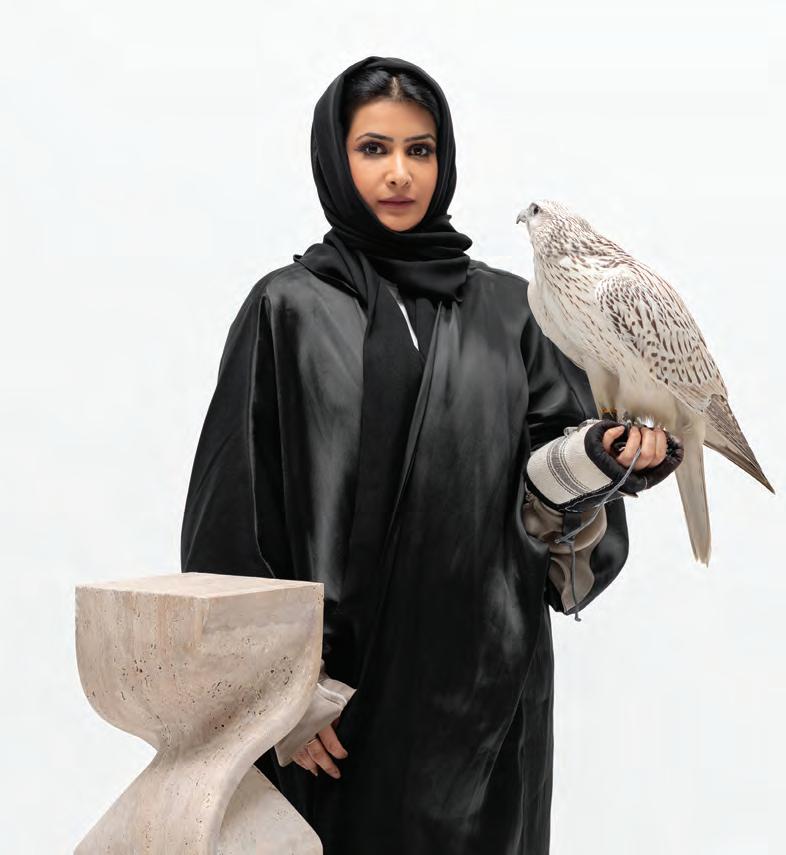
Interspersed throughout the store are several of Altenaiji’s minimalist falcon landing stands, also known as the Falcon Perch, which serve as elegantly sculpted pedestals made in authentic materials. “My design,” explains Altenaiji, “is about maintaining ‘the tangible and intangible heritage; the visual language of the UAE and the emotions it resonates.’”
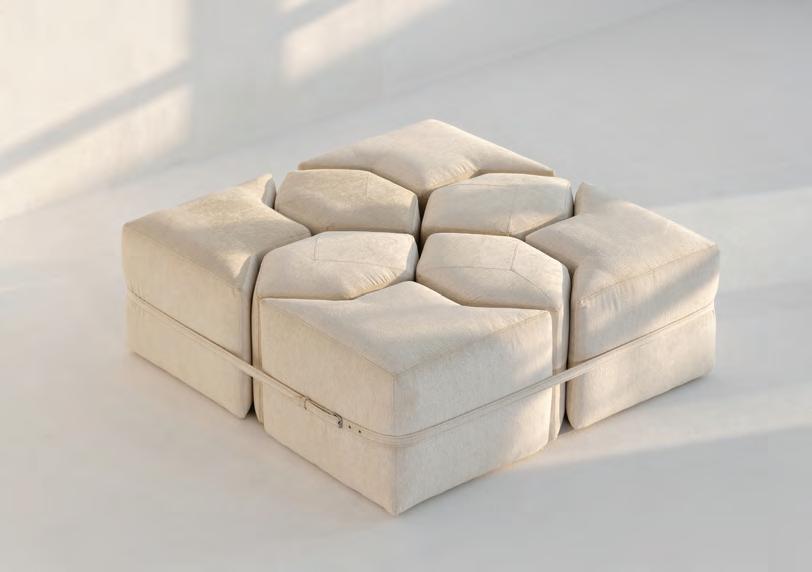
Al Khayl Modular Pouf Chairs
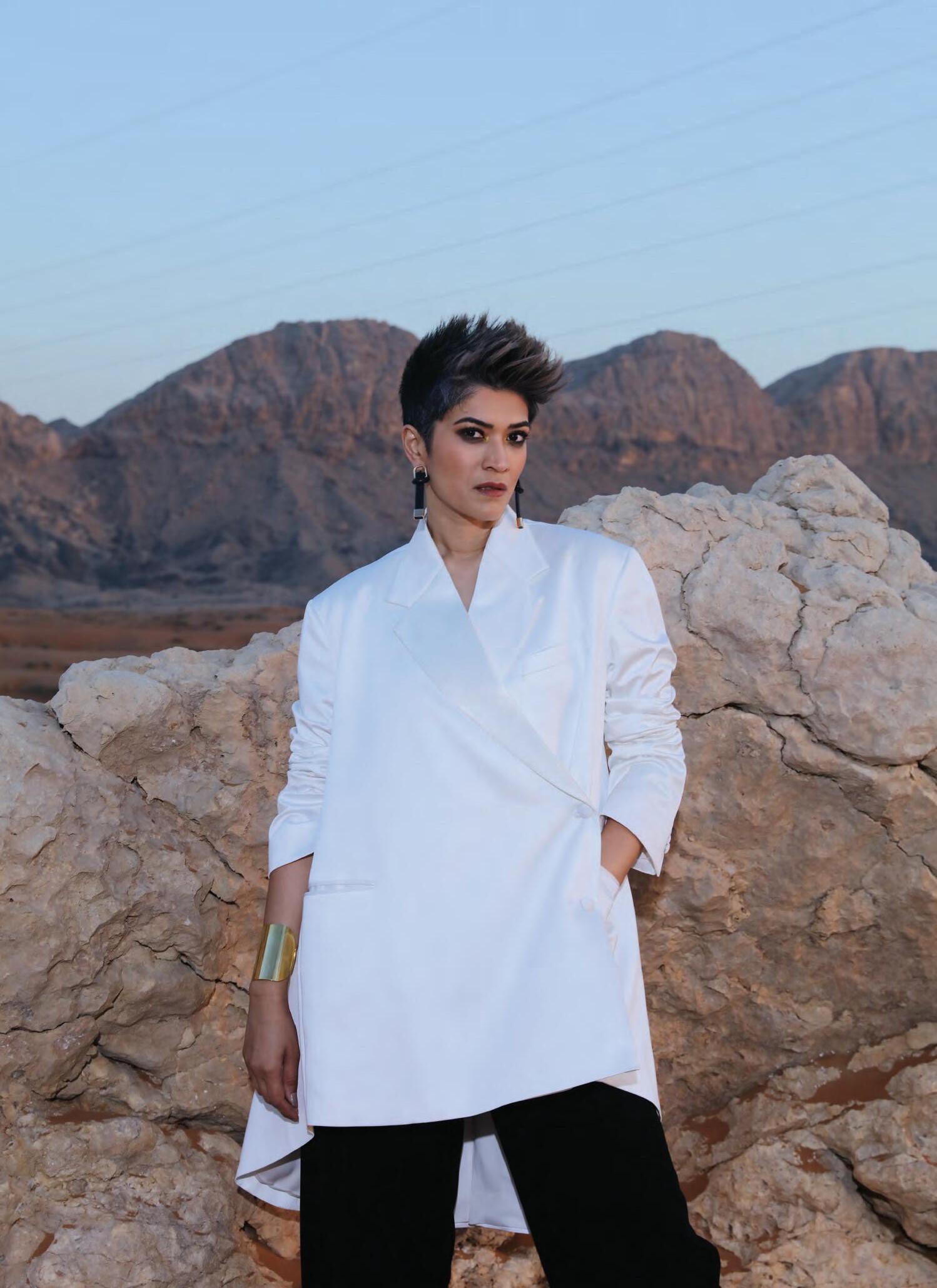
Hajar Altenaiji with a Waker Falcon perch
Kristina Zanic
Australian-born interior designer and founder of her eponymous studio Kristina Zanic Consultants, has over 35 years of global experience. With offices in Riyadh, Bangkok and the Philippines, Zanic specialises in luxury hospitality, commercial and residential projects. Zanic founded her boutique firm in Dubai in 2012 and is known for imbuing her design work with cultural and cosmopolitan flair, incorporating inspiration from her various travels around the world. Having lived in five countries and travelled to over 75 others, Zanic’s approach to design is one where local culture and identity is giv-
en precedence alongside a sophisticated, eclectic and contemporary aesthetic approach that merges luxury with functionality and cultural storytelling. Zanic’s award-winning projects include the Ritz Carlton Al Wadi Desert Resort in Ras Al Khaimah, Ritz-Carlton Al Hamra, the Domes Miramre Resort in Corfu, Greece and the St. Regis Red Sea Resort, among others. She has also designed the renovation of Jotun Paints’ Admin Office Building in Al Quoz, Dubai, endowing it with a modern a modern, functional and visually appealing workspace aligning with Jotun’s identity. Zanic believes spaces have stories. As she states, “Telling the story of the place and its people is a guiding principle.” kristinazanic.com
Photography: Sebastian Boettcher, Natelee Cocks
Gerbou
Maryam Karji & Raha Milani
Led by founders Maryam Karji, Managing Director and Raha Milani, Design Director, Dubai-based leading architectural firm a rchiSENSE Studio has gained a reputation for designing innovative and sustainable spaces across the United Arab Emirates. Established in 2018, the studio specialises in upscale residential, interior architecture and landscape design properties. Both graduates of the American University of Sharjah, Karji and Milani’s creative practice is rooted in the landscape and culture of the United Arab Emirates. Their design ethos centers on creating meaningful and coherent conversations between the natural landscape, architecture and interior design of their projects, with a focus on emphasising spaces that resonate with the occupant’s emotions and foster curiosity through immersive design experiences.
“At archiSENSE, we approach architecture and interiors as a quiet dialogue between space, user, time, and experience – crafting homes that feel intentional, personal, and enduring,” explain Karji and Milani.
Design for archiSENSE is not aimed just at functionality, but about fostering spaces that act as catalysts for wonder, human connection and memory. Recent high-end residential projects in Dubai reflect this philosophy across multiple scales, from House R, a contemporary villa completed in 2025 and shaped as a sequence of transitional spaces that gently mediate between public and private realms through light, movement, and visual continuity, to House BJ, a majlis house in Umm Al Sheif overlooking Burj Al Arab, where a minimal and distinctly masculine language is derived from the client’s original floor plan and refined through clean lines, controlled volumes, and deliberate simplicity.
At a larger scale, the Mansion House, a 75,000-square-foot private family residence, demonstrates the studio’s ability to maintain architectural calm within expansive volumes, remaining minimal and composed despite its scale. Together, these projects reflect archiSENSE Studio’s commitment to precise, timeless residential architecture shaped by intention, proportion, and lived experience.
Maryam Karji and Raha Milani
House R
Noelle Halabi
As the newly appointed director of Architecture at Bluehaus, a TP Bennett company, specialising in architecture, interior design and MEP engineering, Noelle Halabi oversees the design of environments grounded in a sense of place, local culture, impact and wellbeing. Shaped by people’s everyday lifestyle, Halabi is drawn to architecture and design that feels intuitive, warm and inviting – structures where people wish to linger longer and return to. Such preferences inspire her own work, endowing her creative practice with a human-centric approach that aligns closely with the studio’s ethos. She approaches design through the lens of experience, believing that architecture
is never just about physical space, but about how people move, feel, and connect. Spanning individual buildings to complex urban developments, she is particularly interested in projects where architecture, brand identity, and experiential design intersect.
Described as empathy-led design, Halabi’s work includes hospitality, retail, and residential-led mixed-use developments where she can simultaneously activate a space with purpose while also building a sense of community. Among her recent projects in the region is the transformation of a legacy presidential suite into Nobu’s Rooftop Destination, a 405-seat luxury dining experience on the 22nd floor of Atlantis The Palm, through which she incorporated inspiration from Dubai’s coastal heritage and mythical allure of the lost city of Atlantis.
Shamal Pier Club Expansion
Pallavi Dean
Architect Pallavi Dean, founder of Dubaibased studio Roar, is known for transforming spaces through emotional sensitivity and data-driven research that focus on the human needs of the occupants. From designing luxury homes, government offices, barber shops and children’s nurseries in the UAE, over the last few years Dean has seen her practice go international, with new residential projects in Bali alongside a hotel in Rabat, Morocco, a 13,000-squaremeter workplace in Frankfurt within a listed building, a Mumbai boutique for Jaipur Rugs and active projects across India, the United States and Saudi Arabia, including a museum and several large scale workplace environments. “I never want to talk about growth without talking about home,” says Dean. “The UAE is where the studio was built, tested, and refined. Right now, we are deeply involved in major government projects in Abu Dhabi, two schools in Dubai, and a growing portfolio of workplaces across Sharjah and Ajman. These projects have real impact because they shape how people work, learn, and move through their everyday lives.” Dean adds that being a womanled studio is not something her studio “performs.” She says it is how they “operate.” This means by leading and creating with instinct, evidence, and by staying focused on delivering work that is “performative not decorative.” designbyroar.com
Photography: Pedro Ferr
White & Case LLP, Tornado Tower
Pooja Shah Mulani
As the Managing Partner – Creative at Dubai-based LW Design Group, a leading architecture and interior design firm, Pooja Shah Mulani has played a pivotal role in the firm’s transformation from a regional studio to a global hospitality design powerhouse. With an instinct and belief in crafting spaces that resonate emotionally, Mulani’s creative practice lies in blending strategy with authenticity and strong narratives, endowing spaces with human connection and emotion. “Design is like theatre,” she says, “every element must perform in harmony to create lasting emotion.” Her approach is immersive and intuitive yet firmly grounded in commercial reality.
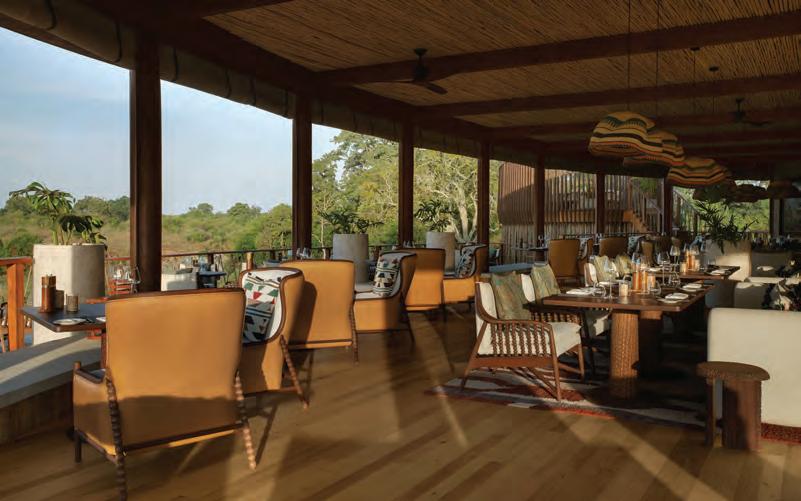
At the heart of Mulani’s work is a belief that design must create emotional connection while delivering lasting value. In recent years, she has led the delivery of several landmark hospitality projects that reflect both the studio’s expanding footprint and her evolving creative philosophy. From the Ritz-Carlton Masai Mara Safari Camp in Kenya, marking LW’s entry into tented lodges, to highprofile dining and hospitality concepts across Europe, the Middle East, and Asia, Mulani’s work demonstrates a deep sensitivity to place, a visitor’s experience and its operation and technology. Mulani is now focused on leading LW Design Group into new territories and typologies, including wellness-driven destinations, heritage-led restorations, and immersive hospitality concepts across Africa, North America, Europe, and Asia, creating spaces that richly resonate with people, places and a meaningful purpose.
Ritz Carlton Masai Mara
Rabah Saied
As the founder and creative director of Styled Habitat, a Dubai-based fullservice interior design studio, Rabah Saied is dedicated to crafting design that transcends the boundaries of material space to resonate culturally and emotionally with clients. A distinguished member of the American Society of Interior Designers, Saied is an American Sudanese designer renowned for her ability to craft immersive residential, commercial, and cultural spaces that captivate the senses and narrate compelling stories. Styled Habitat’s most recent projects include The Rug Company Bungalow on Al Wasl Road in Dubai, the company’s latest regional flagship showroom. For the design, Saied made sure
to pay homage to the structure of the existing 1970s villa endowing it with a warm sense of continuity. Saied has also completed a new showroom and offices for Nordic Homeworx on Sheikh Zayed Road. A renovation and expansion project, the new spaces reflect the essence of Scandinavian design and is characterised by neutral tones, an abundance of natural light and authentic materials.
Saied has become known for work that also challenges conventions. With each project she seeks to respect the historical context, architectural integrity and local nuance in the place in which Styled Habitat works. She recently told identity that her design philosophy can be defined as one that reflects tension between “understated elegance, sensual attraction and the warmth of belonging.” styledhabitat.com
Daily Press Coffeehouse
Rania M. Hamed
An interior architect and founder of Dubai and Montreal-based VSHD Design, a research-based architecture and design studio established in 2006, with over 20 years of Rania M. Hamed’s practice investigates the cultural, historical and social forces that shape spaces, positioning design as a tool for personal and collective inquiry and transformation. Her architecture and interiors possess a Zenlike, minimalistic simplicity, reflective of her continuous incorporation of Japanese design as a major source of inspiration.“I spend most of my time working with spaces – how they feel, how people move through them, and how design can shape their experience,” explains Hamed. “My work sits somewhere between architecture and interiors, but at its core it’s about creating environments that carry meaning, not just style.” Hamed’s work is also influenced by traditional Arabic housing and Brutalist architecture.
Through VSHD Design, Hamed leads multidisciplinary teams across architecture, interior architecture, spatial design, and product design, delivering projects internationally across residential, commercial, and cultural sectors. Her work, informed by a contemporary form of minimalism defined by authentic, natural materials is defined by understated luxury, modesty and elegance. Notable projects include Soub, a new Dubai café filled with references to Sharjah brutalist structures dating to the 1970s; Moon Slice, an artisanal pizzeria in Dubai with a calming, neutral palette, and the recently opened, The Meld, a concept store in Jumeirah that repurposes a 1970s villa. Hamed says what she is always chasing is honesty in design: “using materials that tell their own story, looking at heritage without imitating it, and experimenting with ideas that feel unexpected.” vshd.net
Origami Jumeirah
FAR Pool House
Rita Estephan
Chief Operating Officer of Motif Interiors Rita Estephan represents a new generation of design leaders who work seamlessly within the creative and construction realms of interior design. Estephan joined Motif in September 2018 as a Senior Interior Designer. After working on several projects, she quickly moved ranks to Head of Design after which she was appointed Chief Operating Officer in November 2022, a role that allows her to continue to use her creative vision while also helping to shape the strategic future of the firm. At Motif Interiors, her portfolio spans government entities, healthcare
institutions, aviation offices, headquarters, and retail environments. These include the Dubai Department of Economy & Tourism offices, American Hospital, The Emirates Library, ADIB Private Banking, and Socar’s LEED Platinum-certified headquarters. Estephan has overseen both traditional fit-out and fully integrated design and build projects. As Motif Interiors enters a new chapter, including the development of a 235,000 square-foot-joinery facility in Dubai Industrial City, the launch of a dedicated furniture e-commerce platform, and continued support of its sister company RR Properties, Estephan’s role is becoming increasingly strategic. Still, her focus and vision remain on strengthening and growing Motif Interiors’ design and build capabilities while ensuring each project strikes a balance between flexibility, economic intelligence and lasting sustainability.
Centrum coworking space in Abu Dhabi
Shaikha Al-Sulaiti
Doha-based multidisciplinary designer Shaikha Al-Sulaiti works at the intersection of cultural identity and contemporary expression. Through her conceptual platform, Imagining Utopia, she develops independent collections and curated collaborations that examine how objects can carry memory while remaining relevant to the present. For Al-Sulaiti, design is not simply about aesthetics; it is a means of preserving stories, translating heritage and proposing thoughtful new directions for Qatari creativity.
With more than a decade of experience across luxury hospitality
and cultural projects, her approach is grounded in research and shaped by close engagement with craft. Traditional references are not applied decoratively, but distilled into contemporary forms that feel measured and purposeful. Materiality plays a central role in her work, whether through subtle nods to regional techniques or through carefully sourced finishes that reflect her commitment to ethical and sustainable production.
Alongside her studio practice, AlSulaiti contributes to the wider design discourse in Qatar, supporting initiatives that elevate local talent and foster dialogue around innovation and authorship. International exhibitions and collaborations have further positioned her within a broader creative conversation, yet her work remains distinctly rooted in place.
Measured rather than monumental, her projects reflect a belief that good design should resonate quietly but meaningfully – honouring heritage while allowing space for evolution.
Photography: Sebastian Boettcher
Wahaaj tables
Sumaya Dabbagh
For Saudi architect Sumaya Dabbagh, founder of Dabbagh Architects, architecture offers a means to connect people to the energy and cultural significance of a place. Following an education at Bath University in the United Kingdom, Dabbagh began her career in London and Paris during the early nineties. Her return to the Gulf region in 1993 was part of a quest to gain a deeper understanding of her own identity, a unique mix of influences and sensitivity towards both western and Middle Eastern cultures. In 2002, after completing the award-winning Childrens’ City Project while at Schuster Pechtold and Partners, Dabbagh began to carve her own path as an independent architect. Since then, she has completed a diverse range of projects, including commercial offices, retail, residential, educa-
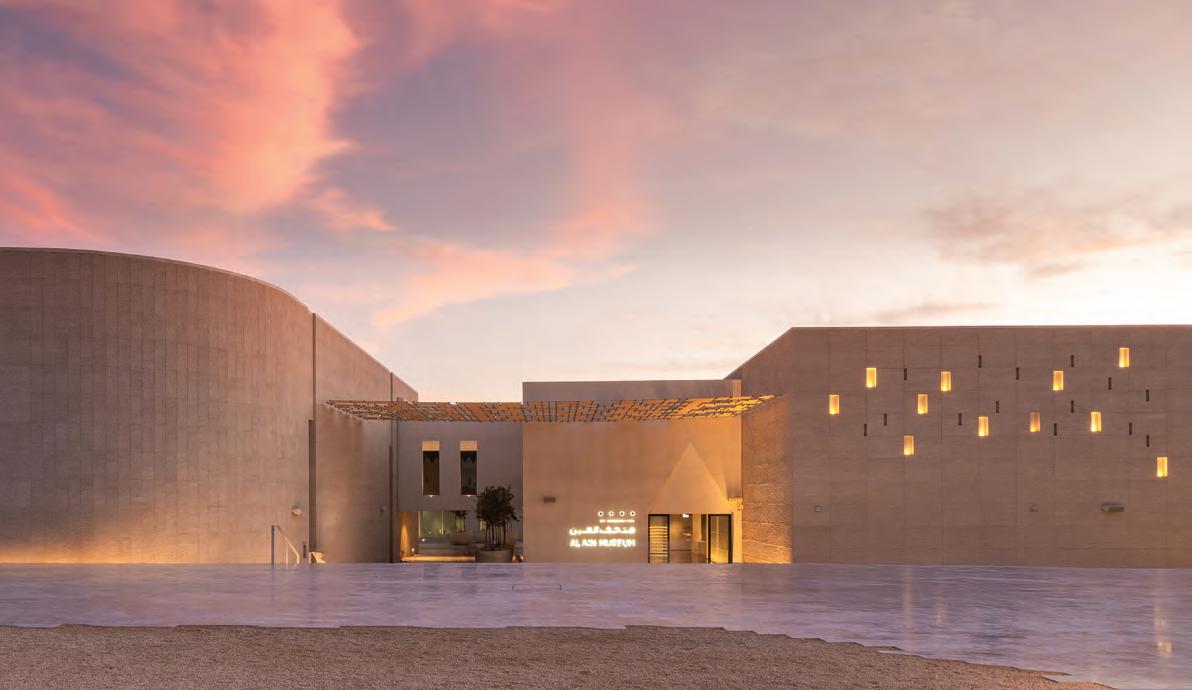
tional, as well as cultural projects. Her timeless designs reflect themes of identity, memory and belonging, unveiled most recently at the newly reopened UNESCOlisted Al Ain Museum in the UAE town of Al Ain, which her firm renovated and extended. Her RIBA chartered studio, founded in 2008, has worked to reshape the Gulf’s architectural language with major projects, including Mleiha Archaeological Centre and Gargash Mosque, both Aga Khan Award nominees (2019 and 2021, respectively). Dabbagh believes that personal and collective memory can be shaped through architecture and design. Her work stems from a desire to historically and archaeologically preserve major landmarks throughout the region. Currently an elected chair for the RIBA Gulf Chapter, Dabbagh continues to bridge cultural and gender gaps through her evocative architectural projects. dabbagharchitects.com
Al Ain Museum
Spatial Rhythms of Fluid Design
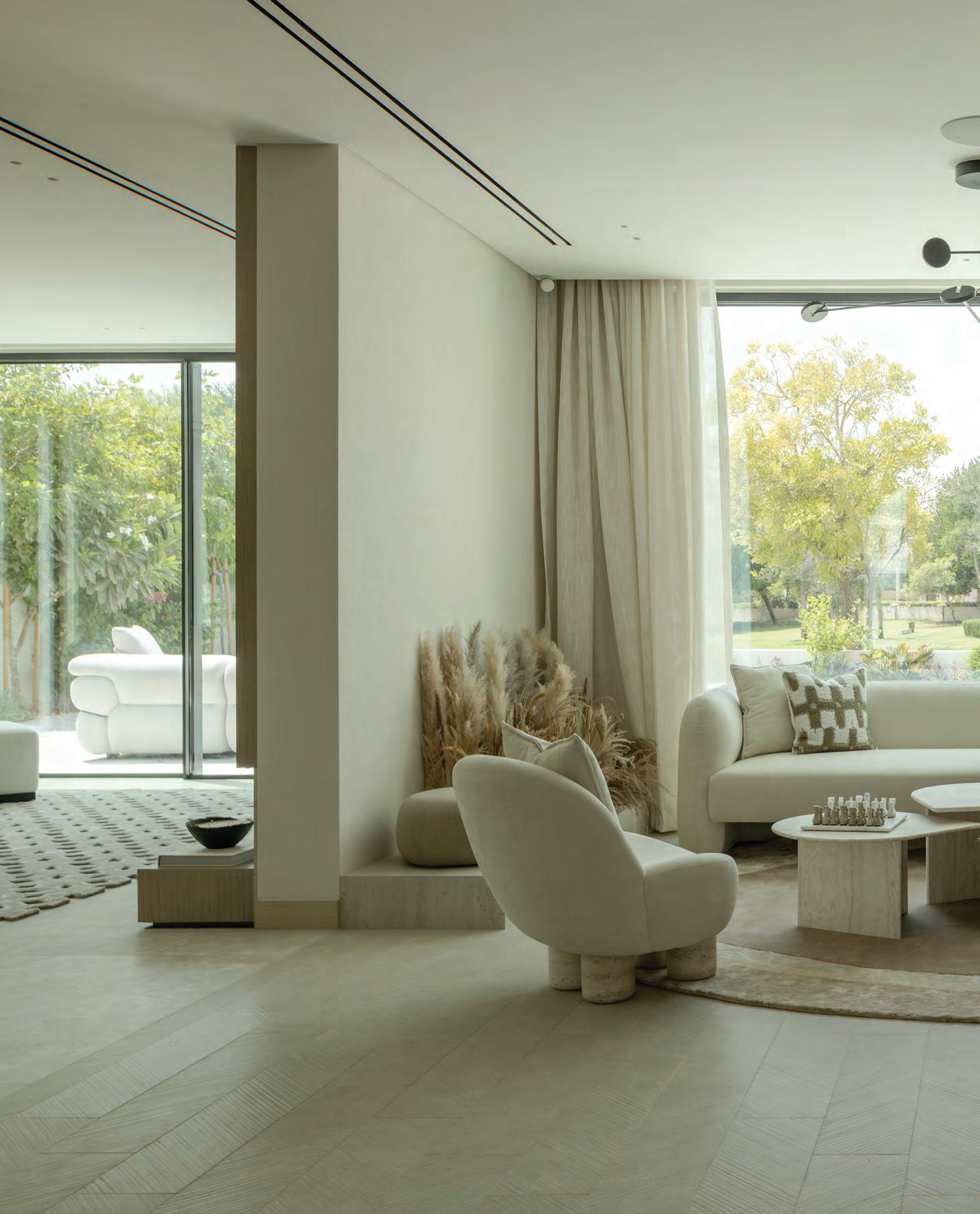
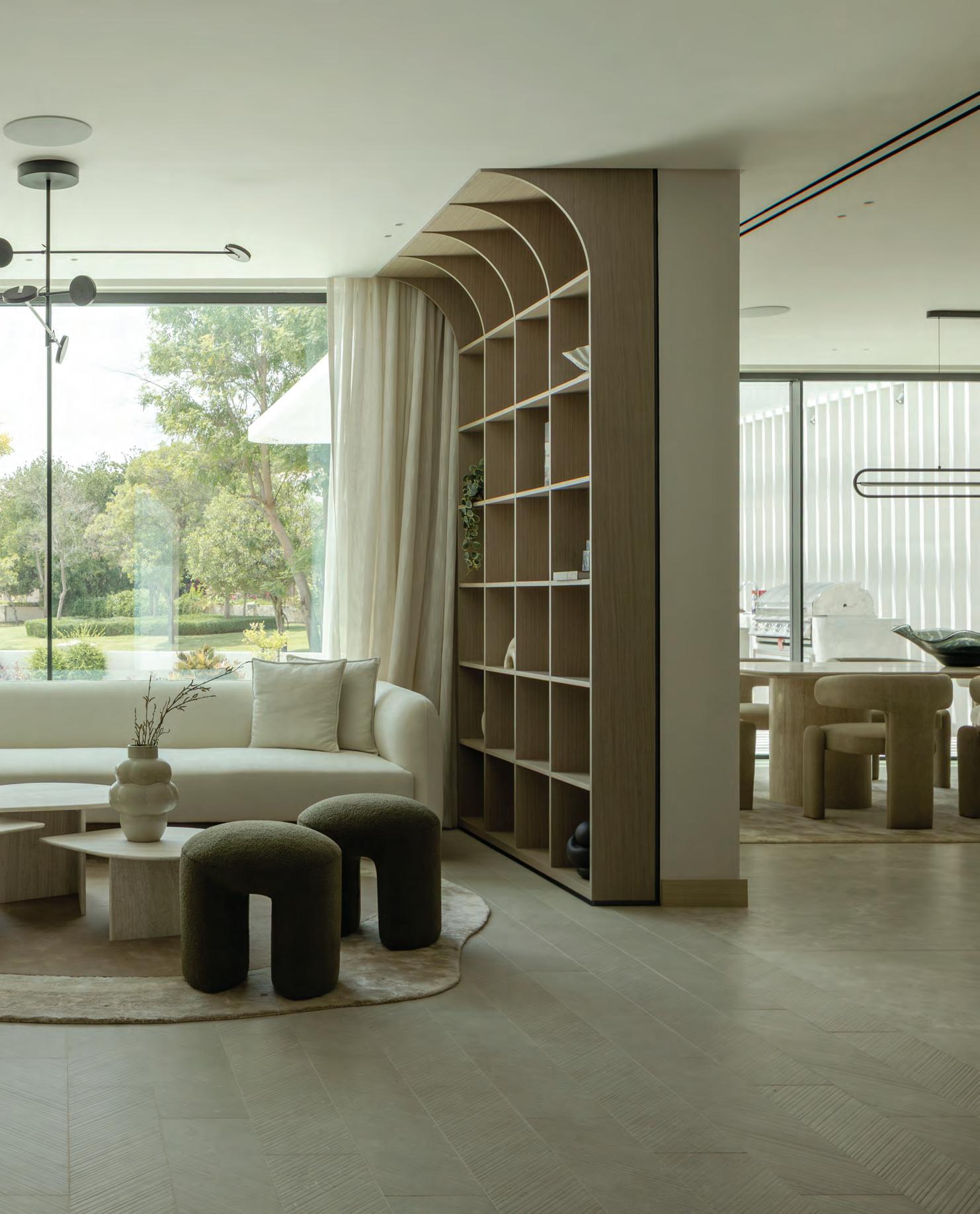
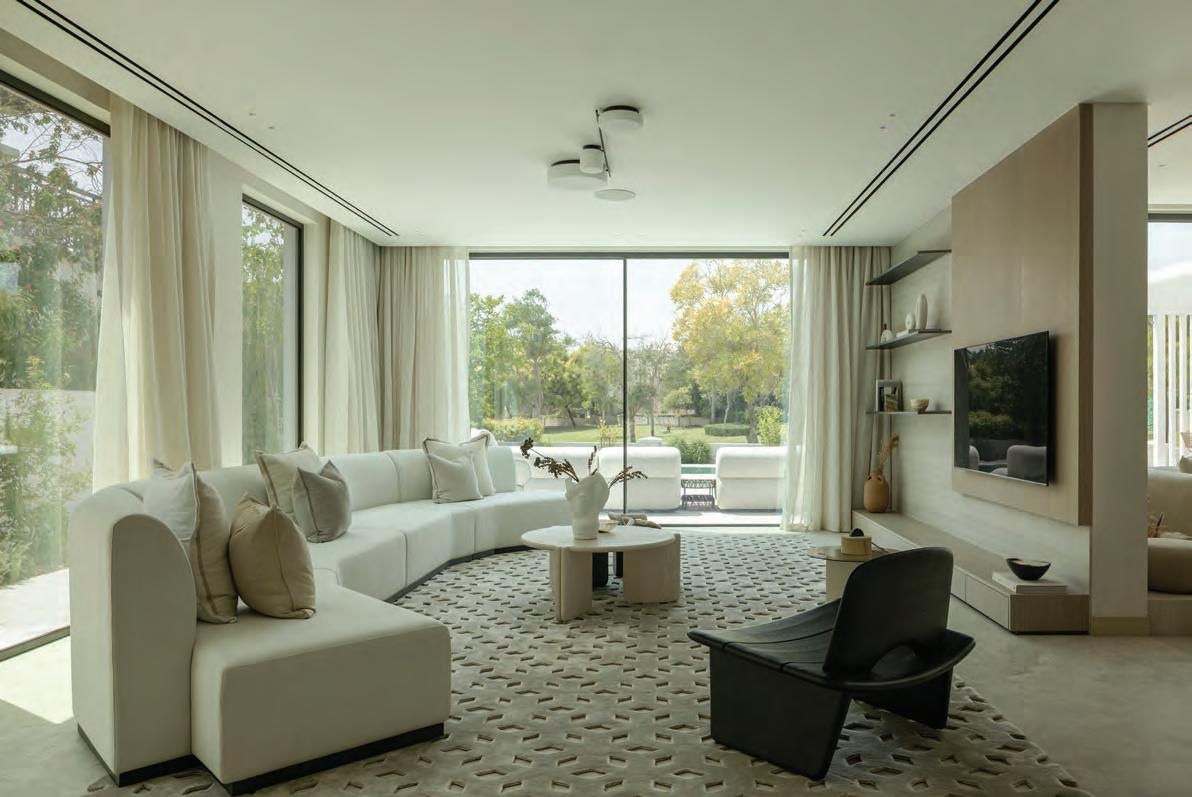
Generous glazing dissolves the boundary between the interiors and the outdoor landscape, while bespoke curved shelving endows structure to the fluid plan. The result is a living environment defined by restraint and spatial clarity.
Located in Jumeirah Golf Estates, Villa Limni offers an adaptive, fluid minimalist design that evolves with its surroundings and the lives of its inhabitants
WORDS – REBECCA ANNE PROCTOR
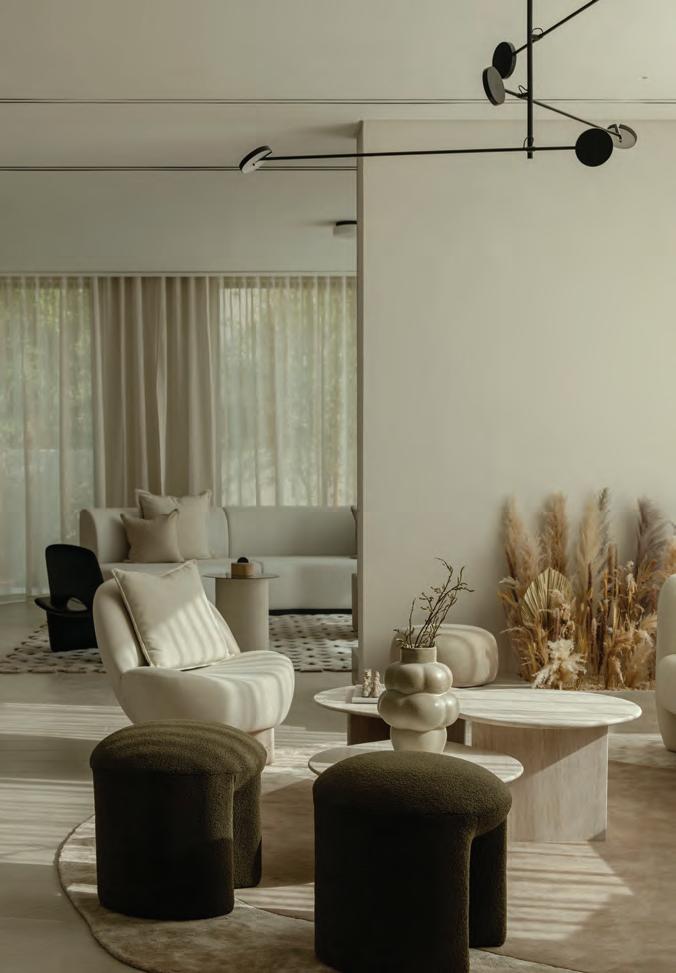
Located in the verdant Dubai neighborhood of Jumeirah Golf Estates, the new Villa Limni, designed by Dubaibased Grounded Design, explores how architecture can anticipate the future while maintaining its roots in the human experience of space and contemporary design. The structure, once a dated villa, has been reimagined to evolve a typical domestic dwelling into one that resembles an evolving organism – one that transforms by responding to the shifting lives of its inhabitants and the elements of light and technology. This serene residential retreat, heightened by a design favouring the inclusion of soft, sculptural organic forms, aims to follow a different creative logic: one where design aims to strike a balance between the permanence of a home and adaptability. As soon as one enters the home, the experience is one that is deliberately fluid filled with open spaces that move from one room to the next in a seemingly seamless dialogue of form and function.
Crafted to exude the experience of permanence, clarity, and emotional resonance,
Grounded Design offers a design that feels rooted, reassuring and open to what the future may bring. “We approached the project not just as a physical upgrade, but as a curatorial exercise in what the future of residential luxury should feel like,” explains Bani Singhi, founder of Grounded Design, a design firm established in 2017 with an ethos rooted in Singh’s Scandinavian heritage dedicated to creating balanced designs. “This is a house that had good bones – it just needed a new language.”
Rather than merely renovate, the design team set out to rethink what it means to live well. Their goal: to create a home that balances architectural precision with sensorial intimacy, one that elevates every moment of daily life, while quietly increasing its long-term value. Over nine months, the house was stripped back, reshaped, and thoughtfully reassembled into a refined statement of spatial fluency.
“The inspiration was to design a home that evolves with its occupants rather than impresses at first glance; a place shaped by light, time, and daily rituals, where restraint allows
emotion, memory, and future living patterns to quietly take root,” explains Bani Singhi, founder of Grounded Design.
The villa’s redesign centers on the principle of continuity. Spaces have been composed not as specific rooms with fixed designations but as fluid areas that are capable of definition over time. This leads the design to flow intuitively, guided by the natural elements of light and proportion rather than a desire for enclosed privacy. Grounded Design has crafted, almost like a choreography, each line and form to cater to change fostering a sense of movement in the space. This is a means for designing not just the present, but for what the future will bring, for the unpredictable yet certain element of change.
“Architecture that endures is not the one that resists time,” says Singh in the villa’s press release. “It’s one that allows time to happen to it – to gather history, use and emotion without losing coherence.” The materials used offer a gentle radiance to the space presenting bright, with soft, muted tones of sand, ivory and ash
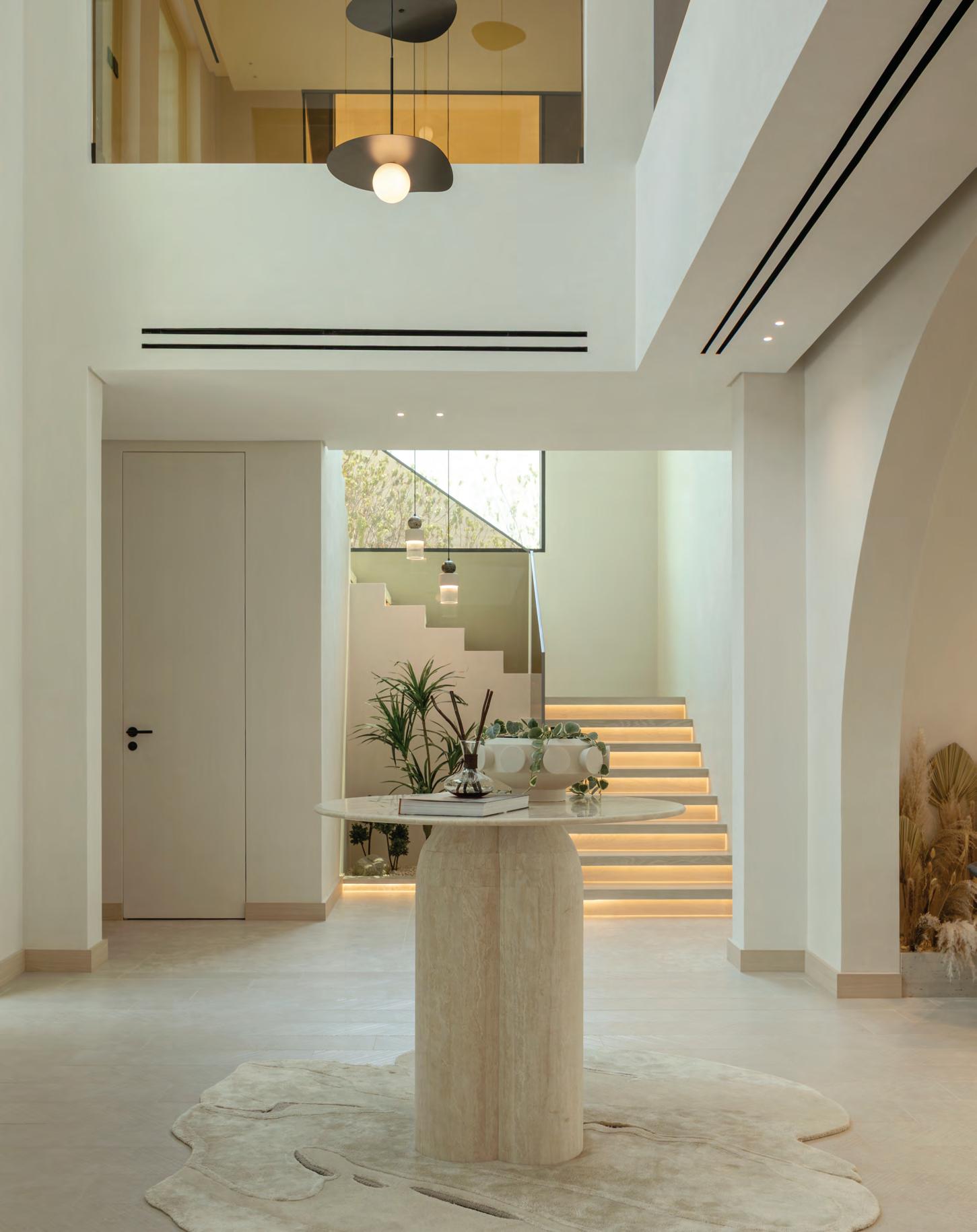
Above – Proportions and softened edges shape a living space designed around the concept of fluidity. Bespoke joinery and concealed detailing allow the outdoor view to remain the focal point; Left page –Double-height volumes and architectural cut-outs foster a quiet sense of procession, with the illuminated stair acting as both a focal point and a guide, anchoring the entrance
INTERIORS
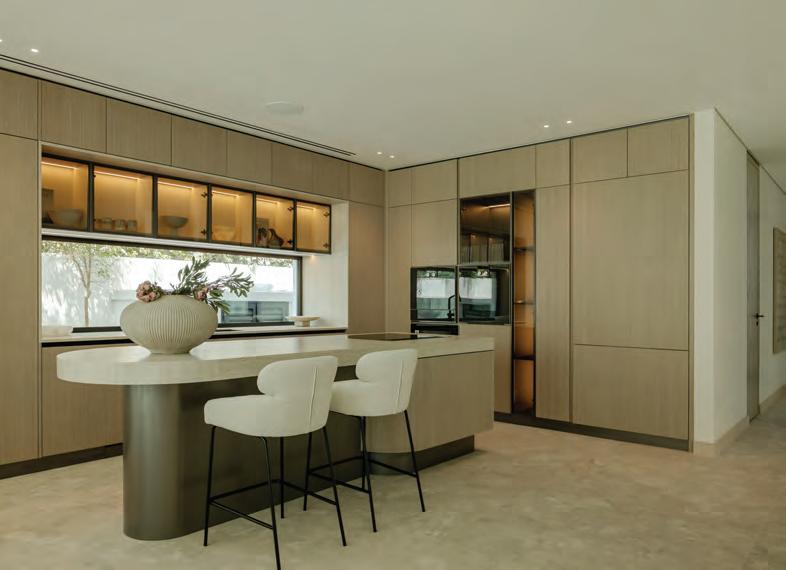
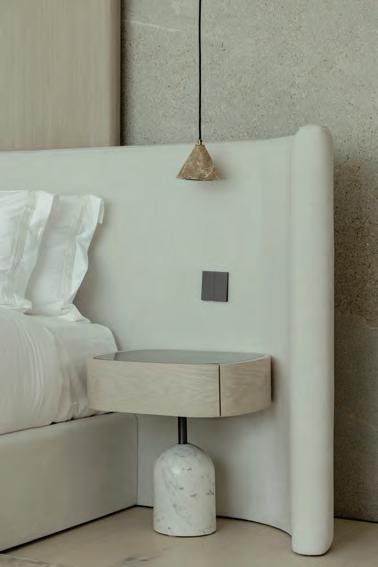
This page – Across the kitchen, living, bedrooms and outdoor landscape, a disciplined material palette of travertine, pale timber and textured porcelain establishes continuity. Sculptural forms and expansive glazing soften the geometry, creating a home defined by proportion, light and quiet permanence
providing an emotional neutrality that roots the texture of the materials and the emotional state of the occupants. Travertine, textured porcelain, and pale timber have been incorporated for their ability to exude light and weather it seamlessly. Materials have been used as strategies for longevity rather than mere ornamentation. Extending from the interior to the terrace are floors in large format porcelain, while in the villa’s private space the grain of wood offers intimacy and grounding. The façade of the structure is made with travertine cladding to distribute the desert sun with a warm glow.
Right page –Filtered daylight washes across textured walls and tonal upholstery, revealing a composition built on balance and composure. Organic curves soften the geometry of the space, creating a living room that feels both grounded and considered.
Key design notes include a double-height volume that opens towards the garden, connecting the interior and exterior spaces and both levels of the house. There’s also a sculptural stair that folds upwards beside a tall plane of glass, adding an interplay of form and function, and a small Zen garden outside provides a moment of meditative calm – a rest area between the fluid movement inside and the expansive environment outside.
The living and dining areas read as a single continuous field, blurred by reflections and framed by greenery. In the kitchen, a strip of horizontal glazing replaces the conventional backsplash, transforming the act of cooking into a dialogue with the outdoors. Upstairs, private rooms adopt the same sense of fluid connection, with the master suite flowing from the function of sleeping to bathing to dressing in one continuous gesture. Meanwhile, a central multipurpose space anchors the upstairs plan, overlooking both the interior void and the garden canopy. Natural light has been used as a crucial design component running through the villa at various intervals to define volume, sculpts surfaces, and creates transitions in mood during different times of the day.
The attention given to the temporality of light transforms the project from a static object into a living environment. A discreet, nearly invisible system of technology further enhances the spaces, with a smart-home framework that manages the lighting, temperature, and security through an intuitive interface. At the same time the villa’s environmental consciousness can be found through water systems enabled through smart irrigation and conservation fixtures meaning that the design doesn’t end with the villa – but extends outwards encompassing the natural landscape.
The design of Villa Limni caters to thoughtful movement and gestures as well as Grounded Design’s ambition in the region: to foster a new, subdued language for contemporary architecture where the progress of technology and fast-paced daily life is balanced with permanence. It also offers a refined counterpoint to the flamboyant excess largely associated with luxury homes in the Gulf. Here the value of minimalism lies in the coherence and balance it brings. Minimalism here allows natural light, material, technology and the inhabitants to converge in a balance of past, present and the future.
In Praise of Becoming: the Inaugural Art Basel Qatar
Held in Doha from 5-7 February, the first edition introduced a new format and spotlighted artists from the Middle East, North Africa and South Asia
WORDS – REBECCA ANNE PROCTOR
In an art world saturated with fairs, throngs of people and the fast transactions for works of art, the inaugural Art Basel Qatar marked a much welcome new format. Over 600 galleries applied and just 87 exhibitors from 31 countries were selected, with 16 first-time Art Basel participants, including several from the region such as Hafez Gallery from Jeddah and Riyadh, Saleh Barakat Gallery from Beirut, Tunis-based Le Violon Bleu, Gallery Misr from Cairo and Tabari Artspace from Dubai.
The fair was much smaller in size than the four other Art Basel fairs which feature over 200 galleries. It also offered a radically new, highly curated format to the display: Rather than tightly grouped booths offering a range of artists, exhibitors were asked to offer openformat presentations by a single artist that responded to the overall theme of “Becoming,” a curatorial concept overseen by Egyptian artist Wael Shawky serving as the fair’s artistic director for the first edition.
Located in two locations in Doha’s chic Msheireb district – M7 and Doha Design District – the fair encouraged visitors to not only peruse the art on show at a quieter pace but also explore the heart of downtown Doha. The curatorial emphasis of the fair was matched with a deliberate focus on Qatar’s strong institutional offering. Developed in partnership with Qatar Sports Investments and QC+, the commercial arm of Qatar Museums, Art Basel Qatar is embedded within the broader Qatari cultural ecosystem that has been supported by the Gulf nation’s long-term investments in art and culture.
For Vincenzo de Bellis, Art Basel’s Chief Artistic Officer and Global Director of Fairs, the launch of Art Basel Qatar reflects the fair’s strategic growth and expansion in the Middle East region. “My daily focus is how to make each of the fairs more rooted within the place where they operate, while having the global reach that our brand has for 55 years,” said De Bellis. “I think this [Art Basel Qatar] reflects that. We want to connect the local and international public. Our objective is to support the growth of the private sector in Qatar and the wider region.” After the fair, De Bellis emphasised, Art Basel will be active throughout the year “to develop connections and market opportunities to bring people together that may
not have yet been interested in art and eventually lead them to collect art.”
The theme of “Becoming,” framed the event as a cultural journey rather than just a marketplace to buy and sell art. The theme, explains Shawky, served as a meditation on humanity’s ongoing transformation and its impact on our identity, the way we live, believe and create meaning. A strong focus was placed on the rapid evolution of the Gulf region, reflecting the cultural and economic growth in the region as a “living palimpsest,” where traditional and spiritual narratives are interwoven with the rapid rise of modern urban and economic growth.
“I wanted to include as many voices from the MENASA (Middle East, North Africa and South Asia) as possible,” said Shawky. “I wanted to create a dialogue between all the galleries and artists; between artists from the Middle East perhaps not as well-known globally, positioned side-by-side with renowned international artists.”
The fair presented works by some of modern and contemporary art’s biggest names – Christo, George Baselitz, Jean-Michel Basquiat and even Pablo Picasso (one work by the latter was priced at around $42 million in a private viewing room) – alongside rising and established regional artists, like Saudi artists Ahmed Mater and Manal AlDowayan, American-Qatari artist Sophia Al-Maria, Lebanese Simone Fattal and Bouthayna Al Muftah from Qatar, among many others.
Notable juxtapositions included the works of Gazan-born, Dubai-based Hazem Harb at Tabari Artspace from the artist’s Future Archaeology (2025) series, which used scanned, enlarged and reconfigured fragments from the ruined Gaza International Airport reflecting archaeology related to Palestinian displacement. Nearby were three paintings at gallery David
Zwirner from Marlene Dumas’s acclaimed series Against the Wall (2009-2010), including Figure in a Landscape (2010), Living on your Knees (2010), and Olive Tree (2010), exploring themes of conflict and loss, largely drawn from media imagery from the ongoing violence in Palestine. At Indian gallery Nature Morte, Pakistani artist Imran Qureshi presented Opening Word of This New Scripture (2025) featuring several men continuously weaving vibrantly coloured South Asian Charpai, a traditional, handwoven, fourlegged bed used across South Asia, with the floor and walls covered in the same boldly coloured woven designs. A few steps away at the booth of Hafez Gallery, Saudi artist Lina Gazzaz’s instal-
lation Tracing Lines of Growth (2024), made of discarded palm leaves hand-stitched with fine red and black threads, continued the focus on craft found in Qureshi’s presentation. Gazzaz’s delicate installation, which caused fairgoers to intentionally pause to take in the beautifully fragility of the piece, reflected on notions of time, labour and survival while grounded in Arabian ecologies and spiritual traditions.
Elsewhere, as part of Art Basel’s nine artworks for its Special Projects, positioned within the fair’s buildings and throughout Doha, Libyan Nour Jaouda presented A House Between Two Houses (2026), an installation on the ground floor of M7 featuring a large, rusted steel frame with suspended, earthlycoloured, hand-dyed textiles, exploring the idea of a “rest house” and themes of decay, transformation, exile and memory.
Perhaps the most evocative work for Art Basel’s Special Projects reflective of the theme of Becoming and the intended cross-cultural dialogue and exchange during a most uncertain time was architect Sumayya Vally’s In the Assembly of Lovers (2026). Artist intent led this first edition of Art Basel Qatar, offering a more relaxed viewing format for appreciating the art on show while also encouraging crosscultural dialogue and exchange. Vally’s work, which was filled daily with fairgoers, residents and Qataris, was made with moveable components to construct a contemporary Majlis seating area common in Muslim countries. Paying homage to lost communal spaces across the Islamic world, the installation, a form of modular forum, reflected the fair’s mission to gather people together and become an active force in the continual redefinition of human identity.
Left page – Vincenzo de Bellis & Wael Shawky, photography by Jinane Ennasri This page – (from top) Farid Belkahia - Procession (The Wings Of Desire), 1985; Etel Adnan Untitled, 2014; Minouk Lim, Shy Republic, 2024, photography by Jeon Byung Cheol
Salone Raritas: Strengthening Design Affinities
During the influential India Art Fair in New Delhi (5-8 February), the organisers of Salone del Mobile.Milano presented Salone Raritas, a curatorial platform that will debut at the 64th edition of the famous trade fair in Milan with the aim of connecting Indian collectors with Italian professional architects, interior designers, developers and hospitality and contract professionals.
Salone Raritas has been conceived as a meeting place for design, manufacturing excellence, cultural narration and research-driven design, as Annalisa Rosso, Editorial Director and Cultural Events Advisor for the Salone del Mobile, explained: “Collectible design represents a new area of dialogue between Italy and India. This platform will give voice to a production combining identity, research, cultural value and new business prospects, bringing unique pieces, limited editions, high craftsmanship
Above – Curated by Annalisa Rosso and with exhibition design by Formafantasma, Salone Raritas will form part of Salone del Mobile.Milano 2026, showing curated icons, unique objects and outsider pieces. Image: Formafantasma
and antiques to the Salone del Mobile for the first time. The Indian market has a natural affinity with this new venture.”
In Mumbai on 10 February, ‘Shaping Luxury Spaces: Italian Design for India’s Real Estate & Hospitality Market’ turned the spotlight to the contract sector where, the organisers say, Italy and India increasingly find common ground in terms of quality, architectural vision and attention to detail.
Salone del Mobile.Milano will take place from 21 to 26 April 2026 at Rho Fiera Milano. India's presence at the event continues to grow, with almost 4,500 professionals attending. Italy is the second largest EU country in terms of furniture exports to India and one of only a few to have a trade surplus.
Maria Porro, President of Salone del Mobile. Milano, concluded: “India is a young, rapidly changing country, with stakeholders who display a marked feeling for design, quality, tailormade solutions and services with high cultural content. We are strengthening a shared vision and the Salone del Mobile.Milano’s role as a benchmark platform between the Made in Italy system and a rapidly evolving market.”
Above – The Plot 6 gallery by COLLECTIONAL, part of Salone Raritas at Salone del Mobile.Milano 2026. Image: Manu Bañó
Below – ‘12 Chairs For Meditations’, designed by Andres Reisinger for Nilufar, will form part of Salone Raritas at Salone del Mobile.Milano 2026. Image: Alejandro Ramirez Orozco
Below – Cava coffee table and Soffio table lamp by Draga e Aurel, part of Salone Raritas at Salone del Mobile.Milano 2026. Image: Federica Lissoni
This page – The Superior Room at the Hotel Savoy features Tuscan-inspired fabrics in vivid colours
Right page – A view of the Hotel Savoy's sumptuous lobby featuring an elaborate Venetian glass chandelier
A Grand Florentine Retreat
The storied Hotel Savoy in the heart of Florence features interiors designed by Olga Polizzi and Laudomia Pucci, blending lively and fresh features into its Florentine heritage
WORDS – REBECCA ANNE PROCTOR
Situated in the heart of Florence, nestled between the Duomo and the Ponte Vecchio, the Hotel Savoy, a 19th-century edifice, has long been a destination for luxury and innovation. Sitting on the ancient ground that was once occupied by the Roman Forum and the medieval church of San Tommaso, the hotel marks one of Florence’s first grand hotels, serving since its establishment as a hub for travellers, aristocrats and artists visiting Florence’s Renaissance landmarks. The hotel first opened its doors to guests in 1893. British hotelier Sir Rocco Forte, owner of luxury hospitality group Rocco Forte Hotels, acquired the property in 1998 and carried out a top-to-toe renovation.
Photography: Matteo Lippera
This page – (from top) A deluxe suite stunning view of Florence at the Hotel Savoy; A Premium Room at the Hotel Savoy in Florence
Known as the Grand Dame of Florence’s Piazza della Repubblica, a step inside the Hotel Savoy offers a distinctly Florentine experience featuring Tuscan craftsmanship infused with colourful, contemporary fashion aesthetics. The hotel offers 80 elegantly designed rooms and suites with pristine views of the Florentine skyline, many featuring fashion-inspired interiors by Laudomia Pucci, the daughter of famed designer Emilio Pucci, who collaborated with Olga Polizzi, Director of Design for Rocco Forte Hotels, to redesign the hotel in April 2018.
“Much of the furniture is made right here in Florence, like the reception desk and the statues in the lobby,” said Polizzi. “It would be crazy not to take advantage of the local artisans. All our hotels aim to represent the city in which they are located, so to achieve this, we buy from local artists and have everything made locally. I also frequent markets to find unique items.” Refined bespoke furniture and art-inspired textiles can be found across all spaces in the hotel offering a smart, chic yet
homely experience. The hotel’s interiors, featuring the best of Italian design and manufacturing, are also punctuated by the hotel’s impressive art collection, including significant paintings by Italian artist Luca Pignatelli. Visitors will find his striking depictions as soon as they enter the lobby – a vibrant space featuring a blend of Renaissance grandeur and contemporary fashion design uplifted by contrasting bold, colourful Emilio Pucci prints, high ceilings and marble floors.
As you enter the hotel, the feeling is one of refined elegance coupled with a cosy, intimate ambiance that prompts all guests to relax and relish moments of intense beauty and design. Key amenities include the renowned Irene restaurant, known for its sumptuous Tuscan specialties prepared by Chef Fulvio Pierangelini within a setting complemented by hand-blown Venetian chandeliers, Pietrasanta marble and Loro Piana fabrics reminiscent of an upscale Tuscan abode. Head up to the terrace of the hotel for a continuation of the restaurant and get
front-row seats to Florentine city life. On the ground floor is the cozy Artemisia Cocktail Bar, named after the 17th-century female painter Artemisia Gentileschi, that will allow guests to relax with expertly crafted cocktails next to the Duomo in a vibrant, theatrical Florentine setting. Wellness has become a large part of the Rocco Forte Hotels’ offerings and the Hotel Savoy also includes Technogym equipment in a dedicated fitness studio. And for those desiring an indulgent rest, head to The Spa Suite on the fifth floor of the hotel and choose from a dedicated array of treatments amid breathtaking views over the city – the cherry on the cake of this timeless Florentine retreat. roccofortehotels.com
This page – An interior view of Irene, Hotel Savoy's sophisticated Tuscan restaurant
A New Residence of Undulating Forms
Abu Dhabi-based Emirati real estate developer GAF Property has launched Flow25, its first signature off-plan residential development and a landmark to Al Reem Island’s evolving urban landscape
WORDS – REBECCA ANNE PROCTOR
Defined by soft, fluid seemingly undulating forms akin to those of the desert sand dunes, Flow25 has been designed as a people-centered residential development on Abu Dhabi’s Reem Island with a strong connection to nature.
Rooted in the natural landscape of the United Arab Emirates, Ghaf trees feature prominently around and throughout the property offering a symbolic and functional element. The property, which features biophilic landscaping, shaded walkways and outdoor areas designed for yearround use, offers a limited collection of one-, two-, and three-bedroom apartments, along with four-bedroom penthouses and sky villas.
Left page – Lounge area
This page – (from top) Building façade; Cinema room
“Flow25 represents our vision for the future of living in Abu Dhabi,” said Eng. Ashba Al Ghafli, CEO of Ghaf Property who played an important role in shaping the architectural vision for Ghaf Property, on Flow25’s launch. “It is a project rooted in integrity of design, a thoughtful response to climate, and the belief that homes should support people’s real lifestyles, both today and over the long term.”
Developed around GAF Property’s three core pillars honouring nature, innovation and community, each residence offers smart home systems to facilitate everyday comfort, while shared amenities promote communal
gathering, wellbeing and a sense of connection. The property’s key amenities include outdoor swimming pools, wellness and fitness facilities, a rooftop yoga pavilion, residents’ lounges, family-oriented gathering spaces and community areas that balance both interaction and privacy. A cooling system will be installed across the balconies and outdoor spaces to enhance thermal comfort and enable outdoor living even during the UAE’s hotter months.
The development is estimated to be handed over in April 2029 and will be supported by a structured 50/50 payment plan along with posthandover options designed to enable long-term ownership. Flow25’s strong connection with nature reflects GAF Property’s long-term mission to deliver design-led communities shaped by climate, context, and human experience. This new residence thus prioritises livability, architectural integrity, and lasting value.
This page – The Café’s contemporary cantilevered roof oversailing one of the original coral boundary walls
Right page – A purpose-built
Khalid Ibrahim Grand Duplex Suite’s open living and dining area, leading out to a private garden terrace
Arabian Heritage Meets Modern Minimalism
Located in the heart of Sharjah and designed by Anarchitect, The Serai Wing blends Emirati traditional architecture with minimalistic modern design
WORDS – REBECCA ANNE PROCTOR
What was it like to live in a traditional Emirati home? Located in the historic heart of Sharjah, the Bait Khalid bin Ibrahim in The Serai Wing, an extension of The Chedi Al Bait, offers a stay that will whisk guests back in time to the decade of the 1950s prior to the United Arab Emirates’ unification in 1971. Dubai and London-based Anarchitect, a boutique, awardwinning architecture and design practice founded by British RIBA architect Jonathan Ashmore, crafted The Serai Wing by preserving the existing character of two redundant 1950s Emirati houses once belonging to pearl merchant Khaled bin Ibrahim that were temporarily being used as government offices.
The design of The Serai Wing reflects the importance of preservation. The immersive retreat required a challenging renovation, upgrade and repurposing of the two former homes. Dividing them into 12 guest rooms, Anarchitect intricately designed and repurposed the homes and infused them with minimalistic, stylish modern design elements. Each of the rooms is uniquely crafted with its own individual layout drawn from the transformation of the historical buildings and maintains a seamless blend of traditional Emirati design elements from the original edifices alongside original and new materials.
“The whole idea of this project is not just about regeneration, but repurposing,” explains Ashmore. Each room showcases the original coral and limestone mortal walls of the two merchant homes and features high ceilings and teakwood trellises alongside modern travertine,
white-metal accents and a serene palette of neutral hues. “We did not want to create a pastiche to make the building look like it was from the original 1950s buildings,” said Ashmore. “What we wanted to do is take influences from parts of the project that were existing, the forms, the shapes, the volumetrics as well as the materials and the perforations, and translate them into a new series of buildings that showed that this was a new intervention in 2023 that was different from the original build 70 years ago.”
Devised as an inner city sanctuary in Sharjah’s historic district, the property is thoughtfully layered to comprise remnants of its past with modern design elements of the present. Due to the candidacy of the heart of Sharjah for UNESCO World Heritage Site status, renovations to The Serai Wing were carefully designed to preserve its integration into the historic coastal community of Sharjah, which once served as a major merchant hub along the shores of the Arabian Gulf, one of the oldest maritime routes.
“Historic layers sit harmoniously alongside new contemporary interventions realised in travertine stone and perforated white-metal surfaces that create additional and necessary functionality to facilitate the new hospitality program transcended into the properties,” Ashmore writes in the press release of the project.
Inside, the rooms are bathed in natural light that emanates through traditional Arabian windows illuminating the space and fostering a serene, intimate atmosphere. The 12 accommodation options, including the 70-sqm duplex Khalid Grand Suite, feature bespoke
furniture, luxurious marble-clad bathrooms, and in-room technology, focusing on comfort and privacy. The rooms are designed around a traditional tranquil central courtyard and have direct access to a temperature-controlled swimming pool with lounge seating and unique sculptural shades. Additionally, a Ghaf tree –the national tree of the United Arab Emirates – is located within the center of the courtyard. Ashmore says his studio had to sensitively design the area around the tree to maintain it.
Anarchitect’s design of The Serai Wing offers a rare dialogue between heritage and modern design. In November 2025, The Serai Wing won the inaugural RIBA Middle East Award for the Adaptive Reuse for representing a transformative piece of architecture that evocatively reflects the importance of preservation while reimagining a new modern lifestyle destination for regional and global travellers.
Designed as an escape within the city, The Serai Wing offers a contemporary experience rooted in the heritage of its location. Views of Sharjah can be relished at various intervals throughout the rooms of Bait Khalid bin Ibrahim where strategic design gestures highlight seclusion, privacy and wellbeing.
The past and present converge in The Serai Wing. As its clean lines meet Emirati traditional architectural components and minimalist design, the structure also offers a gateway to the city’s cultural scene. With the Sharjah Art Foundation just a quick walk away, a further dialogue between the city’s art and timeless architecture can be had.
This page – (from top) The newly-built café and multipurpose space within the contemporary extension of House Two; The Serai Wing rooms each with its own character and individual layout derived from the transformation of the historical buildings
Colour Crush
In her New Jersey family home, Crystal Maki of Silverwing Interiors translates childhood memory, colour confidence and thoughtful spatial planning into a layered interior that feels both joyful and deeply personal – proof that bold design and everyday livability are not mutually exclusive
WORDS – KARINE MONIÉ PHOTOGRAPHY – WILL ELLIS
In a quiet pocket of Little Silver – just minutes from the New Jersey shoreline – a 3,500-square-foot family home unfolds as a layered study in colour, memory and intention. Conceived by interior designer Crystal Maki, founder of Silverwing Interiors, the residence is at once playful and precise: a lived-in environment shaped by storytelling, craftsmanship and a clear point of view.
Maki’s path to design was anything but linear. After studying at the Fashion Institute of Technology and the New York School of Interior Design, she worked in network television production, refining her instinct for narrative and composition, before transitioning into education and eventually establishing her own studio. That layered background is evident here. Each room reads as a chapter – distinct in tone yet connected through rhythm, palette and personality.
The two-storey house, with an additional 1,500-squarefoot basement, was newly constructed when Maki and her family moved in. Architecturally sound but spatially generic, it required recalibration. “The bones were there,” she explains, “but we needed it to function for how we actually live.” Nearly every room was reconsidered. An oversized office was reduced to create a walk-in pantry; larger windows were in-
troduced over the kitchen sink to open the rear elevation to the garden; and the primary closet entry was relocated to allow a proper wall for a king-sized bed. The interventions were strategic rather than cosmetic – small architectural edits that significantly improved flow and usability.
Outdoors, the narrative continues. A pool, pavilion and fire pit transform the backyard into a seasonal extension of the house, reinforcing what the interiors already suggest: this is a home designed for gathering.
At the core of the project is memory – specifically, Maki’s upbringing in Brownstone Brooklyn. She sought an atmosphere that felt warm and storied, yet slightly irreverent. In the powder room, Brooklyn Toile wallpaper by Flavor Paper serves as both an homage and conversation piece, anchoring the space in personal history while setting the tone for the rest of the house. “I wanted it to feel historical with a funky edge,” she says. The result is layered rather than nostalgic – tradition filtered through a contemporary lens.
Colour operates as both connector and differentiator. Blues, creams and greens move through the main living areas, establishing cohesion without monotony. In the primary bedroom, a quieter palette of taupe and mauve introduces calm. Ceiling trim painted in a glossy version of the
Below– Custom cabinetry by Rusterholz Woodworking anchors the space, finished in Green Smoke and Shaded White by Farrow & Ball along with Sea Pearl quartzite countertop. The Galley Workstation sink is complemented by plumbing fixtures from Roh. Lighting is by Hudson Valley Lighting
same hue subtly corrects irregular lines, using sheen and detail to create perceived symmetry. It is a reminder that good design often lies in what the eye doesn’t consciously register. Materiality reinforces the home’s depth. In the library, supple leather, velvet and silk coexist within custom millwork by Rusterholz Woodworking, painted in nuanced tones by Farrow & Ball. The kitchen pairs Sea Pearl quartzite countertops with brass hardware and custom cabinetry, balancing durability with refinement. Throughout the house, wool rugs ground more relaxed furnishings, ensuring that visual energy never compromises comfort. Each secondary space carries its own identity without disrupting the larger composition. The children’s bedrooms introduce wallpaper by Cole & Son and Harlequin, layered with furnishings that allow for growth and change. The basement, outfitted with a poker table by California House and contemporary art sourced through Saatchi Art, shifts the mood toward recreation while maintaining the same level of detail. What distinguishes this project is not simply its embrace of colour or pattern, but its restraint. “I wanted it to be visually unique without feeling loud,” Maki notes. That balance is evident throughout. Every room presents a perspective – a considered interplay of tone, texture and form – yet nothing feels gratuitous. There is clarity behind each decision. Ultimately, the home succeeds because it reflects the people who inhabit it. It is expressive but grounded, confident yet welcoming. Rather than treating design as backdrop, Maki has allowed it to become the narrative, a daily reminder that personality, when thoughtfully articulated, is the most enduring luxury of all.
Right – A bespoke rug by Stark Carpet anchors the room, alongside a green leather Chesterfield by American Leather. Drapery in silk by Robert Allen and lighting by Currey & Company complete the setting
Above – Brooklyn Toile wallpaper by Flavor Paper introduces narrative and wit. A vanity console by Waterworks is paired with mirror by Mirror Image Home and lighting by Hudson Valley Lighting
The River that Shaped a Philosophy
A childhood memory rather than a manifesto; this is the origin of the architectural philosophy of
Koichi Takada
WORDS – VAARUNYA BHALLA
Tokyo-born architect Koichi Takada’s childhood in the 1970s unfolded along the banks of the Tama River, where he witnessed nature gradually give way to the encroaching city. That early awareness of loss and connection would come to shape his work and the practice he would later establish.
In a recent book published by Rizzoli, Koichi Takada: Naturalizing Architecture, we find a curated collection of his recent projects. Featuring photography of buildings and interiors alongside diagrams and images of the natural forms that inspire them, the book guides readers through Takada’s global body of work. A theme that emerges is of the interconnectedness of people with the environment; projects include Upper House in Brisbane, the Palm Frond Retreat at Balmoral Beach, the award-winning Solar Trees Marketplace in Shanghai and, closer to us, Mamsha Palm on Saadiyat Island in Abu Dhabi.
Across these works, Takada’s distinctive language emerges: a fusion of Japanese restraint with a willingness to challenge convention. Through flowing forms, layered structures, and gentle interplay of light, Takada’s work encourages pause and reflection, showing nature as a living presence within the city. With text by architectural writer Philip Jodidio, a foreword by Béatrice Grenier, Director of Curatorial Affairs at Fondation Cartier, and an afterword by Takada himself, the book unfolds over 240 pages of photography, diagrams, and reflection. Naturalizing Architecture marks a new stage in Takada’s work and reinforces his position as one of contemporary architecture’s most thoughtful and original voices. rizzolibookstore.com
Above – Koichi Takada: Naturalizing Architecture, Philio Jodidio, RIZZOLI, 2025; Left – (from top) Solar Trees, image by ZY Architecture Photography; Upper House in South Brisbane, image by Scott Burrows
Photograph by Yousef Al Harmoodi
Painting by Faisal Abdul Qader
Divine Connection by Shaikha Al-Sulaiti and KAHHAL1871
Divine Connection is more than a prayer mat; it is a contemplative work of art that sits within a larger narrative of faith, heritage and design. Part of the Divine Collection, this piece belongs to a capsule inspired by the Bedouin tradition of layering rugs and the intricate beauty of carved gypsum found in historic architecture in Qatar. The prayer mat weaves symbolic motifs drawn from Islamic spirituality and Qatari heritage. Opening from either side, the design embodies jama’a prayer – connection, congregation and wholeness through shared faith. The crescent signifies belief, while spirals trace life’s journey and the interconnected nature of existence. Hand-knotted over 90 days with 160,000 knots per square meter, the mat is crafted from New Zealand wool and silk, meticulously hand-finished by artisans in Egypt. Created in collaboration with KAHHAL1871, Divine Connection bridges tradition and contemporary design, grounding prayer in belonging, balance and unity.