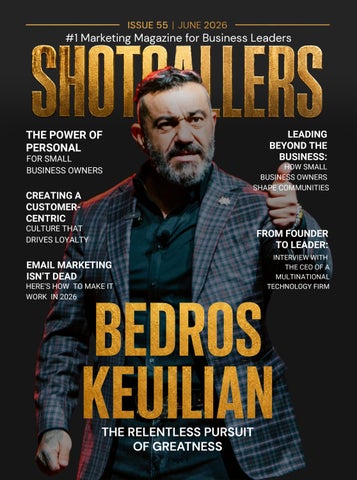
CULTURE THAT DRIVES LOYALTY CREATING A CUSTOMERCENTRIC FOR
THE POWER OF PERSONAL
EMAIL MARKETING ISN’T DEAD
HERE’S HOW TO MAKE IT WORK IN 2026
LEADING BEYOND THE BUSINESS:
HOW SMALL BUSINESS OWNERS SHAPE COMMUNITIES
FROM FOUNDER TO LEADER:
INTERVIEW WITH THE CEO OF A MULTINATIONAL TECHNOLOGY FIRM
THE RELENTLESS PURSUIT OF GREATNESS
This issue of Shotcallers is all about growing with purpose
From building a personal brand to stepping fully into leadership as your business expands, the message is simple: success isn’t just about working harder it’s about evolving It’s about showing up with clarity, building trust, and leading in a way that creates lasting impact.
Our feature with Bedros Keuilian reminds us that opportunity is still out there for those willing to take ownership and stay disciplined. His story is a powerful example of grit and long-term thinking.
You’ll also find practical insights on email marketing, customer loyalty, short-form video, smarter advertising, and making your website more accessible These aren’t just tactics they’re tools to help you build something sustainable
At the end of the day, business is still about people. When you lead with authenticity and consistency, growth follows.
Dennis M. Postema
BedrosKeuilian:TheAmerican Dream isThriving
Bedros Keuilian is an entrepreneur who brings to life a new definition of resilience. Born in Soviet Armenia, Bedros’s family immigrated to the United States when he was a child. His family spent years in poverty
As an adult, Bedros took a leap into entrepreneurship, creating a successful coaching business, working with clients running multimillion-dollar businesses. Today, Bedros gave us insights on raising children with grit in today’s technologically dependent world and offered advice and hope on living the American dream
Dennis Postema: Tell us about your work.
Bedros Keuilian: I’m an entrepreneur through and through. I immigrated to the United States from Armenia, which at the time was part of the Soviet Union The American dream is alive and well. If I can come from a communist country, learn the language, and add value in exchange for money, anyone can.
Attending business events is one of my favorite ways of contributing I get to wake up people’s inner entrepreneurs
I have spoken at events and had people approach me to say, “Man, I came because I thought I wanted to dabble in entrepreneurship, and now I’m planning to put my resignation in at work and chase my dreams.”
I’m an advocate for the American dream, first and foremost.
he funny thing is, I’m an introvert I don’t know if it’s God or the universe or what, but for some reason, I was gifted the ability to send a message to others’ hearts and minds. I know how to get people to start building the sense of urgency they need to take the next step It’s a blessing, and I’m passionate about it.
Dennis: What advice do you have for somebody who wants to start hosting entrepreneurial events?
Bedros: There’s no playbook. I always remind people that if you were hosting your friends at your house, you need to give them all the details. When should they show up? What can they expect when they arrive? Help them mingle. Assume they don’t know anyone there. Introduce them to people.
People attend these events largely to network. When we’re hosting events, encourage attendees to spread their wings. Remind them that they’re not here just to listen to people speak but to connect. Your next business partner might be sitting in the audience with you.
From a production angle, run the event as tightly as you can. Like clockwork I’ve done two large events per year for 15 years.
If one speaker decides to talk for an extra 20 minutes, everybody else’s time gets pushed back, and that’s not fair for the other speakers or for the audience, who have an expectation around how long they’re going to be at the event.
Make sure you’re stacking your speakers in a way that the audience benefits the most. If it’s a business conference, don’t have one speaker talk about marketing and then follow him up with a speaker who discusses selfdevelopment, and then bounce back to a third speaker discussing sales, and so on Know what your speakers are going to discuss and put them in an order that makes sense think of it like a movie with story beats
Dennis: How would you advise parents on guiding their children through modern economic and business challenges?
Bedros: It’s difficult but doable. I have a 19-year-old son and a 17year-old daughter, and they’re growing up in a very different world than I did. We do well financially, so it’s hard to strike a balance between instilling grit, resiliency, and mental toughness within them without going overboard.
They don’t need to have the same level of grit that I developed after immigrating to the United States.
My father used to bring me to the dumpsters behind grocery stores and lift me up—since I was the youngest child and have me grab expired but unspoiled food. That taught me a lot about survival
There were times when we lived in Section 8 government-assisted housing. We’d run out of money by the end of the month, and my father would have to decide between turning off the electricity or the gas
My parents were resourceful. My daughter wanted an expensive dog breed when she was younger, and I said, “You can’t just come and ask me for whatever you want
As a parent myself now, I have to be resourceful with how I teach my teenagers about the world. You don’t think to yourself, “I should bring them to a Third World country so they can suffer like I did,” right?
Getting my children involved in sports helped build strong character traits in them. My son is in martial arts, and my daughter is in flag football, volleyball, and other sports
Teaching them how to be uncomfortable is importan,t too. I taught them to take a cold shower first thing in the morning You get out of your warm, cozy bed and then bam! Freezing water That’s how you build tolerance to uncomfortable situations
On the business side of things, teaching young people negotiation skills is crucial My son has asked if there’s anything in the garage he could sell on Facebook Marketplace, and he offered to give me 50% of the revenue I said, “No, I’ll take 25%,” and we worked out a compromise
You have to sell your mother and me on it ” We had her make a PowerPoint presentation with a pitch She conquered it she answered all our questions on who would clean up after the dog, who would feed the dog when she was at school, and more, so we honored her request.
When you have money, you need to create a foundation for structure within your family That way, you can give your children hardship within a controlled environment You see a great deal of suffering among young people right now, especially with young men, because they lack a sense of purpose and they have no marketable skills or traits
They think the American dream is dead because inflation is high and they have to go into debt to get a college degree The American dream is not dead; you’re just on the wrong path Maybe your parents didn’t set you up to win, but it’s never too late to start
that is by practicing it.
From there, I shower and freshen up for the day, and then I’m off to work on my laptop. I make a to-do list every night, so I tackle those tasks. It’s my “GSD,” or “Get Shit Done,” list. It keeps me focused. I make my phone calls, send texts and emails, and do what needs to be done to produce money and meaning in that order.
People tell me that meaning should come before money, but if I don’t have money, I can’t survive long enough to create meaning. My wife and I have donated millions of dollars to Shriners Children's Hospital over the last 13 years. A dear friend of ours was a police officer whose son was born with a spinal issue. Our friend’s salary wasn’t enough for his son’s medical care Shriners covered the cost of his surgeries and wheelchairs as he grew up. That inspired me to start donating.
By 9:00 a.m., I’m working out in my private gym
Around 12:00 p m , my “second day” starts. That’s when I’m in the office serving my team and coaching clients. My clients run multimillion-dollar businesses
My goal every day is to be home by 6:00 p.m. so my son and I can spend time together doing jiujitsu From there, it’s family dinner time, and then maybe some relaxation in the hot tub before bed.
To learn more, you can find Bedros on YouTube or Instagram, @BedrosKeuilian.
ThePowerofPersonalBrandingforSmall BusinessOwners
Walk into any successful small business and you’ll often notice something immediately: people don’t just know the company they know the person behind it In today’s marketplace, where consumers crave connection as much as quality, personal branding has become one of the most powerful tools a small business owner can leverage. It’s no longer enough to hide behind a logo People want to know who they’re buying from, why that business exists, and what it stands for
Personal branding isn’t about selfpromotion or becoming an influencer. At its core, it’s about trust When customers feel like they know you, they feel more confident choosing you. In a crowded digital world where options are endless, familiarity becomes a differentiator and personal branding creates that familiarity at scale.
For small business owners, this shift is especially important. Large corporations rely on massive budgets and brand recognition Small businesses rely on relationships. Your personal story, values, expertise, and voice can humanize your brand in a way no corporate campaign ever could. When done well, personal branding doesn’t overshadow your business it strengthens it.
The rise of social media and content platforms has accelerated this trend. Consumers now expect access. They want to see the face behind the business, hear the perspective of the owner, and understand the passion that drives the work.
According to a 2025 Edelman Trust Barometer report, people are significantly more likely to trust businesses whose leaders are visible, relatable, and transparent. Trust, once again, sits at the center of buying decisions
Personal branding begins with clarity Who are you as a leader? What do you believe in? What problems do you solve better than anyone else? A strong personal brand isn’t about being everything to everyone it’s about being unmistakably yourself Consistency in tone, message, and values is what turns recognition into credibility.
One of the most overlooked aspects of personal branding is expertise. Small business owners often underestimate how valuable their knowledge is Whether you’re a contractor, consultant, retailer, or service provider, your experience positions you as a guide. Sharing insights, lessons learned, and practical advice builds authority organically. Over time, people don’t just see you as a business owner they see you as a trusted expert.
Visibility plays a key role here. When owners show up consistently on social media, in videos, through blogs, podcasts, or speaking engagements they create touchpoints that keep them top of mind. Visibility doesn’t require perfection In fact, authenticity outperforms polish A thoughtful post, a behind-thescenes video, or a personal reflection often resonates more than a perfectly scripted message.
There’s also a powerful emotional component to personal branding. People don’t remember bullet points they remember stories Sharing your journey, challenges, wins, and even missteps helps audiences connect on a human level It reminds customers that your business isn’t a faceless entity it’s built by someone who understands risk, effort, and resilience.
For employees and partners, personal branding matters too. Leaders who show up authentically create stronger internal cultures. When teams understand who their leader is and what they stand for, alignment improves Employees are more engaged when they feel connected to the mission and confident in the leadership behind it
When your audience already knows and trusts you, your marketing feels less like advertising and more like a conversation Announcements, launches, and promotions land differently when they come from a familiar voice The relationship is already there marketing simply activates it.
Of course, with visibility comes responsibility. Authentic personal branding requires consistency between words and actions If your online presence promotes values that don’t align with your real world behavior, trust erodes quickly. The strongest personal brands are rooted in truth and reinforced daily through leadership decisions, customer interactions, and company culture
Personal branding also strengthens marketing effectiveness.
Another common misconception is that personal branding is only for extroverts. In reality, some of the most compelling personal brands are built quietly through thoughtful writing, insightful commentary, and consistent presence. It’s not about volume; it’s about resonance There’s room for every personality style in personal branding.
As businesses grow, personal branding evolves as well. Early on, it may center around hands-on expertise and daily operations
Over time, it often shifts toward vision, leadership, and mentorship. This evolution allows the brand to scale while keeping the personal connection intact. Customers grow with you because they understand the journey
Personal branding also acts as a long-term asset. Algorithms change. Platforms rise and fall. But a strong personal reputation transcends trends
As businesses grow, personal branding evolves as well Early on, it may center around hands-on expertise and daily operations
Over time, it often shifts toward vision, leadership, and mentorship. This evolution allows the brand to scale while keeping the personal connection intact. Customers grow with you because they understand the journey.
Personal branding also acts as a long-term asset Algorithms change. Platforms rise and fall. But a strong personal reputation transcends trends When people associate your name with trust, quality, and integrity, that reputation carries across industries, ventures, and seasons of growth.
Importantly, personal branding doesn’t mean making everything about yourself. The goal is not ego it’s impact The most effective personal brands shine a light on customers, employees, partners, and community
They elevate others while providing leadership and perspective That balance builds credibility rather than self-promotion fatigue
In a world increasingly shaped by automation and artificial intelligence, personal branding offers something technology can’t replicate: humanity People want connection in an age of efficiency. They want to buy from people who feel real, relatable, and aligned with their values That desire isn’t fading it’s growing.
The power of personal branding lies in its ability to humanize business. For small business owners, it creates trust, differentiation, and lasting connection in a crowded marketplace By showing up with clarity, authenticity, and consistency, owners transform their name into an asset one that strengthens marketing, builds loyalty, and supports long-term growth In the end, people don’t just buy from businesses they buy from people they believe in
roleasyourbusinessgrows
Every business begins with a founder’s vision In the early days, that vision is deeply personal fueled by grit, long hours, and a hands-on approach to everything from sales to service to strategy. Founders wear every hat because they have to But as a business grows, something subtle and often uncomfortable happens. The very behaviors that once drove success can begin to limit it Growth demands evolution, and the most critical evolution of all is the founder’s role
At the startup stage, founders are doers by necessity Decisions are fast, processes are informal, and success often hinges on personal hustle You are the brand, the problem-solver, and the safety net. This intensity builds momentum, but it’s not sustainable forever
What works for a team of two does not scale to a team of twenty or two hundred The challenge many founders face is recognizing when it’s time to step back from the doing and step into leading.
The transition from founder to leader is less about letting go of control and more about redefining impact. Instead of asking, “What can I do today?” the question becomes, “What can I build that enables others to succeed?” This shift requires a new mindset one that prioritizes clarity, alignment, and long-term vision over daily execution
One of the earliest signs that a founder’s role must evolve is bottlenecking When every decision, approval, or idea has to run through one person, growth slows.
slows. Teams become dependent instead of empowered, and momentum stalls Strong leaders recognize this not as a failure, but as a signal. The business is ready for structure, delegation, and trust.
Delegation, however, is one of the hardest skills for founders to master. Letting go can feel risky, especially when the business carries your name, reputation, and financial future. But delegation isn’t abandonment it’s multiplication. When founders invest time in training, setting expectations, and empowering others, they create capacity for growth that no amount of personal effort can match
As the business expands, leadership also becomes more visible Employees no longer just look to the founder for answers they
they look for direction, consistency, and confidence. This is where leadership presence matters. How you communicate change, handle conflict, and model values sets the tone for the entire organization. Culture doesn’t emerge by accident; it reflects the behavior of those at the top.
With growth also comes complexity. More clients, more employees, more systems Leaders must learn to simplify without oversimplifying to create processes that support consistency without stifling creativity This balance is what separates strong leadership from micromanagement. Systems should guide people, not control them Founders who successfully evolve understand that leadership is no longer about being the smartest person in the room. It’s about creating a room full of smart people who feel trusted to think, contribute, and challenge ideas. Great leaders ask better questions instead of providing all the answers They listen more than they speak and when they do speak, their words carry purpose and clarity
Another critical evolution is moving from reactive to strategic thinking Early-stage businesses often operate in survival mode, responding to whatever is most urgent As a leader, your responsibility shifts toward what’s most important. That means carving out time for strategy, planning, and reflection even when the inbox is full. Leaders don’t just manage today; they design tomorrow
Emotional intelligence becomes increasingly important as teams grow Founders who once worked independently must now navigate personalities, motivations, and dynamics. The ability to give feedback with empathy, manage stress without spreading it, and remain steady during uncertainty builds trust. Employees don’t expect leaders to be perfect they expect them to be self-aware and human. There’s also a personal evolution that happens during this transition Many founders tie their identity closely to their work. As leadership responsibilities shift, it can feel like losing a part of yourself But in reality, it’s an expansion Leadership allows founders to focus on vision, innovation, and impact the reasons many started their business in the first place.
Successful leaders also learn when to bring in outside expertise. Whether it’s hiring managers, building a leadership team, or seeking mentors, growth requires collaboration. No leader scales alone Knowing when to ask for help isn’t a weakness it’s a hallmark of maturity and confidence.
Communication, too, must evolve Informal updates and hallway conversations no longer suffice. Leaders must articulate vision clearly and repeatedly People need to understand not just what the company is doing, but why it matters Purpose driven leadership keeps teams aligned, especially during periods of change or uncertainty
As the business grows, accountability becomes shared Leaders set goals, define metrics, and create ownership across the organization. This shift allows founders to move away from daily firefighting and toward guiding performance. When expectations are clear, teams rise to meet them
The most effective leaders understand that growth is not just external it’s internal
They invest in their own development, whether through coaching, learning, or selfreflection Leadership is a skill set, not a title, and it evolves just like the business does.
Transitioning from founder to leader is not a single moment—it’s a process There will be missteps, recalibrations, and moments of discomfort. But those who embrace the evolution position their business and themselves for sustainable success.
Moving from founder to leader is one of the most important transitions a business owner will ever make It requires shifting from doing to enabling, from reacting to strategizing, and from personal control to shared ownership
As businesses grow, leadership must grow with them. Founders who evolve their role don’t lose influence they expand it By leading with clarity, trust, and vision, they create organizations that are not only successful, but resilient, scalable, and built to last
ON MOTIVATION & SUCCESS T.V.
REACH AN AUDIENCE AROUND THE WORLD REACH AN AUDIENCE AROUND THE WORLD
Every year someone declares that email marketing is fading into irrelevance, overshadowed by social media algorithms, SMS blasts, or the latest digital trend
Yet here we are in 2026, and email remains one of the most powerful, reliable, and profitable marketing tools available to small businesses In fact, industry research shows that email still delivers an average ROI of $36 for every $1 spent higher than nearly any other channel. So no, email marketing isn’t dead. It’s evolving And for businesses willing to adapt, it’s offering bigger opportunities than ever before.
The reason email persists is simple: it’s one of the few digital spaces a business can truly own. Algorithms don’t decide who sees your message. Ads don’t compete for attention. Email allows you to communicate directly with people who chose to hear from you people already engaged with your brand. That level of intention is gold in a crowded digital marketplace
But consumers in 2026 are more discerning than ever Their inboxes are overflowing
Their expectations for personalization have soared. Their patience for irrelevant content has plummeted That means success doesn’t come from blasting generic newsletters or weekly sales pitches Instead, it comes from crafting thoughtful, customercentered email experiences that deliver value, spark emotion, and build connection
The first key to making email marketing work today is segmentation. Sending one message to your entire list is the fastest way to lose engagement
Customers want content tailored to who they are and what they care about.
These automations often become the highest performing emails a business sends because they meet customers exactly where they are in their journey Behavioral segmentation based on past purchases, website activity, browsing patterns, or engagement history allows brands to deliver messages that feel hyper-relevant. When an email feels like it was meant for the recipient personally, open rates naturally rise.
Personalization goes hand in hand with segmentation but has evolved beyond simply using someone’s name in the greeting In 2026, personalization means anticipating needs. If a customer browses a product several times but hasn’t purchased, a well-timed email offering education, reviews, or a small incentive can guide them across the finish line If they previously bought skincare, email campaigns highlighting complementary products or seasonal skincare routines create natural opportunities for continued engagement.
Another strategy gaining traction is automation. Not the cold, robotic kind—but smart, behavior-triggered automations that nurture relationships with minimal manual effort. Welcome sequences, postpurchase follow-ups, abandoned cart reminders, and milestone emails (like birthdays or anniversaries) allow brands to show up at just the right moment
Content quality matters more now than ever before. Consumers crave authenticity, storytelling, and value not sales pitches disguised as updates Educational guides, behind-the-scenes glimpses, customer spotlights, and helpful resources generate far more engagement than repetitive promotional emails. When subscribers feel they’re gaining something knowledge, entertainment, inspiration they’re more receptive to occasional sales messaging
Design also plays a big role in email performance today. Clean layouts, easy-to-read fonts, mobileresponsive design, and concise copy win the day More than 70% of emails are opened on mobile devices, meaning long paragraphs and cluttered visuals simply don’t work Simplicity and clarity are the new power moves in inbox communication
Timing is another crucial factor in email success Traditional “best times to send” still offer a starting point, but modern email strategy relies heavily on data-driven optimization Smart platforms can now analyze when each subscriber typically opens emails and delivers messages at that exact time. This individualized send time optimization dramatically improves engagement without requiring guesswork.
List hygiene, although less glamorous, is essential for keeping email marketing effective. Removing inactive subscribers, cleaning bounced emails, and regularly re engaging quiet audiences protect deliverability a metric that ultimately determines whether your email lands in an inbox or in spam A smaller, healthier list will always outperform a large, disengaged one
But while design should be simple, creativity should not Interactive emails featuring embedded polls, gifs, product carousels, or clickable quizzes are rising in popularity and proving incredibly effective These experiences transform passive reading into active engagement, increasing dwell time and click-through rates They also make emails feel fun, unexpected, and worth opening again
As privacy laws and email protections (like Apple’s Mail Privacy Protection) strengthen, marketers must rely less on open rates and more on meaningful engagement metrics. Click through rates, conversions, time spent viewing an email, and subsequent actions (like visiting a website or making a purchase) provide a more accurate measure of success These metrics highlight what truly resonates, enabling smarter decisions moving forward.
Community-building has also emerged as a major theme in 2026 email marketing Businesses that treat their emails like a conversation — not a broadcast—cultivate deeper loyalty Inviting feedback, asking questions, running reader spotlights or sharing community stories all help audiences feel part of something bigger than a sales funnel. When customers feel connected to a brand’s identity, they stick around
Integrating email with other marketing channels strengthens results even further Teasing a new collection on social media, then offering subscribers early access via email, reinforces value. Running a local event? Email becomes the most effective way to boost turnout. Launching a blog post or podcast episode? Email drives the first wave of traffic When email acts as the bridge between channels, it amplifies overall marketing performance.
Finally, small businesses must embrace testing A/B testing subject lines, layouts, CTAs, images, or messaging styles provides ongoing insight into what works Sometimes a simple tweak like shortening copy or changing the placement of a button can dramatically lift conversions. The businesses that continuously test, learn, and iterate are the ones that stay ahead
Email marketing isn’t dead in 2026 it’s smarter, more sophisticated, and more human than ever before
The businesses that thrive are those willing to put in the effort to understand their audience, deliver real value, and communicate with authenticity When done right, email becomes more than a marketing channel; it becomes a relationship builder, a revenue driver, and a strategic advantage
In the end, email marketing succeeds because people still want connection. They want brands that speak directly to them, remember who they are, and show up consistently with something worth reading. And as long as people crave that level of meaningful communication, email marketing will remain not only alive but essential.
A customer-centric culture is more than a marketing buzzword it’s the anchor that keeps modern businesses grounded in a world where consumer expectations evolve at lightning speed. When we talk about being truly customercentric, we’re talking about transforming our organization from the inside out so that every decision, every action, and every
touchpoint speaks to one central priority: the customer It’s a bit like designing a home around the people who live in it rather than the furniture you want to display The structure must support the experience
Customer loyalty doesn’t happen by chance It’s earned through intention, consistency, and emotional resonance
A 2024 PwC report revealed that 73% of customers say experience is a decisive factor when choosing a brand more influential than price or product features This tells an important story: loyalty begins long before a sale. It starts with how we communicate, how we lead, and how we shape our internal behaviours to reflect the kind of company customers want to support.
Leadership plays a pivotal role in this cultural shift. When leaders model customer-first thinking, celebrate exceptional service moments, and empower employees to problem-solve creatively, they send a powerful message. Culture cascades from the top If leaders demonstrate genuine commitment to customer experience, teams across the company will naturally follow.
Employees, in many ways, are the architects of the customer experience They are the ones who answer questions, solve problems, and create the moments customers remember. When we invest in their training, equip them with knowledge, and give them freedom to act in the customer’s best interest, we turn routine interactions into opportunities for connection As the popular saying goes, people may forget what we said, but they never forget how we made them feel
Understanding customers at a human level is where true customer-centricity begins. Demographics tell us who we are serving, but emotions tell us why they behave the way they do. Diving into motivations, frustrations, and backstories gives us the insight needed to craft memorable experiences. Listening not just hearing— becomes essential. Every piece of feedback is a window into a customer’s world
This is where data becomes one of our greatest assets. Beyond reactive problem solving, data helps us anticipate customer needs before they arise. Whether through predictive analytics, behavioral insights, or CRM trends, we can identify patterns that help us shape experiences customers will value. When a customer feels understood without having to explain themselves, trust deepens and once trust is established, loyalty follows
Consistency remains a quiet but powerful driver of loyalty Consumers expect a seamless brand experience across social media, websites, in-store interactions, and customer service channels. Each encounter should feel like a continuation of the last When customers know exactly what to expect, we build reliability and reliability builds repeat business
Personalization is another pillar of a customer-centric culture While automation allows for scalable outreach, meaningful personalization requires empathy and intention. Using a customer’s name, remembering their preferences, or suggesting products based on past behavior can create a sense of being genuinely seen According to McKinsey, 71% of consumers now expect personalized interactions, and 76% grow frustrated when they don’t receive them. The message is clear: personalization is no longer an enhancement it’s a necessity.
Delivering a seamless omnichannel experience strengthens this even further Customers don’t think in terms of channels they simply want convenience Whether browsing at midnight or calling support on their lunch break, they expect consistent care. Integrating our channels ensures that customers can transition smoothly from one touchpoint to another without friction
Feedback, when embraced, becomes a roadmap for improvement. Customer-centric company views feedback as an invaluable resource rather than a criticism. When customers see their suggestions reflected in policy changes, product updates, or service enhancements, they feel valued and heard. This kind of responsiveness transforms passive customers into engaged ones
Emotion, too, plays a powerful role in building loyalty Humans make decisions emotionally before justifying them logically. A brand that can evoke excitement, comfort, joy, relief, or belonging has already won half the loyalty battle. When customers feel emotionally connected to a brand, they return not because they have to, but because they want to.
This emotional connection strengthens when we shift from transactional thinking to relationship building. Instead of viewing customers as one-time purchases, customer-centric companies see them as long-term partners. Checking in without making a sale, providing ongoing education, and adding value between purchases all contribute to deeper relationships.
Rewarding loyalty is another important component. Exclusive offers, early access, personalized thank-you notes the gesture doesn’t have to be large, but it must be sincere Recognizing loyal customers reinforces their decision to stick with us and encourages continued advocacy
Innovation, too, thrives in customercentric environments When we innovate with customer needs at the forefront rather than innovating for innovation’s sake we create solutions that genuinely improve lives Inviting customers into our innovation process through feedback loops or beta programs makes them feel like co-creators, not just buyers.
Finally, measuring what truly matters helps sustain a customer-centric culture long-term While revenue is important, metrics like retention rate, Net Promoter Score, customer satisfaction, and lifetime value reveal the health of our relationships. These indicators show whether our efforts are working and where improvements are still needed
In the end, creating a customercentric culture isn’t a temporary initiative it’s an organizational philosophy that requires patience, consistency, and sincerity. When we prioritize listening, personalization, innovation, and emotional connection, we create experiences that stand out in a crowded marketplace. Loyalty grows naturally from such an environment
Customers don’t stay because we tell them to they stay because we’ve given them every reason to return
For small business owners, marketing can feel like juggling flaming torches while riding a unicycle There’s pressure to be everywhere at once on social media, in the inboxes of customers, inside Google search results, and present at local events Yet many small businesses approach marketing reactively, posting or promoting only when they have time or when sales slow down The result? Inconsistent efforts that lead to inconsistent results But it doesn’t have to be that way. A strong, intentional marketing plan can transform scattered efforts into a clearroadmapthatactuallyworks
The first step is understanding that an effective marketing plan isn’t a one-size-fits all template. It’s a living, breathing strategy built around your business’s goals, audience, resources,andbrandidentity.
It’s a living, breathing strategy built around your business’s goals, audience, resources, and brand identity For small businesses with limited budgets and time, the key is focus Trying to do everything often means nothing gets done well. Instead, we must identify the strategies that make the biggest impact and commit to them with consistency.
Any successful marketing plan begins with defining clear objectives. What are we trying to achieve? More foot traffic? Increased online sales? More bookings or leads Brand recognition within the community? Setting specific, measurable goals keeps the plan grounded and ensures we aren’t just “marketing for the sake of marketing.” When we know where we’re going, it becomes much easier to map out how we’ll get there
Next comes identifying and understanding our target audience arguably the most critical component of any marketing plan. While it’s tempting to believe our business can serve everyone, true marketing success comes from specificity The more detailed our understanding of our ideal customer their needs, frustrations, motivations, preferences the more effectively we can craft messages that resonates. Consumer behavior data shows that businesses using targeted messaging see dramatically higher engagement compared to broad, unfocused campaigns
Once we know our audience, it’s time to take a closer look at our competitors What are they doing well? Where are they falling short? What gaps can we fill? Competitive research helps us identify opportunities to differentiate ourselves Maybe it’s through pricing, maybe through brand personality, maybe throughcustomerexperience.
Whatever it is, understanding the competitive landscape ensures our marketing plan positions us strategically rather than accidentally.
With goals, audience, and market insights in place, we can start outlining our core strategies These might include social media marketing, email campaigns, SEO, paid ads, community events, partnerships, or content marketing. But here’s the truth: small businesses don’t need every strategy they need the right ones
For example, a café might benefit greatly from Instagram and local collaborations, whereas a home services company may thrive through Google Ads and SEOdriven website content The magic lies in choosing platforms where our customers already spend their time.
Content creation becomes the next pillar of a strong marketing plan. This includes everything from social posts and blogs to videos and newsletters Content should feel purposeful— educational, inspiring, entertaining, or problem-solving Too often, businesses post only about what they want to sell.
But consumers connect more deeply with brands that offer value, not just promotions. Creating a consistent content calendar helps eliminate the last-minute scramble and ensures that messaging stays aligned with our brand voice, goals, and customer needs.
Budgeting is another important piece of the puzzle. Small businesses must be realistic about what they can spend and strategic about where that money goes. Whether it’s $200 a month or $2,000, the goal is to invest in efforts that bring the highest return
Allocating budget across paid ads, creation tools, sponsorships, or email platforms ensures that marketing has the resources it needs to succeed.
Of course, even the best plans need strong branding behind them. Branding goes far beyond a logo it’s the tone, visuals, personality, and promise that create recognition and trust When branding is cohesive across all touchpoints, customers feel a sense of familiarity that builds loyalty and boosts conversion rates
A marketing plan built on inconsistent branding will always underperform.
Implementing the plan is where discipline comes in. Consistency is the unsung hero of successful marketing. Posting twice a day for a week and then disappearing for a month won’t build momentum Neither will sending one newsletter in January and another in April The businesses that win are the ones that show up regularly, even when things get busy
Systems, schedules, and automation tools can help maintain this rhythm without overwhelming the team.
One thing that separates a functional marketing plan from a truly effective one is measurement. Tracking key performance indicators—like website traffic, lead volume, email open rates, conversion rates, cost per lead, and social engagement gives us insight into what’s working and what isn’t.
When we monitor data regularly, we can pivot quickly, shifting resources toward strategies that perform and away from those that don’t Marketing isn’t guesswork; it’s an ongoing cycle of testing, analyzing, and improving.
Flexibility is essential, too A marketing plan isn’t carved into stone; it’s a framework meant to evolve. Consumer trends shift, platforms change, new opportunities emerge, and business goals adjust with time.
By revisiting the plan quarterly, we ensure it remains relevant and effective. Adaptability keeps our marketing fresh and competitive.
We should also acknowledge that community engagement plays a powerful role in smallbusiness marketing
Participating in local events, partnering with other businesses, joining the chamber of commerce, or sponsoring fundraisers strengthens both visibility and trust When a business shows up for its community, the community shows up for the business
Finally, no marketing plan is complete without a focus on customer experience. Even the most brilliant marketing strategy cannot compensate for a lackluster experience once the customer walks through our door or lands on our website
Consistent, exceptional service amplifies every marketing effort turning customers into repeat buyers and repeat buyers into loyal advocates
Building a marketing plan that actually works isn’t about complexity it’s about clarity, intention, and understanding what moves people. When small businesses align their goals with audience insight, consistent execution, and ongoing analysis, they create a plan that drives meaningful results It becomes more than a checklist; it becomes a blueprint for growth. In the end, marketing that works is marketing that connects and connection, above all else, is what keeps customers coming back.
Leading Beyond the Business: How Small Business Owners Shape Communities
Small business owners rarely see themselves as community leaders when they first open their doors They’re focused on serving customers, paying bills, and growing a dream from the ground up. Yet, over time, something remarkable happens Their work begins to ripple outward. The relationships they build, the conversations they spark, and the values they uphold start shaping the very fabric of their communities Suddenly, they’re no longer just business owners they’re catalysts for connection, culture, and collective growth.
The role of a small business owner extends far beyond the transactional. While big-box retailers may dominate headlines, it’s local entrepreneurs who often create the heartbeat of a town
Their storefronts become gathering places Their events bring neighbors together. Their involvement in schools, nonprofits, and local organizations inspires others to step up as well. In many ways, small business owners become unofficial ambassadors of their communities champions of what makes their area unique
This influence isn’t forced; it evolves naturally from the deeply personal nature of small business. Unlike larger corporations, small businesses are built on face-to-face interactions, familiar names, and repeated conversations Owners get to know their customers’ stories, milestones, and challenges. Over time, these interactions develop a sense of closeness that transcends commerce The business becomes woven into the daily lives of those it serves.
These connections are powerful, especially in an era where digital interactions often overshadow inperson engagement Studies show that for every dollar spent at a small business, approximately 67 cents remains in the local community fueling everything from local jobs to publicservices Buttheimpactisn’tonly economic It’s emotional People feel anchoredbylocalleaderswhoinvestin their neighborhoods, supporting initiatives that strengthen their shared identity.
Small business owners also set the tone for civic engagement Whether they’re sponsoring a little league team, hosting fundraising nights, or participating in chamber events, their presence demonstrates what leadership looks like in action. They become trusted voices individuals others turn to for support, ideas, and guidance Their willingness to show up, even when time is tight, inspires a cultureofinvolvement.
Yet, leadership for small business owners is often subtle. It doesn’t come with a title or a spotlight It shows up in the everyday gestures the friendly greeting, the personalized service, the willingness to help a customer in need These moments build something irreplaceable: trust And trust is the foundationofanystrongcommunity.
Their leadership is also evident in the innovation they bring to their communities When small businesses introduce new products, host creative events, or bring fresh ideas to life, they keep their towns vibrant and evolving They prevent stagnation. They energize the local economy with originality and passion Innovation at the local level is contagious, encouraging other businesses and residents to try new thingstoo
Some of the strongest community impacts come from the resilience small business owners demonstrate. Their ability to adapt through challenges economic uncertainty, changing consumer habits, or unforeseen crises shows the community what perseverance looks like When businesses survive tough times, they give others hope. They show that strength isn’t about having endless resources; it’s about having vision,heart,anddetermination
Collaboration is another hallmark of local leadership Many small business owners frequently work together co-hosting events, offering joint promotions, or supporting each other during busy seasons. This spirit of partnership sends a powerful message: community success is not a competition. It’s a shared effort. When one business thrives, the entireecosystembecomesstronger
This resilience often inspires a reciprocal loyalty. Customers support local businesses not just because they want a product, but because they want to see their community thrive They understand that every purchase is a vote for the kind of place they want to live. In turn, small business owners acknowledge this loyalty with gratitude and continuous reinvestmentintotheirsurroundings Another profound way small business owners shape communities is through their commitment to inclusivity. Local businesses often serve as safe, welcoming spaces where people of all backgrounds feel seen and appreciated. Owners create environments that reflect their values warm, human-centered spaces that bring people together. This inclusivity strengthens social bonds, encourages dialogue, and fosters a sense of belonging that extends beyond the walls of the business itself
Small business owners also serve as role models for the next generation. Children and young adults observe their work ethic, creativity, and passion They see firsthand what it means to pursue purpose, build relationships, and contribute meaningfully to the world around them These impressions plant seeds that may one day grow into leadership, entrepreneurship, or community service of their own
Their influence even shapes how residents interact with their town When small business owners create events—street fairs, workshops, seasonal gatherings, or charity drives they give people reasons to engage beyond their daily routines These shared experiences strengthen community identity and cultural vibrancy. They help neighborhoods feel alive.
But perhaps the most profound impact small business owners have is their ability to bring humanity into the everyday. In a world that often feels fast paced and impersonal, they offer something precious: connection.
They greet customers by name, they remember preferences, and they bring warmth to interactions that could otherwise feel transactional That humanity is what lifts communities. It’s what binds people together.
Small businesses are more than economic engines they are cultural anchors, memory makers, and connectors of people. Their owners lead with heart, often without realizing the depth of their influence They set an example of what it means to care for a place and its people with intention.
In summary, small business owners play a far more meaningful role in shaping communities than many realize. Through daily interactions, longterm commitment, collaboration, resilience, and heartfelt leadership, they contribute to the health, identity, and spirit of the places they call home Their work extends far beyond the business itself it strengthens the community as a whole, one relationship at a time.
Website accessibility has shifted from a “nice-to have” feature to a business necessity. As more customers rely on digital channels to research, shop, book services, and communicate, an inaccessible website creates real barriers and real risk. In 2026, accessibility is about inclusion, compliance, and smart business strategy When we invest in an ADA compliant website, we’re not just checking a legal box; we’re expanding our reach, strengthening trust, and improving the experience for every visitor
Understanding ADA ComplianceintheDigitalWorld
The Americans with Disabilities Act (ADA) was signed into law long before websites became essential business tools
Yet courts and regulators have increasingly interpreted the ADA to apply to digital experiences. In practice, this means business websites should be usable by individuals with visual auditory, motor, and cognitive disabilities Accessibility guidelines typically follow the Web Content Accessibility Guidelines (WCAG), which focus on making content perceivable, operable, understandable, and robust
The Hidden Cost of an InaccessibleWebsite
An inaccessible website can quietly cost businesses in multiple ways. Users may leave out of frustration, search engines may rank the site lower, and legal exposure continues to rise ADA-related website lawsuits have increased significantly over the past several years, particularly for small and mid-sized businesses that assumed compliance didn’t apply to them. The reality is simple: accessibility issues can be expensive but fixing them doesn’t have to be
Introducing the ADA Tax Credit (Section44)
Many small business owners are surprised to learn that the federal government actually offers financial help to offset the cost of accessibility improvements The Disabled Access Credit commonly referred to as the ADA tax credit is designed to encourage small businesses to remove barriers for people with disabilities. This includes physical spaces and digital assets, such as websites
Who Qualifies for the ADA Tax Credit
The credit is available to eligible small businesses that either earned $1 million or less in gross receipts in the previous tax year or employed 30 or fewer full-time employees. If your business meets either of these criteria, you may qualify. This makes the credit especially valuable for local businesses, professional service providers, retailers, contractors, and nonprofits.
HowMuchIstheADATaxCredit Worth?
The credit covers 50% of eligible accessibility expenses, up to a maximum credit of $5,000 per year Eligible expenses range from $250 to $10,250, meaning the first $250 is excluded, and half of the remaining amount can be claimed. For many businesses, this can significantly reduce the out-ofpocket cost of bringing a website into compliance
Yes Website Accessibility Costs CanQualify
One of the most important clarifications for business owners is that website accessibility improvements often qualify for the credit This can include costs related to accessibility audits, remediation work, developer updates, accessible design enhancements, alternative text for images, keyboard navigation improvements, captioning, and screen reader compatibility. The IRS has recognized digital accessibility as a legitimate barrierremoval expense.
What ADA-Compliant Website ImprovementsTypicallyInclude
An ADA-compliant website is designed so that users with disabilities can navigate and interact with content effectively. This often includes proper heading structure, sufficient color contrast, descriptive alt text for images, captions for videos, accessible forms, logical navigation, and compatibility with assistive technologies.
Interestingly, many of these improvements also enhance usability for all visitors—not just those with disabilities
Why Accessibility Improves SEO andUserExperience
There’s a strong overlap between accessibility best practices and search engine optimization Clean code, structured headings, descriptive links, alt text, and fast load times benefit both users and search engines An accessible website tends to be easier to crawl, understand, and rank In other words, ADA compliance often improves visibility while reducing friction a rare win-win.
Timing Matters: Accessibility Is NotaOne-TimeFix
Accessibility is an ongoing commitment, not a one and-done project. Websites change, content is added, and standards evolve and standards evolve. However, many businesses begin with an accessibility audit and remediation plan, then maintain compliance through periodic reviews. The ADA tax credit can typically be applied annually, making it easier to budget for ongoing improvements rather than postponing updates indefinitely
Documentation Is Key for ClaimingtheCredit
To take advantage of the ADA tax credit, businesses should keep detailed records of expenses related to accessibility improvements Invoices, contracts, descriptions of work completed, and proof of payment are essential When filing taxes, the credit is claimed using IRS Form 8826 A qualified accountant or tax professional can help ensure the credit is applied correctly and strategically
Why Waiting Can Cost More ThanActing
Many businesses delay accessibility upgrades out of uncertainty or fear of cost Ironically, waiting often leads to higher expenses whether through rushed remediation, lost customers, or legal action. Proactive accessibility improvements, supported by the tax credit, are far more cost-effective than reactive fixes under pressure.
Accessibility Reflects Brand Values
Beyond compliance and cost savings, accessibility sends a powerful message about who you are as a business It signals empathy, professionalism, and social responsibility. Customers increasingly choose brands that reflect their values, and inclusivity is a value that resonates strongly across generations.
Working with the Right ProfessionalsMatters
Not all web developers or agencies approach accessibility correctly. ADA compliance requires both technical expertise and an understanding of accessibility standards. Partnering with professionals who understand WCAG guidelines and accessibility testing tools ensures your investment delivers meaningful results and qualifies for the tax credit when applicable.
Small Changes Can Make a Big Impact
Accessibility improvements don’t always require a full website rebuild In many cases, targeted updates can dramatically improve compliance and usability. Addressing the most critical barriers first allows businesses to make progress quickly while spreading costs over time—often maximizing the benefit of the tax credit in the process.
Accessibility Is a Strategic Advantagein2026
As digital expectations rise, accessible websites stand out They serve wider audiences, reduce risk, improve performance, and demonstrate leadership In a competitive market, businesses that prioritize accessibility are positioning themselves ahead of the curve rather than scrambling to catch up
Making your website ADA compliant is not just a legal consideration it’s a smart, forward-thinking business move With the ADA tax credit available to offset costs, small businesses have a powerful incentive to act now rather than later By improving accessibility, we expand our reach, enhance user experience, strengthen our brand, and reduce risk all while taking advantage of a valuable federal credit supported by the Internal Revenue Service In 2026, accessibility isn’t an expense to avoid; it’s an investment that pays dividends in trust, performance, and long-term success
Short-form video has gone from a trendy experiment to a core marketing channel in record time. In 2026, it’s no longer a question of if small businesses should be using short-form video but how they should be using it effectively. With shrinking attention spans and endless content competing for eyeballs, platforms like Instagram Reels, TikTok, and YouTube Shorts have reshaped how brands connect with audiences. When done right, short-form video doesn’t just entertain it drives awareness, trust, andaction
What makes short-form video so powerful is its ability to meet people exactly where they are. Consumers scroll quickly, decide instantly, and engage emotionally. These platforms reward content that feels authentic, relatable, and human not overly polishedorsales-heavy
In many ways, short-form video is less about production value and more about perspective. It invites businesses to show up as people, notbillboards.
Across platforms owned by Meta, including Instagram Reels, storytelling reigns supreme. Reels that perform well tend to feel casual and personal behind-the-scenes clips, quick tips, before-and after transformations, and day in-the-life content consistently outperform traditional promotional videos The goal isn’t perfection; it’s connection. Viewers want to feel like they’re getting a glimpse behind the curtain, notwatchingacommercial.
TikTok, powered by TikTok, has set the tone for what short-form video success looks like across the digital landscape. Trends move fast, but authenticitymovesfaster
Videos that lean into humor, storytelling, education, or raw honesty tend to gain traction, even from accounts with small followings TikTok’s algorithm favors content that keeps people watching not content with the biggest budgets. That levels the playing field for small businesses willing to experiment and show personality
One of the biggest misconceptions about short form video is that it must be trendy to work. While trends can help with visibility, they’re not required for results. In fact, educational content often outperforms trend-based videos for businesses. Quick “how-to” clips, myth-busting videos, FAQs, and industry insights position a business as helpful and knowledgeable two traits that build trust quickly. Teaching something valuable in 30 seconds can be more impactful than chasing thelatestaudiotrend
YouTube Shorts, supported by Google, offers a slightly different advantage. While it shares the vertical, short form format, Shorts benefit from YouTube’s searchdriven ecosystem. This makes Shorts particularly effective for evergreen content quick tips, previews, highlights, and educational snippets that can continue gaining views over time. Businesses already investing in long-form video or blogs can repurpose content into Shorts, extending reach without starting from scratch
Across all platforms, the first three seconds matter more than anything else Attention is earned instantly or lost. Strong hooks are critical. This might be a bold statement, a relatable question, a visual surprise, or a promise of value “Did you know…?” “Stop scrolling if…” and “Here’s what no one tells you about ” remain effective because they spark curiosity Without a compelling opening, even the best message gets skipped. Consistency also plays a major role in short-form video success. Posting once a month won’t move the needle Algorithms favor accounts that show up regularly, even if the content isn’t perfect. Many successful small businesses commit to posting two to four shortform videos per week. Over time, consistency builds familiarity, and familiarity builds trust
Audiences begin to recognize faces, voices, and brand tone— turning casual viewers into loyal followers.
Another common thread among high-performing videos is clarity The best short-form videos focus on one idea, one message, or one takeaway Trying to cram too much into 30 seconds creates confusion Simple, focused videos perform better because they’re easier to understand and easier to remember. If a viewer can summarize your video in one sentence, you’re doing it right Captions and on-screen text have also become essential. Many users watch videos with the sound off, especially on Reels and Shorts Adding text ensures your message lands regardless of audio. Clear captions, subtitles, and highlighted keywords increase retention and accessibility while reinforcing the main point. This small detail often makes the difference between a scroll and a save Call-to-action strategy matters in short-form video, but subtlety wins. Hard sells rarely perform well Instead of “Buy now,” successful videos invite viewers to “Follow for more tips,” “Save this for later,” or “Check the link in our bio ” These softer CTAs align with how people consume short form content quickly and casually while still guiding them toward the next step
Short-form video also thrives on repetition and series-based content Businesses that create recurring formats—weekly tips, FAQs, client spotlights, or themed segments train audiences on what to expect.
This builds anticipation and boosts return viewership. A familiar structure
makes content creation easier and helps viewers connect your brand with aspecifictypeofvalue.
It’s also important to remember that not every video will go viral and that’s okay. The goal of short form video marketing isn’t overnight fame; it’s sustained visibility Many videos quietly build awareness, reinforce credibility, andsupportothermarketingeffortslike email, SEO, and paid ads Success often shows up as increased website traffic, better brand recognition, or warmer leads not just likes and views Analytics play a key role in refining your approach. Watch time, saves, shares, and profile visits often matter more than raw views These metrics reveal what content resonates most deeply. Over time, patterns emerge certain topics, formats, or tones consistently outperform others Let data guide refinement rather than guessing what might work. Perhaps the most important mindset shift for small businesses is this: short-form video is not about being perfect it’s about being present. Audiences are drawn to real people, real stories, and real experiences A shaky phone video with genuine insight will outperform a polished video with no souleverytime
Short-form video marketing works in 2026 because it feels human, immediate, and engaging On Reels, TikTok, and YouTube Shorts, the content that performs best is clear, authentic, consistent, and value driven Small businesses don’t need massive budgets or viral luck they need a willingness to show up, experiment, andconnect Whenshort-formvideois used strategically, it becomes one of the most powerful tools for building trust, visibility, and momentum in today’sdigitallandscape
Running Google Ads can feel deceptively simple. Set a budget, choose some keywords, write an ad, and wait for the leads to roll in at least that’s how it’s often portrayed. But many small business owners quickly discover that without the right strategy, Google Ads can drain budgets faster than it generates results. In 2026, with increased competition and smarter algorithms, expertise matters more than ever That’s where working with a Googlecertified company becomes a strategic advantage rather than a luxury.
At its core, Google Ads is one of the most powerful advertising platforms available to small businesses It allows you to reach customers at the exact moment they’re searching for your product or service. That level of intent is unmatched However, the same power that makes Google Ads effective also makes it complex Bidding strategies, audience signals, quality scores, conversion tracking, and campaign structure all influence performance and getting any one of these wrong can quietly undermine your results
A Google-certified company has demonstrated a deep understanding of how the platform works, not just in theory, but in practice. Certification requires ongoing education, regular testing, and up-to-date knowledge of best practices. In an environment where Google updates its advertising tools and policies constantly, staying current isn’t optional it’s essential Certified teams are trained to adapt as the platform evolves, rather than relying on outdated tactics that no longer perform
One of the biggest misconceptions among small business owners is that Google Ads success is tied solely to budget While spend matters, strategy matters more. A certified company knows how to make your dollars work harder Through smart campaign structure, keyword intent analysis, and continuous optimization, they focus on efficiency not just visibility This often results in lower cost-per-lead, higher conversion rates, and stronger overall ROI
Another key advantage is access to advanced tools and insights
Companies that participate in the Google Partners ecosystem often receive early access to new features, beta programs, and platform insights directly from Google This insider perspective allows certified agencies to test and implement new strategies before they become mainstream, giving their clients a competitive edge
Certified companies also understand how to align Google Ads with your broader marketing strategy. Google Ads does not operate in a vacuum It performs best when it’s connected to a strong website, clear messaging, effective landing pages, and accurate conversion tracking Certified professionals know how to bridge the gap between paid search and your overall customer journey, ensuring that clicks turn into meaningful actions not just traffic.
For small businesses, wasted ad spend is one of the most frustrating experiences. Without expert oversight, it’s easy to spend money on irrelevant searches, poorly matched keywords, or ineffective ad copy. Google certified teams are trained to identify and eliminate inefficiencies quickly They monitor search terms, adjust bids, refine targeting, and pause underperforming campaigns before budgets spiral out of control
Transparency is another major benefit Reputable Google-certified companies understand that small business owners want clarity, not confusion. They provide clear reporting, explain what metrics actually matter, and translate performance data into real-world business outcomes. Instead of vague statements about “impressions” and “clicks,” you gain insight into leads, calls, bookings, and revenue impact.
Time is an often-overlooked factor. Managing Google Ads properly requires ongoing attention testing ad copy, reviewing performance, adjusting budgets, and responding to trends For small business owners already juggling operations, sales, staffing, and customer service, this time investment is rarely realistic Partnering with a certified company allows you to focus on running your business while experts manage and optimize your campaigns behind the scenes
There’s also the matter of compliance and policy management. Google Ads policies are strict and frequently updated A single violation intentional or not can result in disapproved ads or suspended accounts. Certified companies are well-versed in these policies and know how to navigate gray areas safely This reduces risk and ensures campaigns stay active and compliant
Certified companies also bring an objective perspective It’s easy for business owners to make emotional decisions about ads— pushing promotions that feel important internally but don’t align with search behavior. Experienced Google Ads professionals rely on data, not assumptions They test messaging, analyze intent, and let performance guide decisions. That discipline often leads to better outcomes than gut instinct alone
Another advantage lies in scalability. As your business grows, your advertising needs change A Google-certified company can help you scale intelligently expanding into new services, locations, or audiences without sacrificing efficiency. They know when to increase budgets, when to diversify campaigns, and when to pull back This kind of This kind of strategic scaling prevents growth from becoming chaotic or costly
It’s also worth noting that certification isn’t a one-time achievement. Google requires certified professionals to retest and stay current, which means your campaigns benefit from ongoing education and evolving expertise In a platform driven by automation, AI, and machine learning, that continuous learning curve matters. What worked last year may not work today and certified teams know how to adjust accordingly.
Perhaps most importantly, working with a Google certified company builds confidence. You know your advertising is being handled by professionals who understand both the technical side of the platform and the business realities of small companies. That peace of mind has value It allows you to make marketing decisions proactively rather than reactively
In 2026, Google Ads is no longer a “set it and forget it” channel. It’s a dynamic, data-driven system that rewards expertise and punishes guesswork
Small businesses that treat it casually often struggle, while those that invest in professional management see consistent, measurable results.
Using a Google-certified company to manage your Google Ads simply makes sense for small businesses that want smarter spending, stronger performance, and sustainable growth. Certified professionals bring strategic insight, platform expertise, policy knowledge, and continuous optimization to a channel that has become increasingly complex Instead of gambling with your ad budget, you gain a partner focused on turning clicks into customers. In a competitive digital landscape, that expertise isn’t just helpful it’s a decisive advantage