
To stay or to leave DACA recipients wonder: What about our kids?

By Julie Hernandez Mosaic staff writer
When Cristina and Jerry Alarcon won temporary protection from deportation, the spirits of the undocumented couple soared. Then
Teens seek to aid Mother Earth
By Lauren Kim Mosaic staff writer
“Don’t let the planet get hotter than you,” a large banner read in the Cultural Arts Hall of Palo Alto’s Oshman Family Jewish Community Center. The collection of gray foldable chairs facing
“The youth have more time to get involved holding the decision-makers accountable for faster results and more effective changes.”
Delaine Dao 17-year-old senior
the stage were only half occupied by 50 teenagers and parents who waited patiently for the start of 2020 or Bust’s second Global
came President Donald Trump. Today, they keep a portfolio stuffed with personal documents in a drawer, ready to grab quickly if or when they are arrested and deported.
“Our stress is not going to change anything as far as what Donald Trump or the Congress wants
to do,” Jerry Alarcon, 28, said in English as he sat on the steps of his front house on a scorching hot day in San Jose. Their gold and teal, plastic portfolio had all the important documents for themselves and their kids, such as passports and Social Security

Youth Climate Action Summit. Although the turnout for the June 11 summit was small, youth activists from around the Bay Area are stepping up to respond to what they see as a monumental issue. From campus projects to wider community events, stu-
dents are working to take action to combat climate change.
Yarden Zinger, a recent graduate of Homestead High School in Sunnyvale, manages youth outreach for the California chapter of 2020 or Bust, an organization committed to eliminating the cli-
Summit network’s clash with union highlights battle over California charter schools
Two days before the school year ended, teacher Aaron Calvert took his Summit Denali charter school students on a walking field trip to downtown Sunnyvale to explore opportunities for the future: internships, summer jobs, and independent study projects.
Later that day, a student asked if Calvert was returning for the following school year. He responded, “Yes I am, unless I win the lottery.”
At the end of the last day of school, Calvert found out he will not be returning, but not because he won a lottery. Instead, his bosses terminated his contract, after he had already signed on for the following school year.
Two other staff members at Summit Denali — physics teacher Andrew Stevenson and English teacher Evelyn DeFelice — were also terminated despite having been rehired for the fall. All three teachers said they did not get a detailed explanation for why they were let go beyond “business reasons.”
In the days that followed, their colleagues launched a public petition to reinstate the terminated teachers. Diane Tavenner, CEO and co-founder of Summit Public Schools, declined to go into detail about the situation but said they were student oriented.
“At Summit, business reasons are student reasons,” Tavenner posted on the online petition. “While we cannot discuss specific reasons for personnel decisions out of respect for the employees’ privacy, we can assure you that the question of what is best for students is the value that has guided our actions for 16 years.”

All three teachers were prominent supporters of Unite Summit, the first-ever Summit teachers union, formed earlier this year, in hopes to gain more say in
‘No Kid Hungry’ works to give students summer support
Throughout the school year, many students depend on free lunch to eat every day. But when summer comes around and school is out, those same students have few options.
But thanks to organizations like No Kid Hungry, there is a way for them to eat during the summer. No Kid Hungry has been providing food to needy students since 2010, when it was launched by the nonprofit Share Our Strength. This summer in San Jose, Ohlone Middle School, Hoover Middle School, San Jose High School and Lincoln High School were offering breakfast and lunch to kids ages 18 and under for the second half of June. It’s a vital service because according to No Kid Hungry, six out of seven students who rely on subsidized school
By Judy Ly and Jacob Khan-Samuelson Mosaic staff writers
Laughlin Artz, head speaker at Global Youth Climate Action Summit, explains on Tuesday, June 11, 2019 what New York will eventually look like if we don’t begin to take action to reverse climate change, at the Cultural Arts Hall, in the Oshman Family JCC, in Palo Alto, California.
RUTH RODRIGUEZ - STAFF PHOTOGRAPHER
Nancy, an undocumented resident, poses for a picture with her hands covering her face in fear of revealing her status.
PAULO ORZOCO - STAFF PHOTOGRAPHER
By Gianna Campos Mosaic staff writer

The annual Mosaic Journalism Workshop for Bay Area high school students offers aspiring reporters, bloggers, photographers and videographers a two-week intensive course in journalism. Based at San Jose State University’s Spartan Daily newsroom, Mosaic students report and photograph under the guidance of professional journalists. The approximately 500 Mosaic alumni include journalists at top daily newspapers and media outlets, and professionals in other fields.
A non-profit educational project, Mosaic is celebrating its 26th year. Find more stories and our archives at mosiacjournalism.org. Please support us! Go to https://tinyurl.com/y32ov7eo

ABEL ANGEL HERNANDEZ
Abel Angel Hernandez is a rising junior at Downtown College Prep Alum Rock High School. Since Abel was a child, he has gravitated toward visuals. His passions include graphic design, photography and fashion. As an aspiring graphic designer, he hopes to someday design products or advertisements. As a photographer, Abel focuses on capturing the emotions of his subjects even when they may not be present in the shot. One of his most memorable photographs was taken through one of the two windows available for prisoners in Alcatraz — a shot that made him realize how secluded the prisoners must feel and how photography can move not just the viewer, but the artists themselves.
By Kimberly Mitchell

CAMILLE GANDOTRA
Camille Gandotra, a rising junior from Santa Clara High School, enjoys taking photographs of people and unique landscapes. She uses a Canon 5D camera to take pictures during Halloween or post photos of her friends on Instagram. Influenced by her older sister, Camille applied to Mosaic to pursue her passion of photography. Later this summer she plans to visit her family in Mexico. She considers her Mexican-Indian heritage to be an important part of her life and hopes to master her mother tongue by taking AP Spanish – as well as three other AP classes – next school year.
By Sunay Sanghani

ELIZABETH REYES SERRANO
Elizabeth Reyes Serrano is a kind, curious 16-year-old from East San Jose. The rising senior at Latino College Preparatory Academy is working on a newspaper for the first time. Elizabeth is a dedicated student, taking three AP courses this past school year. She plans on taking three more her senior year, including AP Calculus. She hopes to attend San Jose State University and pursue something English related. Aside from her academics, Elizabeth enjoys shows such as “Gilmore Girls.” She also works for Guest Services at Great America, answering the phones. She keeps a small circle of friends and is close with her parents.
By Zoey Towner

EMILIO GONZALEZ-LU
Emilio Gonzalez-Lu, a rising senior at Silver Creek High School, has a distaste of strong flavors – so that hinders him from enjoying foods from his

Chinese and Mexican culture. The few exceptions to his rather plain preferences are buffalo wings, all types of chicken and hamburgers from Sliders. On his San Jose campus, he is friends with everyone from the skaters to the nerds, even though he claims that he’s no social butterfly. Emilio runs cross country and swims competitively. He wishes to attend the University of California at Santa Cruz, and with supportive parents he knows that he can make it far. He would love to continue in journalism, but if that doesn’t work out, he is interested in becoming a divorce lawyer.

By
Janet Zamudio
GIANNA CAMPOS
Gianna Campos, 17, is a Sagittarius living in San Jose. She recently graduated from Yerba Buena High School and is attending De Anza College. Gianna hopes to become a journalist for The New York Times. She is part of a small, close family. She is shy and quiet until she meets someone she vibes with. Gianna and her grandmother go to church every other Sunday and she helps her grandmother clean houses. Being Mexican and Nicaraguan, she has seen and dealt with racism. Those situations made her stronger and taught her to stand up for what she believes in. She wants to make an impact on others, to speak for misunderstood and underrepresented people and to write about topics no one really talks about.
By Victoria Gonzalez

JACOB KAHNSAMUELSON
Jacob Kahn-Samuelson is rising senior at Summit Tahoma High School. Jacob expresses his creativity through comedy with his friends and family. Even though he might not be the best athlete, he enjoys watching sports and blogging about different teams and players. His favorite subjects in school are history and English. Outside of school, Jacob likes to play video games with his friends, varying from sports like “Football Manager” to “Civilization VI,” where the player runs entire countries. Jacob has big plans ahead, hoping to attend Northwestern University in Evanston, Ill. By Liz Sanchez

JANET ZAMUDIO
A resident of South San Jose, Janet Zamudio is a Mexican-American student at Downtown College Prep Alum Rock, where she is an incoming junior. She is energetic, can think of a thousand things at once and has an inclination to
act spontaneously. She plays volleyball and basketball and listens to indie music in her spare time. Janet does whatever piques her interest, and her curious nature was her reason for joining the Mosaic program. She has never tried sushi and doesn’t like movies. After high school, Janet aims to attend Princeton for her bachelor’s degree, University of Southern California to study law and eventually practice criminal law.
By Emilio Gonzalez-Lu

JOCELYN CERVANTES
Born and raised on the east side of San Jose, Jocelyn grew up with two loving parents and her late brother, who she lost when she was in first grade. Growing up without her brother was hard as she had to figure things out on her own, but the support and love of her parents were always there when she needed it. Jocelyn transferred to Downtown College Prep Alum Rock as a junior for a change of scenery and for more opportunities. She was able to find herself and grow. You can catch Jocelyn rewatching “The Office,” practicing her makeup looks and listening to The 1975.

By Julie Hernandez
JUDY
LY
Judy Ly, a 16-year-old junior at Summit Rainier High School, takes pride in her close relationship with her younger brother and maternal care for the underclassmen at her school. When she isn’t baking snickerdoodle cookies and hanging out with her friends, Judy enjoys contemplating life problems and taking therapeutic walks around the neighborhood. She is a strong advocate for addressing mental illness among teens, and she encourages others to practice introspection to alleviate their academic pressures. Though currently uncommitted to a career in media, Judy plans to explore more opportunities through the Mosaic program and meet great journalists.
By Lauren Kim

JULIE
HERNANDEZ
Julie, 16, was born and raised in East San Jose. She’s the youngest of three siblings, and has a tight bond with all of them. Her parents are from Santa Rosa, Oaxaca. Being first generation, she looks to her older brother and sister for guidance. She attends DCP El Primero high school and hopes to attend UCLA. Julie is drawn to Southern California because of teachers and movies that have painted a lovely picture of the area — plus her sister now lives in San Diego, so there’s more reasons for her to go.
By Jocelyn Cervantes

KIMBERLY MITCHELL
With a love of dogs and a passion for writing and design, Kimberly is a rising senior at Carlmont High School. She keeps her stress levels down by running cross country and playing lacrosse, but says she also gets joy from writing, which has given her the opportunity to visit monuments and attend various events. She has written more than 30 articles in the past two years. Her favorite was writing about San Francisco’s Corgi Con, a convention full of lovable dogs. She sees Mosaic as a way to move forward in journalism, a field she loves deeply.
By Abel Angel Hernandez

LIZ SANCHEZ
Elizabeth “Liz” Sanchez is a rising junior at DCP El Primero. Biology is Liz’s favorite subject and she hopes to become a doctor. Despite her ambitions in medicine, she also has a passion for writing. She enjoys writing about controversial topics like abortion and summarizing books she has read. Writing also allows her to express her creativity. Her strong writing skills prompted her teachers to encourage her to apply to the Mosaic workshop. She would like to attend a middle-sized out-of-state school so she can experience the world and see new things. The child of immigrants from Mexico, she will be the first member of her family to attend college.
By Jacob Kahn-Samuelson

LAUREN KIM
A recent graduate of Silver Creek High School, Lauren’s interest in journalism sparked in her senior year, when she was placed in the school journalism class. She was lead web editor where she supervised graphics. Lauren is also a captain of two dance teams: Gobstoppers and Liberty Dance Company. At age 7, Lauren became intrigued with dancing when she and her friends signed up for a class. She was inspired to continue by her parents’ passion for dance. She also enjoys binge-watching TV, hanging out with friends and listening to poetry. Through Mosaic, Lauren hopes to strengthen her writing skills for college and future careers.
By Judy Ly

MELINA KRITIKOPOULOS
Melina Kritikopoulos, a rising junior at Santa Clara High School, describes herself as “basically an old man” because of her old-soul perspective on life. She finds solace in the
play “Hamilton” because it describes a historical figure who came from nothing and rose to everything. Such historical icons inspires her to pursue a degree in art history when she gets to college. When she’s not listening to the “Hamilton” soundtrack, she spends her time painting, writing and analyzing Rococo art from 18th century France. Melina gravitated towards journalism because she wanted a release from mundane life, quenching a thirst for knowledge that no other field could.
By Paulo Orozco

MELISSA CHEN
Melissa Chen is a rising junior at Lynbrook High School. She grew up in San Jose in a really quiet and clean area. At her school, everyone is very competitive in classes, but they’re also compassionate and open. Some people struggle with dreaming about what they want to be. Melissa has considered becoming a journalist. In her free time, she can be found playing her flute or playing tennis. She hasn’t yet decided on which university she’d like to attend. She is hoping that at Mosaic she will realize what she wants to do in the future. She hopes to write stories about real people and the community.

By Ruth Rodriguez
PAULO OROZCO
Paulo Orozco, 17, is an incoming senior at Downtown College Prep El Primero with a passion for photography and art. Although Paulo has his own unique style, he says he’s not striving to be different; “I’m not quirky, I’m just Paulo,” he said. As his school’s track captain, Paulo considers himself a leader, involved in multiple clubs, even holding the position of president in the DREAM club, a group that supports undocumented students’ rights. His work is a way for him to express his stories, and he uses his style to express who he is: not quirky – just Paulo.
By Melina Kritikopoulos

RUTH RODRIGUEZ
Ruth Rodriguez is a rising sophomore at James Lick High School. Her dream college is California Institute of Technology in Pasadena, where she wants to study biomedical engineering. From her own experiences and those of her family, Ruth knows life can be a struggle, but she believes in the opportunity to thrive. Ruth also participates in track and field; this year, she broke her record in the mile run and placed among the top five female runners in the history of her school. At Mosaic, Ruth hopes
to build her passion and skill for photography, so it may become a lifelong hobby for her.
By Melissa Chen

Sunay Sanghani, 17, is a soon-to-be senior at St. Francis High School. Growing up, he enjoyed playing sports such as basketball and swimming, leading him to pursue sports journalism. Looking at colleges, Sunay stays on top of academics by taking many AP classes and being focused. If not studying, Sunay watches shows that interest him. A huge sports fan, Sunay is interested in the logic of games and in sports celebrities. Besides this, Sunay also is interested in yearbook production, which has exposed him to a process similar to journalism. With Mosaic, Sunay hopes to gain experience so one day he may pursue sports journalism. By Camille Gandotra

VICTORIA GONZALEZ
An incoming senior at San Jose High, Victoria Gonzalez has done a lot in high school. She was on the school’s basketball team, and played tennis and badminton. She is president of the photography club, treasurer of the Desi club, and is a member of her class leadership. She loves music, theater, broadcasting, reading and journalism. Her love for journalism sprouted when Victoria was 8 and her parents divorced. She believed that though the topic was depressing, it could be an excellent story, and always kept a journal. Now, whenever she goes out, she writes about the most exciting parts of her day. Victoria hopes to work for a magazine or go into broadcasting.
By Gianna Campos

ZOEY
TOWNER
Zoey Towner is a thoughtful 16-year-old born in Dallas, Texas. After a year her family moved to Georgia before settling in the Willow Glen neighborhood of San Jose to be closer to family. Zoey goes to the all-girls Presentation High School. She said that even though she had attended public school her whole life, she enjoys the empowerment she feels being surrounded by so many hardworking women. She likes to hang out with her friends, although she does not have much free time between being an editor at her school newspaper, The Voice, and keeping up with her school work.
By Elizabeth Reyes Serrano
SUNAY SANGHANI
Top: Jacob Khan-Samuelson, Melissa Chen, Judy Ly, Lauren Kim, Jocelyn Cervantes, Janet Zamudio, Abel Angel Hernandez. Middle: Sunay Sanghani, Ruth Rodriguez, Joe Rodriguez, Emilio Gonzalez-Lu, Elizabeth Reyes Serrano, Julie Hernandez, Paulo Orzoco. Bottom: Melina Kritikopoulos, Zoey Towner, Victoria Gonzales, Kimberly Mitchell, Camille Gandotra
Kahn Abel Angel Gonzalez Hernandez
Abel Angel Gonzalez Hernandez is
30 years after organizing, janitors still fighting for higher pay, safer conditions
30 years after organizing, janitors still fighting for higher pay, safer conditions

By Victoria Gonzalez MOSAIC STAFF WRITER
On the 30th anniversary of the Justice for Janitors campaign on June 13, Patricia Ocana told her frightening story.
“I didn’t feel safe,” Ocana said, referring to the harassment and disrespect she felt two decades ago when she was a young janitor working alone in San Jose.
She continued to work, afraid, until she stumbled upon the campaign organized by the Service Employees International Union, Local 1877 in San Jose.
At least 80 enthusiastic supporters marched three blocks to commemorate an ugly event that inspired the creation of the unionizing campaign — the day Los Angeles police officers beat up a group of janitors protesting low wages, dangerous working conditions and lack of benefits.
While many in the crowd celebrat-
ed what they considered 30 years of success, others seemed frustrated by lingering problems on the job: low wages, long hours and sexual harassment. Representatives from other labor unions and Latino community activists spoke about a problem that has come forward in recent years: sexual harassment and mistreatment of women on the job.
“We have to stick together more than ever,” said Riko Mendez, a Service Employees International Union (SEIU) official.
Janitors of different ethnic and racial backgrounds fought for equal opportunity and safe working conditions.
Now middle-aged with medium length hair, Ocana was a featured speaker. She was a janitor for 20 years cleaning high-tech offices and other buildings. She eventually rose in rank with the union to become an organizer.

Leading the chant, “No justice, no peace,” she and the marchers headed for the Robert F. Peckham Federal Court Building. Most said they were happy with the expressions of solidarity but had mixed emotions because of the problems they still face on the job.
Salvador “Chava” Bustamante did not attend the anniversary demonstration, but he was there at the beginning of the effort to unionize janitors in the early 1990s.
“I was fortunate enough to work with them when they started,” he said.
Bustamante worked in the agricultural fields for several years beginning in 1968 and said the experience made it possible to relate to today’s urban janitors in Silicon Valley.
He became an organizer for the SEIU in 1974. He said he realized and understood what a big difference he was able to help make.
For example, he said, since its start, many more janitors have joined the union. Today, some 60% of the estimated 6,000 janitors in Santa Clara County belong to the union. Thirty years ago, Bustamante said, the union represented only 30% of the janitorial workforce. He also said the number of janitors with medical coverage grew from 4,000 to 10,000.
He said, “They no longer have to take money out from their pockets” for health care.
As the anniversary celebration ended, the crowd applauded with expressions of optimism.
“I think this event commemorates 30 years of struggle against very powerful groups by some of the most vulnerable people out there,” said Andrés Quintero, chief of staff for San Jose city Councilwoman Maya Esparza. “It’s their victory that was placed 30 years ago and the struggle has not finished.”


Supporters gather for a demonstration during the Justice for Janitors protest in Downtown San Jose on June 13. (Paulo Orozco/MOSAIC)
As the Justice for Janitors protest roared across Cesar Chavez Plaza,
Patrica Ocana leads supporters during the Justice for Janitors protest. (Paulo Orozco/MOSAIC)
Andres Quintero, left, marches with supporters during the Justice for Janitors protest in Downtown San Jose.
(Paulo Orozco/MOSAIC)

Not a quiet place anymore: Libraries offer music, gamer lounges to connect with youth
By Elizabeth Reyes Serrano Mosaic staff writer
“You guys rock!”
That is what Chris Waska, a music lover in the audience yelled out to the performers who were playing Brazilian and Cuban songs on acoustic guitars for a “Music In The Library” noon concert the Dr. Martin Luther King Jr. Library in June.
“I used to play the guitar, there is no way I’m missing out on this,” Waska said with a smile.
Libraries are at risk of becoming obsolete to the public if they do not reinvent themselves in some form or another. Adding programs and opportunities that are not traditional parts of a library is the route that many libraries are taking in order to reinvent themselves before the public.
Increasingly, libraries are offering free programs around music, gaming and health and welfare issues geared to young people.
According to a study last year by the California State Library, public libraries had 145 million visits, with 10.4 million of those visits for special programs, implying that a good portion of the visitors participated in events that are part of the reinvention of library systems.
“San Jose Public Library is always looking for new ways to improve the quality of services we offer to stay relevant and create stronger connections with our community members,” said Elizabeth Castaneda, public engagement manager for the city’s library system.
As time goes by and new forms of social media and mobile devices appear for the “iGeneration,” fewer find the need to go to libraries. According to a 2016 Pew Research Center study, 32% of Americans have stepped into a library only once in their lives and not within the past 12 months. The Lady Fingers, the guitar duo at the MLK Library, learned about the gig from an online advertisement.
Guitarist Melody Sheppard plays with the South Bay Guitar Society and volunteered the duo to play and help the library draw a larger audience beyond book readers.
In addition to the music series at MLK, Castaneda
said other branches offer a recording studio and gamer lounge for teens, business career center for young adults and computer coding workshops for all ages. Many of these new offerings are free of charge.
Library systems in surrounding towns are also reinventing themselves.
For example, Santa Clara’s Central Park Library is hosting the “Teen Pride Program” in June, recognized widely by the LGBT+ community as Pride Month.
Nan Choi, the library’s teen services librarian, said the program originally started as a memorial for the 49 people killed at the Pulse nightclub massacre in Orlando, Florida, in June 2016. It has been held annually since then. Choi said the library becomes more than just a building with books. It becomes a place where gay teens can meet and feel safe.
In East San Jose, the Dr. Roberto Cruz Alum Rock Branch Library offers a leadership program for all
teenagers called Teensreach that meets once a month with coordinator Jessica Lundin.
Central Park Library in Santa Clara has a similar program for teens who volunteer at the library regularly and help set up for occasions such as summer reading.
Arjun Lakhanpal, 13, enjoys volunteering because he can experience more, especially talking with strangers, and break out of his shyness.
Rhea Bhatia, 14, volunteers to develop better “people skills” and patience.
Librarians said they still have a long way to go in the reinvention. Input from the public is crucial.
“If they don’t tell us what they need, how will we know how we can help them?” Lundin said, “Because libraries are community spaces that are meant to be a free place where they can explore the world.”


Eugenia Teytelman performs during the “Music in the Library” event at the Dr. Martin Luther King Jr. Library in San Jose.
PAULO ORZOCO - STAFF PHOTOGRAPHER
Eugenia Teytelman, left, and Melody Sheppard, right, perform during the “Music in the Library” event at the Dr. Martin Luther King Jr. Library in San Jose.
PAULO ORZOCO - STAFF PHOTOGRAPHER
Nadia Tatishcheva, a teenage volunteer organizes books at Central Park Library in Santa Clara.
To stay or to leave DACA recipients wonder: What about our kids?
From page 1
numbers and the children’s American birth certificates.
The married couple are protected from deportation by the Deferred Action for Child Arrivals program, or DACA, established by former President Barack Obama in August 2012. Obama wanted to shield undocumented immigrants who arrived at a young age, arguing that innocent children should not be punished for decisions made by their parents. Jerry Alarcon was 9 when he arrived from El Salvador. Cristina Alarcon was 2 when she came from Mexico.
Seven years after DACA began, the Alarcons, like many of about 799,000 DACA recipients, have become DACA parents with U.S.- born children.
The future of many people’s legal status is in question because of changing politics. Trump in 2017 promised to end DACA but so far nothing has been officially set. He’s made a plea to the U.S Supreme Court about his authority to end the program, but it might take until June 2020 for the court to decide.
Under Trump, these DACA parents now find themselves facing tough questions: If they’re deported, what should they do with their children? Return to their homelands and raise their kids in what for them will be a foreign land? Or leave the children here to live with relatives and rarely see them?
The Alarcons admit they are somewhat scared that at any moment the law will change and they’ll be gone, leaving their two children, ages 4 and 1, with relatives here. However, they’ve decided to leave on their own if Trump is re-elected.
“We feel like we could survive anywhere else,” Cristina Alarcon said in perfect, unaccented English. “We’re busting our asses here to life live, we’re going to bust our asses in any other country to live life whether it’s in Mexico or El Salvador.”
Living day by day, the Alarcons are focused on working and giving their children the best life and education they can possibly have in California. But if they had to flee, the Alarcons think the kids are young enough to adapt in Mexico.
President Trump has outlined a new immigration policy that would base immigration to United States based on merit and skill, not on family reunification. Current undocumented immigrants would still be liable to deportation.
In a tweet this week, Trump said immigration enforcement agents will begin deporting large numbers of undocumented people. “They will be removed as fast as they come in.”
Merle Kahn, an immigration attorney in San Jose, often advises undocumented clients on arranging guardianship of their kids, setting plans for their properties and more legal issues.
“What I am seeing is that the Trump administration is not necessarily deporting more people, but they are terrifying them,” Kahn said. “They are threatening mass detentions. They are not giving people enough time to present their cases in immigration court.”
Data from the federal Immigration and Customs Enforcement, or ICE, show that roughly a half-million U.S citizen children have at least one parent possibly subject to deportation.
Another DACA couple who must deal with the question of leaving or taking their U.S.-born children with them are Pablo Vasquez and his wife, Maria, who is undocumented but not a DACA recipient.
Coming from Jalisco, Mexico, the couple lives in Gilroy with their three young children. Vasquez credits DACA for allowing him to get a job as an air-conditioning mechanic, obtain health benefits and buy a house.
“DACA 100% changed my life,” he said in Spanish.

Vasquez admitted he’s not prepared for deportation. His parents here do not have immigration papers, so leaving the children with them isn’t
Summit network’s clash with union highlights battle over California charter schools
From page 1
the quality of their careers and students’ education. The union does not yet have a contract with Summit.
Summit is among the latest charter schools in California to unionize, joining a growing trend in a sector that for years did not have organized labor.
Calvert and DeFelice were part of the organizing committee and Stevenson was elected as a bargaining team representative. Unite Summit has filed an unfair labor practice grievance with the state Public Employment Relations Board over their terminations.
Frank Wells, a spokesman for the California Teacher Association that backed the unionizing effort, said there is nothing in the law that prevents charter school teachers from being fired without certain notice or explanation, and said a union contract could serve as protection from that.
One of Unite Summit’s top priorities is improving mental health services for students.
When he initially joined Summit Public Schools, Keith Brown was a mentor and teacher at Summit
Denali. At each of the Summit schools, every student is placed into a small group and assigned to a mentor.
Brown said he felt he was not adequately trained to properly react to the mental health issues that arose in his mentor group.
Calvert said because mentors are expected to act as therapists without proper training, it can cause emotional burnout, affecting teacher retention.
“There are times when Summit treats its faculty like fossil fuels: It just burns them up and goes looking for more,” Brown said. “I believe the mentor system is wonderful and it needs to be protected.”
Summit Academic Chief Caitlyn Herman said it is not a teacher’s responsibility to provide professional-level mental health support to students.
“None of our teachers are expected to be experts on mental health, that is not their role,” Herman said.
In an interview with Mosaic, Tavenner said that the mentorship system is meant to primarily address the college admissions process and students’ post-high school future.
She said Summit’s multi-tier support system where student support is a collective responsibility of administrators and faculty is more beneficial than the conventional system of having full-time counselors. Chief of Staff Kelly Garcia said there is also a comprehensive teacher support system, where they rely on the chain of command for guidance.
Tavenner also acknowledged a union complaint about inconsistency of leadership meetings across different school sites, saying the administration has begun planning
an option for him. He says he might sell his house in order to have something to live off of in Mexico, and he would take his American-born kids with him. “I wouldn’t be able to leave them with other people,” Vasquez said. “My heart would break.”
how to improve communication across all Summit campuses.
Unite Summit won approval from PERB in January after presenting a petition showing over 75 percent of Summit educators signed a petition in favor of unionizing. However, the Summit administration has not officially recognized the union because of a dispute over which employees were eligible to be represented.
Some teachers had transparency concerns about the union campaign. Mary Beth Thompson, a history teacher at Summit Prep in Redwood City, said some teachers didn’t know a unionizing effort was underway until the result of the petition was announced. Thompson contends some teachers signed the petition not knowing their signatures counted as votes to unionize.
Thompson believes a union is not necessary to improve the Summit organization. She said retention has been addressed in part by administrators implementing a teacher-proposed stipend policy that pays more for staying at Summit longer. She said she and her colleagues considered staying longer at Summit due to the bonuses.
Thompson also opposes Unite Summit’s affiliation with the CTA, based on the statewide union’s support for legislation that she believes threatens charter schools’ viability in California.
There are several proposed bills in the state Legislature that if passed would expand the allowable reasons to reject a charter school’s application for renewal, make the appeals process for charters more difficult, and increase public oversight.
Supporters of the bills believe they would institute much-needed accountability for charter schools while critics say the bills will inhibit the expansion of charter schools or force them to close.
Summit Prep AP U.S. history teacher Chris Kelly said he believes

the link between Unite Summit and CTA will “add another layer of bureaucracy teachers will have to go through” from entities that lack expertise about charter schools.
Wells said such a concern is overstated.
“They would have a collective bargaining agreement, so I am not sure why they would think that being affiliated with CTA would impede their ability to meet student needs,” he said.
DeFelice said a union would represent a “culture change” because the teachers who directly interact with students would be able to voice what’s best for them.
“The idea is to work with administration,” she said, “and not against them.”
Aaron Calvert worked to organize a teachers union at Summit Denali. His contract was terminated after the last day of school.
CAMILLE GANDOTRA - STAFF PHOTOGRAPHER
DACA recipients Cristina Alarcon, left, and Gerardo Alarcon, right play with their children Jakx Alarcon, 4, and Emilia Alarcon,1, in their backyard in San Jose. Both children were born in the U.S., making them citizens.
CAMILLE GANDOTRA - STAFF PHOTOGRAPHER
San Jose Sharks: The Karlsson question
PRO: Karlsson’s large contract won’t kill Sharks’ chances

CON: Sharks sacrificing team balance, flexibility for Karlsson
By Sunay Sanghani Mosaic staff writer
San Jose Sharks General Manager Doug Wilson has struck again. Erik Karlsson, the best free-agent defensemen, agreed to an eight-year, $92 million deal to stay with the team. Some fans think the contract will hurt the Sharks’ chances to retain their own players in the future. They are wrong.
Yes, $11 million is a hefty salary for just one player and leaves the Sharks with only $16 million before they hit the salary cap. And Joe Pavelski, Joe Thornton, Gustav Nyquist, Joonas Donskoi, Timo Meier and Kevin Labanc still remain unsigned, and some fans are afraid of committing such a huge amount to the oft-injured Karlsson. They could be right to be alarmed, but I am putting my trust in Wilson to do what’s best for the Sharks, as he always has.
Wilson made moves to get Brent Burns, Evander Kane, Joe Thornton and many others Sure, the Karls -
son contract may limit the team’s opportunity to sign big-name free agents, but they should be able to retain six of their own free agents. And they don’t need any other big names to win the Stanley Cup.
The Sharks’ capable GM has already started the process to work around the cap space.
He traded Justin Braun to the Philadelphia Flyers for a second- and third-round draft pick. The move shed close to $4 million in salary and the team picked up two picks in return. And history has shown the more picks Wilson has, the better.
Wilson has been phenomenal in past drafts, selecting players like Logan Couture, Tomas Hertl and Timo Meier. That string of firstround picks comprised one of the highest-scoring offenses in the NHL last season. He also thrives on finding gems in the late rounds like fan favorite Joe Pavelski. And some of Wilson’s past picks, prospects like Ryan Merkley
and Jeremy Roy, may be called to step in if Wilson can’t keep the Sharks’ free agents.
The Sharks still need to create more cap room, so more moves are definitely going to be on the way, and names like Brenden Dillon and Melker Karlsson are being mentioned in fan circles as other potential cap casualties.
But Wilson was right to pursue Karlsson early because no one compared to him. He’s simply the best in his position and makes the whole team better. That was the case throughout the season when Karlsson was healthy. With the entire team healthy during a short winter stretch, the Sharks won seven in a row.
Despite signing Karlsson to an expensive contract, there was no way the Sharks could have improved if they let him go. Fans need to have confidence in Doug Wilson’s ability to put the Sharks in the best position to win it all.
By Jacob Kahn-Smuelson Mosaic staff writer
Erik Karlsson is the best defenseman in the NHL and is one of the best players in the league. But Karlsson is earning too much money on his recent extension relative to the salary cap, and this will harm the Sharks in the long term.
The Sharks currently have Brent Burns, Marc-Edouard Vlasic and Karlsson all signed to long-term extensions. Burns, Vlasic and Karlsson are three of the best defensemen in the NHL but the three are 34, 32 and 29 years old. They also account for around 32 percent of the salary cap.
The Sharks have an elite defensemen group. This is true with or without Karlsson. In Burns and Vlasic, the Sharks have two of the league’s most dynamic defensemen and had a solid supporting cast in Justin Braun, Brenden Dillon, Joakim Ryan and Tim Heed. Karlsson is a luxury who is not necessary for the Sharks to win the Stan -
ley Cup, and his salary has already had a detrimental effect on the team’s composition.
The Sharks traded away Braun for two draft picks, a salary dump that shed a competent defenseman who was partnered with Vlasic and regularly took on the toughest defensive matchups each night. In return, they get draft picks that will not immediately help the team.
Other possible salary dump trades include Dillon and forward Melker Karlsson. Both Melker Karlsson and Dillon have become valuable contributors and are trusted in key moments by Sharks Coach Pete DeBoer, but the Sharks need cheap players who are making below market value when devoting so much cap space to just a handful of players.
Captain Joe Pavelski and wings Joonas Donskoi and Gustav Nyquist are unrestricted free agents. Pavelski was the Sharks’ leading goal scorer this past year and his 38 goals ranked 15th in the league. Pavelski will likely receive an offer in free agency that the Sharks will not be able to match, putting his future with the team in doubt.
Nyquist and Donskoi are both capable wings who can play anywhere in the lineup. Both are also expected to receive sizable offers in free agency that the Sharks will have a hard time matching because of Erik Karlsson’s salary. The Sharks’ two best under-24 players, Timo Meier and Kevin Labanc, are both restricted free agents this year. But both players will need raises to stick around beyond that, further eating up the Sharks’ cap space. If the Sharks had not re-signed Karlsson, they would have valuable flexibility with the salary cap and could put out a more balanced team. Karlsson was not able to carry last season’s Sharks team to the Stanley Cup. It is not impossible to do it in the upcoming season, but now it has become much more difficult.
ILLUSTRATION BY MELINA KRITIKOPOLOUS ILLUSTRATION BY MELINA KRITIKOPOULOS
Kahn-Samuelson
No Kid Hungry program gives students needed summer support, no questions asked
From page 1
staff at Ohlone Middle School. “At the time, the program used to get a lot more kids coming since it was in a public place.”
Eddie Zauala runs the No Kid Hungry program at San Jose High School. Zauala said community members under the age of 18 are welcome to eat at the campus. Summer school students who forget their lunch money are also allowed to eat, no questions asked, but Zauala said their
parents will get a bill after the summer term ends.
One family at San Jose High School, who asked not to be named for privacy reasons, said they have been attending this program for several years and have seen fewer people

come by each year. Even they have lost some interest, but remain grateful for the help.
“The food they serve here is very similar to food served at the school I go to,” said one young member of the family. “We like to come to just take advantage of the fact that there is free food provided, which then helps us because we then can have extra money.”
Supporters of the program recognize that after nine years, they need to continue to increase its visibility in San Jose. That’s partly why Zauala has paid close attention to popular food to ensure that hungry students show up and get fed.
“I try to be very mindful of what all the kids like to eat,” Zauala said, “Because I want to make sure everyone is always eating and nothing is going to waste.”
Dress for Success gives low-income women a boost in the job hunt
By Gianna Campos Mosaic staff writer
Women in poverty have many different issues they must face daily, including trying to find and afford the right clothes for job interviews. Luckily, there are organizations that can help these women.
In the South Bay, Dress for Success helps fill that need. The organization’s Milpitas location helps about 1,000 low-income women each year get ready for the jobsearch process.
Dress for Success provides five programs to help people in need: a suiting program, career center, job search program, employment retention center and financial interest program.
The suiting program helps women assemble professional clothing for job interviews.
Percelita Padilla previously worked as a dental assistant for 31 years, loved her job and envisioned she would retire there. But things changed when she was let go from the office. She was concerned about what she would do next, not knowing how to go about looking for a new job.
“I contacted the local unemployment agency and said, ‘Well I have a phone interview, but what do I do about a working interview?” Padilla said. “I’ve been in scrubs for 31 years, I don’t know how to dress.”
The unemployment agency introduced Padilla to Dress for Success. terview, they teamed me up with a few suits, which was great because I didn’t know what shoes to wear, what clothes to wear,” Pa dilla said.
nailed it,” she added, referring to the interview.
The career center provides help with resumes, cover letters and holds mock interviews. It runs a three-week job search program, one in the spring and summer and one in the fall and winter. They also discuss personal branding, LinkedIn accounts, managing expectations and interview preparation.
The employment retention program is a monthly meeting held after clients get work, to help them stay motivated through their first year on the job. The financial literacy program, held once a year, works as a two-day boot camp, going over budgeting, debt reduction, credit management, investment, saving for retirement and avoiding impulse spending.
Dress for Success states on its website that women throughout the world are most affected by poverty. The organization was founded during an economic downturn in 1997 to offer long-term solutions for low-income women, especially single mothers, to get out of poverty.
Godavari Ghosh, program manager for the South Bay office, said her favorite thing about working for the organization is seeing how women’s spirits are uplifted after getting the help they need.
“It’s great to see that they’re so open to learning and willing to better their lives, which makes the job all the more better for us,”

contact with their clients for years.
That includes Padilla, who ended up coming back as an employee for Dress for Success, where she helps run the organization’s employee retention program, known as the Professional Women’s Group.
She knows from personal experience that for women trying to get back in the workforce, having the right thing to

“You are trying to win your self-esteem back and you don’t have any avenues other than going to the Goodwill. And yes, there are a whole lot of clothes that you can choose, but what do you choose, what do you pair things up with?” Padilla said. “Here at Dress for Success we have outlets, networking, people you can connect with.”

Professional clothing is displayed and ready for clients at the Dress For Success boutique in Milpitas
JOCELYN CERVANTEZ - STAFF PHOTOGRAPHER
Women’s shoes are stored in drawers the Dress For Success.
JOCELYN CERVANTEZ - STAFF PHOTOGRAPHER
Percelita Padilla began as a client of Dress forSucess. Now she helps other women through her work for the program.
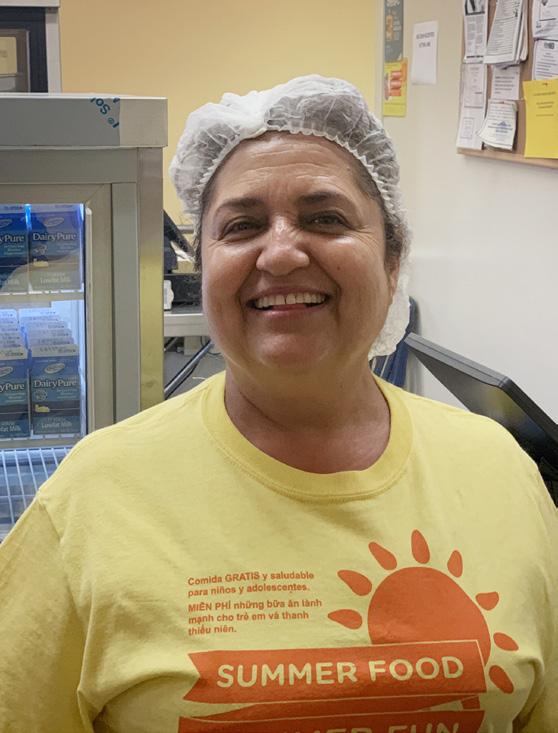
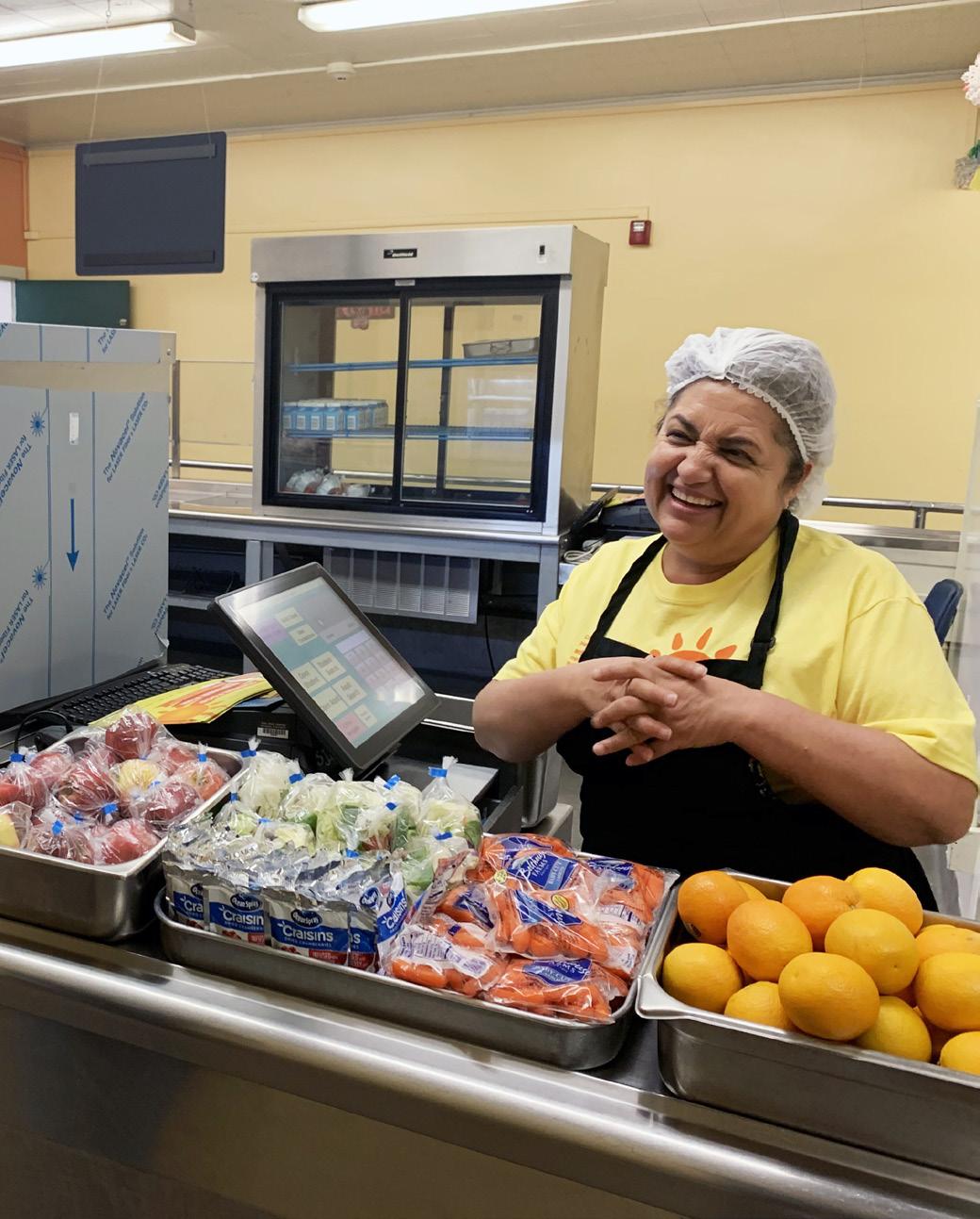
Estela Camatillo, cafeteria manager at Ohlone Middle School helps serve students as part of the No Kid Hungry program, in Ohlone Middle School in San Jose.
JOCELYN CERVANTES - STAFF PHOTOGRAPHER
Bagels and burritos are served to students as part of the No Kid Hungry program at San Jose High School.
JOCELYN CERVANTES - STAFF PHOTOGRAPHER
CERVANTES JOCELYN
ABEL ANGEL GONZALEZ HERNANDEZ
ABEL ANGEL GONZALEZ HERNANDEZ
Juvenile justice reform Advocates push for mental health attention
By Judy Ly Mosaic staff writer
Earlier this year, California Gov. Gavin Newsom announced his plans to separate the Department of Juvenile Justice from state prison system, with the goal of moving supervision of young offenders to state health agencies.
For many juvenile justice advocates, the change was long overdue. The National Center for Biotechnology Information reports approximately 50% to 70% of children who have interacted with the state’s juvenile justice system have a diagnosable mental health disorder. The center also reports approximately 40% to 80% of the incarcerated youth population have at least one mental health disorder.
While it’s more common for older children to be offenders, some as young as 11 and 12 have entered juvenile hall, Santa Clara County Juvenile Justice Commissioner Lissa Thiele said.
“That’s younger than we ever talked about before,” she said.
To address why youth at such a young age end up in the justice system, Thiele said society needs to “peel back the onion to where this first began, so to speak.”
The stigma of mental illness needs to be addressed, Thiele said. She said a wide range of factors can lead children into
the system, such as the schoolto-prison pipeline, trauma that gets passed down through generations and adverse childhood experiences.
To perform well in an academic setting, children need to feel emotionally safe and cared for, said Stacy Dryer, a chief development and communications officer at Alum Rock Counseling Center. She added that while
Tom Cella, a program director with Starlight Community Services, classified these behaviors as external, such as lashing out physically, aggression, and internal, such as anxiety and depression. He added that stress can compound those behaviors and negatively affect physical health because they are interdependent.
Cella said early on in the juvenile justice process, young offenders are assessed for which service would be best at addressing the behavior that got them into court. Community-based organizations typically provide these services in hopes of minimizing the number of minors in custody.
Dryer said the Alum Rock
They cannot afford the resources they were afforded in juvenile hall
Lissa Thiele
Juvinile Justice Commissioner
the effects of trauma can make it seem as if the child is misbehaving, it’s often a response coming from a place of fear.
Counseling Center is one of many local organizations that focuses on early intervention and prevention.
It’s not too late to get help in prison, she said, “but statistics show that it definitely becomes more of an uphill battle.”
Dryer said a portion of incarcerated youth don’t return to school, and not graduating high school is a predictor of poverty. Ironically, it’s only after they’re incarcerated that many
young offenders can access services that could have kept them out of the juvenile justice system, Thiele said.
“It’s some strange, sort of backward approach,” Thiele said. “That says a lot about how we deal with mental health as a society.”
Marina Hinestrosa, a Santa Clara County spokeswoman, said young offenders leave with a transition plan that includes behavioral services.
Upon release, children who were prescribed medication while in custody are provided with a 30-day prescription. Thiele said an inability to obtain medication past that period factors into a high recidivism rate.
“They cannot afford the resources they were afforded in juvenile hall,” Thiele said.
But even in cases where resources are adequate, it can still be challenging to make sure young offenders get the help they need, especially after someone turns 21 and can refuse services that help them stay on a positive track. That’s why having a trusted advocate is so important, said Veronica Guzman, a juvenile case manager at a Santa Clara County mental-health services provider.
“We forget that they are juveniles, they’re kids,” Guzman said. “They’re still in the process of processing and growing and maturing.”
Inside, ‘pillars of the school’ are crumbling High school athletes confront mental health issues
By Janet Zamidio Mosaic staff writer
Ashley Diaz excels on the soccer field at San Jose’s Luis Valdez Leadership Academy, but off the field she struggles with anxiety.
“It’s really bad there,” she said, referring to how she felt playing for her school.
Although she was captain on her team and a top player, the rising junior felt unsupported by her coach. If she failed to follow specific plays during a game, she wouldn’t get playing time on the field.
She said her mental health suffered as a result. “My support system was food, but I could rely on some of my teammates,.” she said Student athletes like Diaz are pillars of many high schools. They often are under enormous pressure to be star students and athletes, yet they are vulnerable to mental health issues.
In California, 30% of adolescents are at risk for depression, according to the 2019 Kids Count Profile released June 17 by the Annie E. Casey Foundation. In addition, 20% of teenagers suffer from mental health issues, according to TeenMentalHealth. org, a nonprofit that works to improve the mental health of young people.
Diaz said she understands that it can be difficult to be a student athlete, but when she comes to practice, she wants to do what she loves.
She’s not the only student
athlete to feel this way.
The problem continues in college. Thirty percent of female athletes and 18% of male athletes in Division I schools suffer from depression symptoms, according to a 2016 study by researchers at Drexel University and Kean University who surveyed 465 athletes.
Francisco Martinez, who plays soccer for Santa Clara Sporting Club, also struggles with depression. During his junior year at Luis Valdez Leadership Academy, he had a difficult time balancing school, work, his social life and competitive and school soccer.
Although Martinez felt alone, he could rely on his club coach for support.
“Soccer is the way I cope with things, and when things conflict with soccer, I’m kind of in a difficult situation.” he said.
It’s even harder when coaches don’t understand or aren’t available to help their athletes.
David Jacobson, who was a longtime marketing communications leader with the Positive Coaching Alliance, said trust between coaches and students is important.
“If you say that you’re there for the athlete – be there,” said Jacobson, who coached youth basketball, softball and baseball teams on the Peninsula for 14 years. “If you show that you aren’t there for them, they won’t come to you when they need help.” Jacobson, who went on to
found the Bay Area-based InkFlow Communications, said it can be hard for some athletes to accept that they need help. Coaches just have to be prepared to help when the students are ready.
Shelsy Perez, a volleyball player from Cristo Rey San Jose Jesuit High School, said
she is one of the lucky ones because she was able to get help for her anxiety.
“I didn’t feel like I would be able to finish my work. We had games, practice and homework, and I procrastinated a lot,” Perez said. “I felt like I wanted to give up.”
When her coaches and teachers noticed that she was no longer showing her bubbly personality, they approached her with the idea of going to a counselor.
“I was reluctant to get help,” Perez said. “I denied it because I didn’t think I needed it.”
Perez thinks the fairly small size of her high school worked to her advantage. “I think it’s ignored a lot like in big public schools,” she said.
“It’s [mental health] definitely a problem, and it’s one of those things that’s kept in silence,” Martinez said.
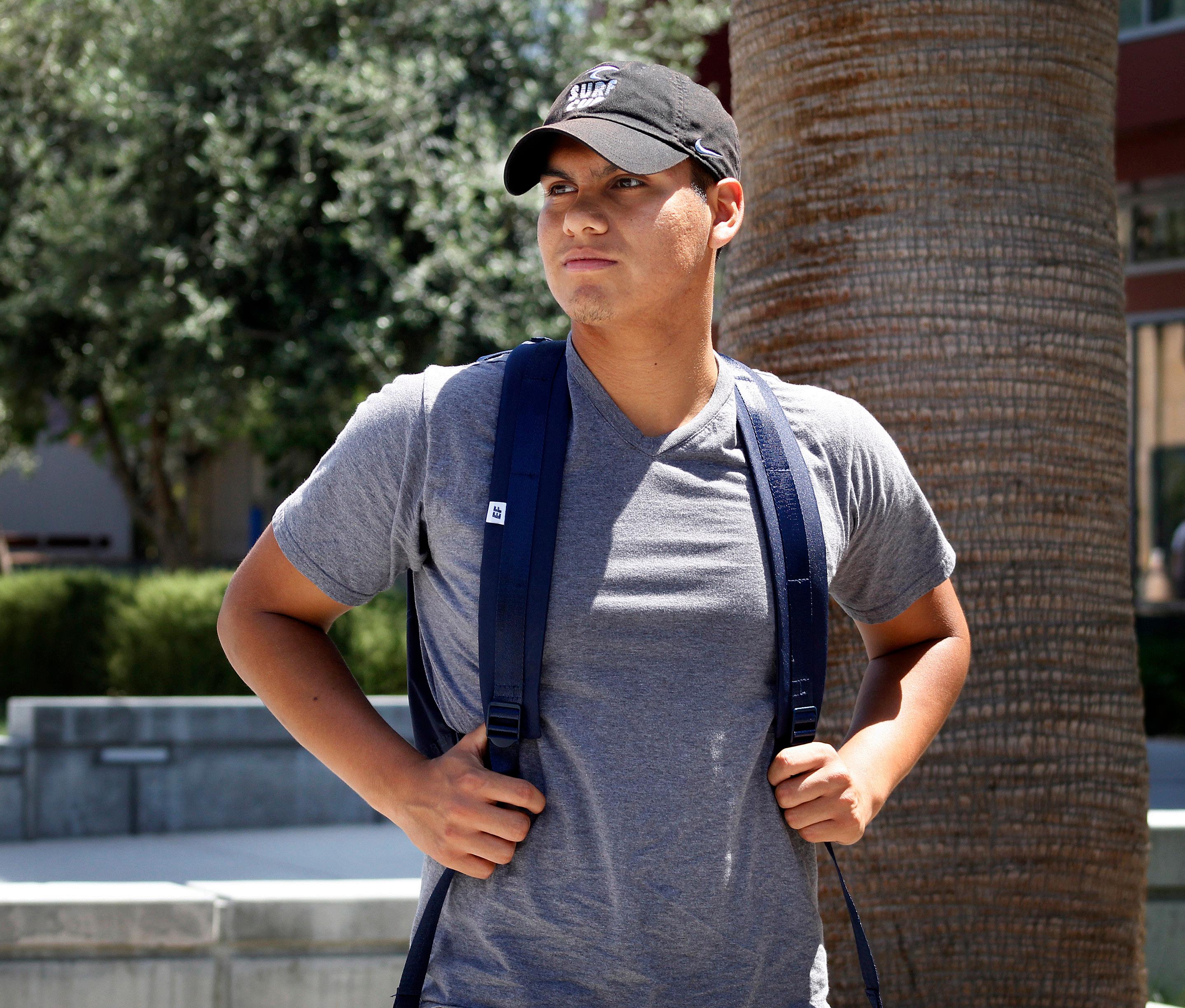
Grad runs through adversity to valedictorian
By Emilio Gonzalez-Lu MOSAIC STAFF WRITER
Arlet Miranda Torres and one of her running teammates came up with a cheer to motivate each other during their races.
“Pain is temporary, pride is
for Doordash to pay the bills.
But being an avid runner since a young age proved to be a double-edged sword. She came blazing into her freshman year at James Lick High School with a 6-minute, 17-second mile time, but then she injured one of her quadricep muscles.
For me, its not about winning. For me, it’s all about times and improving. I’d rather get third place and a faster time instead of first place and a slower time.
Arlet Miranda Torres James Lick valedictorian ’19
as much as she used to and fell behind. That was when Torres discovered that she had iron-deficiency anemia, which seriously decreased her stamina. “It got to a point where I wanted to stop running,” Torres said.
Torres also faced difficulties in class. The anemia, which left her lightheaded, made it hard for her to focus. However, with work, Torres was able to maintain high grades.
Even during this crisis, she never stayed away from her responsibilities of being a co-captain to her teammates.
But she said doubts started to cloud her mind: “Do they care?” she used to wonder. Her coach and her teammates encouraged her, but being slower put her through the wringer mentally.
“I know it’s not being a nobody, but that’s how it felt,” she said. “I know it’s a cliche, but you never know what you have until it’s gone.”
Falling behind gave her a new perspective. She doubled down on her philosophy of constant improvement after that year.
forever.”
That motto would come to define Torres, a firstgeneration American student, who lives with her mother and two brothers. Her father was deported when she was 8 years old, and for a majority of her life she was raised by a single parent. She also looks after her younger brother who has behavioral problems.
Dealing with the challenges in her family is difficult work, so running has been her outlet for stress since the fourth grade, running for both cross country and track over the years. This outlet also proved effective in high school whenever keeping up with her intense amount of schoolwork was difficult. Working hard on being a good student is a challenge and having that release kept her head clear.
Her identity as a runner wasn’t limited to the track. She also helped her mother pick up and make deliveries
Sophomore year, she came running back, only to get tendinitis in one of her legs.
Still, she pulled through, staying on top of her competition. She made it to the Central Coast Section (CCS) Finals, the race that would determine if she could compete in the state championships, but finished just one place outside of qualifying.
However, she never let situations like these keep her down.
“For me, it’s not about winning. For me, it’s all about times and improving,” she said. “I’d rather get third place and a faster time instead of first place and a slower time.”
In her junior year during her cross-country season, she inexplicably slowed down. Suddenly, she couldn’t run
And not only did she regain her old speed, as a senior she posted a peak mile time of 5 minutes, 38 seconds, shaving more than 30 seconds off her top freshman-year performance.
By Sunay Sanghani MOSAIC STAFF WRITER
More than a dozen kids from ages 5 to 13 gathered at San Jose City College’s football field June 15 for a one-of-a-kind experience to learn from Manchester United Soccer School.
The legendary English Premier League club partnered with HCL Technologies, a tech company headquartered in India with a Sunnyvale office, on a North American roadshow with four stops, including San Jose. Manchester United Soccer School held a similar event in San Jose in 2017.
“Silicon Valley always has a large and interested audience, so we brought it here again,” Andrew Acevedo, a volunteer for the event, said.
The rare opportunity to learn from professionals who played at the highest level was a draw for many families.
“When we saw that Manchester United was coming here, my son and I signed up quickly. Soccer is a sport that is not promoted as much as basketball and football in the U.S. and camps like these do not come around often,” said Naveen Bajjuri, a parent at the soccer camp.
The program had a full day of activities, starting with a question-and-answer session with Manchester United legend Quinton Fortune. A center back from South Africa, Fortune started his career in soccer – or football, as its known in Europe – with Manchester United in 1999. He talked about his upbringing, playing as a youth for his hometown team.
“After a few games, my coach
She powered through her senior year, coming back as one of the fastest runners at James Lick. She became team captain for both her crosscountry and track teams. She made it to CCS finals, but once again was one place away from getting into the state competition.
After all her hard work in track and cross-country, Torres came out of high school with a total of 37 medals, 34 of which came from sports.
But her favorite medal is number 37, which she received for being named valedictorian of her graduating class. Torres now has a full-ride scholarship to UC Berkeley, where she plans to major in computer science.
Torres said she’ll keep running in college, whether for the university or a club team. She routinely brings to mind some encouraging words her coach told her as she fought through adversity.
“You have to finish your race with a smile, no matter what the outcome.”

Kids flock to Manchester United’s soccer camp

asked me if I wanted to play football in England. I agreed and I left for England at 14,” he said.
Beyond his own story, Fortune aimed to inspire the young
I played with at Man U, was one of the hardest-working players I knew,” Fortune said.
Another goal of the Manchester United program is to empower girls in sports, and For-
Anything that helps their growth is great. Today, they focused on their individual skills and I’m glad Manchester United came to help my son improve his soccer skills.
players with the value of having a strong work ethic.
“Being great in anything takes a lot of hard work. David Beckham, the famous footballer who
tune also addressed that idea.
“Anyone can be special, boy or girl,” he said. “When I was on my under-10 team in South Africa, the best player was a girl,
not a boy. We tried to pass her the ball every time.”
Later, Fortune and two Manchester United coaches conducted a five-hour program of soccer-related activities. The kids were split up into two groups based on age. The younger group worked on conditioning with the coaches while the older group worked on dribbling skills. Twisting and turning in their high socks and cleats, the young soccer players tried to gain a good grasp of the ball.
“Anything that helps their growth is great. Today, they focused on their individual skills and I’m glad Manchester United came to help my son improve his soccer skills,” Bajjuri said.
Fortune hoped the camp
would be about having fun, too.
“I wanted to play football for fun,” he said. “As a kid, I just ran free and played without thinking. I want them to just play and enjoy, not think too much.”
And the school’s coaching approach was similar. The coaches used patience when working with the kids, not yelling or criticizing, and praised kids who excelled at their drill.
“These camps bring the ‘Manchester United Club way’ around the world and teach these kids how the professionals practice back in Manchester,” volunteer Acevedo said. Parents were not just on the sidelines cheering, either. They were invited to compete against their kids in a penalty kick shootout. Aside from bragging rights, the kids earned prizes for scoring against their parents, so it became a little competitive.
“I hope that my child learns to appreciate this opportunity that they get. It’s exciting to see Manchester United take out time to instill confidence in the kids,” said parent Ram Velaga before he tried to block his son’s goal.
He wasn’t fast enough, and his son scored.
Fortune said the most important thing is for kids to grow and pursue their interests, whatever they are.
“It does not have to be football, it could be basketball or even something like journalism,” he said. “I don’t want them to feel the pressure from their parents to pursue something specific.”
RUTH RODRIGUEZ - STAFF PHOTOGRAPHER
PAULO OROZCO - STAFF PHOTOGRAPHER
Former Manchester United player Quinton Fortune teaches young aspiring children various soccer skills like dribbling while supporting them with high-fives and words of affirmation every step of the way.
Naveen Bajjuri parent from soccer camp

By Kimberly Mitchell
MOSAIC STAFF WRITER
As he reaches the 100-meter mark, he lengthens his strides and feels his heart pound faster. With each step, his shoe meets the sun-beaten green track or an occasional patch of overgrown weeds.
The condition of the track does not bother him. In fact, the faded white lanes and torn patches remind Ramses Rodriguez of those who came before him.
To Rodriguez, a rising senior at Downtown College Prep El Primero High School, the track at San Jose State University’s Bud Winter Field is his second home, one that he shared with iconic U.S. sprinters John Carlos and Tommie Smith.
However, that home will soon be stripped away when SJSU starts construction to turn the track, used by yesterday’s Olympic runners and today’s community members, into a four-level parking garage. Demolition of the track on South 10th Street and Alma Avenue was expected to begin in June.
“I really look up to Speed City runners like Tommie Smith and John Carlos and knowing that the track is going to be paved over is really disappointing,” Rodriguez said.
San Jose State earned the nickname Speed City when it was home to one of the most legendary track-and-field teams of the 20th century. The iconic Spartans team coached by Bud Winter included Tommie Smith, Lee Evans, John Carlos and Ronnie Ray Smith, who all took part in the 1968 Olympic Games in Mexico City.
After winning gold and bronze medals in the 200-meter race, Smith and Carlos made international headlines during their medal ceremony when they raised their black-gloved fists in a Black Power salute and removed their shoes to symbolize poverty in the black community.
In the aftermath, Carlos and Smith were expelled from the Olympic Village and faced ostracization, criticism and even death threats back home. Nearly 40 years later, SJSU’s Associated Students led a campaign to recognize the courage of the Speed City runners, which included the unveiling of an iconic statue on campus in 2005.
The track and field program had a longer hiatus to recovery and after being disbanded in the 1980s, it was not reinstated until 2016. During its absence, the historic track at Bud Winter Field fell into disrepair as it was used as a community running space and parking for large sporting events at nearby Spartan Stadium.
Many students and locals were thrilled when the university announced plans to not only reinstate the men’s track program but to build a $5 million facility at Bud Winter Field. But that facility never
materialized, and Charlie Faas, the university’s vice president for administration and finance, told the Spartan Daily in April that the track team would continue to use San Jose City College’s track for practices and meets.
But for many in the South Campus community who use the track at Bud Winter Field for recreation or training, the 4-mile trek to City College is too far away. Rodriguez, who trains at Bud Winter five days a week, said it could cost him more than just time.
“I was hoping to get a scholarship for track. That’s what I

I’m not it’s just like the here...”
was counting on to get because I’m going to have of time,” Rodriguez said. Rodriguez will most However, this could hinder receiving a scholarship, surface could cause injuries. However, the weight when he is on the track.
During his run on a recent self reach his limit, and not right. His legs started Soon after finishing vomited. Rodriguez knows rarely runs above 75% at him to pass time, it’s his
But, on that day, Rodriguez
“It’s just really emotional,” just sad that this will be about that and all the runners it my all.”
Michael Morales cools down after running on the Bud Winter Field at San Jose State University, San Jose, Calif. on Wednesday, June 12, 2019. The track is set to be demolished this summer and turned into a multistory parking lot. (Ruth A. Rodriguez/MOSAIC)
From left, Dawit Kahsay teaches his son Amen how to ride a scooter on Bud Winter Field at San Jose State University, San Jose, Calif. on Tuesday, June 18, 2019. The track is set to be demolished this summer and turned into a multistory parking lot. (Paulo Orozco/Mosaic)
Runners mourn loss of historic, beloved San Jose State track
not the type to cry, but just sad that this will be the last time I will run here...”
into college. But now I’ll have less time to practice have to go to different track which is going to take a lot said. most likely have to resort to running around the block. hinder both his growth as a runner and his chances of as running on asphalt or concrete instead of a softer injuries.
weight of Rodriguez’s disappointment is revealed only track. recent Monday, his legs began to burn as he felt himand with 50 meters left it became clear something was started to wobble and his face contorted. his sprint, he tucked behind a blue storage cart and knows the dangers of pushing himself too hard and at practices. After all, running is more than a way for his ticket to college.
Rodriguez didn’t care.
emotional,” Rodriguez said. “I’m not the type to cry, but it’s be like the last time I will run here and just thinking runners that came before me made me want to give



Rodriguez/MOSAIC)
Ramses Rodriguez Runner at Downtown College Prep El Primpero
(ABOVE): The track is decaying at the Bud Winter Field at San Jose State University, San Jose, Calif. on Wednesday, June 12, 2019. The track is set to be demolished this summer and turned into a multistory parking lot. (Kimberly Mitchell/ MOSAIC)
(LEFT): A spider web is visible on the statue of Olympic Gold Medalist Tommy Smith on the campus of San Jose State University, San Jose, Calif. on Tuesday, June 18, 2019. (Paulo Orozco/ MOSAIC)
(BELOW): Downtown College Prep El Primero senior Ramses Rodriguez runs at Bud Winter Field at San Jose State University, San Jose, Calif. on Monday, June 17, 2019. The track is set to be demolished this summer and turned into a multistory parking lot. (Kimberly Mitchell/MOSAIC)
Teens seek to aid Mother Earth
mate change threat.
“It doesn’t matter whether you’re Muslim, Christian, whatever,” he said. “Everyone has the power to make a difference.” Zinger’s goal in organizing the summit is to inspire 500 million people to become environmentally active by the end of 2020.
Jenny Pham is focusing her efforts close to home. In March, the 17-year-old senior from Milpitas High School organized about 100 students to pick up litter at Pioneer Mobile Home Park.
Though Pham admits to feeling discouraged by some teens’ tendency to disregard the threat of climate change, she credits it to a “lack of education.” As a member of her school’s Environmental Society, she works with the group twice a month to sort the school’s trash, picking out misplaced recyclables and relining bins.
Ashley Kwong, the 17-year-old vice president and event coordinator of the Me to We Club at Evergreen Valley High School, agrees that young people can be reluctant to become more involved in environmental cleanups.
“Political issues coupled with corporate interests have made climate change kind of a murky subject,” she said.

“Climate change is such a polarized topic.”
Leilani Hsiao, a member of Evergreen Valley High School’s Forever Green Club, worked to install three water bottle refilling stations on campus last November.
The club’s next goal is to replace cafeteria condiment packets with large sauce dispensers and eliminate water-bottle vending machines.
Hsaio, a 16-year-old ju-
nior, wants young people to work for real change instead of posting to social media just for show.
“They do it for Instagram, for the likes, but they don’t make actual actions to continue after they post,” she said. “Our generation will realize and start to make change, not on our own accord, but because we see the consequences of global warming around us.”
In contrast, Isabella Sto-
How zoos help preserve the world’s species for the future
By Liz Sanchez Mosaic staff writer
Zoos around the United States draw millions of people every year, who come to see and learn about exotic animals like giraffes, elephants, lemurs and jaguars. And while animal rights organizations are critical of the treatment of animals in zoos, professionals who work with those animals have a different point of view.
Two zoos in the Bay Area make efforts to provide their animals with extra care and even work to save endangered species.
The Oakland Zoo, which opened in 1922, has more than 750 animals, including four elephants and at least two giraffes.
It’s been accredited by the Association of Zoos and Aquariums since 1988. Oakland Zoo President and CEO Joel Parrott said the zoo monitors the behavior of its animals and provides “enrichment” for animals
like elephants to provide them with exercise and keep them interested in their day.
“We give them good food, toys to play with, games to play, a swimming pool and mud baths,” he said.
Another Oakland Zoo resident, a reticulated giraffe named Benghazi, was an artist, creating paintings with a brush he held in his mouth.
But the last of his paintings was auctioned on June 15 – World Giraffe Day – following Benghazi’s death in May. The giraffe was euthanized at the zoo after his quality of life declined because of lower back injuries.
The average lifespan of a giraffe in the wild is around 25 years, and he was 23.
Benghazi’s death could be seen as supporting the position of animal rights organizations like People for the Ethical Treatment of Animals (PETA), which says living in any zoo can be harmful for animals.
According to a PETA issues
statement, “Even the best artificial environments can’t come close to matching the space, diversity, and freedom that animals want and need.” Instead, PETA recommends people skip the zoos and instead help rescue operations associated with the Global Federation of Animal Sanctuaries, a non-profit group that provides certification for animal sanctuaries.
However, many zoos, including Happy Hollow Park & Zoo in San Jose and the Oakland Zoo, also lend a hand in saving endangered animals. They do this through their own conservation programs and being involved with others like the Species Survival Plan, started by the Association of Zoos and Aquariums in 1981, or the U.S. Fish and Wildlife Service’s California Condor Reintroduction Program. They also work with other institutions to save these animals.
“Twenty-five precent of the approximated amount of animals we have here are a part
ry, a 17-year-old senior at Abraham Lincoln High School and president of the Mermaid Club, thinks social media has helped with environmental activism.
“Social media is a great way for the younger generation to educate themselves and face the statistics,” she said.
Once a month, she and about 15 other students take the bus to the Santa Cruz Beach Boardwalk or the
creek behind San Jose’s William Street Park to collect litter.
Ashley Miller, also an officer of the Me to We Club at Evergreen High School, agrees that using social media is key.
“When people can’t see an automatic change, they have a hard time to get motivated to make an automatic difference,” Miller said. She believes that her club’s frequent posts on social media
outreach are a great way to remind students that the problem still exists.
Silver Creek High School’s Green Society Club takes a different approach to encouraging environmental change in its community.
Delaine Dao, a 17-year-old senior, makes plans to tackle the threat of climate change by creating spaces on campus for students to learn about ecology and the process of plant growth.
As club president, Dao plans to raise money to purchase and assemble a new greenhouse on campus for growing fruits and vegetables. She thinks hands-on activism may inspire students more than just digital outreach.
“I see our future generations to be more connected than ever. The increased access to education about these issues is critical to making sure no one is forgotten and every voice is heard,” Dao said. “The youth have more time to get involved holding the decision-makers accountable for faster results and more effective changes.”

of the SSP (Species Survival Program), so we, a credible zoo, reach out to an animal coordinator to get another mate for an animal to repopulate our endangered species,” said Kevin Hertell, zoo manager at Happy Hollow Park & Zoo, which houses two jaguars, a red panda, lemurs, meerkats and an American alligator.
Parrott cited the Oakland Zoo’s work with California condors as one of the ways it supports endangered species.
“We worked with the Cal Condor Reintroduction Program and at one point, the Condor species population was


down to 22 left and after 30 years, we helped bring the population up to 400,” he said. And while these conservation efforts are important to the zoo, it is facing a battle against natural forces. The planet is experiencing the sixth mass extinction, a process that has been going on for thousands of years and is believed to be caused by human activity and climate change. At least 75% of species are expected to become extinct
within a “geologically” short amount of time. Hertell said this has had a big impact on how people look at animals, too.
“Zoos are not what they used to be,” Happy Hollow’s Hertell said. “We are much more conservation-minded. I believe this sixth mass extinction has affected not just zoos, but the broader community as well, which is why we teach and mentor kids of the future to make a difference.”
Yarden Zinger, at left, and friend Orri Nitzan at the Cultural Arts Hall in the Oshman Family JCC for the summit
RUTH ABIGAIL RODRIGUEZ - STAFF PHOTOGRAPHER
An endangered big anteater wanders around in its enclosure at Happy Hollow Park and Zoo in San Jose
JOCELYN CERVANTES - STAFF PHOTOGRAPHER
The recently imported, endangered black necked stilt takes a sip of water in its new sanctuary at Happy Hollow Park and Zoo in San Jose, Calif. on Tuesday, June 11, 2019
JOCELYN CERVANTES - STAFF
Palo Alto tells restaurants to toss plastic
By Melissa Chen MOSAIC STAFF WRITER
New restaurant rules in Palo Alto soon will mean big changes for the city’s eateries and eventually could mean adjustments for the restaurant industry elsewhere in the Bay Area. Beginning in 2020, Palo Alto restaurants will have to replace all plastic food service items such as straws, utensils, cups and lids.
The Palo Alto City Council recently approved a disposable foodware ordinance, one of 48 initiatives in the city’s Zero Waste Plan, that targets straws and other plastic foodware.
This follows AB 1884, a bill signed by then-Gov. Jerry Brown in September that requires fullservice restaurants – but not fastfood or quick-service eateries – to provide plastic straws only upon customer request. Individual cities, however, can implement their own more restrictive policies, as Palo Alto has done. Buying compostable
in the bucket.”
According to research by the city of Palo Alto, the average cost of each foodware item would increase between 1 cent and 2 cents, numbers that seem low but add up when restaurants are serving restless lines of hungry diners during rush hours. The impact of higher costs can vary from small businesses to large-scale businesses, but it is a factor restaurants need to consider.
Not only are alternatives to plastic disposable items more expensive, restaurants can also encounter difficulties in finding actual alternatives to use among the options on the market and provided by restaurant suppliers.
“We try to be as environmentally friendly as possible,” said J.P. Coupal, manager of Coupa Cafe, which has several locations in Palo Alto. “But a lot is trial and error.”
Coupa Cafe has been making sustainable changes
It’s great now everybody is talking about climate change. If we don’t do it now, I don’t know when we’re going to start. . . We set the examples for other cities.
Malek Kaci co-owner of La Boheme
or reusable alternatives to disposable foodware can raise costs for businesses.
“I used to buy a package of straws for $58. Now the case is $89,” said Paul Ames, executive chef at Tender Greens, a restaurant at the Stanford Shopping Center that serves chef-driven, locally sourced dishes. “But it’s just a drop
since 2013, well before restrictions on straws and plastic foodware began. Coupal said the process to convert to more sustainable foodware is long and involves purchasing different products and trying them in the restaurants. He said management evaluates feedback and discusses which products are best to use,
balancing cost and quality.
As with any changes, restaurant customers also need time to adjust.

“We’re always having that conversation with customers,” said Ames, the chef at Tender Greens. “It’s a large part of our business model having discussions about the product and impact.”
Even without a single, streamlined policy regarding restrictions on disposable food ware, restaurants with multiple locations in different cities likely will make the changes for all of them.
“When it comes to running larger businesses, you want a supply chain that is uniform,” Ames said. “It makes it more difficult to have one area doing one thing, and one area doing another. Talking to suppliers, we would be making changes for the
entirety of our restaurant.”
Generally, quick-service restaurants will have to make greater adjustments because dine-in restaurants use fewer disposables than take-out restaurants. In a survey of food-service establishments by the city of Palo Alto, 52% said converting to compostable foodware would be easy. Even so, the adjustment can still be difficult for many.
In these past months, Kaci said customers have been more conscious about using straws and reducing waste in general. The restaurant still uses plastic straws but plans to switch to biodegradable straws soon. Palo Alto is relatively ahead in terms of sustainability. Since 2007, the city has made efforts with initiatives such as the Climate Protection Plan and the Sustainability and Climate Action Plan Framework.
“It’s great now everybody is talking about climate change,” Kaci said. “If we don’t do it now, I don’t know when we’re going to start. I think we’re getting there but we’re a little late. We set the example for other cities.”
“We’re changing little by little,” said Malek Kaci, co-owner of La Boheme, a French restaurant on California Avenue in Palo Alto. “It costs money, especially for small businesses. They order their straws, but they don’t want to spend extra money for any alternatives for now.”
San Jose residents switch to clean energy
By Zoey Towner MOSAIC STAFF WRITER
Scrolling through Instagram, one’s feed is flooded with the doom of the climate crisis: haunting pictures of a turtle with a straw up its nose, mountains of plastic floating through the ocean, and videos of ice caps melting and forcefully dropping into the seas.
The impending climate crisis is a looming threat for many young people, like Presentation High School junior Zoe Miller.
“I want a future. I don’t just want to live till I’m 30. I want to live a full life,” said Miller. Many, like Zoe, want to take action to guarantee the future of the planet, and they want to know that their city is not being a bystander to climate change.
Using carbon-free or totally renewable energy through San Jose Clean Energy is a simple act that San Jose residents can take to reduce carbon emissions, and it can make an impact in the fight against climate change.
San Jose Clean Energy is a community choice energy program, meaning that once it was created through Climate Smart San Jose, it became the default electricity provider for San Jose residences and businesses.
This gave San Jose citizens the opportunity to take climate action in their own

homes, probably without even realizing it.
Along with other cities in Northern California, San Jose implemented this clean energy program as part of
The city’s leadership and Climate Smart plan truly serves as a model for cities around the state.
the Climate Smart San Jose plan that was approved in February 2018. The city wants to offer electricity that is produced without any greenhouse gas emissions by 2021, in order to reach the target outlined in the Paris Agreement to fight climate change.
GreenSource is the baseline plan that all San Jose residences and businesses, excluding those with rooftop solar, were automatically enrolled in back in February at a rate 1% below PG&E rates.
On its way to reaching that 2021 goal, GreenSource provides energy that is 80% emission-free, with the other 20% made up of
unspecified sources, according to Kate Ziemba, senior public information officer for San Jose Clean Energy.
The 80% emission-free part of the service is 45% renewable emission-free energy, and 35% hydropower energy that is not renewable but is emission-free.
For those who want to take a step further, San Jose Clean Energy offers the TotalGreen plan.
This plan delivers 100% renewable emission-free energy made up of sources like wind and solar, for about $3 to $5 on average more a month, according to the energy provider.
San Jose Clean Energy has
already been successful in getting the San Jose community to participate in the fight against climate change, with 98.7% of residences and businesses using one form of the clean energy offered.
Aside from the 1% price reduction from PG&E’s rate to GreenSource, and the overall health benefits, limiting GHG emissions could help make a real impact in the climate crisis.
Greenhouse gas emissions from electricity use in San Jose were expected initially to decrease by 18% as a result of the implementation of clean electricity, according to the provider.
“Making your electricity supply greenhouse-gas-free is one of the easiest and most effective things a city can do to reduce carbon emissions,” Ziemba said.
Local environmental organizations have also noticed the impact that SJCE programs will have in the larger scheme of fighting climate change.
“San Jose’s Climate Smart and Clean Energy is a bold vision to reduce San Jose's greenhouse gas emissions and the city's leadership and Climate Smart plan truly serves as a model for cities around the state,” said Andrea Mackenzie, general manager for the Santa Clara Valley Open Space Authority.
ABEL ANGEL GONZALES - STAFF PHOTOGRAPHER
Silver solar panels cover the playground at Booksin Elementary School in San Jose in an effort to use renewable energy.
Andrea Mackenzie general manager of Santa Clara Valley Open Space Authority.
ILLUSTRATION BY MELINA KRITIKOPOLOUS ILLUSTRATION BY MELINA KRITIKOPOULOS
ABEL ANGEL GONZALEZ HERNANDEZ
Teatro Visió n represents community
By Melina Kritikopoulos MOSAIC STAFF WRITER
When Annie Martínez brought her son Nathaniel to Teatro Visión’s production of “The House on Mango Street,” she knew it was the perfect place for him to perform.
“Me as a mother, watching it, seeing my son’s eyes get this big,” she said. “I knew that where I was, was where I was going to continue to be and continue to bring him.”
Teatro Visión is a 35-yearold bilingual theater company in San Jose that focuses its original, community-based work on the struggles of Latinx and Chicanx people. On June 5, the group was awarded two grants from the California Arts Council, to provide funding for its upcoming shows.
The $18,000 Local Impact grant will support the company’s October production of “Macario,” and the $9,000 Arts Education Exposure grant will fund next spring’s youth production.
“The grant awards in themselves are a strong testament to our belief in the quality and the value of Teatro Visión’s arts programs to the community they serve,” said Anne Bown-Crawford, California Arts Council executive director.
Teatro Visión produces two mainstage shows every year, one in October for Día de los Muertos and one youth production in the spring, Managing Director Leigh Henderson said. It usually rents out the Mexican Heritage Plaza for its shows, providing projected supertitles in English or Spanish.
This year’s October performance will be “Macario,” based on Bruno Traven’s 1950
THEATER REVIEW

They are exposing a part of the Latino community to the Latino community in Spanish. They are giving a voice . . . to artists like me that are not very good in English.
novela of the same name. The story, set in the viceregal era of Mexico, features a newly wealthy man who reflects on his life choices.
Teatro Visión’s newest original piece, “Raíces: El libro de los Caminos / Roots: Book of Journeys,” is a collaboration with a Mexico City street theater ensemble, La Quinta Teatro. It will premiere in October 2021.
The group also provides classes for children interested in theater, including an introduction to theater class from June 22 to July 20, and a youth voice class from June 12 to July 17.
Henderson said creators collaborate with Latinx and Chicanx groups around San Jose to create the stories for their pieces. The group’s October 2018 production,
“Departera,” a modern take on Día de Los Muertos, came to life when playwright Evelina Fernández and composer Russell Rodríguez worked with Teatro Visión, talking to community members and absorbing real-life stories to inject into the play.
“By the time the piece was done, it was really very reflective of all this input that we had gotten from dozens and dozens of people who participated really creatively in this process,” Henderson said. “We want to make sure we are a space that is telling all of those stories.”
When actor Sergio Davila found Teatro Visión, he appreciated the opportunity to perform in Spanish.
“They are exposing a part of the Latino community to the Latino community in Spanish,”
Davila said. “They are giving a voice… to artists like me that are not very good in English.”
Many who work with Teatro Visión find that actors and staff bond like a family.
“I love the stage, but I feel like a lot of the magic happens behind the scenes,” actress Carolina Perez said. “I feel a beautiful sense of community and I love them and I know that they love me.”
Those who participate and those who watch are filled with pride in the work, according to Edith Macias, community engagement and marketing manager of Teatro Visión.
“When you’re sitting in the theater of the Mexican Heritage Plaza and you look at these little kids up there in their costumes, they’re so committed to their play, and making people laugh. . . You’re like ‘Oh, this is what it’s all about,’ ” Macias said.
When 13-year-old actor Nathaniel Martínez watched “The House on Mango Street,” in May 2018, he saw that Teatro Visión was something special, and he made his acting debut in the March 2019 production of “The Transition of Doodle Pequeño.”
Nathaniel approached a friend who had acted in the production. “I told her that her acting felt really real. It didn’t feel like acting; it felt like it was actually happening,” he said.
Teatro Visión’s communityinfused storylines allow for touching productions.
“It’s about not just people coming to watch theater, but about creating theater that inspires people to act in their own lives, in their own communities,” Henderson said.
‘Mamma Mia!’ leads dissappoint; music doesn’t
By Zoey Towner MOSAIC STAFF WRITER
San Jose Stage Company’s production of “Mamma Mia!” features a deep ensemble cast that delivers an energetic and entertaining trip through ABBA’s hits, but the leads lack the heart necessary to bring the hit Broadway musical to life.
This beloved story centers around Sophie Sheridan, who is getting married, and her mother, Donna Sheridan. Desperate to know her father’s identity, Sophie invites three men with whom her mother had relationships with to her wedding, leading to chaos on their Greek island. The show has heart, drama and an amazing soundtrack.
San Jose Stage Company’s show stars Adrienne Herro as Donna Sheridan and Allison Parker as Sophie. The musical was directed by
“The Winner Takes It All,” and overall delivered an entertaining show. However, the show starts slowly. Parker’s performance of “I Have a Dream” lacks emotional punch. Parker’s vocals and dancing with the rest of the cast kept this number from completely falling flat, but it was clear the passion was not there.
While Herro delivers good vocals in key numbers such as “Money, Money, Money,” her lack of heart is most apparent in the scenes in between the musical numbers, where her emotions feel shallow and the conversations she is having with other characters lack depth.
Key dance numbers hit just the right balance of fun and the cast’s enthusiasm, in numbers like “Voulez-Vous” and “Dancing Queen” make the show an overall entertaining experience.
Allison F. Rich, who also plays one of Donna’s best friends, Tanya CreshamLeigh, alongside actress Jill Miller as her other best friend, Rosie Mulligan.
The production came through with the quintessential numbers such as “Mamma Mia!” and “Dancing Queen,” connected with the audience through emotional songs such as
It is not until “The Winner Takes It All” that the audience sees both the power in Herro’s voice and her emotions. This is such an important song that shows Donna’s vulnerability and I was glad Herro rose to the occasion.
The real heart of the production is delivered by the three men who play the possible fathers: Keith Pinto as Harry Bright, Noel Anthony as Sam Carmichael and Jeffrey Brian Adams as Bill Austin. In performances such as “Thank You for the Music” and “Knowing Me, Knowing You,” Anthony, Pinto and

Adams give the right heart and emotions for a character who finds out he has a daughter.
The three actors carry this emotional depth through to their scenes with Parker as Sophie. The father-daughter dynamic between Parker and each of these men really brings the warm feeling to this show.
As Sam, Anthony demonstrates the most genuine emotions of any actor in the show, both in his scenes with Herro as Donna, and with Parker as Sophie. Anthony conveys his character’s heartbreak over his past relationship with Donna and the longing he still has for her.
Pinto also does an
excellent job of bringing humor through the nervous personality of his character, Harry Bright. Donna’s best friends, played by Rich and Miller, are the most entertaining characters of the show because of their humor and genuine friendship with Donna. Rich plays Tanya with just the right amount of outrageousness, and Miller embodies both humor and true heart.
Sophie’s fiance, Sky, played by Sam Faustine, shares true chemistry with Sophie and he delivers powerful solo vocals in numbers such as “Lay All Your Love On Me.” Sky’s two friends – Eddie, played by Sean Okuniewicz, and
Pepper, played by Michael J. Wu – provide a lot of the humor, whether dancing in flippers or hitting on older women. The ensemble cast of “Mamma Mia!” is what really carries the show. Key dance numbers hit just the right balance of fun, and the cast’s enthusiasm in numbers like “VoulezVous” and “Dancing Queen” make the show an overall entertaining experience.
“Mamma Mia!” runs through July 7 at 490 S. First St., San Jose. Tickets are $20.50 for students, and range from $32 to $60 for adults and seniors. To purchase tickets, call 408-283-7142 or go to www.thestage.org.
Sergio Davila actor in Teatro Visió n
PAULO OROZCO - STAFF PHOTOGRAPHER
Ugho Badu (left) protects his “chicken” from Rodrigo Garcí a while playing their sneak peak of "Macario," a Teatro Visión production that will premire in October.
PHOTO COURTESY OF DAVE LEPORI
Left to right: Keith Pinto (Harry Bright), Allison F. Rich (Tanya), Noel Anthony (Sam Carmichael), Adrienne Herro (Donna Sheridan), Jeffrey Brian Adams (Bill Austin) and Jill Miller (Rosie) in San Jose Stage Company’s production of the ABBA musical 'Mamma Mia!'
Lyft bikes debut in downtown San Jose



Downtown: the newest hot spot
By Sunay
Downtown San Jose has never had much of a reputation as a hotspot for Bay Area residents, but as of late, it is the place to be. In the past five years, new companies, events and restaurants have brought more people to the downtown area.
One driver of downtown’s resurgence has been the plentiful job opportunities since 2014, helped in part because of the plethora of companies that have chosen downtown San Jose as their main campus.
“There are so many opportunities in the downtown area. Most of my friends have a lot of student internships close by. Even as an English major, which may not be popular here, I got an internship with a company,” said Natalia Gerardo, a third-year student at San Jose State University.
Five years ago, high rent was a barrier for many businesses that wanted to settle in the
heart of San Jose. However, Rick Jensen, communications director for the San Jose Downtown Association, believes times have changed. “Believe it or not, out of all of the areas in Silicon Valley, San Jose downtown is slowly becoming one of the cheapest places. Compared to other smaller suburbs, San Jose downtown is not as tight,” he said.
Companies including Google, Okta and Cohesity have recently decided to move downtown, Jensen said, adding that there are 50 different building proposals downtown, more than ever before. Some developers, like Jay Paul and Gary Dillabough’s Urban Community, are planning to transform existing buildings into sleek establishments.
“Jay Paul is going to convert old buildings to nice, exciting-looking buildings,” Jensen said, adding that the result could be a different skyline for downtown San Jose.


has also created a demand for more housing compared with years past, Jensen said.
“The biggest change is that urbanites want to work, enjoy and live in the same place now. If you look around, there are many residential high-rise buildings now,” he said.
According to a study by the San Jose Downtown Association, more than 2,700 units under construction in 2018 have been completed, following 1,584 in 2015-17. By comparison, in 2007-08, only 864 were built, and nothing was completed in 2009-14.
The influx of workers and residents also has created a need for restaurants, bars and events downtown, Jensen said. Hubs like San Pedro Square Market and Paseo de San Antonio, which are home to several popular eateries, have emerged over the past few years.
Quest Hill, the manager of Tac-oh in the arty South First Area (SoFA), said the Mexi-
can fusion restaurant opened a downtown location in 2017 because of the growth in the restaurant-friendly district.
“There have been times where we have had to double up on staff to help our customers,” Hill said.
To cash in on skyrocketing customer traffic, different types of restaurants are moving in, from Korean barbecue to French-Vietnamese cuisine.
Roselyn Mateo, who manages Spread Deli at Paseo de San Antonio, said the restaurant scene does well because of tech conferences like the Zoom conference or Apple’s WWDC19 and annual events like Christmas in the Park, a holiday-themed event that has been held at Plaza de Cesar Chavez for the past 30 years.
“Christmas in the Park time is extremely good for us,” Mateo said. “Whenever there are more events in the convention center, the more business we get.” Jensen, from the downtown
association, also praised the annual holiday event.
“From Thanksgiving to New Year’s, this one event makes downtown the best place to be,” he said. “Over 1 million people come to the park. That’s people from Palo Alto, Mountain View, San Jose and other suburbs.”
The proximity of downtown San Jose attractions to venues like SAP Center and nearby Levi’s Stadium in Santa Clara also helps attract big events like the NHL All-Star weekend and the College Football National Championship game, which were both held in January.
“They know that if any event is hosted in San Jose, attendees will have a good time,” Jensen said. “For almost all 52 weeks, organizers are trying to book in San Jose. We have a reputation as a place where attendees will have fun.”
Sanghani Mosaic staff writer
San Pedro Square Market allows an old fashioned Volkswagen to park in front of its on June 15. San Pedro Square Market opened on October 2011.
RUTH RODRIGUEZ - STAFF PHOTOGRAPHER
John Cordes, a member of the Silicon Valley Bicycle Coalition, rides on the new Ebike introduced by Lyft at press conference at San Jose City Hall Plaza in San Jose.
KIMBERLY MITCHELL - STAFF PHOTOGRAPHER
Mayor Sam Liccardo takes a test drive on the new Ebike introduced by Lyft after the press conference San Jose City Hall Plaza in San Jose.
PAULO OROZCO -
Kimchi conveys my grandma’s love
By Lauren Kim MOSAIC STAFF WRITER
Ten large aluminum bowls filled with napa cabbages flecked with red pepper rest on my grandmother’s kitchen floor. My aunt, my mom and the mastermind behind the mess, my grandma, work in nighttime silence.
They generously lather the saltwater-soaked cabbages in thick, alternating layers of saeujeot (fermented baby shrimp) and gochugaru (red chili pepper powder) and set them aside in large onggi, Korean handmade clay earthenware.
With my grandma, every visit is a feast. Her stovetop is never empty; pots and pans filled with spicy kimchi beef stews, sesame-sprinkled seasoned fermented crab, egg rice cake soup, and my favorite, pork and kimchi rice cake stir fry, litter her kitchen top. The family’s staple, however, is my grandma’s homemade kimchi, a fermented and pickled spicy cabbage side dish.
My family never eats without a fresh plate of kimchi by our side. The slight crunch of a sliver of my grandma’s homemade kimchi, mixed with the spicy kick of the gochugaru, is iconic.
Yet the dish is more than just delicious: It breathes history into our family. It was my grandma’s only connection to her Korean heritage after she immigrated to America. Decades later, it serves as
an emotional bridge to my mom’s childhood; gathering every year to make kimchi with my grandma is an essential, unifying and healing family tradition.
My grandma, Jenny Bok Soon Kim, epitomizes the immigrant’s “American dream.” Born in rural Anseong Gyeonggi Do, South Korea, in 1944, before the Korean War had begun in 1950, Bok Soon understood poverty.
After marrying Yong Hwan Kim in 1963, Bok Soon worked as a housewife, caring for her mentally disabled eldest daughter and her other three children. Their world changed when Yong Hwan, who worked at a South Korean air force base, was invited to the United States by NASA.
Bok Soon was devastated, fearing she’d never see her hometown again. With a heavy heart, she and her family flew to the San Francisco International Airport on Aug. 12, 1978. The family of six lived with a host named Jim, who served them Rice Chex cereal as their first American meal.
“When we first came to America, we weren’t allowed to eat Korean foods because our dad thought it would make us targets for discrimination because of its smell. But we would miss it so much,” my uncle, Jonathan Kim said. “Your grandma went out to buy dill


pickles and we would eat that with our rice instead of kimchi.”
Yong Hwan worked as a mechanical engineer at the NASA Ames Research Center in Mountain View for two decades, before dying of liver cancer in 2001, despite his lifelong sobriety.
The family had difficulty adapting to the change. To afford her son’s doctorate tuition, Bok Soon worked odd jobs at odd hours as a seamstress, a maid, a babysitter, an assembly line worker and eventually as the owner of a frozen yogurt store.
Bok Soon resented her husband for leaving her in a country she hated. She longed to move back to her hometown, but she didn’t want to leave her children.
My aunts and uncles grew up and left home, and my grandma, shy about expressing feelings, made sure to keep in contact by sending ready-to-eat homemade
banchan (Korean side dishes).
Although she never said “I love you,” the sentiment came through my grandma’s food. And because her children eventually had their own children, the demand for her Korean food never ceased.
“It’s something she can do well. It’s something that we cannot do, it’s something to do without the presence of her husband, something that she can do that makes her feel important, and of course, when the children and everyone enjoys it, it’s a plus,” my mom, Senna Kim, said. “She complains that she’s tired, and that she’s hurting, but she keeps on going, even though she says that it’s her last batch.”
Every other week, or whenever her grandchildren ask for more, Bok Soon visits the local Korean market and restocks her kitchen with fresh scallions, red chili peppers, Korean radish, minced
garlic and, of course, napa cabbage. She begins soaking the cabbage halves in salt water and rinsing them in large, burnt-red darai, rubber tubs, with her backyard hose. Once the leaves are malleable, she brings them inside and begins to spread her homemade gochugaru, garlic marinade on each leaf. It was always at this step she would sneak me a small folded leaf to taste. Next she packs the cabbages in big plastic sealable containers, which she loads into the frosty depths of her kimchi fridge –yes, she has a separate fridge just for kimchi.
It’s an elaborate five-hour process of scrubbing and folding cabbage leaves – well, five hours plus the fermentation process – but my grandmother doesn’t bat an eye before preparing her next batch. It’s for her children, she explains. Why wouldn’t she go through the trouble?
Supporting LGBTQ is not just rainbows
By Melina Kritikopoulos MOSAIC STAFF WRITER
Many brands are racing to slap a rainbow on their clothes to cash in on LGBTQ Pride month. In fact, 16 major brands plus “every major sports
ible and rich history of the LGBTQ community, as well as the struggles they have endured, are often overlooked when brands create pride collections; they are simply yearning for blind support.
This issue, known as “rain-
Many don’t realize that certain companies only “support” the LGBTQ community during pride month and capitalize on the struggles of an entire community.
league” had some sort of pride collection last year, according to GQ writer Cam Wolf. And that’s not even counting the thousands of small online artists who create quirky T-shirts. With over 100 pride events around the world this year, according to Caitlin Sawicki for Metro Source, there are lots of consumers – both those in and outside of the LGBTQ community – who purchase these pieces. But many don’t realize that certain companies only “support” the LGBTQ community during pride month and capitalize on the struggles of an entire community.
Pride was born on June 28, 1969, after a black transgender woman, Marsha P. Johnson, among others, started the Stonewall Riots, an event in which members of the gay community fought back against a police raid in Greenwich Village, N.Y. The incred-
bow capitalism,” can greatly harm the place of the LGBTQ community. Many, if not most, who purchase and wear pride clothing do it to show their support.
While this is a great action, a better way to actually sup port the LGBTQ community would be to donate to organi zations, and actively work to make change, not just show the world how “woke” you are. Charitynavigator.org rates various non-profits and rec ommended donating to the San Diego LGBT Community Center, the Trevor Project and the Pride Foundation.
Big brands that do sell pride merchandise can vary in how ethical their products and purposes are.
First, there are companies like Urban Outfitters, which sold a seemingly transphobic greeting card in 2012. Accord ing to a March 2012 article in
the Huffington Post, the company sold a card that twisted the “Jack and Jill” nursery rhyme into an offensive message. Urban Outfitters’ 2019 pride collection has graphic T-shirts averaging about $29.
Second, there are some big brands that donate their proceeds to organizations that support the queer community. Nordstrom is a prime example of this, promising 100% of its pride profit to the Human Rights Campaign.
Smith calls it “the world’s first gender-less store,” as it features diverse models and non-gendered clothing. The Phluid Project donated 10% of online sales to the Stonewall Community Foundation during the second weekend of June. Its graphic T-shirts retail for about $35.
The prices of big-brand companies are better; Urban Outfitters and Nordstrom’s shirts are $5 and $11 cheaper than Phlu
that actively supports queer people.
However, why not pay a little more to support a 100% ethical brand that is queerowned, diverse and active in their support for the LGBTQ community? Also, T-shirts are not necessary to support and actively change the place of minorities in society. In general, people should be aware of where they are buying from and do research on the companies they support. If they want to show that they are an ally, a donation does so much more than covering themselves

CEO and founder Rob
CAMILLE GANDOTRA- STAFF
PHOTOGRAPHER
Jenny Bok Soon Kim’s oi (cucumber) kimchi, left; Chinese broccoli kimchi, far back; baechu (napa cabbage) kimchi, right; and kkakdugi (diced radish) kimchi, front.
Jenny Bok Soon Kim shown in her 20s with her eldest daughter in South Korea, moved to California in 1978.
PHOTO COURTESY OF JENNY BOK SOON KIM
Healthy food options growing more than ever at farmers markets
By Liz Sanchez Mosaic staff writer
It’s Friday at San Pedro Square, and Robert Ramoz is telling potential customers about the mango-nectarine hybrid.
“Nobody else has this but us, and as time goes by it’ll get more sweeter and get a more mango-y taste,” he said. “Every fruit that we have is its own unique flavor.”
Ramoz, whose family has lived in San Jose for 114 years, said he’s proud of the organic fruit like peaches and oranges he sells at the Downtown Farmers Market for Ken’s Top Notch, a 20acre farm in Reedley in Fresno County.
“We have nothing but organic fruit, that’s all we sell. Our fruit sells us out. Once you taste it, you’ll know why,” he said. Organic fruit, he said, is grown naturally without pesticides, gas, wax or chemicals.


“ I believe our families are important, our health is important. That’s all priceless and I think that we should give our families and ourselves the best that we can ”
Ramoz and his family work at San Pedro Square on Fridays, but on other days they’ll be at other farmers markets in Cupertino, Morgan Hill, the Great Mall in Milpitas and Kaiser’s Santa Teresa hospital in South San Jose.
At the San Pedro Square market, his stall was among several selling fruits and vegetables. Other vendors were selling specially designed cards, breads, flowers and plants, and food stands serving lunch. The market, sponsored by Kaiser Permanente, is open from 10 a.m. to 2 p.m. every Friday through Nov. 1.
The Farmers Market in San Pedro Square is part of the Pacific Coast Farmers’ Market Association, which
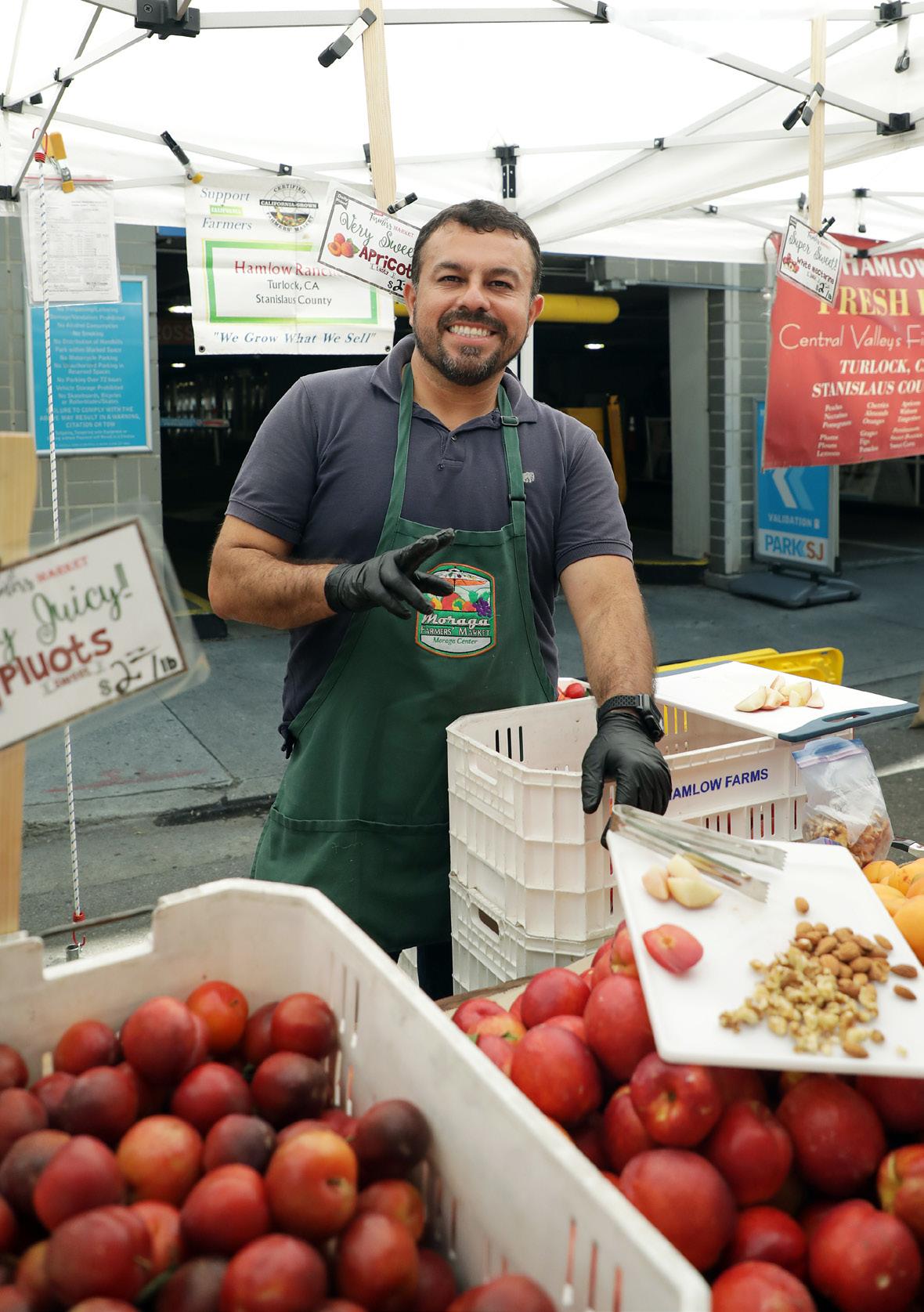
manages markets selling fresh fruits and vegetables in Alameda County, Contra Costa County, San Francisco, San Mateo County, Santa Clara County and Solano County. The California Farmers’ Markets Association (CFMA) is another organization that has managed certified farmers markets in the Bay Area since 1993. There are about 700 certified farmer’s markets in California, according to the CFMA. Esther Bernal said she enjoys coming to San Pedro Square along with her daughter.
“I love to come here every Friday, just to get the fresh fruit. I usually come for the produce and fresh flow-
ers,” she said. Buying organic produce is one thing that brings customers like Joanna Reynoso to farmers markets.
“It’s kind of a summer thing,” said Reynoso is she was buying oranges. “I stopped here because they were organic and the [orange] tree in my backyard is also organic, so I thought I’d obviously stick with the same product.” Ramoz said not all the vendors at the market sell organic fruits and vegetables.
“I believe our families are important, our health is important. That’s all priceless and I think that we should give our families and ourselves the best that we can,” he said.
Northside’s ‘Barkesto’ brings together neighbors with food, art and music
By Melissa Chen Mosaic staff writer
Three years ago, Veronica Fogarty moved with her husband, Kevin, from Ireland to California after his company transferred him to Santa Clara. The Fogartys have no children and Veronica does not work so she hasn’t had the chance to go out and meet many neighbors.
downtown and Japantown, runs from 5 p.m. to 9 p.m. every Saturday until Aug. 31. Public Space Authority, a company managed by urban planners to curate projects in public spaces, organized the summer market for the Northside community.
“We’ve been talking about this process since last year,” said Ryan Sebastian, owner of Public Space Authority.

“We’ve also done neighborhood outreach and meetings. Urban parks need programming. They need activities. You have to work with a lot of people to make it happen, but when a neighborhood supports it and it’s a place where they feel comfortable, magical things happen.”
With funding from the Knight Foundation, Sebastian and his team collaborated with community organizations including the San Jose Parks Foundation and the after-school program Downtown Enrichment to launch the Northside Night Market for this summer. They hope to bring it back next year as well.
Northside is an older neighborhood in San Jose, with a rich history driven by Mexican, Filipino, Japanese, Italian and other immigrants. Originally a fruit-canning district, it still is a diverse and generally working-class area.
“We’ve got neighbors from India, China, the Philippines,” said Veronica Fogarty. “You see a lot more of other cultures, especially during holidays like New Years.”
After her arrival, Veronica also noticed the nicer weather and how people spend more time outdoors. On opening night, the heat of the day was gone, and at 5 p.m. a cool breeze and a playful beat drifted through the park. The market features a different local musician

each week, and for the grand opening, R&B artist Kamiko Fuji and her band played soulful covers and originals.
“It’s lovely out, and it’s a chance to get out to talk to people,” Fogarty said, relaxing with her dogs on a blanket spread on the grass.
The theme of the opening night was “Barkesto!,” an invitation for people to bring their dogs along for the evening.
“People will go to more places where they can take their dogs. The dogs are all very friendly,” said Pam Alford, who lives in downtown San Jose but did not bring a dog.
Corgis, beagles, Malteses, dachshunds, retrievers and dozens of other breeds roamed with their owners among the vendor stalls, a plot of popup tents that sprung up minutes before the event. Keeping with the spirit of the
event, one stall sold pet blankets and pet-themed shirts and clothes. Another sold jam from organic family farms.
At one booth, a little girl demonstrated a colorful craft, pouring dyed sand on sticky paper. Her mother, Yingying Henry, lives in Northside and recently started Sandy Art Fun, which sells do-it-yourself arts and crafts. She jumped at the chance to sign up for the Northside Night Market to attract more customers to her business.
“I think it helps my daughters express their creativity,” Henry said. “It’s also very fun.”
Couples and families crowded in front to form a line around food trucks parked along the street. People peeled away with sandwiches, tacos, and shakes and joined others sitting on towels and chairs dotting the grass or at tables under the shade.
In the recent years, Northside has evolved into a busier, developing area.
“A lot of people are moving. Especially the way prices and rents have gone up,” said Pearl Almondia, a real estate agent in the Northside area who set up a booth at the market. As the sun set, the market was far from winding down. The community mingled as Sylvia Castillo and her boyfriend, Mark Chavez, enjoyed dinner surrounded by their dogs Jio and Luna.
“The neighborhood is family-oriented,” Castillo said. “It had gone down for a while, but it’s better now.”
But on June 15, the couple took a summer evening stroll with their dogs
Trinny and Toby to the grand opening of the Northside Night Market at Backesto Park in San Jose. The market at the park, between
San Jose resident Joanna Reynoso, buys organic fruit from Robert Ramoz and his family on June 14th.
CAMILLE GANDOTRA - STAFF PHOTOGRAPHER
The San Jose Downtown Farmers Market is open on Fridays at San Pedro Square and sells produce, baked goods, clothing and more.
CAMILLE GANDOTRA- STAFF PHOTOGRAPHER
Robert Ramoz sells organic fruit for Ken’s Top Notch, a 20-acre farm in Reedley in Fresno County. On June 14th, he was telling customers about his mango-nectarine hybrid.
CAMILLE GANDOTRA - STAFF
PHOTOGRAPHER
-Robert Romoz Market Vendor
A brown and white bulldog plays with ball in pit at the Barkesto Park festival in San Jose, on June 15.
RUTH RODRIGUEZ - STAFF PHOTOGRAPHER
Teresa Lucas, of vender T Lucas Designs, poses for a photograph at the first Northside Night Market event in Backesto Park in San Jose, on June 15.
RUTH RODRIGUEZ - STAFF PHOTOGRAPHER
Armando Alatorre attends the farmers market at San Jose Downtown on June 14, 2019, to sell peaches, cherries, melons, and more.
-Robert Ramoz



Hundreds of Santa Clara refugee community members came together at the Campbell Community Center on June 14 to celebrate the 27th annual World Refugee Day. The annual event, open to the public and free of charge, included ethnic performances, presentations, and activities highlighting the diverse cultures of Santa Clara’s refugee population. Supported by various nonprofit organizations involved in refugee and immigrant welfare, the event was funded through grants and community donations.
“[World Refugee Day] gives people from different cultures the opportunity to represent their countries and know they are welcomed and celebrated,” said Claire Collins, outreach coordinator for refugee foster care at Catholic Charities of Santa Clara County.
PhotosByRuthA Rodriguez, Mosaicstaffphotographer

World Refugee Day



Jasmine Fathi, from the Beshka Dance Academy, flicks her wrists as she performs a traditional Persian dance at the 27th Annual World Refugee Day.
Twirling in handwoven traditional garments, youth participants perform a Mexican Folkloric dance from Guadalajara, Mexico, at World Refugee Day.
A dancer in a brightly adorned dragon costume is lifted in the air while performing a Chinese ceremonial lion dance with the Buu Kim Tu Dragon and Lion Dance Association.
Dressed in a traditional qipao, a participant performs a Chinese cultural dance at the 27th Annual World Refugee Day.
Renee Paquier, emcee, talks to a performer from the Vietnamese dance group at World Refugee Day.
(Left to right): Lamial Mahari Kralj, Senait Abraha and Arara T. Weldegebril perform a traditional Moroccan dance.
Wassim Hage, Deellan Khanaka, Ahmad Merhebi and Jana Kadah perform a traditional line dance from Levant called Dabke at the 27th Annual World Refugee Day.
showcasing different vocal ists and different styles.
tions, but our music is generally upbeat.”
Kuchlenz’s opening light vocals transition to a rap by Cunningham, in which he talks about wanting to end a relationship because he is “leaving for college, and I cannot leave you on my conscience.” And then Kuchlenz — known as ZJ del Mar — comes back with an explicit verse that contradicts the song’s previous
The members of SadInSF have been collaborating for about a year, and their songs are sometimes made not long after an idea pops into someone’s head. “The whole thing was pretty chaotic,” said Cunnigham, who goes by Adrian QMC. “When I gave my beat to Ziad he immediately fell in love and wanted us to do a collab, but
SadInSF members channel
emotion, friendship through music
ly graduated from Carlmont High School and will soon be off to college, Kuchlenz is confident they will continue producing music even if they can’t meet for a studio session every Friday. “I just can’t picture a life without them,” Kuchlenz said. “I’ve known them for so long that it’s almost impossible not being able to keep in touch and talk about music and just have fun.”
Collaboration of Carlmont High grads recently played Palo Alto festival
By Kimberly Mitchell Mosaic staff writer
Scattered Lego pieces, Nerf guns and towers of cardboard boxes packed with Christmas ornaments surround a keyboard and a mic stand in a Peninsula garage. The smell of cats grows stronger by the hour, prompting allergic sneezes.
Welcome to the makeshift studio of SadInSF, a collaboration of teenage artists who produce and release their work on the music-sharing platform Soundcloud.
The name is ironic: SadInSF’s five members — all recent graduates of Carlmont High in Belmont -— live about 20 miles south of San Francisco and their sound is anything but sad.
ZJ Kuchlenz, Ziad Kedkad, Brandon Gee, Adrian Cunningham and Justin Simoneau grew up together, and their studio sessions — often in Simoneau’s garage or Kedkad’s basement —are often interrupted by laughter, Nerf gun wars and wrestling matches.
“We’re completely the opposite of sad,” said Kedkad, who goes by CXC Mel on Soundcloud. “We’re all really happy people and most of us have supportive families.” Each member has his own style and personality, which comes through in their music, and the way they act and dress. “Dr. Escape,” one of the first songs they produced as a group, has an upbeat tone with the verses showcasing different vocalists and different styles.

melancholy. The song’s tempo increases, and Gee contributes a fast-paced rap and moody lyrics that stem from difficult moments in life.
“It’s not the music that’s sad, but the lyrics that are sad,” said Gee, aka Mid-
soon enough everyone else joined in and together we met at Ziad’s house.”
After performing mostly at Carlmont events, SadInSF played at the Buoyancy Teen Music & Art Festival in Palo Alto on June 3, one of the first times they had performed in front of a large, non-school crowd.
“ We’re completely the opposite of sad
—CXC
Mel Band Member
night. “Our lyrics talk about our struggles and our emotions, but our music is generally upbeat.”
“The Palo Alto Buoyancy festival was definitely the best moment for us as a group,” Cunningham said. “There was a huge crowd and just seeing people dance and sing along to our songs was the best feeling ever.”
Kuchlenz’s opening light vocals transition to a rap by Cunningham, in which he talks about wanting to end a relationship because he is “leaving for college, and I cannot leave you on my conscience.” And then Kuchlenz — known as ZJ del Mar — comes back with an explicit verse that contradicts the song’s previous
The members of SadInSF have been collaborating for about a year, and their songs are sometimes made not long after an idea pops into someone’s head. “The whole thing was pretty chaotic,” said Cunnigham, who goes by Adrian QMC. “When I gave my beat to Ziad he immediately fell in love and wanted us to do a collab, but
Though the group recently graduated from Carlmont High School and will soon be off to college, Kuchlenz is confident they will continue producing music — even if they can’t meet for a studio session every Friday.
“I just can’t picture a life without them,” Kuchlenz said. “I’ve known them for so long that it’s almost impossible not being able to keep in touch and talk about music and just have fun.”


Members of the band SadinSF, Justin Sundermeyer (18), left, and Ziad Kedkad (18), right, jam together on Sundermeyer’s piano in Belmont.
KIMBERLY MITCHELL - STAFF PHOTOGRAPHER
(Left to right) Members of the band SadinSF, Ziad Kedkad (18), left, Justin Sundermeyer (18), Adrian Cunningham (17), Brandon Gee (17), and ZJ Kuchlenz (17) pose for a photograph at Hidden Canyon Park in Belmont Calif., on Tuesday June 17, 2019.
KIMBERLY MITCHELL - STAFF PHOTOGRAPHER
Members of the band SadinSF, ZJ Kuchlenz (17), left, Justin Sundermeyer (18), center, and Ziad Kedkad (18), right, listen to a recording of their new song at Sundermeyer’s garage in Belmont, on June 16.
KIMBERLY MITCHELL - STAFF PHOTOGRAPHER
Members of the band SadinSF, Justin Sundermeyer (18), left, and Ziad Kedkad (18), together on Sundermeyer’s piano in Belmont.
KIMBERLY MITCHELL - STAFF
Members of the band SadinSF, ZJ Kuchlenz (17), left, Justin Sundermeyer (18), center, and Ziad Kedkad (18), right, listen to a recording of their new song at Sundermeyer’s garage in Belmont, on June 16.
KIMBERLY MITCHELL - STAFF PHOTOGRAPHER
(Left to right)
Members of the band SadinSF, Ziad Kedkad (18), left, Justin Sundermeyer (18), Adrian Cunningham (17), Brandon Gee (17), and ZJ Kuchlenz (17) pose for a photograph at Hidden Canyon Park in Belmont Calif., on Tuesday June 17, 2019.
KIMBERLY MITCHELL - STAFF PHOTOGRAPHER
San Jose murals show local culture, artistry






Artist Jim Miner depicts a woman with a cornucopia of fruits and vegetables in the mural “Life Abundant in the Face of Death Imminent” painted on a wall at the Hotel De Anza. (Jocelyn Cervantes/MOSAIC)
A mural depicting a saxophone player decorates the back of a building on First Street. (Abel Angel Gonzalez/MOSAIC)
Darrien Rice looks at the photos he made of the “100 Block Mural Project” painted on a wall of the Valley Title building on First Street. (Abel Angel Gonzalez/MOSAIC)
Detail from a mural on Fountain Alley titled “Heartsong” by artist Francisco Ramirez depicts an eye in the center of a heart with monarch wings. (Jocelyn Cervantes/MOSAIC)
Artist Lila Gemellos plays with the term SoFA (South of First Area) in a mural painted on a wall of the Valley Title building. (Camille Gandotra/MOSAIC)
A mural painted on a wall of the Valley Title building overlooks a parking lot on First Street. (Abel Angel Gonzalez/MOSAIC)
(Abel Angel Gonzalez Hernandez/MOSAIC)
(Abel Angel Gonzalez Hernandez/MOSAIC)
Gonzalez Hernandez/MOSAIC)