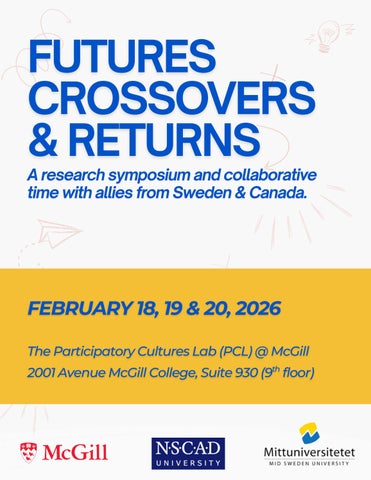
Futures Crossovers & Returns Program

Page 1


FUTURES CROSSOVERS &RETURNS

FUTURES CROSSOVERS & RETURNS

These events bring together researchers from Mid Sweden University, McGill University, and NSCAD University to explore how we may advance understanding of social inclusion, governance, resilience, and lived experiences across diverse contexts. With researchers’ experience spanning gender, work, rurality, displacement, resilience, participatory visual methods, youth engagement, and community‑led arts practices, the PCL is hosting a shared space for interdisciplinary dialogue and collaborative design.

Over these 3-days, we will work across thematic and methodological intersections; on Day 1, we will reconnect and plan together; Day 2 is Symposium day, blending short presentations, methods labs, and reflective dialogues; and, Day 3 culminates with a closer look at funding, mapping-out and next steps for projects and publishing.

Together, these activities support the co‑creation of project and publishing possibilities, identification of shared methodological trajectories, and development of a joint international research agenda.

We hope this time together will strengthen transnational partnerships and collaboration. By the close of these 3-days, we hope to have developed some concrete next steps for research collaboration and the beginnings of a shared vision for community‑rooted, transnational research.

FUTURESASAFRAMING

WhatDoWeMeanbyFuturesasaFrami g

Futures thinking is a relational, creative, and contemplative practice that invites us to imagine plural possibilities for the future by examining the stories and worldviews we collectively shape in the present and how we orient ourselves toward those futures. My project with young women musicians participates in this futures-thinking process by exploring what makes a musical life sustainable over time. Through sound-based co-creation, participants will explore their experiences, social dynamics, and their feelings about their musical futures through a lens of affect and belonging. Sound serves as a medium for imagining futures that support both long-term artistic career sustainability and emotional wellbeing, revealing possibilities for more supportive creative environments for women.

FuturesRecomendedReadings:

Rebecca Coleman & Kat Jungnickel

Introduction to Creating Feminist FuturesResearch Methodologies for New Times

Kai Lehikoinen & Satu Tuittila
“Arts‑Based Approaches for Futures Workshops”

Who’s Involved in the Symposium?

inACTS, NSCAD University

inACTS, NSCAD University

inACTS, NSCAD University & Dalhousie University

AUGUSTA VALEVICIUS McGill University
MONICA SHANK LAUWO
APRIL MANDRONA
Mid Sweden University
KATARINA GIRITLI-NYGREN
KIRSTIE MCCALLUM
SARA NYHLEN
SHAKARA JOSEPH

DAY 1: RECONNECTING & PLANNING

1:00-5:00 PM Orientation & Planning Huddle

A working session to reconnect, get oriented within the PCL space, and align on goals, roles, and expectations for the next two days. The session introduces key conceptual frames and funding landscapes that will shape collaboration conversations.

Activities:

Tour of the PCL (including Smart Board + Sound Booth)

Review of symposium goals, assign facilitation roles, and refine plans

Discussion of conceptual framings (Futures, care/repair, temporality, arts based methods)

Early look at international and national funding pathways (Horizon Europe, NFRF–IJI, UArctic, Connection Grants)

Light strategizing toward possible collaborations and publications

5:30 PM Group Dinner @ The Faculty Club (3450 McTavish)

An informal gathering to welcome all collaborators, deepen connections, and set the tone for the days ahead.

DAY 2: SYMPOSIUM SCHEDULE IN BRIEF

9:45 - 10:00 AM Mini-Fika

10:00 - 10:15 AM

10:15 AM12:00 PM

12:00 - 12:30 PM 12:30 - 1:15 PM

1:15 - 2:15 PM

2:15 - 3:15 PM Getting Started

Session 1 : Who’s at the Table?

Session 2 : Introducing ‘Futures’ as a Framing

Lunch @ PCL

Session 3 : Thematic Waves

3:15 - 4:30 PM

4:30 - 5:00 PM

Session 4 : Clusters & Constellations

5:00 - 7:00 PM

Session 5 : Roadmapping

Break / Set-up 5@7

Afterwork 5@7 OUT Exhibition

Morning Morning

10:15-11:15 AM

DAY 2: FOCUS ON SESSIONS

SESSION 1 : Who’s at the Table?

10:15 AM

45 MINS

11:00 AM

60 MINS

11:15 AM12:30 PM

Individuals share meaningful artefacts that reflect their research Each participant shares for 3-minutes each: One meaningful artefact (photo, map, object) Why it matters to their research

Followed by three group presentations: 1. Mid-Sweden, 2. NSCAD & 3. McGill (15-mins per group):

Collective reflection on each group’s shared projects and collaborative research practice.

SESSION

2 : Introducing ‘Futures’ as a Framing

An introduction to Futures as a conceptual frame, followed by discussion of how Futures and other framings may expand, complicate, or re orient participants’ research

Includes a short presentation by Augusta on plural futures and anticipatory approaches and group input on how Futures might inform, challenge, or expand participants’ work

There is space throughout the day for the identification of other key framings

12:30 - 1:15 PM

Lunch @ PCL

Afternoon Afternoon

1:15 - 2:15

PM SESSION 3:

DAY 2: FOCUS ON SESSIONS

Thematic Waves

The group explores shared research terrain through rotating theme stations, identifying intersections, insights, gaps, and emerging tensions.

Up to six theme stations drawn from team research areas (e.g., resilience & temporality; rurality & green waves; gender, youth, arts based & participatory methods).

2:15 - 3:15

PM SESSION

4 : Clusters & Constellations

Using insights from the thematic stations, participants form thematic clusters and self‑organize into 3–5 “constellations” representing emerging collaboration directions. These constellations will become the basis for concrete project development.

3:15 - 4:30

PM SESSION 5 :

Roadmapping Mini Labs

Constellations develop early‑stage project and/or publishing roadmaps, moving from high level ideas toward concrete, actionable next steps. Each constellation becomes a mini lab and produces: a working project title, one sentence purpose, first research question, potential methods and the beginnings of a plan (roles, tasks, and timeline).

Concludes with short share outs to the group and a wrap up reflection on momentum and next steps

AFTERWORK

5@7 & EXHIBITION

19 FEBRUARY 5

Partiicpatory Cultures Lab 2001 Av McGill College Suite 930 (9 Floor) th

DAY 3: MAPPING & NEXT STEPS

9:30 AM12:00 PM

SESSION 1 : Funding Exploration

A strategic session mapping collaboration ideas against major funding opportunities, with input from OSR and invited advisers.

Some pre-identified opportunities include:

Horizon Europe “culture” call

ERC Synergy Grants

UArctic Indigenous & Northern research funding

NFRF–IJI (SDG aligned, multi PI international collaborations)

SSHRC Connection Grants for networks, workshops, and mobilization

-Joanna Mastalerek (Office of Sponsored Research) will join online to speak to the Horizon Europe and ERC Synergy Grants.

-Maryam Ebrahimi invited to speak about NFRF. (TBC)

Participants map their constellations against these opportunities and sketch which calls may be feasible.

12:0012:45 PM Lunch @ PCL

12:454:00 PM

SESSION 2: Ideas to Expressions of Interest

Constellations turn their emerging project directions into draft EOIs, proposal sketches, and publication concepts.

Draft EOIs (1–2 pages)

Early proposal frames

Publication concepts or collaborative writing seeds

Identification of necessary partners, missing expertise, and feasibility considerations

Ends with brief share outs and scheduling of post symposium follow ups (monthly calls, writing timelines, next convenings)

Turn static files into dynamic content formats.

Create a flipbook