University of California, Berkeley
Student Community Center Master Plan & Feasibility Study
(with Supplemental Information)
University of California, Berkeley
Student Community Center Master Plan & Feasibility Study
(with Supplemental Information)
I Vision: Shaping Community
• Vision Statement
• Views of Proposed Design
II What: Transforming Place
• Conceptual Design
• Sustainable Design
• Accessibility
• A Day in the Life of a Student
III Why: Identifying Opportunities
• Program Vision
• Master Plan Goals
• Campus Scale
• District Scale
• Sustainability
• Historic Significance
IV How: Building A Shared Vision
• Process
• Student Workshops
• Implementation
Supplemental Information:
• Project Framework
• Concept Development
• Capacity
• Feasibility Reports:
- Architecture
- Landscape Architecture
- Civil Engineering
- Structural Engineering
- Mechanical & Plumbing Engineering
- Electrical Engineering
• Meeting Notes
Appendix:
• Bibliography
• Authors
participation
sustainable future
living activism
learning civic engagement performance


Shaping Community
Vision Statement
• Home
• Forum
• Laboratory
Views of Proposed Design
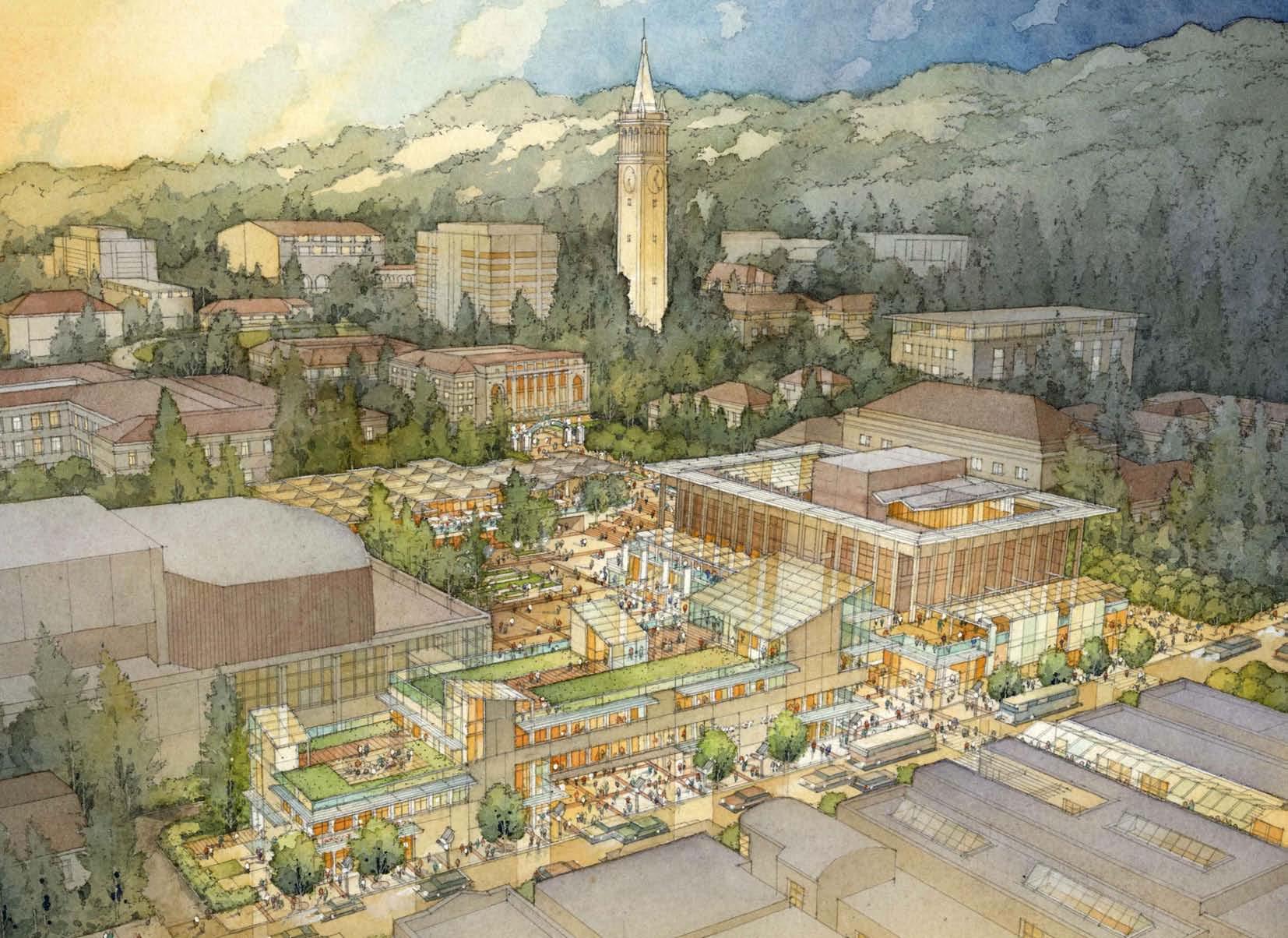
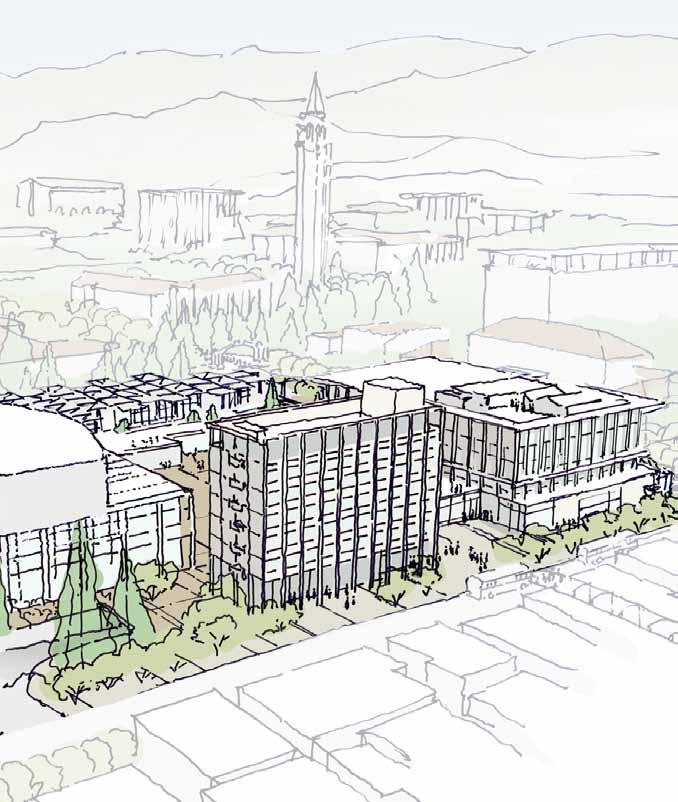
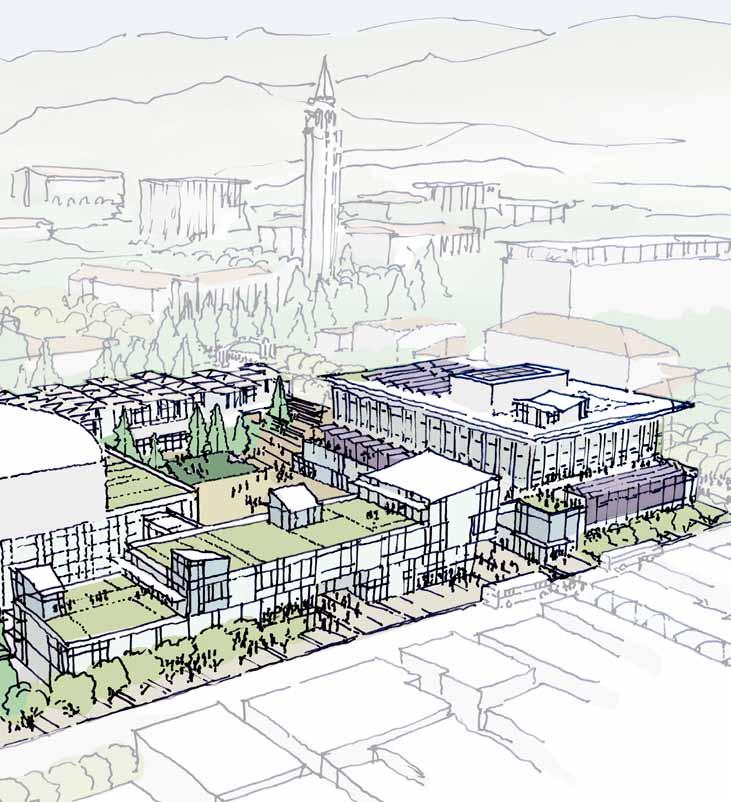
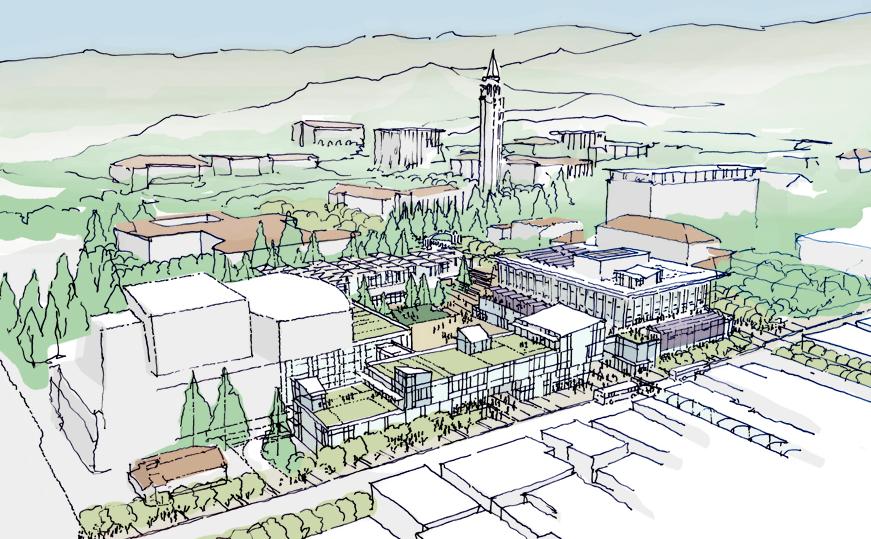
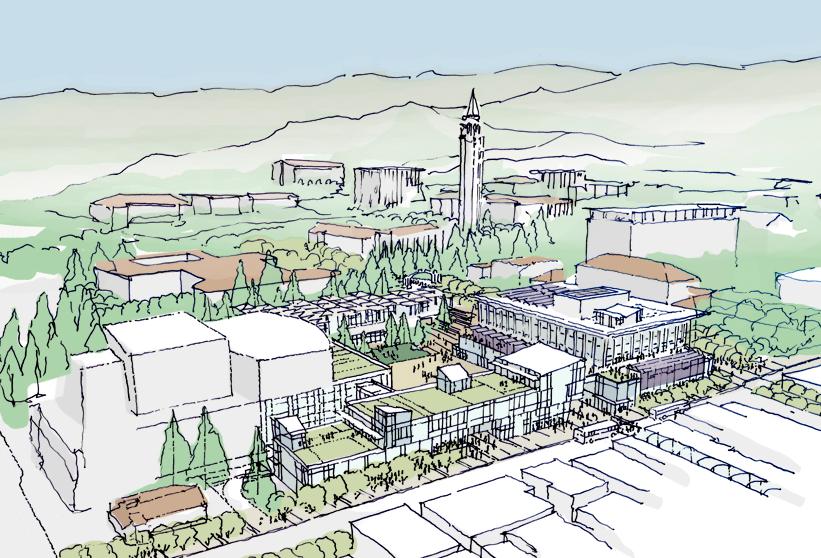
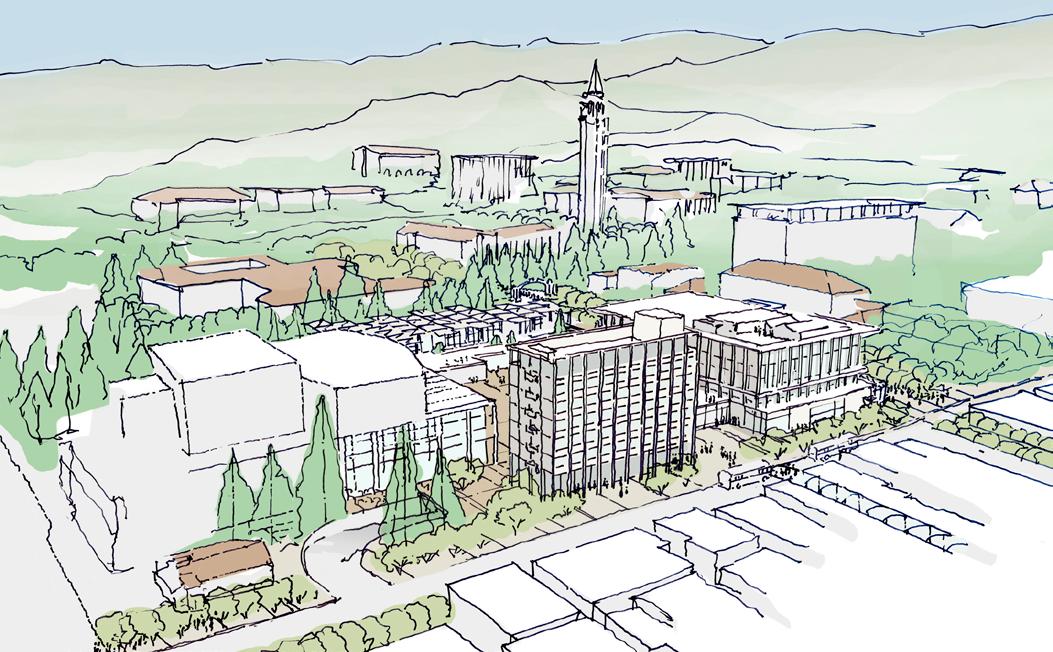
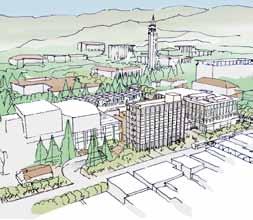
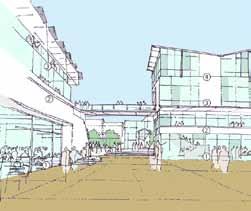
• Bird’s Eye View
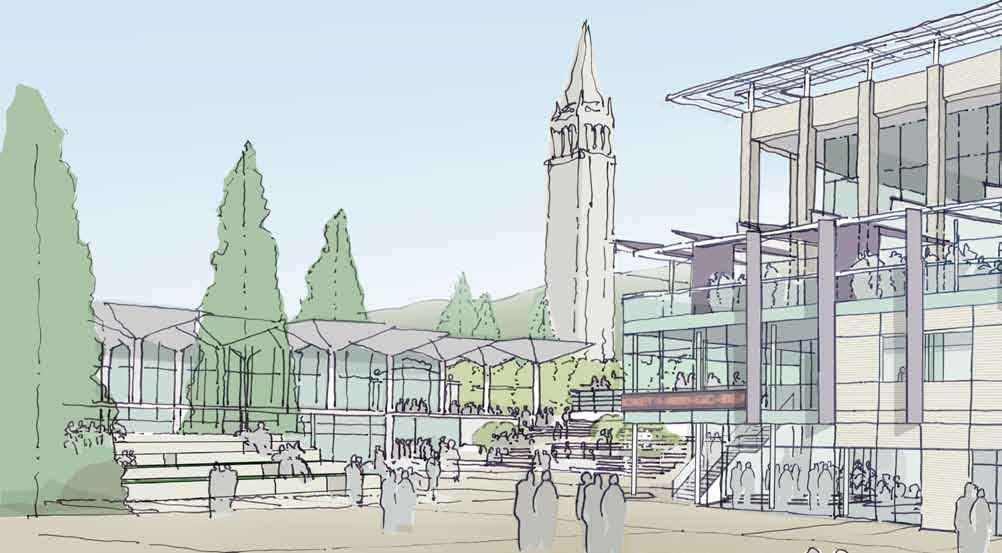
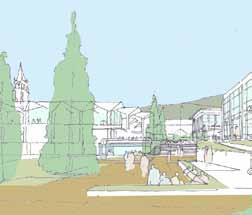
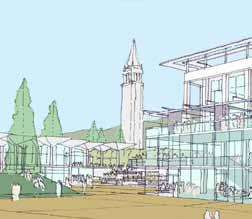
• Plaza to Campanile View
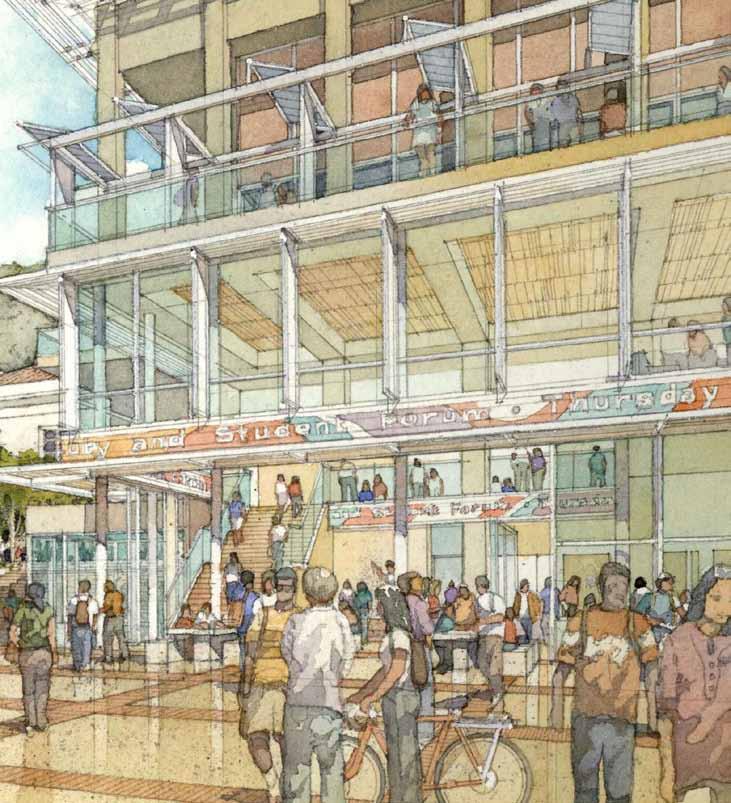
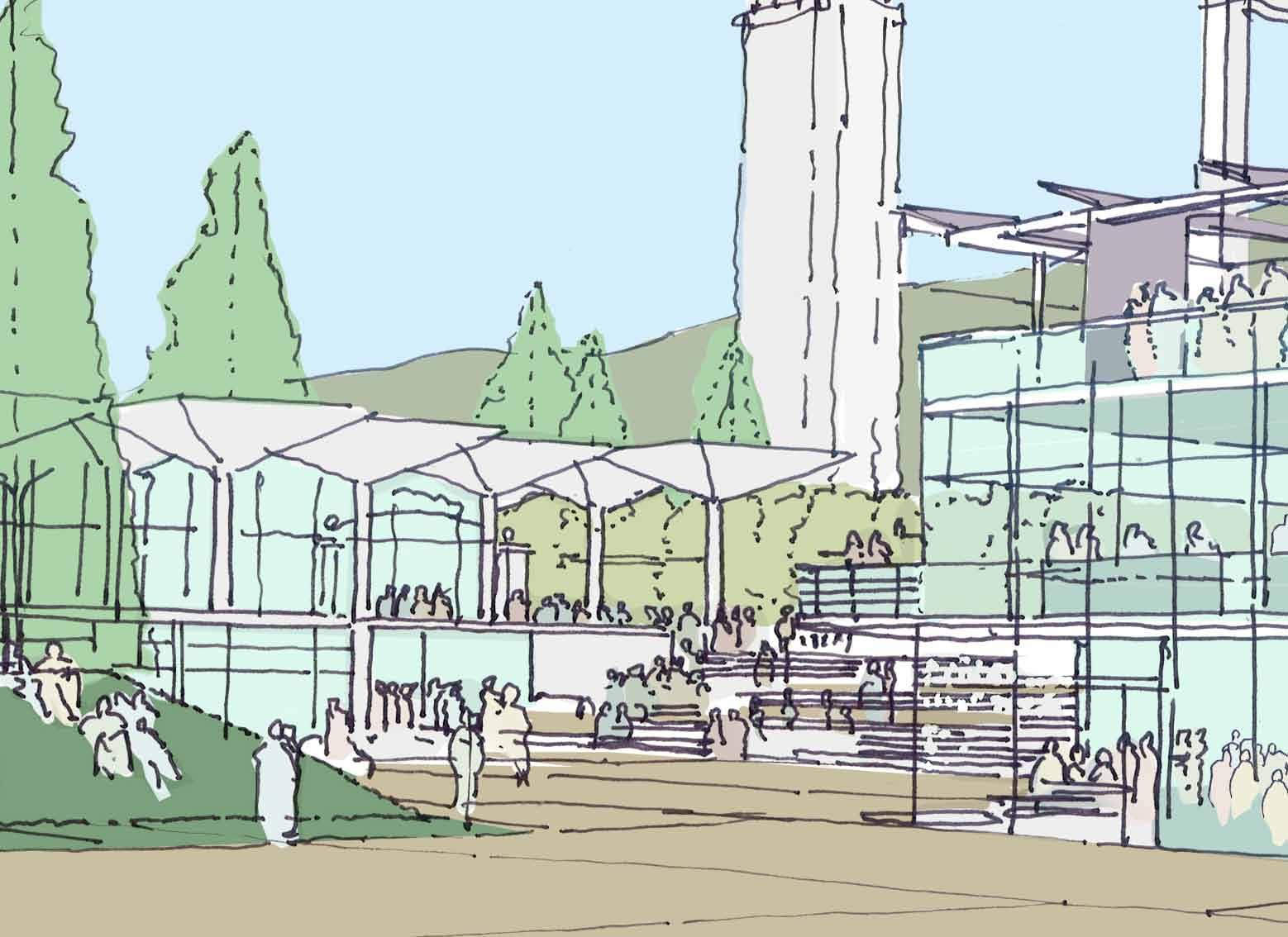
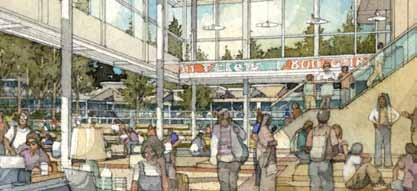
• Inside MLK to Plaza View
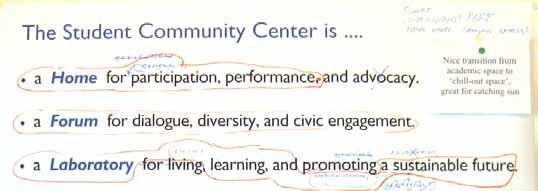
The Student Community Center is a…
• Home for renewal, participation, and performance
• Forum for dialogue, diversity, and civic engagement
• Laboratory for learning, living, and demonstrating a sustainable future
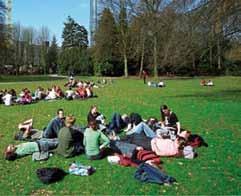
The new Student Community Center (SCC) is a student based initiative that calls for recasting the existing facility at Lower Sproul Plaza (LSP) into a revitalized and state-of-the-art facility rooted in sustainable practices. Both new construction and adaptive reuse combines to celebrate the legacy of its site and history while modernizing its infrastructure into a flexible armature to better accommodate the evolving needs of future generations of students.
The SCC is a home for renewal, participation, and performance. As a home it is an easily found destination that welcomes students and brings to them a sense of belonging, ownership, shelter, and safety where a variety of activities happen day and night. It is both a comfortable living room and an enticing dining venue where healthy, locally grown food is served or purchased from a daily farmer’s market. A choice of micro-climates whether it be full winter sun, dappled fall shade, or cozy interior perch, provide an environment for
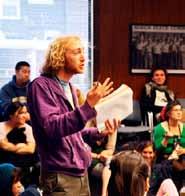
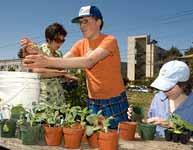
performing, socializing, meeting, or studying. Students will find a nurturing place for rest and relaxation that offers a renewal of spirit in a peaceful retreat for meditation and personal reflection. It is thus a place to meet friends and new acquaintances and get re-charged during the course of daily student life.
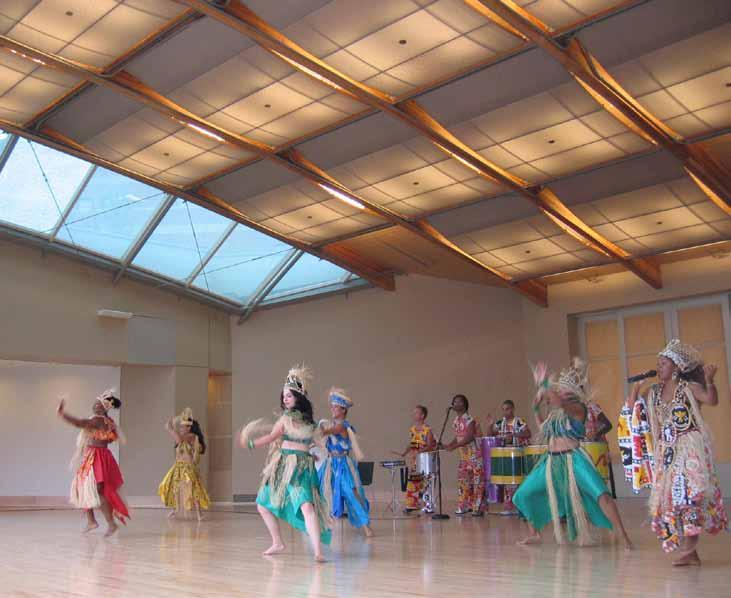
Awareness of Cal’s more than 700 student-run organizations is strengthened through better signage and digital information stations that encourage participation and involvement in student life. These diverse and active groups can “see and be seen” in highly visible, well lit, transparent spaces for working and meeting. Creative expression is also encouraged through music, dance and other student initiated exhibits and performance venues. Various indoor and outdoor spaces provide appropriate lighting, acoustics, and stage surfaces for both practice and presentation of student and commercial productions.
The SCC is a forum for dialogue, diversity, and
civic engagement. Purposeful and critical dialogue is a hallmark of the student experience at Cal such that its meeting rooms, seminar rooms, lounges, and larger venues offer places for the exchange of alternative ideas and appreciation for under-represented minorities and cultural groups. Cal’s activist legacy of advocating multicultural diversity is celebrated in the facility’s prominently located Multicultural Center where students can apply what they learn in the classroom about diversity, power, and grass roots community building while developing leadership skills for a multicultural world.
With the SCC’s location at the edge of campus, a much needed replacement for the aging Eshleman Hall serves as a threshold between campus and community, academics and commerce. Its permeable ground level façade along Bancroft provides an accessible gateway for students, administrators, and the general public. Various forms of civic engagement are evident in the transit hub
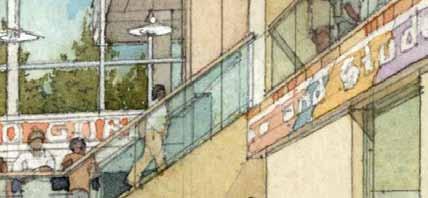
with its commuter lounge where both bus and bike riders access sustainable community services and absorb information on current events ranging from student government proceedings to local or world wide radio and TV broadcasts.
The SCC is also a laboratory for learning, living, and demonstrating a sustainable future. It is a place of inventive student-initiated experimentation where users experience flexible and innovative spaces with a hybrid of activities changing hourly, daily or monthly. Lounges and view terraces for meetings and relaxation transform into venues for dance performances or seminars. The transit hub waiting area becomes a farmers market and the textbook shop gives way to a career center, then to a student art gallery, and back again, all during a single semester. In support of the university’s mission of teaching, conducting research, and providing public service, the new center will conveniently include the Student Learning Center which is
the primary academic support service for Cal students. It is a dependable resource for assistance and encouragement with numerous programs that include tutoring, study groups, workshops, and leadership training.
Such learning support is facilitated in a wide range of comfortable offices, study areas, meeting rooms, and seminar rooms.
The center is a living example of the university’s willingness to embrace the three pillars of sustainable development (environmental stewardship, social justice, and economic fairness) by demonstrating through daily operations that involve conservation of energy and water use, bicycle sharing and repair, energy generation from photovoltaic panels, marketing fair trade goods and locally grown organic produce, and the filtration of stormwater that feeds Strawberry Creek.
As stated in previous university sponsored studies, the existing Lower Sproul Center is
in need of programmatic and physical redesign in order to provide undergraduate and graduate students with a high quality facility for student life appropriate for today’s environment at Cal. Moreover, the new Student Community Center acknowledges its location as the threshold between campus and community, and academics and commerce. As one of the main entrances to the campus, it projects the values of the university while being a good neighbor to the city. It embodies the spirit and aspirations of the students and visitors and celebrates the campus tradition of inclusive multiculturalism and the protection of free speech. The SCC also embraces the movement towards a sustainable future where awareness of our ecological challenges is prominently featured through operational practices that support good stewardship of the environment.
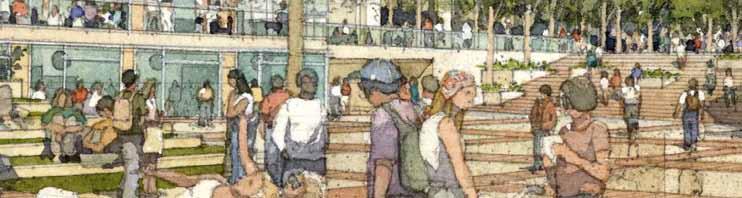


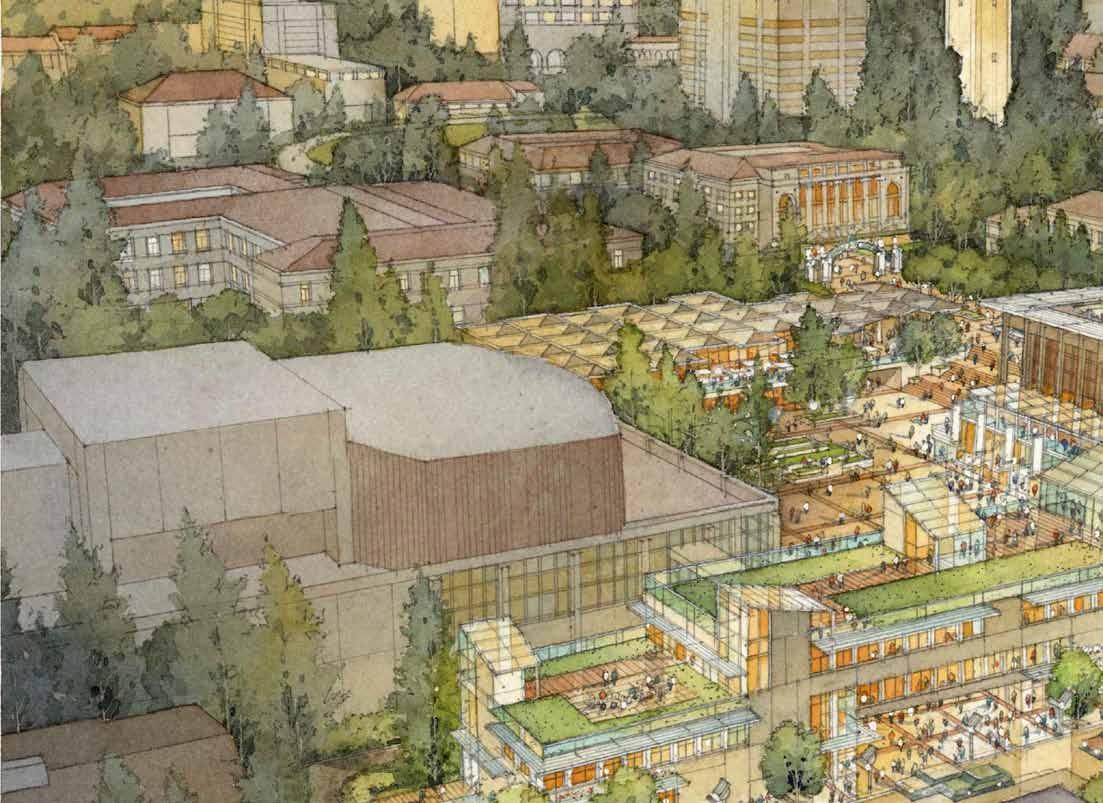
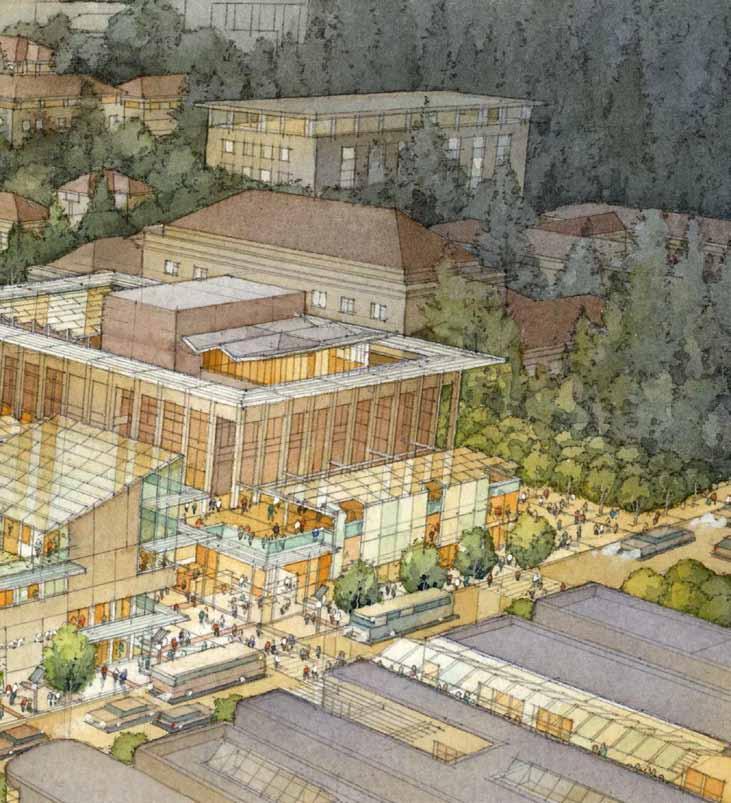
Bird’s Eye View
• Threshold between campus and community, academics and commerce
• An accessible gateway for students, administrators, and the general public
• Transit hub with commuter lounge
• A center for sustainable community services and information exchange
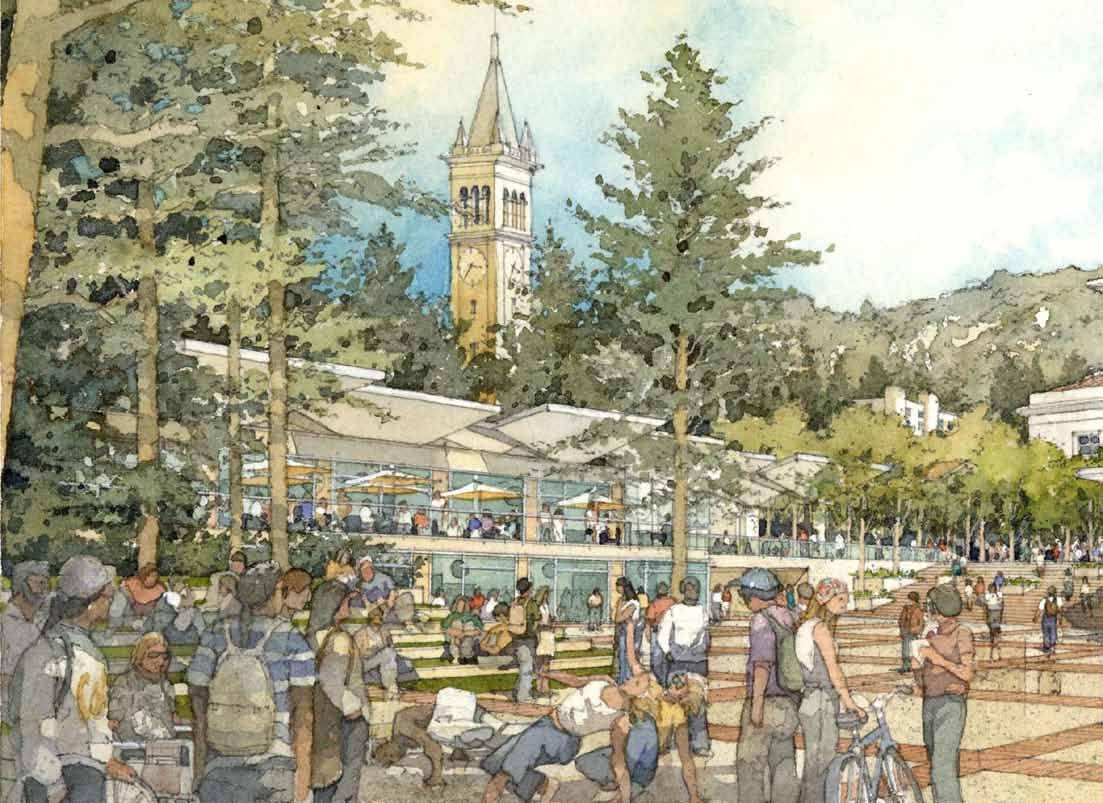
• An easily found destination for students
• A place with full winter sun or dappled fall shade
• An environment for performing, socializing, meeting, or studying
• A nurturing place for rest and relaxation
• A place where you expect to meet your friends
• A safe place for day and night activity
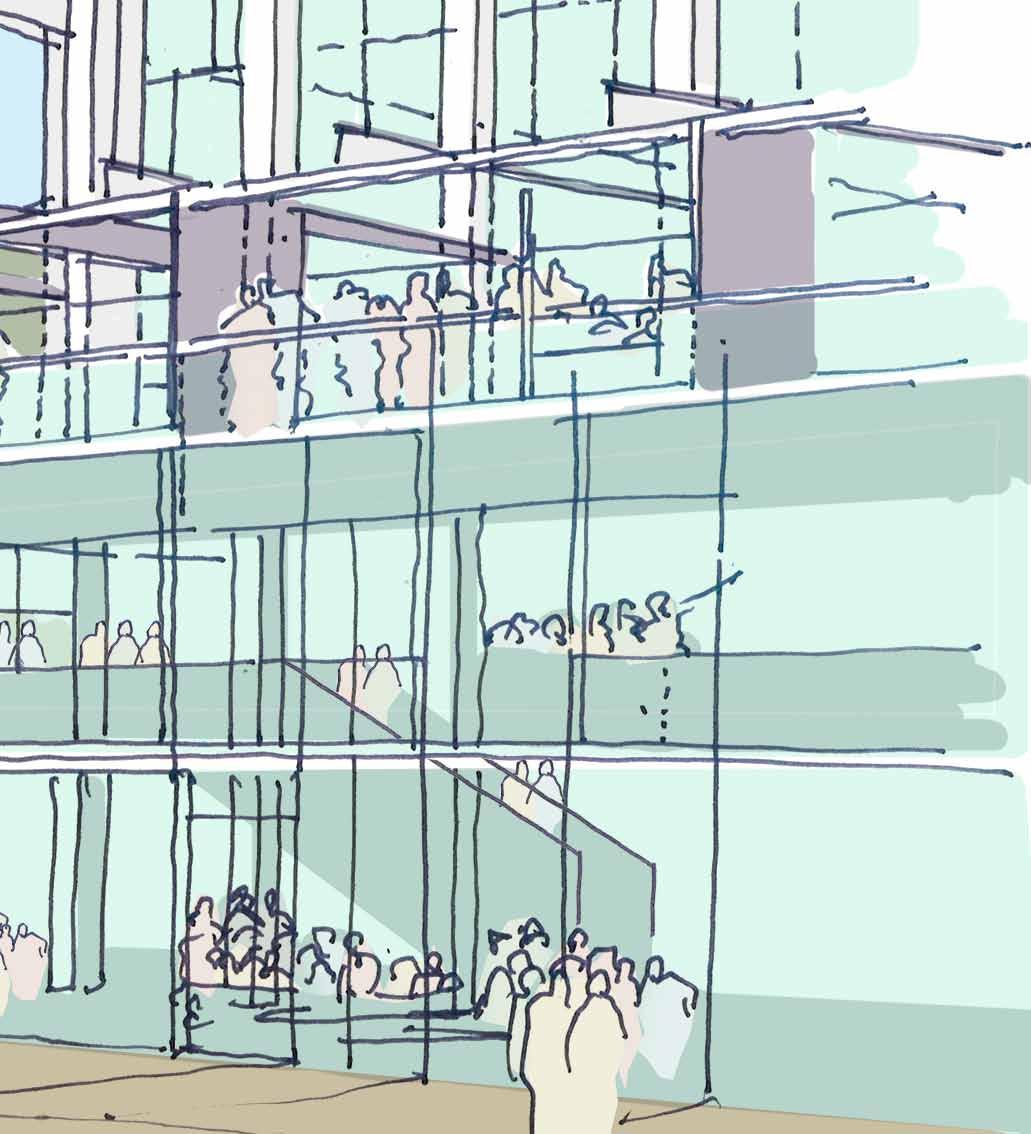
Inside MLK to Plaza View
• A place of inventive student-initiated experimentation
• Flexible and innovative spaces changing hourly, daily or monthly
• Lounges and view terraces for meetings and relaxation
• Venues for dance performances or seminars
• An information center to strengthen student-run organizations
• A forum for dialogue, diversity, and civic engagement
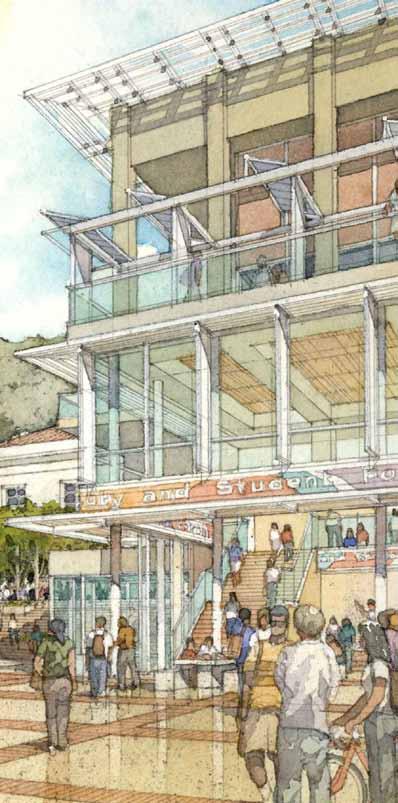
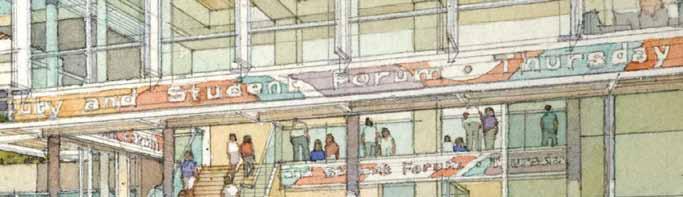
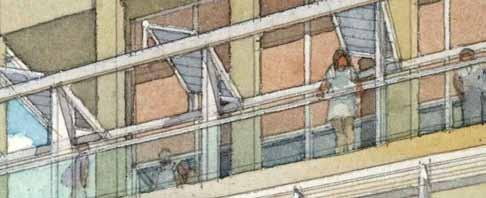
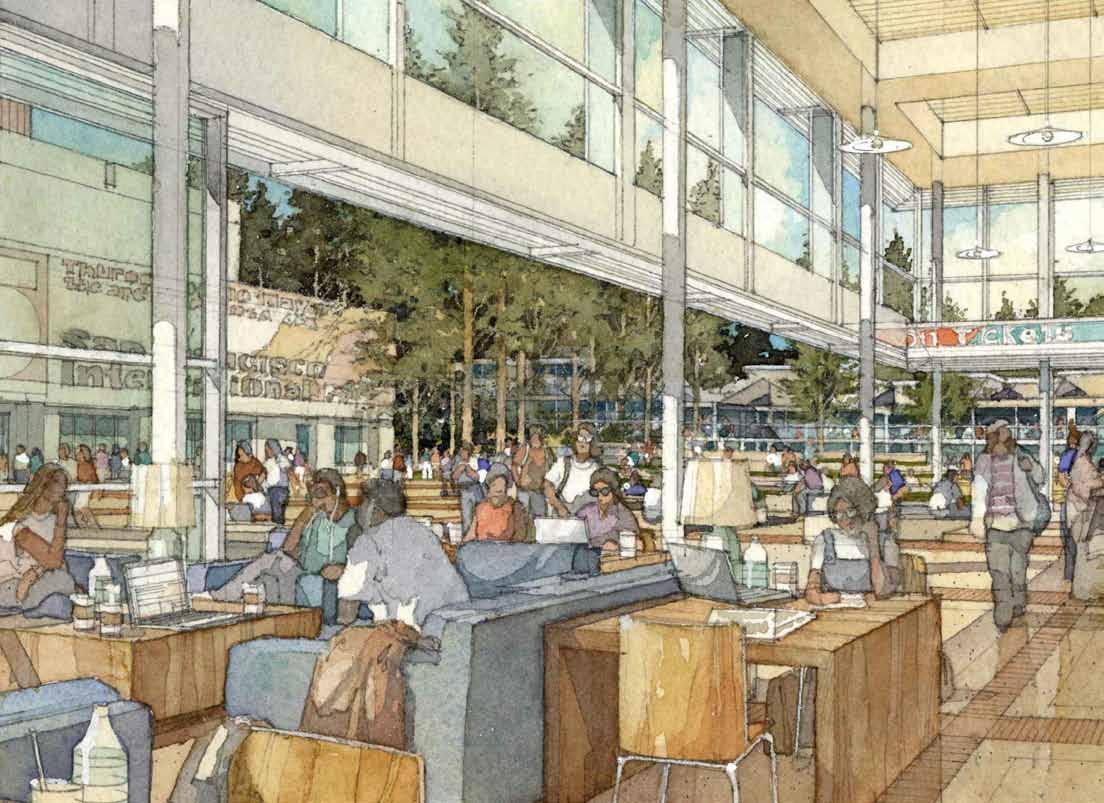
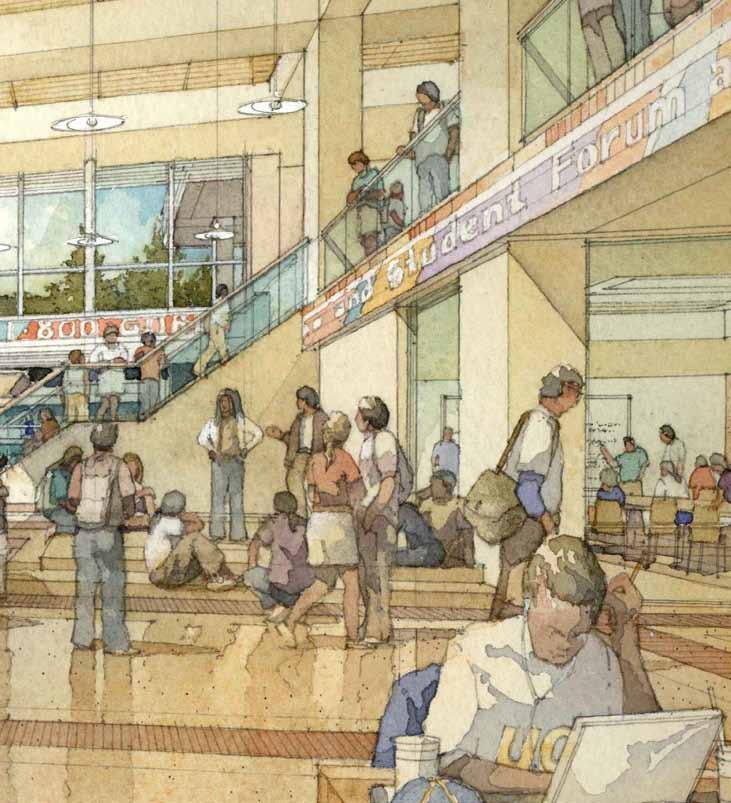
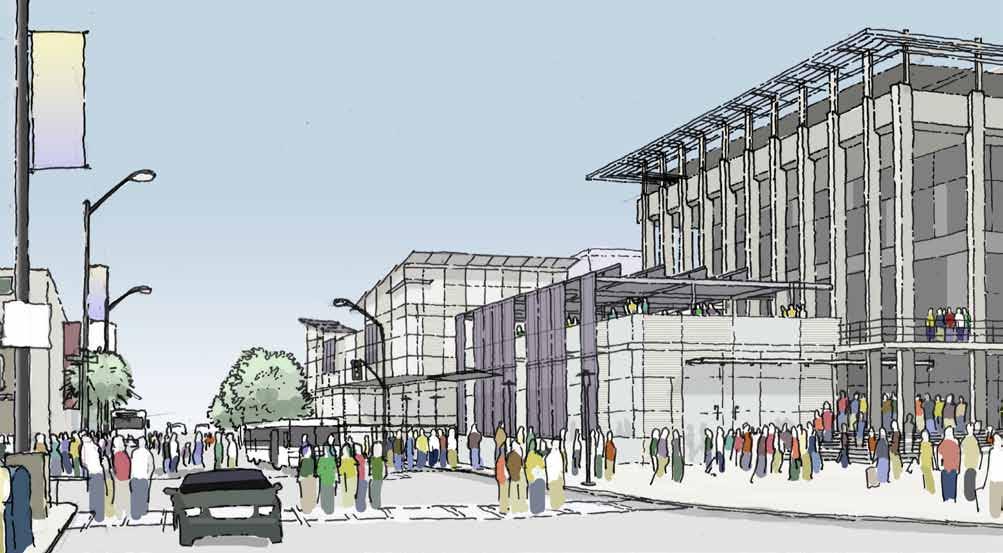
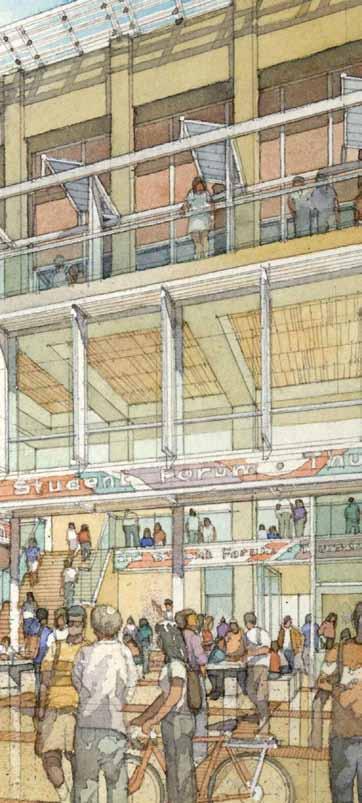
MLK addition features a 2-story indoor-outdoor lounge for meeting, studying, practicing, or performing
Conceptual Design
• Interventions and Transformations
• Conceptual Program
Sustainable Design
• Linking to the Surrounding Environment
• Key Principles
• Global & Regional Linkages
• Integrated Applications
Accessibility
• Existing Condition
• Proposed Improvements
A Day in the Life of a Student
This study provides the campus with a renovation plan for revitalizing Lower Sproul Plaza, long identified as in need of programmatic and physical redesign, to give the students a high quality center for student life with a mixture of services including retail, dining, meeting and performance venues, and space for student organizations and student government.
The SCC is a gateway for students, faculty, and visitors. A transit center on Bancroft Way, a bustling neighborhood retail street, will reinforce 24/7 activity. The north site boundary is defined by Strawberry Creek, a thriving riparian ecosystem. The master plan reinforces visual connections to the city, creek and campus landmarks and encourages pedestrian movement and outdoor gathering. Sustainable design elements are made visible and tangible and include a storm water filtration garden, green roofs, photovoltaic shade panels and operable windows for natural ventilation.
The preferred scheme calls for a series of careful interventions combined with adaptive reuse of approximately 190,000 gsf of existing buildings and approximately 95,000 gsf of new construction. The seismically “poor” 8-story Eshleman Hall will be replaced with
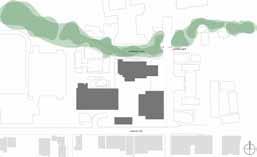
Before: Existing Conditions
a lower, more porous, 4-story design that, as in the other existing building renovations, will have built-in flexibility for the sharing of spaces between the many types of studentrun organizations. King Student Union will be transformed from its current imposing solidlike mass back to its original design intent; a transparent glass pavilion presenting an active and open public face on all sides. Chavez Student Center will be re-programmed with large lounge spaces opening up to dramatic views of the redwood trees along Strawberry Creek. Underneath the renovated plaza deck, the existing garage will remain and provide convenient vehicular access for service vehicles and disabled visitors with parking for 80 cars.
The recent seismic improvements to MLK and Chavez will be incorporated into the preferred scheme with an effort to minimize revisions to any of this work. The existing mechanical, electrical, and plumbing systems will be mostly removed and replaced with improved, highly efficient systems that will meet the project’s sustainable energy efficiency goals.
Civil Engineering and Landscape Architecture will enable storm water to be captured, filtered, and re-used before allowing the site’s drainage to flow into the ground or nearby Strawberry Creek.
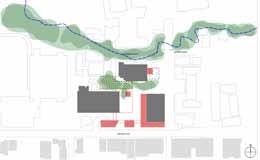
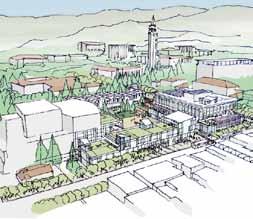
After: Proposed new Student Community Center
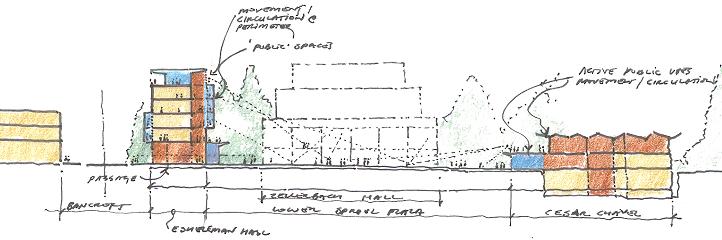
Rated seismically “poor”, Eshleman will be demolished and replaced with a lower building with improved linkage between Bancroft and the Plaza. Eshleman Replacement will provide larger areas of contiguous assignable space for greater program flexibility.
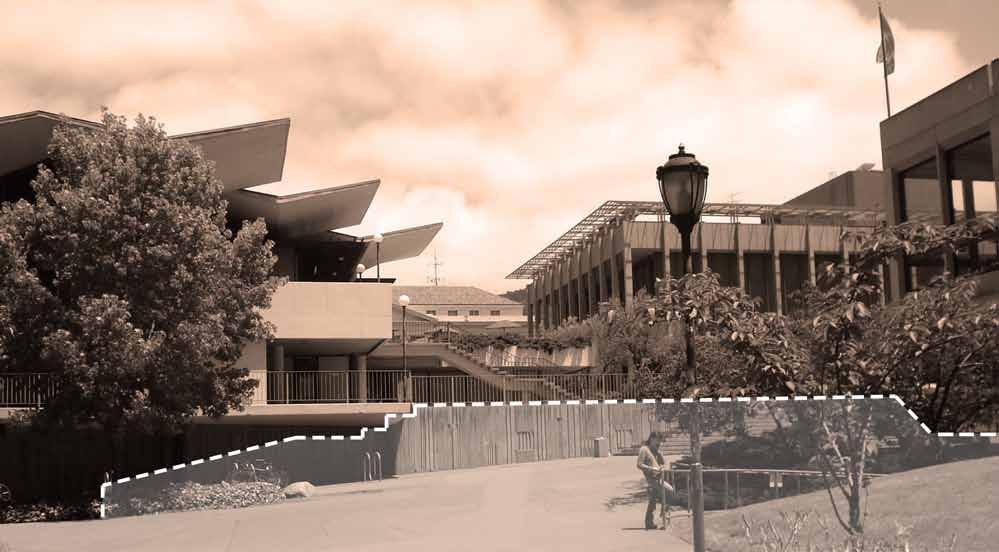
The MLK building will be fully renovated. Two story building additions on the west and south sides will add much needed assignable space including an accessible outdoor terrace adjacent to Pauley Ballroom and its nearby meeting rooms. King’s facade will be transformed from its current imposing wall-like mass to its original design vision; a transparent glass pavilion presenting an active and open public face on all sides.
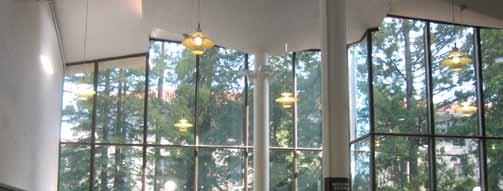
Chavez will be renovated to restore dramatic views of the redwoods along Strawberry Creek and extend these views to Student Community Center Plaza. Program uses com-
patible with its architecture would maximize its potential as a campus amenity.
The Plaza deck above will be reconstructed in order to accommodate larger trucks, support landscape parterres, and to allow for additional building space at the King and Eshleman Replacement buildings. At the Garage level there could be a Student Events Center programmed for use as a student performance / practice facility and a place for meetings, concerts, parties, lectures, and multi-media presentations. The Center’s location would benefit from the convenient accessibility provided by a new elevator connecting it to the SCC and Sproul Plazas above.
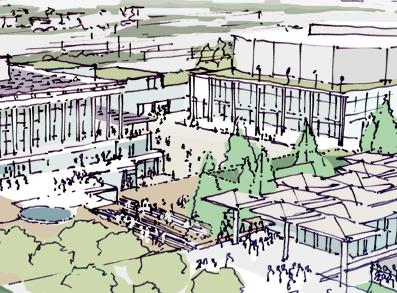
At the plaza level an inner ring of activity contains a mix of retail and student serving programs to create a transparent fabric that is activated 24/7. Multiple upper level terraces and bridges serve to support this high degree of vitality.
• A key point of visual district orientation is afforded by the consolidation of the east end of Chavez
• Simultaneous views to Strawberry Creek, Sather Gate, Sproul Hall and the Student Community Center are opened up
• New elevator connects existing Sproul Plaza to the proposed SCC Plaza and Student Events Center below at the Garage Level
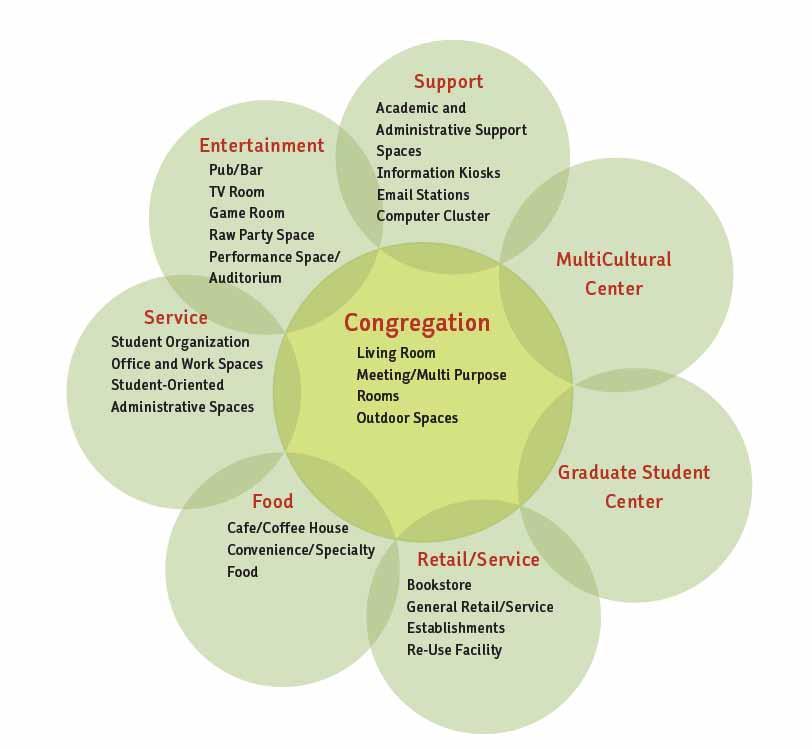
This project is based on the premise that a student’s collegiate experience benefits from having a balance of both academic and social activities. The students could be significantly involved in academics, but also spend time on campus interacting with faculty and participating in student organizations and activities. Previous studies in 2007 carefully identified a grouping of activities that could have the kind of synergies that would result in a facility greater than the sum of its parts. Such activities or programs are categorized below and shown in the Program Diagram on this page:
Program Synergies
• Academic / Admin. Support
• Congregation
• Retail / Service
• Food
• Student Organizations
• Entertainment
• Revenue generating program – Program elements that generate revenue will allow SCC to be financially sustainable as a vibrant student center
• 24/7 retail and program elements - Active day and nighttime use is encouraged by late-night or “24/7” type operations
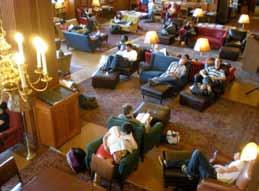
• Unprogrammed congregation – Students want indoor and outdoor spaces to hang out and study - where they can feel at home. A place where students can relax, feel safe, comfortable and welcome.
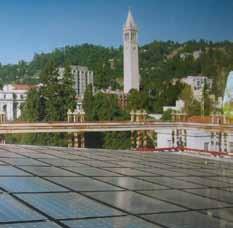
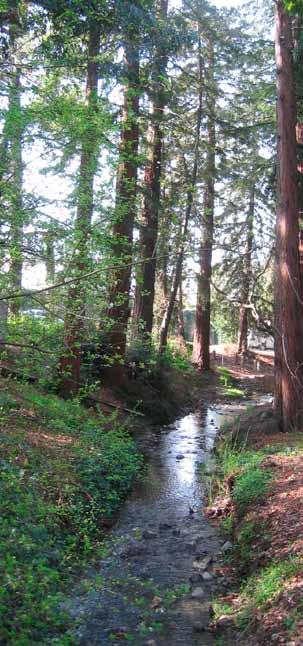
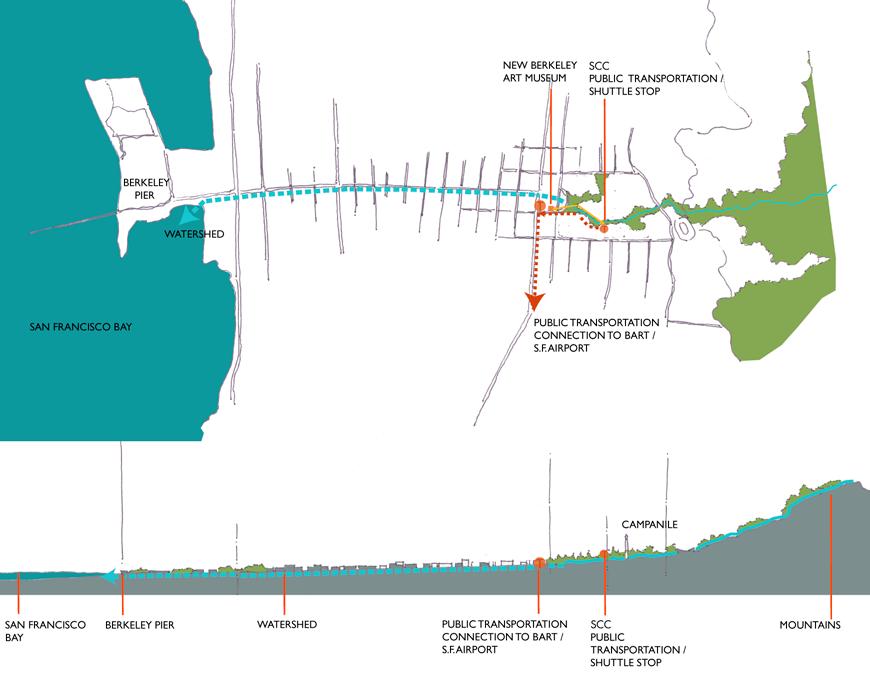
Principles
The revitalized Student Community Center will make water, resource conservation and a heightened relationship to Strawberry Creek hallmarks of an extensive sustainable design program.
Key Sustainable Principles:
Water is a hallmark – From the planting of green roofs, storm water collection, storage and reuse, to the creation of bio-swales and a renewed connection to Strawberry Creek, water is a recurring theme. A Rain Garden will celebrate the flow, filtration and slow release of storm water into Strawberry Creek.
Sustainable design elements are integrated throughout the project and are made visible as demonstrations of evolving technologies.
Ground floor retail may include space to serve as resource center and public forum for events. A place to inform, educate and converse for students and the broader community.
New retail frontages and entrances on Bancroft and Lower Sproul Plaza will enliven the public and commuter experience. Bicycle parking will be distributed at grade for ease of use and safety.
The adaptive reuse and additions to MLK and
Chavez demonstrate a commitment to the conservation of resources, history and physical memory. Renovated and new buildings will harness energy and water conservation technologies such as energy efficient thermal envelopes, low flow plumbing fixtures and smart systems controls.
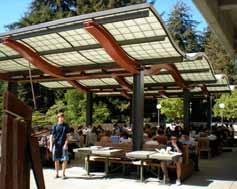
Building surfaces and canopies clad with photovoltaic (PV) panels will generate electricity and also provide shade over outdoor areas and glazing. Rain water will be collected, stored and reused.
Occupants will have improved control over their environment by using both low tech and high tech means such as operable windows, demand activated controls, occupancy sensors and CO2 monitors.
Flexible planning will allow the Student Center to adjust to evolving program and student needs. Creating programmable circulation, lobby and outdoor spaces provides a multiplier effect – increasing flexible gathering space and program support beyond simple assignable area calculations.
The mid-century optimism and vision of the Student Center will be restored to meet the new demands of students and UCB stakeholders.
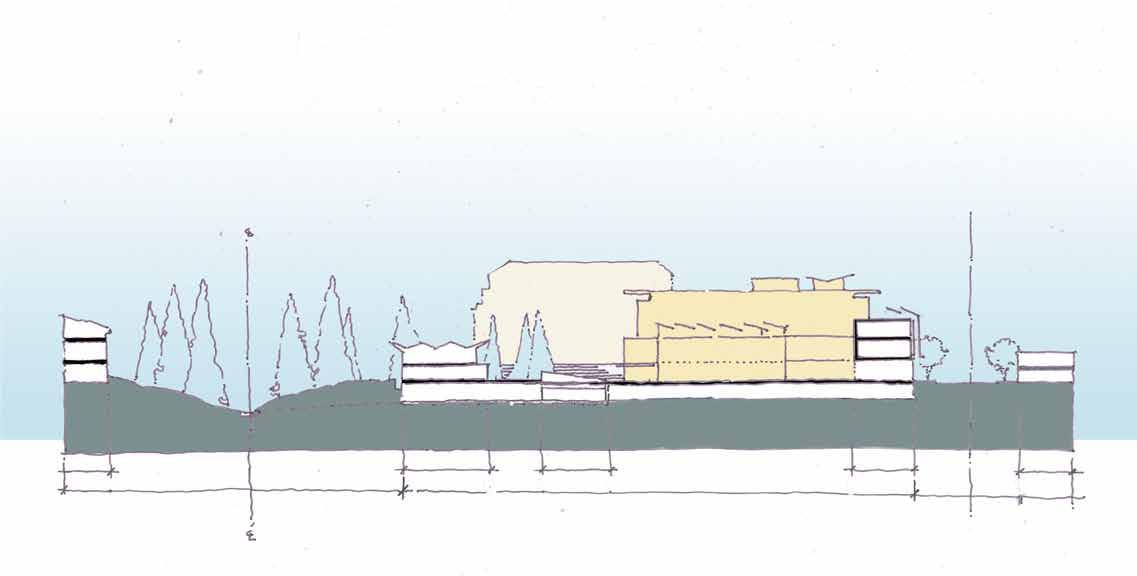
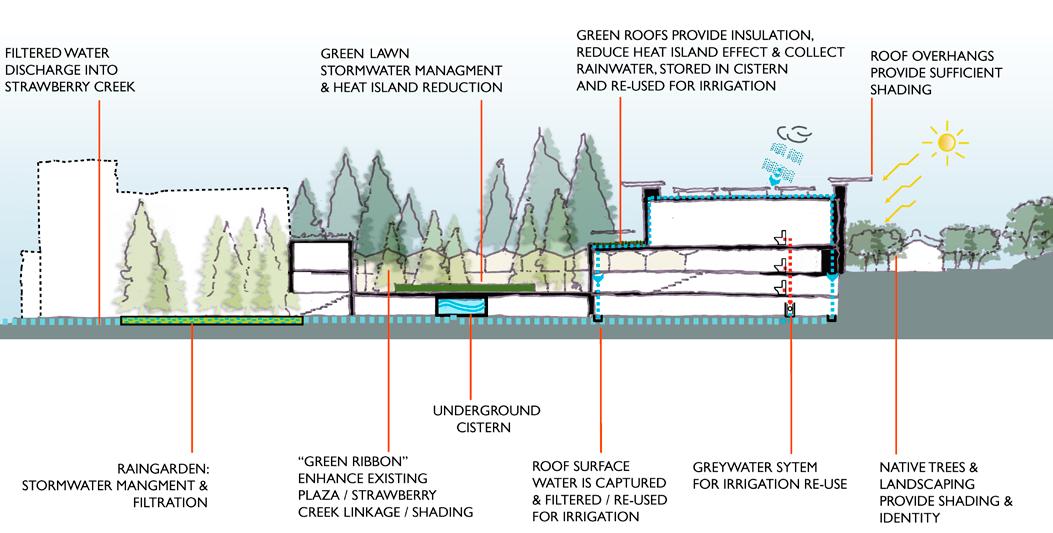
STRAWBERRY CREEK: IMPROVEMENT & DAYLIGHTING OF EXISTING WATER BODY
GREEN LAWN: STORMWATER MANAGMENT & HEAT ISLAND REDUCTION
PASSIVE / NATURAL VENTILATION
GREEN ROOFS PROVIDE INSULATION, REDUCE HEAT ISLAND EFFECT & COLLECT
RAINWATER, STORED IN CISTERN AND RE-USED FOR IRRIGATION


INTEGRATED PV / SHADING ELEMENT
Section Looking East
RAINGARDEN: STORMWATER MANGMENT & FILTRATION
UNDERGROUND CISTERN
PV PANELS CONVERT SUNLIGHT TO ELECTRICITY & SHADING
GREYWATER SYTEM FOR IRRIGATION RE-USE

NATIVE TREES & LANDSCAPING PROVIDE SHADING & IDENTITY
1 Adaptive Reuse of MLK and Chavez
Clear commitment to resource conservation and the preservation of cultural memory. Replace 50 - year - old MEP equipment with new energy efficient systems.
2 Solar Harvesting
Roof canopies and shade structures clad with laminated glass photovoltaic (PV) panels will provide both shelter and “power” for outdoor student spaces.
3 Green Roofs and Roof Gardens
Green Roofs and Roof Gardens provide insulation, capture slow and filter stormwater, reduce the urban “heat island” effect and make the project’s sustainable approach visible.
4 Permeable Surfaces / Stormwater Management / Improvement Strawberry Creek
Stormwater run-off is managed by increasing permeable surfaces to percolation, as well as capturing, filtering and storing rainwater and increasing percolation. This system’s linkage to Strawberry Creek creates awareness and educates people about the local environment and natural habitats.
5 Rain Garden
A Rain Garden will be designed to slow and filter the Student Community Center storm water flows before discharging into Strawberry Creek.
6 Linking to Public Transportation
A shuttle stop and transportation links pedestrians and cyclists to local, regional and international transportation.
7 Campus & Community Connectivity
Pedestrian entrances and crossing paths are reinforced, visible, and designed to allow for impromptu social gathering.
8 High Performence Building Envelope
Insulated Low - E glazing combined with appropriate shading applications filter daylight, reduce heat gain and energy consumption.
9 Water Use Reduction, Storage & Recycling
Low - flow plumbing fixtures will reduce water use and waste water discharge by 40%. Rainwater will be captured on roof and plaza surfaces, stored in an underground cistern and re-used for irrigation.
Materials & Resources
Recycled, regional materials with low VOC content limit overall energy footprint and improve Indoor Air Quality.
Daylight & Lighting
Design to allow and control daylight access. Incorporate occupancy sensors and controls to reduce artificial lighting demand as much as possible.
Climate Control
Design and incorporate passive ventilation strategies, i.e. operable windows, shading and glare control, provide sufficient fresh air circulation and optimize comfort for building occupants.
Entries to the plaza and its buildings will be redesigned so that they are made accessible to everyone.
• New path, ramp, and elevator at the northeast corner near Ludwig’s Fountain
• New path and ramp at northwest corner between Zellerbach and Chavez
• Improved paths and a new entry portal serving the transit center along Bancroft Way.
Students most-likely will arrive from the south side of campus by walking, riding the bus, or biking up to the busy block of Bancroft Way between Telegraph Ave. and Dana Street. Once there, they engage a vibrant street scene lined with commercial, campus, and civic facilities ranging from cafes, transit oriented retail, and venues for student-run organizations. There are accessible passageways with views into the plaza, Zellerbach Auditorium, the historic Chavez building, and the redwoods of Strawberry Creek beyond. These portals lead into the large plaza that is filled and ringed with a range of student centered activities such as dance, music, political discourse, dining, studying and meeting with friends.
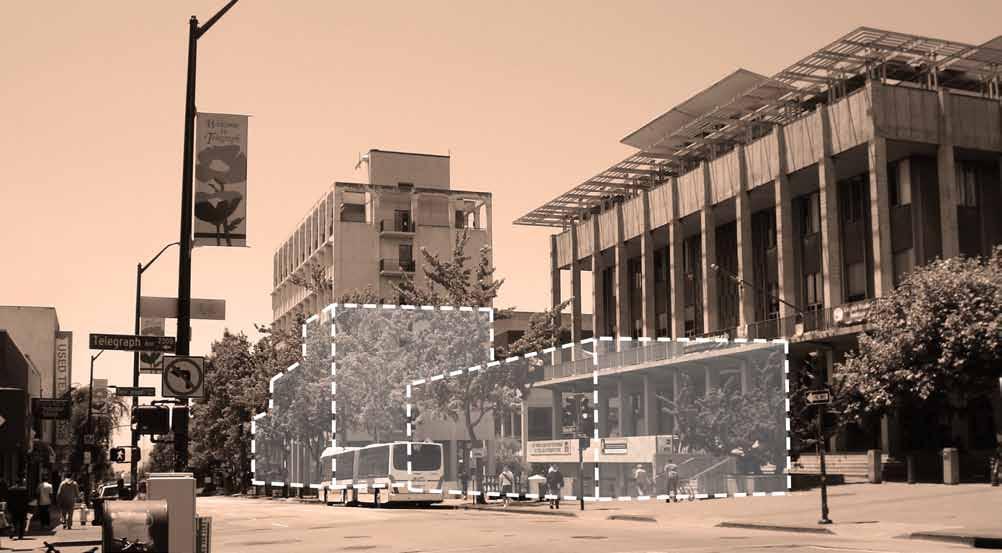
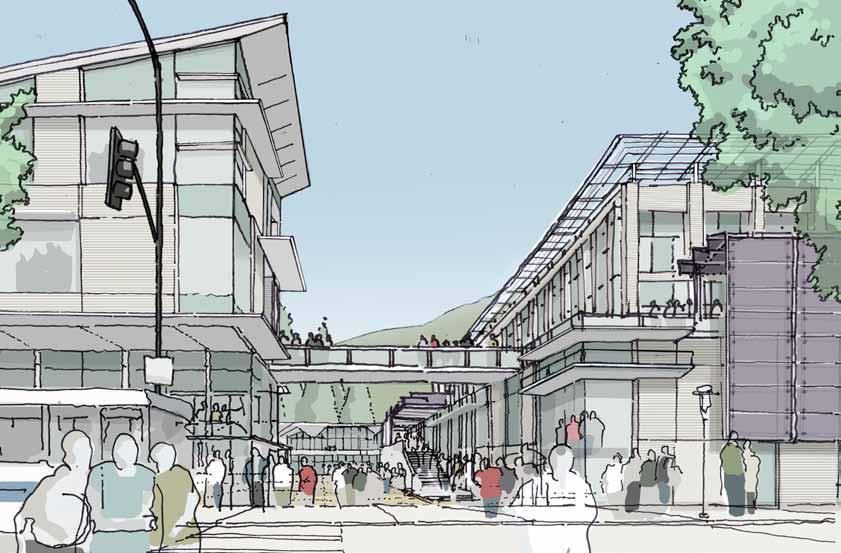
Existing Condition: Intersection of Bancroft Way and Telegraph Avenue looking west
ACCESSIBLE ROOF
NEW 2 STORY ADDITION
PHOTOVOLTAIC PANELS
ESHLEMAN REPLACEMENT BUILDING

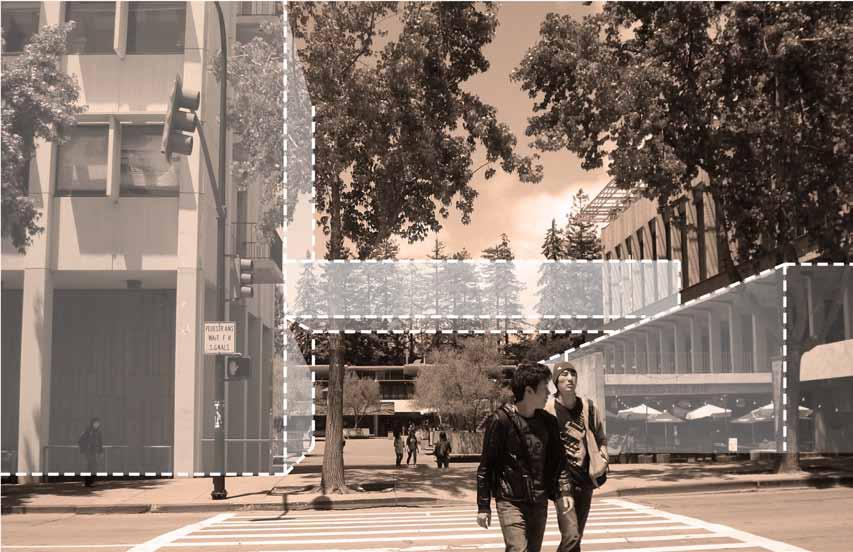
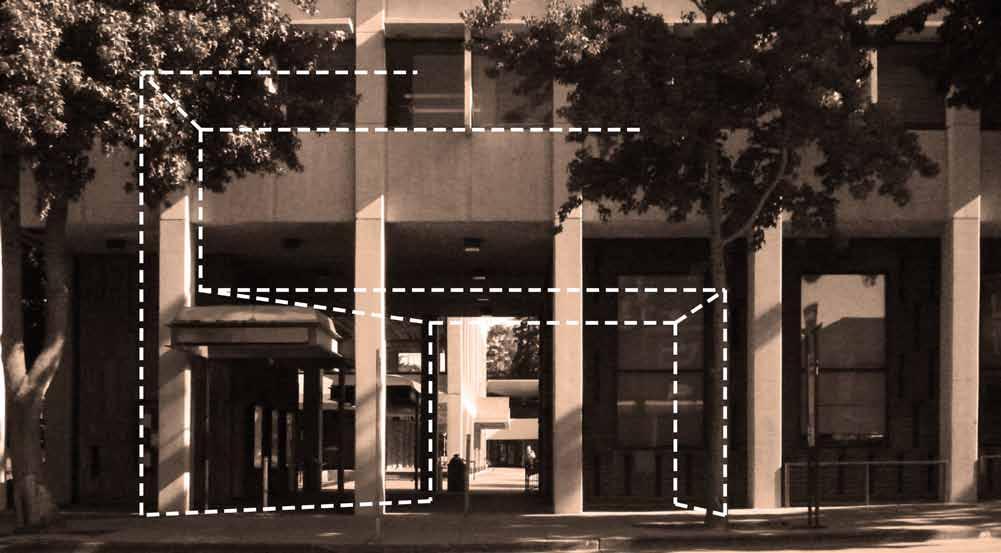
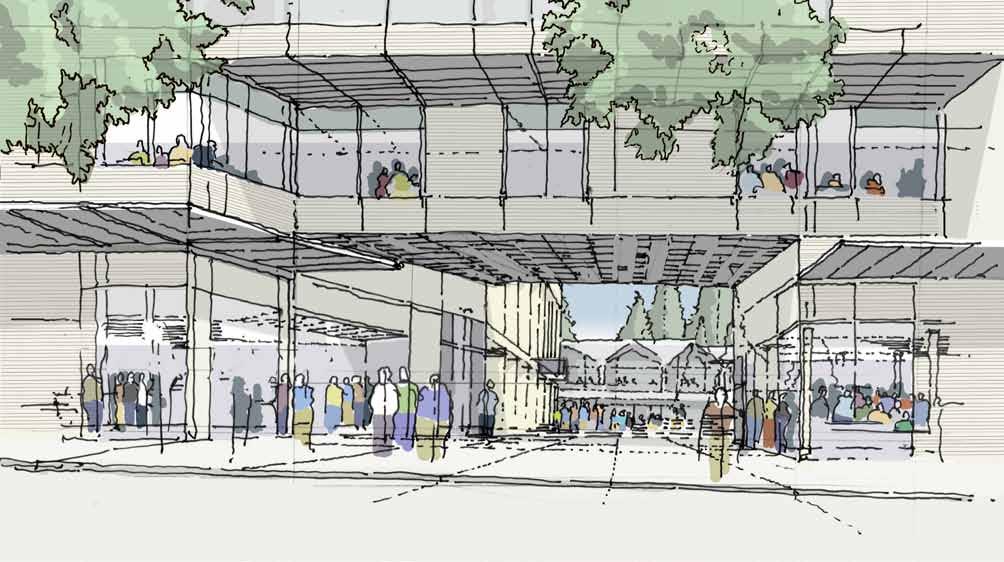
Existing Condition: Entrance to Plaza along Bancroft Way at Telegraph Avenue looking north

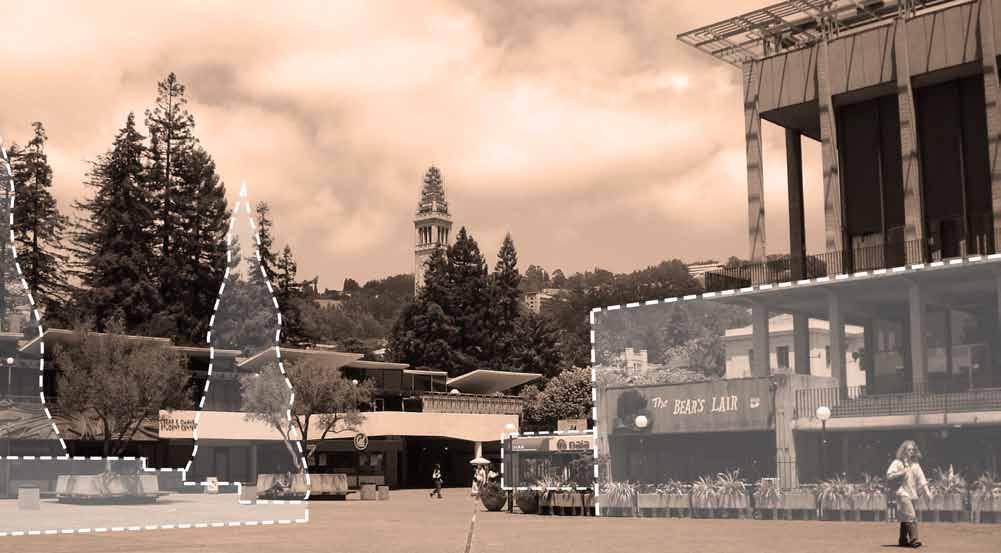
A place to see and be seen
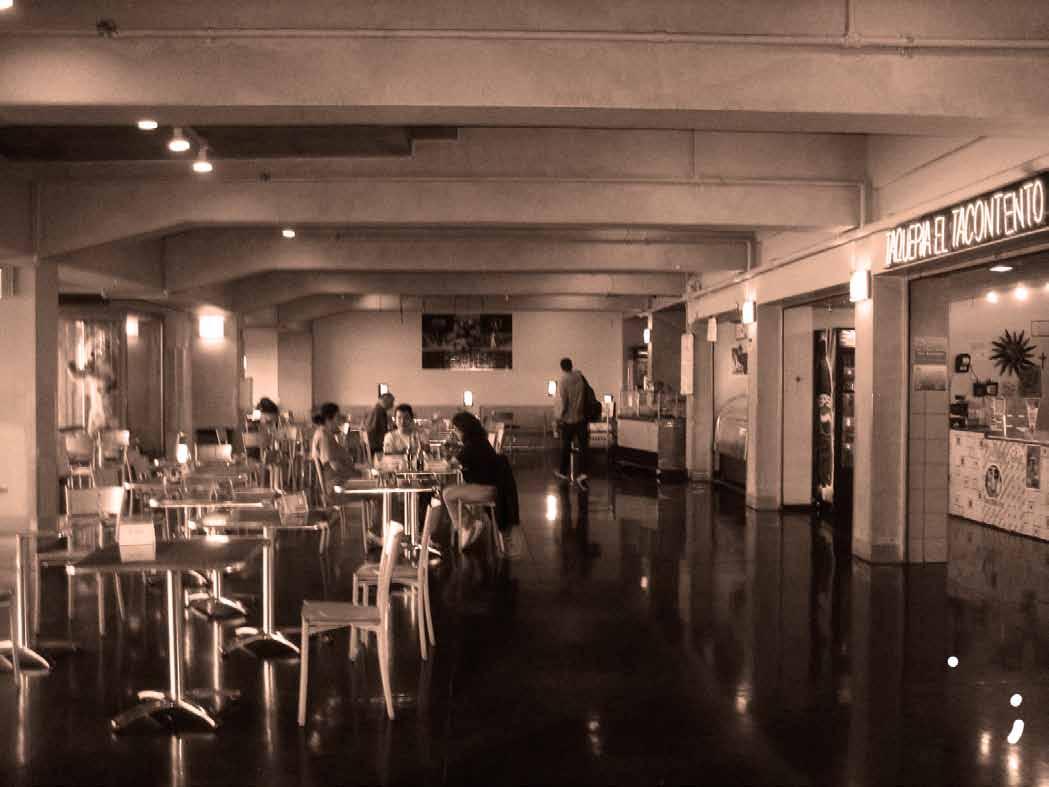
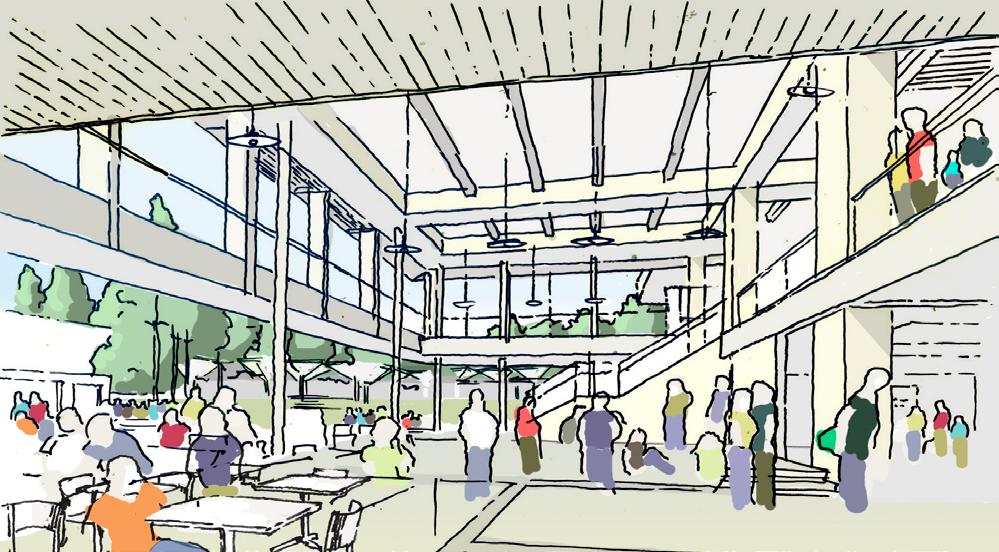
5 Proposed: MLK addition features a 2-story indoor-outdoor lounge for meeting, studying, practicing, or performing
north-east birds-eye view
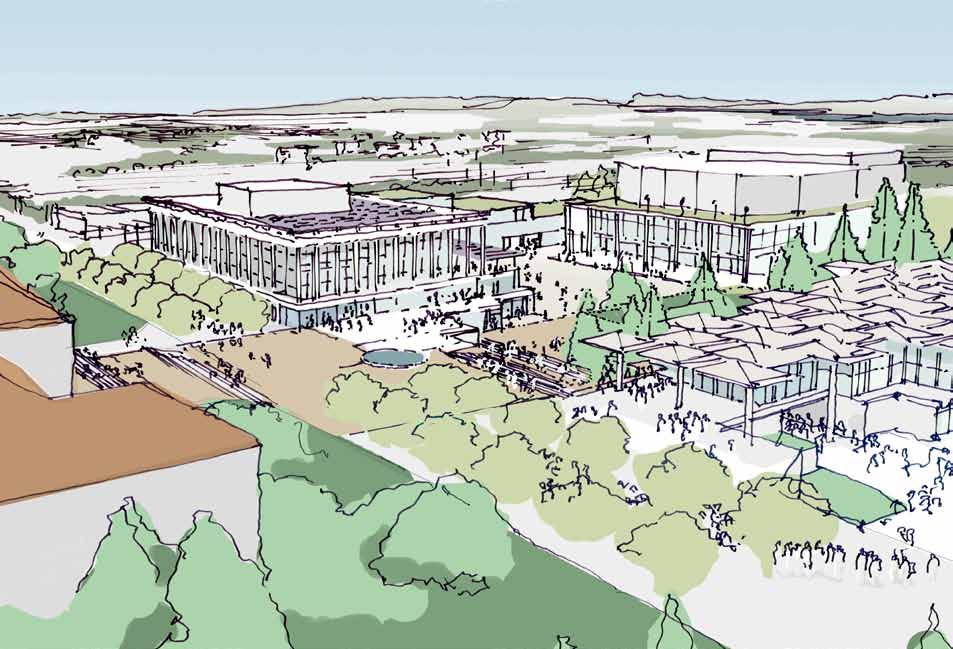
ESHLEMAN REPLACEMENT WITH PASSAGEWAY TO BANCROFT WAY
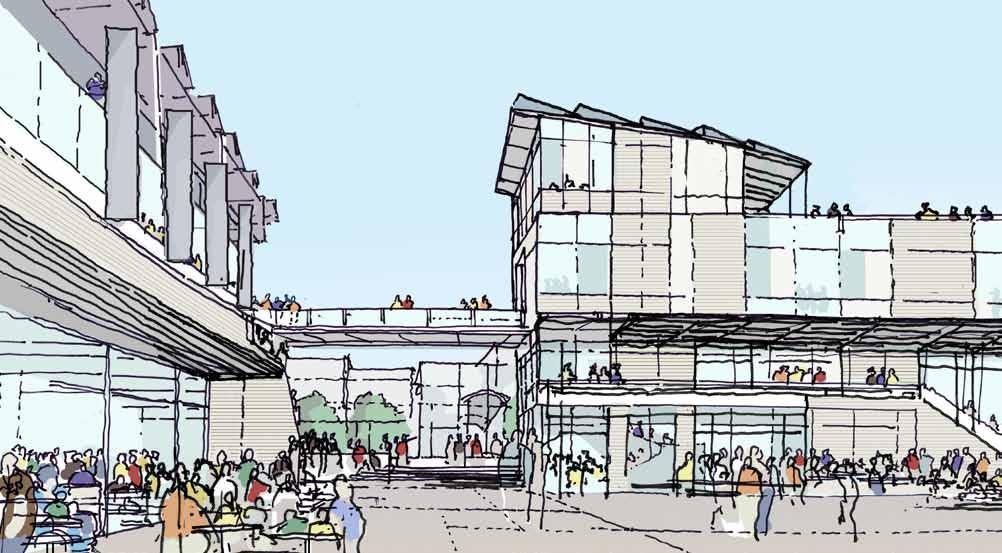
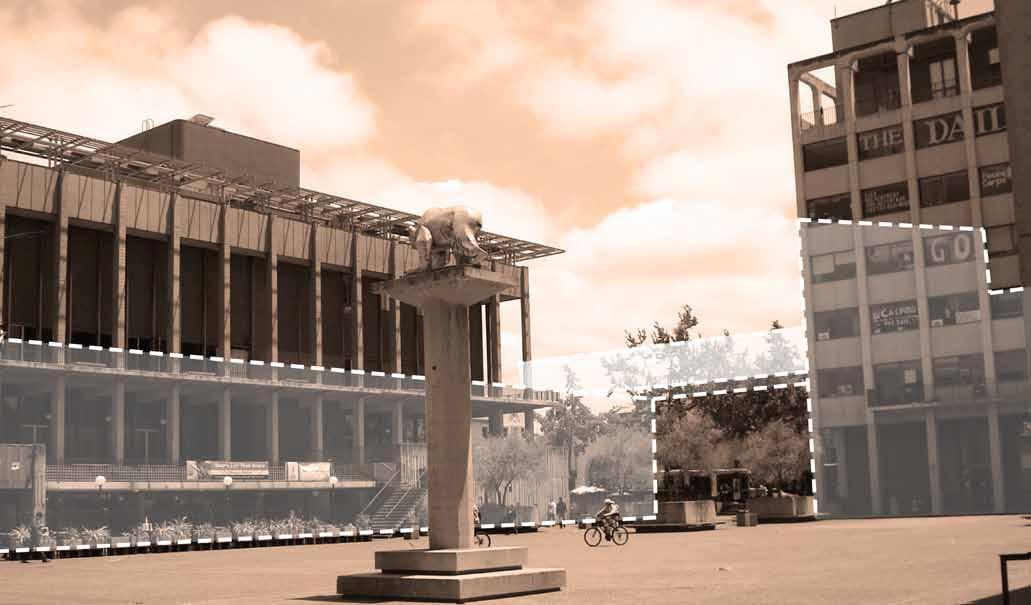
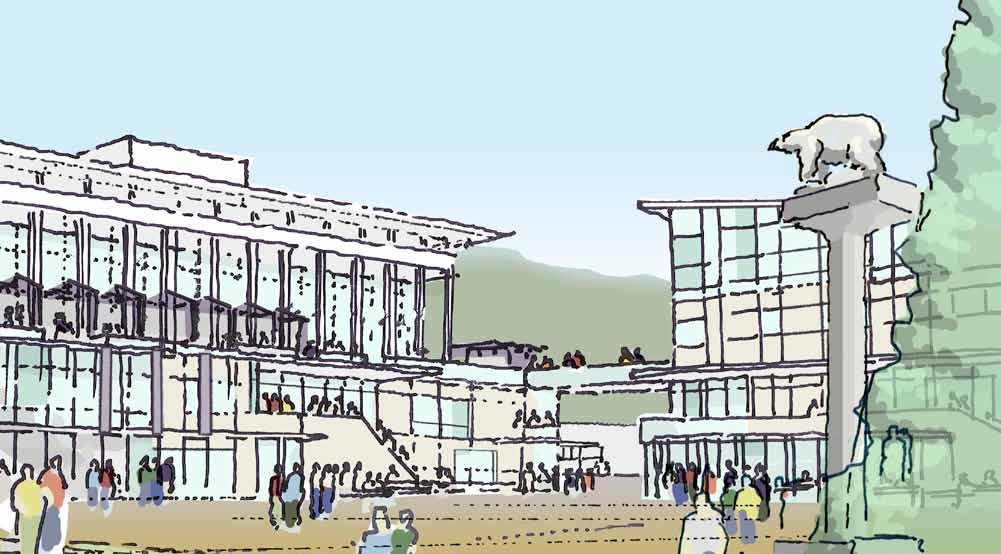
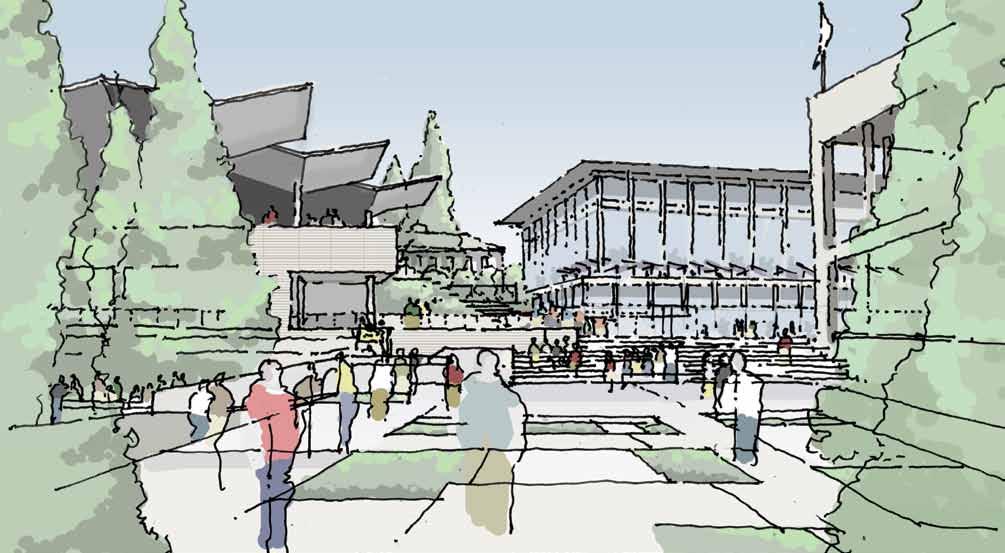
Students will also approach the Student Community Center Plaza from the north returning home from the school day or as part of the course of their daily travels on campus. The SCC Plaza is more of an attraction now that its open space becomes visible from Sproul Plaza as one walks south from Sather Gate toward Ludwig’s fountain. The additions to MLK and the Eshleman Replacement building are limited in size so as to maintain the existing roof line of MLK and to allow more midday sun to enter the plaza during the school year. Wayfinding is improved since a portion of the existing south-facing terrace at Chavez has been cut back enabling the restoration of a strong axial relationship between the two entries of Haas Pavilion and Sproul Hall.
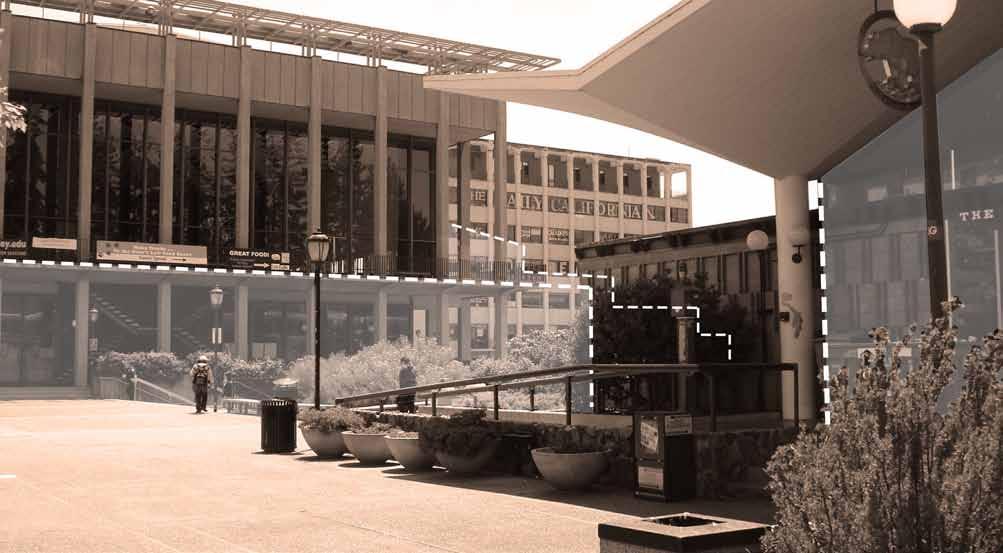
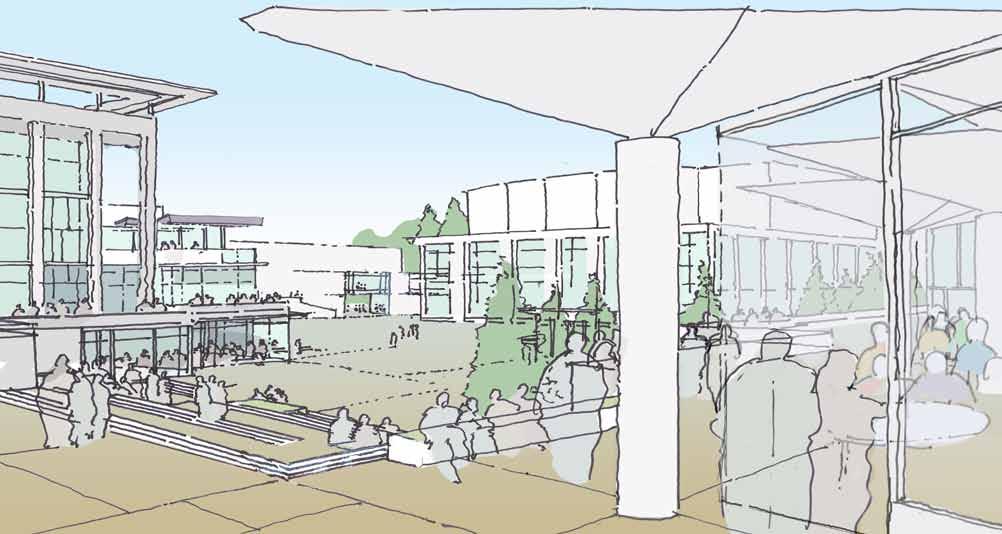
6 Proposed: Existing one-story portion of Chavez is cut back to reveal a welcoming view into the new Student Community Center Plaza. This new expansive view includes a glimpse of Bancroft Way through the entry portal of the Eshleman Replacement building.

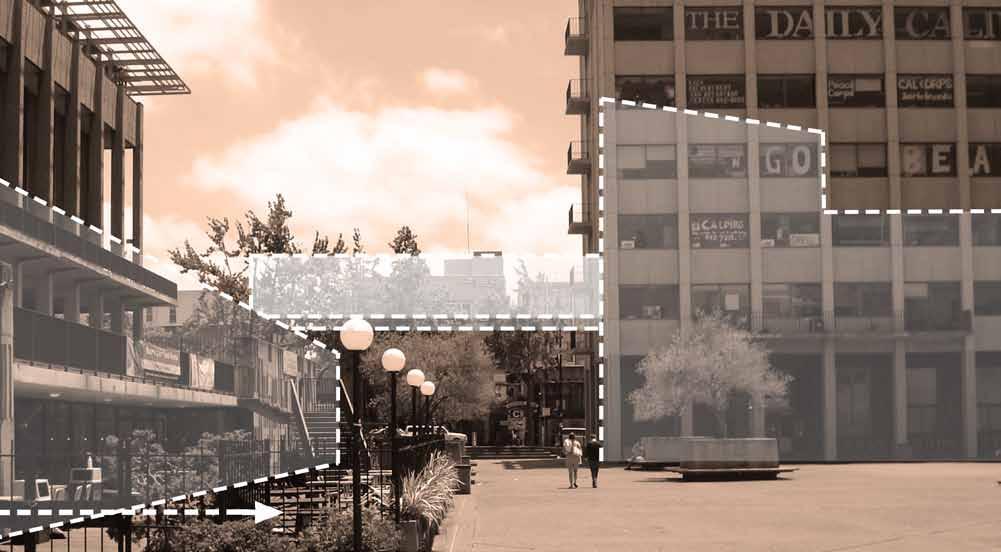
A place that builds bridges for critical dialogue

A place to gather and feel at home

Conveniently connected and accessible to all

Program Vision
• Maintain Student Centered Focus
• Celebrate Leadership
• Integrate Sustainability
• Maxmize Utilization
• Build an Implementable Strategy
Master Plan Goals
• Adapting and Rebuilding
• Linking and Integrating
• Creating Flexibility
• Shaping Movement
• Building Identity
• Preserving & Commemorating
• Strategic Implemetation
Campus Scale
• Walking Distance
• Bicycle Routes
• Watershed
District Scale
• Site Analysis
• Microclimates
Sustainability
• Lower Sproul Student Center Today
Historic Significance
• Commemoration
• Preservation
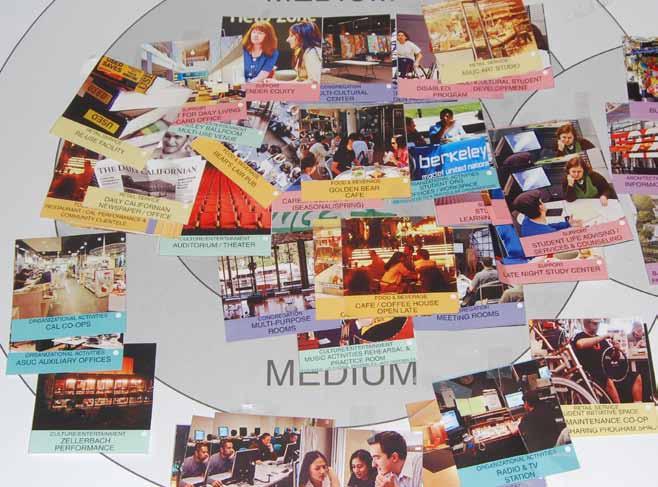
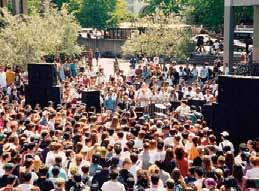
The Student Community Center aims to support a variety of program types by bringing them together into one location. This arrangement affords the students convenient one-stop shopping which could go a long way in helping them navigate through the various academic and social challenges they face. The idea, as shown in the bubble diagram on page 22, is to have a congregation of key student programs sharing a variety of spaces such as living rooms, lounges, meeting rooms, outdoor terraces, and cafes. In addition to having programs that generate revenue in order for the SCC to be sustainable and long lasting there also needs to be active day and nighttime use including latenight or “24/7” type operations as much as possible. Such a mix of program elements is what is necessary in an attractive center where the students can be comfortable, relaxed, and feel welcome.
Maintain Student Centered Focus
• “Make Big Berkeley small”: Provide clear pathways for logistical support in a welcoming environment
• “One-Stop Shopping”: Provide a centrally located resource for student help and direction
• “Mix of retail and student programs”: Create synergies between public serving retail spaces and student programs.
• “24/7 uses”: Promote program activities that have extended hours of operation to meet demand and maintain the center’s viability.
• Make visible student-initiated creative activities
• Balance group and individual identity: Provide opportunities to build identity of individual departments within the larger student center and campus environment
Celebrate Student Leadership and Identity
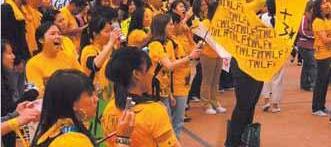
• Support the legacy and evolution of the center’s role in the free speech movement
• Support cultural diversity and multi-cultural awareness
Integrate Sustainability
• Reinforce and display sustainable design measures and practices as a critical component of the university’s educational mission
Maximize Utilization
• Allow for multiple uses in combinations of private and public spaces
• Provide shared resources for student organization use
• Create flexibility for outdoor programs of varying scales and venue criteria
• Provide “pop-up” retail opportunities to serve the seasonal needs of the student community
Build an Implementable Strategy
• Include revenue generating retail for necessary cash flow
• Provide a range of phasing strategies to accommodate evolving needs and resources
The goal of this study is to shape an implementable vision for the Student Community Center that is rooted in both physical and programmatic planning criteria, with consensus from key campus administrators and student representatives. This study forms the foundation for subsequent programming and design development phases. The master plan and feasibility study along with supporting documents will form the basis for the upcoming SCC fee referendum in spring 2010.
1. Adapting and Rebuilding –to transform a fabric of underutilized spaces (interior and exterior) to meet evolving student needs and aspirations
• Assess existing buildings and open spaces
• Adaptive reuse and addition
• Rebuild where necessary
2. Linking and Integrating SCC to Campus, City and Region –
• Linking and Integrating Campus and City / Region
• Integrating Sustainable infrastructure and systems
• Transparency: Visual and Physical
• View sheds to and from SCC
• Adjacency to supporting program elements
3. Creating a Flexible Mix of Uses –to build a synergy of complementary programs, services and gathering spaces
• Diversity of adjacent uses maximize the intersections between program entities.
• Adaptable loft spaces allow for flexible planning and evolving
• Nested scales of proximity and adjacency
• Shared resources
• Circulation / Movement
4. Shaping Movement –to reinforce & recast existing movement patterns and maximize opportunities for visibility, identity and gathering
• Security
• Encourage 24 / 7 occupation
• Transit
• Service
• Pedestrian
• Bicycle
5. Building Identity at Multiple Scales –to balance individual and group identity
• Create inclusive community space
• Intersections between Public and Program / Dept assignable space
• Create places of refuge and prospect
6. Preserving and Transforming Cultural and Natural Historyto respect the legacy of Lower Sproul Plaza while integrating 21st century innovations in sustainable design
• Reinterpret MLK and Chavez to achieve original aspirations
• Restoration
• Preserve Historical Markers (FSM)
• Maintain Plaza (serve public gatherings / FSM)
7. Strategic Implementation –to assess and identify opportunities for maximizing value while leveraging shared resources
• Economic Vision: Investment in Student Space and Retail Revenue Generation
Several common goals for activating the Student Community Center emerged from the workshops and meetings:
• Provide access to services, food / café and study centers on a 24 hour 7 day per week basis
• Create space for student driven initiatives such as storefronts for bike repair or a bicycle sharing program and flexible retail spaces responsive to seasonal needs or student initiative
• Include educational features that help foster collaborative learning
• “One stop shopping” for students and visitors
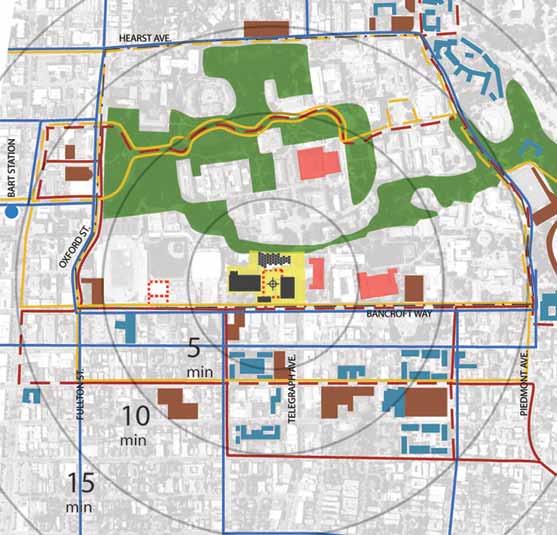
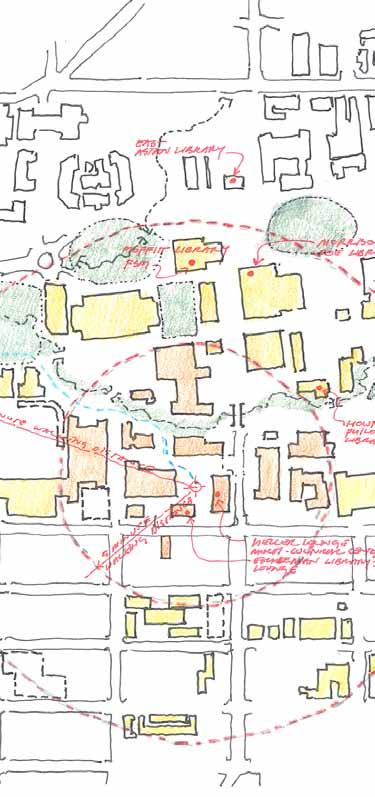
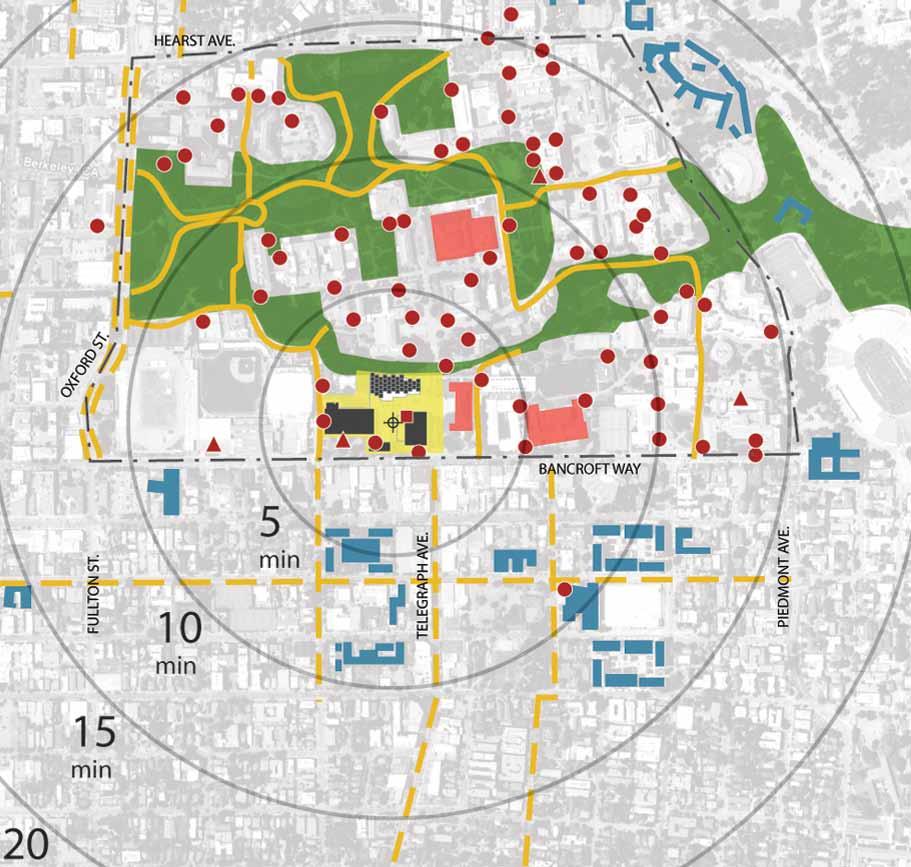
• Student Community Center is within a short walking distance to most points on campus
• SCC is centrally located between campus and student housing and student services
• SCC is conveniently located within walking distance of public and campus parking lots and structures
• Sather Lane, a retail lined mid-block pedestrian alley, channels students, visitors and commuters directly into the heart of SCC
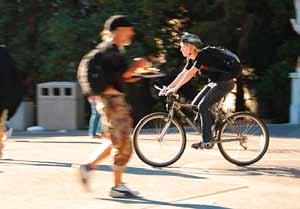
• Berkeley encourages bicycle commuting with a network of bicycle lanes and parking options
• Lower Sproul Plaza is a major gateway between city and campus bicycle paths
• Bicycle shops for service and supplies are desired by students
• For safety and convenience bicycle parking should be located near building entrances
• Underground or less visible bicycle parking has been unsuccessful due to perceived safety concerns
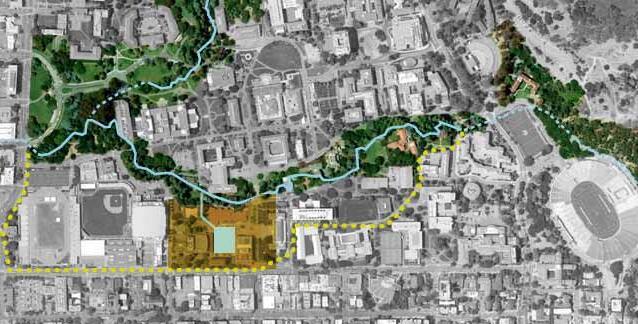
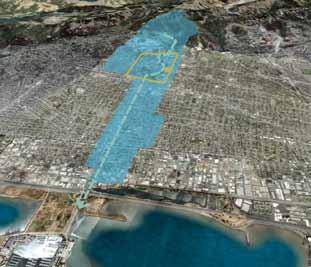
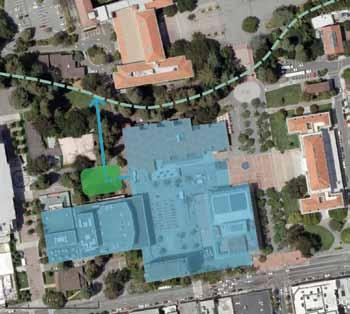
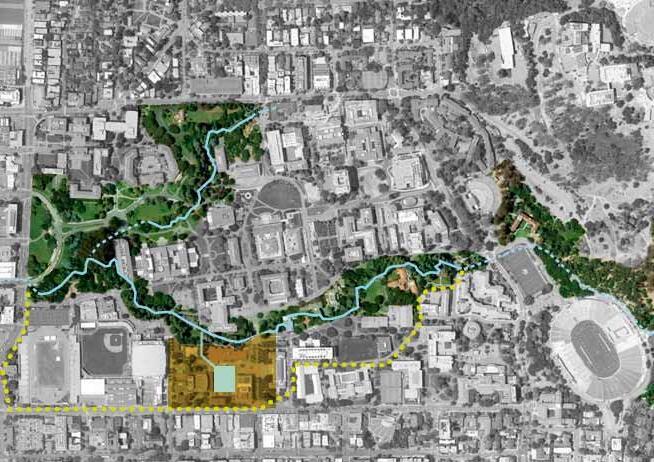
• Strawberry Creek bridges regional influences (watershed and micro-climate) with a range of core campus open spaces and buildings including LSP
• The watershed of the south fork of Strawberry Creek originally extended south to Bancroft at Telegraph. Any redevelopment of the plaza should make this natural process more evident
• Visual and infrastructure connections between the LSP and Strawberry Creek should be identified, clarified and celebrated
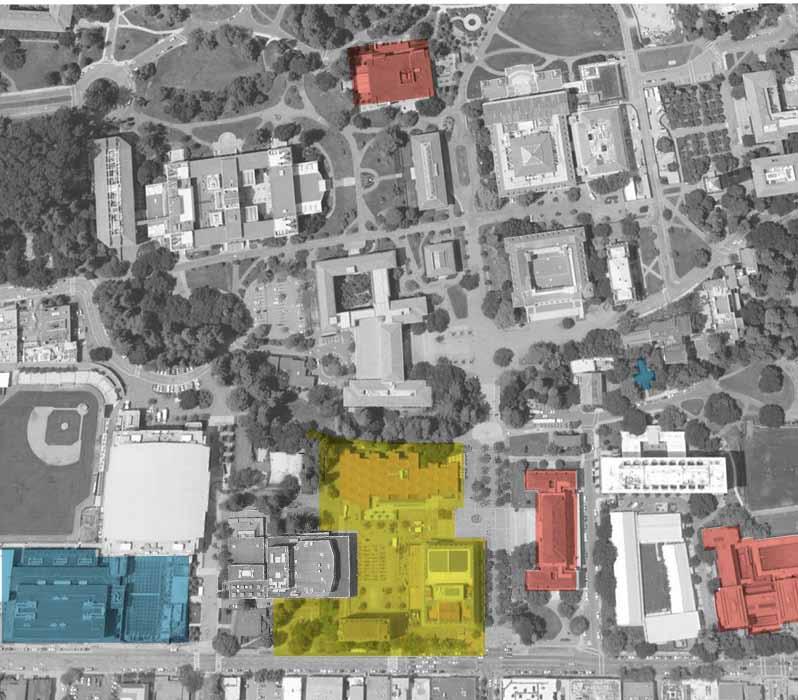
• A constellation of student services and programs are clustered in adjacent buildings
• Lower Sproul Plaza is located within a transitional zone between campus and city
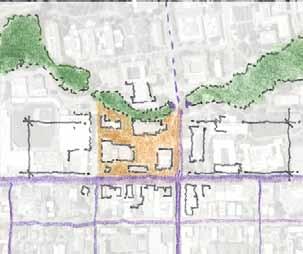
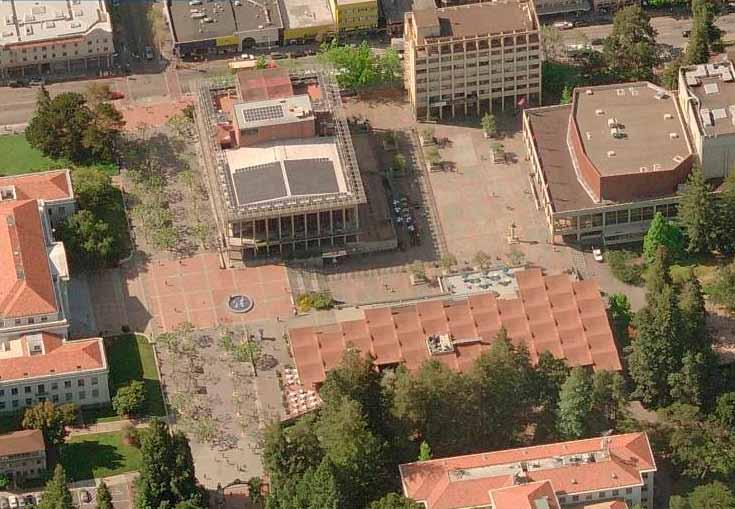
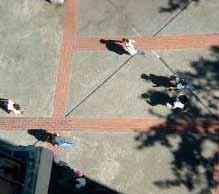
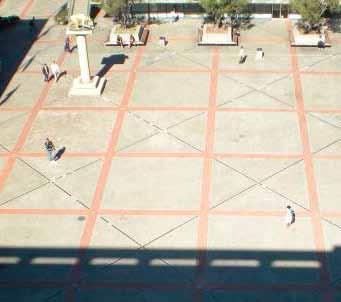
Lower Sproul Plaza lacks a range of micro climate zones to enhance pedestrian comfort
• Adjacent spaces at Upper Sproul Plaza provide a range of micro climate choices
• Lower Sproul Plaza offers only two micro climate zone choices: sun and shade
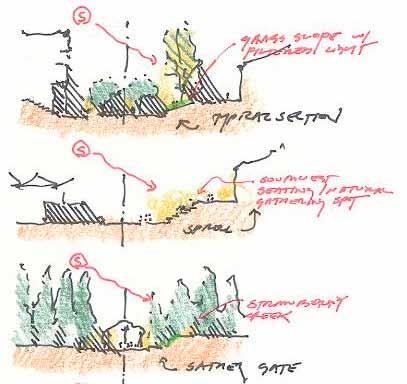
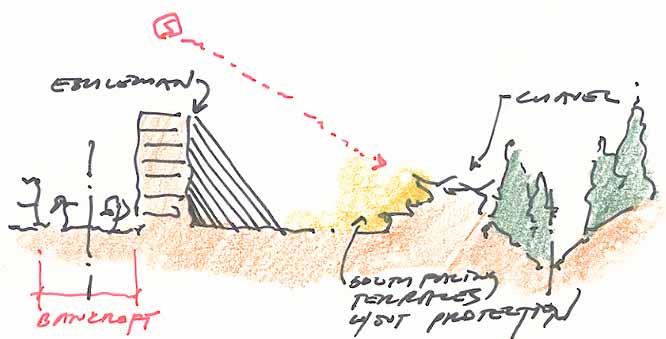
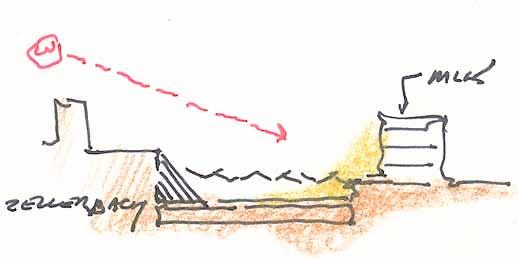
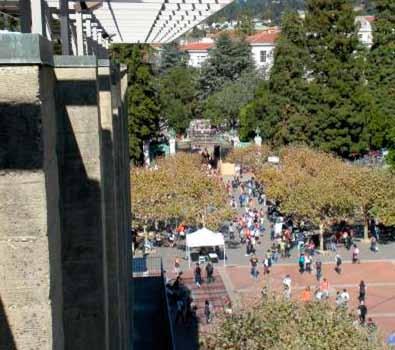
Restoration of Strawberry Creek initiates UC commitment to
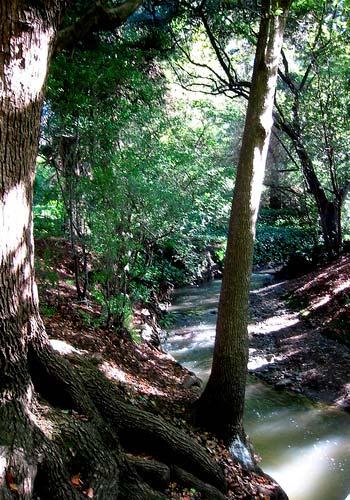
The restoration of Strawberry Creek began in 1987 and is now an international example of urban creek restoration. Strawberry Creek is now a unique natural environment with views, riparian and wildlife habitat and meandering walking paths for students and the campus community. It is an everyday reminder of the fragility of nature and the importance of sustainable design to balance man’s impact on the environment.
for improving linkage to Strawberry Creek
• The Student Center is isolated from the Creek Environment. Strawberry Creek severely flooded in 1962 after which UC Berkeley implemented floodcontrol measures. Design and construction of the Student Center, completed in 1968 reflects this defensive reflex with the result that the creek is isolated and largely invisible from Lower Sproul Plaza.
• Storm water flows to Creek are hidden. As the South Fork Strawberry Creek flows westward, its watershed extends south to Bancroft Avenue at Telegraph. This no longer evident. Storm water from Student Center buildings and plazas is piped and unceremoniously released into Strawberry Creek.
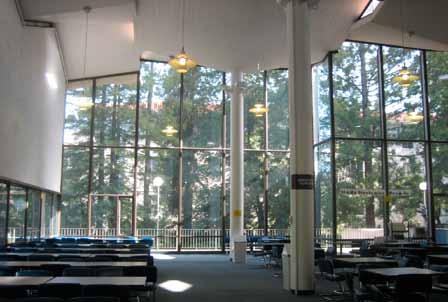
The lack of connection to the creek has been exacerbated by insensitive changes over time. Windows which originally allowed light and views of the creek into the garage level spaces have been walled in. The reprogramming of Chavez from dining commons to office space has resulted in a warren of closed offices and hallways.
• Transit
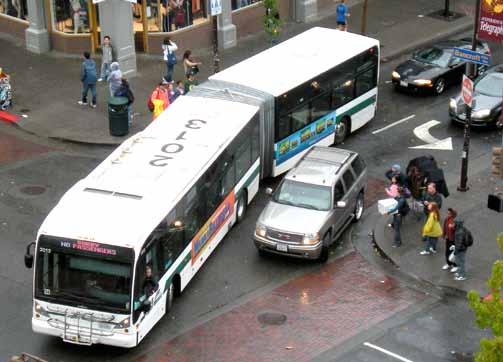
Regional buses and campus shuttles (over 450 per day) provide a lifeline of foot traffic along Bancroft. The Student Center is centrally located making the BART station, student housing and services and most points on campus within easy walking distance. However transit users would be better served by sidewalk adjacent shelter, retail and amenities.
Wayfinding, building entrances and pedestrian paths need improvement to encourage active use by students and community. Although the Student Center is conveniently located midway between Sather Gate and Haas Pavilion most prefer to walk around rather than through Lower Sproul Plaza.
• Adaptive Reuse / cutting edge 50 years ago
While originally conceived to be modern, open and efficient, the Student Center is showing its age and falls short of its original aspirations. Interior space planning is dominated by enclosed offices rather than more flexible open plan layouts. Adaptive reuse of buildings, where possible, would help preserve historical/ spatial memory, allow ongoing use and save resources and expended energy over demolition.
• Building Systems and Thermal Envelope need replacement
New insulated materials and technologies would greatly improve the energy performance of building skin and glazing. High performance insulated glazing units would maximize daylight opportunities and moderate heat gain and conditioning loads. New building systems and smart controls are more energy efficient and compact.
• Visible Sustainable Elements
With the exception of Strawberry Creek, environmental education opportunities for students and the campus community are limited or not readily visible.
1 Outdated Systems
50 year old equipment is functional but space and energy are inefficient compared to new generation equipment. Plumbing fixtures should be replaced with water saving models.
2 Solar Harvesting
Photovoltaic (PV) Panels are installed on MLK roof, but are not visible to students or visitors.
3 Stormwater Roof and Plaza drainage is piped and unceremoniously released into Strawberry Creek.
4 Impermeable Hardscape Plaza
Lower Sproul Plaza and upper terraces are fully paved.
5 Open space around Alumni House does not create linkage between Sproul Plaza and Strawberry Creek
This area is physically and visually isolated from the plaza and discourages easy east-west movement.
6 Public Transportation
Public transit access is strong along Bancroft. BART station is 15 minutes away. Bicycle parking is insufficient, inconvenient or not perceived as safe.
7 Campus & Community Connectivity
The depressed plaza at Bancroft and Telegraph isolates pedestrians from direct access to buildings and open space. Pedestrian routes and building entrances are not readily apparent.
8 Inefficient Building Envelope
Uninsulated glazing and exterior walls provide poor energy and acoustic performance.
9 Climate Control
Lack of operable windows deny occupants natural ventilation and energy savings on days with temperate weather.
Eshleman is a poorly located and inefficient building
Eshleman keeps Sproul Plaza in shadow for much of the day and its interior is not conducive to flexible use by student organizations.
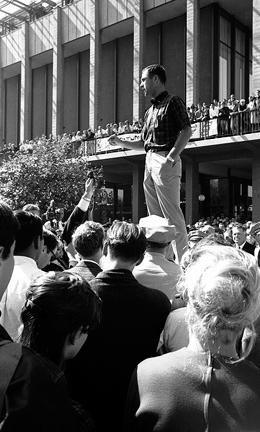
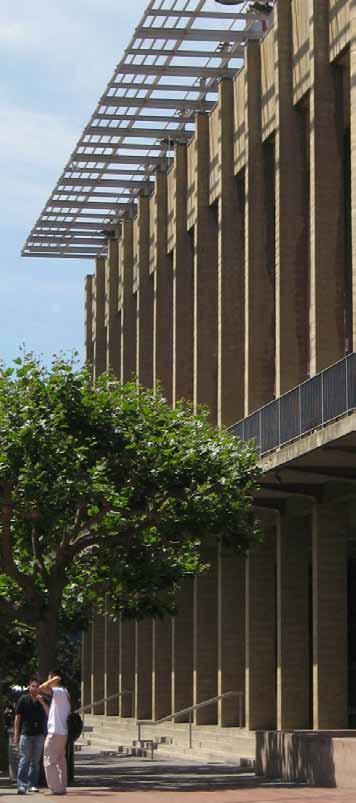
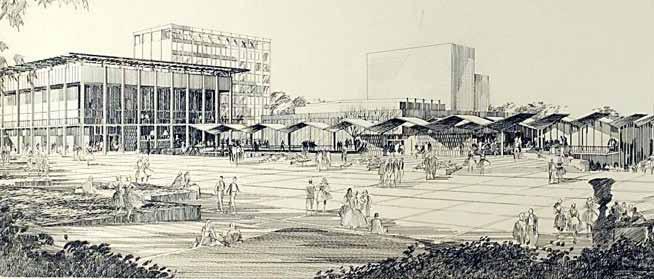
Designed by Hardison and DeMars with Lawrence Halprin, the existing California Student Center was completed in 1968 following 20 years of phased design and construction. At the time it was hailed as an award winning example of campus planning. Patterned after the Piazza San Marco in Venice, Italy, a variety of buildings with a range of surface textures and materials were positioned around a large open plaza to create a vibrant pedestrian space for students, faculty, and visitors. Initially cast as a memorial student center with a program that commemorated those who served in World War II, the completed plaza and buildings contained a cafeteria (Chavez), auditorium (Zellerbach), student activities building (King), and a student office building (Eshleman).
For many years the buildings and plaza functioned as intended with a healthy cross circulation of pedestrians and a range of activities from small dance troupe practices to large rallies and concerts. In 1989 the cafeteria / dining commons was given over to
administrative offices and student academic support services that had been displaced from other locations on campus. This change in program mix lessened the amount of foot traffic in the plaza to such a degree that the area has become a bleak and underutilized space. Over 40 years have passed since the complex’s opening concert at Zellerbach Auditorium yet, few changes have been made to keep up its vitality and so Lower Sproul continues to be a neglected, almost void space at the center of campus.
The highly praised project, both during and after construction, is a strong example of postwar American college and university architecture. Breaking from the norm set by other prominent student unions of the day where single buildings would be set in isolation amongst a lush landscape, the existing California Student Center was designed as a dynamic urban space to deliberately link the pastoral campus with the unpredictable vitality of the Berkeley community. Avoiding the negative aspects of the popular “Brutal-

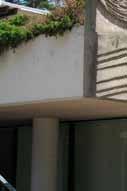
ist” style of the time, the architects sought to incorporate a lighter and more comfortably scaled expression. In the concrete building materials, they used board formed patterns and thin shell hyperbolic-paraboloids.
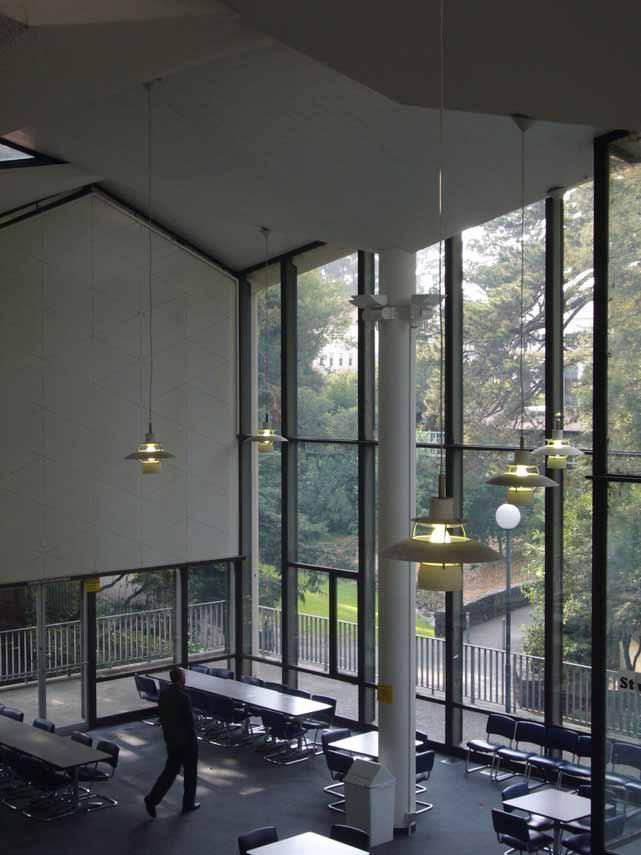
The existing center retains most of its historic fabric and setting and is still able to convey a feeling of 1960’s era California when the state could afford to build large public works projects. There continues to be an association with historic events, such as the rallies and demonstrations of the Free Speech Movement.
The following points highlight the new Student Community Center’s efforts to preserve the cultural memory and respect the original design vision:
• The Lower Sproul Plaza Complex was completed in 1968. It is almost 50 years of age, a basic threshold for consideration of historic significance.
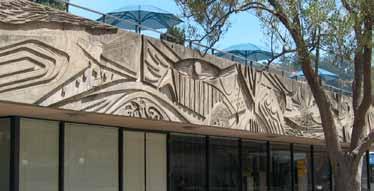
• Character defining features of the Vernon DeMars designed buildings; Chavez, MLK and Zellerbach, may remain intact in the revitalized Student Community Center.
• Building additions and deletions will respect and complement the original design. Existing insensitive physical modifications and program changes will be addressed where feasible.
• Required seismic upgrade and/or code compliance work will likely impact interior spaces in MLK and Chavez. Such impacts are noted for MLK in a 2006 feasibility study and similar impacts may be expected for Chavez, its two story atrium in particular.
• The renovated plaza will remain primarily hardscape to serve as an outdoor forum for public gathering and debate.
* Architecturally significant spaces, such as Chavez Atrium, MLK’s Main Lobby, Pauley
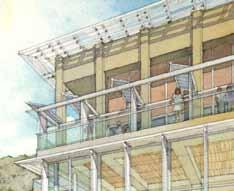
Ballroom, and the Tilden Room will be retained in their original appearance as closely as possible.
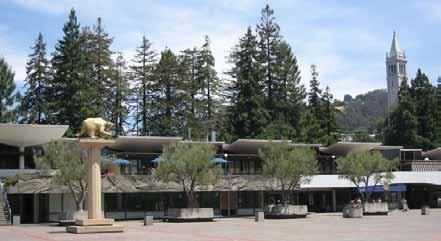
* Other significant site features and public art works, such as the concrete bas relief by Emmy Lou Packard, the strap iron sculpture by Robert Howard, and the Golden Bear sculpture by Tom Hardy on a column by Vernon DeMars will also be preserved and integrated into the new Student Community Center.
* The Free Speech Movement will be commemorated with markers and plaques and its legacy will be maintained through programs accommodating student centered gathering.
* Original design visions will be reinterpreted and improved using new, forward thinking materials and systems.
Process
• Gathering
• Weaving
• Implementing
Student Workshops
• Student Participation
• Sustainable Design
• Pre-Programming
Implementation
• Cost
• Phasing
Previous studies had been conducted since 1994 that served to inform the current master planning and feasibility study, the goal of which was to develop a preferred scheme into an overall master plan with consensus from key campus administrators and student representatives. The master plan is to then be put to a student fee referendum in spring 2010. The feasibility portion of the study defines the scope of the renovation work through building and utility systems surveys, various technical assessments, phasing plans, and a pair of reconciled cost estimates.
Beginning in September 2008 the design team followed a work plan that outlined a sequential process of Gathering, Weaving, and Implementing.
Gathering: Information was collected from previous master planning studies and assessments of existing conditions through review of existing documents and firsthand site visits. Building from information gleaned
from the previous 14-year period of studies enabled the design team to quickly gain critical insights into the opportunities and constraints of Lower Sproul.
Weaving: Master planning principles were established based on analysis of existing conditions and direct feedback from students and administrators through meetings, interviews, and workshops. Conceptual Design proposals were tested against these principles such that a preferred scheme emerged.
Implementing: The preferred scheme was then tested for its feasibility such that issues of constructability, code compliance, phasing, and cost have been analyzed to the degree possible given the preliminary nature of the conceptual design scheme. The ultimate goal of this phase was to ensure that the study reflects the values and vision of the student and administrative representatives.
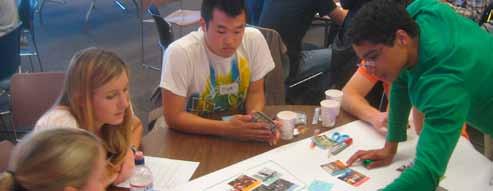
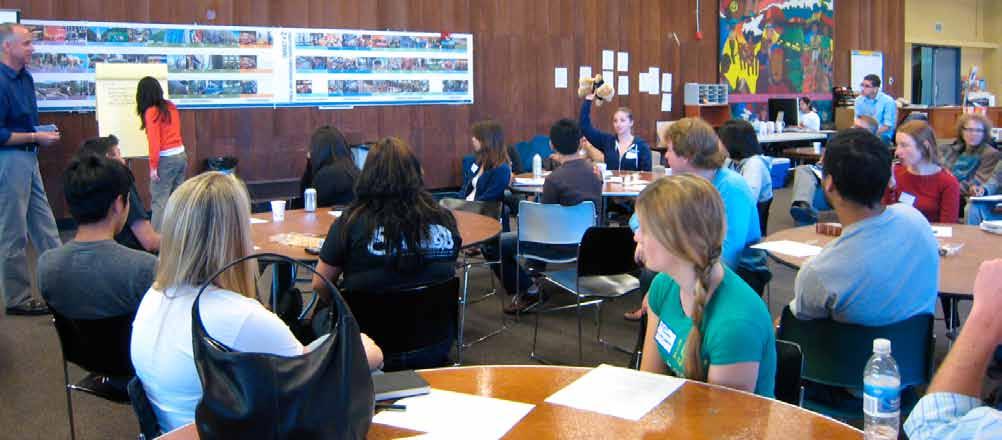
A series of workshops involving both student representatives and campus administrators
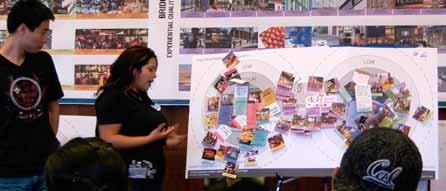
were held from Fall 2008 through Spring 2009.
Initial Master Planning Principles were reviewed:
• Student Centered – primarily for student culture and community
• Identity – reflect unique UCB qualities
• Ecology – sustainable design strategies
• Flexibility – can grow in phases and change
• Feasibility - implementable
Emerging Design Principles were proposed:
• Campus Connections: enhance visibility
• Transparency: see and be seen
• Microclimate response: more green space with choices for sun/shade
• Flexibility and Growth: create a flexible armature for performances and increase areas for study, storage, and dance
• Way-finding: increase visibility of student groups
• Pedestrian movement: draw people into the plaza
Students were asked to rank a set of eight initial program elements:
• Congregation
• Support
• Entertainment
• Service
• Food
• Retail
• Graduate Student Center
• Multicultural Center
It was noted that the elements of Congregation, Support, Service, Graduate Student Center and Multicultural Center appeared to be the most desirable. Food and Retail were not ranked as the most desirable elements, but were confirmed by the students as being important to the center nonetheless.
Students also broke into two groups and generated responses to a set of questions about the existing conditions of Lower Sproul
and what should be changed.
Student Workshop #2:
Master planning principles that had emerged from previous meetings and interviews were reviewed reaching consensus on key principles.
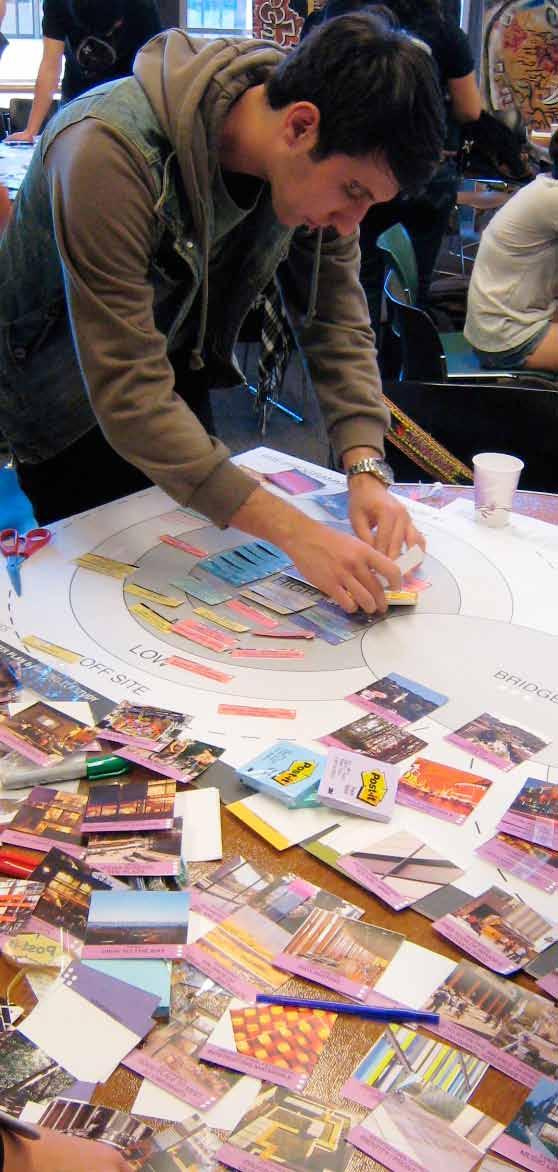
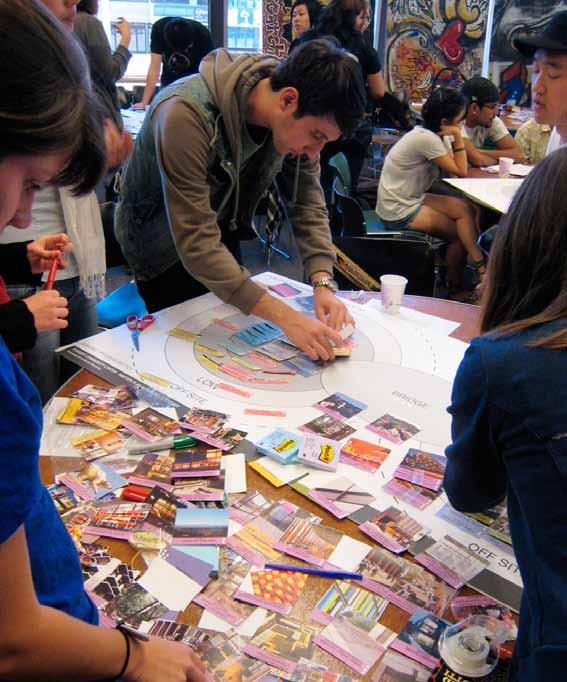
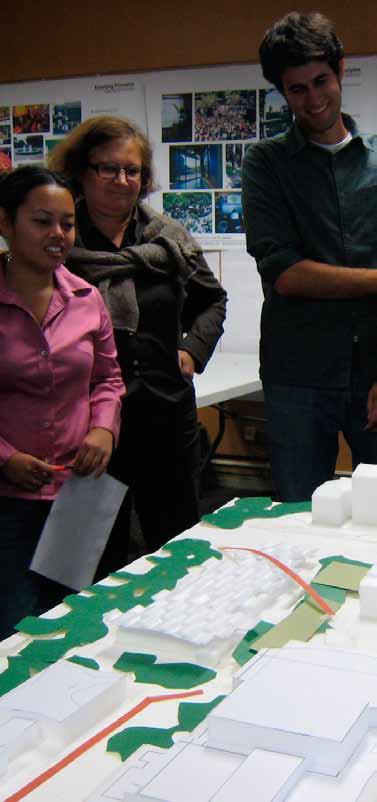
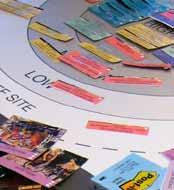
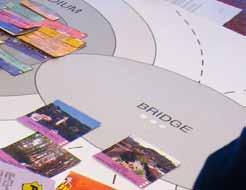
The group also tested site planning and building massing strategies by placing foam blocks and colored paper onto a site model. Together the architects and the students identified physical planning features to be considered.
Sustainable Design Workshop:
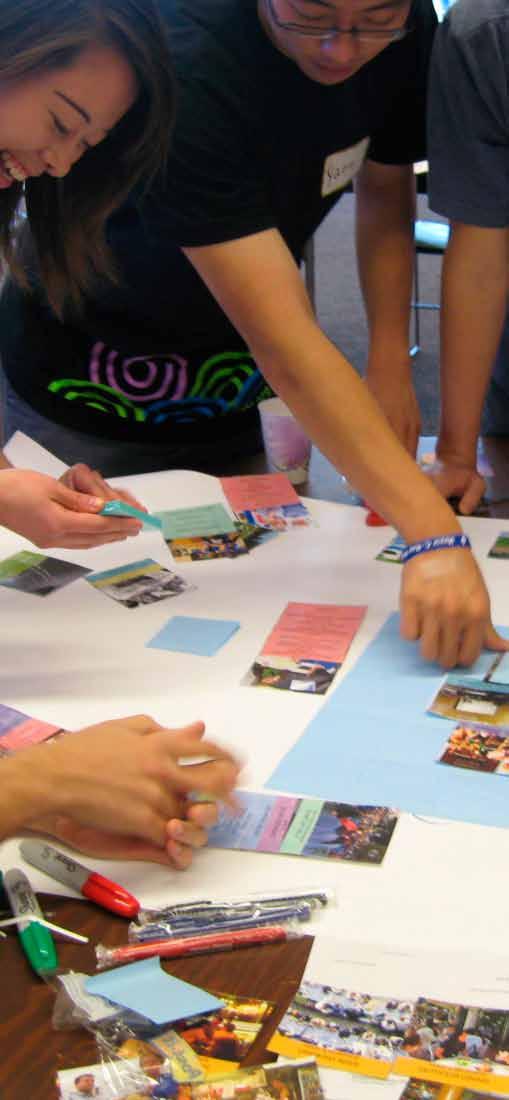
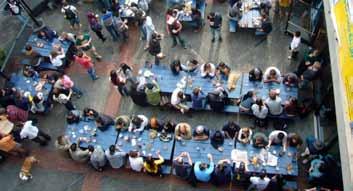
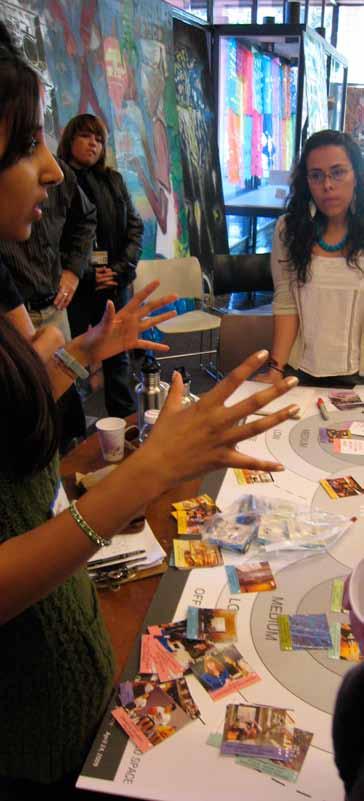
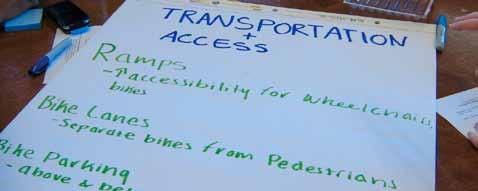
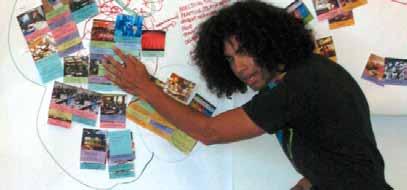
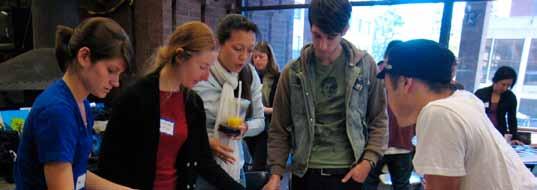
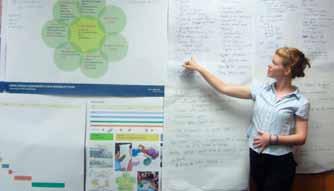
Students working in groups at tables prepared a series of lists and diagrams that highlighted various sustainable design initiatives. Specific features were categorized as follows:
Design
- Porous facades
- Public Art
- Retail
- Site Planning
- Landscape
Transportation
- Slow cars on Bancroft
- Promote bus ridership
- Facilitate bike use
Food
- Organic
- Local
- Less meat
- Compost
Habitat
- Collect rainwater
- Use local sustainable materials
- Conserve water
Community
- MCC
- Anticipate growth
Energy
- Conserve
- Passive / wind & sun
Waste
- Reduce and recycle
Miscellaneous
- Scream sustainability!
The project’s sustainable design features are in direct response to the goals and desires highlighted in the Sustainable Design Workshop.
Student Workshop #3:
A master plan framework with conceptual design options were reviewed as well as a preferred conceptual design scheme. Issues of concern were identified.
Student Workshop #4:
Identified spaces students like on campus that they would also like to see in the SCC.
Pre-Programming Workshop #1:
Identified and prioritized program elements rating the importance of program activities and the qualities of place. Participants identified the desired program “wish list” including “public” spaces and associated qualities and experiences.
Pre-Programming Workshop #2:
Reached consensus on a set of Guiding Principles or Vision Statement for the new Student Community Center project such that it would be supported by the student body in a fee referendum.
Key master planning principles emerged for the series of workshops:
• Identity: Reflects unique UC community of multicultural inclusiveness
• Community: Is primarily “Student centered” both in program and design
• Ecology: Reflects and displays sustainable practices while using a design strategy rooted in ecological principles
• Growth: Creates a “flexible armature” for a range of programmatic activities that allows for growth and change
• Implementation: Builds a framework of achievable goals and confirms that the Master Plan/Feasibility Study initiatives can be phased to meet funding
• Program synergy: Supports synergy
between program elements and multi functional spaces
• History: Respects and highlights the site ‘history’ (i.e. free speech movement)
• Transparency: Promotes transparency and access to and between services (See and be seen)
• Campus / City: Balances connections to the fabric of the campus and city.
Some common proposals for activating the plaza also emerged from the workshops and meetings:
• Having access to services, food / café, and study centers on a 24 hour 7 day per week basis
• Creation of space for student driven initiatives, such as storefronts for a bike sharing program or temporary retail for seasonal needs
• Having educational features that help foster collaborative learning
• “One stop shopping” for students and visitors

A cost plan to determine a construction budget for the preferred scheme has been developed based on architectural drawings (plans, sections, and perspectives), narratives from the design team, discussions with the architect and engineers, and comments from UC Berkeley. The proposed construction budget is based on current market conditions as of June 19, 2009 and assumes a general contract will be competitively bid with a qualified general contractor and subcontractors. The budget figures listed below cover “hard” construction costs of the buildings and plaza only and do not include “soft” costs such as design fees or fixtures, furniture, and equipment (FF&E).
Please see the separate Feasibility Cost Plan dated June 19, 2009 by Davis Langdon for a complete breakdown of costs with a listing of inclusions and exclusions.
Total Proposed Construction Budget (non phased) = $151,000,000
Total Proposed Construction Budget (in 3 phases) = $154,000,000 Phase
= $46,000,000
= $77,000,000





At this time there are significant limits to available funding making it necessary to prioritize the project’s components into logical phases of construction. To determine the best ordering of these components the project site was divided into different areas of work and designated as parcels:
Parcel A:
• Eshleman Hall demolition
• Eshleman Replacement Building
• Renovation of a portion of plaza deck that was connected to the existing Eshleman building
• Renovation of a portion of the plaza structure at the garage west entrance to allow 13’-6” high box trucks to enter
Parcel B:
• MLK renovation
• MLK addition
• Renovation of a portion of plaza deck that was connected to the existing MLK building
Parcel C:
• Plaza renovation
• Garage structure renovation
Parcel D:
• Renovation of existing Chavez building
Parcel E:
• Storm Water Filtration Garden
Parcel X1:
• Rebuilding of ramp to parking garage so that longer trucks can enter
Parcel X2:
• Rebuilding of steps and constructing a ramp to provide an accessible entrance for the pedestrian path coming up hill from Haas Pavilion
Parcel X3:
• Rebuilding of steps and constructing a ramp to provide an accessible entrance from Upper Sproul Plaza into the renovated Lower Sproul plaza
• Installation of a new three-stop elevator in place of an abandoned stair at the northeast corner of the plaza.
The parcels listed above are grouped and ordered into phases with user safety, student services, and revenue generation as being among the highest priorities.
Phase 1: (Includes Parcels A, X.1, X.2, and X.3)
This begins with a tearing down of the existing seismically “poor” Eshleman building and constructing a safer replacement building that provides a facility for revenue generation and
student centered services. Temporary and demountable performance and shade structures are installed in the plaza, new ramps and steps are constructed at the northwest and northeast corners of the plaza and a new three-stop elevator is installed in place of an abandoned stair.
Phase 2: (Includes Parcels B, C, and E)
It includes the renovation of the existing MLK building with a new two story addition and terrace that wraps the south and west facades. The existing Lower Sproul Plaza deck and supporting subterranean garage structure are renovated along with the removal and reinstallation of more permanent performance and shade structures on the plaza deck. A Storm Water Filtration Garden is also installed at the project boundary’s northwest corner.
Phase 3: (Includes Parcel D)
This phase includes a complete renovation of the Chavez building and involves some demolition at the east end and south terrace. These are strategic alterations that will open up dramatic site lines from the Plaza to Sather Gate, and Sproul Hall to Haas Pavilion.
Project Framework
• Campus Scale
• District Scale
Concept Development
• Emerging Patterns
• Preferred Option
Feasibility Reports
• Architecture
• Landscape Architecture
• Civil Engineering
• Structural Engineering
• Mechanical & Plumbing Engineering
• Electrical Engineering
Meeting Notes
• 7.23.08 Work Plan Development Meeting
• 9.24.09 Conceptual Program Meeting
• 10.06.08 Workshop #1 with Students
• 10.07.08 Interviews with Administrators
• 10.28.09 Steering Committee Meeting
• 10.28.09 Emerging Principles
• 11.06.09 Workshop #2 with Students
• 11.17.09 Sustainable Design Initiatives
• 12.08.08 Workshop #3 with Students
• 12.08.08 Design Team Workshop
• 12.09.08 Meeting with Jim Horner
• 12.09.08 Steering Committee Meeting
• 1.15.09 Design Review Comm. Meeting
• 2.20.09 Meeting with Fire Marshal
• 2.20.09 Workshop #4 with Students
• 4.24.09 Pre-Programming Workshop #1
• 5.8.09 Pre-Programming Workshop #2
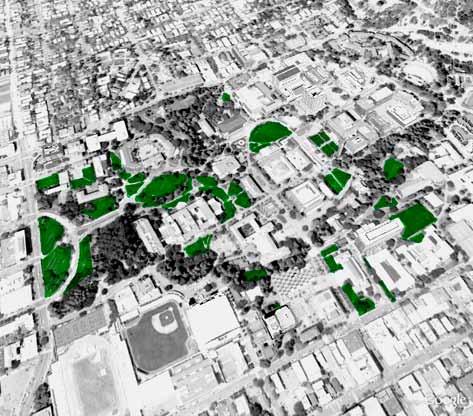
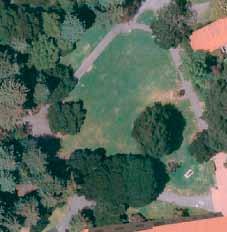
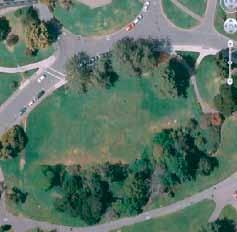
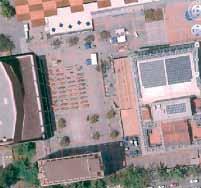
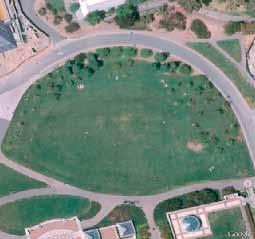
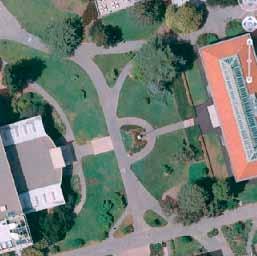
• The UC Berkeley campus is characterized by a predominant fabric of green space - organized along Strawberry Creek and concentrated at the confluence of the creek’s north and south forks
• Open space along Strawberry Creek borders the north boundary of Lower Sproul Plaza
• LSP is the largest programmable flexible space on campus
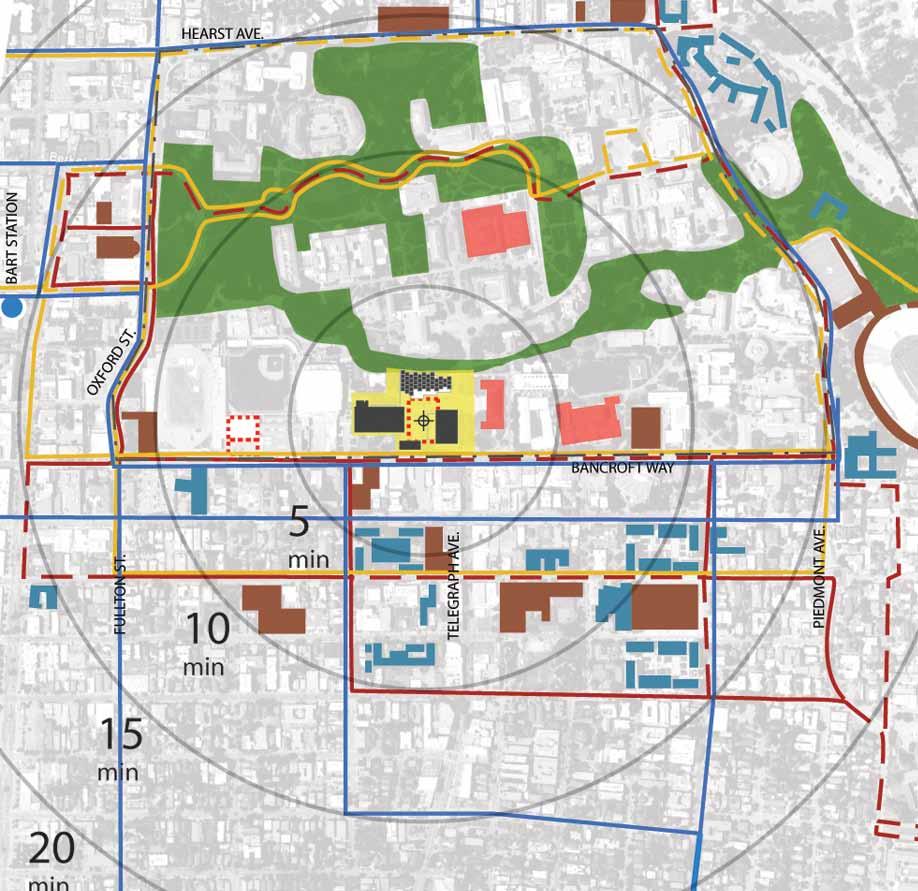
• BART station provides convenient regional access just a 15 minute walk from LSP
• UCB campus is ringed by regional bus routes. 448 buses and shuttles stop along Bancroft every 24 hours
• Between 6 pm and midnight, 122 buses and shuttles stop, to help activate the street at night enhancing the perception of safety
• UC shuttles provide frequent shared rides around campus. Shuttles allow student services and retail at LSP to easily serve the larger campus community
• A planned transit hub along Bancroft will reinforce LSP as a 24/7 commuter gateway, allowing fast and convenient transfers between Regional bus routes and UC shuttles.
• Retail along Bancroft could benefit from this foot traffic and help activate the commuter experience
Scale
• The core of Lower Sproul Plaza is defined by four buildings each with its own distinct campus character and a subterranean parking and service level that connects all four buildings.
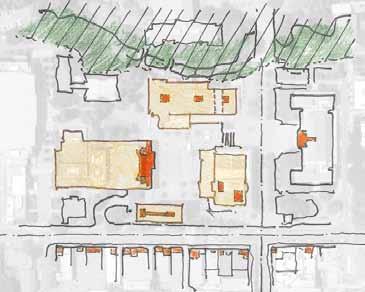
District Scale
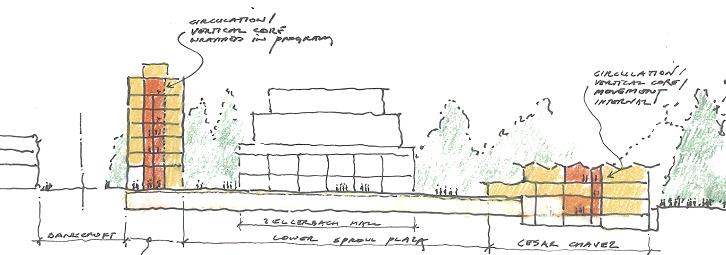
Existing Internal Movement
• Vertical circulation within existing buildings is internalized and separated from exterior public spaces.
Pedestrian Movement
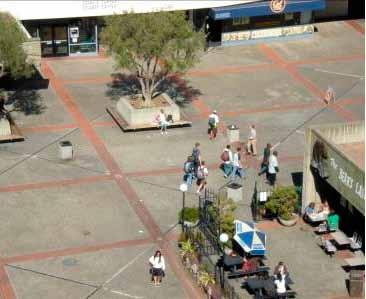
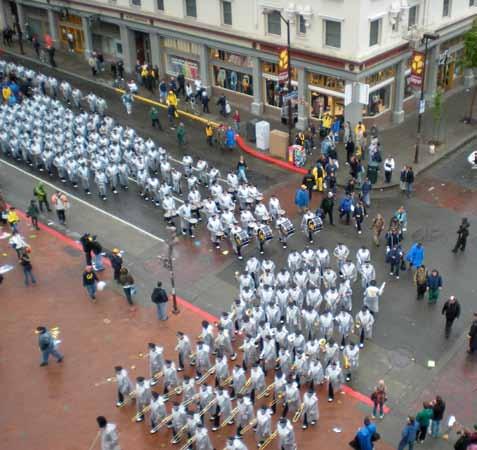
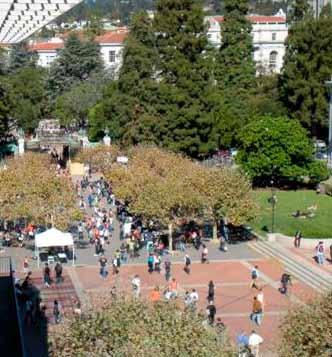
Lower Sproul Plaza is a filter for significant pedestrian movement at campus to city threshold.
• Movement patterns emphasize diagonal paths
• Predominant diagonal path is between the northeast and southwest corners of the plaza
• Important pedestrian traffic generators include the adjacent rec center, Haas Pavilion and Sather Tunnel
District Scale
View Sheds
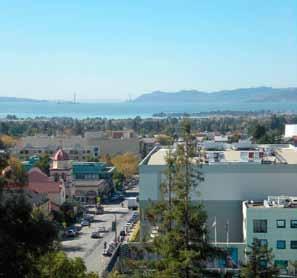
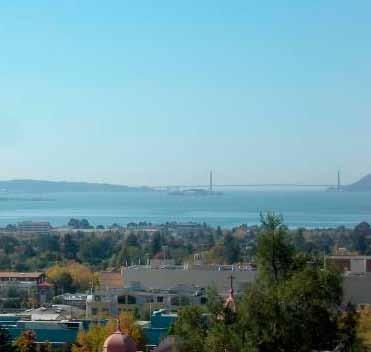
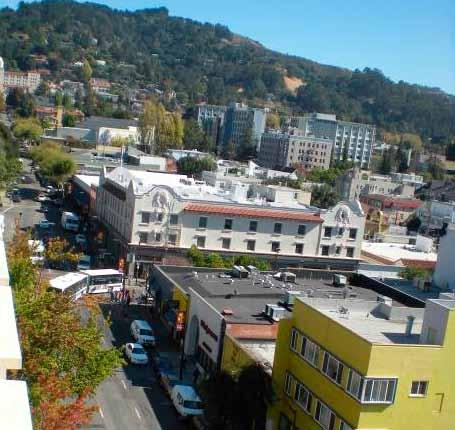
At multiple elevations view sheds include local campus and regional (city) landmarks
• Regional views west to the bay region and east to the Berkeley Hills
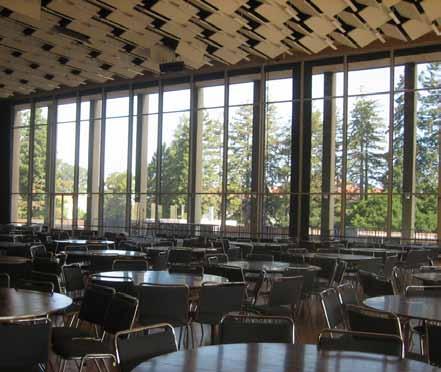
Spectacular views from the Pauley Ballroom of the campus
Enhance views to and from Upper Sproul Plaza to Lower Sproul Plaza
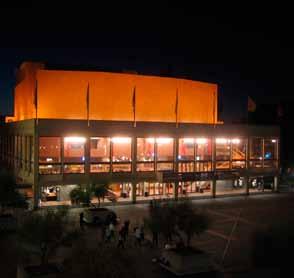
In the evening Zellerbach Hall and Pauley Ballroom act as important “Campus Lanterns”
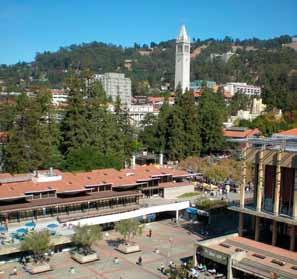
Optimize diagonal view to and from Campanile
District Scale
Bicycle Circulation
• Dedicated primary campus wide bike paths frame the west and south sides of Lower Sproul Plaza
Non dedicated bike routes traverse LSP from Bancroft Way to Sather Gate. Current dedicated bike parking is insufficient
Below grade bike parking is unsuccessful due to low visibility, inconvenience and safety considerations
Surface bike parking currently accommodates 120 bicycles and is concentrated on the north side of MLK and west side of Chavez Student Center
District Scale
Parking Circulation
• Current underground parking accommodates 108 cars below Lower Sproul Plaza, with one point of ingress and egress off Bancroft Way
Current underground parking serves Zellerbach Hall with 12 accessible spaces
District Scale
Service Movement Patterns
• Primary service to Eshleman Hall, MLK and Chavez Student Center is via LSP underground parking level
Service access to LSP garage is insufficient due to height limitations at entry and within structure. Current service needs require at grade service paths off of Bancroft Way across Plaza
Service to Zellerbach Hall is primarily from University Way
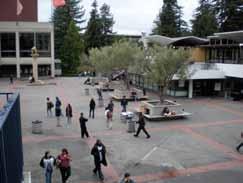
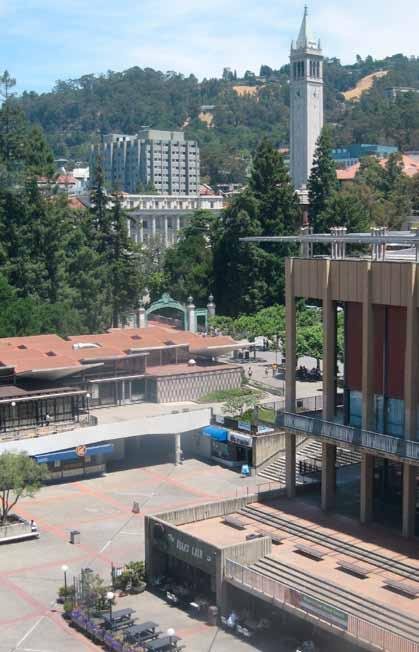
The Student Center is centrally located between Sather Gate, Haas Pavilion and Berkeley neighborhood amenities, but wayfinding and access remain difficult.
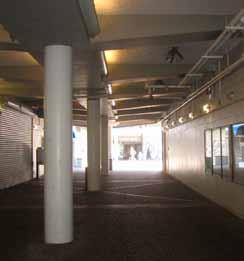
• Direct walking paths or desire lines are not clearly navigable. A circuitous route is required where a shortcut is desired
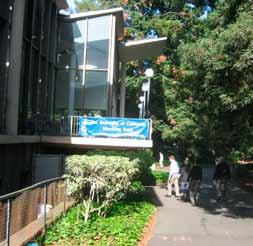
• Destinations, entrances and amenities are not readily visible from project thresholds leading many to simply bypass Lower Sproul Plaza
District Scale
Community Connectivity Issues
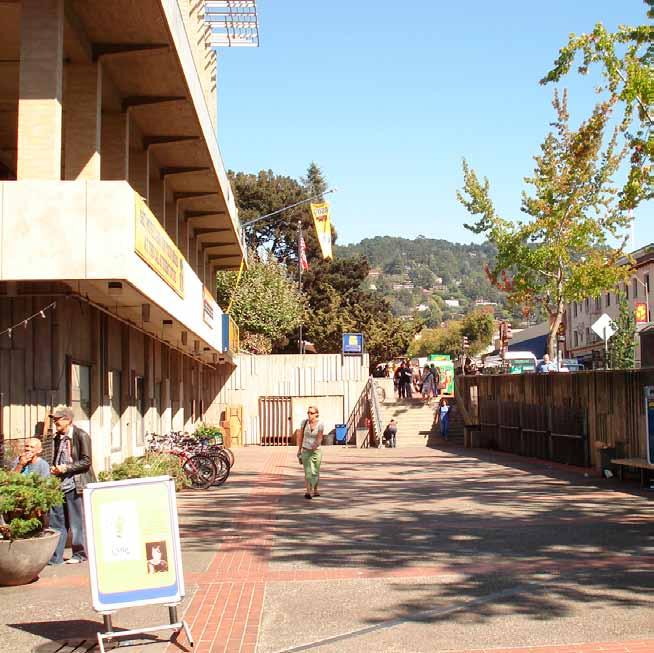
Bancroft Way is the LSP Complex’s front door, a critical community gateway to the campus. Regularly fed by regional buses and campus shuttles (488 every 24 hours), as well as retail, this streetlife remains isolated from the plaza
• Lower Sproul Plaza is physically isolated from street life
• There are no entrances, retail or program amenities on Bancroft Way to activate the street
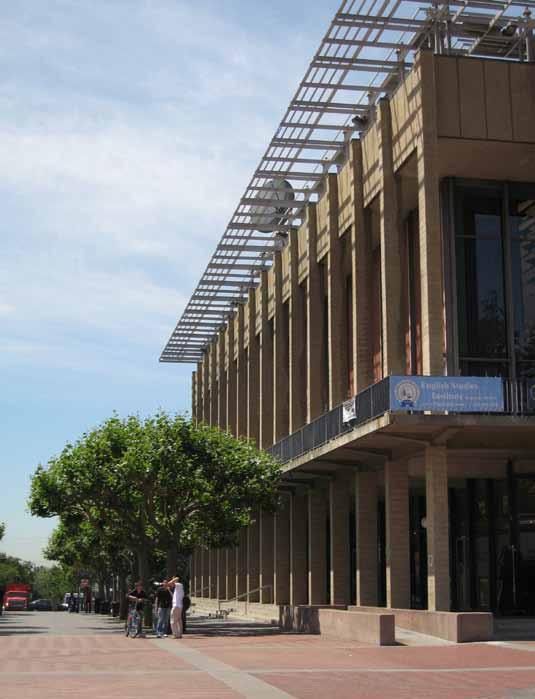
• Eshleman has blank facades and unusable balconies facing the street. Dramatic views west to the hills and to the bay are unexploited.
District Scale
Historic Fabric
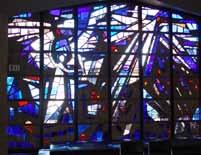
Chavez
• Preserve unique folded-concrete roof
• Chavez Atrium to remain
• Art & cast-in-place concrete bas-relief panels to remain - but may be relocated
MLK
• Steel trelliswork mediates sky and roof
How buildings meet the sky is a signature element defining Lower Sproul buildings
• Boardform concrete will be retained
• Pauley Ballroom interior to remain
• Pauley Ballroom level is expressed with cantilevered balconies
• Custom lighting fixtures will be retrofit to work with energy efficient lamps
Lower Sproul Plaza
• Hardscape plaza program to remain, but greater variety of uses is encouraged which may reduce hardscape area
• Golden Bear column to remain
This page intentionally left blank
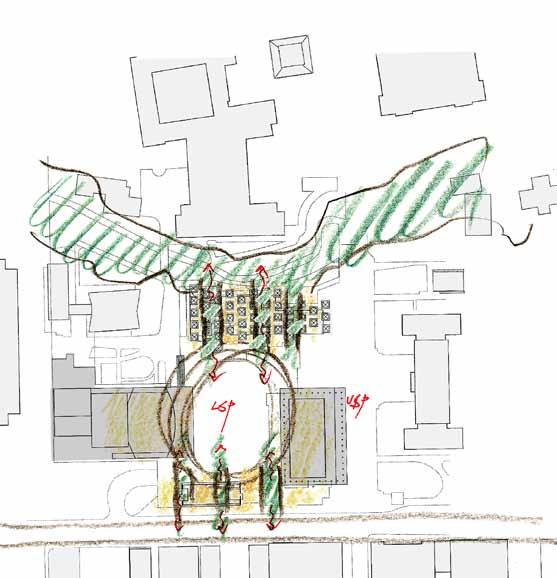
Concept Pattern 1: Linking North-South Axis
• Emphasize visual and spatial connection between the Student Community Center and Strawberry Creek to the north and Bancroft Avenue to the south
• Create multiple corner conditions and protected passage ways to increase program and retail identity opportunities
• The Student Center is the convergence of town and gown, campus with community
• The Student Community Center is also the confluence of the Strawberry Creek natural setting and the “urban” hardscape character of the city
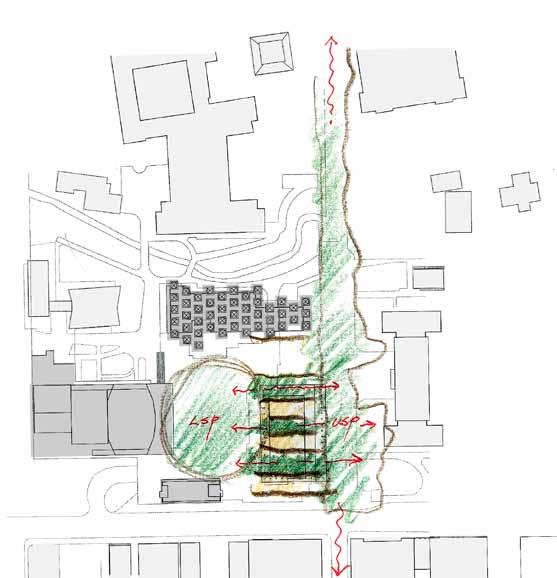
Emerging Patterns
Concept Pattern 2: Linking East-West Axis
• Emphasis on connecting the Lower Sproul Plaza and Upper Sproul Plaza
• Visual and circulation connections
• Upper Sproul Plaza circulation diverted to the LSP
• Assume that MLK is demolished for new construction
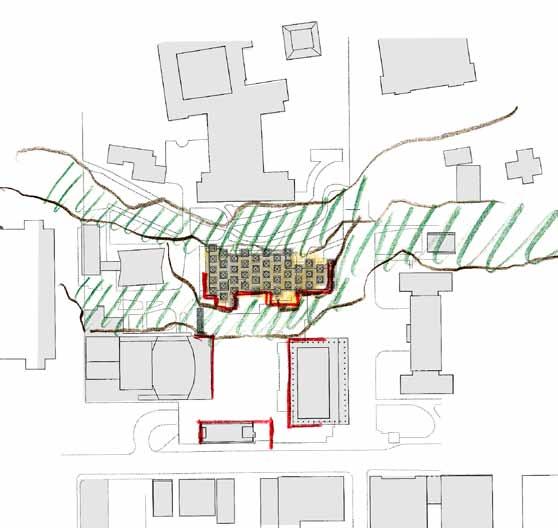
Emerging Patterns
Concept Pattern 3: Chavez In The Green
• Maximize green space along Strawberry Creek
• Restore and reinforce the creek’s natural riparian character to have a stronger presence on the Student Community Center
• Establish a broader range of microclimates and landscapes transitioning from the creek to the plaza
• Re-balance the ratio of hardscape and softscape between plaza and Strawberry Creek
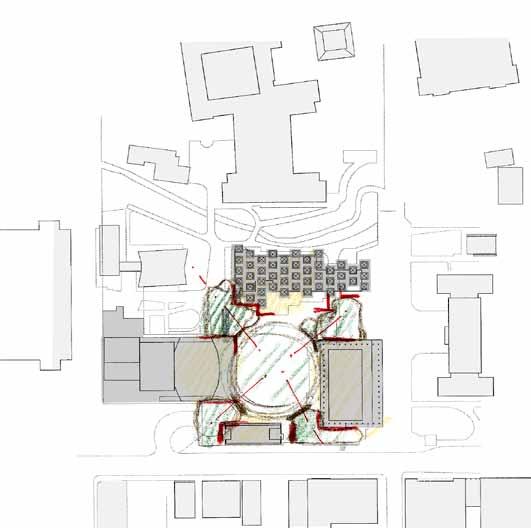
Concept Pattern 4: Diagonal Linkages
• Create strong identity at entry points to Student Center and Lower Sproul Plaza
• Improve wayfinding by creating clear and visible route through the Plaza
• Create framework for expression of individual and group identity
Emerging Patterns
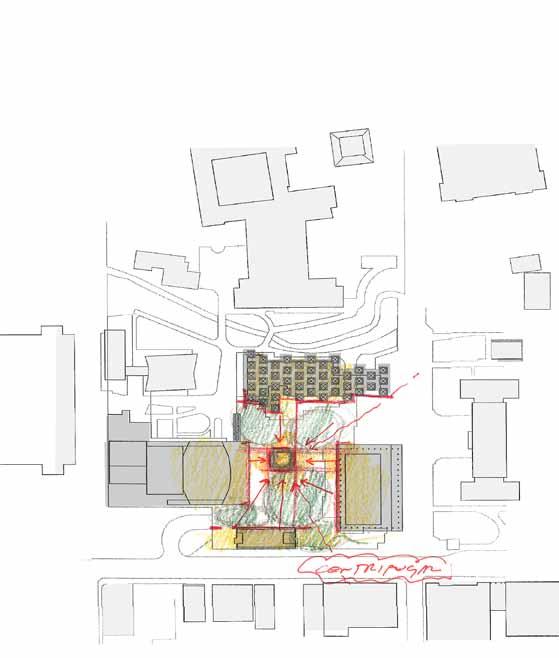
Concept Pattern 5: Centripetal Movement
• Mark the Center / Create strong identity
• Creating a visible destination point
• Shape a habitable central gathering space with a strong sense of place
• High visibility - a space to see and be seen
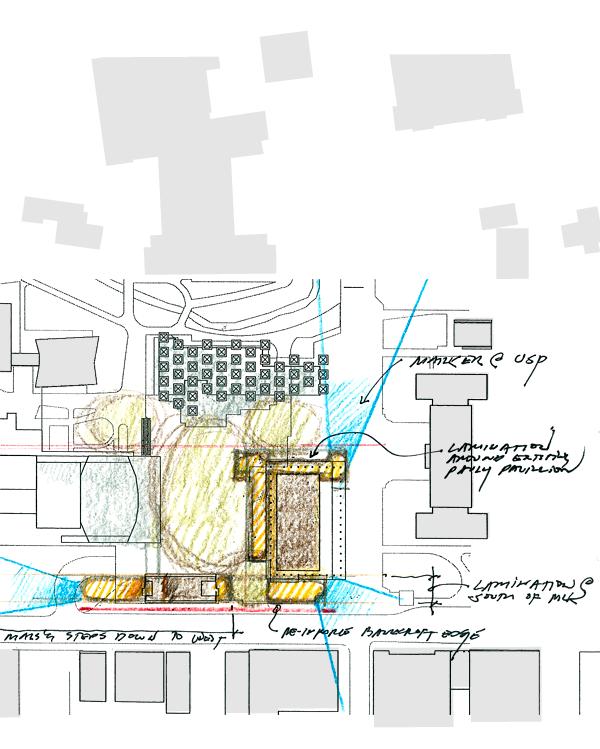
Emerging Patterns
Concept Pattern 6: Additions
• Additions to existing buildings are conceived as glassy additions subordinate to existing building
• Supports seismic upgrading of existing buildings
• Supports sustainable initiatives as adaptive re-use project
• Encourages transparency at building perimeters
Preferred Option
Development Existing Conditions
Recommendations for development of the Student Community Center include the following physical planning criteria:
• Eshleman Hall: removal and replacement
MLK: adaptive re-use and expansion (interior and exterior)
Chavez: adaptive re-use (interior and exterior)
Zellerbach: no significant changes are recommended
Preferred Option
Interventions
Four key interventions are identified involving the removal of existing buildings and or building components:
• Removal of Eshleman Hall (midrise). Eshleman is rated seismically poor, inefficient and roof terrace is underutilized.
Removal of the one story Bear’s Lair: This west facing retail space is underutilized and does not activate the plaza edge. The Chavez Terrace will be made smaller to allow for an uninterrupted east/west axis from Haas Pavilion and Sproul Hall.
The east stairs and a small portion of Chavez will be modified to allow for improved sight lines between Upper and Lower Sproul Plaza.
Preferred Option
Expansion
Expansion of the Student Community Center includes the following insertions:
• New low rise building along Bancroft Way
New “L” shaped addition on the south and west faces of MLK
Possible development of new program area under plaza
Development of key program component at east end of Chavez
New accessible garage level entrance at southwest corner of Chavez
Preferred Option
Development of landscape includes establishing a “green ribbon east-west axis” along the south face of Chavez Student Union, extending from Upper Sproul Plaza down to the Alumni House Quad to the west
project buildings strawberry creek existing context existing redwood canopy tables and chairs outside with connection to interior program green ribbon
Preferred Option
Active Edges Active Edges include:
• The north and south face of Eshleman Replacement West face of MLK
East, north, and south sides of Chavez Student Union
Preferred Option
Green Social Space
• Filtered light for a range of micro climates
South facing “green beach” for informal use and performance seating
Rain garden to filter storm water run-off to adjacent Strawberry Creek
Gently terraced stairways between USP and LSP, and LSP to Alumni House provide informal seating and gathering space
A new east/west green axis accommodates a range of social functions: project buildings strawberry creek existing context existing redwood canopy
Flexible Open Space
Maintain flexible outdoor space for outdoor assembly and performance
• Space allocated can assume a range of assembly configurations
• Preferred Option
Existing and proposed adjacent terraces provide expanded view capacity
Preferred Option
Movement Patterns
Movement patterns are reshaped to emphasize the following:
• Upper and lower levels of movement around the edges of the plaza
Passage ways mark key points of threshold into the Student Community Center
Vertical transitions at northwest and northeast form a new “green path” axis bracketed by existing Sproul Hall and Haas Pavilion
Preferred Option
Concept Development Campus Sightlines
Sight line opportunities to campus and region:
• West facing stepped terraces at Eshleman Replacement
Bay windows at Eshleman Replacement and south face of ‘L’ shaped MLK addition to mountains and bay
Enhanced sight lines to Haas Pavilion and Sproul Hall
Enhanced diagonal site line to campanile
HALL
STUDENT CENTER
STUDENT CENTER
REPLACEMENT • An inner ring of activity contains a mix of retail and student serving programs to create a transparent fabric activated 24/7
Multiple upper level terraces and bridges allow an active ring of activity
• A central amenity on the redeveloped plaza will create a focus of activity. Ideas include performance stage, pavilion or green beach
Multiple upper level terraces and bridges provide overlooks and viewing balconies
This page intentionally left blank
Introduction
This master plan and feasibility study provides the campus with a plan to renovate and revitalize Lower Sproul Plaza, long identified as in need of programmatic and physical redesign, to give the students a high quality center for student life with a mixture of services including retail, dining, meeting and performance venues, and space for student organizations and student government.
The new Student Community Center (SCC) is a student based initiative that calls for recasting the existing midcentury buildings and plaza into a revitalized state-ofthe-art facility rooted in sustainable practices. Both new construction and adaptive reuse combine to celebrate the legacy of its site and history while modernizing its infrastructure into a flexible armature to better accommodate the evolving needs of future generations of students.
The SCC site at the southern edge of campus makes it a gateway between campus and community, academics and commerce. A transit center on Bancroft Way, a bustling neighborhood retail street, will reinforce 24/7 activity. The north site boundary is defined by Strawberry Creek, a thriving riparian ecosystem. This master plan reinforces visual connections to the city, creek and campus landmarks and encourages pedestrian movement and outdoor gathering. Sustainable design elements are made visible and tangible and include a storm water filtration garden, green roofs, photovoltaic shade panels and operable windows for natural ventilation.
The preferred scheme calls for a series of careful interventions combined with adaptive reuse of approximately 190,000 gsf of existing buildings and approximately 95,000 gsf of new construction. The seismically “poor” 8-story Eshleman Hall will be replaced with a lower, more porous, 4-story design that, as in the other existing building renovations, will have built-in flexibility for the sharing of spaces between the many types of student-run organizations. King Student Union will be transformed from its current imposing solid-like mass back to its original design intent; a transparent glass pavilion presenting an active and open public face on all sides.
Chavez Student Center will be re-programmed with large lounge spaces opening up to dramatic views of the redwood trees along Strawberry Creek. Chavez renovations include removal of nonstructural exterior skin at its eastern end and removal of the terrace projection at its southern face. The existing bas relief is to be preserved and relocated.
Underneath the renovated plaza deck, the existing subterranean garage will remain and provide convenient vehicular access for service vehicles and disabled visitors with parking for 80 cars.
Project phasing reflects funding and constructability issues. See page 79.
The following is an outline of proposed architectural features of the preferred scheme as excerpted from the Feasibility Cost Plan dated June 19, 2009:
Foundations include spread footings, isolated column footings, with allowance for locally deepened footings for braced frames and shear walls. Some excavation, concrete retaining walls and shoring are included for new, below-grade construction at the outside perimeter of the plaza. Eshleman, MLK, and Chavez each assume a $100,000 allowance for dewatering.
Vertical structure includes allowances for both steel columns and braced frames as well as concrete columns and shear walls.
Horizontal structure consists of slab on grade, steel beams and girders with metal deck and concrete fill, as well as suspended concrete slabs.
Exterior cladding consists of curtain wall and storefront, with sunshades and louvers, rain screen system, and possible metal panel, and/or masonry cladding such as CMU or tilt-up concrete. Glazing is assumed to comprise approximately 50% of exposed, above-grade wall area. Also included are glazed entries, extensive soffit areas, and miscellaneous exterior detailing.
Roofing consists of single ply or built-up roofing, localized areas of green roof membrane, rigid insulation, flashings and caulking. Also included are retaining wall and slab waterproofing. No new slab waterproofing is included, however, for the new program space in the garage. Terrace surfacing is assumed for designated areas.
Interior partitions include metal stud framing, painted gypsum drywall, doors, balustrades, and interior glazing. Allowances are made for enhanced sound mitigation in some limited areas.
Stairways presume a typical metal pan with concrete fill, with an enhanced interior stairway and an exterior stairway at the Eshleman Replacement building.
Conveying systems include a presumed two new elevators at Eshleman Replacement and one new elevator at the east end of Chavez, with existing elevators receiving upgraded cab finishes.
Interior finishes include allowances for carpet and resilient flooring, ceramic tile in toilet rooms, and enhanced finish in the lobby areas. Wall finishes include some allowance for wood paneling, enhanced finishes in the MLK lobby, and ceramic tile in all toilet rooms.
Ceilings include suspended gypsum board, acoustic tile, and allowance for some special finishes.
Equipment includes toilet partitions and accessories, shelving allowances, fixed casework in limited areas, miscellaneous casework for breakrooms, signage, markerboards, and allowances for fixed audio visual equipment such as projector screens.
Also included are window shades and miscellaneous convenience items such as fire extinguishers and entry mats.
Plumbing includes sanitary fixtures, waste, vent and service pipework, floor drains and hose bibs, gas-fired
water heating equipment, kitchen rough-in, natural gas and roof drainage, and parking drainage systems.
HVAC includes screw type chillers/cooling towers and (steam-water) heat exchangers, circulation equipment and expansion compensation, hydronic piping, air handling units with VAV boxes , 24/7 fan coil units, air distribution ductwork, diffusers and grilles, DDC controls,including, testing and balancing, kitchen exhaust and unit ventilation as well as parking ventilation.
Electrical includes normal and emergency power, PV panels, machine equipment and user convenience power, lighting, grounding,, telephone/data outlets, CATV outlets, audio/visual raceways only, fire alarm system and security system (conduit only).
Fire protection includes automatic sprinkler systems - complete.
Site preparation consists of the demolition of the existing plaza deck, miscellaneous clearing and grading, and site protection.
Site development includes allowances to rebuild the plaza deck, including a reinforcement of its vertical structure to handle anticipated increased loading.
Hardscape includes plaza surfacing, stairs, and ramps. Also included are site plantings, drainage, and lighting, with allowances for miscellaneous site features. Site Development also includes an allowance of $1.5 million for preservation and restoration of historic features both at the plaza and within buildings. Components included are plaza features such as the bas relief sculpture on Chavez, vertical board form concrete panels, the golden bear on pedestal, and features within MLK such as wood paneling, lobby stair railings, light fixtures, and fireplace.
Site utilities include site steam and chilled water, site drainage, domestic and fire water, sewer, gas, electrical normal, emergency and telecommunications / signals.
Alternate 1: Green Roof at Zellerbach Hall
Alternate 2: PV Panels on Roof at Zellerbach Hall
Alternate 3: Temporary Stage for Plaza
Alternate 4: Temporary Shade Structure
Alternate 5: Rooftop Air Conditioner at Eshleman
Alternate 6: New Program at Garage
The following pages include floor plan diagrams that were prepared for the purposes of studying the building mass, pedestrian and vehicular circulation, and potential interior and exterior program area capacities. Area tabulations from these plans were used to develop the quantities listed in the Feasibility Cost Plan dated June 19, 2009.


Potential Program Surge Locations
Student Community Building Center Locations
EXISTING CAPACITY ANALYSIS
A
CHAVEZ STUDENT CENTER
TOTAL BLDG AREA: 78,936 GSF
B
KING STUDENT UNION
TOTAL BLDG AREA: 115,573 GSF
C
ESHLEMAN HALL
TOTAL BLDG AREA: 44,303 GSF
TOTAL AREA: 238,812 GSF
D
LOWER SPROUL PLAZA
PLAZA AREA: 111,692 SF
PARKING BELOW: 58,115 SF
PARKING SPACES: 107
PROPOSED CAPACITY ANALYSIS
CHAVEZ STUDENT CENTER
Following initial meetings with the students and administrators where master planning criteria were established, the architects began generating conceptual design options with the help of a larger design team made up of professionals working in a variety of disciplines. These include landscape architecture, civil engineering, structural engineering, mechanical and plumbing engineering and electrical engineering. Each design option was tested against issues and comments shared by the various team members. An outline of key contributing elements to the preferred conceptual design is below. In-depth narratives from each discipline of study follows.
• Four distinct and heightened entry experiences with fluid, unobstructed circulation.
• Sustainable plant selection with allergy free species
• Large paved area to remain for special events.
• Continuously changing dynamic views throughout the plaza.
• Planting extends the tree canopy of Strawberry Creek
• South facing “beach” provides a perch, stage, or lounge for students to watch daily activity or special events.
• Expanded habitat and biodiversity with roof gardens and other planting.
• Large movable platforms for seating or performing
• Rain water is collected, celebrated, and cleaned, before ultimately flowing into Strawberry Creek.
• Green roofs slow the flow of storm water, lower the environmental temperature, protect the roof water proofing and add insulation to the building envelope.
• New 6-8 inch sanitary sewer for each building.
• Potable water supplied by City of Berkeley.
• Rainwater is filtered, stored in cisterns and re-used for irrigation and toilet flushing.
• Natural gas for heat and hot water.
• Storm water re-use to supply restroom toilet flushing for 5 mos. per year.
• Storm water retention to irrigate all landscape spaces.
• High water table requires the maintenance of a subdrain and pumping system with bathtub membrane as back-up.
• Some existing footings to be enlarged or strengthened along with new spread and strip footings in MLK.
• Existing concrete structure (flat slab over beams) to be re-used at MLK up to Level 3 with steel framing above.
• New additions to MLK will follow existing framing materials to minimize seismic mass of the combined structures.
• Concrete shear walls will be used in MLK below Level 3 to resist seismic force.
• Chavez renovations include removal of nonstructural exterior skin at its eastern end and removal of the terrace projection at its southern face. Existing bas relief to be preserved and relocated.
• New Eshleman could be either concrete or steel framed. Column spacing proposed suggests steel.
• New Eshleman lateral force resistance could be achieved with BRBF, SCBF and/or EBF systems if steel framed. Concrete shear walls around stairs and elevator cores would be used if concrete framed.
• Plaza deck to be replaced entirely to support larger truck capacity on top and increased clearance in garage below. Existing columns and footings to be preserved or strengthened where possible pending truck routing and desired parking capacity.
• New concrete foundations required for new cisterns.
• Existing inefficient and worn-out systems will be replaced with new ones providing a healthier, more comfortable, and productive environment while using less energy.
• Heating, cooling, and fresh air ventilation will be provided for all spaces in the buildings using forced air “Variable Air Volume with Reheat” (VAVR) systems.
• Central air handling units will supply air up or down the buildings through rated shafts.
• New modern efficient cooling systems will signifi cantly improve the comfort and usability of the build ings. Several alternatives will be explored as part of the design process.
• Automatic chilled water “hydration stations” will reduce the use of bottled water.
• Heating for the buildings will continue to be provided by the campus steam utility.
• Environmental operating systems will be controlled with modern computerized and networked controllers to allow continuous feedback and monitoring.
• Building envelopes, lighting, and HVAC systems will be designed to perform at least 30% better than required California Title-24 standardss.
• Grease exhaust systems will be provided for all kitchen needs.
• Existing garage ventilation system will be modified per code with exhaust being discharged at MLK roof.
• New automatic fire sprinkler system throughout
• Storm water to be collected and used for toilet flushing when available.
• Energy efficient lighting.
• Photovoltaic (PV) panels on rooftops and sunshades where possible.
• Reuse of existing 12kV campus power system feeders, fuses, and high voltage switchgear.
• Reuse or recycling of existing copper power conduc tors where possible.
• New diesel emergency power generator.
• Reduced light pollution in favor of a dark stellar sky.
As part of this SSC master plan and feasibility study process, additional reports have been coordinated that are not included in this document. The two listed below were done in parallel with this study and represent significant sources of information that should be referred to when evaluating this study.
• Feasibility Cost Plan by Davis Langdon
• Retail Study by Brailsford & Dunlavey
This page is intentiionally blank.
The identity and visitor’s appreciation of the UC Berkeley campus is rooted in the juxtapositions of the university’s classical core, a unique arrangement of green lawns and the informal axis of the Strawberry Creek corridor that is a setting for neoclassical buildings. The existing student center including Lower Sproul Plaza (LSP), and flanking buildings Martin Luther King, Cesar Chavez, Zellerbach and Eshleman, stands apart from the Classical Core. This dissimilarity highlights a series of challenges and opportunities that this Master Plan proposes to address. At LSP, discrete landscape proposals are made, rooted in environmental and sustainable principles with function and programming, to revitalize the Lower Sproul Plaza landscape through increased use and social activity.
A number of landscape improvement proposals are interwoven with the ground floors and roofs of the adjacent buildings to create seamless patterns of interior and exterior programs. Revitalization of Lower Sproul Plaza relies on both the successful (re)programming and associated reconfiguration of the buildings. While improvement of the landscape can support these endeavors, an integrated approach between landscape and architecture to facilitate and catalyze activity in the plaza is essential. The Master Plan addresses deficiencies or constraints to vital social activity in current open space. Such problems include:
• Poor access to the plaza, both for able-bodied and disabled people.
• Limited to no interior and exterior relationship between plaza and buildings.
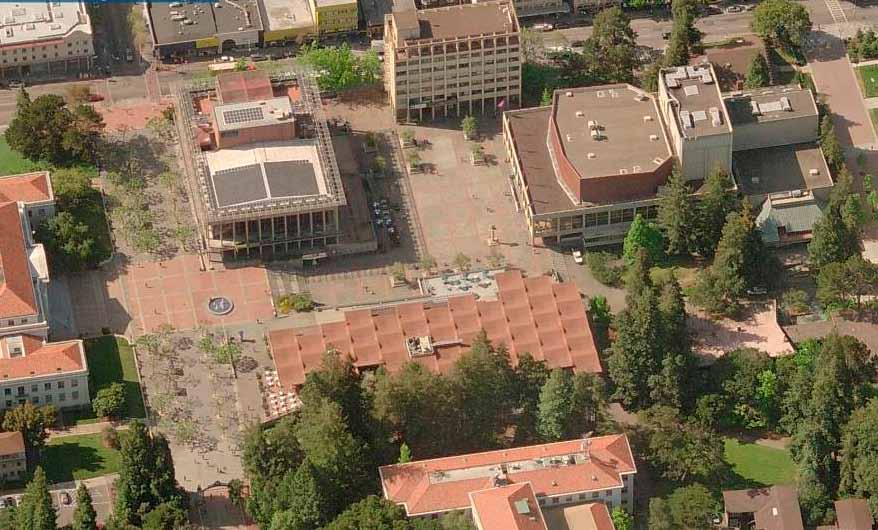
• A lack of variety of types and scales of outdoor spaces.
• An excess of paving and a lack of planting.
• The release of roof and site storm water directly into Strawberry Creek.
• A cultural identity as social space that is anachronistic and no longer relevant.
• A limited range of micro-climates within the plaza.
• Poor lighting discourages nighttime use of the plaza.
The Student Community Center Master Plan addresses each of these issues in such a way that the proposed improvement or solution to one problem will achieve more than one goal. Taken as a whole, the proposal provides for a fully integrated and sustainable Master Plan. On site conveyance and treatment of rain water and new planting, including on roof tops, are proposed to be visible signatures of the revitalized student center complex. A tangible social vitality will be the result of cultivating human ecologies. By understanding sustainability in its broadest context and providing specialized proposals to address issues and technologies most relevant to site planning, open space and landscape design, the SCC Master Plan is committed to sustainable design.
The 2004 UC Berkeley Campus Landscape Master Plan (CLMP) identifies four complementary elements as the armature of the campus; one of these is the sinuous form of Strawberry Creek and its related tree canopy and planting. Significantly, the remaining three components do not inform the framing, design nor atmosphere of Lower Sproul Plaza. The dominant character-providing landscape condition is a “layering of the natural and designed landscape systems [and the] value of the intrinsic landscape and the contrasting overlay of plazas and circulation elements.” These qualities do not occur in the existing Lower Sproul Plaza. The 2004 UC Berkeley Landscape Heritage Plan (LHP) notes that Lower Sproul Plaza lies outside of the Classical Core. The LHP characterizes the various landscapes that constitute the campus, and defines Lower Sproul Plaza as an “urban” open space type. It is worth noting that Upper Sproul
Plaza is identified as the “neoclassical” open space type, further distinguishing Lower Sproul Plaza from its campus context. The landscape of LSP, everything outside of the building walls in the project area, is relatively one dimensional in terms of experience, use and material change over time. It is disconnected from the adjacent campus and urban edge both by its design and lack of use. This condition highlights a variety of planning and design issues and raises questions that result from the self-referential singularity of the existing LSP plan as it was implemented:
• How can the plaza relate more to Strawberry Creek in atmosphere and physically?
• How should the plaza relate to the city of Berkeley as an edge condition?
• How should LSP relate to other adjacent campus landscape spaces, not only Upper Sproul Plaza, but also the neglected Alumni House Quad?
• How can LSP be suitably reconfigured without disrupting the fundamental circulation through the site?
• How can LSP be suitably reconfigured without compromising the integrity of the original Student Center complex plan?
• How hard should the plaza be, how appropriate is adding more planting?
Ultimately, and fundamentally, what is required to make the plaza a hive of student and community activity? The proposed landscape improvements have been made with consideration of these questions in mind.
The CLMP describes improvements to be made to LSP (Site 18). However, of four recommendations only one refers to landscape conditions, “the repair and improvement of paving, site furnishings and planting.” The remaining three recommendations—reprogram adjacent buildings with active day and evening uses, link LSP to Bancroft Way Transit Hub, reconfigure or rebuild Eshleman Hall— are addressed within this Master Plan’s discussion of architecture. The CLMP does note the plaza’s large area of paving to be an important resource
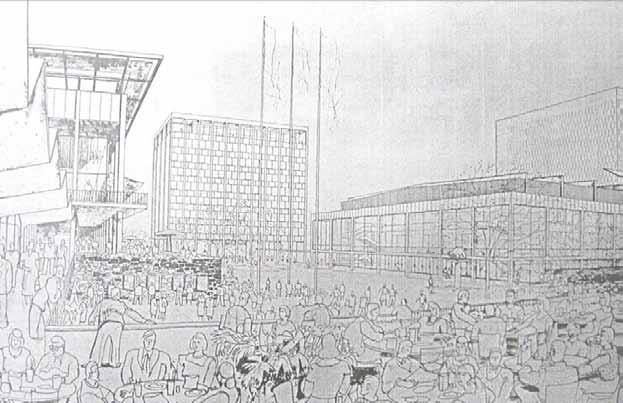
that serves special events, and recommends that any improvement should be done in order to complement Upper Sproul Plaza.
The historical development of the campus landscape is tied to particular consideration of planting. UC Berkeley began life as an agricultural school and there is a history of functional planting to serve the Agricultural Experiment Station and arboretum. Much attention has been paid to the preservation and enhancement of Strawberry Creek, from Olmsted’s work to Halprin’s shelved 1954 campus plan, to Church’s plan that immediately followed Halprin’s, in addition ROMA’s in 1990 to the most current CLMP. In the context of this history of awareness and the immediate adjacency of Strawberry Creek to LSP the
value of the creek vegetation cannot be overlooked. Specifically related to Lower Sproul Plaza, the LHP states that planting design in the Modern landscape type “followed no discernable pattern nor style.” However, the LHP also states that after the 1977 California drought, water conservation by plant selection was paid more attention. Today a sustainable approach to the revitalization of LSP will inform plant selection with a broader array of parameters. The Master Plan proposes that plants are selected not only for aesthetic quality and water use, but also with consideration of function such as habitat value or ability to filter storm water, and uptake contaminants.
The landscape component of this Master Plan is fully integrated into the planning, proposed improvements and programming of the buildings of the Student Community Center that surround the plaza. The integrated approach relies on facilitating connections and capitalizing on adjacencies. Fundamental to the Master Plan recommendations and the revitalized Lower Sproul Plaza is achieving ease of circulation and variety of experience.
The existing Lower Sproul Plaza is the roof of a parking garage and is essentially flat. However, the grade falls more than 10’ east to west along Cesar Chavez to the north and Eshleman to the south at the outside edges of the plaza. While the perimeter of the plaza grade changes, the large flat surface for the plaza is maintained, and this results in problematic access to the plaza for both able-bodied and disabled visitors.
Lack of accessible entry to the plaza is a significant problem. Only one of four direct pedestrian entrances to the plaza is currently wheelchair accessible. This access is at the southwest corner. LSP’s designers provided for an additional exit/entry on the opposite side with a tunnel through Cesar Chavez at the northeast corner. While well used the tunnel is not accessible and is neither a direct entry point to the plaza nor a gracious one. The Master Plan recommends improving accessibility at each corner of the plaza by providing wheelchair compliant paths of travel, and improving the design and quality of experience at each of the corner thresholds. Four distinct and heightened entry experiences will be created.
The Master Plan proposes maintaining the existing accessible entry at the southwest corners, while proposing ADA compliant access at the other corner and the southeast corner, as well as adding vertical circulation inside buildings to facilitate fluid, unobstructed circulation, into, across and out of the plaza. The stairs at the northwest corner and the northeast corner are drawn out to be more inviting points of access that extend between adjacent environments to further a sense of connection between the plaza and it environs. In addition the northeast corner stairs are extended to the north to capture
and support diagonal circulation from the Classical Core of the campus.
Reconfiguration of the northwest corner to provide for a sloped walk or ramp up to the plaza as well as improvement of the stairs to be less abrupt (to lessen its appearance as a wall when approached from Alumni House) allows for a new, direct and visible access into the garage and any potential new program space. These improvements, provided to facilitate circulation, should also be employed to provide the open space between Zellerbach and the Alumni House with a revitalized identity that enhances the intrinsic qualities of the Strawberry Creek corridor.
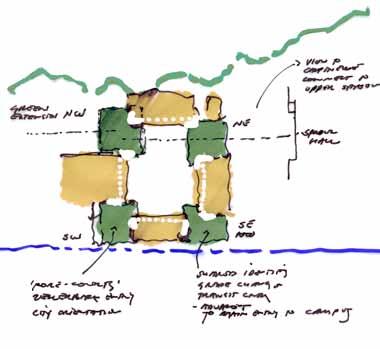
Views in and out of the plaza are fundamental to the new plans for the plaza. They establish cues for circulation and make clear connections between the interior of the plaza and its adjacencies, and between the interior of the campus and the urban edge. Multiple and shifting views provide for rich experiences that become integrated with a variety of encounters established by a new variety of micro-climates—sun/shade relationships—that are in turn connected to program.
Enrich the Experience
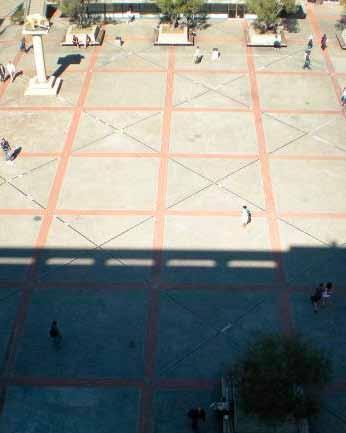
The Landscape Heritage Plan identifies the value of “dynamic views”, as opposed to “formal views”. Dynamic views are experienced as one moves through the landscape. Continuously changing dynamic views in and out of the plaza aid in engendering a lively and engaging environment. The Master Plan identifies two significant views. One view is across the plaza from the sidewalk on Bancroft up to the Campanile. The second
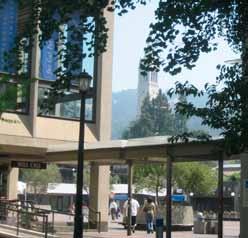
view is from a newly opened east end of Cesar Chavez, into the plaza to the southwest corner and with Bancroft visible beyond.
The 1962 UC Berkeley Long Range Development Plan specified a number of campus open spaces for “formal” design, including the current Student Community Center (SCC). While the existing Lower Sproul Plaza conforms to the formal, modern design and urban qualities, the strict mid-century modernism has established an internal plaza space that is singularly spare. The three largest buildings arranged around the east, south and west flanks of the plaza cast dark shadows through out the day. Coupled with limited seating offered in the plaza at the 10 tree planters or inside the fenced outdoor dining coral, one has the only option of sitting in the deep
shade or completely exposed to the sun. The Master Plan addresses the plaza design and the interface of buildings and plaza specifically to provide a variety of micro-climates and atmospheres, achieved through limiting the building height along Bancroft, attention to connections between interior and exterior space, and filtered light through architectural canopies or planting.
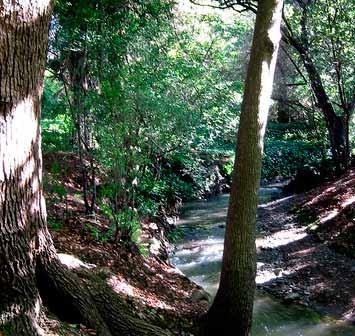
The existing mid-century modern design of LSP offers a very hard environment; a concrete deck with inlaid brick highlights is surrounded by concrete building facades. There are 10 trees in approximately 40,000 square feet of paving. These few trees are removed from the pedestrian environment by their massive planters, and further isolated by benches that surround the planters. While LSP is understood as urban, this does not mean that the new SCC cannot have plants, and that the pedestrian’s proximity to the plants cannot be more immediate. In fact, new urban visions should increase the material diversity and add plants to the urban environment wherever possible. As well as softening the plaza, reducing air temperature, increasing the range of microclimatic conditions, and benefiting the environment for a variety of other reasons, strategic planting can condense the
plaza open space to make the space appear more busy and energized. Additional planted areas will offset if not reduce the amount of paving, and result in a less bleak image on a daily basis, while maintaining the flexible use of an essential paved area.
The Master Plan recommends the addition of planting areas and trees along the northern edge of the plaza. Addition of this “softscape” can achieve a number of goals: the amount of “hardscape” is reduced and a counter point is provided for the primarily concrete environment; the planting extends the tree canopy of Strawberry Creek and the Alumni House quad into SCC Plaza; the planting and trees create a new type of space, a landscape corridor, running east-west at the south side of Cesar Chavez to reinforce this axial connection across the campus; the trees shade the south façade and outdoor terrace of Cesar Chavez.
In addition, the Master Plan recommends introducing a south facing “lawn” at the north end of the plaza, ideally incorporated into the new planting area. While the “lawn” can be constructed from any number of materials, we envision stepped lawn panels that will not infringe on the usable open space of the plaza. Rather it will contain the plaza and provide a perch and lounge for students to watch daily activity or special events unfold.
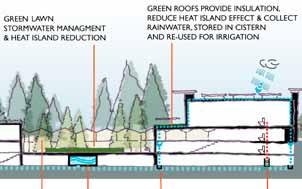
The Master Plan’s additional planting area is readily achievable and highly recommended. The existing 10 concrete tree planters can be replaced with visually accessible planting areas within essentially the same footprint. The existing paved plaza area is too big to be a comfortable space to be in and needs to be reduced in size or softened. The plaza from building wall to building wall is bigger than it needs to be to accommodate all but the largest events.
From the perspective of the landscape, the essential failing of the existing Lower Sproul Plaza has been the poverty of activity in the Student Center complex, more significantly in the plaza and most importantly along the edges of the plaza. The Master Plan recognizes the importance of reprogramming the buildings and in particular bringing new life to the edges of the plaza. The revitalization of the four corners as critical thresholds into the plaza is related. The intent is for the visitor to
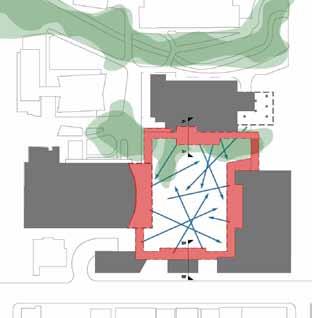
enter an energized environment within the frame of the plaza, and that following the basic cross-plaza paths of travel they will encounter any number of activities from student passive and active recreation to dining and the hubbub of entering and exiting commercial establishments. The importance and value of the large area of on-campus paved open space as is the existing LSP is appreciated and maintained in the Master Plan. The hope is that the new SCC plaza itself can continuously be used by organized events, small and large, with timing of activity structured through a universally accessible internet based calendar. It is hoped that increased activity will be a catalyst for spontaneous events using the unique conditions offered by the SCC. Besides events of various sizes, anticipated additional program includes outdoor dining with tables and chairs, markets and kiosks, and bicycle parking complemented by a bike maintenance store.
The Master Plan establishes four distinct and complementary edges to the plaza. The north side would be defined primarily by planting, with Cesar Chavez in the background. Shade and a variety of spaces will be framed by trees. The “lawn” will offer a comfortable place to relax in the sun. This area will be a magnet for student active and passive recreation, groups and individuals, stimulating social interaction. At the west side, along Zellerbach, the Master Plan proposes extending the floor of Zellerbach’s lobby and covered walk into the plaza to become a terrace, possibly with additional seating. The edge of the plaza at the terrace is bounded by steps. This terrace plinth would not conflict with the design intent of Zellerbach. It would extend the building’s presence in the plaza at the scale of a person and provide an opportunity to perch and people watch. In this way activity is added to the west side of the plaza, where typically there is none, except when there is an event spilling out of the theater. The character and atmosphere of the southern edge will be defined by the Eshleman Replacement at Bancroft. Ideally the visual interest provided by the uses of the ground floor spaces will add to the atmosphere of the open space in its vicinity
along with the vitality of people entering and exiting the building commercial spaces and the plaza from Bancroft at the east and west end. If there is food service at the ground floor of this building, dining would occur outside on the plaza. To further vitalize the south-west corner of the plaza, the Master Plan proposes bicycle parking situated in the tucked away outdoor space between the south façade of Zellerbach and the Eshleman Replacement. This program has potential to be social and even sculptural, and can be complemented and amplified with corresponding building program such as bike maintenance and a cafe. The east-side, west façade of MLK, is anticipated to be the most vital and dynamic edge, primarily because the greatest number of people circulate, north-south, across the plaza and the face of the building. The exciting architecture, the uses at the ground floor inside and outside, and fluid connections between the interior and exterior space should allow visitors to move with ease between environments. Passers-by mingle with spontaneous encounters to be had; the social energy of this plaza edge should be high.
The quality of each of these edges, with people distributed all the way around the plaza, should inflect on the main space; the increased population should make the plaza, even when empty, seem energized. This activity in turn should be a draw for other visitors and a catalyst for performers of all stripes. It is possible for programming of the plaza to be student directed, framed by the ASUC, but content and even scheduling could be by students or other communities. A simple model for this might be a web based calendar that allows a person to claim and block out a period of time for use of the plaza’s central area.
Other areas of opportunity for student use include the “lawn” that can be either a stage or audience seating, and the framing of a mini-plaza or sub-space at the north end of MLK. This space is approximately 4,000 square feet and framed by Cesar Chavez, MLK, the trees of the proposed landscape corridor and the grand stairs from Upper Sproul Plaza. With the proposed backdrop of trees, this relatively intimate space will have new defini-
tion and identity.
In development of the Master Plan additional ideas for student uses and interaction with the space were considered. Most indicative of this thinking was large movable platforms that individually could be benches situated anywhere on the plaza by students, or combined to make a stage or group bench; the benches would be too heavy to carry but on casters so one or two people could move them.
Because sustainability extends beyond the purview of any single profession or discipline, it requires a holistic and collaborative approach. Sustainable proposals include detention, treatment and possible reuse of rainwater and building greywater; expanding habitat and biodiversity in roof gardens and other planting; enrichment of human ecologies through thoughtful programming of the plaza and cultivation of social interaction by design.
Strawberry Creek is a fundamental character defining feature of the UC Berkeley campus. Of its entire watershed, the only developed area that the creek passes through not in a pipe is on the UCB campus. The existing LSP sits directly adjacent to Strawberry Creek. Currently all rain water from the Student Center, including storm water from the building roofs and the plaza is released directly into the creek. Conditions provide for a remarkable and unique opportunity for the revitalized plaza to be ecologically linked to its environment, the landscape and the creek. Because the existing Sproul Plaza water shed is relatively discrete and all storm water is collected on site in pipes intervention in the flow and quality of site water can be made relatively easily.
The relative ease of collecting storm water from the Student Community Center allows for a variety of options in its use or treatment. The water will be treated by filtration, passively not mechanically. This filtration
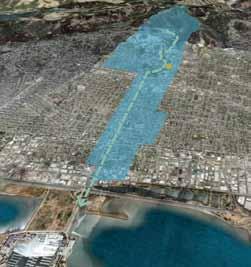
can be made legible as planting beds or concealed as infrastructure under the plaza deck. Given the Master Plan proposal for the “green band” at the northern end of the plaza and the likelihood of rebuilding the entire plaza deck, all site water can be collected and conveyed in a visible manner across the plaza to the proposed planting. The planting medium can include an engineered soil profile that will filter the storm water and be a legible expression of this function and SCC Plaza’s connection to the creek. Collected storm water can be held in cisterns to be used for flushing toilets or for landscape irrigation. Alternatively the storm water can be detained in the planting areas and released in a controlled manner into Strawberry Creek.
The new construction proposed by the Master Plan allows for access to and use of the roof tops at the Eshleman Replacement and the MLK addition. This accentuates the three dimensions of the revitalized Student Community Center with students outdoors, above the plaza and at street level. In addition there is a legible seasonality with more views of plant material
changing through its cycles. The planted roofs can be a signature of the project and a statement of the planning principals and the University’s, faculty’s, administration’s and student’s intentions for the revitalization of Lower Sproul Plaza.
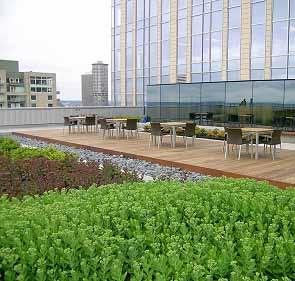
Green roofs are proposed where photovoltaic panels do not cover the roof at the Eshleman Replacement. With this project the true value of the green roofs is in their emblematic quality; to this end the landscape treatment of these roofs will be primarily for demonstration purposes and will set a tone for visitor experience. While the green roofs are accounted for in the Master Plan in terms of accommodating their construction, there are options for the function and aesthetic that can be determined by stakeholders. The green roofs could be vegetable beds to address food supply and equity issues; blankets of a single durable and low water using species to address storm water quality and detention issues; full and tall plantings of native species to be visible from the street below and surrounding buildings; collections of flowering and fruiting ornamental plants to ensure visits from birds to bring another form of life to the rooftops or flower gardens. Whatever they are
planted with, the south and southwest facing aspect of all of these roofs establish a good foundation for their development.
The roof of the MLK addition offers additional opportunities as well as planting because of its direct connection to the Pauley Ballroom. This rooftop will be a flexible open space extension of this facility and provide views over the plaza. The Master Plan proposes the subdivision of this terrace into different zones with distinct qualities. The portion of terrace adjacent to the Pauley Ballroom can be an open area of unobstructed deck or paving. The portion of terrace at the stair tower can be of a different material, possibly including fixed seating and a canopy for shade. The remainder of the terrace can include planting beds, lawn or a playful, but appealing material like recycled rubber surface to make a
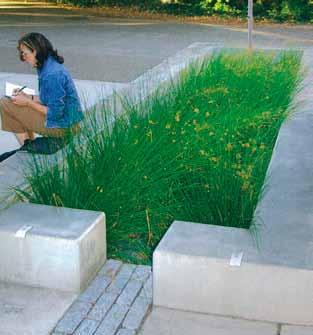
space for passive recreation. Like the plaza and the interior of the revitalized buildings the Master Plan hopes to imbue all corners of the Student Complex with new life, including the roof tops.
With very little expenditure, but special attention paid to the plant species and plant gender, the SCC Plaza can alleviate the misery of people who suffer from allergies. It is possible that many if not all the new plants used in the project can rank low in their harm to allergy sufferers. While wind carried pollen can enter the plaza from afar, its presence can be greatly diminished by using male plants or flowering species that rely on birds and bees to carry their pollen.
Ideally campus bicycle parking, a bike-share program and bicycle maintenance services are all located within the SCC and possibly occupy some of the garage space below, trading bikes for cars. Coupled with the proposed transit hub on Bancroft, the Student Community Center can be a pedestrian friendly transportation hub, providing accessible alternatives to automobile use.
Proposed outdoor lighting in SCC Plaza will conform to maintaining a dark sky. Goals are to reduce light pollution so people can see the stars, to reduce the effects of artificial lighting on the environment and fauna, and to cut down on energy usage. This is primarily achieved with full cutoff light fixtures that cast little or no light upward, along with thoughtful layout of fixtures.
Lower Sproul Plaza is located on the University of California Berkeley Campus between Telegraph Avenue and Dana Street, just north of Bancroft Way. Currently LSP consists of approximately 46,000 square feet of concrete plaza surrounded by four buildings. On the north side of the plaza is the Chavez Student Center Cafeteria. On the east side of the plaza is the Martin Luther King Student Union Center (MLK). Likewise, the south and west sides of the plaza consist of the Eshleman and Zellerbach buildings. Below the existing LSP concrete plaza is an existing underground parking structure. The site generally slopes east to west and towards Strawberry Creek.
The existing sanitary sewers for the buildings around LSP discharge by gravity to the existing City of Berkeley sewer system in either Bancroft Way or north of the Chavez Student Center Cafeteria. The new Eshleman Hall will require a new 6-inch sanitary sewer service to the building. The service will come from the existing City of Berkeley sewer system traveling east-west in Bancroft Way. The extent of modifications and improvements to the MLK building will also likely require new 6- or 8-inch sewer service to the building. Improvements and modifications proposed to the Chavez will not require a new sanitary sewer service.
UC Berkeley obtains its potable water from the City of Berkeley domestic water system. Any new domestic water for Eshleman, MLK, or Chavez will come from the UC Berkeley water system. The domestic water system will connect to the City of Berkeley water mains. Flow and pressure requirements from the City mains plus the demands from the proposed site improvements will be reviewed and used to determine the need for upgrading the existing domestic water lines. Chavez has an existing 4-inch and an existing 8-inch domestic water line serving the building. These domestic water lines connect directly into the 6-inch main system running just north of the building. MLK has an existing 3-inch and an existing 8-inch domestic water line serving the building. These 3-and 8-inch domestic water lines connect into a
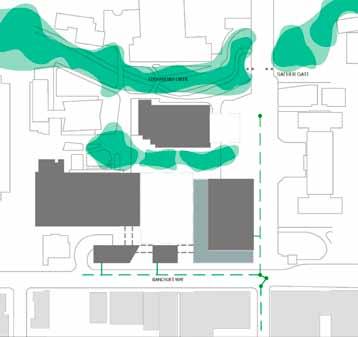
6-inch main line running north-south through the Upper Sproul Corridor. This 6-inch line connects into the main domestic water system traveling east-west just north of Chavez. It is assumed that the Eshleman domestic water system connects directly into the City of Berkeley system in Bancroft Way. These 3-and 8-inch domestic water lines connect into a 6-inch main line running northsouth through the Upper Sproul Corridor. This 6-inch line connects into the main domestic water system traveling east-west just north of Chavez. It is assumed that the Eshleman domestic water system connects directly into the City of Berkeley system in Bancroft Way.
Natural gas will be used for all dining restaurant equipment and building heat in addition to heating domestic
hot water. Any natural gas for Eshleman, MLK, or Chavez will come from the UC Berkeley natural gas system traveling north-south through the Upper Sproul Corridor before connecting into the main system at the intersection of Bancroft Way and Telegraph Avenue.
The Student Community Center site receives an average of approximately 25 inches of rainfall annually. This average annual rainfall produces a large amount of stormwater runoff which currently discharges into Strawberry Creek (see attached figure for existing storm drain system) eventually impacting the City of Berkeley’s storm drain system through a culvert at Oxford Street. The City’s storm drain system at Oxford Street has been identified as exceeding capacity under existing conditions for a 25year storm. Due to these existing conditions, this Master Plan proposes the use of a conventional storm drainage detention system or storm water retention and re-use system. In either system, the focus will be to provide stormwater quality treatment for the first one-half inch of stormwater runoff to meet the C.3 storm water quality requirements from the State of California.
This approach will reduce the negative impact of stormwater runoff from existing and new impervious areas within the Lower Sproul Plaza drainage area and further develop the natural connection of a strongly urban environment adjacent to the natural areas along Strawberry Creek.
A storm drainage system will be provided to convey stormwater runoff from LSP to either a holding tank or directly to the UC Berkeley storm drain system after completing the water quality treatment process. Because of the large amounts of impervious areas within the LSP, stormwater quality treatment through natural vegetated areas will be maximized as much as possible. Areas that do not drain to a natural vegetated area may be treated through the use of manufactured gravity filtration systems to satisfy the 80 percent removal requirement of Total Suspended Solids (TSS). The storm drainage treatment
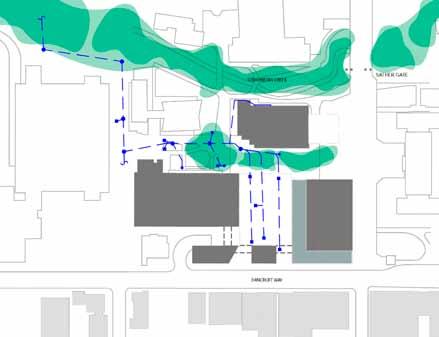
and conveyance system will include downspouts from the adjoining buildings to convey additional stormwater runoff from the roof areas to the storm drainage system.
The holding tank size will be defined by two distinct design criteria: (1) stormwater quality and (2) stormwater quantity. Typically, stormwater quality standards require the first flush of runoff from all impervious area within the project limits be treated by a stormwater quality facility.
A stormwater re-use system will be provided for the Lower Sproul Plaza area to reduce the campus’ potable water use for toilet flushing and irrigation. Development and the addition of impervious surfaces within the Strawberry Creek watershed over the years have resulted in existing downstream capacity issues. A stormwater
re-use system also has the added benefit of reducing the peak and total stormwater runoff rates and volumes to Strawberry Creek. The recommended stormwater re-use system will serve as the primary water source for the Lower Sproul Plaza. This system will supply the proposed toilet flushing demands for the building improvements and landscape irrigation needs surrounding Lower Sproul Plaza.
The rainfall patterns in Berkeley and the total impervious area of LSP will provide sufficient stormwater runoff to serve the expected number of toilets in the new buildings surrounding the Plaza. While the demands for the proposed building improvements will vary based on the number toilets in the buildings, the number of toilets has been estimated based on the number of people regularly in the buildings.
• On a yearly basis a storage tank of approximately 100,000 gals can supply approximately 28 toilets, 8 urinals, and 1,400 square feet of landscape area.
• On a yearly basis a storage tank of approximately 250,000 gals can supply approximately 58 toilets, 18 urinals, and 1,200 square feet of landscape area.
Each additional 100 square feet of landscape area adds approximately 1,500 gallons to the overall storage tank size. For every additional 2 toilets, the storage tank size increases by approximately 9,500 gallons. For every additional 2 urinals, the storage tank size increases by approximately 5,500 gallons.
The location of the stormwater re-use tanks will be the northeast and southeast corners of the underground garage as shown on the following page. The storage tanks could consist of one large tank, a series of smaller square concrete tanks defined by tyhe seismic joints or the columns, or a series of smaller cylindrical fiber glass storage tanks. The size and shape of the stormwater re-use tanks will depend on the phasing and constructability of the stormwater re-use system in the initial stages of the project construction. One large tank is the most efficient method for storage, but doesn’t lend itself to phasing well. The use of smaller concrete or fiberglass tanks allows better phasing of construction, but is inefficient in the space used for the stormwater volume.
This site proposes a unique situation in terms of phasing the construction. Phase 1 of the SCC Plaza includes Eshleman Replacement along with modifications to the existing ramp into the underground garage area. Depending on the method of stormwater storage, the ramp modifications may improve access for construction equipment for the installation of storage tanks.
Phase 2, which includes work on the MLK addition and renovation, and improvements to the Plaza, will include the construction of the stormwater storage system. If portions or the entire plaza are removed as a part of the
work, access to the garage will allow better constructability of the below-plaza level storage system. Once the stormwater system is in place, modifications to Chavez in Phase 3 can take place with the stormwater re-use system functioning.
The new Student Community Center project aims to revitalize an important, but underutilized, area of campus so that it can serve as a modern, dynamic, effective center of student life and activity. The project includes replacement of Eshleman Hall (which has a UC System Seismic Performance Rating of “Poor”), adaptive reuse and expansion of Martin Luther King Jr. Student Center, renovation of Cesar Chavez Student Center, and significant landscaping improvements to the existing Lower Sproul Plaza.
The site is complicated. Four buildings surround the Plaza: King, Chavez, Eshleman Hall, and Zellerbach Hall. The existing plaza itself is effectively a fifth structure. Implementing the architectural vision requires understanding and respecting the complicated interrelationships between the various structures and their connections in order to provide an organized system of thermal and seismic joints, providing efficient and appropriate structural systems for the new work, and incorporating sensitive seismic rehabilitation work at the expanded King.
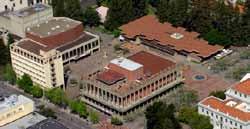
The purpose of this structural narrative is to provide a general description of the existing structures within the Student Community Center (SSC) project scope, the structural systems proposed to be used in the renovation work and new construction, and the associated structural design criteria. The SSC scheme described in the set of Moore Ruble Yudell drawings dated February 26, 2009 has been used as the basis of design. Although Zeller-
bach is not within the project scope, Zellerbach abuts the Plaza, supports a portion of the Plaza for gravity loads, and provides lateral resistance for portions of the Plaza moving in several directions. An alternate to the project also includes adding landscaping on the east end of the Zellerbach roof. As a result, Zellerbach has been included in the discussion.
The narrative first provides a section describing each of the existing structures, then a section on the proposed renovation and new work, followed by a section commenting on structural phasing considerations, and ends with a section on structural sustainable design issues.
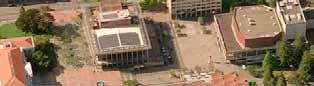
Overview
There is no readily available compilation of information on the structures in the SCC project scope. To provide a convenient resource, the following sections provide information for each structure about the original designers, dates of design and construction, size and geometry of the structures, vertical load-carrying and lateral force-resisting systems, renovation history, seismic evaluation reports and performance ratings, and seismic deficiencies. Information is based on documents sent to us during the master planning process or in our files from previous work. A brief walkthrough of the buildings was conducted, but no finishes were removed, and many areas were not accessed. The naming convention of floor levels for this SCC project follows what was used in the original construction. Thus, the garage level is Level 1, and Lower Sproul Plaza is at Level 2.
Martin Luther King Jr. Student Union Center
• Design: The architect for King was Hardison and De
Mars; the structural engineer was Pregnoff and Matheu. Original drawings are dated April 7, 1958. The building code used in design is not listed on the original structural drawings, but it is presumed to be the 1958 or 1955 UBC.
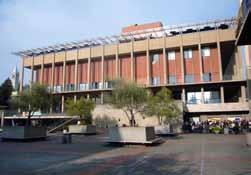
• Size: King is a large five-story structure. The basement story (Level 1) is fully below grade. The next level up (Level 2) opens up on Lower Sproul Plaza, but it is below grade up against Upper Sproul Plaza. At Level 3, there is a terrace on the west side of the building overlooking Lower Sproul Plaza and a short set of steps down to Upper Sproul Plaza on the east side of the building. The large Pauley Ballroom at the north end of the building is on Level 4 and is two stories tall. At the south end of the building at Level 6, there is a mechanical penthouse and the Tilden Room. The base of the building is 247 feet north-south by 180 feet east-west. The tower portion is 185 feet north-south by 120 feet east west. Story heights are 13’ in the basement, 13’ at Level 2, 17’ at Level 3, 17’6” at Level 4, and 13’9” at Level 5. King is structurally connected to Chavez at the plaza, and stairs connect Upper and Lower Sproul Plaza and at the basement story below. The original connecting bridge linking King and Chavez was removed as part of a 1998 Chavez renovation project.
• Vertical Load-Carrying System: From Level 3 down, the building is a made of concrete construction; beginning at Level 3, it is steel framed.
In the upper steel framed portion, the roof over the Pauley Ballroom is unfilled metal deck spanning 12’ between steel trusses that span 120’ east-west to steel columns. The roof over the central mechanical penthouse is unfilled metal deck spanning the steel beams and girders supported by steel columns. These two roof areas support photovoltaic cells added in 2003 and 2006. The Tilden Room uses concrete columns to support a set of interconnected hyperbolic paraboloid concrete shells. The Level 6 floor below the penthouse and Tilden Room, Level 5, and Level 4 all have 6” thick reinforced concrete one-way slabs on steel beams that span to steel girders, supported by steel columns. The steel framing is composite with the slab by use of welded “I” sections on top of the beams and girders.
In the lower concrete portion, gravity loads are resisted by 6” thick reinforced concrete one-way slabs on beams that span to concrete girders and columns and the concrete stair and elevator cores in the south end of the building. Columns are supported by spread footings and strip footings. Live load criteria are not given on the drawings. Allowable bearing pressures are based on a January 30, 1958 geotechnical report by Woodward, Clyde, Sherrard and Associates, with 6000 psf for dead load, 9000 psf for dead plus live load, and 12000 psf for dead plus lateral loads.
• Water Table: The design water table elevation is not indicated on the original structural drawings, but the typical foundation details show a 6” basement slabon-grade over a membrane over a mudslab over drain rock, and there is a subdrain system in the drain rock. The original geotechnical report was not provided to the SCC design team, but a copy of the April 22, 1958 “Field Permeability Investigation for the Proposed Student Center Cafeteria-Union Buildings,” by Woodward, Clyde, Sherard and Associates indicated that “a subdrain system was proposed to permanently lower the water table below the level of the basements.” A series of piezometer holes were drilled, and pumping tests were done to estimate pumping quantities required to lower the water table. Subdrain design recommendations were given that
match the details shown on the drawings. A couple of cross sections were cut across the King/Chavez site that indicate the water table follows the surface slope and an “assumed high water level” for design is at about Elevation 252 on the north side of Chavez to about Elevation 239 on the south side of King at Bancroft Avenue. The basement floor of King is at Elevation 242, with typical bottom of footings at Elevation 236 and the lowest bottom of footing in an elevator pit at Elevation 231.2. The Level 1 Lower Sproul Plaza is at Elevation 255. These elevations are likely based on the older campus datum system and will not match the current datum system. To get elevations in the current NGVD datum system, it is assumed—based on past work at UCB—that 4.12’ should be added to the elevations in the older campus datum system.
• Lateral Force-Resisting System: In the lower concrete portion, lateral forces in both directions are resisted by the slab spanning between concrete walls. In the upper steel portion, loads are primarily resisted by two stair cores and one elevator core in the southern end of the building. The metal deck roof over the Pauley Ballroom is supported for north-south loads by the concrete cores, and east-west loads are resisted partly by cantilever action of the diaphragm off of the cores and partly by the supporting trusses and their columns acting as moment frames. The mechanical penthouse roof is braced with braced frames down to the Level 6 diaphragm. Based on sheet notes, it appears that wide flange steel beam-tocolumn connections are all fully welded, even in the weak direction of the column, providing an unusual back-up moment frame system.
• Plaza: See the “Plaza” section of the report below for information on the portions of the Plaza that were added as part of the construction of King and Chavez.
• Past Structural Evaluations and UC System Ratings: Seismic evaluations of the structure include the following.
- “1997 Preliminary Seismic Evaluation Phase 1”,
September 1997: This was a campus-wide study of many buildings by a team of Rutherford and Chekene, Degenkolb Engineers, and Forell/Elsesser. Eshleman was evaluated by Forell/Elsesser. It was given a UC System Seismic Performance Rating of “Fair”.
- 2002 Report: A 2002 seismic evaluation report is mentioned in the structural section of the 2006 EHDD report. It may have been where the UC Seismic Rating was changed to “Poor”. This report was not available for review.
- “Martin Luther King Jr. Student Union Feasibility Study, The University of California Berkeley,” EHDD, January 2006: This report contains a structural section and detailed evaluation by Forell/Elsesser using nonlinear static pushover analyses. A UC Seismic Rating of “Poor” is indicated, and a rehabilitation scheme is described.
• Seismic Deficiencies: Besides the original (now removed) bridge linking King and Chavez at Level 3, seismic deficiencies identified in various reports for King include inadequate shear capacity in the core walls due to a discontinuity in the west core, inadequate lateral resistance for the north end of the roof over the Pauley Ballroom, and inadequate column details in the Tilden Room structure.
• Rehabilitation/Renovation History: At least two significant seismic rehabilitation projects have been performed for King. The first is a 1998 project that removed the original connecting bridge at Level 3 between King and Chavez, which lacked adequate seismic separations. This is described in the Chavez section below.
The second is a project that is currently underway. The SCC design team received a set of May 7, 2007 “Permit” set drawings, entitled “King Student Union Seismic Correction, University of California, Berkeley.” The architect is EHDD; the structural engineer is Forell/Elsesser. The drawings show phased rehabilitation work that includes strengthening the Tilden Room columns and their attachments to the Level 6 framing, adding a new shear wall on the west side of the building to address the discontinuity at the stair core and resulting torsion,
and adding a braced frame above Level 4 and shear wall below it on the north face of the building to address the lack of adequate east-west resistance for the roof over the Pauley Ballroom.
In a February 17, 2009 email, Craig Comartin, seismic consultant to UCB, noted that the scope has been recently revised based on new structural analysis. The west wall has been deemed adequate as built. The revised scope includes installation of fiber wrap on selected walls and reinforcement to strengthen collector elements.
As part of the current seismic rehabilitation project, a geotechnical report was prepared. It is “Geotechnical Recommendations, King Student Union Assessment, Project Number 11153.000A”, by Geomatrix, dated December, 2005. It was not available for review.
• Design: The architect for Chavez was Hardison and De Mars; the structural engineer was Pregnoff and Matheu. Original drawings are dated April 7, 1958. The building code used in design is not listed on the original structural drawings, but it is presumed to be the 1958 or 1955 UBC.
• Size: Chavez is a three-story reinforced concrete structure. The basement story (Level 1) is fully below grade. The next level up (Level 2) opens up to Lower Sproul Plaza and the pedestrian way to the north, but it is below grade up against Upper Sproul Plaza. Level 3 connects to Upper Sproul Plaza and includes terraces on the south face that overlook Lower Sproul Plaza. King is structurally connected to Chavez at the plaza and stairs connecting Upper and Lower Sproul and at the basement story below. The original connecting bridge linking King and Chavez was removed as part of a 1998 Chavez renovation project.
• Vertical Load-Carrying System: Gravity loads are resisted by reinforced concrete one-way slabs on beams
that span to concrete girders, columns and walls. A combination of 6” thick conventional slabs and 15” thick sonovoid tube slabs are used. The roof structure is an unusual set of interlinked hyperbolic paraboloid concrete shells supported by cantilever columns rising up from the Level 3 floor framing. Columns are supported by spread footings and strip footings. The basement floor is a 6” slab on grade. Live load criteria are not given on the drawings. Allowable bearing pressures are based on a January 30, 1958 geotechnical report by Woodward, Clyde, Sherrard and Associates, and vary depending on the plan location and foundation depth. The water table elevation is not indicated, but the typical foundation details show the same system used in King, which is a 6” slab-on-grade over a membrane over a mudslab over drain rock, and there is a subdrain system in the drain rock. See comments in the King section regarding the water table.
• Lateral Force-Resisting System: Lateral forces are resisted by concrete shear walls at the basement and Level 2 and by the cantilevered canopy columns at Level 3.
• Plaza: See the “Plaza” section of the report below for information on the portions of the Plaza that were added as part of the construction of King and Chavez.
• Past Structural Evaluations: Seismic evaluations of the structure were not available for review. Chavez was apparently not included in the “1997 Preliminary Seismic Evaluation Phase 1” report, nor in the 1998 Phase 2 follow-up. A 1998 renovation project entitled “Seismic Improvements” was performed, so it is likely there was a study that preceded the development of the 1998 drawings.
• Seismic Deficiencies: Assessing the extent of seismic deficiencies, if any, is beyond the scope of this master planning effort. Presumably, the 1998 renovation project addressed any deficiencies that were identified in a preceding report. This should be verified in a future project, particularly since the columns at Level 3 of Chavez are similar to those at the Tilden Room in King, which are in
the process of being seismically strengthened.
• Rehabilitation/Renovation History: A set of May 19, 1998 drawings entitled “Cesar E. Chavez Student Center, University of California, Berkeley, Seismic Improvements, Bid Package #1” was received. It is not known if there was a subsequent “Bid Package #2”. The Bid Package #1 architect was Noll and Tam; the structural engineer was Degenkolb Engineers. Though this project was titled “Seismic Improvements”, there were no seismic improvements other than the removal of the connecting bridge and canopy between Chavez and King. The rest of the work addressed issues related to a ramp next to the stairs connecting Upper and Lower Sproul, other accessibility and elevator improvements, waterproofing, entrance changes, and some reprogramming of spaces.
There is a note on A10.1 of the 1998 drawings that says “See note regarding allowable deck loads at upper and lower Sproul Plaza on Sheet A0. No heavy equipment, such as a crane, that exceeds these loads shall be allowed west of column line A between the King Student Union and the Chavez Student Center.”
The notes on Sheet A0 read: “The maximum wheel load (based on a minimum length between vehicle tires of 5 feet and a minimum length between axles of 5 feet) is 3,000 lbs. If the vehicle tires are spaced less than 5 feet apart and the axles spacing is more than 5 feet, the maximum axle load is 3,000 lbs. There shall not be more than one vehicle within 24 feet of another vehicle at any given time.” Truck loading is typically defined by the American Association of State Highway and Transportation Officials (AASHTO) Specifications. AASHTO has several different standards (H-15, H-20, HS-15, HS-20), but in all cases, the governing rear axle loads for AASHTO are substantially higher than the 1998 Sheet A0 limits.
Eshleman Hall
• Design: The architect for Eshleman was Hardison and De Mars; the structural engineer was Pregnoff and Matheu. Original drawings are dated January 21, 1963. Construction was completed in 1965. The building code
used in design is not listed on the original structural drawings, but it is presumed to be the 1961 UBC.
• Size: Eshleman is a reinforced concrete structure with a full basement and six stories above the Level 2 Lower Sproul Plaza level. The building is rectangular in plan with dimensions of 50’ in the north-south direction and 122’ in the east-west direction, with a total square footage of approximately 49,000 sf. It is 95’ tall above the plaza level, with a tall first story of 20’8”, and typical story heights of 11’11”.
• Vertical Load-Carrying System: Gravity loads are resisted by 4” and 5” thick roof slabs and by 12” sonovoid one-way floor slabs that span between the exterior concrete beams and central interior beam. Exterior spandrel beams are 6’ deep. The bay sizes are 25’ north-south and 24’ east-west. Beams are supported by concrete columns. Columns bear on strip and spread footings. The basement floor is a slab-on-grade. Live load criteria are given on the structural plans and are 50 psf typically, except for the plaza level and top floor, which are 100 psf. Allowable bearing pressures are based on a August 7,1962 geotechnical report by Woodward, Clyde, Sherrard and Associates, with 5000 psf for dead load, 7500 psf for dead plus live load, and 10000 psf for dead plus live plus earthquake loads. The water table elevation is not indicated. A subdrain system and membrane similar to King and Chavez is shown on the structural drawings, but notes indicate it is defined on the architectural drawings.
• Lateral Force-Resisting System: Lateral forces in both directions are primarily resisted by concrete walls at the west and east stair and elevator cores. Walls are 12” and 14” at the basement and plaza level and 10” and 12” at the upper levels. Portions of the transverse walls are discontinuous at the plaza level and the next level. Masonry walls are present at the plaza level in the central portion of the structure.
• Plaza: See the “Plaza” section of the report below for information on the portions of the Plaza that were added
as part of the construction of Eshleman.
• Rehabilitation/Renovation History: During the construction of Zellerbach, corbels were added for gravity support of a portion of the Plaza. They were later repaired and strengthened. They are described below in the “Plaza” section.
• Past Structural Evaluations and UC System Ratings: Seismic evaluations of the structure include the following.
- “1997 Preliminary Seismic Evaluation Phase 1”, September 1997. This was a campus-wide study of many buildings by a team of Rutherford and Chekene, Degenkolb Engineers, and Forell/Elsesser. Eshleman was evaluated by Degenkolb. It was given a UC Seismic Rating of “Poor”, and a retrofit concept was provided.
- “Eshleman Hall Feasibility Study,” May 29, 2001, EHDD and Rutherford and Chekene. This study explored five seismic rehabilitation and replacement options for Eshleman and included cost estimates for comparison.
- “Seismic Hazard Evaluation, Eshleman Hall, University of California, Berkeley Campus”, Degenkolb Engineers, June 2002 draft. FEMA 356 linear static and nonlinear static procedure evaluations were performed, the rating of “Poor” was confirmed, and they provided strengthening concepts to bring the building up to a “Good” rating.
- “Eshleman Hall, UC Berkeley, Independent Approximate Seismic Evaluation”, Rutherford and Chekene, August 28, 2008. An incremental dynamic analysis (IDA) was performed, and rehabilitation options were described.
• Seismic Deficiencies: Seismic deficiencies identified in various reports include discontinuous walls at the plaza level with poor support and confinement in the supporting columns, strong beam-weak column behavior from the deep spandrel beams, columns with shear/flexural behavior at large local displacements, shear critical
core walls with minimal confinement at ends, torsional irregularities, and a lack of collectors. The 2008 R&C study found a median (IDA 50%) spectral acceleration of about 0.7g would lead to dynamic instability, and a spectral acceleration of about 0.6g would lead to local column failure. These capacities are well below the 1.5g spectral acceleration demand in the site-specific response spectrum with a 10% probability of exceedance in 50 years.
Zellerbach Hall
• Design: The architect for Zellerbach was De Mars and Hardison; the structural engineer was Stephan Medwadowski. Original drawings are dated August 23, 1965. Construction was assumed to be completed in 19661967, and the 1964 UBC is assumed for the design.
• Size: Zellerbach is a reinforced concrete building, with an auditorium on the east and a theater on the west. The auditorium has five main levels and two subgrade levels, and measures 144’ by 192’ in plan. The theater has four main levels and one subgrade level, and measures 84’x146’ in plan. The upper floors between the theater and auditorium are separated by an expansion joint.
• Vertical Load-Carrying System: Gravity loads are resisted by reinforced concrete slabs on beams. Beams are supported by concrete columns. Some of the beams are prestressed. The auditorium roof is supported by steel trusses that span approximately 108’ in the east-west direction. Balconies are supported by posttensioned concrete cantilever beams. Foundations are interior spread footings and perimeter strip footings. The typical foundation details show a 5” slab-on-grade over a membrane placed on 3” thick lean concrete over 4” of drain rock over 4” of filter material on the compact grade. Subdrains are noted but not shown. It is assumed the “filter material” is a type of rock such as Class 2 permeable. Live load criteria are not given on the drawings.
• Lateral Force-Resisting System: Lateral forces in both directions are resisted by the concrete slabs and concrete walls.
• Plaza: See the discussion in the “Plaza” section for the areas of the Plaza that were added/renovated during the construction of Zellerbach.
• Rehabilitation/Renovation History: Craig Comartin, consultant to UC Berkeley, verbally indicated that some nonstructural seismic strengthening drawings were prepared as a result of a study noted below that followed the 1997 campus wide evaluation, but he noted in a subsequent February 17, 2009 email that this work apparently was not implemented.
• Past Structural Evaluations and UC System Ratings: Seismic evaluations of the structure include the following.
- “1997 Preliminary Seismic Evaluation Phase 1”, September 1997. This was a campus-wide study of many buildings by a team of Rutherford and Chekene, Degenkolb Engineers, and Forell/Elsesser. Zellerbach was evaluated by Forell/Elsesser. Due to the complexity of the building, a further study was recommended, and a UC Seismic Rating was not given.
- In a February 17, 2009 email, Craig Comartin indicated a follow-up study was performed by Forell/Elsesser that gave Zellerbach a “Fair” rating. The study was not available to the SCC project team for review.
• Seismic Deficiencies: The 1997 evaluation identified severe discontinuities in the north-south walls on the east side of the building, extremely complicated geometry, significant setbacks, potential torsion, no boundary zone detailing, and high shear stresses in walls.
• Design: The architect for the main portion of the Plaza was Hardison and De Mars; the structural engineer was Pregnoff and Matheu. Original drawings are dated May 20, 1959. The building code used in design is not listed on the original structural drawings, but it is presumed to be the 1958 UBC. Additional portions of
the Plaza were added or modified by work at the adjacent structures. See below for additional information. The Plaza is bounded on the north by Chavez, on the east by King, on the south by Eshleman, and on the west by Zellerbach. The Level 2 plaza level covers a below grade basement garage with entrance/exit access between Zellerbach and Eshleman.
• Structural Systems of Various Plaza Areas: The Plaza is made of a number of different structural pieces, many of which are separated by joints of various types. For the purposes of this project, ten areas have been identified as shown in Figure 1 on page 153. They are described as below, together with their vertical load-carrying and lateral force-resisting systems.
- Original Plaza (Areas P and K2): These two areas were built as part of the work shown on the original 1959 drawings. Gravity loads are resisted by 6” thick reinforced concrete one-way slabs on beams that span to concrete girders and columns. Columns are supported by spread footings and strip footings. The basement floor is a 6” slab-on-grade. Live load criteria are not given on the drawings. Allowable bearing pressures are based on a January 30, 1958 geotechnical report by Woodward, Clyde, Sherrard and Associates, with 5000 psf for dead load, 7500 psf for dead plus live load, and 10000 psf for dead plus lateral loads. The water table elevation is not indicated, but the typical foundation details show a 6” slab-on-grade over a membrane over a mudslab over drain rock, and there is a subdrain system in the drain rock. Area P is bounded on four sides by expansion joints. Lateral loads for Area P are resisted by the surrounding structures. Area K2 is seismically connected to King.
- King (Area K1): This area is part of the King building. It has 6” thick reinforced concrete slabs on beams that span to concrete girders and columns. It is seismically connected to King/Chavez.
- Chavez (Area C): This area is part of the south end of Chavez. It has 6” thick reinforced concrete slabs on
beams that span to concrete girders and columns. It is seismically connected to King/Chavez.
- Eshleman (Areas E1 and E2): Area E1 is at the east side of Eshleman. It has 6” thick reinforced concrete slabs on beams that span to concrete girders and columns. It is seismically connected to Eshleman and has an expansion joint between it and Area K2. Area E2 is at the east end of the north side of Eshleman. It has a 6” slab that is supported by cantilever girders that project from the northern columns of Eshleman. It is seismically connected to Eshleman and has an expansion joint between it and Area P to the north and Area Z3 to the west.
- Zellerbach (Areas Z1, Z2, Z3, and Z4): As part of the construction of Zellerbach, four structurally separate pieces of the Plaza were added/renovated. They all have 6” reinforced concrete slabs on beams spanning between to concrete girders.
Area Z1 is a rectangular area between the northeast corner of Zellerbach and the south end of Chavez. It has expansion joints on the south, east and north ends. The west end is supported by a retaining wall. Lateral resistance is provided the earth to the west, Chavez to the north, Area C to the east and Zellerbach and Area Z2 to the south.
Area Z2 is a thin portion on the east side of Zellerbach. It is seismically connected to Zellerbach and has expansion joints on the other three sides.
Area Z3 is a rectangular piece at the southeastern corner of Zellerbach. The east-west beams are dropped at the east end to accommodate the Area P framing and to reach supporting columns located to stay out of the drive aisle. It has an expansion joint on all sides. For gravity loads, the north and west sides cantilever off Area Z3 columns, the east side is supported by Area Z3 columns, and the south side is supported by corbels on the north face of Eshleman. Area Z3 is supported laterally by the surrounding structures.
Area Z4 is a rectangular piece between Zellerbach and Eshleman over the entrance/exit to the garage. It has expansion joints on the north, east, and south sides, with the west side open to air above the entrance/exit. Gravity loads are supported by interior columns, corbels on the south face of Zellerbach and corbels on the north face of Eshleman. Lateral loads are resisted by a irregularlyshaped set of walls in the garage at the northwest corner that are adjacent to Zellerbach, a northeast-southwest oriented wall at the southwest corner, and by the adjacent structures on the north, east, and south sides.
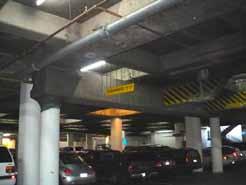
Existing Dropped Framing in Garage
The expansion joints are typically shown as 2” in between concrete beams and are filled with expansion joint filler, noted as “Celotex” on the original drawings. Inertial loads of the interior areas of the Plaza will be resisted ultimately by the large surrounding stiff buildings. The surrounding structures are buried at this level, making it unlikely that the additional outward reaction from the central portion of the garage would induce significant damage to the lateral force-resisting systems of the surrounding structures.
• Rehabilitation/Renovation History: In 1988, the corbels on the north face of Eshleman that support the Plaza structure were evaluated, repaired, and strengthened. A November 30, 1988 detailed report by MVZ Engineering, entitled “Lower Sproul Plaza Parking Garage, Investigation and Repair of Corbels,” describes the existing deterioration; analytical findings, conclusions, and
recommendations; and documents the repair work that was performed.
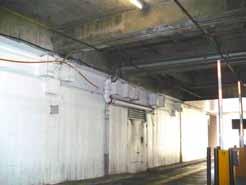
• Past Structural Evaluations and UC System Ratings: It does not appear that the Plaza itself was part of the “1997 Preliminary Seismic Evaluation Phase 1”. Two other reports were identified in the review.
- “Lower Sproul Plaza Seismic Study, University of California, Berkeley, California,” Diseno Architects, Gong Neishi Gong Structural Engineers, October, 1994. They concurred with a UC System Rating of “Fair” rating for the plaza contained in the 1974 report below. They provided a scheme intended to convert the plaza to a “Good” rating by adding shear walls and presumably providing the Plaza with its own code compliant (to the 1991 UBC) lateral system.
- “Investigation of Seismic Hazards,” H.J. Degenkolb Engineers, June 9, 1978. This study was not available, but is referenced by Gong Neishi Gong in their 1994 report.
• Seismic Deficiencies: The 1994 report did not investigate or describe the joint system outlined above and did not mention the corbels at Eshleman or Zellerbach. The corbels were repaired and strengthened at Eshleman, but the Zellerbach corbels should be investigated. In addition, spalling of concrete is likely to occur at the expansion joints when the various areas of the Plaza and the surrounding buildings impact one another.
The SCC project includes renovation work at King, Chavez, and the Plaza. Eshleman will be rebuilt. General building code and design criteria are given below.
• Building Code: The project schedule will evolve as the project proceeds, but the work is likely to occur some time in the future and would be phased. For the purposes of this master planning effort, code design criteria for new construction are based on the current 2007 California Building Code (CBC) requirements. Renovation of existing construction and associated seismic rehabilitation is covered by Chapter 34 “Existing Structures” in the 2007 CBC. Chapter 34 has been extensively revised from previous editions of the CBC. A general discussion of seismic rehabilitation issues and requirements is provided for each structure.
• Seismic Design: UC Berkeley’s Seismic Review Committee (SRC) has traditionally reviewed proposed seismic criteria, analysis methodologies, and lateral force-resisting systems for significant projects. This is often followed by outside peer review. This process is anticipated to occur for the SCC projects as they move toward the design stages. In addition to design for code compliance, detailed evaluations of seismic performance are also typically performed for major projects, using performance based methodologies such as those in ASCE 41 and FEMA 356. This provides opportunities for exploring the costs and benefits of various approaches, more refined designs, increased confidence in expected performance, and increased flexibility and innovation. The SRC and Peer Reviewer also review these analyses. UC Berkeley also has developed a set of site specific campus spectra for use in design and evaluation.
• Live Load Criteria: For the additions at King and the new Eshleman, a design live load of 80 psf plus an allowance of 20 psf for partitions is recommended in typical spaces. For corridors, exit ways and stairs, 100 psf is required. Plaza loading requirements will depend
on the final design concept. A live load of 250 psf is recommended for new plaza construction. Truck access to the Plaza is desired by UCB, which based on the limited information identified above will trigger strengthening or replacement of the Plaza. The specific type of trucks and their loading criteria will be determined as the project moves forward. Tentatively, truck access to the Plaza is assumed to come from Bancroft under the bridge between the new Eshleman and the King additions. Based on a February 20, 2009 meeting between MRY and the campus Fire Marshal, fire truck access to the Plaza is not required. At roof terraces, 100 psf is recommended if they are accessible to occupants.
• Floor Vibration: Floor framing will be evaluated, where appropriate, using criteria and methodologies in the 1997 AISC Steel Design Guide 11: Floor Vibrations Due to Human Activity, for human perceptibility to vibration induced by walking, using an acceleration 0.5% g or less, with a damping ratio as appropriate given the type of space. This is likely to be 2% in open office areas and 3% in more traditional office spaces.
• Water Table: The design water table level was not identified on the drawings provided to the SCC team, and geotechnical reports were not available. However, given the waterproofing and subdrain system shown on the original drawings, and the information in the April 22, 1958 “Field Permeability Investigation for the Proposed Student Center Cafeteria-Union Buildings,” by Woodward, Clyde, Sherard and Associates (see the King section above), a subdrain and pumping system should be assumed as necessary to keep the design water table below the basement. A bathtub membrane should also be assumed as back-up protection. As the project moves forward, available geotechnical studies should be acquired and reviewed, and more details on the water table and existing pumping system should be determined.
• Proposed Concept: The proposed project involves significant additions (or “laminations”) to the west and south sides of the existing building, resulting in a
substantial expansion of square footage. The west addition provides new program space at the basement level that will replace parking spaces at the east side of the garage, reconfigured space at Level 2 (the Lower Sproul Plaza level) and additional space on the terrace above it at Level 3. The roof at Level 4 will likely have a terrace. The west façade will have a significant amount of glazing for viewing of the plaza and increased transparency. The south addition includes reconfigured space in the basement, infills the sunken area between Bancroft and the existing south façade at Levels 2 and 3. A roof terrace at Level 4 is also proposed. The existing King building will be reprogrammed internally.
• Vertical Load-Carrying System: The existing structure is concrete up to Level 3, with steel framing above. A similar approach is recommended for the new additions, both to minimize the weight added as part of the renovation on the foundation system and to minimize the seismic mass of the combined existing structure and additions.
The existing structure is founded on spread and strip footings. An additional story of load would be placed on footings in both the west and south additions. Some enlargement or enhancement of the existing footings is likely to be required.
The existing concrete structure uses a flat slab over beams. This system could be utilized again for the renovation. Bay sizes are typically 24’ x 24’, so a flat plate or flat slab system may be more economical. Post-tensioning offers little benefit, given the irregular nature and size of the additions. At this conceptual stage, a conventionally reinforced slab can be assumed that would either be a 10”-11” thick flat plate or a 9” thick flat slab with drop capitals at the columns.
At the upper steel framed levels, to minimize added weight and seismic mass, floors and roofs of structural lightweight fill on metal deck over the steel framing are recommended. A two-hour fire rating would traditionally be required, though this will need to be evaluated with
the relaxations that are in the 2007 CBC. The slab is likely to be 3-1/4” thick concrete fill over 2” or 3” deep steel decking. The steel wide flange beam depth would range from W14 to W16 shapes with girders from W18 and/or W21 shapes. The west end of the west addition may be cantilevered, so increased depth for girders will to be needed.
The existing roof over the Pauley Ballroom has unfilled metal deck over a longspan steel truss system. A photovoltaic array has been placed over the roofing at this area. The renovation has avoided placing new loads or space in this area, given the lack of concrete fill and likelihood of minimal excess capacity in the existing truss framing.
• Seismic Rehabilitation Requirements: Section 3403.2 of the CBC contains provisions regarding seismic rehabilitation work in buildings with additions. These basic requirements are replaced for state-owned buildings— including those in the UC System—by the provisions of Sections 3415 through 3420. A series of seismic rehabilitation triggers is contained in Section 3415.3. The scale of the proposed additions easily exceeds the trigger regarding project cost in Section 3415.3.1 (“total construction cost, not including furnishings, fixtures and equipment, or normal maintenance…exceeds 25 percent of the construction cost for replacement of the existing building”) and the trigger related to increased seismic demand in Section 3415.3.1.3 (an increase in “the seismic forces or strength requirements of any structural component of the existing structure by more than 10 percent”). Thus, a seismic evaluation of the renovated building would be required, and a seismic rehabilitation would be necessary that would need to meet requirements of Sections 3415 through 3420. As the addition is over 1000 sf, per Section 3415.5, the Basic Safety Objective of ASCE 41 would be used at a minimum. A two-level design check is required, with the Life Safety Performance Level at the BSE-1 Earthquake Hazard Level, and the Collapse Prevention Performance Level at the BSE-2 Earthquake Hazard Level. This criterion for rehabilitation is effectively somewhat less than
would be required for a new building. Two methods of analysis are permitted: “Method A” of Section 3418 or the “Method B” of Section 3419. Method B provides a greater degree of flexibility. Peer review is required. Typically, nonlinear analyses would be performed. A similar approach is being used for the current seismic rehabilitation of King.
• Lateral Force-Resisting System: Concrete shear walls would be used in the concrete portion of the building below Level 3 to resist seismic forces, in order to provide sufficient stiffness to be effective in resisting loads in concert with the existing concrete walls. Above Level 3, the existing lateral system utilizes two stair cores and one elevator core at the south end of the building, plus a braced frame at the north end of the building that is proposed as part of the current seismic rehabilitation effort. It is extremely unlikely that the existing structure, even when rehabilitated under the current project, would have sufficient capacity to resist the demands from the additions. It does not appear practical with the proposed SCC architectural concept to install a seismic joint between the additions and the new structure, so the renovated building would function as one structure, and additional lateral resistance would be provided as part of addition or within the renovated existing portion. For compatibility with the existing concrete core walls, concrete walls are recommended.
• Proposed Concept: The proposed renovations to Chavez focus on removing the nonstructural exterior skin for a portion of the eastern end of the building at Level 3 and removing the Level 3 terrace at the west end of the southern face.
• Seismic Rehabilitation Requirements: The removed areas provide a small reduction in the overall seismic weight of the building and are unlikely to have any significant torsional or diaphragm implications. At the terrace, the removed area is south of the Level 2 perimeter shear wall on Gridline 28, so the Level 2 lateral force-resisting system would not be impacted. For the
modifications of the eastern end of Level 3, the columns and roof structure above remain, so there would be no structural changes. Thus, seismic rehabilitation requirements should not be triggered. However, as noted above in the existing conditions review, past seismic reports should be reviewed to confirm that the Level 3 columns meet UCB existing building standards.
• Proposed Concept: The existing Eshleman Hall will be demolished and replaced with a new, larger building with a small expansion in the footprint to the north and a larger expansion in footprint to the west. The entrance to the basement level garage will still be between the Eshleman Hall Replacement (EHR) and Zellerbach. Massing and scale of the new building will likely evolve as the project moves forward, but in the February 26, 2009 plans the building would be four stories above the Level 2 plaza at the east end and step down to only one story above the plaza level at the west end. Landscaped terraces and green roofs are anticipated. A bridge at Level 4 will connect EHR to the south addition of King, and a bridge at Level 3 will connect EHR to Zellerbach. Seismic joints would be located at the east end of the King bridge and the north end of the Zellerbach bridge so that the bridge lateral loads would be taken by the Eshleman Replacement structure rather than the existing structures.
• Vertical Load-Carrying System: Either a concrete or steel framed structure could be utilized for the Eshleman Hall Replacement building. However, the current plans have a north-south column spacing of 42’, so that steel framing could possibly be more economical. Columns are not located in the same place as the existing columns, so replacement or modification of the existing foundation will be necessary. New foundations are likely to be spread and strip footings.
For a steel framed structure, concrete fill on metal deck floors and roofs would frame bear on steel beams and girders. Steel beams would run in the long 42’ northsouth direction, and they would likely be W21 shapes,
with W21 or W24 girders in the 24’ wide east-west direction.
Concrete and steel each have inherent advantages, however, a concrete system could allow for lower floor to floor heights with a relatively thin profile of the concrete floor slab at the building’s exterior edge.
• Lateral Force-Resisting System: The lateral system from Level 2 at the Plaza to the foundation needs to be a stiff concrete shear wall system for compatibility with the Plaza. The walls will also serve as retaining walls on the south side of the building up against Bancroft. Above the plaza level, several options are possible and depend on the architectural goals as the design evolves. To minimize the size of the joints at the ends of the bridges, stiffer systems should be used instead of moment frames.
With a steel framed building, a buckling restrained braced frame (BRBF), a special concentric braced frame (SCBF), or an eccentric braced frame (EBF) is recommended. Given current research findings and cost data, a BRBF is likely to be the best performing system and have the lowest cost together with the SCBF. In the north-south direction, approximately 5-6 bays of chevron or inverted chevron framing would be likely at the lower stories. In the east-west direction, approximately 3-4 bays of framing would be likely on both the north face and south side at Gridline 3 (see architectural floor plans). Another potential approach for providing stiff lateral resistance is to use concrete shear walls as the lateral system, such as around stairs and elevator cores.
With a concrete building, shear walls would continue on up the full height of the building and would be integrated with the vertical load-carrying system.
A subtle, but important, feature of the proposed design is that Eshleman expands by about 6’ north in the basement. The exit lane would shift to the north side of the existing column. To gain the necessary clearance for this exit lane, an irregular set of shear walls at the northwest
corner of the garage abutting Zellerbach might need to be removed. They currently provide the lateral resistance to westward movement of the Plaza area between Zellerbach and Eshleman. Alternatives include a reconfigured wall parallel and adjacent to Zellerbach or connecting this portion of the Plaza to the new Eshleman for lateral loads.
Zellerbach Hall
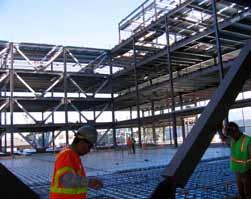
• Proposed Concept: The SCC base project does not include any modifications to Zellerbach itself. A bridge from Eshleman at Level 3 (if agreeable to Zellerbach’s owners) would have its own columns abutting the south face of Zellerbach for gravity loads. Zellerbach provides some gravity support and lateral support for portions of the Plaza. These areas are described below in the “Plaza” section.
An add alternate to the base project, however, includes a green area added to the east end of the Zellerbach roof. This will primarily be used for visual effect and is not intended to be accessible to students. This roof area is supported by an 8” slab spanning 12’ between concrete beams supported by concrete girders bearing on columns. Detailed study of the structural requirements to support new landscaping and live loads were beyond the scope of this study, but given the slab thickness and reinforcing it appears that the roof may have additional live load capacity.
• Proposed Concept: The proposed renovation of the SCC Plaza has a number of elements, including reconfiguration of the stairs connecting Upper Sproul Plaza and SCC Plaza, reconfiguration of the stairs north of Zellerbach, and several landscaping/performance possibilities for the central portion of the Plaza. Planter boxes on top of the Plaza would be used for the majority of new landscaping, including along the south side of Chavez. A set of cisterns might also be placed in the garage to capture storm water. Designs are evolving, but a more gradual transition from the Plaza down to the landscaped area north of Zellerbach is desired.
• Vertical Load-Carrying Considerations: The design live load for the Plaza is not listed on the original structural drawings. UC Berkeley has expressed concern about the current Plaza capacity for truck loading. Evaluation of the vertical load-carry capacity of the Plaza is beyond the scope of the planning study, but it is recommended both to address the question of current capacity and to inform the design process for future renovations to the Plaza. Based on notes on the 1998 Chavez seismic rehabilitation drawings and the Eshleman Level 2 structural plans, the presumption for this study is that the Plaza is unlikely to have any significant excess capacity to resist new dead or live loads, and the Plaza should not be assumed to be able to support large truck loads without strengthening or replacement.
New dead loads from local planters or performance pavilions on the Plaza would likely trigger localized strengthening with concrete beams. Any stairs connecting the garage and Plaza would require some local foundation strengthening, particularly if the stairs are concrete. A new elevator if desired would require foundation modifications to accommodate the pit.
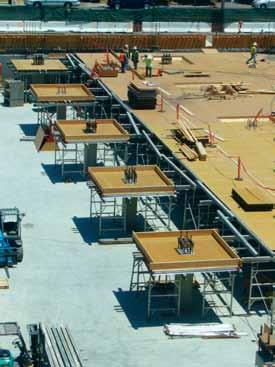
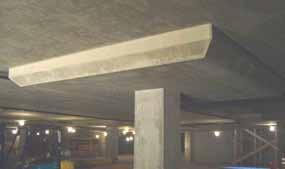
on some elements of more than 10%, though this is unlikely to occur when compared against the capacity of the surrounding structures. From a more fundamental point of view, the issues of importance are whether the renovations would alter the existing lateral force-resisting system and pattern of jointing, and the extent to which additional loads would be added.
• Strengthening vs. Replacement: Given the apparent lack of existing Plaza capacity for truck loading or much new landscaping, UCB’s desire to have truck access, the crossing of a seismic joint between Area C and Area P of the Plaza with a new central landscaped terrace area, UCB’s desire to raise the available vertical clearance in the garage, and the general scale of the project, replacement of the affected structure of the Plaza is recommended. The structure would likely be concrete and would likely have its own independent lateral system. For stiffness compatibility, shear walls would be desired. Addition of walls would be relatively easy in options that add program space to the western portion of the garage. The existing 24’ o.c. grid permits an economical concrete replacement structure for the Plaza deck. Although the final column and wall layout in the garage will depend on program requirements, it would be desirable to aim for preserving or strengthening the existing columns and footings where possible. The new Plaza will still require a rational thermal and seismic expansion jointing system with the surrounding buildings and remaining Plaza structures. If cisterns are added in the garage they should be freestanding units that would not connect to the columns or the Plaza slab above, unless they were integrated into the new lateral system. They would need a new concrete foundation to support the cistern weight.
Development of a final phasing plan is dependent on many issues including available surge space for the various displaced functions during construction, fund raising priorities, and the various constituencies involved.
• Seismic Rehabilitation Requirements: Direct application of the CBC Chapter 34 seismic rehabilitation
requirements to the Plaza structures is difficult and somewhat arbitrary since the Plaza relies on the abutting structures for lateral load resistance. Modifications to the Plaza itself might lead to an increase in demand
From a structural point of view, phasing should be
organized by structure. New loads should not be added to existing structures unless the lateral system for the combined structure is part of the phase to avoid triggering the addition of new temporary lateral force-resisting systems.
For example, Eshleman provides the lateral resistance for Plaza Area P (see Figure 1) moving southward in an earthquake. Eshleman also supports the south side of the southwestern Plaza Areas Z3 and Z4. When Eshleman is demolished, temporary lateral support would be needed for the Plaza if it remained, and shoring would be needed for gravity support of the south ends of Plaza Areas Z3 and Z4. Access to the garage would be limited during this time.
As another example, the new additions to King should not be added first if they are going to rely on future shear walls being added to the renovated existing King. Either shear walls would be part of the additions, or the renovation of the existing King would be done first so that it will have sufficient capacity to receive the new expanded building.
The renovations at Chavez and the stairs connecting Upper Sproul and Lower Sproul are minor in nature and could be done at any time.
The proposed SCC phasing scheme assumes a first phase of Eshleman Replacement construction; a second phase including King and the Plaza; and a third phase of Chavez modifications. Replacing the Plaza altogether with Eshleman would eliminate the need to provide temporary gravity support and seismic restraint of the Plaza. As the additions and renovations to King are done at the same time and the building is not occupied, new shear walls can be added easily as part of this phase. It is likely that the second phase would be subdivided into subphases to permit use of some existing space while new work is going on in other areas.
A primary focus and organizing principle of the Student
Community Center project is sustainability. Some sustainable structural design considerations include refined concrete mix designs to limit cement usage; specification of paints, curing compounds and other chemicals with low volatile organic compound (VOC) levels; requiring reuse of demolished concrete from Eshleman and the lower portion of King as base rock for site preparation and some site concrete; and recycling the rebar from Eshleman and the base of King.
A more subtle consideration is to select higher perform-

ing lateral force-resisting systems to reduce earthquake damage and material use to make repairs in future earthquakes. Analytical tools are increasingly becoming more refined that enable comparing anticipated damage of various building elements, such as cladding, partitions, ceilings, MEP systems and the structural systems themselves under various levels of drift and acceleration. This then permits quantifying the life cycle costs for various structural systems including initial capital costs, and repair and replacement costs from earthquake damage. For both King and Eshleman, relatively stiff systems are proposed, so that drift levels will be relatively low. Nonetheless, the extent of new elements could be compared to determine the optimum quantity of shear wall in King or braced frame in Eshleman.
The mechanical systems (HVAC, plumbing, and firesprinkler) in the existing buildings that make up the UC Berkeley Student Center date to the 1950s and are now at or past the end of their useful lives. This project represents a chance to renew the building by replacing the existing inefficient and worn-out systems with new ones that will provide a healthier, more comfortable, and productive environment while using less energy to do so. A key feature of the mechanical systems will be to work with the building architecture in an integrated design approach. Where sustainable building elements such as natural ventilation and operable windows make sense, the mechanical systems will work in concert with these features and not against them. Where more conventional systems make sense and forced-air ventilation and conditioning are needed, the systems will employ high-efficiency equipment and a “super-smart” building controls approach to keep energy use to the absolute minimum required. Buildings will be designed to exceed the minimum California Title-24 energy code requirements by at least 30%.
The Student Center master plan seeks to re-program and re-envision the Lower Sproul Plaza area of the UC Berkeley campus to provide program areas that will better meet the needs of the current student population at Berkeley. The Student Center is made up of the buildings around the Plaza and currently consists of five separate elements.
• Martin Luther King (MLK) Building (105,000 gsf)
• Caesar Chavez (Chavez) Building (106,000 gsf)
• Eshleman Building (44,000 gsf)
• Zellerbach Hall (150,000 gsf)
• Plaza and Parking Garage (25,000 gsf)
Of these elements, Zellerbach Hall is outside the scope of this project as that building is generally accepted to be a functional part of the campus.
The plan calls for the demolition of the current Eshleman Hall building and for it to be replaced with a new building as described in other sections of this report.
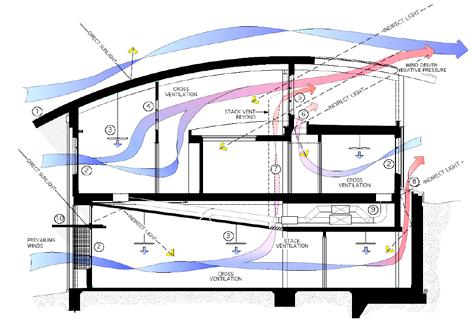
The MLK building will receive additions on the south and west facades of the building that will increase the usable area in the building. The proposed configuration of the buildings is as follows.
• Martin Luther King (MLK) Building (151,000 gsf)
• Caesar Chavez (Chavez) Building (102,500 gsf)
• Eshleman Replacement (73,000 gsf)
• Plaza and Parking Garage (25,000 gsf)
The existing mechanical systems in MLK and Chavez date to the mid-1950s and are now approximately 50 years old. The system designs are typical of buildings from this period and use constant-volume reheat ducted forced air systems. The buildings use campus steam as the heating source and do not have any mechanical cooling.
These constant-volume reheat systems are quite energy inefficient by today’s standards and are in fact no longer allowed by the Title-24 California Energy Code. While the buildings have been moderately well maintained, interviews with the campus facilities staff indicate that there have been many and increasing numbers of failures of system components over the past 10 to 15 years and that today there are large sections of the piping system that are valved-off because of leaks and other problems that are too expensive to fix given the maintenance budget available.
Given the inefficiencies inherent in this system type and the generally poor state of repair of the existing system components, it is clear that the mechanical and plumbing systems in MLK are beyond their useful life and in need of complete replacement.
All existing mechanical systems will be demolished in Chavez and MLK and replaced with new ones. The Eshleman Replacement will receive entirely new mechanical systems as well. The HVAC systems for the new and renovated buildings will provide heating, cooling, and Example of Integrating Mechanical and Passive Ventiliation and Cooling Systems
fresh air ventilation for all spaces in the building using forced air “Variable Air Volume with Reheat” (VAVR) systems. This type of system uses a central air handling unit that is connected with ductwork to VAV boxes with reheat coils located throughout the buildings. This central air handling unit will supply air up or down the buildings through rated shafts. Plenum and direct returns will be used throughout all of the buildings to minimize ductwork and maximize the use of the ceiling spaces. In Chavez we would do a direct return from the space to expose the existing interesting ceiling. Each new or renovated building will be configured with a number of independent HVAC zones roughly sized at 1,000 square feet per zone. In some areas there may be exposed ducts to achieve an open feeling for the users.
Heating for the buildings will continue to be provided by the campus steam utility system that is connected to the central steam plant. All existing building steam piping, heat exchangers, controls, etc., will be demolished and new components sized for the new building loads will be installed.
We are proposing to add cooling to all of the buildings as well. Although there is certainly some energy associated with this choice, new modern cooling systems are quite efficient and will significantly improve the comfort and usability of the buildings. With space at such a premium on campus, and with the density of computers and IT infrastructure growing yearly, the ability to create comfortable, healthy, productive indoor environments is greatly enhanced by HVAC systems that can deal with the heat loads in today’s buildings.
There are ways to make buildings with cooling efficient, and these will be explored as part of the design process starting in schematic design. First off, we will consider the possibility of using non-compressor cooling systems such as “IDEC” or indirect / direct evaporative cooling systems. These systems use water and evaporation as the cooling source and are not as “powerful” as chillers, but can still provide cool air to the building during hot conditions. Secondly, if a more traditional chilled water plant
makes sense, there are a number of ways to optimize the cooling system operation to reduce energy use to the absolute minimum.
Providing cooling has a significant offsetting energy savings that helps the overall energy balance sheet for these systems. When it is hot outside, much less cool air needs to be distributed throughout the building than if the building did not have cooling, and this fact reduces the amount of fan energy that is used over the course of a year. Fan energy is predicted to be the highest single HVAC end-use, so reducing fan energy by providing lower volumes of cool air is a step in the right direction. Energy modeling will be used during design starting in schematic design to quantitatively evaluate the overall energy performance and life-cycle-cost performance of a number of system options.
The entire new building will be controlled with modern computerized and networked controllers to allow continu-
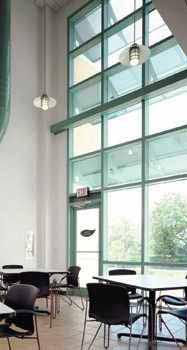
ous feedback and monitoring of all building spaces to create comfortable conditions as well as dynamically modify HVAC system operating parameters to minimize building energy use.
The building envelope, lighting, and HVAC systems will be designed in an integrated manner to accomplish building energy performance that is at least 30% better than the Title-24 standards. This performance target is required by the University of California Office of the President for all new construction on campus.
A grease exhaust system will be provided for any and all kitchen needs located in MLK and New Eshleman. Telecom and electrical rooms will be provided with splitsystem individual AC units to provide 24 hour cooling where the electrical equipment located in these rooms require cooling.
The existing garage ventilation system will need to be modified as part of this project. The system will be brought up to current code for exhausting the garage areas in the project. Garage exhaust will be brought to the roof of MLK and discharged at this location to improve the air quality of the area.
The mechanical systems designs will be developed through an integrated design process where systems and architecture work together to create healthy, comfortable, and productive work spaces. The design concepts presented here will be refined during the project design process and in response to specific client input. Additional design concepts will be discussed and evaluated starting in the schematic design phase.
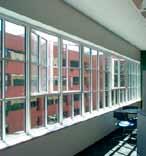
Operable windows can be made to work with HVAC systems
The HVAC and plumbing systems will provide a high degree of reliability and durability. These systems will be designed with concern for equipment life span, changing occupancy needs, and life cycle costs. The development of the building system concepts will place specific emphasis on the use of sustainable technologies and energy efficient equipment to minimize the building’s consumption of energy and natural resources.
The design process will begin by addressing building envelope and architectural issues such as building siting and building form optimization, solar control and shading opportunities and maximizing glazing performance. Opportunities to explore passive or non-energy intensive HVAC and lighting opportunities such as daylighting, maximizing the availability of free cooling, displacement ventilation and natural ventilation can be discussed and studied during the concept design and schematic design phases of the project.
The design of the Eshleman Replacement, MLK, and Chavez plumbing and mechanical systems will investigate opportunities to minimize the building’s overall water consumption. Storm water collection systems can be utilized to serve the some or all of the site irrigation requirements, while low-flow fixtures can dramatically reduce building water consumption. Cooling towers use potable water and for this project, a typical cooling tower will consume approximately 12 gallons per minute of
water, 720 gallons per hour, and 5670 gallons per day. Alternative cooling tower designs, coupled with alternative water treatment methods such as ozone or pulsed magnetic technology can dramatically reduce water consumption and water treatment chemical use.
Building systems are designed based on multiple factors such as peak occupancy, extreme temperatures and simultaneous operation of internal equipment. However, the building systems will operate at part-load most of the time. One primary goal of the building systems design will be the selection of equipment that operate efficiently over a wide range of load conditions. Mechanical systems and equipment rooms will allow modifications to be made in one area without causing major disruptions in other areas of the facility.
During the life span of the building, minor and major alterations may be necessary as the programming needs change. Ability to replace machinery during the life of the building is an important criterion. To accommodate building alterations and changes in technology, the new building should be designed with flexibility to accommodate current and future changes.
A high pressure campus steam loop is available at the existing building site and will be used to heat the new and renovated buildings. The campus steam will be converted to hot water through a shell and tube heat exchanger. The heating hot water will be distributed to air handling units and throughout the building to zone level hot water heating coils.
The building heating hot water system will be provided with reset controls that reduce the hot water supply temperature as the building load changes. These reset controls are an energy efficiency measure that will reduce the demand on the campus steam system.
Steam is supplied to the building at 80 psig and will be reduced to 15 psig by a two-stage, parallel (one-third, two-third) pressure reducing station. Pressure reducing valves will be self-contained pilot operated. The steam will generate hot water via a single shell and tube heat exchanger sized to handle 100% of the system capacity. Heating water is supplied to the building at a maximum temperature of 180°F and reset based on demand. Heating water will be provided for all air-handling units and terminal unit reheat coils. Two parallel pumps, each sized for 100% of the design flow, will circulate water through the system.
A central plant for the generation of cooling would offer significant energy and redundancy related benefits and will be the basis of design for this project. The central plant provides the primary means of cooling the entire project. This central plant approach affords the project an energy efficient means of producing thermal comfort needs at a competitive cost.
The cooling source for the building (other than outside air economizer) will be a new chilled water system. Chiller systems will consist of multiple machines for equipment redundancy. Chillers will have lead-lag control to equalize the runtime and hours of operation of each piece of equipment.
The chiller plant be sized at approximately 500 tons for the new student center buildings. This plant will consist of multiple centrifugal or screw chillers. It would make sense to consider adding cooling to Zellerbach Hall also as part of this project. An extra 200 tons would likely be required for this building if added to the CHW system. Chillers will be selected for the use of environmentally friendly HFC refrigerants (R-134A is likely). The chiller plant will be located in the existing basement mechanical room in MLK. Ultra-high efficiency chillers that employ “Turboco” frictionless compressors will be evaluated during design.
Two secondary chilled water pumps with variable speed drives, each sized to handle 100% of the system capacity, will circulate chilled water through the building cooling coils. The cooling coils will be equipped with 2-way flow control valves.
A multiple cell, induced draft cooling tower, ideally located on the roof of MLK, provides condenser water for the chiller plant. Water efficient cooling tower designs and alternative water treatment options will be considered to minimize water consumption. The induced draft cooling tower utilizes variable speed fans for capacity control, corrosion protected construction and stainless steel pan.
Cooling towers will have (4) vibration isolation. Two condenser water pumps with variable speed drives, each sized to handle 100% of the system capacity, will provide condenser water for the chillers. The cooling towers will be located on the roof of one of the Student Center buildings. The ideal location would be on the roof of MLK, but that location will need to be evaluated structurally during design to see if there is adequate capacity for this new load.
The basis of design for air handling systems that deliver heating and cooling to the spaces within the building will be overhead variable air volume systems with single duct terminals. The air handling systems will include the following elements.
• Variable Speed Drives: Fans will be energized through variable frequency drives controlled from pressure sensors located near the end of the branch having the highest pressure drop in the system.
• Filtration: Each air handling unit will have high efficiency long life type final filters of 85 percent efficiency (MERV 13).
• Pressurization: The building will be maintained under slightly positive pressure relative to the outdoor environment.
• Demand Controlled Ventilation: All densely occupied
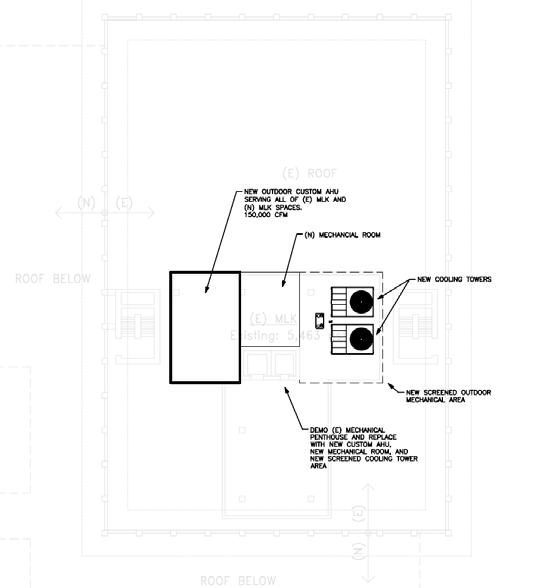
spaces (denser than 50 square feet per person) will be provided with carbon dioxide sensors and necessary controls to adjust outdoor air flow rates to reduce energy use in the buildings. This feature allows the amount of outside air introduced into the building to be reduced during periods of low occupancy, saving heating and cooling energy.

• One high-quality outdoor custom air handling unit will be located at the roof level of MLK. The existing mechanical penthouse area will be partially demolished to make room for this new unit.
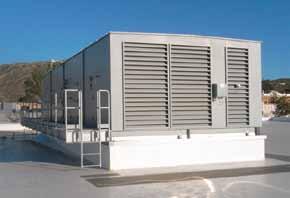
Natural ventilation of the new an renovated buildings will be provided through operable windows that are under control of the building inhabitants. However, the design team recognizes that due to the noisy urban environment there will be times when the windows cannot be open for acoustic reasons. To accommodate this condition, the buildings will use a “Mixed Mode” strategy where operable windows can be used complimentary to forced-air HVAC systems. When the windows are open, the HVAC system will be off. When the windows are closed the HVAC system will come on.
A variety of approaches will be used in the design and construction to ensure that the project will operate with exemplary indoor air qualty performance. The following items are noted:
• Dedicated exhaust from internal sources of emissions or contamination will exhaust air directly outside, without re-circulation back into occupied areas.
• Outside airflow monitoring stations will be used at each air handling system to guarantee that the proper amount of fresh air is provided to the buildings at all times.
• Air systems will have 100% outdoor air economizers so that when the outdoor conditions are favorable then significant quantities of outdoor air will be provided to the building occupants, well in excess of minimum requirements.
• Use of the building control system will provide a realtime ventilation air trend-log for monitoring and reporting of effectiveness of ventilation operation.
• Building outside air intakes will be located where potential for introducing contaminated outside air into the building is minimized.
• Outside air ventilation rates can be adjusted as required.
• All air handling unit drain pans will be positively pitched to eliminate any standing water.
All plumbing and fire sprinkler system will be demolished and replaced with state-of-the art systems as the project phases are implemented.
The sanitary system will consist of a conventional soil and vent piping arrangement. All plumbing fixtures will connect to stacks and discharge the building by gravity. All levels above grade will discharge by gravity and connect to existing City sewers in the streets. Levels below grade where drainage cannot discharge by gravity will be pumped via sewage ejectors and will be connected to the house sewer. Garage drains will discharge through a sand/oil interceptor and connect to the sewage ejector. A sanitary waste and vent system will be provided for potable waste producing fixtures and equipment, with all fixtures trapped and vented to atmosphere.
The storm drainage system will provide drainage of rainwater from all roof areas. Primary risers will discharge the rainwater and design rainfall intensity based on the City of Berkeley Plumbing Code. Planter drains will discharge through a mechanical filter structure prior to discharge to the storm drain system. A storm water drainage system will be provided for the buildings to convey rain water from roof drains, area drains, etc. to a holding tank. Overflow drains from roof will be installed next to regular roof drains and will be piped to the exterior of the building and will be terminated 12” above ground. Downspouts will convey water from the roof to the storm drainage system. Garage drains and sand/oil interceptor will be installed. A sump pump will be provided in the basement to pump water from garage drains.
The domestic water system will connect to the City of Berkeley water mains. A reduced pressure backflow preventer will be provided if required on the incoming service. Flow and pressure requirements from the City mains will be reviewed and used to determine the need for domestic Booster pumps. One (1) 4” water service
will enter each building. A central hot water heating system will maintain domestic water temperatures at not less than 110 degrees F. A separate heating system will supply kitchen equipment with 140 degrees F (or as needed) temperature water. A re-circulating piping system from the heater to the fixtures will be provided.
A non-potable water system will be installed in the new and existing buildings as they are renovated to serve toilet-flushing needs. A set of “purple pipes” will be installed in parallel with standard potable domestic water risers. The non-potable water will be connected to toilets to supply water for flushing. Potable water will be used for all other purposes.
Natural gas will be used for the restaurant cooking equipment. No other use of natural gas is planned.
Use of pint flow / ultra-low-flow urinals will save substantial amount of water usage per year. Water conservation measure including low flow fixtures, automatic flow control devices and irrigation flow reduction can be initiated. Limiting impact of runoff as a result of storm water collection and re-use for irrigation system. Waste heat recovery from kitchen hot water discharge to preheat domestic cold water before entering the water heater is also something we will evaluate during design. Storm water will be collected to re-use as greywater for flushing water closets. (See Civil)
Fire protection water will be provided by one 8-inch fire service to each building. A duplex reduced pressure type backflow preventer assembly will be installed within the mechanical room.
A new automatic fire sprinkler system will provide coverage for all areas. Switchboard rooms, electric rooms, telephone equipment rooms, emergency generator rooms, and elevator equipment rooms will be provided
with fire sprinkler coverage by sprinkler branch piping that will serve the space only. Sprinkler system will be supplied from a dedicated fire sprinkler water mains and risers. Standpipe hose outlets with 2-1/2 inch hose valve will be located in all stairwells at the intermediate landings. The standpipes will be a manual wet type Class I system and will be interconnected to the fire water supply in the fire service entry with a 2-inch supply line to serve as a charge line and not as a source of water supply to the fire standpipes. The standpipe system will be supplied with fire department connections on the landside at multiple locations, which will be used by the fire brigade to supply water to the fire standpipes during a fire event.
The existing Lower Sproul Student Center and adjacent buildings are of various vintage, and most of the electrical systems are beyond their useful life and intended function. For example, as circuit breakers age, they lose their ability to provide overcurrent and short-circuit protection due to the weakening of the mechanical systems within. All power distribution equipment, lighting, and signal systems will be replaced with new as part of the renovations except as described below.
New energy efficient lighting will be provided as part of the renovations. Careful consideration to daylight apertures and placement will reduce the need for electric lighting, and will be implemented as a sustainable solution. Automatic reduction of lighting systems in response to daylight availability will be provided.
Onsite electricity generation via photovoltaic (PV) panels will be provided. Opportunities exist for new PV panels at roofs of M.L.King Jr. Student Union, Cesar Chavez Center, the Eshleman Replacement building, and Zellerbach Auditorium. In addition, PV will be integrated into exterior sun shades on additions to King and Eshleman.
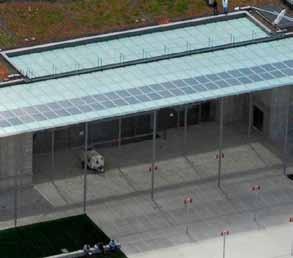
As shown elsewhere in this report, the construction phasing will potentially be in three phases. Full replacement of all electrical, lighting, and signal systems will occur for buildings in each phase except as specifically noted below. A new bio diesel generator sized for all phases will be installed in Phase 1.
Care should be taken to protect and maintain the existing 12kV Campus power system feeders, fuses, and High Voltage switchgear located in each building.
Existing panelboard locations and feeder conduit routings should be reviewed and maintained if feasable for new panels. Exising copper power conductors of 100 amps or greater should be carefully removed and inspected for potential reuse or recycling.
Reduce the power draw from the campus distribution system by adding photovoltaic systems. Onsite power generation directly offsets utility costs, generation needs, and associated pollutants.
Retain existing High Voltage electrical services for remodeled and expanded buildings by reducing power consumption per square foot. Maintaining existing equipment reduces landfill waste.
Provide metering of lighting and HVAC systems with real-time automatic load shedding based on power draw. Load shedding hierarchy is as follows:
• Lighting (via automatic dimming)
• HVAC fan power reduction (via Building Management System)
• Lighting (full shutoff)
• HVAC fan full shutoff (provide pre-shutdown alarm)
New and emerging lighting technologies will be considered for all phases of the project. Depending on the industry progress between the time of this report and
the time of implementation, the following technologies should be considered.
• Exterior lighting systems with LED lamping and integral proximity sensors to dim the lighting down in plaza and open areas when no one is in the immediate area. For enclosed areas and areas subject to safety and security concerns, traditional “all on” control will be provided.
• Wireless-enabled dimming and load shedding protocols for lighting systems to provide automatic energy reduction in response to inputs from campus power distribution, utility power cost increase thresholds, HVAC temperature sensors, and similar inputs.
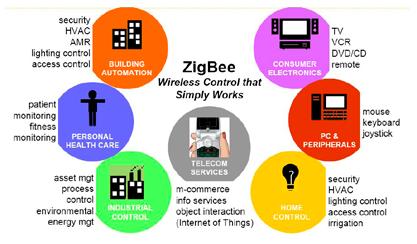
Existing campus power distribution consists of 12kV underground service with High Voltage (HV) switchgear at each building. The Lower Sproul Student Plaza buildings were modified from 4160 kV service to 12kV service in 1990; the existing HV switchgear with fused selector switches are of recent manufacture and should be retained. Multiple transformers will be provided at each building to convert from 12kV to 480Y/277V and/or 208Y/120V as required to serve building loads. Existing transformers installed in 1990, should be reviewed for
proper sizing and replaced only if necessary. Any transformers not sized for the new loads should be reviewed for reuse in other renovation areas.
The existing service capacity for the buildings is a follows:
• Cesar Chavez Center - 800kVA.
• M.L.King Jr. Student Union - 750kVA.
• Eshleman Hall - 300kVA.
• Zellerbach Hall - 1500kVA (for reference only - no changes anticipated.)
Newer technologies within digital circuit breakers allow sophisticated monitoring and control options such as load flow monitoring, history logging, and load shedding. Utilize these networkable systems as an enhancement to the building power distribution.
New power panels and distribution layout will group load types into common panelboards. Dedicated lighting panels, mechanical panels, computer panels, kitchen panels, and convenience panels will be provided with integral digital metering. This will allow for measurement and verification of system performance over time.
Due to the inherent diversity of power loads, extra care should be taken to properly determine the maximum power usage anticipated for each panel. Instead of the traditional technique of “next size up” equipment sizing, load analysis with load shedding will result in “right sizing” of distribution equipment. This will in turn reduce initial cost and reduce material usage. To the greatest extent possible, final building loads will be limited to the following values.
The anticipated final gross area of each building is indicated in other portions of this report. Based on the existing service capacity of each building, the maximum available watts per square foot are as follows:
• Cesar Chavez Student Center - 10.5 watts per square foot.
• M.L.King Jr. Student Union - 5.0 watts per square foot.
• Eshleman Hall - 5.5 watts per square foot.
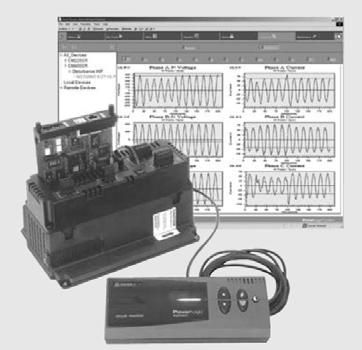
Photovoltaic generation is a viable technology to supplement power grid supply during daylight hours. Photovoltaic systems provide power at any scale from 2kw to 2Mw and greater. See diagram on page 135 in this report for proposed locations for PV panels.
The existing PV system on the roof of King should be maintained. The exising system provides 67 kw of power covering 6,700 square feet of roof area. An additional 850 square feet of roof area is available which will provide an additional 8.5 kw of power (at 10 watts per square foot.) Sunshading systems with integral PV panels will be provided at all new south- and west-facing facades of King. Although not as efficient as rooftop mounted PV panel assemblies, shading systems can produce approximately 5 watts per square foot. An available area of 10,000 square feet will provide 45 kw of generation. As a complete system, an estimated total of 170,000 kwh of power per year can be produced at King.
The existing concrete roof at Chavez provides appropriate solar orientation for flat panel additions to the southfacing roof sections. If structurally feasible, 13,000 square feet of roof area could be provided with panels which will provide 130 kw of power. As a complete system, an estimated total of 200,000 kwh of power per year could be produced at Chavez.
New roof areas at Eshleman will be provided with PV panels, racked and tilted to optimum solar angle. An available area of 4,000 square feet will provide 40 kw of generation. An estimated total of 60,000 kwh of power per year can be produced at Eshleman.
All power generated will be connected to the building power distribution system. No provisions for storage of power generated will be provided due to the inherent environmental risks of storage batteries.
Although considered, wind power generation is not considered feasable at the time of this report, but should be re-evaluated as design and renovations begin. Present day issues include the risk of blade ejection and low yearly wind production at the site.
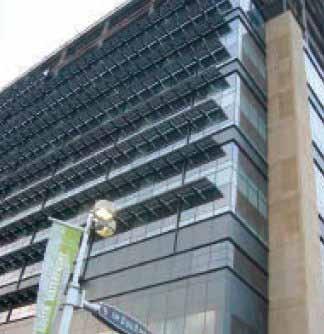
An existing 80kw diesel generator in the basement of Chavez serves both King and Chavez. The generator enclosure does not meet current fire code and should be removed. As part of Phase 1 work, regardless of building, a single bio-diesel generator sized to accommodate life safety, elevator recall, and selected additional loads for all phases as determined wil be located in the basement of the Eshleman Replacement building. Bio-diesel supply will be provided by collection and refinement of kitchen and restaurant cooking oil from all parts of campus. Scheduled weekly generator use will be required to balance supply with tank capacity.
Additionally, selected lighting and exit signage on the egress path of all buildings shall be provided with integral battery backup as a life safety redundancy. Current code at the time of this report requires minimum 1 footcandle of light on the egress path during occupied hours, with 1 footcandle average during power outages. Daylighting systems can provide these levels if positioned properly; during daylight hours, electric lighting on egress paths can be turned off or dimmed to save energy.
All projects will adhere to the current campus standards at determined by UCB Facilities Services. At the time of this report, the standards for systems are as follows:
Fire Alarm System - Provide addressable Pyrotronics MXL control panel with compatible devices.
All alarm-initiating devices will be wired so as to trigger the building central fire alarm system in the event of an alarm. This includes (but is not limited to) elevatorrecall smoke detectors, and devices which are part of fire-extinguishing systems such as Halon or range-hood systems. In addition, all building fire alarm systems shall automatically transmit all alarm signals to the University of California Police Department.
Site Lighting - Lamps: Metal halide 175W, phosphorus coated, vertical installation. Fixtures: Sentry Electric
Corporation cast aluminum decorative luminaire, black finish. Poles: Cast iron fluted poles as provided by Phoenix Iron Works, special casting for University of California Berkeley campus.
Building Lighting - Fluorescent tube is 4 foot T8, 3500 Kelvin color temperature, bi-pin. Compact fluorescent lamps shall be used whenever possible in place of incandescent lamps.
Voice Communication - Radial station cabling configuration to connect outlets to the communication service distribution closet.

UCB Lower Sproul Plaza Master Planning & Feasibility Study Project No. 08385 Print Date 7/29/2008 Page 1 of 5
Meeting Date July 23, 2008 10:00 am – 12:00 noon
Meeting Location Physical & Environmental Planning / Capital Projects 300 A&E Building Berkeley, CA
Subject Meeting #1: Work Plan Development
Author Richard Destin
Issue Date July 23, 2008 (Revised July 29, 2008)

1. Introduction
The meeting was held to review MRY’s proposed Work Plan, clarify personnel roles, and confirm information that is to pass between MRY and UCB.
2. Personnel / Communication
BP will be the lead and primary contact.
AR will have a stronger management role when the “Implementing” or Feasibility phase is reached. Her main concern will be issues of Schedule, Budget, and Scope.
BP reports to Emily Marthinson, Assistant Vice Chancellor who will attend key meetings and will help guide political issues.
Cathy Koshland is the Vice Provost-Academic Planning and Facilities. She, and her representative, will also come to key meetings.
Jim Horner, Campus Landscape Architect reviews landscape planning and site issues only and will attend meetings when these issues are to be the focus.
BP will send an organizational chart to MRY.
MRY will always copy AR when communicating with BP.
AR recommends that MRY try out the B-Space website as a communication tool to exchange information. (Similar to an FTP site)
Buzz Yudell, MV, and RD will attend key meetings.
Jeanne Chen will help facilitate the workshops. She can also be contacted if Mario is not available.
RD will be the main point of contact internally at MRY and for the consultant team. He should also be contacted whenever necessary.
The Eco Charrette is targeted for October, 2008 to be followed by a second Eco Workshop during the Implementing Phase. This allows MRY to incorporate sustainable measures into the master planning criteria and design explorations. As this is a high concern for the students, BP wants to generate publicity for the first Eco Charrette to ensure good student participation.
MRY to build a site model (digital and physical – scale to be determined) during the month of August.
Schedule
o Fall Semester instruction begins on August 21st
o Design Review Committee (DRC) meeting is Dec. 11th
o Dec. 13th – 20th is Finals Week
o Executive Planning Committee meeting will happen on January 22nd, 2009
o Students need presentation visuals before their fee referendum in Fall ‘09
MRY is to provide a tentative meeting schedule as soon as possible.
Mid Term Week at Cal is to be determined and noted on the Work Plan
MRY will use preliminary programming information such that the uses, sizes, and adjacencies will be displayed graphically with program component sizes shown relative to each other.
UCB to provide current program information and determine what programs need to grow.
MRY is to develop an interview questionnaire in order to gain a sense of vision and other particulars. Some Interviewees are to be: Nadesan Permaul – Executive Director of ASUC, Jonathan Poullard - Dean of Students, and Barbara Davis - Assistant Vice Provost, Undergraduate Education. MRY is to be mindful of department management strategies such as protecting or growing program area and revenue generation. UCB is to provide MRY with a comprehensive list of interviewees as soon as possible.
DRC members will include Chuck Davis from EHDD and Sam Davis who is interim Dean of the College of Environmental Design.
Although having a strong vision for the Master Plan is essential, it is also important for MRY to get the students to understand the preferred scheme from a practical standpoint and steer them away from becoming too “starry eyed” about the scheme’s vision prior to their Fall Referendum.
4. Consultant Scope
MRY proposes that most of the consultant team will participate in meetings and workshops and provide valuable input while master plan criteria is being developed and design options are being considered, but they may not produce much in the way of drawings or narratives until a preferred scheme is selected and the feasibility study begins.
5. Consultants
MRY provided a list of recommended consultants in a memo to BP dated 6.23.08.
o Landscape (CMG or GLS)
o Civil (KPFF-SF)
o M.E.P. (Timmons)
o Structural (Forell Elsessor)
o Sustainability (Davis Langdon – Lisa Matthieson)
o Cost (Davis Langdon – SF or LA)
o Retail (Rob York)
UCB recommends several structural engineers:
o Forell Elsessor
o Rutherford and Chekene
o Degenkolb (currently very busy with Health Care projects)
UCB also recommends Brailsford and Dunleavy for retail consulting.
UCB believes that the Free Speech Café at Boalt School of Law is a good example of how future food service facilities could be developed on campus.
6. Information
Existing working drawings were prepared by hand. Subsequent renovation documentation may not be in sync with what was actually built. UCB is to provide MRY with drawings (plans, sections, elevations) that best represent the existing conditions. MRY will evaluate the drawings and determine if additional surveying or drawing work is necessary.
The AutoCAD drawings that MRY received from UCB are not a comprehensive set of documents. The site plan indicates spot elevation heights but do not indicate contours. A topographic drawing file is missing from the x-ref attachments. The plans appear to have been traced over a scanned drawing or aerial photo and the sections and elevations are incomplete. MRY to review further and determine if these drawings are useful.
MRY is to review the Working Papers: Program Study of Undergraduate Student Services and determine if the organizational ideas outlined within are worth pursuing. BP to find out if UCB has any comments regarding this document.
BP noted that the Lower Sproul Urban Design Study (by SMWM) did not address garage serviceability and retail revenue generation. There also was a lack of discussion on Student Affairs, Professional Staffing, and Student Programs. MRY to confirm with Nad Permaul, and his assistant Tom Spivey.
BP to track down and send MRY comprehensive program information for all components of Lower Sproul: Existing and Future.
MRY is to identify what and when key pieces of information (drawings / reports) are needed relative to the work plan schedule.
A Historic Structures Report (HSR) is currently being done for all buildings in Lower Sproul. The proposed final scope of the Lower Sproul project will be reviewed and approved by the State Historic Preservation Officer.
o This being a Mid-Century Building complex, the report is a first of this type for UCB.
o The complex as a whole may be understood as being historically significant.
o BP to find out when the completed report can be sent to MRY.
7. Professional Services Agreement
MRY requested that some revisions be made to the agreement in a memo to BP dated 6.23.08.

& Feasibility Study Project No. 08385 Print Date 7/29/2008 Page 5 of 5

The next meeting date is to happen in mid August. Exact date to be determined.
These meeting notes are a summary of subjects discussed and decisions reached at the above listed meeting. Any discrepancies should be brought to our attention within seven days.
Richard Destin, AIA, LEED® AP, Associate Moore Ruble Yudell Architects and Planners
Meeting Date Sept. 24, 2008 10:00 am – 12:00 noon
Meeting Location Physical & Environmental Planning / Capital Projects
300 A&E Building Berkeley, CA
Subject Meeting #2: Conceptual Program Meeting
Author Richard Destin
Issue Date Oct. 8, 2008

The meeting was held to confirm essential elements that should be in the Lower Sproul Master Plan, We also reviewed MRY’s Work Plan, confirmed key principals of the Biddison Hier Report, and reviewed a Draft Questionnaire that will soon be sent out to administrators and advisory group leaders (sent 9.29.08).
MV explained key principals for master planning of Lower Sproul.
o Supporting the multi-cultural aspect of the UCB community.
o Building a flexible armature for a range of programmatic activities and growth / phasing.
o Framing a design strategy rooted in ecological principles.
o Respecting /highlighting site ‘history’ (i.e. free speech movement).
o Supporting synergy between program elements / multi functional spaces.
o Promoting transparency and access to and between services.
o Balancing connections to the fabric of the campus and city.
o Confirming that Master Plan/Feasibility Study initiatives can be implemented.
o Ensuring that the Master Plan/Feasibility Study accurately reflects the values and vision of the students, administrators and their advisory groups.
HL had the following suggestions:
o To avoid scope creep there needs to be management of the student’s expectations and the students need to know their priorities.
o The project is largely about “pushing people, not paper”.
UCB Lower Sproul Plaza Master Planning & Feasibility Study Project No. 08385
o Town Square or Living Room? MV and CK suggested that the Town Square is Upper Sproul and the Living Room (with elements of retreat) could be Lower Sproul.
CK noted that Nathan (Nat) Permaul and the Steering Committee can help with keeping scope creep in check. She also mentioned that HL will be the clear leader for this project as it relates to student concerns.
HL and EM noted that one key principal should be that this is a Student Centered Design. (Through the eyes of the student). EM also suggested that:
o MRY and UCB team need to be advocates for the students.
o MRY needs to educate the students as to what makes a successful student center and to help instill in them a sense of ownership that they may not have right now.
o MRY also needs to show the students how they might experience a revitalized Lower Sproul through a series of small vignettes.
3. Programming
CK noted that the ASUC always needs revenue and must maintain a solvent business model. The Finance Committee is to verify whether the current revenue source (rental income) is sufficient.
CK noted that the current menu of programs is greater than the actual area available for this project. Lower Sproul does not need to accommodate everyone. Some programs will be accommodated in Moffit Library, Hearst Gymnasium or elsewhere. MRY can suggest programs that may not fit into Lower Sproul.
The group envisioned a campus Living Room with the following features:
o Links to multi-cultural activities
o Indoor / Outdoor
o Both large as well as small, intimate spaces
BP noted that the graduate students could have a separate “den” away from the Living Room. Their priorities need to be verified.
EM noted that students readily accept having to share meeting rooms. Many existing rooms are used for storage with cages or lockers. They generally need meeting spaces for projects that they work on temporarily.
EM suggested that MRY look at Libraries on campus for possible spaces as examples of Living Rooms and note the changes in the way students study. East Asian, Moffit – Free Speech Café, Doe - Morrison Reading Room. The Moffit RFQ notes changes for teaching and learning (how to prepare for presentations / group learning). BP to forward RFQ to MRY.
MV suggested that there is a new Library paradigm where it is less of a place for quiet study and more as a center of information where people can meet and even have coffee and food.
CK suggested the essential program elements for Lower Sproul are:
o Large Living Room for everyone
o Multi Cultural Center + Living Room
o Graduate Students + Living Room
o Revenue generating spaces: Food, Retail, and ASUC
o Pauley Ballroom (multipurpose room)
o Visitors Center with links to Admissions, Recreation, and Theater Dance
o Indoor / Outdoor capabilities
EM suggested that MRY look at Univ. of Arizona student center which has “one-stop” shopping with kiosks for flexible retail. There are generalists who help the students as 80% of students need only this level of help. The other 20% get directed into more specific areas.
EM also suggested that MRY look at the Hearst Gym visionary documents for an overview of contextual campus issues.
The group acknowledged that UCB is to confirm the business model for Food Service. CK noted the following issues:
o Student Food on Telegraph etc. has limited choices and is lacking in quality.
o Students resist having restaurants and cafes owned by large national companies, but the locally owned “Mom and Pop” places preferred by the students often do not run sustainable (green) operations.
o RSSP (Residential and Student Services Programs) needs to decide on what is best in terms of revenue and sustainability when identifying prospective retail tenants.
The group agreed to add another Student Meeting (Open House) on December 8th
The group also agreed that illustrations at follow-up student meetings should show sketch vignettes of:
o Multicultural Center
o Graduate Student Center
o Outdoor Vision (like SMWM depiction)
o The day in the life of a student
CK explained that Cal Performances manages Zellerbach which has good rehearsal spaces for performance companies. A café addition is planned for the south side. The Department of Theater Dance owns Zellerbach Playhouse and its back of house spaces. They are also planning an addition to its north side. BP to provide MRY with information regarding these proposed additions. CK also suggested the following:
o Cal Performances should be moved out to another location.
o Costume storage could move to Nagata(?)
o The Department needs rehearsal space with an appropriate floor.
BP provided a partial list of the Lower Sproul Student Center’s potential programs:
o Dean of Students
o Cal Corps
o Center for Student Leadership
o Leadership Development
o Student Development
o Center for Student Conduct
o Gender Equity Resource Center
o Student Legal Services
o Career Center
o Student Life Advising Services
o Student Learning Center
o Disabled Students Program
o Multicultural Student Development
o Multicultural Center
4. Questionnaire / Interviews
BP suggested that MRY include a “student centered focus” statement in the introduction.
HL and CK suggested that MRY add two questions:
o How does your program intersect with the daily life of a student?
o Are there aspects of your organization that don’t need to be located in this project?
CK suggested that MRY should have available a tabulation of the existing program spaces in Lower Sproul as well as some tabulation of other student centers for comparison and setting of benchmarks.
The group suggested MRY do the following regarding the upcoming meeting with the group of student representatives:
o Show timeline indicating current point in long process.
o Explain the need to trust predecessors.
o Set the Lower Sproul context and show how unique Berkeley is.
o Touch briefly on background of MRY
o Focus on what MRY will do for them
o Explain process – Work Plan
o Explain Key Principals of the project
o Let students know that MRY is coming back in November and December.
o No Power Point – just boards or pinned-up sheets.
MV Summarized the key master planning principals that would be conveyed to the students:
o UCB Lower Sproul is unique
- History free speech (activism).
- Multi-cultural community.
o Key Principles
- ‘Town Center’ or ‘Living Room.’
- Natural ‘draw.’
- Food = Community
- Showcase for sustainable design.
- Lighting is important for both day and nighttime uses.
o Green Initiative
- Reinforce and display.
o Precedents
- UCLA, UCSB, Davidson College, University of St. Louis, others.
5. Eshleman
EM noted that an Eshleman teardown may have some opposition from one campus group, but even Vernon De Mars admits that Lower Sproul would benefit if Eshleman came down.
EM also mentioned that MRY could restore, repair, and improve upon Eshleman in a new design. The idea is to recapture the original intellectual intentions and recast them in a new building.

The next meeting dates are October 6th and 7th.
These meeting notes are a summary of subjects discussed and decisions reached at the above listed meeting. Any discrepancies should be brought to our attention within seven days.
Richard Destin, AIA, LEED® AP, Associate Moore Ruble Yudell Architects and Planners
UCB Lower Sproul Plaza Master Planning & Feasibility Study Project No. 08385 Print Date 10/17/2008 Page 1 of 5
Meeting Date Oct. 6, 2008 5:00 pm – 7:00 pm
Meeting Location Martin Luther King Student Union – Chinquapin Room, 4th Floor University of California Berkeley, CA
Subject Meeting #3: Student Presentation
Author Richard Destin
Issue Date Oct. 17, 2008

1. Introduction
HL explained that the purpose of the meeting was to confirm the initial student center program proposed in previous studies (11/2007 Urban Design Study and 3/2007 Conceptual Program reports) and to generate master planning principals and priorities through dialogue and brainstorming.
RD gave an overview of the project’s timeline from 1994 up to the present with a look ahead to projected future phases.
BP provided an explanation of the different phases of a project from Master Planning through to Fund Raising, Schematic Design and on to Working Drawings, Construction, and Post Occupancy Evaluation.
JC noted that the most recent studies list the following activities that should happen in the Center:
o Congregation
o Support (programs provided by University)
o Entertainment
o Service (programs provided by students)
o Food
o Retail Service
o Graduate Student Center
o Multicultural Center
SC outlined a schedule showing the Student Advisory Group’s involvement:
o Oct. 6th (current) meeting to cover: Introductions, Process, Planning Principles, Priorities
o Nov. 6th (TBD) meeting to cover: Planning Together, Planning for Sustainability
o Early Dec. (Dec. 8th) meeting to cover: Creating Alternate Options, Choosing a Preferred Option.
MV explained five key principles for the master planning of Lower Sproul that has been proposed to date. Such principles will be defined further to eventually serve as criteria when evaluating proposed conceptual design options:
1. Student Centered: Lower Sproul is to be first and foremost a student centered facility. Its program and design must primarily support the student culture & community
2. Identity: The master plan should reflect those qualities that make UCB a unique institution. There is a well known history of student activism which has been centered on the free speech movement. The ongoing tradition shall be supported and commemorated in a revitalized student center.
3. Ecology: The center’s planning shall follow the ecological principals outlined in the UC Green Building Policy and generally incorporate sustainable strategies that promote lasting value and efficiency.
4. Flexibility: The center shall be planned as a flexible armature that can grow in phases and change as programs expand and contract.
5. Feasibility: The center shall be planned to be implementable. Cost modeling and technical analyses should effectively validate planning and design initiatives.
3. Emerging Design Principles
Based on the comments above, previous studies and first-hand experience we propose that the following principles should apply to future conceptual design options. These support or add to the Key Principles listed above:
o Campus Connections:
- Create more visibility from Upper Sproul into Lower Sproul.
- Make a strong visible connection to Strawberry Creek
o Transparency:
- Create more opportunities to see and be seen
- Provide more indoor / outdoor spaces and connections
- Position food service retail so that it supports student socialization
o Microclimate response:
- Create more green space and make as a focus in the plaza.
o Flexibility and Growth:
- Increase areas for study, student group storage, and dance practices.
- Create a flexible armature for outdoor performances of varying scales and venue.
o Way-finding:
- Increase the visibility of student groups and retail through, signage and building façade expression
o Pedestrian movement:
- Adjust pedestrian circulation in adjacent buildings or nearby areas so that more people are drawn into Lower Sproul.
4. Interactive Exercises
Students were asked to rank each program element where “#1” is most desirable. The following chart shows the results of the prioritization exercise.
It was noted that the elements of Congregation, Support, Service, Graduate Student Center and Multicultural Center appear to be the most desirable. Food and Retail / Service were not ranked as the most desirable elements, but were confirmed by the students as being important to the center nonetheless.
Students also broke into two groups and generated responses to a set of questions about Lower Sproul. The following is a consolidation of those responses:
I. Why do we go to Lower Sproul?
o Socialize at the Bear’s Lair.
o Get coffee and food
o Get things at the bookstore
o Cut through to someplace else
o Pick up Cal 1 card at beginning of each semester
o Hear Friday Concerts (Superb)
o ASUC Art Studio
o Credit Union
o Dance performance practices
o Take a nap (in quiet peaceful areas)
o ASUC including Senate / GA meetings
o Student Group spaces (and their storage) – and to learn about other groups
o To get a bus pass
o Tutoring
o Multicultural Center
o Parking (for some)
o Zellerbach performances
II. What Doesn’t Work?
o The plaza is unattractive, uncomfortable and seemingly unsafe at night because it is
o It is not handicapped accessible.
o It’s dirty and appears neglected.
o There is no signage to help with way-finding.
o There are no graduate student services
o The plaza is easily missed because it is sunken and out of view, especially from Upper Sproul Plaza.
III. Are There Missed Opportunities?
o The plaza is a large assembly space that is underutilized. Make better accommodations.
o Zellerbach is active only at night with tickets affordable only for a small group of student rush recipients. Some concert venues could be geared for students and not just the elderly.
o The beauty of Strawberry Creek is blocked by Chavez. Make a visual connection.
o The plaza needs a better name. This is a fund raising opportunity.
IV What Would Make it Better?
o A more dignified transit stop on Bancroft with proper amenities for bus riders.
o More student group spaces with more storage to support them.
o There could be:
- a bike shop
- bowling alley
- movie theater (student films)
- a small health clinic
- day care
- other student-friendly retail in addition to food service retail and bookstore.
o More food/dining options with longer hours (stay open very late)
o More bathrooms, especially in Chavez. Make more gender neutral.
o A green public space as a focus with more trees and grass including green roofs, hanging gardens, and even edible fruit.
o Integration of indoor spaces with outdoor spaces
o Better identity signage for student / retail services
o Comfortable seating for both indoor and outdoor lounge spaces.
o More places to study and places to work on the computer
o A place for transfer students to meet
o Have student art display areas and more use of color in general
o Make the buildings seismically safer.
o Better visibility from Sather Gate and Upper Sproul to help draw people in.
Planning & Feasibility Study Project No. 08385 Print Date 10/17/2008 Page 5 of 5
o More accommodation for dance practices. More spaces with proper dance surfaces.
o Better lighting and HC accessibility
o Better connection to Haas Pavilion during large school events and daily intramural use.
These meeting notes are a summary of subjects discussed and decisions reached at the above listed meeting. Any discrepancies should be brought to our attention within seven days.

Richard Destin, AIA, LEED® AP, Associate Moore Ruble Yudell Architects and Planners MEETING NOTES
Meeting Date Oct. 6, 2008 2:00 pm – 3:00 pm Oct. 7, 2008 9:00 am – 4:00 pm
Meeting Location Physical & Environmental Planning / Capital Projects
300 A&E Building Berkeley, CA
Subject Meeting #4: Program Interviews with Campus Administrators
Author Richard Destin
Issue Date Oct. 26, 2008
Attendees University of California, Berkeley
Beth Piatnitza (BP), Associate Director, Physical & Env. Planning, Capital Projects, UCB
Moore Ruble Yudell Architects and Planners
Mario Violich (MV), Principal Jeanne Chen (JC), Principal Richard Destin (RD), Associate
Campus Administrators
Doug Warrick (D ), Cal Performances
Jonathan Poullard (JP), Dean of Students, Campus Life & Leadership
Nad Permaul (NP), ASUC Auxiliary
Mark Griffith (MG), Theater Dance Performance Studies
Barbara Davis (BD), Cesar Chavez Students Center
Shawn LaPean (SL), Cal Dining
Elizabeth Dupuis (ED), University Library
The following is a summary of notes taken from questionnaire responses and follow up meetings that took place with the seven campus administrators listed above. The notes below summarize specific issues identified that pertain to the Lower Sproul project.
1. Douglas Warrick: General Manager, Cal Performances - Zellerbach
Zellerbach seats approximately 2,000 and holds 130 – 150 events per year. 15-30 trucks back in to west side of building every day for deliveries
The program has outgrown the building and needs to grow to accommodate the following:
o A new restaurant on Bancroft side: A sit-down style, 7-day per week operation.
o More TDPS space: Add a new wing on north side + use space underneath seating (“lower TV room”). Existing Costume Storage would move off campus.
o Keep building open longer during the summer to maximize use.
o Increase lobby size so that there is break-out / reception / lecture space
o Provide more admin. space
o Provide more event parking to ease conflicts with other events
Zellerbach also needs the following improvements:
o Improved accessibility from parking garage
o A card key system for better security
o A new elevator that meets code: Must hold 4 wheelchairs, but currently holds only one.
2. Jonathan Poullard: Dean of Students, Campus Life & Leadership
The new Lower Sproul students center should provide beneficial outdoor programs:
- Ropes Course
- Leadership Training Areas
- Space for dance performers, speakers, rallies, etc. The new L.S. students center should include:
o Career Center (move from Bancroft and Channing): 27 people
o CLL (Campus Life & Leadership) = 37 people (other univ. have 52 staff)
- CSL (Center for Student Life) = 14 people
- Cal Corp Business Center spaces (move from 102 Sproul): 6 people
- ASUC Office of Student Affairs = 5 people
- ASUC Aux = 22 people
o Public Service Center (to be with ASUC & ASUC Aux– a “one stop shop”)
o Student Legal Services (move from 102 Sproul): 1 person Not needed in the new center:
o Dean’s Office (Jonathan)
o Associate Dean
o Pre-BRAT Coordinator
o Assistants
o Center for Student Conduct & Community Standards to stay on Channing.
o Bus. Operations and Marketing
o Tech. and Marketing
o Rec. Sports
o Berkeley International Office.
The new center should have a wide range of ingress and egress points. Programs don’t need to be private. Need as few walls as possible. Compare to UCLA, Wisconsin, UVA, Michigan, Univ. of Tex. Need a faith center for prayer. Tilden room, but doubled in size. Student Groups should set up in Lower Sproul not at Upper Sproul. The new center needs to make this more amenable.
3. Nad Permaul: Executive Director, Office of Student Affairs, ASUC Auxiliary
ASUC Auxiliary = advising, operations, business
o ASUC and Auxiliary should be linked
o Auxiliary = 70 FTE. Half are comprised of part-time student labor.
o ASUC Auxiliary rents 20,000 sf to Daily Californian (newspaper)
ASUC needs to understand the importance of having continuity from past administrations through the present and to the future.
o Understand and commemorate history: Student Union replaced Stevens Union.
o ASUC has significant accomplishments
- Consequential to Regents
- Forced Divestiture in South Africa
- Created Multicultural Center
o Senior Hall should be put on the referendum as a center for Student Govt. (Order of the Golden Bear). This could be a mid-campus lounge (away from L.S.). The building should be restored along with other monuments and statues on campus.
Revenue:
o U of O spends $20 million per year whereas UCB spends (and raises) only $1.1 million. ASUC needs to build cash flow and income. Need viable operation coexisting with students.
o Retail = $ = ASUC. There should be at least 50,000 sf of retail space beyond the 150,000 at the Cal Student Store.
o There should be “Pop-Up Retail” = portable kiosks (part of storage) with coffee, juice, flowers to get pedestrians to stop.
o “Ma & Pa” shops don’t generate enough foot traffic, but Panda Express will be more popular.
o Need a computer store, perhaps a recycling/exchange for re-use of electronic parts.
o Eliminate deferred maintenance with a long term maintenance program to spend money wisely.
Programmatic needs:
o Larger concentrations of foot traffic (Career Center, Student Govt., Advising)
o Connect Davis Durant Parking Lot to L.S
o Capture more space in the garage and in Chavez.
o Expand Chavez toward the west.
o Make Pauley Ballroom more divisible into smaller spaces. Its ceiling could also be lower.
o Need a 350 seat movie theater (look at WSU)
o Need a servery kitchen w/cooking
o Need a night club for dancing and playing games. NAIA Lounge was too small.
o Need practice rooms with controlled access.
o Add a satellite library: ASUC library/ archive with history display.
o Expand the Art studios and add a display space (see UC Davis, UCSB): Current studio has sewing, knitting, dress making, photography, pottery, painting, etc.
o Add back KALX radio station and add a student TV station (see UCI and other campuses)
o More people watching spaces with more engagement. Rooftop spaces too.
The Center should be a student group resource. There are 450 – 800 groups. There should be a 2,500 –3,500 sf Resource Room with lockers, storage, big tables, lots of transparency; a large space that facilitates synergy.
o Look at WSU Suites: Private rooms around a core of shared space.
o Storage should be at the plaza level, not in basements, as this is accessed daily.
Outdoor opportunities:
o Most new Student Unions have outdoor plazas (UCR, UCI, and UCSD). March through October the weather is great in Lower Sproul.
o There should be a spectrum of micro climates – not just hot sun and cold shade as is currently.
o Add flexible 100-200 seat amphitheater for indoor / outdoor performances and practices.
o There should be outdoor lighting with sound system built-in.
o A moving water element would be good for the Plaza.
o Wind / Solar power could be generated by capturing the constant breeze coming predominantly from the West.
o Outdoor signage and banner holders. Perhaps digital signage to communicate events, but not so developed as at UCSD. Redundant communication is effective.
o Open Chavez deck back up to view Strawberry Creek.
UCB Lower Sproul Plaza Master Planning & Feasibility Study
Project No. 08385 Print Date 10/25/2008 Page 4 of 6
MRY to do something tactile (drawings, models, views, narratives, sketches)
4. Mark Griffith: Professor, Department of Theatre Dance Performance Studies
TDPS Operation:
o Admin. and Faculty offices are all in Dwinelle. Basement storage is in Zellerbach.
o They have the following venues:
- Their own playhouse at the back of Zellerbach
- Old church on Bancroft
- Durham play stage in Dwinelle (has 150 seats)
o Other groups pay to use the playhouse, but not during the school year.
o Loading Dock at playhouse accommodates only one truck at a time.
o Building #2401 = Church: Used by Cal Performances, TDPS and other groups.
o TDPS has 30-40 undergrads per year
o Dance Classes are in the Bancroft Studio (church) and in Zellerbach room 7.
o There are also student dance groups as part of P.E.
o Student Musical Activities (SMA) is administered by Cal Performances. This is separate from TDPS spaces.
Playhouse productions:
o Four main stage productions (2 fall, 2 spring)
o One by Cal Performances
o Three or four by others
o Less than 12 total which is not enough use, but it is used for learning space too.
o Adjustable seats 350 – 440
o 439 fixed can expand to 547seats depending on configuration TDPS needs:
o Improved interface between Cal Performances and TDPS.
o Robert Cole successor should integrate the students more with Cal Performances
o The new Playhouse wing could help connect the new student center with Cal Performances
o Have more outdoor recitals in Lower Sproul Plaza
o Provide a Rec. Center Pass to TDPS students (next door). There is currently no shower for TDPS students.
Re. TDPS venue improvements: Speak with Lisa Wymore (Head of Dance). She is managing the Bancroft Studios. She knows what’s needed for a good performance space. Also speak to Kate Matteson.
A good example that TDPS admires is the UCLA World Arts and Cultures facility. For new Dining that is to be added to Zellerbach, the Crossroads Dining is a good successful example.
5. Barbara Gross Davis: Assistant Vice Provost, Undergraduate Education
The Cesar Chavez building is a de facto student union as there is lots of diverse activity. Academic Support Units in Chavez:
o Gender Equity
o Center for Student Life
o Student Learning Center
o Athletic Student Center Chavez offers academic support for :
o Returning Vets
o Disabled
6.
o Ethnic Groups
o Women Chavez houses student services for:
o Counseling
o Low Income
o Tutoring
New Student Center needs:
o Flexible spaces that can be a combination of private and open spaces.
o Every student organization wants a space: A lounge, office, and storage.
o Some programs have paid staff and need permanent space.
o Need to “make big Berkeley small”. (Make the notion of a large, diverse university seem welcoming, comfortable and human scaled in its student center).
She recommends tearing down all three existing buildings and keeping only Zellerbach. The Chavez original design worked fine but then the dining component changed. Many programs located in WWII trailers were dispersed to Chavez in 1991 (+/-)
Should the Multicultural Center be heterogeneous or homogeneous in its programmatic framework? Should it be a “home” to each group, supporting each group’s identity and space or a facility within which different groups are accommodated within one “home”? Does the Multicultural Center = Student Union?
o UCSD has a stand-alone Multicultural Center that should be looked at.
o The MC could become the centerpiece of the Student Center and could fulfill the lounge functions.
- Senior Admin. and Staff have different philosophies.
Cal Dining is part of RSSP (Residential Student Services Program)
At Cal the dining experience is to be about living and learning, gathering, socializing, and interacting. Vanderbilt Univ. is a good example. Students there gather, socialize and learn from each other with food being the central experience.
o For a daily population of 45,000 people, Cal Dining now serves 28,000 people per day. It grew in 5 years from serving just 12,000 people per day.
o 2,535 students are on an optional meal plan = $350,000 revenue per year.
o Golden Bear Café serves 6,000 per day. Needs more storage, both ambient and cold.
o There also is a four-person office near Chavez breezeway.
o Crossroads Dining seats 600. Open 9:00 am to 2:00 am. All night during finals.
o Delivery trucks are too big to fit in LS Plaza Garage so they park on Bancroft temporarily.
Commercial Dining (like Panda Express) if added to L.S. could become monotonous after 6 months. Students could get tired of the menu whereas Cal Dining makes adjustments throughout the year to keep the menu enticing, like at ASUCLA.
Telegraph Ave. has too much on the value end. Restaurants like Intermezzo and Smart Alex’s are fresh and inexpensive, but not that special.
o 70% of entering freshman have money and are willing to spend it so Telegraph should become more upscale.
Lower Sproul Student Center needs:
o A place where people can see and be seen –and have good coffee.
o A small convenience store like Trader Joes or Super Fresh (British Food Mart)
o A 500 person dining room is ideal. There are only 80 seats at Golden Bear Café.
o Golden Bear Café needs more storage, both ambient and cold
o Unit 3 dining is about the size that could fit into Lower Sproul – 410 seats
UCB Lower Sproul Plaza Master Planning & Feasibility Study Project No. 08385 Print Date 10/25/2008 Page 6 of 6
Look at UCD’s proposed new student’s center. See also:
o UW Husky Den
o Univ. of Minn.
o Univ. of Chicago
o Notre Dame (has a centralized commissary) Sustainability:
o Cal Dining is striving to minimize its environmental footprint through composting, leftover food delivery to homeless, organic food. Aims to serve people with LOHAS = Lifestyle of Health and Sustainability.
o Cal Dining to serve less “to go”, do more composting. Striving to serve better, fresher, humanely grown, cage free food.
Cal Dining being asked to open 4 new venues:
o Cal Rec. Sports = “Pro Shop”
o Letters & Science = “Common Grounds” at Dwinelle
o Engineering = “Citris”
o Lawrence Berkeley National Lab = Lab café and coffee shop
7. Elizabeth Dupuis: Director, Doe/Moffit Library
Moffit is a stand alone library but has an underground tunnel to Doe.
o All stacks are open to everybody now. It’s not just about book retrieval.
o There needs to be space for learning beyond the classroom.
o Students need to work in groups.
o They no longer need a monastic type of study set up (private carrels).
o Students need support for writing and studying. Library = Student Center.
Morrison Reading Room is an “old school leisure salon”. Might be considered the “living room” of the campus. People are renting this room out for ceremonial events – weddings, etc. Fine art is on display. Moffit Library is open 24-7 during finals. Considering opening one floor as a 24 hour study lounge as a pilot program.
Moffit to become food and drink friendly.
o Free Speech Movement café will double in size. A popular wireless spot. Energy database to be installed at FSM so students can learn about energy use.
o Morrison has a kitchen. Wine is limited to white only.
Need I.D. to get into Moffit. Other college students pay $25 for a card to study at Moffit. Moffit is to be gutted with $15M worth of the cost towards replacing the M.E.P. infrastructure. Construction to be completed by August 2013. Design begins in January. 8-10 month schedule.
Action Items
o BP to provide MRY with Zellerbach plans and a study done by Marcy Wong / Don Logan UCB
These meeting notes are a summary of subjects discussed and decisions reached at the above listed meeting. Any discrepancies should be brought to our attention within seven days.
Meeting Date Oct. 28, 2008 10:00 am – 11:30 noon
Meeting Location Chancellor's Conference Room, California Hall University of California, Berkeley
Subject Meeting #5: Steering Committee Meeting
Author Richard Destin
Issue Date Nov. 5, 2008

The meeting was held to review input from the student advisory group and responses to interviews of selected administrators. Emerging master planning principles were identified along with a capacity study of the existing, desired, and essential program components for Lower Sproul Plaza.
2. Observations / Comments
RD: The current program desires suggest a doubling of the building area present in Chavez, MLK, and Eshleman with ASUC Merchandise (retail) and Cal Dining having the largest component increase. The site has limitations as to how much retail can survive and MRY will receive guidance from the retail consultant when their study is further along.
MV: Because of its urban edge condition, there could be a strong retail edge along Bancroft that might not compromise the integrity of the University of California. In addition, a permanent retail store such as a Technology Center that could attract both students and the general public may be seen as an appropriate ASUC / Commercial partnership.
UCB Lower Sproul Plaza Master Planning & Feasibility Study
Project No. 08385 Print Date 11/5/2008 Page 2 of 3
CK: A successful Lower Sproul Plaza could help benefit the neighboring businesses on Telegraph Avenue and foster a more symbiotic relationship between UCB and the City of Berkeley.
CK: Given the cost of adding building area for increased programming, the most valuable set of activities in Lower Sproul are the ones that bring the most foot traffic.
MV: 80% of the program’s function could happen in Lower Sproul. The other 20% (admin. / support functions) may need more space, but could be located elsewhere. Lower Sproul should have programs with the greatest foot traffic and least amount of physical space needs.
CK: Some program elements such as Performance Space and a Media Lab could be located in Hearst Gym instead of Lower Sproul. There are other programs that have been placed in Lower Sproul that could move out too. MRY to suggest program locations per site capacity.
CK: MRY to prepare a project site plan that includes Moffit, Sproul, and Hearst Gym for consideration as locations for some program components.
JP: The Student Learning Center operates in Chavez, but used to be in Moffit Library. The SLC should stay in Lower Sproul because it needs to be more of a 24/7 operation that would support the idea of OneStop Shopping.
HL: If Follet wants to expand the bookstore, they could consider relocating some of the program elsewhere rather than have too much of one type of retail in Lower Sproul.
HL: Lower Sproul should have retail that attracts alumni during major campus events at Haas Pavilion, Zellerbach, and the Stadium.
MV: A plaid approach where different program uses can be adjacent to one another seems viable. Food / Student Services / Book Store / Coffee / and Meeting Rooms can be interspersed.
AR: Emphasis in non-assigned space (flexible), sharing of resources. This can be linked to the discussion of sustainability in terms of decreasing footprint, etc. to make the understanding of the advantages broader.
JP: The Multicultural Center’s mission is much greater than its overall space needs.
AR: Cal Performances should advise regarding development of facilities for outdoor performances MD: Graduate Students need their own space:
o 1/3 of student body
o Wants vertical mentoring of undergraduate students
o The want to be part of a student center, but with their own office and study lounge spaces.
3. Decisions
Decisions and directions established at the meeting are as follows (notes from Beth Piatnitza):
o Assume adaptive re-use of MLK and Chavez as more economical and sustainable approach
o Assume demo & new construction at Eshleman in order to increase retail and general program capacity and efficiency at Bancroft edge.
o Incorporate a mix of permanent, pop-up and "seasonal" service and retail space. Provide for one-stop shopping for essential services - Full program staff do not need to be accommodated. "Small footprint/large foot traffic" services should be housed in Student Center.
o Graduate Student Center and Multicultural Center (MCC) are key components. Detailed information regarding these programs will be forwarded to MRY.
o Concentrate late-night or all-night services and uses in Lower Sproul - such as an all-night study center; food/coffee; place to be safe. [If a trade-off is made with Moffitt Library to house a 24-hour study center in the Student Center, what could shift to Moffitt?]
o A 500-seat dining hall is not desirable; prefer several diffuse food service offerings.
o Student government (ASUC and Grad Assembly) should be located in Student Center, with shared amenities. Strengthen linkages between undergrad and grad.
o Not essential to house at Student Center: ASUC Auxiliary offices.
o Absolutely essential: Storage space for student organizations, convenient to transport to Upper Sproul or to keep in revitalized Lower Sproul Plaza. This should also include expanding bicycle storage.
o Per previous meeting with Jonathan Poullard: Gender Equity, LGBT, Center for Student Leadership, Cal Corps, Multicultural Student Development - all should be in Student Center. Also need assembly space for 300-600 people. Not in Student Center: Legal Services, Center for Student Conduct, Dean's Office.

The next meeting dates are November 6th (Student Advisory Group / Graduate Assembly Meetings) and 7th (Sustainability Workshop).
These meeting notes are a summary of subjects discussed and decisions reached at the above listed meeting. Any discrepancies should be brought to our attention within seven days.
Richard Destin, AIA, LEED® AP, Associate Moore Ruble Yudell Architects and Planners
Emerging Principles: Student Workshop
o Maintain Student Centered Focus:
o Linking to the Campus:
- Create more visibility from Upper Sproul into Lower Sproul.
- Make a strong visible connection to Strawberry Creek
o Enhancing Transparency:
- Create more opportunities to see and be seen
- Provide more indoor / outdoor spaces and connections
- Position food service retail so that it supports student socialization
o Increase Choice of Microclimates:
- Create more green space and make as a focus in the plaza.
o Support Flexibility and Growth:
- Increase areas for study, student group storage, and dance practices.
- Create a flexible armature for outdoor performances of varying scales and venue.
o Promote Way-finding:
- Increase the visibility of student groups and retail through, signage and building façade expression
o Shaping Pedestrian movement:
- Adjust pedestrian circulation in adjacent buildings or nearby areas so that more people are drawn into Lower Sproul.
Emerging Principles: Administrators
o Feasibility:
- Revenue generating retail to build cash flow
- Telegraph to go up scale.
- Maximize use of rental spaces
- Pop up retail with carts
o Sustainability:
- Solar / Wind Power
- Dining for LOHAS
- Dining = Living and learning, gathering and socializing
- Long term maintenance (not deferred)
o “Make Big Berkeley Small”:
- 24/7
- One Stop Shopping
- Multicultural Center = Central Lounge = Student Center
- Recreation = Dance, Art, Music, etc.
- Dining = Living and learning, gathering and socializing – the central experience.
o Supporting Flexibility:
- Allow for multiple uses and combination of private and open
o Facilitating Study Support:
- Provide more group and individual study lounges
- Provide more support for writing and studying
- See and be seen
o Programming Outdoor Space:
- Digital Signage
- Dance Surfaces
- Music recitals
- Fountain
o Commemorating Student Activism:
Emerging Questions & Issues
o What programs must be in Lower Sproul? What could be located elsewhere?
o Aside from Hearst Gym, Sproul Hall, and Moffit Library, are there other alternate program locations?
o Are there seasonal functions that could be in a shared flexible space? (i.e. career center)
o Should retail serve the Berkeley community at large and not just the Cal student community?
o Should the blend of retail and student services be diffuse or concentrated? Can a “plaid” mix of retail and program better support the project versus a discrete retail focus (i.e. Bancroft Ave.)?
o Should the Multicultural Center be heterogeneous or homogeneous in its programmatic framework? Should it be a “home” to each group, supporting each group’s identity and space or a facility within which different groups are accommodated within one “home”?
o Can the program components of Lower Sproul be de-centralized into a series of discrete study centers versus a concentrated location?
o How do we protect and balance the identity of the student community with the desired retail program?
UCB Lower Sproul Plaza Master Planning & Feasibility Study Project No. 08385 Print Date 11/18/2008 Page 1 of 2
Meeting Date Nov. 6, 2008 3:00 pm – 5:00 pm
Meeting Location Fourth Floor, Tan Oak Room MLK Student Union University of California, Berkeley
Subject Meeting #6: Student Advisory Group - Open House II
Author Richard Destin
Issue Date Nov. 18, 2008

1. Introduction:
The purpose of the meeting was to review the master planning principles that have emerged from previous meetings / interviews and to test some site planning and building massing strategies. Six key principles were identified:
o Student Centered: To reflect the culture and collective aspirations of the students.
o Commemorate historic “sacred” ground of Berkeley’s Free Speech Movement
o Demonstrate and make legible significant sustainable initiatives
o Flexible Armature: For both interior and exterior program spaces
o Feasible: Affordable design based on the realities of adaptive reuse
o 24/7 preference: Program components should be highly active spaces where there are frequent visitors with long hours of operation.
Site Capacity and Program Analysis:
o 259,000 gsf existing building area
o Possibly add 130,000 to 175,000 gsf, but retail benchmark is unknown
- New building along Bancroft in place of Eshleman
- New laminations to MLK (adaptive reuse)
- Restore Chavez closer to original design intents
o Provide additional and possibly reconfigured storage to accommodate all student user groups (800 +/-). Location in garage is O.K. as long as it is convenient for daily access and not far from active public spaces.
By placing foam blocks and colored paper onto the site model, MRY and the students identified several physical planning features that should be considered:
o Make the new building along Bancroft porous such that pedestrians are drawn into the plaza
o Connect new Bancroft building to MLK, but try to limit the connection to a glassy bridge
o New Bancroft building to be 4-5 stories tall, but stepping down to 2 stories in appreciation for the existing 2-story church next to Zellerbach. Stepping down also helps open up views from MLK.
o View from Sather Gate should allow pedestrians to see into the plaza
o Possibly revise entrance to Rec Center so that pedestrians walk through Lower Sproul instead of down Bancroft
o Allow pedestrians to see through MLK from Upper Sproul into Lower Sproul
o Have a balance of hardscape and softscape in the plaza with Chavez becoming a pavilion-like building within a lush landscape setting.
o Provide Green Roofs and make them accessible for enjoyment as well as growing crops
o Provide a dance platform as part of a flexible theater venue with fold-up panels / doors
o Open up views and pedestrian access to Strawberry creek by cutting back some interior spaces of Chavez.
o Consider having the Bear’s Lair (or other café) relocate to the north side of Chavez to enjoy proximity to Strawberry Creek.
o Have a Farmer’s Market in the plaza
o Plant Fruit Trees and other edible plantings
o Keep most of the new retail along Bancroft and have more student oriented services inside the plaza
o Consider having a technology-centered retail venue in the plaza
o Provide ample bike parking and consider locating in the garage
Action Items
o MRY to provide conceptual design sketches and massing models for next meeting MRY
These meeting notes are a summary of subjects discussed and decisions reached at the above listed meeting. Any discrepancies should be brought to our attention within seven days.
Richard Destin, AIA, LEED® AP, Associate Moore Ruble Yudell Architects and Planners

University of California, Berkeley
Lower Sproul Master Planning Feasibility Study
Project No: 08385
Date: 11/17/2008
Page 1 of 3
CATEGORY SUGGESTIONS / COMMENTS
Design Features
Porous Building Facades Have new building on pilotis to ensure a more porous edge with the City.
Perhaps keep Eshleman, but cut large openings through it.
Maintain a passageway to the bus stop.
Have indoor / outdoor spaces
Have large landings leading down from Upper to Lower Sproul for a more gradual transition
Take down Eshleman
Public Art Engage Artists, Educators to promote sustainability. Art made of refuse and recycled materials. Have sidewalk
Art displays on sale.
Retail Cafes are O.K. but keep the popular retail on Bancroft.
Increase collaboration with Telegraph community and merchants
Have a bike maintenance / repair shop
Have a beer garden: Move Bear's Lair to a place with designed / integrated constraints such as the north terrace of Chavez overlooking the Creek.
Site Planning Provide seating terraces to watch events.
Improve accessibility: ramps
Have a community stage. A portable stage that folds back into the plaza.
Plaza should not be level - have variation in surface levels. Adjust levels so to eliminate long stepped edges (as at Zellerbach front)
Reconnect Chavez with MLK at upper level.
Promote walkability: Avoid having an elevator as a focal point
Consider having an amphitheater in place of Golden Bear Café to improve site lines from Sather Gate
Blur lines between green (soft) and urban (hard)
Views to Creek and Campanile
Outdoor lighting at night
Maximize student safety: No scary tunnels
Have self-cleaning bathrooms
Provide choice of sun and shade
Landscape Roof Garden on Zellerbach at east edge: Provide access for viewing.
Provide a green wall.
Have green roofs that can be seen
More planting, less paving: Have a balance of soft and hardscape
Expressive of current time & values
Unleash the wildness (from the creek)
Have lawns or meadows, and terraces for perching
Bring campus park setting to street at Bancroft
Have real trees in the plaza. An urban forest.
Have a community garden
Transportation
Cars Calm Traffic on Bancroft Ave.
Buses
Acknowledge transit hub along Bancroft: Have covered bus stop
Have a bus store (like SM Big Blue Bus)
Promote transit awareness to increase ridership
Bikes Store some in Garage and have cars park at another lot on Durant
Separate bikes from pedestrians where possible
Have a bike share program
Facilitate bike use: Above & below ground storage
Food
Organic Local cafés to use organic produce
Zero
For example; Moffit Library News
Have
University of California, Berkeley
Lower Sproul Master Planning Feasibility Study
Sustainability
Meeting Date Dec. 8, 2008 5:00 pm – 7:00 pm
Meeting Location Martin Luther King Student Union 2nd Floor, Heller Lounge
University of California, Berkeley
Subject Meeting #9: Student Advisory Group - Open House III
Author Richard Destin
Issue Date Dec. 19, 2008

UCB Lower Sproul Plaza Master Planning & Feasibility Study Project No. 08385 Print Date 12/19/2008 Page 2 of 3
1. Introduction: The purpose of the meeting was to review the current conceptual design scheme and identify issues of concern.
MV presented the master plan framework and conceptual design options. The current scheme has the following features:
o Chavez is to be thought of as a pavilion-in-the-landscape with a stronger relationship to Strawberry Creek. Possible cut backs to its envelope and floor plates are desired to open views to the redwood trees through the building from Lower Sproul Plaza.
o Strong diagonal pedestrian movement from Sather Gate to the Bancroft entrance to the Rec. Center next to Haas Pavilion is to be enhanced by cutting back some of Chavez’s east wing while keeping the folded plate roof intact.
o Apertures in the new building along Bancroft accommodate this diagonal pedestrian movement and the frequented crossing of Bancroft at Sather Lane. A view to the Campanile from Bancroft will also be maintained and carefully framed.
o The “new” Eshleman’s apertures also provide more space for landscape features and transit amenities associated with the existing bus stop.
o The plaza will contain a pavilion for performances and / or student-centered retail with long operating hours to promote a vibrant and safe atmosphere.
o The new Eshleman building’s stepping down profile will follow that of the adjacent Berkeley hills and benefit from a similar view shed.
o The plaza’s lower levels (1 & 2) could be ringed with stores, offices, and cafes that are linked by a continuous circulation route.
o MLK is to be adaptively re-used such that laminations to the building exterior could highlight the interior circulation so that outside pedestrians can see the activity within. A mezzanine level within the Pauley Ballroom volume may provide valuable program space.
o A sloping landscape plane could serve as an amphitheater and connection bridge to Chavez’s south terrace. It also provides a roof for a pavilion that is an outgrowth of a basement level retail or student activity space.
RD gave an overview of project progress and programming capacity:
o 252,151 gsf existing building area could grow to 336,952 (+/-). Approx. 85,000 gsf.
o Additional retail benchmark is about 30-35,000 gsf within the 85,000 gsf total
o Most of the ground levels (1, and 2) will consist of Retail or Student Activities spaces.
o The basement parking area could be reduced to accommodate more program space such as storage, student-centered retail, bike parking, and / or space for mature landscape plantings in the plaza above.
o The horizontal and vertical arrangements of program are just beginning to take shape. A breakdown of the large program categories into individual departments is the next step.
o It was also noted that the Multicultural Center (MCC) needs to define how it wants to be identified and provide definition of its spatial needs, adjacencies, and desired physical expression.
2. Issues & Concerns: Multicultural Center:
o MRY has the plan diagram for Phase II (renovation of Heller Lounge) but needs to know what is desired for Phase III
o Does the MCC stand alone with its own building? Or is it expressed as a wing or bay within a building?
o Responses to MV’s question: How is a Multicultural Center different from a Student Center?
- MCC has richness, diversity that is not found in student centers.
- It needs to be a pivot point in the plaza.
- Student Centers are sterile and too uniform in their spatial mix
o RD: At some other campuses, the Multicultural Center is the Student Center. They can range in size to very large with full-time staff down to very small with no staff or dedicated space.
o MV requested that the students find examples of Multicultural Centers that they like.
MLK Renovation:
o The group recommended that the addition to MLK not push out all the way to the existing retaining wall along Bancroft as there should be more space for pedestrians and bus riders. Plaza:
o NP: The acoustics regarding a performance layout will need to be studied so as to mitigate unwanted noise emanating from the plaza. There is currently an acoustic conflict when there are loud events happening in both Upper and Lower Sproul Plazas. The proposed pavilion is located in a sound trap of noise from Upper Sproul.
o The group suggested that the additional building mass to be added west of MLK should terrace down to the plaza level so that student activities can spill outdoors and enjoy the afternoon sun and views into the plaza below.
Next Steps
- Design Review Committee: Jan. 15, 2009 (MRY to attend)
- Planning Committee: Jan. 22, 2009 (No MRY attendance)
- Cost Modeling to begin late January

These meeting notes are a summary of subjects discussed and decisions reached at the above listed meeting. Any discrepancies should be brought to our attention within seven days.
Richard Destin, AIA, LEED® AP, Associate Moore Ruble Yudell Architects and Planners
Meeting Date Dec. 8, 2008 1:00 pm – 5:00 pm
Meeting Location Martin Luther King Student Union 4th Floor, Chinquapin Room University of California, Berkeley
Subject Design Team Workshop
Author Richard Destin
Issue Date Dec. 19, 2008 (Revised Jan. 6, 2009)

1. Introduction:
The purpose of the meeting was to review the current conceptual design scheme and identify issues of concern as we begin studying its feasibility.
MV presented the master plan framework and conceptual design options. The current scheme has the following features:
o Chavez is to be thought of as a pavilion-in-the-landscape with a stronger relationship to Strawberry Creek. Possible cut backs to its envelope and floor plates are desired to open views to the redwood trees through the building from Lower Sproul Plaza.
o Strong diagonal pedestrian movement from Sather Gate to the Bancroft entrance to the Rec. Center next to Haas Pavilion is to be enhanced by cutting back some of Chavez’s east wing while keeping the folded plate roof intact.
o Apertures in the new building along Bancroft accommodate this diagonal pedestrian movement and the frequented crossing of Bancroft at Sather Lane. A view to the Campanile from Bancroft will also be maintained and carefully framed.
o The “new” Eshleman’s apertures also provide more space for landscape features and transit amenities associated with the existing bus stop.
o The plaza will contain a pavilion for performances and / or student-centered retail with long operating hours to promote a vibrant and safe atmosphere.
o The new Eshleman building’s stepping down profile will follow that of the adjacent Berkeley hills and benefit from a similar view shed.
o The plaza’s lower levels (1 & 2) could be ringed with stores, offices, and cafes that are linked by a continuous circulation route.
o MLK is to be adaptively re-used such that laminations to the building exterior could highlight the interior circulation so that outside pedestrians can see the activity within. A mezzanine level within the Pauley Ballroom volume may provide valuable program space.
o A sloping landscape plane could serve as an amphitheater and connection bridge to Chavez’s south terrace. It also provides a roof for a pavilion that is an outgrowth of a basement level retail or student activity space.
RD gave an overview of project progress and programming capacity:
o 252,151 gsf existing building area could grow to 336,952 (+/-). Approx. 85,000 gsf.
o Additional retail benchmark is about 30-35,000 gsf
o Most of the ground levels (1, and 2) will consist of Retail or Student Activities spaces.
o The basement parking area could be reduced to accommodate more program space and / or space for mature landscape plantings in the plaza above.
o The horizontal and vertical arrangements of program are just beginning to take shape. A breakdown of the large program categories into individual departments is the next step.
2. Issues & Concerns: Structural Comments:
o Keep the same grid-lines as before as we move forward with further documentation.
o Be mindful of the various expansion joints in the parking garage deck due to the fact that Chavez and MLK were built first, then Eshleman, and Zellerbach. The latter two buildings have cantilevered plaza decks that connect to and support the earlier plaza deck in some places with corbels.
o There is lightweight structure spanning Pauley Ballroom therefore it’s roof can not support the load of an additional floor at Level 5. Any new construction south of Pauley Ballroom might best be a steel structure.
o Any new laminations to MLK need to be supported at the ground. There would be no cantilevered additions.
o MLK needs to have shear walls at base stories with braced frames or shear walls at upper stories. MRY is to incorporate the latest structural improvements into its base drawings of the building.
o A new Eshleman will need shear walls up to the plaza level. From that level up, it could be steel framed or concrete framed. A steel structural system with concrete fill and a metal deck will probably have 16” deep beams with 21” - 24” girders. A concrete flat plate system will have lower floor to floor heights.
Landscape Comments:
o Gardens with edible fruit will be mostly symbolic unless highly controlled and made secure. A green house may be the best way to grow a reasonable amount of food that could be sold to restaurants.
o The plaza in general is too big and needs something in it like the pavilion proposed, but also there needs to be more planting to provide a variety of microclimates
o It will be easier to include green roofs to the new buildings than to add them to the existing structures.
o A minimum green roof consists of a 2” thick layer of sedum.
o The project needs to tell a story in order to help cast a vision that can be supported by the student referendum. It appears that a landscape element or water capture element could be a common theme that would resonate with the students.
UCB Lower Sproul Plaza Master Planning & Feasibility Study
Project No. 08385
Print Date 1/6/2009 Page 3 of 4
o It is possible to punch a lower court into the plaza and connect it to the “quad-of-no-name” to the north-west. Trees could be in the lower court, the canopies of which could be the icon or focal element on the LSP level. The trees could be a vertical expression of a rain garden in a “light court” that treats the watershed storm water.
o The space between Cesar Chavez and the "back" of the sloped lawn could be a street or sloped walk that connects LSP to the plaza with no name. Program under the lawn could face the sloped walk and potentially be a double height space under the lawn. This area would feel compressed and may provide a potential busy area for some retail.
Civil Comments:
o The site receives approximately 25” of rain per year. To capture all of that there will need to be a 500,000 gallon cistern. At 0.1336 cu. ft. per gal. = 66,800 cu. ft. The cistern would be approximately 50’ x 80’ x 16.5’ = 66,000 cu. ft. (Garage level is 16’-2” below Level 1.)
o Landscape will need to provide an irrigation target so that a cistern can be adequately sized.
o Since all of the storm water currently empties into Strawberry Creek, it is important to slow down the water flow to mitigate erosion. It is even better to filter the water before releasing into the creek or back into surface planters.
o Storm water can be celebrated by having areas of surface drainage highlighted in the pavement. This could be a design feature in the plaza.
o Development of a gray water system to be investigated further.
o Storm water management systems appropriate to the project (including filter maintenance descriptions) are to be proposed and submitted to UCB for review.
Mech. & Plumb. Comments:
o Use campus steam loop for heat.
o It needs to be determined if cooling the buildings is actually desirable. Ventilation may be all that is needed during the summer months. Although the Bancroft edge with it’s noisy buses will preclude the use of operable windows along the south façade.
o An air driven system might be better than a radiant system for cooling large indoor gathering spaces.
o Use of geothermal loop for cooling / heating to be determined.
o Incorporate some innovative features such as having a Red Light / Green Light indicator at the windows to signify when it is o.k. to open them.
Electrical Comments:
o Keep the MLK Level 5 mechanical room.
o We can use Photo-Voltaic impregnated sunshades. We could also incorporated PVs within a new south-facing glass façade at MLK which would provide sun shading as well as generate electricity at a highly visible location as opposed to being hidden up on the roof.
o There is not enough sustained wind to generate a significant amount of electricity. Windmills on the side of the building would be largely symbolic. Too much wind could create a hazard in such an urban area if a windmill blade were to come loose and break off.
Cost Comments:
o Renovations to MLK will take more construction time than if the building were torn down and replaced.
o It would be most cost effective for the new Eshleman building to have efficient retail layouts and effective green features (green roofs, storm water cistern).
o The lamination ideas for MLK may want to be limited to just two sides and not all four in order to keep the costs below the cost of tear down and rebuild.
General:
o MRY to confirm desired ceiling height.
o MRY to show reconfigured floor plans that identify new versus existing.
o MRY to provide requested As-Built drawings: Electrical diagrams, Mech & Plumbing complete sets. Civil and Landscape have requested existing storm drainage as-builts (3 sheets provided 12.17.08). Structural has a set of the original structural drawings from King/Chavez, Eshleman, and the plaza from previous work, but does not have original Zellerbach (and its plaza modifications), or any renovations to the buildings.
- Design Review Committee: Jan. 15, 2009 (MRY to attend)
- Planning Committee: Jan. 22, 2009 (No MRY attendance)
- Cost Modeling to begin late January
- Site Field Trip & Fire Marshal Meeting: Feb. 18, 2009 (Design Team to attend)
- Final Deliverables: May 2009
Action Items

These meeting notes are a summary of subjects discussed and decisions reached at the above listed meeting. Any discrepancies should be brought to our attention within seven days.
Richard Destin, AIA, LEED® AP, Associate Moore Ruble Yudell Architects and Planners
Meeting Date Dec. 8, 2008 12:00 pm – 12:30 pm Dec. 9, 2008 12:30 pm – 1:00 pm
Meeting Location Physical & Environmental Planning / Capital Projects
300 A&E Building Berkeley, CA
Subject Meeting #10: Landscape Architecture
Author Richard Destin
Issue Date Dec. 19, 2008

1. Introduction:
MV presented the same PowerPoint presentation that was given to the Student Advisory Group on 12.8.08
2. Issues / Comments:
Storm water management:
o Regionally appropriate for this project
o Only 4 month season of rainfall
o The ecology is not riparian as there are no summer rains. It is therefore a good idea to capture storm water for later use
o It is also good to slow down its flow to mitigate erosion and surcharge into city infrastructure
o Groundwater recharge is limited due to the clay base that is often found in the ground on site.
o N.W. corner of the site (between alumni house, north side of Zellerbach and west face of Chavez) could be like a large sponge that filters storm water
o Gray water might be a good idea too, but if not then at least a cistern would help with irrigation from April – November.
Green Roofs:
o Look at campus examples of landscape over buildings:
- Li Kashing
- Berkeley Art Museum (green terraces)
- New Law Building renovation will have a green roof deck
o Visible green roof examples:
- SF Academy of Sciences has a system of foliage baskets that are watered with rotary sprinklers
- It is also a habitat roof with a viewing platform.
o JH is concerned that the green roofs could fail or be neglected if not visible and accessible.
o The sloped lawn idea could be too difficult to maintain. Perhaps a stepped plane with planters would work better.
o Jim believes that having gradual terracing with mature plantings in the NW corner between Chavez and Zellerbach is workable.
Edible plants:
o JH sees a maintenance and security problem to have edible garden spaces accessible to the public.
o Growing citrus trees in planters is already done in various places on campus. There could be more of that.
What not to do:
o Recycling human waste.
o Harnessing wind energy. Site does not have a constant wind of 13 mph which is the speed required to generate enough electricity to make this practical.
Visibility of Strawberry Creek:
o It won’t be possible to actually see the creek from the plaza when a cut is made through Chavez, but to see more of the redwood trees would enhance one’s visual connection to the creek
Solar Panels:
o MRY could consider solar panels that rotate to follow the sun. Perhaps this could installed on the roof of a pavilion in the plaza, or an array of smaller shade canopies with PV panels.
Site Accessibility:
o BP to have the project reviewed by Campus Accessibility Coordinator, Sarah Hawthorne at the appropriate time.
Action Items
o BP to have project reviewed by Sarah Hawthorne at the appropriate time. UCB
These meeting notes are a summary of subjects discussed and decisions reached at the above listed meeting. Any discrepancies should be brought to our attention within seven days.
Richard Destin, AIA, LEED® AP, Associate Moore Ruble Yudell Architects and Planners
UCB Lower Sproul Plaza
Planning & Feasibility Study Project No. 08385 Print Date 12/19/2008 Page 1 of 3
Meeting Date Dec. 9, 2008 4:00 pm – 5:30 pm
Meeting Location Room #11, California Hall University of California, Berkeley
Subject Meeting #11: Steering Committee Meeting
Author Richard Destin
Issue Date Dec. 19, 2008

1. Introduction:
The purpose of the meeting was to review the current conceptual design scheme and identify issues of concern and revisions that could be made in advance of the Jan. 15, 2009 DRC presentation.. MV presented the master plan framework and conceptual design options. The current scheme has the following features:
o Chavez is to be thought of as a pavilion-in-the-landscape with a stronger relationship to Strawberry Creek. Possible cut backs to its envelope and floor plates are desired to open views to the redwood trees through the building from Lower Sproul Plaza.
o Strong diagonal pedestrian movement from Sather Gate to the Bancroft entrance to the RCC is to be enhanced by cutting back some of Chavez’s east wing while keeping the folded plate roof intact.
o Apertures in the new building along Bancroft accommodate this diagonal pedestrian movement and the frequented crossing of Bancroft at Sather Lane. A view to the Campanile from Bancroft will also be maintained and carefully framed.
o The “new” Eshleman’s apertures also provide more space for landscape features and transit amenities associated with the existing bus stop.
o The plaza will contain a pavilion for performances and / or student-centered retail with long operating hours to promote a vibrant and safe atmosphere.
o The new Eshleman building’s stepping down profile will follow that of the adjacent Berkeley hills and benefit from a similar view shed.
o The plaza’s lower levels (1 & 2) could be ringed with stores, offices, and cafes that are linked by a continuous circulation route.
o MLK is to be adaptively re-used such that laminations to the building exterior could highlight the interior circulation so that outside pedestrians can see the activity within. A mezzanine level within the Pauley Ballroom volume may provide valuable program space.
o A sloping landscape plane could serve as an amphitheater and connection bridge to Chavez’s south terrace. It also provides a roof for a pavilion that is an outgrowth of a basement level retail or student activity space.
o Feasible: Affordable design based on the realities of adaptive reuse
o 24/7 preference: Program components should be highly active spaces where there are frequent visitors with long hours of operation.
RD gave an overview of project progress and programming capacity:
o 252,151 gsf existing building area could grow to 336,952 (+/-). Approx. 85,000 gsf.
o Additional retail benchmark is about 30-35,000 gsf
o Most of the ground levels (1, and 2) will consist of Retail or Student Activities spaces.
o The basement parking area could be reduced to accommodate more program space and / or space for mature landscape plantings in the plaza above.
o The horizontal and vertical arrangements of program are just beginning to take shape. A breakdown of the large program categories into individual departments is the next step.
o It was also noted that the Multicultural Center (MCC) needs to define how it wants to be identified and provide definition of its spatial needs, adjacencies, and desired physical expression.
2. Issues & Concerns: Retail:
o CK envisions a scenario where the retail along the edge of Bancroft and at Upper Sproul will have mostly regular hours in keeping with the neighborhood competition. Some might close down as early as 6:00 pm, others might stay open later. The late night retail and student activity spaces would surround Lower Sproul Plaza ensuring an active and safe atmosphere.
o MD: A hardware store might best be located on the outside edge and not inside the plaza.
o RW: A grocery store that could stay open late into the night would be very popular.
o CK: Coffee shops are very nice to have but they do not bring in a lot of revenue.
o MD: ASUC makes most of their money from rent.
o HL suggested the design team look at Bristol Farms at Bloomingdales in San Francisco.
o CK hopes that the revenue made by ASUC will be enough to eliminate the need for student organization groups to rent rooms.
o RW noted that there must remain a mix of student life services in Chavez. Some of the less active spaces could move away from Lower Sproul, for example; the Cal-1 card office has limited use outside of each semester and might be better placed in another building.
o GB needs a list of program elements to help decide what should stay.
o CK noted that a typical program space might have a small portion of its area for lively student interaction. The other portion could be located elsewhere.
Multicultural Center:
o MD: There needs to be a clearer vision from the MCC programming group
o NP: wondered if the MCC would be two stories and would it be in its own building.
UCB Lower Sproul Plaza Master Planning & Feasibility Study
Project No. 08385
Print Date 12/19/2008 Page 3 of 3
o JP believes that the MCC needs its own space. The renovation of Heller Lounge is only Phase 2. It is not an acceptable long term solution. He noted that 40 programs need a place to feed off each other and share kitchens and bathrooms.
o GB confirmed that phase 3 assumes that the MCC will be located in Lowe Sproul.
Next Steps
- Design Review Committee: Jan. 15, 2009
- Planning Committee: Jan. 22, 2009
- Cost Modeling
- Site Field Trip & Fire Marshal Meeting: Feb. 18, 2009
- Final Deliverables: May 2009
Action Items

These meeting notes are a summary of subjects discussed and decisions reached at the above listed meeting. Any discrepancies should be brought to our attention within seven days.
Richard Destin, AIA, LEED® AP, Associate Moore Ruble Yudell Architects and Planners
MEETING SUMMARY (DRAFT – 1 /09)
University of California, Berkeley, Design Review Meeting January 15, 2009
COMMITTEE MEMBERS PRESENT: Sam Davis (Chair); Marsha Maytum; Helaine Kaplan Prentice; Clare Robinson; Henry Siegel; John Wong.
COMMITTEE MEMBERS EXCUSED: Chuck Davis; Allison Williams; Cathy Simon. Gail Brager (on sabbatical).
CAMPUS STAFF PRESENT: E.Denton; E.Marthinsen; Bob Hatheway; Jennifer McDougall, Alicia Rosenthal, Beth Piatnitza, Jim Horner; Kevin Hufferd; S. Finacom (Capital Projects); Kerry Obanion (Space Management). C. Koshland (Vice Provost).
OTHERS PRESENT: Dan Marks (City of Berkeley).
CONSULTANTS PRESENT FOR SPECIFIC PROJECTS:
Gateway Building: Michelle Azevedo, Mike Diepenbrock, Panattoni Development Company Glen Bauer, Steven Shua, RMW Architecture & Interiors
Lower Sproul Master Plan and Feasibility Study Buzz Yudell, Mario Violich, Richard Destin: MRY Architects Willett Moss: GMG Landscape Architects
PROJECTS REVIEWED AT THIS MEETING:
Gateway Building Lower Sproul Master Plan and Feasibility Study
MEETING SUMMARY
Davis noted the long service of Siegel on the Committee, said this would be his last meeting, and thanked him for his contributions. The attendees applauded Siegel.
Gateway Building
Marthinsen introduced the topic. The University owns most of the block bordered by University Avenue, Oxford Street, Berkeley Way, and Walnut Street. The campus Real Estate Group is partnering with a private party, Panattoni Development Company, for a possible office building on a portion of the block, with ground floor commercial. The building would accommodate various University offices.
Azevedo said that the project follows an integrated team building approach. Panattoni is collaborating with the University on overall goals and project details. The design has been “from inside out”, determining needs for basic floorplate size, layout, then designing the building around those needs. The building would consolidate many UC offices currently in rented spaces, but would also be designed for flexibility in use, and with shared spaces. The intent is to build as high as the defined City envelope for a building on this site. A LEED Silver goal is achievable.
Bauer presented the design concept. The building endeavors to understand the relationship of the campus to the city, since this site lies at the edge. This is a unique location, overlooking West Crescent on campus and visually important to the city since it is at the terminus of University
1
Avenue. Campus influences on the concept include the historic west crescent / entrance. The design represents an intertwining of city and campus. The ground floor, along Oxford, University, and part of Walnut, would be largely retail space. The proposed Downtown Plan establishes a new attitude about density Downtown and suggests certain types of density at important Downtown sites, which influences this site; also, the site is across the street from the Li Ka Shing building on campus, which also has an influence. The site includes a 1929 Mission Revival gas / service station, perhaps the first in the East Bay. The project is trying to preserve and use it, finding a way to link it in to the new building.
The proposed design relates to the historic campus entrance. It takes the form of a building in flux, with an outthrust, triangular, section that points to the west gate entrance. That architectural gesture reflects some of the site geometry, since University Avenue and Oxford Street are not at exact right angles to each other. The outthrust would be a lantern, topped by a balcony on the 8th floor. The design also reflects the general composition of campus Classical Core buildings, with a base, middle, and top. The wing along Walnut Street would step down to seven stories. Early façade thoughts are that the building could send a number of messages, being visually accessible on the city faces—west and south, open and transparent, welcoming. There could be fixed sunshades on portions of the façade to manage light.
In response to Committee questions, the presenting team said that the University did not own the wooden apartment building at the corner of Walnut and Berkeley Way, and it is not included in the site plans. The University does own a brownshingle house south of the apartment building, and this location is shown as a “vacant” site on the site plan presented to the Committee.
In response to questions, Bauer said that the historic garage might be reused as a visitor center, or ticket office for the campus, or other public uses. It might also contain a retail use. The design would try to connect the new building to the old garage. A circulation axis through the new building lobby from University Avenue would penetrate through to the garage, and the new building would occupy part of the back corner of the garage site, leaving the street façades intact. The height of the garage roof line could be translated to architectural elements on the Oxford Street façade of the new building, providing a visual transition between old and new structures. The existing garage is about a story and a half high.
In response to questions about how large the project must be to be financially feasible, Azevedo said that the project is around 178,000 rentable square feet, which is close to the amount needed for feasibility. Hufferd concurred.
Azevedo said that the next phase of work would further examine the budget, and produce concepts for curtain wall systems and materials.
In response to a question, Denton said that the University has no plans for University Hall, across the street to the south. It has been seismically reinforced. However, west of the University Hall tower, an infill parking structure is under consideration that could contain up to 600 parking spaces.
Committee Comments:
o The northeast side of the building seems to “crash” into the back of the garage or embed itself in it. More attention is needed for a sensitive transition between the low rise garage and the new tower.
o The building seems too large in scale relative to both the garage and the Ace Hardware building across Walnut Street to the west.
o The best location for the lobby is not mid-way on University Avenue but on the Oxford / University corner. Instead of extending the lantern out over this corner the building
should try to pull back a bit, create a corner plaza space at the entrance; the main lobby on the corner could be a two or three story space, reinforcing the corner. The corner should have a sense of public space.
o A desirable adjunct to this project would be the long-planned (but unfunded) University gateway signwall across the street at the entrance to West Crescent, matching the signwall two blocks south at Center Street and Oxford.
o Bicycle parking needs to be an integral part of the design.
o The north side massing of the building is of concern; it should try to step down more, be more articulated, minimize shadows.
o Overall, while the Committee understands the need to meet the program, the building mass probably needs to be carved or eroded away at points to work better.
o A modern interpretation of classicism needs vertical elements; the model mainly emphasizes horizontal structure. The building feels too corporate; it needs more of a “Berkeley” feel, a local urban style.
o The sustainability strategy—managing light and temperature—is not really clear from the model. This needs to be better articulated.
Other Comments:
Marks from the City of Berkeley said this is a key site, adjoining both City and University contexts and a true gateway to the University. The City is contemplating a very different character for University Avenue between Shattuck and Oxford; new park-like space could be created, the street itself narrowed; the character of Oxford Street could also be changed. So how a building on this corner relates to the street and to the campus is absolutely critical. The city is currently developing guidelines on building articulation for new structures.
The City will not allow a building to project over the public right of way—the lantern needs to be evaluated in that respect. The site should open up at University and Oxford as Committee members have suggested, not close up with structure. That corner cries out for an open space.
The retail frontage on University should reflect the character of Downtown Berkeley—not the Golden Bear building further west on University, where there are large storefronts, but a more modulated scale of smaller storefronts.
Lower Sproul Master Plan and Feasibility Study
Piatnitza introduced the project. “Lower Sproul” is the complex of four buildings—Eshleman, Chavez, Student Union, Zellerbach—surrounding a plaza. The need for a master plan has risen out of student service studies, and the desire of both the campus and students to revitalize the area. Eshleman Hall is also seismically poor, and will either need a retrofit, or be removed. Denton noted that the campus is planning an interim seismic upgrade to reduce the worst Eshleman hazards. A student referendum is proposed for the Spring of 2010 to seek student funding for the overall Lower Sproul projects.
Violich presented the program. The design team has been engaged in a consensus building exercise, and has been working with students and other user groups. The project is now moving into the front end of the feasibility phase.
In terms of site analysis, Lower Sproul is a central part of student life. Although it is on the campus edge, it’s at the center of a cluster of campus activity spaces and off campus living group
spaces. The space is a transitional zone, bracketed by the green of the campus and Strawberry Creek to the north, and urban Berkeley to the south. The site is directly on Strawberry Creek, and at present all water runoff from the Sproul Plaza areas dumps directly into the Creek. A landscape component for the site could be a green ribbon / planted zone south of the Chavez Center which would then angle around the west end of Chavez and go past Alumni House to the creek zone. This could serve as a green connection, and also a way to absorb and filter the runoff. Students are very eager to solve these runoff issues in a sustainable way.
A key goal of the project is to “do no wrong”, repair deterioration of the site, make sure it works better for today’s larger student population and needs. Redesign needs to transform currently “dead” spaces into active spaces.
Several components are envisioned for the building design / redesign; they would both subtract from, and add to, the existing complex. The Chavez Center would be opened up more, back towards its original architectura character when it was the campus dining commons with large interior spaces. The southeast corner of Chavez could be removed at the Sproul Plaza level, leaving the awning-like roof, but permitting views down into the lower plaza, and a new, more gentle, arrangement of stairs and terraces between the two plaza elevations could be created. The King Union would be “laminated” on west and south with new structure, and renovated on the inside. Eshleman would be removed, and replaced with a new, lower, building that extends along Bancroft Way and connects into the lamination of the Student Union on the east, and extends further past, and perhaps bridges over to, Zellerbach Hall to the west.
As noted earlier, the riparian corridor along Strawberry Creek would sweep around the Chavez Center into the plaza. South of the King Union the “pit” along Bancroft would be filled. The new structure along Bancroft would have active retail on the ground / street level and apertures opening into the plaza; it would “filter” from retail to activity space, from Bancroft inward. The existing retail spaces in the basement of the King Union will be reconsidered, and made more flexible. These commercial spaces could be surmounted by open, glassy, social levels and spaces above that would allow users to connect around all the sides of the plaza, even to the Zellerbach mezzanine. A pavilion or light scoop could be inserted in the plaza proper, opening to the current garage area below, and allowing student groups to bring supplies directly up to the plaza. The whole project would express sustainable features, with green roofs and organic spaces, and create more outdoor microclimates rather than the current division between primarily sunny, or primarily shady, spaces. Overall, the project would provide about 50% more useable space than what is there, now.
In response to a question, the design team said that the garage below the plaza could be envisioned to include useable space, storage space, flexible areas that would be, through the plaza pavilion, directly accessible to the open spaces above. Koshland noted that at present 75% of Eshleman Hall is simply used for storage of student organization materials. Violich said that the basement / garage level is almost a “fifth building” of the complex in terms of its space potential.
In response to a question about why Eshleman Hall should be replaced, Koshland said students want big, bull-pen, like spaces for activities, and the ASUC needs more retail areas to produce revenue to fund its operations.
Project Manager Rosenthal said that one of the priorities for the project is to create “24 / 7” spaces where students can spend time and interact.
Committee Comments:
o A key value of Zellerbach Hall is the lantern-light quality of the lobby when there’s an event; concern about an Eshleman replacement extending too far along Bancroft Way, obscuring Zellerbach to those coming up Bancroft and entering the campus. It’s important to be able to look into the campus from the edge and see Zellerbach, and also
see the diagonal view of the Campanile across the plaza. This is an extremely important gateway and view corridor. It is also important to see Zellerbach across the plaza;
o The campus has few, if any, other large hardscape areas like Lower Sproul for activities. While the appeal of greening the space is understood, the useable hardscape shouldn’t be shrunk too much;
o The concept of the glass pavilion or light scoop rising in the plaza did not appeal to most of the Committee;
o The sustainability focus is desirable and to be applauded;
o Some members felt that while the riparian zone curving around Chavez is an interesting concept, it may not be practical or desirable to bring too much “soft” landscape space into the urban plaza, particularly in terms of how the plaza relates to the Chavez building; some Committee members, however, felt it should be done in a “big way’, moderating the lower plaza;
o Recall that the original dining commons space, including the terrace restaurant, stretched the entire length of the Chavez Center. A concept that concentrates cafes, etc. into smaller areas around the perimeter might actually dissipate energy; it’s important to activate the edges, force people to use the edges of the plaza. Is there enough proposed activity to activate the two levels of circulation around the plaza—the lower, retail focused, level and the upper activity space?
o The perimeter of upper Sproul Plaza is part of this site; the design needs to remember to also face Upper Sproul and retain the key features, such as the columned portico of the Student Union and the Chavez Center roofs, that frame upper Sproul, one of the most culturally and historically important spaces on campus;
o The existing complex has a mid Century Modern design context. Future design work needs to recognize that theme, and work in into the design framework. An undesirable outcome would be a complex like the Oakland Coliseum, where large mid-century structures were insensitively altered with various additions and attachments for programmatic uses’
o The “laminate” proposal of new structure for the west side and south side of the King Union is of concern, in this context. The Student Union is a large, regular, structure with a rhythm of columns around the perimeter. New built space around its edges should be pushed down, not rise too high and obscure the original design character. It is fine to fill in the depressions like the “well” along Bancroft, but not rise too high in front of the existing building;
o The “bar” building idea along Bancroft is not a bad concept, but needs to be moderated; it shouldn’t necessarily extend so far or as high as shown in the model. It’s a large mass of new square footage at a point where transparency is important;
o The Student Senate chamber in Eshleman is an important cultural context; the students need a special place like that where their government can gather, not just one of many similar meeting rooms;
o The existing commercial use in the King Union lobby is undesirable and should be removed in any future plan;
5
o One committee member recalled the former bridge between the Chavez Center and the Student Union, which served to tie the two buildings together before it was demolished in the 1990s.
Other Comments:
o Marks from the City of Berkeley encouraged a focus on energizing the Bancroft Way frontage of the complex. It’s unclear from the plan how that frontage works, and how the campus could flow better into the surrounding community. The bar building along Bancroft seems, in the model, rather wall like. There should be more excitement and energy on the Bancroft side.
o Horner said that the important function of the garage space in providing service and delivery access needs to be remembered. Unless that area continues to work for deliveries, they will start intruding on the upper levels. It’s also important to have solid provisions for street trees along Bancroft.
Meeting Date February 20, 2008 10:00 am – 11:30 am
Meeting Location Room 317, University Hall (2199 Addison) University of California, Berkeley
Subject Initial Fire Marshal Review Meeting
Author Adam A. Padua
Issue Date March 13, 2009

1. Introduction and Project Overview:
AP and MV gave project overview of planned Student Center at Lower Sproul Plaza. This is the first time Amy Chen has seen current master plan proposals. Tony Yuen attended previous meetings. General plan is to perform extensive renovation of Chavez and MLK, addition to MLK, demo Eshleman and replace with larger but shorter replacement. Areas of garage and plaza will be reconstructed.
2. Fire Truck Access Requirements:
AP presents diagrams representing existing and proposed fire truck access and safe access to public way around Lower Sproul Plaza.
AC confirms that fire truck access is provided along Bancroft, Upper Sproul Plaza to Sather Gate, Dana Ct., along the south side of Strawberry Creek between USP and Dana Ct., and along the south and east sides of Alumni House.
o These access loops suggest that fire truck turn-arounds would likely not be required.
o Specific fire truck staging areas should be confirmed with Berkeley Fire Department in the future.
o AC confirmed that a fire truck access on LSP would likely not be required
o AC thought that a staging apron might be required at the west end of New Eshleman Safe Access to the Public way diagrams showing egress from building to public way seemed reasonable
o Safe access from new Eshleman should not be routed under the building.
o IBC 2006 Chapter 10.07 require 50% minimum accessible means of egress.
o AC confirmed that a Area of Refuge would likely not be required in LSP
3. Current and Proposed type of construction:
AC confirmed the following existing conditions:
o MLK and Chavez are technically one building.
o AC to confirm Type IIFR current equivalent, and Zellerbach Hall type of construction
AP provided preliminary area tabulations for LSP redevelopment:
o MLK and Chavez
o AC to confirm
4. Building Separations:
AP identified two areas of concern where building separations may limit area of openings: between New Eshleman and Zellerbach, and between New Eshleman and the MLK addition:
o Consistent with Table 602, a 60 foot separation is required for unrated openings in adjacent building (30’ minimum between building and implied property line)
o Since planned building separations are less than 60’ the area of openings will be limited. Bridge connections between buildings are proposed:
o Enclosed skybridge at 2nd floor between New Eshleman and Zellerbach
o Open bridge between New Eshleman and MLK addition
o Refer to IBC 2006 Chapter 31, Section 3104 requiring non-combustible construction.
5. Other Requirements:
AC notes that IBC accessible means of egress requirements may trigger emergency power requirements for elevators. (Note: According to 1007.2.1 this requirement only applies to buildings which are 5 stories or taller. As a worst case, 1 elevator in MLK would be affected.)
LSP buildings currently each have separate fire protection systems. Since building systems will be replaced as part of LSP redevelopment, a single building protection system should be planned to serve MLK and Chavez. This may affect phasing
3. Conclusion:
MRY was commended for completeness of presentation and forethought in raising program critical issues this early in the planning process.
Action Items

These meeting notes are a summary of subjects discussed and decisions reached at the above listed meeting. Any discrepancies should be brought to our attention within seven days.
Meeting Date February 20, 2008 12:30 pm – 2:00 pm
Meeting Location Room 11, California Hall University of California, Berkeley
Subject Student Advisory Group - Open House III
Author Adam Padua
Issue Date March 13, 2009

1.
Following introductions, MV began with a simple exercise of asking students to identify spaces they like on campus and would like to see at LSP:
o Morrison Library / at the entrance to Doe Library– Spacious lounge with lots of natural light, informal groupings of comfortable furniture and tables allow a broad range of individual and group congregation activities
o Free Speech Movement Café at the entrance to Moffit Library is a central place to gather, study, or take a break with friends and colleagues
Students agreed on the following UCB places :
o Yali’s Stanley Hall Café – Nice transition from academic space to ‘chill-out space’, indoor/outdoor, can rent lawn chairs in good weather, visible with views over Hearst Circle. The terrace overlooking
UCB Lower Sproul Plaza Master Planning & Feasibility Study
Project No. 08385
Print Date 3/13/2009 Page 2 of 3
the campus is great for catching sun – you can borrow freely available beach chairs to hang out on the Mining Circle's "pond" grass
o Wurster Courtyard with stairs spilling out, lower retaining walls provide informal places to sit, trees provide shade, and encourage congregation and interaction. Ramona’s Café inside provides food and drink options. People can face one another unlike LSP planter benches where people are forced to face out from one another.
o North Gate Hall, the ARC Building, is a glassy, well lit, multi-level space that provides visibility. Rustic Shingle Style original lecture hall and exhibition hall and multistory library encloses a brick courtyard and activates the stepped terraces
o Recreation Sports Facility atrium, a space to be seen with lots of natural light and visibility. RSF is the University's largest, most complete fitness center and the atrium is a meeting place. Strategy for engaging broader community support for LSP prior to spring 2010 referendum:
o What to emphasize in campaign to get students excited?
o March 09, discussions focus groups
o Summer hiatus
Several items identified that would help engage students for referendum:
o Renderings. Would like to release renderings shown at meeting. More refined renderings could be done in time for the referendum
o A presentation model – students liked the study model but were concerned it would be taken too literally without context.
o Better program definition so can sell improvements
o A fly through animation to get students into the new space and give them a better idea of how much improved interiors and exterior spaces would be.
2. Review of Design Progress model and illustratives:
Main problem with Eshleman and Lower Sproul Plaza in general: “So much space and not enough room”:
Andrew – MCC rough sketch will be submitted to Beth and Alicia within a week Eshleman high demand for space among student groups wanting in Retail as program revenue generator – limited appeal to students who will not be around to reap benefit of new development
Amenities – student lounges, MCC expanded. Need to define minimum new amenities
3. Although referendum not scheduled until spring of 2010, need to generate support and campaign materials:
Some programming should be done prior to referendum, students need to know what are proposed areas
Requires organizing and marketing.
Need to address program needs – specifics on what funding will buy and for whom.
Sustainability is a selling point
In order to sell constituents need to know how they benefit
Action Items

These meeting notes are a summary of subjects discussed and decisions reached at the above listed meeting. Any discrepancies should be brought to our attention within seven days.
Adam Padua, Assoc. AIA, LEED® AP, Senior Associate Moore Ruble Yudell Architects and Planners
UCB Student Community Center Master Planning & Feasibility Study
Project No. 08385 Print Date 5/1/2009 Page 1 of 11
Meeting Date Apr. 24, 2009 11:00 am – 3:00 pm
Meeting Location Heller Lounge, MLK Student Union University of California, Berkeley
Subject Pre-Programming Workshop #1
Author Richard Destin
Issue Date Apr. 30, 2009


1. Introduction:
The purpose of the workshop was to:
o Identify and prioritize program elements: rating the importance of program activities
o Define “qualities of place”: mapping desired ideas and experiences
The expected outcome was for the workshop participants to have identified the desire program “wish list” including “public” spaces and associated qualities and experiences.
MV summarized the Master Planning and Feasibility Study process:
o Project Timeline indicate time period for Fee Referendum preparation
o Workshop Process timelines indicate the schedule of activities for this and the next Workshop #2.
2. Identifying Aspirations and Needs:
Students were asked the following question:
“Close your eyes and imagine yourself within the new SCC 5 years from now. In one or two sentences, describe what you see (visually) and experience (socially) there?”
3 of 11
A stuffed Oski Bear was tossed between each respondent until everyone made contact with the bear. Recorded responses are as follows:
o Lisa: More green space with green components and tailored services
o JP: Sleek, modern buildings and open space
o Sandra: Modern Architecture with businesses to attract students and support ASUC
o Will: Library Space
o Felby: Nicer and visually attractive than what we currently have
o Emily: Place to stay and participate in (not just pass through)
o Annie: A place celebrating diversity with accepted student organization and student service spaces.
o Oscar: Academic advising and multicultural places (not like their current spaces)
o Ben: Career Center and space for outdoor programs. Safe outdoor facility with stage and proper lighting.
o Xander: Student controlled space. Interactive spaces such as restaurants and outdoor landscaped areas that grow food.
o Simone: Outdoor performance space with a Café for gathering and study and an area for sitting. Permanent club space and storage space.
o Ashley: Club meeting spaces (these are currently hard to find) that are visible. Spaces for meeting people and eating food.
o Sam: A place for students and cultural groups. Sustainable buildings.
o Shaun: Combination indoor / outdoor space. A place to go to gather and to feel at home.
o Alyssia: A place that builds intersectional bridges that support actively engaged critical dialogue. Critical retail only (not gentrification).
o Zeinab: Prayer space for spiritual needs. Accessible place for critical dialogue and thought.
o Christina: Food that is delicious and healthy. A place to hang out. Sustainable community services.
o Adam: Computer labs and a study library. CAL TV studio space including sufficient space for electronic equipment and studio work.
o Anna: Conference space and a student controlled-media space with sports broadcasts (sports can only be viewed in Bear’s Lair by those aged 21). Student input as to what goes on in these spaces.
Some questions and concerns were also raised by the students:
o How will accessibility be addressed?
o How will construction be phased with all buildings currently occupied?
o Can some space in the parking garage be used for the Student Center? It could be just for service of for other programming. Can it be controlled by the ASUC for its own source of revenue?
o Where can practice space for performance groups be?
o Will quiet uses clash with noisy uses?
o Will there be flexible, multi-functional spaces?
o What about a Bowling Alley?
- It’s a revenue generator
- It’s a good student life activity
- Univ. of Kansas has a very successful one
o We need a reflective (mirror) surface to help with performance group practices.
o We need space for distribution of student group publications and announcements. This could be a wall with slots for the 60+ student publications. It needs to be centrally located where there is a lot of foot traffic.
3. Physical Planning Summary:
JC presented data from the past and most recent student workshops highlighting emerging themes and challenges.
MV noted that the recent student survey with over 8,000 respondents revealed that 70% of them pass through Lower Sproul Plaza each day yet very few use the spaces or services available to them. MV presented the key master planning principles and master plan framework through a series of perspective sketches that describe the current preferred scheme.
4. Precedents:
Following a short break for lunch RD presented a series of precedent images:
o Successful student spaces at UC Berkeley
o Non-academic models
o Comparable institutions (Univ. of Cincinnati, UCLA, & UCSD)
He stressed that the successful spaces are physically designed with clear programmed uses or with builtin flexibility for different kinds of programming where the physical structure can be temporary or demountable.
RD, MV, and JCr made the following points about the three universities:
o All have similar student populations.
o UCin = “Main Street Building”: Curved, linear building with two other buildings along a main pedestrian thoroughfare forms a gathering point for all students. Compact and efficient. Circulation is highlighted with transparent break-out spaces having seating and views. Retail is located in a syncopated rhythm amongst other ground floor student services along the linear building façade which further supports the street idea.
o UCLA = “Convenient big box” (like a department store) draws students even though Westwood Village is a 10 minute walk away. Centrally located with both new and old (historic) buildings. Compact and efficient to fit dense campus. Retail is mostly hidden indoors with hardly any late night operations
o UCSD = “Town Center” provides downtown where there is no alternative due to suburban campus location. Centrally located, it has Indoor / outdoor qualities with ample circulation and lounge spaces including a two story atrium. There is a wide variety of facilities and programs as expected in a town center. A large courtyard overlays onto a main pedestrian thoroughfare offering a range of habitation scales including access to a large open green space and Eucalyptus grove. Retail is typically at the ground level with a few open 24/7.
5. Workshop Exercise:
5 groups of about 6 participants each used idea-grams to collage activity patterns and target their highest priority program elements for the new student center. Program elements, be they “assigned” or “public / un-assigned shared space” were placed on target boards with a priority ranking of high, medium, low or off-site. “Experiential / qualitative” desires could also be acknowledged by placement onto a third target that bridged between the two main targets.
The following pages are the results presented from each table:





Table 1 presentation:



Hidden Priorities:
* Plaza Parties and Events
* Faith Center / Prayer Space / Tilden Room
* Intimate Spaces for Prayer and Reflection
o Flexible/expandable with ability to compartmentalize.
o “Would want it all”. Space functions are to meet the needs of all interests.
o Under-represented students have needs that are specific and need heightened awareness.
o Shared space is for common needs, i.e. study
o Prayer space could be a combination of open and assigned program space
o Spaces must meet the needs of diverse groups
o 24 Hour study or sound proof space
o Organic spaces (that could change or open up)
o Ability to have outdoor movies
o Recognize the need for interaction / dialogue and facilitate this












Experiential Qualities
Table 2 presentation:
o “Centralize spaces” for maximizing visibility and identity.
o We want a place that will stay/appealing
o Everything should have a significant function: i.e. roof = garden
o Add these program elements (missing from the entity cards):
- Student Government Offices / Chambers
- Childcare Services
Hidden Priorities:
* Recycling
* A grassy place to hang out
* View to the Bay
* Forum – Guest Speakers
* Bear’s Lair Pub
* Restaurant / Cal Performance & Community Clientele
* Multicultural Student Development
* Student Lounge / Morrison Library
* Career Center Station (Seasonal / Spring)
* Student Life Advising / Services & Counseling
* Transfer & Re-entry Students
* Med.: Bike Maintenance Co-Op
* Med.: Bike Sharing Program Space
* School Supplies
* Bookstore
* Café / Coffee House open late
* A place to sit in the sun (UCin)
* Awareness of Free Speech Movement (Historic Markers)
* Balance of spaces scaled for crowds or intimate use
- Student Support Services such as Gender/Equity, Student Learning Center, etc.
- Storage
- Game Room
o Qualities we desire are Light, Color, and Views. We found it difficult to prioritize these.
o Make the MCC the hub of the student center
o Café space with a quiet reading room
o Take out the bus pass office
o Roof-top restaurant with views (for romantic dates)




Table 3 presentation:
Hidden Priorities:
* Med.: View to the Bay
* Practice and Performance Space - Dance / Theater
* Career Center Station (Seasonal / spring)
* Faith Center / Prayer Space / Tilden Room
* Grocery / Communal Food
* Student Athlete Study
* Transfer & Re-Entry Students
* Academic Programs
* Student Learning Center
* Study Lounge / Morrison
* Chavez / Atrium
* Med.: E-mail Stations
* Med.: Information Kiosk
* Open Flexible Loft
o Having spaces for multi-use is important since space provided will be limited
o A Food Co-Op run by students is essential
o Spaces need to be convertible where possible
o Do not replicate existing Upper Sproul uses
o Have a multicultural point of focus for the entire center as expressed through theater shows / performances and other programs. Make it a “touch all center”. Bridge different communities
o The center should promote sustainability through advocacy and education
o Retail can be at upper levels but foot traffic is needed for it to work










Program Elements: Assigned Spaces Program Elements: Unassigned Spaces


Experiential Qualities
Table 4 presentation:
Hidden Priorities:
* Green Wall
* Transportation Shelters
* Roof Garden for Gardening (Gold Star)
* Bicycle Parking
* Written: “Local grasses - not that Bermuda nonsense.”
* Auditorium / Theater
* Community murals for TWLF
* Awareness of Free Speech Movement (Historic Markers)
o Lot’s of cards overlap so please read carefully
o Maintain programs we already have.
o Tang Center (Univ. Health Services) could have a space here
o The Career Center should be located here. This is a big group that has year-round activity.
o A place selling juice and healthy, alternative, food choices
o Don’t replicate other campus spaces, i.e.; study spaces we already have. Provide alternatives.
o Promote awareness of free speech activism with murals and built-in transparency of student run organizations.
o Design spaces to discourage crime passively and not have visible, active security officers.
o Promote awareness of Lower Sproul’s political history
o Have an indoor stage and a permanent outdoor screen with daytime advertising of student events
o Have composting and recycling integrated into the center’s design as both, a comfortable and sustainable place, i.e.; green walls, shading, operable windows, storm water bio-filters, and local / native plantings.
o Save energy by locating / designing kitchens so they can be shared by different programs.



Program Elements: Assigned Spaces


Table 5 presentation:


Program Elements: Unassigned Spaces
Hidden Priorities: (none)
o Maintain current services in existing Lower Sproul and add ASUC and Student Organizations that currently not included
o Make Lower Sproul open to all students and general population
o Have spaces for both study and food, graduates and undergraduates
o Have specific graduate student lounge since 1/3 of student body are grad. Students
o Have a student café to attract more graduate students
o Possibly repurpose Zellerbach since its programs are not very student oriented.
o Can there be space for conferences (all-day use)?
o Zellerbach events currently limit the use of the plaza. Can this be re-thought so as not to happen?\
o Can performance and practice spaces be “assigned” spaces (not “public, un-assigned”)?
o We agree with the San Francisco State Univ. multi-cultural center precedent
Next Steps
Workshop #2: May 8,2009 Fee Referendum Support
Action Items

These meeting notes are a summary of subjects discussed and decisions reached at the above listed meeting. Any discrepancies should be brought to our attention within seven days.
Richard Destin, AIA, LEED® AP, Associate Moore Ruble Yudell Architects and Planners
Meeting Date May 8, 2009 11:00 am – 3:00 pm
Meeting Location Multi-cultural Center – Heller Lounge MLK Student Union University of California, Berkeley
Subject Pre-Programming Workshop #2: Envisioning the Student Community Center
Author Richard Destin
Issue Date June 1, 2009
No.
Date 6/1/2009 Page 2 of 11

1. Introduction:
BP explained that the purpose of the workshop was to reach consensus on a set of Guiding Principals or Vision Statement for the new Student Community Center project such that it will be supported by the student body in next year’s fee referendum.
JP asked the student participants to consider the difference between collaboration and compromise because the students would be dealing with both concepts when working in small groups. The students expressed the following:
o “Collaboration” fosters togetherness, mutual respect and promotes progressive actions.
o “Compromise” means settling or making concessions and has a negative connotation. It was understood that with collaboration, new ideas allow the group to achieve goals without giving up anything.
HL stressed that the building site is limited in space such that the workshop participants must consider including only those activities which are critical to the facility’s success. He urged the students to also consider what kinds of activities future voters would support with an understanding that most voters will graduate before the project is completed.
MV summarized the emerging themes gleaned from Workshop #1.
o Areas of convergence were in the idea of having shared functions and shared qualities of experience. Other themes highlighted were:
- Have flexible and expandable spaces with the ability to compartmentalize
- Centralize spaces to maximize identity and visibility
- Bridge different communities
- Promote sustainability through advocacy and education
- Promote awareness of Free Speech activism
- Have built-in transparency of student-run organizations
- Be open to all students and general population
2. Precedents:
MV asked the participants to consider precedents for student centers on other campuses. He asked the following questions:
o What other places (academic and non academic) have you visited that embody the kinds of ideas and experiences you would like to see as part of the Student Community Center? Why are they relevant?
o What kinds of innovative ideas or new paradigms might be embodied by the new SCC?
Students then described other student centers or related facility features that they want the new student center to emulate or aspire to. The stuffed Oski Bear was tossed between each respondent to solicit contributions to the list of precedents. Recorded responses are as follows:
o Miguel: Have late night food/beverage, but also a quiet place for studying. The center should remain active on Thursdays and Fridays.
o Adam: The SCC could be like Union Square in San Francisco. It is a centrally located space with art and relaxation combined with a pair of cafés. The plaza materials are not all concrete such that more unique materials are used. ‘Don’t try to fit too much into the new SCC.’ Keep strong, easily navigable pathways through a central gathering space. ‘Don’t lose the pathway or convolute it.’
o Felby: She wants connectivity as embodied in the Berkeley botanical garden. Each garden has identity and presence but still needs a central space. In the new student center each space could have a particular flavor or emphasis that is supportive of a whole. It can express the diversity of the student body.
- As in airports, there are places to move through and pause.
- UCSF student center has these qualities
o Lisa: Have vibrancy like Upper Sproul Plaza but include more programming for the dead, bad weather days. Program energy needs to extend to late night as in Upper Sproul. Extend Upper Sproul amenities to Lower Sproul such as comfort and shelter with grassy and intimate spaces to get synergy.
o Noah: Keep the Berkeley flavor by following the example of the F.S.M café. There is a sense of history, with access to news, and freedom to do anything while enjoying a nice view terrace. It is a good example on a small scale.
o Franco: Bowles Hall has the feeling of being home, 24/7. There is convenient food, great views, and a nice Band serenade after home football games.
o Alex: University of Oregon is comprehensive. There is a pool hall, video arcade, and a hang out place to be with friends. The Berkeley flavor is to be purposeful in that it promotes learning to collaborate and experience different cultures while relaxing and having fun.
4 of 11
o Jonathan: Tufts University has an emphasis on nature appreciation. There is a cozy 24-hour study area and a large coffee lounge serving hot chocolate which seems appropriate for the cold weather seasons. “We don’t want anything like the Irvine Spectrum maze of stores.”
o Yao: It should be like the French Quarter in New Orleans. It is bustling with activity (people, food, music). The new student center should be a large bustling space where student groups (not just performing groups) could meet side-by-side and feel connected as this will build a sense of community. It should be big with comfortable places to meet and there should be ample room to practice dance too. There should also be nice views out and lots of coffee. I also like San Francisco State’s MCC.
o Vanessa: There should be murals about the history of the Third World Liberation Front (TWLF) acknowledging the past struggles and promoting a strong multicultural identity. The MCC should be a separate space from the overall Student Center.
3. Precedents:
MV asked the participants to consider multi use and shared spaces – “Hybrid Spaces”: MRY presented some examples where different activities such as Congregation, Studying, Communicating, Performing / Practicing, and Eating can coexist in the same space. Such convertible spaces are designed for many uses – as large space or divisible with sliding walls and storage for chairs and tables.
Participants then gathered into four groups. Using a stack of ideograms representing the various uses and functions being considered for the new student center, they defined 5-10 of the most important common functional needs for the SCC. Additional post-it squares were provided for write-in functions. Each group was asked to try to answer the following questions:
o What are 5-10 of the most important common functional needs for the SCC?
o Which functions can be combined, which can not? How do they support and define the student community?
o What kinds of new typologies might emerge (i.e.; an outdoor café and performance venue)?
o If we were to develop only a portion (initial phase) of the SCC, what would be the essential functions desired?
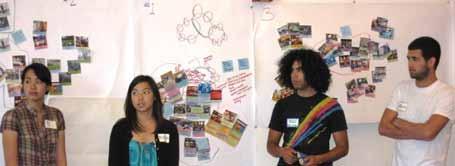
Group 1 presentation:
o There should be an open space in the center with a stage and seating with doors/openings connecting to surrounding program spaces.
o There should also be an iconic symbol of U.C. Berkeley
o The Multicultural Center is to be concentrated in purpose yet open to other related services
o There should be the following activities or spaces:
- Student government related offices
- Practice and performance space
- Food
- Student services
- Transit access
o The MCC should be highly visible with windows to promote transparency and awareness of its resources.
o There should be numerous choices for involvement in ASUC organizations and activities and this should be readily apparent to first time visitors.
o Student Government Chambers should be open for use by other groups
o Student services and food should be adjacent to the transit center along Bancroft
o Pauley Ballroom is a model for the expanded uses of Zellerbach
o A Multicultural Center library is to be a resource for all students
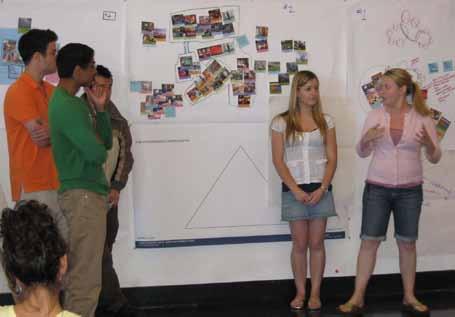
o We like Group #1’s idea of a central space
o There should be concerts, festivals, and parties
o The central public space should have an information ticker, making announcements and flashing the latest news events. We shouldn’t assume that individual students get enough info. on Face Book or other internet web sites.
o It should be a hub for businesses, especially co-operative student-run businesses. There should be more student-run agencies with more transparent oversight.
o We want both food and concerts to happen together. We like the Bear’s Lair, but there should also be a place to play pool and go bowling.
o The new student center should be a place for all students to study, relax, drink coffee, have spirited dialogue, read quietly.
o It is generally student–focused and arranged such that it recognizes activity groupings will vie to be around a central space that is indoor/outdoor and open 24/7. Space for organizations or services should be convenient to this central space.
o Lower Sproul is different than Upper Sproul in that it could be a 24-hour, active place that retains students as opposed to having them just pass through.
o The study areas will be different than at Moffit where the atmosphere is too stressful! There should be a more relaxed feeling with comfortable couches. There needs to be an all night place for intense work / study. This is a unique program need specific to this site.
o Under represented students need their own space, but can still have cross dialogue
o There should be more accommodations for people with disabilities
o There are basically three aggregations of activity:
- Noisy performance related activities that may require enclosure and isolation from other uses
- A social gathering or hang-out place with food and shopping (Beer, pool & Bowling)
- Informal study spaces
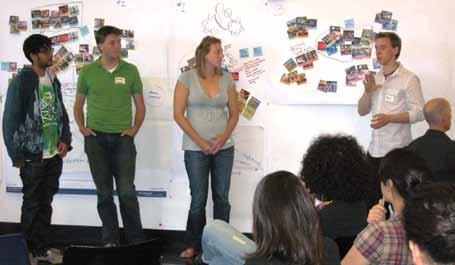
Group #3 Presentation
o Attract students by providing amenities that foster club meetings, relaxing, and eating food
o Have diurnal mixed-use spaces for daytime socializing or eating that can stay available for late night study
o Have a dedicated prayer / meditation space
o Retain students to use services by having dedicated office space and a quiet environment for:
8 of 11
- Bridges equity / inclusion - MSD - Disabled inclusion
o Recruitment and Retention center is a bridge to the larger community
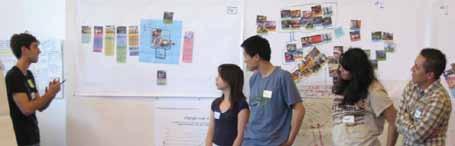
Group #4 Presentation
o Public core services for graduates and undergraduates
o MCC, MSD, and Student Recruitment and Retention Services should be grouped in one place
o Sustainability is an overall priority with water re-use and recycling of key importance in the design of the central space
o Indoor and outdoor groupings are to be organized around the central space for easy access
o There should be Information access / broadcasting to inform / keep watch
o MCC to not be co-opted
o MCC can be part of the larger free space SCC, but with its own identity
o There should be a space for student services, with student government organizations at the heart of a navigable open space.
4. Large Group Discussion:
After the group presentations the participants as a whole were asked to explore how the hybrid uses might inform a vision statement or guiding set of principles for the new student center.
o The guiding principles noted by each group were ranked using green dots. Each participant received 6 dots that were placed on the lists of text or ideograms that they felt were the most important.
o What followed was an open discussion regarding ranking, key guiding principles and vision themes. Below are ideas mentioned that could inform a vision statement with key words in bold.
o Space for students to feel welcome
o A dedicated, independent yet visible Multicultural Center that commemorates the historic struggles of the Third World Liberation Front, Anti-Apartheid movement, and Free Speech Movement.
o A message board so that visitors can be easily informed
o Sustainability is an “Arc” that touches all facets of the student center by having visible passive and active systems that help promote good stewardship of the environment as well as raising awareness of the following:
- Cultural issues (fairness in government with healthy living conditions)
- Agricultural issues (low cost roof-top farming or organic farming)
- Business issues (fair trade products and sustainable restaurant operations)
- Participation through a Bike Share program and Water Fill-up stations
- Limiting energy consumption
- Lowering the carbon footprint
- Encouraging sustainable behavior such as recycling
- Designing for day-lighting and operable windows to minimize energy use
Part of sustainability is not building more than you need:
- Have spaces that can be shared with flexibility for multiple uses
o It should be a place for congregation, performance, and guest speakers
o Many students come to Cal to “share one’s message”. The SCC should support this through resources that promote leadership and creativity.
o The SCC should retain students to use the facilities by making them aware of the resources and allowing convenient access. Students will come if there is good food and coffee, and a place to sit and watch a performance.
o The SCC is to be a place where students can be surrounded by intellectuals
o There should be a balance in light quality during the day with carefully designed sun and shade areas as well as safe and beautiful night time artificial lighting.
o It should be a place to run into a friend because you expect them to be there.
o As Upper Sproul is a very good pathway, Lower Sproul Plaza can be a very good container with resources for work/study and practice/performance. These two function categories need sound attenuation from each other in order to coexist.
o Beauty is to be incorporated into the design of the SCC’s buildings and open spaces by leveraging existing view sheds and the site’s close relationship to Strawberry Creek and the rest of campus.
o A key point is that students greatly desire an alternative to high pressure library study rooms Such a space would meet the following program needs:
- Have daytime and 24 hour study spaces that are casual with comfortable seating
- Allow food and drink
- Have a view with a connection to the outdoors
- Promote easy transition from individual study - to group study – to student organization meetings - to socializing between exam periods.
5. Post Workshop Discussion: Beth, Jim, Alicia, Richard, Mario, and Adam
Other Key Points noted:
o The new student center will be a voluntary space with amenities and resources.
- Choice: Unlike classes, students may choose to spend time here
- Resources: Make resources like audio / visual systems free or inexpensive so that student groups can actually use them (like MCC, unlike Pauley)
o Once students gather for amenities, this critical mass will act to attract other students who want to bump into friends.
o Uses could be seasonal:
- For studying during the month before exams
- For student group meetings or activities in between
- For student socializing throughout
Next Steps
Fee Referendum Support

These meeting notes are a summary of subjects discussed and decisions reached at the above listed meeting. Any discrepancies should be brought to our attention within seven days.
Richard Destin, AIA, LEED® AP, Associate Moore Ruble Yudell Architects and Planners
Authors
Allbright, Taylor. Usage of Eshleman Hall. Rep. Berkeley: University of California, Berkeley 2008.
Biddison Hier, Ltd. Conceptual Program for Lower Sproul. Rep. Berkeley: University of California, Berkeley, 2007.
Burkhalter, Gloria. “Student Life Advising Service and Educational Opportunity Program.” Memo. University of California, Berkeley, 2008.
Chancellor’s Advisory Committee on Sustainability. Campus Sustainability Assessment: 2005. Rep. Berkeley: University of California, 2005.
City Affairs Dept., Office of the External Affairs Vice President, ASUC. ASUC Campus Area Survey Report, 2008-2009. Rep. Berkeley: University of California, Berkeley, 2009.
Clair, Matt St., Zachary M. Gentry, Joshua Mooney, Janice Imrich, and Kevin Fox. UCB Campus Solar Project. Rep. Berkeley: University of California, Berkeley, 2005.
Diseno Architects; Gong, Neishi, Gong Structural Engineers; and B. Hodgson, Cost Consultant. Lower Sproul Plaza Seismic Study. Rep. Berkeley: University of California, Berkeley, 1996.
EHDD Architecture, and Rutherford and Chekene, Consulting Engineers. Eshleman Hall Feasibility Study. Rep. 2001.
EHDD Architecture. Martin Luther King Jr. Student Union Feasibility Study. Rep. Berkeley: University of California, Berkeley, 2006.
Esherick Homsey Dodge & Davis. King Union Seismic Correction – Phase 1 and Phase 2 Cover Sheets. G0.00. 2008
The Graduate Assembly. Graduate Provisions Regarding Lower Sproul Redevelopment. Rep. Berkeley: University of California, Berkeley, 2008.
IDEO. Designing Community. Rep. Berkeley: University of California Berkeley, 2005.
Maffei, S.E., Ph.D, Joe and Karl Telleen, P.E. “Eshleman Hall, UC Berkeley.” Letter to Mr. Allan Palmer. 28 Aug. 2008. Rutherford & Chekene, San Francisco, California.
The New Century Plan Advisory Committee. New Century Plan. Rep. Berkeley: University of California, Berkeley, 2003.
Permaul, Dr. Nadesan. The ASUC Auxiliary. Rep. Berkeley: University of California, Berkeley, 2008.
Permaul, Nad. “Lower Sproul – Considerations for the Complex.” Memo. 7 Oct. 2008. University of California, Berkeley.
Physical and Environmental Planning/Physical PlantCampus Services. New Century Plan: Lower Sproul Case Study, Deferred Maintenance and Facilities Renewal for Lower Sproul Plaza Area Buildings. Rep. Berkeley: University of California, Berkeley, 1999.
Sedway Group. Lower Sproul Retail Revitalization Study. Draft Rep. 2000
Sedway Group. Lower Sproul Revitalization Case Studies. Rep. 2000.
Shah Kawasaki Architects. UC Berkeley Multi-Cultural Center Floor Plans. Raw data. University of California, Berkeley. 2007-2008
Smith, Melissa. Notes from a UCB student who attended a sustainability workshop. Notes. Berkeley: University of California, Berkeley. 14 Nov. 2008.
SMWM. Hearst Memorial Gymnasium: Building Conditions and Deferred Maintenance Report. Berkeley: University of California, Berkeley, 2006.
SMWM. Hearst Memorial Gymnasium: Historic Structure Report. Rep. Berkeley: University of California, Berkeley, 2005.
SMWM. Hearst Memorial Gymnasium: Phoebe A. Hearst Museum of Anthropology. Study. Berkeley: University of California, Berkeley, 2005.
SMWM. Hearst Memorial Gymnasium, Reconstructing Hearst: Background Binder. Rep. Berkeley: University of California, Berkeley, Nov. 2005.
SMWM. Hearst Memorial Gymnasium, Reconstructing Hearst: Student Activities Study. Rep. Berkeley, University of California, Berkeley, 2006.
SMWM. Hearst Memorial Gymnasium, Reconstructing Hearst: Visioning Workshops. Rep. Berkeley: University of California, Berkeley, 2006.
SMWM. Hearst Memorial Gymnasium: Seismic Safety & Program Improvements Study. Rep. Berkeley, University of California, Berkeley, 2006.
SMWM. Lower Sproul Urban Design Study. Rep. Berkeley: University of California, Berkeley, 2007.
Space Management and Capital Programs. Lower Sproul Plaza and Environs Program Committee, List of Members. Raw data. University of California, Berkeley, 2008.
Stanley, Cara. “Student Learning Center.” Memo. Oct 2008. University of California, Berkeley.
Students in the Third World Liberation Front & the Associated Students of the University of California, Berkeley. A Vision for the UC Berkeley Multicultural Center. Berkeley: University of California, 2008.
Studios Architecture, and UC Berkeley Capital Projects. Working Paper: Program Study of Undergraduate Student Services. Rep. Berkeley: University of California, 2003.
Takahashi, Jere. “Multicultural Student Development (MSD).” Memo. Oct 2008. University of California, Berkeley.
University of California, Berkeley. AC Transit & Bear Transit Hourly Impact Report. Berkeley: University of California, Berkeley, 2008.
University of California, Berkeley. AC Transit BRT EIR. Berkeley, University of California, Berkeley, 2007.
University of California, Berkeley, and Space Management & Capital Programs. Moffit Library Infrastructure Study. Raw data. University of California Berkeley, 1994-2006.
University of California, Berkeley. Building Access Guide. Rep. Berkeley: University of California, Berkeley, 2008.
University of California, Berkeley. California Student Center/Lower Sproul Plaza Historic Structure Report. Rep. Berkeley: University of California, Berkeley, 2009.
University of California, Berkeley. Green Building and Clean Energy Policy
Implementation Progress. Rep. Berkeley: University of California, Berkeley, 2005.
University of California, Berkeley. Introduction and Summary: A Campus Workshop on Sproul Plaza and Environs. Rep. Berkeley: University of California, 1996.
University of California, Berkeley. Landscape Heritage Plan. Rep. Berkeley: University of California, Berkeley, 2004.
University of California, Berkeley. Landscape Master Plan. Rep. Berkeley, University of California, Berkeley, 2004.
University of California, Berkeley. Lower Sproul Questionnaire. Berkeley: University of California, Berkeley, 2009.
University of California, Berkeley. Multicultural Center Proposal for the Haas Foundation. Berkeley, University of California, Berkeley, 2008.
University of California, Berkeley. Public Art Data: Golden Bear and Cast Concrete Panel. Raw data. University of California, Berkeley. 2008.
University of California, Berkeley. Self Study: Cesar E. Chavez Student Center Spring 2009. Berkeley: University of California, Berkeley, 2009.
University of California, Berkeley Space Management & Capital Programs. Sproul Hall Floor Plans with Summary Data and a Room-Level Data. Raw data. Berkeley. 2008.
University of California, Berkeley. Sproul (space by room). Excel document with ASF for each room within Chavez, MLK, and Eshleman. Raw data. Berkeley: University of California, Berkeley 2008.
University of California, Berkeley. The Multicultural Center-Visioning for Lower Sproul Redevelopment. Rep. Berkeley, University of California, Berkeley, 2009.
University of California, Berkeley –Steering Committee
Miguel Daal President, Graduate Assembly
Roxanne Winston President, ASUC
Catherine Koshland Vice Provost for Academic Planning and Facilities (co-chair)
Harry LeGrande Vice Chancellor for Student Affairs (co-chair)
David Blinder
Associate Vice Chancellor, University Relations
Emily Marthinsen
Assistant VC, Physical & Env. Planning, Capital Projects
Jonathan Poullard
Dean of Students, Campus Life & Leadership
Gibor Basri
Vice Chancellor for Equity and Inclusion
Nathan Brostrom
Vice Chancellor for Administration
John Ellwood Committee on Academic Planning and Resource Allocation
Christina Maslach Vice Provost for Teaching and Learning
Paula Milano
Principal Analyst, VC Admin-Financial & Mgmt. Analysis SMCP
Emily Sexton
Assistant Vice Chancellor for Administration
University of California, Berkeley –Program Advisory Committee
Nad Permaul Executive Director ASUC Auxiliary
Barbara Gross Davis AVC Equity & Inclusion
Tyler Stovall Dean, UGIS
Mark Griffith Acting Chair, TDPS
Doug Warrick General Manager, Cal Performances
Elizabeth Dupuis Director, Doe & Moffitt Libraries
Prof. Patricia Butler CAPRA Representative
Jonathan Poullard Dean of Students
Shawn LaPean Director, Cal Dining
Mike Weinberger Director, Rec Sports
Triffid Abel Grad Representative
Alberto Ortega Grad Representative
Daniel Work Grad Representative
Mark Griffith Acting Chair, Theater Dance Performance Services
University of California, Berkeley –Finance Committee
Khira Griscavage Director, Administration FF&B (co-chair)
Paula Milano Acting Director, SMCP (co-chair)
Ron Coley AVC, BAS
Nad Permaul Executive Director ASUC Auxiliary
Robert Hatheway AVC, Real Estate Services
MaryEllen Himmel Director, Development & Community Relations
Jodie Rouse Director, Budget & Planning
David Rhoads Undergrad Representative
Jordan Smith Undergrad Representative
Blake Holland Grad Representative
Tom Klatt Vice Provost’s Office, Staff to Committee
University of California, Berkeley –Capital Projects
Alicia Rosenthal Project Manager, Capital Projects
Jim Horner Campus Landscape Architect, Capital Projects
Beth Piatnitza Associate Director, Physical & Environmental Planning
University of California, Berkeley –Student Advisory Committee
Miguel Daal, President President, Graduate Assembly
Roxanne Winston President, ASUC
Alex Cole-Weiss
Undergraduate Representative
Bradley Froehle Grad Representative
Justine Lazaro Graduate Representative
Davene Mignott Undergraduate Representative
Krystle Pasco
ASUC Executive Vice President
Dave Rhoads ASUC Store Operations Board
Jennifer Tai Student Advisory Committee
Dan Work
Graduate Representative
Jonathan Poullard Dean of Students
Allison Falkenstein
University of California, Berkeley –Alumni
Josh Daniels Alumni Representative
Raquel Figeroa UCB alumnus
University of California, Berkeley –Pre-Programming Student Participants
Miguel Daal President, Graduate Assembly
Roxanne Winston President, ASUC
Taymyr Bryant MCC intern
Andrew Chang Interim Coordinator, MCC
Felby Chen CLL (Dean of Students Liaison) + ASUC Aux
Vanessa Coe, Bridges Multicultural Resource Center
Alex Cole-Weiss Undergraduate Representative
Bradley Froehle Grad Representative
Mary June Flores ASUC Senate
Marcelo Garzo MCC, ESUSC, Green Bike Share
David Gregory LED / S. Club
Ian Hepworth Haas- VP Sustainability
Gloria Hernandez MCC
Kushal Kadakia Student Liaison, UC Student Affairs
Justine Lazaro Graduate Representative
Davene Mignott Undergraduate Representative
Ameeti Mishra ASUC intern
Aditi Mishra RHA rep
Erica Odukoya MCC
Krystle Pasco ASUC Executive Vice President
Nish Rajan Graduate Assembly
Dave Rhoads ASUC Store Operations Board
Kifah Shah ASUC Senate
Melissa Smith Student Advisory Committee
Jennifer Tai Student Advisory Committee
Zac Taylor Undergraduate Planning, Capital Improvements Committee
Tracy Teel Cal Performances
Gabriela Urena MCC
Master Plan / Feasibility Study Team
Buzz Yudell Partner
Mario Violich Principal in Charge
Jeanne Chen
Collaborating Principal
Richard Destin Associate, Project Manager
Adam Padua Senior Associate
Simone Barth Associate
Consultant Team
Willett Moss
CMG (Landscape)
Steve Murray
KPFF (Civil)
Bret Lizundia
Rutherford & Chekene (Struct.)
Allan Daly
Taylor Engineering (Mech. & Plumb.)
Craig Oty
OMM (Electrical)
David Cobb
Davis Langdon (Cost)
Jim Carruthers
Brailsford & Dunlavey (Retail)