E-Gobrecht
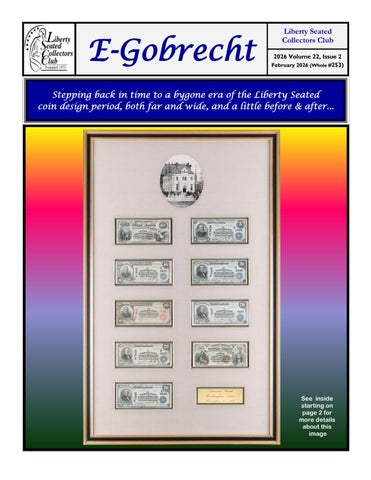
Stepping back in time to a bygone era of the Liberty Seated coin design period, both far and wide, and a little before & after...



The E-Gobrechtis an award winning informal electronic publication of the Liberty Seated Collectors Club (LSCC). The LSCC is a non-profit organization dedicated to the attributions of the Liberty Seated U.S. Coin series. The LSCC provides the information contained in this “electronic” e-mail newsletter from various sources “free of charge” as a general service to the membership and other subscribers with a numismatic interest. You do not have to be a LSCC member to benefit from this newsletter; subscription to the E-Gobrecht is available on a complimentary basis to anyone. All disclaimers are in effect as the completeness and/or accuracy of the information contained herein cannot be completely verified. Contact information for LSCC and this publication can be found on the last page.
President’sMessage
Welcome to the February issue of the E-Gobrecht. The acceleration in precious metal prices is capturing everyone’s attention and bringing related focus to the rare coin market. There is a little to say today that won’t be out of date by the time you read this, except that gold and silver have been viewed as a safe haven for millennia and continue to act in that capacity.
On the E-Gobrecht editorial front, we are making preparation for Paul Kluth’s transition and will have more to share next month on that update. Many thanks to Paul for expanding the reach of the E-Gobrecht over the length of his tenure. Enjoy this issue, and we will see you virtually again in a few weeks …Len Augsburger
The video of the recent F.U.N. LSCC meeting is currently available on YouTube at: https://youtu.be/4IUq-Sjo668
Editor’s‘ViewFromtheRim…PK
Both Far and Wide, and a little Before & After...
In this issue and the recent past January issue of E-Gobrecht, you probably noticed several articles about topics that are not exclusively about Liberty Seated coins. That is because subscribers were gracious enough to share some very cool stuff with us about the past that this editor felt was too important not to share with fellow collectors. And these artifacts and writings might not have ever been published elsewhere.
Of course it helps to know the authors and to encourage them to submit something of general interest to everybody. Each presentation was about commerce and transportation in the distant past when Liberty Seated coinage certainly circulated. While we spend most of our collector time admiring the L.S. series along with the various denominations and their variations, socializing about our hobby, and learning more about our coins everyday; we should always recognize the economic and historical aspects of U.S. coins and currency are what drove the growth of prosperity in our country through a means of commercial exchange.
Also, in this issue is the final installment of a long 5-Part article by Club member Steve D'Ippolito about his top award-winning Liberty Seated Type Set exhibit at this past year’s Summer ANA Convention. Be sure to read his conclusions especially if you are a Type Set collector (and even if you are not)!
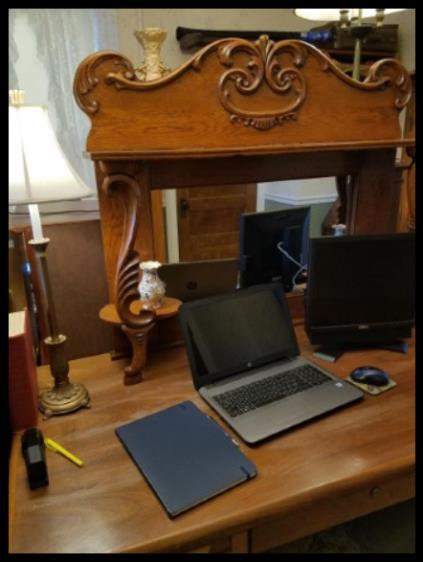
Soon I’ll be retiring as editor for this publication, not because I necessarily want to, but because there comes a time in life for all of us when we need to slow down, start putting on the brakes and downsize one’s activities. I am not going away altogether by any means because of my collecting “disease”, but just sorting thru life
ANNOUNCEMENT

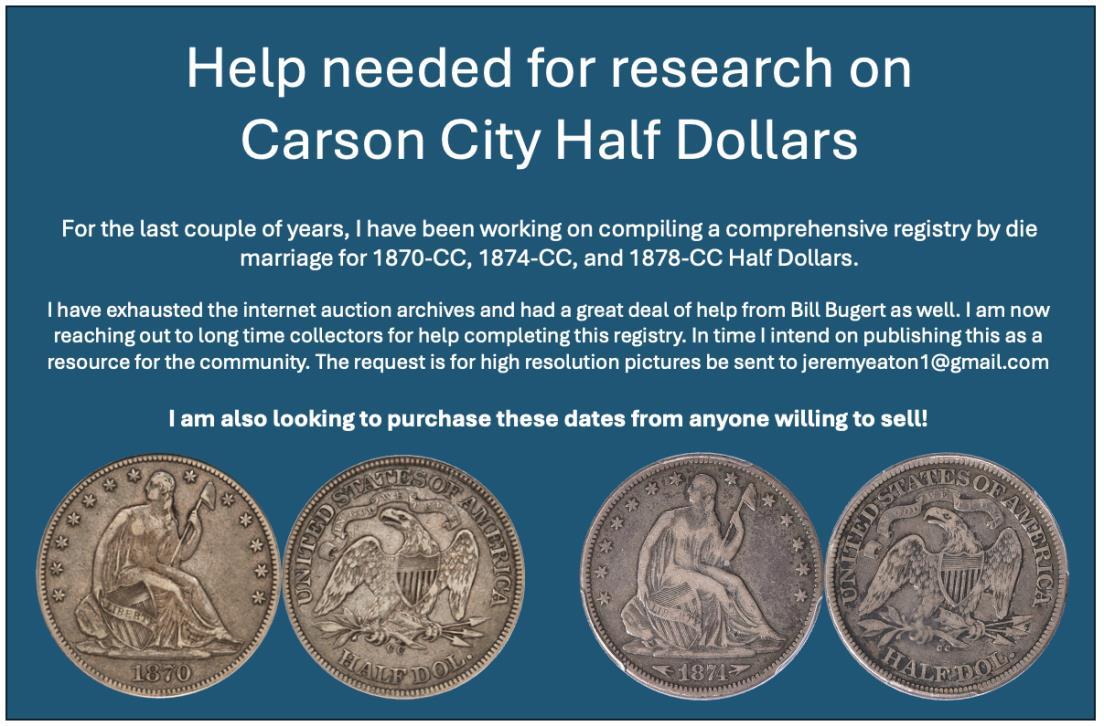
I’ve been collecting Carson Halves for 10 years now. I started the same way I expect most do as they are appealing for numerous reasons. Good size to appreciate and hold in your hand, rare enough to be challenging yet not impossible to find and of course tied to the mystique of the short-lived Carson City Mint in Nevada.
Around 5 years ago, I came across the Liberty Seated Collectors Club and soon thereafter I was introduced to a wonderful resource - Bill Bugert’s breakdown of die marriages. If anything, this only grew my passion. Being able to examine my coins and identify markers that can trace to a particular die set in the manufacturing process piqued my interest as a collector.
While reading up on the series, I saw multiple estimates from experts over the years. For the three rarest dates, 1870-CC, 1874-CC, and the 1878-CC, the prevailing theories usually pinned them in the range of 150 to 250 specimens still available for collectors today. I took this as fact for quite some time, but after being inspired by Bill Bugert’s “Registry” work on the 1878-S, I realized I could do something similar. Armed with a quarter century of auction archives with high resolution images, I set to work compiling every known 1870-CC half dollar I could find and sorted them by die marriage. I started with the ‘70 Carson City half dollar as it has the smallest estimated surviving population and in theory the easiest to be able to compile the majority of them. I later realized this was not the case considering it has the most known die marriages of the three dates, I was researching which really added to the time to analyze each one. After getting to a good place on those, I then moved my focus on to the ‘74 Carson City and did the same thing. I have not started the ‘78 Caron City yet but that is next on my to do list with the intention of one day publishing the three registries to be a resource for our community.
I have exhausted the internet auction archives and had a great deal of help from Bill Bugert as well. I am now reaching out to long-time collectors for help completing this registry. The request is for high resolution pictures of any of these three dates to be sent to Jeremy Eaton, LSCC #2895: jeremyeaton1@gmail.com
I am also looking to purchase these dates from anyone willing to sell! More next month… (END)

#253 - February 2026
The Curious Collector
by Len Augsburger, LSCC #1271
2026 FUN Show Report
The January FUN show is in the books, and everything you’ve read about it is correct.
(Continued
(Continued from previous page)
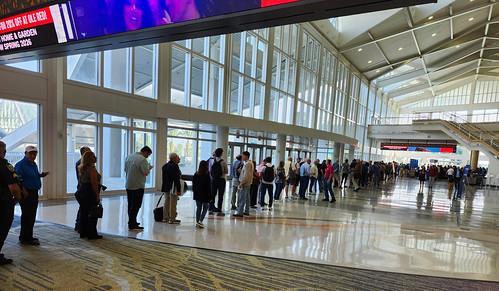
The foot traffic was unprecedented, and the aisles felt like a Starbucks at Grand Central Station during the commuter rush. I’m not a pro at the FUN show, as I’ve only been a few times, not enough to avoid confusion about the actual location of the show. I therefore mistakenly booked at the Hilton, which, on the map, appeared to be the closest hotel. And it is the closest hotel, if you are going to the south portion of the convention center. Unfortunately, the coin show was held in the north half of the hall. The problem isn’t obvious until you grasp the enormity of the convention center, a behemoth roughly the size of the O’Hare and Heathrow airports combined. To make matters worse, the north and south halves of the building are not connected. You have to exit the building and walk to the next town to find the coin show. I wasn’t the only one to make the mistake, and there was a long line of similarly confused coin hunters trudging through the Florida humidity (84 degrees in January), all wondering why they didn’t just take an Uber to begin with.
Some years ago, while I was long distance running, I advertised a FUN show “Fun Run”, with the objective of running around the entire convention center. In what universe that is actually “fun” I’m not sure, but running rewires your brain in unexpected, strange ways. Apparently all the other convention attendees agreed, as I was the only one that actually showed up to the event. In any case, my coach, who had live access to all my training data (GPS, running watches, heart rate monitors –every pursuit seems to have its own accessories) had to call up and ask me what the &*#!$ I was doing on an unplanned run that seemingly extended the entire length of the Florida peninsula. Mind you, I was training for a marathon and doing half-marathons at least once a week. I never thought athletic accomplishment would be a prerequisite to access the Orlando convention center, as usually a mustardstained shirt demonstrates more than sufficient cred to gain entrance to a coin show.
Yes, I somehow eventually managed to find the coin show. A photo of the ‘registration line’ on Thursday on the previous page was much longer than the image shows. Thursday attendance was reportedly over 10,000, and I believe it. Did I wait in the registration line? That is a good question. I walked into the show with another collector who immediately decided that paying $100 for an early bird pass (a much, much shorter line) was a better use of his time. And if I had his bank account, I would agree. I didn’t pay the $100, and I didn’t wait in line. The story is best told over a beer. If only I had demonstrated so much creativity in actually finding the show!
(Continued on next page)
Reminder Notice for LSCC Members
If your membership ends in 2025, please remember to submit your dues renewal so you don’t miss the next Spring issue of The Gobrecht Journal. And besides we all enjoy having you as a Club member. Thank You!
(Continued from previous page)
In any case, I did not have a lot of time available to spend at the show and had a prepared list of people I wanted to meet regarding LSCC, Newman Portal, or other business. First stop is always the LSCC Club table, and I was excited to see Carl Feldman and his exhibit of Liberty Seated dollar exonumia. Carl has the sort of collection that can be built only with a long period of time and a matching amount of determination. We were doubly pleased to have Carl in person as we were unable to present his LSCC President’s Award at the Oklahoma City ANA show in August.
On Friday, I attended the FUN Numismatic Ambassadors breakfast, which annually recognizes individual contributions to numismatics. This year, Carol Bastable, Donna Nunez, Mike Bean, Gerry Tebben, and yours truly were all so honored. Carol is well known as the love token expert, while Donna is a long-time employee of the ANA. Mike worked at the Bureau of Engraving and Printing as a plate printer, and Gerry notably maintained a Coin World column from 1983 to 2025, in addition to serving the CSNS and CONA groups in various capacities. The Numismatic Ambassador program was launched by Chet Krause in the 1970s and is now administered by the FUN organization. I was pleased to see ex-Krause Publications stalwarts Clifford Mishler and David Harper on hand.
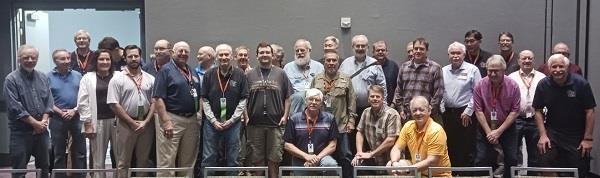
The breakfast unfortunately overlapped with the start of the LSCC meeting, for which I was a bit late. My timing was impeccable, however, as the group portrait was taken at the exact moment I entered the room. The educational presentation was given by Craig Eberhart, who made a leap of faith in entrusting John Frost with the slide deck. John Frost, in turn, blindly accepted my submission of candid photographs. The ensuing hijinks, for the sake of propriety, have been omitted from the meeting video, which is posted on YouTube at https://www.youtube.com/watch?v=4IUq-Sjo668 Craig’s remarks on transitional New Orleans coinage; however, are completely represented in the video, and are well worth viewing. Many thanks to John and Craig for putting this meeting together.
Following the LSCC meeting, Stephen Petty & I held a “whist match” at Doug Winter’s table. The concept of numismatic whist is simple – you get a point for having a coin, and an additional point if you have the nicer coin. Stephen & I collect New Orleans eagles, of which we both have PCGS/ CAC sets. Stephen’s set is complete while mine is missing three of the 37 pieces. As most of Stephen’s coins are graded higher than mine, Doug threw me a bone by slightly modifying the rules so that an original piece of a lower grade might possibly be rated “nicer” than a higher-graded piece. Doug also awarded several “bonus” points for exceptionally noteworthy examples. I did not win, and I did not expect to, but the real value of the exercise was getting Doug’s in-hand evaluations of all the coins. Yes, we did capture this on video, which will be released in due course. Everyone that watches will learn a few things about judging surfaces, luster, and originality as it relates to U.S. gold coins.
I’d love to coordinate a similar event for Liberty Seated coinage, and, if you have any interest in entering your set into such a competition, let’s make it happen. The set registries have done some wonderful things for numismatics, but at the end of the day they are strictly numeric and take a lot of nuance out of the equation. There is no substitute for doing such things with actual coins in hand under the trained eyes of an expert observer.
(Continued from previous page)
My FUN convention wrapped up with a meeting with Tom Uram who works with the ANA on planned giving. Tom is an ex-ANA president, and a career finance professional, and it is the sum of volunteer efforts such as this that makes the organization. If any of the readers are of a mind to support the ANA, I’m happy to connect you with Tom.
Following the show, dealers David Kahn, Gerry Fortin, John Brush, Laura Sperber, Shannon Rajkitkul, and no doubt many others, all issued tremendously positive reports. The consensus is that that the accelerating precious metals market is activating latent interest in rare coins. This has been the pattern in the past and is again operative. I expect well-attended shows in Savannah (the upcoming ANA winter convention) and for the Whitman March Baltimore event as well.
OPINIONS & ANALYSIS as Silver reaches $118.45 an ounce on January 29, 2026, but plunges by -$30 to $85.15 the next day…?
From the Editor: Curious about it, so let us know how others feel? With precious metal Silver now at over $118+/oz., an all-time high, is this the time to sell any silver coins whose bullion value exceeds their numismatic value for common dates and all grade ranges?
We are now certainly in uncharted territory! Is this a big bubble that will soon burst, or is this going to be the new bid/sell price range for precious metal dealers for the foreseeable future? What? ..a -$30 Burst in the Bubble in one day?
I'm not referring to junk silver here, but for many 20th century collectible coins, they are now actually worth more than their numismatic value based on all Grey Sheet pricing of only a couple months ago.
Anonymous Response #1: As to your “sell or hold” question; for us collectors with gray hair, this is probably a good time to simplify our holdings. Thinning the herd of silver odds and ends that aren’t part of our core collection… Stuff we don’t need to burden our heirs with eventually liquidating. If you’re worried about selling only to see silver go even higher, then consider selling a portion of it, and then selling the rest if it does advance further. The trap is trying to sell stuff at “the top” vs selling at a very good price. My two cents…
Don’t blink or you be left in the dust, “silver dust” that is… lol
What are your thoughts? Let us know by emailing your opinion to the editor at: e-gobrecht@msn.com
National Bank of Washington Tying the pieces together
by Bob Bolduc
Been collecting ‘District of Columbia’ National Bank Notes since 1988. I’m sure many of you reading this have been collecting much longer and will be able to relate to this story. At some point, locating material for your collection becomes quite challenging. Either items are difficult to discover and when you do find something, it is priced out of reach. Well, that is what I thought, until I discovered this item.
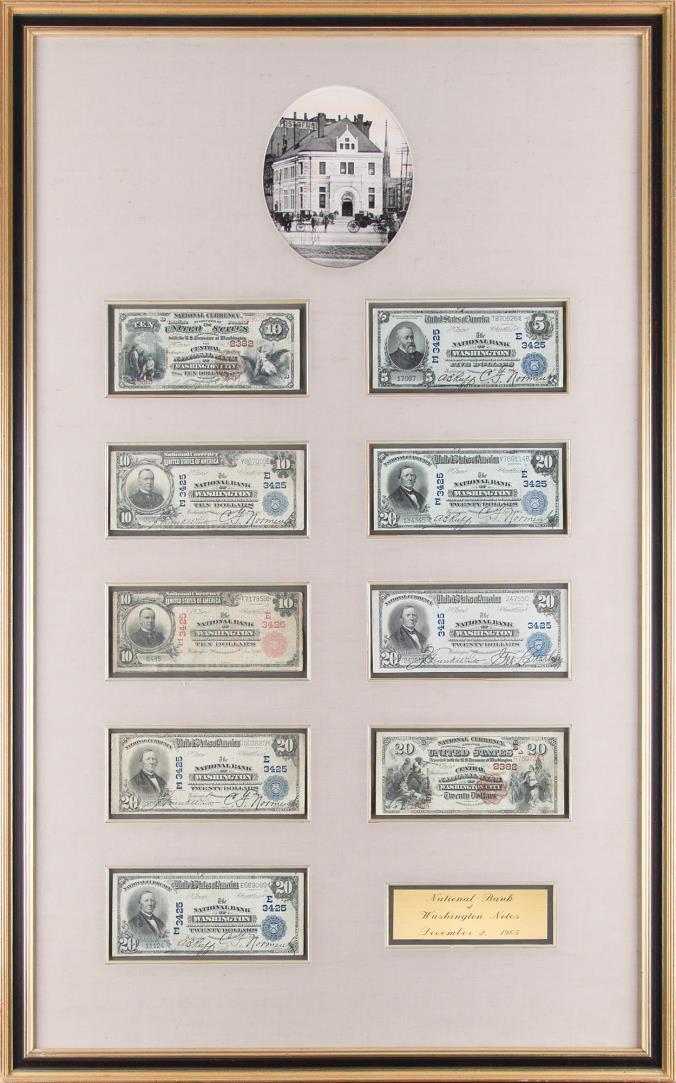
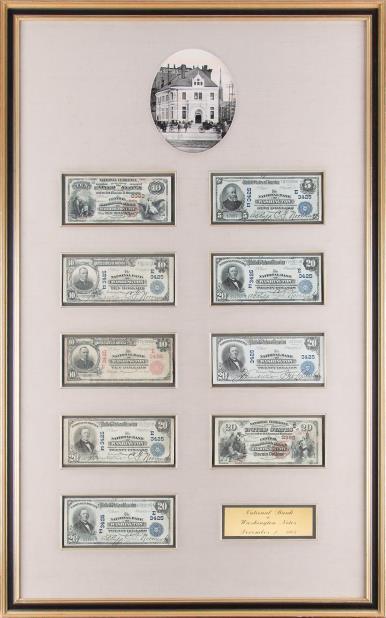
In May of 2024, I was thrilled when I found a picture frame displaying National Bank Notes associated with the National Bank of Washington. True, they are mounted in a frame and no “One-of” notes, but it’s something I had never seen before. I wanted to acquire it, and it was the addition to the collection I had never thought of. Frame included multiple Brown Seals and one Red Seal. Already had these notes represented in my collection, but this had now become a must have. Lucky for me, I was the high bidder and now treasure the item in my collection. Let me share some interesting details about this numismatic find.
As you might have expected, a new door opened. Now I have questions I’m looking for answers to:
1. Who built this currency display frame?
2. When was it built?
3. Why was it built?
Let me set your expectations right now… I did not discover the answers to any of these questions. Yes, I still have the same questions today!
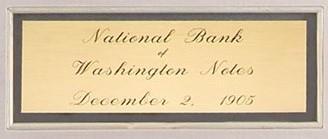
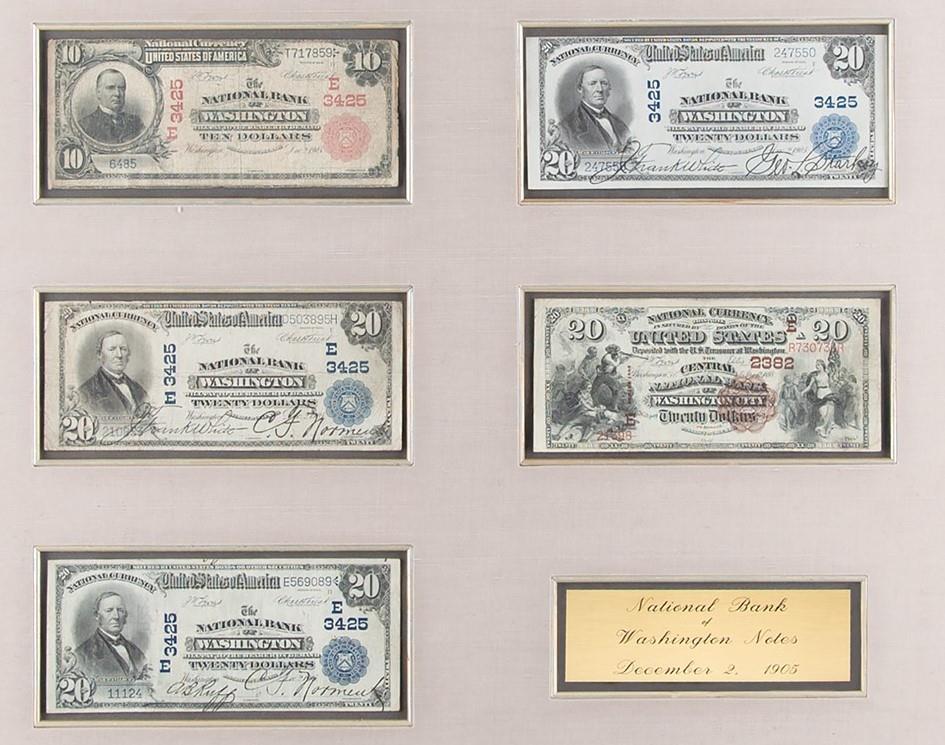
In the bottom right corner is a gold color plate with the bank name and a date of December 2, 1905. This is the same date as on the third charter notes, so it must mean something. Could this framed display have been created to celebrate the bank’s rechartering? The bank survived until 1990, but I do not see any other reason during that time-frame to create an item like this with that date.
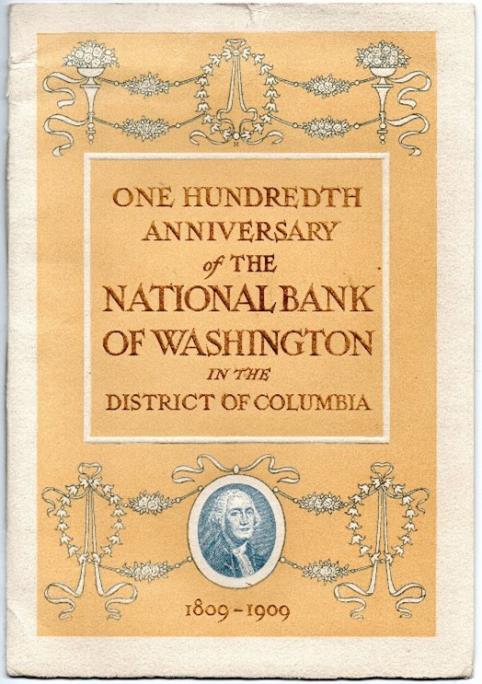
Then I came across a second item I just had to have, from the same bank! A booklet celebrating the 100th Anniversary of the National Bank of Washington“1809-1909”. Dates do not line up with the national charter dates, but that is easily explained as the bank was in business long before national charters were established. Could they have had a celebration for the 100 years? So now I’m convinced the frame was put together between 1906 and 1909. Instead of narrowing my dates down, I’m making them a wider period.
Now let’s add a third piece to this mystery. Found a photo that is claimed to be from the National Bank of Washington, D.C. No date on the image, but you can see the room has electricity, telephone, adding machine and even what appears to be a pizza box. Maybe the picture was taken some time in the 60’s or early 70’s. But what caught my eye was the framed picture in the photo on the left wall about halfway down the room. I have enlarged this picture, but the detail is just not there. What is hanging on the wall? Could it be the picture frame I now have and what you are seeing on the Cover of E-Gobrecht?
See next page...
(Continued
Gold Colored Plate
(Continued
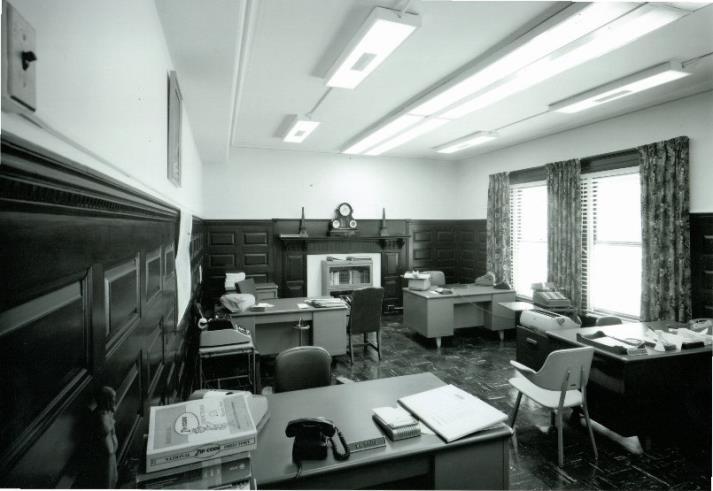
In 1990, the National Bank of Washington was absorbed by Riggs National Bank. I can imagine someone taking the picture frame as a bit of history of the bank. My best guess is maybe, I will never know for sure. Are there any readers out there who might know some answers?
Now for some up-close images on the next couple of pages and catalog descriptions of the notes below as mounted...
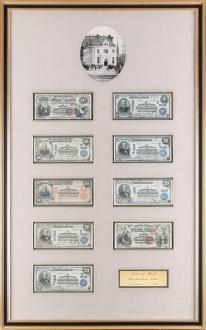
Left Column (top to bottom)
1. 2382, Central National Bank, $10, 2nd Charter – Brown Back
2. 3425, National Bank, $10, 3rd Charter – Plain Back
3. 3425, National Bank, $10, 3rd Charter – Red Seal
4. 3425, National Bank, $10, 3rd Charter – Plain Back
5. 3425, National Bank, $10, 3rd Charter – Plain Back
Right Column (top to bottom)
6. 3425, National Bank, $5, 3rd Charter – Plain Back
7. 3425, National Bank, $20, 3rd Charter – Plain Back
8. 3425, National Bank, $20, 3rd Charter – Plain Back
9. 2382, Central National Bank, $20, 2nd Charter – Brown Back
10. Name Plate
[Editor’s Note]: Bob is a member of our local coin club and historical society & museums. He always has something interesting to share with members.
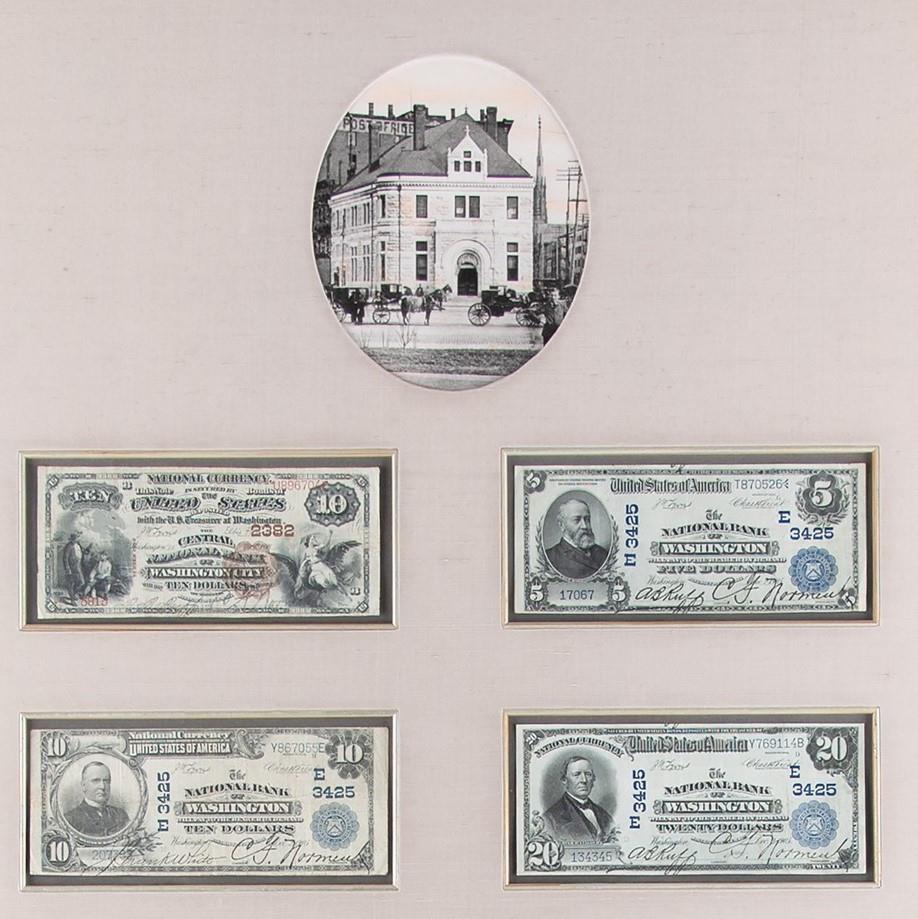
Also note that all the notes that should have signatures appear to have original signatures. If you go to the Club website or Newman Numismatic Portal, you should be able to expand those images of the notes even further to taker a closer look.
(Continued from previous page)
Top Portion of Framed Bank Notes
(Continued on next page)
(Continued from previous page)
Bottom Portion of Framed Bank Notes
Regional News
by Ken Otto, Regional Team Director, LSCC #2674
After a Strong Start in 2026, Many Important Regional Coin
Shows will Occur in February and March
ThewinterFUNshowinOrlandoinearlyJanuarywasaverystrongcoinshow,and very-wellattendedbybothcollectorsandthegeneralpublic. Mostdealersreportedexcellent resultsattheshowwithparticularlystrongactivityduringthefirstdayoftheevent.Thisisa promisingearlyindicatoroftheoverallcoinmarketduring2026.Additionally,therapid escalationofgoldandsilverpricesinearly2026hascreatedabuzzinthecoinmarket.
(Continued on next page)
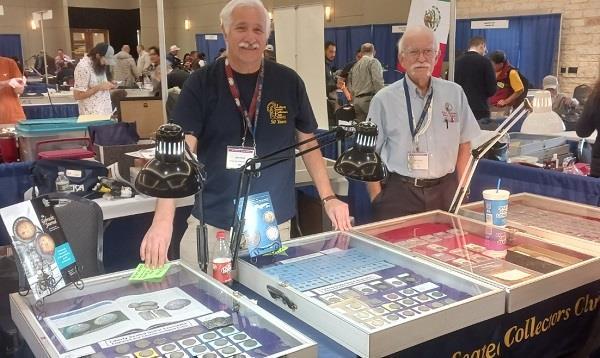
Houston Money Show with Dick Osburn (right) who donated half his bourse table to the LSCC and BCCS. John Frost hosting too. (Above) Group Photo for the LSCC Meeting at FUN. Lots of enthusiasm in the room.
Regional News cont.
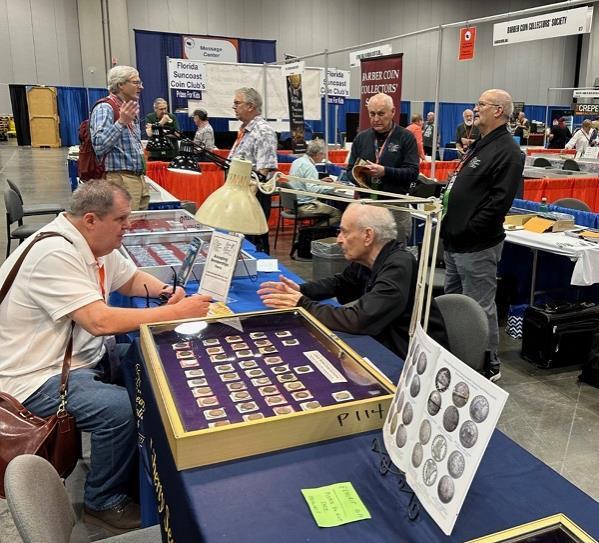
Back at FUN: Manning the LSCC/BCCS tables are Carl Feldman conversing with an attendee, and standing right to left are Dennis Fortier, Joe Casazza, Rich Uhrich and Len Augsburger.
TheRegionalLSCCteamparticipatedin theWinterFUNCoinShowwhichwasheld January8-11attheOrangeCounty ConventionCenter,North/SouthBuilding, Orlando,FL32869.Thisisamajornationalshowthatkicksoffthecoinmarketin thenewyear. TheFUNwintershowthis yearwasparticularlystrongwithgreat attendanceonthefirstcoupleofdaysof theevent.Onthefirstdayforpublic attendance(Thursday)therewasavery longlinetoregisterwhichwasmany timeslongerthanwehaveseenbefore. Asaresult,therewasaverycrowdedbourseduringthefirst dayandaverynoticeablebuzzontheconventionfloor. TheLSCChadamajorpresenceatthisshow andweconductedaClubmeetingandhadaneducationpresentation. JohnFrostandCarlFeldman exhibitedtheLibertySeateddollar‘exonumia’collectionthattheyhaveputtogetheroverthepast 40+years.TheClubtablewashostedbyJohnFrost,DennisFortier,JoeCasazz,CarlFeldman,Ken Ottoandothers.
TheRegionalLSCCteamalsoparticipatedintheHoustonMoneyShowwhichwasheld January16-17attheLoneStarConventionCenter,9055AirportRoad,Conroe,TX77303. ThisimportantRegionalcoinshowwaswell-attendedasnormal. DickOsburngraciously allowedtheLSCCtosharehistableattheshowashehasdoneoverthelastseveralyears. TheClubtablewashostedbyJohnFrostandKenOtto. JohnFrostmadeaneducational presentationattheHoustonMoneyShowcoveringhighlightsofthecourseontheNew OrleansmintwhichisofferedagainthisyearattheANASummerSeminar.
Goingforward,therewillbemanyRegionalcoinshowsduringthenextfew monthsandtheLSCCregionalteamwillbepresentatmanyofthem. Ofparticularnote isweplantoparticipateinthewinterANAcoinshowinSavannah,GAthisyearasthe winterANAshowinAtlantain2025wasagreatshow.
(Continued on next page)
Regional News cont.
FromJohnLundsten: “TheCharlotteCoinShowisFebruary13-14,2026. Itisthe56thshow oftheCharlotteCoinClub. TheshowisonFridayandSaturdayfrom10amto6pmbothdays. Like lastyear,mostoftheactivitywillmostlikelybeinthemornings. ItwillbeatBriarCreekRoad,Charlotte,NC. IthinkthisisadifferentlocationthantheConcord,NClocationwewenttolastyear.“
Call for LSCC Hall of Fame Nominations for 2026 (Due by April 15)
Nominations are being accepted for the LSCC Hall of Fame. A Nomination Form must be received by April 15. For information about the Hall of Fame, requirements for nomination, and access to the Nomination Form, please visit the LSCC website, https://lsccweb.org/LSCC/Hall-of-Fame.
Questions or concerns regarding the LSCC Hall of Fame may be directed to Craig Eberhart, LSCC Vice President. Contact information is on the last page of this issue or send to:
Craig Eberhart at craig@eberhart.us or P.O. Box 1386, Los Alamos, NM 87544
Nominator ___________________________ LSCC Member Yes / No Nominee ___________________________
Provide any of the following information to assist with the selection:
1. Time as LSCC Club Officer or Leader / Position
2. Collections Built, including grade and as many specifics as possible
3. Published Writings (Liberty Seated Books, Articles, etc.)
4. Club Contributions (promoting or assisting the LSCC in its mission)
5. Numismatic or LSCC Awards
6. Miscellaneous Data that might add to Nominee’s consideration & Nominators Comments
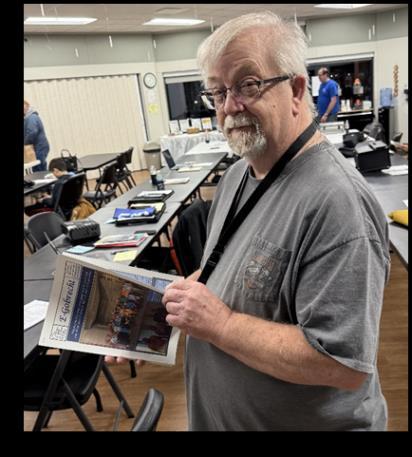
<<< Caught up on your E-Gobrecht reading yet?
Thank you Jim Motley for being our model for both HVNS & LSCC!
The video of the recent F.U.N. LSCC meeting is currently available on YouTube at: https://youtu.be/4IUq-Sjo668.
(Continued
Regional News cont.
Upcoming Coin Show Events for 2026 (Many events include the BCCS too) (LSCC 2026 Regional Events Calendar can be found on page 39)
TheRegionalteamwillparticipateintheKnoxvilleCoin&CurrencyShowtobe heldFebruary6-7attheRothchildConferenceandCateringCenter,8807Kingston Pike,Knoxville,TN37923. TheClubtablewillbehostedbyDennisFortierandJohn Frost.
TheRegionalLSCCteamwillalsoparticipateintheCharlotteCoinClubannual coinshowtobeheldFebruary13-14attheParkExpo&ConferenceCenter,800Briar CreekRoad.,Charlotte,NC28205. JohnLundstenandKenOttowillhosttheClubtable.
TheRegionalLSCCteamalsoplanstoparticipateintheANANationalMoney Show(winterANAshow)whichwillbeheldonFebruary26-28attheSavannah ConventionCenter,1InternationalDrive,Savannah,GA31421.Thiswillbethesecond yearthatweparticipateatthisshowwithaClubtable.Thetablewillbehostedby JohnFrost,DennisFortier,JoeCasazza,KenOttoandothers.
TheRegionalLSCCteamwillparticipateintheWhitmanBaltimoreSpringExpo whichwillbeheldonMarch5-7attheBaltimoreConventionCenter,1WestPratt Street,Baltimore,MD21201. ThisisamajorcoinshowandwewillconductaClub meetingandaneducationalprogramtoo. TheClubtablewillbehostedbyJohnFrost, DennisFortier,GregJohnson,KenOttoandothers.
Press Release
New Book Announcement
Craig Sholley's book, The Evolution of US Minting Technology, 1793 to 1840, is now available through EAC at just $36.00 ppd. Craig donated the copyright to EAC, so all proceeds will go directly to the club. You can order the book at: https://www.eacs.org/books/. Credit cards are accepted.
Liberty Seated collectors interested in how the coins were made should seriously consider obtaining a copy. As Sholley points put in the introduction, "I chose 1840 as the cut-off for this booklet since that was the year Franklin Peale introduced the last of his improvements, transforming the mint from a largely hand-work shop typical of the 18th century into a mechanized manufactory of the industrial age. Future improvements were largely variations on those introduced by Peale, particularly the mechanized presses, rimming machines, and engraving equipment."
#253 – February 2026
ACollector’s Exhibit on Liberty Seated Coins (Part V)
by Steve D'Ippolito, LSCC #2294
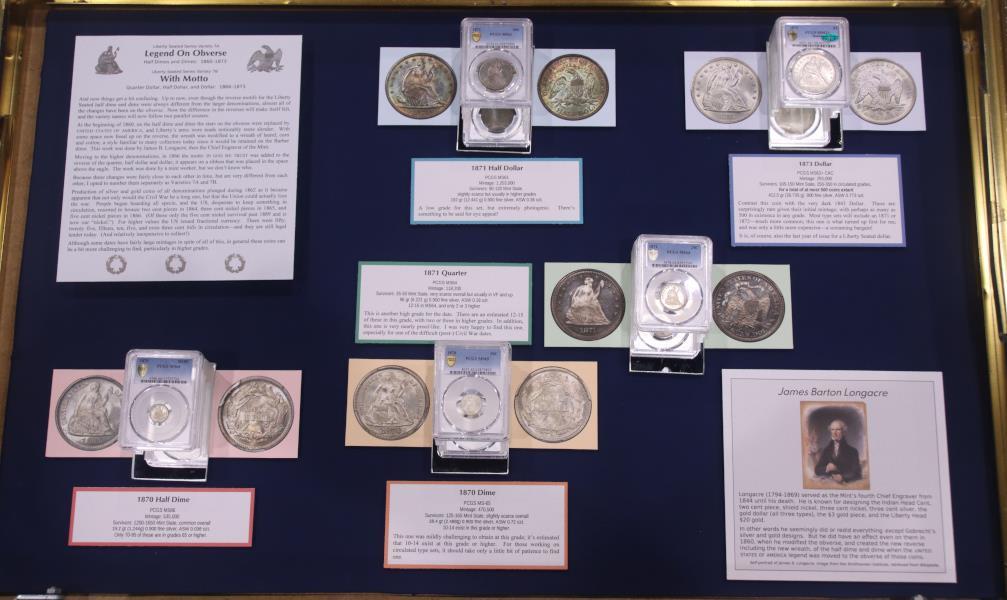
Liberty Seated Series Variety 7A Legend On Obverse
Half Dimes and Dimes: 1860–1873
Liberty Seated Series Variety 7B With Motto
Quarter Dollar, Half Dollar, and Dollar: 1866–1873
And now things get a bit confusing. Up to now, even though the reverse motifs for the Liberty Seated half dime and dime were always different from the larger denominations, almost all of the changes have been on the obverse. Now the difference in the reverses will make itself felt, and the variety names will now follow two parallel courses.
At the beginning of 1860, on the half dime and dime the stars on the obverse were replaced by united states of america, and Liberty’s arms were made noticeably more slender. With some space now freed up on the reverse, the wreath was modified to a wreath of laurel, corn and cotton, a style familiar to many collectors today since it would be retained on the Barber dime. This work was done by
(Continued
E-Gobrecht #253
James B. Longacre, then the Chief Engraver of the Mint.
Moving to the higher denominations, in 1866 the motto in god we trust was added to the reverse of the quarter, half dollar and dollar; it appears on a ribbon that was placed in the space above the eagle. The work was done by a mint worker, but we don’t know who.
Because these changes were fairly close to each other in time, but are very different from each other. I opted to number them separately as Varieties 7A and 7B.
Production of silver and gold coins of all denominations plunged during 1862 as it became apparent that not only would the Civil War be a long one, but that the Union could actually lose the war. People began hoarding all specie, and the US, desperate to keep something in circulation, resorted to bronze two cent pieces in 1864, three cent nickel pieces in 1865, and five cent nickel pieces in 1866. (Of these only the five cent nickel survived past 1889 and is now our “nickel.”) For higher values the U.S. issued fractional currency. There were fifty, twenty five, fifteen, ten, five, and even three cent bills in circulation - and they are still legal tender today. (And relatively inexpensive to collect!)
Although some dates have a fairly large mintages in spite of all of this, in general these coins can be a bit more challenging to find, particularly in higher grades.
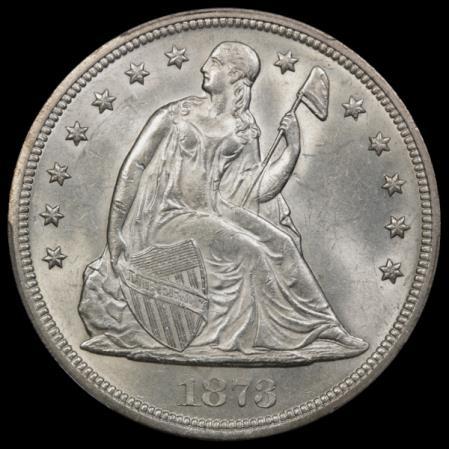
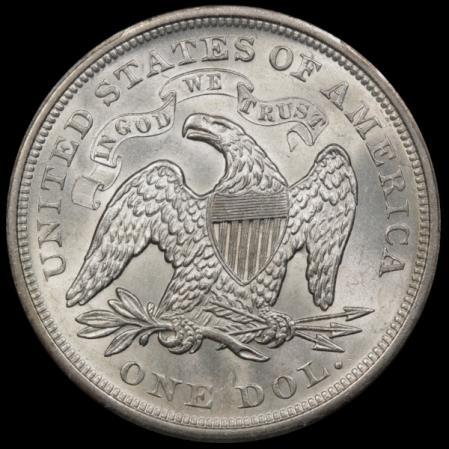
1873 Dollar
PCGS MS62+ CAC
Mintage: 293,000
Survivors: 105-150 Mint State, 250-350 in circulated grades, for a total of at most 500 coins extant 412.5 gr (26.730 g) .900 fine silver, ASW 0.773 ozt.
Contrast this coin with the very dark 1843 Dollar. These are surprisingly rare given their initial mintage; with perhaps as many as 500 in existence in any grade. Most type sets will include an 1871 or 1872 - much more common; this one is what turned up first for me, and was only a little more expensive – a screaming bargain!
It is, of course, also the last year of issue for a Liberty Seated dollar
Page 22
(Continued from previous page)
E-Gobrecht #252
- January 2026
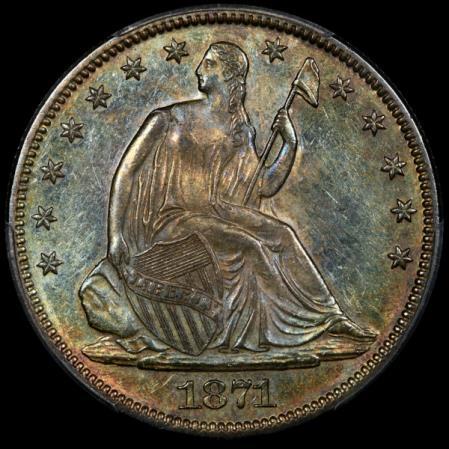
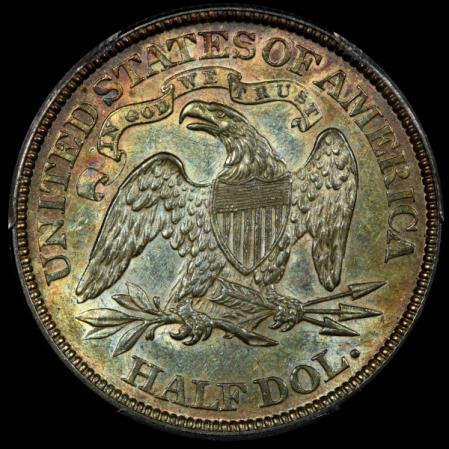
1871 Half Dollar PCGS MS61
Mintage: 1,203,000
Survivors: 80-120 Mint State, slightly scarce but usually in higher grades 192 gr (12.441 g) 0.900 fine silver, ASW 0.36 ozt.
A low grade for this set, but extremely photogenic. There’s something to be said for eye appeal!
(Continued on next page)
(Continued from previous page)
E-Gobrecht #253 -
February 2026
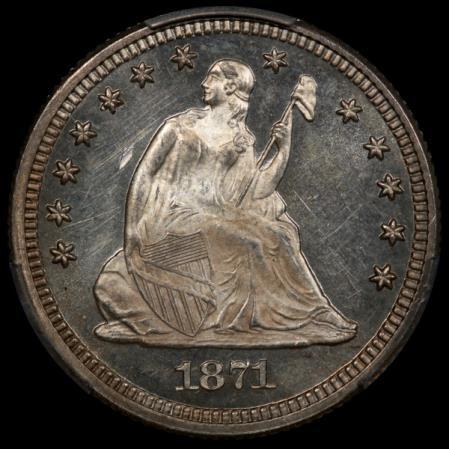
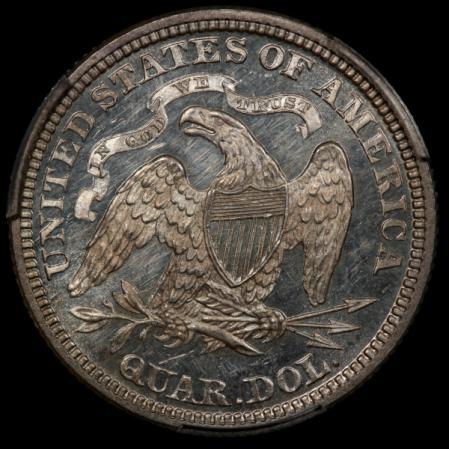
1871 Quarter
PCGS MS64
Mintage: 118,200
Survivors: 35-50 Mint State, very scarce overall but usually in VF and up 96 gr (6.221 g) 0.900 fine silver, ASW 0.18 ozt. 12-15 in MS64, and only 2 or 3 higher
This is another high grade for the date. There are an estimated 12-15 of these in this grade, with two or three in higher grades. In addition, this one is very nearly proof-like. I was very happy to find this one, especially for one of the difficult post-Civil War dates.
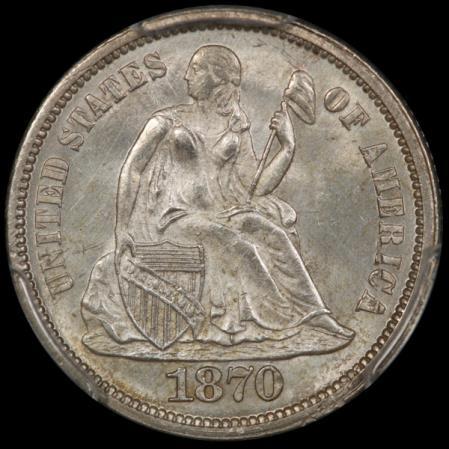
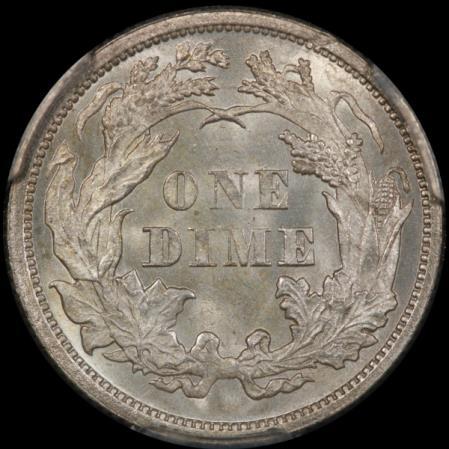
1870 Dime
PCGS MS-65
Mintage: 470,500
Survivors: 125-165 Mint State, slightly scarce overall 38.4 gr (2.488g) 0.900 fine silver, ASW 0.72 ozt. 10-14 exist in this grade or higher.
This one was mildly challenging to obtain at this grade; it’s estimated that 10-14 exist at this grade or higher. For those working on circulated type sets, it should take only a little bit of patience to find one.
(Continued on next page)
(Continued
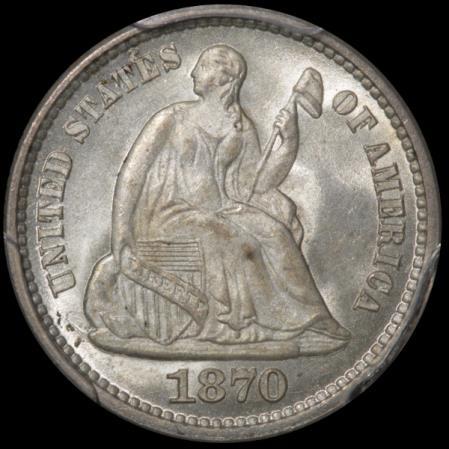
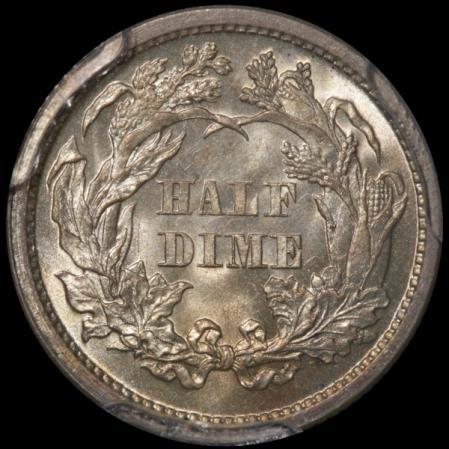
1870 Half Dime
PCGS MS66
Mintage: 535,000
Survivors: 1200-1650 Mint State, common overall 19.2 gr (1.244g) 0.900 fine silver, ASW 0.036 ozt. Only 70-95 of these are in grades 65 or higher.
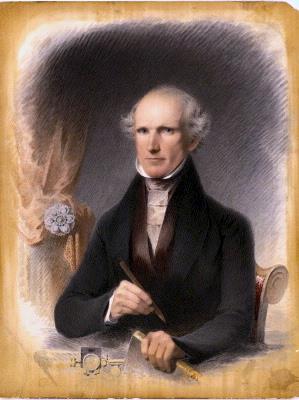
James Barton Longacre
Longacre (1794-1869) served as the Mint’s fourth Chief Engraver from 1844 until his death. He is known for designing the Indian Head Cent, Two Cent Piece, Shield Nickel, Three Cent Nickel, Three Cent Silver, the gold dollar (all three types), the $3 gold piece, and the Liberty Head $20 gold.
In other words, he seemingly did or redid everything except Gobrecht’s silver and gold designs. But he did have an effect even on them in 1860, when he modified the obverse, and created the new reverse including the new wreath of the half dime and dime when the united states of america legend was moved to the obverse of those coins.
Self-portrait of James B. Longacre, image from the Smithsonian Institute, retrieved from Wikipedia.
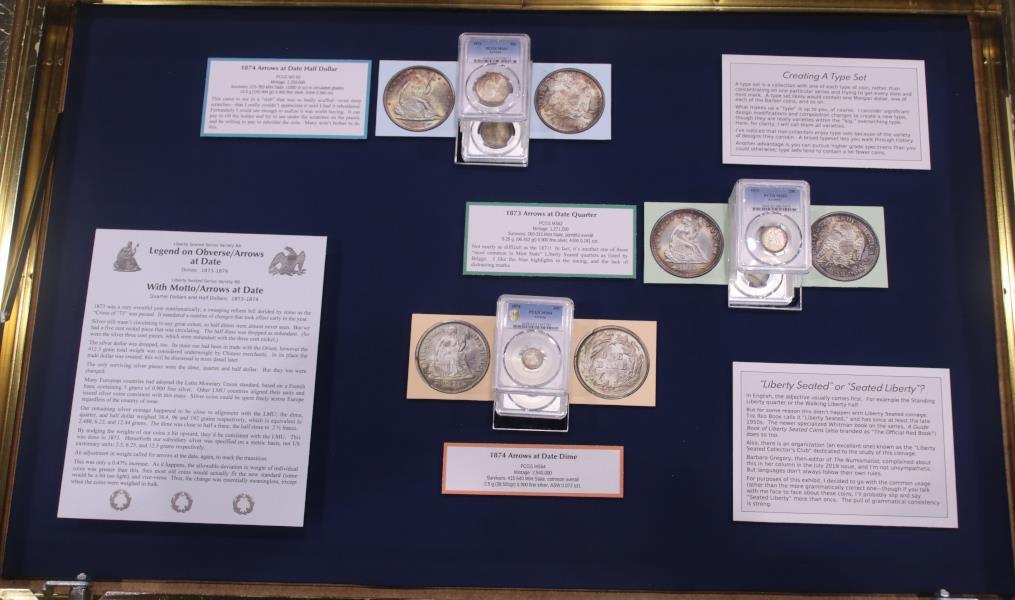
Liberty Seated Series Variety 8A
Legend on Obverse/Arrows at Date
Dimes: 1873–1874
Liberty Seated Series Variety 8B With Motto/Arrows at Date
Quarter Dollars and Half Dollars: 1873–1874
1873 was a very eventful year numismatically; a sweeping reform bill derided by some as the “Crime of ’73” was passed. It mandated a number of changes that took effect early in the year.
Silver still wasn’t circulating to any great extent, so half dimes were almost never seen. But we had a five cent nickel piece that was circulating. The half dime was dropped as redundant. (So were the silver three cent pieces which were redundant with the three cent nickel.)
The silver dollar was dropped, too. Its main use had been in trade with the Orient, however the 412.5 grain total weight was considered underweight by Chinese merchants. In its place the trade dollar was created; this will be discussed in more detail later.
The only surviving silver pieces were the dime, quarter and half dollar. But they too were changed. Many European countries had adopted the Latin Monetary Union standard, based on a French franc containing 5 grams of 0.900 fine silver. Other LMU countries aligned their units and
issued silver coins consistent with this mass. Silver coins could be spent freely across Europe regardless of the country of issue.
Our remaining silver coinage happened to be close to alignment with the LMU; the dime, quarter, and half dollar weighed 38.4, 96 and 192 grains respectively, which is equivalent to 2.488, 6.22, and 12.44 grams. The dime was close to half a franc, the half close to 2 ½ francs.
By nudging the weights of our coins a bit upward, they’d be consistent with the LMU. This was done in 1873. Henceforth our subsidiary silver was specified on a metric basis, not U.S. customary units: 2.5, 6.25, and 12.5 grams respectively.
An adjustment in weight called for arrows at the date, again, to mark the transition.
This was only a 0.47% increase. As it happens, the allowable deviation in weight of individual coins was greater than this, thus most old coins would actually fit the new standard (some would be a bit too light), and vice-versa. Thus, the change was essentially meaningless, except when the coins were weighed in bulk.
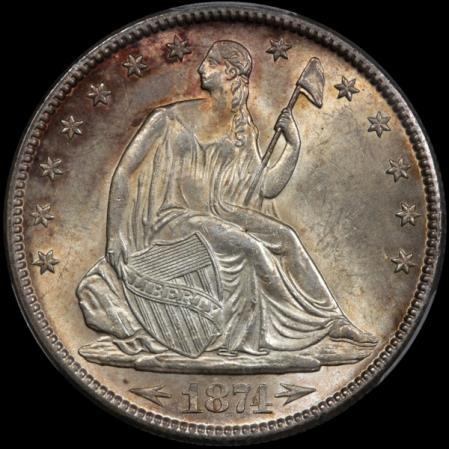
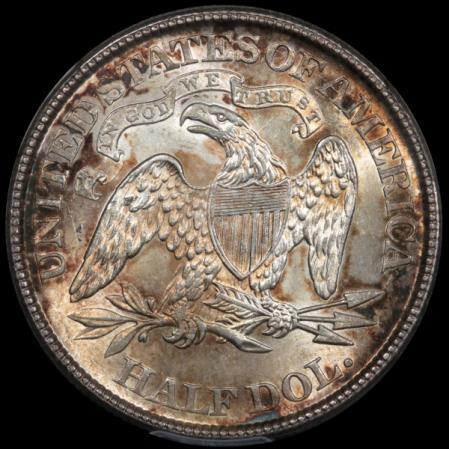
PCGS MS-63
Mintage: 2,359,600
Survivors: 275-350 Mint State, (1000 or so) in circulated grades 12.5 g (192.904 gr) 0.900 fine silver, ASW 0.362 ozt.
This came to me in a “slab” that was so badly scuffed - even deep scratches - that I really couldn’t appreciate it until I had it reholdered. Fortunately I could see enough to realize it was worth buying. It can pay to tilt the holder and try to see under the scratches on the plastic and be willing to pay to reholder the coin. Many collectors won’t bother to do this.
(Continued
1874 Arrows at Date Half Dollar
(Continued from previous page)
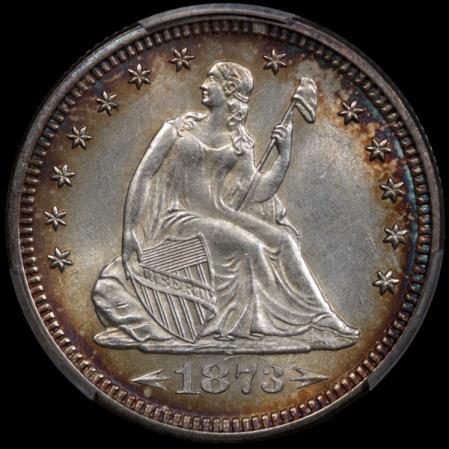
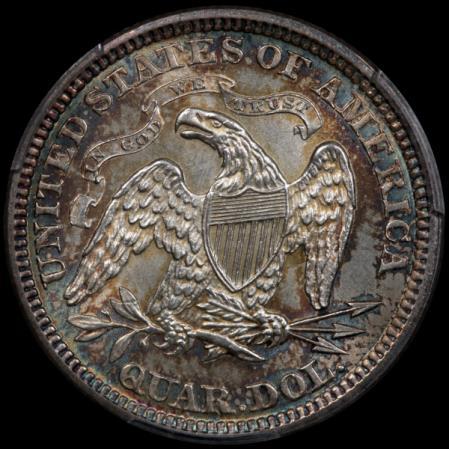
1873 Quarter
PCGS MS62
Mintage: 1,271,200
Survivors: 260-315 Mint State, plentiful overall 6.25 g. (96.452 gr) 0.900 fine silver, ASW 0.181 ozt.
This date is not nearly as difficult as the 1871! In fact, it’s another one of those “most common in Mint State” Liberty Seated quarters as listed by Briggs. I like the blue highlights in the toning, and the lack of distracting marks.
(Continued on next page)
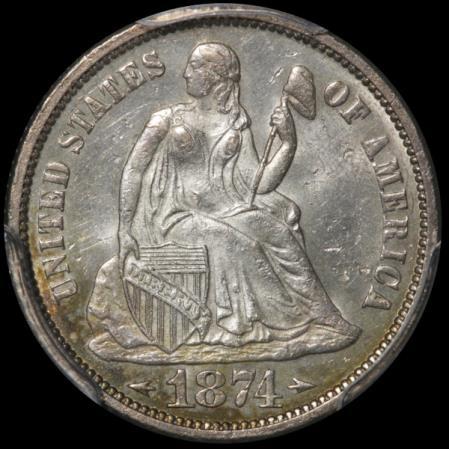
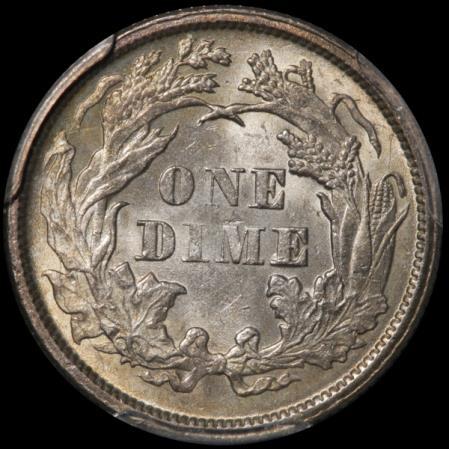
1874 Arrows at Date Dime
PCGS MS64
Mintage: 2,940,000
Survivors: 415-540 Mint State, common overall 2.5 g (38.581gr) 0.900 fine silver, ASW 0.072 ozt.
Creating A Type Set
A type set is a collection with one of each type of coin, rather than concentrating on one particular series and trying to get every date and mint mark. A type set likely would contain one Morgan dollar, one of each of the Barber coins, and so on.
What makes up a “type” is up to you, of course. I consider significant design modifications and composition changes to create a new type, though they are really varieties within the “big” overarching type. Here, for clarity, I will call them all varieties.
I’ve noticed that non-collectors enjoy type sets because of the variety of designs they contain. A broad typeset lets you walk through history.
Another advantage is you can pursue higher grade specimens than you could otherwise; type sets tend to contain a lot fewer coins.
“Liberty Seated” or “Seated Liberty”?
In English, the adjective usually comes first. For example the Standing Liberty quarter or the Walking Liberty half.
But for some reason this didn’t happen with Liberty Seated coinage. The Red Book calls it “Liberty Seated,” and has since at least the late 1950s. The newer specialized Whitman book on the series, A Guide Book of Liberty Seated Coins (also branded as “The Official Red Book”) does so too.
Also, there is an organization (an excellent one) known as the “Liberty Seated Collector’s Club” dedicated to the study of this coinage.
Barbara Gregory, then-editor of The Numismatist, complained about this in her column in the July 2019 issue, and I’m not unsympathetic. But languages don’t always follow their own rules. For purposes of this exhibit, I decided to go with the common usage rather than the more grammatically correct one - though if you talk with me face to face about these coins, I’ll probably slip and say “Seated Liberty” more than once. The pull of grammatical consistency is strong.
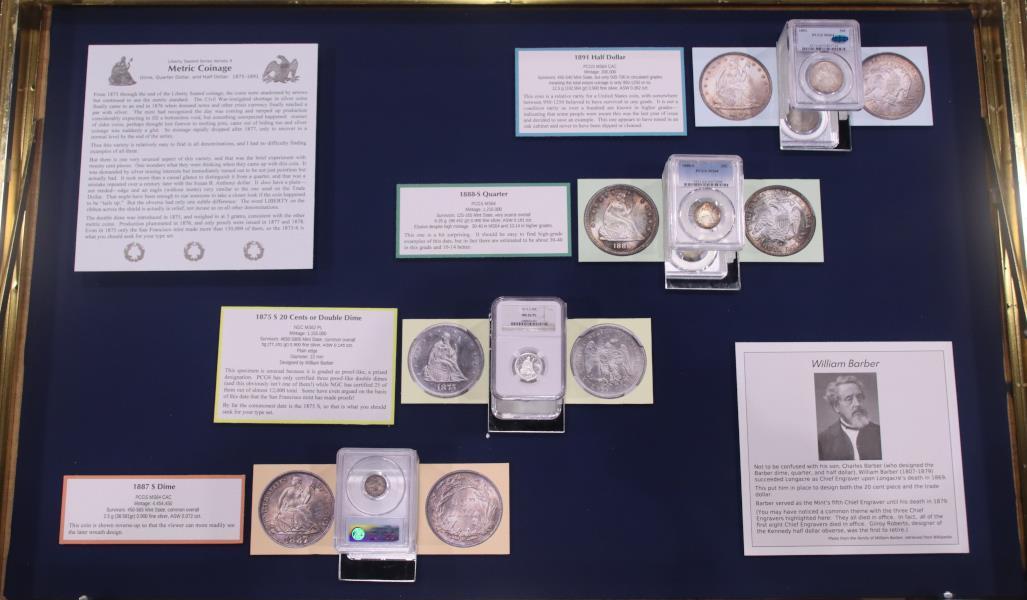
Liberty Seated Series Variety 9 Metric
Coinage
Dime, 20 Cent Piece, Quarter Dollar, and Half Dollar: 1875–1891
From 1875 through the end of the Liberty Seated coinage, the coins were unadorned by arrows but continued to use the metric standard. The Civil War instigated shortage in silver coins finally came to an end in 1876 when demand notes and other crisis currency finally reached a par with silver. The mint had recognized the day was coming and ramped up production considerably expecting to fill a bottomless void, but something unexpected happened: masses of older coins, perhaps thought lost forever to melting pots, came out of hiding too and silver coinage was suddenly a glut. So mintage rapidly dropped after 1877, only to recover to a normal level by the end of the series.
Thus this variety is relatively easy to find in all denominations, and I had no difficulty finding examples of all three.
But there is one very unusual aspect of this variety, and that was the brief experiment with twenty cent pieces. One wonders what they were thinking when they came up with this coin. It was demanded by silver mining interests, but immediately turned out to be not just pointless but actually bad. It took more than a casual glance to distinguish it from a quarter, and that was a mistake repeated over a century later with the Susan B. Anthony dollar. It does have a plain - not reeded - edge and an eagle (without motto) very similar to the one used on the Trade Dollar. That might have been enough to cue someone to take a closer look if the coin happened to be “tails up.” But the obverse had only one subtle difference: The word LIBERTY on the ribbon across the shield is actually in relief, not incuse as on all other denominations.
(Continued from previous page)
The double dime was introduced in 1875, and weighed in at 5 grams, consistent with the other metric coins. Production plummeted in 1876, and only proofs were issued in 1877 and 1878. Even in 1875 only the San Francisco mint made more than 150,000 of them, so the 1875-S is what you should seek for your type set.
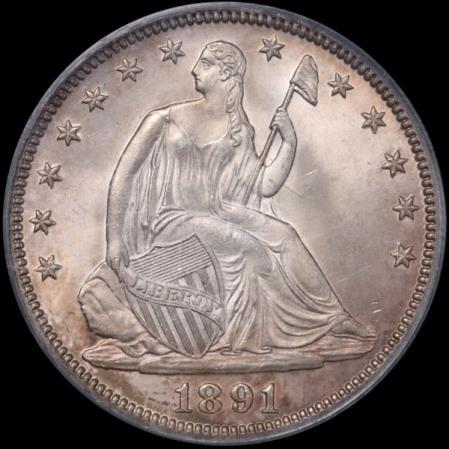
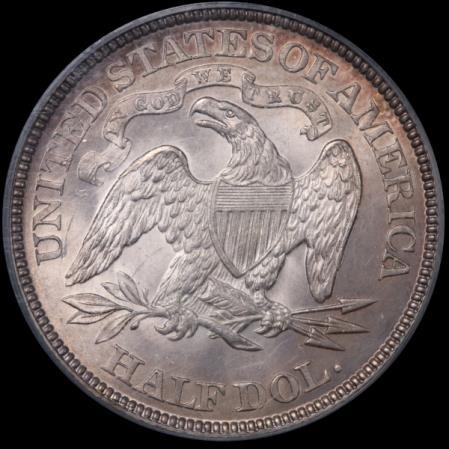
1891 Half Dollar
PCGS MS64 CAC
Mintage: 200,000
Survivors: 445-540 Mint State, but only 500-700 in circulated grades meaning the total extant coinage is only 950-1250 or so.
12.5 g (192.904 gr) 0.900 fine silver, ASW 0.362 ozt.
This coin is a relative rarity for a United States coin, with somewhere between 950-1250 believed to have survived in any grade. It is not a condition rarity as over a hundred are known in higher grades indicating that some people were aware this was the last year of issue and decided to save an example. This one appears to have toned in an oak cabinet and never to have been dipped or cleaned.
(Continued on
(Continued from previous page)
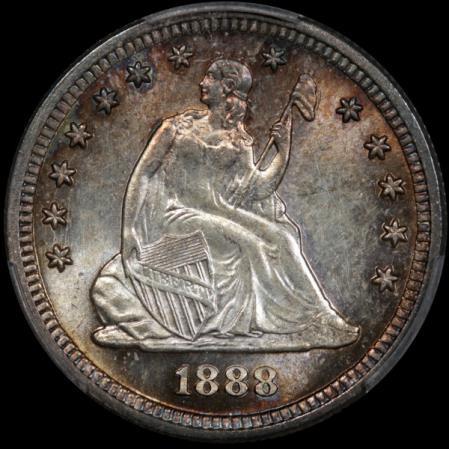
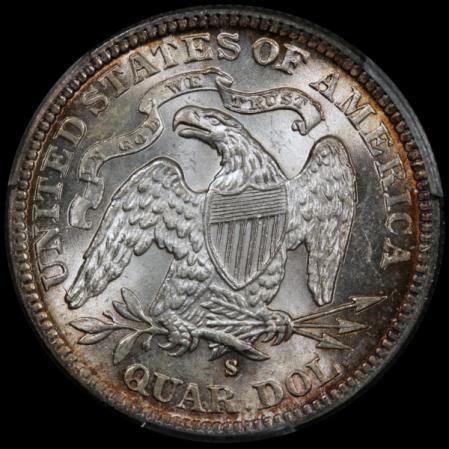
1888-S Quarter PCGS MS64
Mintage: 1,216,000
Survivors: 125-165 Mint State, very scarce overall 6.25 g. (96.452 gr) 0.900 fine silver, ASW 0.181 ozt. Elusive despite high mintage. 30-40 in MS64 and 10-14 in higher grades.
This one is a bit surprising. It should be easy to find high-grade examples of this date, but in fact there are estimated to be about 30-40 in this grade and 10-14 better.
(Continued on next page)
(Continued from previous page)
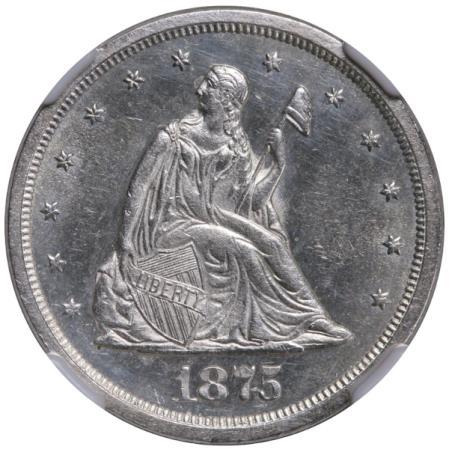
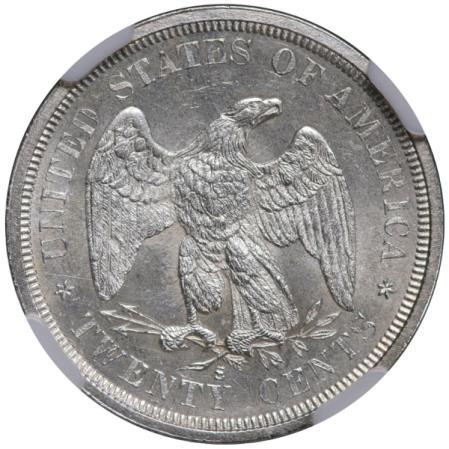
1875-S 20 Cents or Double Dime
NGC MS62 PL
Mintage: 1,155,000
Survivors: 4650-5800 Mint State, common overall 5g (77.161 gr) 0.900 fine silver, ASW 0.145 ozt.
Plain edge
Diameter: 22 mm
Designed by William Barber
This specimen is unusual because it is graded as proof-like, a prized designation. PCGS has only certified three proof-like double dimes (and this obviously isn’t one of them!) while NGC has certified 25 of them out of almost 12,000 total. Some have even argued on the basis of this date that the San Francisco mint has made proofs!
By far the commonest date is the 1875-S, so that is what you should seek for your type set.
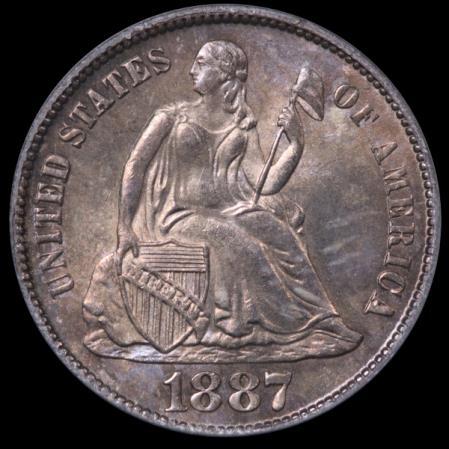
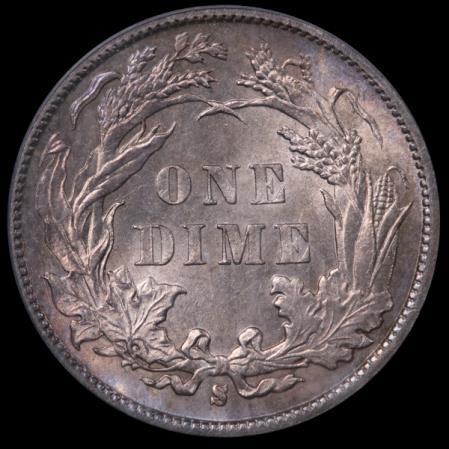
1887-S Dime
PCGS MS64 CAC
Mintage: 4,454,450
Survivors: 450-565 Mint State, common overall 2.5 g (38.581gr) 0.900 fine silver, ASW 0.072 ozt.
This coin is shown reverse-up so that the viewer can more readily see the later wreath design.
(Continued on next page)
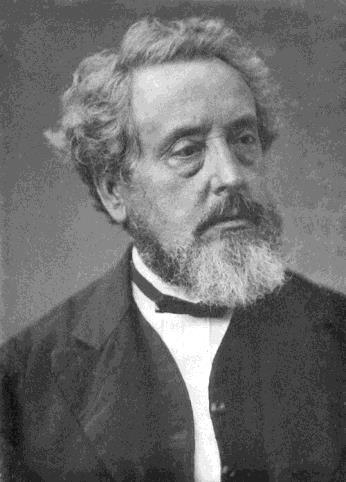
William Barber
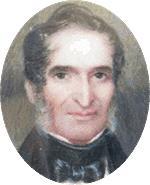
Not to be confused with his son, Charles Barber (who designed the Barber dime, quarter, and half dollar), William Barber (1807-1879) succeeded Longacre as Chief Engraver upon Longacre’s death in 1869.
This put him in place to design both the 20 cent piece and the trade dollar.
Barber served as the Mint’s fifth Chief Engraver until his death in 1879.
(You may have noticed a common theme with the three Chief Engravers highlighted here: They all died in office. In fact, all of the first eight Chief Engravers died in office. Gilroy Roberts, designer of the Kennedy half dollar obverse, was the first to retire.)
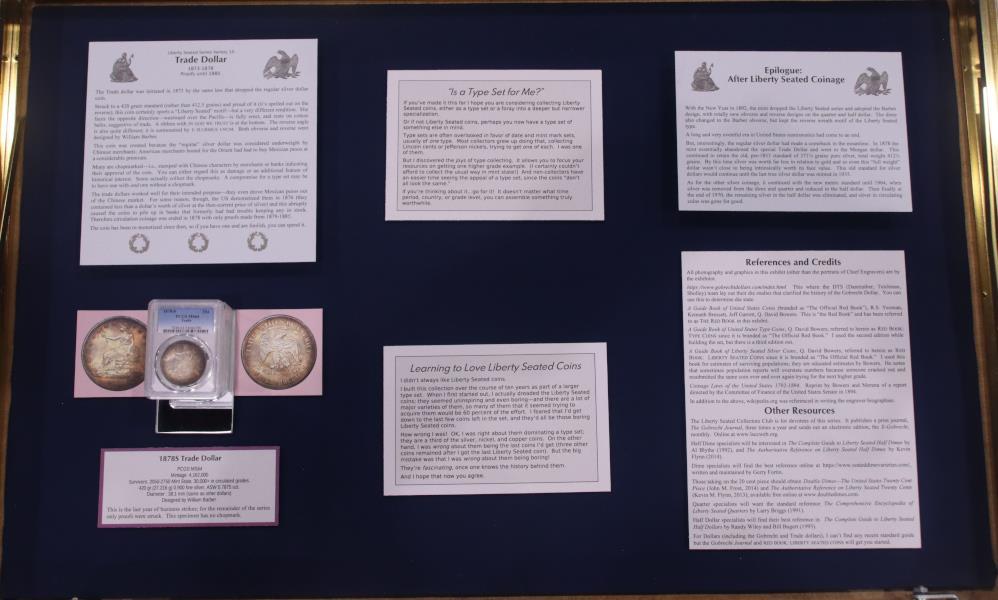
Photo from the family of William Barber, retrieved from Wikipedia (discovered by John Frost during his Double Dime research of the Barber family descendants).
(Continued
Case 10
(Continued from previous page)
Liberty Seated Series Variety 10 Trade Dollar
1873-1878
Proofs until 1885
The Trade dollar was initiated in 1873 by the same law that dropped the regular silver dollar coin.
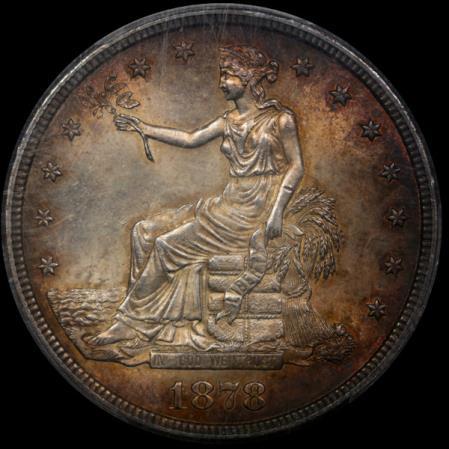
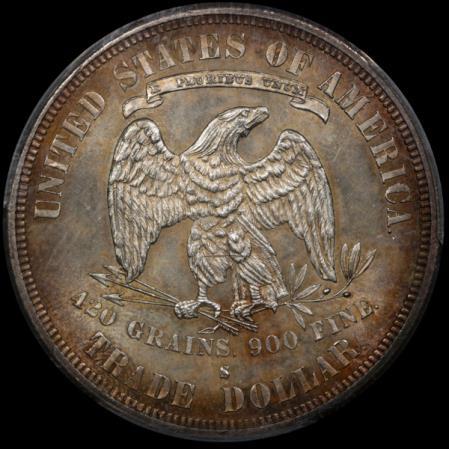
Struck to a 420 grain standard (rather than 412.5 grains) and proud of it (it’s spelled out on the reverse), this coin certainly sports a “Liberty Seated” motif - but a very different rendition. She faces the opposite direction - westward over the Pacific - is fully erect, and rests on cotton bales, suggestive of trade. A ribbon with in god we trust is at the bottom. The reverse eagle is also quite different; it is surmounted by e pluribus unum. Both obverse and reverse were designed by William Barber.
This coin was created because the “regular” silver dollar was considered underweight by Chinese merchants; American merchants bound for the Orient had to buy Mexican pesos at a considerable premium.
Many are chopmarked - i.e., stamped with Chinese characters by merchants or banks indicating their approval of the coin. You can either regard this as damage or an additional feature of historical interest. Some individuals actually collect the chopmarks. A compromise for a type set may be to have one with and one without a chopmark.
The trade dollars worked well for their intended purpose they even drove Mexican pesos out of the Chinese market. For some reason, though, the U.S. demonetized them in 1876 (they contained less than a dollar’s worth of silver at the then-current price of silver) and this abruptly caused the coins to pile up in banks that formerly had trouble keeping any in stock. Therefore circulation coinage was ended in 1878 with only proofs made from 1879-1885.
The coin has been re-monetized since then, so if you have one and are foolish, you can spend it.
(Continued
1878-S Trade Dollar
PCGS MS64
Mintage: 4,162,000
Survivors: 2050-2750 Mint State, 30,000+ in circulated grades.
420 gr (27.216 g) 0.900 fine silver, ASW 0.7875 ozt.
Diameter : 38.1 mm (same as other dollars)
Designed by William Barber
This is the last year of business strikes; for the remainder of the series only proofs were struck. This specimen has no chopmark(s).
“Is a Type Set for Me?”
If you’ve made it this far I hope you are considering collecting Liberty Seated coins, either as a type set or a foray into a deeper but narrower specialization. Or if not Liberty Seated coins, perhaps you now have a type set of something else in mind.
Type sets are often overlooked in favor of date and mint mark sets, usually of one type. Most collectors grew up doing that, collecting Lincoln cents or Jefferson nickels, trying to get one of each. I was one of those beginning collectors.
But I discovered the joys of type collecting. It allows you to focus your resources on getting one higher grade example. (I certainly couldn’t afford to collect the usual way in mint state!) And non-collectors have an easier time seeing the appeal of a type set, since the coins “don’t all look the same.”
If you’re thinking about it...go for it! It doesn’t matter what time period, country, or grade level, you can assemble something truly worthwhile.
Learning to Love Liberty Seated Coins
I didn’t always like Liberty Seated coins.
I built this collection over the course of ten years as part of a larger type set. When I first started out, I actually dreaded the Liberty Seated coins; they seemed uninspiring and even boring - and there are a lot of major varieties in the series, so many of them that it seemed trying to acquire them would be 60 percent of the effort. I feared that I’d get down to the last few coins left in the set, and they’d all be those boring Liberty Seated coins.
How wrong I was! OK, I was right about them dominating a type set; they are a third of the silver, nickel, and copper coins. On the other hand, I was wrong about them being the last coins I’d get (three other coins remained after I got the last Liberty Seated coin). But the big mistake was that I was wrong about them being boring!
They’re fascinating, once one knows the history behind them.
And I hope that now you agree!
(Continued
(Continued
Epilogue:
After Liberty Seated Coinage
With the New Year in 1892, the mint dropped the Liberty Seated series and adopted the Barber design, with totally new obverse and reverse designs on the quarter and half dollar. The dime also changed to the Barber obverse, but kept the reverse wreath motif of the Liberty Seated type.
A long and very eventful era in United States numismatics had come to an end.
But, interestingly, the regular silver dollar had made a comeback in the meantime. In 1878 the mint essentially abandoned the special Trade Dollar and went to the Morgan dollar. This continued to retain the old, pre-1853 standard of 371¼ grains pure silver, total weight 412½ grains. By this time silver was worth far less in relation to gold and so even this “full weight” dollar wasn’t close to being intrinsically worth its face value. This old standard for silver dollars would continue until the last true silver dollar was minted in 1935.
As for the other silver coinage, it continued with the new metric standard until 1964, when silver was removed from the dime and quarter and reduced in the half dollar. Then finally at the end of 1970, the remaining silver in the half dollar was eliminated, and silver in circulating coins was gone for good.
References & Credits
All photography and graphics in this exhibit (other than the portraits of Chief Engravers) are by the exhibitor.
https://www.gobrechtdollars.com/index.html This where the DTS (Dannreuther, Teichman, Sholley) team laid out their die studies that clarified the history of the Gobrecht Dollar. You can use this to determine die state.
A Guide Book of United States Coins (branded as “The Official Red Book”), R.S. Yeoman, Kenneth Bressett, Jeff Garrett, Q. David Bowers. This is “the Red Book” and has been referred to as The Red Book in this exhibit.
A Guide Book of United States Type Coins, Q. David Bowers; referred to herein as Red Book: Type Coins since it is branded as “The Official Red Book.” I used the second edition while building the set, but there is a third edition out.
A Guide Book of Liberty Seated Silver Coins, Q. David Bowers; referred to herein as Red Book: Liberty Seated Coins since it is branded as “The Official Red Book.” I used this book for estimates of surviving populations; they are educated estimates by Bowers. He notes that sometimes population reports will overstate numbers because someone cracked out and resubmitted the same coin over and over again trying for the next higher grade.
Coinage Laws of the United States 1792-1894. Reprint by Bowers and Merena of a report directed by the Committee of Finance of the United States Senate in 1894.
In addition to the above, wikipedia.org was referenced in writing the engraver biographies.
(Continued on next page)
(Continued
Other Resources
The Liberty Seated Collectors Club is for devotees of this series. It publishes a print journal, The Gobrecht Journal, three times a year and sends out an electronic edition, the E-Gobrecht, monthly. Online at www.lsccweb.org.
Half Dime specialists will be interested in The Complete Guide to Liberty Seated Half Dimes by Al Blythe (1992), and The Authoritative Reference on Liberty Seated Half Dimes by Kevin Flynn (2014).
Dime specialists will find the best reference online at https://www.seateddimevarieties.com/, written and maintained by Gerry Fortin.
Those taking on the 20 cent piece should obtain Double Dimes - The United States Twenty Cent Piece (John M. Frost, 2014) and The Authoritative Reference on Liberty Seated Twenty Cents (Kevin M. Flynn, 2013); available free online at www.doubledimes.com.
Quarter specialists will want the standard reference The Comprehensive Encyclopedia of Liberty Seated Quarters by Larry Briggs (1991).
Half Dollar specialists will find their best reference in The Complete Guide to Liberty Seated Half Dollars by Randy Wiley and Bill Bugert (1993).
For Dollars (including the Gobrecht and Trade dollars), I can’t find any recent standard guide but the Gobrecht Journal and red book: liberty seated coins will get you started. [Author’s note: I only learned about Dick Osburn/Brian Cushing’s work at the LSCC meeting.]
#253 - February 2026
Monthly E-Gobrecht Newsletter Advertising Rates
(Prices are per issue. All ads should include some Liberty Seated coins and/or related material.)
Full Page $100
Half Page $ 50
Quarter Page $ 30
Inquires & Special Rates: Contact Advertising Manager Jeff Pritchard at jjpsr2@gmail.com
Deadline: 25th of the month prior to month of issue
For Advertising in The Gobrecht Journal, see contact above.
E-Gobrecht Deadline for Subscriber Submissions 30th of the month prior to month of issue
Send Submissions to: Paul Kluth, Editor e-gobrecht@msn.com
Next Deadline for Submissions to The Gobrecht Journal: Summer 2026 - June 1st
Send Inquiries & Submissions to: lscc@lsccweb.org LSCC Website & Member Application is at: https://lsccweb.org/
LSCC 2026 Regional Events Calendar ***
February 6-7 Knoxville Coin & Currency Show, Rothchild Conference & Catering Center, Knoxville, TN - Club table hosted by Dennis Fortier and John Frost.
February 13-14 Charlotte Coin Club Annual Coin Show, Park Expo and Conference Center, Charlotte, NC - Club table hosted by John Lundsten, Ken Otto and others.
February 26-28 ANA National Money Show (ANA Winter Show), Savannah Convention Center, Savannah, GA - Club table hosted by John Frost, Dennis Fortier and Ken Otto. Other details TBD.
March 5-7 Whitman Baltimore Spring Expo, Baltimore Convention Center, Baltimore, MD - TBD but this large Regional event typically has a Club meeting and Education Program on Friday at 9 am, combined LSCC & BCCS Club tables and a possible Club dinner night.
*** More event details and addresses of show locations are in Ken Otto’s Regional Report found on page 19.
(END)
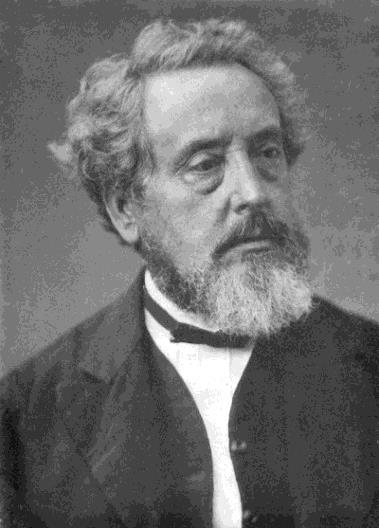
ChristianGobrecht
National Officers
President Leonard Augsburger leonard_augsburger@hotmail.com
Vice President Craig Eberhart craig@eberhart.us
Secretary Jeff Pritchard PO Box 10771, Bainbridge, WA 98110 jjpsr2@gmail.com
Treasurer John Lundsten john.lundsten@yahoo.com
National Positions
The Gobrecht Journal Publication Greg Johnson (Editor/Publisher) lscc@lsccweb.org
E-Gobrecht Monthly Newsletter Paul Kluth (Editor/Publisher) e-gobrecht@msn.com
New Membership Chairman Joe Casazza jsazza236@gmail.com
Education Director John Frost john.frost@doubledimes.com
Advertising Director Jeff Pritchard jjpsr2@gmail.com
Team Leader - Regional Directors Ken Otto kenotto53@gmail.com
Director - Southern Region John Lundsten (email above)
Director - Northeast Region Joe Casazza (email above)
Director - Western Region Open Position
Director - Central Region Dennis Fortier ricajun@msn.com
Club Website: www.lsccweb.org
Liberty Seated Collectors Club Mission
To encourage, promote, and dispense numismatic knowledge of Liberty Seated coins; to cultivate fraternal relations among its members and all those interested in the science of numismatics.
LSCC Membership Information: Dues are bargain priced at $30 per year and include 3 packed issues of The GobrechtJournal, an award winning numismatic publication printed in glossy, full color. To join the Liberty Seated Collectors Club, for GobrechtJournal mailing address changes, or for other membership questions, please correspond with Craig Eberhart, LSCC Secretary listed on this page.
Articles, comments, or advertisements for publication in TheGobrechtJournal magazine may be addressed to Greg Johnson, Gobrecht Journal Publication Editor.
Submissions, correspondence, information and comments for this digital publication (E-Gobrecht)are actively encouraged from its subscribers and may be sent to Paul Kluth, E-Gobrecht Publication Editor.
To be added as a “free” subscriber to E-Gobrechtor removed from the mailing list or to change your email address, please send an email message indicating your preference in the subject line to: e-gobrecht@msn.com
Wanted: Submissionsforthisnewsletter!
Please consider submitting something for print. It need not be elaborate; it can be something as simple as a short note on a favorite coin, variety, neat find, happening at a coin show or local club, Liberty Seated coinage at auction, etc. If you are interested in it; rest assured, others will be too!
Sharing information is a goal of this newsletter and you need not be an experienced writer to submit material of interest to others. “This is your monthly digital publication. It is what you make of it!”
Please be sure to quote the E-Gobrecht and the LSCC as its contents are not copyrighted. Use it contents freely.