252-E-Gobrecht-Volume22-Issue1

Page 1


E-Gobrecht

Stepping back in time to a bygone era of the Liberty Seated coin design period, both far and wide, and a little before & after...

2

President’s Message by Len Augsburger Page 3

Editor’s Viewpoint: View From The Rim by Paul Kluth 4 Club Announcements / Membership Application (page 37) 6, 13, 15

2026 Gold & Silver Forecasts - A Bullish Consensus by Jeff Pritchard 7-9 2025 – COIN YEAR IN REVIEW by Rich Uhrich, Jr. 10-13

The Curious Collector: 2026 Liberty Seated Predictions with an assist from ChatGPT by Len Augsburger 14-15 2025 in Review for Liberty Seated Half Dollars by Dennis Fortier 16

The Iron Horse and Hard Currency: Marion, Montana's Coin Connection by Joanne Sherwin 17-19

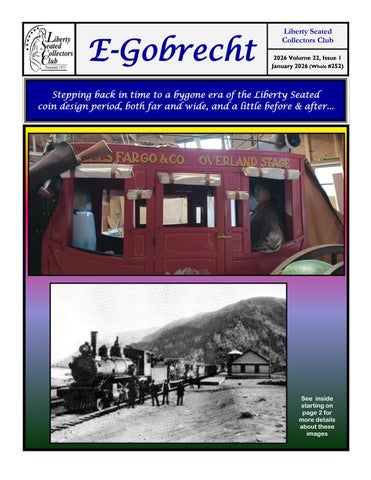
‘The Real Deal’: An Original Wells Fargo Stagecoach presented by Paul Kluth on behalf of the owners 20-29, 36 Regional News: Looking Forward to F.U.N. in Early January by Ken Otto 30-31 A

There are currently 1516 active Subscribers to E-Gobrecht & counting including 347 local coin clubs across the country

Cover Photos: See the interesting articles related to these two images submitted to E-Gobrecht this month to start off the new year (the Nation’s 250th Anniversary Celebration of 2026)… Beginning on pages 17 & 20.

The E-Gobrechtis an award winning informal electronic publication of the Liberty Seated Collectors Club (LSCC). The LSCC is a non-profit organization dedicated to the attributions of the Liberty Seated U.S. Coin series. The LSCC provides the information contained in this “electronic” e-mail newsletter from various sources “free of charge” as a general service to the membership and other subscribers with a numismatic interest. You do not have to be a LSCC member to benefit from this newsletter; subscription to the E-Gobrecht is available on a complimentary basis to anyone. All disclaimers are in effect as the completeness and/or accuracy of the information contained herein cannot be completely verified. Contact information for LSCC and this publication can be found on the last page.

President’sMessage

As the New Year begins, it offers a moment both to reflect on the legacy we steward and to look ahead with renewed curiosity and purpose.

For Liberty Seated collectors, the past year has brought fresh research, newly surfaced varieties, and deeper insights into the people, mints, and markets that shaped this classic American series.

In the year ahead, may our shared pursuit continue to blend study with the simple joy of discovery - whether in the pages of old auction catalogues, the quiet details of a familiar date, or an unexpected find that demands sharing with other collectors. Here’s to another year of learning, fellowship, and continued appreciation for Liberty Seated coinage! …Len Augsburger

Editor’s‘ViewFromtheRim…PK

Stepping back in time to a bygone era...

Like many of our fellow members, I can remember when year after year Club President John McCloskey would edit, publish and mail out The Gobrecht Journal (GJ) consistently on its regular printing schedule. The black & white smaller format was something us Liberty Seated collectors always anxiously looked forward to receiving in their mail box.

Look where that publication is now! A full-color glossy paper 8.5” x 11” version that is still winning numismatic publication awards from the prestigious numismatic societies of our time. The bar has been raised and technological improvements made over time by the passionate and ever-hard working members of the Club have made the organization what it is today… even better for its members!

I still refer to those much older journal issues from time to time, mostly in the form of the 5 Collective Volumes of compiled GJ articles when I try looking up the reported details of a date or new variety or what someone else found back in the day. They don’t collect dust on my bookshelf. Now of course, we have the new Club website with an on-line reference library of past articles and the miraculous Newman Numismatic Portal with digitally-recorded numismatic reference material from the past for the serious collector and researcher.

Still logged in my memory as maybe the next generation of Club old-timers, is as a young error and variety collector remembering Kam Ahwash working the bourse floor of large coin shows promoting Liberty Seated coins, especially the dimes and the very new Liberty Seated Collectors Club he helped form.

With 2026 being our Nation’s 250th Anniversary Celebration, I propose we make this year’s Summer Gobrecht Journal a Special Historical Issue with articles and a design celebrating Life, Liberty and the Pursuit of Happiness in America through the lens of Liberty Seated coins and Christian Gobrecht’s U.S. Mint designs?

LIBERTY 1776 Colonial Tavern Sign

#252 - Janaury 2026

ANNOUNCEMENT

2026 Gold & Silver Forecasts - A Bullish Consensus -

It wasn’t just our friendly wizard who didn’t predict skyrocketing precious metals prices. None of last year’s forecasts were even close! That’s understandable considering the remarkable two year run gold and silver have experienced. Gold was up 27% in 2024 and 66% in 2025; Silver was up 20% in 2024 and a stunning 145% in 2025. Those phenomenal two years are why most forecasters are calling for a period of consolidation or a brief price retrenchment in the first quarter of 2026.

Today, the biggest challenge is finding an institutional forecast current enough to be relevant considering what happened in December. Those year-end price jumps forced forecasters back to their crystal balls, ratcheting up predictions, only to be embarrassed again within a matter of days by surging prices.

Two common factors in nearly all 2026 predictions: a) Due to the recent dramatic run-up, all see a near-term pullback for the market to consolidate support before beginning an upward move towards the $5,000 level; and b) Institutions foresee significant volatility ahead for silver.

(Continued

GOLD - Below are the forces influencing gold’s price and their status in January 2026:

Factors that

INCREASE

Gold’s Price:

Central Bank Buying. This was the 600-pound gorilla in 2025. Central Banks, particularly Emerging Market countries, were aggressively adding to their monetary reserves. During the last 3 years annual Central Bank buying has averaged 1,000 metric tons a year. And 43% of Central Banks plan to continue adding to their gold reserves during the next 3 years.

Declining U.S. Interest Rates. The Federal Reserve reduced interest rates .25% at their December 10th meeting and Trump will soon nominate a more accommodating (i.e. proponent of lower rates) Federal Reserve Chair to replace Jerome Powell.

Geopolitical Risks & Instability. The Ukraine War and China’s confrontational politics have been adding to international tensions.

Investor & Speculator (ETF) Demand. As investors piled into gold, ETFs purchased an estimated 700 metric tons of the yellow metal in 2025.

End-of-Year Momentum. Skyrocketing prices at year-end turned bears into bandwagon bulls. Recency bias makes momentum a powerful force.

Inflation / Declining U.S. Dollar. U.S. inflation continues around the 3% level, above the Fed’s 2% target. Long-term, the nation’s ever-expanding deficits and national debt bode well for the metal, less so for the nation.

Factors that

DECREASE Gold’

s Price:

Rising U.S. Interest Rates. Unlikely in the near-term without a large, unexpected inflation spike.

Strengthening U.S. Dollar. Unlikely in the near term.

Overall Business Decline (Recession). This may be the biggest unknown, and the major influence of silver prices.

High Gold Prices. As prices rise, jewelry purchases tend to decline, acting as a slight counterbalance to momentum’s bullish effect.

In late-2025, Goldman Sachs conducted a broad-based institutional survey of investment managers asking where they thought gold would settle at the end of 2026. (Continued

E-Gobrecht

The results are illustrated in the graph below. Nearly 70% of respondents felt gold would settle above $4,500., and 36% think it will finish 2026 above $5,000.

Silver - Below are the forces influencing silver’s price and their status in January 2026:

While silver is influenced by the same factors as gold, its primary driver is industrial demand. Think of EVs, solar panels, electronics, and advanced weapons systems. Silver ‘bulls’ anticipate a growing supply squeeze, where demand continues to outstrip supply. (2025 was the fifth year in a row in which consumption exceeded mining production.) As major global economies grow, so does silver demand. Adding to its industrial usage, the U.S. recently added silver to its “critical minerals” list, while at the same time, China, the world’s largest silver processor, has begun weaponizing silver as political tool. Potentially ominous signs.

What about a 2026 silver prediction? The recent price run-up has taken on a life of its own. Those dealing with the metal on a daily basis call for it to reach $100, or more, by yearend. Forty-six years ago, in 1980, your elderly author worked at a precious metals brokerage, experiencing first-hand the Hunt Brothers’ silver bubble inflate…. and then dramatically implode. Amid the historic market we are now experiencing, one can only advise proceeding with caution, as ‘trees still can’t grow to the sky’.

What if unexpected global events intercede in the above forecasts to the financial detriment of E-Gobrecht readers? As recompense, this author will happily extend my annual offer – to send any disgruntled readers the exorbitant amount I was paid to write this column and gladly relinquish my crystal ball.

2025 – COIN YEAR IN REVIEW

BIGGEST NEWS: Elimination of the business strike U.S. cent.

2nd BIGGEST NEWS: Big increases in prices of gold and silver. Gold closed at $4,318, up 64.4% for the year, while silver closed at $71.55, up 147.9% for the year. I believe gold is up because central banks throughout the world have been buying a lot of gold, and I believe silver is up because of industrial demand and also demand for the American Silver Eagle.

3rd BIGGEST NEWS: 232 sets of the last of the 2025 cents, with an “Omega” countermark, were sold by Stacks Bowers on December 11. The sets included a 2025 Philadelphia Mint cent, a 2025-D Denver Mint cent, and a GOLD 2025 Philadelphia Mint cent. The total prices realized for all 232 sets was $16.76 million.

CLIMBING TO THE TOP: Inspired by the book The 100 Greatest U.S. Coins, the owner of the Elite Collection is trying to acquire as many as possible. In June, the coins currently in the collection were featured on mycollect.com and also the PCGS Message Board. Some really rare and wonderful coins are in that collection! Current total in the collection is 76 out of the 100.

BIG PRISON TIME: Delaware coin dealer Robert L. Higgins was sentenced to 65 years in federal prison after being convicted of mail fraud, wire fraud, and income tax evasion charges connected to his mismanagement of First State Depository in Wilmington, DE.

SOMEBODY’S GOTTA GO BACK AND GET A S____LOAD OF DIMES (Blazing Saddles reference for those of you who remember that movie)... A tractor-trailer carrying 8 million 2025-D dimes overturned in Texas, spilling the dimes on the highway and surrounding landscape. The dimes were vacuumed up!

GREAT FIND #1: A collector from Arizona found a Choice Uncirculated 1969-S Doubled Die Obverse cent in a sealed roll, estimated value over $100,000.

GREAT FIND #2: An Eisenhower dollar was found that was struck in two different mints: first as a 1978-S proof in San Francisco, then it was overstruck as a business strike in Philadelphia.

GREAT FINDS #3 AND #4: Two 1990 No S cents were discovered in proof sets at a shop in Illinois.

GREAT FIND #5: Collector Sean Kelly discovered a new variety of Capped Bust half dime, which has been designated as 1833 LM-9.2. Congratulations, Sean!

(Continued

GREAT FIND #6: A man bought a storage unit’s contents for $500. Inside was a safe, which when opened, contained $7.5 million in cash.

BUSINESS NEWS: A-Mark Precious Metals acquired Stack’s Bowers Galleries.

ANA: The World’s Fair of Money show was held in Oklahoma City, OK. Despite it being more difficult to fly there than some of the more usual venues, the show was a big success.

THE ANA NATIONAL MONEY SHOW: Was held in Atlanta in late February – early March, and it drew 3,200 attendees plus dealers and staff.

THIS WE’LL DEFEND: U.S. Mint issues 2025-W Proof American Silver eagle with a privy mark celebrating the 250th anniversary of the U.S. Army.

RETIREMENT NEWS: After over 70 years in numismatics, Q. David Bowers retired. He was a dealer for almost all of those years, and the number of numismatic books he wrote is legendary. I want to express my appreciation for all that he has done for numismatics throughout his lengthy career.

MORE RETIREMENT NEWS: Director of the U.S. Mint Ventris Gibson retired March 31. Her contributions to the numismatic community are much appreciated!

NEW MINT DIRECTOR: Paul Hollis, former coin dealer and Louisiana state legislator, was nominated as the new Mint Director.

SUPER LOW-MINTAGE COINS: The United Kingdom Royal Mint issued a total of just 6 coins honoring Paul McCartney (5 silver and 1 gold). One coin was given to Paul, and the other 5 coins sold for $753,000.

GOLD SACAGAWEA DOLLARS: In 1999, 39 proof gold Sacagawea dollars dated 2000 were struck and sent into space on the Space Shuttle. 27 of these were destroyed and 12 were retained by the Mint. In 2025, Stack’s Bowers sold 7 of these for prices ranging from $360,000 to $550,000.

GOLD SACAGAWEA DOLLARS PART II: In 2025, to commemorate the 25th Anniversary of the Sacagawea dollar, the Mint issued proof 2025-W gold Sacagawea dollars weighing one-half ounce, for $2,175. 7,500 were issued.

GOLD & SILVER NOW LEGAL TENDER IN FLORIDA: Gov. Ron DeSantis signs bill allowing some gold and silver to be used as legal tender in some transactions.

FIRST EVER SALE: Of a gold FDR 4th Inaugural Medal (by Stack’s Bowers). There were only ten struck. It sold for $240,000.

BIG SALE OF A SILVER DOLLAR: 1804 Class III dollar sold for $6 million.

ANOTHER BIG SALE OF A SILVER DOLLAR: 1794 sold for $4.5 million.

BIG SALE OF A DOUBLE EAGLE: 1927-D sold for $3.84 million.

BIG SALE OF A HALF EAGLE: 1798 Capped Bust Right, Small eagle sold for $3 million.

BIG SALE OF A DIME: 1894-S sold for $2.16 million.

BIG SALE OF A GOLD DOLLAR: 1849-C Open Wreath (5 known) sold for $1.56 million.

MUSICIAN SELLS COLLECTION: Well-known musician Rick Springfield sold his collection of gold coins.

COINS & COMIC BOOKS: DC Comics teams with the U. S. Mint for coins and medals celebrating Superman and other comic superheroes.

LONG-TIME COLLECTOR/DEALER SELLS LONG-TIME COLLECTION: Jim Matthews sells his set of Draped Bust and Capped Bust dimes. Part of the sale took place in 2025, and part will take place in 2026.

LONG-TIME COLLECTOR SELLS HIS COLLECTION OF BUST QUARTERS: Steve Tompkins’ collection was nearly complete by die variety.

LOTS OF 1889-CC DOLLARS DISCOVERED: Heritage sold this hoard of 35 Uncirculated 1889-CC Morgan dollars.

BIG GOLD THEFT: A theft of $15 million in gold American Eagles in Oklahoma is being investigated.

WHAT IS AN ORIGINAL HOLDER WORTH? Great Collections sold an 1881-S Morgan dollar in MS-63 in a first generation “white rattler” holder for just over $119,000.

LATEST COSTS FOR CENTS AND NICKELS: A cent costs the Mint 3.69c to make, while a nickel costs the Mint 13.78c to make.

SUPERMARKET CHAIN OFFERS PROFIT FOR CENTS: Giant Eagle chain offers 2c for each cent provided to them.

ANS MOVING: From New York City to Toledo, Ohio, in 2028.

GONE TOO SOON: Sondra Beymer, wife and business partner of West Coast dealer Jack Beymer. Richard “Babe” Binette, a long-time and well-known dealer from Maine. Former Delaware Governor and U. S. Congressman Michael Castle, famous for his support of the state quarter program. Dr. Steven Duckor, accomplished numismatist who completed or nearly completed many gold sets, the most significant of which was his set of St. Gaudens double eagles. David Ganz, coin attorney and author. Cont... (Continued

(Continued

John Highfill, dealer in mostly dollars and author of a significant book on that subject. George Frederick Kolbe, long-time bookseller. Ron Landis, engraver and co-founder of the Gallery Mint Museum. Joan Langbord, matriarch of the Langbord family, which owned 10 1933 double eagles before the government took them in a long-disputed lawsuit.

Editor Commentary: Every year at this time (in recent years), E-Gobrecht has presented annual reviews and forecasts from qualified experts in the hobby that LSCC members and other hobbyists across the numismatic spectrum look forward to receiving in the new year. Rich Uhrich as a retired and respected coin dealer and collector has been compiling his “Coin Year in Review” now for 15 years in various publications. Thank you Rich, Jeff, Len, Dennis, Joanne and ‘anonymous’ for your contributions to this year’s “packed” issue. What does the future hold for each of us this coming year?

(END)

The Curious Collector

2026 Liberty Seated Predictions with an assist from ChatGPT

1. Someone Discovers a Completely New Subtype: the “Liberty Slouching” Half Dollar Only one known. Immediately becomes the centerpiece of an exhibit titled “Ergonomics in 19th-Century Engraving”.

2. A Sensational Auction Lot Lists an Unpublished Fortin Die Marriage. Experts debate for months whether it’s real. Turns out the consignor just rotated the coin 28 degrees before taking the photo.

3. The Red Book Adds QR Codes for Each Liberty Seated Entry. Unfortunately, every QR code opens the same page: “Check eBay Sold Listings”.

4. Liberty Seated Coin Dealers Introduce New Show Etiquette Rules. Rule 1: No leaning over cases like you're inspecting a lunar landing site. Rule 2: No asking “What’s your best price?” in the first four seconds.

5. Coin YouTubers Launch a New Genre: “Reaction Videos to Greysheet Updates” Shocked faces everywhere: “SEATED DOLLARS DID WHAT??”

6. The Gobrecht Journal Publishes a 90-Page Study on the “Slightly Tilted Shield” Die Marriage. No one is sure the tilt actually exists, but the plates look convincing.

7. The ANA Museum Launches a “Coin Escape Room” You must solve attribution puzzles to get out. Final challenge: Determine the WB-variety for a low grade 1861-O half dollar.

8. A 2026 Slabbing Controversy Erupts Over the First-Ever “Fully Seated” Designation. PCGS awards it only to coins where Liberty appears to be sitting with perfect posture. Yoga instructors are hired as consultants.

9. A Well-Known Liberty Seated Researcher Announces a Breakthrough in Attribution Science. He can now identify die marriages by sound alone when the coin is gently tapped on a wooden table.

10. ANA Convention Exhibit Wins People’s Choice Award: “Liberty Seated Coins With Regrets”. Includes coins harshly cleaned in the 1920s, dipped in the 1960s, and overgraded in the 1980s.

12. The First Slabbed Liberty Seated Coin With a Built-In Digital Loupe Is Released. Tap the holder twice and it zooms in on the date, mintmark, or that suspicious spot nobody wants to talk about. (Continued

11. A Major Auction Features the First CACG “Triple Bean” Liberty Seated Quarter. One green, one gold, and one holographic bean signifying: “We don’t know how this coin exists, but here it is”.

ANNOUNCEMENTS

On December 4th, the Liberty Seated Collectors Club held one of its periodical Virtual Meetings for both members and the general collecting public. An Educational Program was presented by John Frost about his recent visit to the National Archives in San Bruno, CA and the Carson City Branch Mint Museum.

John shares interesting insights about conducting numismatic research with historical U.S. Mint documents.

Tune in to the YouTube video recording at the link below:

16

2025 in Review for Liberty Seated Half Dollars

AnotherpositiveyearforSeatedhalfdollars...Qualityhalvescontinueto flyoffdealerwebsitesandoutofdealercases. Severalqualitycoinsfoundnew homesthisyearincludingaverynicePCGS-401878-Sthatwenttoawell-known Clubmember. ProofsandMint-statehalfdollarscontinuetofloodthemarket whilecollector-gradecoins(XF-AU)remainelusive. CACcoinspersistin garneringhigherprices. TheSeatedHalfSocietycontinuestoattractinterest fromdedicatedSeatedHalfcollectors. Itpublishes“HalfCrazy”everyquarter andinterestedcollectorsarewelcometosubscribe(seeLSCCwebsitefordetails).

Some highlights from 2025:

Anothernew1878-Scomesonthemarketbringingthetotalofknown examplesto55. ItisaVGdamagedexample. Itisattractivedespitethedamage.

BillBugertwinstheANAAdnaG.WildeMemorialAwardforexemplary Service(seecoverimageontheDecember2025E-Gobrecht)

BillBugertpublisheshisRegisterof1849DramaticallyDoubledDateHalf dollars(WB-6). Anothernew1849WB-6DramaticallyDoubledDateappearson themarketbringingthetotaldocumentedto39. [UpdatefromBillBugert]

JohnDannreutherandCraigSholleypublishedtheirSilverProofsbook includingLibertySeatedHalfDollarProofs.

KevinFlynnmakesastrongcaseforthe1847/6beingan1847/5(see GobrechtJournal#152).

TheSeatedHalfSocietyhasgrownnowto 43 members.

The Iron Horse and Hard Currency: Marion, Montana's Coin Connection

For many coin collectors, the thrill is in the mint mark or the rarity of the issue. But for those of us living in Western Montana, a true story unfolds not in a vault, but along the rails - specifically, those of the Great Northern Railway (GNR). The small town of Marion, Montana, is a perfect lens through which to view the flow of money and commerce during America's great western expansion.

The Railroad: The Original Cash Courier

Marion owes its existence entirely to the GNR, established by the legendary "Empire Builder," James J. Hill. Founded in 1891 as a supply stop and later a crucial divisional point, Marion was central to the GNR's main east-west line connecting major points like Columbia Falls and Libby.

The railroad was more than just a means of transport for people and goods; it was the primary engine for the distribution of currency in the Flathead Valley.

• Payroll Power: Every week, massive amounts of hard currency were needed to pay the hundreds of men who worked on construction, maintenance, and supply logistics for the GNR. These payments - often in heavy bags of silver dollars and other U.S. coinage - traveled with the paymaster, riding the rails right into Marion to be distributed to the workers.

• The Benefit of Money: The presence of the railroad instantly transformed local economies. Land speculation, the purchase of supplies, and basic commerce all began to require large volumes of money, ensuring that coins struck in distant mints like San Francisco, Denver, or Philadelphia were constantly moving through the hands of Marion's residents.

Logging, Silver, and Scrip

The prosperity of Marion was inextricably linked to the surrounding timber industry, a business that depended entirely on the GNR to haul its product.

• Timber for Track: The railroad created immense demand, needing over 2,500 crossties for every mile of new track laid. The money used to pay for the lumber, the logging contracts, and the labor connected Marion directly to the financial markets driving national expansion. (Continued

• Montana's Metallic Roots: Though Marion isn't a mining town, Montana's status as a top producer of silver and gold means that the actual metal used to mint the Morgan Dollars and other coinage of the era including Liberty Seated denominations was often pulled from the earth just a few hundred miles away in Butte or Helena. That silver literally funded the transactions happening in the Flathead Valley.

• The Paper Transition: As the area grew and businesses stabilized, the largescale movement of coinage gave way to more efficient means of payment, such as bank drafts, checks, and even company scrip used by some local logging operations. This transition from bulk coinage to paper instruments is a core theme in American numismatics, and Marion was right in the middle of it.

Where to Find History Today

Today, the original roadbed of the GNR between Kalispell and Marion has been transformed into the Great Northern Historical Trail.

This trail isn't just a scenic route; it’s a tangible piece of numismatic history. While major coin hoards are rare, the ground around the former section houses, depots, and loading areas is where everyday life unfolded. Every now and then, a ‘hobbyist’

Great Northern Railway (GNR) in Montana

(Continued

19

metal detector might uncover a common-date Indian Head Cent, an early Buffalo Nickel, or an artifact like a GNR spike or button - each one a direct, heavy metal link to the commerce that built this town.

Next time you are examining a turn-of-the-century silver dollar or a bank note from the National Bank era, consider its journey. That coin may have been loaded onto a Great Northern railcar in St. Paul, traveled across the Montana plains, and ultimately exchanged for a week’s wages right where the town of Marion now stands.

Later years of the GNR in Marion, MT

The history of American coins isn't just about mints; it's about the commerce that made them travel, and for that, there is no history more relevant to Marion, Montana, than the whistle of the Great Northern train.

75th Anniversary of the Great Northern Railroad (1887-1962) Commemorative Token

[Editor’s Note]: Jo is a good friend who recently moved from Maryland to Montana with her husband Dave to their planned retirement home. They have always loved this part of the northwest.

She commented that “to this day, Marion only has a population of 1100! I always loved research and writing in college, so I spent part of a snowy weekend writing this” piece for E-Gobrecht.

#252 – January 2026

‘The Real Deal’
An Original Wells Fargo Stagecoach with known provenance in a private collection presented by Paul Kluth on behalf of the owners

Rarely if ever seen in original condition is this workhorse of 19th century ‘mode of transportation’. Tucked away by dedicated preservationists of historical artifacts of a by-gone era, this genuine Wells Fargo & Co. Stagecoach was once displayed in the San Francisco Wells Fargo branch bank headquarters. Previously owned by two other serious collectors for a combined 40 years after being located in the bank, I can only share that it now resides in Adams County, PA (and not in Gettysburg as one might expect).

On its way to its latest destination on the East Coach (“Coast”- whoops, a little slip there) from the West Coast, this ‘Overland Stage’ once had a 20 year stop in Tennessee.

What a surprise and honor as a collector it was to be able to share photographs taken with the readers of E-Gobrecht. And just in time for the 250th Anniversary Celebration of America’s history and the signing of the ‘Declaration of Independence’.

When Wells Fargo was founded in 1852 as a bank and express company, they used stagecoaches to safely transport mail, valuables, and even people across the western states. The stagecoach became an icon for the Wells Fargo brand, and remains an enduring symbol of longevity, forward momentum and a commitment to help customers succeed. Moreimagesappearonthefollowingpages...

(Continued from previous page)

– January 2026

(Continued on next page)

(Continued from previous page)

(Above image) An Original Sign (Right) Original Horn used by the drivers to signal they were close to arriving at their next stop, and a jug of something? (Bottom) Right side decorated entry door panel

(Continued on next page)

(Continued from previous page)

Gobrecht #

As you can see, the drivers sat very high up on the top of the coach with no protection from the elements or gunfire if that be the case. They were mostly sitting ducks except for the speed of the horses pulling the stage at a fast pace.

The ‘San Francisco Depot Sign’ is a replica, but is true to the original design.

Very heavy and sturdy is the front right wagon wheel made of oak and cast iron.

Double barrel shotgun and pistol were always ready whenever needed.

(Continued on next page)

(Continued from previous page)

An Iconic Symbol: The red and gold coach became a powerful emblem of the American West, symbolizing reliability and progress, despite the dangers of the journey.

Information on page 26 courtesy

[Also see WF Agent’s photo on page 36]

View of the coach from the left side. Those all important canvass dropdown canopies blocked out the sun, dust and weather for the passengers inside which could include up to 9 adults.

(Continued on next page)

25

#252 – January 2026

STAGE, Farnsworth's 22 by 27 foot oil on linen mural which is now a part of the Sky Harbor Airport art collection (Phoenix, AZ) was commissioned by Wells Fargo & Company in 1981.

(Continued

Wells Fargo Stagecoach Mural Sketch by John Farnsworth

In 1852, Henry Wells and William Fargo established the Wells Fargo Stagecoach Company in San Francisco. The two men purchased Concord coaches built by the Abbott-Downing Company in New Hampshire. The coaches varied in size and could seat six, nine or twelve passengers. The larger coaches could carry up to a dozen men on the roof. The coaches were pulled by four or six-horse teams. Next to the driver at the front would sit an armed guard.

The coaches had leather storage compartments (boots) at the front and back of the coach. The compartment under the driver's seat usually carried the strong box where the passengers kept their money and valuables. The larger boot at the back carried the mail and the bags of the passengers.

These stagecoaches were sometimes stopped and robbed by outlaws. The most successful of these outlaws was Charles Bolton (Black Bart) who during a six year period held up 30 coaches. Others involved in stagecoach robberies included the likes of Jessie James and Cole Younger.

By 1880, the Wells Fargo Stagecoach Company had 573 offices and agents. It was now the most powerful stagecoach company in the American West. However, it began to invest in railroad companies and in 1888, Wells Fargo established the first transcontinental express via rail.

From a trusted source: The stagecoach had to be eventually removed as the company was worried about vandalism, protests, etc. There were a lot of other items on display (gold bags, etc.) which made the lobby area like a museum.

(Continued

(Continued from previous page)

Benjamin Carr photographed the 30 stagecoaches riding piggyback on railcars out of Concord, New Hampshire, on April 15, 1868. Stagecoach maker Abbot-Downing & Company printed the panoramic photo to promote its 85th anniversary in 1898. Photo Credit: Wells Fargo Corporate Archives. (Above) John Burgum painted the colorful landscape scenes adorning each stagecoach door as well as this panoramic canvas depicting the train of 30 stagecoaches. Photo Credit: New Hampshire Historical Society

One of Wells Fargo’s stagecoaches prepares to depart Salt Lake City, Utah, in 1868. Photographers in the 1860s seldom captured objects in motion due to long exposure times. This is the only known photo of a Concord Coach where the Wells, Fargo & Company name is readable on the top rail. Photo Credit: Wells Fargo Corporate Archives

(Continued on next page)

EARLY HISTORY and A GREAT STORY OF THE BEGINNING

In April 1867, just a few months after taking over the operation of most long-distance stagecoach lines in the western U.S., Wells Fargo decided that upgraded equipment would better serve customers now that it covered over 4,000 miles of territory. The company placed an order for 10 new stagecoaches.

Abbot-Downing & Company, a coach and carriage builder in Concord, New Hampshire, was called on to fill the order. The company’s “Concord Coaches” - named for their place of manufacture - were marvels of ingenuity and craftsmanship. The curved hardwood side panels on each coach added extra strength, and each coach body rested on a unique suspension system of leather straps called “thorough braces” that cushioned the ride in a rocking - rather than bouncing - motion. Author Mark Twain compared the ride in a Concord Coach to riding in “a cradle on wheels.” Concord Coaches earned a reputation as a top-quality product and became one of the first American-made manufactured items widely known by a brand name.

Abbot-Downing built each vehicle to customer specifications and numbered each of them for identification purposes. Wells Fargo ordered the factory’s largest stagecoach model - capable of seating nine passengers inside - reinforced with extra iron hardware for use on rough western roads and painted bright red with yellow wheels and running gear. The Wells, Fargo & Company name in gold leaf proudly identified the owner of the 10 new coaches.

On October 8, 1867, Wells Fargo placed an order for an additional 10 stagecoaches, but soon increased the order to 30 coaches, one of the largest orders ever filled by Abbot-Downing.

A handwritten page in the coach-maker’s order book listed custom features requested by Wells Fargo: three more inches of room between the back and middle seats for the comfort of longdistance passengers; leather flaps enclosing the back boot to secure mail and luggage; extra-large candle lamps to light the way in darkness; and fine damask cloth to line the roof inside. The shop superintendent directed that Wells Fargo’s order be “done at once.” Workers finished five of the 30 coaches in January 1868, another five in February, and 10 each in March and April. As a final step in construction, Abbot-Downing artist John Burgum painted colorful landscape scenes on each door, and ornament painter Thomas Knowlton added delicate gold leaf scrolls and striping. Finally, all 30 shiny new Wells Fargo stagecoaches were ready on April 13, 1868.

Just after noon on April 15, 1868, the Boston and Concord Railroad’s steam engine

Pembroke pulled out of the rail yard in Concord. Behind the engine was a train of 15 railroad flatcars holding 30 red and gold stagecoaches and four boxcars full of spare parts and new sets of harness. It was a sight never seen before in Concord, and factory workers, town residents, and news reporters rushed to witness the train of Wells Fargo coaches start its long journey west. Local photographer Benjamin Carr captured the whole trainload of stagecoaches with his camera.

[Article full credit: https://history.wf.com/in-1868-this-was-a-sight-never-before-seen/] (Continued

Newspapers from Maine to Colorado reported on the progress of the train and its unique red and gold stagecoach cargo, but a reporter for the Concord Daily Monitor focused on the artistry of the richly ornamented coaches, writing, “Each door has a handsome picture, mostly landscapes, and no two of the sixty are alike. They are gems of beauty and would afford study for hours.”

The train of 30 stagecoaches went first to Nashua, New Hampshire, then west via Albany and Buffalo, New York, to Chicago, where it arrived on April 21. It continued across Iowa to Council Bluffs, just across the Missouri River from Omaha, Nebraska. No bridge yet spanned the river, so the railroad flatcars holding the stagecoaches were ferried across by steamboat. The 30 coaches arrived in Omaha in the early morning hours of April 23, just seven days and 14 hours after leaving Concord, which the Omaha Herald newspaper claimed was the fastest trip ever for a freight train over such a distance.

End of the Line: In Omaha, the train picked up additional livestock cars carrying 150 horses, and a Union Pacific Railroad engine hauled Wells Fargo’s 30 stagecoaches further west t o Cheyenne, Wyoming - at that time the “end of the line” on the unfinished transcontinental railroad. “Wells Fargo & Co. this morning received thirty new magnificent Concord coaches from the East,” reported the Cheyenne Leader on Monday, April 27, 1868.

Once in Cheyenne, the new stagecoaches hitched up to horse teams in shiny new harness and drove off for duty bringing mail, passengers, and express service to Wells Fargo customersbridging a gap of hundreds of miles separating construction crews laying tracks of the Central Pacific Railroad eastward, and the Union Pacific crews building west.

Twenty of the new Wells Fargo coaches arrived in a grand procession in Salt Lake City, Utah, on June 20. “As they drove through the streets - behind handsome and spirited four-horse teams, they presented a fine appearance,” said the editor of the local Deseret Evening News. The coaches soon dispersed to Wells Fargo’s routes into Montana and Idaho, or west toward California.

Wells Fargo’s domination of the stagecoach business lasted only a few short years, from 1866 to 1869, until the last spike completing the tracks of the transcontinental railroad was driven at Promontory Summit, Utah Territory, on May 10, 1869. Now the iron horse ruled long-distance travel, and Wells Fargo carried its cross-country express shipments faster by train.

Wells Fargo soon began to sell its equipment and stock to local stage operators, and by September 1869, Wells Fargo’s management of the largest stagecoach in the world ended. While the Wells Fargo stagecoaches rolled through the American landscape briefly, the sight of the red and gold Concord coach delivering money and valuables inspired a generation of people to imagine new possibilities. The story continues at the link below:

#252 - January 2026

Regional News

Looking Forward to F.U.N. in early January

Astheyear2026kicksoff,thecoinmarketappearstobereasonablystrongandwe arelookingforwardtothewinterFUNshowwhichisalwaysagreatcoinshowtostartthe newyear. TherewillbemanyregionalcoinshowsduringthefirstquarterandtheLSCC Regionalteamwillbepresentatmanyofthem. WeplantoparticipateinthewinterANA coinshowinSavannah,GAthisyearasthewinterANAshowinAtlantain2025wasagreat success.

Hey,checkthisoutbelowfromalocalcoinclubinMichiganthatisanavidsupporterof theLSCC…

Submitted to The Michmatist – Club Happenings by Al Raddi on December 10, 2025

HURON VALLEY NUMISMATIC SOCIETY (HVNS)

https://hvns.org/

At the club’s November meeting, Russ Bega, Chief Operating Officer of Harlen Berk, Inc. Rare Coins in Chicago, IL and member of the Liberty Seated Collectors Club gave a very educational Zoom presentation to Society members titled “Gobrecht’s Ladies”.

Image of Society member Jim Motley thumbing through a printed copy of E-Gobrecht, this monthly online publication of the LSCC. Jim also happens to be President of CONECA and a great supporter of young collectors and error collecting.

The video from the Baltimore LSCC Meeting (November 7, 2025) is now available at: https://youtu.be/WIoxI3PF0Iw

Joel Meredith spoke on Liberty Seated shipwreck coins.

(Continued on next page)

Regional News cont.

Upcoming Coin Show Events for 2026 (Many events include the BCCS too) (LSCC 2026 Regional Events Calendar can be found on page 38)

TheRegionalLSCCteamwillparticipateintheWinterFUNCoinShowtobeheld January8-11attheOrangeCountyConventionCenter,North/SouthBldg.,Orlando,FL 32869. Thisisanothermajornationalshowthatkicksoffthecoinmarketinthenew year. TheLSCCwillhaveamajorpresenceatthisshowandhaveaClubmeetingatthe event. TheClubtablewillbehostedbyJohnFrost,DennisFortier,JoeCasazza,Carl Feldman,JohnLundsten,KenOttoandothers.

TheRegionalLSCCteamwillbeonhandtoofortheHoustonMoneyShowbeing heldJanuary16-17attheLoneStarConventionCenter,9055AirportRoad,Conroe,TX 77303. Thisisawell-attendedRegionalcoinshowandwenormallyhaveapresence there. TheClubtablewillbehostedbyJohnFrostandKenOtto. JohnFrostis scheduledtomakeaneducationalpresentationattheHoustonMoneyShow.

TheRegionalteamwillparticipateintheWasatchWinterCoinShowtobeheld January30-31atSLCCConferenceCenter,9750300West,Sandy,UT84070.TheClub tablewillagainbehostedbyErnieEly.

TheRegionalteamwillparticipateintheKnoxvilleCoin&CurrencyShowtobe heldFebruary6-7attheRothchildConferenceandCateringCenter,8807Kingston Pike,Knoxville,TN37923. TheClubtablewillbehostedbyDennisFortierandJohn Frost.

TheRegionalLSCCteamwillalsoparticipateintheCharlotteCoinClubannual coinshowtobeheldFebruary13-14attheParkExpo&ConferenceCenter,800Briar CreekRoad.,Charlotte,NC28205. JohnLundstenandotherswillhosttheClubtable.

TheRegionalLSCCteamalsoplanstoparticipateintheANANationalMoney Show(winterANAshow)whichwillbeheldonFebruary26-28attheSavannah ConventionCenter,1InternationalDrive,Savannah,GA31421.Thiswillbethesecond yearthatweparticipateatthisshowwithaClubtable.Thetablewillbehostedby JohnFrost,DennisFortier,JoeCasazza,KenOttoandothers.

ACollector’s Exhibit on Liberty Seated Coins (Part IV)

The End of Free Coinage of Silver

The weight change of 1853 had momentous consequences.

Prior to this time, individuals could bring silver to the mint, and the mint would make coins out of it and return the coins to the depositor, gratis. (If the customer was unwilling to wait for the mint to do this work, they could take immediate delivery for a small fee.) Since the coin was worth its silver content, this was not a problem. This was referred to as “free coinage of silver” because there was no legal constraint on how much silver coinage could be minted.

But now, with fractional silver coinage containing less than their face value of silver, they became subsidiary coinage, and could not be produced freely. If silver coinage were free, it would be possible to convert silver worth some amount into money worth a greater amount, simply by having it coined. This would debase the currency leading to inflation and possibly even drive gold out of circulation, similarly to what had happened in the 1820s and 1830s.

So from this point forward, the mint produced silver coins only by government direction, with the limitedquantity coins ultimately being backed by gold rather than their own silver content. This effectively placed the US on the gold standard, rather than a mixed or “bimetallic” silver/gold standard as it had been before, with all of the attendant headaches caused when gold and silver refuse to stay at a fixed value ratio.

(Continued

Liberty Seated Series Variety 6 Reduced Weight

Half Dimes: 1856–1859

Dimes: 1856–1860

Quarter Dollars: 1856–1865

Half Dollars: 1856–1866

(Dollars continued with the Full Weight or No Motto Variety 3 through 1865)

This is not considered a distinct variety by any of the Red Book references.

Once the temporary rays and arrows were fully removed at the end of 1855, the pre-1853 design from Variety 3 resumed. Most references denote this as a “resumption” of the prior variety (albeit at a different weight).

I beg to differ...

Although at this time the mint was usually free to make design changes whenever convenient, it took an actual act of Congress to change the composition or weight of U.S. coinage. This is therefore a more significant change than a mere design change. So to me, at least, this is a fully distinct variety.

Numismatics, however, is a profoundly visual endeavor and so most type collectors will be focused on designs. On the other hand, most type collectors do consider clad coinage to be distinct from silver coinage, so it’s not a hard-and-fast rule.

One interesting aspect of these coins is that a dollar’s worth of the coins weighed 384 grains, which is exactly 4/5ths of a troy ounce (480 grains). They didn’t contain 4/5ths of a troy ounce of silver; however, remember the coins were 90 percent pure; that works out to .72 troy ounces of silver in a dollar’s worth of coins. But the mint worked with standard, not pure silver, so this made math at the mint very simple, a batch of (say) $20,000 in silver weighed 16,000 troy ounces. This was also true of the three cent silver coins, which had been brought into line with the other denominations in 1853.

(Remember, this does not apply to silver dollars which had continued to be struck to the prior standard.)

Like the previous varieties, these coins escaped the melting pot and are fairly readily available; the limited time span does reduce the number of options. Coins from 1861 onward do get much more difficult, though. The Civil War drove all specie out of circulation and the Mint responded by greatly reducing production.

(Continued from previous page)

1862 Half Dollar

CACG MS62

Mintage: 253,000

Survivors: 85-110 Mint State, scarce in circulated grades 192 gr (12.441 g) 0.900 fine silver, ASW 0.36 ozt.

This is another example of a coin with a pedigree since it was formerly in the Dick Osburn collection. There are some blue and even violet highlights in the toning.

1860 Quarter

PCGS MS63 CAC

Mintage: 804,400

Survivors: 80-105 Mint State, slightly scarce overall 96 gr (6.221 g) 0.900 fine silver, ASW 0.18 ozt. 18 to 25 in MS63, 35-40 in higher grades

Normally one would seek an 1856-58 as they are all among the most common Liberty Seated quarters in Mint State according to Briggs. In my case, this one happened to turn up first in spite of being scarce. I paid a little more, but didn’t mind.

(Continued on next page)

(Continued from previous page)

1856 Dime

PCGS MS64+ CAC

Mintage: 5,057,500

Survivors: 310-410 Mint State, common overall 38.4 gr (2.488g) 0.900 fine silver, ASW 0.72 ozt.

Another year with two different varieties of date; this one happens to be the small date. This one is shown reverse up so you can more clearly see the laurel wreath design.

1856 Half Dime

PCGS MS64

Mintage: 4,880,000

Survivors: 950-1200 Mint State, very common overall 19.2 gr (1.244g) 0.900 fine silver, ASW 0.036 ozt.

(Continued on next page)

To

be continued in Part V …

GOVMINT Partners with Nevada State Museum

This press release announces the Nevada State Museum's partnership with GOVMINT to mint and sell commemorative medals, some of which will be struck on the museum's historic Carson City Coin Press No. 1:

GOVMINT has announced an exclusive partnership with the Nevada State Museum to release limited-edition Carson City Mint 155th Anniversary Commemoratives in gold and silver. These dual-dated 1870-2025 pieces replicate the original designs of the first coins struck at the Carson City Mint in 1870 and feature a special anniversary privy mark. Some were even struck on the historic Coin Press No. 1-the same press that powered the Mint's earliest coinage.

The collection includes designs from the original 1870 Seated Liberty Silver Dollar, $10 Gold Liberty Eagle, and $20 Gold Liberty Double Eagle-coins that marked the Mint's opening. Each piece bears the Carson City mintmark and a 155th Anniversary privy mark depicting the Mint building with "CC" and "155." [More details to be presented later].

Press Release
Actual photo of Wells Fargo agent at work in Antioch, CA

37

#252 - January 2026

Monthly E-Gobrecht Newsletter Advertising Rates

(Prices are per issue. All ads should include some Liberty Seated coins and/or related material.)

Full Page $100

Half Page $ 50

Quarter Page $ 30

Inquires & Special Rates: Contact Advertising Manager Jeff Pritchard at jjpsr2@gmail.com

Deadline: 25th of the month prior to month of issue

For Advertising in The Gobrecht Journal, see contact above.

E-Gobrecht Deadline for Subscriber Submissions 30th of the month prior to month of issue

Send Submissions to: Paul Kluth, Editor e-gobrecht@msn.com

Next Deadline for Submissions to The Gobrecht Journal: Spring 2026 - February 1st

Send Inquiries & Submissions to: lscc@lsccweb.org LSCC Website & Member Application is at: https://lsccweb.org/

LSCC 2026 Regional Events Calendar

January 8-11, 2026 Winter FUN Show, Orange County Convention Center, Noth/South Building, Orlando, FL - Club meeting and educational program by John Frost, Club dinner, and LSCC/BCCS combined Club tables hosted by many LSCC/BCCS Officers and members.

January 16-17 Houston Money Show, Lone Star Convention Center, Conroe, TX - Club meeting and educational program by John Frost and Club table also hosted by Ken Otto.

January 30-31 Wasatch Winter Coin Show, SLCC Conference Center, Sandy, UT - Club table hosted by Ernie Ely.

February 6-7 Knoxville Coin & Currency Show, Rothchild Conference & Catering Center, Knoxville, TN - Club table hosted by Dennis Fortier and John Frost.

February 13-14 Charlotte Coin Club Annual Coin Show, Park Expo and Conference Center, Charlotte, NC - Club table hosted by John Lundsten and others.

February 26-28 ANA National Money Show (ANA Winter Show), Savannah Convention Center, Savannah, GA - Club table hosted by John Frost, Dennis Fortier and Ken Otto. Other details TBD.

March 5-7 Whitman Baltimore Spring Expo, Baltimore Convention Center, Baltimore, MD - TBD but this large Regional event typically has a Club meeting and Education Program on Friday at 9 am, combined LSCC & BCCS Club tables and a Club dinner night.

*** More event details and addresses of show locations are in Ken Otto’s Regional Report found on page 31.

(END)
ChristianGobrecht

National Officers

President Leonard Augsburger leonard_augsburger@hotmail.com

Vice President Craig Eberhart craig@eberhart.us

Secretary Jeff Pritchard PO Box 10771, Bainbridge, WA 98110 jjpsr2@gmail.com

Treasurer John Lundsten john.lundsten@yahoo.com

National Positions

The Gobrecht Journal Publication Greg Johnson (Editor/Publisher) lscc@lsccweb.org

E-Gobrecht Monthly Newsletter Paul Kluth (Editor/Publisher) e-gobrecht@msn.com

New Membership Chairman Joe Casazza jsazza236@gmail.com

Education Director John Frost john.frost@doubledimes.com

Advertising Director Jeff Pritchard jjpsr2@gmail.com

Team Leader - Regional Directors Ken Otto kenotto53@gmail.com

Director - Southern Region John Lundsten (email above)

Director - Northeast Region Joe Casazza (email above)

Director - Western Region Open Position

Director - Central Region Dennis Fortier ricajun@msn.com

Club Website: www.lsccweb.org

Liberty Seated Collectors Club Mission

To encourage, promote, and dispense numismatic knowledge of Liberty Seated coins; to cultivate fraternal relations among its members and all those interested in the science of numismatics.

LSCC Membership Information: Dues are bargain priced at $30 per year and include 3 packed issues of The GobrechtJournal, an award winning numismatic publication printed in glossy, full color. To join the Liberty Seated Collectors Club, for GobrechtJournal mailing address changes, or for other membership questions, please correspond with Craig Eberhart, LSCC Secretary listed on this page.

Articles, comments, or advertisements for publication in TheGobrechtJournal magazine may be addressed to Greg Johnson, Gobrecht Journal Publication Editor.

Submissions, correspondence, information and comments for this digital publication (E-Gobrecht)are actively encouraged from its subscribers and may be sent to Paul Kluth, E-Gobrecht Publication Editor.

To be added as a “free” subscriber to E-Gobrechtor removed from the mailing list or to change your email address, please send an email message indicating your preference in the subject line to: e-gobrecht@msn.com

Wanted: Submissionsforthisnewsletter!

Please consider submitting something for print. It need not be elaborate; it can be something as simple as a short note on a favorite coin, variety, neat find, happening at a coin show or local club, Liberty Seated coinage at auction, etc. If you are interested in it; rest assured, others will be too!

Sharing information is a goal of this newsletter and you need not be an experienced writer to submit material of interest to others. “This is your monthly digital publication. It is what you make of it!”

Please be sure to quote the E-Gobrecht and the LSCC as its contents are not copyrighted. Use it contents freely.

Turn static files into dynamic content formats.

Create a flipbook
Issuu converts static files into: digital portfolios, online yearbooks, online catalogs, digital photo albums and more. Sign up and create your flipbook.