St John Passion programme_issuu

Page 1


SIGN UP FOR OUR NEWSLETTER

What’s On | News | Reviews | Media

Scan the QR code or visit: www.monteverdi.co.uk/pages/newsletter

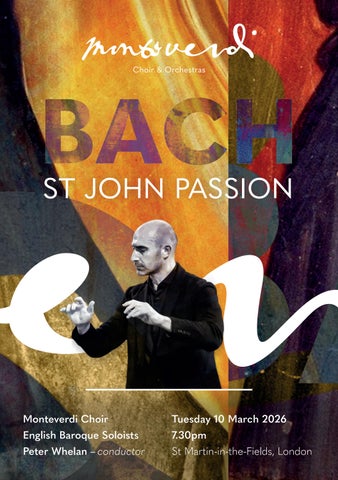
BACH ST JOHN PASSION, BWV 245

Friday 6 March 2026, 7pm

Palau de la Música Catalana, Barcelona

Tuesday 10 March 2026, 7.30pm

St Martin-in-the-Fields, London

Friday 3 April 2026, 7.30pm

Pesti Vigadó, Budapest

Monteverdi Choir & Orchestras presents

BACH ST JOHN PASSION

Monteverdi Choir

English Baroque Soloists

Peter Whelan – conductor

Nick Pritchard – tenor (Evangelist)

Konstantin Krimmel – baritone (Jesus)

Julia Doyle – soprano

Rebecca Leggett – mezzo-soprano

Malachy Frame – baritone (Pilate)

Cressida Sharp – soprano (Maid)

Will Wright – tenor (Officer/Servant)

Tristan Hambleton – bass-baritone (Peter)

BACH ST JOHN PASSION, BWV 245

PART I (35’)

interval (20’)

PART II (79’)

BACH ST JOHN PASSION

Scan to listen on Spotify

from the MCO Team

Welcome to our first concert of 2026 at our London home, St Martin-in-the-Fields, which celebrates its 300th anniversary this year.

In 1724, when Bach’s St John Passion was first heard in Leipzig, this magnificent church was rapidly rising from the ground. James Gibbs’ steepled temple was a radical design that became hugely influential across Britain and America. Internally the focus was on clarity and communication – theatrical proportions, clear sightlines, the pulpit as focal point – ensuring that the Word could be heard and understood.

Bach’s St John Passion aimed to do the same through music. This revolutionary setting changed the course of liturgical music history. In his largest-scale work to date, Bach brought his interpretation of the gospel to life, turning scripture into a vivid, immediate and human experience.

No other group embodies this music quite like the Monteverdi Choir. This is an ensemble that has redefined modern audiences’ understanding of Bach’s music. In December, they ‘once again confirmed their standing as a true benchmark in the field of early music’ (L’Ape musicale, Milan). And tonight they are directed by Olivier Award-winning Baroque specialist Peter Whelan, returning after a ‘thrilling’ (The Times) debut here in 2024.

This is just the start of our 2026 season here at St Martin’s. We return in June, again with Peter Whelan at the helm, to celebrate the church’s 300th anniversary with a programme of music written and first performed within a stone’s throw of this wondrous building by the ‘Father of the Symphony’ Franz Joseph Haydn. We hope to see you there and at our other concerts in London and around the world in 2026, as we continue our mission to bring fresh perspectives to historically-informed musical performances.

PROGRAMME NOTES

In early eighteenth-century Leipzig, the season of Lent was designated as a tempus clausum (literally, ‘closed time’), a period of penitence and reflection. For over six weeks, almost no concerted music was permitted in the church services. It was only on Good Friday, the most solemn day in the Lutheran calendar, that the congregation would again hear sacred liturgical repertoire, in the form of a ‘passion oratorio’, a grand musical setting of the story of Jesus’s trial, crucifixion and burial, performed as part of the evening Vespers service.

When Johann Sebastian Bach arrived in Leipzig in May 1723, the tradition of Good Friday passion oratorios was still a new one. It was only in 1721 that such a work, composed by the then Director of Music at St Thomas’ Church (Thomaskantor), Johann Kuhnau (1660–1722), had first been heard in the city’s principal churches; this, perhaps, was in response to the highly successful performance, in the smaller Neue Kirche, of a passion oratorio by Georg Philipp Telemann (1681–1767). During his first year as the new Thomaskantor, Bach was able to take advantage of the tempus clausum, when his hectic duties of composing and performing weekly cantatas were suspended, in order to conceive his own contribution to the genre. In both scale and ambition, however, Bach’s St John Passion (BWV 245) far exceeded anything that had

been heard in Leipzig thus far. It was likely not his first setting; while working in Weimar, Bach probably composed some passion music that is now lost. His Leipzig Passions, however, dominated the liturgy of the Vespers service, lasting much longer than the sermon itself, and set an entirely new benchmark for the depiction and evocation of religious drama in music.

Unlike the later St Matthew Passion (BWV 244), which has come down to us in both an early and a final version, Bach left no definitive score of the St John Passion. The piece seems to have accompanied Bach throughout the last 25 years of his life, and he continued to experiment with its structure for revival performances until shortly before his death. The original version (BWV 245.1) received its premiere in Leipzig’s St Nicholas Church on 7 April 1724, an occasion that was not without controversy. Bach had wanted it to be performed in the St Thomas Church instead, arguing that St Nicholas’s had less room in the galleries and that the church’s harpsichord was broken; indeed, he had already ensured the programmes were printed to that effect. However, he was overruled by an incensed Leipzig City Council, which later summoned him to issue a stern reprimand for overstepping his authority (although they did, apparently, ensure that the harpsichord was repaired).

The original score of this first version is no longer extant, although attempts have been made to reconstruct it using later materials. The following year, in 1725, Bach performed the St John Passion for a second time, but with significant changes. He revised the work considerably in order to make it fit within the stylistic format of his ongoing cycle of chorale cantatas (1724–25), replacing the opening chorus with a chorale fantasia, ‘O Mensch, bewein dein Sünde groß’ (which later became the closing chorus of Part I of the St Matthew Passion), and the plain concluding chorale with an extended chorale setting, ‘Christe, du Lamm Gottes’ (drawn from Cantata BWV 23). These changes, together with the replacement of several arias, heavily altered the work’s overarching theological impression,

making the now rarely-heard second version (BWV 245.2) highly distinctive, both musically and textually. In the early 1730s, Bach returned to the St John Passion, but restored its original form (including the opening chorus, ‘Herr, unser Herrscher’) with some minor changes (BWV 245.3). An unfinished autograph score dating from the late 1730s indicates a further, aborted revision (BWV 245.4), and there is evidence of a final performance in 1749 (BWV 245.5) which contained additional alterations to the text, along with an enlarged scoring. Nonetheless, although Bach never finished definitively revising the work, these three later versions preserve the essential design and character of the 1724 original. The ‘standard’ version usually heard today is a hybrid of different versions.

Gabriel Bodenehr (1673-1765): The church of St Thomas in Leipzig

The St John Passion is structured in two parts, designed to be performed before and after the Good Friday sermon. The narrative text, principally sung by the tenor Evangelist in recitative, is taken from Chapters 18 and 19 of the Gospel of John, covering Jesus’ arrest, denial, trial, crucifixion and burial (with two interpolations from the Gospel of Matthew). Other soloists take the part of characters in the drama: both Jesus and Pilate are sung by a bass, a servant by a tenor, and female characters (including a maid) by the soprano. The choir, meanwhile, assumes the role of the crowd, consisting variously of the Jewish people, servants of the High Priest, and soldiers. Their dramatic, often aggressive interjections (‘Kreuzige ihn!’ [‘Crucify him!’]) are cast as weighty turba choruses, in which they respond to the individual characters and comment on the action. In the second half of the work, these choruses are often linked thematically or via repeated motifs, thus lending it a greater sense of dramatic architecture. Throughout the work, Bach also inserts verses from Lutheran chorales, mostly written in the sixteenth and seventeenth centuries, that serve as moments of reflection on the unfolding narrative. Here, the choir fulfils another important function, expressing the reactions of the listening congregation and thus encouraging them to become emotionally involved in the unfolding story.

In addition to the biblical narrative and chorale texts, the St John Passion also employs contemporary madrigal poetry by an unknown author, some of which is adopted from older passion libretti by Barthold Heinrich Brockes (1680–1747) and Christian Heinrich Postel (1658–1705). Set as solo arias and ariosi, these

movements are likewise intended as contemplative meditations on the sacred drama and its message. The highly charged tenor aria ‘Ach, mein Sinn’ (No. 13), for example, adds a sense of greater emotional devastation to Peter’s denial. Similarly, the appearance of the bass arioso ‘Betrachte, meine Seel’ (No. 19), and the lengthy tenor aria ‘Erwäge, wie sein blutgefärbter Rücken’ (No. 20) that follows it, at the exact mid-point of the work, abruptly enforces a sense of quiet introspection that is in complete contrast to the violence of the surrounding narrative, when Jesus is scourged (‘und geißelte ihn’) in front of the baying crowd. Such an unexpected change of mood is reinforced by the use of two muted violins alongside the brass, creating a delicate instrumental texture that is unique to this section of the work.

The pivotal alto aria that appears at the point of Jesus’ death, ‘Es ist vollbracht!’ (No. 30) introduces another distinctive sonority. By employing a solo viola da gamba, supported only by the continuo, Bach creates an atmosphere of profound sparsity and grief to accompany the alto’s long, weeping phrases. Suddenly, the full orchestra triumphantly explodes into the second section, musically and textually reintroducing the image of Christ as ‘der Held aus Juda’ (‘the hero from Judah’) and depicting his victory over death. Bach’s departure from the traditional da capo aria form, in which the first section is fully repeated, emphasises this contrast: not only does he invert the expected characteristics of each section, so that the second overpowers the first, but then simply repeats the opening phrase with Jesus’ final words, ‘Es ist vollbracht’. The bass aria that follows, ‘Mein teurer Heiland,

lass dich fragen’ (No. 32), continues this presentation of Jesus as a king victorious over death, supported by a chorale sung by the whole choir, ‘Jesus, der du warest tot, lebest nun ohn Ende’ (‘Jesus, you who were dead, live now unendingly’).

Arguably, however, the emotional high point of the St John Passion is the heartstopping soprano aria, ‘Zerfließe, mein Herze’ (No. 35). This lament on the death of Jesus is exquisitely scored for duetting flute and oboe da caccia, giving it an otherworldly, fragile sound that seems perfectly suited to the voice’s evocation of ‘Zähren’ (‘tears’). In the second section, the soprano becomes more impassioned, crying out ‘to the world and to the heavens’; here, Bach introduces a sobbing vocal effect on the repeated word ‘tot’ (‘dead’).

Framing the entire work are two great choral movements of extraordinary power. From the outset of the arresting opening chorus, ‘Herr, unser Herrscher’ (No. 1), the orchestra establishes a mood of anguish and suffering, with a throbbing bass accompaniment, above which sit tumultuous rolling semiquavers in the strings. In the wind parts, Bach writes chains of tortured, dissonant suspensions that pierce through the dense underlying texture, foreshadowing the events to come. When the choir enters, they acclaim ‘Herr!’ (‘Lord!’) three times, before taking up the restless figuration of the strings. The text is a prayer in two distinct parts: the first (which is repeated at the end) is an invocation of praise, based on the opening verse of Psalm 8, ‘O Lord, our Lord, how excellent is thy name in all the earth!’, whilst the second (‘Zeig uns durch deine Passion…’) is an invitation

to meditate on the events and message of the Passion story.

The touching closing chorus, ‘Ruht wohl, ihr heiligen Gebeine’ (No. 39), is an extended funereal lullaby that, in its stately 3/4 character, evokes the image of Christ being ceremoniously lowered into the grave. However, the St John Passion ends not with this farewell, but a final chorale of eternal praise, ‘Ach Herr, lass dein lieb Engelein’. In its final line, ‘Herr Jesus Christ, erhöre mich, / ich will dich preisen ewiglich!’ (Lord Jesus Christ, hear me, I will praise you eternally!), the text recalls the sentiments of the opening chorus, now transformed into a hymn of glory.

During the Nineteenth Century, the St John Passion was somewhat outshone by its larger sibling, the St Matthew Passion, which was known in the Bach family as ‘der große Passion’ (‘the great Passion’) on account of the double-choir forces it required, and which famously initiated the ‘Bach revival’ spearheaded by Mendelssohn. However, the St John Passion is now justly acclaimed for its raw, intimate character, which in many ways is more dramatically immediate and taut than the St Matthew. It is a work of profound structural and musical complexity, its formal architecture and tonal plan carefully designed to emphasise its theological message. Moreover, the way in which the composer experimented with the work makes it unique in his oeuvre. As the scholar Christoph Wolff has observed, it ‘accompanied [Bach] right from his first year as Cantor of St Thomas’s to the penultimate year of his life…for that reason alone, how close it must have been to his heart’.

MCO’S 2026 ARTWORK

Our 2026 artwork mirrors MCO’s mission: to bring fresh perspectives, immediacy and drama to historically-informed musical performances. Applying the same principles to our visual identity, Matt Abel Smith’s designs for each concert draw on an artwork that is related both historically and in subject matter to the repertoire, highlighting the close relationship between visual art and music.

The Arrest of Christ (Kiss of Judas), from ‘Scenes from the Life of Christ’ by Giotto, 1304-1306

Each design comprises closely cropped segments of the original artwork, borrowing colour and texture from artists working centuries ago. The design for our performance of Bach’s St John Passion takes as its source The Kiss of Judas, one of the celebrated frescoes by Giotto di Bondone, capturing the moment Judas betrays Jesus.

Painted between 1303 and 1305, the fresco forms part of Giotto’s remarkable cycle in the Scrovegni Chapel (also known as the Arena Chapel) in Padua. The cycle illustrates a continuous sacred narrative from the lives of Joachim and Anne to the Last Judgement, and is considered a turning point between Medieval and Renaissance art.

Our artwork focuses on the fabrics worn by figures in the fresco, augmented with contemporary photographic textures in a dramatic fusion of old and new. Fragments of Judas’ golden cape are juxtaposed with the red, blue and purple hues of the heavy cloths worn by the surrounding crowd. The extreme crops highlight the vivid colours and even the individual brushstrokes that underpin Giotto’s original. Yet for all that has changed over time, overlaid photographs of contemporary fabrics are a reminder that much of the human experience remains the same: to see the play of light on silk or cotton is to share a moment that Giotto or Bach would have been equally familiar with.

TEXTS & TRANSLATIONS

Translations of non-biblical texts after Friedel Becker, 1963, and François Séguret reproduced by kind permission of EMI Records Ltd

I. TEIL

1. Chorus

Herr, unser Herrscher, dessen Ruhm in allen Landen herrlich ist!

Zeig uns durch deine Passion, dass du, der wahre Gottessohn, zu aller Zeit, auch in der größten Niedrigkeit, verherrlicht worden bist!

2a. Recitativo

Evangelist Jesus ging mit seinen Jüngern über den Bach Kidron, da war ein Garten, darein ging Jesus und seine Jünger.

Judas aber, der ihn verriet, wusste den Ort auch, denn Jesus versammlete sich oft daselbst mit seinen Jüngern.

Da nun Judas zu sich hatte genommen die Schar und der Hohenpriester und Pharisäer Diener, kommt er dahin mit Fackeln, Lampen und mit Waffen.

Als nun Jesus wusste alles, was ihm begegnen sollte, ging er hinaus und sprach zu ihnen:

Jesus Wen suchet ihr?

Evangelist Sie antworteten ihm:

2b. Chorus

Jesum von Nazareth.

2c. Recitativo

Evangelist Jesus spricht zu ihnen:

Jesus Ich bin’s.

Evangelist Judas aber, der ihn verriet, stund auch bei ihnen. Als nun Jesus zu ihnen sprach: Ich bin’s, wichen sie zurücke und fielen zu Boden. Da fragete er sie abermal:

Jesus Wen suchet ihr?

Evangelist Sie aber sprachen:

2d. Chorus

Jesum von Nazareth.

2e. Recitativo

Evangelist Jesus antwortete:

Jesus Ich hab’s euch gesagt, dass ich’s sei, suchet ihr denn mich, so lasset diese gehen!

PART I

1. Chorus

O Lord, our ruler, whose glory is magnified in all lands, testify to us by thy Passion that thou, the true Son of God, hast at all times, even in time of deepest lowliness, been glorified.

2a. Recitative

Evangelist Jesus went forth with his disciples over the brook Cedron, where was a garden, into the which he entered, and his disciples. And Judas also, which betrayed him, knew the place; for Jesus ofttimes resorted thither with his disciples. Judas then, having received a band of men and officers from the chief priests and Pharisees, cometh thither with lanterns and torches and weapons. Jesus therefore, knowing all things that should come upon him, went forth, and said unto them, Jesus Whom seek ye?

Evangelist They answered him,

2b. Chorus

Jesus of Nazareth.

2c. Recitative

Evangelist Jesus saith unto them, Jesus I am he.

Evangelist And Judas also, who betrayed him, stood with them. As soon as he had said unto them, I am he, they went backward, and fell to the ground. Then asked he them again, Jesus Whom seek ye?

Evangelist And they said,

2d. Chorus

Jesus of Nazareth.

2e. Recitative

Evangelist Jesus answered, Jesus I have told you that I am he: if therefore ye seek me, let these go their way.

und höre nicht auf, selbst an mir zu ziehen, zu schieben, zu bitten.

10. Recitativo

Evangelist Derselbige Jünger war dem Hohenpriester bekannt und ging mit Jesu hinein in des Hohenpriesters Palast. Petrus aber stund draußen für der Tür.

Da ging der andere Jünger, der dem Hohenpriester bekannt war, hinaus und redete mit der Türhüterin und führete Petrum hinein. Da sprach die Magd, die Türhüterin, zu Petro:

Ancilla Bist du nicht dieses Menschen Jünger einer?

Evangelist Er sprach: Petrus Ich bin’s nicht.

Evangelist Es stunden aber die Knechte und Diener und hatten ein Kohlfeu’r gemacht (denn es war kalt) und wärmeten sich. Petrus aber stund bei ihnen und wärmete sich. Aber der Hohepriester fragte Jesum um seine Jünger und um seine Lehre. Jesus antwortete ihm:

Jesus Ich habe frei, öffentlich geredet für der Welt. Ich habe allezeit gelehret in der Schule und in dem Tempel, da alle Jüden zusammenkommen, und habe nichts im Verborgnen geredt. Was fragest du mich darum? Frage die darum, die gehöret haben, was ich zu ihnen geredet habe! Siehe, dieselbigen wissen, was ich gesaget habe.

Evangelist Als er aber solches redete, gab der Diener einer, die dabeistunden, Jesu einen Backenstreich und sprach: Servus Solltest du dem Hohenpriester also antworten?

Evangelist Jesus aber antwortete: Jesus Hab ich übel geredt, so beweise es, dass es böse sei, hab ich aber recht geredt, was schlägest du mich?

11. Chorale

Wer hat dich so geschlagen, mein Heil, und dich mit Plagen so übel zugericht’?

Du bist ja nicht ein Sünder wie wir und unsre Kinder, von Missetaten weißt du nicht. Ich, ich und meine Sünden, die sich wie Körnlein finden des Sandes an dem Meer, die haben dir erreget

and do not cease to push me, to pull me, to encourage me.

10. Recitative

Evangelist That disciple was known unto the high priest, and went in with Jesus into the palace of the high priest. But Peter stood at the door without. Then went out that other disciple, which was known unto the high priest, and spake unto her that kept the door, and brought in Peter. Then saith the damsel that kept the door unto Peter, Maid Art not thou also one of this man’s disciples?

Evangelist He saith, Peter I am not.

Evangelist And the servants and officers stood there, who had made a fire of coals; for it was cold: and they warmed themselves: and Peter stood with them, and warmed himself. The high priest then asked Jesus of his disciples, and of his doctrine. Jesus answered him, Jesus I spake openly to the world; I ever taught in the synagogue, and in the temple, whither the Jews always resort; and in secret have I said nothing. Why askest thou me? Ask them which heard me, what I have said unto them: behold, they know what I said.

Evangelist And when he had thus spoken, one of the officers which stood by struck Jesus with the palm of his hand, saying, Officer Answerest thou the high priest so?

Evangelist Jesus answered him, Jesus If I have spoken evil, bear witness of the evil: but if well, why smitest thou me?

11. Chorale

Who has beaten thee thus, my Saviour, and with torments so mistreated thee?

Surely, thou art not a sinner, as we are, and our children; thou knowest nothing of misdeeds. I, I and my sins, that are as the grains of the sand by the sea, it is they that have caused

das Elend, das dich schläget, und das betrübte Marterheer.

12a. Recitativo

Evangelist Und Hannas sandte ihn gebunden zu dem Hohen priester Kaiphas. Simon Petrus stund und wärmete sich, da sprachen sie zu ihm:

12b. Chorus

Bist du nicht seiner Jünger einer?

12c. Recitativo

Evangelist Er leugnete aber und sprach:

Petrus Ich bin’s nicht.

Evangelist Spricht des Hohenpriesters Knecht’ einer, ein Ge freundter des, dem Petrus das Ohr abgehauen hatte:

Servus Sahe ich dich nicht im Garten bei ihm?

Evangelist Da verleugnete Petrus abermal, und alsobald krähete der Hahn. Da gedachte Petrus an die Worte Jesu und ging hinaus und weinete bitterlich.

13. Aria: Tenore

Ach, mein Sinn, wo willt du endlich hin, wo soll ich mich erquicken?

Bleib ich hier, oder wünsch ich mir

Berg und Hügel auf den Rücken?

Bei der Welt ist gar kein Rat, und im Herzen stehn die Schmerzen meiner Missetat, weil der Knecht den Herrn verleugnet hat.

14. Chorale

Petrus, der nicht denkt zurück, seinen Gott verneinet, der doch auf ein’ ernsten Blick bitterlichen weinet.

Jesu, blicke mich auch an, wenn ich nicht will büßen; wenn ich Böses hab getan, rühre mein Gewissen!

II. TEIL

15. Chorale

Christus, der uns selig macht, kein Bös’ hat begangen, der ward für uns in der Nacht als ein Dieb gefangen, geführt für gottlose Leut und fälschlich verklaget, verlacht, verhöhnt und verspeit, wie denn die Schrift saget.

thee the misery that lays thee low, and the dejected host of martyrs.

12a. Recitative

Evangelist Now Annas had sent him bound unto Caiaphas the high priest. And Simon Peter stood and warmed himself. They said therefore unto him,

12b. Chorus

Art not thou also one of his disciples?

12c. Recitative

Evangelist He denied it, and said, Peter I am not.

Evangelist One of the servants of the high priest, being his kinsman whose ear Peter cut off, saith, Servant Did not I see thee in the garden with him?

Evangelist Peter then denied again: and immediately the cock crew. Then Peter remembered the word of Jesus, and went out, and wept bitterly.

13. Aria: Tenor O, my senses, where will you end? Where shall I refresh myself? Shall I stay here, or would I prefer the hills and mountains behind me? In the world there is no counsel, and in my heart there are the pains of my misdoing, for the servant has renounced his Lord.

14. Chorale

Peter, who does not reflect, denies his God, and yet at that earnest look weeps bitter tears.

Jesu, look upon me, too, when I will not repent; when I have done ill, stir my conscience.

PART II

15. Chorale

Christ, who brings us salvation, who has done no wrong, for our sakes was taken like a thief in the night, was brought before godless men and wrongly accused, derided, mocked and spat upon: so says the Scripture.

16a. Recitativo

Evangelist Da führeten sie Jesum von Kaiphas vor das Richthaus, und es war frühe. Und sie gingen nicht in das Richthaus, auf dass sie nicht unrein würden, sondern Ostern essen möchten. Da ging Pilatus zu ihnen heraus und sprach:

Pilatus Was bringet ihr für Klage wider diesen Menschen?

Evangelist Sie antworteten und sprachen zu ihm:

16b. Chorus

Wäre dieser nicht ein Übeltäter, wir hätten dir ihn nicht überantwortet.

16c. Recitativo

Evangelist Da sprach Pilatus zu ihnen:

Pilatus So nehmet ihr ihn hin und richtet ihn nach eurem Gesetze!

Evangelist Da sprachen die Jüden zu ihm:

16d. Chorus

Wir dürfen niemand töten.

16e. Recitativo

Evangelist Auf dass erfüllet würde das Wort Jesu, welches er sagte, da er deutete, welches Todes er sterben würde.

Da ging Pilatus wieder hinein in das Richthaus und rief Jesu und sprach zu ihm:

Pilatus Bist du der Jüden König?

Evangelist Jesus antwortete:

Jesus Redest du das von dir selbst, oder haben’s dir andere von mir gesagt?

Evangelist Pilatus antwortete:

Pilatus Bin ich ein Jüde? Dein Volk und die Hohenpriester haben dich mir überantwortet; was hast du getan?

Evangelist Jesus antwortete:

Jesus Mein Reich ist nicht von dieser Welt; wäre mein Reich von dieser Welt, meine Diener würden darob kämpfen, dass ich den Jüden nicht überantwortet würde; aber nun ist mein Reich nicht von dannen.

17. Chorale

Ach großer König, groß zu allen Zeiten, wie kann ich gnugsam diese Treu ausbreiten?

Keins Menschen Herze mag indes ausdenken, was dir zu schenken.

Ich kann’s mit meinen Sinnen nicht erreichen,

16a. Recitative

Evangelist Then led they Jesus from Caiaphas unto the hall of judgment: and it was early; and they themselves went not into the judgment hall, lest they should be defiled; but that they might eat the passover. Pilate then went out unto them, and said, Pilate What accusation bring ye against this man?

Evangelist They answered and said unto him, 16b. Chorus

If he were not a malefactor, we would not have delivered him up unto thee.

16c. Recitative

Evangelist Then said Pilate unto them, Pilate Take ye him, and judge him according to your law.

Evangelist The Jews therefore said unto him,

16d. Chorus

It is not lawful for us to put any man to death.

16e. Recitative

Evangelist That the saying of Jesus might be fulfilled, which he spake, signifying what death he should die. Then Pilate entered into the judgment hall again, and called Jesus, and said unto him, Pilate Art thou the King of the Jews?

Evangelist Jesus answered him, Jesus Sayest thou this thing of thyself, or did others tell it thee of me?

Evangelist Pilate answered, Pilate Am I a Jew? Thine own nation and the chief priests have delivered thee unto me: what hast thou done?

Evangelist Jesus answered, Jesus My kingdom is not of this world: if my kingdom were of this world, then would my servants fight, that I should not be delivered to the Jews: but now is my kingdom not from hence.

17. Chorale

O great King, at all time great, how may I sufficiently spread this faith abroad?

Yet no human heart may imagine what thing to offer thee. My senses cannot conceive with what to compare thy compassion; how, then, may I repay thy deeds of love

womit doch dein Erbarmen zu vergleichen. Wie kann ich dir denn deine Liebestaten im Werk erstatten?

18a. Recitativo

Evangelist Da sprach Pilatus zu ihm: Pilatus So bist du dennoch ein König?

Evangelist Jesus antwortete: Jesus Du sagst’s, ich bin ein König. Ich bin dazu geboren und in die Welt kommen, dass ich die Wahrheit zeugen soll. Wer aus der Wahrheit ist, der höret meine Stimme.

Evangelist Spricht Pilatus zu ihm: Pilatus Was ist Wahrheit?

Evangelist Und da er das gesaget, ging er wieder hinaus zu den Jüden und spricht zu ihnen:

Pilatus Ich finde keine Schuld an ihm. Ihr habt aber eine Gewohnheit, dass ich euch einen losgebe; wollt ihr nun, dass ich euch der Jüden König losgebe?

Evangelist Da schrieen sie wieder allesamt und sprachen:

18b. Chorus

Nicht diesen, sondern Barrabam!

18c. Recitativo

Evangelist Barrabas aber war ein Mörder. Da nahm Pilatus Jesum und geißelte ihn.

19. Arioso: Basso

Betrachte, meine Seel, mit ängstlichem Vergnügen, mit bittrer Lust und halb beklemmtem Herzen dein höchstes Gut in Jesu Schmerzen, wie dir auf Dornen, so ihn stechen, die Himmelsschlüsselblumen blühn! Du kannst viel süße Frucht von seiner Wermut brechen, drum sieh ohn Unterlass auf ihn!

20. Aria: Tenore

Erwäge, wie sein blutgefärbter Rücken in allen Stücken dem Himmel gleiche geht, daran, nachdem die Wasserwogen von unsrer Sündflut sich verzogen, der allerschönste Regenbogen als Gottes Gnadenzeichen steht!

21a. Recitativo

Evangelist Und die Kriegsknechte flochten eine Krone von Dornen und satzten sie auf

with any deeds of mine?

18a. Recitative

Evangelist Pilate therefore said unto him, Pilate Art thou a king then?

Evangelist Jesus answered, Jesus Thou sayest that I am a king. To this end was I born, and for this cause came I into the world, that I should bear witness unto the truth. Every one that is of the truth heareth my voice. Evangelist Pilate saith unto him, Pilate What is truth?

Evangelist And when he had said this, he went out again unto the Jews, and saith unto them,

Pilate I find in him no fault at all. But ye have a custom, that I should release unto you one at the passover: will ye therefore that I release unto you the King of the Jews?

Evangelist Then cried they all again, saying, 18b. Chorus

Not this man, but Barabbas.

18c. Recitative

Evangelist Now Barabbas was a robber. Then Pilate therefore took Jesus, and scourged him.

19. Arioso: Bass

Contemplate, my soul, with fearful pleasure, with bitter joy and half-oppressed heart, in Jesu’s agony see thy highest good. See how, from the thorns that pierce him, the flowers of heaven open to you. You may gather a sweet harvest from his suffering: look upon him, therefore, without cease.

20. Aria: Tenor

Imagine, that his blood-bespattered body in every member is a part of Heaven above. There, after the surging waters of our flooding sins disperse, the fairest rainbow stands, God’s token of his grace and love.

21a. Recitative

Evangelist And the soldiers plaited a crown of thorns, and put it on his head, and they

sein Haupt und legten ihm ein

Purpurkleid an und sprachen:

21b. Chorus

Sei gegrüßet, lieber Jüdenkönig!

21c. Recitativo

Evangelist Und gaben ihm Backenstreiche.

Da ging Pilatus wieder heraus und sprach zu ihnen:

Pilatus Sehet, ich führe ihn heraus zu euch, dass ihr erkennet, dass ich keine Schuld an ihm finde.

Evangelist Also ging Jesus heraus und trug eine

Dornenkrone und Purpurkleid. Und er sprach zu ihnen:

Pilatus Sehet, welch ein Mensch!

Evangelist Da ihn die Hohenpriester und die Diener sahen, schrieen sie und sprachen:

21d. Chorus Kreuzige, kreuzige!

21e. Recitativo

Evangelist Pilatus sprach zu ihnen:

Pilatus Nehmet ihr ihn hin und kreuziget ihn; denn ich finde keine Schuld an ihm!

Evangelist Die Jüden antworteten ihm:

21f. Chorus

Wir haben ein Gesetz, und nach dem Gesetz soll er sterben; denn er hat sich selbst zu Gottes Sohn gemacht

21g. Recitativo

Evangelist Da Pilatus das Wort hörete, fürchtet’ er sich noch mehr und ging wieder hinein in das Richthaus, und spricht zu Jesu:

Pilatus Von wannen bist du?

Evangelist

Aber Jesus gab ihm keine Antwort.

Da sprach Pilatus zu ihm:

Pilatus Redest du nicht mit mir? Weißest du nicht, dass ich Macht habe, dich zu kreuzigen, und Macht habe, dich loszugeben?

Evangelist Jesus antwortete:

Jesus Du hättest keine Macht über mich, wenn sie dir nicht wäre von oben herab gegeben; darum, der mich dir überantwortet hat, der hat’s größ’re Sünde.

Evangelist Von dem an trachtete Pilatus, wie er ihn losließe.

22. Chorale

Durch dein Gefängnis, Gottes Sohn, muss uns die Freiheit kommen; dein Kerker ist der Gnadenthron,

put on him a purple robe, and said,

21b. Chorus

Hail, King of the Jews!

21c. Recitative

Evangelist And they smote him with their hands. Pilate therefore went forth again, and saith unto them,

Pilate Behold, I bring him forth to you, that ye may know that I find no fault in him.

Evangelist Then came Jesus forth, wearing the crown of thorns, and the purple robe.

And Pilate saith unto them, Pilate Behold the man!

Evangelist When the chief priests therefore and officers saw him, they cried out, saying,

21d. Chorus

Crucify him, crucify him.

21e. Recitative

Evangelist Pilate saith unto them,

Pilate Take ye him, and crucify him: for I find no fault in him.

Evangelist The Jews answered him,

21f. Chorus

We have a law, and by our law he ought to die, because he made himself the Son of God.

21g. Recitative

Evangelist When Pilate therefore heard that saying, he was the more afraid; and went again into the judgment hall, and saith unto Jesus, Pilate Whence are thou?

Evangelist But Jesus gave him no answer. Then saith Pilate unto him,

Pilate Speakest thou not unto me?

Knowest thou not that I have power to crucify thee, and have power to release thee?

Evangelist Jesus answered, Jesus Thou couldest have no power at all against me, except it were given thee from above: therefore he that delivered me unto thee hath the greater sin.

Evangelist And from thenceforth Pilate sought to release him,

22. Chorale

By way of thy prison, Son of God, freedom must come to us; thy prison is the throne of grace,

die Freistatt aller Frommen; denn gingst du nicht die Knechtschaft ein, müsst unsre Knechtschaft ewig sein.

23a. Recitativo

Evangelist Die Jüden aber schrieen und sprachen:

23b. Chorus

Lässest du diesen los, so bist du des Kaisers Freund nicht; denn wer sich zum Könige machet, der ist wider den Kaiser.

23c. Recitativo

EvangelistDa Pilatus das Wort hörete, führete er Jesum heraus, und satzte sich auf den Richtstuhl, an der Stätte, die da heißet: Hochpflaster, auf Ebräisch aber: Gabbatha. Es war aber der Rüsttag in Ostern um die sechste Stunde, und er spricht zu den Jüden: Pilatus Sehet, das ist euer König!

Evangelist Sie schrieen aber:

23d. Chorus

Weg, weg mit dem, kreuzige ihn!

23e. Recitativo

Evangelist Spricht Pilatus zu ihnen: Pilatus Soll ich euren König kreuzigen?

Evangelist Die Hohenpriester antworteten:

23f. Chorus

Wir haben keinen König denn den Kaiser.

23g. Recitativo

Evangelist Da überantwortete er ihn, dass er gekreuziget würde. Sie nahmen aber Jesum und führeten ihn hin. Und er trug sein Kreuz und ging hinaus zur Stätte, die da heißet Schädelstätt; welche heißet auf Ebräisch: Golgatha.

24. Aria: Basso con Coro Eilt, ihr angefochtnen Seelen, geht aus euren Marterhöhlen, eilt – Wohin? – nach Golgatha! Nehmet an des Glaubens Flügel, flieht – Wohin? – zum Kreuzeshügel, eure Wohlfahrt blüht allda!

25a. Recitativo

Evangelist Allda kreuzigten sie ihn, und mit ihm zween andere zu beiden Seiten, Jesum aber mitten inne. Pilatus aber schrieb eine Überschrift und satzte sie auf das Kreuz, und war geschrieben: “Jesus von Nazareth, der Jüden König”. Diese

the refuge of all godly folk; for if thou hadst not suffered imprisonment, our slavery would be everlasting.

23a. Recitative

Evangelist But the Jews cried out, saying, 23b. Chorus

If thou let this man go, thou art not Caesar’s friend: whosoever maketh himself a king speaketh against Caesar.

23c. Recitative

Evangelist When Pilate therefore heard that saying, he brought Jesus forth, and sat down in the judgment seat in a place that is called the Pavement, but in the Hebrew, Gabbatha. And it was the preparation of the passover, and about the sixth hour: and he saith unto the Jews, Pilate Behold your King!

Evangelist But they cried out,

23d. Chorus

Away with him, away with him, crucify him.

23e. Recitative

Evangelist Pilate saith unto them, Pilate Shall I crucify your King?

Evangelist The chief priests answered,

23f. Chorus

We have no king but Caesar.

23g. Recitative

Evangelist Then delivered he him therefore unto them to be crucified. And they took Jesus, and led him away. And he bearing his cross went forth into a place called the place of a skull, which is called in the Hebrew Golgotha.

24. Aria: Bass with Chorus Hasten, you troubled souls, leave your dens of martyrdom, hurry – where? – to Golgotha!

Take to wings of faith, fly – where? – to the hill of the cross, your welfare flourishes there.

25a. Recitative

Evangelist Where they crucified him, and two others with him, on either side one, and Jesus in the midst. And Pilate wrote a title, and put it in the cross. And the writing was, ‘Jesus of Nazareth, the King of the Jews’. This title then

Überschrift lasen viel Jüden, denn die Stätte war nahe bei der Stadt, da Jesus gekreuziget ist. Und es war geschrieben auf ebräische, griechische und lateinische Sprache. Da sprachen die Hohenpriester der Jüden zu Pilato:

25b. Chorus

Schreibe nicht: der Jüden König, sondern dass er gesaget habe:

Ich bin der Jüden König.

25c. Recitativo

Evangelist Pilatus antwortet: Pilatus Was ich geschrieben habe, das habe ich geschrieben.

26. Chorale

In meines Herzens Grunde dein Nam und Kreuz allein funkelt all Zeit und Stunde, drauf kann ich fröhlich sein. Erschein mir in dem Bilde zu Trost in meiner Not, wie du, Herr Christ, so milde dich hast geblut’ zu Tod!

27a. Recitativo

Evangelist Die Kriegsknechte aber, da sie Jesum gekreuziget hatten, nahmen seine Kleider und machten vier Teile, einem jeglichen Kriegesknechte sein Teil, dazu auch den Rock. Der Rock aber war ungenähet, von oben an gewürket durch und durch. Da sprachen sie untereinander:

27b. Chorus

Lasset uns den nicht zerteilen, sondern darum losen, wes er sein soll.

27c. Recitativo

Evangelist Auf dass erfüllet würde die Schrift, die da saget: „Sie haben meine Kleider unter sich geteilet und haben über meinen Rock das Los geworfen.“ Solches taten die Kriegesknechte. Es stund aber bei dem Kreuze Jesu seine Mutter und seiner Mutter Schwester, Maria, Kleophas Weib, und Maria Magdalena. Da nun Jesus seine Mutter sahe und den Jünger dabei stehen, den er lieb hatte, spricht er zu seiner Mutter: Jesus Weib, siehe, das ist dein Sohn!

Evangelist Darnach spricht er zu dem Jünger: Jesus Siehe, das ist deine Mutter!

read many of the Jews: for the place where Jesus was crucified was nigh to the city: and it was written in Hebrew, and Greek, and Latin.

Then said the chief priests of the Jews to Pilate,

25b. Chorus

Write not, The King of the Jews; but that he said, I am King of the Jews.

25c. Recitative

Evangelist Pilate answered, Pilate What I have written I have written.

26. Chorale

Deep in my heart thy name and cross alone shine all the time and every hour, for that I may rejoice. Appear to me in that likeness as comfort to my need, how thou, Lord Christ, so generously hast bled thyself to death.

27a. Recitative

Evangelist Then the soldiers, when they had crucified Jesus, took his garments, and made four parts, to every soldier a part; and also his coat. Now the coat was without seam, woven from the top throughout. They said therefore among themselves,

27b. Chorus

Let us not rend it, but cast lots for it, whose it shall be.

27c. Recitative

Evangelist That the scripture might be fulfilled, which saith, They parted my raiment among them, and for my vesture they did cast lots. These things therefore the soldiers did. Now there stood by the cross of Jesus his mother, and his mother’s sister, Mary the wife of Cleophas, and Mary Magdalene. When Jesus therefore saw his mother, and the disciple standing by, whom he loved, he saith unto his mother, Jesus Woman, behold thy son!

Evangelist Then saith he to the disciple, Jesus Behold thy mother!

28. Chorale

Er nahm alles wohl in Acht in der letzten Stunde, seine Mutter noch bedacht, setzt ihr ein’ Vormunde.

O Mensch, mache Richtigkeit, Gott und Menschen liebe, stirb darauf ohn alles Leid und dich nicht betrübe!

29. Recitativo

Evangelist Und von Stund an nahm sie der Jünger zu sich. Darnach, als Jesus wusste, dass schon alles vollbracht war, dass die Schrift erfüllet würde, spricht er:

Jesus Mich dürstet!

Evangelist Da stund ein Gefäße voll Essigs. Sie fülleten aber einen Schwamm mit Essig und legten ihn um einen Isopen, und hielten es ihm dar zum Munde. Da nun

Jesus den Essig genommen hatte, sprach er:

Jesus Es ist vollbracht!

30. Aria: Alto

Es ist vollbracht!

O Trost vor die gekränkten Seelen!

Die Trauernacht lässt nun die letzte Stunde zählen. Der Held aus Juda siegt mit Macht und schließt den Kampf. Es ist vollbracht!

31. Recitativo

Evangelist Und neiget das Haupt und verschied.

32. Aria: Basso [con Chorale]

Mein teurer Heiland, lass dich fragen, Jesu, der du warest tot, da du nunmehr ans Kreuz geschlagen und selbst gesaget: Es ist vollbracht, lebest nun ohn Ende, bin ich vom Sterben frei gemacht? in der letzten Todesnot nirgend mich hinwende. Kann ich durch deine Pein und Sterben das Himmelreich ererben?

Ist aller Welt Erlösung da?

Als zu dir, der mich versühnt, o du lieber Herre!

Du kannst vor Schmerzen zwar nichts sagen; Gib mir nur, was du verdient,

28. Chorale

He had a care for everything, in his last hour, he took thought for his mother still, and assigned to her a guardian. Oh, mankind, exercise righteousness, love both God and man, then die free from pain, and do not grieve!

29. Recitative

Evangelist And from that hour that disciple took her unto his own home. After this, Jesus knowing that all things were now accomplished, that the scripture might be fulfilled, saith, Jesus I thirst.

Evangelist Now there was set a vessel full of vinegar: and they filled a sponge with vinegar, and put it upon hyssop, and put it to his mouth. When Jesus therefore had received the vinegar, he said, Jesus It is finished.

30. Aria: Alto

It is finished!

Oh, consolation for all hurt souls; that night of mourning approaches its final hour. The hero from Judah has triumphed in strength and ends the struggle. It is finished!

31. Recitative

Evangelist And he bowed his head, and gave up the ghost.

32. Aria: Bass [with Chorale]

My dear Saviour, let me ask thee, Jesu, thou who wert dead, since thou now art nailed to the cross and since thou sayest thyself: It is finished! now livest for ever; Am I now set free from death? in my last agony nowhere will I turn but to thee May I, through thy suffering and death, inherit heaven? Has salvation come for all the world? who hast redeemed me. O my beloved Lord! True, thou canst not speak for pain, Give me only that which thou hast won,

doch neigest du das Haupt und sprichst stillschweigend: ja. Mehr ich nicht begehre!

33. Recitativo

Evangelist Und siehe da, der Vorhang im Tempel zerriss in zwei Stück von oben an bis unten aus. Und die Erde erbebete, und die Felsen zerrissen, und die Gräber täten sich auf, und stunden auf viel Leiber der Heiligen.

34. Arioso: Tenore

Mein Herz, in dem die ganze Welt bei Jesu Leiden gleichfalls leidet, die Sonne sich in Trauer kleidet, der Vorhang reißt, der Fels zerfällt, die Erde bebt, die Gräber spalten, weil sie den Schöpfer sehn erkalten, was willst du deines Ortes tun?

35. Aria: Soprano Zerfließe, mein Herze, in Fluten der Zähren dem Höchsten zu Ehren! Erzähle der Welt und dem Himmel die Not: Dein Jesus ist tot!

36. Recitativo

Evangelist Die Jüden aber, dieweil es der Rüsttag war, dass nicht die Leichname am Kreuze blieben den Sabbat über (denn desselbigen Sabbats Tag war sehr groß), baten sie Pilatum, dass ihre Beine gebrochen und sie abgenommen würden. Da kamen die Kriegsknechte und brachen dem ersten die Beine und dem andern, der mit ihm gekreuziget war. Als sie aber zu Jesu kamen, da sie sahen, dass er schon gestorben war, brachen sie ihm die Beine nicht; sondern der Kriegsknechte einer eröffnete seine Seite mit einem Speer, und alsobald ging Blut und Wasser heraus. Und der das gesehen hat, der hat es bezeuget, und sein Zeugnis ist wahr, und derselbige weiß, dass er die Wahrheit saget, auf dass ihr gläubet. Denn solches ist geschehen, auf dass die Schrift erfüllet würde: Ihr sollet ihm kein Bein zerbrechen. Und abermal spricht eine andere Schrift: Sie werden sehen, in welchen sie gestochen haben.

yet thy head thou bowest and tacitly thou sayest: Yes. I desire nothing more.

33. Recitative

Evangelist And, behold, the veil of the temple was rent in twain from the top to the bottom; and the earth did quake, and the rocks rent; and the graves were opened; and many bodies of the saints which slept arose.

34. Arioso: Tenor

My heart, wherein the whole world suffers likewise with Jesu’s sorrow, the sun is wrapped in mourning. the curtain is torn asunder, the rock crumbles, the earth trembles, the tombs burst open, because they behold the Creator grow cold: what wilt thou do for thy part?

35. Aria: Soprano Melt, my heart, in floods of tears in honour of the Lord most high. Tell the misery to the world and to the heavens, thy Jesus is dead!

36. Recitative

Evangelist The Jews therefore, because it was the preparation, that the bodies should not remain upon the cross on the sabbath day (for that sabbath day was an high day), besought Pilate that their legs might be broken, and that they might be taken away. Then came the soldiers, and brake the legs of the first, and of the other which was crucified with him. But when they came to Jesus, and saw that he was dead already, they brake not his legs: but one of the soldiers with a spear pierced his side, and forthwith came there out blood and water. And he that saw it bare record, and his record is true: and he knoweth that he saith true, that ye might believe. For these things were done, that the scripture should be fulfilled, A bone of him shall not be broken. And again another scripture saith, They shall look on him whom they pierced.

37. Chorale

O hilf, Christe, Gottes Sohn, durch dein bitter Leiden, dass wir dir stets untertan all Untugend meiden, deinen Tod und sein Ursach fruchtbarlich bedenken, dafür, wiewohl arm und schwach, dir Dankopfer schenken!

38. Recitativo

Evangelist Darnach bat Pilatum Joseph von Arimathia, der ein Jünger Jesu war (doch heimlich, aus Furcht vor den Jüden), dass er möchte abnehmen den Leichnam Jesu. Und Pilatus erlaubete es. Derowegen kam er und nahm den Leichnam Jesu herab. Es kam aber auch Nikodemus, der vormals bei der Nacht zu Jesu kommen war, und brachte Myrrhen und Aloen untereinander, bei hundert Pfunden. Da nahmen sie den Leichnam Jesu und bunden ihn in Leinen Tücher mit Spezereien, wie die Jüden pflegen zu begraben. Es war aber an der Stätte, da er gekreuziget ward, ein Garten, und im Garten ein neu Grab, in welches niemand je geleget war. Daselbst hin legten sie Jesum, um des Rüsttags willen der Jüden, dieweil das Grab nahe war.

39. Chorus

Ruht wohl, ihr heiligen Gebeine, die ich nun weiter nicht beweine, ruht wohl und bringt auch mich zur Ruh! Das Grab, so euch bestimmet ist und ferner keine Not umschließt, macht mir den Himmel auf und schließt die Hölle zu.

40. Chorale

Ach Herr, lass dein lieb Engelein am letzten End die Seele mein in Abrahams Schoß tragen, den Leib in seim Schlafkämmerlein gar sanft ohn eigne Qual und Pein ruhn bis am jüngsten Tage!

Alsdenn vom Tod erwecke mich, dass meine Augen sehen dich in aller Freud, o Gottes Sohn, mein Heiland und Genadenthron!

Herr Jesu Christ, erhöre mich, ich will dich preisen ewiglich!

John 18 & 19; Matthew 26:75 (12), 27:51-52 (33)

37. Chorale

O help us, Jesus Christ, Son of God, through thy bitter suffering, to be always obedient to thee, eschewing all sin: to contemplate fruitfully thy death and its cause: for which, though poor and weak, we will offer up our thanks.

38. Recitative

Evangelist And after this Joseph of Arimathaea, being a disciple of Jesus, but secretly for fear of the Jews, besought Pilate that he might take away the body of Jesus: and Pilate gave him leave. He came therefore, and took the body of Jesus. And there came also Nicodemus, which at the first came to Jesus by night, and brought a mixture of myrrh and aloes, about an hundred pound weight. Then took they the body of Jesus, and wound it in linen clothes with the spices, as the manner of the Jews is to bury. Now in the place where he was crucified there was a garden; and in the garden a new sepulchre, wherein was never man yet laid. There laid they Jesus therefore because of the Jews’ preparation day; for the sepulchre was nigh at hand.

39. Chorus

Rest in peace, you holy bones, which I will now no longer mourn; rest in peace, and take me, too, to rest. The grave, that is destined for you and contains no more grief, opens up the heavens to me and closes hell.

40. Chorale

O Lord, let thy dear angels carry my soul when my end comes to Abraham’s bosom; let my body in its resting chamber gently repose, without pain or grief, till Judgment Day! Then awaken me from death, that my eyes may behold thee in all joy, O Son of God, my Saviour and my Throne of Grace! Lord Jesus Christ, hear my prayer, I will ever praise thee!

MONTEVERDI CHOIR

They are truly one of the finest choirs of their time.’ Bachtrack

For over 60 years the Monteverdi Choir has been recognised as one of the greatest and most influential choirs in the world. Through a combination of consummate technique and historically-informed performance practice, the Choir constantly strives to bring fresh perspectives, immediacy and drama to its performances.

The recipient of many awards, the Monteverdi Choir was named ‘Best Choir’ at the 2024 Oper! Awards, with the jury noting that: ‘At festivals, on concert tours and in their numerous recordings, this is an ensemble whose quality will always leave the listener speechless.’

The Choir’s 2026 commences with Bach’s St John Passion conducted by Peter Whelan in Barcelona, Budapest and London, and a collaborative tour of Bach’s Mass in B minor with Laurence Equilbey and Accentus/Insula Orchestra. In May, Jonathan Sells returns to conduct an immersive production of Purcell’s Dido & Aeneas, directed by Andrew Staples, in the dry dock of Cutty Sark in Greenwich, and on tour at the Bergen International Festival in Norway. In the autumn, Christophe Rousset will conduct Handel’s Theodora on a tour to South America, and in the UK with concerts in London and Oxford.

Tthe Choir’s 2025 programme expanded the range of its repertoire and conductor collaborations. This included two

concerts at the Edinburgh International Festival: John Tavener’s monumental The Veil of The Temple on the opening night, conducted by Sofi Jeannin, and a programme of Purcell, Bach and Handel, conducted by MCO Choir Director Jonathan Sells, and streamed on Deutsche Grammophon’s Stage+ platform.

Other highlights of 2025 included Bach’s 1725 cantatas with Masaaki Suzuki, Mozart’s Requiem with Pablo Heras-Casado, Rossini’s Stabat Mater with Jakob Lehmann, and the Choir’s first performances of Handel’s Messiah in almost three decades, directed by Christophe Rousset.

On Good Friday 2025, MCO’s own record label, Soli Deo Gloria, released its first new recording since before the global pandemic – an album of Bruckner and Gesualdo motets recorded live in concert in October 2024, conducted by Jonathan Sells. This was followed in September 2025 by an album of Charpentier Christmas music conducted by Christophe Rousset, recorded during a critically-acclaimed

European tour in December 2024. The album was recently selected as the benchmark recording of his Messe de Minuit pour Noël by France Musique.

Founded in 1964 by Sir John Eliot Gardiner, the Monteverdi Choir has released over 150 recordings and won numerous prizes. In 2023, the Choir and English Baroque were honoured to perform at the Coronation of HM The King, with The Telegraph proclaiming ‘if the Monteverdi Choir isn’t singing when I get to the gates of Heaven, I want my money back.’

MONTEVERDI CHOIR

10 March 2026

Choir Director: Jonathan Sells

Soprano

Rachel Allen

Jennifer Clark

Elenor Bowers-Jolley

Lucy Knight

Theano Papadaki

Cressida Sharp †

Áine Smith*

Alto

Francesca Biliotti

Mercè Bruguera Abelló

Rebecca Leggett †

Hamish McLaren

Matthew Monaghan*

Tenor

Peter Di-Toro

Edmund Hastings

Tom Kelly

Sam Madden*

Will Wright †

Bass

Samuel Evans

Malachy Frame †

Tristan Hambleton †

George Vines

Allyn Wu*

Emma van der Scheer* † Soloists * 2025/26 Apprentices

ENGLISH BAROQUE SOLOISTS

Intricate and detailed throughout…it was brilliant.’

Die Presse

For over 40 years, the English Baroque Soloists (EBS) has been one of the most innovative period-instrument ensembles, consistently challenging the preconceptions of audiences around the world. Equally at home in chamber, symphonic and operatic repertoire, its distinctively warm and incisive playing is instantly recognisable in music ranging from Monteverdi to Mozart. The orchestra has performed at many of the world’s most prestigious venues, including Milan’s Teatro alla Scala, the Concertgebouw in Amsterdam and the Sydney Opera House.

The orchestra’s 2026 commences with Bach’s St John Passion conducted by Peter Whelan in Barcelona, Budapest and London. In May, Jonathan Sells returns to conduct an immersive production of Purcell’s Dido & Aeneas, directed by Andrew Staples, in the dry dock of Cutty Sark in Greenwich, and on tour at the Bergen International Festival in Norway. In June, a programme exploring Haydn’s time in London will be conducted by Peter Whelan, joined by cello soloist Christophe Coin. In the autumn, Christophe Rousset will conduct Handel’s Theodora on a tour to South America, and in the UK with concerts in London and Oxford, the latter as part of the inaugural season at the new Sohmen Concert Hall in the Schwarzman Centre, Oxford.

Highlights of 2025 included Mozart symphonies and double piano concerto with Marc Minkowksi and the Labèque sisters, Bach’s 1725 cantatas with Masaaki Suzuki, and ‘Sing to the Lord a new song’, a programme of Bach, Purcell and Handel which toured to Aldeburgh, the Edinburgh International Festival and the recently-renovated North Wing at St Bartholomew’s Hospital in London. The year culminated with the orchestra’s first performances of Handel’s Messiah in almost three decades, touring to Paris, Rome, Milan and London, conducted by Christophe Rousset.

In September 2025, MCO’s own record label, Soli Deo Gloria, released its first recording of the EBS since the pandemic – an album of Charpentier Christmas music, recently selected as the

benchmark recording of his Messe de Minuit pour Noël by France Musique. The album was recorded in December 2024 during a European tour conducted by Christophe Rousset, with performances described as ‘joyous and immaculate’ (The Guardian), ‘a refined festive celebration’ (The Times) and ‘an enchanting musical journey, showcasing their exceptional artistry and energy’ (Operawire).

Founded in 1978 by Sir John Eliot Gardiner, the EBS were part of the iconic Bach Cantata Pilgrimage in 2000 alongside the Monteverdi Choir, performing all of Bach’s sacred cantatas throughout Europe (recorded for Soli Deo Gloria). They have participated in major opera productions alongside the Monteverdi Choir in works by Handel, Purcell and Monteverdi, and made the earliest recording of Mozart’s complete piano concertos on period instruments, as well as his greatest operas for Deutsche Grammophon.

ENGLISH BAROQUE SOLOISTS

10 March 2026

Violin I

Madeleine Easton

Jayne Spencer

Flora Curzon

Lucy Waterhouse

Rebecca Bell

Violin II

Naomi Burrell

Alice Earll

Will McGahon

Anna Jane Lester

Chloe Prendergast

Viola

Francesca Gilbert

Dan Shilladay

Samantha Hutchins

Cello

Marco Frezzato

Pedro da Silva

Jacob Garside

Double Bass

Rosie Moon

Kate Brooke

Flute

Elizabeth Walker

Annabel Knight

Oboe

Emma Black

Geoff Coates

Bassoon

Catriona McDermid

Lute

Jadran Duncumb

Organ

Paolo Zanzu

PETER WHELAN

Conductor

Olivier Award winner Peter Whelan is among his generation’s most dynamic and versatile exponents of historical performance. He is Artistic Director of Irish Baroque Orchestra and Curator for Early Music of Norwegian Wind Ensemble. He is Music Director Designate of Philharmonia Baroque Orchestra for 2025/26, and becomes Music Director from the 2026/27 season.

As a conductor, Peter has a particular passion for exploring and championing neglected music from the Baroque and Classical eras. Recent engagements have included appearances with the Scottish Chamber Orchestra, Beethoven Orchester Bonn, Netherlands Chamber Orchestra, Royal Northern Sinfonia, Orchestra della Svizzera Italiana, Kristiansand Symphony Orchestra, Lahti Symphony Orchestra, Orchestra of the Age of Enlightenment, The English Concert, Dunedin Consort, Monteverdi Choir and English Baroque Soloists. He has also conducted Gluck Orfeo with San Francisco Opera, Vivaldi l’Olimpiade with Irish National Opera (across Ireland and at the Royal Opera House, London) and Handel Rodelinda at Garsington Opera.

Highlights of the 2025/26 season include an appearance at the BBC Proms with the Irish Baroque Orchestra and return visits to Philharmonia Baroque Orchestra, Scottish Chamber Orchestra, Meininger Hofkapelle,

National Symphony Orchestra of Ireland, Tapiola Sinfonietta and Monteverdi Choir and English Baroque Soloists.

Peter’s artistic direction in live performance and the recording studio has been widely praised for its ‘rich insight, style and charisma’ (Guardian), its ‘stylish verve’ (BBC Music Magazine), and ‘energetic yet unfailingly sensitive direction’ (Gramophone). As a champion of early music and opera, Peter represents ‘the very best of contemporary trends in bringing this music to life: flex and zest with tempi, lithe and vigorous … an incredible alertness to colors and moods summoned by the cut-and-thrust harmonic footwork of this music’ (Operawire). With the English Concert, he ‘brought Handel’s fabulous score to life in a performance of surpassing rhythmic energy, richly dramatic colouring and heart-breaking lyrical grace’ (The Telegraph).

Turn static files into dynamic content formats.

Create a flipbook