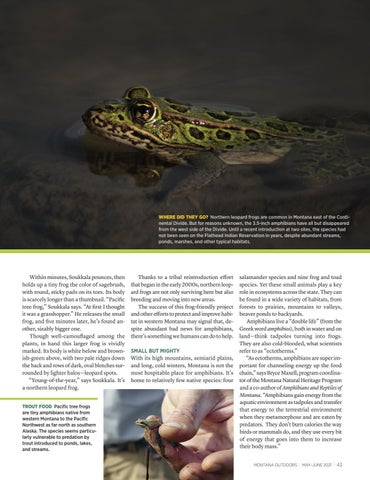
WHERE DID THEY GO? Northern leopard frogs are common in Montana east of the Continental Divide. But for reasons unknown, the 3.5-inch amphibians have all but disappeared from the west side of the Divide. Until a recent introduction at two sites, the species had not been seen on the Flathead Indian Reservation in years, despite abundant streams, ponds, marshes, and other typical habitats.
Within minutes, Soukkala pounces, then holds up a tiny frog the color of sagebrush, with round, sticky pads on its toes. Its body is scarcely longer than a thumbnail. “Pacific tree frog,” Soukkala says. “At first I thought it was a grasshopper.” He releases the small frog, and five minutes later, he’s found another, sizably bigger one. Though well-camouflaged among the plants, in hand this larger frog is vividly marked. Its body is white below and brownish-green above, with two pale ridges down the back and rows of dark, oval blotches surrounded by lighter halos—leopard spots. “Young-of-the-year,” says Soukkala. It’s a northern leopard frog. TROUT FOOD Pacific tree frogs are tiny amphibians native from western Montana to the Pacific Northwest as far north as southern Alaska. The species seems particularly vulnerable to predation by trout introduced to ponds, lakes, and streams.
Thanks to a tribal reintroduction effort that began in the early 2000s, northern leopard frogs are not only surviving here but also breeding and moving into new areas. The success of this frog-friendly project and other efforts to protect and improve habitat in western Montana may signal that, despite abundant bad news for amphibians, there’s something we humans can do to help. SMALL BUT MIGHTY With its high mountains, semiarid plains, and long, cold winters, Montana is not the most hospitable place for amphibians. It’s home to relatively few native species: four
salamander species and nine frog and toad species. Yet these small animals play a key role in ecosystems across the state. They can be found in a wide variety of habitats, from forests to prairies, mountains to valleys, beaver ponds to backyards. Amphibians live a “double life” (from the Greek word amphibios), both in water and on land—think tadpoles turning into frogs. They are also cold-blooded, what scientists refer to as “ectotherms.” “As ectotherms, amphibians are super important for channeling energy up the food chain,” says Bryce Maxell, program coordinator of the Montana Natural Heritage Program and a co-author of Amphibians and Reptiles of Montana. “Amphibians gain energy from the aquatic environment as tadpoles and transfer that energy to the terrestrial environment when they metamorphose and are eaten by predators. They don’t burn calories the way birds or mammals do, and they use every bit of energy that goes into them to increase their body mass.” MONTANA OUTDOORS | MAY–JUNE 2021 | 43