For address changes or subscription information call 800-678-6668. In Canada call +1 406-495-3257
Postmaster: Send address changes to Montana Outdoors Montana Fish, Wildlife & Parks, P.O. Box 200701, Helena, MT 59620-0701. Preferred periodicals postage paid at Helena, MT 59601, and additional mailing offices.
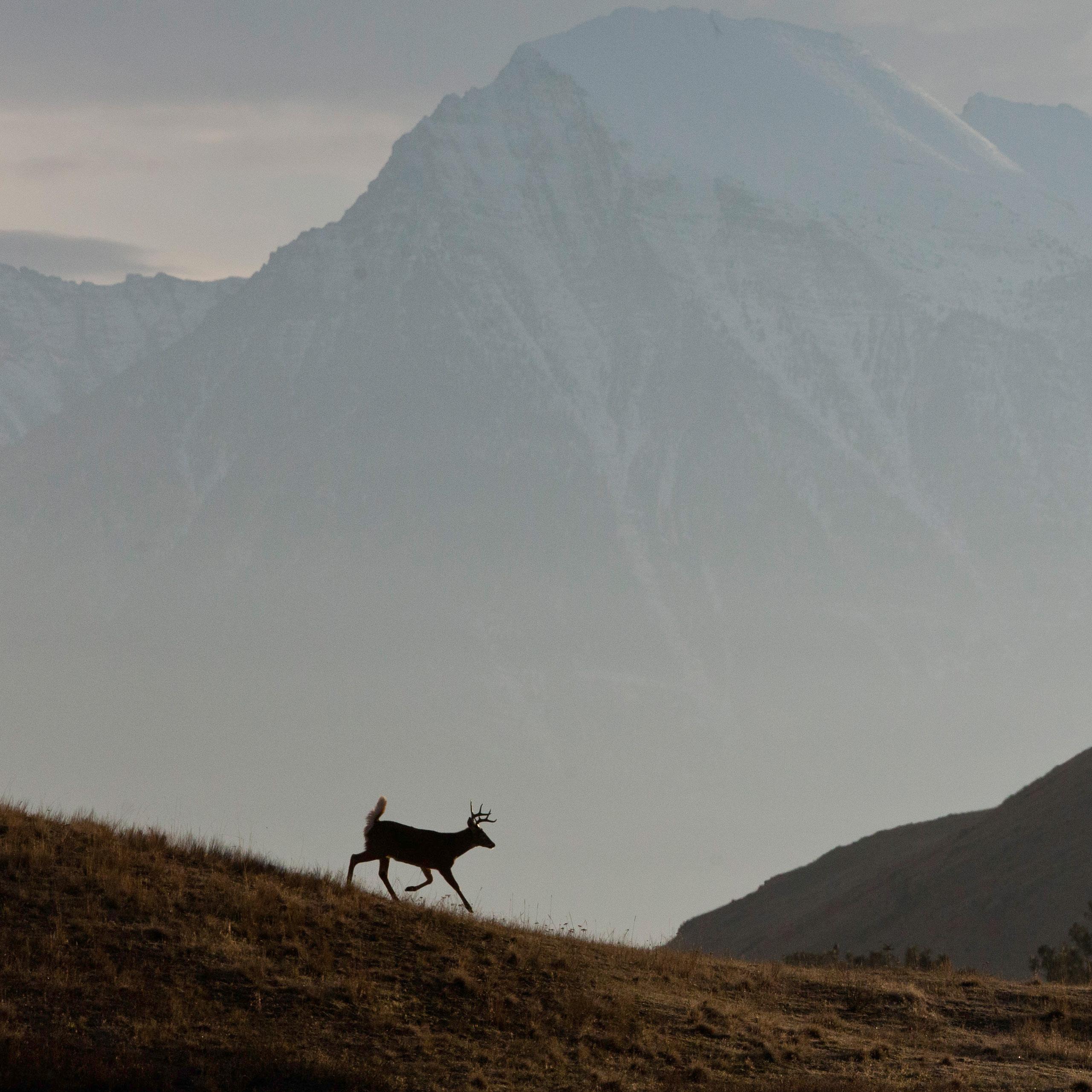
A
buck
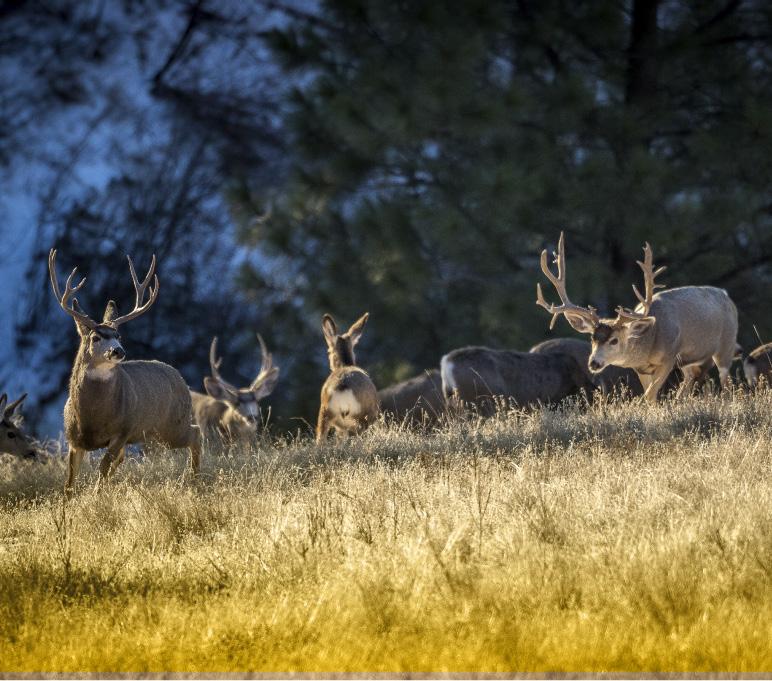
to his next appointment during the November mating season in the Mission Valley. Read about the wisdom of not rushing a rifle shot on a moving deer on page 40. Photo by Donald
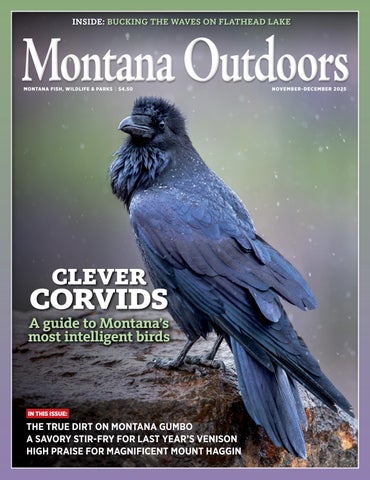
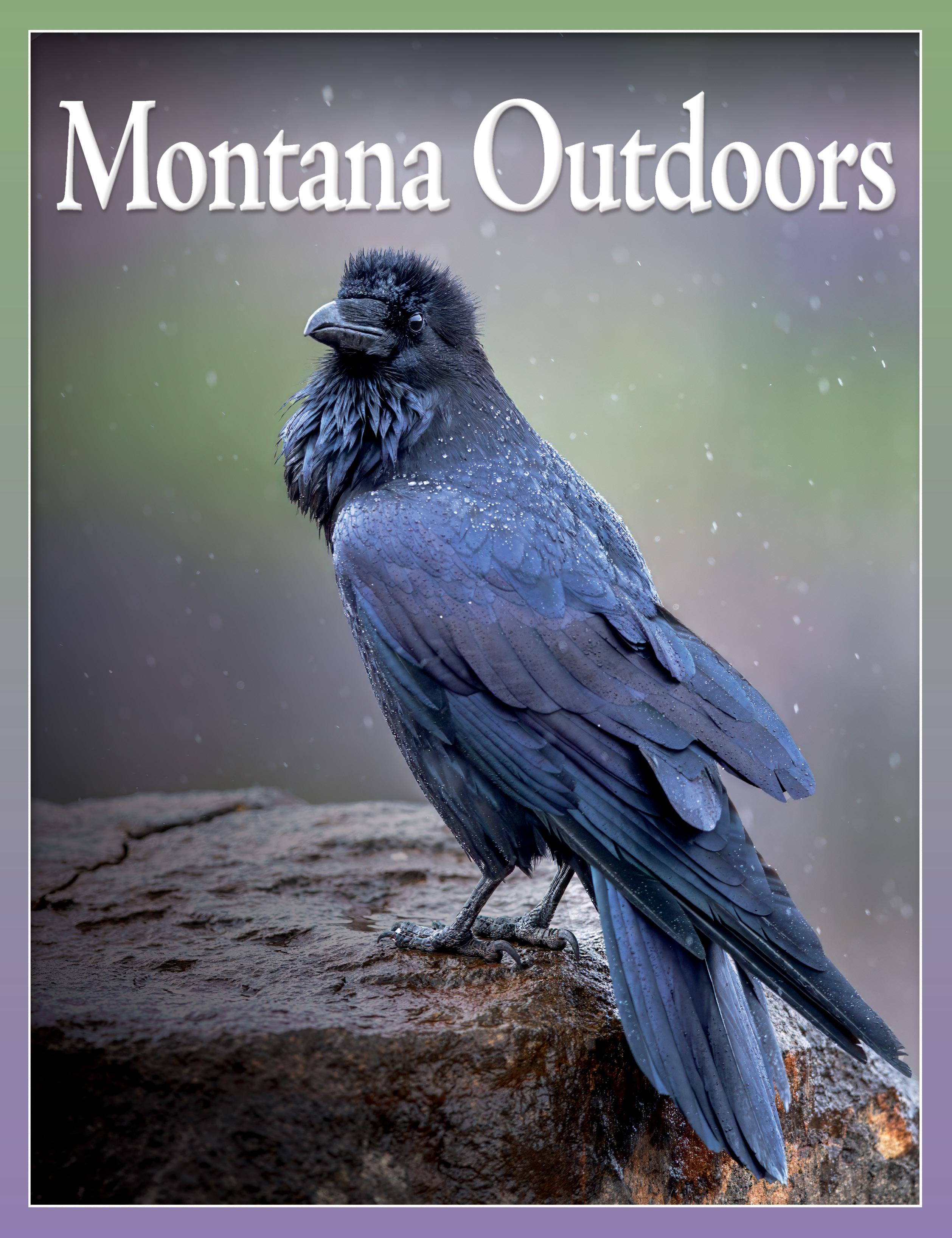
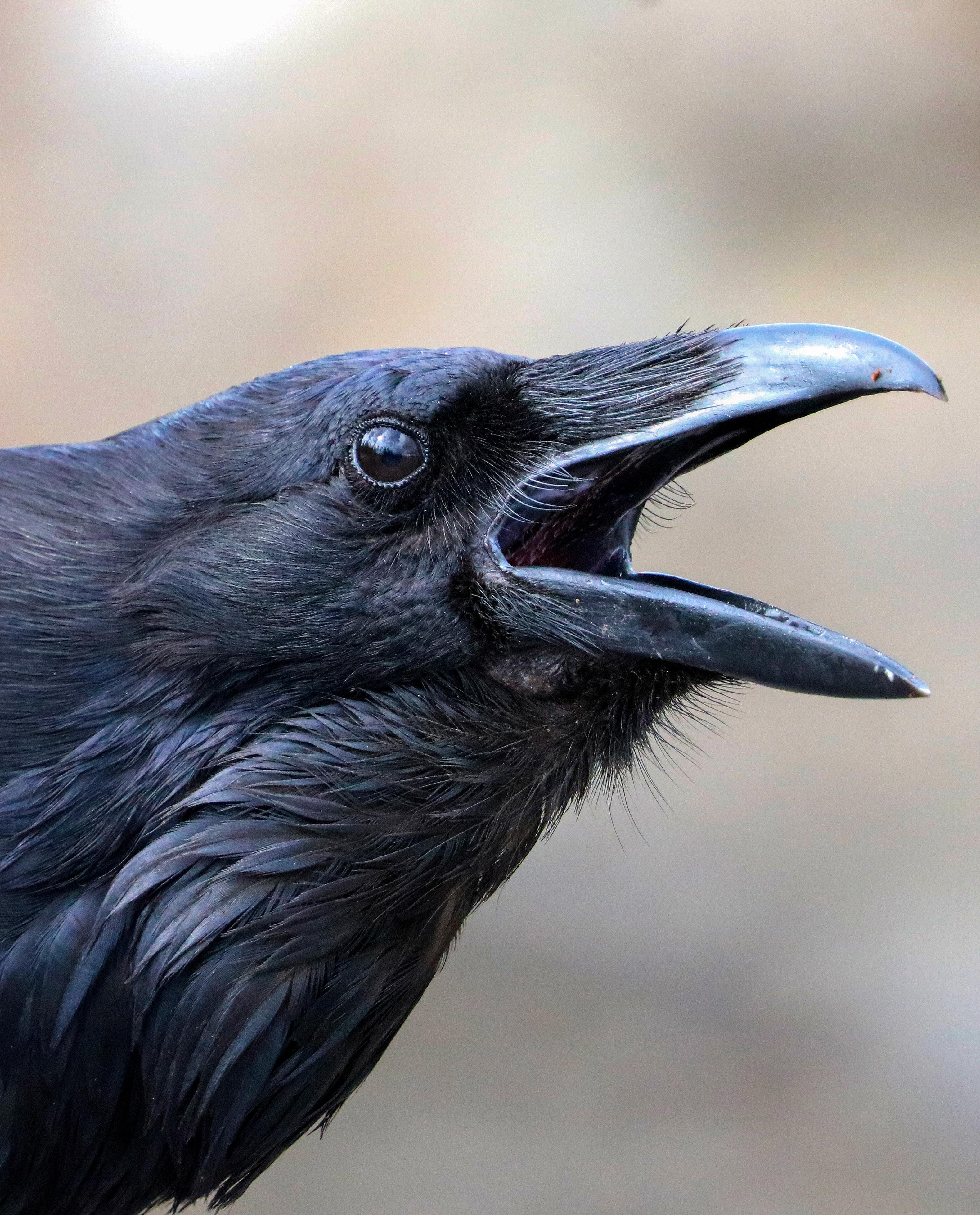
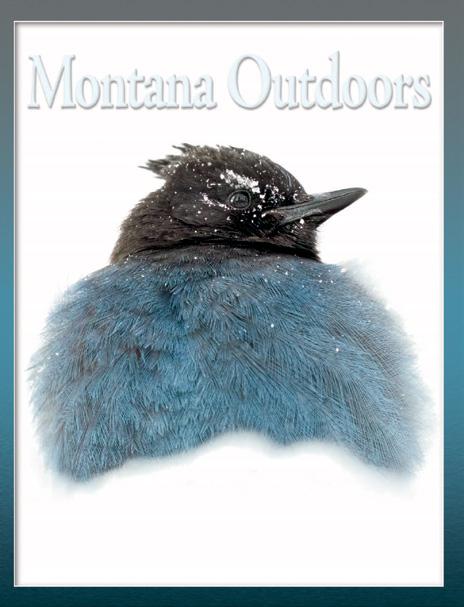
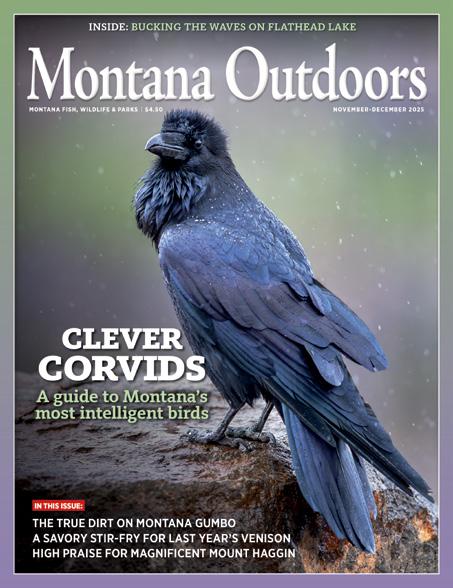
COVER Ravens and other members of the crow family tree are among the most conspicuous, charismatic, and famously clever birds to grace the Big Sky. Read about Montana’s eight great corvids on page 22. Photo by Randy Smith.
Absorbing the Blows at Flathead Lake
From private shorelines to state parks, a Montana-born idea is reshaping how landowners and agencies protect Flathead Lake’s fragile edges. By Dillon Tabish
Corvids
to
Crow
Over A “good enough” guide to identifying Montana’s eight members of the crow family.
By Sneed B. Collard III
Montana’s Gourmet Gumbo How to escape the state’s stickiest, gooeyist, sloppiest soil. By Ben Long
Mountain of Memories
The pleasures of Montana’s largest wildlife management area across years and seasons. By Nicole Qualtieri
RIDGE RUNNER
whitetail
hurries
M. Jones.
LETTERS
Snakes on the plains?
I take issue with the statement that prairie rattlesnakes are found statewide in Montana except the high mountains. Where I live in the glaciated plains of far northeast Montana, I believe there are no endemic rattlesnakes found in Sheridan and Daniels counties or the upland areas of Roosevelt County away from the Missouri River bottoms and breaks. Growing up here on the prairie it was never something we had to worry about. Occasionally a rattlesnake will turn up here when it hitches a ride on custom combining equipment coming up from the south. The biggest hazard for hunters and dogs here is the jumping cactus (Opuntia fragilis), which can carpet the ground in sandy areas and easily detach and stick to dogs’ paws and legs, or ride up a hunter’s pant leg.
Doug Smith Dagmar
Editor replies: Thank you for the correction, Doug. Researchers have found there is adequate habitat for prairie rattlesnakes along the Daniels-Sheridan county line up to the Canadian border, but you’re absolutely right—there have been no reports of rattlers living in that northwestern corner of Montana.
Inconsistent messages on non-native species
The September-October issue celebrates the introduction of non-native upland game birds and hybrid tiger muskies, then decries the presence of German
brown trout in the Flathead River. See any incongruity here?
Terry L. Anderson Bozeman
Editor replies: You make a fair point, Terry. FWP has a responsibility to conserve native fish and wildlife species over non-natives, but it also has a recreational mandate to provide hunters and anglers with species they want to catch and hunt. Tiger muskies are sterile so they can’t reproduce and are put in closed-basin lakes where escape is unlikely. There they can feast on overpopulations of prey fish and provide recreational opportunity
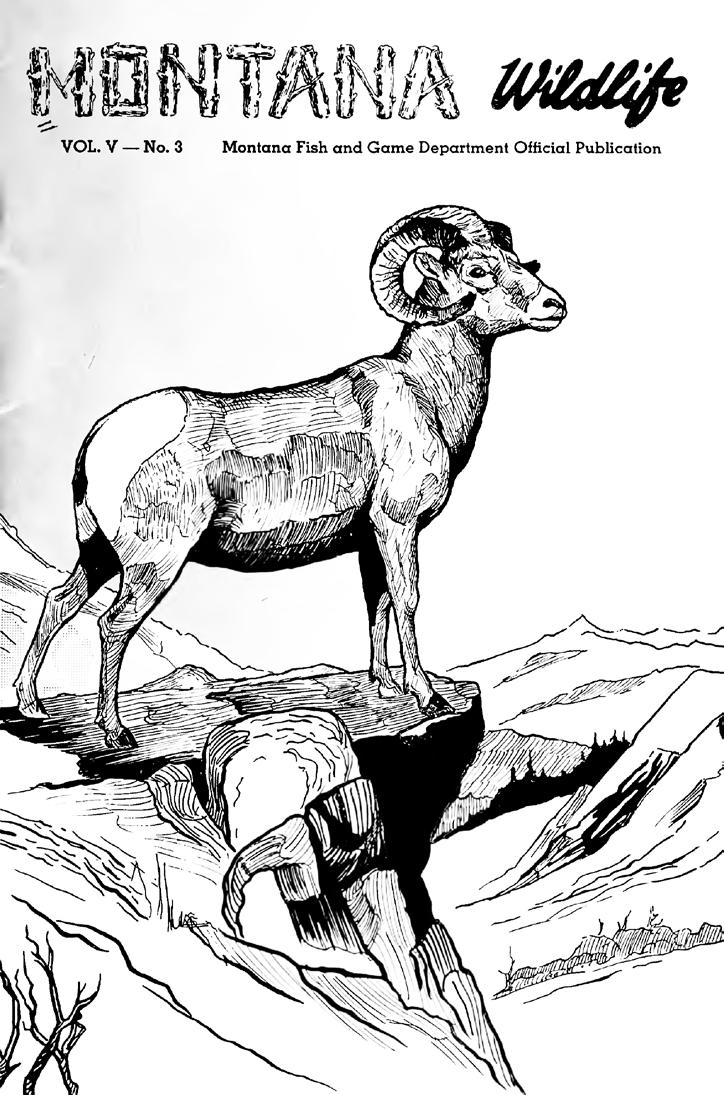
Excerpts from the FWP archive
In the fall 1955 issue of Montana Wildlife, Montana Fish and Game commissioner William T. Sweet reminisced on 61 years of hunting Bull Mountain, between Boulder and Cardwell in Jefferson County. He killed his first deer there in 1894 and, in addition to deer, the mountain’s abundant parks were filled with dusky (blue) grouse. “It was not unusual for us to see 500 in a day…. Often we lugged home a gunny sack full at the end of a day’s hunt.”
In the late 1890s, Sweet’s brother and two other local boys “killed and sold deer for a living,” he wrote, when Montana had no hunting seasons or limits. The three would “come through Boulder each week with an old stagecoach drawn by four horses with a load of frozen deer stacked like cordwood. They sold the deer in Helena for $5 apiece, and be it said to their credit that
for anglers. When it comes to brown trout in the upper Flathead River, though, FWP has a duty to protect struggling native cutthroat trout— Montana’s state fish—which has been petitioned several times for federal threatened species listing.
Great prickly pear portrait
The September-October 2025 Outdoors Portrait about the cactus was perfect! I wondered about these plants that I sometimes run across while out riding horses. This article answered all my questions and then some.
Carole Zundel Mountain Home, ID
We welcome your comments, questions, and letters. Write to Montana Outdoors, P.O. Box 200701, Helena, MT 59620-0701, or email paul.queneau@mt.gov.
they gave many away to hungry families who couldn’t pay the price for fresh meat.”
Sweet explained that market hunting and other overharvest led to a drastic decline in local deer numbers. “Even when the Montana Legislature finally enacted game laws, the season limit was six deer at first. Later that was reduced to three and then to one.”
As game laws and habitat protections were helping Montana’s deer, elk, bighorn sheep, and other wildlife populations recover, Sweet called on future fish and wildlife commissioners to keep managing wildlife for the benefit of later generations so that others could enjoy the quality of hunting he had experienced.
He ended by cautioning that wise management was critical, or “the game herds inevitably will dwindle down again—on Bull Mountain or anywhere else in Montana.” n
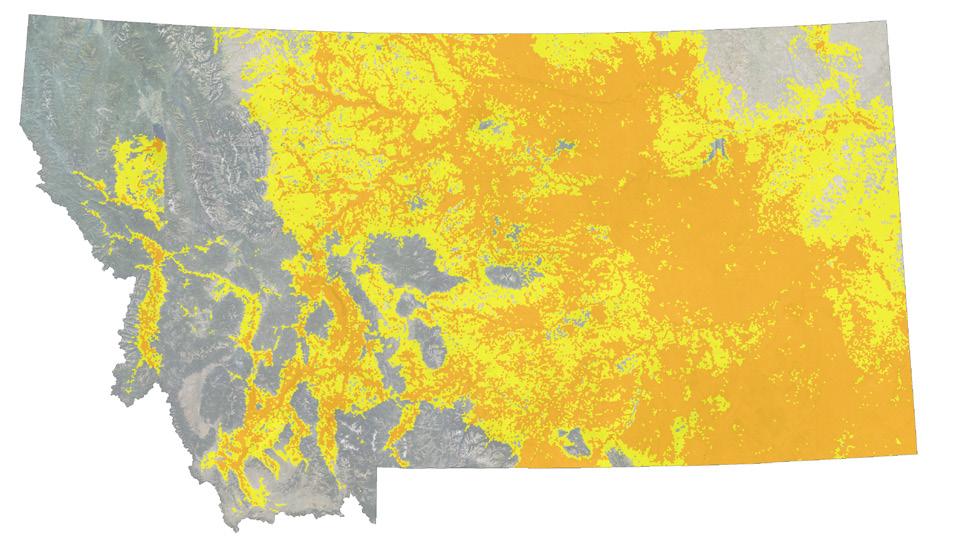
Montana’s suitable habitat for prairie rattlesnakes. Yellow represents low-quality habitat while orange shows moderate-quality. The state’s northeast corner is unsuitable due to the cold climate and other factors.
MAP COURTESY OF MONTANA NATURAL HERITAGE PROGRAM
By
Venison, Broccoli, and Onion Stir-Fry
hen the November-December issue of Montana Outdoors arrives in mailboxes in late October, the deer and elk firearm season has just begun. Hunters are buying bullets, digging out cold-weather camo, sighting in their rifles—and figuring out what to do with those remaining few packages of last year’s venison in the freezer.
This fantastic stir-fry adapted from one on the NYT Cooking app will help free up space for the new season’s harvest. Try it on any cuts except shanks and shoulders (which should be stewed or braised at low temperatures, not flash-cooked in hot oil). Begin thawing the meat, and while it’s still half-frozen, trim off any freezer burn and cut into thin slices against the grain (making the meat more tender).
This delicious dish fries up in just a few minutes so the meat and vegetables don’t overcook. Start the rice first so it’s done before you begin stir-frying. Next prepare all the ingredients and set them out on the counter. Now you’re ready.
The only ingredients not found in many Montana kitchens are oyster sauce, sesame oil, and chili-garlic sauce (the Huy Fong brand with the rooster logo is the most popular in the United States), all found in the Asian aisles of grocery stores. You can buy sake, dry sherry, or dry vermouth at most liquor stores. Dry white wine is also a decent substitute. n
Wok this way
INGREDIENTS
⅓ c. sake, dry sherry, or dry vermouth
3 T. plus 2 t. soy sauce
1 T. cornstarch
1 lb. venison (deer, elk, or pronghorn steak, loin, or roast), sliced thin against the grain
¼ c. oyster sauce
½ T. chile-garlic sauce or to taste
6 T. neutral oil, such as canola or vegetable
1 medium yellow onion, sliced
2 garlic cloves, peeled and minced
1-inch chunk of ginger root, peeled and minced
1 lb. broccoli, the head cut into florets and the stems peeled and cut into discs
1 T. toasted sesame oil or unsalted butter
DIRECTIONS
In a large bowl, whisk the alcohol, 2 T. of the soy sauce, and the cornstarch. Add sliced venison, toss to combine, and set aside for 20 minutes.
To make the sauce, mix the remaining soy sauce, oyster sauce, and chile-garlic sauce in a small bowl. Add 1 T. of water and mix again. Set aside.
Heat 2 T. oil in a wok or large frying pan or skillet set over high heat. While the oil is heating, remove venison from cornstarch mix and place on paper towels to absorb moisture. Reserve the mix. When oil is shimmering, add half the venison and stir rapidly until browned and barely cooked, about 2 minutes. Transfer to a bowl or plate. Add another 2 T. oil and repeat with remaining venison.
Wipe out the pan with a paper towel and return it to the stove over medium-high heat. Add 2 T. oil and swirl to heat. Add onion and broccoli and cook, stirring frequently, until onion is lightly browned. Add garlic and ginger and continue stirring for 2 minutes.
You can make a stir-fry without a wok, but having one makes cooking so much easier. A wok is a deep, round-bottomed metal cooking pan that originated in China. The shape allows for efficient heat distribution and quick cooking, and the generous size can contain all the ingredients. A great deal on a great wok is the Sur La Table 12-inch carbon steel version, which sells for about $45 online. You’ll need to season it before your very first use as you would with a new cast iron skillet, but that takes only a few minutes.
Add 2 T. water to the wok, and toss and stir the vegetables in the steam for 2 minutes (if not using a wok, cover the pan). Add reserved cornstarch mix, stir for 2 minutes to thicken, then return venison to the pan. Cook, stirring frequently, for 30 seconds, then add sesame oil or butter and stir again for 30 seconds. Serve immediately with rice. n
Find more recipes online at bit.ly/TastingMontana
—Tom Dickson is the previous editor of Montana Outdoors.
Tom Dickson I Preparation time: 20 minutes I Cooking time: 10 minutes I Serves: 3
Opening access across Montana
Before anyone can experience Montana’s fish, wildlife, and parks, they need access.
With that simple fact in mind, FWP has worked for decades to create and maintain a wide assortment of public access options so people can enjoy Montana’s world-class outdoor treasures. Our Block Management Program alone opened the gates to over 6.8 million acres of private lands this year, thanks to agreements with more than 1,300 landowners across the state.
FWP also manages 55 state parks for camping, hiking, fishing, swimming, boating, and more, as well as 350 fishing access sites along rivers, streams, lakes, and reservoirs. And that’s just the start.
Wildlife management areas, conservation easements and leases, and various other FWP programs provide more than 1 million acres of access across Montana.
In addition to that, FWP uses proceeds from the sale of conservation licenses to help support public recreation on several million acres of state school trust lands managed by the Department of Natural Resources and Conservation.
As I’ve traveled around Montana in my first year working for this agency, I’ve found it gratifying to see access points featuring the FWP logo just about everywhere I’ve been.
This also hit home in late August while boating with my family in the Gates of the Mountains area of the Missouri River northeast of Helena. After stopping at picnic areas, hiking trails, and campsites around Holter Lake, I was amazed how many access options there were on that single body of water, thanks in part to FWP. Those areas spread people out enough that we sometimes felt like we had the place all to ourselves.
Yet I know that this kind of solitude is getting tougher to find. As Montana has grown, so has our need for more public access. I’m proud to say FWP recently recorded some big wins on that front.
In August, Montana’s Fish and Wildlife Commission approved
the purchase of the 1,080-acre Stafford Ferry Conservation Easement north of Winifred, protecting habitat in the Missouri River Breaks for Montana’s largest bighorn sheep herd and providing a much-needed boost in public access (read more about it on page 10). The commission also approved 22 habitat conservation leases that could potentially protect habitat and open access to 68,000 acres in prairie regions of the state. These leases run 30 to 40 years, and help keep working ranches in operation.
At almost every level of FWP’s access efforts, farmers and ranchers play a vital role. Without them, programs like Block Management wouldn’t exist. Maintaining working lands has been key to garnering vital support for land purchases such as the Big Snowy Mountains Wildlife Management Area (WMA) north of Ryegate. FWP also partners with ranchers to graze livestock on many of our lands at levels that enhance habitat diversity for wildlife. I saw this firsthand recently while touring the beautiful 32,000-acre Robb-Ledford WMA, which lies at the foot of the Snowcrest Range southeast of Dillon. There, FWP is partnering with local sheep ranchers to have their herds munch infestations of noxious weeds that could otherwise diminish critical forage for thousands of elk, deer, moose, and pronghorn that winter there.
In the end, whether it’s working with agricultural producers, private landowners, conservation nonprofits, or other state and federal agencies, access is a group effort. The public can return the favor by respecting the land we work so hard to make available and never leaving it trashed.
After all, access may not be part of FWP’s name, but it’s the pillar supporting everyone’s ability to enjoy our fish, wildlife, and parks. Let’s work together to keep that foundation strong.
—Christy Clark, Director, Montana Fish, Wildlife & Parks
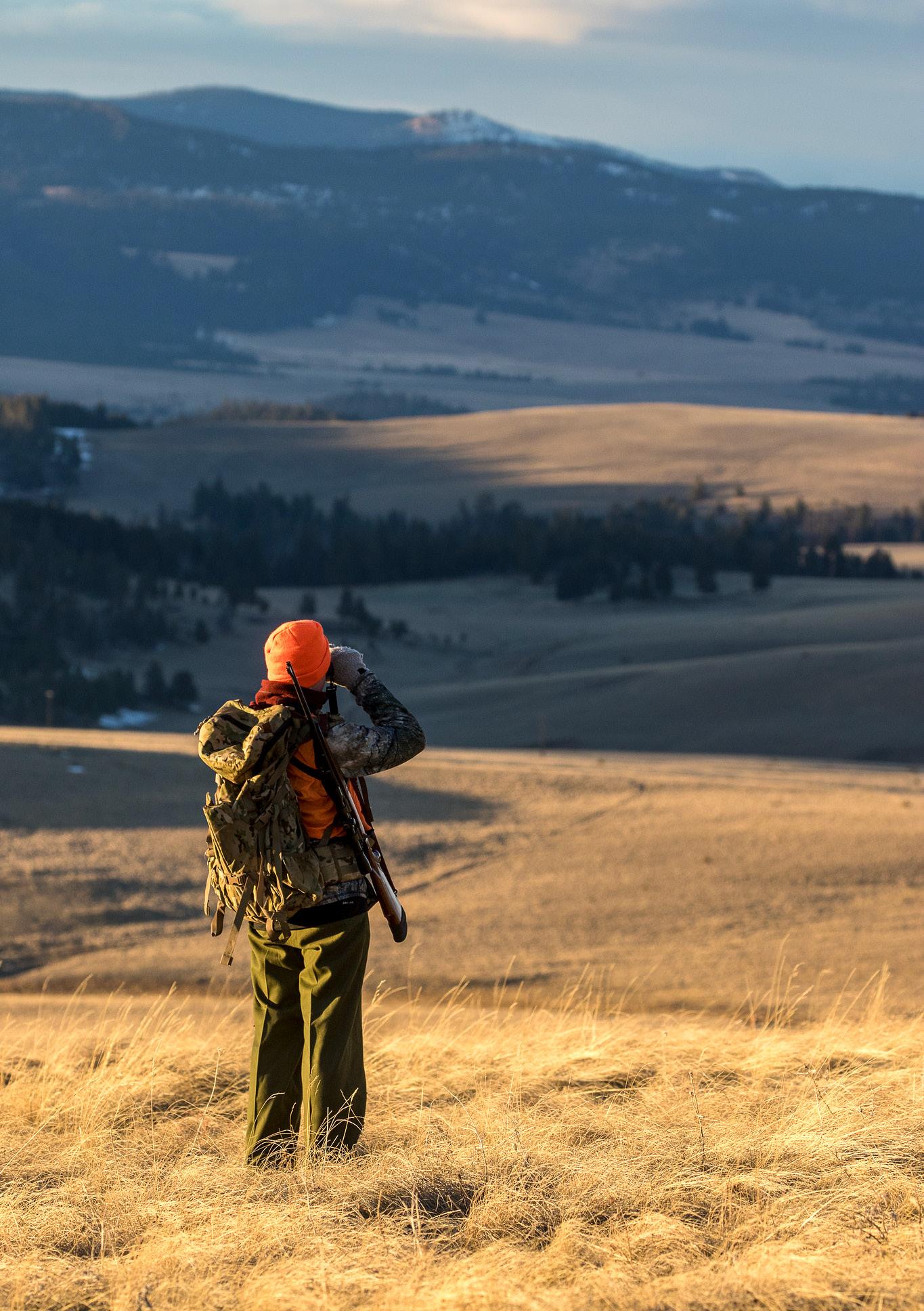
Finding ways for hunters and others to access public and private lands is a keystone of FWP’s mission. PHOTO BY PAUL QUENEAU / FWP
RUNNING BEAR INTERFERENCE
I DID NOT SEEK OUT A CAREER WORKING WITH GRIZZLY BEARS, but they sure found me. I grew up in South Dakota’s Black Hills near Wind Cave National Park. The summer before I left for college to play football, I learned some friends were applying for temp jobs with the National Park Service, so I did too. The application let you choose two parks, so I picked Yellowstone and Wind Cave. The next thing I knew I was stationed at Yellowstone Lake selling fishing and backcountry permits.
A few weeks later, a supervisor asked if I knew how to ride and pack horses, which I did, and soon I was out in the woods clearing trails. Then a few weeks after that, they offered me a spot in grizzly management driving around to “bear jams” on the park’s roadways trying to keep tourists and bruins separated. I can’t say why my bosses thought I’d be good at running interference with grizzlies. Maybe they figured my background as a football free safety was good training. Whatever the case, I was hooked, so I transferred to Montana State University where I majored in wildlife management.
I didn’t play football for the Bobcats but darted bison in Yellowstone for winter research projects and spent six summers trapping grizzlies with the Interagency Grizzly Bear Study Team. In 2006, Kevin Frey, then FWP’s bear management specialist for southwestern Montana, suggested I apply to be the state’s first permanent grizzly bear management technician, working to prevent conflicts between grizzly bears and people. Frey was an amazing mentor, and after he retired in 2021, I took the reins as Region 3 bear management specialist.
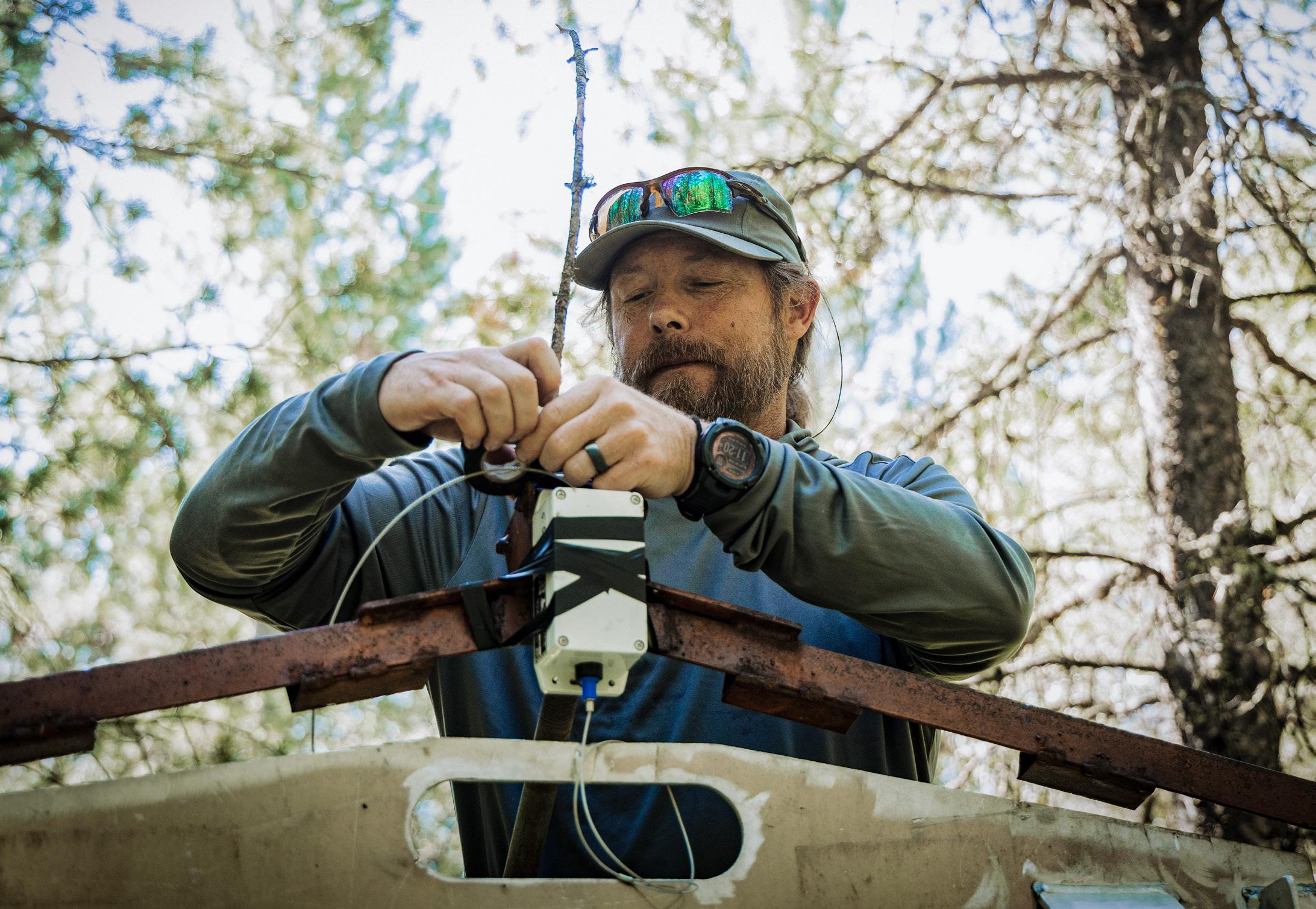
I often work with law enforcement and other field staff across FWP’s divisions who are critical to all I do. Part of my job still involves catching bears in culvert traps, which are easier to check now using transmitters like the one I’m installing in the photo above. It sends a notification via satellite once an animal is caught.
Grizzlies keep showing up in new places, and a big part of my job is helping people navigate the changes. The sooner they call me, the better chance we have of keeping a bear from becoming food conditioned and a threat to human safety.
JEREMIAH SMITH Grizzly bear specialist, Region 3
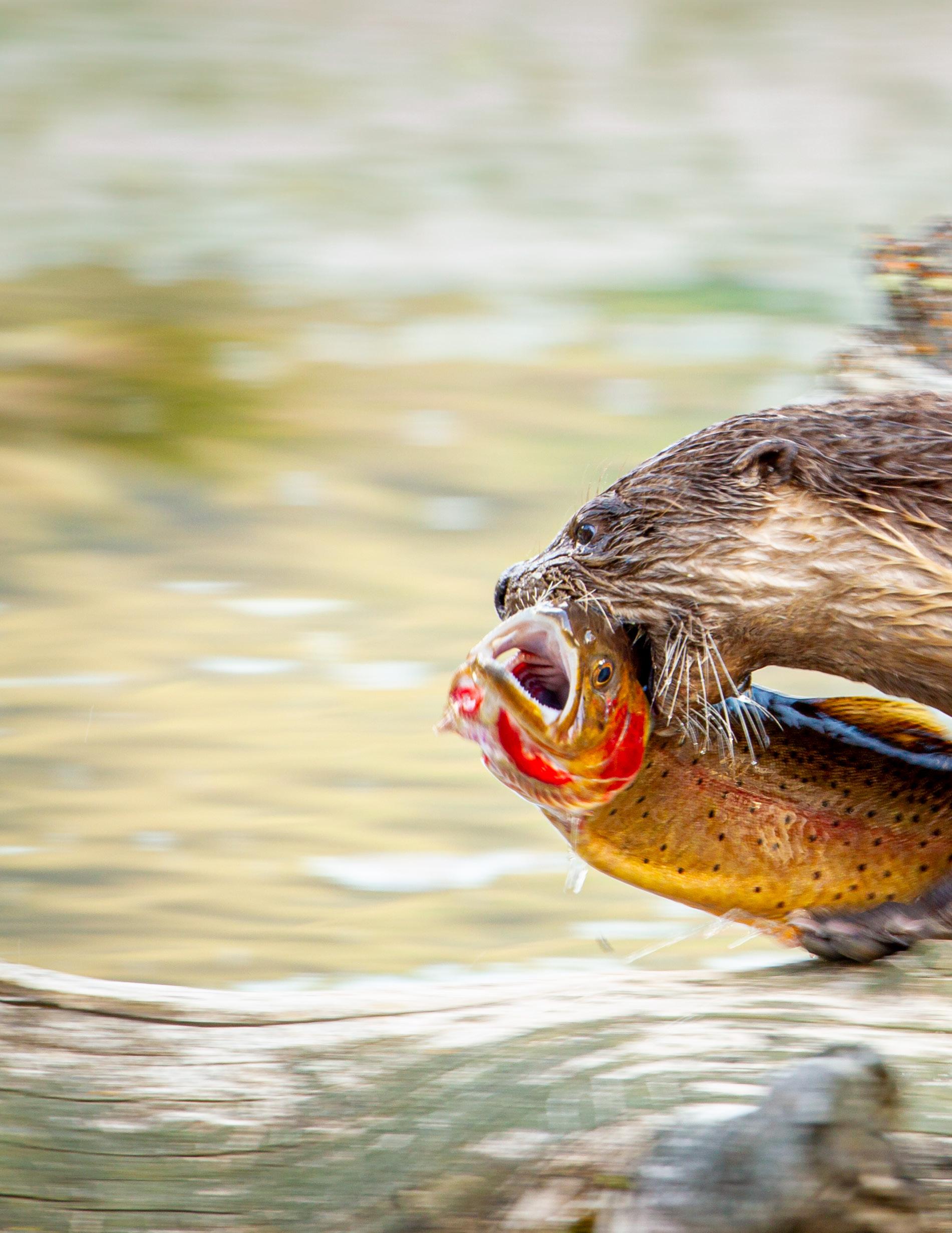
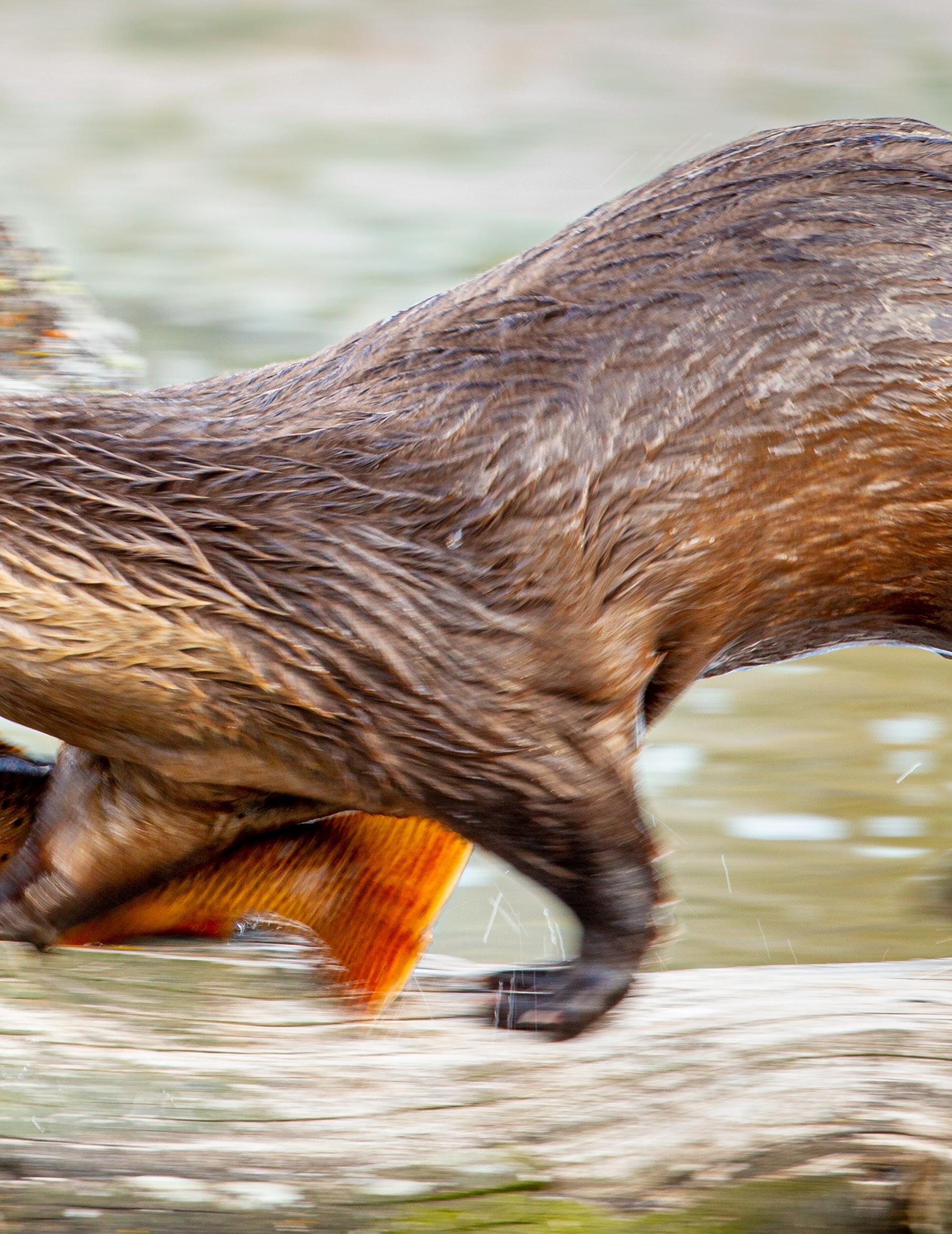
Big Timber–based photographer Cindy Goeddel returned for several years to a lake she knew was home to a family of river otters that preyed on Yellowstone cutthroat during spawning. “This female caught four trout in the span of a few minutes, which she delivered to her three offspring before eating the last one herself,” says Goeddel. “After getting dozens of photos, I decided to play around a bit and dropped my shutter down to 1/60th of a second to try panning with her movements. It’s always the luck of the draw when you do that, so I was excited to find this photo captured both the eyes of the otter and the fish in focus. But I didn’t like how it cropped the body off the otter, and I almost deleted it. I’m glad I didn’t! I came back to it later and totally changed my mind. If the image had included the otter’s entire body, it would have distracted from those eyes. Now I think it’s a keeper—just like that otter felt about the fish.” n
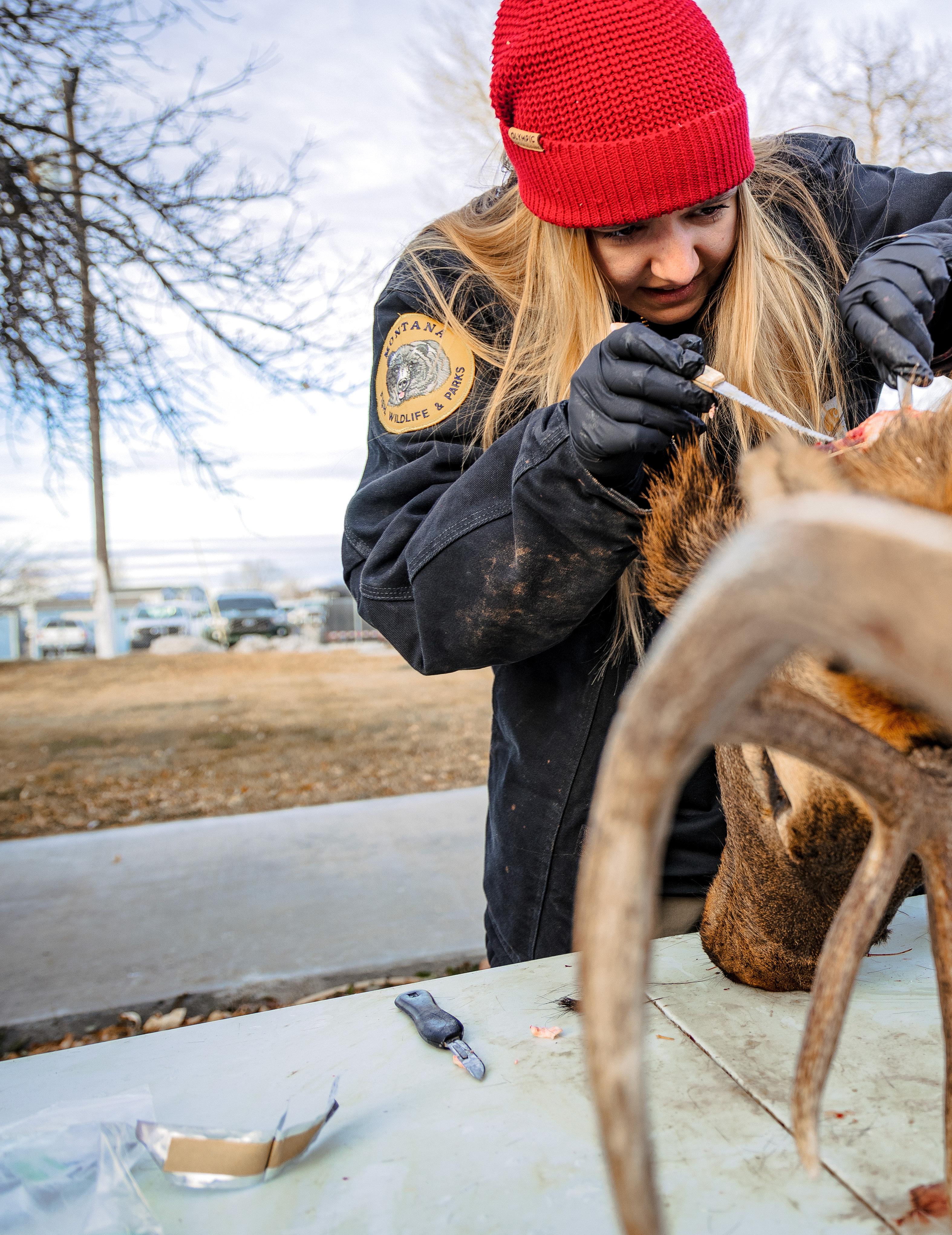
SKILLFUL SLICER FWP’s chronic wasting disease technicians spend long days collecting samples from deer, elk, and moose to test for CWD. Last November, Yvette Bonney did just that, working at an FWP sampling station out of an old camper with her tools and a folding table. She processed up to 30 animals per day, extracting lymph nodes, muscle tissue, and teeth for lab testing. This job is far from glamorous, but Bonney said she loved connecting with hunters, even as a vegetarian. CWD techs are vital to understanding and managing this disease, providing more than 9,500 samples in 2024 alone (up from almost 7,500 the previous year)—critical data for wildlife management across Montana. To learn how to have your animal tested, turn the page, or to watch how FWP trains its CWD samplers, scan the QR code at right or visit qr1.be/YMZY n PHOTO BY
NICK DANIELSON / MONTANA FWP
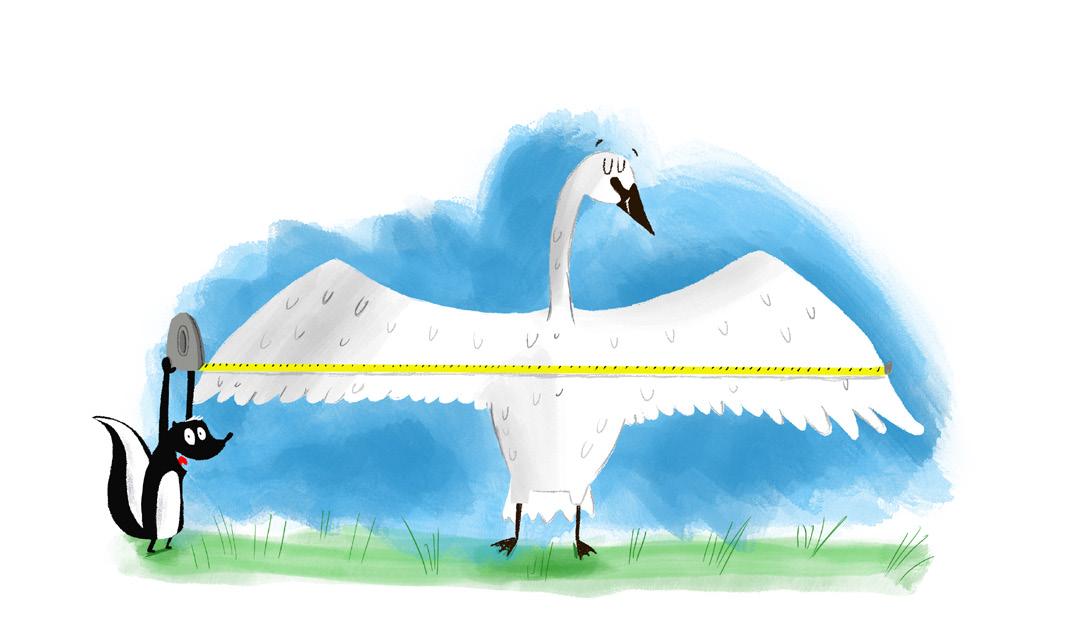
8Wingspan, in feet, of the trumpeter swan—the widest of any Montana bird.
PROTECT MONTANA’S HERDS
Breaks easement protects habitat, provides access
When Lesley Robinson, chair of the Montana Fish and Wildlife Commission, announced “motion carried” at the commission’s August meeting, her words secured the future of the 1,080acre Stafford Ferry Conservation Easement.
It also secures public access for hunting and other recreation.
Hunters can help curb the spread of chronic wasting disease, which is fatal to every deer, elk, or moose that contracts it. Research suggests that once it infects 20 to 40 percent of a herd, it can drastically lower populations, so tracking where and how many animals have CWD is critical.
Do your part by having every animal tested, a free service provided by FWP. Hunters can have animals sampled in minutes at CWD sampling stations or most FWP offices, or you can do it yourself using our instructional videos.
Learn how and where to submit a sample at fwp.mt.gov/cwd
It marked the happy finale of a long and painstaking effort by Sonja Andersen, FWP’s Lewistown-area wildlife biologist, who devoted herself to the project over the past few years. Andersen led the way for FWP, helping to rally area landowners and other stakeholders whose support was pivotal to getting the project approved.
“Success in conservation grows over time. Developing strong relationships and building on past efforts are what allow a ‘conservation footprint’ to take root, build momentum, and expand,” Andersen says. “It’s always a group effort, and when things come together it pays dividends for generations. With any luck, people 100 years from now will look back on us with gratitude for our foresight.”
The easement protects sagebrush-grassland habitat bordering the Missouri River Breaks in deer and elk Hunting Districts 417 and 426, home to Montana’s largest herd of bighorns.
Spearheaded by a landowner, a conservation easement is a voluntary agreement that relinquishes development rights but retains most other rights. It remains one of the best conservation tools available for protecting wildlife habitat and open space while also allowing for grazing, forest management, and other existing agricultural practices to maintain working lands and family traditions.
An independent appraisal valued the easement at $1,080,000. The landowner donated a portion of the easement’s value to help complete the project, lowering the price to $980,000. FWP used proceeds from bighorn sheep auction tags and Habitat Montana (a state program funded by hunting license sales and private donations) to complete the purchase. Northwestern Energy, the national Wild Sheep Foundation, and the Montana Wild Sheep Foundation also provided funding.
“We at FWP are very thankful to all our partners in this project,” Andersen says. “While conservation easements require years of work and commitment, when a project succeeds, it can inspire the next one, and hopefully, this will inspire more to follow.” n
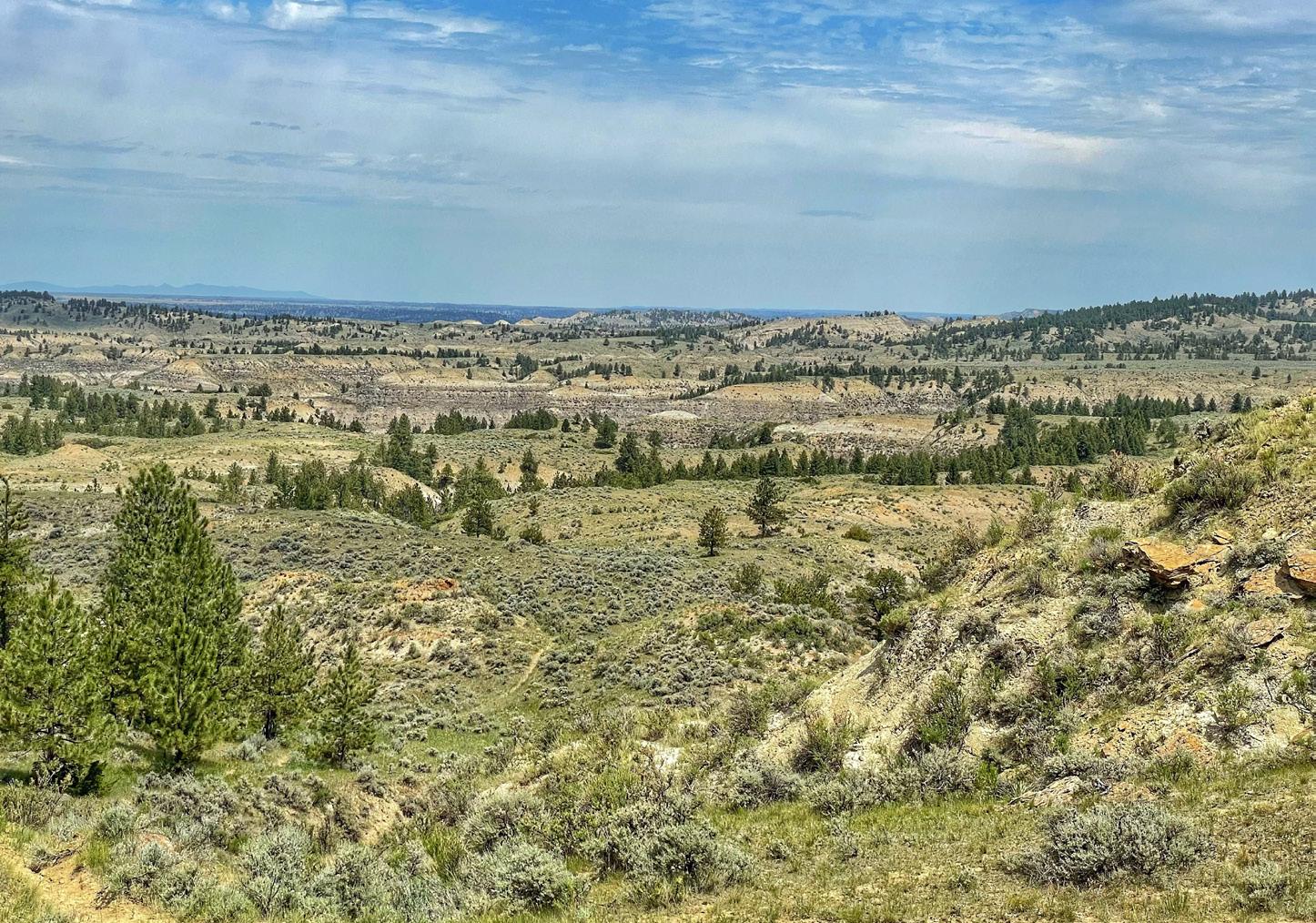
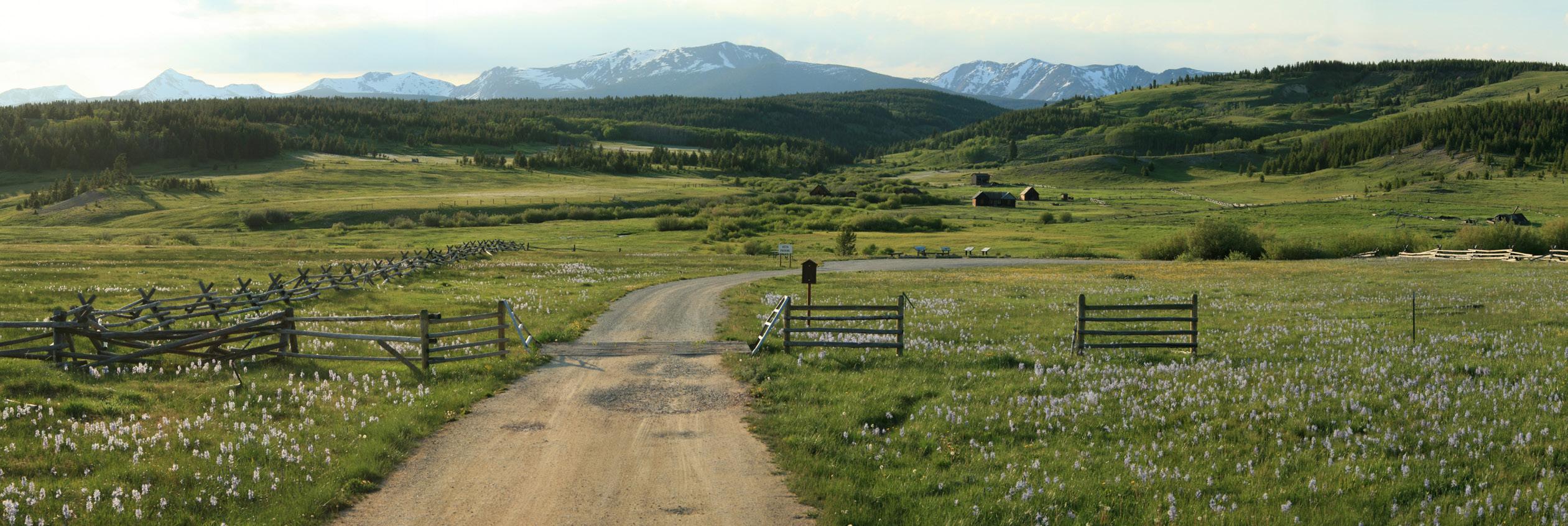
A view of the new Stafford Ferry Conservation Easement 10 miles north of Winifred.
Recommended reading Great books that crossed our desk in 2025
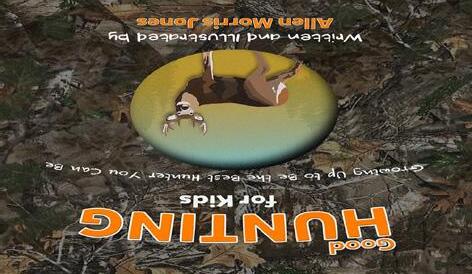
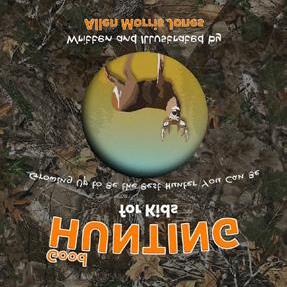
Good Hunting for Kids: Growing Up to Be the Best Hunter You
Can Be
By Allen Morris Jones
Hunting is one of the most exciting things a kid can do outdoors. It also teaches patience, stamina, how nature works, and where meat comes from. This book walks young hunters through the methods of hunting, the coolest attributes of huntable birds and big game, the basic rules of safety, the importance of hunting ethics, and what it means to be a good hunter. It’s also wonderfully written by Montana’s newest poet laureate, Allen Morris Jones, who Gov. Greg Gianforte appointed in September.
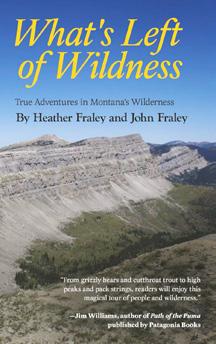
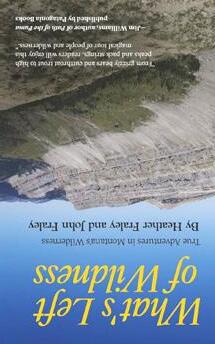
What’s Left of Wildness: True Adventures in Montana’s Wilderness
By Heather Fraley and John Fraley
This book captures the magic of Montana wilderness areas through the stories of outfitters and foresters who spent their careers in untamed country. Heather Fraley works as a magazine editor in Missoula, and her father and co-author John Fraley spent 40 years with FWP, including 25 years as regional education and outreach specialist in Kalispell. It is Heather’s first book and John’s sixth. Both are avid wilderness adventurers, and their love for Montana’s landscapes shines through on every page.
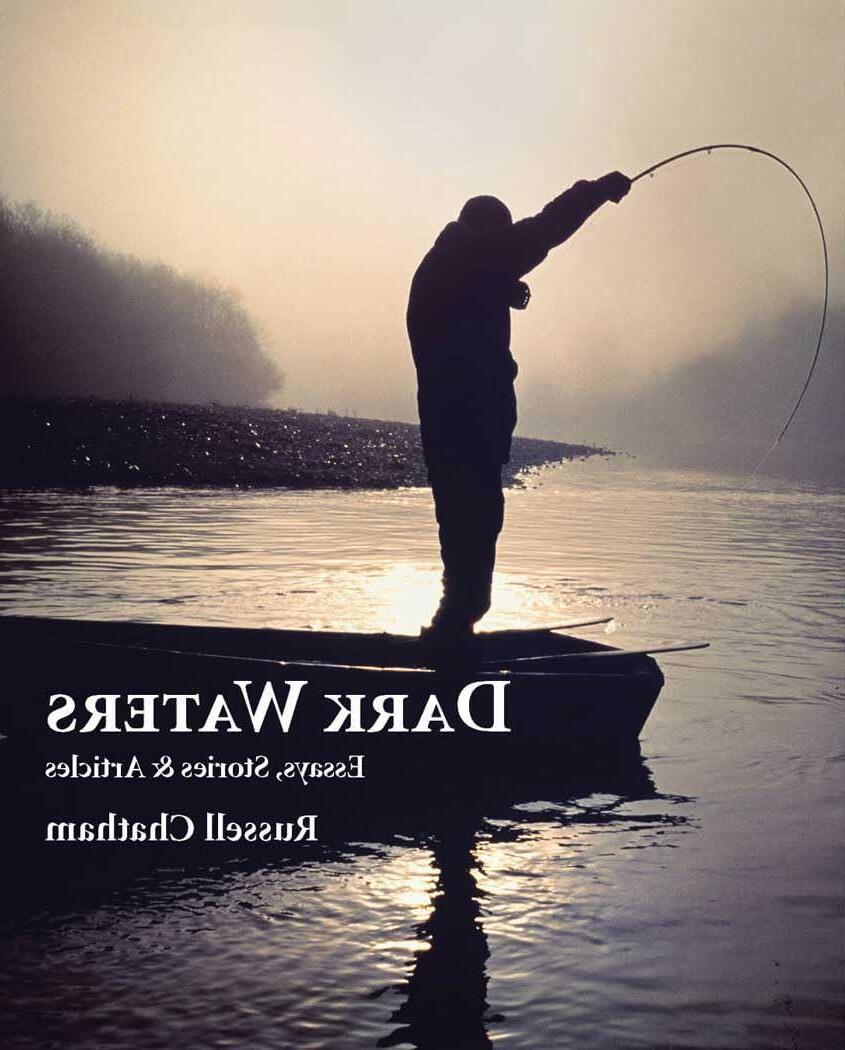
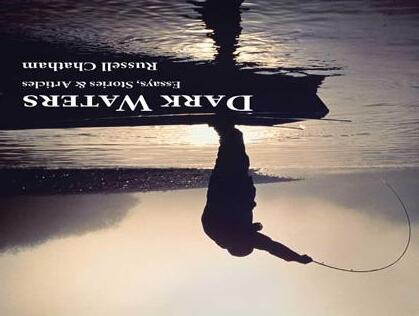
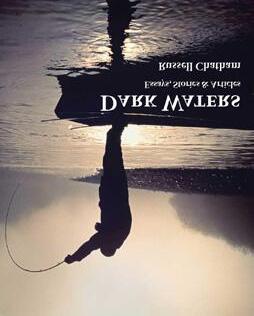
Dark Waters: Essays, Stories, and Articles
By Russell Chatham
First published in 1988 and long out of print, this classic collection of essays and stories was re-released in 2025 by Ice Cube Press. It recounts Chatham’s experiences as a landscape artist and fly fishing enthusiast, with narratives on hunting, food, wine, friends, and the journey of life. Chatham, who died in 2019, spent much of his life in Livingston, and this book gorgeously sketches a bygone era.
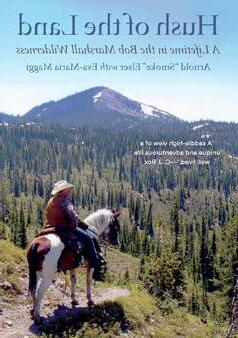
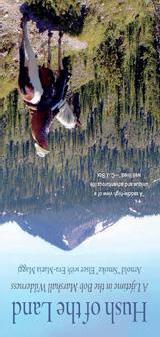
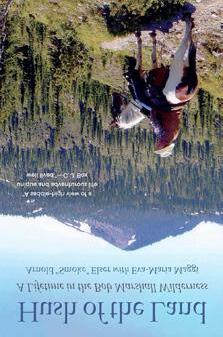
Hush of the Land: A Lifetime in the Bob Marshall Wilderness By Arnold “Smoke” Elser and Eva-Maria Maggi
This memoir follows outfitter and horsepacking instructor Arnold “Smoke” Elser’s 60-year effort to share Montana’s wild country with others. He recounts trips into the Bob Marshall and other wilderness areas, encountering grizzlies, fishing clear mountain streams, and spending countless nights next to a campfire. He also chronicles how his career gave him an influential voice in wilderness conservation.
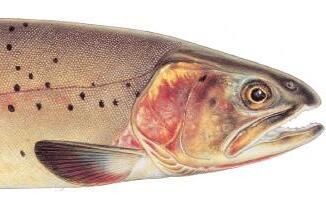
Cutthroat trout: from one species to four
Anglers may notice a new name floating around the trout world: the Rocky Mountain cutthroat (Oncorhynchus virginalis). This isn’t the result of a new species being discovered, but rather a reclassification based on genetic analysis and a greater understanding of how different trout populations evolved.
Cutthroat trout were long grouped as a single species (Oncorhynchus clarkii) with more than a dozen subspecies, including two found in Montana—the westslope and
the Yellowstone. But in 2023, cutthroats were split into four species: coastal, Lahontan, westslope, and Rocky Mountain. The Yellowstone cutthroat ( Oncorhynchus virginalis bouvieri) is now classified as a subspecies of Rocky Mountain cutthroat trout, along with eight other interior subspecies, including the Rio Grande, Colorado River, and Bonneville.
The westslope cutthroat trout (now Oncorhynchus lewisi ) currently has no recognized subspecies.
Both Yellowstone and westslope cutthroats are Montana Species of Concern, having suffered population declines mainly from habitat loss and competition from (or hybridization with) non-native rainbow trout. Kristen Cook, FWP’s native species coordinator for coldwater fish, says the agency has been developing conservation strategies
for the state’s cutthroat trout.
“The priorities are to conserve migratory cutthroat and non-hybridized populations, both of which are extremely challenging,” she says. “Most of our migratory populations are not really doing well.” She also notes that FWP has several projects in the works that aim to boost cutthroat numbers, including a Shields River restoration designed to aid Yellowstone cutthroat trout by removing invasive brook trout from the upper river.
Though Yellowstone and westslope cutthroats are no longer members of the same species, they continue to share the title of Montana’s state fish, an honor they’ve held since 1977.
Updated information can be found on the Fishes of Montana app, a joint project between FWP and Montana State University. n
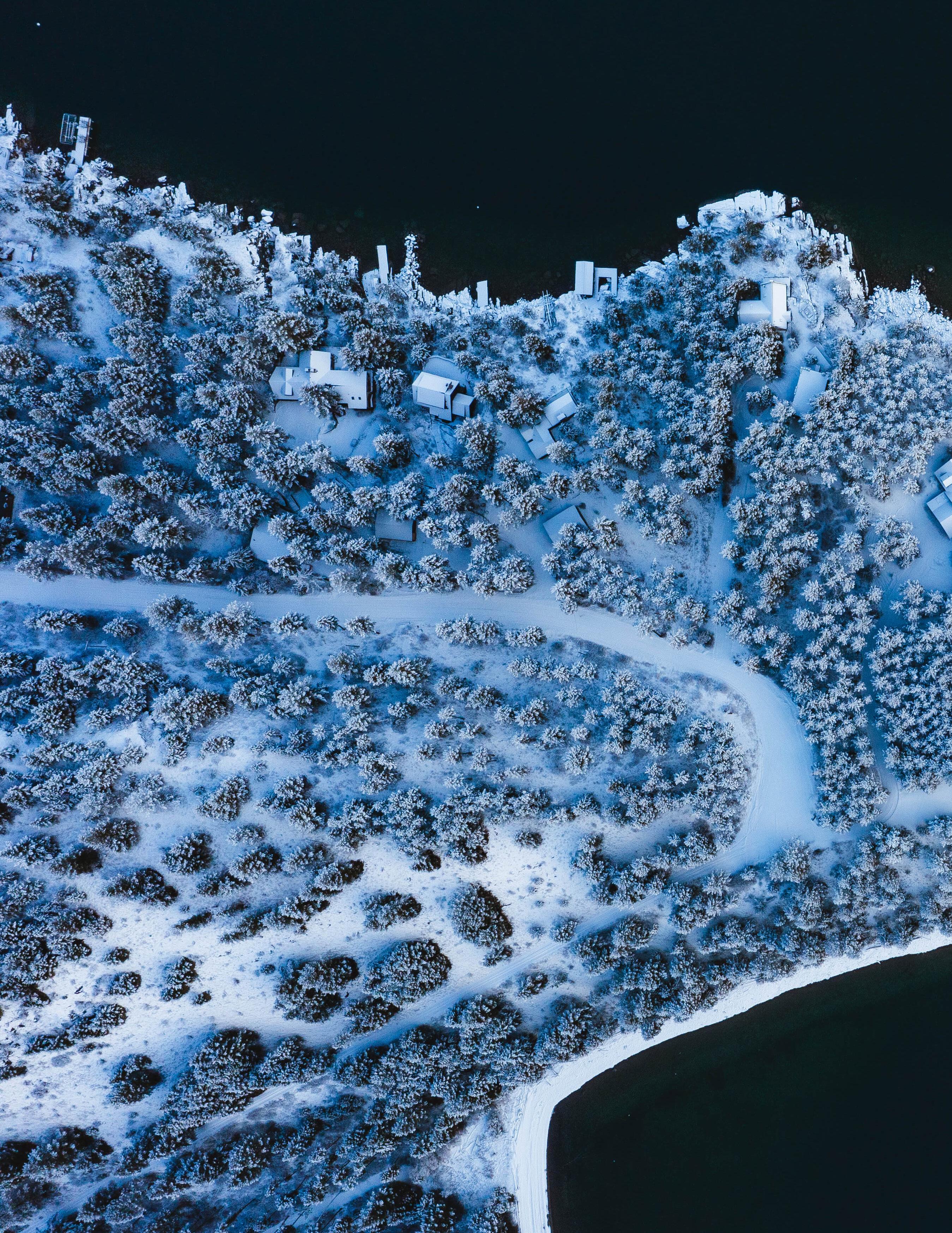
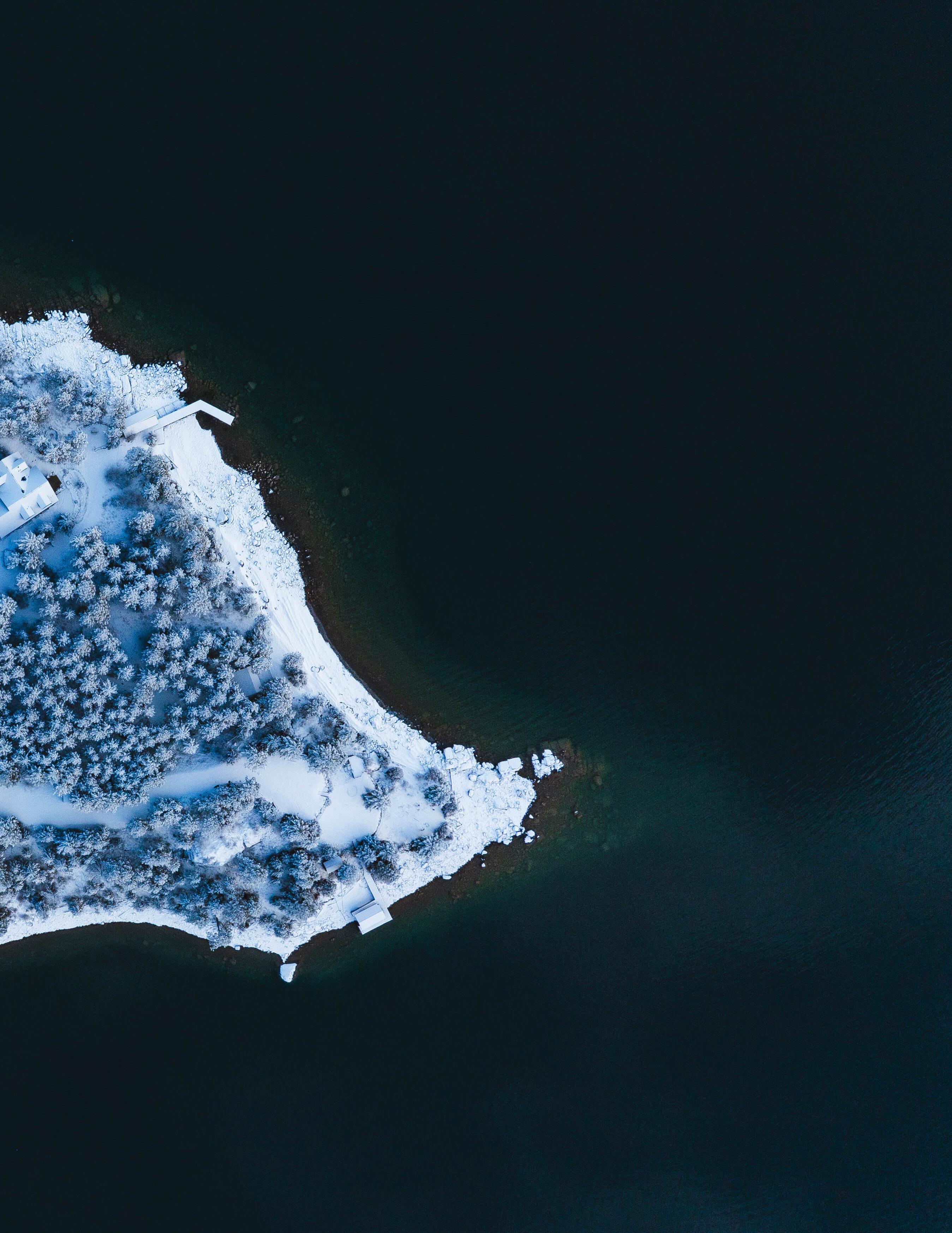
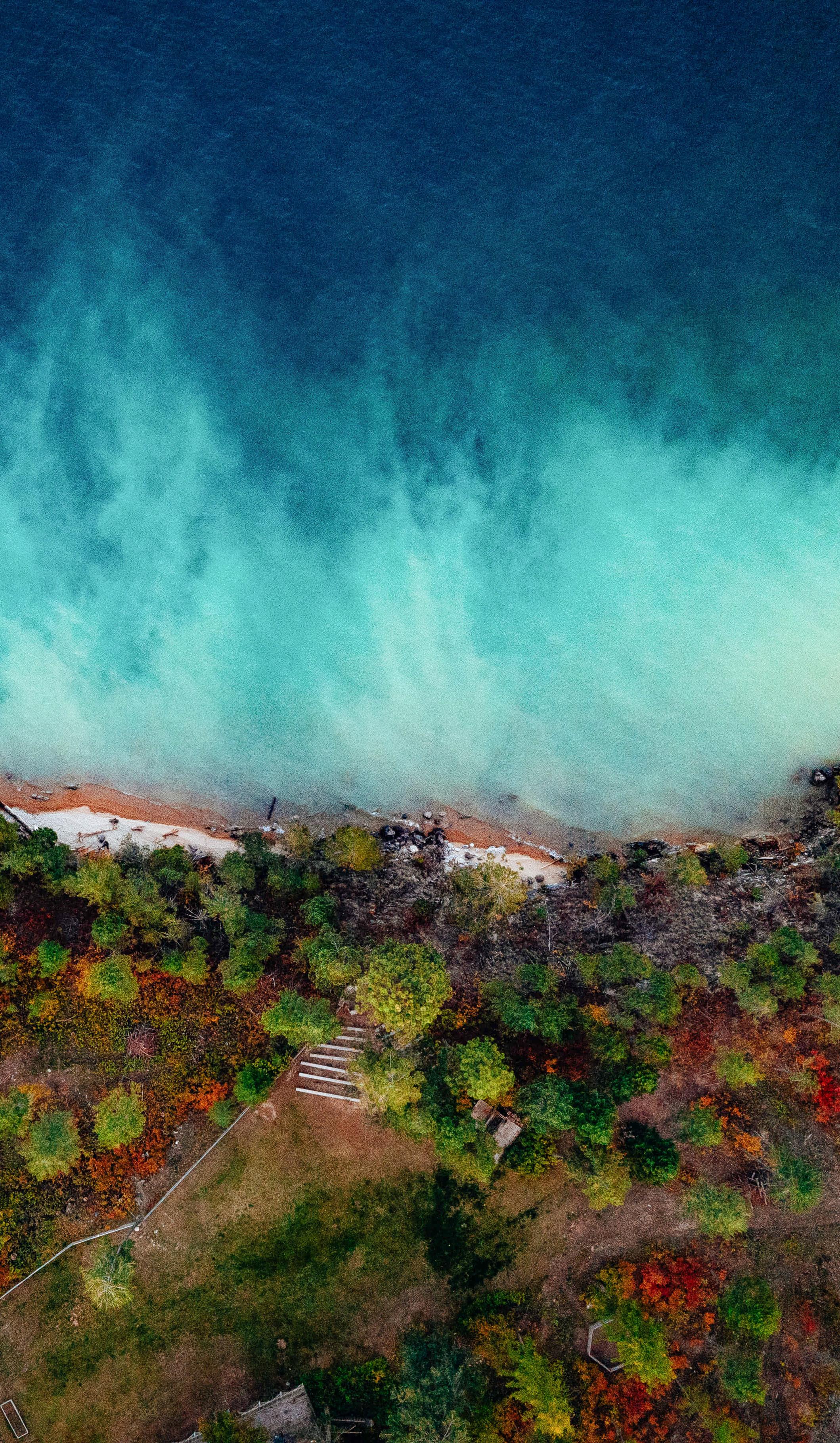
Having grown up in Whitefish, photographer Nicolas James of Liberty Lake, Washington, has admired views of Flathead Lake since childhood. On a cold January day, he was driving along the lake’s western shore on his way to ski Whitefish Mountain when he realized the cake-frosting-like snow conditions could make for an interesting aerial photo. So he pulled over for a pit stop. “Drone photography has become one of my passions,” says James. “I love how landscapes look vertically—peering directly down on Earth is a perspective we don’t often get as humans. The landscape becomes a texture. I must admit I didn’t immediately see the bear shape in this image until a friend pointed it out. That led me to crop it horizontally, and I was floored by the difference. The bear’s silhouette suddenly leapt off the photo.” To read how Montana Fish, Wildlife & Parks and others are working to protect Flathead Lake’s shorelines, turn to the next page. n
ABSORBING BLOWS THE
From private shorelines to state parks, a Montana-born idea is reshaping how landowners and agencies protect Flathead Lake’s fragile edges.
BY DILLON TABISH
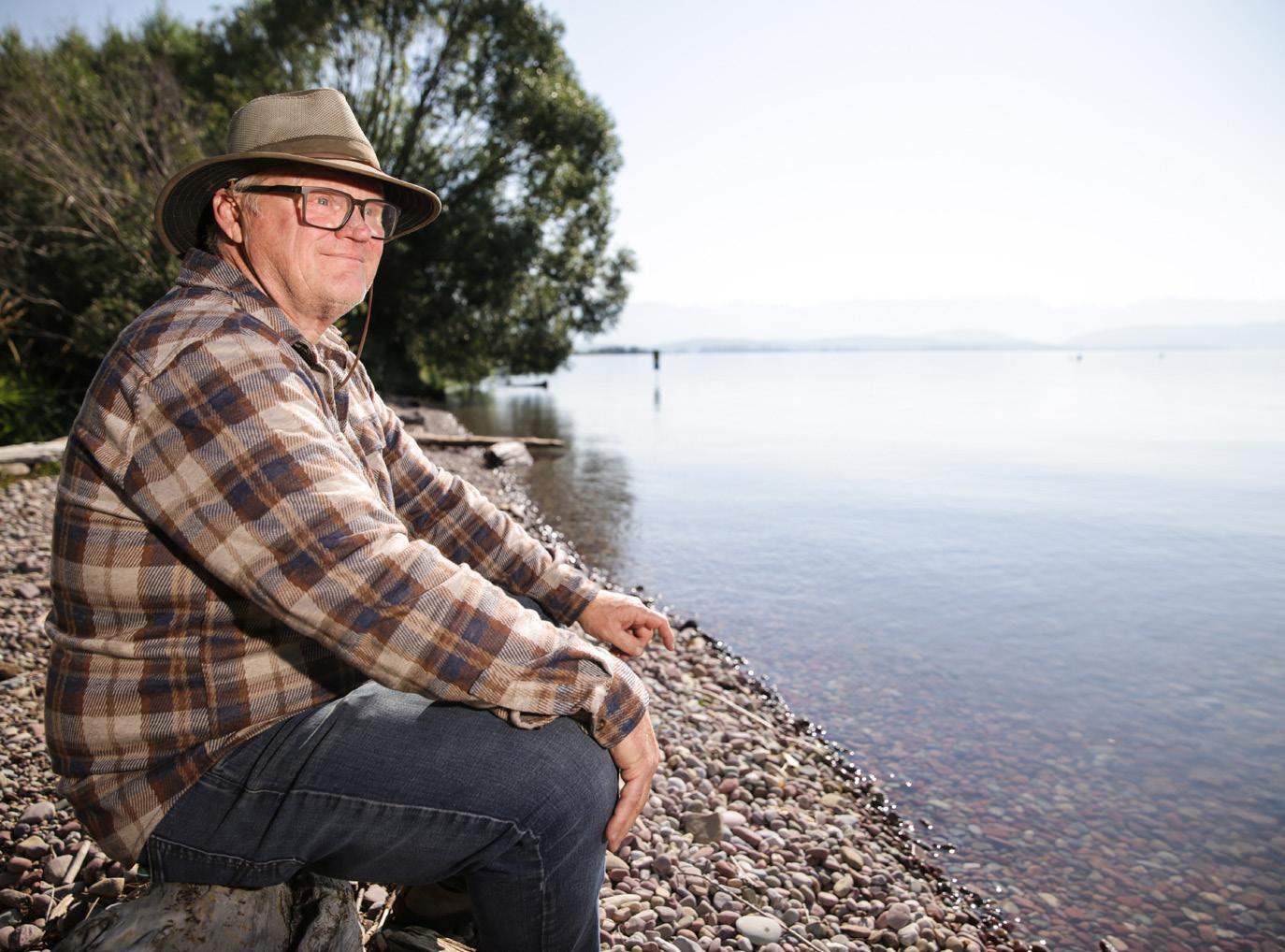
Bob Keenan noticed something unsettling as he arrived home from the 2005 Montana Legislative Session, where he had just wrapped up his latest term in the Senate. His property sits on the north shore of Flathead Lake, and as he walked down to the water, something stopped him in his tracks.
“I could see I had lost about 45 feet of land,” Keenan recalled recently.
“I had a problem.”
The previous fall, right before the former president of the Senate had traveled to Helena for the session, the waves of Flathead Lake had battered his shoreline, causing erosion that’s become an infamous problem around the West’s largest natural freshwater lake.
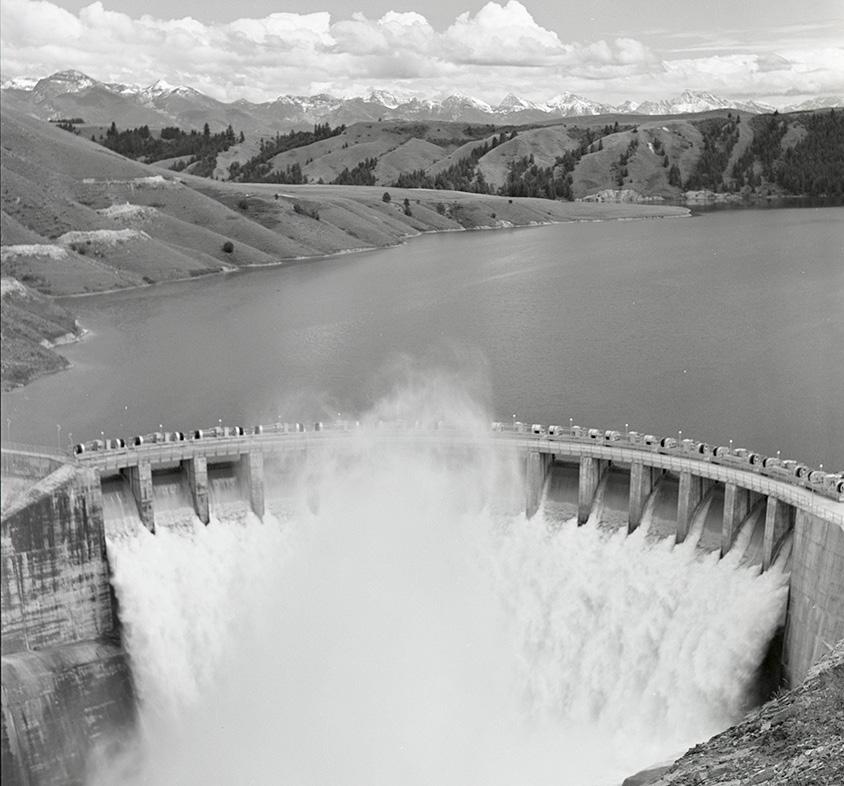
Since the Montana Power Company finished building the Kerr Dam (now known as the Selíš Ksanka Qlispé Dam) in 1938 at the south end of Flathead Lake, the structure has controlled water levels, raising the lake to what’s considered full pool by early summer and dropping it by about 10 feet by wintertime. Under these fluid conditions, shorelines like Keenan’s are vulnerable to the shifting, persistent pounding of waves. The powerful breakers undercut or overwash banks and strip away soil, especially during storms. When dam operators significantly lower levels in late fall and winter, the already weakened and saturated banks slump and collapse,
Dillon Tabish is Region 1 Communication and Education Program manager for Montana Fish, Wildlife & Parks. Born and raised in Missoula, he now lives in Kalispell with his wife and their two young children.
RUPTURED BEACHHEAD Powerful waves chew at Flathead Lake’s shorelines and strip away soil, especially during storms. Once levels drop, undercut banks collapse. The lake’s north shore has receded more than a mile since dam-controlled water level regulation began in 1938. PHOTO BY NICOLAS JAMES
EVEN FLOW Since Kerr Dam (now known as the Selíš Ksanka Qlispé Dam) was built at the south end of Flathead Lake in 1938, it has controlled water levels. It keeps the lake at full pool in early summer and drops it by about 10 feet in winter. These fluctuations contribute to the erosion of the lake's shorelines.
compounding the erosion.
Over time, this unnatural cycle has steadily eaten away shorelines, threatening property, habitat, and recreational access. The lake’s north shore alone has receded more than a mile since water level regulation began in 1938.
The debate on how best to respond crested like a wave in the early 2000s, from a steady stream of letters to the Daily Inter Lake newspaper then spilling into the halls of Congress, where Montana’s U.S. Senator Max Baucus waded into the dam’s management and the impacts of erosion. Keenan followed the controversy closely as fingers were pointed and possible solutions were thrown around. He noticed one vocal critic rejecting the traditional methods of erosion control, such as seawalls or boulders.
The critic was Dr. Mark Lorang, who worked at the Flathead Lake Biological Station at Yellow Bay, down the road from Keenan. A hydrogeologist, Lorang had grown up on the shores of Flathead Lake, witnessing the losses to erosion firsthand. He eventually became an associate research professor at the University of Montana field station on Flathead Lake, teaching courses such as Fundamentals of Sediment Transport and Fluvial Geomorphology.
“I called the Yellow Bay station and asked for Dr. Lorang after I got home and saw what had happened to my land,”
PHOTO COURTESY OF UNIVERSITY OF MONTANA MANSFIELD LIBRARY
Keenan says. “I told him he had been an opponent to every solution I had proposed. Then I asked him if he had a solution. He said, ‘Yes, I do.’”
Half an hour later, Lorang stood on Keenan’s doorstep ready to present his case.
SHOVE THY NEIGHBOR
Waves are the restless muscles of any lake, constantly flexing and pressing against the constraints of land. For landowners aiming to defend their shorelines, the options have been few, crude, and mostly ineffective.
Early attempts at erosion control included embedding junkyard automobiles into shores or riverbanks to deflect the changing currents, aka “Detroit Riprap.” These rusted relics from the ’50s are still visible today along some stretches of the Flathead River and other waterbodies across Montana. Boulders or concrete blocks have since become the most common material for riprap. Some portions of Flathead Lake are fortified with seawall structures like those found along ocean coasts.
These old-school options are neither attractive nor friendly for anyone wanting to play or recreate along the shore. Even more important, they not only don’t solve the problem but actually worsen shoreline erosion.
“Instead of absorbing wave energy, riprap and seawalls just deflect it outward, which then shifts the problem elsewhere,” Lorang says. “That wave energy meets the incoming wave energy. Now you’ve doubled the amount of wave energy. It just gets worse exponentially from there.”
In other words, if one landowner builds a seawall, the ripple effect begins, and neighbors feel the pain.
“That’s why we’re seeing the huge erosion around Flathead Lake,” Lorang says.
A ROCK SOLID ARRANGEMENT
Flathead is not just the largest natural body of freshwater by surface area in the western United States, it’s one of the cleanest lakes in the world. Lorang grew up fascinated with the lake’s unique environment and the constant interplay of land and water. His master’s thesis at Oregon State University focused on Flathead’s shoreline erosion, and his PhD dissertation followed up with a deep dive into wave dynamics and geology. This
PHOTOS BY HUNTER D'ANTUONO
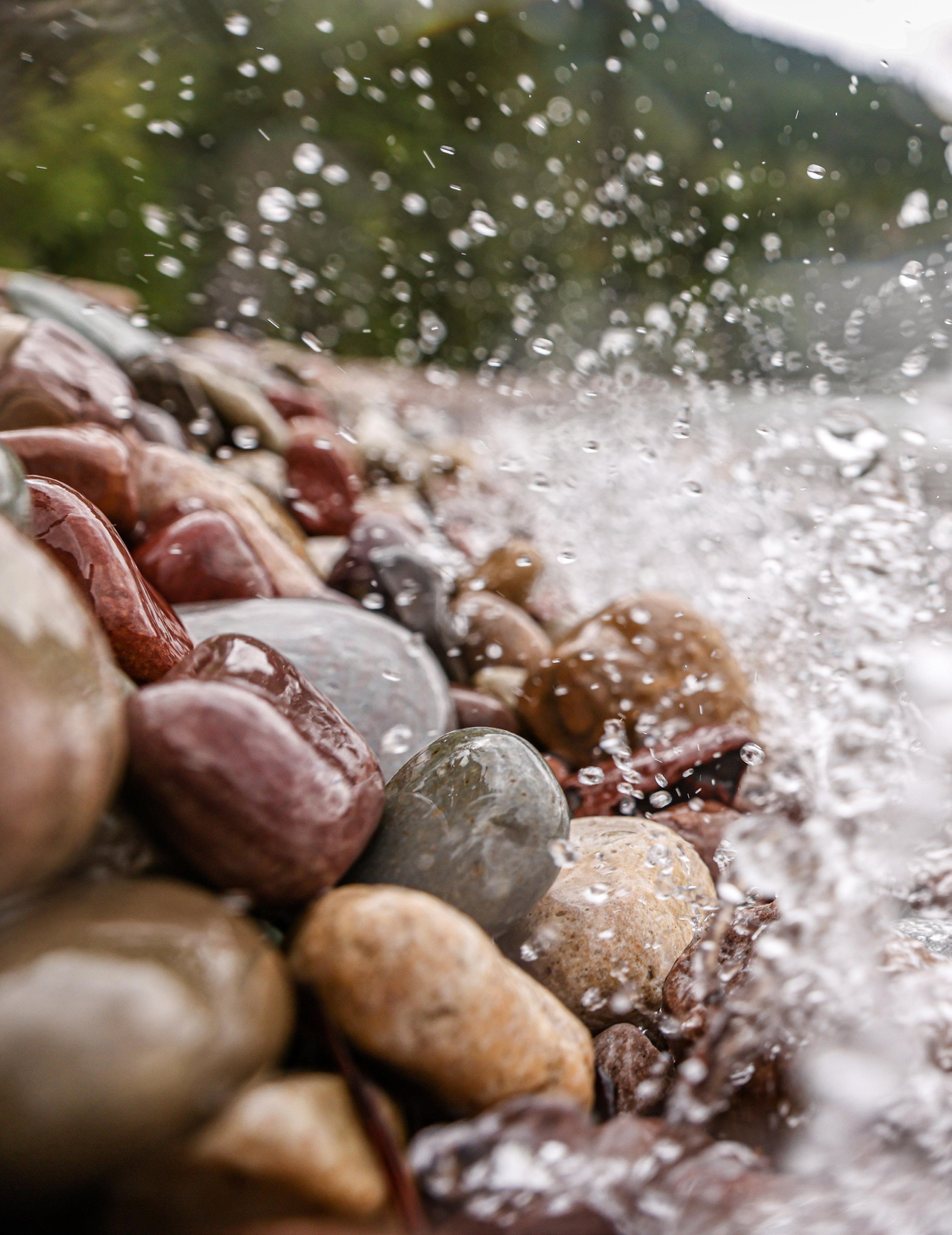
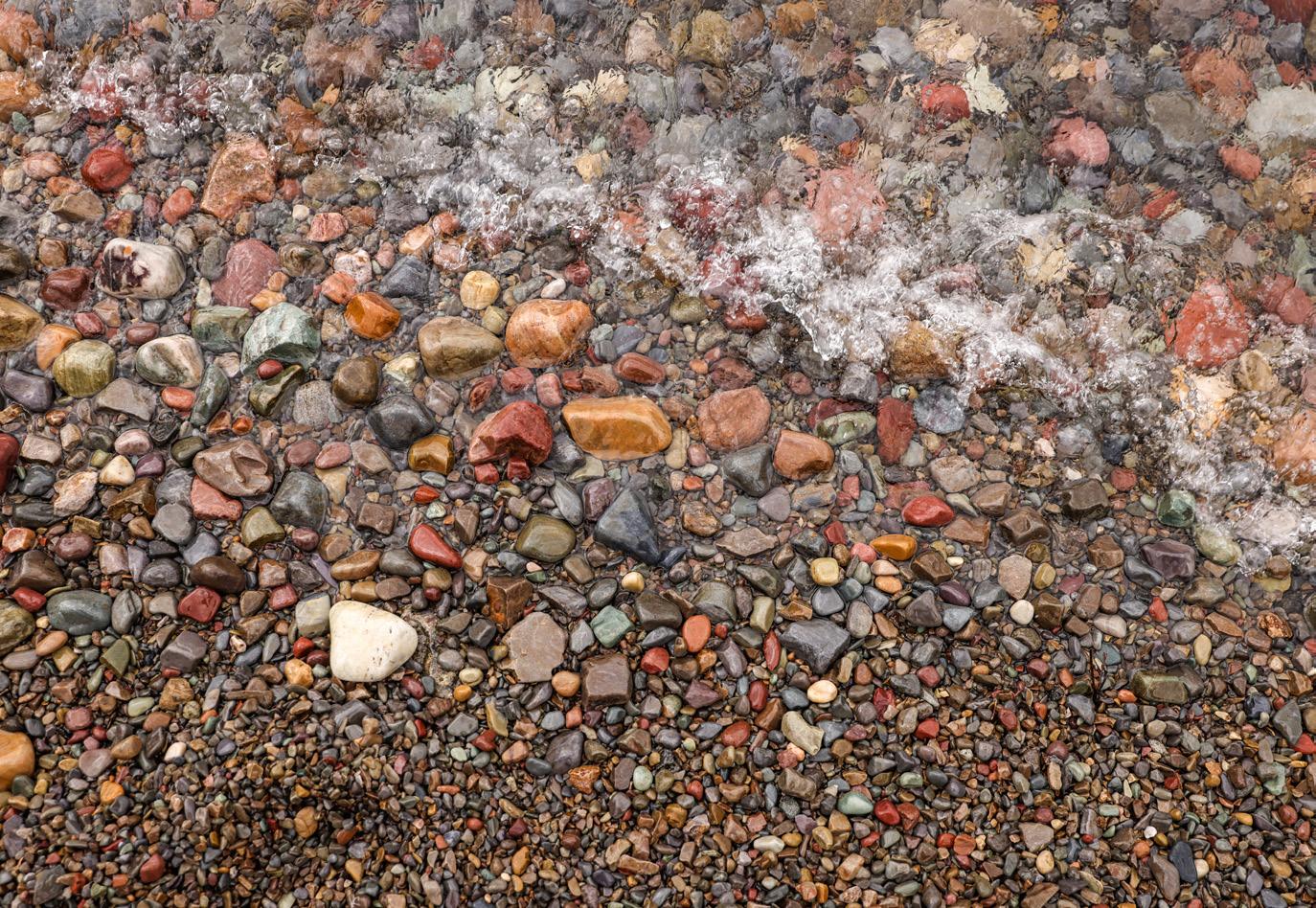
PEBBLE WHISPERER Dr. Mark Lorang (above) used his expertise in sediment transport and hydrology to design a beach that absorbs wave energy rather than deflecting it.
WORKING WITH NATURE
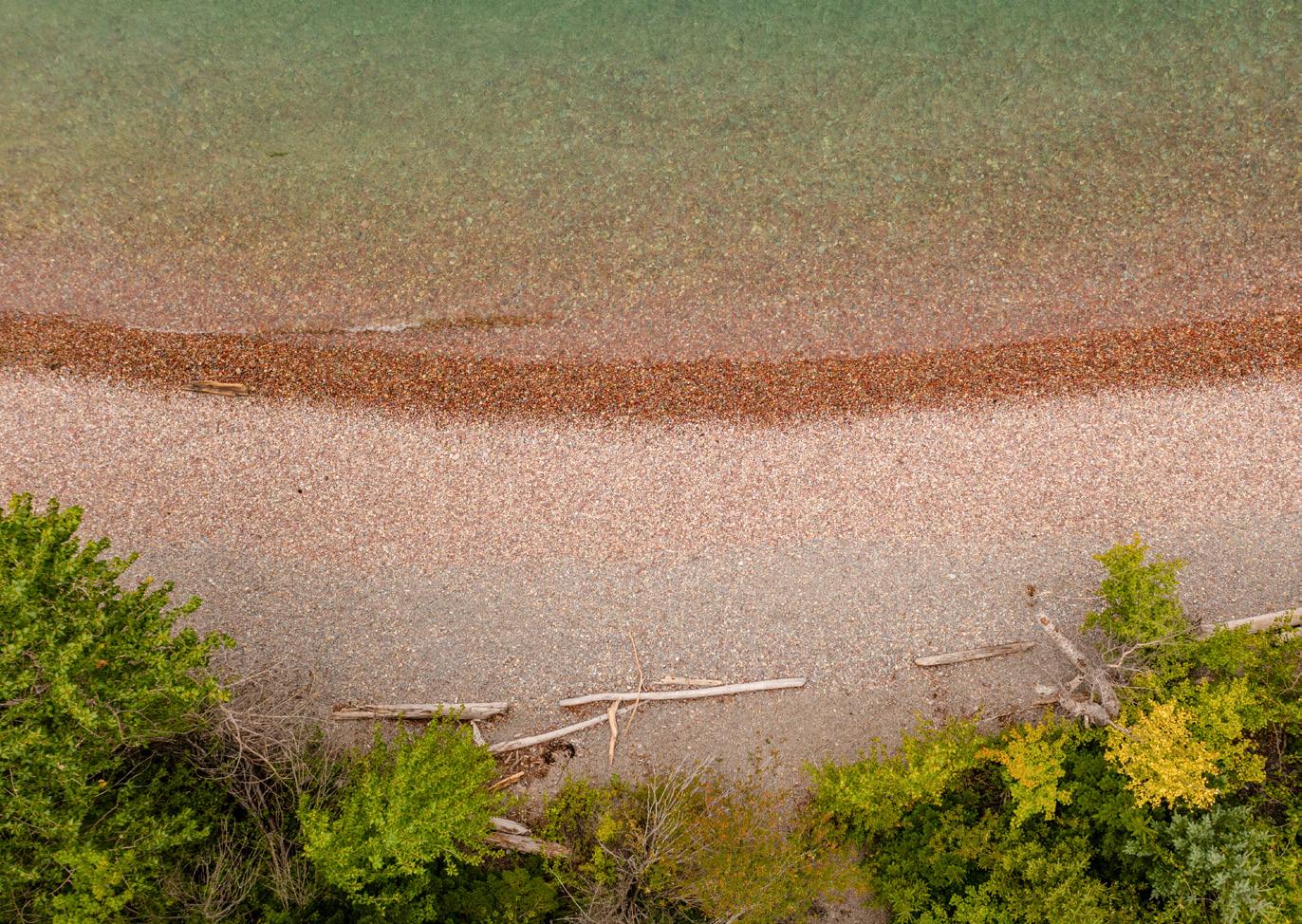
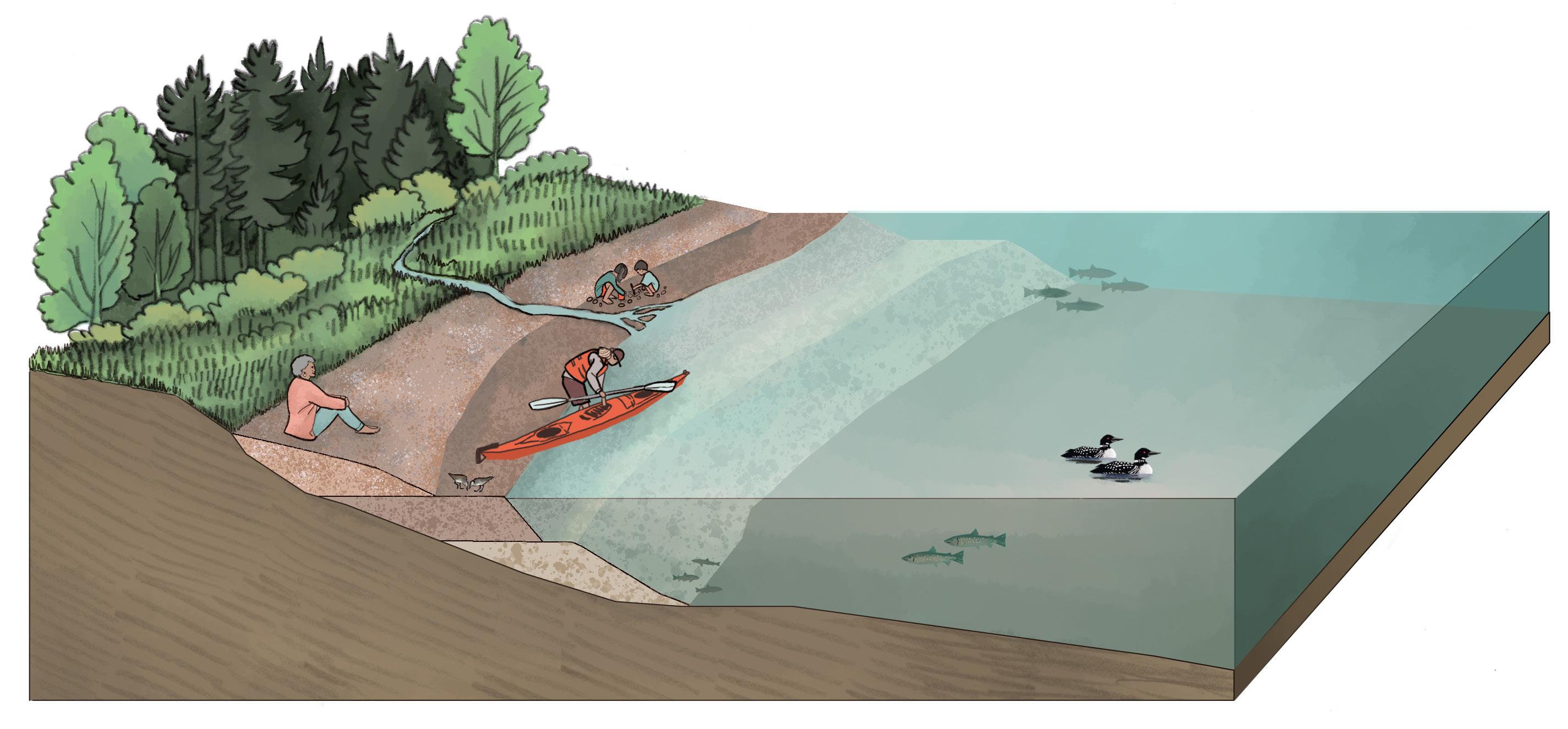
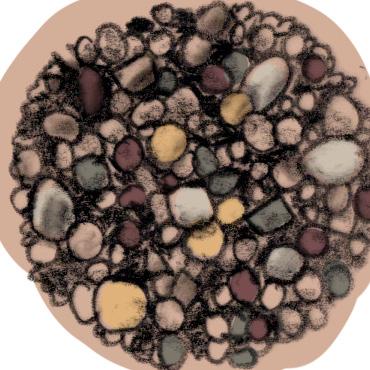
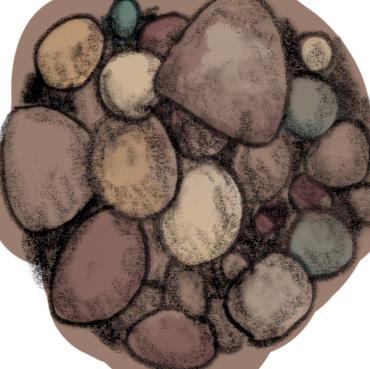
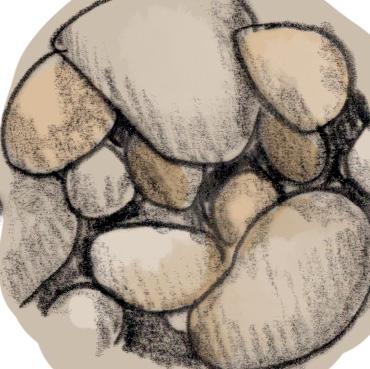
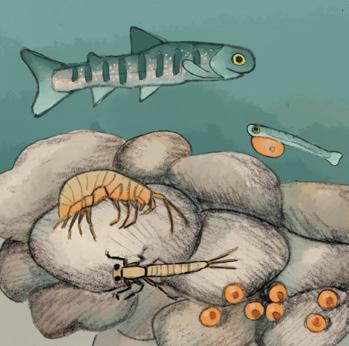
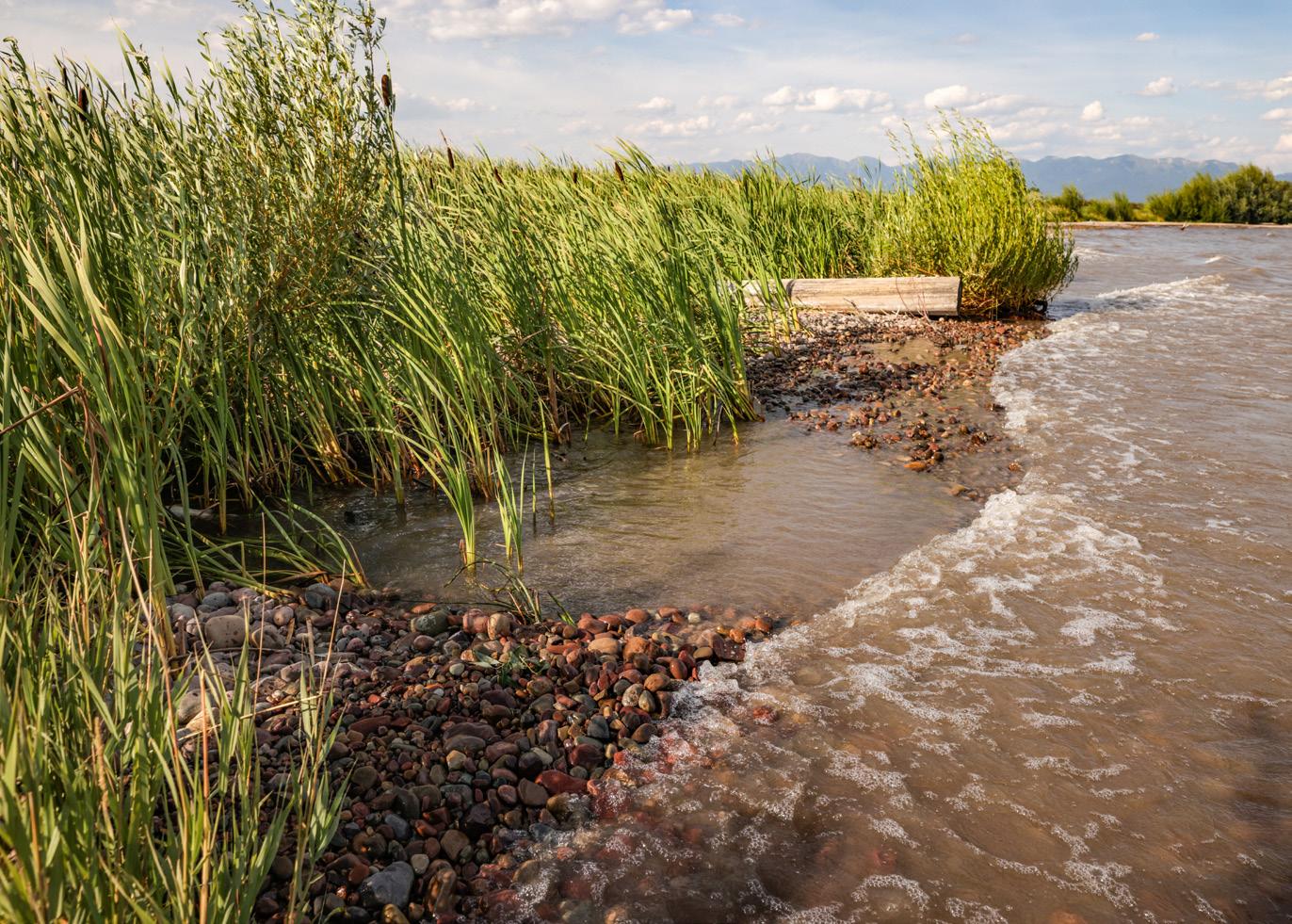
A "dynamic equilibrium beach" uses layers of gravel that grow larger with depth to absorb and disperse wave energy rather than bouncing it sideways. It also provides valuable habitat for fish, waterfowl, amphibians, and aquatic insects.
“It’s about working with natural processes, not trying to dominate them.”
work helped him and two other researchers from Yellow Bay create what’s known as the Shifting Habitat Mosaic Hypothesis. The idea is that constant shifts in floodplain habitat patches—driven by flooding, sediment deposition, and other factors—are a fundamental characteristic of river ecosystems.
This helped Lorang devise a new solution to erosion, one focused on working with the lake’s wave power instead of against it. Using layers of gravel in varying sizes, Lorang engineered “dynamic equilibrium beaches” that mimic the lake’s natural shoreline processes by absorbing and dispersing wave energy, rather than using fortified structures that deflect it to neighboring shorelines.
Over time, the absorption of wave energy sifts and shifts the layers of beach gravel into an ever-more resilient buffer that rebalances itself based on water level to better protect
the shoreline. Vegetation grows well in this natural substrate, helping to further reinforce the beach as plants take root in the shallow water and cobble areas. This provides habitat for insects and other aquatic invertebrates, and the mix of clean gravels and gradual slopes provide spawning habitat and nursery grounds for fish. Waterfowl, amphibians, and other animals also use it for nesting and foraging.
By absorbing wave energy and filtering runoff, these beaches also improve water quality and reduce sedimentation, further supporting a healthy, resilient ecosystem.
Gravel beaches are friendlier to recreation, too, providing a more inviting and comfortable spot to enjoy the shoreline and safer egress for swimmers, paddleboarders, and kayakers than riprap or seawalls.
What’s not to love?
“It’s a mindset shift,” Lorang says. “It’s about working with natural processes, not trying to dominate them. Once you see that the gravel doesn't wash away, you wonder, Why weren’t we doing this the whole time?”
But trying something new requires landowners willing to take that first leap of faith.
“It always takes a pioneer. And Bob [Keenan] was that person,” Lorang says.
Working together, Keenan and Lorang installed an upgraded beach along the 660 feet of shoreline on Keenan’s property.
Skeptics said the gravel would just wash away over time. Yet the beach held strong.
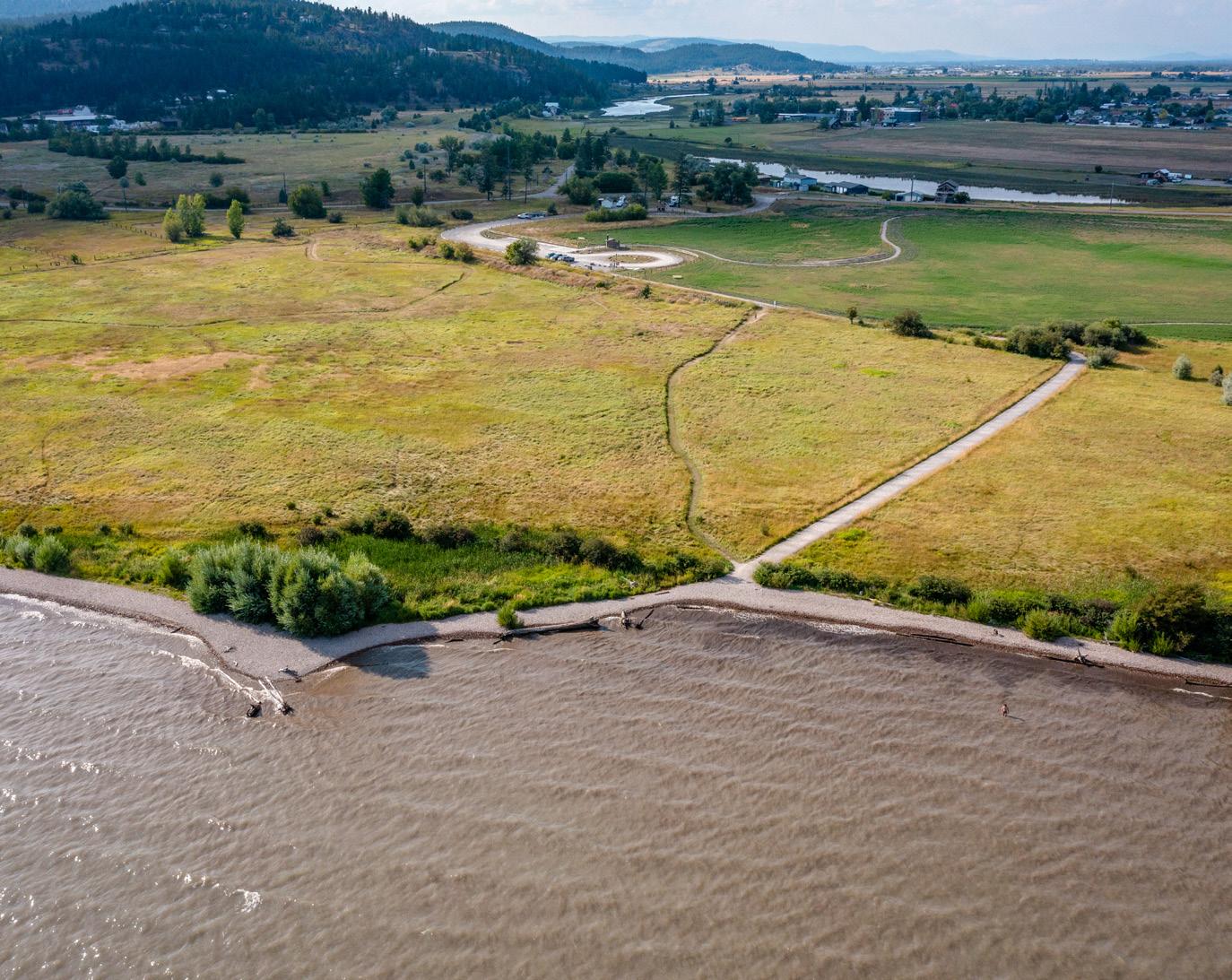
Word quickly spread among property owners along the north shore and got the attention of the U.S. Fish & Wildlife Service, which manages a large section of the 7-mile stretch of shore between Bigfork and Somers as the Flathead Lake Waterfowl Production
Top layer: ¾- to 1-inch pea gravel
Middle layer: 1- to 2-inch drain rock
Bottom layer: 3- to 6-inch drain rock
“This isn’t just erosion control; “This just erosion it’s restoration.”
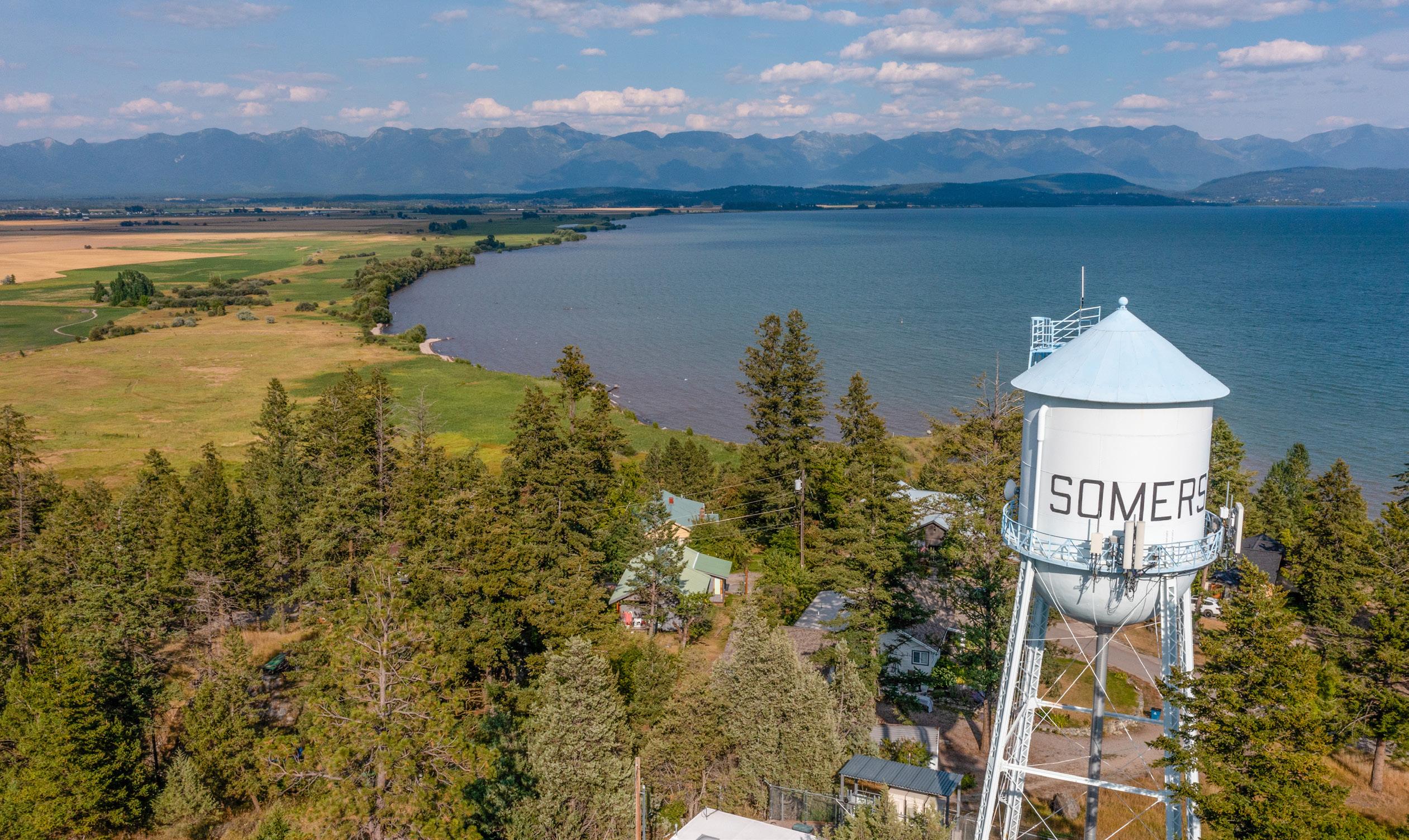
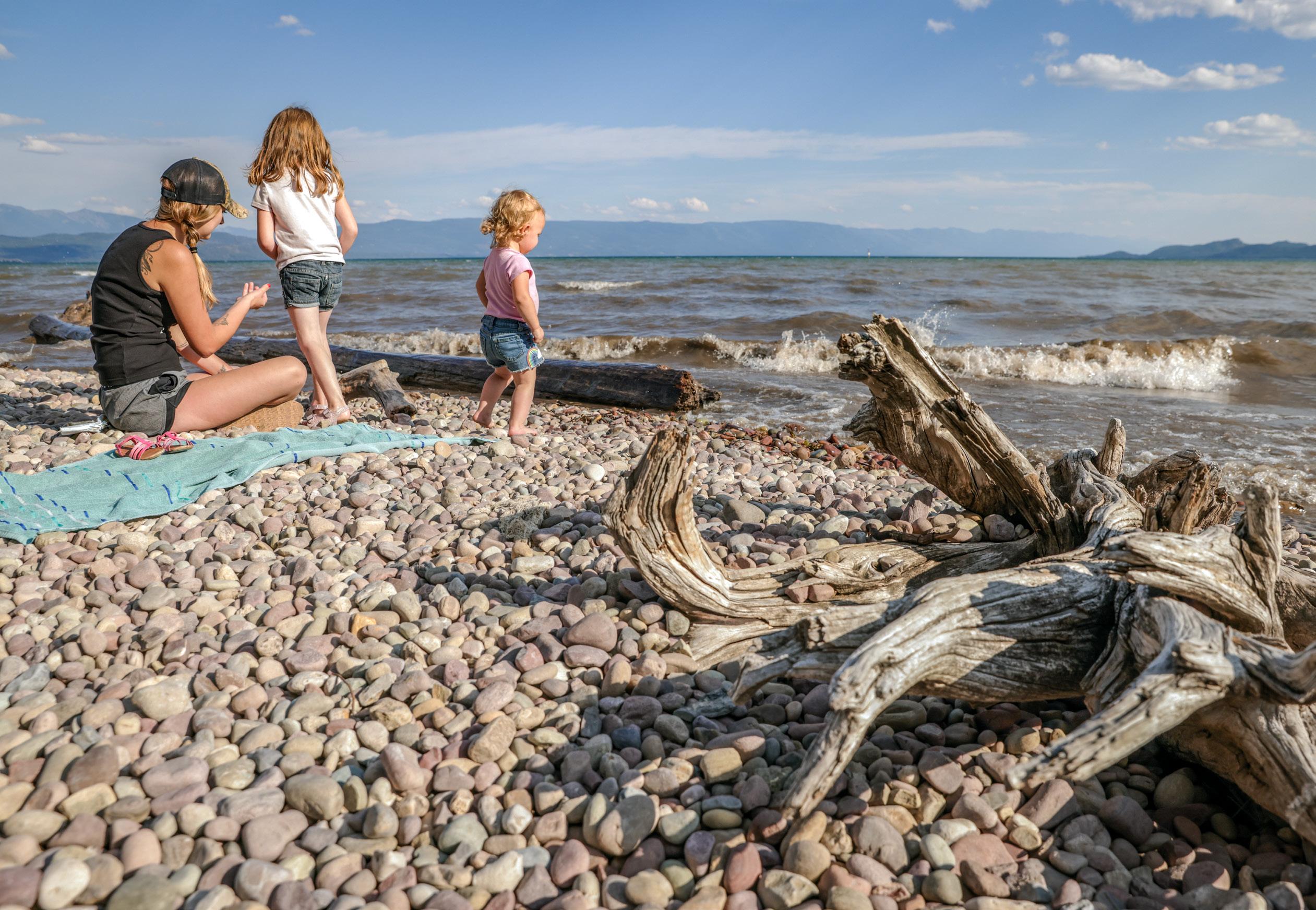
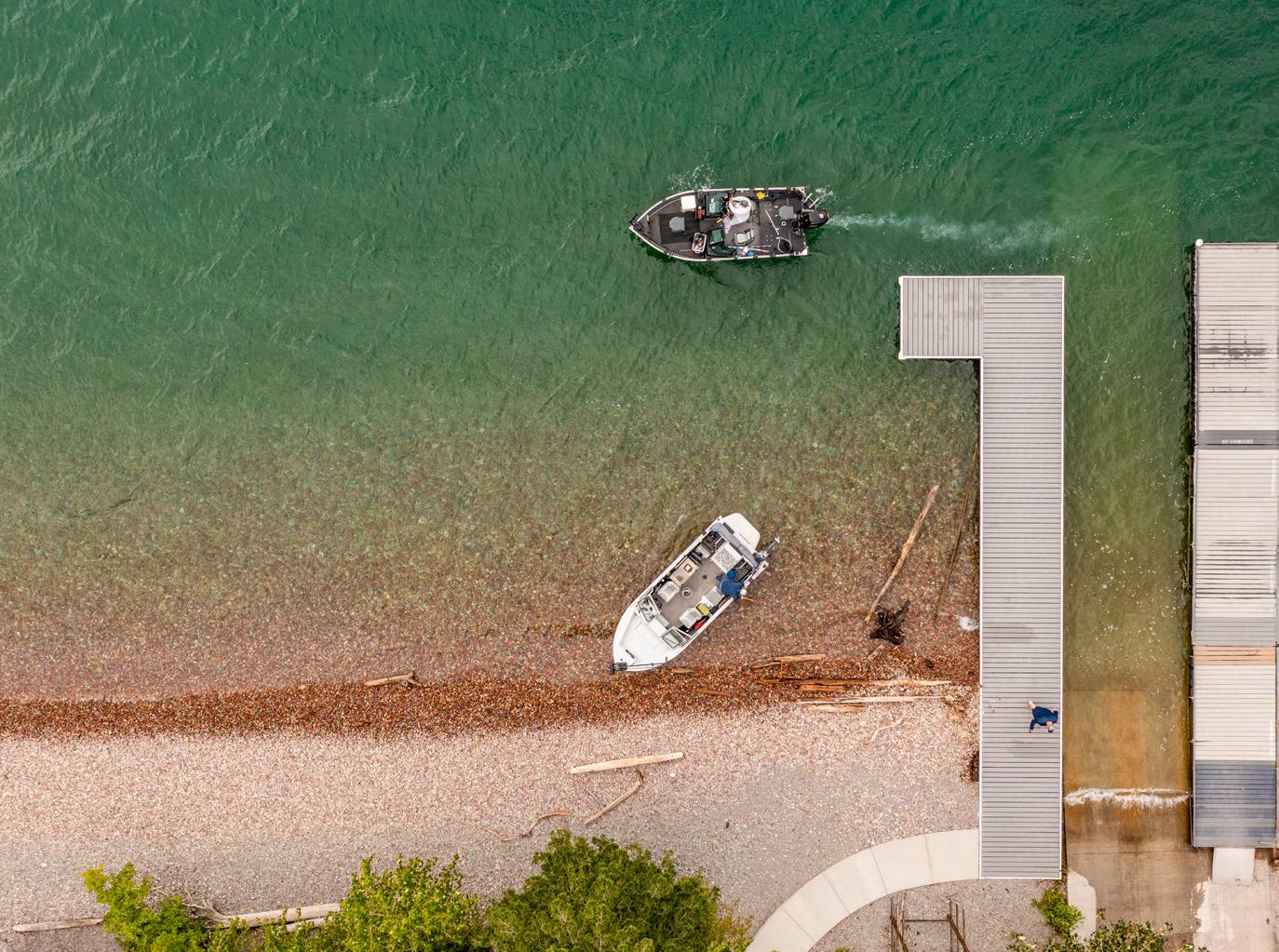
SHORED UP Over the past two years, FWP has installed dynamic gravel beaches at Somers Beach State Park (shown here), Woods Bay Fishing Access Site, and the Yellow Bay Unit of Flathead Lake State Park. The agency aims to protect all its sites on Flathead Lake as funding becomes available. The Confederated Salish and Kootenai Tribes have also put in a dynamic gravel beach at Blue Bay Campground to address shoreline erosion, and the City of Polson installed one at Salish Point.
Area. Montana Fish, Wildlife & Parks took similar interest in dynamic gravel beaches.
To date, more than 8,500 feet of Flathead Lake’s north shore are protected by Lorang’s beaches.
STILL HOLDING STRONG
In the past two years, FWP has used Lorang’s design to install gravel beaches at Woods Bay Fishing Access Site near Bigfork, the Yellow Bay Unit of Flathead Lake State Park, and Somers Beach State Park. The agency plans to protect all of its sites on Flathead Lake with dynamic equilibrium beaches as funding becomes available.
“It’s amazing to see the immediate results, particularly at Somers Beach State Park. It was losing a few feet of land every year to erosion, which was so destructive to shoreline plant communities,” says Dave Landstrom, FWP’s regional parks and outdoor recreation manager. “Within weeks of project completion, plant communities began regenerating in the small overwash ponds that were forming between the beach and the vegetation.”
Twenty years after Keenan came home to find his land washing away into the lake, he walks the pebbled shoreline on his property knowing it’s not going anywhere.
“That beach went to work, and today it’s still holding strong,” he says. “It has required some maintenance over the years. But without building a gravel beach, I think I wouldn’t have any dry property.”
Lorang, meanwhile, continues working with public and private landowners to install gravel beaches big and small. Recently, he met with engineers from Puget Sound's Department of Ecology, who will travel next spring to Flathead Lake to learn more about gravel beaches as potential solutions to help protect ocean coastlines.
“I always say, this isn’t just erosion control; it’s restoration,” Lorang says. “That’s the key. Erosion control is just the second goal. Restoration is number one. And then recreation is the bonus. If we can keep it going, if this becomes the preferred method across the whole region, then we can restore damaged shorelines one project at a time. That is real restoration built with community involvement. What a legacy.”
THE PUBLIC'S PEBBLE BEACHES FWP has installed three dynamic equilibrium beaches on Flathead Lake so far, with aims to eventually protect all its sites.
Corvids to Crow Over
The “good enough” guide to identifying Montana’s eight members of the crow family.
BY SNEED B. COLLARD III
It was a quiet Sunday morning in March when I walked into a mob scene taking place in our neighborhood.
I’d set off with my dog Lola to make a loop counting and recording birds, part of an informal citizen science project I’ve conducted once or twice a month for several years. Along the path I identified five avian species belting out mating and territorial calls. Oddly, none were crows, even though modest numbers often patrolled our neighborhood.
Nearing the end of my circuit, I heard a distinctive caw and spotted a largish black bird swooping toward me. It seemed laser-focused on a particular ponderosa pine, and as I watched, it began circling the tree and cawing incessantly. That attracted the attention of a magpie, which also started circling the pine and making quick incursions into it. Then another magpie showed up, and another, until at least eight of the black-and-white birds were diving like Spitfires in and out of the tree.
By this time, I had a hunch what might be causing this crow-species kerfuffle. Corvidae—the bird family to which both crows and magpies belong—are known for mobbing potentially dangerous animals, including owls, hawks, and other birds of prey. Try as I might, though, I could not spot any raptor through my binoculars. I watched the aerial acrobatics for another 15 minutes, and as I was about to give up, I heard a hoo followed by a hoo-hooo
Ah. A great-horned owl!
As Lola and I turned for home, my esteem and respect for crows, magpies, and other corvids ratcheted up another notch. Yet for centuries of human history, many people have not shared my love for these hyperintelligent birds. uu
Sneed B. Collard III is the author of more than 100 books including his recent humorous guide, Birding for Boomers—And Everyone Else Brave Enough to Embrace the World’s Most Rewarding and Frustrating Activity.
QUOTH THE RAVEN Crows, ravens, and other corvids might not sing melodious songs, but they’re among the most intelligent animals on earth besides humans and other primates. PHOTO BY CHRISTIE HOLMGREN
Corvid basics
A big, bold, intelligent songbird built to scavenge, forage, and problem-solve.
TAIL
Longer than most songbirds to help with balance and maneuvering.
WINGS
Elliptical shape for quick bursts of speed and tight, acrobatic turns.
WBODY
EYES
Sharp vision, wide field of view.
STRONG BILL
Thick, all-purpose tool used for everything from splitting seeds to scavenging flesh.
Stocky and robust compared to other songbirds.
LEGS AND FEET
Strong and adapted for walking, hopping, and grasping.
orldwide there are around 130 species of corvids, including crows, ravens, jays, nutcrackers, and magpies.
They are a group like no other. Though technically songbirds (also called passerines, or perching birds), corvids don’t offer pleasing melodies; instead they produce harsh, throaty cries, squawks, croaks, and rattles.
Whatever corvids might lack in vocal range, though, they make up for in size, diet, and social sophistication. Long, strong legs allow them to hop or even jog, while sturdy, curved bills help expand the diet of some species beyond the usual fare of seeds, fruits, and insects to include small animals and carrion. Some also engage in cooperative rearing where extended family members pitch in to help raise the young.
Yet one feature stands out most when I think of corvids: intelligence.
AVIAN EGGHEADS
Corvids have a well-deserved reputation for being some of the smartest birds on earth. Many formal studies confirm their abilities to recognize faces, use tools, and even plan ahead.
Here in Montana, fascinating corvid stories abound. Ornithologist Dick Hutto and his wife Sue were walking across the University of Montana campus in Missoula when they noticed a baby crow on the ground.
Sue picked it up and moved it to a safer location—something the crow’s parents did not take kindly to. “Mind you,” Dick recalls, “I never touched the baby bird, but they had me linked to the act. Every time I walked across campus after that I was mobbed!”
Montana birder Maggie Ryan, who regularly fed Clark’s nutcrackers in her backyard, decided to test corvid smarts herself. In an experiment she’d seen on a PBS documentary, she hung a peanut from a long piece of string and tied the string to a crossbar. In the documentary, crows figured out how to get the hanging food by using their bills to pull up the string one length at a time, pinning it with their feet so it couldn’t slip back down. To Maggie’s disappointment, her local nutcrackers didn’t figure out the puzzle. Then, one day as she was pulling into her driveway, she saw something amazing. “There on the crossbar,” she recounts, “was a Clark’s nutcracker pulling up the string to grasp with his foot until he reached the peanut!”
Corvids seem especially good at learning sound cues. Maggie Ryan taught Clark’s nutcrackers to come to her bird feeder simply by shouting “Clark!” Dick Hutto’s graduate student Crow White discovered that ravens in the Tetons learned to associate gunshots with free meals of deer and elk remains left behind by hunters. Yet as clever and impressive as corvids are, their intelligence sometimes comes at a cost.
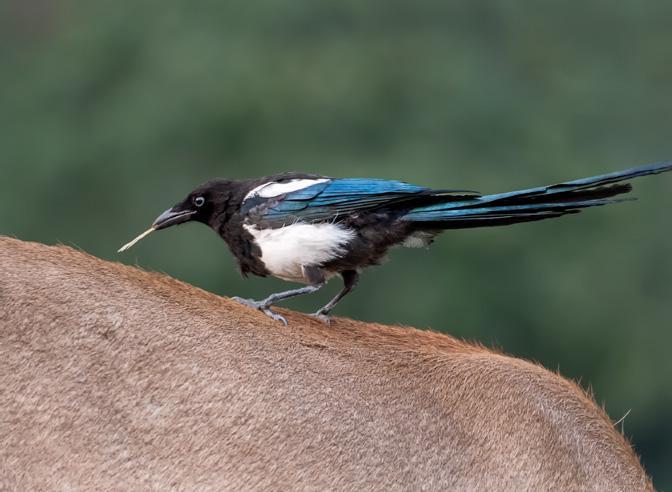
CAWABUNGA! Deer, elk, cattle, and other large mammals often allow black-billed magpies to perch on their backs, necks, and even their heads to pluck off ticks.
FRAMED FOR MURDER
Perhaps because they are so smart and resourceful, corvids can come into conflict with humans. In the past, crows, ravens, and magpies were widely persecuted by farmers and ranchers for eating crops and damaging livestock. Wildly exaggerated stories of corvids pecking the eyes out of lambs and calves or disemboweling cattle on the hoof helped fuel extensive killing of the birds. Millions of corvids have been shot, poisoned, and trapped, and their roosting sites have even been dynamited. Many states offered bounties on the birds.
Not that corvids were totally innocent of the accusations. In large numbers, they can do significant damage to crops. At times, their penchant for picking ticks and other parasites off sheep and cattle have led them to stripping flesh from open wounds.
Control efforts, however, largely proved ineffective and ended up removing key predators of grasshoppers and other agricultural pests, which then increased. Today, greater knowledge of corvids and improved agricultural methods have dramatically reduced conflicts. “People appreciate birds and wildlife a lot more than they used to,” says Colton Allen, whose family runs an 8,200-acre ranch near Melstone.
Montana, in fact, is a great place to find and observe some of the world’s most interesting and charismatic corvids. Most of our eight species can be found yearround, but some only range across specific parts of the state. The following guide is organized by the typical habitats where these birds can be found.
EVERYWHERE CORVIDS (opportunistic omnivores)
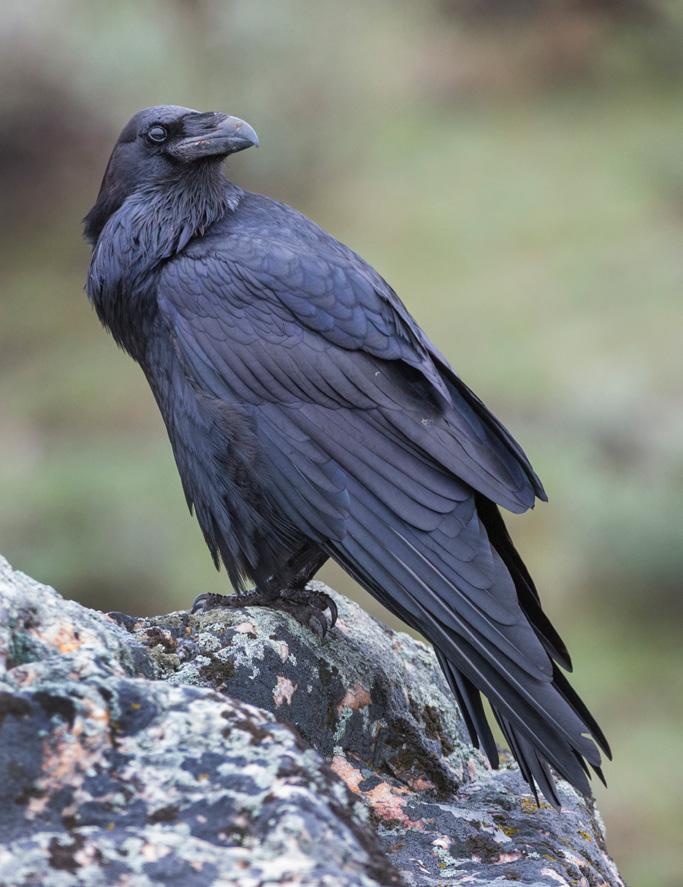
COMMON RAVEN Corvus corax
World’s largest songbird. Solid black body with bluish or purplish sheen. Heavy, bulky bill and long wings.
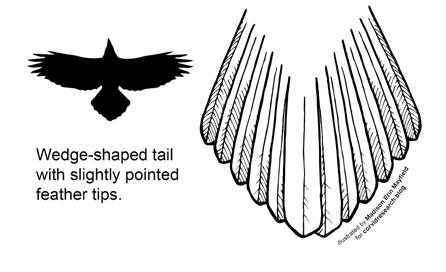
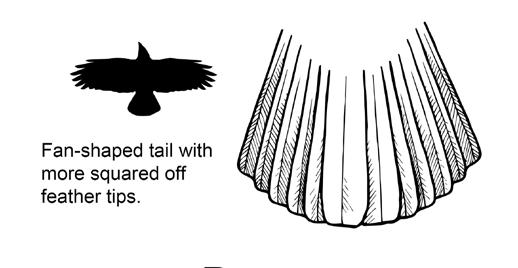
u Key ID tip: From below, note wedge or diamond-shaped end of the tail (crow tails are shorter and more squared off). Its wings often produce an audible swooshing sound in flight.
Size: Length 24 inches, wingspan 53 inches.
Call: Often a deep, throaty kraaah, ravens have nearly three dozen vocalizations varying from low gurgling croaks to shrill alarm calls.
Habitat: Ravens can be found practically anywhere in Montana. Historically, they prospered in close association with bison and wolves, but the near-extinction of bison is thought to have resulted in the disappearance of ravens across many prairie regions.
Worth knowing: Ravens are one of the most widespread naturally occurring birds in the world, and throughout human history have played prominent roles in folklore, mythology, and religious beliefs.
Best places to see: Though they roam statewide, densities are highest in western Montana, where they can be found in most any environment, especially at landfills.
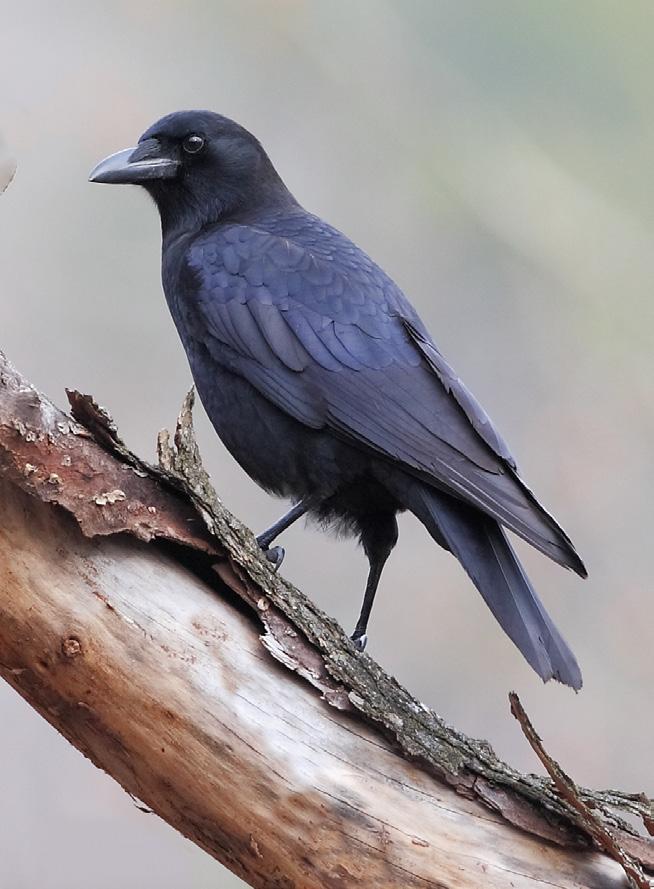
Similar coloring and appearance to common raven, but usually smaller with slimmer bill. u Key ID tip: From below, the end of the tail is more rounded or straight compared to the wedge shape of the raven. Lighter, simpler call versus the raven’s deeper croaking.
Size: Length 17.5 inches, wingspan 39 inches. Call: Lighter caw than ravens, often repeating rapidly: caw-caw-caw.
Habitat: Prefers valleys, foothills, and prairies with open areas and perching trees or structures nearby. More likely than ravens in urban areas.
Worth knowing: In winter, crows migrate south a modest distance (200 miles on average) where they sometimes roost by the thousands.
Best places to see: Almost any semi-open area. More common in western Montana and south of the Yellowstone River.
Montana conservation status: Low conservation concern, though some populations may have been hurt by West Nile virus.
EVERYWHERE CORVIDS
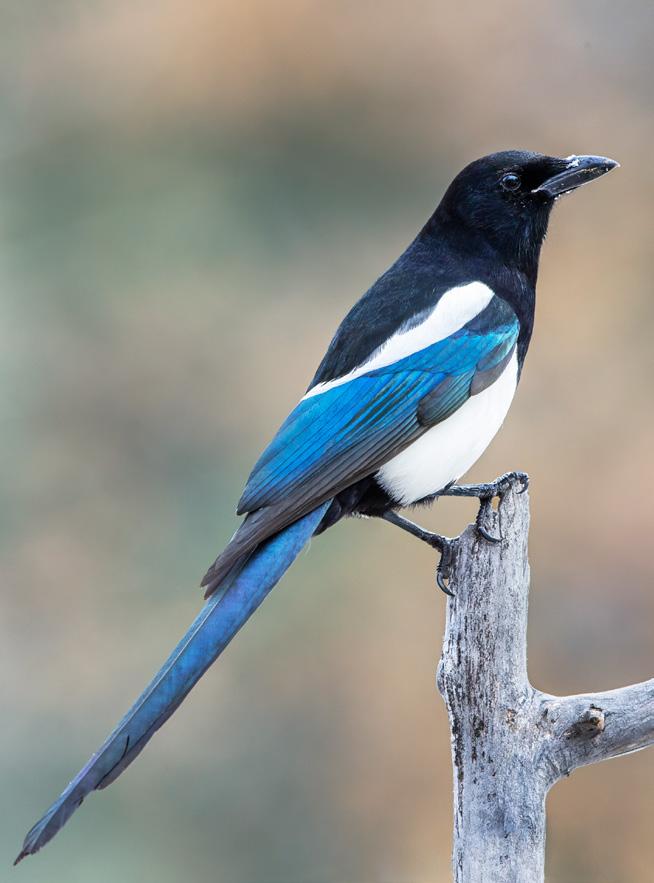
BLACK-BILLED MAGPIE
Pica hudsonia
Stunning, medium-sized black-and-white bird with iridescent bluish or greenish sheen. u Key ID tip: In flight, white wing patches give a distinctive pulsing or rowing effect. Longest tail relative to body length of any Montana songbird.
Size: Length 19 inches, wingspan 25 inches.
Call: Often a chattery chack-chack-chack with lots of variety, but magpies have a repertoire of calls, from harsh, repeating squawks to rising keening sounds to quiet, almost conversational whistles and croaks.
Habitat: Widespread in both urban and rural habitats, especially agricultural regions.
Worth knowing: Some states sponsored campaigns to eradicate magpies. In Idaho, 150,000 were killed in a 30-day period in 1935. Many more died from eating poison baits set out to control predators. Magpies continue to be killed by poisons used to control pests.
Best places to see: Almost anywhere in Montana except high mountain areas.
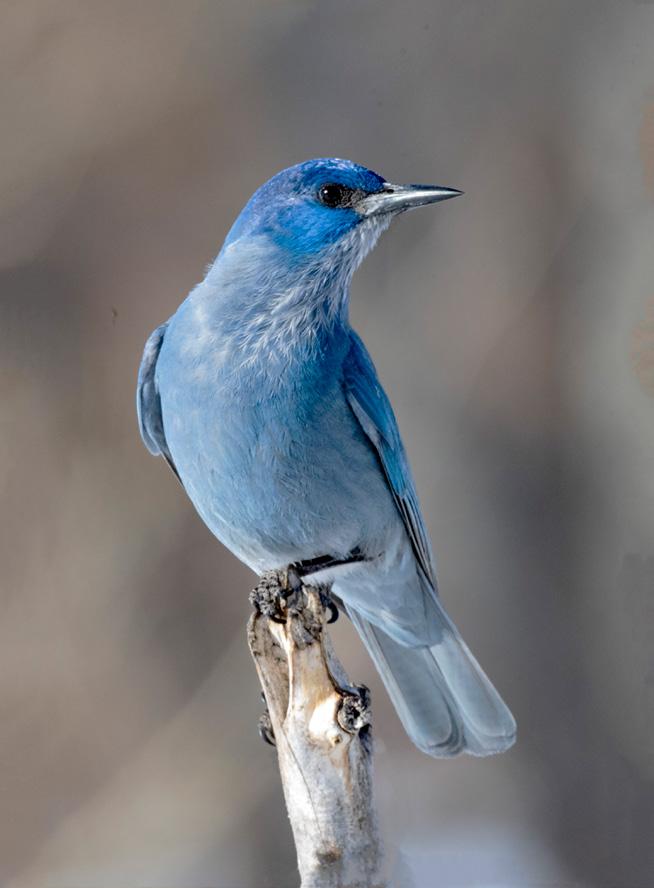
Medium-sized bird with gorgeous powderblue overall appearance.
u Key ID tip: Light blue feathers; usually travels in flocks. Half-again as large as a mountain bluebird, with a much longer bill.
Size: Length 10.5 inches, wingspan 19 inches.
Call: Rapid, usually repeating rising-andfalling call. Less harsh than a crow’s.
Habitat: Arid juniper, ponderosa pine, and limber pine woodlands.
Worth knowing: This bird gets its name from its mutualistic relationship with pinyon pines. Pinyon jays, which disperse and cache huge numbers of pinyon pine seeds to eat in winter, have a remarkable memory for where they stash them.
Best places to see: Arid, southern parts of the state such as Bear Canyon in the Pryor Mountains south of Billings, or around Ennis.
Montana conservation status: Species of concern because of population declines due to habitat loss. Thought to be especially vulnerable to changes in landscape and climate.
WOODLAND EDGE CORVIDS
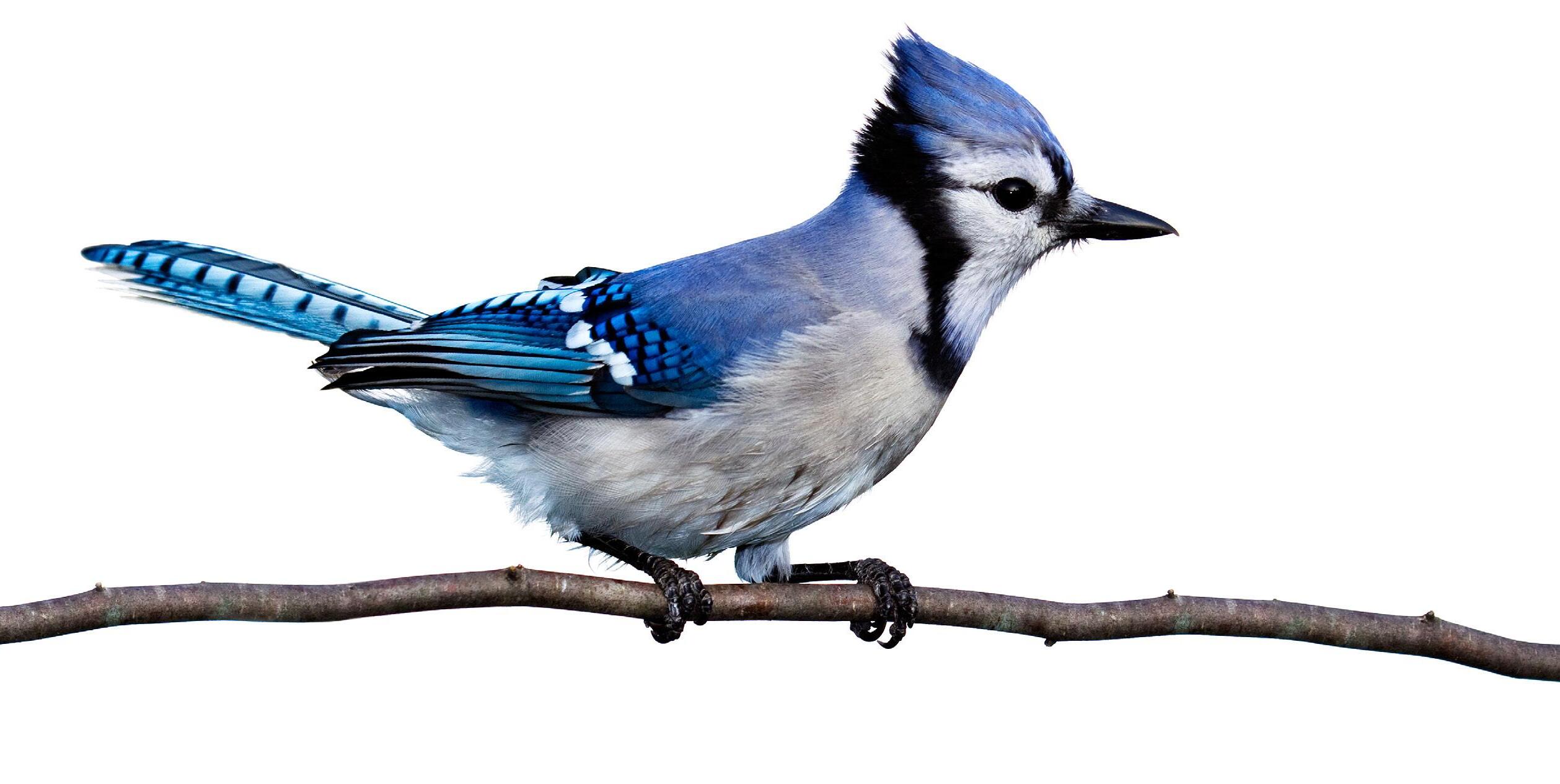
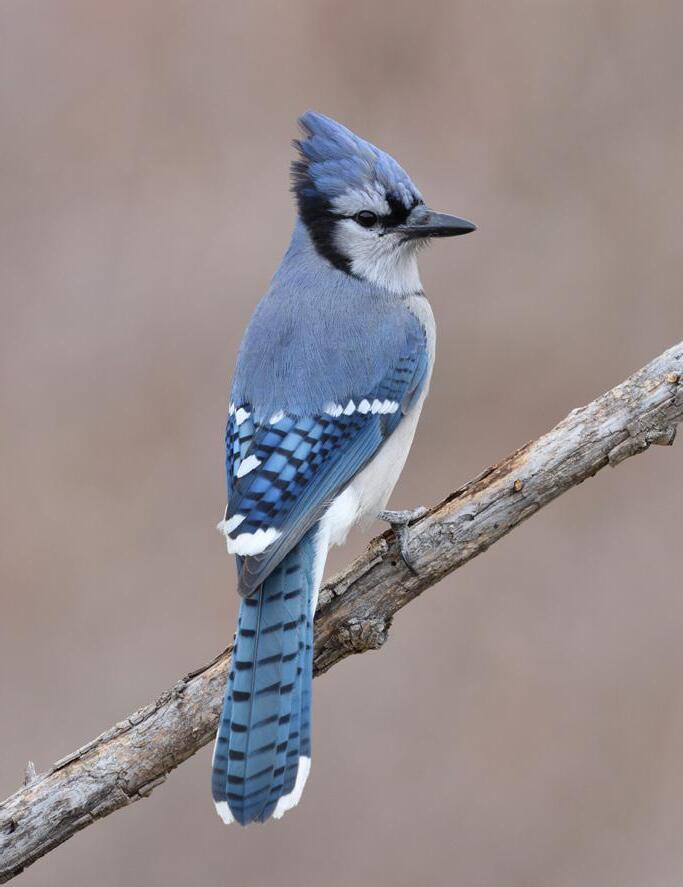
BLUE JAY
Cyanocitta cristata
Medium-sized bird with blue, white, black, and gray markings. Distinguished from Steller’s jay by having smaller crest and lighter gray and white underparts.
u Key ID tip: Blue overall appearance with white face, pale breast, and distinct crest.
Size: Length 11 inches, wingspan 16 inches. Call: High-pitched, descending calls, often emitted twice in succession.
Habitat: In Montana, most often seen in urban areas with tall trees.
Worth knowing: Essentially an eastern bird; urbanization and tree-planting allowed this species to spread westward. In Montana, most “blue jay” sightings are actually Steller’s jays.
Best places to see: Unpredictable, but most often in towns and at feeders. More common in eastern Montana.
Montana conservation status: Low concern.
Corvids are more than clever birds—they’re ecosystem engineers. Clark’s nutcrackers, jays, and crows cache thousands of seeds each year. Many go unretrieved, sprouting into new trees and helping Montana’s forests recover after fire, logging, or beetle kill.
MOUNTAIN FOREST CORVIDS (forest-dependent, diet of conifer seeds and insects, more secretive)
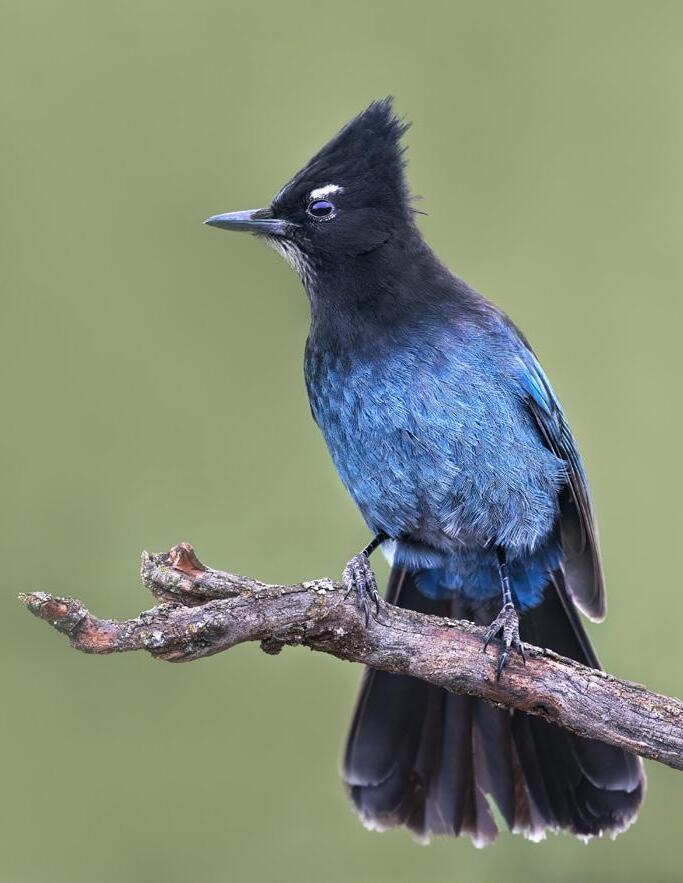
STELLER’S JAY
Cyanocitta stelleri
Medium-sized bird with black head, gray-to-black shoulders, and blue lower parts. Prominent black crest.
u Key ID tip: Distinctive crest and blue undersides are a giveaway. In Montana, they are the most common medium-sized corvid in coniferous forests.
Size: Length 11.5 inches, wingspan 19 inches.
Call: Wide variety, from harsh, slowly repeating vocalizations to rapidly repeating, more chirpy calls.
Habitat: Relatively open or recently harvested conifer forests.
Worth knowing: Steller’s jays have fooled many a birder with their excellent imitations of red-tailed hawks.
Best places to see: Conifer forests on both sides of the Continental Divide.
Montana conservation status: Low concern.
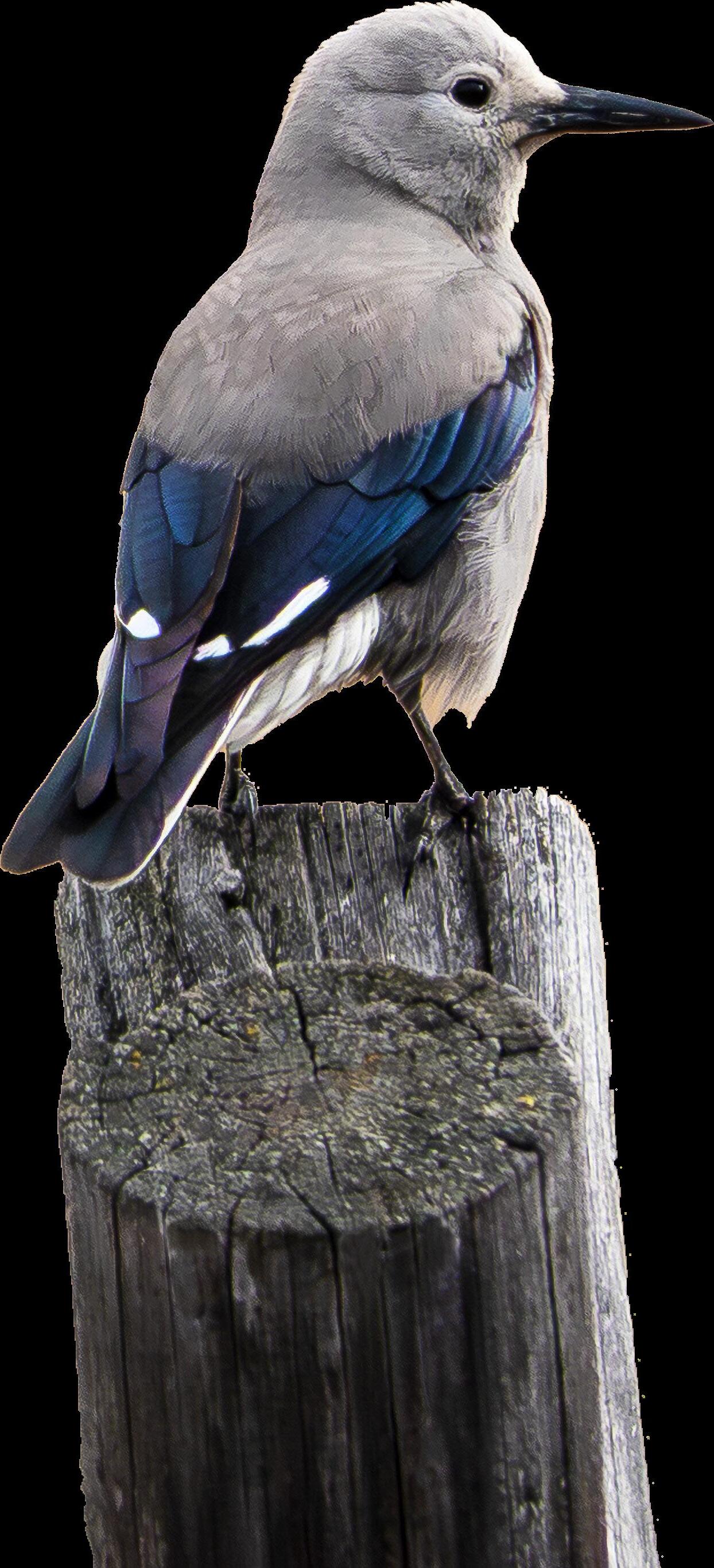
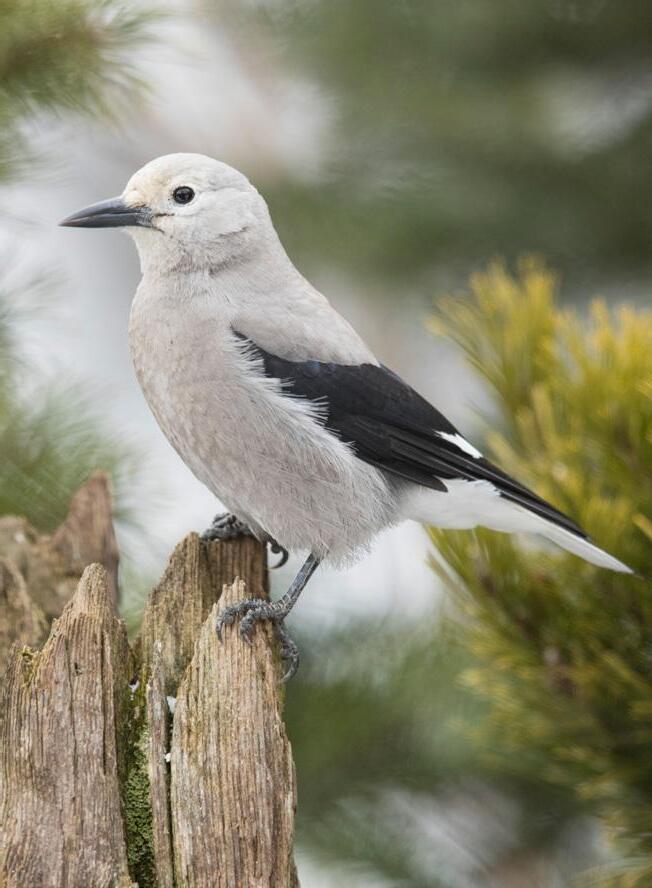
CLARK’S NUTCRACKER
Nucifraga columbiana
Medium-sized bird with gray body and black-and-white wings and tail. Very long bill used for extracting seeds from cones. u Key ID tip: Often seen flying at higher elevations; perhaps harshest call of Montana corvids.
Size: Length 12 inches, wingspan 24 inches.
Call: Longer, harsh, grating primary call issued singly or in combination.
Habitat: Higher-elevation forests and open areas above timberline, but will move downslope in search of cone seed crops, sometimes in large numbers.
Worth knowing: This corvid has evolved a unique relationship with whitebark pine. The pine’s cones do not open naturally, but Clark’s nutcrackers can pry them open with a strong, dagger-like bill to obtain the seeds. Whitebark pines sprout from small groups of seeds that the birds cache in the soil and fail to eat later. As a result, these conifers can often be found growing in clumps.
Best places to see: Open conifer forests.
Montana conservation status: Species of concern due to loss of whitebark and limber pines from disease, insects, and fire.
Corvids on the Slopes
CANADA JAY
Perisoreus canadensis
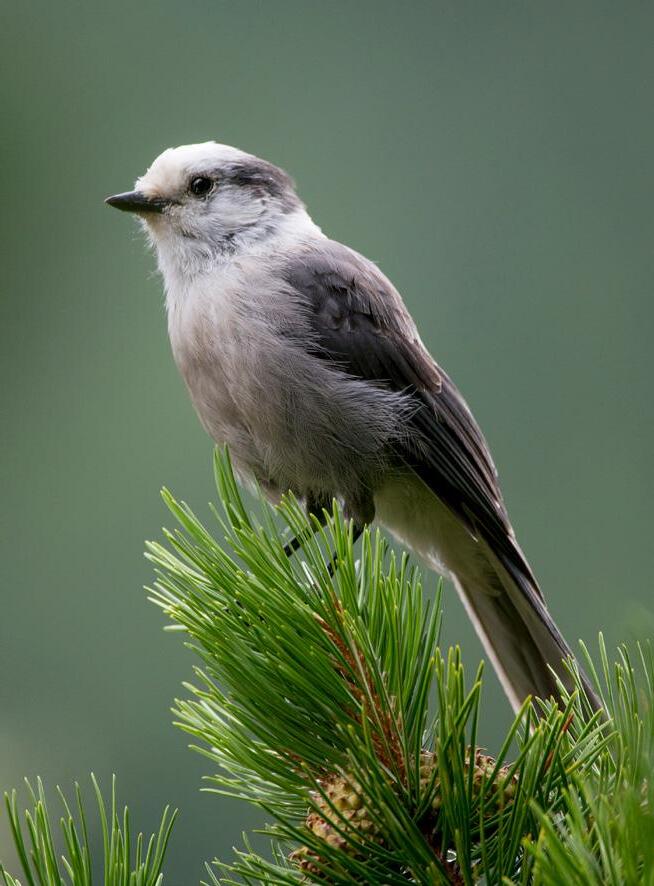
Medium-sized bird with subtle gray, black, and white appearance, often described as similar to a large chickadee.
u Key ID tip: Notably short bill, fluffy appearance; usually travels in pairs or in small groups outside of breeding season. Distinguished from Clark’s nutcracker by much shorter bill.
Size: Length 11.5 inches, wingspan 18 inches.
Call: Haunting, high-pitched falling call somewhat reminiscent of the single notes of ospreys.
Habitat: Higher mountainous coniferous forests, especially those with spruce and fir trees.
Worth knowing: The Canada jay nests during late winter in cold, snowy, and apparently foodless conditions, surviving on clumps of food previously cached on trees with the help of its extremely sticky saliva. It can carry food with its feet, unlike most corvids and other songbirds.
Best places to see: Mountain ski areas (see sidebar below), campgrounds, and other outdoor areas with potential for human food.
Montana conservation status: Low concern, but climate change may be affecting some birds as warmer temperatures lead to spoilage of cached meat and other foods.
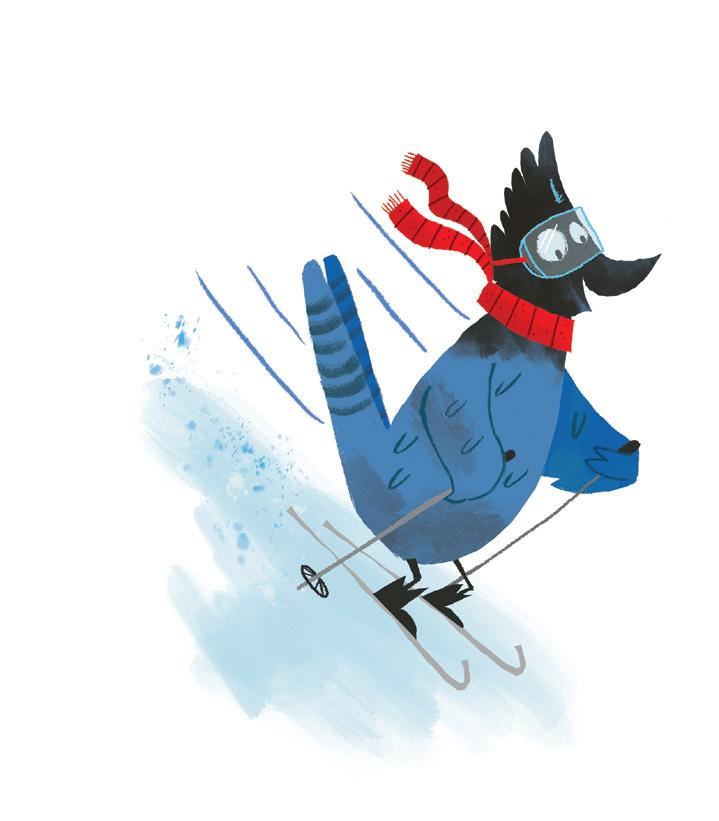
A fun way to see some of our harder-to-find corvids is to visit your local ski area during the winter. Just strolling around the parking lot with binoculars, you can often spot Clark’s nutcrackers, Canada jays, and Steller’s jays, which spend much of the year at higher elevations. Just keep a close eye on your lunch. Any skiers turning their backs for a moment are likely to have their PB&Js carried off by these alert, conniving critters!
Montana’s GourMet GuMbo
How to escape the state’s stickiest, gooeyist, sloppiest soil.
BY BEN LONG
s the rain drummed the camper roof, fear flooded my heart.
My wife’s birthday is in May, so as a treat, we rented a fancy RV camper van with a retail value triple the price of our first house. We drove the winding gravel road to Judith Landing State Park at the confluence of the Judith and the Missouri rivers. Because the park was brand new at the time, it was open for day use only. So we explored a side road and camped at a lovely, lonely overlook nearby.
Stupidly, I had neglected to look at the weather forecast. In this area and many other parts of Montana, rain means gumbo.
“Gumbo” is an African word, stemming from the Bantu word for okra, the main ingredient of the trademark Cajun stew. Gumbo’s thick consistency evidently reminded Montanans of our trademark mud, but any similarity ends there.
Montana gumbo is a temporary phenomenon. Most of the time, the surface is a claystone that is crusted hard. But add a little moisture and it transforms into a pernicious paste, slick as grease yet sticky like tar.
Over the decades I’d dodged serious trouble with Montana’s most notorious ground surface, but this time I had run out of luck. Gumbo was waiting for me.
It waits for all of us.
Mud is mud, but Montana’s gumbo has a reputation as the worst of the worst. Sticky, gooey, sloppy, relentless.
Is it true that mud is worse here than in other states? After interviewing experts and reviewing the science, I’ve concluded that, yes, Montana gumbo is a scourge all its own.
But here’s the twist. This menace has an upside. We can thank gumbo for protecting landscapes that are so important for Montana’s wildlife and so precious to those of us who enjoy wild critters.
BORN OF FIRE
What separates gumbo from rank-and-file mud is a mineral named bentonite. The byproduct of a rare geologic occurrence, bentonite is formed when ash and pulverized rock called tuff are spewed by a volcano to settle on marine saltwater.
Those were the conditions in central Montana about 75 million years ago during the Cretaceous era, when T. Rex and triceratops roamed. The Great Plains were covered in a shallow sea that flooded and receded over millions of years while volcanoes belched ash skyward. Over the eons, that ash-and-saltwater concoction coalesced into claystone.
Ben Long is a writer in Kalispell and a longtime contributor to Montana Outdoors
Bentonite is named for the tiny river town of Fort Benton, where bullwhackers fought the stuff as they carted cargo from steamships to Great Falls, Helena, and points beyond. The fort, in turn, was named for U.S. Senator Thomas Benton of Missouri, a tireless booster of westward expansion.
Bentonite is unusual in that it absorbs water exceedingly well. In fact, it will soak up eight times its mass in water. This quality makes the claystone useful in geoengineering. It is used as a sealant when drilling wells and as a liner to prevent landfills and sewage
BENTON’S
REVENGE
Bentonite, the core ingredient of the gummiest gumbo, was named for the tiny river town of Fort Benton, which was named for U.S. Senator Thomas Benton of Missouri, a tireless promoter of westward expansion.
lagoons from leaking. Montana produces more bentonite commercially than any other state except Wyoming.
The silt and ash that make up bentonite claystone are unusually fine. Wet, it transforms into a nether-material, neither solid nor liquid. Bentonite soils are notoriously unstable for building structures or roadways. A rain shower is all that separates a finely graded gravel road from an impassible quagmire. As an obstacle holding back Senator Benton’s vision of manifest destiny, bentonite is a worthy opponent.
Gumbo was waiting for me. It waits for all of us.
COME RAIN, COME SLIME
All of this is interesting but does zero good when you’re in the middle of nowhere and rain falls. Then, you are on your own.
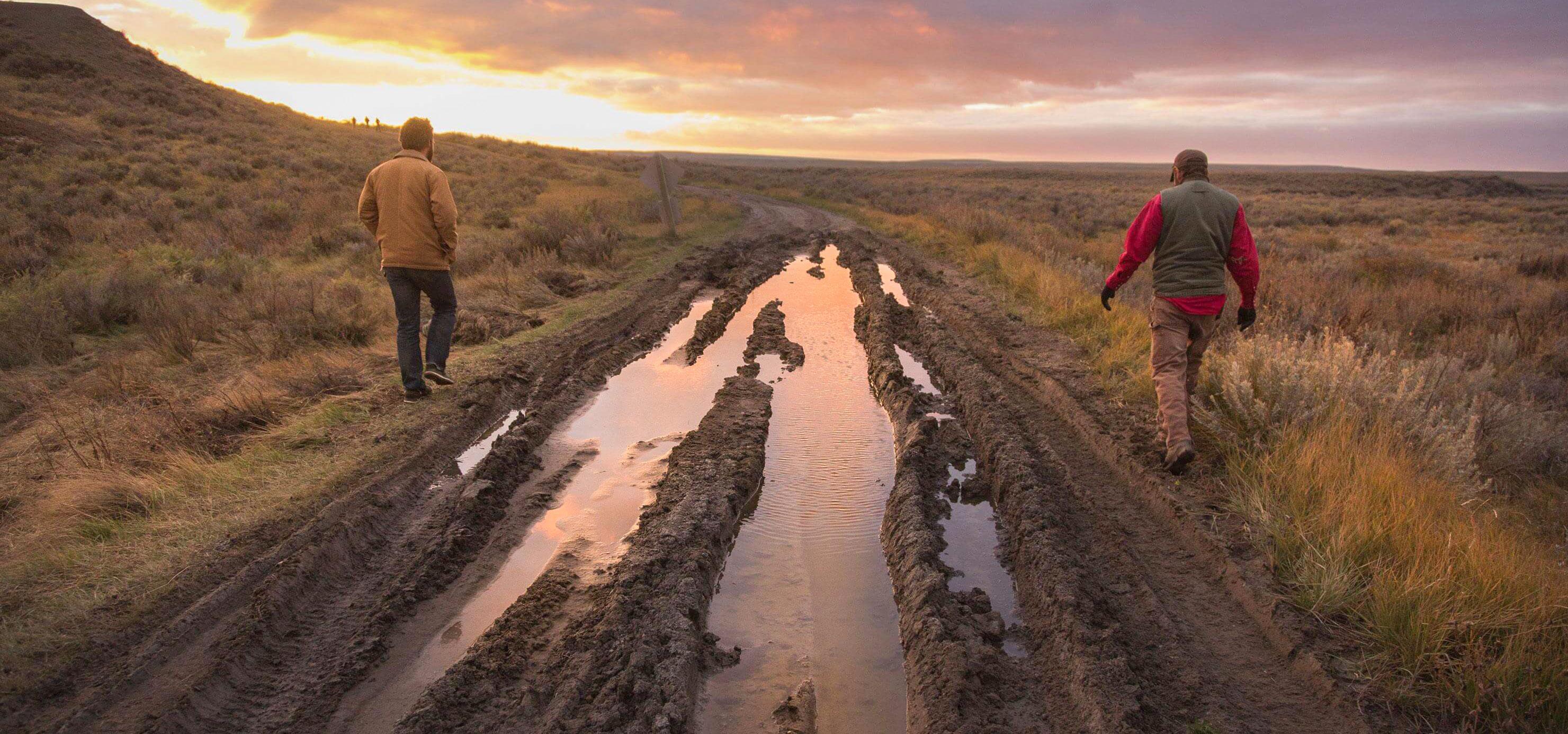
Mud is not particularly dangerous. Gumbo-induced accidents occur at low speed compared to killers like black ice. But get stuck in the outback of Phillips or Garfield counties and you might be augured in for days or weeks. There’s most likely no cell service, and even if you could reach someone, no one is coming to help. The kind of isolation you feel in your gut.
Or, as my inner voice told me that spring dawn as the rain finally stopped falling: “There are 8 billion people on earth and not one of them can lift a finger to assist you.”
I moved the camper one wheel rotation and mud stuck to the tires like some horrible frosting on four giant donuts. I killed the engine. My first job was to not make our situation worse.
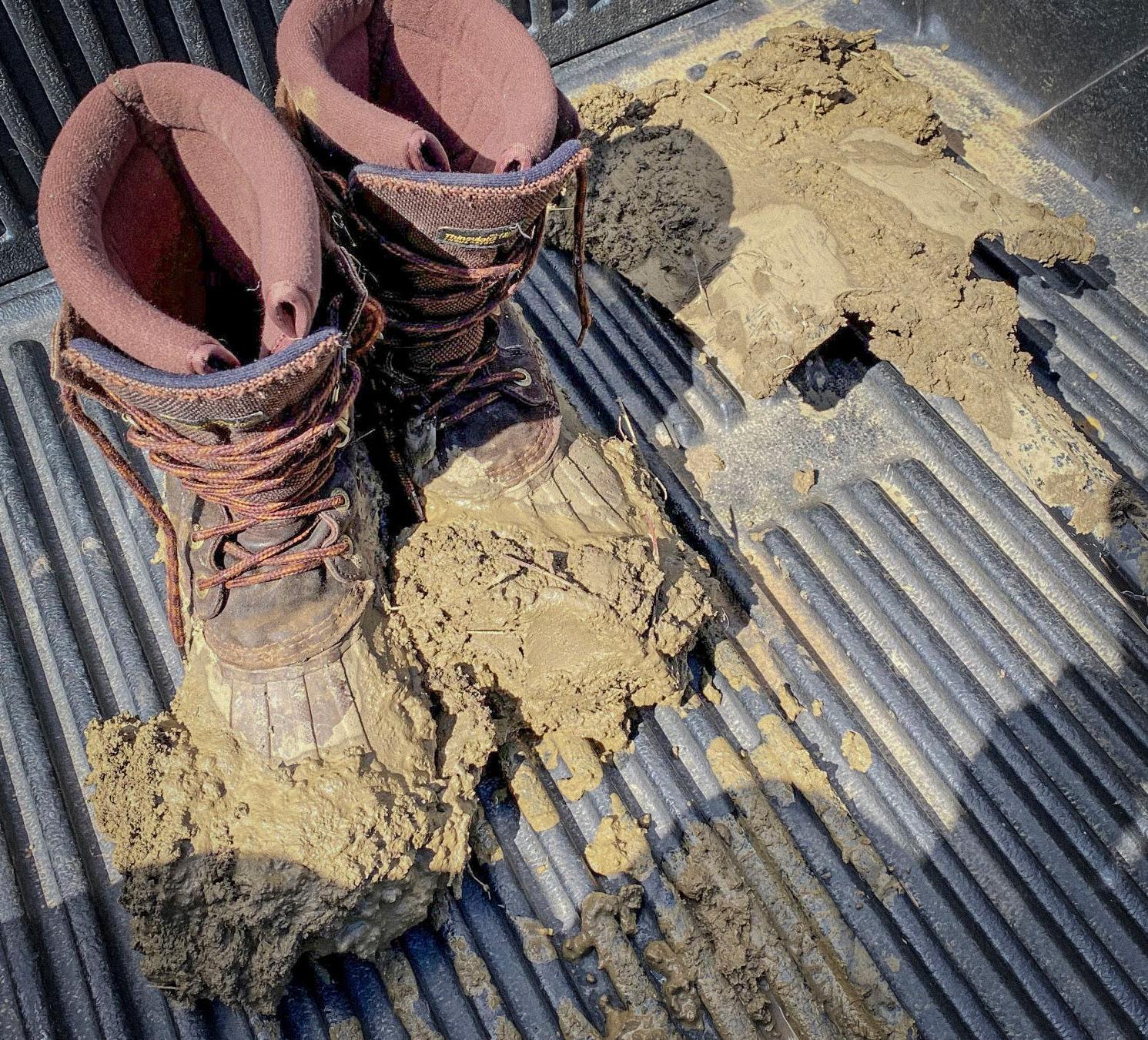
Outside, the footing was so poor it proved difficult to stay upright, and my wife and I were soon muddy head to toe. The mud caked our soles, lifting us several inches like 1970s platform shoes. To flip off the globs, we kicked our feet hard into the air, hoping not to lose a shoe or our balance.
It’s a common dance out here, the Gumbo Shuffle. Karen found a blue tarp and laid it over the interior of the camper to keep the mud somewhat in check.
We sloshed our water jugs and wondered how long we could make the supply last. We made weak jokes about enjoying some quiet time and how much we loved the scent of rain on sagebrush. Nothing to do but wait. Out here, nature is in charge.
The best way to approach gumbo is to avoid it in the first place. You find it in two kinds of traps. Rain will get you in spring and summer. In autumn, you watch for rain and snow and also freeze-thaw. Many an overeager hunter has driven into the coulees on seemingly bombproof roads on a cold morning, only to find trouble when the midday sun melts the snow, rousing the gumbo beneath.
Under such circumstances, the best option is to wait. Damaging private roads is a fast way to not be invited back, and eventually, the arid wind will dry the road or the temperature will drop below freezing.
But sometimes, you have no choice but to go mano-a-mano with the stuff. Gumbo is a bit like driving in deep, wet snow. Ruts can be your friend, keeping your rig aligned with the general direction of the road. But cut too deep, ruts will leave you high-centered.
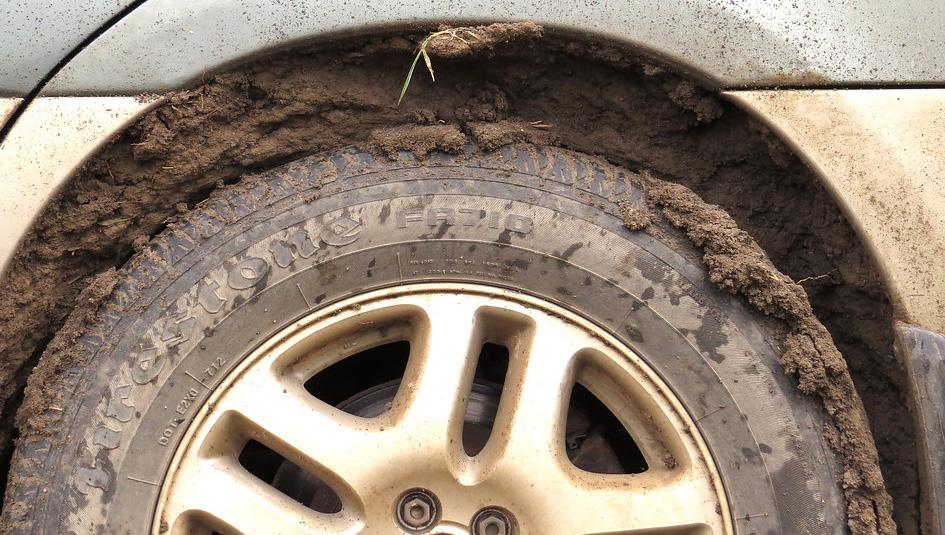
Gumbo will clog your wheel wells to the point it becomes impossible to steer. Worse yet, it can prevent wheels on even the burliest pickups, SUVs and ATVs from spinning—straining the engine and risking expensive mechanical damage. Gumbo can also foul brakes and universal joints. I know people who have had to scrape the muck and dried mud from their wheel wells with tire irons to keep their rigs moving.
Trailers complicate matters, especially stock trailers loaded with nervous horses. Hills become sleigh runs that test your luck and skill. A slide that sends the vehicle toward a fencepost or the side of a cattle-guard probably won’t kill you but is enough to scrape off a side panel.
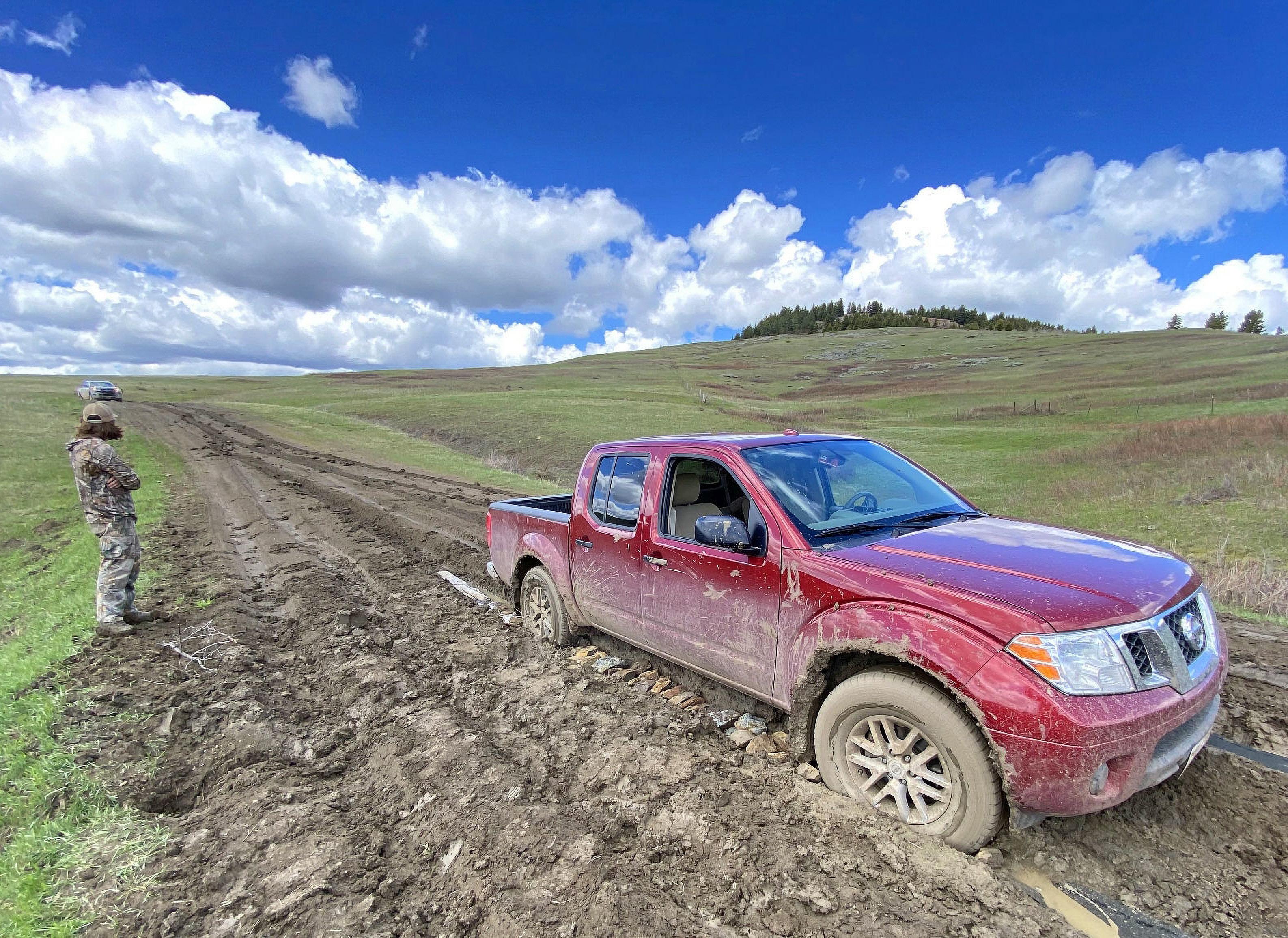
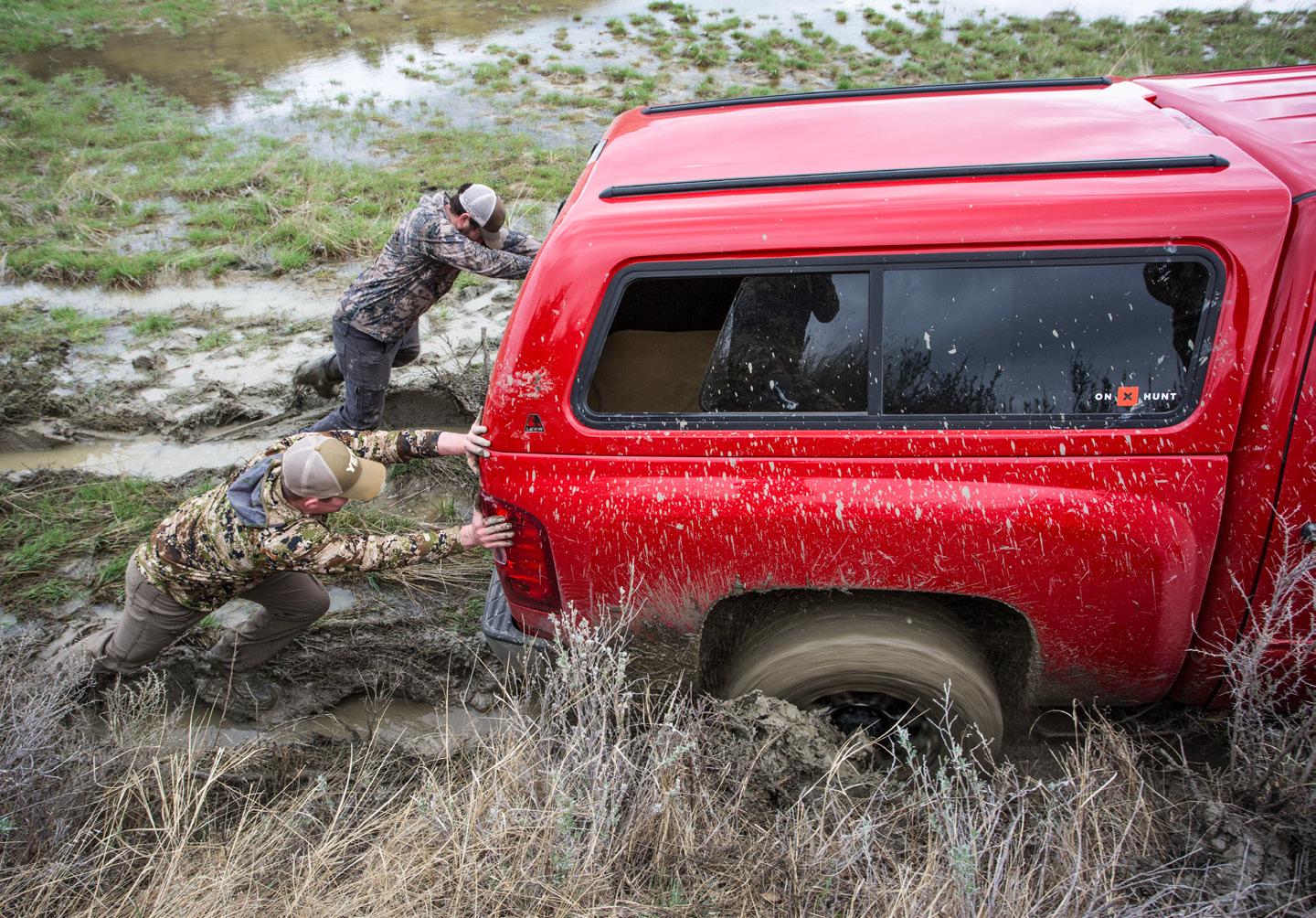
GLUECIFER’S GRIP Montanans carry a battle-hardened reverence for the challenges of traveling in gumbo country. Some grade it for stickiness and viscosity like Vermonters rank maple syrup. No matter the grade, getting unstuck may require passengers to get out and push— who then might need to change clothes after.
Tire chains are a mixed bag. The first challenge is the filthy job of installing them. While they will provide extra bite, chains also give gumbo even more surface to adhere to. I’ve talked to locals who swear that it pays to keep the cross chain a bit loose, so momentum can fling some of the mud free. But install chains too loosely and they’re liable to chew off a fender.
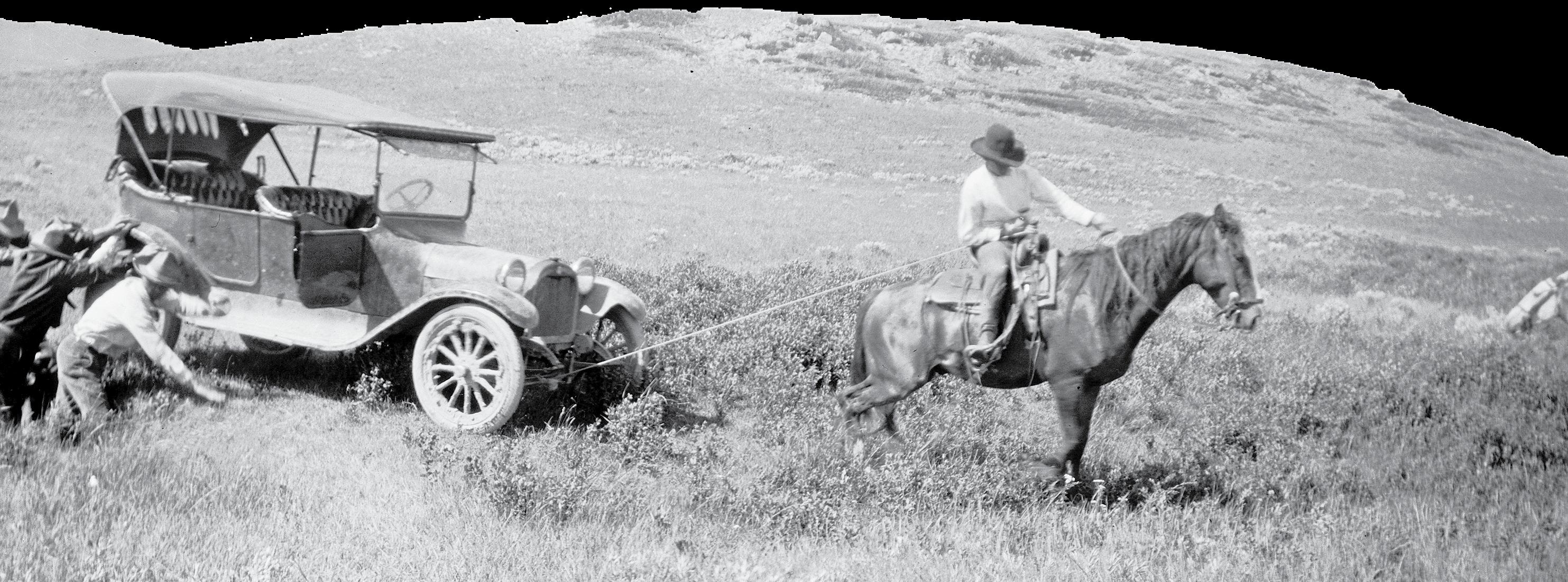
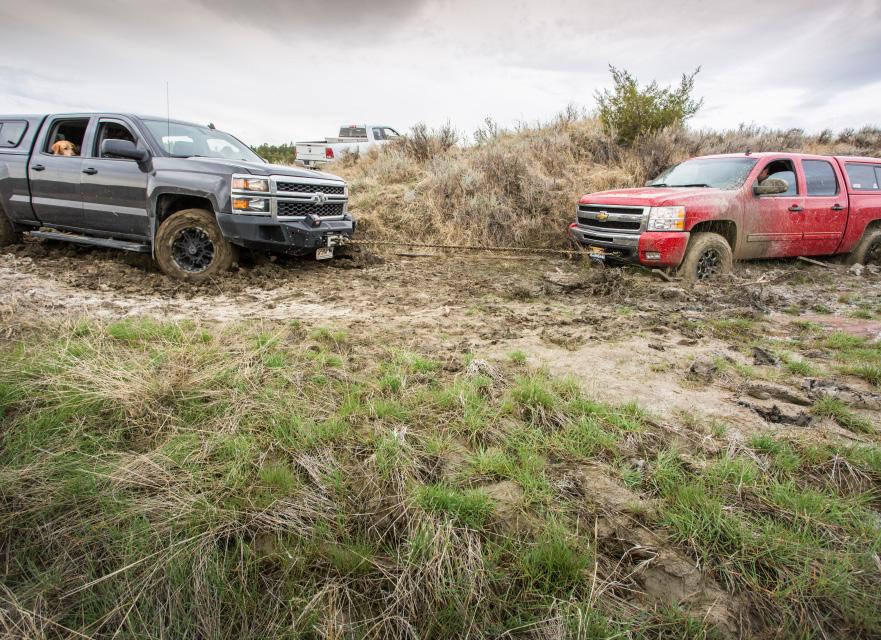
It’s wise in gumbo country to carry a tow rope to help pull a fellow traveler free from the muck, but proceed with caution. More than one pickup has gotten hopelessly mired trying to extricate a compatriot, only making double trouble. Once, I stood by watching a tractor pull a pickup out of a muddy field. The hook on the tow rope broke and a metal fragment zinged past my ear like a bullet.
As when stuck in snow, jamming old fenceposts, dead junipers, or other debris under a spinning wheel may provide the traction necessary to break free, at least until the next turn. Bumper jacks are great in the snow for lifting a rig out of a ditch, but in gumbo you tend to just drive the jack deeper into the muck.
Perhaps your best survival gear to pack along on a trip into gumbo country is a few extra gallons of drinking water and a deck of playing cards. Even if you’re alone, you can play solitaire until the road dries out.
FROM TOP LEFT: KENDRA SIBBETT; JOSH VINSON; JOE HORROCKS; ZEENA MOONEY; MICHAEL WOODRUFF
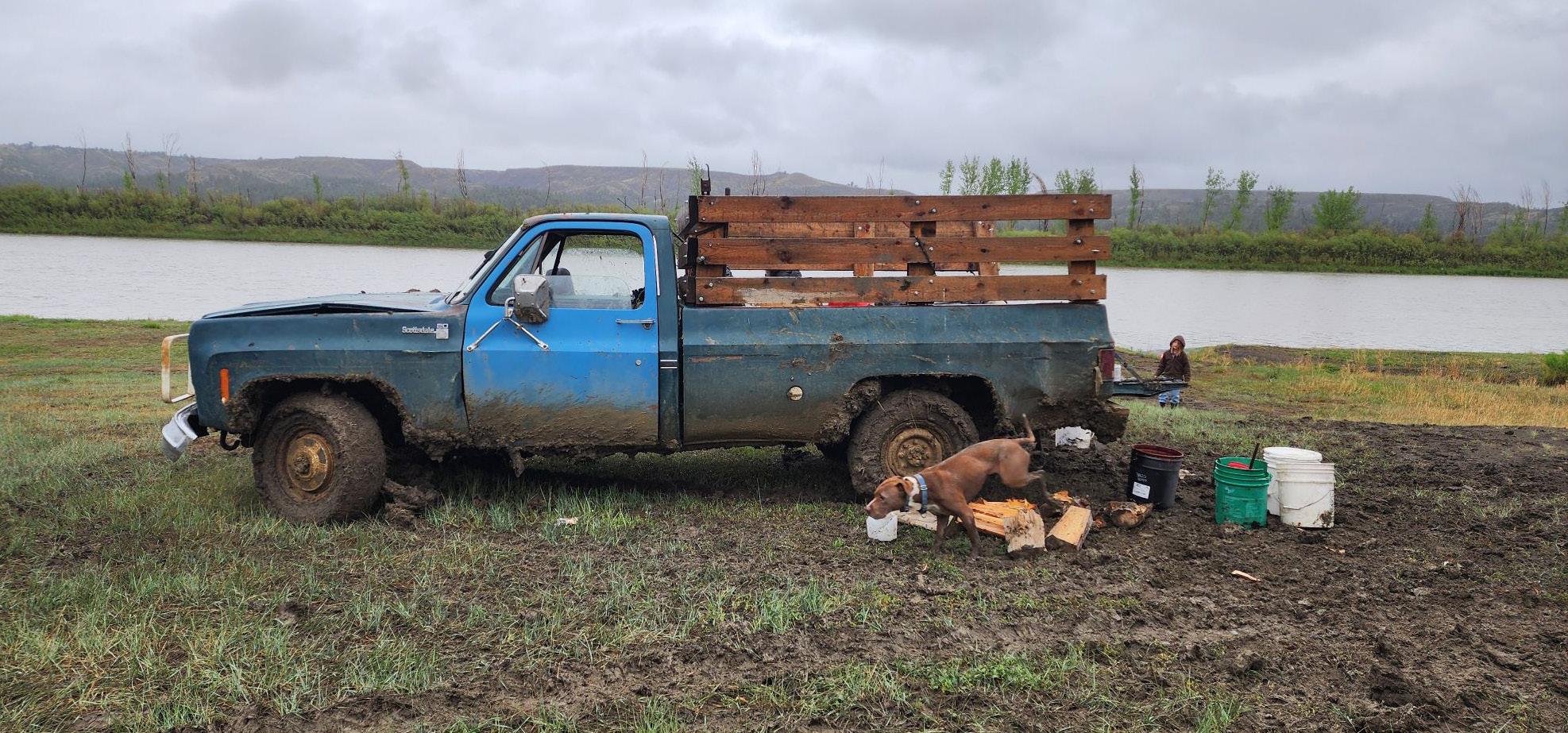
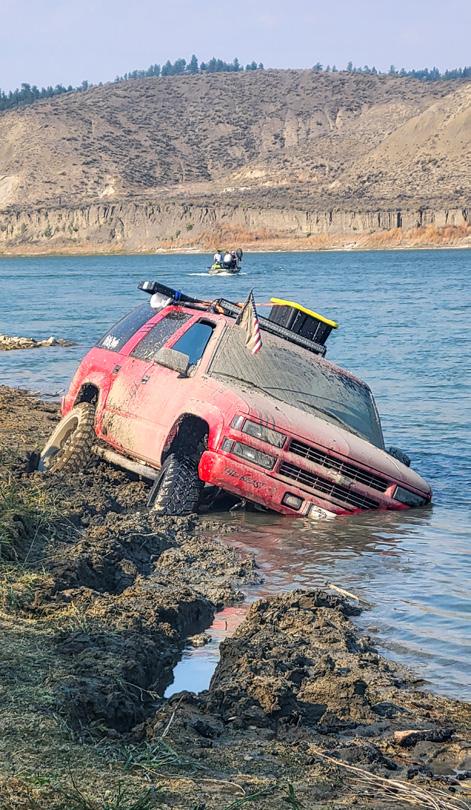
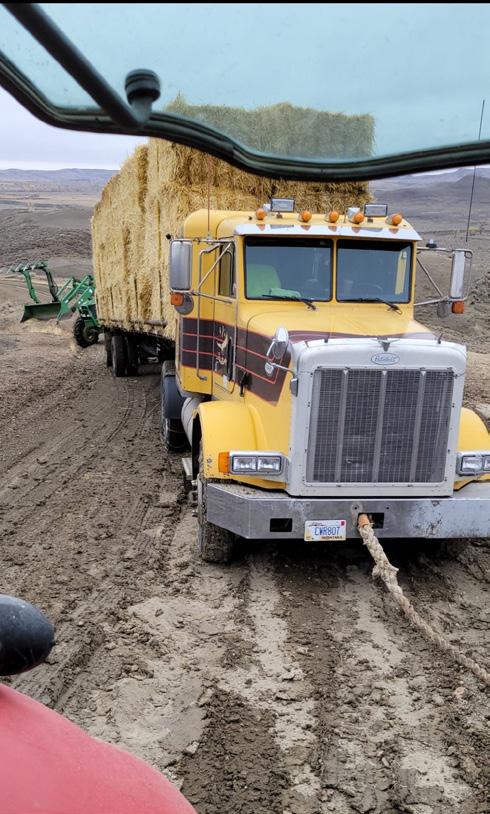
GRIME SCENES From sunken semis to plastered pickups to boot-stealing bogs, gumbo doesn’t play favorites. We asked FWP’s social media followers to post snapshots of their muddiest mishaps from Montana’s gumbo country. Here are a few of our favorites.
Hats off to gumbo. It keeps Montana, Montana. Curse it or bless it, it holds civilization at bay.
MUD WITH A SILVER LINING
Is there an upside to gumbo? I say there is. Bear with me. It’s not easy to find.
Gumbo is synonymous with Montana’s grasslands. Gumbo soils tend to be nutritionally poor for most trees or crops. It takes a hearty variety of native grass to grow roots that can punch through the armor of bentonite crust.
Grasslands happen to be the most endangered habitat on earth, with more than 70 percent lost to date in North America. After all, grasslands are readily cultivated, and the world is full of hungry humans.
But gumbo will stop a plow and tractor just as readily as your truck or ATV. I don’t think it’s a coincidence that areas where we have gumbo are among the few grassland ecosystems that haven’t been plowed under. The long winters and dry climate limit sod-busting, but so does gumbo, leaving space for grasses.
Native grass is good for cattle, and good for bighorns, pronghorns, elk, sharp-tailed grouse, and many other grassland birds, mammals, and reptiles.
So hats off to gumbo. It keeps Montana, Montana. Curse it or bless it, it holds civilization at bay.
Back on the Judith, Karen and I bided our time as best we could, and by the afternoon, puddles on the ranch road began to evaporate. A bank of dark clouds suggested another rainstorm. It was time to skedaddle.
In my head, I tallied my small damage deposit relative to the huge sum it would cost to repair the rented RV. If we mired the 5-ton vehicle, we’d have to walk 20 miles to the nearest farmhouse, if we could walk at all. God knows what a tow truck would’ve cost.
I said a quiet prayer as I put the transmission in gear. What followed was, to put it mildly, a sleigh ride. I found a sweet spot around 30 miles per hour. Any slower and we lost momentum. Any faster and the rear end began to fishtail. Descending a mudchute hill, the rear bumper decided it wanted to switch places with the front end.
I knew to turn the wheel into the spin. In slow motion, I fought the temptation to crank the steering wheel back the other way. At the last moment, the rear corrected,
saving us from a 180.
White-knuckled and tight-jawed, we eventually made it down to the gravel county road. I mentally apologized to the county road grader as we continued out of the river bottom, leaving ruts and spewing mud. Every time it seemed the road was improving, we hit a low spot and were axle-deep in muck.
Eventually, we hit pavement. I stopped for a moment and pressed my forehead into the top of the steering wheel. The van was plastered like a warthog fresh from a wallow, but intact.
At Fort Benton we pumped $30 in quarters into the car wash. We sprayed off each other, then the van. We were not the first. That car wash is actually equipped with square-blade shovels to help scrape the town’s namesake muck out of the bays.
We drove home a bit wiser. If you go explore that new state park or other remote corners of Montana, honor the weather forecast. Gumbo is the patient guardian of the prairie, keeping pilgrims honest and reminding us who really is in charge.
ABANDON SHIP In some cases, the only way to extract a stuck vehicle from gumbo is to walk to the nearest town, wait for drier weather, then return with a tow truck.
Mountain of Memories
The
pleasures
of
Montana’s
largest wildlife
management area across years and seasons.
By Nicole Qualtieri
now fell thick starting at dawn on the last day of the rifle hunting season. With an unfilled B tag for a cow elk and shooting hours wearing thin, I shook myself from my office chair, piled on layers, threw my rifle over my shoulder, and headed out the door.
Driving toward Mount Haggin Wildlife Management Area, my thoughts wandered back to September when I toted my bow through a different part of the WMA on opening weekend of the archery season. I’d gotten brave enough to try my beginner bugles and was surprised to get an immediate answer. It rang back as withering and questionable as my own call.
I soon spotted the pair of archery hunters just before they spotted me, and grinned.
“We thought it was probably another hunter,” one said, smiling back. We headed different ways after much-needed wishes of luck. I climbed to a ridgeline where I sat and watched a small herd of mule deer does and fawns graze until light waned into darkness. No actual elk or real bugles, but a perfect day with miles and elevation under foot.
That day was almost too warm for hunting, and the elk were likely deep in the thick timber shading much of Mount Haggin WMA, which spans more than 60,000 acres. It isn’t an easy place to hunt, and cow elk are managed conservatively; they’re only huntable by the B tag I held. But that tag inspired a sense of discovery, and I lit out afoot, more excited to explore new country than pack out a cow solo. I walked miles of hilly landscape, only occasionally on trails, and without a serious agenda, pushing aside more earnest hunting tactics in favor of exploration.
That fall, a hard-hunting friend told me he gets annoyed with hunters who think they’re going to walk themselves into deer or elk. I needed to be more strategic, he advised. I told him I got into hunting because I liked walking and was okay with odds stacked against me. Even preferred it.
You don’t get it, we both seemed to think at the same time. At this, we laughed and agreed to disagree, to hunt our own hunts. I filled other tags elsewhere, but this was more a chance to get to know a new larger landscape rather than whittling it down to the likeliest habitat. uu
Nicole Qualtieri is a writer and editor in Anaconda.
CLOSE BY AND QUIET
Five years have since passed, and the hills of Mount Haggin WMA still beckon from my front porch in Anaconda, beyond fields of grass and sagebrush, small farms and ranches, to the pockets of dark timber on the foothills of the Anaconda-Pintler Wilderness. The WMA’s namesake mountain stands on the edge of those peaks, but I can’t see it from my humble home on 20 acres with a horse, a mule, three donkeys, two dogs, and a formerly feral barn cat that now lounges on the couch. It takes me just 20 minutes to reach the wildlife area. I can count on two hands the fellow hikers I’ve met there in the past five years. Hunters arrive in greater numbers come fall, but even then, they’re sparsely distributed. Where I like to go, there aren’t massive panoramic payoffs. The trails are old logging roads, and most of the streams aren’t big enough to fish. But it’s close and provides solitude. I’ve learned where elk find water in unlikely places and where a particular grouse hangs each summer to raise her chicks. There’s a shallow knoll where I accidentally came within 10 yards of a cow moose and her red wobbly legged newborn. I was thankful my dogs were oblivious as the mother led her baby at a brisk trot down the path toward the trailhead. I waited an hour to walk the dogs back to the truck.
four-season familiarity with the public lands nearby. But I’m happy to let Mount Haggin WMA remain a winter mystery, knowing wildlife need that respite.
By the time the area opens to the public in mid-May, I drive in, my dogs whining with excitement as we approach familiar trailheads. Soon I’m following a path noting patterns of scat, prints in the mud. I breathe it in.
BIRTH OF AN AMAZING PLACE
The lower elevations of the WMA are prime winter range that helped that cow moose and many before her produce the future of Mount Haggin’s moose population. From December 1 to May 15, the portion west of the Continental Divide is closed to human recreation, offering respite for moose as well as elk, pronghorn, mule deer, whitetails, black bears, and the occasional grizzly, lynx, and wolverine. Vanna Boccadori, FWP’s Butte-area wildlife biologist, says 400 to 600 elk winter on the wildlife area every year. They’re joined by 100 to 200 mule deer, and a few dozen moose.
On one spring hike, the unmistakable rhythm of Who cooks for you? Who cooks for you all? echoed through the Mount Haggin woods, the first barred owl I’d heard in Montana. I called back, hoping it might get curious enough for a look. We talked back and forth a few times, but I never saw it. With late spring thunder rumbling in the near distance, I headed for the truck, my dogs bounding with sticks in their mouths through the green-up.
When the WMA shuts down each December, I look up at the slopes above Anaconda and wonder, What’s happening up there? What’s it like right now? Every place I’ve lived, I’ve developed
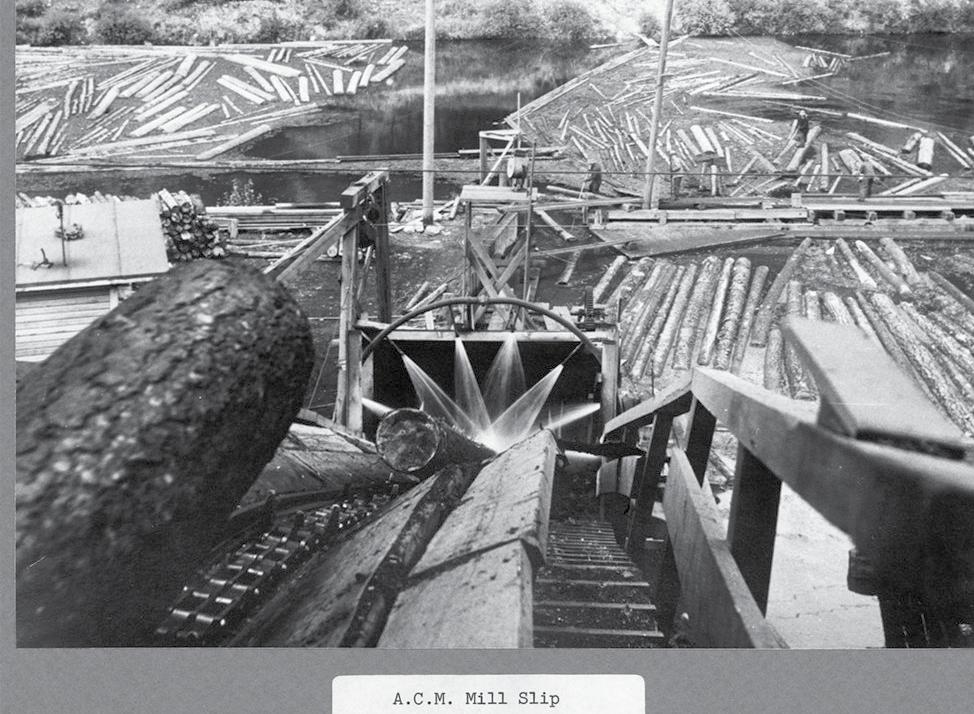
The remains of history are easy to spot in the rocky mounds of tailings within the WMA, even if you don’t know much about the area’s span of human engagement. Before the 1800s, the area provided hunting grounds and gathering sites for the Kootenai, Pend d’Oreille, and Salish peoples, among others. The late 19th century ushered in a very new era—the reign of the copper barons. Mount Haggin was clear-cut to supply wood to fuel the Anaconda Mining Company’s smelters and home stoves in Butte and beyond. With the trees went the wildlife. By the early 1970s, the future of the mountain and surrounding lands looked grim.
A local homesteader and conservationist named Deanye Rousch had an idea. She convinced The Nature Conservancy (TNC) to buy a massive block of land the Anaconda Mining Company was selling. TNC purchased it, then resold it to FWP in 1976 to create the Mount Haggin WMA, protected in perpetuity as a place where wildlife take priority. Rousch is now approaching her ninth decade and still maintains her homestead nearby.
Boccadori oversees management of the WMA, helping coordinate volunteer habitat work projects and updating the public on Mount Haggin and the rest of the region she covers. Her community emails help me and others stay abreast of the latest wildlife news.
An assembly of conservation nonprofits also focuses its efforts on this stretch of habitat. The Rocky Mountain Elk Foundation, Anaconda Sportsmen, Skyline Sportsmen, George Grant Chapter of Trout Unlimited, Big Hole Watershed Committee, and others have helped add acreage to the WMA and recruit volunteers for
In 1976, The Nature Conservancy purchased the land from the Anaconda Mining Company and resold it to FWP, creating the Mount Haggin WMA.
LAND OF POSSIBILITY
Mount Haggin went from supplying logs that fed the mining industry to protecting habitat for fish and wildlife.
An assembly of conservation nonprofits also focuses its efforts on this habitat, helping add acreage to the WMA and recruiting volunteers for restoration work.
restoration work. Boccadori gives special credit to Rousch and the rod and gun clubs, noting they’ve stood up for their hometown wildlife area with constant care, communal efforts, and commentary.
Restoration within the WMA and other habitat areas nearby continues, boosted by mitigation funding earmarked for restoring or replacing lands harmed by mine waste in the Clark Fork River basin. Many places once heavily logged and mined are slowly recovering.
“Mount Haggin is an amazing place,” Boccadori says. “Being the largest WMA in Montana and spanning the Continental Divide, it encompasses big game winter range, birthing and summer range, and the migratory pathways between these vital areas. I’m always humbled when I think that elk, deer, and pronghorn have likely been using it for millennia, passing down herd wisdom across thousands of generations. It’s an honor to help steward this landscape for a relative blink in time.”
Ironically, one of the biggest wildlife habitat challenges facing Boccadori is that parts of Mount Haggin have too many trees. Without logging and wildfires to maintain open areas, juniper, lodgepole, and Douglas fir are taking over sagebrush shrublands, grasslands, young aspen stands, and streamside areas that are vital for songbirds, small mammals, and game species. Since 2010, FWP has contracted with timber companies and firewood suppliers to selectively log small stands of aspen and conifers at Mount Haggin and several other western Montana WMAs. Thriving in the newly opened areas created by low-intensity timber harvest are grasses and wildflowers that deer and elk eat and songbirds use for ground nesting. Thinning also encourages new growth of shrubs like bitterbrush browsed by mule deer and moose. Removal of thick underbrush created by decades of fire suppression reduces the risk of catastrophic wildfire that can threaten surrounding communities.
That late November day I left my house to hunt still stands out as my favorite on Mount Haggin. As I quietly pulled my truck door shut, the thermometer stood at 10 degrees, the sky a deep blue daubed with high wispy horsetails. Cozy in synthetics and wool, I hiked uphill to sit, watch, and wait in a spot I knew that elk used. Mindful of the direction of the slight wind, I passed a few empty elk beds in the snow along a path thick with the morning’s prints.
Then as the golden hour before sunset took hold, a diamond dust of snow crystals sparkled down from snow-laden pines hovering above. A hoar frost tipped my eyelashes as my exhales crusted my hood and neck gaiter with ice.
I sat 45 minutes before the cold began to pierce my layers, prodding me to begin the trek back before shooting light ended.
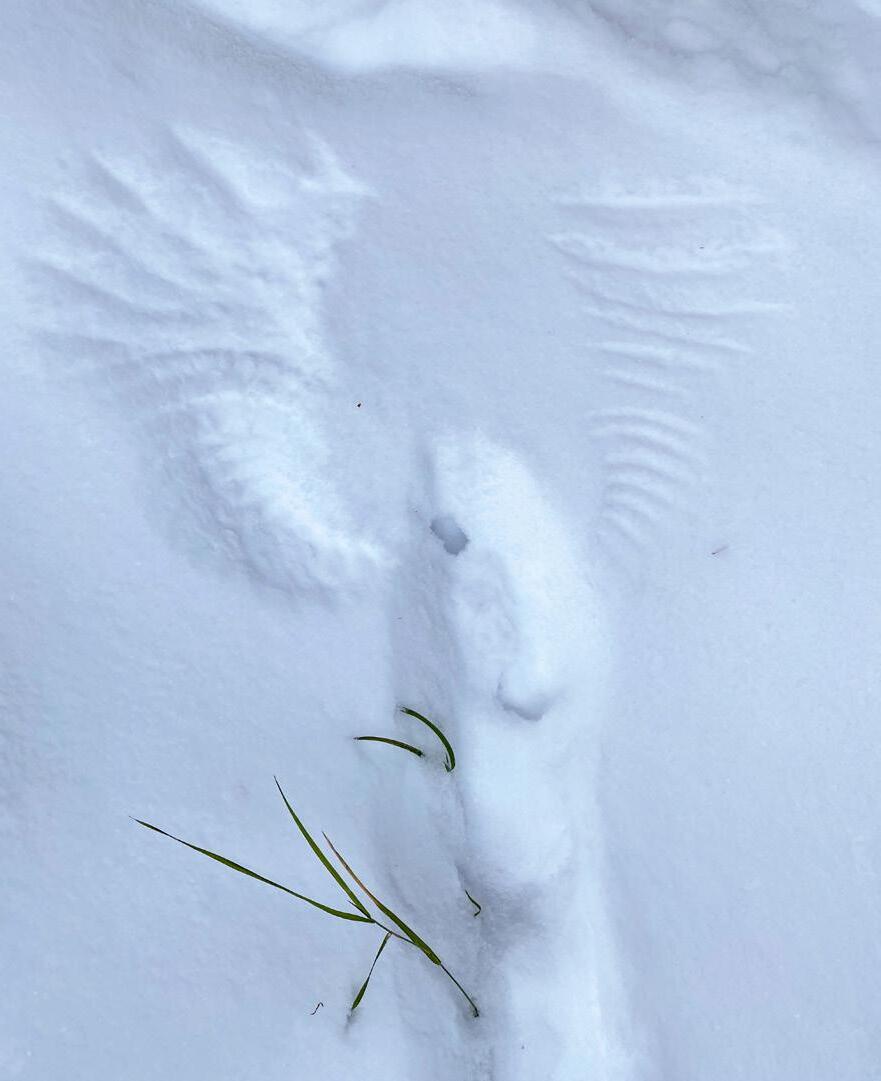
In the snow next to a tall pine where a grouse had once surprised me, I found a perfect imprint of a small bird of prey. I leaned in to investigate: wings high, talons down, a clear impression of a beak. It didn’t appear the bird had come up with its intended prey. Like me, it had gone home empty handed. I hustled to get my blood flowing.
Back in the driver’s seat, the temperature read -8. That sharp drop accounted for the diamond dust I’d seen and the long time it took for my truck to warm up. As heat finally began to fill the vehicle, I sat and watched my surroundings in the fading light. Four mule deer crossed an opening high above, silhouetted against a snowy ridge, grazing for warmth.
I drove out of Mount Haggin with the cover of winter stark white behind me, counting the days until green-up and open gates.
JANUARY–FEBRUARY 2025
44th Annual Photo Issue
MARCH–APRIL 2025
Likin’ Lichen Strange and beautiful organisms thrive in Montana environments—from prairies and deserts to mountaintops and oldgrowth forests.
Essay and photos by Tim Wheeler
Hitting the Empowerment
Bull’s-eye In more than 200 schools across Montana, archery students are building self-confidence, practicing discipline, and enjoying success in competition. By Tom Kuglin
Reconstructing the Regulations
Every two years, FWP and the Montana Fish and Wildlife Commission combine public opinion and scientific data to adjust seasons, harvest quotas, and other components of the hunting regulations booklets. By Brian Wakeling
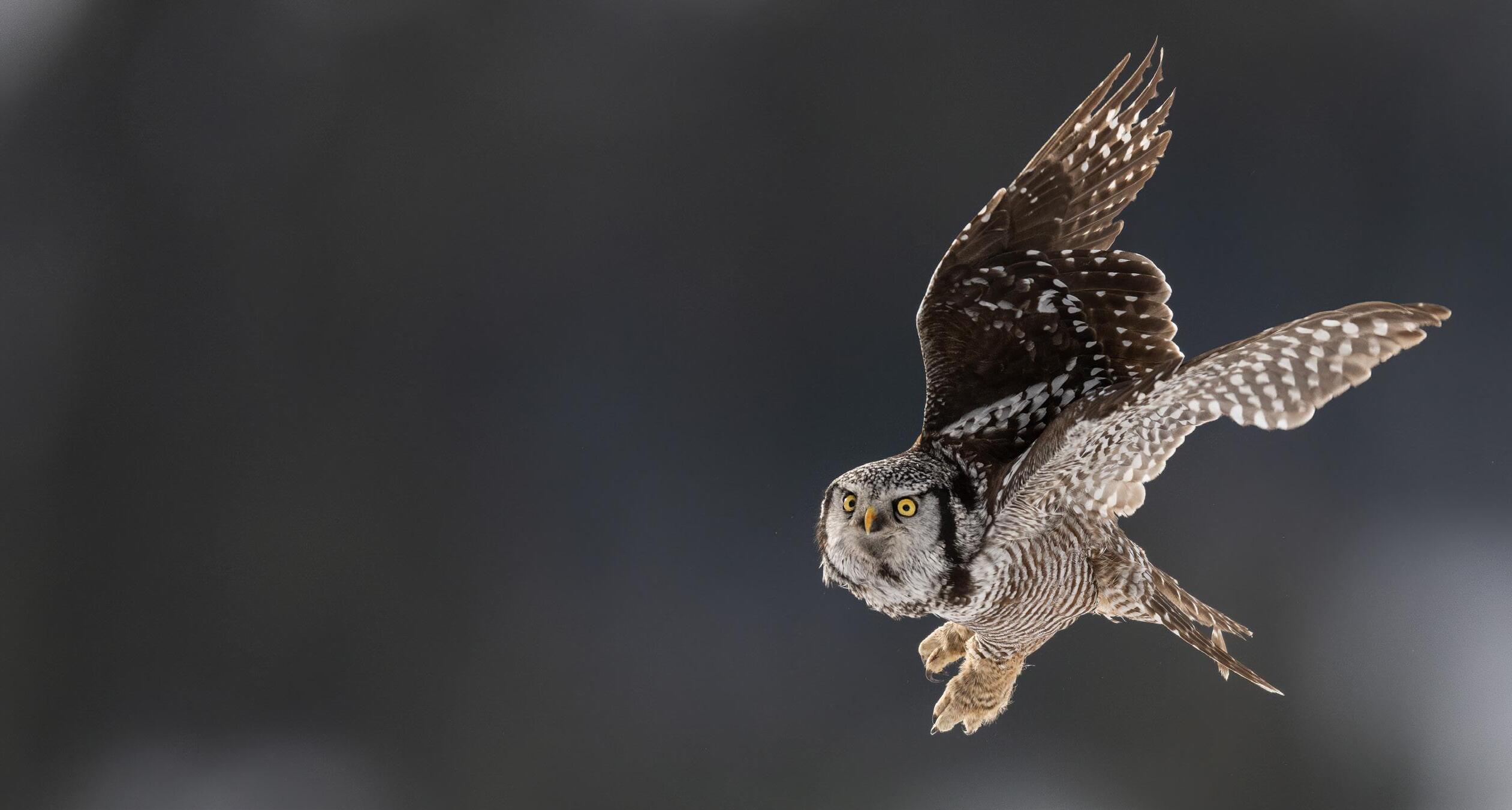
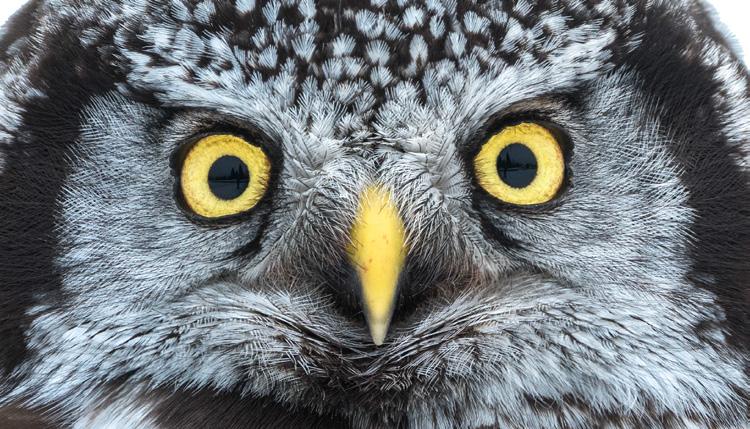
Who’s Who? The “good enough” guide to identifying Montana’s 15 owl species. By Ellen Horowitz
Double Bacon Cheeseburger with Fins Four decades ago, FWP introduced the high-calorie cisco into Fort Peck Reservoir. The result—bigger yet more elusive walleye and other game fish— demonstrates the challenge of bigreservoir fisheries management. By Andrew McKean
MAY–JUNE 2025
MONTANA OUTDOORS 2025 INDEX
Fields of Belonging How a summer spent surveying mountain meadows brought the outdoors into a young woman’s comfort zone.
By Nico Matallana-Mejia
Snakebite A guide to keeping dogs alive and well in snake country. By E. Donnall Thomas, Jr.
Stream Savers For 50 years, Montana’s “310” permits have helped riparian homeowners and others protect the state’s most valuable aquatic assets. By Tom Dickson
Big Sky Season A photo essay.
SEPTEMBER–OCTOBER
2025
Get Smart Simply by taking out the trash, Missoula became North America’s largest Bear Smart Community, inspiring other towns to follow suit. By Paul Queneau
Upland Imports Transplanted from other states or other continents, Montana’s introduced upland bird species are now a welcome presence for many hunters. Here’s how they arrived and where to find them. By Jack Ballard
Interconnected More and more wildlife diseases are being detected in Montana. Keeping tabs on them helps protect domestic animals and people, too. By Julie Lue
Birding for Boomers And everyone else brave enough to embrace one of the world’s most rewarding and frustrating activities. By Sneed B. Collard III Ghosts in the Woods Canada lynx live secretive lives in the backwoods of Montana, but new research is helping unveil some of their mysteries. By Allen Morris Jones
Welcome to Catfish Camp A well-spent week in search of solitude and sundry fish along the middle Missouri River. By David Schmetterling
A Long Ride 46 years of surveying birds in central Montana as part of the national Breeding Bird Survey comes to a close. By Ed Harper
Not Like It Was The Missouri River’s blue-ribbon trout fishery is changing. Is that good news or bad? By Tom Kuglin
JULY–AUGUST 2025
A Prairie Powerhouse Holder of five state fish records and a reliable walleye and perch factory, Nelson Reservoir endures the vagaries of drought and drawdown. Can it now survive its own popularity? By Andrew McKean
Collision Course Window strikes, dead birds, and what to do about it. By Shane Sater
Ravenous Record-Setters Montana is home to some of the world’s largest tiger muskies, a voracious muskellunge–northern pike hybrid attracting anglers from across the United States. By E. Donnall Thomas, Jr. Climbing for Dusky Grouse A reflection on how shifting seasons, wild places, and memories converge on a September mountainside. By Noah Davis
NOVEMBER-DECEMBER
2025
Absorbing the Blows From private shorelines to state parks, a Montanaborn idea is reshaping how landowners and agencies protect Flathead Lake’s fragile edges. By Dillon Tabish
Corvids to Crow Over The “good enough”guide to identifying Montana’s eight members of the crow family. By Sneed B. Collard III Montana’s Gourmet Gumbo How to escape the state’s stickiest, gooeyist, sloppiest soil. By Ben Long
Mount Haggin WMA The pleasure of returning to a nearby wildlife management area across years and seasons. By Nicole Qualtieri
BACK ISSUES are $5.50 per copy, which includes shipping. Send your request and payment to: Montana Outdoors, PO Box 200701, Helena, MT 59620-0701. Or email us at AHowell@mt.gov.
Photo Issue
Bad shot
By Tom Dickson
Ihave this bad trait where the more discomfort I endure while hunting, the more I convince myself that I deserve to bag my prey. That my suffering obligates it to be mine. And from that feeling comes a tendency to occasionally take an unethical shot. It’s not something I’m proud of.
I’m not a great shooter. Maybe average. But I rarely miss when hunting. That’s because I only take shots I’m sure I’ll make, passing on running or distant deer or pronghorn, or upland birds and waterfowl only marginally within range.
That care comes from not wanting to cause animals pain. An odd sentiment for someone who kills dozens of animals each fall, right? But that’s how I feel. I don’t mind the killing; there are far worse ways for a wild animal to perish. It’s the maiming that gets me. I believe that, as the Midwestern author Kent Meyers writes, “When we wound an animal, we are responsible for its pain.”
Yet something happens to that high-mindedness when my hunting plans turn sour. Sitting all day in a cold duck blind with no action. Walking miles and not encountering a single pheasant. Hour after hour of seeing only the white flags of whitetails that smell me long before I see them. I become resentful and start to think that if I ever do see a game animal this long day, perhaps I might need to take a running shot, or shoot at a rooster no matter how far off he flushes. I start to feel like all my misfortune demands compensation. That I am owed my prey, no matter what.
That’s the feeling I had one late November evening last year while kneeling next to a barbed wire fence separating a woodlot from 100 acres of alfalfa stubble. Due to a torn ankle tendon, that season I’d only been able to deer hunt that one day and could hobble only a few hundred yards from where I’d parked. My wife, who waited back in the car with a magazine, said she’d haul out the deer if I shot one.
The week before I’d scouted the area from the road and seen where whitetails snuck from the stand of cottonwoods through tall grass to the fence. After jumping it, they waited a moment or two before dashing a few hundred yards to the center of the field to feed. I saw where I could set up along the fence and have a clean 150-yard shot after one jumped and then paused.
It was late afternoon when I got situated. Knowing the deer wouldn’t move until dusk, I settled into the snow-covered grasses and took a nap.
An hour later when I woke, shivering, a dozen or so does and fawns had already made it out into the field. I got into a kneeling position, readied my rifle on a pair of shooting sticks, and waited. Soon a large doe moved through the tall grass, jumped the fence, then ran out to join the others. No pause. Another did the same thing. Then another and another. I had a solid rest but didn’t want to shoot at a moving deer for fear of not making a killing shot.
But after 30 minutes, with the end of shooting hours fast approaching, I started to kind of panic. This was my only chance for the year. I always get a deer, usually two. My wife and I love eating venison. I told myself I was owed a deer for all I’d been through that fall.
All my foot pain. The hunting trips I’d had to cancel. My frozen fingers and feet. I convinced myself I should get what I deserved.
But with shooting hours about to end, I figured it was over and began to pack up. Then I spotted one last deer moving like a shadow through the grass, a small buck. I glanced at my watch—five minutes left—and readied my rifle. As soon as it jumped and landed, it immediately started trotting like the others. I led it by a few inches and shot.
The buck lurched then staggered. I was sure I’d killed it cleanly but hadn’t. It ran another 200 yards then stopped and stood unsteadily. I fired twice, farther than I’d ever shot at a deer, and missed. It slowly ran off, limping and listing to one side. Soon it was dark, and I searched for it as best I could.
Even now, nearly a year later, I think of my actions with shame. How the buck likely bedded down somewhere to die a painful death that night. How I shouldn’t have shot, knowing I was too disabled to trail a wounded deer for hours and put it out of its misery. How I had to tell my wife what I’d done when I returned to the car.
I still feel sick about taking that shot. Looks like I got what I deserved after all.
Tom Dickson is the previous editor of Montana Outdoors.
Northern Hawk Owl
By Sneed B. Collard III
Two Januarys ago, a Wise River resident posted photos of a northern hawk owl on Facebook. The images ignited a frenzy. For several weeks, birders traveled from all over Montana and at least a half-dozen other states hoping to catch a glimpse of the creature. And for good reason.
Not only are northern hawk owls exceedingly hard to find and observe, they are one of the handsomest, most mysterious, and least-studied birds in North America.
NAME
Surnia, the first half of the northern hawk owl’s scientific name, may be an adaptation of a Greek word for owl or “bird of ill omen.” The second half, ulula, is the Latin word for screech owl.
APPEARANCE
A medium-sized, barrel-chested bird reminiscent of a little linebacker, the northern hawk owl gets its name from having both owl- and hawk-like features. Its eyes blaze with an owly “Don’t mess with me” intensity, while its long tail, pointed wings, and fast, aggressive flight draw frequent comparisons to accipiter hawks and falcons.
SOUND
The northern hawk owl emits a wide variety of vocalizations, ranging from a rising screech to plaintive, repeating shorebird-type calls. The Cornell Lab of Ornithology likens the hawk owl’s song
or “advertising call” to a squeaky wheel bearing on a pickup truck. It will also sometimes broadcast a stream of individual, rapidly repeating notes similar to those of a northern pygmy-owl, creating a haunting, lengthy trill.
HABITAT AND DISTRIBUTION
The northern hawk owl can be found in boreal forests and mountainous areas across Canada and Alaska as well as northern Asia and Europe, but it’s an infrequent visitor in much of the continental United States. Minnesota is the Lower 48’s most popular “go to” state for seeing the bird, but it also has a sparse presence in Montana. This species prefers coniferous or mixed forests next to marshes, logging sites, or other open areas. Owl researchers James and Patricia Duncan say the bird has a particular affinity for burned areas, which provide plenty of snags for perching and tree cavities for nesting and roosting. Northern hawk owls have been found breeding in recent burns in Glacier National Park.
FEEDING
The bird dines mainly on voles, shrews, and other small mammals, but is also known to kill hares, ptarmigan, and grouse—perhaps more frequently in winter. Like short-eared and snowy owls, the northern hawk owl is primarily a daytime hunter and can spot prey at distances of up to half a mile. It often hunts
from a high perch with good views, such as a tall, lone conifer or snag (which is where most people spot them), rotating its head in all directions looking for prey. Once it spies its quarry, the owl launches into a fast, low glide, flapping its falcon-like wings for quick bursts of acceleration.
BREEDING
Courtship and mating can begin as early as February. The female usually lays between 6 and 10 eggs in a bare cavity in a tree, and is the sole incubator. The male provides food for the female and their hatchlings, and both parents will aggressively defend the young, even after they’ve left the nest at three to five weeks of age.
CONSERVATION AND U.S. PRESENCE
With its worldwide distribution, the northern hawk owl is considered globally secure. Montana, however, lists the bird as a state “species of concern” because of how infrequently it’s encountered here and how little is known about it.
“We go years without reported breeding, and in many years the species is not even detected in the state,” says Dan Bachen, senior zoologist for the Montana Natural Heritage Program. But given the northern hawk owl’s penchant for living and breeding in remote wilderness in the dead of winter, he adds that there may well be more of them in Montana than we know.