V O L U M E 2 7
M AY 2 0 1 8
M O N TA N A
GRASS ROOTS F E E D I N G T H E F U T U R E T H R O U G H F A R M E R S U N I O N E D U C AT I O N A P U B L I C AT I O N B Y M O N TA N A F A R M E R S U N I O N
FLOODING CREATES CHALLENGES FOR FARMERS B Y LY N D S AY B R U N O C O M M U N I C AT I O N S D I R E C T O R
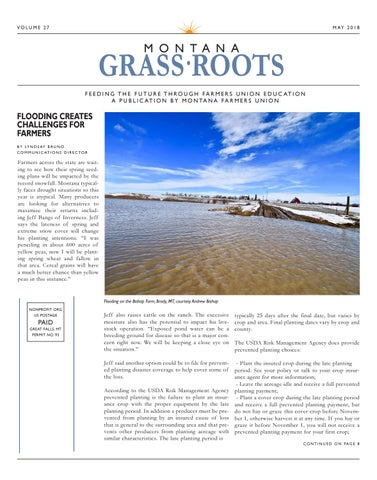
Farmers across the state are waiting to see how their spring seeding plans will be impacted by the record snowfall. Montana typically faces drought situations so this year is atypical. Many producers are looking for alternatives to maximize their returns including Jeff Bangs of Inverness. Jeff says the lateness of spring and extreme snow cover will change his planting intentions. “I was penciling in about 600 acres of yellow peas, now I will be planting spring wheat and fallow in that area. Cereal grains will have a much better chance than yellow peas in this instance.”
Flooding on the Bishop Farm, Brady, MT; courtesy Andrew Bishop NONPROFIT ORG US POSTAGE
PAID GREAT FALLS, MT PERMIT NO. 93
Jeff also raises cattle on the ranch. The excessive moisture also has the potential to impact his livestock operation. “Exposed pond water can be a breeding ground for disease so that is a major concern right now. We will be keeping a close eye on the situation.”
typically 25 days after the final date, but varies by crop and area. Final planting dates vary by crop and county. The USDA Risk Management Agency does provide prevented planting choices:
Jeff said another option could be to file for prevent- - Plant the insured crop during the late planting ed planting disaster coverage to help cover some of period. See your policy or talk to your crop insurthe loss. ance agent for more information; - Leave the acreage idle and receive a full prevented According to the USDA Risk Management Agency planting payment; prevented planting is the failure to plant an insur- - Plant a cover crop during the late planting period ance crop with the proper equipment by the late and receive a full prevented planting payment, but PAGE plantingPAGE period.5In&addition a producer must bePAGE pre- do crop 8before Novem7 not hay or graze this cover 6 Arrowpeak vented plantingSolar by an insured cause of loss otherwise harvest2017 it at any time. If you hay or Sneak Peek ber of 1, the MFUfrom Sponsors Camp theme that is general to the surrounding area and that pregraze it before November 1, you will not receive a 2017 Producers Tour & Ag Technology vents other producers from planting acreage with prevented planting paymentrevealed! for your first crop; Conference Seminar similar characteristics. The late planting period is
IN THIS ISSUE....
C O N T I N U E D O N PA G E 8
V O L U M E 2 7
M AY 2 0 1 8
Dry Hills Distillery/Bozeman
CONFERENCE AGENDA: Wednesday, June 6 2018: 7:30 am 8:00
Final Registration Breakfast/Hilton Garden Inn
8:30 Board Bus at Hotel 9:00 – 11:30 Montana State University Pulse Lab Seed Lab Malt Barley Lab Noon: Lunch; Speaker: President Cruzado, MSU Sheep at Fort Ellis Research Farm, courtesy MSU 6/4/18-Power, MT 1:45 Discover the latest in genetics and animal breeding Hosted by SimGenetics (American Simmental Association) 2:30 Board bus for Dry Hill Distillery Tour 3:00 Dry Hill Distillery: see value-added agriculture at work $35 members/ $50 Nonmembers. Meals 4:00 Return to Hotel 6:00 Dinner; Hilton Garden Inn included with registration. Lodging is
Register Now:
available at the Hilton Garden Inn-
Thursday, June 7 2018: 8:00 Breakfast 8:30 Board bus to MSU 9:00 - 10:45 Tour Wool Lab/Malt Barley Lab 10:45 Board Bus to Fort Ellis Research Farm 11:00 - Noon Fort Ellis Research Farm Learn about the heifer project and the latest in cropping systems at the Fort Ellis Research Farm 12:15 Arrive Back at Hotel 12:30 - 1:30 Lunch; Hilton Garden Inn
2
Bozeman with a special rate for MFU conference attendees. Contact the hotel directly at 406.582.9900 to make reservations. Call MFU at 800-234-4071 to register.
V O L U M E 2 7
M AY 2 0 1 8
WELCOME NEW MEMBERS!! Member
Ella Yeadon, Malta Burgess Ranch Inc., Jordan John & Catherine Landa Walter & Angela Murray, Miles City Scot & Angela Robinson, Powderville Wacey & Nicole Stuart, Miles City T Squared Ag LLC, Terry Travis & Theresa Caldwell, Shepherd Audrey Bermes, Billings Stuart & Annie Shirley, Melstone Steve Preputin & Sons Inc., Brady Seth & Kaci Jansma, Fromberg Jeffrey & Cortney Wagner, Hardin Anne Anderson, Fairfield Bud & Violet Olson, Fairfield Laura Lambert, Broadus Russell & Bonnie McCormick, Stevensville Robert Brannan, St Ignatius Susan Compton, Heron Renae & Ken Cornelius, Ronan Colin Gaskell, Charlo MJB LLC, Willmar, MN Wallace Bailey, White Sulphur Springs Darrell & Tammie Ogg, Great Falls Amber & Mel Carver, Great Falls Kathy Tureck, Boulder CO Kelsey & Dustin Klostermeier, Great Falls Melissa & Jake Han, Brady Tami & Gary Creek, Floweree Stacy & Zac Griffin, Great Falls Molly & Randall Lilly, Great Falls Jenifer Lawson, Great Falls Jenifer & Colby Cline, Fort Benton Martina & Paul Gunter, Augusta Devin & Shawn Kelley, Billings Kara & Dave Bell, Great Falls Seth & Jamie Wheeler, Great Falls Jenifer & John Voss, Great Falls Traci & Jason Orthman, Great Falls Charity & Josh Ewald, Great Falls Melissa Fiori, Great Falls Misty Bickel, Great Falls Adriann & Michael Lewis, Great Falls Jamie Ulmer & Benjamin Winter, Arvada CO
IN THIS ISSUE Soil Acidity: An emerging issue that requires scouting, By Clain Jones Page 4
Recruited by Shane Anderson Ron & Blayne Watts Ron & Blayne Watts Ron & Blayne Watts Ron & Blayne Watts Ron & Blayne Watts Ron & Blayne Watts James Mathews Steve Plaggemeyer K J Fauth Dirk Elings Wes Schwend Melissa Wacker Mathew Luedtke Mathew Luedtke Charles Monroe Bryan Jones
MONTANA FARMERS UNION PO BOX 2447 300 RIVER DRIVE NORTH GREAT FALLS MT 59403 PHONE: (406) 452-6406 1-800-234-4071 FAX: (406) 727-8216 mfu@montanafarmersunion.com www.montanafarmersunion.com
Empowering Women in Agriculture, By Irene Grimberg and Theo Lipfert Page 5 Mfu recognizes agents for recruitent incentive program Page 6 Member Profile: Colter DeVries By Lyndsay Bruno Page 7/9
Andrew Luedtke Andrew Luedtke Andrew Luedtke Andrew Luedtke Cathy Hintz Andre Marcure MFU Camp MFU Camp MFU Camp MFU Camp
Resource on agritourism, By Chris Christiaens Page 8 MFU is hiring camp counselors! Page 10
MFU Camp MFU Camp MFU Camp MFU Camp MFU Camp MFU Camp MFU Camp MFU Camp MFU Camp MFU Camp MFU Camp MFU Camp MFU Camp MFU Camp MFU Camp MFU Camp MFU Camp
Legislative Updates: Washinton Corner, By Roger Johnson Page 11/13 Leadership critical for younger generation to flourish, By Justin Loch Page 12 Messages from the Montana delegation Page 14 Be a part of MFU history! Page 15
3
Board of Directors: Alan Merrill, President Rollie Schlepp, Vice President, Conrad Erik Somerfeld, District 2, Power Jeff Bangs, At-Large Director District 1& 2, Inverness Brett Dailey, District 4, Jordan William Downs, District 5, Molt Ben Peterson, District 5 & 6 At-Large director, Judith Gap Kelly Rutledge, District 1, Big Sandy Sig Rudie, District 3 & 4 At-Large director, Fairview Paul Kanning, Distric 3, Flaxville Jan Tusick, District 6, Polson State Office Staff: Jan Johnson, Office Mgr., Assistant Secretary/ Treasurer Lyndsay Bruno, Communications Director Chris Christiaens, Legislative & Project Specialist Justin Loch, Membership Director Dave Snuggs, Facility Director Violet Green, Education Coordinator Maggie Shane, Continuing Education Coordinator Copyright Š Montana Farmers Union, 2018 Montana Grassroots is the official publication of the Farmers Educational and Cooperative Union of America, Montana Division. MFU reserves the right to reject any advertisements. Third Class bulk postage paid at Great Falls MT 59401. Membership: $50.00 per year Montana Grassroots is published 10 times each calendar year with two combined issues. Article submissions are requested by the 15th of the month. Advertising space is available.
Editor: Lyndsay Bruno Copy Editor: Jan Johnson
IN MEMORIAM Jack Lutgen, Billings Merle Baldwin, Kalispell Larry Chiotti, Fort Shaw
V O L U M E 2 7
SOIL ACIDITY: AN EMERGING ISSUE THAT REQUIRES SCOUTING BY CLAIN JONES M O N TA N A S TAT E U N I V E R S I T Y S O I L F E RT I L I T Y E X T E N S I O N SPECIALIST
Farmers in several Montana counties are experiencing nearly complete yield loss in portions of their fields due to soil acidity (low pH). Standard top 6-inch soil pH testing may not definitively identify soil acidity problems. Most fields with low pH problem areas also have larger areas with higher pH that buffer the pH value when soil samples submitted to labs are mixed from 6-8 subsamples per field. Also, the lowest pH is generally in the top 2 to 3 inches, not the top 6 inches, further masking the issue. MSU soil scientists
have now identified fields in 15 Montana counties with soil pH levels below 5.5, some as low as 3.8. Because many Montana soils have pH levels greater than 7.0, soil acidification received little attention until recently when yieldlimiting acidity was identified in Chouteau County. At pH levels below 5.0, naturally-occurring soil metals (like aluminum and manganese), become more soluble and can stunt root and shoot growth. Young plants in acidic areas are often yellow with club or “witch’s broom” roots (see photos). Substantial yield losses occur at pH levels below 4.5. The most sensitive cereal crops appear to be barley and durum, followed by spring wheat. The major cause of acidification appears to be ammonium fertilizers, including urea, applied in
M AY 2 0 1 8
excess of crop uptake. No-till concentrates the acidity near the surface where fertilizer is applied.
poor growth areas should also be sampled to determine if the pH is close to toxic on the margins, but do not yet exhibit symptoms. The Acidity problems usually start in potential is there for problem arlow lying areas of a field (where eas to grow in size. Areas where yield has historically been high), pH is 5 to 6 should be managed and acidity symptoms spread out- differently to prevent further ward. To identify if you have an acidification. acidification problem, look at your top 6-inch soil test. If the For additional information on pH is consistently above 7.5, it’s this emerging issue, go to http:// unlikely you have a problem. If it landresources.montana.edu/soilis below 6.0, you likely have areas fertility and click on Soil Scoops with pH below 5 and have yield- where you will find two doculimiting soil acidity. ments on soil acidification, or click on Presentations. On fields where standard soil test pH levels in the top 6 inches are Please contact Clain Jones, MSU below 7.5, scout for yellow seed- Extension Soil Fertility Specialist lings and club roots. To verify (clainj@montana.edu, 994-6076) that those symptoms are caused or MT Salinity Control Associaby low pH, analyze just the top 2 tion (406-278-3071) if you have inches for pH, either with a field any questions. pH stick, pH probe, or lab analysis. Soil in the zone at the edge of
2018 MONTANA FARMERS UNION DAY CAMP Join us for a day filled with fun activities, workshops and cooperative games for ages 5-10. No fees! Just bring a sack lunch! To register visit montanafarmersunion.com/event/day-camp/. Contact day camp organizer Maggie Shane with questions at 406.899.9504 or at mshane@ montanafarmersunion.com.
Camp Dates: 6/4/18-Power, MT Zion Lutheran Church 2:45 pm-5:45 pm
6/11/18-Fort Shaw, MT Sun River Valley Community Center 9:00 am-2:30 pm
6/5/18-Big Sandy, MT Big Sandy Park 11:30 am-3:30 pm
6/12/18-Belt, MT Golden Ages Rec Room 9:00 am-2:30 pm
6/6/18-Fort Benton, MT Community Bible Church 9:00 am- 2:30 pm
6/13/18-Conrad, MT First Presbyterian Church 9:00 am-2:30 pm
44
V O L U M E 2 7
M AY 2 0 1 8
DAINES TO HOST MONTANA ENERGY SUMMIT 2018: REGISTRATION NOW OPEN S E N AT O R S T E V E D A I N E S ; O F F I C E
U.S. SENATE — U.S. Senator Steve Daines today announced registration for the Montana Energy Summit 2018 is now open. The summit will take place in Billings on May 30th and 31st, 2018 at the Billings Hotel and Convention Center. Guest speakers and panel discussions will be announced in the coming weeks. To register for the Summit, click here. “Montana energy means energy dominance and high-paying Montana jobs,” Daines stated. “In Billings, on May 30th and 31st, folks across our state will have the opportunity to focus on unlocking Montana’s energy potential. To register, visit www.mtenergysummit.com.”
EMPOWERING WOMEN IN AGRICULTURE
project is determined to change this ratio. An all-women film-crew from Montana State University's School of Film and Photography will document the many contributions of B Y I R E N E G R I M B E R G A N D T H E O L I P F E RT these women. A video library of interviews A team of six women professors from Mon- will be created to share the stories, dreams, tana State University and Flathead Valley Com- and challenges of Montana women in agriculmunity College have partnered on a project to ture. These short video essays will premiere increase the participation and leadership of at a two-day public summit that the project women in agriculture. The project integrates team is organizing. The summit, projected research, education, and public outreach. With for Spring 2019 and Spring 2020, will bring the support of the National Institute of Food inspiring speakers together with students and Agriculture, the Empowering Women in and stakeholders. There will also be a phoAgriculture project responds to the shortage tography contest on the theme “Empowering of women in leadership roles in agriculture at Women in Agriculture.” We believe that the the national and regional levels. According to videos, summit, and the photography contest data from the 2012 U.S. Bureau of Statistics will increase public awareness of women in and United States Department of Agriculture, agriculture. women occupy the majority, about 60 percent, of lower-paid agricultural jobs on America’s The project provides opportunities for a new farms and ranches. Yet women constitute generation of women to engage with seasoned less than 1 percent of the nation’s agricultural professionals in agricultural careers through scientists, engineers, and policymakers. This an online university course and internships,
both focused on five career paths: in agricultural production, research, Extension, policy, and marketing. In turn, the course will be informed by the results from a survey study conducted by the project team. The survey study seeks to identify the needs, aspirations, and achievements of women in agriculture. If you want to learn more about this project visit our website, http://montana.edu/empowering-women-in-ag/. If you would like to be involved in the project, you may contact us at the email addresses listed below. Irene Grimberg is the Principal Investigator of Empowering Women in Agriculture project and an Associate Research Professor at Montana State University. She can be reached at grimberg@montana.edu. Theo Lipfert is Professor and Director of the School of Film & Photography of Montana State University. He can be reached at tlipfert@montana.edu.
MFU is a sponsor of the Empowering Women in Agriculture Project. 5
V O L U M E 2 7
M AY 2 0 1 8
MFU RECOGNIZES AGENTS FOR RECRUITENT INCENTIVE PROGRAM At the Farmers Union Mutual Insurance Company’s Mid-Year Conference in Great Falls MFU Board of Director Erik Somerfeld presented awards to four agents as part of MFU’s Agent Incentive Program. The awards were selected on the basis of 1.) most total members recruited and 2.) most new members recruited during the period from October 1, 2016- September 30, 2017. Congraulations to the following agents and to The Watts AGency for signing up 11 new members and winning the $1,000 prize! District 1: New Members: 1st Watts Agency 2nd James Mathews/Melissa Wacker Erik Somerfeld presents award to agent Blayne Watts/ Watts Agency
Total Members: 1st: Watts Agency 2nd: Tom McKenna District 2: New Members: 1st: Matthew Luedtke 2nd: Dirk Elings/Daryl Hansen Total Members: Dirk Elings Mathew Luedtke District 3: New Members: 1st: Andrew Luedtke 2nd: Andre Marcure/Sally Miller Total Members: 1st: Andrew Luedtke 2nd: Andre Marcure
Erik Somerfeld presents award to agent Dirk Elings
Erik Somerfeld presents award to agent to Andrew Lutedke
THANK YOU BUSINESS BOOSTERS FOR YOUR CONTINUED SUPPORT!
DIRK ELINGS INSURANCE DIRK ELINGS, CONRAD 6
V O L U M E 2 7
•
MEMBER profile
M AY 2 0 1 8
•
COLTER DEVRIES COLT JAMES RANCHES
Colt James Ranch; Roberts, Montana B Y LY N D S AY B R U N O C O M M U N I C AT I O N S D I R E C TO R
Colter DeVries is the founder of Colt James Ranches in Roberts, Montana. He raises Wagyu cattle and has discovered a niche market with a focus on holistic management practices balanced with stainability. His experience in commercial/agricultural banking coupled with a degree in finance has served as a solid foundation to start a ranch and value-added business. Colter began on the family ranch, but soon chose his own path. “I needed something that would segment and differentiate away from convention and commodity which is a race to the bottom for low-cost leaders,” said Colter. “I had tried another breed, and researched extensively the traits, characteristics, and marketability of other breeds, all of which eventually led
me to Wagyu. Wagyu has the legitimate traits and characteristics certain segments of the beef market are looking for, a niche that commands significant premiums of the finished product.”
delicatessens. The pursuit of succeeding in a niche market has come with challenges and lessons learned. Colter says the biggest hurdle is managing costs.
Finding a Place in a Niche Market Colt James Ranches beef is made from crossing Angus with Wagyu. Initially Colter wanted to sell frozen steaks with what he calls a ‘’butcher box/blue apron/Omaha Steak’’ style business model. He said the risk of such an investment was too great. Instead he came up with the idea for the beef snack Montana Chopsticks. Colter said he aims to align the business with a mix of wine drinkers who enjoy meat and cheese boards and a craft-beer complement. Colter is working towards launching the world’s only line of pure Wagyu charcuteries and C O N T I N U E D O N PA G E 9 7
V O L U M E 2 7
fected. He is seeing more producers potentially turning to hay - Plant a cover crop after the late barly. “My advice for farmers is planting period and hay or graze to be patient and not jump the it before November 1 and receive gun,” said Mike. He remembers 35 percent of a prevented plant- quite a different situation in 2011 ing payment for your first crop or in which Montana experienced a wait to hay or graze it on or af- level of flooding that warranted ter November 1 and receive a full the declaration of a presidential prevented planting payment for disaster for 31 counties and four your first crop; or reservations. “The issue in 2011 -Plant a second crop after the was that crops were already in the late planting period (if you are ground which resulted in quite a also prevented from planting loss for many farmers.” through the late planting period). You can also plant after the final Jeff Dow of Farmers Union Inplanting date if no late planting surance recommends producers period is available. You may re- contact their insurance agent for ceive a prevented planting pay- information on the prevented ment equal to 35 percent of the planting process. In addition the prevented planting guarantee. USDA Risk Management Agen(Source: USDA RMA) cy has a fact sheet on prevented planting insurance provisions.
M AY 2 0 1 8
FLOODING CONTINUED
Bangs Family Farm ( Summer 2017)
Impacts on Industry
To download a copy visit: https:// Companies including Clear View www.rma.usda.gov. Seed located in Denton monitor the weather and its effects on Source: USDA Risk Management producers. Owner Mike Devries Agency said weather patterns can certainly change a farmer’s planting intentions and what products will be in the greatest demand. He Bishop Farm; Brady, MT; courtesy Andrew Bishop foresees lentils and peas to be a viable crop and relatively unaf-
PRODUCERS NOW HAVE ACCESS TO RESOURCE ON AGRITOURISM BY CHRIS CHRISTIAENS S P E C I A L P RO J E C T S
It is a pleasure to give an update on the status of agritourism one year after MFU drafted HB342, hosted a mock hearing with legislators from Cascade County and then supported Representative Ross Fitzgerald of Power, Montana and his introduction of the bill in the 2017 legislative session. This bill became law and when a producer decides to invite members of the public to their agricultural operation the participants assume the liability for inherent risk. The bill opens many opportunities to diversify and make some money from a different stream and have assistance in keeping the farm/ranch financially viable. AERO, over the in-
terim partnered with the USDA Farmers Marketing staff, Montana Farmers Union, the Montana Department of Agriculture, the Montana Department of Commerce, the Governor’s Office of Economic Development, the four Food and Ag Development Centers and MSU Extension. The group developed a resource manual intended to assist producers with answers on how to become a part of agritourism, and to connect farms to communities. The exciting part is bringing visitors to your operation to educate, recreate and possibly purchase either products available from your farm now or in the future. C O N T I N U E D O N PA G E 1 4
8
V O L U M E 2 7
M E M B E R P RO F I L E C O N T I N U E D
‘’It seems that there is always something else that is “needed” that wasn’t planned for. Changing direction is costly too. Starting out doing the unknown, everything is foreign, so unforeseen needs always arise and direction has changed several times. I don’t even update or look at the business plan anymore (though I need to next winter) because where I am today vs where I had planned has changed so many times. It’s for the better though, I just have to keep rolling with the punches and see where it takes me. I’ve taken many hits, so I guess my strategy now is endurance given those punches keep coming.”
Government Regulation In agriculture consumer confidence is often a top priority for a producer. For Colter this couldn’t be more true. “The federal regulations and control of food production needs to be updated to reflect the age of Amazon. Current regulations are set up to benefit mega-facilities and large corporations who have economies of scale. Anyone with access to a locally or state inspected food processor should be able to reach
M AY 2 0 1 8
a nationwide market, yet the amount of red-tape an independent producer and entrepreneur must sift through to sell across state lines is extremely prohibitive to efficient and effective markets. It’s killing free enterprise and advancements in the food sector all the while cryptocurrencies and tech are booming.” While some producers are looking forward to the opening of the Chinese market Colter says it’s not a viable option for him. He does see some benefit to Country of Origin Labeling, but says the freedom to operate without government dictation is first and foremost.“In a free market where COOL is not mandatory, if demand drives the premiums and profits upwards from voluntarily doing COOL, and if that activity outweighs the costs, more will elect in. I empathize with both sides of the argument. I think having it voluntary benefits the small independent processor because they have the flexibility and personalized presence to implement it much more easily than the big corporate beef boys do.”
Colter DeVries founded Colt James Ranches near Robers, MT
Achieving Success
chair quarterback your hunch or premonition. Start small, but the Being a successful entrepreneur can involve some missteps and start is the hardest part. I’m not mistakes along the way. His defi- saying what I am doing is right; nition of success is the freedom I’m still learning as I go and havand ability to do what excites him. ing to make lots of changes, but “Treat the ranch as a business. I don’t mind learning-by-doing. No commercial enterprise has an I would have never known how owner or laborer that works for wrong I was until I actually tried free, so make sure you’re getting it, and each day I’m a little closer paid well in whatever it is that to being right.” For more about you’re doing. Don’t over think, Colt James Ranches visit https:// www.coltjamesranches.com. over plan, second guess or arm-
Colt James Ranches, Roberts Mt; photo courtesy Colter DeVries 9
V O L U M E 2 7
M AY 2 0 1 8
2018 Arrowpeak Summer Camp
Registration for summer camp is open! Visit montanafarmersunion.com to register and for more information! Registration for each camp closes two weeks prior to camp. Contact Violet Green, Youth Education Coordinator, with questions at 452-6406 or at vgreen@montanafarmersunion.com.
Junior I: June 17-22
(Sold Out) 2017 Camp Staff
Senior : June 24-29 Teen I: July 8-13 Junior II: July 15-20 Teen II: July 22-27
2017 camp staff
Camp coop store 10
V O L U M E 2 7
M AY 2 0 1 8
The Title I commodity programs, with the exception of improvements for dairy and cotton producers, are largely the same as they were in 2014 Farm Bill. Price Loss Coverage (PLC) would maintain its reference prices, the threshold below which payments are triggered, for all commodities. As a result, strugRO G E R J O H N S O N gling farmers will likely not receive an adePRESIDENT quate amount of assistance to deal with such Between sustained economic difficulties, un- low commodity prices. seasonably cold weather in some regions and drought in others, uncertainty about interna- Additionally, the House bill would entirely tional trade relationships, moves to under- eliminate some provisions, such as the Conmine the Renewable Fuel Standard (RFS), and servation Stewardship Program, a working a less than desirable first draft of the 2018 lands program that provides incentives for Farm Bill, it has been a difficult spring for improving and maintaining conservation many American farmers and ranchers. Yet practices. The bill would also eliminate manNational Farmers Union hasn’t given up the datory funding for Value-Added Producer fight in Washington, D.C. NFU staff con- Grants, Farmers Market and Local Food Protinues to advocate for policies that develop motion Programs, the National Organic Cernew and diverse markets, provide meaningful tification Cost Share Program, all of which relief in economic difficulties, and improve facilitate the development of fair and diverse farm resilience, from the Farm Bill to the RFS markets for family farmers. and beyond. The bill contains some bad news for hungry House Farm Bill Draft Leaves Much to Be Americans, too. The Supplemental Nutrition Desired Assistance Program, which has consistently After much anticipation and heated delibera- been a point of contention in the negotiation tions, the House Agriculture Committee re- process, may see budget cuts and more strinleased its draft of the 2018 Farm Bill in mid- gent work requirements for participants, even April. though there are already such requirements in place. As written in the House draft, individuThe draft includes a number of disappoint- als would be required to either acquire gainful ments for family farmers and ranchers. First employment or attend 20 hours of training and foremost, this version of the Farm Bill weekly. This would cut SNAP participation by would receive an estimated 5 percent less fund- an estimated 1 million people over the next ing than the 2014 Farm Bill, despite NFU’s 10 years. repeated calls for increased funding. This is a particularly disappointing fact considering Farmers Union is urging Congress to pass a where the farm economy is now in relation Farm Bill by the September 30 cutoff, and to to where it was in 2014. In 2013, net farm in- make sure it actually works for the entire food come reached a record of $123.8 billion. This system, from farmer to consumer. In particuyear, it is expected to be just $59.5 billion - its lar, the organization is asking that the legislalowest value since 2006. By cutting funding, tion strengthen the farm safety net by providCongressional leadership has hamstrung the ing more funding for commodity programs Ag Committees' abilities to deal with the very and maintaining crop insurance, improve real economic difficulties family farmers and farm sustainability through strong conservaranchers are currently enduring. tion programs, and ensure fair and diverse
markets by supporting programs that encourage competition and the growth of local and organic markets. Trump Provokes Trade War with China In late March, President Trump announced his intention to levy tariffs on as much as $60 billion worth of imported Chinese goods, ranging from information technology to agriculture equipment. The decision was intended to address the United States’ trade deficit with the country, as well as retaliate against intellectual property theft. It isn't the first time Trump targeted China with trade threats; earlier in the month, he made it clear that tariffs on steel and aluminum were primarily meant to punish China when he exempted a number of American allies, including Mexico and Canada.
China, predictably, responded with retaliation measures of its own, declaring duties on $3 billion of U.S. exports, including a number of agricultural products such as fruit, nuts, ethanol, and pork. National Farmers Union (NFU) expressed concern over the escalating trade war and effects of China’s retaliation, particularly given our already burdensome inventories of grains. C O N T I N U E D O N PA G E 1 3
11
V O L U M E 2 7
LEADERSHIP IN CRTICIAL TO INDUSTRY’S SUCCESS BY JUSTIN LOCH M E M B E R S H I P D I R E C TO R
Leadership is defined as, the action of leading a group of people or an organization. Recently I attended the state FFA convention in Billings where there was a lot of talk about leadership and students emerging as tomorrow’s leaders. That got me thinking about the future of agriculture. We can’t predict weather, yield, commodity prices far into the future, but we can help predict who will be taking the lead in agriculture by supporting and getting involved in organizations, groups, activities that support leadership both for today and tomorrow. Each day there are farms and ranches that are going out of business, which gives agriculture less people working in production Ag. That doesn’t mean that there is a declining interest in agriculture by youth. Attendance has gone up in many agriculture supported groups. Over the last 5 years FFA and 4-H has seen increasing growth. Colleges have experienced growth in Ag related programs. Most importantly MFU has seen growth in our camp program. We used to offer 4 camps per summer and new this year we have added a 5th camp to help accommodate the increased interest in MFU camps. At MFU camps, students learn agriculture, co-
A MESSAGE FROM SENATOR STEVE DAINES
M AY 2 0 1 8
operative, social, and most importantly leadership skills. This can help them in future endeavors such as participation FFA and 4-H as well as getting their feet wet in a beginning producer business venture. The world has changed greatly over the last 25 years. Technology in agriculture being one of the biggest areas from cell phones, GPS, precision ag, computers/internet and much more. Technology has improved areas of efficiency in farming and ranching. As the average age of the farmer continues to grow, it’s up to our younger generation and future leaders to stay on top of the continual changes in technology. Agriculture is progressing everyday and it might be hard for some to admit that someone from the younger generation is needed to help train and carryout new technology across agriculture. Each day, I hear how the millennial generation is messing up the world with their approach to things. There are two sides to every argument both right and wrong. While I see things with an open mind it’s time to start putting trust and support into our younger generation. Most of the time, our future leaders just want support and guidance from our current leaders. Yes, there is going to be times where things don’t work out as planned and the older generation can think “I told you
it wouldn’t work.” But there are also going to be times where the older generation is trying to figure out a new app on the cell phone or how to understand a new computer program and that younger generation is going to step in and say “You just download this, and input your data.” Problems will be solved with compromise and both the younger and older generations coming together to move forward. My point to this article is that while the number of small family farms and ranches are getting smaller, there is a large increase in the younger generation that wants to be a part of agriculture. So it’s up to us to support 4-H, FFA, MFU and other Ag organizations, and college programs. We need to step up and be mentors and leaders to the future generation. We owe it to our younger generation to work with them, not against them and keep agriculture advancing and feeding the world. After what I have seen over that last year by helping with 4-H, FFA, collegiate groups, MFU sponsored events, and other Ag activities, the future of agriculture is in great hands. We just have to trust and support our future leaders. John Quincy Adams once said, “If your actions inspire others to dream more, learn more, do more and become more, you are a leader.”
Policies, rules and regulations written in Washington, D.C. often have unintended consequences and fail to take into account the unique challenges Montana and other rural states face. The Comprehensive Environmental Response, Compensation, and Liability (CERCLA) Act is a perfect example. CERCLA was written to provide for the cleanup of industrial chemical toxic waste dumps and spills, and Superfund sites, like many of those found around Montana. CERCLA was not meant to burden agricultural operations to report emissions from their livestock, but that’s exactly what was about to happen. The law needed to be changed to protect farmers and ranchers from these burdensome mandates under CERCLA – and that’s exactly what we did. Legislation I sponsored, that would establish a new, clear exemption for farmers and ranchers from the reporting requirements, was just signed into law. The Fair Agricultural Reporting Method Act officially exempts agricultural producers from having to report air emissions and animal waste under CERCLA. While this would seem commonsense to most, it took an act of Congress to make it official. I’m glad we could get this done for our farmers and ranchers and I look forward to continuing to fight for commonsense regulations that promote, not hinder, the growth of agriculture, our state’s number one economic driver.
12
V O L U M E 2 7
M AY 2 0 1 8
WA S H I N G TO N C O R N E R C O N T I N U E D
Later that week, Trump doubled down with an additional $50 billion worth of duties on more than 1,300 Chinese products. China, again, reacted with a reciprocal tariff on 106 American products, ranging from soybeans and corn to whiskey and tobacco, of an approximately equivalent value. President Trump, not to be outdone, threatened to enforce $100 billion in tariffs on top of the previous $110 billion, leading to continued market uncertainty. The Chinese government, undeterred, indicated they would not back down. Though National Farmers Union supports moves to establish fair trade between the U.S. and its trading partners, the administration’s ‘bull in a china shop’ approach to accomplishing that goal is dangerous. NFU reinforced its position that the Administration needs to have a plan in place to protect family farmers from the brunt of a trade war. “Farmers are dealing with severely depressed farm prices and a 12-year low in farm income, and a trade war will undoubtedly make these conditions worse,” said NFU President Roger Johnson. “We urge the President and the administration to immediately engage with the Senate and House Agriculture Committees to develop a Farm Bill that will protect farmers and ranchers from the collateral damage that we are seeing as a result of these actions.”
to three of the refiner’s ten deavor’s net profits came to year. The exemption could company somewhere in the million.
operations. An$1.5 billion last have saved the ballpark of $50
National Farmers Union sent a letter to the U.S. Department of Agriculture’s Food Safety Inspection Service (FSIS) in support of efforts to establish labeling requirements that better inform consumers about the difference between beef products that come from cattle Then on April 4, Reuters revealed that the and those that were created in a laboratory. EPA granted exemptions to 25 oil refiner- The letter voices support for a U.S. Cattleies in 2017, roughly three to four times the men’s Association petition calling for accurate amount that previous administrations granted beef labeling requirements. on a yearly basis. Shortly thereafter, the publication also reported that global energy giants Chevron Corporation and Exxon Mobil requested waivers for the smallest of their respective facilities.
In a letter to EPA Administrator Scott Pruitt, NFU admonished the EPA’s administration of the RFS law, saying that their recent trend of undermining the RFS law on behalf of the oil industry is “disturbing” to family farmers and rural communities who rely on biofuel production. NFU urged the agency to either cease granting waivers or raise the RFS volume obligations to account for such a large increase in waivers that the agency is handing out. “Exempting refiners from RFS compliance essentially waives away demand for corn at a time when family farmers need to significantly cut into corn oversupply and is cer- Both the petition and letter were penned in tainly contrary to the intent of the RFS,” said response to a proliferation of meat alternaAfter significant backlash from NFU and oth- NFU President Roger Johnson. tives and imitations, including synthetic proder farm organizations, President Trump and ucts made out of non-animal ingredients as the U.S. Department of Agriculture floated However, there is a small source of optimism well as cultured animal tissue grown in a lab. a number of options to protect farmers and in recent ethanol news; President Trump an- Though Farmers Union embraces new opranchers from the consequences of a trade nounced the administration would allow the portunities for family farmers and ranchers, war, including providing assistance through year-round sale of E15, or gasoline blends including further development of markets for the Commodity Credit Corporation, or re- comprised of 15 percent ethanol, which had plant-based and insect-based proteins, the orjoining the Trans-Pacific Partnership, a trade previously been barred from being sold in ganization maintained that clear and accurate pact from which the administration withdrew the summer. NFU applauded the decision, as labeling is essential for both consumers and within a week of Trumps’ inauguration. it will cut into the corn supply and expand producers. For the former, it is necessary for markets for American farmers. However, the making informed purchasing decisions, and Hardship Waivers Undermine RFS organization also urged the administration to for the latter, it allows them to differentiate According to an April 3 Reuters story, the U.S. cut down other barriers that limit the use of their products. Environmental Protection Agency (EPA) ex- high blends of ethanol and pushed for greater empted Andeavor, one of the nation’s larg- promotion of E30, which offers better eco- National Farmers Union first addressed the est oil refining companies, from having to nomic, fuel economy and air quality benefits issue of imitation products at its 116th Ancomply with the Renewable Fuel Standard than do lower blends of ethanol. nual Convention in March, when delegates (RFS) in 2016. The agency granted “hardship passed a special order of business that emwaivers”which are “historically reserved for NFU Supports Establishment of Meat and phasized the need for truthful labeling. tiny op erations in danger of going belly up,” Beef Labeling Requirement 1 31 3
V O L U M E 2 7
A MESSAGE FROM SENATOR JON TESTER
M AY 2 0 1 8
A MESSAGE FROM CONGRESSMAN GREG GIANFORTE
proves the futures for able-bodied beneficiaries, allowing them to become more self-sufficient by making key reforms to the program. The Farm Bill establishes a strong 20-hour work requirement for able-bodied adults under 60 years of age to receive SNAP benefits. Under the reforms, no one will be kicked off SNAP, and accessibility of workforce development training is guaranteed to SNAP recipients. The next Farm Bill will continue to take shape as it moves forward, and I hope you will continue reaching out to me and sharing your ideas about it. My door is always open. You may find my contact information on my website at gianforte.house.gov. AG R I TO U R I S M C O N T I N U E D
Montana family farmers and ranchers make their money by exporting some of the world’s best grain, beef, and pulse crops to overseas markets. So when President Trump pulled out of TPP, undermined NAFTA, and announced tariffs on Chinese products, I became very concerned about the impacts his decisions will have on Montana’s ag products. We have already seen the President’s decision trigger retaliatory tariffs, and now Montana’s producers are caught in the middle of a potential trade war. Montana producers need predictability and stability to make ends meet. That’s why we need smart, balanced fair trade agreements that do right by all folks across Montana. We need trade agreements that will open new doors to international markets and create new opportunities for the families who whose livelihoods are rooted in production agriculture. We cannot afford haphazard decisions that threaten our farming and ranching communities. I have already taken Agriculture Secretary Sonny Perdue and other top Administration officials to task for triggering a potential trade war and for putting farming and ranching families at risk. I will keep holding their feet to the fire until they do right by the folks who feed the world. Our producers, local businesses, and rural communities deserve every opportunity to succeed. As the Senate’s only working farmer, I know we must tackle this issue head on before it is too late and I will be working hard to defend Montana family farmers and ranchers from more bad trade decisions that will rip money away from you and your family.
As a participant on a panel at the Montana Governor’s Conference on Tourism and RecThe House Agriculture Committee recently reation, held at Big Sky, each of us was given released the text of the next Farm Bill. As I the opportunity to provide information and write this, the committee looks to mark up the define the meaning of agritourism. This defibill. I’m encouraged with what I’ve seen in the nition includes the fact that it is a commercial bill’s initial text, and I’m pleased Montana’s enterprise that links agricultural production fingerprints are on it. I’ll continue working or processing with tourism to attract visitors with Montana’s family farmers and ranchers to a farm, ranch or other agricultural busito ensure the new Farm Bill works for Mon- ness for the purposes of either entertaining tana. or educating. The first text of the next Farm Bill provides greater certainty for our ag producers and maintains a strong safety net for our farmers. The fact is America’s farmers and ranchers feed the world. But international markets and devastating weather can bring uncertainty to our family farms. That’s why the new Farm Bill improves the commodity and crop insurance policies as well as the Foreign Market Access Program of the last Farm Bill. These programs are working and should be strengthened. The new Farm Bill also seeks to reform how we manage our federal forests. Montanans know firsthand how a wildfire can become catastrophic as it burns through unmanaged forests. The fuel loads feed the devastating fires, which destroy wildlife habitats and produce unsafe air for us to breathe. The new Farm Bill addresses needed reforms to help manage our forests and reduce the severity of our wildfires. Finally, the new Farm Bill provides a helping hand to those who need SNAP most, and im14
As panelists we discussed the need for developing markets and marketing, finding financial support, insurance, liability, taxes and discussing activities and experiences from the Tourism and Recreation experts encompassing production, processing, education and entertainment. Presentations were given from two field studies; the B Bar Ranch and Roots to Rise which demonstrated practical considerations for those interested in adding to tourism in this great State of Montana. To view the Montana Agritourism manual or for a discussion and answers to your questions, members can contact the AERO organization at aero@aeromt.org. The manual may assist you in planning your next steps to action for a new and additional source of income to bolster your income.
V O L U M E 2 7
M AY 2 0 1 8
MFU HISTORY MFU is compiling pictures for a wall of presidents at the MFU office. Below is a partial list of the presidents. We are missing pictures of the following past presidents: Thomas Sullivan(1st president: 1916-1917), W.L. Beers(1920-1922), W.J. Hopper(1922-1924), C.H. Dow(1924-1925) and John T. Kelly(1929-1934). If you have a picture to share please send it to mfu@montanafarmersunion.com or mail it to P O Box 2447, Great Falls, MT 59403. Help us preserve a piece of MFU history!
1917-1919 H. J. Thurman Lothair
1968-1969 Gordon Twedt Great Falls
Norman Sullivan 1993-1997 W. Norman Sullivan Geraldine
1919-1920 (1/2 year) 1925-1929 J.H Leuthold J.J O'Shea Park City Roberts
1969-1976 Clyde Jarvis Great Falls
Ken Maki 1997-1999 Belt
1934-1942 H.D. Rolph Joplin
Terry Murphy 1976-1976/1979-1989 Cardwell
Jim Stephens 1976-1979
Del Styren 2001-2003 Brady
Art Loendorf 1999-2001 Billings 15
1942-1956 D.W Chapman Peerless
Ralph Parker May 79 - Oct 79
Brooks Dailey 2003-2006 Great Falls
1956-1968 L. E. Kenfield
Frank "Bud" Daniels 1989-1993 Billings
Alan Merrill 2006-current Big Sandy
Since 1915
OUR AGENTS LIVE AND WORK NEAR YOU. Anaconda Stefanie Thompson 563.5991 Belgrade Craig Parker 388.6774 Bigfork Janice Erickson 692-6020 Billings Jim Mathews 656.2323 Billings Steve Plaggemeyer 294.9491 Billings Judd Long 252.9391 Billings KJ Fauth 969-2282 Billings Jeanne Benson 252-9391 Bozeman Dean Derby 556.0893 Bozeman Trent Leintz 551.2163 Bozeman Art Hoffart 586.6230 Bridger Wesley Schwend 662.3930 Chester Gary Seubert 759-5150 Choteau Mathew Luedtke 466.5146 Circle Kaylen Lehner 485.3303 Conrad Dirk Elings 271-7047 Dillon Judy Siring 683.2365 Dillon Sara Nye 683-1250 Dutton Will Rasmussen 476-3444 Fairfield Matt Luedtke 467.3444 Froid Austin O’ Dea 766-2205 Glasgow Del Hansen 228.2284 Great Falls Eric Hinebauch 453.8413 Great Falls Aeric Reilly 570-5853 Great Falls Jeff Thill 452.7283 Hamilton Bryan Jones 363.6583 Hardin Melissa Wacker 665.1867 Havre Cindy Schubert 265.2693
Helena Todd Crum 443.4630 Kalispell Randy Bloom 257.1252 Kalispell Charles Monroe 756.7720 Laurel Dallas Hagfeldt, Jr. 628.6649 Laurel Lorna Olson 628.6649 Lewistown Tom McKenna 538.8736 Lewistown Raleigh Heitzman 538.8736 Libby Colleen Wood 293.6228 Livingston Daryl Hansen 222.7151 Malta Shane Anderson 654.1589 Miles City Tayler Kennedy 874.2560 Miles City Watts Agency 874.1804 Missoula Brad Bowman 721.2540 Missoula Pam Jacobsen 721.0599 Missoula Andre Marcure 543.7184 Plains Sally Miller 826.4633 Plentywood JR Johnson 765.2051 Ronan Andrew Luedtke 676.0173 Ryegate Audrey Stoican 568.2336 Shelby KW Insurance 424-8480 Shelby Russ Seubert 434-5211 Sidney Cathy Hintz 488.8326 Sunburst KW Insurance 937-6950 Terry Watts Agency 635.5782 Thompson Falls Sally Miller 827.3221 Whitefish Rial Gunlikson 862.4700 Wolf Point Jesse Fleming 653.2200