V O L U M E 2 7
J U LY 2 0 1 8
M O N TA N A
GRASS ROOTS F E E D I N G T H E F U T U R E T H R O U G H F A R M E R S U N I O N E D U C AT I O N A P U B L I C AT I O N B Y M O N TA N A F A R M E R S U N I O N
MID-YEAR FOCUSES ON RESEARCH AND VALUE- ADDED BUSINESS B Y LY N D S AY B R U N O E D I TO R
Connecting agricultural science with today’s farming practices wasIN theTHIS theme EDITION: of the 2018 MidYear Conference held June 6-7 in Bozeman. The event included tours of the MSU College of Agriculture, the Fort Ellis Research Farm, the American Simmental Association and Dry Hills Distillery. Member Cindy Palmer of Geyser attended the mid-year with her husband Walter. “I love Farmers Union primarily because to stay ahead of the curve you’ve got to be out there listening to new points of view, new technologies, and just new things to try.
NONPROFIT ORG US POSTAGE
PAID GREAT FALLS, MT PERMIT NO. 93
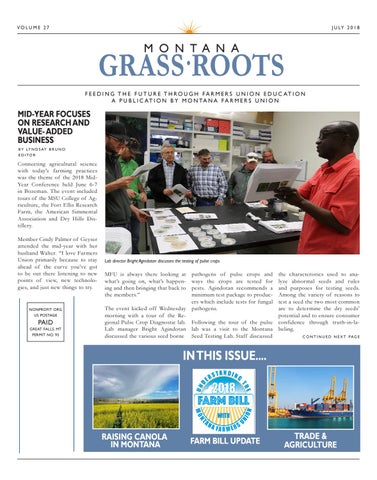
Lab director Bright Agindotan discusses the testing of pulse crops
MFU is always there looking at what’s going on, what’s happening and then bringing that back to the members.”
pathogens of pulse crops and ways the crops are tested for pests. Agindotan recommends a minimum test package to producers which include tests for fungal The event kicked off Wednesday pathogens. morning with a tour of the Regional Pulse Crop Diagnostic lab. Following the tour of the pulse Lab manager Bright Agindotan lab was a visit to the Montana discussed the various seed borne Seed Testing Lab. Staff discussed
the characteristics used to analyze abnormal seeds and rules and purposes for testing seeds. Among the variety of reasons to test a seed the two most common are to determine the dry seeds’ potential and to ensure consumer confidence through truth-in-labeling. C O N T I N U E D N E X T PA G E
IN THIS ISSUE....
RAISING CANOLA IN MONTANA
FARM BILL UPDATE
TRADE & AGRICULTURE
V O L U M E 2 7
J U LY 2 0 1 8
MID-YEAR CONTINUED
Next the group visited the Montana Veterinary Diagnostic lab which is the only accredited veterinary lab in the state. The lab provides support to veterinarians, ranchers, and the Department of Fish, Wildlife & Parks. Lab director Steven Smith talked about the variety of species the lab tests. According to Smith the most predominate test the lab performs is for Brucella. “The surveillance area is basically around the park [Yellowstone] and so that’s the area where Brucella is more of a concern at this point,” said Smith. At lunch the group visited with MSU President Waded Cruzado, toured the American Simmental Association and learned about the distilling process with a stop at Dry Hills Distillery. Jeff and Erica Droge are the managing members of the distillery. All the products created there are sourced from the family farm. Currently the distillery is producing two vodkas, a gin made from potatoes and a wheat whiskey in production. Thursday morning the group toured the Montana Wool Lab, one of two university owned labs in the United States. According to lab manager Devon Ragen the benefit of the university lab is to offer a lower price to consumers. The lab also supports producers, sheep extension and research and teaching efforts. Ragen also discussed some of the many uses for wool including a new trend of using the product in roadside reclamation projects. Fol-
Wool Lab Manager Devon Ragen discusses the process of analyzing wool
lowing the wool lab tour the group learned about the testing process and variety of malt available for analysis at the Malt Quality Lab.
nally conducted in Argentina that MSU replicated using a mobile feedlot. “We had two diets, a traditional high grain diet and we also fed alfalfa pellets,” said Hatfield. “The nice The event concluded with a visit to the Fort thing is we got twice the manure output so we Ellis Research Farm. Director of Animal are interested in manure coming out a grain and Range Sciences Pat Hatfield provided an diet verses an alfalfa diet and what that does overview of the cropping systems and heifer to soil health.” project which examines diet and nutrition. Hatfield talked about a research project origi-
Dry Hills Distillery, Bozeman, MT
Misty and Garrett LeFurgey examine a sample at the Malt Barley Lab, MSU 2
V O L U M E 2 7
J U LY 2 0 1 8
WELCOME NEW MEMBERS!! Member
David & Carolyn Johnson, Glendive Rich Schieffert, Miles City Charles Johnson, Wolf Point Raymond O’Brien, Malta Joseph & Rita Hartman, Lewistown Ellen Thompson, Joliet Sand Hill Red Angus, Froid Tim & Renee Stephens, Harrison Charles & Mary Wark, Park City Cory Olson, Cascade Mabel Barritt, Power Larry Jany, Butte KBJ Farm Inc, Belt JRKJ LLC, Kalispell Lynn & Bonny Ogle, Polebridge Joe & Vivian Brooke, Missoula Lee Montgomery, Gillette WY Dennis Roush, Charlo Bruce & Shauna Wight, Mill Iron Denise & Matthew Weiler, Great Falls Lindsey & Erik Hanson, Cascade Kyla & Jack Wright, Fort Benton Shanna Christopherson & Beau Nemitz, Great Falls Christina & Scott Clark, Great Falls Cody & Desiree Durand, Great Falls Stacy Nerison, Great Falls Deana Moler & Chris Lee, Great Falls Edra & Damien Mitchell, Great Falls Beth & Mike Schmidt, Great Falls Sabreena & Jeremy Stone, Great Falls Jennifer & Cameron Tuss, Fort Benton Nicholaus Hauer, Great Falls Stacy Hermiller, Sand Coulee Kelly Stoneman, Great Falls Beth Cole & Justin Grohs, Great Falls Valerie & Joseph Winfield, Great Falls Neal & Meggan Lehnerz, Power Jana Letcher, Great Falls Kelly & Harris Dunn, Great Falls Wendy & Chris White, Great Falls Suzanne Leahy, Chester Kirby Hancock, Bozeman Joseph and Desiree Holder, Great Falls Sydne and Travis Jaynes, Floweree
IN THIS ISSUE Climate Assessment Seminar By Laurie Lohrer Page 4
Recruited by Ron & Blayne Watts Ron & Blayne Watts Jesse Fleming Jesse Fleming Tom McKenna Jim Mathews Austin O’Dea Dean Derby Dallas Hagfeldt Jr Aeric Reilly Mathew Luedtke Stefanie Thompson Jeff Thill Charles Monroe Charles Monroe Andrew Luedtke Andrew Luedtke Andrew Luedtke Andre Marcure MFU Camp MFU Camp MFU Camp MFU Camp MFU MFU MFU MFU MFU MFU MFU MFU MFU MFU MFU MFU MFU MFU MFU MFU MFU MFU MFU MFU MFU
Membership News Justin Loch Page 5 Life-Line of the High-Line By Marko Manoukian Page 6 Growth of iHemp in Montana By Chris Christiaens Page 7 Raising Canola in Montana By Susan Waring Page 8 MFU Day Camp Brings Communities Together By Alana Stephenson Page 9
Camp Camp Camp Camp Camp Camp Camp Camp Camp Camp Camp Camp Camp Camp Camp Camp Camp Camp Office Lodge Camp
2018 Convention Preview Page 10 Washington Corner By Roger Johnson Page 11-12 Boyer Announces Retirement By MSU News Service 13 Montana Delegation Comments on Ag Issues Page 14 Faces of Camp Page 15
3
MONTANA FARMERS UNION PO BOX 2447 300 RIVER DRIVE NORTH GREAT FALLS MT 59403 PHONE: (406) 452-6406 1-800-234-4071 FAX: (406) 727-8216 mfu@montanafarmersunion.com www.montanafarmersunion.com Board of Directors: Alan Merrill, President Rollie Schlepp, Vice President, Conrad Erik Somerfeld, District 2, Power Jeff Bangs, At-Large Director District 1& 2, Inverness Brett Dailey, District 4, Jordan William Downs, District 5, Molt Ben Peterson, At-Large director, Judith Gap Kelly Rutledge, District 1, Big Sandy Sig Rudie, Fairview, At-Large director Paul Kanning, Distric 5, Flaxville Jan Tusick, District 6, Ronan State Office Staff: Jan Johnson, Office Mgr., Assistant Secretary/ Treasurer Lyndsay Bruno, Communications Director Chris Christiaens, Legislative & Project Specialist Justin Loch, Membership Director Dave Snuggs, Facility Director Violet Green, Education Coordinator Maggie Shane, Continuing Education Coordinator Copyright © Montana Farmers Union, 2018 Montana Grassroots is the official publication of the Farmers Educational and Cooperative Union of America, Montana Division. MFU reserves the right to reject any advertisements. Third Class bulk postage paid at Great Falls MT 59401. Membership: $50.00 per year Montana Grassroots is published 10 times each calendar year with two combined issues. Article submissions are requested by the 15th of the month. Advertising space is available. Copy Editor: Jan Johnson Editor/Designer: Lyndsay Bruno
V O L U M E 2 7
J U LY 2 0 1 8
MONTANA CLIMATE ASSESSMENT REVEALS WEATHER PATTERNS, PROJECTIONS AND IMPACTS BY LAURIE LOHRER C E N T R A L M O N TA N A R E S O U R C E C O U N C I L
A standing-room only crowd of 85 Central Montana farmers, ranchers and citizens filled the Community Center in Lewistown on June 6 for a first-hand look at changing weather patterns, impacts and consequences for Montana. Findings from the “2017 Montana Climate Assessment” were presented, including weather trends, impacts to industry, and possible coping strategies. The 2017 MCA was the result of a comprehensive two-year study of changing weather trends across Montana and projections of what may be coming. Professor Bruce Maxwell, Montana State University agroecology professor & co-director of the Montana Institute on Ecosystems said there are several “unprecedented climate trends” and predictions including more heat during summer, increased precipitation in winter, spring and fall, and increased risk of severe weather events. Climate projections indicate that there will be as many as 35 additional days over 90 degrees in Montana by 2050, according to the Montana Climate Assessment. Maxwell said federal research indicates the five year period from 2013-2017 was the warmest on record in the United States. While increased precipitation is sought after by agriculturists, Maxwell explained that earlier and increased number of “growing degree days” and more spring moisture triggers plants to produce more leaf area which becomes a liability when it gets hot and dry in mid-summer. Demonstrated by last year’s “flash drought”, when precipitation falls off and moisture in the ground becomes unavailable, plants struggle to support the leaf area and root systems resulting in stunted growth.
MSU Professor Bruce Maxwell explains the 2017 Montana Climate Assessment findings and impacts at a June seminar in Lewistown.; courtesy Laurie Lohrer
dicted changes to Montana’s growing seasons. The Assessment provides temperature and precipitation projections for seven climate divisions across Montana.
the state’s recreation and tourism industries. A discussion of how agricultural producers and area businesses can use study results for long-term business planning was part of the question and answer period following speaker Whitney Lonsdale, Assistant Director of the presentations in Lewistown. Attendees shared Montana Water Center and co-author of the their experiences, such as earlier haying, and 2017 MCA Water chapter, covered how cli- ways operations have been modified in remate affects our water. Across the state, pre- sponse to changing weather. cipitation is likely to increase in winter and spring, and decrease in the summer. Lons- The 2017 Montana Climate Assessment is dedale said that research shows a large decline signed to act as a tool to help Montana citiin snowpack over the last half century, and zens understand past climate patterns in diffuture projections from the assessment show ferent regions of Montana, what the climate further declines by mid-century could be sig- projections are, and how ranchers and farmnificant, especially in watersheds with head- ers can use these definitive results for long waters in mid-to-low elevation mountains. range planning. This is the only assessment The Agriculture chapter of the Assessment This decreasing snowpack is likely to result of climate patterns and projections specific examined potential impacts to commodity in less reliable late season water supply and to Montana. crops, livestock, pollinators, disease, pests and more frequent summer drought. The Montana Institute on Ecosystems, a weeds. Sugar beets, hay, malt barley and potatoes may be particularly impacted by reduced Lonsdale also reported that higher summer statewide center based at both Montana State availability of late season irrigation said Max- temperatures and lower summer stream flows University and University of Montana took can lead to increased surface water tempera- on the responsibility of organizing the cliwell, who suggested alternate crops such as lentis, chick peas and certain winter annual tures, with potentially “catastrophic effects on mate assessment. some aquatic species”, and ensuing impacts to forage species may better withstand the preC O N T I N U E D PA G E 1 0 4
V O L U M E 2 7
J U LY 2 0 1 8
BY JUSTIN LOCH M E M B E R S H I P D I R E C TO R
Spring has been a busy time for me in the membership department of Montana Farmers Union. Typically after the farm shows I hit the road and plan visits to each Farmers Union Insurance office in Montana. Currently there are 50 plus offices scattered throughout Montana. As many of you know Farmers Union Insurance agents also work with Montana Farmers Union to help our organization build membership by recruiting and renewing memberships with their clients.
to get involved in their communities. Many sit on local boards, raise money for various groups, sponsor events, attend and volunteer at community events. Most importantly they work to give their community the opportunity The agents work hard to promote for safety and security through Montana Farmers Union and its quality insurance and service. If values. The relationship I have you haven’t had the opportunity built with many of the agents to visit with your local Farmers over the years has been great and Union agent I would encourage I see them more as friends than you to stop in and get to know as an agent. Many of our visits them. I still have a few offices consist of bringing them up to to hit before my agent visits are date on Montana Farmers Union complete, but the miles that I happenings and news, farm/ travel are worth it just because ranch issues, and new member- of the Farmers Union agents and ship materials. What amazes me, their staff ’s open arms when I is often when the business side of walk in the door. our meetings are over, the agent and I will continue to have a ca- Each visit brings something new sual conversation and visit about and strengthens a friendship even anything. This has showed me more. I look forward to visiting that the agents are more than just the rest of the Farmers Union Inbusiness. They genuinely care surance agents. Thanks for always about people and want to devel- making me feel welcome and op a relationship. Farmers Union opening your doors to me. While Insurance agents don’t just get traveling I have been able to see involved with Montana Farmers so much I didn’t realize or appreUnion and what we do, they work ciate about Montana agriculture.
We have vastly different country from border-to-border. Montana is lucky to have such a wide variety of commodities available to market that consumers can take advantage of. Western Montana has some of the best fruits, produce, and pasture fed meats. Central Montana has some of the best grains, pulse crops, meats and hay. Eastern Montana has great grains, sugar beets, corn, cattle and more. With that being said diverse agriculture in Montana is a good thing. We have many more producers stepping out to incorporate value-added products to their already traditional commodities. New agritourism opportunities are popping up which gives people a hands on perspective as to what agriculture looks like. I am very fortunate to work in a job where I get to see so much diversity in agriculture, and people who work their hearts out to produce food for the world. At the end of the day I see a common theme which is to work the land to the best of their ability to produce a quality 5
commodity, and hopefully make enough to start all over again the next year. Producers deserve support and appreciation for all they do. Summer time couldn’t be a better opportunity. Visit your farmers market, attend farm-to-table events, go to your county fair and cheer on the 4-H and FFA kids. Attend a field day put on by MSU to see the studies and advancements they are working on, or simply buy local. Instead of honking in disgust at the tractor or machinery driving slowly down the road, wave as a sign of appreciation as you drive by. And if given the opportunity buy your producer a beer on a hot day made with Montana grown hops and barley! I hope all of you have a safe and fun summer. May you all be blessed with great crops, fair weather and good markets this coming fall. Take time to rest and enjoy the great state of Montana and its offerings.
V O L U M E 2 7
J U LY 2 0 1 8
LIFE-LINE OF THE HI-LINE
cently the irrigators and SMRWG received positive results in congress. Senator Tester and Senator Daines both voted to support the B Y M A R KO M A N O U K I A N CO-CHAIR FY2019 Senate Energy & Water Development S T. M A RY R E H A B I L I TAT I O N W O R K I N G G R O U P Appropriations bill which includes report language encouraging the Bureau of Reclamation The St. Mary River flows north from Mon- (BOR) to complete its design of the replacetana, near Babb, Montana into Canada and ment of the St. Mary Diversion Dam. eventually makes its way in to the Hudson Bay. In the late 1800’s people along the Milk The St. Mary Diversion Dam is the prinRiver realized the Milk would run dry often ciple structure that diverts water out of St. and early in the summer. In 1902 the explo- Mary River into the 30-mile canal system and ration for a stable water supply began. The dumps the water into the North Fork of the result is a water system that takes water from Milk River. Irrigation occurs from Hill Counthe St. Mary River over the Continental Di- ty to Valley County with the imported water. vide and into the Milk River. The diversion dam also causes bull trout, an Endangered Species, to be entrained into the St. Mary Rehabilitation Working Group canal. To fix this the BOR had designed a new dam with a fish screen to avoid entrainThe St. Mary Rehabilitation Working Group ing the bull trout. However, the cost of this (SMRWG) is a citizen group chaired by the new structure is $40 million with Endangered sitting Lt. Governor that was formed in 2002 Species options costing about $20 million of to find a workable solution to fixing the 100 construction cost. The Senate language re+ year old facility. The SMRWG contin- quest the BOR to finish the design without ues to advocate for the rehabilitation of the additional cost to irrigators. 100-year-old federal irrigation system. Re-
How to pay for the structure is the next big question? The $40 million is far beyond what irrigators could pay. The SMRWG is working with irrigators and the consulting firm Water Strategies to draft new cost allocation language. Currently irrigators are responsible for 74% of all repair and construction and the BOR is responsible for 26%. Cost allocation would change these numbers so irrigators are responsible for 25% and BOR (the federal cost share) is 75% for repairs and replacement. Why should the federal government be responsible for this project? The project is 100% federally owned and managed by the BOR, it provides domestic water for 18,000 Montana citizens, and on an annual basis provides food to over 1 million people. More information can be found at http:// dnrc.mt.gov/divisions/water/management/ st-mary-rehabilitation-project.
MFU NAMES FOUNDATION BOARD Montana Farmers Union has formed a foundation board to support education activities of the organization. Four MFU Board members and attorney Jen Bishop will manage the functions of the foundation. Stay tuned for more foundation news!
JAN TUSICK, DISTRICT 6 P O L S O N
B R E T T D A I L E Y, D I S T R I C T 4 , J O R DA N
WILL DOWNS, DISTRICT 5 M O LT 6
E R I K S O M E R F E L D, D I S T R I C T 2 POWER
V O L U M E 2 7
RESEARCH SHOWS POTENTIAL FOR IHEMP IN MONTANA BY CHRIS CHRISTIAENS
At the risk of being redundant, I am writing about one of my favorite subjects, that being Industrial Hemp. Some 18 years ago and in another lifetime I managed to sponsor a bill in the Montana Legislature allowing producers the opportunity to diversify their farming practices and to raise Industrial Hemp. For the following 17 years I followed the progress and finally after Montana jumped through many hoops it has come to pass. In the 2017 crop year some 12 farmers planted their first crop. Was it the best year for hemp? It depends on where and which seed was planted. At the current time only Montana, North Dakota and Minnesota are able to plant this crop, having complied with all of the federal requirements and testing of the crops planted. Drought in some areas was a disaster for the producer planting their first crop, while the majority harvested between 400 to 500 lbs per acre. One producer indicated a 1400 lbs per acre crop. The ability to plant and harvest the crop opens the door to a crop that has hundreds of uses and may be a life-line for some of our rural communities which have been losing population and opportunities for many years. I continually get calls from interested parties
J U LY 2 0 1 8
regarding what uses there are for this commodity. For those interested in the history of Hemp, one needs to go back to the very beginning of the United States. As far back as 1776 hemp was a major crop and textiles from hemp was a major use for this farm crop. In about 1937 the Drug Enforcement Agency considered the crop a scheduled drug. The cotton industry was instrumental in banning the growing of this crop for a number of reasons. The primary one is that hemp fiber is stronger and softer than cotton and lasts much longer when made into cloth. When planted as a crop, 1 acre of hemp produces as much fiber as does 2 to 3 acres of cotton. After researching this crop, one finds that it grows well in Montana as it is frost tolerant, requires only moderate rainfall or irrigation and from date of planting to harvest is 90 days and requires little fertilizer and no pesticide or herbicide. As a crop year such as 2018 where there has been an unusual amount of snow and rain as I write this, many folks are experiencing difficulty in getting crops planted. Hemp can be planted in early June and still make a good crop. The uses of hemp are huge with the seed production, crushed into oil with use in food, cosmetics and fuel . The oils are high in protein, rich in lanolin and linolenic acids essential to human consumption and nutrition. Most cosmetics utilize the oil from hemp in their products and the need for a processing 7
plant in Montana is critical as more producers start raising hemp as a commodity with a price higher than wheat and barley crops, over production and concerns over trade policies currently in flux. Work and research into the uses of the fiber need exploration as some of the uses offer huge opportunities. A list of some of the uses for the fiber include rope which has been used in raising livestock, twine, cord, yarn, clothing due to its strength and durability and for hemp paper. The licenses in Montana for growers is printed on hemp paper. At least two growers are utilizing hempcrete in the building of their homes. The last farm bill included the requirement of the USDA to write rules for the use by agriculture and the current bill before congress includes an amendment to remove Industrial Hemp from the list of scheduled drugs by the DEA. As Montana Farmers Union has sponsored a number of educational forums over the past winter and spring, they have attracted interested producers who are either planning to plant a crop or have a license to do so. There are at least two organizations with plans to build processing plants in Montana, which is critical for the future of growth of this crop. A myth is that because this is a Cannabis Plant, folks will be using it for the THC quantities. In fact there is less than0.02 % THC quantity in Industrial Hemp.
V O L U M E 2 7
J U LY 2 0 1 8
Flowering canola field near Fort Benton; Photo courtesy of Cargill
RAISING CANOLA ENRICHED WITH EPA/DHA OMEGA 3S IN MONTANA B Y S U S A N WA R I N G A R T I C L E O R G I N A L LY P U B L I S H E D I N S I G N AT U R E M O N TA N A
For a region that has had wheat as its number-one crop for years, Montana is now seeing changes in its farming bill of fare. Instead of raising only wheat, a variety of rotational crops that support weed and disease reduction has become the farming standard in the 21st century. To be added to the rotational mix of mainstay grains will soon be a canola containing omega 3 fatty acids.
which is found in wild-caught salmon. For a time fish oil was added to the feed, but that was putting stress on marine resources. Cargill Corporation and BASF Corporation, a German chemical company, jointly developed an answer to the problem by genetically engineering algae-based materials containing EPA/DHA omega 3s with canola to make a new canola oil. This new canola oil would become part of the aquaculture feed for salmon. “Providing the farm-raised salmon with this new product in their feed will take the pressure off marine resources, including the wild caught salmon industry,” said Lorin Debonte, Assistant Vice President, Research and Development, Food Ingredients and Bioindustrials at Cargill. “In the future, farm-raised salmon will be rich in omega-3s at the target levels recommended for heart and brain health. It will be as nutritious as the wild-caught salmon or the farm-raised salmon that had received a diet of fish oil.”
test this new type of canola. Keith Horton, Senior Trial Agronomist for Cargill, has been in Great Falls for eight months. “We are determining which canola hybrids grow best in the various farming regions of Montana by testing them on both irrigated and dryland farms,” he said. “At the same time, the regulatory processes, which take several years, are being finalized with all of the countries involved, including branches of the Food and Drug Administration and the Department of Agriculture in the United States,” said Debonte.
Once the regulatory processes have been completed, Cargill will contract with farmers to raise the rich EPA/DHA omega 3s canola. “We look forward to developing strong, trustThe story didn’t begin in Montana, though; ing relationships with Montana farmers,” said it started where there was a problem at the Horton. “We will be contracting with farmers numerous fish farms in Chile, Norway, and through a closed-loop crop production plan.” the Atlantic and Pacific coasts of Canada. The four-million dollar research station presThe salmon at the fish farms needed an adently being built in Great Falls will support ditive in their food to provide the consumer Many miles away from the fish farms, Mon- farmers raising the EPA/DHA canola with with eicosapentaenoic acid (EPA) and doco- tana with its ideal growing conditions was plant breeding and agronomy information. sahexaenoic acid (DHA) omega 3s like that picked by Cargill to be the first state to field C O N T I N U E D PA G E 1 3
8
V O L U M E 2 7
J U LY 2 0 1 8
DAY CAMPS BRING COMMUNITY TOGETHER
to teach the kids about how cooperatives are formed and how they are essential to our society. We went over our cooperation lesson at BY ALANA STEPHENSON every day camp; a big portion of the lesson is M F U E D U C AT I O N D E P A R T M E N T to teach how important working together is! I along with Levi Smoot and Maggie Shane Working together is a great lesson considerhad a busy fun filled two weeks around the ing we all have to do it on a daily basis, so we lovely state of Montana. We have had the had quite a few fun activities that allowed the great pleasure of running a total of five Mon- kids to work together. tana Farmers Union day camps. These day camps are something I had the pleasure of There were a few activities that we did that going to when I was a kid. Day camps offer allowed them to see the struggles and the a piece of what activities and lessons we do importance of working together to achieve up at our summer camp at the Arrow peak a common goal. We made homemade bread, Lodge. The ages of kiddos run from five to butter and ice cream, and the kids were ecten years old, and we had the opportunity of static to do these activities. In order to accomconducting the day camps in Power, Big San- plish these tasks they had to work together, dy, Fort Benton, Belt and Conrad. which they did awesome at. Once each activity was complete we asked them what made it Our big goal for all of our day camps was challenging to accomplish it as a team. Most
of the kids agreed that it was listening to one another, taking turns, and having patience to get the task done. Overall I will have to say the outcome was great, the kiddos loved enjoying their homemade bread covered with their own hand-made butter, and topping it off with relishing a nice cold bowl of delicious ice cream they made working together.
Big Sandy Day Camp
Fort Benton Day Camp
Conrad Day Camp 9
Out of all the fun activities and lessons we spent all day doing the kids took a lot of knowledge home with them. I hope the kids shared all the fun they had and what they learned with their parents. I am beyond grateful to have had the chance to participate and help run these day camps. I also learned a lot from the kids. It was a fun experience for me. I hope to be able help again with these day camps next year and get more kids involved.
V O L U M E 2 7
J U LY 2 0 1 8
C L I M AT E A S E S S M E N T C O N T I N U E D
The MCA team gathered input from stakeholders all across Montana. Groups involved with agriculture, water and natural resource management, forestry, tourism and recreation helped identify climate impacts in Montana. Researchers met with organizations such as the Montana Association of Conservation Districts, Montana Farmers Union, Montana Grain Growers Association, Montana Stockgrowers Association, and state and federal agencies that provided input about challenges and opportunities Montana may see in the future. According to Maxwell and Lonsdale, their goal is to inform the agriculture community,businesses, natural resource managers, and citizens about the state’s changing climate so they can better plan for the future. The Lewistown seminar was presented by Montana Institute on Ecosystems and sponsored by Central Montana Resource Council, Montana Farmers Union, and MSU Fergus/ Petroleum Extension. The full 2017 Montana Climate Assessment is available online at www. montanaclimate.org.
SAVE THE DATE! October 26-27, 2018 Holiday Inn Great Falls
MOVING AGRICULTURE FORWARD
MONTANA FARMERS UNION—2018 CONVENTION
O N L I N E R E G I S T R AT O N O P E N S A U G U S T 2 6 , 2 0 1 8 INTERESTED IN BEING A CONVENTION SPONSOR? C O N TA C T T H E S TAT E O F F I C E AT 8 0 0 - 2 3 4 - 4 0 7 1 F O R D E TA I L S !
10
V O L U M E 2 7
J U LY 2 0 1 8
tee. "This bill has many encouraging provisions that promote good stewardship, farm sustainability, and diverse markets in agriculture," said NFU President Roger Johnson. He also submitted recommendations for improvements ahead of the markup process. In particular, he asked for a larger investment B Y RO G E R J O H N S O N in the farm safety net as well as resources to N AT I O N A L F A R M E R S U N I O N help farmers cope with negative impacts of ongoing trade disputes. The Senate AgriculThere’s a great deal of uncertainty in farm ture Committee considered 60 amendments country. Our international trade relationships during markup. Following the two-and-a-half are in flux, to say the least, putting impor- hour-long discussion, the bill passed almost tant agricultural export markets in a precari- unanimously, with just a single naysayer. ous position. Similarly, the future of ethanol policy is hazy at best. Though some efforts have been made to implement higher ethanol blends year-round and to address the abuse of Renewable Fuel Standard hardship waivers, both endeavors have stalled at the Environmental Protection Agency. And it is, of yet, unclear what the ultimate outcome of Farm Bill negotiations will be. Though the Senate Agriculture Committee successfully passed its draft of the legislation, both chambers still have a lot of work ahead of them before the September 30 deadline. Senate Ag Committee Passes Bipartisan Farm Bill Draft, Full Vote Expected Be- NFU was encouraged by several of the amendfore July 4 ments, including provisions that would refund dairy Margin Protection Program premium On June 8, a few weeks after the U.S. House payments made between 2015-2017, restore of Representatives rejected its own version funding for bio-based programs, and remove of the Farm Bill, the U.S. Senate Agriculture separate payment limits for organic producers Committee released its draft, also known as in the Environmental Quality Incentives Prothe Agriculture Improvement Act of 2018. gram (EQIP). The organization advocated adUnlike the House draft, which contains sig- ditional improvements to shore up safety nets nificant changes to a number of programs, for farmers and consumers, promote farm the Senate draft doesn't stray far from the cur- and ranch sustainability, and ensure fair and rent Farm Bill, which was passed in 2014 and diverse markets for family farmers. expires in September. Also unlike the highly partisan House bill, the Senate's bill included Senate Majority Leader Mitch McConnell has contributions from across the aisle. signaled that he intends to bring the bill up for a vote on the floor prior to the Senate's National Farmers Union was pleased with July 4 recess. The House is also expected to many aspects of the bill and expressed ap- vote again on its version of the bill before preciation for the hard work of the commit- that date. 11
Tariffs Escalate Global Trade Tensions In early June, the Trump administration announced its intention to impose a 25 percent tariff on steel and a 10 percent tariff on aluminum imports from the European Union, Canada, and Mexico. All three swiftly responded with retaliatory tariffs on a variety of American products, including many agricultural goods. The tariffs were originally announced in March, and were particularly aimed at China, a country that has engaged in unfair trade practices, including currency manipulation and intellectual property theft. China promptly responded with tariffs of its own spanning a large number of American products, including soy, sorghum, pork, wine, fruits, and nuts.
Trump further escalated tensions with Canada at the G7 Summit, an annual meeting among international economic leaders, including the United States, Canada, France, Germany, Italy, Japan, and the United Kingdom. The tariffs were understandably a point of contention during the summit. In his closing statements, Canadian Prime Minister Justin Trudeau fired back at President Trump, emphasizing that Canada would not kowtow to unreasonable requests. Trump, not to be outdone, called Trudeau “very dishonest and weak,” and White House trade adviser Peter Navarro said there was a “special place in hell” for Trudeau for disagreeing with President Trump. C O N T I N U E D N E X T PA G E
V O L U M E 2 7
J U LY 2 0 1 8
long string of agribusiness mergers, will consolidate control of more than a quarter of the world’s seed and pesticides market and create the largest seed and crop chemicals company in the world. The Washington Corner can also be found at www.nfu.org/corner.
To complicate matters, the United States, Mexico, and Canada are still negotiating the North American Free Trade Agreement (NAFTA), a trilateral trade deal among the three nations. The negotiation process has been fraught with animosity, with frequent talk of outright termination. Most recently, President Trump suggested forging deals with each country separately.
threatening to upend any potential benefits of a waiver in the upcoming summer months of 2018. In response, NFU President Roger Johnson wrote to EPA Administrator Scott Pruitt, urging the EPA to immediately institute a waiver for summertime sales of E15.
“It is now May, and the summer restrictions on E15 for this year are looming with no apparent movement from EPA on this issue,” National Farmers Union and the Canadian said Johnson in his letter to Administrator Federation of Agriculture released a joint Pruitt. “Year-round use of E15 is not a new statement urging the maintenance of the issue for EPA; this has long been supported strong and longstanding trade relationship be- by the biofuels industry and agriculture. We tween the two countries. “Our nations trade urge you to act in an expedited manner to folmore than $40 billion in agricultural products low President Trump’s direction to allow the each year, and that number continues to climb use of E15 this summer.” as new opportunities arise between our markets,” the statement reads. “To disrupt this Johnson also highlighted the importance of relationship would be detrimental for farmers ethanol to farmers during times of economic on both sides of the border, as our agricul- difficulty, adding “farmers have worked hard tural sectors are heavily integrated and, to a to build value-added markets; the RFS and large extent, rely upon one another for each E15 provide significant economic opportuniother’s success.” ties for farmers facing increasing uncertainty and loss of demand.” Inaction on Ethanol a Disservice to Family Farmers and Rural Communities Additionally, the administration has not taken action to address the EPA’s mishandling of After a recent meeting between President hardship waivers, which exempt refineries Donald Trump, legislators, and stakeholders from complying with the RFS. The agency from the oil and biofuel industries, the Presi- granted dozens of such waivers to large cordent announced his intention to allow the porations, saving them hundreds of millions year-round sale of E15, or gasoline blends of dollars and cutting demand for renewcomprised of 15 percent ethanol, which had able fuels by an estimated 1.5 billion gallons. previously been barred from being sold in the In response, National Farmers Union, with summer. Additionally, he agreed to a limit on the support of Farmers Union Enterprises, RFS ‘hardship waivers’ being handed out to joined the Renewable Fuels Association, the refiners, and the possibility that Renewable National Corn Growers Association, and the Identification Numbers (RIN) credits could American Coalition for Ethanol in a lawsuit be applied to exports of renewable fuel. against the agency, demanding that the actions be reversed. National Farmers Union was pleased with the decision to allow E15 during all seasons, as DOJ Approves Bayer-Monsanto Merger it would have significant benefits for farmers, the economy, energy independence, and The U.S. Department of Justice (DOJ) forthe environment. However, the U.S. Environ- mally approved German drug and chemimental Protection Agency (EPA) has delayed cal giant Bayer’s $62.5 billion acquisition of implementing the decision, consequently Monsanto. The deal, which is the latest in a
12
26TH ANNUAL PARKER GOLF TOURNAMENT-2018
Flight 1
1st place: Flip Zeren, Shawn Zeren, Marty Klinker, Reece Brown 2nd place: Nanette Kangas, Lee Kangas, Patti Koivisto, Everett Koivisto, 3rd place: Jack Anderson, Jerry Anderson, and Jack Howard Flight 2 1st place: Kim Woodring, Jim Woodring, Kris Nicholson, Brad Holden 2nd place: Dale Thomas, Casey Thomas, Hayley Thomas, Brett Schumacher 3rd place: Loran Stensland, Kevin Good, Robby Ekins, Eric Hinebauch Eagle Sponsors: 3 Rivers Telephone Coop, Fairfield and Steel Etc. of Great Falls Hole Sponsors: Blackfoot Telephone Coop, Missoula; Bryant-Arrotta Insurance, Great Falls; Bud Daniels Family, Great Falls, Douglas Wilson & Co., Great Falls; Dutton State Bank; Farmers Union Insurance, Great Falls; Fergus Electric Co-op; First Security Bank, Fairfield; Flathead Electric Co-op, Kalispell; GTO Farms, Big Sandy; Hill County Electric/Central MT Communications/Triangle Telephone Co-op, Havre; Montana Farmers Union; Mountain View Co-op, Great Falls; MSU College of Ag, Bozeman; MT Council of Co-ops; MT Electric Cooperatives’ Association, Great Falls; MT Federal Credit Union, Great Falls; MT Telecommunications Association; Northwest Farm Credit Services, Great Falls; RBC Wealth Management, Great Falls -- Amy Strom; Russell Country Federal Credit Union, Great Falls; Sun River Electric Co-op, Fairfield. Additional sponsors: Ameriprise, David Milkovich.
V O L U M E 2 7
MSU VICE PRESIDENT OF AGRICULTURE ANNOUNCES RETIREMENT
B Y M S U N E W S S E RV I C E
Montana State University’s Vice President of Agriculture Charles Boyer has announced he plans to retire in December of this year after serving in the role since 2014. The university
J U LY 2 0 1 8
will begin a national search for his replacement in the coming months. Boyer, the university’s first vice president of agriculture, joined MSU from California State University, Fresno, in 2014.
nity to work as the Education Coordinator for Montana Farmers Union I am excited to be involved with the decision of Farmers Union Enterprise (FUE) to support the Science, Technology, Engineering and Math program.
During his time at MSU, Boyer oversaw the College of Agriculture’s five academic departments and seven statewide agricultural research centers as dean and served as the director of the Montana Agricultural Experiment Station. MAES conducts research at seven research centers strategically located across the state to address the diverse climatological challenges of Montana’s agriculture industry. Boyer joined MSU after MSU President Waded Cruzado elevated the position of dean and director of the College of Agriculture to a vice president in recognition of the college’s and MAES’ importance to Montana’s agricultural economy and the university’s land-grant mission.
This program focuses on the idea of educating students in all four of those subjects simultaneously. The STEM program will give schools a better national curriculum for agriculture for grades K-12. Once we are able to get a national curriculum for agriculture to the schools students will better understand how to feed themselves and how to grow/ raise their own food! Not only will they have those skills, but they will also be educated on cooperation, how our water is used and much more.
STEM PROGRAM TO FOCUS ON AGRICULTURE BY VIOLET GREEN E D U C AT I O N C O O R D I N AT O R
Nelson Mandela once said “Education is the most powerful weapon which you can use to change the world.” Having the great opportu-
CANOLA CONTINUED
This new omega-3 enhanced canola will play a major role in helping to make EPA/ DHA omega 3s more accessible to consumers. Studies around the world have indicated that a lack of omega 3 fatty acids in diets is a major nutritional problem. Likely success in the animal feed industry will lead to regulating the omega-rich canola oil for human consumption through various products. “This specialty canola can create tremendous opportunities across the global food and feed markets,” said Debonte. A head start in raising canola with the omega 3s will provide Montana farmers with a sustainable platform for years to come while also giving them more choices in crop rotation.
1133
Educating these students with this program will allow them the ability to change their lives by leaps and bounds.As this program progresses I am excited to see how it will influence our youth.
V O L U M E 2 7
A MESSAGE FROM SENATOR JON TESTER
Over the past year and a half, I have been traveling across Montana to meet with farmers and ranchers and to gather your priorities for the Farm Bill.This spring, the Senate and House Agriculture Committees voted on two very different drafts of the Farm Bill. The Senate’s version of the Farm Bill reflects the input I heard from local producers during my listening sessions. It protects crop insurance, strengthens the safety net for producers, and encourages responsible conservation. The Senate Farm Bill rejects the House’s attempt to combine and cut funding for CSP and EQIP. It strengthens CRP, increases ag research investments, and expands opportunities for organic and specialty crop producers. Most importantly, the Senate Farm Bill gives Montana family farmers and ranchers the long-term certainty needed to make good decisions to increase yields and to be able to stay on their land. Montana producers can take the Senate Farm Bill to the bank. Unfortunately, the House version of the Farm Bill falls far too short. It has been infected with politics and in its current form, it won’t pass.
J U LY 2 0 1 8
A MESSAGE FROM SENATOR STEVE DAINES
As Montana’s voice on the Senate Agriculture Committee, I recently secured the priorities of Montana’s farmers and ranchers in the Farm Bill. I fought to protect critical programs – both crop insurance and the Sugar Program. I also pushed for active forest management reform, to ensure that Montana is best prepared to handle the upcoming wildfire season. Additionally, I worked to ensure that Ag research funding is prioritized at land-grant institutions, like Montana State University and ag research stations. I will continue to advocate for our farmers and ranchers to ensure that the government is providing you with the resources needed to grow your businesses. As always, please reach out to me with any thoughts or concerns you may have on the Farm Bill or any other issues..
A MESSAGE FROM CONGRESSMAN GREG GIANFORTE
As trade negotiations are ongoing, I continue working to protect Montana ag. I have been encouraging the Trump administration to be mindful of the impact tariffs have on our state’s number one industry. I recently visited with Vice President Pence and talked with Larry Kudlow, the director of the U.S. National Economic Council, about trade. I emphasized how tariffs negatively affect Montana ag. I asked them to ensure that any trade negotiations protect the market access that agriculture has achieved already and to improve upon those successes. As I write this, the House is making progress on the Farm Bill. When the bill was considered in May, I voted against amendments that would have reduced crop insurance and phased out the ARC, PLC, and sugar programs. Fortunately, those amendments were defeated and not included in the Farm Bill. While the House Farm Bill does not include language to allow hemp farming, I will continue being a strong voice for it, urging my House colleagues to consider hemp farming legislation I have cosponsored. I look forward to advancing the Farm Bill in the House and working with the Senate to get it to President Trump for his signature.
That is why I am demanding folks quit making political hay out of the Farm Bill. It is time for swift action and I’ll make certain that the Senate takes the lead to get a good Farm Bill across the finish line and on the President’s desk before the end of this summer. 14
V O L U M E 2 7
J U LY 2 0 1 8
FACES FROM CAMP M E E T DY L A N H A G E R : 9 YEARS OLD M O U N TA I N V I E W E L E M E N TA RY, G R E AT F A L L S
JUNIOR CAMP 1, 2018
This is Dylan’s second year at Arrowpeak Camp. Dancing is Dylan’s favorite camp activity. She keeps busy by playing soccer, volleyball and softball.
MEET RILEY MOLINARIO: 9 YEARS OLD F O RT B E N T O N E L E M E N TA RY C A RT E R
MEET DOMINICK TUSS: 11 YEARS OLD F O RT B E N T O N E L E M E N TA RY F O RT B E N TO N
M E E T B R AY D E N K L O S T E R M E I E R : 10 YEARS OLD M O U N TA I N V I E W E L E M E N TA RY G R E AT F A L L S
M E E T TA N N E R O G G : 9 YEARS OLD R I V E R V I E W E L E M E N TA RY G R E AT F A L L S
This is Tanner’s first year at Arrowpeak Camp. His favorite camp activity is archery. Tanner has two sisters and plays ice hockey.
Riley’s family farms wheat and chickpeas on the farm in Carter. Riley likes to work on the farm, and also has plans to attend MIT or Stanford to become a mathematician for NASA. Dancing is Riley’s favorite camp activity. She is also a Mildred Stoltz Award winner.
This is Dominick’s first year of camp. “It has been fun,” said Dominick. “I have loved hanging out with the counselors and campers!” Dominick plays basketball, soccer and football.
15
This is Brayden’s second year attending Arrowpeak Camp. His favorite activity of camp is carnival night. Brayden plays Rush Soccer.
Since 1915
OUR AGENTS LIVE AND WORK NEAR YOU. Anaconda Stefanie Thompson 563.5991 Belgrade Craig Parker 388.6774 Bigfork Janice Erickson 692-6020 Billings Jim Mathews 656.2323 Billings Steve Plaggemeyer 294.9491 Billings Judd Long 252.9391 Billings KJ Fauth 969-2282 Billings Jeanne Benson 252-9391 Bozeman Dean Derby 556.0893 Bozeman Trent Leintz 551.2163 Bozeman Art Hoffart 586.6230 Bridger Wesley Schwend 662.3930 Chester Gary Seubert 759-5150 Choteau Mathew Luedtke 466.5146 Circle Kaylen Lehner 485.3303 Conrad Dirk Elings 271-7047 Dillon Judy Siring 683.2365 Dillon Sara Nye 683-1250 Dutton Will Rasmussen 476-3444 Fairfield Matt Luedtke 467.3444 Froid Austin O’ Dea 766-2205 Glasgow Del Hansen 228.2284 Great Falls Eric Hinebauch 453.8413 Great Falls Aeric Reilly 570-5853 Great Falls Jeff Thill 452.7283 Hamilton Bryan Jones 363.6583 Hardin Melissa Wacker 665.1867 Havre Cindy Schubert 265.2693
Helena Todd Crum 443.4630 Kalispell Randy Bloom 257.1252 Kalispell Charles Monroe 756.7720 Laurel Dallas Hagfeldt, Jr. 628.6649 Laurel Lorna Olson 628.6649 Lewistown Tom McKenna 538.8736 Lewistown Raleigh Heitzman 538.8736 Libby Colleen Wood 293.6228 Livingston Daryl Hansen 222.7151 Malta Shane Anderson 654.1589 Miles City Tayler Kennedy 874.2560 Miles City Watts Agency 874.1804 Missoula Brad Bowman 721.2540 Missoula Pam Jacobsen 721.0599 Missoula Andre Marcure 543.7184 Plains Sally Miller 826.4633 Plentywood JR Johnson 765.2051 Ronan Andrew Luedtke 676.0173 Ryegate Audrey Stoican 568.2336 Shelby KW Insurance 424-8480 Shelby Russ Seubert 434-5211 Sidney Cathy Hintz 488.8326 Sunburst KW Insurance 937-6950 Terry Watts Agency 635.5782 Thompson Falls Sally Miller 827.3221 Whitefish Rial Gunlikson 862.4700 Wolf Point Jesse Fleming 653.2200