Other documents randomly have different content
While Dorantes was stopping at Vera Cruz during the winter of 1536–37, he received a letter from Mendoza, asking him to return to the City of Mexico. After several interviews, the viceroy induced Dorantes to remain in New Spain, agreeing to provide him with a party of horsemen and friars, in order to explore more thoroughly the country through which he had wandered. Mendoza explains the details of his plans in the letter written in December, 1537, and declares that he expected many advantages would be derived from this expedition which would redound to the glory of God and to the profit of His Majesty the King. The viceroy was prepared to expend a large sum—3,500 or 4,000 pesos—to insure a successful undertak‐ing, but he promised to raise the whole amount, without taking a single maravedi from the royal treasury, by means of a more careful collection of dues, and especially by enforcing the payment of overdue sums, the collection of which hitherto had been considered impossible. This reform in the collection of rents and other royal exactions and the careful attention to all the details of the fiscal administration were among the most valuable of the many services rendered by Mendoza as viceroy. The expedition under Dorantes never started, though why nothing came of all the preparations, wrote Mendoza in his next letter to the King, “I never could find out.”7
The three Spaniards wrote several narratives of their experiences on the expedition of Narvaez, and of their adventurous journey from the gulf coast of Texas to the Pacific coast of Mexico.8 These travelers, who had lived a savage life for so long that they could wear no clothes, and were unable to sleep except upon the bare ground, had a strange tale to tell. The story of their eight years of wandering must have been often repeated—of their slavery, their buffalo-hunting expeditions, of the escape from their Indian masters, and their career as traders and as medicine men. These were wonderful and strange p350 experiences, but the story contained little to arouse the eager interest of the colonists in New Spain,
whose minds had been stirred by the accounts which came from Peru telling of the untold wealth of the Incas. A few things, however, had been seen and heard by the wanderers which suggested the possibility of lands worth conquering. “A copper hawks-bell, thick and large, figured with a face,” had been given to Cabeza de Vaca, soon after he started on his journey toward Mexico. The natives who gave this to him said that they had received it from other Indians, “who had brought it from the north, where there was much copper, which was highly esteemed.” After the travelers had crossed the Rio Grande, they showed this bell to some other Indians, who said that “there were many plates of this same metal buried in the ground in the place whence it had come, and that it was a thing which they esteemed highly, and that there were fixed habitations where it came from.”9 This was all the treasure which Cabeza de Vaca could say that he had seen. He had heard, however, of a better region than any he saw, for the Indians told him “that there are pearls and great riches on the coast of the South sea (the Pacific), and all the best and most opulent countries are near there.” We may be sure that none of this was omitted whenever he told the Spanish colonists the story of the years of his residence in Texas and of the months of his journey across northern Mexico.10
THE GOVERNORS OF NEW SPAIN, 1530–1537
Don Antonio de Mendoza, “the good viceroy,” had been at the head of the government of New Spain for two years when Cabeza de Vaca arrived in Mexico. The effects of his careful and intelligent administration were already beginning to appear in the increasing prosperity of the province and the improved condition of the colonists and of their lands. The authority of the viceroy was ample and extensive, although he was limited to some extent by the audiencia, the members of which had administered the government of the province since the retirement of Cortes. The viceroy was the president of this court, which had resumed more strictly judicial functions after his arrival, and he was officially advised by his instructions from the King to consult with his fellow members on all matters of importance.
Nuño de Guzman departed for New Spain in 1528, and became the head of the first audiencia. Within a year he had made himself so deservedly unpopular that when he heard that Cortes was coming back to Mexico from Spain, with the new title of marquis and fresh grants of power from the King, he thought it best to get out of the way of his rival. Without relinquishing the title to his position in the capital p351 city, Guzman collected a considerable force and marched away toward the west and north, determined to win honor and security by new conquests. He explored and subdued the country for a considerable distance along the eastern shores of the Gulf of California, but he could find nothing there to rival the Mexico of Motecuhzoma. Meanwhile reports reached Charles V of the manner in which Guzman had been treating the Indians and the Spanish settlers, and so, March 17, 1536,11 the King appointed the Licentiate Diego Perez de la Torre to take the residencia12 of Guzman. At the same time Torre was commissioned to replace Guzman as governor of New Galicia, as this northwestern province had been named. The latter had already determined to return to Spain, leaving Don
Christobal de Oñate, a model executive and administrative official, in charge of his province. Guzman almost succeeded in escaping, but his judge, who had landed at Vera Cruz by the end of 1536, met him at the viceroy’s palace in Mexico city, and secured his arrest before he could depart. After his trial he was detained in Mexico until June 30, 1538, when he was enabled to leave New Spain by an order which directed him to surrender his person to the officers of the Casa de Contratacion,13 at Seville. Guzman lost no time in going to Spain, where he spent the next four years in urging his claims to a right to participate in the northern conquests.
Torre, the licentiate, had barely begun to reform the abuses of Guzman’s government when he was killed in a conflict with some revolted Indian tribes. Oñate again took charge of affairs until Mendoza appointed Luis Galindo chief justice for New Galicia. This was merely a temporary appointment, however, until a new governor could be selected. The viceroy’s nomination for the position was confirmed by the King, in a cedula dated April 18, 1539, which commissioned Francisco Vazquez Coronado as governor.14
Cortes had been engaged, ever since his return from Spain, in fitting out expeditions which came to nothing,15 but by which he hoped to accomplish his schemes for completing the exploration of the South sea. His leisure was more than occupied by his efforts to outwit the agents of the viceroy and the audiencia, who had received orders from the King to investigate the extent and condition of the estates held by Cortes. In the spring of 1535, Cortes established a colony on the opposite coast of California, the supposed Island of the Marquis, at Santa p352 Cruz,16 near the modern La Paz. Storms and shipwreck, hunger and surfeiting, reduced the numbers and the enthusiasm of the men whom he had conducted thither, and when his vessels returned from the mainland with the news that Mendoza had arrived in Mexico, and bringing letters from his wife urging him to return at once, Cortes went back to Mexico. A few months later he recalled the settlers whom he had
left at Santa Cruz, in accordance, it may be, with the command or advice of Mendoza.17 When the stories of Cabeza de Vaca suggested the possibility of making desirable conquests toward the north, Cortes possessed a better outfit for undertaking this work than any of the others who were likely to be rivals for the privilege of exploring and occupying that region.
Pedro de Alvarado was the least known of these rival claimants. He had been a lieutenant of Cortes until he secured an independent command in Guatemala, Yucatan and Honduras, where he subdued the natives, but discovered nothing except that there was nowhere in these regions any store of gold or treasures. Abandoning this field, he tried to win a share in the conquests of Pizarro and Almagro. He approached Peru from the north, and conducted his army across the mountains. This march, one of the most disastrous in colonial history, so completely destroyed the efficiency of his force that the conquerors of Peru easily compelled him to sell them what was left of his expedition. They paid a considerable sum, weighed out in bars of silver which he found, after his return to Panama, to be made of lead with a silver veneering.18 Alvarado was ready to abandon the work of conquering America, and had forwarded a petition to the King, asking that he might be allowed to return to Spain, when Mendoza, or the audiencia which was controlled by the enemies of Alvarado, furthered his desires by ordering him to go to the mother country and present himself before the throne. This was in 1536. While at court Alvarado must have met Cabeza de Vaca. He changed his plans for making a voyage to the South seas, and secured from the King, whose favor he had easily regained, a commission which allowed him to build a fleet in Central America and explore the South sea—the Pacific—toward the west or the north. He returned to America early in 1539, bringing with him everything needed in the equipment of a large fleet.
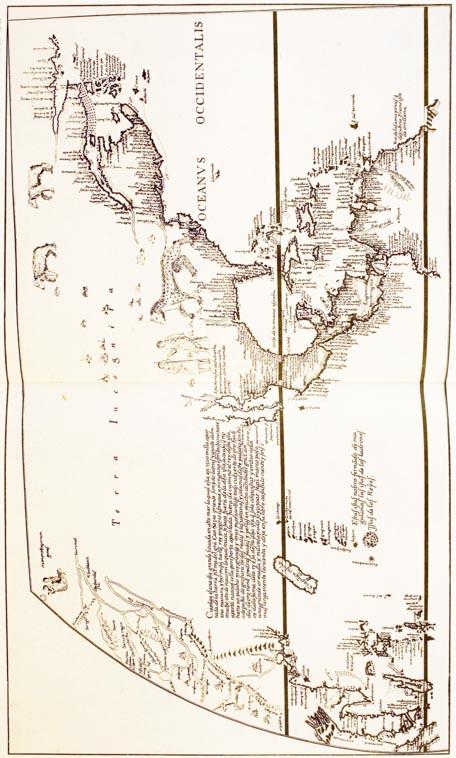
XL. Sebastian Cabot’s Map of 1544 ◊ After Kretschmer
Mendoza, meanwhile, 1536–1539, had been making plans and preparations. He had not come to the New World as an adventurer, and he lacked the spirit of eager, reckless, hopeful expectation of wealth and fame, which accomplished so much for the geographical unfolding of the two Americas. Mendoza appears to have arranged his plans as carefully as if he had been about to engage in some intrigue at court. He p353 recognized his rivals and their strength. Nuño de Guzman was in disgrace and awaiting a trial, but he was at the court, where he could urge his claims persistently in person. Cortes was active, but he was where Mendoza could watch everything that he tried to do. He might succeed in anticipating the viceroy’s plans, but his sea ventures heretofore had all been failures. So long as he kept to the water there seemed to be little danger. Mendoza’s chief concern appears to have been to make sure that his rivals should have no chance of uniting their claims against him. Representing the Crown and its interests, he felt sure of everything else. The viceroy had no ambition to take the field in person as an explorer, and he selected Alvarado as the most available leader for the expedition which he had in mind, probably about the time that the latter came back to the New World. He wrote to Alvarado, suggesting an arrangement between them, and after due consideration on both sides, terms and conditions mutually satisfactory were agreed on. Mendoza succeeded in uniting Alvarado to his interests, and engaged that he should conduct an expedition into the country north of Mexico. This arrangement was completed, apparently, before the return of Friar Marcos from his reconnoissance, which added so largely to the probabilities of success.
THE RECONNOISSANCE OF FRIAR MARCOS DE NIZA
Mendoza did not confine himself to diplomatic measures for bringing about the exploration and conquest which he had in mind. In his undated “première lettre” the viceroy wrote that he was prepared to send Dorantes with forty or fifty horses and everything needed for an expedition into the interior; but nothing was done.
About this time, 1537–38, Friar Juan de la Asuncion seems to have visited the inland tribes north of the Spanish settlements. Mr Bandelier has presented all the evidence obtainable regarding the labors of this friar.19 The most probable interpretation of the statements which refer to his wanderings is that Friar Juan went alone and without official assistance, and that he may have traveled as far north as the river Gila. The details of his journey are hopelessly confused. It is more than probable that there were a number of friars at work among the outlying Indian tribes, and there is no reason why one or more of them may not have wandered north for a considerable distance. During the same year the viceroy made an attempt, possibly in person, to penetrate into the country of Topira or Topia, in northwestern Durango,20 but the mountains and the absence of provisions forced the party to return. It may be that this fruitless expedition was the same as that in which, according to Castañeda, Coronado took part, while Friar Marcos was on his way to Cibola. It is not unlikely, also, p354 that Friar Marcos may have made a preliminary trip toward the north, during the same year, although this is hardly more than a guess to explain statements, made by the old chroniclers, which we can not understand.
As yet nothing had been found to verify the reports brought by Cabeza de Vaca, which, by themselves, were hardly sufficient to justify the equipment of an expedition on a large scale. But Mendoza
was bent on discovering what lay beyond the northern mountains. He still had the negro Estevan, whom he had purchased of Dorantes, besides a number of Indians who had followed Cabeza de Vaca to Mexico and had been trained there to serve as interpreters. The experience which the negro had gained during the years he lived among the savages made him invaluable as a guide. He was used to dealing with the Indians, knew something of their languages, and was practiced in the all-important sign manual.
Friar Marcos de Niza was selected as the leader of the little party which was to find out what the viceroy wanted to know. Aside from his reconnoitering trip to Cibola, very little is known about this friar. Born in Nice, then a part of Savoy, he was called by his contemporaries a Frenchman. He had been with Pizarro in Peru, and had witnessed the death of Atahualpa. Returning to Central America, very likely with Pedro de Alvarado, he had walked from there barefooted, as was his custom, up to Mexico. He seems to have been somewhere in the northwestern provinces of New Spain, when Cabeza de Vaca appeared there after his wanderings. A member of the Franciscan brotherhood, he had already attained to some standing in the order, for he signs his report or personal narration of his explorations, as vice-commissary of the Franciscans. The father provincial of the order, Friar Antonio de Ciudad-Rodrigo, on August 26, 1539,21 certified to the high esteem in which Friar Marcos was held, and stated that he was skilled in cosmography and in the arts of the sea, as well as in theology.
This choice of a leader was beyond question an excellent one, and Mendoza had every reason to feel confidence in the success of his undertaking. The viceroy drew up a set of instructions for Friar Marcos, which directed that the Indians whom he met on the way should receive the best of treatment, and provided for the scientific observations which all Spanish explorers were expected to record. Letters were to be left wherever it seemed advisable, in order to communicate with a possible sea expedition, and information of the
progress of the party was to be sent back to the viceroy at convenient intervals. These instructions are a model of careful and explicit directions, and show the characteristic interest taken by Mendoza in the details of everything with which he was concerned. They supply to some extent, p355 also, the loss of the similar instructions which Coronado must have received when he started on his journey in the following February.22
Friar Marcos, accompanied by a lay brother, Friar Onorato, according to Mendoza’s “première lettre,” left Culiacan on March 7, 1539. Coronado, now acting as governor of New Galicia, had escorted them as far as this town and had assured a quiet journey for a part of the way beyond by sending in advance six Indians, natives of this region, who had been “kept at Mexico to become proficient in the Spanish language and attached to the ways of the Christians.”23 The friars proceeded to Petatlan, where Friar Onorato fell sick, so that it was necessary to leave him behind. During the rest of the journey, Friar Marcos was the only white man in the party, which consisted of the negro Estevan, the Indian interpreters, and a large body of natives who followed him from the different villages near which he passed. The friar continued his journey to “Vacapa,” which Mr Bandelier identifies with the Eudeve settlement of Matapa in central Sonora, where he arrived two days before Passion Sunday, which in 1539 fell on March 23.24 At this place he waited until April 6, in order to send to the seacoast and summon some Indians, from whom he hoped to secure further information about the pearl islands of which Cabeza de Vaca had heard.
The negro Estevan had been ordered by the viceroy to obey Friar Marcos in everything, under pain of serious punishment. While the friar was waiting at Vacapa, he sent the negro toward the north, instructing him to proceed 50 or 60 leagues and see if he could find anything which might help them in their search. If he found any signs of a rich and populous country, it was agreed that he was not to advance farther, but should return to meet the friar, or else wait
where he heard the good news, sending some Indian messengers back to the friar, with a white cross the size of the palm of his hand. If the news was very promising, the cross was to be twice this size, and if the country about which he heard promised to be larger and better than New Spain, a cross still larger than this was to be sent back. Castañeda preserves a story that Estevan was sent ahead, not only to explore and pacify the country, but also because he did not get on well with his superior, who objected to his eagerness in collecting the turquoises and other things which the natives prized and to the moral effect of his relations with the women who followed him from the tribes which they met on their way. Friar Marcos says nothing about this in his narrative, but he had different and much more important ends to accomplish by his report, compared with those of Castañeda, who may easily have gathered the gossip from some native. p356
Estevan started on Passion Sunday, after dinner. Four days later messengers sent by him brought to the friar “a very large cross, as tall as a man.” One of the Indians who had given the negro his information accompanied the messengers. This man said and affirmed, as the friar carefully recorded, “that there are seven very large cities in the first province, all under one lord, with large houses of stone and lime; the smallest one-story high, with a flat roof above, and others two and three stories high, and the house of the lord four stories high. They are all united under his rule. And on the portals of the principal houses there are many designs of turquoise stones, of which he says they have a great abundance. And the people in these cities are very well clothed. . . . Concerning other provinces farther on, he said that each one of them amounted to much more than these seven cities.” All this which the Indian told Friar Marcos was true; and, what is more, the Spanish friar seems to have correctly understood what the Indian meant, except that the Indian idea of several villages having a common allied form of government was interpreted as meaning the rule of a single lord,
who lived in what was to the Indians the chief, because the most populous, village. These villages of stone and lime—or rather of stone and rolls or balls of adobe laid in mud mortar and sometimes whitened with a wash of gypsum25—were very large and wondrous affairs when compared with the huts and shelters of the Seri and some of the Piman Indians of Sonora.26 The priest can hardly be blamed for translating a house entrance into a doorway instead of picturing it as a bulkhead or as the hatchway of a ship. The Spaniards—those who had seen service in the Indies—had outgrown their earlier custom of reading into the Indian stories the ideas of government and of civilization to which they were accustomed in Europe. But Friar Marcos was at a disadvantage hardly less than that of the companions of Cortes, when they first heard of Moctecuhzoma, because his experience with the wealth of the New World had been in the realm of the Incas. He interpreted what he did not understand, of necessity, by what he had seen in Peru.
The story of this Indian did not convince the friar that what he heard about the grandeur of these seven cities was all true, and he decided not to believe anything until he had seen it for himself, or had at least received additional proof. The friar did not start immediately for the seven cities, as the negro had advised him to do, but waited until he could see the Indians who had been summoned from the seacoast. These told him about pearls, which were found near their homes. Some “painted” Indians, living to the eastward, having their faces, chests, and arms tattooed or decorated with pigments, who were perhaps the Pima or Sobaipuri Indians, also visited him while he was staying at Vacapa and gave him an extended account of the seven cities, very similar to that of the Indian sent by Estevan. p357
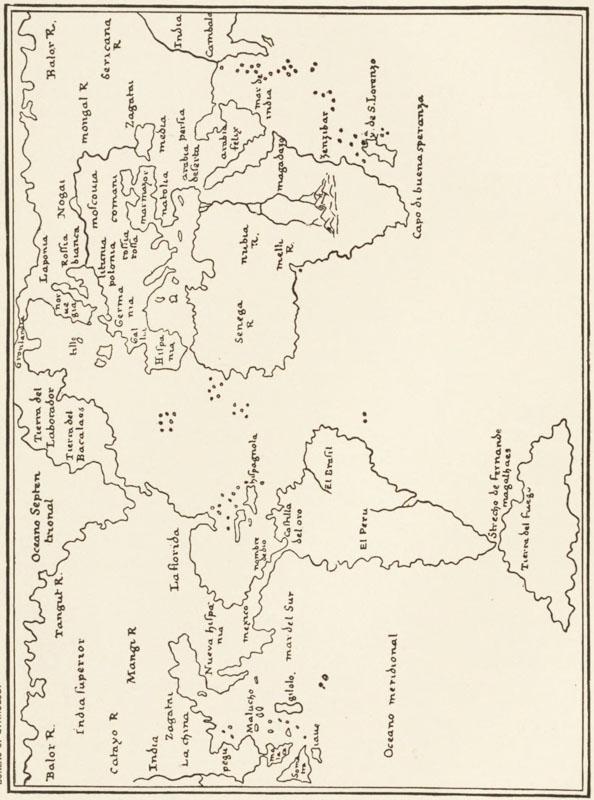
XLI. Map of the World by Ptolemy, 1548 ◊
Friar Marcos started on the second day following Pascua Florida, or Easter, which came on April 6, 1539. He expected to find Estevan waiting at the village where he had first heard about the cities. A second cross, as big as the first, had been received from the negro, and the messengers who brought this gave a fuller and much more specific account of the cities, agreeing in every respect with what had previously been related. When the friar reached the village where the negro had obtained the first information about the cities, he secured many new details. He was told that it was thirty days’ journey from this village to the city of Cibola, which was the first of the seven. Not one person alone, but many, described the houses very particularly and showed him the way in which they were built, just as the messengers had done. Besides these seven cities, he learned that there were other kingdoms, called Marata, Acus, and Totonteac. The linguistic students, and especially Mr Frank Hamilton Cushing, have identified the first of these with Matyata or Makyata, a cluster of pueblos about the salt lakes southeast of Zuñi, which were in ruins when Alvarado saw them in 1540, although they appeared to have been despoiled not very long before. Acus is the Acoma pueblo and Totonteac was in all probability the province of Tusayan, northwestward from Zuñi. The friar asked these people why they went so far away from their homes, and was told that they went to get turquoises and cow skins, besides other valuable things, of all of which he saw a considerable store in the village.
Friar Marcos tried to find out how these Indians bartered for the things they brought from the northern country, but all he could understand was that “with the sweat and service of their persons they went to the first city, which is called Cibola, and that they labored there by digging the earth and other services, and that for what they did they received turquoises and the skins of cows, such as those people had.” We now know, whatever Friar Marcos may have thought, that they doubtless obtained their turquoises by digging them out of the rocky ground in which they are still found in
New Mexico, and this may easily have seemed to them perspiring labor. It is not clear just how they obtained the buffalo skins, although it was doubtless by barter. The friar noticed fine turquoises suspended in the ears and noses of many of the people whom he saw,27 and he was again informed that the principal doorways of Cibola were ceremonially ornamented with designs made of these stones. Mr Cushing has since learned, through tradition, that this was their custom. The dress of these people of Cibola, including the belts of turquoises about the waist, as it was described to the friar, seemed to him to resemble that of the Bohemians, or gypsies. The cow skins, some of which were given to him, were tanned and finished so well that he thought it was evident that they had been prepared by men who were skilled in this work. p358
At this point in his narrative Friar Marcos first uses the word pueblo, village, in referring to the seven cities, a point which would be of some interest if only we could be sure that the report was written from notes made as he went along. He certainly implies that he kept some such record when he speaks of taking down the statements of the Indian who first told him about the seven cities. It looks as if the additional details which he was obtaining gradually dimmed his vision of cities comparable to those into which he had seen Pizarro gather the golden ransom of Atahualpa.
Friar Marcos had not heard from Estevan since leaving Vacapa, but the natives told him that the negro was advancing toward Cibola, and that he had been gone four or five days. The friar started at once to follow the negro, who had proceeded up Sonora valley, as Mr Bandelier traces the route. Estevan had planted several large crosses along the way, and soon began to send messengers to the friar, urging the latter to hasten, and promising to wait for him at the edge of the wilderness which lay between them and the country of Cibola. The friar followed as fast as he could, although constantly hindered by the natives, who were always ready to verify the stories he had already heard concerning Cibola. They pressed him to accept
their offers of turquoises and of cow skins in spite of his persistent refusals. At one village, the lord of the place and his two brothers greeted the friar, having collars of turquoises about their necks, while the rest of the people were all encaconados, as they called it, with turquoises, which hung from their ears and noses. Here they supplied their visitor with deer, rabbits, and quail, besides a great abundance of corn and piñon seed. They also continued to offer him turquoises, skins, fine gourds, and other things which they valued. The Sobaipuri Indians, who were a branch of the Papago, among whom the friar was now traveling, according to Bandelier, seemed to be as well acquainted with Cibola as the natives of New Spain were with Mexico, or those of Peru with Cuzco. They had visited the place many times, and whatever they possessed which was made with any skill or neatness had been brought, so they told him, from that country.
Soon after he encountered these people, the friar met a native of Cibola. He was a well-favored man, rather old, and appeared to be much more intelligent than the natives of this valley or those of any of the districts through which the friar had passed in the course of his march. This man reported that the lord of Cibola lived and had his seat of government in one of the seven cities called Ahacus, and that he appointed men in the other cities who ruled for him. Ahacus is readily identified with Hawikuh, one of the present ruins near K’iapkwainakwin, or Ojo Caliente, about 15 miles southwest of Zuñi. On questioning this man closely, the friar learned that Cibola—by which, as Bandelier and Cushing maintain, the Indian meant the whole range occupied by the Zuñi people—was a large city, in which a great many p359 people dwelt and which had streets and open squares or plazas. In some parts of it there were very large houses, which were ten stories high, and the leading men met together in these on certain days of the year. Possibly this is one of the rare references in the accounts of these early visits to Zuñi, to the ceremonials of the Pueblo Indians, which have been studied and
described with so much care by later visitors, notably by Mrs M. C. Stevenson and by Dr J. Walter Fewkes of the Hemenway Southwestern Archeological Expedition.
This native of Cibola verified all the reports which the friar had already heard. Marata, he said, had been greatly reduced by the lord of Cibola during recent wars. Totonteac was a much larger and richer place, while Acus was an independent kingdom and province. The strange thing about all these reports is not that they are true, and that we can identify them by what is now known concerning these Indians, but the hard thing to understand is how the Spanish friar could have comprehended so well what the natives must have tried to tell him. When one considers the difficulties of language, with all its technicalities, and of radically different conceptions of every phase of life and of thought, the result must be an increased confidence in the common sense and the inherent intelligence of mankind.
On his way up this valley of Sonora, Friar Marcos heard that the seacoast turned toward the west. Realizing the importance of this point, he says that he “went in search of it and saw clearly that it turns to the west in 35 degrees.” He was at the time between 31 and 311 2 degrees north, just opposite the head of the Gulf of California. If Bandelier’s identification of the friar’s route is accepted and it has a great deal more in its favor than any other that can be proposed with any due regard to the topography of the country— Friar Marcos was then near the head of San Pedro valley, distant 200 miles in a direct line from the coast, across a rough and barren country. Although the Franciscan superior testified to Marcos’ proficiency in the arts of the sea, the friar’s calculation was 31 2 degrees out of the way, at a latitude where the usual error in the contemporary accounts of expeditions is on the average a degree and a half. The direction of the coast line does change almost due west of where the friar then was, and he may have gone to some
point among the mountains from which he could satisfy himself that the report of the Indians was reliable. There is a week or ten days, during this part of the journey, for which his narrative gives no specific reckoning. He traveled rather slowly at times, making frequent stops, so that the side trip is not necessary to fill this gap. The point is a curious one; but, in the absence of any details, it is hardly likely that the friar did more than secure from other Indians stories confirming what he had already been told.
Friar Marcos soon reached the borders of the wilderness—the country in and about the present White Mountain Apache reservation in Arizona. He entered this region on May 9, and twelve days later a young man p360 who had been with Estevan, the son of one of the Indian chiefs accompanying the friar, met him and told the story of the negro’s death. Estevan had hastened to reach Cibola before the friar, and just prior to arriving at the first city he had sent a notice of his approach to the chief of the place. As evidence of his position or authority, he sent a gourd, to which were attached a few strings of rattles and two plumes, one of which was white and the other red.
While Cabeza de Vaca and his companions were traveling through Texas, the natives had flocked to see these strange white men and soon began to worship them, pressing about them for even a touch of their garments, from which the Indians trusted to receive some healing power. While taking advantage of the prestige which was thus obtained, Cabeza de Vaca says that he secured some gourds or rattles, which were greatly reverenced among these Indians and which never failed to produce a most respectful behavior whenever they were exhibited. It was also among these southern plains Indians that Cabeza de Vaca heard of the permanent settlements toward the north. Castañeda says that some of these plains Indians came each year to Cibola to pass the winter under the shelter of the adobe villages, but that they were distrusted and feared so much that they were not admitted into the villages unless unarmed, and under no conditions were they allowed to spend the night within the
flat-roof houses. The connection between these Indian rattles and the gourd which Estevan prized so highly can not be proven, but it is not unlikely that the negro announced his arrival to the Cibola chiefs by sending them an important part of the paraphernalia of a medicine man of a tribe with which they were at enmity.
Welcome to our website – the perfect destination for book lovers and knowledge seekers. We believe that every book holds a new world, offering opportunities for learning, discovery, and personal growth. That’s why we are dedicated to bringing you a diverse collection of books, ranging from classic literature and specialized publications to self-development guides and children's books.
More than just a book-buying platform, we strive to be a bridge connecting you with timeless cultural and intellectual values. With an elegant, user-friendly interface and a smart search system, you can quickly find the books that best suit your interests. Additionally, our special promotions and home delivery services help you save time and fully enjoy the joy of reading.
Join us on a journey of knowledge exploration, passion nurturing, and personal growth every day!