FEEDBACK
SEARCHING FOR THE IDEAL COLOUR PALETTE In the quest for perfect whites, Elation Professional discovers the beauty of colour.
Words: Larry Beck Photos: Elation Professional
From the first moment that light was projected onto a stage, lighting professionals have been in search of the ideal colour palette. The colour spectrum is infinite, however, and the variety of shades that designers desire and have sought to create over the years is immense. It’s no surprise then that recreating the full range of colour, and transferring that into an automated luminaire, has been elusive. For years, subtractive colour mixing systems were the default and only viable way to achieve a rich colour palette. White light from lamps or LED engines combined with gels or subtractive colour filters, such as CMY, was seemingly the only option. Additive LED systems that tried to bring a quality RGB alternative mostly failed to produce the rich, saturated colour that designers needed, and resulted in unnatural skin tones and a general washed-out look. However, not all colours can be generated by mixing just three colours. It became clear
094
that an RGB only system was limiting access to the colour spectrum and was incapable of achieving perfect whites, accurate colour temperatures, pastels and almost any of the desired vivid colours that designers value. Those RGB emitters were only capable of a decent saturated red, green, or blue – everything in between and mixed colours looked unnatural and lacked the accurate hue and saturation that designers desired. When lighting people, sets or objects, we simply couldn’t achieve the natural tones or colour reproduction needed, a fact that was made even more evident when used alongside other conventional or tungsten fixtures. Lighting designers have a responsibility to properly light the myriad of skin tones and the intricate detail of costumes and scenic sets but lack the proper tools to do so. Elation Professional was determined to find a solution and invested years of research into LED colour quality, optics and consistency. With time
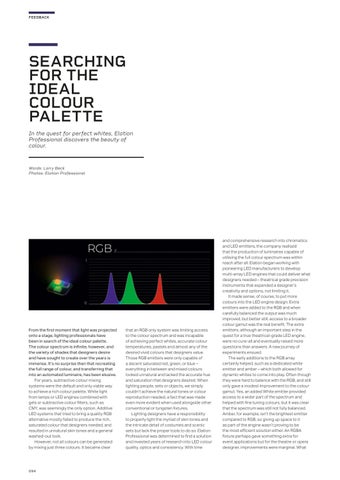
and comprehensive research into chromatics and LED emitters, the company realised that the production of luminaires capable of utilising the full colour spectrum was within reach after all. Elation began working with pioneering LED manufacturers to develop multi-array LED engines that could deliver what designers needed – theatrical grade precision instruments that expanded a designer’s creativity and options, not limiting it. It made sense, of course, to put more colours into the LED engine design. Extra emitters were added to the RGB and when carefully balanced the output was much improved, but better still, access to a broader colour gamut was the real benefit. The extra emitters, although an important step in the quest for a true theatrical-grade LED engine, were no cure-all and eventually raised more questions than answers. A new journey of experiments ensued. The early additions to the RGB array certainly helped, such as a dedicated white emitter and amber – which both allowed for dynamic whites to come into play. Often though they were hard to balance with the RGB, and still only gave a modest improvement to the colour gamut. Yes, an added White emitter provided access to a wider part of the spectrum and helped with fine tuning colours, but it was clear that the spectrum was still not fully balanced. Amber, for example, isn’t the brightest emitter compared to RGB, so giving up space to it as part of the engine wasn’t proving to be the most efficient solution either. An RGBA fixture perhaps gave something extra for event applications but for the theatre or opera designer, improvements were marginal. What