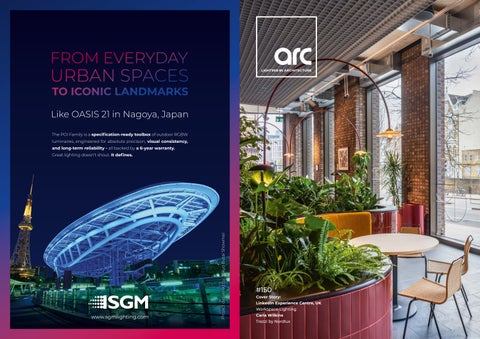
21 in
The POI Family is a specification-ready toolbox of outdoor RGBW luminaires, engineered for absolute precision, visual consistency, and long-term reliability - all backed by a 6-year warranty. Great lighting doesn’t shout. It defines.


![]()
21 in
The POI Family is a specification-ready toolbox of outdoor RGBW luminaires, engineered for absolute precision, visual consistency, and long-term reliability - all backed by a 6-year warranty. Great lighting doesn’t shout. It defines.


Lighting solutions engineered for long-lasting performance in demanding environments

Light+Building 8-13 March 2026
Messe Frankfurt
Hall 5.1 Stand C20

Seamlessly
The UK’s only trade show dedicated to high-end lighting specification

Scan the QR code for future announcements and registration
lightexpo.london


Experience the latest in smart, standardised li�htin� control and interoperabilit� with the


MicroPRIM™ - Special Textured Finish Range
A new evolution of our decorative surface technologies designed to combine refined aesthetics with outstanding durability.
MicroPRIM™+ with Anti-Graffiti Technology
Application of MicroPRIM™+ significantly reduces marks from ink, wax-based materials, and pens on powder-coated surfaces.
Graffiti and other unwanted written marks can be removed easily, helping to preserve the original appearance of the finish without aggressive cleaning methods.
MicroPRIM™ and MicroPRIM™+ are available across three carefully curated finish portfolios:

Woodland Portfolio


Urban Portfolio


Material Portfolio


www.ligman.com/microprim/


Withultra-lowglare,uniformilluminationandacompactdesign, theKARMAseriesseamlesslyintegratesintoextremelyshallowceilings, providinglightingdesignerswithanall-purposetoolforhigh-endhotels, artgalleriesandboutiqueretailspaces.Field-replaceableoptics, IP44/IP65protectionoptions, andprofessional-gradesurfacetreatmentsensureexceptionalperformance,adaptability, andrefinedelegance—allseamlesslyintegratedwithinacohesivesystem.

+86-752-5333256
sales@cdnlighting.com.cn
No.A17,XiangheWestRd.,DongjiangInd. Zone,Shuikou,Huizhou,Guangdong,China


CLS ColourFlow brings architecture and spaces to life with dynamic coloured light. Thanks to advanced RGBW and RGBA
LED technology, vivid colours and smooth transitions are created. The patented Colour Mixing Dome system ensures a perfectly uniform light output without colour streaks.
ColourFlow fixtures are suitable for indoor and outdoor use and can easily be controlled via Casambi, DMX or Wireless DMX. A flexible and durable solution for impressive lighting experiences.

8 - 13 March, Frankfurt am Main Visit us at Hall 4.1 Booth E69


Hello everyone, and welcome to what is our first fully-fledged issue of 2026! I am aware that it is way beyond the statute of limitations to say this, but happy new year to you all! I hope that you have all had a positive start to the new year and are fully prepped and ready for whatever 2026 will throw at us.
What you are holding in your hands is, remarkably, the 150th issue of arc magazine! In an era where we are constantly being told that print media is a dying art and nobody reads physical magazines anymore, we are incredibly proud and privileged to have reached this milestone issue, so a huge thank you to each and every one of you that have supported us on this wonderful journey. It is also a sobering reminder to me personally, that I have now been a part of this publication for a third of its lifetime, joining as I did back on issue 98. Again, it’s an honour and a privilege to have, over the last few years become “part of the furniture”, not just at the magazine, but in this lovely industry of ours – even if it does now make me feel incredibly old! As well as being our landmark 150th issue, this is also the first edition since we made the decision to


Matt Waring Editor
re-incorporate decorative lighting content back into the pages of arc. You will notice this throughout with the addition of some brand-new features, and some slight reworks to our existing content. darc afficionados will be all-too familiar with the Materials feature, which we’re thrilled to be bringing into arc, with Nordlux opening things up for us with a deep dive on its Trezzi product. Meanwhile, Secto Design tells us all about the new Adilo pendant in our reimagined In Focus feature. Elsewhere, in some of our project features, you will note that, as well as speaking to the lighting designers involved, we also get the input from the interior designers that they have collaborated with, to understand more about the harmony that needs to exist between the two to create lasting, beautiful spaces.
Finally, our attentions are very soon turning towards Frankfurt, and the return of Light + Building this March. The entire [d]arc media team will be heading over to Germany for the fair, so please get in touch if you are going, and want to meet up for Kaffee und Kuchen / Bier und Wurst! Enjoy the issue!
Event Diary
On The Board
Alexander Fehre shares three cues he’s drawing from workspace projects.
Snapshot
MMAS Lighting Design Studio
In Focus
Ilkka Kauppinen talks about the design concept behind Secto Design’s Adilo.
Materials Trezzi by Nordlux
Manufacturer Case Studies Workspace Lighting focus
GreenLight Alliance
Tim Bowes calls for a mindset shift regarding circularity.
David Morgan Product Review Nova by Luminii
Bucket List Matt Waring
Doshi Retreat Licht Kunst Licht
Kanola House Lighting Design International
Summer Rain Studio 29
Contingent Object
Shaikha Al Mazrou
Light + Intelligent Building ME
We recap our visit to Dubai for the annual “curtain raiser” of the lighting calendar.
40 Under 40 Awards
Entering its 10th year, the winners of the 2026 40 Under 40 Awards were announced last month.
Carla Wilkins
The newly-sworn in IALD President tells arc about her lighting design journey and her vision for the Association going forward.
Selling Our Shadow
Nulty’s Brice Schneider calls on the lighting design community to embrace our shadows and design with darkness in mind.
Light + Building Preview
As the bi-annual show returns to Frankfurt in March, we preview what visitors can expect to find at the fair.
Hindu Mandir, UAE Studio Lumen
LinkedIn Experience Centre, UK Ström & Ab Rogers Design
No.1 Knightsbridge, UK AECOM & MAWD | March And White Design


Euroshop 22-26 February Dusseldorf, Germany www.euroshop-tradefair.com
Workspace Design Show 25-26 February London, UK www.workspaceshow.co.uk
LUCI Cities & Lighting Summit 25-27 February Oulu, Finland www.luciassociation.org
Japan Lighting Fair 3-6 March Tokyo, Japan www.messe.nikkei.co.jp
Light + Building 8-13 March Frankfurt, Germany www.light-building.messefrankfurt.com
Design Shanghai 12-15 March Shanghai, China www.designshanghai.com
LEDucation 14-15 April New York, USA www.leducation.org
Milan Design Week 21-24 April Milan, Italy www.salonemilano.it
[d]arc awards 30 April London, UK www.darcawards.com
[d]arc sessions europe 5-7 May Sicily, Italy www.darcsessions.com
HD Expo 5-7 May Las Vegas, USA www.hdexpo.hospitalitydesign.com
ICFF 17-19 May New York, USA www.icff.com
Clerkenwell Design Week 19-21 May London, UK www.clerkenwelldesignweek.com
EDITORIAL
Managing Editor Helen Ankers h.ankers@mondiale.co.uk
Editor Matt Waring m.waring@mondiale.co.uk
Junior Journalist
Ellie Walton e.walton@mondiale.co.uk
Contributing Editor
Sarah Cullen s.cullen@mondiale.co.uk
COMMERCIAL
Managing Director
Paul James p.james@mondiale.co.uk
Head of Business Development
Jason Pennington j.pennington@mondiale.co.uk
International Account Manager
Andrew Bousfield a.bousfield@mondiale.co.uk
International Account Manager
Ethan Holt e.holt@mondiale.co.uk
Events & Marketing Manager Moses Naeem m.naeem@mondiale.co.uk
Design Manager
David Bell d.bell@mondiale.co.uk
Design Jez Reid j.reid@mondiale.co.uk
Production Mel Capper m.capper@mondiale.co.uk
Chairman
Damian Walsh d.walsh@mondiale.co.uk
Finance Director
Amanda Giles a.giles@mondiale.co.uk
Credit Control
Lynette Levi l.levi@mondiale.co.uk
[d]arc media ltd
Strawberry Studios, Watson Square, Stockport SK1 3AZ, United Kingdom T: +44 (0)161 464 4750 www.arc-magazine.com ISSN 1753-5875


The Vitra Campus in Weil am Rhein, Germany, has over the years transformed from an industrial site into a public park, welcoming more than 400,000 visitors annually. In late 2025, the campus unveiled the Doshi Retreat; conceived by Pritzker Laureate Balkrishna Doshi, Khushnu Panthaki Hoof, and Sönke Hoof, the project draws from Indian spirituality, and the notion of a journey to create a sanctuary for peaceful solitude and repose. At night, lighting designed by Licht Kunst Licht becomes an intrinsic layer of the narrative. By day, the retreat rests quietly within the landscape, and by night, it reveals itself through a faint, almost imperceptible warm glow reflecting the essence of the architecture. This subtle illumination establishes the retreat as a quiet yet iconic presence – never competing with its surroundings, yet always inviting curiosity.
Unfolding as a winding path, the Doshi Retreat invites both physical and metaphorical exploration. As one moves along the route, which descends below ground level, leading along walls that resonate with the gentle sounds of gong and flute, there is a growing sense of transition. Pathways are defined by an interrupted rhythm of concealed illuminated edges, gently guiding visitors through the descent. At seven distinct “nodes” – symbolic of the Kundalini chakras –boomerang-shaped, floor-recessed details taper
and widen, pacing the movement and deepening the experiential quality of the exploration. 2200K illumination resonates with the warmth of Corten steel, casting a soft, amber hue that soothes the night-adapted eye. These ribbons of light provide legibility without distraction, allowing one to turn inward through this journey.
The journey culminates in a gong room, where light and sound converge. A linear halo traces the circular edge of the chamber, while discreet projectors illuminate the space. Visitors perceive only a mysterious glow, reflected by a brass soffit that shimmers in resonance with the meditative sound of the gong. Here, light transcends its functional role to become an instrument of introspection and transcendence.
Experientially, the lighting cultivates silence and reflection. Iconically, it demonstrates that subtlety can be as powerful as spectacle. Functionally, it ensures clarity and safety without compromising atmosphere.
The Doshi Retreat therefore exemplifies a future of architectural lighting rooted in humility, depth, and narrative – where darkness is as significant as light itself, and where space becomes an instrument of solitude and contemplation, awakening the perception of unseen presences. www.lichtkunstlicht.com

arc’s Editor Matt Waring and Junior Journalist Ellie Walton share their thoughts of this year’s Light + Intelligent Building Middle East, held in Dubai this January.
There is an ancient saying that says ‘three times makes a tradition’, and if this is the case, then I guess it is now a tradition that I open my year with a trip to Dubai for Light + Intelligent Building Middle East.
While January of 2026 marked my third time at the fair, it was the 19th edition of the popular “curtain raiser” of the lighting design calendar, further establishing its position as one of the leading events for lighting and building technology in the MENA region.
The popularity of the event was evident to see, as it brought together more than 16,000 visitors from across 95 countries over the course of its three days. Among these was a strong contingent from the international lighting design community, with designers and manufacturers coming from far and wide to connect, and in some cases (particularly those of us from Northern Europe), get some much-needed January sunshine.
Integral to the show’s success, alongside its exhibition space, was its expansive talks programme; spread across three stages –ThinkLight, InSpotLight, and the Smart Building Summit – the varied programmes boasted a diverse array of speakers from all around the world (including a certain lighting design magazine editor…), giving attendees plenty of inspiring and informative content to mull over.
The Smart Building Summit brought together policymakers, standards bodies, and technology and sustainability leaders to explore how regulation and innovation are accelerating the adoption of intelligent, energy-efficient buildings.
ThinkLight, curated by Light Collective, provided a platform for regional and international lighting professionals to exchange insights through new formats, including the Design Deep Dive, Project Perspectives, and Conversations in Light.
Finally, InSpotLight looked to showcase the latest developments in lighting technology and design, including The Specifiers’ Area, where shortlisted companies presented their products live on stage, as part of the final judging stages of the Light Middle East Awards, which closed out the show on its final night.
As in previous visits to the fair, my aim was to divide my time between the ThinkLight and InSpotLight
stage – a task made easier this year as I was glad to be joined by [d]arc media Junior Journalist Ellie Walton (you can read all about her perspectives of the show later on). So, with notebooks at the ready, we were both keen to get to the International Trade Center to see what this year’s show had to offer. Opening proceedings on the ThinkLight stage, Light Collective’s Martin Lupton introduced the overall theme for the stage – Vision to Impact: From Inspiring Ideas to Lasting Legacies – before introducing its first speaker. Ziad Fattouh, CoFounder of Delta Lighting Solutions took the audience on a “lighting journey of the Middle East”, examining the rate of growth not just in Dubai, but across the Gulf region. As one of the first lighting design studios with a permanent base in Dubai, Fattouh explained how Delta Lighting Design has taken what it has learned internationally, before applying it to a local context. Under the belief that lighting designers “are there to create some magic”, Fattouh detailed the studio’s expansion in the region, from its initial projects in retail and residential spheres, to mega projects and mixeduse developments that require a great deal more cross-coordination, and how with every project, especially as they get bigger and more complex, there are lessons to be learned that can be taken forward to future projects.
On the subject of projects in the region, following Fattouh was the ThinkLight stage’s first Product Perspectives session. On the subject of ‘Heritage and Cultural Spaces’, here, four designers offered insights into specific projects. First up, Michael Grubb talked about exhibition and gallery lighting, and of how lighting can “enhance the story behind the artefacts on display”. This was demonstrated by his studio’s work on the Sheikh Zayed Grand Mosque Visitor Centre in Abu Dhabi, and how the team worked to ensure that this was “in keeping” with the broader storytelling of the Grand Mosque, and its original lighting scheme from Speirs Major Light Architecture.
Grubb was followed by Lama Arouri, Managing Director of Studio N, who explained how lighting became “the essence” of the design of the Mosque of Light – a beautifully restrained, minimalist piece of architecture in Dubai, designed by Dabbagh Architects. Reflecting on this project, Arouri said


that light is a “core spiritual element in the project”, where it is not applied, but discovered.
Up next, Ahmed Bayashout, Design Director of Studio A detailed his experiences on illuminating the Ammar Bin Yasser Mosque in Al Ula, Saudi Arabia. Using light to “reveal”, he explained how the project was a renovation of an existing structure, that was transformed into a new, modernist building with subtle, low glare, hidden lighting used throughout.
Finally, Siddharth Mathur of Studio Lumen took the audience on a tour through the remarkable lighting design of Hindu Mandir – the first Hindu temple to be built in Abu Dhabi. With challenges ranging from architectural complexity and detail preservation, to cultural sensitivity and stakeholder coordination, Mathur explained how his team took a responsible and contemporary approach to sacred lighting (you can read more about this incredible project on page 56 in this issue).
The session concluded with a panel discussion among all speakers, where they could discuss their projects in more detail, highlight some of the particular challenges faced, and take some questions from the audience.
After a brief break, Sharon Stammers of Light Collective hosted a “Fireside Chat” with dpa lighting consultant’s David McNeil that highlighted the studio’s legacy of work in the Middle East, having been working in the UAE for 50 years. In a similar vein to Fattouh’s talk earlier, McNeil focused on


the development and expansion of the region, and how with a continued evolution of the market, it has also led to an evolution in client expectations. Later on at the ThinkLight stage, IALD President Carla Wilkins led a similar session on Commercial, Workplace, and Education projects. Up first, Yah Li Toh, Founder and Principal of Light Collab talked the audience through the design decisions for former arc cover story The Reserve (arc #145) –the world’s highest capacity vault that blurs the boundaries between tradition and innovation.
Next, Daniel Hodierne, Design Director at AFRY Architects (formerly Light Bureau) highlighted the firm’s work on the Queen Silvia Concert Hall – a venue on the campus of Stockholm’s Lilla Akademien, the lighting scheme had to serve two functions: a classroom by day, and a theatre by night.
Hodierne was followed by Tom Niven, Director of Lighting at BDP, who highlighted the synergy between modern workspaces and hospitality design, with specific reference to his work on Deloitte’s Manchester offices.
Finally, Will Whiter, Design Director at architecture studio Kettle Collective talked of the “divine geometry” of the Sheikh Mohammed bin Rashid Al Maktoum Solar Park, and of how essential lighting becomes in not only highlighting its sculptural form, but in understanding and using the space. This session again closed with a panel discussion, moderated by Wilkins, in which the speakers
discussed a variety of challenges associated with each project, from narrative retention to issues surrounding tender packages.
On the subject of emerging traditions, Day One closed, as it did last year, with Light Collective’s Brilliance Light Quiz. With questions covering light art, architecture, and cinema, as well as a few different lighting-themed rounds, it was a fun way to close an informative first day. Unfortunately, I was unable to repeat my successes of last year, but a big shout out to my fellow teammates on “Go [d]arc or go home”, who finished in a very respectable third place.
If Day One was spent mostly camped out on the ThinkLight stage, Day Two saw a change of scenery to the InSpotLight arena. Kicking things off was a series of brief presentations from a selection of Women in Lighting representatives from across the region. The five speakers – Jinane Abi Khalil (Moonlight Architectural Squad), Ayazhan Assanova (F-Project), Alla Fillipovich (962 Light), Ghada Dwaik (GD Lighting Design), and Surbhi Jindal (Da Light Hub) – each offered their own personal insights into working in the region, sharing specific projects that they have worked on, and some of the unique challenges that come with, in some cases, working in countries where there is a scarcity of independent lighting designers.
After this, it was my turn to take to the stage to moderate a session examining the multidisciplinary approach to mentorship, collaboration, and technical excellence. Joining me for this session were Jared Smith (President, IES), Majeed Uz Zafer (Founder, Light Factor), Kristina Allison (President, SLL), and Robert White (Principal, Illuminart). Over the course of our discussion, the panellists discussed the “communication gap” when working in larger, multi-disciplinary teams, and also the importance of acting as a mentor to the next generation of lighting designers, educating and encouraging them to find their own voice in the field. As is seemingly the law these days, the panel also touched on AI, covering the good (and bad!) ways that it can affect working practices, particularly for those just starting out in the industry.
My work didn’t stop there, as after a brief lunch break, I was back on stage again, this time for a “Fireside Chat” with Michael Grubb about his book, Stories With Light. Officially launched with a similar conversation at Clerkenwell Design Week last year, this time around, we discussed the origins of the book, shared some of Michael’s favourite stories from within, and looked back on how it has been received since its release. Although he enjoyed the process of putting together a book, he says that plans are not currently in place for a sequel.
Following my duties on stage, Peter Veale, Director of Layers of Light, delivered a fascinating presentation into how light plays its part in our sensory experiences. Sharing some remarkable research, Veale talked about the ways in which light can affect our experience of the world, from the way we perceive space to the ways that we taste food. Day Two was concluded in style, thanks to IBL and CLA, who hosted a wonderful event at the LookUp
Rooftop Bar, where guests enjoyed drinks and canapes, with beautiful views looking out across the Dubai skyline. It was a great way to wind down after another full-on day of talks, so big thanks to IBL and CLA for their hospitality on the night. And so, to the final day at the fair. Once again spending the majority of my time on the InSpotLight stage this time around, the day opened for me with an insightful session from Kristina Allison, who first provided a focused introduction to the circular economy as a concept, and what that means for lighting designers, before exploring the ins and outs of CIBSE documents TM66 and TM65.2, explaining how designers and manufacturers alike can benefit from the knowledge and understanding of their use in design practice.
One of the highlights of Day Three came when Lebanese designer Cherine Saroufim, introduced two students from the Académie Libanaise des Beaux-Arts (ALBA) in Lebanon, who presented an incredibly unique concept – called Murfi –which aims to address light poverty, and the transformative role of lighting in restoring dignity, safety, and hope.
Another highlight of the day came from Reem Nassour, Principal Architect and Founder of Nassour Architecture Office, who presented “An Architect’s Perspective and Insights” on architectural lighting. Through a thoughtful and insightful presentation, Nassour talked of light’s power in creating storytelling within architecture, and how understanding the nuances of light is a powerful tool for architects. While it is often the way at lighting conferences for the programme to be comprised of lighting people talking to lighting people about lighting, it was incredibly refreshing to hear an “outsider” talk about light in such a positive and passionate way.
Closing out proceedings on the InSpotLight stage, the topic turned to Dark Skies with a panel discussion titled Where Have The Stars Gone. Moderated by Nulty’s Iliana Zotou, the panel, comprised of Katia Kolovea (Archifos, The Lighting Police), Dane Sanders (Clanton and Associates), and Leanne Henderson (Taurima), talked about the need for clarity when discussing darkness and light pollution, particularly in the language used to talk about it. The panel also agreed that there is a need to show that Dark Skies does not necessarily equate to darkness itself, and that more needs to be done to educate people on brightness, safety, wildlife, and health. It was an informative way to end proceedings, but a reminder that, while conferences are great for sharing ideas among each other, for true change to happen, broader conversations need to happen among the wider design and build sphere.
With a head full of inspiration after a remarkable few days of talks, our trip to Dubai concluded in style at the Light Middle East Awards. Dressed up to the nines (for a change!), we took to the Conrad for a wonderful evening celebrating some of the best that lighting design has to offer – a wonderful way to close out our stay.

Attending Light + Building Middle East this January marked a major milestone in my [d]arc media career: my first long-haul trip. As someone who’s never ventured outside of Europe, I truly appreciated the first-time novelty of taking an Emirates flight – watching an array of new release films, the unexpected discovery that I could order any drink without it appearing as an extra charge, and a pillow!
Now, it may have been my first time in Dubai, but it wasn’t my first rodeo at the lighting trade show. After all, we were there to work. One thing to note about Light + Intelligent Building Middle East is its scale: a much smaller and more intimate event than its Frankfurt parent, but that is exactly its strength. Rather than an overwhelming exhibition floor, the real value this year sat in the conversations, particularly the talks split between the ThinkLight programme and the InSpotLight Stage, where Matt and I spent most of our time. Day one had to be the highlight for me, with the talks curated by our dear friends from Light Collective, Sharon Stammers and Martin Lupton, who set the tone: thoughtful, reflective, and refreshingly honest about the realities of practice in the region and beyond.
The opening presentation by Ziad Fattouh, co-founder of Delta Lighting Design, was less a project lecture and more a candid career reflection. Fattouh arrived in Dubai 25 years ago when the profession of architectural lighting design barely existed locally. His early role, as he openly admitted, was essentially “putting lights in ceilings”. What followed mirrors the story of Dubai itself: rapid expansion and escalating complexity. In turn, Delta Lighting Design evolved from a small studio into an international practice working on projects such as the Bvlgari Hotel, the House of Wisdom and Desert Rock. The key shift he described was the transformation of the lighting designer’s role. Lighting, once treated as a late-stage technical service, has become a creative discipline that shapes the experience of architecture. His projects demonstrated that lighting is no longer simply
about visibility; it is about narrative and return visits. Good lighting does not just illuminate a place; it makes people want to come back to it. Perhaps his most important idea was also the simplest: not every project needs spectacle. While the Middle East is often associated with large-scale “wow-factor” lighting, most spaces require restraint, layering and sensitivity rather than showmanship. The talk effectively reframed lighting design as authorship. The designer is not decorating architecture but shaping the story people experience within it.
The following session shifted from professional reflection to collective philosophy, with a panel including Michael Grubb, Michael Grubb Studio; Lama Arouri, Studio N; Ahmed Bayashout, Studio A; and Siddharth Mathur, Studio Lumen. Among the panel, they discussed projects ranging from the Sheikh Zayed Grand Mosque Centre to a Hindu Temple in Dubai and cultural institutions across Asia. While the projects differed widely, the panel quickly converged on a shared idea: lighting sacred or heritage architecture requires humility. A recurring theme was the danger of lighting becoming a performance or “gimmicky”. In religious spaces especially, spectacle can undermine the purpose and sanctity of a religious space. Instead, lighting should support calmness and contemplation, with the agreement that the architecture remains the hero. Darkness, contrast and restraint were repeatedly emphasised as design tools rather than problems to eliminate.
Across the panel, another truth emerged: drawings rarely survive contact with site conditions. Designers spoke about discovering misalignments in building orientation, materials that behaved differently under light, and fixtures that exposed construction imperfections. Lighting, as several noted, can be unforgiving; it reveals reality rather than intentions. In short, good lighting in heritage environments is almost invisible. When done well, visitors remember the space, not the luminaires. After soaking up some 25° sunshine in the middle of January, it was time to head to the InSpotLight


stage for the famous Light Collective quiz. Matt had assured me he had a reputation for landing on the winning team, though I wasn’t entirely convinced that I would be much help – after all, my strengths lie in writing, not specifying lighting; therefore, I became the team’s scribe. Thankfully, some nuggets of trivia I had stored away proved to be useful in the music and film round, which Matt and I absolutely dominated, if I do say so myself. Unfortunately, Matt’s winning streak came to an end this year as we finished tied in second place, ultimately coming third after losing the tiebreaker question. Still, even in our brief moments of glory, we could have never made it to the top three without our true lighting experts, Eloise Reed from Anolis and lighting designers Louise Santiago and Edna Obtinalla of dpa lighting consultants, who carried the team with their impressive knowledge on all things illumination.
The trip started with a first-day high and ended with a celebration at a full black-tie awards ceremony. It was a magical evening, and it felt almost surreal to be dressed so glamorously after New Year’s Eve. As insightful as the talks were, nothing quite matches a party with some friends and the new connections made along the trip. It was wonderful to see how many talented designers were recognised for their work, and a huge congratulations to all the winners. Closing my first long-haul trip in such good company felt like a fantastic start to 2026.
Light + Intelligent Building Middle East will return on 11-13 January 2027.
www.light-middle-east.ae.messefrankfurt.com


Winners of the 2025 40 Under 40 awards - the 10th anniversary of the programme - were announced in an online ceremony this January.
In January of this year, the global lighting community celebrated the announcement of the winners of the 40 Under 40 Awards for 2025.
Marking the 10th anniversary of the awards programme, the 40 under 40 Awards is designed to recognise both emerging talent and established names within the lighting industry, whose work, thinking, and ambition are shaping the future of the industry.
Spearheaded by Light Collective, alongside sponsors Selux and Filix, the 40 Under 40 Awards has, since its launch, focused on designers at a pivotal stage in their careers – those pushing boundaries, asking new questions, and contributing to lighting design far beyond individual projects.
The 2025 edition also reflects the growing diversity and global reach of the profession. The programme received 354 nominations, with 156 nominees from 33 countries submitting their work for consideration. The international span of the programme was also demonstrated through the global panel of judges – Carla Wilkins (Germany), Jeff Shaw (UK), Noemi Barbero (Spain), Guiseppe Simone (Australia), Paola Pietrantoni (USA), and Waleed Fakousa (UAE) who, following a rigorous review process, selected the 40 winners, representing a wide range of disciplines, geographies, and design approaches.
The strength of the 40 Under 40 awards programme lies in its long-term impact; over the past decade, many former winners have gone on to lead studios, contribute to education, publish research, and influence the broader direction of lighting design worldwide.
To mark the landmark anniversary of the 40 Under 40 Awards, a special celebration will take place at Light + Building in Frankfurt, Germany, on 9 March from 4-6pm at the Design Plaza in Hall 3.1. The session will begin by honouring the 2025 winners, followed by talks from past winners reflecting on their passion for light and their professional journeys. Drinks will follow, creating space for conversation and connection, with past winners especially encouraged to take part in this milestone event.
Reflecting on the judging process, Noemi Barbero says: “It has been both exciting and challenging to witness such remarkable talent, reflecting a new generation of lighting professionals: thoughtful, rigorous, and deeply committed to exploring light in all its dimensions.
The future of lighting design is bright!”
Paola Pietrantoni adds: “I truly admire all the participants for their outstanding skills, professional passion, and the energy they bring

to what they want to contribute to the lighting industry in the years ahead. It has been a real pleasure to read through all the profiles.”
Fellow judge Jeff Shaw reflects: “It has been very rewarding reviewing these entries. It shows the industry is in good hands for the future, seeing so much diversity in people, skills, and talent, and demonstrated with so much genuine passion for lighting all around the world.”
Carla Wilkins adds: “I was honoured to review the 40 Under 40 applications, not knowing who will finally receive the top votes from all the judges. There are so many outstanding talents and skilled designers – be inspired by their work and ambition for our lighting community.”
Reflecting on the awards, organisers Light Collective add: “The 40 under 40 2025 was a global success. With a total of 354 nominations, 156 nominees from 33 countries were submitted for the judges to consider and 40 winners chosen. We really enjoy announcing the winners and congratulate them all on their achievements and aspirations. The quality of the entries was outstanding this year and its great to know that the lighting industry is in great hands.” [d]arc media passes on its congratulations to all of this year’s winners.


www.40under40.events


Alexander Fehre, Stuttgart-based interior architect and founder of Studio Alexander Fehre, shares three recurring cues he’s drawing from current workspace projects – and why contemporary office design is less about adopting trends and more about translating organisational culture into space.
When we talk about contemporary workspaces, the conversation still gravitates towards typologies: open plan, desk sharing, remote-first. In practice, these are only labels – and rarely real answers. Work isn’t a furniture system; it’s an interplay of culture, routines, density, identity, and the very ordinary realities of the day: Where do I bump into colleagues naturally, where can I stay focused, where do I feel welcome – and where am I simply “accommodated”?
What I’ve been noticing more and more is this: the real lever isn’t the size of a space or how closely it follows a trend, but its choreography. Offices need to enable movement, encounter and retreat so intuitively that it never feels like a “rulebook” –it simply feels like a natural way of working. The most contemporary spaces I know are the ones that reduce friction quietly: they make the next step obvious, the right behaviour easy, and the atmosphere calm enough for people to bring their full attention.
One element has an outsized impact on whether a space feels intuitive at a subconscious level: light. It’s often the most immediate way to make architecture and materiality legible – revealing texture, softening transitions, guiding movement, and setting the emotional “interface” of a room. Whether we develop lighting concepts in-house on smaller projects or alongside specialist lighting designers, the first question is rarely technical. It’s always: what should this space feel like? From there, lighting becomes a quiet behavioural cue – helping a workplace function naturally, without users needing to think about it.
In the VDK Office in Stuttgart, this became especially tangible on a compact footprint. Two former ground-floor apartments had to become a coherent administration workplace, yet the existing layout initially encouraged fragmentation. The key move wasn’t a concept label, but a clear spatial gesture (1) – a gently curving central corridor that creates orientation, connects functions, and lends the whole floor a sense of generosity.
Once the “spine” is legible, everything else can become quieter: thresholds feel intentional, meetings don’t spill into focus, and the floor reads as one place rather than a sequence of rooms. Here, lighting reinforces that clarity (2) – supporting wayfinding, balancing brightness between zones, and giving calm depth to a restrained palette.
At the other end of the scale sits the “Herzzone” for Roche Diagnostics in Ludwigsburg, a hybrid meeting place inside a production hall. The response was a “house within a house”: timber volumes placed within the larger industrial shell, creating spaces with different degrees of openness (3). In this setting, lighting mediates between industry and comfort: layered, warm light helps the timber structures read as a place to arrive, while task lighting supports work without turning the hall into uniform brightness. In the more informal gathering areas (4), a softer ambient layer invites people to settle in and shift naturally between exchange and focus. And then there are environments where identity is deliberately staged – such as Breuninger Content Production in Sachsenheim, where the everyday feels like backstage and runway at once. Here, lighting doesn’t just support work; it amplifies narrative. It sharpens graphic qualities, emphasises rhythm and depth, and helps define moments that feel like a set (5) – without compromising usability. Even a single editorial gesture (6) can signal what the organisation values: craft, energy, play, precision. What links these projects is a simple position: workplaces become truly contemporary when they don’t copy trends, but offer a tailored spatial answer to people, processes and culture – allowing for both efficiency and emotion. Contemporary workspace design, to me, is the quiet balance of clarity and warmth, structure and flexibility, focus and connection - and light is often the subtle layer that makes this balance feel effortless. www.alexanderfehre.de
Led by Mariel Fuentes and Michela Mezzavilla, Barcelona-based MMAS Lighting Design Studio brings its artistic philosophy of lighting design to every collaboration, resulting in some stunning works across Spain and beyond.


MMAS Lighting Design Studio arises from friendship and passion for light in its different facets.
Mariel Fuentes and Michela Mezzavilla merge their professional backgrounds with commitment and professionalism as a common factor, from a creative and conceptual approach to the achievement of optimal results through efficient and sustainable technical solutions. With a love for collaborative design, MMAS immerses itself in the creative process hand in hand with architects, engineers, installers, interior designers, project managers and owners, with the aim of finding the perfect balance between technique and sensibility. The studio’s design philosophy is to work with the language of light as a narrative and emotional tool for people in space. So that the luminous, visual and perceptive discourse is the guiding thread of people’s experience, the underlying element of cohesion and coherence in space. www.mmaslighting.com
Inner Flow Studio
Barcelona, Spain
Inner Flow Studio has a programme of uses across two levels. On the ground floor there is a Gym, The Shala and Zendo; and in the basement is a Spa and Flotarium. The lighting project seeks to create comfortable lighting environments, where the user can find the right atmosphere and harmony for each specific activity. Among the singularities of the project are spaces such as The Shala, or yoga room: a practically round room where light integrated throughout the curved perimeter generates a great texture with a soft backlighting oriented towards states of relaxation. This coexists with direct light that enriches its versatility in terms of activities, and a more dynamic lighting environment when necessary. In the Zendo, or meditation room, the indirect and integrated perimeter light is coupled with a large lighting oculus, allowing for various lighting scenes. In the basement, a soft indirect and integrated light harmonises with decorative lighting elements, reinforcing the human scale. The Flotarium features a false skylight with several levels with integrated RGB light, which evokes contemplative relaxation. The biggest challenge was to coordinate every detail of the interior design, integrating the lighting into each space, maintaining the identity of the place, with very controlled budgets. Inner Flow Studio is a place where light invites us to enjoy collective activities, as well as intimacy and relaxation, altogether it is a space for wellbeing.
Photography: Rocío Alvarado
The lighting concept for this restaurant was inspired by the warmth, depth, and luminosity of a summer sea view on the Costa Brava. The main challenge was the site itself: a long, narrow space in the centre of Barcelona, completely lacking natural light. Light therefore became the primary tool to dissolve spatial boundaries and recreate the atmosphere of a Mediterranean landscape within an urban interior. Developed in close collaboration with the interior designers, the lighting strategy focused on expanding the perceived space through the treatment of the long walls. Overlapping sail-shaped mirrors combined with backlit rattan panels evoke a vibrant Mediterranean horizon, while wallwashers illuminating bluetoned furniture and artwork create the illusion of windows opening “to the blue” of the sea. Accent lighting on dry plant arrangements adds lightness and an immaterial quality, recalling vegetation shaped by sun and salt. These conceptual ideas were translated into highly detailed technical solutions. Integrated LED strips within the rattan were positioned to avoid reflections on mirrors, requiring precise coordination with carpenters and electricians. Lighting embedded in the dry plants demanded close collaboration with decorators, while accent lighting on trunks and foliage required custom accessories and careful aiming to eliminate glare.
Photography: Adria Goula for El Equipo Creativo
Located in a former military barracks beneath the Rock of Gibraltar, this project carefully balances respect for historical heritage with a forward-looking vision. Light is the central design material, acting as a bridge between history and technology. The lighting strategy is organised in layers. The first consists of indirect linear lighting integrated along the floor throughout the building, softly illuminating the stone arches, and establishing a subtle ambient glow. Above this base layer, accent lighting and functional lighting define key spaces. Accent lighting highlights furniture and focal areas. Functional work lighting is achieved through linear luminaires with controlled UGR, ensuring visual comfort and adequate illumination for daily tasks. At the entrance, visitors arrive from the main plaza into a gallery that serves as reception, circulation space, and venue for cultural events. A floating walkway extends over a reflecting pool, where illuminated stone walls and arches are mirrored to create a striking, illusory spatial effect. The lighting design required precise
coordination, including material selection for the pool and detailed studies of light angles to minimise glare while maximising comfort. The project’s greatest challenge was preserving the architectural heritage while working within strict installation constraints. This was addressed through streamlined systems, surface-mounted perimeter lighting, and meticulous optimisation to achieve maximum impact with minimal fixtures.
Photography: Lagranja Design
Terrassa, Spain
Transicions was conceived as an exercise in precision and sensitivity: an ephemeral lighting installation that, on the 2021 International Day of Light, established a contemporary dialogue with the Masia Freixa, one of Terrassa’s modernist landmarks. Once a textile factory and now a protected heritage building, its architecture became an active support for a narrative constructed entirely through light. The project proposed a temporal reading of the building based on the chromatic transition of the sky throughout the day. Four tonalities – dawn, midday, sunset, and full night –structured the concept, not as fragmented scenes but as a continuous, enveloping flow. Light moved elegantly and subtly across the façade and exterior spaces, surrounding the building’s volume with a dynamic continuity that transformed the perception of the whole. Transicions was realised using RGB outdoor luminaires controlled via DMX, in a preprogrammed seven-minute cycle, played continuously. This precise control allowed for the regulation of intensity, colour, and transition rhythm, ensuring a respectful integration with both the architectural and urban context. Conceived for an exterior and time-based setting, the installation avoided visual excess and embraced a restrained, almost atmospheric presence. The organic forms, curves, and reliefs characteristic of modernist architecture acted as a living canvas that naturally received the shifts in light and colour. Light did not compete with the architecture; it accompanied, revealed, and reinterpreted it. The result is a renewed perspective on heritage, where the building transforms without losing its identity, and where light is affirmed as a project material capable of activating the memory of place while projecting it toward a contemporary reading.
Photography: Viqui Ocaña


Secto Design’s Adilo is an unassuming flat packed pendant that transforms into a graceful spiralled luminaire through a simple unravelling mechanism. 14 years in the making, industrial designer and Finnish artisan, Ilkka Kauppinen discusses the jounrey of Adilo as a rebellion against bulky wasteful packaging.
What is the concept behind this product?
Traditionally, large lamps are difficult to transport: they are fragile, require substantial volume, and demand excessive packaging. I wanted to design a lamp that could be folded flat for transport, solving these challenges without compromising its visual or material qualities.
How long have you been working on the product for?
I first sketched the core idea and geometry around 15 years ago. Over that time, I returned to it in short, intensive phases, experimenting with different materials and manufacturing methods. Once the right tools and materials became available, the final development phase took approximately a year.
What was the most challenging aspect of producing this piece?
The most challenging part was finding a functional opening mechanism. I tested an unreasonable number of fastening and structural solutions, and for a long time, nothing worked the way I envisioned it. The frustration built up to a point where giving up simply was not an option.
Eventually, one evening, I had a genuine lightbulb moment and realised the structure could be tensioned using a string. That single insight unlocked a solution that is both intuitive and userfriendly. From there, everything finally began to fall into place
What materials have been used? Please describe the design process.
The primary material is PEFC-certified ultra-thin birch plywood, which gives the lamp its warm, natural glow while also providing the necessary structural performance. Its flexibility and strength were essential to achieving the folding structure. Additional polymer components are used where precision and durability are required. Because functional materials and mechanisms cannot be fully resolved on paper alone, the design process relied heavily on hands-on prototyping, testing, and iteration.
What technologies does the product use?
When I first sketched the lamp, many of the materials and manufacturing methods required to realise it did not yet exist. Advances in technology have since made it possible to bring the idea to completion. In particular, developments in ultra-thin birch plywood and contemporary manufacturing techniques have enabled a level of precision and efficiency that would not previously have been achievable at a practical scale.
What kind of environments, clients or projects is this product suitable for?
The lamp is suitable for both private and public interiors. It is available in two sizes, allowing it to adapt to different spatial scales and contexts.
What makes this product different from others in your portfolio and from other lighting products on the market?
This piece differs significantly from my earlier work, as my background is largely rooted in technology, but that technical thinking is clearly present here. At the same time, the project carries strong personal significance, having stayed with me for many years. I would not have continued working on it without a deep belief in the value of good design and in the importance of seeing an idea through properly. I can say, with confidence, that there is nothing quite like it currently available.
Describe the product in three words. Unfolding natural lighting.
www.sectodesign.fi

The Dark Sky luminaire head for the modular system bollard luminaires protects the night sky and nocturnal wildlife. Optionally available with BEGA BugSaver® technology to switch the colour temperature to an amber tone. Bollard tubes optionally available in sustainable Accoya® wood. bega.com/systembollards

“Light is our most universal language. From Asia to the USA, we all move beneath the same sun, witnessing the same dance of shadow and brilliance. By uniting as one voice, we do more than illuminate spaces; we reshape how the world is seen. Together, we can turn the simple act of lighting into a global movement for change.”
Carla Wilkins

In January of this year, Carla Wilkins, Founding Partner of Lichtvision, took over the role of President of the International Association of Lighting Designers (IALD). Speaking to arc at Light + Intelligent Building Middle East, Wilkins talks about her vision for the association, and of her stellar career to date.
It is a commonly held belief that lighting design is the bridge that connects technology and design – that magical, ethereal quality that brings architecture to life and has the power to transform the mundane into something truly special.
This is a belief that is firmly held by Carla Wilkins, Founding Partner of global lighting design practice Lichtvision, and newly “sworn in” President of the IALD, who believes that, as well as striving for the best in terms of design, there should also be room for joy and wonder.
“As lighting designers, we have a responsibility. We should always look to bring something new, to merge technology and design to the best level, but it is also about joy,” she tells arc during a conversation at Light + Intelligent Building Middle East.
“In the lighting industry, we are all extremely focused on the business and the profession, but we should also seek out the happiness, and enjoy the work that we do. We all talk about the magic of lighting design, and I have the feeling that sometimes we forget what a luxury we have to work in this special field.”
Like many before and after her, Wilkins “found” lighting design after initially training as an architect. It was only after completing her studies and landing an internship in New York with Fisher Marantz Renfro Stone (as it was known at the time), that she really understood lighting as a profession.
“I can’t say that I was four years old and already had a lightbulb in my hands,” she says. “I am a trained architect, so my education was that there is one light fitting, and it goes in the centre of the room, and that is it. I did a study about museum lighting while at university, which made me think that lighting could be interesting, and also worked at a theatre, where I learned a lot about gels and how scenes can look nicer with special tones.
“I received a recommendation that there was a lighting studio in New York that was hiring interns – bear in mind this was in an age before the internet, we only had books and magazines – and so I thought I would give it a try. I was extremely lucky to get that internship, as it was through this that I learned that lighting design was a serious profession.”
Wilkins stayed in New York for a year and a half, during which she says the “foundation for my passion” grew under the tutelage of Fisher Marantz Renfro Stone’s founding partners. “They were really great mentors, and really trained me,” she says.
“At the time, I wasn’t aware of how lucky I was to have that internship. While I was there, I discovered some serious stuff – the projects that they were working on, the design competitions; I remember thinking ‘oh, this is pretty cool’.”
Following her internship in New York, Wilkins returned to Germany, moving to Cologne to work at Lichtdesign, the former office of the late Hans von Malotki. Here, she met Andreas Schultz and Thomas Möritz, and together, the three of them founded Licht Kunst Licht.
After a few years here, Wilkins says she took a step back and, very briefly, considered moving away from lighting design altogether and into art. However, this thought didn’t last long, as she says

she had “the tremendous opportunity and luck to meet the four founding partners of Lichtvision” – Karsten Ehling, Thomas Knoop, Thomas Müller, and Raoul Hesse, four PhD students from TU Berlin, who first had the idea of forming their own studio during the Lux Europa 97 conference in Amsterdam. “They came fresh from university, didn’t have so much experience, but were extremely highly educated, with PhDs in artificial lighting and controls and daylighting, and were really into visual media, way before it became a ‘thing’,” she recalls.
From its inception, Lichtvision has been driven by a dual focus: design and technology, aiming to bring innovative lighting solutions to the forefront. Wilkins’ involvement in the early days of the studio, and particularly her prior experience, proved instrumental in securing Lichtvision’s first major project – the transformation of the former Reichsbank in Berlin into the German Foreign Office. In the nearly 30 years since, the studio has built a vast and diverse portfolio of projects spanning across the globe.

“The lighting design community is very often talking to itself – I love it, of course, but if we want to be the voice for light, we have to go out. We shouldn’t be afraid of it.”

These range from retail centres, workspaces and museums, to stadiums, transport hubs and largescale infrastructure projects. The studio itself has also expanded, with additional studios established in the UK, Spain, Hong Kong and Shanghai.
This diversity of works is something that Wilkins is very proud of, and rather than having one standout, favourite project, she instead feels that there is something to learn from each project, whatever its typology, that can be used in future works.
“I can’t say that I have one favourite project. I love that, with the diversity of projects, there is always a different challenge. What I enjoy is that you can take what you learn from cruise ships and bring it to automotive, or what you are doing in interior to exterior, from museums to retail. You have to adapt your language and your priorities, but the experience from one field can become the inspiration for another one. What is most important is to stay open minded.
“Of course, there are projects that are once in a lifetime opportunities. We are lucky to be working on the Pergamon Museum in Berlin – a World UNESCO Heritage site, there is only one Pergamon Museum in the world, and if you are not delighted to be a part of this, you are doing something wrong.
“But if I went through our project list, I could name so many projects that could be highlights, where I think in that moment when we finalised it, I was happy.”
Across it all though, the studio’s desire to fuse design and technology has remained constant. Wilkins explains further how this ambition has manifested in the work that Lichtvision does: “With this passion for technology, there might be some kind of state-of-the-art development that might not be ready right now, but if you think in a different way and have a wild soul, you think about how you might use that technology in a completely different context, bringing it into architecture, interiors, wherever, and create something new.
“I have the luxury to have partners and a team that are highly skilled; so, from my personal perspective, I can pick up something and have an understanding, but when it comes to the bits and bytes, the finer details, I have people around me who can bring it to life. That is part of our philosophy – it is not about the individual designer, it is about the team, the multidisciplinary perspective, the talents that you have in the studio and how they challenge you.
“We also have a lot of nationalities across our teams; they speak different languages, have different attitudes. This is where you can personally gain insight, and bring this to a project.”
With regards to a typical process or approach to lighting design, while Wilkins is keen to embrace the magic of the profession, she adds that lighting sits in a “very structured world”.
“You do your analysis, you gain the understanding of the project’s needs and requirements, and what you can bring to the project. This is always the first part.
“The second part is where you establish the narrative of the space, introduce scenes that you can bring in at different levels through the project – never forget your surprising moments. And if you can convince the client, the end user, then it is about which tools and technologies you can use too. Then, you enter into the world of construction and value engineering and surviving and hoping that at the project’s opening, you can stand there and think ‘I still see my concept’. This is a happy moment that should be celebrated.”
On the subject of celebrations, Wilkins opened 2026 by assuming the position of President of the International Association of Lighting Designers (IALD), taking over the role from Andrea Hartranft, who served as IALD President for the past two years. Wilkins’ involvement with the association began almost at the same time as her career in lighting, during her time in the US. She reflects: “While I was working in America, it was normal that if you work as a lighting designer, you become an IALD member. When I moved back to Europe, I was perhaps a little bit narrow minded – I left the IALD and then joined PLDA, which ultimately didn’t work out, but the IALD said to me ‘you can still be a member, we are global’.
“And since then, I have been an active member in the IALD, and have been extremely happy to do so, because it is all about having connections and interchange of ideas. We’re not an aggressive industry, we’re very open and friendly, and this is all about sharing.”
After being an active member of the association for many years, Wilkins was nominated by former


“As lighting designers, we have a responsibility. We should always look to bring something new, to merge technology and design to the best level, but it is also about joy... We should seek out the happiness, and enjoy the work that we do.”
President Monica Lobo to be her chosen board member in 2024, and after putting her name forward, was named President-Elect a year and a half later.
When the news was announced, Wilkins said that she received some encouraging words of wisdom from Hartranft to prepare her for the role.
“Andrea achieved a lot of things for the association, so I have some really big shoes to fill. She gave me some wonderful advice; to quote her, she said: ‘IALD has proven that it can adapt, grow, and welcome a much bigger, more international community. And you have been an integral part of that metamorphosis. Lead and listen with openness and curiosity as you carry that momentum forward, and let the voice of the lighting design profession ring out globally, showcasing the power of qualitative design to shape environments, and the lives with them’.
Thank you, Andrea, for these words. She was really great, and I have big footsteps to follow.”
Looking ahead to her stint as President, Wilkins is hoping that during her term, she can continue the good work of those that came before her in expanding the presence of both the IALD, and the lighting design profession as a whole, on a global level.
“Due to my time on the board, I learned a lot of things, and I think an important thing is we have to open up. We have to be not just an association for lighting designers, we have to be a voice for lighting. My inspiration is that we become even more global. Coming from Germany, having an office that is international, I have very good experience with this and a very strong trust in people.
“Light is our most universal language. From the streets of Tokyo to the skylines of New York, we all move beneath the same sun, witnessing the same dance of shadow and brilliance. By uniting as one voice – designers, builders, and dreamers alike –we do more than illuminate spaces; we reshape how the world is seen. Together, we can turn the simple act of lighting into a global movement for change. We are not just a small group looking at beautification, we need to champion the power and quality of light. It is challenging, but I am optimistic.”
As an association, the IALD has already made strides in expanding its global presence, with the introduction of the international Certified Lighting Designer (CLD) accreditation, as well as the LERN (Lighting Education Resource Network) educational platform. Launched in 2025, the IALD believes that LERN will become an “essential programme connecting manufacturers and IALD lighting design members. Through the platform, a panel of IALD members curates and reviews educational content created by manufacturer partners, researchers and academics, and industry leaders to ensure the excellence of that content and provide it to members with the credibility of the IALD’s endorsement.
“Another thing, that I think is always underestimated, is the Regulatory Working Groups, which I am inviting members to be a part of. It’s very important because, as a designer, being involved in the phrasing of regulations sets the baseline for your day-to-day work – you can actively shape your own future, and there are not a lot of lighting associations that give you that opportunity.”
Looking to the future, while she says she doesn’t have a crystal ball, Wilkins is keen for the IALD, and the lighting profession as a whole, to continue educating the wider design sphere – and beyond – about the importance of good quality lighting design.
“We are the advocates of good light, and we have to educate people more about the effects – what are the positives, what are the negatives – and make this information more available. Issues like light poverty are still being overlooked, and lighting designers are often still only being talked about in terms of beautification, but we can change this.
“In the industry, we are also talking a lot about AI, and I think that we shouldn’t be afraid of this. It is just a new technology. In former times, we did calculations by hand – when programmes came in for this, were we afraid of these because we didn’t have to do calculations by hand anymore. No. So, AI gives us new opportunities; we only have to keep in mind critical thinking and all of our expertise – this will be key in bringing this forward.”
Looking more inward, Wilkins is hopeful that her tenure as IALD President will allow her to grow on a personal level.
She continues: “For me, I will 100% grow as a person. For the IALD, I hope that I can bring a different perspective, as I am coming from Europe. I would like to use this to emphasise that we are


more global, that each chapter is present and active, that we communicate far stronger, and that we open up beyond our lighting world.
“The lighting design community is very often talking to itself – I love it, of course, but if we want to be the voice for light, we have to go out.
We shouldn’t be afraid of it. Especially with the engagement of all of our current and upcoming members. There might be some steps back, but there will be more steps forward.”
In the immediate future, though, Wilkins has spearheaded the curatorial direction for a brandnew area at the upcoming Light + Building fair in Frankfurt this March. Situated in Hall 3.1 and titled “The Living Light – where Design and Technology Shape the Future”, the area will be divided into four distinct spaces – Home, Work, Education, and Communication – each demonstrating the central areas of life in which light can be experienced as a shaping and connecting factor, with the broader goal of illustrating how a holistic approach to lighting can be translated into a spatial experience. At the heart of the experience is a continuous spatial element – the “Green Spine”. This lightstaged corridor connects the four themed spaces and guides visitors through the installation.
Inspired by natural growth forms, a green moss wall accompanies the route, while light provides orientation, directs the gaze, and changes intensity and mood along the individual stations. Nature therefore becomes a symbol of connection and continuity between areas of life, technologies, and people.
“With The Living Light, we want to show that light is far more than illumination,” Wilkins explains.
“Light is a living design factor that appeals to our emotions, motivates us, and connects us with one another. When we use technology in the right way and embed it in a holistic overall concept, light can enhance every moment of our everyday lives.”
The Living Light experience, therefore, brings back to mind the initial goals of both Wilkins and of her studio, Lichtvision, nearly 30 years since its inception, of creating a perfect harmony of design and technology, to create moments of joy and wonder in that special, intangible way that only light can.
www.lichtvision.com www.iald.org
The world’s first premium pendant luminaire made of cardboard


Crafted from paper. Designed for impact.


A lighting solution for every project.
Wrapped meets the demands for a cost-efficient, and sustainable pendant in today’s projects.
☑ High efficiency, up to 165 lm/W
☑ Premium LEDs and CLO 100,000h
☑ Low climate impact
☑ Deconstructable, recyclable materials
☑ Competitive pricing
☑ Easy and fast installation
☑ Made in Sweden
☑ Smart lighting control.

A portable lamp shaped by fluted glass and restrained metalwork, Trezzi balances Danish clarity with softly spoken Art Deco character. From cocktail-glass inspiration to tool-controlled fluting, we trace its journey from concept to production with Anker Studio’s Jonas Birkebæk Poulsen and Nordlux
The inception of the Trezzi began when Nordlux asked designer Jonas Birkebæl Poulsen, cofounder of Anker Studios, to design a lamp for its ‘Design For the People Range’ with a simple but specific intention: a portable table lamp that felt equally at home in the privacy of one’s home or in a bar or restaurant. With that in mind, a simple image of a cocktail glass sparked Poulsen’s imagination. The cocktail glass is a social object; it lives in conversation, in low lighting, in the pause between sips, and is used both in the home and hospitality settings.
As Poulsen puts it: “The starting point was the cocktail glass, it’s a beautiful and refined object that belongs to the moment of conversation or the moment of atmosphere. It was the perfect foundation for a table lamp that can fit in both a private interior and a commercial environment.”
From that familiar silhouette, the idea evolved into a balance between fluted glass and stainless steel. The glass base draws from cocktail glass proportions, tactile and designed to be seen up close, while the metal shade on top introduces a sense of purpose and control.
The shade feels almost architectural: calm, and functional, anchoring the design and directing light downward in a way that works perfectly for dining tables, bedside use, or intimate restaurant settings.
“Fluted glass became a defining material because the design took its cues from a cocktail glass,” says Poulsen. “It offers both tactility and visual detail. The vertical fluting echoes the rhythm and refinement of classic glassware, catching and refracting light.”
However, fluted glass is more than just a decorative gesture; thanks to its geometry, it has a series of ridges that act as microlenses, catching and bending light as it travels through the glass. This transforms what could have been a simple diffused glow into something more layered and dynamic. Light stretches vertically along the grooves, creating depth and giving the sense of subtle movement that shifts when the viewer changes position. In other words, the fluted glass stand becomes an optical tool, one that enriches the atmosphere with its refracted glow of light that is both expressive and calm, with thoughtful geometry in its simplest form.
“This creates a layered effect,” says Poulsen. “The exterior feels calm and architectural, while the interior feels luminous and dynamic. The glass becomes both structure and atmosphere, shaping light into something warm, nuanced, and quietly expressive.”
In a similar kinship to the cocktail glass, Trezzi’s design language influence draws on the glamour and elegance of the 1920’s – one of Poulsen’s most cherished design periods – through the discipline of Danish Minimalism. Rather than adopting an overt ornament or decorative excess, Poulsen creates an essence of Art Deco in refined material detail.
Poulsen adds: “Material plays a key role. The glass remains honest, with fluting and slight shifts in thickness adding depth without visual noise. As light passes through, these surface details come alive, creating shadows and a sense of precision that echoes Art Deco craftsmanship without losing its contemporary edge.”

According to Nordlux, the glass is produced using a moulding method that ensures accuracy in form: raw molten glass is poured delicately into a mould, allowing the vertical flutes and wall thickness to be tightly controlled from the outset. Once cooled, the glass tube is cut into the exact dimensions for the Trezzi’s proportions.


Glass is a naturally “lively” material, which makes achieving consistency of thickness one of the most challenging aspects of production. Using a mould helps minimise variation, ensuring an even profile that is crucial not only for structural integrity but also for the way light bends and refracts within the grooves. Each piece is then inspected individually by factory workers, who check for any deviations or defects before the components are assembled.


Behind Trezzi’s aesthetic is a layer of engineering designed to make the lamp feel effortless in use. The weighted glass base is central to that engineering because its mass gives the lamp stability on busy restaurant tables and domestic surfaces alike, while also contributing to a sense of quality and permanence when lifted or moved. As Poulsen notes, the weight communicates craftsmanship and durability, reinforcing the idea that this is a well-made object designed to stand the test of time. The technological integration follows the same philosophy; the moodmaker touch-dimming system from Nordlux was incorporated without visible interfaces. This allows the switches and interaction to remain invisible, so the purity of form is never interrupted. Together, these decisions ensure Trezzi’s material qualities aren’t just seen but are felt, making the physical experience of touching the lamp part of its visual language.
The development of Trezzi unfolded roughly over a year to 18 months, from the first sketch to the final product. The concept remained remarkably consistent throughout the process, with the initial silhouette – the glass base and metal lamp shade – never wavering. What evolved instead were the subtleties: the depth, spacing, and thickness of fluted glass. These details proved to be the most technically difficult. “The biggest challenge throughout the process was refining the fluted glass, achieving the correct shape and getting the groove details just right,” says Poulsen. “Small adjustments in depth, spacing, and thickness had a major impact on how the glass felt and how light moved through it, making this the most critical and time-intensive part of the development.”
After a lengthy cycle of refinement and iteration, this precision work helped shape the lamp’s optical performance and its tactility, ensuring the final product preserved the purity of the initial vision and the nuanced behaviour Poulsen envisioned from the start.
The final part of the journey was to turn Trezzi’s refined concept into a manufacturable object. This required a production process that could deliver both precision and consistency and was particularly crucial for the fluted glass element, which defines the lamp’s optical personality. According to Nordlux, the glass is produced using a moulding method that ensures accuracy in form: raw molten glass is poured delicately into the mould, allowing the vertical flutes and wall thickness to be tightly controlled from the outset. Once cooled, the glass tube is cut into the exact dimensions for the Trezzi’s proportions. Glass, as Nordlux notes, is a naturally “lively” material, which makes achieving consistency of thickness one of the most challenging aspects
of production. Using the mould helps minimise variation, ensuring an even profile that is crucial not only for structural integrity but also for the way light bends and refracts within the grooves.
Each piece is then inspected individually by factory workers, who check for any deviations or defects before the components are assembled.
Much of the success that happens in production can be traced to the meticulous preparation undertaken before mass manufacturing can begin. Nordlux emphasises the importance of extensive pre-production checks, such as carefully reviewing 3D files, working drawings, and sample iterations to resolve potential issues early on. Only once every detail has been scrutinised were the tools committed to mass production, a process that helps prevent defects and maintain the clarity of design intent.
In addition to its timeless design, the Trezzi has a sustainable edge, as do all Nordlux products. The supplier’s facilities are powered entirely by solar energy, allowing the factory to be fully selfsufficient in electricity – the cherry on top of a material-driven product.
The journey of the Trezzi table lamp from a simple sketch to a fully resolved product is a reminder that clarity of intent can shape an entire design process. What began as just a simple everyday object shared in both the privacy of your lounge or the vibrant atmosphere of a bar, evolved into a lamp defined by careful engineering and the restrained confidence of the Art Deco and Scandinavian style. Like an Old Fashioned, its development went down remarkably smooth.
Poulsen describes the process as “calm and intuitive”, where decisions naturally fell into place, and the focus of refinement never wavered or became tired. That clarity extends to its final form. With each fluted glass piece carefully moulded, inspected, and crafted through a tightly controlled production process, and with the lamp’s tactile weight, invisible control, and expressive light all working in harmony. Trezzi embodies the idea that minimalist objects can carry a lot of depth.
After making hundreds of lights and working with Nordlux for years, Poulsen tells arc he never gets tired of the journey and revels in the challenge of creating the perfect light that, in turn, creates the perfect setting. Poulsen adds: “I am most proud that the design has made it through the entire process and exists for people to enjoy and love. Behind every final design is a long journey where many ideas are tested, rejected, and refined. Only one will survive the demanding creation phase, and seeing that result in a tangible object is deeply rewarding.”
www.nordlux.com


Conceived during Abu Dhabi’s “Year of Tolerance”, the Hindu Mandir is the first Hindu temple of its kind in the UAE. Matching its stunning architecture, Dubaibased Studio Lumen has designed a technically precise yet emotionally resonant lighting scheme to bring this remarkable temple to life.


tanding as both a powerful symbol for, and literal beacon of cultural diversity and interfaith harmony, the newly opened Hindu Mandir in Abu Dhabi is the first temple of its kind in the UAE.
Although first prophesised by His Holiness Pramukh Swami Maharaj on a visit to Sharjah in 1997, the idea behind the temple was first conceived during the UAE’s “Year of Tolerance” in 2019 – an initiative declared by UAE President His Highness Sheikh Khalifa bin Zayed Al Nahyan that “placed emphasis on creating a tolerant society and underlining the significance of human communication”. Abu Dhabi served as the central hub for the year’s activities, which aimed at fostering coexistence, dialogue and openness among the country’s diverse population – a key facet of this was, therefore, to introduce places of worship for multidisciplinary faiths into Abu Dhabi. Designed under the sacred principles of the Shilpa and Sthapathya Shastras, the Hindu Mandir temple features over 200 hand-carved pillars, and more than 40,000 cubic feet of sustainably sourced Italian marble and pink sandstone from northern Rajasthan.

Such a landmark, culturally significant project, required a lighting design solution that would match – bringing this vast, ornate temple to life in a spiritually sensitive, yet visually striking way.
This is where Studio Lumen came to the fore, approaching the lighting design for the temple not just as a technical requirement, but as a means of storytelling, using light to support the temple’s sacred function, elevate its architectural detail, and protect the surrounding environment.
Based in Dubai, UAE, but raised in India under the Hindu faith, Siddharth Mathur, Managing Partner and CEO of Studio Lumen, tells arc how the practice first joined the project, explaining that their involvement came to fruition, in no small part, due to the encouragement of his mother.
“In the summer of 2018, the news broke that a temple of this kind was going to be built in Abu Dhabi. I found out who the architects were, and it is a firm that we have worked with before, so I called them up to express our interest in working on the project. They said ‘thank you for calling, you are on the list, we were going to call you to get some proposals’.
“A few months down the line, we submitted our bids, but for a long time we didn’t hear anything. And during one of my weekend phone calls with my mum, out of the blue she asks me about this project. I told her that we had submitted a bid but hadn’t heard anything back yet. She said: ‘If you are really serious about this, then you need to do something. You can’t just be passive and sit around to hear something. If you want it, you must pursue it’.
“That ticked something in my mind – she doesn’t normally talk about work, so that was the nudge that I needed. So, I went back to the architects and the client, and a few months later, I had to present our credentials to the Head Priest. He was very happy to see me, to understand what the ethos is and where it comes from, and he was happy that I grew up in the faith, so I could understand its values as well. Although as it turned out, the architect that conceptualised the project was an Irish Catholic, the project manager was Muslim, it was built by a Parsi Zoroastrian contracting company, so it was a massive interfaith exercise.”
Once on board with the project, Mathur explains that the Hindu faith, and in particular its attitudes towards light and lighting, was integral to the overall concept for the lighting design.
“The most important thing was the vision. So, we got together to first understand the meaning of light and lighting in the Hindu faith, and how it is important. Traditionally, of course, it was all about the flame and fire, because that was the only light source. But the guiding principle came from a passage I found that says: ‘It is the light from heaven that enlightens the mind’.
“If you try to dissect the aspirations of a person visiting this site, some of them would come with worries, some with thoughts in their mind that they want to get rid of, a few would come to celebrate a certain event in their life; that is when you want to connect with the almighty – either you are extremely happy, or you are sad, and you are coming expecting to find a solution. So, this

One of the most imposing and refined examples of stone architecture in recent decades. The lighting design intervention aims to respect the identity of the temple while enhancing its scenic presence during the evening hours, highlighting its volumes, decorative interweavings, and material richness.
became the core focus for us – it was about the concept of sacred light.
Keeping this in mind, Mathur and his team delved deeper into the Sanskrit scriptures of Hinduism to learn more. Here, they learned that all natural elements of fire are considered as holy, with different interpretations of how this manifests in the human body – bringing vigour and creating a sense of inner power being primary examples. “It was very interesting research. I’ve grown up with the faith, but I had no idea that light was such an important aspect of it,” Mathur adds. “I was very nervous presenting the concept to the gurus of the faith. I explained that it was our interpretation of the faith, but if they believe it to be incorrect, I stand corrected. But it was very well received, because it was rooted in the scriptures and knitted into the faith.”
Following this research, Studio Lumen developed a lighting language rooted in symbolism and cultural resonance. Earth, Water, Fire, Air, and Space were each interpreted through a nuanced palette of light, grounded base layers, glowing accents, fluid transitions, soft diffusion, and intentional darkness to evoke reverence and presence.
Mathur explains further how each of the symbolic elements were manifested in the lighting design of the temple: “Earth is the podium band, which is very subtly at a higher level of brightness, to establish a strong connection to the ground that it is sat on. Water was demonstrated by the confluence of the two “rivers” that wrap around the temple. In mythology, there is a concept of three rivers – two are real rivers, the Ganges and Yamuna, and the third is the mythical Saraswati. The two rivers that surround the temple represent the Ganges and the Yamana, and Saraswati is
manifested in the way that we lit up the steps. There is a very simple fade in and out of the lighting as you walk, so it is like you are walking over water to reach the main chamber, where you would pray. “The concept of fire comes from the lamps, which are lit up during the praying ceremony; and the air concept is shown through another lighting chase that begins in the ghat-style amphitheatres to the sides of the temple, and flows on to the steps, which creates a ripple effect in the water.”
On a technical level, lighting guides worshippers through reflection and spiritual connection, as subtle illumination highlights pathways, architecture, and sacred spaces without overwhelm. Layered lighting, soft diffusion, and controlled contrast create seamless transitions, enhancing ritual, contemplation, and engagement. By balancing drama with subtlety, every visitor experiences the temple visually and emotionally, transforming their journey into one of profound presence and spiritual connection.
On the temple’s façade, the lighting design utilises warm, low-intensity sources with tight optical control to illuminate the delicate architectural features and stone carvings, without contributing to glare or unnecessary skyglow. These carvings, which wrap around the building’s exterior, each tell a different story from the Hindu faith, so that, as Mathur says, “as you walk along, you are visually reminded of something that your grandmother told you – these are the stories that are passed on from generation to generation”.
Lighting also deftly highlights the differences in materials; utilising dynamic white sources, the exterior of the temple, constructed of the pink sandstone, is lit at a warm, 2700K, while the Italian marble interiors are set to a much cooler 4000K. Although on paper, the contrasting colour temperatures could be perceived as a jarring clash, in practice, this method very clearly showcases the two different materials.
The tight optical control for the inground luminaires on the temple’s exterior was a decision made largely due to the constraints faced when placing luminaires. Because of this, Mathur and his team used a combination of two wide-beam and one narrow-beam uplight at each location to create the desired accenting to the façade and its many sculptures.
“It is very subtle, but it is the only way that we could do it,” he adds. “There was a lot of limitation on the depth of the light fixtures. They are situated on a circulation area, so we couldn’t place them further back, as we would then be casting shadows of people onto the walls, and those passing in front of them would have light shining in their face.” Eventually, fittings were situated just 150-200mm away from the stone, as this was “the only space that we could get”.
Indeed, despite the temple being a new construction, Mathur added that, due to the nature of the stone construction – with some of the exterior walls reaching three feet in depth – some of the challenges that Studio Lumen faced in terms of luminaire placement were the same as they might have been on an existing heritage building.


“It is a monolith stone construction, so the challenges were still there – we couldn’t drill through the stone or have cable and conduit where we wanted. We gave the masons 20 different locations for lighting placement, and they would approve maybe three. There was a constant back and forth, and some very heated discussions over what we wanted to do.”
The eventual placement of the lighting fixtures was also complicated further by the elaborate carvings that adorn the exterior of the temple as, until they arrived on site, Studio Lumen had no idea that these carvings would be there.
“Until the stone got to site, it was meant to have a flat texture. We had no idea that there was going to be a story, that there would be this level of detail, so we had to change the lighting concept on site,” Mathur recalls.
“When we arrived on site and saw the stone, we said to someone there, ‘this is not on the drawings’, and they replied, ‘there is no drawing, because this is in the sculptor’s head’, and there was a team of 2,000 sculptors working in India – their life’s mission was to keep sculpting the stone, so it was quite unprecedented from that perspective.
“You had no idea what was going to be where until you got on site. That is why we came up with this whole concept of a set of three fixtures that repeat themselves, that even if we have to tweak the lens or optics, you could achieve it; a simple one-sizefits-all approach wouldn’t work at all.”
With this in mind, Mathur adds that, when the lighting designers carried out their first mock-ups, they were unhappy about some of the shadowing on the sculptures, and because the conduiting was all completed, there was no way to change the location of the fixtures. However, he says that when the Head Priest saw what they were doing, his response was ‘I love it’.
“I said that there was quite a bit of shadowing that I was not happy with, but he said ‘No, that is what I want, because that is how you would have seen it if this temple was built 300 years ago, because the lighting at the time would have been a firestick, or a moonlit night, and there you would see this drama, you would see this’.
“That was a learning experience for me, because when you are that close to it, you are not satisfied. Just like a typical painter, you want another stroke of the brush. You want to do something to fix it. But it was a humbling experience to learn that actually sometimes, you don’t need to.”
To that end, Mathur explains that, due to his own personal history, he felt a particularly strong sense of responsibility and pressure to do this project justice. “There were many extra layers of pressure, a lot of it self-inflicted,” he says.
“I literally grew up in this culture, so it was of immense personal satisfaction to be able to do justice to it. I was also very aware of the privilege of being associated with a project that will probably not repeat itself in this region for the next 300 years.

Pharos Expert is a DMX and DALI control system for architectural lighting, suitable for a wide range of applications.
Expert can be used standalone as a set-and-forget solution, cloud connected for remote management, touch controlled using touchscreens or a mobile phone, or integrated into 3rd party systems.
How will you use yours?


“This place is extremely important to me, because I have built my career here, both my daughters were born here, this is the home that they know. So, to be able to do something of this significance, in this location, was of immense personal value to me. So, all of that added pressure, and the fact that it is such a high profile project, and the Prime Minister of the country and the Royal Family associated with it came to the opening – my extended family, everybody knows about this project, and that I am designing the lighting, so God forbid, if anything were to fail on this, I would take it as a very big personal failure.”
With such high personal expectations on the project, Mathur was certainly feeling the stress as the temple’s grand opening drew nearer, particularly because of the scaffolding that wrapped the grand central dome.
He recalls: “There was scaffolding all the way up to the top until around three days before the opening. Because of this scaffolding, we could not properly test the fixtures, as it was blocking the light output – there was no way to see it. I would set it, come down the scaffolding, drive two kilometres away and try to visualise it, and then come back. The only time we saw it completely lit up without scaffolding was on opening day.
“On top of this, a few days before, we had the first rain of the year in Abu Dhabi, and everything flooded. There was around two feet of water all around the temple, which tripped the power. So, we didn’t have power until the morning of opening day.
I had no idea what it was going to look like; I was sat in the auditorium for the opening ceremony with the Prime Minister of India on one side, and all of the dignitaries on the other, making their speeches, and in the background I could see a drone was flying over, and it was just getting to sunset.
“So, the first time I saw the whole thing lit up was
actually on the screen from the drone video when I was sat in the auditorium. There were some very, very nervous moments.”
However, once the lighting was turned on, any nerves will have faded, as the scheme beautifully accentuates and brings to life the temple, highlighting its stunning craftsmanship, and enhancing its sacred, poetic, and immersive aesthetic.
Reflecting on the project, Mathur says that, rather than focusing on individual moments or elements, the whole temple fills him with pride.
“It’s all encompassing. I feel a sense of pride from the moment I take the exit from the highway and start to see it in the distance. It is a very different feeling because there is nothing around it right now – you can see it very clearly from four or five kilometres away.
“Every time I go there, I have conversations with the priests who live there, and they all have good things to say. But one of the best compliments that I have had on the lighting for this temple was from a priest who was visiting from New York. I happened to meet him, and he told me that this has now become the benchmark for all of our temples, in that they all now want to have a facelift to match up to this.”
Indeed, the lighting design for the Hindu Mandir deftly balances spiritual symbolism with complex architecture, with Studio Lumen creating a lighting language that is both technically precise and emotionally resonant. Through a close collaboration with leaders, experts, and architects, the design achieves a reverence, drama and harmony, while maintaining a softness and restraint – perfectly complementing this remarkable piece of architecture. www.studiolumen.co
Client: BAPS Hindu Mandir
Lighting Design: Siddharth Mathur, Vinod Pillai, Sumit Sharma, Noel Casipit; Studio Lumen, UAE
Architect: RSP Middle East, UAE
Lighting Specified: Helvar, Linea Light Group, No Grey Area, Pharos, Tryka, UFO
Lighting Supplier: Creation Gulf
Photography: AJPG


Kanaloa House is purposely designed as a space for marine exploration, conservation, unexpected collaborations and accelerated ideas, it’s a place where creating the right atmosphere and mood, in a beautiful and thoughtfully designed environment, is essential; lighting in particular plays a critical role in creating conditions for collaboration, inspiration and action to help people do their very best work for the ocean.
Lighting Design International collaborated with Neville and Neville on the project to design an office environment that stepped away from corporate convention and embraced the warmth and character of home-inspired spaces. The scheme balances functionality with experience, anchored by a dramatic arrival sequence incorporating a café, lounges, breakout spaces, and two statement staircases that act as architectural and lighting centrepieces.
The interior narrative is informed by three key pillars: loft-style living, an urban oasis, and the Soho music scene. This translated into a rich, deep colour palette layered with exposed brick, leather upholstery and raw metal finishes, including aged brass. Crittall framing with reeded glass reinforces the industrial language, establishing a distinctly urban backdrop for the lighting interventions.
From a lighting perspective, the open ceiling concept with exposed beams and visible ductwork presented both an opportunity and a coordination challenge for the installation of the spotlights. Spotlights were suspended down into the space to provide focused illumination to artwork, furniture and key architectural features. With ceiling conditions varying throughout the building, a standard detail was not possible; instead, almost every drop length was bespoke to its location, ensuring visual alignment across the ceiling. Decorative lighting played a dominant role within the entrance and breakout spaces. Large-scale bespoke feature light fittings required careful integration into the overall lighting scheme, particularly in balancing decorative lamp colour temperatures with the architectural lighting and ensuring compatibility within the lighting control system.
Throughout Kanaloa House, the lighting strategy works to balance decorative statement pieces with robust architectural solutions, supporting the workspace function while reinforcing the project’s urban, hospitality-influenced identity. www.lightingdesigninternational.com


LinkedIn Experience Centre
Merging architectural and decorative elements seamlessly, Ström has crafted a lighting scheme that perfectly complements the interior design of LinkedIn’s all new Experience Centre.
The largest online professional network, LinkedIn has recently unveiled a new, inperson meeting ground that can transform its digital experience into a real-world environment.
Situated in its London offices and dubbed the LinkedIn Experience Centre, the space has been created with the goal of bringing together customers, social impact organisations, and industry experts across hiring, B2B sales, and marketing, inviting members, customers, and employees to collaborate, innovate, and connect in person.
This dynamic hub was designed by Ab Rogers Design (ARD), and has been broken down into three core areas – The Arcade, The Theatre, and The Executive Suite – each bursting with their own unique character.
Formerly an empty, underused space at the base of LinkedIn’s London offices, the Experience Centre presented a new opportunity, not just for ARD, but also for LinkedIn, to present itself in a whole new way.
Mara Irsara, Senior Associate at ARD, explains: “When LinkedIn approached us and we won the design competition, they were so excited to start on the project.

“As they had never created a space like this before, we had some deep conversations with the stakeholders to understand the business, the priorities, and how to translate that onto the floorplan.
“It was really interesting getting this knowledge from the stakeholders, because every market has different priorities. In London, it was more important to have an executive suite that acts as a ‘show off’ space, as well as a theatre to create events or host people. And then, as we expanded the concept, to reflect the building’s footprint, we developed the front-facing ‘Arcade’ space. This faces onto the road, and is very extroverted; and as you go further into the building, it becomes more introverted.”
This, Irsara says, is reflected in the choice of elements that are used in each space. The Executive Suite, for example, is more private, intended for VIP guests and boardroom meetings, while the outward-facing Arcade is designed more as an “internal street”, inviting visitors to linger and spend some time. In between these two areas is a theatre space, and production facilities for activities like podcasting.
Through each of these distinct spaces, lighting plays a central role in creating the desired ambience and defining the unique character and identity of each space – from creating pockets of interest and setting the right scene for a meeting to highlighting textures, working with interactive elements, and adding drama.
To that end, ARD invited lighting design studio Ström to tender for the project, as the interior designers felt that they had reached a point in the concept design where the input of a specialist lighting design consultant was needed in order for the unique space to meet its myriad needs.
Expanding on the design brief for the lighting, Anna Clara Sandgren, Co-Founder of Ström, tells arc: “The brief was focussed around creating an environment that promotes human ‘face-to-face’ connections and a sense of a public-facing space, more than an office. There were a number of interconnecting zones with their own functions (meeting booths, interactive learning zones, an auditorium, coffee bar), as well as the separate Executive Suite with a more premium/chic residential look and feel. But overall, the character of the spaces needed to work visually together.”
“It was important to provide breathing space for the interactive experiential designs by Deep Local, which are largely internally illuminated, while also providing suitable lighting to the artwork, supplied by Acrylicize, which included traditionally wall-hung prints and tapestries, as well as being integrated within the timber and glazed wall panels,” adds Emilio Hernandez, Co-Founder of Ström.
“The space is vibrant and full of visual interest, so we felt that it was important that the architectural lighting scheme didn’t try too hard, and instead brought a sense of calm through soft lighting to walls, with fixtures that were concealed or blended into the ceiling services.”
With a building profile that was not very deep plan, and a lot of north-facing glazing along one wall, Hernandez adds that the space felt like “quite
TIMI Cove with 30° lens. Powerful, slim‑form, high‑output LED cove lighting solution.


Project: Roslyn Packer Theatre, Sydney
Lighting Design: Mott MacDonald
Photography: Rohan Venn
Branch: KKDC Sydney


a controlled environment”, which allowed for a gentler approach to the lighting that could add depth, without dominating the eye.
On entering the building, a glowing timber backdrop, illuminated by track-mounted wallwashers, frames the reception desk, alongside a large Santa & Cole Cirio circular pendant, that anchors the space and creates an inviting arrival experience.
“ARD asked us to propose something for the reception lobby, as it is the interface between the entrance, the lifts, the security gates and the reception desk, and the ceiling was just exposed concrete,” Hernandez says. “The Cirio pendant was a very simple intervention, but it works really well. Luckily, Santa & Cole provide really good Revit information and models of its range, and we were able to work with ARD to understand the drop of it, the size of each element, whether we use frosted glass or porcelain, to get the balance right so that the space was bright enough for a reception, elegant enough, and that the piece didn’t get lost in the exposed services ceiling.”
Leading from the reception, the lively, internal ‘street’ of The Arcade features meeting spots, lush planting, and playful design elements.
Track-mounted wall washers and spotlights accentuate textured brickwork, featured artwork, and the bright, bold exterior of The Theatre. A Hunter Douglas perforated raft ceiling houses strategically placed recessed downlights that punch light onto the tables and enhance the planting below. An integrated line of light frames the feature ceiling and supplements ambient light levels, while illuminating the soffit above for an elevated effect. Muller Van Severen lamps droop over circular tables, casting an intimate glow, and are complemented by lighting integrated within banquette joinery to create visual interest.
“When you already have the space set out with such a strong concept, when we came on board, we wanted to understand the elements. For us, the track system gave a lot of flexibility to both light the artwork elements on the wall and in between the glazing, while also highlighting the tables and workspaces within the space,” Hernandez says. Sandgren adds: “ARD uses a lot of colour, patterns and artwork, so we knew that we needed to have really good lighting onto the vertical surfaces to pick up the richness of the colours that they would be using. We also added little details such as the lighting underneath the seating, as we knew that it had to be something a little bit more, as the space is going to be used for evening events as
well. During the day, there is so much daylight that the only thing that needs to be lit really well is the elevation; but at night, this space really comes to life with lots of evening events, so it was important that it felt like an inviting place to come to.”
“There are only a few places where people are actually going to be sat with a computer for a while,” Hernandez continues. “Most places, it’s going to be interactive, face-to-face meetings and discussions. We have picked a few key areas that are more ‘traditional’ meeting spaces, where we have used an acoustic hood pendant, so that people can zone out a little bit more from the rest of the space, but if you wanted to have a more informal meeting, there are tables with downlights, light bouncing off the walls, the decorative pendants, lighting built into the underside of the banquettes – there are a lot of different elements that make you feel that there is enough light. It feels professional, but it is also quite casual.”
One of the central features of The Arcade space is the vast, perforated raft ceiling that stretches through the entire avenue. As well as concealing the MEP services, Ström was able to subtly integrate architectural lighting elements to complement the drooping pendant lights over each table, providing the right level of functional light.
Hernandez explains: “Although it is a flexible space, the tables are fixed, and through our collaboration with ARD, they were able to change the spacing of the perforations in the ceiling to fit off-the-shelf downlighting. This meant that we could place them seemingly randomly in the ceiling, and visually, they disappear, but you get that punch of light onto the table that you need.”
“The decorative lights do a big job in terms of the overall design language, but didn’t provide enough useful lighting on the tables or the planting, which is why we doubled up with the discreet lighting in the ceiling,” Sandgren adds.
The downlighting in the grid ceiling is also offset by an indirect cove of light that runs around the grid’s perimeter, providing an added ambient light to the space that works alongside the focused downlighting and decorative pieces.
Underneath this grid ceiling, one of the central focal points of the Arcade is the lush greenery that runs through the middle. While providing adequate lighting for this plant-life could have presented a problem for Ström, Sandgren adds that the abundant natural light entering the space made their job easier on this front.

“It is always a chicken and egg discussion – what plants are being specified, what light is available, etc. Fortunately, the space is heavily glazed and north facing, so suitable plant species were specified to make use of the natural light. This enabled us to focus on more subtle spike lights and decorative lights nestled within the planters.
“It also helped reduce energy consumption. We liaised with Cambium Plants, which has a lot of experience providing planting for offices that are resilient to various light levels and improve air quality without having to provide thousands of lux to the plant canopies. While there are some fantastic options on the market for hydroponic lighting, using natural light is always our preference where possible, as it reduces cost, maintenance, and risk for the client.”
Sitting in the centre of the development, The Theatre forms the beating heart of the Experience Centre. A dramatic, in-ground line of light wraps around the base of a curved coral structure, which is balanced by high-level, curved track lighting, creating a sense of flow and movement that encourages people to explore beyond. From outside, it is a captivating view that catches the eye of passersby.
“We really fought for this feature because in the original renders, it was unlit, and while I don’t like putting a big architectural element in unnecessarily, we felt that this curve was such an important part of the space that it had to be lit from both directions. It means that at night, when you walk by the building, you see this red wall pop from the street,” Hernandez adds.
Inside the auditorium, a linear lighting profile washes the curved timber wall, and together with low-glare lighting within the ceiling from iGuzzini’s Laser Blade, it provides a discreet and flexible base layer for the specialist AV theatre lighting configuration.
To the rear of the project lies the more “introverted” Executive Suite. Designed to feel more intimate and cosy, the lighting design reflects the shift in character to a more chic-residential style space.
Moving from exposed services and raw materials to a cleaner aesthetic with plastered ceilings and white fittings, the lighting similarly shifts to a warmer tone. Cove lighting enhances the vertical timber finishes, adding depth and warmth, while also complementing the Vibia pendants that hang above a soft seating space.
Meeting rooms feature tunable white technology and high colour rendering, creating ideal meeting conditions that users can tailor via a control system. In the boardroom, a back-illuminated ceiling by Optelma enhances the sleek design look, and supports ambient light levels, while adding drama through an array of illuminated colours.
“The Arcade space is a lot more vibrant and high contrast, whereas in the Executive Suite, it is calmer, more of a traditional executive office –there were softer materials, more fabrics, so the lighting was adapted to match.”
Irsara adds: “It was really important that the lighting would be friendly and respond to the space. Especially in the Executive Suite, everyone that enters there says that it feels really residential, and that is exactly what we wanted. So, the lighting reflected this really well, adding to the mood that we wanted to create.”
Indeed, throughout the project, there is a strong harmony between the interior design and the lighting design, not just through the subtle integration of architectural lighting, but also in the selection of decorative elements – a selection that Irsara says was the result of Ström and ARD’s richly collaborative relationship.
“In some instances, we wanted a specific product, but in others, Ström suggested exactly what we needed,” she says. “We have worked with Anna for many years, so we know each other’s style, and she knows what we like.
“What we really appreciated from Ström was how they also suggested elements that could be integrated into the interior design. The downlights integrated into the grid ceiling in The Arcade give the right amount of light, without needing to add an additional element, keeping the rest of the ceiling as free as possible.
“Lighting was not something that has been overlaid as a function – it was considered and integrated


into the design from the beginning. It sounds really obvious, but so often it isn’t the case. Sometimes, all a client cares about is having enough light and it’s hidden somewhere. But here, the lighting is functional and beautifully integrated into the MEP or existing architectural elements, which gives space for the feature lights to really shine and stand out.”
“It was an interesting collaboration, because ARD included us in a lot of the decisions, but equally, they really think about lighting when they design,” adds Sandgren.
Ultimately, the collaboration between Ström and ARD was to the project’s benefit, with the lighting and interior design marrying together beautifully throughout.
feedback directly from the client, especially on larger projects, in which case you can take the stance that no news is good news, as you will usually find out if something is not to the end user’s liking. The response from the client here though has been overwhelmingly positive, so much so that they are looking to replicate this in other regions.
“We’re lucky and grateful that working with ARD feels like we are on the same team, so the feedback is daily, rather than a more formal process at the end of the scheme.”
Client: LinkedIn
Lighting Design: Anna Clara Sandgren, Emilio Hernandez; Ström, Sweden
Interior Design: Ab Rogers Design, UK
Additional Design: Arcylicize, UK; Deep Local, UK
Lighting Suppliers: Atelje Lyktan, iGuzzini, The Light Lab, Muller Van Severen, Optelma, Orluna, Santa & Cole, Stoane
Lighting, Valerie Objects, Vibia
Photography: John Short, Nikhilesh Haval, Acrylicize, ARD
Reflecting on the project, Hernandez says: “We hope that the lighting helps to bring depth, texture, and scale to the space. The challenge with open plan environments of this size, with 4.5-metre ceilings, is that you’re trying to simultaneously give a sense of space, while retaining a cosy, inviting feel.
“The reception pendant, for example, could have easily appeared lost, or overbearing. It fills a difficult junction without any other ceiling or interior features to riff off of. The same applies to the curved floor recessed linear. Its detailing within the stone floor and width are important for it to feel like part of the interior, as opposed to an extra piece of lighting stuck on top.
“I’m sure that many lighting designers will attest that it is not uncommon to not receive any
Finally, Irsara concludes: “Sometimes clients will say ‘you don’t need a lighting designer’. But for us it is really important to say, ‘No, you do – exactly why you think you don’t need one, that is one more reason that you do’. Lighting is something that, if it is good, you don’t notice it, because it gives the right level of wellbeing and feeling in the space. Maybe we don’t even see it, but that’s the beauty, and the difficulty of it. We believe this, and that is why Ström were part of our team from day one.”
www.lightingbystrom.com www.abrogers.com

Not only light
Pyrymyd brings comfort. Acoustic. Visual. Aesthetic. From above. From the ceiling that shapes the space creating a new standard of ambience.
Design: Serge & Robert Cornelissen

Blurring the line between living and working, No.1 Knightsbridge stands as a contemporary, future-focused destination that offers a prestigious address and an elevated arrival experience. James White of March White Design (MAWD) and Flick Ansell of AECOM discuss how they created a restrained, hospitality-influenced scheme, and how light can support a flexible working lifestyle – one of the first of its kind to do so.


onstructed in 1989, No.1 Knightsbridge is a forward-thinking building that reimagines the workplace as a seamless blend of living, working, and arrival. Located in the prestigious borough of Knightsbridge, London, it is just a stone’s throw from Harrods department store and looks onto the beautifully green Hyde Park. The refurbishment, which took place in 2020, aimed to modernise the building in a way that reflected the classiness of its location but also repositioned it as a hospitality-led workplace.
Six years on since the refurbishment began, hospitality design has become almost the norm in modern workspace design, creating a home-awayfrom-home atmosphere to suit the needs of the post-pandemic worker.
“It was one of the first commercial projects that I had worked on where there was a strong language around the definition of space in terms of the welcome areas, and the atrium and the lifts became warmer, more of a hospitality and homely kind of feel,” recalls Flick Ansell, Associate Director at AECOM.

The ambition for the refurbishment was to move beyond the conventional office and create something luxurious, that could also support a range of activities from morning through to evening.
For March and White Design (MAWD), this called for a measured response. Rather than overt visual statements, the approach is rooted in restraint, material quality, and atmospheric control. This strategy informed the interiors from the get-go and within that restrained framework. It quickly became apparent to MAWD that lighting would become a critical tool to achieve the building’s ambition.
“Knightsbridge carries an expectation of quiet confidence and impeccable detail,” says James White, co-founder of MAWD. “It’s less about overt statements, more about craft, finish and atmosphere. That sensibility informed a lighting approach that feels club-like and composed, building layers of warmth into arrival and amenity spaces while allowing daylight and views to remain the hero.”
No.1 Knightsbridge is one of the first buildings visitors will encounter on arrival into the area, with a completely glass façade that allows views into the interior from the street. As such, the lighting needed to communicate quality, welcome, and composure from the outset while remaining sympathetic to its surroundings. From Ansell’s perspective, interpreting MAWD’s “quiet confidence” and “club-like” atmosphere meant rooting its lighting strategy in an approach reserved for hospitality projects. Central to this was the use of differentiated colour temperatures to define space and mood. The reception area, lift lobbies, and central atrium were conceived of a warmer tone of 2700K. This range of colour temperature creates warm levels of light that reinforce this idea of comfort and luxury that the additional furniture and material textures exude. In contrast, the CAT A areas were lit in cooler, neutral 4000K, a more typical colour temperature used in offices to support task performance. This strategy is what White calls “separating work-mode to amenity-mode” where differentiating colour temperatures for different zones defines space and influences mood, a concept that is now frequently seen in high-end workspace design.
As the scheme was developed in 2020, the use of varied colour temperatures and layered warm lighting in office environments was still an emerging approach for office design within the lighting design community. As a result, strategies for transitioning colour temperatures between adjacent rooms had not yet been widely explored. However, the team was able to specify luminaires with selected warm and cool chips, and in some cases blended solutions, to create a transition between spaces. During the day, the building’s glass façade brought an abundance of daylight into the interior, creating a natural and seamless – though unintended – transition between these differing colour temperatures.
A defining aspect of the scheme was the client’s willingness to invest in layered lighting through the key spaces. Ansell recalls: “Rather than relying on a single ambient solution, the atrium and


reception incorporated multiple layers through coves, wall washers, integrated shelf lighting, table lamps, under-bench illumination, and concealed light. It was quite impressive that the client was game for it at the time because usually the lighting would be the first to go in order to cut costs. This signalled a real change to us.”
This commitment to layered light was fundamental in transforming the building’s shared spaces into destinations, spaces that felt welcoming, expansive, yet human all at once. This reinforces the idea that lighting added nourishment to a space and wasn’t just a practical driver or a finishing touch. This idea is further reinforced by the office’s striking five-storey atrium, which takes advantage of the high levels of daylight and stunning park-facing views. Cascading down the core of the atrium is an installation piece consisting of long vines of faux reeded grass and bronze anodised lamps, which hang across the atrium bar. The installation works not only as a centrepiece but also to bring the large volume down to a human scale, creating intimacy in a large architectural moment. Lighting the atrium came with delicate intricacies of balancing artistic beauty with functionality and practical engineering. At the heart of the difficulty was the need to achieve around 200lx across the atrium floor, a value more aligned to a hotel lounge than an office environment. Hitting this target, however, wasn’t as straightforward. The area needed to feel warm and lit, yet bright enough for those working on the atrium bar, while not overlighting the whole space. This required carefully controlling how much light came from the striking pendant installation: too bright, and the fittings would feel harsh for anyone seated beneath them; too dim, and the ambient levels would fall short of the specification. Much of the challenge stemmed from the fitting, which used a typical household source – an E27 – but as Ansell points out, domestic lights brought domestic problems: “I’m sure you’ve had the experience at home,” Ansell notes. “Where sometimes those lights flicker when you dim them down, or they don’t stay at the same level.” In a professional setting, in a highprofile project, this level of instability couldn’t pass, leading to time-consuming quality control testing for the perfect E27 lamp that could deliver the right output, be dimmed smoothly, and didn’t glare when viewed from below.
The physical installation posed its own set of hurdles. The pendant had to be designed in modular sections, each piece engineered to attach to the existing atrium ceiling structure without compromising integrity or ease of installation. The long drop required precise calculation, not merely for aesthetics, but to manage movement, airflow, and future maintenance. The team had to consider everything: how the pieces would be handled during installation, how they would be accessed once in place, and even whether the entire structure might sway in the slightest breeze moving through the atrium. An early ambition for the installation had been to use real, living plant material among the reeded forms. But in a space of this height and complexity, the idea quickly
proved unworkable. Even if installation were possible, maintaining plant health several storeys above ground level was not.
Vertical lighting across the atrium height introduced a different set of complexities. Rather than trying to illuminate all five storeys evenly, a strategy that would have risked flattening the space or creating uncomfortable brightness, the team introduced an intervention at the first floor level. Decorative elements at that height helped bring the vast atrium down to a more human scale, and in-ground uplights set into concrete plinths provided a vertical emphasis, breathing life into the lower portion of the space.
“Decorative lighting was also used sparingly but deliberately as a social marker,” says White. “They were placed to signal where people gather, pause and connect. In the atrium, a statement pendant reinforces the club lounge identity and gives the building a recognisable interior ‘address’ within the larger plan.”
Above that, the atrium allowed an organic spill of light from the surrounding CAT A office floors that naturally lit the upper volumes. This layered approach kept the atrium visually alive without resorting to excessive artificial lighting.
A fundamental driver throughout the whole interior scheme, from lighting to furnishings, was the recognition that modern working habits had changed from the typical nine-to-five, extending from day to evening, blurring the professional with the social.
The interiors respond intuitively with that, with a diverse range of seating and communal areas that promote connection in different formats, from the atrium bar to library booths, to a central gathering around a toasty fireplace. However, materiality plays a central role in shaping the building’s atmosphere. Through the use of polished timber panelling, accents of marble, and champagne-toned metal, a refined palette is created that lends elevated finishes across the building. However, good lighting was absolutely critical in ensuring the delicate finishes were not distorted by poor lighting.
Ansell says: “Light can paint all over someone else’s picture, so luminaires must reproduce the right colours and textures respectfully and faithfully.”
To protect the integrity of the design, AECOM originally specified fixtures with high-quality LEDs and excellent colour rendering. However, the project later shifted when a value engineering supplier replaced almost all of the fittings with “look-alike” versions. What followed for Ansell and their team was a long and meticulous process of verifying every single replacement fixture.
“We were five hours in a room, seeing each version of the fixture and giving them a status A, B, or C… one of the main things was colour rendering,” adds Ansell.
After extensive checks and close collaboration with the supplier, the team ensured that all LED chips ultimately met the level of quality the project demanded.
As well as a testament to sophisticated design, No.1 Knightsbridge displays a commitment to conscious design, which is human-centric at


its core. By embracing a low embodied carbon redevelopment strategy and retaining select existing MEP services to ensure best value, the project modernises the building to meet contemporary standards, in turn extending its life by at least 15 years. The building’s generous glazing, which offers expansive views across Hyde Park and Green Park, supports occupant wellbeing through abundant natural daylight, which is further leveraged through DALI-controlled and daylight-linked lighting systems that reduce energy consumption by responding intelligently to the available sunlight. MAWD, who’s design ethos has a conscious, eco-friendly approach at its heart, used a meticulous selection of materials and features, including the use of 100% legally sourced timber and high-quality lighting selected to meet stringent efficiency and performance standards. As a result, the building achieves exemplary environmental ratings, including WELL Gold (pre-certification) and BREEAM Excellent.
lighting can act as a strategic tool, shaping mood, enhancing wellbeing, and supporting flexible work patterns. In the post-pandemic landscape, the project underscores a crucial realisation: comfort and productivity are not opposing forces, and flexibility often leads to better outcomes for today’s workforce. What No.1 Knightsbridge offers better than the average office or working-fromhome environment is a space that encourages socialisation while being a meticulously designed space for them. Combined with a conscious and carbon-neutral approach, the iconic building delivers an all-encompassing office that is environmentally responsible and beautifully crafted. The result is refined, future-focused, elegant – setting a benchmark for workplace design in years to come.
www.aecom.com
www.mawd.co
Lighting Design: Flick Ansell, Patricia Block, Megan O’Loughlin, Phil Brown, Peter Mullarky; AECOM, UK
Interior Design: MAWD, UK
Architect: HK Architects, UK
Contractors: ISG, UK
Lighting Specified: CTO Lighting, J Adams & Co, Lambert & Fils, LightGraphix, The Lightsource, Oluce, Paul Matter, VE Lighting Zone
Photography: Andrew Beasley
Hospitality-led workspaces may be commonplace in 2026, but No.1 Knightsbridge remains a distinguished example of how the modern office can be reimagined. Through layered lighting and warm materiality, the building transcends the conventional workspace, offering a seamless blend of comfort and sophistication. The collaboration between MAWD and AECOM demonstrates how

Studio N has crafted a sophisticated lighting scheme for One Offices, drawing inspiration from its prestigious setting in one of Dubai’s most illustrious buildings, One Za’abeel.


or Lama Arouri, Managing Director of Studio N, great lighting is never just about illumination – it’s about shaping people’s experience in a space: how they move, how they feel, or even how they perform. That philosophy found the perfect home in One Offices, a luxury workspace in Dubai’s landmark mixed-use development One Za’abeel.
One Za’abeel is globally recognised for its extraordinary engineering, most notably the linking bridge, a 230-metre horizontal structure suspended more than 100-metres above a sixlane highway, extending into the world’s longest cantilever projecting an impressive 67.5-metres above the city. Designed by the Japanese architectural studio Nikken Sekkei alongside interior architects JLL Design, the wider development combines residences, hotels, offices, retail, and dining within two elegant skyscrapers, making it a prominent new gateway to Dubai’s city centre.

One Offices takes its cue from its neighbours, One&Only Urban Resort, and Michelin-starred restaurants on the sky bridge, crafting a concept that blends local characteristics with contemporary luxury. The design aims to redefine traditional workspaces through schemes that are both ergonomic, flexible, and sustainable. This end goal was not only to create a space for individuals to work in but to thrive in.
Working within such an iconic structure demanded a lighting scheme that met equally ambitious standards. Arouri explains: “We’ve worked extensively with JLL and its interior design team, and as we specialise in workspace lighting, we couldn’t say no when they approached us about coming on board for a project in the tower.”
Beyond the prestige of One Za’abeel, the project presented an opportunity to challenge perceptions of what workspace lighting can be. Together, Studio N and JLL developed a shared vision aligned with the client’s desire for an ultra-luxury corporate environment, targeting top-tier companies seeking flexible, fully serviced workspaces in one of Dubai’s most sought-after locations.
“And it was our role to ensure the lighting lived up to that standard,” Arouri adds.
Upon entering One Office, the entrance is designed to deliver an immediate sense of spectacle, setting a tone that aligns with its luxurious hospitality neighbours. A soaring double-height atrium lobby creates a striking first impression, grounding the workspace in its prestigious surroundings. At the heart of the entrance is a dramatic spiral staircase in a warm wood and bronze finish, subtly evoking the hues of Dubai’s sunset.
“The staircase began as a standard design,” Arouri says, “but with carefully integrated lighting and detailing, it became a central feature, shaping circulation while enhancing the overall experience. The chandelier completes that journey, perfectly balancing drama and refinement.”
Suspended from the double-height atrium is a cascading bespoke lighting chandelier consisting of 500 handcrafted tempered glass birds. To create the desired effect, the team used simple yet seamless miniature downlights in the ceiling above, where the light then catches the tempered glass, causing the light to scatter in different directions. The effect, creates an elegant twinkle effect that lends an ethereal, almost airy feel to the space.
The installation was created with Studio N’s sister company, Nulty Bespoke, in a collaboration that can only be described as intuitive and extremely thorough. Arouri provided the initial vision of a sculptural piece, with the concept of being airy, light, and elegant. Arouri says the Nulty Bespoke team understood the assignment immediately and produced a series of samples with various finishes and textures, allowing the team to experiment first hand, and ensure the sculpture achieved the intended aesthetic and delicate twinkle once illuminated. After careful deliberation and thorough detailing, the team translated the vision into the flock of birds that now occupies the space.
“It immediately captured the essence of the idea. A feature that enhances the architecture without

More impact, less e ort, maximum flexibility

08 - 13 März 2026, Halle 3 B48 Frankfurt a.M. , Germany

overwhelming it, while guiding visitors naturally upwards,” she says.
At the core of the lighting strategy throughout was the principle of layered illumination, ensuring the space felt larger and visually engaging. With a palette of rich, luxurious materials and refined textures to work with, the team focused on how to use light to celebrate these surfaces and textures, allowing them to come forward rather than recede into the background. This required a detailed understanding of the joinery, such as what would occupy the shelves, the tonal qualities of backings, and how each element would interact with light, so integrated lighting could be precisely positioned to highlight key features and establish the right levels of contrast.
In the workplace suites, flexibility became a priority, leading to the adoption of a “plug and play” linear lighting system. This system uses a sleek, minimal grid in the ceiling with linear tracks and small spotlights that can be rearranged depending on the furniture layout without technical assistance.
The result is a seamless blend of elegance and practicality that supports evolving workplace needs while preserving the luxurious aesthetic. This is a versatile solution, which according to Arouri allows occupiers to engage with the lighting in ways they couldn’t before.
“I would hope that the plug-and-play concept is as simple and intuitive as it’s intended to be, because
when the lighting in an office is tailored to the occupant, everything functions seamlessly,” says Arouri. “The system itself is straightforward; it’s really just about how to configure it. For example, if someone moves their desk, they can simply redirect the light to suit the new position. We’ve even trained some of the staff here, so they know how the system works. If a user comes along and doesn’t understand the desk layout, they have the flexibility to change it to something like a U-bend arrangement. The flexibility is built in; it’s just a matter of adjusting the light to support it.”
In addition to artificial lighting, daylight plays an integral role in shaping the experience of the office – something that couldn’t be avoided in a building like One Za’abeel, where the façade is completely glass. The transition from the naturally bright, glazed lobby into the deeper interior zones feels effortless, thanks to the use of sophisticated controls that subtly adjust to compensate for changing light levels. In a city like Dubai, where sunlight is abundant all-year-round, this becomes a crucial component to consider. Perimeter areas bathed in natural light contrast sharply with the tower’s core, where daylight barely reaches, demanding a careful approach to “regulating light across the floorplate. To manage this imbalance, daylight sensors continuously modulate the artificial lighting, dimming or brightening as needed to create a smooth, cohesive journey


from sunlit edges to inner work areas. The result is an environment where light feels intuitive and responsive, supporting visual comfort while reinforcing the project’s refined, luxury atmosphere.
Through its meticulous approach to light, whether it’s sculptural, functional, or naturally driven, Arouri and Studio N have transformed One Offices into a workplace that transcends the typical corporate experience. Arouri and her team have crafted a scheme that not only honours the architectural ambition on One Za’abeel but enhances it, elevating every surface and spatial transition with intention. The result is a workplace where luxury and clarity coexist; where lighting adapts to the people who use the space; and where artistry and performance are treated with equal importance.
Layered lighting is particularly important, as strong contrasts in a workplace can quickly become painful.
“Even in more casual areas, careful consideration is needed to ensure a smooth transition from communal areas into the focus station, as abrupt changes to light can cause fatigue over time. Most of us experience headaches, some people get migraines, anxiety, and tiredness without realising that poor lighting may be the cause. This is why the quality and layering of light matters so much.
“Once you understand how vertical illumination shapes a space, you can use it to expand or compress the environment and ultimately create a more comfortable, supportive setting.”
www.studionlighting.com
Client: One Office
Lighting Design: Lama Arouri;
Studio N, UAE
Interior Architect:
JLL Architects
Lighting Specified: Bomma, Flos, Kreon, LEDFlex, Nulty
Bespoke, Nuura
Photography: Chris Goldstraw
In One Offices, light becomes not just an element of design, but a defining experience – one that reflects the prestige of its setting and the forwardthinking vision of those who shaped it.
After years of working on workplace design, Arouri leaves us with her top tip to good workplace design: “It’s essential to understand who uses the space, understand their routines, their functionality, their working hours, because these factors shape how the lighting should function.


Inspired by the radiant rain showers that fall while the sun is shining, Summer Rain is an art installation from Studio 29, commissioned by Lazari Investments for its new Mayfair headquarters, where each droplet catches the light and turns into a golden spark of light.
The piece was envisioned as a gentle, ‘golden’ rain – subtle, yet memorable – that brings a softness and emotion to an architectural context defined by the mass and permanence of the hand-crafted stone staircase that surrounds it.
The result is a bespoke chandelier, designed not only to illuminate the space, but to greet visitors and create an impact on entering the building that shapes the atmosphere – an experience that feels serene, refined, yet deeply evocative.
In collaboration with Venetian master glass artisans Vistosi from Murano, and Operae Interiors, where 2,000 years of glass making refine the ability to transform molten mass into pure light, Summer Rain takes shape as a choreography of light and handblown glass. Across the installation, there are 250 droplets: 92 infused with gold powder, and 158 with trapped air bubbles. 3000K LED light sources are discretely integrated into custom brushed brass housings that illuminate each droplet with precision and subtlety. The lighting is programmed to vary in intensity, mirroring the shifting conditions of sunlight, and giving the illusion of droplets falling.
Each droplet is meticulously shaped by the Venetian craftsmen and finished to catch, refract, and reflect light, producing a sparkling effect reminiscent of rain glistening in the sun. The choice of glass is essential: it gently diffuses the light and enhances the chandelier’s airy, almost weightless presence, while the organic, raindrop-like forms introduce a natural sense of fluidity. A soft, neutral palette reinforces the impression of freshness and delicacy, echoing the clean, luminous feeling of a summer shower.
When illuminated, Summer Rain casts a gentle, dappled glow across the room, creating a tranquil interplay of light and shadow, filling the space with a quiet elegance.
www.studio29lighting.com

The versatile Plusminus range from Vibia perfectly complements the interior design of Sauvage TV’s new Barcelona offices.
The Sauvage TV offices in Barcelona, Spain, designed by Vania Gaetti, take their cue from the current approach to workspace design where, in addition to function and focus, wellbeing of workers is promoted through open and spacious environments, where the light takes on an important role.
For some time, the office sector has taken on radical new directions in developing interior design spaces. Far from the typical configuration of closed layouts and limited flow, these new proposals put the wellbeing of workers at the forefront. From that starting point, the most appropriate environment is designed where functionality becomes as healthy as possible, creating atmospheres where human emotion accompanies daily work-related tasks. This was a prerequisite for the audiovisual company Sauvage TV when they asked Gaetti to design its Barcelona offices. Its location within an old industrial warehouse dating back to the previous century, known locally as Can Illa, occupies an entire city block in Barcelona’s 22@ district.
The original building features a 650sqm floor plate, generous open space, excellent ventilation and superior natural lighting. With the combination of all these unique characteristics provided within the historic complex, the office refurbishment and design project was complemented by a perfectly measured approach that combines an eye-catching industrial brutalist style, a colour scheme of striking primary tones, and a layout that reflects the different work requirements, with lighting as the guiding thread that wraps around the spaces and connects them skilfully.
The space is organised around a central corridor that runs along the entire longitudinal axis, connecting various spaces such as the large coworking space, closed off areas for recording, meeting rooms, private offices etc.
The natural light that enters through the large windows is complemented by Vibia’s Plusminus collection, whose versatility aids in creating the different lighting requirements for every space and function. The versatility of the Plusminus lighting system, conceived by the Diez Office, is the perfect complement with this mixture of ambiences, thanks to the different light fittings that can adapt to any need or scenario.
The creative lighting offered by this design is similar to other works that Sauvage TV is known for, playing with the visual impact of the spherical lights and linear diffusers, depending on whether they are suspended or arranged vertically.
The former provides more organised and calming ambiences that aid concentration, while the latter create a more informal mood for spaces that accommodate social activities.
During working hours and more especially during the late afternoon the day light evokes an atmosphere of wellbeing, one that promotes productivity, and after sunset each of the spaces is transformed through creative and functional luminous ambiences, customised to each work setting, without affecting the goal of supporting employee’s sensations when work rituals are finished for the day.
www.vibia.com


Vancouver Light Columns from LIGMAN bring a sense of character to the revitalised City Hall of Mishawaka, Indiana.
Mishawaka City Hall, located in the heart of downtown Mishawaka, Indiana, is a 92,000sqft municipal landmark that serves as the central hub for city administration, the police department, and the business office for Mishawaka Utilities.
Formerly a Liberty Mutual Insurance building, the site has been transformed into a civic destination that reflects the city’s commitment to revitalisation, accessibility, and community engagement.
The surrounding hardscape design spans two city blocks and plays a defining role in shaping the identity of the project. Featuring both upper and lower plaza areas, the space creates a strong first impression while providing generous areas for gathering, movement, and interaction. The landscape enhances the architectural presence of the building and visually connects it to the surrounding streetscape, reinforcing its role as a focal point within the downtown environment.
Lighting was a critical element of the design, contributing not only to safety and wayfinding but also to the character and atmosphere of the site.
Lighted bollards, parking lights, and pedestrianscale luminaires were carefully positioned to guide visitors through the plazas and circulation routes.
After dark, the lighting transforms the hardscape into an inviting and visually striking environment, making the site feel both secure and welcoming.
LIGMAN provided the primary urban lighting solution for the project, supplying its Vancouver Light Columns. These luminaires were selected for their versatility, strong architectural presence, and ability to deliver a complete urban realm lighting solution. With multiple height options and configuration flexibility, the Vancouver columns adapt seamlessly to the varying scales and functional requirements of the site while maintaining a cohesive visual language.
In addition to their refined aesthetic, the Vancouver Light Columns offer high-performance optical control, providing uniform illumination with excellent visual comfort and minimal glare. Optional accent projectors and accessories allow for selective emphasis of key architectural and landscape features, adding depth and visual interest throughout the space.
Together, the lighting and hardscape design elevate Mishawaka City Hall into a vibrant nighttime destination. LIGMAN’s Vancouver Light Columns help define the site’s identity, reinforcing its role as a secure, welcoming, and visually compelling civic landmark within downtown Mishawaka. www.ligman.com


To ensure highperformance and consistent lighting environments within large-scale technology parks, CDN Lighting customised office luminaires for OPPO’s Chengdu Second Operations Base.
OPPO, as a smartphone and smart device brand, continuously drives innovation in mobile technology and digital ecosystems. The inauguration of its Chengdu Second Operations Base signifies a major expansion of the company’s R&D and operational capabilities in western China.
Located within the Xinchuang Innovation Technology Park, the complex integrates R&D facilities, headquarters offices and supporting commercial spaces. The 206.3-metre R&D tower –the site’s tallest structure – alongside a 57.2-metre auxiliary tower and four basement levels, collectively form a new landmark for Chengdu’s High-Tech Zone. The lighting design philosophy centres on highlighting OPPO’s corporate ethos: clarity, efficiency, and technical excellence. A continuous linear lighting language outlines the building’s geometric form, reinforcing spatial orientation and optimising pedestrian flow. A meticulously conceived layered approach to ambient and accent lighting delivers uniform illuminance, controllable glare, and visual comfort across office floors, meeting spaces, and public areas.
To meet the project’s multifaceted functional requirements, CDN Lighting supplied more than 200 bespoke office series products, including more than 35,000 downlights, 50,000 metres of linear luminaires, and 142,500 metres of flexible LED strips. These customised solutions ensure the campus lighting system’s environmental sustainability, efficiency, and reliability.
Narrow-beam accent lighting highlights architectural features and key signage, while wide-beam general lighting delivers uniform ambient illumination. Deep anti-glare downlights and integrated light strips further enhance spatial layering, creating a sophisticated technological ambience.
CDN Lighting collaborated closely with lighting designers and the project team to complete bespoke luminaire development, technical specification formulation, and full-scale production supply. This integrated service ensures consistency in lighting quality, performance, and visual identity throughout OPPO’s nationwide expansion. www.cdnlight.com


A community-driven lighting solution redefines one of London’s most prestigious shopping streets.
Sloane Street, London
Urbis Schréder, together with LAPD, Cadogan, and RBKC, delivered a bespoke solution using CARLTON lanterns and custom-designed columns to balance heritage, sustainability, and community.
The scheme combines craftsmanship with sustainable LED technology to create a safer, people-focused streetscape.

The new lighting at Arte Charpentier’s Paris office supports its varied zones and functions, thanks to the Moduline 26 system from Neko Lighting
The Paris office of Arte Charpentier is conceived as a large open-plan workspace where workstations, meeting areas and circulation are organised within a continuous spatial layout. As a multidisciplinary architectural practice, the studio sought a lighting solution that could adapt to different functional needs while maintaining a calm and coherent visual environment throughout the space.
The lighting concept is structured around a suspended linear system distributed freely across the ceiling plane. Rather than following a rigid grid, the track layout is arranged in response to architectural composition and spatial use, allowing light to be placed precisely where it is needed. This flexibility enables the lighting to support different zones within the office while preserving a unified visual rhythm across the entire floorplate.
Integrated within this framework is Neko’s Moduline 26 system, selected for its modular structure and adaptability. The track allows different lighting elements to be combined and repositioned with ease, offering long-term flexibility as the office layout evolves. Suspended installation ensures the system integrates seamlessly without interfering with the existing ceiling structure, reinforcing a sense of lightness and order within the space.
Across the more than 800sqm office plateau, the lighting delivers an even and comfortable luminous environment characterised by consistent colour appearance and balanced brightness. The uniformity of light contributes to visual comfort during prolonged periods of work, while the restrained distribution avoids harsh contrasts and visual distraction. The lighting forms a continuous, understated backdrop, supporting focus and everyday work while quietly receding from view. Visually, the system is finished entirely in white, allowing both the tracks and luminaires to recede into the architectural background. This understated appearance ensures that lighting elements remain discreet, harmonising with the ceiling plane and allowing the spatial qualities of the office to take precedence.
By relying on a highly adaptable linear lighting system with freely distributed tracks, the project demonstrates how flexibility, visual consistency and user comfort can be achieved simultaneously. Lighting is conceived as an integrated layer within the space, reinforcing clarity, cohesion and longterm usability rather than appearing as a collection of separate interventions.
www.nekolighting.com


Enhancing the vision of lighting as an architectural tool, the Stik system from Aldabra helps to “define the space” within Alfano Group’s Legnano headquarters.
When Alfano Group commissioned Studio Asia to design the lighting for its new office building, the ambition was not simply to illuminate workspaces, but to rethink the role of light within the contemporary office: moving beyond the familiar visual language of corporate interiors and creating an environment capable of shaping perception, atmosphere, and the working experience.
From the outset, lighting was conceived as a central architectural tool rather than a secondary technical layer. The vision developed by architect Carla Baratelli was grounded in the idea that light should actively participate in defining space: guiding behaviour, supporting different modes of work, and contributing to a shared identity across the building. Rather than adopting a fragmented approach, the project pursued a single, coherent lighting language capable of expressing variation without losing continuity.
The challenge was therefore twofold. On one hand, the lighting system needed to maintain visual consistency throughout the building, reinforcing the perception of a unified architectural narrative. It also had to respond precisely to the diverse functional and emotional requirements of individual spaces: focused, task-oriented light for workstations; softer, indirect illumination for meeting and social areas; and more expressive compositions for creative departments compared to the rational layouts of technical offices. This balance between coherence and differentiation is where light becomes transformative. In each space, the lighting composition subtly shifts in rhythm, orientation, and density, creating distinct spatial
characters while remaining recognisably part of the same system.
To translate this concept into a built solution, the project adopts Stik, a low-voltage linear lighting system developed by Aldabra and used throughout the building. Rather than imposing a fixed layout, the system allows light elements to be positioned, oriented, and redistributed directly on site, enabling each space to develop its own expression while remaining part of a shared visual grammar. Adaptability becomes a core value of the lighting strategy. As office layouts evolve, lighting can follow these changes without structural intervention, ensuring that illumination remains aligned with actual use rather than static plans. Flexibility is not treated as an optional feature, but as an essential quality of contemporary workspace design. A warm white colour temperature of 3000K was selected to balance visual clarity with comfort, countering the sterility often associated with office lighting. Integrated glare control further supports prolonged concentration without compromising the expressive role of light.
Reflecting on the project, Carla Baratelli notes: “We wanted to challenge the conventional idea of office lighting as a purely functional necessity. The project shows that creativity and functionality are not opposing values, but complementary ones.”
The result is an office building where lighting does not merely serve architecture, but becomes an architectural medium in its own right, capable of evolving with the space and redefining how it is perceived and lived every day.
www.aldabra.it


Concerned that our modern environments are becoming too overlit and “disconnected”, Brice Schneider, Design Director at Nulty, offers a perspective shaped by nearly two decades of practice across several continents, inviting the lighting design community worldwide to reflect more deeply on this global phenomenon.
Light reveals, but shadow gives meaning. Somewhere in our pursuit of brightness, we have forgotten this. We flood our cities with artificial illumination, erase darkness from our interiors, and measure progress in lumens per watt. Light is clarity, we are told an enabler of safety, productivity, and visibility. But in this relentless pursuit of brightness, what have we lost?
Shadows are more than the absence of light. They shape depth, create rhythm, and bring texture to space. They offer contrast, making light more meaningful. They whisper of time’s passage, of morning stretching into noon, dusk dissolving into night. Yet, in our modern environments – overlit, sterile, and disconnected – we have sold our shadow, unaware of the price we would pay.
There is an old story about a man who made a terrible bargain. In Peter Schlemihl’s Remarkable Story, the 19th-century novella by Adelbert von Chamisso, a traveller trades his shadow for a bottomless purse of gold. At first, he revels in his fortune, until he realises what he has truly lost. Without his shadow, the world rejects him. People recoil, unable to trust a man without one. He becomes an outsider, unable to belong.
Traditionally, Schlemihl’s story is seen as a cautionary tale about wealth and social exclusion, but there is another way to read it. What if his loss of shadow represents something deeper? A disconnection not just from society, but from the natural world itself?
Like Schlemihl, we have made a bargain of our own. In exchange for the convenience of perpetual brightness, we have severed our relationship with the natural play of light and dark, warmth and coolness, presence and absence. We have created environments where time no longer unfolds naturally, where space feels flat, where the quiet drama of sunlight and moonlight has been replaced by static, mechanical illumination. Schlemihl, desperate to reclaim what he has lost, spends years wandering in search of belonging. Perhaps, like him, we are beginning to realise that in selling our shadow, we have lost something
essential something that can only be recovered by reconsidering how we design and experience light.
In recent years, the shortcomings of overilluminated, rigidly controlled environments have become undeniable. The Covid-19 pandemic forced many to examine their surroundings more closely, exposing the discomfort of living and working in spaces that feel lifeless. The absence of natural rhythm, the gentle shifts of daylight, the presence of shadow, became impossible to ignore.
As we move forward, lighting must be rethought not only in terms of function but in terms of experience. Global sustainability initiatives such as the UN’s 2030 Agenda and the 2050 climate goals challenge us to rethink not just how much energy we use, but how light shapes our relationship with place, time, and wellbeing.
For too long, we have treated artificial illumination as a fixed commodity, something to be controlled and measured. But light in the natural world is never static. It shifts with the seasons, dances with the wind, softens under cloud cover, and transforms as the day unfolds. Yet, conventional lighting design has largely ignored this fluidity, enforcing a mechanistic, uniform glow rather than an illumination that breathes and responds to its surroundings.
Even recent efforts to create human-friendly lighting, designed to better support sleep cycles and wellbeing, remain limited. Most of these approaches focus only on daylight hours, overlooking the complexity of nocturnal illumination. Light at night is not just about visibility, it affects the behaviour of wildlife, the growth of plants, and the subtle interplay between light, air, and water.
But this is beginning to change.
Rather than treating light and darkness as opposing forces, we should embrace the inbetween spaces – those liminal moments where light shifts, softens, and reveals the textures of its surroundings. These are the places where light is alive, changing not just with time, but in response to the world around it.

Inspired by Iain McGilchrist’s exploration of meaningful connections, this approach restores depth, emotional resonance, and harmony to environments, countering the sterility of static, overlit spaces. Light, like a storyteller, carries the memory of its journey from the way it filters through a dense forest canopy, to the way it glows softly against textured surfaces, to its quiet shimmer on water. These moments of connection create spaces that feel layered, immersive, and deeply human.
At the heart of this philosophy is the idea that less is more when used at the right time. Instead of flooding spaces with uniform brightness, light should emerge and recede, responding to the natural flow of the day and the needs of those who inhabit it.
The future of lighting should not simply be about meeting lux levels; it should be about intentionality, responsiveness, and context. It should recognise the role of environmental psychology: the way lighting influences mood, perception, and emotional connection to space. Just as music uses silence to give sound meaning, lighting should use shadow, contrast, and rhythm to bring depth to the built environment.
Lighting is not just functional; it is deeply emotional. The way a space is illuminated shapes how we feel within it – whether we experience a sense of warmth and intimacy or detachment and sterility. If designed thoughtfully, lighting has the power to enhance connection, guiding perception in a way that feels natural rather than imposed.
A more artistic, poetic approach to lighting could reshape our relationship with the night, communicating how and why certain lighting strategies evoke emotional responses. Instead of seeing darkness as a problem to be solved, we could learn to work with it, using soft glows, layered shadows, and patterned light to create visual transitions that reduce the need for excessive brightness.
Light should not dominate its environment; it should belong to it.
Patterned illumination, subtle shifts in texture and contrast can be more effective than sheer brightness in shaping perception, improving visual acuity, and reducing overall energy consumption. A well-placed glow can guide without overpowering. A thoughtful shadow can define space more effectively than a flood of light.
The goal is not just to see, but to experience. For too long, we have treated light as something to impose upon the world. But light does not exist in isolation; it is shaped by its surroundings, transformed by what it touches. It moves, it breathes, it changes.
To reclaim our shadow is to recognise this; to understand that light is most beautiful, most profound, when it dances with darkness.
Rather than selling our shadow for the illusion of control, we should learn to embrace its presence, designing light that is not just functional, but poetic responsive, alive, and in harmony with the world it inhabits.
www.nultylighting.co.uk

The Riven 1.2m linear chandelier designed by Kichler strikes the perfect balance between simplicity and sophistication. Inspired by a vintage map bag, it has clear fluted glass surrounding a white acrylic interior diffuser, softening the integrated LED light source (3050Lm, 3000K). Finished in champagne and bronze, this energy efficient light is versatile with adjustable height rods. www.elsteadlighting.com

Clear Lighting
Luxpave inground lighting delivers landscape precision design. Engineered with 316L stainless steel housings, it withstands foot traffic, vehicles, moisture, and thermal stress. Swappable light strips allow brightness and colour to be adjusted long after installation, eliminating redesign and rework. Phased installation separates groundwork from lighting, reducing site damage, delays, and failure points. www.clearlighting.com

The Mars Series brings together innovative engineering and sleek aesthetics. 360° rotation and 35° tilt, offer precise and versatile light control. The detachable baffle pulls down easily and locks in place with a simple twist, no tools required. Combined with a spherical baffle design, it ensures zero light leakage at any angle. Available in multiple sizes, the MARS Series adapts to every space. www.rise-lighting.com

Wever & Ducré
The inspiration for Cozy Cone is Gaudi’s characteristic hanging chain, which is replicated in the cross-section of the light. With different colour options, the result is lighting in perfect harmony with modern room designs. As well as being an eyecatching feature above a bedside table, Cozy Cone can form a multi-canopy in the living room. With it three different shapes it bathes any desired area in soft light. www.weverducre.com
Ahead of the exhibition this March, we take a look at some of the brands that you can expect to find on the show floor.

Lightline Luminaire Series
Ikizler Lighting
The Lightline series delivers a continuous “light line” for straight runs, corners, or X/T layouts. Available in 43, 49, and 58mm profiles for pendant, surface, or recessed use, it offers efficient direct and indirect lighting with advanced optics. Multiple beam angles and reflector colours enable customised illumination, while IP40/IP54 options and replaceable LED/lens modules ensure longevity and sustainability. www.ikizleraydinlatma.com

The SFP40 is a 3D-bendable, highperformance video linear system rated IP68. Featuring integrated nodes and 16bit grayscale, it maintains a consistent pixel pitch on any surface while significantly boosting installation efficiency. This fully customisable solution delivers fluid motion and vibrant content, providing a high-impact media canvas for everything from intricate designs to grand façades. www.olympialed.com


Midi
LED Luks
A decorative IP65 wall and ceiling luminaire designed to deliver soft, atmospheric light in architectural spaces. Featuring a refined glass diffuser and a compact, sculptural form, Chic provides a warm, controlled glow with strong visual comfort. Switchable CCT options support flexible use across hospitality, bathroom, and residential environments. www.nekolighting.com

Rinato Console Lamp
Bert Frank
The Rinato Console Lamp uses the elongated version of the stainless-steel light shade, supported with asymmetric metalwork and a solid brass base. Ideal for boardrooms, private offices or as a statement design piece, the Console Lamp’s shade and metalwork are available in a number of different finishes and the brass fixture features a decorative strip of premium leather. www.bertfrank.co.uk
The MIDI family introduces three new minimalistic and compact additions inspired by LED Luks’ best sellers. These refined pendant profiles are designed for VDU work stations, meeting EN 124641 standards and ensuring low glare (UGR<16). Equipped with lens optics with a 60° beam angle, they deliver precise and efficient lighting, making them ideal for office and other environments. www.ledluks.com

Cristalbolla
Linea Light Group
Cristalbolla combines the lightness of glass with the solidity of texturedpainted aluminium, centred around a transparent spherical diffuser that creates a floating, visually striking effect. Available as a ceiling light, single suspension, or multi-suspension, it offers versatile composition for retail, residential, and hospitality spaces. Available in finisheswhite, black, peach, petrol, and deep blue. www.linealight.com

Sidara 95 Nordlux
Designed by Jacob Jensen Design, this Sidara garden light combines modern minimalism with a refined, architectural expression. The perforated surface creates a beautiful play of light and shadow in your outdoor areas. Designed for Nordlux’s “Designed For Seaside” range, crafted with a unique surface treatment and paint to withstand the harshest coastal weather conditions. www.nordlux.com

Pharos Expert 2.0
Pharos Controls
Pharos Expert 2.0 introduces fixture-organisation tools, enhanced editing features, and improved RDM management and DALI integration via the RIO D4. It also brings updates to Pharos Designer, including enhanced eDMX pass-through, native Advatek PixLite Mk3 integration, improved audio timelines, and upgraded DMX input for RIO 84 and RIO G4. www.pharoscontrols.com


Cylinder One Spectrum
Acclaim Lighting
Cylinder One Spectrum is a self-contained, high-performance downlight engineered for medium to long-throw applications. Built on Acclaim’s trusted Cylinder One form factor, the new fixture integrates the celebrated Spectrum Five RGBAL light engine, delivering saturated colour, pastel mixes, precise white light from 1800K to 6000K, and Acclaim’s Ai Dim dim-to-warm technology. www.acclaimlighting.com

Club SPI
Chromoteq
The USB to SPI and DMX-RDM standalone controller works with Pro DMX 2 software to control SPI LED strips up to 3072 channels, 1024 RGB, 768 RGBW at 25-30 fps. Its compact with a minimal integration space requirements, offers three smart dry contacts, has DMX in and infrared triggers and operates at 9-24V. www.chromoteq.com

Alphabet by Zambelis
TAF50 lighting system uses minimal 50mm tubes to function like high-end construction toys, allowing architects to “build” installations around corners or between planes. A magnetic track offers effortless flexibility, while a full-diffused light option provides a seamless, glowing aesthetic. Allowing designers to create bespoke functional pieces of art. www.alphabetlights.com

Bright Special Lighting
Ledline with a honeycomb diffuser is a flexible linear lighting solution offering smooth, dot-free illumination. It features bending performance and continuous lengths up to 20m. The honeycomb diffuser ensures glare control and visual comfort, while two-step MacAdam guarantees colour consistency. Available from 2700K to 5300K, with IP67, IK10, UV and chemical resistance. www.bright.gr

Pixeline Rigid delivers crisp, perfectly uniform lines of light in a robust plugand-play format. These rigid linear fixtures offer seamless alignment, outdoor-grade durability, and effortless installation. RGBW and DMX options enable dynamic accents or subtle gradients, turning structure into expression. Ideal for façades, retail, and event environments. www.vivalyte.com

Olo
L&L Luce&Light
Olo is a cylindrical LED bollard for urban or residential spaces, delivering uniform, glare-free light in 360° or 180° beams. Available in 800mm or 1000mm heights, it provides downward illumination up to 10m. It offers dual outputs for courtesy or functional lighting, optional dual colour temperatures, and a teak body with an aluminium head in white, grey, anthracite, corten, or any RAL finish. www.lucelight.it


. Selectable CCT (1800K- 8000K)
. Dynamic white (full range)
. Dim to warm (3000K-1880K)
. Any imaginable static color with broad spectrum technology
The new evolution of the award-winning Cylinder One HO offering the first 4-in-1 pendant with flicker-free, 0-100% dimming.


At the end of 2025, the Department of Culture and Tourism – Abu Dhabi launched Manar Abu Dhabi: a light art exhibition that showcased 22 immersive works of art across four venues. Alongside artists such as Lachlan Turczan, Studio DRIFT, and Kirsten Berg, one of the highlights of the exhibition was The Contingent Object
Created by Shaikha Al Mazrou, The Contingent Object was a land installation that studied fragility and transformation in concert with its site.
Situated close to water, the luminous work took the form of a circular salt field

measuring roughly 30-metres in diameter. The installation registered time through material change; seawater settled into a shallow plane, and as head and wind took hold, evaporation thickened the surface. Over time, the water thinned, colour deepened, crystals gathered, edges grew fine with frost. What was invisible became luminous. What began as a calm, liquid state gradually compacted into a dense, reflective plane, carrying the imprint of climate and duration.
In creating The Contingent Object, Al Mazrou used salt as both a medium and indicator –the material’s responsiveness to environment
gave the installation a living quality, shaped by daily light levels, humidity, and shifting temperatures. At night, a quiet ring of light along the rim and under the edge gave the salt plane a soft glow, with the low light levels allowing the circle to visually “hover” above the ground. The glow framed the salt field, and revealed the incremental shifts in its surface, reinforcing the idea of duration as a central design parameter.
www.paad.ae


Tim Bowes of Whitecroft Lighting calls for a mindset shift regarding circularity, inviting several guest contributors to provide real-world examples of how circular approaches can realise economic, social, and environmental benefits.
In the lighting world, we talk a lot about circularity. We celebrate the modular products, the recycled housings, the remanufactured luminaires that get a second life. But to enable true circularity, a lot of the real action happens long before a product ever reaches a workshop bench. Circularity isn’t a feature you can bolt on; it’s a mindset, a network of decisions today and in the future, and a shift in how organisations behave together. Without this mindset change, much of the effort we celebrate today will be wasted as products end up in landfill or downcycled.
Leaning on several schools of thought, the Ellen MacArthur Foundation (EMF) summarises the Circular Economy (CE) into three key principles: Eliminate Waste & Pollution; Circulate Products & Materials; and Regenerate Nature. Crucially, to enable those principles to become reality, the CE is underpinned by two key principles: a shift to renewable energy and system thinking. It is this latter principle that turns the business-as-usual to real change.
But what is a system and system thinking? Donella Meadows, a systems expert, describes a system as ‘an interconnected set of elements that is coherently organised in a way that achieves something’. The EMF uses the parable of the blind men and the elephant to explain this concept. The parable tells the story of a city whose inhabitants are blind. When a king arrives riding on an elephant, the blind men rush forward to touch the elephant. In isolation each blind man thinks they are touching something different, the man touching the trunk thinks he is touching a snake, and another who touches the tusk claiming he was touching a spear. The lesson the parable is telling is that to really understand something we must understand how one piece is part of something far bigger. As John Muir observed, “When we try to pick out everything by itself, we find it hitched to everything in the Universe”.
The delivery of a building today (as with many other sectors), is like the blind men from the parable, made up of a series of disconnected ‘silos’. While
ours focuses on the lighting part of a project, every decision we make is directly or indirectly hitched to every other part of the building (and conversely on what we do). In some cases, this will be positive, in others it will be having an adverse effect. Often, we will never know about these positive and adverse effects of our choices. But what would happen if everyone took a step back, zoomed out from their own responsibility and looked at the ecosystem around it: the procurement routes, the maintenance teams, the designers, the contractors, the clients, the design and the cultural habits that shape what “normal” looks like.
We are starting to see applied examples in the delivery of buildings, and routes to retain the value of the assets and not taking the ‘default’ approaches today, of down cycling or landfill. These examples aren’t just theory but about changing business-as-usual (BAU) in ways that are practical, collaborative and positive. These approaches are moving on from focusing simply on the product itself as the end point of circular design, but realise that the product is the springboard to deliver increased material value and true circularity. These examples make us realise that our ‘buildings are goldmines’, where the products and materials are “repleters” not “depleters” within our economy if we can extract and create the conditions to reuse, regenerate and prolong their life, and not just recycle the materials. These approaches show that with open and engaging collaboration across all stakeholders, small tweaks can be realised to the ‘solution’, far greater value can be realised for all. Finally, these solutions identify how embedding technology and innovative ideas in the initial design can deliver not just benefits for the delivery but also simplification in extracting the value time and time again.
Looking across our industry, these examples show how adopting the circular economy in an industry that traditionally ‘hinders transformative change’, can realise economic, social, and environmental benefits for all.

Stoane Lighting, Mitie, and Lloyds Banking Group: Irene Mazzei, PhD
A good illustration of this shift is the remanufacturing work carried out by Stoane Lighting at the Lloyds Banking Group building in Edinburgh, Scotland, delivered in partnership with Mitie. On the surface, it’s a straightforward circularity story: existing luminaires were recovered, upgraded and returned to service rather than replaced. But the interesting part is what sits behind it.
Mitie’s sustainability strategy has been pushing for deeper, systemic change, moving away from the default “rip-out-and-replace” model and instead embedding reuse and remanufacture into its operational thinking. Its role as Facility Manager (FM) provider meant it could influence not just the technical solution but the behaviours and expectations around it: coordinating stakeholders, aligning procurement with circular outcomes and proving that remanufacturing can be a reliable, scalable option within a major corporate estate. For Stoane Lighting, this created the conditions for circularity to actually happen. For Lloyds, it demonstrated that sustainability isn’t only a design-stage ambition but something that can be delivered through the everyday systems that keep
a building running. And for the wider industry, it’s a small but meaningful example of how system change starts, not with a new product, but with a new way of working together.
Landlord-led circular lighting and the shift away from Cat A Waste: Paul Beale
Much of the embedded waste in commercial lighting comes not from poor products but from delivery norms. The Cat A office model assumes short lifecycles, duplicated scope, and inevitable strip-out at first occupation. Changing that requires intervention at the level of landlord strategy and procurement, not just luminaire specification. Through 18 Circular, we have been working with commercial landlords to reframe Cat A lighting as a long-life asset rather than a disposable fit-out component. This means designing lighting schemes explicitly for reuse across multiple tenant cycles, standardising layouts and interfaces, and retaining landlord ownership rather than handing responsibility to incoming tenants. In parallel, lighting-as-a-service models are being piloted that separate lighting performance from capital expenditure, enabling reuse, redeployment, and recovery to be planned from day one. Working with Whitecroft as our UK manufacturing partner has


been essential to the integrity of this offer, supporting Made in Britain and the domestic manufacturing sector.
Pilots with major London estate portfolios have demonstrated 80% energy savings and 89% embodied carbon reduction (validated by structural engineer Elliott Wood), but the more significant shift is operational. Designers are no longer optimising for a single handover moment. Contractors work to defined recovery and protection requirements. Landlords retain technical knowledge and control of the asset over time. Circularity becomes an operational discipline rather than a product attribute.
Adapting new workflows into refurbishment: Emilio Hernandez, Ström
Ström partnered with the Regen Initiative to develop a solution that involved remanufacturing
more than 400 high quality existing luminaires from CDM sources to modern LED technology.
Ström was approached by a premium UK department store chain after recent attempts to replace metal halide (CDM-TC & AR111) fixtures in its regional Manchester and Birmingham beauty halls had proven inadequate.
While many flagship retail stores converted to LED lighting some time ago, some regional locations have longer periods between major fitouts, and still utilise more traditional luminaires. Consumergrade LED retrofit lamps had been trialled but lacked the punch, light quality, and beam control essential for a premium retail environment.
This remanufacturing process delivered significant overall cost savings compared to purchasing new fixtures. A parallel comparison against new fixtures offered programme improvements due to minimal wiring changes and no need to modify the ceiling. Furthermore, the project achieved a 48% energy saving over the original scheme, a 40% carbon handprint reduction (CO2 emissions avoided) through remanufacture, and a 66% e-waste reduction compared to a full replacement with new fixtures.
A key component to the approval was the engagement of the QS, project manager and in-house design team, who were willing to trial the integration of this new workflow into the contractors refurbishment programme.
Packaging is of course necessary for the construction industry keeping products and materials safe from factory to installation. However, with packaging being up to a third of all waste from a construction site, Whitecroft Lighting was challenged by Balfour Beatty to not just take the BAU approach and increase the recycled content and recyclability of the packaging but to remove single-use packaging completely. Taking a systemic approach, and working alongside multiple stakeholders to develop a solution, it became apparent early on that the solution could embrace digital technology and data could do more than just achieve the need to remove packaging but address several other challenges experienced with the cycle of a product from manufacture to project handover. The Geopak solution is therefore built on four key pillars; eliminate site waste by removing single use packaging, boost site efficiency through geofence technology and asset location, use data insights to drive improved project planning and allow easy returns through stackable, automated return systems.
The Material Index Marketplace provides access to high-quality reclaimed, excess, and end-of-line construction materials, including lighting. These products are increasingly specified by architects, designers, and design-and-build contractors as part of a more circular approach to procurement.
• 1 DMX In to 2 DMX Out
• RDM
• 9-24V DC input

USB to DALI & DMX
• 64 IDs, 16 Groups, 16 Scenes
• Standalone DALI & DMX
• 3 Contacts, 9-24V DC In


USB to SPI & DMX
• SPI Out of 3072 Channels
• Standalone SPI & DMX In/Out
• 3 Contacts, 9-24V DC In

CLUB POE
Ethernet to DMX
• POE A, POE B, 100 Mbs
• RDM compatible
• NODE Artnet/sACN


Drivers include cost savings, reduced embodied carbon, and access to stock with shorter-thantypical lead times, all of which are contributing to growing industry adoption.
Stock is identified early through building audits carried out prior to strip-out. Recoverable products, such as lighting, are transferred to Material Index Trade Partners, that can refurbish, remanufacture, and re-warrant items where required. This enables materials to be safely and confidently reused in new projects.
At a Derwent London site, Material Index identified Tom Dixon Void LED gold pendant lights, which were listed on the marketplace and subsequently purchased for reuse in a London office fit-out.
Similarly, a Material Reclamation Audit at a British Land retail park identified 389 LED Microlight track lights. Of these, 139 were sold via an Overbury subcontractor for a British Land office fit-out, with the remainder purchased by local workspace provider Arbeit Studios.
Material reuse relies on alignment across procurement, combining early site audits, qualified trade partners, and a digital marketplace that effectively matches supply with demand.
Exploring the reuse of fittings, Overbury & FIS: James Ivin, Hattie Emerson
Overbury subsequently connected with Whitecroft Lighting, which saw an opportunity to trial a more circular approach. Together, they collected the units with their reusable Geopak system, stored and offered a refurbishment offer to keep the fittings in circulation rather than sending them for recycling / waste processing. Crucially, with the exception of batteries, all components, including drivers and LED boards were retained.
As a result, 220 Selene fittings were retained by Overbury and installed on a new project in Wakefield, with a new 5-year warranty offered by Whitecroft, delivering an estimated carbon savings in excess of 16,000kgco2e compared with procuring new fittings. The remaining units remain in storage with Whitecroft Lighting, ready for reuse on future projects.
All fittings have also been added to Overbury’s Reuse Marketplace app, supporting greater visibility and redistribution of materials across the business and demonstrating a practical, collaborative model for circularity in commercial fit out.
FIS Project Reuse are confident the remaining products will be reused and are marketing the products via industry-wide marketplace platforms and their Product Catalogue, which is distributed to potential recipient projects.
This series is curated by Dave Hollingsbee of Stoane Lighting, dave@mikestoanelighting.com
On an Overbury project in Manchester, around 500 existing CAT A light fittings were initially excluded from the new design scheme. While reviewing opportunities for their Project Reuse Initiative, the FIS team identified these fittings and highlighted their potential for reuse. Through this engagement, the Overbury site team learned that the fittings were smart enabled Selene luminaires from Whitecroft, with fewer than 1,000 hours of operation and retaining significant value.


Launched at LiGHT 25, the Nova is the latest development in remote controlled, motorised luminaires from Luminii brand RCL. Keen to find out how the technology has developed since he last reviewed an RCL product, David Morgan puts the Nova under the microscope.
David
It has been more than five years since I last reviewed an RCL motorised recessed downlight so I was intrigued to see and test its new miniaturised Nova luminaire that was launched at LiGHT 25.
In the intervening period between the two reviews, RCL has been acquired by Luminii Lighting, based in Niles, Illinois with operations across the United States, Canada, the UK and the Middle East.
RCL product development and engineering is still based in Wimbledon, south London. Final assembly of all RCL luminaires is also undertaken in the UK at the RCL HQ, with components and sub-assembly sourced globally. RCL shares facilities and staff with sister company, Precision Lighting, and both firms focus on the specification lighting market.
RCL grew out of a custom product request to Precision Lighting in 2001 for a remote controllable motorised lighting system for use in ballroom illumination. Since then, the two companies have grown from two to 25 employees in the UK, with approximately 40,000 RCL motorised luminaires installed worldwide. Luminii employs around 200 people across the world.
The benefits of being able to aim and focus projector luminaires without the need to use cherry-pickers, scaffolds or ladders are as relevant today as they were when RCL started. The costs of manually aiming multiple luminaires continues to rise while conversely the production costs of remote-controlled luminaires have fallen as the various enabling digital technologies develop, factors that have widened the market opportunity. Although the first recorded example of remotecontrolled, motorised lighting dates back to the 1920s, RCL has developed the concept into a recognised luminaire category. The Nova takes the development to the next level.
It is understood that the development of the Nova was triggered by requests from specifiers over recent years for smaller luminaires both in diameter and depth. Although the original
application for RCL motorised downlights was for use in ballrooms with very high mounting height, the requests indicated that a wider market exists, including difficult to reach spaces and multi-use spaces where the lighting needs to be adjusted on a frequent basis. High-end residential homes, galleries, fashion retailing, restaurants and multiuse spaces in cruise ships are among the target applications for the Nova.
The cut out required for the Nova is only 100mm in diameter, with an aperture size of 50mm. The recess depth required is just 130mm. The Nova is approximately 30% smaller than the previously smallest RCL luminaire, the DRX5, while still delivering up to 85% of the lumen output. With a full 360° rotation and 35° tilt, it can be used in a wide range of lighting applications. The Nova is available with either a trimless housing or with a moulded bezel. For the US market, an IC rated enclosure is also available. A clear moulded window is integrated into the flange, which allows communication with the hand controller and is a tell-tale sign that this is not a standard downlight.
The Nova incorporates a variety of technical innovations that both reduce the size of the luminaire but also improve the aiming accuracy and extend the working life. The use of a flexible PCB, typically used in cameras, has helped to reduce the overall size. Digital stepper motors have been used, which also reduce the luminaire size, provide more accurate aiming and scene recall, while also giving a longer working life than previous motor types. A new flat flexible ‘clock-spring’ cable system overcomes the most common failure mode caused by broken wires. It is understood that during development the Nova undertook 30,000 movement cycles without failure, believed to be three times more than any other RCL luminaire.
The Nova range includes three different light engine options. The standard fixed white 18W


light engine is available in narrow, medium and wide distributions with a delivered output of 1200lm. The 15.6W Intense fixed white light engine provides a narrow 6° distribution, delivering up to 35,000 Candela of peak intensity from a lumen output of 646lm. The three standard light engine colour temperatures are 2700, 3000 and 4000K, all with minimum 90 CRI. The Nova range also includes two tuneable white light engines 1800-4000K and 2700-6500K. The 7W TW narrow distribution version delivers 555lm and the medium and wide distributions deliver 1,200lm. A digital zoom based on the Lens Vector system is also available with a range that spans from 6° to 55° depending on the light engine used.
The usual beam control and glare control accessories including honeycomb louvre, and three different strengths of micro softening filter can all be added on site and are retained with a spring clip.
The Nova is controlled by all the existing RCL control options. The RCL handheld controller is required during set up and can then be used to control all the Nova functions. The Nova can also be configured to work with a variety of other control systems.
RCL Control is an iPad based wireless system that
can be used to regulate up to 200 luminaires. DMX can be used to control dimming, pan and tilt. DALI can control dimming and colour temperature. Up to 10 saved scenes can be recalled with DALI, including aiming and zoom. Movement control is via the hand controller if the scene has not been pre-saved. RCL founder and inventor-in-chief Joe Ruston, with his early Royal Navy weapons engineering background, is no longer involved with the company following the acquisition by Luminii. However, the innovative engineering culture, based at the RCL HQ, continues with a multi-disciplinary development team for the Nova project including George Ridley (project lead), Peter McClelland (design director), and Richard Jarvis (engineering manager), with electrical engineering contributions from Ed Cooper and Bart Jozwicki.
I was impressed with the lighting and mechanical performance of the Nova sample that was demonstrated to me by sales manager, Matthew Norse. It will be interesting to see if the Nova is able to widen the market for motorised downlights with its smaller size and lower price point than previous RCL products. www.luminii.com

From its interior galleries to exterior façades, the Almaty Museum of Arts uses fixtures from WAC Lighting to support its cultural mission.
Located at the foothills of the Tien Shan Mountains, Almaty is a city shaped by history, culture, and artistic exchange. The Almaty Museum of Arts represents a major cultural milestone for Kazakhstan, serving as the country’s first private museum dedicated to modern and contemporary art and one of the most significant institutions of its kind in Central Asia.
Commissioned by entrepreneur and collector Nurlan Smagulov under the Astana Group, the museum was designed by Chapman Taylor as a dialogue between city and landscape. A limestone façade echoes the surrounding geology, while lighter metal volumes reflect the rhythm of contemporary urban life. Curatorial planning was led by Lord Cultural Resources, with engineering by Buro Happold and lighting design by LiDS Lighting Design Studio.
WAC Architectural served as the primary lighting solution supplier and technical implementation partner. From interior galleries to exterior façades, the team supported product selection, customisation, system commissioning, and on-site technical coordination, using light to shape space and support the museum’s cultural mission.
The Grand Lobby rises nearly 15-metres, requiring balanced illumination at high mounting heights. High-output luminaires provide even wall washing across limestone surfaces while maintaining visual comfort and controlled glare. A DALI-2 control system layers light throughout the space, guiding visitors from the entry to the atrium and stairway with subtle brightness shifts.
In galleries, adaptable lighting strategies support a wide range of artworks and exhibition formats. Track-mounted luminaires with interchangeable optics deliver precise, high-CRI illumination for paintings, sculptures, and installations. Custom optical elements provide controlled framing light where needed, ensuring clarity without spill or visual noise. Integrated control systems allow both zoned and individual fixture adjustment as exhibitions evolve.
Monumental works by artists such as Anselm Kiefer and Richard Serra required carefully layered lighting approaches that balance ambient illumination with directional light to reveal material texture, scale, and spatial rhythm. Throughout the museum, artificial light is thoughtfully integrated with daylight, creating a calm, measured environment where architecture and art remain in dialogue.
WAC’s exterior lighting addresses Almaty’s extreme winter conditions, with durable, weather-resistant luminaires illuminating façades and landscape elements. At night, the museum appears as a quiet landmark, its form defined by light and shadow against the mountain backdrop. Together, architecture, art, and light establish the Almaty Museum of Arts as a cultural beacon, demonstrating how carefully engineered lighting can shape experience, reveal materiality, and support artistic expression.
www.waclighting.com


RCL by Luminii’s smallest motorised downlight, Nova delivers precision control within a discreet 100 mm cut-out. Advanced optics, wireless connectivity, and a next-generation electronics platform provide exceptional accuracy and long-term reliability. With beam angles down to 6° and up to 3× the mechanical life of previous generations, Nova puts confident, refined control in the hands of lighting designers.


of every curve


Please contact Radiant now for product information, to see demo samples, or to discuss your latest project


We’re excited to announce that the new flexible version of our Flaplight System has been chosen as winner of the “Linear Lighting Systems” category in the LIT Lighting Design Awards 2025. The barn-doors control glare and cut-off. Custom anodised and powder-coat finishes. Custom bracketry. Custom module lengths.
What
I am sure that there is a technical term for it that someone more educated than myself can inform me of, but I think of it as the “space between the light” – the liminal space that appears where a beam of light “splits”.
Where
This effect is something that you have probably seen at most live music shows or club nights that you have been to. It is also something that features in the work of light artist Anthony McCall.
When I first became aware of this “phenomenon”, if you can call it that, when watching Queens of the Stone Age at Glastonbury Festival in 2011 – a good six years before I even entered the world of lighting. I was completely mesmerised by the effect, and have hoped to see it at every gig I have been to since.
Why
I am sure it has absolutely nothing to do with the fact that by that point I was five days into a threeday music festival and in no way feeling the effects of such an experience, but I found this particular lighting effect, and the way that the air interacted with this “void” of light to be totally entrancing. It felt like a portal to another world, or a glimpse into the afterlife. Like I say, absolutely nothing to do with the “side effects” of being at Glastonbury Festival…
www.arc-magazine.com

The Space Between All Things, Idlewild

The POI Family is a specification-ready toolbox of outdoor RGBW luminaires, engineered for absolute precision, visual consistency, and long-term reliability - all backed by a 6-year warranty. Great lighting doesn’t shout. It defines.


