


www.sgmlighting.com
www.sgmlighting.com
Modern office lighting to support flexible workspaces and well-being
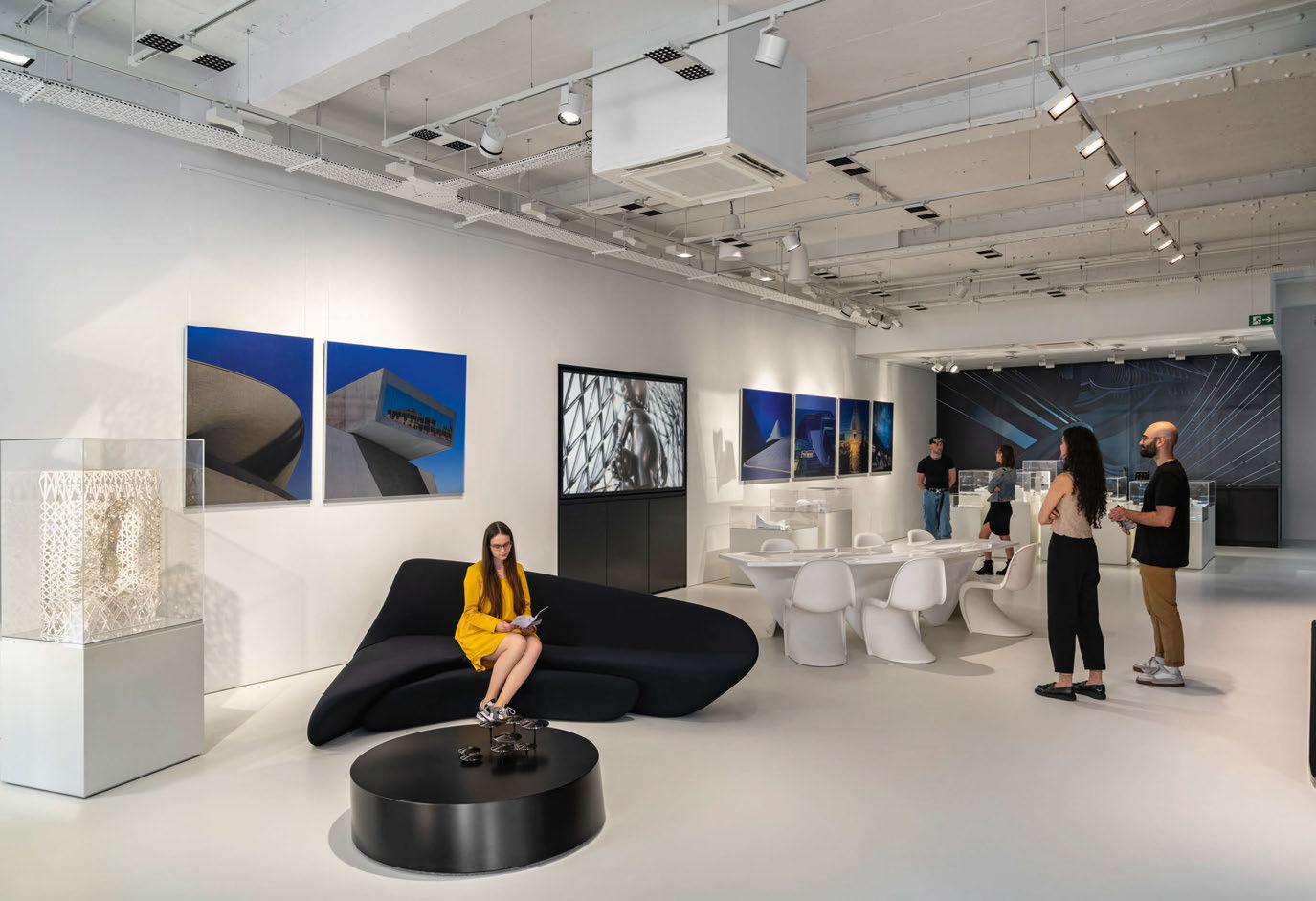
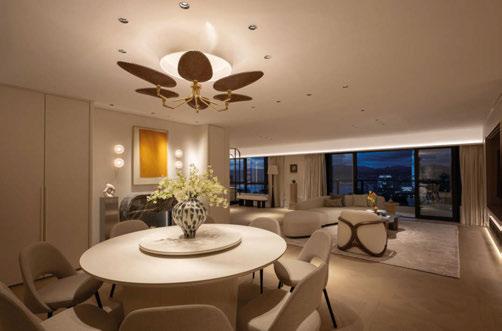
The requirements for modern offices have fundamentally changed: There needs to be more possibilities for collaborating in the form of teams and improved quality of stay. For the needs of flexible working offices have to be adaptable, and also inspiring to become a place for the exchange of ideas. Discover how to highlight interior design with modern office lighting.
Client: Zaha Hadid Architects, London Photography: Gavriil Papadiotis
Clerkenwell Design Week: Meet us in the Zaha Hadid Architects Gallery
Light is the fourth dimension of architecture
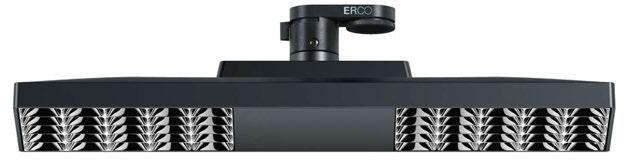
www.erco.com/ modern-office-lighting
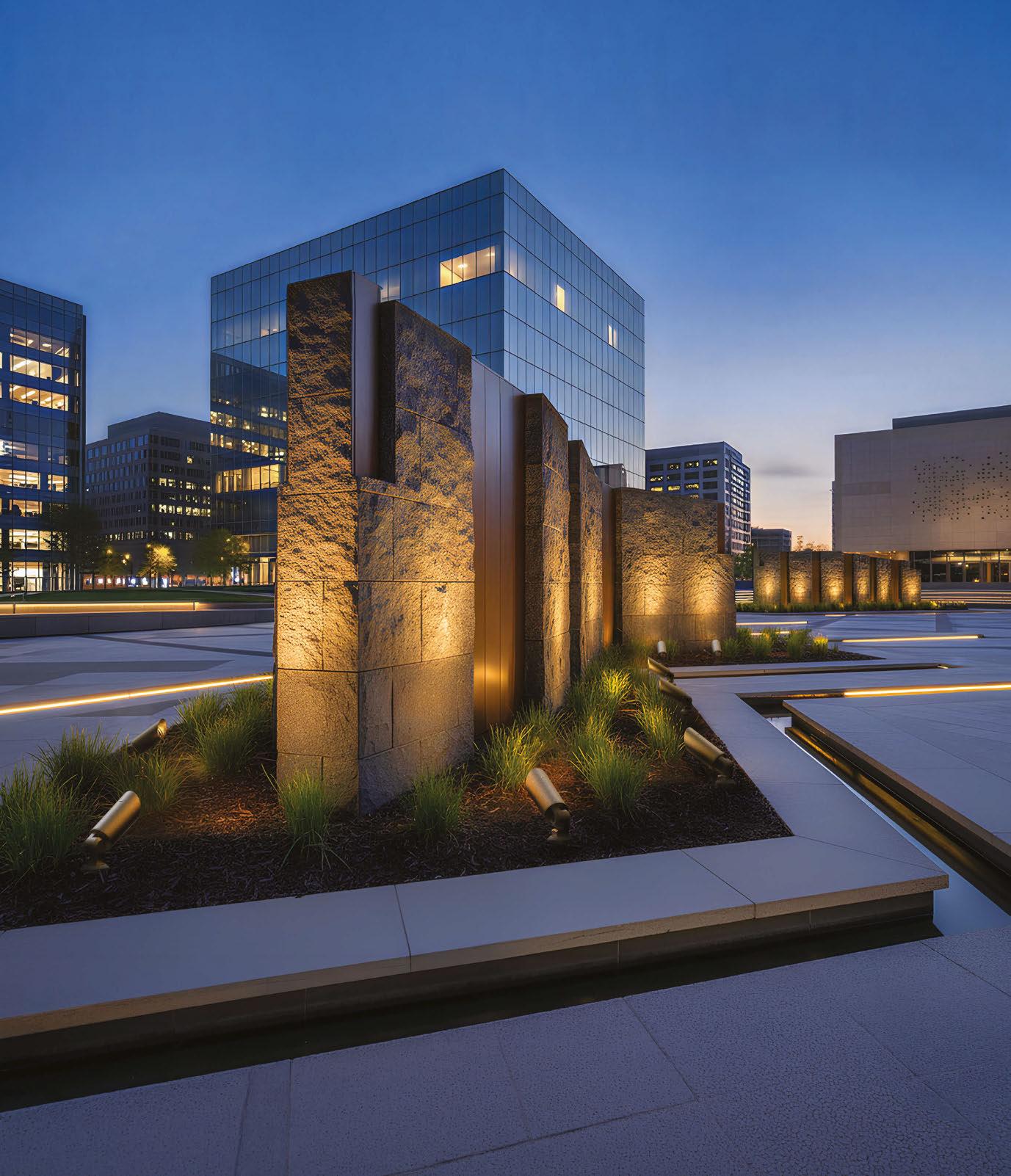
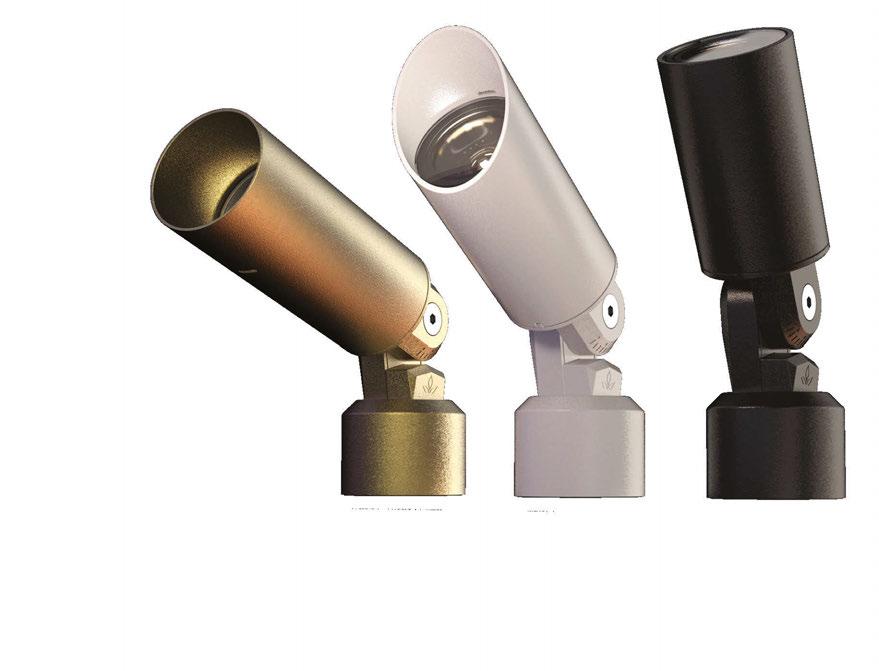
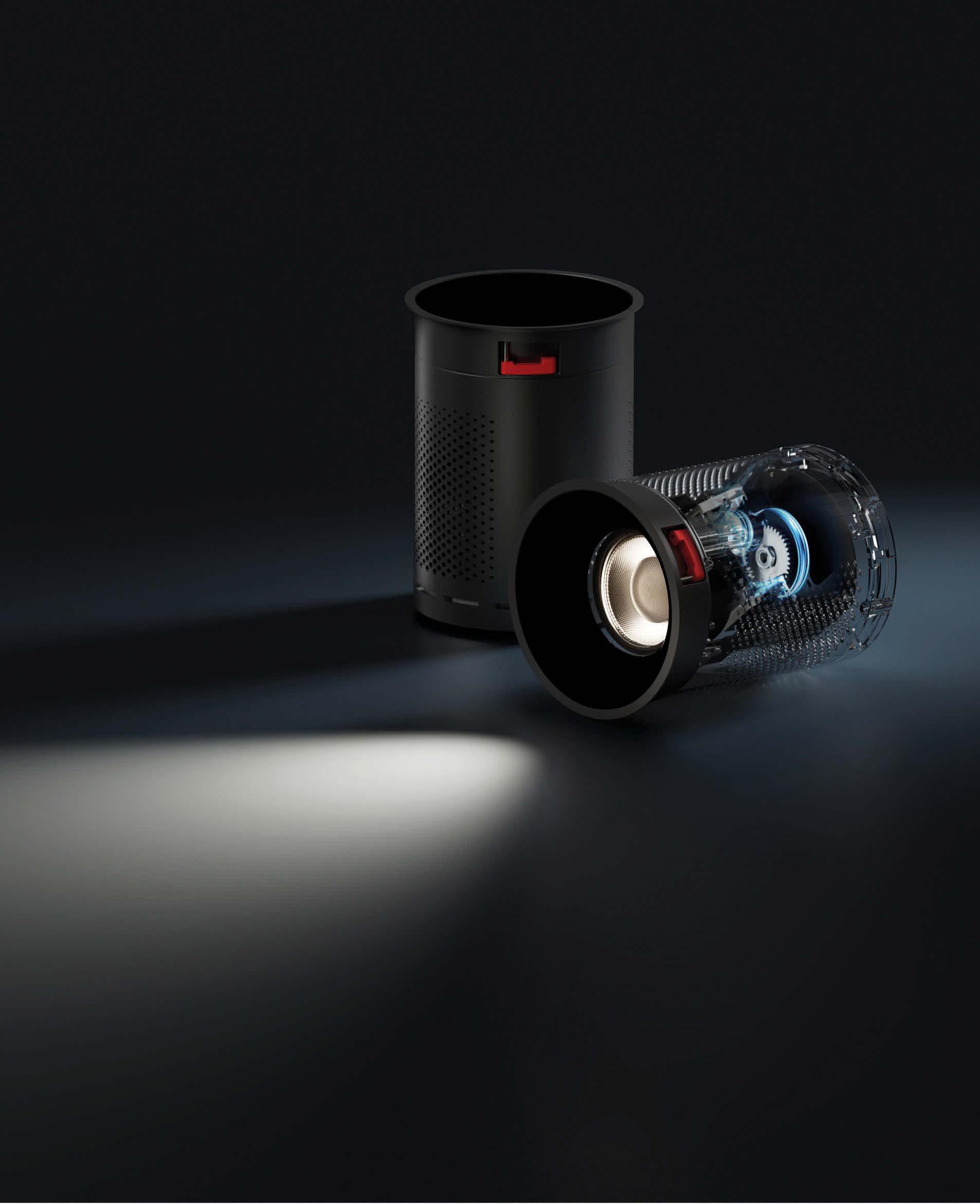
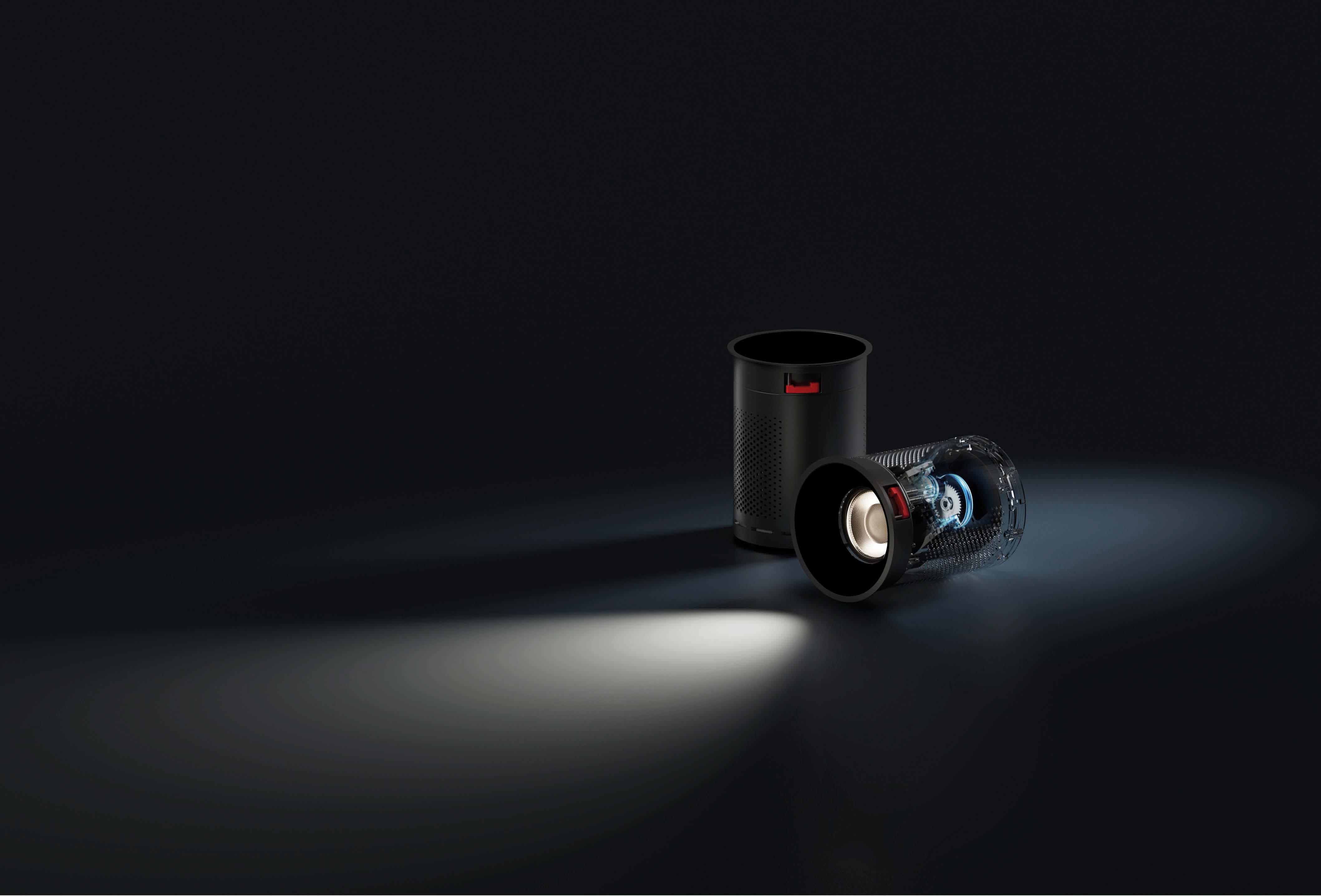
Introducing Dune, a compact architectural spotlight delivering up to 1,240 lumens from less than 13W of power from a highperformance LED light engine. Designed for demanding exterior environments, Dune features a seamless housing in solid brass for exceptional corrosion resistance, or powder-coated aluminium finishes with a marine-grade epoxy undercoat for architectural flexibility.



•
•
•
•
•
•
•






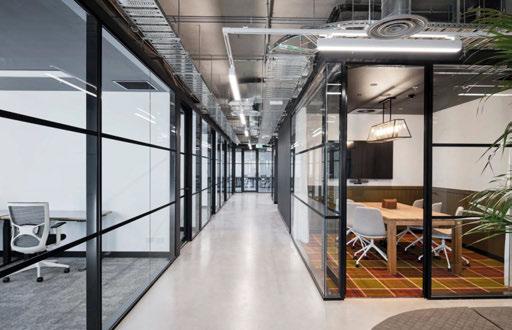








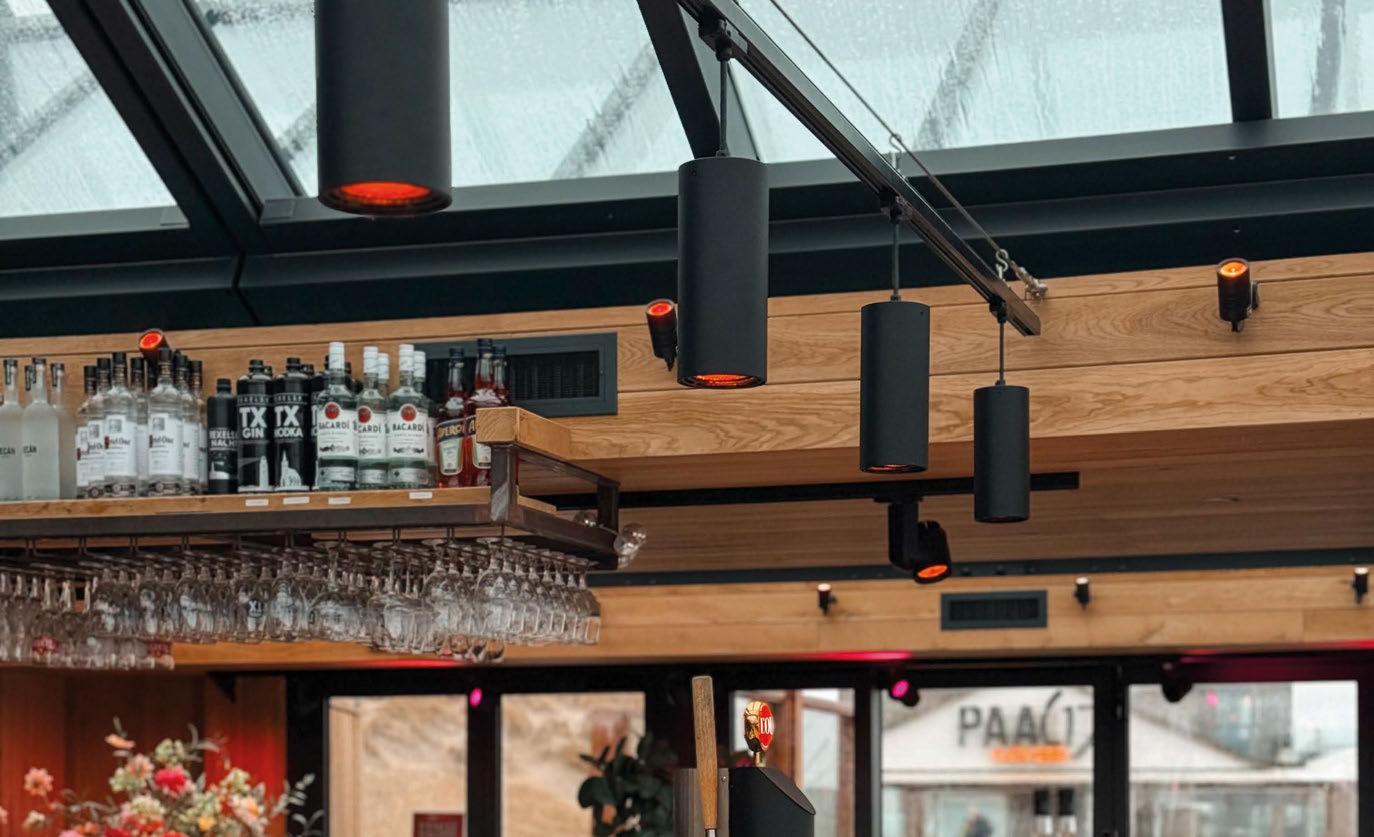
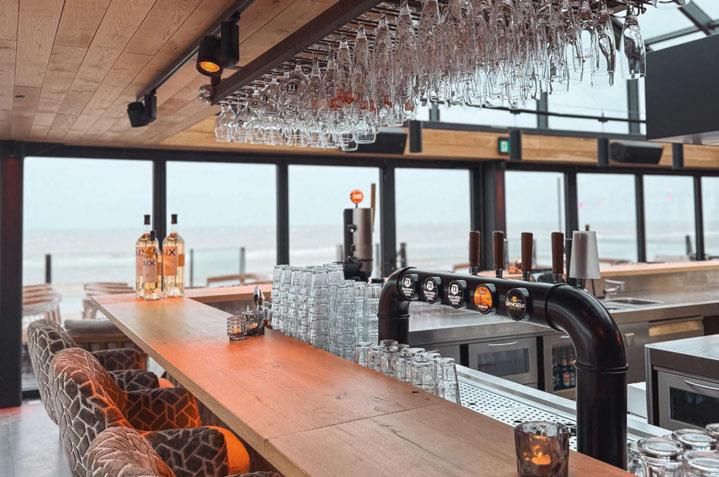
Transform your hospitality venue with CLS LED’s customizable lighting, turning every space into a memorable experience. High CRI, Tunable White, RGBW, and RGBA options ensure vivid colours and the perfect ambiance for any moment. Easily control everything with Casambi or (Wireless) DMX, tailored to suit any space from lobbies to guest rooms and beyond.
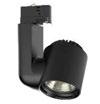
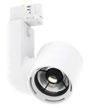
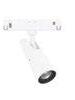
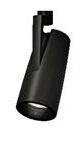
> Fixtures are available with:



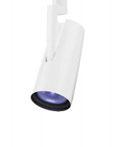
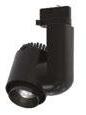
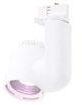
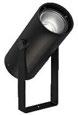
We’re attending

The UK’s only trade show dedicated to high-end lighting specification

Scan the QR code for future announcements and registration
lightexpo.london
What is it about Light + Building that always leads to travel disruptions? Whether it’s volcanic ash clouds, snow storms, industrial action, or, as was the case this year, the ongoing crisis in the Middle East (plus an additional sprinkling of further industrial action, just for fun!), it seems that there is always something that makes Frankfurt incredibly difficult to navigate.
But, for those of us that were able to make it to Germany, Light + Building was certainly a fun show. While it evidently isn’t at the scale that it once was, and the amount of “new” innovations on show wasn’t quite to the same level that we have seen in previous years, it is always a joy to gather with our global lighting family.
That is also not to say that there wasn’t plenty of interesting stuff to see and do at the fair ‒ from the brands exhibiting at the show itself, to the “extra-curricular” activities each evening, our schedules were very busy, and I was definitely in need of a long sit down in a dark, quiet room when I got back home. You can read all about what we got up to, and who we saw, in our extensive L+B review inside this issue.


Matt Waring Editor
We are also very happy to welcome back Kevin Grant, who has worked tirelessly to put together his CoolKitList, detailing his favourite finds from this year’s exhibition. Big, big thank you to Kevin for working his socks off on this - a big ask, especially given his project commitments too!
While in Frankfurt, I also had the chance to sit down for a lovely conversation with Till Armbrüster, product design extraordinaire, about how he approaches luminaire design. With a CV that includes stints at Ingo Maurer and Licht Kunst Licht, before he founded his own studio, Source to Space, Armbrüster’s work delicately walks the line between technical and decorative ‒ although he doesn’t feel that there should be such a distinction between the two, a sentiment that we very much agree on!
Before signing off for this issue, I do not wish to make light of the current situation in the Middle East, and it goes without saying that our thoughts are with everyone affected. I hope that everyone is keeping safe and well, and that we soon see a swift and peaceful resolution to this conflict.
Enjoy the issue!
In
Federico de Majo tells us about Zafferano’s prismatic Stalactite fixture.
Snapshot Lightchitects Studio
On The Board
Isla James Interiors’ Jo Calver reflects on the 2026 Pantone Colour of the Year, Cloud Dancer.
Manufacturer Case Studies Hospitality Lighting focus
Materials Axia by Lodes
Good Light Group
Jan Denneman of the Good Light Group talks about “The Greatest Missed Opportunity in Lighting”.
Manufacturer Case Studies
My Light Paul Nulty
Cloud of Light Lasvit
Carbone Nulty
Clerkenwell Design Week Preview
A look ahead at [d]arc media’s planned activities for the London event.
Till Armbrüster
The founder of Source to Space talks about his attitude to luminaire design, and the blend of technical and decorative lighting.
Light + Building Review: CoolKitList Kevin Grant of LIGHTALLIANCE shares his top finds from this year’s lighting extravaganza.
Light + Building Review: Products Some of the top products that we saw during our visit to Frankfurt.
Light + Building Review: Events
As well as meeting exhibitors, there was a wealth of additional events taking place during L+B, from awards celebrations to talks and social gatherings.
Park Hyatt Kuala Lumpur, Malaysia dpa lighting consultants
The Chancery Rosewood, UK Lighting Design International
Radisson RED, UK Into Lighting & Studio DLSM
Flesslers Lenggries, Germany Weiser Lighting & JOI-Design
Ciel Dubai Marina Atelier33


LEDucation
14-15 April
New York, USA www.leducation.org
Milan Design Week 21-24 April
Milan, Italy www.salonemilano.it
[d]arc awards
30 April London, UK www.darcawards.com
MAY
[d]arc sessions europe 5-7 May
Sicily, Italy www.darcsessions.com
HD Expo
5-7 May
Las Vegas, USA www.hdexpo.hospitalitydesign.com
Plasa Focus
12-13 May Leeds, UK www.plasaleeds.com
ICFF
17-19 May
New York, USA www.icff.com
Clerkenwell Design Week 19-21 May
London, UK www.clerkenwelldesignweek.com
Index Dubai 2-4 June
Dubai, UAE www.indexdubai.com
[d]arc sessions americas 2-5 June
Cancún, Mexico www.darcsessions.com
Illuminate 8-10 June
Chicago, USA www.neocon.com
Cruise Ship Interiors Americas 9-10 June
Miami, USA www.cruiseshipinteriors-expo.com
Hotel & Resort Design South 9-10 June
Miami, USA www.hotelresortdesign-south.com
GILE 9-12 June
Guangzhou, China www.guangzhou-international-lighting-exhibition. hk.messefrankfurt.com
3 Days of Design 10-12 June
Copenhagen, Denmark www.3daysofdesign.dk
IALD Enlighten Europe
17-19 June
Paris, France www.iald.org
EDITORIAL
Managing Editor
Helen Ankers h.ankers@mondiale.co.uk
Editor Matt Waring m.waring@mondiale.co.uk
Junior Journalist
Ellie Walton e.walton@mondiale.co.uk
Contributing Editor
Sarah Cullen s.cullen@mondiale.co.uk
COMMERCIAL
Managing Director
Paul James p.james@mondiale.co.uk
Head of Business Development
Jason Pennington j.pennington@mondiale.co.uk
International Account Manager
Andrew Bousfield a.bousfield@mondiale.co.uk
International Account Manager
Ethan Holt e.holt@mondiale.co.uk
Events & Marketing Manager Moses Naeem m.naeem@mondiale.co.uk
Design Manager
David Bell d.bell@mondiale.co.uk
Design Jez Reid j.reid@mondiale.co.uk
Production Mel Capper m.capper@mondiale.co.uk
CORPORATE
Chairman
Damian Walsh d.walsh@mondiale.co.uk
Finance Director
Amanda Giles a.giles@mondiale.co.uk
Credit Control
Lynette Levi l.levi@mondiale.co.uk
[d]arc media ltd
Strawberry Studios, Watson Square, Stockport SK1 3AZ, United Kingdom T: +44 (0)161 464 4750 www.arc-magazine.com ISSN 1753-5875
World Turtle Day on 23 May highlights the urgent need to protect sea turtles and their fragile coastal habitats. Artificial lighting along beachfront developments can disrupt nesting behavior and disorient hatchlings trying to reach the ocean.
Turtle-friendly lighting helps minimize this impact through carefully controlled illumination and longer wavelength amber light that is less disturbing to marine wildlife.
LIGMAN’s turtle-friendly luminaires follow the guidelines of the Florida Fish and Wildlife Conservation Commission (FWC):
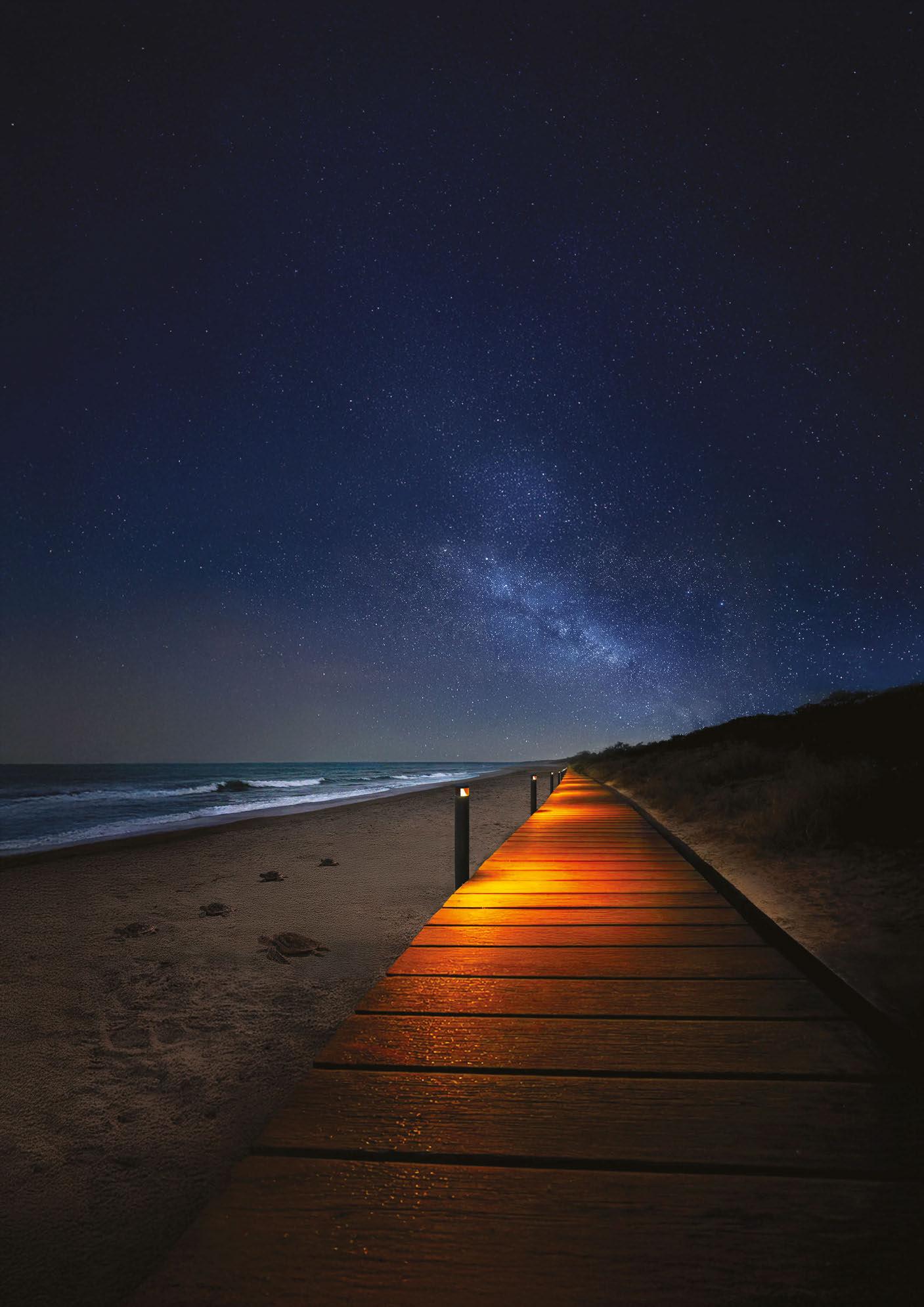




For designers shaping coastal environments, turtle-friendly lighting provides a balance between visual comfort, safety, and ecological responsibility.
Coastal resortsWaterfront promenadesBeachfront landscapes Marine conservation zones
www.ligman.com/turtle-friendly-lighting/
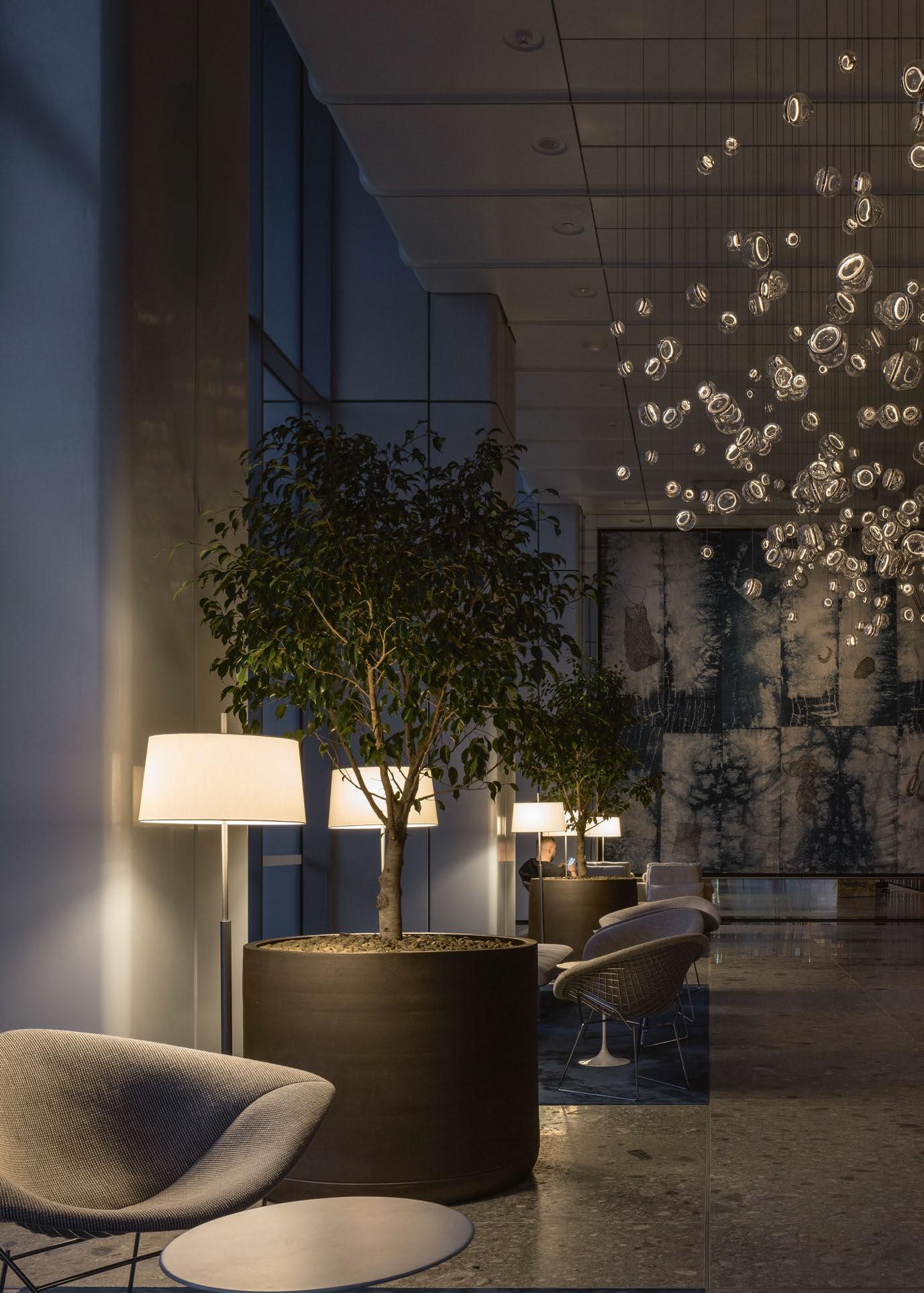
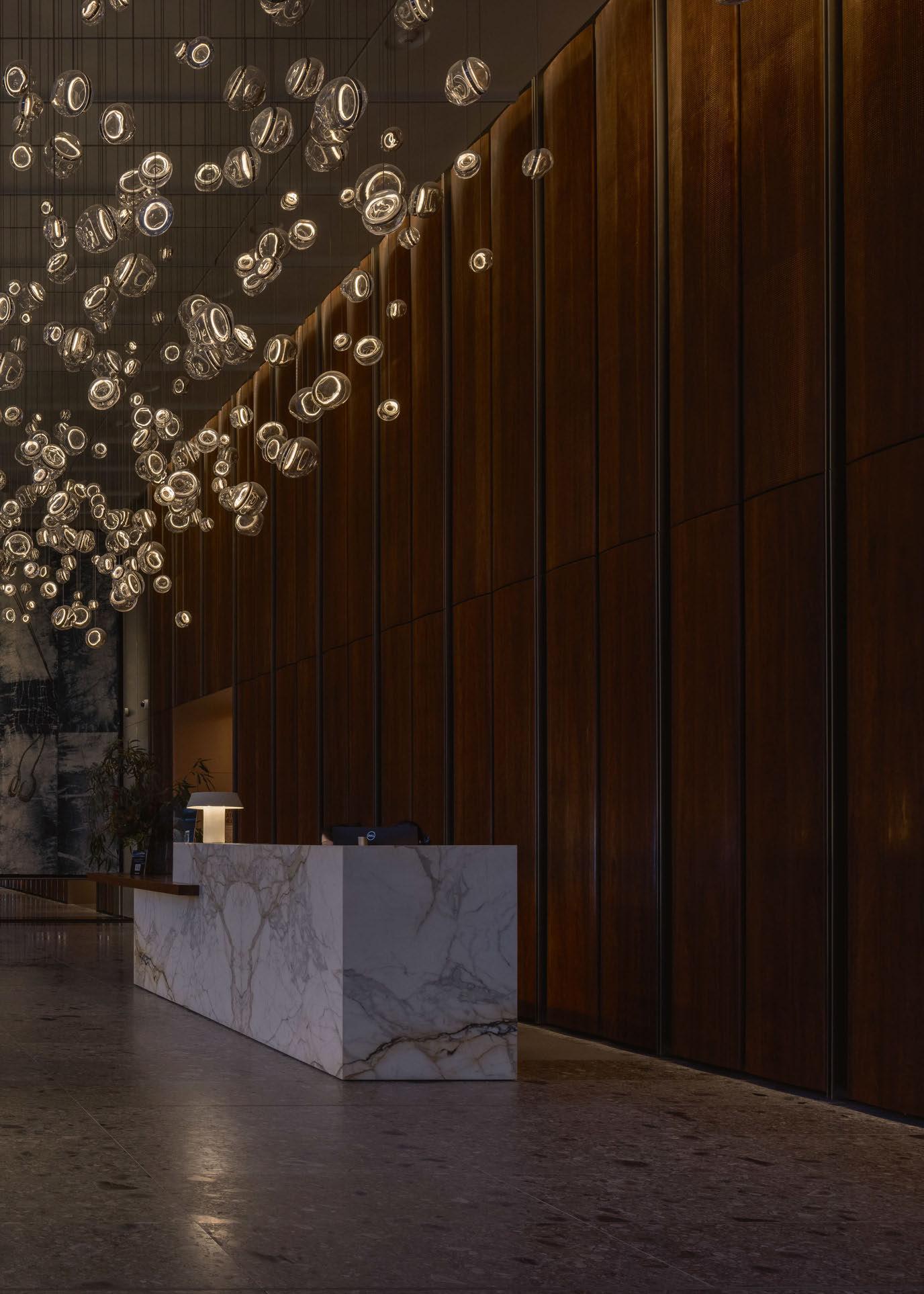
Adorning the entrance lobby of one of the most prestigious addresses in Sydney, Australia, Lasvit has created “Cloud of Light” – a bespoke light installation that aims to create a serene atmosphere, while enhancing its luxurious surroundings.
Hovering above the central area, its soft illumination and nuanced design contribute to a refined yet inviting environment. The dynamic interplay of light and motion reflects the pulse of the city outside, while maintaining a tranquil, ethereal presence within the residence.
Designed by renowned Italian architecture studio Renzo Piano Building Workshop (RPBW), One Sydney Harbour looks to harmonise architecture with nature, celebrating the beauty of its location. Comprising three towers that each feature dynamic glass façades, the buildings offer breathtaking views and vibrant public spaces overlooking Barangaroo Reserve. With thoughtful integration into the cityscape, the project sets a new benchmark for modern, sustainable urban living. Cloud of Light brings this approach to the interior space – a collaboration between Lasvit, RPBW, and developer Lendlease, the piece seamlessly integrates craftsmanship and design, marking a key achievement that serves as a reference for future high-end residential projects. www.lasvit.com www.rpbw.com
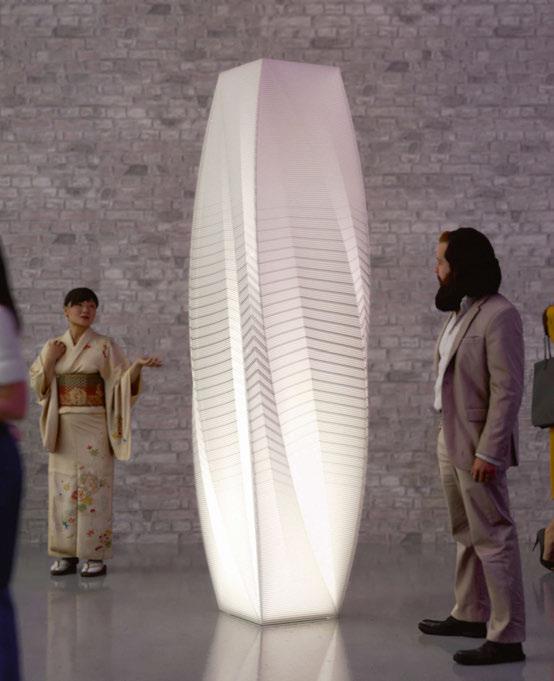

Our highly regarded [d]arc thoughts programme heads back to House of Detention for a fifth year.
Taking place as part of the wider lighting exhibition located at the historical Victorian Clerkenwell Prison, visitors will be treated to three days of lighting-focused panels and presentations, with leading designers and manufacturers taking to the stage to share their knowledge and experience on integrating the perfect lighting into projects.
Sponsored by Ideolux, who will also light the talks space, take a look at what’s in store over on the next page.
All talks are free to attend for registered Clerkenwell Design Week visitors.
Other lighting highlights at Clerkenwell Design Week include:
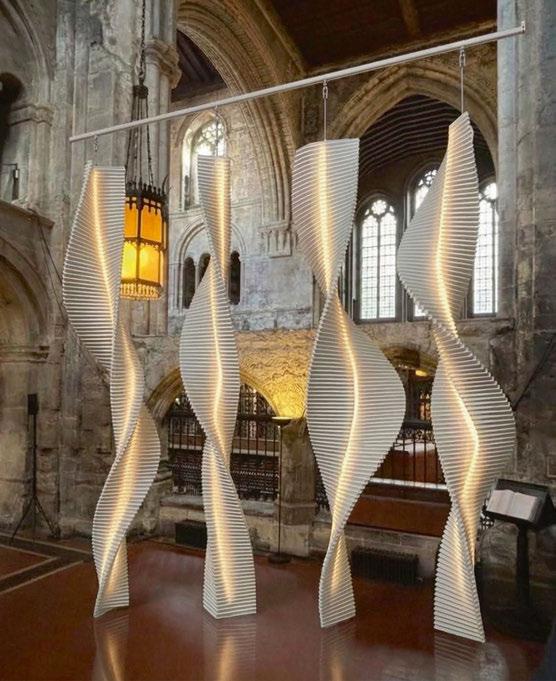
Resonance: four illuminated, folded and twisted paper sculptures by Fung+Bedford, will be suspended from the ceiling of 900-year-old Grade I listed medieval church, St Bartholomew the Great (Church of Design).
Loom Light: visitors to the Light exhibition at House of Detention will be greeted at the entrance with Loom Light, a 3D-printed light sculpture drawing on the optical language of Op Art, designed by MIMStudios, AI Build and SEAM Design.
Register at: www.clerkenwelldesignweek.com
In collaboration with

Tuesday 19 May
1 – 1.45pm - Lighting as a long-term investment - designing for adaptability and longevity
Speakers: Magdelana Gomez, So It Is Design; Jack Pannell, Common Ground Workshop; Chris Simmons, Orluna
This talk focuses on future-proof lighting - how designers can create systems that evolve with changing use, technology, and regulations. Addressing maintenance, controls, flexibility, and circular design principles.
2 – 2.45pm - The Power of Collaboration: In conversation with Equation
Speaker: Maida Hot, Equation Lighting
Maida Hot from Equation, alongside interior architects, will explore how open dialogue and trusted relationships within design teams play a vital role in delivering successful projects, particularly as project complexities continue to grow. Through a selection of shared project examples, the session will highlight how collaborations strengthen the creative process and lead to more thoughtful, integrated design solutions.
3 – 3.45pm - The Art of Darkness
Speakers: Neil Knowles, Elektra Lighting & Anna Burles, Run For The Hills
The aim for many projects, and especially a bar or a restaurant, is a dark, intimate, atmospheric and moody space. There is a common misconception that all you need to do is put in a lot of the normal lighting and use a dimmer to turn it down. This is not how you do it. Drawing on several previous project collaborations but focusing on a recent restaurant, DOOD, Neil Knowles from Elektra Lighting and Anna Burles from Run For The Hills will showcase and explain the tricks that everyone needs to know.
Wednesday 20 May
1 – 1.45pm - Why is lighting design still undervalued?
Speakers: Interior Designer Jasper Sanders; Eoin Billings, Billings Jackson; & Gary Thornton, Nulty
Lighting sits at the very core of how a space is experienced and yet is routinely treated as expendable in cost evaluations, rather than fundamental to purpose. At the same time, environmental metrics often drive decision-making – ticking boxes instead of designing spaces for the people who inhabit them. This panel will explore why lighting design is often considered a ‘nice to have’ rather than a core design driver and how lighting designers can breathe new life into the industry by designing for both certificates and people - ensuring that light remains a medium for emotion, character and drama.
2 – 2.45pm - Project Focus: The Radisson RED Lounge
Speakers: Anthony Stead, Into Lighting and Emma Caballero, DLSM
Designers from Into Lighting and Studio DLSM will walk the audience through their collaborative work on the Radisson RED Lounge – showcasing the design and specification process and how lighting works with the interiors to bring the space alive.
3 – 3.45pm - Project Focus: Flesslers Lenggries, a Tribute Portfolio Hotel
Speaker: Sabrina Voecks, JOI-Design
JOI-Design’s Sabrina Voecks joins us for a project focus on the Flesslers Lenggries hotel project in Germany, showcasing the design and specification process and how lighting works with the interiors to bring the space alive.
5 – 8pm - Interior Design Declares Social
Interior Design Declares is a volunteer-led network of UK design practices, suppliers, and educators committed to addressing the climate and biodiversity emergencies.
Launched as part of the Built Environment Declares network, it empowers members to advocate for regenerative design, share best practices, and reduce environmental impact, including lifecycle carbon and sustainable material choices.
Join [d]arc media and Interior Design Declares for an informative session on the network’s key activities for 2026, followed by time to network and a free bar.
Thursday 21st May
1 – 1.45pm - The Future of Residential Lighting: Craft, Sustainability & Personality
Speakers: Interior Designer Manuela Hamilford; Joshua Welch, Hoare Lea; and Industrial Designer Rona Meyuchas Koblenz
The lighting and design worlds are moving away from clinical fixtures to sculptural lighting, shifting to craftsmanship and warmth to tell the story of the homeowner. This panel will discuss why lighting needs personality and tactility in high-end homes - including material choices and design decisions that make lighting feel integral, not an accessory. Homes of the future will be lit like they are curated - not fitted.
2 – 3.00pm - How to be Brilliant at Designing with Light
Speakers: Sally Storey, Lighting Design International; Nick Hoggett, dpa lighting consultants; and Keith Bradshaw, Speirs Major Light Architecture
In this special “How to be Brilliant” panel, brought to you by the Institution of Lighting Professionals, top tier lighting designers Sally Storey, Nick Hoggett and Keith Bradshaw explore what truly defines excellent light. From challenging common misconceptions to understanding how the intended use of a space shapes light strategy, the panel will unpack the discipline, collaboration and process required to get it right. Whatever your role in the built environment, you will leave with a clearer understanding of what good light really requires.
3.15 – 3.45pm - Can we still design consciously with light?
Speaker: Benz Roos, Speirs Major Light Architecture
Lighting design has always been a balancing act: managing energy use, making spaces legible, ensuring safety, and staying within budget. Yet today, that balance feels harder than ever. In 2026, we stand on a knife-edge. Through this presentation lighting designer Benz Roos will explore our shared search for a more conscious and soulful approach to lighting design in the 21st century.
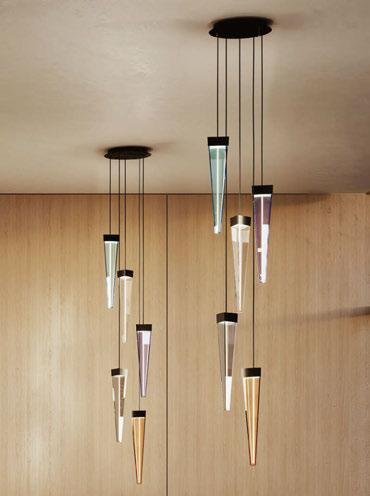
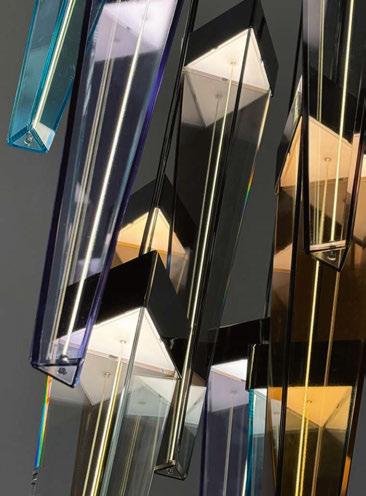
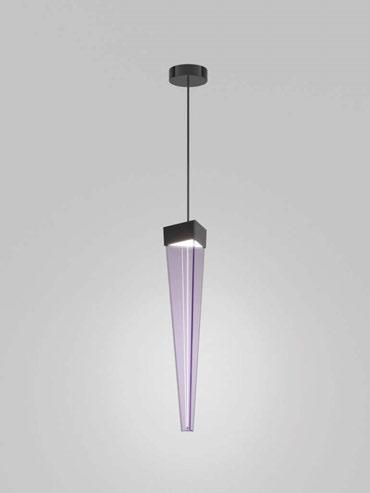
Zafferano’s Stalactite is a prismatic, three-sided glass pryramid lighting fixture that creates extraordinary special effects and commands attention in the space. It combines a strong sculptural identity with simplicity and versatility. Zafferano’s founder and president Federico de Majo tells us more.
What is the concept behind this product?
The concept originated from a spontaneous idea during a dinner with a LED filament technology manufacturer. A quick sketch on a piece of paper explored elongated, soft shapes, which then evolved into a more defined geometric form: a three-sided pyramid. That sketch stayed with the factory owner, and shortly after, the first feasibility study arrived. The result is a luminous prism, a sculptural object that combines purity of form with a strong visual presence, almost like a glowing stalactite suspended in space.
How long have you been working on the product for?
The development process was quite extensive. Each component ‒ from the light source to the decorative glass elements ‒ proved technically demanding and required careful study and refinement. It was not a short journey, but the time invested allowed us to achieve a result we are very satisfied with.
What was the most challenging aspect of producing this piece?
The construction of the glass pyramid. Cutting and bonding the glass panels had to be absolutely impeccable from every angle, as every detail needed to be flawless both structurally and aesthetically. Maintaining precision while preserving transparency and brilliance was key. We used extra-clear glass sheets with colour treatments applied through lustres fired at 180°C, a meticulous process that required great precision and craftsmanship.
What materials have been used?
The diffusers are made from flat glass sheets, assembled into a triangular-based pyramid and enhanced with layered colour finishes achieved through high-temperature processes. The metal structure features a glossy black nickel finish, designed to emphasise the brilliance and purity of the glass. The design process combined hand sketching, technical feasibility studies, and close collaboration with manufacturers.
What technologies does the product use?
Stalactite features a double dimmable light source. The primary source sits beneath the metal frame of the glass, while the secondary one is a vertical luminous filament running the full height of the diffuser, kept taut by a small magnet. This combination creates a remarkable visual effect - the filament illuminates the glass from within, turning the entire pyramid into a glowing, jewellike object. The lamp uses LED TRIAC dimming technology at 2700K, with a CRI >80 and a beam angle of 55°, delivering 1,472lm at just 12W.
What kind of environments, clients or projects is this product suitable for?
Indoor residential and contract spaces. It works beautifully both as a single pendant and in modular compositions: think of high-ceilinged environments such as stairwells, hotel lobbies, and and large architectural volumes: indeed, the product is available in curated compositions of up to 13 elements. A shorter-diffuser version is also coming soon, which will extend its suitability to rooms with standard ceiling heights.
What makes this product different from others in your portfolio and from other lighting products on the market?
This is a unique piece due to the combination of the prismatic three-sided glass pyramid, the dual light source (which creates extraordinary special effects and commands attention) and the wide range of colour and compositional options. It combines a strong sculptural identity with simplicity and versatility. The possibility to customise compositions (from single pieces to large clusters) and choose from five different glass colours allows designers and architects to benefit from an exceptional level of creative freedom.
Describe the product in three words.
A luminous crocus: prismatic, sculptural, captivating.
www.zafferanoitalia.com
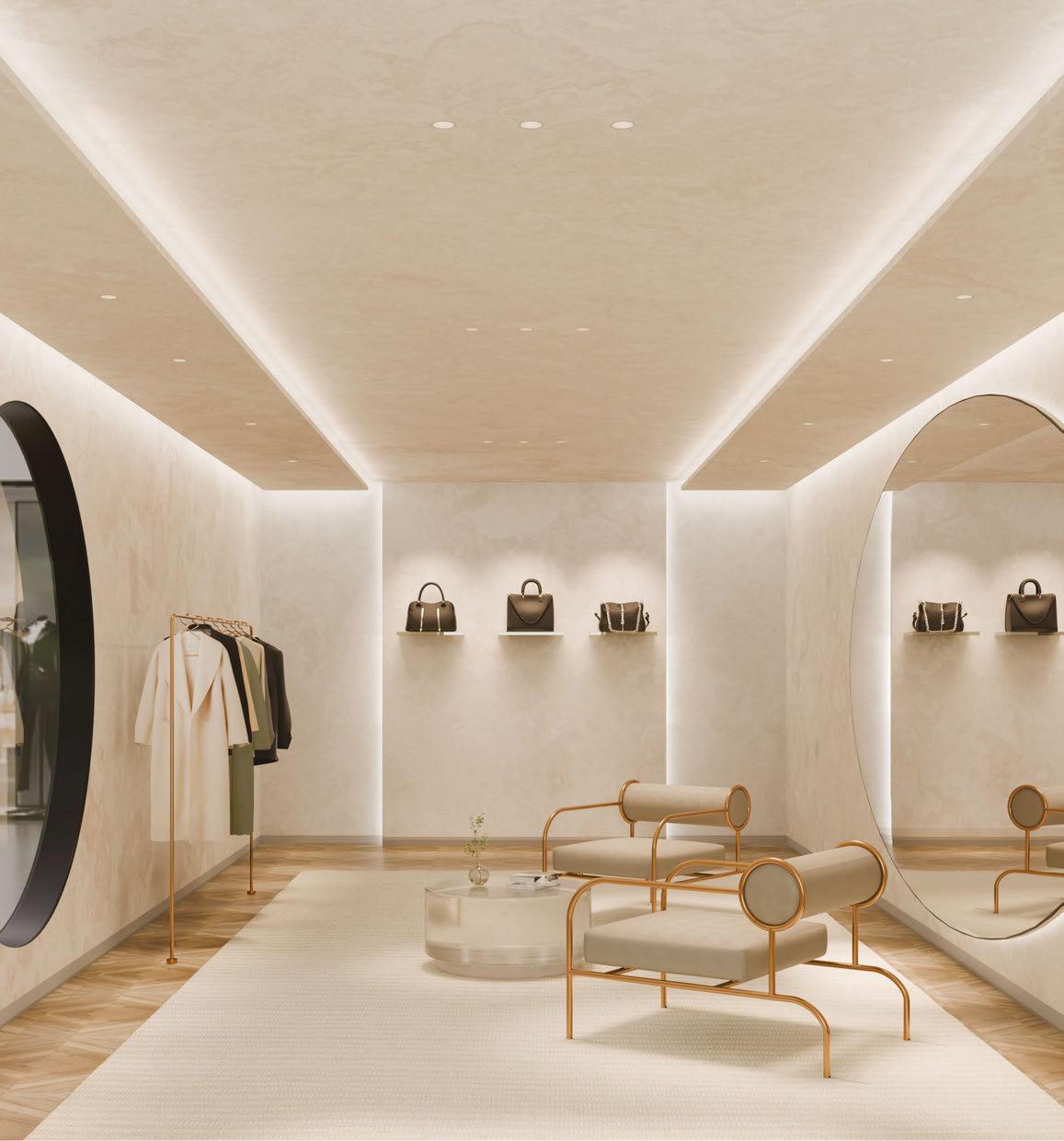

Using light to craft “rich spatial experiences”, Mexico Citybased Lightchitects Studio has built a strong portfolio of work across Mexico and beyond, from museums and galleries to residential, hospitality, retail, and public projects.
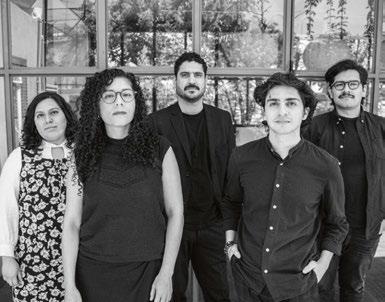
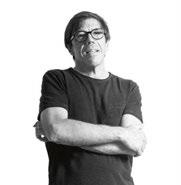
Lightchitects Studio is an independent lighting design consultancy based in Mexico City, working internationally, founded by Carlos Hano. Guided by the belief that light and architecture form a single organism, the studio creates rich spatial experiences through fully integrated, concept-driven lighting that is seamlessly embedded in the architecture. Lightchitects partners with architects, artists, and engineers to deliver solutions that elevate atmosphere and strengthen spatial and social interaction across cultural, hospitality, retail, residential, and public projects. www.lightchitects.com
Team Image: Irmante Sungailaite
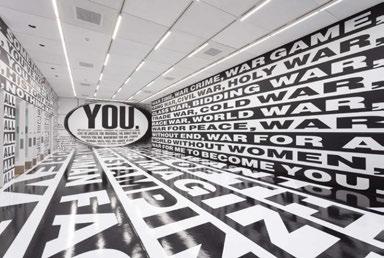
Barbara Kruger: Thinking of You. I Mean Me. I Mean You Chicago, USA
Thinking of You. I Mean Me. I Mean You –an installation from Barbara Kruger, was presented at the Art Institute of Chicago as a museum- and city-scale project coorganised by the Art Institute of Chicago, LACMA, and MoMA. Exhibit design by Leticia Pardo and curated by Robin Farrell. From a lighting perspective, the challenge was to support an immersive, high-contrast graphic environment with clarity and control – preserving legibility across large vinyl fields while avoiding glare, reflections, and veiling brightness. A key technical constraint was the museum’s existing infrastructure: galleries relied on track lighting and did not have continuous linear luminaires, yet the artist’s intent called for a distinctly linear lighting language. In response, the lighting design required a custom fixture family engineered to use the museum’s existing track system while enabling continuous linear runs both along the track axis and perpendicular to it – maintaining uninterrupted lines of light without reworking ceilings or power distribution. Those custom fixtures integrated Bluetooth-controllable drivers, allowing dimming and fine tuning of exhibition levels without altering the museum’s electrical installation – critical for fast installation, curatorial flexibility, and ongoing adjustments over the run of the show and still allowing the museum to use these fixtures in future exhibitions.
Photography: Art Institute of Chicago
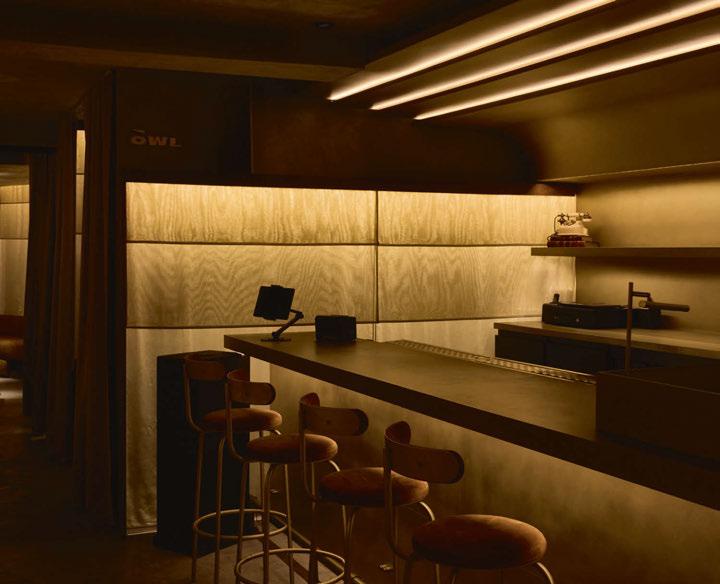
Owl Bar
Mexico City, Mexico Owl Bar is an intimate, speakeasy-inspired venue in Mexico City – an adaptive reuse of what was previously a restaurant storage/ back-of-house space. With no meaningful daylight contribution, lighting becomes a primary design driver for shaping perception,
hierarchy, and comfort within the architecture by Rojkind Arquitectos + MS Studio. As Michel Rojkind has described it, the project nods to 1930s Art Deco speakeasies, translating that reference into a contemporary sequence of texture, reflection, and calibrated darkness. From a lighting perspective, the concept is built on chiaroscuro and a controlled dialogue between warm whites and saturated colour. A Japanese-inspired perimeter textile operates as a luminous architectural “skin,” animated by fully concealed sources and programmed to shift over time – supporting the space’s transition from restaurant mood to late-night club energy – while visually masking acoustic build-ups behind it. Brass elements (tables, bar details, and a central ceiling plane) act as active participants: the metal catches and rebounds light, adding a second specular layer that deepens the atmosphere. Tight, colourfaithful illumination frames tabletops to give hierarchy to food and cocktails, while the bar – crowned by a brass-clad ceiling element with Art Deco patterning – is supported by highfidelity, glare-controlled downlight for both service and spectacle, with the bottle display articulated as a luminous backdrop. Finally, a scene-control strategy guides the space through phases of the night, moving from warm ambience into reds and oranges that evoke a “sunset,” then returning to functional levels for close-out and cleaning. In this project, lighting detailing and integration are not secondary, they are the essence of the design. Photography: Alejandro Ramírez Orozco
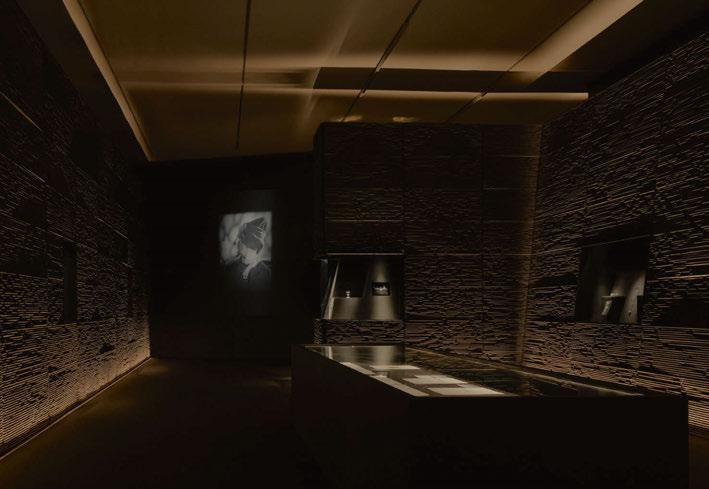
Cartier Design: A Living Legacy Mexico City, Mexico
Cartier Design: A Living Legacy was curated by Ana Elena Mallet, with exhibition design/ museography by Frida Escobedo.
Conceived as a journey “back to the origin,” the exhibition’s spatial narrative evokes a mine/quarry – a dark, textured environment that frames the jewels as extracted “finds,” allowing the objects to read simultaneously as design, art, and historical evidence. From a lighting perspective, the concept is built on high contrast, keeping overall room levels intentionally low to heighten the perceptual “glow” of each piece, while using light to activate texture and reinforce the quarry idea. A defining gesture is the raking illumination of the concrete wall panels, creating a continuous, tactile backdrop that “embraces” visitors through the sequence. At the object scale, display-case lighting was coordinated exhaustively so sources remain out of sight, supported by custom lighting details/accessories to fine-tune optics and intensity per vitrine. Given the intentional darkness, anti-glare control becomes a core
requirement – resolved through concealed details and optical shielding – while lighting controls enable adjustments without reopening vitrines (supporting both conservation/ safety and operational flexibility).
Photography: Ariadna Polo
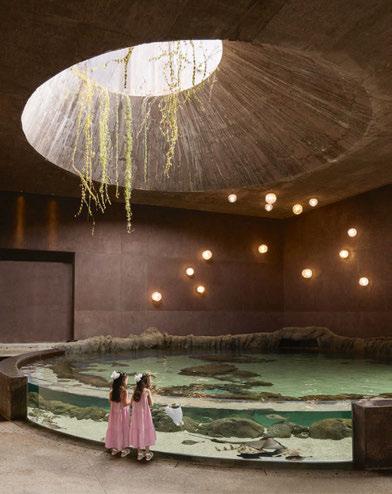
The Sea of Cortez Research Center Mazatlán, Mexico
The Sea of Cortez Research Center (Gran Acquario Mazatlán Mar de Cortés) – the Mazatlán Aquarium project designed by Tatiana Bilbao Estudio – is conceived to read as a discovered “ruin” inhabited by water, vegetation, and wildlife: a sequence of tall, pigmented concrete walls and orthogonal volumes that choreograph one-point perspectives, courtyards, and dramatic oculi, delivering daylight to key moments in the visitor journey. From a lighting perspective, the project demands a dual calibration: human legibility and theatricality for circulation and public rooms, and biologically appropriate light for marine life and underwater perception. The strategy maintains very low ambient levels throughout exhibit zones so the primary visual hierarchy remains with the tanks, while accounting for how light behaves differently underwater – including shifts in apparent colour and contrast with depth. A notable architectural-lighting gesture is the integration of custom elements – free-form glass lanterns described as jellyfish-like –used as luminous markers within interstitial spaces, reinforcing the Sea of Cortez narrative while remaining consistent with the building’s raw concrete tectonics. Ultimately, the lighting is not only animal-centric: it supports visitor orientation, anticipation, and emotional pacing, balancing stewardship with a carefully staged public experience.
Photography: Juan Manuel McGrath.
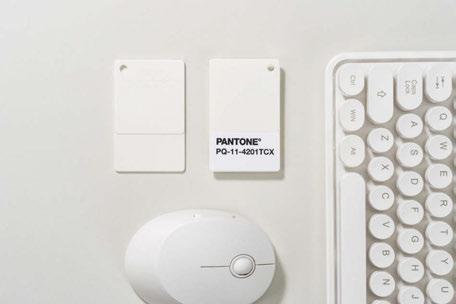
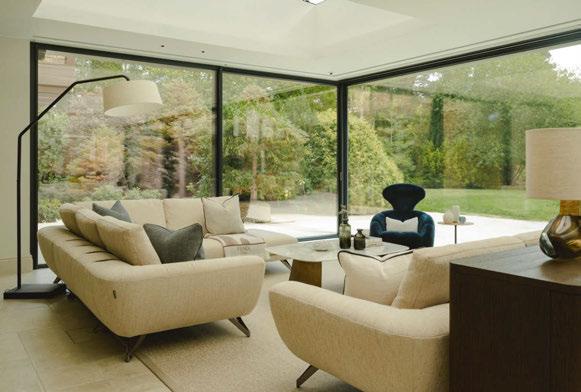
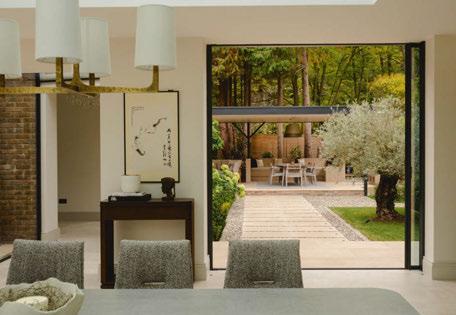
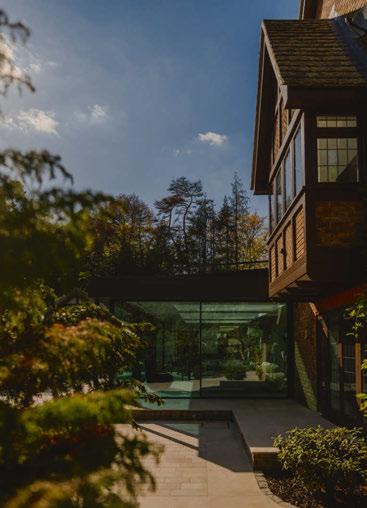
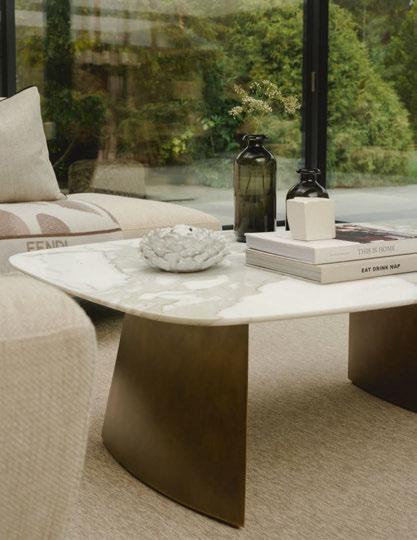

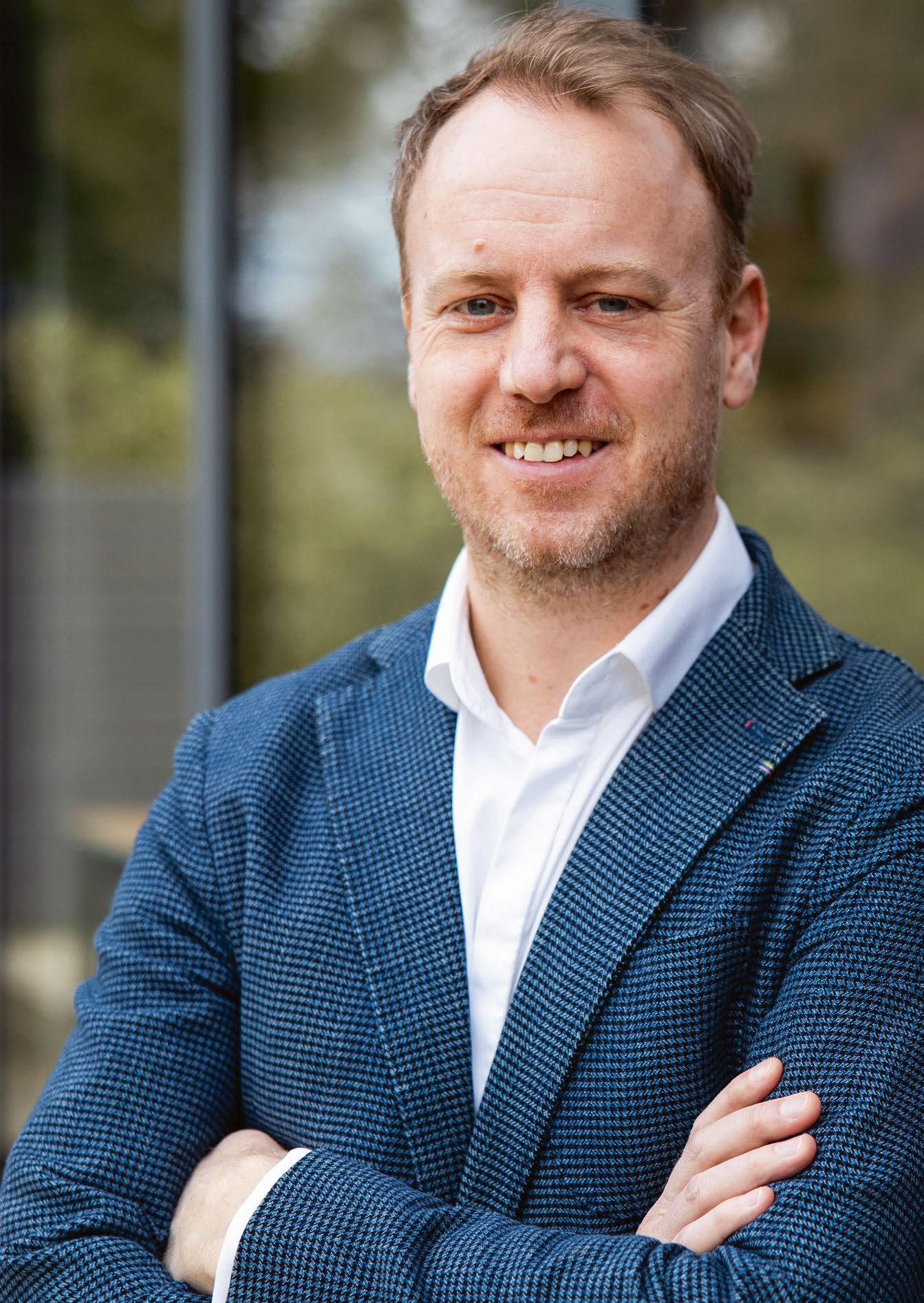
Jo Calver, Founder and Creative Director of Isla James, reflects on Pantone’s 2026 Colour of the Year, ‘Cloud Dancer’, and examines how its restrained, soft neutrality is reflected in her studio’s deep respect for natural light.
Whether in our interior design practice or our dedicated lighting design studio, at the heart of the Isla James philosophy is a deep respect for natural light. Every project begins with daylight: how it moves through a space, how it changes across the day, and how it can be used to shape the experience of a home.
Wherever possible, natural light is celebrated and enhanced, informing the way spaces are planned and lived in. Artificial architectural lighting is then carefully layered to extend these natural qualities, echoing the gentle transition of daylight from the crisp brightness of morning to the softer, warmer tones of evening.
In recent years, the studio has observed a clear shift in client priorities. Increasingly, homeowners are placing wellbeing and health at the centre of their design briefs. In the years following the COVID-19 pandemic, awareness has grown around the profound influence our environments have on both mental and physical wellbeing. As people spent more time indoors, the home evolved into a place not only for living, but for working, resting and restoring balance. Today, many clients seek spaces that actively support comfort, calm and emotional wellbeing – homes designed not only for beauty, but for healthier, more nurturing ways of living. For Isla James, this renewed focus naturally aligns with the inspiration found in colour and materiality. In particular, the studio resonates with Pantone’s 2026 Colour of the Year, “Cloud Dancer” (1). This ethereal hue feels both uplifting and grounding, offering a fresh, eco-conscious presence while maintaining a sense of calm clarity. Its soft neutrality creates a refuge of visual simplicity, allowing materials, textures and light to take centre stage. Rather than dominating a space, it introduces a quiet elegance – a gentle pleasure without overstimulation. In a visually busy world, this restrained palette encourages a more conscious approach to design, where atmosphere and emotional balance take precedence. Lighting plays a vital role in reinforcing this sense of wellbeing. Through intelligent control systems, lighting can adapt seamlessly throughout the day, shifting from brighter, energising scenes to softer, warmer evening settings that promote relaxation. The studio also prioritises hidden lighting, carefully integrated into architectural details so that the
atmosphere of a room is shaped by light itself rather than visible fittings. Combined with scene setting, this approach allows spaces to transform effortlessly as the mood or time of day changes. One project that beautifully demonstrates this philosophy is Clarence House (2), where interior and lighting design come together through the principles of biophilic design. Biophilic design seeks to strengthen the connection between people and the natural world within built environments ‒ a concept rooted in the idea of “biophilia,” popularised by Edward O. Wilson, which describes humanity’s innate affinity with nature.
At Clarence House, expansive floor-to-ceiling glazing (3) frames uninterrupted views of the surrounding garden, drawing daylight deep into the interior and creating a seamless relationship between home and landscape. The palette reflects this connection with nature. Soft neutral tones, tactile fabrics and organic materials (4) echo the calm simplicity of Cloud Dancer, creating an environment that feels both fresh and restorative. Lighting has been carefully designed to complement this natural palette. High CRI (colour rendering index) lighting ensures that materials such as timber, stone and planting appear as they would in natural daylight, allowing colours and textures to reveal their truest character. The result is an interior that feels authentic, balanced and deeply connected to the natural world (5) These principles are particularly powerful in the wellness suites and spa-inspired environments that Isla James frequently designs. Such spaces are conceived as places of retreat – sanctuaries where people can slow down, disconnect from daily pressures and restore a sense of calm. Soft palettes inspired by tones such as Cloud Dancer provide a serene foundation, while natural materials and layered lighting create an atmosphere of quiet tranquillity (6)
Through this holistic approach to interior and lighting design, Isla James creates spaces that are more than simply beautiful. They are environments shaped by light, grounded in nature, and designed to support the wellbeing of the people who live within them – balanced, restorative spaces that feel quietly inspired by the natural world.
www.islajamesinteriors.com
“Sustainability is not a goal,it is a journey. And it is important that you start walking. I started walking many years ago, and now I am trying to take as many people as possible with me on this journey.”
Till Armbrüster
Throughout his career, German product designer Till Armbrüster has blended architectural and decorative lighting, creating beatiful luminaires for Ingo Maurer and Licht Kunst Licht, and has recently launched his own design studio, Source to Space. Speaking to arc at Light + Building, Armbrüster tells us of his design philosophy, and golas for the new studio.
As a publication, here at arc have noticed in recent times a blurring of the boundaries between architectural and decorative luminaire design. Decorative lighting pieces are becoming much more technically-minded, while there has also been a definite emphasis in architectural luminaire design to make fixtures more aesthetically pleasing.
This is one of the primary reasons why we, as a magazine, decided to re-integrate decorative lighting content back into our pages. However, for German product designer Till Armbrüster, Founder of Source to Space, this is an approach that he has always tried to hold on to in his work.
“Typically, the protagonist in architectural lighting and decorative lighting is quite different – in architectural lighting, the protagonist is seen as the architecture, or the interior, or the people; while in decorative lighting, the protagonist is often the luminaire itself. But I don’t see it as being this black and white.
“I try to give an architectural luminaire a certain emotion, but also vice versa, a decorative luminaire should have a technical element.”
Born in Cologne, Germany, Armbrüster moved to the country’s “lighting capital” of Lüdenscheid at an early age – although it wasn’t until much later in his design career that he realised the significance of his hometown in the lighting industry. Instead, his early forays into design were more centred around carpentry and construction.
Speaking to arc editor Matt Waring during Light + Building 2026, he reflects: “In school, we had a lot of artistic classes, looking at different materialities and art styles. I fell in love with this work, but I was unsure if I was good enough to apply to art school; you have to apply with a portfolio, and I have to admit, I am not the best sketcher, I was much more into building. Because of this, I started an apprenticeship in carpentry, which helped me to develop my skills to build ideas.”
During this time, Armbrüster also built up his portfolio, and eventually enrolled in Aachen University of Applied Sciences to study Industrial and Product Design – initially thinking that, with his experience in carpentry, he would move into furniture design. But this was in the mid-00s, in the nascent days of the LED revolution, and lighting soon began to take hold.
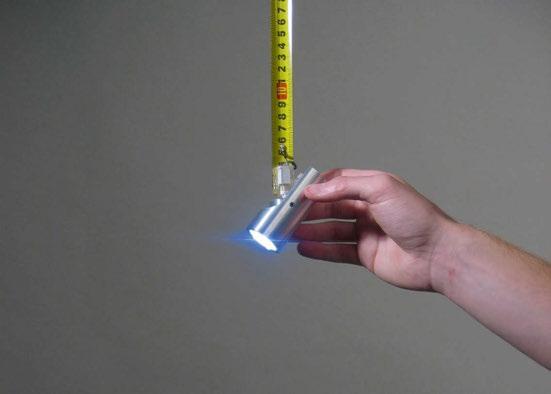
“Quite early during my studies, I came into contact with lighting and luminaires. In my third semester, I did a luminaire project, and built a prototype that was only feasible with LEDs. This was in the early days of LED – I think it was a one-Watt Osram LED – and the concept was that I was conducting electricity over metal measuring tapes, that was not possible at higher voltages.”
A unique concept that, while it may not have led to a launchable product, did lead to another, incredibly exciting opportunity for a budding luminaire designer.
“I presented it to my professor, and he suggested that I show it to Ingo Maurer. I said ‘wow, are you sure I can go there with this?’, and he told me to give them a call, as Ingo and his team are very open to young people, students, etc.
“They asked if I wanted to send the prototype, but I said ‘no, I want to show it myself, it’s too important to me’. So, I put on the suit that I wore for my mother’s wedding, went to Munich, and when I arrived, I got a lot of laughter as nobody in Ingo Maurer’s office was wearing a suit – it was super creative, chaotic, everyone was wearing whatever they wanted.
“They really took their time looking at the product, and found it very interesting, but it was clear in the beginning that they wouldn’t turn it into a product in their series. But once I was there, I felt the atmosphere, I loved talking to the people, and it became clear to me that I had to work there. To be in this super creative team that was always doing new stuff, experimenting with materiality and light, was mind-blowing as a young student. I applied for an internship, and afterwards, Ingo said to me, ‘this is working well for me; you don’t have to go back to university, just stay here’.”
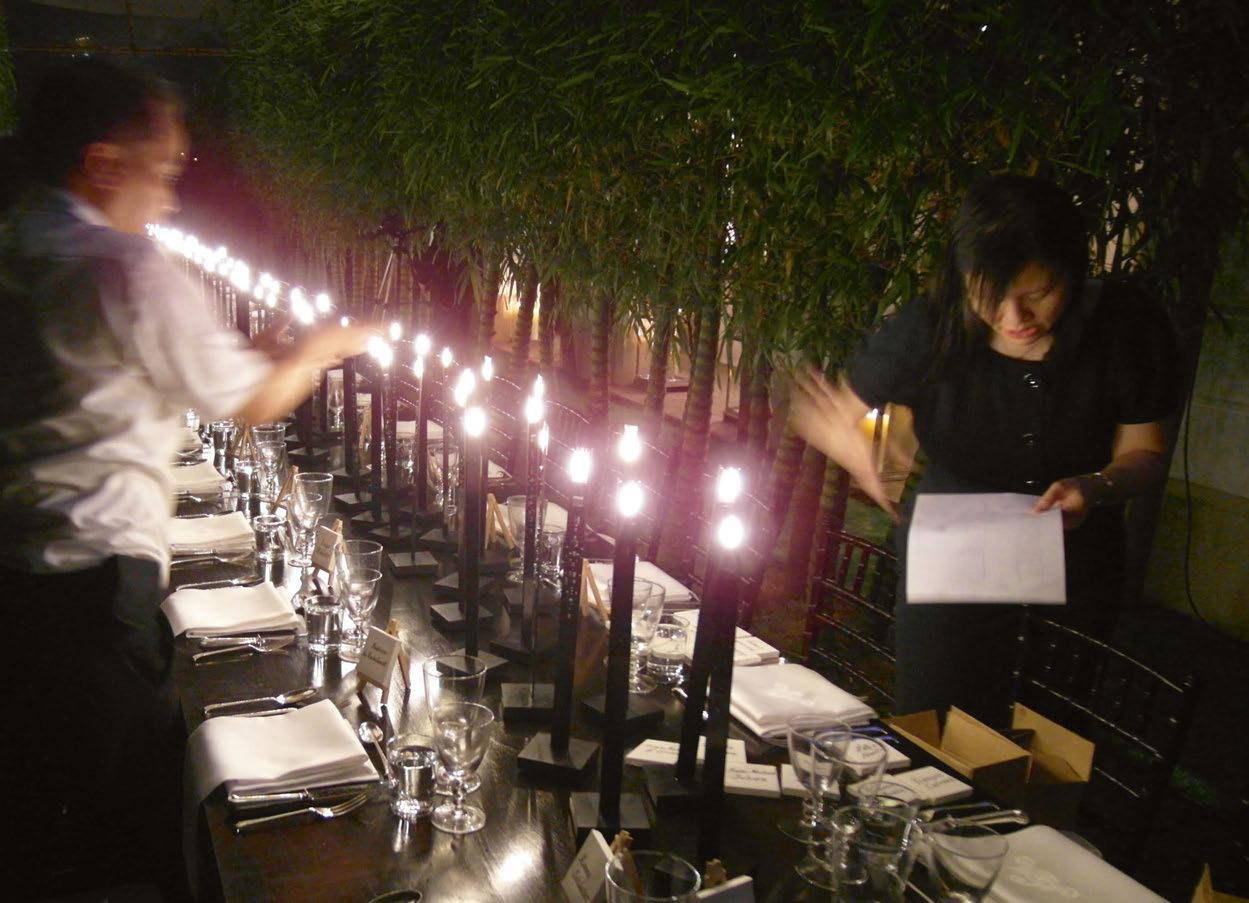
“We always used to say that if you open up a catalogue from Ingo Maurer, you will find a product that you absolutely love, and one that you absolutely don’t understand, but for everyone it is different, because his work is so much about emotion.”
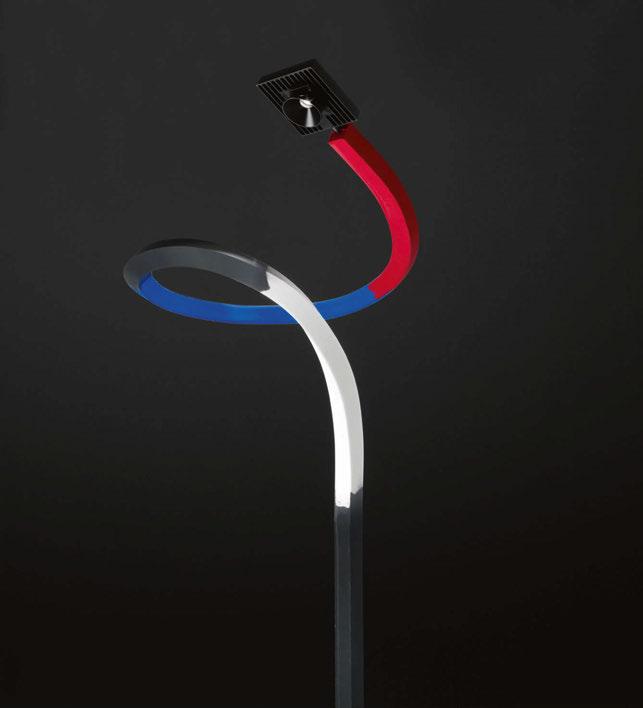
However, keen to finish his degree before fully entering the working world, Armbrüster returned to university, where he further honed his craft, designing and building lighting prototypes. Luckily, so impressed was Maurer with Armbrüster that, two weeks before he finished his degree, he received another call telling him that, when he graduated, he was to move to Munich to come and work for him.
For a young graduate, entering the wild and wonderful world of Ingo Maurer was quite an experience for Armbrüster, particularly as lighting technology was also entering a brave new world.
“There is a German term, ‘Schlaraffenland’, which translates to the ‘Land of Milk and Honey’. On the one hand, Ingo and his team had a courageous, hardworking, 24/7 attitude to design, and then on the other, the new technology of LED was emerging.
“The Ingo Maurer team was still working a lot with halogen and fluorescent lighting, but I was there right at the shift. I consider myself an LED native, because I was directly working with LED from a young age and created my expertise around this new development. The older colleagues on the team often came to me and asked, ‘can we solve this problem with LED?’. With this expertise, I found my place in the design team.
“It was quite a hard thing for all companies to shift from incandescent to LED, but as a young designer, it was fantastic because we could do so many things, play around, and create luminaires that had never been possible before.”
While Ingo Maurer as a designer cemented his legacy through his imaginative, creative, and oftentimes outlandish designs, Armbrüster’s early design influences were much more formal; the likes of Bauhaus and Dieter Rams of Braun – “traditional heroes of German design”, as he calls them.
“I still refer to these names, but somehow the work with Ingo was so different and so fascinating that I really went deep into this. Even though I couldn’t understand every design that he was doing, it was still a lot of fun to execute them and build them, because it was so experimental.
“We always used to say that if you open up a catalogue from Ingo Maurer, you will find a product that you absolutely love, and one that you absolutely don’t understand, but for everyone it is different, because his work is so much about emotion.”
During his time with Ingo Maurer, Armbrüster was involved in the design of a number of beautiful light pieces. Particular highlights of his though include the Zufall series of luminaires. Translated to “By Chance”, the Zufall family is a range of luminaires crafted from silicone – a material known for its extraordinary properties. Its flexibility, and ability to incorporate colour pigments in a pure, three-dimensional form made these light objects –which came in both a standing table lamp or a hanging, knotted pendant – truly unique. The soft, vibrant silicone allowed users to interact with the table lamp or redefine the pendant version’s design by adjusting the knot.
“We also produced a one-of-a-kind, larger scale piece that Ingo called the ‘Headache Lüster’, because it was so complicated to build,” Armbrüster recalls.
Another highlight from his years at Ingo Maurer was the collaboration with Moritz Waldemeyer on the iconic My New Flame LED candles. Inspired by Waldemeyer’s idea of creating a digital candle as a stunning combination of high-tech innovation and poetic expression, Armbrüster and the Ingo Maurer team developed, together with Moritz Waldemeyer, a family of luminaires from a single circuit board – almost in a flashback to his first foray into lighting during his university studies. At the upper end of a sleek black circuit board, a candle flame appears to flicker in the wind. Up close, viewers can see a double-sided rectangular display made up of 128 tiny LEDs per side, rendering the image of a burning flame. From a slight distance, or in dimly lit settings, the LEDs blend into a single, realistic-looking flame. The sophisticated programming of the LEDs, combined with their warm colour temperature, creates an astonishingly lifelike effect.
“The goal was to design the product in a way that highlights the magic of the digital flame, while embracing the raw beauty of the exposed circuit board,” Armbrüster says.
After seven years with Ingo Maurer, Armbrüster needed a change, and with a small family now in tow, wished to return closer to his hometown of Cologne. At the time, an opportunity arose for Armbrüster in the nearby town of Bonn, with lighting design studio Licht Kunst Licht.
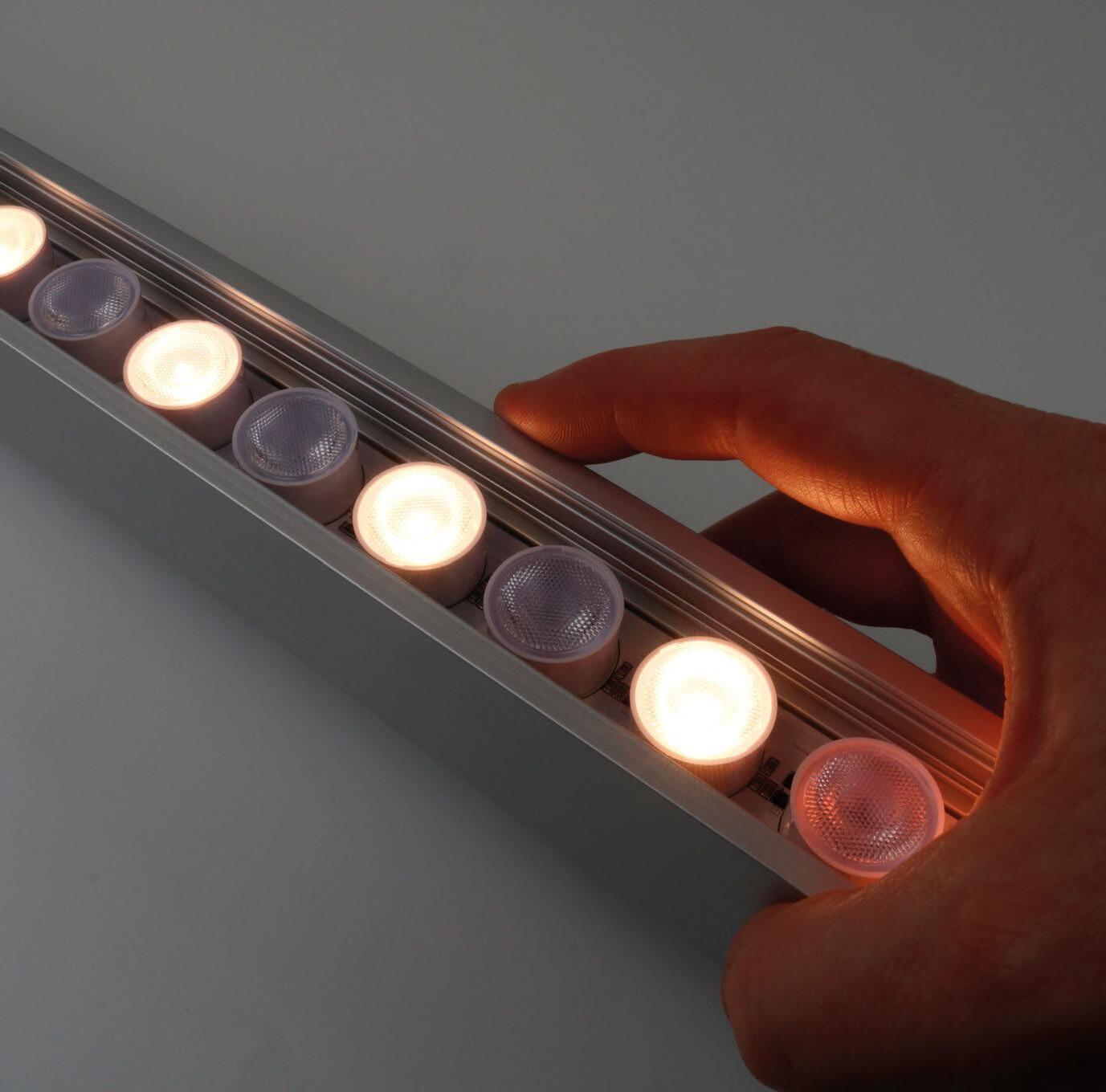
Powerful SEN series now available with CHROMAX RGBW technology SEN CV 055 CHROMAX RGBW
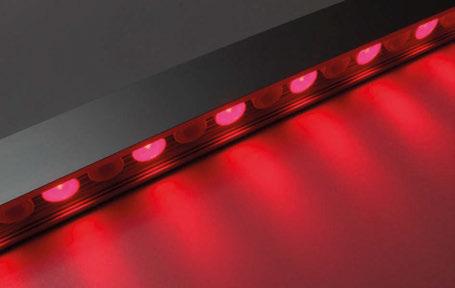
“What was nice about being in an office with lighting designers is I could show them the concept that I was working on, and get very direct feedback where they would tell me if something was a good idea or to forget about it.”
“I knew Andreas [Schulz, CEO of Licht Kunst Licht], through a shared friend, and I was a bit scared that I would be asked to do proper lighting design. I considered my skills and thought ‘I am a product designer; I know a lot about light, but I don’t know anything about the project business’. But during this time, one of the first members of the Licht Kunst Licht team, Thomas Moritz, a product designer, had stepped down, and there was a need for a new product designer. To Work with Andreas and his team was truly outstanding. I have a deep respect in their work and how to make remarkable architectural lighting design on such global scale and importance. Here, I learned everything about architectural lighting design and to design and develop luminaires for this realm, that was a big step for me.
“Together, Andreas and I professionalised this department and expanded its role within the industry. I was also creating custom, one-of-akind luminaires, and consulting with the lighting designers on technical matters, both in Bonn and also with our colleagues in Berlin, and then later in Barcelona, because of the work that we were doing on the Sagrada Familia.”
The prospect of working alongside the architectural lighting designers on the Licht Kunst Licht team was a new challenge for Armbrüster, but one that he enjoyed. Explaining his role within the wider team further, he adds: “The lighting designers would come to me when we needed to make something special for a project – whether that was a centrepiece to complement the architecture, or something that could be integrated into the architecture that wasn’t available on the market.
“I became almost like a negotiator with custom manufacturers; on the one hand I was a translator between the worlds of a lighting designer who has an idea but isn’t sure on how to realise it; and on the other hand, the custom luminaire maker who would try to tell me that an idea is not possible. In those moments, I could say ‘no, I understand the idea, and it is possible’, and with my background, I would do it on my own.
“What was nice about being in an office with lighting designers is I could show them the concept that I was working on, and get very direct feedback where they would tell me if something was a good idea or to forget about it.
“One of the last products I worked on at Licht Kunst Licht was an outdoor, wall-mounted luminaire that we were designing for Trilux. So, I spoke to the team and asked ‘what do you need? What is important for an outdoor luminaire?’ Because my way of designing is not just about designing the outer form, the involved technologies and so on, it is also about the needs of the space, of the application. At Licht Kunst Licht, I learned to first find the right light for the space, and then to design the source.”
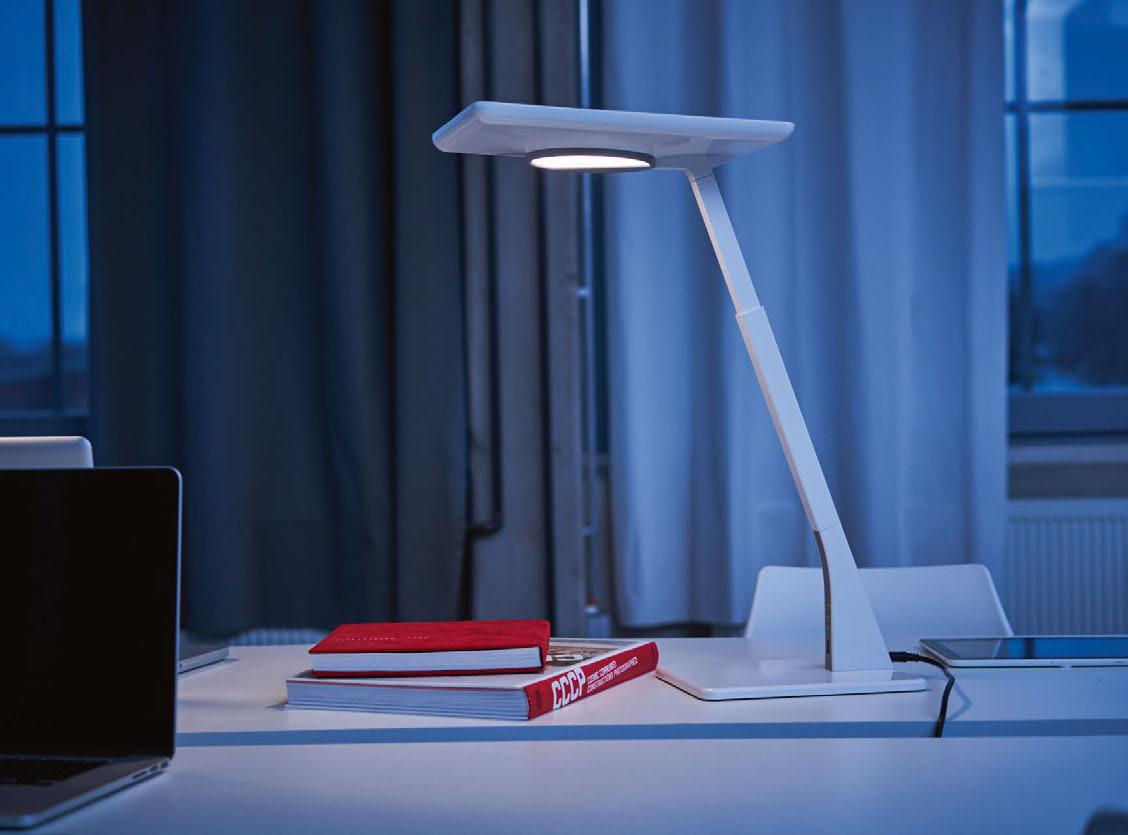
Of the products that Armbrüster designed for Licht Kunst Licht, he cites the Bicult – a desk luminaire designed for Trilux – as one of the particular highlights. The first desktop lamp to combine direct and indirect light output, Bicult features glare-free uplighting, and targeted, optimal downlighting to the work surface in one, compact form factor.
“It turned out to be a new definition for office lighting,’ Armbrüster adds. “Andreas introduced me to this concept – it was only a rough concept at the time, but as we developed it, Trilux said to us ‘this isn’t going to work – 5,000lm from under the eyeline is impossible’. To convince both Trilux and ourselves, I built a prototype of the powerful indirect light using thin-film optics to demonstrate that the concept was feasible. Based on this proof of concept, the team at Trilux then used all of their expertise in developing high-tech, highquality products to turn the concept into a real luminaire — while still incorporating the original thin-film glare control. Even now, eight years after it launched, it is a special product – it is technical, sophisticated, and there is still nothing like it on the market.”
Fusing technical specifics with a sophisticated finish is something that Armbrüster has regularly brought to his product designs. Another such example of this is the Stellr, a downlight developed alongside Lucifer Lighting that merges the worlds of decorative and architectural lighting by focusing both on shadows, and the vibrancy of the objects it is illuminating.
Reflecting on the experience of designing Stellr, Armbrüster says: “Once the idea arose to make a surface-mounted luminaire for Lucifer Lighting, I read a quote from its owner, Gilbert Mathews, where he defines the company as “Design, Define, Disappear”. After our first meeting, I thought ‘how the hell do I make a surface-mounted luminaire disappear?’
“I was on the train back from Berlin, and for me, sitting on a train is always a very contemplative, almost meditative way of travelling, where you can really think differently. And I remembered about this waveguide material that is transparent when a light is turned off. To that point, it had only been used on flat surfaces, but I researched if we could injection-mould, or thermo-form it, and this became the birth of Stellr.
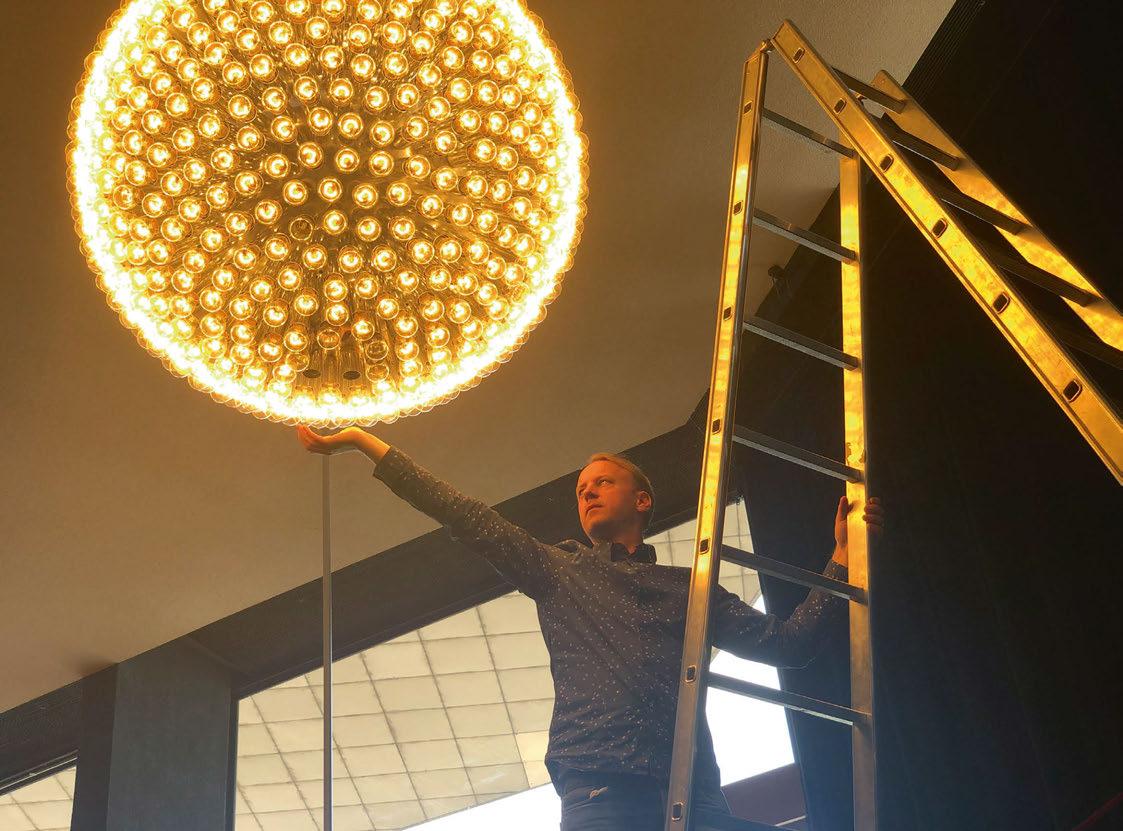
“It became this volumetric source, that changes the appearance of a room when it is turned on –it raises the ceiling, creates atmosphere, and an interplay with very different lighting qualities. And it is not purely decorative or purely architectural – it somehow merges these two things.”
After nine years at Licht Kunst Licht, Armbrüster made the decision to step out on his own and form his own product design studio – Source to Space. Building on his experience of understanding not just the technical components of a lighting product, but the context in which it will sit, Armbrüster hoped to use the experience he gained from both Ingo Maurer and Licht Kunst Licht for his own venture.
“I learned from two masters of light and saw how they followed their path, and so I thought it was time to go out on my own, and to go back to my core competencies of product design and designing of luminaires, and opening up more to the decorative market.
“For me, the similarity is more important than the difference: both architectural and decorative lighting are about balancing emotion and function. In architectural lighting, light helps the architecture create that effect. In decorative lighting, the object itself carries more of the emotional expression, while also delivering the light.”
Across both sectors though, Armbrüster says that sustainability is a core component of his “mission statement” for Source to Space – ensuring that, across his luminaire designs, he looks at new materials, ways in which his products can be more circular, building in repairability, and so on.
“Sometimes, clients are very open to this – of course nobody is telling me they don’t care about sustainability – but some go further than others and stick with it. For me, it is important to get people moving in this direction. I once read the quote ‘sustainability is not a goal, it is a journey. And it is important that you start walking. I started walking many years ago, and now I am trying to take as many people as possible with me on this journey, because I believe it is necessary – and because it sparks my creativity.”
To that end, he adds that his goals for Source to Space are not to be seen as a “fashionable” design studio, but rather, looks to create pieces that are more timeless, that through a combination of good quality design and technical specifications, become long-lasting products.
“This is something that was also very important for Ingo Maurer – we didn’t want to only create glowing pieces, but to have these artistic pieces that had proper lighting; this is what sets it apart from art pieces.
“It is important that a luminaire as a light source should fulfil its purpose, that it fits the application. It should make people feel in a certain situation comfortable and good. For instance, if you are designing a lighting concept, or a luminaire concept for an office, this is different than for a bar or restaurant. Although we have seen some merging of this, you need to understand the needs of both spaces. If you want to merge residential and office design you have to define the residential qualities, but still keep the qualities or needs of the office space for it to be a success.”
Discussing the current trends in the lighting market – particularly poignant considering our conversation was taking place during Light + Building – Armbrüster says that, while there has been a concerted push towards sustainability in recent years, he would like to see a similar movement in lighting controls, as the two can be mutually beneficial.
“Nowadays in lighting, there can be so many dynamic scenarios, but the controls are still too complicated. For me, controls are a big lever on the topic of sustainability, and of bringing sustainability and human centric lighting together.
“Sometimes, these can be quite contradictory, especially in the outdoor environment, we have seen a move into changing the colour of the lighting so as not to disturb certain species, or only using the light that people need during certain hours of the night.”




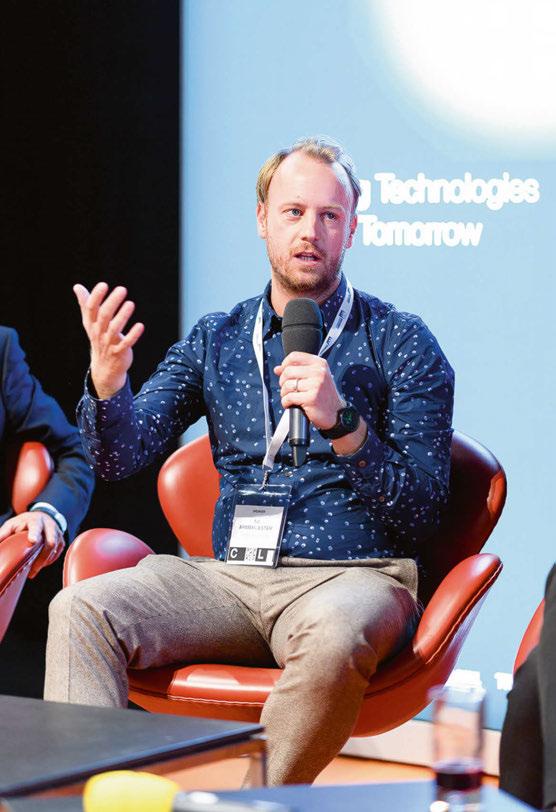
Looking ahead on a personal level, Armbrüster says that it is “a very exciting time”, as he works on new designs and some new collaborations – including with former Ingo Maurer colleague Sebastien Hepting – that will hopefully come to light in the next 12 months.
But as he expands his portfolio with new collaborations, Armbrüster says that, for him, it is not so much about working with big-name studios or manufacturers, but rather the people behind the names.
“All the different brands that I have worked with have been rewarding, but each come with their own challenges. To work with an Italian company is very different to a German one or to a US brand. It’s important to work with a good brand, but more so it is the people that you are working with, that you are in direct contact with. When I look to the future, I don’t look to a specific brand name, but for people that are committed to meaningful innovation in the field of architectural and decorative lighting, or the merging of it. In the aim to create new and sustainable luminaires.”
As he reflects on his career to date, from the many collaborations and innovative products designed, to the projects that he has been involved with through Licht Kunst Licht, Armbrüster says that the most rewarding moment will always be the “aweinspiring effect” that lighting can inspire in people.
“At the beginning of my career, I realised that there are so many interesting aspects to lighting – things like aesthetics, like technical and health issues, but also emotion. And with all of these combined, it never gets boring. It is why I loved being at fairs and going to booths where products of mine were exhibited. In my years at Ingo Maurer, we would build the booths ourselves, install all the luminaires, and then when the doors open and people come in and you see the smiles on their faces and their eyes open wide, and you get that instant feedback, it reminds you of why you are doing this, why all the effort and the stress and the long nights are worth it – because you are doing it for people.”
www.sourcetospace.com
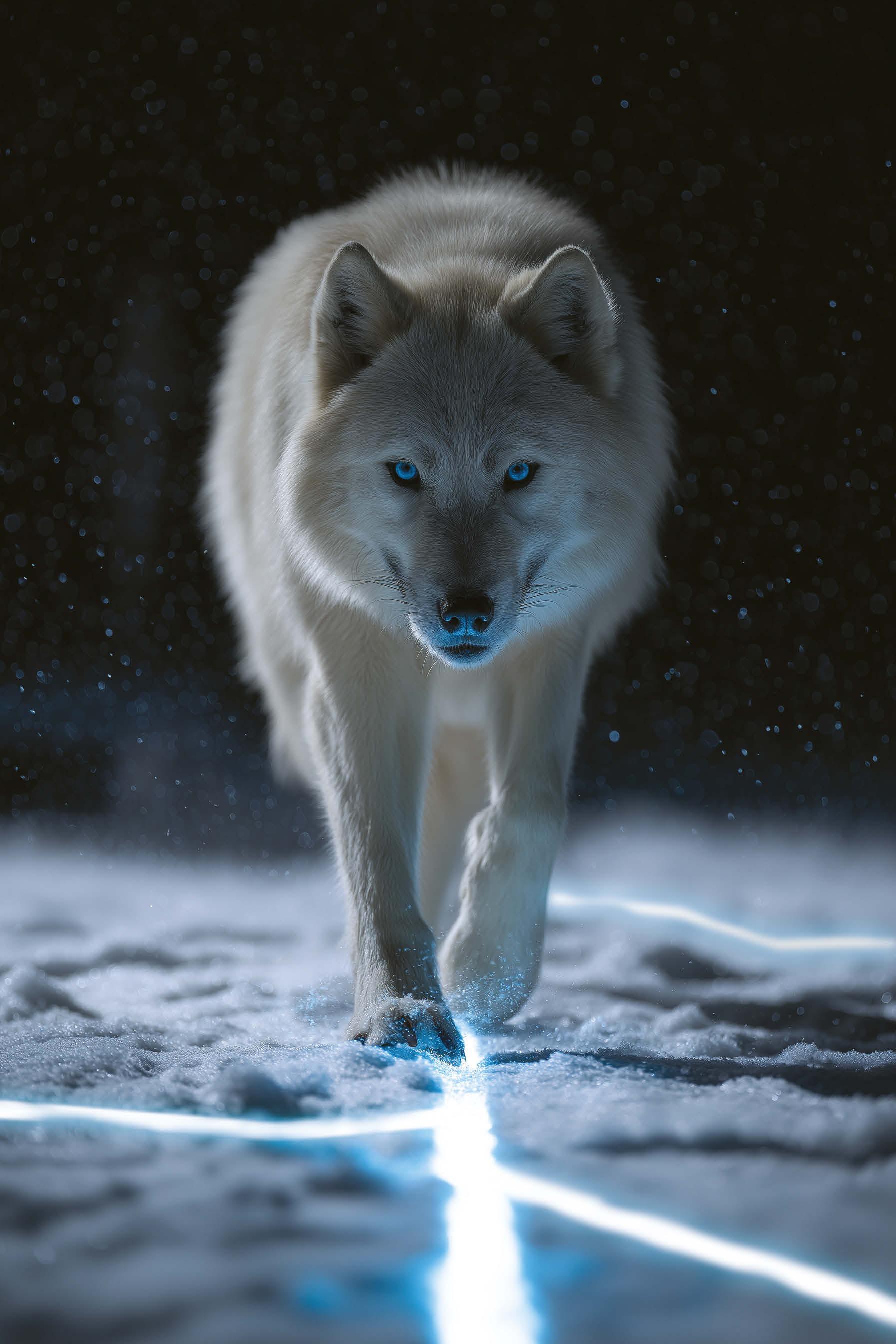

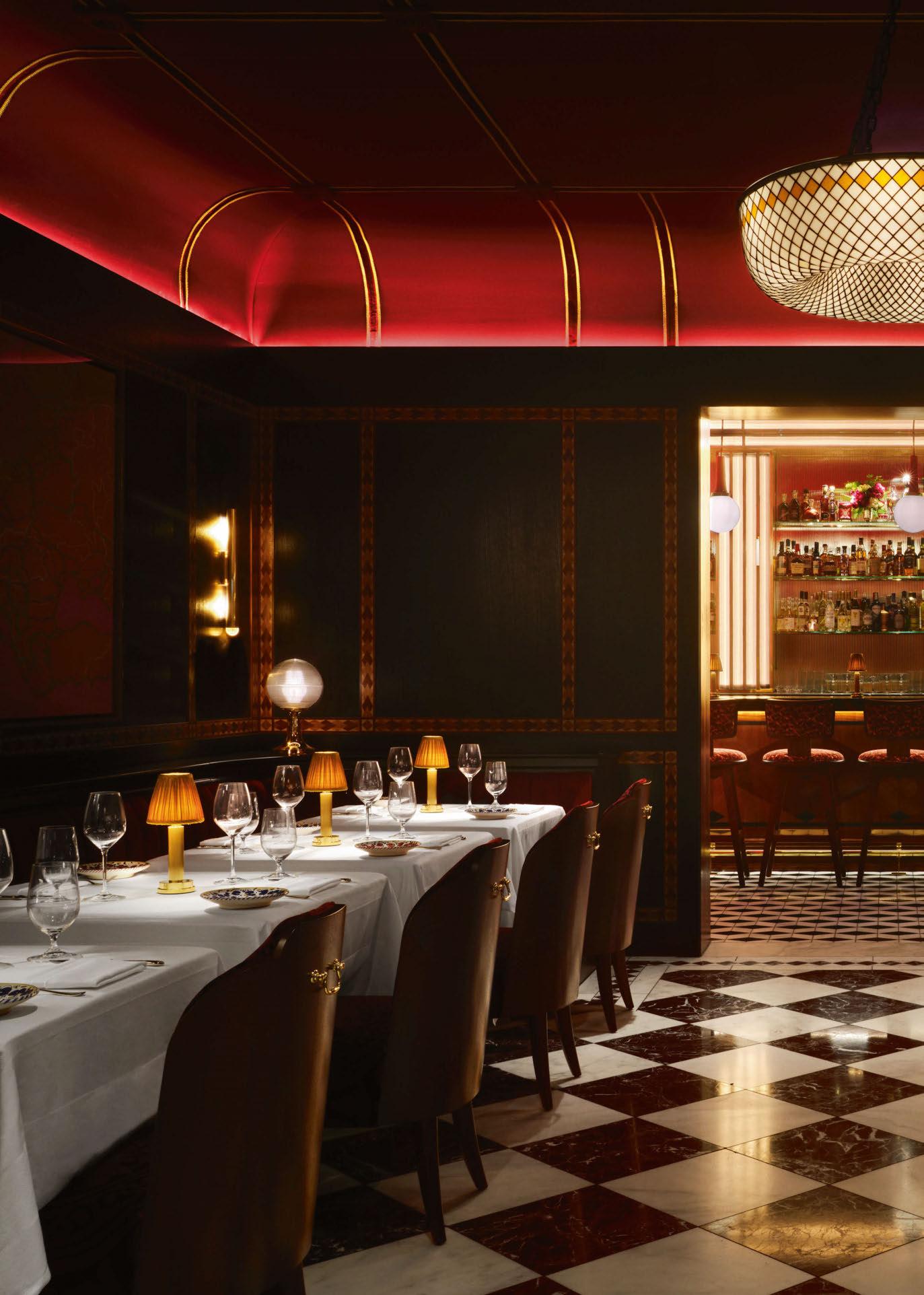
Set within the former US Embassy building – now reimagined as The Chancery Rosewood by David Chipperfield Architects – famed New York institution Carbone has opened its first restaurant in London.
With a moody interior from US designer Ken Fulk that embodies Carbone’s upscale New York style meets classic Italian vibe, the restaurant features a lighting design from Nulty, that further looks to capture the warmth and glamour that Carbone is known for, while heightening the atmosphere in the subterranean restaurant through layering, contrast, and drama.
Carbone’s celebrated sense of spectacle greets guests at the entrance, where red leather and brass doors lead to a ground-floor bar furnished with glossy blue walls, mosaic floors, and a striking panelled ceiling. Here, the lighting was choreographed to make the bar area resonate as the brightest focal point. Spotlights accent the ceiling, adding texture to its aged tin finish. Integrated joinery lighting heroes the materials, emphasising the contrasting textures of the zinc-topped oak bar, and lending a touch of sparkle to the glassware.
The elegant scheme is reinforced by decorative luminaires that nod to the mid-century aesthetic, while creating layers of diffuse light.
The journey continues down a staircase where linear LEDs graze the wall to produce a continuous run of warmth along the marble steps, and lines of light
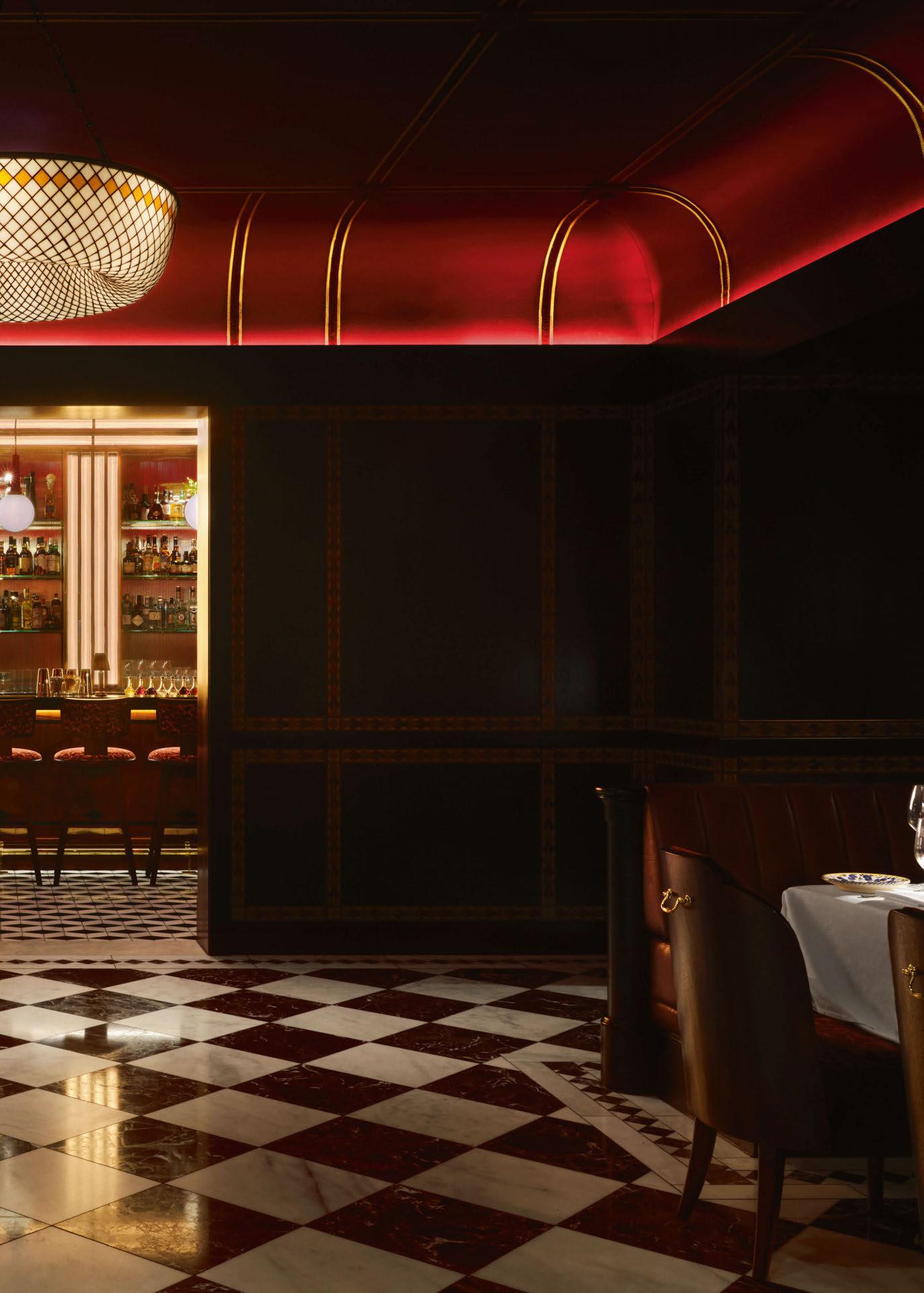
hidden in the stringer details form a rhythmic flow of light down the stairs. An opalised element was built into each stringer fitting to diffuse light evenly and produce a soft, consistent glow.
Downstairs in the basement restaurant, an area completely devoid of natural light, the ambience comes alive through a balanced hierarchy of direct and indirect illumination.
In the restaurant, adjustable spotlights and integrated lines of light elevate the material palette, accentuating both the red coffer ceiling and amber fluted glasswork and brass detailing at the bar. Further down, light was directed onto the custom artwork and tables. Picture lights illuminate each piece, with colour temperatures carefully balanced to show the colours of the art in the best possible way.
Around the dining tables, the lighting is purposefully low level, as only the chandeliers, wall sconces and table lamps evoke the moody ambience and visible sparkle for which Carbone is renowned.
In the adjacent private dining room, the lighting is equally restrained to give the gold panelled walls, mirrored ceiling and Murano glass chandelier space to sing.
Discreet spotlights, integrated joinery lighting, picture lights and table lamps create contrast and drama, while preserving the harmony of the overall scheme.
www.nultylighting.co.uk
Park Hyatt
Kuala Lumpur
Kuala Lumpur, Malaysia
Situated in the world’s second tallest building, Park Hyatt Kuala Lumpur is the hotel chain’s first location in Malaysia. Inside, dpa lighting consultants used light to complement GA Group’s warm, intimate interior design.
t may sit more than 100 storeys above ground, but Kuala Lumpur’s newly opened Park Hyatt is deeply grounded in Malaysian culture.
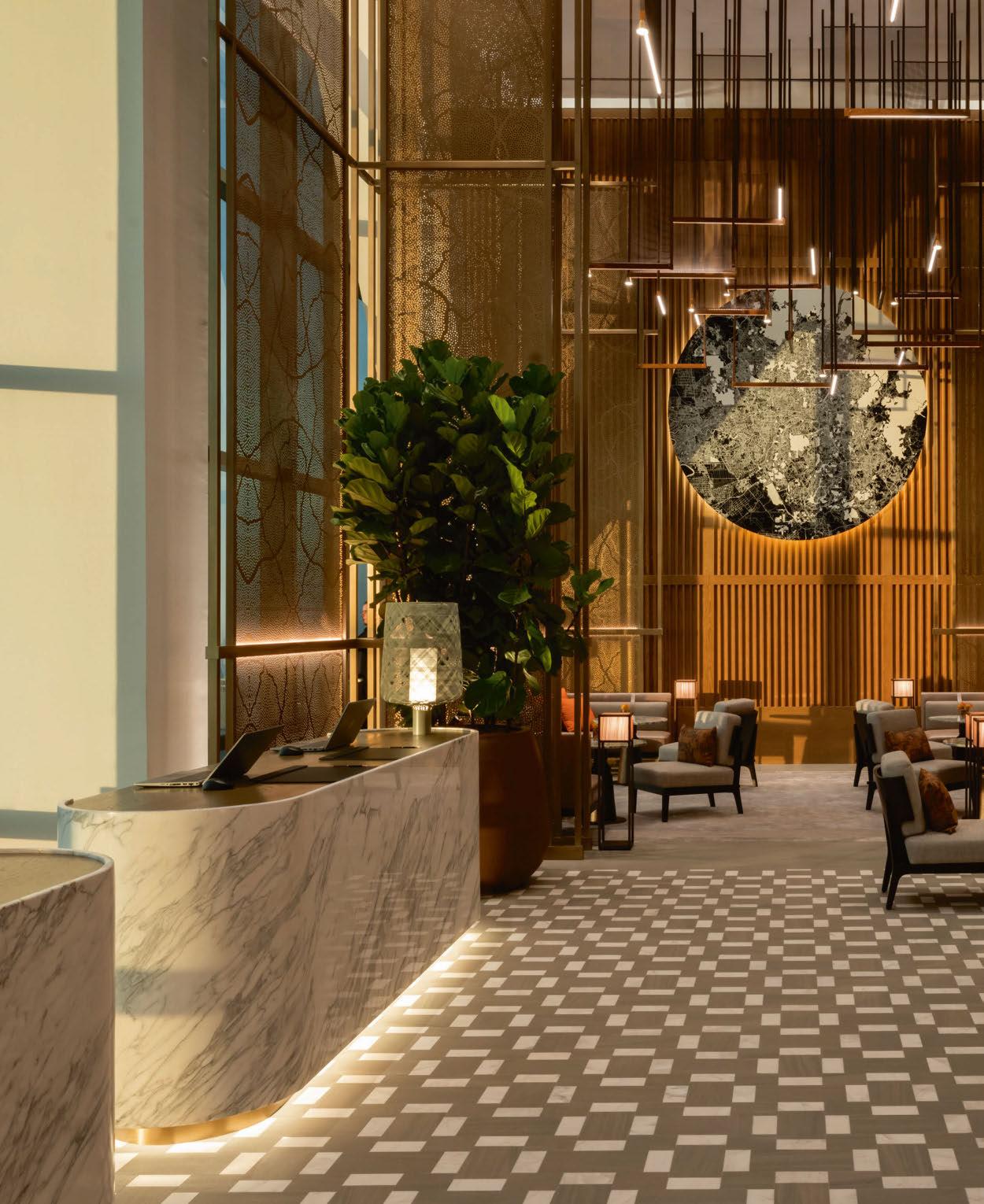
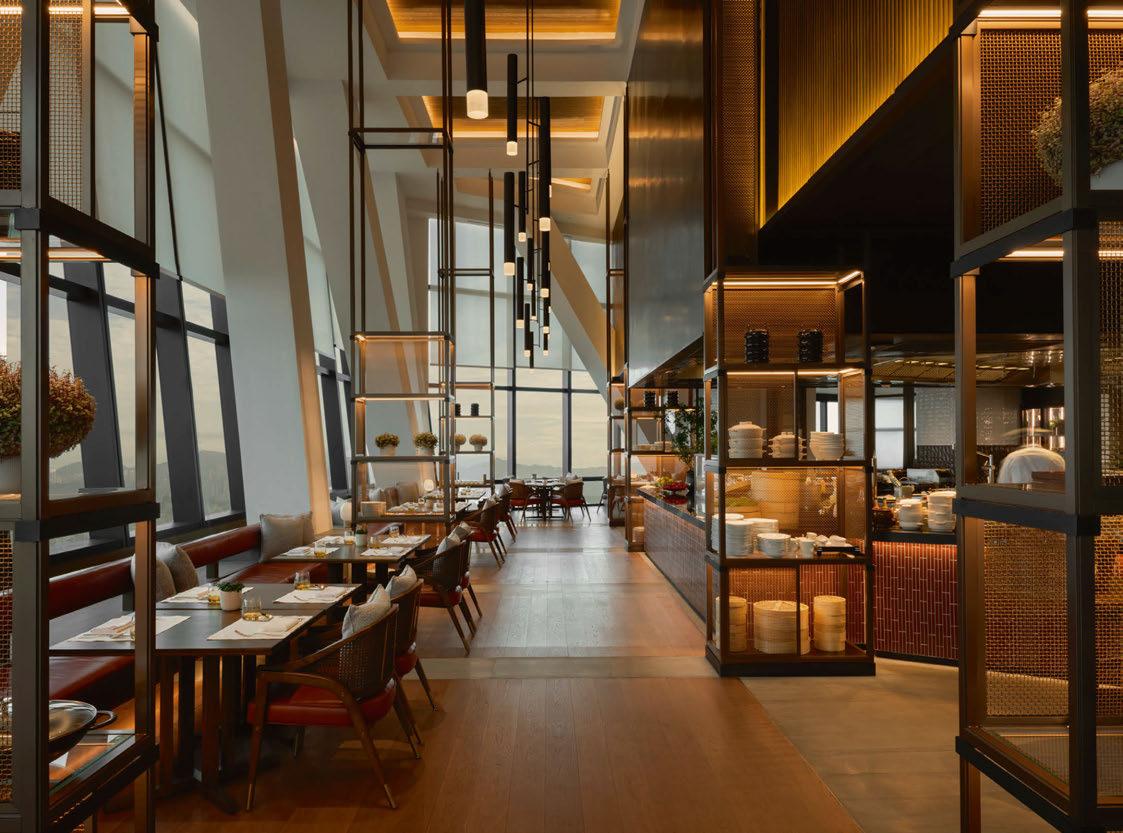
Occupying Levels 75 to 114 of Merdeka 118 – the tallest skyscraper in Asia Pacific and the second tallest building in the world after the Burj Khalifa – Park Hyatt’s first Malaysian property seamlessly blends local craftsmanship with contemporary luxury. The result is a warm, intimate guest experience that pays homage to traditions grounded some 2,000 ft below.
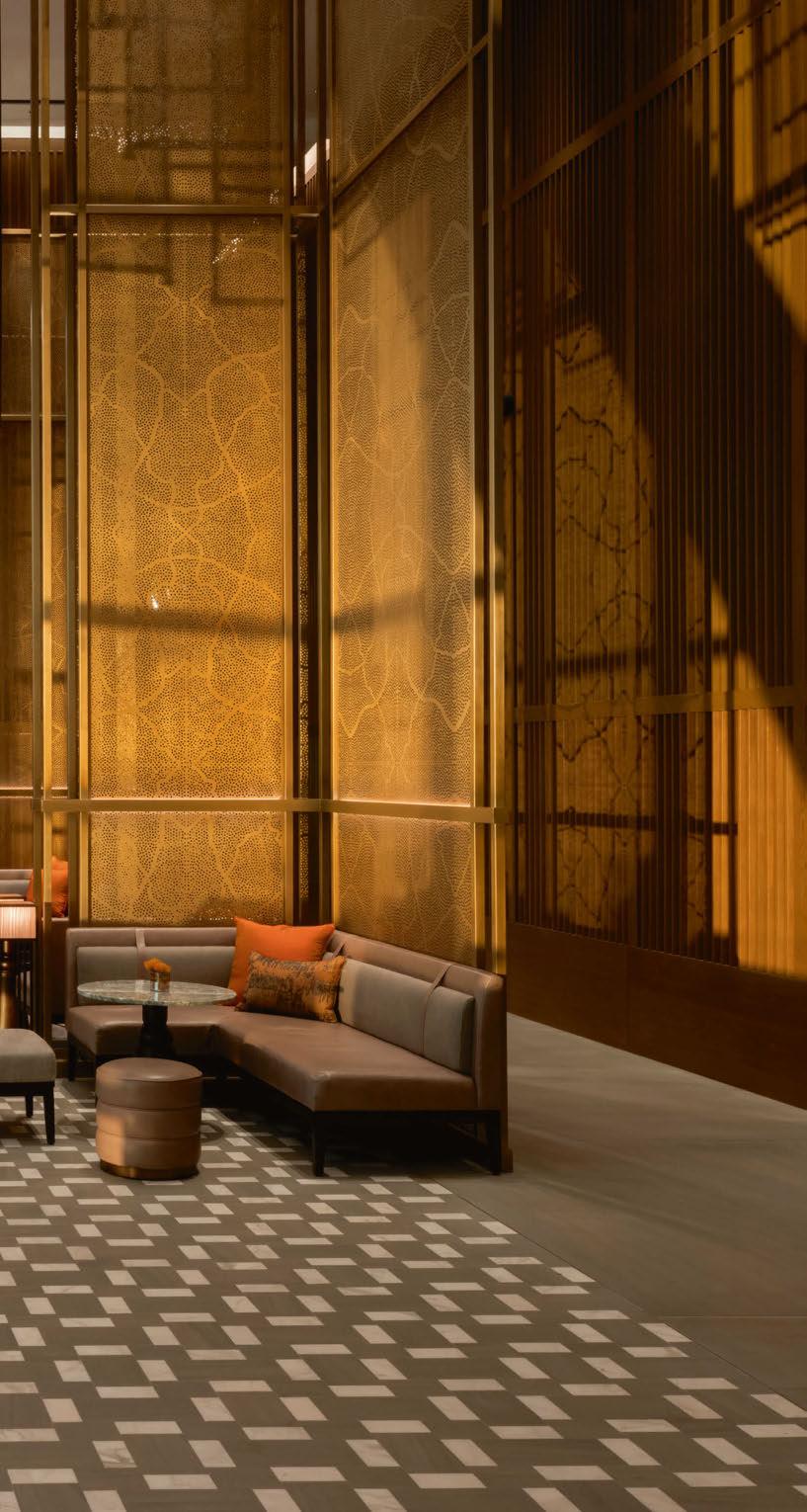
World-renowned interior designers GA drew inspiration from the traditional Malay kampung house when shaping the 252-room, five-star hotel. Timber-clad walls, rich wooden panelling and earthy colour palettes reference vernacular architecture, while a pared-back lighting scheme by long-time collaborators dpa lighting consultants enhances the materiality of the interiors and celebrates the panoramic city views beyond.
Reflecting on the early design conversations, Adam Busby, Associate at dpa lighting consultants, explains: “We understand GA are committed to incorporating local crafts and architecture into its work and expressing that within the project’s story. As lighting designers, our role is to emphasise that narrative.”
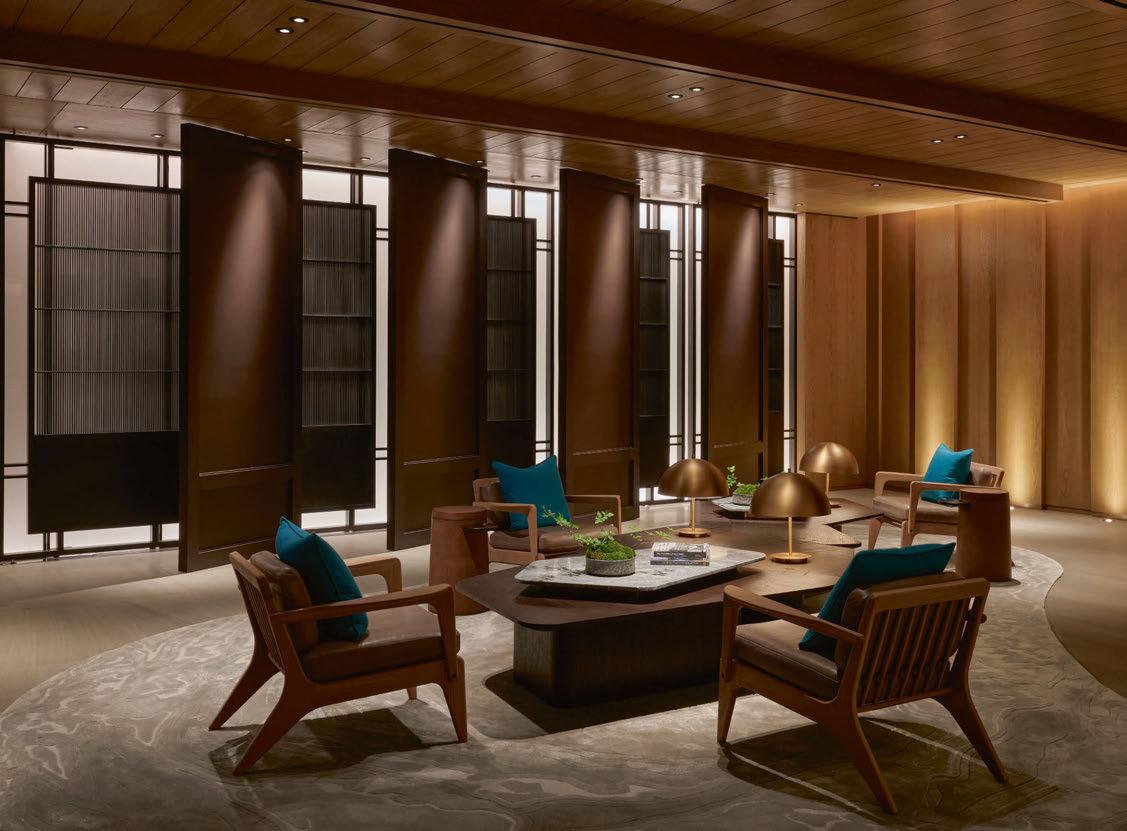
From the moment guests enter the Arrival Lobby at the Lower Ground Mezzanine level, they are enveloped in warm timber tones, subtly revealed through recessed uplighting. Pivoting screens positioned before softly backlit panels offer a striking reference to the Malay kampung house, introducing a quiet sense of drama that sets the tone for the journey ahead. With minimal natural daylight in this space, dpa implemented a dynamic lighting system that transitions throughout the day — shifting from a crisp 4500K daylight tone to a warmer 2200K glow in the evening.
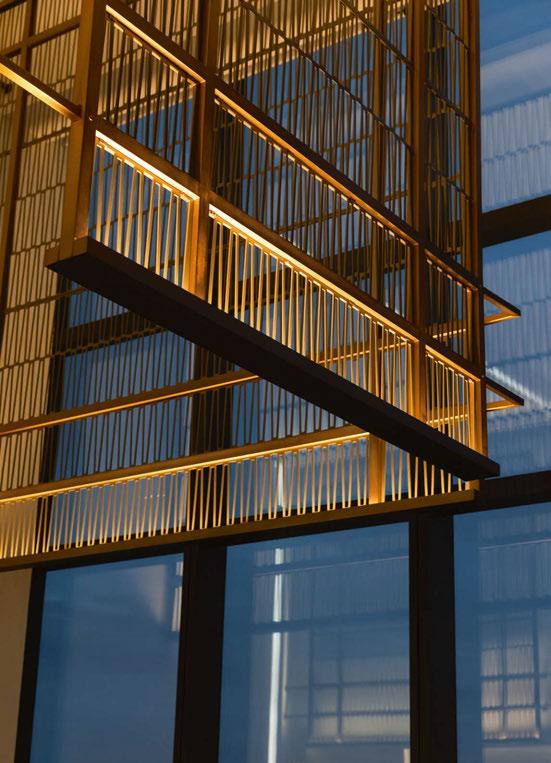
The hotel’s principal public spaces are located on Level 75, including the main lobby, Merdeka Grill, Park Lounge, and the Cacao Mixology and Chocolate Bar. Here, feature accent lighting highlights key architectural elements, most notably perforated brass screens etched with intricate batik canting patterns in the double-height reception area. Bespoke ceiling pendants, carefully coordinated between dpa and GA, anchor each space, complementing the interior palette and reinforcing the spatial rhythm.
Rather than applying a uniform blanket of light, dpa introduced layers and variation. Busby explained: “It was important to create a rise and fall to the light levels, pockets of interest that naturally encourage guests to move through each space at their leisure.”
Integrated lighting within joinery adds subtle depth, while decorative fixtures provide both highand low-level illumination. A carefully calibrated control system ensures balance throughout, maintaining consistent light levels while allowing each venue to retain its own distinct character.
Decorative lighting plays a defining role across the Level 75 F&B destinations. “The architectural lighting techniques remain fairly consistent with carefully selected luminaires to suit the high ceilings,” Busby notes, “but the decorative lighting gives each space its own identity.”
While the decorative specifications originated largely from the interior design team, dpa provided technical guidance to ensure precision in dimming protocols, light sources and lumen outputs. Close collaboration also extended to the scale of fixtures, ensuring that each fixture not only complemented the design visually but performed appropriately in terms of illumination.
Lighting further enhances the warmth and richness of GA’s chosen materials. Notably, the team selected a warmer colour temperature than is typically preferred in the region. “There can be a tendency toward cooler temperatures, around 4000K,” Busby explains. “We opted for 2700K to provide a warm residential feel but also enhance the warm timbers, metal work, and textures throughout the space.”
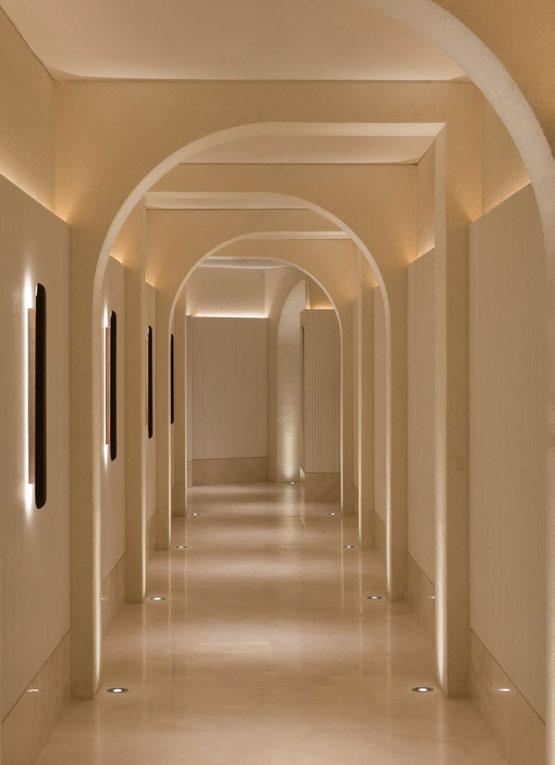
Ascending to Level 99, the Wellness Floor offers a tranquil retreat. Guests transition from daylightfilled openness to a more immersive, calming environment. Drawing again from traditional Malaysian architecture, the space reinterprets the ‘Five-foot way’, the sheltered walkway commonly found in front of shophouses. Softly illuminated archways guide visitors through the floor, creating a serene atmosphere that evolves with the time of day. Throughout the hotel, shifting daylight and sweeping panoramic views of Kuala Lumpur further animate the interiors. The 252 guestrooms and suites are designed to frame the cityscape, with lighting discreetly integrated into joinery to minimise visual clutter. Subtle downlights highlight artworks, while decorative fixtures inspired by woven fabrics introduce warmth and intimacy. Balancing intimacy with extensive glazing presented its own challenges. “At night, large expanses of glazing can become reflective black walls,” Busby explains. “We had to minimise reflections and carefully conceal light sources through shading and integration within the joinery.” The aim was to preserve the views while ensuring the rooms remained functional and comfortably illuminated.
Guestroom lighting is integrated with the blinds and control systems to create a memorable arrival experience. “When guests enter at night, the lighting remains low,” Busby explains. “And the blinds rise in unison, unveiling the city skyline. That coordinated reveal delivers a real ‘wow’ moment as part of the overall stay.
The open-plan layout of the guestrooms required intuitive controls, particularly given the multiple entry points within the suites and the open plan layouts. dpa responded with a simplified lighting interface, allowing guests to adjust the environment effortlessly.
Given the project’s landmark status as the first Park Hyatt in the region, quality control remained paramount throughout. From integrated architectural details to bespoke decorative fixtures, dpa worked closely with GA and local manufacturers through mock-ups and iterative testing to ensure each element met exacting standards.
“There was constant collaboration,” Busby recalls. “We reviewed physical mock-ups on site, at the factory and through detailed photos and videos to refine fixture designs, adapting solutions that were both striking and practical to produce.”
luxurious destination with the lighting design in harmony with GA’s interior design, skilfully bringing out the warmth, texture, and finishes that define the space. This collaboration elevates every detail, transforming materials and views into a cohesive narrative of luxury.
“The lighting design emphasises and brings to life all of those architectural and local crafts that the interior designer has introduced,” Busby adds.
Client: PNB Merdeka Ventures
Operator: Hyatt
Lighting Design: dpa lighting consultants
Interior Design: GA
Architect: Fender Katsalidis, Arup, RSP Architects
Lighting Specified: Aero, Eco Holdings Group, Honeywell, Jung
Photography: Park Hyatt Kuala Lumpur; GA; What The Fox Studio
At 118-storeys tall, one may be forgiven for thinking that the sheer height of Merdeka 118 could have presented a challenge for the dpa team, but he says that, apart from a couple of “hairy” trips up the tower during construction, the process was very familiar. “During the final set-up, sometimes it could take us over an hour to get up the building and the same to get back down. We had an amazing experience when the tower was still under construction, and we had to travel in an open cage on the outside of the building to get up to the hotel levels. So, that did provide some challenges, but only temporarily.
Despite any challenges faced though, throughout the hotel, dpa and GA have together created a
“From the early stages with GA, there was always talk of taking the guests through a journey, and we hope that, with the lighting design creating focal points and interest throughout, we draw the guests to walk through those spaces, to enjoy the restaurants and bars, and feel as comfortable as possible.
“As lighting designers, our goal is always for guests to enjoy a space without noticing the lighting, unless it is a feature piece, such as a large decorative pendant. It is all combined as part of the feeling of the space, as one experience.”
To that end, Park Hyatt Kuala Lumpur is a hotel that glows from within, a blend of natural and architectural lighting that, despite its lofty heights, feels firmly rooted in the spirit and culture of Malaysia. www.dpalighting.com
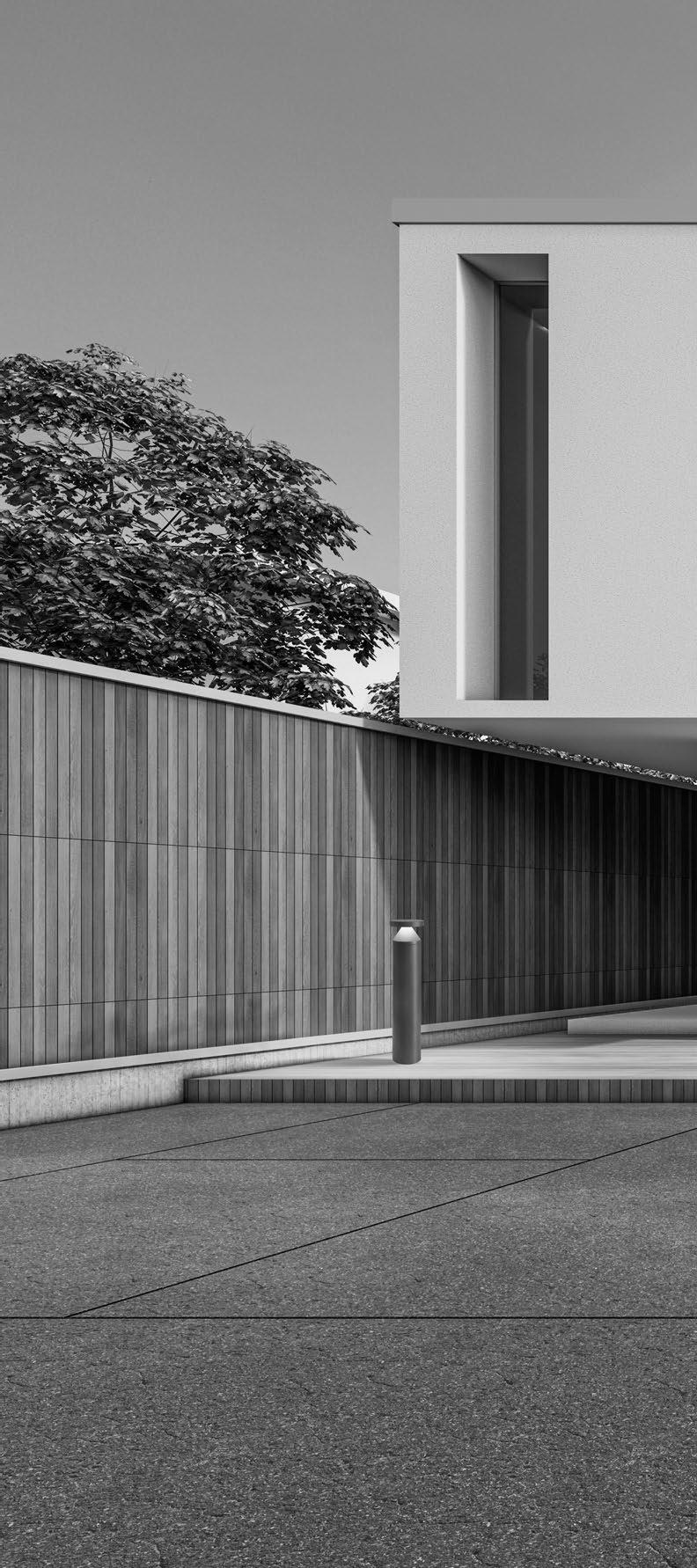
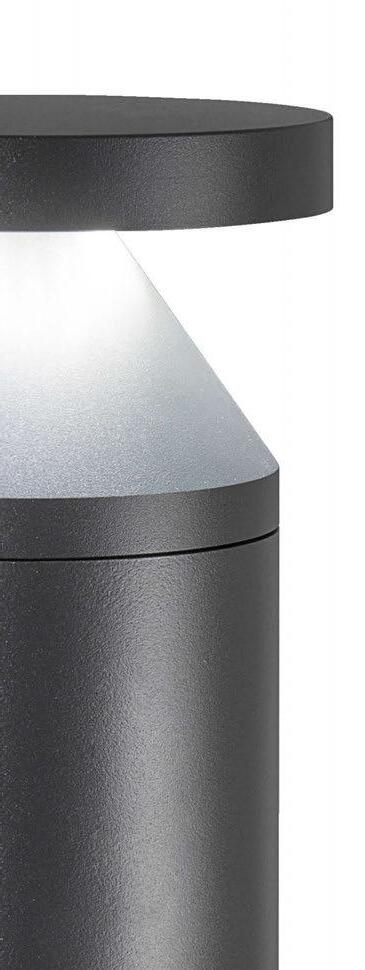
Designed to shape residential spaces with visual comfort, precise light distribution and reduced upward emission.

Eero Saarinen’s former US Embassy has been transformed into one of London’s newest luxury hotels. The project balances the architecture’s integrity with a fresh contemporary perspective. Lighting Design International creates a scheme that injects a sense of warmth and intimacy without overshadowing its monumental heritage.
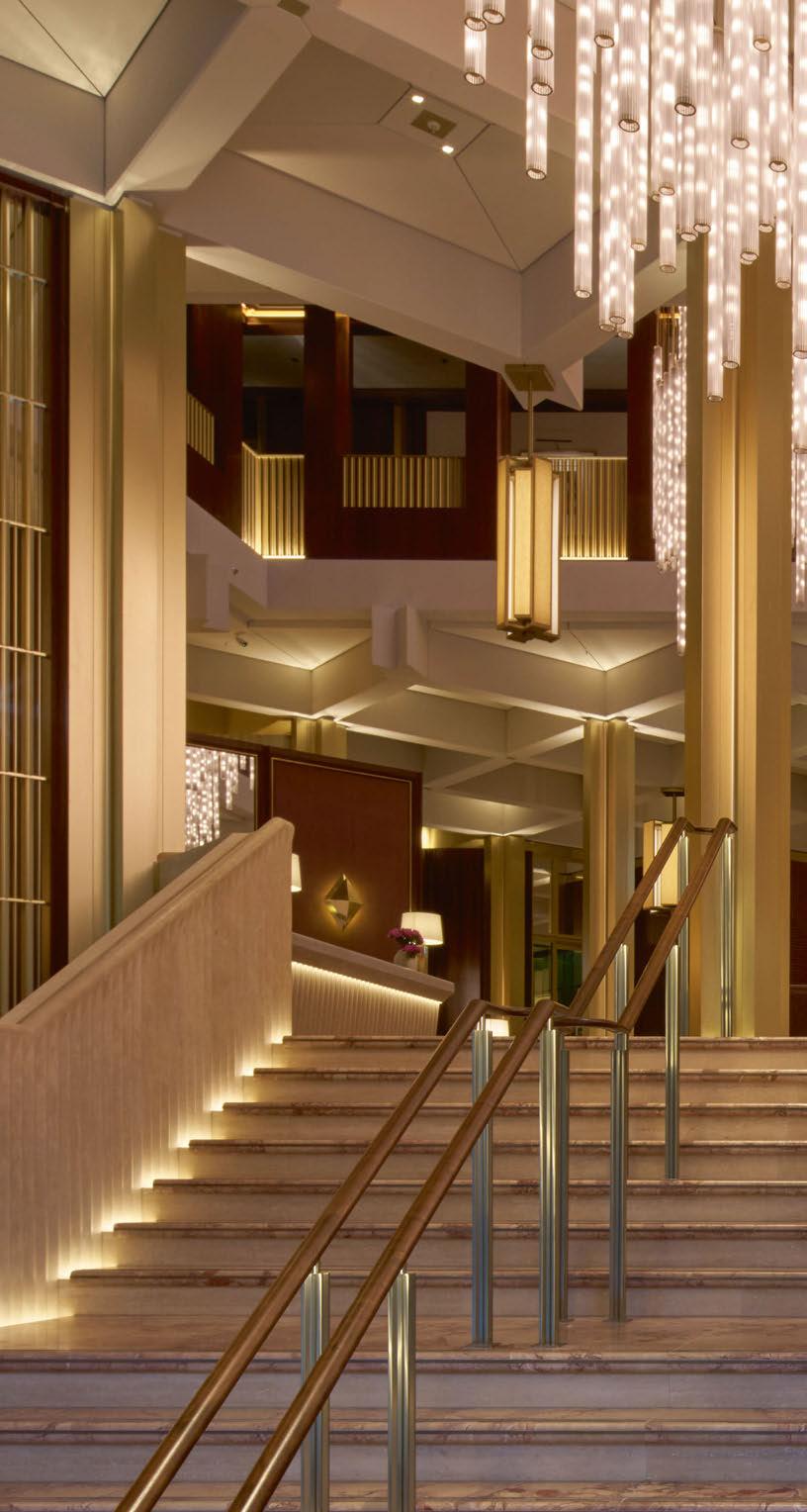
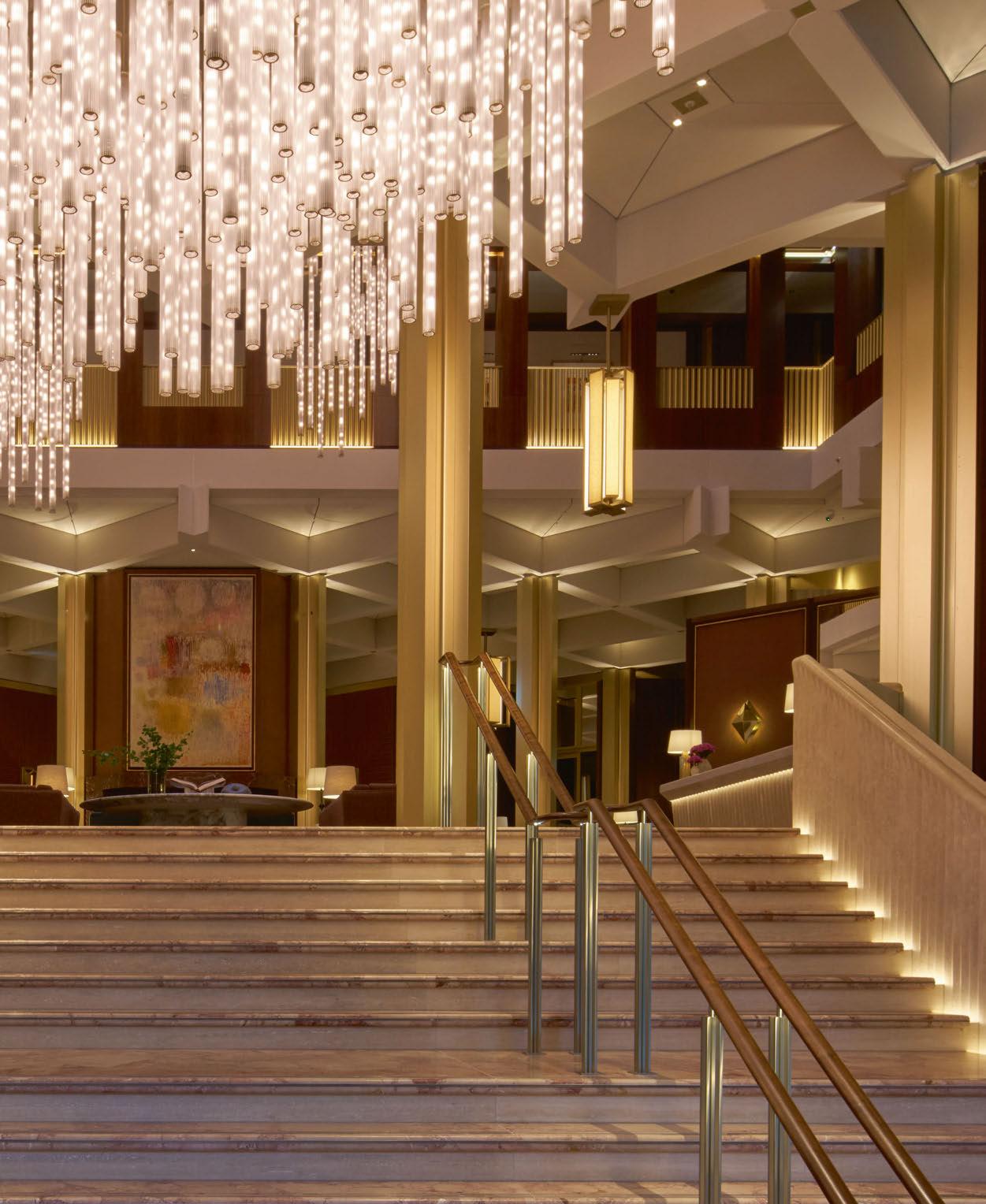
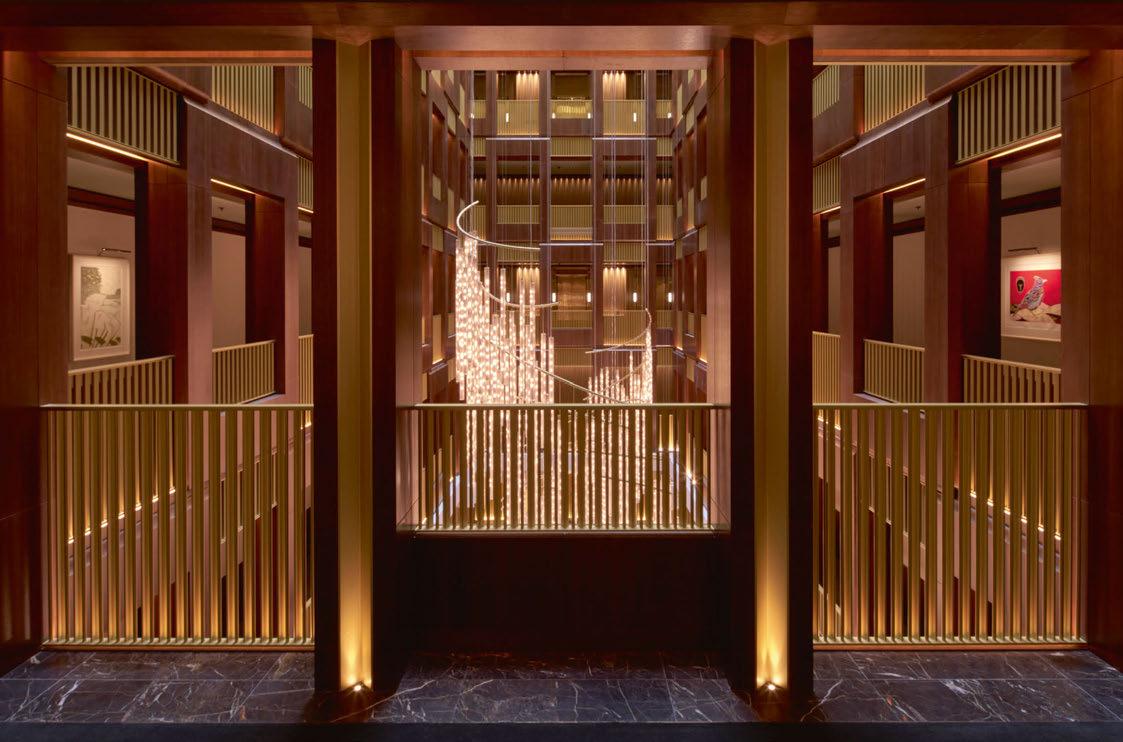
ne of London’s landmarks, the former US Embassy, has undergone a remarkable transformation into the uber-luxurious Chancery Rosewood hotel. The building, originally designed by renowned architect Eero Saarinen in 1960, has been redeveloped, led by Sir David Chipperfield, and has restored the building’s integrity while adapting it to a more contemporary audience. The interiors were reimagined by Joseph Dirand, who introduced a material-led language where restraint and atmosphere take precedence over overt luxury. Meanwhile, Yabu Pushelberg employed a contemporary counterpart to the spa and wellness areas. Responding to this layered design vision, Lighting Design International (LDI) was tasked to create a lighting scheme that could seamlessly integrate the historic nature of the building’s architecture with its new, contemporary identity.
Working within the constraints of a Grade II-listed structure posed a fundamental challenge for the design teams: how to introduce the warmth and intimacy expected of a modern luxury hotel without compromising the clarity of Saarinen’s modernist form.
With extensive experience in landmark redevelopments – spanning high-end hospitality and complex heritage sites – LDI was brought in from the outset to help bridge these two ambitions.
“From the very beginning, we collaborated closely with Sir David Chipperfield’s architectural team and Joseph Dirand’s interior design studio, alongside Yabu Pushelberg for the spa, to ensure the lighting supported the architectural vision while creating a warm, layered ambience that feels intimate and residential. We wanted to achieve the idea of the hotel as a true ‘home away from home’,” says LDI Associate Charlotte Svenson.
When appointed to the project, Svenson and her colleague, fellow LDI Associate Sandra Brookes, quickly understood this was no straightforward hotel renovation. As Saarinen’s former US Embassy carried cultural weight and a legacy that would be central to every decision they made, they knew excessive illumination or overtly contemporary interventions risked diminishing the building’s heritage.
“Our task was to honour the building’s gravitas while guiding it sensitively into its new life as a vibrant hospitality destination,” adds Brookes. The client’s brief was simple: create a timeless and refined lighting scheme and an overall atmosphere that felt like ‘a home away from home’. Svenson and Brookes defined the concept through integration and restraint. Illumination was to be woven into the architecture, allowing the building to be read clearly without visible distractions of light sources. As the interior design evolved, so did the brief, introducing a richer layering of light that balanced the architectural elements that Chipperfield’s vision introduced with the more expressive pieces selected by the interior designers. The tension between hospitality and monumentality sits at the core of the finished concept. The building retains its civic and historical presence, yet the lighting allows it to be reinterpreted through a more intimate lens – shifting the perspective from institutional to residential, allowing guests to engage with the space as both monument and a place to inhabit.
A key part of the strategy was respecting the geometry established by Eero Saarinen. The building’s strong architectural rhythm, especially the iconic diagrid ceiling, shaped the way the lighting could be placed. Instead of competing with these features, LDI focused on integrating light within them by refining existing elements, adding new sources discreetly, and allowing the architecture to remain the focus. This degree of integration was shaped by both design intention and practical limitations. As a Grade II listed building, changes were controlled: nothing could be fixed to the stone façade, ceiling voids were shallow, and placing luminaires within major architectural features was limited. These constraints demanded a precise, carefully considered approach, where each fitting had to be justified. Ultimately, light was threaded through tight spaces and coordinated with exact precision. The results reveal the building’s proportions, depths, and textures through almost invisible interventions.





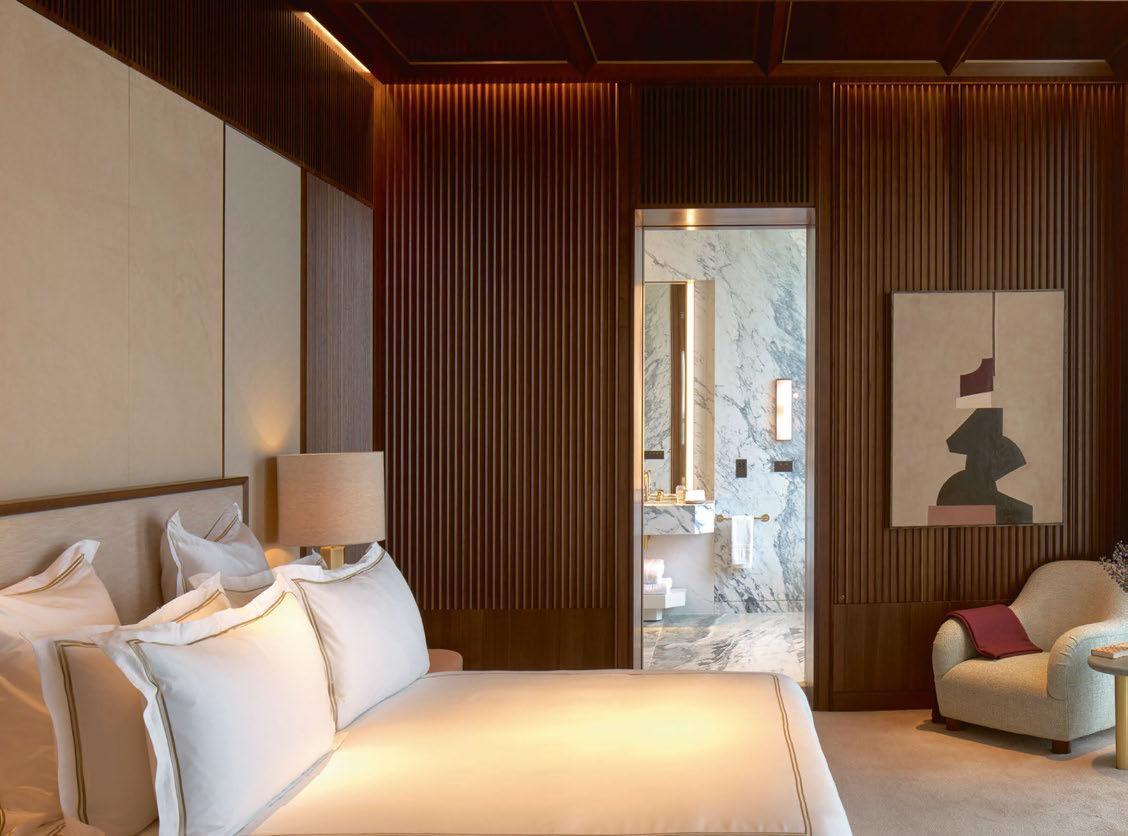
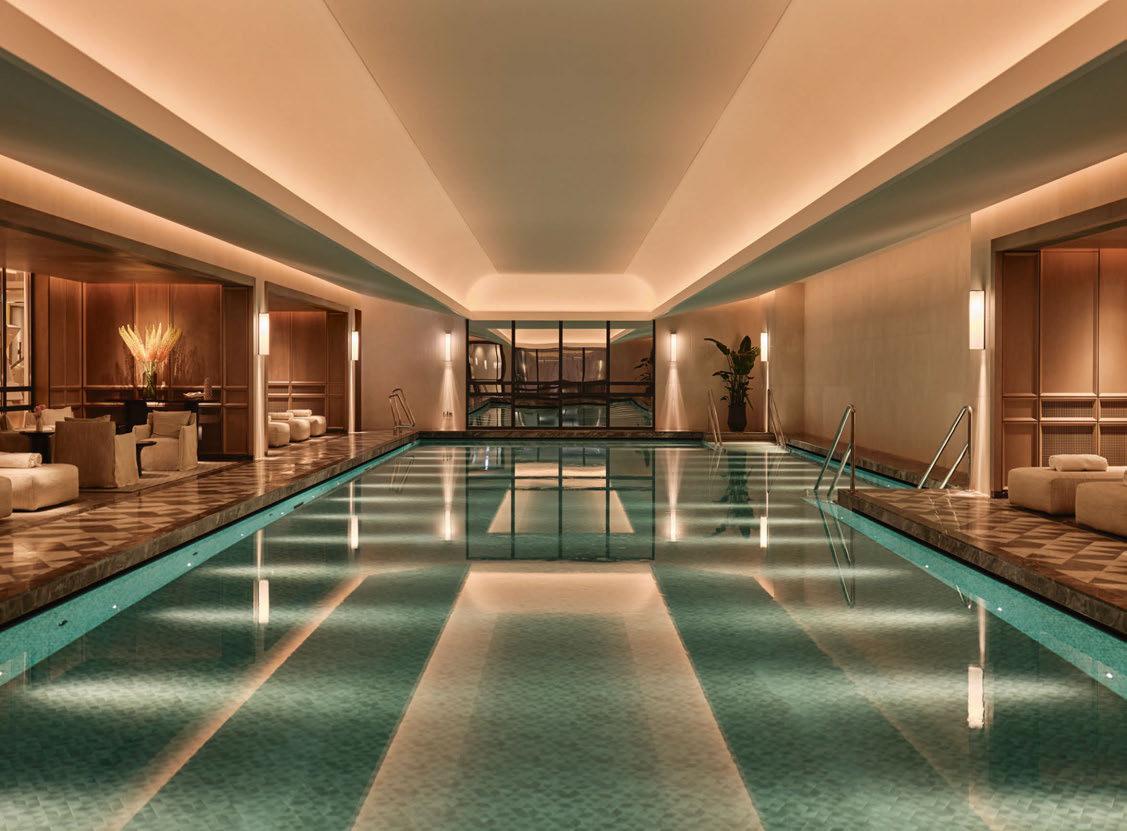
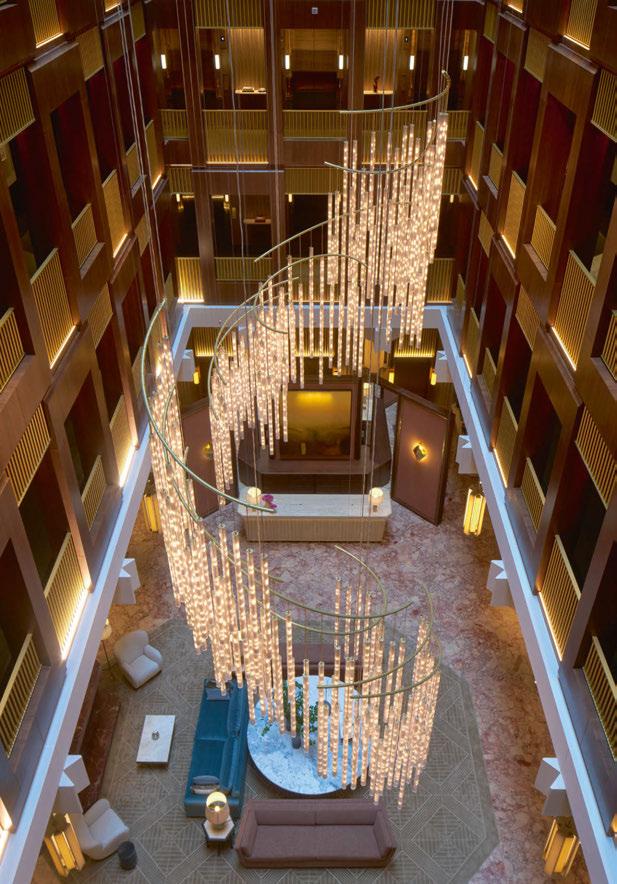
A clear example of how the geometry informed LDI’s lighting approach can be seen in the atria. Saarinen’s diagrid structure establishes a strong sense of rhythm and horizontality, and this architectural language informed how the lighting was arranged throughout the project. Although the atria does not feature the diagrid, the broader architectural order guided the design to balance proportion and spatial emphasis. To bring the atria to life, the team applied a tunable white LED light of 2200-4000k, installed with 10° narrow optics, one lighting up and the other down, to help animate the space. Within the atria, the lighting strategy centres around a dramatic feature installation that occupies the full height of the space, creating a luminous focal point and drawing the eye vertically through the volume, establishing an atmosphere of luxury and glamour for the guests while simultaneously complementing the architecture.
“Elsewhere in the building, we refurbished the original fittings integrated within the diagrid, preserving an important layer of the building’s historical narrative while upgrading their performance with contemporary light sources,” adds Svenson.
The hotel features 144 suites, including two expansive penthouses, all designed by Dirand. The interiors use a warm, embassy inspired palette of wood, velvet, and rich materials, complemented by green, purple, and cream tones, sandy hues, and opulent finishes. Like the Dirand’s design, the lighting strategy follows the same suit, restrained and material-led. Here, light is used not to light the space directly but to reveal texture – drawing out the depth of timber fluting, the softness of the velvet, and its existing architecture through carefully controlled sources. Grazing linear light is integrated discreetly into the architectural details, allowing surfaces to appear yet avoid being overtly lit. This approach shifts the visual emphasis away from the fixtures and towards the materiality, creating an atmosphere that feels inherently residential. A layered strategy ensures that this softness does not come at the expense of function. Decorative pendants and wall lights establish mood, while concealed task lighting is precisely integrated to support mirrors, wardrobes, and bathrooms without introducing glare. Throughout, there is a deliberate reduction in the reliance on downlights. Instead, reflected light from curtains, panelling, and high-level coves contributes to the perceived brightness of the space, allowing illumination to feel ambient rather than directional. In the penthouse suites, this language becomes more expressive, with concealed vertical lighting integrated into wall slots as a subtle design feature. Yet even here, restraint is maintained with low-level and indirect lighting shaping evening scenes, while spotlighting is deliberately minimised.
The result is a series of interiors where light is inseparable from material that delivers a sense of quiet luxury.
In contrast to the intimate suites, the corridors present a fundamentally different challenge. With little to no access to natural light, the risk of monotony and spatial compression is significant. Rather than relying on uniform illumination, the design uses contrast to articulate the journey. Miniature downlights highlight fluted wall details, while concealed cove lighting increases the perceived width and height of the space, allowing surfaces to unfold gradually as guests move through.
Additionally, illuminated artwork creates moments of focus and visual pause that break the potential repetition of the plan. Tunable white lighting plays a key role in shaping the temporal experience of these internal spaces. By shifting colour temperature throughout the day from cooler and brighter during daytime hours, to warmer and more subdued in the evening, the lighting subtly provides a sense of time and comfort, compensating for the absence of daylight. Within the spa at The Chancery Rosewood, the lighting strategy shifts deliberately away from the architectural rigour that defines the rest of the building. Designed in collaboration with design studio Yabu Pushelberg, this space introduces a softer, more immersive environment, where light is used to support relaxation and sensory experience. “The lighting language in the spa intentionally diverges from the rest of the building to align with the contemporary, softer architectural tone of the space,” says Brookes. “The spa introduces a warmer and more enveloping atmosphere, so the lighting becomes lower, more tactile and more immersive, creating a calm and intimate environment that supports relaxation. However, there is still a subtle connection to the overall architectural narrative.”
Around the pool, the approach is notably restrained, with underwater illumination providing a subtle glow that animates the water. Reflections are allowed to play across surfaces, reinforcing a sense of calm and stillness, while avoiding any overt spotlighting of occupants. Balancing ambience with safety is critical in a wellness environment, so low-level lighting elements such as floor washers, recessed uplighters, and integrated linear details guide movement intuitively through the space. Commenting on the saunas specifically, Svenson adds: “Steam rooms and areas with humidity can be technically difficult, and therefore require IP-rated fittings and careful material specification within the operating temperature ranges. This does limit certain fixture types, but with our detailed sketches, mock-ups and discussions with the manufacturers, it did not hinder the conceptual ambition.”
Client: Qatar Diar Europe
Lighting Design: Charlotte Svenson, Sandra Brookes; Lighting Design International, UK
Architect: Sir David Chipperfield, UK
Interior Design: Joseph Dirand, France; Yabu Pushelburg, Canada
Lighting Specified: Architectural FX, DGA, Ecosense, LightGraphix, Lucent, Lutron, Stoane Lighting
Photography: Edmund Sumner, Ben Anders
The result is a space that feels distinctly separate from the rest of the building, yet still connected through its underlying discipline, which is the lighting strategy. Light becomes an atmospheric quiet, immersive and restorative, supporting the transition from public intensity to a more private experience.
The lighting concept for The Chancery Rosewood may look effortless, but according to Svenson and Brookes, delivering it required a huge amount of technical coordination. Many of the biggest challenges arose during construction, especially in areas where new lighting had to be fitted around the original structure. Full-scale mock-ups were invaluable to the lighting designers, allowing them to test details, refine the positioning of the luminaires, and resolve potential conflicts before construction, ensuring the final solution remained both discreet and technically robust. In several cases, bespoke solutions were needed; existing fittings in Saarinen’s original diagrid had to be adapted, and new ways of integrating lighting were developed where standard fittings were not allowed. Ultimately, the success of the project relied on how
seamlessly these challenges were resolved, where lighting appears calm and minimal – yet beneath the surface is a highly coordinated system that supports the architecture without ever drawing attention to itself.
For Lighting Design International, The Chancery Rosewood offered a clear reminder that lighting, particularly in heritage projects, must operate with humility. In contrast to perhaps a new build, where lighting can often define or dominate a space, working within an existing landmark demands the most restrained and interpretive approach. The role of lighting is not to overwrite history, but to unveil a side to its story that hasn’t yet been told by drawing out textures, proportions, and spatial rhythms that otherwise might not have been noticed.
“This project reminded us that lighting must remain humble and discreet. It should support the architecture rather than compete with it. Yet lighting is fundamental, because without the good lighting, even the most luxurious environment will not feel or look right,” says Brookes. www.lightingdesigninternational.com

Not only light
Pyrymyd brings comfort. Acoustic. Visual. Aesthetic. From above. From the ceiling that shapes the space creating a new standard of ambience.
Design: Serge & Robert Cornelissen
Designed by DLSM Studio, with lighting from Into Lighting, the newly opened Radisson RED at Twickenham’s Allianz Stadium celebrates the heritage, energy, and community spirit of rugby culture, with an additional vibrant flair.
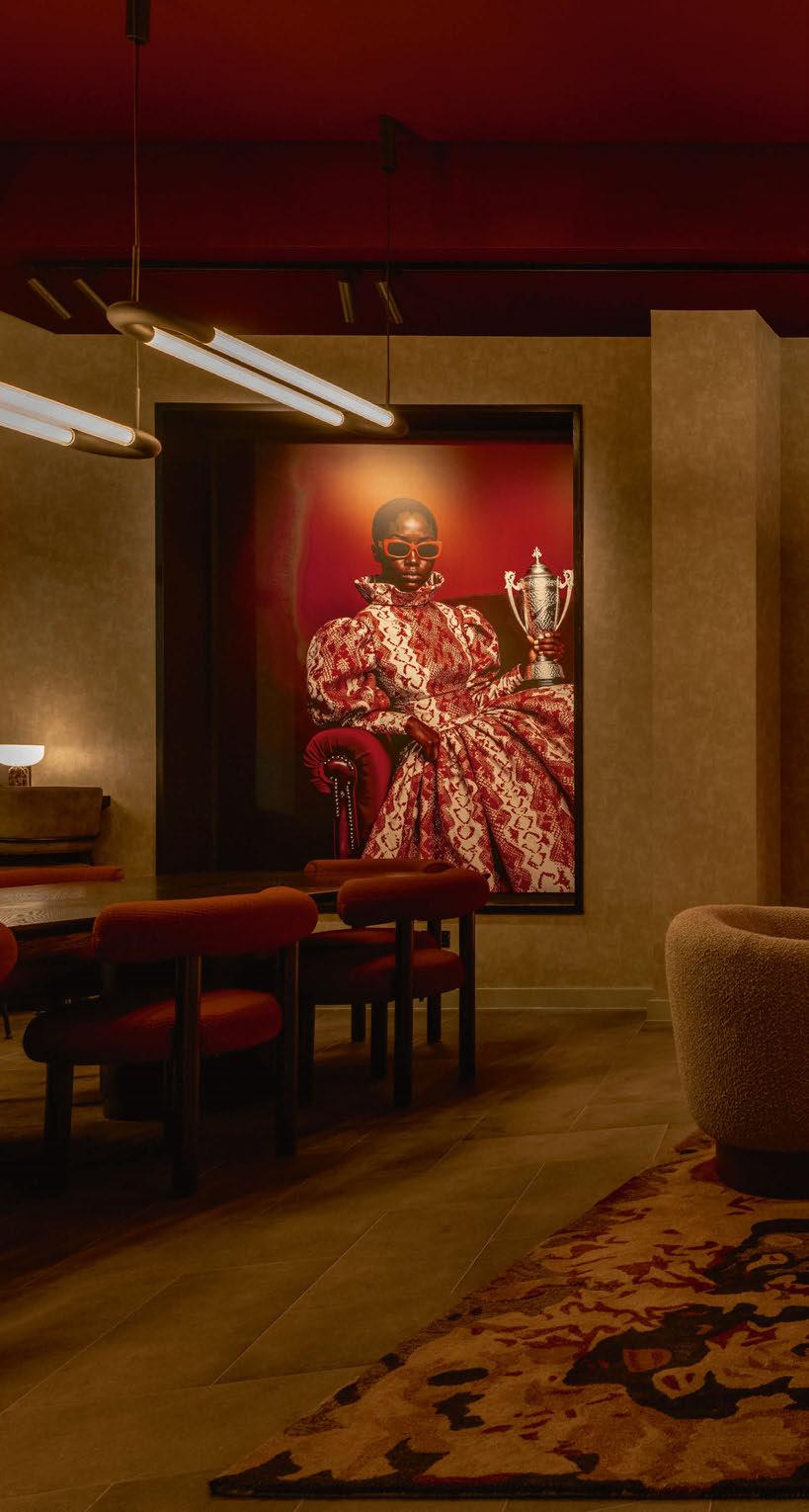
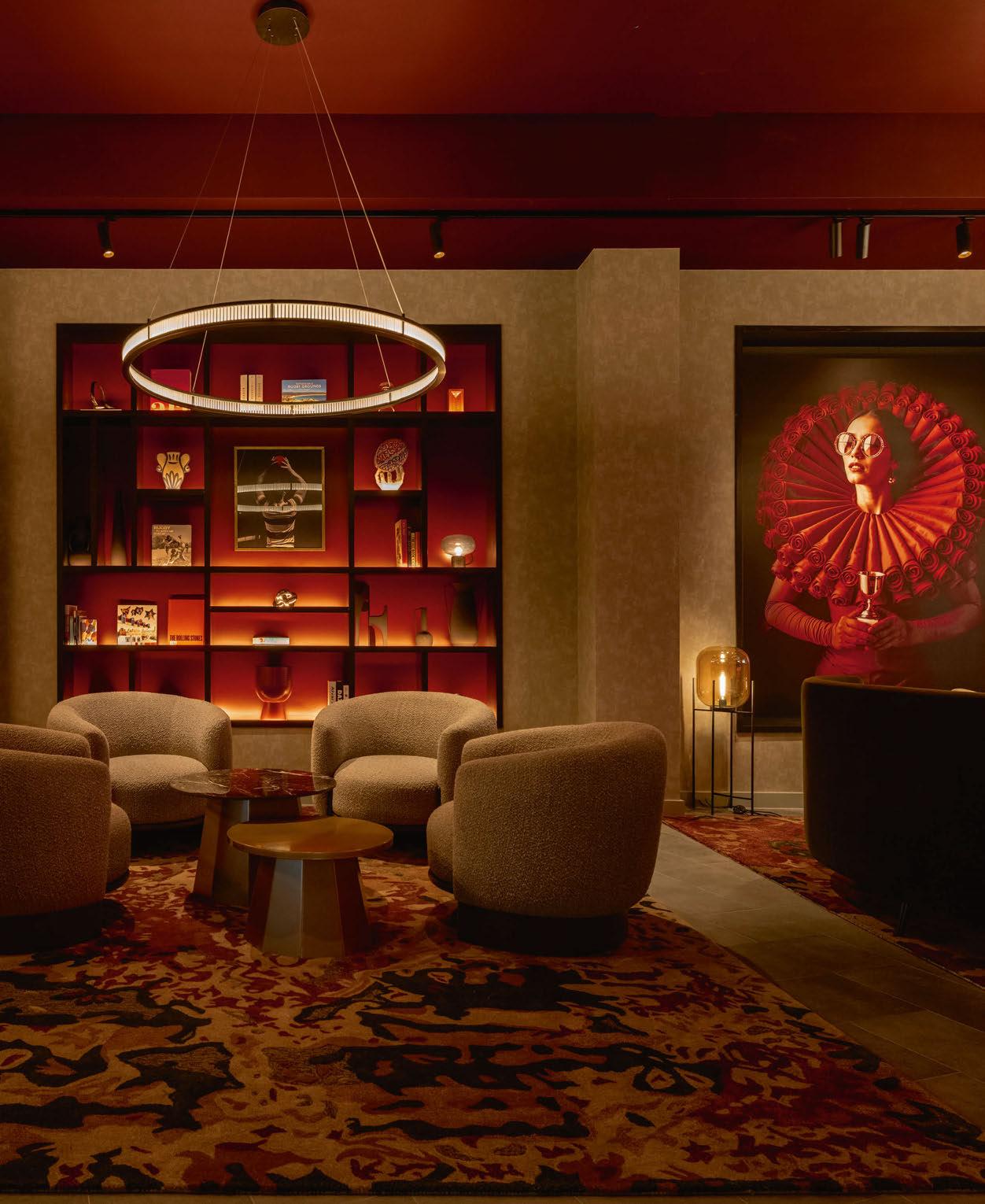
t the home of English rugby, a new hospitality destination has opened up that fuses vibrancy and tradition, in an effort to encapsulate the aesthetic of the modern game.
Radisson RED London Twickenham is situated within the iconic Allianz Stadium (Twickenham) – owned by the Rugby Football Union (RFU), and operated by Aimbridge Hospitality EMEA, the property has been fully reimagined with the bold, dynamic personality of the Radisson RED brand, underpinned by a design narrative that celebrates the heritage, energy, and community spirit of both the RFU and rugby culture.
Spearheading the design of this new hotel was DLSM Studio, whose work spanned across the property’s 150 guest rooms, reception, lounge, co-working areas, event spaces, and washrooms –as well as two newly formed social concepts: The Loft, and The Huddle.
The Loft, situated on the mezzanine floor, consists of a bar, gaming area, and premium lounge space; while The Huddle, on the ground floor, is the main bar and restaurant for the property, appealing to both locals and hotel guests alike.
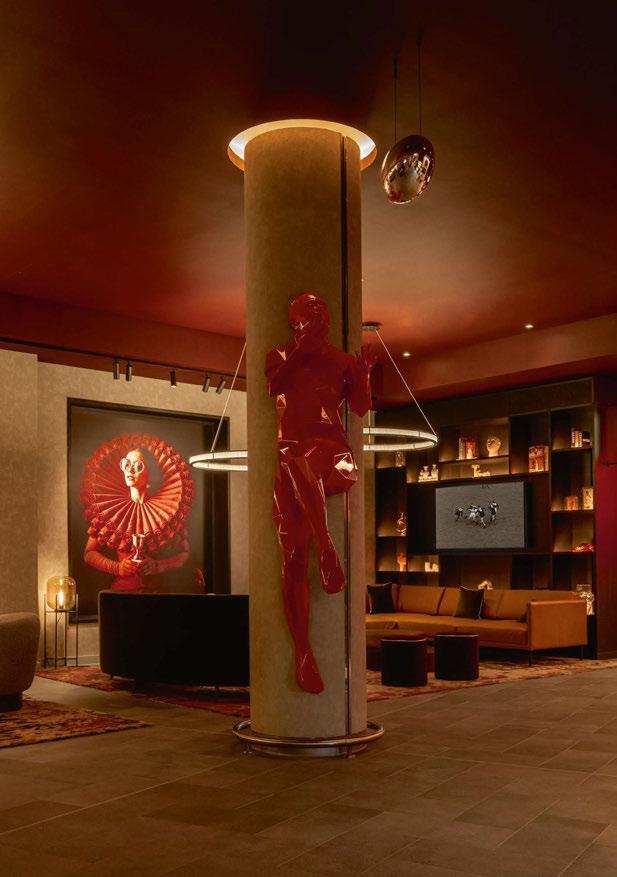
With this in mind, DLSM Studio approached the studio not only as a design exercise, but as a chance to reposition the hotel’s role within Twickenham.
Guided by extensive strategic insight, the team undertook a detailed study of the hotel’s operations, guest profiles, community needs and wider market potential, identifying the importance of creating a destination that would resonate beyond matchdays, when the stadium welcomes up to 82,000 spectators.
The result is a concept that actively appeals to local residents as well as guests, with co-working spaces, all-day lounge zones and art-infused social areas offering a warm, everyday backdrop to work, relax, dine, and gather.
Alongside the community-centred approach, DLSM Studio hoped that the interiors could match both the identity of Radisson RED as a brand, and also of RFU – a process that Emma Caballero, Interior Designer at DLSM Studio describes as “surprisingly smooth”.
“We found the sweet spot in between RFU’s brand identity, and that of Radisson RED. By selecting materials such as black metal, which can feel harsher and more urban, and coupling with reeded glass, which feels a bit softer and more elegant, there was a marriage of materiality, tactility, and different levels of energy across the various zones that works really well. There were high expectations, as both RFU and Radisson RED were really excited about how the future of the hotel could look – they both saw the potential of what we could bring, especially to the new spaces.”
DLSM Studio therefore understood that lighting would be integral to achieving this urban, yet elevated aesthetic. To that end, Into Lighting was invited to tender for the role of lighting designers by the RFU, project managers NBM, and DLSM Studio, based on its portfolio of completed hospitality projects.
“We knew that lighting was going to be key from the get-go, and it is something that we considered from the beginning of the concept stage,”
Caballero adds. “Into was appointed when we were still doing the mock-up room. We had already developed the visuals for the whole hotel and had them approved by the RFU, so we knew what we wanted to achieve, but we didn’t know exactly how.
Hosting a workshop with Into and talking through our vision, their team broke it down and proposed a very layered scheme with various approaches to the architectural, feature, and integrated lighting. They advised on where exactly to position LEDs, on the finishes to the artwork, and so on – they were really helpful.”
Darren Orrow, Director at Into Lighting, adds:
“DLSM Studio had a strong vision for the interior design concept and the ambience. They wanted to push the boundaries creatively while also aligning with Radisson’s brand guidelines. Some bespoke, high-impact lighting concepts featured in their vision, and we had a series of design workshop sessions where we explored, challenged and developed a number of ideas – reviewing working samples and mock-ups.”
Available in three finishes & two designs

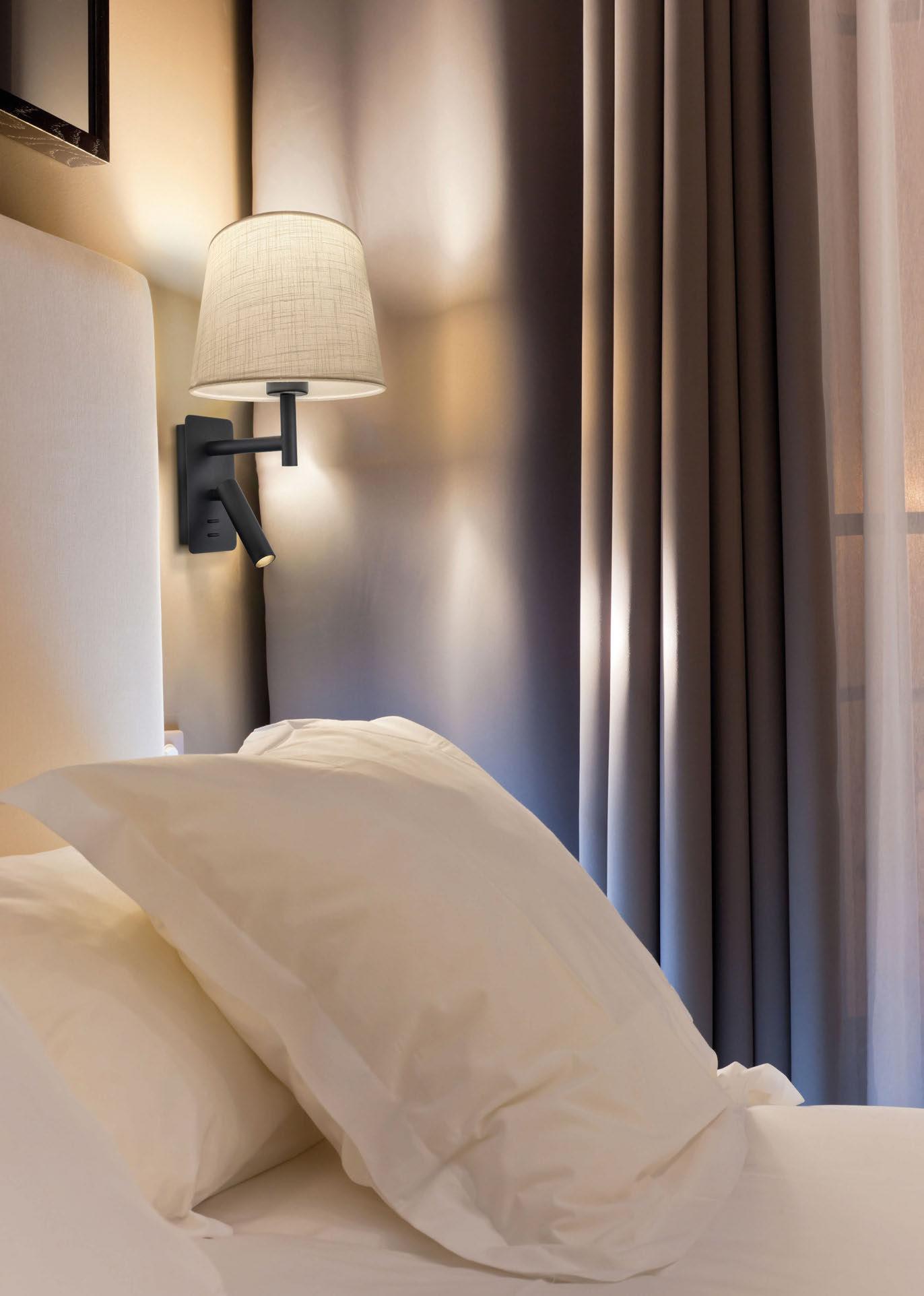
The lighting concept for the hotel was developed in conjunction with DLSM Studio as an integral part of the interior architecture – supporting further the bold brand identity of Radisson RED, while responding sensitively to the building’s unique context within such a renowned sporting location. The approach, Orrow explains, was therefore centred on creating an atmosphere that feels “energetic, yet refined”, blending moments of drama with warmth and intimacy.
“Lighting was used not simply to illuminate, but to shape perception, guide movement, and create emotional resonance throughout the guest journey – from arrival and public spaces through to more intimate areas of retreat,” he says.
A carefully layered strategy combines architectural lighting, decorative elements, and accent illumination to establish depth and contrast. In public areas, controlled highlights draw attention to textures, materials, and key design features, while darker interstitial zones allow the illuminated elements to stand out, creating a sense of rhythm and visual intrigue. The lighting also aims to respond to the bold forms and colour palette set
out by DLSM Studio, enhancing materiality without overpowering the interior narrative.
Orrow continues: “Dynamic contrasts between light and shadow were intentionally employed to reflect the vibrant, playful character of the Radisson RED brand, while warmer tones and softer transitions ensure the spaces remain welcoming and comfortable for guests.
Throughout the project, glare control and visual comfort were prioritised, particularly in lounge and social areas, ensuring the lighting supports both social interaction and relaxation.”
Working closely with DLSM Studio, Into homed in on a palette of architectural light fixtures, integrated fixtures for use in joinery, and decorative and bespoke options. The decorative solutions primarily came from DLSM Studio, who Orrow says “had a strong narrative and aesthetic for the decorative lighting”.
From here, Into assessed through lux calculations how much light these would contribute to the overall ambience. Using this data, Into then considered if and where any additional architectural lighting was needed – resulting in the specification of additional integrated lighting, downlighting, and track spotlights.
“We also assessed the required dim protocols for the decorative lights, and their compatibility with the lighting control system. In some cases, this meant some fixtures were not suitable and had to be reselected,” Orrow adds.
“Into provided guidance on a number of large scale bespoke light features, which were a crossover between architectural and decorative features.”
Elaborating further on the narrative and aesthetic for the decorative lighting, particularly in the public-facing hospitality spaces, Caballero says that DLSM Studio had two different strategies.
“For the ground floor, we took a calmer and more welcoming approach, easing guests into the space, while still having that bold, fun aesthetic associated with Radisson RED – but it was about creating an approachable entrance to the hotel.
“Decorative lighting, such as table and floor lamps, was therefore used to soften the space, creating cosy nooks to compliment the layered interiors that are brought to life with curated dressing items and quirky artefacts, reflecting the rugby culture and Radisson RED personality.”
Indeed, the lobby of the hotel has been transformed into a vibrant, multifunctional space where dramatic colour contrasts, layered textures and curated artwork create a sense of energy and connection – a sense that Orrow feels is further strengthened through a combination of “high impact and unique statement lighting pieces”, while ensuring that all textures, graphics, and displays were theatrically lit.
Taking centre stage in the lobby space is a bespoke, sculptural installation of a female rugby player integrated into a structural column, symbolising the RFU’s commitment to its “Every Rose” five-year action plan to elevate women’s rugby. This statement piece serves to reinforce the hotel’s connection to its setting, while amplifying the inclusive values at the heart of the RFU’s vision.
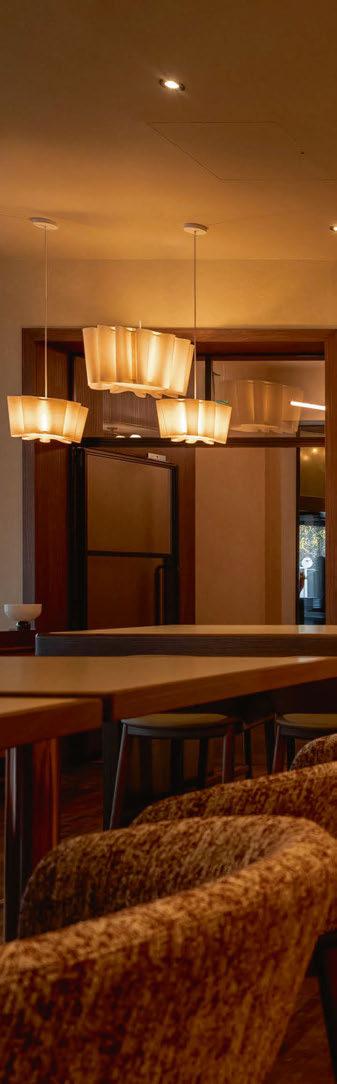
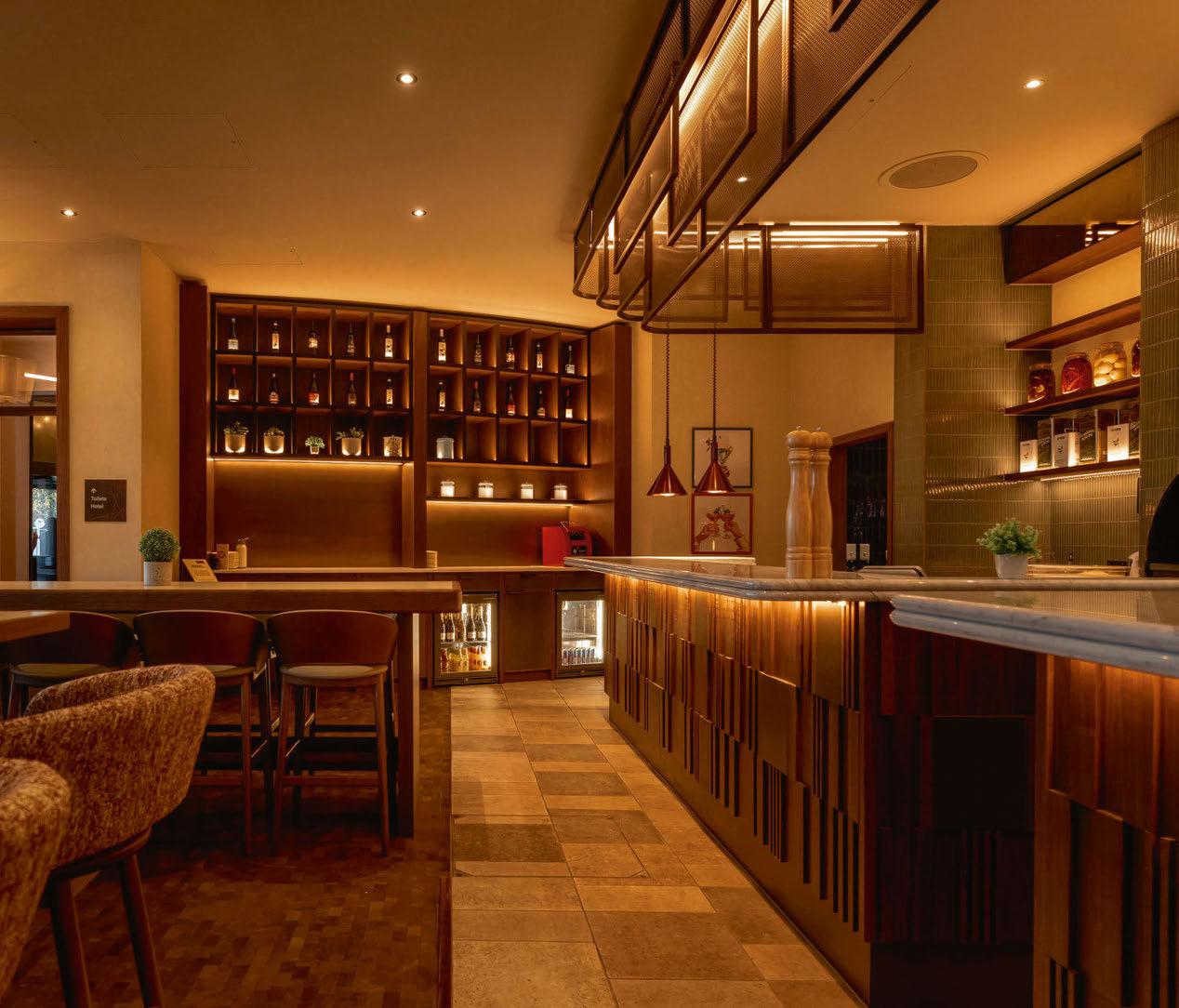
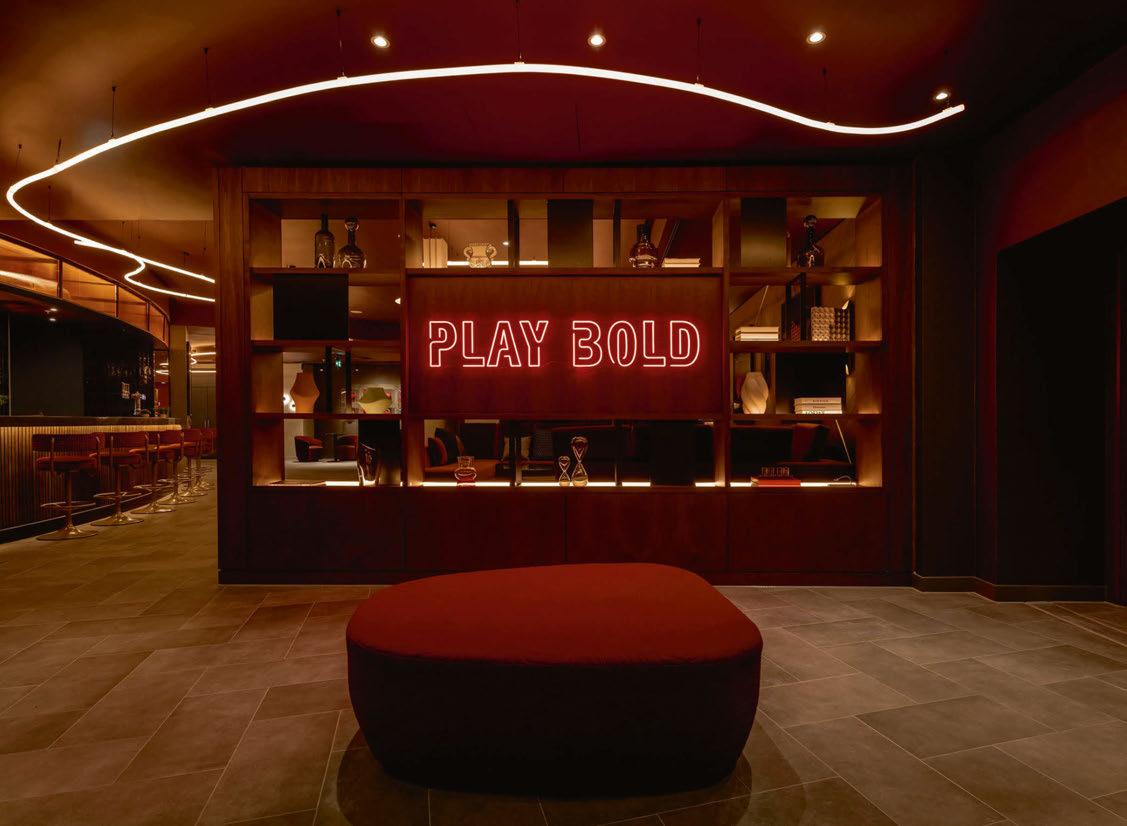
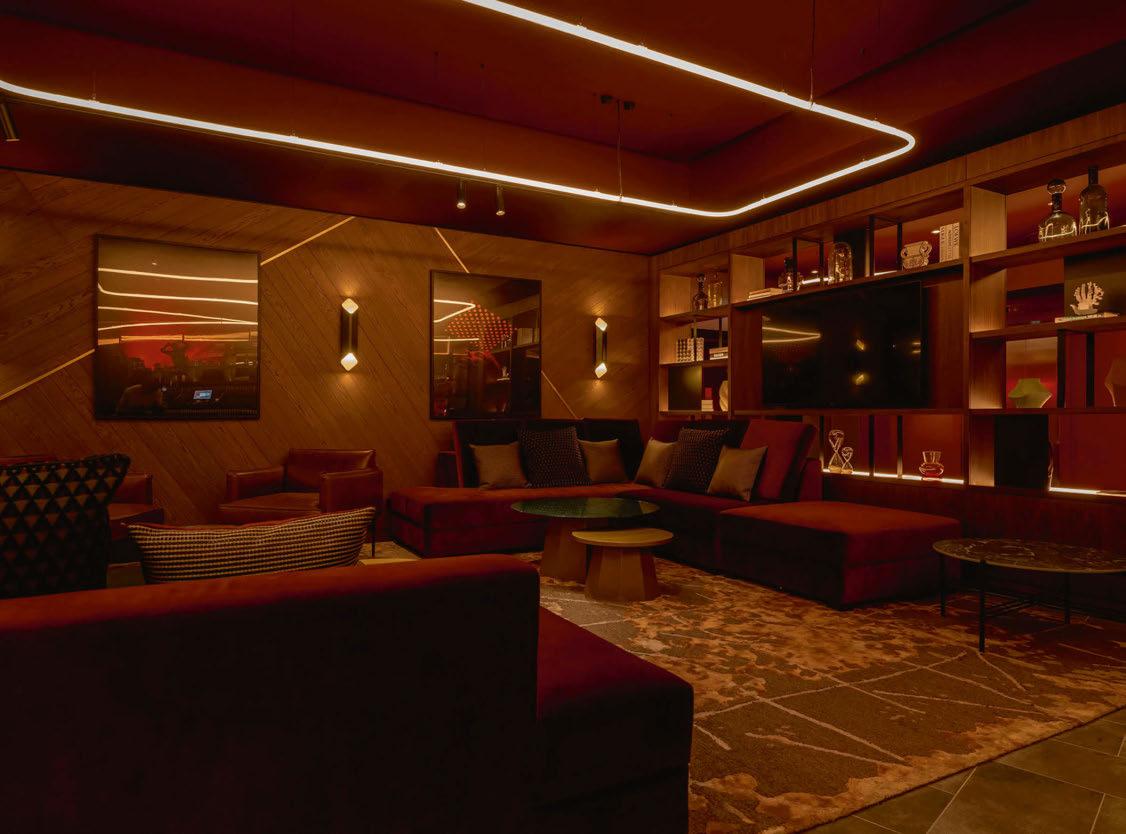
Connection was also key to the design of The Huddle, the hotel’s standalone restaurant, where DLSM Studio looked to create a stronger link with the local community.
Influenced by the crafted materiality of historic rugby equipment, such as stitched leather and rugby shirt-inspired stripes alongside warm timber detailing and tactile finishes, the restaurant presents a playful, artisan-led environment that shifts between casual dining, weekend socialising, and the high-energy atmosphere of match days. Lighting here emphasises the warm materiality of the space. Into wanted to create a warmer, cosier environment in The Huddle, so they specified 2700K for all architectural lighting and 2200K for all integrated lighting to architectural details, joinery and decorative lighting. In all other areas the colour temperature of the decorative lighting was adjusted between 2200K and 2700K to suit the use of each space and what CCT worked best visually with a particular light fixture.
In the first-floor event space Into specified tuneable lighting for the bespoke light rings. The lighting in the event space is DALI addressable, which gives the Client maximum flexibility on the use of the space and zoning of the lights. Through careful circuit grouping of light fixture types, Into could also transition from higher ambient light levels during the day, to low-level, intimate, and theatrical lighting post-dusk and into the evening.
On the first floor, in The Loft, everything was designed to be bolder, and more fun and playful, with a focus on having key, feature ceiling lights. “We had the idea of bringing the feeling of motion and movement, inspired by the players on a rugby pitch,” Caballero adds. “We wanted to add a neon-style light running across the whole floor, like a long exposure of film. Into was really helpful in terms of specifying this lighting. They had done this before, so they were mindful with the key suspension elements, so that we didn’t have too many, but enough to make it a flowing piece. The lighting really brings energy to this social space.”
An experience that was not without its challenges though. On the key difficulties that were faced during this project, Orrow recalls that, due to the fact that the site was a preexisting hotel under another brand, there were elements of the ceiling,
wiring and services that were initially considered to be retained due to cost. “This meant that we had to design ceiling recessed and mounted lighting with this in mind to avoid any existing architectural construction and services,” he says.
“It was a challenge to balance use of existing locations and void depth with the new interior design layouts. But, as the project progressed, it was decided that the ceilings would be replaced, and we then had to rework the detailed design to accommodate this, while not undoing the detailed lighting design and circuiting approach.”
Caballero concurs, adding: “Transforming this property into a Radisson RED brand with various stakeholders involved required a strategic approach to design. Meeting the needs of the RFU, Aimbridge and Radisson, the property required a bold re-design to signify change and extend its appeal to the wider community, which included a review of the hotel’s offering. Delivering spaces that welcomed hotel guests and the public to rest, gather, dine and socialise within, from morning through to night.”
Indeed, this focus and emphasis on transitioning the spaces through the day with the lighting has paid off, as the dramatic, atmospheric light installations help to shape the hotel’s overall identity, intensifying the bold visual language that is at the heart of the Radisson RED experience.
Reflecting on the project, Orrow concludes: “The lighting enhances the architectural language of the hotel, and amplifies the interior concept, delivering a distinctive atmosphere that is rooted in both place and brand.
“We have worked with DLSM Studio on many projects over the years – they understand the value a lighting designer brings to a project. They listen and learn, but still challenge to ensure their vision is realised. Through this close collaboration with both DLSM Studio and the client team, we feel that we have delivered a cohesive, immersive environment that balances bold expression with subtlety – creating a memorable experience for guests at this landmark location.” www.into.co.uk www.designlsm.com
Client: RFU, Aimbridge Hospitality EMEA
Lighting Design: Darren Orrow, Anthony Stead; Into Lighting, UK Interior Design: DLSM Studio, UK Lighting Specified: Aromas, Astro, Atea, Bomma, Chantelle, Demo Lights, Dyke & Dean, Eicholtz, Enigma, Encapsulite, Flos, Frandsen, Illumination, Insight, Kemps, Lamp Twist, Light Box, Made In Design, Marset, Mode Lighting, New Works, Nocturne Studio, Optelma, Philips Kazzar, Polpo Products, Pooky, Royal Design, Segula Photography: Stevie Campbell
Creative
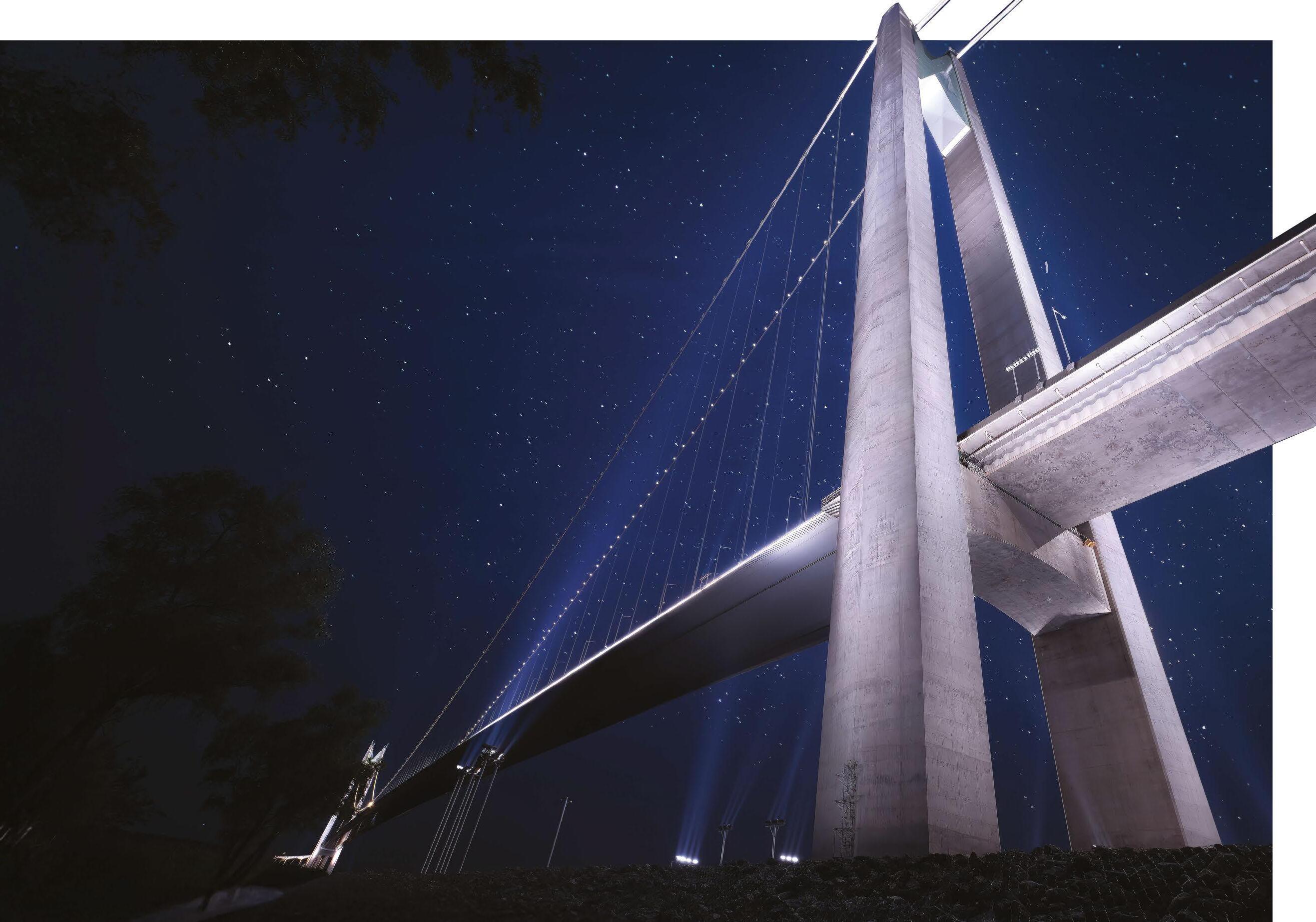
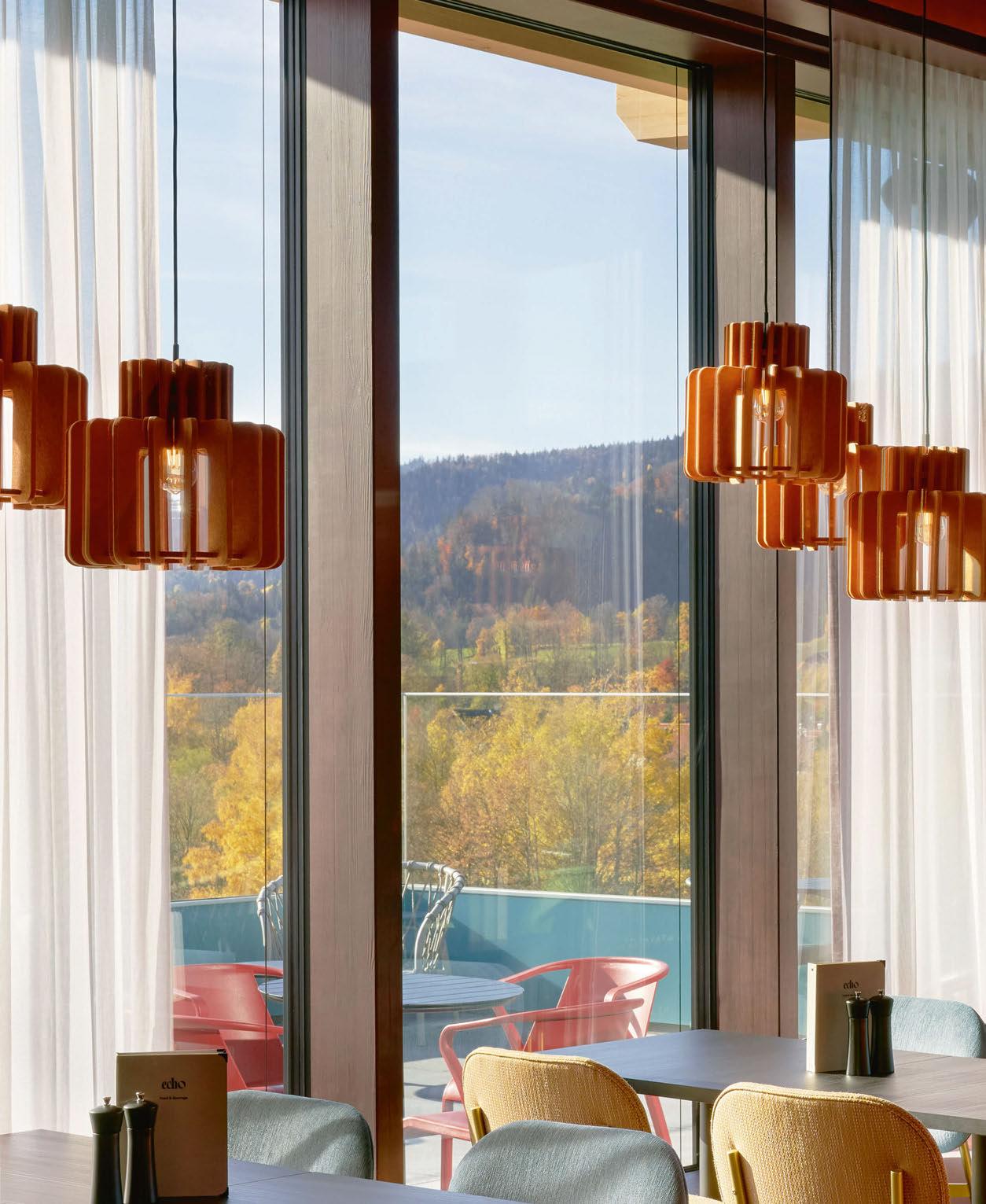
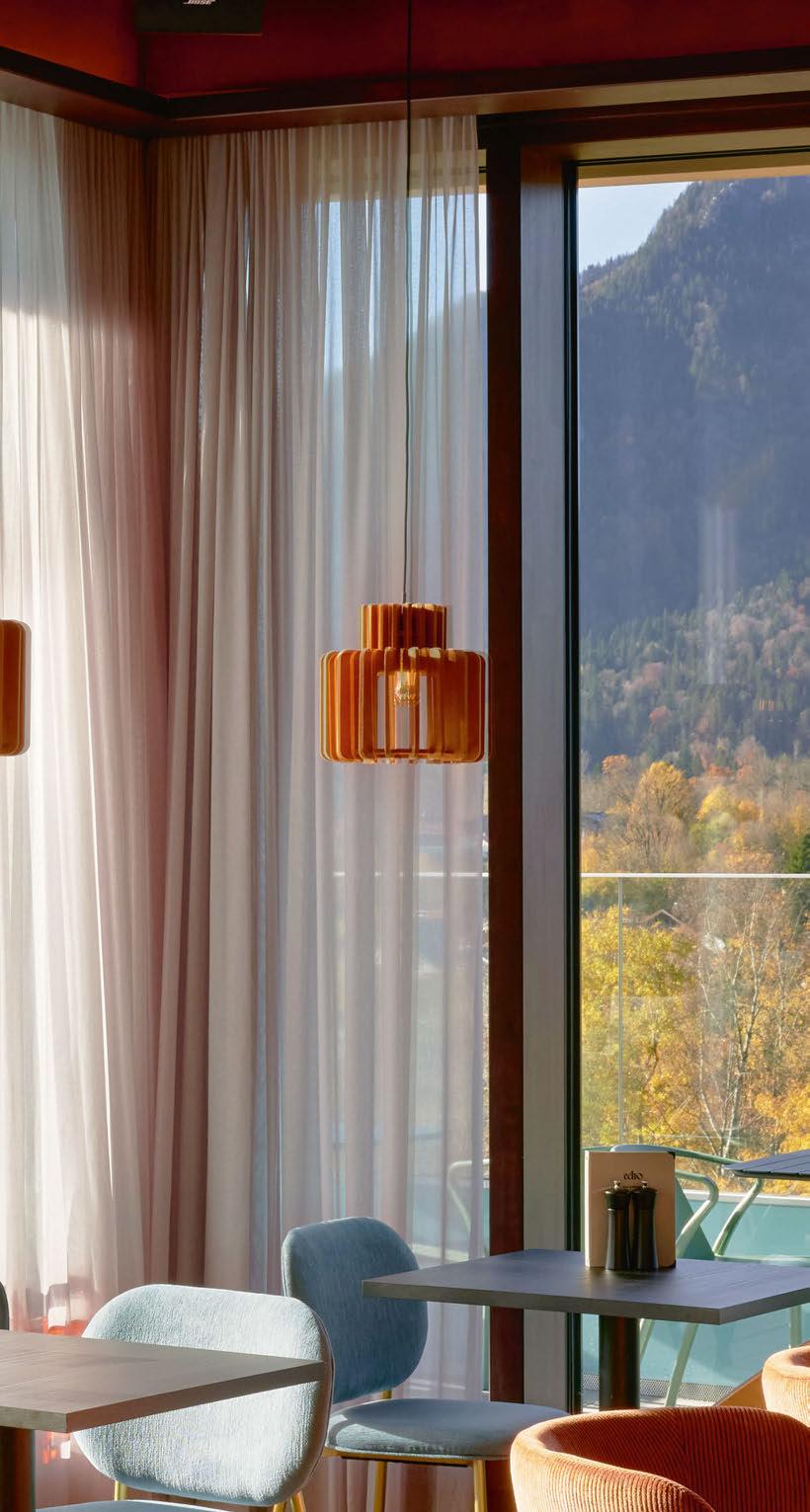
A historic hotel has been reborn, marrying its 1970s heritage with contemporary design and its local roots, combining the thrill and glamour of James Bond with the town’s historical heritage. JOI-Design worked with Weiser Lighting to create a scheme that resonates with locals and a new, younger audience.
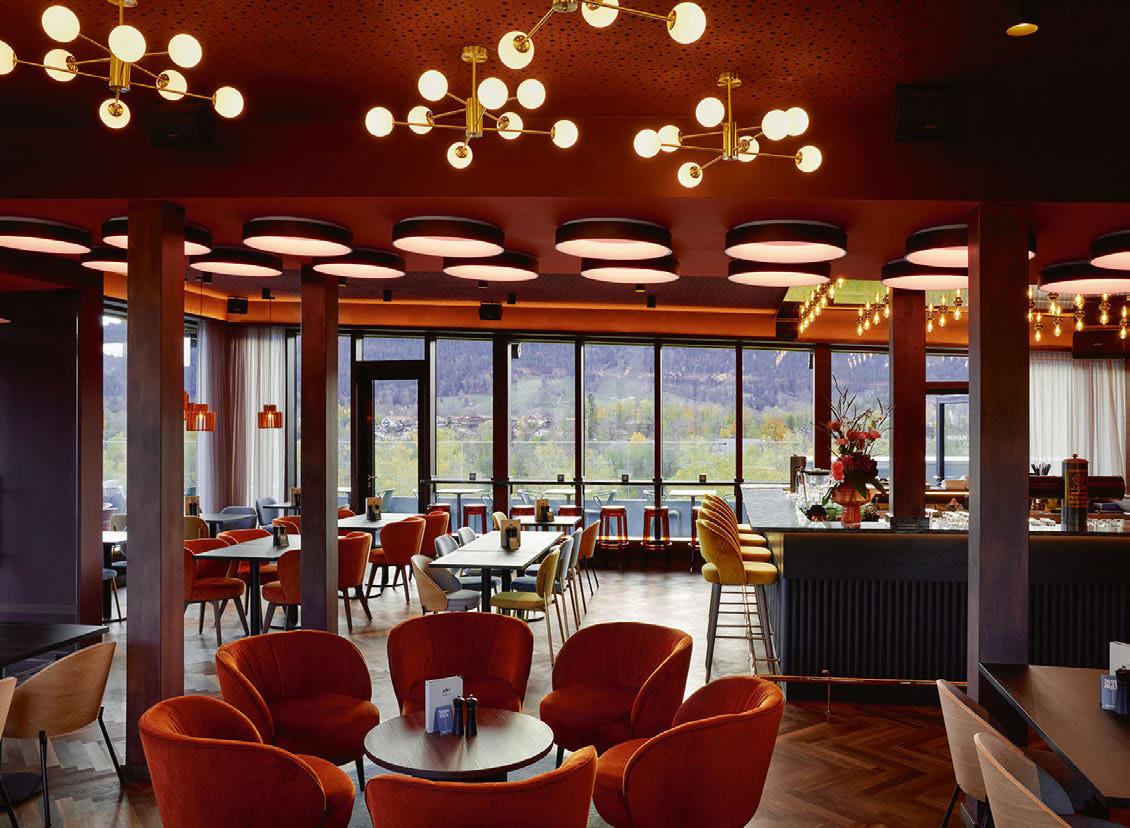
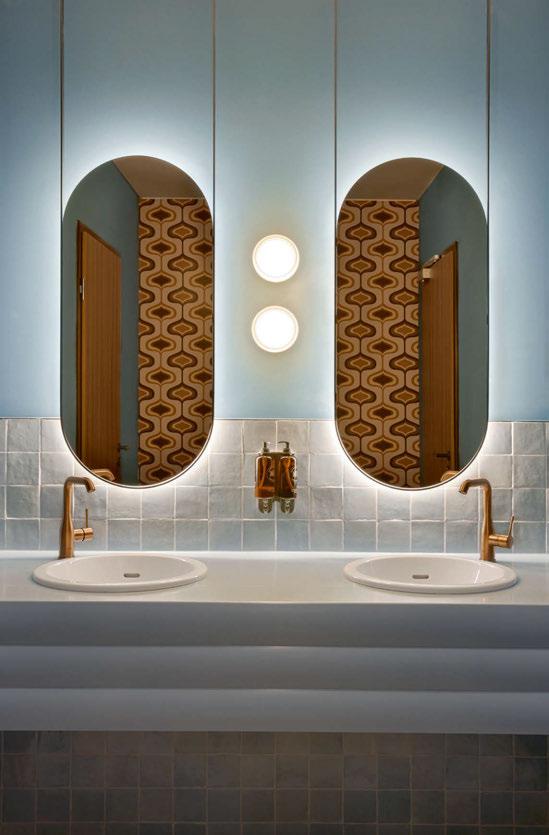
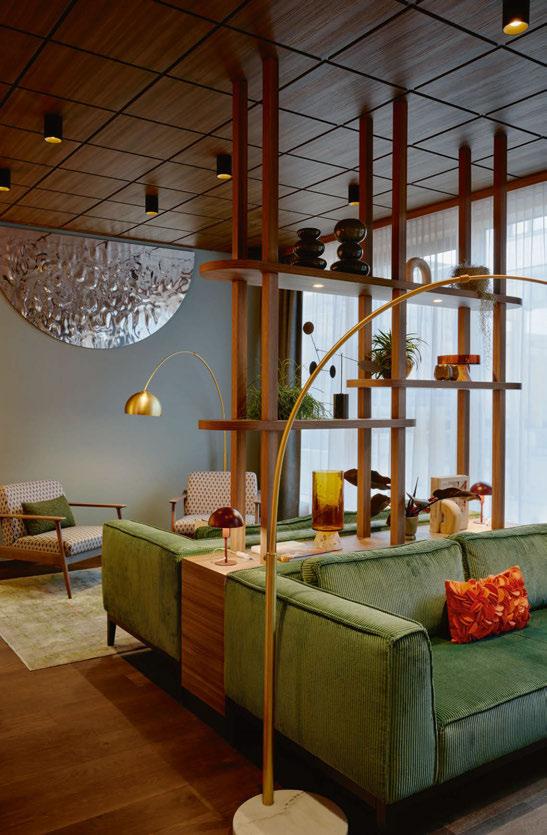
tepping up to Flesslers Lenggries, there’s a moment when the building begins to reveal its character in light. Before you even cross the threshold, timber logs stacked as a nod to the region’s historic rafting tradition, glow gently from below, creating a warm, luminous passageway that bridges past and present. As the doors open, the mood shifts instantly: a sweeping wall of amber toned luminaires wash across rich walnut surfaces, transforming familiar Alpine cues into something far more unexpected. What unfolds is a playful blend of cinematic warmth and 1970s flair – a groovy, contemporary interior that invites you to cross boundaries between time. It’s an atmosphere that hints at the story behind the building, one shaped as much by its surroundings as by the era in which it was first conceived.
Set in a small Alpine town in Bavaria, Flesslers Lenggries is a cherished local landmark, part gathering place for the community, part home away from home for travellers. Built in 1972 for the Munich Olympics Games, the building carries the weight of its era unapologetically.
JOI-Design, a Hamburg-based branding and interior design studio, was called to inject new life into this beloved hospitality hub after the studio’s co-founder, Peter Joehnk, visited the hotel at the request of owner Signo Hospitality to assess its potential. What began as an informal site visit quickly evolved into something more substantial; the structure’s location and character revealed an opportunity that extended beyond simple refurbishment.
Rather than erase the identity of the hotel, designer and Partner Sabrina Voecks – who took charge of the rebranding – and Henrich Böhm, Senior Designer – who led the interior construction – chose to amplify it, weaving two distinct narratives: the “jet-set glamour” of the 70s and the deep local history of timber rafting. The latter inspired the new name, with Flesslers being the old German word for raftsmen, anchoring the brand to its roots. These masters once guided timber down the Isar River that runs next to the hotel, connecting Bavaria with the rest of the world. In 2022, timber rafting was named by UNESCO as a heritage sport of cultural significance. The legacy lent the hotel its name and inspired the easyflowing rhythm of the interiors.
“We also had James Bond movies at the centre of our vision. We were picturing The Spy Who Loved Me, with images of him in the 70s, running down the slope and drinking martinis. It was this kind of jet set lifestyle we wanted to evoke,” says Voecks.
Throughout the hotel, JOI-Design translates this dual narrative into a series of immersive spatial experiences. In the lobby, sculptural forms inspired by the Isar River create a fluid arrival sequence. Warm walnut finishes and ochre-toned furnishings establish a tactile connection to both the natural landscape and 1970s interiors. Intimate seating nooks and open-plan lounges balance sociability with retreat, reflecting the hotel’s dual identity as both adventure base and lifestyle destination. The lighting scheme comes into effect as a unifying element that connects the two narratives. Illumination became the medium through which the glamour of the 1970s and the heritage of the surrounding landscape could be brought into dialogue with the hotel’s identity and its experience. “Light is a really strong design element from the beginning,” explains Voecks. She goes on to point to the role of large-scale installations such as the 70s inspired installation in the lobby.
The bespoke installation mimics concentric circle patterns of the era, strategically placed by the reception desk and ochre sofa. By applying the lighting retrospectively, the designers could develop key gestures in parallel with the broader interior concept, ensuring the atmosphere carried a distinctintent.
While JOI-Design defined the visual language of the interior, lighting designer Martin Weiser played a crucial role in shaping how the spaces are ultimately experienced and tying the opposing narratives together. As Weiser puts it, his role is not merely technical but to “act as a mediator between the technical and design part”, which brings the whole concept to life.
While Weiser may not have designed the installation himself, he picked luminaires that could complement the vintage aesthetic while implementing a control system that subtly adjusts intensity and colour temperature throughout the day, such as cooler tones in the morning and warmer, more intimate tones in the evening. The next space at ground level is the Nepomuk Bar and Grill, which acts as the hotel’s social anchor for guests and for the locals. Named after the patron saint of sailors and raftsmen, the space directly connects to the Flesslers narrative. JOI-Design called for bold, glowing lines in the form of fluid neon lights that draw the guests to the bar and ignite a lively atmosphere in the space. However, in practice, these luminaires produced too much light, which risked the intimacy of the bar. To solve this, Weiser worked with the manufacturer to develop a bespoke solution.
After multiple prototypes, the lights were made using a bendable polycarbonate tube, allowing them to achieve the desired curved and continuous form with a neon glow.
Moving into the neighbouring dining areas, the energy begins to soften, introducing a lighter and more retro palette, creating a juxtaposition between the more contemporary elements of the bar. Here, the space is adorned in an aqua tone, mod-patterned wall coverings, and antique 1970s lighting in the form of flowerpot-style lamps. A central, flexible table anchors the room, functioning as both a communal dining surface and a breakfast station. Just beyond Nepomuk is the beer garden, where the atmosphere extends outdoors. Here, rafting logs are mounted along the walls, creating a traditional Bavarian beer garden setting, furthering its roots in the local culture.
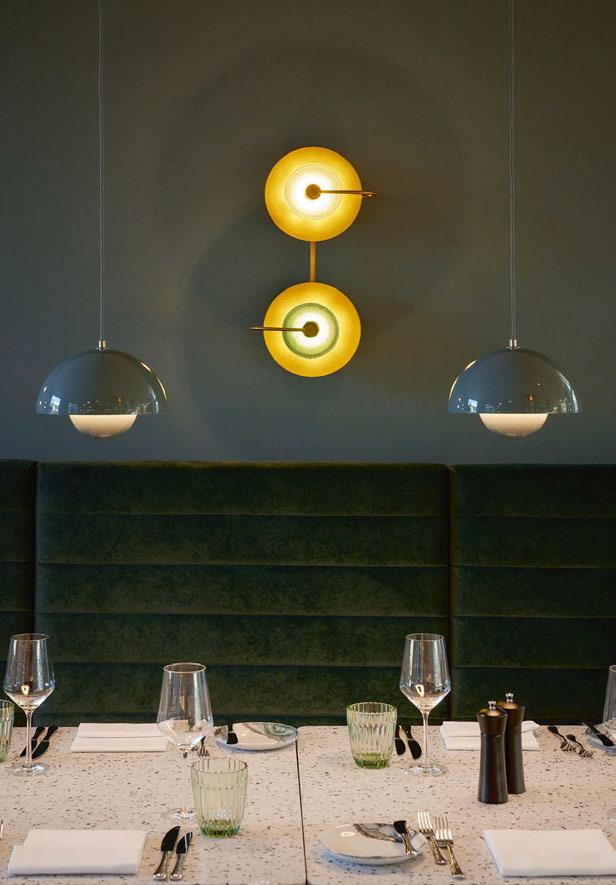
Externally, Weiser adopted a markedly restrained approach, introducing flexible lighting using gobo projectors that cast shifting patterns and colours across the ground, allowing the space to adapt to different events.
Beyond this, interventions were deliberately minimal. A soft glow beneath the rooftop edge subtly defines the building at night, while most exterior areas remain intentionally underlit for environmental sensitivity.
“We didn’t want to highlight a building within a natural space,” he explains, emphasising a design philosophy rooted in environmental respect and atmosphere rather than spectacle.
The Echo Rooftop Bar was conceived as the ultimate expression of the dual identity where alpine escape meets 70s glamour. Here, lighting plays a central role in shaping an atmosphere that shifts effortlessly from relaxed daytime lounging to an energetic evening scene. Set within a newly added upper level, the space combines chalet warmth with a Studio 54-inspired edge, and Weiser’s scheme enhances this duality through carefully controlled intensity and colour.
A dynamic lighting system adjusts throughout the day, with cooler, brighter tones welcoming guests in the morning and warmer, sunset hues taking over as evening approaches. Decorative elements such as glowing circular ceiling luminaires and reflective surfaces amplify the sense of movement and mood, while mirrored ceilings and disco balls heighten the bar’s groovy glamour.
Importantly, the lighting remains adaptable: scenes can be dimmed for intimate cocktail settings or adjusted for livelier gatherings, with table-mounted battery lamps ensuring a comfortable, humanscale glow even as overhead lighting is reduced. Beyond the interior, restraint defines the approach, again with minimal artificial lighting on the terrace to preserve the surrounding landscape, allowing the alpine views and natural darkness to become part of the experience.
“The whole rebrand wasn’t only to refurbish the hotel but to widen the client demographic to a younger audience,” says Voecks. “We kept it a place that is warm and welcoming for guests to relax, but adaptable for parties. We wanted it to feel like a cool place to be in.”
In the guest rooms, the balance is between retro character and contemporary comfort, with a focus on calmness and cohesion. Rather than competing with the bold decorative language seen in the public areas, the lighting here is more restrained, supporting the walnut finishes, green marble accents, and bespoke furniture. Weiser’s approach prioritised the guest experience, ensuring that illumination felt relaxed and intuitive rather than overly technical.
This thinking extends into the corridors, which act as a transitional threshold between the lively, expressive public spaces and the privacy of the rooms. Here, existing downlights were replaced with warmer, softer alternatives to create a gentler ambience, guiding guests towards their rooms with a consistent mood and to avoid a jarring shift in atmosphere.
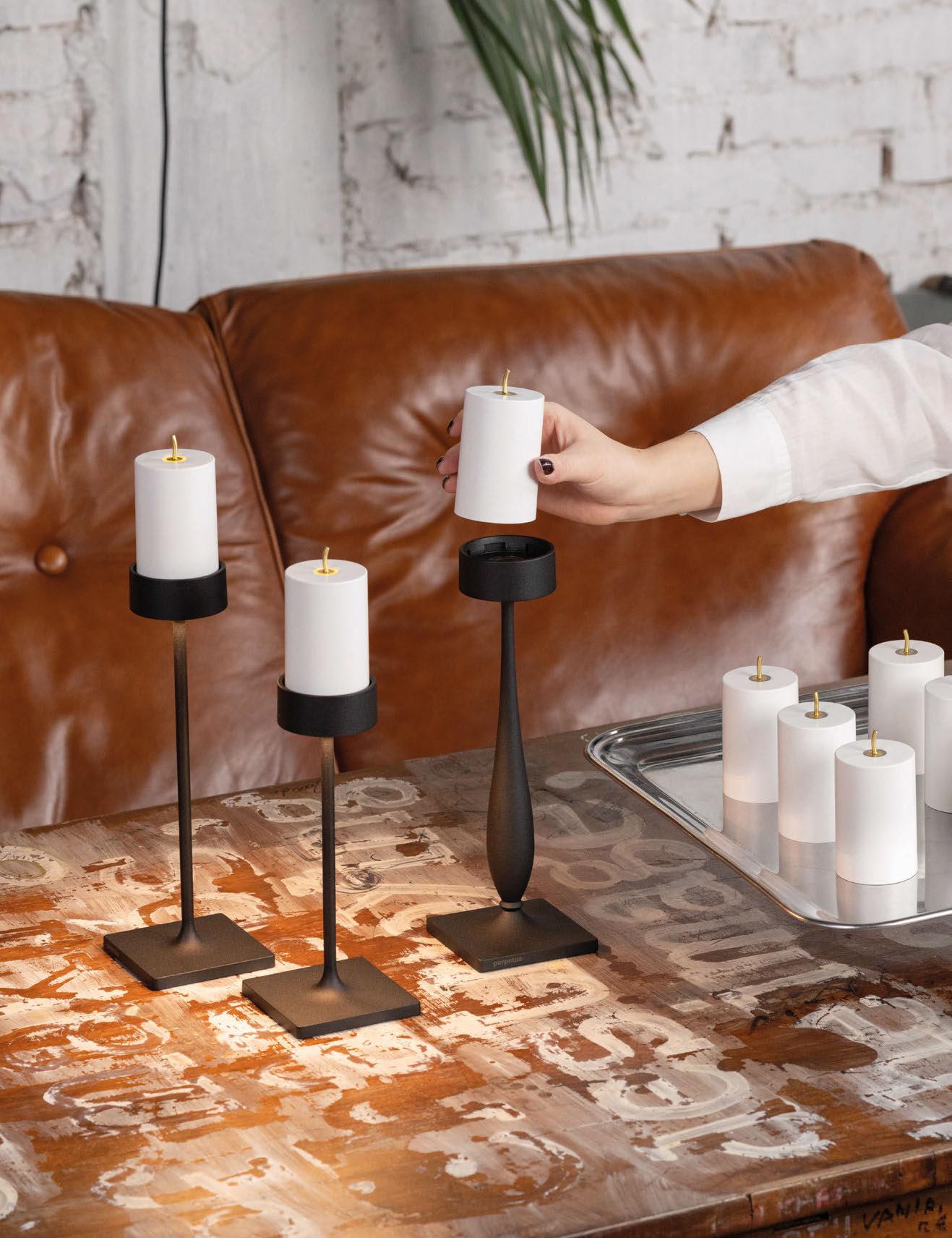
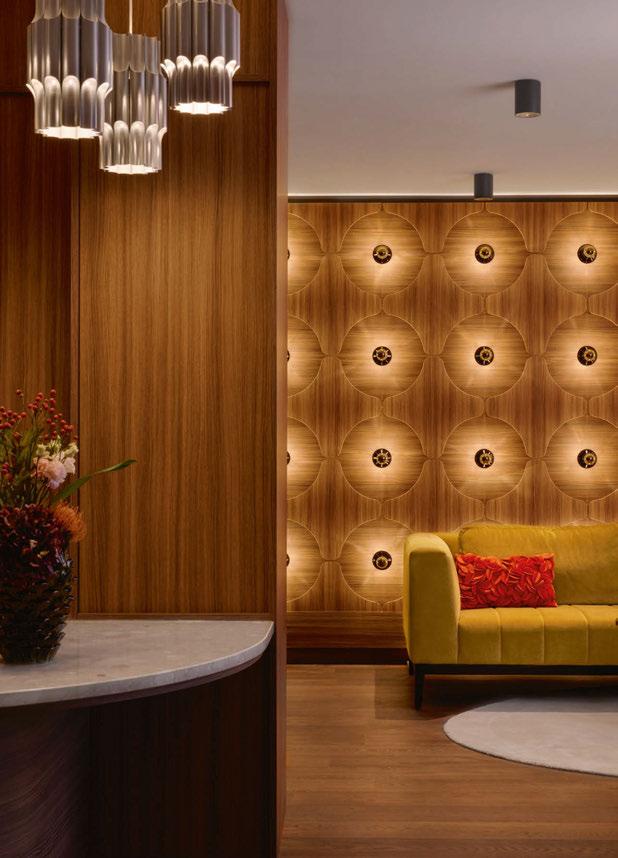
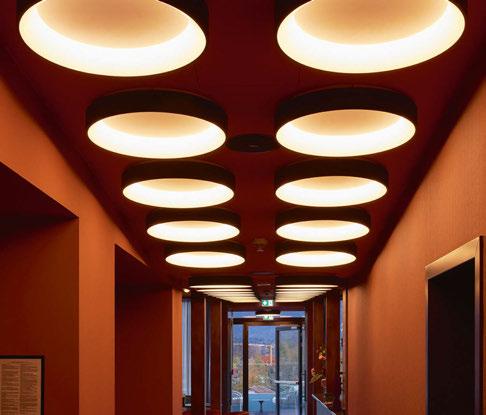
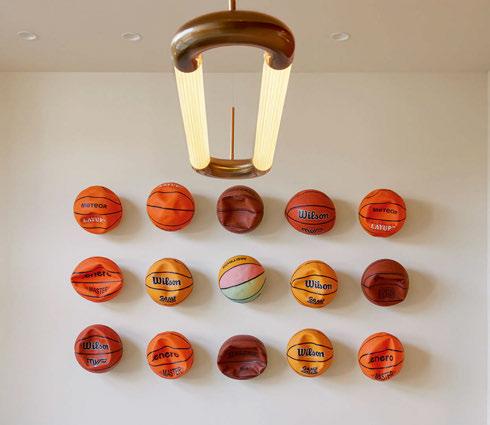
With the project being a refurbishment, the brief entailed little to no structural changes to the building, making sure the architecture is preserved and celebrated.
Despite the architecture being one of the project’s most meritable offerings, this didn’t come without structural constraints. Weiser recalls that in the public areas, the ceiling was low, meaning standard recessed downlights couldn’t be installed.
To resolve this, Weiser opted for surface-mounted luminaires just 10cm high with black exteriors and gold reflectors, which could respect the height limitations of the ceiling while unintentionally reinforcing the 70s aesthetic.
Weiser explains: “The 70s narrative was a lot of fun for me because that was when I began my career in lighting design, and this approach reminded me of the way we used to work back then.
“The essence of the 70s was really in the forms. Lighting fixtures were often organic in shape, and the lamps were visible, becoming a design feature themselves. It wasn’t so much about controlling the light precisely, but about making the luminaire part of the décor. Today, we often focus on one centrepiece fixture to create a statement, but in
the 70s, spaces were filled with multiple luminaires in varied colours and forms. The lighting itself became an installation, adding personality and vibrancy to the room, rather than just providing illumination.”
In the bar, existing columns that support the rooftop posed further constraints for installing the lighting and affecting the bold glow they envisioned. Böhm’s solution was to add mirrored surfaces and accents onto the columns, creating visual continuity and clever reflections that made the lighting appear seamless and twinkle.
Across the project, these constraints were not only addressed practically but were embraced as opportunities to enhance the design narrative, demonstrating how careful integration of architectural limitations can contribute to functionality and style.
Further challenges the designers faced often came down to budget. One of which, JOI-Design, says was the difficulty in convincing the client to bring a lighting designer onto the project, highlighting that this is always a difficult process to any project. With determination and surely some excellent pitching, Weiser was brought on board.
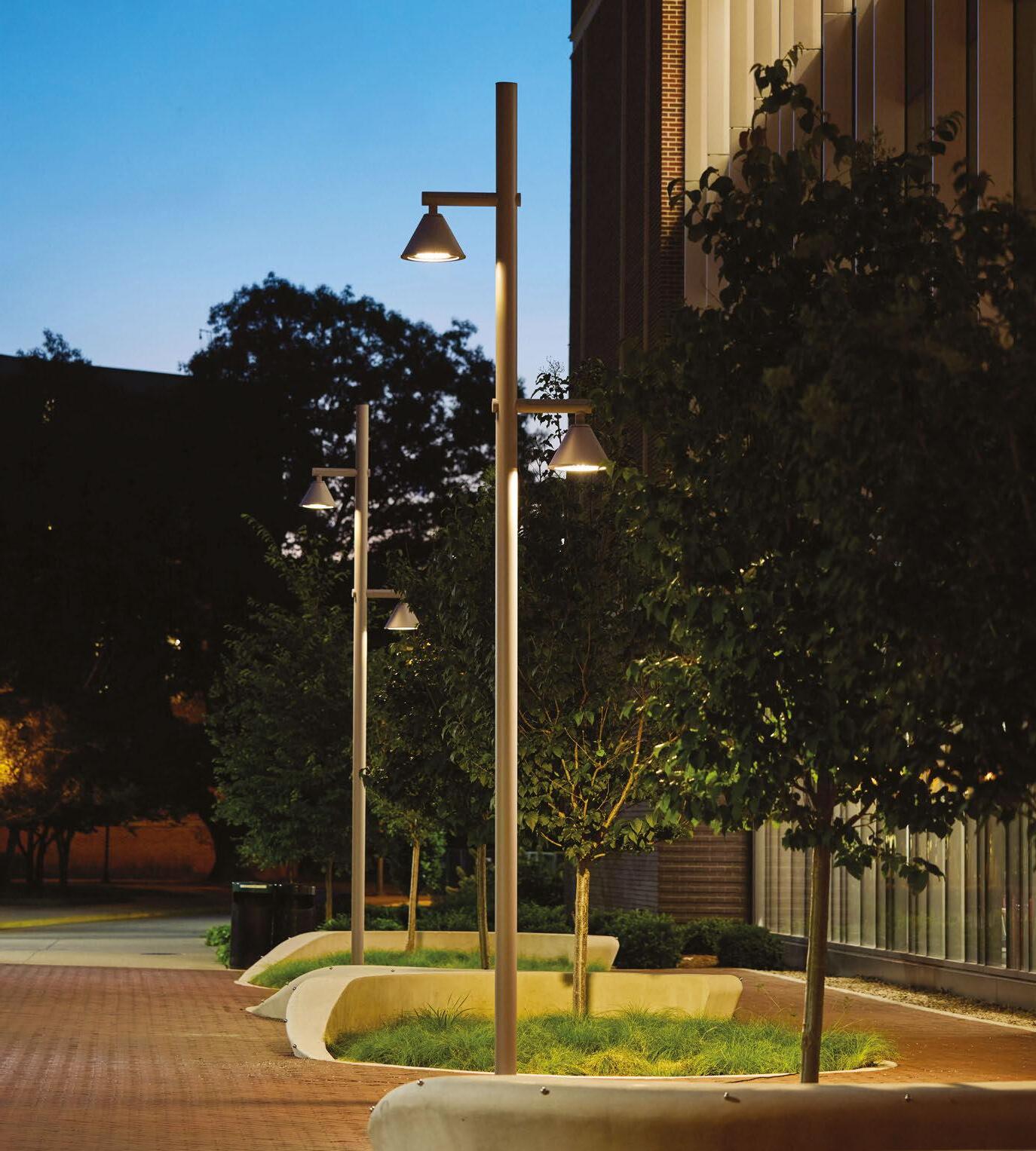
Minimalist in form. Meaningful in experience.
A luminaire designed to quietly define the moments that bring public spaces to life.
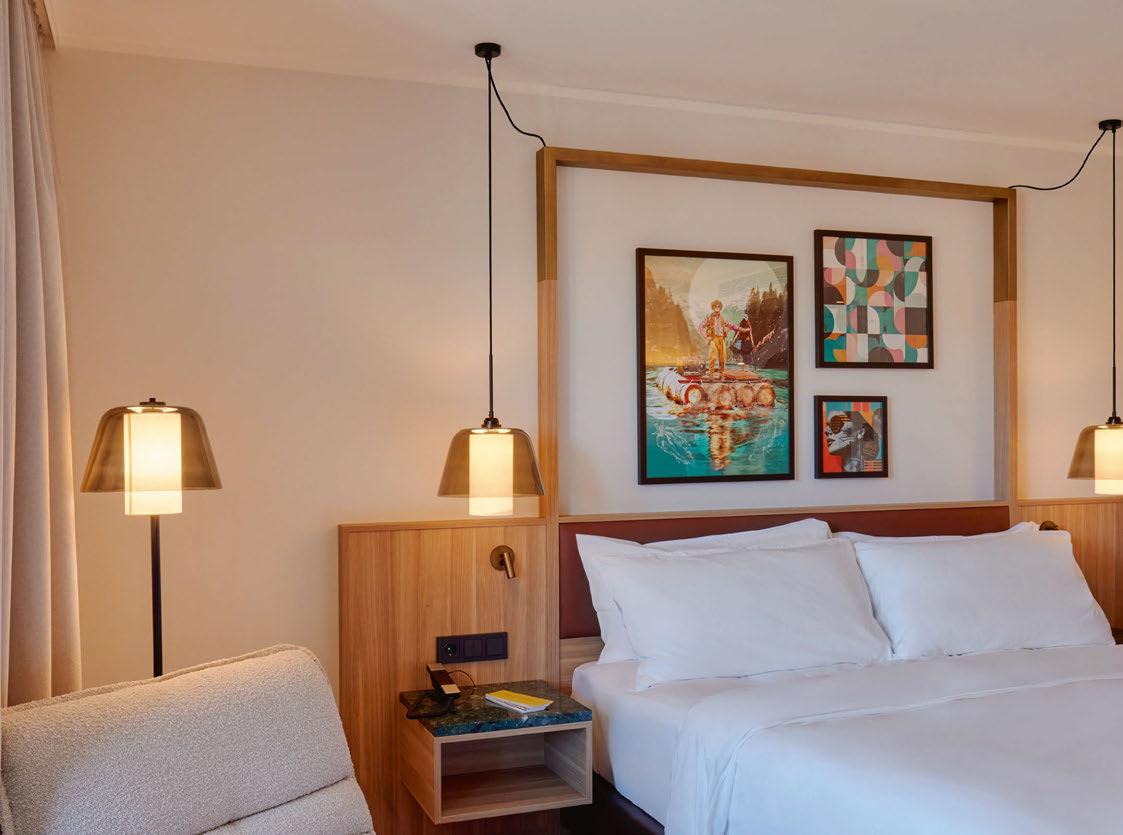
For Weiser, the challenge lay in translating the 70s aesthetic into functional, atmospheric lighting while integrating modern controls and respecting the natural environment. Together, these challenges underscored the need for persistence, collaboration, and inventive problem-solving to achieve a cohesive, immersive design.
Client: Flessler Lenggries
Lighting Design: Martin Weiser; Weiser Lighting, Germany
Interior Design: Sabrina Voecks, Heinrich Böhm; JOI-Design, Germany
Lighting Suppliers: &tradition, ACB Illumination, Arkoslight, aromas, Baulmann, Bega, BRILLTY, Dutchbone, EGLO, Häfele, hkliving, iGuzzini, Illushop, Impolux, Kartell, KiKi, LCI, LED Linear, Lichtlauf, Lightnet, Lindby, Litfad, LTS, Lodes, Loom Design, Lumpaz, LYFA, Meyer, Missal, Nordlux, Pedrali, Philips, RZB, SLV, Tala, Wever & Ducré, 9010
Photography: Nina Struve
Flesslers Lenggries isn’t just a hotel; now it’s a destination for all. Bringing 70s flair and subtle nods to Bavaria’s timber rafting heritage, the project is poised to revitalise the local tourist scene. Now the hotel can accommodate those who either wish for a relaxing, laidback holiday or for young jet setters who seek both style and adventure. Walking through the hotel, you can experience the nostalgic roots in which the hotel emerged while navigating spaces like flowing down the Isar Rapids. Each corner, from the mirrored rooftop bar to the neonlit lounge, offers a twist or a surprise.
Speaking on the lessons learned during the design process, Voecks shares why the project was so enriching for her and her team: “What made this project so special for me was working with two strong, parallel design narratives, the 70s Alpine
jet-set lifestyle and the local rafting heritage and seeing how they could interweave and play off each other. Usually, a project has one clear story, but here they ran alongside each other, sometimes overlapping, sometimes contrasting, some of the results were pleasantly unexpected.”
Böhm adds: “What I loved, too, was that the old hotel director returned to manage the project, and many team members had worked there before, back when it was known as Arabella Brauneck. They stayed, and they were so proud and in love with the new design. They knew the building for decades, and now, seeing it reopened in a completely new setup with expanded possibilities for the region and community, they were genuinely proud and happy. It was very special to witness.”
In bringing together JOI-Design’s visionary interiors and Martin Weiser’s nuanced lighting scheme, Flesslers Lenggries proves that heritage and playful narratives can coexist to create a space that leaves a lasting impression on both the guests and the wider hospitality industry.
www.joi-design.com
www.weisertechnik.com
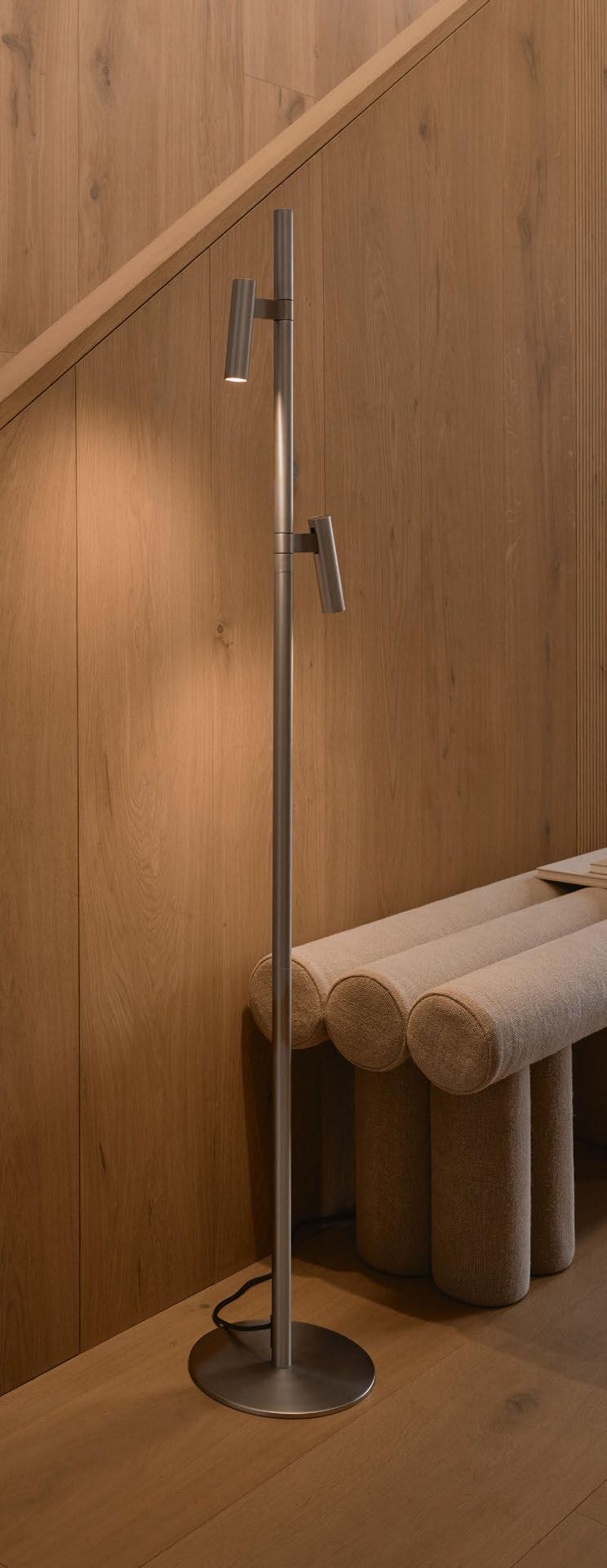
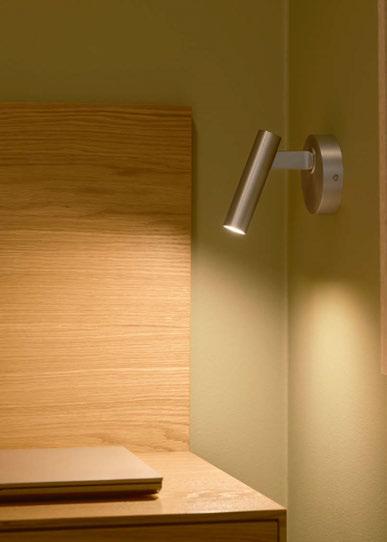
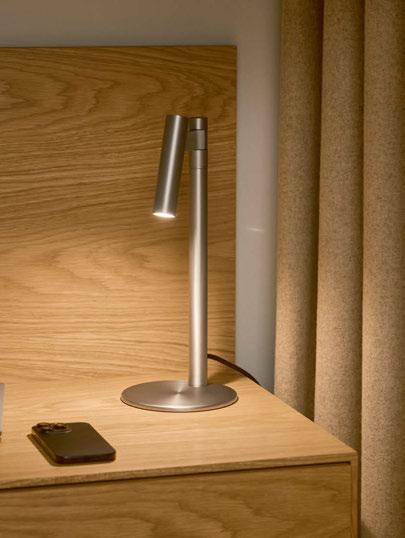
The latest addition to Dubai’s skyline ‒ the Guinness World Record-winning Ciel Dubai Marina, features a flowing, curvacious lighting scheme from Atelier33 that beautifully complements its architectural design.
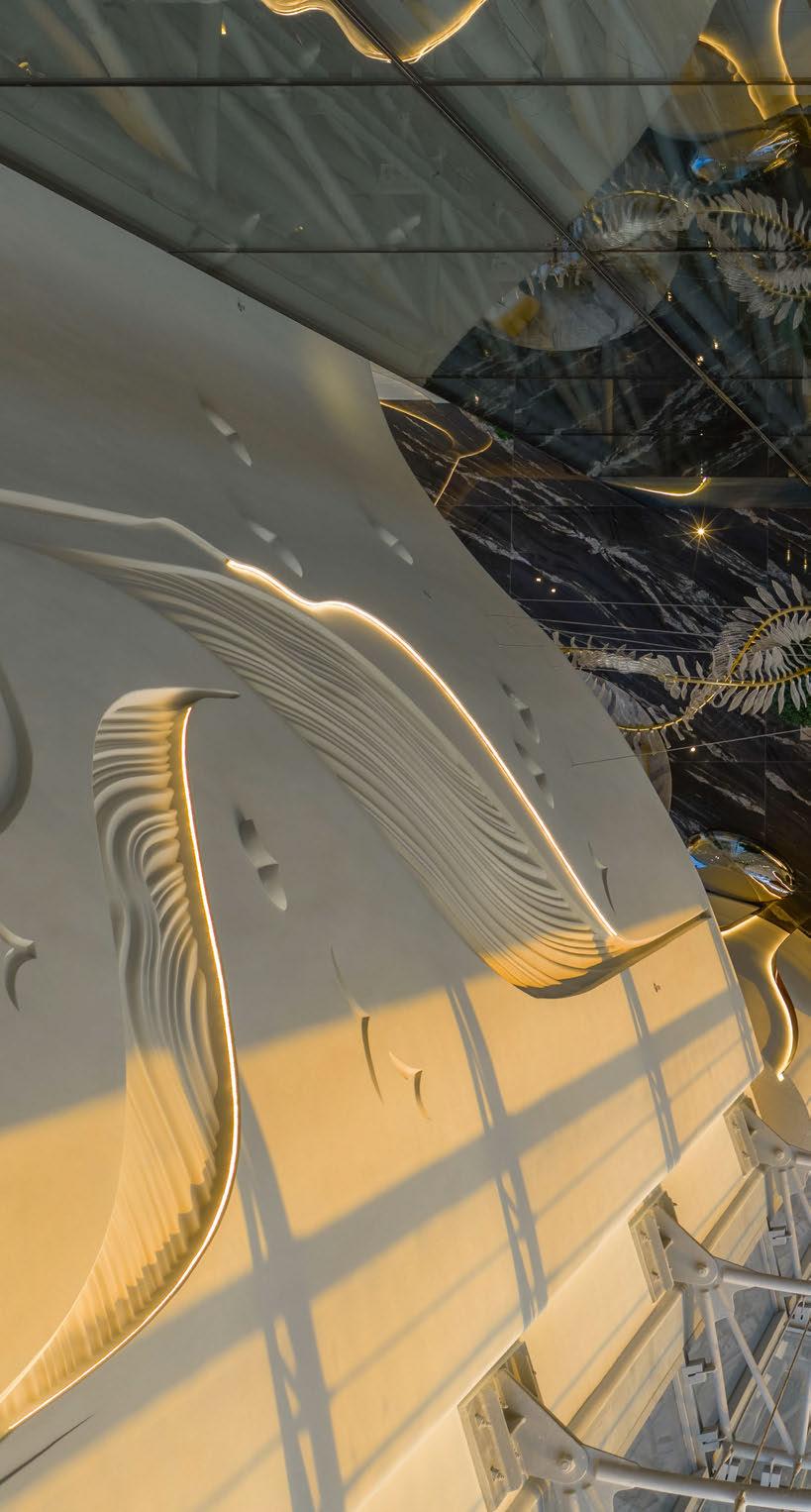
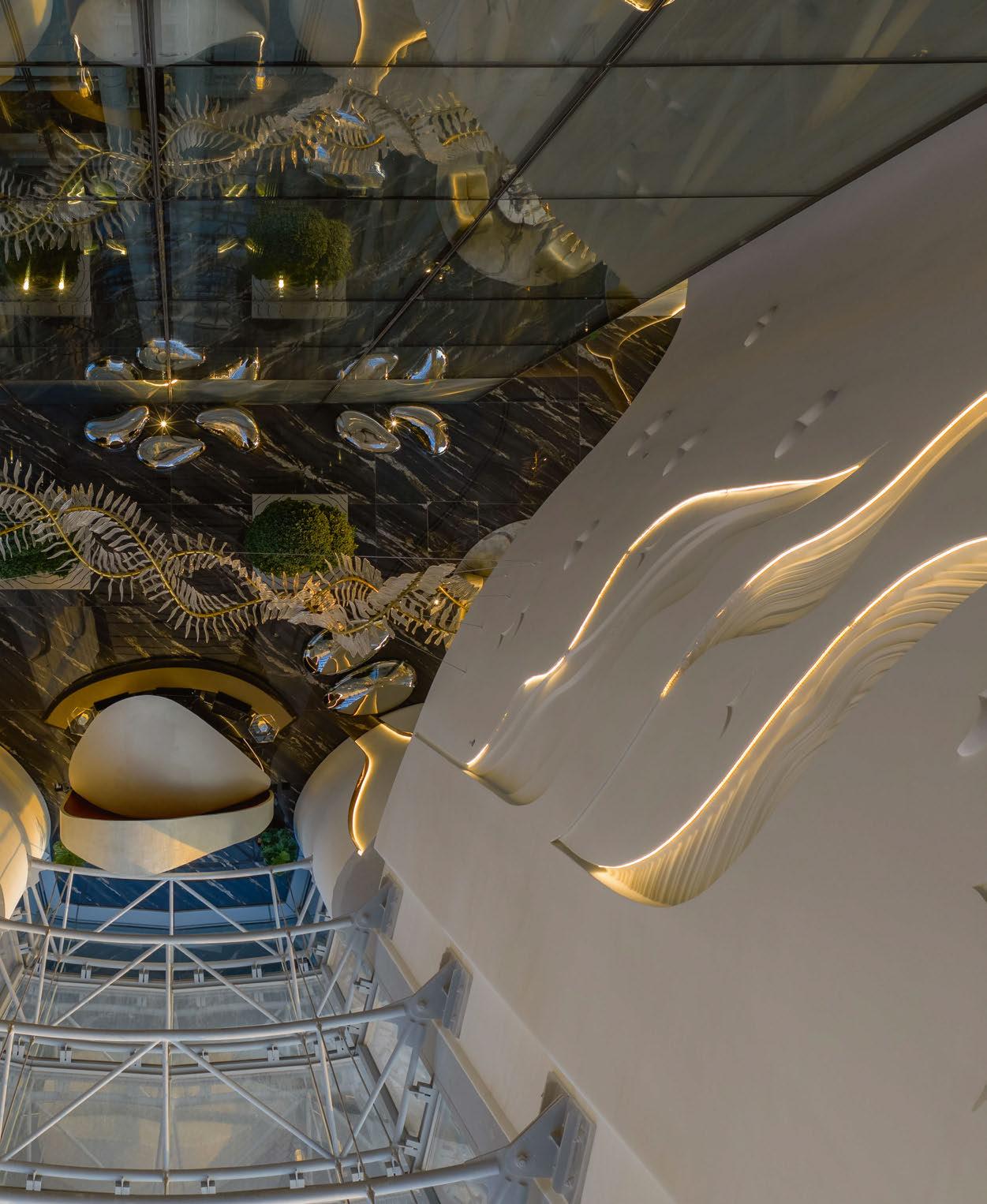
n a city that has become defined by its ever-expanding skyline of immense towers and skyscrapers, a brand-new architectural landmark has recently been unveiled in Dubai.
Standing at 377-metres and 82 storeys tall, the newly opened Ciel Dubai Marina has recently been recognised by the Guinness World Records as the “World’s Tallest Hotel”.
Designed by London-based architects NORR Group, the five-star hotel features a striking design, contemporary interiors, and a remarkable glass observation deck that offers 360° vistas across Dubai marina, the Palm Jumeirah, and the Arabian Gulf.
Ciel Dubai Marina is part of IHG Hotels & Resorts’ prestigious Vignette Collection, and features more than 1,000 rooms and suites, all designed to offer modern comfort and refined elegance. The property also includes eight distinct F&B venues, alongside a luxury spa, a state-of-the-art gym, and the world’s highest infinity pool on the 76th floor.

Lighting for this extravagant new property was designed by Middle Eastern studio Atelier33, which hoped to use lighting as a means of enhancing the strong sculptural gestures of the interior architecture, while maintaining a feeling of elegance and visual comfort.
The studio’s initial involvement in the project was focused primarily on its main lobby and 30-metrehigh atrium space – which was envisioned as a dramatic, vertical volume featuring sculpted walls from Lebanese artist Karim Tamerji that would create a highly expressive architectural relief.
Speaking to arc, Jad Cortas, Co-Founder of Atelier33, reflected on his team’s introductions to the project: “Our involvement began through Nadine Atta, Vice President of Design at The First Group. At the time, Nadine approached us with a very specific challenge related to two key elements within the hotel – the main lobby feature installation, and the atrium space.
“Nadine’s main concern was ensuring that the lighting would not simply illuminate these elements, but reveal the sculptural depth and artistic intention of the surfaces, particularly given the scale of the atrium.
“Our initial task was therefore to develop two design proposals: one for the atrium wall installation, and another for the main chandelier in the lobby. Once these concepts were presented, the response was very positive and the collaboration quickly expanded. This first intervention eventually led to Atelier33 being invited to work on additional areas across several floors of the hotel.
“In many ways, the atrium and lobby became the starting point of the narrative for the entire project.”
That narrative, for the lighting design at least, was built around movement and fluidity, with the aim of revealing the sculptural surfaces and architectural depth of the interiors, while creating a memorable visual identity for the core arrival spaces.
“From the beginning, the objective was to ensure that the lighting would feel integrated with the architecture, rather than applied to it,” Cortas adds.
“When we studied the architecture and interior design language, we noticed a recurring theme of curves and flowing lines. This inspired us to develop lighting concepts that would reinforce this sense of motion.”
For the chandelier within the lobby, Cortas imagined a stream of light formed by crystal elements, suspended within the height of the lobby. Each crystal module interacts with light, creating subtle refractions and reflections that give the installation a dynamic quality.
As for the atrium walls, the approach was different, but complementary. Here, lighting was designed to reveal the sculptural relief created by Tamerji, allowing shadows and highlights to emphasise the depth of the surfaces.
Together, these two elements introduced a narrative of light interacting with form, movement, and materiality.
As with any lighting design project, translating these concepts into a reality required a combination of technical integration and artistic sensitivity.
Versatility transforms every surface into light

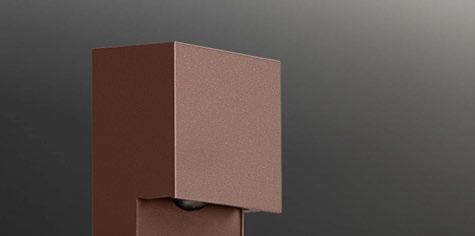
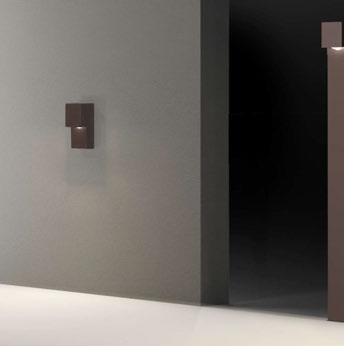

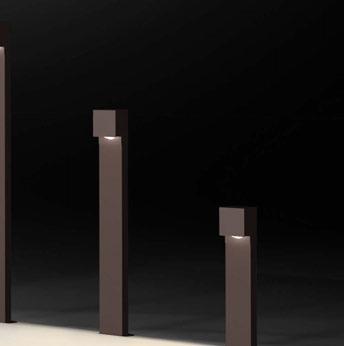


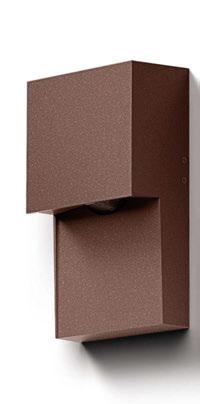



is a collection of outdoor luminaires designed to deliver high-performance light distribution within a compact and essential body. Its aluminum structure features clean volumes, rigorous proportions, and a slender profile that enhances its discreet, architectural presence within the space.
The innovative optical system is engineered to provide a wide and controlled emission: lateral and frontal light combine into a homogeneous projection, capable of enhancing pathways, surfaces, and architectural elements with precision and uniformity.
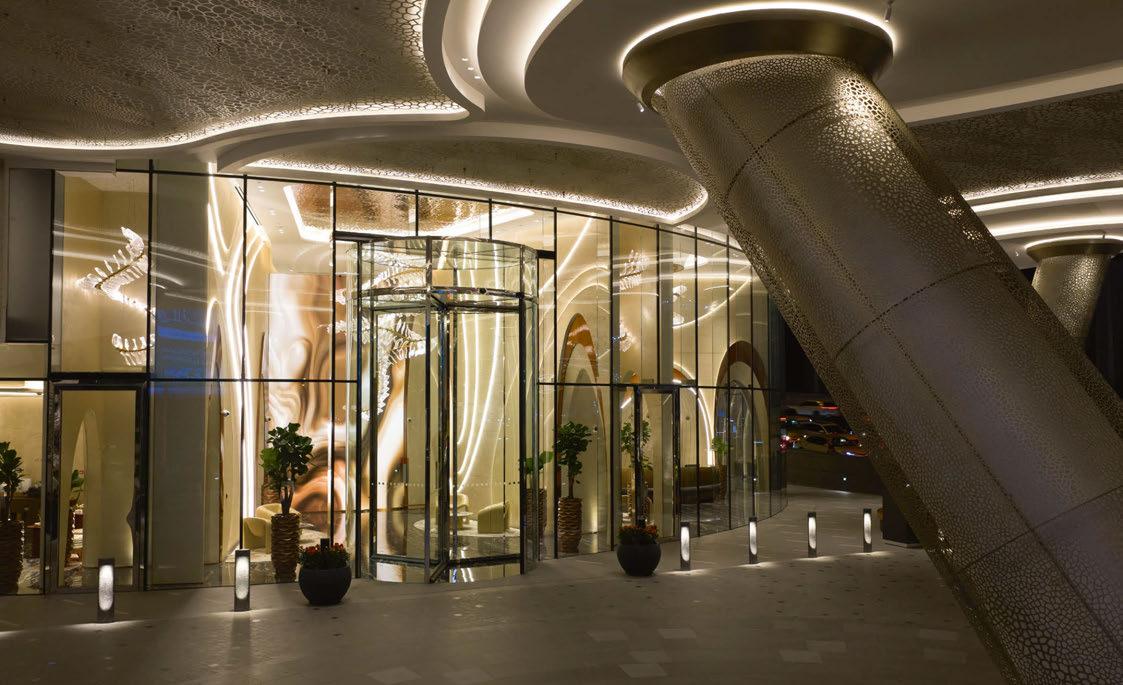
Cortas continues: “The chandelier was conceived as a sculptural centrepiece for the lobby. Rather than designing a conventional chandelier, we developed a flowing structure composed of crystal modules arranged along a curved spine. Each crystal element was selected for its ability to refract light internally, creating a soft, luminous effect.
“The form was designed to appear almost like a floating ribbon of light, suspended within the double-height space of the lobby.
The development of the piece required close collaboration with manufacturers to ensure that the final installation achieved both the desired aesthetic and technical performance.”
For the wider atrium lighting, the strategy focused on revealing the sculpted surfaces through layered illumination. Due to the swooping, curved surfaces, the natural choice for Atelier33 was to utilise linear lighting integrated into the architectural grooves, as this would serve to outline the main flowing gestures, without introducing visual clutter. Narrow-beam projectors selectively highlight specific sculptural elements.
Cortas continues: “The atrium wall installation is a collaboration between architecture, art, and lighting. Karim Tamerji’s work introduces a composition of elements embedded within the relief. Our challenge was to ensure that the lighting would reveal the depth and texture of these forms without flattening the surfaces.”
The combination of linear elements, offset by the narrow-beam spots creates an interplay of diffuse
light and accent lighting, bringing depth and movement to the installation, while the integration of linear fixtures allows the lighting to feel like an extension of the architectural lines. As Cortas explains, it creates a “constantly changing visual experience, depending on the viewer’s perspective”.
Once the lighting concept for the atrium and lobby space had been determined, this helped to establish a lighting language for the broader project, with Atelier33’s scope expanding to include a number of different areas across the building.
As well as the main lobby floors and the drop-off/ arrival areas, this new scope included the West 13 and West 14 restaurants; management offices, meeting rooms and kids area on level 15; the Nest Lounge; and the spa and gym on level 61. Each space required a tailored lighting approach, while maintaining a coherence with the overall design language of the project.
To that end, certain principles within the lighting scheme remained consistent throughout. These principles included the use of warm and welcoming light tones and, where possible, concealed architectural lighting.
There was also an emphasis placed on materials and sculptural surfaces, adding a tactility and depth to the space.
“Public areas such as restaurants and lounges tend to have more expressive lighting elements, while areas like the offices or wellness spaces were designed to be calmer and more subtle,” Cortas adds.
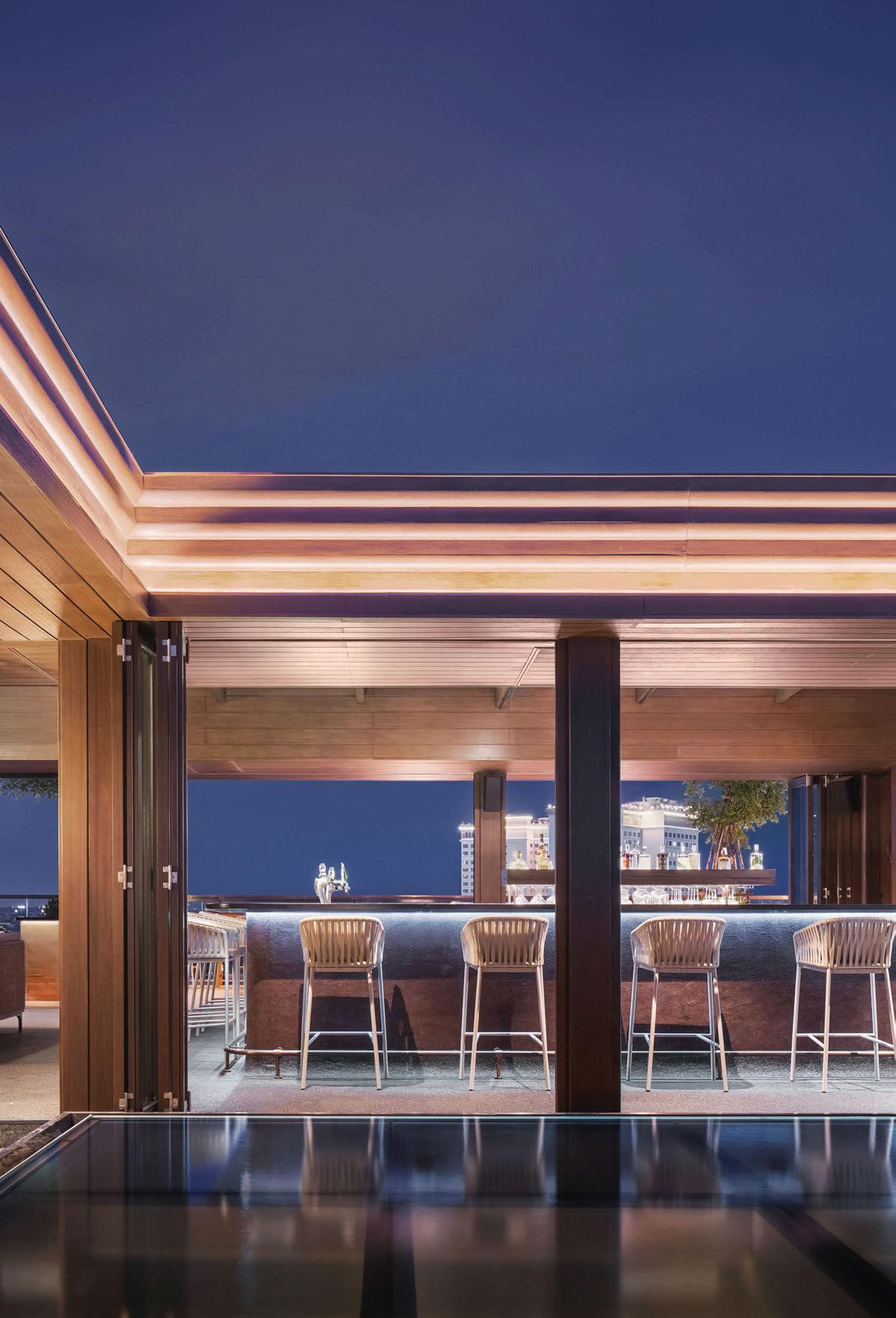
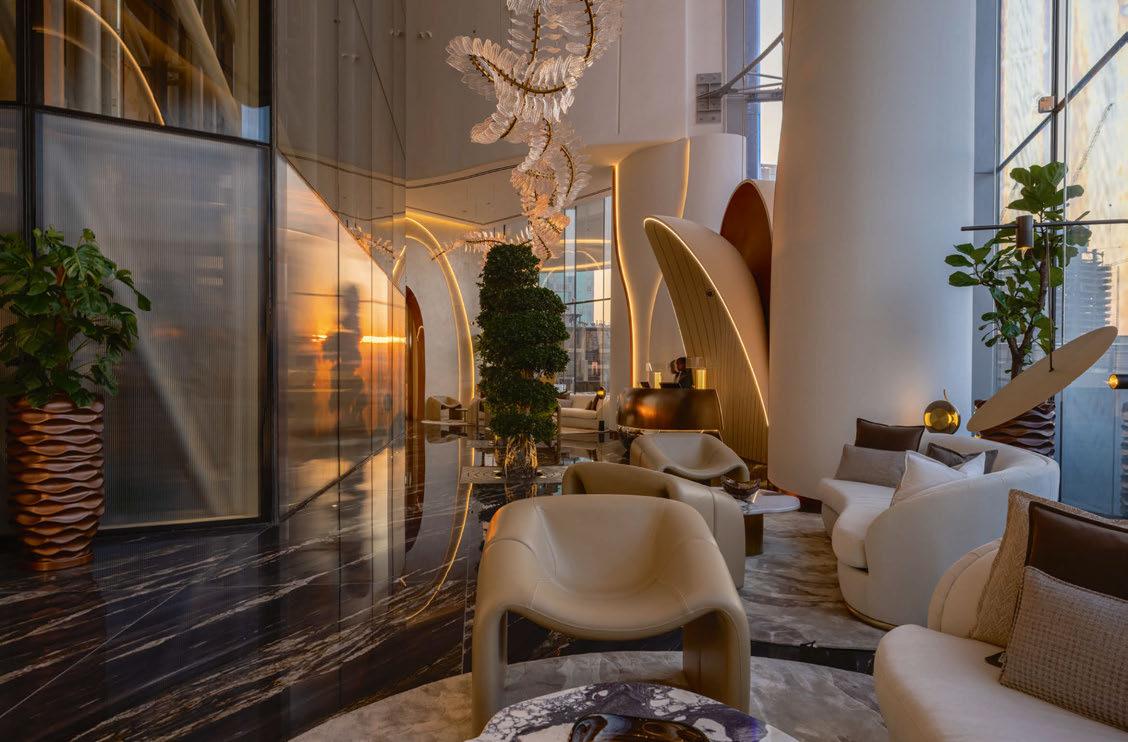
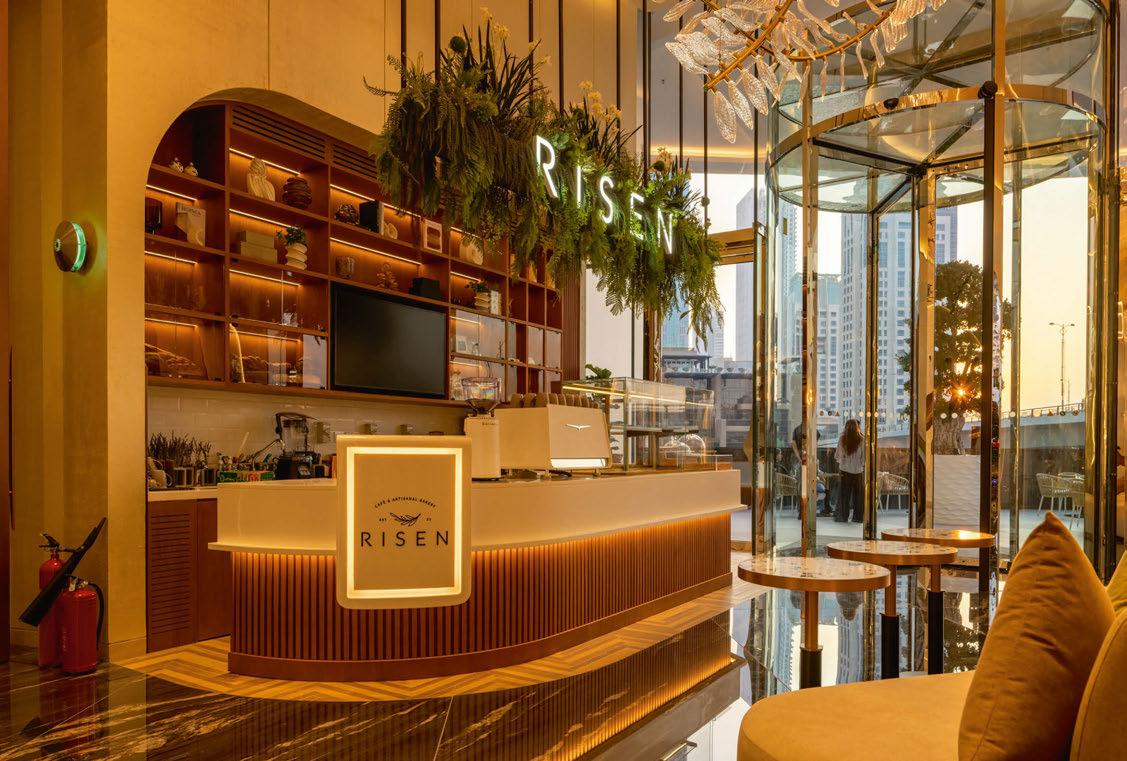
Throughout each area within the hotel though, Atelier33’s focus was always primarily on architectural lighting as Cortas believes this is what “defines the spatial experience”.
He explains: “Architectural lighting establishes the visual structure of the space, highlighting volumes and guiding movement. Decorative lighting then acts as a focal point or visual identity within that environment.”
However, Atelier33 did assist in the specification of the decorative lighting pieces, working with the design team at The First Group.
“In most cases, the interior designers would define the mood, character, and visual direction of a space, and our role was to translate that intention into a lighting solution that was both aesthetically coherent and technically appropriate. This meant that we were not only working on the architectural lighting and integration details, but also actively advising on the decorative lighting selection for each area,” Cortas adds.
Depending on this space, Cortas says that this process could take different forms. In some areas, the lighting designers would identify suitable products from known brands that aligned with the design language of the interior. In other cases, when the space required something more specific or unique, Atelier33 would develop custom fixture concepts and coordinate directly with manufacturers in order to achieve the desired result.
“Our guidance on the decorative lighting typically covered scale and proportion of the fixture within the space, light output and visual comfort, colour temperature and atmosphere, materiality and finish, integration with the ceiling details and architectural constraints, and coordination with site conditions and maintenance requirements,” he continues.
“This was especially important on a project like Ciel, where each area had its own identity, while still needing to feel part of a coherent overall experience. The decorative lighting therefore had to do more than just look good – it had to support the architecture, work technically, and contribute meaningfully to the atmosphere of each space.
That same design approach is visible in the early chandelier concept proposals, where decorative light was treated as a sculptural and experiential
element rather than simply a product selection.”
Given the sheer scale and complexity of the project, Cortas explains that it was not without its difficulties, whether this be budget constraints, technical issues, or construction timelines. However, through it all, the key objective to preserve the essence of the design concept endured.
“Ciel is a very tall tower, with many floors and different functional zones. Each floor often involved different contractors and subcontractors, which required constant coordination,” he says.
“Another challenge was the tight project timeline; maintaining the lighting design intent while working with multiple teams required close communication and daily coordination with architects, designers, and site contractors.
“But in this project, the fundamental ideas of movement, fluidity, and sculptural light interaction were successfully maintained.”
To that end, Cortas can look back and reflect with satisfaction that the lighting design plays an important role in shaping the experience of the hotel. “For us, lighting design is ultimately about creating atmosphere and revealing architecture. Projects like Ciel demonstrate how lighting can become an integral part of the spatial narrative when it is considered from the very beginning of the design process.
“The main concepts that we developed early on –movement, sculptural light, and integration with architecture – remain clearly visible in the final design. The chandelier in the lobby is certainly one of the most memorable moments in the project. Because of its flowing geometry and the way light interacts with the crystal elements, the installation appears different from every viewpoint, creating a sense of motion within the space.”
Far from dominating the architecture, lighting throughout the hotel serves to reveal its intricacies and enhance the spatial atmosphere. It’s a sentiment that many designers share across their work, but as Cortas says: “When lighting is successful, people rarely notice it consciously –they simply feel the space.”
www.atelier33.me
Client: The First Group
Lighting Design: Jad Cortas, Mia Chaptini, Anna Bhanniny, Nathalie Saadeh; Atelier33, Lebanon
Architect: NORR Group, UAE
Contractor: Blue Camel Design, UAE
Lighting Specified: Aero, Artemide, Bega, Clarity, DGA, Flexalighting, Flos, Fontana Arte, GVA, Holecron, Huda Lighting, INFiLED, Klus, LEDFlex, Lee Broom, Linea Light Group, Lombardo, LTech, OneEightyOne, Orluna, Pablo, Panzeri, Penta Light, Tom Dixon, Vibia
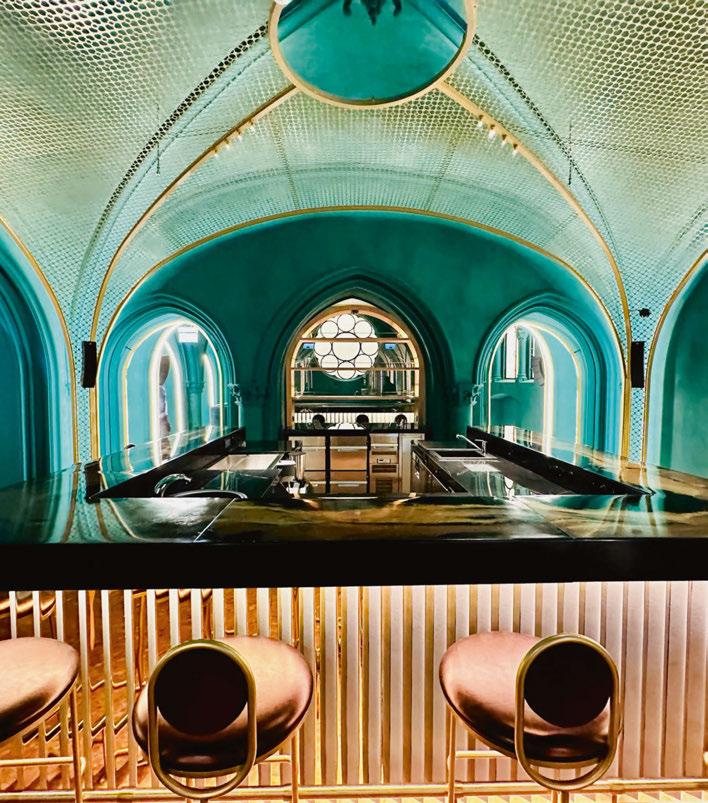
Integrated lighting solutions from LED Linear support the architectural rhythm, visual comfort and long-term performance across the contemporary hospitality environment of Budapest’s W Hotel.
Housed within the historic Drechsler Palace, the W Hotel Budapest represents a careful dialogue between architectural heritage and contemporary hospitality design. Lighting plays a central role in this transformation, not as a dominant visual element, but as a precise architectural tool that supports spatial rhythm, materiality, and guest experience across all areas of the hotel.
The lighting concept, designed by Artec Studio, was developed to enhance the existing structure while integrating seamlessly into the new interior language. Linear lighting was chosen deliberately to follow architectural geometries, emphasise depth and proportion, and maintain visual calm throughout the building.
LED Linear’s modular lighting systems provided the flexibility and reliability required for this complex hospitality environment.
In entrance and corridor areas, Venus IP67 luminaires are vertically integrated into the architecture, tracing the rhythm of arches and guiding guests through the space. The controlled, glare-free light enhances spatial perception while remaining visually unobtrusive, a key requirement in a high-end hotel environment where comfort and orientation must coexist.
In the spa area, Venus is installed along the pool edge, where its high protection rating ensures long-term performance in humid conditions.
The linear light gently defines the water’s edge, creating a calm and atmospheric environment without introducing visual noise or reflections that could disturb guests.
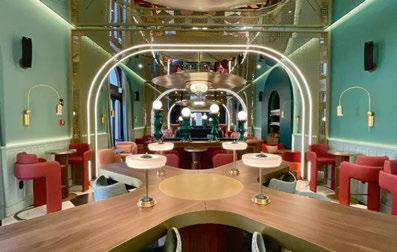
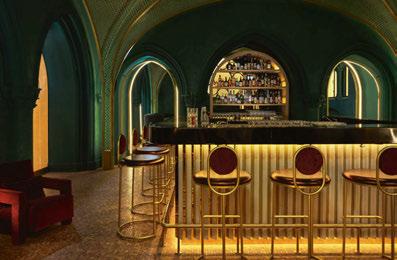
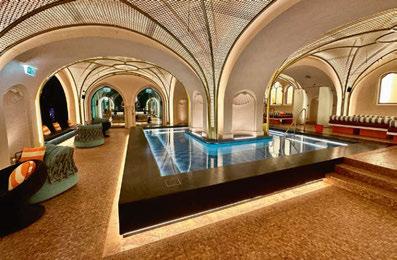
At reception, Venus provides soft, glare-free illumination beneath the counters, supporting both functionality and visual comfort for staff and visitors alike. This is complemented by Xooline IP40, used in ceiling coves and transitions to subtly accentuate architectural lines and enhance the perception of height and depth.
In the bar and restaurant areas, Xooline IP40 is applied selectively beneath counters and within ceiling details, contributing to a warm ambient brightness that supports the hotel’s hospitality concept while maintaining a consistent visual language throughout the interior.
Across the project, LED Linear solutions were selected for their architectural integration, precise optical control, durability, and minimal maintenance requirements. The result is a lighting scheme that respects the historic fabric of the building while delivering contemporary comfort, reliability, and atmosphere, lighting that becomes part of the architecture rather than an addition to it.
Artec Studio worked with Difusiona, Bánáti and Hartvig Architects, and interior designers Bowler James Brindley to realise this project.
www.led-linear.com www.artecstudio.net
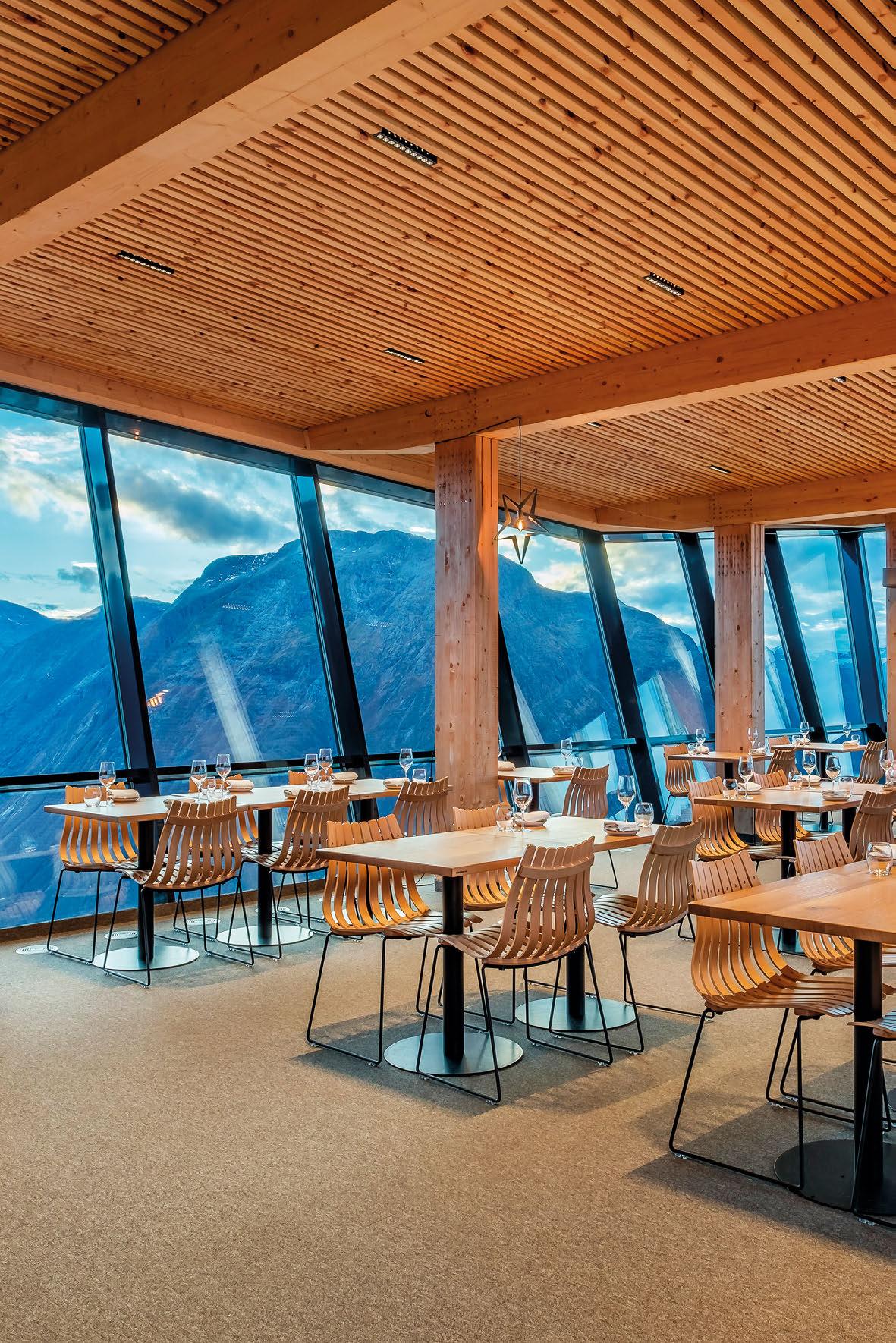

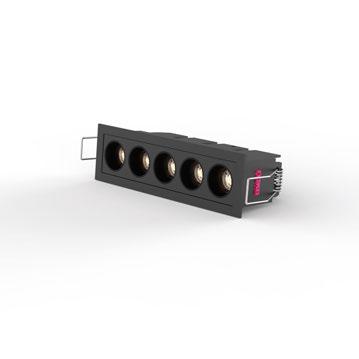
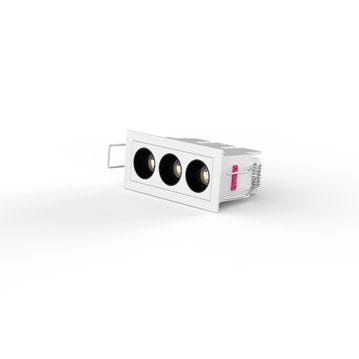
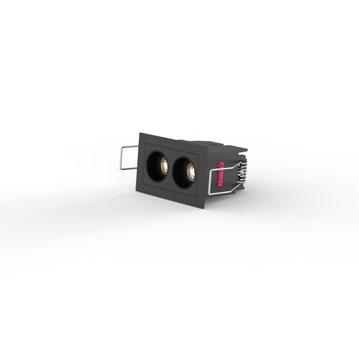
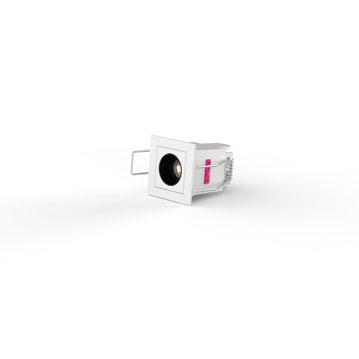
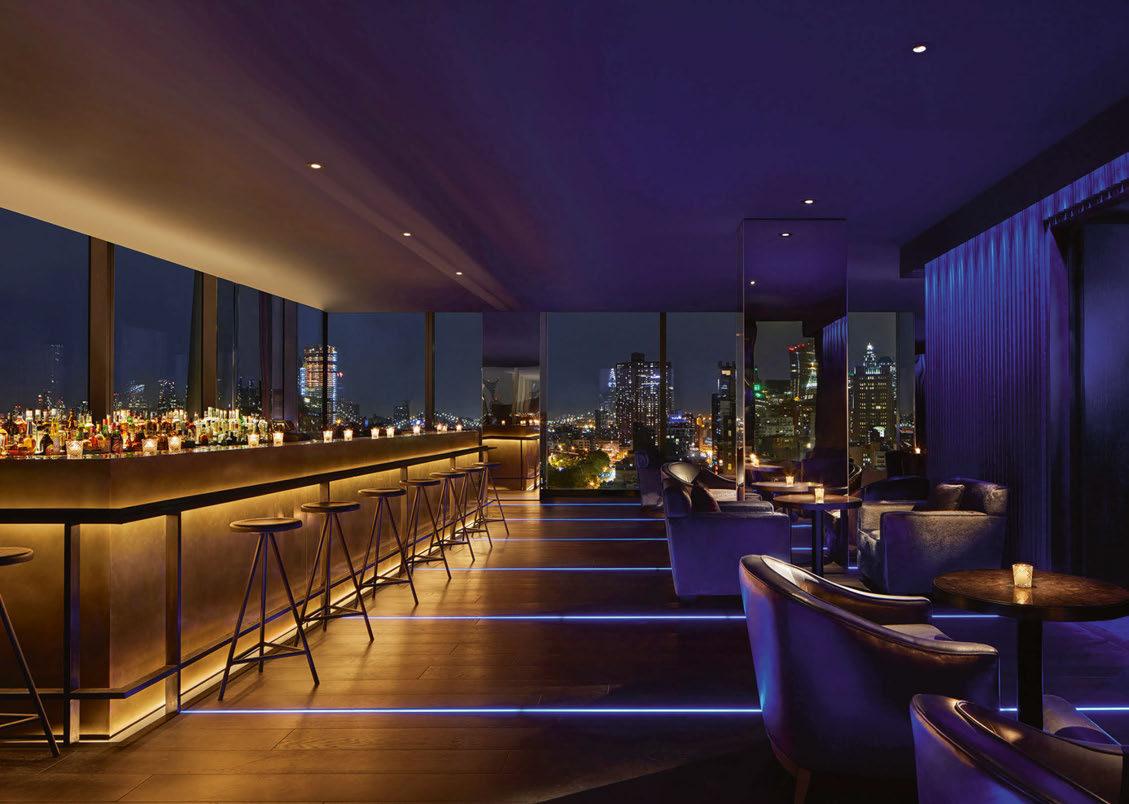
The Roof Bar of New York’s Public Hotel features vibrant, saturated lines of blue light, courtesy of a customised version of the EK1 recessed linear system from Aldabra
In hospitality environments, light defines not only how a space is seen, but how it is experienced and remembered. At The Roof Bar of the Public Hotel in New York, lighting operates as a subtle yet decisive layer, shaping atmosphere through contrast, colour, and rhythm rather than intensity.
The hotel, conceived by Herzog & de Meuron as part of Ian Schrager’s vision of a more accessible and experience-driven form of luxury, is designed around carefully curated yet informal environments. Within this framework, the lighting design developed by Isometrix Lighting Design plays a central role in defining the identity of the spaces, using light not simply to illuminate, but to structure perception and experience.
At the rooftop bar, this approach translates into a layered composition where different qualities of light coexist in deliberate contrast. The warm glow of the bar counter establishes intimacy and social focus, while a series of linear blue light lines embedded in the floor introduces a distinct and atmospheric layer across the space. Positioned at a low visual plane, these lines do not compete with the architecture or the skyline; instead, they operate as subtle spatial markers, guiding movement, defining rhythm, and contributing to a coherent visual language.
The use of a deep royal blue becomes a key element within this strategy, reinforcing the perceptual hierarchy of the space, and creating a dialogue between warmth and coolness, between the interior environment and the city beyond. At night, the lines appear as luminous traces across the floor, while during the day they remain visible as a graphic presence, maintaining continuity in
the spatial narrative.
Achieving this dual condition, required a departure from conventional solutions. The solution was developed through close collaboration with Aldabra, leading to a customised version of EK1, its recessed linear system. Instead of relying solely on coloured light, the outer resin layer was pigmented to match the exact shade of blue required for the project. This allows the lines to retain a deep blue appearance when switched off, while producing a vivid and saturated tone when illuminated.
Beyond its visual contribution, the system also responds to the demanding conditions of a hospitality environment. Although originally developed for outdoor applications, its durability proved particularly suited to the interior of a rooftop bar: an environment characterised by high foot traffic, exposure to liquids, and frequent maintenance and cleaning. Resistance to water, chemicals, impact and wear ensures long-term performance without compromising the integrity of the design.
Ultimately, the project demonstrates how lighting, when conceived as an integral part of the architectural narrative, can operate as a material in its own right. Through a careful balance of contrast, colour, and placement, the design establishes a continuous visual identity that remains present both day and night, shaping the way the space is perceived and experienced over time.
www.aldabra.it
www.isometrix.co.uk
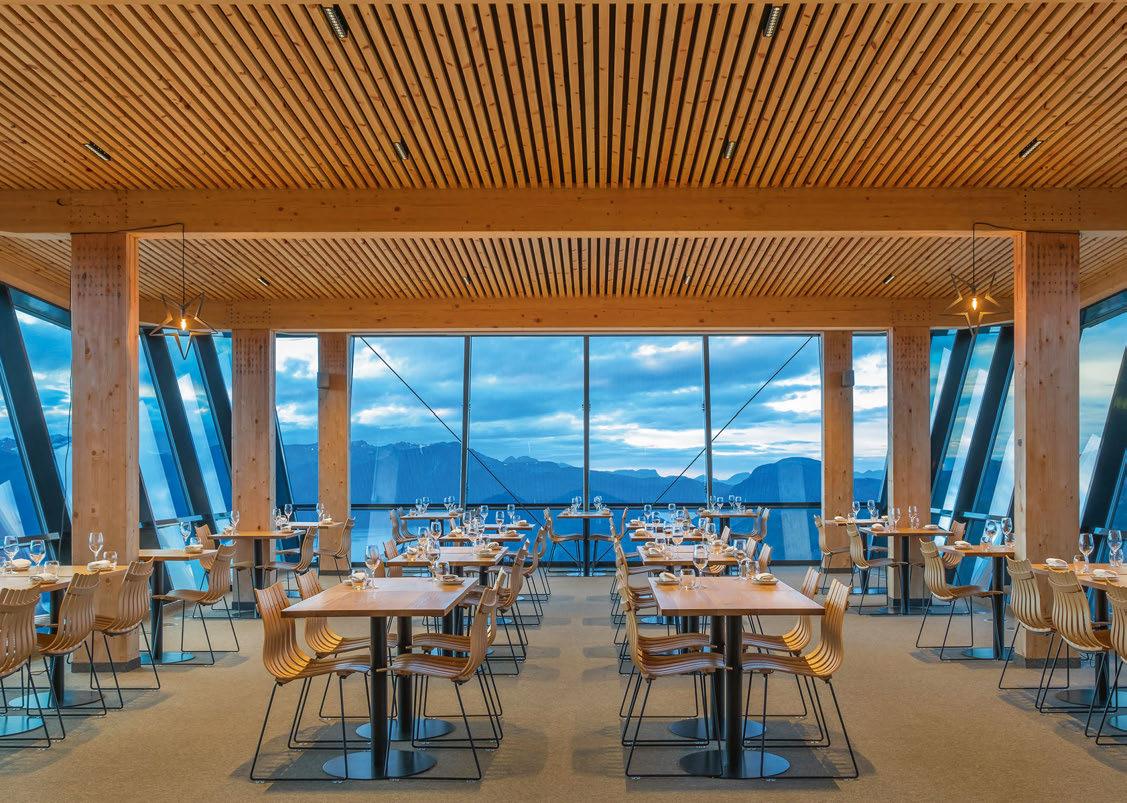
Complementing both the restained architecture and beautiful views to the surrounding nature, Neko Lighting used its discreet Fusion series of luminaires for this panoramic restaurant.
Perched high above the Romsdalen valley, the Romsdalsgondolen Eggen Restaurant forms part of a cable car destination connecting the fjord to the mountain summit at approximately 700-metres above sea level.
Designed as a panoramic dining space, the project is defined by its close relationship to the surrounding landscape, with expansive glazing framing uninterrupted views across the mountains and fjord. The architecture follows a restrained material approach, combining timber and glass within a structure carefully positioned along the natural terrain. Conceived with a reversible construction principle, the building minimises long term impact on its environment, reinforcing a design intent that prioritises both landscape and longevity. Within this context, Neko’s Fusion series plays a key role in shaping the lighting strategy, which called for a discreet and carefully controlled approach. With constantly shifting natural light conditions and extensive glazing, controlling glare and avoiding reflections were essential, while ensuring that
artificial lighting would not compete with the dramatic exterior views.
The scheme is based on a series of compact downlights, distributed according to the functional zones of the restaurant. Variations in output allow different areas from dining tables to circulation paths to be lit appropriately, supporting both visual comfort and spatial clarity.
Selected for its minimal form and adaptability, the Fusion series enables seamless integration within the timber ceiling. The luminaires sit quietly within the architectural rhythm, avoiding visual interruption and maintaining the integrity of the ceiling plane.
At the same time, the optical performance delivers a balanced and comfortable luminous environment, with controlled distribution and consistent brightness throughout the space.
Lighting is conceived as a subtle supporting layer, enhancing the interior experience while allowing the surrounding landscape to remain the primary focus. www.nekolighting.com
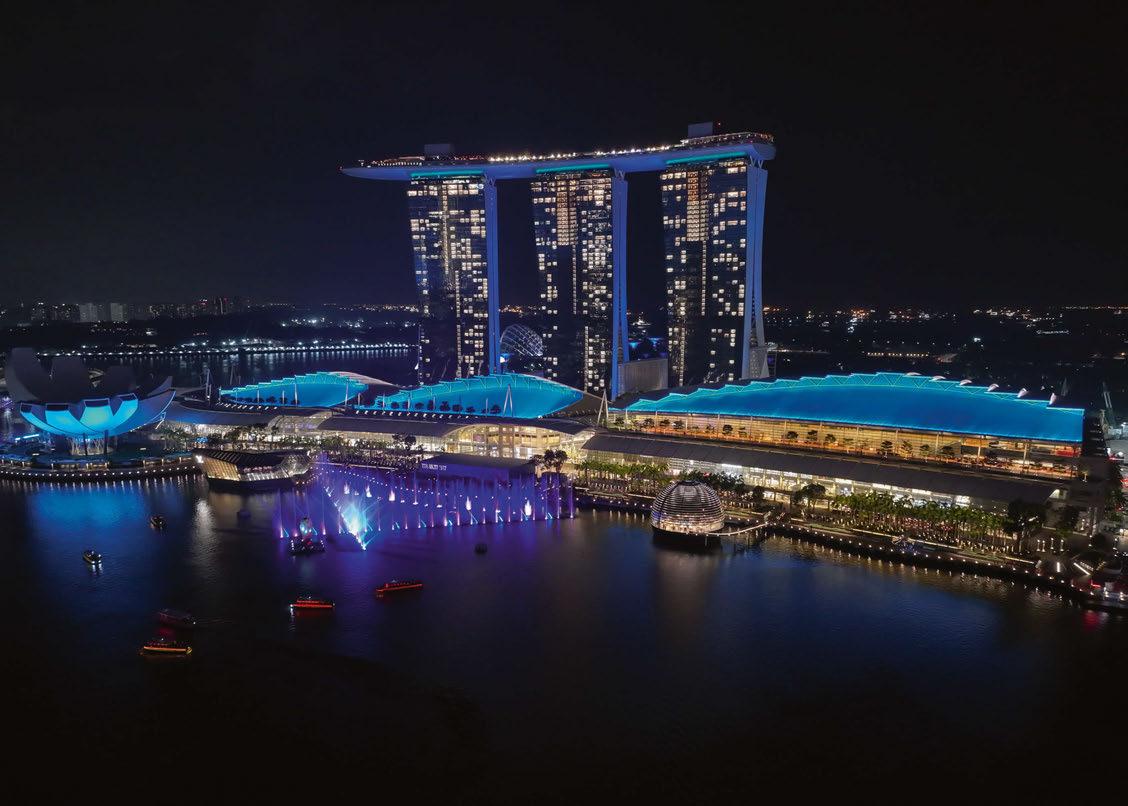
To mark its 15th anniversary, the iconic Marina Bay Sands underwent a renovation in 2025; with new fixtures from Acclaim Lighting installated to illuminate the resort’s unique architecture.
Situated in the heart of Singapore’s central business district, the magnificent Marina Bay Sands resort stands tall, providing a stunning highlight along the city’s skyline. The architectural marvel, which at the time of its construction in 2010 was billed as the world’s most expensive standalone casino property, has become Asia’s most visited hospitality and entertainment destination.
The 1,850-room hotel features a unique design that consists of three sloping towers and is crowned by the famous Sands SkyPark, a more than 1,000ft-long platform that connects the towers at the 57th floor and offers spectacular 360° views of the city and the bay.
Inside the hotel, the towers are linked by an impressive atrium running the length of the hotel complex. At 30 storeys high, it is one of the largest in the world and features floor-to-ceiling windows. Also inside the hotel are an array of world-class amenities, including a spa, gym, and a casino that spans four luxurious levels. Outside the front of the hotel are The Shops at Marina Bay Sands, Singapore’s largest shopping mall.
Leading up to the resort’s 15-year anniversary in 2025, management made the decision to invest an additional $1.75bn to renovate the resort. As part of the larger renovation project, which included a transformation of the resort’s rooms and suites, plans were put in motion to upgrade many of the exterior lighting fixtures. Areas targeted for the lighting upgrade included the casino roof, the Art Science Museum that was located inside the integrated resort, and inside the area that is known as the MICE roof – the wave-like podium roofs
of the resort’s convention and exhibition centre located below the SkyPark.
According to Cy Fun, director at PTP Singapore, the lighting distributor overseeing the lighting renovation, the original lighting fixtures in these areas of the resort had gradually diminished in light output due to natural lumen depreciation, dimming the overall brilliance. A total of 1,200 fixtures were replaced.
After evaluating multiple options, the PTP team offered a custom Rebel Band 300 LED floodlight from Acclaim Lighting, designed to match the existing colour-changing LED fixtures being replaced. Drawing on a successful collaboration with Acclaim eight years ago at Marina Bay Sands, where a custom pixel node was specified for the underside of the sky roof, Fun’s team had full confidence in the quality and durability of the products. This Acclaim light fixture is designed for direct-view, pixel-controllable LED lighting with options for RGBW, RGBA, dynamic white, or singlecolour LEDs. It is suitable for both indoor and outdoor use due to its IP66 rating and comes with internal power supplies.
The lighting upgrade was completed in the spring of 2025 just in time for the 15-year anniversary celebration which, coincidentally, aligned with when the resort welcomed its 500 millionth customer.
“The lighting renovation is a striking success that now illuminates the Singapore skyline,” said Fun.
“Beyond its visual impact, we delivered a durable, sustainable solution designed for longevity and ease of maintenance.”
www.acclaimlighting.com
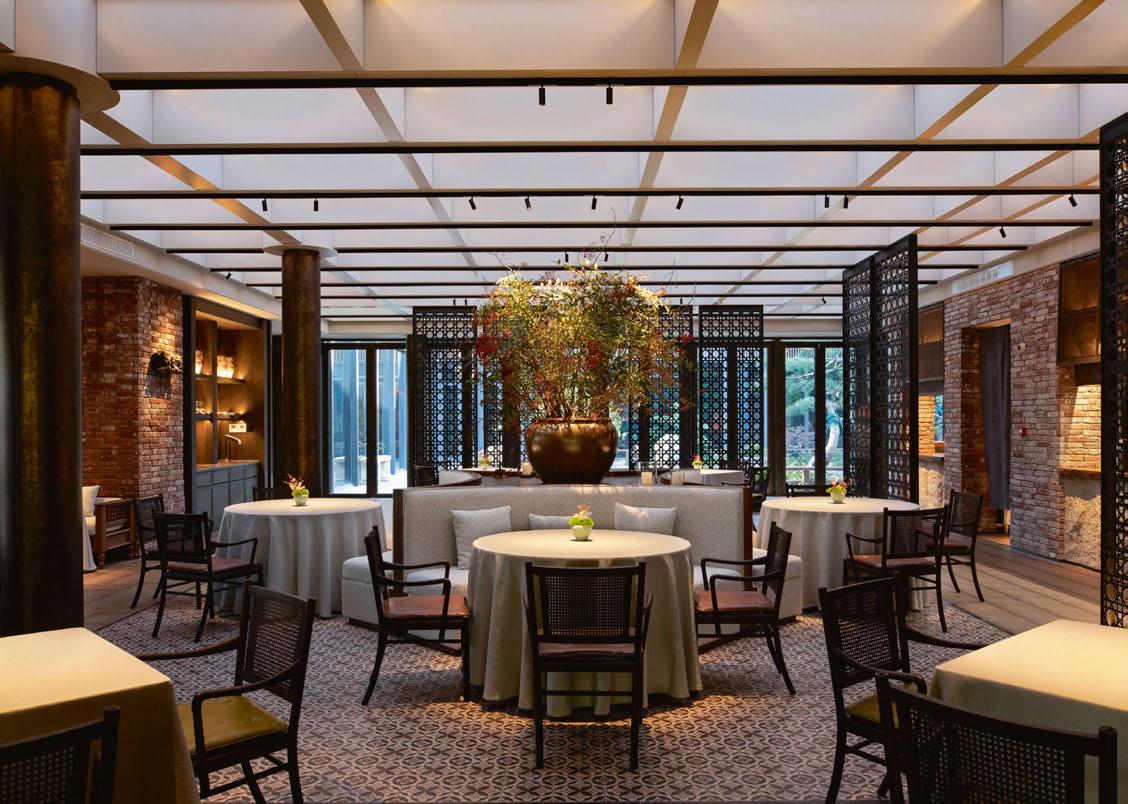
Supporting both clarity and ambience, a layered light scheme, utilising luminaires from CDN Light shapes a contemporary Jiangnan dining experience.
Located in Suzhou, Xin Rong Ji presents a refined dining environment that draws on the cultural imagery of Jiangnan while embracing a contemporary spatial language. Through a careful integration of materiality, decorative elements and lighting, the project creates an atmosphere that is layered, intimate and visually composed.
The lighting scheme was developed in response to the key demands of a high-end dining setting, balancing comfort, colour quality and ambience.
In the main dining area, high colour-rendering lighting enhances both the presentation of the cuisine and the tactile richness of the interior, supporting an elevated guest experience. Light interacts with ink-inspired features, screens and candle-like installations to create a nuanced composition of brightness and shadow, reinforcing the poetic character of the space.
In the ingredient display and private dining areas, the lighting language continues to build on the project’s overall narrative. By carefully controlling contrast and visual rhythm, the scheme strengthens the relationship between interior atmosphere and surrounding scenery. Here, light serves not only a functional purpose, but also acts as a medium that connects architecture, interior design and cultural expression, bringing the spirit of Jiangnan into a contemporary hospitality setting.
The project incorporates CDN Lighting’s Spring Banquet Collection, selected for its ability to meet the visual and atmospheric requirements of premium dining environments. The lighting supports clarity and elegance during the day, while at night it contributes a softer, more refined ambience that enhances the sense of intimacy and occasion.
In this project, light is more than a technical layer. It becomes an active part of the spatial narrative, shaping the identity of Xin Rong Ji Suzhou and offering a considered lighting approach for contemporary Chinese fine dining interiors. www.cdnlight.com
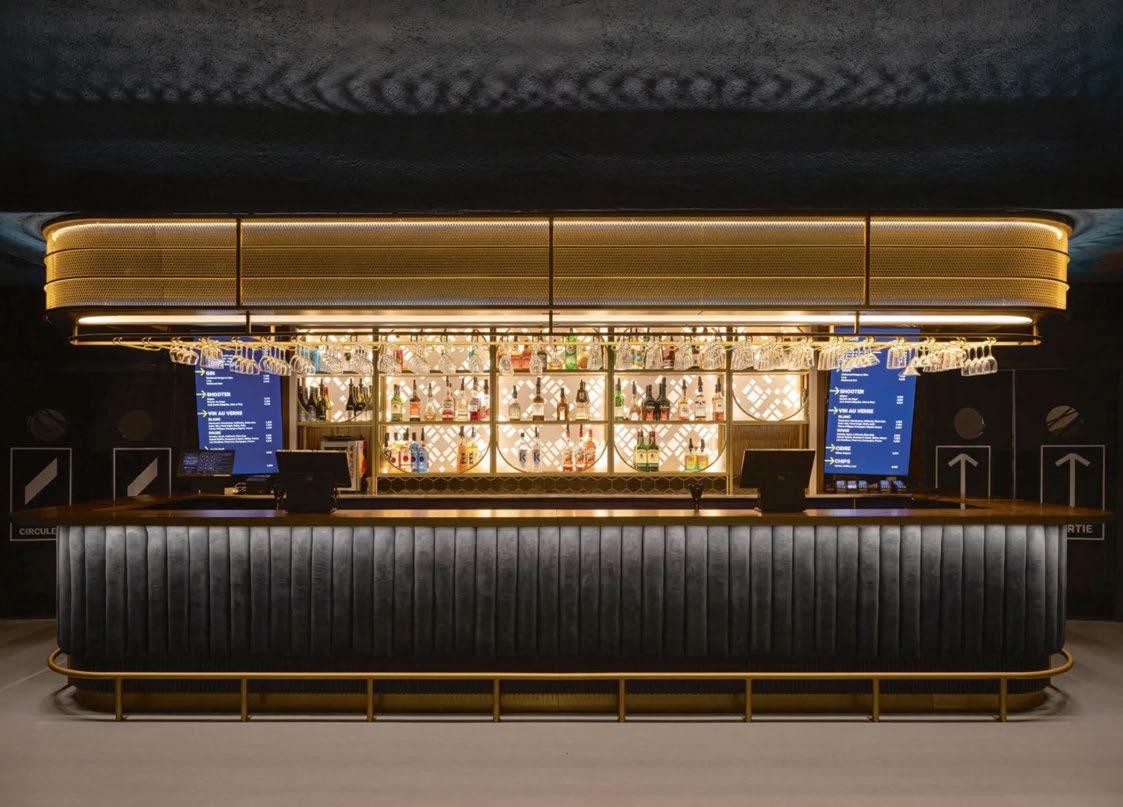
Drawing from Art Deco and Neoclassical references, luminaires from GLLS illuminate Québec’s L’Impérial Bell.
In the heart of Québec City, L’Impérial Bell stands as a reinvigorated cultural and hospitality destination, one where architecture, interior design, and lighting converge to evoke the glamour of a bygone era while delivering a contemporary guest experience.
Inspired by the grandeur of imperial palaces and the golden era of music and entertainment, the interior design draws heavily from Art Deco and Neoclassical references. Gold finishes dominate the palette, creating a sense of warmth, luxury, and celebration. The architects at SGD+A envisioned a renovation of the main bar area focused not only on aesthetic renewal but also on functional improvements to workplace ergonomics, storage efficiency, and staff circulation. This pragmatic foundation allowed lighting to become a defining experiential layer, one that reinforces architectural rhythm, material richness, and emotional tone without overwhelming the space.
Lighting plays a critical role in activating these surfaces. The flexible lighting, Vivid Wave Mini from the manufacturer GLLS and distributed by NRG, traces geometric forms, articulates vertical planes, and emphasises symmetry, allowing light itself to become a material. Rather than relying on a single visual statement, the lighting strategy is deliberately layered. Ambient illumination establishes an inviting baseline glow, while accent lighting brings focus to architectural details, bar surfaces, and circulation paths. This hierarchy creates a spatial rhythm, guiding guests intuitively through the venue while maintaining visual comfort across various moments, from daytime dining to evening performances.
A defining characteristic of the project is the visibility of the lighting within the architectural elements of the space. The lighting is not hidden; instead, it is carefully embedded within architectural elements, reinforcing the design language rather than competing with it. This approach ensures that lighting remains legible and expressive, yet restrained, supporting the atmosphere without visual clutter. Equally important is performance. Glare control, balanced contrast, and warm colour temperatures were crucial for maintaining comfort in a space characterised by reflective materials and metallic finishes. The result is a luminous environment, captured beautifully by Stéphane Groleau. It feels immersive and festive, while remaining functional for staff and adaptable to changing programmatic needs.
For architects and lighting designers, L’Impérial Bell offers a compelling case study in how lighting can bridge past and present, honouring historical inspiration while meeting contemporary expectations for flexibility, efficiency, and experience. The project’s success has been recognised internationally, including multiple honours at the Grands Prix du Design, underscoring the strength of its integrated interior and lighting approach.
www.glls.com www.sgda.ca
www.nrgqc.com
www.stephanegroleau.com
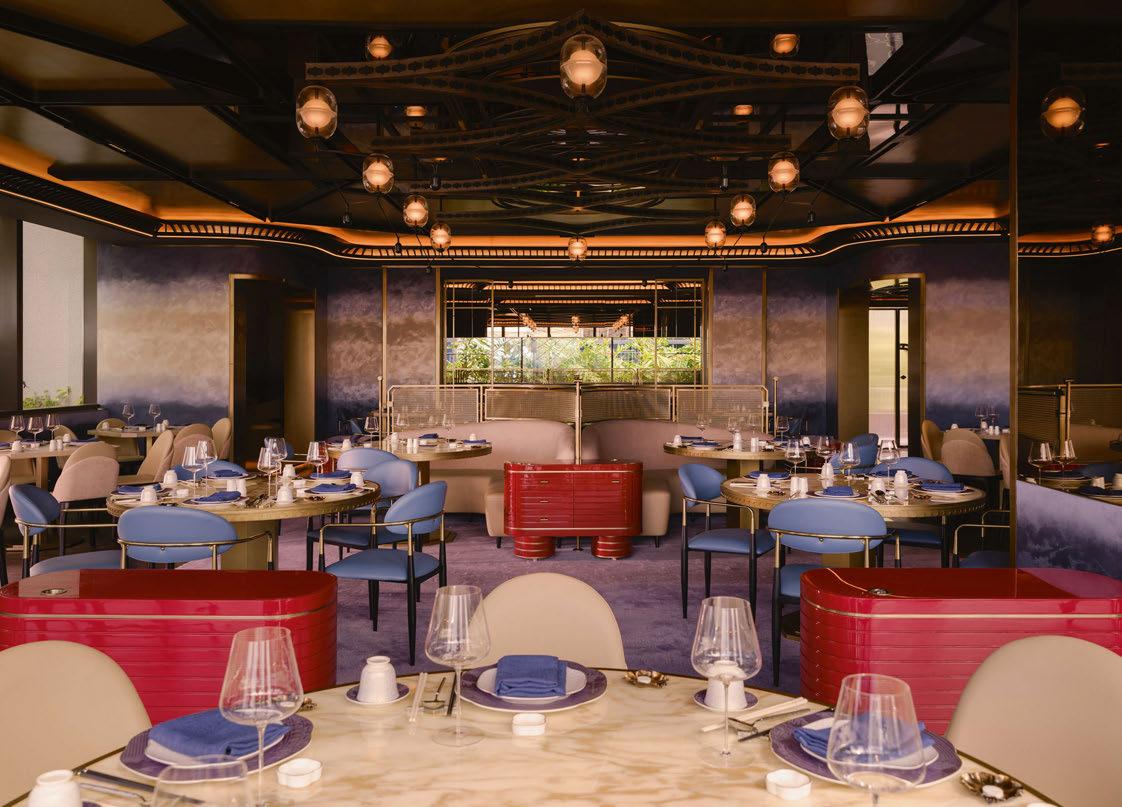
Lighting fixtures from LuxConex play an integral role within Singapore’s Black Pearl restaurant in merging modern sensibilities with classic Chinese inspirations.
The Black Pearl is a one-of-a-kind rooftop dining destination that seamlessly merges modern sensibilities with classical Chinese inspirations. The restaurant’s thoughtfully designed lighting by ALPs plays a pivotal role. From the soft golden glow that envelops guests in warmth to the precisely placed accent lights that highlight the presentation of each dish, every detail is illuminated to create a visually captivating experience.
Upon entering the restaurant, guests are greeted by the sophisticated and luxurious interior design by Hot Design Folks. The main dining hall is defined by rich, intricate textures that elevate the ambience. As for the lighting design, it perfectly complements the restaurant. The indirect cove lighting was achieved using Luxconex Cont H Auras, which reduces glare and harsh shadows while also creating dramatic effects, making the ceiling carpentry stand out with the illumination behind it. Additionally, the brand’s linear light: SR Blaze provides general illumination, further enhancing the dining area.
In the bar, Cont H Auras were smartly placed along the cove, the uplighting creating an ambient glow that enhances both the decorative elements and ceiling details. The highly reflective ceiling amplifies the light from the cove, creating a beautiful shine and also highlighting the natural stone details. Luxconex’s Cont H Fino was aesthetically utilised on the alcohol display shelving, creating a soft, even wash and highlighting the different colours, labels, and shape. The glow behind the bottles adds a sophisticated feel, ideal for these upscale bars and lounges.
Luxconex’s Fino contour lighting was also used along the inside of the bar counter, to keep the area well-lit and give bartenders the visibility they need while working on their concoctions. Just before the entrance to the bar, Ryko fittings have been installed in the corner dining area, with the goal of providing focused illumination and controlled lighting. The Ryko downlight offers a wide range of beam angles, power options, and flux outputs, allowing the lighting consultant to achieve the desired lighting effect while highlighting tables without excessive glare or spillover. Another key area of the restaurant is the exclusive dining space, where guests can immerse themselves in the experience and get up close with the chef during their live culinary performance. This makes proper lighting essential in this part of the restaurant. Right above, the ceiling features stunning carpentry work, encircled by Cont H Auras – not just for aesthetics, but also to illuminate the surrounding space. Combined with other lighting fixtures, it ensures a well-lit dining experience. Behind the counter, multiple shelves showcase various decorations and furniture, illuminated by the Cont H Fino. With its 10mm slim body, it fits seamlessly onto the shelves, creating a soft glow that elegantly highlights the displayed products. Every luminous detail in this high-end restaurant was carefully selected to enhance both functionality and aesthetics. By integrating SR Lightings, ALPs has crafted a warm, luminous ambience that not only highlights the chef’s artistry but also complements the remarkable interior design. www.luxconex.com
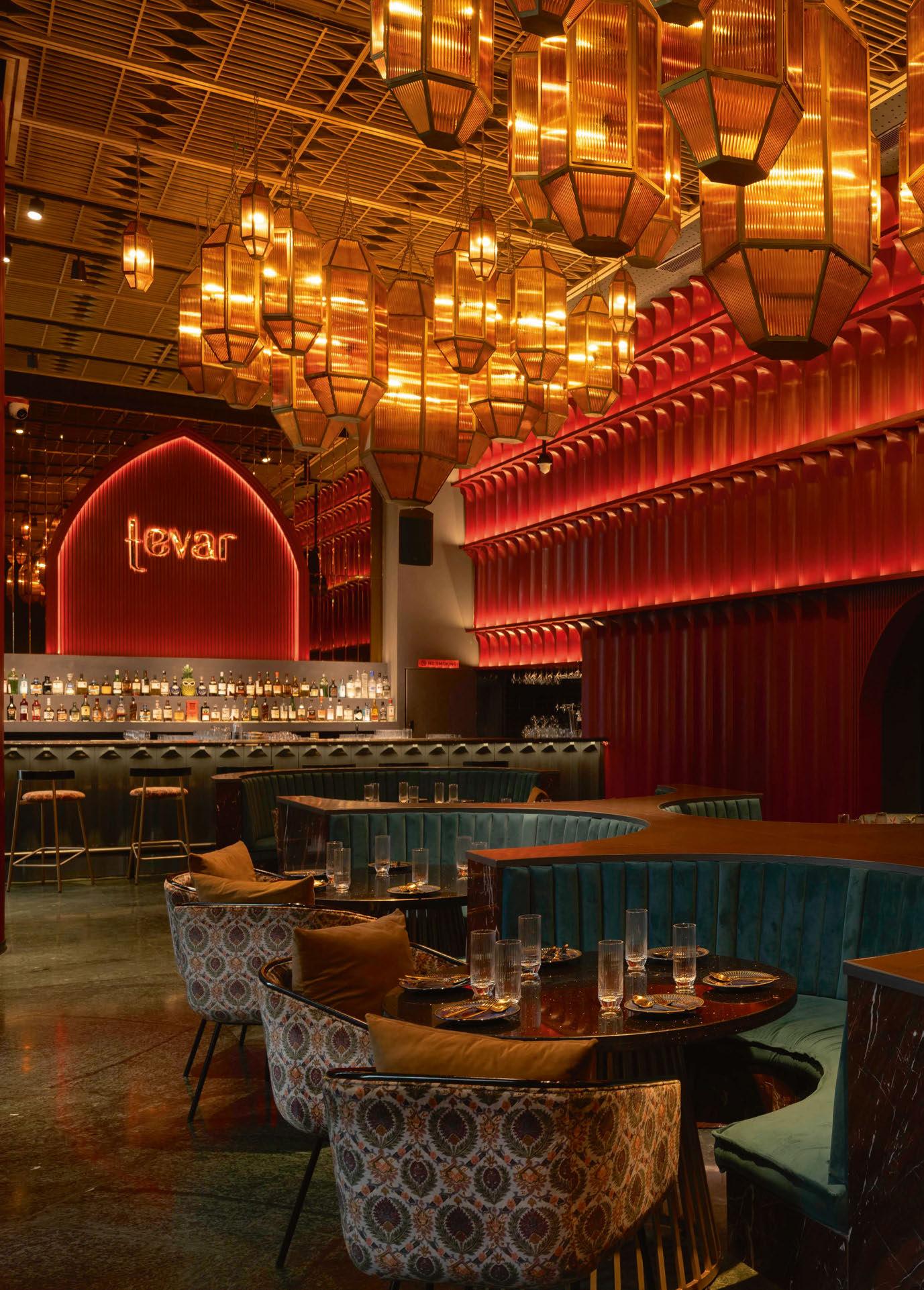
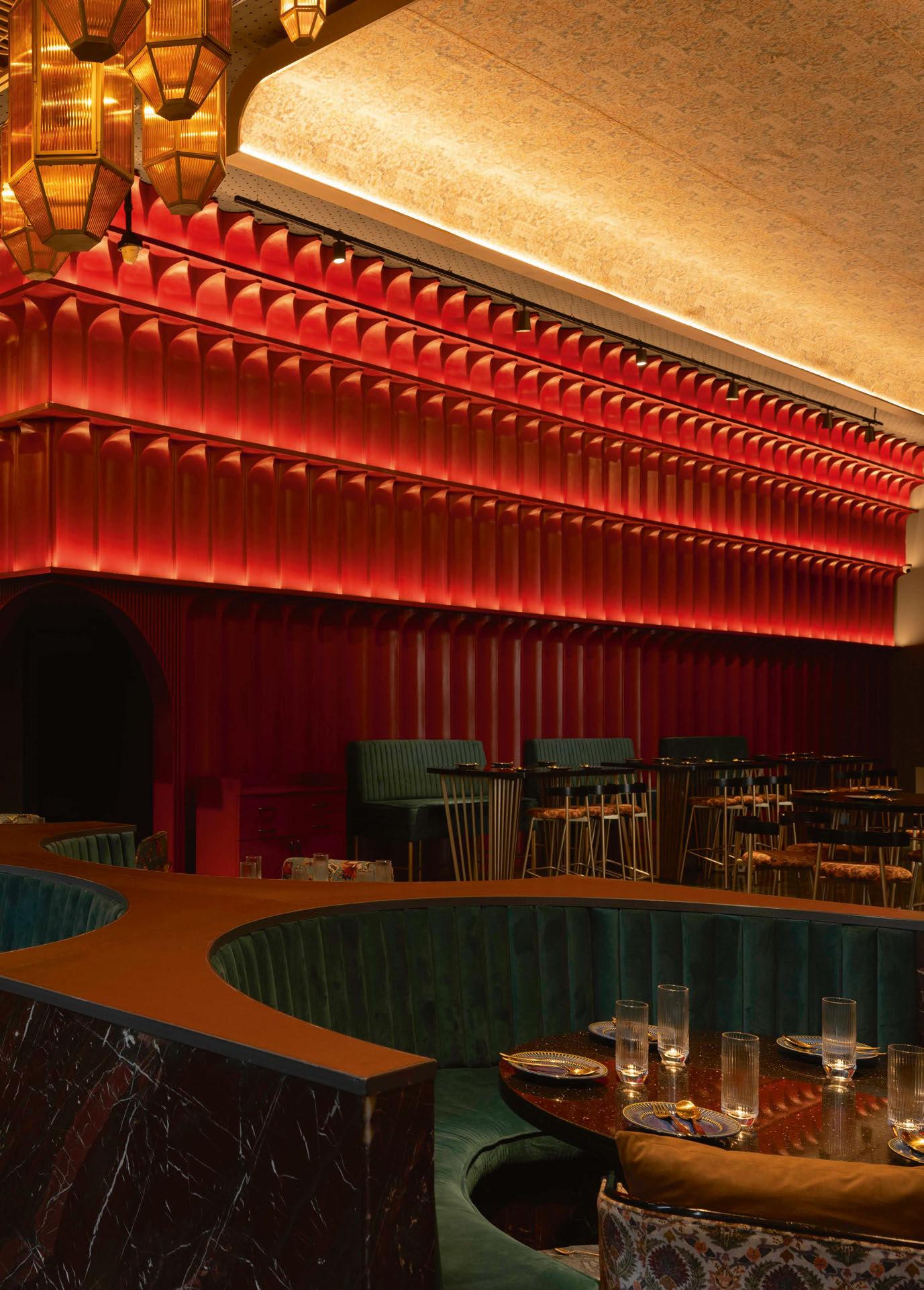
Tevar – The Progressive Indian Kitchen & Bar is a contemporary dining space in Hyderabad, India, that combines food, music, and performance within a layered architectural environment. The lighting design for the project was developed by Love of Light, working closely with the interior design team to shape an atmosphere that responds to the restaurant’s dramatic spatial language, while maintaining warmth and intimacy. The interior is defined by deep tones, curved forms, and a rhythmic arrangement of architectural elements. Rather than evenly illuminating the space, the lighting strategy introduces hierarchy and contrast, allowing materials, textures, and volumes to reveal themselves gradually. The approach focuses on layered illumination, combining ambient light, focal accents, and controlled brightness to guide the visual experience throughout the restaurant.
A central element of the project is a large chandelier installation composed of 89 lanternlike fixtures suspended across the ceiling. Each fixture was custom designed for the space and developed through several months of prototyping and testing. The lanterns are fabricated using recycled aluminium and handblown glass sourced within a 100km radius of the site. Their clustered arrangement creates a floating canopy of warm light that defines the main dining volume, while maintaining visual lightness within the large interior.
Along the surrounding walls, a series of customdesigned jharokha modules – inspired by traditional projecting window niches found in Indian architecture – form an architectural rhythm that frames the dining areas. Linear lighting profiles integrated within these modules gently graze the surfaces, revealing depth and texture while maintaining a controlled and comfortable brightness level.
In addition to the central chandelier and wall lighting, other areas of the restaurant are treated with more restrained layers of illumination. The bar uses integrated backlighting to highlight bottles and materials, while counters and service surfaces are softly illuminated from below to maintain visual comfort. Acoustic ceiling forms and performance zones are accented with carefully positioned fixtures that emphasise architectural geometry without introducing glare. The result is a lighting environment that supports the spatial identity of Tevar while remaining integrated with the architecture. By combining custom lighting elements, controlled illumination, and responsive lighting controls, the project demonstrates how lighting can shape atmosphere, guide perception, and support the experiential qualities of hospitality spaces. www.loveoflight.in

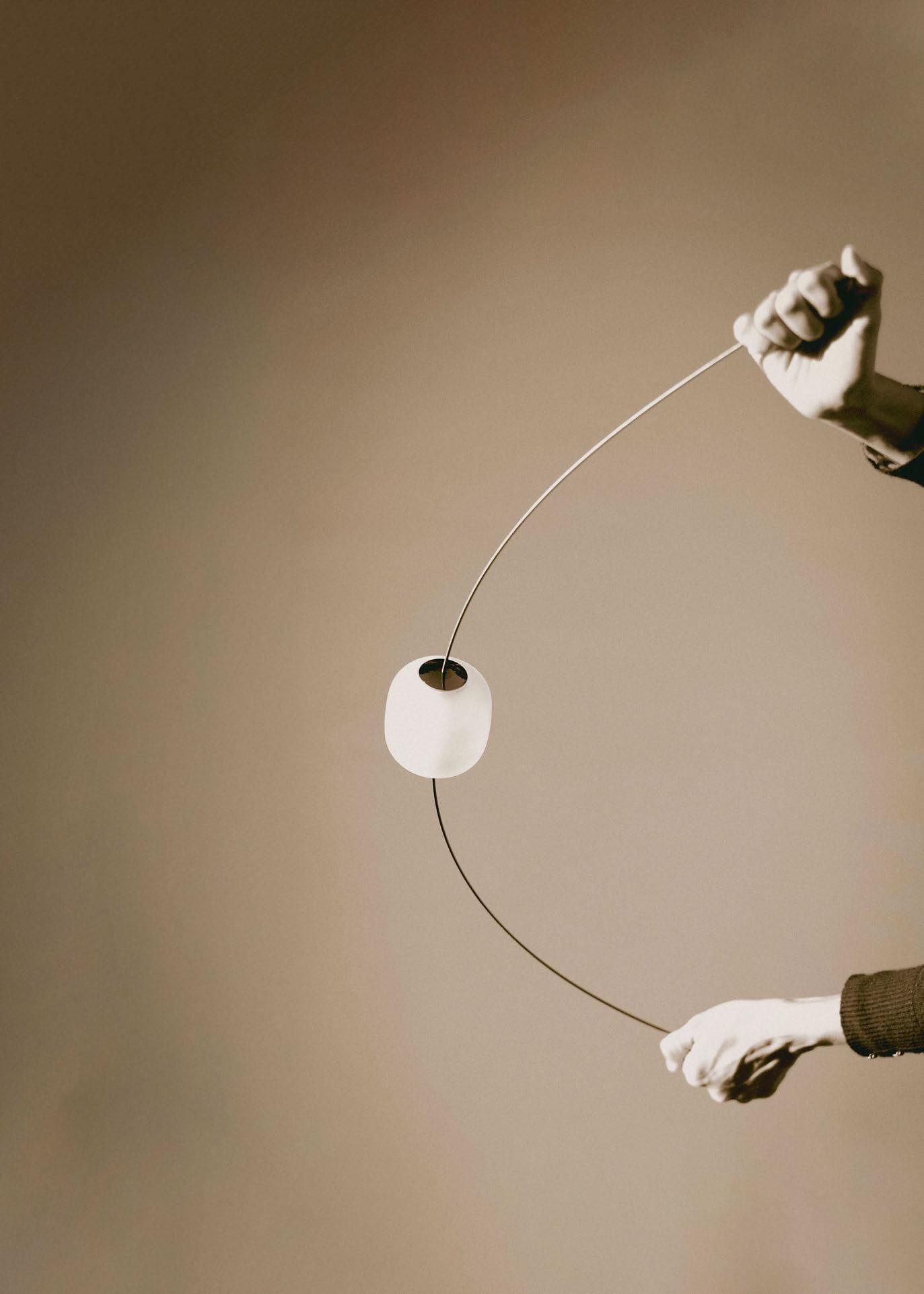
Born from the desire to rethink the chandelier without visible wiring, Axia unites structure, energy, and refined materiality. Its development traces a journey of experimentation that culminates in a system of pure balance and light.
The realisation of Axia came from a project that is driven more by the pursuit of balance rather than the inception of a light in the traditional sense. From the very beginning, independant designers Vittorio Venezia and Carolina Martinelli, approached Axia as an idea: what spatial presence could a chandelier achieve if its most visible component, the wire, were removed?
This radical question became both the core and constraint of the project, prompting the team to hide every technical element within the structure itself, turning the central axis into the conductor that carries both electrical poles and gives the lamp its name – Axia, from the ancient Greek word meaning “value” and “axis”.
“Axia was born from the desire to reinterpret the chandelier typology in a contemporary way,” says Martinelli. “We were interested in working on a lamp capable of establishing a presence in space, yet with great visual lightness. Rather than focusing on the object itself, the research concentrated on how light could occupy and define space.”
“The initial question was very simple: what happens if we remove the wire from a chandelier? That’s where the project began. If light is no longer bound to a cable but flows through the structure itself, the lamp changes its nature: energy passes through the object, and the technology disappears, allowing only light, structure, and proportion to emerge,” adds Venezia.
The idea for Axia originated long before its realisation, but it wasn’t until Lodes approached the duo for a potential collaboration that it began to take shape.
The designers shared their vision of reinterpreting the chandelier with no wires, a concept that Lodes was immediately drawn to. From there, the project evolved, with both teams agreeing to treat the design not as a singular object but as a flexible system capable of adapting to various lighting needs.
The project began in 2024, requiring two years of development, including concept, prototyping, technical refinement, and final rollout. The initial concept was the easier part, with the challenge lying in how they would make the technology “disappear” within the structure without compromising the clarity of its chandelier form.
The lamp begins as straight metal rods and tubes, which are manufactured and finished while still in their linear forms. These parts are designed to be slightly elastic, so they can be easily bent without compromising their strength. This flexibility is essential, as it allows the natural curvatures to take shape during installation.
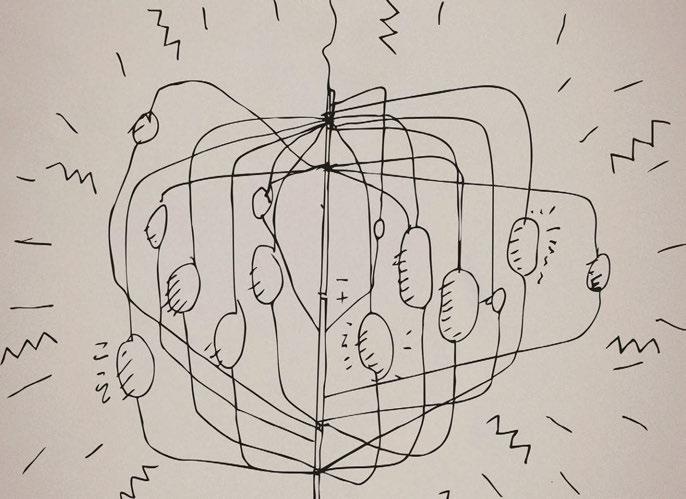
After shaping, the metal receives a PVD coating treatment. This finishing is not only fundamental for the refined aesthetic, but also plays a functional role, helping the metal maintain electrical conductivity so the structure can act as part of the circuit. In parallel, the diffusers are made from Pyrex glass tubes that are heated until soft, then shaped over the moulds.
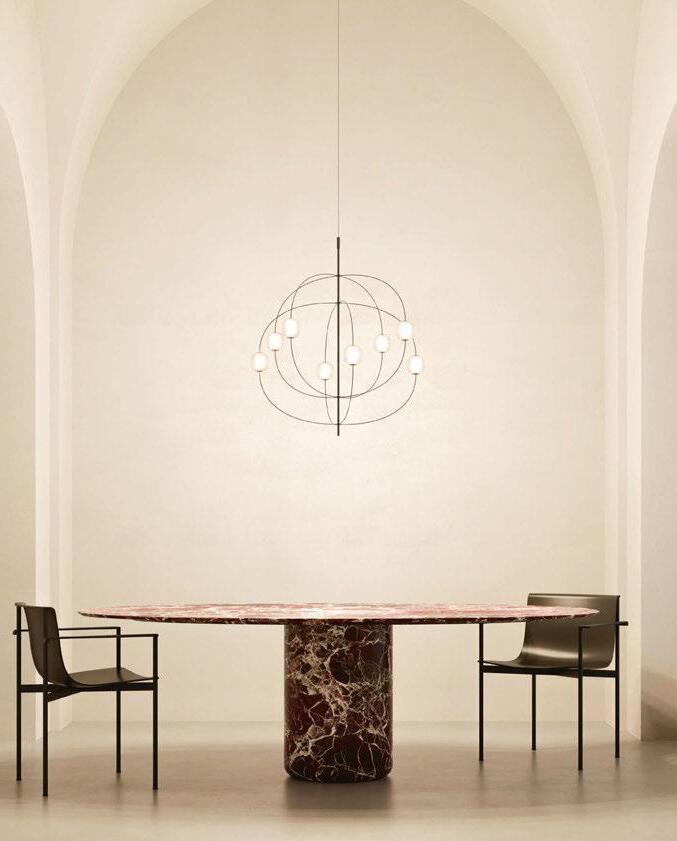
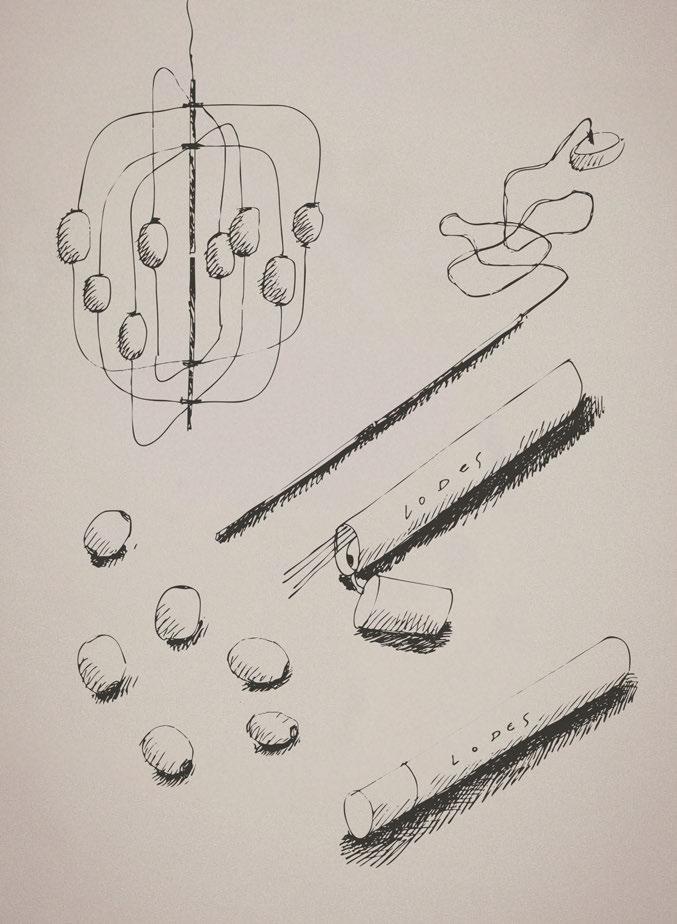
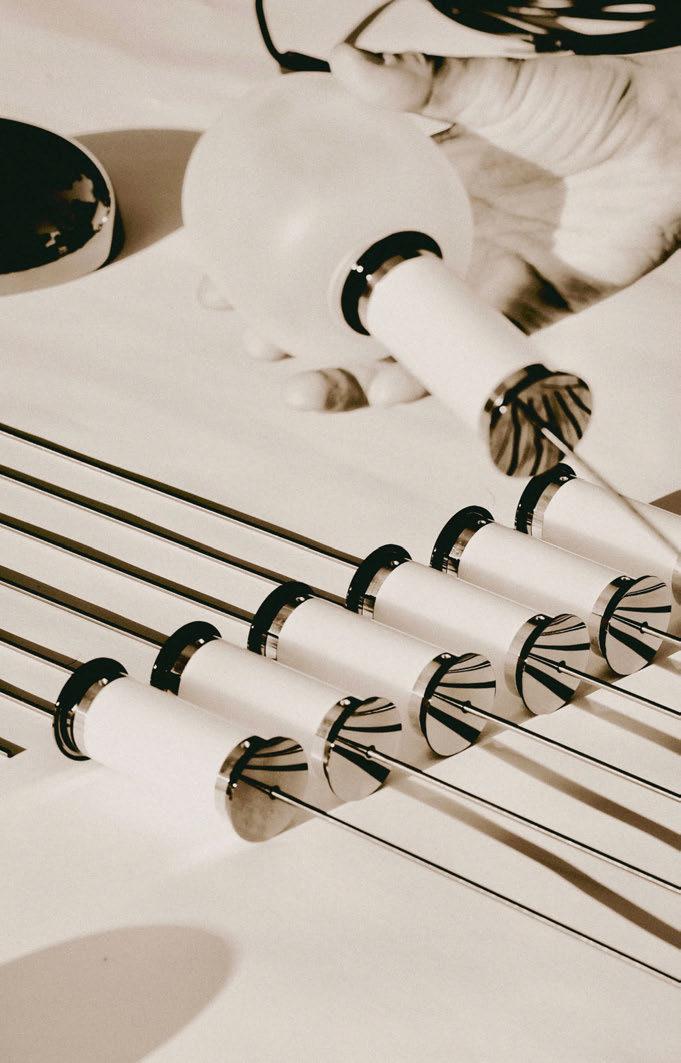
The prototyping phase proved just how demanding the designer’s initial gesture of removing the wire would become once translated into materiality. The early prototypes were stripped-back technical rigs, built primarily to verify internal electrical continuity and the reliability of the connections between elements.
“The early prototypes were much more technical than the final product, but they already contained the fundamental principle of the project: a central rod divided into two poles of positive and negative, from which the arms extend, conducting electricity,” explains Martinelli.
As development progressed, the team moved through several distinct iterations: early versions relied on rods, but these soon were replaced with spring steel, whose elasticity offered greater efficiency, slimmer proportions, and the possibility of compact packaging that would help reduce its overall environmental impact. This shift, however, introduced new complexities –every section, tolerance and junction had to be recalibrated to ensure that the lamp maintained both its structural stability and its visual clarity. Throughout all these changes, one principle remained untouched: the central axis as the chandelier’s organising and conductive core, the element that unites material and light, and most crucially gives a sense of balance.
The production of Axia is based on a combination of precision engineering and a material-led approach. The lamp begins as straight metal rods and tubes, which are manufactured and finished while still in their linear forms. These parts are designed to be slightly elastic, so they can be easily bent without compromising their strength. This flexibility is essential, as it allows the natural curvatures to take shape during installation. After shaping, the metal receives a PVD coating treatment. This finishing is not only fundamental for the refined aesthetic, but also plays a functional role, helping the metal maintain electrical conductivity so the structure can act as part of the circuit. In parallel, the diffusers are made from Pyrex glass tubes that are heated until soft, then shaped over the moulds. Once formed, the glass is sandblasted in a controlled chamber, where air and sand gently roughen the surface to create a matte finish that allows a soft and even light. In the final stage, the electrical components are added, and the system is assembled. The whole design has been developed with modularity in mind, reducing the number of parts to make installation easier and allowing the lamp to be packed efficiently. Overall, this improves transportation, minimises waste while still maintaining the clarity and identity of the design.
“Sustainability and longevity play a key factor in our designs, especially in construction logic,
hence why Axia is shipped in very compact packaging. At the same time, the product is designed to allow LED replacement over time, ensuring greater longevity and reducing waste. It represents a choice for more sustainable, longlasting lighting,” says Martinelli.
To allow this, the structure is modular and can be disassembled into a few small elements: the central canopy with the transformer, the central axis, and the eight arms to which the LEDs and glass spheres are attached. “We like the idea of the assembly being a ritual,” adds Venezia.
In its final form, Axia expresses a kind of presence that goes beyond illumination. The designers have been blown away by the feedback of their chandelier, with users describing it as a lamp “that draws space even when it’s switched off”. Rather than occupying space with mass, it occupies space with light, allowing a gentle, diffused glow to define the atmosphere more than the object itself. This effect is heightened by the lamp’s soft output, which wraps the room in an elegant radiance. For the designers, Axia resolves into three words: balance, system, and light – a concise summary of its material logic and its quiet yet unmistakable presence. www.lodes.com www.martinellivenezia.com
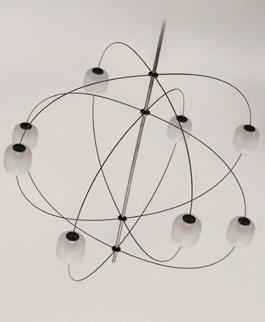
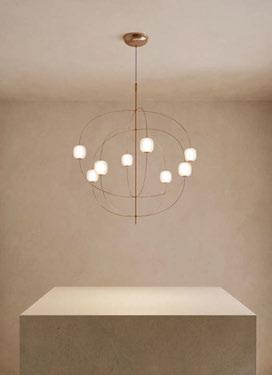




Fresh from an extended trip to Frankfurt for Light + Building, Kevin Grant, Founder and Creative Director of LIGHTALLIANCE presents his top findings from the fair in this year’s edition of the CoolKitList.
Something about Light + Building in Frankfurt seems to attract a perfect storm of creativity, innovation… and logistical chaos. Every edition brings its own flavour of disruption, and 2026 was no exception. This year’s adventure came courtesy of an unexpected Middle East conflict closing airspace for many visitors and yet another German airline strike, leaving many of us stranded, rerouted, or forced into creative travel solutions involving trains, buses, and the occasional questionable taxi. Some left early, some stayed home, and some (myself included) simply surrendered to fate and stayed longer than planned.
But once you finally make it through the doors of Messe Frankfurt, the travel dramas fade. Light + Building remains the biggest and most influential lighting event in the world, which attracts a fantastically diverse mix of brands, products, and people. A place where ideas collide, boundaries shift, and the future of our industry reveals itself one stand at a time. This year the future was framed around three major themes: Sustainable Transformation, Smart Connectivity, and Living Light.
There was a clear focus on climate goals, with brands emphasising reduced carbon impact, increased system efficiency, and lower energy consumption. Many exhibitors demonstrated a shift toward lifecycle sustainability; circular design, smaller footprints, fewer components, modularity, and repairability were consistent themes across the halls.
Digitalisation took centre stage, with intuitive local controls, sensor based systems, adaptive lighting, and AI integration moving beyond theory into practical deployable tools. Gesture control, predictive maintenance, and cybersecurity were woven into several systems, signalling a more mature and integrated approach to smart buildings.
There was a renewed emphasis on wellbeing, spatial quality, and the emotional impact of light. Human centric lighting and the physiological response to light were explored through refined solutions for flexible workplaces and home working. Complex surface technologies, fractal patterns, and natural textures enhanced aesthetics and wellbeing. The fusion of light with acoustic materials and multifunctional components also played a major role this year.
We always discover some nice and unique features, innovations, and problem-solvers when our industry comes together like this and so here are some of the highlights from Light + Building 2026.
A.A.G. Stucchi showcased the evolution of its Core ultra miniaturised polymer tracks, delivering standard track performance with significantly reduced form factors and material use. It also presented some innovative ‘curved’ articulated track adapters for use in straight or curved sections. Its Hyper System 2 modular mains voltage system features upper and lower sectors, which allow options for uplighting, emergency lighting, loudspeakers, and customised inserts – all with full smart functionality and extensive customisation options, designed for the next generation of integrated systems. Full customisation light inserts and finishes are also possible.
Aero introduced the AI powered Vision Auto Tracking Light, capable of real time object tracking by simply uploading a photo of the focus target. ATA Touchscreen Track Light adds onboard dimming, beam, and CCT control via the touchscreen on the rear of the luminaire. Albert downlights offer bracket fixings with telescopic alignment for tricky open gap ceiling geometries, while Ares and Ada deliver ultra compact, high CRI spotlights with precise beam and glare control. Alphabet by Zambelis explored experimental lighting with Curved Magnetic systems for freeform compositions. TAF50 is a minimal magnetic track with 360° luminous distribution and individual
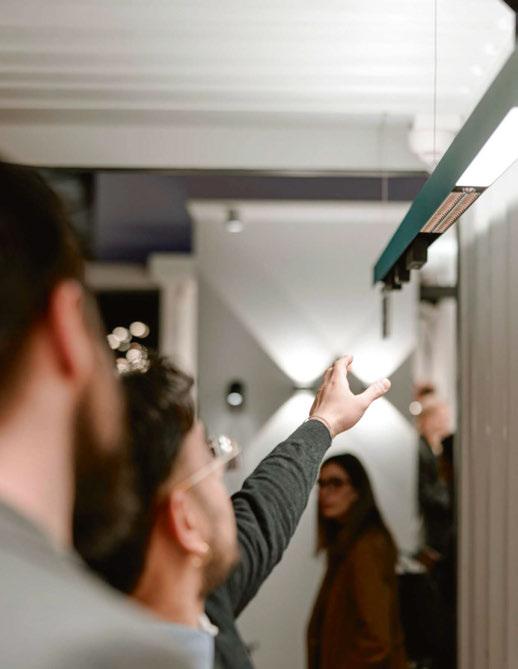
DALI control. Its Acoustic Panel/ZETA21 integrates lighting and acoustic control in modular ceiling platforms, complemented by New Fine Matte Powder Coat and Metallic Finishes.
The Calumma family from Anolis delivers ultra narrow beams (down to 3.5°) using precision collimator optics. Calumma Art added dynamic effects through manual manipulation of interchangeable lenses and textured glass. The prototype Yoro fixture introduces motorised 3.8–60° zoom with RGBW/RGBA/RGBL options in an IP67 housing.
Bartenbach demonstrated the abilities of the complex surface reflector technology with controlled distributions and exceptional glare control - such as providing square light distribution from a round wall wash luminaire. Highlights included the RMJ (Reflector Mini Junior) at 40mm diameter and supports tuneable white, and Focal Optics, featuring miniaturised double focus systems with apertures as small as 10mm.
Bega had a commanding presence in Hall 3. The Fanoos collection blends tradition with technology through customisable patterns and multiple mounting formats. Spark Line introduced a range of fixed or portable lanterns with crystal glass reflectors. Bega’s 48V range expands miniature luminaire with useful function output, options for ThermoBrass finishes and modular accessories. The PV Bollard impressed with fully self sufficient solar power generation, even in northern climates. Bega Connect control via app simplifies wireless DALI control, removing the need for traditional DALI bus cabling. The Aubrilam New Wood Finish
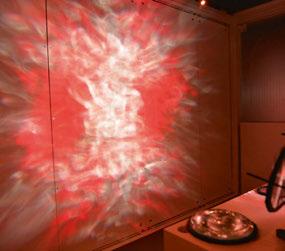
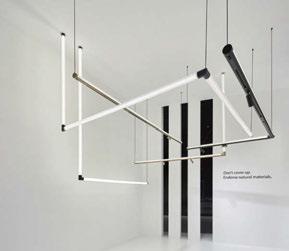
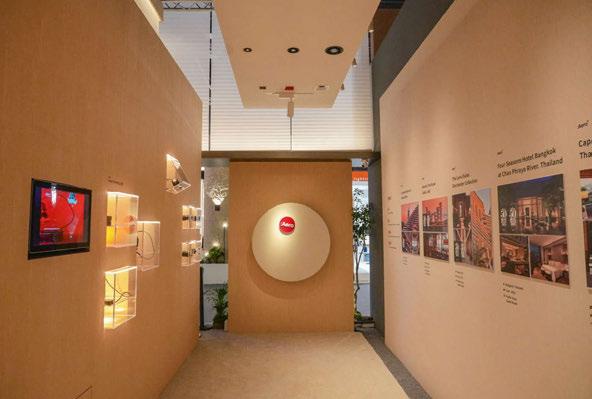
+ Features was also impressive, with a refined desaturated palette and emphasis grain and Modular mechanical fixings (Aubrilam has moved decisively toward fully mechanical, reversible, serviceable connections for all wood–metal interfaces). One real stand out was the new generation of Wide-Spread Bollard Optics, where bollards can be placed up to 16-metres apart and still achieve continuous, overlapping illumination (although 8-12-metre spacings may be required where specific minimum levels are being targeted –still very impressive).
eldoLED presented its optimised technology for human centric environments. Ultra smooth deep dimming to 0.1%. Tuneable White transitions that feel truly natural, precision colour mixing with perfectly smooth transitions and pixel accurate colour blending. Smooth flicker-safe dimming and transitions. It also displayed some practical problem solvers – modular connector for fast and more reliable installations, wireless control options and a prototype preview of some neat field adjustable future innovations.
Filix showcased various configurations of its modular Tria 48V flexible multipole system with options for projectors, street optics, signage, sensors, and cameras. Arpool Micro introduced tiny underwater luminaires for shallow pools and steps with multiple glare control options such as halfmoon shield and hex louvre.
Folio evolved its Zero backlit surfaces with precision inserts and homogeneous illumination in any shape, including concave forms. The Outdoor Opal10VS variants on display demonstrated exterior
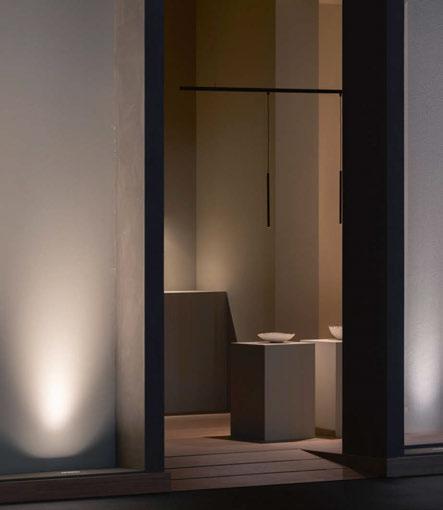
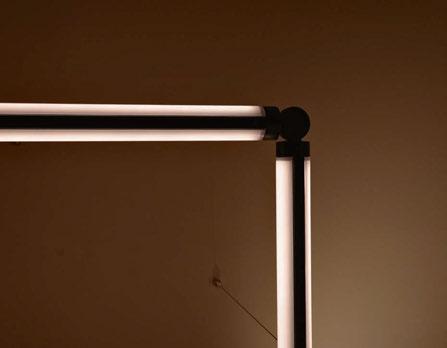
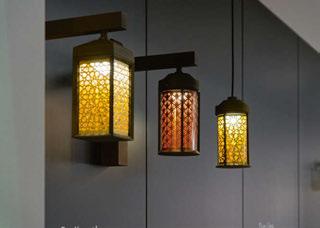
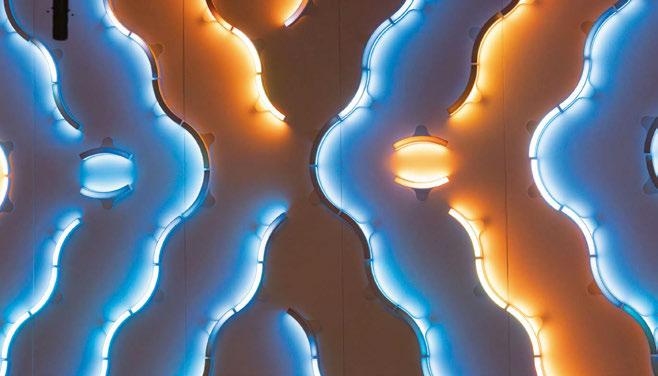
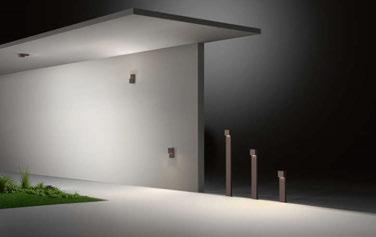
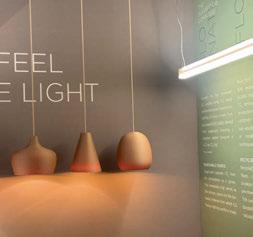
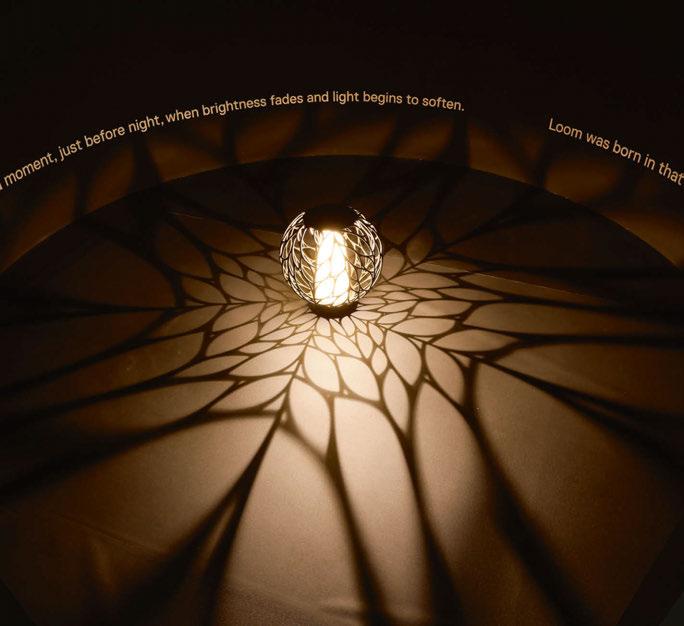
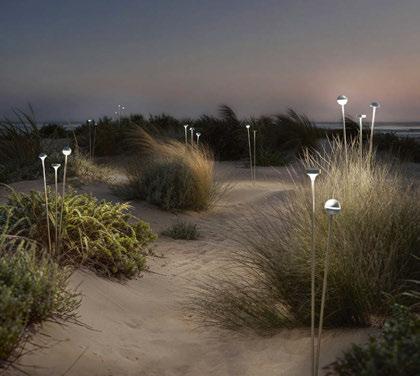
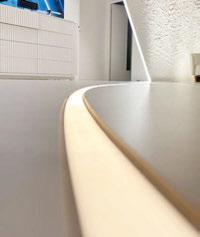
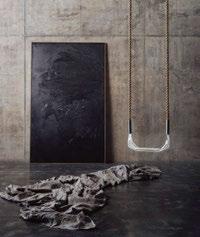
canopy and wall applications. Prism added micro prismatic glare control, while Ghost integrates honeycomb louvres for controlled brightness.
Georg Bechter Licht refined its Dot 28 platform with flush, frameless integration and easier installation/maintenance. Viso 28 adds a miniature DALI 2 multisensor for motion and daylight detection. Wall 28 delivers precise wallwashing from a 28mm depth. Dot Slim increases output to 1220lm at only 25mm depth, and Spannring 28 introduced a clever tool free mounting ring. Ideal Lux showed a strong trend towards rippled and fluted glass. Tubix stood out as a slender 20mm fluted pendant. Mapa has evolved into a modular system allowing for features and chandeliers to be formed using modular components. Steel offers ultra slim linear luminaires with direct or direct/indirect emission providing functional light, but the standout feature is how slim the fixture is, at only 9mm width in some variants.
Kerai introduced 1001K Amber Spectrum technology delivering zero blue light (446–480nm) to avoid melatonin suppression and support natural circadian rhythms. Copper and bronze materials reinforce the warm, intimate aesthetic. Its new 1000–3000K “light to embrace” range uses spectral recipes for rest, wellbeing, and emotional comfort, demonstrated through an immersive sensory installation.
Kreon expanded its darklight portfolio with Stark 60/80, deep recessed downlights with CRI97+ (R9 88), multiple beam angles, adjustable rotation with 40° tilt (in steps of 5°) and excellent UGR performance. Nano Track is a 20mm high 48V system with individual DALI control and ultra compact directional modules.
Visitors entered the LEDFlex stand by a waterfall lit from Rigid Optico Aqua, an underwater wallwasher with collimated beams and adjustable optics. Zeta Inground delivered dynamic pixel fades demonstrating seamless integration into hardscape. While Delta Inground introduced dual bending 3D flexibility with IK10 strength and dynamic pixel control. Optico Neon added new anti glare hex and linear louvre optics. LEDiL showcased Spectre, a secondary optic that neutralises 99% of blue light while maintaining 90–96% efficiency, and Ulla – a new family of fixtures and lenses designed specifically for uplight applications to deliver soft, uniform uplighting. The Flora pendants from LEDLuks are formed from bio-based PLA with 40% recycled wood fibres via 3D printing. Razel integrates ambient and task lighting in a layered form with illuminated cylindrical translucent body and low glare task lighting from below. Fibi is a spherical pendant with central cylindrical glowing element and a functional downlight, which can be independently controlled. Moal from LedsC4 is both a beautiful piece of exterior furniture and a light beacon providing useful light. Available in two sizes (705mm + 455mm), sealed to IP66 with IK10 impact resistance. The latest generation of Lightnet’s Liquid Line profiles have a minimised section of only 60×60mm available with both direct and direct/indirect
lighting, a special groove on the rear allows integration of additional components, such as the metal mesh curtains used to good effect around the central bar of its stand this year, which provided a fabulous view of the Liquid Tiles kinetic audiovisual art installation, where generative algorithms provided a hypnotic combination of movement, geometry, colour, and sound. An expansion of the Matric systems showed miniaturisation, ultralow glare optics, and new adjustability/flexibility features. Another well received display was Lightnet’s collection of wood and continuous wood grain wood veneer luminaires.
Linea Light Group’s Drift range includes discreet bollard and surface mount fixtures with highperformance light distribution from a very compact form. The Suelo uplight range now features asymmetric wallwasher, hyper spot (1–3°), and ultra spot (4–6°) optics. Rubber 3D Optic V2 is a flexible linear system designed to adapt even to complex geometries. Moldable along both vertical and horizontal axes, it precisely follows architectural forms and natural elements integrating harmoniously into the space. Periskop Round introduced a sleek outdoor projector family available in four sizes, five finishes, scalable power outputs and a wide range of optics. It has a very clever very flexible adjustment.
DoReMi is an ultra minimalist 316L stainless steel bollard family from L&L Luce&Light. Ginko 4.5 Light Shaper uses multi-lens systems and movable fins for crisp, adjustable projections, also available with a GOBO option for crisp, clear projection, even in areas with ambient lighting. Bit is a miniature flush recessed accent light with fixed or elliptical optics. Neva Pro 7 is a high performance linear grazer with integral MicroLouvre, homogeneous colour mixing extensive CCT/RGBW options and marine grade protection.
Luminus highlighted PerfectWhite LEDs with halogen-like spectral quality without UV/violet emissions, filling the cyan gap for exceptional colour rendering. Its COB families (GEN6, GEN6+, Lux, ThinPro) reach up to 187 lm/W. GEN 2 Tuneable COBs offer smooth warm/cool mixing. MP Lighting showcased compact ingrade lights designed for easy installation in concrete pours and paving stones, with adjustable levelling for uneven ground.
Neko Lighting’s Space 40/60 Evo offer seamless linear systems with options for custom shape, acoustic compatibility and new low glare homogenous diffusers. Module 07 48V is an ultra slim 7mm track with options for translucent glowing tube elements, multiple insets and control options, and flexible mounting configurations. SF28 is a next generation flexible linear system from Olympia Lighting, with RGBW pixel level control and multidirectional bending, supporting runs of up to 50-metres with consistent output. O/M expanded One Pro with scalable diameters (40–150mm) and replaceable optics and wallwasher versions up to 3000lm. Golden Light enhances warm materials via spectral reflection. Act is a precision beam shaping projector with Bartenbach optics offering 14°–100° zoom.
The Loom approach introduced a decorative bespoke lantern concept based on layered, indirect light. Loom Path extends this into landscape with very wide lateral throw distributions.
Prolicht’s Sen is an ultra flexible linear system with smart mechanical joints enabling bending, branching, and rotation in 3D while maintaining continuous power and data. With decorative reeded diffuser, functional task light and globes/ pendants, Oiko Pro is its flagship downlight family with pure, clean beams and extensive modularity, Available in a wide range of configurations including a dual wall wash function and version for seamless integration into concrete.
Puk expanded the Lucea family with wall lights, bollards, lanterns, and garden lights, all structural parts are phosphochromatised and polyester powder coated and rated IP66.
The Sense Lightswing was a kinetic light sculpture from SAAS Instruments. Its philosophy of restraint and simplicity is reflected in tiny, efficient fixtures like SAAS Sauna ID+, at only 18mm diameter but rated for –30°C to +125°C. Lightware demonstrated elegant fibre optic table top lighting with concealed source.
Simes’ Shift Pro Rotosymmetric added 180°/360° diffused heads to modular poles, supporting cameras, loudspeakers, sensors, and connectivity. Field + Field Sensor integrates app based control and environmental sensing for adaptive outdoor lighting. The new Bronze Collection uses BRAL aluminium bronze alloy for extreme durability in harsh environments.
Intusens from Trilux is a full family of intuitive PIR based sensors (offering stand alone, DALI 2, Bluetooth NLC, Zhaga connectivity), which can be directly managed and programmed via the on-sensor interface dial. Jovie IQ surfacemounted luminaires focus on vertical illuminance for facial recognition, glare-free uniformity, CCTV compatible spectra, and modular optics for urban environments.
UFO (Universal Fibre Optics) showcased laser driven fibre systems delivering high intensity output over long distances. Phaetons combines multiple lasers for up to 100-metres of illuminated fibre at only 12W. A 32-metre “fibre link” allows further flexible placement of the light engine.
Unonovesette’s Trail 54 Q is a compact brass step light with glare free asymmetric distribution and dark sky compliance; the bollard version is formed from reconstituted bamboo. Vario 33 Zoom offers 6°–52° on site adjustable optics. Stelvio 45/66 are trimless recessed uplights with TIR optics, Smart Shield, and extensive accessory options. The Stix System is a modular outdoor family with single/ double emission, multiple lengths, and refined finishes with colour temperature ranges from 2200K to 2700K, 3000K, 4000K.
The Ziggy Wireless (yes wireless lighting!) from WAC Architectural uses induction based power transmission for showcase lighting, allowing free repositioning and onboard zoom (8°–40°). Ziggy
Projector Art LV adds crisp framing projection to the micro track system. LEDme Air is an 8mm diameter task light with 0–360° rotation, modular splicing, and asymmetric no glare optics.
The W164 Alto pendant from Wästberg delivers powerful indirect illumination from a minimal cylindrical form, offering 10,400lm at 91W with CRI≥90 and DALI/PUSH dimming. Simple, almost brutalist in form, yet atmospheric in effect and visual impact.
Wibre’s Hiro 4.0298 is a high output IP68/IP69 tiltable inground uplight with IK11 impact rating, The LED board can be tilted on site without opening the luminaire (with visual indicator nor tilt increment selected). Available in white or RGBW with multiple beam options and anti-glare accessories.
XAL’s Mino 25 is a super shallow 25mm linear system that can be recessed, surface-mounted or suspended, with UGR≤16 and high efficacy up to 168 lm/W. Move It 10 has been upgraded with curved reflectors, flexible insets, and dual sided mounting in a 10mm track. Revo is a 30mm deep asymmetric wall-mounted uplight with strong indirect output. Tubo + Conex introduces modular 3D lighting structures with rotatable connectors and multi-channel control. Fractal Code was a standout experience – it merges lighting with acoustic panels with fractal geometry for measurable stress reduction and cognitive benefits. When I heard the schpeel I was bemused, but as soon as we entered the area enclosed on three sides and above, the sound pressure dropped, everyone spoke more softly and genuinely felt calmer (thinking of getting some for our own studio here!). Move-It Pro 25 is a compact 230V single-phase DALI-2 track system combining sleek dimensions with impressive flexibility. Its big brother, Move It Pro 45 230V, is a three-phase DALI track system that provides two separate emergency lighting circuits, and options for various sensors and flexible indirect light inserts allow for a fully integrated ceiling system solution.
The Xpecular Lens offers efficacies of up to 196 lm/W. Enviva has been reduced to the maximum; despite its slim profile of just 15mm, it provides direct and indirect lighting as well as glare-free working light (up to UGR ≤ 10 / 65° ≤ 1500 cd/m²) and an efficiency of up to 184 lm/W. The clearly separable components allow for optimal recycling, and as such has been awarded a Cradle-To-Cradle certification.
Zumtobel’s Matrix introduces a new office luminaire concept combining four light distributions in one fixture. AI supported sensors detect the task and automatically adjust between base brightness and contrast enhancing directional light or a mixture of both.
You can see our full breakdown of the latest and greatest from Frankfurt Light + Building 2026 in the CoolKitList on the LIGHTALLIANCE website. www.lightalliance.com
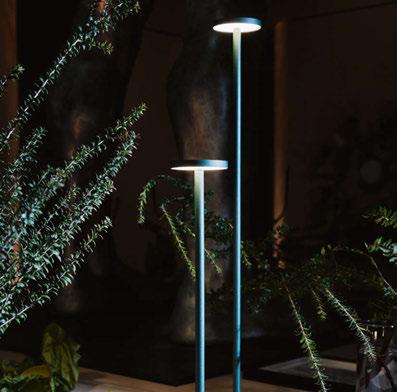
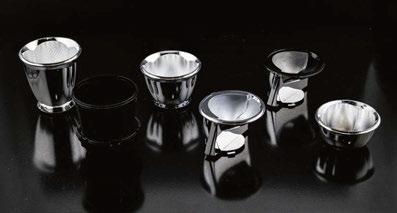
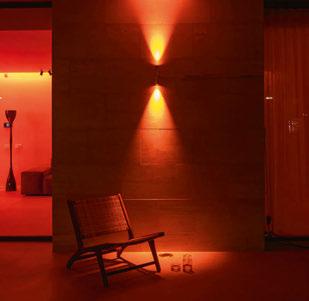
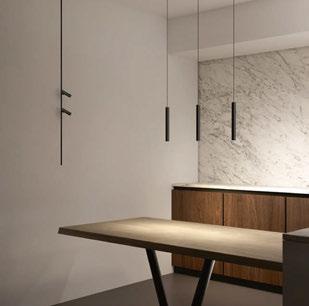
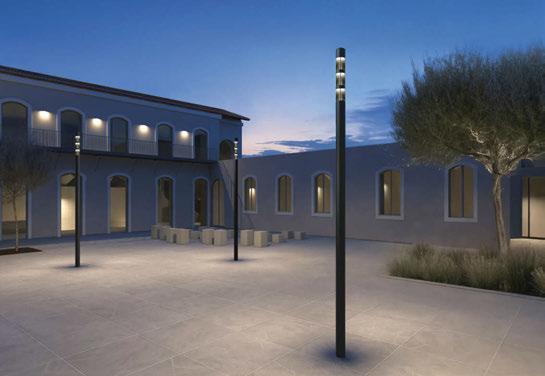
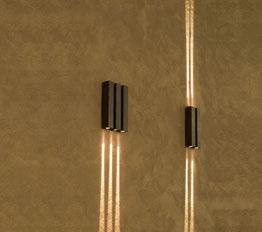
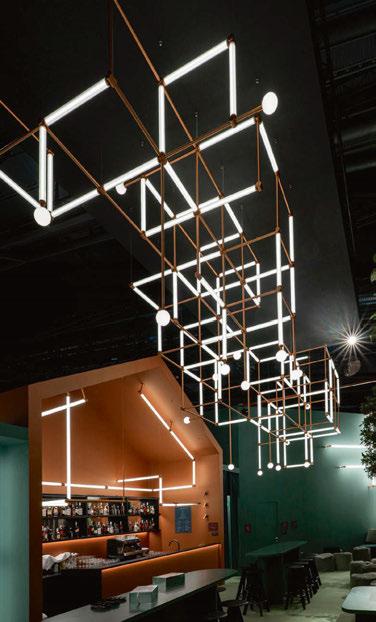
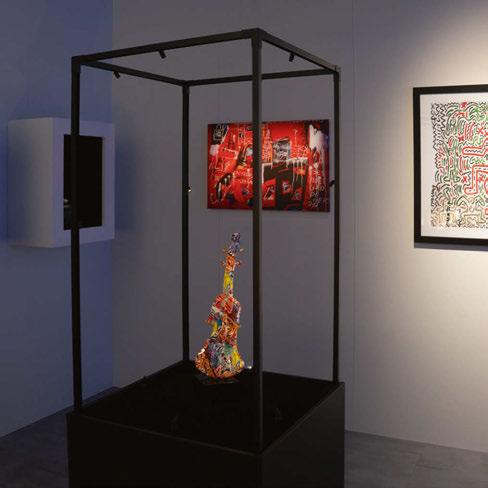
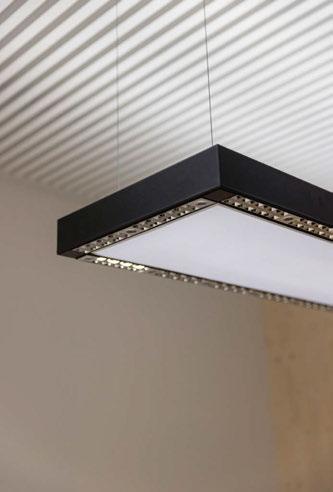
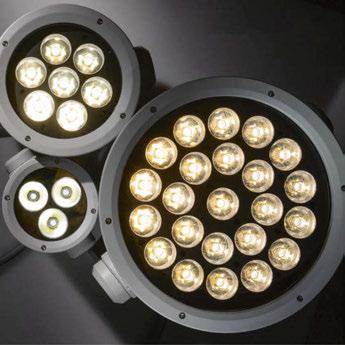
Acclaim
Dyna Drum Series 3 represents the next evolution of Acclaim’s high-performance exterior floodlighting. As the first Dyna Drum family built on the Acclaim Modular Systems (AMS) platform, the H3, E3, and S3 combine extreme output (H3 up to 26,000 lumens), reduced form factors, and CoreSwap Modular Electronics for field-serviceable modularity into a single IP67 rated, future-ready system. www.acclaimlighting.com
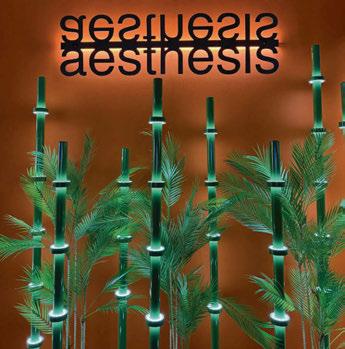
Bona is an innovative addition to urban lighting, blending architectural lighting with the natural aesthetics of bamboo. Standing at 1,937mm with an IP65 rating, it features four illuminated rings of 6W each. Offering dynamic RGBW colour transitions and high efficacy of 100Lm/W, it creates a unique, sustainable atmosphere for any modern urban landscape. www.bright.gr
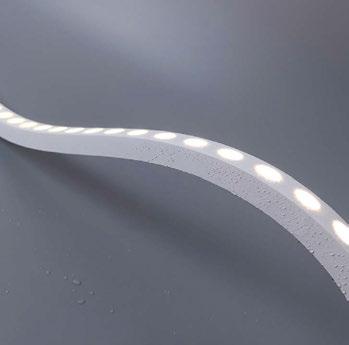
Clear Lighting
Panoray focuses on the details that matter. A clean, flush profile delivers a smooth, continuous line of light with no unevenness and no colour shift. Precision optics bend without breaking beam integrity, locking light exactly where it’s intended. Installation risk disappears through seamless joints, glare-free control, and fast-adjust accessories. www.clearlighting.com
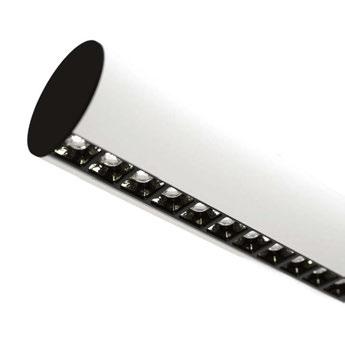
Climar
Tupoli I-Light is a versatile suspended modular lighting system designed for exceptional visual comfort and efficiency. It offers effective direct and indirect lighting while ensuring excellent glare control with a UGR as low as <19. Designed for flexibility, the Tupoli I-Light’s lens and reflector technology offer beam angles of 50° and 70°, ensuring maximum efficiency and a modern appearance. www.climarlighting.com
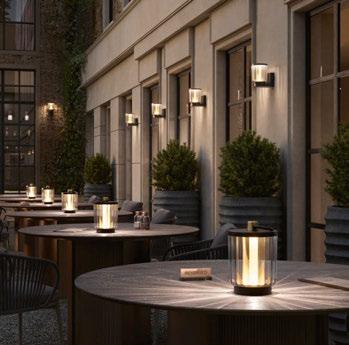
Bega
With the new Spark Line luminaire family, Bega presents a series that understands light not merely as a functional element, but as a design feature. Structured surfaces refract the light into numerous reflections, creating a vibrant and atmospheric lighting effect. A specially developed clear synthetic cover made of Bega NeoGlass as well as crystal glass from Bega’s own glassworks in Limburg are used for these luminaires. www.bega.com
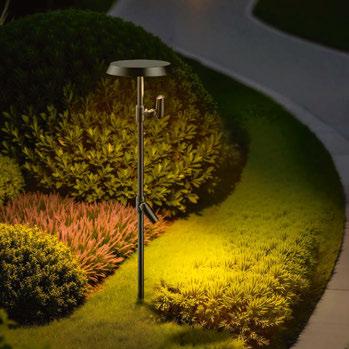
Aplite is a compact outdoor lighting system designed for hospitality landscapes, where light integrates rather than dominates. By bringing indoor-grade optical precision into exterior environments, it ensures a consistent visual language between interior and outdoor spaces. Available in multiple mounting options, with a wide ranges of sizes and outputs, it ensures consistency across scales. www.aerolight.cn
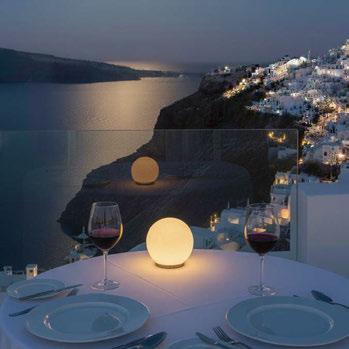
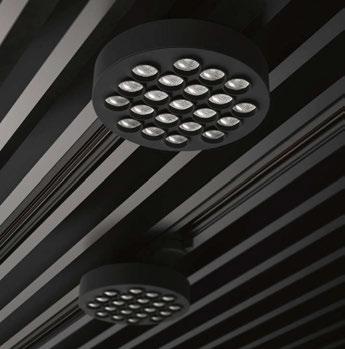
Linea Light Group
The Luna rechargeable table lamp is a mystifying beauty that dims by a movement sensor. Using Namib Bianco marble to diffuse the LED light within, it will enchant any onlooker with its subtle natural moonlike patterns. Not tethered by a cable, this lamp can be placed anywhere and then recharged within 2.5 hours, making it an ideal light for evening dining and relaxation. www.elsteadlighting.com
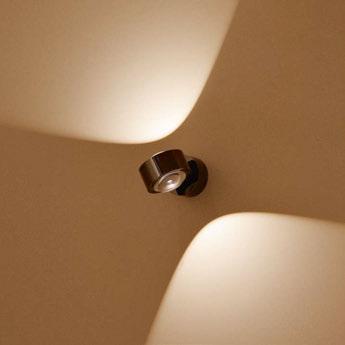
Spin Neko Lighting
Spin explores light through rotation, combining dual emission with convex optics and refined surface finishes in a compact, sculptural form. The adjustable head enables precise control and dynamic symmetry, shaping soft yet defined illumination. Designed to enhance spatial perception, it brings both atmosphere and architectural clarity to refined interior settings. www.nekolighting.com
Beatbox is a family of lighting fixtures inspired by the idea that light, like music, is shaped by rhythm, balance, and harmony. At the heart of the system is a high-performance optical module that ensures excellent visual comfort and effective glare control. Available in several configurations, optics, and colour finishes, Beatbox combines lighting quality, versatility, and essential design. www.linealight.com
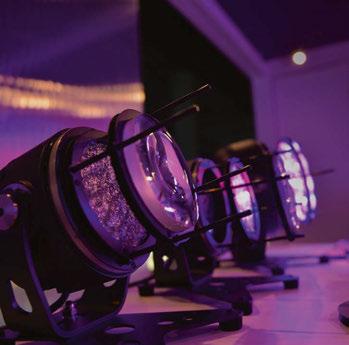
Calumma Arts
Anolis
Calumma Arts is designed to work with light in creative ways, producing a variety of striking visual outcomes. A selection of textured glass and lens options, easily adjustable on site, allows precise shaping of light to suit the space and its architecture. As a static luminaire, it delivers a strong artistic impression with a sense of depth and perceived movement. www.anolislighting.com
Following a successful six days in Frankfurt, we look back at some of our favourite finds from the show.
Folio
Folio Ghost consists of a glare controlling Folio Opal, through which an integrated honeycomb louvre has been mounted between the opal diffuser and the glass screen. The effect is a light that, even while on, appears to disappear, creating only a homogenous light effect on the surface with no glare. www.folio.it
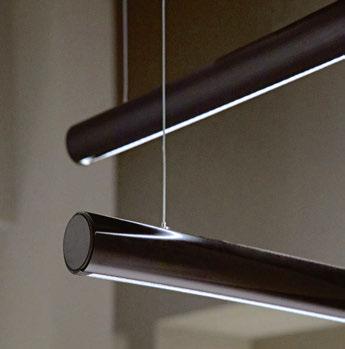
Signature Collection
MCI Light
As the boundaries between technical performance and design blur, Signature Collection explores a more integrated approach where optical engineering, spatial integration and formal clarity are developed as part of a single process. Conceived for high-end interior projects, it positions light as an active component of architecture contributing to the perception, atmosphere and identity of a space. www.mcilight.com
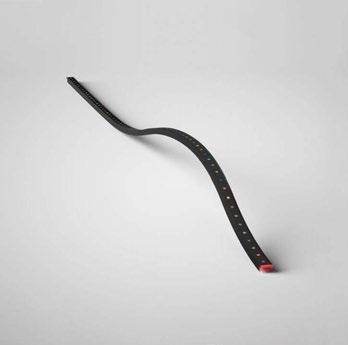
Olympia Lighting
SFP16 redefines architectural media facades with its vertical-bending silicone construction, maintaining constant 20mm pixel pitch across any curved surface. Built from premium F1-rated gas-phase silicone with IP68 protection, each independently controlled RGB pixel delivers 16-bit grayscale resolution and flicker-free video playback via SPI or NovaStar control. www.olympialed.com
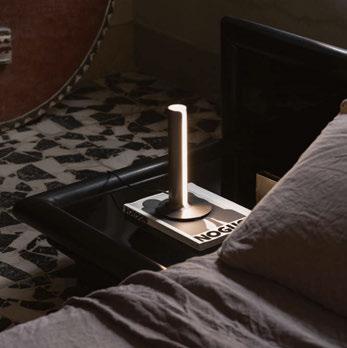
Ideal Lux
The Rinato Console Lamp uses the elongated version of the stainless-steel light shade, supported with asymmetric metalwork and a solid brass base. Ideal for boardrooms, private offices or as a statement design piece, the Console Lamp’s shade and metalwork are available in a number of different finishes and the brass fixture features a decorative strip of premium leather. www.ideal-lux.com
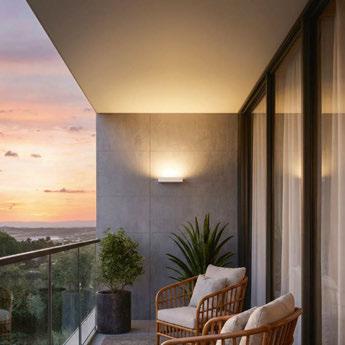
Edelweiss
Rise Lighting
Pairing minimalist aesthetics with outstanding performance in nighttime landscape lighting, the clean, understated design of Edelweiss blends seamlessly with building façades without causing visual distraction. It delivers uniform, soft light distribution to meet refined illumination needs, while offering excellent IP67rated waterproof protection. www.rise-lighting.com
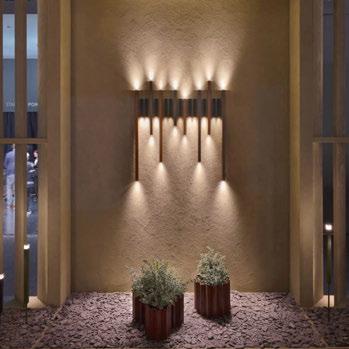
Stix
Unonovesette
Stix is a modular wall-mounted light for indoor and outdoor use. It merges architectural utility with expressive design, offering full compositional freedom. Stix features a sleek, minimal 35x35mm square profile with rich functionality. Available in three light types, five lengths, and refined finishes, it gives designers visual impact and creative flexibility.
(Image: Marco Ferrari) www.unonovesette.com
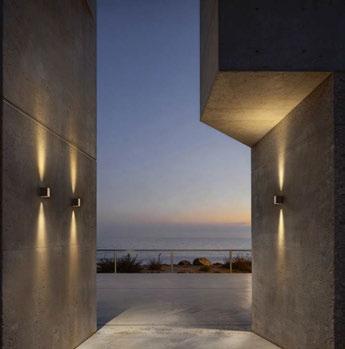
Maris
L&L Luce&Light
Maris is an outdoor, wall-mounted fixture designed to ensure reliability even in challenging environmental conditions. Maris’s clean, linear form is made entirely of glass and AISI 316L stainless steel treated with AC19. This ensures high resistance to corrosion and to the aggressive conditions typical of spas and marine locations, as well as thermal and sulphurous environments. www.lucelight.it
Vivalyte
The Phantom Mesh is a transparent LED solution that enables architects to integrate dynamic media without compromising daylight or views. Its open structure supports layered visual compositions, combining content, depth and architecture in one system. The result is a subtle yet impactful media presence that enhances spatial perception and creates engaging, multi-dimensional façade experiences. www.vivalyte.com
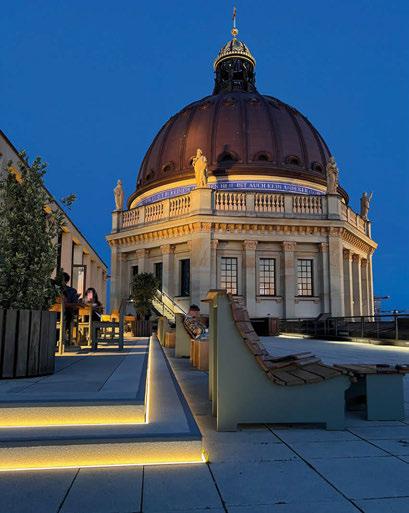
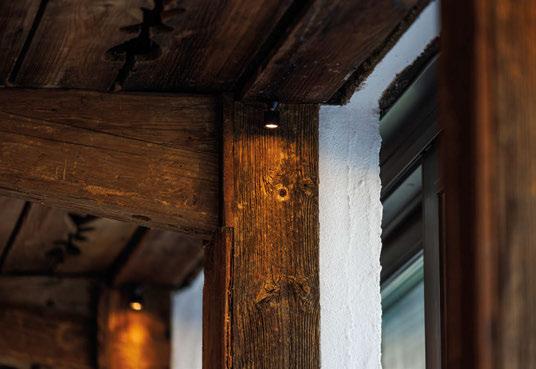
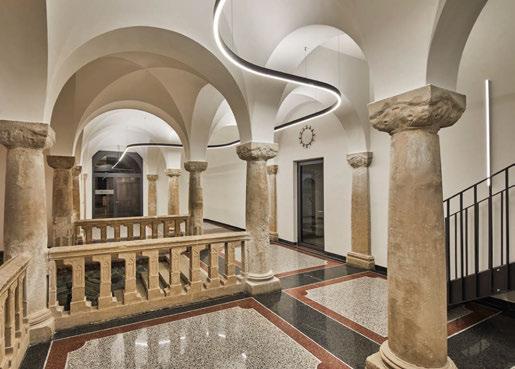
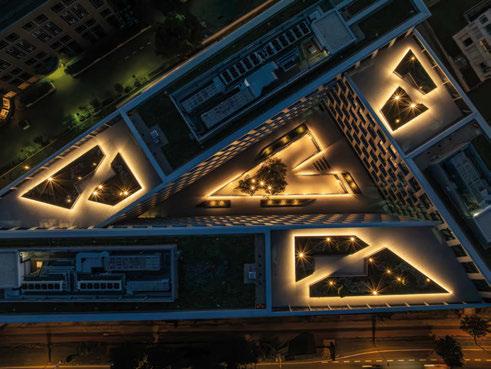
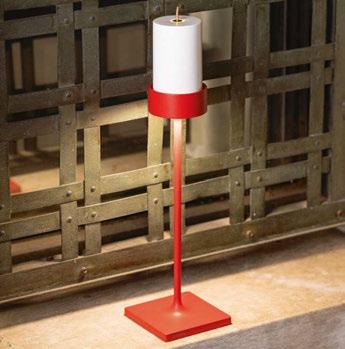
Perpetua Zafferano
Perpetua is a cordless table lamp collection that reinterprets the archetypal candlestick through a technologydriven approach. Playing on a subtle trompe-l’œil, the cylindrical battery takes the form of a candle, while the “wick” becomes a touch control for switching, dimming, and colour temperature selection. A LED source integrated in the structure emits a downward beam. www.zafferanoitalia.com
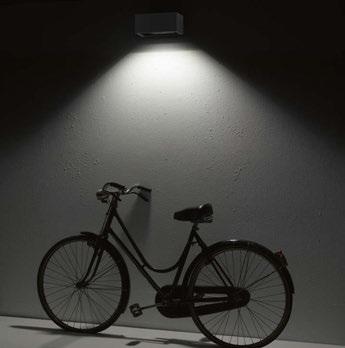
Ánesi Cariboni
Ánesi guarantees visual comfort in transitional spaces between urban interior and exterior. Its design and geometry combine with versatility in different sizes and fixings to create a harmonious dialogue with every lit place. It incorporates BLOS optics that control luminance and glare. Ideal for pedestrian areas, it ensures high visual comfort and limits non-functional light emissions. www.caribonigroup.com
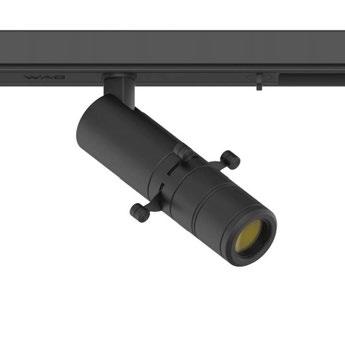
Ziggy Projector Art LV
WAC Architectural
Ziggy Projector Art LV introduces compact projection performance for the Ziggy 2-wire track system. Featuring focusable and wide-angle projection options, it delivers crisp projection for museum and gallery displays utilising the Ziggy Micro Track. With beautifully crisp framing focus for multiple shapes and sizes, and a 97 CRI option for beautiful colour rendering, it ensures every object looks its best. www.wacarchitectural.com
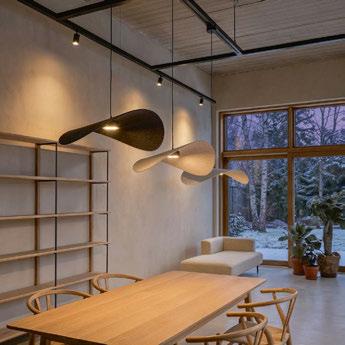
Tide Normagrup
Tide combines acoustic performance and lighting to enhance spatial wellbeing. Its large-format suspended design creates organic, gravity-shaped forms that define space with softness and clarity. Inspired by biophilic principles, it brings warmth and a more human-centred experience. Crafted from advanced thermoformed acoustic materials for high performance and a refined, tactile quality. www.normagrup.com
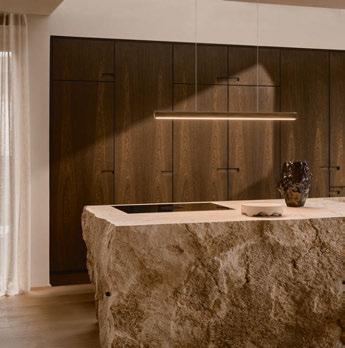
Akeno Nordlux
The Akeno pendant lamp by Bjørn + Balle for Nordlux combines Nordic elegance with a light form reduced to the essentials. The slender wooden body and fine brass details create a warm impression, while the dimmable LEDs with high colour rendering provide natural, atmospheric lighting. Akeno adds a sensual accent to any room, which is guaranteed to last thanks to its high-quality workmanship. www.nordlux.com
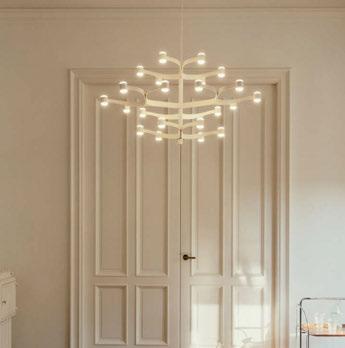
Fronda Stilnovo
Fronda is a modular, branching suspension that creates truly luminous architectural compositions, ideal for large-scale hospitality and residential spaces; the design reinterprets the classic chandelier style in a contemporary key. Fronda is available from July in multiple “tiered” versions and finishes, either suspended or ceiling-mounted. (PH Consiglio Manni, AD Russo Sgarbossa) www.stilnovo.com
Brand new. The hero for highly robust architectural lighting. Timelessly elegance, made for eternity. With outstanding characteristics, this series defies the most adverse conditions.





















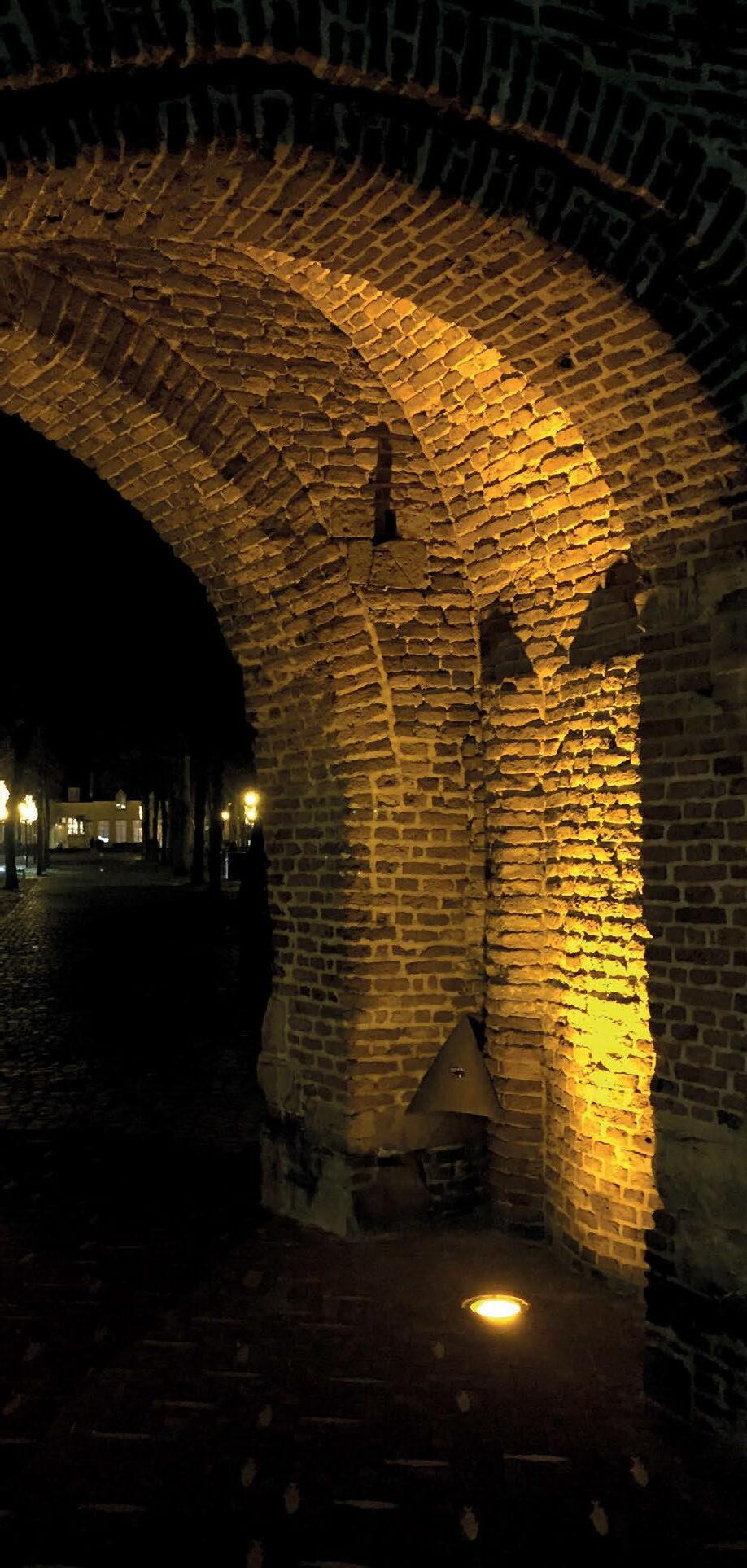
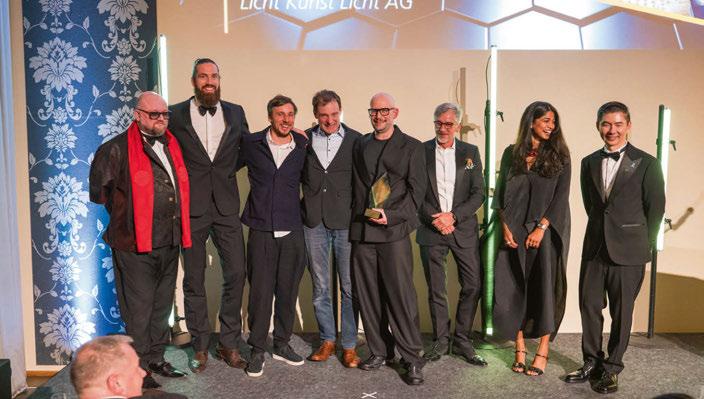
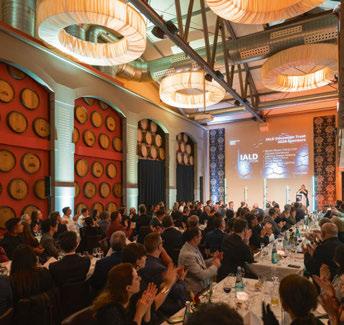
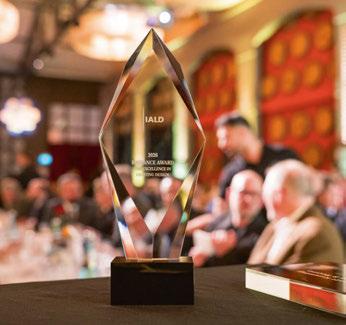
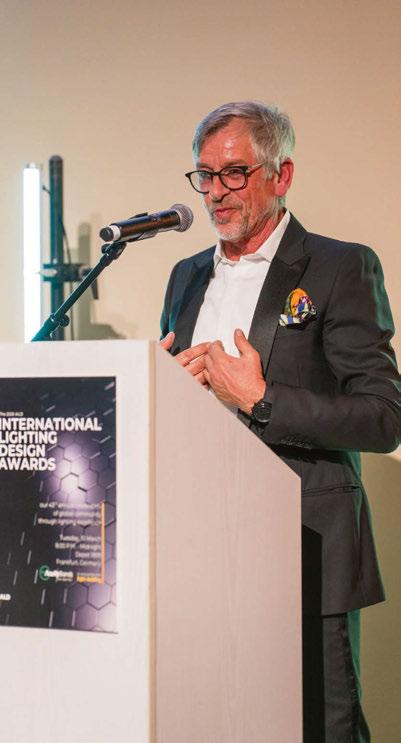
Alongside the hubbub of activity across the show floor, Light + Building was host to a number of special events - from awards celebrations, to talks programmes and community gatherings. Here, we look back at some of our highlights.
The International Association of Lighting Designers (IALD) celebrated the 43rd annual IALD International Lighting Design Awards in a glittering ceremony at Frankfurt’s Depot 1899. The first time that the awards ceremony has been held in Europe, the event recognised 14 outstanding architectural lighting design projects for their commitment to innovation, sustainability, and cultural sensitivity. While the winning projects spanned across six continents, the top prize on the night, the IALD Radiance Award for Excellence in Lighting Design, was awarded to Licht Kunst Licht for its transformative exterior lighting of Cologne Cathedral in Germany. The project showcases breakthrough heritage conservation techniques that reduce energy consumption and light pollution by substantial margins, while revealing 50% more architectural detail than the previous system. Speaking at the awards ceremony, IALD Awards Co-Chair Colin Ball said: “The lighting design for
Cologne Cathedral represents the pinnacle of what our profession can achieve. This project demonstrates how contemporary lighting technology can enhance both the spiritual presence and civic identity of a historic monument while meeting modern sustainability standards.” The 2026 IALD Awards programme recognised projects across three categories, with winners representing diverse building types, from sacred spaces and cultural institutions to resorts and memorials. Winning projects came from Germany, Qatar, China, Saudi Arabia, the UAE, Mexico, Brazil, and Japan – showcasing the international scope of lighting design excellence. The rigorous judging process included a seven-member international panel of renowned lighting designers, architects, and industry professionals, who evaluated each project through an anonymised review process. A full list of all the winners can be found on the arc magazine website. www.iald.org
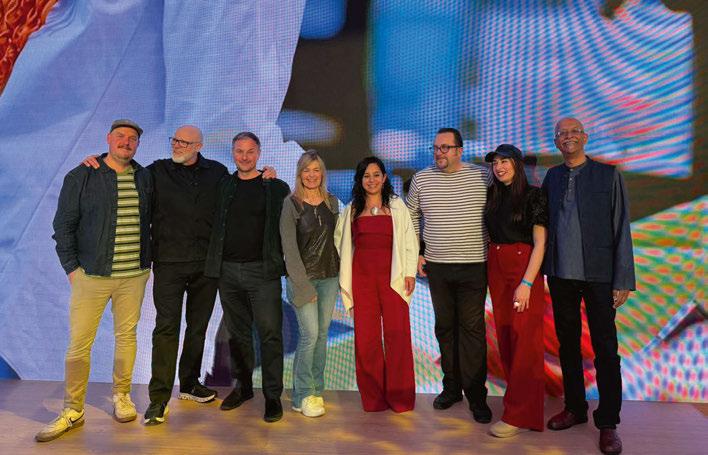
To commemorate 50 editions of the Back Page Bucket List – a segment that has run in arc magazine since issue 100 – [d]arc media, alongside Light Collective, held a special, celebratory event on the Signify stand, looking back at some of our favourite, and most inspiring entries.
The feature, curated by Light Collective, asks lighting professionals from around the world to share something from their lighting “Bucket List” – a place, space, lighting effect, or general feeling that we should experience before we die. Submissions to the feature have been as broad and diverse as the lighting industry itself – from witnessing the Aurora Borealis, or seeing the sunrise at Machu Picchu, to watching the dance of fireflies in the Philippine mangrove rivers or visiting Blackpool Illuminations.
During the celebration on Signify’s stand, alongside Light Collective and arc editor Matt Waring, six international lighting designers offered up some inspirational insight into their selections – Katia Kolovea, Beata Denton, Kevin Grant, Linus Lopez, Magali Mendez, and Jean-Yves Soetinck.
As curators of the feature, Light Collective created the first Bucket List page in arc 100, and Martin Lupton explained that their selection was to swim in Mosquito Bay, Puerto Rico, where the bioluminescence of the water creates the feeling of “swimming in light”.
Katia Kolovea, Linus Lopez, and Magali Mendez each shared examples of inspiration from their home countries. Kolovea talked about the healing powers of witnessing the sun set over the Mediterranean Sea from a Greek island. Lopez shared the beautiful, intricate shadow play that filters through traditional Indian Jaali screens, with particular mention to the Amer Palace Fort just outside Jaipur. Originally seen as an architectural solution to battle extreme heat, while modulating daylight, the intricate designs of these Jaali, and the shadows that they cast, have become symbols of beauty. Mendez’ Bucket List entry was a love letter
to the “chromaticity” of her hometown of Mexico City, particularly during the Día de los Muertos celebration, where the already vibrant city comes alive with colour and energy.
An inspiration for many in the lighting industry, James Turrell and his Skyspace installation was the subject of Beata Denton’s entry –particularly Skyspace Lech in the Austrian Alps. Turrell’s Skyspace pieces are renowned for their mesmerising interplay of natural and artificial light, and coupled with the beautiful surroundings of the Alps, this is surely a must-see experience for many lighting afficionados.
Rare moments of natural light formed the basis of both Kevin Grant and Jean-Yves Soetinck’s selections too – albeit at very different scales. Grant shared the visual phenomenon known as the “Firefall”, that occurs at El Capitan’s Horsetail Fall in Yosemite National Park. This unique, magical illusion only happens in very specific conditions at a very specific time of the year, but is a remarkable example of the beauty of nature.
For Soetinck, inspiration came in the image of a ray of daylight filtering through the curtains of a hotel room on a sunny June morning, diffusing fragmented light into the room. Bringing to mind childhood naps, and also the light installations of Chris Fraser, the effect showcased the power of light, however simply it manifests, to evoke memory and emotion.
Closing out proceedings, arc editor Matt Waring shared his Bucket List entry, citing the “void” of light often seen in the light shows of live music performances, where a beam of light can split, creating an ethereal, almost hypnotic vortex within the light.
A big thank you to Signify for hosting us on its stand for this event, and also to each of our speakers, and to Light Collective for curating this feature. Be sure to check out the all-new Back Page feature, My Light, launched in this issue. www.signify.com www.lightcollective.net
As the popular awards programme celebrated its 10th anniversary, the 40 Under 40 Awards hosted a celebratory Pecha Kucha session on the Design Plaza, in which a selection of previous winners from across the past decade were invited onto the stage to reflect on their passion for light and their professional journey. After honouring this year’s winners – many of whom were in attendance to collect their trophies – each speaker offered up some words of advice and encouragement to the new inductees, before sharing their own unique takes on what makes this industry, and lighting design as a profession, so special.
The speakers at the event included: Magali Mendez, Dario Nuñez Salazar, David Ghatan, Katia Kolovea, Eugenia Cheng, Dan Lister, Ayça Donaghy, Marinana Noaves, Brice Schneider, Nick Albert, Anna Sbokou, Maryam Aghajani, Julia Hartmann, and Faraz Izhar – who sent a pre-recorded video as he was unable to travel to Frankfurt.
The 40 Under 40 Awards is spearheaded by Light Collective, alongside sponsors Filix and Selux. www.40under40.events
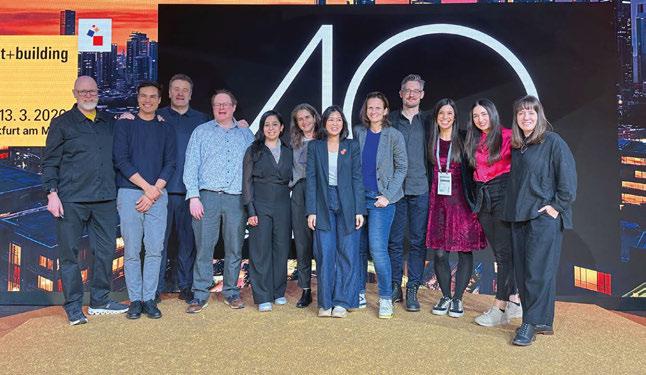
Women in Lighting: International Women’s Day
This year, Light + Building commenced on Sunday 8 March – International Women’s Day. Marking the occasion, Women in Lighting (WIL) brought together its global community for an event, led by WIL Ambassador for Germany, Sabine De Schutter. Held at the fair’s Design Plaza, the event welcomed a selection of internationally renowned speakers, who each shared their unique perspectives and experiences as women in lighting. Ranging from high-end lighting design to product design, hightech fashion, and architainment, the speakers included Sally Storey, Lisa-Akari Ishii, Erika Baffico, Clara Daguin, and Daphné Delbeke.
Alongside the event, long-term WIL partner and supporter formalighting gave away a speciallydesigned “WIL Tool Belt” to visitors. The gift marks the launch of WIL’s new campaign, #WILonsite, in which the community is aiming to show that women in lighting “get out and get involved on site”. Analysing Google image searches of site photos, WIL found 30% of images showing women, with most of these a mixture of women and men, while 70% are exlusively men – the #WILonsite campaign aims to challenge that stigma, and encourages women to share images of themselves on site.
Following the event at the fair, formalighting hosted a dinner at the nearby Moriki Restaurant, where guests celebrated International Women’s Day with sushi and sake.
www.womeninlighting.com
www.lightcollective.net
www.formalighting.com
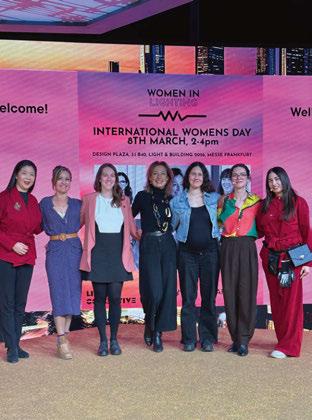

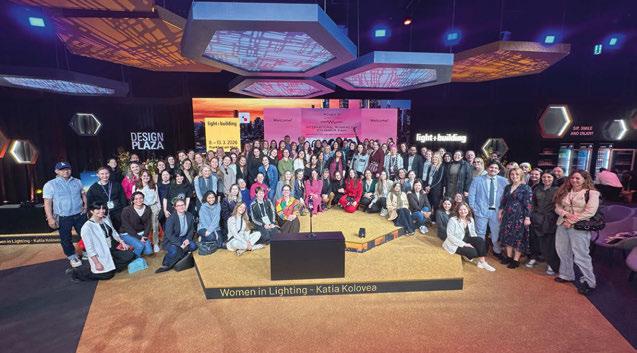
The Silhouette Awards, now celebrating its fifth year, continues to champion the next generation of lighting design talent through mentorship, professional development, and global community building. As part of its anniversary programme, an in-person gathering was hosted at Light + Building, bringing together mentors, mentees, industry partners, sponsors and past participants for a celebration of creativity, collaboration, and networking.
Held on 12th March at the Design Plaza as part of the Future Forum, invited by programme supporters, The Virtual Lighting Design Community, the Light + Building event was a unique opportunity for participants to connect face-to-face.
“The energy was incredible,” said Katia Kolovea, Co-Founder of the Silhouette Awards, who represented the team in person and hosted the event in Frankfurt. “Being able to meet mentors, mentees, and industry
colleagues in person really highlighted the power of collaboration. Networking is a core part of what we do, and seeing it happen naturally at Light + Building reminded us of the value of these connections.”
At Light + Building, attendees also saw firsthand the benefits of the programme’s international reach. Past mentees mingled with new participants, sharing experiences and insights, while mentors discussed emerging trends and industry challenges.
As part of the in-person event, two panel discussions brought together mentees, mentors, and industry voices to share insights and experiences. The first panel, focusing on the value of portfolios and award submissions, featured mentors Claudia Paz (Year 2), Courtney Mark (Year 5), and supporting organisation LIT Design Awards, represented by Astrid Hebert. The discussion explored how emerging designers can effectively communicate their ideas and stand out through submissions and curated portfolios.
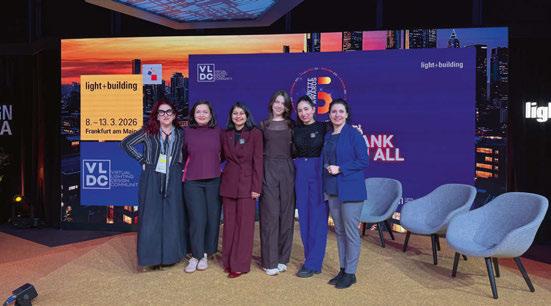
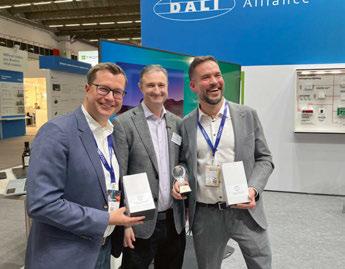
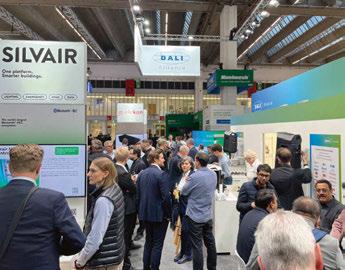
The second panel celebrated mentorship journeys, with contributions from Riddhi Bhootda (Year 5 winner), Ksenia Chubenko (Year 4), and Armaghan Ahmadi (Mentor of Year 4). Together, they reflected on the impact of mentorship, sharing personal experiences of growth, collaboration, and the long-term value of these professional relationships. Now in its fifth year, the Silhouette Awards has cemented its reputation as a global platform for emerging talent. Launched in 2021 through a collaboration between Parrot PR and Marketing and Archifos, the programme has grown into a vibrant international community that provides opportunities for creativity, knowledge-sharing, and mentorship. The fifth year, which also highlights the celebration of reaching 100 mentors and 100 mentees since the programme’s inception, is marked by a series of events celebrating both the achievements of past participants and the launch of the 2025–2026 programme. www.silhouetteawards.com
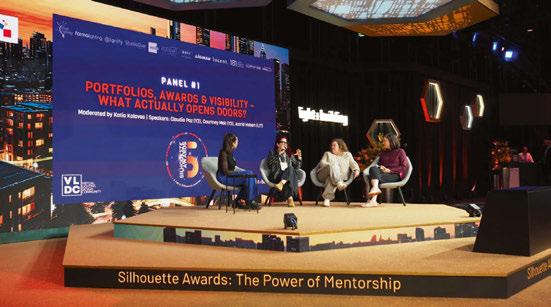
The winners of the 2026 DALI Lighting Awards were announced at the DALI Pavilion.
Organised by the DALI Alliance, the global industry association for DALI lighting control, the awards recognise outstanding projects that demonstrate the application and innovation of DALI-based lighting systems around the world.
The DALI Lighting Awards highlight projects that showcase the benefits of the open DALI standard, including interoperability, energy efficiency, installation flexibility, and advanced digital lighting control.
Entries were submitted from projects across Europe, Asia, the Americas, Oceania, and Africa, demonstrating the global reach of the DALI ecosystem.
Highlighting 13 winning projects and three highly commended projects, the awards programme includes two main groups of categories: Application Awards, recognising real-world project implementations; and Innovation Awards, celebrating technical
advancement and new applications of DALI lighting control.
A global panel of expert judges from across the lighting industry, including lighting designers, technical specialists, and media representatives, selected the winners and highly commended entries.
“Our congratulations go to all the winners and highly commended projects,” said Paul Drosihn, General Manager of the DALI Alliance. “The quality and diversity of submissions this year were exceptional, reflecting the continued growth of DALI as a foundation for smart, interoperable lighting systems worldwide.”
A full list of the winners can be found on the arc magazine website.
www.dali-alliance.org
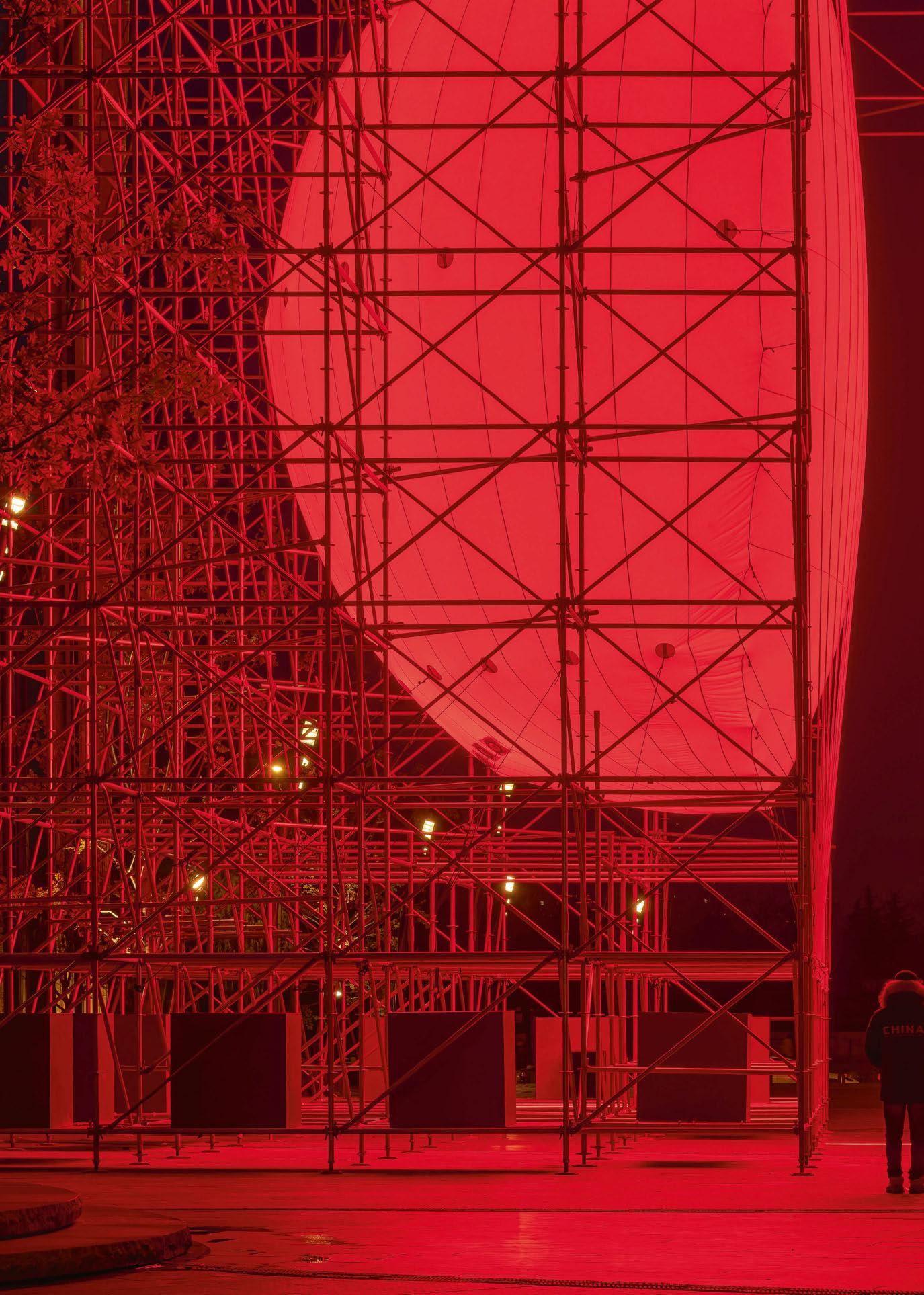
DIVIDED is part of visual artist SpY’s ongoing research into the relationship between body, space, and perception, exploring how monumental scale and light transform the viewer’s experience and reconfigure the urban environment.
The work takes the form of a large, luminous sphere of intense red light, fragmented into two identical halves and separated from each other. Each hemisphere is contained within a metal structure built from industrial scaffolding, similar to that commonly used in construction, which here is revealed as an essential component of the work’s visual and conceptual language. This framework not only supports the spherical forms, but also emphasises the tension between cubic and spherical geometries, functioning as a conceptual cage that articulates a condition of formal containment.
The installation acts as an active agent within the space, capable of altering the perception of its surroundings and establishing an immediate, physical relationship with the viewer’s body. Its monumental scale imposes a presence that is experienced before it is fully understood, generating a sense of awe and attraction that intensifies as the public approaches.
DIVIDED is fully activated through the audience’s actions. Visitors walk through the space between the two halves, entering a corridor of light that completely envelops them. The journey between the two halves transforms the relationship between form and body, shifting the experience toward the interior of the installation. In this movement, the viewer inhabits a suspended space of light where the tension between fragmentation and unity is perceived in a direct, physical, and emotional way. While SpY has explored in previous installations the ability of large-scale luminous forms to activate their surroundings and generate an immediate bodily relationship with the viewer, in DIVIDED the interaction shifts inward, inviting the public to move through the work and to experience from within the tension between separation and union. The red light – recurrent in SpY’s recent work –acts as an emotional and enveloping element, transforming the space into a suspended atmosphere. The work does not merely occupy a site; it redefines it, turning it into an immersive experience in which perception, scale, and the body become the fundamental materials of the proposal.
DIVIDED is part of SpY’s “Earth” series, composed of “Earth,” “Divided,” and “Confronted,” a group of installations that reflect on fragmentation, conflict, and coexistence. Previously presented in cities such as Madrid, Athens, Riyadh, and Ghent, the series offers a symbolic reading of the contemporary world. www.spy-urbanart.co
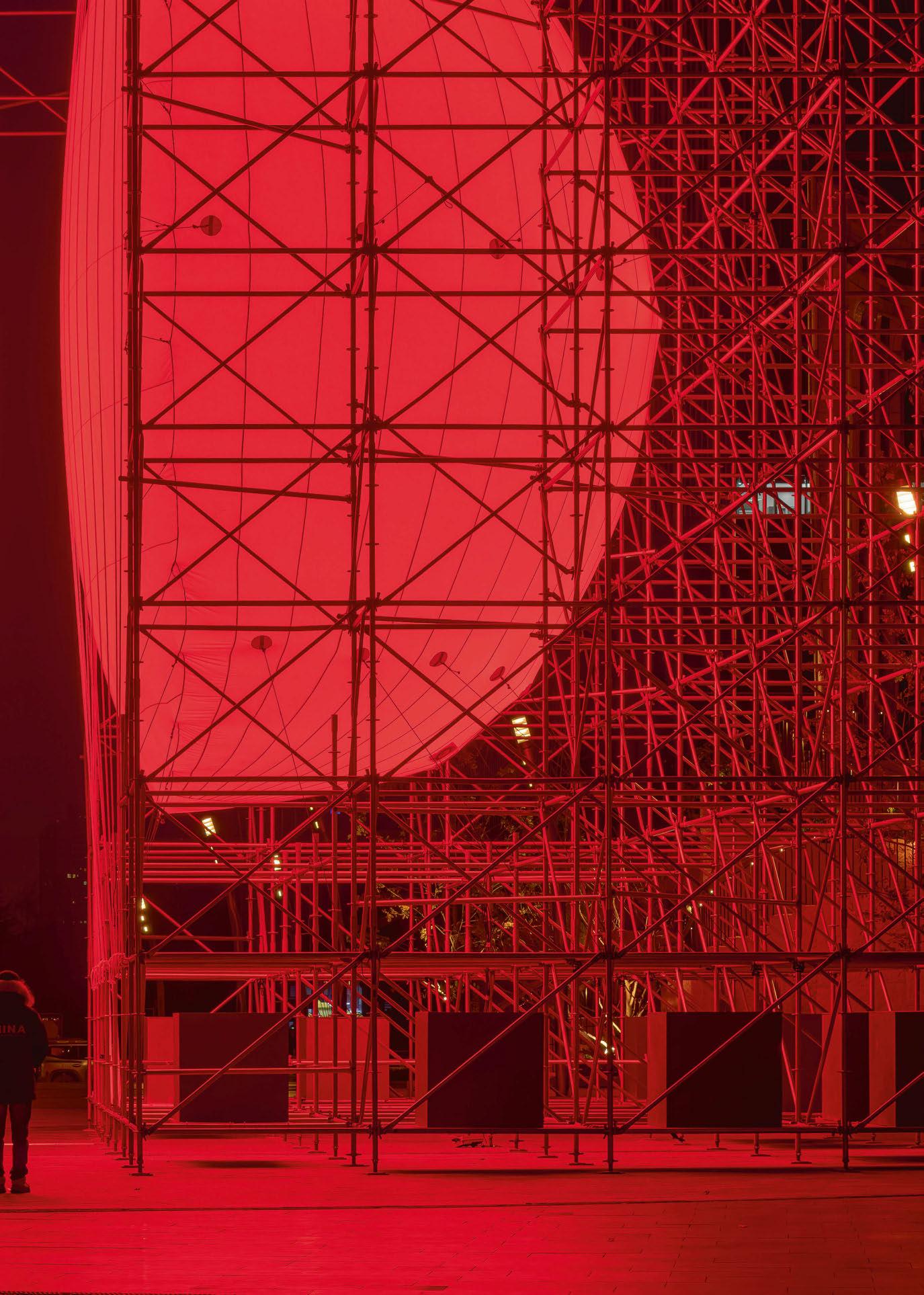

In this issue, Dave Hollingsbee introduces the Good Light Group - an organisation focused on the impacts of lighting on human health.
Keen eyed regular readers of this column will notice that the usual GreenLight Alliance logo has been swapped with that of the Good Light Group. This in no way suggests that the work is all done when it comes to sustainability. While it is true that huge progress has been made over the past five years: terms like “harmonised metric” are known and understood, as are LCAs and EPDs; many readers likely have encountered TM66 and TM65.2 metrics; and remanufacturing (rather than buying new) has become mainstream. The tide may finally be turning on Cat A fit outs too.
Expect to see more on these topics and case studies, in the future, but now we share the stage with another vitally important topic within our sector, and it is not unrelated: Light and Health. By light and health, we don’t just mean “tuneable white”, “warm dim”. These are nice features but arguably have muddied the waters or distracted from the real issues. Truly “human centric” or “circadian” lighting is about much more than simply dimming and dropping CCT as the day goes on. Warm dim could be argued to be the equivalent of boiling sustainability down to just recycling. It’s a start, but there is so much more to understand. It is important that we do. Just as our industry has improved impressively in terms of light LED source efficiency (the inescapable lm/W) and sharpened up aspects like colour rendition, optical control and controls – there remains an elephant in the room. There is a growing body of evidence pointing to myriad threats to human wellbeing if we don’t alter the way we approach artificial indoor lighting. Conversely, with this technology, and by interpreting the evidence correctly, there is unprecedented opportunity for parties all across our industry to intervene intelligently and positively. It is a large, complicated and evolving subject. So, this is where we bring in the Good Light Group (and the closely affiliated Good Light Group Asia). The Good Light Group exists as non-profit organisation operating globally, with a legal structure as a foundation, registered in 2019. Its main objective is to gather and interpret precisely
these facts, and to promote the exposure to healthy light across all sectors. To establish and promote the benefits of natural daylight and electric lighting that compensates for its absence, as well as the health risks associated with spending all day indoors, where the light is normally too dim during the day and too bright in the evening. Affiliated scientists work together with lighting designers to inform on the practical implementation of the latest research developments.
Founded in 2019, it is funded by individual members and commercial sustaining members. The group seeks to promote science-backed, actionable interventions for Healthy Light. The backbone of the group is its 33 Science Advisors from around the world.
The group share fantastically informative newsletters, host webinars with its experts and guest speakers. It issues very accessible videos, brochures and infographics.
In coming issues, we will explore a variety of fascinating and important studies, recommendations, emerging data and case studies. We will introduce eminent scientists working in this area, share papers and recommend further reading and viewing resources. But for this first issue, the Good Light Group founder Jan Denneman starts unapologetically by answering WHY? Never mind the ethics, or the science for now, how do I sell it to the bean-counters?
Lighting’s Established Narrative
Indoor lighting is typically positioned in three ways. First, as functional infrastructure. Light is required to perform visual tasks; it must comply with standards, deliver sufficient illuminance on the task plane, limit glare and ensure visual comfort. Second, lighting supports architectural quality. It reveals materials, articulates texture and volume, structures space and shapes atmosphere. It is the medium through which architecture becomes perceptible and meaningful. Third, lighting is framed as sustainable. LED technology has drastically reduced energy consumption, intelligent control systems minimise unnecessary operating hours, and luminaires are increasingly designed with circularity, reuse and reduced embodied carbon in mind.
All three perspectives are valid. Without adequate light, we cannot function visually. Without welldesigned light, architecture loses expression. Without energy efficiency and material responsibility, lighting is not future-proof. Yet a fourth dimension is largely absent from the discussion: the influence of light on human performance. Economically, this dimension outweighs the other three combined.
The Economic Blind Spot
The 3-30-300 rule makes this imbalance visible. Popularised by real estate advisor JLL, it describes the typical annual cost structure of an organisation and the building it occupies as approximately €333 per square foot per year, roughly equivalent to €333 per tenth of a square metre per year. Of this amount, approximately €3 relates to utilities such as energy and water, around €30 covers rent or capital costs, and roughly €300 accounts for personnel expenditure. While exact figures vary by country and sector, the proportions are remarkably consistent. In offices, schools, healthcare facilities and industrial environments, people represent by far the largest cost component. Salaries, social contributions, recruitment, training, turnover, absenteeism and productivity losses due to fatigue or illness dominate operational expenditure. Yet the lighting industry continues to position itself primarily within the smallest category. Lighting is typically presented as an energy-saving measure, and investment decisions are frequently evaluated on the basis of payback periods derived from electricity costs. From an economic perspective, this focus is disproportionate.
The LED Success Story... and Its Consequence
Two decades ago, this emphasis on energy was understandable. Lighting accounted for approximately 15-18% of total electricity
consumption. Improvements in efficiency delivered meaningful financial savings and carbon reductions. The transition to LED technology has fundamentally changed this landscape. High luminous efficacy, improved optical performance and advanced control strategies have reduced lighting’s share of total electricity use in many modern office buildings to only a few percent. Technologically, this is a success story. Economically, however, it has reduced the relative leverage of further energy savings. Even an additional 10-20% reduction in lighting energy consumption has a modest financial effect when compared to overall personnel costs. The strategic leverage of lighting no longer lies primarily in the €3 category.
Consider a simple scenario: An organisation with 1,000 employees and average total personnel costs of €60,000 per employee per year has an annual payroll of €60m. A 1% improvement in productivity, or a 1% reduction in absenteeism-related costs, represents €600,000 per year. In many buildings, this exceeds not only the total annual energy cost of lighting, but often the total energy cost of the building itself.
When a marginal improvement in human performance outweighs the financial impact of eliminating the entire lighting energy bill, it becomes difficult to justify evaluating lighting primarily on the basis of energy efficiency. It would be comparable to assessing an orchestra by the weight of its instruments rather than by the quality of its performance. Efficient instruments matter, but the purpose of the orchestra is the music. In buildings, that performance is human performance.
The economic argument is reinforced by developments in chronobiology. In 2002, researchers including David Berson and Ignacio Provencio identified intrinsically photosensitive retinal ganglion cells in the human eye. These cells contain the photopigment melanopsin and are particularly sensitive to short-wavelength light (around 480 nanometres). Unlike rods and cones, they project to brain regions responsible for regulating circadian rhythms, including the suprachiasmatic nucleus in the hypothalamus. Research by George Brainard and Steven Lockley demonstrated how evening light exposure suppresses melatonin and shifts circadian timing. Charles Czeisler and colleagues documented the relationship between circadian misalignment and impaired cognitive performance. Till Roenneberg introduced the concept of social jetlag, describing
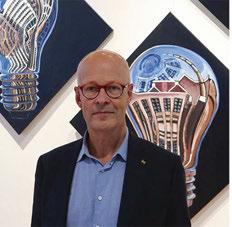
the mismatch between biological rhythms and social schedules, with measurable consequences for wellbeing and productivity. These findings confirm that light is not merely a visual stimulus but a biological regulator.
The Indoor Light Mismatch
Modern indoor lifestyles often provide insufficient vertical illuminance at eye level during the day while exposing individuals to relatively bright and often blue-enriched light in the evening. This pattern differs significantly from the natural daylight cycle under which human physiology evolved. Research led by Mariana Figueiro and Mark Rea has attempted to quantify circadian stimulus in relation to vertical light exposure. Studies indicate that higher daytime circadian stimulus is associated with improved sleep quality and increased subjective alertness. Publications in the Journal of Clinical Sleep Medicine have linked greater workplace daylight exposure to longer and better sleep.
Sleep is a critical mediator in this relationship. Chronic sleep restriction is associated with reduced attention, impaired executive function and increased error rates. In knowledge-based environments, this translates into lower productivity and diminished creative capacity. In safety-critical contexts, it increases operational risk. If lighting environments support better circadian alignment and sleep quality, they indirectly influence performance outcomes. In economic terms, this shifts lighting firmly into the €300 category.
The Light Diet
In my work on light and health, I describe this dynamic as the “light diet.” Just as nutrition influences metabolic health, patterns of light exposure influence circadian regulation and overall functioning. While individuals increasingly monitor diet and physical activity, few consider the quality and timing of their daily light exposure. Yet light is one of the most powerful external regulators of human biology. Indoor lighting is therefore not neutral background infrastructure, but a structural determinant of wellbeing.
To translate these insights into practice, the Good Light Group was established as an independent, non-profit platform dedicated to promoting healthier indoor lighting. The organisation addresses not only circadiansupportive lighting, but the broader biological consequences of reduced daylight exposure in modern buildings.
While much of the recent discussion has focused on melanopic stimulation and circadian regulation, natural daylight provides a far richer spectral composition than most
indoor environments. Contemporary buildings filter out ultraviolet B radiation that enables vitamin D synthesis in the skin, and significantly reduce exposure to near-infrared wavelengths that are increasingly being studied for their role in cellular and mitochondrial processes. The cumulative biological implications of spending most of our lives indoors under spectrally limited light environments are only beginning to be understood.
The Good Light Group operates at the intersection of science, design and industry. It seeks to make emerging research accessible to architects, lighting designers, developers and policymakers, while encouraging dialogue between chronobiologists, photobiologists and building professionals. Its aim is not to prescribe simplistic solutions, but to foster a broader understanding of light as a multidimensional environmental factor that affects human physiology beyond vision alone. By advocating for daylight integration, adequate vertical light exposure, biologically informed electric lighting strategies and deeper investigation into full-spectrum light environments, the Good Light Group promotes a more comprehensive definition of what “good light” means in contemporary architecture. The objective is to move the conversation from compliance and energy metrics toward measurable human outcomes and long-term health resilience.
Recognising lighting as part of the €300 category has direct implications for design. Daylight strategy should be integral to architectural conception rather than an afterthought. Façade design, orientation, spatial depth and glare management fundamentally shape indoor light conditions. Electric lighting should complement and reinforce natural circadian rhythms. Vertical illuminance at eye level deserves greater attention than horizontal lux values alone. Temporal variation and spectral composition should be aligned with time of day and functional requirements. For the real estate sector, this perspective implies that investment decisions should not be based solely on energy performance. When personnel costs exceed real estate costs by an order of magnitude and energy costs by two orders of magnitude, it is econom-ically rational to treat indoor environmental quality as a strategic variable. ESG frameworks increasingly reflect this shift. The environmental dimension remains important, but the social dimension encompasses health and wellbeing. Certification systems such as WELL and Fitwel explicitly include circadian lighting and access to daylight within their assessment criteria.
The point is not that light is a panacea. The point is that light is a controllable environmental variable with demonstrable biological effects, and that these effects carry economic consequences. Developers and investors who focus exclusively on energy performance reduce sustainability to a technical metric. True sustainability includes social sustainability.
A building that is energy efficient but leaves its occupants chronically fatigued or disengaged cannot be considered sustainable in the full sense of the word. Sustainability must therefore be defined more broadly. Lighting must be energy efficient. Luminaires should be designed for circularity, reuse and reduced embodied carbon. Manufacturing processes must become more sustainable. At the same time, lighting must contribute to healthy and resilient users.
This requires a different design approach. Daylight must be integrated from the earliest stages. Electric lighting must support rather than override natural rhythms. Vertical light exposure and temporal dynamics must be deliberately structured. Users should understand how light affects them, enabling more informed interaction with their environment.
The principal barrier to this shift is not technological but economic and cultural. Building owners invest, while tenants benefit from improved performance. As long as these interests remain disconnected, short-term capital expenditure will dominate decisionmaking. Nevertheless, change is visible. Organisations competing for talent increasingly recognise the importance of workplace quality. ESG metrics are expanding to include wellbeing indicators. Human performance is entering the sustainability conversation.
The move from €3 to €300 is not an argument against energy efficiency. It is an argument for proportionality. Lighting should not be understood solely as a cost item to be minimised, but as a strategic investment in people.
The question is not whether we can afford to design lighting that supports health and performance. The question is whether we can afford not to. This series is curated by Dave Hollingsbee of
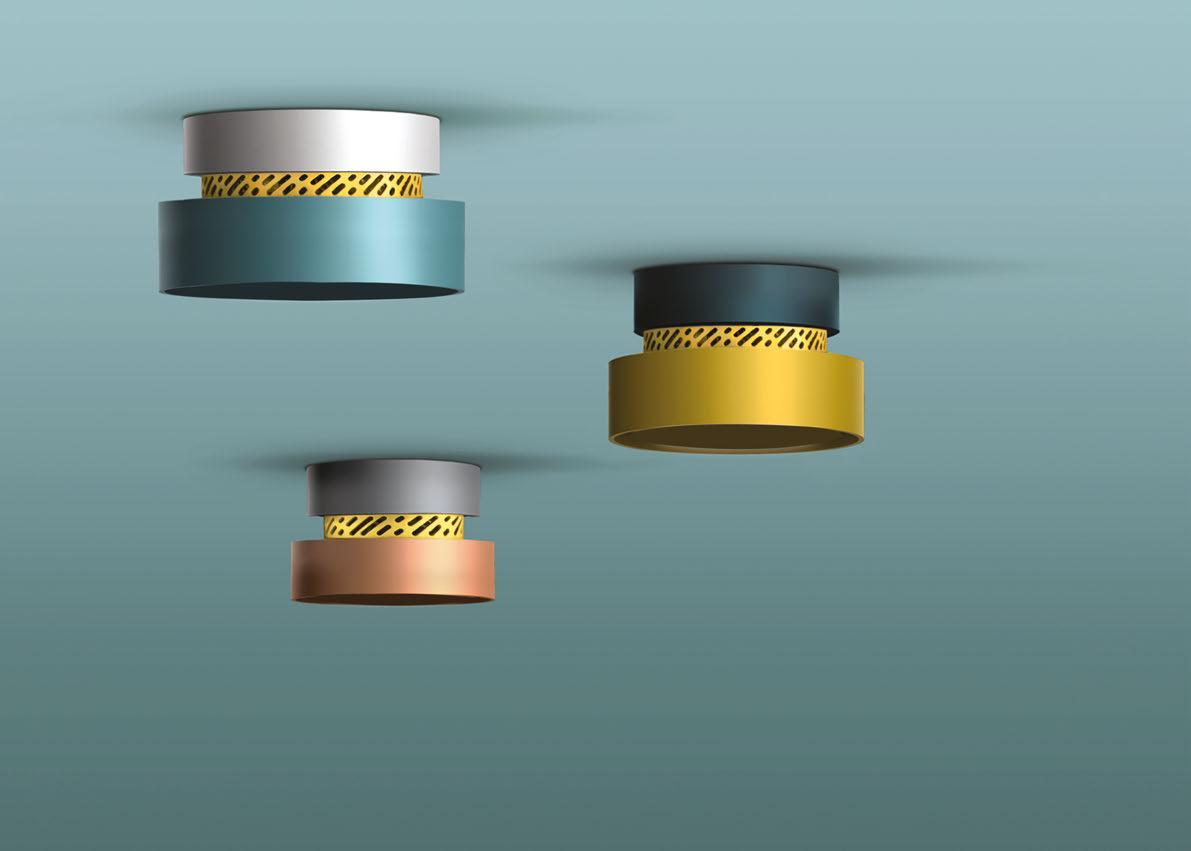


Ahead of every curve Visit us at booth GB-207 | April 14–15 2026 | NY Hilton Midtown
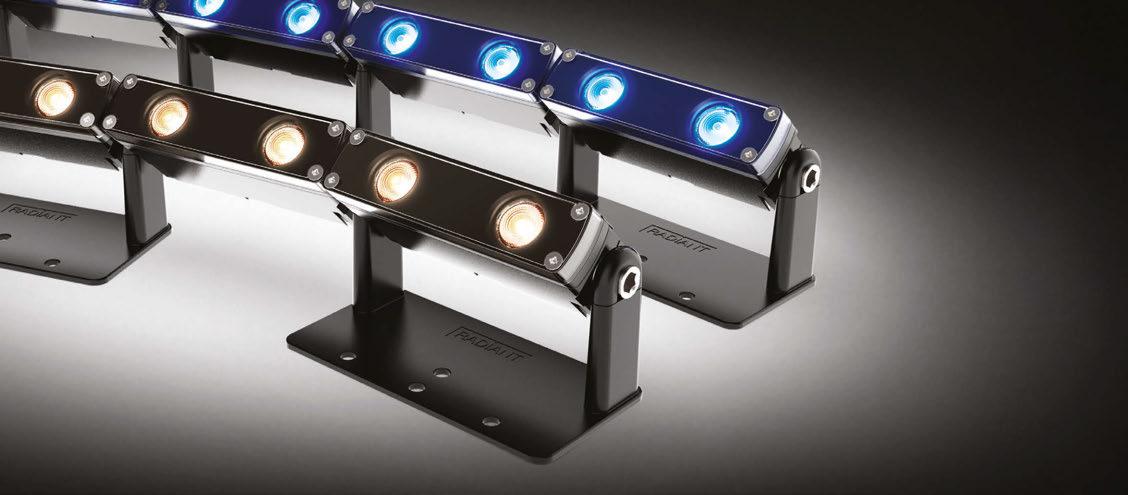
• RGBW & Tuneable White LED arrays with colour mixing optics
• Patented ball-joint system - hand bendable & lockable 3D flexibility
• 5-year guarantee with a refurbishment service thereafter
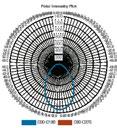
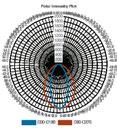
• We’re excited to introduce a new version of the 3D LED Flex 25 System with colour-mixing lenses. The width of this system is only 25mm.
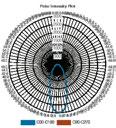
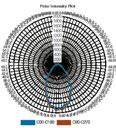
• 1 or 2 RGBW or Tuneable White LED arrays with colour mixing TIR lenses per module, available in a limited range of distributions to suit project requirements.
• The 3D LED Flex System’s patented ball-joint design allows for hand-bendable and lockable 3D flexibility on-site - ideal for following curved building surfaces.
• The system can be run at up to 4W per 100mm module - producing up to 3,500 Lumens /m for Tuneable White and 1,500 Lumens /m for RGBW.
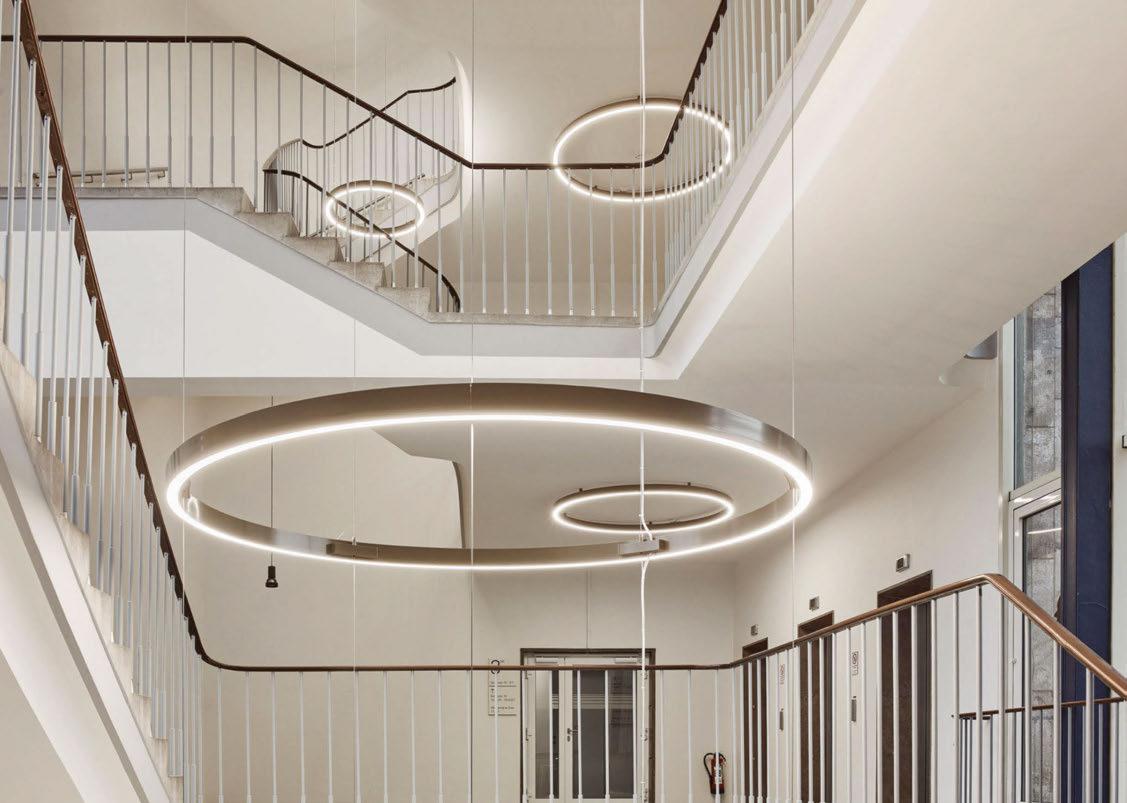
A clean, minimalist lighting scheme, utilising luminaires from ADO Lights, illuminates the renovated Siemens Energy headquarters in Duisburg.
Some buildings are more than structures. The former Demag headquarters in Duisburg, now home to Siemens Energy, is one of them. Its clear architectural language and strong urban presence have endured for decades.
The renovation was therefore not simply a technical upgrade. It was a question of attitude: How do you add without overpowering? How do you continue without distorting?
The answer begins at the entrance.
Beneath the expansive cantilevered canopy, two integrated light lines extend over more than 25-metres. Precisely embedded and almost invisible when switched off, they reveal a uniform, glare-free illumination at dusk. A flush-mounted light line in the ground completes the concept, subtly marking the transition and intuitively guiding visitors inside, while reinforcing the architecture’s horizontal gesture.
Inside the foyer, the space opens, and the lighting follows. Circular Linargo pendant luminaires from ADO Lights float beneath the ceiling as custom single-tier constructions with diameters of 1800 and 2400mm. Their geometry is deliberately minimal, almost archetypal. The soft, diffuse light creates orientation without dominating the space. The atmosphere feels neither overly representative nor purely functional, but carefully balanced. The spatial highlight unfolds within the stair cores. Multi-tier Linargo pendants, ranging from 1000 to 2400mm in diameter, are vertically layered within the space.
The powder-coated housings are precisely colourmatched to the handrails – a detail that only reveals itself at second glance, yet reinforces the coherence of the design. The staggered rings introduce a subtle dynamism, accompanying movement through the space like a calm, luminous rhythm. Technically, the project reflects a clear commitment to sustainability: LEDs and light lines can be individually replaced, ensuring maintenance remains predictable and straightforward, never invasive to the architectural fabric. The modular LED Linargo system, available as pendant, surface-mounted, or recessed luminaires, enables continuous light bands and can be combined with LED Luc mini-spots for precise accent lighting. In this way, light continues the building’s story. Not loudly, not spectacularly, but with precision, restraint, and in dialogue with the existing architecture.
A perfect circle, both literally and metaphorically. www.ado-lights.de
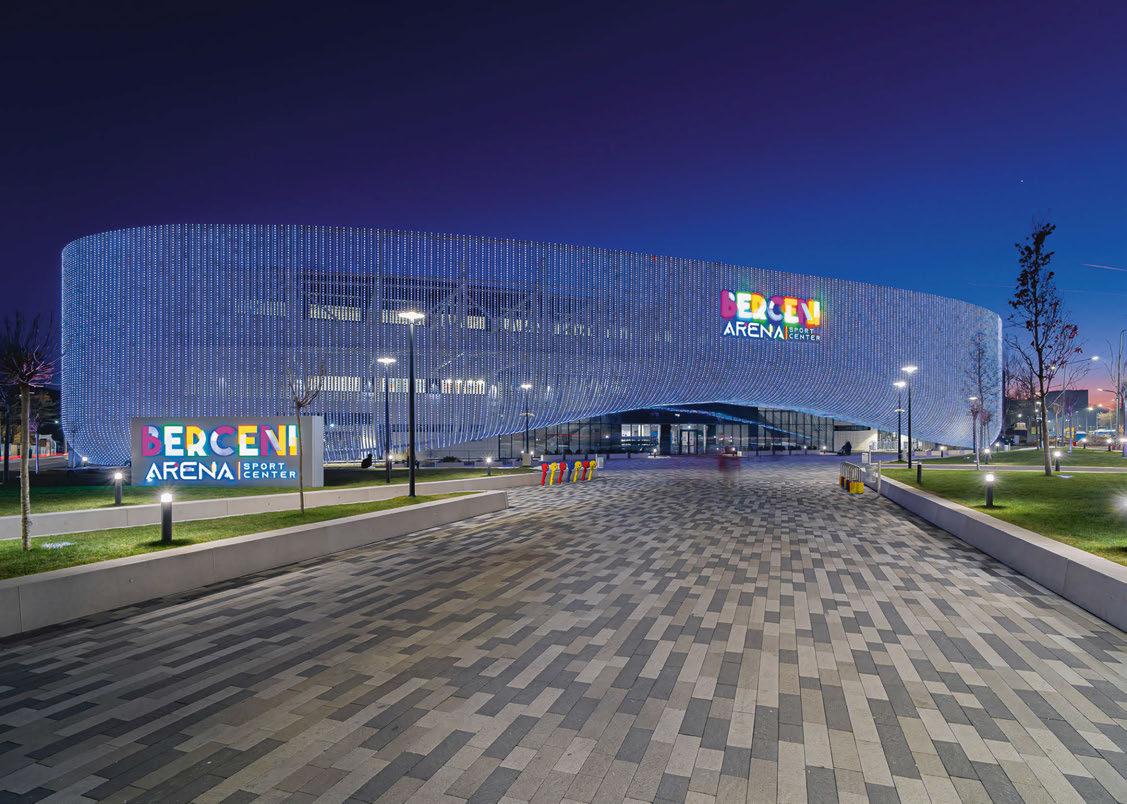
Matching the high-octane sporting activity within, the Berceni Arena has a dynamic new façade lighting solution, realised with help from Pharos Architectural Controls
The Berceni Arena Ice Rink in Bucharest represents a remarkable example of modern technology integrated into urban and sports design, with a dynamic lighting control solution from Pharos Architectural Controls playing a key role in bringing the project to life.
This state-of-the-art facility represents the revival of ice sports in the Romanian capital. Its advanced lighting systems were developed and implemented by Power Electric, using the latest technologies to create a functional, aesthetic space suitable for high-level competitions.
The impressive façade is managed by no fewer than six 100-universe Pharos Designer LPC X controllers, each providing 51,200 channels of control. This third-generation 19ins rack-mount LPC X is an all-in-one solution that is ideal for interactive and integrated lighting installations.
The controller offers an extreme level of power and integration, making it the perfect lighting control solution for landmark lighting installations requiring significant channel counts. The six controllers at the Berceni Arena Ice Rink act seamlessly across the network.
The powerful flexibility of the LPC X provides pinpoint control of individual fixtures, multiple overlapping groups and matrices allowing zones and sections of the façade to act as separate screens, or together as one cohesive canvas.
The LPC X features individually controllable and independently running timelines and scenes allowing the dynamic façade lighting to reproduce a wide range of colours and animated sequences, creating a unique and visually captivating spectacle. At the Berceni Arena the Pharos Designer LPC Xs are controlling a vast number of fixtures, as the façade is illuminated through 70,839 ColorFlex Micro RGB light points, which are using the Color Kinetics network protocol KiNET, output directly from the LPC X over Ethernet.
A five-inch Pharos Designer TPS wall station offers elegant touch control. With a seamless, uninterrupted glass plate and fully customisable interfaces, the Designer TPS provides venue staff with the freedom of real-time manual scene selection, colour and intensity overrides.
Berceni Arena’s interior lighting system is specially designed for exciting sports competitions and high-definition TV broadcasts. The DALI-based interior game lighting system was addressed using four Pharos Designer RIO D. The system allows the lighting to be customised according to the event type, meeting the HD broadcast requirements for sports competitions and ensuring an excellent visual experience for the audience. www.pharoscontrols.com
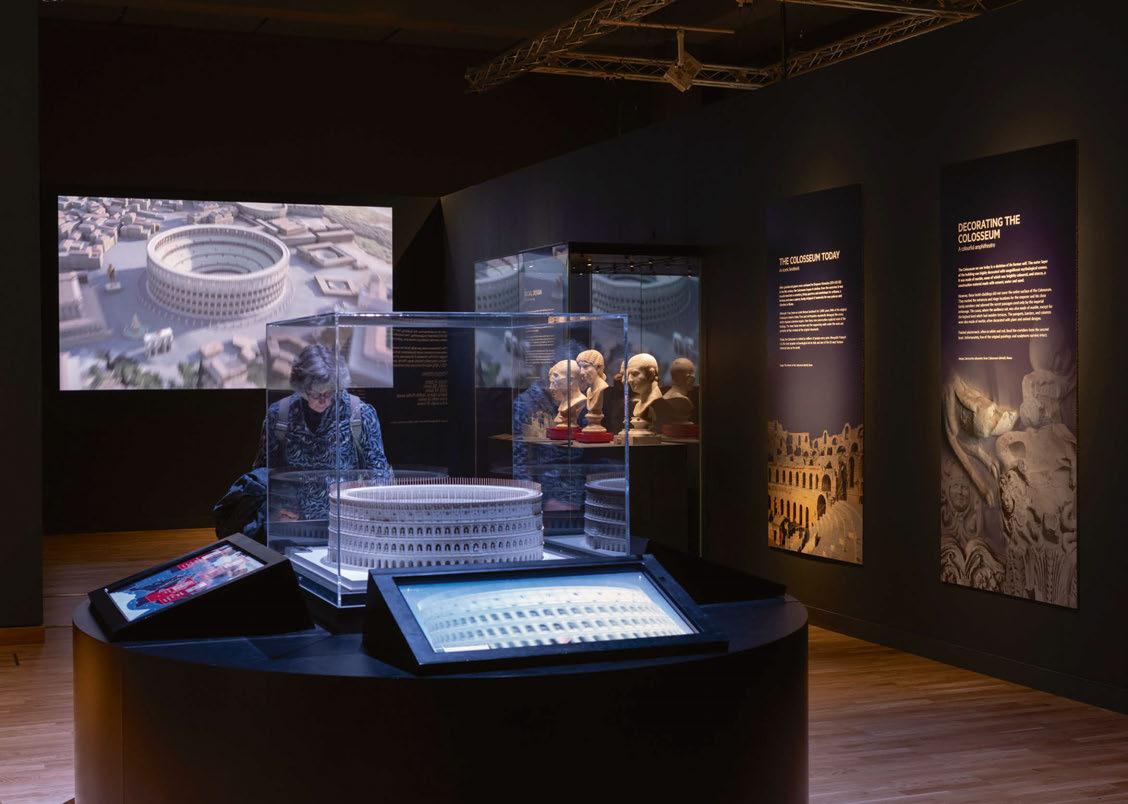
Erco, together with Arup, has integrated new, flexible lighting solutions to the Special Exhibitions Gallery of Leeds’ Royal Armouries Museum.
The immersive Gladiators: Heroes of the Colosseum exhibition at the Royal Armouries Museum in Leeds, UK, transports visitors to the heart of Ancient Rome, showcasing rare artefacts, detailed models, and life-size figures that tell the story of gladiatorial combat and spectacle. Created in collaboration with the National Archaeological Museum of Naples, Expona, and Contemporanea Progetti, the exhibition required a lighting solution that could evoke the scale and intensity of Roman areas, while meeting demanding standards of accessibility, conservation, and adaptability.
In close coordination with the museum’s exhibitions, conservation and facilities teams, Erco and Arup, together with Contemporanea Progetti, developed a lighting strategy that delivers both aesthetic impact and technical performance. Previously, the space lacked sufficient control and flexibility. Now, with Erco luminaires paired with Casambi Technologies wireless control, the exhibition team can fine-tune light intensity, colour temperature and scene programming to suit the current display and future exhibitions.
In addition to its curatorial and aesthetic functions, the new lighting system also supports the museum’s security strategy. Through programmable scene settings, staff can instantly adjust light levels for opening, visitor hours, and after-hours conditions. Low-level illumination during non-public times ensures sufficient visibility for surveillance and housekeeping while protecting sensitive artefacts. This intelligent use of light enhances both security and conservation, showing how lighting can serve multiple operational needs.
Erco’s Optec New and Eclipse RGBW spotlights are used to illuminate key exhibition pieces, from the intricate miniature Colosseum and stone artefacts to the dynamic life-size models of gladiators. High colour rendering enhances the material texture and craftsmanship of each object, while the RGBW capability allows for subtle shifts in tone and mood, enhancing the narrative drama, allowing guests to truly immerse themselves in this time in history.
Throughout the exhibition, cooler 4000K light highlights the texture of stone artefacts, while warmer 3000K tones bring the life-sized gladiators to life, creating an atmosphere that recalls the ancient world.
To ensure visual comfort and cohesion throughout the gallery, Jilly track downlights provide soft, uniform illumination at the entrance and along walkways. The lighting is precisely directed where it is needed, without glare, ensuring clear legibility of signage and intuitive wayfinding for visitors. Another aspect of the gallery space was the challenging ceiling height. This was overcome, with the combination of precise optics and highefficiency control, using Optec New and Eclipse spotlights, ensuring consistent illumination levels across all zones.
In addition to delivering striking visual results, the new lighting scheme significantly improves operational efficiency. With controllable lux levels, reduced maintenance demands, and long product lifetimes, the system supports durability and offers full adaptability for future exhibitions.
www.erco.com
www.arup.com


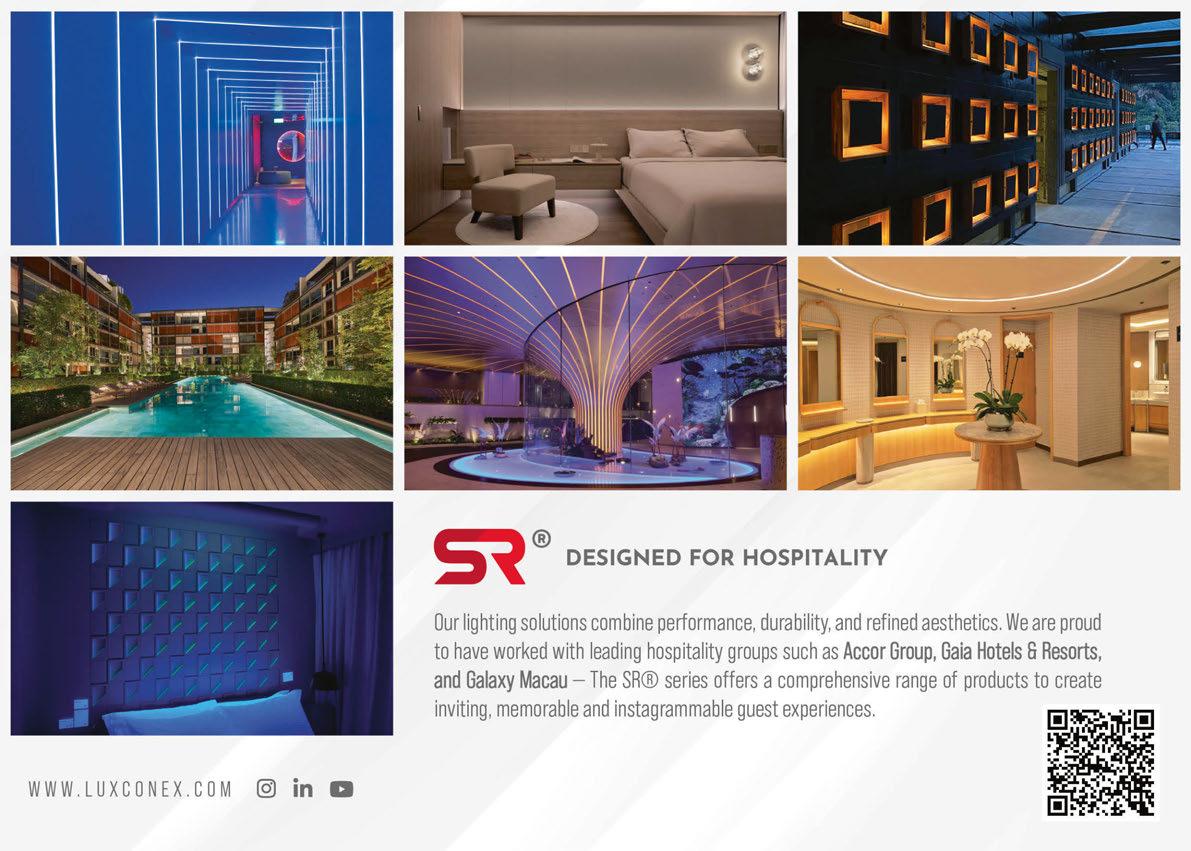
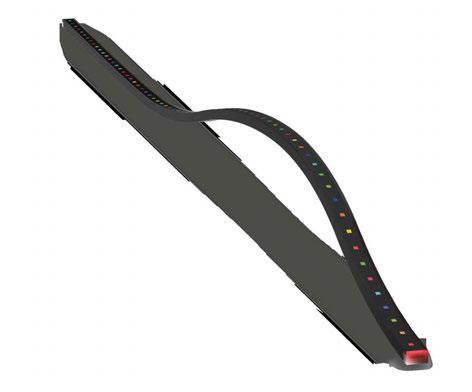
What is your chosen feature?
I love light. Quite literally everything about it; the impact it has on one’s psychology, physiology and wellbeing, and the way it influences quality of life on a broader, sociological level. The beauty of light is captivating.
No matter how much artificial lighting technology evolves, nothing comes close to the beauty, wonder and dynamism of natural light.
I’m lucky to live in a villa in the Middle East, where a deep red sunrise creeps through the curtains into my bedroom each morning and rises higher in the sky to become strong, direct sunlight that dances across a tree in the garden, creating dynamic, dappled patterns of light on my bed and walls. It is special to me because it encapsulates the ethereal and ephemeral quality of light that I love so much. A reminder that light is both emotional and spiritual. Each dawn heralds a new day full of hope, energy and excitement, while triggering childhood memories such as summer camping or playing in my local park.
Natural light has the capacity to trigger an emotional response, even in the smallest, most everyday moments.
Where can it be found in your home?
The tree sits just outside my bedroom window, and as the light passes through the leaves, it creates a soft, dappled effect across the room.
When do you use/experience it?
I experience it every morning as I wake up and begin the day.
How does it make you feel?
Optimistic, grateful and inspired. Optimistic, because it’s a daily reminder of the beauty of light in its purest form. Grateful, because I get to spend so much of my time thinking about and playing with light. Inspired, because while I am constantly searching for creative and innovative ways to master the medium of light, natural light is, and always will be, the ultimate muse.
Why does it have meaning to you?
The poetic and spiritual quality of light is something we need to keep coming back to. In the mêlée of project work, so much of a lighting designer’s focus is on sustainability, efficiency and technical detail. It is easy to lose sight of the emotional and spiritual connection with light. Moments like these, when we are connected to nature, remind us of the hope and energy that comes with the start of a new day – something we all need, especially in a world that feels increasingly complex and overwhelming.
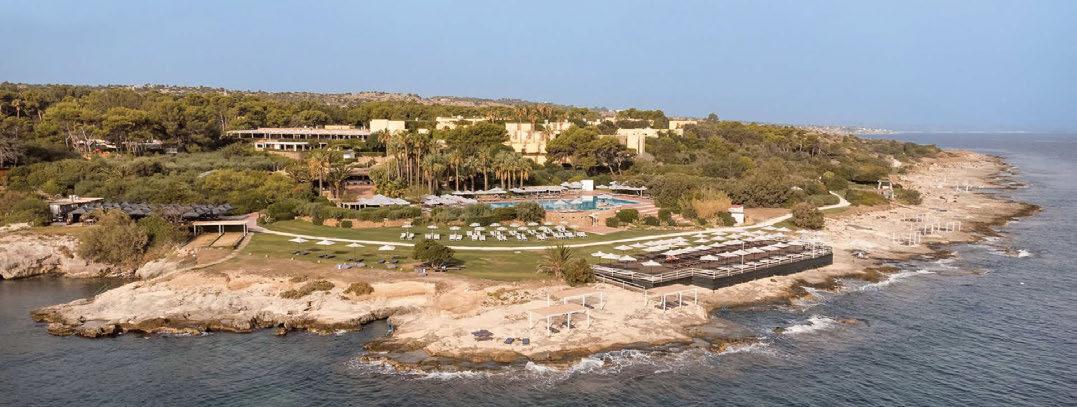
5 - 8 May 2026
Mangia’s Brucoli, Autograph Collection Sicily, Italy
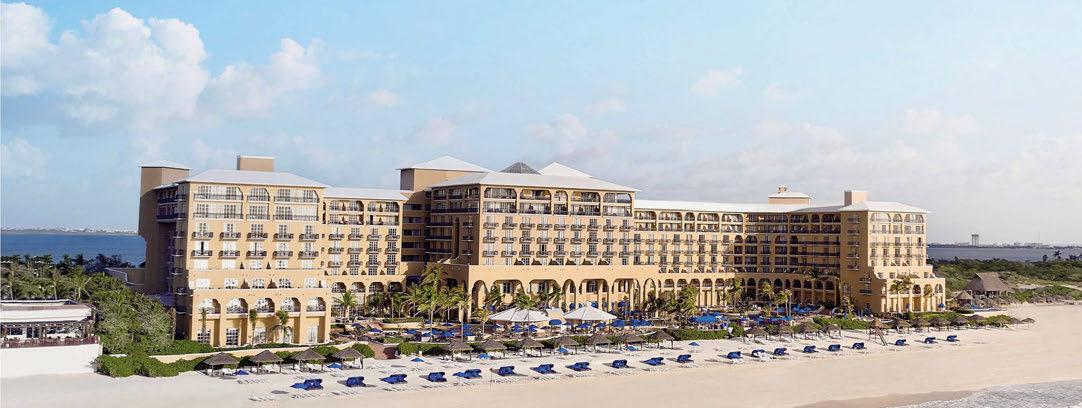
2 - 5 June 2026
Kempinski Hotel, Cancun, Mexico
22 - 25 September 2026
Intercontinental, Phu Quoc, Vietnam