sounding the teaching X
Sustaining a Passion as Music Educators
Sustaining a Passion as Music Educators
A Publication by the Singapore Teachers’ Academy for the aRts (STAR)
A Publication by the Singapore Teachers’ Academy for the aRts (STAR)

We would like to express our appreciation to the Principal, staff and students of Bartley Secondary School, Bedok Green Primary School, Bukit View Primary School, Cedar Primary School, CHIJ Secondary (Toa Payoh), Edgefield Secondary School, Evergreen Primary School, Fern Green Primary School, Fernvale Primary School, Fengshan Primary School, Fuhua Primary School, Geylang Methodist School (Primary), Haig Girls’ School, Jurongville Secondary School, Naval Base Primary School, Park View Primary School, Paya Lebar Methodist Girls’ School (Primary), Red Swastika School, Serangoon Gardens Secondary School, Telok Kurau Primary School, Valour Primary School, Victoria School, and Yio Chu Kang Secondary School.
EDITORS: Chua Siew Ling and Seah Cheng Tat DESIGN AGENCY: Garçon Design
ISBN: 978-981-94-5001-5
Copyright ©2026 Singapore Teachers’ Academy for the aRts
All parts of this publication are protected by copyright. No part of it may be reprinted or reproduced or utilised in any form or by any electronic, mechanical, or other means, now known or hereafter invented, including photocopying and recording, or in any information storage or retrieval system, without permission in writing from the Singapore Teachers’ Academy for the aRts.
sounding the teaching X
Sustaining a Passion as Music Educators
A Publication by the Singapore Teachers’ Academy for the aRts (STAR)

Clifford Chua Academy Principal
Chua Siew Ling Principal Master Teacher (Music)
Designing Playful Explorations
Opening the classroom
Adapting and Reimagining
Re ection & Sharing
Seah Cheng Tat Academy Officer (Music)
Foreword
Clifford Chua Academy Principal Singapore Teachers’ Academy
for the aRts
In a rapidly changing world, passionate and future-ready leaders and educators will form the scaffold that our young Singaporeans need to nurture their growth and fire their imagination to pursue new possibilities.
The arts, rooted in creativity, expression, and human connection, offer powerful pathways for our young to understand themselves and make sense of the world around them.
As educators navigating this evolving landscape, we draw upon our courage, experience, and artistic sensibilities to explore new grounds so that we can continue to give our best for our children.
Notwithstanding the rapid transformations and volatility of today’s world, the heart of the teaching profession safeguards a deep and sustaining passion: the desire to spark curiosity, nurture creativity, and connect meaningfully with every learner who walks into our classrooms.
Consequently, there is a need for resilience on the part of the teacher to navigate the changing world, even as we hold on to our mission of nurturing the future generation.
To flourish as educators, we must harness, amongst other competencies, adaptability, creativity and discernment — embracing and reflecting on new pedagogical tools while holding firm to our core values of care and excellence.
This means we need to continuously learn alongside our students and fellow educators, find strength in our professional communities, and examine and tap into the wealth of knowledge and experiences both within and outside these circles.
Our teachers in this year’s Critical Inquiry Networked Learning Community (CI NLC) have done just that, and embarked on passion projects to discover how they can sustain their passion as Music educators.
I would like to thank all the contributors for their passionate and innovative spirit in exploring and investigating new pedagogical ideas to deepen and strengthen music pedagogies in their school contexts.
I would also like to thank their School Leaders for their unreserved and continued support. May Sounding the Teaching X inspire all readers to sustain their passions and flourish in our work as educators.
Chua Siew Ling
Principal Master Teacher (Music)
Seah Cheng Tat Academy Officer (Music)
Singapore Teachers’ Academy for the aRts
The theme for the 2025 Music CI NLC is “Sustaining a Passion as Music Educators”, which intends to encourage teachers to explore the joy and passion in music teaching.
Based on this theme, our teachers examined ways to cultivate resilience in students, and self-care for themselves. They also investigated playful approaches that promote the joy of teaching and improve student learning experiences, and explored how artificial intelligence (AI) and technology can be harnessed to sustain motivation and engagement in music education.
“We teach who we are” (Palmer, 1997) reminds us that teaching is a deeply personal act that draws from teachers’ selfhood, and that teachers project the conditions of their soul onto their students. Other literature has also supported this premise that passionate teaching directly influences the quality of education (Fried, 2001; Serin, 2017).
In working with learners, passionate teachers have a greater sense of professional identity, and truly believe that they can positively impact student learning and outcomes. When students recognise their teacher’s genuine interest in the subject and their high expectations of them, they become more engaged and inspired to learn and excel.
Cultivating and sustaining such passion is intimately linked to teachers’ commitment as educators, and fundamentally tied to their sense of professional identity (Rampa, 2012). Hence, teachers in this networked learning community have embarked on explorations to investigate how they can sustain their passion as Music educators. Their passion projects are listed in the illustrations on this spread.
Studies in “Sustaining the Joy of Teaching” explore the importance of collaborative play, where teachers from different schools collaborate to share pedagogical ideas
and experiment on them, reminding us that teaching is not a solitary pursuit, but a shared journey that grows with the generous exchange of knowledge and experiences.
In “Including Diverse Learners” studies, we are encouraged to expand our pedagogical imagination, and create avenues for every student to learn, be seen, valued, and empowered to contribute.
The sharing in “Nurturing Relationships and Emotional Growth” affirms that Music learning is inseparable from human connection, and that Music lessons can be safe spaces for the development of 21st Century Competencies (21CC).
As we continue to navigate an everchanging world, “Playing with Teaching Approaches” invites us to remain curious and inventive, embracing lively experimentation with pedagogical strategies to engage, motivate, and
empower students in our Music classrooms.
Similarly, studies in “Exploring the Use of AI and Technology” encourage us to harness new tools with discernment and responsibility, integrating AI and technology in ways that support student learning and creativity.
Finally, studies in “Flourishing as an Improvising Teacher” shine a light on the fact that teaching, like music-making, is often an improvisational craft: dynamic, responsive, and sustained by the deep sense of purpose and passion that anchors our practice over time.
We hope the 17 articles presented in this edition will encourage teachers to be inspired by the interactions between the ideas and the passion projects conducted, consider how some of these strategies might extend or challenge what they already know, and spark new pedagogical ideas that will sustain their passion as Music educators in Singapore.
References
☑ Fried, R. (2001). The Passionate Teacher: A Practical Guide. Boston: Beacon Press.
☑ Palmer, P. J. (1997). The Heart of a Teacher Identity and Integrity in Teaching. Change: The Magazine of Higher Learning, 29(6), 14–21. doi:10.1080/ 00091389709602343
☑ Rampa, S. H. (2012). Passion for teaching: A qualitative study. Procedia – Social and Behavioral Sciences, 47, 1281–1285. https:// doi.org/10.1016/j. sbspro.2012.06.812
☑ Serin, H. (2017). The role of passion in learning and teaching. International Journal of Social Sciences & Educational Studies, 4(1), 60–64. https://doi. org/10.23918/ijsses. v4i1p60
9
Sustaining a Joy for Teaching
Collaborative Play: Bringing Joy to Music Learning
Allen Losey
Cher Wei Shan Fengshan Primary School
Long Peizhen
Haig Girls’ School
Cindy Lim
Paya Lebar Methodist Girls’ School (Primary)
Muhammad Firdaus Bin Nasirjaya
Ng Xin Ru Cedar Primary School
Tan Hui Chin
Bedok Green Primary School
This qualitative paper is presented in the form of an autoethnography. It serves as a collection of the individual journeys that we have taken to explore collaborative play this year. We welcome you to dive into our world and explore together with us.
The Spark
What happens when teachers choose to play? What happens when we dare to loosen our grip on certainty, step beyond the safety of our own classrooms, and open our practice — with all its imperfections — to the gaze of others?
Last year, bound by curiosity and a shared longing to rediscover joy in teaching, music teachers from three schools came together to experiment in classroom play. We explored, faltered, reflected, and in the process, unearthed insights into our pedagogies and ourselves as educators.
In many ways, that first collaboration was the spark. It offered a safe yet daring space where we could imagine new possibilities for music education in our own classrooms.
As Huizinga (1955) reminds us, play is both serious and transformative. It invites us into a “magic circle” where we can test boundaries, rehearse new identities, and create meaning together. Encouraged by our experience, we invited like-minded educators — teachers who were curious and willing to explore uncharted terrain — to join us this year.
Seven of us from five different schools took on this shared inquiry:
☑ Firdaus and Xin Ru from Cedar Primary
☑ Hui Chin from Bedok Green Primary
☑ Peizhen from Haig Girls’ School
☑ Cindy from Paya Lebar Methodist Girls’ School (Primary), and
☑ Wei Shan and I from Fengshan Primary
Together, we became co-players in a collaborative experiment, united by a single question:
How might we design playful pedagogies that ignite joy for our students and for ourselves?
First we opened our classrooms to each other — an act that demanded both courage and vulnerability. This was an important and meaningful step. As Mezirow (1997) suggests, such disorienting dilemmas can become catalysts for transformative learning when met with reflection and dialogue.
We imagined a process inspired by the structure of Lesson Study, yet more fluid and less prescribed. What emerged was a framework we have come to call collaborative playful inquiry — a space where curiosity leads, and structure follows. Here, each teacher is both learner and designer, free to choose the paths they wish to take while remaining cognizant of the collective rhythm of the group.
A New Beginning
The journey began with an Open Classroom demonstration of a music lesson at Fengshan Primary School, where a single music lesson became our shared starting point. Teachers from four schools stepped quietly into my music room, watching not just with their eyes,
Opening the classroom Designing Playful Explorations
Shared live demo and reflection, building trust and curiosity.
A safe yet daring space.
Trust, curiosity and growth in community.
Opening the classroom
Opening the classroom Designing Playful Explorations
classroom Designing Playful Explorations
Opening the classroom
Joyful Experimentation
Freedom to explore and create lessons rooted in playfulness.
Re ection & Sharing Adapting and Reimagining
Designing Playful Explorations
COLLABORATIVE PLAYFUL INQUIRY
Sharing Adapting and Reimagining
Joyful Experimentation
Adapting and Reimagining
Choosing one idea from a peer’s lesson. Reimagining and reshaping it for own context.
Reflection and Sharing
Re ection & Sharing Joyful Experimentation
Video-recorded lessons viewed asynchronously with structured reflection forms which guided dialogue.
Re ection & Sharing Adapting and Reimagining Joyful Experimentation
Experimentation
but with anticipation — notebooks open and reflection forms ready. The lesson unfolded, with a playful weaving of sound, movement, and improvisation.
As they watched, the teachers recorded their observations: the choices made, the students’ responses, the small sparks of joy. After that, we gathered to talk — not to judge, but to understand. Intentions were unpacked, questions were voiced, and ideas collided in ways none of us could have predicted.
Harvard University’s Project Zero Visible
Thinking framework reminds us that learning deepens when we “make our thinking visible” and invite others into the process. That conversation marked the first step into our game.
From there, the baton was passed. Each teacher returned to their own classroom with new possibilities and ideas in mind. We designed lessons rooted in play — some with small experiments, some with bold departures — guided by the rhythms of our students and the contexts we knew best.
Every lesson was video-recorded, so each became both mirror and window: a mirror for self-reflection, and a window for others to step into our classrooms without leaving their own.
The videos gave us time to pause, rewind, and notice what might otherwise be missed, and the freedom to learn asynchronously amid our busy, scattered schedules.
We watched each other’s lessons slowly and deliberately. The reflection forms co-created by Peizhen and me provided structure for observation. Focusing on key pedagogical dimensions such as student engagement, classroom interactions, spatial use, pacing, and teacher prompts that invited play or reflection, they framed our thinking with honest and constructive feedback. Resources — slides, worksheets, activity guides — were uploaded to a shared repository, creating a collective library of playful practices.
A Twist in the Game
Then came the twist: each of us chose one idea from a peer’s lesson to carry into our own. This was not replication, but reimagining — reshaping another’s spark to fit the contours of our own classrooms.
By choosing our own “games”, we became co-players in something larger than ourselves. We became a community of teachers learning to lean into uncertainty, play with possibility, and discover new ways of seeing our students, our practice, and perhaps even ourselves.
Each classroom became its own stage, each lesson a play episode — sometimes joyful, sometimes messy, but always meaningful. No two journeys were alike, though all were woven together through threads of curiosity and courage. These are the stories of teachers experimenting, adapting, and reimagining play in their own ways, creating small moments that spark large transformations.
References
☑ Harvard Graduate School Of Education. (2022). Visible Thinking | Project Zero . https://pz.harvard.edu/projects/visible-thinking
☑ Huizinga, J. (2016). Homo Ludens . Angelico Press.
☑ Mezirow, J. (1997). Transformative Learning: Theory to Practice. New Directions for Adult and Continuing Education , 74, 5-12. http://dx.doi.org/10.1002/ace.7401
☑ Ritchhart, R., Church, M., & Morrison, K. (2011). Making thinking visible . Jossey Bass Wiley.
Episodes Play
PEIZHEN’S PLAY EPISODE
Haig Girls’ School
A steady beat in the background, as students moved in groups of four, demonstrating rhythm. Then sang the song, “I Don’t Care if the Rain Comes Down”.
I was struck by the seamless transitions. The class segued fluidly from sitting in rows to forming circles or pairs, then regrouping again with little direction.
This ease was no accident; it was the result of careful effort and perseverance in building strong routines. It was a good reminder that play pedagogy is not the absence of structure. Instead, as Bodrova and Leong (2007) emphasise, play becomes meaningful when it is scaffolded with routines, roles and tools that channel children’s energy productively.
Within this play structure that my fellow music teacher Weishan had created, joy was visible: students smiled as they sang, responded eagerly to tempo changes and tambourine cues, and followed directions with enthusiasm.
One moment stood out vividly: the introduction of the ti-tika rhythm. From identifying long and short sounds to fitting them within a two-beat
structure to connecting the rhythm to the lyrics, the progression was scaffolded clearly. Two stools were used as beat markers to make the rhythm visible.
Creating a New Variation
Inspired, I created my own variation of the game. Instead of stools, I used floor markers and designed a hopscotch-style rhythm game where students stepped out on “ta, ti-ti” and “ti-tika” to build two-beat phrases.
In the process I was reminded that collaboration fuels growth. One person’s idea becomes another’s springboard, creating a chain of innovation. Though the tool had changed, the intention remained the same, to enable students to experience the concept (rhythm) in a fun way before it was taught, echoing Vygotsky’s (1978)
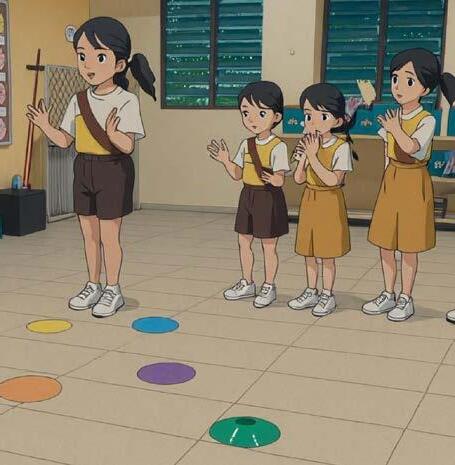
Figure 1: Students in Peizhen’s class learning music through a Hopscotch game.
insight that play enables learners to “see and feel” concepts through embodied participation.
Collaboration within this project further enriched my practice. Observing how colleagues used routines, props, and imagination gave me food for thought on how to adapt and extend teaching ideas and approaches.
Furthermore, the team’s feedback on my lesson affirmed my new direction and prompted further innovation, echoing Dylan Wiliam’s (2015) framing of formative assessment as feedback learning forward, and Johnson and Johnson’s (1999) reminder that understanding deepens when we build it together through the exchange of perspectives. The team’s openness and creativity encouraged me to continue exploring playful, student-centred strategies.
A ‘Cocky Robin’ Lesson
Guided by this, I created my ‘Cocky Robin’ lesson. This was designed to strengthen students’ grasp of melodic intervals, develop their recognition of recurring rhythmic and melodic patterns, and enhance their singing, while also exploring playful ways of meeting my musical objectives. Being on this journey a second time affirmed one truth: playful learning begins with playful teaching.
I wanted to draw students into ‘Cocky Robin’ without letting the lyrics of the original nursery rhyme Who killed Cock Robin? overshadow the learning. Hence I reimagined the story: Robin,
References
the proud and handsome bird, could not stop mocking Sparrow, the plain one. One day, Sparrow, in anger, tried to scare Robin with a bow and arrow — only for things to go tragically wrong.
To my surprise, this sparked a lively discussion on morals. Students offered insights like “two wrongs don’t make a right” and even shared personal anecdotes.
What began as a playful narrative had become a springboard for deeper conversations on justice and empathy, reflecting Bruner’s (1996) view that narrative is not merely decorative but a cognitive tool, a way through which learners make sense of human experience.
Here, play had unlocked meaning far beyond the lesson plan.
In the end, whether through stools and markers for rhythm, or a reimagined bird tale, the heart of each play episode lies in how structure and imagination work together. Just as the steady beat carried our lesson forward, it is these steady rhythms of play, structure and collaboration that carry our teaching forward, even as they evolve with every exchange of ideas.
By keeping choice, wonder, and delight as our compasses for lesson design, even the smallest classroom moments can become opportunities for joy, connection, and growth.
☑ Bodrova, E., & Leong, D. J. (2007). Tools of the mind: The Vygotskian approach to early childhood education (2nd ed.). Pearson.
☑ Bruner, J. S. (1996). The culture of education. Harvard University Press.
☑ Johnson, D. W., & Johnson, R. T. (1999). Learning together and alone: Cooperative, competitive, and individualistic learning (5th ed.). Allyn & Bacon.
☑ Vygotsky, L. S. (1978). Mind in society: The development of higher psychological processes (M. Cole, V. John-Steiner, S. Scribner, & E. Souberman, Eds.). Harvard University Press.
☑ Wiliam, D. (2015). Embedding formative assessment: Practical techniques for K–12 classrooms. Learning Sciences International.
CINDY’S PLAY EPISODE
Paya Lebar Methodist Girls’ School (Primary)
Children learn best through play as it helps them develop concepts and understand how things and ideas are connected. A child’s selfconfidence and self-worth grows as they master the tasks required for play.
Additionally, active participation in play encourages empowerment and autonomy, helping children feel less stress, and more in charge of their actions.
When play is incorporated into lessons, learning becomes joyful, and joyful learning leads to joyful discovery. I saw all this in Hui Chin’s lesson.
Hui Chin began with a lively singing partner game (see Video 1) that immediately captured our interest and attention. Her energetic and engaging presence set a vibrant tone, sparking curiosity and encouraging active participation from the onset.
Before moving on to a clapping game, Hui Chin demonstrated it with a student partner to clarify its flow and expectations.
The playful and interactive nature of the activity invited us to explore musical expression both physically and socially. I appreciated how Hui Chin balanced freedom and structure throughout the session.
Although movement was initially confined to the classroom seating arrangement, working within the lines provided just enough structure to help the students manage a new game while still feeling engaged and free to explore.
Being in their usual groups gave them a sense of familiarity, and their confident performance of the song and body percussion suggested strong prior scaffolding and well-established routines. There was a real sense of safety and encouragement in the space, largely due to Hui Chin’s warm tone, and open and inviting body language.
The students sang and clapped with enthusiasm, often smiling or laughing with their partners. It was clear that they were genuinely enjoying the experience.
Using Movement to Enhance Learning
After observing Hui Chin’s lesson, I read up more on how movement can enhance the learning of musical concepts. I realised that both Dalcroze and Kodály approaches utilise rhythm and movement.
Dalcroze Eurhythmics aims to build a deeper physical and emotional connection to music through the whole body (Juntunen & Hyvönen, 2004), while the Kodály approach uses movement to internalise rhythmic syllables and concepts learnt through other methods like singing and clapping (Choksy & Kodály, 1981).
Click here to view Video 2.
Inspired by Hui Chin’s lesson, I decided to incorporate this hand clapping game to introduce what a musical phrase is while teaching a new song — “Zao Qi Shang Xue Xiao” — to my Primary 1 class.
As you can see in Video 2, I have the luxury of space in the music room, so I decided to craft the game differently. I got my students to make two circles (inner and outer) while singing the song and doing the movement.
They exchange partners by moving to their right each time the song repeats. By turning learning into an active, playful experience, this hand-clapping game helped my students build a stronger connection to the concept of musical phrasing in a song, without my needing to explain it in words.
Seeing their smiling faces and hearing their laughter as my students engage in the activities that I have planned for my music classes always strengthens my belief that music lessons should be engaging and fun.
I am thankful for this collaboration with the other music teachers. It has expanded my ‘bag of tricks’ to include playful pedagogy in my lessons, making it more fun for the students to learn, and giving me joy in my teaching. It has also encouraged me to reflect more on how I plan, scaffold, and execute my lessons.
References
☑ Choksy, L., & Kodály, Z. (1981). The Kodály context: Creating an Environment for Musical Learning. Prentice Hall.
☑ Juntunen, M. (2004). Embodiment in Dalcroze Eurhythmics
Seeing their smiling faces and hearing their laughter as my students engage in the activities that I have planned for my music classes always strengthens my belief that music lessons should be engaging and fun.
HUI CHIN’S PLAY EPISODE
Bedok Green Primary School
Before students can sing rhythm with accuracy, they need to be able to feel it. Gestures, movement, and even simple daily objects are powerful tools that can make learning rhythm physical and engaging. This is because the learning experience is strengthened when the body is actively involved.
As I explored this idea in my own practice, Xin Ru’s lesson, where she used cups to engage students in tapping out rhythms, stood out for me. What struck me was how involved and excited the students were, and how easily they could reproduce the rhythms.
While I have always used movement in music teaching and learning, I have rarely used daily objects in my own practice. This led me to wonder: does the use of daily objects help students go further in understanding and familiarising themselves with rhythms, beyond what movement alone can do?
Exploring Deeper
As I read more, I discovered that the answer lies in embodiment — that is, the way our bodies play an active role in learning (Kosmas & Zaphiris, 2018). Movement on its own helps internalise rhythm, but objects provide additional layers, harnessing sound, touch, and weight to anchor the rhythm in the body (Godøy, 2022; Pouw, Wassenburg, Hostetter, et al, 2020).
Hence that cup-tapping lesson was not just a fun activity. It revealed how the use of objects can enhance embodiment and make learning rhythms
more accessible. Embodied cognition explains how physical experiences shape learning (Kosmas & Zaphiris, 2018).
For instance, when students tap rhythms with cups or move with scarves to a rhythm, they embody rhythm. The body acts as an anchor that helps them make the transition from external movement to internalised rhythm.
Rhythm Cupping
I could not stop thinking about how Xin Ru used cups to get her students to tap out rhythms. So I decided to give it a try with my Primary Two class. Using the song “Great Big House”, I got my students to first hand the cups around to each other to feel the song’s steady pulse.
After that, we shifted to tapping out the rhythm on the cups before singing. What struck me was how quickly the students grasped the difference between pulse and rhythm, almost without my having to explain. It was as if the cups had made rhythm come alive in their bodies.
This simple cup-tapping lesson was my turning point. It led me to discover the idea of embodiment, that learning happens through the whole body, not just the head. The way we move, gesture, touch, and sense the world directly shape how we understand and remember concepts. Now, I see movement and objects not as extras, but as essential tools for internalising rhythms before singing.
References
☑ Godøy, R. I. (2022). Thinking rhythm objects. Frontiers in Psychology, 13, 906479. https://doi.org/10.3389/fpsyg.2022.906479
☑ Kosmas, P., & Zaphiris, P. (2018). Embodied cognition and its implications in education: An overview of recent literature. International Journal of Educational and Pedagogical sciences, 12(7), 971-977.
☑ Pouw, W., Wassenburg, S.I., Hostetter, A.B. et al. Does gesture strengthen sensorimotor knowledge of objects? The case of the size-weight illusion. Psychological Research 84, 966–980 (2020). https://doi.org/10.1007/s00426-018-1128-y
FIRDAUS’ PLAY EPISODE
Cedar Primary School
When I first joined this Critical Inquiry NLC, I was new to the idea of Play Pedagogy. Very quickly, I realised that it was something music teachers, including myself, are already doing, although not always intentionally. Sitting in Allen’s Open Classroom was an eye-opener as I realised that I might have found the secret sauce to what could make my ‘Gamification Style’ lessons better. In her lesson, I saw how structuring lessons into levels could make play more purposeful. Levels could help students have a clearer sense of what to expect, as well as give them a sense of achievement and satisfaction.
I began to experiment with this in my own lessons, and learnt that for the students, completing each level as a class instantly created collective motivation and pride. When I teased my students with lines like, “It’s okay if your class cannot do this — only very, very good classes can”, they became even more determined to prove me wrong. What surprised me most was how they started saying things like, “We can do it with a bit more practise”, or “We cannot do it yet but we can try again”. They were exhibiting a growth mindset (Dweck, 2016) without me having to prompt them to do so.
Developing Levels in Lessons
Following this I developed the idea of ‘levels’ into a series of soundscape lessons. This time, levels did not simply refer to increasing in difficulty or complexity. The different levels introduced different skills that the students would ultimately need to use to create a soundscape.
In Level One, students were tasked to create sound effects for a short video clip (Honda Cog Commercial). This level guided them to discover how placement, tempo, timing, and dynamics matter as much as the timbre of the sounds itself. One thing I did differently this time was to ensure that the students would not be able to attempt the next level in the same lesson. Instead, they had to wait until the following week to do this. I had expected my students to be quite curious about Level Two but their responses surprised me. This delay heightened their anticipation to the point where they were buzzing with excitement, and speculating about what “Level Two” might be. This enthusiasm carried over into the next lesson.
Building on Levels
At Level Two, the students had to design sound effects for a busy picture scene (children rollerblading, a man walking his dog, a squirrel at a water cooler, people playing basketball) in groups. The game this time was for the other groups to listen and guess which part of the picture was being represented. The room was filled with energy and laughter, and the students were so engaged that I let them try the same game with another picture.
What surprised me was how spacing out the levels across different lessons created enthusiasm. Students were excited not just in the moment but were also looking forward to what the next level might bring. For me, these experiences showed how, if done carefully, playful structures such as gamification can spark joy, resilience, and curiosity not only for students, but also for teachers. They also help students develop a self-directed attitude towards learning, and fuel intrinsic motivation for both learners and teachers. Indeed, I have discovered a very powerful tool in music pedagogy.
XIN RU’S PLAY EPISODE
Cedar Primary School
My entry into CI NLC was interesting. I was privileged to attend an Open Classroom session conducted by Allen, together with my colleague Firdaus. This marked my first official encounter with play pedagogy in a music classroom. Throughout the lesson, I was immersed in the joyfulness of the students and Allen. This made me reflect on my own teaching practice. How were they able to have so much fun and yet learn the required concepts? What helped the students and teachers there in that lesson?
I found my answer after the post-lesson discussion and through reflections from other colleagues in our CI NLC who had watched the lesson recordings — being intentional about play and joy! It made me realise that purposeful play is important and should be a staple experience for my students in my preparation and enactment of lessons. This will contribute to a positive classroom culture and motivate learning.
PAL Inspiration
I drew inspiration from the Primary One Programme for Active Learning (PAL) lesson on the cup song, using a cup when teaching the song “Jinkli Nona” to my Primary Four class. My intention was to help the students internalise the dotted rhythms in “Jinkli Nona” even before they learnt how to sing the song. Not only did they manage the actions of the “Jinkli Nona” cup song well, they enjoyed themselves throughout the challenge!
The Importance of Scaffolding
Apart from creating purposeful play moments
in class, I learnt through Cindy’s lesson that preparation for scaffolding even before the play begins is even more important! I noticed how she planted ‘seeds’ at the beginning of her lesson to help students succeed in the later half of the lesson. This was done by introducing the concept of canon through movement, without mentioning the musical term.
Next, Cindy added onto the scaffold a new song, then got the students to apply the concept of canon on the new song, and finally, extended the application onto a familiar song. All these could only be done through careful preparation of lesson sequence, clear instructions, and scaffolding.
In addition, students were also given multiple opportunities to be part of the play process. They offered suggestions on actions used in the canon and chose their own canon partner. These simple moments sparked joy and reminded me that I too, can increase my students’ participation and engagement in my lessons.
Creating Intentional Play
Inspired, I prepared my students through a simple game of “Be The Conductor” where they would experience the binary form by conducting the two different sections, before introducing them to the form in “Semoga Bahagia”. Eventually, I also extended the application to the song “Chan Mali Chan”. The concept of form was not told to the students at all. Instead, they derived the form of the songs through movement and embodiment. As they smiled and discovered the joy of learning, musical elements also became more than just head knowledge to them.
To conclude, play is intentional and can be prepared for. It is also possible to balance both play and the teaching of concepts. In fact, they work hand in hand, and reinforce each other.
WEI SHAN’S PLAY EPISODE Fengshan Primary School
Earlier this year, Allen invited me to join her in a research project that involves incorporating playful pedagogies into our lessons, so as to ignite joy for our students and ourselves.
This was in addition to our discussions on ways to make music classroom activities more engaging and fun for the pupils, without neglecting the Critical, Adaptive, and Inventive Thinking (CAIT) development milestones of the Emerging 21st Century Competencies (E21CC).
I attended an Open Classroom session that Allen had organised with a Primary Three class and tried some suggestions that she shared there with my classes. I had also picked up some scaffolding ideas from Lucinda, my fellow music teacher, in a Kodaly course, so I decided to marry both for my class on discovering the notation Ti-tika. We used the song “I Don’t Care If The Rain Comes Down”.
A Marriage of Lesson Ideas
I started the lesson with our first game, a rhythm challenge from Allen’s Open Classroom. This allowed the students to revise rhythms like ta, ti-ti, tika tika, and crotchet rest in a call-and-response format.
After this, the students were delighted to hear that they had ‘levelled up’ to the next round. We proceeded to the next game, where they were arranged in four columns. In this game, the first person in every column would stand and use their fingers to represent rhythmic notation. When all four students stood and displayed their rhythm, the
rest of the class clapped and chanted the notation aloud. The atmosphere was playful and focused, as pupils created and responded to one another.
After these two rhythm games, we moved onto the next task: “Find the New Rhythm”. The focus was on ti-tika, a rhythm that can be initially confusing for new learners. To provide a concrete visual aid, I made use of two chairs, assigning each chair to represent one beat.
Students were placed in groups of four. Each group received a mini whiteboard and four rhythm cards, with each card containing two bars of music notation. I sang the song while tapping its rhythm on the chairs, pausing after the first two bars. Students worked together to select the rhythm card that best matched what they had heard. Lively exchanges took place within the groups as they debated and placed their chosen card on their boards.
Introducing Challenges
To extend the challenge, I asked if they noticed any lyrics that carried a rhythm not yet included in their “music dictionary”. Several students were able to verbalise the exact words. To guide their thinking further, I posed this multiple-choice question: Did the rhythm sound like (1) long–short–short, (2) short–long–short, or (3) short–short–long?
Most students answered confidently with option (1). Finally, I invited them to infer the name of this rhythm, based on their prior knowledge. After a brief pause, one boy spoke up: “It’s ti-tika!” His peers nodded in agreement and displayed clear excitement at the discovery of a new rhythm together.
Following the discovery of ti-tika, the students demonstrated confidence in mapping the remaining rhythm patterns onto the song lyrics. Towards the end of the lesson, I introduced another challenge: to compose a two-bar rhythm pattern in 2/4 time that
would accompany “I Don’t Care If The Rain Comes Down”.
The only condition was that the new rhythm, ti-tika, had to be included. The students responded eagerly, and worked efficiently, creating their two-bar patterns with accuracy and enthusiasm.
By the following lesson, they were ready to present their compositions. Each group shared their rhythms, and the activity culminated in a lively ensemble experience where the students transferred their written rhythms onto percussion instruments, filling the music room with energetic sounds as they performed. The atmosphere was joyful and collaborative, reflecting both their grasp of the rhythmic concept and their enjoyment of making music together.
Learning from Others
Segments of this lesson were recorded and shared during our peer sharing. I also got to view segments of lessons by fellow music colleagues. While watching these, a particular moment in Peizhen’s lesson stood out to me — her use of Curwen hand signs to scaffold and guide her students’ singing, a small yet impactful gesture
I carried this idea into a Primary Three class that was learning National Day songs. In “Singapore Town”, I asked the students to sing the bass notes of the chords (Do, Fa, So, Do) while using the corresponding hand signs. After this grounding in singing I transitioned them to playing the same notes on resonator bells.
What I noticed was not only smoother playing, but also a shift in the students’ sense of pitch awareness. Their voices seemed more anchored, and the confusion that often arises in matching the right note to the right instrument was significantly reduced.
Reflecting on this experience, I realised that the hand signs did more than provide a visual aid, they created a bridge for the students to internalise pitch before transferring it to the instruments. It was a reminder that embodiment in music learning can offer a powerful means of knowledge transfer, easing the gap between abstract notation and concrete performance.
The strategy also sharpened my awareness of how small pedagogical moves can ripple meaningfully into my own teaching practice.
Reflecting on the Process
All in all, participating in this project has been a reflective experience for me. The process of keying in written reflections and engaging in our check-in discussions created a space for me to examine my own practice with honesty and depth. The reflection questions pushed me to interrogate larger patterns in my teaching: Am I infusing enough playfulness and joy into my lessons so that both my students and I enter the music room with anticipation?
Have I provided enough space for them to explore, converse, and uncover musical ideas for themselves? Or have I scaffolded so much that I have inadvertently removed the challenges that nurture growth?
Engaging with these questions also revealed that my students were not the only ones on a learning journey. I too, have grown with them. Their musical development mirrors my own growth in practice, reminding me that teaching is never static.
In this sense, the project became, for me, more than an exercise in documenting lessons; it became a mirror, reflecting my intentions and my blind spots, and inviting me to reimagine what music education can look like in my classroom.
to imagine his responses before I could trigger them. I would ask,
ALLEN’S PLAY EPISODE
Fengshan Primary School
Firdaus’ Primary Two classroom was alive with energy, his students bubbling with laughter as they sang “Buttons You Must Wonder”. What struck me was not just their bright voices, but how he drew out good singing techniques with such ease. He arranged the class into circles that mimicked a button, reshaping the room into a stage for playful focus. Then came his “magical” sound machine: comical fanfares of “ya hoo!” and melodramatic “wah wah wah wah!”s, each cue transforming the children’s efforts into a spirited game. Their eyes sparkled as they challenged themselves, eager to earn the machine’s triumphant applause.
Inspired, I tried the sound application myself, only to realise that my inexperience made it clumsy. But that stumble led me elsewhere, to a treasure trove of free cartoon sound effects, and the birth of “Mr Happy”, a hand puppet who became my students’ whimsical judge. Like Firdaus’ class, mine began striving joyfully for the hand puppet’s approval, singing, playing, and reading notation with renewed conviction. At first, Mr Happy was the whimsical judge, his cartoonish sound effects of triumph and disappointment carrying the weight of approval. My students sang and played eagerly, striving for the applause or groaning at the mock sadness of his “Oh no…”. The game was simple — they performed, he responded — yet joy and determination filled the room.
A Powerful Change
But over time, something shifted. Mr Happy no longer held the voice alone. My students began
ALLEN
“If Mr Happy were to give you a sound now, what would it be?”
And they answered, not in words but in song — a playful chorus of “wah, wahh, wahhh…” or an exuberant “yay!” echoing through the room. From there, the conversation deepened.
“Why do you say that? What can we do to change the response?”
The children paused, reflected, and responded with remarkable clarity:
“We sang too softly.”
“Our notes weren’t together.”
STUDENTS
Mr Happy had become more than a character; he was a mirror, and my students were learning to see themselves in it.
What began as a game of approval-seeking had evolved into something far more powerful: selfcritique, analysis, and ownership. The students were no longer passively waiting for feedback. Instead they were generating it, questioning it, and acting on it. In those moments, I saw them not just as young musicians but as thoughtful learners taking on the onus of musicking into their own hands.
Conclusion: The Game We Played Together
Every game begins with a first move, and ours began with the willingness to be seen. Opening our classrooms to each other, whether in live demonstrations or through the unblinking eye of a video recording, is never easy.
Yet with that vulnerability lay the spark of authenticity. As we shared our lessons, we were not performing for one another, but exposing the very real, imperfect process of teaching. To admit this uncertainty together was to take the first step into the game, knowing that risk itself is a gateway to growth.
What surprised and moved us was the depth of trust that grew. Here was a generosity of spirit: slides passed on without hesitation, worksheets shared freely, classroom stories told with candour.
There was no sense of competition, only an eagerness to contribute and to learn. Trust became our greatest strength. For me, it was profoundly rewarding to not just initiate this journey but to be held within it as a fellow player.
To borrow a peer’s tool was to extend the life of an idea. Yet what was returned was never identical to what had been borrowed; it was reshaped, reimagined, and made to fit a new rhythm. In this way, our collaboration was not about replication, but about co-creation.
Each classroom became a site of experimentation, and the echoes of our colleagues’ voices were heard in the laughter and learning of our own students.
Pausing to Reflect
Perhaps the most transformative element of our journey was the decision to press pause. Reflection turned fleeting classroom moments into lasting insight. It was here that we moved from activity to understanding, from playful experimentation to thoughtful refinement.
Reflection became the hinge between play and mastery, allowing us to see not just what had happened, but what might happen next. In pausing together, we found clarity, and in that clarity, we found change.
In our journey, our collaborative playful inquiry reminded us that teaching is not a solitary craft but a shared game — one that demands courage, thrives on trust, grows through exchange, and matures in reflection. By daring to play together, we discovered that joy is not just a by-product of learning; it is its very heartbeat.
Including Diverse Learners
How Differentiation in the Teaching Process can Impact Students’ Creative Journey in Songwriting
Clarissa Ng
Jurongville Secondary School Introduction
The songwriting module has long presented persistent challenges within my music classroom as outcomes failed to meet expectations despite repeated revisions to the process and content. A consistent observation was the high level of student (and sometimes, teacher) frustration, often stemming from a perceived lack of progress and frequently leading to creative ‘blockage’.
Various changes in collaborative formats were attempted in previous years, but these modifications did not fully resolve the creative difficulties.
Further complications ensued when Full Subject-Based Banding (FSBB) was introduced, and my music classrooms had wider ranges of student readiness than before. My decision to embark on this specific project was inspired by the idea of structured song maps which I came across on YouTube while searching for songwriting resources.
The primary intent was to provide students with greater clarity and structure to guide their creative thinking process, thereby enhancing the overall success of the songwriting module.
Inquiry Question
How does differentiation in the teaching process impact students’ creative journey in songwriting?
Methodology
Target Audience
☑ Secondary Two
☑ Two classes
☑ 68 students
Data Collection
☑ Survey
Pedagogical Principles
Differentiated Instruction (DI)
This project draws inspiration from Stephanie L. Standerfer’s (2011) research on DI application in the music classroom, specifically differentiating the process.
By assigning students to groups for specific goals or allowing them to select the most engaging task, we ensure that students can learn new material or hone a skill in a manner tailored to their readiness, interest, and learning profiles.
Curriculum Outline
1 Song Structure – rearrange existing tracks to form a complete song
2 Introduction to Chords and Drumbeats
3–4 Lyric Writing (DI application 1*) with Song Map
5–7 Setting Words to Music (DI application 2**) with BandLab
8–10 Feedback, recording and submission
*DI Application 1: Differentiation for Interest (Lessons 3 to 4)
This strategy focused on providing students with Song Maps to help them develop their lyrical ideas. This approach aimed to directly influence student engagement and product.
Differentiation was achieved by offering three distinct levels of storytelling/theme complexity, allowing groups to choose the map that best suited their interest or creative approach:
Level 1 : Low Readiness: Feeling (Song Map 1)
☑ Portray a particular feeling/situation.
☑ The map guides students to explore the emotion, when they feel it, what causes it, and what prevents it.
Level 2: Middle Readiness: Problem – Escalation – Conclusion (Song Map 2)
☑ Linear storytelling.
☑ The map prompts students to define the main character(s), the start/ context, how the story develops, and the conclusion.
Level 3: High Readiness: Situation – Context – Consequence (Song Map 3)
☑ Present – Past – Future (or nonlinear) storytelling structure.
☑ The map asks students to describe the present, how the present happened (past/context), and the consequence/conclusion (future).
**DI Application 2: Differentiation for Readiness (Lessons 5 to 7)
This strategy was implemented during the “Setting words to music” phase and focused on catering to students’ varying readiness levels.
The key strategy was the use of the BandLab for Education platform. The tools in BandLab allow users to choose instruments, voice/audio recording, drum machines, samplers, guitars, and bass for their tracks. Differentiation was provided by offering various ways for students to create music:
❶ Using Song Templates: Lower-readiness students could use curated song templates
for entire songs (like “Lost Lovers” or “Cutesy” from the Pop genre, or others from Hip Hop, etc.) to quickly set their words to music.
❷ Original Arrangement: Higherreadiness students were able to use Virtual Instruments and other tools within BandLab to create an original arrangement. This allowed them to express their creative goals musically, as well as explore the arrangement component of recording.
The tools in BandLab allow users to choose instruments, voice/audio recording, drum machines, samplers, guitars, and bass for their tracks.
Overview of Tools/Apps


Jurongville Secondary School
Music Lesson Song-writing Module
1. Song maps
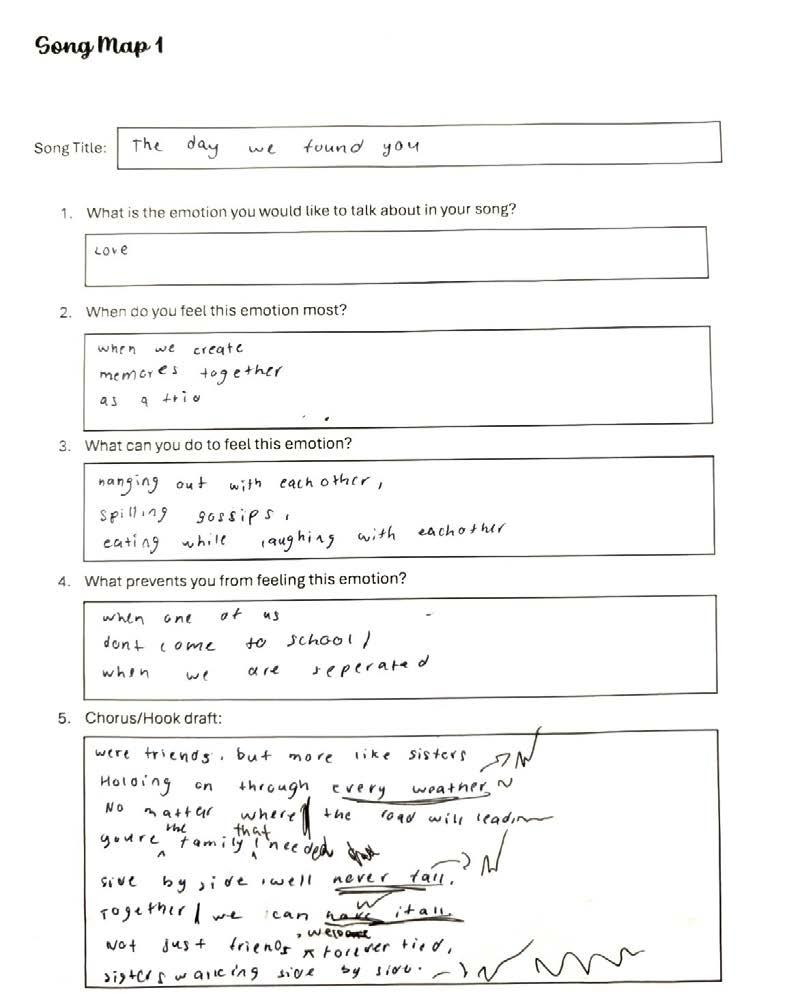
Figure 1: Song Map 1, Readiness level: Low.
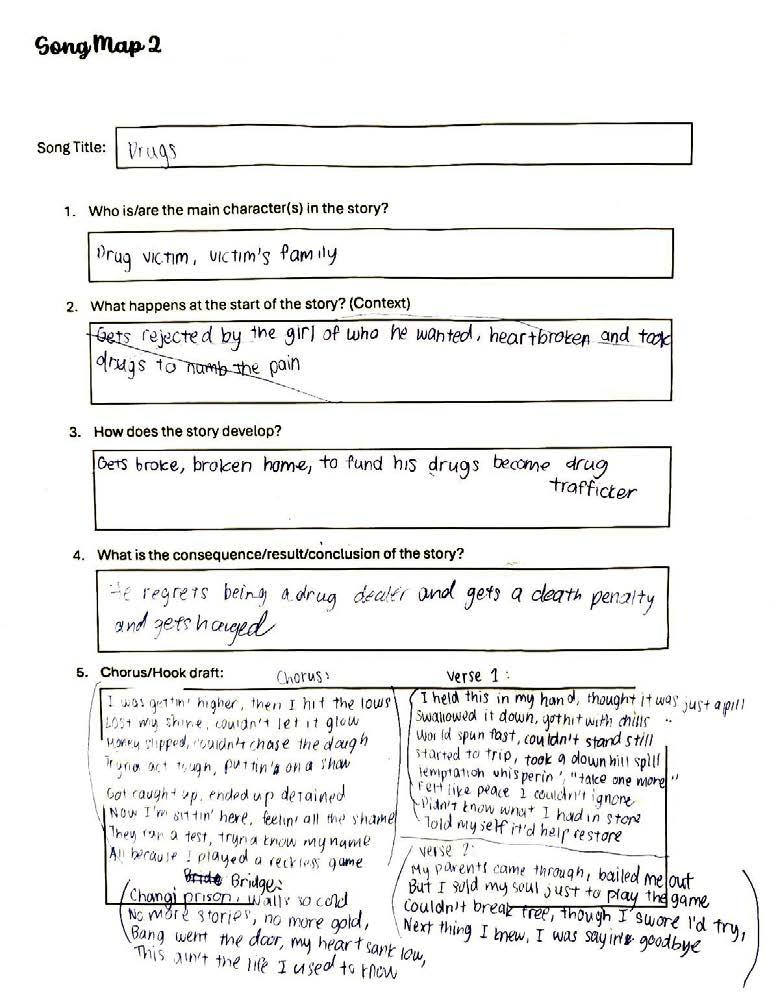
Figure 2: Song Map 2, Readiness level: Middle.
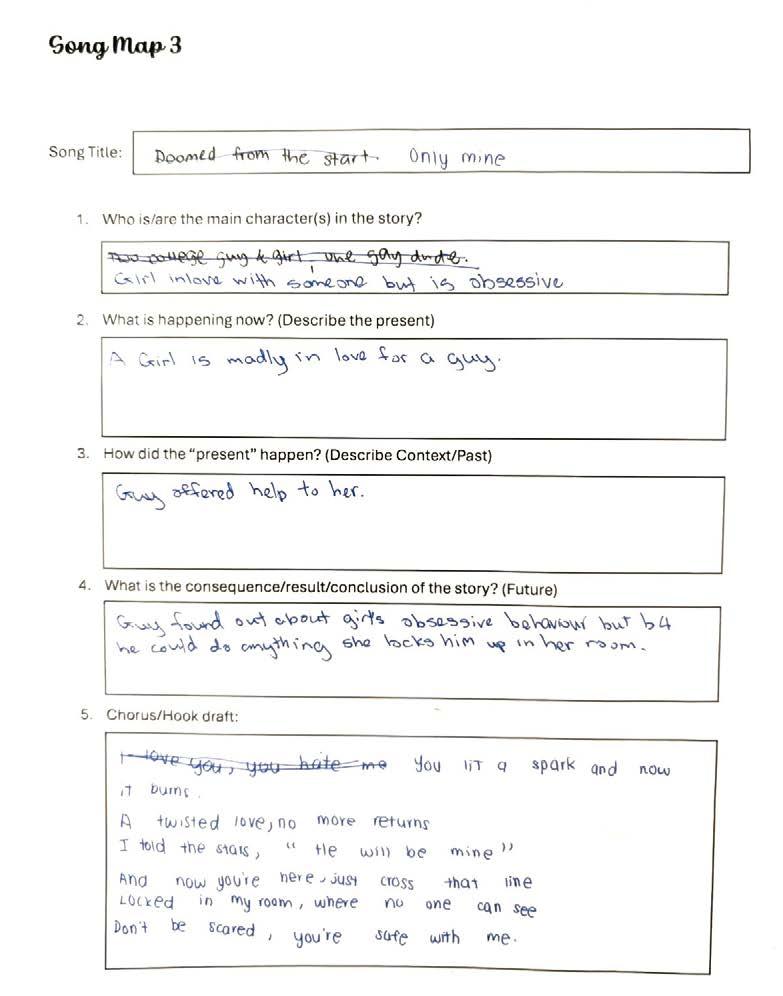
Figure 3: Song Map 3, Readiness level: High.
2. BandLab
Song Map 1
Story: The pain of losing a loved one
Music: Original arrangement using virtual instruments on BandLab
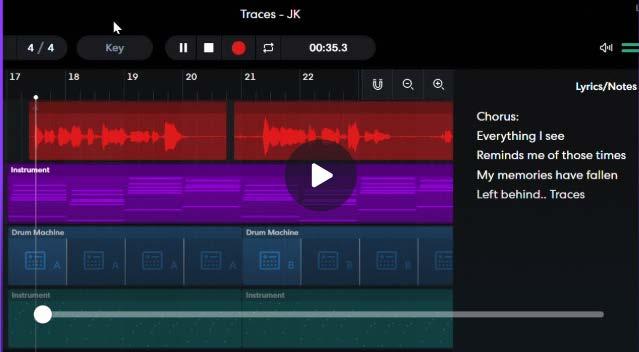
Song Map 2
Story: Obsession over an ex-boyfriend
Music: Used “R&B” genre template on BandLab
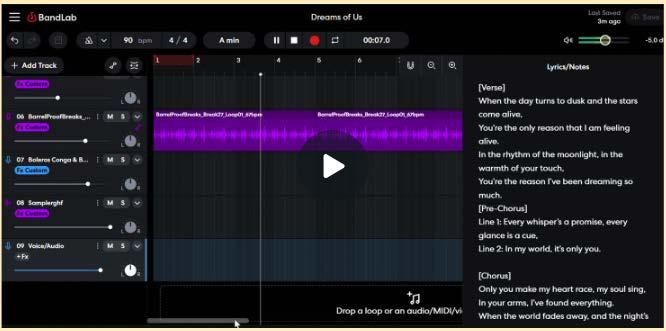
Middle.
Song Map 3
Story: Watching a friend fall into bad company and consume drugs
Music: Used “Gangsta Rap” genre template on BandLab
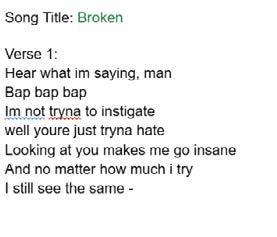
6: Example of Music Readiness level: High.
Figure 4: Example of Music Readiness level: Low.
Figure 5: Example of Music Readiness level:
Figure
Data Collected
Findings
Pre-Survey Questions
Forced-choice Questions
What genres of music do you listen to?
☑ Pop
☑ Rock
☑ Classical
☑ R&B
☑ K-pop
Open-ended Questions
What do you think makes a good song?
☑ “Relatable lyrics”
☑ “Groovy rhythm”
☑ “Catchy tune”
The purpose of the pre-survey was to establish a reference point for my students’ creative influences.
Observations
❶ Issues faced during Lessons
(i) Students with weaker grasp of the English language struggled to write lyrics.
(ii) Low-readiness students resorted to “rapping” the lyrics layered over a BandLab template track.
(iii) Higher-readiness students wanted more time and space to record their music due to self-set high expectations.
(iv) Consultations were time-consuming. This resulted in an unequal amount of time spent with the groups.
❷ Students’ responses to the apps
(i) Song Maps
Students found Song Maps to be a highly effective planning tool. They praised it for helping their ideas flow, establishing context for their songs,
and providing clear step-by-step guidance for song development. Students also felt that it gave them a good sense of direction and helped them to come up with lyrics, while allowing them to be fully creative and to explore their own options.
(ii) BandLab
Students had technical and creative challenges during the music creation process while using BandLab. They struggled with the software’s performance, lagging interface, and difficulties when it came to moving the music around. They also faced significant problems with the practical aspects of recording, especially the vocal track. Creatively, they struggled to create a tune they liked, to match the instruments with the song, and to match the lyrics and the rhythm effectively.
Post-Survey Findings
Potential introduction of Artificial Intelligence (AI) tools
Response to the introduction of AI tools in songwriting was mixed, but largely leant towards the negative, focusing on concerns about authenticity and emotion.
Students were concerned that using AI tools would negatively impact their creative input (Mean Rating Index of 3.06). They feared a potential loss of originality and the absence of “raw emotion or feeling” that comes from writing songs “with heart and soul”.
However AI tools could aid differentiation by making lyric composition more accessible and quicker for students. For instance, one response suggested that AI could generate a song that students could
edit to make their own, and that it would take less time to come up with lyrics this way (refer to Figure 7).
Furthermore, this would benefit LowReadiness Learners (Focusing on Speed and Structure) as AI could generate a preliminary set of lyrics, providing a strong starting point that they can then edit and personalise. This would reduce the time
The Song Maps were helpful in generating creative ideas for lyrics.
BandLab’s music templates had a positive impact on our creativity when setting our lyrics to music.
Song Maps, BandLab and Choruswritingapp helped us throughout our creative journey in song writing.
My group members and I chose our Song Map based on which we felt would be easiest. Using AI tools would negatively impact our creative input. AI (Artificial Intelligence) tools would be helpful in writing a song.
My group preferred to use BandLab’s smart instruments to create our own music.
spent struggling with initial composition, allowing them to proceed quickly to the more creative or technical process of setting the words to music, and music arrangement.
Additionally, the use of AI could resolve grammar challenges for students with limited language proficiency, resulting in more polished lyrics.
Figure 7: Survey Findings.
Challenges
Song Maps was a successful foundational tool and a good starting point for idea generation. However, lyric writing presented a significant challenge, especially for low-readiness learners who demonstrated a lack of motivation and struggled due to weaker language abilities.
Ultimately, the task of setting words to music exposed clear learning differences: low-readiness students tended to rely heavily on pre-existing templates, while high-readiness students felt pressured and needed additional time to develop their own original arrangements.
Conclusion
The differentiated approach anchored by Song Maps successfully supported the initial phases of the creative journey by facilitating idea generation and clear creative direction.
However, challenges were identified in lyric composition, particularly for students with weaker language skills, despite support from the various songwriting tools.
Student feedback offers a clear path forward: use AI tools in the lyric segment to streamline the writing process and save time. The extra bandwidth
gained can then be dedicated to deeper exploration in the music-making segment, which students have identified as a more engaging creative focus.
Hence, future instructional efforts will prioritise creativity in music-making/ arrangement and composition, over lyric composition alone. The goal is to strategically leverage AI to make songwriting more accessible to lowerreadiness students without compromising originality in their final work.
Acknowledgements
Special thanks to my colleague, Ms. Pauline Fong, for giving me the time and space to experiment with this Song Writing module.
References
Journal Article
☑ Standerfer, S. L. (2011). Differentiation in the music classroom. Music Educators Journal , 97(4), 43-48.
Video
☑ Coutts, K. [How To Write Songs]. (2023, June 3). The Simple Songwriting Formula that Changed Everything for Me [Video]. YouTube. Retrieved January 5, 2025, from https://www.youtube.com/watch?v=My2AKeFwLuI&t=111s
Designing for Belonging: Inclusive Adaptations in the Music Classroom
Introduction
Sunshine Ong Siqi
Naval Base
Primary School
Music has the power to help children learn, express themselves, and connect with others.
As music teachers, we see this every day, not just in neurotypical students, but also in those who require more learning support. Over the years, our classrooms have become more diverse, welcoming many students who have unique learning needs. Through my experience in teaching students with Autism and with Attention-Deficit/Hyperactivity Disorder (ADHD), I have learnt that inclusion in music education is not simply about having all students in the same room. It is about adapting our teaching strategies so that every child can access and enjoy learning music.
Like many teachers who have atypical students, I face challenges in the classroom, with students moving around during lessons, becoming easily distracted, or struggling
Name Diagnosis
Boy 1 (L)
Strengths
to stay on task. Over time, I realise that instead of expecting them to always be engaged in my lessons, I needed to reshape my teaching approaches to fit their needs.
Inquiry Question
This has led me to explore one key question: How can teaching methods in Primary school music lessons be adapted to accommodate students with special educational needs (SEN)?
Case Studies
To better understand how different strategies could support students with SEN, I focused on three students from my Primary Two music class. The table below outlines their key strengths and challenges. These brief case studies highlight the
Autism ☑ Loves dancing and drumming
☑ Responds well to rhythm
☑ Good rhythmic accuracy
☑ Answers verbally when asked
Autism, ADHD
Boy 2 (Z)
Boy 3 (J)
☑ Enjoys playing instruments
☑ Follows instructions at times
☑ Good sense of beat
Autism ☑ Can mimic actions
☑ Calm during lessons
☑ Participates when prompted
Challenges
☒ Walks around and plays with instruments, unable to sit still
☒ Needs frequent reminders
☒ Will not sing or do paperwork
☒ Can’t sit still
☒ Stomps feet, shouts randomly
☒ Rolls on the floor
☒ Asks questions frequently
☒ Non-verbal
☒ Cannot follow instructions
☒ Unable to follow theory/ practical lessons
diversity among learners with different learning and behavioural needs. Even though all three students displayed characteristics commonly associated with autism and attention-related traits, their learning profiles, behaviours, and responses in the music classroom were very different. Each brought unique strengths to celebrate and specific challenges to address.
Methodology
To explore effective strategies for supporting students with SEN in music lessons, I observed my Primary Two class over an eight-week period. Each week, I documented my observations and reflections to capture not only the learning outcomes but also the ongoing process of teaching and adapting. To guide my reflection, I used a consistent set of questions:
☑ How were the students engaging with the class? Were they focused, distracted, or showing excitement?
☑ When challenges or surprises arose, were there behavioural difficulties or positive, unexpected breakthroughs?
☑ What strategies seemed to help, and
which are worth refining or repeating?
☑ How were the students interacting with their peers, and what did these social dynamics reveal about their comfort and participation in music activities?
By documenting each lesson through this reflective lens, I was able to identify emerging patterns and see which approaches supported learning and behaviour most effectively. This process also helped me refine my teaching practices and adjust them along the way based on what I observed in real time.
Curriculum Outline
The lessons took place during the second term of the year.
Four key concepts —
☑ Sound exploration
☑ Rhythm creation
☑ Melodic performance, and
☑ Inclusive participation
provided a framework for exploring inclusive teaching strategies to better support the diverse needs of my students.
Classroom Observations
The following examples are taken from my reflective journal over the eight-week observation period.
In Week 1, I introduced the concept of soundscapes through storytelling, guessing games, and a rain soundscape using body percussion. Each student responded differently: L was highly engaged in the guessing game but needed reminders to take turns, Z was distracted during teaching but motivated when the game
was used as a reward, and J preferred body percussion activities over vocal participation.
From this, I learned that interactive and movement-based activities were far more effective in sustaining attention and participation than purely verbal or written tasks. These early insights shaped how I adapted my lessons in the weeks that followed.
(Reflective journal entries from the eight weeks can be viewed below.)
Exploring
Soundscapes
❶ Introduction to Soundscapes
The teacher introduces the concept of soundscapes through storytelling.
❷ Guess the Sounds Game
Students observe a picture of a setting (e.g., a park) and listen to their classmates creating sounds using body percussion and voice. They take turns to guess the different objects or activities based on the sounds.
❸ Rain Soundscape Activity
Students watch a video demonstrating a rain soundscape and follow along using body percussion to replicate different sounds.
❹ Creating a Soundscape
Given a picture, students brainstorm possible sounds to bring the scene to life. They then perform these sounds while other groups listen and guess the correct picture from a set of options.
ENGAGEMENT
Boy 1 (L) Boy 2 (Z)
Highly engaged, especially during the guessing game, showing enthusiasm and an eagerness to participate.
CHALLENGES
Struggled with taking turns, repeatedly wanting to be the guesser. Expressed frustration when not chosen but was receptive to reminders.
ENGAGEMENT
Struggled to stay focused during teaching, often making noises and banging on the table. However, he showed interest in the “Guess the Sounds” game.
ENGAGEMENT
Boy 3 (J)
Participated in the rain soundscape activity, responding well to body percussion instead of vocal sounds.
PEER RELATIONSHIPS
Positive interactions with classmates, who were supportive and who encouraged him by applauding when he answered correctly.
CHALLENGES
Easily distracted and disengaged during group work, preferring to do his own activities.
EFFECTIVE STRATEGIES
Simple verbal reminders like “take turns” helped manage his expectations and keep him on track.
PEER RELATIONSHIPS
Limited interaction with his group, showing little interest in collaborative tasks.
CHALLENGES
Reluctant to join the “Guess the Sounds” game, even when privately encouraged.
EFFECTIVE STRATEGIES
Using the game as a reward system temporarily improved his behaviour, but further strategies were needed to sustain engagement, especially during group activities.
PEER RELATIONSHIPS
Limited interaction during the game, preferring to stay on the sidelines.
EFFECTIVE STRATEGIES & NEXT STEPS
Body percussion was an effective way to engage him. Need to explore alternative ways to check on his understanding, possibly through non-verbal responses or one-on-one engagement.
Week 2 Soundscape Exploration & Assessment
❶ Recap & Warm-Up
Reviewed the concept of soundscapes through a quick discussion. Students engaged in a warm-up activity where they recreated sounds based on different Singapore locations.
❷ Soundscape Assessment
☑ Students were grouped (4–5 per group) and given two picture options to choose from.
☑ Each group selected one picture and identified five key elements to represent through sound.
☑ Groups performed their soundscapes while the rest of the class guessed the sounds they created.
ENGAGEMENT
Boy 1 (L) Boy 2 (Z)
Seemed disengaged during group discussions but was actively listening, as he could accurately recreate the discussed sounds during the performance.
CHALLENGES
Needed reminders to collaborate with his group, as he was not visibly interacting with peers.
ENGAGEMENT
Continued to make random noises during the lesson, showing limited focus during group discussions.
Boy 3 (J)
ENGAGEMENT
Needed one-on-one support during group discussions but was able to participate when guided by a peer.
PEER RELATIONSHIPS
Participated well in the assessment and was engaged in guessing other groups’ soundscapes.
CHALLENGES
Reluctant to communicate or collaborate with group members in planning their soundscape.
CHALLENGES
Initially quiet and passive, requiring encouragement to contribute ideas.
EFFECTIVE STRATEGIES
Gentle reminders about teamwork helped; his engagement improved during hands-on activities rather than discussions.
STRENGTHS & SURPRISES
Showed strong interest in guessing other groups’ sounds and was able to produce accurate and relatable sounds when prompted individually.
EFFECTIVE STRATEGIES
While group interaction was challenging, his interest in the guessing activity and ability to produce sounds when directly engaged suggest that individual prompting and game-based learning may be more effective in drawing out his participation.
SURPRISES
Although he did not verbalise ideas, he successfully recreated sounds during the performance, especially nature and animal sounds.
PEER RELATIONSHIPS
Benefitted from having a buddy who actively engaged him in the task.
EFFECTIVE STRATEGIES
Positive reinforcement and consistent reminders helped boost his confidence, making him more comfortable with performing in front of the class.
Week 3
Exploring Rhythm through “Chattanooga Choo
❶ Introduction to Rhythm (Implicit Learning of Semiquaver)
The teacher introduced the rhythmic feel of semiquavers through body percussion and chanting the lyrics of “Chattanooga Choo Choo” without showing the actual notation.
❷ Step-by-Step Song Learning
☑ Students learned the song in stages, beginning with verbal rhythm chanting and body percussion, gradually internalising the fast rhythm patterns.
☑ Once the students were comfortable, the teacher introduced the melody and had the class sing along, maintaining rhythmic accuracy.
❸ Rhythmic Reinforcement in a Circle Activity
Students formed a circle and used chopsticks to tap out the rhythm while singing, reinforcing the feel of semiquavers through a hands-on, musical experience.
❹ Rhythm Substitution Game
To further reinforce the rhythm, a game was played where certain words (e.g., “Chattanooga”, “train”) were silenced, and students had to tap the rhythm instead of singing those parts.
Choo”
ENGAGEMENT
Boy 1 (L) Boy 2 (Z) Boy 3 (J)
Unable to sing, but could verbalise the lyrics and follow body percussion actions. Participated inconsistently but responded positively to support.
ENGAGEMENT
Verbally active during the lesson, frequently repeating random words like “choo choo” and “Chattanooga” out of context, but not able to follow the structured rhythm or lyrics during call-andresponse activities.
ENGAGEMENT
Unable to sing or verbalise the lyrics, but participated by following the body percussion movements.
CHALLENGES
Occasionally lost focus and stopped following along, but could be re-engaged with encouragement.
PEER RELATIONSHIPS
Encouragement from friends and teacher modelling were effective in helping him stay on task.
CHALLENGES
Difficulty with structured vocal tasks and staying on rhythm when singing or speaking in time.
CHALLENGES
Had difficulty sustaining focus on body percussion for extended periods; often drifted off-task.
EFFECTIVE STRATEGIES
Verbal prompts and positive reinforcement from both the teacher and his peers helped him to maintain attention and participation. Modelling the actions clearly also supported his understanding and involvement.
STRENGTHS & SURPRISES
Demonstrated strong rhythmic accuracy when given chopsticks. He was quiet, focused, and could tap the exact rhythm of the song correctly.
PEER RELATIONSHIPS
Having a buddy to guide and remind him helped maintain his attention slightly longer.
EFFECTIVE STRATEGIES
Providing a tactile and focused task like rhythm tapping helped regulate his attention and brought out his musical strengths. Reducing verbal demands allowed him to participate more meaningfully.
EFFECTIVE STRATEGIES
While he remained unwilling to vocalise or sing, allowing him to engage through movement provided him with a non-verbal way to participate meaningfully. Peer support was useful in keeping him involved.
Week 4 Introduction to Semiquaver tikatika through “Chattanooga Choo
❶ Song Recap & Rhythm Game
Students revisited the song “Chattanooga Choo Choo” and played the rhythm substitution game to reinforce rhythmic patterns.
❸ Rhythmic Vocalisation & Body Percussion
☑ Students sang the song again using rhythm syllables (ta, titi, tika tika) instead of lyrics.
☑ The teacher presented rhythm patterns with tika tika for students to chant and perform using body percussion.
❷ Conceptual Bridge to New Note Value
The teacher guided students to make connections between familiar rhythms (ta = “train”, titi = “choo choo”) and introduced the new note value tika tika (semiquaver).
❹ Creative Group Activity
In groups, students created a 1-bar rhythm using ta, titi, and tika tika, and performed it for the class.
Choo”
ENGAGEMENT
Boy 1 (L) Boy 2 (Z)
Did not actively sing or follow the body percussion actions, but showed physical engagement by bobbing to the beat, indicating internal processing of the music.
IMPROVED PARTICIPATION WITH INSTRUMENTS
He was able to follow rhythm patterns accurately when using chopsticks, showing good auditory-motor coordination.
ENGAGEMENT
Boy 3 (J)
Did not participate in the singing or body percussion activities, and appeared to struggle with grasping the new note value tika tika, likely due to limited familiarity with ta and titi from previous learning.
STRENGTHS
Successfully vocalised the new note value (tika tika) and was accurate in performing rhythm patterns using chopsticks.
ATTENTION CHALLENGES
During the explanation of note values, he appeared inattentive and distracted.
PARTICIPATION
Actively contributed during the rhythm creation activity, showing understanding and interest in the task.
EFFECTIVE STRATEGIES
Hands-on tools like chopsticks and rhythm-based tasks supported his engagement and brought out his musical strengths, even without full verbal or physical participation in singing.
GROUP ACTIVITY ENGAGEMENT
He showed a stronger interest in participating during the group rhythm game, though he continued to make occasional loud, random noises.
ADAPTATIONS & STRENGTHS
When given a drum to tap the steady beat, he was able to follow along consistently, showing rhythmic awareness at a basic level.
PARTICIPATION
Did not actively engage in the group rhythm creation activity but was able to contribute a note when prompted, indicating he can respond with support.
PROGRESS NOTED
Despite these challenges, there was noticeable improvement in participation compared to previous lessons.
EFFECTIVE STRATEGIES
Simplifying the task to beat tapping helped scaffold his learning and kept him involved. Individual prompting also encouraged his participation during group work.
Week 5 Revision & of Practice Semiquaver (tikatika)
❶ Rhythm Recap with Body Percussion
Students reviewed note values (ta a, ta, titi, tika tika) by vocalising and performing them using body percussion.
❸ Group Rhythm Creation
☑ In groups of five, each student took turns to create a 1-bar rhythm using note values provided on paper plates.
☑ Groups rehearsed and performed their rhythms to the class.
❷ Rhythm Practice with Chopsticks
Students practiced saying and tapping the rhythms with chopsticks, reinforcing coordination and accuracy.
❹ Listening & Guessing Challenge
The lesson concluded with a rhythm guessing game, where students listened carefully and identified the rhythms performed by other groups.
Boy 1 (L) Boy 2 (Z) Boy 3 (J)
ENGAGEMENT BOOSTED BY TOOLS
The use of chopsticks significantly increased his focus, as having something physical to engage with helped maintain his attention.
ABSENT
EMERGING ENGAGEMENT
While he is still developing accuracy in rhythm, he showed more effort today, attempting to follow along using his chopsticks.
RHYTHMIC ACCURACY
He was able to follow and perform rhythms steadily, showing strong rhythmic coordination.
GROUP PARTICIPATION
Initially hesitant to join group work, but when given the autonomy to choose his group, he became more cooperative.
PEER MODELLING
He began to mimic the rhythms played by the classmate next to him, suggesting that pairing him with a rhythmically-strong buddy could enhance his learning.
GROUP INVOLVEMENT
During the group activity, he contributed by helping with setup (e.g., arranging paper plates), though he continued to struggle with maintaining a steady beat.
POSITIVE OUTCOME
Once in his chosen group, he followed instructions, co-created, and accurately performed the rhythm with his peers.
Week 6 Learning on “Chattanooga Choo Choo” Chime
❶
Song Revision
The lesson began with a revision of singing “Chattanooga Choo Choo” using the lyrics.
❸ Memory Exercise
Students were challenged to memorise the sequence of notes by closing their eyes and recalling the notes they sang.
❷ Introduction to Notes and Solfège
Students then practised singing the song using note names and solfège instead of lyrics to familiarise themselves with the pitches.
❹ Chime Bar Practice
Finally, students played the song step-bystep on the chime bars, applying their note knowledge in a practical way.
Boy 1 (L) Boy 2 (Z) Boy 3 (J)
HIGH PARTICIPATION
He was actively engaged, frequently volunteering to answer questions during class discussions.
MOTIVATION THROUGH INSTRUMENT USE
Building on past observations, a structured reward system was used. He was told he could play the instrument first if he refrained from walking around, clapping, or hitting the floor.
INITIAL RELUCTANCE
He was not engaged during the singing portion and was initially hesitant to play the chime bars, likely due to difficulty in following the activity.
IMPULSE CONTROL SUPPORT NEEDED
During the chime bar activity, he occasionally played out of turn, but having a peer buddy to guide him proved effective in minimising disruptions and supporting classroom management.
IMPROVED SELFREGULATION
While he still occasionally displayed impulsive behaviours, there was a notable reduction in their frequency, indicating some progress in self-control.
IMPROVED ENGAGEMENT WITH SUPPORT
After being paired with a buddy for guidance, he became more willing to participate.
MUSICAL ACCURACY
He was able to play both the melody and rhythm accurately, showing good understanding and coordination.
STRONG MUSICAL PERFORMANCE
When given the chime bars, he was able to play the melody accurately and maintain a steady beat, showing strong engagement and musical ability.
MUSICAL PROGRESS
While he did not yet play the rhythm accurately, he was able to follow the correct melody notes, showing progress with support.
Week 7 Revision of “Chattanooga Choo
Choo” on Chime Bars
❶ Song Revision
Students began by singing the song using letter names to reinforce pitch recognition before playing.
❷ Instrument Practice
They then rehearsed the melody on chime bars, focusing on accuracy and control.
❸
Peer Assessment Activity
Students were paired up and used a peer assessment checklist to evaluate each other’s posture, playing technique, and note accuracy, in preparation for their upcoming assessment.
Boy 1 (L) Boy 2 (Z)
STRONG MUSICAL PERFORMANCE
He was able to rehearse the melody accurately and maintain a steady beat while playing with the mallets on the chime bars.
ABSENT
Boy 3 (J)
NON-VOCAL ENGAGEMENT
He continued to refrain from singing, but showed increased participation during the instrumental portion.
PEER ASSESSMENT CHALLENGE
During the peer assessment activity, he was less focused on observing and supporting his partner, showing limited engagement in the collaborative task.
NEXT STEP
May benefit from explicit guidance on peer assessment roles to help him stay attentive and contribute meaningfully during partner work.
EFFECTIVE SUPPORT STRATEGY
Providing a colour-coded cue card with letter notes greatly supported his engagement and helped him follow along more confidently.
MUSICAL PROGRESS
Although he is not yet keeping to the beat, he was able to play the correct notes slowly and accurately.
INCREASED EFFORT AND PARTICIPATION
He appeared more motivated and willing to practise, showing clear signs of improvement with the added visual aid.
8 Assessment of “Chattanooga Choo Choo” on Chime Bars
Boy 1 (L)
SUCCESSFUL ASSESSMENT PERFORMANCE
He was able to play the notes accurately and maintain a steady beat, demonstrating strong musical understanding.
IMPROVED SELFREGULATION
Compared to previous lessons, he required fewer reminders to wait for his turn, showing growth in his ability to follow class expectations.
OVERALL PROGRESS
This reflects a successful and focused performance, both musically and behaviourally.
Boy 2 (Z)
MUSICAL ACCURACY
He was able to play the correct notes with a steady beat during the assessment, demonstrating good understanding of the melody.
IMPULSE CONTROL STILL DEVELOPING
Although musically capable, he occasionally played out of turn, indicating ongoing challenges with self-regulation.
OVERALL OUTCOME
A successful performance musically, with some behavioural reminders still needed to manage turn-taking.
☑ The lesson began with a class revision of the song to reinforce note accuracy and rhythm.
☑ Students were then given 10 minutes to practise individually or with a partner, allowing for final preparation.
☑ The session concluded with the teacher conducting individual assessments of students’ playing on the chime bars.
Boy 3 (J)
SIGNIFICANT PROGRESS
During the assessment, he was finally able to play the notes on the chime bars accurately, marking a clear milestone in his musical development.
EFFECTIVE SUPPORT TOOL
The use of a colour-coded cue card was highly effective in helping him stay focused and navigate the notes confidently.
POSITIVE OUTCOME WITH PRACTICE
With continued encouragement and practice, he was able to overcome previous challenges and successfully complete the task.
Discussion
Several key themes emerged from the observations.
Rhythm and Hands-On Learning
Rhythm-based and hands-on activities such as drumming and body percussion significantly improved engagement. Students like Z, who is usually distracted, stayed focused when given instruments, while L maintained a steady beat during rhythm tasks. Providing a physical outlet helped channel their energy into purposeful learning.
Visual Aids for Accessibility
Visual support proved especially effective for non-verbal learners. Colour-coded cue cards that matched the colours of the chime bars helped J identify notes independently. With guidance and practice, along with a peer of higher readiness for support, he gained both confidence and accuracy. Multimodal strategies made music learning more accessible and inclusive for J, enabling him to complete the task successfully.
Peer Support and Buddy Systems
Structured buddy systems reduced teacher intervention and encouraged independence. Students were paired as Buddy A and Buddy B. One performed while the other observed using a simple, visual performance checklist. Instead of writing, they circled smiley faces to indicate if their buddy had kept the beat or played accurately. This child-friendly approach fostered peer feedback, active listening, and a sense of responsibility.
Games for Inclusive Participation
Game-based learning such as “Guess the Sound” and rhythm substitution encouraged participation from students who were non-
verbal or easily disengaged. These games provided alternative forms of expression, enabling students like J to contribute through sound and movement while building confidence and enjoyment.
Individual Behaviour Strategies
Personalised approaches helped manage challenging behaviours. For example, giving Z instrument time as a reward reduced impulsive actions. Clear expectations, consistency, and positive reinforcement gradually improved self-regulation.
Scaffolding for Progress
Breaking lessons into smaller, guided steps led to noticeable improvement. J, who initially struggled with rhythm patterns, succeeded through repetition and visual cues. Simplifying tasks, modelling, and repetition were key strategies in supporting gradual progress.
Conclusion
This journey has taught me several key lessons about inclusive music teaching. Understanding must come before managing; when we recognise each child’s strengths and challenges, it is easier to support their learning meaningfully. Small adaptations such as using colour cues, breaking tasks into manageable steps, and incorporating games can make a significant difference in engagement and progress.
Every child’s growth looks different, but each step forward is worth celebrating. Moving ahead, I aim to continue using multi-sensory and inclusive strategies, and to expand peer support and choicebased learning opportunities. I hope these reflections offer practical ideas that other teachers can bring into their own music classrooms.
Nurturing Relationships and Emotional Growth
Student’s Growth in Kompang Learning Through Self-Assessment and Reflection
Introduction
Chua Soo Bin April
Welzl Valentin Xin Wei
Teoh Jia Yan Diana
Data Collection
☑ Teachers’ observations
☑ Data from co-crafted rubrics
Allen Losey Fengshan Primary School
Pagsibigan Jemaima Agustin
Fuhua Primary School
This project was inspired by a desire to empower students to take greater ownership of their learning during kompang lessons. We observed that many students relied mainly on teachers’ feedback and lacked confidence in assessing their own progress.
While tools like rubrics, checklists, and guided reflections have the potential to help students monitor their growth, set meaningful goals, and take responsibility for improvement, this study aims to explore how students use these tools to support both their musical skills and their development as independent, reflective learners.
Inquiry Question
How are students using different tools to develop and enhance the ownership of their learning?
Methodology
Target Audience
☑ Two Primary Three classes with students who have a higher level of readiness (3 Care and 3 Excellence)
☑ 39 students in each class
☑ Two different teachers delivering the same lessons
Duration
☑ Five one-hour lessons over five weeks
Pedagogical Principles
Emerging 21st Century Competencies (E21CC)
Key areas of the project were aligned with the E21CC Framework through socialemotional learning (SEL), with the desired outcome of becoming a self-directed learner and confident person.
Singapore Teacher Practice (STP)
Key areas of the project were mapped to the Singapore Teaching Practice, in alignment with positive classroom culture, and assessment and feedback.
Ipsative Assessment Approach
This approach enables students to focus on their individual progress and growth by comparing their current performance to their previous performance.
Overview of Tools
Rubrics Co-constructed with Teacher
At the end of lessons two and five, students used the co-constructed rubrics to self-assess their skills and emotional awareness, set goals, and reflect on their learning.
Video Recordings
Performance videos were recorded to provide students with opportunities for
reflective practice. These enabled them to monitor their progress and engage in metacognitive self-assessment.
Verbal Feedback
Constructive teacher feedback helped students identify their strengths and receive targeted guidance for improvement. Tailored to individual learning levels, the feedback encouraged self-reflection, fostering deeper understanding and greater autonomy for learners. Week
☑ Introduction to Kompang
☑ Introduction to basic Kompang playing techniques
1
2
3
☑ Watch videos of Kompang performance
☑ Expectation of good playing rubric
☑ Recap basic Kompang techniques
☑ Learn and perform Pattern 1
☑ Review of performance (video)
☑ Co-create self-assessment checklist
☑ Self-assessment using checklist
☑ Recap of Pattern 1
☑ Learn Patterns 2 and 3
☑ Practise Patterns 1–3
☑ Play as a class ☑ Play as a group
4
5
☑ Improvise rhythm
☑ Review of performance (video)
☑ Self-assessment using checklist
Week 1
Students learned about the origins of the kompang, its materials, and basic playing techniques. They watched performance videos and practised on imaginary instruments before using the actual ones. No playing patterns were introduced. Teachers shared rubrics outlining their expectations for rhythm, sound quality, and teamwork.
Week 2
Students learned Pattern 1 and co-constructed rubrics with teachers. They reviewed their performance videos to reflect and set goals. Emotional awareness criteria, based on student reflections and SEL frameworks, made feelings measurable and supported meaningful, accessible selfassessment. (Graphic Notation)
Week 3
Students reviewed Pattern 1 and progressed to Patterns 2 and 3 through clapping and playing. Most showed correct technique use and memorised two patterns. Differentiation allowed advanced students to attempt all three patterns, while others focused on one. Note value accuracy remained a key challenge.
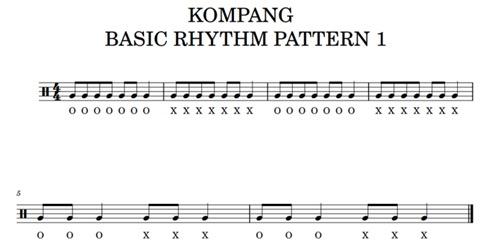
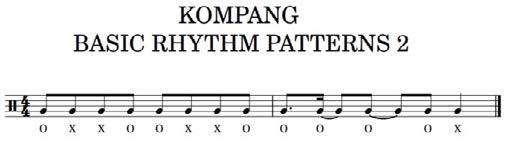
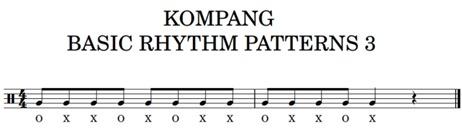
Kompang Pattern 2 (Graphic Notation)
Kompang Pattern 3 (Graphic Notation)
Week 4
Students reviewed videos of prior performances to refine posture and technique. Most memorised all three patterns and practiced with notations for support. In groups, they rehearsed, recorded, and exchanged feedback. Peer support was evident, though some struggled with dynamics. Overall, engagement and confidence increased.
Week 5
Students created new rhythmic patterns using notation or oral methods. Groups presented their compositions, demonstrating creativity and varied learning approaches. Minor performance lapses occurred, but peers responded with encouragement. The activity fostered collaboration, resilience, and positive reinforcement.
Data Collected
Data from 3 Care Co-constructed Rubrics
Section 1: Kompang playing skills I can hold the kompang the right way.
can play the basic rhythms.
Section 2: Understanding my emotions
Section 3: Goal Setting and Reflection
Data from 3 Excellence Co-constructed Rubrics
Section 1: Kompang playing skills After 2 lessons At end of programme
☑ To hold the kompang properly.
☑ To play the kompang better.
☑ To learn to play more complex rhythms.
☑ To play the kompang more steadily.
☑ To follow the rhythm of the pattern smoothly.
☑ To play the kompang perfectly without mistakes.
☑ To be more precise in my timing.
☑ To play confidently.
☑ To be chosen to play for the performance.
☑ To play more difficult pieces.
☑ We are more focused when we stand to play.
☑ Enjoy playing instead of being too focused on the rhythm.
I can play the ‘bing’ and ‘pang’ sounds properly.
I can listen attentively to instructions given by my teachers.
I can do this well. I am still learning. I need help.
☑ To play solo. At end of programme
After 2 lessons
I can memorise and play the three patterns fluently (individual).
Section 2: Understanding my emotions
I can play together with my friends (ensemble). At end of programme
Confident playing the kompang. Okay but I want to improve. Unsure, I need practice.
Section 3: Goal Setting and Reflection
After 2 lessons
☑ To be able to memorise patterns.
☑ To be able to play fluently.
☑ To focus on instructions.
☑ Proper hand placement is important.
At end of programme
☑ Teamwork is essential.
☑ Movement helps with rhythm.
☑ Memory work is challenging.
Rubrics Findings
❶ Self-Assessment of Skills
An interesting finding emerged from the statement: “I can play together with my friends as an ensemble.”
Surprisingly, there was an increase in the percentage of students who indicated that they needed help at the end of the programme, compared to their responses after just two lessons.
When asked about this change, students explained that as the programme progressed, they developed a clearer understanding of what excellence in kompang ensemble playing entailed. With this deeper awareness, they realised that the skills required were more complex than what they had initially perceived.
This finding highlights how self-assessment not only helps track students’ progress but also deepens their understanding of quality and performance expectations. Such awareness is a valuable part of their learning journey, fostering greater self-reflection and growth.
❷ Emotional Awareness
The second key area of our findings focused on emotional awareness.
For 3 Care, by the end of the programme, 78.9% of students reported feeling confident, while 21.1% indicated that they still wanted to improve. Notably, none of the students reported feeling unsure.
For 3 Excellence, the percentage of students who felt confident rose to 73%, showing an overall growth in confidence. Those who felt ‘okay but I want to improve’ dropped slightly to 27%. Importantly, none reported feeling unsure.
This trend suggests that as students gained more experience, their confidence and sense of assurance increased, and uncertainty was reduced.
At the same time, some students continued to recognise areas for growth — demonstrating healthy emotional awareness and selfreflection in their learning journey.
❸ Goal Setting and Reflection
The third key area of our findings is on goal setting and reflection.
For 3 Care, there was a shift in students’ goals from the start to the end of the programme. After two lessons, their goals were mostly about mastering basic techniques — such as holding the kompang properly, playing steadily, and learning more complex rhythms.
By the end of the programme, their goals had become more advanced and aspirational. They focused on precision, confidence, performing for an audience, and even playing solo. Some also reflected that they enjoyed the music more, rather than just concentrating on the rhythm.
This shows a clear progression from technical mastery to higher-order goals like performance, expression, and enjoyment of music.
For 3 Excellence, we see a clear shift in students’ reflections. After two lessons, their goals were mostly about technique and accuracy — memorising patterns, playing fluently, following instructions, and correct hand placement.
By the end of the programme, their focus had expanded to include deeper insights. They recognised the importance of teamwork, using movement to support rhythm, and realised that memory work can be challenging.
This shows a progression from focusing on individual skills to appreciating the collaborative and cognitive demands of ensemble playing.
Overall, the findings show that selfassessment improved students’ skills and deepened their awareness of ensemble standards. Some students reported needing more help as expectations became clearer.
While students’ reflections conveyed rising confidence and reduced uncertainty, they continued to identify their own growth areas. This balance highlights the role of self-assessment in fostering realistic awareness and resilient learning dispositions.
Observations
Issues Faced during Lessons
Consistency of self-assessment was a problem. Variations in the consistency of students’ self-assessments may have influenced the results. Despite prior discussions to standardise the different aspects of the rubric, students’ expectations of their own performance likely evolved as the kompang lessons progressed. As a result, the final self-assessment scores may not fully capture students’ actual competencies or the extent of their learning growth. This highlights the inherent subjectivity of self-assessment as an evaluative tool.
Students’ Response to the Co-constructed Rubrics
Students showed steady progress from only having basic skills to developing confident, precise performance abilities, along with a growth mindset. Reflections revealed a shift from individual accuracy to ensemble awareness. Regular reviews highlighted teamwork and cooperation. The programme strengthened musical skills, collaboration, persistence, and ownership of learning, fostering growth as both individuals and ensemble.
Students’ Works
Click here to view 3 Care – Performance of Pattern 1.
Click here to view 3 Excellence – Performance of Patterns 1 to 3.
Discussion
Based on the findings, students demonstrated a clear progression in their musical learning. Initially, their goals focused on building fundamental skills such as technique, accuracy, and fluency in playing the kompang.
As their confidence grew, they began to set goals that reflected deeper musical understanding — emphasising ensemble playing, rhythmic coordination, and collaboration.
By the end of the programme, students were showing greater appreciation for music as a shared and expressive experience. This shift from individual skill-building to collective performance highlights their holistic growth in both musicianship and teamwork.
Limitations
While the findings showed positive growth in students’ musical and collaborative development, there were several limitations.
Lesson Two
Lesson Four
The duration of the programme may have restricted the depth of exploration and reflection possible within each learning cycle. Students’ differing levels of prior musical experience also affected the consistency of progress across classes.
In addition, observations and reflections were largely qualitative, relying on selfreported goals and teacher interpretation. This may have affected the objectivity of the findings.
Finally, logistical factors, such as limited rehearsal time and scheduling constraints, may have influenced students’ ability to fully demonstrate their learning outcomes.
Conclusion
Overall, the findings of this Critical Inquiry project underscore the value of integrating self-assessment, emotional reflection, and goal-setting in nurturing student ownership of learning.
The strategies used empowered students to take greater responsibility for their progress, build confidence, and set purposeful goals for improvement.
When implemented within a supportive and structured environment, such practices enabled students to demonstrate initiative, resilience, and independence.
Ultimately, the project highlights that with timely guidance and meaningful reflection opportunities, students can develop the mindset and skills needed to become selfdirected and lifelong learners.
Acknowledgements
The researchers would like to express their appreciation to the school leaders, Mr. Ganesan s/o Raman, Mrs. Christina Manuel, and Ms. Saima Hanif, as well as their reporting officers, for their support of this research project.
More than Music: Finding Harmony in Empathy and Teamwork
Introduction
Nur Atika Binti
Mohamed Naim
Victoria School
The theme of 2025’s Critical Inquiry is “Sustaining a Passion as Music Educators”. As a music teacher what keeps my passion alive is seeing students demonstrating care and empathy for each other. When class interactions run on understanding rather than frustration, both teaching and learning become more joyful.
This idea of relationship management and teamwork first came to me during a ‘Friends in Concert’ rehearsal with my fellow teachers. We would rehearse, jam, laugh, and sometimes lose focus. But even when things got a little off-beat, we always pulled ourselves back because we were outcomedriven. We knew what we were working towards. We could picture the performance, sense when things were off, and adjust our playing until everything clicked. This shared goal and our teamwork kept us accountable to one another.
These moments often remind me of my students in the pop band module who are at a different stage of the same journey. They too, rehearse, jam, and occasionally drift. But unlike adults, they have yet to develop that instinct to refocus or realign when things go awry. They are still learning to be musically instinctive, to listen beyond their own part, sense when the groove slips, and respond to others in real time. They are still learning how to manage themselves, listen to others, and find their bearings as a team.
As such, I wanted to explore how I could find a way to better support my students in their
collaborative group work. Using Design Thinking, I guided students to empathise with one another, define group goals, and ideate and prototype fresh interpretations of their song covers by exploring new ways to rehearse, arrange and perform together.
This way, music lessons became more than just a music lesson. Aligning with the “we first” society that Prime Minister Lawrence Wong spoke about during the National Day Rally on August 17, 2025, music lessons became more than just playing in tune — they were about tuning in to one another, and nurturing empathy, teamwork, and collaboration within the classroom.
Inquiry Question
With tuning in to one another as the guiding idea, my study asks: How can the lesson processes used in design thinking make students more empathetic and collaborative in a pop band setting?
Methodology
Target Audience
☑ 34 Secondary Two students (one class).
Procedure
☑ Students participated in the Pop Band module which was conceptualised using the Design Thinking Framework.
☑ At the end of this project, each student completed a reflective questionnaire to measure their growth over time, comparing themselves to their own past behaviours.
Data Collection
☑ Approach: Mixed-methods
☑ Analysis: Reflection responses were analysed based on recurring behaviours and coded accordingly. While the approach was primarily qualitative, the data was coded to analyse student behaviours for further understanding of students’ empathy and teamwork.
Duration
☑ The project spanned eight weeks, with one hour per week dedicated to Pop Band lessons.
Empathy and Collaboration in E21CC
In a pop band, harmony is not just about music, it is also about people. Every rehearsal calls for members to listen, adapt, and respond to one another. That is why this inquiry focuses on empathy and collaboration as the heart of learning.
At the core of the Ministry of Education’s Emerging 21st Century Competencies (E21CC) framework, communication and collaboration skills form the foundation for meaningful interaction and shared understanding.
Developing empathy allows students to understand the perspectives of their bandmates, and teamwork enables their collaboration(s) to synchronise towards a shared goal. Ultimately, these skills help students discover that real harmony comes not just from playing together, but from connecting together.
As students develop and practice these skills, they strengthen their inner social-emotional competencies and gain social awareness and relationship management. This leads, hopefully, to responsible decision-making when they work as a team.
Pedagogical Framework
To nurture these skills, I drew on the Design Thinking framework (Dorst, 2011) and the Strategy of Noticing approach (AttendingInterpreting-Deciding phases and questions) adapted from Campbell & Yeo (2023).
Dorst describes Design Thinking as tackling wicked problems — human, open-ended challenges that do not have a single right answer. In this context, my ‘problem’ was how to humanise learning, to help students empathise, reframe challenges, and co-create solutions. By applying Design Thinking processes, my students learnt to empathise with bandmates, define group goals, ideate through questions and song maps, and prototype their interpretation of their song choice.
The questions asked in the Strategy of Noticing approach complement the Design Thinking processes by helping students to reflect through ipsative assessment (i.e., comparing themselves to their own past behaviours). Across three reflection cycles, they learnt to notice patterns, interpret what mattered, and decide how to improve.
While Design Thinking drove the process of learning together, the Strategy of Noticing approach was the lens that helped both myself and my students reflect on how empathy and teamwork had taken shape.
Curriculum Outline
This project was designed around the EDIPT Framework (derived from Design Thinking) — Empathy, Define, Ideate, Prototype and Test. Before beginning the EDIPT cycle, we had a Preparatory Phase that helped prepare students for their Pop Band journey through different foundational experiences.
Setting the Groove
Preparatory Phase
Setting the Stage Designing Sound Performing and Feedback
Empathy & Define
EDIPT framework Test
Ideate & Prototype
Preparatory Phase (before the EDIPT framework) —
Setting the Groove
These musicking experiences equipped students with the skills and confidence to collaborate and create independently.
Keyboard Curriculum
(Secondary One, Semester Two)
Students learnt basic chord progressions, accompaniment patterns, and how to play along with video tutorials.
Guitar Curriculum
(Secondary Two, Pre-Pop Band)
Students used Ultimate Guitar to improvise chords and perform with YouTube videos. Lessons reinforced key relationships: adjusting with a capo, and adjusting YouTube with the transpose function to stay in the same key. They were also introduced to bass basics, using musicca.com/bassguitar to explore finger positions and fret navigation.
Whole-Class Pop Band Experience
To simulate a live band, the class performed Coldplay’s “Viva La Vida” together. Volunteers took on roles for
vocals, keyboard, guitar, bass, and drums, performing while referencing from a song map (a tool which was revisited in the Prototype Stage).
Exploring Groove
I facilitated class discussions regarding the rhythmic ‘groove’ in “Viva La Vida” — the driving off-beat from strings and drums. Students explored how altering the groove could change a song’s mood and identity, which were visited in the Ideate Stage through “How Might We” questions. To spark creativity, students watched the Arabic/ Middle East remix of Rosé and Bruno Mars’ “APT”, which inspired them to experiment with arrangement choices when developing their own covers.
EDIPT Framework
This was facilitated in three phases:
❶ Empathy & Define — Setting the Stage
Starting with Empathy
Students discussed what made a great concert from an audience’s perspective. This shifted their focus from “how do I play
my part?” to “how do we create a shared experience?”. Additionally, it helped them recognise that empathy begins with understanding others in the team: listening to their ideas, needs, and challenges before making musical decisions together.
Defining Goals and Roles
Using Padlet as a collaborative hub, each group identified:
☑ their target audience (i.e., classmates, teachers)
☑ band roles after discussing how each member’s strengths would contribute to the overall performance, and
☑ the message or mood they wanted to convey with their song.
This stage surfaced important insights. Students realised that song choice and role assignment were not just technical decisions, but relational ones. They needed to consider each other’s comfort levels, skills, and confidence — an early rehearsal of empathy and shared responsibility.
For students, the Padlet became a band notebook. For me, it served as a dashboard that captured every group’s process in one place.
❷ Ideate & Prototype — Designing Sound
Ideation through “How Might We” questions
Students were asked “how might we…?” questions to experiment with musical ideas. One group asked, “How might we change the chorus lyrics to make it sound less romantic?”, showing awareness of their audience and themselves, and how to adapt creatively.
When thinking about arranging a song into a cover, we investigated how elements of music could be explored in the arrangement:
☑ Melody/Lyrics —
Changing for audience engagement
☑ Timbre —
Swapping traditional band instruments
☑ Structure —
Changing the order of sections
☑ Dynamics —
Adjusting volume levels
☑ Rhythm —
Changing chord patterns or grooves
Teacher Modelling: “Rolling in the Dip”
I modelled this process by sharing how my own band rewrote lyrics for ‘Friends in Concert’ to fit its Red Dot theme, turning Adele’s “Rolling in the Deep” into “Rolling in the (Satay) Dip”. This reinforced the idea that music is not fixed, that it is flexible, adaptable, and open to reinterpretation. It also helped students see how lyric changes can transform tone, meaning, and audience connection.
Prototyping through Song Maps
Students mapped out their musical ideas using a Song Map template. Each map outlined structure, chords, key, and instrumental needs (e.g., where the guitarist might use a capo).
The Song Map was intentionally dynamic and adaptable, encouraging students to revise and improve their ideas as rehearsals evolve, similar to how musicians refine an arrangement. Completed Song Maps were submitted through Padlet.
Resources:
❸ Test — Performing and Feedback
Peer Test Performances
Each group performed for another band group in a peer test setting. The focus was on learning, not grading, and keeping the environment safe, low-stakes, and collaborative.
Structured Feedback on Padlet
Feedback was structured through Padlet using the “Praise, Polish, Ponder” format:
☑ Praise what worked
☑ Polish what could be refined
☑ Ponder a suggestion or question
Learning to Give Meaningful Feedback
This structure turned feedback into a constructive dialogue rather than vague comments like “nice”.
Data Collected
Reflective Questionnaire Overview
This was conducted through Student Learning Space (SLS) at the end of the Pop Band module. The reflective questionnaire was designed to capture students’ progression across three questions from Attending, Interpreting, and Deciding phases (adapted from the Strategy of Noticing approach).
Each reflection prompted students to notice their own behaviours, recognise their impact on others, and identify actionable steps to strengthen collaboration within their band. Each stage began with one overarching question, followed by short prompts to help students reflect more deeply on their learning.
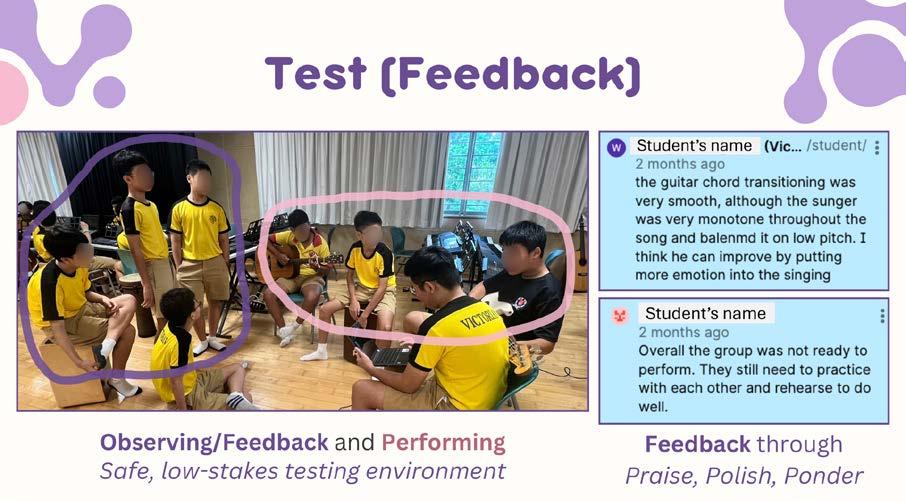
Figure 1: Example of students learning to give meaningful feedback.
Reflection Questions
Attending
☑ What did you notice about yourself as a team player during band rehearsals?
☑ Can you describe a moment where you worked well with your group?
☑ What did you do or say that helped your team?
☑ Was there a time when you held back or felt unsure? What happened?
Interpreting
☑ How do you think your contribution affected the band’s progress?
☑ How did your actions (or inaction) impact your team’s practice?
☑ What was one success/challenge you faced during rehearsal?
☑ What feedback (if any) did you receive from your friends or teacher?
Deciding
☑ What is one way you can improve to help your band grow stronger together?
☑ What is one specific thing you want to try or change next time?
☑ How do you think this change will help your group?
☑ Why is this goal important to you as a bandmate?
Survey Findings
From Noticing to Acting Together
To fully understand how students experienced growth in empathy and teamwork, the reflection prompts captured different layers of awareness: noticing one’s behaviour, understanding one’s contribution, and deciding one’s actions for improvement.
The responses were coded based on recurring behaviours. In many of their reflections, students displayed dual or triple themes within a single response.
To ensure that the data reflected proportional rather than inflated frequencies, a scaling factor was applied so that the overall distribution approximated 100 per cent.
This approach kept the analysis focused not on the magnitude of responses, but on the direction of students’ growth, specifically, how they developed empathy and teamwork skills over time.
When viewed collectively, the findings (Figure 2) reveal a steady and meaningful shift from self-focus to shared responsibility. The key behavioural indicators in column three were selectively drawn from the coded reflections to exemplify how students expressed empathy and teamwork in relation the E21CC domains of communication and collaboration (Column 4).
To ensure that the data reflected proportional rather than inflated frequencies, a scaling factor was applied so that the overall distribution approximated 100 per cent.
Reflection Question Phase Focus of Growth Key Behavioural Indicators
☑ Focused and engaged during rehearsals (31.3%), and active listening (4.2%)
Attending Noticing self and others
Interpreting Understanding one’s impact on the group
☑ Some hesitation or withdrawal (18.8%)
☑ Helping/ encouragement (10.4%), sharing ideas/leading (8.3%), early active listening/social awareness (4.2%)
☑ Ownership language (26.5%)
☑ Positive impact on progress (23.5%)
☑ References to challenges (11.8%) and feedback (7.4%)
☑ Negative impact (8.8%)
☑ Collaborative musicianship (40%)
☑ Leadership and coordination (20%)
E21CC Link to Communication & Collaboration Skills
Empathy begins with:
☑ students moving from managing themselves to noticing others.
☑ early helping behaviours (e.g., “I helped them with their chords when they were unsure”).
☑ idea-sharing which signals emerging awareness, though collaboration remains uneven.
Deciding Acting together towards improvement
☑ Self-expression and communication (22.2%)
Communication develops with:
☑ students evaluating how their actions affect group outcomes.
☑ ownership and responsiveness emerging through remarks like “my rhythm helped my teammates stay on beat” and “encouraging each other allowed us to progress faster”.
Collaboration solidifies as:
☑ students translate empathy into purposeful group action through clearer communication, coordination and mutual support.
☑ reflections such as “I want to get my team together so we can be more united” and “we can practise more as a group instead of individually” show this awareness extending beyond music-making to other collaborative settings.
2: Adapted from data collected from the Reflection Questionnaire.
Under Attending, 31.3% of students described being focused and engaged in their individual roles, establishing a foundation of self-management and task
responsibility. Yet even at this phase of Noticing self and others, signs of relational awareness were emerging: 10.4% mentioned helping peers or adjusting
Figure
their playing for the group, 8.3% shared ideas to support group progress, and 4.2% demonstrated active listening and social awareness, reflecting early expressions of empathy in action.
In contrast, 18.8% of students had expressed hesitation or withdrawal. This highlights that confidence and collaboration skills develop unevenly and require supportive structures to surface.
In Interpreting (Understanding one’s impact on the group), students began to evaluate how their personal efforts affected collective outcomes. Ownership language (26.5%) and positive impact statements (23.5%) marked a growing consciousness of the fact that teamwork depends as much on interpersonal responsiveness as on musical skills.
A smaller proportion (7.4%–8.8%) acknowledged that challenges, feedback and negative contributions or setbacks could hinder teamwork. Together, nearly half the participants displayed indicators of empathetic understanding and an emerging awareness of how one’s actions could hinder group progress. They recognised that the quality of group sound is a shared responsibility rather than an individual achievement.
Reflecting in the Deciding (Acting together towards improvement) phase, the students’ empathy matured into collaborative intent. 40% of students identified ways to strengthen group performance, such as by rehearsing together, 20% focused on leadership, often framed as coordinating or motivating peers, and 22.2% wanted clearer communication among group members. In total, over four-fifths of responses had evolved from awareness to purposeful contribution towards teamwork.
The results of the reflective process demonstrate how the students had become more socially attuned and collaborative.
As they learnt to notice one another and reflect on the impact of their actions, empathy shifted from an internal awareness to a shared, outward practice of collaboration.
In the context of the E21CC framework, these patterns of growth illustrate how communication and collaboration skills can be developed not only through verbal exchanges, but also through a progressive, embodied form of social-musical learning.
The Pop Band setting thus served as a living space where students could rehearse the skills of empathy and teamwork at the heart of this inquiry.
Discussion
To further illustrate this development of empathetic and collaborative skills, I turn to the reflections of my band of students whom I would describe as a band of characters. Each one in this band carried a different story of growth, shaped by moments of struggle, laughter and discovery. Character is difficult to measure and even harder to teach. It often reveals itself in the quiet, unplanned moments of music-making, where students learn not just to play together, but to be together.
The Pop Band module offered a collaborative musical setting that became the medium through which character was formed and observed.
Collaboration took place in real time as students listened to one another, responded, and made shared decisions on how to move
forward. The two following case studies offer a glimpse into how empathy and teamwork (collaborative skills) were not only taught, but lived through the act of making music together.
The Distracted Organiser
Among my students, one boy stood out as the Distracted Organiser. He is one of the friendliest students in class; approachable, well-liked and the one others turn to for help. That very friendliness, however, often kept him from stepping up. In his interactions with his classmates, he preferred harmony over confrontation, and blending in rather than standing out.
In his reflections he wrote, “I was not very focused… a few of my teammates were quite inactive.” However, instead of blaming others, he took ownership, adding, “Next time I want to get my team together so we can be more united.”
This moment revealed the first spark of leadership — not in commanding others, but in recognising his part in the collective spirit of collaboration. In expressing his desire to unite his team, he had also revealed something deeper: a shift from fitting in to leading with purpose.
Through this process, he demonstrated leadership by turning distraction into direction. Watching him move from social ease to social purpose reminded me that becoming an empathetic leader often begins with recognising one’s quiet influence within the group.
He moved from simply “being with the group” to wanting to shape the group. Here, empathy took shape as awareness, noticing the group’s needs and recognising that the group needed someone to hold the centre.
The Reflective ProblemSolver
My next story features the Reflective Problem-Solver, a tuba player with a strong concert band background. In that structured environment, precision is everything: play your part well, follow the score, stay in time. However, the Pop Band setting demanded something different — to listen, adapt and create together.
After one performance, he reflected, “I practised my part to get rehearsals moving quicker… but it’s hard to get the band together if everyone practices individually.” Beneath this comment was a realisation that ensemble success depends not just on personal mastery, but on mutual connection and collaboration.
What struck me most was when he reflected: “This is important to me because I know we could have performed better together.” That awareness of care for others rather than personal control marked his turning point.
His thinking shifted from “did I do my part?” to “how did my presence support the group?”. It was no longer about personal precision and standards, but on how his presence could encourage his group mates to grow, to listen, and to adapt to each other. This is the essence of ensemble collaboration, where empathy translates into shared responsibility and intentional support for the group.
Together, these stories of the Distracted Organiser and the Reflective ProblemSolver remind me that musical growth is inseparable from character growth. Both students came to realise, each in their own ways, that empathy and teamwork are not abstract ideals but practical actions rehearsed in everyday collaboration.
Conclusion
While students showed meaningful growth in empathy and teamwork, the process had its challenges, from keeping them engaged in the reflective processes, to sustaining focus during rehearsals.
My ‘band of characters’ reminded me that character, much like musicianship, is not taught in a single lesson but rehearsed through every act of listening, leading, and learning alongside others.
The Pop Band module brought the E21CC framework to life, as students developed skills of communication, collaboration, and character through music-making and structured reflective processes. The shift from “me”, to “my impact”, to “we” echoed through every moment, shaping a ‘we-first’ mindset that went beyond music-making.
For that, I will always stand by the philosophy that I am a character education teacher first, before a music teacher Because in the end, what we teach goes beyond chords and lyrics. It is more than music, a harmony of empathy and teamwork that prepares our students for life. And here, I end my article by inviting you to sing the following adapted lyrics to the tune of “More Than Words” by rock band, Extreme.
“More than music we can feel, To show our students that life is real.”
Acknowledgements
With a smile, I would like to thank my Satè with the Baè and Rockget teacher-band friends. Our jam sessions were more than music; they reminded me of what it feels like to be a learner again, figuring things out together. That shared space of laughter, missed beats, and discovery continually refreshed my perspective as both teacher and student.
My heartfelt thanks to Mr. Joel Yeo, whose steady encouragement and openness have made all the difference. Thank you for trusting me with freedom to reshape parts of the music curriculum even though it is only my second year in Victoria School and your many, many, years here carry far more wisdom. Colleagues like you remind me that sustaining a passion as music educators often begins with supporting one another’s ideas.
To Mr. Jason Lai, course facilitator of the Design Thinking workshop held at the National Institute of Education, thank you for two days of clarity that transformed the way I now see human-centred design in the music classroom. Your guidance made Design Thinking not just a framework, but a mindset for teaching with empathy.
And finally, to the students of my class, my very own band of gentlemen. I am grateful to have grown alongside you for two years, watching you develop in character, humour, and heart. Thank you for making it easy to teach you. Keep the rhythm going as you move into upper secondary.
References
☑ Campbell, T. G., & Yeo, S. (2023). Student noticing of collaborative practices: Exploring how college students notice during small group interactions in math. Educational Studies in Mathematics, 113 (3), 405-423.
☑ Dorst, K. (2011). The core of ‘design thinking’ and its application. Design Studies, 32 (6), 521-532.
☑ Zainal, N. S. (2025, August 17). Calling on the Singapore spirit. In National Day Rally 2025 e-paper (pp. 5–8).
How can Teachers Promote Inclusivity in Music Group Work?
Introduction
Brenda Teo Yan Ling
Bartley Secondary School
Stephanie Zhong Hongkun
Serangoon Gardens Secondary School
In many of our music modules, students work in groups for their music projects and performances. Hence, as music teachers, we get a glimpse into class dynamics and individual students’ behavioural characteristics as we observe their group interactions. Ideally, an inclusive music classroom is a learning environment where “students both with and without disabilities participate successfully and happily in meaningful music experiences” as described beautifully by Jellison (2012). Unfortunately, many of us know this is not always the case for most classes and students.
Here are two observations that we have noticed in our classes.
❶ During the initial phase of group formation, interpersonal dynamics and social hierarchies within the class become evident, with observable instances of social exclusion amongst certain students (‘left out students’).
❷ During the groupwork process, unequal participation amongst members may be noticed, wherein one or more members adopt authoritative (‘bossy’) behaviours that discourage open discussion. Other group members may suppress their own perspective or objections, prioritising the preservation of friendships over collaborative problem-solving.
As teachers, we see the importance of developing empathy and groupwork skills to foster social cohesion amongst peers,
especially in our climate of Full SubjectBased Banding (FSBB) classes. Hence, we asked, how can we as teachers play our part in the classroom to help students be better group members and peers to one another?
Inquiry Question
In FSBB classes where students of different academic progress are grouped together, misunderstandings may arise when students do not communicate their thoughts well. Additionally, students’ overall motivation and attitudes towards music learning may be affected when there are learning gaps between peers (Tan, 2020).
The differing levels of student engagement amongst group members could then result in some students being excluded during group work processes. In line with the Ministry of Education’s (MOE) Music syllabus and the 21st Century Competencies, music lessons can help to foster social cohesion amongst students (Student Development Curriculum Division, 2022).
Hence, through our music group work sessions, we aim to help students learn relationship management skills, and develop good communication and collaboration skills so as to become confident individuals and active contributors. By researching possible strategies that teachers can utilise to foster a conducive and supportive learning environment for students in music groupwork, and working to understand students’ emotions and peer interactions during our music lessons, we hope to gain insights into how teachers can play a better
School Bartley Secondary School Serangoon Gardens Secondary School
Class Size 35–36 students per class
32–34 students per class
Group Size 2–6 in a group 4–5 in a group
Class Profile
☑ 9 classes
☑ Mix of G1–3 in 7 classes
☑ Mix of G2 and G3 in 2 classes
(Students with Special Educational Needs (SEN) spread across all 9 classes)
☑ 10 classes
☑ Mix of G1–3 in all 10 classes
(Students with SEN spread across all 10 classes)
AL Score Range 7–29 8–29
Lesson Duration
30-minute lessons conducted twice a week for some classes, 1-hour lessons conducted once a week for some classes (dependent on timetable).
role in building a culture of inclusiveness during music lessons. This leads to our inquiry question — how can teachers promote inclusivity in music group work?
Methodology
Target Audience
Our research was conducted in two schools, Bartley Secondary School (BSS) and Serangoon Gardens Secondary School (SGSS). Our project focused on the Secondary One cohort’s Piano Keyboard module, where students perform a pop song of their choice as a group at the end. There were slight differences in the student makeup as per table above.
Data Collection
Data was collected via the following methods:
☑ Audio recordings of student group conversations
☑ Teachers’ lesson reflection notes
☑ Focus group discussions (selected students)
☑ Student interviews (selected students)
Duration
50-minute lessons conducted once a week for all classes.
The research was conducted over 11 weeks of lessons from July to September 2025 (Term 3 and Week 1 of Term 4).
Pedagogical Principles
Collaborative Learning
This project drew inspiration from the informal learning approach, where it is essential for teachers to establish an environment in which students can approach tasks freely, organise their own groups, set their own objectives, and steer their own learning (Green, 2009).
By encouraging familiar social groups, we aimed to create a friendly environment where students feel comfortable making mistakes and self-correcting (Teh, 2023). Bowman’s (2024) “facilitative teaching” approach, a cycle of ‘guiding, observing, questioning and suggesting’, was adopted to encourage student agency and reduce teacher direction during groupwork facilitation.
Curriculum Outline
In both schools, the aim of the keyboard module was similar: for student groups to perform a pop song on the keyboard together.
Stage Bartley Secondary School
❶
Teacherassigned Pair
Whole class learning:
☑ “Mary Had A Little Lamb”
☑ “Twinkle Twinkle Little Star”
☑ Playing “Payphone” by Maroon 5
☑ Identification of letter names on keyboard
☑ Reading notes on treble staff
☑ Learning of chords (C, G, Am, F)
Serangoon Gardens Secondary School
Whole class learning:
☑ Identification of letter names on keyboard
☑ Learning of chords (C, G, Am, F, Em)
☑ Playing “Memories” by Maroon 5
☑ Playing the melody line of “Memories” with letter notes
Studentselected
Group
❸ Group
Performance
Groupwork:
☑ Choose a pop song to learn (suggested list/approved by Teacher)
☑ To include melody line/vocals + chords (on piano)
☑ 2–5 in a group
Groupwork:
☑ Choose a pop song to learn (approved by Teacher)
☑ To include melody line/vocals + chords (on piano) + ukulele
☑ 4–5 in a group
Performance:
☑ Keyboard
☑ Vocals (optional)
Performance:
☑ Keyboard
☑ Vocals
☑ Ukulele
Process
After identifying the main pedagogical principles from research promoting inclusive classroom learning, we adopted them into our lessons. The following table illustrates our different teaching processes.
Lesson Flow
Teacher Moves
Pre-Groupwork Teacher offers students two options for student grouping:
❶ Teacher-allocated
❷ Student-selected
Condition for Option 2: Without teacher’s direction, and no student is unwillingly forced into a group. If unable to do so, revert to Option 1.
Groupwork Facilitation Teacher introduces sentence starters to the class via screen projection prior to beginning groupwork.
Pedagogical Principles/Rationale
Familiar Social Groups (Teh, 2023, Green, 2009)
☑ Based on past lessons, the majority of students prefer student-selected ‘friendship groups’.
☑ Providing students with options and reducing teacher direction encourages student agency and initiative in accepting/ re-organising groups.
Student Performance After performing, the teacher encourages student groups to share the challenges they faced and how they overcame them.
Facilitative Teaching (Bowman, 2024):
Guiding, Observing, Questioning, Suggesting
☑ Based on past lessons, student groups often fall out or do not work out due to misunderstanding and disagreements.
☑ Sentence starters are shared, in the hope that groups solve disagreements on their own, emerging stronger together.
☑ Serves as a reminder and encouragement to students that there is no perfect group.
☑ Offers teachers a glimpse into each group’s dynamics.
Data Collected
Classroom Observations
In almost all classes, students were able to form groups on their own. Reduced teacher direction promoted a more inclusive classroom environment as students were encouraged to be open-minded and accepting of ‘left-out’ students during group formation.
Additionally, a facilitative teaching style (Guiding, Observing, Questioning, Suggesting) helped mitigate instances of ‘bossy’ students neglecting their group members’ ideas and feelings.
❶ Acceptance of ‘left-out’ students Students were able to navigate the challenge of forming groups on their own. They did this in two ways.
(i) To meet member criteria and their teacher’s conditions, students willingly stepped out of their comfort zone to reorganise groups amongst themselves.
You can ask my form teacher. My parents said I cannot be grouped with him. We will fight.
Me also!
Me also, really. You go ask Mr B*! (Form Teacher)
Okay. Since the class did not manage to agree and form your groups within the criteria on your own, I will ask Mr. B and choose the groups for everyone.
(Next lesson)
(Shows teacher-selected groupings on Whiteboard). These are the groupings that Mr. B and I discussed and came up with. Please go into your groups now.
Class: NOOOOOOOO......
(Not the chairperson) Cher, give us five minutes. I promise you. Five minutes we will sort this out.
Okay, I will observe. If anyone is forced here and there, or people say they don’t want so or so in their group, we will go back to my grouping.
Okay.
[All groups were formed — peacefully — in about five minutes.]
1 John*, Peter*, James*, Jackson*, Mary*, Sally*, Tina* are pseudonyms for students.
JOHN*1
JACKSON
(ii) Students took initiative to call out to students who were left out. By welcoming their peers into their groups on their own willingly, students who were usually left out could feel a sense of belonging.
Okay class, I see that some of our friends are not very sure which group to work with. As agreed together earlier, no one should be left behind. In this case, I shall rearrange your groupings.
❷ Facilitative Teaching Style to Improve Groupwork Dynamics
An ideal groupwork environment is one where all members actively contribute to discussions and feel safe to share ideas and make mistakes together. Unfortunately, when students of different needs and musical backgrounds are in the same group, misunderstandings easily arise.
Wait wait Cher, come come join us Peter*.
Come to us Mary*.
STUDENT GROUP 2 [Smiles]
We take John*.
[Reaffirms the class’s effort to be welcoming]
In line with Tan (2020), students’ overall motivation and attitudes towards music learning are affected when there is a learning gap. Being in a groupwork setting, these learning gaps may be amplified and students need to learn to cooperate and help each other.
As teachers, we can guide students to be more self-aware as group members. In our research, we highlight students with bossy characters who may create uneasy tensions in the group, hindering the formation of a comfortable groupwork environment.
(i) Instead of going into the group to tell the bossy student off, the teacher facilitates by making a general class announcement. This reduces conflict amongst members and encourages student agency within the group.
MS
Eh, you singer ah.
[Stays quiet]
SALLY
Ms T overhears and announces to the class:
MS T
Reminder, you can sing as a group as well. As long as there’s some melody to accompany your chords!
Eh, Cher say can sing together also.
[Shows a bit of relief]
(ii) Instead of going into the group to decide which song is suitable for the group, the teacher facilitates by guiding the group through a discussion. Students are guided to weigh the benefits and consequences of each song, so they can come to a consensus peacefully.
This encourages members to speak up and share their thoughts, with an understanding of the repercussions from their decision. In this scenario, John realises that a song that is less popular amongst his friends would result in him taking on the singer role as he is the one who is the most familiar with the song.
Let’s perform Linkin Park’s song!
No, let’s do “Memories”, it is easier and all of us know how to play it!
No man, that song is so not cool! I don’t care, we are doing Linkin Park.
JOHN
John insisted on performing a Linkin Park song that would require the group to learn new chord progressions, while the majority preferred performing “Memories”, a piece which they were already familiar with.
This disagreement resulted in a tension between individual musical preferences and group comfort levels, with John perceiving the new song as manageable while other group members had concerns about its learning demands.
The teacher used facilitative questioning to guide the group through a conflict resolution process. This started with the acknowledgement of different perspectives (“I understand the conflict... John wants to perform this song while others prefer ‘Memories’”), identifying the underlying concerns (difficulty learning new chords versus individual musical preferences), and promoting collaborative problem-solving through guided questions (“What compromises can we make when things do not go our way?”).
TINA
SALLY
JOHN
MARY
Through this mediated discussion, the group reached a mutually acceptable solution: John took the role as a singer, a role that was initially unwanted by all the members, while the others agreed to challenge themselves by learning the new chord progressions.
This demonstrated successful negotiation, where individual contributions were valued while maintaining group cohesion and promoting collective growth.
This example illustrates how structured peer dialogue can develop students’ social-emotional competencies, particularly in negotiation, empathy, and collaborative decision-making within subject-specific contexts.
Students’ Work
View a group performance which included a student who is usually left out, and a student with a bossy character, here.
Discussion
Through classroom observations and targeted focused group discussions, we realised behaviours that were initially perceived as problematic, such as exclusion or dominance in collaborative settings, could be reframed as valuable learning opportunities when students were afforded appropriate autonomy.
Students could potentially be trusted to independently navigate interpersonal challenges and foster a sense of peer belonging through self-directed problemsolving, rather than teacher-imposed solutions.
environment for music group work. The words we use, the classroom tone we set, and expectations we have for our students are some key factors that may either constrain or enhance students’ ownership of their learning.
When teachers adopt a facilitative stance and set clear expectations, students can amaze us with their collaborative competencies.
Challenges
Although the students were introduced sentence starters prior to groupwork, we noted that its usage was underwhelming and not intuitive, possibly due to linguistic or emotional barriers. Nonetheless, sentence starters appeared to promote a respectful communication climate that we believe is necessary for inclusive group work.
Upon reflection, teachers may achieve greater effectiveness by actively modelling suitable sentence starters with students, especially when there are authentic collaborative difficulties. It may also be beneficial to incorporate sentence starters directly into student materials to enhance its accessibility and encourage ongoing use.
Post-performance reflections, whilst conceptually interesting for teachers, yielded limited insights as students struggled to articulate their experiences and provided repetitive responses.
Teachers play an important role in cultivating an inclusive classroom
The majority of students identified synchronisation with members and tempo regulation as primary challenges (“play at the right time with my friends”), offering more practise as the predominant solution.
Ultimately, it is important to recognise that our students are developmentally immature teenagers who are still in the process of acquiring emotional regulation and social interaction skills.
This suggests that students may either have forgotten the interpersonal aspects of collaborative work or lack the vocabulary to express their group dynamics effectively. To address this limitation, we suggest incorporating individual written reflection opportunities within the lesson module.
A Possible Solution
These brief, paper-based reflections would enable teachers to monitor student experiences informally during their group work experiences. Please refer to our teacher resource package for suggested sentence starter templates and student check-in forms to support this reflective practice.
Within Singapore’s educational context, students with special educational needs (SEN) are present in virtually every classroom and school (Souza, 2020). Despite existing support measures designed to facilitate SEN student integration into mainstream educational settings, meaningful collaboration between neurotypical students and those with diverse abilities or special needs can still be challenging.
While we observe our neurotypical students’ attempts in demonstrating genuine care and concern for their peers with SEN, it is often only at a
level of tolerance rather than authentic collaboration. Students with pronounced special needs may experience difficulties with behavioural regulation or collaborative engagement due to their specific conditions.
Hence, creating an authentic inclusive classroom environment could be a challenge at times, as both teachers and neurotypical students would need the knowledge and skills necessary to provide appropriate support, and explicit instruction in inclusive collaboration strategies, in order to move beyond mere accommodation towards meaningful partnership.
This approach is likely to expose students who have SEN status, and this could lead to additional complications rather than providing an optimal solution. Ultimately, it is important to recognise that our students are developmentally immature teenagers who are still in the process of acquiring emotional regulation and social interaction skills.
Expecting students to intuitively demonstrate perfect inclusive practices without explicit guidance is unrealistic. This highlights how necessary it is for teachers to proactively facilitate group work sessions, as students require structured support and explicit instruction to develop
effective teamwork capabilities, instead of leaving them to navigate complex social dynamics on their own.
Conclusion
This journey has revealed that teachers can indeed play an important role in promoting an inclusive music classroom culture through group work sessions. While we adopt a facilitative stance when students are in their groups, this does not mean that we are abandoning our students to manage the complex social group dynamics on their own. After all, without appropriate guidance, unwanted behaviours such as social exclusion or bullying could emerge.
As teachers, our role shifts from direct problem resolution to scaffolding collaborative skill development. By balancing student autonomy with targeted pedagogical support, assisting to create learning environments where all students experience a sense of belonging and can contribute meaningfully, inclusivity can be promoted and cultivated in our music classrooms.
While it is aspirational to achieve a fully inclusive classroom with 30 to 40 teenagers of different personal belief systems and family upbringing, we are confident that the values promoted and the skills developed through our regular music group work sessions can contribute to our students’ capacity to foster an inclusive society.
References
☑ Bowman, D. D. (2024). You’re not the only one who can teach us: Teacher facilitation in three secondary school music contexts . (Doctoral dissertation, University of South Carolina). (pp. 103-114).
☑ Green, L. (2009). Implementing Informal Learning. In Abigal D’Amore (Eds) Musical Futures: An approach to teaching and learning: Resource pack (2nd ed., pp. 133-135).
☑ Jellison, J. A. (2012). Inclusive Music Classrooms and Programs. In G. E. McPherson & G. F. Welch (Eds.), The Oxford handbook of music education (Vol. 2, pp. 65-80).
☑ Student Development Curriculum Division (2022). Music Syllabus: Primary and lower secondary (with implementation from 2023) (pp. 4, 6).
☑ Souza, C. (2020, October 14). Inclusion of students with SEN . MOE Parliamentary Replies. https://www.moe.gov.sg/news/parliamentary-replies/20201014-inclusion-of-students-with-sen
☑ Tan, X. L. (2020). How can music teaching and learning incorporating collaborative learning create a more inclusive classroom? In S. L. Chua & A. Eng (Eds.), Sounding the Teaching IV: Diversity and inclusion in the music classroom (pp. 24-33).
☑ Teh, M. (2023). Reimagining the music classroom: Student engagement with learning and self-corrective strategies through play-based music education. Nota Bene: Canadian Undergraduate Journal of Musicology , 16(1), 93-114.
Playing with Teaching Approaches
Exploring Play and Performance Anxiety in the Music Classroom
Introduction
Sebrina Kwa
Muhammad Izdihar Othman
Park View Primary School
Lim Nien Chern Juliana
Fernvale Primary School
Our aim for this Critical Inquiry project is to develop the resilience of students in our music classrooms. In our music lessons, assessments are largely performancebased. During these performance tasks, some students tend to be nervous and hence do not perform as well as their peers.
This led us to question whether performative tasks are suitable for all our students, especially those who experience performance anxiety. We asked ourselves what pedagogical tools we could use to help reduce performance anxiety.
Inquiry Question
To what extent does play in music learning affect the performance anxiety of students in attempting a performance task?
Methodology
We started with a control group and an experimental group in both schools. The
groups were made up of mixed-progress students from the Primary Two cohort, with an average of 30 students per class. Before the intervention, a pre-survey on performance anxiety was conducted.
Control group students learnt the song “Tideo” and the tika tika rhythm through rote learning. Experimental group students learnt the song “Tideo” and the tika tika rhythm through a game.
Both groups were given the same performance task. At the end of the intervention, students completed a post-survey with questions similar to the pre-survey, to measure their performance anxiety levels.
Data Collection
Students scanned a QR code to access the survey, which was collated through Google Forms. The survey tool that used is a simplified version of Mazzarolo’s Performance Anxiety Scale (Mazzarolo & Schubert (2022)).
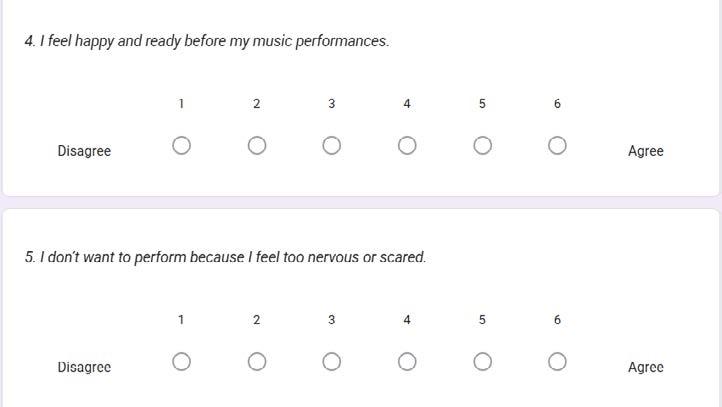
To aid our students’ understanding of the survey items, we simplified Mazzarolo’s inventory as follows:
❶ I feel very scared or worried before I perform.
❷ I often feel nervous or worried before I perform.
❸ I try not to perform because it makes me feel less nervous or scared.
❹ I do not feel happy and ready before my music performances.
❺ I don’t want to perform because I feel too nervous or scared.
Figure 1: Mazzarolo’s Performance Anxiety Scale.
Figure 1.1: Simplified survey using Google Forms.
Our intervention spanned across four lessons. The table below shows the experimental procedures. Similarities and differences between the procedures are described below.
Lesson Control Group Experimental Group
❶ Administer pre-survey
❷ Warm up with rhythm video (ta, ti-ti, ta-rest)
❸ Students learn “Tideo” through rote
a. Clap the rhythm of the song
1
2
b. Add in rhythmic syllables
c. Add in tune of the song
❹ Students to clap and sing “Tideo”
Same procedures as Control Group
3
❶ Revise rhythmic syllables and tune of “Tideo” with slides
❷ Introduce the performance task:
a. Teacher to compose a 2-bar rhythmic example with the class on the screen
b. Teacher to demonstrate the rhythmic accompaniment and sing along to “Tideo”
❸ Students disperse for group work
❶ Warm up with rhythms (no instruments)
❷ Introduce challenge #1 – perform other groups’ work
❸ Group Practice – 10 minutes
❹ Perform other groups’ work
❶ Revise “Tideo” with circle game
❷ Introduce the performance task:
a. Teacher to compose a 2-bar rhythmic example with the class on the screen
b. Teacher to demonstrate the rhythmic accompaniment and sing along to “Tideo”
❸ Students disperse for group work
Same procedures as Control Group
4
❶ Warm up with rhythms (no instruments)
❷ Group Practice – 10 minutes
❸ Perform own group’s rhythm
❹ Administer post-survey
Same procedures as Control Group
Findings
We have highlighted some of our findings in the table below:
Aspect
Feeling scared or worried before performing
Fernvale Students
Both groups reported less fear/worry over time, which are statistically significant.
Park View Students
The Experimental group reported less fear/worry than the Control group during the post-survey, but both within-group changes were not significant. However the difference between the groups is statistically significant.
Feeling nervous often before performing
The Experimental group reported less nervousness over time, which was statistically significant.
Avoiding performances
Both groups reported less avoidance of performances, but the differences are not statistically significant.
The Experimental group reported less nervousness than the Control group during the post-survey but both withingroup changes are not significant. The difference between the groups is statistically significant.
The Experimental group reported less avoidance over time and less avoidance than the Control group in the postsurvey. The difference is statistically significant. The difference between the groups is statistically significant.
Not feeling happy/ ready before performances
Both groups reported feeling happier and more ready over time, although the differences are not statistically significant.
Unwillingness to perform due to fear
Both groups reported being more willing to perform over time, with the changes in the Experimental group being statistically significant.
The Experimental group reported feeling happier and more ready over time, although this difference was not statistically significant. Similarly, the difference from the Control group is not statistically significant.
The Experimental group reported being more willing to perform than the Control group at post-survey stage. The difference was statistically significant, although the within-group change was not significant.
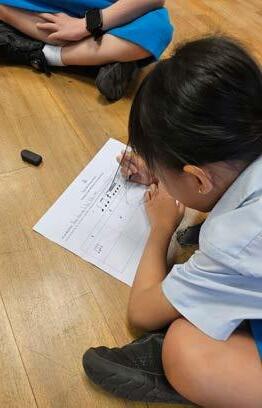
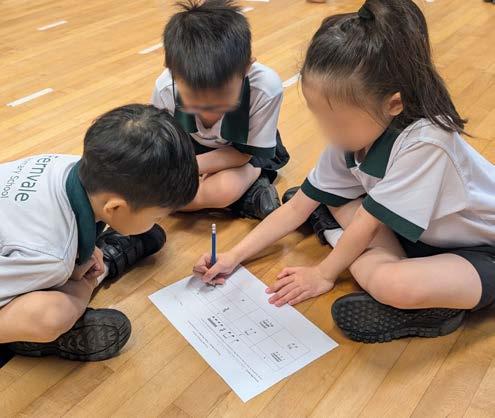
Discussion
Overall, the results were slightly different from what we expected. Before the experiment, we predicted that the experimental groups would have lower scores (i.e., more “strongly disagree” answers), and the control groups higher scores (i.e., more “agree/strongly agree” answers) for all the survey items.
We also expected significant differences in the level of performance anxiety between the groups — with the experimental groups showing less performance anxiety. Based on the results, the experimental groups generally reported positive changes over time. Students were less scared, worried, and nervous before performing. For the control groups in both schools, no significant differences were reported; their levels of performance anxiety before and after the lessons stayed similar.
Overall, we agree that play-based music learning does have some effect in
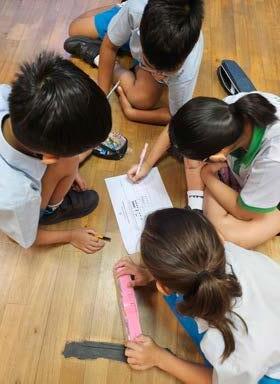
reducing fear and nervousness, as seen in the experimental groups. At Park View Primary for instance, play appeared to help students in the experimental group increase their levels of readiness and willingness to perform.
In contrast, at Fernvale Primary, while students also reported reduced nervousness, their behavioural responses were less pronounced. This suggests that some effects of play may take longer to emerge, or depend more on classroom dynamics and student characteristics. Students with behaviours such as avoidance or reluctance may require a longer intervention period or additional support to adapt.
While the findings are promising, several considerations should be noted. Firstly, for stronger impact, play needs to be meaningfully woven into music lessons, not just added as a one-off activity. Secondly, a longer implementation period (more than the four weeks we had)
Figure 2: Students creating a 2-bar rhythmic ostinato.
might have a clearer impact on students’ performance anxiety.
Thirdly, students have different readiness levels and learning preferences. Some may thrive through play-based approaches, while others, such as those who learn better through repetition or visual cues, may respond more positively to traditional teaching methods.
Challenges
At Fernvale Primary, music lessons were disrupted due to school schedules and public holidays. As a result, lesson flow and learning continuity was affected. This could have influenced students’ retention rates and their responses in the post-survey.
In addition, students’ pre-existing confidence levels may have influenced their levels of performance anxiety. Some students might have already been more comfortable performing in front of others, while those with lower self-confidence would require a longer intervention period before showing noticeable improvement.
Music pedagogy also plays an important role. For example, students who are regularly exposed to group or individual performances during lessons may naturally experience less performance anxiety over time. Similarly, if play-based activities are a routine part of music lessons, students may have already adapted to them and thus reported lower anxiety levels even before the study began.
Lastly, as our module only spanned four lessons, the limited duration may have restricted the observable impact of playbased learning. A longer or more consistent implementation might produce clearer or more sustained effects on students’ confidence in performing.
Conclusion
Overall, students in both the control and the experimental groups showed clear enjoyment during their lessons and demonstrated good retention of learning. This might suggest that cultivating a positive and engaging classroom environment fosters students’ confidence and motivation to perform. Notably, playbased music learning further enhanced these outcomes.
Students in the experimental groups, particularly those from Park View Primary, generally became less fearful, less nervous, and more willing to perform. While some students still experienced nervousness before performing, they nonetheless demonstrated resilience and stepped forward with courage. As American composer Eric Whitacre once said: “The terror of performing never goes away. Instead, you get very, very comfortable being terrified.”
Ultimately, our findings highlight the importance of nurturing confidence through play, while also recognising that the journey towards being comfortable on stage is one of gradual growth, built on joy, encouragement, and meaningful musical experiences.
Reference ☑ Mazzarolo, I., & Schubert, E. (2022). A short performance anxiety scale for musicians. Frontiers in Psychology, 12 , 781262. doi:10.3389/fpsyg.2021.781262
How Do Classroom Instruments Enhance Students’ Engagement in Singing and Music Composition?
Introduction
Teo Lee Loo Edgefield Secondary School
As a music educator, I have observed that many Lower Secondary students hesitate to participate in singing activities during music lessons. Some feel self-conscious about their voices, while others find singing uncomfortable in a classroom environment.
However, singing remains a core component of music learning as it develops musicality, pitch accuracy, expression, and confidence.
I noticed that students respond positively when given opportunities to explore and play classroom instruments such as xylophones, glockenspiels, and simple percussion instruments.
This sparked a question: Could classroom instruments make singing more engaging and less intimidating, while also enhancing musical understanding? Hence this inquiry explores how integrating classroom instruments using the Orff Schulwerk Approach can enhance students’ engagement in singing and support their development in basic music composition.
The Orff approach emphasises learning by doing — through singing, movement, speech, and instrument playing (Goodkin, 2002). Its use of accessible instruments makes it suitable for mixed-ability music classrooms.
This inquiry was conducted with a Secondary One class of 40 mixed-ability students over four 30-minute periods. Students were tasked to compose and perform a short school spirit jingle using their voices (singing) and classroom instruments.
Inquiry Question
How can the use of classroom instruments enhance students’ engagement in singing, and support their development in music composition?
Methodology
Target Audience
☑ 40 Secondary One students
☑ Mixed G1, G2, G3 profiles
☑ Neighbourhood mixed-stream school
☑ Varied musical backgrounds and confidence levels
Data Collection
☑ Students’ reflection responses
☑ Teacher’s observations
☑ Group performance artefacts
☑ Students’ voices from discussions
☑ Teacher’s reflective journal
Duration
Four 30-minute periods over two weeks.
Curriculum Outline
This inquiry uses the Orff Schulwerk Approach to promote learning through exploration and ensemble music-making.
The process is as follows:
WARM-UP
SCAFFOLDED INSTRUMENTAL EXPLORATION
REFLECTION
PERFORMANCE
Data Collected & Findings
Role of Orff Instruments
REHEARSAL
Students’ responses are coded according to where the role of instruments supported their music learning. The frequency is given below.
“The xylophone anchors the melody while the unpitched instruments keep a steady beat for the singers.” Themes from Student Responses
“Pitched instruments guide the singing as the unpitched instruments provide a clear rhythmic pulse.”
Figure 1: Most students used Orff instruments to create melody and maintain a steady rhythm.
Role of Singing
Students’ responses are coded according to where singing supported their music learning.
Students’ Voices
Themes from Student Responses on Singing
Melody Meaning Rhythm/ Coordination
“Singing was important because it brought out the melody.”
“Singing helped show the message of our school jingle.”
“It helped us stay on the beat and match the instruments.”
Figure 2: Students viewed singing as important for melody, meaning, and group unity.
Comparison
Instruments provided melodic and rhythmic support, while singing conveyed musical meaning and identity.
Discussion
Students’ responses pointed to the following findings:
☑ Increased Engagement in Singing Through Instrumental Support
Instruments reduced performance anxiety and supported vocal confidence, increasing participation.
☑ Development of Musical Understanding Through Composition
Through hands-on experimentation, students used instruments to explore melody, rhythm, and structure.
☑ Collaboration and Student Ownership of Learning
Group composition encouraged peer learning, shared responsibility, and creative decision-making.
Challenges
Managing sound levels during rehearsals and students’ varied musical readiness required additional scaffolding. Group dynamics also affected productivity. The short time frame limited musical refinement.
Conclusion
This inquiry showed that classroom instruments can and do motivate and support students in singing and composition. With the right structure, even hesitant learners found confidence and ownership in music-making. I hope to extend this approach through longer projects and deeper reflection opportunities.
Acknowledgements
I would like to thank my Secondary One students for their creativity, perseverance, and enthusiasm throughout this inquiry journey. I am also grateful to my reporting officer Mdm. Chan for her encouragement and steady guidance, as well as to my school leaders Mr. Foo, Mr. Teo, and Mr. How for their support in making this work possible.
Reference ☑ Goodkin, D. (2002). Play, Sing & Dance: An Introduction to Orff Schulwerk . Schott Music.
Turning Voices into Songs: How does the “Call and Response” Technique Engage Students
in Songwriting?
Introduction
My motivation for this research stems from my own experiences. When I was a student, I was always humming tunes, but I never took the next step — to write my own songs.
Over the years, I have discovered that songwriting can be simple, and in fact, as natural as having a conversation. So now, as a teacher, I want to change that story for my students by using the “Call and Response” method.
I believe that “Call and Response” is an effective technique to use for songwriting.
After all, it is something we already use unconsciously all the time: when I greet my class, and they greet me back, through clapping rhythms in a musical dialogue, and even in everyday conversations.
It builds on a natural rhythm of interaction that strengthens connection and engagement. Songwriting, then, can give students a way to share their voices and stories.
Inquiry Question
How does the use of “Call and Response” engage students’ participation in songwriting?
Three sub-questions guided me throughout this study:
❶ How effective is this technique?
❷ How does it promote student engagement in songwriting activities?
❸ What challenges do teachers encounter when facilitating this technique?
Methodology
Target Audience
Two classes of Primary Five (P5) students over the course of eight lessons. In Term 1, I had already worked with them on a group performance, during which they played the ukulele to a chosen song.
Duration
As you can see from the lesson schedule, there are noticeable gaps (marked in pink) between some lessons, as well as the long June holiday break.
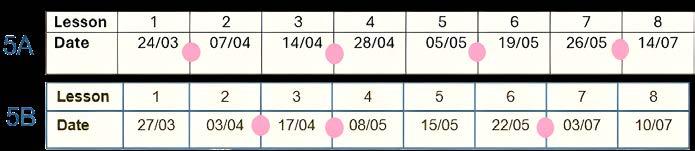
Chan Li Xin
Bukit View Primary School
Figure 1: Lesson schedules of P5 classes.
I planned to make use of the Student Learning Space (SLS) platform to address this. By P5, students should be capable of completing assignments independently, so this would also provide an opportunity to assess how much self-directed learning was actually taking place.
Data Collection
I collected data through surveys, classroom observations, student work samples, and group interviews.
I used the Swivl app to record my lessons. TurboScribe.ai was used to transcribe all my videos. The latter has been useful, especially in providing timestamps of what I said and how my students responded.
Pedagogical Principles
Building on the Self-Determination Theory (Deci & Ryan, 2002), I designed lessons around the Autonomy, Relatedness, and Competence (ARC) framework while focusing on the “Call and Response” technique (MasterClass, 2021).
I promoted autonomy by giving students choices, such as in selecting songs,
crafting responses, and forming groups. This was to foster a sense of ownership over their learning.
I encouraged relatedness by connecting the activities to shared experiences, making the music feel personal and relatable. Finally, I supported competence by designing scaffolded, bite-sized tasks that allowed students to achieve small, manageable goals, through which they could gradually build their confidence and skills.
My ultimate goal was simple but ambitious: I wanted my students to leave with the belief that songwriting is a skill they can return to ten, even 20 years from now, if they choose to.
Process and Findings
The process began with an introduction to songwriting, followed by the core component, the “Call and Response” technique. This was explored through stages of introduction, exploration, and application.
Figure 2: Module overview.
My Learning Journey in Songwriting
Before beginning this journey with my students, I checked in with them to find out how they felt about it. I asked them questions such as: “What is songwriting to you?” and “Do you think songwriting is easy or difficult?”. Their answers were mostly positive, which felt like an encouraging start.
For our main activity, I decided to have the students create raps inspired by their P5 camp experience. This idea came from observing how they interacted during the camp, how united they were in group activities, how eagerly they learned the dances, and how enthusiastically they chanted along to raps. When I showed them photos from the camp, lively discussions immediately followed, making it the perfect springboard for the rap writing task.
To show them that songwriting could be simple, I even performed a short rap which included these three words: eyes, time, students.
Line 1
Line 2
Line 3
Line 4
Figure 3: Line starters.
This was what I rapped:
I see with my eyes; the time is flying by.
There isn’t much time, we only have 15 minutes left.
Looking at my students, who are staring back at me.
Keeping your iPads safe, is where I began.
I had practiced for this, but still felt nervous doing it. Thankfully, the students clapped. It became easier when I rapped to the second class. For both classes, I purposely paused at the word “students”. They leaned in, every single one of them, waiting for me to continue. This was truly an engaging moment for all of us. Energised, they went on to create their own short songs in just minutes. Line starters (Figure 3) were given to help them at the initial stage.
The day before the camp
Arriving at the camp site
I wish I could have
So much memories
Line starters
Attached are some of their responses to the activity. Take a closer look, and you can see that they used words that clearly expressed how they felt at that particular moment during camp: “I was awake all night”, “The sun is shining before camp”, and “How I wish I had a fan” — all experiences that they could easily relate to. Their enthusiasm gave me the confidence to think, “Hey, we are on the right track!”
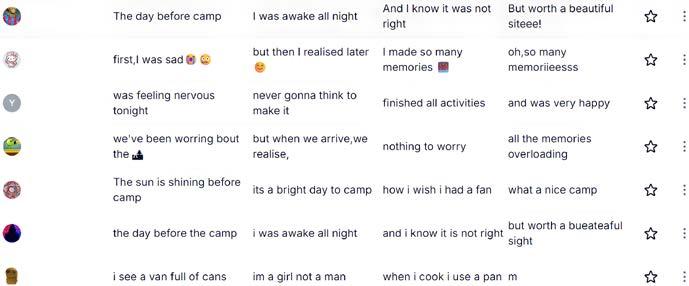
Figure 4: Students’ responses on ClassPoint.
Exploring “Call and Response”
Over the next few lessons, we explored the “Call and Response” technique further. Using the ARC framework as the underpinning theory, the diagram below illustrates some examples on how it is applied within the “Call and Response” approach.
Autonomy
Relatedness
☑ Students are given the choice to choose the “Call and Response” song which they would like to sing, respond to, and develop.
☑ Students select the melody notes to use when responding to the call during class.
☑ To foster relevance, I emphasised our shared familiarity with the song, noting that although we all knew it, each of us may have learned it for different reasons.
☑ Co-construct the meaning of “Call and Response” together.
Competence
☑ Begin with bite-size tasks where students craft responses to the call. Through continued work on these smaller tasks, they progressively build towards performing the entire song.
☑ By drawing on their prior instrumental knowledge, students progress to incorporating singing into the “Call and Response” song they have created.
Who lives in the pineapple under the sea?
Absorbent and yellow and porous is he!
If nautical nonsense be something you wish,
If nautical nonsense be something you wish,
5: Students’ responses on SLS homework.
Since the students already had a glimpse and a taste of what it was like to write songs, I decided to make the next lesson more fun for them by letting them choose between “SpongeBob Square Pants” and “Baby Shark” as the song to explore. Both classes chose “SpongeBob”, and I accompanied them on the ukulele as they sang.
The results surprised me. I received some silly responses from the students. For example, they wrote things like “sponge ball round pants”, “perpendicular pants”, and “SpongeBob triangle square pants”. This happened in both classes.
I wondered why it felt so different from the first lesson. The way they worded their
A yellow sponge with a snail
A little sponge that has a tie
Go to him and make him squished
Flip Flop Flip Flop
responses didn’t seem thoughtful this time. It was almost as if they weren’t taking the task seriously and were writing without much care or intention.
I asked myself, why was it so different from the first lesson? Was it because my instructions were not clear? Were my expectations not laid out properly? I will solve the mystery shortly. This experience showed me how even small teaching decisions can make a big difference.
When I repeated the task on SLS for homework, without changing any instructions, the responses improved. Some students even recorded themselves singing, and in the following lesson, we voted for our favorites in class.
Figure
Application of “Call and Response”
In the next lesson, I introduced “Charlie Over the Ocean”, a “Call and Response” imitation song. This time, I asked the students to create their own responses using words related to the five senses. Drawing on their P5 camp responses, I got them to identify the senses, which they did quickly. Some even noticed, “Hey, this is ours.” I also provided an example, and they quickly understood what was required for the songwriting task.
With only five minutes left till the end of the class, many students adapted my example in creative ways, often rhyming with “ocean” or using sea-related words. Without prompting, they tried to fit their responses to the melody. Some went beyond my example and came up with original versions of their own. This showed me that when students are given clear directions or a structure as a guide, their ideas can flow freely.
I rewarded their ClassPoint submissions with stars, though in hindsight, asking them to sing back their responses might have boosted motivation even further. For homework, I set an SLS recording task. This time, participation improved, with more students submitting recordings. Click here to view
Singing
In the next few lessons, I noticed that students were hesitant to sing together. When I said, “Let’s sing your own responses together”, participation was low. Some murmured, some whispered, and a few mentioned feeling embarrassed, which their expressions confirmed.
To encourage participation, we first sang responses as a class, then in smaller groups. Video 1 shows a student performing her work in front of friends. On the first attempt, the ukulele and singer were off from the djembe beat, but by the second attempt, their timing had improved noticeably.
In the next two lessons, I introduced resonator bells through hands-on activities, which the students enjoyed.
The lessons were structured as a melody game, encouraging students to find their own melody lines on the bells and sing together.
Despite this, singing remained a challenge. While students were eager to try the resonator bells, only few were willing to sing aloud. In Video 2 you can see the moment when the students realised they had to sing; they instinctively moved back.
Data Collected
Post-Survey
After the “Call and Response” lessons were over, I focused on gathering feedback to understand how this technique impacted students’ songwriting.
In Class 5A, feedback was mostly unhelpful. This included instances where students provided comments that were irrelevant to the topic. It also involved disciplinary issues, such as students beginning to comment before fully listening to instructions.
Additionally, it included an instance where a student made a rude comment anonymously, despite knowing that it was a class rule to use their real names. When questioned, no one admitted to making the comment. On the other hand, some students provided constructive and helpful comments. Nevertheless, these issues affected the collection of data significantly.
In Class 5B, I changed the approach by giving students the devices only after guiding the activities. This resulted in much more constructive feedback.
Students described their specific struggles, ranked the activities by enjoyment, and shared new insights they had gained. Compared to Class 5A, their perspective
was different: while Class 5A felt embarrassed about performing, Class 5B saw it as a learning opportunity.
Ending with the Interview
In Class 5A, I conducted a small group interview with eight students to gain deeper insights into their experience. They explained why creating responses to “SpongeBob SquarePants” was challenging.
They had found it difficult to come up with words that rhyme with the song. They also mentioned that singing in front of others was embarrassing. When I asked why, they explained: “Because we need to act tough… when you grow older, more people become introverted. Reputation.”
Some students appreciated the “Call and Response” approach, noting that it made songwriting easier, while others preferred to start with their own rhymes.
They suggested allowing students to choose their preferred approach, and also highlighted that more time with the resonator bells could help with developing melodies.
This discussion showed that small group conversations can provide valuable insights into students’ learning and preferences.
Some students appreciated the “Call and Response” approach, noting that it made songwriting easier, while others preferred to start with their own rhymes.
Discussion
How Effective is the “Call and Response” Technique?
When I began this inquiry, I wanted to find out how the “Call and Response” technique engages students in songwriting. I learnt that it lowered entry barriers, allowing students who thought songwriting was “too hard” to take manageable steps and gain confidence.
The familiar motions of taking turns and responding encouraged participation, while carefully scaffolded activities, like the P5 Camp Exercise and the Five Senses Exercise, helped students produce meaningful work.
Clear structure did not limit creativity; it provided a safe space to explore. When scaffolding was weaker, as in the SpongeBob Exercise, students struggled.
Overall, I would say that “Call and Response” makes songwriting less intimidating, and supports students’ competence and motivation by helping them feel capable and see their progress.
How does “Call and Response” Promote Student Engagement in Songwriting Activities?
“Call and Response” promoted student engagement in songwriting best when the tasks were connected to students’ experiences, and when they were given meaningful opportunities to participate.
When students could relate the activity to their own lives, such as the P5 camp, or familiar topics like SpongeBob, they were more excited and involved.
The technique also allowed students to contribute their own responses within a structured framework, which supported autonomy while keeping the task manageable.
At the same time, it fostered a sense of relatedness, as students felt that they were part of a supportive group.
Engagement was highest when students had clear boundaries and meaningful choices, balancing creativity with confidence and reducing the fear of peer judgment and performance anxiety.
What Challenges do Teachers Encounter when Facilitating this Technique?
One challenge I encountered when facilitating the “Call and Response” technique was that students responded differently.
A lesson that worked well for one class might not have the same effect with another.
Success came from observing students’ reactions and making immediate adjustments, rather than assuming that a single method would work universally.
Small changes, such as giving instructions before distributing devices, could significantly impact student engagement and performance.
Additionally, I needed to balance providing students with choices, fostering their sense of competence, and creating a safe, supportive environment. This was challenging given the varying levels of confidence and skill among students.
Key Challenges
Three key challenges stood out for me.
Time constraints
Songwriting takes time, but lessons often felt rushed, and moving quickly from listening, to creating, to performing, meant students could not fully develop their ideas, particularly when crafting melodies. Creativity needs space to breathe.
Reluctance to sing Performance anxiety
Many students were happy to play instruments but resisted using their voices, which posed a major limitation for a technique so reliant on singing.
Concerns about peer judgment and reputation made live performance stressful, so I needed to find ways for students to share their work safely without fear of embarrassment.
Conclusion
To me, “Call and Response” is a promising way to engage students in songwriting. However its success relies on thoughtful planning, adaptable teaching, and attention to students’ needs.
It works best when combined with approaches that support skill development and create a safe space for creativity. For instance, using bite-sized songwriting tasks that enable students to develop their skills in a step-by-step manner, as each small task helps them grow progressively. Although creative choices should remain open, scaffolds such as lyric starters provide helpful guidance without restricting originality.
Flexible teaching also contributes greatly to the process. This includes adjusting instructions according to the needs of different classes, and incorporating topics that resonate with them.
Giving students personal time to work independently on the SLS platform allows them to take ownership of their learning and become more engaged in the creative process.
These small adjustments can significantly impact their confidence, creativity, and overall participation, making the process valuable for both students and teachers.
Despite these strengths, however, I still encountered three main challenges.
First, limited time rushed the songwriting process and restricted students’ melodic development.
Second, many students were reluctant to sing. To build their confidence, I could introduce more singing activities from the very beginning, such as singing random words on different pitches in a gamified way, or engaging in basic vocal improvisation. These activities would help students become more comfortable in using their voices.
Lastly, although many students were confident with instruments, performance anxiety was still present. Their fear of peer judgment made live sharing stressful, emphasising the need for safer, lowpressure opportunities for students to present their work.
Acknowledgements
I would like to take a moment to thank some very important people.
To my music department colleagues, I am deeply grateful for your encouragement, for looking through my lesson plans, and for offering thoughtful suggestions that made a real difference.
To my level teachers, thank you for your patience, support, and for giving me the space I needed to record my lessons. Your encouragement has meant a lot.
And lastly, to my reporting officer and principals, thank you for allowing me to pursue my passion and for supporting the study to be carried out in school. Your trust and approval have been invaluable.
References
☑ Deci, E. L., & Ryan, R. M. (2002). Handbook of self-determination Research (pp. 3-33). University Of Rochester Press.
☑ MasterClass. (2021, August 27). What is call and response in music? - 2025. MasterClass. https://www.masterclass.com/articles/what-is-call-and-response-in-music
How Do Narratives Influence Students’ Decisions when Composing with Loops?
Introduction
Loh Chai Na
Telok Kurau Primary School
This inquiry was inspired by a gap I observed in my students’ digital music learning. ICT in Music is a key focus in Primary Five (P5) and Primary Six (P6), when students utilise GarageBand to create song covers and original compositions. However, before P5, students have little exposure to the app. Hence many of them do not know what music loops (which we apply in GarageBand) are, or how to employ them meaningfully. When they begin composing, their decisions often lack purpose as they choose loops because they “sound nice”.
I wanted to help students get comfortable with GarageBand and nudge them to think beyond surface-level sound selection — towards using musical elements intentionally to express emotions and meaning. This prompted me to explore how narratives with different moods and emotions could guide students’ music-making decisions and build a stronger foundation for creative expression in future compositions. As a matter of fact, this challenge is not unique to our school. Many Primary School music teachers face similar issues when introducing digital composition tools to their students. This inquiry therefore contributes to wider conversations about how narrative structures and emotional cues can meaningfully scaffold digital music-making for young learners.
Inquiry Question
How do narratives with different moods and emotions influence students’ music-making
decisions when they compose with loops in GarageBand?
Methodology
Target Audience
☑ One Primary Five class (High Progress)
☑ Students explored GarageBand individually
☑ Students worked in pairs for the final project to compose music using GarageBand loops
☑ Each pair created music based on a narrative with different moods and emotions
☑ Students had no prior knowledge of GarageBand and were still learning about loops and digital composition
☑ Lessons were conducted fortnightly (one hour per lesson)
Data Collection
☑ Mixed-methods approach combining both quantitative and qualitative data
Quantitative data
☑ Students’ compositions and survey responses
☑ Analysed the use of musical elements and loop selection for the mood
Qualitative data
☑ Interviews and classroom observations
☑ Captured students’ thought processes, challenges, and reflections
☑ Data triangulated to understand what students created and how they made musical decisions
1 Free Exploration
2 Emotion-based Composition
3 Narrativebased Composition
Followup Survey and Reflection
Overview of Tools
GarageBand (Apple)
Students explored GarageBand to understand loops and the app interface. They created short free compositions.
Students selected one emotion and used loops to compose music to express it.
Students composed music based on a story with multiple moods. They applied what they learnt about emotions and musical elements.
Students completed surveys. Selected pairs were interviewed to get a deeper understanding of their decision-making processes.
GarageBand was used as the main digital tool for composition. It allowed students to explore pre-recorded loops, record narrations, and sequence tracks. The app’s user-friendly interface made it suitable for beginners to experiment with layering, tempo, and dynamics.
Through hands-on exploration, students learnt how digital loops could be used to represent emotions and create mood changes in their compositions.

GarageBand also supported collaborative learning, as students worked in pairs to make musical decisions and refine transitions.
Through hands-on exploration, students learnt how digital loops could be used to represent emotions and create mood changes in their compositions.
Curriculum Outline
Learning Objectives
LO 2
Use digital tools to create music, sequencing tracks by looping, copying, pasting, and slicing.
Lesson 1 (Weeks 1–2)
Introduction to GarageBand
☑ Watch a short demo video: GarageBand Introduction.
☑ Explore GarageBand interface and experiment with different loops.
☑ Students create a short free composition with no set theme.
☑ Teacher observes students’ natural style and comfort level with loops.
☑ End with short sharing: “What did you enjoy?”, “What was challenging?”
Students understand that music can be created by combining and layering loops. Through exploration in GarageBand, they learn that digital tools allow them to experiment with different sounds, textures, and structures to express ideas.
CU
Students explore and experience how music is organised and structured.
Lesson 2 (Weeks 3–4)
LO 1
Analyse and evaluate music they listen to, create, and perform, with reference to elements of music.
LO 2
Use digital tools to create music by sequencing loops.
Emotion-Based Composition
☑ Recap: “How can music show emotions?”
☑ Class discusses examples: fast = excited, slow = calm.
☑ Each student chooses one emotion (happy, sad, excited, calm).
☑ Students compose a short piece using GarageBand loops that represent their chosen emotion.
☑ Teacher interviews students: “What musical elements helped you show that feeling?”, “How do tempo or instrument choice affect mood?”
☑ Teacher observes engagement and use of tools.
☑ Teacher moves around the class to ask questions, observe students’ progress, and allow shoulder partners to share their free compositions.
☑ Teacher observes and notices how students make connections with loops and emotions.
Students understand that music can express emotions through the deliberate use of elements such as tempo, rhythm, and timbre. By composing music for a selected emotion, they connect their personal feelings to the expressive elements of music.
CU
Students understand that music communicates moods, ideas, and feelings.
☑ Teacher observes how loops match chosen emotions.
☑ Teacher highlights and explains how specific loops can evoke different emotions, helping students link music elements to feelings.
Learning Objectives
LO 1
Analyse and describe how composers express moods and feelings.
LO 2
Use digital tools to layer, arrange, and refine loops.
Objectives
LO 1
Evaluate how musical choices express moods and feelings.
LO 2
Sequence and refine loops to complete a digital composition.
Lesson 3 (Weeks 5—6)
Narrative-Based Composition (Part 1)
☑ Introduce a short story with multiple moods (e.g., calm, suspense, happy).
☑ In pairs, plan how the story’s emotions can be shown through music.
☑ Students record narration and begin composing loops to match each mood.
☑ Teacher asks: “How does your music fit this part of the story?”, “What changes can show tension or calmness?”.
☑ Focus: Experimenting with layering and tempo changes.
Students understand that music can be used to tell a story and convey different moods by applying musical elements intentionally. They learn to make compositional decisions to match each part of a narrative, demonstrating how changes in tempo, dynamics, and texture affect meaning.
CU
Students create and perform music to communicate ideas and feelings.
Lesson 4 (Weeks 7—8)
Narrative-Based Composition (Part 2)
☑ Students complete their storybased compositions in pairs.
☑ Refine transitions between sections, adjust dynamics, and layer sounds for contrast.
☑ Final playback and interview sessions. Selected pairs explain how their music represents the story’s moods.
☑ Teacher guides reflection on musical decisions and use of elements through interviews and Google survey.
Students understand that music can be used to tell a story and convey different moods by applying musical elements intentionally. They learn to make compositional decisions to match each part of a narrative, demonstrating how changes in tempo, dynamics, and texture affect meaning.
CU
Students create and perform music to communicate ideas and feelings.
☑ Teacher observes group planning and loop selection.
☑ Formative feedback on transitions and emotional matches.
☑ Students produce final composition recordings.
☑ Self and peer reflection.
☑ Teacher feedback on musicality and use of elements.
Data Collected
Observations
❶
Student Engagement and Exploration
Students were highly engaged when introduced to GarageBand. Many showed curiosity and excitement during the free exploration lessons. They enjoyed discovering loops and experimenting with layering, which helped them gain confidence using the app. This free exploration lowered their fear of making mistakes and encouraged creativity.
❷ Emotional Awareness in MusicMaking
Students naturally connected emotions to musical elements. For example, with “happy” and “excited” pieces, they used faster tempos and bright timbres, while with “calm” pieces, they used loops with slower tempo and sustained sounds. This showed that students could relate musical elements to emotions.
❸ Varied Approaches to Composition
Different pairs of students demonstrated different compositional ideas. Some used a single loop, such as an ostinato, for smooth flow, while others layered contrasting loops for dramatic effect. This variety revealed that students were developing their own musical identities and experimenting with mood, structure and texture.
❹ Growth in Musical Choice
By the final project, students’ compositions had become more purposeful. Instead of random selections or loops, their loop choices were guided by the story’s mood. Narratives gave students a clear reason for their musical decisions, helping them understand that music can communicate meaning.
❺ Collaboration and Peer Learning
Students who worked in pairs benefited from sharing ideas and giving feedback. Though some had disagreements, these discussions often led to better decisions and more refined compositions. It also helped students to practise listening and communicating their choices.
❻ Technical and Logistical Challenges
Some issues arose with iPad project files that were lost when students used different iPad carts. This made it difficult to track progress and conduct interviews. I later ensured all students saved their work, and used the same iPad cart each time.
❼ Managing Large Volumes of Student Work
With 20 pairs of students producing multi-layered digital compositions, it became clear that reviewing every piece individually weekly and at the end of the project required significant time and careful attention, given the depth of musical decision-making involved.
This experience made me realise the need for a more sustainable workflow to strengthen students’ ownership of learning.
Introducing structured peer review processes and simple analytical checklists would not only enable students to get timely feedback, but also provide them with valuable opportunities to articulate their reasoning, evaluate musical choices, and develop critical listening skills linked to emotions and musical elements.
Students’ Works
Lesson 1
Students explored GarageBand freely and created short compositions using loops they liked or found interesting. Most of their choices were based on what “sounded nice” rather than musical intention. These works serve as a baseline or “control”. They show that before narratives or emotional guidance were introduced, students tended to choose loops randomly without considering tempo, dynamics, or transitions.
Lesson 2
Example 1: “Excited”
Students selected fast loops and upbeat rhythms to express excitement. The use of higher-pitched loops and faster tempos reflected that they were thinking about musical elements as they listened and chose loops.
Example 2: “Calm”
Another student used a slower tempo and incorporated a guzheng loop to create a soothing sonic world. Sustained tones and minimal layering helped convey peacefulness.
Students began associating musical elements (tempo, timbre, texture) with specific emotions. Their decisions became more deliberate as compared to Lesson 1.
Lesson 3
Example 1: Section by Section
This group used one loop per story section, creating abrupt transitions that matched shifts in the narrative’s mood. The contrasts gave the composition a sense of form and direction.
Click to hear “Exploration 1” and “Exploration 2”.
Section by Section
“Excited”
“Calm”
Example 2: Continuous Flow
Another pair used a single loop as an ostinato, layering instruments to build excitement before resolving calmly at the end. This musical idea demonstrated smooth transitions and control of musical flow.
Both works reveal how narratives influenced students’ musical and emotional decisions. Their compositions reflected a clearer sense of purpose, demonstrating growth in musical thinking and understanding of musical elements.
Discussion
I found that giving students a story with emotions helped them make more purposeful musical decisions. When there was a clear context, students began thinking about how tempo, rhythm and timbre could express emotions instead of just picking loops that sounded nice.
A common pattern I noticed was that many students could feel the emotions in their music but were unable to describe their choices using musical terms like pitch, dynamics or form. This showed me that though students can make expressive choices naturally, they still need guidance to put their musical thinking into words.
This experience made me realise that while narratives can guide students emotionally, it takes reflection and questioning to help them think musically. Asking questions such as “What makes your music sound mysterious?” or “How did you use tempo to show excitement?” encouraged students to connect their feelings with musical elements. This helped them become more deliberate and thoughtful during music-making, reflecting stronger conceptual understanding.
Challenges
Flow
One of the main challenges was time. With lessons held only once every two weeks for one hour each time, it was difficult to cover all the necessary skills in GarageBand.
Students had limited time to explore features such as panning and tempo adjustment, and I was unable to go into depth when teaching the full interface of the app. As a result, some students were still unsure about how to make smoother transitions or balance their sounds effectively.
There were logistical challenges such as the need to manage different iPad carts, and files being saved inconsistently across the devices. This made it hard for students to continue their projects from previous lessons.
Another challenge was the large number of student compositions, which made it difficult to review every piece of work
Continuous
in detail. Moving forward, I plan to include peer feedback and allow students to listen, comment, and learn from each other’s work. This will not only reduce the feedback load for teachers, but also give students more ownership of their learning.
Conclusion
This inquiry has helped me understand how stories and emotions can provide students with a meaningful anchor for musical decisionmaking. I learnt that when students have a clear story to guide them, they are more confident and make purposeful choices.
However, I also realised that emotions alone are not enough. Students need structured opportunities to verbalise their choices and connect their intuitive decisions to musical vocabulary.
As a teacher, this experience has reminded me that my role is not to tell students what to do, but to design learning experiences that make students’ thinking visible.
Through targeted questioning and reflection, I can help students articulate how tempo, timbre, texture and structure shape the moods they want to express. Moving forward, I want to build in more time for discussions and peer feedback so that students can share ideas, use music vocabulary consciously, and reflect on their progress in authentic contexts.
This aligns with our broader goal of nurturing independent, reflective young musicians who can think critically and explain not just what they have created, but why they made certain decisions.
Overall, this project has shown me that when students listen carefully, explore freely, and
create with purpose, they can develop both emotional understanding and musical awareness. With the right scaffolding, stories can become a powerful way for students to learn how to communicate feelings and meaning through music.
Acknowledgements
☑ My colleagues in the Music Department, Mrs. Sandy Tay and Mdm. Eng Shuen Yin for sharing ideas and offering support.
☑ ICT Manager, Mr. Ahmad, and Desktop Engineers Mr. Sufyan and Mr. Uthaya, for helping with the logistics of iPads.
☑ My students from P5 Reflector, whose curiosity and creativity made this project meaningful. Their enthusiasm for exploring GarageBand inspired many of the reflections and findings in this inquiry.
Exploring the Use of AI and Technology
Exploring AI in Music Composition: Enhancing Student Motivation and Sustaining Educators’ Passion in Teaching Music
Introduction
Tan Guodong
Evergreen Primary School
Artificial Intelligence (AI) is transforming music education by providing interactive, personalised, and creative tools that enhance students’ learning experiences. In this study, AI-powered tools such as MagicSchool AI and Suno were incorporated into Primary Six Jingle Writing lessons to support melody generation, lyrical refinement, and composition structuring.
Beyond its potential impact on students, AI also offers transformative opportunities for educators. Research shows that sustaining educators’ passion in teaching music is critical to ensuring engaging and meaningful learning experiences (Robinson, 2015). By reducing administrative workload and introducing novel approaches to teaching, AI can enhance professional fulfilment for music educators.
Hence this study seeks to explore the dual impact of AI: on students’ motivation, and on teachers’ sustained passion for music education.
The implementation of AI in this study is framed within the context of a structured songwriting task, where students compose four-line jingles to promote food, drink, or healthy eating.
AI is introduced midway through the project as a scaffold — not a shortcut — to empower students to refine, adapt, and enhance their compositions. At the same time, it provides teachers with time-saving resources and customisable materials, improving both instructional design and classroom delivery.
Inquiry Question
How does the use of AI in music composition influence students’ motivation and engagement, and in what ways does it sustain educators’ passion for teaching music?
Literature Review
The integration of AI in music learning has significantly evolved, offering students instant feedback, compositional guidance, and creative autonomy (Holland, 2000). AI-powered tools, including Intelligent Tutoring Systems (ITS) and music composition software allow learners to experiment with melodies, harmonies, and rhythms in structured yet flexible ways. Rizal and Milyartini (2024) highlight how AI personalises music learning experiences by:
☑ Tracking student progress and adapting exercises accordingly.
☑ Providing real-time feedback to improve compositions.
☑ Encouraging exploration of various musical styles and structures.
A key component of inspirational teaching is the teacher’s own engagement and motivation (Robinson, 2015). AI can:
☑ Reduce repetitive workload, allowing teachers to focus on creative instruction.
☑ Offer AI-generated teaching materials, saving time on lesson preparation.
☑ Introduce fresh pedagogical approaches, keeping teaching innovative and engaging.
While AI has the potential to enhance efficiency in music education, research highlights the importance of maintaining a human-centred approach. AI should be leveraged as a partner to enhance human cognition and deepen musical creativity, rather than as a tool that replaces the intuitive and expressive aspects of musicmaking (Holland, 2000; Rizal & Milyartini, 2024).
A balanced approach, where AI complements and supports traditional teaching methods, ensures that technology fosters greater human connection and enriches learning experiences.
Methodology
Target Audience
This study was conducted over two academic terms focusing on:
❶ Primary Six (P6) students participating in AI-assisted Jingle Writing lessons.
❷ Music educators who incorporate MagicSchool AI and Suno into their teaching.
Data Collection
The study adopted a mixed-methods approach. Quantitative data was gathered
through student surveys (N=135), focusing on their confidence, motivation, and willingness to continue using AI tools. These were measured using a five-point Likert scale.
Qualitative data included:
☑ Students’ open-ended responses on what they liked or disliked about AI tools.
☑ Teacher interview responses.
☑ Samples of student work before and after using AI.
Together, these data sources provided insights into the learning processes as well as the implications of AI integration in the teaching of music composition.
Overview of Tools/Apps
MAGICSCHOOL AI
Used to scaffold lyric writing, particularly in supporting rhyming structure, clarity of theme, and brainstorming ideas.

GARAGEBAND
Introduced to facilitate music arrangement using loops (drums and melody), and to record vocal tracks.
SUNO (Teacher-led demo)
Used for demonstration purposes to illustrate AIgenerated musical composition based on given lyrics.

Curriculum Outline
The curriculum is designed for students to learn music through composition. The final task was for students to compose a
four-line jingle promoting a type of food, drink, or a healthy eating message. The integration of AI tools was designed to be progressive, following the sequence below:
1–2
3–5
6–7
8–9
10–11
12
Introduction to jingles, analysis of real-life examples, slogans, and advertisement strategies.
Group discussions on jingle themes, and initial lyric drafting using a scaffolded worksheet.
Exploration of MagicSchool AI: Students refined lyrics and experimented with prompt inputs.
Introduction to GarageBand: Students created one drum loop and one melody loop.
Students recorded their vocals (singing or rapping) into GarageBand, and had peer feedback sessions. Final projects were exported as audio and presented in class.
Introduction to Suno as a teacher-led demonstration. Students reflected on its application.
13 Post-survey and final reflection.
The final task was for students to compose a four-line jingle promoting a type of food, drink, or a healthy eating message.
Lesson Focus
Sample Worksheet
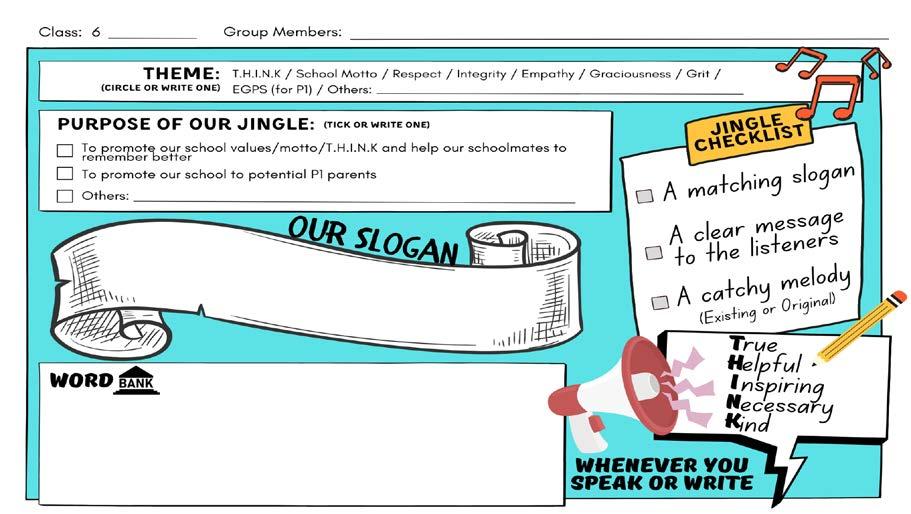
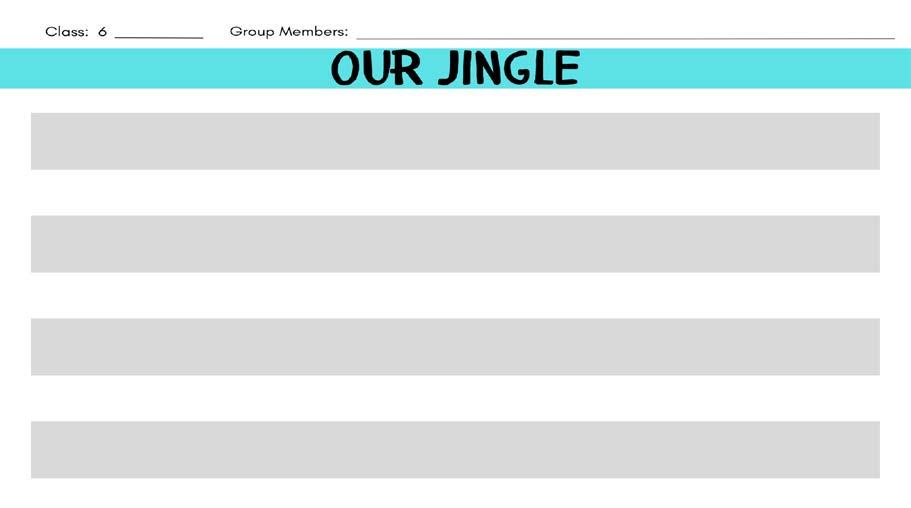
Pedagogical Framing and Ethical Guidance
In previous years, students have consistently struggled to compose fourline jingles, even with the aid of rhyme banks and structured worksheets. In 2025, these same scaffolds were retained, but enhanced with AI support at a later stage.
Students began by brainstorming using traditional worksheets. After this initial ideation phase, MagicSchool AI was introduced to support lyric generation. This sequencing was intentional; it encouraged students to generate ideas independently before leveraging AI for refinement and inspiration.
To promote responsible AI use, students were asked to critically evaluate and adapt the AI-generated outputs, focusing on tone, message, and audience fit. This helped students shift from a position of creative frustration to one of growing confidence, as they began seeing AI as a creative collaborator rather than a replacement.
Teachers also addressed the ethical dimension explicitly, reminding students:
Quantitative Results
Q1
“AI gives you ideas — you are still the composer.” This framing clarified authorship and reinforced students’ agency in the creative process.
Data Collected
Two post-implementation surveys were conducted: one for students and one for teachers, to evaluate how AI tools influenced learning motivation, creativity, and teaching engagement in music composition.
Quantitative findings from student responses were complemented by qualitative insights from teachers’ reflective interviews and samples of student work before and after AI use.
Student Survey Findings (N=135)
Students completed a five-point Likert-scale questionnaire after using MagicSchool AI during their jingle composition project.
Four core areas were measured:
❶ Perceived ease of composition with AI
❷ Exploration of new melodic or lyrical ideas
❸ Confidence in composing after AI use
❹ Willingness to continue using AI for music composition
Statements
Using MagicSchool AI made it easier for me to create my jingle.
Q2 AI tools helped me explore new melodic idea(s) I wouldn’t have thought of on my own.
Q3 I feel more confident in composing a jingle after using AI.
Q4 I would like to use AI tool(s) for music composition in the future.
Q1
Using MagicSchool AI made it easier for me to create my jingle.
Q2
AI tools helped me explore new melodic idea(s) I wouldn’t have thought of on my own.
Q3 I feel more confident in composing a jingle after using AI.
Q4 I would like to use AI tool(s) for music composition in the future.
The process of evaluating and refining AI-generated lyrics helped students develop musical judgment and a sense of authorship, even as they leveraged technology for support.
Interpretation and Key Insights
All four Mean Rating Indices (MRIs) exceeded 4.0, showing strong student endorsement of AI as a creative and motivational scaffold in music composition.
Ease and Accessibility
MagicSchool AI reduced creative barriers such as writer’s block and lyric structuring. 82.3% of students agreed that AI made the composition process easier, helping them organise and express musical ideas more fluently.
Creative Exploration
77.7% of students agreed that AI tools expanded their creativity by providing fresh lyric and melodic ideas they might not have discovered independently.
Confidence and Ownership
75.5% of students felt more confident about composing after AI use. The process of evaluating and refining AI-generated lyrics helped students develop musical judgment and a sense of authorship, even as they leveraged technology for support.
Sustained Interest
75.6% indicated that they would like to use AI for future compositions, showing an openness to continued integration of digital tools in music learning.
Points of Resistance
However, a minority of students expressed reservations:
☑ Some were frustrated with the AI prompts, which they felt did not always align with their (the students’) creative ideas.
☑ Certain groups preferred to retain and refine their own original compositions rather than use AI-generated material.
These responses underscore the importance of teacher guidance and ethical framing in helping students to perceive AI as a partner that supports — not replaces — human creativity.
Open-Ended Student Responses (N=108)
Students answered two open-ended questions reflecting on their experience in using MagicSchool AI in jingle composition. Responses were grouped into recurring themes.
Q5
What did you like most about using MagicSchool AI for composing your jingle?
Lyrics – Rhyming
Most students praised AI’s ability to generate rhyming lyrics, which made their jingles sound more fluent and catchy. Fast/Easy/ Efficient
Students appreciated how AI made the process quicker and easier, especially when they ran out of ideas.
Time-Saving/ Catchy/ Supportive 8 7.4%
A few noted AI’s usefulness in creating catchy lyrics or supporting teamwork.
Melody/Jingle Creation 4 3.7%
Others (General positives/ simplicity/ customisation)
Some mentioned that AI helped them think about rhythm and melody.
Included remarks like “fun to use”, “simple”, and “gives more choices”.
Interpretation
Over half the students (50%) valued MagicSchool AI’s ability to generate rhymes, while about 28% found it fast and convenient. Only a few cited minor limitations. The responses indicate that students appreciated AI’s linguistic and structural support, which made songwriting more accessible and enjoyable for them.
Students recognised AI’s potential to improve lyric writing and music arrangement, and were curious about features such as beat creation and vocal generation.
Only a small proportion (8%) were uncertain or sceptical due to concerns on overreliance. Overall, responses suggest that students perceive AI not just as a writing aid but as a platform to expand how they learn and experience music.
Summary Insight
One in three students felt AI could improve music learning by providing creative or well-structured lyrics.
Students hoped AI could add rhythm, backing tracks, or instrument layers.
Some believed AI could help them work faster and focus on performing.
Others felt AI could teach them to compose or structure songs more effectively.
A small group were doubtful or preferred traditional composing methods.
Examples included “it makes learning fun” and “it helps me be creative”.
Students mentioned ideas like changing genres, voice generation, and personalising AI tools.
Across both questions, students consistently viewed MagicSchool AI as a creative partner that simplifies composition and supports idea generation. The most valued aspect was rhyme and lyric creation, followed by opportunities for AI to evolve into a more comprehensive musical tool. A small minority raised reservations about dependency and creative mismatch, reaffirming the importance of guided, reflective AI use within teacher-facilitated music learning.
Teacher Interview Findings
Semi-structured interviews were conducted with music educators who had implemented MagicSchool AI and Suno in the Primary Six Jingle Composition unit. Teachers reflected on how these tools affected lesson design, student engagement, and their own professional motivation.
Theme Observation
Improved Lesson Planning
Support for Diverse Learners
Boost in Student Engagement and Creativity
Pedagogical Strategy — “Scaffold First, Then AI”
Increased Teacher Motivation
MagicSchool AI streamlined lesson preparation through ready-made prompts, scaffolds, and differentiated materials, freeing up time for customisation and student-centred instruction.
AI drafts provided a starting point for students with lower English proficiency, reducing anxiety about “getting lyrics wrong” and encouraging experimentation.
Students eagerly edited AI-generated lyrics to suit tone and theme, sparking rich peer dialogue (e.g., “Let’s change this word, it doesn’t sound cheerful enough”).
Teachers intentionally introduced AI only after students had completed planning worksheets on theme, keywords, and audience.
Implication
Greater instructional efficiency and flexibility.
Suggestions for Improvement
Higher student participation and creative outcomes revitalised teachers’ enthusiasm for music instruction.
Promoted inclusion and participation among mixed-progress learners.
Fostered ownership, collaboration, and critical musical thinking.
Preserved student agency while helping them apply AI outputs meaningfully.
Sustained educators’ passion and professional fulfilment.
Teachers recommend more music-specific templates and greater control over parameters such as key, tempo, instrumentation, and notation visuals.
The interviews revealed that AI served as both a pedagogical aid as well as a source of renewed professional motivation. Teachers valued its efficiency in lesson planning and its capacity to engage a broader range of learners. The deliberate sequencing of “Scaffold First, Then AI” proved crucial in maintaining student ownership while ensuring that technology
Points to future directions for AI development and teacher professional learning.
complemented rather than replaced creative thought. Teachers also reported renewed motivation as lessons became more dynamic and collaborative. Students’ excitement and willingness to refine AI outputs reignited teachers’ sense of purpose, demonstrating AI’s potential to sustain passion for teaching through meaningful, technology-enhanced artistry.
Students' Works
1
2
*Feel the stretch, feel the cheese, so cheesey, so creamy, The more cheese, the more breeze, Mac & cheese, so yummy. The cheesier, the better.
*The crispier, the better The juicier, the tastier Take a bite and feel the crisp Bite into happiness and the bliss.
*Verbatim student submission before AI support.
Hot and cheesy, can’t resist The cheesier, the better! Every spoonful brings such bliss Makes me smile forever!
Crispy crunchy, oh so YUM! Makes my taste buds dance and hum! Better than the rest, you’ll see Best fried chicken, guaranteed.
At the same time, teachers emphasised the need for continued professional development and the refinement of AI platforms to better align with music-specific pedagogy.
Discussion
The findings reveal clear evidence that integrating AI tools such as MagicSchool AI and Suno positively influenced both student motivation and teacher engagement in music composition. Based on quantitative data, more than 80% of students agreed that MagicSchool AI made jingle creation easier, while over three-quarters felt it helped them explore new musical ideas and compose with greater confidence. These results affirm AI’s role in simplifying composition tasks that previously caused frustration, such as lyric structuring and rhyme development. Qualitative feedback further highlights AI’s pedagogical value. Students described MagicSchool AI as fast, easy, and efficient, especially in generating rhymes and new lyrical ideas. The shift from “struggle to support” observed across the jingle-writing process indicates that AI transformed initial hesitation into creative confidence.
Furthermore, by providing a structured yet flexible framework, the tool also encouraged
experimentation and peer dialogue; students collaboratively revised AI-suggested lyrics, demonstrating active musical thinking rather than passive use. The “Scaffold First, Then AI” model, where students first planned their ideas on worksheets before using AI to refine their drafts, was particularly effective. This ensured that creative ownership remained with the students, aligning with the view that AI should serve as a partner in cognition rather than a replacement for intuition (Holland, 2000). Teacher interviews reinforce these findings. For educators, AI tools helped streamline lesson planning, support diverse learners, and rekindle their enthusiasm for teaching.
At the same time, the inquiry surfaced instances of student hesitation, where learners exercised discernment when engaging with AI suggestions.
A small number of students preferred to rely on their own ideas or found that AI prompts were misaligned with their creative vision. This balance between enthusiasm and reservation underscores the need for guided reflection and ethical framing.
In such situations, teachers can help students exercise further thought and
caution in their use of AI by guiding them to think critically about its suggestions, conduct their own evaluations, and recognise themselves as the true composers.
Overall, the results suggest that AI can enhance both student motivation and teacher sustainability when embedded intentionally within a human-centred, scaffolded learning process.
Limitations/Challenges
Tool Specificity
The AI platforms used — MagicSchool AI and Suno — are not designed exclusively for music education. Although they generate useful lyrics and audio, their outputs often lack musical nuance and thematic consistency. Teachers also noted that Suno offered limited control over tempo, key, and instrumentation, restricting a deeper exploration of musical elements.
Learner Readiness and Ethics
Some students were uncertain about authorship, questioning whether AI-assisted work could be considered fully their own. Others struggled with prompt refinement and interpreting AI suggestions. These findings point to the need for more explicit instruction in ethical AI use, and digital literacy.
Time Constraints
Due to curriculum pacing, students had limited time to practise AI prompting or engage in multiple creative iterations. A longer implementation time would allow for more in-depth experimentation and reflection. Future extensions could include music-
specific AI tools, longitudinal studies tracking creative growth, and professional-learning opportunities for teachers to deepen AIpedagogical integration.
Conclusion
This inquiry demonstrates that AI-powered tools like MagicSchool AI and Suno can meaningfully enhance both teaching and learning in music education. For students, AI made composition more accessible and engaging. It also built their confidence in their ability to perform the required tasks. For teachers, it reduced administrative workload, introduced innovative pedagogy, and reignited professional passion. The “Scaffold First, Then AI” approach was the key success factor. By ensuring that planning and ideation preceded AI use, students retained authorship and creative agency. This balance safeguarded the human element of music-making while leveraging technology’s strengths.
Moving forward, a blended model of ‘AI + human creativity’ is essential. Teachers should guide students to use AI critically — refining prompts, questioning results, and valuing originality. For teachers, continued professional learning will help them maximise AI’s benefits while addressing concerns of dependency, bias, and cultural representation.
Ultimately, AI should not replace human artistry but enrich it. When thoughtfully integrated, it can inspire both learners and teachers, sustaining and nurturing curiosity, creativity, and passion for music in an evolving digital landscape.
References
☑ Holland, S. (2000). Artificial Intelligence in Music Education: A Critical Review. In E. Miranda (Ed.), Readings in Music and Artificial Intelligence (Vol. 20) . Harwood Academic Publishers.
☑ Rizal, H., & Milyartini, R. (2024). Improving the quality of music education through applications based on Artificial Intelligence (AI) . SHS Web of Conferences, 197, 01004.
☑ Robinson, J. (2015). Inspiring music teachers: A study of what is important in practice. Australian Journal of Music Education, 52(1) , 51-60.
Harnessing Music Technology to Increase Student Engagement
Introduction
Samantha Chan
CHIJ Secondary (Toa Payoh)
As students in Singapore begin their Secondary One journey, they are equipped with a Personal Learning Device (PLD). While these devices hold great potential for creativity and engagement, they can easily become sources of distraction.
This has led me to think “if you can’t beat them, join them!”, and ask myself how I can harness the very tools that often disengage students to draw them into deeper, more meaningful learning experiences instead.
I believe that integrating music-focused educational technology (EdTech) tools will not only foster a more engaging classroom environment, but also hone students’ digital literacy skills.
In the context of music lessons, EdTech tools such as BandLab offer exciting possibilities for collaboration, exploration, and self-expression. This presents an opportunity to incorporate EdTech tools into the Film Music module that we have planned for our Secondary One students, especially in film composition activities.
It is hoped that this will allow the creation of learning environments that encourage experimentation, foster creativity, and strengthen connections between music and storytelling, thus increasing student engagement.
Inquiry Question
How can the use of technology enhance student engagement?
Literature Review
This project draws inspiration from the Ministry of Education’s EdTech Masterplan 2030, Transforming Education through Technology, where one of the outcomes is to digitally-empower learners who are selfdirected in managing their learning when using digital tools and resources.
Finn & Zimmer (2012) state that higher student engagement can result in improved academic achievement and lower rates of school dropout. They find that when students are behaviourally, emotionally, and cognitively engaged, they are more likely to persist in learning tasks. This makes engagement a critical factor in learning, something I believe the use of technology can support.
Alongside increasing student engagement, Marcrides & Angeli (2020) mention that technology can foster students’ emotional engagement with music by allowing for more interactive, multimodal, and personalised learning experiences. For example, digital tools can enhance music cognition (how students process rhythm, melody, harmony), making lessons more meaningful and motivating. Technology does not just teach music skills, it enhances students’ emotional connection to music, which strengthens engagement and learning.
Methodology
Target Audience
☑ One class of 35 Secondary One students
❶ Mixed Level of Readiness
❷ Mixed Posting Group from 1–3
Data Collection
☑ Teacher Observation
❶ Class
❷ Focus on Student A and B
☑ Student Reflections
Curriculum Outline
Duration
☑ Eight weeks, with a one-hour lesson each week
Technological Tool
We used BandLab, a free, cloudbased platform for music creation and collaboration. BandLab is a digital audio workstation (DAW) accessible through web browsers or standalone apps that combines music creation tools with social media features, allowing users to record, edit, mix, and share music.
Different music elements that contribute to a soundtrack
☑ E.g., tempo, dynamics, instrumentations, etc.
☑ Examples of how different music can shape the listener’s emotions and reactions
Lead up activity: in-class group work
☑ Each group was assigned a video
☑ Students watched the video and answered the following questions: What is the mood/emotion evoked in this segment of the movie? How do the tempo, pitch, and instrumentation achieve the mood/emotion?
Briefing of Assessment Details
☑ How to navigate BandLab
☑ Creation of BandLab account
☑ Common features: adding tracking, exploring virtual instruments, editing the tracks, exporting the track
Assessment Instructions
Watch the video of students creating their compositions on Bandlab
Data Collected
PART 1
❶ Collaborate with peers (4–5 members) to use BandLab loops and/or instrumental recording to create music for a short film video.
❷ Stitch final audio from BandLab to the short film using other editing apps like CapCut, TikTok, etc.
❸ Group presentation: Present final video and Rationalise ideas and choice of music based on Music Element considerations.
PART 2: Group presentation questions
☑ What is your interpretation of the clip?
☑ What loops/instrumentation did your group use?
☑ How do these loops/instrumentation achieve your interpretation?
☑ Were there challenges faced in this project? If yes, how did your group overcome these challenges?
☑ What were some memorable moments that the group experienced while working on this project?
Observations
Class Response — Week 1
Students gasped in excitement when Film Music was introduced as the module that they were going to embark on for the term. Most had their eyes glued to the screen when the various examples of film music were shown. The choice of videos heightened the engagement of the students, making it a great start to the module.
Class Response — Week 2
Students responded positively to the visual representation of the different music elements, chuckling in excitement, whispering comments, and nodding to their friends next to them, sending the message that they were in agreement with and understood what they were watching. One student remarked, “This is amazing, to see how the same video could feel so different, with the different music used!”
Class Response — Weeks 3 to 8
Students were on task and would take the initiative to come up to me to clarify their doubts. Five out of seven groups sought advice on their BandLab progress over the weeks by asking me to listen to their work. Most group
work issues were easily resolved during weekly check-ins. Students also showed very clearly that they had understood what was expected of them when they presented their final work in Week 8.
Students A and B — Week 1
I had already started noticing Students A and B from the start of the year. Both would frequently bury their faces in their PLDs whenever possible. For this module, it was no different, but because of the rapport that I had built with them, they were aware that I would occasionally make eye contact with them, and knew that I was paying closer attention to them. This would result in them looking up from their PLDs when I was addressing the class.
Students A and B — Week 2
Student B was paying attention and volunteered to answer a question. Sometimes, Student B would nudge Student A to look up at the screen after I made eye contact with Student B.
Students A and B — Week 3
Students were getting into groups this week, and it was no surprise that Students A and B stuck together and did not actively look to form a group with other students. Fortunately, three other students approached them to form a group.
Students A and B — Week 4
As the class embarked on their first session, I paid close attention to Students A and B. I noticed that their body language was closed off from the rest of the group, with their backs to the group members. I observed for a few more minutes before making my way over.
As Students A and B noticed my presence, they quickly shifted their attention to their group members and moved their PLDs away. Upon checking in, the group expressed that
they were having issues creating an account on BandLab. I rendered help and the entire group, including Students A and B, began to explore BandLab.
Students A and B — Weeks 5 to 7
During these weeks, Students A and B grew increasingly focused on BandLab. They would drift off occasionally, but spent the majority of the time exploring its various features. They were also seen contributing to their group.
By Week 6, not only were they more focused, both students had also bonded with the rest of the group members, and were working together with the group. In fact, they were seen eagerly talking over each other, and suggesting ideas from what they had tried out on BandLab. Even though there were times when it caused confusion, I saw these as teaching moments where I could step in and guide them on active listening and taking turns to speak to be heard.
By Week 7, the group had completed all the tasks and was rehearsing and tweaking their final work. In the final 10 minutes of the lesson, Student B was creating a new project to try out other effects on BandLab.
Students A and B — Week 8
Presentation week was an interesting experience. When it was the group’s turn to present, Student B led the group by whispering loudly to the group members, reminding them to greet me and introduce themselves before they began the presentation.
As Student B was doing this, Student A also tried to do her part by leading the group to where they were supposed to position themselves around the projector screen. Needless to say, the presentation was well executed.

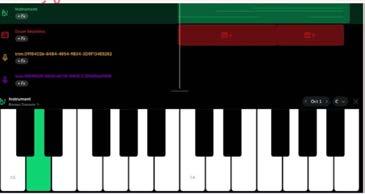
Watch the video recordings of students’ screen recordings on BandLab.
Listen to students’ Final Work.
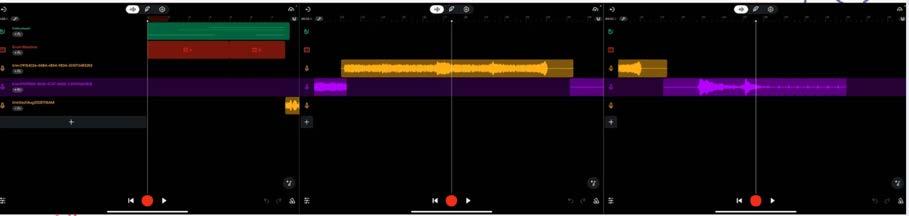
Students’
Reflections
“It was fun when we got to explore the different virtual instruments provided by BandLab.”
“Best part was when we completed and watched the final video of how our music perfectly match at the hit points.”
“Spoilt for choice on the options that BandLab provided. It gave us a taste of being a music producer of some sorts.”
“It almost felt like we were content creators on TikTok, and how the music we put together has an intention to shape the way the audience feel.”
Screenshot of students’ work on BandLab.
Discussion
Observing the class and in particular Students A and B, there is no denying that technology had a huge part to play in engaging the students.
I believe that the chosen module was of interest to the students as it was relatable to them. In addition, the assessment that was crafted for them motivated them to be detailed in matching the music to the hit points in order to influence the audience’s listening moods.
Furthermore, the fact that the students had put in a lot of effort for the project and were determined to see it through also had an impact on the full class attendance for the entire module. This links back to Finn & Zimmer’s (2012) take on how students are more likely to persist in learning tasks and have lower rates of school dropout when there is higher engagement.
Challenges
There were instances where technology failed. For example, when the BandLab app hung and students had to close the app and restart their work.
There were also moments where I was worried that some students would drift off and piggyback on their group members’ efforts. In the future, I would like to explore a smaller grouping of two to three students, which may encourage greater individual focus and contribution.
Conclusion
Technology and the constant advancement of technology are here to stay. It is important to embrace this and equip our students with
relevant skills for the future. Film Music as a module was well received. The examples chosen to introduce the students to this module were of interest to them and they showed a clear understanding of what was shared.
On top of that, the use of BandLab enhanced student engagement and promoted active collaboration and creative learning. The intuitive digital platform catered to diverse learning styles and readiness, and through features such as real-time collaboration and instant playback, students gained a sense of ownership and motivation in their music-making process.
BandLab’s “spoilt for choice” music loops and MIDI files also encouraged students to explore and connect more deeply with their musical interests, thus transforming the lessons into a more dynamic and student-centred experience.
It has been such a pleasure embarking on this project with my students and being able to see them become confident users of EdTech. Watching them beam with pride when they presented their final work to the class was a magical experience.
Acknowledgements
☑ I would like to thank my school leaders for their support throughout my entire NLC journey.
☑ My reporting officer, Daniel Kuan, for always believing in me, and his unwavering support and encouragement in all that I want to embark on.
☑ My students whose enthusiasm constantly inspires me to improve and refine the music curriculum.
Reference
☑ Finn, J. D., & Zimmer, K. S. (2012). Student engagement: What is it? Why does it matter? In S. L. Christenson, A. L. Reschly, & C. Wylie (Eds.), Handbook of research on student engagement (pp. 97–131). Springer. https://doi.org/10.1007/978-1-4614-2018-7_5
Using Virtual Instruments to Support Instrumental Learning and Musical Development
Introduction
Yeo Wee Kiong
Geylang Methodist School (Primary)
This study explores how the use of a virtual angklung application, Sarinande+ (also referred to as a “Virtual Angklung app” in this paper), enhanced the teaching and learning of angklung among Primary Three students.
The research investigated how technology supported students’ understanding of melody, chords, and ensemble performance, and how the integration of virtual and real angklungs improved their musicianship.
The study also examined how the use of the virtual angklung app supported students’ development of aural skills, music visualisation, and conceptual understanding of chords through authentic and tactile learning experiences.
Inquiry Question
How can virtual angklung technology be used to teach angklung to Primary Three (P3) students?
Methodology
This study advocates the use of both virtual and real angklungs to augment music teaching and learning. The aim is to utilise the virtual angklung app as a tool to allow students to “test-proof” their musical ideas and melodies before performing in an angklung ensemble. Through this approach, students are encouraged to engage in
musicking and performance using both virtual and physical angklungs in a complementary manner.
The angklung is a traditional musical instrument originating from West Java, Indonesia. Historically, farmers performed angklung music during rice harvest festivals as a form of thanksgiving. Their angklung instruments used the five-tone Slendro or seven-tone Pelog scales.
For contemporary educational use, we use angklungs tuned to the Western diatonic scale. In this research, our angklungs were diatonically tuned to align with the C major and G major scales used in the virtual angklung application.
Target Audience
The study involved eight classes of Primary Three students over 13 weeks, whose music classes were all conducted by one music teacher.
These students had previously learnt recorder skills and were able to play simple music tunes using B, A, and G notes. They were also able to sing in pitch using solfège, and had learnt how numbers correspond to pitch in solfège since the beginning of the academic year.
Data was collected from classes P3-2, P3-6 (mixed progress) and P3-7, P3-1 (high progress). Each class consists of 38 to 40 students.
Data Collection
☑ Verbal feedback from students after every lesson.
☑ Students’ indication of their preference for virtual angklung or actual angklungs.
Duration
13 weeks, with a one-hour lesson each week
Pedagogical Framework
Kagan’s collaborative Learning
This project utilises the pedagogical framework from Spencer Kagan’s (2009) principles for the power of pair work.
Students worked in pairs, with one student using the virtual angklung app while the other student sang, observed and/or played the actual angklung instrument. This helped to maintain overall musical balance and gave students opportunities to offer peer feedback on each other’s playing. It also helped students to remain on task.
Use of Visuals in ICT to enhance conceptual understanding
One of the key concepts in this project was how ICT tools helped enhance students’ conceptual understanding. The visually appealing animated characters playing the angklung in the app helped students understand that angklung performance is a team effort.
Visuals also enhanced students’ conceptual understanding of chords. The animated characters made abstract ideas, such as the concept of chords, more concrete (Connolly, 2025).
This combination of visual processing (such as having four animated characters shaking angklungs to play a chord) and audio stimuli helped students retain the concepts of chords taught in class.
Pre-lesson Observations and Problems faced in Lessons
Through observations from P3 angklung lessons conducted over the years, we observed several challenges commonly faced by the students:
Issue 1
Playing actual angklung music requires teamwork, as each student is responsible for a single note that completes the ensemble piece. Initially, students found it challenging to play accurately and in rhythm as an ensemble. They often played their notes with the wrong rhythms and note values during more challenging sections of the musical piece.
Issue 2
Students who could not read music notation struggled to “imagine” the sound of a melody. They were unable to tell how their individual angklung notes relate to others in the melody. Unlike on the piano, where one can play multiple notes simultaneously to visualise the full harmony, the student is only able to play one pitch/note on the angklung. As a result, students often played wrong notes, or played out of beat, as they were unable to perceive the “bigger picture” in the music.

SARINANDE+
Overview of Tools/Apps
Sarinande+ is a free virtual angklung application that simulates realistic angklung sounds (referred to as the virtual angklung app in this paper). It allows users to tap on a tablet screen to play angklung tones, and supports up to six-tone polyphony. The app provides access to the C major and
G major scales and includes a chord function where users can tap chord symbols (C, Dm, Em, F, G, Am, Bdim) to hear their respective chord tones. It also adopts traditional angklung cipher notation 1, 2, 3, 4, 4#, 5, 6, 7, which corresponds to C, D, E, F, F#, G, A, and B in Western notation.
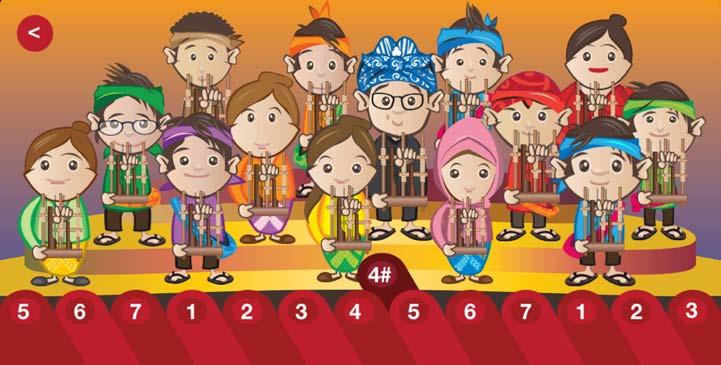
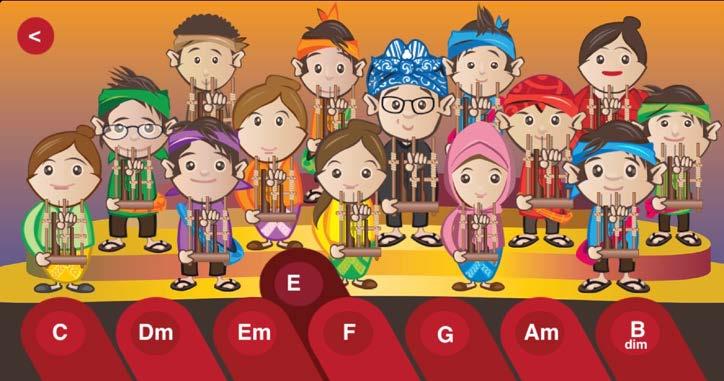
Figure 1: Melody function interface in the Sarinande+ virtual angklung app.
Figure 2: Chord function interface in the Sarinande+ virtual angklung app.
Process/Curriculum Outline
Learning Objectives
This research investigated how the virtual angklung app could be used effectively as an ICT tool to improve two main areas of learning for students:
❶ Learning to play simple melodies and musical motifs on the angklung.
❷ Understanding and playing chords on the angklung.
General Usage of the Virtual Angklung App
I used the Sarinande+ app to introduce new melodies to students, allowing them to hear and visualise the tunes before playing. With the virtual angklung app interface, I showed the students how to play the C major scale and triad chords such as C, Dm, Em, F, G, and Am using the first, third, and fifth degrees of the scale.
Overview of Technology Use in Teaching and Learning
Students worked in pairs, using the melody function to explore the C major scale, discover new melodies, and construct chords. I introduced new music pieces and played the melodies on the app, letting students imagine and internalise the melody before they attempted to play it on the angklungs.
This approach improved students’ playing accuracy and musical awareness when they transitioned to the actual instruments. I also guided the students to sing the melody while playing the chords on the virtual angklung app, as a means of self-accompaniment.
Weeks 1 and 2
Discovering Cipher Notation (Lessons 1 and 2)
I began the lesson by having students sing “Number Song”, “Do, Re, Mi”, and “A, B, C” as a warm-up activity. This helped students relate cipher notation numbers to solfège syllables and alphabetic note names in the C major scale. I then explained and taught them how cipher notation represents musical pitch, and how it aligns with Western notation systems.
Cipher Solfège
major Scale
Weeks 3 and 4
Discovering Chords (Lessons 3 and 4)
I demonstrated how to form triad chords on the virtual angklung app by combining specific notes and encouraged students to observe and identify the pattern used in triad chord construction: the “1 note, 1 space, 1 note, 1 space, 1 note, 1 space” sequence. Working in pairs, students used the app to create their own triad chords. I then explained that chords support melodies
and that chords consist of three or more notes played together. Selected students performed the C major chord on real angklungs and compared the tonal texture and timbre with the sounds produced on the virtual app.
Following this, I incorporated aural training activities, where I played chords on the piano, and had students identify the chords by matching them on the virtual app.
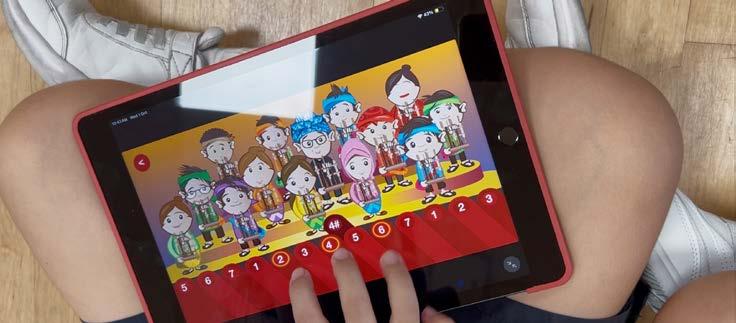
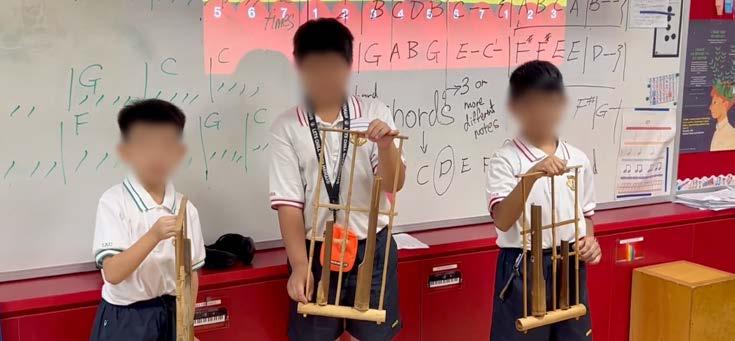
Figure 3: Students playing a Dm chord using three notes in the Sarinande+ virtual angklung app.
Figure 4: Students performing with angklungs.
Data Collected
The following were some of the comments and feedback given by students after the lessons:
Students’ Comments and Feedback
“I can see four cartoon students playing angklungs when I press a chord, it helps me to remember that a chord is made up of three or more notes played together.”
“It would be better if the virtual angklung can be louder.”
“I like to combine sounds of real and virtual angklung, because the sound is interesting and nice.”
“The virtual angklung app helps us to learn chords.”
I also asked students whether they preferred the virtual or real angklung. They expressed that they did not prefer playing real angklung over the virtual angklung and vice-versa.
Issues Faced During Lessons
Sarinande+ uses the traditional angklung number notation (cipher notation) instead of the Western Do, Re, Mi, Fa, So, La, Ti or C, D, E, F, G, A, B, which students are familiar with. Hence, effort was needed to teach students the cipher notation and familiarise them with it. However this step was necessary, as it is part of authentic angklung music teaching and learning.
In addition, there was latency when notes were pressed in the virtual angklung app (Sarinande+), making it difficult to play fast melodic passages.
Emulating what experienced musicians would do to overcome the “quirks” of their instrument, the students and I would press the note or chord on the app approximately half a second
earlier to overcome this problem. I also directed the students to play in a slower tempo, and encouraged them to play chords instead of melody lines.
Students’ Works
Watch video of students’ learning and ensemble playing
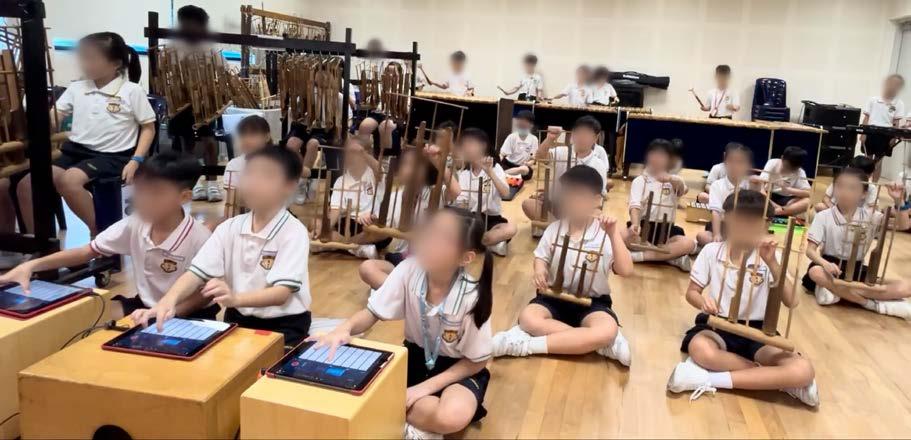
Figure 5: The students played chords on the virtual angklung app together with melodies played using real angklung.
Discussion
Affordances of the Virtual Angklung App
Students enjoyed playing on the app. They especially liked the animated characters shaking the angklungs. The app’s interface reinforced the concept of teamwork, showing that multiple animated characters were needed to play a coherent tune, just like in a real angklung ensemble.
Furthermore, the animated characters were scattered and not arranged according to ascending pitches, representing the authentic setup of an angklung group.
When students played chords such as C, they could visually see four characters shaking angklungs. This helped them understand that chords are made up of three or more notes (e.g., C, E, G, C’).
They also found virtual playing less physically tiring than playing on the actual angklungs, yet still realistic in sound.
However I believe it is important to balance the use of real and virtual instruments for true holistic learning.
Pedagogical Adaptations
The Sarinande+ app uses traditional cipher notation, which differs from the Western notation (Do, Re, Mi or C, D, E, F, G, A, B) that students are more familiar with.
Thus, additional teaching was required to help students become comfortable with this notation system, as cipher
notation is the authentic way to teach and learn the angklung.
Technical limitations such as latency were observed in the app, making it difficult to play fast melodic passages accurately. To overcome this, students were taught to adapt by pressing notes slightly earlier, playing at slower tempos, or focusing on chords instead of rapid melodies.
This adaptive behaviour mirrors real-life musicianship, where players learn to overcome the physical limitations of their instruments.
Application: Playing “Twinkle, Twinkle Little Star”
Students used the Sarinande+ app to play chords C, F, and G while singing “Twinkle, Twinkle Little Star”. They sang the lyrics and the alphabet notation of the melody while they played chords on the virtual angklung app.
They also attempted to play the melody of “Twinkle, Twinkle Little Star” using the virtual angklung, but it was not very effective due to the app’s substantial latency when playing rapidly changing notes in melodies. Singing the song while playing the chords on the virtual angklung app proved to be more effective.
As a class project, students also composed their own variations of “Twinkle, Twinkle Little Star” and sang and performed it on both real and virtual angklungs.
The Mealworm Song
Mealworm, mealworm, four-stage life cycle, Egg, larvae, pupa, and beetle.
Chomping carrots and oatmeal, Sometimes apple and bread too.
Mealworm, mealworm, four-stage life cycle, Egg, larvae, pupa, and beetle (adult)*.


* The correct scientific term is “adult” for the mealworm life cycle, but the students chose the word “beetle” in their lyric creation for better musical expression.
Cross-Disciplinary Integration: The Mealworm Song
After learning about the life cycle of mealworms in their science lessons, students adapted the melody of “Twinkle, Twinkle Little Star” to create new lyrics about the topic. (See lyrics in the table above.)
This cross-curricular project demonstrated how music learning can be integrated with other school subjects, in this case reinforcing both musical and scientific understanding.
Challenges
The Primary Three students found it challenging to play fast musical passages using the virtual angklung app (Sarinande+) due to the latency issues.
To overcome this, they were encouraged to play the melodies slightly ahead of the beat. I also re-arranged the music to be played at a slower tempo. This is akin to a drummer overcoming the delay in a kick drum mechanism to sound the bass kick note on time.
The latency issue was not as pronounced when students played the chord function, hence the virtual angklung app proved to be useful and effective in teaching chords during ensemble playing. However, the latency became an issue when the app was used for playing the melody.
An alternative to the virtual angklung app for melody playing would be the GarageBand Sampler app, which has minimal latency. The user would have to record (sample) actual angklung sounds by pressing the recording button in GarageBand Sampler, following which the app would auto-assign the pitch to the virtual keyboard in the sampler.
Conclusion
The Sarinande+ virtual angklung app is an accessible and effective tool for supporting music education at the Primary level. It promotes visual and conceptual understanding of chords and melodies through interactive learning. By providing immediate auditory and visual feedback, the app also motivates students in their learning process.
For us, the virtual angklung app offered valuable opportunities for musical exploration and collaborative learning. The Primary Three students demonstrated improved ability to visualise melodies, understood chord construction, and appreciated the cooperative efforts required in ensemble playing.
Moreover, they were able to perform together using both virtual and real angklungs, demonstrating how technology can effectively complement traditional musical instruments.
Overall, the virtual angklung app helped students to “see/hear the bigger picture”, which is extremely helpful when learning new music pieces.
In conclusion, the integration of virtual angklung technology enhances both conceptual and practical learning of angklung performance among young students.
Acknowledgements
I would like to thank the school leaders and key personnel of Geylang Methodist School (Primary) who supported me in this study.
References
☑ Connolly, M. (11 May 2025), Animation as a Teaching Tool: Boosting Learning in British Classrooms https://educationalvoice.co.uk/aanimation-as-a-teaching-tool
☑ Kagan, S. (2009). The Power of Pair Work . Kagan It’s All about Engagement. https://www.kaganonline.com/free_articles/dr_spencer_kagan/533/The_Power_of_Pair_Work
How Gamification can Increase Motivation and Engagement of Lower Primary Students in Learning and Understanding Music Concepts
Introduction
Timothy Chua Yu Yong
Valour Primary School
Tan Shi Ying
Red Swastika School
In today’s Primary classrooms, sustaining students’ focus and motivation in learning remains an increasing challenge, particularly among younger learners. Many Lower Primary students find it difficult to remember music concepts and retain learning over time. They lose focus easily during music lessons that require repetition or abstract understanding, such as recognising solfège hand signs or internalising melodic patterns. This observation aligns with research suggesting that young children’s limited working memory and shorter attention spans can hinder the retention of new musical knowledge (Barlow, 2016; Spencer et al., 2020).
Hence as teachers, we constantly explore innovative ways to make learning more engaging, meaningful, and memorable for our students. One promising approach is gamification — the use of game elements such as rewards, levels, and instant feedback to motivate learners and sustain engagement. Gamification has been shown to increase participation, focus, and enjoyment in classroom learning by transforming routine tasks into interactive challenges (Dichev & Dicheva, 2017).
Purpose of Study
This study aims to investigate how gamification using ‘Gimkit’, a digital,
game-based learning platform, can enhance the motivation and engagement of Lower Primary students in learning and understanding music concepts, specifically, solfège. By integrating gameplay mechanics with music learning, we hope to find out whether this approach can help students develop stronger recall of solfège pitches and hand signs, sustain their engagement during lessons, and cultivate a more positive attitude towards music learning. The findings will provide insights into how technology-enhanced gamified learning can support young learners’ musical development in a joyful and sustainable way.
Research Methods
We adopted a mixed-methods research style for this study.
Quantitative
☑ an analysis of students’ responses based on pre- and post-survey data.
Qualitative
☑ feedback gathered from students’ written responses in the post-survey.
Methodology
Participants (4 classes –110 students)
❶ Two Primary One classes from Red Swastika School (Total number of students: 53)
❷ Two Primary Two classes from Valour Primary School (Total number of students: 57)
Data Collection
❶ Pre-survey questionnaire
❷ Post-survey questionnaire
❸ Students’ written post-lesson feedback
❹ Video recordings of students’ group performance
❺ Teachers’ observation of students’ engagement levels.
Overview of Lesson
To investigate whether Gimkit truly increases the motivation and engagement
of Lower Primary students in learning and understanding music concepts, we designed a small study.
We identified two levels for our study, Primary 1 and Primary 2. At each level, one class served as the control group, while the other experienced learning with Gimkit. Lessons were carried out over a period of three weeks. The control classes learned solfège and hand signs through traditional teaching methods. The Gimkit classes learned and revised these same concepts through gamification. This study allowed us to make a fair comparison between traditional instruction and game-based learning.
❶ Introduction to solfège (do, re, mi, so, la) through singing games.
1
2
❷ Learn the solfège hand signs do, re, mi, so, la.
❸ Experience singing a few simple songs using do, re, mi, so, la.
❶ Revise singing solfège do, re, mi, so, la with solfège hand signs by using the solfège flashcards.
❷ Introduce students to the C-pentatonic scale.
❸ Sing different melodic patterns with solfège hand signs (hand sign games).
❹ Sing the song “Bow Wow Wow” with solfège hand signs.
❶ Revise singing solfège do, re, mi, so, la with solfège hand signs.
3
❷ Group task: Students perform the song “Bow Wow Wow” with solfège hand signs. (Record)
❸ Complete post-lesson survey.

❶ Introduction to solfège (do, re, mi, so, la) through singing games.
❷ Learn the solfège hand signs do, re, mi, so, la.
❸ Using ‘GimKit’, revise the solfège do, re, mi, so, la and hand signs through gamification.
❶ Introduce students to the C-pentatonic scale and the song “Bow Wow Wow”.
❷ Sing “Bow Wow Wow” with solfège hand signs.
❸ Using ‘GimKit’, students revise the solfège do, re, mi, so, la and hand signs through gamification.
❹ Using ‘GimKit’, students revise and check their understanding of C-pentatonic Scale.
❶ Revise singing solfège do, re, mi, so, la with solfège hand signs.
❷ Group task: Students perform “Bow Wow Wow” with solfège hand signs.
❸ Complete post-lesson survey.
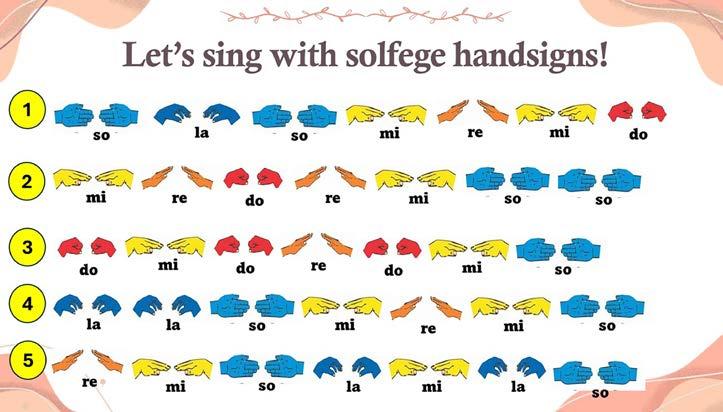
Screenshot 1: Solfège handsign game for the control class.
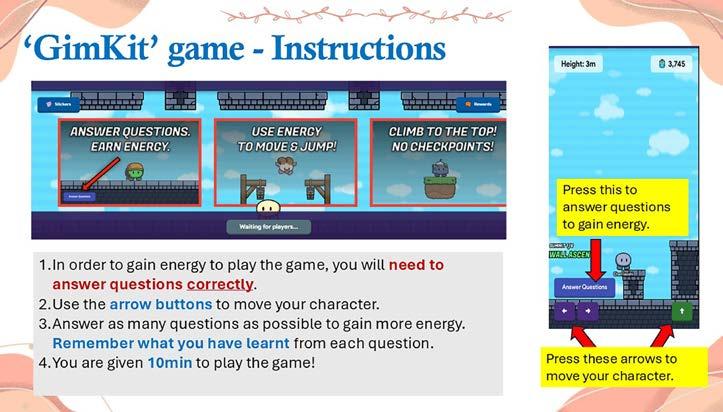
Screenshot 2: Digital Game-Based Learning platform game for the Gimkit class.
Findings
Theoretical Framework: Self-Determination Theory (SDT)
This study is grounded in Self-Determination Theory (SDT), a widely established framework explaining human motivation and behaviour (Ryan & Deci, 2020). SDT posits that motivation lies on a continuum based on how self-directed it is.
The Role of Play and Motivation
Play has always been a key part of how children learn. Through play, they explore, experiment and make sense of the world around them. Psychologists like Lev Vygotsky (1967) and Piaget (1962) have long linked play to creativity, imagination, and intellectual growth.
In today’s structured classrooms, reintroducing playful elements can rekindle curiosity and motivation. Game-based learning, through features like points, levels, and rewards, keeps students engaged by offering choice, challenge, and connection to their interests.
In music education, for instance, using rhythm games or familiar songs can make learning more enjoyable, creating a supportive environment that helps students build confidence and enthusiasm.
Digital Game-Based Learning (DGBL)
Digital tools have become essential for engaging young learners through play, collaboration, and instant feedback. Gamebased learning platforms transform traditional lessons into interactive experiences that boost motivation and retention. Digital Game-Based Learning (DGBL) goes further by combining fun and learning to sustain focus and participation. In music education, such games help students develop rhythm, listening, and performance skills in an enjoyable way.
By blending technology, play, and creativity, learning becomes a meaningful and motivating experience. Among DGBL platforms, Gimkit stands out for its engaging use of game mechanics and friendly competition.
What is Gimkit?
Gimkit is an online game-based learning platform that allows teachers to create interactive quizzes featuring multiplechoice, true-or-false, or short-answer questions, enhanced with images or audio. Similar to Kahoot! but with a more strategic and engaging gameplay, Gimkit rewards correct answers with “energy”, which students use to perform actions within various game modes.
Featuring more than 25 game modes that cater to both individual and team play across varying levels of difficulty, Gimkit provides an engaging and interactive environment that fosters both learning and enjoyment. Questions reappear often to reinforce understanding, and students can join live sessions with a simple game code, or complete assignments independently.
Interpretive Analysis of Findings
Table 1 presents the mean scores and the differences between the mean scores. The single asterisk (*) indicates corresponding statistical significance (measured by p-values <0.05), while double asterisks (**) indicate high statistical significance (measured by p-values <0.005) for both Primary One (P1) and Primary Two (P2) groups, comparing the Control Group (students engaged in traditional hand games) and the Experimental Group (students exposed to Gimkit-based activities) across pre- and post-survey results.
The motivational constructs examined were grounded in SDT and include Intrinsic Motivation (IM), Identified Regulation (ID), Introjected Regulation (IJ), External Regulation (EX), and Amotivation (AM).
Table 1
Motivational Statement
IM1
I enjoy learning with solfège very much.#
Intrinsic Motivation (IM)
I experience pleasure and satisfaction learning solfège.°
Learning solfège help me understand better.#+
IJ1
Motivational Statement
I will feel bad if I do not learn solfège well.#^
Introjected Regulation (IR)
IJ3
I feel a sense of obligation to learn solfège because others expect it of me.#
I am learning solfège to show myself that I am capable of doing it.°^
External Regulation (EX)
I will get in trouble if I don’t learn with solfège.#
Learning solfège can help me do well in singing.^
° Adapted from The Academic Motivation Scale by Vallerand et al (1992).
# Adapted from Self-Regulation Questionnaire by Ryan and Connell (1989).
^ Adapted from Multidimensional Work Motivation Scale by Gagné et al. (2015).
+ Constructed in the present study.
Motivational Statement
AM1
Learning solfège is meaningless.^
Amotivation (AM)
I cannot see why I need to learn solfège.^
AM3 Learning solfège is a waste of my time.^
° Adapted from The Academic Motivation Scale by Vallerand et al (1992).
# Adapted from Self-Regulation Questionnaire by Ryan and Connell (1989).
^ Adapted from Multidimensional Work Motivation Scale by Gagné et al. (2015).
+ Constructed in the present study.
Overview of Study Focus
The post-survey results were analysed to determine how different instructional strategies, such as traditional hand games and Gimkit-based lessons, influenced students’ motivation to learn solfège. The five motivational constructs examined were:
❶ Intrinsic Motivation (IM) – enjoyment and interest in learning.
❷ Identified Regulation (ID) – personal importance and value of learning.
❸ Introjected Regulation (IJ) – internal pressure or pride.
❹ External Regulation (EX) – motivation from external rewards or rules.
❺ Amotivation (AM) – lack of motivation or purpose
A p-value below 0.05 indicates statistical significance in motivation change.
Intrinsic Motivation (IM)
Significant improvements were observed in both levels, especially in the Gimkit experimental group.
☑ P1 Results: Three IM items (IM1–IM3) showed p-values <0.01, with post-test means rising from ~3.1 (Pre) to ~4.4–4.5 (Post).
☑ P2 Results: Smaller increases were seen (3.3 → 3.9 range), but are not all statistically significant.
Based on the findings, Gimkit had a pronounced positive effect on students’ enjoyment and engagement in learning
solfège. Students consistently described the experience as “fun”, “interesting”, and “exciting”, indicating a clear increase in intrinsic motivation. While traditional hand games also enhanced enjoyment, the effect was comparatively smaller.
Overall, Gimkit lessons generated greater enthusiasm and sustained interest than conventional approaches.
Identified Regulation (ID)
☑ P1 Gimkit Experimental group: Statistically-significant increase in positive mean value (1.29–1.44) shows that students began seeing solfège as personally meaningful.
☑ P2 Gimkit Experimental group: Gains were smaller but still showed a positive increase in value (0.48–0.5 for ID1).
The control groups showed minimal change, suggesting that while the hand games were engaging, they did not significantly enhance students’ perceived value or connection to the learning content.
In contrast, Gimkit enabled students to better appreciate the importance and usefulness of solfège in music learning, shifting their motivation from mere enjoyment to a deeper sense of personal relevance.
Introjected Regulation (IJ)
☑ IJ3 (P1 Gimkit Experimental group) showed statistically significant improvement, with a positive mean value increase of 0.88. This suggests that Gimkit enhanced students’ selfconfidence and pride in their ability to succeed in music-related challenges.
The control groups did not exhibit comparable gains, suggesting that the
competitive, points-based environment in Gimkit fostered students’ self-recognition and persistence more effectively. Overall, Gimkit strengthened students’ selfvalidation and sense of achievement better than traditional games.
External Regulation (EX)
☑ Significant improvement appeared in EX1 and EX3 (P1 Gimkit Experimental groups) with a positive mean value increase of 0.68 and 1 respectively. This shows that some motivation stemmed from external reinforcement, such as scores, competition, and teacher recognition.
Unlike the control groups, Gimkit effectively enhanced both intrinsic and extrinsic motivation, engaging students through enjoyment and recognition.
Amotivation (AM)
Across both levels, Gimkit significantly reduced amotivation:
☑ AM1–AM3 (P1 Gimkit Experimental groups): Showed a statistically significant decline in mean of 1.04, 0.68 and 1.28 respectively, indicating clear reductions in feelings that solfège was meaningless.
☑ P2 Gimkit Experimental group: AM2 dropped from 3.16 to 2.48 (p=0.035), confirming improved engagement.
The control groups showed only minor or inconsistent decreases in amotivation. In contrast, students in the Gimkit lessons were less likely to feel bored or disengaged, as the interactive gameplay made learning more purposeful and engaging.
Table 2: Comparative Summary – Motivation Levels.
Motivational Construct
Intrinsic Motivation
Moderate improvement; fun but mixed feedback.
Identified Regulation Limited growth in perceived value.
Introjected Regulation Minimal effect.
External Regulation Stable; minimal change.
Strong improvement; highly enjoyable, engaging, and fun.
Significant increase in perceived importance and meaning.
Improved confidence and pride (p<0.01).
Moderate rise — students motivated by competition and recognition.
Overall Difference
Gimkit had a stronger emotional pull.
Gimkit linked fun with purpose.
Competitive design enhanced self-efficacy.
Gimkit blended intrinsic + extrinsic drives.
Amotivation Slight reduction.
Sharp decrease — students felt less bored and more purposeful.
Gimkit reduced disengagement effectively.
Figure 1: Comparison of Student Motivation: Gimkit vs. Traditional Hand Games.
Table 3
Increased enjoyment and interest
Greater personal meaning and relevance
Students enjoyed learning more, and were better engaged.
Improved confidence and self-validation
Students found solfège more personally meaningful.
Motivation partly from competition/ rewards
Students felt proud and capable through game success.
Reduced disengagement and meaninglessness
Motivation linked to external recognition and feedback.
Students became more purposeful and self-driven.
Table 4: Post-survey findings.
Statement
Gimkit/Traditional Hand games motivate me in learning solfège.
Gimkit/Traditional Hand games help me learn music in a fun way.
Summary of Quantitative Findings:
☑ For Primary 1, the Gimkit experimental group showed a significant increase (0.4) in motivation as compared to the control group.
Qualitative
Interpretation
Significant improvement in motivation for P1 Gimkit group. P2 shows slight improvement but is not statistically significant.
Both groups rated this highly, showing both activities were perceived as fun, but Gimkit’s mean was consistently higher.
P2 Gimkit group shows strong statistical significance, indicating much greater enjoyment.
☑ For Primary 2, the Gimkit experimental group produced a highly significant boost in enjoyment with a statistically significant positive mean value of 1.38.
☑ Overall, the Gimkit experimental groups consistently recorded higher mean scores than the control groups across all survey items, even where results were not statistically significant.
(Students’
Analysis Comments)
Gimkit (Experimental Groups)
Students’ comments show a strong emotional and motivational connection to the game:
☑ Frequent use of words like “fun”, “love”, “interesting”, “best game”, “happy”, “learn music”, and “solfège”.
☑ Students described Gimkit as both entertaining and educational, often linking fun with learning outcomes.
☑ Students mentioned social interaction (“I can play with my friends”, “find my BFF”, “competing with others”) and competition as top motivating factors.
☑ Students emphasised pure enjoyment and excitement, reflecting early positive engagement with digital learning tools.
Students in the Gimkit experimental groups experienced high engagement, emotional enjoyment, and social motivation. The platform appealed to intrinsic motivation — learning felt enjoyable and self-rewarding.
Comparative Discussion
Traditional Hand Game (Control Groups)
Students’ responses were more varied:
☑ Positive remarks included “fun”, “interesting”, “new”, “important”, and “resilient”.
☑ However, several students found the activity confusing, hard, or boring (“too fast”, “complicated”, “boring”, “I don’t like the hand game”).
☑ The novelty was appreciated (“new and fun”), but enjoyment often decreased when students struggled with the speed or complexity of the movements.
While traditional hand games remained fun for many students, their learning enjoyment varied with task difficulty. When tasks were perceived as challenging, engagement and confidence tended to decline, reflecting lower adaptability as compared to the digital format.
Motivation Strong intrinsic motivation; students were excited and eager to learn solfège.
Motivation was mixed; some found it meaningful, some found it difficult or confusing.
Engagement Consistently high; interactive and game-based elements sustained attention.
Varied; engagement dropped when coordination demands increased.
Overall Interpretation
In summary, the results of this study indicate that Gimkit-based lessons are generally more effective than traditional hand games in enhancing students’ motivation across multiple dimensions. The findings suggest that Digital Game-Based Learning (DGBL) through Gimkit may offer a more engaging and enjoyable learning environment for music instruction.
While traditional hand games provided enjoyment and opportunities for collaboration, students’ engagement levels appeared to fluctuate with task difficulty. When activities were perceived as more challenging, some students exhibited reduced confidence and participation, suggesting that such approaches may require additional scaffolding to meet diverse learning needs.
Overall, Gimkit supported higher levels of motivation and engagement, transforming music learning from a routine task into a more interactive and emotionally meaningful experience.
Educational Implication
Integrating DGBL platforms such as Gimkit can serve as a valuable complement to traditional music pedagogy. Such tools can:
☑ Increase intrinsic motivation and enjoyment, fostering greater interest and sustained engagement in music learning;
☑ Encourage active participation and collaboration, as students work individually and in teams to achieve learning goals;
☑ Make abstract musical concepts more interactive and meaningful, enhancing conceptual understanding through
immediate feedback and game-based challenges; and
☑ Promote 21st Century Competencies (E21CC), including self-directed learning, critical and inventive thinking, collaboration, and digital literacy, as students navigate digital platforms, reflect on their progress, and take ownership of their learning.
Challenges
While Gimkit provided an engaging and interactive platform for DGBL, several challenges emerged during classroom use. Students experienced technical issues such as lagging, freezing screens, unclear audio or images, and data loss upon refreshing, which affected engagement.
Dependence on stable Wi-Fi and device functionality also disrupted lesson flow, particularly for younger learners with limited digital skills.
Broader challenges include insufficient technological infrastructure, high subscription costs to unlock full features, and limited access in the free version. Despite these challenges, with proper preparation, clear objectives, and teacher guidance, Gimkit remains an effective and enjoyable tool to enhance motivation and learning in the classroom.
Conclusion
While traditional games remain valuable for promoting kinesthetic learning and social interaction, Gimkit serves as a complementary digital platform that reinforces classroom learning through interactive, student-centred activities.
Its diverse game modes, question types, and adjustable difficulty levels allow
teachers to tailor instruction to varied learning needs and objectives. The platform’s engaging and competitive elements promote active participation, while repeated exposure to questions enhances concept retention and understanding.
When thoughtfully integrated into music lessons or independent practice, Gimkit can enhance students’ motivation and engagement, making review sessions more purposeful and enjoyable.
Ultimately, the effective use of DGBL tools such as Gimkit highlights the potential of technology to enrich music education by bridging traditional and modern pedagogical approaches.
References
☑ Barlow, S. (2016). Improving aural skills within the curriculum: A literature review. Victorian Journal of Music Education, (1) , 23–28. https://files.eric.ed.gov/fulltext/EJ1146509.pdf
☑ Breuer, J., & Bente, G. (2010). Why so serious? On the relation of serious games and learning. Journal for Computer Game Culture , 2010, 4 (1), pp.7-24.
☑ Dichev, C., & Dicheva, D. (2017). Gamifying education: What is known, what is believed and what remains uncertain: A critical review. International Journal of Educational Technology in Higher Education, 14(1) , 9. https://doi.org/10.1186/s41239-017-0042-5
☑ Gagné, M., Forest, J., Vansteenkiste, M., Crevier-Braud, L., van den Broeck, A., Aspeli, A. K., Bellerose, J., Benabou, C., Chemolli, E., Güntert, S. T., Halvari, H., Indiyastuti, D. L., Johnson, P. A., Molstad, M. H., Naudin, M., Ndao, A., Olafsen, A. H., Roussel, P., Wang, Z., & Westbye, C. (2015). The Multidimensional Work Motivation Scale: Validation evidence in seven languages and nine countries. European Journal of Work and Organizational Psychology, 24(2) , 178-196. https://doi.org/10.1080/1359432X.2013.877892
☑ Piaget, J. (1962). Play, dreams and imitation in childhood . New York, NY:W. W. Norton.
☑ Ryan, R. M., & Connell, J. P. (1989). Perceived locus of causality and internalization: Examining reasons for acting in two domains. Journal of Personality and Social Psychology, 57(5) , 749–761. https://doi.org/10.1037/0022-3514.57.5.749
☑ Ryan, R. M., & Deci, E. L. (2020). Intrinsic and extrinsic motivation from a self-determination theory perspective: Definitions, theory, theory, practices, and future directions. Contemporary Educational Psychology , 61, 101860. https://doi.org/10.1016/j.cedpsych.2020.101860
☑ Spencer, J. P., Perone, S., & Buss, A. T. (2020). The development of working memory. Current Directions in Psychological Science, 29(6) , 500–505. https://doi.org/10.1177/0963721420959836
☑ Vallerand, R. J., Pelletier, L. G., Blais, M. R., Briere, N. M., Senecal, C., & Vallieres, E. F. (1992). The Academic Motivation Scale: A measure of intrinsic, extrinsic, and amotivation in education. Educational and Psychological Measurement, 52(4) , 1003–1017. https://doi.org/10.1177/0013164492052004025
☑ Vygotsky, L. S. (1967). Play and its role in the mental development of the child. Soviet Psychology, 5(3) , 6-18.
Flourishing as an Improvising Teacher
A Journey into Collective Free Music Improvisation
Michael William Cartwright
Yio Chu Kang Secondary School
As music educators, we are often searching for that ideal balance in classroom activities: something with a low floor but a high ceiling, something that trains core musicianship quickly, and something that empowers every student to see themselves as a musician immediately.
My recent critical inquiry explored Collective Free Music Improvisation (CFMI) in a Secondary Music classroom.
My “elevator pitch” for CFMI is simple: it is a low-cost, high-impact way to build real musicianship, creativity, and collaboration, both inclusively and joyfully.
However, the journey to get there was not a straight line. Over a series of five lessons, conducted in conjunction with Dr. Ng Hoon Hong from National Institute of Education (NIE), I encountered specific hurdles and found the solution in an unexpected place: a game called “Rumbleball”.
and spontaneous musical interaction amongst the student musicians.
I realised that ostinatos often result in what I call the “ostinato trap” — a situation where a few soloists improvise while the rest of the ensemble remains passive, stuck in repetitive loops. My goal was to move beyond this to achieve true collective interaction.
To prepare the students, we began by viewing a video of a professional CFMI performance. We unpacked how the musicians were interacting, with references to “Interactive strategies in group improvisation” (Monk, 2013) and “Relational functions between free improvisers” (Nunn, 1998; Ng, 2019). Following this discussion, I asked the students to get into groups and simply “Just Do It.”
Click to view
Video 1 (2E modal improv pre trial).
Click to view
Video 2 (Dive in the Deep End).
The Context: Facing the “Ostinato Trap”
Prior to this project, my students were comfortable with structured improvisation. They could create call-and-response patterns on a keyboard over a drone, supported by percussionists playing layered ostinatos. When I showed this to Dr. Ng, his feedback surprised me: “I don't want layered ostinatos.” (Video 1)
He explained that while ostinatos are safe, they do not represent the goal of this inquiry. He wanted to see truly dynamic,
Our initial attempt at CFMI yielded inconsistent results. While some students demonstrated the targeted musical behaviours — eye contact, head nodding, and the exchange of ideas — others remained disengaged, exhibiting a lack of focus or employing non-interactive ostinatos. To address this inconsistency in musical interaction and focus, I needed a way to cultivate collective agency — the shared capacity of the ensemble to make autonomous musical decisions — within the group. (Video 2)
LESSON 1: BUILDING CONFIDENCE THROUGH SOUND PAINTING
We began the formal lessons with sound painting (Harris & Thompson, 2017). In this method, a conductor uses specific gestures to direct an ensemble’s texture, dynamics, and entry points. While the conductor is the primary improviser in this scenario, the students are also improvising by interpreting and responding to these gestures in realtime. Rotating the conductor role among students increased individual ownership and facilitated collective interaction. Sound painting provided a functional
scaffold for this process by establishing a standardised gestural vocabulary where meaning was established through group consensus.
Furthermore, significant musical engagement was observed during “white space” — the transitions between formal activities. In these moments, students engaged in unprompted musical dialogue, such as rhythmic imitation and melodic echoing, without external direction. However, while this scaffold was necessary for initial confidence, the pedagogical objective was to integrate this spontaneous musicality into the primary CFMI framework. (Video 3)
LESSON 2: THE RUMBLEBALL BREAKTHROUGH
Searching for a way to bridge the gap between sound painting and students making their own musical decisions, I introduced Rumbleball. The concept is simple: the class focuses on a ball.
As the ball moves, changes velocity, or stops, the students, using their instruments, improvise a sound to match its movement. Initially, we set this up with two students passing the ball back and forth, effectively acting as dual conductors while the musicians reacted. (Video 4)
A significant shift occurred when the students, on their own initiative, moved
the ball from the external conductors into the playing group. By passing the ball freely amongst themselves while playing their instruments, the ensemble bypassed the formal conductor-player hierarchy. This autonomy increased both fun and communication within the group. The focal point became unpredictable because any musician could instantly become a “shaper of sound” by taking command of the ball — pushing, throwing, or bouncing it to another member of the ensemble. This unexpected shift in leadership meant that the musicians had to remain constantly responsive to one another. Consequently, the music became more spontaneous and interactive, unfolding into a “Sound Mass” — a collective, complex sound where numerous voices contribute equally through distributed agency. (Video 5)
Click to view Video 3 (Invisible Rumble Mirabelle Sound Painting Excerpt).
Click to view
Video 4 (Whole class Rumbleball).
Click to view Video 5 (Dron Visible Snippet).
LESSON 3: THE POWER OF THE INVISIBLE
The next evolution of the project came from a discussion with my Principal Master Teacher (Music), Dr. Chua Siew Ling. She suggested we remove the prop entirely and try “Invisible Rumbleball”.
I hesitated. I told her I had actually tried that previously but was disappointed with the results; the students had been too self-conscious and simply could not buy into the idea of an invisible ball.
However, after some self-reflection, I decided that the concept itself was too powerful to discard just because of one
LESSON 4: THE CHALLENGE OF STRUCTURE
By this stage, I was very happy with the “Sound Mass” we had achieved. The group was interacting well, but I wanted to deepen the musicality by introducing more of Nunn’s (1998) relational functions. I attempted to introduce specific roles:
☑ Ground: Providing a static background or foundation.
failed experiment. I decided to try it again.
This time, the result was completely different. As opposed to my previous attempt, there was strong student buy-in. I suspect this was because the students had intuitively created a middle step — passing the physical ball among themselves without a conductor — which acted as a necessary bridge.
As the object was now imaginary rather than tangible, the students had to rely wholly on eye contact, head nods, and hyper-focused non-verbal communication to track it. By removing the physical object, we encouraged the students to connect deeply with one another. (Videos 6 and 7)
Click to view Video 6 (Dron Invisible Rumble).
Click to view Video 7 (This is What We Want).
☑ Solo: Taking a dominant, melodic voice.
☑ Support: Performing in a supportive role to the soloist.
Interestingly, this structured approach hampered our progress. As soon as students started thinking about their specific “role”, they stopped listening and communicating as effectively. They became insular, and the spontaneity vanished. It became clear that introducing prescriptive roles too rigidly could hinder the natural musicality we had just unlocked. (Video 8)
Click to view Video 8 (Free Improv with Ground).
LESSON 5: THE REALISATION
For the final showcase, I gave students a choice of four performance structures:
❶ Invisible Rumbleball
❷ Soundscape (e.g., “A Walk in the Rain”)
❸ Fade In/Fade Out
❹ “Just Do It” (revisiting our first attempt)
Most groups chose the structured options (Fade In/Fade Out or Soundscapes). While these performances were competent, I had a nagging sense that the students
Final Thoughts
The impact of this five-lesson project extended well beyond the term. In subsequent classes where students performed music with conventional form and structure, they were visibly better at listening and maintaining a groove. While spontaneous improvisation occurred only occasionally, there was a noticeable improvement in overall confidence, class participation, and social interaction.
The key takeaway was that making music is a social act. By removing sheet music and imposed structures, we revealed the underlying empathy and teamwork that are the real foundation of any ensemble. If students can connect with each other in an unstructured environment, that affinity naturally carries over into everything else they play.
were not performing at their peak of spontaneity and interaction. It seemed that the imposed performance structures were hampering the natural flow we had developed. I wanted to recapture that raw energy. Midshowcase, I made a spontaneous decision. I asked every group to perform again, but this time, they had to use the Invisible Rumbleball performance structure. The difference was distinct. The performances were immediately fresh, engaging, and dynamic. Eye contact returned, and the interactions came alive. It was a moment of realisation for me: the non-verbal communication developed through the game was not just a warm-up, but the engine of their best improvisation work. (Video 9)
However, the project also highlighted the fragility of spontaneity; as soon as we introduced roles or structural concepts, communication dropped. Given the short duration of this inquiry, it is likely that these challenges can be overcome with perseverance and a longer period of sustained practice. While integrating specific roles remains a challenge for future inquiry, the “Rumbleball” approach has proven that we can get students improvising collectively and fearlessly. If you are looking to build collaboration among your students, I strongly encourage you to try CFMI — just be ready to throw the ball, and then make it invisible!
Click to view Video 9 (Final performance).
References
☑ Harris, M., & Thompson, W. (2017). Soundpainting: A language of creativity for music educators SPing Books.
☑ Monk, A. (2013). Symbolic interactionism in music education: Eight strategies for collaborative improvisation. Music Educators Journal, 99(3) , 76–81
☑ Ng, H. H. (2019). Collective free music improvisation as a sociocommunicative endeavor: A literature review. Update: Applications of Research in Music Education, 37(2) , 15–23.
☑ Nunn, T. (1998). Wisdom of the impulse: On the nature of musical free improvisation . T. Nunn.
Fostering Adaptive Thinking: An Exploration of Collective Free Music Improvisation in the Primary Classroom
Introduction
Biao Bin, Pang
Fern Green Primary School
The purpose of this study is to investigate how Collective Free Music Improvisation (CFMI) can be used as a pedagogical tool to develop and enhance adaptive thinking in primary school students.
Collective Free Music Improvisation is defined as a “socio-communicative endeavour” where groups compose in realtime without strict conventions (Ng, 2022). Its ‘enablers’ are the specific mechanisms that facilitate this negotiation of meaning: socio-musical interactions, shared understanding, and personal musical language (Ng, 2019).
Inquiry Question
How does participation in Collective Free Music Improvisation lessons potentially influence the development of adaptive thinking skills in primary school students?
Methodology
Target Audience
Primary Four, one mid-progress class of 40 students.
Data Collection
❶ I developed a six-lesson package that included soundscape and CFMI, focusing on one enabler — Personal Musical Vocabulary.
❷ The hope was that the introduction of a familiar activity, such as creating a soundscape, would help ease students into CFMI.
❸ I conducted the lessons and observed students’ interactions during the two types of activities: soundscapes, and CFMI lessons.
❹ I observed how students responded to the CFMI activity and displayed adaptive thinking skills.
Duration
Six lessons, one hour-long lesson each week
Pedagogical Principles
Literature Review
☑ Collective improvisation acts as a model for group creativity, demanding deep listening and constant negotiation. This process inherently builds real-time problem-solving and the ability to modify actions in response to group dynamics (Sawyer, 2006).
☑ Structured improvisation lessons have been proven to enhance musical flexibility and originality, the core components of creative and adaptive thought processes in children (Koutsoupidou & Hargreaves, 2009).
☑ The act of improvising in a group heavily engages key executive functions like working memory, inhibitory control, and cognitive flexibility. This strengthens the
mental processes essential for planning, focus, and multitasking (MacDonald & Wilson, 2014).
☑ Improvisation encourages both divergent and convergent thinking, enabling students to generate, select, and refine ideas in real-time. This helps develop metacognition — the ability to think about one’s own thinking — in a safe environment that encourages experimentation (Biasutti, 2015).
☑ The pedagogical approach for CFMI creates an inclusive, sociocommunicative space that fosters an
Curriculum Outline
Lesson (1 hour each)
1 Understanding Improvisation
2 Exploring Soundscapes
3 & 4
CFMI Group improvisation activity — Personal Musical Vocabulary
5 & 6
Consolidation and feedback
“open attitude”. It teaches students to embrace uncertainty and co-construct outcomes, directly cultivating an adaptive mindset (Ng, 2021).
☑ As Ng (2023) has noted, “CFMI’s socio-communicative nature requires participants to constantly make real-time attempts to communicate with each other and sustain group musical congruence, creating natural opportunities for developing adaptive thinking capabilities”. Based on this, students engaging in CFMI should be able to develop adaptive thinking.
Learning Objectives
Students are able to:
❶ Understand the concept of improvisation and its role in music, that improvisation involves creating music spontaneously, without a predetermined plan.
❷ Listen to examples of improvised music and discuss the features of music improvisation.
Students are able to:
❶ Get into groups and create soundscapes on a given theme using available classroom instruments.
❷ Experiment with different sounds and textures, focusing on listening and responding to each other’s musical ideas.
Students are able to:
❶ Get into groups to explore their own musical voice and decide on an instrument to represent the sounds.
❷ Discuss and perform as a group, taking note of the musical conversations as they perform and improvise.
Students are able to:
❶ Watch and listen to video recordings of their previous improvisation works.
❷ Reflect on what they hear, and identify elements of communication, collaboration, and creativity within the music.
Click to view slides used in this curriculum.
Data Collected
Students’ Works
Students were provided with ample music instruments such as electronic keyboards, Orff instruments, ukuleles, and various percussion auxiliaries, including tambourines, maracas, and castanets, to explore for the soundscape and CFMI lessons.
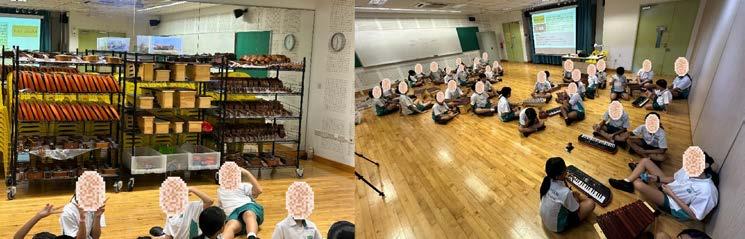
Students’ Voices
“The music lesson helps me to communicate with my friends more often.”
“You can learn to be confident when talking to people you don’t usually talk to.”
“I enjoy the lesson because we can play with different instruments.”
Discussion
Adaptive thinking is defined not just by the ability to solve problems, but by the cognitive agility to navigate complex, dynamic, and uncertain situations. It is the capacity to monitor one’s environment,
“Add more instruments so that we can make new sounds for learning.”
“Showing care and respect for one another.”
“Listening and responding to music better.”
“We take turns to hear each other’s sounds.”
recognise when a current strategy is ineffective, and rapidly pivot to new approaches in real-time. This competency relies heavily on specific dispositions such as open-mindedness, resilience in the face of ambiguity, and the courage to take calculated risks.
Figure 1: Music instruments and seating arrangement during lessons.
In addition, it is grounded in values like collaboration, as students must adjust their thinking in response to the actions of their peers. As outlined in the development milestones, students progress from needing scaffolded support to make these adjustments, towards autonomously demonstrating this flexibility in spontaneous scenarios.
The lessons on CFMI provided fertile ground for observing these milestones in action. Possible traces of adaptive thinking which took place during these lessons included how students explored using different instruments in their interactions with each other, and how they spontaneously responded to one another during the improvisation activity. The students practise a version of their improvisation a few times, but during the actual performance, they may come up with a different version than that which they have previously practised and agreed upon. Despite the initial rowdiness, I observed groups genuinely listening and responding to each other in real time, while ignoring the noise around them. I fondly remember four girls, who were exploring different melody lines simultaneously, constantly adjusting their contributions to create something cohesive. There was also a moment when a student was worried about her absent group members. I suggested she join another group and “make up something new altogether”. Her immediate acceptance revealed adaptive thinking in action!
Limitations
This study’s primary limitation is its short duration. With only six lessons, the research provides a mere snapshot of how CFMI can encourage adaptive thinking.
This brief timeframe makes it difficult to ascertain whether the observed behaviours are directly linked to CFMI’s processes or result merely from improvisational practices.
Therefore, the findings should be interpreted as preliminary indicators of CFMI’s potential, rather than conclusive evidence of its longterm impact on fostering adaptive cognitive skills in Primary students.
Conclusion
When specifically examining its contributions to developing adaptive thinking within the Emerging 21st Century Competencies (E21CC) framework, CFMI appears to offer robust opportunities for this particular development milestone.
CFMI’s inherent characteristics — including its emphasis on real-time musical negotiations, cross-cultural dialogue, and spontaneous problem-solving — align themselves directly with the adaptive thinking skills outlined in the E21CC framework.
Acknowledgements
Dr. Ng Hoon Hong, Senior Lecturer, National Institute of Education, for his dedicated efforts in exploring CFMI and for his support in my learning of CFMI.
References
☑ Sawyer, R. K. (2006). Group creativity: Musical performance and collaboration. Psychology of Music, 34(2) , 148–165. https://doi.org/10.1177/0305735606061850
☑ Koutsoupidou, T., & Hargreaves, D. J. (2009). An experimental study of the effects of improvisation on the development of children’s creative thinking in music. Psychology of Music, 37(3) , 251–278. https://doi.org/10.1177/0305735608097246
☑ MacDonald, R.A., Wilson, G.B. (2014). Musical improvisation and health: a review. Psych Well-Being 4, 20 (2014) . https://doi.org/10.1186/s13612-014-0020-9
☑ Biasutti, M. (2015). Pedagogical applications of cognitive research on musical improvisation. Frontiers in Psychology, 6 , Article 614. https://doi.org/10.3389/fpsyg.2015.00614
☑ Ng, H. H. (2019). Collective free music improvisation as a sociocommunicative endeavor: A literature review. Update: Applications of Research in Music Education, 37(2) , 15–23. https://doi.org/10.1177/8755123318784109
☑ Ng, H. H. (2021). The value of learning collective free music improvisation: Preservice music educators’ perspectives. Journal of Music Teacher Education, 30(3) , 40–53. https://doi.org/10.1177/10570837211018287
☑ Ng, H. H. (2022). Learning collective free music improvisation as a sociocommunicative endeavor: Preservice teachers’ journey in a teacher preparation course in Singapore. International Journal of Music Education, 40(4) , 571–586. https://doi.org/10.1177/02557614221079871
☑ Ng, H. H. (2023). Facilitating Collective Free Improvisation Learning in Teacher Education. Journal of Music Teacher Education, 33(1) , 15-30. https://doi.org/10.1177/10570837231168410 (Original work published 2023)
Space, Aliens, and the Improvising Teacher
Lim Soon
Keong
Joseph
Naval Base
Primary School
Mission Overview
Mission
Establish contact with Collective Free Music
Improvisation (CFMI) and bring it into the Singapore primary school music classroom
Orders From
Ground Control Commander: Dr. Ng Hoon
Hong (senior lecturer at NIE (National Institute of Education) who developed CFMI).
Crew Specifications
❶ Students from the Beacon for Life (BFL) after-school programme.
❷ BFL caters to students from diverse family backgrounds who would benefit from additional support.
❸ 14–20 students from Primary One to Primary Six levels.
Mission Duration
Seven one-hour weekly lessons.
Coverage of Mission Report
Part 1
How is the CFMI theoretical framework applied practically in the classroom?
Part 2
What did I learn as an improvising teacher?
Part 1: How is the CFMI Theoretical Framework Applied Practically in the Classroom?
Introducing the CFMI Theoretical Framework
Definitions
Ng’s formal definition
My simplification
“Idiom fluid socio-communicative endeavour where improvisers express themselves freely in context” (Ng, 2023).
Talking to each other using music.
3 Enablers of CFMI
Shared Understanding Personal Language
The musical conversation’s “overarching scenario or context shared by all performers” (Sawyer, 2006).
Specific sounds used in the musical conversation.
Socio-musical Interactions
How performers interact in their musical conversation.
Applying the CFMI Theoretical Framework
Enabler Application
Shared Understanding
Students are space explorers meeting and communicating with aliens.
Enabler Application
Personal Language
☑ Students learn various alien languages through vocal and instrumental experimentation.
☑ Students first converse using the alien languages in pairs, and then in larger groups.
Types of Alien Languages

Species: Blob
Habitat Planet Zoak
Communicates by Saying “peep” and “doop” (has vocal cords)
Classroom Instrument Voice

Species: Blab
Habitat Planet Zo
Communicates by Tapping on an external frame (no vocal cords)
Classroom Instrument Djembe

Species: Grub
Habitat Planet Ni
Communicates by Strumming a stringed instrument (no vocal cords)
Classroom Instrument Ukulele
Click to view Blob’s video.
Click to view Blab’s video.
Click to view Grub’s video.
Enabler Application
Socio-musical Interactions
Monk’s (2013) Interactional Strategies
Simplification of Monk’s (2013) eight interactional strategies to just three Alien Talk Moves, to guide the musical conversations.
Part 2: What did I Learn as an Improvising Teacher?
Lesson 1: An improvising teacher models the valuing and development of student musical ideas
Reflecting on the Module’s Progress (Lesson Enactment)
SPACE EXPLORATION
JOURNAL ENTRY: LESSON 1
In the first lesson, we met the alien 'Blob', a creature with vocal cords. I also introduced whale songs and dolphin clicks, sounds that similar creatures with vocal cords create. As I prepared to move on, a student mentioned that rubbing the floor created sounds alike to the ones that dolphins make. At that point, I could have politely acknowledged his contribution and moved on to the next activity. Instead, I valued that contribution by expressing curiosity and interrupting my own lesson plan to explore that musical idea
SPACE EXPLORATION
JOURNAL ENTRY: LESSON 6
In the sixth lesson, students split into groups to practise their collective free improvisations. One all-girl group worried me. They seemed to simply fiddle randomly with their instruments without any musical direction. I decided to intervene (Video 3).
As I got the group to begin improvising, I heard a musical motif from one student (a djembe tap). I valued it by saying “I liked it”. During the post-observation interview, a fellow educator noted how my body language was affirming and motivating to the students (Audio 1). This reminded
(Video 1). In the resultant unplanned whole-class activity I also modelled how a musical idea can be developed by varying dynamics and texture (Video 2).
Valuing and developing others' musical ideas is intrinsic to improvisation. In jazz, small ideas from one musician can be developed by another into elaborate creations. To become an improvising teacher, I first had to be an improviser — not just modelling musical development, but improvising pedagogically by valuing and developing students’ ideas at unexpected moments.
me that teachers model valuing through embodiment, not just words. I then used the djembe to show how varying dynamics and intensity could develop their musical idea. This seemed to inject sudden energy and inspiration into the group. After this, I also demonstrated how two different instruments could interact or ‘talk’ to each other.
The group’s final performance was beautifully pointillistic in style, evolving from a single soft djembe tap that developed in complexity and dynamics. That djembe idea was their improvisation’s seed (Video 4)!


Click to view Video 1 (Valuing floor rubbing).
Click to view Video 2 (Floor rubbing development). Click to view Video 3 (Intervention).
Click to view Video 4 (Final Performance).
Click for Audio Log of Dr Chua’s observation.


Lesson 2: An improvising teacher has varied sources of inspiration
Exploring the Module’s Genesis (Lesson Preparation)
Challenge Source of inspiration
How might the ‘sociocommunicative’ nature of CFMI be actualised?
Classroom Talk Moves.
☑ Intended to improve quality of classroom discussions across various subject areas.
☑ Talk Moves like ‘Revoice, Repeat, Add-on, Wait-time’.
Application
☑ ‘Musicalising’ these Talk Moves to structure the improvised musical conversations.
☑ This led to the Alien Talk Moves: Repeat, Argue, and Wait Time.
How might improvised musical conversations be introduced and scaffolded?
Allen Losey’s (2024) workshop on drama techniques in music.
☑ In the warmup activity, participants conversed in pairs using made-up languages and sounds.
☑ Improvised musical conversations could first begin with vocal experimentation before transitioning to instruments.
How to make these concepts of speech and dialogue exciting to my diverse BFL students?
A book: Alien Listening by Daniel Chua and Alexander Rehding (2021).
☑ This book is based on the Voyager Golden Record, which is a phonograph record of various human music (like the music of Bach and folk music) that was blasted into space by a National Aeronautics and Space Administration (NASA) Voyager Spacecraft.
☑ The book explores how aliens might analyse and think about human music.
☑ Like the Golden Record, I had to blast the lesson plan into space.
☑ By decontextualising sounds from their regular ‘musical’ context, and embracing a more esoteric ‘Alien’ theme, students would be more daring to create and experiment with sounds.
Reflection
This lesson preparation process felt like an improvisational performance. As an improviser, I did not create in a vacuum but was inspired by prior life and musical experiences, adaptively recombining them in novel ways.
Conclusion
I certainly had a blast exploring CFMI in the classroom. Translating theoretical concepts into practical lessons was challenging, yet fulfilling. The struggle in lesson preparation and lesson enactment taught me valuable lessons that I will remember as I continue developing as an improvising teacher.
These lessons — ‘modelling the valuing and development of student musical ideas’ and being continually ‘inspired by varied sources’ — are teacher attributes that extend far beyond mere music improvisation.
I really hope that my Ground Control Commander, Dr. Ng, considers this mission a success!
References
☑ Monk, A. (2013), Symbolic Interactionism in Music Education: Eight Strategies for Collaborative Improvisation, Music Educators Journal 99(3) , 76–81, https://doi.org/10.1177/0027432112467823
☑ Chua, D. K. L., & Rehding, A. (2021). Alien listening: Voyager’s Golden Record and music from Earth . Zone Books.
☑ Losey, A., (2024, August 27). Enhancing Primary School Students’ Learning of Singing with Drama Strategies . Teacher-led Workshop, CHIJ Primary Toa Payoh.
☑ Ng, H. H. (2023). Facilitating Collective Free Improvisation Learning in Teacher Education. Journal of Music Teacher Education, 33(1) , 15–30. https://doi.org/10.1177/10570837231168410
☑ Sawyer, R. K. (2006). Group creativity: Musical performance and collaboration. Psychology of Music, 34(2) , 148–165. https://doi.org/10.1177/0305735606061850