The exploration of fashion as an indicator of the state of the economy
The rise and fall of the short-lived phenomenon that took the 70’s by storm Disco Death
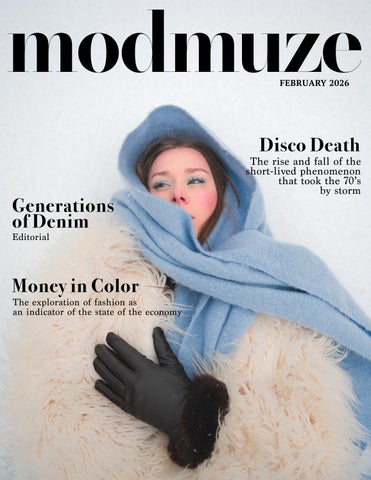
Disco Death
The rise and fall of the short-lived phenomenon that took the 1970s by storm
Outgrowing Boundaries
How fashion becomes a reminder of personal growth
Finding Small Joys
A reflection of building resilience through reclaiming personal joy
Snow Way!
Disintegration
A short story rooted in 80’s horror
Generations of Denim
How (Fake) Nails Grew
Looking at the rise in Acrylic Nails
Money in Color
The exploration of fashion as an indicator of state of the economy
Timeless
Time Capsule
Celebrating. the Soul of Vintage Fashion
Editor’s Note
Editor’s note
The Modmuze team and I are so excited to invite you to read this issue, “If not for my art, do I even exist?” A celebration of how art is perceived through different perspectives and how it shapes us as individuals. When the idea was first brought up, I immediately loved it because art truly is interpreted differently by every person you meet.
Hi! Thank you so much for engaging with the newest Modmuze issue: Time Capsule. The team and I wanted to create something that not only highlights vintage but also explores how vintage is intertwined throughout history. How time shapes what we love, and how we, in turn, preserve it. This issue is dedicated to the ways vintage can be rediscovered, reimagined, and celebrated with love. Vintage is not just an aesthetic; it is history you can wear, hear, and feel. It carries stories, memories, and moments from eras that helped shape the world we live in today.
Art isn’t always found in galleries; sometimes it’s stitched into the seams of our clothes, written between the lines of our choices, expressed through the way we grew up, the stories we read, our political beliefs, and so much more. “If not for my art, do I even exist?” is not a question of vanity, but of being, a reflection of how deeply creation and identity intertwine. Through every feature, photograph, and thread of inspiration in these pages, we explore what it means to exist because of the art we create.
I have always loved the vintage aesthetic from a young age. From the fashion to the music, to the simplicity that defined certain points in history, it has always felt special to me. That love has stayed with me throughout my life and continues to grow. I have always felt that vintage holds so much history, time, and memory, and there is something so beautiful about that.
Lately, I’ve been realizing just how fast time moves. I graduate in six months, and while I’m so excited for the future, I’m also scared, but in the best way. From starting college to now, I’ve seen how much I’ve grown, and how much my friends and family have too. It’s made me appreciate the importance of slowing down and truly living in the present. Running this magazine has been one of the most meaningful parts of that process. Writing and fashion have always been my art. My way to relax, reflect, and be creative. When I first accepted this position, I doubted whether I could lead it well since I’d never done anything like this before. But seeing this issue come to life has filled me with so much gratitude and confidence.
If I could offer one piece of advice to anyone who’s in a similar place. The feeling of being uncertain, nervous, or hesitant it would be this: go for it anyway. Even when you’re uncomfortable, even when you’re scared. You’ll never know what you’re capable of until you try. I was terrified of failing or disappointing people, but standing here now, I couldn’t be more proud of myself and of my amazing team. Don’t let fear stop you from creating or chasing what you want.
As generations change, so does the meaning of vintage. Watching it evolve has been both amazing and slightly discomforting. Discomforting because it reminds me that I am growing older alongside it, and that time keeps moving forward. Growing older is such a blessing, but it can also feel scary when you realize that the things you cherished as a child are now considered “vintage” to a new generation. Time can feel like both a blessing and a curse in that way. Seeing trends return after 15–20 years, watching what was once loved fade and then come back again, it is all so bittersweet. Recently, I have had a lot on my plate, with both external and internal challenges. One thing that has consistently brought me comfort and peace has been my love for vintage music, writing, and fashion. It grounds me. Life around me can change, but my love for these things has remained steady through every phase of my life. That consistency eases my worries about the future and reminds me of who I am. It has also strengthened my connection with my family and friends. My mom is the one who truly introduced me to vintage through her music and fashion. It built a strong foundation between us and has shaped so much of who I am today. Vintage feels like a universal language, much like love. You can almost always find common ground with someone through shared nostalgia, music, fashion, or memories from another time. It builds bridges you didn’t even know existed, not only between people, but within yourself. Though this is my first year as Editor-in-Chief and my second year overall at Modmuze, it has become a creative outlet for me, something at times hard to find. I feel like I can be fully authentic here, while watching others embrace their authenticity with each issue as well. It hasn’t always been easy, but pushing through the challenges and growing from them has been such a blessing. The past few months have been difficult, and having my team’s support and a space to express myself has meant more to me than I can put into words. I am so incredibly thankful for my team and for what Modmuze has given me. I hope you all enjoy this beautiful issue. Embrace vintage. Embrace history. We never truly know when certain moments, styles, or eras will fade into memory. They shape us more than we realize, and in many ways, they define who we become.
Love,
To my team and our executives, thank you. I could not have done this without you. You poured so much love and energy into this issue, and it shows on every page. I’m endlessly proud and grateful to share your passion with the world. Finally, this issue is a love letter to the creators, the dreamers, and those who blur the line between living and creating. It’s for anyone who finds meaning in movement, in culture, and in the art of simply being themselves. Here’s to the art that saves us, defines us, and dares us to be seen and heard.
Love,
EDITOR-IN-CHIEF & President Karli Clemons, MKTG
CREATIVE DIRECTOR & Vice President Erin Kistler, DM
PRODUCTION DIRECTOR Madison McMaster, GD
MARKETING DIRECTOR Hannah Cozens, SM, SC
PHOTOGRAPHY DIRECTOR Loren Rogers, DM
STYLING & MODEL DIRECTOR Reese Ehrhart , DM
TREASURER Riley Kirkman, DM
modmuze is a fashion and lifestyle magazine produced by students, for students. Our magazine provides a unique platform for students to freely express themselves creatively in any and all ways imaginable.
WRITERS
Aliyah Young
Margot Munson
Brooklyn Taylor-Talbert
STYLISTS
Lisabriela Calleros
Sarah Evan Mitchell
Madelyn Campbell
Emily Bass
Zoe Hoffman
Aubrey Wagner
PHOTOGRAPHY
Reagan Downs
Mathai Jones
Our Mantra Empowering self-expression
MARKETING
Kamryn Major
Sarah Miller
Rylee Day
Georgia Matthews
PRODUCTION
Triere Nikel
Kayla Gross
modmuze editorial team
Directors
Karli Clemons Editor in Chief & Writing
As the President, Karli keeps the whole magazine running by making executive decisions and managing all the fine details while supporting her team and the writers.
Madison McMaster Production
In charge of Production, Madison oversees the team that makes the magazine come to life.
Hannah Cozens
Marketing & Secretary
In charge of Marketing, Hannah creates innovative projects for her team and turns their content into postable content.
organized and maximized for members to have more
Loren Rogers
Photography
In charge of Photography, Loren directs and manages her team while contributing to the visual artform itself.
Reese Ehrhart
Styling
In charge of Styling, Reese inspires her teams creativity with wordrobes and settings while managing their extensive process.
DISCO DEATH
Author: Aliyah Young
The rise and fall of the short-lived phenomenon that took the 1970s by storm
Disco died at the young age of ten years old. The short-lived phenomenon took the 1970s by storm. The genre was more than a melody; disco was a culture. The disco wave was known for a steady four-beat rhythm, funky synths, DJs, dance, and a vibrant nightlife that transformed sound forever.
It was so impactful that disco became polarizing and induced an anti-disco division. Movements like “Disco Sucks” erupted, growing loud and angry. They attacked the overwhelming support of disco, claiming it took supremacy over the generation and suffocated other genres that wanted to be heard. The culture clash between disco and rock fueled the fire. Rock icons like Steve Dahl, a former rock radio host in Chicago, were major anti-disco instigators of the late 1970s. He became a catalyst for the death of disco and pushed the Disco Sucks movement to its peak by leading “Disco Demolition Night” on July 12, 1979. Crates of disco records were blown up in protest.
This notorious stunt ended in a riot. Though Dahl claims his motives were driven by a deep, humorous dislike of disco, overcommercialization, and a strong love for rock & roll, others took a different message from the event. The movement targeted Black, Brown, and LGBTQIA+ communities, who felt specifically liberated by the freedom disco represented. The combination of hostility toward the people responsible for the innovative formation of disco and disdain for disco’s persistent rise in pop culture effectively killed the genre.
Photographer: Reagan Downs
Model: Arranton Thomas
Styling: Aliyah Young
Production: Madison McMaster
Though disco died, its legacy did not. The electronic, rhythmic, synth-heavy sound disco leaned into did not disappear in the debris of Disco Demolition Night. It lived through the songs of the 1980s, influencing genres like electro, house, and hip-hop. It is fair to say that disco did not die from natural causes. The inferno that burned it can be traced to a night in history, but maybe the true criminal has been walking among us, living with the evidence. The genres that succeeded disco had every motive to kill it. They took the place of disco’s mainstream domination by evolving from disco’s discoveries. If this is the case, then it is necessary to investigate which genre did it.
Suspect #1: Electronic Music
Electronic music hit the charts hot amidst the rise of synth-pop in the early 1980s, conveniently following the death of disco. Accompanied by futuristic aesthetics armed with neon lasers and airbrushed art, electronic music became its own subculture. Its sound consisted of fun, fast-paced tracks, and the fashion was as loud as the music—often inspired by synth-pop and alternative bands like Duran Duran and New Order. The genre of electro is wide, encompassing both pop and punk. It is only right to mention the King of Pop, Michael Jackson, and his reign over the 1980s. Jackson took synth-driven electronic pop and fused it with R&B, creating a revolutionary worldwide obsession. The success of electro should raise some eyebrows. Could it be the genre that swallowed and replaced disco, blasting it with futuristic lasers? Or is it just a coincidence that a genre so heavily influenced by disco rose as soon as disco fell?
It is possible that electro was an accomplice to disco’s demise, but it cannot be pinned without further inspection.
Suspect #2: House Music
House music was also present at the scene of the crime. It can be traced back to Chicago, a very familiar place to disco. House music took disco’s rhythmic, dance-oriented sound and fused it with soul, creating funky, soulful hits like Your Love by DJ Frankie Knuckles. The infectious beats of house music were adored by those grieving the loss of disco. Knuckles even referred to the house as
“Disco’s Revenge,” filling the hole disco left on July 12, 1979. The deep admiration for disco held by the pillars of house music makes murder seem improbable. The genre was created through an aching loss of disco.
Suspect #3: Hip-Hop
Hip-hop presents a complex alibi. The genre evolved from disco, inheriting its dance culture and fast pace. Early pioneers like Grandmaster Flash and the Furious Five dominated the scene in the early 1980s. Hip-hop was dangerously cool. Breakdancers, MCs, and DJs had their time to shine in what many describe as the Golden Era of hip-hop. The genre was sample-heavy, often pulling from disco-era tracks and earlier music. Lyricism and imagery played a major role, frequently used for political activism and social awareness. The two genres coexisted with a relationship more like friends than rivals.
Having examined the suspects, the verdict is clear. Hip-hop is not the killer of disco. Though it may be an accomplice, as it rose in popularity after disco’s death, there is not enough evidence to call it guilty. House music is completely exonerated. Although its rise looks suspicious, its ascension was rooted in pure love and respect for disco. That leaves the final suspect: electronic music, red-handed. Electronic music and its diverse subgenres murdered disco by taking over the charts while using the same techniques disco once did. Electronic is a smooth criminal, sneakily replacing disco while distracting the world with generational hits.
Disco’s death did not kill disco fever. Today, a wide range of genres sample disco tracks and take inspiration from the disco era. Disco is dead, but its spirit lives on through today’s artists. The genres that grew alongside disco, like hip-hop and rock, evolved and continue to flourish. In honor of disco, it is fair to wonder: if disco never died, what would it have evolved to sound like today?
OUTGROWING
BOUNDRIES
Outgrowing your old self doesn’t always happen suddenly. Sometimes it’s subtle. It can appear in small ways, like when you notice the clothes you used to wear no longer feel like they fit you. Fashion is one of the most obvious indicators of growth because it shows how you view yourself and how confident you are in showcasing that version of you. Initially, my style lacked a distinct identity, just regular shirts, maybe ones with an occasional design, and regular jeans. I wore whatever was available, comfortable, or blended in. There was no purpose behind it—no true sense of self being expressed. As I matured and became more aware of who I am, my fashion began to change as well. I leaned towards a more punk and alternative style, more graphic T-shirts. My pants normally had some design on them, were wide-legged, or baggy.
Author: Brooklyn Talbert Taylor
As my style evolved, the way my clothes fit me changed too, both physically and emotionally. They began to feel like they were meant for me, and it made me more confident because it felt like I was in my own skin instead of just throwing something together. Discovering your personal style is a process of experimentation. It requires trial and error, confidence, and even discomfort. Support from others can help us find our style. Sometimes hearing the words “oh that looks really good on you,” or “that fits you well,” can push you further.
Photographer: Reagan Downs
Model: Madelyn Campbell
Styling: Emily Bass
Production: Loren Rogers
Marketing: Sarah Miller
Over time, I also realized that personal style isn’t confined to one environment. With intention, you can adapt it to any setting, school, work, or social gatherings without losing what makes it uniquely yours. Sometimes when I was at work, I would try to find similar stuff, like a plain shirt, while also still having on my baggy jeans or ripped jeans. I still felt like I was dressing for myself and my job because we were allowed to keep things casual at the time, and that was my casual. It’s also about finding balance because you can keep your style while remaining professional. Now, my clothing communicates for me. People can identify me by my outfits before they recognize my face. During high school, when I first started dressing this wayhere would be times when my best friend would come looking for me in the bathroom and could tell which stall from my shoes alone. And her reply would always be, “Not hard to find you, I know how you dress.” That’s when I realized my fashion had transformed into more than just clothing; it became a signature. A visual reminder that I’ve grown, evolved, and outgrown the version of myself that was afraid to be seen.
Finding Small Joys
Models:
Styling:
Production: Triere Nikel
Marketing: Kamryn Major
Photographer: Cosette Branstetter
Presley McFarland, Ava Poos, and Sydnie Schaudt
Aubrey Wagner and Madelyn Campbell
We all strive to do our best in life, yet we frequently forget to support ourselves. It’s simpler to focus on what we lack than to appreciate how much we’ve achieved. Amidst the many things we balance expectations and responsibilities, we overlook that simply moving forward is an accomplishment in itself. Resilience isn’t always loud or dramatic. Often, it means getting up on days when you feel exhausted and trying to push through even when your motivation is low, and remembering to be kind to yourself when things don’t go as planned. Resilience is developed quietly using self-kindness and self-awareness. Because you’re focusing on your own tolerance rather than someone else’s and measuring yourself against them. It shouldn’t look like “oh well, they can do this, then I should too.” Your tolerance level is yours for a reason.
Being present in your daily life is crucial for building that resilience. When you take the time to truly experience your life, small routines and everyday victories, whether big or small, you create space to breathe. These moments serve as emotional anchors. They stabilize you when things feel overwhelming and remind you of who you are when you feel lost. An emotional anchor could be a morning routine, a favorite song, a comforting outfit, a familiar place, or even a deep breath taken at the right moment. These anchors don’t eliminate struggle, but they help you endure it. Joy is personal. It’s what makes you feel like yourself again. It’s what rejuvenates you, steadies you, and gives purpose to the effort you invest in living. Defining what joy means to you on your own terms. And like resilience, it’s something you are entitled to claim, nurture, and protect. By choosing to be present, to acknowledge your resilience, and to define your own joy, you become your own cheerleader. Sometimes, that support is precisely what propels you forward.
SNOW WAY !
Photographer: Loren Rogers
Model: Riley Kirkman
Styling: Riley Kirkman
Production: Loren Rogers
Marketing: Erin Kistler
Disintegration
By: Aliyah Young
Bang. Bang. Bang.
A heavy, loud thump shook the door in its frame. Bang. Bang. More urgent now. I opened my eyes in panic. The dark room swallowed my sight.
“What?” I yelled, my voice cracked and groggy.
“Get up. We’re gonna be late,” Nia’s voice permeated through the wood. “I’m not leaving until you open this door.”
“Okay, okay, I’m coming,” I mumbled. Begrudgingly, I pushed myself up. A faint, muted hum spilled from the tangle of my disheveled sheets. A distant, melodic whisper: “Softly through the shadow of the evening sun… Stealing past the windows of the blissfully dead…” My Walkman. I fumbled through the comforter until my fingers hit the hard plastic shell.
“Yes,” I exhaled. In a rushed haze, I turned on the light, grabbed my purse, and yanked the door open.
Nia greeted me with an eye roll. “Our one day off and you spend it locked in your room, asleep.”
“I was not asleep. I was listening to music.”
“What, in your dreams?” she snarked. Her eyes lowered and landed on the Walkman in my hand, and a familiar, teasing smirk crept onto her face. I braced myself. “And why are you still using this thing? Jade, you literally have an iPhone.”
“Nia, you literally have a boyfriend. Why are you still texting Drew?”
“I told you, he’s a work friend. It’s different. We wouldn’t have these tickets without him, so be grateful.”
“Okay,” I sighed, reaching for my Walkman. “I’m grateful.”
“Are you wearing that?”
I looked down at my jeans. “Um, yeah? What’s wrong with this?”
“It’s not the eighties anymore. Normal jeans exist.”
“These are normal. Sorry, I’m not—” Ding. Her phone lit up, cutting me off. “Is that Drew?” I quipped.
“No,” she said through a stifled smile. “Our Uber’s here.”
The night was dark and cold. So dark that I checked the time.
“How is it pitch black at 7 PM?” I questioned.
“Right?” Nia agreed, shivering. “And why did he park so far?” The car idled at the far end of our street, alone, shadowed by the roof. We hurried toward it, our staggered breaths revealing themselves in the crisp air. Nia leaned toward the rolled-down window. “Are you Mark?” The driver was pale, with deep-set dark eyes and a scruffy, patchy beard. His smile was wide.
“Yes,” he replied. Nia and I exchanged a glance. My hand found the pepper spray in my pocket.
“Can you show me your phone?” I asked sternly, my voice tighter than I expected.
“Oh—yes. Sorry,” he stuttered, then held up his Uber app. My shoulders slumped.
“Thank you,” I said, forcing a chuckle, hoping I didn’t offend him. We slid into the backseat. The interior was black—sleek but worn. The ride was silent. I stared out the window, watching the trees blur past, climbing them with my gaze from the trunk to the leaves. I tilted my head back. “The stars,” I whispered. “There’s so—there’s so many.”
In a panic, I texted Nia. Can you see his eyes in the mirror? A second later: No.
Chills shot up my spine. A skewed reflection, I told myself, and tried to avoid looking at it—but I couldn’t. My eyes were drawn to his unblinking gaze.
“Um, sir?” My voice trembled.
“Yes?” he replied. In the mirror, his eyes flickered, like a film catching up to itself. The sensation of being watched intensified, as if something else was peering out from behind them.
Nia, sensing my hesitation, swooped in. “Do you know why so many stars are out tonight?” she asked overly sweetly. She nudged my leg. Get it together.
“Probably because it’s so dark,” Mark replied pleasantly. “I prefer it this way.”
“Why is it so dark?” she asked.
“I stared back, waiting for him to break, but he didn’t.”
Nia looked up. “It’s beautiful.” I turned warmly toward Mark, about to comment on the stars, and met his eyes in the rearview mirror. I jumped. He was staring directly at me. I stared back, waiting for him to break, but he didn’t. Worried, I bobbed my head to see if the reflection was somehow wrong.
“The winter solstice. The darkest day of the year.” A pause. “Why, are you scared of the dark?” He smiled, but his eyes didn’t.
“No,” Nia said, offended.
“You in the corner back there?” he asked. “Are you?” I couldn’t speak. All I could muster was a weak, breathy exhale as I forced my face to smile. The rest of the ride passed in eerie silence. Slow and silent, the car rolled forward as if it were being pushed. Finally, we arrived. The cinema parking lot was filled.
“Thank God we Ubered,” Nia said. “Parking would’ve been a nightmare.”
Mark pulled to the curb. “Is here okay?”
“Perfect,” Nia said.
“Thank you,” I murmured, scrambling out.
“You girls have a good night!” he called after us, too cheerfully. “Don’t let the bedbugs bite!” The theatre was packed, a hive of muffled whispers and rustling snacks. By the time the credits rolled, a deep exhaustion had settled in.
“Have you ordered the Uber yet?” I asked as we poured into the lobby.
“Obviously,” Nia said, checking her phone. “It’ll be here any second.” Outside, a familiar dark car waited at the curb. The window slid down, revealing Mark’s same wide grin.
“Jade?” he asked. A knot of dread tightened in my stomach.
“Yes,” I said, swiftly sliding in, hoping to get this ride over with. Before Nia could follow, the doors slammed shut, locking with a soul-crushing click.
“Hey!” Nia screamed outside the car. The car lunged forward, throwing me against the seat.
“What are you doing?!” I screamed, swinging my purse at his head. It connected with a thump, but he didn’t flinch. “Stop the car!” I shrieked. I clawed at him—jabbing, pulling, scratching. Nothing. In a final, desperate move, I lunged between the seats and aimed a stream of pepper spray into his eyes. He didn’t twitch. I battered the windows and kicked the door. The glass felt unnaturally solid. He accelerated; the world outside blurred into a messy slop of gray. I fumbled for my phone. The screen was dark. Dead.
“No power,” he said flatly. Trembling, I slowly lifted my gaze to the rearview mirror. His beady, black eyes were fixed on me.
“What are you?” I pleaded. “What is this?” We barreled down an empty, treelined road at an impossible speed. “Where are we going? Answer me!” He chuckled, still glaring at me. I looked away, searching the dark interior for anything, and my vision landed on his arm draped over the console. It was… wrong. Disgustingly long. Covered in sparse, rodent-like black fur, dispersed in candy-cane-like stripes, revealing patches of scaly, pale skin beneath. It was not like that before. A wave of nausea hit me. This is not real. This is not real. I squeezed my eyes shut.
“He smiled, but his eyes didn’t.”
When I opened them, his head was twisted fully around, facing me. The wide grin was now a vicious slash filled with needle-sharp, stained teeth. The beady eyes had multiplied—a cluster of eight glistening black holes on the upper half of his grotesque, enlarged face. “NO!” I blurted, covering my eyes. I shook uncontrollably. I heard the wet, clicking sound of his mouth opening and closing. Hungry. The thought was a brick in my chest. He’s hungry. The Spiderman is always hungry…
The song. The lullaby on my Walkman.
“On candy-striped legs the Spiderman comes, softly through the shadow of the evening sun…”
Candy-striped legs. Like his arms. If this is real… this thing is from The Cure. I racked my brain, scrabbling for the next lyric. But I couldn’t remember. I couldn’t think at all.
A cool breeze touched my cheek. He had turned back to the front. This was my chance. Slowly, I reached into my purse, my fingers closing around my Walkman. Shakily, I put on my headphones. A click, a whirr, and the soft melody filled my ears.
“…Looking for a victim, shivering in bed, searching out fear in the gathering gloom…”
Click. I hit pause, my heart hammering against my ribs. Searching out fear. Did it pick me? Had it smelled my fear in the car?
Click.
“And there is nothing I can do when I realize with fright, that the Spiderman is having me for dinner tonight.”
In the mirror, all eight of his eyes were glued to me. The car sped on into the darkness as I listened to the lullaby.
Photographer: Mathai Jones
Model: Sarah Evan Mitchell Styling: Zoe Hoffman & Aliyah Young Production: Kayla Gross Marketing: Hannah Cozens
Production: Madison McMaster
Marketing: Hannah Cozens
Generations of Denim
Photographer: Loren Rogers
Models: Jordy Secrest, Karli Clemons, Madison McMaster, Lisabriela Calleros
Styling: Reese Ehrhart
How (Fake) Nails Grew
By: Margaret Munson
If you feel like you’ve been seeing more and more sets of acrylics around lately, you aren’t crazy, and this isn’t the first time in history people have felt this way.
Acrylics were first invented in 1954 by a dentist by the name of Dr. Fred Slack, who had broken his nail and tried to fix it using a resin in his office. This was eventually innovated and put into regular nail salons; however, at first, the general public did not trust the technology.
The initial boost in popularity came through the 1960s to the mid 1970s. Many factors contributed to the newfound popularity of unnatural nails and brighter colors being applied to them.
These are mostly social factors like a departure from the conservatism America saw in the 50s and a more trusting public coming out of the massive economic boom at the end of 1959. The other part of acrylics' meteoric rise to becoming the most popular manicure in the country was celebrity endorsement. People like Cher, Donna Summers, and Diana Ross had their nails enhanced for every performance, and the public quickly took notice. When these celebrities would wear acrylic nails throughout their live performance and variety shows, people then started to ask for longer and more colorful nails at their own hometown manicurist rather than a plain French tip or solid coat.
“-many were trying new things in the beauty sector that they wouldn't have before.”
Photography by: Hannah Cozens
Models: Brooklyn Brigham and Yasmin Castellanos Styling by: Lisabriella Calleros
In the 1980s, they soared in popularity, finally being the most popular thing to ask for when going to any salon for a manicure. They hit their peak in the eighties, with one iconic moment being when Olympian Florence Griffith-Joyner wore approximately six-inch-long square tip acrylics to become the fastest woman in the world. In the 1990s, when grunge and punk styles took over the popular culture, the popularity of long and feminine acrylic nails dropped off because it was seen as something of the past. With a few notable exceptions, such as large French tips
and glittered flared or duck nails. However, they have recently come back stronger than ever. Many people believe this was indirectly caused by the effects of the COVID-19 pandemic. Since people were inside and some pieces of culture were steadily coming back, With this, many young people began to do their own nails and discover designs they could enjoy and have for a longer amount of time than typical polish. Coming out of the pandemic, their popularity rose as the accessibility to artificial nails became more and more prevalent.
MONEY IN COLOR MONEY IN COLOR
FFashion gives many indicators of the time and place you live in, including what’s trening, reserve levels, and even what the temperature outside is. However, fashion is also one of the lesser-known indicators of the state of the economy. Many examples support the idea that the amount of color in a wardrobe can indicate whether or not the economy is doing well. There are many reasons for the shifts in vibrancy seen in everyday wardrobes when the economy goes through ups and downs. Most of these reasons are financial, but some are psychological. When the economy is declining, consumers seek pieces they feel will last longer. These items are often black, grey, or cream-colored. When the economy is thriving, lower-income consumers feel more able to branch out and buy items they may only wear a few times, whether they are outside their comfort zone or for a onetime occasion. When necessary expenses like groceries or bills feel lower due to slower inflation, society tends to spend more on clothing.
At the same time, financial data shows more direct reasons for darker or more muted clothing becoming popular during recessions. These clothes are cheaper to produce. White or undyed fabrics cost less throughout the entire supply chain, whereas fabrics with patterns tend to increase production costs by about fifty percent compared to plain-colored fabrics. This trend has existed for centuries, but this timeline begins just before the Great Depression and ends just before Y2K. The reason flapper Halloween costumes are often black and white is not because of the limitations of film at the time. While the 1920s experienced sharp economic highs and lows, a steep decline just before the Great Depression caused even the most fringe-filled and shiny flapper outfits to become muted.
TThroughout the Great Depression and the entirety of the 1930s, people were barely surviving, if they survived at all. Most clothing was plain white because production was almost entirely U.S.based; manufacturers could not afford colored fabrics, and consumers could not afford them either.
After years of economic struggle, World War II ended, and the economy soared. From 1945 to 1960, the consumer was king, and it was visible in everyday life. Pastels ruled the 1950s, from the dresses women wore to the suits worn by their husbands. Everything was colorful and light-toned, and even lighter hair colors became more popular.
This shifted in the 1960s. The economy was extremely strong, marking one of the largest expansions in U.S. history next to the Gilded Age. Clothing trends expanded as well. Pastels and hoop skirts faded, and bright, bold colors in shorter dresses became popular. Mod fashion emphasized geometric designs paired with vibrant colors.
Photographer: Hannah Cozens
Models: Keaton Mitchell
Styling: Sarah Evan Mitchell
Production: Triere Nikel
Marketing: Rylee Day
There are exceptions to any rule, and the 1970s serve as one for this discussion. Despite the economy struggling due to multiple gas crises and stagflation, so much so that the term was coined during this decade, bright colors such as orange, yellow, and tie-dye remained popular. This may be attributed to the sense of freedom people felt due to expansive government policies during this time, even without strong economic growth.
Following this, the 1980s began with a recession from 1981 to 1982, influenced by Reagan’s supply-side policies. Early 1980s fashion leaned preppy, featuring white and denim. After economic expansion later in the decade, trends shifted toward neon colors like pink and yellow.
Finally, in the 1990s, the country experienced significant economic growth, largely driven by the rise of computers in households. This boom was reflected in fashion through the popularity of metallic fabrics and colorful leggings. Later in the decade, supermodels became household names, and more Americans began purchasing designer brands. W