
Modern Dog Fall/Winter 2025/26 - US Edition

Page 1


60 The Friend You Didn’t Know You Needed After unexpectedly inheriting a dog, some surprised recipients found it’s exactly what their lives were lacking. BY

66 Too Big, Too Old, Too Damaged A lovely, heartstring-tugging, adoption-inspiring diptych from an artist that channels “radical compassion.”

READ YOUR BREED

64 The 14 Calmest, Most Laid-Back Dog Breeds Looking for a relaxed canine companion? These low maintenance breeds fit the bill!

72 Meet the “Mini Aussie” Get to know the good-natured, bright, and devoted Miniature American Shepherd. BY

Toys for Bored Dogs Discover the best dog toys with this guide to keeping your dog entertained and busy!

is Where the Dog is File under “want it!”

Dog Gear Look Book Staff favourites and current obsessions.

Healthy Paws Solutions for everything from itchy ears to digestive distress!

BODY

& SOUL

52 Good News for Dog Lovers

10 science-backed reasons why having a

54 Have Dog Allergies?

This scientist couple engineered a solution.

Osteoarthritis in Dogs

Spotting the signs and knowing the causes.

58 Dental Disease in Dogs

ON THE COVER

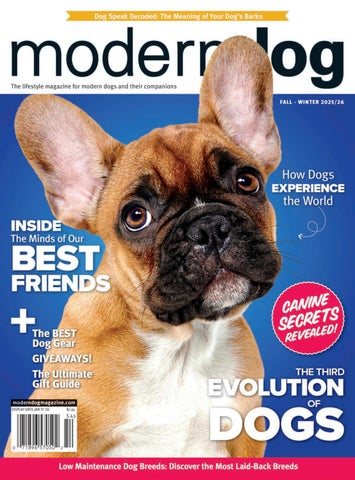
This issue’s cover dog Frenchie, an utterly adorable 10-week-old French Bulldog puppy, photographed by the very talented Shaina Fishman, an NYC-based commercial photographer specializing in pets. Find her at shainafishman.com.

DOG LIFE

20 We’re Giving It Away!

We’ve got 6 months of incredible giveaways—from GPS trackers for dogs to wellness prize packs—and winners every two weeks. See what’s up for grabs on page 20!

38 How Dogs See the World Around Them

New sensory insights reveal how our dogs experience the world around them—and how we can adapt our homes to match.

44 How Dogs Experience the World

A dog cognition scientist offers fascinating insight into what our dogs see, feel, hear, and think.

68 Connie’s Book Club

Editor-in-Chief Connie Wilson’s current selection of must-read books for dog lovers.

76 Tiny Dog Stories

Dog love in short form: miniature, reader-submitted dog stories of no more than 100 words.

80 Last Lick: Quotable

TRescue Rules

his issue celebrates canine life and the fascinating, wonderful creature that is the dog. We’ve dedicated this issue to better understanding our best friends, from their incredible senses to how they are evolving to meet the demands of modern life. If you’ve ever wondered what your dog is thinking, saying or feeling, this is the magazine for you!
Our dogs’ senses differ from ours in important ways, from the colours they see to the scents and sounds they are able perceive. On page 44, a dog cognition scientist offers fascinating insight into what dogs, see, feel, hear, and think in How Dogs Experience the World. What about barking? Different barks mean different things, of course. Can you tell the difference? Turn to page 42 for Dog Barks Decoded: What Your Dog’s Barks Mean.

In a recent study, scientists posited that dogs are entering a third wave of evolution. Discover what this means for our best friends and how they’re changing on page 30.

Of course, we’ve found all the coolest dog stuff, including a shortlist of excellent toys for bored dogs. (We love nothing better than testing dog toys!) You’ll also find recommendations for collars, leashes, beds, and more. Flip to page 26 for a Dachshund’s unlikely tale of survival. Read all about the recovery effort to find Valerie, a Miniature Doxie who spent an incredible 529 days alone in the Australian Bush—only to emerge in the best shape of her life.

And that’s not all. Get to know the most low-maintenance dog breeds, discover 10 science-backed reasons why having a dog is good for your health, and check out the “rubbish” pet portraits that have raised £400,000 for charity! We also share interesting dog facts, sciencebacked wellness picks, great gift ideas, giveaways, and so much more.

So, jump in! As always, thank you for being a part of our amazing community of dog lovers.

With love,

Happy Fans

We really enjoyed the latest issue and especially the article “Is My Dog Happy?” Yes, Maya and Milly are happy. How can you not be happy reading Modern Dog? —@thats_maya_zoya_latte

Some light reading at the book store for this adorable puppy Pom!

Max Loves Modern Dog
CONNIE WILSON WITH PENNY, PHOTO KHAREN HILL

Award-winning journalist

Tracey Tong is a lifelong dog lover and regular contributor to Modern Dog. A magazine editor and professor of journalism at Algonquin College, she lives in Ottawa, Canada with her husband and two daughters. In this issue, she shares the incredible story of Valerie the Miniature Dachshund (p 26) who spent 529 days alone in the Australian bush, captivating the world as she evaded capture at every turn.

Lisa Kanarek is a freelance writer with work published in The New York Times, The Washington Post, Huffington Post, and WIRED. She and her Husky, Gaia, are a therapy animal team that visits pediatric and hospice patients. She is working on a book about how they became a team and the work they do. Head to page 60 to read about the challenging yet heartwarming experience of unexpectedly inheriting a dog.

Teoti Anderson, CPDT-KA, KPA-CTP, is a Modern Dog regular contributor and the co-owner of A Dog’s Best Friend in Ft. Lauderdale, FL. A dog trainer for more than 30 years, she’s the author of The Dog Behavior Problem Solver, Ultimate Guide to Dog Training, and more. She also presents on canine behaviour to pet owners, humane organizations, and fellow pet professionals across the U.S. and internationally. Turn to page 42 for her unpacking of what your dog’s barks mean (they’re not all the same!).

Publisher Modern Dog Inc.

Editor-in-Chief

Connie Wilson

Editor & Creative Director

Jennifer Nosek

Design & Production

Megan Carpick

Sales & Marketing

Aly Stamper

Subscriptions & Office Administration

Anna Regino

Administrative Assistant

Mina Zivkovic

Sales

Simran Parekh

Comptroller

Cecilia de Roca Chan, CPA, CGA

Advertising inquiries call (866) 734-3131 or email advertising@moderndogmagazine.com

MODERN DOG (ISSN 1703-812X) Volume 24, Issue 2. Published semi-annually by Modern Dog Inc. at Suite 101–2930 Arbutus St, Vancouver, BC Canada V6J 3Y9

In Canada POSTMASTER: send address changes to Modern Dog, Suite 101–2930 Arbutus St, Vancouver, BC Canada V6J 3Y9

In USA POSTMASTER: send address changes to Modern Dog, PO Box 4767 Blaine, WA 98231-9901.

PHONE (604) 734-3131 OR TOLL FREE (866) 734-3131 FAX (604) 734-3031 OR TOLL FREE (866) 734-3031

The publisher is not responsible for unsolicited manuscripts, images, photographs or other materials. By accepting and publishing advertising the publisher in no way recommends, guarantees or endorses the quality of services or products within those advertisements.

Copyright 2025/26 by Modern Dog Inc. All rights reserved. No part of this publication may be reproduced by any means, electronic or mechanical, including the Internet or photocopying without the written permission of the Publisher. Modern Dog® and its logotype are the trademarks of Modern Dog Inc. Modern Dog® is published two times a year. Two-year subscription prices: Canada $18CAD, U.S.A. $18USD, foreign $45USD. Subscription orders and customer service inquiries should be sent to Modern Dog Subscription Services, Suite 101–2930 Arbutus St, Vancouver, BC Canada V6J 3Y9

PRINTED IN CANADA

Stuff We Love

Modern Dog staffers’ picks of the litter!

1 Here’s a collection worth howling for! Look and feel good in shoes by BOBS® from Skechers® From the brand that’s donated $13 million to help save and support more than 2 million shelter pets.—Aly (from $70, BOBSfromskechers.com)

2 Don’t let dry, itchy, irritated paws pester your pup. Simply Sage’s Calming Lavender Dog Paw Balm soothes and protects paws, offering gentle, natural relief so your dog can stay active, happy, and ready for every adventure. —Anna ($15, simplysagedogtreats.com)

3 Want something new to listen to? Hugz n Pawz is a musical project inspired by a love for dogs. It’s a bit retro rock, a bit boy band, a bit Disney musical—and 100% pup-inspired. Check it out on Spotify, Apple Music, or YouTube music, where you can stream all 27 tail-wagging tracks.—Jory

4 Say goodbye to pee pad and poop bag odours with the Doggy Twist’R by Red Rocket—your smart, mess-free solution for pet waste disposal. Designed for both indoor and outdoor use, it features a built-in poop bag dispenser and odour-locking technology to keep your space fresh and clean. Waste management made easy!—Bowen (from $60, redrocketpets.com)

5 We’ve found your next fun read! Madcap Dogs: Revealing Their True Glory shares 14 lively tales of dogs whose spirit, mischief, and loyalty transform the lives of their families, celebrating the unbreakable bond between humans and their four-legged companions in moments both heartfelt and hilarious.—Shakira ($11, amazon.com)

6 Pup O’Clock is the subscription box for dog lovers that delivers education, enrichment, and entertainment all in one. Each subscription box is packed with activities and guides, treats and recipes, and toys and accessories designed to deepen your bond and support your dog’s development. It’s the smart, playful way to nurture your dog’s well-being. Plus, every purchase helps support animal shelters!—Connie ($35, pupoclock.com)

7 I’m-Yunity’s research-backed supplement supports dogs fighting cancer, particularly hemangiosarcoma. Powered by a proprietary Polysaccharopeptide (PSP) extract derived from the Coriolus Versicolor mushroom, it’s designed to naturally boost immune health, help stabilize white blood cell counts, and support energy and appetite.—Jennifer ($95, buyimyunity.com)

8 If you’re interested in safe, proven, and effective natural remedies for helping your dog, The Herbal Dog is a must read. Canine herbalist Rita Hogan’s guide to caninespecific herbs, what conditions they’re good for, and how to use them is an invaluable resource for anyone invested in their dog’s best health.—Rose ($25, amazon.com)

9 Stop masking pet urine odours—eliminate them with ChemDry’s revolutionary Pet Urine Removal Treatment (P.U.R.T.). This professional carpet cleaning service targets stubborn stains and lingering smells, leaving your home cleaner and healthier.—Mina (chemdry.ca)

10 Turn your pup’s cuteness into awesome stickers—in just minutes! With a variety of playful themes to choose from and the option to include yourself, these personalized wallpapers and stickers have never been easier or more adorable!—Chili ($3, pixelpets.co)

11 Take your dog’s favourite spot with you! Meet the magic mat: the portable Luwello Settle Mat is lightweight, wipeable, and designed to keep your dog calm and comfortable wherever you go.—Simran ($65, luwello.com)

12 Nourish your pet’s skin and coat with the gentle power of ZYMOX Advanced Enzymatic Shampoo. It combines the antimicrobial LP3 Enzyme System with soothing vitamin D3 and Avena Sativa extract. Hypoallergenic, pH-balanced, plus paraben and detergent-free, it’s the ideal solution for sensitive, dry, itchy or irritated skin.—Megan ($20, zymox.com)

13 Find the best vet, groomer, boarding, and more! ZooDoc’s website and app make it easy to search and compare vets, specialists, and other animal care experts in your area.—Jessica (zoodoc.org)

14 Turn cherished memories into something you can display with Furever Framed’s Custom Photo Magnets, lovingly handcrafted to showcase your dog’s photo in vibrant colour and a glossy finish!—Cecilia ($9, fureverframed.com)

“Rubbish” Ar tist Raises £400,000

Self-confessed

“rubbish” artist raises whopping sum for charity with hilariously bad pet portraits

AUK-based pet-portrait artist has raised more than £400,000 for charity with his self-confessed “rubbish” pictures. No one is more surprised than he is.

It all started in 2020 when Phil Heckels, from Worthing, West Sussex, drew his own dog, posting it on Facebook and jokingly offering paid commissions under the alias Hercule Van Wolfwinkle. But real requests flooded in.

His hilariously bad pet portraits, with their way-too-long legs and wonky eyes, struck a chord with dog lovers.

Heckels, who recently had a second book published of his work, is still stunned by the response.

The artist is “overwhelmed” to have raised so much for charity, telling the BBC: “The continued support will never cease to amaze me. I’ve always said I will keep drawing portraits for as long as people donate…The work that the two charities do is unbelievable and I’m so pleased to raise awareness for them.”

Heckels receives so many portrait requests that pets are chosen via a lottery. Send him a message with your pet’s

photo via Facebook messenger and cross your fingers. All donations are discretionary and go directly to the charities.

All of the pet portraits are shared on his social media pages, ‘Pet Portraits By Hercule’ (the only account name he operates under; all others are fakes), in return for a voluntary donation to one of his two chosen charities: Turning Tides, a homelessness charity, and StreetVet, an organization that provides free, essential veterinary care to the pets of people experiencing homelessness across the U.K.

The response has been so great that three years ago he quit his job in commercial property to work full-time as an artist and fundraiser. The sale of prints, originals, and other artwork allows him to keep it going.

“It’s amazing,” Heckels says. “The whole project feels like being on a rollercoaster.”

More Rubbish Pet Portraits was published April 10th. Available wherever books are sold!

Snuggles or Sleep?

A sleep expert reveals findings why many would sooner ‘sleep divorce’ their partner than their pet

a sleep researcher best known for my work on sleep in couples—I’ve even written a book on the topic, Sharing the Covers: Every Couple’s Guide to Better Sleep. Of all the questions I receive, none comes up more often than whether it’s “bad” for couples to sleep in separate beds. People look to me for permission, hoping I’ll affirm their need to “sleep divorce” in the name of rest and sanity.

But here’s what never fails to surprise me. If I dare to mention that perhaps the family pet might do better with their own bed, suddenly I’ve crossed a very sensitive line! Suggesting partners sleep apart is met with open minds, but hint that a beloved dog or cat should leave the mattress? That’s when the resistance hits.

According to national surveys, nearly half of all pet owners share their beds with animals. There’s a deep comfort in curling up with a furry companion at the end of a long day. But science tells us this comes with a very real trade-off: good sleep quality is often what’s sacrificed. Pets bring dander and allergens into the sleep environment, which can disrupt rest for everyone, not just allergy sufferers. Their sleep cycles clash with ours—dogs may twitch, kick, whimper, or bark in their dreams, while cats hit their stride

during the early hours, turning bedrooms into parkour courses. Even when things are calm, simply adding another breathing body to the room raises carbon dioxide levels and affects air quality, further compromising restful sleep. Despite these disruptions, people will often kick their partner to the couch long before considering banishing the pet. There’s a reason for this deep attachment. The bond we share with our animals is uniquely powerful and especially pronounced when night falls. As historian Roger Ekirch describes, nighttime has always left humans vulnerable, and our drive for connection and safety is hardwired. Even today, our pets fill that hardwired psychological need. They are not just buddies, but family, protectors, and living symbols of comfort.

If the idea of “sleep divorcing” your pet sounds impossible but you’re desperate for better sleep, there is hope. Consider a few practical tweaks:

1. Up-size your bed so everyone, human and animal, can spread out.

2. Try alternate arrangements, like placing a cozy pet bed next to yours, equipped with a heated pad or favourite blanket, to tempt even the most stubborn bed hog.

3. Use a HEPA filter to improve air quality and wash bedding frequently to minimize allergens.

4.

Compromise creatively: some families let pets sleep beside the bed early in the night, then join for morning cuddles.

Our pets aren’t just pets; they’re family, protectors, and living teddy bears rolled into one.

And here’s an important twist. The pet-sleep debate is a bit more nuanced when it comes to kids. Parents often worry about the impact on their children’s sleep if pets share the bed. Research suggests that most kids and teens who sleep with pets don’t experience worse sleep quality. In fact, many feel more secure and peaceful, reporting better rest when their trusted animal is nearby. For young people, the presence of a dog or cat can ease anxiety and make bedtime a more positive experience. So, while adults may need to make trade-offs for better sleep, for children, the emotional and psychological benefits may outweigh the costs. Ultimately, sleep is deeply personal. Who we share our bed with, whether it’s a partner, a pet, or both, plays into our sense of comfort and safety. While science shows there can be some downsides to sleeping with pets, the emotional return can be profound, especially for children. My best advice, rooted in years of research and clinical experience (and pet ownership), is to recognize what brings you and your family comfort and to honour that choice. After all, good sleep is about balance and well-being, and sometimes that balance involves a warm, furry body curled up at your side. ■

Wendy Troxel is a senior behavioural and social scientist at RAND, an adjunct professor at the University of Pittsburgh and University of Utah, and author of Sharing the Covers: Every Couple's Guide to Better Sleep.

CAPTION THIS!

Exercise your funny bone. Create a caption for this cartoon and submit your entry at moderndogmagazine.com/cartooncaption. The most comic captions will be published in the next issue.

AND THE WINNING CAPTION FROM THE LAST ISSUE IS…

“My brother, McGruff, fights crime. I went down a different path.”

SUBMITTED BY JOSEPH

DEWAN

RUNNER-UP CAPTIONS

“I'm

still a good boy—a good PLAYBOY.”

SUBMITTED BY JOE AYELLA

“Care for a scotch and toilet water?”

SUBMITTED BY FRITZ BRAND

“I trust that you find all this talk about me as interesting as I do.”

SUBMITTED BY MARJORIE IMBERG

“Maybe being in the doghouse isn't such a bad thing.”

SUBMITTED BY SUSAN GALE WICKES

“And then when I was 18...”

SUBMITTED BY LAUREN CLARK

SMILE!

CHAMP

LINCOLN

koda Siberian Husky
taisy ray Golden Doodle GRACIE

Think your dog ought To be in Modern Dog?

Upload your dog’s photo at moderndogmagazine.com/ photocontest. Not only will he or she be entered to be our Dog of the Week, but a selection of the photos entered will appear on these pages!

ENTER TO WIN Great Giveaways

We’re giving it away! Enter to win fabulous giveaways every two weeks from November through April. Go to moderndogmagazine.com/giveaways to enter! Lucky readers will win every two weeks.

November December

Win 1 of 2 wellness bundles from Vetramil! Each bundle is packed with Vetramil favorites: Ointment, Spray, Paw Wax, Auris, and Shampoo—premium, medical-grade honey-based formulations crafted to comfort, protect, and support your pet’s sensitive skin, paws, and ears.

Win $300 worth of dog food from Loyal Saints! Includes 2 Loyal Saints Freeze-Dried Dog Food Sampler Variety Packs of gourmet, human-grade meals for dogs. Each pack includes three 14 oz bags in 3 flavours–chicken, beef, & turkey with salmon.

Win 1 of 3 prize packs from Fetch Coffee Roasters! Includes 2 bags of coffee and a 16 oz ceramic-coated stainless steel travel cup!

Win 1 of 6 bottles of the new 4 fl. oz. Mānuka Vet Hot Spot Solution, a fast-acting spray featuring 20% pure New Zealand Mānuka honey to provide quick relief for hot spots, minor wounds, and skin irritations.

Win 1 of 4 COOKIE PAL humangrade, organic dog treat prize packs. Includes 2 bags each of their bestselling Peanut Butter Biscuits and Peanut Butter & Apple Soft Baked Bites, plus a bone-shaped slow feeder and a pet bandana!

April January

February

Win 1 of 2 prize packs from Bailey’s CBD! Includes 600 mg Calming CBD Oil For Dogs and two 30-count bags of Calming CBD Yummies!

Win a 6-month subscription to Pup O’clock, the monthly subscription box that’s fun for the whole family. Featuring everything you need for a happy, healthy dog: toys, accessories, treats, recipes, activities, guides, and more!

1st -14th 1st -14th 1st -14th 15 31 15th - 28th 15 30 1st -14th 1st -14th 1st -14th 15th - 31st 15th - 31st Includes Vetericyn plus Ear Rinse, Eye Wash, Hot Spot

Win 1 of 8 prizes from Voff Haus! Includes 3 bandanas of your choice from their collection of stylish, reversible dog bandanas featuring awesome and adorable prints!

Win 1 of 2 prize bundles featuring 9 fun, dog-centric books and games from The Quarto Group!

Win 1 of 2 Pawfit Lite GPS Trackers for dogs featuring worldwide tracking and activity monitoring, along with a 6-month premium subscription and water bottle!

Win 1 of 5 luxurious, cozy Pelsbarn sofa beds for dogs! It’s irresistibly soft for your dog and protects your sofa from fur, scratches, and tears!

1

Sniff and Hunt

This grape-shaped snuffle mat challenges your dog to sniff and hunt! The engaging PawzNDogz Forbidden Grapes Challenge Level 4 is a complex multi-puzzle mat that keeps energetic, smart dogs occupied! A large suction cup keeps the mat in place during snuffling. This snuffle mat acts as a slow feeder too. (Smaller mats, ideal for small breeds, are also available.)

($79, pawzndogz.ca)

forTOYSBored Dogs

2

Get Your Chew On

The Bow Wow Buddy Bully Stick Holder lets your dog safely

Mammoth 42-Inch SnakeBiter Rope Tug Toy, $19, chewy.com

3Talking Buttons

Teach your dog to talk! The Hunger For Words Talking Pet Starter Set includes four recordable speech buttons. Use them to teach your dog words like “food,” “play,” and “outside.” An included, easy step-by-step guide written by Christina Hunger, speech therapist and creator of the talking dog movement, shows you how to get started ($32, brightkins.com)

4

For Powerful Chewers

The Cookie Cup Jar provides hours of challenging, rewarding play. It’s fillable, freezable, and stands up to powerful chew ers. Insert a Cookie Cup treat, fill with fruit, yogurt, peanut butter, or broth, then freeze. Virtually indestructible (and free of latex, vinyl, and phthalates), it’s ideal for dogs that destroy other chew toys. Comes in three sizes (from $14, starmarkacademy.com)

Cutest Burrow Toy

ZippyPaws, makers of downright adorable dog toys, has another hit on their hands: the Bungee Burrow Pickle Jar! Stuff the adorable squeaky Miniz into the Burrow jar and sit back and watch your dog dig in. The attached bungee cord keeps you from losing the pickles under the couch but keeps all the excavation fun! A hook-and-loop closure on the lid adds to the challenge. ($23, zippypaws.com)

5Puzzle Box

Challenge your dog! Trixie Pet’s Strategy Game Poker Box 1 is loads of fun. Your dog must puzzle out how to get into each of the four compartments, maneuvering lids, flaps, knobs and

7

Tough, Treat-Filled Toy

This interactive, treat-dispensing dog chew toy is built for the toughest chewers! With its patented, uber-durable design free of harmful materials, the BIONIC Treat Shaker satisfies your dog’s natural instinct to chew. A large treat-holding compartment keeps dogs entertained and mentally stimulated longer—simply fill the treat pocket with treats, butters, or pastes. It also bounces and floats and is perfect for redirecting destructive chewing behaviours! (Available in three sizes from $9, bionicdogtoys.com)

A Dachshund’s Unlikely Survival Story

After 529 days alone in the Australian bush, Miniature Dachshund Valerie is finally home

After spending 18 months on her own in the Australian wilderness, a Miniature Dachshund named Valerie has been reunited with her family. The little dog’s unlikely survival story has captivated the world.

The now-three-year-old Dachshund’s harrowing adventures began when she escaped from a pen during her owner’s, Georgia Gardner and Josh Fishlock, camping trip on South Australia’s Kangaroo Island.

The couple were going fishing and decided it was safer for Valerie to stay behind in a pen with food, water, and toys.

A neighbouring camper alerted them to Valerie’s escape, but by the time the couple rushed back, Valerie had evaded her well-meaning pursuers.

“She became frightened and continued to run away from them into the bushland,” says Gardner. “We spent the entire rest of our trip hiking through the hills looking for her. It poured rain. The campground had no showers. We were camping in a rooftop tent. We had packed mostly warm weather clothes and only had one jumper [sweater] and pants to wear for the entire time.”

very expensive, and we had to return to our jobs. We made the heartbreaking decision to leave the island.”

The couple were devastated. “We always had hope that Valerie would be found,” says Fishlock, “however, we also had to remain realistic—we grieved her as if we would never find her again as the chances of her surviving were very slim.”

“We are using surveillance and various trapping and luring methods in the area she was last seen to try and bring her home,” the statement said. “This is a tiny dog in a huge area, and we will need help from the public to report any sightings and a lot of luck.”

The couple were amazed: “She was not a very outside, roughand-tough dog.” Gardner told 

The Guardian. “To think that she even went one night outside in the rain, oh my gosh. To think that she’s gone a year and a half is incredible.”

Though the survival of such a small dog in the wild seems unlikely, Dachshunds are feisty.

Though not built for distance running, leaping, or strenuous swimming, these otherwise tireless hounds are game for anything, notes the American Kennel Club (AKC), which describes the Dachshund as smart and vigilant. Bred to be an independent hunter of dangerous prey, they can be brave to the point of rashness, reads the AKC breed description.

Finally, volunteer rescuers captured Valerie in good health on April 25—529 days after her owners had last seen her.

Ultimately, Valerie was rescued in an area along the north coast of Kangaroo Island, about 15 kilometers from Stokes Bay. She was trapped by the Kangala team on a very remote farm thousands of acres in size.

After spotting Valerie, they spent weeks gradually getting her more comfortable coming into the trap site. They built a very large trap with a remote trigger system, so that the door could be closed remotely once they saw her on the camera inside the trap.

“I was at work when Lisa Karran from Kangala Wildlife Rescue called,” Gardner says. “I was completely overwhelmed with joy.”

Georgia immediately FaceTimed Josh. “I sent him through a photo of Valerie that Lisa had sent me. His face lit up…I was teary, and we just smiled at each other saying, ‘She’s coming home.’”

“When Georgia told me the news,” adds Josh, “it was like everything that was evil in the world disappeared for a couple of days and our lives would finally be whole again.”

They made the 11-hour drive from Albury, New South Wales to Kangaroo Island for the reunion with Valerie, which was documented by local media. The couple have been inundated with global media requests since bringing their dog home.

By that point, Valerie had been lost and on her own for roughly half her life, but Gardner says that her dog recognized her instantly.

“I was very nervous about how she and I would react to seeing each other again,” she says. “I was sitting on the floor when she ran straight up to me and jumped across my body. I was crying with joy, and she was wagging her tail, licking my face, making cute little gnawing sounds. I, too, recognized her although I was surprised to see how muscly she was.”

Gardner brought along Valerie’s old harness, but it barely fit, as she had grown from four to nearly six kilograms during her absence. “It is believed she was surviving off dead wildlife or stock, maybe some small reptiles or insects,” Gardner says.

After initially spotting her on camera, volunteers from Kangala spent 1,000 hours tracking Valerie over 5,000 kilometers (3,000 miles) across the island before finally managing to catch the dog in a trap. Jared Karran of Kangala Wildlife Rescue called it a “long and emotional” rescue effort.

He was surprised at how much smaller Valerie was in real life. “It’s just unbelievable that she was able to survive and thrive out there,” he says, adding, “we can confidently say that we’ve never met a dog like Valerie before… she's wise and she’s just so smart.”

Without the team at Kangala, Valerie would not have come home, says Gardner. “They sacrificed their time, sleep, work, and privacy out of genuine care and love for Valerie and us.”

Lisa Karran from Kangala Wildlife Rescue slowly reintroduced Valerie to domestic items and familiar smells,” says Gardner, who was worried about how Valerie would reintegrate, but there were no issues reacclimating to home life.

Back in New South Wales, Valerie was reunited with Lucy, a two-year-old male cat, and Mason, a four-year-old red Heeler. “It was evident they remembered each other,” says Josh. “They ran straight up to each other and gave each other kisses before playing a game of chase around the backyard.” Valerie also met Dorothy. “Over the first week they became the best of friends,” says Josh, “chasing each other up and down our hallway and playing tug-of-war.”

They also changed Valerie’s diet. “Considering her impeccable shape and perfect health returning from the wild, we hope to keep Valerie as healthy as she is now for the rest of her life,” says Georgia. After speaking to a veterinarian, the couple switched all their pets to raw food—uncooked, minimally processed ingredients including meat, vegetables and raw meaty bones.

Josh and Georgia are still revelling in the fact that she’s finally home. Says Fishlock: “Every time I look at her, I imagine how afraid she must have been while she was out there…knowing she is safe makes me incredibly warm inside.”

“I feel like my family is finally all together,” adds Gardner. “I hope Valerie’s story brings hope, joy, and inspiration to anyone who’s ever lost a pet or is going through a difficult time. If the smallest sausage dog can survive 529 days in the bush—you, too, can survive whatever life throws at you.” ■

Ingenious solutions to common dog-life problems

 PROBLEM: YOUR DOG IS SUFFERING FROM ALLERGIES AND SENSITIVE SKIN

 SOLUTION:

Spirited Paw® Skin + Allergy is a human-quality nutritional supplement for pets that supports the immune system and soothes skin from the inside out—offering support for both seasonal and everyday environmental irritants. spiritedpaw.com

 PROBLEM: YOUR DOG IS IN PAIN AND FATIGUED

 SOLUTION: I’m-Yunity for dogs is the only clinically proven medicinal mushroom extract of Coriolus versicolor. It helps reduce pain and fatigue while improving energy levels, mobility, appetite, and overall quality of life. Learn more at buyimyunity.com

PROBLEM: PET HAIR EVERYWHERE

 SOLUTION: Try Fur-Zoff! FurZoff removes pet hair quickly and effectively, saving you time and money. It’s not pretty, but it works! amvllcproducts.com

 PROBLEM: MAINTAINING VISION AND EYE HEALTH

 SOLUTION: Ocu-GLO supports eye health in all breeds and sizes, particularly in aging dogs or those predisposed to eye issues. Protect your dog’s vision with the #1 veterinary ophthalmologist recommended vision supplement in the world! Shop.OcuGLO.com

 PROBLEM: TRYING TO FEED FRESH, BALANCED MEALS AT HOME

 SOLUTION: ChefPaw simplifies homemade pet food with a countertop appliance that cooks and mixes fresh meals in one pot, ensuring complete nutrition, convenience, and cost savings—all in just 40 minutes. chefpaw.com

THE THIRD EVOLUTION OF DOGS

As dogs enter a new phase of evolution, scientists and dog experts wonder, what’s next? By Sheri Radford

A Shuman environments become simultaneously more urbanized and less physically demanding, modern dogs are adapting along with humans. Studies suggest that dogs are entering a third wave of domestication, becoming smaller, quieter, calmer, less aggressive, and more eager to please. How much has “man’s best friend” already evolved? And how might dogs evolve next?

F IRST WAVE: TRANSFORMING FROM WOLF TO DOG

Greger Larson has thought a lot about domestication. “What happens when people form close relationships with animals and plants over long periods of time? How does that change them? How does that change us? And how does that change the world?” An evolutionary

geneticist at the UK’s University of Oxford, Larson and his team have studied everything from chickens and pigs to ferrets and dogs. “We’ve been on this hunt for a long time, trying to find some of the earliest dogs in the archeological record,” he says. “You can get a bone or a skeleton, or some kind of archeological remains of what may or may not be a dog, and you try and interpret whether or not you think it was a dog.” Vast improvements in technology over the last two decades have spurred what he describes as a “massive revolution in ancient DNA,” leading scientists to more easily pinpoint dog DNA throughout the centuries and throughout different continents. “There were dogs all over at least western Eurasia—so Europe, modern-day Turkey, probably a little bit further north than that as well—for probably 15,000 or 16,000 years.”

When wolves first began cozying up to humans, their “wolfiness,” as Larson calls it, quickly began disappearing. “It just starts getting eradicated almost immediately,” he says. “It’s almost like the hump that you have to get over as a wolf to be able to coexist with people is such a huge distance—behaviourally, morphologically, the way you interpret the world, all these things, huge biological changes have to happen in order for you to now be one of our companions—that halfway in between a dog and a wolf makes for a bad dog and a terrible wolf.”

The theory favoured by many ethologists today is that “wolves who were less spooked than their brethren evolved, in just the course of a human generation or two, to be doglike,” says Annie Grossman, a certified dog trainer in New York City and the author of How to Train Your Dog With Love + Science: A Dog Lover’s Guide to Animal Behavior and Positive Reinforcement Training. “The wolves that were less scared of people were the ones more likely to benefit from the easy calories that our garbage provided. The most friendly of those dogs were brought inside by our ancestors, and we helped breed them together.”

As social animals who lived in groups with hierarchical structures, wolves were well-suited to being integrated into the human world. By staying close to human settlements, the bravest of the wolves enjoyed a reliable food source of scraps and garbage, and they also received some protection from predators. In turn, these increasingly domesticated wolves provided humans with companionship, hunting help and timely alerts about approaching threats.

Grossman says the belief in this rapid transformation from wolf to dog is supported by the long-running silver fox domestication experiment, which began in Siberia in 1959 under geneticist Dmitri Belyaev. “The foxes, known as the Belyaev foxes, have been bred for

‘‘ DOGS WERE USED FOR FUNCTIONS THAT WE NO LONGER NEED THEM FOR.

many generations solely based on how close they will come to humans. In just about 12 fox generations, they became very much doglike, both behaviourally and physically.” She notes that the foxes have developed physical traits similar to domesticated dogs, including piebald coats, curly tails and floppy ears, and posits that these traits “just tag along on the friendliness genes.”

S ECOND WAVE: CREATING THE BREEDS

Over the following centuries, dogs continued to carve out niches for themselves by becoming adept at tasks such as tracking and retrieving game, herding livestock, controlling vermin, guarding humans, and pulling sleds. Then, in the mid-1800s, the second wave of domestication occurred with the advent of dog fancying, when British elites started breeding and showing dogs, focusing largely on appearance.

Greger Larson believes the “human predilection for novelty” is largely to blame for the dog fancying craze. He observes that humans tend to become excited about anything new, “whether it’s a good thing or a bad thing, ultimately, for the organism,” and the British nobles enjoyed exerting control over the natural world—and often glorifying their own family names—by naming the breeds, codifying the breed standards, and meticulously tracking the animals’ pedigrees. “There are no blurry boundaries anymore,” he says. “Prior to this, dogs existed on a spectrum in terms of size and shape and limb length and head shape and everything else.”

According to Annie Grossman, advances in surgical sterilization during this time period were crucial to dog breeding. “With surgical sterilization, it became easier to propagate certain physical or behavioural traits by selecting two dogs with those traits and breeding them and then sterilizing any of their progeny that didn’t have those traits,” she says. “Another major advancement that helped people control the population was the 20th-century advent of vaccines and flea control products, which helped people literally keep their dogs indoors with them. Indoor dogs are less likely to find mates without human assistance.”

One unfortunate result of selective breeding practices has been breed-specific health problems, such as glaucoma in Beagles and Cocker Spaniels, lymphoma in Golden Retrievers and Bernese Mountain Dogs, and hemangiosarcoma in Labrador Retrievers and German Shepherds. Grossman notes that the best modern breeders are attempting to eliminate such health issues by “registering their dogs’ DNA in health databases to track the prevalence of genetic disorders in the breed, allowing breeders to make good choices when selecting mates.”

THIRD WAVE: FITTING INTO THE MODERN HUMAN WORLD—THE CONTINUED EVOLUTION OF DOGS

“The third wave of domestication in dogs refers to the recent and ongoing period in which humans have begun selectively breeding dogs for specialized working roles and companionship, often emphasizing behavioural traits over survival traits,” says Karen Piwinski. Based in Beaufort, NC, she’s a certified dog trainer at Woofz. She notes that dogs have had to adapt to fenced-in yards, compact city apartments, and the increasingly sedentary lifestyles of their owners. “Unlike the first wave, where dogs self-domesticated by scavenging tasty scraps near human settlements, and the second wave, where humans began actively breeding dogs for tasks like herding, guarding or hunting, the third wave focuses more on social and psychological compatibility with humans.”

She says, “Dogs were used for functions that we no longer need them for. For example, we have alarm systems and home cameras instead of using a dog to guard the home or yard.”

Whether as family pets or working animals, now the most highly prized dogs are the ones attuned to human emotions and social situations. “In current times, when dogs are used for a

‘‘ UNLIKE THE SECOND WAVE, WHERE HUMANS BEGAN ACTIVELY BREEDING DOGS FOR TASKS, THE THIRD WAVE FOCUSES MORE ON SOCIAL AND PSYCHOLOGICAL COMPATIBILITY WITH HUMANS.

job, it is often service dog tasks, therapy dog work, police and detection work, and search and rescue. All of these jobs require the dog to have a very close relationship with their owners.”

Perry Ahlgrimm is the president and CEO of Command Control Protection Dogs. The animals he trains for protection roles need to have a specific mix of characteristics. “A dog must be calm around family, yet decisive and capable when a threat arises. Traits like confidence under pressure, clear-headedness, and controlled aggression are selectively bred—not just size or strength. It’s about emotional maturity as much as physical capability.” When it comes to dogs as personal pets,

he says, “Today’s dogs are being bred with a much sharper focus on fitting into the modern human lifestyle.” Ahlgrimm notes six traits that are in particularly high demand in 2025:

1 EMOTIONAL STABILITY “With more dogs living in busy households or cities, breeders emphasize calm, eventempered dogs who don’t startle easily or react aggressively to stimuli.”

2 TRAINABILITY & INTELLIGENCE “Families want dogs who can learn quickly and adapt to complex routines—from therapy work to protection roles.”

3 SOCIAL INTELLIGENCE “Dogs are increasingly expected to be good at reading human emotions, adapting to guests, children, and unfamiliar situations without stress.”

4 HYPOALLERGENIC OR LOW-SHEDDING COATS

“As people grow more conscious of allergens and house-cleaning demands, breeds that are easier on allergies are being favoured.”

5 COMPACT SIZE OR MANAGEABLE BUILD

“Especially in urban areas, people are seeking mediumsized dogs who are easy to transport, house, and exercise.”

6 HEALTH & LONGEVITY “There’s also a greater emphasis on reducing hereditary conditions and breeding dogs for longer, healthier lives—a shift from the aestheticfocused breeding of the past.”

Ahlgrimm refers to a 2017 study published in Hormones and Behavior that examined the role of the hormone oxytocin in how dogs have bonded socially with humans. He notes that studies such as this one “suggest that we’ve not only shaped how dogs act but how they feel. Dogs today are more attuned to human emotions and signals than ever before, partly because we’ve reinforced the behaviours that support strong bonds: eye contact, empathy, and a desire to please.”

“I find the study especially interesting because it sheds light on the bond between humans and dogs, and how oxytocin— the so-called ‘love hormone’—may have played a major role in making dogs our lifelong companions,” says Petrina Firth, also known as the Pet Coach, a dog trainer and animal behaviourist who splits her time between Berlin and London. “This research suggests that, rather than creating entirely new traits, domestication has mostly worked with genetic differences in how sensitive dogs are to oxytocin. That helps explain why some breeds, like the Golden Retriever, are naturally more social and responsive to people, and why they often excel as service animals. Overall, these genetic variations in oxytocin sensitivity give us a better understanding of how the strong attachment between humans and dogs has developed, and why our connection with them feels so instinctive.”

Karis Nafte is a dog behaviourist and pet custody mediator in Cape Town, South Africa, and the author of Who Keeps the Dog? Navigating Pet Custody During Divorce. During the more than two decades that she’s been working with dogs, she’s witnessed huge changes in owners’ expectations of their pets. “It’s like dogs are being asked to be substitute human friends instead of dogs, with much less acceptance for the inherent differences of breed types of dogs,” she says. “One thing I have noticed over the years is an expectation that dogs should enjoy human-type social activities as much as we do, specifically that dogs should enjoy going to parties, bars, restaurants, and coffee shops.” She describes a “dumbing down” of many breeds, to make the animals as calm as possible. “I see retrievers losing their ability to retrieve, instead being bred for a certain look and mellowness.”

Another development Nafte laments is that many dogs are now surrendered for having the traits they were initially bred for. “For example, the cartoon Bluey has led to a flood of people buying Australian Cattle Dogs, especially if they have children,” she says. “The most common reasons Cattle Dogs end up being surrendered to shelters or rescue groups? They bark too much, have too much energy, and nip at the kids when they play. Cattle Dogs were bred to bark at cattle to corral them on the farm, to have the energy to run all day after livestock, and to nip the heels of cows when they don’t move fast enough. Put a dog like that in a home with children and of course those instincts will come out in inappropriate ways.”

THE NEXT WAVE?

Petrina Firth has thoughts about what the fourth wave of dog domestication might look like, based on where modern society and current technology appear to be headed. Genomic precision breeding could become common: editing genes to keep good traits but eliminate inherited diseases, using whole genome sequencing, picking dogs to breed based on their DNA instead of their appearance. She foresees using genetics to breed dogs to match specific needs—such as autism support or PTSD help— and also “creating ‘designer’ behaviours in dogs for special therapy or support roles.” She also predicts an emphasis on breeding dogs that are smart and talented at problem-solving and “breeding for certain brain chemistry traits that make dogs even better at bonding with people.”

Amidst all this talk about the future, Firth has one specific wish: “I would like to be hopeful that our anthropomorphization with dogs stops, and we start to treat them like dogs.” ■

With an aesthetic worthy of a design magazine, the Futura is a pet bed you might want to steal for yourself! Handcrafted from vegan leatherette, it brings chic, modern comfort that’s effortless to maintain! ($220, whiskerhaus.com)

Bauer Pottery Company created simple, beautiful ceramics from the late 1880s to the early 1960s. Their timeless, elegant designs are now available as handcrafted replicas—including their classic dog bowls in their signature bright colours, which are perfection. (from $60, bauerpottery.com)

Home is where the dog is

Make your dog un-fur-gettable: Voff Haus’ stylish, reversible bandanas feature a different, cool print on each side for double the fun! ($20, voffhaus.com)

Spoil your dog with the dreamiest, super plush, overstuffed Franklin dog bed from Bowsers. Choose your fabric finish: performance plush terry or luxurious faux fur in an array of colours! (from $125, bowsers.com)

Protect your car from muddy paws! 4Knines Multi-Function Dog Split-Tech SUV Cargo Liner is a dog lover’s dream come true—no more mud, dirt or fur all over the seats! It’s waterproof, simple to clean, and built to last, making your adventures fun and mess-free. (from $100, 4knines.com)

How Dogs See the World Around Them

New sensory insights reveal how our dogs experience the world around them—and how we can adapt our homes to match

Ever wondered what the world looks like through your dog’s eyes? The following insights from Dr. Brian Faulkner, a veterinarian for Petplan, reveal interesting facts about how dogs perceive colour, movement, and space.

The Science Behind Our Dog’s Vision

Unlike us, dogs only have two types of colour sensing receptors (humans have three), so where we can see a full spectrum of colours, our canine companions can only see a limited palette of yellows and blues. Dogs are also believed to be red-green colourblind, with these shades blending into browns and greys. However, what they lack in colour range they make up for with superlative night vision.

“Dogs have incredible night vision and are especially tuned in to movement, thanks to a reflective layer in their eyes called the tapetum lucidum—it’s

also why their eyes seem to glow in photos,” says Dr. Brian Faulkner, vet and Associate Professor at Nottingham Veterinary School.

Most dogs also have 20/75 vision, which means they can only see objects from about 20 feet away, whereas humans with clear vision could see that same object from 75 feet away, shares Dr. Faulkner.

Lab Vision: The exception is Labrador Retrievers, particularly those bred for service roles, often have vision closer to 20/20, allowing them to see objects with greater clarity at greater distances. However, what dogs lack in vision and colour range, they make up for with exceptional smell. A human has about five million smell receptors, but a dog has up to a billion—which explains why dogs can smell a BBQ from 12 miles away! Dogs can even communicate through chemical signals, known as pheromones, when they sniff other dogs, which helps them find a mating partner.

The Science Behind Creating a Dog-Friendly Space Anywhere

* While a dog would struggle to see reds and greens, their eyes would be alive to movements and shapes, and the way that light is reflected.

* Selecting toys in shades of blue or yellow can help your dog to spot them better.

* Humans have about 5 million smell receptors, whereas dogs have up to a billion! This means dogs have a sense of smell up to 100,000 times stronger than the average human.

* Dogs are said to enjoy the smell of lavender, mint, and blackberries.

* Consider how strong fragrances (perfumes, room sprays, and detergents) could negatively affect your dog.

Q&A with Dr. Brian Faulkner

Does my dog recognise me by sight? Yes, dogs can recognise human faces by sight. Studies suggest they use both facial recognition and body language to identify their owners. They also rely heavily on scent and voice to distinguish familiar people.

Can dogs recognise themselves in their reflection? Generally, most dogs don’t recognise themselves in the mirror. Some dogs may think it’s another dog they’re seeing in the mirror, whilst others may ignore their reflections. ■

THE DOG GEAR LOOKBOOK

Three Dog Bakery’s Bark’n Crunch!™ Chicken Chips, from $20; threedog.com

Tangerine & Bermuda Leash and Collar Colour Combo, $75; batsby.com

Saratoga Suede Collars, from $32; auburndirect.com

Original Walkabout Back End Harness, from $40; walkaboutharnesses.com

Pet Hair Remover, $13; amvllcproducts.com MudBuster Pet Paw Washer, from $17; amazon.com

Pet Feeder, $185; vintagedesigningco.ca

Grooming Gloves, $25; handsongloves.com

Blueberry & Pumpkin Soft Baked Bites, $9; cookiepal.ca

The Meaning of Your Dog’s BARKS

What’s that bark mean? Understanding dog barks (they’re not all the same)

You’re chilling on the couch and your dog starts barking. You ignore him.

Same dog. Different night. He barks and you leap off the couch to investigate. Why? You know “that bark”—the one that indicates something is worrisome. How did you realize this bark was different from others? Research suggests you’re onto something.

In a classic 2004 study published in Animal Behaviour, researchers sought to determine if dog barks could be divided into subtypes based on context. The study included 10 adult dogs. Six breeds participated, including two Australian Shepherds, one Dachshund (cue the barking!), two Australian Cattle Dogs, one English Springer Spaniel, three German Shorthair Pointers, and one Lab mix. All the dogs were neutered and two were female. They were all pets living in households.

The study consisted of three scenarios. The first was a disturbance situation in which a stranger rang the doorbell. The second was an isolation

situation in which the dog was locked outside or in a room isolated by his owner. The third was a play situation in which either two dogs, or a dog and person, played together.

The researchers analyzed the barks during each scenario. Some of the things they were able to measure included the length of the barks, the time in between barks, the minimum frequency of the barks, and the mean frequency or pitch. They found significant differences in the barks depending on the scenario.

When a stranger rings your doorbell, what does your dog sound like? In the study, disturbance barks were harsh, low-pitched barks with little amplitude modulation and little pitch modulation. They also were longer in duration because they would fuse together in what the researchers referred to as “superbarks.” This is the “stranger danger!” bark you’re probably familiar with in similar situations.

Isolation and play barks were more tonal and high frequency. They had more modulation in both pitch and amplitude. Play barks would cluster

together. Think of your dog’s “Yip! Yip! Yip!” calls when he is playing with you or another dog. Isolation barks tended to occur one at a time, with long gaps in between, kind of a “Hello?! …. Hello?! …. Hello?! Anyone home?!”

You’re not alone in understanding your dog’s barking. The Journal of Comparative Psychology (May 2005) featured research demonstrating people, even those who didn’t own dogs, are good at classifying dog barks. Participants were played prerecorded barks and asked to categorize them. They were given possible scenarios that might have triggered the barking. They were also asked to rate the dog’s emotion based on the bark. The results showed that people were pretty good at matching the barks to the scenarios, much better than chance.

So, the next time you’re chilling on the couch and your dog starts barking, listen closely. Is his tone low and harsh? High and frequent? He’s communicating with you one bark at a time. 

How Dogs Experience the World

A dog cognition scientist offers fascinating insight into what our dogs see, feel, hear, and think

Dog-cognition scientist Alexandra Horowitz wants to make you fall in love with dogs all over again. Her beloved #1 New York Times bestseller, Inside of a Dog, originally published 16 years ago, has been fully revised and updated with new, fascinating discoveries from the rapidly expanding field of dog cognition. This fresh look at the world of dogs—from the dog’s point of view—is a love letter to our canine companions that will have you looking at your dog, and how they experience the world, in a new way.

If you’ve ever wondered what dogs can smell, how they experience time, and what they understand, read on—we asked Horowitz a few questions about dogs and how they experience the world around them—including how they perceive us. (Our dogs, after all, are perhaps our keenest observers.)

Q: What can dogs hear?

Dogs’ hearing overlaps with the sounds that we make and hear—what we call “audible” sounds. They are attuned to sounds in the frequencies of speech—and they even

bark in those frequencies! They can also hear ultrasonic sounds, up to 45 Hz, which means that they can hear sounds emitted from ordinary machines around the home—lights, humidifiers, phones—that we cannot.

Q: What are dogs able to smell?

The story of what dogs can smell is a whole book unto itself (and I wrote that book! Being a Dog: Following the Dog Into a World of Smell). But, to begin, I would say: they can smell the crumbs of a dog treat in your pocket; they can smell how long you've been gone from the house; they can smell when you've pet another dog when you've been out; they can smell skin cancer; they can smell how long ago another dog walked by. Their world is in smell.

Q: What colours do dogs prefer?

Colour preference is very individual, but with two-colour vision, it’s likely that dogs do not discriminate reds and oranges well. On the other hand, free-ranging dogs in India

A dog can hear the bodily vibrations of insects.

seem to prefer yellow food bowls— maybe because this is often the colour of the food that they find scavenging.

Q: How do dogs experience time?

Like all mammals, dogs experience circadian cycles, regulated by a part of the brain called the suprachiasmatic nucleus. In that sense, all mammals can “feel” a day. Dogs also are very good noticers of our behaviour and come to anticipate events based on how we act. The combination of the two of those is certainly enough for them to know when to tell you, for instance, that it's time for dinner. I think they can also smell the passage of a day: over the course of a day, air currents (carrying odours) warm and travel a reliable course through a room. Dogs can smell this passage of time. Experiments have also shown that

they can easily learn the difference between short intervals of time—15 and 30 seconds—and that they know the difference between your being gone for 15 minutes and an hour (in both cases they greet you happily; but in the latter, they greet you even more happily.).

Q: Are dogs bothered by taste when they use their mouths to pick things

up? It’s an interesting idea, isn’t it, that the mouth might be used as we use our hands— basically to touch, explore, interact with objects in the world. They might not like the texture or flavour of the object, definitely—but more often, the mouth-qua-hand is used exploratorily, just to see what something is.

Q: Do dogs come to resemble their owners, at least in terms of behaviour?

There are several experiments showing that dogs and owners resemble each other, at least somewhat. Across cultures, people are able to

match photographs of people and dogs from arrays of images, at rates higher than chance. Usually it's not conspicuous features, either—like a blond-haired woman with a blond retriever. There is some je ne sais quoi that we share. But this could be because we come to resemble each other, or because we unconsciously choose dogs who we think “match” us.

Q: What are our dogs able to actually perceive about us?

Dogs are impressive observers of us, their people. They notice when we’ve changed our habits, and they can tell the difference between our getting up for a snack and for a walk. And we now have plenty of evidence that they are sensitive to our emotions (they can see and smell stress) and to our health (they can smell disease). It’s only up to us to notice when they’re telling us about them!

Cognitive scientist Alexandra Horowitz is the author of the bestselling book, Inside of a Dog, now fully revised and updated.

Gift Guide

Give your dog a wholesome, USA-grown chew! Sam’s Yam’s Veggie Rawhide Sweet Potato Dog Chewz have patented High in fiber, vegan, grain-free, —perfect for dietary restrictions!

Must-have gift for pet owners! Keep pets safer, healthier, and happier with a Pawfit pet location and activity tracker. Pets of all sizes love wearing this 100% waterproof, smart GPS tracker. pawfit.com or amazon.com

Treat your pet to spaday vibes with the Refreshing Paw & Body Soak, perfect for soothing itchy paws, calming hot spots, and banishing odours. Ideal for dogs and cats with sensitive skin. A perfect holiday stocking stuffer! simplysagedogtreats.com

Double the joy with Fetch Coffee! Dog lovers enjoy delicious specialty coffee with roast names like Muddy Paws, Squirrel!!® , and Zoomies, and $1 from each bag helps dogs in need. fetchroasters.com

“An entertaining assortment of stories that pay tribute to a bevy of endearing pups.” —Kirkus Reviews

Madcap Dogs: Revealing Their True Glory contains 14 adventures that explore the lifechanging relationships dogs have with their families. amazon.com

Gift a healthy gut with Probiotic +. Developed by microbiologists using the natural microbiomes of wolves and healthy Canadian dogs. This unique blend helps keep every dog’s gut happy by supporting a healthy microbiome—the way nature intended. northhoundlife.com

Gift Guide

Give your dog what they really want for the holidays: a meaty bone! It’s even wrapped, ready for surprising your dog. This beef femur bone from Jones Natural Chews is all natural and sourced from USA raised beef. jonesnaturalchews.com/holiday

A fascinating tribute to our enduring love for dogs viewed through the lens of canine collectibles. Featuring stunning photography, this gorgeous coffee table book highlights an extensive collection of dog collars and more, spanning ancient to modern times. A great gift idea! whosedogareyou.com

Your dog’s face deserves fridge fame! Turn any pet pic into a custom magnet that’s equal parts adorable and functional. A paw-some gift for dog lovers, made by Furever Framed. fureverframed.com

Door Buddy Door Prop keeps dogs out of the room with the cat food or litter box. It’s the smarter, low-fuss way to manage multi-pet households. Installs in seconds—no gates or cutting required. thedoorbuddy.com or amazon.com

Flippity floppity fun comes alive with the stuffing-free ecoZippy Stan the Scarecrow toy from ZippyPaws! Made from durable eco-friendly materials, ecoZippy toys are perfect for environmentally conscious play. zippypaws.com

Perfect for dog lovers on the go! The 4Knines Hard Bottom Seat Extender Cover gives pups a sturdy spot to stretch out and rest easy. Exclusive EZ open door guards make it extra practical and thoughtful. 4Knines.com

Gift Guide

Give a dog a bone! BetterBone: the natural, sustainable alternative to nylon and rawhide. Made in Europe from plant-based ingredients, BetterBone delivers safe, healthy, and eco-friendly chewing—better for dogs, better for the planet. thebetterbone.com

Give your dog the gift of wellness! From itchy skin to tummy troubles, find proven herbal remedies and practical tips for real results—created for loving pet parents by canine herbalist Rita Hogan. bit.ly/HerbalDog

Countdown to tail-waggin’ joy with Country Kitchen’s Advent Calendar for Dogs! Featuring 25 days of natural, real chicken treats in six tasty varieties, it’s “cookin’ up the good stuff” every day! chewy.com

Give your pet the gift of wellness this season with 5 Defenders and Immune Chews, daily treats crafted from 100% organic mushroom extracts to support immunity, vitality, and overall well-being. shop.realmushrooms.com

Transform your pet into a superhero instantly digital, then delivered as a custom vinyl sticker. It’s the cutest way to celebrate your sidekick. Make magic from a photo—your pet deserves it! pixelpets.co

Every portable Luwello Settle Mat keeps dogs comfortable anywhere—home, travel or work—while supporting canine cancer research. Made in the USA with durable, eco-friendly materials, it’s gear with purpose behind every purchase. luwello.com

From beloved author and illustrator Andrea Cáceres, adorable, delightfully illustrated book full of wisdom (and humour) from your dog’s perspective—to help you live your best and most authentic human life. geni.us/dogaffirmations

Scare up some hairraising fun this spooky ecoZippy Halloween Crinkle Scaredy from ZippyPaws! Made durable eco-friendly ecoZippy toys are perfect for environmentally conscious zippypaws.com

Brightkins’ Calming Rainbow Treat Puzzle & Lick Mats is a fun, rainbow-shaped puzzle with 28 hidden treat compartments and two removable lick mats for both mental stimulation and calming enrichment. brightkins.com

Woodrow Wear’s Power Paws socks are a unique solution for pets. Indoors, they provide traction and mobility. Outdoors, they protect against heat, salt/snow, and allergens. Cotton and elastic ensure comfort, fit, and adaptability. woodrowwear.com

Honour the love you share The Halo Frame holds a photo inside their collar— simply choose a size, add collar and photo. A timeless keepsake or meaningful gift handcrafted with love by fellow pet parents. whiskerandfang.com

Good News for Dog Lovers

10 science-backed reasons why having a dog is good for your health

The dog-tor is in. Recent studies continue to highlight the positive impact dogs can have on human health, both physically and mentally. Research collectively suggests that dogs are not just loyal companions—they play a significant role in improving human health through physical activity, emotional support, and even social connections. Here are just some of the ways your dog can improve your health.

1. Stay Sharp Dog Ownership Can Cut Dementia Risk By 40% In Older People

Dogs are good for the brain! A new study from Japan found that having a dog lowers the risk of dementia in older adults. The study, published in Preventive Medicine Reports, found that dog owners over the age of 65 are 40% less likely to develop dementia!

2. Dogs Increase Longevity

A 2019 analysis of nearly 4 million people in the United States, Canada, Scandinavia, New Zealand, Australia, and the United Kingdom found dog ownership was associated with a 24% reduction in dying early

from any cause. If the person had already suffered a heart attack or stroke, having a dog was even more beneficial; they were 31% less likely to die from cardiovascular disease.

3. Dogs Against Diabetes

A 2016 Helsinki Health Study found that dog owners who regularly walk their dogs reduced their risk of developing type 2 diabetes by about one-third compared to those who don’t own a dog.

Physical activity, especially moderate exercise like walking, is known to help manage weight, improve insulin sensitivity, and reduce the risk of type 2 diabetes.

4. Heart Happy

A 2024 study published in Circulation, the journal of the American Heart Association, found that dog ownership is linked to reduced risks of cardiovascular disease. The research suggests that having a dog encourages more physical activity (e.g., daily walks) and helps lower stress levels, both of which contribute to better heart health.

5. Stress Reduction + Mental Health Benefits

Research from the Journal of Psychiatric Research (2024) confirmed that interacting with dogs can help lower cortisol and boost oxytocin. Best of all, the effects are immediate, instantly helping to relieve anxiety, reduce depression symptoms, and improve overall mood.

6. Increased Physical Activity

A 2024 study from the Journal of Physical Activity & Health showed that dog owners tend to get more exercise than those without pets. Regular walks and play with dogs contribute to improved fitness levels and a lower risk of obesity and chronic diseases like diabetes.

7. Better Immune Function

A study from Pediatrics in 2024 indicated that children who grow up with dogs may have a stronger immune system. Early exposure to pets, especially dogs, was linked to a lower incidence of allergies, asthma, and autoimmune conditions.

8. Improved Social Interaction

A 2024 study published in Social Science & Medicine revealed that dog ownership promotes social engagement. People with dogs are more likely to interact with neighbours, participate in outdoor activities, and report higher levels of social satisfaction and support, all of which are linked to better mental health.

9. Therapeutic Effects for Seniors

2024 research published in Gerontology found that dogs provide emotional support and reduce feelings of loneliness in older adults and help seniors stay mentally sharp. Dog ownership in older populations was linked to lower rates of depression and better cognitive function, possibly due to the companionship and routine that pets bring.

10. Improved Sleep

A 2024 study in Sleep Health demonstrated that having a dog in the bedroom can improve sleep quality. The presence of a dog was shown to help people feel safer and more relaxed, leading to more restful sleep cycles, although some individuals may need to adjust for dogs who are disruptive at night. ■

Have Dog Allergies?

This Scientist Couple

Engineered a Solution

Meet the married Princeton scientists who spent $2,000,000 developing an anti-allergy solution

Would you spend $2,000,000 to get rid of your cat allergies? Married scientists Dr. Evan Zhao and Dr. Siyang Han did just that developing a revolutionary anti-allergy spray called Pacagen. Their inspiration? Their cat, MiaoMiao.

Their adored British Shorthair brought an abundance of love—and allergies—into their lives. Han found she was allergic, experiencing a stuffy nose, itchy eyes, and asthma symptoms. The couple couldn’t bear to part with MiaoMiao, so Zhao, with his background in biotechnology, decided to engineer a solution.

He turned to a special class of proteins that he studied during his PhD which could be tailored to target specific allergens and turned into a spray.

The resulting product is their cat allergen neutralizing spray, which is easy to use, effective for anyone with cat allergies, and completely safe for both people and pets.

“The spray contains special proteins we’ve named WhiskerBlock that neutralize specifically the allergen that they were designed for. For the cat spray, the proteins target the allergen Fel D1. For the dog spray, the (different) proteins target the allergens CAN F1 and CAN F2,” explains Zhao. The innovative structure transforms allergenic tetramers into non-reactive monomers.

Simply spray the space you’re in. It works instantly on the allergens. “It was so effective that I could stop taking antihistamines altogether,” says Han.

So far, they have sold 100,000 units. “People are amazing at sending us updates on the product,” says Evan. “Customers are amazed at how well it works.” ■

Products to enhance a healthy canine lifestyle

Save on groomer visits and new carpets with Nellie’s Clean Fresh Pet Bundle—planet friendly pet products that keep your best buddy and your carpets looking and (more importantly) smelling their best! nelliesclean.com

From pets’ coats to pet stains and bad breath, Lively’s probiotic products tackle messes at the source. and buildup, Each formula is and safe to use around pets and kids— to keep your home clean and healthy. LivelyClean.com

Keep your senior cat active, comfortable, and thriving with advanced joint and digestive care. WellyTails Mature/Senior Cat Care ADVANCED combines glucosamine and greenlipped mussel to ease stiffness, protect cartilage, and promote easier movement, while digestive enzymes and probiotics support a healthy gut and help aging cats absorb more nourishment. wellytails.com

Doggie Dental oral health powder features a first-to-market Canine OralHealth Postbiotic (COHP) that is clinically proven to reduce odour-causing compounds and fight microbes that form plaque, biofilms, tartar, and bad breath! otherhalfpet.com

ALL-IN delivers total body health with ingredients customized for your dog’s life stage! Powered by nutrient-rich organ meat and a gut health blend for absorption, it’s the all-in-one supplement that’s one of a kind. vetericyn.com

Award-winning snuffle mats! PawzNDogz snuffle mats blend science, function, and sustainability—offering enrichment, calm, and joy for dogs while championing ecoconscious craftsmanship and pet parent peace of mind. pawzndogz.ca

Understanding Osteoarthritis in Dogs

Spotting the signs and knowing the causes

Osteoarthritis or OA, sometimes referred to as “doggy arthritis,” is a chronic joint condition that affects many aging dogs—but it’s not just a problem for seniors. Though commonly diagnosed in dogs seven to eight years old, dogs as young as one may be affected, particularly if they have developmental joint issues. This degenerative disease causes the cartilage in joints to break down over time, leading to pain, inflammation, and decreased mobility.

What to Watch For

Is your once-playful pup moving a bit slower lately? Common signs of osteoarthritis include stiffness (especially after rest), limping, reluctance to jump or climb stairs, and a general decrease in activity. Some dogs may even show irritability due to ongoing discomfort.

What Causes It?

Osteoarthritis can result from everyday wear and tear, but several factors increase the risk. These include age, breed (larger dogs like Labradors and German Shepherds are more prone), previous joint injuries such as fractures or ligament damage, joint abnormalities like hip or elbow dysplasia, and obesity, which puts extra strain on the joints.

While there’s no cure, early diagnosis and proper management—through weight control, medications, supplements, or physical therapy—can greatly improve your dog’s quality of life. So, if your furry friend seems a little stiff, don’t chalk it up to “just getting old”—it could be osteoarthritis, and there are ways to help your dog feel better.

Symptoms of OA in Dogs:

PAIN & STIFFNESS Look for signs of discomfort, especially after rest or exercise, or a reluctance to move or play.

LAMENESS Limping or an altered gait is a common sign. Affected dogs may shuffle-walk.

DECREASED ACTIVITY Waning enthusiasm for walks, playtime, or jumping.

RELUCTANCE TO MOVE Dogs may have trouble getting up or hesitate to do stairs.

SWOLLEN JOINTS Affected joints may appear enlarged or swollen.

CHANGES IN BEHAVIOUR Irritability, restlessness, or even aggression can be caused by pain.

OUR PICKS

A

SCIENCEBACKED SUPPLEMENT

Keep your dog moving with 4CYTE Epiitalis Forte. This patented supplement is formulated exclusively with epiitalis for scientifically proven joint care that supports joint function and mobility, eases stiffness, and maintains a normal inflammatory response. ($37, amazon.com)

A YUMMY BONE BROTH CHEW

Fera Pets’ bestselling Hip + Joint Support for Dogs combines all the must-haves for healthy joints into a tasty chicken bone-broth flavoured soft chew. The proprietary blend of turmeric, glucosamine, chondroitin, MSM, and green lipped mussel supports long-term mobility, activity, and eases stiffness. ($40, ferapets.com)

ADVANCED JOINT

HELP WellyTails

Cartilage, Joints & Ligaments Dog

ADVANCED is specially formulated for dogs with advanced joint health issues. It’s formulated with very high amounts of natural joint healthsupporting synergistic ingredients, including glucosamine HCL, chondroitin sulphate, MSM, green lipped mussel, hyaluronic acid, Omega-3s, and tart red cherry powder. ($50, wellytails.com)

A CBD JOINT

TREAT Joint pain?

CBD to the rescue!

Suzie’s 6 mg CBD Soft Chews for Big Dogs deliver 6 mg of full spectrum CBD oil per chew to reduce pain and inflammation and improve mobility and flexibility—all in a tasty soft chew. Choose peanut butter and carob or beef bone broth flavour. ($55, suziespettreats.com)

Dental Disease in Dogs

Dental disease in dogs is both more common and more impactful than you may think. Studies estimate that over 80 percent of dogs over the age of three have active dental disease. If left untreated, dental disease can lead to chronic pain, tooth loss, and systemic health problems affecting the heart, kidneys, and liver.

* persistent bad breath (a sign of bacteria build up in the mouth)

* visible tartar (look for brown or yellow build up on teeth)

* red, swollen or bleeding gums

* drooling

* difficulty eating, perhaps favouring one side of the mouth or choosing to eat only soft food

* pawing at the mouth

* changes in appetite

* irritability or lethergy

OUR PICKS

A BRUSH-FREE BAD BREATH SOLUTION

Bid bad dog breath adieu with the Pet Dental Water Additive from Oxyfresh. Just add this brushfree solution for stinky breath, tartar, irritated gums, and cleaner teeth to your dog’s drinking water. Tasteless and odourless, it neutralizes bad-breath-causing sulfur compounds and destroys bacteria responsible for plaque and tartar buildup, helping prevent periodontal disease. ($18, oxyfresh.com)

A TARTAR-BUSTING CHEW

Give your dog a safe, healthy chew that also cleans their teeth! Made from just two food-grade ingredients, BetterBone’s teeth-cleaning nubs and ridges clean above the gum line and prevent the buildup of tartar, helping to stop bad breath and tooth decay in its’ tracks. (from $12, thebetterbone.com)

A BIOFILM DISRUPTOR

Other

Half’s Doggie Dental probiotic powder delivers better oral health with a first-to-market, patent-pending Canine Oral-Health Postbiotic ingredient. Researchbacked benefits include disrupting oral biofilms by 98%, preventing plaque and tartar, and reducing bad breath! Did we mention it’s bacon flavoured? ($40, otherhalfpet.com)

The most prevalent types of canine dental disease include gingivitis (inflammation of the gums), periodontitis (inflammation affecting deeper structures around the tooth), and eventually, bone and tooth loss.

Does Your Dog Have Dental Disease?

Signs of dental disease in dogs may be subtle, as dogs are adept at hiding pain and discomfort. Common symptoms include:

Brushing your dog’s teeth is one of the most effective ways to prevent dental disease. Start slow and, ideally, early. Specially formulated dental treats and dental water additives has also been shown to reduce plaque and tartar. If you suspect your dog has dental disease, an oral examination by your vet is needed—professional dental cleaning under anesthesia may be recommended. Remember, dental disease not only causes pain and discomfort but impacts your dog’s overall wellbeing! ■

A SOOTHING ORAL GEL Oratene Enzymatic

Brushless Oral Gel provides intensive care for inflamed gums and oral conditions like periodontal disease, thanks to its potent enzymes. The patented, antiseptic formula is flavourless—just spread on your dog’s gums, no brushing needed—to soothe and maintain gum health. ($13, zymox.com)

T he Friend You Didn’t Know You Needed

After unexpectedly inheriting a dog, some surprised recipients found it’s exactly what their lives needed

InThe Friend, now streaming, the unexpected inheritance of a Great Dane is at the center of this story of grief and personal growth. When Bill Murray’s character, Walter, dies, he leaves his pony-sized Great Dane, Apollo, to his friend, Iris, played by Naomi Watts. Iris is shocked, not only by his wishes—after all, she lives in a tiny rent-controlled apartment in Manhattan where pets are explicitly forbidden—but by how quickly she forms a bond with her new charge. Though Iris initially resists taking Apollo, she finds herself forming a strong attachment to the dog even as she struggles to care for him. (A 180-pound harlequin Great Dane is not exactly the type of dog

you can hide, and an eviction notice is just one of the challenges the duo face.) Ultimately, the film is about the unanticipated connections we forge and how they can change our lives.

A few years ago, a version of this scenario happened to me. After my elderly neighbour, Sandra, died, I was asked if I would adopt her Husky, Gaia. In my mind, I was the least likely choice out of anyone she could have picked. For starters, I wasn't a dog person.

But everything changed when Gaia became part of my family. Opening my home—and my heart—did more than affect my daily activities—it transformed my life.

Before the 10-year-old Husky with piercing blue eyes moved in, I had volunteered to walk her twice a day while

Sandra was in hospice care at home. Still, transitioning to a full-time dog guardian required some adjustments. As an empty nester who worked from home, I was used to making my own schedule. I spent most mornings at my desk, then scheduled appointments or errands for the afternoon. Leaving town was easy: lock and go. With no responsibilities for anyone else, including a dog, my time was my own. Enter Gaia. I couldn’t resist the playful pup who became my office mate, sleeping beside my desk. My days revolved around her. She and I walked in the morning, and then at noon after she danced around my home office to let me know it was time for another stroll through the neighbourhood. I postponed out-oftown trips to stay home with her.

Naomi Watts and Bing in “The Friend.”

MOST

The Clumber Spaniel

The Clumber Spaniel is a mellow, gentle dog. The breed is playful and loving and fits in well

Laid-Back Dog Breeds

Looking for a chill, laid-back companion? We asked Mari-Beth O’Neill, breed expert and AKC Vice President of Sport Services, for her list of the calmest dog breeds. Read on for her top picks and the characteristics they are known for.

1

The Bulldog One of the most popular breeds according

being around people and bond closely with their families.

5

The

Saint Bernard

The Saint Bernard is powerful and muscular but has a mellow temperament. The breed is friendly and patient and does well with children.

6

The Neapolitan Mastiff

The Neapolitan Mastiff is a calm, steady breed. They are massive, powerful dogs that are best suited for experienced big-dog owners.

7

The Xoloitzcuintli One of the world’s oldest and rarest breeds, the Xoloitzcuintli is known to be loyal, calm, and alert. The Xolo’s main job is to be a companion.

The Borzoi Borzois are widely loved for their temperament. An affectionate family dog, this breed is also known to have a quiet, cat-like personality.

12

This protective guardian is calm, steady, and intelligent. These dogs can be wary of strangers at first but are affectionate with family and friends.

3

The Coton de Tulear

The Coton de Tulear is calm, gentle and intelligent. They are happy-go-lucky companions.

8

The Cavalier King

Charles Spaniel

Cavalier King Charles

home, Whippets are

Too Big, Too Old, Too Damaged

A

lovely, heartstring-tugging, adoption-inspiring diptych from an artist that channels “radical compassion.”

‘Waiting’ and ‘Chosen’ are a kind of diptych, shares UK-based artist Amber Fossey, better known as Zeppelinmoon. “I first drew ‘Waiting’ to raise awareness that Greyhounds and black dogs were the most likely to be rejected at animal shelters and hence wait the longest,” she says. “I had a huge response with people asking for a happy ending to the story, so that is why I made ‘Chosen.’ Since then, so many kind people have shared their stories with me of their rescue dogs and of how often, in fact, the dogs saved them.”

Fossey’s career path has been unconventional. She qualified from UCL as a medical doctor and previously worked in forensic psychiatry. In 2017, she began channelling themes of radical compassion for all species into whimsical artworks. She paints watercolours of badass animals and illustrates her own stories. She believes all life forms are sentient and champions the rejected and endangered. You can find her up a tree in South-East England, pretending to be a sloth and talking to crows. Find her at zeppelinmoon.com.

Amber Fossey

Dog Affirmations:

An Illustrated Journey Through Your Dog’s Thoughts

Dog Affirmations is utterly delightful, capturing the imagined inner thoughts and reflections of our best furry friends. The whimsical illustrations paired with canine affirmations (“my treats won’t be cut into little treats”) will put a smile on your face and make you want to hug your dog. Funny, uplifting, and endlessly charming, it’s an ideal little gift for the fellow dog lovers in your life.

A Dog Lover’s Activity Book

Filled with pawsome puzzles, games, and fun for canine fans, A Dog Lover’s Activity Book celebrates everything you love about dogs—and even the things you don’t! Inside you’ll find hilarious colouring pages featuring classic dog antics, along with quizzes, word searches, illustrations, and more, capturing life with dogs in all its messy glory. A wonderfully fun gift idea!

CONNIE’S BOOK CLUB

Editor-in-Chief Connie Wilson’s current selection of must-read books for dog lovers

Whose Dog Are You?

This stunning coffee table book pairs modern photography with canine collectibles through the ages, providing a captivating look at the depth and duration of our relationship with dogs. Showcasing a fascinating and extensive collection of dog collars and more spanning ancient to modern times, Whose Dog Are You? poignantly underscores our enduring love for dogs.

Wolf Girl: Into the Wild

The first in the thrilling Wolf Girl series for middle graders finds a young girl separated from her family following a disaster. After a wolf puppy, a Labrador, a Chihuahua, and a Greyhound save her life, she discovers skills she didn’t know she possessed as she learns to survive with her new-found pack of canine friends by her side. The emergent reader in your life will be unable to put down this exciting, action-packed series!

Feed Your Best Friend

Better: Easy, Nutritious Meals and Treats for Dogs

Feed Your Best Friend Better asks: If you wouldn’t eat processed food, why would you feed it to your dog? This essential nutrition guide for dogs from the “Dog Food Dude” Rick Woodford is a must have. Packed with guidelines, charts, tips, and more than 85 easy recipes, it makes feeding your dog healthy, natural food a breeze!

From Dog Affirmations: An Illustrated Journey Through Your Dog’s Thoughts, by Andrea Cáceres

Healthy PAWS

1. AN EASY FRESHEN UP

Bath time battles? Skip the splash with Nellie’s Fresh Dog, the waterless, plant-based shampoo that cleans, freshens, and softens with a sweet Oatmeal Mango scent. Perfect for in-between grooms or pups who hate baths. Just spray, wipe, and shine on! ($15, nelliesclean.com)

Solutions for everything from itchy ears to digestive distress!

2. G.I. SUPPORT

Support your dog’s gut health with CaniOtic, the daily probiotic tablets harnessing Lactobacillus reuteri, a strain of canine cultured bacteria. Vetformulated and bacon-flavoured, it helps reduce diarrhea, boosts immunity, and protects against common pathogens. Perfect for stressed, aging, or recovering pups needing daily digestive support. ($21, bluegrassanimalproducts.com)

3. CBD CHEWS

Peanut butter flavour meets powerful support for joints, stress, skin, and brain health in ElleVet CBD + CBDA Soft Chews. With 62 easy-to-give chews per bag, each containing cannabinoids plus glucosamine and chondroitin, it’s the vettrusted secret to a happier, healthier pup! ($89, ellevetsciences.com)

4. COLOSTRUM FOR CANINES

Boost your dog’s health naturally with Canadian Bovine Colostrum, a nutrient-rich superfood that supports immunity, gut health, joint comfort, and faster healing. Ideal for aging, active, or recovering pups, it helps dogs feel better, move easier, and thrive daily. ($37, northhoundlife.com)

5. COOL, CALM & COLLECTED

Encourage calm behaviour and normal sleeping habits. The Calming Comfort Pro supplement from Standard Process is formulated with research-supported, whole food-based ingredients to promote relaxation and calm the nervous system of dogs and cats in stressful situations. Clinically studied ingredients like Ltheanine, magnesium, and L-tryptophan calm neurotransmitter pathways and promote a healthy stress response. (standardprocess.com)

6. BRIGHT EYES

Keep your dog's bright eyes shining with Ocu-GLO Powder Blend. Formulated with antioxidants, vitamins, and omega-3s to support and maintain eye health, this easy sprinkle-on supplement protects against free radical damage and supports the normal cellular health and function—because your dog deserves clear, healthy vision! ($35, shop.ocuglo.com)

7. BIOFILM-BUSTING DENTAL CHEW

Chewsday dental chews are enzyme powered for advanced cleaning and fresher breath. Each chew is designed to gently scrub your dog’s teeth and naturally break apart biofilm, removing plaque and tartar as your dog enjoys their chew! ($8, chewsday.com)

8. MUSHROOM POWER

Boost your dog’s immunity, vitality, and cognitive function with Daily Dawg, a veterinary-formulated blend of certified organic mushrooms and adaptogens. Extracted for increased bioavailability, it’s the all-in-one powder for your dog’s longevity and well-being. Third-party lab tested for quality, purity, and guaranteed betaglucans! ($45, realmushrooms.com)

9. BETTER BREATH

Say goodbye to stinky kisses! Lively Pet Breath & Dental Health Water Additive freshens breath and supports healthy teeth with probiotic power—no brushing needed. Just add to your pet’s water daily for a cleaner mouth, happier snuggles, and sweeter smiles. ($7, livelyclean.com)

10. REAL-TIME TRACKING

Always know where your dog is with the Pawfit Lite GPS tracker. This smaller, lighter tracker weighs just 18 grams, making it perfect for smaller breeds. It offers real-time tracking with up to threedays of battery life, plus activity monitoring and safety zones. ($43, pawfit.com)

11. HELP FOR ITCHY EARS

Soothe itchy, irritated ears fast with Vetericyn’s Triple-Action Ear Treatment with 1% Hydrocortisone. It safely removes infection-causing buildup, calms inflammation, and restores ear health. An easy-to-use flex spout applicator makes application a breeze. ($20, vetericyn.com)

12. DIGESTIVE AID

Support your pup’s gut and immune health with MITOMAX DH, a plant-based probiotic powered by Mito-5051 and Saccharomyces boulardii. Designed to survive the digestive tract, reduce inflammation, and recover post-antibiotic use, it's healthy tummy, happy tail for your furry friend! ($52, mitopets.com)

13. A COLLAGEN CHEW

Whether your pup’s a power chewer or a gentle nibbler, Redbarn’s Collagen Stick delivers a tasty boost for joints, skin, and a glossy coat. All-natural, protein-packed, and free from artificial flavours, every chew delivers a fun diversion with real health benefits! ($3, redbarn.com)

14. A BETTER DIET

Fuel your pup’s tail-wagging health with Zignature’s Original Trout & Salmon Formula with Probiotics! Crafted with real fish, rich omega-3s, and gut-loving probiotics, it’s a tasty recipe that keeps tummies happy, coats gleaming, and dogs thriving at every age. ($13, zignature.com)

Meet the “Mini Aussie”

Get to know the good-natured, bright, and devoted Miniature American Shepherd

ove the Australian Shepherd but looking for a smaller dog? The Miniature American Shepherd (aka the Mini Aussie) looks like a small Australian Shepherd! They are true herders despite their compact size and are smart, self-motivated— and adorable—workers. Read on to discover if the Mini Aussie is right for you.

Atfirst glance, the Miniature Australian Shepherd appears as though someone pointed a shrinkray at an Australian Shepherd. In essence, that’s precisely what happened—albeit through years of purposeful breeding rather than a sci-fi experiment. Behind those mesmerizing eyes and compact frame lies a dynamic, versatile companion with a fascinating history. Let’s meet the remarkable Mini Aussie.

From the Outback to the American West

To understand this breed’s origins, we must first explore the development of its predecessor: the Australian Shepherd. The larger breed traces its roots to Basque shepherds who emigrated from Europe to Australia in the 1800s, bringing along their skilled herding dogs—agile, intelligent companions that expertly managed livestock.

These Basque herders didn’t settle permanently in Australia. Within a few years, most migrated to the western United States, drawn by a flourishing sheep industry, growing demand for skilled herders, and the allure of the gold rush. The American West’s terrain and climate resembled Australia’s, so the shepherds brought their trusted canine partners, along with their traditions and expertise.

Because they arrived with shepherds from Australia, the name “Australian Shepherd” became firmly established. Over time, these resilient working dogs became fixtures at rodeos and ranches across America. Their unique combination of intelligence, loyalty, and determination made them indispensable. Aussies could think independently, manage livestock with remarkable finesse, and—perhaps most impressively—transition seamlessly from tireless workers by day to affectionate family companions by night. American ranchers took notice and began breeding these versatile dogs with enthusiasm.

A More Compact Australian Shepherd

If the standard Aussie sounds impressive, imagine those same sterling qualities in a more compact package. That’s exactly what breeders in California envisioned when they began developing smaller Australian Shepherds in the 1960s.

This wasn’t about creating delicate, toy-sized versions of the breed. The goal was far more ambitious: preserve the Aussie’s legendary herding instinct, intelligence, and work ethic while creating a smaller, more adaptable size perfect for travel, family living, and modern lifestyles.

The path of least resistance would have been introducing smaller breeds into the mix. However, breed enthusiasts recognized this would dilute the distinctive temperament, skills, and essence that made Aussies special. Instead, they embarked on a decades-long journey of selective breeding, carefully pairing smaller Aussies while maintaining the breed’s working abilities and character. After generations of meticulous breeding, the result was undeniable success, and the Miniature Australian Shepherd was recognized as a distinct breed by the AKC in 2015.

Fun Facts

Despite their smaller stature, Minis retain powerful herding instincts. Many instinctively circle children, other pets, or even flocks of birds!

Their eye colouration can be strikingly unique, featuring shades of blue, brown, amber, or even heterochromia. Merles particularly display dramatic and unpredictable eye-colour combinations.

Mini Aussie? Miniature American Shepherd? A Name

Worth Debating For years, these compact herders were registered with breed-specific organizations, including the National Stock Dog Registry (NSDR), under the name Miniature Australian Shepherds.

However, when breeders sought recognition from the American Kennel Club (AKC), they encountered a roadblock. Since the AKC already recognized the Australian Shepherd as a distinct breed, they wouldn’t accept a miniature version under the same name.

In 2015, the AKC finally granted recognition—but with a new designation: the Miniature American Shepherd. While many still refer to these dogs as “Mini Aussies,” the revised name does more accurately reflect their American development. Whether you call them Mini Aussies or Mini American Shepherds, they’re the same exceptional breed, with both names commonly used interchangeably.

According to AKC standards, males stand 14 to 18 inches tall, while females measure 13 to 17 inches. Their coat is straight to wavy with moderate feathering. The colour palette is diverse: red and blue merles, solid black, and red— all potentially featuring tan and/or white markings. Eye colours span brown, blue, or hazel, with heterochromia

Intelligent. Hard-working. Devoted.

(one eye of each colour) being perfectly acceptable. While the standard doesn’t specify weight, most Mini Aussies range between 20 and 40 pounds.

Life With a Mini Aussie: Equal Parts Challenge & Reward

The Miniature Aussie might best be described as equally demanding and rewarding. This intelligent, energetic breed offers tremendous companionship but requires significant commitment.

Let’s start with the brightest highlights: this dog possesses an enormous capacity for love and loyalty. Mini Aussies bond intensely with their people and eagerly participate in all family activities. True “Velcro dogs,” they’ll follow you from room to room simply to remain close. They typically excel with children and fit beautifully into active households. These sensitive souls are extraordinarily perceptive and eager to please. Mini Aussies remain highly attuned to their environment and people, quickly detecting shifts in mood, vocal tones, and routine changes. This sensitivity represents their superpower, but it also means they can become anxious or withdrawn if treated harshly or left alone excessively. They thrive with consistency, connection, and compassionate leadership.

Why a Mini?

There are compelling reasons behind the development of smaller working breeds:

• Urban Adaptability: Mini Aussies adjust better to smaller homes, condos, and apartment living spaces.

• Travel Convenience: A 20 - 30 pound dog travels more easily in vehicles or to pet-friendly workplaces compared to their 50-plus pound counterparts.

• Accessibility: Seniors, children, or individuals with mobility challenges often find smaller dogs more manageable.

• Remember: Mini Aussies remain authentic herding dogs with real working abilities. They’re simply condensed versions of their larger relatives—not lapdogs in disguise!

Their eagerness to please translates to exceptional trainability. These dogs are remarkably intelligent and rapidly master obedi ence commands, tricks, and virtually any challenge you present. However, it’s crucial to employ exclusively positive reinforcement training methods. These sensitive dogs feel harsh words deeply, and such approaches are entirely unnecessary with all breeds, especially one so naturally cooperative and enthusiastic.

Beyond Basic Training: Engaging

Body and Mind

Let’s be clear: appearances can be deceiving. The Mini Aussie may resemble an adorable lap dog—but this working breed requires substantial physical and mental engagement to truly flourish.

These quick learners can become quite mischievous with out proper training and stimulation. The good news? They excel at practically everything they attempt. Training and socialization should begin early, establishing boundaries and basic manners that these intelligent dogs rapidly absorb.

As notorious workaholics of the dog world, Mini Aussies have substantial exercise requirements. A bored Mini Aussie quickly becomes a destructive one. Daily activities must include a balanced combination of play, physical exercise (walks, hikes, fetch games), and mental challenges such as puzzle toys or training sessions. For a Mini Aussie to truly thrive, plan for at least an hour daily of these combined activities—two hours or more is even better.

If you’ve ever considered canine sports like Obedience, Agility, Rally, Flyball or Dock Diving, you’ve found your ideal partner. These activities provide excellent outlets for their energy while strengthening your bond and introducing you to a community of like-minded enthusiasts.

Grooming and Health

beautiful coat requires relatively minimal maintenance. A thorough weekly brushing removes loose hair and maintains coat health. Twice yearly (spring and fall), they

experience more significant shedding periods requiring more frequent brushing. These seasonal transitions present ideal opportunities for professional grooming sessions for deeper cleaning and blow-drying.

Profile: The Miniature Australian Shepherd

Size: Small. Typically, 20 to 30 pounds and 13-18 inches tall at the shoulder.

Energy level:

Off the charts! Plan for two hours daily of combined physical and mental stimulation: walks, runs, play sessions, herding trials, agility, and brain games.

Grooming:

Moderate. Thorough weekly brushing is essential. Seasonal shedding is inevitable.

Heritage: Working breed, developed to create a small but versatile herding dog with all the capabilities of standard Aussies.

For more information on Mini Aussie rescue, visit miniaussierescue.webnode.page/

Health-wise, they’re generally robust with impressive lifespans averaging 12 to 15 years. Like all purebreds, Mini Australian Shepherds can face certain genetic conditions. Always partner with reputable breeders committed to health testing and responsible breeding practices.

The Perfect Portable Package

Today’s Miniature American Shepherd represents a versatile, compact herding dog excelling across diverse roles from competitive sports to emotional support. What began as a downsized version of a ranch dog has evolved into a beloved companion for city apartments, suburban homes, and rural properties alike. They embody a modern breed with an old soul, delivering all the intelligence, beauty, and loyalty of their full-sized relatives in an adaptable, portable package.

Are they right for everyone? Certainly not. But for those prepared to meet their considerable needs, the rewards defy description. Mini Aussies truly represent one of the canine world’s most brilliant stars. 

Tiny Dog Stories

Dog love in short form: miniature, reader-submitted dog stories of no more than 100 words.

Mark was shattered when his standard Poodle, Echo, died. He never quite recovered–until one Spring day, while having a cigarette, an Eastern cottontail rabbit appeared on the deck. They stared at each other for a while. There was a strong aura of peace. It continued to visit Mark and carved out shelter in a large white planter. The first time the bunny met the new family dog, it didn’t run away, nor did the dog chase the bunny. Was it a sign? Echo reincarnated? Mark believes that Echo’s soul lives on, perhaps in the rabbit living in the planter.—Monica Lin Morishita

Woof

If there was a throwback to older times Way back when life made sense And the motives were clear, clean, and simple I might like my choices

Now I strive for peace, and that is all

But there is a squirrel I do not like He scares the pretty birds away And chews on the feeder

Our tiny dog gives them all the same bark.—M. Dunlap

Amateur Detection Dog

Bela, our six-pound deer head Chihuahua, helped detect my breast cancer in Spring 2023. For weeks, she persistently sniffed, pawed, and jumped on the left side of my chest, prompting me to find a lump. A doctor visit led to imaging and a biopsy, confirming stage one breast cancer. I underwent successful treatment in July 2023. Thanks to early detection, skilled medical care—and a remarkable “medicine dog”—I made a full recovery.—Alexander Smoliak

Not a Casual Barker

Harper is a barker. Not just a casual barker, but an ‘every time I get into the car barker.’  We’ve tried everything to stop his barking in the car but to no avail. Although friends and family feel his barking is unnecessary, and Harper needs discipline, I beg to differ. He barks not to be bad but is greeting all his friends. One day, while driving and talking on my cell to my niece, Missy, I explained that once out of the neighbourhood, he would stop. 20 minutes later, my niece exclaimed, “Wow, he has a lot of friends.”—Sandra Roth

Rescued

Tiny, long eared, hairless, and starving, a baby hound sits in a forest pit awaiting his fate. A young boy is walking home from school; the shortcut through the lush woods is inviting. He sees the little dog, scoops him up, cradles him, carries him home. With medicine and tender loving care, the little dog finally knows kindness and love. He is transported to his foster mom to heal. Then it’s my turn to scoop up and give love. That was nine years ago, and since then my beautiful Merlin has known only unconditional love.—Rose Hawkins

Doritos Dog

My 18-breed mutt-mosaic Anisette is the cute factor starring in the title role of my Cool Ranch Dog Doritos commercials. Annie is amenable to almost any silly costume Velcroed onto her, not a guide dog—but sometimes she plays one on TV! She offered a hilarious outtake when she snacked on a Dorito held by her blind owner (that would be me!) when I wasn’t looking! Now she serves as ranch security, sounding the alarm with her boisterous barks and flogging visitors with her waggling tail, securely securing smiles from everyone who dares enter her domain!—Sam Madden

Get published in Modern Dog! Submit your dog story of no more than 100 words (word count strictly enforced) to tinydogstories@moderndogmagazine.com. By submitting, you are consenting to publication of your story.

must-haves for you & your dog

Joy is what happens to us when we allow ourselves to recognize how good things really are.
—Marianne Williamson

Turn static files into dynamic content formats.

Create a flipbook