






Madeline Berberian-Hutchinson

Knee-deep in the shallow end of the riverbed, we sat crouched in the bordering brush. (I did not yet know that the ticks were biting at my strappy sandaled heels, the venom festering inside us) and our calves began to shake from the cold rush of the river and the hours of waiting on relatives who did not remember our names. In the water, darkness clung to our thighs as our panoptical sun ran alongside her cousin in between the leaves – saluting a creased god. The breeze drew her wisps of fine hair against my eyelashes. Our language is shaded in between heavy blinks so our eyelids began to sing. She taught me, in broken English, how to even our tiny palms (render them an unfamiliar flatness, no German or girl had ever known) so the fireflies would land in the softest part of our grasp – which was every part of me.
Our mothers called us to the dinner table with the leaves and the stained tablecloth. We grabbed our last shiny rocks by the fistful, and I folded my checkered Sunday dress, cut from the tablecloth, upwards to keep the rocks safely in my grasp and wondered if this is what it’s like to be a mother. Specks of purple nail polish floating down the stream, our bliss dripped onto the gravel path as we tripped on our toes up the hill.
The grain of our grandfather’s unpolished wooden bench sliced against the underbelly of my thighs and her face split in two, her teeth proudly bearing the scene where I tattooed my name on her wrist with chalk, hers near my shoulder.
In an abbreviated breath she told me I had our family until you and this sentiment had left me with a complicated guilt until I bit back my (grand)mother tongue: I later learned that she truncated her double “S” and meant to say she hated our family, for in German the difference between having and hating are found in a single beat.
The photos our fathers took of us had their blurry fingertips on the frame, and the river ran black, a dark, unforgiving sludge. The pool (where her little brother almost drowned) was filled with cement, and her blue-eyed horse had died, buried near the patch of Edelweiss where we screamed, for the first time, curses in English.
Me not knowing the word for nostalgia, her not knowing the word for oil spill, we tried to explain what had elapsed, tried to explain why the hair on our legs and the lilac grass in the field were so closely shaven.
But the word for exhalation had not yet sprouted in either of our disjointed lexicons.
I now know diasporic and dysphoric still sound the same on my tongue: neither the land nor the body will ever be mine.
Rou Chen
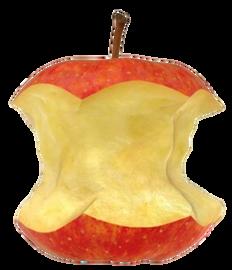
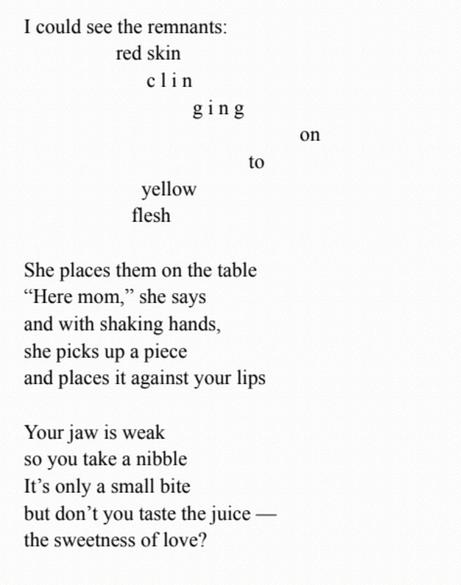
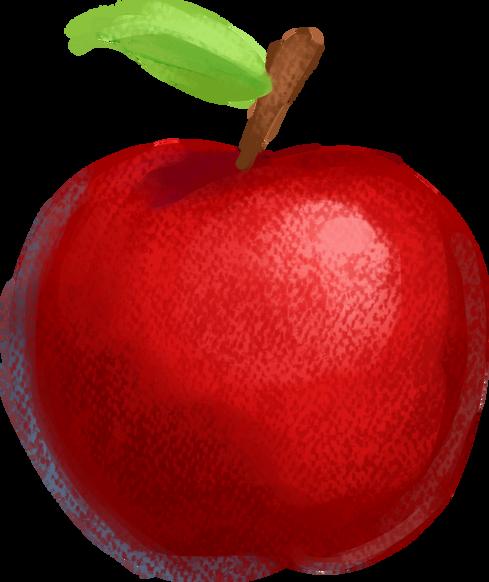
She asks if you’d like an apple You say you’re not hungry
Yet she shuffles into the kitchen takes out a knife from the cupboard an apple from the fridge
She places the sharp of the blade against the shine of the apple
One slow movement and there it is a cut
She turns the apple around and there it is a cut
She turns the apple around and there it is a cut
With each unsteady slice, her thumb only slightly misses the edge
She, too, is growing old Her youth has long left her straining eyes, struggling to see what is in front of her
I foresee the next scene:
Blood Spilling Over Her Olive Skin



Zeran Li
Before my great-grandfather died, He gave me a key to a lonely road
Behind his stone house, pig pen, Herb gardens that also died, replaced
By bonsais of last spring, they lasted
Two years before withering, the same Year my cousins stopped playing tag Outside, under paler but beautiful skies,
Our sleeves would brush against Fruit branches of the season, they line The road in shame My cousins donned Glasses, muscle, one never to be seen
Again, she caught a glimpse and ran far
From this silence, birds sing of love and They’ve flown too. My great grandfather was Once a hollow knight in horse’s armor,
Without steed, clanking, swinging at nothing, at friends who ate leather Scraps for breakfast, and each other’s Flesh, boiled boots live fresh
On his tongue, the Chinese civil War from 1927 to 1949, For nine thousand kilometers etched
Into my country’s history he was a
School book hero with blackened teeth, I learned about him through poems and He was sung in the blare of the public school Speaker I walked by with my dad, drove past
With my mother, hard hats and cones on A highway fast forward to 2017, my dad is held
Between two red officers in an airport terminal, Lights too bright to see a straight back, a week
Later my mother can’t sleep at night. When the Regime shut down her church, after my father was Freed he let the community into our home before He was swept away again, my mother ground
Her teeth like wet sand, she handed me a one-way Plane ticket to a better place and said father was okay Years later, I’m caught in a New York City
Billboard that didn’t let the sky get dark, only then
Did I know that my uncle’s business didn’t need Help in Germany and she lied, about my father and Two flags raised in the public school outside my Yard in China where I passed every morning to
Trumpets and a ribbon, June comes and I’m Standing at my great-grandfather’s doorstep
Again, listening to birds singing of 2013
And white bed endings, of half dried dribble
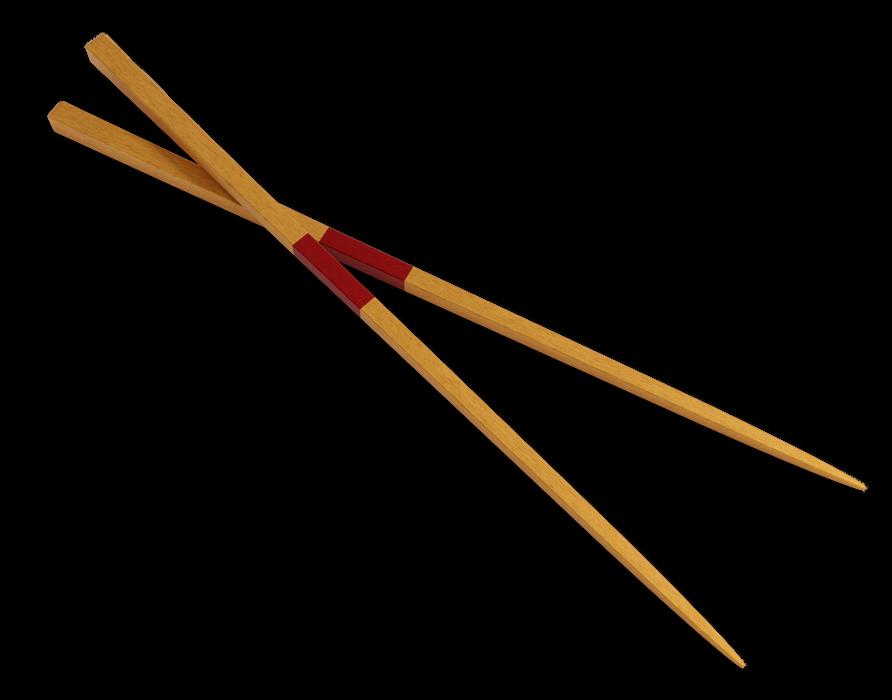
On a frilled napkin, and soapy water, and hot Sun, and an electric fan that turned slowly on The lowest setting, as chopsticks from a nurse
Made its way to my great-grandfather’s mouth
Kept open by his smile, next morning the plastic Tablecloth was stained by both my parent’s tears
Now they grieve 20,000 kilometers apart and all I can see in the fluorescent humming lights is my Great-grandfather’s face, telling me how Beautiful I looked before he died, I was called the Stable one, his eyes had set themselves in hard butter
But his smile moved above our sick city of fame,
Death struck down our bridges and I kept looking Out the car window, at two men kiss on a sidewalk
When my mother followed me to New York, she Didn’t know any English so I’ve always loved
The language, the libraries are bigger here, I Know books burn and they are thin like a cracker, They fill but you have to be as thin as them
And you can’t let them rest on your tongue,
Close your mouth, close your eyes, close your ears
And eat, at a dinner table stood up against a wall, When the rice cooker finishes you can help yourself
To your family’s history, told by us, told through
Pain that confuses us, a lesbian daughter that
Sent my uncle into an unknown place, that Was the runaway cousin, she fled to the silence of The country’s biggest city and I don’t know
What that means, it was told to me at a ping pong table in China and we just kept playing, missing
No shots just the repetitive back and forth of Paddles held like wine glasses I waited for
Them to break shape into something new
So I forced slam after slam into my father’s
Unwavering arm he wore me out until I hit the Net and the ball bounced slowly back at me,
I serve it with spin and he would hit it
Back so I try again but he wanted me
To slam it as hard as I could, he loved defending
So I slammed until my arms were
Sore, pencil sharpeners into the ground and
A white wall bleeding into red, I am surrounded
By bullshit, by people who spew nails and I
Don’t know what to do with it at the bitter
Tasting age of 16 and a halfway to hell,
My friend said an economy flight of 13
Hours would kill him and I agreed, I did it
Alone to an airplane terminal still with no
Father, he was “back from Germany” now,
Or a scared mother that saw through the lights
To the back of a man too big for this cabin,
My grandparents started waiting the moment
I landed and said “You will reach the sky” and pull down
The moon small piece by small piece so that everyone can Get their greatest love, I said yes into their wrinkles and Saw them fading upwards, I felt like a good thing when
My grandparents smiled. They did it often, I just Had to appear on the Facetime with a wave, more Than that they loved photos where I smiled, with My father, at the ping pong table in our New York City
My dad bought once he saw that I didn’t like smiling In photos, talking about how we came from food strips
In a village to the peak of the world, he didn’t look Happy, I had forgotten how to read his face, he talked
About changing fate and birthlands, family history
Started with him and his coconut juice job in Hainan, But my sister and I are the first-generation immigrants. She took on the family business and I overheard
My mother, talking about my sister’s friend, Ask my father in the kitchen, how a child
Could not consider the wishes of their parents
When making decisions about their future,
Especially when they were an only child.
I am a son, and the younger brother, my Sister went to school in Manchester alone At the age of 17, I came to
New York at the age of 10 and she was waiting, I did not know her when I was young, she is 28 and I am 16, I wonder if She smiled into their wrinkles, when I arrived
All the paperwork was done in her name, My father also did not know any English, I’ve never put my mother’s phone number As a contact and I couldn’t my father’s,
He would be asleep, he talked about opportunity At the ping pong table in New York, he looked At me and said he seized it, he asked me without Talking to turn back to my future but I saw
My mother, a woman of 58 years who Knew what it felt like to be the smallest, When she tells you the sky is falling down How could you not run, she held it up
When you were six, laying in bed crying for
A missing Dad again that was before the Airport terminal, twice he was in the airport Terminal, you’re the second child with bigger eyes
Your mother had to let go into a future she had to Break fingernails to get into, she’s hoisted Your screaming back once before on her Fingertips, ones she cut one day while cooking
And the blood bled in floods, you looked Away, you hated blood, you knew that And that was okay but how could your Mother bleed in the New World,
She came here to cook for you, I accuse you, of your laziness, Sleeping till 12 in the midday, Thinking you’re good enough
For no breakfast and long hair,
Do you feel shame for your Bigger eyes, your mother can’t
See your eyes with your hair,
It is the new year now, Cut it, I Accuse you, of making your father
Suffer through pale FaceTimes, They’re algorithmic, you’re robotic,
Scripted, a child’s body with Nothing to say on his dad’s birthday
Now what does that mean, raise a toast
For god's sake it is important,
A father’s son frozen, standing,
At the round dinner table, his uncles
To his left, his mother off to the side
With his aunts, his sister to his
Father’s right, they’re all looking at him, Eyes sharp but also bright, diamonds
Resting on the wine glass, trembling, Hesitating, slowly tilting in the air.

My Nana has never been conventional Unlike most American grandmothers, she is a strict atheist She was the first woman in her family to go to college, and instead of settling down young, she traveled the world with my Grandpa by her side My Dad doesn’t even call her Mom, and he never has He calls her by her first name, Michelle (This wasn’t her choice, though; when my Dad was little, his friends would always be over, and they called her Michelle. He caught on, and still calls her Michelle to this day.) Remarkably, however, none of these unorthodox aspects of her life came to her naturally. Recently, I sat down with her for an interview to learn more about her life. She came from a poor, extremely Catholic family of eight living in Detroit: “There were six kids in our family, there were four girls and two boys. I was the oldest. And then there were two girls right behind me, so three of us were really close in age.” Since she was the oldest, she wasn’t just expected to “be a lady,” but to set a good Catholic example for her siblings especially her sisters, who were under the constant scrutiny of their parents. At first, she easily conformed to her parent’s expectations. Now, she groans at the mention of any sort of Catholic church. During my interview, I focused on the time when this all flipped: a period lasting from the age of 12 until college.
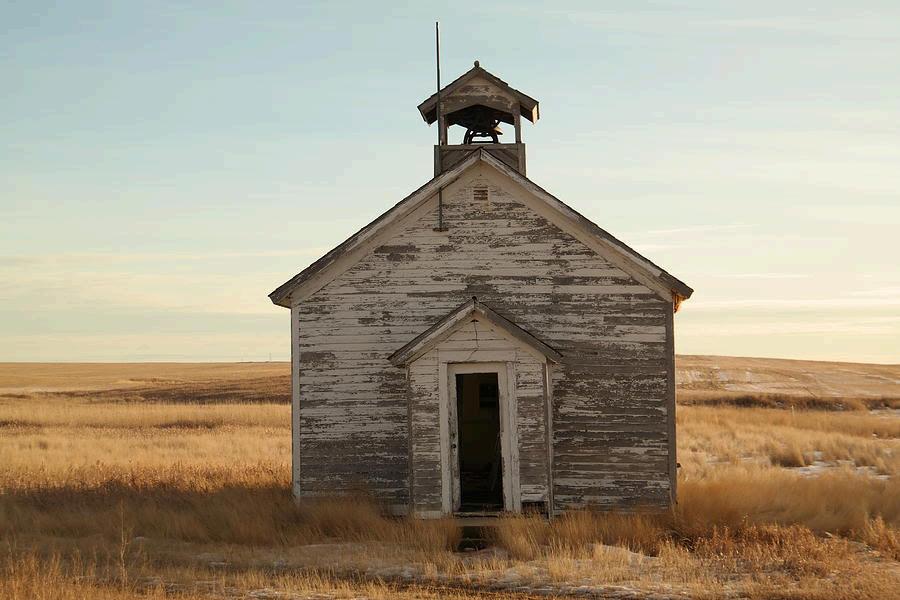
My Nana grew up in what she describes as a “one room house.” The “one room” description is just metaphorical, but the house really was tiny, especially for a family with six children. However, the house she grew up in didn’t just confine her physically; it also confined her spiritually. “I was raised Catholic, they [her parents] were really strict. For a long time, we couldn’t put on nail polish, we couldn't wear makeup. I’d say up until high school, 9th grade, they didn't want us to do anything like makeup and they didn’t let us go out a whole lot there were no boyfriends.” My Nana experienced very strong gender separation from a young age; she recognized and felt sexism early in life Her parents enforced rules on her and her sisters that didn’t exist for the boys in the family: strict dating rules, strict rules about what to wear, strict rules about when you were allowed to go out This gender rift was only heightened at a place she spent most of her time: Catholic school “One time, a priest came into the classroom, and he made all the boys leave, and he made all the girls kneel down, and if your skirt didn’t touch the floor, you had to go home and change ” During our interview, we laughed a lot about how ridiculously horrible and almost cartoonish this was
Inwardly, I began to recognize how confining my Nana’s childhood had been She’s so opinionated, smart, and outspoken. In Catholic school, none of that could really happen “Well, the nuns were super strict, you could never just speak up I’ve seen kids your age in the classroom, having big discussions. In Catholic school, we just sat there, really quiet You couldn’t have big discussions. And I’m talking, like, seventh or eighth grade ” She said this all with a sort of sadness, a regret that she wasn’t allowed to express her opinions freely as a child. Eventually, this all culminated in a sort of breakaway from her belief in Catholicism; of course, she hid it from her parents at the time, but she stopped believing at a pretty young age. “I started to look at a lot of the things they were saying in church, like ‘love everybody ’ But they didn’t want black people to come to church. You know? So I started saying, this is such hypocrisy And then, the other thing is, I’m twelve, and I’m looking at the way they treat women! And I’m like, ‘This isn’t right,’ you know?”
When she got to high school, she finally felt like she had more independence Her parents considered her old enough to leave the house on her own, and she reveled in a sort of newfound freedom: “We lived in the city, but on the very edge of the city, before it became suburbs And one of the things that I really liked was that I could take the bus to go downtown, to go shopping or to go to baseball games with my sisters or friends ” The fact that her new high school was public also dramatically changed things “So everything [in Catholic school] was like [strict] how are you dressed, are you flirting with the boys, there was just none of that... until ninth grade I went to Catholic school, but in ninth grade I went to public school So to me, I could do all kinds of stuff in public school that I couldn’t do in catholic school... [in] ninth grade I made up for it ”
“Nana, were you flirting with the boys?”
“I was flirting with the boys, I was talking in class, I was having a great time ”
Ninth grade was a key year in my Nana’s life it was when my Grandpa finally caught sight of her “Well, he lived in the rich neighborhood, and I lived in the poor neighborhood So, he went to one school, and I went to another school, but there was this dance And it was all the junior high schools in the area going to this dance. He says that he saw me at the dance And so, he was like, oh, I want to know her ” I’ve heard this story more
than once I always mention the fact that it was probably love at first sight My Nana is more practical than I am, so she always laughs. I really believe it, though. I think that the quote “arguing like an old married couple” was written about my Nana and Grandpa. They argue constantly, but it’s out of love; when they bicker (which is all the time), it’s almost like they never left high school I think my Grandpa fell in love the moment he saw her, and he’s been in love ever since He finally got to make his move in tenth grade the year they finally ended up going to the same high school. Eventually, they were bound to make a mutual friend “We had a friend, Anne, and he told her that he wanted to meet me The school had a Sadie Hawkins dance... So the dance was coming up, and Anne called me, and said, ‘Bob wants you to ask him to the dance, and I told him you would, so here’s his phone number, and he’s expecting you to call him tonight.’” “You were trapped!” “I never called a boy in my life! Anyway, I called him, and I asked him to go to the dance. And I had a really great time.”
After that, my Nana and Grandpa started going out They were constantly driving to McDonald’s, going to the movies, just generally checking boxes off of a “fifties teenage romance” list Suddenly, however, her parents “started to get really upset. ‘You just can’t go out with this one guy, you’re way too serious, you’re way too young ’ Eventually, they said, ‘you can’t date him anymore.’” There were a lot of ways in which my Grandpa inspired my Nana to find independence and rebel a little against her parent’s strict rules. Long story short, my Nana continued to date my Grandpa in secret: “My friends and I, we would have other guys come pick me up, and then I would go meet Grandpa.”
There was one question I had that remained unanswered, however
“Why didn’t they [her parents] like Grandpa initially?”
“Well, one reason was that he wasn’t Catholic. So I think they were worried about that ”
“He was Protestant, right?”
“Yeah He was Protestant And I was gonna marry somebody who wasn’t Catholic, and that was gonna lead me down the ‘bad path,’ I guess I don’t know Anyway, that was one reason, and then the other reason is that they just thought we were getting way too serious. They probably thought I’d get pregnant, that I’d start having sex and whatnot ”
We were back to a key issue: her parent’s Midwestern Catholic values They didn’t want her to marry someone Protestant; and because she was a girl, they were sometimes overly protective, resulting from a paranoia that she would become pregnant too young

Eventually, my Grandpa became fed up with meeting in secret He got the idea to talk to my Nana’s dad; she, however, was immediately against that plan. “I said, ‘you can’t go and talk to my dad! NOBODY talks to my dad Nobody questions him, he was always like, this is the rule, this is that,’ but Grandpa came over.” Somehow, though, the plan worked My Nana doesn’t quite remember, but she thinks he said something along the lines of that “his intentions were honorable, and he wouldn’t do anything to hurt me He really cared about me, and that it was really horrible to not be able to spend time with me. Anyway, he talked to my dad, and my dad said: ‘Okay, you can go out with Michelle, but you can’t go out all the time You can’t go out so much. You have to take it a little easy.’” They then continued to date for the rest of high school However, college was a hot-button issue. Since my Nana was the oldest sister, her parents fully expected her to become a nun when she left high school They also liked another plan: “They thought girls just got married and had babies and that it was just kind of a waste of time I would go to college, and then maybe I’d get a job, and then I’d just quit to have kids I mean that was kind of, the attitude? Back then? Not just my parents, but many parents ” Unfortunately for them, by that point, she had more belief in herself than the status quo she grew up around “The state of Michigan, at that time, they gave scholarships to students of the state who had low income families but were really good students. So I applied, and I got it. I was really happy.” This jump-started the rest of her life; eventually, Grandpa joined her at Michigan state During college he realized he wanted to be a part of the restaurant industry, but she wasn’t sure what she wanted to do yet this meant that they ended up traveling the world together They lived in New York, where my Nana styled racks at department stores; Switzerland, where my Uncle Derek was eventually born Eventually, they landed in LA after she gave birth to my Dad in Las Vegas. She got a masters degree, he got a PHD, they published a book on wine together, and they still travel the world.
I think my Nana has always been able to observe the world more clearly than most. What I say is true; she is very smart. She’s always had such strong opinions, but advocating for herself was something she had to learn during her teenage years. This independence came from her own soul; however, falling in love with my Grandpa cemented her change in mindset forever When I asked her how her life would have been different had she not met Grandpa, she was initially stumped, but eventually had a lot to say “Um, woah, boy, that’s a hard one. Cause I’ve known Grandpa for 60 ‘sum years. So how would it have been different? I still would’ve gone to college oh, well here’s a big thing, here’s a big thing that would’ve been different.

I think I would’ve stayed in Michigan; I probably would’ve gotten a job teaching school; I don’t think I would’ve been adventuresome enough to say, ‘I’m gonna move to New York, or I’m gonna move to California ’ But Grandpa always wanted to try new things and go to new places, so. I think that’s probably the one thing that’s the most different is we just went all over, we just lived all over So I think I really think I wouldn’t’ve done so many different things. Because if I’d stayed in Michigan, I think I would’ve been more influenced by my parents a little bit more? Like, ‘Oh, you shouldn’t go there, or you shouldn’t move there, or you shouldn’t do that kind of job ’”
That, to me, is true love. Finding someone who loves you for who you are, your ideas, your beliefs Someone who allows you to radically change your worldview, and someone who gives you an environment to be the truest version of yourself My Grandpa really did want to go everywhere, so they did everything. It’s what’s so incredible about my Nana and Grandpa’s love story In a way, it’s classic: leaving your old life behind to form a new one with someone you love. She found someone who loved her for her opinions, humor, and adventurous spirit, and finally got to exercise it
I’ve always latched onto my Nana as a role model, ever since I was really little I have always loved talking to her she’s funny, smart, and patient, but there was something else that made me respect her; something I never understood until I sat down for this interview. She is completely, 100%, all-the-time, herself. She isn’t afraid to argue, or express an unpopular opinion, or try something new During horror movies, she screams louder than anyone else (they’re not her favorite genre.) When I suggested that we watch Stranger Things, however, she was completely open to it - and she ended up loving the show, even though she screams even when there isn’t a jumpscare. Now I understand that it’s because of the struggles she had as a kid that she is that person She is 100% herself because she worked hard to get there. Though it took her years, she split from the Church. Though she had always followed her parent’s rules, she went to college. And even though she had never dated a boy in her life, she asked my Grandpa to a Sadie Hawkins dance. My parents are great: they’re supportive, loving, and they’ve never forced anything onto me. Compared to my Nana, it should be easy to be myself Sometimes, the pressure to conform to a way to look or dress or act is overwhelming But my Nana’s story teaches me that being yourself is always worth it. She taught me, from an early age, to think for myself and be independent For that, I’ll always admire her

With pain I didn

I weave new netw and reinforce these make them as strong as durable as steel, make t what I made with you. As I co my kingdom expands. So vast it get lost in its breadth. But as I contin e you stand. ance has changed us at we once had. g it off emains ught in my head, stuck on the web.
If you were to a I’d shake my head and say “n and I know you wou yet the truth cannot ng new cons d structure New webs s leave old o worn, desolate and neglec n the day ar hreat too ov mpire has gr or me to pr ’ll sacrifice I’ll break ev sinew of gr dissolve the delicate l as I crawl my w to you.

“In three words I can sum up everything “In three words I can sum up everything I've learned about life: it goes on. ” I've learned about life: it goes on. ”
-Robert Frost
odern Anthologies Literary Magazine ging panel run by Dr. Th nia, as well as his collea Rice University.
ntributors, writers, and
ers who make this so sp not exist without you.
r magazine and join our portunities, and publication!