







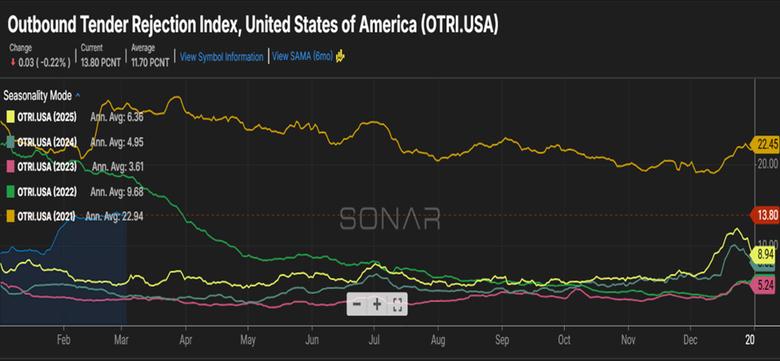
The uncertainty surrounding geopolitical events meets a market with tender rejections still hovering between 1314%. Fuel will be the driving factor in the coming weeks as the reality of the cost per barrel hits diesel prices at the pump. This raises concerns for smaller fleets not as well equipped to weather sustained volatility and adds to the factors shifting momentum to carriers when it comes to pricing.
Source: Sonar Surf
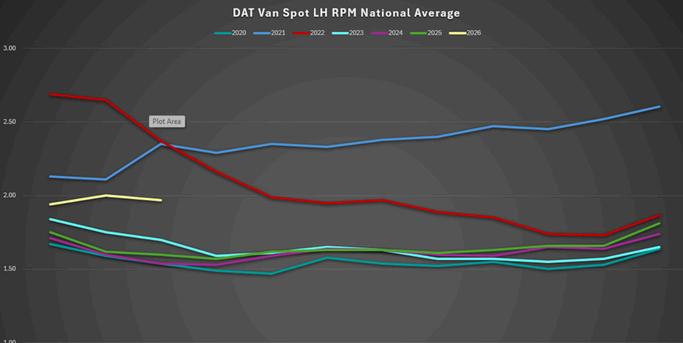
DAT’s National Van Spot Linehaul RPM remained relatively stable from February to March. Dry Van load volumes are up significantly YoY. The degree to which capacity tightens due to both demand and geopolitics will set the tone for what could be a period of elevated rates. Significant volatility with fuel will impact available capacity and further pressure test rates.


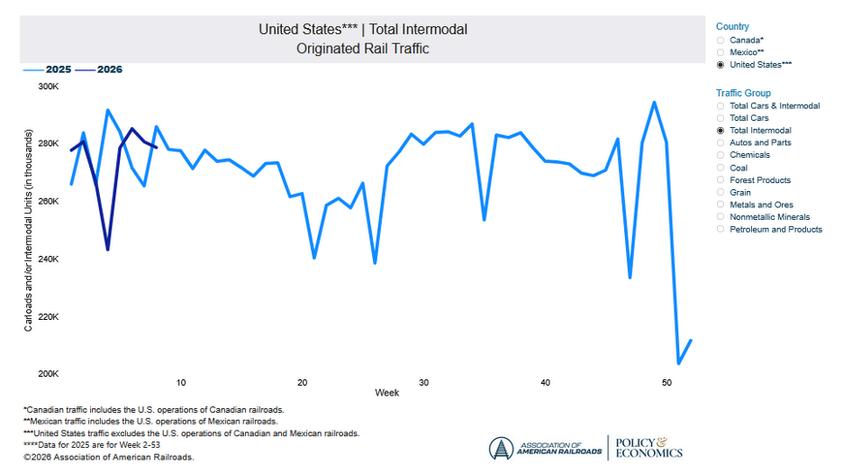
Increasing fuel costs combined with tightening truckload capacity have created greater demand for domestic intermodal services. Shippers should get in front of the rising demand for intermodal and assess the potential for truckload-to-intermodal conversions.
We are approximately 60% of the way through the 2026 bid season, which is typically when most new bids and RFPs are released. Many bids and RFPs have multiple rounds, and in those subsequent rounds, intermodal providers are not making as many concessions as in years past. Their willingness to reduce rates to win business has been more visible in backhaul lanes and in winning new truckload-to-intermodal business. Rate increases for incumbent business have remained, on average, between 3-5%.
North American intermodal volume growth forecast for 2026 has remained relatively unchanged at 1 4% for 2026 and 1 5% for 2027 Growth is still expected to be primarily driven by domestic containers, while international container volumes will remain flat

Here are links to some top stories in the industry for you to check out:
Averitt Enhancing Footprint in 2026
Across Multiple States (2.27.26)
First Look: Some US LTL Indicators at TFI International Turn Higher (2.17.26)
XPO Focuses on Improvements After Adjusted EPS in Q4 Up 18% (2.9.26)
Saia Revenue Hits Quarterly Record as Q4 Earnings Slip (2.10.26)
March finds the LTL market looking a lot like it did to start the year. Freight demand remains steady with volumes holding roughly in line with what carriers saw through January and February. The good news is that the slide many feared hasn’t shown up. The challenge is that meaningful growth hasn’t either, leaving the market in a stable but slow-moving position as Q1 continues to unfold.
We are now in the back half of bid season, and most of the heavy lifting has already taken place. Early indications suggest the cycle is playing out much the way many expected. Shippers are pressing where they can for savings, while carriers are protecting core accounts and strategic freight. Instead of broad pricing changes, most adjustments are happening at the lane level, driven by network fit, density and service expectations
Operationally, carriers remain focused on running efficient networks rather than chasing incremental volume Terminals and linehaul networks are being managed carefully to maintain service and productivity while freight levels remain moderate. The focus across most LTL operations continues to be clean freight flow, tighter planning and maintaining margins until demand becomes more consistent.
Looking ahead, the industry continues to watch for signs that the goods economy is ready to move again. Inventory levels, manufacturing activity and overall shipment patterns will likely determine how quickly the market finds its next gear. Until those indicators begin to shift, most carriers appear comfortable staying disciplined and running balanced networks.
Bottom line: March keeps the same theme we’ve seen to start the year. The market is stable, pricing remains controlled and carriers are staying selective about the freight they move. Until demand strengthens, discipline and network efficiency will continue to drive decisions across the LTL industry.

SOURCE: Trucking Dive, Only as good as your weakest link : Estes Express Lines COO notes service strategy in expansion,” David Taube 2026.
Estes Express Lines has continued to expand and refine its terminal network as it prepares for the next freight upcycle. The carrier recently surpassed 13,000 doors across its system and expects to reach 14,000 in the near future through a combination of new facilities, relocations, and terminal expansions.
Rather than expanding indiscriminately, Estes leadership says the company focuses on strengthening specific parts of the network where capacity constraints previously created pressure. By addressing these areas, the carrier believes it can improve the performance of the entire system. As Webb Estes explained, success in an LTL network often comes down to the weakest point in the operation reinforcing the idea that targeted investments can elevate overall service reliability.
This approach reflects the company’s broader long-term strategy As a privately held, debt-free carrier, Estes has the flexibility to invest in infrastructure based on long-term service goals rather than short-term market conditions Many of the recent terminal projects were designed to relieve congestion in key markets and distribute capacity more evenly across the network
According to the company, these investments are already paying off. Estes reported improved on-time performance, stronger load factors, and historically low claims ratios outcomes the company attributes to a healthier, more balanced network.
For partners and customers, the takeaway is clear: strengthening the underlying network today helps ensure dependable service when freight volumes eventually accelerate again.
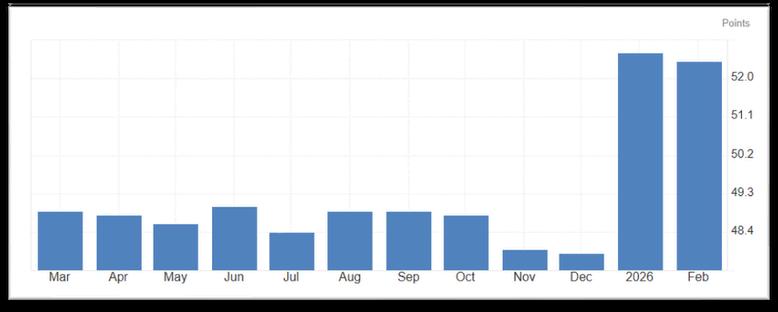
The ISM Manufacturing PMI eased slightly to 52.4 in February 2026 from 52.6 in January, remaining above expectations and marking the second straight month of expansion. Growth in new orders and production slowed modestly, while employment and inventories stayed in contraction. Price pressures jumped sharply, reaching their highest level since mid-2022, driven largely by rising steel and aluminum costs and tariff impacts Supplier deliveries slowed for the third consecutive month, suggesting tightening supply conditions. Four of the six largest manufacturing industries, including machinery and transportation equipment, reported expansion during the month
Source: Trading Economics & Federal Reserve
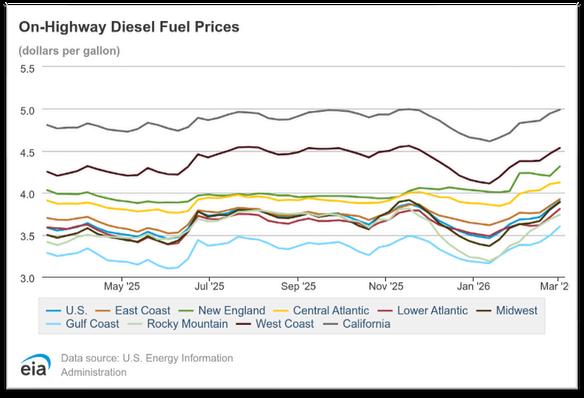
The U S national average cost per gallon for on-highway diesel in February 2026 came in at approximately $3 73, which is $0 21 (6.0%) higher than January 2026’s average of roughly $3.52. February 2025’s average was approximately $3.92, putting February 2026 at about $0.19 (4.8%) lower year-overyear. As of the first week of March 2026 (week ending March 2, 2026), the national average stands at $3.74 per gallon, reflecting a slight increase of about $0.01 (0.3%) from the February monthly average

The U S parcel market continues to evolve as shippers refine their strategies following peak season While overall parcel volumes remain steady due to continued e-commerce demand and B2B shipping activity, many businesses are taking a closer look at their shipping programs as they plan for the remainder of the year
As transportation costs continue to rise, organizations are increasingly looking for partners, like MODE, who can help them better understand the factors influencing their total parcel spend and identify opportunities to improve cost control without sacrificing service performance.
One of the biggest opportunities right now is total parcel cost visibility Many shippers focus heavily on base rates but underestimate the impact of accessorial charges such as residential delivery fees, delivery area surcharges and additional handling costs. We can help you understand these hidden cost drivers illustrate how parcel program optimization can produce long-term savings opportunities.
Year-over-year surcharge increases are also a hot topic. In 2026, UPS accessorial fees increased in several key categories, including Additional Handling (approximately 6.6–7.3%), Large Package (about 5.6–10%), Delivery Area surcharges (roughly 6–8%) and Address Correction fees (around 7.4%). By comparison, many accessorial increases from FedEx generally remained closer to the 5.5–6% range, resulting in a smaller year-over-year jump in surcharge costs for many shippers

In 2026, FedEx’s biggest assessorial advantage is fewer surcharge triggers and a simpler dimensional surcharge structure, while UPS has expanded cubic and dimensional rules that can cause more packages to incur additional handling or large package fees For example, UPS added cubic-volume thresholds that can trigger surcharges at 10,368 cubic inches for Additional Handling and 17,280 cubic inches for Large Package, applied in addition to traditional length and girth rules. UPS has also broadened its Additional Handling criteria to include packages with a longest side over 48 inches, a second side over 30 inches, cylindrical or irregular packaging, and shipments that are shrink-wrapped or banded. While both carriers maintain similar surcharge categories, UPS generally applies these triggers more broadly, which can lead to more packages incurring Additional Handling fees.
Let MODE help evaluate how carrier rules impact true shipping costs and guide you through a more complete cost comparison when evaluating parcel carriers. Connect with your MODE parcel account team at parcel@modeglobal.com to explore how you can maximize FedEx solutions for your business and your customers.

Rates: Asia to U.S. rate levels slid back moving into March as soft demand continues.
Capacity: Post Lunar New Year sees capacity available in most all trade lanes.
Volume: U.S. import container demand remains soft after Lunar New Year.
News: Middle East conflict results in service pauses, fuel price increases and new surcharges.
Tariff News: IEEPA tariffs overturned by U.S. Supreme Court.
The post Chinese New Year Trans-Pacific rate market continued to lose ground moving into March. Market average spot rates at the end of February for Asia to U.S. West Coast were $1,889 per FEU, down from $2,052 the previous week. Asia to the U.S. East Coast settled at $2,688 per FEU, from $2,882
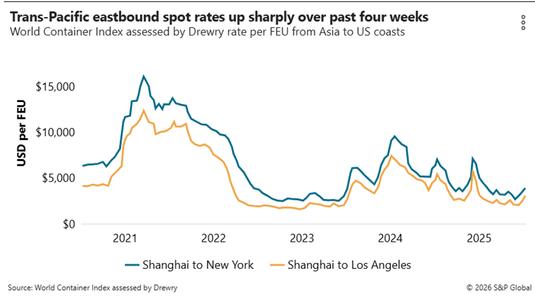
Continued market rate uncertainty comes at a particularly inconvenient time for the ocean carriers entering contract negotiations with shippers. The carriers are pushing for higher fixed rate contract levels after a difficult financial year of 2025. However, those hopes may come up short if demand continues to be softened by economic concerns aggravated by more tariff uncertainty and current geopolitical factors. Without a sustained meaningful bump in demand, it will be increasingly difficult for carriers to push rates up, especially as global capacity continues to expand.
With the recent Middle East military activity, shippers in all U.S. trades should prepare for increased fuel charges, war risk and congestion surcharges due to the impacts to the overall carrier network, but most notably the supply network for oil transport. As many of the primary oil supply ports are closed, there have been announcements of Naval escorts in the area to ensure the safety of some of these liners This is in effort to keep maritime traffic moving through the strait and have oil prices retreat after the recent surge However, commodity strategists have concerns if the strait remains closed that oil prices could surge above $100 per barrel if this is extended longer term
In the short term, oil prices, and therefore bunker fuel prices, will likely increase, which will impact container shipping costs. And that means ocean carriers will respond with increased fuel surcharges.
Because of the heightened military actions as of the first week of March, ocean carriers are expected to start implementing as many new surcharges as possible, and not just on trades to and from the Gulf region, but likely all trades. The carriers will call these emergency fuel surcharges, war risk, emergency conflict surcharges, etc. At this point, there is no way to know how high these will go or how long they may last. As of the first week of March, announcements from international carriers have fuel rates increasing $150 per TEU either through emergency fuel surcharges, bunker fuel increases or other variations of surcharges across most trades Additionally, for cargo travelling through the Middle East region, war risk surcharges between $1500-$2500 per TEU have been implemented
Unlike in past years when importers were anxious to lock in volume allotments, known as minimum quantity commitments (MQCs), because vessel space was tight, capacity is currently readily available in most all trades so many importers are slow playing their decisions. With what appears to be ample capacity, importers will be in a favorable position to negotiate space allocations in the upcoming contract cycle.
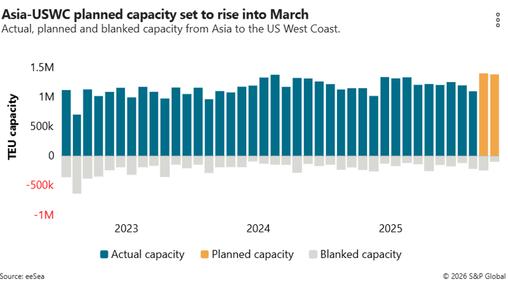
A major reason why there was no capacity shortage in the trans-Pacific leading into the Lunar New Year was that carriers did not respond quickly enough to the market conditions by managing vessel space. Blank sailings estimated for March have leveled off following the Lunar New Year slowdown. Moving into March, about 16% of scheduled departures were cancelled across East-West trades, with the majority occurring on the Asia–North America trades. But with weak demand and more new vessels' capacity coming online, the gap keeps growing.
According to data from eeSea, carriers had 1.19 million TEUs of actual capacity on the Asia-West Coast trade lane in January, with that expected to rise to 1.26 million TEUs in February and 1.4 million TEUs in March.
U.S. container import volumes from Asia softened in February following a modest January rebound prior to the Chinese New Year manufacturing shutdown in Asia Total U S port imports were expected to come in at approximately 1 97 million TEU, representing about a 3% year-over-year decline
Container import volumes from Asia are expected to remain relatively weak through March in the port Lunar New Year transition.
U.S. containerized imports are projected at around 1.89 million TEU, representing a ~12% year-over-year decline and roughly 5% drop monthover-month
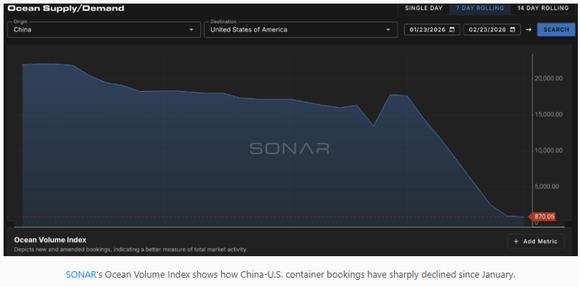
Retailers remain conservative in replenishment cycles due to economic uncertainty and elevated inventories carried over from earlier front-loading cycles
Import volumes expected to remain below 2025 levels as the market absorbs a continued weak demand cycle but also growing excess carrier capacity. Volumes may begin improving in April–May as Asian production normalizes and seasonal retail restocking begins. But much of that will rely on U.S. importers’ comfort with current inventory levels and their confidence in what is going on with the U.S. economy.
Escalating military conflict in the Middle East following U S and Israeli strikes on Iran on February 28, 2026 has intensified security risks across key maritime chokepoints, including the Red Sea, Bab-el-Mandeb Strait and Strait of Hormuz The conflict has significantly disrupted global shipping networks and forced carriers to reassess routing decisions across multiple trade lanes.
The escalation comes as the container shipping industry had been cautiously evaluating a potential return to the Red Sea after prolonged disruptions since 2023. However, the renewed conflict has effectively halted plans for any large-scale return of container services through the Suez Canal corridor in 2026.
As of early March, ocean container services are unavailable to the UAE, Oman (all ports apart from Salalah), Iraq, Kuwait, Qatar, Bahrain and Saudi Arabia (Dammam and Jubail only) until further notice. Current vessels in route will be rerouted to avoid the conflict, and future services will begin to avoid the Red Sea altogether, which is not a significant impact as all carriers had still been routing goods south of Africa via the Cape of Good Hope until recently. See our latest global advisory for the recap.
IEEPA tariffs overturned by the U.S. Supreme Court
The Supreme Court decided on February 20, 2026, that tariffs imposed under the International Emergency Economic Powers Act (IEEPA) were invalid. The Court determined that tariffs are a form of taxation and therefore fall under Congress’s constitutional authority, not unilateral executive power. As a result, all tariffs imposed under IEEPA were declared unlawful, invalidating a major component of recent U.S. trade policy.
The ruling strikes down tariffs imposed under emergency authority, including measures such as:
25% tariffs on certain imports from Mexico and Canada
10% duties on Chinese imports (also known as the “fentanyl duty”)
A broader baseline global tariff applied to multiple countries
Duty refunds are possible, but the “how and when” is still unclear, and no details or timelines have been published. Additionally, it is unknown what types of appeals might be submitted in the interim.
Near-term duty planning remains fluid: IEEPA tariffs were collected until Feb 24, 2026, then a new 10%