


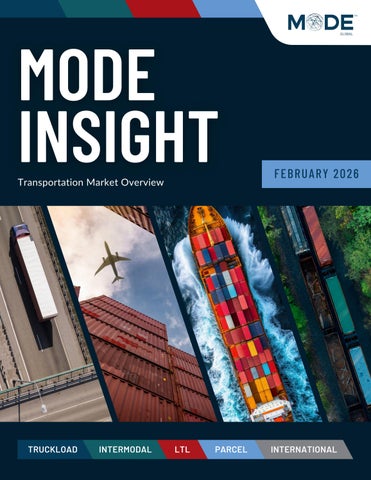





Tender rejections remain elevated post-winter events, with their staying power hanging in the balance. Specialized reefer and flatbed markets remain the most impacted segments for tender rejections, with a broader focus shifting to capacity availability versus weather impact (Sonar's OTRI climbed above 13%, compared to 9.8% before Winter Storm Fern). Elevated spot rates have held longer than in the past year, though are plateauing and downward pressure is likely.
Source: Sonar Surf
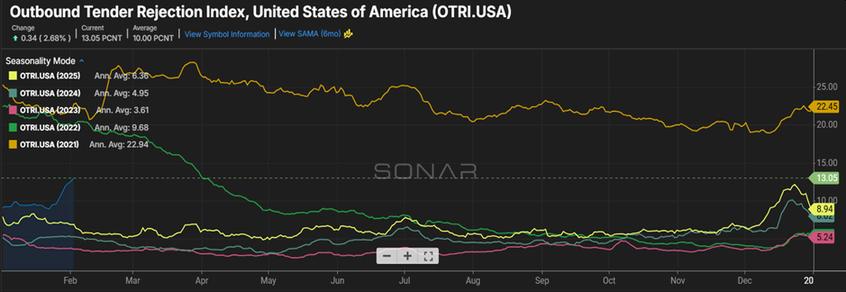
DAT’s National Van Spot Linehaul RPM rose 5 6% from January to February Spot rates have remained elevated more than in the past year, but downward and volatile pressure expected in the coming weeks The breadth of capacity tightening remains to be seen and will largely dictate the next dynamic shifts relative to rates and rejections.

Source: DAT com/trendlines


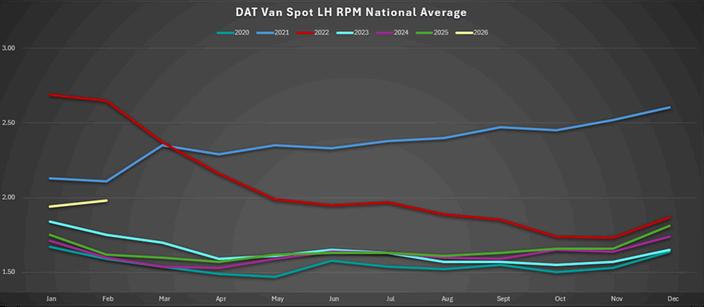
Norfolk Southern has launched East Edge intermodal double-stack service between Chicago and New England, which will improve transit times by ten hours and add additional capacity to the market.
Union Pacific has installed GPS tracking into the fleet of UMAX and EMP containers, which are owned in combination with other Class I railroads. GPS tracking is managed by Blume Global and provides shippers with enhanced street-level visibility through geofencing and improved real-time data.
The 2026 bid season is underway, and intermodal pricing teams are seeing an influx of bids (RFPs) from shippers to lock in rate levels for 2026. In an effort to convert truckload to intermodal for new business, railroads and intermodal providers are providing aggressive rates to compete with over-the-road costs. Incumbent intermodal business has seen rate increases averaging between 3-5% on new rates for 2026
North American intermodal volume growth forecast for 2026 has changed to 1 3% year over year, which is expected to be primarily driven by domestic containers

Here are links to some top stories in the industry for you to check out:
Amazon’s LTL Offering Reaching Out to Shippers as Possible Customers: Report
Estes Adds 6 More Terminals on Road to 14,000 Doors
LTL Carrier Peninsula Adding a 2-state Surcharge for Regulatory Burdens
Southeastern Freight Lines Boosts Cross-Border Operations
February finds the LTL market still searching for traction, but with a slightly clearer picture of where things stand. Freight demand remains soft coming out of January, which is typical for the season, yet the bigger story is stability. Volumes aren’t accelerating, but they also aren’t sliding the way they did earlier in the cycle. That steadiness is giving carriers a better baseline as the year begins to take shape.
Bid season conversations are now fully underway, and the tone is more balanced than last year. Shippers are still looking for savings where they can find them, but carriers continue to protect core pricing and long-term freight. Instead of broad rate moves, most adjustments are happening at the lane level, guided by density, network fit and service expectations It’s a quieter negotiation cycle, focused more on positioning than drastic change
Across the industry, pricing discipline remains the defining theme Even with demand limited, carriers are showing little interest in lowering rates just to win volume That approach is helping keep overall cost levels elevated compared to prior years and reinforcing the idea that the current market floor is being managed rather than tested. The result is a market that feels controlled, even if it’s not yet growing.
Looking ahead, attention is shifting toward the timing of a broader recovery. Early indicators from outside the LTL space suggest improvement may come later in the cycle rather than sooner, which keeps most carriers in planning mode instead of expansion mode. For now, the focus remains on running efficient networks, maintaining pricing discipline and staying ready to respond when demand becomes more consistent.
Bottom line: February continues the theme of cautious stability. The market hasn’t turned upward yet, but it appears to be holding its ground. Until clearer demand shows up, discipline, selectivity and operational control remain the playbook across the LTL landscape.
SOURCE: FreightWaves, “LTL pricing index hits new high in Q4,” Todd Maiden, Jan 14, 2026
LTL carriers closed the year with pricing strength intact, even as freight demand remained subdued The latest TD Cowen/AFS Freight Index shows rate levels reaching a new high in the fourth quarter, underscoring carriers’ continued discipline and reluctance to discount simply to secure volume. While a modest seasonal pullback is expected early in the new year, overall pricing remains firmly elevated compared with historical norms.
Underlying demand indicators continue to reflect a cautious industrial environment. Manufacturing activity stayed in contraction through the end of the quarter, and forward-looking order signals suggest limited near-term momentum. Even so, shipment-level costs have remained resilient, highlighting how tightly carriers are managing networks, yield and cost structures despite softer freight conditions.

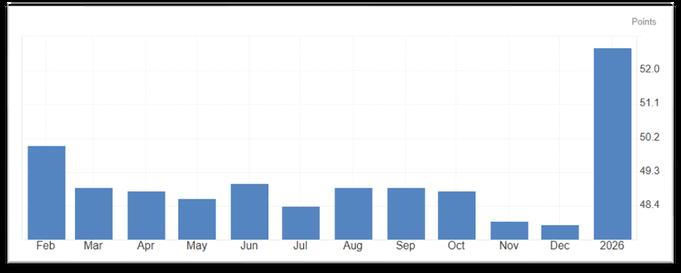
The ISM Manufacturing PMI rose to 52.6 in January, beating expectations and marking the first expansion in 12 months and the strongest reading since 2022. Gains were driven by sharp rebounds in new orders, production, supplier deliveries and employment, while inventories and employment still technically remained in contraction. Price pressures held relatively steady, indicating limited cost relief
Source: Trading Economics & Federal Reserve
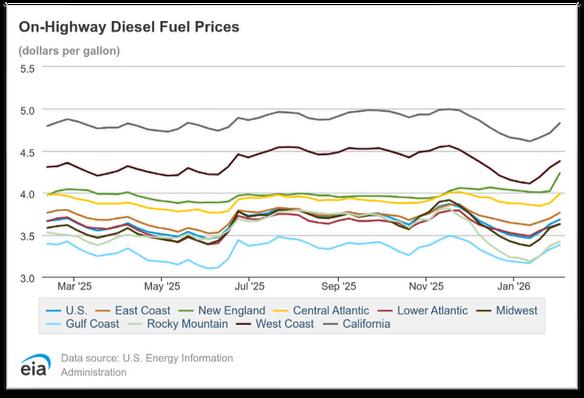
The U.S. national average cost per gallon for on-highway diesel in January 2026 came in at approximately $3.52, which is $0.10 (2.8%) lower than December 2025’s average January 2025’s average was roughly $3.63, putting January 2026 about $0.11 (3.0%) lower year-overyear As of the first week of February 2026 (week ending February 2, 2026), the national average stands at $3.681 per gallon, reflecting an increase of $0.161 (4.6%) from the January monthly average.
ISM noted the improvement may be partially seasonal, as January typically reflects post-holiday restocking and forward buying ahead of potential tariff-related price increases, suggesting the strength should be monitored for sustainability.

The U.S. domestic parcel market continues to grow, fueled by steady e-commerce demand and ongoing B2B shipping needs. At the same time, competition remains intense as regional carriers, USPS and private delivery networks expand their footprint. In this environment, stability and scalability matter more than ever.

FedEx remains well-positioned as a national carrier with integrated air and ground capabilities, consistent transit performance and enterprise-level visibility tools As customers evaluate carrier diversification strategies, many are balancing cost pressures with service reliability and network reach
A major development shaping the domestic landscape is FedEx’s Network 2 0 transformation By integrating and streamlining operations across air and ground networks, FedEx is improving density, optimizing facilities and enhancing efficiency. These changes are designed to strengthen long-term service performance while maintaining competitive cost structures. For customers, this translates into improved predictability and a more resilient delivery network.
Pricing remains a central topic in the market. Annual rate increases and evolving surcharge structures continue to impact shipper budgets; however, leading organizations are shifting focus from base rates alone to total cost of shipping. Service consistency, reduced claims, fewer exceptions and stronger end-customer experiences all influence overall transportation spend and revenue protection. Reliability plays a direct role in customer retention and brand reputation, particularly for retail and high-volume B2B shippers.
Service performance across the domestic parcel industry has remained strong, even during peak volume periods High on-time delivery rates reinforce the importance of partnering with carriers that can sustain operational excellence during demand surges Consistency reduces downstream disruptions, protects SLAs and minimizes costly service recovery efforts
Another key differentiator in today’s parcel environment is data visibility. Shippers increasingly expect more than basic tracking; they want actionable insights. Investments in predictive tracking, exception management, returns optimization and advanced reporting are becoming critical components of the value equation. As supply chains grow more complex, visibility tools that provide proactive insight can significantly improve decisionmaking and cost control.
Overall, the domestic parcel market remains dynamic but opportunity-rich. Growth continues, competition is active and customers are seeking partners who can deliver efficiency, reliability and data-driven insight. FedEx’s continued operational investments and network integration efforts position it to compete effectively in this evolving landscape while supporting customers focused on long-term performance and margin protection
Take Advantage of FedEx’s Competitive Edge Today
Leverage MODE’s strategic FedEx partnerships to deliver superior service, maintain reliability and protect your margins. Whether it’s optimizing domestic shipping, accessing advanced visibility tools or supporting your clients with seamless back-office handling, now is the time to position yourself for growth. Connect with your MODE parcel account team at parcel@modeglobal.com to explore how you can maximize FedEx solutions for your business and your customers.


Rates: Gains of January lost as pre-Chinese New Year volumes underwhelming.
Capacity: Load factors unseasonably low just four weeks before Lunar New Year holiday.
Volume: Overall demand for Asia volumes down moving into Lunar New Year.
Red Sea news: CMA changes direction on their return to Red Sea services.
After a relatively stable January, where early on, Asia to U.S. rates actually saw some increases for the first time in months, it appears that those gains will be lost. As in past years, carriers typically pushed rates upward in January, preparing for pre-Chinese New Year volume spikes. That does not appear to be the case in 2026.
North Asia to U.S. West Coast spot rates that started January at $2,075/FEU were at $1,900 as of the first week of February. Another index (Drewry) had Shanghai to LA/LGB rates at $3,132/FEU on January 8, but those had fallen to $2,442 by month’s end. Shanghai-West Coast rates of $1,867 per FEU from the Shanghai Shipping Exchange as of January 30 were down from $2,188 at the start of the month. Similarly, Asia to the U.S. East Coast rates have declined by nearly 20% moving into February.
According to all the indexes, spot rates moving into February are about 50% lower than they were a year ago. Softer post-holiday demand this year has pushed carriers to increase the number of blanked (cancelled or postponed) sailings to avoid continued declines moving into import contract negotiation season. Industry analysts expect freight rates on the Asia to U.S. trade to decline further in the coming weeks.
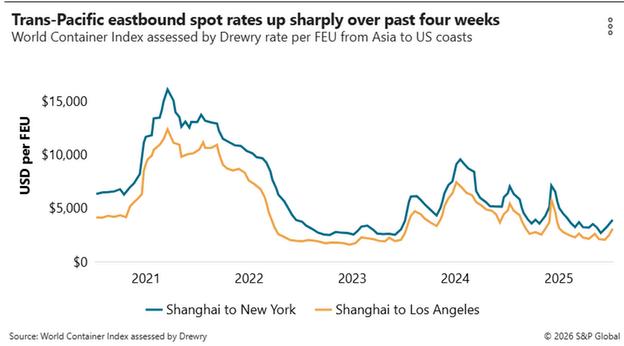
Carriers may attempt to push general rate increases either on February 15 or March 1 to slow the rate of decline, but it is likely that current spot rate levels have reached their peak through the end of February.
U.S. import demand has clearly been strained through January, with little significant bump typically seen for early and mid-January By ‘normal’ pre-Chinese New Year standards, this year’s market so far is trending much lower This is most likely a result of front-loading orders throughout 2025 as well as some shifting of supplier sourcing to avoid certain higher tariffs In either case, volumes are much softer compared to previous years’ upturn for carriers
U S retailers have already forecast weaker cargo volumes over the next three months. The National Retail Federation (NRF) forecasts that U.S. imports in February will be down 4.6% from the same month a year earlier, with March imports down 12.6% and April down 8.1% from the PY months.
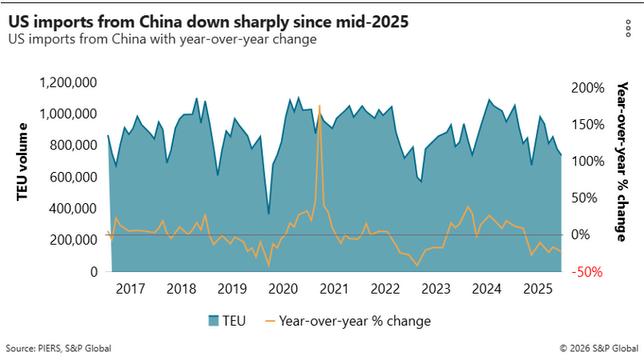
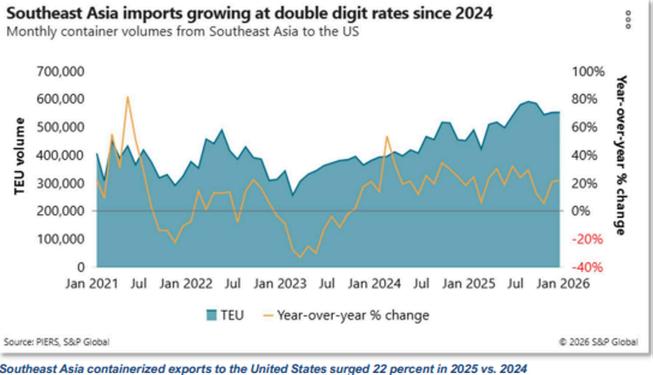
With the ongoing trade war between the U.S. and China, import volumes from China have definitely suffered The primary reason is based on the uncertainty of increased tariffs but also importers proactive attempt to seek out new sourcing partners outside of China. As shown below, overall import volumes from the SE Asia region have grown 22% in 2025 compared to 2024. Sourcing from Vietnam, Malaysia, Indonesia, etc., have all improved.
With the less-than-stellar January volume reported and little to no surge in Lunar New Year volumes, ocean carriers will need to find some alternatives to save themselves from a further decline in rates.
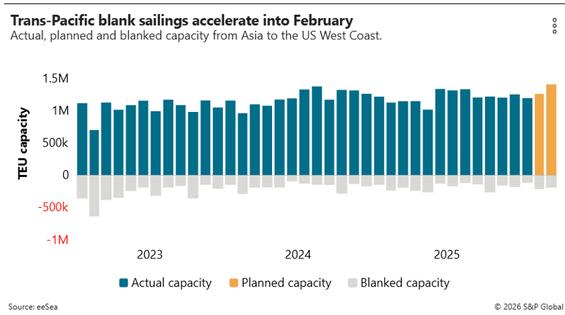
Ocean carriers are now adjusting further to the reality of this reduced demand with more blank sailings. Carriers will reduce the available capacity from Asia to North America to 2.5 million TEUs in the first quarter from 2.6 million TEUs in the fourth quarter, according to analysts. This also includes additional cuts that have not been announced by carriers.
Source: M+R Spedag Group
The Asia-East Coast (all-water) and Asia-Pacific Northwest trades, where demand is weaker than to the Pacific Southwest, will see elevated blank sailings around the Lunar New Year holiday. Carriers are blanking heavily in the weeks of February 23 and March 2 in response to the lower exports out of China as a result of the holiday. Blank sailings will increase in February. Data shows that carriers intend to blank 206,835 TEUs of capacity this month on the Asia to West Coast trade, up from 107,318 TEUs in January. From Asia to the East and Gulf coasts, the blanks so far in February are at 96,881 TEUs, according to eeSea, up from 77,339 TEUs in January.
CMA-CGM has now changed its mind about diverting vessels away from the Red Sea, just weeks after stating publicly that they will return to the traditional Red Sea/ Middle East trade route In late January, CMA announced that three service strings, the FAL 1, FAL 3 and MEX services, will again (or continue to) operate via the Cape of Good Hope around the southern tip of Africa This transit routing adds as much as two weeks to a typical service from Asia CMA did not specify any direct reasons why this decision was made, but stated that, for the time being, the three services will use the longer/slower route.
CMA-CGM was the only known major carrier to maintain some scheduled commercial services via the Red Sea despite the security risks and geopolitical tensions in the area. Since December, CMA-CGM and Maersk made some highly publicized voyages testing a return to the Red Sea. This was a positive industry update, as there was hope for a more robust return to normal vessel operations and scheduling. The Red Sea and Suez Canal routing serves as a critical link between Asia, Europe, the Mediterranean and North America.