






A little over a year after “Liberation Day,” energy costs and anticipatory implications of the war in Iran have not slowed rising spot rates or momentum for the balance of the year outlook. Diesel prices were at a stall in progress more than a shift in direction, but despite bright spots, there are no significant demand signals indicating any surges in volume. Capacity continues to tighten with challenges regionally tied to regulatory and inspection activity (i.e., California, Arizona and Texas) while rates climb in parallel. Core capital goods orders were up 5% YoY in March, with consumer spending remaining flat.
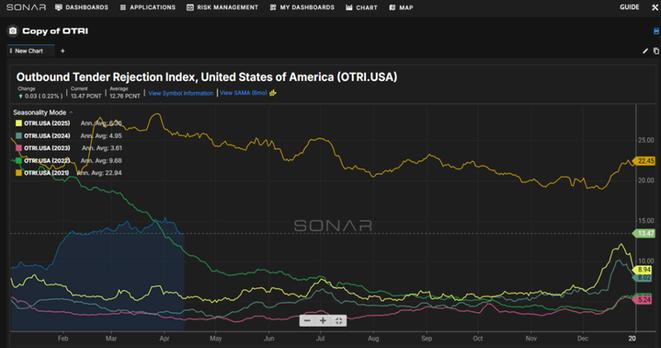
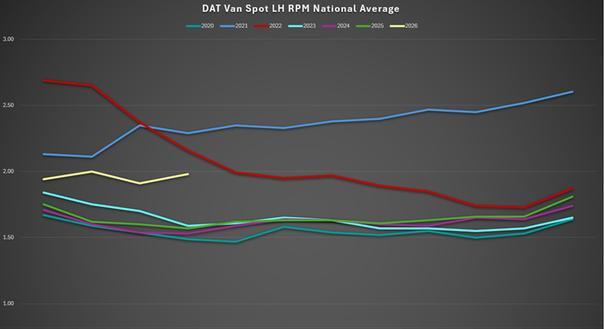


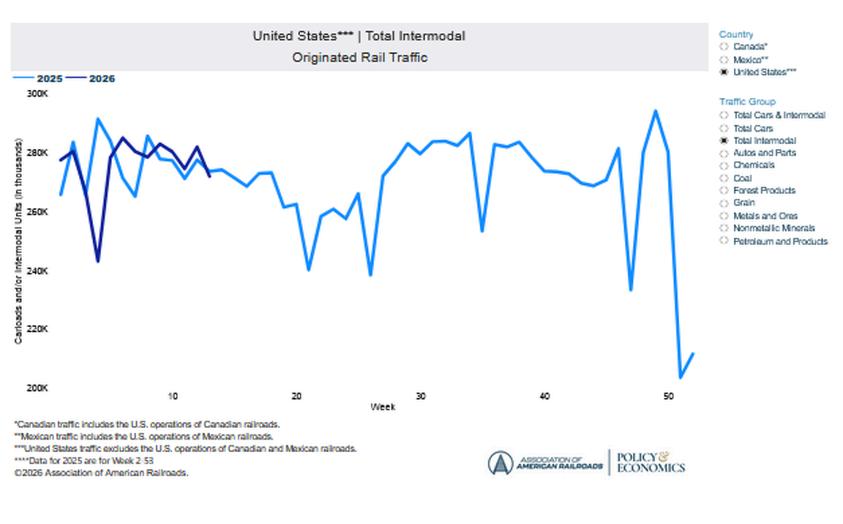
Many truckload shippers are exploring and switching to intermodal due to current truckload capacity constraints and rising fuel costs. Now is the best time for truckload shippers to get ahead of the curve and look at converting to intermodal transportation for any long-haul needs. California, especially, is seeing the impact of rising fuel and truckload rates, which is tightening capacity in the intermodal market.
Intermodal providers are still taking rate increases of 3-5% on RFPs and bid proposals. With domestic truckload to intermodal conversions increasing, we are continuing to see very few rate concessions from the providers.
Volume growth for North America has increased slightly to 1.8% for 2026 and decreased to 1.3% for 2027. Domestic containers remain the expected primary driver for intermodal growth.

Here are links to some top stories in the industry for you to check out:
ArcBest awaiting LTL demand inflection
FedEx Freight spin-off on track as company focuses on yield growth and longterm value
LTL jobs appear to take big hit at start of 2026
April starts to show what the market actually looks like as we come out of bid season. With most contracts now set, freight is beginning to flow under new pricing and routing structures. So far, there hasn’t been any major shift in volume, but there is a noticeable change in how freight is moving. Networks are adjusting to new lane alignments, and carriers are settling into the freight they chose to keep versus what they were willing to let go.
One theme that’s becoming clearer is freight mix. Shipment counts in some areas are holding up, but weight per shipment continues to be inconsistent, which is keeping tonnage from showing real growth. That dynamic is putting more pressure on network efficiency, as carriers work to balance service levels with lighter, more variable freight
On the pricing side, the market is starting to show a bit more separation Core accounts and well-aligned freight are still seeing stable pricing, while less dense or more volatile lanes are where flexibility is showing up It’s not broad-based pricing pressure, but more of a targeted approach as carriers fine-tune their networks after bid season.
As we move further into Q2, the focus shifts from planning to execution. Carriers are watching to see if freight levels build with the typical spring push, but expectations remain measured. Most are still running with a “prove it” mindset when it comes to demand, preferring to see consistent volume before making any meaningful changes to capacity or network structure.
Bottom line: April is less about where the market is going and more about how it’s operating. Bid season is behind us, networks are adjusting and freight patterns are settling in. The market remains stable, but the next real signal will come from whether volumes begin to build as we move deeper into Q2.
SOURCE: Trucking Dive, “Some LTL tonnage improves, but carriers report mixed freight performance,” David Taube, March 10, 2026
Early Q1 results across the LTL space are starting to show some improvement, but not consistently across the board. Some carriers are seeing volume and tonnage move in the right direction, while others remain behind prior year levels. The difference continues to come down to freight mix and how well it fits each carrier’s network. Heavier shipments and better-aligned freight are helping certain networks, while lighter, lower-density freight continues to create pressure in others. At the same time, pricing discipline hasn’t moved. Carriers are still holding yield and managing contracts carefully, keeping revenue trends more stable than volume trends.
Tonnage increased alongside a modest rise in shipments per day, driven by a shift in freight profile. However, revenue per hundredweight declined, reflecting continued pressure tied to fuel and overall market softness.
Revenue per hundredweight improved despite declines in tonnage and shipments, reinforcing the company’s continued focus on yield management and disciplined pricing.
Tonnage per workday remained below prior year levels, though shipment trends improved as the quarter progressed. Contract renewals stayed firm, signaling continued pricing strength.
Tonnage saw a slight increase, supported by higher shipment counts, though weight per shipment declined, another indicator of the lighter freight mix still moving through the network
Overall, the market is not turning broadly yet It’s stabilizing, with performance tied closely to freight mix and network alignment rather than a full demand recovery.
This is exactly the type of environment where discipline matters. MODE’s focus on clean freight, proper classification, and aligning shipments to the right carrier networks allows us to perform through mixed conditions while protecting margin and service. As demand becomes more consistent, that foundation positions us to scale with the right freight, not just more freight.
The ISM Manufacturing PMI rose to 52.7 in March 2026, marking the strongest expansion since August 2022 and extending the sector’s growth trend. Gains were driven by accelerating production, while new orders cooled and employment declined slightly further. Cost pressure remains the headline, with the prices index jumping to its highest level since mid-2022 Supplier delays extended for a fourth straight month, signaling continued strain across supply chains. Survey feedback turned more cautious, with a majority of respondents citing geopolitical risk and tariff uncertainty as growing concerns, adding pressure despite the recent momentum in output.
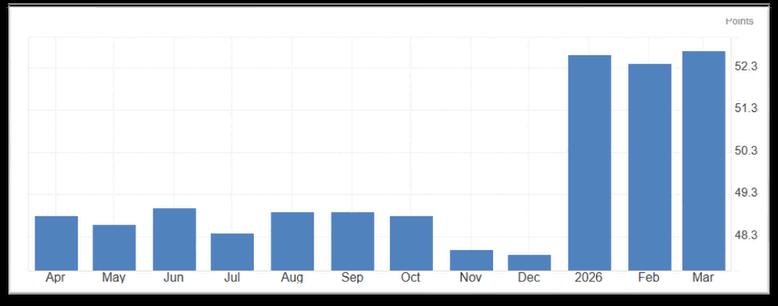
Source: Trading Economics & Federal Reserve
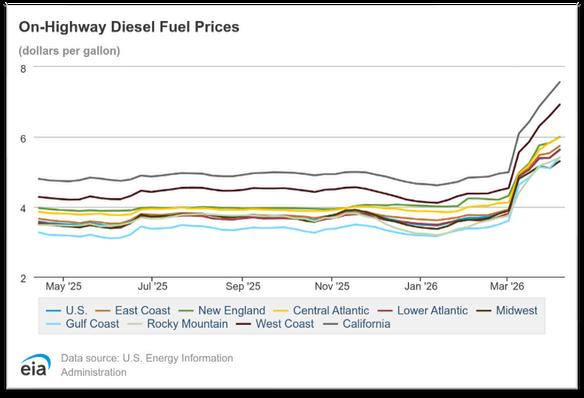
The U S national average cost per gallon for on-highway diesel in March 2026 came in at approximately $3 74, which is $0 01 (0 3%) higher than February 2026’s average of roughly $3.73. March 2025’s average was approximately $3 98, putting March 2026 about $0.24 (6.0%) lower year-over-year. As of the first week of April 2026 (week ending April 6, 2026), the national average stands at $3.67 per gallon, reflecting a decrease of $0.07 (1.9%) from the March monthly average.

The U.S. domestic parcel market is moving through a period of meaningful structural change. While volumes remain steady, approximately 23.9 billion shipments in 2025, with revenue growing 4.1% to $196 billion, the more significant shifts are happening beneath the surface: in how carriers are pricing their services, how their networks are being restructured, and how shippers are being forced to rethink cost assumptions they’ve held for years. Four developments stand out heading into Q2.
Accessorial fees have been rising faster than base rates for several years, but 2026 marks a notable inflection point. Industry data now places surcharges at roughly 30–40% of total parcel spend for many shippers a figure that fundamentally changes how carrier costs need to be evaluated. Delivery area surcharges, additional handling, residential delivery fees and large package charges are all up 6–10% year over year, outpacing general rate increases across the board For organizations still anchoring their carrier decisions to base rates alone, the gap between budgeted and actual spend is growing
A shipper focused only on negotiated base rates may be underestimating true carrier costs by a significant margin. Understanding which surcharges apply to which package types, weights and zones is now as important as the rate card itself.

One of the most consequential developments in domestic parcel this spring is USPS applying an 8% fuel surcharge to package services the first in the agency’s history. Effective April 26, 2026, through January 17, 2027 (pending Postal Regulatory Commission approval), the surcharge applies to Priority Mail, Priority Mail Express, USPS Ground Advantage and Parcel Select. First-Class Mail is not affected.
The significance extends beyond the 8% figure itself USPS had historically been one of the few carriers without a fuel surcharge, making it a predictable, stable cost option particularly for lightweight parcels That structural distinction no longer holds Combined with USPS’s January 2026 general rate increases, some shippers could be facing a cumulative cost increase of close to 16% on certain services within a matter of months. USPS has indicated this surcharge is also a step toward more permanent, market-responsive pricing and a meaningful shift in how the postal network will operate going forward.
8%
USPS fuel surcharge effective April 26, 2026 ~16%
Potential cumulative YoY cost increase on select USPS services
20–25%
FedEx and UPS fuel surcharges as a % of shipping costs currently

FedEx’s Network 2.0 initiative is the consolidation of its historically separate Ground and Express operations into a single integrated network, which is one of the most significant structural changes in domestic parcel in recent memory Progress has accelerated considerably in 2026 As of February, more than 25% of FedEx’s eligible average daily volume in the U S and Canada is flowing through over 360 optimized facilities, with FedEx targeting 65% by the 2026 peak season More than 200 stations have already closed, with over 475 closures expected by the end of 2027, equating to roughly 30% of FedEx’s total facility footprint.
The operational rationale is straightforward: eliminating overlapping Express and Ground routes reduces cost and complexity. FedEx has reported a 10% reduction in pickup and delivery costs in markets where Network 2.0 has rolled out, and projects $2 billion in total savings by the end of 2027. For shippers, the most immediate practical change is consolidated pickups, meaning one truck, one appointment, for both Express and Ground packages, which eliminates the need to separate shipments by service type. FedEx has stated that service levels are being maintained throughout the transition, and real-time visibility tools are being expanded to support proactive exception management during the rollout.
Shippers no longer need to separate Express and Ground packages for pickup in optimized markets
Pickup pricing was updated in August 2025 to reflect the consolidated model a single fee structure regardless of service type
FedEx’s Canadian network was fully optimized first and is being used as the operational blueprint for U S markets
Amazon overtook USPS as the largest U.S. parcel carrier by volume in 2025, a milestone that signals how much the competitive structure of domestic delivery has changed. This shift, combined with the pricing and network changes underway at FedEx, UPS and USPS, makes Q2 a practical window for shippers to review their carrier mix, revisit routing assumptions, and ensure their programs reflect the current environment rather than conditions from a year ago.
With Q1 data now available and peak season pressure absent, April and May offer the clearest view of actual shipping cost trends. Organizations that conduct a program review now are better positioned when contract cycles reopen later in the year.

Rates: After continued declines in March, rates are moving up sharply due to the conflict in the Middle East.
Volume: April forecast expected to be a little better than March but still well below 2025.
Capacity: Capacity available in the Transpacific trade though the Middle East conflict is having some impact on vessel schedules.
The effects of the Iran war are being felt across the global supply chain, as container rates rise in all trade routes including to the United States Since the Strait of Hormuz closure, spot rates on every major east-west trade lane have risen sharply Asia to U S West Coast, a trade lane very far from the Middle East, has seen spot rates increase 29% since the end of February.
Up until the start of the Iran conflict, average Transpacific spot prices were more than 50% lower than in January and February 2025, and Asia-Europe rates were similarly 30% down compared to last year.
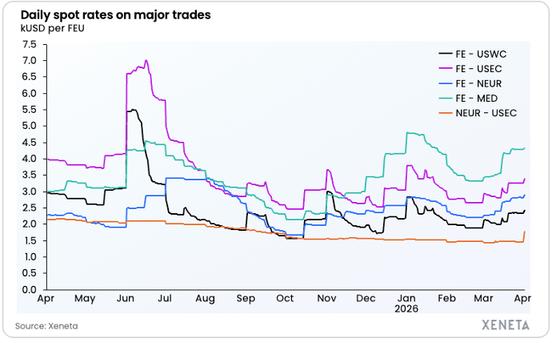
Market average spot rates (according to Xeneta) as of April 1 from Asia to the U.S. West Coast were $2,430 per 40 ft. container, and $3,382 from Asia to U.S. East Coast ports. It is being reported that some Transpacific carriers are moving toward a one-week rate cycle to try to capitalize on volatility in the market.
Spot rates from Rotterdam to New York also jumped 25% to $1,968 per FEU in the first week of April, breaking the usual trend of stability in the Transatlantic trade. The primary driver was the limited capacity due to vessel schedule issues with Middle East transits.
With an eye on potential fuel shortages, ocean carriers all scrambled to announce and implement new Emergency Fuel surcharges Most carriers are pushing for Emergency Fuel Surcharges of around $200 per TEU
Maersk officially petitioned the FMC to waive the 30-day tariff notice so they could immediately implement higher fuel levels The FMC denied this waiver request, as many believe this could open the door to unreasonable profiteering
Fuel supplies in Singapore, the world’s largest bunker fuel hub, remain available; however, at roughly double precrisis prices. They are trending slowly downward after an initial spike, but significant fuel increases will be felt in the near term.
With actual volumes reported, February import volumes were 2 09 million TEUs, down 9 7% month-over-month, reflecting normal seasonal patterns These volumes were typical of February levels observed post-pandemic and remained 17 0% above February 2019 March 2026 numbers have not been reported yet, but analyst projected volumes of about 1.91 million TEUs, representing a significant year-over-year decline of 11-12%. Based on continued muted demand, no data is indicating much change to this forecast, especially with the onset of global unrest in late March.
April is expected to be a stronger month than March, which is in line with the traditional spring trend but will still be an overall decline compared to 2025. April volumes are forecasted at approximately 2.03 million TEUs; this represents a decline of about 5-8% compared to April 2025. But it is important to note that the comps of 2025 were rather inflated due to volume frontloading as a result of tariff volatility at the time.
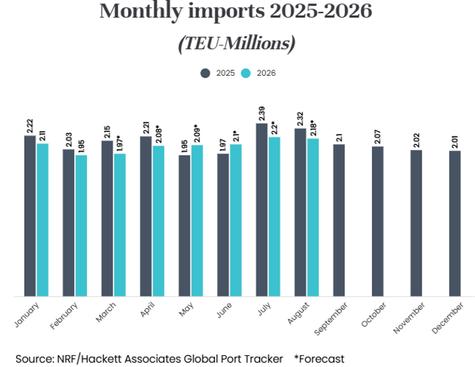
While conflict in the Middle East has increased fuel costs and shipping rates, analysts suggest the immediate impact on U.S. inbound container volume remains somewhat limited since very little cargo is sourced directly from that region.
One potential volume market driver is new/fresh tariff uncertainty because of the Supreme Court ruling rescinding tariff actions by the Trump Administration. This change has seemingly created more questions for U.S. importers and led to continued caution with their importing strategies. Importers are currently maintaining leaner inventories with more purchase discipline following the high-volume "tariff-driven surge" that occurred for most of 2025.
Generally speaking, global capacity is still available in most trade lanes, and specifically, capacity in the Asia to U.S. lanes seems to be open and readily available. However, as reported previously, the key drivers to this are certainly a weaker demand from the U.S. for import volumes, but more directly related to new capacity infusions from the ocean carriers.
New capacity is expected to enter the market in late April and May as the Premier Alliance carriers expand their Pacific Southwest services by 20% with new vessel introductions Overall, for 2026, analysts estimate about 1 5M TEUs of new capacity will be implemented throughout the year
Evergreen Marine announced on April 10 that they have finalized a new ship order for eleven 24,000 TEU container ships, which equates to an additional 260,000 TEUs or about a 30% capacity increase for Evergreen.
Carrier capacity management remains aggressive, particularly across the primary ports in North China. Carriers are still using blank sailings, but also continuing to employ slow steaming of their vessels in transit.
Over the next five weeks, carriers will blank 66 sailings out of 700 scheduled departures, reflecting a 9% cancellation rate, with the majority (91%) of services still operating as planned. Cancellations are concentrated on the Transpacific eastbound (56%), followed by Asia–Europe/Med (27%), while the Transatlantic (17%) sees fewer disruptions. Because of these missed schedules and altered rotations, congestion risks at major ports including Shanghai, Ningbo, Qingdao, Singapore, Nhava Sheva and Mundra will continue to be a factor.