Calming the Anxious Generation
Responding with clam, care and faithful presence as smartphones and social media reshape student life.


Responding with clam, care and faithful presence as smartphones and social media reshape student life.
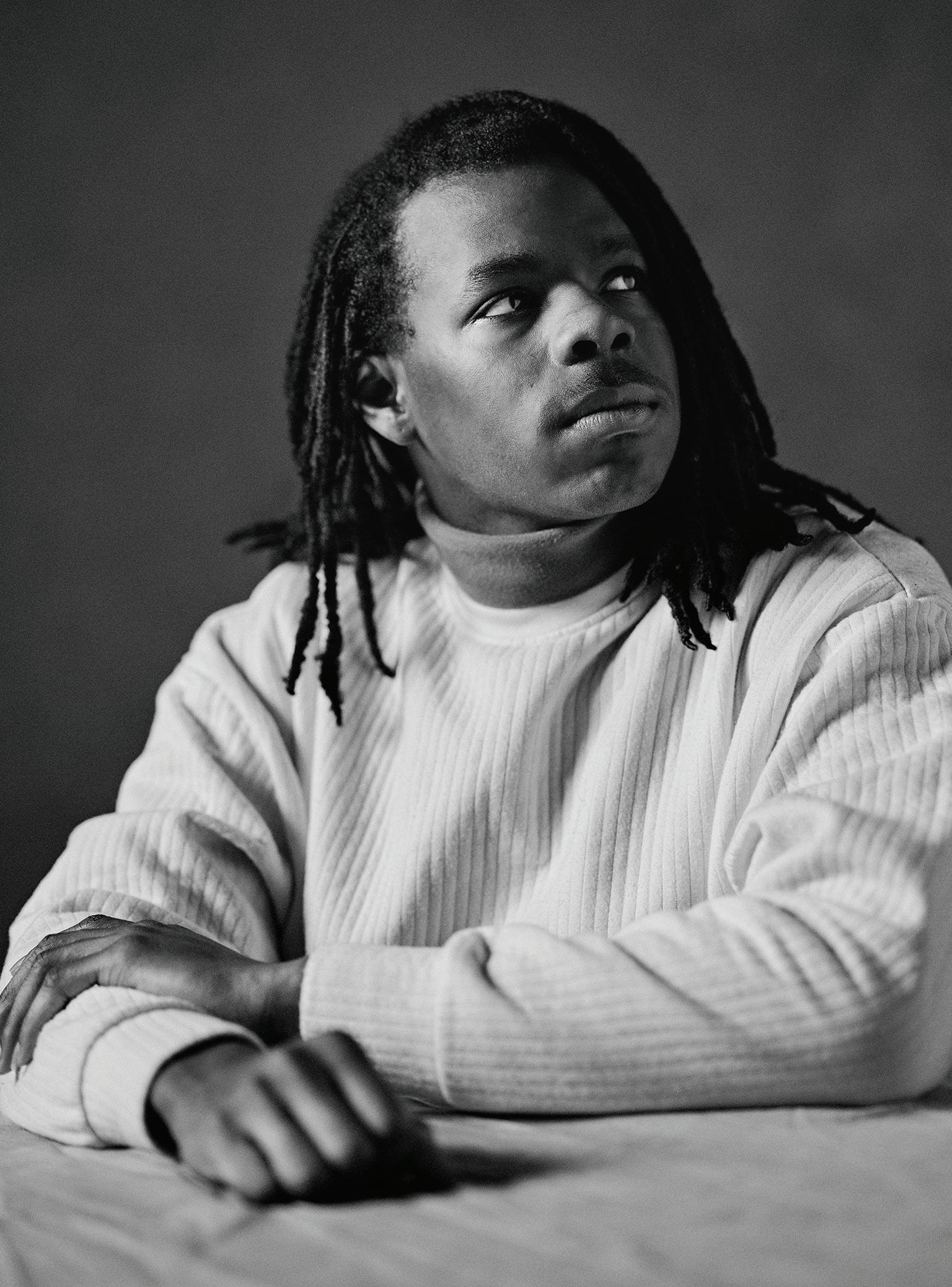
I chose MBU because I wanted genuine Christian community. When I arrived on campus, I experienced a kind of crisis of faith. I was really struggling. Media & Production Coordinator Josh Hunt (’21) welcomed and listened to me.
Through that kind of support, I began to heal.
Since then, I’ve grown stronger in faith, purpose and hope for the future.
President
Dr. Keith Ross (’87)
Senior VP for Enrollment, Marketing & University
Communications
Bryce Chapman
Editor-in-Chief
Joel Lindsey
Creative Direction & Design
Metaleap Creative
Photographers
Judd Demaline, Lisa Hessel, Corey Nolen, Paul Nordmann, Ben Rollins, Jennifer Silverberg
Illustrators
Oriana Fenwick, Satoshi Hashimoto, Claire Merchlinksy, Brian Rea, James Yates
Writers
Joel Lindsey, Reid Davis
Contributors
Tyler Andrus, Ashley Crane, Claire Floring, Keshon Word
Cover Illustration
Brian Rea
mobap.edu

Responding with wisdom, care and faithful presence as smartphones and social media reshape student life.
MBU faculty members explore the television series Severance and humanity's search for wholeness. Hospitality in
Inspired by Provost Emeritus Dr. Arlen Dykstra, the MBU community strives for Christ-centered hospitality.
Serving in the shadows, Chris Hume ('92) has protected presidents with steady, disciplined leadership.
MBU Magazine is published by the University Communications Office of Missouri Baptist University, One College Park Drive, Saint Louis, Mo. 63141-8698. Copyright 2025. All rights reserved. Send change of address notification at least a month before effective date, including both old and new addresses. Postmaster send address changes to MBU Magazine, Missouri Baptist University, One College Park Drive, Saint Louis, Mo. 63141-8698.
Articles and letters to the editor are welcome. Email submissions to editor@mobap.edu.
All submissions are subject to editing and will not be returned. Free subscriptions are provided to University alumni, donors and friends. Contact 314.392.2304 or editor@mobap.edu for details.
We are serious and intentional about our Christian faith. We will freely and responsibly search for truth. We strive for excellence. We believe in the importance and cultivation of character. We believe in social change through service and leadership.





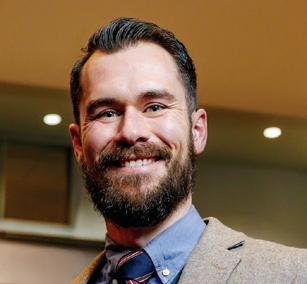

Dr. Keith Ross
Guided by the year’s theme verse, MBU embraces a rhythm of rejoicing, praying and giving thanks, celebrating God’s work while preparing students to serve Christ faithfully.
This academic year the MBU campus community has been led by the words of 1 Thessalonians 5:16-18: “Rejoice always, pray continually, give thanks in all circumstances.” These simple but profound instructions form a powerful rhythm for Christian life, and they also shape the culture we seek to cultivate each day at Missouri Baptist University.
When we rejoice, we celebrate the ways God is at work among us. We see it in the accomplishments of our students, the dedication of our faculty and staff and the faithful presence of our alumni who are serving Christ in communities across this nation and the globe. Their lives are a testimony to the mission and impact of an MBU education.
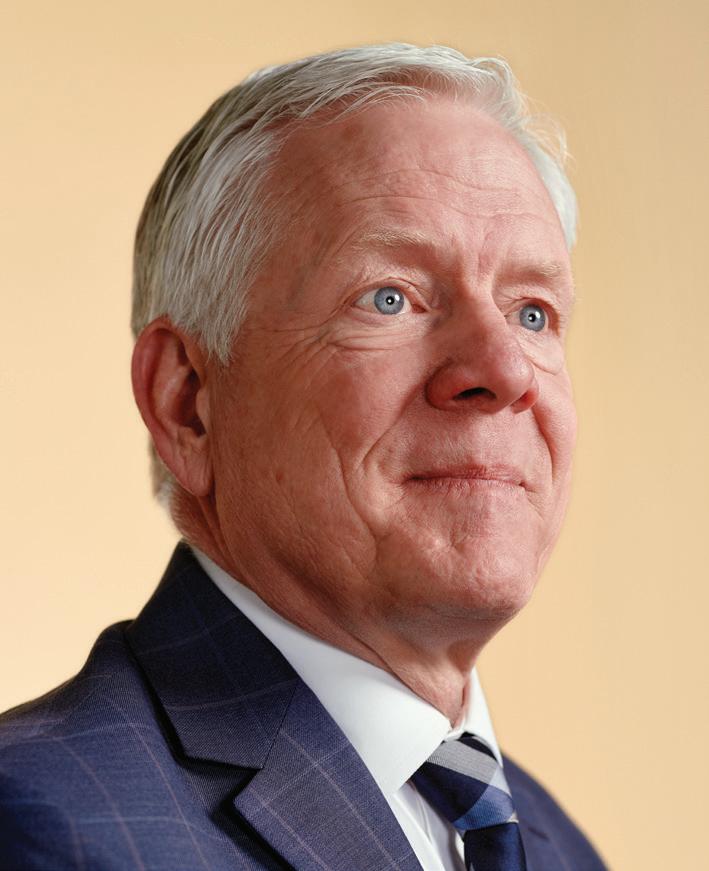
When we pray, we are reminded that our work is ultimately God’s work. Each day, we lift up our students, asking the Lord to guide their steps, deepen their faith and shape their vocational aspirations. It is truly a privilege to watch young men and women grow academically and spiritually as their lives are transformed during their time here at MBU.
And when we give thanks, we acknowledge the many people God uses to make this mission possible. I am especially grateful for the generous donors who have invested in the new Pillsbury Wainwright Academic & Welcome Center, which will soon serve future generations of students and warmly welcome guests to MBU’s beautiful campus for many years to come.
Rejoicing, praying and giving thanks — these practices help create a culture where students flourish, faith grows and MBU’s influence is expanded. For that, we are deeply grateful.
As we continue forward, this rhythm also calls us into deeper community with one another. It reminds us to bear one another’s burdens, to celebrate victories, both big and small, and to remain anchored in hope in every circumstance. At Missouri Baptist University, we believe formation happens not only in classrooms but in relationships, shared experiences and daily faithfulness. It is in these moments that character is shaped, calling is clarified and lives are prepared for meaningful service. By God’s grace, we will continue to pursue this vision together with humility, purpose and enduring joy.
The people, conversations and values shaping MBU in a season of growth, hospitality and thoughtful engagement.
A college magazine is, in many ways, a snapshot of a moment in history. Our current moment includes some obvious things like campus construction projects and the expansion of academic programming, but also includes the less obvious ideas we’re wrestling with, the people shaping the culture and the ways our community lives out its values.
As we assembled this issue of MBU Magazine, a few themes began to surface across very different stories.

One is the idea of formation. Formation happens in classrooms and labs, certainly, but also in chapel conversations, late-night study sessions, mentoring relationships and shared experiences that shape character over time. Several of the stories in this issue explore how Missouri Baptist University seeks to cultivate thoughtful, resilient graduates who are prepared not only for careers but for lives of purpose and service.
Another thread is hospitality — a value that has long defined this institution. Hospitality at MBU shows up in small but meaningful ways: a professor investing extra time in a student, a staff member helping a family find their way across campus, classmates forming bonds that last far beyond graduation. In this issue, we reflect on the legacy of leaders who modeled that spirit well and on the ways the University continues to practice hospitality in both ordinary and difficult moments.
You’ll also notice stories that highlight the importance of conversation and curiosity in an age that often feels dominated by noise and division. Whether examining cultural trends affecting today’s students, exploring friendship across political differences or reflecting on faith and learning in the classroom, these stories point toward a hopeful conviction: that thoughtful, faith-informed dialogue still matters.
Alongside these reflections, you’ll also find celebrations of Spartan athletics, alumni updates and, of course, one-of-a-kind advice from MBU’s First Pup, Magnolia Bleu.
Taken together, this issue reminds us that a university is ultimately a community of people learning, questioning, serving and growing together. Thank you for being part of the MBU story.
It was a tale of dueling news conferences.
In 2002, Republican Jim Talent and Democrat Jean Carnahan were campaigning to fill a U.S. Senate seat, with a special election looming. John Hancock, executive director of the Missouri Republican Party, was working to support Talent.
Then, a pro-Talent news conference was crashed by Michael Kelley, who held the same position in the Missouri Democratic Party and who
handed out a news release refuting Hancock's points.
“I thought, ‘You know, what a punk!’” Hancock recalls. It was an unlikely start to what eventually became a close friendship.
“Then the Missouri Chamber of Commerce invited both of us to debate before the election, and we did,” Hancock says. “After that, we got to talking a little bit, and you know, I kind of liked him!”
“The following year, I started my own consulting business. I got a contract with Sallie Mae, who asked if I worked with any Democrats,” Hancock continues. “The only Democrat I knew was Michael, so I found his phone number and called him.”
As featured guests at April's Spartan Speaker Series, the friends are an increasingly rare example of a relationship that values the intellectually honest civil discourse Missouri Baptist University strives to uphold.
“I feel strongly that Christian liberal arts colleges are uniquely positioned to help foster civil discourse,” saysid MBU President Dr. Keith Ross. “We offer different forums, panels and classroom dialogs with diverse viewpoints, where all are welcome, and we do it all within a Christian framework.”
That framework is rooted in the understanding that God’s kingdom is bigger than the concerns of the United States of America or even the world, says Dr. Matthew Easter, professor of Biblical Studies at MBU.
“If we’re Christians, according to the Apostle Paul, we have been crucified with Christ in the life we live now,” Easter says. “We live by the faithfulness of the Son of God who loved us and gave himself for us. Paul also says in Colossians that we

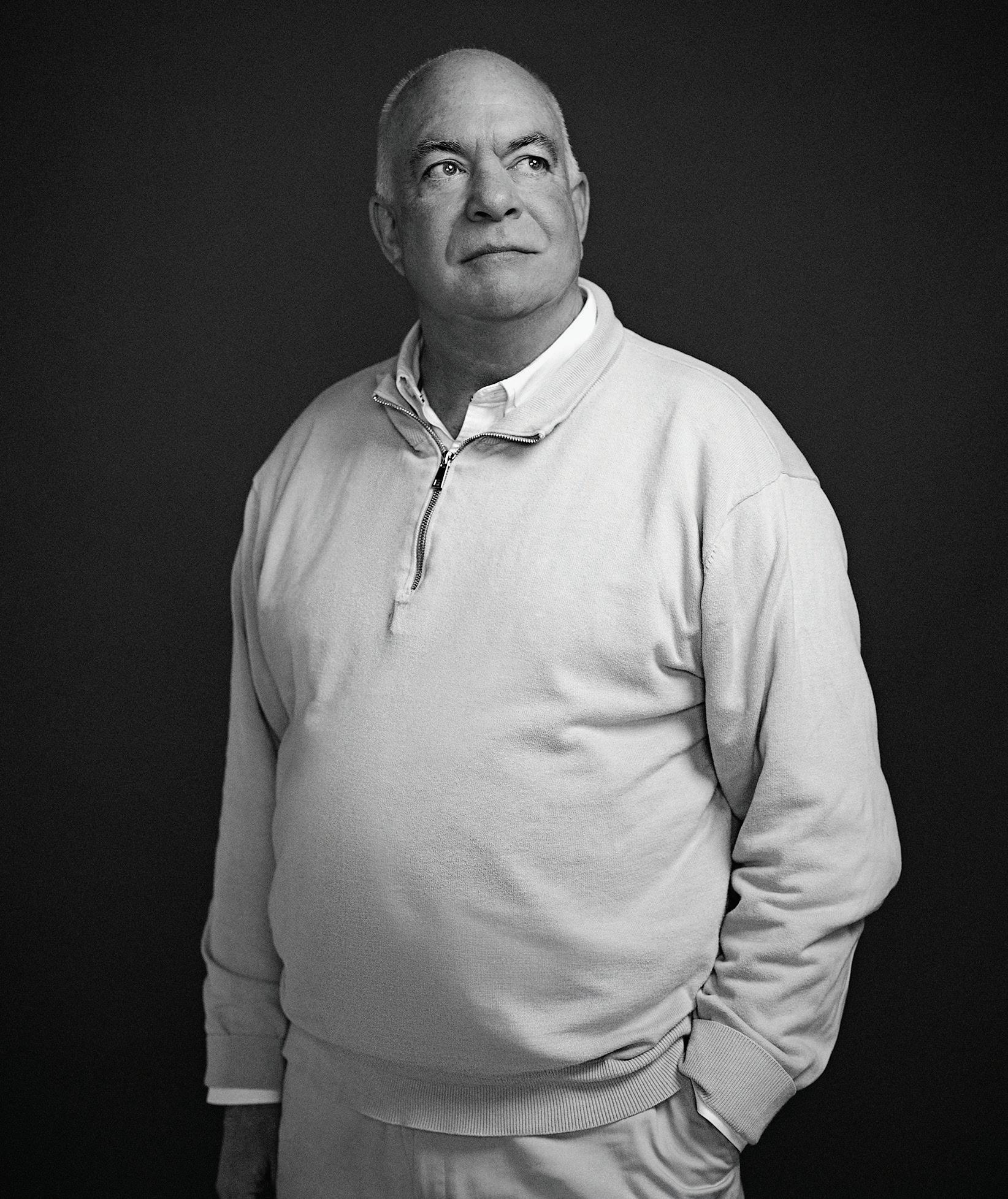
are dead and our life is hidden with Christ and God. We are in a completely new reality when we participate in the life, death and resurrection of Jesus in baptism.”
“We no longer operate on the world’s way of navigating the world,” Easter continues. “By putting so much emphasis on politics, we’re fundamentally betraying the fact that we don’t understand that.”
At the same time, Easter observes, this transcendent perspective should cause Christians to stake out positions that don’t neatly align with either party. A consistent pro-life position, for example, might go beyond legal prohibition to support services that make it easier for mothers to carry babies to term and raise them.
“If I’m truly pro-life, I need to be pro-life from womb to tomb, as they say,” he says.
Moving by standing still
Michael Kelley notes with wry amusement that he and Hancock have remained politically consistent, even as the ideologies — and fortunes — of both parties have changed around them.
by
“JOHN AND I HAVE THE SAME VARIED INTERESTS WEʼVE ALWAYS HAD. WEʼVE JUST FOUND A WAY TO ACCEPT WHERE THE OTHER PERSON IS AND MOVE FORWARD FROM THERE.”
“When I started in Democratic politics, we had the governor’s office and most of the statewide offices. Today, the Democrats have no statewide [offices] and are the ultra minority in both the House and the Senate,” Kelley observes.
“We've seen both of our parties changing drastically,” Kelley continues. “You know, I’m not that much different of a Democrat than I was the day I started in politics.”
“John and I have the same varied and different opinions we’ve always had,” Kelley says. “We’ve just found a way to accept where the other person is and move forward from there.”
Shifting sands
As the platforms of each party have shifted, the two ideologically-opposed friends have at times found themselves on the same side of an issue. For example, free trade was once a key plank of the Republican platform, with the GOP opposed to tariffs and other restrictions on moving goods across borders.
Today, with tariffs a key part of the current administration’s agenda, the GOP has done an about-face, a phenomenon that Kelley, who once worked for free-trade skeptic Richard Gephardt (former Democratic U.S. House Representative), finds strange.
Immigration is another topic where the two find themselves mostly in alignment. Hancock doesn’t oppose enforcement, but believes it should be balanced against allowing the country to be an asylum for those who need one. Hancock reported feeling troubled about a recent situation in St. Louis, where Alejandro Perez, a father and church member with a Social Security number and work permit, was detained and threatened with deportation.
Meanwhile, Kelley finds the administration’s approach to immigration enforcement “cynical” and not in keeping with promises to only deport “the worst of the worst.”
Swimming upstream
While friendships across the aisle were once so normal as to be unremarkable, today people like Hancock and Kelley are so rare that they merit media platforms and stories in publications like this one.
What’s the secret to swimming against the tide? Faith plays a key role.
“I’m a Christian, and gave my life to Christ in 1986,” Hancock says. “And so I can see… that Michael is an image bearer, and he’s got one of the kindest hearts of anybody I’ve ever met in my life. And so I love him, and I think one of the reasons that I love him is because God has first loved me and I see the Lord in him.”
JOHN HANCOCK and MICHAEL KELLEY were the featured guests at the April 7, 2026, Spartan Speaker Series, moderated by MBU President Dr. Keith Ross.
“I’m a person of faith,” Kelley says in agreement. “I believe in God. It wasn’t until I really created this relationship with John that I met somebody who was different from me and the people that I knew who were Catholic. To see his spirituality has helped broaden my mind in terms of why people come to the conclusions that they come to.”
College life isn't only on campus.
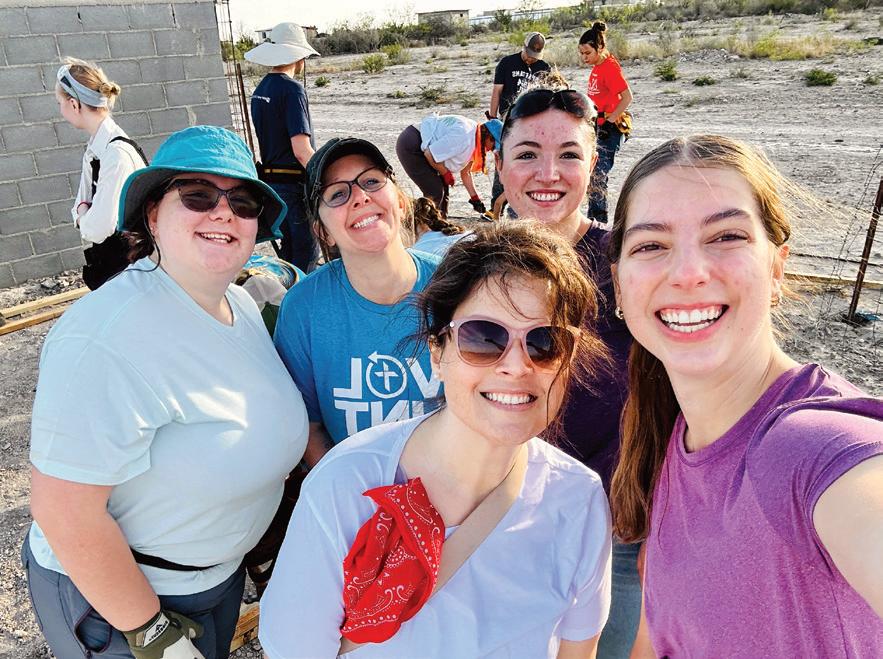
Serving together Mexico
a
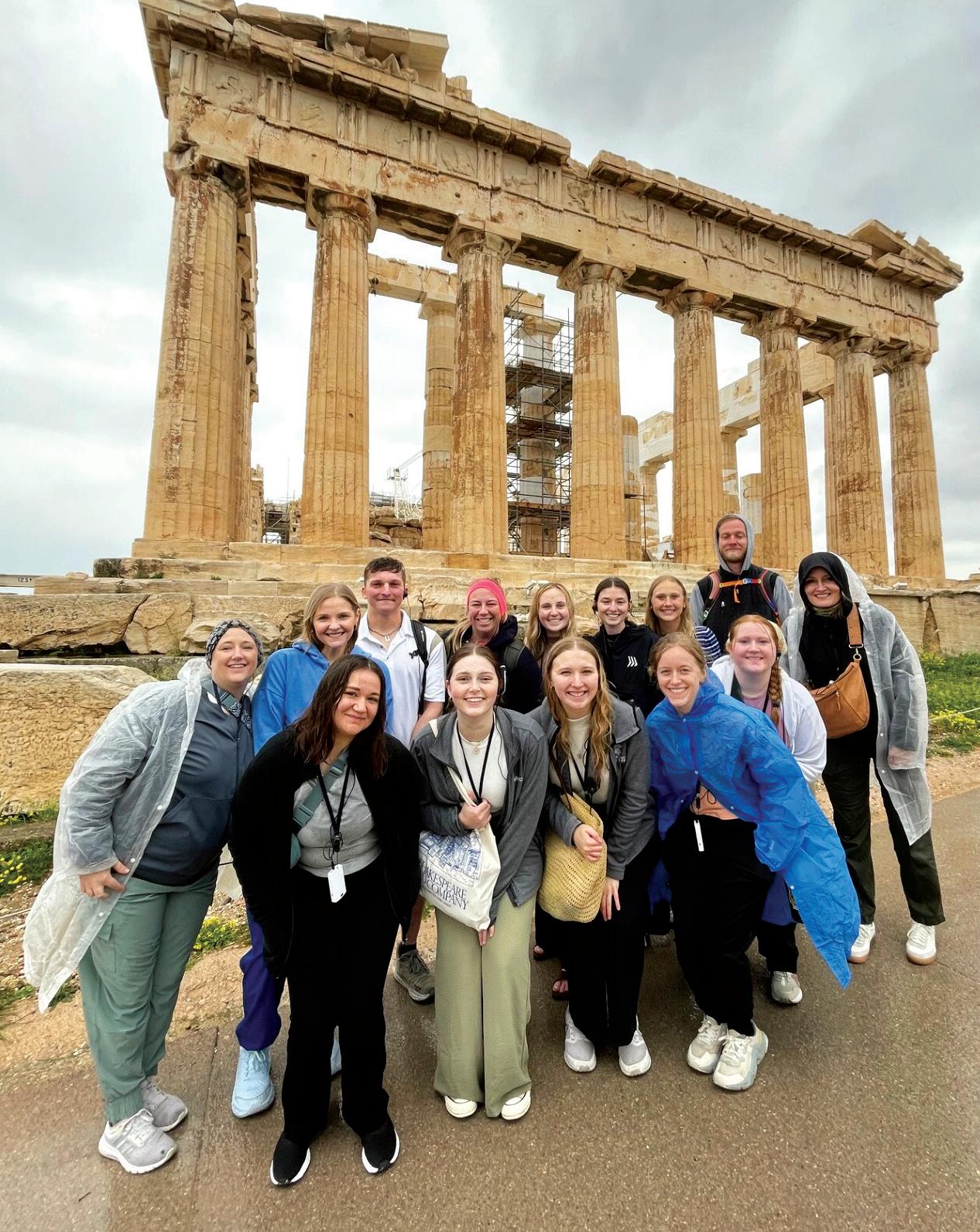
Serving near and far Mexico
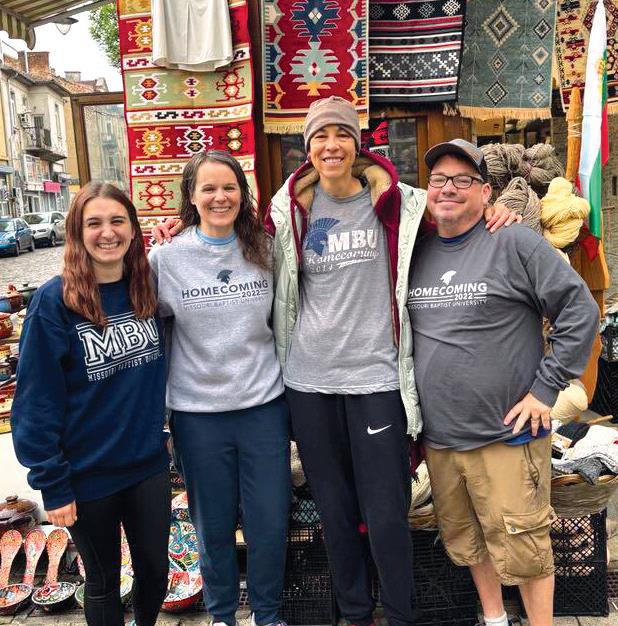
Walking through the
“Arise, shine, for your light has come, and the glory of the Lord rises upon you." (Isaiah 60:1)


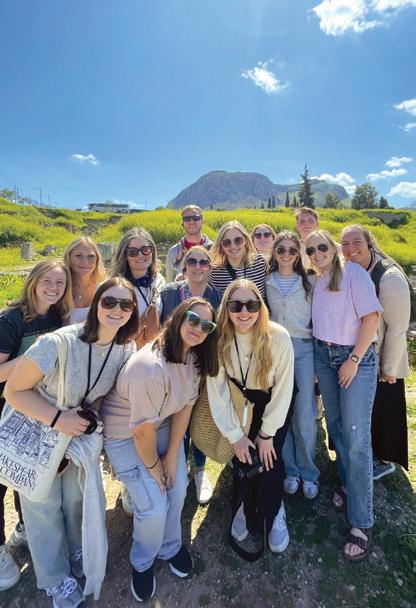
Beautiful ruins Corinth, Greece
At ancient Corinth, Acropolis of Corinth in the background. Dr. Ansley Little (left), Haley Edmonds, Taya Abraham, Avarah Riesenberger, Megan Turner, Mia Pogue, Emma Revelle, Ashley Hofius, Ellie Schertz, Jordan Notz, Dr. Robin Murray, Dr. Ashley Bell, Sydney Kardasz
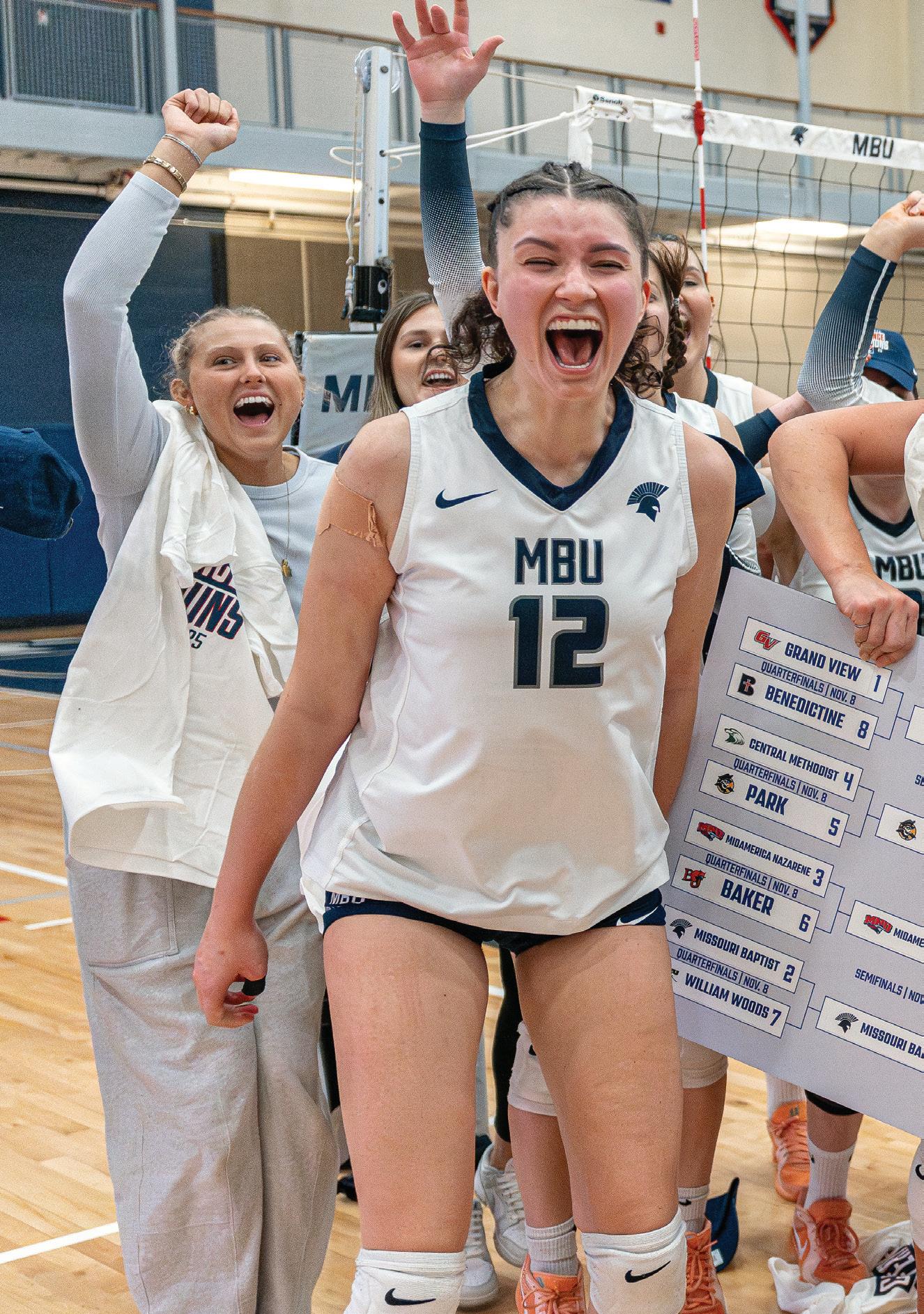
With the score tied 6–6 in the deciding fifth set, Missouri Baptist University’s women’s volleyball team stood on the edge of a moment that could define its season.
Across the net was No. 3-ranked Corban, a legitimate national title contender. Just minutes earlier, the Spartans had dropped the fourth set 25–18, forcing a winner-takeall finale. In the huddle, Head Coach Claire Ochs made the moment clear.
“This could be a defining win — one that sets the tone for the rest of our season,” she told her players. “Don’t shy away from it.”
The Spartans didn’t.
Behind a pair of aces from threetime NAIA All-American Gabi Jakubowska, MBU broke the deadlock and surged ahead 10–6 before closing out a 15–9 victory. The upset capped an impressive opening tournament that included wins over No. 16 Viterbo and No. 9 St. Thomas.
More importantly, it previewed what the Spartans would become.
Missouri Baptist went on to win both the Heart of America Athletic Conference regular-season and tournament championships in the program’s first year in the league. For Ochs, the moment against Corban captured the identity she has worked to build.
“Over the past two seasons, we’ve talked constantly about the
“AS A COACH, YOU WANT TO BUILD SOMETHING THAT LASTS. WHEN CULTURE, COMMITMENT AND INSTITUTIONAL SUPPORT ALIGN, IT ALLOWS YOU TO CREATE SOMETHING BIGGER THAN A SINGLE SEASON.”

culture we want to build and the mentality we want to bring,” Ochs said. “This was our opportunity to live it.”
That culture has produced immediate results. In her first two seasons as head coach, Ochs has led the Spartans to a 58–18 record, two conference regular-season titles, two conference tournament championships and two appearances in the NAIA National Tournament.
Her leadership has also earned national recognition. Ochs was named conference Coach of the Year in back-to-back seasons — in two different conferences — and was selected as the 2025 American Volleyball Coaches Association Midwest Region Coach of the Year.
Ochs credits much of her philosophy to mentors who shaped her own career. From former MBU Head Coach Chris Nichols, she learned the technical details and competitive drive that defined a national championship program. From Southeast Missouri State University Head Coach Julie Yankus, she learned the importance of genuinely caring for the people around her.
“As a coach, you want to build something that lasts,” Ochs
said. “When culture, commitment and institutional support align, it allows you to create something bigger than a single season.”
At Missouri Baptist University, that culture is rooted in both competition and community.
“The foundation of our culture is God, and it is selfless and thoughtful,” Ochs said. “It makes coming to work something I genuinely look forward to each day.”
If the early moments of the 2025 season were any indication, the Spartans are building exactly the kind of program Ochs envisioned — one capable of rising to the biggest moments and competing on the national stage.
On Thursday mornings, music and prayer fill MBU’s Pillsbury Chapel as students gather for worship. On the first Tuesday of the month, students might hear a scholar, athlete or cultural leader challenge them to think more deeply about faith and calling. These rhythms — chapel and the Spartan Speaker Series — reflect two complementary ways MBU forms students spiritually and intellectually.
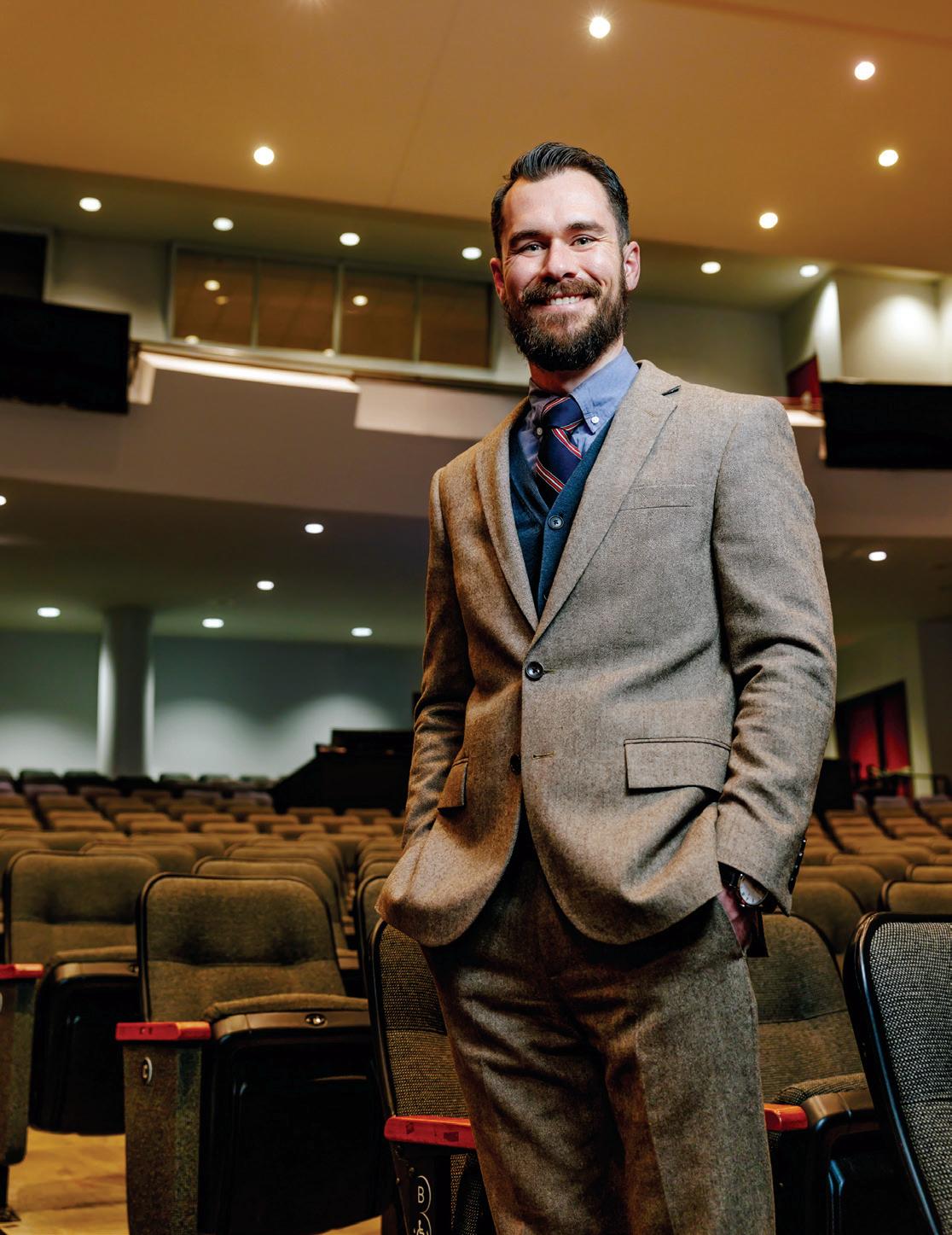
Dr. Aaron Lumpkin, vice president for Spiritual Formation and assistant professor of Theology, recently explored the importance of these rhythms in an article published by the International Alliance for Christian Education (IACE).
Lumpkin reflects on his experience as a college student attending both chapel-style worship gatherings and academic-style convocations.
“In my undergraduate studies, I was sometimes frustrated that convocation did not reflect the components of chapel more closely,” Lumpkin said.
Today, however, Lumpkin argues that Christian universities need both gatherings because each contributes to the formation of students. “We need chapel because we’re not simply producing teachers, nurses and business leaders. We’re forming distinctly Christian teachers, nurses and business leaders.”
Convocation-style events, he argues, extend that formation by exploring cultural issues and professional life through a Christian worldview.
Lumpkin believes both gatherings prepare students for more faithful engagement. “We need chapel and convocation so students are equipped to live faithfully in this time.”
→ Attend chapel regularly. Treat it as a time to worship, reflect and reset your focus on God amid a busy academic schedule.
→ Listen with curiosity at convocation events. Guest speakers often address real-world issues through a Christian lens.
→ Connect faith and learning. Ask how the ideas you hear relate to your major and future vocation.
→ Discuss what you hear. Conversations with friends, professors and mentors help turn ideas into lasting formation.



In a cozy office in the Field Academic Building, three Early College Partnerships staff members see student stories in everday office supplies.

On the bottom floor of the Field Academic Building, there’s a work space that feels less like an office and more like a wellkept living room. It’s warm and tidy in that lived-in sort of way, buzzing with charm and purpose. This is home base for the Early College Partnerships team at Missouri Baptist University: Kim Cochran, Colleen Inman and Dr. Mary Saale.
It is also where one very large jar of paperclips lives.
The jar is impossible to miss. When visitors see it, they usually laugh and ask the obvious question: Why do you have so many paperclips? The answer always lands with a smile and a hint of pride.
“Every one of these paperclips is a student,” the ECP trio explains.
Each paperclip represents a real high school student taking college-level courses through Missouri Baptist University’s Early College Partnerships program. ECP allows students to earn college credit while still in high school, at a significantly reduced cost, easing the transition to higher education and opening doors that might have once felt out of reach.
The paperclips are used to hold together physical copies of student files. In the ECP office, students aren’t just digital data points. Students are paperclips; they’re tangible, countable and carefully handled.
“We want students to be treated with kindness through every interaction with MBU,” Cochran says. “We visit every dual-credit high school classroom in-person because we want students to know they will be cared for. When they call our office with questions, they talk to a real person, which often comes as a surprise to them.”
Inman smiles as she describes how the jar keeps the team motivated. “The paperclip jar is a fun reminder that our daily work has real impact on students. It reminds us why we do what we do,” Inman says.
Dr. Saale connects the jar to spiritual purpose. “Getting this jump start on college can change the trajectory of students’ lives. For me and for our team, the work of serving others is an honor that brings true joy. What a privilege it is to care for every single student God puts in our path,” says Saale.

The three colleagues share not just an office, but a calling marked by hospitality and hope. Their space reflects it: organized but cozy, professional but personal. It’s the kind of place where questions are welcomed, names are remembered and prospective students are treated like they already belong.
At Missouri Baptist University, “welcome home” isn’t just a phrase. Sometimes, it’s a big jar of paperclips telling an even bigger story.
At the heart of Missouri Baptist University’s campus, thePerk Coffee House is more than a place to grab a latte; it’s a place where campus community is brewed daily.
One of the largest campus coffee shops in the state of Missouri, thePerk serves up expertly crafted coffee and espresso drinks alongside a growing menu of food and pastry items. But what keeps students, faculty, staff and guests coming back isn’t just what’s on the menu; it’s who’s behind the counter.
Managed by MBU alumna Leah Starks (’24), thePerk is powered by a team of student workers who understand that hospitality is as important as the coffee itself. “I’m looking for people who know how to connect,” Starks says. “We can teach someone to make coffee, but we can’t always teach how to make people feel like they matter and that they belong here.”
This approach is embodied in student employees like Marissa Oldham, a junior Psychology major and member of the Women’s Lacrosse team from Evansville, Indiana. Whether she’s dialing in an espresso shot or greeting a regular by name, Marissa represents the warm, attentive presence that defines thePerk.
Like so many spaces on the MBU campus, thePerk offers something simple but valuable: a place to pause, connect and belong.
Menu board with a wink More than a list of drinks and prices, the digital menu slips in a reminder from Psalm 23: “My cup runneth over.” A small, clever nod that reflects thePerk’s abundant, joyful and playful spirit.
thePerk Event mugs Lined up year after year, each mug tells a story. Designed uniquely for the annual Homecoming staple thePerk Event, they mark time, tradition and shared experiences. These are creative, tangible reminders of a community that keeps gathering.
Nuova Simonelli Appia II This espresso machine hums with purpose. Precision meets rhythm as each shot is pulled, turning technical craft into something relational — a tool that helps create moments, not just drinks.


Before a single order is taken, Marissa’s smile does its work. Genuine and disarming, she turns routine transactions into meaningful interactions, reminding every guest that they are seen, welcomed and valued.
Name stitched into collar
Each employee wears their name stitched into their shirt. It’s a quiet signal of team spirit and an open invitation for conversation and connection.
Iced matcha latte with strawberry sweet cream cold foam
Marissa’s go-to order is as thoughtful as it is refreshing. Earthy matcha meets velvety sweetness, layered carefully into something both familiar and a little unexpected — much like thePerk itself.
One of my favorite stories in the Bible is the story of the woman with the chronic bleeding and her encounter with Jesus. In a crowd of hundreds, one woman reaches out and touches the hem of Jesus’ cloak. She has been bleeding for 12 years, and in that instant she is healed. Her faith makes her well.
Even just that first part of the story speaks deeply to me. A faith that strong, a faith that believes even the edge of Jesus’ garment is enough, is the kind of faith I’ve always wanted to have. If I spend the rest of my life reaching out to follow Jesus and only manage to touch the edge of his cloak, I think that would still be more than enough.
But the part of the story that moves me most is what happens next. In the middle of a huge crowd, with people pressing in from every direction, Jesus stops and asks who touched him. Of course, he already knows. Yet he calls this woman forward and addresses her as “daughter.” To a woman who would have been considered spiritually unclean and, likely, a social outcast, he offers not only healing, but recognition. In the middle of her pain and isolation, Jesus sees her. He tells her to take heart.
That moment reminds me of the kind of God I serve: a God who sees his people and meets them in their hurt. He has done that for me
in every hard and hopeless moment of my life. And he calls me to do the same for others.
That calling is a big reason I’m studying to become a social worker. I believe it’s a meaningful and necessary way to love people who are walking through crisis. It’s also why I love working at thePerk Coffeehouse on campus. It gives me the chance to meet people from all kinds of backgrounds, hear their stories and learn something as simple as their regular drink order. Those everyday conversations mean a lot to me.
I’m grateful for the opportunities I have to love the people around me, in small moments and big ones, the same way God has loved me. That’s what inspires me every day.

by

There’s a scenic lookout in Phoenix, Arizona, where MBU sophomore Hannah Abel used to drive when she felt lonely.
From that vantage point, she could see the entire city stretched out below her, including the campus of the college she was attending at the time.
“Everything looked so small from way up there,” Hannah says.
For Hannah, a Behavioral Science major from Florissant, Missouri, the perspective she found since transferring to MBU has been just as expansive and far more personal.
Her freshman year at a college in Arizona began well enough. She loved her roommate and made a few acquaintances, but she never felt at home.
“I started to feel really lonely," she says. The quiet notion of transferring closer to home lingered.
Hannah says she'd considered attending MBU after high school but thought a real college experience had to be far
from home. That changed when her roommate — one of her only steady anchors — said she wouldn’t be coming back for her sophomore year.
“In that moment,” Hannah says, “God took away the one thing that was keeping me in Arizona.” She felt God pulling her home. She enrolled at MBU and has flourished.
“In Arizona, I felt alone. At MBU, I have to choose when I want to be alone. I’m surrounded by people I love who love me right back.”
That sense of belonging shows up in her everyday life. Hannah sings in SpiritWing, MBU’s select vocal ensemble. “I find so much power in singing and in listening to others sing,” she says. “I get a little anxious on stage,” she admits. “But God is with me. My bandmates are with me. Feeling nervous forces me to lean into the Lord more.”
Her understanding of faith has also deepened through her friendships.
“I feel so loved,” she says. “I have a group of girls who are incredible women of God; they make me want to be a better friend and person.”
When asked what she would say to herself sitting at that Arizona overlook wrestling with whether to transfer, Hannah pauses.
“Honestly,” she says, “I wouldn’t say anything.” She smiles.
“I’d just sit with her and pray that she would trust the Lord.”
The view from that Arizona lookout once reminded Hannah that God’s perspective is bigger than hers.
At MBU, she’s learned something just as powerful: Sometimes the clearest perspective isn’t seeing how small everything is from above but discovering how deeply known, loved and connected you are right where you stand.
Every four years, speed skating gets its moment. During the Winter Olympics, viewers marvel at the blur of blades on ice, the tight turns and the razor-thin finishes. Then, as quickly as it arrives, the spotlight fades.
For Laura Ribeiro, instructor of Social Work and director of field experience at Missouri Baptist University, the sport was never just a fouryear fascination.
“When I was a child, I used to time myself skating up and down my street on rollerblades,” Ribeiro says. “So, when the opportunity to try speed skating at Steinberg rink came up when I was 15, I was eager to give it a shot.”
She began racing the following year, competing across Missouri and Illinois throughout high school. After a pause during her undergraduate and graduate studies at MBU, Ribeiro returned to the ice with renewed intensity. She went on to compete in three Short Track Age Group National Championships, earning a second-place finish in her age group in 2013. Though she skated only short track — “long track is still on my bucket list,” she says — the discipline shaped her deeply.
For students intrigued by Olympic speed skating, Ribeiro offers four steps.
1. Find Your Community “If you’re in St. Louis, start with Gateway Speedskating Club,” she says. “The coaches devote so much to skaters of all levels.” With regular ice time and rental skates available, she emphasizes getting a good feel for the sport before going all-in.
2. Commit to the Work Once you decide to give it a go, Ribeiro advises to be prepared to work. “At my most competitive, I was skating three to four times a week for two hours, plus dryland and weight training,” she says. Elite athletes dedicate years for a chance at the Olympic stage.
3. Master the Technique “Speed skating is so technical,” Ribeiro says. “Sometimes you have to slow down to get the technique right. If you ignore the small details, you can still move forward — but not nearly as effectively.”
4. Finish the Race “When you fall down, you still have to get up and finish,” she says. “Short track, like life, is unpredictable. It’s not always the fastest person who wins. You have to pivot, do your best and trust God with the outcome.”
The Olympics may introduce the sport to many. But for Ribeiro, speed skating’s real reward was learning how to endure, adapt and keep moving forward — one lap at a time.

MBU grapples with the impact of smartphones and social media on Gen Z
By Reid Davis
Rea

when she was in ninth grade. She was, she estimates, either 14 or 15 when this occurred — and yes, this was a little later than many of her classmates. Until the phone arrived, she felt left out.
“I would be going places like church camps, things like that, and everyone else is on their phone, and I just felt like I was sitting there, and had nothing to do,” says Schmidt, 21, a senior at Missouri Baptist University majoring in Communication Studies, with minors in Journalism and Public Relations.
On the other hand, Schmidt reflects, she enjoyed reading, crafts and other hobbies, and she allows that those interests might not have even formed had she gotten her phone earlier. Then, while the phone’s addition allowed her to fit in better with her peers, it also affected her temperament.
“It really made me less patient,” she says. “And so when I didn’t get instant gratification, or I couldn’t be around my phone, I did feel a little anxious [and] quickly became attached to it.”
Easy access to social media also allowed her to make comparisons to people she knew, people she didn’t know, and people she’d never meet, “which isn’t healthy, obviously,” she now reflects.
The effect goes beyond students like Kailey Schmidt to encompass an entire generation of young women and men who came of age during a time when smartphones were routinely handed out to children and teens, beginning around 2012. It’s a bit like asking an entire generation — Gen Z
— to trade a familiar earthbound upbringing for “life on Mars,” according to social scientist Jonathan Haidt.
A tech-caused mental health crisis
Haidt’s book, “The Anxious Generation,” impressively marshals data-driven analysis and extensive reporting to unpack the impact of smartphones and social media on the generation that now comprises MBU undergraduates. The replacement of a “play-based” with a “phonebased” childhood has led to rising rates of anxiety, depression, self-harm and suicide, with girls more at risk than boys.
“My central claim in this book is that these two trends — overprotection in the real world and underprotection in the virtual world — are the major reasons why children born in 1995 became the anxious generation,” he writes.
As societies around the world struggle to understand and cope with this phenomenon, the rise of smartphones and social media has serious implications for academic life as well as spiritual life at MBU.
“Some critics accused me of being an alarmist, spreading a moral panic, but I was pretty careful in what I wrote,” Haidt told "Christianity Today" editor Russell Moore, on the Sept. 10, 2025 episode of "The Russell Moore Show."
“But what I’ve learned, since the book came out, is that the problem is so much bigger, so much more comprehensive in terms of taking over so much of childhood and life.”
As documented in the book, the issue is alarming enough. As of 2020, rates of major depression had risen a staggering 161% among boys and 145% among girls since 2010. Emergency room visits for self-harm rose 188% for girls and 45% for boys over the same time period.
Suicide rates for younger adolescents, ages 1014, also spiked over the decade ending 2020, rising 167% for girls and 91% for boys.
In his research, Haidt carefully ties these trends to smartphones and social media as a cause rather than just a correlation, using data to rule out other theories, such as national and world events. According to his research, prior to 2012 teenagers had cellphones, but not smartphones.
So while they might use their phones to call and text their friends, most of their interactions took place face-to-face.
(After all, who wants to press the “7” key three times to make the letter “r,” and then do that for every other letter in a text message? Yet for most people — except for those who had Blackberries, typically business users — this was the unquestioned norm until the iPhone appeared in 2007.)
And so, from 2012 onward, when teenagers started to acquire iPhones and other smartphones in large numbers, negative mental health trends started to go up and to the right.
Even among those without mental health issues arising from smartphone use starting at early ages, there’s no question that attention spans have suffered, along with the ability to focus. For an institution of higher education the takeaways are obvious.
“It’s hyperbolic for me to say that Instagram is controlling your mind and your thoughts and your actions,” says Dr. C. Allin Means, professor of Journalism and Communications at MBU. “That’s a little over the top, but it’s not ridiculously over the top when you think that the sole purpose of social media is to use algorithms and technology and now AI-driven algorithms to keep you engaged in this content as long as it can.”
With this article in mind, Dr. Means prodded his classroom to think more deeply about how media typically works, and to ponder the motivations of those who own everything from publications to social media platforms.

In all of history, he notes, there have only been two ways for media enterprises to make money — either from subscriptions or from advertising. With the latter in mind, it makes perfect sense that a social media platform will do everything it can within the bounds of legality to monopolize its users' attention in order to sell that to advertisers.
In other words, as the artist Richard Serra said all the way back in 1973: “It is the consumer who is consumed. You are the product of TV.”
Or, to put it more succinctly, if you’re not the customer, you’re the product.
While Serra’s quote was in reference to television, it works just as well for TikTok or Instagram.
Confirming Haidt’s research, the "anxious generation" has already been showing up on MBU’s campus according to Dr. Lisa Woodman, associate dean of students at MBU.
“We’re seeing an increase in those students who are coming in with a diagnosis of anxiety and needing accommodations for that,” says Dr. Woodman, who oversees MBU Cares, a campus-wide initiative that identifies barriers to student success and then connects students with campus resources and support.
The theology of the attention economy
A friend of mine has been a missionary in Odessa, Ukraine, for decades now. (He and his family are
now relocated to Romania — temporarily, they hope — until the Ukraine war ends.)
He’s been there long enough that I have been able to chart changes in technology that reduce the distance between us. Today, when he goes for a run, he uploads it to Strava and I see it here in the U.S. When he posts a photo of Ukrainian sunflowers on Instagram, it pops right up in my feed. When I want to communicate with him, WhatsApp makes it nearly instantaneous.
One day we were having a conversation about this, a sort of meta-conversation about technology and communication, and he told me that he has had to be really mindful about how online he allows himself to be. God has called me to this particular place, he said. “But when I’m online I’m both everywhere and nowhere. If I overindulge, it’s counterproductive.”
That makes sense, I thought. When Jesus appeared on earth, he arrived as a human infant in a specific place and time — not as a multi-media avatar. His adult ministry took place in a relatively small area and it was traversed primarily by walking. Then Jesus invested most of his time in just 12 people. It was embodied, face-to-face and limited by geography — everything that social media is not.
“I’ve tried to encourage people to avoid using technology for things that you would normally

do in relationship,” says Dr. Aaron Lumpkin, assistant professor of Theology.
For example, he says, this would mean that while the online streaming of a worship service is valuable for people who cannot attend in person — like those with health issues — everyone else should prioritize in-person attendance.
“We’re made to engage with people that way,” Dr. Lumpkin says. “So part of that, I think, is understanding, at the root of this, how God has created us as men and women, as people who are built meant to reflect Him.
“Genesis 1:26-28 talks about how we’re created in God’s image and likeness, and so we reflect that to the world,” he says. “We reflect God, and we reflect that to one another in some different capacities. So we don’t want to promote things that seem to pull away from how God has made us. The way I talk a lot about it with our students in class is, what does it mean to be a person? If we misunderstand that, then all of these other things are going to become slippery.”
Human beings, as God created them, are wonderfully multidimensional, multi-faceted creatures, Dr. Lumpkin adds. But in the world of social media, especially as delivered by smartphones, human beings, created by God in His image, are rendered one-dimensional, valued only as providers of attention.
Human connection: online vs. “IRL”
For Reece Ratliff, an MBU sophomore studying Social Sciences, the smartphone has largely been a facilitator of in-person connectivity, something that changed very little from when he got his first phone — not a smartphone — in middle school.
“The only times I’ve ever used a social media app is out of necessity, because my friends are like, ‘hey, you know, we’re communicating on this thing,’” says Ratliff, 20. “And every once in a while, I would download an app just to appease them and keep in touch, but I really don’t use it outside of that.”
Jonathan Haidt, both in the book and in subsequent conversations, grades the benefit and harm of specific phone-enabled platforms. Communication between individuals who know each other in real life is essentially harmless, he notes. Platforms that operate with models that sidestep monetizing attention are less problematic, he says. He expanded on this idea in his conversation with Russell Moore.
“So the basic idea of social media is, wouldn’t it be great if people were connected and they could easily talk to each other?” he told Moore. “There’s
nothing wrong with that. So, let’s look at LinkedIn. LinkedIn is fine. I never hear about LinkedIn addictions.”
“Pinterest is actually really good. They have good leadership. The CEO, Bill Ready, took down all social features for [users] under 16. So you’re not talking to strangers.”
On the other hand, Instagram, Snapchat and TikTok stand out as being uniquely harmful to developing brains. “These are the three really terrible ones,” he told Moore. “We know they’re terrible because we have a lot of internal memos and reports and studies that they’ve done. These have come out either from whistleblowers or they’ve come out in the course of lawsuits.”
In the book, Haidt lists the harm caused by social media and smartphones in four major categories: social deprivation, sleep deprivation, attention fragmentation and addiction.
“By the early 2010s, our phones had transformed from Swiss Army knives, which we pulled out when we needed a tool, to platforms upon which companies competed to see who could hold on to eyeballs the longest,” Haidt writes. “The people with the least willpower and the greatest vulnerability to manipulation were, of course, children and adolescents, whose frontal cortices were still highly underdeveloped.”
I might have thought “addiction” was too strong of a word to apply to teenagers’ attachment to their phones. After all, I may have thought, it’s just a device, not a drug.
But then I observed what happened when my then-16-year-old daughter had her phone taken away after repeated obsessive behavior, an “intervention” borne of desperation. She retreated
27
As of 2020, rates of major depression had risen a staggering 161% among boys and 145% among girls since 2010.

to her room and refused to speak to her mother for a week, also barely speaking to me. It was a full-blown withdrawal, not much different from what might have happened if drug use had been cut off, “cold turkey” style.
At the end of it, however, her personality softened, and she was far more interactive and present with the people around her than she had been prior to the intervention.
“Dopamine release is pleasurable, but it does not trigger a feeling of satisfaction,” Haidt writes in the book. “Rather, it makes you want more of whatever you did to trigger the release.”
Smartphones and social media are not the first child-harming technology that was allowed free reign until society made collective decisions to mitigate the damage. After all, at one point leaded gasoline was legal, lead paint and asbestos were in buildings everywhere, and for decades cars did not include seat belts. Child seats for cars were not legally required until the 1980s.
“This may be optimistic and hopeful, which I think it is, but I think we have reached the tipping point, and we’ll see substantive change in the next few years in a positive direction,” says Dr. Holly Brand, professor of Psychology at MBU.
“I think people have finally seen, OK, this is negative. It’s not a positive outcome. It’s not a healthy thing or a good thing. And the level of addiction we see, again, I think has finally gotten us to the tipping point.”
As the saying goes, when you know better, you do better. Today, many schools enforce phone bans — either for the entire day, or just during class times. More parents are giving their children phones that lack smartphone-style features, a tactic Haidt endorses.
Haidt, an agnostic who nonetheless has great respect for faith, even recommends phone-free church services.
When told by Russell Moore that the habit of many churchgoers is to look up Bible passages on their phones, Haidt responded forcefully.
“That has to stop,” he told Moore. “There’s no point doing anything else until you stop that. And here’s the reason why: Imagine a kid in school. It’s always been hard to pay attention in school.
Now imagine you put a computer on a kid’s desk, and you load it up with all kinds of great software that’s supposed to teach them stuff. But what happens?
“They mostly are on TikTok, porn and video games,” he continued. “It’s a multi-function device. The teacher might say ‘please do this,’ but they’re going to do seven other things. The amount of time they spend on these devices learning is microscopic. It’s almost all entertainment.
“So now let’s look at your parishioners coming into church and you say, ‘please open to Corinthians, you know, whatever.’ And they do that, but they see that they have four notifications and let me just check that. And we all know where that leads. So it’s the constant interruption, the constant distraction, [and] the inability to go 20 minutes just softly paying attention to one thing that is going to block spiritual development.”
How shall we then live?
“But the toothpaste is now out of the tube,” some now argue. “Is there really a chance of reining in the smartphone’s dominance over our everyday lives?”
Increasingly, yes, especially as its harms are becoming more widely known.
“I know Jonathan Haidt is recommending the banning of social media and things like that until age 16,” Dr. Brand says. “Yes, that’s an OK idea. But for true behavioral change to occur, it has to occur at the level of your thoughts. If you’re ever going to truly successfully change behavior, you have to change the thinking that drives your behavior.”
This is something that some MBU students are starting to piece together on their own.
“Something that has really helped me is just going outside,” says Kailey Schmidt. “I found a pickleball group that I’ve been playing with. I like to walk and run. Outside, I don’t desire to be on social media, I don’t desire to be on my phone, and that’s one of the best ways that I found to make friends, because the other people who are doing these outdoor activities seem likeminded, where they don’t want to be on their phone while they’re doing that.”
Finding things to say “yes” to, rather than just putting a big circle-and-slash over smartphone use, is the best approach, Dr. Brand says.
“Understanding human nature is exceedingly important, especially when dealing with teenagers,” she adds. “So if they’re just told, ‘No, you can’t have this,’ good luck with that, because it only creates the intense desire to have it. So rather than telling teens what to say no to, they respond really well when they’re told what to say yes to.
“‘Doom scrolling,’ I think, reveals to us the underlying problem, which is that there’s a lack of joy, delight, satisfaction, and sense of purpose in life.”
And then, should they get in trouble, make resources available without judgment. This is the role of MBU Cares and the services it provides. Importantly, these services are provided in person and via phone calls — not via an app on students’ phones.
“I’m real,” says Dr. Lisa Woodman. “I’m not just a screen. I’m real, I’m here, and I am going to call you and I am going to check up on you.”
These strategies go beyond the utilitarian, Dr. Aaron Lumpkin says, and help reconnect wouldbe phone addicts to grander themes and grander purposes.
“‘Doom scrolling,’ I think, reveals to us the underlying problem, which is that there’s a lack of joy, delight, satisfaction and sense of purpose in life,” Dr. Lumpkin says. “Someone who understands their God-given purpose should have more restraint because they realize [that phone scrolling] is a waste of time, and time is a gift from God.
“So I can use this time in a better way than sitting here and just scrolling for hours on end,” he continues. “I can have a conversation to encourage someone who’s hurting. I can go and volunteer. I can serve in my church. I can read and study something that’s going to help me grow and to be a better person, a better leader. There’s a long list.”








How MBU faculty engage Apple TV's "Severance" with depth and discernment


The elevator doors
When they the character, has become close. open again, Mark, someone else.

Few television shows begin with a premise as unsettling — or as philosophically rich — as the Apple TV+ series "Severance."
Employees at Lumon Industries undergo a surgical procedure that splits their consciousness in two. Their “outie” lives life outside the office, with memories, relationships and personal history intact. Their “innie” exists only at work, awakening each day inside a windowless, minimalist maze of white hallways on Lumon’s “severed floor.” When one self is active, the other is unconscious. They share a body, but not a memory.
Lumon itself is more than a corporation. It operates like a closed belief system, complete with founding texts, ritualized language, moral codes and a near-messianic reverence for its founder. Employees are told their work is “mysterious and important,” though they are never allowed to know what it accomplishes. Loyalty is virtue. Questioning is suspect.
At first glance, the series appears to be a commentary on corporate greed. But beneath the aesthetic minimalism and dark humor lies something far more serious.
At Missouri Baptist University, two faculty members are engaging the show not as casual viewers but as scholars.
Dr. Michael Steinmetz, assistant professor of Theology, and Dr. Julie Ooms, professor of English, have written articles for an academic analysis of "Severance" (forthcoming from Bloomsbury Academic). Writing from theological and literary perspectives, they approach the series from different angles — yet both see the show probing questions Christians have wrestled with for centuries.
For Steinmetz, the show’s central fracture — the split between Mark Scout and Mark S. — is not merely an entertaining narrative device. It is theological drama.
In his analysis, Steinmetz draws from the work of Søren Kierkegaard, the Danish theologian and philosopher who described despair as the result of a self disconnected from the divine. For Kierkegaard, the true self is not self-invented autonomy but a self rightly related to God.
“One of the central questions in "Severance" is the same question Kierkegaard asks,” Steinmetz says. “‘What is the self?’ By splitting Mark into

“Kierkegaard argues that when someone tries to become a self on their own terms — apart from the power that created them — the result is despair.”
Dr. Michael Steinmetz, assistant professor of Theology


“The descent into the underworld — and the journey back. The show suggests that trying to bypass suffering isn’t the same thing as healing.”
Dr. Julie Ooms,
professor of English
two consciousnesses, the show dramatizes that question in a very literal way.”
Kierkegaard argued that becoming a true self is not automatic.
“Kierkegaard says that selfhood is a process,” Steinmetz explains. “We have to become ourselves — and unfortunately many people never actually do.”
In "Severance," Mark Scout undergoes the procedure largely to escape the crushing grief of losing his wife. For eight hours each day, he can exist without remembering that loss.
But Steinmetz notes that Kierkegaard warned against grounding our identity in anything finite — even something as meaningful as marriage.
“Mark Scout has built his sense of self around his marriage,” Steinmetz says. “When that relationship is gone, the foundation of his identity collapses.”
From a Kierkegaardian perspective, Steinmetz argues, attempts to construct the self independently ultimately lead to despair.
“Kierkegaard argues that when someone tries to become a self on their own terms — apart from the power that created them — the result is despair.”
Ironically, Steinmetz observes, the innie version of Mark may be closer to genuine selfhood.
“What’s interesting is that Mark S., the innie, may actually be moving closer to becoming a self,” Steinmetz says. “He begins to recognize that his actions matter and that he bears responsibility for them.”
Ultimately, Kierkegaard believed the decisive step toward authentic selfhood required faith.
“For Kierkegaard, the decisive step toward authentic selfhood is what he calls the leap,” Steinmetz explains. “A person becomes a self by entrusting themselves to the power that established them.”
In that sense, "Severance" raises questions that go far beyond the corporate satire on the surface.
While Steinmetz focuses on the fractured self, Ooms situates the show within a much older literary pattern: the descent into the underworld.
For Ooms, the pilot episode’s title, “Good News about Hell,” signals more than workplace satire.
“The show draws on a storytelling pattern that appears again and again in Western litera-
ture,” she says. “The descent into the underworld — and the journey back.”
In classical epics, heroes like Odysseus and Aeneas descend into the realm of the dead to gain knowledge or rescue the beloved. Later Christian literature deepens the symbolism — most famously in Dante’s "Divine Comedy," where the pilgrim must descend before he can ascend toward redemption.
The Greek term for this descent is katabasis — literally, “to go down.”
Each morning in "Severance," Mark Scout steps into an elevator and descends to Lumon’s severed floor. Each evening, he ascends again.
But Ooms argues the show disrupts the traditional pattern.
“What makes "Severance" unusual is that the characters’ descents are incomplete,” she says. “Mark Scout never truly goes down, and Mark S. never truly comes back up.”
The result is suffering without context. Pain without understanding. Grief without integration.
“The show suggests that trying to bypass suffering isn’t the same thing as healing,” Ooms says.
In classical and Christian narratives alike, descent is not optional.
“In the great stories of Western literature, the hero has to descend and endure the darkness of the underworld,” Ooms explains. “There aren’t shortcuts around that journey.”
Severance, she argues, reveals the tragedy of trying to bypass that process.
Corporate salvation and its limits
Lumon promises liberation from pain. Childbirth, grief, guilt — even moral responsibility — can be outsourced to another consciousness. The company frames this as progress: salvation through technology.
But both scholars see the hollowness of that promise.
For Steinmetz, Lumon reflects a modern cultural temptation to treat suffering as something that can be engineered away.
“Kierkegaard pushes us to ask what it really means to become a self,” Steinmetz says. “Avoiding suffering doesn’t necessarily move us toward that.”
Ooms sees a similar misunderstanding of how transformation works.
“Stories across the Western tradition consistently show that descent and suffering are part of the path toward renewal,” she says.
At Missouri Baptist University, this kind of engagement with culture is intentional.
Faculty do not approach popular media as something to fear or dismiss, nor as something to embrace uncritically. Instead, they examine it with intellectual rigor and theological reflection.
For Steinmetz, that means recognizing that modern stories often surface ancient questions.
“Questions about identity and what it means to become a self didn’t start with modern television,” he says. “Philosophers and theologians have been wrestling with them for centuries.”
Ooms agrees that stories play a powerful role in shaping how we think about the world.
“When you recognize patterns like the descent into the underworld, you start to see how modern stories connect to much older literary traditions,” she says.
In classrooms across campus, students are invited to wrestle honestly with works of art and culture — to consider what they reveal about human longing, suffering and hope.
In a series obsessed with divided minds, both scholars ultimately point toward the same hope: integration.
Fragmentation promises relief, but it leaves the self divided and disoriented.
The path toward wholeness, whether in theology, literature or storytelling, follows a different pattern.
Descent.
Endurance.
Transformation.
Even in a television show about severed selves, MBU faculty are inviting students and readers to consider a deeper question — not how to divide our lives more efficiently, but how to become whole.
And as both theology and literature suggest, wholeness is rarely found by escaping suffering; rather, it is found by passing through it.
By Reid Davis



“MBU is a great place to be when things are going well, and an even better place to be when things are not.”
—Dr. Arlen Dykstra
This quote from MBU’s respected former provost flows easily from the lips of everyone on the University’s faculty and in leadership. Hospitality is one of the University’s hallmarks — not just a superficially welcoming ethos, but a commitment to being hospitable in the worst circumstances.
“When people come to Missouri Baptist University, we want them to experience a place that is warm, that is winsome, and that is welcoming,” says MBU President Dr. Keith Ross. “It goes back to the idea of loving your neighbor. Missouri Baptist University would be a place where loving your neighbor is commonplace, and we want people who are here to feel seen, to feel cared for and also feel known.”
“Having worked in secular educational institutions prior to coming to MBU, I hadn’t really experienced a place quite like this,” says Dr. Melanie Bishop, vice president for Graduate Affairs and Professional Studies, “in that we do truly care for and love each other, because Christ loves us, and we all have that inside of us, and so Christ’s light can shine through us. It’s just part of who we are.”
Up until about two and a half years ago, Dr. Bishop was primarily on the “giving” side of Dr. Dykstra’s tone-setting quote.
“In my leadership roles, I had faculty, staff or students who would be going through rough patches or family challenges, health issues, or other things happening in life that required MBU

to really show grace, compassion and empathy,” she says.
A nightmare — with company
That changed in December 2023, when Dr. Bishop learned of her 52-year-old sister’s stage-four cancer diagnosis. What followed was an almost unimaginable set of trials, yet met by the love and care of the MBU community.
“My family walked through a couple of months of just navigating what that was going to look like, and then, in February, my dad fell and cracked his head, and was in the hospital for a month,” she says.
Two months later, as her sister started chemo, Dr. Bishop’s family learned that her brother, 49, had stage-four pancreatic cancer. “So it was three big blows, and I never apologized for crying,” she says. “That’s how God made us.”
Burdened with the knowledge that she would likely soon be losing both her older sister and younger brother, Dr. Bishop nonetheless continued to show up for work. And, in time, MBU showed up for her.
As she recalls, a key turning point was a cabinet retreat, when she leveled with her colleagues about everything that was happening. In return, Vice President for Student Development and Dean of Students Jon Hessel (’03) gave her the book “Dark Clouds, Deep Mercy: Discovering the Grace of Lament” by Mark Vroegop.
“That book really helped me,” she recalls.
As Dr. Bishop focused her attention on her brother, her sister and her extended family, MBU stepped up to give her flexibility.
“My boss was amazing,” she says. “[Dr.] Andy Chambers [provost and senior vice president for Academic Affairs] was just so great to work for. Because my sister was single, my mom and I were her primary caregivers, and so every other Wednesday, I got the wonderful privilege of going with my sister to chemo, and it took me out of the office every other Wednesday.”
Love and care came out of the woodwork, from the top down.
“Dr. Ross, the president, would often ask me: ‘How is your family doing?’ And he would ask me about my sister’s son, Caleb, who was a sophomore at a sister Christian institution here in Missouri at the time.”
One of the team members in Dr. Bishop’s office, Charlene Slates, had been through a similar ex-
perience, losing a husband to pancreatic cancer, and became a close confidante.
“She was my soft place to fall when I had questions,“ Dr. Bishop recalls. “She would check in on me, and we would close my door, and I would cry and I remember her telling me, ‘Melanie, even if the worst thing you think is going to happen, it’s going to be OK.' And I remember her saying, ‘God’s got you.’ So I often heard her in my ear when things got scary.”
Dr. Bishop recalls one memorable day when one of her encouragers, a person who “would just know when I needed a hug,” came to her with a word picture, a surprising one, revealed to her in prayer. It was one of the inflatable tube figures commonly seen in front of car dealerships and other roadside sales, the kind that flips and flops back and forth but never hits the ground until the power is cut.
“She said, 'The Lord has said that, Melanie, you’re going to be that for your family, and they’re going to be looking to you to be that,'” Dr. Bishop recalls. “And as soon as you fall over, you need the wind from the Holy Spirit to lift you back up so you can be what they need you to be.'”
“She would also remind me multiple times after my brother passed that God has a special grief journey written just for me, and that I just needed to lean into that.”
While Dr. Bishop and her family received steady infusions of love and support at every point along this most difficult two-year journey, her brother’s February 2025 memorial presented an opportunity for the entire community to come together.
“The flowers, the cards, the emails, the gifts — so many MBU people attended my brother’s visitation,” Dr. Bishop says. “And you don’t know until you go through it how much that matters. Just physical presence. People showing up. They didn’t know my brother, but they knew me and because he was young, there was a really long line. [People waited] over an hour and we didn’t sit one time. It was like five hours of standing.“
After the guests were gone, the family retreated to a hospitality room to eat, gather themselves and reflect on an overwhelming day.
“My brother’s 25-year-old stepson said there were more MBU people than any other group,” Dr. Bishop says, recalling the reaction.
Community strengthened Even the memorial service helped deepen community at MBU, she adds.
“There were two people in particular who, when they came through the line, they introduced themselves to me that they work at MBU, and they saw the email come through, and that my brother’s life mattered,” she says.
“One woman, Susan Dawkins, I had never met before. So when I got back to the office a couple weeks later, and saw her across campus in financial services, I just connected with her and said, ‘Why did you feel obligated to come to this for me?’ She had lost her husband just a few months prior. And little did we know that a year later, she and I would work together. She left financial services, and now she’s the administrative assistant in our office, and so I get to see her every day.”
Similarly, another faculty member, previously a stranger, came to both visitations and funerals for Dr. Bishop’s brother and sister.
“Our family had navigated that, all the while knowing we would be doing it again in just a few months with my sister, who, at that point, had been fighting cancer for about a year and a couple of months, and her diagnosis was, they said, maybe two years,” she says. “So we knew time was short with her as well. And then a group of women started a summer Bible study, and it was exactly the lifeline I needed to scripture in the Psalms to help me through a really hard season.
“With that group, we prayed together, we shared worship songs, we laughed, we cried, and all the while, still, every other Wednesday, I’m out of the office, going to accompany my sister to chemo.”
Bear one another’s burdens
As time wore on, weekly chemo turned into a full month in the hospital for Dr. Bishop’s sister, with Dr. Bishop spending every other night in her room as her mother covered the other days.
“At first I was still trying to work and just take days as needed, but after a few days, it was really wearing on me, and I didn’t feel like I was doing either well,” she says. “I was distracted, and so I went out on FMLA and I just sent out an email. I asked my boss’s permission, but I went through all of my job duties and I assigned them to a lot of different people across campus.”
“When we first saw her email of all the things that she does, I thought, ‘Well, if that isn’t job security, I don’t know what is,’” says Ashlee Johnson, vice president for University Advancement, who took on some strategic planning responsibilities. “But everybody just stepped up and said, ‘Absolutely, no question.’”

“The flowers, the cards, the emails, the gifts – so many MBU people attended my brother’s visitation. And you don’t know until you go through it how much that matters.”
—Dr. Melanie Bishop


“I thought, I want to do this with excellence and to honor the work she does here every day,” Johnson recalls. “I think what was really neat to see is that everyone else did that as well. There was no question of 'When are you coming back?' It was: ‘What else can I do for you? How else can I serve you?’”
Though the situation may have been unusual, it was entirely in keeping with the kind of place MBU strives to be.
From a 2019 article on Dr. Arlen Dykstra:
Dykstra believes caring for MBU’s faculty and staff is vital to MBU’s success. “Faculty have come to my office to seek solace and wisdom in dealing with their burdens,” he said.
“We have so many faculty that carry on with such strength, that you would never assume that anything was wrong. My office is a safe place for them to share Christian community and support.”
After the hospital stay for Dr. Bishop’s sister, constant care was still needed.
“People at MBU were carrying the water for me, and I didn’t learn until I got back,” Dr. Bishop recalls. “So she got out of the hospital, and then I was able to come back for a little bit before she passed away. And it was then that I realized I had no idea these things were happening. I had no idea that this issue had blown up. Everybody just shielded me.”
“I don’t know how they did it, because, of course, if an email comes to me, I’m going to address it or farm it out to somebody, but they somehow intercepted burdens for me, which is scriptural. I mean, Galatians 6:2 says, “bear one another’s burdens.”
When Dr. Bishop’s sister passed, in November, the visitation and funeral was a repeat of the same heavy MBU presence from her brother’s memorials.
‘Faithful presence’
Obviously, it doesn’t take a trial of this magnitude to draw out MBU’s hospitable ethos. Quotes from students tell the tale, demonstrating how hospitality shows up in all kinds of situations.
“From the moment I stepped on campus to tour MBU, I felt wanted and valued. I felt more than just another student to help pay the bills.”
“When I had to leave school because of my liver transplant, my professors worked with me to make up the coursework so I didn’t have to repeat the semester.”
“After learning my first child had a fatal birth defect, they were kind and understanding when I needed to miss class. They checked to see how I was doing and prayed for us.”
“I started here as a single mother with little hope of finishing, but with the help of my advisor and teachers I was able to complete my undergrad.”
“The staff was always working with me to further my education but also helped me emotionally when I was overwhelmed.”
While it didn’t start with him — and certainly won’t finish with him — Dr. Arlen Dykstra, who served at MBU for almost 47 years, played a key role in making the institution the hospitable place it is today. And that legacy will be honored as the campus gets some upgrades. Along with the construction of a new academic building, the entrance to the Field Building, where Dr. Dykstra spent almost all of his career, will be redesigned into the Arlen and Nancy Dykstra Plaza.
“It’s going to include new, attractive walking and patio space, as well as additional outdoor seating with benches, tables and umbrellas and beautiful landscaping,” Dr. Keith Ross says. “We intentionally are designing it as a place of connection. It’s a place of gathering. It’s a place of reflection, where people can come, sit and celebrate God’s creation. And it fits into the regular rhythm of the campus life, in that people will walk through that every single day. Arlen’s leadership was really just about this 47 years of faithful presence. And so we wanted to recreate just kind of that same vibe, in the faithful presence of this area.”
For Dr. Melanie Bishop, seeing a stated value come to life so powerfully, echoed Jesus’ parable of the sower in Mark 4, where seed falling on good soil grows and multiplies.
“I had the privilege of working with Dr. Dykstra for years, and that man truly cared about us,” she says. “Being on the receiving end, it’s humbling. At first it’s a little strange, because you want to be strong and act like you don’t need help, especially in a leadership role. But it was so good to let people love me in that way.”

BY JOEL LINDSEY
DISTINGUISHED ALUMNUS CHRIS HUME (’92) REFLECTS ON FAITHFUL SERVICE BEHIND A LIFE OF PROTECTION
Chris Hume has spent more than two decades in a profession where success is measured by what never happens. As a Senior Special Agent with the U.S. Secret Service, Hume works in a world defined by preparation, vigilance and responsibility. In his line of work, no one seeks the spotlight. In fact, his goal is quite the opposite.
“In our world, success is invisible,” Hume said. “If everything goes right, nothing happens. No headlines. No drama. That’s the win.”
This year, Missouri Baptist University honored Hume with its Distinguished Alumni Award, recognizing his career in federal service and the character he has embodied since graduating in 1992 with a bachelor of science in Business Administration.
For Hume, the recognition is meaningful because of the significant role MBU played in his development long before he stepped into national service.
“MBU shaped who I was becoming more than what I was studying,” Hume said. “The classes mattered,
but the real growth happened in the everyday moments. Faith wasn’t just something we talked about in chapel — it showed up in dorm rooms, latenight conversations and friendships.”
During his years at MBU, Hume competed on both the men’s golf and men’s soccer teams, experiences that demanded discipline and teamwork. Yet some of his most formative memories came not from the field, but from the community he found on campus.
“Being part of Spirit Wing was honestly one of the best parts of that season,” he said. “The friends I made and the laughs we shared still stay with me. We were figuring life out together, and that community mattered more than I realized at the time.”
Looking back, Hume believes those everyday experiences helped form the habits and character that would later prove essential in a demanding career.
“MBU taught me that character isn’t built in big, dramatic moments — it’s built in small, often ordinary ones,” he said. “Showing up when you don’t feel like it. Doing the right thing when no one’s watching. Taking responsibility instead of pointing fingers.”
Those lessons extended beyond discipline into matters of faith as well.
“Spiritually, that’s also where my faith became my own,” Hume said. “I had to wrestle with it, ask hard questions, and choose it for myself.”
A CAREER SHAPED BY TIMING
Hume’s path into federal service began shortly before one of the most pivotal moments in modern American history.
“I actually applied in January 2001, before 9/11,” he said. “At the time, it was simply a career I felt drawn to — service, protection, investigative work.”
“I’VE
IT’S
The hiring process took months. By August of that year, he had been told he would receive a call when the agency needed him.
“Then 9/11 happened,” he said.
Hume was hired the following October and began training in January 2002. Though his personal decision had already been made, the world surrounding that decision had shifted dramatically.
“My decision hadn’t changed, but the world around it had,” he said. “Everything felt more serious.”
The weight of the responsibility of this new endeavor quickly became clear.
“When I stepped into the role, it didn’t just feel like starting a job — there was weight to it,” he said. “You quickly realize that what you do matters beyond you.”
Looking back now, Hume sees something deeper at work.
“Sometimes you simply take the next step, and only later understand why it mattered,” he said. “Looking back, I see God’s timing in it.”
Serving in high-stakes security work requires intense preparation and mental clarity. Hume says discipline is essential.
“You train until the basics are automatic because, under pressure, you don’t rise to the occasion — you fall back on preparation,” he said.
Yet one of the most surprising tools for navigating tense environments is something many people might not expect.
“Humor helps,” he said. “In high-stress moments, a little well-timed levity can reset the room.”
But beyond training and mindset, Hume believes the most important foundation is spiritual.
“Spiritually, it comes down to identity,” he said. “If your worth is tied to performance, pressure will wear you down. But when your identity is rooted in Christ, you operate from stability instead of fear.”
Faith also provides perspective in positions of authority.
“You can take your calling seriously without taking yourself too seriously,” Hume said.
Because the work of the Secret Service is designed to operate quietly, recognition is rarely part of the equation. That reality reshapes how success is understood.
“Most people don’t see the amount of work that goes into a single visit,” Hume said. “The logistics alone are massive.”
Over time, the pursuit of visibility fades and something deeper replaces it.
“Success becomes less about recognition and more about preparation,” he said. “Preparation defeats complacency every time.”
That philosophy aligns closely with the biblical concept of stewardship.
“Scripture calls it stewardship — handling what you’ve been entrusted with well, even if no one sees it,” Hume said.
Despite a long and respected career, Hume speaks candidly about the ongoing nature of personal growth.
“If I’m being honest, I still mess up. Daily,” he said. “Following Christ hasn’t made me perfect — it’s made me more aware of how much I need him.”
For Hume, faith has never been about flawless performance.
“I’ve learned that maturity isn’t perfection — it’s quicker repentance,” he said.
Prayer plays an important role in maintaining that perspective.
“Some of my best conversations with God happen in the car or on a plane when it’s finally quiet,” he said.
Looking back over the years, he sees a consistent pattern.
“I see God’s faithfulness not because I got everything right, but because he stayed faithful anyway,” Hume said.
Behind the discipline of Hume’s career is a steady foundation at home.
“Yulia has been steady through all of it,” he said of his wife.
The demands of federal service can easily spill into personal life, something Hume has learned to guard carefully.
“One of the biggest lessons I’ve had to learn is how to change gears at the front door,” he said. “At work, decisiveness is necessary. At home, that tone doesn’t work.”
Instead, he emphasizes partnership.
“Yulia isn’t my partner in an operation — she’s my partner in life,” Hume said. “She walks beside me.”
When Hume speaks with students who feel uncertain about their future, he offers reassurance drawn from his own experience.
“It’s okay not to have everything figured out,” he said. “Most people don’t — even the ones who look like they do.”
For him, the key has never been perfect clarity about the future.
“I couldn’t control which doors opened or closed,” he said. “But I could control who I was becoming.”
That focus shaped the habits he chose to cultivate.
“I could show up prepared. Tell the truth. Keep my word. Lean into my faith instead of drifting.”
In time, he discovered that direction often comes through steady growth.
“God often handles direction while we focus on development,” Hume said.
Even now, decades into a career marked by huge responsibility and professional excellence, he sees himself as a work in progress.
“I’m still growing,” he said. “Still learning. Still getting back up when I fall.”
Following Christ, he says, has never meant arriving at perfection.
“Following Christ hasn’t meant perfection — it’s meant progress. And I’m still on that journey.”
(’16)
For some, theology feels like a word reserved for stuffy classrooms, dusty books and debates over Greek verb tenses. For Katy Goldstein (’16), it feels more like a conversation you’re finally allowed to have out loud: curious, thoughtful, sometimes spirited, and grounded in a love for the local church.
Goldstein earned her bachelor’s degree in Christian Ministry from Missouri Baptist University, with a minor in religion. Today, she co-hosts "The Theology Girls" podcast, a growing platform where women reclaim space for meaningful theological conversation without the pressure to pretend every Christian agrees on every issue.
“We want to create a space where women can have the conversations they might not always have felt comfortable having,” Goldstein said. “We’re trying to provide a space to ask big questions, wrestle with theological truths and have a seat at a table that can feel like it’s set more for men than women.”
A place to think out loud
Goldstein didn’t follow the “traditional student” path at MBU. She returned to school as an adult learner, married, commuting and balancing life beyond the classroom.
“When you go back to college as an adult, you’re like, ‘I don’t have the capacity to be involved in a ton of stuff,’” she said.
Still, she remembers moments of community and connection, including performing worship songs at thePerk Event. Mostly, she remembers the classroom experiences that made theology feel alive. When asked to recall instructors who were particularly influential, she responded immediately.
“Dr. Easter, 1000%,” Goldstein said, referring to Professor of Biblical Studies and Director of Christian Studies Dr. Matthew Easter. “I took Baptist history with him. I grew up Baptist, so it was really interesting to trace those roots all the way back.”
She also credited Dr. John Greever, who taught hermeneutics, for shaping how she reads Scripture. “That class and his demeanor were so formative for me,” she said. “It deepened not just my understanding of Scripture, but my appreciation for it.”
How 'The Theology Girls' started Like many creators, Goldstein had an early version of her idea

long before it became what it is today. Before the pandemic, she, her husband and a friend experimented with a podcast concept focused on how faith shapes public life.
“It didn’t go very far,” she said, “but I think it scratched the itch.”
The COVID-19 pandemic changed the landscape as remote conversations became normal. Goldstein and fellow MBU alumna Jocelyn Brewer (’24) started talking about a different challenge they were noticing: how many women’s ministry spaces can sometimes feel shallow for women who are hungry to go deeper.
“Women’s ministry can fall a little flat for women who are more academically inclined,” Goldstein said. “I’m not super excited about a flower truck. I’m not super excited about just another worship night. I want to go a little deeper.”
Their original concept was an in-person gathering built around tacos and theology. Then a group chat name became the spark that stuck.
“I named our Messenger chat ‘The Theology Girls’ with the emoji of the girl doing her nails,” Goldstein laughed. “It was truly just a joke so we could find the chat. But then it stuck.”
Their first event, hosted at a church in St. Louis, featured a panel that included Dr. Easter. They expected a small group of attendees.
“We thought maybe we would have 15 people,” she said. “Then, we had 45 people register. The capacity in that room is 40.” →
The event went so well that Goldstein and her team quickly realized monthly gatherings would be hard to sustain.
“What if we do a podcast instead?” Goldstein remembered thinking. “I could record this after my kids go to bed.”
Built for Conversation, Built to Scale
Goldstein’s ability to execute isn’t accidental. She's entrepreneurial, with a decade of sales experience. Once she starts something, she is wired to build it well.
“It’s very hard for me to not scale something once I start,” she said. “I can’t just do something subpar.”
The practical pieces came together, too. Goldstein credited her husband, an audio engineer, for shaping the production quality. “He can edit everything and make it sound wonderful,” she said.
Then came a pivotal moment that helped accelerate the show’s credibility. Goldstein reached out to scholar and author Jennifer Powell McNutt after reading her book on Mary Magdalene.
“I messaged her and said, ‘This is me shooting my shot,’” Goldstein said. “And she messaged back and said she would love to do it.”
From there, guest opportunities multiplied through a mix of relationships, social media and word-of-mouth. What emerged is a platform that doesn’t exist to win arguments, but to host conversations that strengthen the church.
“Our tagline is, ‘A group of women reclaiming our place in the theological discourse,’” Goldstein said. “And I think we’ve stayed pretty true to that.”
Disagreement Without Division
Goldstein’s show occasionally touches current events and cultural tensions. She joked about “playing Switzerland,” but she was clear about why: She wants the podcast to remain a credible place for Christians across perspectives.
“You can trust that I’ll approach everything with nuance,” she said. “I’ll be gracious and keep Jesus the main thing.”
She framed disagreement with a three-tier approach. First-tier issues are core Christian confessions, the truths that shape what it means to be a Christian. Second-tier issues matter deeply, but don’t determine whether someone belongs to Christ. Third-tier issues are often preferences.
That framework allows her to host real conversations without creating panic.
“We’re not going to shy away from things,” Goldstein said. “But if we remember Jesus is most important, that’s what we unify around. We can have disagreements and still love Jesus and love each other.”
Rooted at MBU, Grateful for the Season
In her early 20s, Goldstein determined that ministry was to be her life’s work. She considered a worship arts path but ultimately chose the Christian Ministry degree because she wanted solid theological grounding.
“I’m so grateful I went that route. I have confidence talking about the Bible and church history that I never would have had before.”
Faithfulness looks different for different people and situations. And sometimes it looks like recording a podcast episode after the kids go to bed, promoting deep theological conversation and inspiring chorus of women realizing they have something worth contributing.
Ashley Crane (’17) Writer, Director, Actress
When I stepped onto Missouri Baptist University’s campus as a student, I didn’t know exactly where my love of performance would take me. I just knew I felt at home on stage. At MBU, I found professors who challenged me, classmates who cheered me on and a community that believed creativity could be a calling.
My time as a Spartan shaped more than my resumé. Late rehearsals, opening nights and classroom conversations built my confidence and deepened my faith. I learned how to collaborate, how to take direction and how to trust the gifts I’d been given.
Today, I serve as “Mo,” the face of the Missouri Division of Tourism’s Mo Travels campaign. Looking back, three lessons rise to the top: choose joy on purpose, stay open to the journey and practice tenacity.

Choose Joy on Purpose
Playing Mo means celebrating the beauty and hidden gems of Missouri. Joy is a choice. When I intentionally lead with gratitude and enthusiasm, whether on set or in life, people feel it. Joy opens doors.
Stay Open to the Journey
I couldn’t have scripted this path. The best opportunities came when I stayed flexible and took some risks. Growth happens when you’re willing to step into the unknown.
Practice Tenacity
Rejection is frequently a part of the growing process. Tenacity is being prepared and refusing to quit. Keep going. You only get your “yes” when you show up ready.
An evening that changes everything
How José Silva’s
“Night of Elegance” shapes students through mentorship, fine dining and the arts
On a cool spring evening in St. Louis, a small group of MBU students step into a world that feels slightly elevated from their everyday routine. Soft light pools gently over crisp white linens as polished glass shimmers. The table is set with multiple forks, while the menu includes words they may not immediately recognize. A hint of expectation lingers in the air — not of intimidation, but of possibility.
At the table is the man who dreamed up this evening, José Silva (’06).
For more than a decade, Silva, a Missouri Baptist University alumnus and former faculty member, has invested in students through what he calls “Night of Elegance.” What began as a simple idea has grown into a meaningful tradition: an evening of fine dining, thoughtful conversation and exposure to the arts in St. Louis — culminating in a St. Louis Symphony Orchestra concert in Powell Hall at the Jack C. Taylor Music Center.

Silva’s journey with the University began in 2002 when he enrolled as a music major, graduating in 2006 with a bachelor of arts in Music and a minor in Mathematics. He later built a career as an educator with the Special School District of St. Louis while also serving as a clarinetist in an Air National Guard band. In 2013, he joined MBU as an adjunct faculty member teaching music theory and ear training, a role he held until 2023.
“I just love having such wonderful relationships with students,” Silva said. “I strive to build community, and I love it when the students work hard and treat each other like family.”
That commitment to students eventually inspired Night of Elegance, which began almost by accident.
During the spring semester of 2014, Silva was talking with five Music majors gathered in the Pillsbury Chapel & Dale Williams Fine Arts Center when he posed a spontaneous question: If he took them out to dinner and then to the symphony, would they go?
“They all unanimously said they would,” Silva said. Soon after, Silva purchased concert tickets, made a dinner reservation and hosted the first Night of Elegance on March 7, 2014.
Each evening pairs dinner at one of St. Louis’ notable restaurants with a performance in Powell Hall. Silva intentionally chooses restaurants that offer a more formal atmosphere than students might normally experience.
“I focused on places that exhibited culinary excellence,” Silva said. “Additionally, I purposefully wanted students to expand their palette and try new things together.”
Over the years, he estimates roughly 40 students and alumni have participated.
The students come from all kinds of backgrounds.
“Students from all walks of life — and I mean all walks of life — have participated,” Silva said. “Some just want free food. Others want the concert credit for recital. However, each one of them said yes when the offer was made.”
What Silva hopes they take away from the evening is something deeper than a meal or a concert ticket.
“I want them to know that sometimes, the qualification for receiving a gift is simply saying, ‘Yes, I will accept your offer,’” he said.
For many students, formal settings can feel intimidating. Silva remembers feeling the same way when he was younger.
“There is a stigma about being in formal settings, whether it is a nice restaurant or a venue like Powell Hall,” Silva said. “Many students thought that they didn’t belong in these places because they didn’t know how to act the part.”
Silva wants students to experience a different reality.
“In my mind, not belonging equated to not deserving,” he said. “I wanted my students to understand that places like Powell Hall are for them just as much as they are for regular patrons of the arts. It’s a mind shift from ‘you don’t belong’ to ‘it’s yours if you want it.’”
Sometimes the impact becomes visible in unexpected ways.
One student who participated was not even a Music major but had heard about the event and asked if she could attend. Silva welcomed her. Later, at another student’s graduate performance, the young woman’s mother approached him and thanked him for the experience her daughter had during Night of Elegance.
“I never knew how much of an impression that experience had on her,” Silva said.
For Silva, that kind of impact is exactly the point.
“I want students to understand that the world has much to offer. They should never see themselves as undeserving.”

During Night of Elegance, José Silva doesn’t simply teach students which fork to use. The deeper lessons are about conversation skills and how to carry oneself with humble confidence. Over the years, he has shared a handful of guiding principles with students as they navigate the evening together.
❶ “Seek to understand, not to be understood.” Silva encourages students to approach conversation with curiosity. “A conversation is much more pleasant when you take interest in the person rather than trying to make them be interested in you,” he says. Listening well, he reminds them, is often the most meaningful contribution a person can make at the table.
❷ “Silence can never be corrected.” In other words, think before speaking. “No one can ever accuse you of misspeaking if you never said anything,” Silva says. Sometimes restraint shows wisdom.
❸ “Keep your words rare.” Thoughtful speech carries weight. “The less you throw your words around, the more your words are valued when you take the time to speak,” Silva explains. Choosing words carefully allows them to carry greater meaning.
❹ “Clear is kind.” Silva also reminds students that honesty matters. “It is far better to be clear about the truth than to be nice and avoid it.” Clarity, delivered with respect, is a form of kindness.

Communities across the country face a growing challenge: a shortage of nurses and not enough nurse educators to prepare the next generation.
According to the American Association of Colleges of Nursing, nursing schools turned away tens of thousands of qualified applicants in recent years due in part to faculty shortages. As veteran nurses retire and patient needs grow more complex, the demand for advanced practice nurses and nurse educators continues to rise.
At Missouri Baptist University, the answer is not simply to graduate more nurses. It is to cultivate skilled educators and compassionate professionals prepared to serve patients and communities.
A calling bigger than a career MBU’s Master of Science in Nursing programs are designed for nurses who sense that their calling is expanding. Whether pursuing advanced clinical leadership or preparing to step into the classroom as nurse educators, students enter programs rooted in academic rigor, ethical formation and relational support.
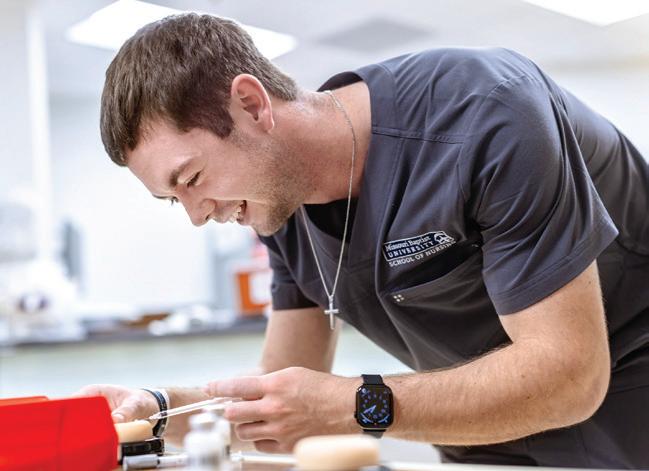

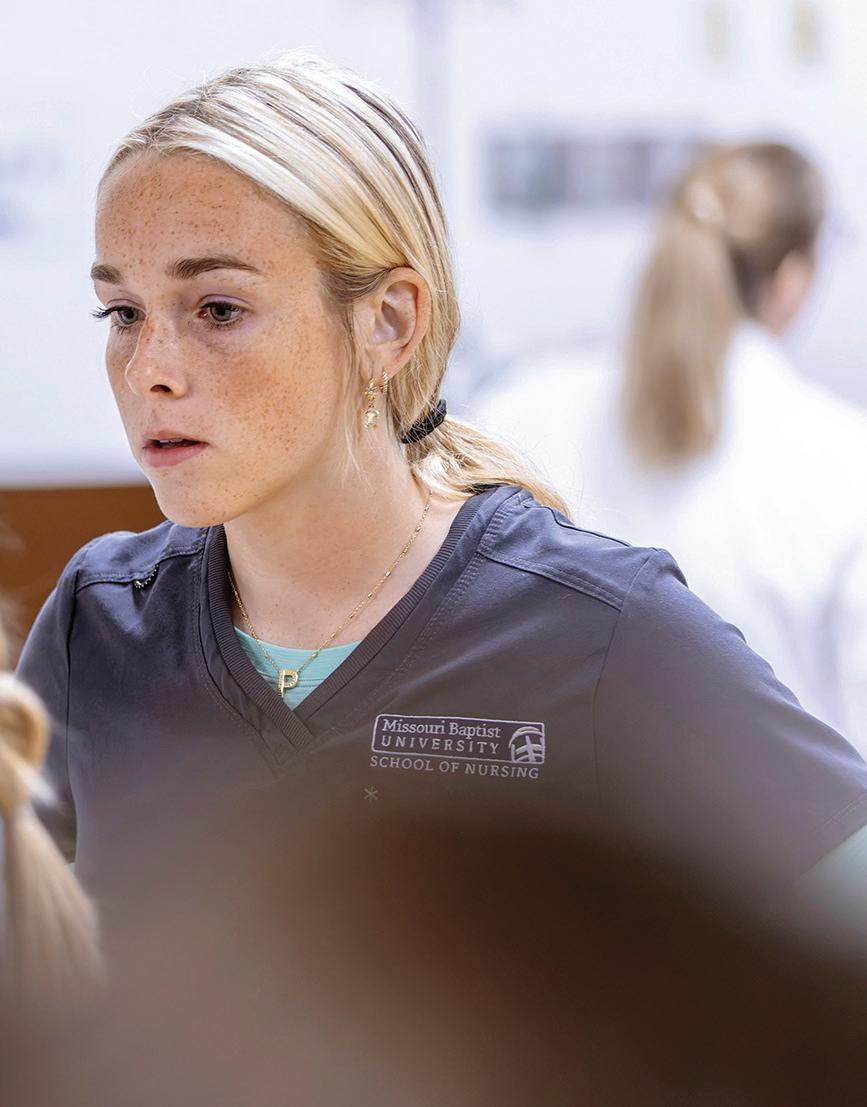


“We are training nurses and nurse educators with the express goal of being a part of the solution to real community issues,” said Dr. Amber Heimberger, dean of the College of Science & Health. “Our graduates are prepared not only to practice at a high level, but to teach, mentor and lead.”
The need for nurse educators is particularly urgent. As nursing programs nationwide struggle to fill faculty roles, qualified educators have become one of the most critical links to addressing the broader nursing shortage. MBU’s MSN tracks intentionally prepare graduates to step into classrooms, simulation labs and clinical partnerships where they can multiply their impact.
Yet statistics alone do not capture what defines the MBU nursing experience. Students often speak first about community.
“My experience at Missouri Baptist University’s School of Nursing was life changing,” said Nathaniel Fischer, MSN (’24). “The faculty were incredibly supportive and invested in our success. I not only gained an excellent education, but I also built lifelong friendships. Two of my classmates even stood with me at my wedding!”
That spirit of camaraderie is not accidental. The cohort model invites students to journey together — through study sessions, clinical rotations and moments of personal prayer. Through it all, faculty members walk alongside students.
The result is a learning environment where academic excellence and spiritual formation are not separate tracks but shared commitments.
One of the distinguishing features of MBU’s nursing programs is the accessibility of faculty. Small cohort sizes foster meaningful interaction.
Faculty members bring years of clinical expertise and educational experience into the classroom, but they also bring something harder to measure: investment. They celebrate milestones. They check in during stressful rotations. They model professionalism grounded in faith.
For many students, those relationships become the foundation for lifelong professional networks and lasting friendships.
“With a degree centered on caring for others,” said Fischer, “I could not have chosen a better place to learn and mature into the person and educator that I am today.”
As healthcare evolves, nursing education must keep pace. Through its graduate nursing programs, MBU is preparing leaders and educators who combine competence with compassion. The goal is not simply to fill positions but to strengthen the entire health care ecosystem.
In a field defined by care. MBU students do not walk alone. They move forward together, committed to excellence, fellowship and a calling that reaches far beyond themselves.
Missouri Baptist University’s story can be told in many ways: Through the lives of its students and alumni, the dedication of its faculty, the growth of its athletic programs and the physical development of the campus that has taken shape over time.
What began in the 1970s with construction of the University’s first core facilities soon grew into a vibrant academic community set atop the gentle hills of West St. Louis County.
Through the 1990s and 2000s, new residence halls, academic spaces and gathering places expanded the campus while strengthening the sense of community that defines life at MBU. Each addition reflected a vision for how faith, learning and hospitality could come together in one place.
That story continues today with the construction of the Pillsbury Wainwright Academic & Welcome Center, a new gateway to campus that will house the Robert W. Plaster College of Business & Entrepreneurship and the Mary Pillsbury School of Nursing, while welcoming future Spartans and their families for generations to come.



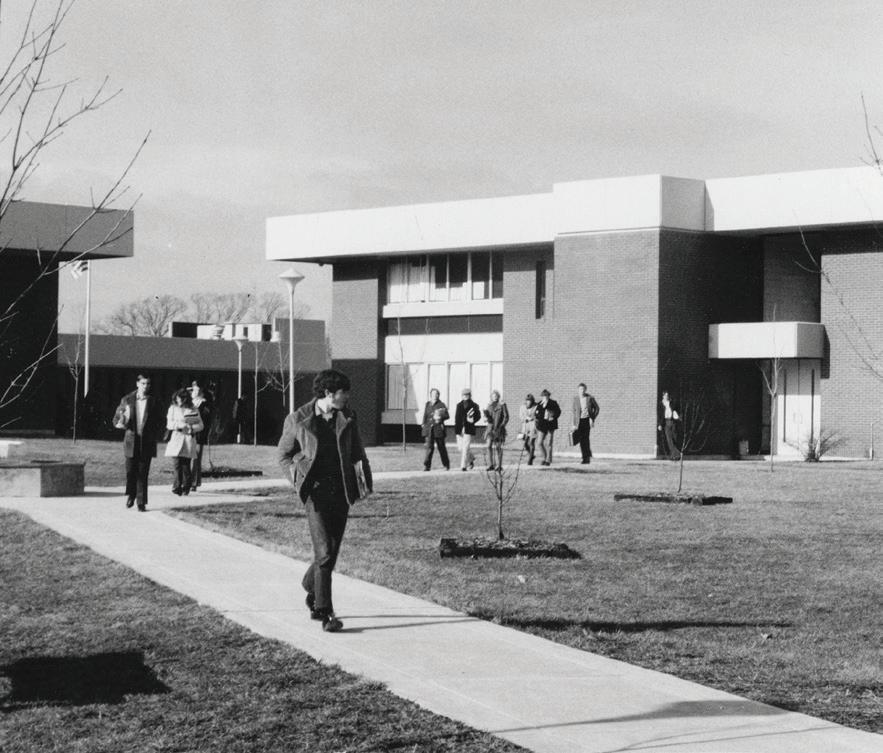

Missouri Baptist University alumna Grace Burrows (’23) has been named interim head softball coach at Principia College, continuing a path outlined by leadership and service. Originally from Pacific, Missouri, Burrows graduated with a B.S. in Sport Management and a minor in Business. She is also a former Spartan women’s basketball player. Burrows is currently pursuing her MBA at MBU while investing in Principia College student-athletes on and off the field. She is hard at work to rebuild the softball program and make her community proud.
GEOFF DAVIS (B.A. in Christian Ministry ’21 ) Lives in Vass, North Carolina. He was recently promoted to the rank of captain in the 82nd Airborne Division in the US Army. Most recently, he supported Hurricane Helene relief efforts.
LELAN HOLLAND (B.A. in Bible ’84 ) Lives in Vevay, Indiana. He is a pastor at Warsaw Baptist Church.
BRUCE HUELSKAMP (B.A. in History ’74 ) Lives in Nixa, Missouri. Bruce recently semi-retired after over 40 years preparing tax returns as a Certified Public Accountant.
DAVID BLAZER (B.A. in Music ’87, M.HEL. ’22) Lives in Webster Groves, Missouri. He is the entertainment manager at Six Flags.
IVAN MILICEVIC (B.S. Psychology; M.A. Counseling ’13) Lives in Ballwin, Missouri. He is a clinical director at Sandhill Counseling & Consultation. He recently returned to the St. Louis area to take his current role overseeing a large team of mental health professionals.
LISA BLAZER (B.A. in Music ’87 ) Lives in Webster Groves, Missouri. She is senior vice president of Enrollment Management at Webster University.
MICHAEL MASEEN (B.A. in Worship Arts/Technology ’17 ) Lives in St. Peters, Missouri. He is a technology specialist at Maryville University. Michael and his wife recently welcomed a new baby boy, Seth Maasen!
JAMES CALVERT (B.S. in Church Music ’96 ) Lives in Moses Lake, Washington. James moved to his new area to work full time in hospice chaplaincy.
R. KAY KURZEL ( B.A. in Rel. Education ’06 ) Lives in St. Peters, Missouri. Kay is archives technician at the National Archives & Records Administration, serving veterans every day.
SUMMER ROGERS (M.S. in Education ’07 ) Lives in Columbus, Georgia. Summer is associate director of Financial Planning and Registrar Services at Mercer University.
KEVIN CROWDER (B.A. in Religion ’09, M.A.T. ’12, M.E.A. ’24 ) Lives in Owensville, Missouri. He is a Physical Science teacher and 21CCLC site director at Gasconade County R-2 School District.
CRAIG STOUT (B.A. in Business ’81 ) lives in Princeton, West Virginia. Craig retired after a long career in ministry, sales and civic leadership. He was a trustee of Bluefield University in Bluefield, Va., for 10 years, and he served as a Major League Baseball chaplain for 22 years.
BILLY RUCKER (B.S. in Biology ’11 ) lives in St. Louis, Missouri. He is deputy director and public health administrator at the Saint Louis County Department of Public Health.
NATHAN UTT (B.S. in Secondary Education ’13) Lives in Tomball, Texas. Nathan was recently promoted to the role athletic director at Rosehill Christian School.
KATHLEEN BAHAN ( Ed.S. ’13 ) Lives in Kearney, Missouri. She is in her second year as the principal at Dogwood Elementary in the Kearney School District.
REBECCA BUERMANN (M.B.A. ’14 ) Lives in Manchester, Missouri. She is senior technical specialist II at Edward Jones.
VICTORIA BEACHLER (B.A. in Professional Studies ’15 ) Lives in High Ridge, Missouri. She is a probation and parole officer at the Missouri Department of Corrections.
AUBREY LEMMON (B.S. in Psychology ’26 ) Lives in Tamaroa, Illinois. Aubrey works for Child Life - Pediatric Healthcare and has secured a child life practicum. She is currently working to secure a child life internship.
ZACHARY MEADOWS (B.A. ’16 ) Lives in Breckenridge Hills, Missouri. He is a partnership manager at Walmart.
JOSIAH GREEVER (B.S. Human Services ’17 ) Lives in St. Louis, Missouri. He is co-owner/founder of Greever Counseling.
MARIA RUPPRECHT (B.S. in Psychology ’17 ) Lives in St. Peters, Missouri. She is a mental health therapist at Cobblestone Collective and an adjunct instructor at Missouri Baptist University.
BRETT ZANGARO (B.A. in Professional Studies ’14, M.B.A. ’18) Lives in Villa Ridge, Missouri. He is director of property management at Hayes Property Co.
MADISON RHODES (B.S. in Behavioral Science ’19) Lives in Festus, Missouri. She is a foster care case manager at Positive Impacts.
ALEXIS WOMBLE (B.S. in Information Technology ’19) Lives in Arvada, Colorado. She is senior cyber security engineer at Autodesk.
LOGAN MILLS (B.S. in Christian Ministry ’20) Lives in Florissant, Missouri. Logan is a student pastor at Chesterfield Community Church.
TIFFANY WHITNEY (B.A. in Business Administration ’20) Lives in St. Louis, Missouri. She is associate portfolio manager at Moneta Group.
LANEY MANES (B.A. in Biology with Biomedical Concentration ’21 ) Lives in Springfield, Missouri. Laney is an animal keeper at Wonders of Wildlife Aquarium. She will present a poster at the American Association of Zookeepers conference in October. Her article will appear in the September/October issue of Connect magazine published by the Association of Zoos and Aquariums.
LUKE LITTLE (B.S. in Nursing ’23) Lives in Lebanon, New Hampshire. He is emergency department nurse at Dartmouth Hitchcock Medical Center.
EMILY HECHLER (B.A. in Communication Studies ’22) Lives in Wentzville, Missouri. Emily is marketing coordinator at Alltrue Credit Union.
HOLLY EPISCOPO ( B.S. in Health Science ’23 ) Lives in Pembroke, Kentucky. Holly is pay-

ment posting specialist at Tennessee Orthopaedic Alliance. She and her husband are, at the time of this update, joyfully expecting a baby while also celebrating their new home.
KIRENDA BUEHLER (B.S. in Nursing ’23) Lives in St. Louis, Missouri. She was recently promoted to assistant nurse manager of Division 9600 at St. Luke’s Hospital.
JESSICA SIMMONS ( B.A. in Communication Studies and B.A. in Journalism ’23) Lives in St. Louis, Missouri. She is content marketing specialist at American Heritage Girls, Inc.
LEAH SMITH (M.B.A. ’24 ) Lives in Festus, Missouri. Leah is city clerk for the City of Festus.
AUGUSTA SCHMITZ (M.A. of Teaching ’25 ) Lives in New Haven, Missouri. Augusta teaches at Gasconade County R-II, and her daughter will be getting married later this year.

EMMA RAGES (B.S. in Nursin ’25 ) Lives in Manchester, Missouri. She is triage nurse at Premier Pediatrics, and she recently had a baby boy in June!
KATHERINE ORTSCHEID (Ed.S. ’24 ) Lives in Fenton Missouri. She teaches Speech, Theatre, and English Language Arts at Living Water Academy and recently accepted a position as dean of curriculum and instruction at City Christian Academy.

“My experience at MBU was a time where I was surrounded by a strong and passionate Christian community.” — Luke Little ('23)

Q“Dear Magnolia, is it normal to forget everything you learned when it’s time to take a test?”
–Foggy Brain
Dear Foggy,
Sounds like your mind is doing zoomies at the worst possible time. I get it! One minute your thoughts are lined up nicely, and the next they’re chasing imaginary squirrels. Totally normal. Try this: Sit. Stay. Pant…I mean, breathe. Look for the question or problem that looks most familiar. Then, give it your best shot.
Your brain will come back. I’m paw-sitive it didn’t run away forever! You studied. You’re prepared. No matter how it goes, you are still a very good human. Now go finish strong, and don’t forget to gobble up some post-test kibble.
Your squirrel-chasing pal, Magnolia Bleu
Ask Magnolia is an advice column featuring MBU’s First Pup, Magnolia Bleu, who offers doggone good advice for campus life and beyond. Got a question? Magnolia’s ready to lend an ear … and an occasional bark.
“Dear Magnolia, I’m graduating soon and terrified of what comes next. Everyone keeps asking, ‘What’s your plan?’ The short answer is: I don’t have one. Help!”
– Soon-to-be Alumni
Dear Soon-to-be, The best paths aren’t always the straightest ones. I once followed a bouncing ball into a building I’d never been in before and discovered the glories of air conditioning. Life works like that sometimes. You don’t need your whole life mapped out; you just need to sniff around and put your next paw forward.
The world outside MBU’s fence might seem big, but you’re not alone. Take what you’ve learned, stay leashed to your friends and family, and enjoy the path you’re walking on.
Meandering with you, Magnolia Bleu
“Dear Magnolia, I’m struggling spiritually. I believe in God, but I don’t always feel so sure about things. Is there something wrong with me?”
– Holding On
Dear Holding, If faith was always about feelings, I’d doubt my owners’ love every time they took me to the vet. Sometimes faith is solid and obvious. Other times it’s about staying at your owners’ side, trusting they’ll keep you safe while you rest at their feet. Doubt doesn’t mean you’ve wandered off the path; it means you’re still sniffing around for clues about what’s true.
Even when your tail’s not wagging, God’s love is still real and good. You can trust him.
Your furry friend, Magnolia Bleu