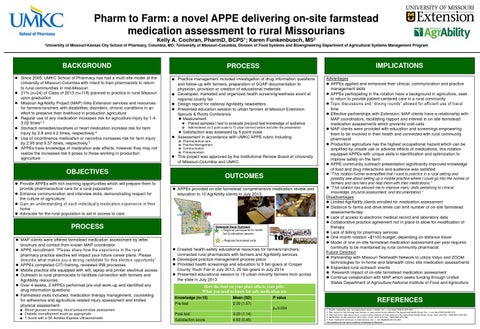
Pharm to Farm: a novel APPE delivering on-site farmstead medication assessment to rural Missourians Kelly A. Cochran, PharmD, BCPS1; Karen Funkenbusch, MS2 1University
of Missouri-Kansas City School of Pharmacy, Columbia, MO; 2University of Missouri-Columbia, Division of Food Systems and Bioengineering Department of Agricultural Systems Management Program
BACKGROUND ● ● ● ● ● ● ●
Since 2005, UMKC School of Pharmacy has had a multi-site model at the University of Missouri-Columbia with intent to train pharmacists to return to rural communities in mid-Missouri 21% (n=24) of Class of 2013 (n=118) planned to practice in rural Missouri upon graduation Missouri AgrAbility Project (MAP) links Extension services and resources for farmers/ranchers with disabilities, disorders, chronic conditions in an effort to preserve their livelihood in production agriculture Regular use of any medication increases risk for agriculture-injury by 1.43.02 times1-3 Stomach remedies/laxatives or heart medication increase risk for farm injury by 2.8 and 4.2 times, respectively.4 Use of incontinence medication or narcotics increases risk for farm injury by 2.95 and 9.37 times, respectively.5 APPEs have knowledge of medication side effects, however they may not realize the increased risk it poses to those working in production agriculture
Practice management included investigation of drug information questions and follow-up with farmers, preparation of SOAP documentation to physician, provision or creation of educational materials Developed, marketed and organized health screening/wellness event at regional county fair Design report for national AgrAbility newsletters Presented education session to urban farmers at Missouri Extension Sprouts & Roots Conference
●
●
● ●
● Measurement:
● Paired samples t test to evaluate pre/post test knowledge of audience ☼
Administered via 5 point scale to 15 urban farmers before and after the presentation
● Satisfaction was assessed by 5 point scale
●
Assessment in accordance with UMKC APPE rubric including: ☼ ☼ ☼ ☼
●
Pharmaceutical care Practice Management Communication Professionalism
This project was approved by the Institutional Review Board at University of Missouri-Columbia and UMKC
OBJECTIVES ● ● ● ●
Provide APPEs with rich learning opportunities which will prepare them to provide pharmaceutical care for a rural population Enhance communication and interview skills, demonstrating respect for the culture of agriculture Gain an understanding of each individual’s medication experience in their home Advocate for the rural population to aid in access to care
●
● ● ● ● ● ●
MAP clients were offered farmstead medication assessment by letter, brochure and contact from known MAP coordinator APPE recruitment: “Please share how the experience in the rural pharmacy practice elective will impact your future career plans. Please describe what makes you a strong candidate for this elective opportunity” APPEs completed CITI training, reviewed IRB processes Mobile practice site equipped with wifi, laptop and printer electrical access Outreach to rural pharmacists to facilitate connection with farmers and AgrAbility resources Over 4 weeks, 2 APPEs performed pre-visit work-up and identified any drug information questions Farmstead visits included: medication therapy management, counseling for adherence and agriculture-related injury assessment and limited physical assessment:
APPEs provided on-site farmstead comprehensive medication review and education to 10 AgrAbility clients in July 2013
● ● ●
Blood glucose screening, blood pressure/vitals assessment Diabetic monofilament exam as appropriate T-Score with a GE Achilles Express Ultrasonometer
Statewide Rural Outreach = Regional participants for health fair & education session = Regional farmstead visits
● ● ● ●
Advantages ● APPEs applied and enhanced their clinical, communication and practice management skills ● APPEs participating in the rotation have a background in agriculture, seek to return to provide patient-centered care in a rural community ● Topic discussions and “driving rounds” allowed for efficient use of travel time ● Effective partnerships with Extension: MAP clients have a relationship with MAP coordinators, facilitating rapport and interest in on-site farmstead medication assessments which prevents cold-calls ● MAP clients were provided with education and screenings empowering them to be involved in their health and connected with rural community pharmacist ● Production agriculture has the highest occupational hazard which can be amplified by unsafe use or adverse effects of medications, this rotation equipped APPEs with unique skills in identification and optimization to improve safety on the farm ● APPE community outreach presentation significantly improved knowledge of food and drug interactions and audience was satisfied
● “This rotation further exemplified that I want to practice in a rural setting and
OUTCOMES
PROCESS ●
IMPLICATIONS
PROCESS
Created health-safety educational resources for farmers/ranchers; connected rural pharmacists with farmers and AgrAbility services Developed practice management process plans Provided health screenings and education to 9 fair-goers at Cooper County Youth Fair in July 2013, 25 fair-goers in July 2014 Presented educational session to 15 urban minority farmers from across the state in July 2013
●
possibly see about setting up a mobile practice where I could go into the homes of farmers and ranchers and help them with their medications.” “This rotation has allowed me to improve many skills pertaining to clinical knowledge, physical assessment, and documentation.”
Disadvantages ● Limited AgrAbility clients enrolled for medication assessment ● Distance to farms and drive times can limit number of on-site farmstead assessments/day ● Lack of access to electronic medical record and laboratory data ● Collaborative practice agreement not in place to allow for modification of therapy ● Lack of billing for pharmacy services ● One month rotation =$1100 budget, depending on distance travel ● Model of one on-site farmstead medication assessment per year requires continuity to be maintained by rural community pharmacist Future Direction ● Partnership with Missouri Telehealth Network to utilize Vidyo and ZOOM technologies for in-home and telehealth clinic site medication assessments ● Expanded rural outreach events ● Research impact of on-site farmstead medication assessment ● Continue collaboration with MAP which seeks funding through United States Department of Agriculture-National Institute of Food and Agriculture
How the food on your plate affects your pills: What you need to know for safe medication use Knowledge (n=15)
Mean (SD)
Pre-test
2.30 (1.57)
P value p=0.004
Post-test
3.20 (1.14)
Satisfaction score
4.63 (0.45)
REFERENCES 1. Health, medication use, and agricultural injury: a review. Am. J. Ind. Med.2009;52:876-889. 2. Risk factors for falls among Iowa farmers: a case-control study nested in the Agricultural Health Study. Am. J. Ind. Med 2003;44:265-272. 3. Risk factors for agricultural injury: a case-control analysis of Iowa farmers in the Agricultural Health Study. Accid. Anal. and Prev. 1996;28(4):453-462. 4. Medications as risk factors for farm injury. Accid. Anal. and Prev. 1996;28(4):453-462. 5. Pain, medication and injury in older farmers. Am. J. Ind. Med2006;49:374-382. The authors do not have conflicts of interest to disclose.