THE VOICE OF THE AFRICAN AMERICAN COMMUNITY SINCE 1934
June 11-17, 2020 Vol. 86 No. 45
85
FIND US ONLINE AT WWW.SPOKESMAN-RECORDER.COM
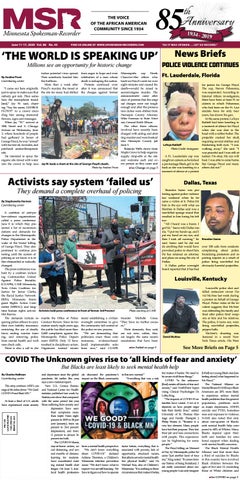
‘THE WORLD IS SPEAKING UP’ Millions see an opportunity for historic change
tralize potential virus spread. from anger to hope and even Then somebody handed him celebration of a man whose death is reshaping the nation. the bullhorn. Protests continued even More than a week after “I came out here originally Floyd’s murder, the mood at after it was announced that just to spray to make sure that the site for many had shifted the charges against former nobody got sick. Then somehow the microphone found [me],” Jay W. said, chanting “Say his name, GEORGE FLOYD!” to a crowd encircling him among memorial flowers, signs and messages. When Jay “W.” arrived at 38th Street and S. Chicago Avenue on Wednesday, June 3, where hundreds of people had gathered in honor of George Floyd, he was “armed” with tea tree oil, lavender, and patchouli aroma-therapeutic oils. He intended to spray the organic oils mixed with water into the crowd to help neu- Jay W. leads a chant at the site of George Floyd’s death. Photo by Analise Pruni By Analise Pruni Contributing writer
Minneapolis cop Derek Chauvin—the officer who knelt on Floyd’s neck for over eight minutes and caused his death—would be raised to second-degree murder. The announcement came after days of protests that the original charges were not tough enough and after the prosecution duties were shifted from Hennepin County Attorney Mike Freeman to State Attorney General Keith Ellison. The other three officers involved have recently been charged with aiding and abetting murder and were booked into Hennepin County jail June 3. Ralanda Wells drove from Maple Grove to help organize supply drop-offs at the site and welcome each and every person as they came and ■See Change on page 5
Activists say system ‘failed us’ They demand a complete overhaul of policing
By Stephenetta Harmon Contributing writer A coalition of anti-police-violence organizations called a press conference June 8 in which they presented a list of recommendations and demands for changes in the Minneapolis Police Department in the wake of the brutal killing of George Floyd. They also promised to continue protesting until the system of policing as we know it is either dismantled or radically changed. The press conference was held by a coalition including Communities United Against Police Brutality (CUAPB), CAIR Minnesota, Twin Cities Coalition for Justice for Jamar Clarke, the Racial Justice Network (RJN), Minnesota Immigrant Rights Action Committee (MIRAC), and longtime human rights activist Activists hold press conference in front of former 3rd Precinct Mel Reeves. The demands include re- mantle the Office of Police mend establishing a civilian quiring police officers to carry Conduct Review. Since its for- oversight committee to give their own liability insurance; mation nearly eight years ago, the community full control of restricting the use of deadly the public has filed more than the police review process. “We are demanding that force; ending warrior train- 2,600 complaints against the ing; and removing police Minneapolis Police Depart- politicians enact these comevidence-based from mental health and well- ment (MPD). Only 12 have monsense, resulted in disciplinary action. [and] implementable soluness check calls. There is also a call to dis- Organizers instead recom- tions now,” said CUAPB
th
Anniversary 1934 - 20 19
“AS IT WAS SPOKEN ... LET US RECORD.”
News Briefs Police Violence continues Ft. Lauderdale, Florida
LaToya Ratlieff Photo Credit: Instagram A Ft. Lauderdale cop was caught on camera as he kicked a pre-teenage Black girl in the back as she was kneeling in a moment of silence at a protest
for justice for George Floyd. The cop, Steven Pohorence, was suspended. According to Internal Affairs investigators, there have been at least 51 incidents in which Pohorence, who had been on the Ft. Lauderdale force for only four years, has drawn his gun. At the same protest, LaToya Ratlieff had been kneeling in a moment of silence for Floyd when she was shot in the head with a rubber bullet. The projectile cracked her skull, requiring several stitches and blackening both eyes. “I was walking away,” she said. “I was peaceful and I was still attacked. I’m okay. My eye will heal. I was able to come home. But George Floyd and many others did not.”
Dallas, Texas Brandon Saenz was protesting against police violence last weekend when he became a victim of it. Police hit him in the eye with what authorities in Dallas said was a non-lethal sponge round that resulted in him losing his left eye. “All I heard was a boom. I got hit,” Saenz told Dallas media. “I put my hands up, and I put my hand on my eye, and then I took off running,” he said. Saenz said he did not do anything that would have provoked police to shoot him. He has retained an attorney and plans on suing the city of Dallas. A Dallas police oversight board reported that it has had
Brandon Saenz over 100 calls from residents complaining about police brutalizing protestors and reporting injuries as a result of police firing non-lethal but obviously harmful projectiles.
Louisville, Kentucky Louisville police shot and killed restaurant owner David McAtee last week during a protest on behalf of George Floyd. Police video of the incident suggests that McAtee was defending his family and fired after police fired weapons at him and his relatives. The police, it turns out, were firing non-lethal projectiles, pepper balls. McAtee’s shooting was featured in a recent New York Times article. His West
Photo courtesy of CAIR founder Michelle Gross. “They have no further excuses.” Their demands, they said, are not new; rather, they are largely the same recommendations that have been
David McAtee
■See Failed on page 5
See More Briefs on Page 5
COVID The Unknown gives rise to ‘all kinds of fear and anxiety’ But Blacks are least likely to seek mental health help
and depression since the global pandemic hit earlier this year, says a new national report. New U.S. Census Bureau This story continues MSR’s coverage of the online forum “We Good: and National Center for Health statistics published last week by COVID-19 and Black MN.” Statista.com show that compared At least a third of U.S. adults with the same period last year, have experienced more anxiety those suffering from anxiety and depression have seen their symptoms more than triple: From eight percent in 2019 to 28 percent (anxiety), from six percent to 24.4 percent (depression), and from 11 percent to almost 34 percent for both. The COVID-19 threat, stay-at-home orders, social distancing, and several months of distance learning for students have exacerbated existing mental health challenges. On June 3, four local health professionPRST STD U.S.POSTAGE PAID TWIN CITIES MN PERMIT NO. 6391
By Charles Hallman Contributing writer
but makes it harder. We need to be aware of all those things.” COVID “is the unknown [that] creates all kinds of fear and anxiety,” said NorthPoint Supervising Clinical Psychologist Dr. Lolita King. “The impacts of COVID-19 on families have varied. A lot of it depends on how people negotiate their family lives,” added University of St. Thomas Marriage and Family Therapist J. Philip Rosier, Jr. “Routine is a very key element. Many people have lost their purpose. They lost their job and lose connections with people. This experience can be frightening for some people.” from a mental health perspective. factor before, everything that is The Floyd killing on Memori“We don’t know everything associated with poverty, lack of al Day by Minneapolis police beabout COVID-19,” declared opportunity, structural racism, came “just another layer of trauAdriene Thornton, a Children’s that affects not only mental health ma,” King noted. “It comes from Minnesota infection prevention but physical health,” said Dr. our history of being brutalized. I nurse. “We don’t know what to Michael Troy, also of Children’s am really concerned about our expect—we are still learning. We Minnesota. “It is nothing in these young people. I can only imagine have to figure out how to operate circumstances that makes it better, als discussed the pandemic’s impact on the Black community
in this new normal.” “Everything that was a risk
[what] our young Black men [are feeling about] what happened to Mr. Floyd.” The National Alliance on Mental Illness (NAMI) says Black Americans are 20% more likely to experience serious mental health problems than the general population, problems such as major depression, ADHD, suicide and PTSD, homelessness and exposure to violence. NAMI also noted that only about one-quarter of Blacks seek mental health help compared to 40% of Whites. Many Blacks depend upon their faith and families for emotional support when dealing with mental health concerns. The Black Mental Health Alliance said that more than a third of suicides by Blacks in this country have involved Black children between the ages of five and 12, exceeding those of White children and ■See COVID on page 5
2
June 11-17, 2020
More than talk needed to rebuild Northside businesses Fund has raised $1.5M toward $5M goal
By Stephenetta Harmon Contributing writer Civil unrest following the May 25 killing of George Floyd by Minneapolis police has left the Northside community without its primary grocery store, storefronts decimated, and inventory looted. The West Broadway Business & Area Coalition (WBC) and Northside Funders Group have raised more than $1.5 million in funds to help rebuild those businesses along the West Broadway corridor and surrounding areas. Donations started pouring in after the organization’s executive director, Felicia Perry, took to Facebook Live on May 31 with an impassioned plea
Instead, she challenged them to show up in the community and do actual work to help clean up and rebuild. For those who can’t, she said to contribute. That call went viral. “This is something that happened so fast and became so big,” Perry told the MSR. The Restore Fund was initially set up to help businesses impacted by the COVID-19 pandemic. They had previously raised $250K for emergency funds to small businesses and independent contractors. Perry said they started the fundraiser a couple of weeks ago after the money ran out. Less than a week ago, they had raised approximately $5,000. Now the organiza-
“We are just doing triage right now. We haven’t even gotten into recovery.” for elected officials, leaders, and the collective community to do more than talk about fixing a problem. “Just asking, ‘Are you okay?’ is not healing or helping,” she said in the video.
tions have a new goal of $5M, with 100% of the funds going directly to North Minneapolis. She said the funds will not be touched until the organizations have developed a plan for the community that ex-
tends beyond the crisis. "One day, one donation is not what’s going to rebuild. We are just doing triage right now," Perry said. "We haven’t even gotten into recovery.” The first things she is asking for is space and time. “Giving space helps us ground ourselves as we strategize,” said Perry. “It’s important that we have a comprehensive strategy and plan around what rebuilding looks like. I want to take time to really connect with Northside businesses and the community.” One thing she is sure about is not using the funds to address issues for which the City of Minneapolis has already earmarked dollars. “We don’t want to spend this money on what other organizations are supposed to do and should already be paying for," said Perry. "They need to still pay for it.” That includes things like helping to fix storefronts and providing pandemic impact grants. In the meantime, WBC will continue to inform and help businesses apply for those existing dollars as well as
Courtesy of De’Vonna Pittman help support and coordinate emergency business and community outreach responses as it assesses needs and creates a long-term strategy. Perry admitted the monetary and volunteer response has been a bit overwhelming. “Usually, there are one or two people a month offering [support]. Now, we have hundreds a day." There is also an influx of
subscribers and membership requests, a good problem to have. “We are grateful. Just give us time," she said. Perry also thanked the WBC and Northside Funders Group team, along with residents like Ashley Henderson, De'Vonna Pittman, Desralynn Cole and Nastaaja Johnson for their ongoing organizing and clean-up efforts. "This is a community effort, and the
North Side has been out there." Stephenetta Harmon welcomes reader responses to sharmon@spokesman-recorder.com. To donate, visit bit.ly/northsidebiz. For more information on West Broadway Businesses & Area Coalition, visit westbroadway. org or follow them on Facebook.
Damaged post offices relocated; some collection boxes removed set up for customers to pick up their post office box mail and mail held due to damaged businesses or residences. An ID will be required for all mail pickups. The Minneapolis Powderhorn Station, located at 3045 Bloomington Ave, 55407, remains closed until further notice while repairs are underway to fix the damage sustained in recent Postal Service relocation events. The Powderhorn team updates The Loop Station, located at expects to open the doors to its 811 LaSalle Ave., Minneapolis, retail and P.O. Box customers by 55402, is now open. Hours are early next week. Until then, P.O. Monday-Friday, 7:30 am to 5 Box Mail and Hold Mail will pm. The station is closed on Sat- be available at the Minneapolis Main Post Office, located at urdays. Customers who used the 100 S. 1st Street, 55401. Minnehaha Postal Station, from Retail services are also availZIP Code 55406, will now be served out of the Main Post Of- able online 24/7 including weekfice in downtown Minneapolis: ends and holidays at usps.com. 100 S. 1st Street, Minneapolis, The Postal Service receives no 55401. The hours are Monday- tax dollars for operating exFriday, 7 am to 8 pm; Saturday, 9 penses and relies on the sale of postage, products and services to am to 1 pm. Customers who used the fund its operations. Lake Street Postal Station, from Information provided by ZIP Codes 55408 and 55409, will USPS. now be served out of the Loring Post Office in Downtown Minneapolis: 18 N. 12th Street, Minneapolis, 55403. The hours are Monday-Friday, 8:30 am to 5 pm; Saturday, 9 am to 1 pm. A special window has been sure, the Postal Service has also temporarily removed some collection boxes in St. Paul and Minneapolis,” reads a statement from the Postal Service. “They will be back in service when it is deemed safe to do so, and when we are able to collect the mail within them without incident.”
Remains of burned Lake Street Station
The civil unrest following the police killing of George Floyd has left many South Minneapolis residents wondering where to find essential services, including mail. The United States Postal Service (USPS) recently announced that it has resumed full
delivery to customers impacted by the recent events. Due to fire damage, the Minnehaha and Lake Street Post Offices in Minneapolis have relocated their operations and services. “Our thoughts and prayers go out those impacted by recent
events.” said Northland District Manager Anthony Williams. “We are committed to providing first class service to our customers. I sincerely apologize for any inconvenience this has caused to the residents of these communities, and I thank you for your
patience as we work to bring permanent services back into these neighborhoods.” Adding to the confusion, some mailboxes have been uprooted in Minneapolis for what USPS cited as “safety” concerns. “As a precautionary mea-
June 11-17, 2020
3
Moving forward and healing after tragedy
By Dr. Valerie Lemaine, M.D., M.P.H. Guest contributor I am struggling to write this week’s column. It’s been a rough few days…weeks… months… half-year. Here we are again, grieving from the horror following yet another police killing of a Black man, George Floyd. Our hearts are broken. Our community is angry, sad, exhausted, numb and traumatized. We are grieving George Floyd and countless others before him. And as if this wasn’t already more than enough to handle, this has all unfolded during the COVID-19 pandemic that, as we well know, dis-
proportionally affects African American. I hardly know where to begin as I haven’t been able to process my own emotions at the moment. Ironically, my last column was on the topic of managing anxiety during a pandemic. I will be honest: Since May 25, 2020, I haven’t been able to maintain several of the tools I suggested in that article, like keeping a regular daily schedule, getting regular exercise, and deep breathing. I am not okay at the moment. I suspect you aren’t either. Eventually, I plan on resuming using these tools, but at the moment, I need to give myself some grace and space to grieve. I hope you do the same. You might find it helpful to understand a few basic things about how trauma affects us. Do your own internal scan to see where you fall on this spectrum of trauma healing. Note that you can be in more than one phase at the same time. 1. There is a circuit break in our nervous system In this phase, everything in our brain shuts down to the bare minimum for us to function. This happens because our nervous system has been overloaded with too many stimuli, too much horror, too much danger. To preserve our energy, our brain shuts down to the
your best to name your feelings. This will help you heal. And remember, your feelings are not up for debate. For some of us, it may be helpful to revisit the scene of destruction. For others, that is too intense. Don’t judge yourself or others. Grieving is a very personal experience and we all express it differently. Lastly, remember that while grieving, you can still make space for positive emotions without feeling guilty. Create space for joy, peace, smiles, laughter. 3. We take action Taking action allows us to restore a sense of control, a sense of hope. It also helps us move forward. It makes us feel like we contribute and it eases the sense of powerlessness we have been experiencing. We have already seen countless examples of this over the past few days: people distribProtestors mourn George Floyd Photo by Steve Floyd uting bottles of water; people volunteering to clean up neighbasics and runs on our reserve cover enough to handle more borhoods; people who are dostimulation, our feelings slowly nating to local organizations; tank. Apparently, in this phase, come back. This is when you people who are feeding volunwe lose 50 to 90% of our brain need to talk. Talk to your family teers; creating artwork and mecapacity! This explains why we members. Talk to your friends. morials for George Floyd. The feel numb, depleted. I can tell If you have a therapist, definite- list goes on. you that after everything I have ly talk to them. Talk about your memories 4. We grow and reintegrate witnessed this past week, I am of the trauma and how you feel. ourselves definitely in this phase. Trauma breaks our soul, yet Or if you prefer, use a journal and write down your feelings. it gives us an opportunity to 2. Our feelings return Once our brain begins to re- This work is not easy, but do grow if we invest time and
energy to heal. We learn about ourselves, about our pain, about our resilience. We find meaning in life. As a surgeon, I know first-hand that healing takes time. I offer my sympathies to George Floyd’s family, his friends, and to our entire community. We will get through this, as we have done before. We are strong. We are resilient. We will be heard, and we will keep fighting until there is justice. Dr. Valerie Lemaine, M.D., M.P.H., is a top-ranked, boardcertified plastic surgeon in private practice in Edina, MN. She received her M.D. from University of Montreal, Canada, where she also completed her plastic surgery. She obtained her M.P.H. from Columbia University, NY, USA. She also completed a reconstructive microsurgical fellowship at Memorial Sloan-Kettering Cancer Center in New York City. Dr. Lemaine then accepted a staff position at the prestigious Mayo Clinic (Rochester, MN) where she worked as a plastic surgeon, taught and published clinical research. In 2018, she transitioned to private practice and joined Plastic Surgery Consultants and Minnesota Oncology.
New measures needed to make workplaces safe from COVID-19 The offices, warehouses, and manufacturing plants that America’s workers are starting to return to may look the same as they did months ago, but the feel inside will be largely different. The coronavirus has changed the workplace environment as we knew it for the foreseeable future. Companies welcoming back employees to their facilities are subject to a duty of care that requires new protocols and rules necessary to protect the health of their workforce. While there is no perfect plan, knowing the priorities and putting extra attention on detailed health measures are paramount for all employers, says Dr. Jonathan Spero, a physician and expert on pandemic preparedness and employee health. “As employers begin creating a COVID back-to-work
program for their organizations, it is clear that there is no proven roadmap,” Dr. Spero says. “We are in uncharted territory.” But it has to be all about health security. “People are concerned when they get up in the morning that they are going to be exposed to COVID-19. The only way to solve it is to take a lesson out of the global public health playbook and establish proven health security strategies. This involves three foundational elements: the prevention of illness, the detection, and the response once you get the data to identify who’s ill or who has been infected in the past. Some people will get infected in the workplace, so the key is taking all the measures that can help keep the transmission rate way down.” Dr. Spero offers these tips to employers for developing
a return-to-work plan: Reconfigure high-contact areas Dr. Spero says continued social distancing and wearing masks in the office remain top priorities as the pandemic continues. “Until further notice, office space needs to be designed so employees remain at least six feet from each other at all times,” he says. “There is no more mingling in groups, and people have to be spread out.” Daily temperature checks “These are done before entry into the workplace,” Dr. Spero says. “Use no-contact, infrared thermometers. Taking employees’ temperature is not bullet-proof; people can be asymptomatic and still be infected. But fever is the most common symptom associated
keyboards,” Dr. Spero says. “Frequent hand washing, use of hand sanitizer, and avoiding touching your face all are very important as employees come back to the office. “Returning to a workplace does bring risks, and emwant to identify those folks ployers have a duty of care and avoid them infecting oth- to mitigate these risks,” Dr. Spero says. “It’s imperative ers in the workplace.” that employers build a plan Have a reporting and follow- that reduces the risk of COVID transmission.” up system Dr. Spero says employees Dr. Jonathan Spero has for who test positive need to be enrolled in a return-to-work over 30 years been the CEO of program. This involves quar- InHouse Physicians, which is antine protocols and work dedicated to protecting the health clearance guidelines on when and well-being of employees and the employee can return to meeting attendees around the world. He completed his mediwork. cal training at the University of California. Ramp up cleaning procedures “There should be morning and evening routines of disinfecting all surfaces in the work area, including
with COVID-19, so it makes “The idea around PCR testing sense to still check people’s is, because there’s an asymptemperatures. If they’re tomatic pool of employees above normal, they’re sent that may be positive, you
“We are in uncharted territory.” home with a plan to refer the ill employee for follow-up medical evaluation and potentially COVID testing.” Consider PCR testing As states reopen businesses, some large companies are testing employees for COVID-19 while trying to prevent outbreaks on the job. Medical professionals and employers say this testing, known as PCR (Polymerase chain reaction), can help reduce transmissions and workers’ fears. “For employers, it’s recommended that when doing a screening, you’re testing for those patients that are asymptomatic,” Dr. Spero says.
4
June 11-17, 2020
The Minnesota Spokesman-Recorder (MSR) welcomes and values commentary and feedback from the community. The articles found here are edited for clarity and/or space, but the opinions are the author’s own and do not reflect the views of the MSR.
Voices from the corporate community on George Floyd’s murder From the Boston Scientific leadership team:
Across the nation, we the people are winning! MELLANEOUS By Mel Reeves ALL FOUR OFFICERS CHARGED! WE ARE WINNING! These old eyes of mine, and the rest of us, are likely experiencing just the beginning in the campaign to get justice for George Floyd. It’s the beginning of, if not a sea change, at least the swelling of a tide that, once it gets its bearing, will spell, if not the end, at least the prelude to the beginning of the end of the reign of capitalist organized terror. People, a multi-racial, multi-ethnic, mass of people—Black, Brown, White, Yellow, Native, Muslim, Christian, Buddhist, male, female, straight, gay, trans— were in the streets by the hundreds of thousands, demanding justice for a Black man. Wow, just wow! Nobody should misunder-
der is just an aberration, and that police violence is an exception rather than the rule, and that police in general are good guys who exist to serve you. A few young people with the veil still over their minds are kneeling with them and taking the bait, hugging their class enemy; but the overwhelming majority of the fighters aren’t fooled. Houston Police Chief Art Avecedo was masterful. He stood in a crowd of Black people and told them, “You know the Black community needs the police,” and many in the crowd applauded. But the people are starting to wake up to the fact that they, indeed, do not need the police, because the police neither protect nor serve them, but are in fact a threat to their well-being. While the system attempts to misdirect and confuse, it’s not working. The scales are coming off lots of eyes. The
The people are waking up. stand what’s going on in the streets of the U.S. We are winning! Over the last few days there have been protests in Anchorage, Alaska; Boise, Idaho; Dubuque, Iowa; Minot, North Dakota; and Grand Island, Nebraska, wherever that is. From Minneapolis to Boston, to Miami, to New Orleans, to Chicago, to Denver, to Phoenix, to LA, to Seattle, to Portland, to New York and all the way across the water to Honolulu, people are taking it to the streets. NBC News reported that 300 cities have had protests or rallies demanding justice for George Floyd. Across the world, people are standing up in Paris, Amsterdam, Dublin, London, Rome, Berlin, Japan and Nairobi just to name a few. Even Syria has had a spirited response to the murder of our Brother Floyd. The people are winning. They sure aren’t losing, as the U.S. government is being exposed. And in the process, the system of policing is being laid bare, as people are beginning to wake up to its true intentions and true mission. This time, rather than blaming the murder of Floyd on “bad apples”—a lie that has been exposed—they have rolled out the “good apple” approach with the cops attempting to join the protests. After all, they say they “feel our pain,” and they are heartbroken by our brother’s murder just like you; they say they are upset just like you. However, their true motive for attempting to join the protest is to try to convince young people that this mur-
Floyd’s funeral on Thursday? And make no mistake: Protests will have to continue to ensure the system understands that we will settle for nothing short of a conviction of the murderers. No, this is not “the revolution” many of us have anticipated, but the million people in the street demanding justice for George Floyd are a prequel of things to come. George Floyd’s name is going to become iconic. This moment of protest is going to be how people mark their lives. Years from now people are going to ask, “Where were you when George Floyd was killed? Were you in the streets?” The mainstream media, the ruling class’s vehicle of distraction and disinformation, has been fighting an uphill battle as they worked feverishly to ignore the demand of “JAIL ALL FOUR KILLER COPS NOW” by hundreds of thousands by repeating it like a broken record. “But what about the looting? What about the violence?” Ironically, some of mainstream media’s own well-paid hands refuse to toe the line and are exposing the real source of violence at the protests, the real outside agitators, the real provocateurs: the cops. Incredibly, the handmaiden of the one percent, which during this pandemic showed little concern for the health and wellbeing of so-called “essential workers” and Black people, had the nerve to feign concern about the health of their children as they take a stand for justice. NBC News sent a Black woman reporter to ask young fighters if they were concerned that attending a protest may make them susceptible to catching the coronavirus. One young Black woman looked directly into the camera and said, “I’m willing to risk my life for People of Color, for my people and people who suffer from injustices.” “I think the benefits of being out here outweigh the risks,” was the response of a young White male medical student. “It’s not going to stop until we get justice,” a young Black man told the reporter with all of the steeled determination he could muster. Yes, these eyes have seen the glory of what is to come. We will not stay down forever. A beaten people will eventually rise up, because truth crushed to earth will indeed rise again! Justice, then peace.
youth noticed as the cops offered to take a knee and embrace them during the daytime while under the cover of darkness the same cops attack them with sticks, fists, rubber bullets, paintballs, mace and tear gas, locking them up for little or no reason. The people are waking up. The leader of the U.S. decided it was time to get religious as he orchestrated a scene in which he went to church and posed with an upside-down Bible. Did anyone notice that it appeared that the Bible was going to catch fire in his hands at any time? It appeared as if “Cheeto-man” was going to spontaneously combust right before our eyes. Imagine that: The best response to the demand for justice from the leader of the demonic system of U.S. Imperialism was to go to church. The power structure is nervous, just a bit afraid that they may be losing their grip. They tried holding the line by refusing to indict the psychopathic cops because they don’t want the people to recognize their power. They were still trying to show us that they were in charge. But that is a facade; they are not winning. If they were they would have held the line. But at this moment we, the people, are winning. Furthermore, don’t let anyone tell you that the protests did not force the hand of the power structure. It was absolutely because of the protests that the killer cops were Mel Reeves welcomes reader charged. And who doubts that had the system not given responses to mellaneous19@yain, nearly the entire coun- hoo.com. try would have burned after
On May 25, George Floyd, a Black man, died in Minneapolis after being handcuffed and pinned to the ground by the knee of a White law enforcement official. George Floyd was being restrained by the police on suspicion of a nonviolent crime. His cries for help, bystander pleas for mercy, and the terrible manner of his death were all recorded on video. George Floyd’s death reflects deeply ingrained, longstanding divisions in our society. And it comes at a time when the pandemic has given rise to hate and xenophobia around the world, with rampant acts of violence across the nation, and the spread of misinformation, racial stereotyping and fear. Sadly, George Floyd is one of many who have recently died because of injustice. As an executive committee, we feel compelled to condemn injustice and discrimination and to reaffirm our commitment to live by our values and cultivate a workplace that makes equality, diversity and openness priorities—a workplace that sets an example for the greater community. These deaths are yet another reminder that we must continue to listen and learn from one another in safe and inclusive environments—and
with respect for different perspectives and backgrounds. Martin Luther King Jr. once said, “Injustice anywhere is a threat to justice everywhere.” As individuals and as an organization, we must stand up against acts of intolerance and racism— as well as behaviors that promote divisiveness. In line with our values at Boston Scientific, we will not accept hate, racism or intolerance of any kind. The tragedy in Minneapolis hit particularly close to home for the nearly 9,000 members of the Boston Scientific team who live and work there. This letter is signed by our leadership team and carries a universal message: We can only heal and grow better together by listening and learning, by having courageous conversations, and by cultivating a trusting environment where all people feel safe, comfortable and empowered to voice their ideas, thoughts and concerns. When we behave this way, we can set an example for all of our communities around the world. We need to do better—and we can. Mike Mahoney, chairman and CEO
From Ecolab: One of our Minnesota neighbors died this week at the hands of our police. It was caught on video and the inhumanity and outright cruelty displayed is gut wrenching. The victim was a Black man with no criminal record in Minnesota. It is nearly impossible to believe that race wasn’t a factor. The patterns of police and criminal justice abuse towards Black men in the U.S. are statistically irrefutable. Statistics speak to the head, but seeing it played out on video hits emotionally, and I can only imagine the emotional impact on our Black community. I want our Ecolab associates of African heritage to know how I feel about this. I am deeply
sorry this happened and even more deeply sorry that there remains an environment where this still too routinely occurs. I hope we can relieve some of the heartache and angst you feel. Maybe most importantly, I commit to use whatever pulpit I have to make our feelings and beliefs known... We all need and deserve a culture where opportunity is shared, which will only happen when justice and education are shared. When injustice is ignored, justice for everyone is weakened. We must stand as one. Doug Baker, CEO of Ecolab
From Mississippi to Minneapolis, change is coming By Jennifer Loewenstein In the early morning hours of August 28, 1955, two White men burst into the Mississippi home of Moses Wright where 14-year-old Emmett Till slept. Till had come down from Chicago to visit his cousins and was accused of having flirted with a White woman, Carolyn Bryant, while at a local country store with some friends four days earlier. Around 4 am, Carolyn’s husband, Roy Bryant, and his halfbrother, J.W. Milam, dragged Till from his bed and put him in their truck. In the hours that followed, Bryant and Milam beat, mutilated, and shot Emmett Till. To dispose of his body, they wound barbed wire around his neck, attached it to a metal cotton gin fan, and threw his corpse into the Tallahatchie River. When found days later, he was so unrecognizable that his cousin was able to identify him only from a ring he wore on one of his fingers. Till’s killers were acquitted by an all-White jury. The gruesome images of Emmett Till in his coffin nevertheless helped launch the Civil Rights Movement. This would be one of the first times the photographic images of racial bigotry on display would galvanize people into action. Eight years later, on April 16, 1963, Martin Luther King, Jr. penned his now-famous “Letter from a Birmingham Jail” in which he responded to fellow clergymen who had called his nonviolent direct action activities “unwise and untimely.” “When you have seen vicious mobs lynch your mothers and fathers at will and drown your sisters and brothers at whim; when you have seen hate filled policemen curse, kick and even
kill your black brothers and sisters; …when you are forever fighting a degenerating sense of ‘nobodiness’—then you will understand why we find it difficult to wait. There comes a time when the cup of endurance runs over, and men are no longer willing to be plunged into the abyss of despair.” How timely King’s words ring today. As protesters throng the streets of Minneapolis and other major cities across the United States, appalled by a police officer’s public lynching of George Floyd; by the vigilante murder of Ahmaud Arbery; by the shooting death of Breonna Taylor in her own bed; and by far too many other similar and deeply disturbing killings, it is not difficult to understand why in many cases these demonstrations have descended into violence. The Civil Rights Movement of the 1960s, for all its accomplishments, failed to rid our society of the plague of racism. Every year we are faced with more killings of unarmed Black men and women and, more ominously, with the impunity of the perpetrators of those killings. “A riot is the language of the unheard,” King once memorably remarked. His words ring true today more than ever. As governors, city councilmen and women, news anchors, police officials, religious leaders, and others plead for calm and appeal to the civic honor and need for unity of the citizens of our cities, they are also mobilizing local police forces, fire departments, and the national guard to attempt to restore order. There is something inherently flawed in these national entreaties to stay home and respect the calls for peace. As King continued, “I must confess that over the past few years I have been
gravely disappointed with the White moderate. I have almost reached the regrettable conclusion that the Negro’s great stumbling block in his stride toward freedom is not the…Ku Klux Klanner, but the White moderate, who is more devoted to ‘order’ than to justice; who prefers a negative peace which is the absence of tension to a positive peace which is the presence of justice…” Those weariest of the years of persistent discrimination and harassment are unlikely to be mollified by pleas for civility and respect for the rights and property of others. It is time for our local and national leaders to address their grievances. Rather than beseeching people to obey the law and refrain from using force, our leaders need to be acknowledging the social and economic injustice, oppression and inequality so many Americans encounter day after vexing day. Protesters don’t want to return to the status quo. They don’t want to be told to quiet down. They want more than for the murderers of innocent people to be held accountable for their actions. George Floyd is not the cause of the unrest; he is the symbol of it. Whether it is the swollen, deformed face of Emmett Till or the image of a near dead and gasping George Floyd with the knee of Derek Chauvin crushing his neck, the issue transcends impropriety. People are not simply asking to breathe; they are asking to breathe free. Jennifer Loewenstein is a human rights activist and member of Amnesty International’s Young Leadership Group, She is an independent researcher and freelance journalist.
June 11-17, 2020
More News Briefs Change lOuIsVIlle Continued from page 1 End restaurant, YaYa’s BBQ, was popular among Black Louisville residents. “He fed them police, I know that for myself. Gave them food, didn’t charge them nothing,” recalled his mother, Odessa McAtee, who sometimes
helped out at the restaurant. “He fed a whole lot more people. Homeless people. He fed them. Why? That’s the way I raised him. To be nice to people. Treat people right.”
Ft. Wayne, Indiana
Blake Balin Blake Balin, weekend editor for a Fort Wayne news station, was hit in the face by a tear gas canister outside of the Allen County Courthouse in Fort Wayne, Indiana. He lost his left eye as a result. “To anybody curious, my eye ruptured when a FWPD Officer unnecessarily and improperly fired a tear gas canister at my
head, hitting my eye. “I might have to have surgery for broken bones in my face within weeks to come, but for now all that happened is I did end up losing my eye. This pales in comparison to the hardships African Americans have endured for decades. Stand up for what u believe in,” tweeted Balin. Witnesses support Balin’s statements that the tear gas canister was fired at him by police. Michael Kuhn of WANE 15 in Fort Wayne tweeted, “I definitely saw someone take a direct hit to the face and drop to the ground. A few of the canisters certainly seemed to be fired at eye level from my perspective”.
Continued from page 1
Linda Tirado police who shot me, not protesters.” “If someone believes that we have injured them, we encourage people to contact our Internal Affairs Unit or the Office of Police Conduct Review,” said John Elder, MPD spokesperson.
New York, NY
Dounya Zayer On May 29 New York police officer Vincent D’Andraia, 28, of the 73rd Precinct in Brownsville, was caught in a video that
went viral knocking a cell phone out of the hands of Dounya Zayer and then throwing her violently to the street. Zayer was hospitalized as a result. “I am deeply troubled by this unnecessary assault,” said Brooklyn District Attorney Eric Gonzalez in a statement. “We will now seek to hold this defendant accountable.” D’Andraia has been suspended and charged with third degree assault, fourth-degree criminal mischief, second-degree harassment and third-degree menacing, in addition to the assault count.
Individual photos from social media
Bristol, England Protesters in Bristol, England pulled down a statue of the slave trader Edward Colston and pushed it into the River Avon.
Courtesy of YouTube
The 18-foot bronze statue, erected in 1895, has long been a focal point for anger at the city’s role in the slave trade. Colston’s company transported more than 100,000 slaves from West Africa to the Caribbean and the Americas between 1672 and 1689, cramming them into ships to maximize profit. A petition to remove the statute read, “Whilst history shouldn’t be forgotten, these people who benefited from the enslavement of individuals do not deserve the honour of a statue. This should be reserved for those who bring about positive change and who fight for peace, equality and social unity.”
it’s past curfew or not, we are grown people. You trying to give grown people grief over something ya’ll did, a limit to how we can grieve.” Jay, Wells and Matthews attributed the upgraded charges against the officers not only to the continued presence and vigil of the people of Minneapolis, but also to protests that had carried outrage across the
“I’m so sad that George had to lose his life, but his legacy—this is history.”
FaIleD
Minneapolis, MN
Journalist Linda Tirado was hit in the face by a rubber bullet fired by Minneapolis police on May 31, which resulted in her losing an eye. Minneapolis police claim they don’t fire rubber bullets, but protestors have reported being hit by projectiles and have shown news media large rocket- and bullet-shaped objects that police have fired at them. “It comes to my attention that some folks are using my injury to argue that people should stop protesting,” Tirado said. “F--- that, stay in the streets double for me, cause I can’t. It was
Minneapolis resident Don Matthews, standing near a tall black-and-white mural Continued from page 1 of Floyd, was watching the went. Then she heard about crowds when he heard the upthe new charges. “I would dated prosecution news. “I still like to see it through because I feel like this is a long time comdo know that the judicial sys- ing for this justice,” he said. “How many unheard names tem isn’t always in our favor,” and unheard stories have we Wells said. “My hope is that going for- let slip through the cracks over ward when it goes to trial it will hundreds of years in this counbe a fair trial and there won’t be any bias and there’s justice for George,” Wells said. “I’m so sad that George had to lose his life, but his legacy—this is history.” She thought the media, until try and in the world? I’m glad recently, had poorly portrayed it’s being spoke up on now, but the peaceful manner of most you’ve got to realize that the of the protesters and focused Civil Rights [Movement] was largely on the negative aspects 60 years ago,” Matthews said. and damage following the in- “Why are we still fighting the same fight?” justice of Floyd’s murder. Floyd’s life was an irrevo“Our hope was that someone would come down here cable price to pay for change, and see all of the community but Matthews watched as huncoming together in love and dreds upon hundreds of people in hope and comforting each did what they could to make other,” Wells said as she began that change. “It’s definitely a to cry. “Even let people know beautiful thing to see all these that we don’t think every po- people coming together,” he lice officer is bad, that’s not said, “all these different races, what we’re saying. We’re say- just being peaceful. The police would like to make you think ing, ‘Don’t kill us.’” She said that many people, that this is not a peaceful thing.” He added that he did not White people in particular, had come up to her that day and agree with the curfew order that Gov. Walz had set in Minasked how they could help. neapolis last week. “Whether
ignored by elected officials for years. Gross last Thursday shared the document at a roundtable with Rep. Ilhan Omar and other elected officials. CUAPB, which was founded over 30 years ago, has long been “trying to raise the alarm bells for the state of Minnesota about the crisis of policing that we have right now [and] that we have always had,” said Nekima Levy Armstrong, RJN founder, at the conference. “All of those elected officials had ample opportunities to do something with the power and the positions that they have, and they have refused to do so up until now, and even then their responses are inadequate,” Levy Armstrong added. “These are recommendations that should have long been applied,” added Reeves. “We cannot continue with this system as it is. Even in the midst of people protesting police violence, you look all over the country [and] the police are still being violent.” “They [past elected officials] failed us,” said Gross. “No, they didn’t light the match, but they created the conditions that made people so angry that they took to the streets and they
COVID Continued from page 1 other ethnicities in the same age group. Many Blacks historically fear being called crazy or talking about their problems to strangers. “I think [the subject of mental health] is stigmatized in all communities, but not on the level it is in the African American community,” said mental health advocate Achea Redd. She was diagnosed with Generalized Anxiety Disorder (GAD) in 2016, which is characterized by persistent and excessive worrying and being overly concerned about a number of things while finding it difficult to control such worrying. At least three percent of the U.S. population has GAD, and women are twice as likely to get it. “I’m not going to pay somebody and tell them all of my
burned down this precinct. “They created the underlying conditions that led to the death of George Floyd,” continued Gross. “Had they done anything on police accountability, had they disciplined Derek Chauvin in the 19 cases against him, had they addressed the three other lethal force incidents he had been involved in, he would not have been working in the police force. The blood of George Floyd is on their hands.” The recommendations represent a “complete overhaul” of the system and require action from all levels of government within the state. This issue of police violence, they said, extends beyond Floyd’s death. “Minnesota has an opportunity to lead on true reform,” said Jaylani Hussein, CAIRMN executive director, adding “band-aid solutions” are no longer acceptable. “The entire system is interconnected,” he said. “If you talk about the city, you have to talk about the county. If you talk about the county, you have to talk about the state. If you talk about the state, you have to talk about the federal government. That is critical because all of them are protecting each other.” In addition to the outlined recommendations, the organizations renewed their call to have State Attorney General Keith Ellison remove himself and appoint an independent
business,” said Redd of how she once felt about therapy. “Most of the time the therapist will be White,” According to the Black Mental Health Alliance, only six percent of psychologists, five percent of advancedpractice psychiatric nurses, 12 percent of social workers and
‘Not hard.’” Jay would like to see every officer enrolled in empathy training before they can make an arrest, before they can pick up a gun. Others at the site sought change in representation. Activist Kathleen Cole got together with several other organizers to petition a recall of Hennepin County Attorney Mike Freeman; she said the response was overwhelming. With other volunteers they passed around clipboards at the site and at the First Universalist Church of Minneapolis with a goal of 160,000 signatures. “We saw the charges, and we think that [Freeman] violated his ethical obligations. He’s also made it more difficult for us to hold the cops who killed George Floyd accountable in his actions,” Cole said. “Black and Brown communities in Minneapolis know that Mike Freeman won’t hold White cops accountable when they kill Black and Brown people and White cops know that frankly. So it’s time for us to recall Mike Freeman.”
nation. “They can isolate Minneapolis, but if it wasn’t for everywhere else starting to flare up with protests, that’s where everybody is paying attention,” Matthews said. Added Wells, “We have to make a change; things can’t keep going on like this. I think the world is speaking up, the world is saying enough is enough, and I definitely agree. ”While the nation will never move “past” Floyd’s death, Jay said that there are ways to move “up.” The night prior, he Analise Pruni welcomes readposed a question to Mayor Frey er responses to apruni@spokesat a vigil. man-recorder.com. “How easy is it to require all law enforcement to have a sixweek empathy training?” Jay asked. “He [Frey] responded
special prosecutor to oversee the prosecution of the four police officers responsible for Floyd’s death. They also called for Hennepin County Attorney Mike Freeman and his staff to be removed. “We want someone without ties to Minnesota’s law enforcement community,” Levy Armstrong told the MSR. The protests, they said, will
the call is a good sentiment, but she questioned the ability to complete such a task. “[The city council doesn’t] have the power to do that,” said Gross. “The police are hardwired in our city charter They are hardwired in state law They have a requirement to have police [departments] and to have a certain number of po lice officers.”
“Just because the fires have stopped doesn't mean the fire inside people has stopped burning.” continue until these demands are met and the system of policing as we know it is changed. “What you saw happen these past few weeks is only an example of the power of people— and the people have taken back their power,” said Sam Martinez of the TCCJ4J. “Just because the fires have stopped doesn't mean the fire inside people has stopped burning.” The press conference came just days after protesters took to the streets this weekend to call for the defunding of police and the Minneapolis City Councilmembers publicly committed to exploring how to do it. While calling for community control, CUAPB’s recommendations stop shy of the same request. Gross previously acknowledged to the MSR that
But, she said, elected of ficials have “the power to do everything on this list.”
To view the final list of 44 rec ommendations, visit www.cuapb org. Stephenetta Harmon wel comes reader responses to shar mon@spokesman-recorder.com.
pening in their homes and in their communities.” Troy asked, “What are we going to do on the other side” of COVID as the state gradually reopens? He strongly advised that mental health help will be needed more than ever post-coronavirus, especially for children. He recommended watching children for any change in behavior which “doesn’t necessarily mean a behavioral problem but rather a signal of what is going on internally.” King concluded with an upbeat “We can make it day.” through this. If we focus on The Black community al- us really getting better, we ways has operated under can move beyond this.” stressful situations, King pointed out. “We already Charles Hallman welcomes have these underlying health reader responses to challman@ issues… People are really spokesman-recorder.com. panicking about the unknown and what to expect. People feel that they have little control of what is hap-
portunity for individuals to “create your own routine or a new routine that match today’s times.” He advises individuals to “invest in yourself, whether that is walking, hobbies, exercise—maybe learning a different language. Spend time investing in yourself, maybe an hour or two a
“I can only imagine what our young Black men are feeling about what happened to Mr. Floyd.” 21 percent of psychiatrists are Black or other People of Color. “There is a shortage in African American therapists in most states, and Minnesota is no different,” Rosier added. He and King in later MSR interviews offered their prognosis for surviving in a postCOVID world. Rosier said this is an op-
5
6
June 11-17, 2020
Film shows how ‘justice system’ fails juvenile offenders The case of Cyntoia Brown
An interview with director Dan Birman
C
yntoia Brown walked out of prison in August 2019 after serving 15 years of a life sentence for a murder she committed when she was 16. Her story is the focus of “Murder to Mercy: The Cyntoia Brown Story,” a Netflix feature documentary. Dan Birman directed this documentary and another on Cyntoia’s life that aired on PBS in 2011. He is a professor of professional practice and teaches documentary at the University of Southern California, Annenberg School for Communication and Journalism. What does Cyntoia’s case tell us about the U.S. justice system? Cyntoia Brown’s case follows a complex social and legal path, but her story is common to thousands of young people in the justice system. As of 2017,
How did you come to work with Cyntoia? In January 2004, I gained access to the juvenile justice system in Nashville because I was interested in telling a story about juveniles who commit serious crimes. When Cyntoia was arrested eight months later, I was invited to meet her. At the time, few television networks were interested in such dark subjects, so I went on this journey without a distributor or the resources to produce the project. The first documentary, “Me Facing Life: Cyntoia’s Story,” helped stir debate about how young people are treated in the American criminal justice system and helped bring about some reform. In Tennessee, where Cyntoia was sentenced, juveniles can no longer be charged with prostitution. And state legislators are trying to address the state’s
justice system is great. How are the two films different? They are different in one key way—depth. The first, while completed in 2011, stopped when it seemed the story was over. Cyntoia was incarcerated, she lost her first appeal and that was the end. But then a legal team came together after seeing the documentary and decided to continue fighting for Cyntoia. This meant that there was still more to play out. The possibility existed that new appeals might be successful, but it was also entirely possible that nothing would happen. Either outcome would be significant. I decided to continue documenting the case. I wanted to complete the full story. The new film was a complete redo, with about 80% of the footage not having been seen before. Ultimately, “Murder to Mer-
Still, Cyntoia’s clemency left some legal questions unanswered. While Cyntoia was incarcerated, her attorneys filed an appeal with the Sixth Circuit Court of Appeals on the grounds that her sentence was unconstitutional. Had they succeeded, it might have had implications for states with harsh sentencing laws. Arguments were heard, but the court’s verdict was never provided—it was moot due to the governor’s decision. This means that Cyntoia’s clemency was a personal victory but that no legal precedent was established about Tennessee’s sentencing laws. The new documentary reveals the general legal arguments for her appeal and shows the simultaneous application to the governor for early parole consideration. What makes this story different is our recording of events and their impact on Cyntoia and her family over 16 years. The audience can see what happened at major milestones in Cyntoia’s case, which gives the documentary unusual depth. It is also a story that centers on journalistic inquiry.
Are you suggesting that journalists have a unique approach to documentary filmmaking? Yes, definitely. A journalistic approach to documentary depends on balancing a story by vetting facts through research— as opposed to depending solely on a director’s point of view. To be fair, most documentaries Cyntoia Brown spent 14 years behind bars. center on facts. But it is possible Murder to Mercy/Netflix through cinematic approaches to treat facts in many different ways, there were nearly 44,000 juve- harsh sentencing laws. Many cy” presents the broader social from straight verite recording— niles locked up in America, and other states are developing more and legal issues with greater clar- in other words, using a camera to ity due to the expansive timeline purely observe—to the inclusion more than two-thirds were black progressive laws too. More needs to be done. Thou- in the film. And it provides more of dramatic recreations using acor Latino. Many are serving life sentences with and without pa- sands of children each year are insight to the legal process that tors and representative locations. Also, whom we choose to inrole. Like Cyntoia, they all have arrested for violent crimes. The led to the clemency granted to stories of their own—stories that need for an ongoing thoughtful Cyntoia by Tennessee Gov. Bill terview and what we choose to analysis of America’s juvenile Haslam as he was leaving office. show on screen can change, or the law may not be sensitive to.
Cyntoia Brown was sentenced to 51 years in prison when just 16 years old. Courtesy of Netflix even limit, the story viewers see. The point is that viewers, while treated to great content, might not be aware of the story balance. Regardless of approach, truth is important to me. We cannot avoid some bias just by the choices we make. And it is impossible to see or present every point of view, but I believe that what emerges needs to be as close to the truth as possible. As a professor of journalism, I am constantly worried about ethical challenges when creating documentaries and the standards by which we do our craft. This is especially true now that documentaries are more popular. Cyntoia’s story has been a teaching tool for most of my time at USC. I teach students that what we do is not a right, but a privilege. I learned a lot more from Cyntoia, her family, and the lawyers than would have been possible with short interviews. My experience walks straight into the classroom as an urgent message that it is incumbent upon us to employ best practices when presenting facts. The tools available to documentary filmmakers when shooting and editing a story are about the same. Budgets tend to dictate picture quality, how
much we can do stylistically and how much crew we can afford to help pull it off. But budgets don’t prescribe story ethics. This is up to the filmmaker. Cyntoia’s case became a lens into large social problems both at home and in the system. It brings inequality in the juvenile justice system squarely into view. Sadly, thousands of juveniles won’t enjoy the attention that Cyntoia gained because we happened to turn the camera toward her. And while we can see change happening nationally, racial and financial disparity remain daunting problems. Hopefully the biggest takeaway for viewers is that children matter and the laws that judge children at their worst need to be reconsidered. Their circumstances need to be factored in, and not just the violent acts that land them in the criminal justice system. Dan Birman is the founder and president of Daniel H. Birman Productions, Inc., a film company that produced “Murder to Mercy: The Cyntoia Brown Story.” This story was republished with permission from The Conversation.
FILM REVIEW: ‘Blue Story’ A cautionary urban tale that hits home By Dwight Brown “They act like guns are toys until they get shot.” That’s it. Kids playing games and suffering grownup consequences. It’s a prime symptom of misguided adolescent gang life. With a great feel for modern times and hip hop music, Rapman (aka Andrew Onwubolu) mixes a bit of “Boyz N the Hood,” with “Menace II Society,” and seasons with some “Juice” and “New Jack City” swag. Then tops it off with a touch of “West Side Story” and a twist of African/ Caribbean culture. The setting is bustling London, a city in a state of change. What’s in store? Rapman gives it away in a lyric: “I ain’t tryna justify,
but imma show you what these young boys are fighting for.” They’re mates. Best mates. Timmy (Stephen Odubola) is shy and from the Deptford neighborhood. His nurturing parents have sent him to a high school in the “better” Peckham district. Peckham is home to folks of African and Caribbean descent who fill convenience shops, hardware stores, butchers, boutiques and ethnic restaurants. The faces on the street represent the new England and its increasingly multicultural capital city. The African heritage interloper has become chummy with Marco (Michael Ward), a Caribbean student who has gang ties. All is well between the two blokes, until Marco is jumped and pummeled by some of Timmy’s old
friends. A fissure grows between the two guys. Tit-for-tat revenge leads to beatings, shootings and then murders. The escalation of violence and vitriol spirals out of control. Wise as a hip hop shaman, Rapman, a British rapper turned music producer, actor, writer, YouTube sensation (Shiro’s Story) and now a film director, lays the groundwork. His script, with its autobiographical leanings, maps out the challenges that urban youth face and the futility of gang violence. The storyline becomes more engrossing by the minute. Lively characters, hardened rivalries, revenge subplots, sneaky betrayals and street mayhem mount to a
fever pitch. Shakespearian? If Romeo and Juliet and Julius Caesar come to mind it’s because of the dramatic illfated love affairs and tragedy of theatrical proportions. How do you send a message to impressionable adolescents that violence leads you nowhere and gang warfare is pointless? Show them the folly firsthand, without being preachy. Just tell the story, show the negative results of bad choices and audiences can take the hint. As a director Rapman injects an inexplicable verve in every scene of a film that never seems glossy or superficial and proudly flaunts its rough edges. This is grassroots filmmaking. Within the confines of its low budget, it brims with real emotions and a tangible inner-city atmosphere that films that cost millions more never achieve. Surely Rapman developed his low-to-the ground technique as he made his YouTube videos. He shoots candid scenes (cinematographer Simon Stolland, “Shiro’s Story”) that look like they could be uploaded to Facebook or Instagram. He cuts the footage with a sharp knife (editor Mdhamiri Á Nkemi), trimming it to 91 minutes. The sloppy action scenes are more reminiscent of a street gunfight gone viral or on a newsfeed than overly-choreographed battle sequences. Conversely, Rapman is particularly judicious with love scenes. They’re
(l-r) Micheal Ward and Stephen Odubola in ‘Blue Story. Nick Wall/Paramount Pictures’ erotic, not graphic. Steamy, yet loving. Like kids who are finding their way around the bedroom for the first or second time. A natural and spontaneous feel is accentuated by the foot-thumping musical score by Jonathon Deering. Also, characters sing or rap in-between dramatic scenes with lyrics that augment feelings and plot points. Call it “rap narration.” The leads are magnetic: Stephen Odubola as the African/English Timmy has a gentleness about him that makes you gasp when his behavior becomes more sinister. Michael Ward’s Marco brings that cool West Indian vibe to the party. The ensemble cast plays friends, bangers, siblings and love interests with equal authenticity. Eric Kofi Abrefa, Khali Best, Richie Campbell and Jo Martin are electrifying. Karla-Simone Spence as Leah, Timmy’s lover, brings
a humanity and vulnerability to her role. Junior Afolabi Salokun shines as Madder. Towards the end of this heartbreak and misfortune, a veteran thug shows some remorse: “I should never have gotten you into this gang bang thing in the first place.” It’s too late for the characters to reap any benefits from his confession. But not for the audience. Heads up. First-time feature filmmaker Rapman has schooled Generation Z with a cautionary urban tale that is both raw and affecting. “Blue Story” did not receive a theatrical release in the U.S. due to the coronavirus pandemic. It can be rented on Amazon or purchased on DVD. Dwight Brown is an NNPA News Wire film critic at DwightBrownInk.com and BlackPressUSA.com.
June 11-17, 2020
Legals
7
Employment A/1 Contract No. 21-029 INVITATION TO BID
Sealed bids will be received by the Public Housing Agency of the City of Saint Paul at 200 East Arch Street St. Paul, Minnesota 55130 for ELEVATOR MODERNIZATION AT CLEVELAND HI-RISE, 899 S. Cleveland (Contract No. 21-029), until 1:00 PM, Local Time, on JULY 9, 2020 at which time they will be publicly opened and read aloud. A Pre-Bid Conference will be held in conjunction with a tour of the building on June 16, 2020 at 9:00 A.M. at the Cleveland Hi Rise Community room , 899 S. Cleveland , St. Paul, MN. Immediately following the conference there will be a Pre-Bid Tour of the building. All questions arising from this pre-bid conference will be addressed by addendum, if necessary. A complete set of bid documents are available by contacting Northstar Imaging at 651-686-0477 or www.northstarplanroom.com , under public plan room, ELEVATOR MODERNIZATION AT CLEVELAND HI-RISE. Digital downloads are no charge, contact Northstar for hard copy pricing. Bids must be accompanied by a 5% bid guarantee, non-collusive affidavit, EEO form and Minnesota Responsible Contractor Compliance Affidavit. The successful bidder will be required to furnish both a performance bond and a separate payment bond. The PHA reserves the right to reject any or all bids or to waive any informalities in the bidding. AN EQUAL OPPORTUNITY AGENCY
STEVE AHNER PROJECT LEADER (651) 292-6069
Minnesota Spokesman-Recorder June 11, 2020
From Classified
State of Minnesota Department/MN Ramsey County Spokesman-Recorder Court File Number: Case Type: PHONE: 612-827-4021
FOR BILLING Notice of Issuance of Restraining Order INQUIRIES Harassment by Publication TEARSHEETS Jeralyn Mohr & Vs Isabel Hernandez PLEASE CONTACT To Respondent: ACCOUNTING DEPT
SOE
ing Order will not be a defense to prosecution for violation of the Court's order.
Court Administrator Ramsey Minnesota Spokesman-Recorder June 11, 2020
ADVERTORIAL
Shopping for your new home – the fun part of the homebuying journey, especially if you prepare before you start refrigerator and freezer – are they cold? Turn on the oven – does it start to heat up right away? Do doors and windows open and close easily or do they stick? Does any part of the house have a musty, damp smell? When was it built? How many renovations has it had? Are there any reports of storm damage? Don’t be shy! Get the answers you need about major structural pieces and systems such as the condition of stairs, porches or decks. Any easements on the property (realtor.com/news/real-estate-news/whatyou-need-to-know-about-easements/) and the age of the roof, furnace, air conditioner, electrical work, and plumbing. The more information you have about a house, the more educated your buying decision will be. There are good resources out there to research any home you’re considering, like these property history listings for Hennepin (hennepin. us/residents/property/property-information-search) and Ramsey (ramseycounty.us/ residents/property) Counties. Buying a home is an emotional process, but don’t let your excitement about a particular property cloud your judgement. Depend on your Realtor to help you make good decisions and stay within your price range. Don't get stuck on paint color or style of carpeting. All those things can be changed to reflect your style. Once you find a home that meets your needs and fits your budget, it’s time to make an offer. As part of determining how much to offer, decide the highest amount you’re willing to pay for this particular home. That way, if the seller comes back with a counter offer, you’re ready to increase your offer by an amount you’re comfortable with. Remember, even if you’re working with a Realtor, the decision is ultimately yours. If you’re not comfortable paying the asking price and it doesn’t fit in your budget, keep looking. There’s a home out there for every budget. There are several lenders, like Twin Cities Habitat’s mortgage subsidiary TCHFH Lending, Inc., that specialize in working with first-time homebuyers. These lenders typically have qualifications designed to make a mortgage loan more accessible to first-time homebuyers. Twin Cities Habitat provides you with education and support through every step of the homebuying process, from getting mortgage ready to closing on your home. Our goal is your long-term success as a homeowner. Want more information about navigating the homebuying process? Check out our firsttime homebuyer guide at tchabitat.org/guide. To learn more about Habitat’s mortgage program and find out if you’re eligible, visit buywithhabitat.org.
ADVERTORIAL
From Classified Department/MN Client Services/Intake, Mid-Minnesota Legal Aid. ForSpokesman-Recorder details go to https://mylegalaid.org/employment. PHONE: 612-827-4021 FOR BILLING INQUIRIES & TEARSHEETS PLEASE CONTACT ACCOUNTING DEPT
ViEw
Jackson offers tennis star Serena Williams as an exLEGAL NOTICES LEGAL NOTICES Continued from page 10 ample: “She wasn’t greater 2 COL X following 4.5 X A hearingSIZE: is scheduled for the date, time, and location: SIZE: 2 COL X 5 INCHES than Michael Jordan, and RATE $15.53 PCI (1ST RUN) RATE $100 FLAT RATE June 15, 2020 8:30 AM Harassment Hearing that is arguable. Let Mike disrespected and unfairly SUBTOTAL: $139.77 Street, James J. compared with males, a spi- have a baby and come back… tried email to lookconfirmation at the totality noff of a 2011 ESPN column Please proof, respondI with to d XTotal: JFJC, 25 West 7th Street, St. Paul MN 55102 of it.” he wrote, Jackson said. “It $139.77 spokesman-recorder.com CH, 15 W. Kellogg Blvd, Court Room 190, St. Paul, MN 55102 was basically how women Next week: Jackson proactually were more domiPlease proof, respond with email confirmation to display@ OR vides a breakdown of selected nant than men in a particular A hearingspokesman-recorder.com has not been scheduled. You may request a hearing on this matter by chapters from his book. sport. I never said that womfiling a Request for Hearing HAR301 with the Court within twenty (20) days of the date this Notice is published. You may get a copy of the HRO from the court adminCharles Hallman welcomes en were better. I stated how istrator's office at the following address: JFJC, 25 W. 7th Street, St. Paul MN 55102. they were more dominant in reader responses to challman@ Failure to appear at a scheduled hearing or to get a copy of the Harassment Restraintheir own sport,” he recalled. spokesman-recorder.com. YOU ARE NOTIFIED that a Harassment Restraining Order has been issued on April 28, 2020.
6/3/2020
drews said. She asks herself three questions before posting on social media: “Does it Continued from page 10 need to be said? Do I need to times in our lives, and I’m be the person to say it? Is this grateful for that,” said Lunis. the place to say it?” The four journalists agreed “We have to take full authority over our stories. I that they must do what the honestly care about the peo- community has entrusted ple who look like me. It is them to do: Report While something I don’t take light- Black. “People trust you to tell ly,” Tinsley reiterated. “The best way to tell our stories is their stories. You have to tell the truth. That’s one reason for us to tell them.” Tesfatsion concurred: you get into this industry,” “Your experiences help shape said Tinsley. your perspective. You own Charles Hallman welcomes the culture and bring something to the table as a Black reader responses to challman@ spokesman-recorder.com. person.” Black journalists must ensure that their social media usage is purposely done, An-
This is the fifth of five articles covering the current Twin Cities residential real estate market, how to navigate the homebuying process and how Twin Cities Habitat’s expanded mortgage program is making it possible for more metro area families to buy their first home. Shopping for your new home can be a lot of fun, especially if you’ve completed the pre-approval process for a mortgage and have a solid idea of what you can afford. But for first-time homebuyers, it can also be challenging, especially when you’re looking to stay within your budget. Your search will be easier if you have the answers to a few basic questions before you start. First, decide whether you want to work with a Realtor®. Realtors can search available databases to find homes for sale that match your needs and they’ll provide honest advice during your search. They can also help you navigate the legal and financial complexities of buying a home. Next, determine where you want to live. Whether you already have a city or neighborhood in mind or you’re starting from scratch, take the time to check out your target area’s school district, commute time to work and proximity to grocery stores, pharmacies and shops, medical clinics, libraries, restaurants and parks. Once you’ve identified where you want to live, make a list of those features you need and want in a house. You may know for sure that you need at least three bedrooms and two bathrooms, while you’d want to have a walk-in closet, a front porch, a fenced yard or a mudroom. After clearly identifying your needs and wants, prioritize them in order of importance – from ‘must have’ to ‘nice to have.’ Taking the time to create this list will make it easier for you to compare the homes you’re considering and decide which ones rank the highest. Once you’ve identified where you want to live and have your list together, it’s time to start shopping for a house. Online real estate listings are full of attractive photos and virtual video tours of homes for sale, but the best way to get the feel for a house is touring it yourself. Walking around the house and yard helps you understand a property and gives you a look at how the owners have taken care of it. You also get the opportunity to look for issues that will help you determine whether the house is a good investment. This is your opportunity to check on the functionality of features that will influence the quality of daily life in the house. Do the light switches work? Is there good water pressure when you turn on a faucet and does it drip when you turn it off? Open the
District Court Second Judicial District 62-HR-CV-20-350 Harassment
Larry Fitzgerald’s column will return next week.
8
June 11-17, 2020
Congratulations Class of 2020!!!
June 11-17, 2020
Congratulations Class of 2020!!!
9
10 June 11-17, 2020
Basketball legend ESPN writer takes on sports’ sacred cows urges more athletes to speak out By Stacy M. Brown Contributing writer
L
os Angeles Lakers legend Kareem Abdul-Jabbar is no stranger to social activism and protests. The all-time leading scorer in NBA history who earned six world titles, Jabbar boycotted the 1968 Olympics in the wake of social unrest and the aftermath of the murder of Dr. Martin Luther King, Jr. In a live interview with the BlackPressUSA, Jabbar said he believes the murder
Kareem Abdul-Jabbar Courtesy of NNPA
Angeles Sentinel. “For so many Black Americans, it’s just a daily grind of possible bad situations that you come across just because of the color of your skin. And people are starting to realize that and understand that it can’t be tolerated,” Jabbar stated. The Hall of Fame center has worked almost his entire life to help bring change. He said he even changed his name and became a Muslim because he sought ways to make a difference. Jabbar commended his fellow athletes for their history of activism, including LeBron James, who has spoken out about Floyd’s murder. “It is really important for athletes, especially those in African American communities and communities of color, to speak out because the young people in those communities look up to athletes as the people that set the tone and have the knowledge and courage to do what is right,” Jabbar insisted. “They look upon athletes in a way that is just a little bit less than how they look at their own parents. So, athletes are very important to the hopes and dreams of young people in thosecommunities.”
of George Floyd by police and the subsequent protests around the globe signal a sea change. “Across America, people of all descriptions got an understanding of what it Stacy M. Brown, an NNPA means to be a Black American, to be singled out and Newswire senior correspondent, discriminated against,” Jab- can be reached at @StacyBrownbar said during the interview, Media on Twitter. co-hosted by Brandon Brooks, Story courtesy of NNPA managing editor of the Los
R
obert Scoop Jackson’s third book, “The Game is Not a Game: The Power, Protest and Politics of American Sports” (Haymarket Books) came out in March just as the national coronavirus lockdown began. It explores the role sports plays in American society, from the White House to the average fan, while also reinforcing many of society’s ills. Each of Jackson’s 13 chapters successfully peels off layers like a ripe onion to expose the hypocritical standards by which athletes are often
“I will call out the NFL in its hypocrisy.” judged. He takes on such sacred cows as the NFL, the NCAA and team owners, and examines at length sexism and athletes’ social activism. “The Game” also features a candid and honest conversation with journalist Jemele Hill. “The original plan was for the book to be nine chapters,” Jackson said, but his pub-
‘Reporting While Black’ is a storytelling responsibility These last couple of weeks or so have been trying times for Black America, and for Black journalists as well. Four former Minneapolis police officers are charged with George Floyd’s murder, whose last 10 minutes of life at 38th and Chicago Avenue South were captured on phone video. The police killing sparked days and nights of mass protests that have stretched to several U.S. cities from coast to coast. Since February we’ve seen an unfortunate fatal Black troika that have garnered
“People trust you to tell their stories. You have to tell the truth.” porter April Ryan tweeted last week that Black journalists carry “unique burdens” in covering the Floyd death and protests that “hit close to home.” Columbia Journalism Review noted that it is “much more dangerous for journalists of color than it is for their White colleagues” in doing their job. It is “Reporting While Black” in times like these.
White House reporter April Ryan national and worldwide attention—Breonna Taylor in March killed by police in her Louisville, Ky. bedroom; Ahmaud Arbery killed by two Whites while jogging in Georgia almost three months earlier; and Floyd’s death at police hands (or knee) on Memorial Day. Veteran White House re-
Photo courtesy of Twitte
“Being Black is a full-time job,” noted Errin Haines, the editor at large for The 19th News, a nonpartisan women’s news site. “I am capturing history right now,” said NBC10 Boston Social Media Producer/ Host Kwani Lunis. “I’m watching people who look like me.”
Lunis, Malika Andrews, Justin Tinsley and Master Tesfatsion spoke last week at the NABJ Sports Task Force’s “Innovation in Storytelling: Art of Storytelling.” The four candidly and at times emotionally talked of walking that fine line of being objective versus losing one’s emotions in the aftermath of the May 25 murder of Floyd, who was laid to rest earlier last week. Andrews, an ESPN NBA reporter who moderated last week’s panel, said, “I see myself as a chronicler. I am in this position and I deserve to be here.” “I used to live in South Minneapolis where George Floyd was murdered,” recalled Tesfatsion, a former Star Tribune sportswriter, now Bleacher Report senior writer/columnist. “I’ve seen and encountered…police brutality in Minneapolis. Everybody is looking internally and externally as well trying to make sense of this.” “2020 [has been] the longest [year] of my life,” admitted Tinsley, who writes on sports and culture for The Undefeated. He recently penned a piece on how Martin Luther King’s words are being “whitewashed” to make a point during protests. The four all stressed the importance of storytelling, especially from a Black perspective. “I’m a storyteller for one of the most eventful ■ See SOE on page 7
for Nike. He’s currently an ESPN SportsCenter senior writer. On the NFL’s duplicity, Jackson offers examples of how the league treats its retired players, levies fines on current players but not owners when rules are broken, and how domestic abuse incidents are handled. “You go across the board over the course of years,” he explained. “Where there are some good things about the NFL,” the “shield” ignores important issues “or acts like they’re not happening. They do a good job of protecting the shield,” he says. He shows how inconsistent the NFL is when it comes to dealing with social issues. “The NFL is pretty much representative of America in its thought process and its function… I will call out the NFL in its hypocrisy,” Jackson Photos courtesy of Haymarket Books declares in his chapter on former NFL quarterback Colin lishers wanted something which racism, the subtle Kaepernick and the anthem longer. It is part play-by- politics of the game, and the play, part op-ed. It challenges power of media to dictate the American sports’ “accepted narrative in sports interact” ideology to push the bound- is how he began the concludaries of mainstream sports ing section. “I thought it summed up media beyond the comfort zone,” says its promotional why a book like this had to be written…that you have to press release. As each chapter can easily apologize on the only Black be a standalone treatise, the man you have on the list who book’s epilogue titled “Eddie” was the most accomplished,” could just as easily have been Jackson stressed. Before he joined ESPN in its introduction as well. Jackson said it came after once be- 2005, Jackson lent his insight- Robert Scoop Jackson ing bothered by a sentence in ful, unapologetic voice on an online article on the great- sports and society to previous protests issue. est football coaches, which editorial positions at Hoop, The author tackles the issue included the late Grambling Inside Stuff, Slam and XXL. of how women athletes are coach Eddie Robinson: “A He also authored two books ■ See View on page 7 great example of the ways in and was a former copywriter
Simmons ends 20-year career at Johnson
bloom, Demetri Conwell, Estan Tyler, Roosevelt Scott, Marcus Marshall, Anthony Lee, Chris Smith-Bond, Donte Warlick, Prince Williams, Jordan Pluff, Xavier Henry, and Xavier Black) to a 32-0 and Class 3A state tournament championship using an 11-man rotation. After an outstanding prep career as a point guard, Simmons played at NCAA Division II Morningside College from 1979-1983. His senior year he led his team to the 1983 NCAA Division II Final Four. The entire team was inducted into the school’s M-Club Hall of Fame in 2014. Simmons joined the St. Paul City Police Department in 1990, spending most of his career as a school resource officer at Johnson until his retirement in 2017. Colin Moore, a community and cultural specialist in the St. Paul Public Schools and an assistant coach for Simmons the past decade and a half, will take over the program. “He was not only my mentor as a coach, he was like a big brother,” Moore said of Simmons. “He will be missed, but his impact on the program remains.”
After building one of the most successful high school boys’ basketball programs in state history over the past 20 years at St. Paul Johnson, Head PreP Scene Coach Vern Simmons has retired. Dr. Mitchell PalMer McDonalD A retired officer from the St. Paul Police Department and native of Michigan City, Indiana, Simmons coached the Governors from 2000-2020, leading them to a City Conference championship this past season. “Twenty years is enough,” Simmons said when announcing his retirement in the fall. “I’ve had a good run.” Indeed, Simmons had one of the best runs in state history. He led the Governors to 15 City Conference championships (2004, ’05, ’06, ’07, ’08, ’09, ’10, ’11, ’12, ’13, ‘14 ’15, ’16, ’18, ’20), nine state tournament appearances (2004, ’06, ’07, ’09, ’10, ’11, ’12, ’13, ’15), and five Twin Dr. Mitchell Palmer McDonald welcomes readCities title wins (2007, ’10, ’13, ’14, ’15). Simmons’ best year came in 2010, when er responses to mcdeezy05@gmail.com. he led Johnson (with players Maxie Rosen-
(l-r) Johnson High School boys’ basketball coaches Colin Moore and Vern Simmons
Courtesy of Tara Ryan