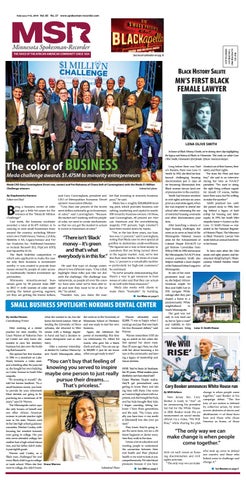
February 7-13, 2019 Vol. 85 No. 27 www.spokesman-recorder.com
PRST STD U.S.POSTAGE PAID TWIN CITIES MN PERMIT NO. 6391
THE VOICE OF THE AFRICAN AMERICAN COMMUNITY SINCE 1934
See local calendar on pg. 8
Black History salute
MN’S FIRST BLACK FEMALE LAWYER
LENA OLIVE SMITH In honor of Black History Month, we’re sharing short clips highlighting the legacy and history of Blacks in Minnesota. This week, we salute Lena Olive Smith, Minnesota’s first female African American lawyer.
The color of BUSINESS
Meda challenge awards $1.475M to minority entrepreneurs Meda CEO Gary Cunningham (front row, center) and Pat Mahoney of Chase (left of Cunningham) with the Meda $1 Million Challenge winners Submitted photo
said Gary Cunningham, president and CEO of Metropolitan Economic Development Association (Meda). “Less than one percent of the investeing a business owner of color just got a little bit easier for the ment dollars nationally go to businesses winners of the “Meda $1 Million of color,” said Cunningham. “Because the market isn’t working well for people Challenge.” Last week, the business incubator of color, we need to create mechanisms awarded a total of $1.475 million in fi- so that we can get the market to actualnancing to nine small businesses from ly invest in businesses of color.” around the country, including Minnesota’s own HabitAware, Vemos, Cytilife, Mobility 4 All, LegacyArmour and Virtue Analytics Inc. Additional businesses include Ilerasoft (IL), PopCom (OH), and SquarePac (GA). The Shark Tank-like competition — which asks applicants to make the case for why their business is investmentHe said that type of change comes worthy — was created to provide businesses owned by people of color access about in two different ways. “One is [to] to traditionally limited investment op- highlight these folks just like we did with the challenge. The challenge was portunities. Minnesota minority-owned busi- nationwide, so people all over the counnesses grew by 58 percent from 2007 try have seen what we’ve been able to to 2012 — with women of color repre- do and now they want to be at the tasenting the fastest growing segment, ble,” he added. “Number two, you show the maryet they are getting the fewest dollars,
By Stephenetta Harmon Editor-in-Chief
B
“There isn’t ‘Black’ money – it’s green and that’s what everybody is in this for.”
ket that investing in minority business pays,” he said. Meda has a roughly $20,000,000 lending pool, which provides business consulting, marketing and capital to nearly 850 minority business owners. Of those, said Cunningham, 60 percent are African American and the overwhelming majority (“95 percent, high nineties”) have been turned down by banks. “Yet, in the last three years, our loan loss was 1.1 percent,” said Cunningham, noting that Meda uses its own special algorithm to dertermine credit-worthiness. “We figured out a way to lend money to customers that are being turned down in the regular market. And, we’ve lost less than most banks. In terms of a loan loss, 1.1 percent is a remarkable number — particularly for high-risk customers,” he continued. “So we’re actually demonstrating that there’s a way to get resources to businesses of color and that they can actually do well with those resources.” Meda also works with clients to make them “bankable” by building ■ See Meda on page 5
SMALL BUSINESS SPOTLIGHT: NOKOMIS DENTAL CENTER what she wanted to do, but she knew she loved science. After attending the University of PennAfter working at a dental sylvania, she returned to Minpractice for nine months, Dr. nesota with a biology degree Grace Warren of Nokomis Den- in hand and had a decision to tal Center not only knew she make: chiropractic care or denwanted to own her dentistry tistry. After a summer internship business but also own the buildat dentist Dr. Larban Otieno-Aying that housed it. She opened her first location im’s North Minneapolis office, in 1984 — a storefront on Lake Street, between a video store and a bowling alley. Six years later, she bought her own building on Cedar Avenue in South Minneapolis. “It’s investing in myself,” she told her former landlord. “As a small business owner, you have to provide for your retirement. Most dentists are going to be practicing for a minimum of 30 years,” says Dr. Warren. The Minneapolis native says she only knows of herself and one other African American woman in private practice right now in the state. Warren credits her late high school guidance counselor, Fletcher Cooley, with focusing her mindset towards even going to college. Her parents never attended college, her mother had a high school education, and her father didn’t make it past eighth grade. Warren said Cooley, as a Black man, challenged her and every Black child to go to college or trade school. When she first Grace Warren went to college, she didn’t know By Jonika Stowes Contributing Writer
she went on to the University of Minnesota School of Dentistry and was ready to start her own business. Again, she references the power of mentorship, this time via veterinarian Dr. Albert Edwards, who gave her a blank check and said, “You can use up to $10,000 — just let me know when you get ready to start.”
“You can’t buy that feeling of knowing you served to inspire maybe one person to just really pursue their dreams… That’s priceless.”
Submitted Photo
Warren ultimately used $2,000. “I was so happy when I could go and pay that man back his two thousand dollars,” said Warren. Warren remembers MSR doing an article on her when she first opened her doors more than 35 years ago. Here, we chat with her about becoming a fixture in the community and leaving a legacy of mentorship and future dentists. MSR: You’ve been in business for 35 years. What makes your dentistry services stand out? Grace Warren: People realize they’ll get personalized care, getting to know them and taking time with them. One woman I went to high school with is a patient, and she brought her kids, and her kids brought their kids. I began counting, letting her know I have three generations, and she said, “No, Grace, actually you have four — my mother [deceased] was also your patient.” They know they’re going to see the same faces, not see a different hygienist or doctor every time they walk in the door. I stress a lot on education and wanting people to understand the connection between their oral health and their physical health — we want to look at you comprehensively. We take blood pressures because if you have ■ See SBS on page 5
Long before there was Nad- cheated out of their homes, their er’s Raiders, there was Lena O. safety and their rights. “I’m from the West and fearSmith. In 1921, she filed her first lawsuit challenging housing less,” she said in an interview discrimination just 11 days af- during her time as NAACP ter becoming Minnesota’s first president. “I’m used to doing Black woman lawyer (and one the right thing without regard of precious few in the country). for myself. Of course, battles Smith had become involved leave their scars, but I’m willing in civil rights activism six years to make the sacrifice.” prior as a real estate agent, when Smith practiced law until she was inspired to attend law she passed away in 1966, leavschool after witnessing the use ing behind a legacy of leadof restricted housing covenants ership for housing and labor and other discriminatory prac- equity. In 1991, her South Mintices. neapolis home — known as the After launching a stream of Lena O. Smith House — was legal housing challenges, she added to the National Register went on to serve as head of the of Historic Places. The MinnesoMinneapolis National Associ- ta Black Women’s Lawyer Netation for the Advancement of work holds an annual luncheon Colored People (NAACP) Le- in her honor. gal Redress Committee from 1926 to 1930. In 1930, she became To learn more about this Minthe Minneapolis NAACP’s first nesota civil rights pioneer, read her woman president. Smith also story here: bit.ly/2SqZwpN. Photos helped establish a local chapter courtesy Mitchell Hamline School of the National Urban League in of Law Minneapolis. In one of her most prominent local cases, she helped African American couple Arthur and Edith Lee in 1931 navigate White outrage after they purchased a home in a predominantly White neighborhood in South Minneapolis. Her goal was not only to win local cases, but to “give a voice” and visibility to African Americans being Lena O. Smith House
‘We Will RISE’
Cory Booker announces White House run By MSR Editors New Jersey Sen. Cory Booker is ready to “rise” after announcing his presidential bid for the White House in 2020. Booker made the announcement on social media official via a video, “We Will Rise,” while sharing his plat-
change is when people come together,” said Booker in his campaign debut. “The history of our nation is defined by collective action, by interwoven destinies of slaves and abolitionists — of those born here and those who chose America as home, of those
“The only way we can make change is when people come together.” form on such issues as housing discrimination and civil rights activism. “The only way we can make
who took up arms to defend our country and those who linked arms to challenge and change it.” ■ See Booker on page 5
2
February 7-13, 2019
3 ways to improve education about U.S. slavery By Tiffany Mitchell Patterson Contributing Writer
W
hen it comes to teaching students about slavery in the United States, teachers often stumble through the topic. In the worst cases, they use poorly conceived lessons that end up inflaming students, parents and communities about a subject that is already difficult to deal with because of the inhumanity involved. For instance, in 2018 a Bronx middle school teacher “shocked and traumatized” her social studies class when she had Black students lie on the floor, then “stepped on their backs to show them what slavery felt like.” In 2012 in Georgia, a third-grade teacher resigned after an investigation found the teacher and three others had assigned math homework with word problems about slavery, such as, “If Frederick got two beatings each day, how many beatings did he get in one week?” As a former social studies teacher and now as an assistant professor who helps prepare educators to teach social studies, I have no shortage of ideas on how educators — or parents or anyone who is interested in learning more about slavery in the United States — can do a better job of understanding the subject and presenting it to others. Here are three of those ideas: Identify the slaveholding presidents Every American should know that several U.S. presidents — including some of the Founding Fathers — were slaveholders. Twelve U.S. presidents held anywhere from one to
“Years A Slave”
llustration by Dusan Pavic es from the Days of Slavery: Former Slaves tell their Stories” — a collection on file at the Library of Congress and available online — a person can actually hear firsthand accounts of life during slavery. Hearing the voices of those who were enslaved is more powerful than what could ever be captured in a textbook. Similar primary sources can be found in the “Framework for Teaching Hard History of American Slavery.” Picture books and novels, such as those on a list titled “Slavery, Resistance and Reparations,” are also a great way to engage children of all ages.
Never Caught, The Story of Ona Judge: George and Martha Washington’s Courageous Slave Who Dared to Run Away George Washington standing among slaves harvesting grain at Mt. Vernon Courtesy of Everett Historical from www.shutterstock.com hundreds of people as slaves. The nation’s first president, George Washington, enslaved over 300 people and held slaves for 56 years. Thomas Jefferson, the nation’s third president, held 600 people as slaves. This often comes as a surprise to students. In my experience, many students have also been taught that the presidents were nice and humane to their slaves. I would emphasize to students that treating a person as property is neither nice nor humane. About two years ago, critics prompted Scholastic to stop distribution of a book, A Birthday Cake for George Washington, that depicted “happy” slaves which Scholastic, itself, admits may have given a “false impression of the reality of the lives of slaves.” Slavery should be taught from the perspectives of those who were enslaved. For example, the young reader’s edition of Never Caught, The Story of Ona Judge: George and Martha Washing-
ton’s Courageous Slave Who Dared to Run Away, sheds light on an aspect of George Washington’s life as a slaveholder that is not widely told to children. Similarly, students should contemplate the life of Sally Hemings, an enslaved house servant with whom Thomas Jefferson — author of the Declaration of Independence — fathered six children, beginning when she was 16. Jefferson never publicly acknowledged his children with Hemings. Move beyond textbooks When it comes to dealing with slavery, textbooks often use inadequate or inaccurate descriptions. For instance, in 2015, a high school freshman noticed that his geography textbook referred to Africans brought to plantations in the United States between the 1500s and 1800s as “workers” instead of as slaves. This sparked widespread outrage as McGraw-Hill is a major
Turn your calling into a career The College of St. Scholastica is equipping care professionals through our CSWE-accredited undergraduate and graduate social work programs. B.A. Social Work
Master of Social Work (MSW)
Values-based curriculum including interprofessional
A flexible, hybrid learning environment with two tracks
education and 570 hours of in-field service
for those with and without a B.A. in Social Work
Social work health care certification option
Financial incentives through the ROBUST
Five MN locations offering traditional on-campus, mostly-online, evenings or weekend formats
Specialization grants from the U.S. Dept. of Health and Human Services One of the U.S. News & World Report’s best Social Work Master’s Programs
go.css.edu/spokesman
Get out of the classroom Another way to learn about slavery is to visit museums and historic sites. Smaller state and local museums with exhibits, plantations, cemeteries, auction blocks and historical markers might be located in your state or local community. A librarian or archivist at a local library might be able to share unique local histories of slavery. Plan family trips or field trips to larger national museums that highlight the histories of slavery. In Washington, D.C., you can vis-
(l-r) Dred and Harriet Scott, former slaves living in Fort Snelling in the mid-1800s who sued and won their freedom. textbook publishing company. McGraw-Hill apologized and agreed to revise the textbooks. The McGraw-Hill textbook controversy was hardly an isolated issue. In 2018, the Southern Law Poverty Center found that when it comes to teaching students about American slavery, “textbooks do not have enough material about it.” Even the best textbook examined in the Center’s analysis scored just 70 percent on a rubric designed to assess how good the textbooks were teaching various aspects of U.S. slavery, such as how the nation’s founding documents — the Declaration of Independence and the U.S. Constitution — contain protections for slavery, or how slave labor was critical to the nation’s economy. The average book scored 46 percent. Parents and educators would be wise to encourage the use of primary sources to fill in what the textbooks are missing. Primary sources include records and firsthand accounts. Since slavery in the U.S. was not formally abolished until the 13th Amendment was ratified in 1865, today’s student might think there’s no way they could actually hear the voices of former slaves. But as demonstrated by “Voic-
it the Smithsonian National Museum of African American History and Culture’s “Slavery and Freedom” exhibition or the Frederick Douglass National Historic Site. Here, in Minnesota, you can visit the Minnesota Historical Society’s Historic Fort Snelling, which highlights enslaved African Americans and their fight for freedom in the North. The National Underground Railroad Freedom Center in Cincinnati, Ohio; Lest We Forget Black Holocaust Museum of Slavery in Philadelphia, Pa.; and the Legacy Museum: From Enslavement to Mass Incarceration in Montgomery, Ala. all provide a more comprehensive lens on the systemic oppression of slavery. Tiffany Mitchell Patterson is an assistant professor of secondary social studies at West Virginia University. Published by permission from The Conversation.
February 7-13, 2019
3
With winter comes threat of frostbite The best strategy is prevention
By Charles E. Crutchfield III, MD Originally published Jan. 24 last year, this column is back by popular demand — it seems our freezing cold weather just keeps returning!
F
rostbite is a term that is used when skin is severely damaged by the cold, where the skin actually freezes. In severe cases, the underlying tissue can be affected, too. First, your skin becomes painful and tingles. Next, the skin becomes very cold and red, then numb, hard and pale. Sometimes, in severe cases, hands are difficult to close, or joints underlying the frostbite will be difficult to move. Exposed extremities and regions in cold, windy weather — such as fingers, toes, nose, cheeks and ears — are most vulnerable to frostbite, but frostbite can occur anywhere on the body, including areas that are covered and protected. Frostbite commonly occurs upon exposure to cold weather, but it can also be caused by exposure to cold metals, ice or cold liquids. Because the area that gets frostbitten often becomes numb, a sufferer may not even realize what is happening until someone else
points it out to them. In cold weather, one must be cautious and protective by wearing the appropriate clothing and covering vulnerable areas such as hands, ears and face. Temperatures below zero degrees Fahrenheit are especially concerning. Exposed skin can become frostbitten with just 10 minutes of exposure under these conditions. Very early, mild frostbite is called “frostnip” and only requires rewarming. Other stages of frostbite need medical attention because severe damage can occur, such as damage to muscles, nerves and bone. Severe blistering can result in infection. Stages of frostbite Frostnip: Frostnip is the early, first stage of frostbite. The skin becomes tingly, red and painful. At this point, getting out of the cold and rewarming the skin is all that is required. The skin may become tingly again upon rewarming. Superficial frostbite: In the second stage of frostbite, the red skin becomes pale or white/light. If the skin begins to have a burning sensation, this is an indication of severe skin involvement. The skin should be rewarmed, but as it warms it may become mottled in color, painful and swollen. Blistering can occur within 12-36 hours after exposure. Severe (deep) frostbite: If the frostbite continues, it can affect the full thickness of the skin and nerves and the area beneath the skin, including fat, muscles, bones and joints. A signal that this is happening is that one loses all sensation of discomfort, coldness or pain in the area(s). If you experience any signs of frostbite including discoloration, pain, swelling or blistering, consult your
physician. In addition to frostbite, the person should also be aware of developing hypothermia. That is where the cold overwhelms the body’s ability to maintain its temperature. Signs of hypothermia • Unstoppable shivering • Thick and slurred speech • Fatigue and sleepiness • Frostbite risk factors • Poor circulation • Infants and children • Elderly • Drug and/or alcohol abuse • Tobacco users • High altitudes (decreases oxygen to skin) • Medical conditions that affect ability to feel cold or interfere with normal blood circulation such as diabetes • Dehydration • Exhaustion Frostbite prevention tips • Check the forecast and plan your outdoor activities appropriately. • Limit the time you spend outside by employing several warming periods. • Dress in layers with material de-
• • • • • •
signed to both wick wetness away and maximize protection against the cold. Cover your head, ears included. Limit alcohol consumption. Don’t become overly exhausted or dehydrated. If traveling extensively in cold areas, have an emergency kit with supplies and warming materials. Consider self-warming packs for hands and feet (available at sporting goods stores and online). Don’t forget excellent gloves or mittens and thick warm socks.
Frostbite diagnosis Continuing skin discoloration, swelling, pain and blistering are all signs of frostbite. Consult your doctor. Depending on the severity, the physician may order other tests to determine if any hypothermia, muscle or bone involvement is present. First aid and medical treatment For frostnip, gentle rewarming is all that is required. For moderate to severe frostbite, or if hypothermia is suspected, get medical attention right away. With frostbite, the gentle rewarming should include ONLY lukewarm
water warming or a gentle warm bath only. Using other measures can cause burns. If the feet have been severely affected, avoid walking on them because this can cause further damage. If blisters are present, do not break them. The first step is to immediately get out of the cold; rewarm using water at a temperature of 99-105 F; use an over-the-counter anti-inflammatory such as ibuprofen, Aleve or Advil; and get medical attention immediately. If the case of frostbite is severe, the doctor may prescribe medications to prevent infection, increase blood flow to the affected areas, reduce pain, or increase oxygen flow to the involved areas. Surgical treatment may also be needed. Remember, when it comes to frostbite, prevention is the best strategy. If you do find yourself in a position of getting frostbite, get out of the cold, gently rewarm, and get medical attention without delay. Charles E. Crutchfield III, MD is a board certified dermatologist and Clinical Professor of Dermatology at the University of Minnesota Medical School. He also has a private practice in Eagan, MN. He received his M.D. and Master’s Degree in Molecular Biology and Genomics from the Mayo Clinic. He has been selected as one of the top 10 dermatologists in the United States by Black Enterprise magazine. Dr. Crutchfield was recognized by Minnesota Medicine as one of the 100 Most Influential Healthcare Leaders in Minnesota. He is the team dermatologist for the Minnesota Twins, Vikings, Timberwolves, Wild and Lynx. Dr. Crutchfield is an active member of both the American and National Medical Associations.
Helping youtH weatHer tHe storms in life Three strategies for helping them become more resilient Statistics show that the United States is facing an epidemic of lost and distressed youth who struggle to handle the daily challenges of life. The suicide rate for young people is on the rise, and suicide is the second-leading cause of death for people ages 15 to 24, according to the Centers for Disease Control. Despite such troubling statistics, there are ways to better prepare young people so they can bounce back from the trials that life throws at them, says Dr. Kim Metcalfe, a retired professor of early childhood education and psychology and author of Let’s Build ExtraOrdinary Youth Together. “Children need much more than love, food, clothing, shelter and electronic devices,” Metcalfe says. “They need to be armed with the ability to be resilient so they can navigate through childhood and into adulthood, dealing with adversity, trauma, tragedy, racism, and other significant sources of stress. We know the traits of emotionally resilient people, and we know the types of experiences and opportunities that youth need to develop these traits.”
consequences of those decisions and behaviors. That means you can’t make all their decisions for them. Use missteps, mistakes and disappointments as learning opportunities. The next time your adolescent does something you aren’t thrilled about, Metcalfe says, try asking them questions such as, “What other choice could you have made?” Use follow-up questions, such as: “If you’d made that choice, what do you think might have happened?” “Is there another choice or option you could have considered?” Model the resilience you want to see in them. One way to build more resilience in a teenager is to make certain you are modeling the behavior you want to see. They notice how you handle challenging situations. “If you have a difficult time bouncing back from setbacks, then it makes sense that your teens will have difficulty, too,” Metcalfe says. “Modeling for our youth what we want to de-
“If you have a difficult time bouncing back from setbacks, then it makes sense that your teens will have difficulty, too.” Resilient individuals don’t see themselves as victims, even though sometimes they are, she says. They refuse to play the blame game, and they know how to intercede on their own best behalf. Resilient individuals view setbacks as challenges that they are capable of addressing successfully. They feel hopeful rather than helpless. For Metcalfe, helping distressed young people is a mission. Her daughter committed suicide in 2012, so Metcalfe speaks both as a professional and as a mother who has suffered a grievous loss. Metcalfe offers suggestions for parents and others on ways they can help build resilience in young people so they know they can handle the situation when life becomes difficult: Give them opportunities to self-regulate. Self-regulation is when you are able to take control of your thinking, your decisions and your behavior. If you want your children to develop the skill of self-regulation, Metcalfe says, you must provide them opportunities where they are required to stop and think about the
velop in them is very powerful. Resilient people are able to cope with challenges, weather the storms in life, and work successfully through setbacks to reach their goals and make their dreams come true. “People like to say that kids are resilient,” Metcalfe says. “That’s not always true. In fact, it’s often not true. But they can develop the thinking habits and skills to live through adversity and recover in ways that allow them to live the lives they were born to live and do in life what they were born to do.” Dr. Kim Metcalfe, a retired professor of early childhood education and psychology, is the author of Let’s Build ExtraOrdinary Youth Together. She is a member of the National Association for the Education of Young Children, the California Association for the Education of Young Children, and the American Psychological Association. For more information, visit www.xtraordinaryyouth. com. Story courtesy of News and Experts.
4
February 7-13, 2019
The Minnesota Spokesman-Recorder (MSR) welcomes and values commentary and feedback from the community. The articles found here are edited for clarity and/or space, but the opinions are the author’s own and do not reflect the views of the MSR.
New voting laws can disrupt GOP’s ‘power grab’ Reverend Irene Monroe By Rev. Irene Monroe Contributing Commentator Senate Majority Leader Mitch McConnell has voiced opposition to making Election Day a federal holiday. However, allowing American voters a more accessible and a stress-free trip to their voting precincts should be a no-brainer. And, H.R.1 — For the People Act of 2019 would do just that. McConnell depicted the Democratic-controlled House proposal as “a political power grab,” and mocked the legislation as the “Democrat Politician Protection Act.” Not true! H.R. 1 includes a group of voting rights provisions that would “expand Americans’ access to the ballot box, reduce the influence of big money in politics, and strengthen ethics rules for public servants, and for other purposes.” The bill would improve access for voters with disabilities and voter turnout. It would reform automatic voter registration and felon re-enfranchisement. In other words, H.R. 1 would modernize a century-old bankrupt voting system to mirror America today; thus allowing for participatory democracy. Because of the GOP’s continued aversion to di-
cerated Section 4(b) of the 1965 Voting Rights Act (VRA). The section historically protected African Americans and other disenfranchised people of color and also identified problematic voting precincts with shameful histories of racial discrimination. Not surprisingly, these precincts are predominantly GOP strongholds. The Court ruled that Section 4(b) were outdated. The ruling attests to the fictive post-racial premise that racial minorities, especially in the South, no longer confront discriminatory barriers voting. At the time, the VRA applied to nine states in South — Alabama, Alaska, Arizona, Georgia, Louisiana, Mississippi, South Carolina, Texas, and Virginia. After North Carolina’s Black vote increased by 51.1 percent in 2000, and Blacks had a higher voter turnout with Obama on the ballot in both 2008 and 2012 presidential elections, the federal court said that state’s GOP had begun to target Blacks “with almost surgical precision” to deny them voting rights. In 2018, the epic gubernatorial battle between Democratic candidate Stacey Abrams and Republican candidate Brian Kemp was a bold, brash, and brazen example of how the Republican “power grab” works in the state of Georgia. While running for governor, Kemp also stayed on as Georgia’s secretary of state. As secretary of state, he oversaw the state’s elections and was responsible for
Democracy starts at the ballot box. versity — people of color, LGBTs, immigrants, and Muslims, to name a few — the tribe has become an aging White nostalgic throwback of Jim Crow days. Since the 1964 Civil Rights Voting Act gave African Americans the ballot, the GOP has had ongoing tactics to suppress minority voting of people of color. Such old Jim Crow tactics as literacy tests, poll taxes and grandfather clauses have given way to a new crop of tactics: random voter roll purging, changing polling locations and/or polling hours, eliminating early voting days, reducing the number of polling places, packing majorityminority districts and dividing minority districts, along with notorious voter ID laws that disproportionately disenfranchise minority voters. They are all part and parcel of the Republican playbook. The Republican game plan to disenfranchise Democratic voters by any means necessary has both unapologetically and unabashedly shown the American public the art of what a “power grab” really looks like. And, McConnell’s party has continued their no-holds-barred tactics in this century as in the last. In 2000, the outcome of the presidential race between Democratic Vice President Al Gore and Republican Texas Governor George W. Bush was decided in a recount of Florida ballots due to hanging chads. In predominantly Black voting precincts, which are overwhelmingly Democratic, it was reported that piles of ballots were left uncounted. The U.S. Civil Rights Commission reported that 53 percent of ballots invalidated by Florida officials were cast by Black voters. The Florida debacle was settled in Bush’s favor, winning him the presidency. His brother Jeb was governor at the time. In 2013, by a 5-to-4 Republican majority, the U.S. Supreme Court case Shelby County v. Holder evis-
the “exact match” policy which states that a voter’s application must “exactly match” their social security or driver’s license information in order to be approved. According to the Associated Press, 53,000 applications were put on hold — 70 percent of which were Black voters. The GOP tactics to dissuade people of color from going to the polls during the midterm elections also impacted and posed challenges for many transgender voters who transitioned. Many did not have government-issued photo IDs reflecting their gender. According to the Williams Institute data, of the 137,000 transgender people who transitioned and were eligible to vote, approximately 57 percent (78,000) may not have had the appropriate ID. H.R. 1-For the People Act of 2019 would allow those of us who’d too easily be denied the right to vote. I grew up knowing one of the most influential voices in American politics, Congresswoman Shirley Chisholm. Chisholm represented my Brooklyn congressional district for seven terms, from 1969 to 1983. She was known throughout the neighborhood and the halls of power in New York City as a force to be reckoned with who was “unbought” and ”unbossed” (also the title of her 1970 memoir). I learned from her that democracy can only begin to work when those who are relegated to the fringes of society can begin to sample what those in society take for granted as their inalienable right. And, it starts at the ballot box. Rev. Irene Monroe is an African American lesbian feminist public theologian, sought-after speaker, and preacher.
BLACK HISTORY EVERYDAY What role will the U.S. play in Venezuela’s crisis? Through My Eyes The Minneapolis Story Continues By Ron Edwards Contributing Commentator The New York Times has provided an insightful examination of a conflict that could turn into a shooting war in Venezuela. Over the three days of researching and writing this column, the NYT published over a dozen separate articles on how Venezuela current political crisis will impact the world’s nations and cities. Specifically, will there be a shooting war, a world war of ideas, or both? The question, itself, is related to whether Venezuela will have a socialist economy, the current choice of Russian and Chinese on the ground, or a market economy, such as in Europe and the United States, or a combination of both that some new congressional leaders call “democratic socialism,” as seen today in the “new” China and “new” Russia. The NYT articles illustrate three key points: First, Russia has poured nearly $25 billion into Venezuela, along with military personnel, as they build air bases to accommodate their strategic, long-range bombers. Secondly, China has just added a $5 billion pledge to help Venezuela’s oil industry. And third, although the people and National Assembly want President Nicolás Maduro to go, the Venezuelan military support him and their “guests” from Russia and China.
The NYT reports that the now impoverished Venezuela was once the fourth wealthiest country in the world, per capita. As stated by both the NYT and the Washington Post: “Venezuela is heading toward complete disaster,” despite having “the world’s largest proven oil reserves.” The reports show that the number-one problem is hunger, causing three million to flee their country. Five million more are projected to flee this year, unmasking the current humanitarian trifecta: hunger, economics, and social unrest. Some have suggested Maduro step aside and have the United Nations (UN) settle the matter and guide new elections. Others want Juan Guaidó, head of the National Assembly opposition, who, as allowed by the Constitution, declared himself to be the interim president until the National Assembly can sort it all out. But, as this is being written, both China and Russia favor Maduro, and both have UN veto power within the UN Security Council, which would guarantee that America might have to go it alone. But how? Militarily, with boots on the ground? Diplomatically with sanctions that will further impoverish Venezuela, while the Chinese and Russians continue their military buildup? Will Brazil, sharing a common border, intervene militarily? That is a pipe dream. A mil-
itary conflict, ramping up from militaristic propaganda that the little South Americans will be saved again by North America’s “Big Brother,” would cause another Vietnam-like situation, and we all know how that ended. Will Donald Trump “coincidentally” trigger military conflict in Venezuela as a diversion from his presidential problems? How does the Trump Administration’s discussion of a potential military action fit the 19th century Monroe Doctrine that warned foreign powers not to interfere in Latin America? Where will people of Venezuela go? How many will try to cross our southern border, just as the poor and hungry have flooded Europe — hence the serious policy debate regarding socialism versus market-based approaches? How many new people can America support? Is Trump’s strategy to stop Americans from dying in the Middle East only to switch the dying zone to South America? Will the American republic put up the stop sign? Even though the U.S. has obtained support from a majority of members of the Organization of American States and countries around the world, as well as Venezuela’s National Assembly, would they actually offer military resources to drive out Maduro, who enjoys the support of two major nuclear powers? Stay tuned. Ron Edwards is an author and hosts radio and TV shows.
Trump’s America rewards abuse and discrimination By Alissa Ellis Guest Commentator Whether it’s Jeff Sessions, Stephen Miller, or Sheriff Joe Arpaio, the Trump administration has a real knack for empowering and absolving people who push discriminatory law enforcement and immigration policy. Now there’s another name to add to that list: Sheriff Terry Johnson of Alamance County in North Carolina. Six years after the federal government severed ties with Johnson for his office’s discriminatory policing of Latinx residents, Uncle Sam and the Alamance County Sheriff’s Office are partners once again. In 2012, the U.S. Justice Department filed a civil rights lawsuit against Sheriff Johnson, which sprang from the department’s two-year investigation into his office. In its complaint, the department alleged a widespread pattern of racial profiling that systematically and unlawfully targeted Latinx residents for investigation, traffic stops, arrests, and seizures since at least 2007. Witnesses even told federal investigators that Johnson in 2007
yelled: “bring me some Mexicans” while pounding his fists on a table during a staff meeting. Although a federal judge ultimately dismissed the lawsuit filed against Johnson, the office’s egregious civil rights abuses were exposed. In response, Immigration and Customs Enforcement (ICE) termi-
commissioners approved Johnson’s request for a $2.8 million budget increase for staffing and facility upgrades at the county detention facility to hold immigrants for ICE. Under the renewed partnership, the same sheriff who ICE terminated its relationship with in 2012 for discriminatory policing will once again detain immigrants
Under a renewed partnership, the same sheriff who ICE terminated its relationship with in 2012 for discriminatory policing will once again detain immigrants. nated its 287(g) agreement — a program that authorizes local deputies to perform functions of federal immigration agents — with Johnson and stripped him and his deputies of the authority to investigate potential immigration violations by individuals detained in the county jail. But that was then and this is now. Late last month, the county’s
— including those seeking asylum — and be reimbursed for it with federal funds. In Trump’s America, law enforcement officials who abuse their authority aren’t investigated, or at least shunned, but rewarded with taxpayer money. The potential for abuse and the violation of immigrant and Latinx rights in Alamance County is terrifying and un-
acceptable, particularly when Johnson used fearmongering and false, racist statements about immigrant populations to get the money. During the meeting on the budgetary request, Johnson told the county’s board of commissioners that “criminal illegal immigrants” are “actually raping our citizens in many, many ways.” The renewed partnership between ICE and Johnson once again illuminates the civil rights disasters that occur when local law enforcement partners with the federal government to do federal immigration enforcement. Such agreements can frighten community members from reporting crimes and from seeking even the most basic assistance from law enforcement. In other words, such agreements do not enforce the rule of law. They undermine it as well as harm public safety. Johnson has already proven that any collaboration with ICE will inevitably lead to racial profiling and deepen the rift between immigrant communities and Alamance County law enforcement. By engaging in this new collaboration, both Johnson and the Trump
administration will continue to compromise public safety and equal protection under the law. No one, including members of our immigrant communities, should be treated as a source of revenue for law en-
forcement — whether it’s in Alamance County or anywhere else across the United States. Alissa Ellis is regional immigrants’ rights strategist for ACLU of North Carolina.
LETTER TO THE EDITOR POLICY The MSR welcomes letters to the editors. Letters should be typed, double-spaced, in 12 point font and must be signed. Anonymous letters will not be printed. A telephone number or email address must be included for verification. Letters of 250 words or less are more likely to be published. The editor reserves the right to edit letters for length.
SEND LETTERS TO: Minnesota Spokesman-Recorder- Letters to the Editor P.O. Box 8558 * Minneapolis, MN * 55408-0558 Or email your letters/commentary to sharmon@spokesman-recorder.com
READER SERVICE • Circulation Department/Billing Department If you have any questions regarding your invoice or subscription, call 612-827-4021. 9 am to 5 pm, Monday through Thursday. • News Department To report a news event, call 612-827-4021 or email to sharmon@spokesman-recorder.com • Advertising Department To reach our advertising departments call 612-827-4021 or email to: display@spokesman-recorder.com
CORRECTION POLICY If we make an error, we want to correct it. If you believe that an error has been made email sharmon@spokesman-recorder.com. If a correction is warranted, it will be printed the next week.
February 7-13, 2019
SBS
Meda CEO Gary Cunningham
Meda
“They have an award every year for a million-dollar program-related investment that they make in organizations like ours for the most innovative product,” he said. “We were the most innovative.” The challenge also caught the eye of investors across the country, who also signed on as judges, as well as Chase Bank, which co-sponsored the challenge and offered an additional $250K that Meda matched to bolster its original prize pool from $1 million. With year one under its belt, Meda is now gearing up for its second challenge later this year. For those interested in applying, he recommends refining your pitch deck — “everybody should have one — and diving into the details of your business. “Getting an application that’s clear and certainly spells out your business plan,” he said is important, along with presenting clear financial projections. “We have some very savvy business people, they just don’t have the technical knowledge and those things help when you’re giving somebody else something to review,” he said. Cunningham said he is excited for the 2019 challenge to help bring the next great inventor or entrepreneur to the forefront. “People of color are very innovative,” he said, calling attention to such Black inventions as refrigerated boxcars, snowmobiles, and pacemakers. “Somewhere, there are people in their garage or basement or wherever right now, working on something that might blow everybody’s mind. “We don’t even know about it until they bring it out. We want to help them get with folks that know how to pitch and sell in order to get their product off the ground.”
Continued from page 1
relationships with larger banks, such as US Bank, Bremer, Wells Fargo and Sunrise. “Discrimination in the lending market is pretty widespread. We’re giving them a leg up to help them equalize the playing field so that they can actually play and get their loan approved,” he said. “Once you have a relationship…, the money is green. There isn’t ‘Black’ money — it’s green and that’s what everybody is in this for.” Cunningham said Meda’s client success is also based on expanding their networks. “We’re not only helping these businesses build relationships with the regular banking industry, we’re helping them have regular relationships with folks like accountants and lawyers and other folks that can give them the technical support.” Beyond minimal loan loss, Meda’s numbers are strong across all fronts. “Meda’s clients had revenues of over one billion dollars combined, employed over 6,000 people and the average salary was over $22 an hour,” shared Cunningham. That kind of success is expected to spill over onto the challenge’s winners’ circle. Each of the nine winners will receive financing via a five-year patient capital investment based on equity, which requires interest-only payments for five years. If a business sells during that time, Meda and its partners would get a percentage. Other than that, after five years, it turns into a regular loan if it hasn’t been paid off or it can be re-upped for another five-year inFor more information on Meda’s next vestment. “It’s a unique product,” explained Cun- challenge, visit meda.net. ningham. Its innovation is how Meda got Stephenetta Harmon welcomes reader rean investment from the Opportunity Finance Network to launch the challenge. sponses to sharmon@spokesman-recorder.com.
‘MEDA $1 MILLION CHALLENGE’ WINNERS HabitAware, St. Louis Park, MN — $400K Provides wearable technology that helps people with body-focused repetitive behaviors (i.e., compulsive hair pulling or nail biting) take control of their condition. Ilerasoft, Chicago, IL — $200K A software solution for hospitals to improve capital planning and budgeting by optimizing their medical equipment utilization Vemos, Minneapolis, MN — $200K Enables hospitality venues to manage and grow their business from a single dashboard. Cytilife, Minneapolis, MN — $125K Uses their Smart Campus platform to help students and college administrators make data-driven decisions to help reduce college dropouts. Mobility 4 All, St. Paul, MN —$125K Provides a kinder, gentler ride hailing service for seniors and people with disabilities.
Booker Continued from page 1
In an apparent dig at Trump, the junior senator also called for a new direction, “where we see the faces of our leaders on television and feel pride, not shame.” After growing up in White suburbia, the former mayor literally met his constituents where they live by moving to Newark’s inner city, where he worked to fight slumlords. He even took on the SNAP/Food Stamp Challenge in 2012, restricting his meals for
PopCom, Columbus, OH — $125K Makes vending machines and kiosks “smart” with software and artificial intelligence capabilities at the point-of-sale.
MSR: What has been your biggest challenge? Continued from page 1 GW: I worked for other people for nine months and knew I hypertension that’s a sign you didn’t want to work for anyone have cardiovascular disease, and else for nine more months. In that may affect your periodontal the beginning, it was the financhealth or your gum health. We es. You come out of dental school take the time to let people know with debt. I didn’t have a lot of that you care about them and re- debt, but I also didn’t have colally get to know them and their lateral One bank told me to put my family. We’ve seen people go parents’ house up as collateral, through health crises. Some- and I wouldn’t do that. Then [it times I call to check up on pa- was] mentally getting prepared, tients even though they don’t setting up and then keeping up have an appointment, because with technology. People expect a I know they’re going through certain level of technology, and cancer treatment. With a small it’s expensive. private practice, you can do that, and I think people appreciate it. MSR: Three decades later, what does your vision look like for MSR: What has been the most your business? rewarding part of owning your GW: To continue to mentor the next generation. As you begin business? GW: Being self-employed, I can to exit stage right as they say [redictate how much time I want to tirement], you’re more conscious spend with people, and it gives of hoping someone steps in your me the chance to really develop shoes… I know one woman who personal relationships without wants to open her own practice, feeling like I’m on a time clock to [so] let’s strategize a plan… I came out of dental school rush to get through something and not really get to know folks. owing $60,000 worth of debt and today, they owe more than that I really value that. I’m very fortunate I don’t have in one year. It’s closer to $400,000 any debt and our practice is busy now… Maybe you can’t do a soenough where I’m good finan- lo dental practice right now, but cially. Although I knew I would [you can] partner with another make a good income, that was dentist...and pool your efforts, renever my motivation in dentistry. sources, time and money… Not all [dentists] want to go It’s [also] a different dimension when Black kids come in into private practice. Some of and see someone who looks like them are quite content working them. Whether it’s subconscious for someone else, and that’s fine. or not, they start thinking, “Maybe, I can do that. There’s a Black MSR: What advice would you dentist, a Black physician, a Black give to an aspiring entreprelawyer. Maybe I could do that neur? GW: Always invest in yourself when I grow up.”
and build a strong work ethic. It is not nine to five and you have to accept that it’s not going to be. Hopefully, if you’re married, you have a spouse who is supportive of that. Also, you have to always give back, whether it’s giving back to your community or mentoring the next generation. I do a lot of what they call “goodwill dentistry” for people who just can’t afford it, like senior citizens. That’s part of giving back… You need to inspire, serve as a role model. One of my mentees is a pediatric dentist who’s now out in D.C. From the time she was seven years old, she knew she wanted to be a dentist, never wavered — and that’s really odd. So when they would have “Take Your Daughter to Work” day, she would shadow me. She went down to Georgia for undergraduate school, came back to Minnesota, and I wrote her a recommendation for dental school. She got into Howard University, did a residency in pediatric dentistry, and is now Dr. Alicia Reynolds in Washington, D.C. You can’t buy that feeling of knowing you served to inspire maybe one person to just really pursue their dreams because they came in as a little Black girl and saw a Back female dentist and thought, “I can become a dentist.” That’s priceless. Nokomis Dental is offering new MSR patients without insurance a free first-time exam and 10 percent off an x-ray and cleaning through March 31. Jonika Stowes welcomes reader responses to jstowes@ spokesman-recorder.com.
Unique, local content from the African American community's perspective!
LegacyArmour, Minneapolis, MN — $100K This secure online asset protection platform organizes important information in encrypted vaults that is automatically delivered to designated recipients on a scheduled date or life event. SquarePac, Austell, GA — $100K Uses design and metal fabrication expertise to help clients maximize space, reduce freight, save money, and promote safety Virtue Analytics Inc., Woodbury, MN — $100K Provides an eEnrollment Management platform that allows educational institutions to leverage the power of machine learning and predictive modeling to make better decisions across the admissions process.
one week to match the $30 weekly allotment the average food stamp recipient receives. Continuing his grassroots bent, Booker said he will not accept campaign funds from corporate PACs or federal lobbyists. The announcement comes after years of speculation of a run since Booker became a junior senator in 2013. He joins Sen. Kamala Harris in announcing a presidential bid with a nod to Black history. While Harris kicked off her run on Martin Luther King, Jr. holiday, Booker’s announcement marked the
Simply fill out the subscription form below and mail with payment to: Minnesota Spokesman-Recorder, PO Box 8558, Minneapolis, Minnesota 55408 start of Black History Month. A win by either senator would make him or her the second African American president in U.S. history, following Barack Obama. Other Democrats to throw their hats in the ring include senators Kirsten Gillibrand (NY) and Elizabeth Warren (MA), former U.S. Secretary of Housing and Urban Development Julian Castro, and Pete Buttigieg, mayor of South Bend, Ind. Photo courtesy of Getty Images
(All subscriptions must be pre-paid. One year subscription $35, out-of-state $40.)
Name: Address: City/State/Zip: Phone:
Email Address: Payment Options
Check
Money Order
Credit Card (circle & complete info below): Visa
Master Card
Discover
American Express
Card Number: _________________________________________________________ Expiration Date: _______________________________
5
6
February 7-13, 2019
‘Love Thyself’ encourages women to be intentional with self-care By MSR Editors
“Self-love
means taking care of yourself. A lot of times, we as mothers, daughters [and] sisters, we tend to...leave out ourselves. Don’t ever feel guilty for taking care of you.” The above remarks by life coach Trenella Ricks embodied the lessons of self-love and care found at Sister Spokesman’s recent “Love Thyself” gathering. The Feb. 2 event found a captive audience, as attendees packed into a suite at Thor Companies in Minneapolis ready to glean words of wisdom from life coach and author Dr. Joi Lewis, therapist Brandon Jones, and Ricks. The expert panelists encouraged attendees to take a simple, intentional approach to self-care, with the understanding that you cannot pour into others if there’s nothing in your own glass. “There’s no growth in a comfort zone, and there’s no comfort in a growth zone,” said Jones in response to why people stay in toxic relationships and situations. “Sometimes we’re in situations and we don’t even realize that they are hurtful to us,” he continued. “And one thing I’ve seen with a lot of Black women that I’ve come in contact with is…[they] have been conditioned to put their feelings last. And that’s a stressful place to be in.
“When I look at statistics of Black women’s health, just stress-related things, [they] are always number-one and two on the list. And I think that has to do with a lot of historical trauma that we’ve gone through. “Black women have put, not just the community, but the existence of future generations on their backs,” added Jones. “But when do they have the opportunity to heal? Places like this offer that opportunity, but how many spaces do you have outside of Sister Spokesman? Not a lot. One of the solutions is to create more of these healing spaces.” Dr. Lewis encouraged attendees to take better stock of their emotional health with simple healing measures. “When you think of meditation, sometimes it’s like, ‘Oh, it’s got to be quiet… But you can just take your right hand and put it over your heart,” said Lewis as she led attendees in an exercise. “You have so much healing power in your own hand,” she continued. “If you’re feeling anxious or something has happened, you can take your hand and put it over your own heart...our whole central nervous system is going to calm down.” The discussion closed on a feel-good vibe as moderator Tracey Williams-Dillard asked attendees to stand up and greet their neighbor with a hug. Brandi Phillips of Wellife 360, in partnership with Sister Spokesman, also an-
(l-r) Dr. Joi Lewis, Brandon Jones, Tracey Williams-Dillard and Trenella Ricks All photos by Steve Floyd nounced the official launch of the Get Fit Challenge to empower women to embark on a healthier lifestyle. Next up, Sister Spokesman will offer resources and insight for reentry with “New Beginnings: Life After Incarceration on March 2 at the Minneapolis Urban League.
NEW BEGINNINGS
UP NEXT AT THE ORDWAY
Life After Incarceration
FRI APR 19 7:30PM SUN MAR 31 7:30PM
#heysista #soulsista
SATURDAY
O N S A L E N OW ! 651.224.4222 Music & Movement Series sponsored by
TTY651.282.3100
Black Violin and Boys II Men sponsored by
O RDWAY.O RG /ACCESS This activity is made possible by the voters of Minnesota through a Minnesota State Arts Board Operating Support grant, thanks to a legislative appropriation from the arts and cultural heritage fund.
For more info on upcoming events, the Get Fit Challenge, and photos and video highlights from “Love Thyself,” go to Facebook.com/ SisterSpokesman.
MAR 2
At this event, our panelists will discuss resources for women reentering society after incarceration, and provide information for their families to aid in the transition. ONLY
$5
BRING A SISTA!
12-4
MINNEAPOLIS URBAN LEAGUE 2100 PLYMOUTH AVE N, MPLS., MN 55411 FOR MORE INFORMATION CALL 612-827-4021
February 7-13, 2019
7
MORE THAN FUN IN THE SUN: Big lessons, attractions in Texas By Sheletta Brundidge Contributing Writer
A
fter my story about making vacations a teaching opportunity for your children ran in the MSR this past December, I’ve been inundated with calls and e-mails from parents looking for places to go. Most of them asked, “Where should I take my children for spring break?” Others demanded to know, “Are there places nearby we can drive that have rich African American history but won’t break the bank? I got bills to pay!” While a funnier mom quipped, “Anywhere I can drop them off and keep going? I need a break too!” It began getting difficult for me to respond to them all. So my editors at the MSR allowed me to do a follow-up series in the coming weeks — just in time to book travel for spring break —, detailing warm weather cities that you can take your kids. My suggestions won’t hit your pock-
etbooks too hard, and they have Black history and culture you can’t get anywhere else in the nation. I’ve been fortunate enough to have a good husband with a pretty decent job who loves to travel and do new things. Each year, he spearheads renting an RV, loading up all four of our little ones, and setting out a new destination for us to see. For every town, city, and state, there is a story to tell that has blessed our kids and helped them learn more about life outside of Minnesota. • In Dallas, we saw where JFK was assassinated. • In Louisville, we checked out the Muhammad Ali Center. • In Niagara Falls, we visited the Underground Railroad Heritage Center. • In Kansas City, we took a tour of the Negro League Baseball Museum. • In Atlanta, we watched movies about MLK and Coretta at the King Center. Each city and each trip inspired and educated my little ones.
This week, we’ll start off with Dallas and work our way down the list. They say everything is bigger in Texas and they are right! Treat your children to an enjoyable hotel that’s spacious and luxurious. If they’ve never stayed in one before, they’ll appreciate being at the Canopy by Hilton Hotel in Uptown Dallas. It’s a newer hotel so it has all the amenities, including free breakfast that includes real food like eggs and bacon and not just muffins and bananas. They’ve got the fitness center, pools, spacious lobby with the wrap around bar. And the coolest feature is the bicycles that are available that you can ride around for free to check out nearby attractions. The rooms have space to move around so you’re not all cramped. There is a patio with chairs and tables where the kids can play games in their downtime and enjoy a view overlooking the city.
My suggestions won’t hit your pocketbooks too hard, and they have Black history and culture you can’t get anywhere else in the nation. Olowe of Ise, Kneeling female figure with bowl (olumeye), Nigeria, c. 1910-c. 1938, wood, pigment, and paint, the Dallas Museum of Art. Photo courtesy of Dallas Museum of Art
Big portions from Mi Cocina
Photo by Sheletta Brundidge
For grown-up fun (and you’ll need some of that after a few days), there is a rooftop bar that boasts Texas size drink pours and live music. The hotel sales director, Kevin Sullivan, says there is a lot nearby for families to do. “The uptown area of Dallas is very rich with excitement and fun,” said Sullivan. “There are trollies that have stops right in front of the hotel that will take you throughout the downtown Dallas area. There are parks, museums, and restaurants all along the way.” They also have a family fun package that lets you book your stay and save a few dollars when you’re traveling with the children. And speaking of food, there are at least a dozen stellar and inexpensive restaurants within walking distance of the Canopy by Hilton in uptown Dallas that will set your taste buds on fire. The area is known for its blend of Texas and Mexican cuisine known as TexMex and there isn’t a restaurant in the area that prepares it better than Mi Cocina. With signature dishes like Red
Chile Chicken Pozole, sizzling fajitas and the almost too pretty to eat Rico salad, you’ll want to eat until you pass out. When you’re done eating and enjoying your hotel room, get on the free McKinney Avenue Trolly and tour the city. It’ll take you to the Dallas Museum of Art, the Nasher Sculpture Garden, and the Dallas World Aquarium. Klyde Warren Park is within a stone’s throw of the hotel and boasts live music most evenings. The free concerts feature both local and national bands from a variety of music genres. Get your groove on and dance until the break of dawn with your babies until your feet hurt. Then they can go back to the hotel room too pooped to pop. That’s when you sneak up to that rooftop bar and have yourself something brown and tasty. And, you can’t leave the city of Dallas without going to Elm Street where President John F. Kennedy was traveling when he was fatally shot by an assassin. Dealey Plaza, a museum that overlooks Elm Street,
honors the memory of JFK. There is an exhibit set up as a timeline leading up to his death in November of 1963. It includes one-of-akind historical photographs, films, artifacts and documents that you will only see in Dallas. I thought this would be too sad for my children to take in; however, it had quite the opposite effect. We found it life-changing and left feeling empowered and inspired. So, roll your quarters, put some gas in the car and head south on I-35 until it turns into I-45. It’s a straight shot and well worth the trip. Next column, I’ll tell you why it’s imperative that you take your kids to Louisville so the legacy of Muhammad Ali can propel them to greatness. Sheletta Brundidge is contributing writer at the Minnesota SpokesmanRecorder. She can be reached at shelettab@gmail.com. You can also catch her as co-host of the Two Haute Mama podcast online at WCCO Radio or on her website at twohautemamas. com.
LIKE US
@MNSpokesmanRecorder
YET THEY PERSIST Celebrating women who change our world Sun, Feb 24, 2019 | 4-6 PM Orchestra Hall, Minneapolis @MNSpokesman
FOLLOW US
FEATURING VocalEssence Chorus Spelman College Glee Club VocalEssence Singers Of This Age
vocalessence.org | 612-371-5656
8
February 7-13, 2019
BULLETIN
2019 Black History Month Community Calendar FEBRUARY 12-21
Each week this month, MSR editors share their top picks for events celebrating Black History Month.
February 12 History Lounge: Reconstruction in Minnesota 7-8 pm @ Minnesota History Center, 345 W. Kellogg Blvd., St. Paul. Free When emancipation became the law of the land, White Minnesotans — who had previously championed African Americans in the state — began to abandon the fight for racial equality during Reconstruction. Hear Dr. Bill Green, history professor at Augsburg University and author of The Children of Lincoln: White Paternalism and the Limits of Black Opportunity in Minnesota, 1860–1876, expound on this part of Minnesota history. Info: bit.ly/MNRecontstruction or 651-259-3015
February 14 Selma Movie Screening 6-8 pm @ Brooklyn Park Library, 8500 W. Broadway Ave., Brooklyn Park. Free Ava DuVernay’s award-winning film chronicles the journey of Dr. Martin Luther King and other activists who marched from Selma to Montgomery, despite violent opposition. Info: bit.ly/BHMSelmaScreening or 612-543-5669 Not in Our Neighborhood! 7-9 pm @ Landmark Center, 75 5th Street W., St. Paul. $10 Presented by Minnesota Landmarks, and written by Tom Fabel and Eric Wood and directed by Eric Wood, this original historical play depicts the true story of vicious opposition by White Groveland Park citizens to an African American couple moving into their neighborhood in 1924. The play runs until Feb. 23 with select dates. As of press time, tickets were available for shows on the 14, 22 & 23. Info: bit.ly/NotOurNeighborhood Spike Lee Film Series: BlackKlansMan Screening 7 pm @ SLC 120, Winona State University, Winona. Free and open to the public BlackKklansMan is the first of five movie screenings devoted to the work of director Spike Lee, Winona State’s Film Studies program and Office of Diversity and Inclusion are collaborating on this film series that runs until Feb. 28. Four Little Girls screens on Feb. 18. Info: bit.ly/SpikeLeeSeries
February 16 Minneapolis History Harvest Exhibit Opening Reception 1-5 pm @ Hennepin History Museum, 2303 3rd Ave. S., Mpls. Free The Minnesota African American Heritage Museum and Gallery (MAAHMG) and the Hennepin History Museum have partnered for a new exhibit that tells the stories of Minneapolis’ African American communities through keepsakes. The exhibit will run simultaneously at MAAHMG until June 2. Info: maahmg.org Black History Celebration 4-7 pm @ Midtown Global Village, 920 E. Lake St., Mpls. Free Enjoy a night of performances and entertainment in honor of Black history and culture. Info: bit.ly/MidtownBHM
February 17 BLACKapella 7-10 pm @ H. White Men’s Room, 1500 North 44th Ave., Mpls. $15 Artists of various genres perform acapella in celebration of Black narratives. The event will feature four intimate, acapella performances from Nazeem, Destiny Roberts, Courtland Pickens and SoloStar. Info: bit.ly/BLACKapella
“Touching Hearts While Healing Mine: Storytelling and Songs of the Civil Rights Movement” with Ms. Bettie Mae Fikes 6-8 pm @ Coffman Memorial Union Theater, 300 Washington Ave. S.E., Minneapolis; Free Known as the ”Voice of Selma,” gospel and blues singer Ms. Bettie Mae Fikes was born in Selma, Ala. and is a descendant of a long line of country gospel singers and preachers. Catch her in concert with the Wayman A.M.E. Church Men’s Profit of Praise, Minneapolis; Batume Gingery, Black Panther Chicago 1969 and jazz drummer; and Pierre Lewis, keyboardist for the Commodores. Info: bit.ly/BettieMaeFikes Harriet Tubman and the Underground Railroad 6:30-7:30 pm @ Page Theatre, Saint Mary’s University of Minnesota, 700 Terrace Heights, Winona. Free Billed as an accurate and deeply moving musical history lesson, this play recounts the joys and sorrows of Harriet Tubman who freed herself and hundreds of others from the bonds of slavery. Info: bit.ly/HarrietTubmanPageTheatre 5th Annual Twin Cities Black History Month Networking Soirée 5:30-8:30 pm @ Minneapolis Institute of Art, 2400 3rd Ave. S., Reception Hall, Minneapolis. Free This event promises a sophisticated evening of African American art, networking, and culture with over 250 professionals from across Minneapolis and St. Paul. Appetizers will be on-hand and alcoholic beverages will be available for purchase. Dress to impress! Info: bit.ly/BHMSoiree
February 20 Diesel Heart Book Launch with Melvin Carter Jr. 6:30-8:30 pm @ Hallie Q. Brown Community Center, Canteen Room, 270 N. Kent St., St. Paul. Free Melvin Carter Jr., former St. Paul Police officer and father of the city’s current mayor, will reflect on his journey growing up in St. Paul’s historic Rondo neighborhood, in advance of the Minnesota Historical Society’s release of his book Diesel Heart. The event includes music by Mathew Carter Sr. and a book signing. Info: bit.ly/DieselHeart
ADD YOUR OWN EVENTS FREE OF CHARGE AT SPOKESMAN-RECORDER.COM/CALENDAR
February 7-13, 2019
9
Employment
Legals NOTICE OF MORTGAGE FORECLOSURE SALE THE RIGHT TO VERIFICATION OF THE DEBT AND IDENTITY OF THE ORIGINAL CREDITOR WITHIN THE TIME PROVIDED BY LAW IS NOT AFFECTED BY THIS ACTION. NOTICE IS HEREBY GIVEN that default has occurred in the conditions of the fol-
STATE OF MINNESOTA COUNTY OF RAMSEY Hamza Abubakar-Elmehra, Plaintiff, v. Cristian Hernandez and Kathryn Sauve,,
CASE TYPE: PERSONAL INJURY DISTRICT COURT SECOND JUDICIAL DISTRICT SUMMONS
lowing described mortgage:
Defendants
DATE OF MORTGAGE: January 6, 2012
THIS SUMMONS IS DIRECTED TO the above-named Defendants: 1. YOU ARE BEING SUED. The Plaintiff has started a lawsuit against you. The Plaintiff’s Complaint against you is attached to this summons. Do not throw these papers away. They are official papers that affect your rights. You must respond to this lawsuit even though it may not yet be filed with the Court and there may be no court file number on this summons. 2. YOU MUST REPLY WITHIN 20 DAYS TO PROTECT YOUR RIGHTS. You must give or mail to the person who signed this summons a written response called an Answer within 20 days of the date on which you received this Summons. You must send a copy of your Answer to the person who signed this summons located at: Brantingham & Curtis, PA 2200 E Franklin Avenue, Suite 202 Minneapolis, MN 55404 3. YOU MUST RESPOND TO EACH CLAIM. The Answer is your written response to the Plaintiff’s Complaint. In your Answer you must state whether you agree or disagree with each paragraph of the Complaint. If you believe the Plaintiff should not be given everything asked for in the Complaint, you must say so in your Answer. 4. YOU WILL LOSE YOUR CASE IF YOU DO NOT SEND A WRITTEN RESPONSE TO THE COMPLAINT TO THE PERSON WHO SIGNED THIS SUMMONS. If you do not Answer within 20 days, you will lose this case. You will not get to tell your side of the story, and the Court may decide against you and award the Plaintiff everything asked for in the complaint. If you do not want to contest the claims stated in the complaint, you do not need to respond. A default judgment can then be entered against you for the relief requested in the complaint. 5. LEGAL ASSISTANCE. You may wish to get legal help from a lawyer. If you do not have a lawyer, the Court Administrator may have information about places where you can get legal assistance. Even if you cannot get legal help, you must still provide a written Answer to protect your rights or you may lose the case. 6. ALTERNATIVE DISPUTE RESOLUTION. The parties may agree to or be ordered to participate in an alternative dispute resolution process under Rule 114 of the Minnesota General Rules of Practice. You must still send your written response to the Complaint even if you expect to use alternative means of resolving this dispute.
ORIGINAL PRINCIPAL AMOUNT OF MORTGAGE: $24,000.00 MORTGAGOR(S): Toulia Dennis MORTGAGEE: US Federal Credit Union DATE AND PLACE OF RECORDING: Recorded with the County Recorder in and for the County of Hennepin, State of Minnesota, on the 25th day of January, 2012, as Document No. 9742585 ASSIGNMENTS OF MORTGAGE: Assigned to Glenwood Financial, LLC in Assignment recorded as Document No. 10591964; subsequently assigned to Minneapolis Property, LLC in Assignment recorded as Document No. 10591965 LEGAL DESCRIPTION OF PROPERTY: Lot 9, Otto S. Lofgren’s Addition to Minneapolis, and that part of Lot 1, Block 2, W.L. Baldwin’s Addition to Minneapolis, lying South of the North line, extended of Lot 9, Otto S. Lofgren’s Addition to Minneapolis and North of the South line, extended of same Lot PROPERTY ADDRESS: 3733 11th Avenue South, Minneapolis, Minnesota 55407 .COUNTY IN WHICH PROPERTY IS LOCATED: Hennepin AMOUNT DUE AND CLAIMED TO BE DUE AS OF DATE OF NOTICE, INCLUDING TAXES, IF ANY, PAID BY MORTGAGEE: $21,419.89 THAT there has been compliance with all pre-foreclosure requirements; that no action or proceeding has been instituted at law or otherwise to recover the debt secured by said mortgage, or any part thereof; THAT pursuant to the power of sale contained in said mortgage, the above-described property will be sold by the Sheriff of Hennepin County as follows: DATE AND TIME OF SALE: March 22, 2019, at 11:00 a.m. PLACE OF SALE: Hennepin County Sheriff’s Office, Room 30, 350 South Fifth Street, Minneapolis, Minnesota to pay the debt secured by said mortgage and taxes, if any, on said premises and the costs and disbursements, including attorneys’ fees allowed by law subject to redemption within six (6) months from the date of said sale by the mortgagor(s), their personal representatives or assigns. The date on or before which the mortgagor must vacate the property if the mortgage is not reinstated under section 580.30 or the property redeemed under section 580.23: September 23, 2019, at 11:59 p.m. THE TIME ALLOWED BY LAW FOR REDEMPTION BY THE MORTGAGOR, THE MORTGAGOR’S PERSONAL REPRESENTATIVES OR ASSIGNS, MAY BE REDUCED TO FIVE WEEKS IF A JUDICIAL ORDER IS ENTERED UNDER MINNESOTA STATUTES, SECTION 582.032, DETER-
Music Director Part-time position available at Mt. Olivet Baptist Church in St. Paul for our Children’s Choir. Experience required. Visit our website for info: mtolivetbaptistchurch.org
Fundraising Communications Assistant The Minneapolis Parks Foundation is seeking a Fundraising Communications Assistant. This position will assist with a variety of duties, providing support primarily to the Chief Development Officer, Director of Communications & Strategic Partnerships, and Executive Director. This position is fulltime, hourly, and benefited. For the full job description and how to apply, visit https://mplsparksfoundation.org/blog/ and scroll to the January 28 posting. The application deadline is February 25. EOE.
Housing
Dated: December 13, 2018 By:Megan M. Curtis BRANTINGHAM & CURTIS, P.A. Jeremy Brantingham, #0299558 Megan M. Curtis, #0393601 2200 E Franklin Avenue, Suite 202 Minneapolis, MN 55404 (612) 339-9700 ATTORNEYS FOR PLAINTIFF Minnesota Spokesman Recorder, February 7,14 & 21 2019
MINING, AMONG OTHER THINGS, THAT THE MORTGAGED PREMISES ARE IMPROVED WITH A RESIDENTIAL DWELLING OF LESS THAN FIVE UNITS, ARE NOT PROPERTY USED IN AGRICULTURAL PRODUCTION, AND ARE ABANDONED. Dated: January 25, 2019
SOE Continued from page 10
Minneapolis Property, LLC Assignee of Mortgagee
Thinking of buying or selling a home in 2019?
MAKE THE MSR CONNECTION!
HOELSCHER LAW FIRM, PLLC By: /s/ Brian G. Hoelscher Brian G. Hoelscher #0238752 Attorneys for Assignee of Mortgagee 13100 Wayzata Boulevard, Suite 100 Minnetonka, MN 55305 (952) 224-9551 THIS IS A COMMUNICATION FROM A DEBT COLLECTOR. FORECLOSURE DATA Minn. Stat. Sec. 580.025 (1) the physical street address, city, and zip code of the mortgaged premises is 3733 11th Avenue South, Minneapolis, Minnesota 55407; (2) the name of the transaction agent, residential mortgage servicer, and the lender or broker, as defined in section 58.02, if the person holding the mortgage is a transaction agent as defined in section 58.02, subdivision 30 are as follows: – not applicable; or the name of the residential mortgage servicer and the lender or broker, as defined in section 58.02, if the person holding the mortgage is not a transaction agent as defined in section 58.02, subdivision 30 are as follows: residential mortgage servicer – Minneapolis Property, LLC, lender or broker – Minneapolis Property, LLC; (3) the tax parcel identification number of the mortgaged premises is: 02-028-24-34-0190; (4) if stated on the mortgage, the transaction agent’s mortgage identification number is: - not applicable; (5) if stated on the mortgage, the name of the residential mortgage originator as defined in section 58.02 is: US Federal Credit Union Minnesota Spokesman Recorder, January 31,February 7,14,21,28, March 7, 2019
To place your legal, housing or employment ad
call the MSR at 612-827-4021 MINNESOTA SPOKESMAN-RECORDER 3744 4th Ave. South • Minneapolis, MN 55409 Phone: 612-827-4021 • Fax: 612-827-0577
TraCey williams-DillarD
CeCil e. NewmaN
Publisher/CEO
Founder-Publisher 1934-1976
wallaCe (JaCk) JaCkmaN Co-Publisher Emeritus
lauNa Q. NewmaN CEO/Publisher 1976-2000
Norma JeaN williams Vice President Emeritus
Senior Editor
Contributing Writers
Sports Writers
Jerry Freeman
Kenneth Brown Dr. Charles E. Crutchfield III Dr. Deirdre Golden Solomon Gustava Charles Hallman Dr. Clarence Hightower Dwight Hobbes Brandon Jones Tony Kiene Nekima Levy-Armstrong Issa A. Mansaray Tammy McIntyre Juliet Mitchell Khymyle Mims Ivan Phifer Nicole Pillow I. Angela Rae James L. Stroud, Jr.
Larry Fitzgerald Charles Hallman Dr. Mitchell P. McDonald
Editor in Chief Stephenetta Harmon
Digital Editor Paige Elliott
Desktop Publisher Laura Poehlman
Editoral Intern Chris Juhn
Distribution Manuel Alvarez
Account Representatives Monisha Washington Cecilia Viel
Opinion Writers Myrle Cooper Ron Edwards Frank Erikson Rev. Irene Monroe Mel Reeves Lucky Rosenbloom
Staff Photographer Chris Juhn
Contributing Photographers Onika Nicole Craven Steve Floyd Travis Lee
MEMBER ASSOCIATIONS Minnesota Newspaper Association • National Newspaper Publishers Association The Minnesota Spokesman-Recorder assumes no responsibility for unsolicited materials.
for head coaching spots, was strengthened last year — NFL teams now are required to go outside their organizations to interview a coach of color or interview someone on the League’s career development advisory panel list. “We will see at the end of the 2019 season if the Rooney Rule [changes so] that those numbers should go back up,” Lapchick said. Four people of color started the 2018 season as general managers, but that number was cut in half at season’s end as one Black GM was fired and another retired. There were six GMs of color in 2017 and five in 2016. Lapchick pointed out that the GM position is defined differently by some teams. “They call it different things on different teams,” he said. “It is a low percentage of GMs of color for sure.” But Lapchick also tweeted a contrasting fact: The WNBA’s Los Angeles Sparks have more women (president, GM, senior VP) and people of color (head coach, top assistant) in key positions, including two Black men as owners, than well over half of the NFL clubs. With a league in which almost 70 percent of its players are Black, the burden of improving the low numbers of Black head coaches and general managers and other key positions must fall squarely on the White team owners. No NFL team has a Black majority owner. “I’m optimistic,” Lapchick said. But when asked if real progress in diversity will be ever achieved, he said, “Confident is probably too strong a word.”
Publications are published every Thursday by the Spokesman-Recorder Publishing Co., Inc. Editorial/Business office is at 3744 Fourth Avenue South, Minneapolis, MN 55409 POSTMASTER Send address changes to: Minnesota Spokesman-Recorder, P.O. Box 8558, Minneapolis, MN 55408
SUBSCRIPTION RATES:In-state $35 yearly • Outside Minnesota $40 yearly All subscriptions payable in advance.
INDEPENDENT NEWSPAPER
Charles Hallman welcomes reader responses to challman@ spokesman-recorder.com.
Shawna Frazier Realtor
Todd.Williams
NMLS ID 341222
Loan Officer
Autumn Frazier Realtor
CALL (612) 827-4021 TO GET STARTED!
ViEw Continued from page 10 According to Pointer, her college coach has successfully passed the test of time. “She hasn’t lost touch with the young ladies she teaches,” the
Fitz Continued from page 10 the overwhelming experience advantage the Patriots had, the defensive slugfest was really tough going for them. It had to be something the Rams had not planned for. The Patriots were the fourthhighest-scoring team in the NFL at 27.3, so how does the game become so low scoring? Brady is 41 years old, the oldest player to win the Super Bowl. His coach, Belichick, is 66. Rams Defensive Coordinator Wade Phillips is 71. Those two great defensive minds battled and had their talented defenses ready. Rams Head Coach Sean McVay, now 33 years old in his second year, is the new wave — young head coaches. In the last two years, 14 new head coaches have been hired, most of them young and White with offensive reputations. The national media was ready to crown him the man
UIC coach noted. “She really is a great teacher. She goes above and beyond what some coaches may do.” We might not know from the coaching tree Stringer has grown over the years exactly how far and wide its branches extend, but we do know it who ended the Patriot dynasty. Losing back-to-back Super Bowls, having lost in Minneapolis, the Patriots seemed to be opening the door to crowning McVay as the new offensive NFL genius. But the Patriots, 14-5, refuse to go away, winning their third Super Bowl in five years. This team started the season 1-2 and was just 2-2 in December. Dynasty? Indeed. They are 282121 since 1994. With six Super Bowls, they are the winningest team in all of pro sports. The Rams, 15-4, started the season 8-0. The Patriots beat both the Kansas City Chiefs and the Los Angeles Rams in the playoffs. The Chiefs scored 565 points, the Rams 527 points, numbers one and two in scoring in the NFL. The Chiefs also had the NFL MVP Pat Mahomes, and the Rams had Defensive Player of the Year Aaron Donald. Of course, the Patriots have my favorite drink, B&B — that’s Brady and Belichick — and
is alive and strong and should be more widely recognized as such. Charles Hallman welcomes reader responses to challman@ spokesman-recorder.com.
Brady is called the G.O.A.T. for the Greatest of All Time. Defensive Coordinator Flores was named the new head coach of the Miami Dolphins. Zac Taylor, offensive coordinator of the Rams, is the new head coach of the Cincinnati Bengals. Gladys Knight, the Atlanta legend, sung the emotional national anthem. The city of Atlanta did a great job in hosting the Super Bowl. It was by far the most diverse and culturally enriched Super Bowl in history, making it tough to get around town as more than one million people poured into Atlanta. Larry Fitzgerald can be heard weekday mornings on KMOJ Radio 89.9 FM at 8:25 am, on WDGY-AM 740 Monday and Friday at 9:10 am, and at www. Gamedaygold.com. He also commentates on sports 7-8 pm on Almanac (TPT channel 2). Follow him on Twitter at FitzBeatSr. Larry welcomes reader responses to info@ larry-fitzgerald.com or visit LarryFitzgerald.com
10
February 7-13, 2019
PATRIOTS WIN AGAIN IN C. Vivian Stringer’s ‘coaching tree’ yet to be measured DEFENSIVE SLUGFEST! ANOTHER Silence Rams 13-3
ATLANTA — Tom Brady, first player to win six Super Bowls Photo by Lou Lampson They did it again. The greatest run in NFL history continues as the Atlanta paid $2.4 million to help New England Patriots, in their build the new home of the At11th Super Bowl, dominated the lanta Falcons. Amazingly, the PaLos Angeles Rams 13-3. triots’ huge fan base among the It was the lowest-scoring Su- 70,000 fans on Sunday gave the per Bowl ever, a physical, defen- Patriots an overwhelming feelsive battle captured by the Pa- ing of support. They made a lot of noise, triots in their record-tying sixth Super Bowl win, joining the drowned out the Rams’ support, and made it extremely difficult Pittsburgh Steelers. But in this high-scoring, fan- for the Rams to hear their plays tasy-driven age of the NFL, ma- on offense. This was my 38th Suny will call Super Bowl LIII bor- per Bowl, and I’ve never seen one ing and lacking excitement, team at a neutral game site have absent of the drama they’ve be- such a big advantage. The Patriots had the feeling of being at come accustomed to. Patriots Head Coach Bill home at Gillette Stadium, where Belichick may not have the most they are 91-1 at home when leadexciting personality among ing at halftime. The Patriots led at the half, but coaches in the league. He is, however, the best as the first head only 3-0. The way Brian Flores’ coach to win six Super Bowls. defense dominated the game, Though he ties George Hallas the Rams’ chances of winning and Curly Lambeau with six were gone with the wind. The NFL Championships, Hallas Patriots just stuffed the Rams at and Lambeau won champion- the point of attack in the trenchships prior to the Super Bowl era. es, constantly beating them to the Quarterback Tom Brady com- punch. They held the potent runpleted 21of 35 passes for 262 ning game of the Rams, led by yards. He is the first NFL player Todd Gurley, to 62 yards. Rams quarterback Jared Goff to win six Super Bowls. The city of Atlanta, hosting faced consistent pressure all day, the Super Bowl for the third time, unable to set his feet in the pockdid a magnificent job. The game et. The Rams have averaged 33 played at the spectacular Mer- points a game, but considering cedes Benz Stadium. The city of ■ See Fitz on page 9
young adults who were more like myA “coaching tree” hisself [at their age] who torically refers to a head thought that you uncoach whose career has derstand the world. produced head coaching It wasn’t until after jobs for others. Sadly, this playing collegiately reference seems only to Charles that I understood the apply to White coaches. hallman importance of havYou often hear ing more female role about the late Pat Summitt’s “tree,” but we hear noth- models and, more importantly, ing about Rutgers’ C. Vivian more female coaches.” “Throughout my basketball Stringer’s, the only Black coach to amass 1,000 career victories. career prior to going to Rutgers, That career began at Cheyney I never had a female coach,” State University, an HBCU, in Pointer recalled. “To see Coach 1971, the same year Title IX was Stringer — a strong, feminine, but competitive woman — that passed. She’s now at 1,014 wins and meant the world to me.” “She’s been ready to become counting, and earlier this season she became Rutgers’ all-time a head coach for quite some basketball victories leader — time,” Stringer said of Pointer’s men’s or women’s — and has the hiring in a UIC press release. Pointer was hard pressed to most Big Ten victories in conference history. She also coached at estimate the number of females like herself who Stringer in Iowa. “You think of someone who some way or another influenced has been coaching at the col- to become coaches. “There are legiate level for some 40-plus so many young ladies that she years, her reach is so long and coached who are [now] coachso strong,” University of Illi- es,” she said. The almighty Internet hasn’t nois-Chicago Head Coach Ta-
VIEW
Photo by Dr. Mitchell Palmer McDonald
“To see Coach Stringer — a strong, feminine, but competitive woman — that meant the world to me.” sha Pointer said of Stringer in an MSR phone interview. Pointer played for Stringer at Rutgers (1997-2001), and then later returned and worked as an assistant coach for eight seasons. Pointer also had similar assistant stints at Northwestern, Columbia, Xavier and St. John’s. This is the Chicago native’s first season at UIC after being hired last April. “No, never,” Pointer admitted when asked if she had envisioned herself in coaching. “I never wanted to coach because I’d have to deal with
Tasha Pointer
Photo by Steve Woltmann, UIC Athletics
Black History Month recognition prominent at U of M women’s game principal at St. Paul Central, sang both “Lift Every Voice and Sing” (the Black national anthem) followed it by “The Star Spangled Banner,” garnering enthusiastic applause from an announced crowd of 4,888. Littles-Butler starred as a shooting guard for St. Paul Highland Park from 1978-81 before continuing her career at Florida A&M University. Former shooting guard Wilson honored Cindy Wilson, a four-year shooting guard from Everett High School in Lansing, Michigan, was honored during the game in celebration of Black History Month. Wilson played from 1983-87. Her son, former football and basketball great Odell Wilson IV (Minneapolis North), is playing basketball at North Dakota State. Her husband, Odell Wilson III, played football at Penn State from 1986-88. Kenisha Bell
C. Vivian Stringer
Roberts not forgotten During the game I looked up in the rafters and saw a picture of Linda Roberts, the first African American to have Black History Month her jersey retired by the Gophers. Robresonated officially and PreP Scene erts, who starred as a 6’0” center, is in the unofficially throughrafters with former greats Laura Coenen, out the Big 10 ConferDr. mitChell Palmer mCDonalD Deb Hunter, Carol Ann Shudlick, ence women’s basketball Lyndsay Whalen and Rachel Banham. matchup between the It would be 25 years after concluding University of Minnesota her playing career before Roberts, who aland Rutgers. Not only did the Gophers defeat first- so led St. Paul Central to the very first Class place Rutgers 60-46 behind Kenisha Bell’s AA state girls’ basketball championship in (Bloomington Kennedy) 19 points and five 1976, would be so honored. assists at Williams Arena last Sunday — along with 11 points and 21 rebounds from Twin Cities game could feature Central, Taiye Bello, 14 from Destiny Pitts, and 13 North Minneapolis North and St. Paul Central from Jasmine Brunson — there were a few other highlights that focused on African could meet in the Twin Cities boys’ basketball championship — the game that matchAmerican accomplishments. es City Conference champions form Minneapolis and St. Paul respectively — on Stringer honored Before the singing of the national an- Saturday, March 2. If they do, one thing is for sure: There them, the U of M athletic department honored legendary Rutgers Coach C. Vivian will be lots of talent on both sides. Central, led by a balanced scoring attack Stringer, who recently notched her 1,000th career victory, for her contributions to the courtesy of their starting five, served notice that they are the team to beat in the St. Paul game and African American history. City Conference, scoring a 90-46 victory over defending champion Johnson last FriLittles-Butler sings two national anthems Dr. Valerie Littles-Butler, an assistant day evening.
Dion Ford led the way with 21 points, Daveonte Davis had 19, point guard Ronnell Porter added 17, Willie Fountain contributed 15, and Khai West added seven. The Minutemen built a 53-25 halftime advantage over the Governors — who were led by Larry Harris’ 15 points — and never looked back. Across the river, five-time defending City Conference champion North defeated arch rival Henry 57-44 after trailing the Patriots 28-24 at the half. The Polars were led by the outstanding foursome of Nasir El-Amin, Eli Campbell, Willie Wilson and Omar Brown. El-Amin had a team-high 16 points, Campbell had 13, Wilson 12 and Brown 11. Glentrell Carter led Henry with 11 points. Both Central, coached by Scott Howell, and North, led by Hall-of-Fame Coach Larry McKenzie, are undefeated in conference play. Dr. Mitchell Palmer McDonald welcomes reader responses to mcdeezy05@gmail.com.
Ronnell Porter Photos by Dr. Mitchell Palmer McDonald
been any help, either. Current South Carolina Assistant Coach Jolette Law, a former Stringer assistant, once was the University of Illinois head coach. Georgia Assistant Coach Chelsea Newton, a former Rutgers player, told the Macon [Ga.] Telegraph that her college coach “is the whole reason why I’m here.” Even Stringer couldn’t offer an es-
timate of her “tree” when the MSR talked to her after Sunday’s Rutgers-Minnesota game at Williams Arena. Before the contest, Minnesota honored Stringer on her milestone accomplishment. Stringer responded humbly to our “tree” question: “Honestly, I don’t know how many. I just know I love what I do, and I think that anybody who loves the game and wants to somehow impact it in some way will do it the same way. “Coach Pointer is just starting [as a head coach]. She will have a tremendous impact,” Stringer predicted. “She is capable of doing some nice things, and she loves what she’s doing.”
■ See View on page 9
Sports odds and ends
Little to no progress seen in NFL coaching, GM diversity By Charles Hallman Contributing Writer While the spotlight on last Sunday’s Super Bowl can’t be ignored, neither can the NFL’s longstanding diversity problem. The 2018 season started with eight head coaches of color, an all-time high first set in 2011, according to The Institute for Diversity and Ethics in Sport (TIDES). Then came “Black Monday” — the day after the last Sunday of the regular season that saw six head coaches fired, four of them Black.
hiring slipped slightly (28.4 to 28.3 percent). NFL League Office gender hiring: Women down from 35.4 to 35 percent from 2017 to 2018 but up in the number of female VPs and above hired (45 to 50). However, only 18.2 percent of VPs and above positions are filled by females at the team level. The Undefeated recently analyzed that since 2003, the year the NFL instituted the Rooney Rule, 108 head coaches were hired but only 20 were Black. Coaches of color are on the “hot seat” more often (52.4 percent)
“We continue to see a significant disparity in racial and gender hiring practices.” A seventh coach was earlier dismissed in October. He too was Black. As of this writing, one Black has been hired to fill those vacancies. “It is disturbing,” said TIDES Director Richard Lapchick in a recent MSR phone interview. In his 2018 Racial and Gender Report Card released two weeks ago, the NFL got an overall B but an A-minus in racial hiring and a C in gender hiring. But Lapchick noted that between the NFL headquarters and the teams, “We continue to see a significant disparity in racial and gender hiring practices between the League Office and their teams.” Racial hiring is up in the League Office from 2017 to 2018 in vice presidents and above (31 to 38), “but the teams need to do more in this area,” Lapchick pointed out. Yet overall racial
Richard Lapchick
MSR file photo
than Whites (about 29 percent). For offensive coordinators, regarded as the preparation track for becoming a head coach, The Undefeated found that Whites are twice as likely to be OCs while coaches of color are almost twice as likely to be defensive coordinators. The Rooney Rule, which requires that Blacks and other people of color be interviewed
■ See SOe on page 9