CAMPUS & METRO
Students crave healthier food
A U survey shows students also want lower healthy food prices on campus. u See PAGE 3
EDITORIALS & OPINIONS
SPORTS
Demanding there be more Minnesotans at the university is a risk to diversity.
Minnesota ranked 10th in the Big Ten in total offense last season.
Encouraging applicants from all states u See PAGE 5
P.M. SHOWERS HIGH 47° LOW 30°
U OF M
MINNEAPOLIS
Offense focuses on playaction pass u See PAGE 6
ST PAUL
WEDNESDAY
APRIL 24, 2013
ONLINE EXCLUSIVES AT MNDAILY.COM
HIGHER ED
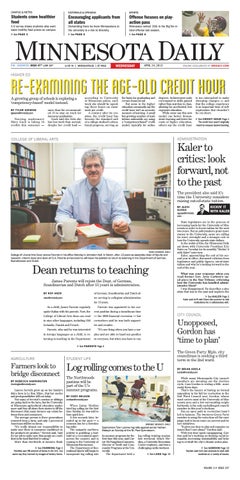
Re-examining the age-old credit hour A growing group of schools is exploring a ‘competency-based’ model instead. BY T YLER GIESEKE tgieseke@mndaily.com
Nursing sophomore Mar y Guck is taking 18 credits this semester —
more than the recommended 15 to stay on track for four-year graduation. Guck said she feels she has less work than normal, despite her credit load —
according to University of Minnesota policy, each week she should be spending three hours on classwork per credit. A centur y after its creation, the credit hour has become the standard unit of a college student’s educational progress, ser ving as
the basis for graduating and certain financial aid. But some in the higher education community say the credit hour isn’t an accurate measure of learning. A small but growing number of institutions nationwide are using a “competency-based” credit model, typically for online
degrees. Achievement units correspond to skills gained rather than seat time in class, allowing for accelerated, less expensive education. While some say this new model can better demonstrate learning and lower the costs of higher education, others say the credit hour
is too entrenched to make sweeping changes — and that the college experience is an important time of selfexploration that shouldn’t be cut short. u See CREDIT HOUR Page 4 The credit hour wasn’t originally meant to measure student learning.
ADMINISTRATION
COLLEGE OF LIBERAL ARTS
Kaler to critics: look forward, not to the past The president also said it’s time the University considers raising out-of-state tuition. BY ALEXI GUSSO agusso@mndaily. com
EMILY DUNKER, DAILY
College of Liberal Arts Dean James Parente in his office Monday in Johnston Hall. In March, after 13 years as associate dean of faculty and research, interim dean and dean of CLA, Parente announced he will leave his position to return to teaching in the Department of German, Scandinavian and Dutch.
Dean returns to teaching James Parente will rejoin the Dept. of German, Scandinavian and Dutch after 13 years in administration. BY ROY AKER
of German, Scandinavian and Dutch af-
raker@mndaily.com
ter serving in collegiate administration
As a child, James Parente regularly
Parente was appointed to his current position during a tumultuous time
College of Liberal Arts dean can read
— the 2008 financial recession — but
in nine other languages, including Old
co-workers said he was both support-
Icelandic, Danish and French.
ive and creative.
Parente, who said he was interested
“It’s one thing when you have a sur-
in foreign languages as a child, is re-
plus and are able to hand out goodies
turning to teaching in the Department
to everyone, but when you have to run
Farmers look to bridge disconnect BY REBECCA HARRINGTON rharrington@mndaily.com
Lauren Servick grew up on her family’s dairy farm in Le Roy, Minn., that her uncles and great-grandfather still run today. Not many of Servick’s cousins or siblings are going back to the farm, but the University of Minnesota agricultural education sophomore said they all share their stories to fill the disconnect that many farmers say exists between them and consumers. The average person is three generations removed from a farm, and only 2 percent of Americans still live on farms. “It’s really almost our responsibility to make sure there is consumer confidence in the products we produce,” Servick said, “and it’s our job to make sure that people are confident in the food that they’re eating.” More than two-thirds of farmers think
Unopposed, Gordon has ‘time to plan’
u See FARMING Page 3 Families own 98 percent of farms in the U.S., but some say they harmed by images of factory farms.
STUDENT LIFE
Log rolling comes to the U The Northwoods pastime will be part of the U’s summer programs. BY CODY NELSON cnelson@mndaily.com
When Jaime Medina tried log rolling for the first time Sunday, he was told to have quick feet. A few seconds later, he ended up in the pool — a common fate for a first-time log roller. The uniquely northern activity is grabbing a foothold as a recreational sport across the country and is coming to the University of Minnesota this summer. The Department of Recreational Sports will begin to incorporate log rolling into
BRIDGET BENNETT, DAILY
Sophomore Tyler Loomer log rolls against senior Nathan Blascyk on Sunday at the St. Paul Gymnasium.
its summer programs for the first time this year, said Carole McNaughton-Commers, director of Youth and Community Programs at the University. The department held a
What was your response when you read former Gov. Arne Carlson’s oped piece in the Star Tribune criticizing how the University has handled administrative bloat? I was disappointed. He describes a situation that was in the past and neglects the
CITY COUNCIL
u See PARENTE Page 3
AGRICULTURE
State legislators are in the process of increasing funds for the University of Minnesota in order to freeze tuition for the next two years. But as policymakers grant more money to the University, some are calling for more oversight and a stronger role in how the University spends state dollars. In the midst of this, the Minnesota Daily sat down with University President Eric Kaler on Tuesday for its monthly “Kickin’ it with Kaler” interview. Kaler, approaching the end of his second year in office, discussed criticism from legislators and public figures, out-of-state tuition and why he’s looking forward to the end of the year.
u See KALER Page 3 Kaler said he’ll visit China this summer to visit institutions the U collaborates with.
for 13 years. spoke Italian with his parents. Now, the
KICKIN’ IT WITH KALER
log rolling training session last weekend, which Medina, a University Recreation Center employee, said was a challenging cardio workout. u See LOGS Page 10
The Green Party Mpls. city councilman is seeking a third term in the 2nd ward. BY BRIAN AROLA barola@mndaily.com
While many Minneapolis City councilmembers are sweating out the election cycle, Cam Gordon is resting a little more easily these days. That’s the luxur y of having no formal opposition in his bid for re-election to the 2nd Ward Council seat. Gordon, whose ward covers most of the University of Minnesota area and a few surrounding neighborhoods, is the only unchallenged councilmember in this year’s elections. But an open path to re-election hasn’t led to laziness. The two-term Green Party member is using the extra time off the campaign trail to focus more on current and future initiatives. “It gives me time to plan and organize on issues that I care about,” Gordon said. With less time spent campaigning, Gordon said he’s working on limiting racial inequality, increasing sustainability and helping to re-draft the city’s climate action plan. u See GORDON Page 10 Gordon said he’s had chances to work with students on a variety of issues.
VOLUME 114 ISSUE 107
2
Daily Review
Wednesday, April 24, 2013
THIS DAY IN HISTORY
1916 The Irish Republican Brotherhood, a secret organization of Irish nationalists led by Patrick Pearse, launches the so-called Easter Rebellion, an armed uprising against British rule. HISTORYCHANNEL.COM/TDIH
SLIDESHOW Vol. 114 Wednesday, April 24, 2013, No. 107
An Independent Student Newspaper, Founded in 1900. 2221 University Ave. SE Suite 450 Minneapolis, MN 55414 Phone: (612) 627-4080 Fax: (612) 435-5865 Copyright © 2013 The Minnesota Daily This newspaper, its design and its contents are copyrighted. OFFICE OF THE PUBLISHER Cali Owings cowings@mndaily.com Co-Publisher and Editor-in-Chief (612) 435-2759 Morgan Hay-Chapman mhay-chapman@mndaily.com Co-Publisher and President Nathan Moen nmoen@mndaily.com Co-Publisher and Business Operations Officer =
=
=
NEWS STAFF Katherine Lymn klymn@mndaily.com Managing Editor Lisa Bain lbain@mndaily.com Managing Production Editor Charlie Armitz carmitz@mndaily.com Sports Editor Sarah Harper sharper@mndaily.com A&E Editor Joe Kleinschmidt jkleinschmidt@mndaily.com Assistant A&E Editor Mark Vancleave mvancleave@mndaily.com Multimedia Editor Jenn Moe jmoe@mndaily.com Copy Desk Chief Katie Wielgos kwielgos@mndaily.com Assistant Copy Desk Chief Kelsie Klaustermeier kklaustermeier@mndaily.com Visuals Editor Josh Jones jjones@mndaily.com Chief Page Designer Kevin Burbach kburbach@mndaily.com Policy Editor Tony Wagner awagner1@mndaily.com City Editor Jill Jensen jjensen@mndaily.com Campus Editor Jeff Hargarten jhargarten@mndaily.com Web Editor =
=
=
=
=
=
=
=
=
Turtles trample sold-out shows at First Avenue
=
Trampled by Turtles performed at First Avenue on April 17 in Minneapolis. The band celebrated its 10-year anniversary with three sold-out shows. To view this slideshow, visit http://www.mndaily.com/multimedia/.
=
=
=
WORLD BRIEFING
=
US immigration bill could slow Indian outsourcers
EDITORIAL STAFF Eric Best ebest@mndaily.com Editorials & Opinions Editor William Bornhoft wbornhoft@mndaily.com Senior Editorial Board Member =
=
BUSINESS STAFF Megan Grossardt mgrossardt@mndaily.com Sales Productivity Director Stacia Burtis sburtis@mndaily.com Advertising Production Manager Tyler Hamilton thamilton@mndaily.com Distribution Manager Dan Ries dries@mndaily.com Controller Nick Lundquist nlundquist@mndaily.com Retail Sales Manager Lisi Arnstrom larnstrom@mndaily.com Classified Sales Manager =
BY THE ASSOCIATED PRESS
MUMBAI — Low cost ef ficiency put India’s outsourcing companies at the heart of global business and created a multibillion dollar industry that for years has skated over criticism it was eliminating white collar jobs in rich nations. Now, the industry’s long-held fears of a backlash are being realized in its crucial U.S. market. Provisions in an overhaul of U.S. immigration law will close loopholes that allow outsourcing companies, Indian and American, to pay guest workers in the U.S. at rates often below wages for
equivalently skilled Americans. The proposed changes are in line with President Barack Obama’s vows to make it tougher for U.S. companies to replace American workers with cheaper labor abroad, either by opening factories overseas or subcontracting their work to outsourcing companies. The cost to the Indian companies, which do everything from running call centers to managing the massive amounts of transactional data generated by banks, could run to several hundred million dollars in lost profits. India’s $108 billion outsourcing industr y has shr ugged of f bad public-
Yemen court sentences 11 alQaida militants BY THE ASSOCIATED PRESS
SANAA — A Yemeni court on Tuesday sentenced 11 convicted al-Qaida militants to up to 10 years in prison for forming armed gangs to destabilize the country and planning attacks on foreign embassies and security forces. The sentencing came as militants attacked a militar y camp in the central town of Radda, about 100 miles south of Sanaa, setting off clashes that killed three soldiers and eight militants. Radda was briefly seized by al-Qaida militants last year before the Yemeni government waged an offensive to drive them out. The militants, who took refuge in other areas in the central province where Radda is located, have been trying to return to the town. During Yemen’s 2011 uprising, al-Qaida occupied large swaths of land and towns in the south before being driven out to mountainous areas by the new government. Since then the group has retaliated with assassinations and bombings at military compounds. In the court in Sanaa, Ahmed al-Hababi, one of the defendants, threatened to kill the judge, shouting, “we will teach you a lesson and we will drag you on the ground.” Two raised an al-Qaida flag inside the defendants’ cage. Others shouted “God is great” in Arabic. In another trial on Tuesday, a court in Aden, Yemen’s second largest city, began trying nine Yemenis for smuggling Iranian-made weapons on a ship. Eight were captured in January in the country’s territorial waters and one was tried in absentia. The trial was adjourned until April 30.
ity in the U.S. and other countries since it began blossoming more than a decade ago. It has plenty of suppor ters among global corporations who prized outsourcing’s ability to lower their costs and boost profits. But with the world economy stagnating, and U.S. unemployment at stubbornly high levels since the recession, a day of reckoning appears to be looming. At issue in the U.S. are high-skill worker visas called H-1B that have been dubbed the “outsourcing visa” by critics who say the system allows companies to bring in cheaper tech workers from abroad instead of hiring Americans.
The immigration bill, the larger point of which is to boost border security and provide a path to citizenship for 11 million people living illegally in the U.S., would impose steep fees for companies such as Indian outsourcers that have more than half their U.S. staff on the permits and also require them to pay higher salaries. The Indian government and the country’s outsourcing industry are gearing up for a fight during debate on the bill, which could take weeks or months due to its other contentious issues. The draft law is now in hearings before the Senate Judiciary Committee.
Protest against gay marriage turns violent
Mostly sunny
FRIDAY HIGH 70° LOW 49° Partly cloudy
=
=
=
=
ADMINISTRATIVE STAFF Morgan Goronkin mgoronkin@mndaily.com Human Resources Manager =
Daniel Barnard dbarnard@mndaily.com Online Manager Justin Tan jtan@mndaily.com Information Systems Manager Justin Schlitz jschlitz@mndaily.com Marketing Communications Director =
=
=
HOW TO CONTRIBUTE TO THE DAILY Freelance audio/video: Contact Multimedia Editor Mark Vancleave at mvancleave@mndaily.com. Letters to the editor: Email submissions to letters@mndaily.com Guest columns: Emails submissions to Editorials & Opinions Editor Eric Best at ebest@mndaily.com. All submissions are welcome, but there is no guarantee of publication.
BY THE ASSOCIATED PRESS
DAILY POLL
PARIS — France legalized gay marriage Tuesday after a wrenching national debate that exposed deep conservatism in the nation’s heartland and triggered huge demonstrations that tapped into intense discontent with the Socialist government. Within hours, fiery clashes broke out between protesters and riot police. Legions of officers stayed late into the night, and a protest against the measure turned violent near the Invalides complex of museums and monuments. Protesters threw glass bottles, cans and metal bars at police, who responded with tear gas. It was an issue that galvanized the countr y’s faltering right, which had been decimated by infighting and their election loss to President Francois Hollande. France is the 14th countr y to legalize gay marriage nationwide —and the most populous. The measure passed easily in the Socialist-majority Assembly, 331-225, just after the president of the legislative body expelled a disruptive protester in pink, the color adopted by French opponents of gay marriage. Justice Minister Christiane Taubira told lawmakers that the first weddings could be as soon as June. “We believe that the first weddings will be beautiful and that they’ll bring a breeze of joy, and that those who are opposed to them today will surely be confounded when they are overcome with the happiness of the newlyweds and the families,” she said. Earlier in the day, there appeared to be more police than protesters outside the Parliament building on Paris’ Left Bank, but that calculation soon shifted as night fell and thousands gathered to protest the bill. The protest dwindled to a few stalwarts shortly before midnight, when the violence began among a few hundred demonstrators including some who carried signs saying “Socialist dictatorship.”
Do you follow the University’s funding request as it works its way through the Legislature?
EXTENDED WEATHER FORECAST THURSDAY HIGH 51° LOW 42°
=
SATURDAY HIGH 71° LOW 53° Partly cloudy
SUNDAY HIGH 75° LOW 57° Mostly sunny
4Yes, I have followed every development since the University made its request. 4I pay attention to the big parts of it, like the controversy over alleged administrative bloat. 4I’m aware the University gets state money, but I don’t follow the politics of it. 4What funding request? CORRECTIONS A front-page article, “U to try historic HIV cure,” in Tuesday’s Daily incorrectly stated the age of the patient undergoing the transplant. His age has not been disclosed as a privacy measure. errors@mndaily.com The Minnesota Daily strives for complete accuracy and corrects its errors immediately. Corrections and clarifications will always be printed in this space. If you believe the Daily has printed a factual error, please call the readers’ representative at (612) 627–4070, extension 3057, or email errors@mndaily.com immediately. THE MINNESOTA DAILY is a legally independent nonprofit 501(c)(3) organization and is a student-written and student-managed newspaper for the University of Minnesota’s Twin Cities campus. The Daily’s mission is: 1) to provide coverage of news and events affecting the University community; 2) to provide a forum for the communication and exchange of ideas for the University community; 3) to provide educational training and experience to University students in all areas of newspaper operations; and 4) to operate a fiscally responsible organization to ensure its ability to serve the University in the future. The Daily is a member of the Minnesota News Council, the Minnesota Associated Press, the Associated Collegiate Press, The Minnesota Newspaper Association and other organizations. The Daily is published Monday through Thursday, during the regular school year and weekly during the summer, and is printed by ECM Publishers in Princeton, Minn. Midwest News Service distributes the 22,000 issues daily. All Minnesota Daily inserts are recyclable within the University of Minnesota program and are at least 6 percent consumer waste. One (1) copy of The Minnesota Daily per person is free at newsstands in and around the Twin Cities campus of the University of Minnesota. Additional copies may be purchased for $.25 each. U. S. Postal Service: 351–480.
Wednesday, April 24, 2013
Farming u from Page 1
consumers have “very little knowledge” about modern farming, according to a survey by the U.S. Farmers and Ranchers Alliance. Mark Koepp and his son Bruce, hog farmers from Belle Plaine, Minn., said they’re frustrated with how the public perceives what they do. “We’re all on the same team,” Bruce Koepp said, “but nobody understands that.”
Not the ‘big bad guy’ The Koepp’s farm houses 30,000 hogs each year, but it’s not a factory. In the U.S., families own 98 percent of farms, according to the U.S. Department of Agriculture. Thinking of a farm run by a factory evokes images of animals that aren’t cared for, Mark Koepp said, which is the opposite of what’s true. Keeping livestock happy and healthy is “fundamental” to what farmers do, said Lakefield, Minn., farmer Dan O’Connor. “I’m saddened by the fact that so many people think we don’t care,” he said. “Animals that aren’t cared for well perform miserably and you fail financially.” While the financial reasons for keeping livestock healthy is an underlying reason, Mark Koepp said it’s not the main motivation. “You do it because you love the animals,” Bruce Koepp added. “If I hated pigs, do you think I’d go out there every day?” Farming has become more efficient and more technologically advanced than ever before. GPS-enabled tractors and automated equipment are the norm. Investing in new technology requires that farms get bigger, the Koepps said, and in turn, the efficiency created by better equipment propels growth. Genetically modified organisms deepen the divide between farmers and consumers. GMOs are crops that have been scientifically
altered to enhance the plant’s quality and resistance to elements and pesticides. In a national survey, 64 percent of people said they were “unsure” if eating GMOs was safe. O’Connor said it’s “sickening” to see the misinformation on GMOs. “If I thought there was anything dangerous to genetically modified corn or alfalfa, I would never let my 4-yearold daughter or my 6-year-old son eat them,” he said.
Changing misconceptions
Cassie Olson said she isn’t going to go back to run her family farm. Instead, the agricultural education sophomore wants to go into public relations or communications to try and boost consumers’ confidence in farming. Olson said farmers and consumers often have an “us vs. them” mentality, which the media intensifies by focusing on negative instances that can color the entire industry. Steve Lammers, agricultural education junior, said he’s noticed more consumers are asking questions about where their food comes from and about farming in general. Just asking questions is the best way for the public to learn more about farming, Servick said.
“It’s pretty easy that once you hear one negative thing, that’s what you think is right,” Ser vick said. “It’s hard to bridge that gap back to what it actually is.” Lammers said he thinks public perceptions of farming will change over time because farmers are starting to recognize and address people’s concerns. “The young people coming into agriculture realize that this is our livelihood,” he said. “If we want to succeed and do what is right, we have to make sure people understand what goes into it.”
MINNESOTA FARMS
BY THE NUMBERS
81,000 FARMS
2ND LARGEST EMPLOYER IN THE STATE IS THE FARMS/FOOD INDUSTRY
53 PERCENT OF LAND AREA IS MADE UP OF FARMS
6TH LARGEST AGRICULTURAL STATE BY EXPORTS
$187,194 MEDIAN NET FARM INCOME SOURCE: MINNESOTA DEPARTMENT OF AGRICULTURE, UNIVERSITY OF MINNESOTA EXTENSION
MINNESOTA FARM TYPES BY AREA
SUGARBEET, WHEAT FOREST AREA CASH GRAINS DAIRY, CATTLE, CROPS METRO AREA
CROPS, HOGS
CROPS, DAIRY, HOGS SOURCE: MINNESOTA DEPARTMENT OF AGRICULTURE
FARMER AND CONSUMER OPINIONS
70 PERCENT of farmers think consumers
have “very little knowledge” about modern farming
58 PERCENT of farmers think consumers’
perceptions of modern farming is “not accurate at all”
42 PERCENT of consumers think U.S.
farming is on the “wrong track”
SOURCE: U.S. FARMERS AND RANCHERS ALLIANCE
Parente u from Page 1
a major institution during budget shortfalls and cuts, that’s a major challenge to stick through,” said sociology professor Joachim Savelsberg. “I think that’s something we ought to acknowledge and give him credit for. “There was a cer tain imaginativeness and vision and thinking out of the box when it came to Parente,” Savelsberg said. Parente received his doctorate from Yale University in Germanic languages and literatures in 1979. He held both teaching and administrative positions at Princeton University and the University of Illinois at Chicago before coming to the University of Minnesota in 1990 as a visiting associate professor. Parente said he was drawn to German histor y and literature after learning about World War II. “ M y f a m i l y, w h i c h was ver y strongly ItalianAmerican, always said, ‘Oh, German, you don’t want to learn that. It’s too difficult,’ ” Parente said. “I wanted to learn something difficult.” Former graduate student James Pasternak said Parente acted as a mentor and father figure to him. “Even when his schedule as CLA dean was at its busiest, he could find time to talk with me and other graduate students in his of fice about our work,” Pasternak said in an email. He said he and some of his peers used to meet with Parente in his of fice
for a seminar on medieval literature. “Our sessions were always interesting, lively and challenging,” he said. “Between readings in medieval German and Dutch, professor Parente made us cups of espresso to sip during our translation sessions.” Parente always sought consensus among CLA departments, said psychology professor Gordan Legge, “which is a challenge in CLA because it’s a huge college.” Political science professor John Freeman said Parente was always genuinely interested in people’s opinions. “Many people ask us for our opinions, and you wonder if they’re really sincere,” Freeman said. “He was always ver y sincer e about wanting to know what you thought about things.” Looking back, Parente said one of the most exciting things about ser ving as dean is that not a single day was ordinar y. “Having been in administration for over a decade, it’s been a real education of a ver y special kind in the liberal ar ts that I’ve been privileged to have.” Parente will return to teaching but not before he takes a sabbatical — his first since 1993. Although he taught graduate courses in his department while ser ving as dean, fall 2014 will be his first time teaching undergraduates since 2006. “I’m looking for ward to thinking about creative ways of teaching,” he said, “and also looking to develop new material and topics for classes.”
Kaler u from Page 1
progress that we’ve made. He also deflects the discussion away from the really important fact, which is a $140 million disinvestment from the state of Minnesota and instead talks about administrative costs, which are a small fraction of our budget. So I was disappointed that someone of his stature would not talk about the elements of state disinvestment and the importance of the state coming back to be our partner.
3
Students crave healthier food A U survey shows students also want lower healthy food prices on campus. BY BRANDEN LARGENT blargent@mndaily.com
A new sur vey showed University of Minnesota students living in residence halls want more inexpensive and healthy food options on campus. Three undergraduate interns from the University’s Obesity Prevention Center sur veyed students living in Territorial Hall and Sanford Hall. Nearly 94 percent of the 1,162 respondents agreed that healthy food and beverages should be available at all University dining facilities. Nutrition junior Taylor Aasand, who helped conduct and analyze the surveys, said she was pleased that most of the responding students were looking to eat healthier. Almost 87 percent of students who responded said high prices are a barrier to buying healthy food. “Students are finding [high healthy food prices] to be a huge barrier to practice healthy eating,” Aasand said. The Obesity Prevention Center was concerned about the food of fered on campus because health problems on campus reflect a nationwide issue, center director Simone French said. Nearly one in three University students is over weight, obese or extremely obese, according to the 2010 College Student Health Sur vey. More than 35 percent of Americans are obese, according to the Centers for Disease Control and Prevention. The center plans to bring the survey results to University Dining Services to discuss how to provide more healthy food options on
eral research funding with those dollars. I think it’s an impor tant investment for the state to make. Some legislators proposed amendments to the higher ed bill that would make state funds contingent on cer tain conditions, such as preventing state funds from paying for administrative salar y bonuses. What did you think of those amendments? Some of them are not necessar y because of the progress we’ve made, but we’re all about being accountable for the money that we get, and we provide a report to the Legislature yearly. We’re happy to share that information with them.
Last week, the Senate approved increased funding to the University. What was your response? I’m ver y grateful that they have recognized our highest priority need, which is funding the tuition freeze for Minnesota resident undergraduates. I’m pleased that they’ve made an investment in our MnDRIVE initiative. They don’t match our request in terms of dollar amount, so we’ll be talking to the legislators about that aspect as they go into conference committee.
Several legislators have shown a greater interest in attaching strings to University funding from the state. Rep. Gene Pelowski, DFLWinona, has vowed to overhaul many areas of the University, including the selection of regents and how student fees are decided. What are your thoughts on the Legislature wanting more say? I think the heart of the relationship between the University and the Legislature is the constitutional autonomy that the University has. It’s established in the state Constitution. I think legislators are cer tainly free to change the laws that impact the University, but I think the constitutional autonomy gives us freedoms that are dif ficult to take away.
The House proposed giving $18 million less than the Senate for MnDRIVE research. What steps will the University take at the Legislature now to advocate for that research funding? Again, it’s emphasizing the value of that research and the economic impact it will bring to the state because we’ll be able to leverage private funding and fed-
Are you worried that the publicity these legislative conversations garner is damaging the University’s image? I think some of the criticism we hear are rooted in the past and are no longer active and no longer true. But again, the University is a big part of the state of Minnesota, and it gets a lot of attention from our legislators.
campus. UDS would be willing to collaborate with the students and consider their suggestions, said Leslie Bowman, director of UDS contract administration. “Can a better job be done? Always,” she said. “UDS is always trying to improve.” Bowman said UDS is already working to improve students’ heath and eating options. Since January 2011, UDS has posted calorie information on all menu boards, she said. After meeting with Students for Gluten Free Awareness last July, UDS health and wellness coordinator Jenna Brott said there are more gluten-free options in campus dining halls. Brott said she meets with students regularly to get input on improving campus dining.
“It’s great to get feedback from those groups to add food options,” she said. Customer satisfaction with the availability of healthy foods and nutritional information “dramatically increased” from fall 2011 to fall 2012, Bowman said “I think that if students are looking for healthy foods, that in every location they can find choices that would meet those needs,” Bowman said. Now that the residence hall sur vey is complete, College of Biological Sciences senior Amber Mayer said she’d be interested to see future Obesity Prevention Center interns sur vey older students because more than 85 percent of respondents were freshmen. “It would be interesting to get a broader audience and hopefully do some focus groups,” Mayer said.
UNIVERSITY OF MINNESOTA STUDENT FOOD SURVEY RESULTS
94.5 PERCENT OF RESPONDENTS AGREED THAT THE U SHOULD CREATE A HEALTHFUL FOOD ENVIRONMENT FOR STUDENTS
91.5 PERCENT
94 PERCENT
of student respondents agreed healthy food choices should be conveniently located and visible so they are easier to “grab and go”
of student respondents agreed healthy food and beverages should be available at all food venues on campus
85 PERCENT
86.8 PERCENT
of respondents strongly agreed or agreed that prices for healthful food and beverages sold on campus should be lower than those of less healthful foods
of respondents agreed that high prices of healthy foods and beverages causes them to consume less of these items
SOURCE: OBESITY PREVENTION CENTER
One amendment was aimed at increasing outof-state tuition. Is this something you’d support? We’re taking a look at our outstate tuition costs. It was originally designed to attract out-of-state students to the University because we’re at a lower price point than in-state tuition in some states. But the fraction of out-of-state students has grown, and it may be time — it is time — to look at that tuition difference. Again, bringing out-ofstate students to Minnesota is an important thing to do. We’re a magnet for talent, and students stay and contribute to the Minnesota economy after they graduate. Sen. Ter ri Bonof f, DFL-Minnetonka, said recently that she “didn’t appr eciate” the University’s approach to requesting increased state funds. She called it a “threat” and said it “wasn’t the way I like to work.” What do you think of her remarks? We cer tainly did not mean to threaten the Legislature in any way, but when we formed our budget back in September … before we knew the leadership on the various committees, we talked to a lot of legislative leaders. They made it very clear that they wanted to know what they were getting for an increased investment in the University. So we made it clear that what they were getting was an opportunity to stop the increases in tuition and an opportunity to invest in the research mission. Our budget is very clear on that, and we cer tainly don’t mean to be a threat, but we do mean to show the linkage between state appropriations and tuition, and this does that clearly. Is there any way the University could have gone about the request differently?
I think any other approach would have likely failed. I think asking for an increase in state appropriation without specifying what we would use it for would not be well-received. What do you think of the House and governor’s bonding proposals? We’re grateful to be included in the bonding bills. But the amount of money we are allocated for HEAPR [Higher Education Asset Preser vation and Renovation] funds is far below what we requested and is below what is needed to adequately maintain the 29 million square feet that are in our inventory. Funding for the Bell Museum has been continually left out of the University’s r equest, but it was included in the House bonding bill. Would you like to see a new one built? Remember that the University included the Bell Museum at least twice in previous bonding requests, and it was vetoed twice by the governor. We have advocated for it in the past; we did put higher priority items on our list this year. But if the Bell Museum is funded, we will use those dollars to replace the building. Are there other projects you’d like to see funded before the Bell? The investment in HEAPR would be a higher priority for the University. What are you most looking forward to as the school year comes to an end? I will be happy when the legislative session is over, and I hope we’ll be able to celebrate a good investment in the University. I’m looking for ward to making my first trip to China in the summertime. I’m visiting some friends of the University, alumni and institutions that we have good collaborations with.
4
Wednesday, April 24, 2013
EXAMINING THE CREDIT HOUR
CREDIT HOUR FROM PAGE 1
An experiment in education
Currently, many competency-based programs are geared toward students who work or can’t afford higher education. Rather than being tied to elapsed time, the competency unit at Western Governors University, for example, focuses on learning, said Patrick Partridge, the school’s chief marketing officer. WGU’s student body is primarily working adults returning to school, he said, but includes teens through 70-year-olds, mostly in undergraduate programs. The online school was founded in 1997. Shana Eccles, WGU student and single mother of two, earned her bachelor’s degree in business with information technology management in a little over 2 1/2 years, and said WGU’s model allowed her to test out of a course and receive the appropriate competency units whenever she felt ready. The hands-on aspect of Eccles’ degree and the ability to tackle coursework at her own speed was appealing, she said, especially because she has to balance study with work and caring for her family. Eccles said she normally worked through about 24 credits every six months. In comparison, the University recommends students take 15 credits a semester. Once, Eccles said she completed a course in about two weeks. “It just depended on what was going on in my life,” she said. Now that she’s graduated with a bachelor’s degree, Eccles is pursuing her master of business administration also at WGU. At College for America, a new online competency-based program out of Southern New Hampshire University, many students are working adults with low wages, said Chief Academic Officer Cathrael Kazin. The program is currently in its pilot stage and will officially launch in September. For now, Kazin said students aren’t charged and act as the program’s co-creators. The program was formed to lower costs, increase access for low-income students and offer more job-ready skills, she said. Students in the program get a competency transcript that includes a list of “can do” statements describing abilities. For example, the transcript might read, “can write a business memo,” she said. “This is really the language that employers speak,” Kazin said. Following an “all-you-can-learn” model, the program will cost $2,500 a year. In addition to a competency transcript, students receive a transcript showing
CREDITS
BY THE NUMBERS
the number of credit-hour equivalencies they’ve completed. This transcript is necessary, Kazin said, so students can use their competencies in the broader higher education community. Still, there’s nothing magical about a credit hour-based, 15-week semester, she said. “It’s an administrative convenience, but it’s … come to rule how we think about education.”
A time to ‘‘ grow and develop’’
Some think talk of reworking the credit hour may be misguided. Drury University associate professor Richard Schur said the conversation regarding the changing landscape of higher education seems to be wrongly centered on costs rather than quality. A college education should help a student become a good citizen, he said — someone who makes good decisions and possesses virtue. “I think college is a really important time — and I would emphasize the word ‘time’ there,” for people to “think, reflect, grow and develop.” Although he acknowledged the credit hour isn’t perfect, Schur said the conversation seems to be focused on making higher education cheaper and faster rather than better. “We don’t know what we want our institutions of higher education to do,” he said. “One of the first things we need to figure out is, ‘What are we trying to accomplish?’” Currently, many competency-based models use online learning, something that University of Minnesota professor Sally Kohlstedt said may not provide the skills a classroom experience can. These skills, like learning to identify and solve problems, are part of the University’s “student learning outcomes.” “It’s not that I think it can’t [provide what a classroom can], but it’s a little bit like, ‘Show me,’ ” she said. “You do need to put in a certain amount of time to show that you gain that competence.” Competency-based and seat time-based credit models could work better for different students, said Jay Hatch, an associate professor in the University’s Department of Postsecondary Teaching and Learning. He said one student might work best independently while another needs motivation and regular class time to learn material. “I think it’s a slippery slope if what you’re trying to do is argue that either way is a better way for a given student,” he said. For Guck, education is about learning from someone and interacting with peers — online classes don’t provide enough motivation. “You don’t put the effort in,” she said. Chemical engineering sophomore Emily Schmitz agreed, saying a competency model might address students’ different learning rates, but learning in a traditional classroom at a steady pace provides motivation to keep going.
A century-old tradition
A UNIVERSITY STUDENT MUST TAKE 12 CREDITS TO BE CONSIDERED FULL TIME
A MINNESOTA STUDENT MUST TAKE 15 CREDITS TO RECEIVE FULL STATE GRANT AID
When it was created more than 100 years ago, the credit hour wasn’t meant to measure students’ learning. Though it’s now the default for measuring student achievement, it was originally designed by the Carnegie Foundation for the Advancement of Teaching as a way to determine faculty pensions, said Elena Silva, a senior associate at the foundation. The credit hour seems to be a “holdover” from traditional brick-and-mortar classrooms, Hatch said.
THE AVERAGE NUMBER OF CREDITS UNIVERSITY STUDENTS TOOK IN SPRING 2013 WAS 12.8
$460,000
AMOUNT GRANTED TO THE CARNEGIE FOUNDATION TO RE-EXAMINE THE CREDIT HOUR 15.4% OF STUDENTS NATIONWIDE WERE EMPLOYED FULL TIME IN 2009
MINIMUM CREDIT REQUIREMENTS FOR UNDERGRADUATE DEGREES AT THE UNIVERSITY
89.6%
24 AND YOUNGER
UNDERGRADUATE ENROLLMENT AT THE UNIVERSITY SPRING 2013
8%
25-34
2.4%
35 AND OLDER
62%
24 AND YOUNGER
NATIONAL COLLEGE ENROLLMENT 2009
22% 25-34
16%
35 AND OLDER “[It’s] a simpler way to keep track of what students are completing,” he said. The Carnegie Foundation has received a grant to reconsider the credit hour’s viability in the modern context. With online learning and other advancements in technology, Silva said students no longer have to sit with certain people to learn. Silva said a Carnegie team is meeting with schools using the competency-based credit model to better understand it, and the team will continue to pin down some of the concerns over shifting away from the time-based credit. The team will examine whether a competency-based model would make sense for liberal arts degrees — or if it only would work with certain occupations, like an associate’s degree in a technical skill. But the foundation isn’t saying the credit hour needs to change — yet. “We’re starting this project with an open mind,” Silva said.
U faculty cautious
A lot rides on the credit hour — from getting help paying tuition to securing a degree. The number of credits a course is worth corresponds with the approximate number of hours spent on the class each week to give students and faculty members an idea of the time commitment a course requires. Although some departments’ classes seem to align with this policy, others offer classes with workloads disproportionate to the number of credits, Schmitz said. Despite nationwide discussions of the credit hour and the competency model, the model hasn’t come up at meetings of the Faculty Consultative Committee, said Kohlstedt, who’s the committee chair. But that doesn’t mean faculty members aren’t talking about these topics, Kohlstedt
said. “It’s not as though we’re not reading the Chronicle of Higher Education,” Kohlstedt said. “We want to know what’s out there.” While Kohlstedt said she hasn’t noticed a push to move toward a competencybased credit model at the University, she said faculty members have been discussing how to potentially award credit for massive open online courses, or MOOCs. But the discussion surrounding MOOCs, she pointed out, started a long time before the University decided to create its own. “We don’t move to every new idea that comes along.”
A ‘‘resurgence IN interest’’’
In response to increased interest in competency-based programs, the U.S. Department of Education sent out a letter last month to higher education institutions detailing how competency-based programs could qualify for federal financial aid funding. The first program to qualify for aid was College for America. “[Competency-based programs] are not particularly common at this point,” said Kay Gilcher, director of the DOE accreditation group. “However, within the last, let’s say, six to eight months there’s been a resurgence in interest.” To qualify for funding, programs must show how their competencies align with the credit hour, she said. Federal aid regulations are written in the context of credit hour programs, not programs using the competency model. The rules could change in the future, but it would take time, she said. “Who knows what Congress might do?” Gilcher said. “Everybody is sort of approaching this with a certain amount of caution.”
NATIONAL MEDIAN ANNUAL EARNINGS BY EDUCATIONAL ATTAINMENT IN 2010**
1906
YEAR THE CREDIT HOUR WAS CREATED
*WORKERS AGES 25-34
91%
45% OF UNIVERSITY STUDENTS TOOK 15 OR MORE CREDITS IN SPRING 2013
4%
120 CREDITS
121-124 CREDITS
5%
125-132 CREDITS
75%
64%
2007
2009
2011
$37,400
WESTERN GOVERN
$54,700
ORS UNIVERSITY
72%
91%
$45,000
UNIVERSITY OF MINNESOTA
$37,000
89%
90%
$29,900
ONE-YEAR RETENTION RATES
HIGH SCHOOL DIPLOMA OR EQUIVALENT
ASSOCIATE’S DEGREE
BACHELOR’S DEGREE
MASTER’S DEGREE OR HIGHER
AVERAGE
GRAPHICS SOURCES: OFFICE OF INSTITUTIONAL RESEARCH, ONE STOP STUDENT SERVICES, U.S. CENSUS BUREAU, WESTERN GOVERNORS UNIVERSITY 2011 ANNUAL REPORT, NATIONAL CENTER FOR EDUCATION STATISTICS, CARNEGIE FOUNDATION FOR THE ADVANCEMENT OF TEACHING
Editorials & Opinions www.mndaily.com/opinion
Wednesday, April 24, 2013
5
The Editorials & Opinions department is independent of the newsroom. The editorial board prepares the editorials labeled “EDITORIALS,” which are the opinion of the Minnesota Daily as an institution but not representative of Daily employees’ opinions. Columnists’ opinions are their own.
EDITORIALS
COMEDY
Humor heals Laughter is helping Americans cope with some difficult situations.
O
ur generation is no stranger to inappropriate topics made into late-night sketches on “Saturday Night Live,” or real-world scenarios displayed via YouTube. We are able to find humor in some alarmingly serious situations. Humor has become the medication for our countr y; it provides us with a sense of comfort during grim times. Take for example, suicide. It’s clearly a sensitive issue for many Americans who have been af fected by suicide in some way. A campaign based in Colorado aimed toward men between the ages of 25 and 64 features a comical, fictional therapist who uses humor to help men sort through thoughts of suicide or depression. The Colorado Of fice of Suicide Prevention launched its humorous adver tising campaign in July 2012. The campaign’s videos and bill-
MEG O’CONNOR columnist
boards sought to break down the stigma that envelopes men when they realize they need help. Last year, Vanity Fair issued its first comedy issue. Inside were exposés from the countr y’s most prominent comical figures. One ar ticle that str uck me as I was waiting for my hair dye to set was a feature on Mathilde “Tig” Notaro. To be honest, I hadn’t heard of this par ticular comedian before I picked up the magazine, but after I put it down, I couldn’t forget her. In four months’ time, Notaro was diagnosed with breast cancer, under went a double mastectomy, ended a long relationship and lost her mother to a freak
accident. Many would have understood if she had decided to put her comedy routine on hold after such an ordeal. After all, it didn’t appear that she had too much to laugh about. However, this was the time that she gained most of her fame, as she made light of what were most likely her darkest days. Her opening line: “Hello. Good evening, hello. I have cancer.” I wouldn’t refer to myself as an expert on comedy, but I can say that I have the utmost respect for people who choose to make their lives into public spectacles for people’s enjoyment. Notaro did not have to stand up on a stage and joke about her cancer or her mother’s death, but she did — not just for herself but for others. “Tig is now in the heads of hundreds of thousands of people who don’t see her as a comic — she’s now their favorite person,” Ira Glass, host of “This American Life,” said in the Vanity Fair feature. Mayo Clinic staff believes
DEATHS IN IRAQ: U.S. & COALITION TROOPS: 4,802 — IRAQI CIVILIANS: 112,114- PLUS DEATHS IN AFGHANISTAN: U.S. & COALITION TROOPS: 3,272 — AFGHAN CIVILIANS: UNKNOWN
that laughter, as the ageold idiom says, is the key to managing stress and providing relief under dif ficult circumstances. It can improve the immune system or relieve pain. While I don’t believe that a good, hear ty laugh is equivalent to antibiotics, it should be noted that laughter can provide an escape from reality. Let’s be honest, if you choose to watch “Anchorman” over “Schindler’s List,” you are going to improve your mood by leaps and bounds for the rest of the day. If there is anything to take away from Notaro’s stor y, it’s that humor can be found anywhere. Although there are times when I watch “SNL” and ask myself “How are they making fun of this?” particularly when it comes to government, it is a healthy outlet for the countr y to let out frustration and create a dialogue that wouldn’t otherwise be heard. Meg O’Connor welcomes comments at mo’connor@mndaily.com.
ECONOMICS
Pro-austerity study debunked A report that has been used to justify radical spending cuts is riddled with flaws.
I
Collin Randolph welcomes comments at crandolph@mndaily.com.
LETTERS TO THE EDITOR Bachmann misses the mark
Minnesota’s 6th District representative, Michele Bachmann, has had her fair share of time in the limelight, including regularly staking claims with ver y little evidence to back up her words. Recently, she made headlines when referring to the Affordable Care Act, specifically how it will “literally kill” certain groups of people. Personally, I feel that after more than 30 attempts from the GOP to repeal the Affordable Care Act, the doom and gloom tactic has been a bit done to death (pun intended). Instead, I want to focus on one of her more recent claims that hasn’t been making headlines. A few weeks ago, Bachmann appeared on the national radio show hosted by local conser vative host Jason Lewis. On the show, she made an egregious claim about the many Americans currently receiving benefits through our welfare system. The congresswoman cited statistics that the average household on welfare receives more than $30 per hour in untaxed government assistance compared to the $25 per hour that the average American family takes in. After hearing this, I thought this couldn’t possibly be true and decided to do some research. I was able to quickly find that Bachmann’s numbers had been cited frequently on various Tea Partythemed websites, but it took a little longer to find the data source and a breakdown of the data. To her credit, I discovered the numbers are, for the most part, correct, however, the methods by which they were created and the points they are used for are incredibly misleading.
The data Bachmann cited comes from a chart put together by Sen. Jeff Sessions, R-Alabama. The chart suggests that “total welfare spending equates to $168 per day for every household in poverty — if converted to cash payments, hourly rate exceeds median income by 20 percent.” What the simple chart and explanation fail to mention are the factors that went into creating these figures. First off, 50 percent of the funding the graph cites on the welfare side accounts for health care spending — mostly Medicaid — which is different from the general notion of welfare spending in that it doesn’t contribute to a family’s income level but instead provides help for paying medical bills. That being said, health care spending is not included in the census data that Sessions used to calculate the average median income on the other side of the graph, thus the comparison is essentially comparing apples to oranges. The rest of the graph presents countless unfair comparisons as well. The welfare spending side is meant to represent “direct or indirect financial support.” It appears that Bachmann and others don’t quite understand when reading this graph what Sessions refers to as “indirect support.” This phrase is carefully used to include government spending for programs aimed at natural disaster aid and job training, education grants, funding for AmeriCorps, assistance for rural communities upgrading their water systems and other community-based initiatives that do not fit the traditional notion of welfare spending.
Ultimately, to complete his calculations, Sessions adds all of these means-tested programs, which are aimed at low-income people, and divides the number by the amount of people under the poverty level. The problem with this math is that nearly all of the programs provide aid to millions of Americans above the poverty level as well as below. This calculation alone misleadingly skews the graph in the direction that Sessions, Bachmann and their supporters would like to see. I am disappointed in Bachmann for following suit behind Sessions without doing the necessary digging or simply choosing to ignore the facts. However, I am also well aware that skewed and lazy data such as this makes its way into political discourse all too frequently, which is why I strongly encourage everyone to check sources and pick apart the claims of their politicians and interest groups — no matter which political party you identify with. I chose this one as it demonstrates the ignorance and lack of leadership of one of Minnesota’s representatives. It also illustrates the strong disconnect that many of our elected officials have with the poorest among us. It is this kind of leadership and rhetoric that allows the poor to become disenfranchised from society and ultimately wind up lost in the system. No matter which side of the aisle you sit on, in order to enact worthwhile reforms and a truly better society, the last thing we want to do is vilify those among us who need the most help. Joe Praska University alumnus
n 2010, two Harvard University economists, Kenneth Rogoff and Carmen Reinhar t, conducted a study called Growth in a T ime of Debt. The re- RONALD DIXON port found that columnist a nation whose debt rises above 90 percent of its gross domestic product would experience negative growth. When the study was first released, there was doubt about the findings. As economist Paul Krugman noted, they only found a negative correlation between the rise in debt and the decline in growth, when in reality, it is much more likely that a depressed economy is the cause for more debt. Recent findings by Thomas Herndon, an economics doctoral candidate from the University of MassachusettsAmherst, reaffirmed the fallibility of the study. Herndon had access to the original Excel spreadsheets that Reinhart and Rogoff used to compute their data. He found that consequential information was miscalculated and omitted. When computing the math properly, it was found that, even with a debt above 90 percent of GDP, there was still economic growth. Unfortunately, though, this revelation came far too late. Since the study was published a few years ago, several conservative politicians, writers and economists have used the paper to justify massive austerity cuts in the U.S. and Europe, namely in Greece. In fact, Paul Ryan, a Wisconsin congressman that ran as the vice presidential nominee with Mitt Romney last year, cited the study to attack government economic stimulation during the recession, a component of Keynesian economics. This raises an important question: If the credibility of the study was shattered when the paper was first published, would the U.S. and nations like Greece have had to suffer from the reduction in government aid? Prior to 2010, in the wake of the American Recovery and Reinvestment Act, Keynesian economics was preferred, but as austerity gained credibility, whereby rendering those like Ryan as “policy wonks,” draconian cuts began to take center stage. If more politicians, writers and economists would make their voices heard on the real solutions for economic growth, such as Keynesian stimulation, then we might actually see the economy greatly improve in the long term. Ronald Dixon welcomes comments at rdixon@mndaily.com.
Encouraging applicants from all states Demanding there be more Minnesotans at the University is a risk to diversity.
L
ast week, the Minnesota Legislature approved funding for a tuition freeze, but as the Minnesota Daily reported Thursday, it was not without attempting to tack on several amendments that would allow more legislative oversight in funding given to the University of Minnesota. Some of the proposed amendments to the bill that would increase funding for the University were not entirely unreasonable: Some amendments would not allow state funds to be used for University coaching buyouts or year-end administrative bonuses, and there was also the formation of a policy urging the University to meet three goals outlined by the Legislature in order to receive the full amount of its appropriation in two years. But there was one proposed change to the bill — that rightfully failed — that would add a recommendation that three-fourths of the University’s incoming freshmen be from Minnesota. It should be noted that it is not the place for the state Legislature to make recommendations on the University’s admissions policies. Additionally, it is neither beneficial or practical to recommend that 75 percent of incoming freshmen be Minnesotan. As the Editorial Board has previously stated, the University has a multitude of roles to play: a research institution, Minnesota’s flagship university and a competitive force in the Big Ten athletic conference. The University should be happy to encourage applicants from every state and enroll students who are a good fit, residents and non-residents alike. Given that 63 percent of incoming freshmen are residents, there is no shortage of Minnesota students at the University. Putting a recommendation in place that seeks to focus on heavy recruiting in Minnesota runs the risk of discouraging diversity. And a lack of diversity, whether we receive full funding from the state, is a cost the University cannot afford.
Little justification for a liquor tax hike Taxes on liquor should not increase unless there is an upward trend in costs to the state.
O
n Tuesday, Minnesota Public Radio reported on the disagreements between Minnesota House and Senate Democrats on whether to pass a liquor tax hike. Both chambers have Democratic-Farmer-Labor Party majorities, and Senate Majority Leader Tom Bakk, DFL-Cook, and House Speaker Paul Thissen, DFL-Minneapolis, seem to agree on raising the sales tax on cigarettes. However, the two are at odds over whether to raise taxes on alcohol. Thissen said that House Democrats are planning on proposing an increase to the liquor tax to offset the costs associated with alcohol, including DWI and health care costs. On Tuesday morning, MPR reported that Bakk said the Senate tax bill will not include an increase in the liquor tax. While general sales taxes are often a favorable alternative to income taxes as ways the state can raise revenue, it’s not entirely clear why a raise in the alcohol tax is warranted. The higher taxes on alcohol and cigarettes, often dubbed “sin taxes,” are justified given that consumption of both comes at a cost to the state, and ultimately, the taxpayer. And a steady rise in the taxes on cigarettes in the interest of reducing the number of consumers could also be justified, given their particularly harmful effects on society: There is no safe way to smoke a cigarette. However, the vast majority of adults who consume alcohol do so responsibly. Unless there has been a steady rise in alcohol-related costs throughout the span of several years, the justification for increasing the liquor tax is at best shaky. Also, given the craft beer boom occurring in the Twin Cities, it would be best to avoid adding unnecessary fears in the local business climate. Unless House Democrats can prove that alcoholrelated costs to the state are on the rise, the Legislature should not go through with an increase on the state liquor tax.
LETTERS AND GUEST COLUMNS
The Minnesota Daily welcomes letters and guest columns from readers. All letters must include the writer’s name, address and phone number for verification. The Daily reserves the right to edit all letters for style, space, libel and grammar. Letters to the editor should be no more than 600 words in length. Readers may also submit guest columns. Guest columns should be approximately 350 words. The Daily reserves the right to print any submission as a letter or guest column. Submission does not guarantee publication. letters@mndaily.com Fax: (612) 435-5865 Phone: (612) 435-1578 Letters and columns to the editor 2221 University Ave. SE Suite 450 Minneapolis, MN 55414
Look for online exclusive columns at www.mndaily.com/opinion.
@mndailyopinions
EDITOR IN CHIEF CALI OWINGS = EDITORIAL EDITOR ERIC BEST = SENIOR EDITORIAL BOARD MEMBER WILLIAM BORNHOFT = BOARD MEMBERS CASSANDRA SUNDARAM, JONATHAN MORRIS
6
Wednesday, April 24, 2013
Sports
@MNDAILYSPORTS
FOOTBALL
Offense focuses on play-action pass BY NATE GOTLIEB ngotlieb@mndaily.com
The Gophers football team discovered its offensive identity during its 34-31 loss to Texas Tech in the Meineke Car Care Bowl on Dec. 28. Just ask offensive lineman Zac Epping, who helped Minnesota match the physical play of Texas Tech’s defense, allowing the team to gain 222 rushing yards on 54 attempts that day. The Gophers controlled the clock during their bowl game, running 73 plays and dominating the time of possession battle. Epping said the game was a turning point in the team’s offensive identity. “We want to be an aggressive team, a downhill running team, and be able to run [hard] at opposing defenses,” he said. “Hopefully we can keep that up.” Through 13 spring practices, the Gophers’ offense has continued to focus on the running game and playing physically. But Minnesota has added a new dimension to its offense: the play-action pass. The Gophers’ play-action abilities were on display during an April 12 scrimmage. Freshman quarterback Mitch
MINNESOTA 2012 BIG TEN RANKINGS OFFENSE Scoring offense Total offense Rushing offense Pass offense Third-down conversions
RANKING 9th 10th 7th T9th 10th
SOURCE: BIGTEN.ORG
Leidner laced a sideline pass to sophomore receiver KJ Maye for a 20-yard gain off a play-action fake. Coaches want the play action to figure into the team’s overall offensive approach of gaining yards on first down and creating manageable third-down situations. “Everybody talks about being great on third down,” quarterbacks coach Jim Zebrowski said April 12. “But if you’re great on first down, you’ve got a much better chance to be great on third down.” Of fensive coordinator Matt Limegrover said the offense’s priority is to gain at least five yards on first down. “Because if you’re in second-and-five, you’ve got the whole playbook,” he said. “If you’re in second-andnine, play action isn’t quite as good.”
The offense appeared to take this logic to heart during Saturday’s scrimmage, running the ball effectively on first down and creating play-action opportunities on second and third down. The ef fective running game contributed to sophomore quarterback Philip Nelson’s strong performance. Nelson completed more than half his passes and threw one touchdown. He said the offense has built upon its run-first mentality since the Texas Tech game and improved its execution. “It’s night and day,” Nelson said. “We’re running the same things — we’re just running them better. We’re getting different looks and knowing what to do with them.” Head coach Jerr y Kill has emphasized toughness and physicality throughout the spring. The team’s increased physicality has led to a couple of minor scuffles between offensive and defensive linemen. Coaches said they see an occasional scuf fle as par t of the process of building physicality. “As long as it is controlled,” defensive coordina-
EMILY DUNKER, DAILY
Sophomore quarterback Philip Nelson prepares to throw a pass Tuesday at the Gibson-Nagurski Football Complex.
tor Tracy Claeys said after an April 6 practice. “You will never see us just let them go.”
Hawthorne shows ability to kick under pressure
Kill called the team and fans in attendance onto the field after Saturday’s scrimmage while senior kicker
Chris Hawthorne attempted a pair of field goals. Hawthorne made both kicks despite the artificial distractions. The Gophers will need Hawthorne to step up this season after graduating Jordan Wettstein, their top kicker from last season. Wettstein made 14 of 22
field goals last season, when the Gophers ranked secondto-last in field-goal percentage in the Big Ten. Hawthorne, who made six of nine field goals in 2011, did not attempt a field goal last season. He said he has been trying to build chemistr y with his new holder this offseason.
Freshman Sawyer evolving into a top reliever Dalton Sawyer earned his first win last Wednesday against Augsburg. BY SAM GORDON sgordon@mndaily.com
Dalton Sawyer’s latest performance on the mound fared much better than the first time he pitched in a Gophers uniform. The Gophers freshman relief pitcher earned his first career win in a triumph over
Augsburg at Siebert Field on April 16. Sawyer made his first career appearance in Minnesota’s second game of the season, a 14-0 loss to college baseball powerhouse UCLA. He walked four batters and allowed five runs in 1.1 innings in that game. But Gophers head coach John Anderson let him work out the kinks, and he has seen enough improvement in Sawyer — especially on the mental side — to trust him as one of his top middle relievers. Sawyer leads all relievers on the Gophers with 25.1 innings pitched. His 12 appearances are the third-most on the team behind veterans Billy Soule and Kevin Kray’s 13.
“[Sawyer’s] place on the mound is much more poised,” Anderson said. “He’s developed a routine to settle himself down there.” Sawyer said he throws pretty well in jams. In his win over Augsburg, he inherited a runner on second base and struck him out to end the inning. Sawyer has thrown 7.1 straight scoreless innings dating back to April 7. His fastball is in the 90 mph range, and he’s done a better job commanding it and keeping it low in the strike zone, Anderson said. The fact that he’s one of just two left-handed relievers on the Gophers makes him even more valuable. “He’s made huge strides,”
Anderson said. “He’s going to be a good pitcher in this program.”
period. Minnesota practiced outside Tuesday, but it had been practicing indoors at the Gibson-Nagurski Football Complex before that. Anderson said the weekend off was especially good for the pitchers, who hadn’t thrown in warm weather since the team’s last games in the Metrodome. “You hate missing games, you hate not being on the baseball field, but we did get a chance to catch our breath a little bit and slow down,” Anderson said. “It wasn’t a waste of time by any means.”
Cancellations afford Gophers a breather
The Gophers’ series against Michigan State last weekend was canceled, marking Minnesota’s first canceled Big Ten series since 2007. The weather has canceled or postponed many Gophers games and practices since the inception of their new, oncampus Siebert Field. Senior Kurt Schlangen said though the cancellations aren’t ideal, the team used the weekend off as a regrouping
BASEBALL PREVIEW
VS MINNESOTA
NORTH DAKOTA STATE
3:05 p.m., Wednesday at Siebert Field
MINNESOTA: The Gophers beat North Dakota State, 4-2, on Feb. 27 at the Metrodome. Today’s game was originally scheduled for Tuesday in Fargo, but NDSU’s natural grass field is unplayable, so the game was moved to Siebert Field. Minnesota head coach John Anderson said a conglomerate of relief pitchers will man the mound for his club. The Gophers haven’t played since April 16 when they defeated Augsburg 4-1 at home. NORTH DAKOTA STATE: NDSU, like Minnesota, has dealt with weatherbased cancellations all season long. The Bison have canceled eight of their last 10 games due to rain and snow. The last game they were able to play was on April 14. Currently, the Bison sit at 15-14. SOURCE: GOPHERSPORTS.COM
GOPHERS IN THE POLLS LAST WEEK’S RANKING
MEN’S TENNIS
THIS WEEK’S RANKING
32 36
CHANGE
-4
SOURCE: ITATENNIS.COM
SOFTBALL PREVIEW
VS MINNESOTA
IOWA STATE
2 p.m., Wednesday (doubleheader) in Ames, Iowa
MINNESOTA: The Gophers will face off against a nonconference opponent for the first time in more than a month. With a 9-5 record in the Big Ten, Minnesota is fourth in the conference standings. After its series with Michigan State was snowed out, the Gophers have six Big Ten games remaining on their schedule. This is the second time this season the Gophers have had home games turned into road games. Minnesota opened its Big Ten schedule by playing a three-game series at Illinois. IOWA STATE: Iowa State has a 19-24 record and has gone 4-8 so far in Big 12 play. The Cyclones are sixth out of seven teams in the Big 12 standings and haven’t won a conference road game all season. SOURCE: GOPHERSPORTS.COM
Wednesday, April 24, 2013
Classifieds
7
RATES PER LINE/DAY • PREPAID: $2.70, BILLED: $3.10, CREDIT CARD: $2.70 To place a Classified linage ad, call: 612-627-4080 or email: classifieds@mndaily.com To place a display ad, call: 612-435-5863 For billing questions, call: 612-627-4080 *$60 minimum billing Linage hours: Monday through Friday, 9 a.m.-5 p.m. Email address: classifieds@mndaily.com Classified Sales Manager: Lisi Arnstrom 612-435-1562
The Minnesota Daily must approve all ad copy, and reserves the right to request text changes, reject or re-classify an ad. The advertiser is responsible for the truthfulness of their ad. Advertisers are also subject to credit approval. Corrections are accepted until 2 p.m. Monday through Friday by calling 612-627-4080. To cancel an ad call 612-627-4080. In order to ensure proper credit, cancellations must be made by 1 p.m., otherwise the ad will appear in the following day’s paper and be charged accordingly. Prepaid ads will be refunded by mail or in person if cancelled before the end date. Please check the ad carefully after its first run, linage will not be responsible for any errors after that. The Minnesota Daily discourages sending credit card information through email.
PERSONALS HOPING TO ADOPT lovingfun filled family of 3. Live in Mpls sbrbs. Are home study approved. Interested in open and/or multicult adoption. Learn more and contact Tom and Mary at:adoptingmn.com
EMPLOYMENT
HOUSING
HOUSING
HOUSING DINKYTOWN
Landcare Student Workers Must be UofM student Beg. PT Apr cont. FT for summer M-F, Sat-Wed or Wed-Sun 7am-3:30pm $8.25/hr. Go to http://z.umn.edu/landcarestudent
1, 2, 3 BR’s avail 8/1 & 9/1 Crpt, A/C, ldry, secure, pkg, $720 and up, heat pd 612-237-6941 www.uofmhousing.com
4 BR Apt. Newer. 2 BA. Central Air. Off St Prkg. Great price. Call Jake 612-600-9101
Dinkytown 61515th Ave SE 1 BR $675$725 near McDonalds Free parking avail 9/1 612-331-4398
8th St SE. Very lg studio or 1 BR. Free ldry/PKG/Internet. 651-226-1094
*Awesome 5 brNow Renting For Fall* 2BA unit laundry. Off st pkg. frplc Starting at $630/BR. all utl pd www.dinkytownrentals.com or 612-378-2413
EMPLOYMENT
Hiring ASAP: PT groundskeeper for student living. Send resumes to ccampbell@peakcampus.com
Afterschool nanny for 8 y/o. 2-5d/wk; 2-6P. Car req. Fall 2013. SW Mpls; melliott@umn.edu
Cashier & Stockperson Wanted Franklin/ Nicollet Liquors, PT and FT, Flexible Scheduling, Contact Chuck or Dave 612-871-1511.
BARTENDING! $300/Day potential No Exp Nec, Training available. Age 18+ OK. 1-800-965-6520 xt114
HOUSING Painters Wanted, 1 summer of exp. needed, $10-13/ hour. Call 651-238-3012 or 651-6991965 Hughes and Faust Decorating
UMN area, 2, 3, 4, 5 BR by 9/1. 800-$2K, 2BA, 2 Kitch. Ldry, dw, deck,PKG/GA. 651-226-1094
CLASSIC CITY APTS Dinkytown/Stadium Village AVAIL FALL 2013 Rooms, Studios 1 BR, 2 BR, 5 BR Units OPEN HOUSES Check our website at WWW.classiccityapartments.com for Dec/Jan Dates & Times. 5BR/2BA Lofts incl 46 inch TV starting at $2700/mo. Call 612-623-1888 for appt. Email info@classiccityapartments.com WHY share a room when you can stay in an apt for around same price???
3 BR Apt. Newer. 2 BA. Central Air. Off st prkg. Great price. Call Jake 612-600-9101
Events
HAVE AN EVENT YOU WOULD LIKE TO PROMOTE IN THE DAILY? The Minnesota Daily now promotes events in the new Events section for free. If you would like your event promoted here, go to mndaily.com/contact and fill out the provided form.
UPCOMING EVENTS WHAT: REVOLT fashion show for charity WHO: Local fashion designers WHEN: 5:45 p.m., Saturday WHERE: Faces Mears Park, 380 Jackson St., St. Paul PRICE: $70 REVOLT is a revolutionary fashion show and charity event to help alleviate hunger in local communities. REVOLT will donate 100 percent of proceeds to fight hunger in the Twin Cities and surrounding areas. The event will showcase the latest spring fashion trends from local businesses. A silent auction will occur prior to the fashion show with a variety of exclusive beauty and fashion products and services. To register and receive an e-ticket, visit: http://revolt4hunger.eventbrite.com/#.
WHAT: Master class with violinist Luís Otávio Santos WHO: Lyra Baroque Orchestra WHEN: 7 p.m., May 2 WHERE: The Baroque Room, 275 E. Fourth St., St. Paul PRICE: Free for students; $10 for adults Brazilian violin virtuoso Luís Otávio Santos works with violin students in this class open to the public. The atmosphere will be casual and questions are encouraged.
WHAT: Mainstreet Days arts and craft fair WHO: Hopkins Jaycees WHEN: 9 a.m.-4 p.m., May 18 WHERE: Downtown Hopkins, Minn. PRICE: Free There will be entertainment for the entire family that includes train rides, a balloon twister and more! There are more than 100 participating — art vendors, food vendors and kids’ activities.
Featured Student Group HAVE A STUDENT GROUP YOU WOULD LIKE TO PROMOTE IN THE DAILY? The Minnesota Daily now promotes student groups in the new Student Group section for free. If you would like your student group featured, email studentgroup@mndaily.com with contact person, contact phone, contact email, student group name, group description, and a photo if possible (limit 250 characters). Don’t have a photo? Contact us in advance to take your group photo.
The Minnesota Daily Classifieds page is now a service for student groups. Student groups can promote themselves for free in the featured section. Featured student groups run for one week and are published on a rolling submission basis. This page is independent from the Minnesota Daily’s editorial content and is operated by the advertising staff. The subject matter, for wording, illustrations and typography of featured groups are subject to approval by the Publisher. Any content that attacks, criticizes or demeans any individual, race, religion, sex, institution, firm, business, profession, organization or affectional preference shall not be accepted.
8
Wednesday, April 24, 2013
BACKTALK sudoku
horoscopes
Complete the grid so each row, column and 3-by-3 box (in bold borders) contains every digit 1 to 9. For strategies on how to solve sudoku, visit sudoku.org.uk. Visit mndaily.com to see the solution to today’s puzzle.
4/24/13
Tuesday’s solution © 2013 Michael Mepham. Distributed by Tribune Media Services. All rights reserved.
Today’s Birthday (4/24): Strengthen infrastructure, review numbers and work your plan; finances shine for the next six months. Save some away. Your team is crucial, so spread appreciation and build bridges.
To get the advantage, check the day’s rating: 10 is the easiest day, 0 the most challenging. Written By Linda C. Black
Aries (3/21 - 4/19): Today is a 7 — The more you love, the more you feel loved. Minimize travel, and don’t send your package yet. Shop carefully. It’s a good time to visualize utopia.
Libra (9/23 - 10/22): Today is a 7 — New information illuminates. Watch out for hidden agendas. Check for changes, as a creative project gets delayed.
Taurus (4/20 - 5/20): Today is a 9 — Confirm facts before jumping to conclusions. Keep doing the stuff that works. Cleaning your working space can increase your productivity.
Scorpio (10/23 - 11/21): Today is an 8 — You’re good at generating money now. It pays to recycle, so reduce unused stuff. An auction may bring the best price.
Gemini (5/21 - 6/21): Today is an 8 — Don’t make wild promises you can’t keep. You’re likely to change your mind later. Call for reinforcements. Ponder before speaking.
Sagittarius (11/22 - 12/21): Today is a 7 — Go carefully. You may want to shout at people. If so, take five. Call in a favor. Delay a meeting to spend more time with family.
Cancer (6/22 - 7/22): Today is an 8 — Your mind is moving faster than usual. Take advantage of an extra dose of imagination to increase your earthly comfort.
Capricorn (12/22 - 1/19): Today is a 9 — Conversations provide insight. Influential people are watching. The action is behind the scenes. There’s a promise of riches.
Leo (7/23 - 8/22): Today is a 9 — Review all options. Listen to what others want, and check the facts you’ve been presented. Your investigation leads to a treasure.
Aquarius (1/20 - 2/18): Today is an 8 — Shop carefully, and discover a treasure. You can’t be two places at the same time; prioritize meetings. Friends provide support.
Virgo (8/23 - 9/22): Today is a 9 — While you can afford an excellent communication system, don’t get more than necessary. There are hidden factors.
Pisces (2/19 - 3/20): Today is a 9 — Intuition gets you through a sticky spot. Call the moment you see that you’ll be late. Financial success snowballs. Ask for more and get it.
Wednesday, April 24, 2013
overheard Professor: “This is a safe zone for nerds. I’ll stick up for you.”
—Smith Hall
“My plan is to go to the bars in my cap and gown.”
—Campus Connector
Student: “Well, I was going to comment on the previously made point, before you went off on your little monologue.” Professor: “I like to call it teaching, but go on.”
—Blegen Hall
“It’s supposed to be, like, 76 in a few days. That’s almost, like, 80, which is, like, hot!”
—Outside Moos Tower
“Have you ever cut your butthole?”
—Centennial Hall
Girl: “I’m a babysitter. I get paid to get licked.”
—Centennial Hall
crossword
Guy 1: “Why is he so mad?” Guy 2: “I think he’s drunk.”
—Centennial Hall
“Is there a way to call England from our lab phones?”
—Tate Laboratory of Physics
“When I’m old my boobs will be saggy, and how am I supposed to find a boy then? Why can’t I just get married in my prime?!”
—Pioneer Hall
What did you overhear? 4Post submissions on the “overheard at U of M Facebook group. 4Visit mndaily.com and look for the “Connect with the Daily” box on the homepage. 4Email submissions to overheards@mndaily.com.
FOR RELEASE APRIL 24, 2013
Los Angeles Times Daily Crossword Puzzle Edited by Rich Norris and Joyce Lewis
ACROSS 1 Singer Bryant 6 Tooted in a Revolutionary band 11 Jacques, e.g. 14 Common java hr. 15 “__ of Two Cities” 16 Be in the red 17 Michael Jackson memorabilia 19 Coal container 20 Met display 21 Met supporter: Abbr. 22 Completely drained 24 Cold War concerns 27 Web address ending 28 Line-drawing tool 33 Fruity 36 Aristotelian pair? 37 Cauliflower __: boxing injury 38 “Exodus” author 39 Heavy curtain 41 Head of a family? 42 Channel for film buffs 43 Jalapeño rating characteristic 44 Nemo creator Verne 45 Conversational skill 49 Info source, with “the” 50 Like early life forms 54 Shakespearean actor Kenneth 58 SALT subject 59 Worker who handles returns, briefly 60 Tune 61 Uno ancestor, and, in a way, what are hidden in 17-, 28- and 45-Across 64 Prune 65 New worker 66 Pick of the litter 67 Sot’s symptoms 68 Readied, as the presses 69 Deep sleep DOWN 1 Engaged in armed conflict
4/24/13
By Ed Sessa
2 Beatles jacket style 3 Contract change approvals: Abbr. 4 Tit for __ 5 Motel Wi-Fi, for one 6 Singer-dancer Lola 7 Jurist Lance 8 Top choice, slangily 9 Type of sch. with low grades? 10 Iron-fisted rulers 11 “Don’t sweat it” 12 Baby’s boo-boo 13 Convalesce 18 First in a car, say 23 Uno e due 25 Retired fliers 26 Straddle 29 Spark plug measurement 30 Color 31 Look openmouthed 32 Valentine’s Day deity 33 Target of a joke 34 St. Louis symbol 35 Sci-fi travel conveniences 39 Dict. feature
Tuesday’s Puzzle Solved
(c)2013 Tribune Media Services, Inc.
40 Dirty one in a memorable Cagney line 41 Sugar shape 43 Terrace cooker 44 Night-night clothes? 46 DDE, in WWII 47 Worn at the edges 48 Sarcastic remark 51 TV monitoring device
4/24/13
52 Most likely will, after “is” 53 Surgery beam 54 Not in need of a barber 55 Mob action 56 It may run from cheek to cheek 57 Carol opening 62 Zip code start? 63 Day-__: pigment brand
Visit mndaily.com to see the solution to today’s puzzle.
dr. date Dr. Date,
I am currently a junior in college and just got together with my first-ever boyfriend. We first started dating when we were both 13 and have been on and off till now. The last time we hooked up was when we were 17, and I remember his junk being amazing. We recently hooked up again, and he wants to get serious with me, but it wouldn’t get up. No matter what I did, he stayed soft. He seemed like he was enjoying it, but nothing would happen. Help! I don’t want to get into a serious relationship with him if he can’t even get turned on.
—Shrunk Junk
Ball So Hard,
So, your boy can’t get the ole baloney pony to ride well, eh? He’s having trouble with his one-eyed wonder weasel burrowing in your heated earth? He’s — sorry, the doc’s on a roll with this one. Tuck that fear behind your ears, honey, because being the love professional that I am, this is a problem for which I can offer some causes and a solution. Let’s start with the causes. As much as you’d probably love to forget the horror that was the evening of faltering fornication, you’ve got to remember how much alcohol was involved. A couple of pitchers? Only one or two brews? Or none — you rode the sober train to what you thought was going to be pound town. If you were pretty obliterated, then whiskey-dick is the cause. No biggie. Try again sans buckets of liquor. Another potential cause of your boo’s flaccidity is if he’s a frequent toker of Miss Mary Jane. Such activity is linked to lame sexual performance. Does the dude justify a joint every hour of the day? If so, there’s his problem. Now on to solutions, which I have only one: Ditch your dude with the non-
performing Elvis, and find a man with a solid sausage to feed your libidinous needs.
—Dr. Date
Dr. Date,
What’s the protocol for removing an ex on Facebook? Even though it didn’t end in a horrible mess, I still am not sure what to do and need the love doctor’s advice.
—Single Guy
Lone Soldier,
Not to fear this one, comrade. There are plenty of other cadets who are curious of the answer to this question, too. The doc will give you a pretty standard template to follow in situations such as this. Abide by the following, according to your specific emotions. 1. If you fear keeping Facebook contact will encourage you to virtually stalk your ex, keep it. Several photostalking sessions are healthy and normal post-breakup. 2. If you’re in too much pain to even look at your ex-boo in cyber space, give him or her the FB axe. Send a succinct message of why you’re doing so for courteous measures. 3. If you were friends before doin’ the whole bump and grind and emotional-longing thing (sometimes noted as a “relationship”), then keep your ex as a FB friend. If you weren’t, it’s totally appropriate to remove his or her avatar from your social media friend group. You’ve got some pondering to do, young soldier. Will you hide behind the barracks or confront your fear on the battlefield of your photoshopped newsfeed?
—Dr. Date
Need relationship advice? Email Dr. Date at drdate@mndaily.com.
9
10
Wednesday, April 24, 2013
Gordon u from Page 1
A tailor-made ward In many ways, Minneapolis’ 2nd Ward is a perfect fit for Gordon. “It’s a very progressive ward,” said Robin Garwood, Gordon’s long-time policy aide. “It’s a ward where people care a lot about the environment.” With the University and the Seward and Cedar-Riverside neighborhoods, the district also puts a premium on social and economic justice, Gordon said. “The values that I have are shared by the vast majority of people in the ward,” Gordon said. The ward also includes its fair share of young constituents, with students at the University and Augsburg College. Gordon said he’s had the chance to work with students on a variety of issues. He partnered with students and the Minnesota Public Interest Research Group on a recycling ordinance for commercial
ICHIGO TAKIKAWA, DAILY
Councilman Cam Gordon works in his office Monday at City Hall.
business owners. A University student noticed Stadium Village bars weren’t required to recycle. He went to MPIRG, which then worked with Gordon to develop a substantive recycling program, said MPIRG executive director Josh Winters. The City Council approved the ordinance in 2011. Gordon said he’s also worked with students on housing ordinances and is looking forward to an exciting next four years for the area if he’s re-elected. Twelfth Ward City Coun-
cil Democratic-Farmer-Labor Par ty candidate Andrew Johnson, who hopes to become Gordon’s colleague in November, said the 2nd Ward is lucky to have the Green Party member. “He’s done a fantastic job representing his ward and Minneapolis as a whole,” he said.
Smoother sailing Though Gordon coasted to re-election in 2009 with 84 percent of the vote, his two previous elections were a lot tougher.
ICHIGO TAKIKAWA, DAILY
Minneapolis Ward 2 City Councilman Cam Gordon on Monday at City Hall. Gordon is up for reelection.
In 2001, he lost to DFLer Paul Zerby by 108 votes. Four years later, he defeated DFLer Cara Letofsky by 141 votes to win the open seat. After having trailed in the primary election two months earlier, Gordon’s 2005 victory surprised a lot of people, said Garwood, who served as Gordon’s campaign manager that year. After the relative upset and the loss of two Green Party incumbents, Gordon became the only non-DFL candidate on the council. He said he needed to demonstrate early on that he could work across party lines if he wanted to get anything done. “It put me in a position early on where I had to demonstrate that I could work with ever ybody on the council despite the party difference,” he said. After tight council races in the past, Garwood said this year’s opponent-free election cycle has been a lot less
stressful, and people seem to be happy with the work the councilman has done for the ward. “What we hear from folks is that they feel well represented, and there’s not a particular need they feel to run somebody against him,” Garwood said. Dan McConnell, chair of the Minneapolis DFL, said even DFLers in the ward seem content with Gordon, which explains why no candidate has opposed him. “I think a lot of the people in the DFL support Cam and think that even though he’s not a member of the DFL, he does a good job,” he said. Gordon’s transparency and readiness to step forward on issues make him an admirable councilmember, Johnson said. He said Gordon’s interaction with constituents — like his regularly updated 2nd Ward blog — is unprecedented on the council. “As I run for City Council
I look to him as a role model for what a councilmember should be,” he said. Johnson, president of the Longfellow Community Council, said Gordon shows up to nearly all of the neighborhood’s meetings with an open ear. “When we need something in the neighborhood, he said, “he steps up to bat and is very responsive.”
CAM GORDON’S PERCENTAGE OF VOTES IN WARD 2 ELECTIONS 51.3%
2005
vs. Cara Letofsky
84.1%
2009
vs. Allen Aigbogun
SOURCE: MINNEAPOLIS CITY CLERK’S OFFICE
Logs u from Page 1
“I knew I was going to have fun,” he said, “but not this much fun.” Though it’s just getting its footing as a sport at the University and elsewhere, log rolling began in the mid-19th century. Lumberjacks held log drives to transpor t their product down U.S. rivers. Toward the end, the frontiersmen discovered it was fun to try balancing on the logs. This playful activity eventually became competitive, with logging companies even sponsoring competitions. “It was a way of life that turned into a recreational activity,” said Abby Hoeschler, a life-long log roller and founder of Key Log Rolling. Though there’s a strong log rolling presence in nor thern states like Minnesota and Wisconsin, Hoeschler said the spor t has been slow to grow. “There’s a tradition to it and a history to it,” she said, “but not many people know about it.” Part of the problem with log rolling’s growth, she said, was that the logs used for rolling are big, impractical to ship and can’t be taken out of the U.S. In response, Hoeschler teamed up with Wenonah Canoe to develop and manufacture synthetic logs that are easier to use, weighing in at 60 pounds. This year marks the company’s first selling season, Hoeschler said, adding that she hopes the synthetic log will help expand the sport. Key Log Rolling, who will supply the University’s synthetic logs, will help with the training sessions. Though log rolling is currently only available through the Summer Youth Programs, McNaughton-Commers said she’d like to expand the sport to more areas. “It is something that is appealing to all ages,” she said.